EP2298737B1 - Indolverbindungen und sie enthaltende organische lichtemittierende Vorrichtung - Google Patents
Indolverbindungen und sie enthaltende organische lichtemittierende Vorrichtung Download PDFInfo
- Publication number
- EP2298737B1 EP2298737B1 EP10251513.7A EP10251513A EP2298737B1 EP 2298737 B1 EP2298737 B1 EP 2298737B1 EP 10251513 A EP10251513 A EP 10251513A EP 2298737 B1 EP2298737 B1 EP 2298737B1
- Authority
- EP
- European Patent Office
- Prior art keywords
- groups
- substituted
- unsubstituted
- group
- compound
- Prior art date
- Legal status (The legal status is an assumption and is not a legal conclusion. Google has not performed a legal analysis and makes no representation as to the accuracy of the status listed.)
- Active
Links
- 0 *c(c1c2ccc(*N(*)[Al])c1)c(*)[n]2I Chemical compound *c(c1c2ccc(*N(*)[Al])c1)c(*)[n]2I 0.000 description 8
- QRMLAMCEPKEKHS-UHFFFAOYSA-N CC1(C)c2cc(Nc(cc3)ccc3-c3ccccc3)ccc2-c2ccccc12 Chemical compound CC1(C)c2cc(Nc(cc3)ccc3-c3ccccc3)ccc2-c2ccccc12 QRMLAMCEPKEKHS-UHFFFAOYSA-N 0.000 description 1
- FRRJMPRRORRBAL-PIOWNMBXSA-N CCCCC1(C)[C@H](CC)[C@H](C)CC(C)C1 Chemical compound CCCCC1(C)[C@H](CC)[C@H](C)CC(C)C1 FRRJMPRRORRBAL-PIOWNMBXSA-N 0.000 description 1
- JAUCIDPGGHZXRP-UHFFFAOYSA-N c(cc1)ccc1-c(cc1)ccc1Nc(cc1)ccc1-c1ccccc1 Chemical compound c(cc1)ccc1-c(cc1)ccc1Nc(cc1)ccc1-c1ccccc1 JAUCIDPGGHZXRP-UHFFFAOYSA-N 0.000 description 1
Images

Classifications
-
- C—CHEMISTRY; METALLURGY
- C07—ORGANIC CHEMISTRY
- C07D—HETEROCYCLIC COMPOUNDS
- C07D403/00—Heterocyclic compounds containing two or more hetero rings, having nitrogen atoms as the only ring hetero atoms, not provided for by group C07D401/00
- C07D403/14—Heterocyclic compounds containing two or more hetero rings, having nitrogen atoms as the only ring hetero atoms, not provided for by group C07D401/00 containing three or more hetero rings
-
- C—CHEMISTRY; METALLURGY
- C07—ORGANIC CHEMISTRY
- C07D—HETEROCYCLIC COMPOUNDS
- C07D209/00—Heterocyclic compounds containing five-membered rings, condensed with other rings, with one nitrogen atom as the only ring hetero atom
- C07D209/02—Heterocyclic compounds containing five-membered rings, condensed with other rings, with one nitrogen atom as the only ring hetero atom condensed with one carbocyclic ring
- C07D209/04—Indoles; Hydrogenated indoles
- C07D209/08—Indoles; Hydrogenated indoles with only hydrogen atoms or radicals containing only hydrogen and carbon atoms, directly attached to carbon atoms of the hetero ring
-
- C—CHEMISTRY; METALLURGY
- C07—ORGANIC CHEMISTRY
- C07D—HETEROCYCLIC COMPOUNDS
- C07D209/00—Heterocyclic compounds containing five-membered rings, condensed with other rings, with one nitrogen atom as the only ring hetero atom
- C07D209/02—Heterocyclic compounds containing five-membered rings, condensed with other rings, with one nitrogen atom as the only ring hetero atom condensed with one carbocyclic ring
- C07D209/04—Indoles; Hydrogenated indoles
-
- C—CHEMISTRY; METALLURGY
- C07—ORGANIC CHEMISTRY
- C07D—HETEROCYCLIC COMPOUNDS
- C07D209/00—Heterocyclic compounds containing five-membered rings, condensed with other rings, with one nitrogen atom as the only ring hetero atom
- C07D209/56—Ring systems containing three or more rings
- C07D209/80—[b, c]- or [b, d]-condensed
- C07D209/82—Carbazoles; Hydrogenated carbazoles
- C07D209/86—Carbazoles; Hydrogenated carbazoles with only hydrogen atoms, hydrocarbon or substituted hydrocarbon radicals, directly attached to carbon atoms of the ring system
-
- C—CHEMISTRY; METALLURGY
- C07—ORGANIC CHEMISTRY
- C07D—HETEROCYCLIC COMPOUNDS
- C07D209/00—Heterocyclic compounds containing five-membered rings, condensed with other rings, with one nitrogen atom as the only ring hetero atom
- C07D209/56—Ring systems containing three or more rings
- C07D209/80—[b, c]- or [b, d]-condensed
- C07D209/82—Carbazoles; Hydrogenated carbazoles
- C07D209/88—Carbazoles; Hydrogenated carbazoles with hetero atoms or with carbon atoms having three bonds to hetero atoms with at the most one bond to halogen, e.g. ester or nitrile radicals, directly attached to carbon atoms of the ring system
-
- C—CHEMISTRY; METALLURGY
- C07—ORGANIC CHEMISTRY
- C07D—HETEROCYCLIC COMPOUNDS
- C07D405/00—Heterocyclic compounds containing both one or more hetero rings having oxygen atoms as the only ring hetero atoms, and one or more rings having nitrogen as the only ring hetero atom
- C07D405/02—Heterocyclic compounds containing both one or more hetero rings having oxygen atoms as the only ring hetero atoms, and one or more rings having nitrogen as the only ring hetero atom containing two hetero rings
- C07D405/04—Heterocyclic compounds containing both one or more hetero rings having oxygen atoms as the only ring hetero atoms, and one or more rings having nitrogen as the only ring hetero atom containing two hetero rings directly linked by a ring-member-to-ring-member bond
-
- C—CHEMISTRY; METALLURGY
- C07—ORGANIC CHEMISTRY
- C07D—HETEROCYCLIC COMPOUNDS
- C07D405/00—Heterocyclic compounds containing both one or more hetero rings having oxygen atoms as the only ring hetero atoms, and one or more rings having nitrogen as the only ring hetero atom
- C07D405/14—Heterocyclic compounds containing both one or more hetero rings having oxygen atoms as the only ring hetero atoms, and one or more rings having nitrogen as the only ring hetero atom containing three or more hetero rings
-
- C—CHEMISTRY; METALLURGY
- C07—ORGANIC CHEMISTRY
- C07D—HETEROCYCLIC COMPOUNDS
- C07D409/00—Heterocyclic compounds containing two or more hetero rings, at least one ring having sulfur atoms as the only ring hetero atoms
- C07D409/02—Heterocyclic compounds containing two or more hetero rings, at least one ring having sulfur atoms as the only ring hetero atoms containing two hetero rings
- C07D409/04—Heterocyclic compounds containing two or more hetero rings, at least one ring having sulfur atoms as the only ring hetero atoms containing two hetero rings directly linked by a ring-member-to-ring-member bond
-
- C—CHEMISTRY; METALLURGY
- C07—ORGANIC CHEMISTRY
- C07D—HETEROCYCLIC COMPOUNDS
- C07D409/00—Heterocyclic compounds containing two or more hetero rings, at least one ring having sulfur atoms as the only ring hetero atoms
- C07D409/14—Heterocyclic compounds containing two or more hetero rings, at least one ring having sulfur atoms as the only ring hetero atoms containing three or more hetero rings
-
- C—CHEMISTRY; METALLURGY
- C09—DYES; PAINTS; POLISHES; NATURAL RESINS; ADHESIVES; COMPOSITIONS NOT OTHERWISE PROVIDED FOR; APPLICATIONS OF MATERIALS NOT OTHERWISE PROVIDED FOR
- C09K—MATERIALS FOR MISCELLANEOUS APPLICATIONS, NOT PROVIDED FOR ELSEWHERE
- C09K11/00—Luminescent materials, e.g. electroluminescent or chemiluminescent
- C09K11/06—Luminescent materials, e.g. electroluminescent or chemiluminescent containing organic luminescent materials
Definitions
- the present invention relates organic light-emitting devices including heteroarylamine compounds.
- Light-emitting devices are self-emission type display devices having wide viewing angles, high contrast ratios, and short response times. Due to these characteristics, light-emitting devices are drawing more attention. Such light-emitting devices can be roughly classified into inorganic light-emitting devices (which include emission layers containing inorganic compounds), and organic light-emitting devices (which include emission layers containing organic compounds). Specifically, organic light-emitting devices have higher luminance, lower driving voltages, and shorter response times than inorganic light-emitting devices, and can produce multi-colored displays. Thus, much research into organic light-emitting devices has been conducted.
- an organic light-emitting device has a stacked structure including an anode, a cathode and an organic emission layer between the anode and cathode.
- a hole injection layer and/or a hole transport layer may be further stacked between the anode and the organic emission layer, and/or an electron transport layer may be further stacked between the organic emission layer and the cathode.
- an organic light-emitting device may have an anode/hole transport layer/organic emission layer/cathode stack structure or an anode/hole transport layer/organic emission layer/electron transport layer/cathode stack structure.
- an organic light-emitting device comprising a first electrode, a second electrode, and one or more organic layers between the first electrode and the second electrode, wherein the one or more organic layers comprise a hole transport layer comprising a compound represented by Formula 1 according to Claim 1, and a flat panel display according to Claim 12.
- organic layer material having improved electrical stability and charge transporting capability, high glass transition temperature, and improved ability to prevent crystallization.
- the organic layer material is suitable for fluorescent or phosphorescent organic light-emitting devices (OLEDs), including full-color OLEDs (which can generate all colors, including red, green, blue, and white).
- an OLED including an organic layer comprising the above-described material.
- the OLED has high efficiency, low driving voltage, and improved luminance.
- a flat panel display device including the above-described OLED.
- heteroarylamine compound represented by Formula 1 below:
- the organic light-emitting device includes a first electrode, a second electrode, and one or more organic layers between the first electrode and the second electrode.
- the one or more organic layer comprise a hole transport layer containing the heteroarylamine compound described above.
- a flat panel display device comprises the organic light-emitting device described above, in which the first electrode of the organic light-emitting device is electrically connected to a source electrode or a drain electrode of a thin film transistor.
- the said at least one layer is formed using a wet process.
- an organic light-emitting device comprising a first electrode, a second electrode, and one or more organic layers between the first electrode and the second electrode, wherein the one or more organic layers comprise a hole transport layer comprising a heteroarylamine compound represented by Formula 1 below.
- Nonlimiting examples of the arylene group or heteroarylene group include phenylene groups, 1-naphthylene groups, 2-naphthylene groups, 1-phenanthrylene groups, 2-phenanthrylene groups, 3-phenanthrylene groups, 4-phenanthrylene groups, 9-phenanthrylene groups, 1-pyrenylene groups, 2-pyrenylene groups, 4-pyrenylene groups, 3-methyl-2-naphthylene groups, 4-methyl-1-naphthylene groups, , fluorenylene groups, 1-pyrrolene groups, 2-pyrrolene groups, 3-pyrrolene groups, pyrazinylene groups, 2-pyridinylene groups, 3-pyridinylene groups, 4-pyridinylene groups, 1-indolylene groups, 2-indolylene groups, 3-indolylene groups, 4-indolylene groups, 5-indolylene groups, 6-indolylene groups, 7-indolylene groups
- the arylene group represented by X 1 includes phenylene groups, naphthylene groups, phenanthrylene groups, chrysenylene groups, pyrenylene groups, perylenylene groups, and a fluorenylene groups.
- the arylene group may be selected from phenylene groups, , naphthylene groups, phenanthrylene groups, and fluorenylene groups.
- X 1 functions as a linker.
- the linker stabilizes radical cations generated during voltage application, and thus increases the lifetime of the device.
- a single benzene ring such as in m-MTDATA [4,4',4"-tris (3-methylphenylphenylamino) triphenylamine], TDATA, or 2-TNATA
- the linker may include bivalent organic groups represented by the following formulae.
- each of Ar 1 and Ar 2 may be independently selected from unsubstituted and substituted C 6 -C 60 aryl groups (for example, aryl groups having from 6 to 18 carbon atoms forming one or morearomatic rings), and unsubstituted and substituted C 4 -C 60 heteroaryl groups (for example, heteroaryl groups having 5 to 20 carbon atoms forming one or more aromatic rings).
- C 6 -C 60 aryl groups for example, aryl groups having from 6 to 18 carbon atoms forming one or morearomatic rings
- C 4 -C 60 heteroaryl groups for example, heteroaryl groups having 5 to 20 carbon atoms forming one or more aromatic rings
- Nonlimiting examples of the aryl group represented by Ar 1 or Ar 2 include phenyl groups, 1-naphthyl groups, 2-naphthyl groups, 1-anthracenyl groups, 2-anthracenyl groups, 9-anthracenyl groups, 1-phenanthryl groups, 2-phenanthryl groups, 3-phenanthryl groups, 4-phenanthryl groups, 9-phenanthryl groups, 1-naphthacenyl groups, 2-naphthacenyl groups, 9-naphthacenyl groups, 1-pyrenyl groups, 2-pyrenyl groups, 4-pyrenyl groups, 2-biphenylyl groups, 3-biphenylyl groups, 4-biphenylyl groups, p-terphenyl-4-yl groups, p-terphenyl-3-yl groups, p-terphenyl-2-yl groups, m-terphenyl-4-yl groups, m-terphenyl-3-y
- Nonlimiting examples of the heteroaryl group represented by Ar 1 or Ar 2 include thiophenyl groups, 1-phenylthiophenyl groups, 1,4-diphenylthiophenyl groups, benzothiophenyl groups, 1-phenylbenzothiophenyl groups, 1,8-diphenylbenzothiophenyl groups, furyl groups, 1-phenyldibenzothiophenyl groups, 1,8-diphenylthiophenyl groups, dibenzofuranyl groups, 1-phenyldibenzofuranyl groups, 1,8-diphenyldibenzofuranyl groups, and benzothiazolyl groups.
- R 1 is selected from substituted and unsubstituted C 6 -C 60 aryl groups (for example, aryl groups having 6 to 18 carbon atoms forming one or more aromatic rings).
- Nonlimiting examples of the aryl group represented by R 1 include phenyl groups, 1-naphthyl groups, 2-naphthyl groups, 1-anthracenyl groups, 2-anthracenyl groups, 9-anthracenyl groups, 1-phenanthryl groups, 2-phenanthryl groups, 3-phenanthryl groups, 4-phenanthryl groups, 9-phenanthryl groups, 1-naphthacenyl groups, 2-naphthacenyl groups, 9-naphthacenyl groups, 1-pyrenyl groups, 2-pyrenyl groups, 4-pyrenyl groups, 2-biphenylyl groups, 3-biphenylyl groups, 4-biphenylyl groups, p-terphenyl-4-yl groups, p-terphenyl-3-yl groups, p-terphenyl-2-yl groups, m-terphenyl-4-yl groups, m-terphenyl-3-yl groups,
- the aryl group may be selected from phenyl groups, 1-naphthyl groups, 2-naphthyl groups, 4-biphenylyl groups, and p-terphenyl-4-yl groups.
- the aryl group may be selected from phenyl groups, biphenylyl groups, terphenylyl groups, a-naphthyl groups, ⁇ -naphthyl groups, and phenanthryl groups.
- each of R 2 and R 3 may be independently selected from hydrogen atoms, heavy hydrogen atoms, substituted and unsubstituted C 6 -C 50 aryl groups (for example, C 6 -C 30 aryl groups), substituted and unsubstituted C 1 -C 50 alkyl groups (for example, C 1 -C 20 alkyl groups), substituted and unsubstituted C 1 -C 50 alkoxy groups (for example, C 1 -C 20 alkoxy groups), substituted and unsubstituted C 1 -C 50 alkoxycarbonyl groups (for example, C 1 -C 20 alkoxycarbonyl groups), substituted and unsubstituted C 5 -C 50 aryloxy groups (for example, C 6 -C 20 aryloxy groups), substituted and unsubstituted C 5 -C 50 arylthio groups (for example, C 6 -C 20 arylthio groups), amino groups substituted with at least one substituted or
- R 2 or R 3 may be a substituted or unsubstituted C 6 -C 60 aryl group linked to the 2- or 3-position of an indole backbone, wherein the aryl group forms one or more aromatic rings.
- Nonlimiting examples of the aryl group represented by R 2 or R 3 include phenyl groups, 1-naphthyl groups, 2-naphthyl groups, 1-anthracenyl groups, 2-anthracenyl groups, 9-anthracenyl groups, 1-phenanthryl groups, 2-phenanthryl groups, 3-phenanthryl groups, 4-phenanthryl groups, 9-phenanthryl groups, 1-naphthacenyl groups, 2-naphthacenyl groups, 9-naphthacenyl groups, 1-pyrenyl groups, 2-pyrenyl groups, 4-pyrenyl groups, 2-biphenylyl groups, 3-biphenylyl groups, 4-biphenylyl groups, p-terphenyl-4-yl groups, p-terphenyl-3-yl groups, p-terphenyl-2-yl groups, m-terphenyl-4-yl groups, m-terphenyl-3-y
- the aryl group may be selected from phenyl groups, 1-naphthyl groups, 2-naphthyl groups, 4-biphenylyl groups, p-terphenyl-4-yl groups, p-tolyl groups, and fluorenyl groups.
- Nonlimiting examples of the aryloxy group represented by R 2 or R 3 include phenyloxy groups, 1-naphthyloxy groups, 2-naphthyloxy groups, 4-biphenylyloxy groups, p-terphenyl-4-yloxy groups, and p-tolyloxy groups.
- the aryloxy group may be selected from phenyloxy groups and 2-naphthyloxy groups.
- Nonlimiting examples of the arylthio group represented by R 2 or R 3 include phenylthio groups, 1-naphthylthio groups, 2-naphthylthio groups, 4-biphenylylthio groups, p-terphenyl-4-ylthio groups, and p-tolylthio groups.
- the arylthio group may be selected from phenylthio groups and 2-naphthylthio groups.
- Nonlimiting examples of the alkoxycarbonyl group represented by R 2 or R 3 include methoxycarbonyl groups, ethoxycarbonyl groups, n-propoxycarbonyl groups, iso-propoxycarbonyl groups, n-butoxycarbonyl groups, and tert-butoxycarbonyl groups.
- the alkoxycarbonyl group may be selected from methoxycarbonyl groups and ethoxycarbonyl groups.
- Nonlimiting examples of the aryl group as a substituent of the amino group, and the aryl group represented by R 2 or R 3 , include those groups listed above in connection with the aryl group represented by R 1 .
- nonlimiting examples of the halogen atom include fluorine atoms, chlorine atoms, bromine atoms, and iodine atoms.
- Each of the groups described above may be further substituted, and in some embodiments, may include at least two substituents which may be the same or different.
- the at least two substituents may be interconnected to form a ring.
- Nonlimiting examples of the substituents for Ar 1 , Ar 2 , R 1 , R 2 and R 3 include alkyl groups, alkenyl groups, alkynyl groups, amino groups, alkoxy groups, aryloxy groups, acyl groups, alkoxycarbonyl groups, aryloxycarbonyl groups, acyloxy groups, acylamino groups, alkoxycarbonylamino groups, aryloxycarbonylamino groups, sulfonylamino groups, sulfamoyl groups, carbamoyl groups, alkylthio groups, arylthio groups, sulfonyl groups, sulfinyl groups, ureide groups, phosphoricamide groups, hydroxyl groups, mercapto groups, halogen atoms, cyano groups, sulfo groups, carboxyl groups, nitro groups, hydroxamic acid groups, sulfino groups, hydrazino groups, imino groups, heterocycl
- Ar 1 , Ar 2 , R 1 , R 2 and R 3 may each include at least two substituents which may be the same or different. The at least two substituents may be interconnected to form a ring.
- Nonlimiting examples of the alkyl group include C 1 -C 20 alkyl groups. In some embodiments for example, the alkyl group is selected from C 1 -C 12 alkyl groups. In other embodiments, the alkyl group is selected from C 1 -C 8 alkyl groups.
- suitable alkyl groups include methyl groups, ethyl groups, iso-propyl groups, tert-butyl groups, n-octyl groups, n-decyl groups, n-hexadecyl groups, cyclopropyl groups, cyclopentyl groups, and cyclohexyl groups.
- Nonlimiting examples of the alkenyl group include C 2 -C 20 alkenyl groups. In some embodiments, for example, the alkenyl group is selected from C 2 -C 12 alkenyl groups. In other embodiments, the alkenyl group is selected from C 2 -C 8 alkenyl groups. Nonlimiting examples of the alkenyl group include vinyl groups, allyl groups, 2-butenyl groups, and 3-pentenyl groups.
- Nonlimiting examples of the alkynyl group include C 2 -C 20 alkynyl group. In some embodiments, for example, the alkynyl group is a C 2 -C 12 alkynyl group. In other embodiments, the alkynyl group is selected from C 2 -C 8 alkynyl groups. A nonlimiting example of the alkynyl group is a 3-pentynyl group.
- Nonlimiting examples of the amino group include C 0 -C 20 amino groups. In some embodiments, for example, the amino group is a C 0 -C 12 amino group. In other embodiments, the amino group is selected from C 0 -C 6 amino groups. Nonlimiting examples of the amino group include amino groups, methylamino groups, dimethylamino groups, diethylamino groups, diphenylamino groups, and dibenzylamino groups.
- Nonlimiting examples of the alkoxy group include C 1 -C 20 alkoxy groups. In some embodiments, for example, the alkoxy group is a C 1 -C 12 alkoxy group. In other embodiments, the alkoxy group is selected from C 1 -C 8 alkoxy groups. Nonlimiting examples of the alkoxy group include methoxy groups, ethoxy groups, and butoxy groups.
- Nonlimiting examples of the aryloxy group include C 6 -C 20 aryloxy groups. In some embodiments, for example, the aryloxy group is a C 6 -C 16 aryloxy group. In other embodiments, the aryloxy group is selected from C 6 -C 12 aryloxy groups. Nonlimiting examples of the aryloxy group include phenyloxy groups, and 2-naphthyloxy groups.
- Nonlimiting examples of the acyl group include C 1 -C 20 acyl groups. In some embodiments, for example, the acyl group is a C 1 -C 16 acyl group. In other embodiments, the acyl group is selected from C 1 -C 12 acyl groups. Nonlimiting examples of the acyl group include acetyl groups, benzoyl groups, formyl groups, and pivaloyl groups.
- Nonlimiting examples of the alkoxycarbonyl group include C 2 -C 20 alkoxycarbonyl groups. In some embodiments, for example, the alkoxycarbonyl group is a C 2 -C 16 alkoxycarbonyl group. In other embodiments, the alkoxycarbonyl group is selected from C 2 -C 12 alkoxycarbonyl groups. Nonlimiting examples of the alkoxycarbonyl group include methoxycarbonyl groups, and ethoxycarbonyl groups.
- Nonlimiting examples of the aryloxycarbonyl group include C 7 -C 20 aryloxycarbonyl groups. In some embodiments, for example, the aryloxycarbonyl group is a C 7 -C 16 aryloxycarbonyl group. In other embodiments, the aryloxycarbonyl group is selected from C 7 -C 10 aryloxycarbonyl groups. A nonlimiting example of the aryloxycarbonyl group is a phenyloxycarbonyl group.
- Nonlimiting examples of the acyloxy group include C 2 -C 20 acyloxy groups. In some embodiments, for example, the acyloxy group is a C 2 -C 16 acyloxy group. In other embodiments, the acyloxy group is selected from C 2 -C 10 acyloxy groups. Nonlimiting examples of the acyloxy group include acetoxy groups and benzoyloxy groups.
- Nonlimiting examples of the acylamino group include C 2 -C 20 acylamino groups. In some embodiments, for example, the acylamino group is a C 2 -C 16 acylamino group. In other embodiments, the acylamino group is selected from C 2 -C 10 acylamino groups. Nonlimiting examples of the acylamino group include acetylamino groups, and benzoylamino groups.
- Nonlimiting examples of the alkoxycarbonylamino group include C 2 -C 20 alkoxycarbonylamino groups. In some embodiments, for example, the alkoxycarbonylamino group is a C 2 -C 16 alkoxycarbonylamino group. In other embodiments, the alkoxycarbonylamino group is selected from C 2 -C 12 alkoxycarbonylamino groups. A nonlimiting example of the alkoxycarbonylamino group is a methoxycarbonylamino group.
- Nonlimiting examples of the aryloxycarbonylamino group include C 7 -C 20 aryloxycarbonylamino groups. In some embodiments, for example, the aryloxycarbonylamino group is a C 7 -C 16 aryloxycarbonylamino group. In other embodiments, the aryloxycarbonylamino group is selected from C 7 -C 12 aryloxycarbonylamino groups. A nonlimiting example of the aryloxycarbonylamino group is a phenyloxycarbonylamino group.
- Nonlimiting examples of the sulfonylamino group include C 1 -C 20 sulfonylamino groups. In some embodiments, for example, the sulfonylamino group is a C 1 -C 16 sulfonylamino group. In other embodiments, the sulfonylamino group is selected from C 1 -C 12 sulfonylamino groups.
- Nonlimiting examples of the sulfonylamino group include methanesulfonylamino groups, and benzenesulfonylamino groups.
- Nonlimiting examples of the sulfamoyl group include C 0 -C 20 sulfamoyl groups. In some embodiments, for example, the sulfamoyl group is a C 0 -C 16 sulfamoyl group. In other embodiments, the sulfamoyl group is selected from C 0 -C 12 sulfamoyl groups. Nonlimiting examples of the sulfamoyl group include sulfamoyl groups, methylsulfamoyl groups, dimethylsulfamoyl groups, and phenylsulfamoyl groups.
- Nonlimiting examples of the carbamoyl group include C 1 -C 20 carbamoyl groups. In some embodiments, for example, the carbamoyl group is a C 1 -C 16 carbamoyl group. In other embodiments, the carbamoyl group is selected from C 1 -C 12 carbamoyl groups. Nonlimiting examples of the carbamoyl group include carbamoyl groups, methylcarbamoyl groups, diethylcarbamoyl groups, and phenylcarbamoyl groups.
- Nonlimiting examples of the alkylthio group include C 1 -C 20 alkylthio groups. In some embodiments, for example, the alkylthio group is a C 1 -C 16 alkylthio group. In other embodiments, the alkylthio group is selected from C 1 -C 12 alkylthio groups. Nonlimiting examples of the alkylthio group include methylthio groups, and ethylthio groups.
- Nonlimiting examples of the arylthio group include C 6 -C 20 arylthio groups. In some embodiments, for example, the arylthio group is a C 6 -C 16 arylthio group. In other embodiments, the arylthio group is selected from C 6 -C 12 arylthio groups. One nonlimiting example of the arylthio group is a phenylthio group.
- Nonlimiting examples of the sulfonyl group include C 1 -C 20 sulfonyl groups. In some embodiments, for example, the sulfonyl group is a C 1 -C 16 sulfonyl group. In other embodiments, the sulfonyl group is selected from C 1 -C 12 sulfonyl groups. Nonlimiting examples of the sulfonyl group include mesyl groups, and tosyl groups.
- Nonlimiting examples of the sulfinyl group include C 1 -C 20 sulfinyl groups. In some embodiments, for example, the sulfinyl group is a C 1 -C 16 sulfinyl group. In other embodiments, the sulfinyl group is selected from C 1 -C 12 sulfinyl groups.
- Nonlimiting examples of the sulfinyl group include methanesulfinyl groups, and benzenesulfinyl groups.
- Nonlimiting examples of the ureide group include C 1 -C 20 ureide groups. In some embodiments, for example, the ureide group is a C 1 -C 16 ureide group. In other embodiments, the ureide group is selected from C 1 -C 12 ureide groups. Nonlimiting examples of the ureide group include ureide groups, methylureide groups, and phenylureide groups.
- Nonlimiting examples of the phosphoricamide group include C 1 -C 20 phosphoricamide group. In some embodiments, for example, the phosphoricamide group is a C 1 -C 16 phosphoricamide group. In other embodiments, the phosphoricamide group is selected from C 1 -C 12 phosphoricamide groups. Nonlimiting examples of the phosphoricamide group include diethylphosphoricamide groups, and phenylphosphoricamide groups.
- Nonlimiting examples of the halogen atom include fluorine atoms, chlorine atoms, bromine atoms and iodine atoms.
- the heterocyclic group may be a C 1 -C 30 heterocyclic group. In some embodiments, for example, the heterocyclic group is a C 1 -C 15 heterocyclic group.
- Nonlimiting examples of the heterocyclic group include imidazolyl groups, pyridyl groups, quinolyl groups, furyl groups, thienyl groups, piperidyl groups, morpholino groups, benzoxazolyl groups, benzimidazolyl groups, benzothiazolyl groups, and carbazolyl groups, in which the hetero atom may be nitrogen, oxygen, or sulfur.
- Nonlimiting examples of the silyl group include C 3 -C 40 silyl groups. In some embodiments, for example, the silyl group is a C 3 -C 30 silyl group. In other embodiments, the silyl group is selected from C 3 -C 24 silyl groups. Nonlimiting examples of the silyl group include trimethylsilyl groups and triphenylsilyl groups.
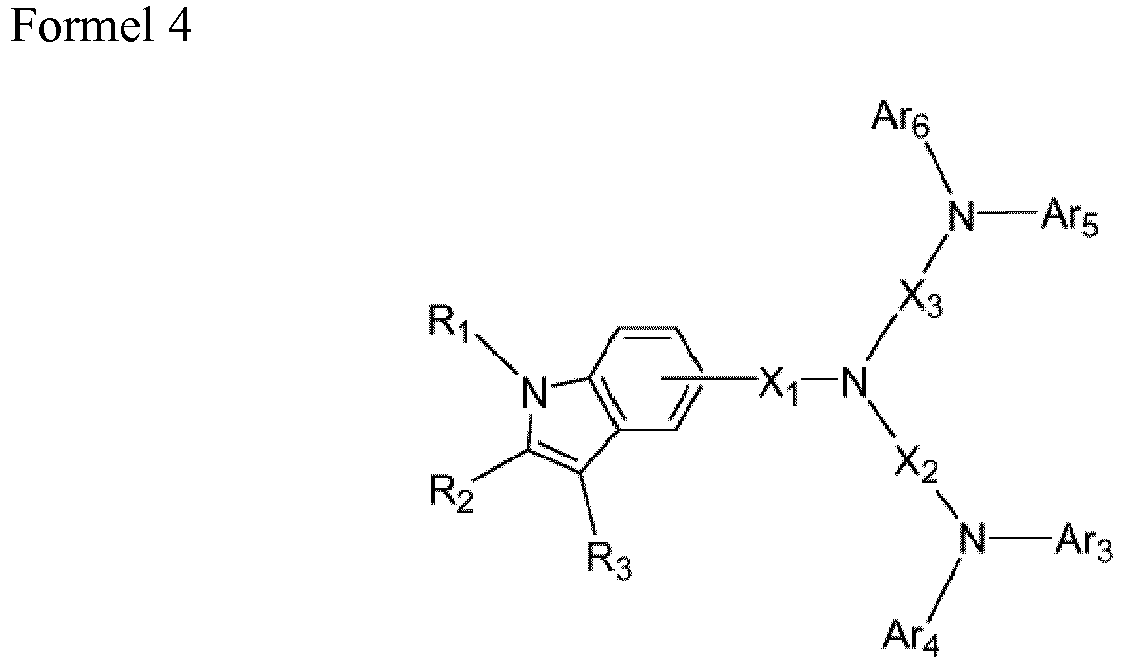
- the heteroarylamine compound of Formula 1 is a compound represented by any of Formulae 2 through 6 below.
- each of Ar 1 through Ar 10 is independently selected from substituted and unsubstituted C 6 -C 60 aryl groups, substituted and unsubstituted C 4 -C 60 heteroaryl groups, and substituted and unsubstituted C 6 -C 60 condensed polycyclic groups.
- Each of X 2 and X 3 is independently selected from substituted and unsubstituted C 6 -C 30 arylene groups, substituted and unsubstituted C 4 -C 30 heteroarylene groups, and substituted and unsubstituted C 6 -C 30 condensed polycyclic groups.
- Each of R 2 and R 3 is independently selected from hydrogen atoms, heavy hydrogen atoms, substituted and unsubstituted C 1 -C 50 alkyl groups, substituted and unsubstituted C 1 -C 50 alkoxy groups, substituted and unsubstituted C 1 -C 50 alkoxycarbonyl groups, substituted and unsubstituted C 6 -C 60 aryl groups, substituted and unsubstituted C 5 -C 50 aryloxy groups, substituted and unsubstituted C 5 -C 50 arylthio groups, amino groups substituted with at least one substituted or unsubstituted C 5 -C 50 aryl group, substituted and unsubstituted C 3 -C 50 carbon rings, substituted and unsubstituted C 4 -C 60 heteroaryl groups, substituted and unsubstituted C 6 -C 60 condensed polycyclic groups, halogen atoms, cyano groups, hydroxyl groups,
- each of Ar 1 through Ar 10 may be independently selected from monocyclic to tricyclic aryl groups.
- suitable monocyclic to tricyclic aryl groups include phenyl groups, naphthyl groups, biphenyl groups, terphenyl groups, fluorenyl groups, and carbazolyl groups.
- the monocyclic to tricyclic aryl group may be substituted with from one to three substituents.
- substituents include C 1 -C 5 alkyl groups, C 1 -C 5 alkoxy groups, cyano groups, amino groups, phenoxy groups, phenyl groups, and halogen atoms.
- Nonlimiting examples of the arylene group represented by X 2 through X 3 include phenylene groups, biphenylene groups, terphenylene groups, quaterphenylene groups, naphthylene groups, anthracenylene groups, phenanthrylene groups, chrysenylene groups, pyrenylene groups, perylenylene groups, and fluorenylene groups.
- the arylene group is selected from phenylene groups, biphenylene groups, naphthylene groups, anthracenyl groups, phenanthrylene groups, and fluorenylene groups.
- Nonlimiting examples of the heteroarylene group represented by X 2 through X 3 include thiophenylene groups, 1-phenylthiophenylene groups, 1,4-diphenylthiophenylene groups, benzothiophenylene groups, 1-phenylbenzothiophenylene groups, 1,8-diphenylbenzothiophenylene groups, furylene groups, 1-phenyldibenzothiophenylene groups, 1,8-diphenylthiophenylene groups, dibenzofuranylene groups, 1-phenyldibenzofuranylene groups, 1,8-diphenyldibenzofuranylene groups, and benzothiazolylene groups.
- the heteroarylene group is selected from 1-phenylthiophenyl groups, 1-phenylbenzothiophenyl groups, 1-phenyldibenzofuranyl groups, and benzothiazolyl groups.
- each of R 1 through R 3 is independently an aryl group.
- each of R 1 through R 3 is independently selected from phenyl groups, 4-fluorophenyl groups, naphthalene groups, and biphenyl groups.
- nonlimiting examples of bivalent organic groups represented by X 1 through X 3 include those represented by the following formulae. Each of X 1 through X 3 may be independently selected from these bivalent organic groups, but are not limited thereto.
- each of Ar 1 through Ar 10 may be independently selected from one of the monovalent organic groups represented by the following formulae.
- the unsubstituted C 1 -C 50 alkyl group may be linear or branched.
- Nonlimiting examples of the alkyl group include methyl groups, ethyl groups, propyl groups, isobutyl groups, sec-butyl groups, pentyl groups, iso-amyl groups, hexyl groups, heptyl groups, octyl groups, nonanyl groups, and dodecyl groups.
- At least one hydrogen atom of the alkyl group may be substituted with a substituent selected from heavy hydrogen atoms, halogen atoms, hydroxyl groups, nitro groups, cyano groups, amino groups, amidino groups, hydrazines, hydrazones, carboxyl groups and salts thereof, sulfonic acid groups and salts thereof, phosphoric acid groups and salts thereof, C 1 -C 10 alkyl groups, C 1 -C 10 alkoxy groups, C 2 -C 10 alkenyl groups, C 2 -C 10 alkynyl groups, C 6 -C 16 aryl groups, and C 4 -C 16 heteroaryl groups.
- a substituent selected from heavy hydrogen atoms, halogen atoms, hydroxyl groups, nitro groups, cyano groups, amino groups, amidino groups, hydrazines, hydrazones, carboxyl groups and salts thereof, sulfonic acid groups and salts thereof, phosphoric acid groups and salt
- the unsubstituted C 3 -C 50 carbon ring refers to a C 3 -C 50 cycloalkyl group where at least one hydrogen atom in the carbon ring may be substituted with the substituents described above in connection with the C 1 -C 50 alkyl group.
- the unsubstituted C 4 -C 60 heterocyclic group refers to a C 4 -C 60 cycloalkyl group including one, two or three hetero atoms selected from N, O, P and S. At least one hydrogen atom in the heterocyclic group may be substituted with the substituents described above in connection with the C 1 -C 50 alkyl group.
- the unsubstituted C 1 -C 50 alkoxy group is a group having a -OA structure where A is an unsubstituted C 1 -C 50 alkyl group as described above.
- the alkoxy group include methoxy groups, ethoxy groups, propoxy groups, isopropyloxy groups, butoxy groups, and pentoxy groups.
- At least one hydrogen atom of the alkoxy group may be substituted with the substituents described above in connection with the C 1 -C 50 alkyl group.
- the unsubstituted C 6 -C 60 aryl group refers to a carbocyclic aromatic system containing at least one ring. At least two rings may be fused to each other or linked to each other by a single bond.
- the term 'aryl' refers to an aromatic system, such as phenyl, naphthyl, or anthracenyl. At least one hydrogen atom in the aryl group may be substituted with the substituents described above in connection with the C 1 -C 50 alkyl group.
- Nonlimiting examples of the substituted or unsubstituted C 6 -C 60 aryl group include phenyl groups, C 1 -C 10 alkylphenyl groups (for example, ethylphenyl groups), halophenyl groups (for example, o-, m-, and p-fluorophenyl groups, dichlorophenyl groups), cyanophenyl groups, dicyanophenyl groups, trifluoromethoxyphenyl groups, biphenyl groups, halobiphenyl groups, cyanobiphenyl groups, C 1 -C 10 alkyl biphenyl groups, C 1 -C 10 alkoxybiphenyl groups, o-, m-, and p-tolyl groups, o-, m-, and p-cumenyl groups, mesityl groups, phenoxyphenyl groups, ( ⁇ , ⁇ -dimethylbenzene)phenyl groups, (N,N'-dimethyl)a
- the unsubstituted C 4 -C 60 heteroaryl group includes one, two or three hetero atoms selected from N, O, P and S. At least two rings may be fused to each other or linked to each other by a single bond.
- Nonlimiting examples of the unsubstituted C 4 -C 60 heteroaryl group include pyrazolyl groups, imidazolyl groups, oxazolyl groups, thiazolyl groups, triazolyl groups, tetrazolyl groups, oxadiazolyl groups, pyridinyl groups, pyridazinyl groups, pyrimidinyl groups, triazinyl groups, carbazolyl groups, indolyl groups, quinolinyl groups, and isoquinolinyl groups.
- At least one hydrogen atom in the heteroaryl group may be substituted with the substituents described above in connection with the C 1 -C 50 alkyl group.
- the unsubstituted C 6 -C 60 condensed polycyclic group refers to a substituent including at least two rings where at least one aromatic ring and/or at least one nonaromatic ring are fused to each other.
- the unsubstituted C 6 -C 60 polycyclic condensed group may include some of the substituents described in connection with the aryl group or the heteroaryl group.
- the heteroarylamine compound of Formula 1 may be used as an organic layer material having at least one of hole-injecting capability, hole-transporting capability, and light-emitting capability.
- the heteroarylamine compound of Formula 1 has a heterocyclic group in the molecule, and therefore has a high glass transition temperature (Tg) or melting point due to the introduction of the heterocyclic group.
- Tg glass transition temperature
- the heteroarylamine compound has high heat resistance against Joule's heat generated in an organic layer, between organic layers, or between an organic layer and a metallic electrode when light emission occurs.
- the heteroarylamine compound also has high durability in a high-temperature environment. An organic light-emitting device manufactured using the heteroarylamine compound therefore has high durability when stored or operated.
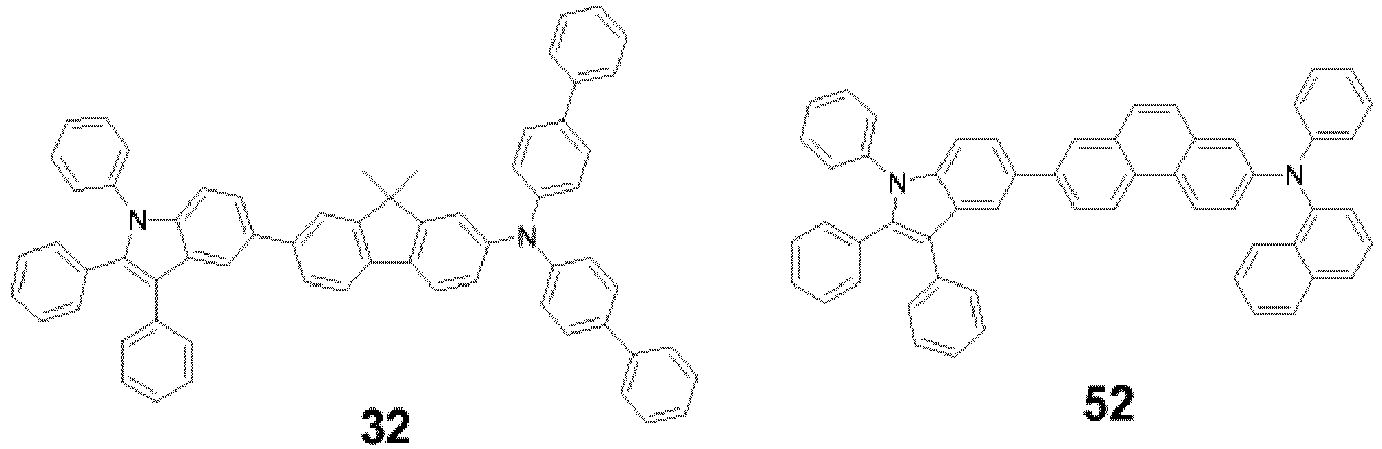
- heteroarylamine compound of Formula 1 include the following Compounds 1-83:
- the heteroarylamine compound of Formula 1 is selected from Compound 1, Compound 2, Compound 8, Compound 29, Compound 32, Compound 52, Compound 58, and Compound 81.
- a method of synthesizing a heteroarylamine compound of Formula 1 is provided. Initially, benzophenone hydrazone, sodium butoxide, palladium diacetate and 2-dicyclohexylphospino-2',4',6'-triisopropylbiphenyl are added to a heteroarylamine compound represented by Formula 7 below. The components are mixed together and heated to obtain a compound represented by Formula 8 below.
- X 1 , Ar 1 , and Ar 2 are as defined above in connection with Formula 1, and Y is a halogen atom selected from bromine, iodine, and chlorine.
- X 1 , Ar 1 , and Ar 2 are as defined above in connection with Formula 1.
- the amount of benzophenone hydrazone may be about 1.05 to about 1.2 moles based on 1 mole of the heteroarylamine compound of Formula 7.
- the amount of sodium butoxide may be about 1.2 to about 1.5 moles based on 1 mole of the heteroarylamine compound of Formula 7.
- the amount of palladium diacetate may be about 0.02 to about 0.05 moles
- the amount of 2-dicyclohexylphospino-2',4',6'-triisopropylbiphenyl may be about 0.02 to about 0.05 moles, based on 1 mole of the heteroarylamine compound of Formula 7.
- the heating may be performed at a temperature of about 80 to about 100°C. When the heating temperature is within this range, a high yield of the compound of Formula 8 may be obtained.
- p-toluenesulfonic acid monohydrate, benzylphenylketone and a solvent are added to the compound of Formula 8, and the components are heated.
- the reaction product is worked up to obtain a heteroarylamine compound of Formula 1.
- the heating for the reaction may be performed at a temperature of about 60 to about 100°C. When the heating temperature is within this range, a high yield of the heteroarylamine compound of Formula 1 may be obtained.
- the amount of p-toluenesulfonic acid monohydrate may be about 1.5 to about 2.0 moles, and the amount of benzylphenylketone may be about 1.5 to about 2.0 moles, based on 1 mole of the compound of Formula 8.
- an organic light-emitting device includes a first electrode, a second electrode, and one or more organic layers between the first electrode and the second electrode.
- the one or more organic layers comprise a hole transport layer containing the heteroarylamine compound of Formula 1 described above.
- the heteroarylamine compound may be used exclusively or may be included in a mixture.
- the at least one organic layer containing the heteroarylamine compound of Formula 1 may include a hole injection layer or a single layer having both hole injection and hole transport capabilities.
- the heteroarylamine compound of Formula 1 may also be present in a hole injection layer.
- the at least one organic layer containing the heteroarylamine compound of Formula 1 may also include an emission layer.
- the heteroarylamine compound of Formula 1 may be used as a host material for a blue, green, or red emission layer of a fluorescent or phosphorescent device.
- the one or more organic layers may include a hole injection layer, a hole transport layer, and an emission layer, wherein the hole transport layer contains the heteroarylamine compound of Formula 1, and the emission layer may contain an anthracene compound.
- the one or more organic layers may include a hole injection layer, a hole transport layer and an emission layer, wherein the hole transport layer contains the heteroarylamine compound of Formula 1, and the emission layer may contain an arylamine or heteroarylamine compound or a styryl compound.
- the first electrode may be an anode, and the second electrode may be a cathode, but the reverse is also possible.
- the organic light-emitting device described above may also include at least one layer selected from a hole injection layer, an electron blocking layer, an emission layer, a hole blocking layer, an electron transport layer and an electron injection layer. These organic layers may have double-layered structures.
- An organic light-emitting device may have a a first electrode/hole injection layer/hole transport layer/emission layer/electron transport layer/second electrode structure, or a first electrode/hole injection layer/hole transport layer/emission layer/electron transport layer/electron injection layer/second electrode structure.
- An organic light-emitting device may have a first electrode/single layer having both hole injection and hole transport capabilities/emission layer/electron transport layer/second electrode structure, or a first electrode/single layer having both hole injection and hole transport capabilities/emission layer/electron transport layer/electron injection layer/second electrode structure.
- An organic light-emitting device may have various structures, such as a top emission type organic light-emitting device structure or a bottom emission type organic light-emitting device structure.
- FIG. 1 illustrates the structure of an organic light-emitting device according to an embodiment of the present invention.
- an organic light-emitting device includes a substrate, a first electrode (anode), a hole injection layer (HIL), a hole transport layer (HTL), an emission layer (EML), an electron transport layer (ETL), an electron injection layer (EIL), and a second electrode (cathode).
- the first electrode is formed on the substrate by deposition or sputtering.
- the first electrode may be formed of a first electrode material having a high work function.
- the first electrode may be an anode or a cathode.
- the substrate may be any substrate conventionally used in organic light-emitting devices, and may be, for example, a glass substrate or a transparent plastic substrate having good mechanical strength, thermal stability, transparency, surface planarity, handling convenience, and water resistance.
- the first electrode material may include at least one material selected from indium tin oxide (ITO), indium zinc oxide (IZO), tin oxide (SnO 2 ), zinc oxide (ZnO), aluminum (AI), silver (Ag), and magnesium (Mg), which have good conductivity, and may form a transparent or reflective electrode.
- a HIL may be formed on the first electrode by vacuum deposition, spin coating, casting, Langmuir Blodgett (LB) deposition, or the like.
- the vacuum deposition conditions may vary according to the compound used to form the HIL and the desired structure and thermal properties of the HIL to be formed.
- the vacuum deposition may be performed at a deposition temperature of about 100°C to about 500 °C, under a pressure of about 10- 8 torr (1.3 x10 -6 Pa) to about 10 -3 torr (0.13 Pa), at a deposition speed of about 0.01 to about 100 ⁇ /sec (10 -6 - 0.01 ⁇ m/sec), and to a layer thickness of about 10 ⁇ (0.001 ⁇ m) to about 5 ⁇ m.
- the coating conditions may vary according to the compound used to form the HIL and the desired structure and thermal properties of the HIL to be formed. In general, however, the coating speed may be about 2000 rpm to about 5000 rpm, and the temperature for heat treatment (performed to remove the solvent after coating) may be about 80°C to about 200°C.
- the HIL material may include the heteroarylamine compound of Formula 1 described above.
- any known HIL material may be used.
- HIL materials include phthalocyanine compounds (such as copper phthalocyanine), star-burst type amine derivatives (such as TCTA, 4,4',4"-tris(3-methylphenylphenylamino)triphenylamine (m-MTDATA), N,N'-di(1-naphthyl)-N,N'-diphenylbenzidine) (NPB), TDATA, and 2-TNATA), polyaniline/dodecylbenzenesulfonic acid (Pani/DBSA), poly(3,4-ethylenedioxythiophene)/poly(4-styrenesulfonate) (PEDOT/PSS), polyaniline/camphor sulfonicacid (Pani/CSA), and (polyaniline)/poly(4-styrenesulfonate) (PANI/PS
- the thickness of the HIL may be about 100 to about 10,000 ⁇ (0.01 - 1 ⁇ m). In some embodiments, for example, the thickness of the HIL is about 100 to about 1,000 ⁇ (0.01 - 0.1 ⁇ m). When the HIL has a thickness within these ranges, the HIL has good hole injection characteristics without increasing driving voltage.
- An HTL may be formed on the HIL by vacuum deposition, spin coating, casting, LB deposition, or the like.
- the conditions for deposition and coating are similar to those for the formation of the HIL, although the conditions for the deposition and coating may vary according to the material used to form the HTL.
- the HTL material includes the heteroarylamine compound of Formula 1 described above.
- suitable materials to also to be used for the HTL include carbazole derivatives (such as N-phenylcarbazole and polyvinylcarbazole), and amine derivatives having condensed aromatic rings (such as 4,4'-bis[N-(1-naphthyl)-N-phenylamino]biphenyl (NPB), N,N'-bis(3-methylphenyl)-N,N'-diphenyl-[1,1-biphenyl]-4,4'-diamine (TPD)).
- carbazole derivatives such as N-phenylcarbazole and polyvinylcarbazole
- amine derivatives having condensed aromatic rings such as 4,4'-bis[N-(1-naphthyl)-N-phenylamino]biphenyl (NPB), N,N'-bis(3-methylphenyl)-N,N'
- the thickness of the HTL may be about 50 to about 1,000 ⁇ (0.005 - 0.1 ⁇ m ). In some embodiments, for example, the thickness of the HTL is about 100 to about 600 ⁇ (0.01 - 0.06 ⁇ m). When the HTL has a thickness within these ranges, the HTL has good hole transporting characteristics without substantially increasing driving voltage.
- an electron blocking layer may be formed on the HTL.
- the electron blocking layer blocks migration of electrons into the HTL.
- the electron blocking layer may include, for example, TATT represented by the following formula:
- the thickness of the electron blocking layer may be about 50 to about 200 ⁇ (0.005 - 0.02 ⁇ m). When the electron blocking layer has a thickness within this range, the electron blocking layer has good electron blocking characteristics without substantially increasing driving voltage.
- the EML is formed on the resultant structure.
- the EML may be formed by vacuum deposition, spin coating, casting, or LB deposition.
- the conditions for deposition and coating are similar to those for the formation of the HIL, although the conditions for deposition and coating may vary according to the material used to form the EML.
- the EML may include the heteroarylamine compound of Formula 1.
- the heteroarylamine compound of Formula 1 may be used as a host of the EML.
- the EML of the organic light-emitting device may be formed of any suitable light-emitting material for forming the EML of an organic light-emitting device.
- suitable light-emitting materials for forming the EML include known hosts and dopants.
- Dopants used to form the EML may include either a fluorescent dopant or a phosphorescent dopant.
- Nonlimiting examples of hosts include Alq 3 , 4,4'-N,N'-dicarbazole-biphenyl (CPB), 9,10-di(naphthalene-2-yl)anthracene (ADN), distyrylarylene (DSA), arylamine and heteroarylamine compounds, anthracene compounds having symmetrical or asymmetrical structures, pyrene compounds having symmetrical or asymmetrical structures, spirofluorene compounds, and fluorene compounds.
- CPB 4,4'-N,N'-dicarbazole-biphenyl
- ADN 9,10-di(naphthalene-2-yl)anthracene
- DSA distyrylarylene
- arylamine and heteroarylamine compounds anthracene compounds having symmetrical or asymmetrical structures
- pyrene compounds having symmetrical or asymmetrical structures
- spirofluorene compounds and fluorene compounds.
- Either a fluorescent dopant or a phosphorescent dopant may be used as a dopant for forming the EML.
- the fluorescent dopant include styryl compounds, arylamine or heteroarylamine compounds, styrylheteroarylamine compounds, and aminopyrene compounds.
- Ir iridium
- Ru ruthenium
- Pd palladium
- platinum Pt
- Os osmium
- Re rhenium
- red dopants include platinum(II) octaethylporphyrin (PtOEP), Ir(piq) 3 , Btp 2 Ir(acac), and DCJTB.
- Nonlimiting examples of green dopants include Ir(ppy) 3 (where "ppy” denotes phenylpyridine), Ir(ppy) 2 (acac), Ir(mpyp) 3 , and C545T.
- Nonlimiting examples of blue dopants include F 2 Irpic, (F 2 ppy) 2 Ir(tmd), Ir(dfppz) 3 , ter-fluorene, 4,4'-bis(4-diphenylaminostyryl)biphenyl (DPAVBi), and 2,5,8,11-tetra-t-butyl pherylene (TBP).
- the amount of the dopant may be about 0.1 to about 20 parts by weight based on 100 parts by weight of the EML material, which is the total weight of the host and dopant. In some embodiments, for example, the amount of the dopant is about 0.5 to about 12 parts by weight based on 100 parts by weight of the EML material. When the amount of the dopant is within these ranges, concentration quenching may be substantially prevented.
- the thickness of the EML may be about 100 to about 1000 ⁇ (0.01 - 0.1 ⁇ m ). In some embodiments, for example, the thickness of the EML is about 200 to about 600 ⁇ (0.02 - 0.06 ⁇ m). When the thickness of the EML is within these ranges, good light emission characteristics may be obtained without increasing driving voltage.
- a hole blocking layer (HBL, not shown in FIG. 1 ) may be formed on the EML in order to prevent diffusion of triplet excitons or holes into the ETL.
- the HBL may be formed of any suitable material without limitation.
- suitable materials for the HBL include oxadiazole derivatives, triazole derivatives, phenanthroline derivatives, bis(2-methyl-8-quinolato)-(p-phenylphenolato)-aluminum (Balq), bathocuproine (BCP), and tris(N-arylbenzimidazole) (TPBI).
- the thickness of the H BL may be about 50 to about 1000 ⁇ (0.005 - 0.1 ⁇ m). In some embodiments, for example, the thickness of the HBL is about 100 to about 300 ⁇ (0.01 - 0.03 ⁇ m). When the thickness of the HBL is within these ranges, good hole-blocking characteristics may be obtained without increasing driving voltage.
- the ETL may be formed on the HBL or EML by vacuum deposition, spin coating, or casting.
- the deposition and coating conditions may be similar to those for formation of the HIL, although the deposition and coating conditions may vary according to the compound used to form the ETL.
- the ETL may be formed of any suitable material without limitation.
- suitable materials for the ETL include quinoline derivatives, for example, tris(8-quinolinorate)aluminum (Alq3), TAZ, and Balq.
- the thickness of the ETL may be about 100 to about 1000 ⁇ (0.01 - 0.1 ⁇ m). In some embodiments, for example, the thickness of the ETL is about 100 to about 500 ⁇ (0.01 - 0.05 ⁇ m). When the ETL has a thickness within these ranges, the ETL may have good electron transport characteristics without substantially increasing driving voltage.
- an electron injection layer for facilitating the injection of electrons from the cathode may be formed on the ETL.
- EIL electron injection layer
- Nonlimiting examples of materials for the EIL include BaF 2 , LiF, NaCl, CsF, Li 2 O, BaO, and Liq.
- the deposition or coating conditions used to form the EIL may be similar to those used to form the HIL, although the deposition and coating conditions may vary according to the material used to form the EIL.
- the thickness of the EIL may be about 1 to about 100 ⁇ (0.0001 - 0.01 ⁇ m). In some embodiments, for example, the thickness of the EIL is about 5 to about 90 ⁇ (0.0005 - 0.009 ⁇ m). When the EIL has a thickness within these ranges, the EIL may have good electron injection characteristics without substantially increasing driving voltage.
- the second electrode may be formed on the EIL by vacuum deposition or sputtering.
- the second electrode may be a cathode or an anode.
- the material for forming the second electrode may be selected from metals, alloys, electrically conductive compounds, materials which have a low work function, and mixtures thereof.
- Nonlimiting examples of materials for the second electrode include lithium (Li), magnesium (Mg), aluminum (Al), aluminum-lithium (Al-Li), calcium (Ca), magnesium-indium(Mg-In), and magnesium-silver (Mg-Ag).
- a transparent cathode formed of a transparent material such as ITO or IZO may be used as the second electrode.
- the organic light-emitting device may be included in various types of flat panel display devices, such as in passive matrix organic light-emitting display devices or active matrix organic light-emitting display devices.
- the organic light-emitting device is included in an active matrix organic light-emitting display device including a thin-film transistor
- the first electrode on the substrate may function as a pixel electrode, and be electrically connected to a source electrode or a drain electrode of the thin-film transistor.
- the organic light-emitting device may also be included in a flat panel display device having a double-sided screen.
- At least one layer of the organic light-emitting device may comprise the heteroarylamine compound of Formula 1 and can be formed using a deposition method or a wet method of coating a solution of the heteroarylamine compound of Formula 1.
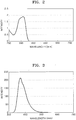
- FIGS. 2 and 3 are graphs showing the absorption and emission spectra of Compound 1, respectively.
- C 48 H 34 N 2 calc.: 638.2722; found: 638.2721; 1 H NMR (CDCl 3 , 400MHz) ⁇ (ppm) 8.69 (d, 1 H), 8.49 (dd, 1 H), 7.85 (dd, 1H), 7.70-7.45 (m, 22H), 7.27 (dd, 2H), 7.12 (dt, 1H), 7.02 (d, 2H), 6.97 (dd, 1H), 6.83 (d, 2H).
- An anode was prepared by cutting a Corning 15 ⁇ cm 2 [1200 A (0.12 ⁇ m)] ITO glass substrate to a size of 50 mm ⁇ 50 mm ⁇ 0.7 mm, ultrasonically cleaning the glass substrate using isopropyl alcohol and pure water for 5 minutes each, and then irradiating with UV light for 30 minutes and exposing to ozone to clean. Then, the anode was mounted in a vacuum deposition apparatus.
- 2-TNATA was vacuum-deposited on the anode to a thickness of 600 ⁇ (0.06 ⁇ m) to form an HIL
- Compound 1 as a hole transporting compound was vacuum-deposited on the HIL to a thickness of 300 ⁇ (0.03 ⁇ m) to form a HTL.
- a green fluorescent host (Alq 3 ) and a green fluorescent dopant (C545T) were co-deposited at a weight ratio of 98:2 on the HTL to form an EML with a thickness of 300 ⁇ (0.03 ⁇ m).
- Alq 3 was deposited on the EML to a thickness of 300 ⁇ (0.03 ⁇ m) to form an ETL, and LiF was deposited to a thickness of 10 ⁇ (0.001 ⁇ m) on the ETL to form an EIL.
- Al was vacuum-deposited on the EIL to a thickness of 3000 ⁇ (0.3 ⁇ m) to form a LiF/Al electrode (cathode), thereby completing the manufacture of an organic light-emitting device.
- An organic light-emitting device was manufactured as in Example 1, except that Compound 2 was used instead of Compound 1 to form the HTL.
- An organic light-emitting device was manufactured as in Example 1, except that Compound 8 was used instead of Compound 1 to form the HTL.
- An organic light-emitting device was manufactured as in Example 1, except that Compound 29 was used instead of Compound 1 to form the HTL.
- An organic light-emitting device was manufactured as in Example 1, except that Compound 32 was used instead of Compound 1 to form the HTL.
- An organic light-emitting device was manufactured as in Example 1, except that Compound 52 was used instead of Compound 1 to form the HTL.
- An organic light-emitting device was manufactured as in Example 1, except that Compound 58 was used instead of Compound 1 to form the HTL.
- An organic light-emitting device was manufactured as in Example 1, except that Compound 81 was used instead of Compound 1 to form the HTL.
- An organic light-emitting device was manufactured in the same manner as in Example 1, except that 4,4'-bis[N-(1-naphthyl)-N-phenylamino]biphenyl (NPB) was used instead of Compound 1 to form the HTL.
- NPB 4,4'-bis[N-(1-naphthyl)-N-phenylamino]biphenyl
- the organic light-emitting device had a driving voltage of 7.45V at a current density of 50 mA/cm, a luminance of 6,102 cd/m 2 , color coordinates of (0.309, 0.642), and a luminescent efficiency of 12.2 cd/A.
- the driving voltage at a current density of 50mA/cm 2 , luminance, color coordinates, and luminescent efficiency of each of the organic light-emitting devices manufactured in Examples 1 through 6 and Comparative Example 1 were measured. The results are shown in Table 1 below.
- the organic light-emitting devices manufactured using the heteroarylamine compounds of Formula 1 according to embodiments of the present invention had driving voltages that were lower by around 1 V or greater than the device in which NPB was used, and thus had higher efficiency and improved I-V-L characteristics.
- the lifetime characteristics were markedly improved by around 100% or greater in the organic light-emitting devices according to Examples 1 through 8, as compared to the organic light-emitting device according to Comparative Example 1.
- the organic light-emitting devices according to Examples 1 through 8 had longer half life-spans than the organic light-emitting device according to Comparative Example 1.
- the heteroarylamine compounds of Formula 1 have improved electrical characteristics and charge transporting capabilities, and thus are used as at least a hole transporting material and optionally for one of a hole injecting material and a material for emission layers. These materials are suitable for any color fluorescent and phosphorescent devices, such as red, green, blue, and white fluorescent and phosphorescent devices.
- Organic light-emitting devices including organic layers containing the heteroarylamine compound of Formula 1 have high efficiency, low driving voltages, and high luminance.
Landscapes
- Chemical & Material Sciences (AREA)
- Organic Chemistry (AREA)
- Engineering & Computer Science (AREA)
- Materials Engineering (AREA)
- Electroluminescent Light Sources (AREA)
- Indole Compounds (AREA)
Claims (13)
- Organisches lichtemittierendes Bauelement, umfassend eine erste Elektrode, eine zweite Elektrode und eine oder mehrere organische Schichten zwischen der ersten Elektrode und der zweiten Elektrode, worin die eine oder die mehreren organischen Schichten eine Löchertransportschicht umfassen, die eine Verbindung umfassen, die durch nachstehende Formel 1 dargestellt wird:
 jedes von Ar1 und Ar2 unabhängig aus der Gruppe ausgewählt ist, die aus Folgendem besteht: substituierte und nicht substituierte C6-C60-Arylgruppen, substituierte und nicht substituierte C4-C60-Heteroarylgruppen, und substituierte und nicht substituierte kondensierte polyzyklische C6-C60-Gruppen;X1 unabhängig aus der Gruppe ausgewählt ist, die aus Folgendem besteht: substituierte und nicht substituierte Phenylengruppen, Naphthylengruppen, Phenanthrylengruppen, Chrysenylengruppen, Pyrenylengruppen, Perylenylengruppen and Fluorenylengruppen;R1 eine substituierte oder nicht substituierte C6-C60-Arylgruppe ist; undjedes von R2 und R3 unabhängig aus der Gruppe ausgewählt ist, die aus Folgendem besteht: Wasserstoffatome, Schwerwasserstoffatome, substituierte und nicht substituierte C1-C50-Alkylgruppen, substituierte und nicht substituierte C1-C50-Alkoxygruppen, substituierte und nicht substituierte C1-C50-Alkoxycarbonylgruppen, substituierte und nicht substituierte C6-C60-Arylgruppen, substituierte und nicht substituierte C5-C50-Aryloxygruppen, substituierte und nicht substituierte C5-C50-Arylthiogruppen, mit mindestens einer substituierten oder nicht substituierten C5-C50-Arylgruppe substituierte Aminogruppen, substituierte und nicht substituierte C3-C50-Kohlenstoffringe, substituierte und nicht substituierte C4-C60-Heteroarylgruppen, substituierte und nicht substituierte kondensierte polyzyklische C6-C60-Gruppen, Halogenatome, Cyanogruppen, Hydroxylgruppen und Carboxylgruppen.
 - Organisches lichtemittierendes Bauelement nach Anspruch 1, worin die durch Formel 1 dargestellte Verbindung eine Verbindung ist, die aus der Gruppe ausgewählt ist, die aus Verbindungen besteht, die durch nachstehende Formeln 2 bis 6 dargestellt werden:



 jedes von Ar1 bis Ar10 unabhängig aus der Gruppe ausgewählt ist, die aus Folgendem besteht: substituierte und nicht substituierte C6-C60-Arylgruppen, substituierte und nicht substituierte C4-C60-Heteroarylgruppen, und substituierte und nicht substituierte kondensierte polyzyklische C6-C60-Gruppen;jedes von X2 und X3 unabhängig aus der Gruppe ausgewählt ist, die aus Folgendem besteht: substituierte und nicht substituierte C6-C30-Arylengruppen, substituierte und nicht substituierte C4-C30-Heteroarylengruppen, und substituierte und nicht substituierte kondensierte polyzyklische C6-C30-Gruppen;R1 eine substituierte oder nicht substituierte C6-C6-Arylgruppe ist; undjedes von R2 und R3 unabhängig aus der Gruppe ausgewählt ist, die aus Folgendem besteht: Wasserstoffatome, Schwerwasserstoffatome, substituierte und nicht substituierte C1-C50-Alkylgruppen, substituierte und nicht substituierte C1-C50-Alkoxygruppen, substituierte und nicht substituierte C1-C50-Alkoxycarbonylgruppen, substituierte und nicht substituierte C6-C60-Arylgruppen, substituierte und nicht substituierte C5-C50-Aryloxygruppen, substituierte und nicht substituierte C5-C50-Arylthiogruppen, mit mindestens einer substituierten oder nicht substituierten C5-C50-Arylgruppe substituierte Aminogruppen, substituierte und nicht substituierte C3-C50-Kohlenstoffringe, substituierte und nicht substituierte C4-C60-Heteroarylgruppen, substituierte und nicht substituierte kondensierte polyzyklische C6-C60-Gruppen, Halogenatome, Cyanogruppen, Hydroxylgruppen und Carboxylgruppen.
 - Organisches lichtemittierendes Bauelement nach Anspruch 2, worin jedes von X2 und X3 unabhängig aus der Gruppe ausgewählt ist, die aus Folgendem besteht: substituierte und nicht substituierte Phenylengruppen, Biphenylengruppen, Terphenylengruppen, Quaterphenylengruppen, Naphthylengruppen, Anthracenylengruppen, Phenanthrylengruppen, Chrysenylengruppen, Pyrenylengruppen, Perylenylengruppen, Fluorenylengruppen, Thiophenylengruppen, 1-Phenylthiophenylengruppen, 1,4-Diphenylthiophenylengruppen, Benzothiophenylengruppen, 1-Phenylbenzothiophenylengruppen, 1,8-Diphenylbenzothiophenylengruppen, Furylengruppen, 1-Phenyldibenzothiophenylengruppen, 1,8-Diphenylthiophenylengruppen, Dibenzofuranylengruppen, 1-Phenyldibenzofuranylengruppen, 1,8-Diphenyldibenzofuranylengruppen, und Benzothiazolylengruppen.
- Organisches lichtemittierendes Bauelement nach einem der Ansprüche 1 bis 3, worin jedes von Ar1 bis Ar10 unabhängig aus der Gruppe ausgewählt ist, die aus Folgendem besteht:monozyklische bis trizyklische Arylgruppen, die aus der Gruppe ausgewählt sind, die aus Folgendem besteht: Phenylgruppen, Naphthylgruppen, Biphenylgruppen, Terphenylgruppen, Fluorenylgruppen, und Carbazolylgruppen, unddie monozyklischen bis trizyklischen Arylgruppen, die mit einem bis drei Substituenten substituiert sind, die aus der Gruppe ausgewählt sind, die aus Folgendem besteht: C1-C5-Alkylgruppen, C1-C5-Alkoxygruppen, Cyanogruppen, Aminogruppen, Phenoxygruppen, Phenylgruppen, und Halogenatome.
- Organisches lichtemittierendes Bauelement nach einem der Ansprüche 1, 2 und 4, worin jedes von X1 bis X3 unabhängig aus der Gruppe ausgewählt ist, die aus Folgendem besteht:


- Organisches lichtemittierendes Bauelement nach einem der Ansprüche 1 bis 3 und 5, worin jedes von Ar1 bis Ar10 unabhängig aus der Gruppe ausgewählt ist, die aus Folgendem besteht:



- Organisches lichtemittierendes Bauelement nach einem der vorhergehenden Ansprüche, worin jedes von R1 bis R3 unabhängig aus der Gruppe ausgewählt ist, die aus Folgendem besteht: Phenylgruppen, 4-Fluorophenylgruppen, Naphthalengruppen, und Biphenylgruppen.
- Organisches lichtemittierendes Bauelement nach Anspruch 1, worin die durch Formel 1 dargestellte Verbindung eine Verbindung ist, die aus der Gruppe ausgewählt ist, die aus den Verbindungen 1, 2, 8, 29, 32, 52, 58 und 81 besteht:



- Organisches lichtemittierendes Bauelement nach einem der Ansprüche 1 bis 8, worin die eine oder die mehreren organischen Schichten eine Löcherinjektionsschicht, eine Löchertransportschicht und eine Emissionsschicht umfassen, worin die Emissionsschicht eine Anthracenverbindung, eine Arylaminverbindung, eine Heteroarylaminverbindung oder eine Styrylverbindung umfasst.
- Organisches lichtemittierendes Bauelement nach einem der Ansprüche 1 bis 8, worin die eine oder die mehreren organischen Schichten eine Löcherinjektionsschicht, eine Löchertransportschicht und eine Emissionsschicht umfassen, worin die Emissionsschicht eine Rot-Emissionsschicht, eine Grün-Emissionsschicht, eine Blau-Emissionsschicht und eine Weiß-Emissionsschicht umfasst, wobei mindestens eine der Rot-Emissionsschicht, der Grün-Emissionsschicht, der Blau-Emissionsschicht und der Weiß-Emissionsschicht eine phosphoreszierende Verbindung umfasst.
- Organisches lichtemittierendes Bauelement nach einem der Ansprüche 1 bis 8, worin das organische lichtemittierende Bauelement eine Struktur erste Elektrode / Löcherinjektionsschicht / Löchertransportschicht / Emissionsschicht / Elektronentransportschicht / zweite Elektrode oder eine Struktur erste Elektrode / Löcherinjektionsschicht / Löchertransportschicht / Emissionsschicht / Elektronentransportschicht / Elektroneninjektionsschicht / zweite Elektrode umfasst.
- Flachbildschirmanzeigevorrichtung, umfassend das organische lichtemittierende Bauelement nach einem der Ansprüche 1 bis 11, worin die erste Elektrode des organischen lichtemittierenden Bauelements mit einer Source-Elektrode oder einer Drain-Elektrode eines Dünnschichttransistors elektrisch verbunden ist.
- Organisches lichtemittierendes Bauelement nach einem der Ansprüche 1 bis 11, wobei die mindestens eine organische Schicht die Heteroarylaminverbindung umfasst, die unter Verwendung eines Nassverfahrens ausgebildet worden ist.
Applications Claiming Priority (1)
| Application Number | Priority Date | Filing Date | Title |
|---|---|---|---|
| KR1020090080701A KR101137384B1 (ko) | 2009-08-28 | 2009-08-28 | 헤테로아릴아민 화합물 및 이를 이용한 유기 발광 소자 |
Publications (2)
| Publication Number | Publication Date |
|---|---|
| EP2298737A1 EP2298737A1 (de) | 2011-03-23 |
| EP2298737B1 true EP2298737B1 (de) | 2017-05-10 |
Family
ID=43596930
Family Applications (1)
| Application Number | Title | Priority Date | Filing Date |
|---|---|---|---|
| EP10251513.7A Active EP2298737B1 (de) | 2009-08-28 | 2010-08-27 | Indolverbindungen und sie enthaltende organische lichtemittierende Vorrichtung |
Country Status (5)
| Country | Link |
|---|---|
| US (1) | US8283057B2 (de) |
| EP (1) | EP2298737B1 (de) |
| JP (1) | JP5343044B2 (de) |
| KR (1) | KR101137384B1 (de) |
| CN (1) | CN102001987B (de) |
Families Citing this family (10)
| Publication number | Priority date | Publication date | Assignee | Title |
|---|---|---|---|---|
| KR101560028B1 (ko) * | 2011-01-17 | 2015-10-15 | 주식회사 엘지화학 | 새로운 헤테로고리 화합물 및 이를 이용한 유기 발광 소자 |
| KR101129241B1 (ko) * | 2011-07-13 | 2012-03-22 | 덕산하이메탈(주) | 유기전기소자용 신규 화합물, 이를 이용하는 유기전기소자 및 그 단말 |
| US9403795B2 (en) * | 2011-08-05 | 2016-08-02 | Samsung Display Co., Ltd. | Carbazole-based compound and organic light-emitting diode comprising the same |
| CN102516089A (zh) * | 2011-10-28 | 2012-06-27 | 黑龙江省科学院石油化学研究院 | 一种9,9-二甲基-2-(n-联苯基)-氨基芴的合成方法 |
| KR101821256B1 (ko) * | 2011-11-03 | 2018-01-24 | 삼성디스플레이 주식회사 | 헤테로고리 화합물 및 이를 포함하는 유기 전계 발광 소자 |
| US9768391B2 (en) | 2012-07-23 | 2017-09-19 | Merck Patent Gmbh | Derivatives of 2-diarylaminofluorene and organic electronic compounds containing them |
| KR20140142088A (ko) | 2013-06-03 | 2014-12-11 | 삼성디스플레이 주식회사 | 아릴 아민계 화합물 및 이를 포함한 유기 발광 소자 |
| KR102092706B1 (ko) * | 2013-09-02 | 2020-04-16 | 삼성디스플레이 주식회사 | 조성물, 상기 조성물을 포함하는 유기 발광 표시 장치 및 상기 유기 발광 표시 장치의 제조 방법 |
| WO2018089181A1 (en) * | 2016-11-11 | 2018-05-17 | Dow Global Technologies Llc | Organic indolyl triarylamine compounds and electronic devices comprising an organic layer containing such compounds |
| CN113024510B (zh) * | 2019-12-25 | 2024-05-31 | 北京鼎材科技有限公司 | 一种吲哚衍生物及其应用 |
Family Cites Families (14)
| Publication number | Priority date | Publication date | Assignee | Title |
|---|---|---|---|---|
| JPH05323634A (ja) * | 1992-05-26 | 1993-12-07 | Konica Corp | 電子写真感光体 |
| JP4088985B2 (ja) * | 1997-05-09 | 2008-05-21 | コニカミノルタホールディングス株式会社 | 新規アミノ化合物を使用した有機エレクトロルミネセンス素子 |
| US6465115B2 (en) * | 1998-12-09 | 2002-10-15 | Eastman Kodak Company | Electroluminescent device with anthracene derivatives hole transport layer |
| EP1009043A3 (de) | 1998-12-09 | 2002-07-03 | Eastman Kodak Company | Elektrolumineszente Vorrichtung mit Polyphenyl-Kohlenwasserstoff Ladungslöchertransportschicht |
| JP2002148835A (ja) * | 2000-11-15 | 2002-05-22 | Sharp Corp | 電子写真感光体およびこれを用いた画像形成装置 |
| JP4392206B2 (ja) * | 2003-07-30 | 2009-12-24 | 三井化学株式会社 | アントラセン化合物、および該アントラセン化合物を含有する有機電界発光素子 |
| JP4843897B2 (ja) | 2003-09-16 | 2011-12-21 | コニカミノルタホールディングス株式会社 | 有機エレクトロルミネッセンス素子、表示装置及び照明装置 |
| KR101356654B1 (ko) * | 2005-09-23 | 2014-02-05 | 삼성디스플레이 주식회사 | 유기 발광 화합물 및 이를 구비한 유기 발광 소자 |
| US7901793B2 (en) * | 2005-09-23 | 2011-03-08 | Samsung Mobile Display Co., Ltd. | Organic light-emitting compound and organic light-emitting device containing the same |
| KR101551591B1 (ko) | 2006-04-26 | 2015-09-08 | 이데미쓰 고산 가부시키가이샤 | 방향족 아민 유도체 및 그들을 이용한 유기 전기 발광 소자 |
| KR101347519B1 (ko) * | 2006-11-24 | 2014-01-03 | 이데미쓰 고산 가부시키가이샤 | 방향족 아민 유도체 및 그것을 이용한 유기 전기발광 소자 |
| JP5282260B2 (ja) * | 2006-11-27 | 2013-09-04 | ユー・ディー・シー アイルランド リミテッド | 有機電界発光素子 |
| JP2008133225A (ja) * | 2006-11-29 | 2008-06-12 | Toyo Ink Mfg Co Ltd | インドール誘導体およびその用途 |
| KR101022649B1 (ko) * | 2008-08-07 | 2011-03-22 | 삼성모바일디스플레이주식회사 | 헤테로고리 화합물 및 이를 이용한 유기 전계 발광 장치 |
-
2009
- 2009-08-28 KR KR1020090080701A patent/KR101137384B1/ko not_active Expired - Fee Related
-
2010
- 2010-07-06 US US12/830,646 patent/US8283057B2/en active Active
- 2010-07-06 JP JP2010153806A patent/JP5343044B2/ja active Active
- 2010-08-26 CN CN2010102645084A patent/CN102001987B/zh active Active
- 2010-08-27 EP EP10251513.7A patent/EP2298737B1/de active Active
Also Published As
| Publication number | Publication date |
|---|---|
| JP2011046689A (ja) | 2011-03-10 |
| CN102001987B (zh) | 2013-05-22 |
| KR20110023088A (ko) | 2011-03-08 |
| EP2298737A1 (de) | 2011-03-23 |
| US8283057B2 (en) | 2012-10-09 |
| JP5343044B2 (ja) | 2013-11-13 |
| US20110049484A1 (en) | 2011-03-03 |
| CN102001987A (zh) | 2011-04-06 |
| KR101137384B1 (ko) | 2012-04-20 |
Similar Documents
| Publication | Publication Date | Title |
|---|---|---|
| EP2298740B1 (de) | 1-H-benzo[g]indol- Verbindungen und sie enthaltende organische lichtemittierende Vorrichtung | |
| EP2292602B1 (de) | Auf Phenaleno[1,9-fg]indol basierende organische lichtemittierende Vorrichtung | |
| JP4589223B2 (ja) | フェニルカルバゾール系化合物とその製造方法及び有機電界発光素子 | |
| EP2298737B1 (de) | Indolverbindungen und sie enthaltende organische lichtemittierende Vorrichtung | |
| JP5211104B2 (ja) | 有機発光素子 | |
| JP5258846B2 (ja) | 有機発光素子 | |
| JP5588789B2 (ja) | ヘテロアリールアミン化合物及びそれを用いた有機発光素子 | |
| EP2293650B1 (de) | Dipyrrolo[a,h]pyrenes für organische Licht-emittierende Vorrichtungen | |
| EP2298771B1 (de) | Organische lichtemittierende Vorrichtung | |
| JP5216823B2 (ja) | ヘテロ環化合物及び有機発光素子 |
Legal Events
| Date | Code | Title | Description |
|---|---|---|---|
| PUAI | Public reference made under article 153(3) epc to a published international application that has entered the european phase |
Free format text: ORIGINAL CODE: 0009012 |
|
| AK | Designated contracting states |
Kind code of ref document: A1 Designated state(s): AL AT BE BG CH CY CZ DE DK EE ES FI FR GB GR HR HU IE IS IT LI LT LU LV MC MK MT NL NO PL PT RO SE SI SK SM TR |
|
| AX | Request for extension of the european patent |
Extension state: BA ME RS |
|
| 17P | Request for examination filed |
Effective date: 20110923 |
|
| RAP1 | Party data changed (applicant data changed or rights of an application transferred) |
Owner name: SAMSUNG DISPLAY CO., LTD. |
|
| 17Q | First examination report despatched |
Effective date: 20140205 |
|
| RAP1 | Party data changed (applicant data changed or rights of an application transferred) |
Owner name: SAMSUNG DISPLAY CO., LTD. |
|
| GRAP | Despatch of communication of intention to grant a patent |
Free format text: ORIGINAL CODE: EPIDOSNIGR1 |
|
| INTG | Intention to grant announced |
Effective date: 20161124 |
|
| GRAS | Grant fee paid |
Free format text: ORIGINAL CODE: EPIDOSNIGR3 |
|
| GRAA | (expected) grant |
Free format text: ORIGINAL CODE: 0009210 |
|
| AK | Designated contracting states |
Kind code of ref document: B1 Designated state(s): AL AT BE BG CH CY CZ DE DK EE ES FI FR GB GR HR HU IE IS IT LI LT LU LV MC MK MT NL NO PL PT RO SE SI SK SM TR |
|
| REG | Reference to a national code |
Ref country code: GB Ref legal event code: FG4D |
|
| REG | Reference to a national code |
Ref country code: AT Ref legal event code: REF Ref document number: 892164 Country of ref document: AT Kind code of ref document: T Effective date: 20170515 Ref country code: CH Ref legal event code: EP |
|
| REG | Reference to a national code |
Ref country code: IE Ref legal event code: FG4D |
|
| REG | Reference to a national code |
Ref country code: DE Ref legal event code: R096 Ref document number: 602010042205 Country of ref document: DE |
|
| REG | Reference to a national code |
Ref country code: FR Ref legal event code: PLFP Year of fee payment: 8 |
|
| REG | Reference to a national code |
Ref country code: NL Ref legal event code: MP Effective date: 20170510 |
|
| REG | Reference to a national code |
Ref country code: LT Ref legal event code: MG4D |
|
| REG | Reference to a national code |
Ref country code: AT Ref legal event code: MK05 Ref document number: 892164 Country of ref document: AT Kind code of ref document: T Effective date: 20170510 |
|
| PG25 | Lapsed in a contracting state [announced via postgrant information from national office to epo] |
Ref country code: LT Free format text: LAPSE BECAUSE OF FAILURE TO SUBMIT A TRANSLATION OF THE DESCRIPTION OR TO PAY THE FEE WITHIN THE PRESCRIBED TIME-LIMIT Effective date: 20170510 Ref country code: ES Free format text: LAPSE BECAUSE OF FAILURE TO SUBMIT A TRANSLATION OF THE DESCRIPTION OR TO PAY THE FEE WITHIN THE PRESCRIBED TIME-LIMIT Effective date: 20170510 Ref country code: AT Free format text: LAPSE BECAUSE OF FAILURE TO SUBMIT A TRANSLATION OF THE DESCRIPTION OR TO PAY THE FEE WITHIN THE PRESCRIBED TIME-LIMIT Effective date: 20170510 Ref country code: HR Free format text: LAPSE BECAUSE OF FAILURE TO SUBMIT A TRANSLATION OF THE DESCRIPTION OR TO PAY THE FEE WITHIN THE PRESCRIBED TIME-LIMIT Effective date: 20170510 Ref country code: NO Free format text: LAPSE BECAUSE OF FAILURE TO SUBMIT A TRANSLATION OF THE DESCRIPTION OR TO PAY THE FEE WITHIN THE PRESCRIBED TIME-LIMIT Effective date: 20170810 Ref country code: GR Free format text: LAPSE BECAUSE OF FAILURE TO SUBMIT A TRANSLATION OF THE DESCRIPTION OR TO PAY THE FEE WITHIN THE PRESCRIBED TIME-LIMIT Effective date: 20170811 Ref country code: FI Free format text: LAPSE BECAUSE OF FAILURE TO SUBMIT A TRANSLATION OF THE DESCRIPTION OR TO PAY THE FEE WITHIN THE PRESCRIBED TIME-LIMIT Effective date: 20170510 |
|
| PG25 | Lapsed in a contracting state [announced via postgrant information from national office to epo] |
Ref country code: LV Free format text: LAPSE BECAUSE OF FAILURE TO SUBMIT A TRANSLATION OF THE DESCRIPTION OR TO PAY THE FEE WITHIN THE PRESCRIBED TIME-LIMIT Effective date: 20170510 Ref country code: BG Free format text: LAPSE BECAUSE OF FAILURE TO SUBMIT A TRANSLATION OF THE DESCRIPTION OR TO PAY THE FEE WITHIN THE PRESCRIBED TIME-LIMIT Effective date: 20170810 Ref country code: NL Free format text: LAPSE BECAUSE OF FAILURE TO SUBMIT A TRANSLATION OF THE DESCRIPTION OR TO PAY THE FEE WITHIN THE PRESCRIBED TIME-LIMIT Effective date: 20170510 Ref country code: IS Free format text: LAPSE BECAUSE OF FAILURE TO SUBMIT A TRANSLATION OF THE DESCRIPTION OR TO PAY THE FEE WITHIN THE PRESCRIBED TIME-LIMIT Effective date: 20170910 Ref country code: SE Free format text: LAPSE BECAUSE OF FAILURE TO SUBMIT A TRANSLATION OF THE DESCRIPTION OR TO PAY THE FEE WITHIN THE PRESCRIBED TIME-LIMIT Effective date: 20170510 Ref country code: PL Free format text: LAPSE BECAUSE OF FAILURE TO SUBMIT A TRANSLATION OF THE DESCRIPTION OR TO PAY THE FEE WITHIN THE PRESCRIBED TIME-LIMIT Effective date: 20170510 |
|
| PG25 | Lapsed in a contracting state [announced via postgrant information from national office to epo] |
Ref country code: EE Free format text: LAPSE BECAUSE OF FAILURE TO SUBMIT A TRANSLATION OF THE DESCRIPTION OR TO PAY THE FEE WITHIN THE PRESCRIBED TIME-LIMIT Effective date: 20170510 Ref country code: SK Free format text: LAPSE BECAUSE OF FAILURE TO SUBMIT A TRANSLATION OF THE DESCRIPTION OR TO PAY THE FEE WITHIN THE PRESCRIBED TIME-LIMIT Effective date: 20170510 Ref country code: CZ Free format text: LAPSE BECAUSE OF FAILURE TO SUBMIT A TRANSLATION OF THE DESCRIPTION OR TO PAY THE FEE WITHIN THE PRESCRIBED TIME-LIMIT Effective date: 20170510 Ref country code: DK Free format text: LAPSE BECAUSE OF FAILURE TO SUBMIT A TRANSLATION OF THE DESCRIPTION OR TO PAY THE FEE WITHIN THE PRESCRIBED TIME-LIMIT Effective date: 20170510 Ref country code: RO Free format text: LAPSE BECAUSE OF FAILURE TO SUBMIT A TRANSLATION OF THE DESCRIPTION OR TO PAY THE FEE WITHIN THE PRESCRIBED TIME-LIMIT Effective date: 20170510 |
|
| REG | Reference to a national code |
Ref country code: DE Ref legal event code: R097 Ref document number: 602010042205 Country of ref document: DE |
|
| PG25 | Lapsed in a contracting state [announced via postgrant information from national office to epo] |
Ref country code: IT Free format text: LAPSE BECAUSE OF FAILURE TO SUBMIT A TRANSLATION OF THE DESCRIPTION OR TO PAY THE FEE WITHIN THE PRESCRIBED TIME-LIMIT Effective date: 20170510 Ref country code: SM Free format text: LAPSE BECAUSE OF FAILURE TO SUBMIT A TRANSLATION OF THE DESCRIPTION OR TO PAY THE FEE WITHIN THE PRESCRIBED TIME-LIMIT Effective date: 20170510 |
|
| PLBE | No opposition filed within time limit |
Free format text: ORIGINAL CODE: 0009261 |
|
| STAA | Information on the status of an ep patent application or granted ep patent |
Free format text: STATUS: NO OPPOSITION FILED WITHIN TIME LIMIT |
|
| REG | Reference to a national code |
Ref country code: CH Ref legal event code: PL |
|
| PG25 | Lapsed in a contracting state [announced via postgrant information from national office to epo] |
Ref country code: MC Free format text: LAPSE BECAUSE OF FAILURE TO SUBMIT A TRANSLATION OF THE DESCRIPTION OR TO PAY THE FEE WITHIN THE PRESCRIBED TIME-LIMIT Effective date: 20170510 |
|
| 26N | No opposition filed |
Effective date: 20180213 |
|
| PG25 | Lapsed in a contracting state [announced via postgrant information from national office to epo] |
Ref country code: CH Free format text: LAPSE BECAUSE OF NON-PAYMENT OF DUE FEES Effective date: 20170831 Ref country code: LI Free format text: LAPSE BECAUSE OF NON-PAYMENT OF DUE FEES Effective date: 20170831 |
|
| REG | Reference to a national code |
Ref country code: IE Ref legal event code: MM4A |
|
| PG25 | Lapsed in a contracting state [announced via postgrant information from national office to epo] |
Ref country code: SI Free format text: LAPSE BECAUSE OF FAILURE TO SUBMIT A TRANSLATION OF THE DESCRIPTION OR TO PAY THE FEE WITHIN THE PRESCRIBED TIME-LIMIT Effective date: 20170510 |
|
| REG | Reference to a national code |
Ref country code: BE Ref legal event code: MM Effective date: 20170831 |
|
| PG25 | Lapsed in a contracting state [announced via postgrant information from national office to epo] |
Ref country code: LU Free format text: LAPSE BECAUSE OF NON-PAYMENT OF DUE FEES Effective date: 20170827 |
|
| REG | Reference to a national code |
Ref country code: FR Ref legal event code: PLFP Year of fee payment: 9 |
|
| PG25 | Lapsed in a contracting state [announced via postgrant information from national office to epo] |
Ref country code: IE Free format text: LAPSE BECAUSE OF NON-PAYMENT OF DUE FEES Effective date: 20170827 |
|
| PG25 | Lapsed in a contracting state [announced via postgrant information from national office to epo] |
Ref country code: BE Free format text: LAPSE BECAUSE OF NON-PAYMENT OF DUE FEES Effective date: 20170831 |
|
| PG25 | Lapsed in a contracting state [announced via postgrant information from national office to epo] |
Ref country code: MT Free format text: LAPSE BECAUSE OF NON-PAYMENT OF DUE FEES Effective date: 20170827 |
|
| PG25 | Lapsed in a contracting state [announced via postgrant information from national office to epo] |
Ref country code: HU Free format text: LAPSE BECAUSE OF FAILURE TO SUBMIT A TRANSLATION OF THE DESCRIPTION OR TO PAY THE FEE WITHIN THE PRESCRIBED TIME-LIMIT; INVALID AB INITIO Effective date: 20100827 |
|
| PG25 | Lapsed in a contracting state [announced via postgrant information from national office to epo] |
Ref country code: CY Free format text: LAPSE BECAUSE OF NON-PAYMENT OF DUE FEES Effective date: 20170510 |
|
| PG25 | Lapsed in a contracting state [announced via postgrant information from national office to epo] |
Ref country code: MK Free format text: LAPSE BECAUSE OF FAILURE TO SUBMIT A TRANSLATION OF THE DESCRIPTION OR TO PAY THE FEE WITHIN THE PRESCRIBED TIME-LIMIT Effective date: 20170510 |
|
| PG25 | Lapsed in a contracting state [announced via postgrant information from national office to epo] |
Ref country code: TR Free format text: LAPSE BECAUSE OF FAILURE TO SUBMIT A TRANSLATION OF THE DESCRIPTION OR TO PAY THE FEE WITHIN THE PRESCRIBED TIME-LIMIT Effective date: 20170510 |
|
| PG25 | Lapsed in a contracting state [announced via postgrant information from national office to epo] |
Ref country code: PT Free format text: LAPSE BECAUSE OF FAILURE TO SUBMIT A TRANSLATION OF THE DESCRIPTION OR TO PAY THE FEE WITHIN THE PRESCRIBED TIME-LIMIT Effective date: 20170510 |
|
| PG25 | Lapsed in a contracting state [announced via postgrant information from national office to epo] |
Ref country code: AL Free format text: LAPSE BECAUSE OF FAILURE TO SUBMIT A TRANSLATION OF THE DESCRIPTION OR TO PAY THE FEE WITHIN THE PRESCRIBED TIME-LIMIT Effective date: 20170510 |
|
| P01 | Opt-out of the competence of the unified patent court (upc) registered |
Effective date: 20230515 |
|
| PGFP | Annual fee paid to national office [announced via postgrant information from national office to epo] |
Ref country code: DE Payment date: 20250721 Year of fee payment: 16 |
|
| PGFP | Annual fee paid to national office [announced via postgrant information from national office to epo] |
Ref country code: GB Payment date: 20250722 Year of fee payment: 16 |
|
| PGFP | Annual fee paid to national office [announced via postgrant information from national office to epo] |
Ref country code: FR Payment date: 20250725 Year of fee payment: 16 |