EP2284933A1 - Verfahren zur Herstellung von dehnbaren Elektroden - Google Patents
Verfahren zur Herstellung von dehnbaren Elektroden Download PDFInfo
- Publication number
- EP2284933A1 EP2284933A1 EP20090009472 EP09009472A EP2284933A1 EP 2284933 A1 EP2284933 A1 EP 2284933A1 EP 20090009472 EP20090009472 EP 20090009472 EP 09009472 A EP09009472 A EP 09009472A EP 2284933 A1 EP2284933 A1 EP 2284933A1
- Authority
- EP
- European Patent Office
- Prior art keywords
- elastomer
- surface layer
- carbon particles
- carbon
- electrically conductive
- Prior art date
- Legal status (The legal status is an assumption and is not a legal conclusion. Google has not performed a legal analysis and makes no representation as to the accuracy of the status listed.)
- Withdrawn
Links
Images




Classifications
-
- H—ELECTRICITY
- H01—ELECTRIC ELEMENTS
- H01M—PROCESSES OR MEANS, e.g. BATTERIES, FOR THE DIRECT CONVERSION OF CHEMICAL ENERGY INTO ELECTRICAL ENERGY
- H01M4/00—Electrodes
- H01M4/02—Electrodes composed of, or comprising, active material
- H01M4/04—Processes of manufacture in general
-
- H—ELECTRICITY
- H01—ELECTRIC ELEMENTS
- H01M—PROCESSES OR MEANS, e.g. BATTERIES, FOR THE DIRECT CONVERSION OF CHEMICAL ENERGY INTO ELECTRICAL ENERGY
- H01M4/00—Electrodes
- H01M4/02—Electrodes composed of, or comprising, active material
- H01M4/64—Carriers or collectors
- H01M4/66—Selection of materials
- H01M4/663—Selection of materials containing carbon or carbonaceous materials as conductive part, e.g. graphite, carbon fibres
-
- H—ELECTRICITY
- H01—ELECTRIC ELEMENTS
- H01G—CAPACITORS; CAPACITORS, RECTIFIERS, DETECTORS, SWITCHING DEVICES, LIGHT-SENSITIVE OR TEMPERATURE-SENSITIVE DEVICES OF THE ELECTROLYTIC TYPE
- H01G11/00—Hybrid capacitors, i.e. capacitors having different positive and negative electrodes; Electric double-layer [EDL] capacitors; Processes for the manufacture thereof or of parts thereof
- H01G11/22—Electrodes
- H01G11/30—Electrodes characterised by their material
- H01G11/32—Carbon-based
-
- H—ELECTRICITY
- H01—ELECTRIC ELEMENTS
- H01M—PROCESSES OR MEANS, e.g. BATTERIES, FOR THE DIRECT CONVERSION OF CHEMICAL ENERGY INTO ELECTRICAL ENERGY
- H01M4/00—Electrodes
- H01M4/02—Electrodes composed of, or comprising, active material
- H01M4/13—Electrodes for accumulators with non-aqueous electrolyte, e.g. for lithium-accumulators; Processes of manufacture thereof
-
- H—ELECTRICITY
- H01—ELECTRIC ELEMENTS
- H01M—PROCESSES OR MEANS, e.g. BATTERIES, FOR THE DIRECT CONVERSION OF CHEMICAL ENERGY INTO ELECTRICAL ENERGY
- H01M4/00—Electrodes
- H01M4/02—Electrodes composed of, or comprising, active material
- H01M4/13—Electrodes for accumulators with non-aqueous electrolyte, e.g. for lithium-accumulators; Processes of manufacture thereof
- H01M4/139—Processes of manufacture
-
- H—ELECTRICITY
- H01—ELECTRIC ELEMENTS
- H01M—PROCESSES OR MEANS, e.g. BATTERIES, FOR THE DIRECT CONVERSION OF CHEMICAL ENERGY INTO ELECTRICAL ENERGY
- H01M4/00—Electrodes
- H01M4/02—Electrodes composed of, or comprising, active material
- H01M4/62—Selection of inactive substances as ingredients for active masses, e.g. binders, fillers
-
- H—ELECTRICITY
- H01—ELECTRIC ELEMENTS
- H01M—PROCESSES OR MEANS, e.g. BATTERIES, FOR THE DIRECT CONVERSION OF CHEMICAL ENERGY INTO ELECTRICAL ENERGY
- H01M4/00—Electrodes
- H01M4/02—Electrodes composed of, or comprising, active material
- H01M4/62—Selection of inactive substances as ingredients for active masses, e.g. binders, fillers
- H01M4/621—Binders
-
- H—ELECTRICITY
- H01—ELECTRIC ELEMENTS
- H01M—PROCESSES OR MEANS, e.g. BATTERIES, FOR THE DIRECT CONVERSION OF CHEMICAL ENERGY INTO ELECTRICAL ENERGY
- H01M4/00—Electrodes
- H01M4/02—Electrodes composed of, or comprising, active material
- H01M4/62—Selection of inactive substances as ingredients for active masses, e.g. binders, fillers
- H01M4/621—Binders
- H01M4/622—Binders being polymers
-
- H—ELECTRICITY
- H01—ELECTRIC ELEMENTS
- H01M—PROCESSES OR MEANS, e.g. BATTERIES, FOR THE DIRECT CONVERSION OF CHEMICAL ENERGY INTO ELECTRICAL ENERGY
- H01M4/00—Electrodes
- H01M4/02—Electrodes composed of, or comprising, active material
- H01M4/62—Selection of inactive substances as ingredients for active masses, e.g. binders, fillers
- H01M4/624—Electric conductive fillers
- H01M4/625—Carbon or graphite
-
- H—ELECTRICITY
- H01—ELECTRIC ELEMENTS
- H01M—PROCESSES OR MEANS, e.g. BATTERIES, FOR THE DIRECT CONVERSION OF CHEMICAL ENERGY INTO ELECTRICAL ENERGY
- H01M4/00—Electrodes
- H01M4/02—Electrodes composed of, or comprising, active material
- H01M4/64—Carriers or collectors
-
- H—ELECTRICITY
- H10—SEMICONDUCTOR DEVICES; ELECTRIC SOLID-STATE DEVICES NOT OTHERWISE PROVIDED FOR
- H10N—ELECTRIC SOLID-STATE DEVICES NOT OTHERWISE PROVIDED FOR
- H10N30/00—Piezoelectric or electrostrictive devices
- H10N30/01—Manufacture or treatment
- H10N30/06—Forming electrodes or interconnections, e.g. leads or terminals
-
- H—ELECTRICITY
- H10—SEMICONDUCTOR DEVICES; ELECTRIC SOLID-STATE DEVICES NOT OTHERWISE PROVIDED FOR
- H10N—ELECTRIC SOLID-STATE DEVICES NOT OTHERWISE PROVIDED FOR
- H10N30/00—Piezoelectric or electrostrictive devices
- H10N30/80—Constructional details
- H10N30/87—Electrodes or interconnections, e.g. leads or terminals
- H10N30/877—Conductive materials
- H10N30/878—Conductive materials the principal material being non-metallic, e.g. oxide or carbon based
-
- Y—GENERAL TAGGING OF NEW TECHNOLOGICAL DEVELOPMENTS; GENERAL TAGGING OF CROSS-SECTIONAL TECHNOLOGIES SPANNING OVER SEVERAL SECTIONS OF THE IPC; TECHNICAL SUBJECTS COVERED BY FORMER USPC CROSS-REFERENCE ART COLLECTIONS [XRACs] AND DIGESTS
- Y02—TECHNOLOGIES OR APPLICATIONS FOR MITIGATION OR ADAPTATION AGAINST CLIMATE CHANGE
- Y02E—REDUCTION OF GREENHOUSE GAS [GHG] EMISSIONS, RELATED TO ENERGY GENERATION, TRANSMISSION OR DISTRIBUTION
- Y02E60/00—Enabling technologies; Technologies with a potential or indirect contribution to GHG emissions mitigation
- Y02E60/10—Energy storage using batteries
-
- Y—GENERAL TAGGING OF NEW TECHNOLOGICAL DEVELOPMENTS; GENERAL TAGGING OF CROSS-SECTIONAL TECHNOLOGIES SPANNING OVER SEVERAL SECTIONS OF THE IPC; TECHNICAL SUBJECTS COVERED BY FORMER USPC CROSS-REFERENCE ART COLLECTIONS [XRACs] AND DIGESTS
- Y02—TECHNOLOGIES OR APPLICATIONS FOR MITIGATION OR ADAPTATION AGAINST CLIMATE CHANGE
- Y02E—REDUCTION OF GREENHOUSE GAS [GHG] EMISSIONS, RELATED TO ENERGY GENERATION, TRANSMISSION OR DISTRIBUTION
- Y02E60/00—Enabling technologies; Technologies with a potential or indirect contribution to GHG emissions mitigation
- Y02E60/13—Energy storage using capacitors
-
- Y—GENERAL TAGGING OF NEW TECHNOLOGICAL DEVELOPMENTS; GENERAL TAGGING OF CROSS-SECTIONAL TECHNOLOGIES SPANNING OVER SEVERAL SECTIONS OF THE IPC; TECHNICAL SUBJECTS COVERED BY FORMER USPC CROSS-REFERENCE ART COLLECTIONS [XRACs] AND DIGESTS
- Y10—TECHNICAL SUBJECTS COVERED BY FORMER USPC
- Y10T—TECHNICAL SUBJECTS COVERED BY FORMER US CLASSIFICATION
- Y10T428/00—Stock material or miscellaneous articles
- Y10T428/31504—Composite [nonstructural laminate]
- Y10T428/31678—Of metal
Definitions
- the present invention relates to a method of making stretchable electrodes.
- electrically conductive carbon particles are introduced into a surface layer comprising an elastomer. These carbon particles may in particular be carbon nanotubes.
- the invention relates to an expandable electrode obtainable according to the invention and the use of such an electrode.
- Carbon nanotubes are known for their exceptional properties. For example, their strength is about 100 times that of steel, their thermal conductivity is about twice that of diamond, their thermal stability reaches up to 2800 ° C in vacuum and their electrical conductivity can be many times the conductivity of copper , However, these structure-related characteristics are only accessible at the molecular level if it is possible to distribute carbon nanotubes homogeneously and to produce the largest possible contact between the tubes and the medium, ie to make them compatible with the medium and thus stable dispersible. With regard to electrical conductivity, it is furthermore necessary to form an optionally homogeneous network of tubes in which, ideally, they only touch at the ends.
- the carbon nanotubes should be as isolated as possible, that is agglomerate-free, not aligned and present in a concentration at which such a network can just form, which is reflected by the sudden increase in electrical conductivity as a function of the concentration of carbon nanotubes (percolation limit) ,
- Electrically conductive materials that do not or only slightly change their conductive properties under mechanical stress are for applications such as the term "smart apparel", flexible display elements, stretchable electrical circuits, implants, prostheses, microelectromechanical systems (MEMS) and dielectric Elastomer actuators can be used.
- the mechanical strains acting in such applications can range from less than 5% to over 200%.
- the problems associated with this method are obvious.
- the electrode can be worn down by mechanical stress and it has fundamentally different mechanical extensibilities than the carrier elastomer.
- the latter means that the less elastic electrode ruptures earlier under mechanical stress.
- Such cracks represent wire breaks and, in aggregate, may result in the loss of operation of such a stretchable two-layer electrode.
- the electrically conductive material to a pre-stretched elastomer, it is still possible to obtain a few percent of the elongation of the electrode by the region of the pre-strain without loss of conductivity.
- the coating of an elastomer with an electrode material such as conductive silver always causes the undesirable increase of the modulus of elasticity, thus leading to losses in the mechanical properties of the expandable electrode. Depending on the application and materials, this may even lead to the stiffening of the carrier elastomer exceeding the tolerance range even before reaching the percolation limit of the electrode material.
- stretchable electrodes can be obtained by blending a metal salt with a radiation-curable elastomer precursor compound, curing, and reducing with a reducing solution
- carbon nanotubes in the form of bundles and / or agglomerates find an energetic minimum in their mutual arrangement, their compatibility with the surrounding medium must be increased.
- a chemical, covalent functionalization of carbon nanotubes can actually improve their compatibility with the polymer medium. This manifests itself for example in an increased (thermal) long-term stability and the absence of reagglomeration.
- this surface modification also interrupts the delocalized ⁇ -electron system of the tube and thus lowers the electrical conductivity of each individual tube as a function of the degree of functionalization.
- non-covalent functionalization of carbon nanotubes by, for example, dispersing additives provides an alternative to chemical, covalent modification and compatibilization of the tube with the medium.
- this approach can be used for any new medium, whether elastomeric raw material or formulation requires new optimization with regard to the chemistry and the concentration of the respective dispersing additive and can never represent a universal solution.
- any processing of fillers including carbon nanotubes
- a new property such as electrical conductivity
- mechanical properties can be impaired by such agglomerates.
- carbon nanotubes would have to be distributed homogeneously over the entire volume of the material so that the percolation limit is exceeded and at the same time no residual agglomerates are present.
- WO 2008/150867 A2 discloses a method for embedding particles in a substrate.
- a fluid is applied to at least a portion of the substrate comprising a population of particles having at least one characteristic dimension in the range of about 0.1 nm to about 1 cm.
- the application is done in such a way that the substrate softens to a degree that a plurality of particles are at least partially embedded in the softened area of the substrate.
- at least a part of the substrate is hardened so that at least one particle is securely embedded in the substrate. It is stated that the application of heat can help embed particles.
- the embedding of carbon particles such as carbon nanotubes in elastomers is not described concretely.
- the examples in this patent application deal with embedding silver nanoparticles in polyvinyl chloride.
- Electrically conductive particles in the meaning of the present invention are initially all particles of a material which is not an insulator.
- insulators are substances which have an electrical conductivity of less than 10 -8 S / m.
- the particles are introduced into a surface layer comprising an elastomer, which means that it is not only the surface itself that is occupied by the particles, but also the material immediately below the surface that absorbs the particles.
- the term surface layer as opposed to the two-dimensional surface, means a three-dimensional layer of material which includes the surface as one of its boundaries. The surface layer is delimited to the interior of the object in question at least by containing just these electrically conductive particles.
- an elastomer is provided.
- Elastomers in the context of the present invention are dimensionally stable, but elastically deformable plastics. It is envisaged that the elastomer has a glass transition temperature T g of ⁇ -130 ° C to ⁇ 0 ° C.
- the glass transition temperature can be determined according to the standard DIN EN ISO 6721-1 and can also be in a range from ⁇ -80 ° C to ⁇ -10 ° C or from ⁇ -78 ° C to ⁇ -30 ° C.
- the stress ⁇ does not decrease with increasing elongation. This is to be understood as the behavior of the stress ⁇ at the intended operating temperature of the electrode.
- the curve for the stress ⁇ has no local maximum.
- the elastomers do not show a yield point in the stress-strain curve.
- Particularly suitable elastomers have a progressively increasing stress ⁇ with increasing elongation, without showing a yield point in the stress-strain curve.
- the stress ⁇ does not decrease with increasing elongation.
- Suitable elastomers may include, but are not limited to, a Shore A hardness according to ISO 868 of ⁇ 20 to ⁇ 100.
- the plastics may deform elastically under tensile and compressive loading and have tensile strengths in the range of ⁇ 10 kPa to ⁇ 60 MPa in accordance with DIN 53 504. After the stress they find their way back to their original, undeformed shape.
- Good elastomers show only low permanent elongation and no noticeable creep under continuous mechanical load.
- the creep angle according to DIN EN 10 291 is preferably ⁇ 20% and more preferably ⁇ 5%.
- Step (B) involves providing a preparation of non-aggregated carbon particles.
- a stable preparation occurs in a storage at room temperature for a period of at least one day, preferably one week or four weeks, no flocculation or precipitation of the carbon particles.
- the existing aggregates of the carbon particles can be broken by energy input, for example by means of ultrasound, grinding processes or high shear forces.
- the solvent is selected after that it can both form the preparation of the carbon particles and swell the elastomer surface.
- the average particle diameter may also be in a range from ⁇ 1 nm to ⁇ 1000 nm or from ⁇ 3 nm to ⁇ 100 nm.
- the determination can be made for example by means of scanning electron microscopy or dynamic light scattering.
- the solvent may be an aqueous or a nonaqueous solvent. In the latter case, it is preferably a polar, aprotic solvent. In this way, the solvent can interact well with soft segment domains in the elastomer.
- nonaqueous means that no additional water has been added to the solvent, but excludes the technically unavoidable traces of water, for example, up to an amount of ⁇ 5% by weight, preferably ⁇ 3% by weight, and more preferably ⁇ 1% by weight. not from.
- the carbon particles may be deagglomerated and dispersed by the addition of surfactants or other surfactants.
- the carbon particles may be present in the solvent in a concentration of, for example, > 0.01% by weight to ⁇ 20% by weight, ⁇ 0.1% by weight to ⁇ 15% by weight or ⁇ 0.04% by weight to ⁇ 5% by weight -% exist.
- step (C) The contacting of the surface layer comprising an elastomer with the preparation of the carbon particles in step (C) naturally takes place via the surface of the elastomer.
- the preparation of the carbon particles acts on the surface layer.
- the solvent swells the surface of the elastomer, forms pores in the surface layer, and allows carbon particles to migrate into these pores.
- swelling of the elastomer is favored when hydrophilic domains are present in the polymer.
- the particles may, for example, penetrate into the surface layer to a depth of ⁇ 10 ⁇ m, ⁇ 1 ⁇ m or ⁇ 0.3 ⁇ m.
- the exposure time is chosen so that the elastomer of the surface layer is not converted into solution. Included here are technically unavoidable solutions, at for example, ⁇ 1% by weight, ⁇ 0.1% by weight or ⁇ 0.01% by weight of the elastomer is converted into the solvent.
- the process according to the invention is not a process in which the polymer is first dissolved homogeneously and then, together with nanoparticles, the finished particles are obtained in the matrix by removing the solvent. Rather, the exposure time is chosen so that swelling of the polymer surface can take place. Examples of suitable exposure times are ⁇ 1 second to ⁇ 360 minutes, preferably ⁇ 1 minute to ⁇ 90 minutes, more preferably ⁇ 3 minutes to ⁇ 10 minutes.
- step (E) involves stopping the exposure of the preparation of the carbon particles to the surface layer.
- the preparation of the carbon particles is separated from the surface layer again.
- the surface layer can be rinsed to remove adherent preparation. This can be done inter alia by removing the elastomeric article with the surface layer to be modified from a dipping bath. Thereafter, the article can be rinsed with acetone, for example.
- step (E) is followed by a drying step in which the solvent in the swollen surface layer is removed, closing the pores in the elastomer and entrapping the carbon particles in the polymer.
- the method according to the invention offers the possibility of selectively providing the surface layer of an elastomeric article with an electrically conductive surface for the production of an expandable electrode. Because the elastomer functionalized in the process is selected according to the invention, the electrode is also suitable for cyclic loading. In the process, the shape of the article is not destroyed by dissolution, so that even finished moldings can be treated. Since the particles are concentrated in the near-surface area of the article, an overall smaller amount is needed to obtain an electrically conductive elastomer surface. Finally, unlike solution-based processes, no large amounts of solvents need to be removed to obtain the final modified polymer. It is also possible to keep the concentration of the carbon particles in a range in which no technically disadvantageous increase in viscosity occurs.
- a further advantageous aspect of the method according to the invention for producing expandable electrodes is the treatment of elastomer moldings which are subsequently to be painted by an electrostatic powder coating or which are to be galvanized.
- the electrically conductive particles in the surface layer provide for an improved electrostatic powder application.
- Another application relates to the treatment of elastomer moldings for the preparation of an electrodeposition coating. It is also possible to obtain conductive electrode materials or elastic capacitors.
- electronic Components or cable sheathing are provided with an antistatic coating.
- the additional electrically conductive layer in step (F) may be, for example, a conductive paint, a conductive paste, a metal layer or a layer of an electrically conductive polymer.
- metals are gold, silver, copper and / or tin.
- electrically conductive polymers are polythiophenes, in particular the poly (3,4-ethylenedioxythiophene) commonly referred to as PEDOT or PEDT.
- the application of the metals can be done, for example, by chemical vapor deposition, physical vapor deposition or sputtering. Preference is given to the sputtering of gold.
- the application of the electrically conductive polymers can be carried out by means of a polymer solution, followed by evaporation of the solvent.
- Other possible materials for the additional layer are indium tin oxide (ITO), fluorine doped tin (IV) oxide (FTO), aluminum doped zinc oxide (AZO) and / or antimony doped tin (IV) oxide (A
- the additional electrical layer may, but is not limited to, have a thickness of ⁇ 10 nm to ⁇ 10 ⁇ m or of ⁇ 20 nm to ⁇ 1 ⁇ m.
- the material of the additional electrically conductive layer is selected so that the additional layer first breaks or tears when the surface layer is stretched.
- the advantage of this is that the electrical conductivity of the overall system does not abruptly collapse due to the contact of the broken or cracked coating with the surface layer comprising carbon particles, but is still maintained to a certain extent.
- the power density of a stretchable electrode decreases with time due to the stress, but does not completely extinguish. This behavior is particularly favorable when the elastomer is subjected to cyclic elongation and relief and the electrical conductivity is required all the time.
- step (D) the action of the preparation of the carbon particles on the surface layer of the elastomer takes place using ultrasound and / or heat.
- the energy input by ultrasound and / or heat counteracts the formation of particle aggregates and thus enables higher particle concentrations in the solution.
- the introduction of the particles in the Elastomer surface layer accelerated.
- the frequency is advantageously 0 kHz to ⁇ 20 MHz and, independently of this, the power density in the solvent is ⁇ 1 W / l to ⁇ 200 W / 1.
- the temperature may be ⁇ 30 ° C to ⁇ 200 ° C, preferably ⁇ 40 ° C to ⁇ 150 ° C.
- the carbon particles used are not further covalently functionalized at the surface following their preparation. This means that the particles do not carry any additional functional groups covalently attached via further reaction steps on their surface.
- oxidizing agents such as nitric acid, hydrogen peroxide, potassium permanganate and sulfuric acid or a possible mixture of these agents for the functionalization of the carbon particles is avoided.
- An advantage of the use of non-covalently functionalized particles is that the ⁇ -electron system of the surface is not disturbed and therefore can contribute fully to the electrical conductivity.
- the carbon particles are selected from the group comprising carbon nanotubes, single-walled carbon nanotubes, multi-walled carbon nanotubes, carbon nanohorns, carbon nano-onions, fullerenes, graphite, graphene, carbon fibers, carbon black and / or carbon black.
- these particles can also improve mechanical properties of the surface layer, such as elasticity and impact strength.
- Carbon nanotubes according to the invention are all single-walled or multi-walled carbon nanotubes of the cylinder-type, scroll-type, multiscroll-type or onion-like structure. Preference is given to using multi-walled carbon nanotubes of the cylinder type, scroll type, multiscroll type or mixtures thereof. It is favorable if the carbon nanotubes have a ratio of length to outer diameter of ⁇ 5, preferably ⁇ 100.
- the individual graphene or graphite layers in these carbon nanotubes seen in cross-section, evidently run continuously from the center of the carbon nanotubes to the outer edge without interruption. This may, for example, allow for improved and faster intercalation of other materials in the tube framework as more open edges than the entry zone of the intercalates are available compared to single-scroll carbon nanotubes ( Carbon 1996, 34, 1301-3 ) or CNTs with onion-like structure ( Science 1994, 263, 1744-7 ).
- the carbon particles are preferably non-covalently functionalized, multi-walled carbon nanotubes with a diameter of ⁇ 3 nm to ⁇ 100 nm.
- the diameter here refers to the mean diameter of the nanotubes. It can also be in a range from ⁇ 5 nm to ⁇ 80 nm and advantageously from ⁇ 6 nm to ⁇ 60 nm.
- the length of the nanotubes is initially not limited. However, it can be, for example, in a range of ⁇ 1 ⁇ m to ⁇ 100 ⁇ m and advantageously of ⁇ 10 ⁇ m to ⁇ 30 ⁇ m.
- the solvent is selected from the group comprising methanol, ethanol, isopropanol, butanol, ethylene glycol, propylene glycol, butylene glycol, glycerol, hydroquinone, acetone, ethyl acetate, trichlorethylene, trichloroethane, trichloromethane, methylene chloride, cyclohexanone, N, N Dimethylformamide, dimethylsulfoxide, tetrahydrofuran, N-methyl-2-pyrrolidone, benzene, toluene, chlorobenzene, styrene, polyesterpolyols, polyetherpolyols, methyl ethyl ketone, ethylene glycol monobutyl ether, diethylene glycol, mixtures of the abovementioned solvents with one another and / or mixtures of the abovementioned solvents with water.
- solvents uniquely combine the ability to form aggregate-free or aggregate-free solutions with the carbon particles, while at the same time leading to swelling of the elastomer surface when the choice is matched to the polymer. Mixtures of the abovementioned solvents relate to cases in which the solvent in the desired mass fraction is also soluble in water.
- the contacting of the surface layer comprising an elastomer with the preparation of the carbon particles can take place inter alia by immersion, application, printing, brushing, spraying and / or pouring.
- immersion application, printing, brushing, spraying and / or pouring.
- objects can be easily completely treated.
- a continuous process for producing a thus treated polymer film can be easily realized.
- the printing of elastomeric articles for example by screen printing, allows the representation of electrically conductive structures such as printed conductors on the elastomeric article.
- the elastomer is selected from the group comprising polyacrylate, acrylic ester rubber, polyacrylonitrile, poly (acrylonitrile-co-butydiene-co-styrene), poly (acrylonitrile-co-methyl methacrylate), polyamide, polyamide-imide, polyester , Polyetheretherketone, polyetherester, polyethylene, ethylene-propylene rubber, poly (ethylene-co-tetrafluoroethylene), poly (ethylene-co-vinylacetate), poly (ethylene-co-vinylalcohol), fluoro-silicones, perfluoroalkoxy-polymer, (natural) Rubber, poly (methyl methacrylate-co-acrylonitrile-co-butadiene-co-styrene), poly (methyl methacrylate-co-butadiene-co-styrene), nitriles, olefins, polyphosphazenes, polypropylene,
- the surface layer of the elastomer is partially covered by a mask.
- the mask covers parts of the surface and leaves other areas free. In this way, electrically conductive structures on the elastomer surface such as printed conductors and the like can be represented.
- the elastomer surface obtained according to the invention may, for example, have a resistivity of the surface layer of ⁇ 10 -3 ohm cm to ⁇ 10 8 ohm cm.
- the resistivity can be determined by the standard ASTM D 257.
- this resistance is in a range of ⁇ 1 ohm cm to ⁇ 1000000 ohm cm, more preferably 10 ohm cm to ⁇ 100000 ohm cm.
- the layer thickness required for calculating the specific resistance ⁇ can be obtained from electron microscope images of a sample cross section.
- the present invention also relates to a stretchable electrode comprising an elastomer having a surface layer comprising electrically conductive carbon particles obtainable by a process according to the invention, wherein the elastomer has a glass transition temperature T g of ⁇ -130 ° C to ⁇ 0 ° C and further wherein Elastomer, the stress ⁇ does not decrease with increasing elongation.
- T g glass transition temperature
- Stretchable electrodes according to the invention are useful, for example, in elastomeric moldings which are subsequently to be painted by electrostatic powder coating or electrocoating or which are to be electroplated.
- Other examples are generally electronic components or cable sheathing with an antistatic coating. Particularly preferred uses are given below.
- the carbon particles are in the Surface layer arranged to a depth of ⁇ 10 microns below the surface before.
- the surface layer comprises an elastomer.
- the particles in this surface layer form a network, so that an electrical conductivity occurs.
- the particles may also be present to a depth of ⁇ 5 ⁇ m or ⁇ 1 ⁇ m below the surface.
- articles which comprise the elastomeric surface layer provided with carbon particles and additionally comprise further materials They may, for example, be commodities which at least partially comprise an elastomer surface and in which surface or elastomer surface layer the electrically conductive carbon particles have been introduced.
- the carbon particles are present within the elastomeric material of the surface layer comprising them in a proportion of ⁇ 0.1% by weight to ⁇ 10% by weight.
- the proportion may also be in a range from ⁇ 0.5% by weight to ⁇ 4% by weight or from ⁇ 1% by weight to ⁇ 5% by weight.
- this indicates the content of carbon particles in the surface layer.
- the boundary of the surface layer inside the article, from which the elastomer material is no longer included in the calculation, is formed by the lowest (innermost) line to which the carbon particles in the occurrence occur.
- the percolation limit for the carbon particles can be exceeded, so that the electrical conductivity is greatly improved.
- this has a resistivity of the surface layer of ⁇ 10 -3 ohm cm to ⁇ 10 8 ohm cm.
- the resistivity can be determined by the standard ASTM D 257.
- this resistance is in a range of ⁇ 1 ohm cm to ⁇ 1000000 ohm cm, more preferably 10 ohm cm to ⁇ 100000 ohm cm.
- the carbon particles are unfunctionalized, multi-walled carbon nanotubes with a diameter of ⁇ 3 nm to ⁇ 100 nm.
- the diameter here refers to the mean diameter of the nanotubes. It can also be in a range from ⁇ 5 nm to ⁇ 80 nm and advantageously from ⁇ 6 nm to ⁇ 60 nm.
- the length of the nanotubes is initially not limited. However, it can be, for example, in a range of ⁇ 1 ⁇ m to ⁇ 100 ⁇ m and advantageously of ⁇ 10 ⁇ m to ⁇ 30 ⁇ m.
- this has a first and a second electrically conductive carbon particles comprising surface layer, wherein said first and second surface layers are opposed to each other and separated by an elastomeric layer. Due to the manufacturing process, the first and second surface layers are integrally bonded to the separating, electrically insulating elastomer. By such a structure of two dielectric layers separated by a dielectric, an elastic capacitor can be realized. Immediately on the first and / or the second surface layer then an already mentioned above additional electrically conductive layer is arranged.
- this comprises an additional electrically conductive layer arranged on the surface layer comprising electrically conductive carbon particles, wherein the additional electrically conductive layer breaks up or tears when the surface layer expands before it.
- the additional electrical layer can be, for example, a conductive lacquer, a conductive paste, a metal layer or a layer of an electrically conductive polymer. Examples of metals are precious metals, copper and / or tin.
- the additional electrical layer may, but is not limited to, have a thickness of ⁇ 10 nm to ⁇ 50 ⁇ m or of ⁇ 20 nm to ⁇ 10 ⁇ m.
- the material of the additional electrically conductive layer is selected so that the additional layer first breaks or tears when the surface layer is stretched. The advantage of this is that the electrical conductivity of the overall system does not abruptly collapse due to the contact of the broken or cracked coating with the surface layer comprising carbon particles, but is still maintained to a certain extent.
- the power density of a stretchable electrode decreases with time due to the stress, but does not completely extinguish. This behavior is particularly favorable when the elastomer is subjected to cyclic elongation and relief and the electrical conductivity is required all the time.
- the additional electrically conductive layer comprises gold, silver, copper, indium tin oxide, fluorine doped tin (IV) oxide, aluminum doped zinc oxide, antimony doped tin (IV) oxide and / or poly (3,4-ethylenedioxythiophene).
- Gold can be applied by sputtering, for example.
- Poly (3,4-ethylenedioxythiophene) is commonly referred to as PEDOT or PEDT and can be applied from a formulation of the polymer.
- the elastomer article according to the invention is present as a composite of a carrier material with the elastomeric surface layer comprising electrically conductive carbon particles.
- support materials are ceramics, metals, but also other polymers such as polycarbonates or polyolefins.
- a metal molding may be first coated with the elastomer and then the elastomer surface layer with the carbon particles and the additional electrically conductive layer be provided.
- the invention further relates to the use of an electrode according to the invention as an electromechanical transducer, as an electromechanical actuator and / or as an electromechanical sensor.
- the elastomer in the electrode is an electroactive polymer, and especially a dielectric elastomer.
- FIG. 1 schematically shows an electrode assembly according to the invention with a multilayer structure.
- carbon particles such as carbon nanotubes were introduced into the top (1) and bottom (2) surface layers of the elastomer. These particles are represented by dashes or dots in the respective layers (1, 2). It can be seen that the particles have a limited penetration depth into the surface layers.
- On the surface layers (1, 2) is in each case an additional electrically conductive layer (4, 5).
- the surface layers (1, 2) are separated from each other by a particle-free elastomer layer (3). Due to the manufacturing process, the electrode is still constructed in one piece with respect to the surface layers (1, 2) and the surface layers are bonded to the particle-free layer (3).
- the electrodes shown may, with suitable dimensions, serve for example as a film-shaped capacitor or as an electroactive polymer (EAP).
- EAP electroactive polymer
- Elastomer E1 was a thermoplastic polyurethane (DESMOPAN® 3380A, Bayer MaterialScience AG), having a Shore A hardness according to ISO 868 of 80 and a glass transition temperature T g of -35 ° C.
- the Glass transition temperature Tg of the elastomer E2 was -65 ° C.
- the carbon particles mentioned in the examples were carbon nanotubes (CNT) in the form of multi-walled carbon nanotubes under the trade name BAYTUBES® C 150 P from Bayer MaterialScience AG.
- the other type of carbon particulate was carbon black in the form of carbon black (Ketjenblack 600).
- PEDOT used as coating agent was poly-3,4-ethylenedioxythiophene with the trade name Clevios P® from HCStarck. This was as a preparation of 0.3% by weight in demineralized water.
- the dip solution was prepared by sonicating a defined amount of carbon particles in the solvent by means of ultrasonic lance and used immediately.
- the ultrasonic frequency was 20 kHz and the power density 300 W / kg.
- the samples were completely immersed in the dip formulation and sonicated for a defined time in an ultrasonic bath. After removal, the surface was rinsed briefly with acetone, dried completely at room temperature and then rubbed off with an aqueous soap solution.
- the optional coating of the CNT-functionalized elastomers was carried out in a second step by the vapor deposition of gold (Cressington device, model Sputter Coater 108auto) or immersion for 20 seconds in the aforementioned PEDOT-containing solution.
- the applied gold layers were opaque and shiny metallic. Therefore, a layer thickness of over 10 nm was assumed.
- FIG. 2 shows for different variants of the elastomer E1e the dependence of the force F (left y-axis) or the resistance of the tensile bar of the sample R (right y-axis) of the strain D (x-axis).
- Traces 100 and 110 refer to the force during deformation. Curve 100 is a superposition of two curves that are almost congruent. One of these curves relates to the elastomer sample E1e without further coating, the other the elastomer sample E1e with gold layer. At approximately 275% elongation, the measurement for the gold-coated sample E1e was discontinued, as can be seen from the reduced thickness of the curve 100 above this strain. From the course of these curves it follows that the additional gold layer exerts no influence on the mechanical properties of the elastomer.
- the trace 110 refers to a sample of the elastomer E1e with an additional layer of PEDOT.
- Curves 120, 130 and 140 represent the profile of the resistance R as a function of the deformation D for different samples of the elastomer E1e.
- the curve 120 refers to a gold-coated sample. Again, the measurement was stopped at about 275% elongation.
- Curve 130 refers to an elastomer E1e without further coating.
- curve 140 relates to a PEDOT coated sample of the elastomer E1e. It can clearly be seen that elastomer E1e has a non-vanishing conductivity under deformation, which can be further significantly improved with an additional, conductive surface layer in certain deformation ranges.
- FIG. 3 shows again for the elastomer E1e in curve 210, the dependence of the force F (left y-axis).
- a rough estimate shows that the resistance in the measured strain range of about 230% increases by about two orders of magnitude.
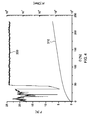
- FIG. 4 relates to an untreated sample of the elastomer E1 which has not been functionalized with carbon particles and which was not immersed in acetone (as would be the case for a sample of the designation E11).
- the figure shows the dependence of the force F (left y-axis) or in measurement curve 300 of the resistance R (right y-axis) of the strain D (x-axis) for a sputtered on both sides with gold sample of the elastomer E1 in curve 310.
- the conductivity of the gold-sputtered sample collapses during deformation even at small deformations.
- FIGS. 5a, 5b . 6a, 6b . 7a and 7b show scanning electron microscope (SEM) images of various samples according to the invention. They were made with a type ESEM Quanta 400 SEM from FEI.
- FIG. 5a shows a SEM image of the surface of a sample of the elastomer E2b. An enlarged picture of this sample is in FIG. 5b shown.
- FIG. 6a shows an SEM image of the Surface of a sample of the elastomer E2c and FIG. 6b an enlarged picture of this sample.
- FIG. 7a shows an SEM image of the surface of a sample of the elastomer enlarged SEM image of the surface of a sample of the elastomer E2d.
- the particles ie carbon nanotubes and / or soot particles
- the surfaces show at most one relief structure through the particles. Only occasionally do loose nanotube ends stick out of the polymer matrix. Overall, the particles were thus incorporated firmly into the polymer surface.
Landscapes
- Chemical & Material Sciences (AREA)
- Engineering & Computer Science (AREA)
- Chemical Kinetics & Catalysis (AREA)
- Electrochemistry (AREA)
- General Chemical & Material Sciences (AREA)
- Materials Engineering (AREA)
- Manufacturing & Machinery (AREA)
- Power Engineering (AREA)
- Microelectronics & Electronic Packaging (AREA)
- Conductive Materials (AREA)
- Compositions Of Macromolecular Compounds (AREA)
- Paints Or Removers (AREA)
- Battery Electrode And Active Subsutance (AREA)
- Application Of Or Painting With Fluid Materials (AREA)
- Non-Insulated Conductors (AREA)
- Manufacturing Of Electric Cables (AREA)
- Laminated Bodies (AREA)
Priority Applications (13)
| Application Number | Priority Date | Filing Date | Title |
|---|---|---|---|
| EP20090009472 EP2284933A1 (de) | 2009-07-22 | 2009-07-22 | Verfahren zur Herstellung von dehnbaren Elektroden |
| US13/384,300 US20120177934A1 (en) | 2009-07-22 | 2010-01-14 | Method for the production of stretchable electrodes |
| CN2010800334820A CN102498595A (zh) | 2009-07-22 | 2010-07-14 | 生产可伸缩电极的方法 |
| JP2012520929A JP2012533857A (ja) | 2009-07-22 | 2010-07-14 | 伸張性電極の製造方法 |
| IN600DEN2012 IN2012DN00600A (enExample) | 2009-07-22 | 2010-07-14 | |
| CA2768677A CA2768677A1 (en) | 2009-07-22 | 2010-07-14 | Method for the production of stretchable electrodes |
| PCT/EP2010/004283 WO2011009549A1 (de) | 2009-07-22 | 2010-07-14 | Verfahren zur herstellung von dehnbaren elektroden |
| KR20127004194A KR20120047261A (ko) | 2009-07-22 | 2010-07-14 | 신축성 전극의 제조 방법 |
| AU2010275788A AU2010275788A1 (en) | 2009-07-22 | 2010-07-14 | Method for the production of stretchable electrodes |
| EP10735201A EP2457277A1 (de) | 2009-07-22 | 2010-07-14 | Verfahren zur herstellung von dehnbaren elektroden |
| SG2012000261A SG177487A1 (en) | 2009-07-22 | 2010-07-14 | Method for the production of stretchable electrodes |
| RU2012106077/07A RU2012106077A (ru) | 2009-07-22 | 2010-07-14 | Способ изготовления растягивающихся электродов |
| TW99123898A TW201126795A (en) | 2009-07-22 | 2010-07-21 | Process for the production of stretchable electrodes |
Applications Claiming Priority (1)
| Application Number | Priority Date | Filing Date | Title |
|---|---|---|---|
| EP20090009472 EP2284933A1 (de) | 2009-07-22 | 2009-07-22 | Verfahren zur Herstellung von dehnbaren Elektroden |
Publications (1)
| Publication Number | Publication Date |
|---|---|
| EP2284933A1 true EP2284933A1 (de) | 2011-02-16 |
Family
ID=41220395
Family Applications (2)
| Application Number | Title | Priority Date | Filing Date |
|---|---|---|---|
| EP20090009472 Withdrawn EP2284933A1 (de) | 2009-07-22 | 2009-07-22 | Verfahren zur Herstellung von dehnbaren Elektroden |
| EP10735201A Withdrawn EP2457277A1 (de) | 2009-07-22 | 2010-07-14 | Verfahren zur herstellung von dehnbaren elektroden |
Family Applications After (1)
| Application Number | Title | Priority Date | Filing Date |
|---|---|---|---|
| EP10735201A Withdrawn EP2457277A1 (de) | 2009-07-22 | 2010-07-14 | Verfahren zur herstellung von dehnbaren elektroden |
Country Status (12)
| Country | Link |
|---|---|
| US (1) | US20120177934A1 (enExample) |
| EP (2) | EP2284933A1 (enExample) |
| JP (1) | JP2012533857A (enExample) |
| KR (1) | KR20120047261A (enExample) |
| CN (1) | CN102498595A (enExample) |
| AU (1) | AU2010275788A1 (enExample) |
| CA (1) | CA2768677A1 (enExample) |
| IN (1) | IN2012DN00600A (enExample) |
| RU (1) | RU2012106077A (enExample) |
| SG (1) | SG177487A1 (enExample) |
| TW (1) | TW201126795A (enExample) |
| WO (1) | WO2011009549A1 (enExample) |
Cited By (6)
| Publication number | Priority date | Publication date | Assignee | Title |
|---|---|---|---|---|
| WO2012172166A1 (en) * | 2011-06-15 | 2012-12-20 | Nokia Corporation | Electrode with reversibly deformable actuating substrate and associated methods |
| WO2013034549A3 (de) * | 2011-09-06 | 2013-05-10 | Empa Eidgenössische Materialprüfungs- Und Forschungsanstalt | Elastomerbeschichtungskopf mit einer beschichtungsdüse und verwendung von aufweitmitteln |
| DE102012112153A1 (de) | 2012-12-12 | 2014-06-26 | Rembert Born | Verfahren zur Herstellung einer textilbasierten Elektrode, Elektrode und Verwendung |
| DE102013225702A1 (de) | 2013-12-12 | 2015-06-18 | Rembert Born | Textilbasierte Elektrode, Verfahren zu deren Herstellung sowie Verwendung |
| CN106711453A (zh) * | 2016-12-28 | 2017-05-24 | 深圳市德方纳米科技股份有限公司 | 一种导电碳浆料、正极材料极片、锂离子电池 |
| WO2017148653A1 (de) * | 2016-02-29 | 2017-09-08 | Robert Bosch Gmbh | Verfahren zur herstellung einer elektrode, elektrode und batteriezelle |
Families Citing this family (68)
| Publication number | Priority date | Publication date | Assignee | Title |
|---|---|---|---|---|
| US8608984B1 (en) * | 2010-02-23 | 2013-12-17 | Cleveland Medical Polymers, Inc. | Polymer nano-composites as dry sensor material for biosignal sensing |
| US8871385B2 (en) * | 2012-01-27 | 2014-10-28 | Battelle Energy Alliance, Llc | Electrodes including a polyphosphazene cyclomatrix, methods of forming the electrodes, and related electrochemical cells |
| DE102012212222B4 (de) * | 2012-03-12 | 2018-05-30 | Fraunhofer-Gesellschaft zur Förderung der angewandten Forschung e.V. | Dielektrisches Elastomer auf Fluorosilicon-Basis und Verfahren zu seiner Herstellung |
| US10147558B2 (en) * | 2012-04-18 | 2018-12-04 | Arizona Board Of Regents On Behalf Of Northern Arizona University | Structural supercapacitor |
| KR101903053B1 (ko) * | 2012-07-10 | 2018-11-23 | 삼성디스플레이 주식회사 | 플렉서블 디스플레이 장치 |
| CN103545556B (zh) * | 2012-07-13 | 2016-01-20 | 清华大学 | 薄膜锂离子电池的制备方法 |
| CN103545554B (zh) * | 2012-07-13 | 2016-06-08 | 清华大学 | 锂离子电池的制备方法 |
| CN104620154B (zh) * | 2012-09-14 | 2017-10-03 | 夏普株式会社 | 显示面板、显示装置和制造方法 |
| CN104869969B (zh) | 2012-09-17 | 2017-06-09 | 哈佛大学校长及研究员协会 | 用于辅助人类运动的软式外装护具 |
| JP5497222B2 (ja) * | 2012-09-28 | 2014-05-21 | バンドー化学株式会社 | 静電容量型センサシート及び静電容量型センサシートの製造方法 |
| US9212960B2 (en) | 2012-10-22 | 2015-12-15 | The Board Of Trustees Of The Leland Stanford Junior University | Nanostructures with strain-induced resistance |
| TWI524825B (zh) | 2012-10-29 | 2016-03-01 | 財團法人工業技術研究院 | 碳材導電膜的轉印方法 |
| CN103194142B (zh) * | 2013-04-28 | 2015-12-09 | 吉林大学 | 一种聚醚醚酮抗静电耐高温涂层及其制备方法 |
| KR20160016925A (ko) | 2013-05-31 | 2016-02-15 | 프레지던트 앤드 펠로우즈 오브 하바드 칼리지 | 인간 모션과의 보조를 위한 소프트 엑소슈트 |
| US9899154B2 (en) * | 2013-07-06 | 2018-02-20 | Blue Horizon Innovations, Llc. | Dense energy ultra-capacitor preform, thin film, module and fabrication methods therefor |
| KR20160091364A (ko) * | 2013-11-28 | 2016-08-02 | 반도 카가쿠 가부시키가이샤 | 신축성 전극, 센서 시트 및 정전용량형 센서 |
| CA2932883A1 (en) | 2013-12-09 | 2015-06-18 | President And Fellows Of Harvard College | Assistive flexible suits, flexible suit systems, and methods for making and control thereof to assist human mobility |
| WO2015095379A1 (en) | 2013-12-17 | 2015-06-25 | The Board Of Trustees Of The Leland Stanford Junior University | Surface area-based pressure sensing |
| US10278883B2 (en) | 2014-02-05 | 2019-05-07 | President And Fellows Of Harvard College | Systems, methods, and devices for assisting walking for developmentally-delayed toddlers |
| KR102254940B1 (ko) * | 2014-02-05 | 2021-05-24 | 고쿠리츠켄큐카이하츠호진 카가쿠기쥬츠신코키코 | 신축성 도전체 및 그 제조 방법과 신축성 도전체 형성용 페이스트 |
| US10864100B2 (en) | 2014-04-10 | 2020-12-15 | President And Fellows Of Harvard College | Orthopedic device including protruding members |
| DE102014005851B4 (de) * | 2014-04-22 | 2018-10-18 | Festo Ag & Co. Kg | Verfahren und Vorrichtung zur Herstellung von Elastomer-Aktuatoren |
| US10722174B2 (en) | 2014-07-11 | 2020-07-28 | The Board Of Trustees Of The Leland Stanford Junior University | Skin-conformal sensors |
| US9625330B2 (en) | 2014-08-01 | 2017-04-18 | The Board Of Trustees Of The Leland Stanford Junior University | Methods and apparatus concerning multi-tactile sensitive (E-skin) pressure sensors |
| CN118252727A (zh) | 2014-09-19 | 2024-06-28 | 哈佛大学校长及研究员协会 | 辅助使用者的关节运动的方法和可穿戴式机器人系统 |
| US10072177B2 (en) | 2014-11-06 | 2018-09-11 | E I Du Pont De Nemours And Company | Stretchable polymer thick film compositions for thermoplastic substrates and wearables electronics |
| CN106931997B (zh) * | 2014-12-09 | 2019-08-06 | 上海昕鼎网络科技有限公司 | 一种感应纤毛、传感器、传感器集群、人工神经元系统、智能机器人 |
| CN105369475B (zh) * | 2015-08-27 | 2017-10-20 | 新疆大学 | 锡锑和碳纳米纤维活性材料及其制备方法 |
| ITUB20153380A1 (it) * | 2015-09-03 | 2017-03-03 | Windtex Vagotex Spa | Procedimento per la realizzazione di una membrana poliuretanica multistrato a base di grafene. |
| US10217810B2 (en) * | 2015-12-07 | 2019-02-26 | Microchip Technology Incorporated | Capacitor formed on heavily doped substrate |
| CN105428082B (zh) * | 2015-12-27 | 2018-02-27 | 复旦大学 | 基于氮掺杂碳纳米管阵列/聚氨酯复合电极的可拉伸超级电容器及其制备方法 |
| WO2017160751A1 (en) | 2016-03-13 | 2017-09-21 | President And Fellows Of Harvard College | Flexible members for anchoring to the body |
| US11171324B2 (en) | 2016-03-15 | 2021-11-09 | Honda Motor Co., Ltd. | System and method of producing a composite product |
| US11383213B2 (en) | 2016-03-15 | 2022-07-12 | Honda Motor Co., Ltd. | System and method of producing a composite product |
| CN105838310B (zh) * | 2016-05-17 | 2019-01-18 | 西安工程大学 | 一种uv光固化洋葱碳/银包铜导电胶的制备方法 |
| WO2018017436A1 (en) | 2016-07-22 | 2018-01-25 | President And Fellows Of Harvard College | Controls optimization for wearable systems |
| US11014804B2 (en) | 2017-03-14 | 2021-05-25 | President And Fellows Of Harvard College | Systems and methods for fabricating 3D soft microstructures |
| US11081684B2 (en) | 2017-05-24 | 2021-08-03 | Honda Motor Co., Ltd. | Production of carbon nanotube modified battery electrode powders via single step dispersion |
| US20190036102A1 (en) | 2017-07-31 | 2019-01-31 | Honda Motor Co., Ltd. | Continuous production of binder and collector-less self-standing electrodes for li-ion batteries by using carbon nanotubes as an additive |
| US10658651B2 (en) | 2017-07-31 | 2020-05-19 | Honda Motor Co., Ltd. | Self standing electrodes and methods for making thereof |
| CN107564729A (zh) * | 2017-08-02 | 2018-01-09 | 苏州柔能纳米科技有限公司 | 柔性纳米网状复合材料的制备方法 |
| US11201318B2 (en) | 2017-09-15 | 2021-12-14 | Honda Motor Co., Ltd. | Method for battery tab attachment to a self-standing electrode |
| US11121358B2 (en) | 2017-09-15 | 2021-09-14 | Honda Motor Co., Ltd. | Method for embedding a battery tab attachment in a self-standing electrode without current collector or binder |
| US11420411B2 (en) * | 2017-10-11 | 2022-08-23 | Single Buoy Moorings Inc. | Electro-active polymer device and method for manufacturing such a device |
| EP3741295A4 (en) | 2018-01-15 | 2021-09-15 | NOK Corporation | BIOELECTRODE |
| WO2019139164A1 (ja) | 2018-01-15 | 2019-07-18 | Nok株式会社 | 生体電極 |
| DE102018221051A1 (de) * | 2018-04-05 | 2019-10-10 | Continental Reifen Deutschland Gmbh | Vorrichtung zum Messen einer mechanischen Kraft, umfassend eine erste, zweite, dritte, vierte und fünfte Schicht sowie die Verwendungen der Vorrichtung und Reifen oder technischer Gummiartikel umfassend die Vorrichtung |
| CN110660592B (zh) * | 2018-06-29 | 2020-12-04 | 清华大学 | 可拉伸电容器电极-导体结构的制备方法 |
| GB201816575D0 (en) * | 2018-10-11 | 2018-11-28 | Seeds Capital Ltd | Novel carbon nano-structures for energy generation and energy storage applications |
| DE102018218637B3 (de) * | 2018-10-31 | 2020-02-20 | Festo Ag & Co. Kg | Elektroaktive Polymeraktuatoreinrichtung |
| JP7272801B2 (ja) * | 2019-01-18 | 2023-05-12 | 正毅 千葉 | 誘電エラストマートランスデューサーおよび誘電エラストマートランスデューサーの製造方法 |
| US11535517B2 (en) | 2019-01-24 | 2022-12-27 | Honda Motor Co., Ltd. | Method of making self-standing electrodes supported by carbon nanostructured filaments |
| WO2021016319A1 (en) * | 2019-07-22 | 2021-01-28 | Honda Motor Co., Ltd. | Stretchable and flexible lithium ion battery |
| US12381275B2 (en) | 2019-01-30 | 2025-08-05 | Honda Motor Co., Ltd. | Stretchable and flexible lithium ion battery |
| US12142771B2 (en) | 2019-01-30 | 2024-11-12 | Honda Motor Co., Ltd. | Flexible battery as an integration platform for wearable sensors and processing/transmitting devices |
| US11325833B2 (en) | 2019-03-04 | 2022-05-10 | Honda Motor Co., Ltd. | Composite yarn and method of making a carbon nanotube composite yarn |
| US11352258B2 (en) | 2019-03-04 | 2022-06-07 | Honda Motor Co., Ltd. | Multifunctional conductive wire and method of making |
| CN114008911A (zh) * | 2019-06-24 | 2022-02-01 | 千叶正毅 | 介电弹性体换能器 |
| US11539042B2 (en) | 2019-07-19 | 2022-12-27 | Honda Motor Co., Ltd. | Flexible packaging with embedded electrode and method of making |
| US11787105B2 (en) * | 2019-11-14 | 2023-10-17 | Rolls-Royce Corporation | Fused filament fabrication of components including predetermined yield points based on composition functions |
| CN111117227A (zh) * | 2019-12-31 | 2020-05-08 | 湖南华曙高科技有限责任公司 | 一种光纤激光烧结用高分子粉末材料制备方法 |
| CN111477838B (zh) * | 2020-04-08 | 2021-05-18 | 北京科技大学 | 一种一体化可拉伸锂离子电池及其制备方法 |
| TWI732585B (zh) * | 2020-06-05 | 2021-07-01 | 三芳化學工業股份有限公司 | 導電薄膜及其製造方法 |
| CN112080031B (zh) * | 2020-08-13 | 2022-05-20 | 哈尔滨工业大学 | 一种用于柔性神经电极的具有自我修复功能的可拉伸导电聚合物膜的制备方法 |
| CN112226033B (zh) * | 2020-10-16 | 2025-12-30 | 浙江清华柔性电子技术研究院 | 具有鲁棒界面的可拉伸应变材料及其制备方法 |
| CN112993223B (zh) * | 2021-02-07 | 2022-04-12 | 西南科技大学 | 一种双层包覆结构的锂离子电池负极材料及其制备方法 |
| KR20220133439A (ko) * | 2021-03-25 | 2022-10-05 | 연세대학교 산학협력단 | 웨어러블 욕창 감지 센서 및 이를 포함하는 욕창 감지 시스템 |
| CN114188070B (zh) * | 2021-12-08 | 2024-03-19 | 成都科威尔博新材料科技有限公司 | 一种可穿戴电极贴片及其制备方法 |
Citations (9)
| Publication number | Priority date | Publication date | Assignee | Title |
|---|---|---|---|---|
| US6583533B2 (en) * | 1997-02-07 | 2003-06-24 | Sri International | Electroactive polymer electrodes |
| US7119028B1 (en) * | 2003-10-29 | 2006-10-10 | The United States Of America As Represented By The Secretary Of The Navy | Surface imprinted films with carbon nanotubes |
| US20070295714A1 (en) * | 2006-06-16 | 2007-12-27 | Tsinghua University | Flexible electrothermal composite and heating apparatus having the same |
| WO2008067137A2 (en) * | 2006-11-08 | 2008-06-05 | United States Of America As Represented By The Administrator Of The National Aeronautics And Space Administration | A carbon nanotube film electrode and an electroactive device fabricated with the carbon nanotube film electrode and methods for making same |
| WO2008073153A2 (en) * | 2006-07-31 | 2008-06-19 | National Institute Of Aerospace Associates | Nanocomposites from stable dispersions of carbon nanotubes in polymeric matrices using dispersion interaction |
| WO2008140623A1 (en) * | 2006-12-26 | 2008-11-20 | Texas Southern University | Instantaneous electrodeposition of metal nanostructures on carbon nanotubes |
| WO2008150867A2 (en) | 2007-05-29 | 2008-12-11 | Innova Materials, Llc | Surfaces having particles and related methods |
| US20080318026A1 (en) * | 2007-06-25 | 2008-12-25 | University Of Dayton | Method of modifying carbon nanomaterials, composites incorporating modified carbon nanomaterials and method of producing the composites |
| DE102007044031A1 (de) | 2007-09-14 | 2009-03-19 | Bayer Materialscience Ag | Kohlenstoffnanoröhrchenpulver, Kohlenstoffnanoröhrchen und Verfahren zu ihrer Herstellung |
Family Cites Families (2)
| Publication number | Priority date | Publication date | Assignee | Title |
|---|---|---|---|---|
| US4265727A (en) * | 1979-10-22 | 1981-05-05 | Hitco | Composite electrodes |
| US6084047A (en) * | 1997-11-06 | 2000-07-04 | Eastman Chemical Company | Elastomeric amorphous olefin terpolymer |
-
2009
- 2009-07-22 EP EP20090009472 patent/EP2284933A1/de not_active Withdrawn
-
2010
- 2010-01-14 US US13/384,300 patent/US20120177934A1/en not_active Abandoned
- 2010-07-14 AU AU2010275788A patent/AU2010275788A1/en not_active Abandoned
- 2010-07-14 CN CN2010800334820A patent/CN102498595A/zh active Pending
- 2010-07-14 WO PCT/EP2010/004283 patent/WO2011009549A1/de not_active Ceased
- 2010-07-14 RU RU2012106077/07A patent/RU2012106077A/ru not_active Application Discontinuation
- 2010-07-14 SG SG2012000261A patent/SG177487A1/en unknown
- 2010-07-14 EP EP10735201A patent/EP2457277A1/de not_active Withdrawn
- 2010-07-14 IN IN600DEN2012 patent/IN2012DN00600A/en unknown
- 2010-07-14 KR KR20127004194A patent/KR20120047261A/ko not_active Withdrawn
- 2010-07-14 CA CA2768677A patent/CA2768677A1/en not_active Abandoned
- 2010-07-14 JP JP2012520929A patent/JP2012533857A/ja active Pending
- 2010-07-21 TW TW99123898A patent/TW201126795A/zh unknown
Patent Citations (9)
| Publication number | Priority date | Publication date | Assignee | Title |
|---|---|---|---|---|
| US6583533B2 (en) * | 1997-02-07 | 2003-06-24 | Sri International | Electroactive polymer electrodes |
| US7119028B1 (en) * | 2003-10-29 | 2006-10-10 | The United States Of America As Represented By The Secretary Of The Navy | Surface imprinted films with carbon nanotubes |
| US20070295714A1 (en) * | 2006-06-16 | 2007-12-27 | Tsinghua University | Flexible electrothermal composite and heating apparatus having the same |
| WO2008073153A2 (en) * | 2006-07-31 | 2008-06-19 | National Institute Of Aerospace Associates | Nanocomposites from stable dispersions of carbon nanotubes in polymeric matrices using dispersion interaction |
| WO2008067137A2 (en) * | 2006-11-08 | 2008-06-05 | United States Of America As Represented By The Administrator Of The National Aeronautics And Space Administration | A carbon nanotube film electrode and an electroactive device fabricated with the carbon nanotube film electrode and methods for making same |
| WO2008140623A1 (en) * | 2006-12-26 | 2008-11-20 | Texas Southern University | Instantaneous electrodeposition of metal nanostructures on carbon nanotubes |
| WO2008150867A2 (en) | 2007-05-29 | 2008-12-11 | Innova Materials, Llc | Surfaces having particles and related methods |
| US20080318026A1 (en) * | 2007-06-25 | 2008-12-25 | University Of Dayton | Method of modifying carbon nanomaterials, composites incorporating modified carbon nanomaterials and method of producing the composites |
| DE102007044031A1 (de) | 2007-09-14 | 2009-03-19 | Bayer Materialscience Ag | Kohlenstoffnanoröhrchenpulver, Kohlenstoffnanoröhrchen und Verfahren zu ihrer Herstellung |
Non-Patent Citations (6)
| Title |
|---|
| CARBON, vol. 34, 1996, pages 1301 - 3 |
| E. SMELA ET AL., VERÖFFENTLICHUNG ADVANCED MATERIALS, vol. 19, 2007, pages 2629 - 2633 |
| KHODOPARAST P ET AL: "Electrode structures in high strain actuator technology", JOURNAL OF OPTOELECTRONICS AND ADVANCED MATERIALS, NATIONAL INSTITUTE FOR OPTOELECTRONICS, vol. 9, no. 11, 1 November 2007 (2007-11-01), pages 3585 - 3591, XP009125117, ISSN: 1454-4164 * |
| S. R. GHAFFARIAN ET AL., JOURNAL OF OPTOELECTRONICS ANDADVANCED MATERIALS, vol. 9, 2007, pages 3585 - 3591 |
| SCIENCE, vol. 263, 1994, pages 1744 - 7 |
| SHAOXIN LU ET AL: "Optically driven nanotube actuators; Optically driven nanotube actuators", NANOTECHNOLOGY, IOP, BRISTOL, GB, vol. 16, no. 11, 1 November 2005 (2005-11-01), pages 2548 - 2554, XP020090822, ISSN: 0957-4484 * |
Cited By (10)
| Publication number | Priority date | Publication date | Assignee | Title |
|---|---|---|---|---|
| WO2012172166A1 (en) * | 2011-06-15 | 2012-12-20 | Nokia Corporation | Electrode with reversibly deformable actuating substrate and associated methods |
| EP2721673A4 (en) * | 2011-06-15 | 2015-02-25 | Nokia Corp | ELECTRODE HAVING REVERSIBLE DEFORMATION ACTUATION SUBSTRATE AND ASSOCIATED METHODS |
| US9324508B2 (en) | 2011-06-15 | 2016-04-26 | Nokia Technologies Oy | Substrate for electrode capable of undergoing reversible deformation |
| WO2013034549A3 (de) * | 2011-09-06 | 2013-05-10 | Empa Eidgenössische Materialprüfungs- Und Forschungsanstalt | Elastomerbeschichtungskopf mit einer beschichtungsdüse und verwendung von aufweitmitteln |
| DE102012112153A1 (de) | 2012-12-12 | 2014-06-26 | Rembert Born | Verfahren zur Herstellung einer textilbasierten Elektrode, Elektrode und Verwendung |
| DE202013012286U1 (de) | 2012-12-12 | 2016-01-15 | Rembert Born | Textilbasierte Elektrode |
| DE102012112153B4 (de) | 2012-12-12 | 2018-05-09 | Rembert Born | Verfahren zur Herstellung einer textilbasierten Elektrode sowie textilbasierte Elektrode |
| DE102013225702A1 (de) | 2013-12-12 | 2015-06-18 | Rembert Born | Textilbasierte Elektrode, Verfahren zu deren Herstellung sowie Verwendung |
| WO2017148653A1 (de) * | 2016-02-29 | 2017-09-08 | Robert Bosch Gmbh | Verfahren zur herstellung einer elektrode, elektrode und batteriezelle |
| CN106711453A (zh) * | 2016-12-28 | 2017-05-24 | 深圳市德方纳米科技股份有限公司 | 一种导电碳浆料、正极材料极片、锂离子电池 |
Also Published As
| Publication number | Publication date |
|---|---|
| JP2012533857A (ja) | 2012-12-27 |
| TW201126795A (en) | 2011-08-01 |
| AU2010275788A1 (en) | 2012-02-09 |
| EP2457277A1 (de) | 2012-05-30 |
| KR20120047261A (ko) | 2012-05-11 |
| US20120177934A1 (en) | 2012-07-12 |
| IN2012DN00600A (enExample) | 2015-06-12 |
| WO2011009549A1 (de) | 2011-01-27 |
| SG177487A1 (en) | 2012-02-28 |
| CN102498595A (zh) | 2012-06-13 |
| RU2012106077A (ru) | 2013-08-27 |
| CA2768677A1 (en) | 2011-01-27 |
Similar Documents
| Publication | Publication Date | Title |
|---|---|---|
| WO2011009549A1 (de) | Verfahren zur herstellung von dehnbaren elektroden | |
| EP2391671B1 (de) | Verfahren zum Einbringen von Kohlenstoffteilchen in eine Polyurethan-Oberflächenschicht | |
| EP2775483B1 (de) | Elektrisch leitendes Material und dessen Verwendung als Elektrode in einem dielektrischen Elastomerkomposit oder als elektrisch leitende, dehnbare Faser | |
| DE102017208220A1 (de) | Verfahren zum Herstellen eines Trockenfilms sowie Trockenfilm und mit dem Trockenfilm beschichtetes Substrat | |
| DE10039174B4 (de) | Elektrode für einen elektrischen Doppelschichtkondensator und Aufschlemmung zur Bildung derselben | |
| EP2490284A1 (de) | Elektroden für Batterien, insbesondere für Lithium-Ionen-Batterien, und ihre Herstellung | |
| EP2013920B1 (de) | Piezoaktor mit gradient-verkapselungsschicht und verfahren zu seiner herstellung | |
| EP2468826A1 (de) | Pickering-Emulsion zur Herstellung elektrisch leitfähiger Beschichtungen und Verfahren zur Herstellung einer Pickering-Emulsion | |
| DE102013106114A1 (de) | Lithium-Ionen-Zelle für eine Sekundärbatterie | |
| WO2009109485A1 (de) | Strangförmiger materialverbund mit cnt-garnen und verfahren zu dessen herstellung | |
| DE102023200011A1 (de) | Vorrichtung und Verfahren zur Herstellung einer Elektrode | |
| EP2287240B1 (de) | Verfahren zum Einbringen von Kohlenstoffteilchen in eine Polycarbonat-Oberflächenschicht | |
| DE102004036793A1 (de) | Nanoporöse Fullerenschichten und deren Verwendung in der organischen Photovoltaik | |
| DE69935767T2 (de) | Metallisches elektrodenmaterial, dieses verwendender kondensator und herstellungsverfahren | |
| EP2622660A1 (de) | Piezoelektrisches vielschichtbauelement und verfahren zu dessen herstellung | |
| DE10155346C1 (de) | Solarzelle sowie Verfahren zu deren Herstellung | |
| DE102019122226A1 (de) | Kompositelektrode für eine Lithium- oder Lithium-Ionen-Batterie und Herstellungsverfahren dafür | |
| DE102004025603A1 (de) | Aktor auf der Basis geometrisch anisotroper Nanopartikel | |
| DE102022105852A1 (de) | Verfahren zum Herstellen einer Elektrode für eine elektrochemische Zelle, Kompositelektrode und elektrochemische Zelle | |
| DE102023211971B4 (de) | Elektrode für eine Elektroden-Separator-Anordnung in einer Batteriezelle, Verfahren zur Fertigung einer solchen Elektrode sowie Batteriezelle | |
| DE102016200153B4 (de) | Elektromechanischer Wandler und Verfahren zur Herstellung eines elektromechanischen Wandlers | |
| DE202011110597U1 (de) | Substrat für eine optoelektronische Vorrichtung | |
| DE202024105963U1 (de) | Verbundkeramikelektrolytpartikel mit hydrophober Schutzschicht für Batterieelektroden | |
| DE102024128915A1 (de) | Stromabnehmerfolie, Batterie sowie Primerlack | |
| DE102024130112A1 (de) | Verfahren zur herstellung von verbundkeramikelektrolytpartikeln mit hydrophoben schutzschichten für batterieelektroden |
Legal Events
| Date | Code | Title | Description |
|---|---|---|---|
| PUAI | Public reference made under article 153(3) epc to a published international application that has entered the european phase |
Free format text: ORIGINAL CODE: 0009012 |
|
| AK | Designated contracting states |
Kind code of ref document: A1 Designated state(s): AT BE BG CH CY CZ DE DK EE ES FI FR GB GR HR HU IE IS IT LI LT LU LV MC MK MT NL NO PL PT RO SE SI SK SM TR |
|
| AX | Request for extension of the european patent |
Extension state: AL BA RS |
|
| STAA | Information on the status of an ep patent application or granted ep patent |
Free format text: STATUS: THE APPLICATION IS DEEMED TO BE WITHDRAWN |
|
| 18D | Application deemed to be withdrawn |
Effective date: 20110817 |