EP2248905A1 - Neue, Geruchsstoffe bildende Genprodukte von Bacillus licheniformis und darauf aufbauende verbesserte biotechnologische Produktionsverfahren - Google Patents
Neue, Geruchsstoffe bildende Genprodukte von Bacillus licheniformis und darauf aufbauende verbesserte biotechnologische Produktionsverfahren Download PDFInfo
- Publication number
- EP2248905A1 EP2248905A1 EP10174633A EP10174633A EP2248905A1 EP 2248905 A1 EP2248905 A1 EP 2248905A1 EP 10174633 A EP10174633 A EP 10174633A EP 10174633 A EP10174633 A EP 10174633A EP 2248905 A1 EP2248905 A1 EP 2248905A1
- Authority
- EP
- European Patent Office
- Prior art keywords
- subtilis
- gene
- dehydrogenase
- acid
- coa
- Prior art date
- Legal status (The legal status is an assumption and is not a legal conclusion. Google has not performed a legal analysis and makes no representation as to the accuracy of the status listed.)
- Withdrawn
Links
- 108090000623 proteins and genes Proteins 0.000 title claims abstract description 67
- 238000000034 method Methods 0.000 title claims description 20
- 230000008569 process Effects 0.000 title claims description 6
- 239000000126 substance Substances 0.000 title description 12
- 241000194108 Bacillus licheniformis Species 0.000 title description 5
- 238000013452 biotechnological production Methods 0.000 title description 4
- 230000015572 biosynthetic process Effects 0.000 claims abstract description 22
- 244000005700 microbiome Species 0.000 claims abstract description 22
- 238000000855 fermentation Methods 0.000 claims abstract description 20
- 230000004151 fermentation Effects 0.000 claims abstract description 20
- 230000037353 metabolic pathway Effects 0.000 claims abstract description 15
- GWYFCOCPABKNJV-UHFFFAOYSA-N beta-methyl-butyric acid Natural products CC(C)CC(O)=O GWYFCOCPABKNJV-UHFFFAOYSA-N 0.000 claims abstract description 13
- 238000003786 synthesis reaction Methods 0.000 claims abstract description 11
- XYHKNCXZYYTLRG-UHFFFAOYSA-N 1h-imidazole-2-carbaldehyde Chemical compound O=CC1=NC=CN1 XYHKNCXZYYTLRG-UHFFFAOYSA-N 0.000 claims abstract description 10
- GWYFCOCPABKNJV-UHFFFAOYSA-M 3-Methylbutanoic acid Natural products CC(C)CC([O-])=O GWYFCOCPABKNJV-UHFFFAOYSA-M 0.000 claims abstract description 10
- 230000015556 catabolic process Effects 0.000 claims description 25
- 102000004190 Enzymes Human genes 0.000 claims description 22
- 108090000790 Enzymes Proteins 0.000 claims description 22
- ROHFNLRQFUQHCH-UHFFFAOYSA-N Leucine Natural products CC(C)CC(N)C(O)=O ROHFNLRQFUQHCH-UHFFFAOYSA-N 0.000 claims description 14
- 229960003136 leucine Drugs 0.000 claims description 14
- ROHFNLRQFUQHCH-YFKPBYRVSA-N L-leucine Chemical compound CC(C)C[C@H](N)C(O)=O ROHFNLRQFUQHCH-YFKPBYRVSA-N 0.000 claims description 12
- 108010028658 Leucine Dehydrogenase Proteins 0.000 claims description 9
- 230000002068 genetic effect Effects 0.000 claims description 7
- FERIUCNNQQJTOY-UHFFFAOYSA-N Butyric acid Chemical compound CCCC(O)=O FERIUCNNQQJTOY-UHFFFAOYSA-N 0.000 abstract description 17
- VHRGRCVQAFMJIZ-UHFFFAOYSA-N cadaverine Chemical compound NCCCCCN VHRGRCVQAFMJIZ-UHFFFAOYSA-N 0.000 abstract description 14
- KIDHWZJUCRJVML-UHFFFAOYSA-N putrescine Chemical compound NCCCCN KIDHWZJUCRJVML-UHFFFAOYSA-N 0.000 abstract description 14
- 150000007523 nucleic acids Chemical group 0.000 abstract description 13
- 239000005700 Putrescine Substances 0.000 abstract description 7
- LRHPLDYGYMQRHN-UHFFFAOYSA-N N-Butanol Chemical compound CCCCO LRHPLDYGYMQRHN-UHFFFAOYSA-N 0.000 abstract description 6
- 239000002253 acid Substances 0.000 abstract description 4
- 230000002779 inactivation Effects 0.000 abstract description 4
- KQNPFQTWMSNSAP-UHFFFAOYSA-N isobutyric acid Chemical compound CC(C)C(O)=O KQNPFQTWMSNSAP-UHFFFAOYSA-N 0.000 abstract description 4
- WLAMNBDJUVNPJU-UHFFFAOYSA-N 2-methylbutyric acid Chemical compound CCC(C)C(O)=O WLAMNBDJUVNPJU-UHFFFAOYSA-N 0.000 abstract description 2
- 241000498991 Bacillus licheniformis DSM 13 = ATCC 14580 Species 0.000 abstract description 2
- UAXOELSVPTZZQG-UHFFFAOYSA-N tiglic acid Natural products CC(C)=C(C)C(O)=O UAXOELSVPTZZQG-UHFFFAOYSA-N 0.000 abstract description 2
- 150000007513 acids Chemical class 0.000 abstract 1
- 230000001580 bacterial effect Effects 0.000 abstract 1
- 235000014469 Bacillus subtilis Nutrition 0.000 description 24
- 239000013598 vector Substances 0.000 description 23
- 102000004169 proteins and genes Human genes 0.000 description 19
- 241000276408 Bacillus subtilis subsp. subtilis str. 168 Species 0.000 description 15
- 239000000047 product Substances 0.000 description 14
- 230000004060 metabolic process Effects 0.000 description 13
- 238000012217 deletion Methods 0.000 description 12
- 230000037430 deletion Effects 0.000 description 12
- 108020004707 nucleic acids Proteins 0.000 description 12
- 102000039446 nucleic acids Human genes 0.000 description 12
- AGPKZVBTJJNPAG-WHFBIAKZSA-N L-isoleucine Chemical compound CC[C@H](C)[C@H](N)C(O)=O AGPKZVBTJJNPAG-WHFBIAKZSA-N 0.000 description 11
- KZSNJWFQEVHDMF-UHFFFAOYSA-N Valine Natural products CC(C)C(N)C(O)=O KZSNJWFQEVHDMF-UHFFFAOYSA-N 0.000 description 11
- 210000004027 cell Anatomy 0.000 description 11
- 229960000310 isoleucine Drugs 0.000 description 11
- AGPKZVBTJJNPAG-UHFFFAOYSA-N isoleucine Natural products CCC(C)C(N)C(O)=O AGPKZVBTJJNPAG-UHFFFAOYSA-N 0.000 description 11
- 235000019645 odor Nutrition 0.000 description 11
- 239000004474 valine Substances 0.000 description 11
- 108020004414 DNA Proteins 0.000 description 10
- KZSNJWFQEVHDMF-BYPYZUCNSA-N L-valine Chemical compound CC(C)[C@H](N)C(O)=O KZSNJWFQEVHDMF-BYPYZUCNSA-N 0.000 description 10
- 238000006243 chemical reaction Methods 0.000 description 10
- 102000002735 Acyl-CoA Dehydrogenase Human genes 0.000 description 9
- 108010001058 Acyl-CoA Dehydrogenase Proteins 0.000 description 9
- 238000004519 manufacturing process Methods 0.000 description 9
- 102100035709 Acetyl-coenzyme A synthetase, cytoplasmic Human genes 0.000 description 8
- 239000012634 fragment Substances 0.000 description 8
- 108010049926 Acetate-CoA ligase Proteins 0.000 description 7
- 239000013612 plasmid Substances 0.000 description 7
- 230000009466 transformation Effects 0.000 description 7
- 241000301512 Bacillus cereus ATCC 14579 Species 0.000 description 6
- 210000000349 chromosome Anatomy 0.000 description 6
- 230000000694 effects Effects 0.000 description 6
- 239000003053 toxin Substances 0.000 description 6
- 231100000765 toxin Toxicity 0.000 description 6
- 108700012359 toxins Proteins 0.000 description 6
- KDXKERNSBIXSRK-UHFFFAOYSA-N Lysine Natural products NCCCCC(N)C(O)=O KDXKERNSBIXSRK-UHFFFAOYSA-N 0.000 description 5
- 239000004472 Lysine Substances 0.000 description 5
- 239000013611 chromosomal DNA Substances 0.000 description 5
- 150000001875 compounds Chemical class 0.000 description 5
- 239000003205 fragrance Substances 0.000 description 5
- 238000001727 in vivo Methods 0.000 description 5
- 102100021834 3-hydroxyacyl-CoA dehydrogenase Human genes 0.000 description 4
- -1 3-hydroxyisobutyryl Chemical group 0.000 description 4
- 241001506697 Bacillus anthracis str. Ames Species 0.000 description 4
- 108010068197 Butyryl-CoA Dehydrogenase Proteins 0.000 description 4
- 108010023922 Enoyl-CoA hydratase Proteins 0.000 description 4
- ULGZDMOVFRHVEP-RWJQBGPGSA-N Erythromycin Chemical compound O([C@@H]1[C@@H](C)C(=O)O[C@@H]([C@@]([C@H](O)[C@@H](C)C(=O)[C@H](C)C[C@@](C)(O)[C@H](O[C@H]2[C@@H]([C@H](C[C@@H](C)O2)N(C)C)O)[C@H]1C)(C)O)CC)[C@H]1C[C@@](C)(OC)[C@@H](O)[C@H](C)O1 ULGZDMOVFRHVEP-RWJQBGPGSA-N 0.000 description 4
- 108010048581 Lysine decarboxylase Proteins 0.000 description 4
- 102100024639 Short-chain specific acyl-CoA dehydrogenase, mitochondrial Human genes 0.000 description 4
- 150000001413 amino acids Chemical group 0.000 description 4
- 230000035772 mutation Effects 0.000 description 4
- 230000037361 pathway Effects 0.000 description 4
- 241000894007 species Species 0.000 description 4
- 238000010626 work up procedure Methods 0.000 description 4
- 108700020831 3-Hydroxyacyl-CoA Dehydrogenase Proteins 0.000 description 3
- 102000006589 Alpha-ketoglutarate dehydrogenase Human genes 0.000 description 3
- 108020004306 Alpha-ketoglutarate dehydrogenase Proteins 0.000 description 3
- 239000004475 Arginine Substances 0.000 description 3
- 241000193830 Bacillus <bacterium> Species 0.000 description 3
- 244000063299 Bacillus subtilis Species 0.000 description 3
- 101100488802 Bacillus subtilis (strain 168) yngF gene Proteins 0.000 description 3
- RGJOEKWQDUBAIZ-IBOSZNHHSA-N CoASH Chemical compound O[C@@H]1[C@H](OP(O)(O)=O)[C@@H](COP(O)(=O)OP(O)(=O)OCC(C)(C)[C@@H](O)C(=O)NCCC(=O)NCCS)O[C@H]1N1C2=NC=NC(N)=C2N=C1 RGJOEKWQDUBAIZ-IBOSZNHHSA-N 0.000 description 3
- 108020004705 Codon Proteins 0.000 description 3
- 102000011426 Enoyl-CoA hydratase Human genes 0.000 description 3
- 108090001042 Hydro-Lyases Proteins 0.000 description 3
- 102000004867 Hydro-Lyases Human genes 0.000 description 3
- FFEARJCKVFRZRR-BYPYZUCNSA-N L-methionine Chemical compound CSCC[C@H](N)C(O)=O FFEARJCKVFRZRR-BYPYZUCNSA-N 0.000 description 3
- 108091028043 Nucleic acid sequence Proteins 0.000 description 3
- XBDQKXXYIPTUBI-UHFFFAOYSA-M Propionate Chemical compound CCC([O-])=O XBDQKXXYIPTUBI-UHFFFAOYSA-M 0.000 description 3
- ODKSFYDXXFIFQN-UHFFFAOYSA-N arginine Natural products OC(=O)C(N)CCCNC(N)=N ODKSFYDXXFIFQN-UHFFFAOYSA-N 0.000 description 3
- 230000001364 causal effect Effects 0.000 description 3
- 238000010367 cloning Methods 0.000 description 3
- RGJOEKWQDUBAIZ-UHFFFAOYSA-N coenzime A Natural products OC1C(OP(O)(O)=O)C(COP(O)(=O)OP(O)(=O)OCC(C)(C)C(O)C(=O)NCCC(=O)NCCS)OC1N1C2=NC=NC(N)=C2N=C1 RGJOEKWQDUBAIZ-UHFFFAOYSA-N 0.000 description 3
- KDTSHFARGAKYJN-UHFFFAOYSA-N dephosphocoenzyme A Natural products OC1C(O)C(COP(O)(=O)OP(O)(=O)OCC(C)(C)C(O)C(=O)NCCC(=O)NCCS)OC1N1C2=NC=NC(N)=C2N=C1 KDTSHFARGAKYJN-UHFFFAOYSA-N 0.000 description 3
- 235000014113 dietary fatty acids Nutrition 0.000 description 3
- 229930195729 fatty acid Natural products 0.000 description 3
- 239000000194 fatty acid Substances 0.000 description 3
- 150000004665 fatty acids Chemical class 0.000 description 3
- 238000001914 filtration Methods 0.000 description 3
- 238000002744 homologous recombination Methods 0.000 description 3
- 230000006801 homologous recombination Effects 0.000 description 3
- 230000010354 integration Effects 0.000 description 3
- 229930182817 methionine Natural products 0.000 description 3
- 108010033058 propionate - CoA ligase Proteins 0.000 description 3
- 210000001938 protoplast Anatomy 0.000 description 3
- 230000010076 replication Effects 0.000 description 3
- 108050003384 2-oxoglutarate dehydrogenase E1 component Proteins 0.000 description 2
- 108020003281 3-hydroxyisobutyrate dehydrogenase Proteins 0.000 description 2
- 102000006027 3-hydroxyisobutyrate dehydrogenase Human genes 0.000 description 2
- 102000008146 Acetate-CoA ligase Human genes 0.000 description 2
- 102100032252 Antizyme inhibitor 2 Human genes 0.000 description 2
- 241000006382 Bacillus halodurans Species 0.000 description 2
- 101100322122 Bacillus subtilis (strain 168) accC2 gene Proteins 0.000 description 2
- 101100488801 Bacillus subtilis (strain 168) yngE gene Proteins 0.000 description 2
- 101100507299 Bacillus subtilis (strain 168) yngG gene Proteins 0.000 description 2
- 101100215014 Bacillus subtilis (strain 168) yngJ gene Proteins 0.000 description 2
- 101100488804 Bacillus subtilis (strain 168) yngK gene Proteins 0.000 description 2
- 101100488805 Bacillus subtilis (strain 168) yngL gene Proteins 0.000 description 2
- 101100267698 Bacillus subtilis (strain 168) yotB gene Proteins 0.000 description 2
- 101000597679 Dictyostelium discoideum 2-oxoisovalerate dehydrogenase subunit beta, mitochondrial Proteins 0.000 description 2
- 241000588724 Escherichia coli Species 0.000 description 2
- 241000192125 Firmicutes Species 0.000 description 2
- 101000652415 Homo sapiens Agmatinase, mitochondrial Proteins 0.000 description 2
- 101000798222 Homo sapiens Antizyme inhibitor 2 Proteins 0.000 description 2
- 101710134548 Probable enoyl-CoA hydratase Proteins 0.000 description 2
- 101710199693 Putative branched-chain-amino-acid aminotransferase Proteins 0.000 description 2
- 101100000272 Rhizobium meliloti (strain 1021) acsA2 gene Proteins 0.000 description 2
- 238000002105 Southern blotting Methods 0.000 description 2
- 241001415395 Spea Species 0.000 description 2
- 101000711499 Thermococcus kodakarensis (strain ATCC BAA-918 / JCM 12380 / KOD1) N(1)-aminopropylagmatine ureohydrolase Proteins 0.000 description 2
- 101150116076 acsA gene Proteins 0.000 description 2
- 101150081706 acsAB gene Proteins 0.000 description 2
- 239000011543 agarose gel Substances 0.000 description 2
- 102000011229 agmatinase Human genes 0.000 description 2
- 230000008901 benefit Effects 0.000 description 2
- 239000005516 coenzyme A Substances 0.000 description 2
- 229940093530 coenzyme a Drugs 0.000 description 2
- 238000004332 deodorization Methods 0.000 description 2
- 238000013461 design Methods 0.000 description 2
- 150000004985 diamines Chemical class 0.000 description 2
- 229960003276 erythromycin Drugs 0.000 description 2
- 230000006870 function Effects 0.000 description 2
- 101150032444 gadC gene Proteins 0.000 description 2
- 235000003869 genetically modified organism Nutrition 0.000 description 2
- 238000003780 insertion Methods 0.000 description 2
- 230000037431 insertion Effects 0.000 description 2
- UYVZIWWBJMYRCD-ZMHDXICWSA-N isovaleryl-CoA Chemical compound O[C@@H]1[C@H](OP(O)(O)=O)[C@@H](COP(O)(=O)OP(O)(=O)OCC(C)(C)[C@@H](O)C(=O)NCCC(=O)NCCSC(=O)CC(C)C)O[C@H]1N1C2=NC=NC(N)=C2N=C1 UYVZIWWBJMYRCD-ZMHDXICWSA-N 0.000 description 2
- 239000003550 marker Substances 0.000 description 2
- 230000002503 metabolic effect Effects 0.000 description 2
- 108010009759 methylglutaconyl-CoA hydratase Proteins 0.000 description 2
- 238000010369 molecular cloning Methods 0.000 description 2
- 231100000614 poison Toxicity 0.000 description 2
- 101150000880 ppsD gene Proteins 0.000 description 2
- 101150063262 ppsE gene Proteins 0.000 description 2
- 238000000746 purification Methods 0.000 description 2
- 230000006798 recombination Effects 0.000 description 2
- 238000005215 recombination Methods 0.000 description 2
- 230000009467 reduction Effects 0.000 description 2
- 238000011160 research Methods 0.000 description 2
- 238000010561 standard procedure Methods 0.000 description 2
- 102000014443 2-oxoglutarate dehydrogenase E1 component Human genes 0.000 description 1
- 102100026936 2-oxoglutarate dehydrogenase, mitochondrial Human genes 0.000 description 1
- 108030005660 3-hydroxybutyryl-CoA dehydratases Proteins 0.000 description 1
- 108010055682 3-hydroxybutyryl-CoA dehydrogenase Proteins 0.000 description 1
- 108010077268 3-hydroxyisobutyryl-CoA hydrolase Proteins 0.000 description 1
- 102100034767 3-hydroxyisobutyryl-CoA hydrolase, mitochondrial Human genes 0.000 description 1
- QYPPJABKJHAVHS-UHFFFAOYSA-N Agmatine Natural products NCCCCNC(N)=N QYPPJABKJHAVHS-UHFFFAOYSA-N 0.000 description 1
- 241000193744 Bacillus amyloliquefaciens Species 0.000 description 1
- 101100007787 Bacillus subtilis (strain 168) cse15 gene Proteins 0.000 description 1
- 101100173201 Bacillus subtilis (strain 168) fadB gene Proteins 0.000 description 1
- 101100066238 Bacillus subtilis (strain 168) fadE gene Proteins 0.000 description 1
- 101100508722 Bacillus subtilis (strain 168) ilvK gene Proteins 0.000 description 1
- 101100127701 Bacillus subtilis (strain 168) lcfB gene Proteins 0.000 description 1
- 101100299607 Bacillus subtilis (strain 168) licA gene Proteins 0.000 description 1
- 101100354311 Bacillus subtilis (strain 168) licB gene Proteins 0.000 description 1
- 101100354312 Bacillus subtilis (strain 168) licC gene Proteins 0.000 description 1
- 101100399280 Bacillus subtilis (strain 168) licH gene Proteins 0.000 description 1
- 101100096368 Bacillus subtilis (strain 168) speB gene Proteins 0.000 description 1
- 101100376570 Bacillus subtilis (strain 168) ykwC gene Proteins 0.000 description 1
- 101100489187 Bacillus subtilis (strain 168) yugK gene Proteins 0.000 description 1
- 108010088278 Branched-chain-amino-acid transaminase Proteins 0.000 description 1
- 108010089895 Branched-chain-fatty-acid kinase Proteins 0.000 description 1
- 241001552623 Clostridium tetani E88 Species 0.000 description 1
- 108091026890 Coding region Proteins 0.000 description 1
- 241000196324 Embryophyta Species 0.000 description 1
- 101100410352 Escherichia coli (strain K12) chbC gene Proteins 0.000 description 1
- 101100113310 Escherichia coli (strain K12) chbR gene Proteins 0.000 description 1
- 241000620209 Escherichia coli DH5[alpha] Species 0.000 description 1
- 101100129092 Escherichia coli hic gene Proteins 0.000 description 1
- LFQSCWFLJHTTHZ-UHFFFAOYSA-N Ethanol Chemical compound CCO LFQSCWFLJHTTHZ-UHFFFAOYSA-N 0.000 description 1
- 241000287828 Gallus gallus Species 0.000 description 1
- 102100039894 Hemoglobin subunit delta Human genes 0.000 description 1
- 108090000604 Hydrolases Proteins 0.000 description 1
- 102000004157 Hydrolases Human genes 0.000 description 1
- 102000003960 Ligases Human genes 0.000 description 1
- 108090000364 Ligases Proteins 0.000 description 1
- 108010011449 Long-chain-fatty-acid-CoA ligase Proteins 0.000 description 1
- 241001465754 Metazoa Species 0.000 description 1
- 101710154493 NADH-dependent butanol dehydrogenase A Proteins 0.000 description 1
- 108091034117 Oligonucleotide Proteins 0.000 description 1
- 102000004316 Oxidoreductases Human genes 0.000 description 1
- 108090000854 Oxidoreductases Proteins 0.000 description 1
- 108700024327 Phosphate butyryltransferases Proteins 0.000 description 1
- 101710107528 Probable butyrate kinase Proteins 0.000 description 1
- 101710119339 Probable phosphate butyryltransferase Proteins 0.000 description 1
- LCTONWCANYUPML-UHFFFAOYSA-M Pyruvate Chemical compound CC(=O)C([O-])=O LCTONWCANYUPML-UHFFFAOYSA-M 0.000 description 1
- 241000831652 Salinivibrio sharmensis Species 0.000 description 1
- 101100394024 Salmonella typhimurium (strain LT2 / SGSC1412 / ATCC 700720) bcsZ gene Proteins 0.000 description 1
- 102100023048 Very long-chain acyl-CoA synthetase Human genes 0.000 description 1
- JLCPHMBAVCMARE-UHFFFAOYSA-N [3-[[3-[[3-[[3-[[3-[[3-[[3-[[3-[[3-[[3-[[3-[[5-(2-amino-6-oxo-1H-purin-9-yl)-3-[[3-[[3-[[3-[[3-[[3-[[5-(2-amino-6-oxo-1H-purin-9-yl)-3-[[5-(2-amino-6-oxo-1H-purin-9-yl)-3-hydroxyoxolan-2-yl]methoxy-hydroxyphosphoryl]oxyoxolan-2-yl]methoxy-hydroxyphosphoryl]oxy-5-(5-methyl-2,4-dioxopyrimidin-1-yl)oxolan-2-yl]methoxy-hydroxyphosphoryl]oxy-5-(6-aminopurin-9-yl)oxolan-2-yl]methoxy-hydroxyphosphoryl]oxy-5-(6-aminopurin-9-yl)oxolan-2-yl]methoxy-hydroxyphosphoryl]oxy-5-(6-aminopurin-9-yl)oxolan-2-yl]methoxy-hydroxyphosphoryl]oxy-5-(6-aminopurin-9-yl)oxolan-2-yl]methoxy-hydroxyphosphoryl]oxyoxolan-2-yl]methoxy-hydroxyphosphoryl]oxy-5-(5-methyl-2,4-dioxopyrimidin-1-yl)oxolan-2-yl]methoxy-hydroxyphosphoryl]oxy-5-(4-amino-2-oxopyrimidin-1-yl)oxolan-2-yl]methoxy-hydroxyphosphoryl]oxy-5-(5-methyl-2,4-dioxopyrimidin-1-yl)oxolan-2-yl]methoxy-hydroxyphosphoryl]oxy-5-(5-methyl-2,4-dioxopyrimidin-1-yl)oxolan-2-yl]methoxy-hydroxyphosphoryl]oxy-5-(6-aminopurin-9-yl)oxolan-2-yl]methoxy-hydroxyphosphoryl]oxy-5-(6-aminopurin-9-yl)oxolan-2-yl]methoxy-hydroxyphosphoryl]oxy-5-(4-amino-2-oxopyrimidin-1-yl)oxolan-2-yl]methoxy-hydroxyphosphoryl]oxy-5-(4-amino-2-oxopyrimidin-1-yl)oxolan-2-yl]methoxy-hydroxyphosphoryl]oxy-5-(4-amino-2-oxopyrimidin-1-yl)oxolan-2-yl]methoxy-hydroxyphosphoryl]oxy-5-(6-aminopurin-9-yl)oxolan-2-yl]methoxy-hydroxyphosphoryl]oxy-5-(4-amino-2-oxopyrimidin-1-yl)oxolan-2-yl]methyl [5-(6-aminopurin-9-yl)-2-(hydroxymethyl)oxolan-3-yl] hydrogen phosphate Polymers Cc1cn(C2CC(OP(O)(=O)OCC3OC(CC3OP(O)(=O)OCC3OC(CC3O)n3cnc4c3nc(N)[nH]c4=O)n3cnc4c3nc(N)[nH]c4=O)C(COP(O)(=O)OC3CC(OC3COP(O)(=O)OC3CC(OC3COP(O)(=O)OC3CC(OC3COP(O)(=O)OC3CC(OC3COP(O)(=O)OC3CC(OC3COP(O)(=O)OC3CC(OC3COP(O)(=O)OC3CC(OC3COP(O)(=O)OC3CC(OC3COP(O)(=O)OC3CC(OC3COP(O)(=O)OC3CC(OC3COP(O)(=O)OC3CC(OC3COP(O)(=O)OC3CC(OC3COP(O)(=O)OC3CC(OC3COP(O)(=O)OC3CC(OC3COP(O)(=O)OC3CC(OC3COP(O)(=O)OC3CC(OC3COP(O)(=O)OC3CC(OC3CO)n3cnc4c(N)ncnc34)n3ccc(N)nc3=O)n3cnc4c(N)ncnc34)n3ccc(N)nc3=O)n3ccc(N)nc3=O)n3ccc(N)nc3=O)n3cnc4c(N)ncnc34)n3cnc4c(N)ncnc34)n3cc(C)c(=O)[nH]c3=O)n3cc(C)c(=O)[nH]c3=O)n3ccc(N)nc3=O)n3cc(C)c(=O)[nH]c3=O)n3cnc4c3nc(N)[nH]c4=O)n3cnc4c(N)ncnc34)n3cnc4c(N)ncnc34)n3cnc4c(N)ncnc34)n3cnc4c(N)ncnc34)O2)c(=O)[nH]c1=O JLCPHMBAVCMARE-UHFFFAOYSA-N 0.000 description 1
- QYPPJABKJHAVHS-UHFFFAOYSA-P agmatinium(2+) Chemical compound NC(=[NH2+])NCCCC[NH3+] QYPPJABKJHAVHS-UHFFFAOYSA-P 0.000 description 1
- 150000001298 alcohols Chemical class 0.000 description 1
- 230000003698 anagen phase Effects 0.000 description 1
- 238000004458 analytical method Methods 0.000 description 1
- 238000013459 approach Methods 0.000 description 1
- 238000002306 biochemical method Methods 0.000 description 1
- 108010057307 butanol dehydrogenase Proteins 0.000 description 1
- 210000004899 c-terminal region Anatomy 0.000 description 1
- 101150072516 cbhA gene Proteins 0.000 description 1
- 101150019709 celA gene Proteins 0.000 description 1
- 101150080131 celB gene Proteins 0.000 description 1
- 101150008363 celC gene Proteins 0.000 description 1
- 101150072511 celD gene Proteins 0.000 description 1
- 238000004113 cell culture Methods 0.000 description 1
- 101150083131 chbA gene Proteins 0.000 description 1
- 101150026781 chbB gene Proteins 0.000 description 1
- 238000011210 chromatographic step Methods 0.000 description 1
- 230000002759 chromosomal effect Effects 0.000 description 1
- 238000004590 computer program Methods 0.000 description 1
- 238000010276 construction Methods 0.000 description 1
- 238000007796 conventional method Methods 0.000 description 1
- 239000013601 cosmid vector Substances 0.000 description 1
- 238000012258 culturing Methods 0.000 description 1
- 230000002950 deficient Effects 0.000 description 1
- 230000001419 dependent effect Effects 0.000 description 1
- 238000001514 detection method Methods 0.000 description 1
- 235000015872 dietary supplement Nutrition 0.000 description 1
- 101150092530 echA8 gene Proteins 0.000 description 1
- 238000001962 electrophoresis Methods 0.000 description 1
- 125000004050 enoyl group Chemical group 0.000 description 1
- 230000007613 environmental effect Effects 0.000 description 1
- 230000007071 enzymatic hydrolysis Effects 0.000 description 1
- 238000006047 enzymatic hydrolysis reaction Methods 0.000 description 1
- 230000000763 evoking effect Effects 0.000 description 1
- 238000000605 extraction Methods 0.000 description 1
- 230000004129 fatty acid metabolism Effects 0.000 description 1
- 235000013305 food Nutrition 0.000 description 1
- 238000012224 gene deletion Methods 0.000 description 1
- 238000012239 gene modification Methods 0.000 description 1
- 238000010353 genetic engineering Methods 0.000 description 1
- 230000005017 genetic modification Effects 0.000 description 1
- 235000013617 genetically modified food Nutrition 0.000 description 1
- 230000036541 health Effects 0.000 description 1
- 230000007062 hydrolysis Effects 0.000 description 1
- 238000006460 hydrolysis reaction Methods 0.000 description 1
- 239000000463 material Substances 0.000 description 1
- 230000037323 metabolic rate Effects 0.000 description 1
- 125000002496 methyl group Chemical group [H]C([H])([H])* 0.000 description 1
- 230000002906 microbiologic effect Effects 0.000 description 1
- 238000002703 mutagenesis Methods 0.000 description 1
- 231100000350 mutagenesis Toxicity 0.000 description 1
- 235000015097 nutrients Nutrition 0.000 description 1
- 101150021317 odhA gene Proteins 0.000 description 1
- 230000009965 odorless effect Effects 0.000 description 1
- 238000005457 optimization Methods 0.000 description 1
- 101150115273 patB gene Proteins 0.000 description 1
- 238000013492 plasmid preparation Methods 0.000 description 1
- 239000002574 poison Substances 0.000 description 1
- 238000006116 polymerization reaction Methods 0.000 description 1
- 230000003389 potentiating effect Effects 0.000 description 1
- 238000001556 precipitation Methods 0.000 description 1
- 238000002360 preparation method Methods 0.000 description 1
- 238000012958 reprocessing Methods 0.000 description 1
- 108091008146 restriction endonucleases Proteins 0.000 description 1
- 238000000926 separation method Methods 0.000 description 1
- 150000003384 small molecules Chemical class 0.000 description 1
- 239000007858 starting material Substances 0.000 description 1
- 239000000758 substrate Substances 0.000 description 1
- 231100000331 toxic Toxicity 0.000 description 1
- 231100000167 toxic agent Toxicity 0.000 description 1
- 230000002588 toxic effect Effects 0.000 description 1
- 239000003440 toxic substance Substances 0.000 description 1
- 230000001131 transforming effect Effects 0.000 description 1
- 230000007704 transition Effects 0.000 description 1
- 230000004102 tricarboxylic acid cycle Effects 0.000 description 1
- 101150077217 yhfL gene Proteins 0.000 description 1
Images

Classifications
-
- C—CHEMISTRY; METALLURGY
- C12—BIOCHEMISTRY; BEER; SPIRITS; WINE; VINEGAR; MICROBIOLOGY; ENZYMOLOGY; MUTATION OR GENETIC ENGINEERING
- C12N—MICROORGANISMS OR ENZYMES; COMPOSITIONS THEREOF; PROPAGATING, PRESERVING, OR MAINTAINING MICROORGANISMS; MUTATION OR GENETIC ENGINEERING; CULTURE MEDIA
- C12N15/00—Mutation or genetic engineering; DNA or RNA concerning genetic engineering, vectors, e.g. plasmids, or their isolation, preparation or purification; Use of hosts therefor
- C12N15/09—Recombinant DNA-technology
- C12N15/11—DNA or RNA fragments; Modified forms thereof; Non-coding nucleic acids having a biological activity
- C12N15/52—Genes encoding for enzymes or proenzymes
-
- C—CHEMISTRY; METALLURGY
- C12—BIOCHEMISTRY; BEER; SPIRITS; WINE; VINEGAR; MICROBIOLOGY; ENZYMOLOGY; MUTATION OR GENETIC ENGINEERING
- C12N—MICROORGANISMS OR ENZYMES; COMPOSITIONS THEREOF; PROPAGATING, PRESERVING, OR MAINTAINING MICROORGANISMS; MUTATION OR GENETIC ENGINEERING; CULTURE MEDIA
- C12N15/00—Mutation or genetic engineering; DNA or RNA concerning genetic engineering, vectors, e.g. plasmids, or their isolation, preparation or purification; Use of hosts therefor
- C12N15/09—Recombinant DNA-technology
- C12N15/63—Introduction of foreign genetic material using vectors; Vectors; Use of hosts therefor; Regulation of expression
- C12N15/74—Vectors or expression systems specially adapted for prokaryotic hosts other than E. coli, e.g. Lactobacillus, Micromonospora
- C12N15/75—Vectors or expression systems specially adapted for prokaryotic hosts other than E. coli, e.g. Lactobacillus, Micromonospora for Bacillus
-
- C—CHEMISTRY; METALLURGY
- C12—BIOCHEMISTRY; BEER; SPIRITS; WINE; VINEGAR; MICROBIOLOGY; ENZYMOLOGY; MUTATION OR GENETIC ENGINEERING
- C12N—MICROORGANISMS OR ENZYMES; COMPOSITIONS THEREOF; PROPAGATING, PRESERVING, OR MAINTAINING MICROORGANISMS; MUTATION OR GENETIC ENGINEERING; CULTURE MEDIA
- C12N9/00—Enzymes; Proenzymes; Compositions thereof; Processes for preparing, activating, inhibiting, separating or purifying enzymes
- C12N9/0004—Oxidoreductases (1.)
- C12N9/0006—Oxidoreductases (1.) acting on CH-OH groups as donors (1.1)
-
- C—CHEMISTRY; METALLURGY
- C12—BIOCHEMISTRY; BEER; SPIRITS; WINE; VINEGAR; MICROBIOLOGY; ENZYMOLOGY; MUTATION OR GENETIC ENGINEERING
- C12N—MICROORGANISMS OR ENZYMES; COMPOSITIONS THEREOF; PROPAGATING, PRESERVING, OR MAINTAINING MICROORGANISMS; MUTATION OR GENETIC ENGINEERING; CULTURE MEDIA
- C12N9/00—Enzymes; Proenzymes; Compositions thereof; Processes for preparing, activating, inhibiting, separating or purifying enzymes
- C12N9/0004—Oxidoreductases (1.)
- C12N9/0008—Oxidoreductases (1.) acting on the aldehyde or oxo group of donors (1.2)
-
- C—CHEMISTRY; METALLURGY
- C12—BIOCHEMISTRY; BEER; SPIRITS; WINE; VINEGAR; MICROBIOLOGY; ENZYMOLOGY; MUTATION OR GENETIC ENGINEERING
- C12N—MICROORGANISMS OR ENZYMES; COMPOSITIONS THEREOF; PROPAGATING, PRESERVING, OR MAINTAINING MICROORGANISMS; MUTATION OR GENETIC ENGINEERING; CULTURE MEDIA
- C12N9/00—Enzymes; Proenzymes; Compositions thereof; Processes for preparing, activating, inhibiting, separating or purifying enzymes
- C12N9/0004—Oxidoreductases (1.)
- C12N9/001—Oxidoreductases (1.) acting on the CH-CH group of donors (1.3)
-
- C—CHEMISTRY; METALLURGY
- C12—BIOCHEMISTRY; BEER; SPIRITS; WINE; VINEGAR; MICROBIOLOGY; ENZYMOLOGY; MUTATION OR GENETIC ENGINEERING
- C12N—MICROORGANISMS OR ENZYMES; COMPOSITIONS THEREOF; PROPAGATING, PRESERVING, OR MAINTAINING MICROORGANISMS; MUTATION OR GENETIC ENGINEERING; CULTURE MEDIA
- C12N9/00—Enzymes; Proenzymes; Compositions thereof; Processes for preparing, activating, inhibiting, separating or purifying enzymes
- C12N9/0004—Oxidoreductases (1.)
- C12N9/0012—Oxidoreductases (1.) acting on nitrogen containing compounds as donors (1.4, 1.5, 1.6, 1.7)
- C12N9/0014—Oxidoreductases (1.) acting on nitrogen containing compounds as donors (1.4, 1.5, 1.6, 1.7) acting on the CH-NH2 group of donors (1.4)
- C12N9/0016—Oxidoreductases (1.) acting on nitrogen containing compounds as donors (1.4, 1.5, 1.6, 1.7) acting on the CH-NH2 group of donors (1.4) with NAD or NADP as acceptor (1.4.1)
-
- C—CHEMISTRY; METALLURGY
- C12—BIOCHEMISTRY; BEER; SPIRITS; WINE; VINEGAR; MICROBIOLOGY; ENZYMOLOGY; MUTATION OR GENETIC ENGINEERING
- C12N—MICROORGANISMS OR ENZYMES; COMPOSITIONS THEREOF; PROPAGATING, PRESERVING, OR MAINTAINING MICROORGANISMS; MUTATION OR GENETIC ENGINEERING; CULTURE MEDIA
- C12N9/00—Enzymes; Proenzymes; Compositions thereof; Processes for preparing, activating, inhibiting, separating or purifying enzymes
- C12N9/10—Transferases (2.)
- C12N9/1025—Acyltransferases (2.3)
-
- C—CHEMISTRY; METALLURGY
- C12—BIOCHEMISTRY; BEER; SPIRITS; WINE; VINEGAR; MICROBIOLOGY; ENZYMOLOGY; MUTATION OR GENETIC ENGINEERING
- C12N—MICROORGANISMS OR ENZYMES; COMPOSITIONS THEREOF; PROPAGATING, PRESERVING, OR MAINTAINING MICROORGANISMS; MUTATION OR GENETIC ENGINEERING; CULTURE MEDIA
- C12N9/00—Enzymes; Proenzymes; Compositions thereof; Processes for preparing, activating, inhibiting, separating or purifying enzymes
- C12N9/10—Transferases (2.)
- C12N9/1025—Acyltransferases (2.3)
- C12N9/1029—Acyltransferases (2.3) transferring groups other than amino-acyl groups (2.3.1)
-
- C—CHEMISTRY; METALLURGY
- C12—BIOCHEMISTRY; BEER; SPIRITS; WINE; VINEGAR; MICROBIOLOGY; ENZYMOLOGY; MUTATION OR GENETIC ENGINEERING
- C12N—MICROORGANISMS OR ENZYMES; COMPOSITIONS THEREOF; PROPAGATING, PRESERVING, OR MAINTAINING MICROORGANISMS; MUTATION OR GENETIC ENGINEERING; CULTURE MEDIA
- C12N9/00—Enzymes; Proenzymes; Compositions thereof; Processes for preparing, activating, inhibiting, separating or purifying enzymes
- C12N9/10—Transferases (2.)
- C12N9/1096—Transferases (2.) transferring nitrogenous groups (2.6)
-
- C—CHEMISTRY; METALLURGY
- C12—BIOCHEMISTRY; BEER; SPIRITS; WINE; VINEGAR; MICROBIOLOGY; ENZYMOLOGY; MUTATION OR GENETIC ENGINEERING
- C12N—MICROORGANISMS OR ENZYMES; COMPOSITIONS THEREOF; PROPAGATING, PRESERVING, OR MAINTAINING MICROORGANISMS; MUTATION OR GENETIC ENGINEERING; CULTURE MEDIA
- C12N9/00—Enzymes; Proenzymes; Compositions thereof; Processes for preparing, activating, inhibiting, separating or purifying enzymes
- C12N9/10—Transferases (2.)
- C12N9/12—Transferases (2.) transferring phosphorus containing groups, e.g. kinases (2.7)
- C12N9/1217—Phosphotransferases with a carboxyl group as acceptor (2.7.2)
-
- C—CHEMISTRY; METALLURGY
- C12—BIOCHEMISTRY; BEER; SPIRITS; WINE; VINEGAR; MICROBIOLOGY; ENZYMOLOGY; MUTATION OR GENETIC ENGINEERING
- C12N—MICROORGANISMS OR ENZYMES; COMPOSITIONS THEREOF; PROPAGATING, PRESERVING, OR MAINTAINING MICROORGANISMS; MUTATION OR GENETIC ENGINEERING; CULTURE MEDIA
- C12N9/00—Enzymes; Proenzymes; Compositions thereof; Processes for preparing, activating, inhibiting, separating or purifying enzymes
- C12N9/14—Hydrolases (3)
- C12N9/16—Hydrolases (3) acting on ester bonds (3.1)
-
- C—CHEMISTRY; METALLURGY
- C12—BIOCHEMISTRY; BEER; SPIRITS; WINE; VINEGAR; MICROBIOLOGY; ENZYMOLOGY; MUTATION OR GENETIC ENGINEERING
- C12N—MICROORGANISMS OR ENZYMES; COMPOSITIONS THEREOF; PROPAGATING, PRESERVING, OR MAINTAINING MICROORGANISMS; MUTATION OR GENETIC ENGINEERING; CULTURE MEDIA
- C12N9/00—Enzymes; Proenzymes; Compositions thereof; Processes for preparing, activating, inhibiting, separating or purifying enzymes
- C12N9/14—Hydrolases (3)
- C12N9/78—Hydrolases (3) acting on carbon to nitrogen bonds other than peptide bonds (3.5)
-
- C—CHEMISTRY; METALLURGY
- C12—BIOCHEMISTRY; BEER; SPIRITS; WINE; VINEGAR; MICROBIOLOGY; ENZYMOLOGY; MUTATION OR GENETIC ENGINEERING
- C12N—MICROORGANISMS OR ENZYMES; COMPOSITIONS THEREOF; PROPAGATING, PRESERVING, OR MAINTAINING MICROORGANISMS; MUTATION OR GENETIC ENGINEERING; CULTURE MEDIA
- C12N9/00—Enzymes; Proenzymes; Compositions thereof; Processes for preparing, activating, inhibiting, separating or purifying enzymes
- C12N9/14—Hydrolases (3)
- C12N9/78—Hydrolases (3) acting on carbon to nitrogen bonds other than peptide bonds (3.5)
- C12N9/80—Hydrolases (3) acting on carbon to nitrogen bonds other than peptide bonds (3.5) acting on amide bonds in linear amides (3.5.1)
-
- C—CHEMISTRY; METALLURGY
- C12—BIOCHEMISTRY; BEER; SPIRITS; WINE; VINEGAR; MICROBIOLOGY; ENZYMOLOGY; MUTATION OR GENETIC ENGINEERING
- C12N—MICROORGANISMS OR ENZYMES; COMPOSITIONS THEREOF; PROPAGATING, PRESERVING, OR MAINTAINING MICROORGANISMS; MUTATION OR GENETIC ENGINEERING; CULTURE MEDIA
- C12N9/00—Enzymes; Proenzymes; Compositions thereof; Processes for preparing, activating, inhibiting, separating or purifying enzymes
- C12N9/14—Hydrolases (3)
- C12N9/78—Hydrolases (3) acting on carbon to nitrogen bonds other than peptide bonds (3.5)
- C12N9/80—Hydrolases (3) acting on carbon to nitrogen bonds other than peptide bonds (3.5) acting on amide bonds in linear amides (3.5.1)
- C12N9/84—Penicillin amidase (3.5.1.11)
-
- C—CHEMISTRY; METALLURGY
- C12—BIOCHEMISTRY; BEER; SPIRITS; WINE; VINEGAR; MICROBIOLOGY; ENZYMOLOGY; MUTATION OR GENETIC ENGINEERING
- C12N—MICROORGANISMS OR ENZYMES; COMPOSITIONS THEREOF; PROPAGATING, PRESERVING, OR MAINTAINING MICROORGANISMS; MUTATION OR GENETIC ENGINEERING; CULTURE MEDIA
- C12N9/00—Enzymes; Proenzymes; Compositions thereof; Processes for preparing, activating, inhibiting, separating or purifying enzymes
- C12N9/88—Lyases (4.)
-
- C—CHEMISTRY; METALLURGY
- C12—BIOCHEMISTRY; BEER; SPIRITS; WINE; VINEGAR; MICROBIOLOGY; ENZYMOLOGY; MUTATION OR GENETIC ENGINEERING
- C12N—MICROORGANISMS OR ENZYMES; COMPOSITIONS THEREOF; PROPAGATING, PRESERVING, OR MAINTAINING MICROORGANISMS; MUTATION OR GENETIC ENGINEERING; CULTURE MEDIA
- C12N9/00—Enzymes; Proenzymes; Compositions thereof; Processes for preparing, activating, inhibiting, separating or purifying enzymes
- C12N9/93—Ligases (6)
-
- C—CHEMISTRY; METALLURGY
- C12—BIOCHEMISTRY; BEER; SPIRITS; WINE; VINEGAR; MICROBIOLOGY; ENZYMOLOGY; MUTATION OR GENETIC ENGINEERING
- C12P—FERMENTATION OR ENZYME-USING PROCESSES TO SYNTHESISE A DESIRED CHEMICAL COMPOUND OR COMPOSITION OR TO SEPARATE OPTICAL ISOMERS FROM A RACEMIC MIXTURE
- C12P13/00—Preparation of nitrogen-containing organic compounds
- C12P13/001—Amines; Imines
-
- C—CHEMISTRY; METALLURGY
- C12—BIOCHEMISTRY; BEER; SPIRITS; WINE; VINEGAR; MICROBIOLOGY; ENZYMOLOGY; MUTATION OR GENETIC ENGINEERING
- C12P—FERMENTATION OR ENZYME-USING PROCESSES TO SYNTHESISE A DESIRED CHEMICAL COMPOUND OR COMPOSITION OR TO SEPARATE OPTICAL ISOMERS FROM A RACEMIC MIXTURE
- C12P7/00—Preparation of oxygen-containing organic compounds
- C12P7/02—Preparation of oxygen-containing organic compounds containing a hydroxy group
- C12P7/04—Preparation of oxygen-containing organic compounds containing a hydroxy group acyclic
- C12P7/16—Butanols
-
- C—CHEMISTRY; METALLURGY
- C12—BIOCHEMISTRY; BEER; SPIRITS; WINE; VINEGAR; MICROBIOLOGY; ENZYMOLOGY; MUTATION OR GENETIC ENGINEERING
- C12P—FERMENTATION OR ENZYME-USING PROCESSES TO SYNTHESISE A DESIRED CHEMICAL COMPOUND OR COMPOSITION OR TO SEPARATE OPTICAL ISOMERS FROM A RACEMIC MIXTURE
- C12P7/00—Preparation of oxygen-containing organic compounds
- C12P7/40—Preparation of oxygen-containing organic compounds containing a carboxyl group including Peroxycarboxylic acids
-
- C—CHEMISTRY; METALLURGY
- C12—BIOCHEMISTRY; BEER; SPIRITS; WINE; VINEGAR; MICROBIOLOGY; ENZYMOLOGY; MUTATION OR GENETIC ENGINEERING
- C12P—FERMENTATION OR ENZYME-USING PROCESSES TO SYNTHESISE A DESIRED CHEMICAL COMPOUND OR COMPOSITION OR TO SEPARATE OPTICAL ISOMERS FROM A RACEMIC MIXTURE
- C12P7/00—Preparation of oxygen-containing organic compounds
- C12P7/40—Preparation of oxygen-containing organic compounds containing a carboxyl group including Peroxycarboxylic acids
- C12P7/42—Hydroxy-carboxylic acids
-
- C—CHEMISTRY; METALLURGY
- C12—BIOCHEMISTRY; BEER; SPIRITS; WINE; VINEGAR; MICROBIOLOGY; ENZYMOLOGY; MUTATION OR GENETIC ENGINEERING
- C12P—FERMENTATION OR ENZYME-USING PROCESSES TO SYNTHESISE A DESIRED CHEMICAL COMPOUND OR COMPOSITION OR TO SEPARATE OPTICAL ISOMERS FROM A RACEMIC MIXTURE
- C12P7/00—Preparation of oxygen-containing organic compounds
- C12P7/40—Preparation of oxygen-containing organic compounds containing a carboxyl group including Peroxycarboxylic acids
- C12P7/52—Propionic acid; Butyric acids
-
- C—CHEMISTRY; METALLURGY
- C12—BIOCHEMISTRY; BEER; SPIRITS; WINE; VINEGAR; MICROBIOLOGY; ENZYMOLOGY; MUTATION OR GENETIC ENGINEERING
- C12Y—ENZYMES
- C12Y101/00—Oxidoreductases acting on the CH-OH group of donors (1.1)
- C12Y101/01—Oxidoreductases acting on the CH-OH group of donors (1.1) with NAD+ or NADP+ as acceptor (1.1.1)
-
- C—CHEMISTRY; METALLURGY
- C12—BIOCHEMISTRY; BEER; SPIRITS; WINE; VINEGAR; MICROBIOLOGY; ENZYMOLOGY; MUTATION OR GENETIC ENGINEERING
- C12Y—ENZYMES
- C12Y101/00—Oxidoreductases acting on the CH-OH group of donors (1.1)
- C12Y101/01—Oxidoreductases acting on the CH-OH group of donors (1.1) with NAD+ or NADP+ as acceptor (1.1.1)
- C12Y101/01035—3-Hydroxyacyl-CoA dehydrogenase (1.1.1.35)
-
- C—CHEMISTRY; METALLURGY
- C12—BIOCHEMISTRY; BEER; SPIRITS; WINE; VINEGAR; MICROBIOLOGY; ENZYMOLOGY; MUTATION OR GENETIC ENGINEERING
- C12Y—ENZYMES
- C12Y101/00—Oxidoreductases acting on the CH-OH group of donors (1.1)
- C12Y101/01—Oxidoreductases acting on the CH-OH group of donors (1.1) with NAD+ or NADP+ as acceptor (1.1.1)
- C12Y101/01157—3-Hydroxybutyryl-CoA dehydrogenase (1.1.1.157)
-
- C—CHEMISTRY; METALLURGY
- C12—BIOCHEMISTRY; BEER; SPIRITS; WINE; VINEGAR; MICROBIOLOGY; ENZYMOLOGY; MUTATION OR GENETIC ENGINEERING
- C12Y—ENZYMES
- C12Y102/00—Oxidoreductases acting on the aldehyde or oxo group of donors (1.2)
- C12Y102/04—Oxidoreductases acting on the aldehyde or oxo group of donors (1.2) with a disulfide as acceptor (1.2.4)
- C12Y102/04002—Oxoglutarate dehydrogenase (succinyl-transferring) (1.2.4.2), i.e. alpha-ketoglutarat dehydrogenase
-
- C—CHEMISTRY; METALLURGY
- C12—BIOCHEMISTRY; BEER; SPIRITS; WINE; VINEGAR; MICROBIOLOGY; ENZYMOLOGY; MUTATION OR GENETIC ENGINEERING
- C12Y—ENZYMES
- C12Y103/00—Oxidoreductases acting on the CH-CH group of donors (1.3)
- C12Y103/99—Oxidoreductases acting on the CH-CH group of donors (1.3) with other acceptors (1.3.99)
-
- C—CHEMISTRY; METALLURGY
- C12—BIOCHEMISTRY; BEER; SPIRITS; WINE; VINEGAR; MICROBIOLOGY; ENZYMOLOGY; MUTATION OR GENETIC ENGINEERING
- C12Y—ENZYMES
- C12Y203/00—Acyltransferases (2.3)
- C12Y203/01—Acyltransferases (2.3) transferring groups other than amino-acyl groups (2.3.1)
- C12Y203/01019—Phosphate butyryltransferase (2.3.1.19)
-
- C—CHEMISTRY; METALLURGY
- C12—BIOCHEMISTRY; BEER; SPIRITS; WINE; VINEGAR; MICROBIOLOGY; ENZYMOLOGY; MUTATION OR GENETIC ENGINEERING
- C12Y—ENZYMES
- C12Y206/00—Transferases transferring nitrogenous groups (2.6)
- C12Y206/01—Transaminases (2.6.1)
- C12Y206/01042—Branched-chain-amino-acid transaminase (2.6.1.42)
-
- C—CHEMISTRY; METALLURGY
- C12—BIOCHEMISTRY; BEER; SPIRITS; WINE; VINEGAR; MICROBIOLOGY; ENZYMOLOGY; MUTATION OR GENETIC ENGINEERING
- C12Y—ENZYMES
- C12Y207/00—Transferases transferring phosphorus-containing groups (2.7)
- C12Y207/02—Phosphotransferases with a carboxy group as acceptor (2.7.2)
- C12Y207/02007—Butyrate kinase (2.7.2.7)
-
- C—CHEMISTRY; METALLURGY
- C12—BIOCHEMISTRY; BEER; SPIRITS; WINE; VINEGAR; MICROBIOLOGY; ENZYMOLOGY; MUTATION OR GENETIC ENGINEERING
- C12Y—ENZYMES
- C12Y305/00—Hydrolases acting on carbon-nitrogen bonds, other than peptide bonds (3.5)
- C12Y305/01—Hydrolases acting on carbon-nitrogen bonds, other than peptide bonds (3.5) in linear amides (3.5.1)
- C12Y305/01001—Asparaginase (3.5.1.1)
-
- C—CHEMISTRY; METALLURGY
- C12—BIOCHEMISTRY; BEER; SPIRITS; WINE; VINEGAR; MICROBIOLOGY; ENZYMOLOGY; MUTATION OR GENETIC ENGINEERING
- C12Y—ENZYMES
- C12Y305/00—Hydrolases acting on carbon-nitrogen bonds, other than peptide bonds (3.5)
- C12Y305/01—Hydrolases acting on carbon-nitrogen bonds, other than peptide bonds (3.5) in linear amides (3.5.1)
- C12Y305/01011—Penicillin amidase (3.5.1.11), i.e. penicillin-amidohydrolase
-
- C—CHEMISTRY; METALLURGY
- C12—BIOCHEMISTRY; BEER; SPIRITS; WINE; VINEGAR; MICROBIOLOGY; ENZYMOLOGY; MUTATION OR GENETIC ENGINEERING
- C12Y—ENZYMES
- C12Y401/00—Carbon-carbon lyases (4.1)
- C12Y401/01—Carboxy-lyases (4.1.1)
- C12Y401/01018—Lysine decarboxylase (4.1.1.18)
-
- C—CHEMISTRY; METALLURGY
- C12—BIOCHEMISTRY; BEER; SPIRITS; WINE; VINEGAR; MICROBIOLOGY; ENZYMOLOGY; MUTATION OR GENETIC ENGINEERING
- C12Y—ENZYMES
- C12Y401/00—Carbon-carbon lyases (4.1)
- C12Y401/01—Carboxy-lyases (4.1.1)
- C12Y401/01019—Arginine decarboxylase (4.1.1.19)
-
- C—CHEMISTRY; METALLURGY
- C12—BIOCHEMISTRY; BEER; SPIRITS; WINE; VINEGAR; MICROBIOLOGY; ENZYMOLOGY; MUTATION OR GENETIC ENGINEERING
- C12Y—ENZYMES
- C12Y402/00—Carbon-oxygen lyases (4.2)
- C12Y402/01—Hydro-lyases (4.2.1)
- C12Y402/01017—Enoyl-CoA hydratase (4.2.1.17), i.e. crotonase
-
- C—CHEMISTRY; METALLURGY
- C12—BIOCHEMISTRY; BEER; SPIRITS; WINE; VINEGAR; MICROBIOLOGY; ENZYMOLOGY; MUTATION OR GENETIC ENGINEERING
- C12Y—ENZYMES
- C12Y402/00—Carbon-oxygen lyases (4.2)
- C12Y402/01—Hydro-lyases (4.2.1)
- C12Y402/01055—3-Hydroxybutyryl-CoA dehydratase (4.2.1.55)
-
- C—CHEMISTRY; METALLURGY
- C12—BIOCHEMISTRY; BEER; SPIRITS; WINE; VINEGAR; MICROBIOLOGY; ENZYMOLOGY; MUTATION OR GENETIC ENGINEERING
- C12Y—ENZYMES
- C12Y602/00—Ligases forming carbon-sulfur bonds (6.2)
- C12Y602/01—Acid-Thiol Ligases (6.2.1)
-
- C—CHEMISTRY; METALLURGY
- C12—BIOCHEMISTRY; BEER; SPIRITS; WINE; VINEGAR; MICROBIOLOGY; ENZYMOLOGY; MUTATION OR GENETIC ENGINEERING
- C12Y—ENZYMES
- C12Y602/00—Ligases forming carbon-sulfur bonds (6.2)
- C12Y602/01—Acid-Thiol Ligases (6.2.1)
- C12Y602/01001—Acetate-CoA ligase (6.2.1.1)
-
- Y—GENERAL TAGGING OF NEW TECHNOLOGICAL DEVELOPMENTS; GENERAL TAGGING OF CROSS-SECTIONAL TECHNOLOGIES SPANNING OVER SEVERAL SECTIONS OF THE IPC; TECHNICAL SUBJECTS COVERED BY FORMER USPC CROSS-REFERENCE ART COLLECTIONS [XRACs] AND DIGESTS
- Y02—TECHNOLOGIES OR APPLICATIONS FOR MITIGATION OR ADAPTATION AGAINST CLIMATE CHANGE
- Y02E—REDUCTION OF GREENHOUSE GAS [GHG] EMISSIONS, RELATED TO ENERGY GENERATION, TRANSMISSION OR DISTRIBUTION
- Y02E50/00—Technologies for the production of fuel of non-fossil origin
- Y02E50/10—Biofuels, e.g. bio-diesel
-
- Y—GENERAL TAGGING OF NEW TECHNOLOGICAL DEVELOPMENTS; GENERAL TAGGING OF CROSS-SECTIONAL TECHNOLOGIES SPANNING OVER SEVERAL SECTIONS OF THE IPC; TECHNICAL SUBJECTS COVERED BY FORMER USPC CROSS-REFERENCE ART COLLECTIONS [XRACs] AND DIGESTS
- Y02—TECHNOLOGIES OR APPLICATIONS FOR MITIGATION OR ADAPTATION AGAINST CLIMATE CHANGE
- Y02P—CLIMATE CHANGE MITIGATION TECHNOLOGIES IN THE PRODUCTION OR PROCESSING OF GOODS
- Y02P20/00—Technologies relating to chemical industry
- Y02P20/50—Improvements relating to the production of bulk chemicals
- Y02P20/52—Improvements relating to the production of bulk chemicals using catalysts, e.g. selective catalysts
Definitions
- the present invention relates to a biotechnological production process which is improved in that the formation of these odorous substances can be reduced due to the identification of a gene of B. licheniformis which participates in the formation of odorous substances on a metabolic pathway.
- the present invention is in the field of biotechnology, in particular the production of recyclables by fermentation of microorganisms which are capable of forming the valuable substances of interest.
- microorganisms which are capable of forming the valuable substances of interest.
- These include, for example, the production of low molecular weight compounds, such as food supplements or pharmaceutically relevant compounds, or of proteins, which in turn is due to their diversity, a large technical application.
- the metabolic properties of the microorganisms in question are utilized and / or modified for the production of valuable substances; in the second case, cells are used which express the genes of the proteins of interest. In both cases, therefore, most of them are genetically modified organisms (GMOs).
- GMOs genetically modified organisms
- the microorganisms in question are cultivated in fermenters that are designed according to their metabolic properties. During cultivation, they metabolize the substrate offered and, in addition to the actual product, usually form a multiplicity of further substances, which are generally of no interest and / or which can lead to undesirable side effects.
- Odors commonly found in the fermentation of microorganisms are evoked by small organic molecules from the classes of volatile, branched and unbranched fatty acids, alcohols and diamines. These include isovaleric acid, 2-methylbutyric acid, isobutyric acid from the class of branched fatty acids, butyric acid, propylic acid (unbranched fatty acids), butanol (alcohol), cadaverine and putrescine (diamines).
- Some of these volatile substances are also toxic to humans and animals, such as cadaverine and putrescine, also known as corpse poisons. They can therefore not only be defined as odorants, but depending on the concentration and exposure time for the organism in question as toxins.
- the usual workup of the recyclables formed in addition to steps for removing cell debris and higher molecular weight compounds also includes additional process steps, which are referred to as deodorization.
- deodorization there are usually filtrations, precipitation steps and / or chromatographic steps, each contributing to deodorization to a certain extent. Nevertheless, all these steps carried out for separation lead only to an insufficient purity according to the above-mentioned standards.
- the exhaust air of the fermenters is also controlled to minimize the load during the production process.
- the solution of the problem is a method for fermentation of a microorganism in which at least one of the genes is functionally inactivated in a metabolic pathway for the synthesis of isovaleric acid (as part of leucine catabolism), the following enzyme being functionally inactivated: L-leucine dehydrogenase (EC 1.4.1.9).
- the large-scale fermentation is thereby improved, which should also lead to a cost reduction of the fermentation products.
- the names of the respective enzymes depend on the concrete, catalyzed by them reaction, as described for example in the FIG. 1 is shown. (More detailed explanations of the figures and the relevant metabolic pathways will follow below.) According to the invention, the enzyme name depends on the respective specific reaction. For this is also the concrete in the course of the present invention realized or possibly hindere function.
- the suspected enzyme activities can be detected in appropriate detection reactions. This is done, for example, so that the relevant for the reaction in question starting compound is presented and incubated with a cell extract. In the presence of the enzyme activity in question, the subsequent products in the metabolic pathway would have to accumulate, in the event that all subsequent enzymes are present, up to the odorant.
- the metabolic pathway used in the synthesis of isovaleric acid in gram-positive bacteria of the genus Bacillus , as part of leucine catabolism, is in FIG. 1 shown. It ultimately provides an interface between the citrate cycle and / or fatty acid metabolism and pyruvate metabolism, all the way to the synthesis of leucine.
- a causative solution that is to say a solution starting at the molecular-biological level.
- a method according to the invention is preferred, wherein the enzyme is functionally inactivated at the genetic level.
- the fermentation should be improved on a genetic level.
- the amount of odor and / or toxins will be less than with unmodified strains. This, resulting in the course of fermentation advantage is inventively preferred because it is based on both Manufacturing, ie fermentation process as well as on the subsequent workup advantageous.
- genes are those wherein each of a nucleic acid encoding a non-active protein having a point mutation is used.
- nucleic acids can be generated by per se known methods for point mutagenesis. Such are for example in relevant manuals like that of Fritsch, Sambrook and Maniatis, "Molecular cloning: a laboratory manual", Cold Spring Harbor Laboratory Press, New York, 1989 represented.
- numerous commercial construction kits are now available, such as the QuickChange ® kit from Stratagene, La Jolla, USA. Its principle is that single-stranded oligonucleotides (mismatch primers) are synthesized and hybridized with the single-stranded gene; subsequent DNA polymerization then yields corresponding point mutants.
- the respective species-specific sequences of these genes can be used. Because of the high homologies, it is possible and particularly advantageous according to the invention to carry out this reaction on the basis of the nucleotide sequences provided in the sequence listing. These sequences can also serve to design corresponding mismatch primers for related species.
- genes and / or the described nucleic acids according to the invention are those in which in each case one nucleic acid with a deletion or insertion mutation is used, preferably comprising the border sequences of the coding for the protein comprising at least 70 to 150 nucleic acid positions range.
- nucleic acids having a total of two nucleic acid sections are used, which each comprise at least 70 to 150 nucleic acid positions and thus at least partially, preferably completely, flank the region coding for the protein.
- the flanking region can be determined starting from the known sequences by methods known per se, for example by means of outwardly directed PCR primers and a preparation of genomic DNA as a template (anchored PCR). Because only to allow the exchange of the two gene copies via homologous recombination, it does not necessarily need to be protein coding sections.
- at least partially non-coding regions for many of these genes can be derived from related species, for example B. subtilis database entries, for example the database Subtilist of the Institute Pasteur, Paris, France (http://genolist.pasteur.fr/SubtiList/genome.cgi) or the databases specified in Example 2.
- sequences indicated in the sequence listing of the present application SEQ ID NO. 1, 3, 5, 7, 9, 11, 13, 15, 17, 19, 21, 23, 25, 27, 29, 31, 33, 35, 37, 39, 41, 43, 45, 47 and 49 .
- the deduced amino acid sequences are - the corresponding under the higher number - under SEQ ID NO. 2, 4, 6, 8, 10, 12, 14, 16, 18, 20, 22, 24, 26, 28, 30, 32, 34, 36, 38, 40, 42, 44, 46, 48 and 50 ,
- GenBank National Center for Biotechnology Information NCBI, National Institutes of Health, Bethesda, MD, USA
- EBI EMBL-European Bioinformatics Institute
- Swiss-Prot Geneticeva Bioinformatics (GeneBio) SA, Geneva, Switzerland, http://www.genebio.com/sprot.html
- PIR Protein Information Resource, National Biomedical Research Foundation, Georgetown University Medical Center, Washington, DC, USA; http://www.pir.georgetwown.edu
- nr nonredundand
- the determined DNA or amino acid sequences were compared to determine the degree of homology via Alignments each other;
- the standard parameters of this program were used, that is, for the comparison of the DNA sequences: K-tuple size: 2; Number of best diagonals: 4; Window size: 4; Gap penalty: 5; Gap opening penalty: 15 and Gap extension penalty: 6.66.
- the following standard parameters were used to compare the amino acid sequences: K-tuple size: 1; Number of best Diagonals: 5; Window size: 5; Gap penalty: 3; Gap opening penalty: 10 and gap extension penalty: 0.1.
- subtilis lysine decarboxylase (NP_389346; A54546) 7, 8 NADH-dependent butanol dehydrogenase A ( YugJ ) 1.1.1.- Butyric acid metabolism 76.30% to emb
- subtilis 168 (NP_391015.1) 9.10 Acyl-CoA dehydrogenase (so, that is more generally stated in the Sequence Listing) / butyryl-CoA dehydrogenase 1.3.99 .- / 1.3.99.2 5 Leucine catabolism, valine / isoleucine catabolism, butyric acid metabolism 74.70% to emb
- anthracis ames (NP_653803.1) 13, 14 3-hydroxybutyryl-CoA dehydrogenase 1.1.1.15 7 Butyric acid metabolism 62.40% to gb
- subtilis 8.7 Kb chromosomal DNA: downstream of the glyB-prsA region 58% to YhaR from B. subtilis 168 (CAB12828.2) 17, 18 probable enoyl (3-hydroxyisobutyryl) coenzyme A hydrolase protein not yet awarded Leucine catabolism, valine / isoleucine catabolism 61.90% to gb
- subtilis 168 (NP_390732.1) 21, 22 Acyl-CoA dehydrogenase 1.3.99.- Leucine catabolism, valine / isoleucine catabolism 49.90% to gb
- subtilis genes ppsE, yngL, yngK, yotB, yngJ, yngl, yngH, yngG and yngF, and partial genes ppsD and yngE 65% to B.
- subtilis hydroxybutyryl dehydratase AAF32340.1 27, 28 Acyl-CoA dehydrogenase (so, that is more general, given in the Sequence Listing ) / butyryl-CoA dehydrogenase ( yusJ ) 1.3.99 .- / 1.3.99.2 5 Leucine catabolism, valine / isoleucine catabolism, butyric acid metabolism 72.90% to emb
- subtilis genes ppsE, yngL, yngK, yotB, yngJ, yngl, yngH, yngG and yngF, and partial genes ppsD and yngE 82% to the butyryl-CoA dehydrogenase from B. subtilis 168 (NP_389708.1) 29, 30 3-hydroxy-isobutyrate dehydrogenase / hypothetical oxidoreductase (so, that is, more generally, given in the Sequence Listing ) ( ykwC ) 1.1.1.31 or 1.1.-.- Valine catabolism 72.80% to emb
- subtilis 29kB DNA fragment from the gene for gene ykwC cse15 81% to 3-hydroxyisobutyrate dehydrogenase from B. subtilis 168 (NP_389279.1) 31, 32 probable phosphate butyryl transferase 2.3.1.19 Butyric acid metabolism 46.30% to gb
- subtilis complete genome (Section 13 of 21): from 2409151 to 2613687 80% to the branched-chain fatty acid kinase from B. subtilis 168 (NP_390287.1) 35, 36 Acetyl-coenzyme A synthetase (as listed in the Sequence Listing ) or propionate-CoA ligase ( acsA ) 6.2.1.1 Propionate metabolism 74,90% to emb
- subtilis acetate CoA ligase P39062, S39646) 37, 38 Acetate-CoA ligase (as indicated in the Sequence Listing ) or propionate-CoA ligase ( ytcl )
- the first codon is likely to be translated in vivo as methionine.
- subtilis 168 acetate CoA ligase (NP_390834.1, E69989) 39, 40 Lysine and / or arginine decarboxylase ( speA ) 4.1.1.18 or 4.1.1.19 Cadaverine and / or putrescine synthesis (lysine and / or arginine catabolism) 63.40% to emb
- NP_976355 41, 42 probable enoyl-CoA hydratase ( ysiB ) 4.2.1.17
- subtilis complete genome (section 17 of 21): from 3213330 to 3414388 76% to 3-hydroxyacyl-CoA dehydrogenase from B. subtilis 168 (NP_391163.1) 45.46 3-Methyl-2-oxobutanoate dehydrogenase / 2-oxoglutarate dehydrogenase E1 component (so, that is more generally stated in the Sequence Listing) 1.2.4.2 Leucine catabolism, valine / isoleucine catabolism 75.70% to emb
- subtilis 2-oxoglutarate dehydrogenase (CAB13829.2) 47, 48 probable acid CoA ligase ( yhfL ) 6.2.1.- Propionate metabolism 62.20% to gb
- Each of these genes can be functionally inactivated for example by means of a so-called deletion vector.
- This procedure is in itself, for example, of J. Vehmaanpera et al. (1991) in the publication "Genetic manipulation of Bacillus amyloliquefaciens"; J. Biotechnol., Vol. 19, pages 221-240 described.
- a suitable vector for this is pE194, which is described in the publication " Replication and incompatibility properties of plasmid pE194 in Bacillus subtilis "by TJ Gryczan et al. (1982) J. Bacteriol., Vol. 152, pp. 722-735 is characterized.
- the advantage of this deletion vector is that it has a temperature-dependent origin of replication. At 33 ° C, pE194 can replicate in the transformed cell, so that at this temperature it is first selected for successful transformation. Subsequently, the cells containing the vector are incubated at 42 ° C.
- the deletion vector no longer replicates and selective pressure is exerted on integration of the plasmid over a previously selected homologous region into the chromosome.
- a second homologous recombination over a second homologous region then leads to the excision of the vector together with the intact gene copy from the chromosome and thus to the deletion of the in vivo chromosomally localized gene.
- Also possible as a second recombination would be the reverse reaction to integration, that is, recombining out the vector from the chromosome so that the chromosomal gene would remain intact.
- the gene deletion must therefore be detected by methods known per se, for example in the Southern blot after restriction of the chromosomal DNA with suitable enzymes or by means of the PCR technique on the basis of the size of the amplified region.
- a deletion vector the 5'- and 3'-regions of each of these genes of interest are amplified by PCR.
- suitable primers the sequences SEQ ID NO. 1, 3, 5, 7, 9, 11, 13, 15, 17, 19, 21, 23, 25, 27, 29, 31, 33, 35, 37, 39, 41, 43, 45, 47 and 49 to Available from B. licheniformis , due to expected homologies but also for other species, especially the genus Bacillus should be suitable.
- the two amplified regions are suitably intervened immediately after one another on a vector which is customary for this work, for example on the vector pUC18, which is suitable for cloning steps in E. coli . suitable.
- a recloning takes place in the deletion-selected vector pE194 and its transformation into B. subtilis DB104, according to the method of protoplast transformation Chang & Cohen (1979; "High Frequency Transformation of Bacillus subtilis Protoplasts by Plasmid DNA”; Molec. Gen. Genet. (1979), Vol. 168, pp. 111-115 ). All operations must be performed at 33 ° C to ensure replication of the vector.
- the intermediate-cloned vector is likewise transformed into the desired host strain, here B. licheniformis, by means of the method of protoplast transformation.
- the transformants thus obtained and identified as positive by conventional methods selection via the resistance marker of the plasmid, control via plasmid preparation and PCR for the insert
- the deletion vector can no longer replicate and only those cells survive in which the vector is integrated into the chromosome, which integration most likely takes place in homologous or identical regions.
- the excision of the deletion vector can then be subsequently induced, the chromosomally encoded gene being completely removed from the chromosome.
- the success of the deletion is subsequently checked by Southern blot for restriction of the chromosomal DNA with suitable enzymes or by means of the PCR technique.
- Such transformants in which the gene in question is deleted, are usually also characterized by a restriction to the formation of the associated metabolic pathway resulting odor or toxin.
- the pathway in question is completely blocked, so that this compound is no longer formed at all and the strain modified in this way no longer has the odor component concerned.
Landscapes
- Chemical & Material Sciences (AREA)
- Organic Chemistry (AREA)
- Life Sciences & Earth Sciences (AREA)
- Health & Medical Sciences (AREA)
- Engineering & Computer Science (AREA)
- Zoology (AREA)
- Wood Science & Technology (AREA)
- Genetics & Genomics (AREA)
- Bioinformatics & Cheminformatics (AREA)
- General Engineering & Computer Science (AREA)
- General Health & Medical Sciences (AREA)
- Biochemistry (AREA)
- Biotechnology (AREA)
- Microbiology (AREA)
- Biomedical Technology (AREA)
- Molecular Biology (AREA)
- Medicinal Chemistry (AREA)
- Chemical Kinetics & Catalysis (AREA)
- General Chemical & Material Sciences (AREA)
- Mycology (AREA)
- Physics & Mathematics (AREA)
- Biophysics (AREA)
- Plant Pathology (AREA)
- Proteomics, Peptides & Aminoacids (AREA)
- Micro-Organisms Or Cultivation Processes Thereof (AREA)
- Enzymes And Modification Thereof (AREA)
- Preparation Of Compounds By Using Micro-Organisms (AREA)
Abstract
Description
- Die vorliegende Erfindung betrifft ein biotechnologisches Produktionsverfahren, das insofern verbessert ist, als aufgrund der Identifizierung eines Gens von B. licheniformis, das auf einem Stoffwechselweg an der Bildung von Geruchsstoffen beteiligt ist, die Bildung dieser Geruchsstoffe verringert werden kann.
- Die vorliegende Erfindung liegt auf dem Gebiet der Biotechnologie, insbesondere der Herstellung von Wertstoffen durch Fermentation von Mikroorganismen, die zur Bildung der interessierenden Wertstoffe in der Lage sind. Hierzu zählt beispielsweise die Herstellung niedermolekularer Verbindungen, etwa von Nahrungsmittelergänzungsstoffen oder pharmazeutisch relevanten Verbindungen, oder von Proteinen, für welche aufgrund ihrer Diversität wiederum ein großes technisches Einsatzgebiet besteht. Im ersten Fall werden die Stoffwechseleigenschaften der betreffenden Mikroorganismen zur Herstellung der Wertstoffe ausgenutzt und/oder verändert; im zweiten Fall werden Zellen eingesetzt, die die Gene der interessierenden Proteine exprimieren. In beiden Fällen handelt es sich zumeist also um gentechnisch veränderte Organismen (GVO).
- Zur Fermentation von Mikroorganismen besteht ein reichhaltiger Stand der Technik, insbesondere auch im großtechnischen Maßstab; er reicht von der Optimierung der betreffenden Stämme hinsichtlich der Bildungsrate und der Nährstoffausnutzung über die technische Gestaltung der Fermenter bis hin zur Gewinnnung der Wertstoffe aus den betreffenden Zellen selbst und/oder dem Fermentationsmedium. Hierfür kommen sowohl genetische und mikrobiologische als auch verfahrenstechnische und biochemische Ansätze zu tragen. Ziel der vorliegenden Erfindung ist es, diesen Prozeß hinsichtlich einer häufigen, den eigentlichen Fermentationschritt beeinträchtigenden Eigenschaft der eingesetzten Mikroorganismen zu verbessern, und zwar auf der Ebene der genetischen Eigenschaften der eingesetzten Stämme.
- Für die großtechnische, biotechnologische Produktion werden die betreffenden Mikroorganismen in Fermentern kultiviert, die ihren Stoffwechseleigenschaften entsprechend ausgelegt sind. Während der Kultivierung verstoffwechseln sie das angebotene Substrat und bilden neben dem eigentlichen Produkt üblicherweise eine Vielzahl weiterer Substanzen, an denen in der Regel kein Interesse besteht und/oder die zu unerwünschten Begleiterscheinungen führen können.
- Hierzu gehören Geruchs- und/oder Giftstoffe, die lästig und/oder schädlich sind und bereits während der Fermentation über die Abluft ausgetragen werden und/oder bei der nachfolgenden Aufarbeitung des Wertstoffs nur unvollständig abgetrennt werden und somit die Qualität des Produkts beeinträchtigen. Die begleitenden Geruchs- und/oder Giftstoffe belasten somit zum einen den Produktionsprozeß, das heißt das beteiligte Personal und die Umgebung der Anlage. Zum anderen kann das Nichterreichen einer erwünschten Qualität (Spezifikation) des Produkts dazu führen, daß es für das erhoffte Einsatzgebiet (beispielsweise der Lebensmittelherstellung) nicht zur Verfügung steht, was einen erheblichen wirtschaftlichen Nachteil bedeutet. Umgekehrt könnten durch Verringerung der Bildung von Geruchs- und/oder Giftsstoffen der Arbeits- und der Umweltschutz gesteigert und für das Produkt zusätzliche Einsatzgebiete und Absatzmärkte erschlossen werden.
- Häufig bei der Fermentation von Mikroorganismen festgestellte Gerüche werden durch kleine organische Moleküle aus den Klassen der flüchtigen, verzweigten und unverzeigten Fettsäuren, Alkoholen und Diaminen hervorgerufen. Dazu gehören Isovaleriansäure, 2-Methylbuttersäure, Isobuttersäure aus der Klasse der verzweigten Fettsäuren, Buttersäure, Propylsäure (unverzweigte Fettsäuren), Butanol (Alkohol), Cadaverin und Putrescin (Diamine).
- Ein Teil dieser flüchtigen Substanzen ist zudem toxisch für Mensch und Tier, zum Beispiel Cadaverin und Putrescin, die auch als Leichengifte bekannt sind. Sie können deshalb nicht nur als Geruchsstoffe, sondern je nach Konzentration und Einwirkzeit für den betreffenden Organismus bereits als Giftstoffe definiert werden.
- Bereits zum gegenwärtigen Zeitpunkt bemüht man sich, derartige Verbindungen aus den Fermentationsprodukten nachträglich zu entfernen. Zu diesem Zweck enthält die übliche Aufarbeitung der gebildeten Wertstoffe neben Schritten zur Entfernung von Zelltrümmern und höhermolekularen Verbindungen auch zusätzliche Prozeßschritte, die als Desodorierung bezeichnet werden. Hinzu kommen in der Regel Filtrationen, Fällungsschritte und/oder Chromatographieschritte, die jeweils zu einem gewissen Anteil auch zur Desodorierung beitragen. Dennoch führen all diese zur Abtrennung durchgeführten Schritte nur zu einer, nach den oben genannten Maßstäben unzureichenden Reinheit.
- Die Abluft der Fermenter wird ebenfalls kontrolliert, um die Belastung während des Produktionsprozesses geringzuhalten.
- Dennoch wäre es wünschenswert, eine möglichst ursächliche Geruchsbekämpfung vorzunehmen, das heißt zu verhindern, daß die betreffenden Stoffe überhaupt erst entstehen. Denn damit könnte zum einen die Zahl der nachfolgenden Reinigungs- und Aufarbeitungsschritte geringgehalten werden, was deshalb vorteilhaft erscheint, weil sie jeweils eine physikochemische Belastung für das erwünschte Produkt darstellen und die Ausbeute verringern. Insgesamt würde also eine bessere Produktqualität erhalten. Zum anderen würden die Produktionsbedingungen an sich verbessert, und die Anlagen zur Filtration der Fermenterabluft könnten einfacher gehalten werden. Eine derartige ursächliche Geruchsbekämpfung würde, wenn dadurch die Eigenschaften des Mikroorganismus selbst verändert würden, auch dessen Verträglichkeit für weitere Arbeiten an diesem Mikroorganismus erhöhen.
- Es stellte sich somit die Aufgabe, die bei der Fermentation von Mikroorganismen, insbesondere grampositiven Bakterien der Spezies Bacillus auftretende und auf diese selbst zurückzuführende Bildung unangenehmer Gerüche und/oder giftiger Verbindungen zu verringern. Vorzugsweise sollte dies auf genetischer Ebene erfolgen, um geruchs- und/oder giftstoffärmere Mikroorganismen zu erhalten. In Teilaufgaben bedeutete dies, hierfür relevante Stoffwechselwege zu identifizieren, Gene zu finden, die für Proteine und/oder Enzyme codieren, welche auf diesen Wegen liegende Reaktionen katalysieren und sich als mögliche Ansatzpunkte zur Lösung der Aufgabe eignen, und über Identifizierung der zugehörigen Nukleotidsequenzen Werkzeuge für die gewünschte gentechnische Modifizierung in die Hand zu bekommen und entsprechenden Anwendungen zur Verfügung zu stellen.
- Die Lösung der gestellten Aufgabe stellt ein Verfahren zur Fermentation eines Mikroorganismus dar, bei dem mindestens eines der Gene auf einem Stoffwechselweg zur Synthese von Isovaleriansäure (als Teil des Leucin-Katabolismus) funktionell inaktiviert ist, wobei folgendes Enzym funktionell inaktiviert ist:
L-Leucin-Dehydrogenase (E.C. 1.4.1.9). - Zur Lösung dieser Aufgabe wurde folgender Stoffwechselweg identifiziert:
- der Stoffwechselweg zur Synthese von Isovaleriansäure (als Teil des Leucin-Katabolismus). Sodann wurde folgendes Gen gefunden, das für ein Protein und/oder Enzym codiert, welches auf diesem Weg liegende Reaktionen katalysiert und sich als Ansatzpunkt für erfindungsgemäße biotechnologische Produktionsverfahren eignet:
- L-Leucin-Dehydrogenase (E.C. 1.4.1.9).
- Mit der vorliegenden Erfindung wird, zumindest was diesen wichtigen Stoffwechselweg angeht, eine ursächliche Geruchsbekämpfung ermöglicht. Denn durch Ausschalten des erkannten Stoffwechselwegs über die beteiligten Proteine mithilfe der für diese Proteine codierenden Nukleinsäuren kann weitgehend verhindert werden, daß die betreffenden Stoffe überhaupt erst entstehen. Damit kann zum einen die Zahl der nachfolgenden Reinigungs- und Aufarbeitungsschritte geringgehalten werden, was deshalb vorteilhaft ist, weil sie jeweils eine physikochemische Belastung für das erwünschte Produkt darstellen und die Ausbeute verringern; insgesamt wird also die Produktqualität verbessert. Zum anderen werden die Produktionsbedingungen an sich verbessert, und die Anlagen zur Filtration der Fermenterabluft können einfacher gehalten werden. Diese ursächliche Geruchsbekämpfung wirkt sich, weil sie auf genetischer Ebene ansetzt, auf die Eigenschaften des jeweiligen Mikroorganismus selbst aus, wodurch dessen Verträglichkeit für weitere Arbeiten an diesem Mikroorganismus erhöht wird.
- Insbesondere die großtechnische Fermentation wird dadurch verbessert, was auch zu einer Kostenreduktion der Fermentationsprodukte führen sollte.
- Die Bezeichnungen der jeweiligen Enzyme richten sich nach der konkreten, durch sie katalysierten Reaktion, wie sie beispielsweise in der
Figur 1 dargestellt ist. (Detailliertere Erläuterungen der Figuren und der betreffenden Stoffwechselwege folgen weiter unten.) Die Enzymbezeichnung richtet sich erfindungsgemäß nach der jeweiligen konkreten Reaktion. Denn damit geht auch die konkrete im Zuge der vorliegenden Erfindung verwirklichte oder gegebenenfalls auszuschaltende Funktion einher. - Als Nachweis für die Existenz der betreffenden Proteine in einem interessierenden Stamm dient zunächst einmal ein chemischer Nachweis, ob die betreffenden Geruchsstoffe gebildet werden. Sodann können die hierfür vermuteten Enzymaktivitäten in geeigneten Nachweisreaktionen erfaßt werden. Dies geschieht beispielsweise so, daß die für die fragliche Reaktion relevante Ausgangsverbindung vorgelegt und mit einem Zellextrakt inkubiert wird. Bei Vorhandensein der betreffenden Enzymaktivität müßten sich die in dem betreffenden Stoffwechselweg nachfolgenden Produkte anhäufen, in dem Fall, daß alle nachfolgenden Enzyme vorhanden sind, bis hin zu dem Geruchsstoff.
- Der in grampositiven Bakterien der Gattung Bacillus genutzte Stoffwechselweg zur Synthese von Isovaleriansäure, als Teil des Leucin-Katabolismus, ist in
Figur 1 dargestellt. Er stellt letztlich eine Schnittstelle zwischen dem Citratzyklus und/oder dem Fettsäurestoffwechsel und dem Pyruvat-Metabolismus dar, bis hin zur Synthese von Leucin. - An den in
Figur 1 gezeigten Reaktionen sind, wie oben bereits erwähnt, folgende Enzyme beteiligt, wobei die zugehörige Nummer den jeweiligen in der Figur angegebenen Reaktionsschritt bezeichnet: - (1.) L-Leucin-Dehydrogenase (E.C. 1.4.1.9),
- (2.) 3-Methyl-2-Oxobutanoat-Dehydrogenase beziehungsweise 2-Oxoglutarat-Dehydrogenase E1 (E.C. 1.2.4.2),
- (3.) Enzym zur Hydrolyse von Isovaleryl-CoA zu Isovaleriansäure und Coenzym A (wobei auch eine nichtenzymatische Hydrolyse möglich ist),
- (4.) Acyl-CoA Dehydrogenase (E.C. 1.3.99.-),
- (5.) Methylcrotonyl-Carboxylase,
- (6.) 3-Methyl-Glutaconyl-CoA Hydratase und
- (7.) Enoyl-CoA Hydratase (E.C. 4.2.1.17).
- Vorzugsweise handelt es sich um Verfahren, bei dem der Mikroorganismus nur noch 50% der natürlicherweise unter denselben Bedingungen gebildeten Menge, vorzugsweise nur noch 10%, besonders bevorzugt keine Isovaleriansäure bildet.
- Unter diesen Prozentwerten sind alle dazwischenliegenden ganzzahligen oder gebrochenen Prozentwerte in entsprechend bevorzugter Abstufung zu verstehen. Zur Bestimmung dieser Werte werden Zellen eines nichtbehandelten Stamms und eines behandelten Stamms unter ansonsten identischen Bedingungen fermentiert und geeigneterweise während der Fermentation die Bildungsrate an dem unerwünschten Geruchsstoff auf an sich bekannte Weise ermittelt. Da die Stämme ansonsten identisch sind, sind die Unterschiede hinsichtlich der Bildung dieses Stoffs auf die unterschiedlichen Genaktivitäten zurückzuführen. Dabei ist erfindungsgemäß jede Verringerung der Bildung des Geruchsstoffs erwünscht. Prozentual vergleichbare Werte erhält man, indem man aus beiden Fermentationen Proben (etwa aus der Abluft) nimmt und nach an sich bekannten analytischen Methoden den Gehalt des jeweiligen Stoffs bestimmt. Bevorzugt ist es, diesen Wert beim Übergang in die stationäre Wachstumsphase zu bestimmen, weil dieser Zeitpunkt meist eindeutig zu erkennen ist und zugleich in der Regel mit der höchsten Stoffwechselrate einhergeht.
- Hiermit wird der im allgemeinen hohen Flexibilität von Mikroorganismen hinsichtlich ihres Stoffwechsels Rechnung getragen. So ist es denkbar, daß die Inaktivierung eines Gens durch eine Aktivitätsverstärkung eines anderen, in vivo möglicherweise nicht ganz so leistungsfähigen Gens und/oder Proteins zum Teil ausgeglichen wird. Zunehmend bevorzugt ist jedoch eine möglichst weitgehende Inaktivierung des genannten Wegs.
- Der gestellten Aufgabe entsprechend sollte vorzugsweise eine ursächliche, das heißt auf molekularbiologischer Ebene ansetzende Lösung gefunden werden. Bevorzugt ist somit ein solches erfindungsgemäßes Verfahren, wobei das Enzym auf genetischer Ebene funktionell inaktiviert wird.
- Denn der gestellten Aufgabe entsprechend sollte die Fermentation auf genetischer Ebene verbessert werden. Bei Fermentation von Mikroorganismen, die über diese Gene und/oder Nukleinsäuren entsprechend modifiziert worden sind, ist zu erwarten, daß die Menge der Geruchs-und/oder Giftstoffe geringer als bei nichtmodifizierten Stämmen ist. Dieser, sich im Laufe der Fermentation ergebende Vorteil ist erfindungsgemäß bevorzugt, weil er sich sowohl auf den Herstell-, das heißt Fermentationsprozeß als auch auf die nachfolgende Aufarbeitung vorteilhaft auswirkt.
- Nach einer Alternative handelt es sich bei diesen Verwendungen von Genen um solche, wobei jeweils eine für ein nichtaktives Protein codierende Nukleinsäure mit einer Punktmutation eingesetzt wird.
- Derartige Nukleinsäuren können über an sich bekannte Verfahren zur Punktmutagenese erzeugt werden. Solche sind beispielsweise in einschlägigen Handbüchern wie dem von Fritsch, Sambrook und Maniatis, "Molecular cloning: a laboratory manual", Cold Spring Harbour Laboratory Press, New York, 1989, dargestellt. Zudem stehen hierfür inzwischen zahlreiche kommerzielle Baukästen zur Verfügung, etwa das QuickChange®-Kit der Firma Stratagene, La Jolla, USA. Dessen Prinzip besteht darin, daß Oligonukleotide mit einzelnen Austauschen (Mismatch-Primer) synthetisiert und mit dem einzelsträngig vorgelegten Gen hybridisiert werden; anschließende DNA-Polymerisation ergibt dann entsprechende Punktmutanten. Hierfür können die jeweiligen Spezies-eigenen Sequenzen dieser Gene verwendet werden. Aufgrund der hohen Homologien ist es möglich und erfindungsgemäß besonders vorteilhaft, diese Reaktion anhand der im Sequenzprotokoll zur Verfügung gestellten Nukleotidsequenzen durchzuführen. Diese Sequenzen können auch dazu dienen, entsprechende Mismatch-Primer für verwandte Spezies zu entwerfen.
- Nach einer Alternative handelt es sich bei diesen Verwendungen von Genen und/oder den beschriebenen erfindungsgemäßen Nukleinsäuren um solche, wobei jeweils eine Nukleinsäure mit einer Deletions- oder Insertionsmutation eingesetzt wird, vorzugsweise umfassend die jeweils mindestens 70 bis 150 Nukleinsäurepositionen umfassenden Randsequenzen des für das Protein codierenden Bereichs.
- Auch diese Verfahren sind dem Fachmann an sich vertraut. Somit ist es möglich, die Bildung eines oder mehrerer der beschriebenen Genprodukte durch die Wirtszelle dadurch zu verhindern, daß ein Teil des betreffenden Gens auf einem entsprechenden Transformationsvektor über Restriktionsendonukleasen herausgeschnitten und der Vektor anschließend in den interessierenden Wirt transformiert wird, wo über die - bis dahin noch mögliche - homologe Rekombination das aktive Gen gegen die inaktive Kopie ausgetauscht wird. In der Ausführungsform der Insertionsmutation kann lediglich das intakte Gen unterbrechend oder anstelle eines Genteils ein anderes Gen, beispielsweise ein Selektionsmarker eingefügt werden. Hierüber ist das Mutationsereignis in an sich bekannter Weise phänotypisch überprüfbar.
- Um diese jeweils notwendigen Rekombinationsereignisse zwischen dem in die Zelle eingeführten defekten Gen und der beispielsweise auf dem Chromosom endogen vorhandenen intakten Genkopie zu ermöglichen, ist nach dem derzeitigen Wissensstand eine Übereinstimmung in jeweils mindestens 70 bis 150 zusammenhängenden Nukleinsäurepositionen, jeweils in den beiden Randsequenzen zu dem nichtübereinstimmenden Teil nötig, wobei es auf den dazwischenliegenden Teil nicht ankommt. Dementsprechend sind solche Ausführungsformen bevorzugt, die lediglich zwei flankierende Regionen mit mindestens diesen Größen umfassen.
- Nach einer weiteren alternativen Ausführungsform dieser Verwendung werden Nukleinsäuren mit insgesamt zwei Nukleinsäureabschnitten eingesetzt, die jeweils mindestens 70 bis 150 Nukleinsäurepositionen umfassen und damit den für das Protein codierenden Bereich zumindest teilweise, vorzugsweise vollständig flankieren. Die flankierenden Bereich können dabei ausgehend von den bekannten Sequenzen über an sich bekannte Methoden, beispielsweise mithilfe nach außen gerichteter PCR-Primer und einer Präparation genomischer DNA als Matrize ermittelt werden (anchored PCR). Denn allein um den Austausch der beiden Genkopien über homologe Rekombination zu ermöglichen, braucht es sich dabei nicht zwangsläufig um proteincodierende Abschnitte zu handeln. Alternativ zu diesem experimentellen Ansatz können derartige, wenigstens zum Teil nichtcodierende Bereiche für viele dieser Gene aus verwandten Spezies, beispielsweise aus B. subtilis Datenbankeinträgen entnommen werden, beispielsweise der Datenbank Subtilist des Institute Pasteur, Paris, Frankreich (http://genolist.pasteur.fr/SubtiList/genome.cgi) oder den in Beispiel 2 angegebenen Datenbanken.
- Die nachfolgenden Beispiele erläutern die vorliegende Erfindung weiter.
- Alle molekularbiologischen Arbeitsschritte folgen Standardmethoden, wie sie beispielsweise in dem Handbuch von Fritsch, Sambrook und Maniatis "Molecular cloning: a laboratory manual", Cold Spring Harbour Laboratory Press, New York, 1989, oder vergleichbaren einschlägigen Werken angegeben sind. Enzyme und Baukästen (Kits) werden nach den Angaben der jeweiligen Hersteller eingesetzt.
- Aus dem von der Deutschen Sammlung von Mikroorganismen und Zellkulturen GmbH, Mascheroder Weg 1 b, 38124 Braunschweig (http://www.dsmz.de) für jedermann erhältlichen Stamm B. licheniformis DSM 13 wurde nach Standardmethoden die genomische DNA präpariert, mechnisch fraktioniert und über Elektrophorese in einem 0,8%igen Agarosegel aufgetrennt. Für eine Schrotschußklonierung der kleineren Fragmente wurden die 2 bis 2,5 kb großen Fragmente aus dem Agarosegel eluiert, dephosphoryliert und als stumpf endende (blunt ended) Fragmente in die Smal-Restriktionsschnittstelle des Vektors pTZ19R-Cm ligiert. Dabei handelt es sich um ein Chloramphenicol-Resistenz verleihendes Derivat des von der Firma Fermentas (St. Leon-Rot) kommerziell erhältlichen Plasmids pTZ19R. Dadurch wurde eine Genbank der kleineren Fragmente erhalten. Als zweite Schrotschußklonierung wurden die durch eine partielle Restriktion mit dem Enzym Saulllal erhaltenen genomischen Fragmente in das SuperCos-1-Vektorsystem ("Cosmid Vector Kit") der Firma Stratagene, La Jolla, USA, ligiert, wodurch eine Genbank über die überwiegend größeren Fragmente erhalten wurde.
- Aus den durch Transformation mit den betreffenden Genbanken erhältlichen Bakterien E. coli DH5α (D.Hannahan (1983): "Studies on transformation on Escherichia coli"; J. Mol. Microbiol., Band 166, Seiten 557 - 580) wurden die betreffenden rekombinanten Plasmide isoliert und sequenziert. hierbei kam die Farbstoffabbruchmethode (dye terminator chemistry) zum Einsatz, durchgeführt durch die automatischen Sequenziergeräte Mega-BACE 1000/4000 (Fa. Amersham Bioscence, Piscataway, USA) und ABI Prism 377 (Fa. Applied Biosystems, Foster City, USA).
- Auf diese Weise wurden unter anderem die im Sequenzprotokoll der vorliegenden Anmeldung angegebenen Sequenzen SEQ ID NO. 1, 3, 5, 7, 9, 11, 13, 15, 17, 19, 21, 23, 25, 27, 29, 31, 33, 35, 37, 39, 41, 43, 45, 47 und 49 erhalten. Die hiervon abgeleiteten Aminosäuresequenzen sind - die zugehörigen unter der jeweils höheren Nummer - unter SEQ ID NO. 2, 4, 6, 8, 10, 12, 14, 16, 18, 20, 22, 24, 26, 28, 30, 32, 34, 36, 38, 40, 42, 44, 46, 48 und 50 angegeben.
- Nach Ermittlung der DNA- und Aminosäuresequenzen gemäß Beispiel 1 wurden durch Recherche in den Datenbanken GenBank (National Center for Biotechnology Information NCBI, National Institutes of Health, Bethesda, MD, USA), EMBL-European Bioinformatics Institute (EBI) in Cambridge, Großbritannien (http://www.ebi.ac.uk), Swiss-Prot (Geneva Bioinformatics (GeneBio) S.A., Genf, Schweiz; http://www.genebio.com/sprot.html) und PIR (Protein Information Resource, National Biomedical Research Foundation, Georgetown University Medical Center, Washington, DC, USA; http://www.pir.georgetwown.edu) die jeweils nächstähnlichen, bisher bekannten Homologe ermittelt. Dabei wurde die Option nr (nonredundand) gewählt.
- Die ermittelten DNA- beziehungsweise Aminosäuresequenzen wurden zur Bestimmung des Homologiegrads über Alignments einander gegenübergestellt; hierfür wurde das Computerprogramm Vector NTI® Suite Version 7, verwendet, welches von der Firma Informax Inc., Bethesda, USA, erhältlich ist. Hierbei wurden die Standard-Parameter dieses Programms angewendet, das heißt für den Vergleich der DNA-Sequenzen: K-tuple size: 2; Number of best Diagonals: 4; Window size: 4; Gap penalty: 5; Gap opening penalty: 15 und Gap extension penalty: 6,66. Für den Vergleich der Aminosäure-Sequenzen galten folgende Standard-Parameter: K-tuple size: 1; Number of best Diagonals: 5; Window size: 5; Gap penalty: 3; Gap opening penalty: 10 und Gap extension penalty: 0,1. Die Ergebnisse dieser Sequenzvergleiche sind zusammen mit einer Angabe der jeweiligen Enzymnamen, das heißt Funktionen, E.C.-Nummern, und den zugehörigen Stoffwechselwegen in folgender Tabelle 1 zusammengestellt. Die Numerierung der aus dem Stand der Technik bekannten Enzyme ist die übereinstimmende Nomenklatur der oben genannten Datenbanken.
Tabelle 1: Nächstähnliche Gene beziehungsweise Proteine zu den in Beispiel 1 ermittelten Genen und Proteinen. Darin bedeuten: ID die im Sequenzprotokoll zur vorliegenden Anmeldung angegebene SEQ ID NO.; E.C.-Nr. die Nummer gemäß der internationalen Enzymklassifikation (Enzyme Nomenclature der IUBMB). ID Name des Enzyms (sofern möglich des Gens) und gegebenenfalls zusätzliche Informationen E.C.-Nr. Stoffwechselweg Identität zum nächsten Verwandten auf DNA-ebene % Identität zum nächsten Verwandten auf Proteinebene % 1, 2 putative Verzweigtketten-Aminosäure-Aminotransferase 2.6.1.42 Valin-/Isoleucin-Katabolisums 62,40% zu gb|AE017003.1| B. cereus ATCC 14579, Abschnitt 6 v. 18 des kompletten Genoms 69% zur IV aus B. anthracis Ames (NP_655296.1) 3, 4 putative Verzweigtketten-Aminosäure-Aminotransferase 2.6.1.42 Valin-/Isoleucin-Katabolisums 73,80% zu emb|Z49992.1|BSC ELABCD, B.subtilis-Gene celA, celB, celC, celD und ywaA 79% zur Verzweigtketten-Aminosäure-Aminotransferase aus B. subtilis 168 (NP_391734.1) 5, 6 Lysin- und/oder Arginin-Decarboxylase (speA) 4.1.1.18 beziehungsweise 4.1.1.19 Cadaverin- und/oder Putrescin-Synthese (Lysin- und/oder Arginin-Katabolismus) 74,00% zu emb|X58433.1|BSC ADDNA, B. subtillis, cad-Gen für die Lysin-Decarboxylase 85% zur Lysin-Decarboxylase aus B. subtilis (NP_389346; A54546) 7, 8 NADH-abhängige Butanol-Dehydrogenase A (yugJ) 1.1.1.- Buttersäure-Metabolismus 76,30% zu emb|Z93934.1|BSZ 93934, B.subtilis, genomisches DNA-Fragment von patB bis yugK 89% zur NADH-abhängigen Butanol-Dehydrogenase aus B. subtilis 168 (NP_391015.1) 9,10 Acyl-CoA-Dehydrogenase (so, das heißt allgemeiner im Sequenzprotokoll angegeben) / Butyryl-CoA-Dehydrogenase 1.3.99.-/1.3.99.2 5 Leucin-Katabolismus, Valin-/Isoleucin-Katabolisums, Buttersäure-Metabolismus 74,70% zu emb|Z49782.1|BSD NA320D, B.subtilis, chromosomale DNA (Region 320-321 Grad) 82% zur kurzkettenspezifischen Acyl-CoA-Dehydrogenase, aus B. cereus ATCC 14579 (NP_835003.1) 11, 12 Acyl-CoA-Dehydrogenase (so, das heißt allgemeiner im Sequenzprotokoll angegeben) / Butyryl-CoA-Dehydrogenase Das erste Codon dürfte in vivo als Methionin translatiert werden. 1.3.99.- Leucin-Katabolismus 59,30% zu emb|Z49782.1|BSD NA320D, B. subtilis, chromosomale DNA (Region 320-321 Grad) 63% zur C-terminalen Domäne der Acyl-CoA Dehydrogenase, aus B. anthracis Ames (NP_653803.1) 13, 14 3-Hydroxybutyryl-CoA-Dehydrogenase 1.1.1.15 7 Buttersäure-Metabolismus 62,40% zu gb|AE017015.1|, B. cereus ATCC 14579, Abschnitt 18 von 18 des kompletten Genoms 65% zur NAD-Bindungsdomäne der 3-Hydroxyacyl-CoA Dehydrogenase, aus B. anthracis Ames (NP_653804.1) 15, 16 putatives Enoyl-CoA-Hydratase-Protein 4.2.1.17 Leucin-Katabolismus, Valin-/Isoleucin-Katabolisums 61,00% zu emb|Y14078.1|BSY 14078, B. subtilis, 8.7 Kb chromosomale DNA: stromabwärts der glyB-prsA-Region 58% zu YhaR aus B. subtilis 168 (CAB12828.2) 17, 18 wahrscheinliches Enoyl-(3-Hydroxyisobutyryl)-Coenzym A-Hydrolase-Protein noch nicht vergeben Leucin-Katabolismus, Valin-/Isoleucin-Katabolisums 61,90% zu gb|AE017031.1|, B. anthracis Ames, Abschnitt 8 von 18 des kompletten Genoms 62% zur 3-Hydroxyisobutyryl-Coenzyme A-Hydrolase aus B. cereus ATCC 14579 (NP_832055.1; AAP09256) 19, 20 wahrscheinliche Enoyl-CoA-Hydratase (echA8) Das erste Codon dürfte in vivo als Methionin translatiert werden. 4.2.1.17 Leucin-Katabolismus, Valin-/Isoleucin-Katabolisums 43,50% zu gb|AC084761.2|, Gallus gallus, Klon WAG-69H2, komplette Sequenz 48% zur 3-Hydroxbutyryl-CoA Dehydratase aus B. subtilis 168 (NP_390732.1) 21, 22 Acyl-CoA Dehydrogenase 1.3.99.- Leucin-Katabolismus, Valin-/Isoleucin-Katabolisums 49,90% zu gb|AE015940.1|, Clostridium tetani E88, Abschnitt 5 von 10 des kompletten Genoms 61% zur Acyl-CoA Dehydrogenase aus B. cereus ATCC 14579 (NP_832051.1) 23,24 Acetyl-Coenzym A-Synthetase (so im Sequenzprotokoll angegeben) oder Propionat-CoA Ligase (acsA) 6.2.1.1 Propionat-Metabolismus 63,00% zu dbj|AP001511.1|, B. halodurans, genomische DNA, Abschnitt 5/14 61 % zur Acetyl-CoA-Synthetase aus B. halodurans (NP_242003.1) 25, 26 3-Hydroxybutyryl-CoA-Dehydratase (yngF) 4.2.1.55 Buttersäure-Metabolismus 63,80% zu emb|Y13917.1|BSY 13917, B. subtilis, Gene ppsE, yngL, yngK, yotB, yngJ, yngl, yngH, yngG and yngF und partielle Gene ppsD and yngE 65% zur Hydroxybutyryl-dehydratase aus B. subtilis (AAF32340.1) 27, 28 Acyl-CoA Dehydrogenase (so, das heißt allgemeiner, im Sequenzprotokoll angegeben) / Butyryl-CoA-Dehydrogenase (yusJ) 1.3.99.-/ 1.3.99.2 5 Leucin-Katabolismus, Valin-/Isoleucin-Katabolisums, Buttersäure-Metabolismus 72,90% zu emb|Y13917.1|BSY 13917, B. subtilis, Gene ppsE, yngL, yngK, yotB, yngJ, yngl, yngH, yngG und yngF und partielle Gene ppsD und yngE 82% zur Butyryl-CoA-Dehydrogenase aus B. subtilis 168 (NP_389708.1) 29, 30 3-Hydroxy-Isobutyrat Dehydrogenase / hypothetische Oxidoreduktase (so, das heißt allgemeiner, im Sequenzprotokoll angegeben) (ykwC) 1.1.1.31 beziehungsweise 1.1.-.- Valin-Katabolismus 72,80% zu emb|AJ222587.1|B S16829KB, B. subtilis, 29kB-DNA Fragment vom Gen ykwC zum Gen cse15 81% zur 3-Hydroxyisobutyrat-Dehydrogenase aus B. subtilis 168 (NP_389279.1) 31, 32 wahrscheinliche Phosphat-Butyryl-Transferase 2.3.1.19 Buttersäure-Metabolismus 46,30% zu gb|S81735.1|S8173 5, Leucine-Dehydrogenase 65% zur Phosphat-Butyryltransferase aus B. subtilis 168 (NP_390289.1) 33, 34 wahrscheinliche Butyrat-Kinase 2.7.2.7 Buttersäure-Metabolismus 72,50% zu emb|Z99116.2|BSU B0013, B. subtilis, komplettes Genom (Abschnitt 13 von 21): von 2409151 bis 2613687 80% zur Verzweigtketten-Fettsäure-Kinase aus B. subtilis 168 (NP_390287.1) 35, 36 Acetyl-Coenzym A-Synthetase (so im Sequenzprotokoll angegeben) oder Propionat-CoA Ligase (acsA) 6.2.1.1 Propionat-Metabolismus 74,90% zu emb|Z99119.2|BSU B0016, B. subtilis, komplettes Genom (Abschnitt 16 von 21): von 3013458 bis 3213379 81% zur Acetyl-CoA-Synthetase aus B. subtilis 168 (NP_390846.1) und zur Acetat-CoA-Ligase aus B. subtilis (P39062, S39646) 37, 38 Acetat-CoA-Ligase (so im Sequenz-protokoll angegeben) oder Propionat-CoA-Ligase (ytcl) Das erste Codon dürfte in vivo als Methionin translatiert werden. 6.2.1.1 Propionat-Metabolismus 70% zu emb|Z99119.2|BSU B0016, B. subtilis, komplettes Genom (Abschnitt 16 von 21): von 3013458 bis 3213379 73% zur Acetat-CoA-Ligase aus B. subtilis 168 (NP_390834.1, E69989) 39, 40 Lysin- und/oder Arginin-Decarboxylase (speA) 4.1.1.18 beziehungsweise 4.1.1.19 Cadaverin- und/oder Putrescin-Synthese (Lysin- und/oder Arginin-Katabolismus) 63,40% zu emb|Z99104.2|BSU B0001, B. subtilis, komplettes Genom (Abschnitt 1 von 21): von 1 bis 213080 62% zur Lysin-Decarboxylase aus B. subtilis 168 (NP_387908.1)und B. perfrigens (NP_976355) 41, 42 wahrscheinliche Enoyl-CoA Hydratase (ysiB) 4.2.1.17 Leucin-Katabolismus, Valin-/Isoleucin-Katabolisums 70,30% zu emb|Z75208.1|BSZ 75208, B.subtilis, genomische Sequenz, 89009bp 73% zur 3-Hydroxbutyryl-CoA -Dehydratase aus B. subtilis 168 (NP_390732.1) 43, 44 Ähnliches zur 3-Hydroxyacyl-CoA-Dehydrogenase 1.1.1.35 Isoleucin-Katabolisums 71,60% zu emb|Z99120.2|BSU B0017, B. subtilis, komplettes Genom (Abschnitt 17 von 21): von 3213330 bis 3414388 76% zur 3-Hydroxyacyl-CoA Dehydrogenase aus B. subtilis 168 (NP_391163.1) 45,46 3-Methyl-2-Oxobutanoat-Dehydrogenase / 2-Oxoglutarat-Dehydrogenase E1-Komponente (so, das heißt allgemeiner im Sequenzprotokoll angegeben) 1.2.4.2 Leucin-Katabolismus, Valin-/Isoleucin-Katabolisums 75,70% zu emb|X54805.1|BSO DHA, B. subtilis, odhA-Gen für die 2-Oxoglutarat-Dehydrogenase 78% zur E1-Untereinheit der 2-Oxoglutarate-Dehydrogenase aus B. subtilis (CAB13829.2) 47, 48 wahrscheinliche Säure-CoA-Ligase (yhfL) 6.2.1.- Propionat-Metabolismus 62,20% zu gb|AE017001.1|, B. cereus ATCC 14579, Abschnitt 4 von 18 des kompletten Genoms (NP_388908.1) 72% zur Langketten-Fettsäure-CoA-Ligase aus B. subtilis 168 49, 50 Agmatinase (ywhG) 3.5.1.11 Cadaverin- und/oder Putrescin-Synthese (Lysin-und/oder Arginin-Katabolismus) 80,9% zu B. subtilis, Gen BSUB0020 (Genebank, komplettes Genom) 95% zur Agmatinase (Agmatin-Ureohydrolase) aus B. subtilis 168 (P70999) - Man erkennt, daß es sich bei den gefundenen Genen und den hiervon abgeleiteten Genprodukten um neue Gene beziehungsweise Proteine mit einem deutlichen Abstand zum bisher bekannten Stand der Technik handelt.
- Jedes dieser Gene kann beispielsweise mittels eines sogenannten Deletionsvektors funktionell inaktiviert werden. Dieses Vorgehen ist an sich beispielsweise von J. Vehmaanperä et al. (1991) in der Publikation "Genetic manipulation of Bacillus amyloliquefaciens"; J. Biotechnol., Band 19, Seiten 221 - 240 beschrieben.
- Ein geeigneter Vektor hierfür ist pE194, der in der Publikation "Replication and incompatibility properties of plasmid pE194 in Bacillus subtilis" von T.J. Gryczan et al. (1982), J. Bacteriol., Band 152, Seiten 722 - 735 charakterisiert ist. Der Vorteil dieses Deletionsvektors besteht darin, daß er einen Temperatur-abhängigen Replikationsursprung besitzt. Bei 33°C kann pE194 in der transformierten Zelle replizieren, so daß bei dieser Temperatur zunächst auf eine erfolgreiche Transformation selektiert wird. Anschließend werden die Zellen, die den Vektor enthalten, bei 42°C inkubiert. Bei dieser Temperatur repliziert der Deletionsvektor nicht mehr und es wird ein Selektionsdruck auf die Integration des Plasmids über einen zuvor ausgewählten homologe Bereich in das Chromosom ausgeübt. Eine zweite homologe Rekombination über einen zweiten homologen Bereich führt dann zur Exzision des Vektors zusammen mit der intakten Genkopie aus dem Chromosom und damit zur Deletion des in vivo chromosomal lokalisierten Gens. Möglich wäre auch als zweite Rekombination die Umkehrreaktion zur Integration, das heißt ein Herausrekombinieren des Vektors aus dem Chromosom, so daß das chromosomale Gen intakt bliebe. Die Gen-Deletion muß daher nach an sich bekannten Methoden, etwa im Southern-Blot nach Restriktion der chromosomalen DNA mit geeigneten Enzymen oder mit Hilfe der PCR-Technik anhand der Größe des amplifizierten Bereichs nachgewiesen werden.
- Erforderlich ist also die Auswahl zweier homologer Bereiche des zu deletierenden Gens, die jeweils mindestens je 70 Basenpaare umfassen sollten, beispielsweise der 5'- und der 3'-Bereich des ausgewählten Gens. Diese werden so in den Vektor kloniert, daß sie einen für ein nichtaktives Protein codierenden Teil flankieren oder unter Auslassung des dazwischenliegenden Bereichs direkt aufeinanderfolgen. Hierdurch wird der Deletionsvektor erhalten.
- Zur Konstruktion eines erfindungsgemäßen Deletionsvektors werden die 5'- und 3'-Bereiche des jeweils interessierenden dieser Gene mittels PCR amplifiziert. Zur Konstruktion geeigneter Primer stehen die im Sequenzprotokoll angegebenen Sequenzen SEQ ID NO. 1, 3, 5, 7, 9, 11, 13, 15, 17, 19, 21, 23, 25, 27, 29, 31, 33, 35, 37, 39, 41, 43, 45, 47 und 49 zur Verfügung, die aus B. licheniformis stammen, aufgrund zu erwartender Homologien aber auch für andere Spezies, insbesondere der Gattung Bacillus geeignet sein sollten.
- Die beiden amplifizierten Bereiche werden geeigneterweise unmittelbar hintereinander auf einem für diese Arbeiten gebräuchlichen Vektor zwischenkloniert, zum Beispiel auf dem Vektor pUC18, der sich für Klonierungssschritte in E. coli. eignet.
- Im nächsten Schritt erfolgt eine Umklonierung in den zur Deletion ausgewählten Vektor pE194 und dessen Transformation in B. subtilis DB104, etwa nach der Methode der ProtoplastenTransformation nach Chang & Cohen (1979; "High Frequency Transformation of Bacillus subtilis Protoplasts by Plasmid DNA"; Molec. Gen. Genet. (1979), Band 168, Seiten 111-115). Alle Arbeitsschritte müssen bei 33°C durchgeführt werden, um eine Replikation des Vektors zu gewährleisten.
- In einem nächsten Schritt wird der zwischenklonierte Vektor ebenfalls mittels der Methode der Protoplastentransformation in den gewünschten Wirtsstamm, hier B. licheniformis, transformiert. Die solcherart erhaltenen und mit üblichen Methoden (Selektion über den Resistenzmarker des Plasmids; Kontrolle über Plasmidpräparation und PCR für das Insert) als positiv identifizierten Transformanten werden anschließend bei 42°C unter Selektionsdruck durch Zugabe von Erythromycin auf Anwesenheit des Plasmids kultiviert. Bei dieser Temperatur kann der Deletionsvektor nicht mehr replizieren und es überleben nur solche Zellen, bei denen der Vektor in das Chromosom integriert ist, wobei diese Integration mit höchster Wahrscheinlichkeit in homologen oder identischen Bereichen stattfindet. Durch Kultivierung bei 33°C ohne Erythromycin-Selektionsdruck kann dann nachfolgend die Excision des Deletionsvektors induziert werden, wobei das chromosomal codierte Gen vollständig aus dem Chromosom entfernt wird. Der Erfolg der Deletion wird anschließend über Southern-Blot nach Restriktion der chromosomalen DNA mit geeigneten Enzymen oder mit Hilfe der PCR-Technik überprüft.
- Solche Transformanten, bei denen das betreffende Gen deletiert ist, zeichnen sich in der Regel zudem durch eine Einschränkung zur Bildung des aus dem zugehörigen Stoffwechselweg resultierenden Geruch- oder Giftstoffs aus. In den Fällen, in denen die Zelle über keinen Ersatzweg zur Synthese der betreffenden Verbindung verfügt, ist der betreffende Stoffwechselweg vollständig blockiert, so daß diese Verbindung überhaupt nicht mehr gebildet wird und der auf diese Weise modifizierte Stamm nicht mehr über die betreffende Geruchskomponente verfügt.
-
- Figur 1:
- Stoffwechselweg zur Bildung von Isovaleriansäure Erläuterungen: siehe Text.


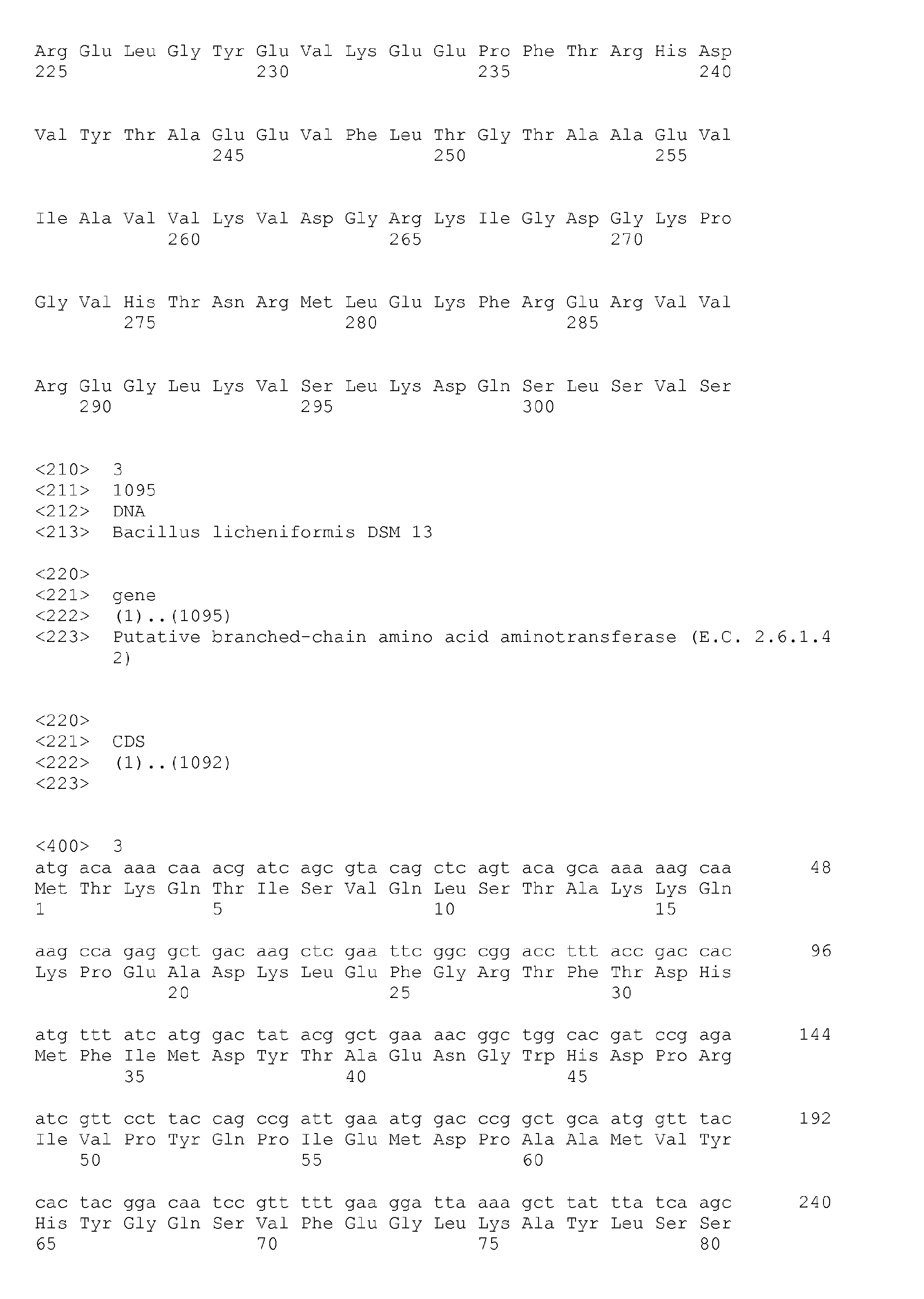


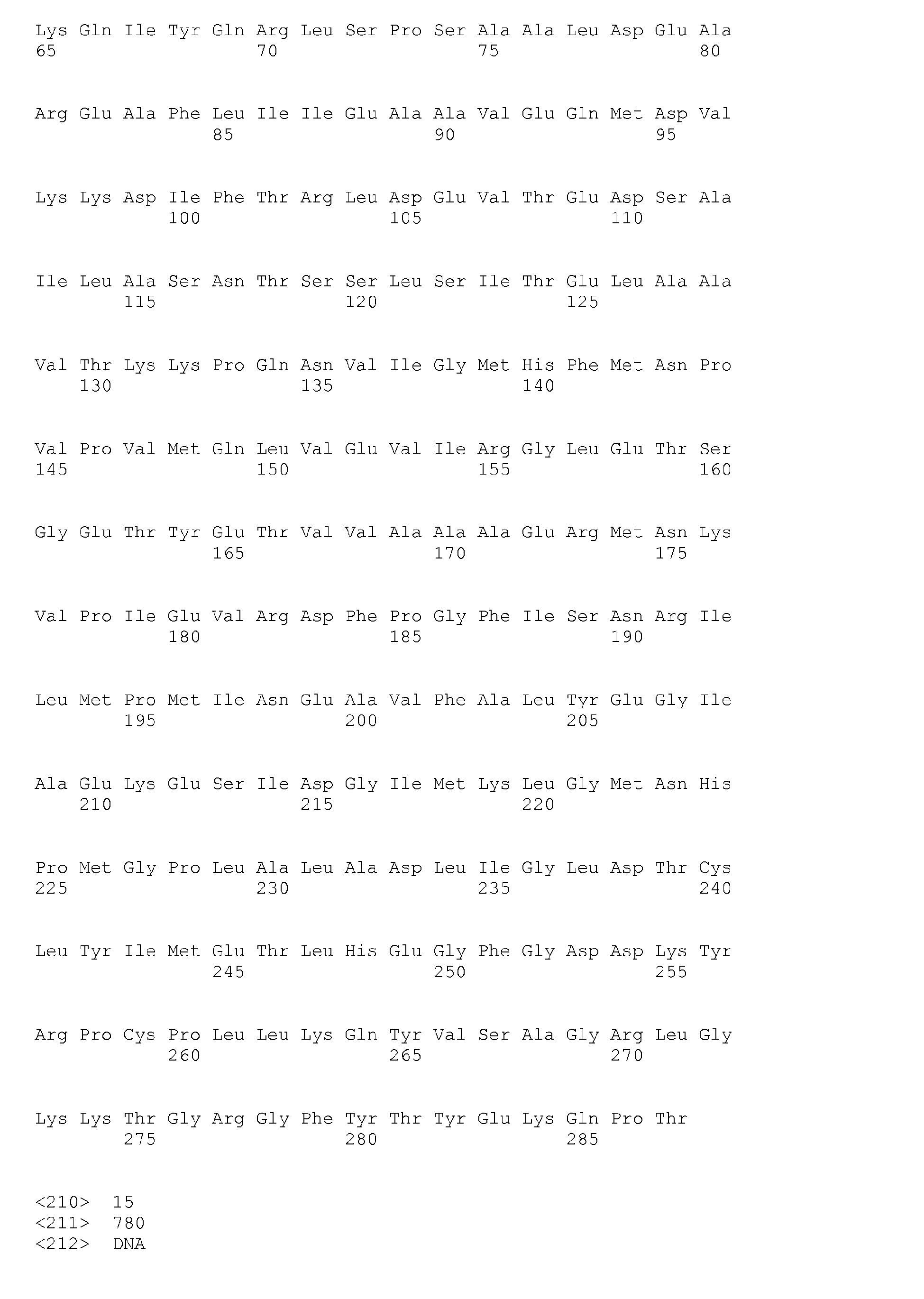


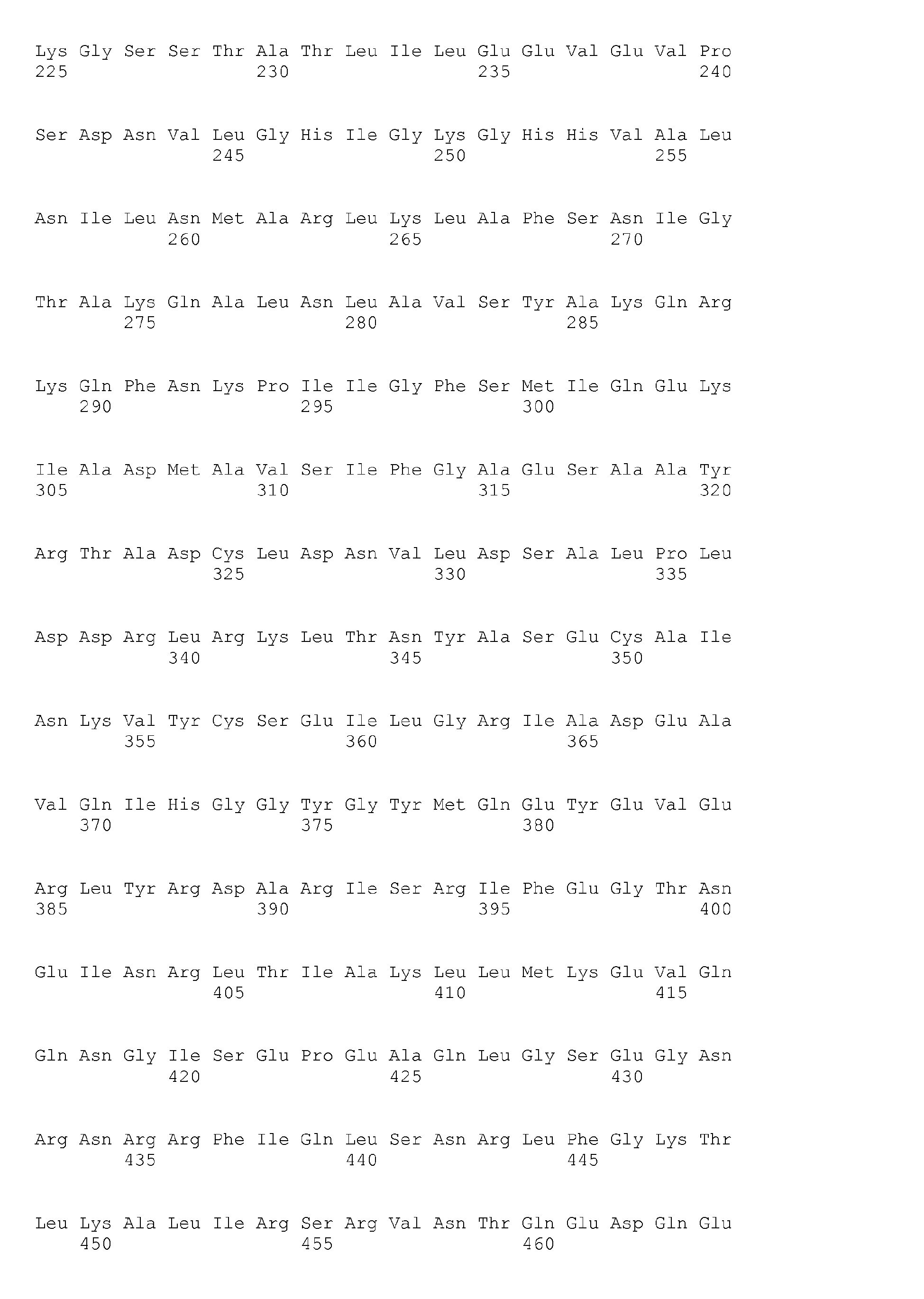


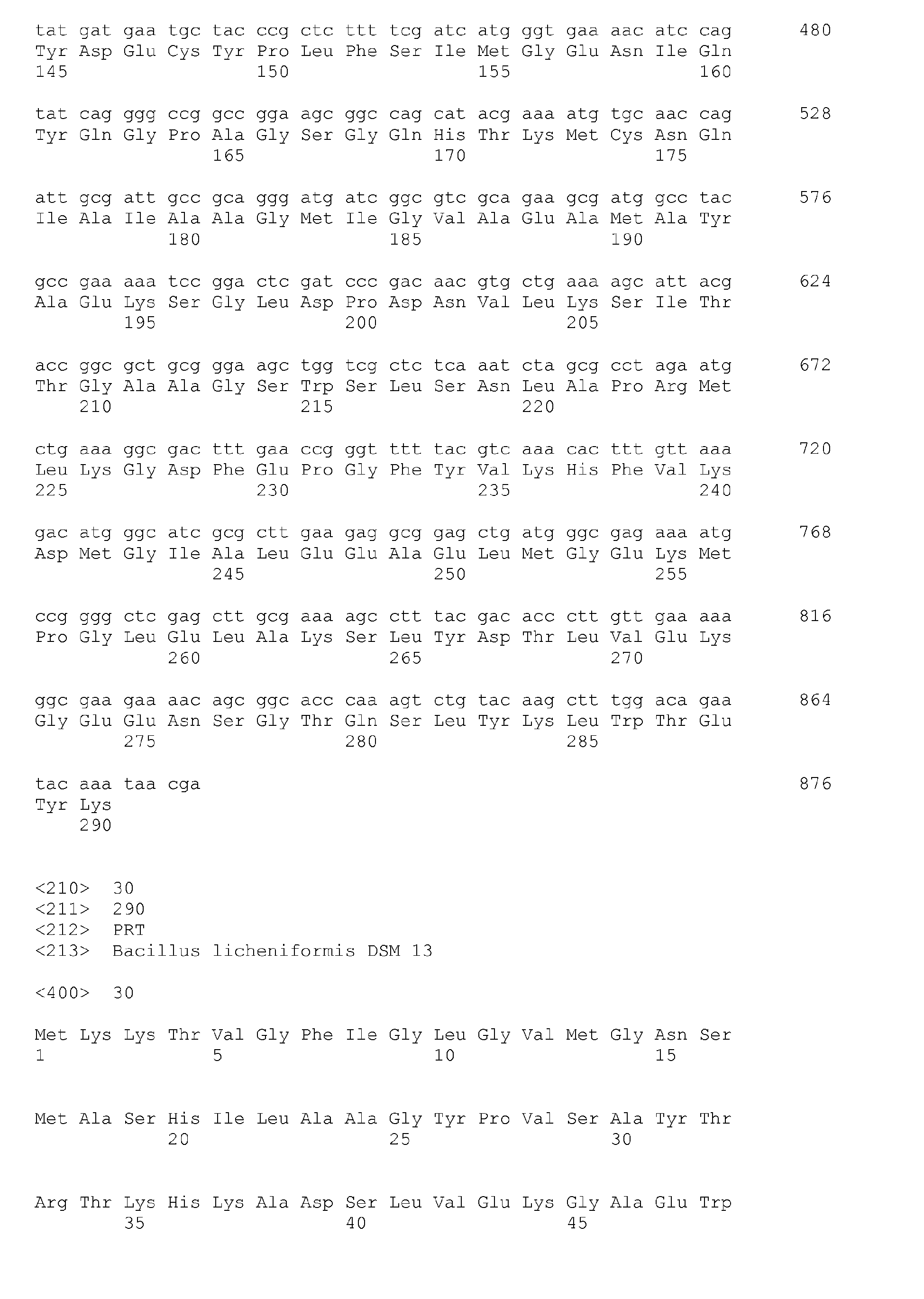


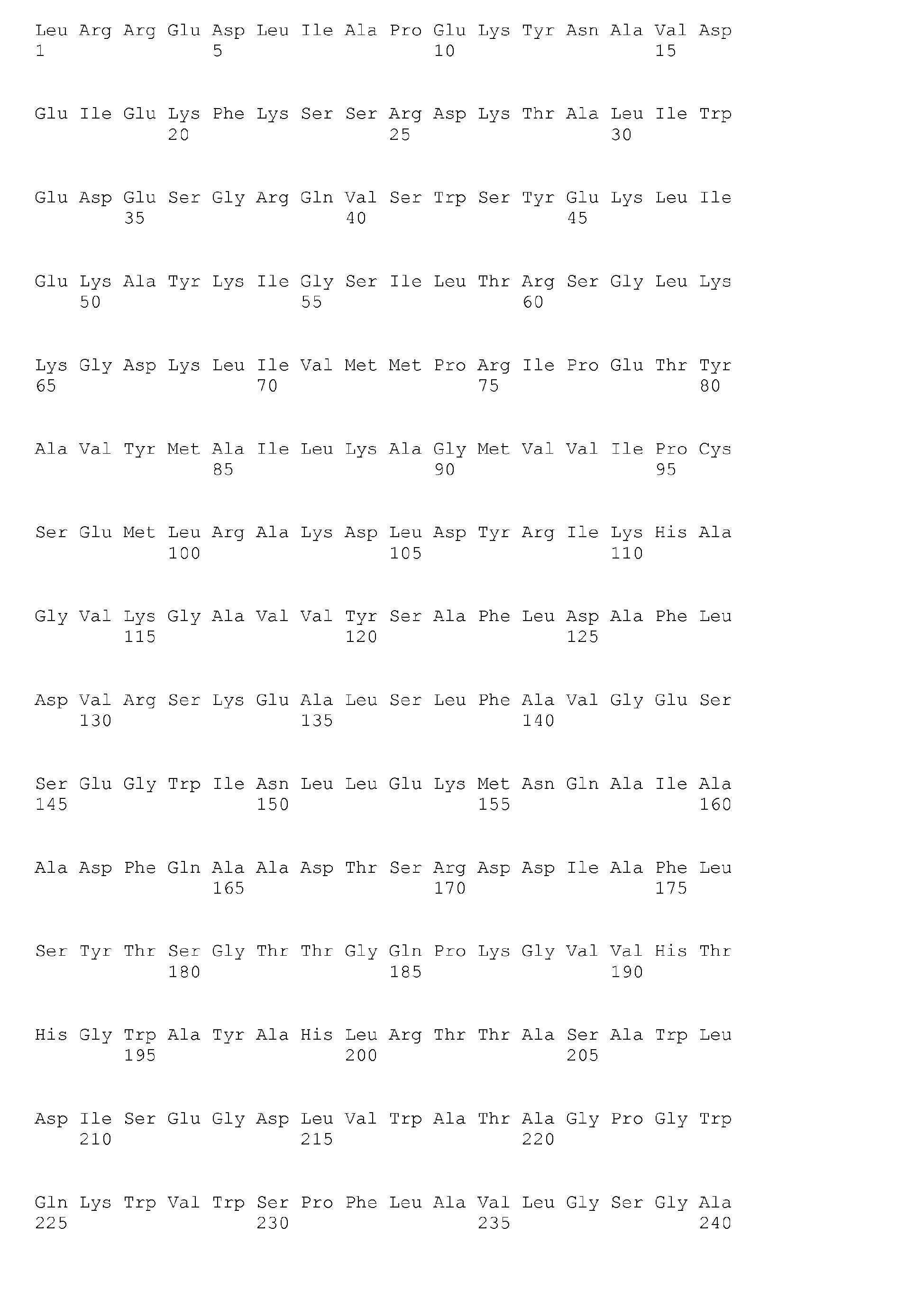


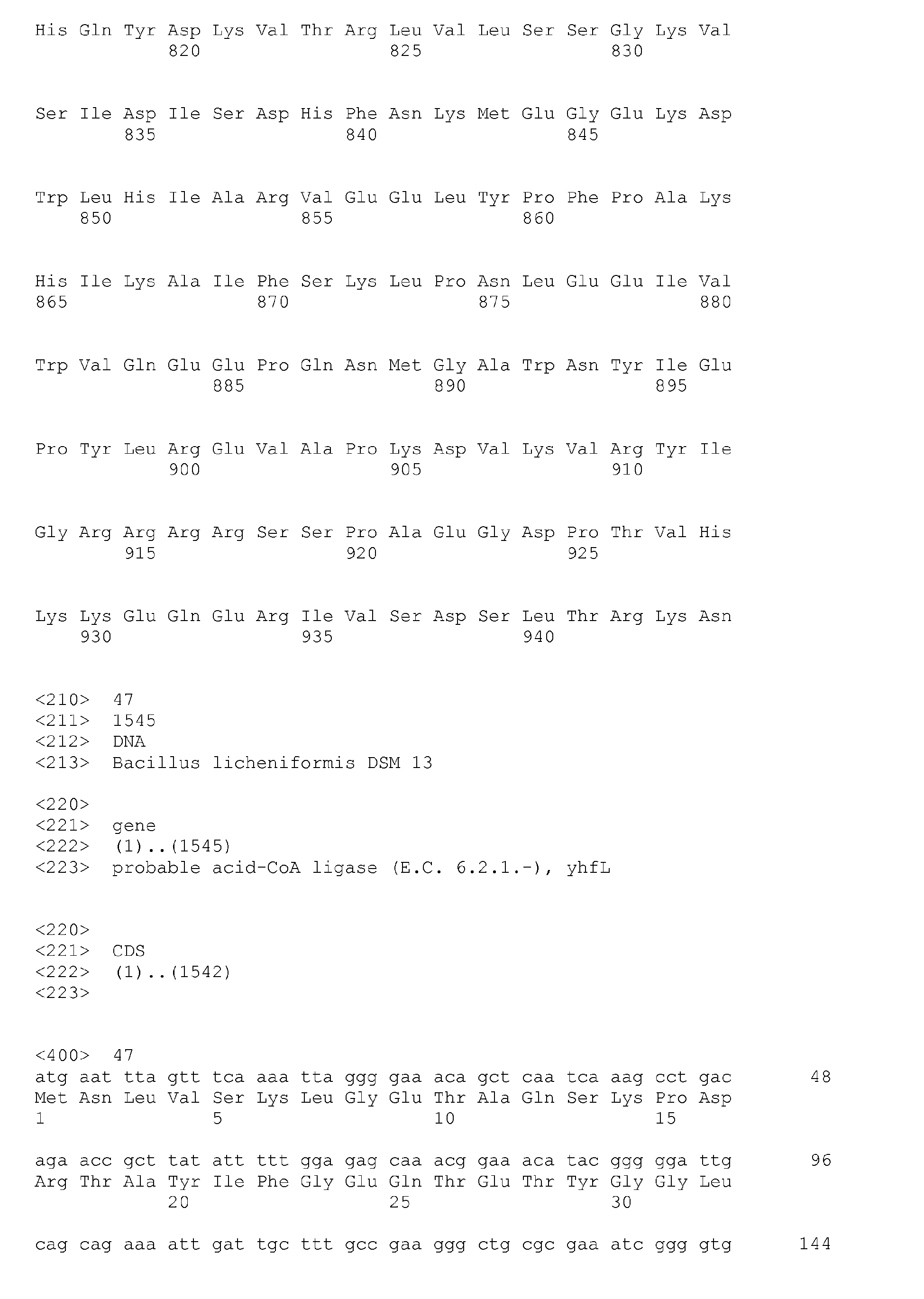


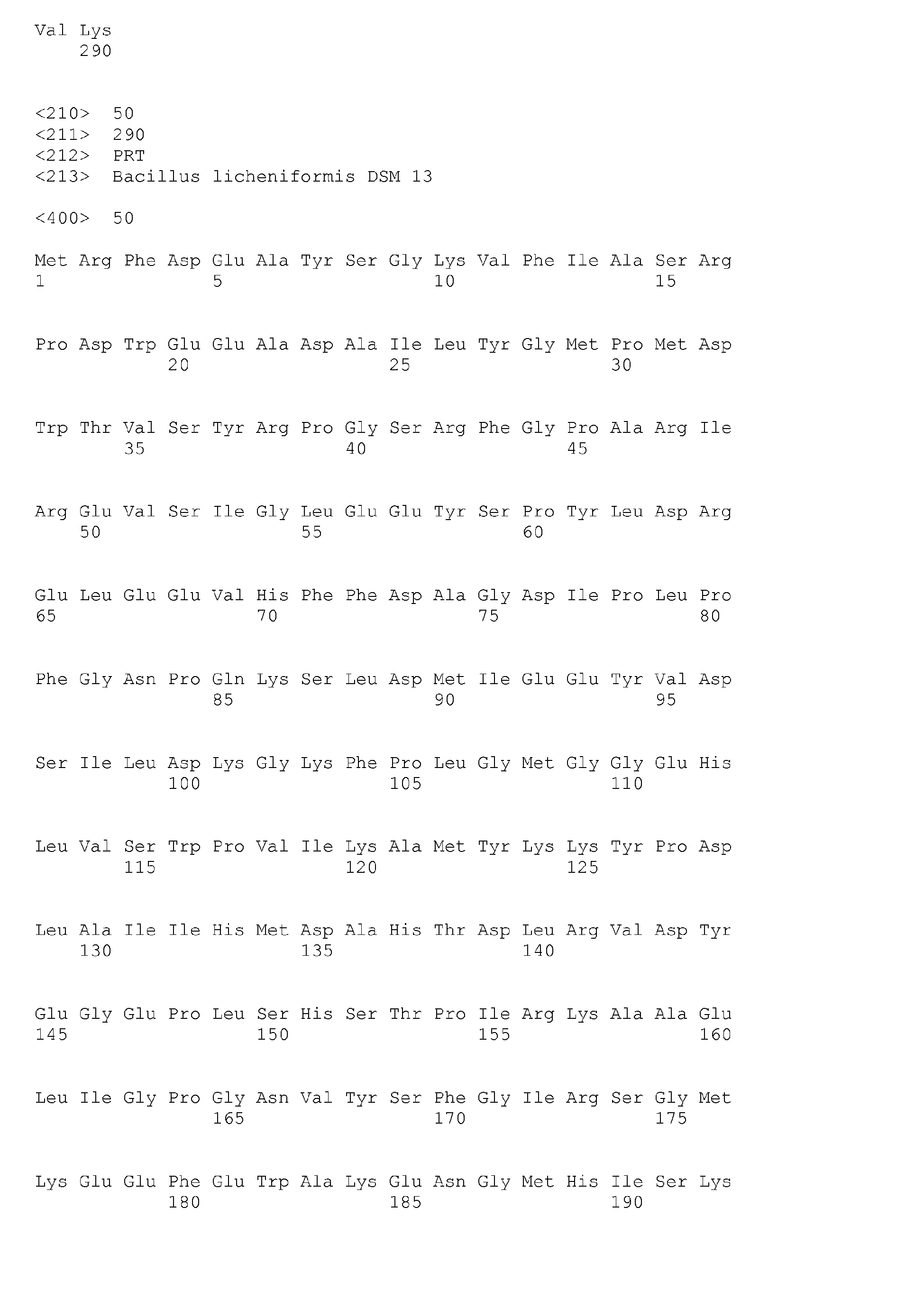

Claims (3)
- Verfahren zur Fermentation eines Mikroorganismus, bei dem mindestens eines der Gene auf einem Stoffwechselweg zur Synthese von Isovaleriansäure (als Teil des Leucin-Katabolismus) funktionell inaktiviert ist, wobei folgendes Enzym funktionell inaktiviert ist:L-Leucin-Dehydrogenase (E.C. 1.4.1.9).
- Verfahren nach Anspruch 1, bei dem der Mikroorganismus nur noch 50% der natürlicherweise unter denselben Bedingungen gebildeten Menge, vorzugsweise nur noch 10%, besonders bevorzugt keine Isovaleriansäure bildet.
- Verfahren nach Anspruch 1 oder 2, wobei das Enzym auf genetischer Ebene funktionell inaktiviert wird.
Applications Claiming Priority (2)
| Application Number | Priority Date | Filing Date | Title |
|---|---|---|---|
| DE102004031177A DE102004031177A1 (de) | 2004-06-29 | 2004-06-29 | Neue Geruchsstoffe bildende Genprodukte von Bacillus licheniformis und darauf aufbauende verbesserte biotechnologische Produktionsverfahren |
| EP05752264A EP1761628A2 (de) | 2004-06-29 | 2005-06-17 | Neue, geruchsstoffe bildende genprodukte von bacilllus licheniformis und darauf aufbauende verbesserte biotechnologische produktionsverfahren |
Related Parent Applications (1)
| Application Number | Title | Priority Date | Filing Date |
|---|---|---|---|
| EP05752264.1 Division | 2005-06-17 |
Publications (1)
| Publication Number | Publication Date |
|---|---|
| EP2248905A1 true EP2248905A1 (de) | 2010-11-10 |
Family
ID=34970441
Family Applications (5)
| Application Number | Title | Priority Date | Filing Date |
|---|---|---|---|
| EP10174633A Withdrawn EP2248905A1 (de) | 2004-06-29 | 2005-06-17 | Neue, Geruchsstoffe bildende Genprodukte von Bacillus licheniformis und darauf aufbauende verbesserte biotechnologische Produktionsverfahren |
| EP20100174635 Ceased EP2264153A3 (de) | 2004-06-29 | 2005-06-17 | Neue, Geruchsstoffe bildende Genprodukte von Bacillus licheniformis und darauf aufbauende verbesserte biotechnologische Produktionsverfahren |
| EP05752264A Ceased EP1761628A2 (de) | 2004-06-29 | 2005-06-17 | Neue, geruchsstoffe bildende genprodukte von bacilllus licheniformis und darauf aufbauende verbesserte biotechnologische produktionsverfahren |
| EP20100174601 Ceased EP2248891A1 (de) | 2004-06-29 | 2005-06-17 | Neue, Geruchsstoffe bildende Genprodukte von Bacillus licheniformis und darauf aufbauende verbesserte biotechnologische Produktionsverfahren |
| EP20100174602 Ceased EP2264154A3 (de) | 2004-06-29 | 2005-06-17 | Neue, Geruchsstoffe bildende Genprodukte von Bacillus licheniformis und darauf aufbauende verbesserte biotechnologische Produktionsverfahren |
Family Applications After (4)
| Application Number | Title | Priority Date | Filing Date |
|---|---|---|---|
| EP20100174635 Ceased EP2264153A3 (de) | 2004-06-29 | 2005-06-17 | Neue, Geruchsstoffe bildende Genprodukte von Bacillus licheniformis und darauf aufbauende verbesserte biotechnologische Produktionsverfahren |
| EP05752264A Ceased EP1761628A2 (de) | 2004-06-29 | 2005-06-17 | Neue, geruchsstoffe bildende genprodukte von bacilllus licheniformis und darauf aufbauende verbesserte biotechnologische produktionsverfahren |
| EP20100174601 Ceased EP2248891A1 (de) | 2004-06-29 | 2005-06-17 | Neue, Geruchsstoffe bildende Genprodukte von Bacillus licheniformis und darauf aufbauende verbesserte biotechnologische Produktionsverfahren |
| EP20100174602 Ceased EP2264154A3 (de) | 2004-06-29 | 2005-06-17 | Neue, Geruchsstoffe bildende Genprodukte von Bacillus licheniformis und darauf aufbauende verbesserte biotechnologische Produktionsverfahren |
Country Status (6)
| Country | Link |
|---|---|
| US (2) | US9394528B2 (de) |
| EP (5) | EP2248905A1 (de) |
| JP (1) | JP2008504829A (de) |
| CN (1) | CN101356266A (de) |
| DE (1) | DE102004031177A1 (de) |
| WO (1) | WO2006000343A2 (de) |
Families Citing this family (45)
| Publication number | Priority date | Publication date | Assignee | Title |
|---|---|---|---|---|
| DE102004031177A1 (de) | 2004-06-29 | 2006-01-19 | Henkel Kgaa | Neue Geruchsstoffe bildende Genprodukte von Bacillus licheniformis und darauf aufbauende verbesserte biotechnologische Produktionsverfahren |
| WO2006136164A1 (en) * | 2005-06-24 | 2006-12-28 | Novozymes A/S | Mutant cells suitable for recombinant polypeptide production |
| US8673601B2 (en) * | 2007-01-22 | 2014-03-18 | Genomatica, Inc. | Methods and organisms for growth-coupled production of 3-hydroxypropionic acid |
| TWI568847B (zh) | 2007-03-16 | 2017-02-01 | 奇諾麥提卡公司 | 用於1,4-丁二醇及其前驅物之生物合成的組合物及方法 |
| US7947483B2 (en) * | 2007-08-10 | 2011-05-24 | Genomatica, Inc. | Methods and organisms for the growth-coupled production of 1,4-butanediol |
| US7803589B2 (en) | 2008-01-22 | 2010-09-28 | Genomatica, Inc. | Methods and organisms for utilizing synthesis gas or other gaseous carbon sources and methanol |
| US9249431B2 (en) * | 2008-02-28 | 2016-02-02 | Green Biologics Limited | Production process |
| SI2262901T1 (sl) | 2008-03-05 | 2019-02-28 | Genomatica, Inc. | Primarni alkohol producirajoči organizmi |
| EP3351619A1 (de) * | 2008-03-27 | 2018-07-25 | Genomatica, Inc. | Mikroorganismen zur herstellung von adipinsäure und anderen verbindungen |
| GB0806093D0 (en) * | 2008-04-03 | 2008-05-14 | Green Biologics Ltd | Production of butanol |
| WO2009128644A2 (ko) * | 2008-04-14 | 2009-10-22 | 한국과학기술원 | 게놈 수준에서의 부탄올 생산 미생물의 대사 네트워크 모델 및 이를 이용한 부탄올 생성 미생물의 대사특성분석 및 결실 표적 스크리닝 방법 |
| EP2285973A4 (de) * | 2008-05-01 | 2012-04-25 | Genomatica Inc | Verfahren zur herstellung von methacrylsäure |
| JP5271606B2 (ja) * | 2008-05-30 | 2013-08-21 | 長谷川香料株式会社 | (s)−2−メチル酪酸の製造方法 |
| US20100021978A1 (en) * | 2008-07-23 | 2010-01-28 | Genomatica, Inc. | Methods and organisms for production of 3-hydroxypropionic acid |
| CA2735883C (en) * | 2008-09-10 | 2020-05-05 | Genomatica, Inc. | Microorganisms for the production of 1,4-butanediol |
| WO2010057022A1 (en) * | 2008-11-14 | 2010-05-20 | Genomatica, Inc. | Microorganisms for the production of methyl ethyl ketone and 2-butanol |
| KR20110097951A (ko) * | 2008-12-16 | 2011-08-31 | 게노마티카 인코포레이티드 | 합성가스와 다른 탄소원을 유용 제품으로 전환시키기 위한 미생물 및 방법 |
| KR102115497B1 (ko) | 2009-04-30 | 2020-05-26 | 게노마티카 인코포레이티드 | 1,3-부탄다이올 생산 유기체 |
| AU2010242849A1 (en) | 2009-04-30 | 2011-11-24 | Genomatica, Inc. | Organisms for the production of isopropanol, n-butanol, and isobutanol |
| KR20200038334A (ko) | 2009-05-07 | 2020-04-10 | 게노마티카 인코포레이티드 | 아디페이트, 헥사메틸렌디아민 및 6-아미노카프로산의 생합성을 위한 미생물 및 방법 |
| EP2429587A4 (de) * | 2009-05-15 | 2014-10-08 | Genomatica Inc | Organismen zur herstellung von cyclohexanon |
| KR20180042467A (ko) | 2009-06-04 | 2018-04-25 | 게노마티카 인코포레이티드 | 발효액 성분들의 분리 방법 |
| US8129169B2 (en) | 2009-06-04 | 2012-03-06 | Genomatica, Inc. | Microorganisms for the production of 1,4-butanediol and related methods |
| JP2012529889A (ja) * | 2009-06-10 | 2012-11-29 | ゲノマチカ, インク. | Mek及び2−ブタノールの炭素効率のよい生合成のための微生物及び方法 |
| WO2011017560A1 (en) | 2009-08-05 | 2011-02-10 | Genomatica, Inc. | Semi-synthetic terephthalic acid via microorganisms that produce muconic acid |
| EP2475775A4 (de) | 2009-09-09 | 2013-03-20 | Genomatica Inc | Mikroorganismen und verfahren zur gleichzeitigen herstellung von isopropanol und primären alkoholen, diolen und säuren |
| WO2011047101A1 (en) * | 2009-10-13 | 2011-04-21 | Genomatica, Inc. | Microorganisms for the production of 1,4-butanediol, 4-hydroxybutanal, 4-hydroxybutyryl-coa, putrescine and related compounds, and methods related thereto |
| KR20120088753A (ko) | 2009-10-23 | 2012-08-08 | 게노마티카 인코포레이티드 | 아닐린의 제조를 위한 미생물 |
| WO2011066076A1 (en) | 2009-11-25 | 2011-06-03 | Genomatica, Inc. | Microorganisms and methods for the coproduction of 1,4-butanediol and gamma-butyrolactone |
| CA2783096A1 (en) | 2009-12-10 | 2011-06-16 | Genomatica, Inc. | Methods and organisms for converting synthesis gas or other gaseous carbon sources and methanol to 1,3-butanediol |
| BR112012018620A2 (pt) * | 2010-01-29 | 2015-09-15 | Genomatica Inc | organismo microbiano de ocorrência não-natural, método para produzir (2-hidroxi-3-metil-4-oxobutoxi) fosfonato, método para produção de p-toluato, método para produzir tereftalato |
| US8048661B2 (en) | 2010-02-23 | 2011-11-01 | Genomatica, Inc. | Microbial organisms comprising exogenous nucleic acids encoding reductive TCA pathway enzymes |
| US8445244B2 (en) | 2010-02-23 | 2013-05-21 | Genomatica, Inc. | Methods for increasing product yields |
| US9023636B2 (en) | 2010-04-30 | 2015-05-05 | Genomatica, Inc. | Microorganisms and methods for the biosynthesis of propylene |
| JP5911847B2 (ja) | 2010-05-05 | 2016-04-27 | ジェノマティカ, インコーポレイテッド | ブタジエンの生合成のための微生物および方法 |
| SG187174A1 (en) | 2010-07-26 | 2013-02-28 | Genomatica Inc | Microorganisms and methods for the biosynthesis of aromatics, 2,4-pentadienoate and 1,3-butadiene |
| SI2855687T1 (sl) | 2012-06-04 | 2020-09-30 | Genomatica, Inc. | Mikroorganizmi in metode za proizvodnjo 4-hidroksibutirat, 1,4-butandiola in sorodne spojine |
| CN108004184B (zh) * | 2018-01-04 | 2021-01-29 | 云南中烟工业有限责任公司 | 一种芽孢杆菌及其用于生产异戊酸的方法 |
| CN109913509A (zh) * | 2018-04-28 | 2019-06-21 | 湖北大学 | 一种高效生产短支链脂肪酸的发酵培养基及发酵工艺 |
| CN109402188B (zh) * | 2018-10-19 | 2020-11-06 | 江南大学 | 一种来自短小芽孢杆菌的ω-转氨酶及在生物胺化中的应用 |
| CN109486780B (zh) * | 2018-11-14 | 2020-06-09 | 江南大学 | 一种催化效率提高的ω-转氨酶突变体 |
| CN109486784B (zh) * | 2018-11-30 | 2020-06-09 | 江南大学 | 一种能催化西他沙星五元环关键中间体的ω-转氨酶突变体 |
| CN112251391B (zh) * | 2019-05-13 | 2022-07-26 | 中国科学院天津工业生物技术研究所 | 一种赖氨酸生产菌株的构建方法和应用 |
| CN110904174B (zh) * | 2019-12-16 | 2022-08-30 | 湖北大学 | 缺失亮氨酸脱氢酶基因的地衣芽胞杆菌在异源蛋白生产中的应用 |
| CN116410914A (zh) * | 2023-05-18 | 2023-07-11 | 华中农业大学 | 一种发酵脱臭解淀粉芽胞杆菌工程菌及其在血红素合成中的应用 |
Citations (1)
| Publication number | Priority date | Publication date | Assignee | Title |
|---|---|---|---|---|
| JP2000224982A (ja) * | 1999-01-13 | 2000-08-15 | Mitsukan Group Honsha:Kk | 短鎖分岐脂肪酸非生産納豆菌 |
Family Cites Families (8)
| Publication number | Priority date | Publication date | Assignee | Title |
|---|---|---|---|---|
| US5238848A (en) * | 1987-01-23 | 1993-08-24 | Pfizer Inc | Cultures for production of avermectins |
| US5807522A (en) | 1994-06-17 | 1998-09-15 | The Board Of Trustees Of The Leland Stanford Junior University | Methods for fabricating microarrays of biological samples |
| AU3051699A (en) * | 1998-03-27 | 1999-10-18 | Yissum Research Development Company Of The Hebrew University Of Jerusalem | Method for reduction of fusel oils in alcoholic beverages and food products |
| GB9920431D0 (en) * | 1999-08-27 | 1999-11-03 | Nestle Sa | Phage resistant bacteria |
| US7018794B2 (en) | 2000-10-06 | 2006-03-28 | Novozymes, Inc. | Methods for monitoring multiple gene expression |
| RU2243260C2 (ru) * | 2002-06-25 | 2004-12-27 | Закрытое акционерное общество "Научно-исследовательский институт Аджиномото-Генетика" | Способ получения l-лейцина (варианты), штамм escherichia coli 505/pacyc-tyr b - продуцент l-лейцина |
| WO2005069762A2 (en) * | 2004-01-09 | 2005-08-04 | Novozymes Inc. | Bacillus licheniformis chromosome |
| DE102004031177A1 (de) | 2004-06-29 | 2006-01-19 | Henkel Kgaa | Neue Geruchsstoffe bildende Genprodukte von Bacillus licheniformis und darauf aufbauende verbesserte biotechnologische Produktionsverfahren |
-
2004
- 2004-06-29 DE DE102004031177A patent/DE102004031177A1/de not_active Withdrawn
-
2005
- 2005-06-17 WO PCT/EP2005/006540 patent/WO2006000343A2/de not_active Ceased
- 2005-06-17 EP EP10174633A patent/EP2248905A1/de not_active Withdrawn
- 2005-06-17 EP EP20100174635 patent/EP2264153A3/de not_active Ceased
- 2005-06-17 JP JP2007519651A patent/JP2008504829A/ja active Pending
- 2005-06-17 EP EP05752264A patent/EP1761628A2/de not_active Ceased
- 2005-06-17 EP EP20100174601 patent/EP2248891A1/de not_active Ceased
- 2005-06-17 EP EP20100174602 patent/EP2264154A3/de not_active Ceased
- 2005-06-17 CN CNA2005800218034A patent/CN101356266A/zh active Pending
-
2006
- 2006-12-27 US US11/616,319 patent/US9394528B2/en not_active Expired - Fee Related
-
2016
- 2016-06-15 US US15/182,839 patent/US20170067064A1/en not_active Abandoned
Patent Citations (1)
| Publication number | Priority date | Publication date | Assignee | Title |
|---|---|---|---|---|
| JP2000224982A (ja) * | 1999-01-13 | 2000-08-15 | Mitsukan Group Honsha:Kk | 短鎖分岐脂肪酸非生産納豆菌 |
Non-Patent Citations (7)
| Title |
|---|
| CHANG; COHEN: "High Frequency Transformation of Bacillus subtilis Protoplasts by Plasmid DNA", MOLEC. GEN. GENET., vol. 168, 1979, pages 111 - 115 |
| D.HANNAHAN: "Studies on transformation on Escherichia coli", J. MOL. MICROBIOL., vol. 166, 1983, pages 557 - 580 |
| DATABASE WPI Week 200057, Derwent World Patents Index; AN 2000-596909, XP002600539 * |
| FRITSCH; SAMBROOK; MANIATIS: "Molecular cloning: a laboratory manual", 1989, COLD SPRING HARBOUR LABORATORY PRESS |
| J. VEHMAANPERÄ ET AL.: "Genetic manipulation of Bacillus amyloliquefaciens", J. BIOTECHNOL., vol. 19, 1991, pages 221 - 240 |
| T.J. GRYCZAN ET AL.: "Replication and incompatibility properties of plasmid pE194 in Bacillus subtilis", J. BACTERIOL., vol. 152, 1982, pages 722 - 735 |
| TAKEMURA H ET AL: "BREEDING OF BRANCHED SHORT-CHAIN FATTY ACIDS NON-PRODUCING NATTO BACTERIA AND ITS APPLICATION TO PRODUCTION OF NATTO WITH LIGHT SMELLS", NIPPON SHOKUHIN KAGAKU KOGAKU KAISHI - JOURNAL OF JAPANESE SOCIETY OF FOOD SCIENCE AND TECHNOLOGY, NIPPON SHOKUHIN KAGAKU KOGAKUKAI, TSUKUBA, JP, vol. 47, no. 10, 1 January 2000 (2000-01-01), pages 773 - 779, XP008054433, ISSN: 1341-027X * |
Also Published As
| Publication number | Publication date |
|---|---|
| WO2006000343A3 (de) | 2006-07-27 |
| WO2006000343A2 (de) | 2006-01-05 |
| CN101356266A (zh) | 2009-01-28 |
| US9394528B2 (en) | 2016-07-19 |
| EP2264154A3 (de) | 2011-10-19 |
| EP1761628A2 (de) | 2007-03-14 |
| DE102004031177A1 (de) | 2006-01-19 |
| EP2264153A3 (de) | 2011-10-26 |
| US20170067064A1 (en) | 2017-03-09 |
| US20070190605A1 (en) | 2007-08-16 |
| JP2008504829A (ja) | 2008-02-21 |
| EP2248891A1 (de) | 2010-11-10 |
| EP2264154A2 (de) | 2010-12-22 |
| EP2264153A2 (de) | 2010-12-22 |
Similar Documents
| Publication | Publication Date | Title |
|---|---|---|
| EP2264154A2 (de) | Neue, Geruchsstoffe bildende Genprodukte von Bacillus licheniformis und darauf aufbauende verbesserte biotechnologische Produktionsverfahren | |
| DE60025976T2 (de) | DNA die für eine mutierte Isopropylmalatsynthase kodiert, Microorganismus, das L-Leucin produziert, und Verfahren zur Herstellung von L-Leucin | |
| DE19907567B4 (de) | Verfahren zur mikrobiellen Herstellung von L-Valin | |
| DE60024178T2 (de) | Gene für L-Lysinbiosynthese aus thermophilen Bakterien | |
| EP0751995B1 (de) | Riboflavin-biosynthesis in fungi | |
| US10633684B2 (en) | Production of riboflavin | |
| DE19855312A1 (de) | Verfahren zur fermentativen Herstellung von D-Pantothensäure unter Verwendung coryneformer Bakterien | |
| DE69615055T2 (de) | Gene kodierend für ultrathermostabile proteasen | |
| EP2267007B1 (de) | Neue, Polyaminosäuren bildende oder abbauende Genprodukte von Bacillus licheniformis und darauf aufbauende verbesserte biotechnologische Produktionsverfahren | |
| WO2010075960A2 (de) | Verfahren zur herstellung von riboflavin | |
| DE60202227T2 (de) | Neue Enon Reduktasen isoliert aus Kluyveromyces lactis, Methoden zu deren Herstellung und Methoden zur selektiven Reduzierung von Kohlenstoff-Kohlenstoff Doppelbindungen von Alpha, Beta-ungesättigten Ketonen unter Verwendung der Reduktasen | |
| EP0285949B1 (de) | Genetische Kontrolleinheit und Klonierungs- und Expressionssystem | |
| EP1725582A1 (de) | Der faktor reca aus bacillus licheniformis und reca-inaktivierte sicherheitsstämme für die biotechnologische produktion | |
| DE102004032995A1 (de) | Neue, sekretierte Genprodukte von Bacillus licheniformis und darauf aufbauende verbesserte biotechnologische Produktionsverfahren | |
| DE102004041717A1 (de) | Restriktions-Modifikationssystem von Bacillus licheniformis und darauf aufbauende verbesserte biotechnologische Produktionsverfahren | |
| DE69121024T2 (de) | Dns-segmente und das delta-1 des hydrogenasegen enthaltende mikroorganismen und ihre verwendung | |
| EP1470227A2 (de) | Verfahren zur überexpression von dehydrogenasen | |
| DE102004035543A1 (de) | Neue sekretorische Genprodukte von Bacillus licheniformis und darauf aufbauende verbesserte biotechnologische Produktionsverfahren | |
| DE10101501A1 (de) | Verfahren zur fermentativen Herstellung von Pantothensäure | |
| EP1322764A2 (de) | Verfahren zur verbesserten herstellung von cyanophycin und dessen folgeprodukte | |
| HK1124883A (en) | Novel gene products of bacillus licheniformis which form odorous substances and improved biotechnological production methods based thereon | |
| DE19937548A1 (de) | Ein- oder mehrzellige Organismen zur Herstellung von Riboflavin | |
| WO2001023576A1 (de) | Proteinproduktion mit ashbya gossypii |
Legal Events
| Date | Code | Title | Description |
|---|---|---|---|
| PUAI | Public reference made under article 153(3) epc to a published international application that has entered the european phase |
Free format text: ORIGINAL CODE: 0009012 |
|
| 17P | Request for examination filed |
Effective date: 20100831 |
|
| AC | Divisional application: reference to earlier application |
Ref document number: 1761628 Country of ref document: EP Kind code of ref document: P |
|
| AK | Designated contracting states |
Kind code of ref document: A1 Designated state(s): AT BE BG CH CY CZ DE DK EE ES FI FR GB GR HU IE IS IT LI LT LU MC NL PL PT RO SE SI SK TR |
|
| 17Q | First examination report despatched |
Effective date: 20101015 |
|
| RIN1 | Information on inventor provided before grant (corrected) |
Inventor name: GOTTSCHALK, GERHARD Inventor name: HERZBERG, CHRISTINA Inventor name: SINGER, ANKE Inventor name: LIESEGANG, HEIKO Inventor name: VEITH, BIRGIT Inventor name: EHRENREICH, ARMIN Inventor name: MAURER, KARL-HEINZ Inventor name: EVERS, STEFAN Inventor name: FEESCHE, JOERG Inventor name: BESSLER, CORNELIUS |
|
| STAA | Information on the status of an ep patent application or granted ep patent |
Free format text: STATUS: THE APPLICATION IS DEEMED TO BE WITHDRAWN |
|
| 18D | Application deemed to be withdrawn |
Effective date: 20110427 |