EP2242152A1 - Optisches modul - Google Patents
Optisches modul Download PDFInfo
- Publication number
- EP2242152A1 EP2242152A1 EP09701495A EP09701495A EP2242152A1 EP 2242152 A1 EP2242152 A1 EP 2242152A1 EP 09701495 A EP09701495 A EP 09701495A EP 09701495 A EP09701495 A EP 09701495A EP 2242152 A1 EP2242152 A1 EP 2242152A1
- Authority
- EP
- European Patent Office
- Prior art keywords
- optical
- board
- electronic device
- optical module
- elements
- Prior art date
- Legal status (The legal status is an assumption and is not a legal conclusion. Google has not performed a legal analysis and makes no representation as to the accuracy of the status listed.)
- Withdrawn
Links
Images




Classifications
-
- H—ELECTRICITY
- H01—ELECTRIC ELEMENTS
- H01S—DEVICES USING THE PROCESS OF LIGHT AMPLIFICATION BY STIMULATED EMISSION OF RADIATION [LASER] TO AMPLIFY OR GENERATE LIGHT; DEVICES USING STIMULATED EMISSION OF ELECTROMAGNETIC RADIATION IN WAVE RANGES OTHER THAN OPTICAL
- H01S5/00—Semiconductor lasers
- H01S5/40—Arrangement of two or more semiconductor lasers, not provided for in groups H01S5/02 - H01S5/30
- H01S5/4025—Array arrangements, e.g. constituted by discrete laser diodes or laser bar
-
- G—PHYSICS
- G02—OPTICS
- G02B—OPTICAL ELEMENTS, SYSTEMS OR APPARATUS
- G02B6/00—Light guides; Structural details of arrangements comprising light guides and other optical elements, e.g. couplings
- G02B6/24—Coupling light guides
- G02B6/42—Coupling light guides with opto-electronic elements
- G02B6/4201—Packages, e.g. shape, construction, internal or external details
-
- G—PHYSICS
- G02—OPTICS
- G02B—OPTICAL ELEMENTS, SYSTEMS OR APPARATUS
- G02B6/00—Light guides; Structural details of arrangements comprising light guides and other optical elements, e.g. couplings
- G02B6/24—Coupling light guides
- G02B6/42—Coupling light guides with opto-electronic elements
- G02B6/4201—Packages, e.g. shape, construction, internal or external details
- G02B6/4274—Electrical aspects
- G02B6/4279—Radio frequency signal propagation aspects of the electrical connection, high frequency adaptations
-
- G—PHYSICS
- G02—OPTICS
- G02B—OPTICAL ELEMENTS, SYSTEMS OR APPARATUS
- G02B6/00—Light guides; Structural details of arrangements comprising light guides and other optical elements, e.g. couplings
- G02B6/24—Coupling light guides
- G02B6/42—Coupling light guides with opto-electronic elements
- G02B6/4201—Packages, e.g. shape, construction, internal or external details
- G02B6/4249—Packages, e.g. shape, construction, internal or external details comprising arrays of active devices and fibres
-
- G—PHYSICS
- G02—OPTICS
- G02B—OPTICAL ELEMENTS, SYSTEMS OR APPARATUS
- G02B6/00—Light guides; Structural details of arrangements comprising light guides and other optical elements, e.g. couplings
- G02B6/24—Coupling light guides
- G02B6/42—Coupling light guides with opto-electronic elements
- G02B6/4292—Coupling light guides with opto-electronic elements the light guide being disconnectable from the opto-electronic element, e.g. mutually self aligning arrangements
-
- H—ELECTRICITY
- H01—ELECTRIC ELEMENTS
- H01S—DEVICES USING THE PROCESS OF LIGHT AMPLIFICATION BY STIMULATED EMISSION OF RADIATION [LASER] TO AMPLIFY OR GENERATE LIGHT; DEVICES USING STIMULATED EMISSION OF ELECTROMAGNETIC RADIATION IN WAVE RANGES OTHER THAN OPTICAL
- H01S5/00—Semiconductor lasers
- H01S5/02—Structural details or components not essential to laser action
- H01S5/022—Mountings; Housings
- H01S5/0225—Out-coupling of light
- H01S5/02251—Out-coupling of light using optical fibres
-
- H—ELECTRICITY
- H01—ELECTRIC ELEMENTS
- H01S—DEVICES USING THE PROCESS OF LIGHT AMPLIFICATION BY STIMULATED EMISSION OF RADIATION [LASER] TO AMPLIFY OR GENERATE LIGHT; DEVICES USING STIMULATED EMISSION OF ELECTROMAGNETIC RADIATION IN WAVE RANGES OTHER THAN OPTICAL
- H01S5/00—Semiconductor lasers
- H01S5/02—Structural details or components not essential to laser action
- H01S5/022—Mountings; Housings
- H01S5/0233—Mounting configuration of laser chips
- H01S5/02345—Wire-bonding
-
- H—ELECTRICITY
- H01—ELECTRIC ELEMENTS
- H01S—DEVICES USING THE PROCESS OF LIGHT AMPLIFICATION BY STIMULATED EMISSION OF RADIATION [LASER] TO AMPLIFY OR GENERATE LIGHT; DEVICES USING STIMULATED EMISSION OF ELECTROMAGNETIC RADIATION IN WAVE RANGES OTHER THAN OPTICAL
- H01S5/00—Semiconductor lasers
- H01S5/06—Arrangements for controlling the laser output parameters, e.g. by operating on the active medium
- H01S5/062—Arrangements for controlling the laser output parameters, e.g. by operating on the active medium by varying the potential of the electrodes
- H01S5/06226—Modulation at ultra-high frequencies
-
- H—ELECTRICITY
- H01—ELECTRIC ELEMENTS
- H01S—DEVICES USING THE PROCESS OF LIGHT AMPLIFICATION BY STIMULATED EMISSION OF RADIATION [LASER] TO AMPLIFY OR GENERATE LIGHT; DEVICES USING STIMULATED EMISSION OF ELECTROMAGNETIC RADIATION IN WAVE RANGES OTHER THAN OPTICAL
- H01S5/00—Semiconductor lasers
- H01S5/40—Arrangement of two or more semiconductor lasers, not provided for in groups H01S5/02 - H01S5/30
- H01S5/42—Arrays of surface emitting lasers
- H01S5/423—Arrays of surface emitting lasers having a vertical cavity
-
- H—ELECTRICITY
- H10—SEMICONDUCTOR DEVICES; ELECTRIC SOLID-STATE DEVICES NOT OTHERWISE PROVIDED FOR
- H10W—GENERIC PACKAGES, INTERCONNECTIONS, CONNECTORS OR OTHER CONSTRUCTIONAL DETAILS OF DEVICES COVERED BY CLASS H10
- H10W72/00—Interconnections or connectors in packages
- H10W72/50—Bond wires
- H10W72/531—Shapes of wire connectors
- H10W72/536—Shapes of wire connectors the connected ends being ball-shaped
-
- H—ELECTRICITY
- H10—SEMICONDUCTOR DEVICES; ELECTRIC SOLID-STATE DEVICES NOT OTHERWISE PROVIDED FOR
- H10W—GENERIC PACKAGES, INTERCONNECTIONS, CONNECTORS OR OTHER CONSTRUCTIONAL DETAILS OF DEVICES COVERED BY CLASS H10
- H10W72/00—Interconnections or connectors in packages
- H10W72/50—Bond wires
- H10W72/531—Shapes of wire connectors
- H10W72/5363—Shapes of wire connectors the connected ends being wedge-shaped
-
- H—ELECTRICITY
- H10—SEMICONDUCTOR DEVICES; ELECTRIC SOLID-STATE DEVICES NOT OTHERWISE PROVIDED FOR
- H10W—GENERIC PACKAGES, INTERCONNECTIONS, CONNECTORS OR OTHER CONSTRUCTIONAL DETAILS OF DEVICES COVERED BY CLASS H10
- H10W72/00—Interconnections or connectors in packages
- H10W72/50—Bond wires
- H10W72/531—Shapes of wire connectors
- H10W72/5366—Shapes of wire connectors the bond wires having kinks
-
- H—ELECTRICITY
- H10—SEMICONDUCTOR DEVICES; ELECTRIC SOLID-STATE DEVICES NOT OTHERWISE PROVIDED FOR
- H10W—GENERIC PACKAGES, INTERCONNECTIONS, CONNECTORS OR OTHER CONSTRUCTIONAL DETAILS OF DEVICES COVERED BY CLASS H10
- H10W72/00—Interconnections or connectors in packages
- H10W72/50—Bond wires
- H10W72/541—Dispositions of bond wires
- H10W72/5445—Dispositions of bond wires being orthogonal to a side surface of the chip, e.g. parallel arrangements
-
- H—ELECTRICITY
- H10—SEMICONDUCTOR DEVICES; ELECTRIC SOLID-STATE DEVICES NOT OTHERWISE PROVIDED FOR
- H10W—GENERIC PACKAGES, INTERCONNECTIONS, CONNECTORS OR OTHER CONSTRUCTIONAL DETAILS OF DEVICES COVERED BY CLASS H10
- H10W72/00—Interconnections or connectors in packages
- H10W72/50—Bond wires
- H10W72/551—Materials of bond wires
- H10W72/552—Materials of bond wires comprising metals or metalloids, e.g. silver
- H10W72/5522—Materials of bond wires comprising metals or metalloids, e.g. silver comprising gold [Au]
-
- H—ELECTRICITY
- H10—SEMICONDUCTOR DEVICES; ELECTRIC SOLID-STATE DEVICES NOT OTHERWISE PROVIDED FOR
- H10W—GENERIC PACKAGES, INTERCONNECTIONS, CONNECTORS OR OTHER CONSTRUCTIONAL DETAILS OF DEVICES COVERED BY CLASS H10
- H10W74/00—Encapsulations, e.g. protective coatings
-
- H—ELECTRICITY
- H10—SEMICONDUCTOR DEVICES; ELECTRIC SOLID-STATE DEVICES NOT OTHERWISE PROVIDED FOR
- H10W—GENERIC PACKAGES, INTERCONNECTIONS, CONNECTORS OR OTHER CONSTRUCTIONAL DETAILS OF DEVICES COVERED BY CLASS H10
- H10W90/00—Package configurations
- H10W90/701—Package configurations characterised by the relative positions of pads or connectors relative to package parts
- H10W90/751—Package configurations characterised by the relative positions of pads or connectors relative to package parts of bond wires
- H10W90/753—Package configurations characterised by the relative positions of pads or connectors relative to package parts of bond wires between laterally-adjacent chips
Definitions
- the present invention relates to an optical module, and more particularly to an optical module as a parallel optical transmission module to be used for an inter-board optical transmission system and an inter-apparatus (inter-housing) optical transmission system, which parallel optical transmission module parallelly transmits optical signals with a plurality of optical fibers (channels) arranged in parallel.
- An optical module composed of a plurality of light emitting elements and an electronic device (IC) driving the plurality of light emitting elements, both housed in a case to be integrated, has hitherto been known (see, for example, Patent Document 1).
- the conventional optical modules disclosed in the Patent Document 1 and the Non-Patent Document 1 are adapted to accord each center of the plurality of optical fibers, held by a ferrule, with the center of each light emitting section of the plurality of optical elements by passive alignment using a silicon optical bench (SiOB).
- SiOB silicon optical bench
- the configuration of the technique is that of electrically connecting the plurality of optical elements and the electronic device with the wiring on the SiOB.
- the configuration is the following one: the plurality of optical elements are connected to the wiring on the SiOB with wires, and the wiring is connected to the electronic device with wires.
- the lengths of a plurality of transmission lines connecting the plurality of light emitting elements and the electronic device electrically becomes long. Consequently, crosstalk components between adjacent transmission lines increase, and there is a problem of the difficulty of realizing high speed parallel light transmission.
- active alignment is performed in such a way that the plurality of optical fibers and the plurality of optical elements are optically coupled to each other, respectively, by two-dimensionally adjusting the position of the optical connector section on the board. Consequently, the SiOB for performing the passive alignment becomes unnecessary unlike the conventional technique, and the plurality of optical elements and the electronic device can be arranged at positions on the board close to each other. Hereby, the lengths of the plurality of transmission lines connecting the plurality of light emitting elements and the electronic device electrically can be shortened.
- a position where the plurality of optical fibers and the plurality of optical elements are optically coupled to each other, respectively means the position where the center (core center) of each one end of the plurality of optical fibers and the center of each light emitting section or each light receiving section of the plurality of optical elements accord with each other, respectively.
- An optical module of the invention according to claim 3 features that the electronic device is arranged in a recess section formed on the board in order that heights of surfaces of the plurality of optical elements and a height of a surface of the electronic device become comparative levels in order that wire lengths become shortest, and the surfaces of the plurality of optical elements and the surface of the electronic device are directly electrically connected to each other, respectively, with a plurality of wires as the transmission lines.
- crosstalk between adjacent wires can be reduced in the optical module in which the plurality of optical elements and the electronic device are mounted by wire bonding.
- An optical module of the invention according to claim 4 features that the recess section has almost vertical wall surfaces; the plurality of optical elements are arranged on the board so as to align along one of the wall surfaces at a position close to the one of the wall surfaces; and the electronic device is arranged in the recess section at a position close to the one of the wall surfaces.
- An optical module of the invention features that the electronic device is mounted on the board by flip chip mounting; the plurality of optical elements are arranged in a recess section formed on the board in order that heights of surfaces of the plurality of optical elements and a height of a surface of the electronic device become comparative levels in order that wire lengths become shortest; and the plurality of optical elements and wiring on the board, to which wiring the electronic device is electrically connected, are electrically connected to each other with a plurality of wires.
- the transmission lines for transmitting signals between the plurality of optical elements and the electronic device are composed of the wiring on the board, to which wiring the electronic device is electrically connected, and the plurality of wires in this case.
- An optical module of the invention features that the electronic device is arranged in a recess section formed on the board; surfaces of the plurality of optical elements and a surface of the electronic device are directly electrically connected to each other with a plurality of wires as the transmission lines; and the surface of the electronic device is made to be higher than the surfaces of the plurality of optical elements within a range in which no electrical short circuits are caused at respective both ends of the plurality of wires.
- each of the wire lengths can be shortened as short as possible without causing any electrical short circuit at each of both the ends of the plurality of wires.
- An optical module of the invention according to claim 8 features that the electronic device is arranged in a recess section formed on the board; surfaces of the plurality of optical elements and a surface of the electronic device are directly electrically connected to each other with a plurality of wires as the transmission lines; and the surfaces of the plurality of optical elements are made to be higher than the surface of the electronic device within a range in which no electrical short circuits are caused at respective both ends of the plurality of wires.
- each of the wiring lengths can be shortened as short as possible without causing any electrical short circuit at each of both the ends of the plurality of wires.
- An optical module of the invention features that the optical module includes a plurality of surface emitting type semiconductor laser elements as the optical elements and a driver IC as the electronic device, which driver IC drives the plurality of surface emitting type semiconductor laser elements, and the optical module is configured as a transmission side optical module to transmit the optical signals to be emitted from the plurality of surface emitting type semiconductor laser elements, respectively, to an outside through the plurality of optical fibers in parallel.
- the transmission side optical module capable of performing high speed parallel light transmission can be realized.
- An optical module of the invention features that the optical module includes a plurality of photodiodes as the optical elements and an amplifying IC as the electronic device, which amplifying IC has a function to convert output currents of the photodiodes into voltages to amplify the voltage, and the optical module is configured as a reception side optical module to receive the optical signals, which are parallelly transmitted from an outside through the plurality of optical fibers, with the plurality of photodiodes to convert the received optical signals into electric signals.
- the reception side optical module capable of performing high speed parallel light transmission can be realized.
- an optical module of the invention is an optical module to parallelly transmit optical signals with a plurality of optical fibers, the optical module including: a board having an electrode pattern; a plurality of optical elements which are mounted on the electrode pattern of the board; and an electronic device which is mounted on the electrode pattern of the board and which is electrically connected to the plurality of optical elements, wherein the plurality of optical elements and the electronic device are arranged at positions close to each other on the board.
- the lengths of a plurality of transmission lines connecting the plurality of light emitting elements and the electronic device to each other electrically become short, and crosstalk between adjacent transmission lines can be reduced.
- high speed parallel light transmission can be realized.
- An optical module of the invention according to claim 12 further includes an optical connector section to hold the plurality of optical fibers, which optical connector section is fixed to the board at a position where the plurality of optical fibers and the plurality of optical elements are optically coupled to each other, respectively, and a position of the optical connector section can two-dimensionally be adjusted on the board.
- the configuration is the one performing the active alignment in order that the plurality of optical fibers and the plurality of optical elements may optically coupled to each other, respectively, byperformingtwo-dimensionalposition adjustment of the optical connector section on the board. Consequently, the SiOB for performing the passive alignment becomes unnecessary unlike the conventional technique, and the plurality of optical elements and the electronic device can be arranged at positions close to each other on the board.
- a position where the plurality of optical fibers and the plurality of optical elements are optically coupled to each other, respectively indicates the position where the center (core center) of each one end of the plurality of optical fibers and the center of each light emitting section or each light receiving section of the plurality of optical elements accord with each other, respectively.
- An optical module of the invention according to claim 13 features that the electronic device and the plurality of optical elements are directly electrically connected to each other, respectively, with a plurality of wires. According to the configuration, the wire lengths of the plurality of wires connecting the plurality of light emitting elements and the electronic device electrically become short. Hereby, crosstalk between adjacent wires can be reduced in the optical module in which the electronic device and the plurality of optical elements are mounted by wire bonding mounting.
- An optical module of the invention according to claim 14 features that each of lengths in horizontal directions of the plurality of wires is made to be 500 ⁇ m or less. According to the configuration, the crosstalk between adjacent wires (channels) at the time of the transmission at the rate of 10 Gbit/s ( ⁇ 8 GHz) can be suppressed to be 30 dB or less.
- An optical module of the invention according to claim 15 features that the electronic device is mounted on the board by flip chip mounting, and the plurality of optical elements and wiring on the board, to which the electronic device is electrically connected, are electrically connected to each other, respectively, with a plurality of wires.
- a plurality of transmission lines are composed of the plurality of wires and the wiring, respectively, which wires and wiring electrically connect the plurality of optical elements and the electronic device to each other, respectively, and consequently the lengths of the plurality of transmission lines become short.
- crosstalk between adjacent transmission lines can be reduced in the optical module including the electronic device mounted on the board by the flip chip mounting.
- An optical module of the invention according to claim 16 features that lengths of a plurality of transmission lines composed of the plurality of wires and the wiring, which wires and wiring electrically connect the plurality of optical elements and the electronic device, respectively, are made to be 500 ⁇ m or less. According to the configuration, the crosstalk between adjacent wires (channels) at the time of the transmission at the rate of 10 Gbit/s ( ⁇ 8 GHz) can be suppressed to be 30 dB or less.
- An optical module of the invention according to claim 17 features that the optical module is configured as a transmission side optical module to include a plurality of surface emitting type semiconductor laser elements as the optical elements and a driver IC as the electronic device to drive the plurality of surface emitting type semiconductor laser elements, which transmission side optical module parallelly transmits optical signals emitted from the plurality of surface emitting type semiconductor laser elements, respectively, to an outside through the plurality of optical fibers.
- the transmission side optical module capable of high speed parallel light transmission can be realized.
- An optical module of the invention features that the optical module is configured as a reception side optical module to include a plurality of photodiodes as the optical elements and an amplifying IC as the electronic device to have a function of converting output currents of the photodiodes into voltages to amplify the voltages, which reception side optical module receives optical signals transmitted parallely from an outside through the plurality of optical fibers with the plurality of photodiodes to convert the received optical signals into electric signals.
- the reception side optical module capable of high speed parallel light transmission can be realized.
- crosstalk components can be reduced, and high speed parallel light transmission can be realized.
- FIG. 1 is a perspective view showing the principal part of the optical module according to the first embodiment
- FIG. 2 is a sectional view of FIG. 1
- FIG. 3 is a longitudinal sectional view showing the schematic configuration of the optical module.
- FIG. 4A is a perspective view showing the whole optical module
- FIG. 4B is an enlarged view showing one of a plurality of optical fibers to be used for the optical module
- FIG. 4C is a plan view showing the connection relation between each surface emitting type semiconductor laser element of a laser diode array to be used for the optical module and a driver IC.
- FIG. 5 is an exploded perspective view showing the schematic configuration of the optical module
- FIG. 6 is a perspective view showing an optical connector section of the optical module
- FIG. 7 is a perspective view showing a state in which an external connector (multicore ferrule type connector) is mounted on the optical connector section of the optical module.
- an external connector multicore ferrule type connector
- the optical module 10 is the one for parallelly transmitting optical signals with a plurality of optical fibers.
- the optical module 10 includes a board 11 having an electrode pattern (not shown), a plurality of optical elements mounted on the electrode pattern in a line, and an electronic device mounted on the electrode pattern to be electrically connected to the plurality of optical elements.
- the board 11 is a ceramic board.
- the plurality of optical elements are composed of a laser diode array 14 including a plurality of surface emitting type semiconductor laser elements (optical elements) aligned in a line.
- a mark 14a in FIG. 4C denotes each light emitting section (aperture section) of the plurality of surface emitting type semiconductor laser elements of the laser diode array 14.
- a surface emitting type semiconductor laser element as an optical element is a vertical cavity surface emitting laser (VCSEL), emitting a light (optical signal 23) into the direction perpendicular to a board surface.
- the electronic device is a driver IC 15 driving the plurality of surface emitting type semiconductor laser elements of the laser diode array 14.
- a feature of the optical module 10 exists in the respect of the arrangement of the laser diode array 14 and the driver IC on the board 11 in such a way that the lengths of a plurality of wires (transmission lines) 22, each transmitting a signal between each of the plurality of surface emitting type semiconductor laser elements of the laser diode array 14 and the driver IC 15, becomes shortest as shown FIGS. 1 and 2 .
- the driver IC 15 is arranged in a recess section 40 formed on the board 11 in such a way that the height of the front surface (surface) 14a of the laser diode array 14 and the height of the front surface (surface) 15a of the driver IC 15 become comparable levels in order that the wire lengths may become shortest.
- the wall surfaces 40a of the recess section 40 are made to be almost vertical in order to enable the laser diode array 14 and the driver IC 15 to be arranged to be close to each other in order to shorten the plurality of wires 22. Then, the laser diode array 14 is arranged on the board 11 at a position close to one of the wall surfaces 40a, and the driver IC 15 is arranged at a position in the recess section 40 close to the wall surface 40a.
- the laser diode array 14 is mounted on the front surface 11a of the board 11 by being adhered thereon with, for example, a die attach adhesive.
- the driver IC 15 is mounted on the bottom surface of the recess section 40 by being adhered thereon with, for example, a die attach adhesive with a part of the driver IC 15 housed in the recess section 40 of the board 11.
- the recess section 40 is a rectangular hole having the almost vertical wall surfaces 40a.
- the laser diode array 14 is arranged on the front surface 11a of the board in such a way that one of the end faces becomes close to one of the wall surfaces 40a.
- the driver IC 15 is arranged on the bottom surface of the recess section 40 in such a way that one of the end faces is close to the wall surface 40a.
- the laser diode array 14 and the driver IC 15 are arranged on the board 11 at the positions close to each other in this way.
- the driver IC 15 and the plurality of surface emitting type semiconductor laser elements of the laser diode array 14, namely, the electrodes on the front surface 15a of the driver IC 15 and the electrodes of the respective surface emitting type semiconductor laser elements on the front surface 14a of the laser diode array 14, are directly electrically connected with the plurality of wires 22 as the transmission lines, respectively (see, FIGS. 1 , 2 , and 4C ).
- the driver IC 15 and the plurality of surface emitting type semiconductor laser elements of the laser diode array 14 are electrically connected to each other, respectively, with the plurality of wires 22 without any wiring on an SiOB unlike the conventional technique described above.
- the optical module 10 is configured in order that a modulation signal may be input from the driver IC 15 to each surface emitting type semiconductor laser element of the laser diode array 14 through each of the bonding wires 22, and that the optical signal 23, modulated by the modulation signal, is emitted from each surface emitting type semiconductor laser element of the laser diode array 14.
- the driver IC 15 and the electrode pattern of the board 11 are electrically connected to each other with a not-shown plurality of bonding wires.
- a mark 22a in FIG. 4C denotes a ball fused to the electrode of each surface emitting type semiconductor laser element.
- the optical module 10 furthermore includes an optical connector section 12, a cover 13, and two guide pins 32 as shown in FIGS. 3 , 4A , and 5 .
- the optical module 10 is adapted to optically couple each emitted light (optical signal 23) from each of the light emitting sections 14a of the laser diode array 14 to each of the one ends 16a of the optical fibers corresponding to the plurality of optical fibers 16.
- the optical connector section 12 has side wall sections 17 on both sides as shown in FIG. 6 .
- the lower end faces 17a of both the side wall sections 17 severally contact with the front surface 11a of the board 11 in a slidable state.
- the optical connector section 12 is two-dimensionally moved on the front surface 11a of the board 11 by the active alignment in order that the center of each of the one ends 16a of the plurality of optical fibers 16 and the center of each of the light emitting sections 14a of the laser diode array 14 may accord with each other, and after that, the lower end faces 17a of both the side wall sections 17 of the optical connector section 12 are fixed to the front surface 11a of the board 11 by adhering or the like.
- the optical connector section 12 includes a plurality of fiber holding holes 12a, into which the plurality of optical fibers 16 are fitted, which fiber holding holes 12a are aligned in a line, and two guide pin holes 12b provided on both the sides of the fiber holding holes 12a.
- the two guide pins 32 are adapted to be able to fit into the two guide pin holes 12b.
- the two guide pins 32 are adapted to be able to fit into two through-holes, respectively, of a multicore optical fiber connector (hereinafter referred to as an MT connector) 30, shown in FIG. 7 , which is an external connector.
- an MT connector multicore optical fiber connector
- the MT connector 30 is adapted to be mounted onto the optical connector section 12, as shown in FIG. 7 , in the state in which the center (core center) of each of the optical fibers of a multicore optical fiber (multicore tape optical fiber) 31, held by the MT connector 30, and each of the centers (core centers) of the plurality of optical fibers 16, held by the optical connector section 12, accord with each other.
- the cover 13 includes an aperture section 13a for mounting the optical connector section 12, and is fixed to the board 11 by adhesion or the like in order to cover all the parts, such as the laser diode array 14 and the driver IC 15.
- the cover 13 is made of a material having high thermal conductivity, such as an alloy of copper (Cu) and tungsten (W).
- a resin 18, such as a resin sealing compound or an adhesive is filled in a space between a side face of the optical connector section 12 and the aperture section 13a of the cover 13 as shown in FIG. 3 .
- a silicone gel 19, having heat conductance and insulation properties, is filled in as a sealing compound in a gap (space) between the driver IC 15 and the cover 13.
- a transparent silicone gel 20 is filled in the space between each of the one ends 16a of the plurality of optical fibers 16 and each of the light emitting sections 14a of the laser diode array 14 as a sealing compound.
- the first embodiment configured as described above, takes the following operations and effects.
- the driver IC 15 is arranged in the recess section 40 in order that the height of the front surface (surface) 14a of the laser diode array 14 and the height of the front surface (surface) 15a of the driver IC 15 may be comparable levels in order that the wire lengths may be shortest and the front surface 14a and the front surface (surface) 15a are directly electrically connected to each other, respectively, with the plurality of wires 22 as the transmission lines, the wire lengths L of the plurality of wires 22 (see FIG. 2 ) become short.
- crosstalk between adjacent ones of the wires 22 can be reduced in the optical module in which the laser diode array 14 and the driver IC 15 are mounted by the wire bonding mounting.
- the first embodiment is configured in order that the plurality of optical fibers 16 and the plurality of surface emitting type semiconductor laser elements of the laser diode array 14 may be optically coupled to each other, respectively, by the active alignment by performing two-dimensional position adjustment of the optical connector section 12 on the board 11. Namely, by the active alignment, the center of each of the one ends 16a of the plurality of optical fibers 16 and the center of each of the light emitting sections 14a of the laser diode array 14 accord with each other. Consequently, the SiOB for performing the passive alignment becomes unnecessary unlike the conventional technique described above, and the laser diode array 14 and the driver IC 15 can be arranged on the board 11 at positions close to each other.
- the wire lengths L of the plurality of wires 22, connecting the plurality of surface emitting type semiconductor laser elements of the laser diode array 14 and the driver IC 15 to each other electrically, can be shortened, and crosstalk between adjacent ones of the wires 22 can be reduced.
- the wall surfaces 40a of the recess section 40 are made to be almost vertical, the laser diode array 14 and the driver IC 15 can be arranged to be close to each other, and the plurality of wires 22 can be shortened.
- crosstalk between adjacent ones of the wires 22 can be reduced, and high speed parallel light transmission can be realized.
- An optical module 10A according to a second embodiment will be described with reference to FIG. 8 .
- the driver IC 15 is mounted on the electrode pattern of the board 11 by the wire bonding.
- the features of the optical module 10A according to the second embodiment exist in the following configuration.
- the driver IC 15 is mounted on the electrode pattern of the board 11 by the flip chip mounting.
- the laser diode array 14 is arranged in a recess section 41 formed on the board 11 in order that the height of the front surface 14a of the laser diode array 14 and the height of the front surface 11a of the board 11 may be comparable levels in order that the wire lengths become shortest.
- the plurality of surface emitting type semiconductor laser elements of the laser diode array 14 and the wiring on the board 11 to which wiring the driver IC 15 is electrically connected are connected to each other with the plurality of wires 22.
- the other configuration is similar to that of the optical module 10 of the first embodiment described above.
- the lengths of the plurality of wires (transmission lines) 22 for transmitting signals between the plurality of surface emitting type semiconductor laser elements of the laser diode array 14 and the driver IC 15, respectively, are made to be shortest.
- the whole of the laser diode array 14 is housed in the recess section 41 of the board 11 and is mounted on the bottom surface of the recess section 41 by, for example, being adhered with a die attach adhesive.
- the recess section 41 is a rectangular hole having almost vertical wall surfaces 41a and almost the same depth as the height of the laser diode array 14.
- the laser diode array 14 is arranged in the recess section 41 in such a way that one of the end faces thereof becomes close to one of the wall surfaces 41a.
- the driver IC 15 is mounted on the electrode pattern of the board 11 in such a way that one of the end faces of the driver IC 15 becomes close to the wall surface 41a.
- the laser diode array 14 and the driver IC 15 are arranged at positions on the board 11 close to each other. Then, the plurality of surface emitting type semiconductor laser elements of the laser diode array 14 and the wiring (a part of the electrode pattern) to which the driver IC 15 is electrically connected are electrically connected to each other, respectively, with the plurality of wires 22.
- the second embodiment configured as described above takes the following operations and effects in addition to the operations and effects taken by the first embodiment.
- the transmission lines for transmitting signals between the plurality of surface emitting type semiconductor laser elements of the laser diode array 14 and the driver IC 15 are each composed of the wiring on the board 11, to which wiring the drive IC 15 is electrically connected, and the plurality of wires 22 in this case.
- the laser diode array 14 and the driver IC 15 can be arranged to be close to each other, and the plurality of wires 22 can be shortened. Hereby, crosstalk between adjacent ones of the wires 22 can be reduced, and high speed parallel light transmission can be realized.
- An optical module 10B according to a third embodiment will be described with reference to FIG. 9 .
- each of the surface emitting type semiconductor laser elements of the laser diode array 14 is a vertical cavity surface emitting laser (VCSEL), emitting a light (optical signal 23) from the front surface 14a side into the direction perpendicular to the board surface.
- each of the surface emitting type semiconductor laser elements of the laser diode array 14 used in the optical module 10B is a back surface light emitting type VCSEL, emitting a light (optical signal 23) from the back surface 14b side into the direction perpendicular to the board surface.
- optical module 10B The features of the optical module 10B exist in the following configuration.
- the laserdiode array 14, including the plurality of surface emitting type semiconductor laser elements, is mounted on the board 11 by the flip chip mounting.
- the driver IC 15 is arranged in a recess section 42 formed on the board 11 in order that the height of the front surface 15a of the driver IC 15 and the height of the front surface 11a of the board 11 may be comparative levels in order that the wire lengths may be shortest.
- the other configuration is similar to that of the optical module 10 of the first embodiment, described above.
- the lengths of the plurality of wires (transmission lines) 22 for transmitting signals between the plurality of surface emitting type semiconductor laser elements of the laser diode array 14 and the driver IC 15, respectively, are made to be shortest.
- the whole of the driver IC 15 is housed in the recess section 42 of the board 11 to be mounted on the bottom surface of the recess section 42 by being adhered thereto with, for example, a die attach adhesive.
- the recess section 42 is a rectangular hole having almost vertical wall surfaces 42a and a depth almost same as the height of the driver IC 15.
- the driver IC 15 is arranged in the recess section 42 in such a way that one of the end faces becomes close to one of the wall surfaces 42a.
- the laser diode array 14 is mounted on the electrode pattern of the board 11 in such a way that one of the end faces becomes to be close to the wall surface 42a. Then, the wiring (a part of the electrode pattern) to which the plurality of surface emitting type semiconductor laser elements of the laser diode array 14 are electrically connected and the driver IC 15 are electrically connected to each other, respectively, with the plurality of wires 22.
- the third embodiment configured as described above takes the following operations and effects in addition to the operations and effects taken by the first embodiment described above.
- the transmission lines for transmitting signals between the plurality of surface emitting type semiconductor laser elements of the laser diode array 14 and the driver IC 15 are composed of a plurality of pieces of wiring on the board 11 (a part of the electrode pattern), to which wiring the plurality of surface emitting type semiconductor laser elements of the laser diode array 14 are electrically connected, and the plurality of wires 22, respectively, in this case.
- the laser diode array 14 and the driver IC 15 can be arranged to be close to each other, and the plurality of wires 22 can be shortened. Hereby, crosstalk between adjacent ones of the wires 22 can be reduced, and high speed parallel light transmission can be realized.
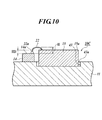
- An optical module 10C according to a fourth embodiment will be described with reference to FIG. 10 .
- the lengths of the plurality of wires 22 are made to be shortest by making the height of the front surface 14a of the laser diode array 14 and the height of the front surface 15a of the drive IC 15 comparative levels in order that the wire lengths become shortest.
- the features of the optical modules 10C exist in the following configuration.
- the driver IC 15 is arranged in a recess section 43 formed in the board 11.
- the electrodes on the front surface 14a of the laser diode array 14 and the electrodes on the front surface 15a of the driver IC 15 are directly electrically connected to each other, respectively, with the plurality of wires 22.
- the front surface 15a of the driver IC 15 is made to be higher than the front surface 14a of the laser diode array 14 within a range in which no electrical short circuits are caused at the respective both ends of the plurality of wires 22.
- the other configuration is similar to that of the optical module 10 of the first embodiment, described above.
- the fourth embodiment configured as described above takes the following operation and effect in addition to the operations and effects taken by the first embodiment described above.
- Each of the wire lengths can be shortened as short as possible without causing any electrical short circuits at the respective both ends of the plurality of wires 22.
- cross talk between adjacent ones of the wires 22 can be reduced, and high speed parallel light transmission can be realized.
- the wire lengths of the plurality of wires 22 could be shortened as short as possible without causing any electrical short circuits at the respective both ends of the wires 22.
- An optical module 10D according to a fifth embodiment will be described with reference to FIG. 11 .
- the lengths of the plurality of wires 22 are made to be shortest by making the height of the front surface 14a of the laser diode array 14 and the height of the front surface 15a of the driver IC 15 comparable levels.
- the features of the optical module 10C exist in the following configuration.
- the driver IC 15 is arranged in a recess section 44 formed in the board 11.
- the electrodes on the front surface 14a of the laser diode array 14 and the electrodes on the front surface 15a of the driver IC 15 are directly electrically connected to each other, respectively, with the plurality of wires 22.
- the front surface 14a of the laser diode array 14 is made to be higher than the front surface 15a of the driver IC 15 within a range of causing no electrical short circuits at the respective both ends of the plurality of wires 22.
- the other configuration is similar to that of the optical module 10 of the first embodiment.
- the fifth embodiment configured as described above takes the following operation and effect in addition to the operations and effects taken by the first embodiment described above.
- Each of the wire lengths can be shortened as short as possible without causing any electrical short circuits at the respective both ends of the plurality of wires 22.
- crosstalk between adjacent ones of the wires 22 can be reduced, and high speed parallel light transmission can be realized.
- the wire lengths of the plurality of wires 22 could be shortened as short as possible without causing any electrical short circuits at the respective both ends of the wires 22.
- the configuration of an optical module according to a sixth embodiment is similar to that of the optical module according to the first embodiment described with reference to FIGS. 1-7 .
- the optical module according to the sixth embodiment will be described with reference to FIGS. 1-7 , 12 , and 13 .
- FIG. 1 is a perspective view showing the principal part of the optical module according to the sixth embodiment
- FIG. 2 is a sectional view of FIG. 1
- FIG. 3 is a longitudinal sectional view showing the schematic configuration of the optical module.
- FIG. 4A is a perspective view showing the whole optical module;
- FIG. 4B is an enlarged view showing one of a plurality of optical fibers to be used for the optical module;
- FIG. 4C is a plan view showing the connection relation of the respective surface emitting type semiconductor laser elements of the laser diode array used for the optical module and a driver IC.
- FIG. 5 is an exploded perspective view showing the schematic configuration of the optical module;
- FIG. 6 is a perspective view of the optical connector section of the optical module; and
- FIG. 7 is a perspective view showing a state in which an external connector (multicore ferrule type connector) is mounted in the optical connector section of the optical module.
- an external connector multicore ferrule type connector
- the optical module 10 is the one transmitting optical signals with the plurality of optical fibers in parallel.
- the optical module 10 includes the board 11, having an electrode pattern (not shown), a plurality of optical elements, mounted on the electrode pattern in a line, and an electronic device, mounted on the electrode pattern to be electrically connected to the plurality of optical elements.
- the board 11 is a ceramic board.
- the plurality of optical elements are composed of the laser diode array 14, including the plurality of surface emitting type semiconductor laser elements (optical elements) aligned in a line.
- the mark 14a in FIG. 4C denotes each light emitting section (aperture section) of the plurality of surface emitting type semiconductor laser elements of the laser diode array 14.
- a surface emitting type semiconductor laser element as an optical element is a vertical cavity surface emitting laser (VCSEL), emitting a light (optical signal 23) into the direction perpendicular to a board surface.
- VCSEL vertical cavity surface emitting laser
- the electronic device is a driver IC 15, driving the plurality of surface emitting type semiconductor laser elements of the laser diode array 14.
- the laser diode array 14 and the driver IC 15 are arranged on the board 11 at positions close to each other.
- the laser diode array 14 is mounted on the front surface 11a of the board 11 by being adhered thereon with, for example, adieattachadhesive.
- a part of the driver IC 15 is housed in the recess section 40 on the board 11 to be mounted on the bottom surface of the recess section 40 by being adhered thereto with, for example, a die attach adhesive.
- the recess section 40 is a rectangular hole having the almost vertical wall surfaces 40a.
- the laser diode array 14 is arranged on the surface 11a of the board in such a way that an end face thereof is situated to be close to one of the wall surfaces 40a.
- the driver IC 15 is arranged on the bottom surface in such a way that one of the end faces of the driver IC 15 is situated to be close to the wall surface 40a.
- the laser diode array 14 and the driver IC 15 are arranged at positions on the board 11 close to each other.
- the electrodes on the front surface 15a of the driver IC 15 and the electrode of the respective surface emitting type semiconductor laser elements on the front surface 14a of the laser diode array 14 are directly electrically connected to each other, respectively, with the plurality of wires 22 (see FIGS. 1 , 2 , and 4C ).
- the driver IC 15 and the plurality of surface emitting type semiconductor laser elements of the laser diode array 14 are electrically connected to each other, respectively, with the plurality of wires 22 without the wiring on the SiOB unlike the conventional technique.
- the optical module 10 is adapted in order that a modulation signal may be input from the driver IC 15 to each of the surface emitting type semiconductor laser elements of the laser diode array 14 through each of the bonding wires 22, and that the optical signal 23, modulated by the modulation signal, is emitted from each of the surface emitting type semiconductor laser elements of the laser diode array 14.
- the driver IC 15 and the electrode pattern of the board 11 are electrically connected to each other with a not-shown plurality of bonding wires.
- the mark 22a in FIG. 4C denotes each ball mounted onto the electrode of each of the surface emitting type semiconductor laser elements.
- the optical module 10 furthermore includes the optical connector section 12, the cover 13, and the two guide pins 32 as shown in FIGS. 3 , 4A , and 5 .
- the optical connector section 12 holds the plurality of optical fibers 16, aligned in a line (in the direction perpendicular to the paper surface in FIG 3 ), as shown in FIGS. 4A-4C and 6 .
- the optical connector section 12 is aligned by the active alignment in such a way that the center (core center) of each of the one ends 16a (see FIG. 4B ) of the plurality of optical fibers 16 and the center of each of the light emitting sections 14a of the laser diode array 14 accord with each other, and, after that, the optical connector section 12 is fixed on the front surface 11a of the board 11.
- the optical module 10 is adapted to optically couple each emitted light (optical signal 23) from each of the light emitting sections 14a of the laser diode array 14 to each of the one ends 16a of the optical fibers corresponding to the plurality of optical fibers 16.
- the optical connector section 12 has side wall sections 17 on both sides as shown in FIG. 6 .
- the lower end faces 17a of both the side wall sections 17 severally contact with the front surface 11a of the board 11 in a slidable state.
- the optical connector section 12 is two-dimensionally moved on the front surface 11a of the board 11 by the active alignment in order that the center of each of the one ends 16a of the plurality of optical fibers 16 and the center of each of the light emitting sections 14a of the laser diode array 14 may accord with each other, and after that, the lower end faces 17a of both the side wall sections 17 of the optical connector section 12 are fixed to the front surface 11a of the board 11 by adhering or the like.
- the optical connector section 12 includes the plurality of fiber holding holes 12a, to which the plurality of optical fibers 16 are fit, which fiber holding holes 12a are aligned in a line, and the two guide pin holes 12b formed on both the sides of the fiber holding holes 12a.
- the two guide pins 32 are adapted to be able to fit into the two guide pin holes 12b, respectively.
- the two guide pins 32 are adapted to be able to fit into the two through-holes, respectively, of the MT connector 30, which is an external connector shown in FIG. 7 .
- the MT connector 30 is adapted to be mounted onto the optical connector section 12, as shown in FIG. 7 , in the state in which the core center of each of the optical fibers of the multicore optical fiber (multicore tape optical fiber) 31, held by the MT connector 30, and each of the core centers of the plurality of optical fibers 16, held by the optical connector section 12, accord with each other.
- the cover 13 includes the aperture section 13a for mounting the optical connector section 12 and is fixed to the board 11 by adhesion or the like in order to cover all the parts, such as the laser diode array 14 and the driver IC 15.
- the cover 13 is made of a material having high thermal conductivity, such as an alloy of copper (Cu) and tungsten (W).
- the resin 18, such as a resin sealing compound or an adhesive is filled in the space between a side face of the optical connector section 12 and the aperture section 13a of the cover 13 as shown in FIG. 3 .
- the silicone gel 19, having heat conductance and insulation properties, is filled in as a sealing compound in a gap (space) between the driver IC 15 and the cover 13.
- the transparent silicone gel 20 is filled in the space between one ends 16a of the plurality of optical fibers 16 and the respective light emitting sections 14a of the laser diode array 14 as a sealing compound.
- the sixth embodiment configured as described above, takes the following operations and effects.
- the sixth embodiment is configured in order that the plurality of optical fibers 16 and the plurality of surface emitting type semiconductor laser elements of the laser diode array 14 may be optically coupled, respectively, by the active alignment by performing two-dimensional position adjustment of the optical connector section 12 on the board 11. Namely, by the active alignment, the center of each of the one ends 16a of the plurality of optical fibers 16 and the center of each of the light emitting sections 14a of the laser diode array 14 accord with each other. Consequently, the SiOB for performing the passive alignment becomes unnecessary unlike the conventional technique mentioned above, and the laser diode array 14 and the driver IC 15 can be arranged on the board 11 at positions close to each other.
- the lengths of the plurality of wires 22 (transmission line lengths), connecting the plurality of surface emitting type semiconductor laser elements of the laser diode array 14 and the driver IC 15 to each other electrically, can be shortened, and crosstalk between adjacent transmission lines can be reduced.
- the driver IC 15 and the plurality of surface emitting type semiconductor laser elements of the laser diode array 14 are directly electrically connected to each other with the plurality of wires 22, respectively, the wire lengths L (see FIG. 2 ) of the plurality of wires 22 become short.
- crosstalk between adjacent wires can be reduced in the optical module mounting the driver IC 15 and the laser diode array 14 thereon by the wire bonding mounting.
- the lengths L of the wires (wire lengths) of the plurality of wires 22 in the horizontal direction of the wires were severally made 500 ⁇ m or less.
- the wire of the shape shown in FIG. 12 was used as each of the wires 22.
- the front surface 14a of the laser diode array 14 and the front surface 15a of the driver IC 15 were made to be the same heights.
- the pitches between the plurality of wires 22 were made to be 250 ⁇ m.
- a curved line indicates an S parameter when the frequency of a modulation signal in the conventional model is changed. From the curved line a, it is known that the crosstalk between adjacent wires (channels) cannot be suppressed to be 30 dB or less in a transmission band exceeding 3 GHz in the conventional model.
- the S parameters when the frequency of the modulation signal is changed in the case where the lengths L (wire lengths) in the horizontal direction are changed to be 200 ⁇ m, 300 ⁇ m, 400 ⁇ m, 500 ⁇ m, 600 ⁇ m, 700 ⁇ m, 800 ⁇ m, 900 ⁇ m, and 1000 ⁇ m in the optical module 10 described above are shown by a curved line b, a curved line c, a curved line d, a curved line e, a curved line f, a curved line g, a curved line h, a curved line i, and a curved line k, respectively.
- the configuration of an optical module according to a seventh embodiment is similar to the one of the optical module according the second embodiment described with reference to FIG. 8 .
- the optical module 10A according to the seventh embodiment will be described with reference to FIG. 8 .
- the driver IC 15 is mounted on the electrode pattern of the board 11 by the wire bonding.
- the driver IC 15 is mounted on the electrode pattern of the board 11 by the flip chip mounting.
- the whole of the laser diode array 14 is hosed in the recess section 41 on the board 11 to be mounted on the bottom surface of the recess section 41 by being adhered thereto with, for example, a die attach adhesive.
- the recess section 41 is a rectangular hole having the almost vertical wall surfaces 41a and almost the same depth as the height of the laser diode array 14.
- the laser diode array 14 is arranged in the recess section 41 in such a way that one of the end faces is situated at a position near to one of the wall surfaces 41a.
- the driver IC 15 is mounted on the electrode pattern of the board 11 in such a way that one of the end faces is situated at a position close to the wall surface 41a. In this way, the laser diode array 14 and the driver IC 15 are arranged at positions on the board 11 close to each other. Then, the plurality of surface emitting type semiconductor laser elements of the laser diode array 14 and the wiring (a part of the electrode pattern), to which the driver IC 15 is electrically connected, are electrically connected to each other, respectively, with the plurality of wires 22.
- the other configuration is similar to that of the optical module 10 of the sixth embodiment.
- the seventh embodiment configured as described above takes the following operations and effects in addition to the operations and effects taken by the sixth embodiment.
- the plurality of transmission lines are composed of the plurality of wires 22 by which the plurality of surface emitting type semiconductor laser elements of the laser diode array 14 and the driver IC 15 are electrically connected with each other, and the wiring to which the driver IC 15 is electrically connected. Hence, the lengths of the plurality of transmission lines are shortened. Hereby, cross talk between adjacent transmission lines can be reduced in the optical module mounting the driver IC 15 on the electrode pattern of the board 11 by the flip chip mounting.
- Crosstalk between adjacent wires (channels) can be suppressed to be 30 dB or less at the time of transmission in a transmission band up to 8 GHz by making the lengths of the plurality of transmission lines 500 ⁇ m or less.
- optical module 10B according to the eighth embodiment will be described with reference to FIG. 9 .
- each of the surface emitting type semiconductor laser elements of the laser diode array 14 is a vertical cavity surface emitting laser (VCSEL), emitting a light (optical signal 23) from the front surface side into the direction perpendicular to the board surface.
- each of the surface emitting type semiconductor laser elements of the laser diode array 14 used in the optical module 10B is a back surface light emitting type VCSEL, emitting a light (optical signal 23) from the back surface side into the direction perpendicular to the board surface.
- the laser diode array 14 is mounted on the electrode pattern of the board 11 by the flip chip mounting.
- the whole of the driver IC 15 is housed in a recess section 42 on the board 11 and is mounted on the bottom surface of the recess section 42 by being adhered thereto with, for example, a die attach adhesive.
- the recess section 42 is a rectangular hole having the almost vertical wall surfaces 42a and almost the same depth as the height of the driver IC 15.
- the driver IC 15 is arranged in the recess section 42 in such a way that one of the end faces of the driver IC 15 is situated close to one of the wall surfaces 42a.
- the laser diode array 14 is mounted on the electrode pattern of the board 11 in such a way that one of the end surfaces of the laser diode array 14 is situated to be close to the wall surface 42a. In this way, the laser diode array 14 and the driver IC 15 are arranged at positions on the board 11 close to each other. Then, the plurality of pieces of wiring (a part of the electrode pattern), to which the plurality of surface emitting type semiconductor laser elements of the laser diode array 14 is electrically connected, and the driver IC 15 are electrically connected to each other, respectively, with the plurality of wires 22.
- the other configuration is similar to that of the optical module 10 of the sixth embodiment, described above.
- the eighth embodiment configured as described above takes the following operations and effects in addition to the operations and effects taken by the first embodiment described above.
- Cross talk between adjacent transmission lines can be reduced in the optical module mounting the laser diode array 14 on the board 11 by the flip chip mounting, which laser diode array 14 includes the plurality of surface emitting type semiconductor laser elements, each being a back surface light emitting type VCSEL.
- the present invention can be embodied by changing as follows.
- the present invention can also be applied to an optical module mounting a plurality of surface emitting type semiconductor laser elements (optical elements) aligned in a line in place of the laser diode array 14, or an optical module mounting a plurality of photodiodes (optical elements) aligned in a line in place of the photodiode array.
- the present invention can be used in the field of optical communication, and can be applied to an optical module transmitting optical signals in parallel with optical fibers.
Landscapes
- Physics & Mathematics (AREA)
- General Physics & Mathematics (AREA)
- Optics & Photonics (AREA)
- Condensed Matter Physics & Semiconductors (AREA)
- Electromagnetism (AREA)
- Optical Couplings Of Light Guides (AREA)
- Semiconductor Lasers (AREA)
Applications Claiming Priority (3)
| Application Number | Priority Date | Filing Date | Title |
|---|---|---|---|
| JP2008007443 | 2008-01-16 | ||
| JP2008007442 | 2008-01-16 | ||
| PCT/JP2009/050448 WO2009090988A1 (ja) | 2008-01-16 | 2009-01-15 | 光モジュール |
Publications (2)
| Publication Number | Publication Date |
|---|---|
| EP2242152A1 true EP2242152A1 (de) | 2010-10-20 |
| EP2242152A4 EP2242152A4 (de) | 2013-05-29 |
Family
ID=40885374
Family Applications (1)
| Application Number | Title | Priority Date | Filing Date |
|---|---|---|---|
| EP09701495.5A Withdrawn EP2242152A4 (de) | 2008-01-16 | 2009-01-15 | Optisches modul |
Country Status (5)
| Country | Link |
|---|---|
| US (1) | US20110049334A1 (de) |
| EP (1) | EP2242152A4 (de) |
| JP (1) | JPWO2009090988A1 (de) |
| CN (1) | CN101911405B (de) |
| WO (1) | WO2009090988A1 (de) |
Cited By (2)
| Publication number | Priority date | Publication date | Assignee | Title |
|---|---|---|---|---|
| CN103579899A (zh) * | 2013-11-21 | 2014-02-12 | 中国科学院半导体研究所 | 一种激光阵列热沉模块 |
| WO2014179511A3 (en) * | 2013-04-30 | 2014-12-24 | Finisar Corporation | Thermal management structures for optoelectronic modules |
Families Citing this family (13)
| Publication number | Priority date | Publication date | Assignee | Title |
|---|---|---|---|---|
| JP4969711B2 (ja) * | 2010-08-31 | 2012-07-04 | 京セラ株式会社 | 光伝送体およびその製造方法、ならびに光伝送モジュール |
| TWI514533B (zh) * | 2012-03-22 | 2015-12-21 | 鴻海精密工業股份有限公司 | 高頻傳輸模組及光纖連接器 |
| TWI539871B (zh) * | 2012-12-26 | 2016-06-21 | 鴻海精密工業股份有限公司 | 光纖連接器電路基板 |
| EP2992376B1 (de) * | 2013-04-29 | 2020-10-07 | Silicon Line GmbH | Vorrichtung zum einkoppeln und/oder auskoppeln optischer signale |
| US9235014B2 (en) * | 2013-07-31 | 2016-01-12 | Avago Technologies General Ip (Singapore) Pte. Ltd. | Optics system module for use in an optical communications module, an optical communications system, and a method |
| US9647419B2 (en) | 2014-04-16 | 2017-05-09 | Apple Inc. | Active silicon optical bench |
| JP6379642B2 (ja) * | 2014-05-07 | 2018-08-29 | 住友電気工業株式会社 | 光学装置の製造方法、光学装置及び光学コネクタユニット |
| KR101620574B1 (ko) | 2014-08-06 | 2016-05-13 | (주)옵토라인 | 옵티칼 인터커넥션 디바이스 |
| JP6988493B2 (ja) * | 2018-01-11 | 2022-01-05 | 住友電気工業株式会社 | 光モジュール及びその製造方法 |
| JP7484230B2 (ja) * | 2020-03-04 | 2024-05-16 | 富士通オプティカルコンポーネンツ株式会社 | 光モジュール |
| CN113759472B (zh) * | 2020-06-03 | 2023-01-24 | 青岛海信宽带多媒体技术有限公司 | 一种光模块 |
| CN115832864A (zh) * | 2021-09-18 | 2023-03-21 | 默升科技集团有限公司 | 到表面发射器的高频信号耦合 |
| CN114744481A (zh) * | 2022-06-13 | 2022-07-12 | 西安炬光科技股份有限公司 | 一种芯片封装体、感光模组、激光发射模组和激光雷达 |
Family Cites Families (23)
| Publication number | Priority date | Publication date | Assignee | Title |
|---|---|---|---|---|
| US4787696A (en) * | 1987-12-18 | 1988-11-29 | Gte Laboratories Incorporated | Mounting apparatus for optical fibers and lasers |
| US5205032A (en) * | 1990-09-28 | 1993-04-27 | Kabushiki Kaisha Toshiba | Electronic parts mounting apparatus |
| JP3931545B2 (ja) * | 2000-03-22 | 2007-06-20 | 住友電気工業株式会社 | 発光モジュール |
| US6932516B2 (en) * | 2000-07-19 | 2005-08-23 | Canon Kabushiki Kaisha | Surface optical device apparatus, method of fabricating the same, and apparatus using the same |
| JP4532688B2 (ja) * | 2000-07-19 | 2010-08-25 | キヤノン株式会社 | 面型光素子を備えた装置 |
| JP3722279B2 (ja) * | 2001-01-26 | 2005-11-30 | 日本電気株式会社 | 光送受信モジュール |
| JP3672831B2 (ja) * | 2001-02-27 | 2005-07-20 | 住友電気工業株式会社 | 搭載基板及び光モジュール |
| JP2002267892A (ja) * | 2001-03-07 | 2002-09-18 | Fujikura Ltd | 光ファイバアレイデバイス及び光モジュール |
| JP2002289956A (ja) * | 2001-03-22 | 2002-10-04 | Kyocera Corp | 半導体レーザ装置 |
| DE10117889A1 (de) * | 2001-04-10 | 2002-10-24 | Osram Opto Semiconductors Gmbh | Leiterrahmen und Gehäuse für ein strahlungsemittierendes Bauelement, strahlungsemittierendes Bauelement sowie Verfahren zu dessen Herstellung |
| KR100461157B1 (ko) * | 2002-06-07 | 2004-12-13 | 한국전자통신연구원 | 병렬 광접속 모듈 및 그 제조방법 |
| JP2004134522A (ja) * | 2002-10-09 | 2004-04-30 | Sumitomo Electric Ind Ltd | 光モジュール |
| US20070041729A1 (en) * | 2002-10-23 | 2007-02-22 | Philip Heinz | Systems and methods for detecting changes in incident optical radiation at high frequencies |
| JP2004152875A (ja) * | 2002-10-29 | 2004-05-27 | Nec Compound Semiconductor Devices Ltd | 半導体レーザモジュール |
| JP4496708B2 (ja) * | 2003-03-10 | 2010-07-07 | 三菱電機株式会社 | 発光素子モジュール |
| JP4125180B2 (ja) * | 2003-05-30 | 2008-07-30 | 株式会社フジクラ | 光モジュール、光モジュールの製造方法、光送受信システム |
| US6985645B2 (en) * | 2003-09-24 | 2006-01-10 | International Business Machines Corporation | Apparatus and methods for integrally packaging optoelectronic devices, IC chips and optical transmission lines |
| JP2005173043A (ja) * | 2003-12-09 | 2005-06-30 | Hitachi Ltd | 多チャンネル光モジュール |
| US7183581B2 (en) * | 2003-12-25 | 2007-02-27 | Matsushita Electric Industrial Co., Ltd. | Optical transmission module for use in high-speed optical fiber communication |
| JP2005210092A (ja) * | 2003-12-25 | 2005-08-04 | Matsushita Electric Ind Co Ltd | 光送信モジュール |
| JP2005309270A (ja) * | 2004-04-26 | 2005-11-04 | Matsushita Electric Ind Co Ltd | 光モジュール及びその製造方法 |
| JP2007317941A (ja) * | 2006-05-26 | 2007-12-06 | Fujifilm Corp | 光モジュール |
| JP4477677B2 (ja) * | 2008-01-16 | 2010-06-09 | 古河電気工業株式会社 | 光モジュールおよびその作製方法 |
-
2009
- 2009-01-15 EP EP09701495.5A patent/EP2242152A4/de not_active Withdrawn
- 2009-01-15 WO PCT/JP2009/050448 patent/WO2009090988A1/ja not_active Ceased
- 2009-01-15 US US12/863,194 patent/US20110049334A1/en not_active Abandoned
- 2009-01-15 CN CN2009801023794A patent/CN101911405B/zh active Active
- 2009-01-15 JP JP2009550036A patent/JPWO2009090988A1/ja active Pending
Cited By (6)
| Publication number | Priority date | Publication date | Assignee | Title |
|---|---|---|---|---|
| WO2014179511A3 (en) * | 2013-04-30 | 2014-12-24 | Finisar Corporation | Thermal management structures for optoelectronic modules |
| US9788417B2 (en) | 2013-04-30 | 2017-10-10 | Finisar Corporation | Thermal management structures for optoelectronic modules |
| US20180124914A1 (en) * | 2013-04-30 | 2018-05-03 | Finisar Corporation | Thermal management structures for optoelectronic modules |
| US10582611B2 (en) * | 2013-04-30 | 2020-03-03 | Finisar Corporation | Thermal management structures for optoelectronic modules |
| CN103579899A (zh) * | 2013-11-21 | 2014-02-12 | 中国科学院半导体研究所 | 一种激光阵列热沉模块 |
| CN103579899B (zh) * | 2013-11-21 | 2016-01-27 | 中国科学院半导体研究所 | 一种激光阵列热沉模块 |
Also Published As
| Publication number | Publication date |
|---|---|
| WO2009090988A1 (ja) | 2009-07-23 |
| JPWO2009090988A1 (ja) | 2011-05-26 |
| CN101911405B (zh) | 2013-12-04 |
| US20110049334A1 (en) | 2011-03-03 |
| CN101911405A (zh) | 2010-12-08 |
| EP2242152A4 (de) | 2013-05-29 |
Similar Documents
| Publication | Publication Date | Title |
|---|---|---|
| US20110049334A1 (en) | Optical module | |
| US8366325B2 (en) | Optical module and method of manufacturing thereof | |
| EP2365363B1 (de) | Fotoelektrischer Wandler | |
| US6955481B2 (en) | Method and apparatus for providing parallel optoelectronic communication with an electronic device | |
| US9647762B2 (en) | Integrated parallel optical transceiver | |
| US6624507B1 (en) | Miniature semiconductor package for opto-electronic devices | |
| US10444452B2 (en) | Optical module and optical transmission equipment | |
| EP1723456B1 (de) | System und verfahren zur herstellung eines elektrooptischen moduls | |
| US8090228B2 (en) | Photoelectric conversion device, photoelectric conversion module and method of manufacturing photoelectric conversion device | |
| JP2009170675A (ja) | 光モジュール | |
| JP7300625B2 (ja) | 半導体装置の実装構造、光モジュール、及び半導体装置の実装構造の製造方法 | |
| CN116184583B (zh) | 一种自对准光纤的400g硅光封装结构 | |
| EP3229053A1 (de) | Optisches modul | |
| US8750657B2 (en) | Flip-chip optical interface with micro-lens array | |
| EP1202095B1 (de) | Elektrisch-optisches Verbindungsmodul | |
| JP5065061B2 (ja) | 光モジュール | |
| US20020102072A1 (en) | Optical fiber guide module and a method for making the same | |
| JP2007207803A (ja) | 光送信モジュール | |
| HK1147359A (en) | Optical module | |
| KR20090124771A (ko) | 광전변환모듈 | |
| JP2004317632A (ja) | 光モジュール用マウント部材、光モジュール、光モジュールの製造方法 | |
| CN114731022B (zh) | 光发送模块 | |
| JP2005284167A (ja) | 光通信モジュール | |
| CN115832864A (zh) | 到表面发射器的高频信号耦合 | |
| KR20040022675A (ko) | 광 백플레인 고속 병렬 통신을 위한 수직 공동 방출레이저 송신기 어레이 모듈 및 광 검출기 어레이 모듈을갖는 광송수신장치 |
Legal Events
| Date | Code | Title | Description |
|---|---|---|---|
| PUAI | Public reference made under article 153(3) epc to a published international application that has entered the european phase |
Free format text: ORIGINAL CODE: 0009012 |
|
| 17P | Request for examination filed |
Effective date: 20100716 |
|
| AK | Designated contracting states |
Kind code of ref document: A1 Designated state(s): AT BE BG CH CY CZ DE DK EE ES FI FR GB GR HR HU IE IS IT LI LT LU LV MC MK MT NL NO PL PT RO SE SI SK TR |
|
| AX | Request for extension of the european patent |
Extension state: AL BA RS |
|
| DAX | Request for extension of the european patent (deleted) | ||
| RAP1 | Party data changed (applicant data changed or rights of an application transferred) |
Owner name: FURUKAWA ELECTRIC CO., LTD. |
|
| REG | Reference to a national code |
Ref country code: HK Ref legal event code: DE Ref document number: 1147359 Country of ref document: HK |
|
| A4 | Supplementary search report drawn up and despatched |
Effective date: 20130503 |
|
| RIC1 | Information provided on ipc code assigned before grant |
Ipc: H01S 5/022 20060101AFI20130423BHEP Ipc: G02B 6/42 20060101ALI20130423BHEP Ipc: H01S 5/40 20060101ALN20130423BHEP Ipc: H01S 5/062 20060101ALN20130423BHEP |
|
| STAA | Information on the status of an ep patent application or granted ep patent |
Free format text: STATUS: THE APPLICATION HAS BEEN WITHDRAWN |
|
| 18W | Application withdrawn |
Effective date: 20131219 |
|
| REG | Reference to a national code |
Ref country code: HK Ref legal event code: WD Ref document number: 1147359 Country of ref document: HK |