EP2231942B1 - Acoustic absorber with barrier facing - Google Patents
Acoustic absorber with barrier facing Download PDFInfo
- Publication number
- EP2231942B1 EP2231942B1 EP08865987.5A EP08865987A EP2231942B1 EP 2231942 B1 EP2231942 B1 EP 2231942B1 EP 08865987 A EP08865987 A EP 08865987A EP 2231942 B1 EP2231942 B1 EP 2231942B1
- Authority
- EP
- European Patent Office
- Prior art keywords
- facing
- article
- core
- pore diameter
- acoustically
- Prior art date
- Legal status (The legal status is an assumption and is not a legal conclusion. Google has not performed a legal analysis and makes no representation as to the accuracy of the status listed.)
- Not-in-force
Links
Images


Classifications
-
- E—FIXED CONSTRUCTIONS
- E04—BUILDING
- E04B—GENERAL BUILDING CONSTRUCTIONS; WALLS, e.g. PARTITIONS; ROOFS; FLOORS; CEILINGS; INSULATION OR OTHER PROTECTION OF BUILDINGS
- E04B9/00—Ceilings; Construction of ceilings, e.g. false ceilings; Ceiling construction with regard to insulation
- E04B9/04—Ceilings; Construction of ceilings, e.g. false ceilings; Ceiling construction with regard to insulation comprising slabs, panels, sheets or the like
-
- E—FIXED CONSTRUCTIONS
- E04—BUILDING
- E04B—GENERAL BUILDING CONSTRUCTIONS; WALLS, e.g. PARTITIONS; ROOFS; FLOORS; CEILINGS; INSULATION OR OTHER PROTECTION OF BUILDINGS
- E04B1/00—Constructions in general; Structures which are not restricted either to walls, e.g. partitions, or floors or ceilings or roofs
- E04B1/62—Insulation or other protection; Elements or use of specified material therefor
- E04B1/74—Heat, sound or noise insulation, absorption, or reflection; Other building methods affording favourable thermal or acoustical conditions, e.g. accumulating of heat within walls
- E04B1/82—Heat, sound or noise insulation, absorption, or reflection; Other building methods affording favourable thermal or acoustical conditions, e.g. accumulating of heat within walls specifically with respect to sound only
- E04B1/84—Sound-absorbing elements
- E04B1/8409—Sound-absorbing elements sheet-shaped
-
- E—FIXED CONSTRUCTIONS
- E04—BUILDING
- E04B—GENERAL BUILDING CONSTRUCTIONS; WALLS, e.g. PARTITIONS; ROOFS; FLOORS; CEILINGS; INSULATION OR OTHER PROTECTION OF BUILDINGS
- E04B2103/00—Material constitution of slabs, sheets or the like
- E04B2103/04—Material constitution of slabs, sheets or the like of plastics, fibrous material or wood
Definitions
- the invention relates generally to an acoustic absorber, particularly for use in building interiors.
- Acoustically absorbing materials are known in the art for use reducing the amount of noise and/or reverberation within a given space, such as a building interior. Acoustically absorbing materials, i.e., materials having a high absorption coefficient, reduce noise by absorbing acoustic energy.
- acoustically absorbing materials There are various types of acoustically absorbing materials.
- One of the most common types utilizes fibrous materials to dissipate sound energy by friction within the interfibrous voids.
- the greater the thickness and the higher the density of the absorber the greater is the acoustic absorption of the absorber, particularly at low frequencies, e.g. below about 500 Hz. Therefore, known solutions to achieve appreciable absorption at low frequencies tend to be expensive.
- acoustically absorbing materials are formed of unconsolidated or partially consolidated, lofty fibrous materials including compressed fibers, recycled fiber or shoddy materials, fiberglass or mineral fiber batts and felts require a facing to contain the core of fibrous materials. While the fiber-based sound absorbers are generally inexpensive and are an effective solution for sound absorption over a wide frequency range, they have inherent disadvantages, such as possible release of particulates into the air, collection of dust and harboring bacteria and mold on their surface and inside the voids, as the area is not cleanable. Other known acoustically absorbing core materials can include foam, materials having a honeycomb structure, perforated and microperforated materials utilizing additional air spaces for sound absorption. Most of the known sound absorbers also require a protective and/or decorative facing for use in a building interior.
- Facings for covering acoustic absorber core materials serve as durable coverings that protect the delicate structure of the core during handling, use and maintenance. It is desirable for facings for covering acoustically absorbing materials to be acoustically transparent or acoustically absorbent in order to enhance the absorption of sound provided by the absorber. Facings which are acoustically reflective undesirably contribute to the ambient noise.
- There two types of known facings for covering acoustically absorbing materials thin impervious films and porous membranes (see, for example, D.A.Bies and C.H.Hansen Engineering Noise Control. Theory and Practice. Second edition, E&FN Spoon. London, New York, p.249 ).
- Thin, commonly 6-35 micrometers, impervious film facings are acoustically transparent in the low and mid frequencies, but they are acoustically reflective at high frequencies, as such they do not allow sound waves to pass.
- Thin film facings also have a serious drawback of not being durable enough to sustain everyday use and should be additionally protected by sound transparent solid surfaces. Unfortunately, this complicates the structure and raises the expense of the solution. Examples of common facings include fabric, nonwoven sheet, paper, film and perforated solid surfaces (panels).
- Waterproof acoustic absorbers are known in the art in which the absorber is covered with waterproof or impervious film, such as one disclosed in U.S. Pat. No. 6,197,403 .
- film facings have the disadvantage of being insufficiently durable to be used as a finished surface of an absorptive article.
- film facings do not provide adequate acoustic absorption at higher frequencies of the most desirable voice frequency range.
- Impregnated woven fabrics have also been used as waterproof facings for acoustic absorbers.
- a vinyl coated fiberglass, style 3478-VS-2, from Alpha Associates is one example of an impregnated waterproof facing.
- Xorel® available from Carnegie Fabrics is an example of an acoustic facing material, which is a woven, heavily calendered polyolefin fabric. Impregnated fabrics are generally expensive to make, thick, heavy, acoustically reflective at mid and high frequencies, and have the tendency to off-gas volatile organic compounds and support the growth of mold and bacteria unless additional additives are used.
- U.S. Pat. Appl. Pub. No. 2006/0065482 discloses a nonwoven acoustic insulating material including a nonwoven layer having a low surface tension fluid repellency treatment.
- Specific nonwoven materials disclosed for use in the nonwoven layer are fabrics or webs resulting from melt blowing processes, spun bonding processes, air laying processes and carded web processes.
- U.S. Pat. No. 5,824,973 discloses a sound absorption laminate comprising a porous insulation substrate and a paper, fabric or perforated film facing sheet having an airflow resistance between 200 and 1210 rayls. These known facing materials have the disadvantage that they are open to the penetration of water, dust, mold and microorganisms, thus limiting their application for indoor use where air quality is of concern.
- the present invention is directed to an acoustically absorbing article comprising:
- the present invention is directed to an assembly comprising the acoustically absorbing article encased in a sound permeable rigid casing, an acoustically absorbing partition and an acoustically absorbing architectural surface covering.
- the invention is directed to a method of improving acoustic absorption in an environment comprising:
- acoustic absorbent and “acoustically absorbing” herein refer generally to the ability of a material to absorb incident sound waves.
- the acoustically absorbing article of the invention includes an acoustically absorbing core and a nonwoven facing covering at least one surface of the core.
- the facing provides excellent barrier properties while not impeding the acoustical absorption of the absorbing core.
- the nonwoven facing further enhances the acoustical absorption of the article at low- and mid-range frequencies.
- the nonwoven facing comprises a flash spun plexifilamentary film-fibril sheet having a coherent surface.
- coherent surface is meant the surface of the sheet is consolidated and/or bonded.
- the bonding method can be any known in the art, including but not limited to thermal calendering, through-gas bonding, and point-bonding.
- the core and facing can be optionally bonded to each other, by any known suitable bonding techniques such as adhesive bonding, solvent bonding, ultrasonic bonding, thermal bonding, stitch bonding or the like.
- the acoustically absorbing core includes any known acoustically absorbing material and/or an air space.
- the core has a noise reduction coefficient (NRC) between about 0.3 and about 0.9, as measured by ASTM C423, mounting A (without air space).
- Suitable acoustically absorbent materials include nonwoven fabrics, such as spunbonded nonwovens, carded nonwovens, needlepunched nonwovens, air-laid nonwovens, wet-laid nonwovens, spunlaced nonwovens, meltblown nonwovens, spunbonded-meltblown-spunbonded composite nonwovens, woven fabrics, knit fabrics, three-dimensional meshes, including honeycomb structures and foams, combinations thereof and the like.
- nonwoven means a web including a multitude of randomly distributed fibers.
- the fibers can be staple fibers or continuous fibers.
- the fibers can comprise a single material or a multitude of materials, either as a combination of different fibers or as a combination of similar fibers each comprised of different materials.
- Other materials suitable for use as the core are foams, such as open-cell melamine foam, polyimide, polyolefin, and polyurethane foams, and perforated sheets.
- the core is substantially free of volatile organic compounds (VOCs).
- One preferred material is formaldehyde-free fiberglass batting.
- An air space covered with the facing can serve as the absorbing core.
- Acoustically transparent facings for use with acoustic absorbers are known in the art. Such facings typically have between about 5% and about 50% open area, i.e. the area of the pores or holes on the surface with respect to the total surface area, depending on the need for acoustic absorption. If high frequency absorption is not required, 5% to 15% open area is appropriate (M.D.Egan Architectural Acoustics). The percent open area and diameter of the holes affects the acoustic transparency by determining the critical frequency, the frequency after which the sound absorption decreases rapidly.
- Examples of known acoustically transparent facings include woven meshes, fabrics with low density, nonwoven scrims and perforated solid surfaces.
- the drawback of such facings is very low barrier, e.g., resistance to penetration of water, dust, and/or microorganisms.
- the facing for use in the absorber of the invention is highly resistant to the penetration of water and fine particles including microorganisms.
- the inventive facing is highly porous. It was believed before, that high barrier properties and porosity are run counter to each other and can not be implemented in the same structure.
- the void fraction (total porosity) of the facing i.e., 1 minus the solids fraction, is between about 0.5 and about 0.7.
- the facing has a pore diameter as measured by mercury porosimetry ( H.M. Rootare. "A Review of Mercury Porosimetry" from Advanced Experimental Techniques in Powder Metallurgy.
- the pores include intra-fiber pores and inter-fiber pores.
- Intra-fiber pores are randomly distributed throughout the interior of a fiber and have a mean pore diameter from about 20 nm to about 500 nm.
- Inter-fiber pores are randomly distributed interstices between fibers in a plexifilamentary film-fibril sheet.
- the porous structure of the plexifilamentary film-fibril sheet consist of both types of pores forming torturous pore structure, rather then through hole structure found in mechanically perforated prior art facings.
- the mean pore diameter of the inventive facing is less than about 20,000 nm, even less than about 5,000 nm, even less than about 2,000 nm, even less than about 1,000 nm and even between about 10 nm and about 1,000 nm.
- the facing of the absorber has a barrier to microorganisms including bacteria, viruses and mold.
- the facing has a log reduction value (LRV), which is a measure of microbial filtration, of at least about 2 or even of at least about 4, as measured according to ASTM F2638-07 and ASTM F1608. It is desired for the facing to have no flow rate or time-dependent LRV such that the facing has stable barrier efficiency and does not build up barrier over time during use, such as is the case for known laminated paper.
- the facing further does not include nutrients that support the growth of microorganisms, including bacteria, yeast and fungus, without any additional antibacterial or antifungal treatment.
- the nonwoven facing for use in the absorber of the invention includes a plexifilamentary film-fibril sheet formed by flash spinning, also referred to herein interchangeably as a flash spun plexifilamentary film-fibril sheet or a flash spun sheet.
- the nonwoven facing of the invention is lightweight, thin and strong.
- the basis weight of the facing is less than about 140 g/m 2 , even between about 34 g/m 2 and about 120 g/m 2 .
- the thickness of the facing is not more than about 1 mm, even between about 0.02 mm and about 0.40 mm, and even between about 0.10 mm and about 0.25 mm.
- Previously used thin impervious film facing materials were significantly thinner, such as about less than 0.035 mm to insure sound energy transparency at mid and high frequencies. They provided negligible acoustic absorption at mid and high frequencies and a significantly lower level of strength and durability than inventive facing.
- the flash spun facing according to the invention imparts a high degree of isotropic strength and durability which is important for product manufacturing and handling as well as stable long term performance.
- the preferred tensile strength of the facing in both machine and cross directions is not less than about 20 N/2.54 cm as measured by ASTM D5035.
- Fig.1 shows that the acoustic reflection coefficient is nearly 1.0 for flash spun plexifilamentary sheet for use as the nonwoven facing when tested in a blocked configuration in an impedance tube, and there is no acoustic absorption detected.
- the same flash spun plexifilamentary sheet surprisingly exhibits broad acoustic absorption demonstrated by absorption coefficients between 0 and 0.2 and lower acoustic reflection when tested in an anechoic configuration (with an air space located behind the sheet in the impedance tube) at low- and mid-range frequencies, e.g., between 200 and 1200 Hz. It was previously believed that only thick materials and thick perforated facings with continuous through-holes were able to act as acoustic absorbers near the individual hole resonant frequencies (Helmholtz resonators) with closed air space behind the facing.
- Helmholtz resonators individual hole resonant frequencies
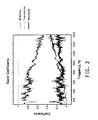
- the facing of the absorber which does not have through-holes and which is much thinner than typical perforated facings in the trade, but not as thin as commonly used impervious film facings, has been found to enhance acoustic absorption at broader range of low- and mid-range frequencies and be acoustically transparent in about the voice frequency range, as depicted in Figures 2 and 3 .
- the flash spun sheet is produced by the following general process, also disclosed in U.S. Pat. No. 3,860,369 .
- the flash spinning process is conducted in a chamber which has a vapor-removal port and an opening through which sheet material produced in the process is removed.
- Polymer solution is prepared at an elevated temperature and pressure and provided to the chamber.
- the pressure of the solution is greater than the cloud-point pressure, which is the lowest pressure at which the polymer is fully dissolved in the spin agent forming a homogeneous single phase mixture.
- the single phase polymer solution passes through a letdown orifice into a lower pressure (or letdown) chamber where the solution separates into a two-phase liquid-liquid dispersion.
- One phase of the dispersion is a spin agent-rich phase which comprises primarily spin agent and the other phase of the dispersion is a polymer-rich phase which contains most of the polymer.
- This two-phase liquid-liquid dispersion is forced through a spinneret into an area of much lower pressure (preferably atmospheric pressure) where the spin agent evaporates very rapidly (flashes), and the polyolefin emerges from the spinneret as plexifilaments which are laid down to form the flash spun sheet.
- impurities are flashed along with the spin agent, so that the resulting flash spun sheet is free of impurities.
- plexifilamentary or plexifilaments refers to a three-dimensional integral network of a multitude of thin, ribbon-like, film-fibrils of random length and with a mean fibril thickness of less than about 4 micrometers and a median width of less than about 25 micrometers.
- the film-fibrils are generally coextensively aligned with the longitudinal axis of the structure and they intermittently unite and separate at irregular intervals in various places throughout the length, width and thickness of the structure to form a continuous three-dimensional network.
- Such structures are described in further detail in U.S. Pat. Nos 3,081,519 and 3,227,794 .
- the sheet is consolidated which involves compressing the sheet between the belt and a consolidation roll into a structure having sufficient strength to be handled outside the chamber.
- the sheet is then collected outside the chamber on a windup roll.
- the sheet can then be bonded using methods known in the art, such as thermal bonding, through gas bonding and point bonding, including patterned bonding or embossing.
- the sheet can be bonded to varying degrees provided that a coherent surface is formed.
- the diameter of the film-fibrils of the flash spun facing i.e. between about 4 micrometers and about 25 micrometers, is in the range of ultrasound wavelengths. At frequencies between about 100 Hz and about 1600 Hz, the wavelength of sound is several orders of magnitude larger than the diameter of the film-fibrils. Nevertheless, thin plexifilamentary film-fibrils of the facing according to the invention surprisingly enhance the acoustic absorption of the acoustic absorber between about 100 Hz and about 1600 Hz, even between about 100 Hz and about 1200 Hz. This is the range of frequencies most often emitted by mechanical equipment and the human voice, and therefore most often encountered as undesirable noise in building interiors.
- the pore size distribution of the plexifilamentary film-fibrils of the flash spun sheet provide torturous path for the sound wave and enhances the acoustic absorption of an acoustically absorbing core of an acoustically absorbing material or air space when the sheet is used as a facing on at least one surface of the core. It has furthermore surprisingly been found that flash spun sheet exhibits extremely high airflow resistance, much higher than porous facings in the prior art.
- Polymers from which facings of the acoustically absorbing article according to the invention can be made include polyolefin (e.g., polyethylene, polypropylene, polymethylpentene and polybutylene), acrylonitrile-butadiene-styrene (ABS) resin, polystyrene, styreneacrylonitrile, styrene-butadiene, styrene-maleic anhydride, vinyl plastic (e.g., polyvinyl chloride (PVC)), acrylic, acrylonitrile-based resin, acetal, perfluoropolymer, hydrofluoropolymer, polyamide, polyamide-imide, polyaramid, polyarylate, polycarbonate, polyesters, (e.g., polyethylene napthalate (PEN)), polyketone, polyphenylene ether, polyphenylene sulfide and polysulfone.
- polyolefin e.g., polyethylene, polyprop
- polystyrene resins Preferred amongst the polymers are the polyolefins, e.g., polyethylene and polypropylene.
- polyethylene as used herein includes not only homopolymers of ethylene, but also copolymers wherein at least 85% of the recurring units arise from ethylene.
- a preferred polyethylene is linear high density polyethylene having an upper limit of melting range of about 130° to 137°C, a density in the range of 0.94 to 0.98 g/cm 3 and a melt index (as defined by ASTM D-1238-57T, Condition E) of between 0.1 to 100, preferably between 0.1 and 4.
- polypropylene as used herein includes not only homopolymers of propylene but also copolymers wherein at least 85% of the recurring units arise from propylene units.
- Nonwoven facings can further comprise a known UV stabilizer, antistatic agent, pigment and/or flame retardant dispersed within the polymer of the fibers of the nonwoven substrate.
- the facing of the invention has the desirable combination of barrier, i.e., resistance to penetration of water, dust and/or microorganisms, and porosity resulting in higher air flow or permeability than impervious films and good acoustical performance.
- Acoustical absorption is a function of acoustic impedance, which is determined by a complex combination of acoustical resistance and acoustical reactance.
- the acoustical reactance is governed largely by material thickness, while acoustical resistance is governed by air flow through the material.
- Significant porosity is needed for acoustically transparent facings.
- barrier properties are needed for particulate and liquid resistance of the facing.
- Facings according to the present invention can comprise single or multiple layers of flash spun sheet provided the acoustical absorption is not compromised.
- the multilayer sheet embodiment is also useful for averaging out nonuniformities in single sheets due to nonuniform sheet thickness or directionality of sheet fibers.
- Multilayer laminates can be prepared by positioning two or more sheets face to face, and lightly thermally bonding the sheets under applied pressure, such as by rolling the sheets between one or more pairs of nip rollers.
- Laminates of sheets are preferably prepared by adhering the sheets together with an adhesive, such as a pressure sensitive adhesive. Adhesives also might be used between facing and an absorbing core.
- Adhesives of utility are those that maintain sufficient structural integrity of the laminate during normal handling and use. Adhesives of utility include, but not limited to moisture curable polyurethane, solvated polyurethane adhesives and water-borne acrylics.
- the nonwoven facing can be metallized which may be desirable to provide certain aesthetics, light reflectance and/or electromagnetic shielding of sensitive equipment or security articles.
- Representative metals include aluminum, tin, nickel, iron, chromium, copper, silver, gold, zinc or alloys thereof, with aluminum preferred.
- Metals may be deposited by known vacuum metallization techniques in which metal is vaporized by heat under vacuum, and then deposited on one face of a nonwoven sheet in a thickness greater than amount 15 nm. Metals may be deposited in a thickness from about 15 nm to about 1 micrometer in a single layer, or in a thickness greater than 1 micrometer using multiple layers. Vacuum metallization of flash-spun polyolefin sheet is known, for example, in U.S. Pat.
- a thin specular reflecting layer is added to one face of the nonwoven sheet without substantially changing the overall thickness of the nonwoven sheet.
- the metal layer can be protected by an outer organic coating layer of a material selected from the group consisting of organic polymers, organic oligomers and combinations thereof, e.g., polyacrylate polymers and oligomers, having a thickness between about 0.2 micrometer and 2.5 micrometers vapor deposited on the metal layer by a known method such as described in U.S. Pat. No. 7,157,117 .
- the facing can further include a functional surface coating layer or a surface treatment, such as, for example, antistatic treatment, pigmented layer, gloss layer, antibacterial layer or photoreactive layer.
- a functional surface coating layer or a surface treatment such as, for example, antistatic treatment, pigmented layer, gloss layer, antibacterial layer or photoreactive layer.
- the acoustic absorber of the invention can be effectively employed to absorb and/or reduce the acoustic energy within the confined space, such as an architectural space.
- the absorber can be used as a building interior surface, such as a wall or ceiling, covering, a partition or a building interior component (such as pillar) placed within a three-dimensional space such as a room.
- the absorber of the invention can be placed inside a porous, acoustically transparent frame or cage to be protected from severe physical abuse.
- the absorber can be used in combination with common building components such as floors, walls, ceilings and the like, and components of moving vehicles such as motor vehicles, trains, aircraft and the like, or as components of industrial equipment, appliances having moving parts and computers.
- the acoustic absorber of the invention is particularly useful in indoor environments in which indoor air quality and cleanliness are critical, such as in schools, hospitals, cleanrooms, and the like.
- the resulting facing is free of impurities and the facing does not generate off-gassing of any volatile compounds.
- the facing is non-linting in that it does not release particles or fibers as a result of the high degree of consolidation of the single film-fibrils within the sheet structure.
- the acoustically absorbing core preferably contains substantially no VOCs.
- the facing can be cleaned by wiping or washing.
- the facing can also be sterilized by known methods including solution cleaning, physical energy radiation or gas sterilization. In situations in which cleaning and sterilizing the facing are not convenient, the flash spun facing can be disposed of and replaced at minimal expense and effort.
- flash spun facing can be additionally bonded by any known bonding technique. After bonding, the facing can have varying degrees of surface smoothness.
- the facing can be very smooth such as to have a Parker surface smoothness below 5 micrometers, or a facing can be rough with a Parker surface smoothness not less than 6 micrometers.
- the rough surface can have various 3-dimenthional surface features, distributed throughout the facing surface randomly or in a specially arranged order.
- the facing of the absorber can be further printed with a graphic design such as an image and/or text to be aesthetically desirable for the intended use. It is convenient to have the ability to replace the facing in order to change the image and/or text. By changing the facing, the aesthetics of the absorber can easily and inexpensively be changed.
- the invention can further include a sound permeable rigid casing to protect and encase the absorber.
- the casing can be a perforated metal, perforated plastic, or perforated solid filled resin material such as, for instance, Corian ® material available from E. I. du Pont de Nemours and Company (DuPont), Wilmington, Del., comprising an acrylic matrix filled with alumina trihydrate (ATH).
- Corian ® material available from E. I. du Pont de Nemours and Company (DuPont), Wilmington, Del., comprising an acrylic matrix filled with alumina trihydrate (ATH).
- the present invention further includes a method of improving acoustic absorption in an environment comprising: (i) providing an acoustically absorptive article comprising a core of acoustically absorptive core material covered by a facing of flash spun sheet having a plurality of pores wherein the pores have a diameter between about 100 nm and about 20,000 nm and even between about 100 nm and about 1500 nm and wherein the pores have a mean pore diameter of less than about 20,000 nm, even less than about 5,000 nm, even less than about 2,000 nm, even less than about 1,000 nm and even between about 10 nm and about 1,000 nm; and (ii) positioning the article within the environment to cause ambient sound to be absorbed by the article.
- Basis Weight was measured by the method of ASTM D 3776, modified for specimen size, and reported in units of g/m 2 .
- Frazier Air Permeability was measured according to ASTM D737-75 in CFM/ft 2 at 125 Pa differential pressure.
- Hydrostatic Head was measured according to AATCC TM 127, DIN EN 20811 with a test rate of 60 cm of H 2 O per minute.
- Parker Surface Smoothness was measured according to TAPPI 555 at a clamping pressure of 1.0 MPa and is reported in micrometers.
- Specific Airflow Resistance is equivalent to the air pressure difference across a sample divided by the linear velocity of airflow measured outside the sample and is reported in Ns/m 3 .
- the values reported herein were determined based on the air permeability measurements as follows.
- the Frazier air permeability of 0.6 m 3 /min/m 2 (2 ft 3 /min/ft 2 ) corresponds to about 3.1 seconds; therefore Frazier air permeability (in CFM/ft 2 ) of the samples herein was approximated as 3.1/Gurley Hill porosity (in seconds).
- the airflow resistance in units of Pa-s/m 3 was calculated by dividing the differential pressure by the air flow Q.
- the specific airflow resistance in units of Ns/m 3 was calculated by dividing the airflow resistance by the area of the sample.
- Sound Absorption Coefficient as reported in Fig. 3 was measured using a laboratory setting including a reverberant room in compliance with ASTM C423, specimen mounting A (without air space) according to ASTM E 795.
- the absorbers were placed on the floor of the reverberant room in a 1 inch high aluminum test frame. The edges of the frame were sealed to the floor using duct tape to eliminate flanking noise.
- the sound absorption measurements were conducted at 1/3 octave bands from 80 to 5,000 Hz. Ten decay measurements were taken for every microphone position.
- Noise Reduction Coefficient was calculated as an average of the Sound Absorption Coefficient at 250, 500, 1000, 2,000 and 4,000 Hz as measured in accordance with ASTM C423.
- Porosity and pore size distribution data are obtained by known mercury porosimetry methodology as disclosed by H. M. Rootare in "A Review of Mercury Porosimetry” from Advanced Experimental Techniques in Powder Metallurgy, pp. 225-252, Plenum Press, 1970 .
- Porosity 1 - Basis weight / density of solid x thickness
- Microbial Filtration Efficiency was measured according to the ASTM F2638-07 and ASTM F1608.
- Log reduction value or LRV characterizes barrier efficiency of the membrane and is determined from the test. The test can use both polystyrene particles and actual spores to challenge the membrane.
- Hydrostatic Head was measured according to AATCC TM 127, DIN EN 20811 and reported in cm of H 2 O.
- Absorber cores according to the invention were formed using a layer of open cell melamine foam (from Illbruck Acoustic Inc., Minneapolis, Minnesota) having a thickness of 13 mm, a basis weight of 9.4 kg/m 3 and a specific airflow resistance of 120 rayls.
- a 0.1 mm thick, 17 g/m 2 basis weight nylon 6,6 spunbond scrim was laid on both sides of the foam and the scrims and foam were quilted together using a pattern of approximately 11 cm x 11 cm diamonds.
- the example absorbers were made by the lamination process described below.
- a vinyl acetate water based glue (WA 2173 available from efi Polymers, Denver, Colorado) was applied by a roller onto one surface of the quilted foam layer at a rate of approximately 0.3 kg/m 2 .
- a melt blown polyester nonwoven layer having a thickness of 20 mm, a basis weight of 0.33 kg/m 2 , and a specific airflow resistance of 130 rayls was laminated to the quilted foam layer to form the absorber core.
- a flash spun nonwoven facing available from DuPont under the trade name DuPontTM Tyvek® style 1055B was wrapped around the core to form the absorber of Example 1.
- Flash spun nonwoven facing available from DuPont under the trade name DuPontTMTyvek® style 1443R was wrapped around the core to form the absorber of Example 2.
- the total absorber thickness of each of the examples was about 25 mm.
- Flash spun facing of Example 1 has a hydrostatic head of at least 180 cm of H 2 O
- facing of Example 2 has a hydrostatic head of at least 24 cm of H 2 O according to the product specification (tested per AATCC TM 127, DIN EN 20811 with a test rate of 60 cm of H 2 O per minute).
- the Table includes properties of the facings used in the example absorbers.
- Example 1 and 2 The Gurley Hill porosity of Example 1 and 2 was measured experimentally and it is well in agreement with the typical range within which the flash spun nonwoven varies for both Tyvek® styles according to specification.
- Air permeability as measured by Gurley Hill porosity and Frazier air permeability characterizes the general porosity or openness of the structure. The range for air permeability for various types of nonwoven structures is very wide. Typically, all nonwovens have much more open structure with Frazier air permeability of about 50 cfm or higher. Solid films have very closed, solid structure, which is why films are called impervious, with Gurley Hill porosity well above 10,000 s.
- the air permeability of the flash spun facing can be changed from Gurley Hill range of about 4,000 s, like for Example 1 to Frazier air permeability to about 30 cfm, giving a range of Specific Air Flow Resistance of about 31,000,000 to 800 rayls.
- Total porosity of the structure can be roughly estimated from the facing's basis weight, thickness and density of the polymer. Knowing polyethylene has a density of about 0.98 g/cm 3 , the total porosity can be estimated as being about 0.6 for facing of Example 1 and about 0.7 for facing of Example 2. This is well in agreement with total porosity as measured by mercury porosimetry.
- the pore size range was from 10 nm to about 8,000 nm for Example 1 and from 10 nm to about 10,000 nm for Example 2, as measured by mercury porosimetry.
- the mean pore size was about 2,000 nm for both, Example 1 and Example 2.
- Solid films have total porosity of about 0, which means they have no voids or pores inside the structure. This is why solid films have extremely good barrier properties.
- inventive flash spun facing exhibits the water resistance range similar to the water resistance of solid impervious films as measured by hydrostatic head.
- the typical range of hydrostatic head for the inventive facing is from about 24 to about 230 cm H 2 O, as illustrated by Example 1 and 2.
- inventive flash spun facings have various surface features as was measured by Parker surface smoothness.
- Example 1 has a Parker surface smoothness of about 4.5 micrometers; therefore, it exhibits a smooth sleek surface, similar to the printing quality paper.
- Example 2 has a Parker surface smoothness of about 8 micrometers, representing a rough surface with 3-dimentional features, in this case, ribbon-like features.
- the wide range of Parker surface smoothness allows the production of aesthetically pleasing surfaces to compliment design in various architectural spaces.
- Inventive facings can further comprise graphical images. Table Ex. No.
- a comparative absorber was prepared similarly without the flash spun facing.
- the thickness of the comparative absorber was about 25 mm.
- the example and comparative absorbers were conditioned at room temperature for at least two weeks after manufacturing, and at controlled conditions (temperature of 23°C and RH of 60%) for 24 hours before acoustic testing. Absorption coefficient data were obtained for each absorber.
- the absorbers of Examples 1 and 2 as represented by curves 1 and 2, respectively, provide continuously improved absorption as compared with the comparative example as represented by curve C over the frequency range from 400 Hz to 1200 Hz.
- the improvement is at least 5% higher for the absorbers with facings versus the absorber without a facing.
- Examples 1 and 2 also show that, despite being much thicker than commonly used impervious film facings and having much higher specific airflow resistance than typical perforated facings, the inventive facings do not substantially reflect the sound energy at higher frequencies of the voice range.
Landscapes
- Physics & Mathematics (AREA)
- Engineering & Computer Science (AREA)
- Architecture (AREA)
- Acoustics & Sound (AREA)
- Electromagnetism (AREA)
- Civil Engineering (AREA)
- Structural Engineering (AREA)
- Building Environments (AREA)
- Soundproofing, Sound Blocking, And Sound Damping (AREA)
- Laminated Bodies (AREA)
Applications Claiming Priority (2)
| Application Number | Priority Date | Filing Date | Title |
|---|---|---|---|
| US888207P | 2007-12-20 | 2007-12-20 | |
| PCT/US2008/087899 WO2009086245A1 (en) | 2007-12-20 | 2008-12-22 | Acoustic absorber with barrier facing |
Publications (2)
| Publication Number | Publication Date |
|---|---|
| EP2231942A1 EP2231942A1 (en) | 2010-09-29 |
| EP2231942B1 true EP2231942B1 (en) | 2014-09-17 |
Family
ID=40459603
Family Applications (1)
| Application Number | Title | Priority Date | Filing Date |
|---|---|---|---|
| EP08865987.5A Not-in-force EP2231942B1 (en) | 2007-12-20 | 2008-12-22 | Acoustic absorber with barrier facing |
Country Status (5)
| Country | Link |
|---|---|
| US (1) | US20090173569A1 (enExample) |
| EP (1) | EP2231942B1 (enExample) |
| JP (2) | JP5479365B2 (enExample) |
| CN (1) | CN101946048A (enExample) |
| WO (1) | WO2009086245A1 (enExample) |
Families Citing this family (20)
| Publication number | Priority date | Publication date | Assignee | Title |
|---|---|---|---|---|
| ATE427245T1 (de) * | 2005-04-04 | 2009-04-15 | Rieter Technologies Ag | Hermetisches dunnes mehrschichtiges shallabsorbierendes element |
| DE102005049570B3 (de) * | 2005-10-17 | 2007-04-05 | Cellofoam Gmbh & Co. Kg | Schallabsorbierendes Material |
| KR200440716Y1 (ko) * | 2006-10-24 | 2008-06-27 | 이계정 | 고밀도 폴리에스테르 복합흡음재 및 이의 제조 장치 |
| US8434120B2 (en) | 2007-06-26 | 2013-04-30 | Thomson Licensing | System and method for grouping program identifiers into multicast groups |
| EP2283480A4 (en) * | 2008-05-22 | 2016-11-09 | 3M Innovative Properties Co | MULTILAYER SOUND ABSORBING STRUCTURE WITH A MESH LAYER |
| EP2515624B1 (en) * | 2009-12-15 | 2017-06-14 | Asahi Kasei Kabushiki Kaisha | Electromagnetic noise absorbing fabric |
| FR2978373B1 (fr) * | 2011-07-28 | 2013-08-02 | Saint Gobain Adfors | Revetement mural absorbant acoustique |
| FR2978459B1 (fr) * | 2011-07-28 | 2013-08-02 | Saint Gobain Adfors | Revetement mural absorbant acoustique renfermant une couche de fibres multilobees |
| FR2979281B1 (fr) | 2011-08-25 | 2013-08-23 | Saint Gobain Adfors | Revetement mural pour confort thermique et acoustique |
| GB2516489A (en) * | 2013-07-24 | 2015-01-28 | Geko Innovations Ltd | Acoustic Panel |
| WO2016051527A1 (ja) * | 2014-09-30 | 2016-04-07 | コンパニー ゼネラール デ エタブリッスマン ミシュラン | 吸音体 |
| EP3256312B1 (en) * | 2015-02-13 | 2019-04-03 | Zephyros Inc. | Nonwoven infrared reflective fiber materials |
| JP7033129B2 (ja) * | 2016-10-11 | 2022-03-09 | イー・アイ・デュポン・ドウ・ヌムール・アンド・カンパニー | エンボス加工押印パターンを有する接合表面を有する不織物を含む密封された接触領域を含むパッケージ |
| JP6705780B2 (ja) * | 2017-07-27 | 2020-06-03 | 富士フイルム株式会社 | 防音構造 |
| JP6660035B2 (ja) * | 2018-03-08 | 2020-03-04 | Jnc株式会社 | 積層吸音材 |
| JP2020189414A (ja) | 2019-05-20 | 2020-11-26 | 名古屋油化株式会社 | 吸音材及びその製造方法 |
| US11565615B2 (en) * | 2020-04-28 | 2023-01-31 | Global Ip Holdings, Llc | Anti-microbial, partition divider assembly for a cart such as a golf cart |
| CN116670753A (zh) * | 2020-09-11 | 2023-08-29 | 3M创新有限公司 | 吸声填料和相关的声学制品 |
| CN114648972B (zh) * | 2020-12-18 | 2025-10-24 | 香港大学浙江科学技术研究院 | 吸声结构和吸声装置 |
| JP7766278B2 (ja) * | 2021-12-22 | 2025-11-10 | パナソニックIpマネジメント株式会社 | 積層パネル |
Family Cites Families (39)
| Publication number | Priority date | Publication date | Assignee | Title |
|---|---|---|---|---|
| FR1149040A (fr) * | 1956-06-26 | 1957-12-19 | Procédé et dispositif pour la fabrication d'éléments (corps) absorbant le bruit dans des pièces | |
| US3081519A (en) * | 1962-01-31 | 1963-03-19 | Fibrillated strand | |
| NL300881A (enExample) * | 1962-11-23 | |||
| US3255563A (en) * | 1962-12-20 | 1966-06-14 | Victor E Sauer | Wall structure and support assembly |
| US3380206A (en) * | 1965-09-29 | 1968-04-30 | Soundlock Corp | Lay-in acoustical ceiling panel with flexible diaphragms |
| US3860369A (en) * | 1972-11-02 | 1975-01-14 | Du Pont | Apparatus for making non-woven fibrous sheet |
| US3858676A (en) * | 1973-01-22 | 1975-01-07 | Masurier Philip H Le | Sound absorbing panel |
| US4522284A (en) * | 1983-04-20 | 1985-06-11 | Peabody Noise Control, Inc. | Composite panel structure |
| JPS6335940A (ja) * | 1986-07-30 | 1988-02-16 | コマニ−株式会社 | 吸音パネル |
| JPH0762307B2 (ja) * | 1987-12-15 | 1995-07-05 | 積水化学工業株式会社 | 繊維成形体 |
| US4999222A (en) * | 1989-07-10 | 1991-03-12 | E. I. Du Pont De Nemours And Company | Metallized polyethylene plexifilamentary film-fibril sheet |
| US5824973A (en) * | 1992-09-29 | 1998-10-20 | Johns Manville International, Inc. | Method of making sound absorbing laminates and laminates having maximized sound absorbing characteristics |
| US5288536A (en) * | 1993-05-28 | 1994-02-22 | E. I. Du Pont De Nemours And Company | Hydraulic-jet-treated stitchbonded fabric |
| US6096421A (en) * | 1996-01-11 | 2000-08-01 | E. I. Du Pont De Nemours And Company | Plexifilamentary strand of blended polymers |
| US5723084A (en) * | 1996-03-08 | 1998-03-03 | E. I. Du Pont De Nemours And Company | Flash spinning process |
| JP3494332B2 (ja) * | 1996-05-28 | 2004-02-09 | カネボウ株式会社 | 防音材料 |
| US5877100A (en) * | 1996-09-27 | 1999-03-02 | Cabot Corporation | Compositions and insulation bodies having low thermal conductivity |
| US20020004351A1 (en) * | 1997-03-05 | 2002-01-10 | Wazir Nobbee | Packaging product |
| WO1998039509A1 (en) * | 1997-03-05 | 1998-09-11 | E.I. Du Pont De Nemours And Company | Improved flash-spun sheet material |
| DE29713779U1 (de) * | 1997-08-02 | 1997-10-09 | SOMMER ALLIBERT-LIGNOTOCK GmbH, 76744 Wörth | Mehrschichtiges Formteil |
| US6497946B1 (en) * | 1997-10-24 | 2002-12-24 | 3M Innovative Properties Company | Diffuse reflective articles |
| US6197403B1 (en) * | 1998-04-06 | 2001-03-06 | Hp Pelzer (Automotive Systems), Inc. | Integral sound absorber and water deflector door panel |
| US6253526B1 (en) * | 1998-11-13 | 2001-07-03 | E.I. Du Pont De Nemours And Company | Installation method for carpet underlays |
| US6703331B1 (en) * | 1999-02-25 | 2004-03-09 | E. I. Du Pont De Nemours And Company | Fungus resistant gypsum-based substrate |
| JP2003518202A (ja) * | 1999-10-18 | 2003-06-03 | イー・アイ・デュポン・ドウ・ヌムール・アンド・カンパニー | フラッシュ紡糸されたシ−ト材料 |
| JP2001236076A (ja) * | 2000-02-23 | 2001-08-31 | Toray Ind Inc | 吸音材 |
| US20020106959A1 (en) * | 2000-09-01 | 2002-08-08 | Huffines Prentice Lee | Composite sheet material |
| US7157117B2 (en) * | 2002-06-26 | 2007-01-02 | Sigma Laboratories Of Arizona, Llc | Functionalization of porous materials by vacuum deposition of polymers |
| US7776251B2 (en) * | 2003-04-16 | 2010-08-17 | Rowland Griffin | Method of making sound insulation with high loft |
| TWI302171B (en) * | 2003-04-22 | 2008-10-21 | Asahi Kasei Fibers Corp | A spun bonded-type laminate nonwoven fabric and method therefor |
| US20040247819A1 (en) * | 2003-06-09 | 2004-12-09 | 3M Innovative Properties Company | Casing-free insulation blanket |
| US7629043B2 (en) * | 2003-12-22 | 2009-12-08 | Kimberly-Clark Worldwide, Inc. | Multi purpose cleaning product including a foam and a web |
| EP1919701B1 (en) * | 2004-06-29 | 2012-08-08 | Aspen Aerogels Inc. | Energy efficient and insulated building envelopes |
| US20060040122A1 (en) * | 2004-08-20 | 2006-02-23 | Verichem, Inc. | Antimicrobial drywall |
| US7500541B2 (en) * | 2004-09-30 | 2009-03-10 | Kimberly-Clark Worldwide, Inc. | Acoustic material with liquid repellency |
| US7837009B2 (en) * | 2005-04-01 | 2010-11-23 | Buckeye Technologies Inc. | Nonwoven material for acoustic insulation, and process for manufacture |
| US7660040B2 (en) * | 2005-05-17 | 2010-02-09 | E. I. Du Pont De Nemours And Company | Diffuse reflective article |
| US20070094964A1 (en) * | 2005-10-17 | 2007-05-03 | Stender Mark L | Dynamically ventilated exterior wall assembly |
| US8445101B2 (en) * | 2007-03-21 | 2013-05-21 | Ashtech Industries, Llc | Sound attenuation building material and system |
-
2008
- 2008-12-19 US US12/339,924 patent/US20090173569A1/en not_active Abandoned
- 2008-12-22 JP JP2010539926A patent/JP5479365B2/ja not_active Expired - Fee Related
- 2008-12-22 EP EP08865987.5A patent/EP2231942B1/en not_active Not-in-force
- 2008-12-22 CN CN2008801272788A patent/CN101946048A/zh active Pending
- 2008-12-22 WO PCT/US2008/087899 patent/WO2009086245A1/en not_active Ceased
-
2014
- 2014-02-12 JP JP2014024014A patent/JP5806349B2/ja not_active Expired - Fee Related
Also Published As
| Publication number | Publication date |
|---|---|
| US20090173569A1 (en) | 2009-07-09 |
| EP2231942A1 (en) | 2010-09-29 |
| WO2009086245A1 (en) | 2009-07-09 |
| JP2014130363A (ja) | 2014-07-10 |
| JP2011508118A (ja) | 2011-03-10 |
| CN101946048A (zh) | 2011-01-12 |
| JP5479365B2 (ja) | 2014-04-23 |
| JP5806349B2 (ja) | 2015-11-10 |
Similar Documents
| Publication | Publication Date | Title |
|---|---|---|
| EP2231942B1 (en) | Acoustic absorber with barrier facing | |
| EP2231948B1 (en) | Acoustically absorbent ceiling tile having barrier facing with diffuse reflectance and use of said tile | |
| EP2311028B1 (en) | Multilayer sound absorbing sheet and method of absorbing sound | |
| KR100405073B1 (ko) | 음향을 감쇠시키는 방법 및 그 방법에 이용되는 방음체 | |
| US8496088B2 (en) | Acoustic composite | |
| US8322487B1 (en) | Acoustically coupled non-woven composite | |
| CN103842169B (zh) | 吸音材料墙面涂料 | |
| JP2023093414A (ja) | 積層パネル | |
| CN103874574B (zh) | 吸音材料墙面涂料 | |
| JP6050359B2 (ja) | 熱及び音響快適性のための壁面被覆 | |
| KR101408581B1 (ko) | 다공성 막 | |
| US11905633B2 (en) | Functional nonwoven scrim for high temperature applications requiring low flammability, smoke, and toxicity | |
| JPH09317047A (ja) | 防音材料 | |
| JP7766278B2 (ja) | 積層パネル | |
| JP2022162918A (ja) | 積層パネル | |
| MX2008008387A (es) | Membrana porosa |
Legal Events
| Date | Code | Title | Description |
|---|---|---|---|
| PUAI | Public reference made under article 153(3) epc to a published international application that has entered the european phase |
Free format text: ORIGINAL CODE: 0009012 |
|
| 17P | Request for examination filed |
Effective date: 20100625 |
|
| AK | Designated contracting states |
Kind code of ref document: A1 Designated state(s): AT BE BG CH CY CZ DE DK EE ES FI FR GB GR HR HU IE IS IT LI LT LU LV MC MT NL NO PL PT RO SE SI SK TR |
|
| AX | Request for extension of the european patent |
Extension state: AL BA MK RS |
|
| DAX | Request for extension of the european patent (deleted) | ||
| 17Q | First examination report despatched |
Effective date: 20121218 |
|
| GRAP | Despatch of communication of intention to grant a patent |
Free format text: ORIGINAL CODE: EPIDOSNIGR1 |
|
| INTG | Intention to grant announced |
Effective date: 20140317 |
|
| GRAS | Grant fee paid |
Free format text: ORIGINAL CODE: EPIDOSNIGR3 |
|
| GRAA | (expected) grant |
Free format text: ORIGINAL CODE: 0009210 |
|
| AK | Designated contracting states |
Kind code of ref document: B1 Designated state(s): AT BE BG CH CY CZ DE DK EE ES FI FR GB GR HR HU IE IS IT LI LT LU LV MC MT NL NO PL PT RO SE SI SK TR |
|
| REG | Reference to a national code |
Ref country code: GB Ref legal event code: FG4D |
|
| REG | Reference to a national code |
Ref country code: CH Ref legal event code: EP |
|
| REG | Reference to a national code |
Ref country code: IE Ref legal event code: FG4D |
|
| REG | Reference to a national code |
Ref country code: AT Ref legal event code: REF Ref document number: 687781 Country of ref document: AT Kind code of ref document: T Effective date: 20141015 |
|
| REG | Reference to a national code |
Ref country code: DE Ref legal event code: R096 Ref document number: 602008034488 Country of ref document: DE Effective date: 20141030 |
|
| PG25 | Lapsed in a contracting state [announced via postgrant information from national office to epo] |
Ref country code: GR Free format text: LAPSE BECAUSE OF FAILURE TO SUBMIT A TRANSLATION OF THE DESCRIPTION OR TO PAY THE FEE WITHIN THE PRESCRIBED TIME-LIMIT Effective date: 20141218 Ref country code: LT Free format text: LAPSE BECAUSE OF FAILURE TO SUBMIT A TRANSLATION OF THE DESCRIPTION OR TO PAY THE FEE WITHIN THE PRESCRIBED TIME-LIMIT Effective date: 20140917 Ref country code: NO Free format text: LAPSE BECAUSE OF FAILURE TO SUBMIT A TRANSLATION OF THE DESCRIPTION OR TO PAY THE FEE WITHIN THE PRESCRIBED TIME-LIMIT Effective date: 20141217 Ref country code: SE Free format text: LAPSE BECAUSE OF FAILURE TO SUBMIT A TRANSLATION OF THE DESCRIPTION OR TO PAY THE FEE WITHIN THE PRESCRIBED TIME-LIMIT Effective date: 20140917 Ref country code: FI Free format text: LAPSE BECAUSE OF FAILURE TO SUBMIT A TRANSLATION OF THE DESCRIPTION OR TO PAY THE FEE WITHIN THE PRESCRIBED TIME-LIMIT Effective date: 20140917 |
|
| REG | Reference to a national code |
Ref country code: NL Ref legal event code: VDEP Effective date: 20140917 |
|
| REG | Reference to a national code |
Ref country code: LT Ref legal event code: MG4D |
|
| PG25 | Lapsed in a contracting state [announced via postgrant information from national office to epo] |
Ref country code: HR Free format text: LAPSE BECAUSE OF FAILURE TO SUBMIT A TRANSLATION OF THE DESCRIPTION OR TO PAY THE FEE WITHIN THE PRESCRIBED TIME-LIMIT Effective date: 20140917 Ref country code: LV Free format text: LAPSE BECAUSE OF FAILURE TO SUBMIT A TRANSLATION OF THE DESCRIPTION OR TO PAY THE FEE WITHIN THE PRESCRIBED TIME-LIMIT Effective date: 20140917 Ref country code: CY Free format text: LAPSE BECAUSE OF FAILURE TO SUBMIT A TRANSLATION OF THE DESCRIPTION OR TO PAY THE FEE WITHIN THE PRESCRIBED TIME-LIMIT Effective date: 20140917 |
|
| REG | Reference to a national code |
Ref country code: AT Ref legal event code: MK05 Ref document number: 687781 Country of ref document: AT Kind code of ref document: T Effective date: 20140917 |
|
| PG25 | Lapsed in a contracting state [announced via postgrant information from national office to epo] |
Ref country code: NL Free format text: LAPSE BECAUSE OF FAILURE TO SUBMIT A TRANSLATION OF THE DESCRIPTION OR TO PAY THE FEE WITHIN THE PRESCRIBED TIME-LIMIT Effective date: 20140917 |
|
| PG25 | Lapsed in a contracting state [announced via postgrant information from national office to epo] |
Ref country code: ES Free format text: LAPSE BECAUSE OF FAILURE TO SUBMIT A TRANSLATION OF THE DESCRIPTION OR TO PAY THE FEE WITHIN THE PRESCRIBED TIME-LIMIT Effective date: 20140917 Ref country code: PT Free format text: LAPSE BECAUSE OF FAILURE TO SUBMIT A TRANSLATION OF THE DESCRIPTION OR TO PAY THE FEE WITHIN THE PRESCRIBED TIME-LIMIT Effective date: 20150119 Ref country code: IS Free format text: LAPSE BECAUSE OF FAILURE TO SUBMIT A TRANSLATION OF THE DESCRIPTION OR TO PAY THE FEE WITHIN THE PRESCRIBED TIME-LIMIT Effective date: 20150117 Ref country code: CZ Free format text: LAPSE BECAUSE OF FAILURE TO SUBMIT A TRANSLATION OF THE DESCRIPTION OR TO PAY THE FEE WITHIN THE PRESCRIBED TIME-LIMIT Effective date: 20140917 Ref country code: RO Free format text: LAPSE BECAUSE OF FAILURE TO SUBMIT A TRANSLATION OF THE DESCRIPTION OR TO PAY THE FEE WITHIN THE PRESCRIBED TIME-LIMIT Effective date: 20140917 Ref country code: EE Free format text: LAPSE BECAUSE OF FAILURE TO SUBMIT A TRANSLATION OF THE DESCRIPTION OR TO PAY THE FEE WITHIN THE PRESCRIBED TIME-LIMIT Effective date: 20140917 Ref country code: SK Free format text: LAPSE BECAUSE OF FAILURE TO SUBMIT A TRANSLATION OF THE DESCRIPTION OR TO PAY THE FEE WITHIN THE PRESCRIBED TIME-LIMIT Effective date: 20140917 |
|
| PG25 | Lapsed in a contracting state [announced via postgrant information from national office to epo] |
Ref country code: AT Free format text: LAPSE BECAUSE OF FAILURE TO SUBMIT A TRANSLATION OF THE DESCRIPTION OR TO PAY THE FEE WITHIN THE PRESCRIBED TIME-LIMIT Effective date: 20140917 Ref country code: PL Free format text: LAPSE BECAUSE OF FAILURE TO SUBMIT A TRANSLATION OF THE DESCRIPTION OR TO PAY THE FEE WITHIN THE PRESCRIBED TIME-LIMIT Effective date: 20140917 |
|
| REG | Reference to a national code |
Ref country code: DE Ref legal event code: R097 Ref document number: 602008034488 Country of ref document: DE |
|
| PG25 | Lapsed in a contracting state [announced via postgrant information from national office to epo] |
Ref country code: BE Free format text: LAPSE BECAUSE OF NON-PAYMENT OF DUE FEES Effective date: 20141231 |
|
| REG | Reference to a national code |
Ref country code: DE Ref legal event code: R119 Ref document number: 602008034488 Country of ref document: DE |
|
| PLBE | No opposition filed within time limit |
Free format text: ORIGINAL CODE: 0009261 |
|
| STAA | Information on the status of an ep patent application or granted ep patent |
Free format text: STATUS: NO OPPOSITION FILED WITHIN TIME LIMIT |
|
| PG25 | Lapsed in a contracting state [announced via postgrant information from national office to epo] |
Ref country code: DK Free format text: LAPSE BECAUSE OF FAILURE TO SUBMIT A TRANSLATION OF THE DESCRIPTION OR TO PAY THE FEE WITHIN THE PRESCRIBED TIME-LIMIT Effective date: 20140917 Ref country code: LU Free format text: LAPSE BECAUSE OF FAILURE TO SUBMIT A TRANSLATION OF THE DESCRIPTION OR TO PAY THE FEE WITHIN THE PRESCRIBED TIME-LIMIT Effective date: 20141222 |
|
| REG | Reference to a national code |
Ref country code: CH Ref legal event code: PL |
|
| 26N | No opposition filed |
Effective date: 20150618 |
|
| GBPC | Gb: european patent ceased through non-payment of renewal fee |
Effective date: 20141222 |
|
| PG25 | Lapsed in a contracting state [announced via postgrant information from national office to epo] |
Ref country code: IT Free format text: LAPSE BECAUSE OF FAILURE TO SUBMIT A TRANSLATION OF THE DESCRIPTION OR TO PAY THE FEE WITHIN THE PRESCRIBED TIME-LIMIT Effective date: 20140917 |
|
| REG | Reference to a national code |
Ref country code: IE Ref legal event code: MM4A |
|
| REG | Reference to a national code |
Ref country code: FR Ref legal event code: ST Effective date: 20150831 |
|
| PG25 | Lapsed in a contracting state [announced via postgrant information from national office to epo] |
Ref country code: LI Free format text: LAPSE BECAUSE OF NON-PAYMENT OF DUE FEES Effective date: 20141231 Ref country code: DE Free format text: LAPSE BECAUSE OF NON-PAYMENT OF DUE FEES Effective date: 20150701 Ref country code: CH Free format text: LAPSE BECAUSE OF NON-PAYMENT OF DUE FEES Effective date: 20141231 Ref country code: GB Free format text: LAPSE BECAUSE OF NON-PAYMENT OF DUE FEES Effective date: 20141222 Ref country code: IE Free format text: LAPSE BECAUSE OF NON-PAYMENT OF DUE FEES Effective date: 20141222 |
|
| PG25 | Lapsed in a contracting state [announced via postgrant information from national office to epo] |
Ref country code: FR Free format text: LAPSE BECAUSE OF NON-PAYMENT OF DUE FEES Effective date: 20141231 Ref country code: SI Free format text: LAPSE BECAUSE OF FAILURE TO SUBMIT A TRANSLATION OF THE DESCRIPTION OR TO PAY THE FEE WITHIN THE PRESCRIBED TIME-LIMIT Effective date: 20140917 |
|
| PG25 | Lapsed in a contracting state [announced via postgrant information from national office to epo] |
Ref country code: BG Free format text: LAPSE BECAUSE OF FAILURE TO SUBMIT A TRANSLATION OF THE DESCRIPTION OR TO PAY THE FEE WITHIN THE PRESCRIBED TIME-LIMIT Effective date: 20140917 Ref country code: MC Free format text: LAPSE BECAUSE OF FAILURE TO SUBMIT A TRANSLATION OF THE DESCRIPTION OR TO PAY THE FEE WITHIN THE PRESCRIBED TIME-LIMIT Effective date: 20140917 |
|
| PG25 | Lapsed in a contracting state [announced via postgrant information from national office to epo] |
Ref country code: TR Free format text: LAPSE BECAUSE OF FAILURE TO SUBMIT A TRANSLATION OF THE DESCRIPTION OR TO PAY THE FEE WITHIN THE PRESCRIBED TIME-LIMIT Effective date: 20140917 Ref country code: MT Free format text: LAPSE BECAUSE OF FAILURE TO SUBMIT A TRANSLATION OF THE DESCRIPTION OR TO PAY THE FEE WITHIN THE PRESCRIBED TIME-LIMIT Effective date: 20140917 Ref country code: HU Free format text: LAPSE BECAUSE OF FAILURE TO SUBMIT A TRANSLATION OF THE DESCRIPTION OR TO PAY THE FEE WITHIN THE PRESCRIBED TIME-LIMIT; INVALID AB INITIO Effective date: 20081222 |