EP2231786B1 - Inorganic particles hydrophobized with fluoroalkyl silanes - Google Patents
Inorganic particles hydrophobized with fluoroalkyl silanes Download PDFInfo
- Publication number
- EP2231786B1 EP2231786B1 EP08859173.0A EP08859173A EP2231786B1 EP 2231786 B1 EP2231786 B1 EP 2231786B1 EP 08859173 A EP08859173 A EP 08859173A EP 2231786 B1 EP2231786 B1 EP 2231786B1
- Authority
- EP
- European Patent Office
- Prior art keywords
- group
- chosen
- fluorosilane
- particles
- formula
- Prior art date
- Legal status (The legal status is an assumption and is not a legal conclusion. Google has not performed a legal analysis and makes no representation as to the accuracy of the status listed.)
- Not-in-force
Links
- 239000010954 inorganic particle Substances 0.000 title description 30
- -1 fluoroalkyl silanes Chemical class 0.000 title description 2
- 239000002245 particle Substances 0.000 claims description 137
- XPBBUZJBQWWFFJ-UHFFFAOYSA-N fluorosilane Chemical group [SiH3]F XPBBUZJBQWWFFJ-UHFFFAOYSA-N 0.000 claims description 85
- 229910052809 inorganic oxide Inorganic materials 0.000 claims description 66
- 125000005010 perfluoroalkyl group Chemical group 0.000 claims description 31
- 229910052731 fluorine Inorganic materials 0.000 claims description 25
- 229910052710 silicon Inorganic materials 0.000 claims description 24
- XSQUKJJJFZCRTK-UHFFFAOYSA-N Urea Chemical compound NC(N)=O XSQUKJJJFZCRTK-UHFFFAOYSA-N 0.000 claims description 23
- 229910052739 hydrogen Inorganic materials 0.000 claims description 20
- 125000003178 carboxy group Chemical group [H]OC(*)=O 0.000 claims description 18
- 239000001257 hydrogen Substances 0.000 claims description 18
- 229910052760 oxygen Inorganic materials 0.000 claims description 17
- 150000002431 hydrogen Chemical class 0.000 claims description 15
- QVGXLLKOCUKJST-UHFFFAOYSA-N atomic oxygen Chemical compound [O] QVGXLLKOCUKJST-UHFFFAOYSA-N 0.000 claims description 14
- 125000000325 methylidene group Chemical group [H]C([H])=* 0.000 claims description 14
- 239000001301 oxygen Substances 0.000 claims description 14
- VGGSQFUCUMXWEO-UHFFFAOYSA-N Ethene Chemical compound C=C VGGSQFUCUMXWEO-UHFFFAOYSA-N 0.000 claims description 12
- 239000005977 Ethylene Substances 0.000 claims description 12
- 125000001153 fluoro group Chemical group F* 0.000 claims description 12
- QWCOSMBXZZJARK-UHFFFAOYSA-N fluorosilane thiourea Chemical group F[SiH3].NC(N)=S QWCOSMBXZZJARK-UHFFFAOYSA-N 0.000 claims description 12
- 239000004202 carbamide Substances 0.000 claims description 11
- RNLWPKPXXVJKNI-UHFFFAOYSA-N F[SiH3].C(N)(O)=O Chemical group F[SiH3].C(N)(O)=O RNLWPKPXXVJKNI-UHFFFAOYSA-N 0.000 claims description 9
- 125000002496 methyl group Chemical group [H]C([H])([H])* 0.000 claims description 6
- 125000000962 organic group Chemical group 0.000 claims description 6
- BFIQGHWJERJARE-UHFFFAOYSA-N F[SiH3].NC(N)=O Chemical group F[SiH3].NC(N)=O BFIQGHWJERJARE-UHFFFAOYSA-N 0.000 claims description 4
- 150000003568 thioethers Chemical group 0.000 claims description 4
- 125000004209 (C1-C8) alkyl group Chemical group 0.000 claims description 3
- JBONTXQZKUTFRB-UHFFFAOYSA-N F[SiH3].C(CCC(=O)N)(=O)O Chemical group F[SiH3].C(CCC(=O)N)(=O)O JBONTXQZKUTFRB-UHFFFAOYSA-N 0.000 claims description 3
- UFHFLCQGNIYNRP-UHFFFAOYSA-N Hydrogen Chemical compound [H][H] UFHFLCQGNIYNRP-UHFFFAOYSA-N 0.000 claims description 3
- IANKFTPPKZJKNC-UHFFFAOYSA-N N-carbamoylformamide fluorosilane Chemical group [SiH3]F.NC(=O)NC=O IANKFTPPKZJKNC-UHFFFAOYSA-N 0.000 claims description 3
- 229910052782 aluminium Inorganic materials 0.000 claims description 3
- 229910052748 manganese Inorganic materials 0.000 claims description 3
- JOWMUPQBELRFRZ-UHFFFAOYSA-N n-carbamoylformamide Chemical group NC(=O)NC=O JOWMUPQBELRFRZ-UHFFFAOYSA-N 0.000 claims description 3
- 125000001997 phenyl group Chemical group [H]C1=C([H])C([H])=C(*)C([H])=C1[H] 0.000 claims description 3
- 229910052717 sulfur Inorganic materials 0.000 claims description 3
- 229910052719 titanium Inorganic materials 0.000 claims description 3
- 229910052725 zinc Inorganic materials 0.000 claims description 3
- 229910052726 zirconium Inorganic materials 0.000 claims description 3
- 125000000217 alkyl group Chemical group 0.000 claims description 2
- 125000001302 tertiary amino group Chemical group 0.000 claims description 2
- VYPSYNLAJGMNEJ-UHFFFAOYSA-N Silicium dioxide Chemical compound O=[Si]=O VYPSYNLAJGMNEJ-UHFFFAOYSA-N 0.000 description 170
- 239000000377 silicon dioxide Substances 0.000 description 77
- 229910052681 coesite Inorganic materials 0.000 description 63
- 229910052906 cristobalite Inorganic materials 0.000 description 63
- 229910052682 stishovite Inorganic materials 0.000 description 63
- 229910052905 tridymite Inorganic materials 0.000 description 63
- 239000010408 film Substances 0.000 description 50
- 238000005259 measurement Methods 0.000 description 46
- XLYOFNOQVPJJNP-UHFFFAOYSA-N water Substances O XLYOFNOQVPJJNP-UHFFFAOYSA-N 0.000 description 30
- 238000005266 casting Methods 0.000 description 29
- 229910001868 water Inorganic materials 0.000 description 29
- 239000010409 thin film Substances 0.000 description 28
- XUIMIQQOPSSXEZ-UHFFFAOYSA-N Silicon Chemical group [Si] XUIMIQQOPSSXEZ-UHFFFAOYSA-N 0.000 description 24
- 238000007306 functionalization reaction Methods 0.000 description 24
- 239000003921 oil Substances 0.000 description 22
- 239000003795 chemical substances by application Substances 0.000 description 19
- 230000000052 comparative effect Effects 0.000 description 19
- 239000002243 precursor Substances 0.000 description 16
- 238000000034 method Methods 0.000 description 11
- OKTJSMMVPCPJKN-UHFFFAOYSA-N Carbon Chemical compound [C] OKTJSMMVPCPJKN-UHFFFAOYSA-N 0.000 description 10
- YXFVVABEGXRONW-UHFFFAOYSA-N Toluene Chemical compound CC1=CC=CC=C1 YXFVVABEGXRONW-UHFFFAOYSA-N 0.000 description 10
- 238000001228 spectrum Methods 0.000 description 10
- LFQSCWFLJHTTHZ-UHFFFAOYSA-N Ethanol Chemical compound CCO LFQSCWFLJHTTHZ-UHFFFAOYSA-N 0.000 description 9
- XLOMVQKBTHCTTD-UHFFFAOYSA-N Zinc monoxide Chemical compound [Zn]=O XLOMVQKBTHCTTD-UHFFFAOYSA-N 0.000 description 9
- IJGRMHOSHXDMSA-UHFFFAOYSA-N Atomic nitrogen Chemical compound N#N IJGRMHOSHXDMSA-UHFFFAOYSA-N 0.000 description 8
- YCKRFDGAMUMZLT-UHFFFAOYSA-N Fluorine atom Chemical compound [F] YCKRFDGAMUMZLT-UHFFFAOYSA-N 0.000 description 8
- 239000011737 fluorine Substances 0.000 description 8
- 125000005647 linker group Chemical group 0.000 description 8
- 239000012299 nitrogen atmosphere Substances 0.000 description 8
- 239000011541 reaction mixture Substances 0.000 description 8
- 239000012258 stirred mixture Substances 0.000 description 8
- 238000012360 testing method Methods 0.000 description 8
- 229910002016 Aerosil® 200 Inorganic materials 0.000 description 7
- 238000009736 wetting Methods 0.000 description 7
- 239000012530 fluid Substances 0.000 description 6
- 239000011164 primary particle Substances 0.000 description 6
- 239000002904 solvent Substances 0.000 description 6
- 238000005384 cross polarization magic-angle spinning Methods 0.000 description 5
- 239000006185 dispersion Substances 0.000 description 5
- 230000002209 hydrophobic effect Effects 0.000 description 5
- 239000012948 isocyanate Substances 0.000 description 5
- 150000002513 isocyanates Chemical class 0.000 description 5
- 239000010703 silicon Substances 0.000 description 5
- 0 CC(C)*C*C(C)C(C)NC Chemical compound CC(C)*C*C(C)C(C)NC 0.000 description 4
- 239000004215 Carbon black (E152) Substances 0.000 description 4
- 150000001412 amines Chemical class 0.000 description 4
- 238000013459 approach Methods 0.000 description 4
- 238000001035 drying Methods 0.000 description 4
- 239000011521 glass Substances 0.000 description 4
- 239000007970 homogeneous dispersion Substances 0.000 description 4
- 229930195733 hydrocarbon Natural products 0.000 description 4
- 150000002430 hydrocarbons Chemical class 0.000 description 4
- 238000010348 incorporation Methods 0.000 description 4
- GRVDJDISBSALJP-UHFFFAOYSA-N methyloxidanyl Chemical compound [O]C GRVDJDISBSALJP-UHFFFAOYSA-N 0.000 description 4
- 229910052757 nitrogen Inorganic materials 0.000 description 4
- 230000035484 reaction time Effects 0.000 description 4
- 239000011787 zinc oxide Substances 0.000 description 4
- 238000005133 29Si NMR spectroscopy Methods 0.000 description 3
- 238000004458 analytical method Methods 0.000 description 3
- 230000015572 biosynthetic process Effects 0.000 description 3
- 150000002540 isothiocyanates Chemical class 0.000 description 3
- 125000004430 oxygen atom Chemical group O* 0.000 description 3
- 238000003786 synthesis reaction Methods 0.000 description 3
- FALRKNHUBBKYCC-UHFFFAOYSA-N 2-(chloromethyl)pyridine-3-carbonitrile Chemical compound ClCC1=NC=CC=C1C#N FALRKNHUBBKYCC-UHFFFAOYSA-N 0.000 description 2
- SJECZPVISLOESU-UHFFFAOYSA-N 3-trimethoxysilylpropan-1-amine Chemical compound CO[Si](OC)(OC)CCCN SJECZPVISLOESU-UHFFFAOYSA-N 0.000 description 2
- KXDHJXZQYSOELW-UHFFFAOYSA-M Carbamate Chemical compound NC([O-])=O KXDHJXZQYSOELW-UHFFFAOYSA-M 0.000 description 2
- KFZMGEQAYNKOFK-UHFFFAOYSA-N Isopropanol Chemical compound CC(C)O KFZMGEQAYNKOFK-UHFFFAOYSA-N 0.000 description 2
- DCAYPVUWAIABOU-UHFFFAOYSA-N hexadecane Chemical compound CCCCCCCCCCCCCCCC DCAYPVUWAIABOU-UHFFFAOYSA-N 0.000 description 2
- 239000012454 non-polar solvent Substances 0.000 description 2
- 229920000642 polymer Polymers 0.000 description 2
- 150000004756 silanes Chemical class 0.000 description 2
- 229940014800 succinic anhydride Drugs 0.000 description 2
- 229940124530 sulfonamide Drugs 0.000 description 2
- 150000003456 sulfonamides Chemical class 0.000 description 2
- YBBRCQOCSYXUOC-UHFFFAOYSA-N sulfuryl dichloride Chemical compound ClS(Cl)(=O)=O YBBRCQOCSYXUOC-UHFFFAOYSA-N 0.000 description 2
- 230000003075 superhydrophobic effect Effects 0.000 description 2
- UMGDCJDMYOKAJW-UHFFFAOYSA-N thiourea Chemical compound NC(N)=S UMGDCJDMYOKAJW-UHFFFAOYSA-N 0.000 description 2
- 239000010936 titanium Substances 0.000 description 2
- 125000000391 vinyl group Chemical group [H]C([*])=C([H])[H] 0.000 description 2
- 229920002554 vinyl polymer Polymers 0.000 description 2
- 239000011701 zinc Substances 0.000 description 2
- 229910002018 Aerosil® 300 Inorganic materials 0.000 description 1
- 229910002013 Aerosil® 90 Inorganic materials 0.000 description 1
- 238000005481 NMR spectroscopy Methods 0.000 description 1
- 125000003277 amino group Chemical group 0.000 description 1
- 239000000919 ceramic Substances 0.000 description 1
- 239000011248 coating agent Substances 0.000 description 1
- 238000000576 coating method Methods 0.000 description 1
- 239000008119 colloidal silica Substances 0.000 description 1
- 239000002131 composite material Substances 0.000 description 1
- 239000008367 deionised water Substances 0.000 description 1
- 229910021641 deionized water Inorganic materials 0.000 description 1
- 238000011156 evaluation Methods 0.000 description 1
- 239000007788 liquid Substances 0.000 description 1
- 125000000956 methoxy group Chemical group [H]C([H])([H])O* 0.000 description 1
- SOQBVABWOPYFQZ-UHFFFAOYSA-N oxygen(2-);titanium(4+) Chemical compound [O-2].[O-2].[Ti+4] SOQBVABWOPYFQZ-UHFFFAOYSA-N 0.000 description 1
- 229910001220 stainless steel Inorganic materials 0.000 description 1
- 239000010935 stainless steel Substances 0.000 description 1
- JDVPQXZIJDEHAN-UHFFFAOYSA-N succinamic acid Chemical compound NC(=O)CCC(O)=O JDVPQXZIJDEHAN-UHFFFAOYSA-N 0.000 description 1
- 150000003512 tertiary amines Chemical class 0.000 description 1
- 238000005406 washing Methods 0.000 description 1
Images

Classifications
-
- C—CHEMISTRY; METALLURGY
- C09—DYES; PAINTS; POLISHES; NATURAL RESINS; ADHESIVES; COMPOSITIONS NOT OTHERWISE PROVIDED FOR; APPLICATIONS OF MATERIALS NOT OTHERWISE PROVIDED FOR
- C09C—TREATMENT OF INORGANIC MATERIALS, OTHER THAN FIBROUS FILLERS, TO ENHANCE THEIR PIGMENTING OR FILLING PROPERTIES ; PREPARATION OF CARBON BLACK ; PREPARATION OF INORGANIC MATERIALS WHICH ARE NO SINGLE CHEMICAL COMPOUNDS AND WHICH ARE MAINLY USED AS PIGMENTS OR FILLERS
- C09C3/00—Treatment in general of inorganic materials, other than fibrous fillers, to enhance their pigmenting or filling properties
- C09C3/12—Treatment with organosilicon compounds
-
- C—CHEMISTRY; METALLURGY
- C09—DYES; PAINTS; POLISHES; NATURAL RESINS; ADHESIVES; COMPOSITIONS NOT OTHERWISE PROVIDED FOR; APPLICATIONS OF MATERIALS NOT OTHERWISE PROVIDED FOR
- C09C—TREATMENT OF INORGANIC MATERIALS, OTHER THAN FIBROUS FILLERS, TO ENHANCE THEIR PIGMENTING OR FILLING PROPERTIES ; PREPARATION OF CARBON BLACK ; PREPARATION OF INORGANIC MATERIALS WHICH ARE NO SINGLE CHEMICAL COMPOUNDS AND WHICH ARE MAINLY USED AS PIGMENTS OR FILLERS
- C09C1/00—Treatment of specific inorganic materials other than fibrous fillers; Preparation of carbon black
- C09C1/04—Compounds of zinc
- C09C1/043—Zinc oxide
-
- C—CHEMISTRY; METALLURGY
- C09—DYES; PAINTS; POLISHES; NATURAL RESINS; ADHESIVES; COMPOSITIONS NOT OTHERWISE PROVIDED FOR; APPLICATIONS OF MATERIALS NOT OTHERWISE PROVIDED FOR
- C09C—TREATMENT OF INORGANIC MATERIALS, OTHER THAN FIBROUS FILLERS, TO ENHANCE THEIR PIGMENTING OR FILLING PROPERTIES ; PREPARATION OF CARBON BLACK ; PREPARATION OF INORGANIC MATERIALS WHICH ARE NO SINGLE CHEMICAL COMPOUNDS AND WHICH ARE MAINLY USED AS PIGMENTS OR FILLERS
- C09C1/00—Treatment of specific inorganic materials other than fibrous fillers; Preparation of carbon black
- C09C1/28—Compounds of silicon
- C09C1/30—Silicic acid
- C09C1/3081—Treatment with organo-silicon compounds
-
- C—CHEMISTRY; METALLURGY
- C09—DYES; PAINTS; POLISHES; NATURAL RESINS; ADHESIVES; COMPOSITIONS NOT OTHERWISE PROVIDED FOR; APPLICATIONS OF MATERIALS NOT OTHERWISE PROVIDED FOR
- C09C—TREATMENT OF INORGANIC MATERIALS, OTHER THAN FIBROUS FILLERS, TO ENHANCE THEIR PIGMENTING OR FILLING PROPERTIES ; PREPARATION OF CARBON BLACK ; PREPARATION OF INORGANIC MATERIALS WHICH ARE NO SINGLE CHEMICAL COMPOUNDS AND WHICH ARE MAINLY USED AS PIGMENTS OR FILLERS
- C09C1/00—Treatment of specific inorganic materials other than fibrous fillers; Preparation of carbon black
- C09C1/36—Compounds of titanium
- C09C1/3607—Titanium dioxide
- C09C1/3684—Treatment with organo-silicon compounds
-
- C—CHEMISTRY; METALLURGY
- C09—DYES; PAINTS; POLISHES; NATURAL RESINS; ADHESIVES; COMPOSITIONS NOT OTHERWISE PROVIDED FOR; APPLICATIONS OF MATERIALS NOT OTHERWISE PROVIDED FOR
- C09C—TREATMENT OF INORGANIC MATERIALS, OTHER THAN FIBROUS FILLERS, TO ENHANCE THEIR PIGMENTING OR FILLING PROPERTIES ; PREPARATION OF CARBON BLACK ; PREPARATION OF INORGANIC MATERIALS WHICH ARE NO SINGLE CHEMICAL COMPOUNDS AND WHICH ARE MAINLY USED AS PIGMENTS OR FILLERS
- C09C1/00—Treatment of specific inorganic materials other than fibrous fillers; Preparation of carbon black
- C09C1/40—Compounds of aluminium
- C09C1/407—Aluminium oxides or hydroxides
-
- C—CHEMISTRY; METALLURGY
- C01—INORGANIC CHEMISTRY
- C01P—INDEXING SCHEME RELATING TO STRUCTURAL AND PHYSICAL ASPECTS OF SOLID INORGANIC COMPOUNDS
- C01P2002/00—Crystal-structural characteristics
- C01P2002/80—Crystal-structural characteristics defined by measured data other than those specified in group C01P2002/70
- C01P2002/86—Crystal-structural characteristics defined by measured data other than those specified in group C01P2002/70 by NMR- or ESR-data
-
- Y—GENERAL TAGGING OF NEW TECHNOLOGICAL DEVELOPMENTS; GENERAL TAGGING OF CROSS-SECTIONAL TECHNOLOGIES SPANNING OVER SEVERAL SECTIONS OF THE IPC; TECHNICAL SUBJECTS COVERED BY FORMER USPC CROSS-REFERENCE ART COLLECTIONS [XRACs] AND DIGESTS
- Y10—TECHNICAL SUBJECTS COVERED BY FORMER USPC
- Y10T—TECHNICAL SUBJECTS COVERED BY FORMER US CLASSIFICATION
- Y10T428/00—Stock material or miscellaneous articles
- Y10T428/29—Coated or structually defined flake, particle, cell, strand, strand portion, rod, filament, macroscopic fiber or mass thereof
- Y10T428/2982—Particulate matter [e.g., sphere, flake, etc.]
- Y10T428/2991—Coated
Definitions
- Inorganic particles hydrophobized with fluorosilanes have been used to impart hydrophobic as well as oleophobic properties as exemplified by U.S. Patent Application, US2006/0222815, filed by Oles et al. which teaches making such hydrophobized particles by the covalent bonding (i.e. grafting) of fluorosilanes upon the surface of inorganic particles (e.g. silica).
- the fluorosilanes employed by Oles et al. consist of a silicon atom having four bonds, three of which are direct bonds to hydrolysable groups which can react with the surface of an inorganic particle thereby covalently bonding the fluorosilane to particle. The remaining bond is a direct bond from the silicon atom to a perfluoroalkyl group.
- US2006/0159849 discloses ceramic particles which are surface-modified with a fluorosilane group.
- hydrophobized inorganic particles comprise residues from fluorosilanes wherein the silicon atom is directly bonded to a perfluoroalkyl group
- the hydrophobized inorganic particles of the present invention comprise residues from fluorosilanes wherein the silicon atom is first bonded to a divalent organic linking group which in turn is bonded to a perfluoroalkyl group. It has been discovered that incorporation of the aforementioned divalent organic linking group can improve the ability of resulting hydrophobized inorganic particles to impart hydrophobic as well as oleophobic properties.
- the present invention relates to surface modified inorganic particles (also known as hydrophobized inorganic particles) made by the method of covalently grafting fluorosilanes to their surface thereby imparting to the particles hydrophobic and/or oleophobic properties.
- the fluorosilanes used in the present invention have a divalent organic linking group which bonds the silicon atom thereof to a fluorine rich group such as a perfluoroalkyl group.
- the fluorosilanes useful in the aforementioned method of covalent grafting are described in U.S. Patent Application 12/323,593 filed November 26, 2008 hereby incorporated by reference.
- the surface modified inorganic oxide particles comprise an oxide of M wherein M is independently selected from the group consisting of Si, Ti, Zn, Zr, Mn, Al, and combinations thereof; at least one of said particles having a surface covalently bonded to at least one fluorosilane group represented by Formula (1): (L 1 ) d (L 2 ) c Si-(CH 2 ) n -(Z 1 ) a -[C(X 1 )] x -(Z 2 ) l -Q 1 -R f wherein:
- L 1 , L 2 , d, c, n, Z 1 , X 1 , Z 2 , Q 1 , Q 3 , R 1 , and R f are identical to the definitions set forth above for Formula 1.
- the surface modified inorganic oxide particles comprise at least one particle having a surface covalently bonded to a urea or thiourea fluorosilane group such that in Formula (1):
- the surface modified inorganic oxide particles comprise at least one particle having a surface covalently bonded to a urea or thiourea fluorosilane group such that R f is chosen from a C 2 -C 12 perfluoroalkyl and Q 1 is independently chosen from the group consisting of a C 2 -C 12 hydrocarbylene interrupted by at least one divalent moiety chosen from the group consisting of -S-, -S(O)-, -S(O) 2 -, and -O-C(O)-NH -.
- the surface modified inorganic oxide particles comprise at least one particle having a surface covalently bonded to a urea or thiourea fluorosilane group such that R f is chosen from a C 2 -C 12 perfluoroalkyl provided that: i) one fluorine atom of the perfluoroalkyl is replaced by hydrogen, and/or ii) the perfluoroalkyl is interrupted by at least one oxygen, methylene, or ethylene.
- the surface modified inorganic oxide particles comprise at least one particle having a surface covalently bonded to a carbamate fluorosilane such that in Formula (1):
- the surface modified inorganic oxide particles comprise at least one particle having a surface covalently bonded to a carbamate fluorosilane group such that R f is chosen from a C 2 -C 12 perfluoroalkyl and Q 1 is independently chosen from the group consisting of a C 2 -C 12 hydrocarbylene interrupted by at least one divalent moiety chosen from the group consisting of -S-, -S(O)-, -S(O) 2 -, and - O-C(O)-NH-.
- the surface modified inorganic oxide particles comprise at least one particle having a surface covalently bonded to a carbamate fluorosilane group such that R f is chosen from a C 2 -C 12 perfluoroalkyl provided that: i) one fluorine atom of the perfluoroalkyl is replaced by hydrogen, and/or ii) the perfluoroalkyl is interrupted by at least one oxygen, methylene, or ethylene.
- the surface modified inorganic oxide particles comprise at least one particle having a surface covalently bonded to a thiolcarbamate fluorosilane group such that in Formula (1):
- the surface modified inorganic oxide particles comprise at least one particle having a surface covalently bonded to a thiolcarbamate fluorosilane group such that R f is chosen from a C 2 -C 12 perfluoroalkyl and Q 1 is independently chosen from the group consisting of a C 2 -C 12 hydrocarbylene interrupted by at least one divalent moiety chosen from the group consisting of -S-, -S(O)-, -S(O) 2 -, and - O-C(O)-NH -.
- the surface modified inorganic oxide particles comprise at least one particle having a surface covalently bonded to a thiolcarbamate fluorosilane group such that R f is chosen from a C 2 -C 12 perfluoroalkyl provided that: i) one fluorine atom of the perfluoroalkyl is replaced by hydrogen, and/or ii) the perfluoroalkyl is interrupted by at least one oxygen, methylene, or ethylene.
- the surface modified inorganic oxide particles comprise at least one particle having a surface covalently bonded to a N-sulfone urea fluorosilane group such that in Formula (1):
- the surface modified inorganic oxide particles comprise at least one particle having a surface covalently bonded to a N-formyl urea fluorosilane group such that in Formula (1):
- the surface modified inorganic oxide particles comprise at least one particle having a surface covalently bonded to a thioether succinamic acid fluorosilane group such that in Formula (1):
- the surface modified inorganic oxide particles comprise at least one particle having a surface covalently bonded to a tertiary amine fluorosilane group such that in Formula (1):
- the hydrophobized inorganic particles of the present invention can be made by covalently grafting fluorosilanes to their surface in order to impart to them both hydrophobic and oleophobic properties.
- the fluorosilanes used in the present invention have a divalent organic linking group which connects the silicon atom to a fluorine rich group such as a perfluoroalkyl group.
- Fluorosilanes useful for the invention have at least one hydrolysable group which reacts with the surface of an inorganic particle thereby creating a covalent bond between the fluorosilane and the inorganic particle.
- Fluorosilanes that are useful in the present invention are also known as fluoroalkyl silanes which are further described in U.S. Patent Application 12/323,593 filed November 26, 2008 .
- the hydrophobized inorganic particles of the present invention can be made by dispersing inorganic oxide particles in a non-polar solvent (e.g. toluene) and adding to this dispersion the desired fluorosilane.
- a non-polar solvent e.g. toluene
- the dispersion is then heated to an elevated temperature (e.g. 80-100 °C) for about 8-10 hours.
- the dispersion is then allowed to cool to ambient temperature (about 20 °C).
- the dispersion is then placed in a centrifuge, the solvent is decanted, and the resulting inorganic oxide particles are washed with fresh solvent. Washing is preferably done at least twice.
- the washed inorganic oxide particles are then dried in an oven at elevated temperature (about 100-110 °C).
- the resulting dried inorganic oxide particles can be re-dispersed in a non-polar solvent (e.g. toluene) and additional fluorosilane can be added
- hydrophobized inorganic particles of the present invention can also be made via a "divergent” approach wherein “functionalized inorganic particles” are made by reacting untreated inorganic particles with a first precursor wherein the first precursor comprises a silicon atom bonded to at least one terminal hydrolysable group which reacts with the surface of the inorganic particle thereby creating a covalent bond between the first precursor and the inorganic particle.
- the first precursor further comprises a terminal reactive group (e.g.
- an amine or an isocyante derived from an amine or an isothiocyanate derived an amine thereby creating functionalized inorganic particles having "anchors" which comprise the terminal reactive group.
- These functionalized inorganic particles are then reacted with a second precursor wherein the second precursor comprises a corresponding reactive group (e.g.
- the second precursor is also known herein by the term "capping agent.”
- An example of a useful first precursor and second precursor combination is wherein the first precursor comprises a terminal amine group and the second precursor comprises a terminal isocyante, isothiocyanate, vinyl, sulfonyl chloride, or sulfonamide.
- Inorganic particles useful to the invention are inorganic oxide particles comprising an oxide of M wherein M is independently selected from the group consisting of Si, Ti, Zn, Zr, Mn, Al and combinations thereof that have reactive groups on the surface thereof wherein such groups are capable of reacting with the hydrolysable groups of the fluorosilanes (or precursors thereof) of the invention thereby creating a covalent bond between the inorganic particle and the fluorosilane (or precursor thereof).
- Fluorosilanes useful in the convergent approach are represented by (L) 3 -Si-(CH 2 ) n -(Z 1 ) a -[C(X 1 )] x -(Z 2 ) l -Q 1 -R f Formula 2 wherein:
- a preferred fluorosilane of Formula 2 is an isocyanate derived fluorosilane being a urea or thiourea fluorosilane wherein: Z 1 and Z 2 are both -NH-; said urea or thiourea represented by the formula: (L) 3 Si-(CH 2 ) n -NH-C(X 1 )-NH-Q 1 -R f wherein:
- a preferred urea or thiourea fluorosilane is one wherein R f is chosen from a C 2 -C 12 perfluoroalkyl and Q 1 is independently chosen from the group consisting of a C 2 -C 12 hydrocarbylene interrupted by at least one divalent moiety chosen from the group consisting of -S-, -S(O)-, -S(O) 2 -, and -O-C(O)-NH -.
- a preferred urea or thiourea fluorosilane is one wherein R f is chosen from a C 2 -C 12 perfluoroalkyl provided that: i) one fluorine atom of the perfluoroalkyl is replaced by hydrogen, and/or ii) the perfluoroalkyl is interrupted by at least one oxygen, methylene, or ethylene.
- Another preferred isocyanate derived fluorosilane of Formula 2 is a carbamate fluorosilane wherein:
- a preferred carbamate fluorosilane is one wherein R f is chosen from a C 2 -C 12 perfluoroalkyl and Q 1 is independently chosen from the group consisting of a C 2 -C 12 hydrocarbylene interrupted by at least one divalent moiety chosen from the group consisting of -S-, -S(O)-, -S(O) 2 - and -O-C(O)-NH -.
- a preferred carbamate fluorosilane is one wherein R f is chosen from a C 2 -C 12 perfluoroalkyl provided that: i) one fluorine atom of the perfluoroalkyl is replaced by hydrogen, and/or ii) the perfluoroalkyl is interrupted by at least one oxygen, methylene, or ethylene.
- Another preferred isocyanate derived fluorosilane of Formula 2 is a thiolcarbamate fluorosilane wherein:
- a preferred thiolcarbamate fluorosilane is one wherein R f is chosen from a C 2 -C 12 perfluoroalkyl and Q 1 is independently chosen from the group consisting of a C 2 -C 12 hydrocarbylene interrupted by at least one divalent moiety chosen from the group consisting of -S-, -S(O)-, -S(O) 2 -, and -O-C(O)-NH -.
- a preferred thiolcarbamate fluorosilane is one wherein R f is chosen from a C 2 -C 12 perfluoroalkyl provided that: i) one fluorine atom of the perfluoroalkyl is replaced by hydrogen, and/or ii) the perfluoroalkyl is interrupted by at least one oxygen, methylene, or ethylene.
- Another preferred isocyanate derived fluorosilane of Formula 2 is a N-sulfone urea fluorosilane wherein:
- Another preferred isocyanate derived fluorosilane of Formula 2 is a N-formyl urea fluorosilane wherein:
- Another preferred fluorosilane of Formula 2 is a thioether succinamic acid fluorosilane wherein:
- Another preferred fluorosilane of Formula 2 is a tertiary amine fluorosilane wherein:
- Table 1 Name of Inorganic Oxide Description of Inorganic Oxide SiO 2 #1 Silica having a primary particle size of about 12 nm obtained as AEROSIL 200 from Degussa AG now Evonik Degussa Industries AG. ZnO #1 Zinc oxide nanopowder having a primary particle size of about 50-70 nm obtained from Sigma-Aldrich Corporation TiSiO 4 #1 Silica coated titanium oxide nanopowder having a primary particle size of about 100 nm from Sigma-Aldrich Corporation. SiO 2 #2 Silica having a primary particle size of about 7 nm obtained as AEROSIL 300 from Degussa AG now Evonik Degussa Industries AG.
- SiO 2 #3 Silica having a primary particle size of about 20 nm obtained as AEROSIL 90 from Degussa AG now Evonik Degussa Industries AG.
- the term "convergent fluorosilane single grafting" as used throughout the examples refers to the following procedure. About 125 g of a chosen inorganic oxide was placed in a 3 liter round bottom flask equipped with a mechanical stirrer and under nitrogen atmosphere. The stirred mixture was heated to about 50 °C for about 2 hours in order to achieve a homogeneous dispersion. 25 g of a chosen fluorinated silane was then quickly added to the stirred mixture followed by nitrogen sparging for 30 minutes. The reaction mixture temperature was then raised to 75 °C and stirred for about 15 hours under a nitrogen atmosphere. After this allotted reaction time period, the reaction mixture was cooled and centrifuged in portions at 3000 rpm for about 2 minutes. Excess hydrocarbon solvent was decanted and the remaining fluorine grafted fumed inorganic oxide product were washed 3 times with ethanol and centrifuged followed by drying in a vacuum oven at 110 °C for about 12 hours.
- convergent fluorosilane double grafting refers to a procedure identical to "convergent fluorosilane single grafting" with the following additional steps.
- About 125 g the inorganic oxide product obtained after a convergent fluorosilane double grafting was placed in a 3 liter round bottom flask equipped with a mechanical stirrer and under nitrogen atmosphere. The stirred mixture was heated to about 50 °C for about 2 hours in order to achieve a homogeneous dispersion. 25 g of the same fluorinated silane used in the convergent fluorosilane single grafting was then quickly added to the stirred mixture followed by nitrogen sparging for 30 minutes.
- reaction mixture temperature was then raised to 75 °C and stirred for about 15 hours under a nitrogen atmosphere. After the allotted reaction time period, the reaction mixture was cooled and centrifuged in portions at 3000 rpm for about 2 minutes. Excess hydrocarbon solvent was decanted and the remaining fluorine double grafted fumed inorganic oxide product were washed 3 times with ethanol and centrifuged followed by drying in a vacuum oven at 110 °C for about 12 hours.
- thin film casting refers to the following procedure. About 5 wt. % of chosen hydrophobized inorganic particles or untreated inorganic particles were dispersed in isopropanol. A thin film was made by casting three layers of this solution onto a clean glass slides wherein the slide were allowed to dry for about 10 minutes at 60 °C after each casting thereby creating a homogenous coating of particles on the glass slides.
- advancing water contact angle or "H 2 O Adv.” refer to the results of a measurement conducted using a Ramé-Hart Standard Automated Goniometer Model 200 employing DROP image standard software and equipped with an automated dispensing system with 250 ⁇ l syringe, having an illuminated specimen stage assembly. A sample was glued to a glass slide using double-sided tape.
- the goniometer which is connected through an interface to a computer with computer screen, had an integral eye piece connected to a camera having both horizontal axis line indicator and an adjustable rotating cross line and angle scale, both independently adjustable by separate verniers.
- the syringe used were carefully cleaned with alcohol and allowed to dry completely before use.
- the sample on the glass slide was clamped into place and the vertical vernier adjusted to align the horizontal line (axis) of the eye piece coincident to the horizontal plane of the sample, and the horizontal position of the stage relative to the eye piece positioned so as to view one side of the test fluid droplet interface region at the sample interface.
- test fluid approximately one drop of test fluid was dispensed onto the sample using a small syringe fitted with a stainless steel needle and a micrometer drive screw to displace a calibrated amount of the test fluid, which was deionized water.
- Horizontal and cross lines were adjusted via the software in the Model 200 after leveling the sample via stage adjustment, and the computer calculated the contact angle based upon modeling the drop appearance.
- the rotatable vernier was adjusted to align the cross line and cross position, that is the intersection of the rotatable cross line and the fixed horizontal line, coincident with the edge of the test fluid droplet and the sample, and the cross line angle (rotation) then positioned coincident with the tangent to the edge of the test droplet surface, as imaged by the eye piece.
- the contact angle was then read from the angle scale, which was equivalent to the tangent angle.
- receiving water contact angle or "H 2 O Rec.” refer to the results of a measurement identical to the advancing water contact angle measurement described above except contact angle was measured after the droplet was partially withdrawn from a surface.
- advancing oil contact angle or "C 16 H 12 Adv.” refer to the results of a measurement identical to the advancing water contact angle measurement described above except hexadecane was used as the test liquid instead of water.
- receiving oil contact angle or "C 16 H 12 Rec.” refer to the results of a measurement identical to the advancing oil contact angle measurement described above except contact angle was measured after the droplet was partially withdrawn from a surface.
- a surface is said to be “super oleophobic" in cases where the advancing oil contact angle and receding oil contact angle was greater than about 150 degrees and the hysteresis (difference between advancing and receding oil contact angle) is less than about 10 degrees.
- a surface that is both super hydrophobic and super oleophobic is said to be "super amphiophobic.”
- the percent fluorine in any given hydrophobized particle was determined by the Wickbold Torch method and are shown in the tables below under a column labeled "%F.”
- Convergent fluorosilane single grafting was conducted wherein the chosen inorganic oxide was SiO 2 #1 and the chosen fluorosilane was FS #A resulting in hydrophobized particles.
- a film sample was made by thin film casting using these hydrophobized particles. Contact angle measurements were conducted on this film sample and are shown in Table 3.
- Convergent fluorosilane single grafting was conducted wherein the chosen inorganic oxide was SiO 2 #1 and the chosen fluorosilane was FS #B.
- a film sample was made by thin film casting using these hydrophobized particles. Contact angle measurements were conducted on this film sample and are shown in Table 3.
- Convergent fluorosilane single grafting was conducted wherein the chosen inorganic oxide was SiO 2 #1 and the chosen fluorosilane was FS #C.
- a film sample was made by thin film casting using these hydrophobized particles. Contact angle measurements were conducted on this film sample and are shown in Table 3.
- Convergent fluorosilane single grafting was conducted wherein the chosen inorganic oxide was SiO 2 #1 and the chosen fluorosilane was FS #1.
- a film sample was made by thin film casting using these hydrophobized particles. Contact angle measurements were conducted on this film sample and are shown in Table 3.
- Convergent fluorosilane single grafting was conducted wherein the chosen inorganic oxide was ZnO #1 and the chosen fluorosilane was FS #1.
- a film sample was made by thin film casting using these hydrophobized particles. Contact angle measurements were conducted on this film sample and are shown in Table 3.
- Convergent fluorosilane single grafting was conducted wherein the chosen inorganic oxide was TiSiO 4 #1and the chosen fluorosilane was FS #1.
- a film sample was made by thin film casting using these hydrophobized particles. Contact angle measurements were conducted on this film sample and are shown in Table 3.
- Convergent fluorosilane double grafting was conducted wherein the chosen inorganic oxide was SiO 2 #1 and the chosen fluorosilane was FS #A resulting in hydrophobized particles.
- a film sample was made by thin film casting using these hydrophobized particles. Contact angle measurements were conducted on this film sample and are shown in Table 3.
- Convergent fluorosilane double grafting was conducted wherein the chosen inorganic oxide was SiO 2 #1 and the chosen fluorosilane was FS #B.
- a film sample was made by thin film casting using these hydrophobized particles. Contact angle measurements were conducted on this film sample and are shown in Table 3.
- Convergent fluorosilane double grafting was conducted wherein the chosen inorganic oxide was SiO 2 #1 and the chosen fluorosilane was FS #C.
- a film sample was made by thin film casting using these hydrophobized particles. Contact angle measurements were conducted on this film sample and are shown in Table 3.
- Convergent fluorosilane double grafting was conducted wherein the chosen inorganic oxide was SiO 2 #1 and the chosen fluorosilane was FS #1.
- a film sample was made by thin film casting using these hydrophobized particles. Contact angle measurements were conducted on this film sample and are shown in Table 3.
- Convergent fluorosilane double grafting was conducted wherein the chosen inorganic oxide was ZnO #1 and the chosen fluorosilane was FS #1.
- a film sample was made by thin film casting using these hydrophobized particles. Contact angle measurements were conducted on this film sample and are shown in Table 3.
- Convergent fluorosilane double grafting was conducted wherein the chosen inorganic oxide was TiSiO 4 #1and the chosen fluorosilane was FS #1.
- a film sample was made by thin film casting using these hydrophobized particles. Contact angle measurements were conducted on this film sample and are shown in Table 3.
- the fluorosilane used in Comparative Examples A-E is a fluorosilane wherein the silicon atom is directly bonded to a perfluoroalkyl group.
- the fluorosilane used in Examples 1-6 is a fluorosilane wherein the silicon atom is first bonded to a divalent organic linking group, represented by -NH-C(O)-NH-(CH 2 ) 2 -S-(CH 2 ) 2 -, which in turn is bonded to a perfluoroalkyl group.
- Example 1 As shown by comparing the contact angle measurements of Example 1 to Comparative Examples A-C, without the incorporation of a divalent organic linking group it was only possible to achieve adequate water repellency but impossible to also achieve adequate oil repellency.
- the incorporation of a divalent organic linking group in Example 1 results in adequate water repellency as well as adequate oil repellency.
- Comparative Examples D-E Even when double grafting is performed such as in Comparative Examples D-E, without the incorporation of a divalent organic linking group it was only possible to achieve adequate water repellency but impossible to also achieve adequate oil repellency.
- Table 3 also shows that double grafting improves oil repellency over single grafting as evidenced by comparing: Example 1 to Example 4; Example 2 to Example 5; and Example 3 to Example 6.
- single functionalization refers to the following procedure. About 125 g of a chosen inorganic oxide was placed in a 3 liter round bottom flask equipped with a mechanical stirrer and under nitrogen atmosphere. The stirred mixture was heated to about 50 °C for about 2 hours in order to achieve a homogeneous dispersion. 25 g of a first precursor, (CH 3 O) 3 Si-(CH 2 ) 3 -NH 2 (commercially available as AMMO from Degussa AG), was then quickly added to the stirred mixture followed by nitrogen sparging for 30 minutes. The reaction mixture temperature was then raised to 75 °C and stirred for about 15 hours.
- a first precursor (CH 3 O) 3 Si-(CH 2 ) 3 -NH 2
- reaction mixture was cooled and centrifuged in portions at 3000 rpm for about 2 minutes. Excess hydrocarbon solvent was decanted and the remaining fluorine grafted fumed inorganic oxide product were washed 3 times with ethanol and centrifuged followed by drying in a vacuum oven at 110 °C for about 12 hours. All of the above steps were preformed in a nitrogen atmosphere.
- double functionalization refers to a procedure identical to "single functionalization” with the following additional steps.
- About 125 g of the inorganic oxide product obtained after single functionalization was placed in a 3 liter round bottom flask equipped with a mechanical stirrer and under nitrogen atmosphere. The stirred mixture was heated to about 50 °C for about 2 hours in order to achieve a homogeneous dispersion.
- 25 g of the first precursor, (CH 3 O) 3 Si-(CH 2 ) 3 -NH 2 (commercially available as AMMO from Degussa AG), was then quickly added to the stirred mixture followed by nitrogen sparging for 30 minutes. The reaction mixture temperature was then raised to 75 °C and stirred for about 15 hours.
- reaction mixture was cooled and centrifuged in portions at 3000 rpm for about 2 minutes. Excess hydrocarbon solvent was decanted and the remaining fluorine double grafted fumed inorganic oxide product were washed 3 times with ethanol and centrifuged followed by drying in a vacuum oven at 110 °C for about 12 hours. All of the above steps were preformed in a nitrogen atmosphere.
- Double functionalization was conducted wherein the chosen inorganic oxide was SiO 2 #6 resulting in treated particles.
- a film sample was made by thin film casting using these treated particles. Contact angle measurements were conducted on this film sample and are shown in Table 4.
- Double functionalization was conducted wherein the chosen inorganic oxide was SiO 2 #1 resulting in treated particles.
- a film sample was made by thin film casting using these treated particles.
- Contact angle measurements were conducted on this film sample and are shown in Table 4.
- Table 4 Example Inorganic Oxide Particle %F Contact Angle Measurements (°) H 2 O Adv. H 2 O Rec. C 16 H 12 Adv. C 16 H 12 Rec. F SiO 2 #2 0 26 25 * * G SiO 2 #1 0 27 23 17 11 H SiO 2 #3 0 * * * * * * * * I SiO 2 #4 0 * * * * * * * * * * * * * * * * * * * * * * * * * * * * * * * * * * * * * indicates contact angle could not be measure because of wetting
- capping step refers to the following procedure. Inorganic particles obtained after single functionalization or after double functionalization are reacted with a chosen "capping agent" in an inert environment in toluene solvent.
- the capping agent was a succinic anhydride
- the capping agent was synthesized in toluene and immediately reacted with the inorganic particles obtained after single functionalization or after double functionalization. Synthesis of the succinic anhydride was conducted as taught in US4171282 .
- Example 7 was repeated except the chosen inorganic oxide was SiO 2 #1.
- Example 7 was repeated except the chosen inorganic oxide was SiO 2 #3.
- Example 7 was repeated except the chosen inorganic oxide was SiO 2 #4.
- Example 7 was repeated except the chosen inorganic oxide was SiO 2 #5.
- Example 7 was repeated except the chosen inorganic oxide was SiO 2 #6.
- Double functionalization was conducted wherein the chosen inorganic oxide was SiO 2 #2 resulting in treated particles. These treated particles wherein subjected to the capping step wherein the chosen capping agent was thereby making hydrophobized particles.
- a film sample was made by thin film casting using these hydrophobized particles. Contact angle measurements were conducted on this film sample and are shown in Table 5. The resulting fluorosilane residue on these hydrophobized particles was
- Example 13 was repeated except the chosen inorganic oxide was SiO 2 #1.
- Table 5 Exampl e Inorganic Oxide Particle %F Contact Angle Measurements (°) H 2 O Adv. H 2 O Rec. C 16 H 12 Adv. C 16 H 12 Rec. 7 SiO 2 #2 10.7 158 155 * * 8 SiO 2 #1 13.5 159 159 140 126 9 SiO 2 #3 6.23 159 157 34 16 10 SiO 2 #4 1.66 148 122 * * 11 SiO 2 #5 0.72 * * 47 35 12 SiO 2 #6 0.15 58 52 74 55 13 SiO 2 #2 13.2 160 160 * * 14 SiO 2 #1 16.6 156 148 139 121 * indicates contact angle could not be measure because of wetting
- Example 15 was repeated except the chosen inorganic oxide was SiO 2 #1.
- Double functionalization was conducted wherein the chosen inorganic oxide was SiO 2 #2 resulting in treated particles. These treated particles wherein subjected to the capping step wherein the chosen capping agent was Cl-S(O) 2 -(CH 2 ) 2 -(CF 2 ) 5 -CF 3 thereby making hydrophobized particles having a fluorosilane residue of ⁇ Si-(CH 2 ) 3 -NH-S(O) 2 -(CH 2 ) 2 -(CF 2 ) 5 -CF 3 .
- the symbol " ⁇ " represents three covalent bonds from silicon, at least one of which is bonded to the particle surface.
- a film sample was made by thin film casting using these hydrophobized particles. Contact angle measurements were conducted on this film sample and are shown in Table 6.
- Example 17 was repeated except the chosen inorganic oxide was SiO 2 #1.
- Table 6 Example Inorganic Oxide Particle %F Contact Angle Measurements (°) H 2 O Adv. H 2 O Rec. C 16 H 1 2 Adv. C 16 H 12 Rec. 15 SiO 2 #2 11.3 149 140 * * 16 SiO 2 #1 12.9 150 148 132 126 17 SiO 2 #2 12.4 145 139 * * 18 SiO 2 #1 10.6 147 146 147 144 * indicates contact angle could not be measure because of wetting
- Double functionalization was conducted wherein the chosen inorganic oxide was SiO 2 #1 resulting in treated particles.
- the symbol " ⁇ " represents three covalent bonds from silicon, at least one of which is bonded to the particle surface.
- a film sample was made by thin film casting using the hydrophobized particles obtained after second precursor double grafting. Contact angle measurements were conducted on this film sample and are shown in Table 7. Table 7 Example Inorganic Oxide Particle %F Contact Angle Measurements (°) H 2 O Adv. H 2 O Rec. C 16 H 12 Adv. C 16 H 12 Rec. 15 SiO 2 #1 18.9 154 151 129 116 * indicates contact angle could not be measure because of wetting
- hydrophobized particles made from SiO 2 #1 (AEROSIL 200) silica particles obtained in Example 14 were subjected to solid-state 29 Si NMR cross-polarization magic angle spinning analysis (CPMAS) resulting in the spectra shown in Figure 2 . Also shown in Figure 2 is the spectra using the same 29 Si NMR CPMAS analysis of untreated SiO 2 #1 (AEROSIL 200) silica particles.
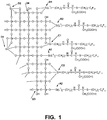
- Figure 1 is a simplified depiction of a hydrophobized particle made from SiO 2 #1 (AEROSIL 200) silica particles obtained in Example 14.
- the silicon atom of fluorosilane residues is depicted by A1, A2, B1, B2, C1 , and C2 .
- L 2 represents -OCH 3 or -OH.
- A1 and A2 show the silicon atom of fluorosilane residues bonded to the surface of the silica particle through one oxygen atom.
- B1 and B2 show the silicon atom of fluorosilane residues bonded to the surface of the silica particle through two oxygen atoms.
- C1 and C2 show the silicon atom of fluorosilane residues bonded to the surface of the silica particle through three oxygen atoms.
- D1 , D2 , D3 , and D4 depict silicon atoms at the surface of the silica particle which are not bonded to a fluorosilane residue.
- FIG. 1 depicts a signal consistent with the silicon atom of fluorosilane residues depicted as C1 and C2 in Figure 1 .
- FIG. 2 and the spectra of hydrophobized particles 2 depicts a signal consistent with the silicon atom of fluorosilane residues depicted as B1 and B2 in Figure 1 .
- FIG. 2 and the spectra of hydrophobized particles 3 depicts a signal consistent with the silicon atom of fluorosilane residues depicted as A1 and A2 in Figure 1 .
- FIG. 6 depicts a signal consistent silicon atoms at the surface of the silica particle which are not bonded to a fluorosilane residue depicted as D1 , D2 , D3 , and D4 in Figure 1 .
- FIG. 5 depicts a signal consistent with silicon atoms at the surface of the silica particle which are not bonded to a fluorosilane residue depicted as D1 , D2 , D3 , and D4 in Figure 1 .
- FIG. 2 and the spectra of untreated particles notably absent are any signals corresponding to those depicted by 1 , 2 , and 3 in the spectra of hydrophobized particles.
Landscapes
- Chemical & Material Sciences (AREA)
- Organic Chemistry (AREA)
- Pigments, Carbon Blacks, Or Wood Stains (AREA)
- Silicon Compounds (AREA)
- Inorganic Compounds Of Heavy Metals (AREA)
- Silicates, Zeolites, And Molecular Sieves (AREA)
- Oxygen, Ozone, And Oxides In General (AREA)
- Silicon Polymers (AREA)
- Compositions Of Macromolecular Compounds (AREA)
Applications Claiming Priority (3)
| Application Number | Priority Date | Filing Date | Title |
|---|---|---|---|
| US566707P | 2007-12-05 | 2007-12-05 | |
| US12/328,122 US8153834B2 (en) | 2007-12-05 | 2008-12-04 | Surface modified inorganic particles |
| PCT/US2008/085612 WO2009076179A2 (en) | 2007-12-05 | 2008-12-05 | Inorganic particles hydrophobized with fluoroalkyl silanes |
Publications (2)
| Publication Number | Publication Date |
|---|---|
| EP2231786A2 EP2231786A2 (en) | 2010-09-29 |
| EP2231786B1 true EP2231786B1 (en) | 2018-12-05 |
Family
ID=40631578
Family Applications (1)
| Application Number | Title | Priority Date | Filing Date |
|---|---|---|---|
| EP08859173.0A Not-in-force EP2231786B1 (en) | 2007-12-05 | 2008-12-05 | Inorganic particles hydrophobized with fluoroalkyl silanes |
Country Status (8)
| Country | Link |
|---|---|
| US (1) | US8153834B2 (OSRAM) |
| EP (1) | EP2231786B1 (OSRAM) |
| JP (2) | JP2011506240A (OSRAM) |
| KR (1) | KR101544235B1 (OSRAM) |
| CN (1) | CN101932661B (OSRAM) |
| CA (1) | CA2706702C (OSRAM) |
| NZ (1) | NZ585501A (OSRAM) |
| WO (1) | WO2009076179A2 (OSRAM) |
Families Citing this family (18)
| Publication number | Priority date | Publication date | Assignee | Title |
|---|---|---|---|---|
| CA2737120C (en) * | 2008-11-14 | 2018-02-13 | E. I. Du Pont De Nemours And Company | Fluoropolymer compositions and treated substrates |
| US8324314B2 (en) | 2009-10-12 | 2012-12-04 | E.I. Du Pont De Nemours And Company | Fluoropolymer compositions and treated substrates |
| US8258341B2 (en) * | 2009-07-10 | 2012-09-04 | E.I. Du Pont De Nemours And Company | Polyfluorosulfonamido amine and intermediate |
| US9777161B1 (en) | 2010-08-16 | 2017-10-03 | The United States Of America As Represented By The Secretary Of The Air Force | Fluoroalkylsilanated mesoporous metal oxide particles and methods of preparation thereof |
| US8741432B1 (en) * | 2010-08-16 | 2014-06-03 | The United States Of America As Represented By The Secretary Of The Air Force | Fluoroalkylsilanated mesoporous metal oxide particles and methods of preparation thereof |
| US8981140B1 (en) | 2010-08-18 | 2015-03-17 | The United States Of America As Represented By The Secretary Of The Air Force | Peripherally aromatic silsesquioxanes featuring reactive functionality: synthesis and applications thereof |
| WO2012032868A1 (ja) * | 2010-09-09 | 2012-03-15 | Hoya株式会社 | 表面修飾チタニア粒子の製造方法、チタニア粒子分散液およびチタニア粒子分散樹脂 |
| CN102432742B (zh) * | 2011-09-09 | 2013-08-07 | 中科院广州化学有限公司 | 一种超双疏性聚合物及由其构筑的超双疏性表面 |
| US9249313B2 (en) | 2011-09-21 | 2016-02-02 | The United States Of America As Represented By The Secretary Of The Air Force | Synthesis of functional fluorinated polyhedral oligomeric silsesquioxane (F-POSS) |
| KR101369381B1 (ko) * | 2011-11-04 | 2014-03-06 | 에스케이이노베이션 주식회사 | 함불소 화합물을 포함하는 저굴절 코팅 조성물, 이를 이용한 반사방지 필름, 이를 포함하는 편광판 및 표시장치 |
| CN102604467B (zh) * | 2012-01-13 | 2013-12-25 | 中科院广州化学有限公司 | 一种高分散型含氟纳米微球和环氧树脂超双疏性表面 |
| US9217064B2 (en) | 2013-01-24 | 2015-12-22 | The United States Of America, As Represented By The Secretary Of The Air Force | Thermosetting resins with enhanced cure characteristics containing organofunctional silane moieties |
| US9394408B2 (en) | 2013-08-29 | 2016-07-19 | The United States Of America As Represented By The Secretary Of The Air Force | Controlled polymerization of functional fluorinated polyhedral oligomeric silsesquioxane monomers |
| WO2016176388A1 (en) * | 2015-04-30 | 2016-11-03 | The Chemours Company Tt, Llc | Crosslinkable fluorinated inorganic oxide particle for architectural coatings |
| CN106390764B (zh) * | 2015-07-28 | 2018-10-12 | 北京工业大学 | 一种多孔膜的超疏水疏油改性方法 |
| WO2018160455A1 (en) | 2017-03-03 | 2018-09-07 | The Government Of The United States Of America, As Represented By The Secretary Of The Navy | Moisture-curable omniphobic coatings |
| CN109868652A (zh) * | 2019-03-07 | 2019-06-11 | 扬州金泉旅游用品有限公司 | 一种制备疏水和防污的织物和布料的方法 |
| KR102531723B1 (ko) * | 2020-11-06 | 2023-05-11 | 도레이첨단소재 주식회사 | 이형필름 및 이의 제조방법 |
Citations (1)
| Publication number | Priority date | Publication date | Assignee | Title |
|---|---|---|---|---|
| US20060159849A1 (en) * | 2002-09-19 | 2006-07-20 | Daikin Industries Ltd. | Material with pattern surface for use as template and process for producing the same |
Family Cites Families (69)
| Publication number | Priority date | Publication date | Assignee | Title |
|---|---|---|---|---|
| US3719698A (en) * | 1967-11-27 | 1973-03-06 | Stevens & Co Inc J P | Polyfluorinated esters of acids containing silicon and amino groups |
| GB1267224A (OSRAM) * | 1969-08-06 | 1972-03-15 | ||
| US4171282A (en) | 1977-12-07 | 1979-10-16 | Ciba-Geigy Corporation | Fluorinated nonionic surfactants |
| JPS60190727A (ja) * | 1984-03-09 | 1985-09-28 | Daikin Ind Ltd | 含フツ素有機シラン化合物およびその製法と用途 |
| JPH0393605A (ja) * | 1989-09-01 | 1991-04-18 | Asahi Glass Co Ltd | 金属酸化物微粉末の流動性の改善の方法 |
| JPH03109482A (ja) * | 1989-09-22 | 1991-05-09 | Mitsubishi Materials Corp | 宝飾品表面処理剤 |
| US5084653A (en) | 1990-07-18 | 1992-01-28 | Nilssen Ole K | Power-line-isolated dimmable electronic ballast |
| JP2673763B2 (ja) * | 1992-07-03 | 1997-11-05 | 信越化学工業株式会社 | 表面処理された無機酸化物粒子 |
| JPH08127733A (ja) * | 1994-11-01 | 1996-05-21 | Shiseido Co Ltd | 撥水性撥油性固体およびその製造方法 |
| JPH08157643A (ja) * | 1994-12-07 | 1996-06-18 | Asahi Glass Co Ltd | 撥水撥油性多孔性シリカ粒子および撥水撥油性塗膜 |
| JP3196621B2 (ja) * | 1995-04-20 | 2001-08-06 | 信越化学工業株式会社 | 水溶性表面処理剤 |
| US5726247A (en) | 1996-06-14 | 1998-03-10 | E. I. Du Pont De Nemours And Company | Fluoropolymer nanocomposites |
| JPH09309745A (ja) | 1996-05-24 | 1997-12-02 | Central Glass Co Ltd | 撥水撥油性物品及びその製法 |
| JPH10139930A (ja) | 1996-11-07 | 1998-05-26 | Kansai Shin Gijutsu Kenkyusho:Kk | 反応性粒子 |
| US6495624B1 (en) | 1997-02-03 | 2002-12-17 | Cytonix Corporation | Hydrophobic coating compositions, articles coated with said compositions, and processes for manufacturing same |
| JP3109482B2 (ja) * | 1998-06-29 | 2000-11-13 | タイガー魔法瓶株式会社 | 電気貯湯容器 |
| JP4411668B2 (ja) * | 1998-08-13 | 2010-02-10 | 凸版印刷株式会社 | 防汚剤 |
| JP2000191668A (ja) * | 1998-12-10 | 2000-07-11 | Toray Ind Inc | 含フッ素化合物、防汚性組成物及び防汚性物品 |
| TW591097B (en) * | 1998-12-10 | 2004-06-11 | Toray Industries | Optical articles and the preparation of optical articles |
| DE19938551A1 (de) | 1999-08-18 | 2001-02-22 | Penth Bernd | Hydrophobe Beschichtung |
| CH695946A5 (de) | 2000-04-04 | 2006-10-31 | Schoeller Technologies Ag | Ausrüstung von textilen Fasern, Geweben und Flächengebilden. |
| JP4126521B2 (ja) | 2000-08-04 | 2008-07-30 | 信越化学工業株式会社 | 被膜形成用組成物用フロロオルガノポリシロキサン樹脂の製造方法 |
| DE10051182A1 (de) | 2000-10-16 | 2002-05-02 | Nano X Gmbh | Nanopartikel mit hydrophoben und oleophoben Eigenschaften, deren Verarbeitung und Verwendung |
| DE10106213A1 (de) | 2001-02-10 | 2002-08-22 | Dmc2 Degussa Metals Catalysts Cerdec Ag | Selbstreinigende Lackbeschichtungen und Verfahren und Mittel zur Herstellung derselben |
| DE10118352A1 (de) | 2001-04-12 | 2002-10-17 | Creavis Tech & Innovation Gmbh | Selbstreinigende Oberflächen durch hydrophobe Strukturen und Verfahren zu deren Herstellung |
| DE10118346A1 (de) | 2001-04-12 | 2002-10-17 | Creavis Tech & Innovation Gmbh | Textile Flächengebilde mit selbstreinigender und wasserabweisender Oberfläche |
| DE10118349A1 (de) | 2001-04-12 | 2002-10-17 | Creavis Tech & Innovation Gmbh | Selbstreinigende Oberflächen durch hydrophobe Strukturen und Verfahren zu deren Herstellung |
| DE10118351A1 (de) | 2001-04-12 | 2002-10-17 | Creavis Tech & Innovation Gmbh | Selbstreinigende Oberflächen durch hydrophobe Strukturen und Verfahren zu deren Herstellung |
| DE10134477A1 (de) | 2001-07-16 | 2003-02-06 | Creavis Tech & Innovation Gmbh | Selbstreinigende Oberflächen durch hydrophobe Strukturen und Verfahren zu deren Herstellung |
| EP1414831A1 (de) * | 2001-08-02 | 2004-05-06 | Clariant GmbH | Fluoralkylmodifizierte organosilane, verwendung in beschichtungszusammensetzungen |
| DE10139574A1 (de) | 2001-08-10 | 2003-02-20 | Creavis Tech & Innovation Gmbh | Erhalt des Lotus-Effektes durch Verhinderung des Mikrobenwachstums auf selbstreinigenden Oberflächen |
| DE10205007A1 (de) | 2002-02-07 | 2003-08-21 | Creavis Tech & Innovation Gmbh | Verfahren zur Herstellung von Schutzschichten mit schmutz- und wasserabweisenden Eigenschaften |
| DE10209297A1 (de) | 2002-03-01 | 2003-09-18 | Koenig & Bauer Ag | Oberfläche für Maschinenteile einer Druckmaschine |
| CN1454921A (zh) | 2002-03-01 | 2003-11-12 | 刘铁林 | 纳米氟碳双疏膜的制备及生成方法 |
| DE10210673A1 (de) | 2002-03-12 | 2003-09-25 | Creavis Tech & Innovation Gmbh | Spritzgusskörper mit selbstreinigenden Eigenschaften und Verfahren zur Herstellung solcher Spritzgusskörper |
| DE10210667A1 (de) | 2002-03-12 | 2003-09-25 | Creavis Tech & Innovation Gmbh | Herstellung von Bahnenwaren mit selbstreinigenden Oberflächen mittels eines Kalandrierprozesses, Bahnenwaren selbst und die Verwendung dieser |
| DE10210671A1 (de) | 2002-03-12 | 2003-09-25 | Creavis Tech & Innovation Gmbh | Entformungsmittel, welches hydrophobe, nanoskalige Partikel aufweist sowie Verwendung dieser Entformungsmittel |
| DE10210666A1 (de) | 2002-03-12 | 2003-10-02 | Creavis Tech & Innovation Gmbh | Formgebungsverfahren zur Herstellung von Formkörpern mit zumindest einer Oberfläche, die selbstreinigende Eigenschaften aufweist sowie mit diesem Verfahren hergestellte Formkörper |
| US7141618B2 (en) | 2002-06-03 | 2006-11-28 | Ppg Industries Ohio, Inc. | Coating compositions with modified particles and methods of using the same |
| US6790904B2 (en) | 2002-06-03 | 2004-09-14 | Ppg Industries Ohio, Inc. | Liquid coating of film-forming resin and particles chemically modified to lower surface tension |
| DE10231757A1 (de) | 2002-07-13 | 2004-01-22 | Creavis Gesellschaft Für Technologie Und Innovation Mbh | Verfahren zur Herstellung einer tensidfreien Suspension auf wässriger basis von nanostrukturierten, hydrophoben Partikeln und deren Verwendung |
| DE10242560A1 (de) | 2002-09-13 | 2004-03-25 | Creavis Gesellschaft Für Technologie Und Innovation Mbh | Herstellung von selbstreinigenden Oberflächen auf textilen Beschichtungen |
| DE10250328A1 (de) | 2002-10-29 | 2004-05-13 | Creavis Gesellschaft Für Technologie Und Innovation Mbh | Herstellung von Suspensionen hydrophober Oxidpartikel |
| US7407899B2 (en) | 2003-01-10 | 2008-08-05 | Milliken & Company | Textile substrates having layered finish structure for improving liquid repellency and stain release |
| DE10308379A1 (de) | 2003-02-27 | 2004-09-09 | Creavis Gesellschaft Für Technologie Und Innovation Mbh | Dispersion von Wasser in hydrophoben Oxiden zur Herstellung von hydrophoben nanostrukturierten Oberflächen |
| CN1441147A (zh) | 2003-03-14 | 2003-09-10 | 国玉江 | 具有疏油疏水和三防功能金属管、杆的制造方法及所用涂料 |
| JP4491549B2 (ja) * | 2003-03-19 | 2010-06-30 | 花王株式会社 | 化粧料 |
| CN1469021A (zh) | 2003-04-25 | 2004-01-21 | 河 冯 | 超双疏纳米界面材料在厕具上的应用 |
| DE10321851A1 (de) | 2003-05-15 | 2004-12-02 | Creavis Gesellschaft Für Technologie Und Innovation Mbh | Verwendung von mit Fluorsilanen hydrophobierten Partikeln zur Herstellung von selbstreinigenden Oberflächen mit lipophoben, oleophoben, laktophoben und hydrophoben Eigenschaften |
| EP1479738A1 (en) | 2003-05-20 | 2004-11-24 | DSM IP Assets B.V. | Hydrophobic coatings comprising reactive nano-particles |
| WO2004106252A1 (en) | 2003-05-28 | 2004-12-09 | Nanogate Coating Systems Gmbh | Hydrophobic and/or oleophobic coating for glass surfaces with adhesion sites for sealants |
| EP1660704B1 (en) | 2003-09-02 | 2009-07-15 | Sabanci Universitesi | Process for preparing superhydrophobic surface compositions, surfaces obtained by said process and use of them |
| CN100463931C (zh) | 2003-11-03 | 2009-02-25 | 长春赛纳纳米服饰有限公司 | 一种纳米材料改性的织物整理剂及其制备方法 |
| CN1614128A (zh) | 2003-11-05 | 2005-05-11 | 北京中科安康医疗用品有限公司 | 超双疏阻隔性杀菌防病毒织物及其制法和用于医务工作服 |
| CN1614129A (zh) | 2003-11-05 | 2005-05-11 | 北京中科安康医疗用品有限公司 | 超双疏性杀菌防病毒织物及其制法和用于医用病员服 |
| WO2005068399A1 (en) | 2004-01-15 | 2005-07-28 | Newsouth Innovations Pty Limited | Method of making a surface hydrophobic |
| US7435450B2 (en) | 2004-01-30 | 2008-10-14 | Hewlett-Packard Development Company, L.P. | Surface modification of silica in an aqueous environment |
| KR100607716B1 (ko) | 2004-04-22 | 2006-08-01 | 한국화학연구원 | 불소계 지문방지제와 이의 제조방법 |
| TW200615424A (en) | 2004-07-20 | 2006-05-16 | Schoeller Textil Ag | Finishings for textile fibres and babrics to give hydrophobic oleophobic and self-cleaning surfaces |
| CN1727566A (zh) | 2004-07-29 | 2006-02-01 | 只金芳 | 纳米拒水拒油剂及其在防寒服面料、领带中的应用 |
| DE102004037752A1 (de) | 2004-08-04 | 2006-03-16 | Cognis Deutschland Gmbh & Co. Kg | Ausgerüstete Fasern und textile Flächengebilde |
| DE102004046568A1 (de) | 2004-09-24 | 2006-04-06 | Construction Research & Technology Gmbh | Fluormodifizierte Reaktivharzsysteme, Verfahren zu ihrer Herstellung und deren Verwendung |
| WO2006037148A1 (en) | 2004-10-05 | 2006-04-13 | Newsouth Innovations Pty Limited | Hydrophobic and lyophobic coating |
| CN100500778C (zh) | 2004-11-23 | 2009-06-17 | 鸿富锦精密工业(深圳)有限公司 | 表面抗指纹化涂层 |
| DE102004062740A1 (de) | 2004-12-27 | 2006-07-13 | Degussa Ag | Verfahren zur Erhöhung der Wasserdichtigkeit von textilen Flächengebilden, so ausgerüstete textile Flächengebilde sowie deren Verwendung |
| DE102004062743A1 (de) | 2004-12-27 | 2006-07-06 | Degussa Ag | Verfahren zur Erhöhung der Wasserdichtigkeit von textilen Flächengebilden, so ausgerüstete textile Flächengebilde sowie deren Verwendung |
| DE102004062739A1 (de) | 2004-12-27 | 2006-07-06 | Degussa Ag | Selbstreinigende Oberflächen mit durch hydrophobe Partikel gebildeten Erhebungen, mit verbesserter mechanischer Festigkeit |
| DE102004062742A1 (de) | 2004-12-27 | 2006-07-06 | Degussa Ag | Textile Substrate mit selbstreinigenden Eigenschaften (Lotuseffekt) |
| US8058463B2 (en) * | 2007-12-04 | 2011-11-15 | E. I. Du Pont De Nemours And Compnay | Fluorosilanes |
-
2008
- 2008-12-04 US US12/328,122 patent/US8153834B2/en not_active Expired - Fee Related
- 2008-12-05 CN CN200880126116.2A patent/CN101932661B/zh not_active Expired - Fee Related
- 2008-12-05 JP JP2010537095A patent/JP2011506240A/ja not_active Withdrawn
- 2008-12-05 EP EP08859173.0A patent/EP2231786B1/en not_active Not-in-force
- 2008-12-05 CA CA2706702A patent/CA2706702C/en not_active Expired - Fee Related
- 2008-12-05 KR KR1020107014618A patent/KR101544235B1/ko not_active Expired - Fee Related
- 2008-12-05 NZ NZ585501A patent/NZ585501A/en not_active IP Right Cessation
- 2008-12-05 WO PCT/US2008/085612 patent/WO2009076179A2/en not_active Ceased
-
2015
- 2015-01-07 JP JP2015001906A patent/JP5956617B2/ja not_active Expired - Fee Related
Patent Citations (1)
| Publication number | Priority date | Publication date | Assignee | Title |
|---|---|---|---|---|
| US20060159849A1 (en) * | 2002-09-19 | 2006-07-20 | Daikin Industries Ltd. | Material with pattern surface for use as template and process for producing the same |
Non-Patent Citations (1)
| Title |
|---|
| YOSHINAGA K ET AL: "CONTROL OF POLYMER LAYER THICKNESS IN COATING OF MONODISPERSED COLLOIDAL SILICA", POLYMERS AND POLYMER COMPOSITES, RAPRA TECHNOLOGY, vol. 4, no. 3, 1 January 1996 (1996-01-01), pages 163 - 172, XP000629416, ISSN: 0967-3911 * |
Also Published As
| Publication number | Publication date |
|---|---|
| CA2706702C (en) | 2018-01-16 |
| EP2231786A2 (en) | 2010-09-29 |
| HK1152330A1 (en) | 2012-02-24 |
| CA2706702A1 (en) | 2009-06-18 |
| KR20100110806A (ko) | 2010-10-13 |
| CN101932661B (zh) | 2014-05-14 |
| WO2009076179A2 (en) | 2009-06-18 |
| AU2008335413A1 (en) | 2009-06-18 |
| US20090176097A1 (en) | 2009-07-09 |
| JP2015131755A (ja) | 2015-07-23 |
| JP5956617B2 (ja) | 2016-07-27 |
| NZ585501A (en) | 2011-10-28 |
| JP2011506240A (ja) | 2011-03-03 |
| KR101544235B1 (ko) | 2015-08-12 |
| CN101932661A (zh) | 2010-12-29 |
| US8153834B2 (en) | 2012-04-10 |
| WO2009076179A3 (en) | 2010-03-11 |
Similar Documents
| Publication | Publication Date | Title |
|---|---|---|
| EP2231786B1 (en) | Inorganic particles hydrophobized with fluoroalkyl silanes | |
| EP2725078B1 (en) | Coating composition, surface treating material containing said composition, and article whose surface is treated with said surface treating material | |
| EP1215252B1 (en) | Water repellent silicone coating agent composition | |
| EP2139903B1 (en) | Michael-adduct fluorochemical silanes | |
| US8507033B2 (en) | Surface-modified, pyrogenically prepared silicas | |
| EP1997824B1 (en) | Perfluoropolyether-modified aminosilane, surface treating agent, and aminosilane-coated article | |
| US20090136741A1 (en) | Nanoscopically modified superhydrophobic coating | |
| JPH08157643A (ja) | 撥水撥油性多孔性シリカ粒子および撥水撥油性塗膜 | |
| DE112015001719T5 (de) | Hydrophober Artikel | |
| Wu et al. | Self-assembled monolayers of perfluoroalkylsilane on plasma-hydroxylated silicon substrates | |
| WO2010006837A2 (en) | Process for preparing redispersible surface-modified silicon dioxide particles | |
| CN103874654A (zh) | 经表面覆盖处理的无机粉体 | |
| WO2008107331A1 (de) | Schichten aus heterosubstituierten silsesquioxanen | |
| JP2001152050A (ja) | 有機ケイ素化合物処理顔料、その製造方法及び化粧料 | |
| KR102780988B1 (ko) | 액체-기반 적층 제조를 위한 조성물 | |
| EP2781558B1 (de) | Modifizierte kieselsäure enthaltende zusammensetzung und diese zusammensetzung enthaltender silikonkautschuk | |
| AU2008335413B2 (en) | Inorganic particles hydrophobized with fluoroalkyl silanes | |
| Garcia et al. | Chemically guided topography in alkylsilane-and oligosiloxane-modified silica nanoparticle coatings: From very hydrophobic surfaces to “pearl” bouncing droplets | |
| JP2011528385A (ja) | 疎水化二酸化ケイ素粒子及びその顆粒の分散液 | |
| CN112004860B (zh) | 球状聚甲基倍半硅氧烷粒子 | |
| HK1152330B (en) | Inorganic particles hydrophobized with fluoroalkyl silanes | |
| KR20240018801A (ko) | 실라잔 표면개질제에 의한 비불소계 소수성 코팅용 개질 메조포러스 실리카 입자 및 생분해성 필름의 내오염성과 고발수성 코팅 기술 이의 제조방법 | |
| CN120737295A (zh) | 一种氟硅水性聚氨酯乳液及其制备方法和应用 | |
| JP2020117670A (ja) | フッ素含有複合粒子 |
Legal Events
| Date | Code | Title | Description |
|---|---|---|---|
| PUAI | Public reference made under article 153(3) epc to a published international application that has entered the european phase |
Free format text: ORIGINAL CODE: 0009012 |
|
| 17P | Request for examination filed |
Effective date: 20100603 |
|
| AK | Designated contracting states |
Kind code of ref document: A2 Designated state(s): AT BE BG CH CY CZ DE DK EE ES FI FR GB GR HR HU IE IS IT LI LT LU LV MC MT NL NO PL PT RO SE SI SK TR |
|
| AX | Request for extension of the european patent |
Extension state: AL BA MK RS |
|
| DAX | Request for extension of the european patent (deleted) | ||
| 17Q | First examination report despatched |
Effective date: 20120619 |
|
| RAP1 | Party data changed (applicant data changed or rights of an application transferred) |
Owner name: THE CHEMOURS COMPANY FC, LLC |
|
| STAA | Information on the status of an ep patent application or granted ep patent |
Free format text: STATUS: EXAMINATION IS IN PROGRESS |
|
| RIC1 | Information provided on ipc code assigned before grant |
Ipc: C09C 1/40 20060101ALI20180419BHEP Ipc: C09C 1/30 20060101AFI20180419BHEP Ipc: C09C 1/04 20060101ALI20180419BHEP Ipc: C09C 3/12 20060101ALI20180419BHEP Ipc: C09C 1/36 20060101ALI20180419BHEP |
|
| GRAP | Despatch of communication of intention to grant a patent |
Free format text: ORIGINAL CODE: EPIDOSNIGR1 |
|
| STAA | Information on the status of an ep patent application or granted ep patent |
Free format text: STATUS: GRANT OF PATENT IS INTENDED |
|
| INTG | Intention to grant announced |
Effective date: 20180615 |
|
| GRAS | Grant fee paid |
Free format text: ORIGINAL CODE: EPIDOSNIGR3 |
|
| GRAA | (expected) grant |
Free format text: ORIGINAL CODE: 0009210 |
|
| STAA | Information on the status of an ep patent application or granted ep patent |
Free format text: STATUS: THE PATENT HAS BEEN GRANTED |
|
| AK | Designated contracting states |
Kind code of ref document: B1 Designated state(s): AT BE BG CH CY CZ DE DK EE ES FI FR GB GR HR HU IE IS IT LI LT LU LV MC MT NL NO PL PT RO SE SI SK TR |
|
| REG | Reference to a national code |
Ref country code: GB Ref legal event code: FG4D |
|
| REG | Reference to a national code |
Ref country code: CH Ref legal event code: EP |
|
| REG | Reference to a national code |
Ref country code: AT Ref legal event code: REF Ref document number: 1073001 Country of ref document: AT Kind code of ref document: T Effective date: 20181215 |
|
| REG | Reference to a national code |
Ref country code: DE Ref legal event code: R096 Ref document number: 602008058255 Country of ref document: DE |
|
| REG | Reference to a national code |
Ref country code: IE Ref legal event code: FG4D |
|
| REG | Reference to a national code |
Ref country code: NL Ref legal event code: FP |
|
| REG | Reference to a national code |
Ref country code: AT Ref legal event code: MK05 Ref document number: 1073001 Country of ref document: AT Kind code of ref document: T Effective date: 20181205 |
|
| REG | Reference to a national code |
Ref country code: LT Ref legal event code: MG4D |
|
| PG25 | Lapsed in a contracting state [announced via postgrant information from national office to epo] |
Ref country code: AT Free format text: LAPSE BECAUSE OF FAILURE TO SUBMIT A TRANSLATION OF THE DESCRIPTION OR TO PAY THE FEE WITHIN THE PRESCRIBED TIME-LIMIT Effective date: 20181205 Ref country code: ES Free format text: LAPSE BECAUSE OF FAILURE TO SUBMIT A TRANSLATION OF THE DESCRIPTION OR TO PAY THE FEE WITHIN THE PRESCRIBED TIME-LIMIT Effective date: 20181205 Ref country code: LV Free format text: LAPSE BECAUSE OF FAILURE TO SUBMIT A TRANSLATION OF THE DESCRIPTION OR TO PAY THE FEE WITHIN THE PRESCRIBED TIME-LIMIT Effective date: 20181205 Ref country code: FI Free format text: LAPSE BECAUSE OF FAILURE TO SUBMIT A TRANSLATION OF THE DESCRIPTION OR TO PAY THE FEE WITHIN THE PRESCRIBED TIME-LIMIT Effective date: 20181205 Ref country code: BG Free format text: LAPSE BECAUSE OF FAILURE TO SUBMIT A TRANSLATION OF THE DESCRIPTION OR TO PAY THE FEE WITHIN THE PRESCRIBED TIME-LIMIT Effective date: 20190305 Ref country code: HR Free format text: LAPSE BECAUSE OF FAILURE TO SUBMIT A TRANSLATION OF THE DESCRIPTION OR TO PAY THE FEE WITHIN THE PRESCRIBED TIME-LIMIT Effective date: 20181205 Ref country code: NO Free format text: LAPSE BECAUSE OF FAILURE TO SUBMIT A TRANSLATION OF THE DESCRIPTION OR TO PAY THE FEE WITHIN THE PRESCRIBED TIME-LIMIT Effective date: 20190305 Ref country code: LT Free format text: LAPSE BECAUSE OF FAILURE TO SUBMIT A TRANSLATION OF THE DESCRIPTION OR TO PAY THE FEE WITHIN THE PRESCRIBED TIME-LIMIT Effective date: 20181205 |
|
| PG25 | Lapsed in a contracting state [announced via postgrant information from national office to epo] |
Ref country code: SE Free format text: LAPSE BECAUSE OF FAILURE TO SUBMIT A TRANSLATION OF THE DESCRIPTION OR TO PAY THE FEE WITHIN THE PRESCRIBED TIME-LIMIT Effective date: 20181205 Ref country code: GR Free format text: LAPSE BECAUSE OF FAILURE TO SUBMIT A TRANSLATION OF THE DESCRIPTION OR TO PAY THE FEE WITHIN THE PRESCRIBED TIME-LIMIT Effective date: 20190306 |
|
| PG25 | Lapsed in a contracting state [announced via postgrant information from national office to epo] |
Ref country code: PT Free format text: LAPSE BECAUSE OF FAILURE TO SUBMIT A TRANSLATION OF THE DESCRIPTION OR TO PAY THE FEE WITHIN THE PRESCRIBED TIME-LIMIT Effective date: 20190405 Ref country code: CZ Free format text: LAPSE BECAUSE OF FAILURE TO SUBMIT A TRANSLATION OF THE DESCRIPTION OR TO PAY THE FEE WITHIN THE PRESCRIBED TIME-LIMIT Effective date: 20181205 Ref country code: PL Free format text: LAPSE BECAUSE OF FAILURE TO SUBMIT A TRANSLATION OF THE DESCRIPTION OR TO PAY THE FEE WITHIN THE PRESCRIBED TIME-LIMIT Effective date: 20181205 |
|
| REG | Reference to a national code |
Ref country code: CH Ref legal event code: PL |
|
| PG25 | Lapsed in a contracting state [announced via postgrant information from national office to epo] |
Ref country code: RO Free format text: LAPSE BECAUSE OF FAILURE TO SUBMIT A TRANSLATION OF THE DESCRIPTION OR TO PAY THE FEE WITHIN THE PRESCRIBED TIME-LIMIT Effective date: 20181205 Ref country code: IS Free format text: LAPSE BECAUSE OF FAILURE TO SUBMIT A TRANSLATION OF THE DESCRIPTION OR TO PAY THE FEE WITHIN THE PRESCRIBED TIME-LIMIT Effective date: 20190405 Ref country code: EE Free format text: LAPSE BECAUSE OF FAILURE TO SUBMIT A TRANSLATION OF THE DESCRIPTION OR TO PAY THE FEE WITHIN THE PRESCRIBED TIME-LIMIT Effective date: 20181205 Ref country code: SK Free format text: LAPSE BECAUSE OF FAILURE TO SUBMIT A TRANSLATION OF THE DESCRIPTION OR TO PAY THE FEE WITHIN THE PRESCRIBED TIME-LIMIT Effective date: 20181205 Ref country code: LU Free format text: LAPSE BECAUSE OF NON-PAYMENT OF DUE FEES Effective date: 20181205 |
|
| REG | Reference to a national code |
Ref country code: DE Ref legal event code: R097 Ref document number: 602008058255 Country of ref document: DE |
|
| REG | Reference to a national code |
Ref country code: IE Ref legal event code: MM4A |
|
| REG | Reference to a national code |
Ref country code: BE Ref legal event code: MM Effective date: 20181231 |
|
| PLBE | No opposition filed within time limit |
Free format text: ORIGINAL CODE: 0009261 |
|
| STAA | Information on the status of an ep patent application or granted ep patent |
Free format text: STATUS: NO OPPOSITION FILED WITHIN TIME LIMIT |
|
| PG25 | Lapsed in a contracting state [announced via postgrant information from national office to epo] |
Ref country code: DK Free format text: LAPSE BECAUSE OF FAILURE TO SUBMIT A TRANSLATION OF THE DESCRIPTION OR TO PAY THE FEE WITHIN THE PRESCRIBED TIME-LIMIT Effective date: 20181205 Ref country code: IE Free format text: LAPSE BECAUSE OF NON-PAYMENT OF DUE FEES Effective date: 20181205 Ref country code: SI Free format text: LAPSE BECAUSE OF FAILURE TO SUBMIT A TRANSLATION OF THE DESCRIPTION OR TO PAY THE FEE WITHIN THE PRESCRIBED TIME-LIMIT Effective date: 20181205 Ref country code: MC Free format text: LAPSE BECAUSE OF FAILURE TO SUBMIT A TRANSLATION OF THE DESCRIPTION OR TO PAY THE FEE WITHIN THE PRESCRIBED TIME-LIMIT Effective date: 20181205 |
|
| 26N | No opposition filed |
Effective date: 20190906 |
|
| PG25 | Lapsed in a contracting state [announced via postgrant information from national office to epo] |
Ref country code: BE Free format text: LAPSE BECAUSE OF NON-PAYMENT OF DUE FEES Effective date: 20181231 |
|
| PG25 | Lapsed in a contracting state [announced via postgrant information from national office to epo] |
Ref country code: LI Free format text: LAPSE BECAUSE OF NON-PAYMENT OF DUE FEES Effective date: 20181231 Ref country code: CH Free format text: LAPSE BECAUSE OF NON-PAYMENT OF DUE FEES Effective date: 20181231 |
|
| PG25 | Lapsed in a contracting state [announced via postgrant information from national office to epo] |
Ref country code: MT Free format text: LAPSE BECAUSE OF NON-PAYMENT OF DUE FEES Effective date: 20181205 |
|
| PGFP | Annual fee paid to national office [announced via postgrant information from national office to epo] |
Ref country code: NL Payment date: 20191125 Year of fee payment: 12 Ref country code: DE Payment date: 20191119 Year of fee payment: 12 |
|
| PGFP | Annual fee paid to national office [announced via postgrant information from national office to epo] |
Ref country code: FR Payment date: 20191120 Year of fee payment: 12 Ref country code: IT Payment date: 20191121 Year of fee payment: 12 |
|
| PG25 | Lapsed in a contracting state [announced via postgrant information from national office to epo] |
Ref country code: TR Free format text: LAPSE BECAUSE OF FAILURE TO SUBMIT A TRANSLATION OF THE DESCRIPTION OR TO PAY THE FEE WITHIN THE PRESCRIBED TIME-LIMIT Effective date: 20181205 |
|
| PGFP | Annual fee paid to national office [announced via postgrant information from national office to epo] |
Ref country code: GB Payment date: 20191122 Year of fee payment: 12 |
|
| PG25 | Lapsed in a contracting state [announced via postgrant information from national office to epo] |
Ref country code: HU Free format text: LAPSE BECAUSE OF FAILURE TO SUBMIT A TRANSLATION OF THE DESCRIPTION OR TO PAY THE FEE WITHIN THE PRESCRIBED TIME-LIMIT; INVALID AB INITIO Effective date: 20081205 Ref country code: CY Free format text: LAPSE BECAUSE OF FAILURE TO SUBMIT A TRANSLATION OF THE DESCRIPTION OR TO PAY THE FEE WITHIN THE PRESCRIBED TIME-LIMIT Effective date: 20181205 |
|
| REG | Reference to a national code |
Ref country code: DE Ref legal event code: R119 Ref document number: 602008058255 Country of ref document: DE |
|
| REG | Reference to a national code |
Ref country code: NL Ref legal event code: MM Effective date: 20210101 |
|
| GBPC | Gb: european patent ceased through non-payment of renewal fee |
Effective date: 20201205 |
|
| PG25 | Lapsed in a contracting state [announced via postgrant information from national office to epo] |
Ref country code: NL Free format text: LAPSE BECAUSE OF NON-PAYMENT OF DUE FEES Effective date: 20210101 |
|
| PG25 | Lapsed in a contracting state [announced via postgrant information from national office to epo] |
Ref country code: IT Free format text: LAPSE BECAUSE OF NON-PAYMENT OF DUE FEES Effective date: 20201205 Ref country code: FR Free format text: LAPSE BECAUSE OF NON-PAYMENT OF DUE FEES Effective date: 20201231 |
|
| PG25 | Lapsed in a contracting state [announced via postgrant information from national office to epo] |
Ref country code: DE Free format text: LAPSE BECAUSE OF NON-PAYMENT OF DUE FEES Effective date: 20210701 Ref country code: GB Free format text: LAPSE BECAUSE OF NON-PAYMENT OF DUE FEES Effective date: 20201205 |