EP2225291B1 - Vernetzte polyolefine für biomedizinische anwendungen und herstellungsverfahren dafür - Google Patents
Vernetzte polyolefine für biomedizinische anwendungen und herstellungsverfahren dafür Download PDFInfo
- Publication number
- EP2225291B1 EP2225291B1 EP08797379A EP08797379A EP2225291B1 EP 2225291 B1 EP2225291 B1 EP 2225291B1 EP 08797379 A EP08797379 A EP 08797379A EP 08797379 A EP08797379 A EP 08797379A EP 2225291 B1 EP2225291 B1 EP 2225291B1
- Authority
- EP
- European Patent Office
- Prior art keywords
- copolymer
- monomer
- olefin
- methyl
- bcb
- Prior art date
- Legal status (The legal status is an assumption and is not a legal conclusion. Google has not performed a legal analysis and makes no representation as to the accuracy of the status listed.)
- Active
Links
Images



Classifications
-
- C—CHEMISTRY; METALLURGY
- C08—ORGANIC MACROMOLECULAR COMPOUNDS; THEIR PREPARATION OR CHEMICAL WORKING-UP; COMPOSITIONS BASED THEREON
- C08F—MACROMOLECULAR COMPOUNDS OBTAINED BY REACTIONS ONLY INVOLVING CARBON-TO-CARBON UNSATURATED BONDS
- C08F210/00—Copolymers of unsaturated aliphatic hydrocarbons having only one carbon-to-carbon double bond
- C08F210/04—Monomers containing three or four carbon atoms
- C08F210/08—Butenes
- C08F210/10—Isobutene
-
- A—HUMAN NECESSITIES
- A61—MEDICAL OR VETERINARY SCIENCE; HYGIENE
- A61F—FILTERS IMPLANTABLE INTO BLOOD VESSELS; PROSTHESES; DEVICES PROVIDING PATENCY TO, OR PREVENTING COLLAPSING OF, TUBULAR STRUCTURES OF THE BODY, e.g. STENTS; ORTHOPAEDIC, NURSING OR CONTRACEPTIVE DEVICES; FOMENTATION; TREATMENT OR PROTECTION OF EYES OR EARS; BANDAGES, DRESSINGS OR ABSORBENT PADS; FIRST-AID KITS
- A61F2/00—Filters implantable into blood vessels; Prostheses, i.e. artificial substitutes or replacements for parts of the body; Appliances for connecting them with the body; Devices providing patency to, or preventing collapsing of, tubular structures of the body, e.g. stents
- A61F2/02—Prostheses implantable into the body
- A61F2/14—Eye parts, e.g. lenses or corneal implants; Artificial eyes
- A61F2/16—Intraocular lenses
- A61F2/1613—Intraocular lenses having special lens configurations, e.g. multipart lenses; having particular optical properties, e.g. pseudo-accommodative lenses, lenses having aberration corrections, diffractive lenses, lenses for variably absorbing electromagnetic radiation, lenses having variable focus
-
- A—HUMAN NECESSITIES
- A61—MEDICAL OR VETERINARY SCIENCE; HYGIENE
- A61L—METHODS OR APPARATUS FOR STERILISING MATERIALS OR OBJECTS IN GENERAL; DISINFECTION, STERILISATION OR DEODORISATION OF AIR; CHEMICAL ASPECTS OF BANDAGES, DRESSINGS, ABSORBENT PADS OR SURGICAL ARTICLES; MATERIALS FOR BANDAGES, DRESSINGS, ABSORBENT PADS OR SURGICAL ARTICLES
- A61L27/00—Materials for grafts or prostheses or for coating grafts or prostheses
- A61L27/14—Macromolecular materials
- A61L27/16—Macromolecular materials obtained by reactions only involving carbon-to-carbon unsaturated bonds
-
- C—CHEMISTRY; METALLURGY
- C08—ORGANIC MACROMOLECULAR COMPOUNDS; THEIR PREPARATION OR CHEMICAL WORKING-UP; COMPOSITIONS BASED THEREON
- C08F—MACROMOLECULAR COMPOUNDS OBTAINED BY REACTIONS ONLY INVOLVING CARBON-TO-CARBON UNSATURATED BONDS
- C08F210/00—Copolymers of unsaturated aliphatic hydrocarbons having only one carbon-to-carbon double bond
- C08F210/14—Monomers containing five or more carbon atoms
-
- C—CHEMISTRY; METALLURGY
- C08—ORGANIC MACROMOLECULAR COMPOUNDS; THEIR PREPARATION OR CHEMICAL WORKING-UP; COMPOSITIONS BASED THEREON
- C08F—MACROMOLECULAR COMPOUNDS OBTAINED BY REACTIONS ONLY INVOLVING CARBON-TO-CARBON UNSATURATED BONDS
- C08F212/00—Copolymers of compounds having one or more unsaturated aliphatic radicals, each having only one carbon-to-carbon double bond, and at least one being terminated by an aromatic carbocyclic ring
- C08F212/02—Monomers containing only one unsaturated aliphatic radical
- C08F212/04—Monomers containing only one unsaturated aliphatic radical containing one ring
- C08F212/06—Hydrocarbons
- C08F212/08—Styrene
-
- C—CHEMISTRY; METALLURGY
- C08—ORGANIC MACROMOLECULAR COMPOUNDS; THEIR PREPARATION OR CHEMICAL WORKING-UP; COMPOSITIONS BASED THEREON
- C08F—MACROMOLECULAR COMPOUNDS OBTAINED BY REACTIONS ONLY INVOLVING CARBON-TO-CARBON UNSATURATED BONDS
- C08F212/00—Copolymers of compounds having one or more unsaturated aliphatic radicals, each having only one carbon-to-carbon double bond, and at least one being terminated by an aromatic carbocyclic ring
- C08F212/02—Monomers containing only one unsaturated aliphatic radical
- C08F212/04—Monomers containing only one unsaturated aliphatic radical containing one ring
- C08F212/06—Hydrocarbons
- C08F212/12—Monomers containing a branched unsaturated aliphatic radical or a ring substituted by an alkyl radical
-
- C—CHEMISTRY; METALLURGY
- C08—ORGANIC MACROMOLECULAR COMPOUNDS; THEIR PREPARATION OR CHEMICAL WORKING-UP; COMPOSITIONS BASED THEREON
- C08F—MACROMOLECULAR COMPOUNDS OBTAINED BY REACTIONS ONLY INVOLVING CARBON-TO-CARBON UNSATURATED BONDS
- C08F212/00—Copolymers of compounds having one or more unsaturated aliphatic radicals, each having only one carbon-to-carbon double bond, and at least one being terminated by an aromatic carbocyclic ring
- C08F212/02—Monomers containing only one unsaturated aliphatic radical
- C08F212/32—Monomers containing only one unsaturated aliphatic radical containing two or more rings
-
- C—CHEMISTRY; METALLURGY
- C08—ORGANIC MACROMOLECULAR COMPOUNDS; THEIR PREPARATION OR CHEMICAL WORKING-UP; COMPOSITIONS BASED THEREON
- C08F—MACROMOLECULAR COMPOUNDS OBTAINED BY REACTIONS ONLY INVOLVING CARBON-TO-CARBON UNSATURATED BONDS
- C08F293/00—Macromolecular compounds obtained by polymerisation on to a macromolecule having groups capable of inducing the formation of new polymer chains bound exclusively at one or both ends of the starting macromolecule
-
- C—CHEMISTRY; METALLURGY
- C08—ORGANIC MACROMOLECULAR COMPOUNDS; THEIR PREPARATION OR CHEMICAL WORKING-UP; COMPOSITIONS BASED THEREON
- C08F—MACROMOLECULAR COMPOUNDS OBTAINED BY REACTIONS ONLY INVOLVING CARBON-TO-CARBON UNSATURATED BONDS
- C08F297/00—Macromolecular compounds obtained by successively polymerising different monomer systems using a catalyst of the ionic or coordination type without deactivating the intermediate polymer
-
- C—CHEMISTRY; METALLURGY
- C08—ORGANIC MACROMOLECULAR COMPOUNDS; THEIR PREPARATION OR CHEMICAL WORKING-UP; COMPOSITIONS BASED THEREON
- C08J—WORKING-UP; GENERAL PROCESSES OF COMPOUNDING; AFTER-TREATMENT NOT COVERED BY SUBCLASSES C08B, C08C, C08F, C08G or C08H
- C08J3/00—Processes of treating or compounding macromolecular substances
- C08J3/24—Crosslinking, e.g. vulcanising, of macromolecules
- C08J3/247—Heating methods
-
- G—PHYSICS
- G02—OPTICS
- G02B—OPTICAL ELEMENTS, SYSTEMS OR APPARATUS
- G02B1/00—Optical elements characterised by the material of which they are made; Optical coatings for optical elements
- G02B1/04—Optical elements characterised by the material of which they are made; Optical coatings for optical elements made of organic materials, e.g. plastics
- G02B1/041—Lenses
- G02B1/043—Contact lenses
-
- A—HUMAN NECESSITIES
- A61—MEDICAL OR VETERINARY SCIENCE; HYGIENE
- A61F—FILTERS IMPLANTABLE INTO BLOOD VESSELS; PROSTHESES; DEVICES PROVIDING PATENCY TO, OR PREVENTING COLLAPSING OF, TUBULAR STRUCTURES OF THE BODY, e.g. STENTS; ORTHOPAEDIC, NURSING OR CONTRACEPTIVE DEVICES; FOMENTATION; TREATMENT OR PROTECTION OF EYES OR EARS; BANDAGES, DRESSINGS OR ABSORBENT PADS; FIRST-AID KITS
- A61F2/00—Filters implantable into blood vessels; Prostheses, i.e. artificial substitutes or replacements for parts of the body; Appliances for connecting them with the body; Devices providing patency to, or preventing collapsing of, tubular structures of the body, e.g. stents
- A61F2/02—Prostheses implantable into the body
- A61F2/14—Eye parts, e.g. lenses or corneal implants; Artificial eyes
- A61F2/16—Intraocular lenses
- A61F2/1613—Intraocular lenses having special lens configurations, e.g. multipart lenses; having particular optical properties, e.g. pseudo-accommodative lenses, lenses having aberration corrections, diffractive lenses, lenses for variably absorbing electromagnetic radiation, lenses having variable focus
- A61F2/1624—Intraocular lenses having special lens configurations, e.g. multipart lenses; having particular optical properties, e.g. pseudo-accommodative lenses, lenses having aberration corrections, diffractive lenses, lenses for variably absorbing electromagnetic radiation, lenses having variable focus having adjustable focus; power activated variable focus means, e.g. mechanically or electrically by the ciliary muscle or from the outside
-
- A—HUMAN NECESSITIES
- A61—MEDICAL OR VETERINARY SCIENCE; HYGIENE
- A61F—FILTERS IMPLANTABLE INTO BLOOD VESSELS; PROSTHESES; DEVICES PROVIDING PATENCY TO, OR PREVENTING COLLAPSING OF, TUBULAR STRUCTURES OF THE BODY, e.g. STENTS; ORTHOPAEDIC, NURSING OR CONTRACEPTIVE DEVICES; FOMENTATION; TREATMENT OR PROTECTION OF EYES OR EARS; BANDAGES, DRESSINGS OR ABSORBENT PADS; FIRST-AID KITS
- A61F2/00—Filters implantable into blood vessels; Prostheses, i.e. artificial substitutes or replacements for parts of the body; Appliances for connecting them with the body; Devices providing patency to, or preventing collapsing of, tubular structures of the body, e.g. stents
- A61F2/02—Prostheses implantable into the body
- A61F2/14—Eye parts, e.g. lenses or corneal implants; Artificial eyes
- A61F2/16—Intraocular lenses
- A61F2/1613—Intraocular lenses having special lens configurations, e.g. multipart lenses; having particular optical properties, e.g. pseudo-accommodative lenses, lenses having aberration corrections, diffractive lenses, lenses for variably absorbing electromagnetic radiation, lenses having variable focus
- A61F2/1624—Intraocular lenses having special lens configurations, e.g. multipart lenses; having particular optical properties, e.g. pseudo-accommodative lenses, lenses having aberration corrections, diffractive lenses, lenses for variably absorbing electromagnetic radiation, lenses having variable focus having adjustable focus; power activated variable focus means, e.g. mechanically or electrically by the ciliary muscle or from the outside
- A61F2/1629—Intraocular lenses having special lens configurations, e.g. multipart lenses; having particular optical properties, e.g. pseudo-accommodative lenses, lenses having aberration corrections, diffractive lenses, lenses for variably absorbing electromagnetic radiation, lenses having variable focus having adjustable focus; power activated variable focus means, e.g. mechanically or electrically by the ciliary muscle or from the outside for changing longitudinal position, i.e. along the visual axis when implanted
-
- A—HUMAN NECESSITIES
- A61—MEDICAL OR VETERINARY SCIENCE; HYGIENE
- A61F—FILTERS IMPLANTABLE INTO BLOOD VESSELS; PROSTHESES; DEVICES PROVIDING PATENCY TO, OR PREVENTING COLLAPSING OF, TUBULAR STRUCTURES OF THE BODY, e.g. STENTS; ORTHOPAEDIC, NURSING OR CONTRACEPTIVE DEVICES; FOMENTATION; TREATMENT OR PROTECTION OF EYES OR EARS; BANDAGES, DRESSINGS OR ABSORBENT PADS; FIRST-AID KITS
- A61F2/00—Filters implantable into blood vessels; Prostheses, i.e. artificial substitutes or replacements for parts of the body; Appliances for connecting them with the body; Devices providing patency to, or preventing collapsing of, tubular structures of the body, e.g. stents
- A61F2/02—Prostheses implantable into the body
- A61F2/14—Eye parts, e.g. lenses or corneal implants; Artificial eyes
- A61F2/16—Intraocular lenses
- A61F2002/1681—Intraocular lenses having supporting structure for lens, e.g. haptics
-
- C—CHEMISTRY; METALLURGY
- C08—ORGANIC MACROMOLECULAR COMPOUNDS; THEIR PREPARATION OR CHEMICAL WORKING-UP; COMPOSITIONS BASED THEREON
- C08F—MACROMOLECULAR COMPOUNDS OBTAINED BY REACTIONS ONLY INVOLVING CARBON-TO-CARBON UNSATURATED BONDS
- C08F212/00—Copolymers of compounds having one or more unsaturated aliphatic radicals, each having only one carbon-to-carbon double bond, and at least one being terminated by an aromatic carbocyclic ring
- C08F212/02—Monomers containing only one unsaturated aliphatic radical
- C08F212/04—Monomers containing only one unsaturated aliphatic radical containing one ring
- C08F212/06—Hydrocarbons
-
- C—CHEMISTRY; METALLURGY
- C08—ORGANIC MACROMOLECULAR COMPOUNDS; THEIR PREPARATION OR CHEMICAL WORKING-UP; COMPOSITIONS BASED THEREON
- C08J—WORKING-UP; GENERAL PROCESSES OF COMPOUNDING; AFTER-TREATMENT NOT COVERED BY SUBCLASSES C08B, C08C, C08F, C08G or C08H
- C08J2323/00—Characterised by the use of homopolymers or copolymers of unsaturated aliphatic hydrocarbons having only one carbon-to-carbon double bond; Derivatives of such polymers
- C08J2323/02—Characterised by the use of homopolymers or copolymers of unsaturated aliphatic hydrocarbons having only one carbon-to-carbon double bond; Derivatives of such polymers not modified by chemical after treatment
- C08J2323/18—Homopolymers or copolymers of hydrocarbons having four or more carbon atoms
- C08J2323/20—Homopolymers or copolymers of hydrocarbons having four or more carbon atoms having four to nine carbon atoms
- C08J2323/22—Copolymers of isobutene; butyl rubber
-
- C—CHEMISTRY; METALLURGY
- C08—ORGANIC MACROMOLECULAR COMPOUNDS; THEIR PREPARATION OR CHEMICAL WORKING-UP; COMPOSITIONS BASED THEREON
- C08J—WORKING-UP; GENERAL PROCESSES OF COMPOUNDING; AFTER-TREATMENT NOT COVERED BY SUBCLASSES C08B, C08C, C08F, C08G or C08H
- C08J2353/00—Characterised by the use of block copolymers containing at least one sequence of a polymer obtained by reactions only involving carbon-to-carbon unsaturated bonds; Derivatives of such polymers
Definitions
- This invention relates to polymeric materials.
- the polymeric materials are particularly suitable for biomedical applications, such as a component of an intraocular lens.
- Polymers have been used in biomedical applications for a long time. Early in vivo studies on polymeric implants revealed that the polymers are susceptible to degradation in physiological environment and lose integrity over time. A close scrutiny of the structure and bio-properties relationship led to Pinchuk's discovery of the superior biostability of polyisobutylene-based materials.
- the biomedical application of polyisobutylene-based materials is disclosed in U.S. Patent Nos. 5,741,331 ; 6,102,939 ; 6,197,240 ; 6,545,097 ; and 6,855,770 .
- the first commercial application of such materials is the use of SIBS in the TAXUS ® Stent of Boston Scientific Corporation, which is regarded as the most successful launch of a biomedical device in history.
- SIBS is a thermoforming triblock copolymer consisting of polyisobutylene (PIB) as the rubbery center block and polystyrene (PS) as the hard side blocks. Due to the immiscibility of PIB and PS, the SIBS material has microphase-separated morphology in which PS phase forms physical crosslinks in the matrix of rubbery PIB phase. Due to the thermoplastic nature of the crosslinking, SIBS material creeps and can lose its dimension. SIBS doesn't withstand the high temperature of autoclave sterilization due to limitation by the glass transition temperature of PS. As a result, SIBS sterilization is difficult, because gamma-sterilization breaks down SIBS and ethylene oxide sterilization is cumbersome.
- PIB polyisobutylene
- PS polystyrene
- PIB is commonly crosslinked through vulcanization.
- isobutylene is copolymerized with a small fraction (1-5%) conjugated dienes such as butadiene, so that there are carbon-carbon double bonds in the backbone providing sites for vulcanization;
- the isobutylene/butadiene copolymer is heated with sulfur and crosslinked by the sulfur.
- either the polymer is activated as in the case of halo-butyl rubber, or accelerators are added such as resins, zinc oxide, xanthates and quinoid systems.
- An extremely fast vulcanization process involves mixing butyl rubber solution with sulfur monochloride at room temperature ( Erman et al, Macromolecules, Vol. 33, 2000, 4822-4827 ).
- the chemicals used for vulcanization of butyl rubber are toxic to human body. Extraction by solvent is necessary for removal of toxic residuals, but complete extraction is difficult and time-consuming.
- PIB can be crosslinked utilizing silicone chemistry.
- Kaneka developed telechelic functional PIB (trade name: Epion) with silyl or allyl end groups, which can be crosslinked by moisture or adding silanes.
- Faust et al disclosed a virtually telechelic silyl PIB, which undergoes room temperature crosslinking as described in US Patent No. 6268451 .
- Copolymers of an olefin co-monomer having a pendant benzocyclobutene group (hereinafter referred to as "BCB” group) with certain other alkene co-monomers (such as alpha-methyl-styrene and isoolefinic norbornene type monomers) are known from, respectively, WO2004/072133 and WO2004/073018 .
- the copolymers, which are crosslinkable at above 180°C and can be produced by cationic polymerisation, are proposed for making air gap semiconductors.
- copolymers of cationically polymerisable olefin co-onomers having a pendant BCB group with selected iso-olefin co-monomers which copolymers are useful inter alia in implantable medical devices, and in particular foor intraocular lenses.
- the copolymer according to the present invention comprises:
- copolymer according to the invention is produced by cationic polymerisation, as set out d in the accompanying claims.
- each of the respective co-monomer units occurs in the copolymer molecule at a frequency of at least 2 times, and more typically at least 50, 100, 1000 or more times.
- the copolymer according to the invention is biostable, exhibits increased tensile strength, does not require a filler, and is suitable for many applications.
- the copolymer can be crosslinked in a manner such that it has improved creep resistance and/or dimensional stability, especially when stressed or at elevated temperatures.
- the copolymer can be chemically crosslinked at elevated temperatures (e.g., greater than 180oC) without addition or evolution of small molecules and can withstand high temperature sterilisation.
- the copolymer includes, in copolymerised form, a branched iso-olefin having 4 to 7 carbon atoms which is cationically polymerisable; a cationically polymerisable olefin co-monomer containing BCB as a pendant group; and optionally, a glass-forming co-monomer.
- the copolymer can take various forms, such as a linear random copolymer, a linear block copolymer, a star random copolymer, a star block copolymer, or other hyperbranched copolymer forms.
- the copolymer preferably undergoes crosslinking reaction at elevated temperatures (preferably above 180°C).
- copolymer composition and structure By changing the copolymer composition and structure, materials with variable hardness and crosslinking density can be obtained for various biomedical applications.
- uses include implantable medical devices such as synthetic heart valves, pharmaceutical closure devices, vertebral disks, joint meniscuses, artificial ligaments, artificial meniscuses, vascular grafts, pacemaker headers and lead insulators, glaucoma drainage tubes, intraocular lenses, and the like.
- the present invention therefore comprises articles, such as intraocular lenses, made from the copolymer according to the invention.
- the copolymer according to the invention is generally cured at elevated temperatures, such as above 180oC. Because of the strained four-membered ring, benzocyclobutene (BCB) is converted to o-xylylene at temperatures above 180oC. At such elevated temperatures, the BCB group undergoes Diels-Alder reactions with dienophiles to form a six-membered ring, or reacts with itself to form an eight-membered ring. Polymers containing multiple pendant BCB groups per molecular chain can be thermally crosslinked with or without dienophiles.
- BCB benzocyclobutene
- Each crosslink consists of a ring structure of carbon-carbon bond, which is more thermally stable than the sulfur bridge in vulcanized polymers and is stronger than the Si-O bond in silicone copolymers.
- the BCB crosslinking only involves heat. As long as the polymer is stable at the crosslinking temperature, there is no toxic chemical involved.
- the iso-olefin co-monomer is cationically polymerisable.
- Alkenes that are not cationically polymerisable, such as 1-hexene, should not be employed.
- dienes, such as 1,3-butadiene cannot propagate in a cationic polymerisation reaction, as the secondary carbon in the vinyl group will frequently cause the reaction to terminate.
- dienes are typically only added to the backbone of a polymer as a cap or mono-addition to a living end. See De et al., "Relative Reactivity of C4 Olefins toward the Polyisobutylene Cation,” Macromolecules, 39 (2006) pp. 6861-70 . Additionally, effective cationic polymerisation can be difficult using dienes having sterically hindered tertiary carbons.
- the cationically polymerisable branched iso-olefin contains a tertiary carbon on the vinyl group.
- cations are stable on the tertiary carbon due to the electron-donating capacity of the surrounding carbons that stabilize the positive charge of the cation.
- Molecules such as propene contain secondary carbons at the vinyl group and, as known by those of skill in the art, are not cationically polymerisable. Specifically, secondary carbons on the vinyl group after polymerisation undesirably leave tertiary hydrogens that are easily extracted by simple oxidation means or even acid means to form double bonds.
- alkenes or olefins containing tertiary hydrogens tend to oxidise over time and become brittle. Consequently, alkenes having secondary carbons are not desirable for cationic polymerization reactions.
- alkenes containing tertiary carbons will form alternating quaternary carbons upon polymerisation. Polymers based upon these alternating quaternary carbons cannot support a double bond on its backbone; such polymers are therefore much more stable over time and better suited for uses such as implants, where the polymer should ideally be able to stay in the host for an extended period of time.
- the iso-olefin co-monomer which is employed in the copolymer according to the invention is a small-chain C 4 -C 7 isoolefin selected from isobutylene, 2-methyl-1-butene, 2-methyl-1-pentene and 2-methyl-1-hexene.
- the olefin co-monomer having a pendant BCB group is one containing at least one BCB-functional moiety.
- the olefin should be cationically polymerisable and compatible with the iso-olefin.
- Suitable such monomers having a pendant BCB group include 4-vinylbenzocyclo-butene, 4-( ⁇ -alkylvinyl)benzocyclobutenes such as 2-(4-benzocyclobutenyl)-propene and 2-(4-benzocyclobutenyl)-1-butene, and 4-(2-methyl-alkenyl)benzocyclobutenes such as 2-methyl-3-(4-benzocyclobutenyl)-1-propene and 2-methyl-4-(4-benzocyclobutenyl)-1-butene.
- Preferred olefin co-monomers having a pendant BCB group have the formula wherein R is hydrogen and n is 0, or R is an alkyl group (preferably methyl, ethyl, or propyl) and n is 0 to 3.
- R is hydrogen and n is 0, or R is an alkyl group (preferably methyl, ethyl, or propyl) and n is 0 to 3.
- alkyl group preferably methyl, ethyl, or propyl
- n is 0 to 3.
- Examples of this type of preferred such an olefin co-monomer include 4-vinylbenzocyclo-butene, 2-(4-benzocyclobutenyl)-propene, 2-methyl-3-(4-benzocyclobutenyl)-1-propene and 2-methyl-4-(4-benzocyclobutenyl)-1-butene.
- the olefin co-monomer having a pendant BCB group should also be cationically polymerisable.
- a similar mechanism in the olefin co-monomer enables this.
- Olefins having a secondary carbon on the vinyl group are cationically polymerisable when the electronegativity of the aromatic ring adjacent to the vinyl group can stabilize the cation.
- olefin co-monomers such as 4-vinylbenzocyclobutene, a preferred such olefin, can be cationically polymerised.
- These type of olefins can be easily incorporated into the copolymer simply by titrating it into the reaction during its polymerisation. This is different to, for example, the allyl-BCB, which cannot be added to a cationic polymerisation, in part because the aromatic ring in the BCB is not adjacent to the vinyl group.
- Olefins having a pendant BCB and a tertiary carbon on the vinyl group are also suitable for cationic polymerisation even if the vinyl group is not adjacent to the aromatic ring of the BCB.
- Tertiary carbons, which become quaternary carbons during polymerisation, are stabilised by the electronegativity of the surrounding carbons. Therefore, olefin co-monomers having tertiary carbons on the vinyl carbons can be incorporated into a cationic polymerised reaction much in the same manner as the iso-olefin co-monomer having a tertiary carbon is incorporated.
- 2-Methyl-3-(4-benzocyclobutenyl)-propene is an example of this type of comonomer.
- olefins that draw on the electronegativity of both the surrounding carbons and the aromatic ring, for example 2-(4-benzocyclobutenyl)-propene.
- These type of olefins will cationically polymerise as they are stabilised both by the methyl group (as in this case of 2-(4-benzocyclobutenyl)-propene) and the aromatic ring.
- suitable (optional) glass-forming co-monomers include styrenic monomers such as styrene, alpha-alkyl styrene (e.g., alpha-methyl styrene), 4-alkylstyrene 9e.g p-tert-butyl-styrene), 4-alkoxystyrene, and various benzene-ring substituted styrenes.
- Suitable glass-forming co-monomers also include non-reactive glass-forming co-monomers such as indene, norbornadiene or norbornene.
- the non-reactive glass-forming co-monomers are preferably bicyclic bridged systems that obey Bredt's rule, which states that the bridgeheads cannot be involved in a double bond. Co-monomers falling under this rule are typically inert.
- the glass-forming co-monomer is styrene.
- the copolymer may contain a plurality of co-monomer units such as 1,3-dienes, vinyl ethers, N-vinyl ethers, N-vinyl carbazoles, N-vinyl pyrrolidone, aldehydes, ketones, or combinations thereof.
- the copolymer may include one or more 1,3-dienes, such as isoprene or 1,3-butadiene.
- the 1,3-dienes cannot be homopolymerised by cationic polymerisation, but can be copolymerised with isobutylene or another suitable iso-olefin monomer as defined above.
- the olefin having a pendant BCB group can be added at any time, that is, during the iso-olefin addition and/or after the iso-olefin polymerisation is completed (with or without the glass-forming co-monomer).
- the copolymers of the present invention may have a variety of configurations, for example, cyclic, linear and branched configurations.
- Branched configurations include star-shaped configurations (e.g., configurations in which three or more chains emanate from a single region), comb configurations (e.g., graft copolymers having a main chain and a plurality of side chains), and dendritic configurations (including arborescent or hyperbranched copolymers).
- the copolymers of the present invention may be (a) copolymers comprising one or more chains containing repeating co-monomer units of a single type (e.g., block copolymers), (b) copolymers comprising one or more chains containing randomly distributed co-monomer units of two or more types (e.g., random copolymers), (c) copolymers comprising one or more chains containing two or more types of co-monomer units that repeat within an ongoing series (e.g., alternating copolymers), such as triblocks, quadblocks, and so forth.
- alternating copolymers such as triblocks, quadblocks, and so forth.
- the copolymers of the present invention are random or block copolymers containing (a) one or more co-monomer units of the iso-olefins having 4 to 7 carboon atoms, and (b) one or more BCB-olefin co-monomer units as discussed above.
- the BCB-olefin blocks can further contain a plurality of units from the glass-forming co-monomer.
- the number average molecular weight (Mn) of the copolymers of the present invention typically range, for example, from about 1000 to about 2,000,000, more typically from about 10,000 to about 300,000, even more typically 50,000 to 150,000, with the BCB-olefin units typically comprising 0.01-60 mol %, more typically 0.5-40 mol %, even more typically 0.5-5 mol % of the polymer.
- polymers have a narrow molecular weight distribution such that the ratio of weight average molecular weight to number average molecular weight (Mw/Mn) (i.e., the polydispersity index) of the copolymers ranges from about 1.0 to about 2.5, or even from about 1.0 to about 1.2.
- Living polymerization i.e., a polymerization that proceeds in the practical absence of chain transfer and termination, is a desirable objective in polymer synthesis.
- Living cationic polymerization implies that a polymer can be grown from one or from a plurality of active sites in a controlled manner (controlled molecular weight, molecular weight distribution, end functionalities, etc.). During this growth process, different molecules can be incorporated into the backbone of the polymer, yielding polymers with well-defined structures.
- SIBS poly(styrene-block-isobutylene-block-styrene)
- SIBS poly(styrene-block-isobutylene-block-styrene)
- isobutylene is grown to a certain block size from two ends of a difunctional seed molecule and then styrene is infused into the reaction to cap the growing chain with glass-forming monomer segments.
- the result is a thermoplastic triblock polymer of polystyrene-polyisobutylene-polystyrene.
- One of the advantages of this type of polymer system is that depending upon the molar ratio of styrene to isobutylene, polymers can be made with durometers from Shore 20A to Shore 90D with a wide range of elongations.
- Another advantage of this triblock over a simple random polymerization of isobutylene and styrene is that the polymer blocks thus formed can segment into different domains which dramatically improve
- copolymers of the present invention are random copolymer
- conventional polymerization is employed in polymer synthesis.
- Random copolymers are formed by polymerizing monomer mixtures of (a) branched alkene monomer species (e.g., isobutylene) and (b) BCB-olefin monomer species (e.g., 4-vinylbenzocyclobutene or 2-(4-benzocyclobutenyl)-propene).
- block copolymers are formed by the sequential monomer addition technique using (a) branched alkene monomer species (e.g., isobutylene) and (b) BCB-olefin monomer species (e.g., 4-vinylbenzocyclobutene or 2-(4-benzocyclobutenyl)-propene).
- branched alkene monomer species e.g., isobutylene
- BCB-olefin monomer species e.g., 4-vinylbenzocyclobutene or 2-(4-benzocyclobutenyl)-propene.
- BCB-olefin monomer species e.g., 4-vinylbenzocyclobutene or 2-(4-benzocyclobutenyl)-propene.
- a mixture of BCB-olefin and glass-forming monomer species may be used instead of BCB-olefin monomer species alone.
- the copolymers of the present invention are block copolymers containing (a) one or more olefin monomer blocks, which contain a plurality of units corresponding to one or more branched alkene monomer species, such as isobutylene, copolymerized with (b) one or more BCB-olefin monomer species, to produce a polymer comprised of polyisobutylene (or other polyalkene) dispersed with BCB crosslinkable units.
- these polyisobutylene polymers containing BCB crosslinking units crosslink into 3-dimcntional thcrmosct materials.
- the copolymers described above containing polyisobutylene co-polymerized with BCB can be mixed in the melt (below 180°C) with other copolymers.
- the other copolymer may be, for instance, block copolymers containing (a) one or more glass-forming monomer blocks, which contain a plurality of units corresponding to one or more glass-forming monomer species, such as alpha-methyl styrene, copolymerized with (b) one or more BCB-olefin monomer species to produce a copolymer comprised of poly(alpha-methyl styrene) (or other glass-forming monomer) dispersed with BCB crosslinkable units.
- these polyisobutylene polymers containing BCB crosslinkable units can crosslink to the poly(alpha-methyl styrene) polymers containing BCB crosslinkable units to form 3-dimentional thermoset materials that, depending upon the ratios of the above copolymers, can provide rubbery to stiff materials with exceptional physical and chemical properties.
- the polymer is formed at low temperature from a reaction mixture that comprises: (a) a solvent system appropriate for cationic polymerization, (b) one or more branched alkene monomer species, (c) an initiator, and (d) a Lewis acid coinitiator.
- a proton-scavenger is also typically provided to ensure the practical absence of protic impurities, such as water, which can lead to polymeric contaminants in the final product.
- An inert nitrogen or argon atmosphere is generally required for the polymerization.
- Polymerization can be conducted, for example, within a temperature range of from about 0 °C to about -100 °C, more typically from about -50 °C to -90 °C. Polymerization times are typically those times that are sufficient to reach the desired conversion.
- the solvent system contains a mixture of a polar solvent, such as methyl chloride, methylene chloride and the like, and a nonpolar solvent, such as hexane, cyclohexane or methylcyclohexane and the like.
- a polar solvent such as methyl chloride, methylene chloride and the like
- a nonpolar solvent such as hexane, cyclohexane or methylcyclohexane and the like.
- Initiators for living carbocationic polymerization are commonly organic ethers, organic esters, organic alcohols, or organic halides, including tert-ester, tert-ether, terthydroxyl and tert-halogen containing compounds.
- Specific examples include alkyl cumyl ethers, cumyl halides, alkyl cumyl esters, cumyl hydroxyl compounds and hindered versions of the same, for instance, dicumyl chloride, 5-tert-butyl,1,3-dicumyl chloride, and 5-tert-butyl-1,3-bis(1-methoxy-1-methylethyl)benzene.
- 5-tert-butyl-1,3-bis(1-methoxy-1-methylethyl)benzene is the preferred initiator for cationic polymerization and may be prepared through the methods disclosed in Wang B. et al., "Living carbocationic polymerization XII. Telechelic polyisobutylenes by a sterically hindered bifunctional initiator” Polym. Bull. (1987)17:205-11 ; or Mishra M.K., et al., "Living carbocationic polymerization VIII. Telechelic polyisobutylenes by the MeO(CH2)2C-p-C5H4-C(CH3)2 OMe/BCl3 initiating system" Polym. Bull. (1987) 17:7-13 .
- the initiators used for crosslinkable polyolefins described in this invention include mono or multifunctional initiators.
- Carbocationically terminated star polymers can be formed by selecting initiators having three or more initiation sites, for example, tricumyl chloride (i.e., 1,3,5-tris(1-chloro-1-methylethyl)benzene), which contains three initiation sites.
- tricumyl chloride i.e., 1,3,5-tris(1-chloro-1-methylethyl)benzene
- Lewis acid coinitiators include metal halides such as boron trichloride, titanium tetrachloride and alkyl aluminium halides.
- the Lewis acid coinitiator is typically used in concentrations equal to or greater, e.g., 2 to 50 times greater, than the concentration of the initiator.
- proton-scavengers also referred to as proton traps
- proton traps include substituted or unsubstituted 2,6-di-tert-butylpyridines, such as 2,6-di-tert-butylpyridine and 4-methyl-2,6-di-tert-butylpyridine, as well as 1,8-bis(dimethylamino)-naphthalene and diisopropylethyl amine.
- concentration of the proton trap is preferably only slightly higher than the concentration of protic impurities such as water in the polymerization system.
- thermoplastic polymer makes excellent thermoplastics.
- the resultant thermoplastic polymer can be cleaned by multiple dissolution and precipitation procedures, which can be especially useful in medical applications, as it is still soluble in solvents.
- the polymer can then be molded or extruded or cast into its desired shape and then heat cured to react the olefin having the pendant BCB group with itself to crosslink the polymer into a thermoset shape.
- the resultant product provides better heat stability, better creep resistance, less water uptake, and less swelling or solubility in organic solvents.
- plasticizers including polyisobutylene, mineral oil, paraffin oil and the like to soften the polymer.
- the polymer can be used for heart valves, vertebral disks, dynamic stabilizers, sealable vascular grafts, stent grafts, intraocular lens (e.g., accommodating intraocular lenses), glaucoma drainage implants, pacemaker headers, pacemaker lead insulators and other implantable medical devices as well as other medical devices where exceptional compression set or creep resistance are important. Additionally, the polymers have use for various uses outside the biomedical field, such use as O-rings or as components of windshield wipers.
- an initiator solution (HDCE/DTBP/MeCHx 0.28g/0.45mL/15mL) was added through a port on the reactor lid.
- TiCl 4 (3.5 mL, use a 10 cc glass syringe) was then added through an opening in the reactor lid, which started the IB polymerization (the timer is started).
- ⁇ 4 mL of reaction mixture was withdrawn from the reactor and quenched in excess methanol.
- the reaction mixture was stored under the fume hood overnight. The top layer was separated and washed repeatedly with distilled water until neutral. The solution was precipitated into isopropyl alcohol, followed by dissolution in toluene and precipitation in isopropyl alcohol again. The precipitate was dried in a vacuum oven at ⁇ 60 °C until constant weight (yield: 22g).
- the polymer was characterized by GPC and NMR. As shown in Figure 1 , both the starting PIB (low elution volume) and the triblock copolymer (high elution volume) show a narrow monodispersed peak in GPC RI traces, and the traces shift smoothly as molecular weight increases. As shown in Figure 2 , there is a singlet at ⁇ 3.1 ppm in proton NMR spectrum, which is attributed to the strained ring of BCB. The broad peaks at ⁇ 6.4-7.3 ppm are attributed to aromatic protons on styrene and 4-VBCB monomer units. From the relative integration intensities, the copolymer was determined to have ⁇ 3 mol% 4-VBCB and ⁇ 7 mol% styrene.
- an initiator solution (HDCE/DTBP/MeCHx 0.28g/0.45mL/15mL) was added through a port on the reactor lid.
- TiCl 4 (3.5 mL, using a 10 cc glass syringe) was then added through an opening in the reactor lid, which starts the IB polymerization (the timer was started).
- 36g of IB and 1.5g 4VBCB (dissolved in 10 mL of MeCHx) were added slowly, taking 7 min and 9.5 min, respectively. After all 4-VBCB was added, the reaction is kept going for 60 min. Samples were taken at 5, 30 and 60 min. The reaction was quenched with excess methanol in the end.
- the reaction mixture was stored under the fume hood overnight. The top layer was separated and washed repeatedly with distilled water until neutral. The solution was precipitated into isopropyl alcohol, followed by dissolution in hexane and precipitation in isopropyl alcohol again. The precipitate was dried in a vacuum oven at ⁇ 60 °C until constant weight (yield: 35g).
- the polymer was characterized by GPC and proton NMR.
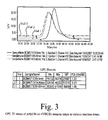
- GPC RI traces of the samples show (see Figure 3 ) that the molecular weight increases with reaction time. Little change was observed in molecular weight ( ⁇ 10%) from 30min to 60min, as the polymerization approached completion.
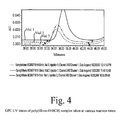
- Each sample had a UV signal with similar elution volume as its RI signal ( Figure 3 4 .
- the sample taken at 5 min exhibited a much stronger UV signal than the other two, indicating that it has a higher 4-VBCB content at lower conversion.
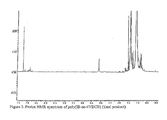
- the incorporation of 4-VBCB into the copolymer was further confirmed by proton NMR spectroscopy. A singlet at ⁇ 3.1 ppm was seen in proton NMR spectrum ( Figure 5 ), which is attributed to the strained ring of BCB.
- Example 3 Thermal crosslinking of poly(st-co-4VBCB)-polyIB-poly(st-co-4VBCB) triblock copolymer
- a sample (0.2g) of the poly(st-co-4VBCB)-polylB-poly(st-co-4VBCB) triblock copolymer as formed above was placed between two Teflon films, and the films placed between two flat metal plates.
- the resulting structure was placed in a hot press (250 °C) for 10 minutes with virtually no pressure applied.
- the Teflon films were removed from the plates and cooled to room temperature.
- a small piece of the heat treated polymer was placed in a vial containing THF. The film remained insoluble overnight and longer, indicating that it crosslinked.
- Polymer samples were thermally treated at different temperatures for 10 minutes. At temperatures above 220 °C, the resultant polymer is insolublc in THF. At a temperature of 200 °C, the resultant polymer is soluble in THF. For thermal crosslinking below 220 °C, extended time period (> 10 min) may be necessary.
- SIBS was prepared in two steps in one pot.
- isobutylene was polymerized by a 5-tert-butyl,1,3-dicumyl chloride/TiCl 4 initiating system in a methyl chloride/hexanes solvent system in the presence of a proton trap under a blanket of dry nitrogen at -80°C.
- the central PIB block reached the desired molecular weight, in this case 50 KDaltons
- a sample was removed from the reactor and styrene was added to the reactor and the polymerization continued until the outer polystyrene blocks also reach a predetermined length, in this case 75 KDaltons.
- the process was terminated by the addition of methanol.
- the sample that was taken was dried in an oven. After drying in the oven, the sample was observed to have a consistency similar to that of a rubber band.
- the polymeric material as described herein realizes an intraocular lens (IOL) for the replacement of the natural crystalline lens of the eye.
- the natural crystalline lens is a gel-like material that sits within the lens capsule of the eye and when the lens capsule is stretched by the zonules, the gel changes its thickness and therefore its focal point thereby allowing focusing at different distances.
- lens epithelial cells LECs
- LECs lens epithelial cells
- PCO posterior wall opaque
- the LEC's also spread on the anterior wall.
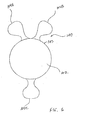
- the polymeric material as described herein is used to form a one-piece IOL that includes an optic portion with an outer peripheral edge as well as one or more haptic elements (or haptics) that project radially outward from the peripheral edge of optic portion as shown in FIGS. 6 - 8C .
- the IOL 100 includes an optic portion 102 with an outer peripheral edge 103.
- Three haptic elements 104A, 104B, 104C project radially outward from the peripheral edge 103 of optic portion 102.
- the haptic elements 104 are preferably integrally formed with and permanently connected to the outer peripheral edge 103 of optic portion 102. Different haptic designs, such as those that utilize two haptics or four haptics can also be used.
- the IOL 100' employs a ring haptic 104' as is well known in the art.
- FIG. 7 illustrates a top view of the IOL 100' with an optic portion 102" and a ring haptic 104'.
- Cross-sections for different embodiments are shown in FIGS. 8A-8C .
- the front and back surfaces of optic portion 102' can be of any diopter (curvature) necessary to provide the desired correction for the patient.
- the front surface of the optic portion 104' may be convex as shown in FIGS. 8A-8C or possibly concave (not shown).
- the back surface of the optic portion 104' is preferably flat as shown in FIGS.
- the angle ⁇ of the annulus of the ring haptic 104' relative to the plane of the optic portion 104' is between 0 and 45 degrees, and more preferably between 10 and 20 degrees, and most preferably 15 degrees.
- the terminal end(s) of the haptic(s) of the IOL as described herein are adapted to rest in and engage the lens capsule where such terminal end(s) is(are) held in place through compressive forces exerted by the inner surfaces of the lens capsule.
- the haptic(s) preferably do not lie in the plane of the optic portion but are angled relative to the optic portion (for example, at 15 degrees) such that posterior side of the optics portion presses against and contacts the posterior wall of the lens capsule.
- This configuration (which is typically referred to as a "vaulted configuration” or “vaulted haptics”) is important because the pressure of the optics portion against the posterior wall of the lens capsule prevents epithelial cells from migrating between the optics portion and the posterior wall and thereby mitigates the occurrence of PCO. Moreover, due to the crosslinked nature of the polymeric material as described herein, the vaulted haptics realized from such polymeric material maintain pressure of the optics portion against the posterior wall of the lens capsule over time and thus mitigates the occurrence of PCO over time.
- the haptics of the IOL act as a hinge which allows the optics portion to move forward or backwards along the optical axis of the eye.
- the crosslinked nature of the polymeric material as described herein allows for such hinged movement while providing memory that returns the haptics to their original shape during such accommodation.
- the polymeric material as described herein better resists fatigue under the flex stresses imposed during accommodation as compared to the acrylic lenses currently on the market. More specifically, acrylic lenses are not used for accommodating IOLs for this reason.
- silicone is used for accommodating IOLs, but silicone IOLs are thick
- the polymeric material as described herein provides an index of refraction in the range between 1.525 and 1.535 as compared to an index of refraction between 1.25 and 1.42 for silicone rubber.
- This higher index of refraction provides greater magnification as compared to silicone rubber, which enables the IOL realized from the polymeric material described herein to be thinner than silicone rubber IOLs.
- a thin IOL is advantageous as it can be introduced into lens capsule through a smaller size cannula and thus reduces the size of the surgical incision into the lens capsule. The reduced size incision lessens the chance of an astigmatism that can possibly result therefrom when the incision is sutured closed.
- the thin IOL can be deployed into the lens capsule through an incision less than 2.5mm. In this case, a suture is not necessary to close the incision and astigmatisms are not a concern.
- the polymeric material of the IOL includes PIB crosslinked by at least one BCB-olefin monomer as described herein due to the homogeneity of such material. It is also contemplated that the polymeric material of the IOL can be made gel like to form a phako-ersatz lens.
- the polymeric material as described herein can be made into a gel for realizing the IOL by blending in, either with heat or in solvent, plasticizers such as low molecular weight PIB, mineral oil, paraffin oil, organic solvents (toluene, hexane, heptane, octane, nonane, decane, dodecane, etc.) or any other aliphatic plasticizer.
- plasticizers such as low molecular weight PIB, mineral oil, paraffin oil, organic solvents (toluene, hexane, heptane, octane, nonane, decane, dodecane, etc.) or any other aliphatic plasticizer.
- plasticizers such as low molecular weight PIB, mineral oil, paraffin oil, organic solvents (toluene, hexane, heptane, octane, nonane, decane, dodecane, etc.
- the PIB When PIB is used as part of the polymeric material of the IOL, the PIB is typically synthesized in organic solvent using a Lewis acid as an initiator.
- a Lewis acid that is preferred for this application is titanium tetrachloride.
- chemicals such as alcohols (methanol, for example) are added in excess to the reaction stoicheometry which immediately quenches the reaction by neutralizing titanium tetrachloride.
- titanium tetrachloride is converted into various salts of titanium, including titanium dioxide, titanium methoxide, and the like.
- the polymer When used as an IOL, the polymer can be compounded with radiopaque fillers and the like to enable visualization under X-ray or angiography.
- radiopaque fillers and the like to enable visualization under X-ray or angiography.
- Other fillers and additives known in the art of preparing an IOL can also be added using known techniques and procedures.
Landscapes
- Chemical & Material Sciences (AREA)
- Health & Medical Sciences (AREA)
- Chemical Kinetics & Catalysis (AREA)
- Medicinal Chemistry (AREA)
- Organic Chemistry (AREA)
- Polymers & Plastics (AREA)
- Physics & Mathematics (AREA)
- Life Sciences & Earth Sciences (AREA)
- Animal Behavior & Ethology (AREA)
- General Health & Medical Sciences (AREA)
- Public Health (AREA)
- Veterinary Medicine (AREA)
- Transplantation (AREA)
- Oral & Maxillofacial Surgery (AREA)
- Ophthalmology & Optometry (AREA)
- Inorganic Chemistry (AREA)
- Optics & Photonics (AREA)
- General Physics & Mathematics (AREA)
- Epidemiology (AREA)
- Dermatology (AREA)
- Cardiology (AREA)
- Engineering & Computer Science (AREA)
- Biomedical Technology (AREA)
- Heart & Thoracic Surgery (AREA)
- Vascular Medicine (AREA)
- Addition Polymer Or Copolymer, Post-Treatments, Or Chemical Modifications (AREA)
- Prostheses (AREA)
- Materials For Medical Uses (AREA)
- Graft Or Block Polymers (AREA)
Claims (15)
- Copolymer, umfassend:a) mehrere konstitutionelle Einheiten, die aus mindestens einem kationisch polymerisierbaren verzweigten Isoolefinmonomer abgeleitet sind, das ausgewählt ist aus 2-Methyl-1-buten, 2-Methyl-1-penten und 2-Methyl-1-hexen;b) mehrere konstitutionelle Einheiten, die aus mindestens einem kationisch polymerisierbaren Olefinmonomer abgeleitet sind, das eine anhängige Benzocyclobuten (BCB) -Gruppe aufweist; und wahlweisec) mehrere konstitutionelle Einheiten, die aus mindestens einem Glasformungsmonomer abgeleitet sind.
- Copolymer nach Anspruch 1, wobei das Olefinmonomer mit einer anhängigen BCB-Gruppe die folgende Formel aufweist

- Copolymer nach Anspruch 2, wobei das Olefinmonomer mit einer anhängigen BCB-Gruppe 4-Vinylbenzocyclobuten, 2-(4-Benzocyclobutenyl)-propen oder 2-Methyl-3-(4-benzocyclo-butenyl)-propen ist.
- Copolymer nach einem der Ansprüche 1 bis 3, wobei das Glasformungsmonomer einer oder mehrere von Styrol, Inden, o-Methylstyrol, p-tert-Butylstyrol, p-Chlorstyrol und Norbonen ist.
- Copolymer nach Anspruch 1, wobei das Alkenmonomer Isobutylen ist, das Olefinmonomer mit einer anhängigen BCB-Gruppe 4-Vinylbenzocyclobuten ist und das Glasformungsmonomer Styrol ist.
- Copolymer nach einem der Ansprüche 1 bis 5, das ein statisches Copolymer, ein Blockcopolymer oder ein duroplastisches Polymer ist.
- Copolymer nach einem der Ansprüche 1 bis 6, das ein Blockcopolymer ist, in dem das polymerisierbare Olefinmonomer mit einer anhängigen Benzocyclobutengruppe in einer Menge von 0,01 bis 60 Mol-% der konstitutionellen Einheiten des Blockcopolymers vorhanden ist.
- Verfahren zum Herstellen eines Copolymers, umfassend das kationische Polymerisieren:a) mindestens eines verzweigten Isoolefincomonomers, das ausgewählt ist aus Isobutylen, 2-Methyl-1-buten, 2-Methyl-1-penten und 2-Methyl-1-hexen;b) mindestens eines Olefincomonomers mit einer anhängigen Benzocyclobuten (BCB) -Gruppe; und wahlweisec) mindestens eines Glasformungscomonomers.
- Verfahren nach Anspruch 8, wobei das Olefincomonomer mit einer anhängigen BCB-Gruppe die folgende Formel aufweist

- Verfahren nach Anspruch 8 oder 9, wobei die Polymerisation eine lebende kationische Polymerisation umfasst.
- Verfahren nach einem der Ansprüche 8 bis 10, wobei die Polymerisation in Gegenwart eines Initiators stattfindet, der 5-tert-Butyl-1,3-bis(1-methoxy-1-methylethyl)benzol umfasst.
- Verfahren nach einem der Ansprüche 8 bis 11, ferner umfassend den Schritt des Aussetzens des Copolymers Temperaturen von mindestens 180 °C, um die Vernetzung zu initiieren und ein duroplastisches Copolymer zu bilden.
- Intraokularlinse, die aus einem Copolymer nach einem der Ansprüche 1 bis 7 gebildet ist oder durch ein Verfahren nach einem der Ansprüche 8 bis 12 hergestellt wird.
- Intraokularlinse nach Anspruch 13, wobei das Copolymer ferner Weichmacher und/oder röntgendichte Füllstoffe umfasst.
- Intraokularlinse nach Anspruch 13 oder 14, wobei das Copolymer einen Brechungsindex von 1,525 bis 1,535 aufweist.
Applications Claiming Priority (3)
| Application Number | Priority Date | Filing Date | Title |
|---|---|---|---|
| US98638407P | 2007-11-08 | 2007-11-08 | |
| US12/145,704 US8765895B2 (en) | 2007-11-08 | 2008-06-25 | Crosslinked polyolefins for biomedical applications and method of making same |
| PCT/US2008/072482 WO2009061534A1 (en) | 2007-11-08 | 2008-08-07 | Crosslinked polyolefins for biomedical applications and method of making same |
Publications (3)
| Publication Number | Publication Date |
|---|---|
| EP2225291A1 EP2225291A1 (de) | 2010-09-08 |
| EP2225291A4 EP2225291A4 (de) | 2011-06-22 |
| EP2225291B1 true EP2225291B1 (de) | 2013-01-02 |
Family
ID=40624382
Family Applications (1)
| Application Number | Title | Priority Date | Filing Date |
|---|---|---|---|
| EP08797379A Active EP2225291B1 (de) | 2007-11-08 | 2008-08-07 | Vernetzte polyolefine für biomedizinische anwendungen und herstellungsverfahren dafür |
Country Status (10)
| Country | Link |
|---|---|
| US (4) | US8765895B2 (de) |
| EP (1) | EP2225291B1 (de) |
| JP (1) | JP5605706B2 (de) |
| KR (1) | KR101523239B1 (de) |
| CN (2) | CN101918461B (de) |
| BR (1) | BRPI0818904A2 (de) |
| CA (1) | CA2705143C (de) |
| ES (1) | ES2408754T3 (de) |
| MX (1) | MX2010005098A (de) |
| WO (1) | WO2009061534A1 (de) |
Families Citing this family (37)
| Publication number | Priority date | Publication date | Assignee | Title |
|---|---|---|---|---|
| US10835373B2 (en) | 2002-12-12 | 2020-11-17 | Alcon Inc. | Accommodating intraocular lenses and methods of use |
| US8328869B2 (en) | 2002-12-12 | 2012-12-11 | Powervision, Inc. | Accommodating intraocular lenses and methods of use |
| US9872763B2 (en) | 2004-10-22 | 2018-01-23 | Powervision, Inc. | Accommodating intraocular lenses |
| US8968396B2 (en) | 2007-07-23 | 2015-03-03 | Powervision, Inc. | Intraocular lens delivery systems and methods of use |
| EP2178462B1 (de) | 2007-07-23 | 2014-04-02 | PowerVision, Inc. | Modifizierung der linsenstärke nach der implantation |
| JP5346022B2 (ja) | 2007-07-23 | 2013-11-20 | パワーヴィジョン・インコーポレーテッド | 調節眼内レンズおよび使用方法 |
| CN101754728B (zh) | 2007-07-23 | 2013-09-18 | 力景公司 | 晶状体递送系统 |
| US8765895B2 (en) * | 2007-11-08 | 2014-07-01 | Innolene Llc | Crosslinked polyolefins for biomedical applications and method of making same |
| US10299913B2 (en) | 2009-01-09 | 2019-05-28 | Powervision, Inc. | Accommodating intraocular lenses and methods of use |
| WO2010129905A1 (en) * | 2009-05-08 | 2010-11-11 | Innolene Llc | Ocular lens |
| EP2473138A4 (de) | 2009-08-31 | 2017-08-16 | PowerVision, Inc. | Schätzung der linsenkapselgrösse |
| US20110144746A1 (en) * | 2009-12-11 | 2011-06-16 | Vanderbilt David P | Intraocular Lens |
| WO2011106435A2 (en) | 2010-02-23 | 2011-09-01 | Powervision, Inc. | Fluid for accommodating intraocular lenses |
| US9220590B2 (en) | 2010-06-10 | 2015-12-29 | Z Lens, Llc | Accommodative intraocular lens and method of improving accommodation |
| WO2012006616A2 (en) | 2010-07-09 | 2012-01-12 | Powervision, Inc. | Intraocular lens delivery devices and methods of use |
| JP6071995B2 (ja) | 2011-03-24 | 2017-02-01 | パワーヴィジョン・インコーポレーテッド | 眼内レンズ装填システムおよび使用方法 |
| JP5791418B2 (ja) * | 2011-07-29 | 2015-10-07 | キヤノン株式会社 | 新規化合物、重合体、その架橋体、及びそれを有する光学素子 |
| US10433949B2 (en) | 2011-11-08 | 2019-10-08 | Powervision, Inc. | Accommodating intraocular lenses |
| US9101444B2 (en) | 2012-01-12 | 2015-08-11 | Innfocus, Inc. | Method, surgical kit and device for treating glaucoma |
| US9220888B2 (en) | 2012-04-02 | 2015-12-29 | Medtronic, Inc. | Medical leads |
| US9364318B2 (en) | 2012-05-10 | 2016-06-14 | Z Lens, Llc | Accommodative-disaccommodative intraocular lens |
| US8940810B2 (en) * | 2012-06-07 | 2015-01-27 | Canon Kabushiki Kaisha | Optical component, electronic board, method for producing the optical component, and method for producing the electronic board |
| EP3785668A1 (de) | 2013-03-15 | 2021-03-03 | Alcon Inc. | Aufbewahrungs- und ladevorrichtung für intraokularlinsen und verfahren zur verwendung |
| ES2962463T3 (es) | 2015-06-10 | 2024-03-19 | Alcon Inc | Materiales y componentes de lentes intraoculares |
| CN111407464B (zh) | 2015-11-06 | 2022-12-13 | 爱尔康公司 | 可调节人工晶状体和制造方法 |
| CN107440818A (zh) * | 2016-06-01 | 2017-12-08 | 西安浦勒生物科技有限公司 | 一种基于创新生物相容性疏水材料的新型后房人工晶体 |
| CN109890325B (zh) | 2016-08-24 | 2021-10-26 | Z晶状体有限责任公司 | 双模式调节-去调节型人工晶状体 |
| CN107501459A (zh) * | 2017-08-25 | 2017-12-22 | 江苏明魁高分子材料技术有限公司 | 具有高碳含量和可控光学指数的可交联聚合物及其合成方法和应用 |
| CN111205383B (zh) * | 2020-02-28 | 2021-04-02 | 西北工业大学 | 一种无规共聚物及其制备方法和应用、一种改性pbo纤维及其制备方法 |
| CN113367885B (zh) * | 2020-03-10 | 2022-07-29 | 成都米戈思医疗技术有限公司 | 一种青光眼引流管及其材料和植入装置 |
| CN113855862A (zh) * | 2020-06-30 | 2021-12-31 | 四川大学华西医院 | 一种用于青光眼滤过手术的抗瘢痕膜及其材料 |
| CN117062848A (zh) * | 2021-04-02 | 2023-11-14 | 杭州新聚医疗科技有限公司 | 用作可折叠人工晶状体的可热交联形成弹性材料的聚合物及其制备方法和应用 |
| CN116425930A (zh) * | 2021-09-30 | 2023-07-14 | 北京石油化工学院 | 聚异单烯烃共聚物、引发剂体系及应用 |
| CN115569245A (zh) * | 2022-09-23 | 2023-01-06 | 西安眼得乐医疗科技有限公司 | 眼部植入物及其制备方法和用途 |
| AU2024309881A1 (en) | 2023-06-30 | 2025-11-20 | Alcon Inc. | System and methods for compensating for intraocular lens tilt |
| CN120158028A (zh) * | 2023-12-07 | 2025-06-17 | 台光电子材料(昆山)股份有限公司 | 树脂组合物及其制品 |
| CN119552326A (zh) * | 2024-04-17 | 2025-03-04 | 成都米戈思医疗技术有限公司 | 聚异丁烯基共聚物及其制备方法 |
Family Cites Families (25)
| Publication number | Priority date | Publication date | Assignee | Title |
|---|---|---|---|---|
| US4698394A (en) * | 1985-12-23 | 1987-10-06 | Shell Oil Company | Reactive styrene polymers |
| ATE73143T1 (de) * | 1985-12-23 | 1992-03-15 | Shell Int Research | Olefinische benzocyclobuten-polymere und verfahren zu deren herstellung. |
| US4667005A (en) * | 1985-12-23 | 1987-05-19 | Shell Oil Company | Crystalline alphamonoolefin copolymers |
| US4667004A (en) * | 1985-12-23 | 1987-05-19 | Shell Oil Company | Olefinic benzocyclobutene polymers |
| US4622375A (en) * | 1986-03-28 | 1986-11-11 | Shell Oil Company | Amorphous ethylene/propylene polymers |
| US4687815A (en) * | 1985-12-23 | 1987-08-18 | Shell Oil Company | Hydrogenated block copolymers |
| US4946899A (en) * | 1988-12-16 | 1990-08-07 | The University Of Akron | Thermoplastic elastomers of isobutylene and process of preparation |
| US5077367A (en) * | 1989-09-29 | 1991-12-31 | The Dow Chemical Company | Crystalline syndiotactic copolymers from arylcyclobutene functional monomers and vinyl aromatic monomers |
| ATE161021T1 (de) * | 1991-07-15 | 1997-12-15 | Exxon Chemical Patents Inc | Lebendes karbokationisches polymerisationsverfahren |
| US5278272A (en) * | 1991-10-15 | 1994-01-11 | The Dow Chemical Company | Elastic substantialy linear olefin polymers |
| US5422410A (en) * | 1992-10-27 | 1995-06-06 | The Dow Chemical Company | Method for increasing the molecular weight of thermoplastic polymers of monoalkenyl arenes |
| US5516610A (en) * | 1994-08-08 | 1996-05-14 | Hewlett-Packard Company | Reusable inverse composite dual-layer organic photoconductor using specific polymers |
| WO1996016094A1 (en) * | 1994-11-23 | 1996-05-30 | The Dow Chemical Company | Preparation of syndiotactic polyolefins from prochiral olefins |
| US5741331A (en) * | 1996-07-29 | 1998-04-21 | Corvita Corporation | Biostable elastomeric polymers having quaternary carbons |
| US6268451B1 (en) * | 2000-10-03 | 2001-07-31 | University Of Massachusetts Lowell | Silyl-functional pseudo-telechelic polyisobutylene terpolymers |
| US6545097B2 (en) * | 2000-12-12 | 2003-04-08 | Scimed Life Systems, Inc. | Drug delivery compositions and medical devices containing block copolymer |
| JP5328001B2 (ja) * | 2000-12-20 | 2013-10-30 | エクソンモービル・ケミカル・パテンツ・インク | カチオン重合性モノマーの重合方法 |
| US6512056B1 (en) * | 2001-03-09 | 2003-01-28 | The University Of Akron | Star polymers having statistical poly(isobutylene-co-styrene) copolymer arms |
| WO2004035680A1 (en) | 2002-10-17 | 2004-04-29 | Dow Global Technologies Inc. | Highly filled polymer compositions |
| US7598114B2 (en) | 2003-02-05 | 2009-10-06 | Dow Global Technologies Inc. | Sacrificial benzocyclobutene/norbornene polymers for making air gap semiconductor devices |
| US20060264065A1 (en) * | 2003-02-05 | 2006-11-23 | So Ying H | Sacrificial styrene benzocyclobutene copolymers for making air gap semiconductor devices |
| US20050187414A1 (en) * | 2003-07-31 | 2005-08-25 | Rudolf Faust | Copolymers comprising branched olefin and vinyl ether units |
| US8101697B2 (en) * | 2005-02-01 | 2012-01-24 | Bridgestone Corporation | Multi-functionalized high-trans elastomeric polymers |
| CN100374448C (zh) * | 2005-12-30 | 2008-03-12 | 四川大学 | 双烯基硅氧烷桥联双苯并环丁烯单体及预聚体的制备方法 |
| US8765895B2 (en) | 2007-11-08 | 2014-07-01 | Innolene Llc | Crosslinked polyolefins for biomedical applications and method of making same |
-
2008
- 2008-06-25 US US12/145,704 patent/US8765895B2/en active Active
- 2008-08-07 EP EP08797379A patent/EP2225291B1/de active Active
- 2008-08-07 ES ES08797379T patent/ES2408754T3/es active Active
- 2008-08-07 KR KR1020107012514A patent/KR101523239B1/ko active Active
- 2008-08-07 CN CN200880124361.XA patent/CN101918461B/zh active Active
- 2008-08-07 MX MX2010005098A patent/MX2010005098A/es active IP Right Grant
- 2008-08-07 WO PCT/US2008/072482 patent/WO2009061534A1/en not_active Ceased
- 2008-08-07 JP JP2010533131A patent/JP5605706B2/ja active Active
- 2008-08-07 CA CA2705143A patent/CA2705143C/en active Active
- 2008-08-07 BR BRPI0818904-8A patent/BRPI0818904A2/pt not_active IP Right Cessation
- 2008-08-07 CN CN201510603918.XA patent/CN105330775B/zh active Active
-
2014
- 2014-06-27 US US14/317,521 patent/US9382357B2/en active Active
-
2016
- 2016-07-05 US US15/202,239 patent/US20160311952A1/en not_active Abandoned
-
2018
- 2018-01-03 US US15/861,608 patent/US10766987B2/en active Active
Also Published As
| Publication number | Publication date |
|---|---|
| CN101918461A (zh) | 2010-12-15 |
| JP2011503290A (ja) | 2011-01-27 |
| US10766987B2 (en) | 2020-09-08 |
| CA2705143A1 (en) | 2009-05-14 |
| US20090124773A1 (en) | 2009-05-14 |
| CN105330775B (zh) | 2018-09-07 |
| EP2225291A1 (de) | 2010-09-08 |
| US20160311952A1 (en) | 2016-10-27 |
| CN105330775A (zh) | 2016-02-17 |
| ES2408754T3 (es) | 2013-06-21 |
| JP5605706B2 (ja) | 2014-10-15 |
| US20180127525A1 (en) | 2018-05-10 |
| US9382357B2 (en) | 2016-07-05 |
| KR20100096142A (ko) | 2010-09-01 |
| EP2225291A4 (de) | 2011-06-22 |
| CN101918461B (zh) | 2015-09-16 |
| US20140309394A1 (en) | 2014-10-16 |
| WO2009061534A1 (en) | 2009-05-14 |
| BRPI0818904A2 (pt) | 2015-05-12 |
| CA2705143C (en) | 2016-03-01 |
| KR101523239B1 (ko) | 2015-05-27 |
| US8765895B2 (en) | 2014-07-01 |
| MX2010005098A (es) | 2010-11-12 |
Similar Documents
| Publication | Publication Date | Title |
|---|---|---|
| US10766987B2 (en) | Crosslinked polyolefins for biomedical applications and method of making same | |
| US20140058008A1 (en) | Ocular Lens | |
| KR101433025B1 (ko) | 블록 공중합체의 정제방법 | |
| US20130103148A1 (en) | Intraocular Lens | |
| US20030151825A1 (en) | Polyacrylate-based light adjustable optical element | |
| WO2022246198A1 (en) | Biostable polymer brushes with defined viscosity and optical properties for use in a novel intraocular lens | |
| Pusch | Strategies of preparing transparent latices with application to the synthesis of transparent hydrogels for intraocular lenses | |
| CZ20002507A3 (cs) | Hydrofilně-hydrofobní materiály na bázi kopolymeru isobutylenu s hydroxyalkylakryláty a methakryláty a způsob jejich výroby | |
| WO2022205473A1 (zh) | 用作可折叠人工晶状体的可热交联形成弹性材料的聚合物及其制备方法和应用 |
Legal Events
| Date | Code | Title | Description |
|---|---|---|---|
| PUAI | Public reference made under article 153(3) epc to a published international application that has entered the european phase |
Free format text: ORIGINAL CODE: 0009012 |
|
| 17P | Request for examination filed |
Effective date: 20100608 |
|
| AK | Designated contracting states |
Kind code of ref document: A1 Designated state(s): AT BE BG CH CY CZ DE DK EE ES FI FR GB GR HR HU IE IS IT LI LT LU LV MC MT NL NO PL PT RO SE SI SK TR |
|
| AX | Request for extension of the european patent |
Extension state: AL BA MK RS |
|
| DAX | Request for extension of the european patent (deleted) | ||
| REG | Reference to a national code |
Ref country code: DE Ref legal event code: R079 Ref document number: 602008021416 Country of ref document: DE Free format text: PREVIOUS MAIN CLASS: C08F0012320000 Ipc: C08F0212320000 |
|
| A4 | Supplementary search report drawn up and despatched |
Effective date: 20110520 |
|
| RIC1 | Information provided on ipc code assigned before grant |
Ipc: C08J 3/24 20060101ALI20110516BHEP Ipc: A61F 2/16 20060101ALI20110516BHEP Ipc: C08F 297/00 20060101ALI20110516BHEP Ipc: C08F 210/10 20060101ALI20110516BHEP Ipc: C08F 212/32 20060101AFI20110516BHEP |
|
| 17Q | First examination report despatched |
Effective date: 20111122 |
|
| GRAP | Despatch of communication of intention to grant a patent |
Free format text: ORIGINAL CODE: EPIDOSNIGR1 |
|
| RIC1 | Information provided on ipc code assigned before grant |
Ipc: C08F 212/32 20060101AFI20120620BHEP Ipc: C08F 210/10 20060101ALI20120620BHEP Ipc: C08F 297/00 20060101ALI20120620BHEP Ipc: C08F 210/14 20060101ALN20120620BHEP Ipc: A61F 2/16 20060101ALI20120620BHEP Ipc: C08J 3/24 20060101ALI20120620BHEP |
|
| RIC1 | Information provided on ipc code assigned before grant |
Ipc: C08F 212/32 20060101AFI20120622BHEP Ipc: A61F 2/16 20060101ALI20120622BHEP Ipc: C08F 210/14 20060101ALN20120622BHEP Ipc: C08J 3/24 20060101ALI20120622BHEP Ipc: C08F 297/00 20060101ALI20120622BHEP Ipc: C08F 210/10 20060101ALI20120622BHEP |
|
| GRAS | Grant fee paid |
Free format text: ORIGINAL CODE: EPIDOSNIGR3 |
|
| GRAA | (expected) grant |
Free format text: ORIGINAL CODE: 0009210 |
|
| AK | Designated contracting states |
Kind code of ref document: B1 Designated state(s): AT BE BG CH CY CZ DE DK EE ES FI FR GB GR HR HU IE IS IT LI LT LU LV MC MT NL NO PL PT RO SE SI SK TR |
|
| REG | Reference to a national code |
Ref country code: GB Ref legal event code: FG4D |
|
| REG | Reference to a national code |
Ref country code: AT Ref legal event code: REF Ref document number: 591594 Country of ref document: AT Kind code of ref document: T Effective date: 20130115 Ref country code: CH Ref legal event code: EP |
|
| REG | Reference to a national code |
Ref country code: IE Ref legal event code: FG4D |
|
| REG | Reference to a national code |
Ref country code: DE Ref legal event code: R096 Ref document number: 602008021416 Country of ref document: DE Effective date: 20130228 |
|
| REG | Reference to a national code |
Ref country code: AT Ref legal event code: MK05 Ref document number: 591594 Country of ref document: AT Kind code of ref document: T Effective date: 20130102 |
|
| REG | Reference to a national code |
Ref country code: NL Ref legal event code: T3 |
|
| RAP2 | Party data changed (patent owner data changed or rights of a patent transferred) |
Owner name: INNOLENE LLC |
|
| PG25 | Lapsed in a contracting state [announced via postgrant information from national office to epo] |
Ref country code: SI Free format text: LAPSE BECAUSE OF FAILURE TO SUBMIT A TRANSLATION OF THE DESCRIPTION OR TO PAY THE FEE WITHIN THE PRESCRIBED TIME-LIMIT Effective date: 20130102 |
|
| REG | Reference to a national code |
Ref country code: GB Ref legal event code: 732E Free format text: REGISTERED BETWEEN 20130523 AND 20130529 |
|
| REG | Reference to a national code |
Ref country code: ES Ref legal event code: FG2A Ref document number: 2408754 Country of ref document: ES Kind code of ref document: T3 Effective date: 20130621 |
|
| REG | Reference to a national code |
Ref country code: LT Ref legal event code: MG4D |
|
| REG | Reference to a national code |
Ref country code: NL Ref legal event code: SD Effective date: 20130711 |
|
| PG25 | Lapsed in a contracting state [announced via postgrant information from national office to epo] |
Ref country code: IS Free format text: LAPSE BECAUSE OF FAILURE TO SUBMIT A TRANSLATION OF THE DESCRIPTION OR TO PAY THE FEE WITHIN THE PRESCRIBED TIME-LIMIT Effective date: 20130502 Ref country code: CZ Free format text: LAPSE BECAUSE OF FAILURE TO SUBMIT A TRANSLATION OF THE DESCRIPTION OR TO PAY THE FEE WITHIN THE PRESCRIBED TIME-LIMIT Effective date: 20130102 Ref country code: AT Free format text: LAPSE BECAUSE OF FAILURE TO SUBMIT A TRANSLATION OF THE DESCRIPTION OR TO PAY THE FEE WITHIN THE PRESCRIBED TIME-LIMIT Effective date: 20130102 Ref country code: BE Free format text: LAPSE BECAUSE OF FAILURE TO SUBMIT A TRANSLATION OF THE DESCRIPTION OR TO PAY THE FEE WITHIN THE PRESCRIBED TIME-LIMIT Effective date: 20130102 Ref country code: BG Free format text: LAPSE BECAUSE OF FAILURE TO SUBMIT A TRANSLATION OF THE DESCRIPTION OR TO PAY THE FEE WITHIN THE PRESCRIBED TIME-LIMIT Effective date: 20130402 Ref country code: SE Free format text: LAPSE BECAUSE OF FAILURE TO SUBMIT A TRANSLATION OF THE DESCRIPTION OR TO PAY THE FEE WITHIN THE PRESCRIBED TIME-LIMIT Effective date: 20130102 Ref country code: LT Free format text: LAPSE BECAUSE OF FAILURE TO SUBMIT A TRANSLATION OF THE DESCRIPTION OR TO PAY THE FEE WITHIN THE PRESCRIBED TIME-LIMIT Effective date: 20130102 Ref country code: NO Free format text: LAPSE BECAUSE OF FAILURE TO SUBMIT A TRANSLATION OF THE DESCRIPTION OR TO PAY THE FEE WITHIN THE PRESCRIBED TIME-LIMIT Effective date: 20130402 |
|
| REG | Reference to a national code |
Ref country code: DE Ref legal event code: R081 Ref document number: 602008021416 Country of ref document: DE Owner name: INNOLENE LLC, MIAMI, US Free format text: FORMER OWNER: INNOVIA LLC, MIAMI, FLA., US Effective date: 20130620 Ref country code: DE Ref legal event code: R081 Ref document number: 602008021416 Country of ref document: DE Owner name: INNOLENE LLC, US Free format text: FORMER OWNER: INNOVIA LLC, MIAMI, US Effective date: 20130620 |
|
| PG25 | Lapsed in a contracting state [announced via postgrant information from national office to epo] |
Ref country code: PT Free format text: LAPSE BECAUSE OF FAILURE TO SUBMIT A TRANSLATION OF THE DESCRIPTION OR TO PAY THE FEE WITHIN THE PRESCRIBED TIME-LIMIT Effective date: 20130502 Ref country code: LV Free format text: LAPSE BECAUSE OF FAILURE TO SUBMIT A TRANSLATION OF THE DESCRIPTION OR TO PAY THE FEE WITHIN THE PRESCRIBED TIME-LIMIT Effective date: 20130102 Ref country code: FI Free format text: LAPSE BECAUSE OF FAILURE TO SUBMIT A TRANSLATION OF THE DESCRIPTION OR TO PAY THE FEE WITHIN THE PRESCRIBED TIME-LIMIT Effective date: 20130102 Ref country code: PL Free format text: LAPSE BECAUSE OF FAILURE TO SUBMIT A TRANSLATION OF THE DESCRIPTION OR TO PAY THE FEE WITHIN THE PRESCRIBED TIME-LIMIT Effective date: 20130102 Ref country code: GR Free format text: LAPSE BECAUSE OF FAILURE TO SUBMIT A TRANSLATION OF THE DESCRIPTION OR TO PAY THE FEE WITHIN THE PRESCRIBED TIME-LIMIT Effective date: 20130403 |
|
| PG25 | Lapsed in a contracting state [announced via postgrant information from national office to epo] |
Ref country code: HR Free format text: LAPSE BECAUSE OF FAILURE TO SUBMIT A TRANSLATION OF THE DESCRIPTION OR TO PAY THE FEE WITHIN THE PRESCRIBED TIME-LIMIT Effective date: 20130102 |
|
| PG25 | Lapsed in a contracting state [announced via postgrant information from national office to epo] |
Ref country code: DK Free format text: LAPSE BECAUSE OF FAILURE TO SUBMIT A TRANSLATION OF THE DESCRIPTION OR TO PAY THE FEE WITHIN THE PRESCRIBED TIME-LIMIT Effective date: 20130102 Ref country code: EE Free format text: LAPSE BECAUSE OF FAILURE TO SUBMIT A TRANSLATION OF THE DESCRIPTION OR TO PAY THE FEE WITHIN THE PRESCRIBED TIME-LIMIT Effective date: 20130102 Ref country code: RO Free format text: LAPSE BECAUSE OF FAILURE TO SUBMIT A TRANSLATION OF THE DESCRIPTION OR TO PAY THE FEE WITHIN THE PRESCRIBED TIME-LIMIT Effective date: 20130102 Ref country code: SK Free format text: LAPSE BECAUSE OF FAILURE TO SUBMIT A TRANSLATION OF THE DESCRIPTION OR TO PAY THE FEE WITHIN THE PRESCRIBED TIME-LIMIT Effective date: 20130102 |
|
| PLBE | No opposition filed within time limit |
Free format text: ORIGINAL CODE: 0009261 |
|
| STAA | Information on the status of an ep patent application or granted ep patent |
Free format text: STATUS: NO OPPOSITION FILED WITHIN TIME LIMIT |
|
| PG25 | Lapsed in a contracting state [announced via postgrant information from national office to epo] |
Ref country code: CY Free format text: LAPSE BECAUSE OF FAILURE TO SUBMIT A TRANSLATION OF THE DESCRIPTION OR TO PAY THE FEE WITHIN THE PRESCRIBED TIME-LIMIT Effective date: 20130102 |
|
| 26N | No opposition filed |
Effective date: 20131003 |
|
| REG | Reference to a national code |
Ref country code: DE Ref legal event code: R097 Ref document number: 602008021416 Country of ref document: DE Effective date: 20131003 |
|
| REG | Reference to a national code |
Ref country code: CH Ref legal event code: PL |
|
| PG25 | Lapsed in a contracting state [announced via postgrant information from national office to epo] |
Ref country code: CH Free format text: LAPSE BECAUSE OF NON-PAYMENT OF DUE FEES Effective date: 20130831 Ref country code: MC Free format text: LAPSE BECAUSE OF FAILURE TO SUBMIT A TRANSLATION OF THE DESCRIPTION OR TO PAY THE FEE WITHIN THE PRESCRIBED TIME-LIMIT Effective date: 20130102 Ref country code: LI Free format text: LAPSE BECAUSE OF NON-PAYMENT OF DUE FEES Effective date: 20130831 |
|
| REG | Reference to a national code |
Ref country code: IE Ref legal event code: MM4A |
|
| PG25 | Lapsed in a contracting state [announced via postgrant information from national office to epo] |
Ref country code: IE Free format text: LAPSE BECAUSE OF NON-PAYMENT OF DUE FEES Effective date: 20130807 |
|
| PG25 | Lapsed in a contracting state [announced via postgrant information from national office to epo] |
Ref country code: MT Free format text: LAPSE BECAUSE OF FAILURE TO SUBMIT A TRANSLATION OF THE DESCRIPTION OR TO PAY THE FEE WITHIN THE PRESCRIBED TIME-LIMIT Effective date: 20130102 Ref country code: TR Free format text: LAPSE BECAUSE OF FAILURE TO SUBMIT A TRANSLATION OF THE DESCRIPTION OR TO PAY THE FEE WITHIN THE PRESCRIBED TIME-LIMIT Effective date: 20130102 |
|
| PG25 | Lapsed in a contracting state [announced via postgrant information from national office to epo] |
Ref country code: HU Free format text: LAPSE BECAUSE OF FAILURE TO SUBMIT A TRANSLATION OF THE DESCRIPTION OR TO PAY THE FEE WITHIN THE PRESCRIBED TIME-LIMIT; INVALID AB INITIO Effective date: 20080807 Ref country code: LU Free format text: LAPSE BECAUSE OF NON-PAYMENT OF DUE FEES Effective date: 20130807 |
|
| REG | Reference to a national code |
Ref country code: FR Ref legal event code: PLFP Year of fee payment: 9 |
|
| REG | Reference to a national code |
Ref country code: FR Ref legal event code: PLFP Year of fee payment: 10 |
|
| REG | Reference to a national code |
Ref country code: FR Ref legal event code: PLFP Year of fee payment: 11 |
|
| REG | Reference to a national code |
Ref country code: GB Ref legal event code: 732E Free format text: REGISTERED BETWEEN 20210819 AND 20210825 |
|
| REG | Reference to a national code |
Ref country code: ES Ref legal event code: PC2A Owner name: EYEDEAL HONGKONG LIMITED Effective date: 20210923 |
|
| REG | Reference to a national code |
Ref country code: NL Ref legal event code: PD Owner name: EYEDEAL HONGKONG LIMITED; HK Free format text: DETAILS ASSIGNMENT: CHANGE OF OWNER(S), ASSIGNMENT; FORMER OWNER NAME: INNOLENE LLC Effective date: 20211005 |
|
| REG | Reference to a national code |
Ref country code: DE Ref legal event code: R081 Ref document number: 602008021416 Country of ref document: DE Owner name: EYEDEAL HONGKONG LTD., HK Free format text: FORMER OWNER: INNOLENE LLC, MIAMI, FL, US |
|
| P01 | Opt-out of the competence of the unified patent court (upc) registered |
Effective date: 20230608 |
|
| PGFP | Annual fee paid to national office [announced via postgrant information from national office to epo] |
Ref country code: NL Payment date: 20250820 Year of fee payment: 18 |
|
| PGFP | Annual fee paid to national office [announced via postgrant information from national office to epo] |
Ref country code: ES Payment date: 20250916 Year of fee payment: 18 |
|
| PGFP | Annual fee paid to national office [announced via postgrant information from national office to epo] |
Ref country code: DE Payment date: 20250827 Year of fee payment: 18 |
|
| PGFP | Annual fee paid to national office [announced via postgrant information from national office to epo] |
Ref country code: IT Payment date: 20250827 Year of fee payment: 18 |
|
| PGFP | Annual fee paid to national office [announced via postgrant information from national office to epo] |
Ref country code: GB Payment date: 20250829 Year of fee payment: 18 |
|
| PGFP | Annual fee paid to national office [announced via postgrant information from national office to epo] |
Ref country code: FR Payment date: 20250820 Year of fee payment: 18 |