EP2220272B1 - Multicomponent fiber with polyarylene sulfide component - Google Patents
Multicomponent fiber with polyarylene sulfide component Download PDFInfo
- Publication number
- EP2220272B1 EP2220272B1 EP08859962.6A EP08859962A EP2220272B1 EP 2220272 B1 EP2220272 B1 EP 2220272B1 EP 08859962 A EP08859962 A EP 08859962A EP 2220272 B1 EP2220272 B1 EP 2220272B1
- Authority
- EP
- European Patent Office
- Prior art keywords
- fiber
- component
- polymer
- polyarylene sulfide
- fibers
- Prior art date
- Legal status (The legal status is an assumption and is not a legal conclusion. Google has not performed a legal analysis and makes no representation as to the accuracy of the status listed.)
- Active
Links
Images
Classifications
-
- D—TEXTILES; PAPER
- D01—NATURAL OR MAN-MADE THREADS OR FIBRES; SPINNING
- D01F—CHEMICAL FEATURES IN THE MANUFACTURE OF ARTIFICIAL FILAMENTS, THREADS, FIBRES, BRISTLES OR RIBBONS; APPARATUS SPECIALLY ADAPTED FOR THE MANUFACTURE OF CARBON FILAMENTS
- D01F8/00—Conjugated, i.e. bi- or multicomponent, artificial filaments or the like; Manufacture thereof
- D01F8/04—Conjugated, i.e. bi- or multicomponent, artificial filaments or the like; Manufacture thereof from synthetic polymers
- D01F8/16—Conjugated, i.e. bi- or multicomponent, artificial filaments or the like; Manufacture thereof from synthetic polymers with at least one other macromolecular compound obtained otherwise than by reactions only involving carbon-to-carbon unsaturated bonds as constituent
-
- Y—GENERAL TAGGING OF NEW TECHNOLOGICAL DEVELOPMENTS; GENERAL TAGGING OF CROSS-SECTIONAL TECHNOLOGIES SPANNING OVER SEVERAL SECTIONS OF THE IPC; TECHNICAL SUBJECTS COVERED BY FORMER USPC CROSS-REFERENCE ART COLLECTIONS [XRACs] AND DIGESTS
- Y10—TECHNICAL SUBJECTS COVERED BY FORMER USPC
- Y10T—TECHNICAL SUBJECTS COVERED BY FORMER US CLASSIFICATION
- Y10T428/00—Stock material or miscellaneous articles
- Y10T428/249921—Web or sheet containing structurally defined element or component
-
- Y—GENERAL TAGGING OF NEW TECHNOLOGICAL DEVELOPMENTS; GENERAL TAGGING OF CROSS-SECTIONAL TECHNOLOGIES SPANNING OVER SEVERAL SECTIONS OF THE IPC; TECHNICAL SUBJECTS COVERED BY FORMER USPC CROSS-REFERENCE ART COLLECTIONS [XRACs] AND DIGESTS
- Y10—TECHNICAL SUBJECTS COVERED BY FORMER USPC
- Y10T—TECHNICAL SUBJECTS COVERED BY FORMER US CLASSIFICATION
- Y10T428/00—Stock material or miscellaneous articles
- Y10T428/29—Coated or structually defined flake, particle, cell, strand, strand portion, rod, filament, macroscopic fiber or mass thereof
- Y10T428/2904—Staple length fiber
-
- Y—GENERAL TAGGING OF NEW TECHNOLOGICAL DEVELOPMENTS; GENERAL TAGGING OF CROSS-SECTIONAL TECHNOLOGIES SPANNING OVER SEVERAL SECTIONS OF THE IPC; TECHNICAL SUBJECTS COVERED BY FORMER USPC CROSS-REFERENCE ART COLLECTIONS [XRACs] AND DIGESTS
- Y10—TECHNICAL SUBJECTS COVERED BY FORMER USPC
- Y10T—TECHNICAL SUBJECTS COVERED BY FORMER US CLASSIFICATION
- Y10T428/00—Stock material or miscellaneous articles
- Y10T428/29—Coated or structually defined flake, particle, cell, strand, strand portion, rod, filament, macroscopic fiber or mass thereof
- Y10T428/2913—Rod, strand, filament or fiber
-
- Y—GENERAL TAGGING OF NEW TECHNOLOGICAL DEVELOPMENTS; GENERAL TAGGING OF CROSS-SECTIONAL TECHNOLOGIES SPANNING OVER SEVERAL SECTIONS OF THE IPC; TECHNICAL SUBJECTS COVERED BY FORMER USPC CROSS-REFERENCE ART COLLECTIONS [XRACs] AND DIGESTS
- Y10—TECHNICAL SUBJECTS COVERED BY FORMER USPC
- Y10T—TECHNICAL SUBJECTS COVERED BY FORMER US CLASSIFICATION
- Y10T428/00—Stock material or miscellaneous articles
- Y10T428/29—Coated or structually defined flake, particle, cell, strand, strand portion, rod, filament, macroscopic fiber or mass thereof
- Y10T428/2913—Rod, strand, filament or fiber
- Y10T428/2929—Bicomponent, conjugate, composite or collateral fibers or filaments [i.e., coextruded sheath-core or side-by-side type]
-
- Y—GENERAL TAGGING OF NEW TECHNOLOGICAL DEVELOPMENTS; GENERAL TAGGING OF CROSS-SECTIONAL TECHNOLOGIES SPANNING OVER SEVERAL SECTIONS OF THE IPC; TECHNICAL SUBJECTS COVERED BY FORMER USPC CROSS-REFERENCE ART COLLECTIONS [XRACs] AND DIGESTS
- Y10—TECHNICAL SUBJECTS COVERED BY FORMER USPC
- Y10T—TECHNICAL SUBJECTS COVERED BY FORMER US CLASSIFICATION
- Y10T428/00—Stock material or miscellaneous articles
- Y10T428/29—Coated or structually defined flake, particle, cell, strand, strand portion, rod, filament, macroscopic fiber or mass thereof
- Y10T428/2913—Rod, strand, filament or fiber
- Y10T428/2929—Bicomponent, conjugate, composite or collateral fibers or filaments [i.e., coextruded sheath-core or side-by-side type]
- Y10T428/2931—Fibers or filaments nonconcentric [e.g., side-by-side or eccentric, etc.]
-
- Y—GENERAL TAGGING OF NEW TECHNOLOGICAL DEVELOPMENTS; GENERAL TAGGING OF CROSS-SECTIONAL TECHNOLOGIES SPANNING OVER SEVERAL SECTIONS OF THE IPC; TECHNICAL SUBJECTS COVERED BY FORMER USPC CROSS-REFERENCE ART COLLECTIONS [XRACs] AND DIGESTS
- Y10—TECHNICAL SUBJECTS COVERED BY FORMER USPC
- Y10T—TECHNICAL SUBJECTS COVERED BY FORMER US CLASSIFICATION
- Y10T428/00—Stock material or miscellaneous articles
- Y10T428/29—Coated or structually defined flake, particle, cell, strand, strand portion, rod, filament, macroscopic fiber or mass thereof
- Y10T428/2913—Rod, strand, filament or fiber
- Y10T428/2973—Particular cross section
-
- Y—GENERAL TAGGING OF NEW TECHNOLOGICAL DEVELOPMENTS; GENERAL TAGGING OF CROSS-SECTIONAL TECHNOLOGIES SPANNING OVER SEVERAL SECTIONS OF THE IPC; TECHNICAL SUBJECTS COVERED BY FORMER USPC CROSS-REFERENCE ART COLLECTIONS [XRACs] AND DIGESTS
- Y10—TECHNICAL SUBJECTS COVERED BY FORMER USPC
- Y10T—TECHNICAL SUBJECTS COVERED BY FORMER US CLASSIFICATION
- Y10T442/00—Fabric [woven, knitted, or nonwoven textile or cloth, etc.]
- Y10T442/30—Woven fabric [i.e., woven strand or strip material]
- Y10T442/3146—Strand material is composed of two or more polymeric materials in physically distinct relationship [e.g., sheath-core, side-by-side, islands-in-sea, fibrils-in-matrix, etc.] or composed of physical blend of chemically different polymeric materials or a physical blend of a polymeric material and a filler material
Definitions
- the present invention relates to fibers having a polyarylene sulfide component and products including the same.
- Filtration processes are used to separate compounds of one phase from a fluid stream of another phase by passing the fluid stream through filtration media, which traps the entrained or suspended matter.
- the fluid stream may be either a liquid stream containing a solid particulate or a gas stream containing a liquid or solid aerosol.
- bags are used in collecting dust emitted from incinerators, coal fired boilers, metal melting furnaces and the like. Such filters are referred to generally as "bag filters.” Because exhaust gas temperatures can be high, bag filters used to collect hot dust emitted from these and similar devices are required to be heat resistant. Bag filters can also be used in chemically corrosive environments. Thus, dust collection environments can also require a filter bag made of materials that exhibit chemical resistance. Examples of common filtration media include fabrics formed of aramid fibers, polyimide fibers, fluorine fibers and glass fibers.
- PPS polymers exhibit thermal and chemical resistance.
- PPS polymers can be useful in various applications.
- PPS can be useful in the manufacture of molded components for automobiles, electrical and electronic devices, industrial/mechanical products, consumer products, and the like.
- PPS has also been proposed for use as fibers for filtration media, flame resistant articles, and high performance composites. Despite the advantages of the polymer, however, there are difficulties associated with the production of fibers from PPS.
- CA 1 335 745 C describes polyphenylene sulfone fibers mainly consisting of a structural unit represented by the general formula wherein x is 0 or 1 or 2, ⁇ , the average value of x is 1.0 to 2.0 and the bond attached to the benzene ring is in the para- or meta-position with respect to the SO x group.
- the present invention provides a commercially viable process to make multicomponent fiber with polyarylene sulfide content.
- the present invention is directed to a multicomponent fiber having an exposed outer surface, comprising at least a first component of polyarylene sulfide polymer, wherein the polyarylene sulphide polymer includes at least 30 mol% arylene sulfide units, and at least a second component of a thermoplastic polymer free of polyarylene sulfide polymer, wherein said thermoplastic polymer forms the entire exposed surface of the multicomponent fiber, wherein said thermoplastic polymer is selected from the group consisting of polyamides, polyolefins, and aromatic polyesters, aliphatic polyesters, and mixtures thereof; wherein said polyamide is selected from the group consisting of nylon 6, nylon 6,6, mixtures and copolymers thereof; wherein said aromatic polyester is selected from the group consisting of polybutylene terephthalate, polyalkylene naphthalates, polyesters derived from cyclohexanedimethanol and terephthalic acid, and mixtures thereof; and wherein said poly
- the multicomponent fiber can be bicomponent or islands-in-the-sea types of fibers.
- the multicomponent fiber continues to exhibit useful chemical and flame resistant properties similar to the polyarylene sulfide monocomponent fiber.
- multicomponent fibers includes staple fibers and continuous filaments prepared from two or more polymers present in discrete structured domains in the fiber, as opposed to blends where the domains tend to be dispersed, random or unstructured.
- the two or more structured polymeric components are arranged in substantially constantly positioned distinct zones across the cross section of the multicomponent fiber and extending continuously along the length of the multicomponent fiber.
- the present invention will generally be described in terms of a bicomponent fiber comprising two components. However, it should be understood that the scope of the present invention is meant to include fibers with two or more structured components.
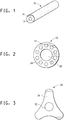
- FIG. 1 is a transverse cross sectional view of an exemplary fiber configuration useful in the present invention.
- FIG. 1 illustrates a bicomponent fiber 10 having an inner core polymer domain 12 and surrounding sheath polymer domain 14.
- Sheath component 14 is formed of a thermoplastic polymer free of polyarylene sulfide polymer.
- Core component 12 is formed of polyarylene sulfide polymer.
- sheath 14 is continuous, e.g., completely surrounds core 12 and forms the entire outer surface of fiber 10.
- Core 12 can be concentric, as illustrated in FIG. 1 .
- the core can be eccentric, as described in more detail below.
- sheath should be as virtually free of polyarylene sulfide polymer.
- FIG. 2 illustrates a cross sectional view of one such islands-in-the-sea fiber 20.
- islands-in-the-sea fibers include a "sea" polymer component 22 surrounding a plurality of "island" polymer components 24.
- the island components can be substantially uniformly arranged within the matrix of sea component 22, such as illustrated in FIG. 2 .
- the island components can be randomly distributed within the sea matrix.
- Sea component 22 forms the entire outer exposed surface of the fiber and is formed of a thermoplastic polymer free of polyarylene sulfide polymer.
- island components 24 are formed of polyarylene sulfide polymer.
- the islands-in-the-sea fiber can optionally also include a core 26, which can be concentric as illustrated or eccentric as described below. When present, core 26 is formed of any suitable fiber-forming polymer.
- the fibers of the invention also include multilobal fibers having three or more arms or lobes extending outwardly from a central portion thereof.
- FIG. 3 is a cross sectional view of an exemplary multilobal fiber 30 of the invention.
- Fiber 30 includes a central core 32 and arms or lobes 34 extending outwardly therefrom.
- the arms or lobes 34 are formed of a thermoplastic polymer free of polyarylene sulfide polymer and central core 32 is formed of polyarylene sulfide polymer.
- the core can be eccentric.
- any of these or other multicomponent fiber constructions may be used, so long as the entire exposed outer surface of the fiber is formed of the thermoplastic polymer free of polyarylene sulfide polymer.
- the cross section of the fiber is preferably circular, since the equipment typically used in the production of synthetic fibers normally produces fibers with a substantially circular cross section.
- the configuration of the first and second components can be either concentric or acentric, the latter configuration sometimes being known as a "modified side-by-side" or an "eccentric" multicomponent fiber.
- the sheath/core fibers of the invention are concentric fibers, and as such will generally be non-self crimping or non-latently crimpable fibers.
- the concentric configuration is characterized by the sheath component having a substantially uniform thickness, such that the core component lies approximately in the center of the fiber, such as illustrated in FIG. 1 .
- This is in contrast to an eccentric configuration, in which the thickness of the sheath component varies, and the core component therefore does not lie in the center of the fiber.
- Concentric sheath/core fibers can be defined as fibers in which the center of the core component is biased by no more than about 0 to about 20 percent, preferably no more than about 0 to about 10 percent, based on the diameter of the sheath/core bicomponent fiber, from the center of the sheath component.
- Islands-in-the-sea and multi-lobal fibers of the invention can also include a concentric core component substantially centrally positioned within the fiber structure, such as cores 26 and 32 illustrated in FIGS. 2 and 3 , respectively.
- the additional polymeric components can be eccentrically located so that the thickness of the surrounding thermoplastic polymer free of polyarylene sulfide polymer component varies across the cross section of the fiber.
- any of the additional polymeric components can have a substantially circular cross section, such as components 12, 24 and 32 illustrated in FIGS. 1, 2 and 3 , respectively.
- any of the additional polymeric components of the fibers of the invention can have a non-circular cross section.
- Polyarylene sulfides include linear, branched or cross linked polymers that include arylene sulfide units. Polyarylene sulfide polymers and their synthesis are known in the art and such polymers are commercially available.
- Exemplary polyarylene sulfides useful in the invention include polyarylene thioethers containing repeat units of the formula --[(Ar 1 ) n --X] m --[(Ar 2 ) i --Y] j --(Ar 3 ) k --Z] l --[(Ar 4 ) o --W] p -- wherein Ar 1 , Ar 2 , Ar 3 , and Ar 4 are the same or different and are arylene units of 6 to 18 carbon atoms; W, X, Y, and Z are the same or different and are bivalent linking groups selected from--S0 2 --,--S--,--SO--,--CO--,--O--,--COO--or alkylene or alkylidene groups of 1 to 6 carbon atoms and wherein at least one of the linking groups is--S--; and n, m, i, j, k, I, o, and p are independently zero or 1, 2, 3,
- the arylene units Ar 1 , Ar 2 , Ar 3 , and Ar 4 may be selectively substituted or unsubstituted.
- Advantageous arylene systems are phenylene, biphenylene, naphthylene, anthracene and phenanthrene.
- the polyarylene sulfide includes at least 30 mol %, particularly at least 50 mol % and more particularly at least 70 mol % arylene sulfide (--S--) units.
- the polyarylene sulfide polymer includes at least 85 mol % sulfide linkages attached directly to two aromatic rings.
- polyarylene sulfide polymer is polyphenylene sulfide (PPS), defined herein as containing the phenylene sulfide structure--(C 6 H 4 --S) n --(wherein n is an integer of 1 or more) as a component thereof.
- PPS polyphenylene sulfide
- At least one other of the polymeric components includes an aromatic polyester, an aliphatic polyester, polyamide or polyolefin polymer and mixtures thereof.
- the aromatic polyesters are selected from the group consisting of polybutylene terephthalate, polyalkylene naphthalates, polyesters derived from cyclohexanedimethanol and terephthalic acid, and mixtures thereofFurthermore, aliphatic polyesters, such as polylactic acid, and mixtures thereof can be present.
- the polyamides are selected from the group consisting of Nylon 6 and Nylon 6, 6 mixtures and copolymers thereof.
- the polyolefins are selected from a group consisting of low density polyethylene, high density polyethylene, linear low density polyethylene, copolymers of polybutene and polypropylene and polybutene, as well as co-and terpolymers and mixtures thereof.
- the at least one other polymeric component does not include a polyarylene sulfide polymer as defined above. This can reduce manufacturing costs and complexity. Yet surprisingly, despite the presence of a polymer which is not the same or chemically similar to the polyarylene sulfide polymer of the core polymeric component, the fibers of the invention exhibit sufficient integrity for downstream processing.
- the fiber-forming polymer can be an aliphatic polyester polymer, such as polylactic acid (PLA).
- aliphatic polyesters which may be useful in the present invention include without limitation fiber forming polymer formed from (1) a combination of an aliphatic glycol (e.g., ethylene, glycol, propylene glycol, butylene glycol, hexanediol, octanediol or decanediol) or an oligomer of ethylene glycol (e.g., diethylene glycol or triethylene glycol) with an aliphatic dicarboxylic acid (e.g., succinic acid, adipic acid, hexanedicarboxylic acid or decaneolicarboxylic acid) or (2) the self condensation of hydroxy carboxylic acids other than polylactic acid, such as polyhydroxy butyrate, polyethylene adipate, polybutylene adipate, polyhexane adipate,
- the fiber-forming component of the fibers of the invention can include an aromatic polyester polymer.
- Thermoplastic aromatic polymers include (1) polybutylene terephthalate; (2) polyalkylene naphthalates, which are polyesters of 2,6-naphthalenedicarboxylic acid and alkylene glycols, as for example polyethylene naphthalate; and (3) polyesters derived from 1,4-cyclohexanedimethanol and terephthalic acid, as for example polycyclohexane terephthalatePolybutylene terephthalate, is particularly useful in various applications.
- Such a polyester is well known in the art and is commercially available.
- the weight ratio of the respective polymeric components of the fibers of the invention can vary.
- the weight ratio of the polymeric components can range from about 5:95 to about 95:5.
- One advantage of the fibers of the invention is that by using a minimal amount of thermoplastic polymer free of polyarylene sulfide polymer on the exposed surface of the fiber, there is minimal adverse impact on the desired properties of the fibers, such as chemical and heat resistance.
- the thermoplastic polymer free of polyarylene sulfide component comprises less than about 30 percent by weight of the total weight of the fiber, more advantageously less than about 20 percent by weight of the total weight of the fiber and most advantageously less than about 10 percent by weight of the total weight of the fiber.
- the surface thermoplastic polymer free of polyarylene sulfide polymer component of the fiber should be minimized as much as possible.
- the polymers can optionally include other components not adversely affecting the desired properties thereof.
- Exemplary materials that could be used as additional components would include, without limitation, antimicrobials, pigments, antioxidants, stabilizers, surfactants, waxes, flow promoters, solid solvents, particulates, and other materials added to enhance processability of the first and the second components. These and other additives can be used in conventional amounts.
- multicomponent fibers of the invention are prepared using conventional multicomponent textile fiber spinning processes and apparatus and utilizing mechanical drawing techniques as known in the art. Processing conditions for the melt extrusion and fiber-formation of polyarylene sulfide polymers are well known in the art and may be employed in this invention. Processing conditions for the melt extrusion and fiber-formation of other fiber-forming polymers useful for the additional polymer component of the fibers are also known in the art and may be employed in this invention.
- At least two polymers namely, a polyarylene sulfide polymer and at least one additional fiber-forming polymer are melt extruded separately and fed into a polymer distribution system wherein the polymers are introduced into a spinneret plate.
- the polymers follow separate paths to the fiber spinneret and are combined in a spinneret hole.
- the spinneret is configured so that the extrudant has the desired shape.
- the resulting thin fluid strands, or filaments remain in the molten state before they are solidified by cooling in a surrounding fluid medium, which may be chilled air blown through the strands, or immersion in a bath of liquid such as water.
- a surrounding fluid medium which may be chilled air blown through the strands, or immersion in a bath of liquid such as water.
- the filaments are taken up on a godet or another take-up surface.
- the strands are taken up on a godet which draws down the thin fluid streams in proportion to the speed of the take-up godet.
- the jet process the strands are collected in a jet, such as for example, an air gun, and blown onto a take-up surface such as a roller or a moving belt to form a spunbond web.
- air is ejected at the surface of the spinneret, which serves to simultaneously draw down and cool the thin fluid streams as they are deposited on a take-up surface in the path of cooling air, thereby forming
- the thin fluid streams are melt drawn down in a molten state, i.e. before solidification occurs to orient the polymer molecules for good tenacity.
- Typical melt draw down ratios known in the art may be utilized.
- a continuous filament or staple process it may be desirable to draw the strands in the solid state with conventional drawing equipment, such as, for example, sequential godets operating at differential speeds.
- the continuous filaments may be crimped or texturized and cut into a desirable fiber length, thereby producing staple fiber.
- the length of the staple fibers generally ranges from about 25 to about 50 millimeters, although the fibers can be longer or shorter as desired.
- the fibers of the invention are useful in the production of a wide variety of products, including without limitation nonwoven structures, such as but not limited to carded webs, wet laid webs, dry laid webs, spunbonded webs, meltblown webs, and the like.
- the fibers of the invention can also be used to make other textile structures such as but not limited to woven and knit fabrics. Fibers other than the fibers of the invention may be present in articles produced therefrom, including any of the various synthetic and/or natural fibers known in the art.
- Exemplary synthetic fibers include polyolefin, polyester, polyamide, acrylic, rayon, cellulose acetate, thermoplastic multicomponent fibers (such as conventional sheath/core fibers, for example polyethylene sheath/polyester core fibers) and the like and mixtures thereof.
- Exemplary natural fibers include wool, cotton, wood pulp fibers and the like and mixtures thereof.
- the fibers are used as to produce filtration media.
- the fibers of the invention can exhibit good thermal and chemical resistance.
- the fibers can also exhibit good flexibility and tensile strength and can be manipulated to produce products for use in corrosive and/or high temperature environments.
- the fibers of the invention can be readily processed to produce products for use as filtration media, such as bag filters (or bag-house filters) for collecting hot dust generated by incinerators, coal fired boilers, metal melting furnaces and the like.
- Another use for the fibers of the invention is the production of insulation for hot oil transformers.
- the Flammability (NFPA-702-1980) test was used as a basis for our study. This test is primarily concerned with wearing apparel and it measures the flame resistance of materials when they are in contact with a source of ignition. A standardized flame is impinged on the lower edge of a 6.4 x 15.2 cm specimen mounted at a 45 degree angle. In our modification, the flame was applied until the sample ignited. What was then measured was ignition time and total burn time in seconds. The burn length was recorded in cm.
- a bicomponent spunbond fabric was made from polyphenylene sulfide component.
- the polyphenylene sulfide component has a nominal melt viscosity of 1700 Poise at 1200 s -1 and at a temperature of 316°C.
- the resin is available from Ticona as Fortron PPS 0317 C1.
- the polyphenylene sulfide resin was dried in a through air dryer at a temperature of 115°C, to a moisture content of less than 150 parts per million. The polymer was heated in separate extruders to 295°C.
- the polymer streams were metered to a spin-pack assembly where the two melt streams were separately filtered and then combined through a stack of distribution plates to provide multiple rows of spunbond fibers having sheath-core cross sections.
- the PPS component comprised both the sheath and core components.
- the spin pack assembly consisted of 4316 round capillary openings (155 rows where the number of capillaries vary from 22 to 28). Each capillary has a diameter of 0.35 mm and a length of 1.40 mm. The width of the pack in the MD direction was 18.02 and in the cross direction was 115.09 cm.
- the spin-pack assembly was heated to 295°C and the polymers were spun through each capillary at a polymer throughput rate of 1.0 g/hole/min.
- the fibers were cooled in a cross flow quench extending over a length of 122 cm.
- An attenuating force was provided to the bundle of fibers by a rectangular slot jet. The distance from the between the spin-pack to the entrance of the jet was 83.82 cm.
- the fibers exiting the jet were collected on a forming belt. A vacuum was applied underneath the belt to help pin the fibers to the belt.
- the spunbond layer was then thermally bonded between an embosser roll and an anvil roll. The bonding conditions were 148°C roll temperature and 300 PLI nip pressure. After thermal bonding, the spunbond sheet was formed into a roll using a winder.
- Comparative Example A Attempts to produce Comparative Example A were met with great difficulty. Within minutes of start up the spinneret surface would need to be scraped to remove any residue that had initially formed. Scraping the surface of the spinneret was often repeated on an hourly basis. The presence of un-attenuated polymer in the sheet, jet obstruction by fibrous and non-fibrous material, and forming belt contamination by molten polymer were the type of spinning defects that were often observed which led to taking the process offline to address the contaminated spinneret surface. Many of these defects would also lead to bonder wraps and sheet breaks which would also require that the process be taken offline to address,
- a bicomponent spunbond fabric was prepared as described in Comparative Example A with the exception that the fibers consisted of a poly(ethylene terephthalate) component and a polyphenylene sulfide component.
- the polyester component has an intrinsic viscosity of 0.53 dl/g available from DuPont as Crystar® polyester (Merge 4415).
- the polyphenylene sulfide component has a nominal melt viscosity of 1700 Poise at 1200 s -1 and at a temperature of 316°C.
- the resin is available from Ticona as Fortron PPS 0317 C1.
- the polyester resin was dried in a through air dryer at a temperature of 120°C, to a moisture content of less than 50 parts per million.
- the polyphenylene sulfide resin was dried in a through air dryer at a temperature of 115°C, to a moisture content of less than 150 parts per million.
- the polymers were heated in separate extruders with the polyester heated to 290°C and the polyphenylene sulfide resin heated to 295°C.
- the two polymers were metered to a spin-pack assembly where the two melt streams were separately filtered and then combined through a stack of distribution plates to provide multiple rows of spunbond fibers having a sheath-core cross sections.
- the PPS component comprised the core and the PET component comprised the sheath.
- the polyester component consisted of 10% by weight of the spun bond fibers.
- Reference Example 1 was prepared while maintaining a defect free spinning process. In fact, once process conditions were set for Reference Example 1, the process ran for more than 3 hours without need for shutdown or operator involvement. Once the requisite product was produced the production of Reference Example 1 was discontinued. It was found that the spinneret surface was free of contamination or monomer residue during that time.
- Reference Example 2 was prepared similarly to Example 1 except the PET component was 15%.
- Reference Example 2 was prepared while maintaining a defect free spinning process. The process ran for more than 3 hours without need for shutdown or operator involvement. Once the requisite product was produced the production of Reference Example 2 was discontinued. It was found that the spinneret surface was free of contamination or monomer residue during that time.
- Reference Example 3 was prepared similarly to Example 1 except the PET component was 20%.
- Reference Example 3 was prepared while maintaining a defect free spinning process. The process ran for more than 3 hours without need for shutdown or operator involvement. Once the requisite product was produced the production of Reference Example 3 was discontinued. Separately, an effort was made to demonstrate process continuity as it relates to Reference Example 3. The process was brought online and permitted to run for more than 7 hours without interruption. Examination of the spinneret surface revealed that it was substantially free of contamination or monomer residue.
- Reference Example 4 was prepared similarly to Example 1 except the PET component was 25%.
- Reference Example 4 was prepared while maintaining a defect free spinning process. The process ran for more than 3 hours without need for shutdown or operator involvement. Once the requisite product was produced the production of Reference Example 4 was discontinued. It was found that the spinneret surface was free of contamination or monomer residue during that time.
- Reference Example 5 was prepared similarly to Example 1 except the PET component was 50%.
- Reference Example 5 was prepared while maintaining a defect free spinning process. The process ran for more than 3 hours without need for shutdown or operator involvement. Once the requisite product was produced the production of Reference Example 5 was discontinued. It was found that the spinneret surface was free of contamination or monomer residue during that time.
- Reference Example 6 was prepared similarly to Reference Example 1 except the PET component was 75%.
- Reference Example 6 was prepared while maintaining a defect free spinning process. The process ran for more than 3 hours without need for shutdown or operator involvement. Once the requisite product was produced the production of Reference Example 6 was discontinued. It was found that the spinneret surface was free of contamination or monomer residue during that time.
Landscapes
- Chemical & Material Sciences (AREA)
- Chemical Kinetics & Catalysis (AREA)
- General Chemical & Material Sciences (AREA)
- Engineering & Computer Science (AREA)
- Textile Engineering (AREA)
- Multicomponent Fibers (AREA)
- Nonwoven Fabrics (AREA)
Applications Claiming Priority (2)
| Application Number | Priority Date | Filing Date | Title |
|---|---|---|---|
| US12/001,803 US7998577B2 (en) | 2007-12-13 | 2007-12-13 | Multicomponent fiber with polyarylene sulfide component |
| PCT/US2008/086264 WO2009076459A1 (en) | 2007-12-13 | 2008-12-10 | Multicomponent fiber with polyarylene sulfide component |
Publications (2)
| Publication Number | Publication Date |
|---|---|
| EP2220272A1 EP2220272A1 (en) | 2010-08-25 |
| EP2220272B1 true EP2220272B1 (en) | 2019-05-08 |
Family
ID=40433561
Family Applications (1)
| Application Number | Title | Priority Date | Filing Date |
|---|---|---|---|
| EP08859962.6A Active EP2220272B1 (en) | 2007-12-13 | 2008-12-10 | Multicomponent fiber with polyarylene sulfide component |
Country Status (5)
| Country | Link |
|---|---|
| US (1) | US7998577B2 (enExample) |
| EP (1) | EP2220272B1 (enExample) |
| JP (1) | JP5547651B2 (enExample) |
| CN (1) | CN101896652B (enExample) |
| WO (1) | WO2009076459A1 (enExample) |
Families Citing this family (18)
| Publication number | Priority date | Publication date | Assignee | Title |
|---|---|---|---|---|
| US7998577B2 (en) * | 2007-12-13 | 2011-08-16 | E. I. Du Pont De Nemours And Company | Multicomponent fiber with polyarylene sulfide component |
| US7998578B2 (en) * | 2008-12-16 | 2011-08-16 | E.I. Du Pont De Nemours And Company | Polyphenylene sulfide spunbond fiber |
| KR101156193B1 (ko) * | 2010-03-15 | 2012-06-18 | 코오롱글로텍주식회사 | 난연성 및 일광견뢰도가 우수한 복합섬유 및 이를 활용한 인테리어 원단 |
| WO2011119546A2 (en) | 2010-03-22 | 2011-09-29 | E. I. Du Pont De Nemours And Company | Cure acceleration of polymeric structures |
| CN103328704B (zh) * | 2011-03-22 | 2015-03-18 | 东丽株式会社 | 聚苯硫醚复合纤维及无纺布 |
| CN102898836A (zh) * | 2011-07-29 | 2013-01-30 | 中纺投资发展股份有限公司 | 一种聚苯硫醚和聚酰胺的组合物及其纤维 |
| CN102898837A (zh) * | 2011-07-29 | 2013-01-30 | 中纺投资发展股份有限公司 | 一种聚苯硫醚组合物及其纤维 |
| US20150159303A1 (en) * | 2012-07-12 | 2015-06-11 | Kb Seiren, Ltd. | Core-Sheath Conjugated Fiber |
| JP6201558B2 (ja) * | 2012-09-21 | 2017-09-27 | 東レ株式会社 | ポリフェニレンスルフィド繊維および不織布 |
| KR102030381B1 (ko) * | 2012-09-21 | 2019-10-10 | 도레이 카부시키가이샤 | 폴리페닐렌술피드 복합 섬유 및 부직포 |
| US20140170415A1 (en) * | 2012-12-19 | 2014-06-19 | Ticona Llc | Multicomponent Fiber Containing a Polyarylene Sulfide |
| US8951325B2 (en) | 2013-02-27 | 2015-02-10 | Bha Altair, Llc | Bi-component fiber and filter media including bi-component fibers |
| US20140308866A1 (en) * | 2013-04-10 | 2014-10-16 | E I Du Pont De Nemours And Company | Acid Resistant Fibers.of Polyarylene and Polymethylpentene |
| US20140308868A1 (en) * | 2013-04-10 | 2014-10-16 | E I Du Pont De Nemours And Company | Acid Resistant Fibers of Polyarylene Sulfide and Norbornene Copolymer |
| CN104958954B (zh) * | 2015-06-09 | 2017-03-01 | 铜陵华洋特种线材有限责任公司 | 高强度工业滤布及其制备方法 |
| US11692284B2 (en) | 2016-08-18 | 2023-07-04 | Aladdin Manufacturing Corporation | Trilobal filaments and spinnerets for producing the same |
| USD841838S1 (en) | 2016-11-04 | 2019-02-26 | Mohawk Industries, Inc. | Filament |
| JP7031577B2 (ja) * | 2017-04-04 | 2022-03-08 | 東レ株式会社 | 多孔質繊維および吸着カラム |
Family Cites Families (26)
| Publication number | Priority date | Publication date | Assignee | Title |
|---|---|---|---|---|
| WO1988002414A1 (fr) * | 1986-09-26 | 1988-04-07 | Toray Industries, Inc. | Fibre de polyphenylene sulfone |
| US5244467A (en) * | 1986-09-26 | 1993-09-14 | Toray Industries, Inc. | Method for production of polyphenylene sulfone fibers |
| CA1335745C (en) * | 1986-09-26 | 1995-05-30 | Masao Umezawa | Polyphenylene sulfone fibers and a method for production thereof |
| JP2562350B2 (ja) * | 1988-05-30 | 1996-12-11 | 呉羽化学工業株式会社 | 耐熱性複合繊維およびその製造方法 |
| GB2228892A (en) * | 1989-03-06 | 1990-09-12 | Courtaulds Plc | Filaments and hot gas filter |
| JP2820976B2 (ja) * | 1989-09-19 | 1998-11-05 | 株式会社クラレ | 寸法安定性に優れた複合繊維及びその製造方法 |
| US5178813A (en) * | 1990-03-23 | 1993-01-12 | Kureha Kagaku Kogyo K.K. | Method of producing poly(phenylene sulfide) fibers |
| US5424125A (en) * | 1994-04-11 | 1995-06-13 | Shakespeare Company | Monofilaments from polymer blends and fabrics thereof |
| US6110589A (en) * | 1995-12-11 | 2000-08-29 | Pall Corporation | Polyarylene sulfide melt blown fibers and products |
| US6110249A (en) * | 1999-03-26 | 2000-08-29 | Bha Technologies, Inc. | Filter element with membrane and bicomponent substrate |
| JP4030688B2 (ja) * | 1999-08-18 | 2008-01-09 | 株式会社クラレ | 基布 |
| DE19963242C1 (de) * | 1999-12-27 | 2001-07-26 | Johns Manville Int Inc | Hochmodul Bikomponenten-Monofile und deren Verwendung |
| US6730439B2 (en) * | 2000-08-01 | 2004-05-04 | Tonen Tapyrus Co., Ltd. | Heat-resistant separator |
| JP2002151358A (ja) * | 2000-11-15 | 2002-05-24 | Kuraray Co Ltd | キャパシタ用セパレータおよびその製造方法 |
| JP2003096622A (ja) * | 2001-09-26 | 2003-04-03 | Toyobo Co Ltd | 有機繊維系強化材及びそれを用いた繊維強化成形材料 |
| US20040235383A1 (en) * | 2003-05-23 | 2004-11-25 | Celanese Advanced Materials, Inc. | Fabric and yarn for protective garments |
| JP4069057B2 (ja) * | 2003-10-29 | 2008-03-26 | タピルス株式会社 | 高性能エアフィルタ |
| US20050095935A1 (en) * | 2003-11-03 | 2005-05-05 | Mark Levine | Durable highly conductive synthetic fabric construction |
| US6949288B2 (en) * | 2003-12-04 | 2005-09-27 | Fiber Innovation Technology, Inc. | Multicomponent fiber with polyarylene sulfide component |
| US20050269011A1 (en) * | 2004-06-02 | 2005-12-08 | Ticona Llc | Methods of making spunbonded fabrics from blends of polyarylene sulfide and a crystallinity enhancer |
| JP4705386B2 (ja) * | 2005-03-10 | 2011-06-22 | 帝人ファイバー株式会社 | 繊維強化プラスチックの製造方法および強化用繊維材料 |
| US20080070021A1 (en) * | 2005-03-23 | 2008-03-20 | E. I. Du Pont De Nemours And Company | Flash spun sheet material having improved breathability |
| JP2006274503A (ja) * | 2005-03-30 | 2006-10-12 | Toray Ind Inc | ポリマーアロイ繊維からなる乾式不織布 |
| CN1948564A (zh) * | 2006-10-25 | 2007-04-18 | 东华大学 | 一种复合纤维及其制备方法 |
| CN101605932A (zh) * | 2007-03-23 | 2009-12-16 | 索维高级聚合物股份有限公司 | 聚合物纤维、引入此类聚合物纤维的装置和引入此类过滤装置的系统 |
| US7998577B2 (en) * | 2007-12-13 | 2011-08-16 | E. I. Du Pont De Nemours And Company | Multicomponent fiber with polyarylene sulfide component |
-
2007
- 2007-12-13 US US12/001,803 patent/US7998577B2/en active Active
-
2008
- 2008-12-10 WO PCT/US2008/086264 patent/WO2009076459A1/en not_active Ceased
- 2008-12-10 JP JP2010538135A patent/JP5547651B2/ja active Active
- 2008-12-10 CN CN2008801203006A patent/CN101896652B/zh active Active
- 2008-12-10 EP EP08859962.6A patent/EP2220272B1/en active Active
Non-Patent Citations (1)
| Title |
|---|
| None * |
Also Published As
| Publication number | Publication date |
|---|---|
| JP5547651B2 (ja) | 2014-07-16 |
| JP2011506790A (ja) | 2011-03-03 |
| US7998577B2 (en) | 2011-08-16 |
| WO2009076459A1 (en) | 2009-06-18 |
| CN101896652B (zh) | 2013-06-19 |
| EP2220272A1 (en) | 2010-08-25 |
| CN101896652A (zh) | 2010-11-24 |
| US20090156075A1 (en) | 2009-06-18 |
Similar Documents
| Publication | Publication Date | Title |
|---|---|---|
| US7998577B2 (en) | Multicomponent fiber with polyarylene sulfide component | |
| US6949288B2 (en) | Multicomponent fiber with polyarylene sulfide component | |
| EP3284854B1 (en) | A continuous bicomponent filament formed from a single polymer system | |
| KR910005016B1 (ko) | 폴리아릴렌 설파이드 부직포 | |
| CN104641027B (zh) | 聚苯硫醚复合纤维及无纺布 | |
| KR20130007619A (ko) | 부직 웨브의 제조 방법 | |
| KR20130019394A (ko) | 부직포 웨브 | |
| US5695869A (en) | Melt-blown polyarylene sulfide microfibers and method of making the same | |
| JP2008504460A (ja) | スプリットファイバーの集合体 | |
| US20140308866A1 (en) | Acid Resistant Fibers.of Polyarylene and Polymethylpentene | |
| US20070207317A1 (en) | Splittable multicomponent fiber with high temperature, corrosion resistant polymer | |
| EP1074644A1 (en) | Resilient multicomponent fibers and fabrics formed of the same | |
| US20140308868A1 (en) | Acid Resistant Fibers of Polyarylene Sulfide and Norbornene Copolymer | |
| JP7681110B2 (ja) | 芯鞘型スパンボンド不織布およびその製造方法 | |
| CN120548389A (zh) | 复合喷丝头、及复合纤维的制造方法 | |
| HK1251268B (en) | A continuous bicomponent filament formed from a single polymer system | |
| HK1142932B (en) | Area bonded nonwoven fabric from single polymer system | |
| HK1142932A (en) | Area bonded nonwoven fabric from single polymer system | |
| HK1099348A (en) | Multicomponent fiber with polyarylene sulfide component |
Legal Events
| Date | Code | Title | Description |
|---|---|---|---|
| PUAI | Public reference made under article 153(3) epc to a published international application that has entered the european phase |
Free format text: ORIGINAL CODE: 0009012 |
|
| 17P | Request for examination filed |
Effective date: 20100524 |
|
| AK | Designated contracting states |
Kind code of ref document: A1 Designated state(s): AT BE BG CH CY CZ DE DK EE ES FI FR GB GR HR HU IE IS IT LI LT LU LV MC MT NL NO PL PT RO SE SI SK TR |
|
| AX | Request for extension of the european patent |
Extension state: AL BA MK RS |
|
| DAX | Request for extension of the european patent (deleted) | ||
| 17Q | First examination report despatched |
Effective date: 20130729 |
|
| STAA | Information on the status of an ep patent application or granted ep patent |
Free format text: STATUS: EXAMINATION IS IN PROGRESS |
|
| REG | Reference to a national code |
Ref country code: DE Ref legal event code: R079 Ref document number: 602008060043 Country of ref document: DE Free format text: PREVIOUS MAIN CLASS: D01F0008040000 Ipc: D01F0008160000 |
|
| GRAP | Despatch of communication of intention to grant a patent |
Free format text: ORIGINAL CODE: EPIDOSNIGR1 |
|
| STAA | Information on the status of an ep patent application or granted ep patent |
Free format text: STATUS: GRANT OF PATENT IS INTENDED |
|
| RIC1 | Information provided on ipc code assigned before grant |
Ipc: D01F 8/16 20060101AFI20181212BHEP |
|
| INTG | Intention to grant announced |
Effective date: 20190111 |
|
| GRAS | Grant fee paid |
Free format text: ORIGINAL CODE: EPIDOSNIGR3 |
|
| GRAA | (expected) grant |
Free format text: ORIGINAL CODE: 0009210 |
|
| STAA | Information on the status of an ep patent application or granted ep patent |
Free format text: STATUS: THE PATENT HAS BEEN GRANTED |
|
| AK | Designated contracting states |
Kind code of ref document: B1 Designated state(s): AT BE BG CH CY CZ DE DK EE ES FI FR GB GR HR HU IE IS IT LI LT LU LV MC MT NL NO PL PT RO SE SI SK TR |
|
| REG | Reference to a national code |
Ref country code: GB Ref legal event code: FG4D |
|
| REG | Reference to a national code |
Ref country code: CH Ref legal event code: EP Ref country code: AT Ref legal event code: REF Ref document number: 1130276 Country of ref document: AT Kind code of ref document: T Effective date: 20190515 |
|
| REG | Reference to a national code |
Ref country code: DE Ref legal event code: R096 Ref document number: 602008060043 Country of ref document: DE |
|
| REG | Reference to a national code |
Ref country code: IE Ref legal event code: FG4D |
|
| REG | Reference to a national code |
Ref country code: NL Ref legal event code: MP Effective date: 20190508 |
|
| REG | Reference to a national code |
Ref country code: LT Ref legal event code: MG4D |
|
| PG25 | Lapsed in a contracting state [announced via postgrant information from national office to epo] |
Ref country code: NO Free format text: LAPSE BECAUSE OF FAILURE TO SUBMIT A TRANSLATION OF THE DESCRIPTION OR TO PAY THE FEE WITHIN THE PRESCRIBED TIME-LIMIT Effective date: 20190808 Ref country code: PT Free format text: LAPSE BECAUSE OF FAILURE TO SUBMIT A TRANSLATION OF THE DESCRIPTION OR TO PAY THE FEE WITHIN THE PRESCRIBED TIME-LIMIT Effective date: 20190908 Ref country code: FI Free format text: LAPSE BECAUSE OF FAILURE TO SUBMIT A TRANSLATION OF THE DESCRIPTION OR TO PAY THE FEE WITHIN THE PRESCRIBED TIME-LIMIT Effective date: 20190508 Ref country code: NL Free format text: LAPSE BECAUSE OF FAILURE TO SUBMIT A TRANSLATION OF THE DESCRIPTION OR TO PAY THE FEE WITHIN THE PRESCRIBED TIME-LIMIT Effective date: 20190508 Ref country code: SE Free format text: LAPSE BECAUSE OF FAILURE TO SUBMIT A TRANSLATION OF THE DESCRIPTION OR TO PAY THE FEE WITHIN THE PRESCRIBED TIME-LIMIT Effective date: 20190508 Ref country code: HR Free format text: LAPSE BECAUSE OF FAILURE TO SUBMIT A TRANSLATION OF THE DESCRIPTION OR TO PAY THE FEE WITHIN THE PRESCRIBED TIME-LIMIT Effective date: 20190508 Ref country code: ES Free format text: LAPSE BECAUSE OF FAILURE TO SUBMIT A TRANSLATION OF THE DESCRIPTION OR TO PAY THE FEE WITHIN THE PRESCRIBED TIME-LIMIT Effective date: 20190508 Ref country code: LT Free format text: LAPSE BECAUSE OF FAILURE TO SUBMIT A TRANSLATION OF THE DESCRIPTION OR TO PAY THE FEE WITHIN THE PRESCRIBED TIME-LIMIT Effective date: 20190508 |
|
| PG25 | Lapsed in a contracting state [announced via postgrant information from national office to epo] |
Ref country code: BG Free format text: LAPSE BECAUSE OF FAILURE TO SUBMIT A TRANSLATION OF THE DESCRIPTION OR TO PAY THE FEE WITHIN THE PRESCRIBED TIME-LIMIT Effective date: 20190808 Ref country code: LV Free format text: LAPSE BECAUSE OF FAILURE TO SUBMIT A TRANSLATION OF THE DESCRIPTION OR TO PAY THE FEE WITHIN THE PRESCRIBED TIME-LIMIT Effective date: 20190508 Ref country code: GR Free format text: LAPSE BECAUSE OF FAILURE TO SUBMIT A TRANSLATION OF THE DESCRIPTION OR TO PAY THE FEE WITHIN THE PRESCRIBED TIME-LIMIT Effective date: 20190809 |
|
| REG | Reference to a national code |
Ref country code: AT Ref legal event code: MK05 Ref document number: 1130276 Country of ref document: AT Kind code of ref document: T Effective date: 20190508 |
|
| PG25 | Lapsed in a contracting state [announced via postgrant information from national office to epo] |
Ref country code: CZ Free format text: LAPSE BECAUSE OF FAILURE TO SUBMIT A TRANSLATION OF THE DESCRIPTION OR TO PAY THE FEE WITHIN THE PRESCRIBED TIME-LIMIT Effective date: 20190508 Ref country code: RO Free format text: LAPSE BECAUSE OF FAILURE TO SUBMIT A TRANSLATION OF THE DESCRIPTION OR TO PAY THE FEE WITHIN THE PRESCRIBED TIME-LIMIT Effective date: 20190508 Ref country code: DK Free format text: LAPSE BECAUSE OF FAILURE TO SUBMIT A TRANSLATION OF THE DESCRIPTION OR TO PAY THE FEE WITHIN THE PRESCRIBED TIME-LIMIT Effective date: 20190508 Ref country code: AT Free format text: LAPSE BECAUSE OF FAILURE TO SUBMIT A TRANSLATION OF THE DESCRIPTION OR TO PAY THE FEE WITHIN THE PRESCRIBED TIME-LIMIT Effective date: 20190508 Ref country code: EE Free format text: LAPSE BECAUSE OF FAILURE TO SUBMIT A TRANSLATION OF THE DESCRIPTION OR TO PAY THE FEE WITHIN THE PRESCRIBED TIME-LIMIT Effective date: 20190508 Ref country code: SK Free format text: LAPSE BECAUSE OF FAILURE TO SUBMIT A TRANSLATION OF THE DESCRIPTION OR TO PAY THE FEE WITHIN THE PRESCRIBED TIME-LIMIT Effective date: 20190508 |
|
| REG | Reference to a national code |
Ref country code: DE Ref legal event code: R097 Ref document number: 602008060043 Country of ref document: DE |
|
| PG25 | Lapsed in a contracting state [announced via postgrant information from national office to epo] |
Ref country code: IT Free format text: LAPSE BECAUSE OF FAILURE TO SUBMIT A TRANSLATION OF THE DESCRIPTION OR TO PAY THE FEE WITHIN THE PRESCRIBED TIME-LIMIT Effective date: 20190508 |
|
| PLBE | No opposition filed within time limit |
Free format text: ORIGINAL CODE: 0009261 |
|
| STAA | Information on the status of an ep patent application or granted ep patent |
Free format text: STATUS: NO OPPOSITION FILED WITHIN TIME LIMIT |
|
| PG25 | Lapsed in a contracting state [announced via postgrant information from national office to epo] |
Ref country code: TR Free format text: LAPSE BECAUSE OF FAILURE TO SUBMIT A TRANSLATION OF THE DESCRIPTION OR TO PAY THE FEE WITHIN THE PRESCRIBED TIME-LIMIT Effective date: 20190508 |
|
| 26N | No opposition filed |
Effective date: 20200211 |
|
| PG25 | Lapsed in a contracting state [announced via postgrant information from national office to epo] |
Ref country code: PL Free format text: LAPSE BECAUSE OF FAILURE TO SUBMIT A TRANSLATION OF THE DESCRIPTION OR TO PAY THE FEE WITHIN THE PRESCRIBED TIME-LIMIT Effective date: 20190508 |
|
| PG25 | Lapsed in a contracting state [announced via postgrant information from national office to epo] |
Ref country code: SI Free format text: LAPSE BECAUSE OF FAILURE TO SUBMIT A TRANSLATION OF THE DESCRIPTION OR TO PAY THE FEE WITHIN THE PRESCRIBED TIME-LIMIT Effective date: 20190508 |
|
| REG | Reference to a national code |
Ref country code: CH Ref legal event code: PL |
|
| REG | Reference to a national code |
Ref country code: BE Ref legal event code: MM Effective date: 20191231 |
|
| PG25 | Lapsed in a contracting state [announced via postgrant information from national office to epo] |
Ref country code: MC Free format text: LAPSE BECAUSE OF FAILURE TO SUBMIT A TRANSLATION OF THE DESCRIPTION OR TO PAY THE FEE WITHIN THE PRESCRIBED TIME-LIMIT Effective date: 20190508 |
|
| PG25 | Lapsed in a contracting state [announced via postgrant information from national office to epo] |
Ref country code: LU Free format text: LAPSE BECAUSE OF NON-PAYMENT OF DUE FEES Effective date: 20191210 Ref country code: IE Free format text: LAPSE BECAUSE OF NON-PAYMENT OF DUE FEES Effective date: 20191210 |
|
| PG25 | Lapsed in a contracting state [announced via postgrant information from national office to epo] |
Ref country code: CH Free format text: LAPSE BECAUSE OF NON-PAYMENT OF DUE FEES Effective date: 20191231 Ref country code: LI Free format text: LAPSE BECAUSE OF NON-PAYMENT OF DUE FEES Effective date: 20191231 Ref country code: BE Free format text: LAPSE BECAUSE OF NON-PAYMENT OF DUE FEES Effective date: 20191231 |
|
| PG25 | Lapsed in a contracting state [announced via postgrant information from national office to epo] |
Ref country code: CY Free format text: LAPSE BECAUSE OF FAILURE TO SUBMIT A TRANSLATION OF THE DESCRIPTION OR TO PAY THE FEE WITHIN THE PRESCRIBED TIME-LIMIT Effective date: 20190508 |
|
| PG25 | Lapsed in a contracting state [announced via postgrant information from national office to epo] |
Ref country code: IS Free format text: LAPSE BECAUSE OF FAILURE TO SUBMIT A TRANSLATION OF THE DESCRIPTION OR TO PAY THE FEE WITHIN THE PRESCRIBED TIME-LIMIT Effective date: 20190908 |
|
| PG25 | Lapsed in a contracting state [announced via postgrant information from national office to epo] |
Ref country code: HU Free format text: LAPSE BECAUSE OF FAILURE TO SUBMIT A TRANSLATION OF THE DESCRIPTION OR TO PAY THE FEE WITHIN THE PRESCRIBED TIME-LIMIT; INVALID AB INITIO Effective date: 20081210 Ref country code: MT Free format text: LAPSE BECAUSE OF FAILURE TO SUBMIT A TRANSLATION OF THE DESCRIPTION OR TO PAY THE FEE WITHIN THE PRESCRIBED TIME-LIMIT Effective date: 20190508 |
|
| REG | Reference to a national code |
Ref country code: DE Ref legal event code: R081 Ref document number: 602008060043 Country of ref document: DE Owner name: DUPONT SAFETY & CONSTRUCTION, INC., WILMINGTON, US Free format text: FORMER OWNER: E. I. DU PONT DE NEMOURS AND COMPANY, WILMINGTON, DEL., US |
|
| REG | Reference to a national code |
Ref country code: GB Ref legal event code: 732E Free format text: REGISTERED BETWEEN 20221027 AND 20221102 |
|
| P01 | Opt-out of the competence of the unified patent court (upc) registered |
Effective date: 20230528 |
|
| PGFP | Annual fee paid to national office [announced via postgrant information from national office to epo] |
Ref country code: DE Payment date: 20251104 Year of fee payment: 18 |
|
| PGFP | Annual fee paid to national office [announced via postgrant information from national office to epo] |
Ref country code: GB Payment date: 20251030 Year of fee payment: 18 |
|
| PGFP | Annual fee paid to national office [announced via postgrant information from national office to epo] |
Ref country code: FR Payment date: 20251110 Year of fee payment: 18 |