EP2219562B1 - Zwischenwirbelimplantat - Google Patents
Zwischenwirbelimplantat Download PDFInfo
- Publication number
- EP2219562B1 EP2219562B1 EP08853677.6A EP08853677A EP2219562B1 EP 2219562 B1 EP2219562 B1 EP 2219562B1 EP 08853677 A EP08853677 A EP 08853677A EP 2219562 B1 EP2219562 B1 EP 2219562B1
- Authority
- EP
- European Patent Office
- Prior art keywords
- channels
- bone
- openings
- implant
- intervertebral implant
- Prior art date
- Legal status (The legal status is an assumption and is not a legal conclusion. Google has not performed a legal analysis and makes no representation as to the accuracy of the status listed.)
- Active
Links
Images


Classifications
-
- A—HUMAN NECESSITIES
- A61—MEDICAL OR VETERINARY SCIENCE; HYGIENE
- A61F—FILTERS IMPLANTABLE INTO BLOOD VESSELS; PROSTHESES; DEVICES PROVIDING PATENCY TO, OR PREVENTING COLLAPSING OF, TUBULAR STRUCTURES OF THE BODY, e.g. STENTS; ORTHOPAEDIC, NURSING OR CONTRACEPTIVE DEVICES; FOMENTATION; TREATMENT OR PROTECTION OF EYES OR EARS; BANDAGES, DRESSINGS OR ABSORBENT PADS; FIRST-AID KITS
- A61F2/00—Filters implantable into blood vessels; Prostheses, i.e. artificial substitutes or replacements for parts of the body; Appliances for connecting them with the body; Devices providing patency to, or preventing collapsing of, tubular structures of the body, e.g. stents
- A61F2/02—Prostheses implantable into the body
- A61F2/30—Joints
- A61F2/30767—Special external or bone-contacting surface, e.g. coating for improving bone ingrowth
- A61F2/30771—Special external or bone-contacting surface, e.g. coating for improving bone ingrowth applied in original prostheses, e.g. holes or grooves
-
- A—HUMAN NECESSITIES
- A61—MEDICAL OR VETERINARY SCIENCE; HYGIENE
- A61B—DIAGNOSIS; SURGERY; IDENTIFICATION
- A61B17/00—Surgical instruments, devices or methods
- A61B17/56—Surgical instruments or methods for treatment of bones or joints; Devices specially adapted therefor
- A61B17/58—Surgical instruments or methods for treatment of bones or joints; Devices specially adapted therefor for osteosynthesis, e.g. bone plates, screws or setting implements
- A61B17/68—Internal fixation devices, including fasteners and spinal fixators, even if a part thereof projects from the skin
-
- A—HUMAN NECESSITIES
- A61—MEDICAL OR VETERINARY SCIENCE; HYGIENE
- A61F—FILTERS IMPLANTABLE INTO BLOOD VESSELS; PROSTHESES; DEVICES PROVIDING PATENCY TO, OR PREVENTING COLLAPSING OF, TUBULAR STRUCTURES OF THE BODY, e.g. STENTS; ORTHOPAEDIC, NURSING OR CONTRACEPTIVE DEVICES; FOMENTATION; TREATMENT OR PROTECTION OF EYES OR EARS; BANDAGES, DRESSINGS OR ABSORBENT PADS; FIRST-AID KITS
- A61F2/00—Filters implantable into blood vessels; Prostheses, i.e. artificial substitutes or replacements for parts of the body; Appliances for connecting them with the body; Devices providing patency to, or preventing collapsing of, tubular structures of the body, e.g. stents
- A61F2/02—Prostheses implantable into the body
- A61F2/30—Joints
- A61F2/32—Joints for the hip
- A61F2/36—Femoral heads ; Femoral endoprostheses
- A61F2/3601—Femoral heads ; Femoral endoprostheses for replacing only the epiphyseal or metaphyseal parts of the femur, e.g. endoprosthetic femoral heads or necks directly fixed to the natural femur by internal fixation devices
-
- A—HUMAN NECESSITIES
- A61—MEDICAL OR VETERINARY SCIENCE; HYGIENE
- A61F—FILTERS IMPLANTABLE INTO BLOOD VESSELS; PROSTHESES; DEVICES PROVIDING PATENCY TO, OR PREVENTING COLLAPSING OF, TUBULAR STRUCTURES OF THE BODY, e.g. STENTS; ORTHOPAEDIC, NURSING OR CONTRACEPTIVE DEVICES; FOMENTATION; TREATMENT OR PROTECTION OF EYES OR EARS; BANDAGES, DRESSINGS OR ABSORBENT PADS; FIRST-AID KITS
- A61F2/00—Filters implantable into blood vessels; Prostheses, i.e. artificial substitutes or replacements for parts of the body; Appliances for connecting them with the body; Devices providing patency to, or preventing collapsing of, tubular structures of the body, e.g. stents
- A61F2/02—Prostheses implantable into the body
- A61F2/30—Joints
- A61F2/32—Joints for the hip
- A61F2/36—Femoral heads ; Femoral endoprostheses
- A61F2/3601—Femoral heads ; Femoral endoprostheses for replacing only the epiphyseal or metaphyseal parts of the femur, e.g. endoprosthetic femoral heads or necks directly fixed to the natural femur by internal fixation devices
- A61F2/3603—Femoral heads ; Femoral endoprostheses for replacing only the epiphyseal or metaphyseal parts of the femur, e.g. endoprosthetic femoral heads or necks directly fixed to the natural femur by internal fixation devices implanted without ablation of the whole natural femoral head
-
- A—HUMAN NECESSITIES
- A61—MEDICAL OR VETERINARY SCIENCE; HYGIENE
- A61F—FILTERS IMPLANTABLE INTO BLOOD VESSELS; PROSTHESES; DEVICES PROVIDING PATENCY TO, OR PREVENTING COLLAPSING OF, TUBULAR STRUCTURES OF THE BODY, e.g. STENTS; ORTHOPAEDIC, NURSING OR CONTRACEPTIVE DEVICES; FOMENTATION; TREATMENT OR PROTECTION OF EYES OR EARS; BANDAGES, DRESSINGS OR ABSORBENT PADS; FIRST-AID KITS
- A61F2/00—Filters implantable into blood vessels; Prostheses, i.e. artificial substitutes or replacements for parts of the body; Appliances for connecting them with the body; Devices providing patency to, or preventing collapsing of, tubular structures of the body, e.g. stents
- A61F2/02—Prostheses implantable into the body
- A61F2/30—Joints
- A61F2/32—Joints for the hip
- A61F2/36—Femoral heads ; Femoral endoprostheses
- A61F2/3662—Femoral shafts
-
- A—HUMAN NECESSITIES
- A61—MEDICAL OR VETERINARY SCIENCE; HYGIENE
- A61F—FILTERS IMPLANTABLE INTO BLOOD VESSELS; PROSTHESES; DEVICES PROVIDING PATENCY TO, OR PREVENTING COLLAPSING OF, TUBULAR STRUCTURES OF THE BODY, e.g. STENTS; ORTHOPAEDIC, NURSING OR CONTRACEPTIVE DEVICES; FOMENTATION; TREATMENT OR PROTECTION OF EYES OR EARS; BANDAGES, DRESSINGS OR ABSORBENT PADS; FIRST-AID KITS
- A61F2/00—Filters implantable into blood vessels; Prostheses, i.e. artificial substitutes or replacements for parts of the body; Appliances for connecting them with the body; Devices providing patency to, or preventing collapsing of, tubular structures of the body, e.g. stents
- A61F2/02—Prostheses implantable into the body
- A61F2/30—Joints
- A61F2/44—Joints for the spine, e.g. vertebrae or spinal discs
- A61F2/4455—Joints for the spine, e.g. vertebrae or spinal discs for the fusion of spinal bodies, e.g. intervertebral fusion of adjacent spinal bodies, e.g. fusion cages
- A61F2/4465—Joints for the spine, e.g. vertebrae or spinal discs for the fusion of spinal bodies, e.g. intervertebral fusion of adjacent spinal bodies, e.g. fusion cages having a circular or kidney shaped cross-section substantially perpendicular to the axis of the spine
-
- A—HUMAN NECESSITIES
- A61—MEDICAL OR VETERINARY SCIENCE; HYGIENE
- A61B—DIAGNOSIS; SURGERY; IDENTIFICATION
- A61B17/00—Surgical instruments, devices or methods
- A61B17/14—Surgical saws
- A61B17/15—Guides therefor
- A61B17/151—Guides therefor for corrective osteotomy
- A61B17/152—Guides therefor for corrective osteotomy for removing a wedge-shaped piece of bone
-
- A—HUMAN NECESSITIES
- A61—MEDICAL OR VETERINARY SCIENCE; HYGIENE
- A61B—DIAGNOSIS; SURGERY; IDENTIFICATION
- A61B17/00—Surgical instruments, devices or methods
- A61B17/56—Surgical instruments or methods for treatment of bones or joints; Devices specially adapted therefor
- A61B17/58—Surgical instruments or methods for treatment of bones or joints; Devices specially adapted therefor for osteosynthesis, e.g. bone plates, screws or setting implements
- A61B17/68—Internal fixation devices, including fasteners and spinal fixators, even if a part thereof projects from the skin
- A61B17/80—Cortical plates, i.e. bone plates; Instruments for holding or positioning cortical plates, or for compressing bones attached to cortical plates
- A61B17/8095—Wedge osteotomy devices
-
- A—HUMAN NECESSITIES
- A61—MEDICAL OR VETERINARY SCIENCE; HYGIENE
- A61F—FILTERS IMPLANTABLE INTO BLOOD VESSELS; PROSTHESES; DEVICES PROVIDING PATENCY TO, OR PREVENTING COLLAPSING OF, TUBULAR STRUCTURES OF THE BODY, e.g. STENTS; ORTHOPAEDIC, NURSING OR CONTRACEPTIVE DEVICES; FOMENTATION; TREATMENT OR PROTECTION OF EYES OR EARS; BANDAGES, DRESSINGS OR ABSORBENT PADS; FIRST-AID KITS
- A61F2/00—Filters implantable into blood vessels; Prostheses, i.e. artificial substitutes or replacements for parts of the body; Appliances for connecting them with the body; Devices providing patency to, or preventing collapsing of, tubular structures of the body, e.g. stents
- A61F2/02—Prostheses implantable into the body
- A61F2/30—Joints
- A61F2/38—Joints for elbows or knees
-
- A—HUMAN NECESSITIES
- A61—MEDICAL OR VETERINARY SCIENCE; HYGIENE
- A61F—FILTERS IMPLANTABLE INTO BLOOD VESSELS; PROSTHESES; DEVICES PROVIDING PATENCY TO, OR PREVENTING COLLAPSING OF, TUBULAR STRUCTURES OF THE BODY, e.g. STENTS; ORTHOPAEDIC, NURSING OR CONTRACEPTIVE DEVICES; FOMENTATION; TREATMENT OR PROTECTION OF EYES OR EARS; BANDAGES, DRESSINGS OR ABSORBENT PADS; FIRST-AID KITS
- A61F2/00—Filters implantable into blood vessels; Prostheses, i.e. artificial substitutes or replacements for parts of the body; Appliances for connecting them with the body; Devices providing patency to, or preventing collapsing of, tubular structures of the body, e.g. stents
- A61F2/02—Prostheses implantable into the body
- A61F2/28—Bones
- A61F2002/2835—Bone graft implants for filling a bony defect or an endoprosthesis cavity, e.g. by synthetic material or biological material
-
- A—HUMAN NECESSITIES
- A61—MEDICAL OR VETERINARY SCIENCE; HYGIENE
- A61F—FILTERS IMPLANTABLE INTO BLOOD VESSELS; PROSTHESES; DEVICES PROVIDING PATENCY TO, OR PREVENTING COLLAPSING OF, TUBULAR STRUCTURES OF THE BODY, e.g. STENTS; ORTHOPAEDIC, NURSING OR CONTRACEPTIVE DEVICES; FOMENTATION; TREATMENT OR PROTECTION OF EYES OR EARS; BANDAGES, DRESSINGS OR ABSORBENT PADS; FIRST-AID KITS
- A61F2/00—Filters implantable into blood vessels; Prostheses, i.e. artificial substitutes or replacements for parts of the body; Appliances for connecting them with the body; Devices providing patency to, or preventing collapsing of, tubular structures of the body, e.g. stents
- A61F2/02—Prostheses implantable into the body
- A61F2/28—Bones
- A61F2002/2892—Tibia
-
- A—HUMAN NECESSITIES
- A61—MEDICAL OR VETERINARY SCIENCE; HYGIENE
- A61F—FILTERS IMPLANTABLE INTO BLOOD VESSELS; PROSTHESES; DEVICES PROVIDING PATENCY TO, OR PREVENTING COLLAPSING OF, TUBULAR STRUCTURES OF THE BODY, e.g. STENTS; ORTHOPAEDIC, NURSING OR CONTRACEPTIVE DEVICES; FOMENTATION; TREATMENT OR PROTECTION OF EYES OR EARS; BANDAGES, DRESSINGS OR ABSORBENT PADS; FIRST-AID KITS
- A61F2/00—Filters implantable into blood vessels; Prostheses, i.e. artificial substitutes or replacements for parts of the body; Appliances for connecting them with the body; Devices providing patency to, or preventing collapsing of, tubular structures of the body, e.g. stents
- A61F2/02—Prostheses implantable into the body
- A61F2/30—Joints
- A61F2002/30001—Additional features of subject-matter classified in A61F2/28, A61F2/30 and subgroups thereof
- A61F2002/30316—The prosthesis having different structural features at different locations within the same prosthesis; Connections between prosthetic parts; Special structural features of bone or joint prostheses not otherwise provided for
- A61F2002/30329—Connections or couplings between prosthetic parts, e.g. between modular parts; Connecting elements
- A61F2002/30331—Connections or couplings between prosthetic parts, e.g. between modular parts; Connecting elements made by longitudinally pushing a protrusion into a complementarily-shaped recess, e.g. held by friction fit
- A61F2002/30332—Conically- or frustoconically-shaped protrusion and recess
-
- A—HUMAN NECESSITIES
- A61—MEDICAL OR VETERINARY SCIENCE; HYGIENE
- A61F—FILTERS IMPLANTABLE INTO BLOOD VESSELS; PROSTHESES; DEVICES PROVIDING PATENCY TO, OR PREVENTING COLLAPSING OF, TUBULAR STRUCTURES OF THE BODY, e.g. STENTS; ORTHOPAEDIC, NURSING OR CONTRACEPTIVE DEVICES; FOMENTATION; TREATMENT OR PROTECTION OF EYES OR EARS; BANDAGES, DRESSINGS OR ABSORBENT PADS; FIRST-AID KITS
- A61F2/00—Filters implantable into blood vessels; Prostheses, i.e. artificial substitutes or replacements for parts of the body; Appliances for connecting them with the body; Devices providing patency to, or preventing collapsing of, tubular structures of the body, e.g. stents
- A61F2/02—Prostheses implantable into the body
- A61F2/30—Joints
- A61F2002/30001—Additional features of subject-matter classified in A61F2/28, A61F2/30 and subgroups thereof
- A61F2002/30621—Features concerning the anatomical functioning or articulation of the prosthetic joint
- A61F2002/30622—Implant for fusing a joint or bone material
-
- A—HUMAN NECESSITIES
- A61—MEDICAL OR VETERINARY SCIENCE; HYGIENE
- A61F—FILTERS IMPLANTABLE INTO BLOOD VESSELS; PROSTHESES; DEVICES PROVIDING PATENCY TO, OR PREVENTING COLLAPSING OF, TUBULAR STRUCTURES OF THE BODY, e.g. STENTS; ORTHOPAEDIC, NURSING OR CONTRACEPTIVE DEVICES; FOMENTATION; TREATMENT OR PROTECTION OF EYES OR EARS; BANDAGES, DRESSINGS OR ABSORBENT PADS; FIRST-AID KITS
- A61F2/00—Filters implantable into blood vessels; Prostheses, i.e. artificial substitutes or replacements for parts of the body; Appliances for connecting them with the body; Devices providing patency to, or preventing collapsing of, tubular structures of the body, e.g. stents
- A61F2/02—Prostheses implantable into the body
- A61F2/30—Joints
- A61F2/30721—Accessories
- A61F2/30734—Modular inserts, sleeves or augments, e.g. placed on proximal part of stem for fixation purposes or wedges for bridging a bone defect
- A61F2002/30736—Augments or augmentation pieces, e.g. wedges or blocks for bridging a bone defect
-
- A—HUMAN NECESSITIES
- A61—MEDICAL OR VETERINARY SCIENCE; HYGIENE
- A61F—FILTERS IMPLANTABLE INTO BLOOD VESSELS; PROSTHESES; DEVICES PROVIDING PATENCY TO, OR PREVENTING COLLAPSING OF, TUBULAR STRUCTURES OF THE BODY, e.g. STENTS; ORTHOPAEDIC, NURSING OR CONTRACEPTIVE DEVICES; FOMENTATION; TREATMENT OR PROTECTION OF EYES OR EARS; BANDAGES, DRESSINGS OR ABSORBENT PADS; FIRST-AID KITS
- A61F2/00—Filters implantable into blood vessels; Prostheses, i.e. artificial substitutes or replacements for parts of the body; Appliances for connecting them with the body; Devices providing patency to, or preventing collapsing of, tubular structures of the body, e.g. stents
- A61F2/02—Prostheses implantable into the body
- A61F2/30—Joints
- A61F2/30767—Special external or bone-contacting surface, e.g. coating for improving bone ingrowth
- A61F2/30771—Special external or bone-contacting surface, e.g. coating for improving bone ingrowth applied in original prostheses, e.g. holes or grooves
- A61F2002/30772—Apertures or holes, e.g. of circular cross section
- A61F2002/30784—Plurality of holes
- A61F2002/30785—Plurality of holes parallel
-
- A—HUMAN NECESSITIES
- A61—MEDICAL OR VETERINARY SCIENCE; HYGIENE
- A61F—FILTERS IMPLANTABLE INTO BLOOD VESSELS; PROSTHESES; DEVICES PROVIDING PATENCY TO, OR PREVENTING COLLAPSING OF, TUBULAR STRUCTURES OF THE BODY, e.g. STENTS; ORTHOPAEDIC, NURSING OR CONTRACEPTIVE DEVICES; FOMENTATION; TREATMENT OR PROTECTION OF EYES OR EARS; BANDAGES, DRESSINGS OR ABSORBENT PADS; FIRST-AID KITS
- A61F2/00—Filters implantable into blood vessels; Prostheses, i.e. artificial substitutes or replacements for parts of the body; Appliances for connecting them with the body; Devices providing patency to, or preventing collapsing of, tubular structures of the body, e.g. stents
- A61F2/02—Prostheses implantable into the body
- A61F2/30—Joints
- A61F2/30767—Special external or bone-contacting surface, e.g. coating for improving bone ingrowth
- A61F2002/3092—Special external or bone-contacting surface, e.g. coating for improving bone ingrowth having an open-celled or open-pored structure
-
- A—HUMAN NECESSITIES
- A61—MEDICAL OR VETERINARY SCIENCE; HYGIENE
- A61F—FILTERS IMPLANTABLE INTO BLOOD VESSELS; PROSTHESES; DEVICES PROVIDING PATENCY TO, OR PREVENTING COLLAPSING OF, TUBULAR STRUCTURES OF THE BODY, e.g. STENTS; ORTHOPAEDIC, NURSING OR CONTRACEPTIVE DEVICES; FOMENTATION; TREATMENT OR PROTECTION OF EYES OR EARS; BANDAGES, DRESSINGS OR ABSORBENT PADS; FIRST-AID KITS
- A61F2/00—Filters implantable into blood vessels; Prostheses, i.e. artificial substitutes or replacements for parts of the body; Appliances for connecting them with the body; Devices providing patency to, or preventing collapsing of, tubular structures of the body, e.g. stents
- A61F2/02—Prostheses implantable into the body
- A61F2/30—Joints
- A61F2/32—Joints for the hip
- A61F2/36—Femoral heads ; Femoral endoprostheses
- A61F2/3609—Femoral heads or necks; Connections of endoprosthetic heads or necks to endoprosthetic femoral shafts
- A61F2002/3654—Connections of heads directly to shafts
-
- A—HUMAN NECESSITIES
- A61—MEDICAL OR VETERINARY SCIENCE; HYGIENE
- A61F—FILTERS IMPLANTABLE INTO BLOOD VESSELS; PROSTHESES; DEVICES PROVIDING PATENCY TO, OR PREVENTING COLLAPSING OF, TUBULAR STRUCTURES OF THE BODY, e.g. STENTS; ORTHOPAEDIC, NURSING OR CONTRACEPTIVE DEVICES; FOMENTATION; TREATMENT OR PROTECTION OF EYES OR EARS; BANDAGES, DRESSINGS OR ABSORBENT PADS; FIRST-AID KITS
- A61F2220/00—Fixations or connections for prostheses classified in groups A61F2/00 - A61F2/26 or A61F2/82 or A61F9/00 or A61F11/00 or subgroups thereof
- A61F2220/0025—Connections or couplings between prosthetic parts, e.g. between modular parts; Connecting elements
- A61F2220/0033—Connections or couplings between prosthetic parts, e.g. between modular parts; Connecting elements made by longitudinally pushing a protrusion into a complementary-shaped recess, e.g. held by friction fit
-
- A—HUMAN NECESSITIES
- A61—MEDICAL OR VETERINARY SCIENCE; HYGIENE
- A61F—FILTERS IMPLANTABLE INTO BLOOD VESSELS; PROSTHESES; DEVICES PROVIDING PATENCY TO, OR PREVENTING COLLAPSING OF, TUBULAR STRUCTURES OF THE BODY, e.g. STENTS; ORTHOPAEDIC, NURSING OR CONTRACEPTIVE DEVICES; FOMENTATION; TREATMENT OR PROTECTION OF EYES OR EARS; BANDAGES, DRESSINGS OR ABSORBENT PADS; FIRST-AID KITS
- A61F2310/00—Prostheses classified in A61F2/28 or A61F2/30 - A61F2/44 being constructed from or coated with a particular material
- A61F2310/00005—The prosthesis being constructed from a particular material
- A61F2310/00011—Metals or alloys
- A61F2310/00017—Iron- or Fe-based alloys, e.g. stainless steel
-
- A—HUMAN NECESSITIES
- A61—MEDICAL OR VETERINARY SCIENCE; HYGIENE
- A61F—FILTERS IMPLANTABLE INTO BLOOD VESSELS; PROSTHESES; DEVICES PROVIDING PATENCY TO, OR PREVENTING COLLAPSING OF, TUBULAR STRUCTURES OF THE BODY, e.g. STENTS; ORTHOPAEDIC, NURSING OR CONTRACEPTIVE DEVICES; FOMENTATION; TREATMENT OR PROTECTION OF EYES OR EARS; BANDAGES, DRESSINGS OR ABSORBENT PADS; FIRST-AID KITS
- A61F2310/00—Prostheses classified in A61F2/28 or A61F2/30 - A61F2/44 being constructed from or coated with a particular material
- A61F2310/00005—The prosthesis being constructed from a particular material
- A61F2310/00011—Metals or alloys
- A61F2310/00023—Titanium or titanium-based alloys, e.g. Ti-Ni alloys
-
- A—HUMAN NECESSITIES
- A61—MEDICAL OR VETERINARY SCIENCE; HYGIENE
- A61F—FILTERS IMPLANTABLE INTO BLOOD VESSELS; PROSTHESES; DEVICES PROVIDING PATENCY TO, OR PREVENTING COLLAPSING OF, TUBULAR STRUCTURES OF THE BODY, e.g. STENTS; ORTHOPAEDIC, NURSING OR CONTRACEPTIVE DEVICES; FOMENTATION; TREATMENT OR PROTECTION OF EYES OR EARS; BANDAGES, DRESSINGS OR ABSORBENT PADS; FIRST-AID KITS
- A61F2310/00—Prostheses classified in A61F2/28 or A61F2/30 - A61F2/44 being constructed from or coated with a particular material
- A61F2310/00005—The prosthesis being constructed from a particular material
- A61F2310/00011—Metals or alloys
- A61F2310/00029—Cobalt-based alloys, e.g. Co-Cr alloys or Vitallium
-
- A—HUMAN NECESSITIES
- A61—MEDICAL OR VETERINARY SCIENCE; HYGIENE
- A61F—FILTERS IMPLANTABLE INTO BLOOD VESSELS; PROSTHESES; DEVICES PROVIDING PATENCY TO, OR PREVENTING COLLAPSING OF, TUBULAR STRUCTURES OF THE BODY, e.g. STENTS; ORTHOPAEDIC, NURSING OR CONTRACEPTIVE DEVICES; FOMENTATION; TREATMENT OR PROTECTION OF EYES OR EARS; BANDAGES, DRESSINGS OR ABSORBENT PADS; FIRST-AID KITS
- A61F2310/00—Prostheses classified in A61F2/28 or A61F2/30 - A61F2/44 being constructed from or coated with a particular material
- A61F2310/00005—The prosthesis being constructed from a particular material
- A61F2310/00011—Metals or alloys
- A61F2310/00035—Other metals or alloys
- A61F2310/00131—Tantalum or Ta-based alloys
Definitions
- the present invention relates to intervertebral implants, so-called cages, with an inner channel-like structure.
- the goal of a fusion, for example by means of cages in the spine area is the bony fürbauung because you want to achieve the longest possible stability. If the bones break through the implant, one obtains the advantage that the bone cells can renew themselves in the same way as in the body, thereby ensuring long-term stability.
- the cages thus serve as a temporary placeholder, so that the disc space does not sink and thus loses height. Therefore, the cages must primarily take over the statics, at least until the implant has taken place.
- a rapid and stable bony union of an artificial disc implant e.g. In principle, one would like to achieve a cage since such implants come closest to the natural ligaments and represent the most advantageous embodiment for the patient.
- an intervertebral implant AL with a massive artificial Primaalköroer AL1 which may for example consist of a titanium alloy.
- the surfaces of the center body AL1 facing the adjacent vertebrae were each laminated with a conforming member AL2 composed of plates laminated with each other and cut out differently so that a non-massive structure is also formed on the upper side of the underside of the intervertebral implant AL into which newly formed bones can grow.
- a channel network of vertically extending interconnected channels, the laminated on each other about 10 plates are preferably made of titanium each have a thickness of 100 microns, so that components AL2 of about 1 mm thickness result , although these channels run through the components AL2 but not through the entire intervertebral implant AL from the top to the bottom, because the central body AL1 is massive.
- Hollow implants such as e.g. hole cages are used with or without bone substitutes. Again, these implants have the disadvantage that if no bone substitutes are used to fill the implants, the bone would have to overbuild a too large cavity and therefore the implant would again have to take over the support function with the above-described disadvantages for too long. If bone substitutes are used, they serve to stimulate the bone structure. However, since blood is the catalyst for bone formation, but the internal cavity of the cage filled with bone substitute is not adequately supplied with blood, natural bone growth takes place insufficiently to complete the partially bone substitute-filled cage. This in turn has the consequence that a fürbauung a partially filled with bone substitute Cages also does not take place in the desired manner.
- a bioresorbable artificial intervertebral disc would be ideal, which takes over the support function until the body's own bone has replaced it and can take over the support functions.
- Such embodiments have not been realized due to lack of suitable materials. This is due to the fact that no biodegradable materials are available, which ensure sufficient stability while the bone builds up and also can not regulate at the rate of degradation sufficiently accurate, because the structure of the bone and the degradation of the implant with exactly the same Speed must be made so that no transition structure is created, which could collapse.
- bone-connecting or bone-bridging implants which, on the one hand, offer sufficient mechanical stability and, moreover, can be completely built-in or intergrown with the body's own bone as far as possible.
- the object of the present invention is therefore the provision of intervertebral implants, which promote the ingrowth of the body's own bone in the best possible way, in order to best support the body's own bone structure and to ensure sufficient stability until the body's own bone is built up.
- the present invention relates to metallic bone splints or bone bridging intervertebral implants in the form of artificial discs, wherein the artificial disc implants have at least one bone contacting surface and an inner structure of a plurality of channels with defined cross sectional areas or radii and the channels are also interconnected via apertures. so that a three-dimensional sewer network is created.
- bone-connecting or bone-bridging disc implants particularly well grow together with the contacted bone when the surface of the implant is not smooth or not rough or non-porous, but has a channel structure, wherein the channels are connected to each other through openings and a defined structure have.
- the nature and the symmetry of the channel structure is essential to the invention and will be described in detail below.
- the present invention relates to an intervertebral implant, wherein the implant has two surfaces for contacting two vertebral bodies, an outer shell and an inner structure and wherein the inner structure is formed of a plurality of channels and the channels each have a cross-sectional area of 8,000 microns 2 to 7,000,000 microns 2 and the channels are parallel to each other along the longitudinal axis of the spine and the channels are interconnected via openings, characterized in that each channel is connected by at least two openings with adjacent channels and the openings are continuous with a bone contacting surface extend to the opposite surface in the form of cuts.
- bone-connecting or “bone-bridging” is understood to mean that the implant is directly connected to a bone so that at least part of the surface of the intervertebral disc implant comes into contact with a bone.
- Cages for cervical, thoracic or lumbar use should be mentioned as examples of such disc implants or intervertebral implants.
- the intermediate intervertebral implants according to the invention are also referred to as an intervertebral body element or implants for intersomatic fusion or as implants for interbody fusion of the vertebral body.
- the aforementioned implants are usually made entirely of a hard material, in particular a metal or a metal alloy such as titanium, zirconium, oxidized zirconium, hafnium, platinum, rhodium, niobium, medical grade stainless steel, CoCr steel (Cobalt Crom), tantalum and But can also be made of fiber-reinforced plastics (glass / carbon fibers with appropriate Matrix), PEEK [poly (ether ether ketones)] or polymer materials in general.
- metal alloys metals such as aluminum, medical steel and / or gold may also be added.
- One-piece disc implants such as the cages according to the invention, which are also referred to as intervertebral implant, generally have a solid outer sheath without a channel structure in order to ensure sufficient stability of the implant.
- solid as used herein means that the outer sheath has no openings, ie no openings of channels of the channel structure according to the invention or openings of connecting channels between the channels of the channel structure according to the invention up to such a number of openings of channels or connecting channels of the invention
- the channel structure according to the invention inside the cage or the artificial intervertebral disc implant serves for targeted stimulation of bone growth and less for stabilization of the entire implant.
- the mechanical stability is imparted to the intervertebral implant, the cage, by an outer sheath, which, on the one hand, is designed to withstand the high pressures of the spinal column and prevents the implant from sinking into the vertebral bone, so that the distance defined by the height of the outer sheath can be maintained between two vertebral bodies.
- the outer jacket i. the part of the disc implant that surrounds the internal channel structure is solid and not part of the internal channel structure.
- solid should be understood that this outer sheath is preferably not crossed by channels, there are no holes therein and no channels run through the outer sheath and terminate on the outer surface. Thus, preferably no blood flow through the outer shell take place. Over time, the outer sheath loses its supporting function as the inner canal structure grows through bone.
- the outer sheath may also be referred to as the cortical outer wall of the intervertebral implant.
- the intervertebral implants, which are used for intersomatic fusion should ideally correspond to the base area of the adjacent vertebral bodies.
- the space available for the bony reconstruction should also be maximized, but nevertheless be able to grow quickly through the body's own bone cells.
- the implant in the first moment of supply, i. After implantation, the implant assumes the static and it must be prevented that the implant provides the vertebral body with too little support surface and therefore it sinks under load into the vertebral body.
- the particular load-bearing structure of the vertebral body is the circular corticalis.
- the massive wall of the cage is located between the circular cortical walls of the adjacent vertebral bodies, so that the corticalis has a support surface which prevents the cage from sinking into the vertebral body.
- the well-perfused bone is located centrally in the vertebral body, the honeycomb structure of the cage is to ensure an ideal bony fürbauung.
- the implants of the present invention can be made by standard techniques, for example, using laser technology and laser cutting techniques, as well as laser melting techniques, e.g. Lasercusing and therefore take any shape within the scope of the described invention.
- the cages according to the invention are thus preferably one-piece, consist entirely or at least 90% by weight of metal or a metal alloy, are non-porous such as ceramics, but have a defined internal channel structure which promotes blood flow and thus the best Preconditions for endogenous bone growth create and have an outer coat, which is responsible for the stability at least as long as the newly formed bone can not yet take over this function.
- one-piece disc implants or “one-piece cages” refers only to the implant itself and not to any fasteners. Such disc implants can be screwed, for example, in the adjacent vertebrae.
- the fasteners used such as screws are not considered in the term “one piece” and are used as an accessory to the invention
- Disc implant designates as well as the implantation tool.
- natural materials such as natural bone material are not part of the disc implant according to the invention and in its implantation, no artificial bone material or must be used.
- the cages according to the invention are thus preferably in one piece according to this definition.
- the implants according to the invention consist of a maximum of three parts, preferably even not more than two parts
- the other parts usually relate to the cage provided fastening means such as removable plates for mounting screws or mounting hooks or mounting claws or the like, which can be optionally provided as an option on the implants according to the invention.
- the implants according to the invention are not assembled according to a modular principle or from several individual parts or parts, which may be difficult to interconnect or move against each other translationally movable, rotationally movable or sliding and have an outer sheath with a defined shape, not after implantation its shape and dimensions more changed.
- the inner honeycomb structure or channel structure separately from the outer shell and to join it together after separate production, so that finally there is again a one-piece implant.
- the outer jacket is solid, i.
- the maximum number of recesses, holes or openings may be such that deformation due to spinal column pressure can not take place until the time when it has completely developed with the body's own bone. It is preferred that the massive outer shell has no recesses, holes or openings.
- the channel structure according to the invention begins at the bone-contacting surface of the implant, so that the openings of the channels face the bone, i. the upper openings facing the upper contacted vertebral body and the lower openings of the channels facing the lower vertebral body.
- the Contact surfaces of the implants with the respective bone usually flat and the channels extend along the spine longitudinal axis away from the bone contact surface.
- the contact surface is understood to be the surface of the cage which comes into contact with the resting vertebral body as well as the opposite surface of the cage, which comes into contact with the underlying vertebral body.
- the contact surface with the bone need not be flat, as is the case with prior art vertebral intermediate implants, but may also have an asymmetrical shape. It is quite further preferred if the inner channel structure extends slightly over the outer jacket in the direction of the overlying vertebral body as well as in the direction of the underlying vertebral body as will be explained below in more detail. The extending beyond the outer shell part of the inner channel structure drops or presses into the superimposed or the underlying vertebral body and thus leads to a deliberate injury to the surface of these two vertebral bodies, whereby the bone growth and the blood flow are increased again.
- the channels begin at the bone-contacting surface of the implant, wherein the inner channel structure may have a flat surface to the resting vertebral body as well as a planar surface to the underlying vertebral body.
- a convex i. directed to the vertebral body curvature of the surface of the inner channel structure, wherein the contacting surface to the overlying vertebral body may be configured convex and / or the underlying vertebral body contacting opposite surface of the inner channel structure may be configured convex.
- the convex curvature of the inner channel structure has a height measured at the highest point of curvature of 0.1 mm to 5 mm.
- the individual channels or at least 75% of all channels, preferably at least 85% of all channels, and more preferably at least 95% of all channels have a cross-sectional area in the range from 8,000 ⁇ m 2 to 7,000,000 ⁇ m 2 , preferably from 50,000 ⁇ m 2 to 3,100 , 000 ⁇ m 2 , more preferably in the range of 100,000 ⁇ m 2 to 800,000 ⁇ m 2 , even more preferably in the range of 125,000 ⁇ m 2 to 650,000 ⁇ m 2 and particularly preferably in the range of 160,000 ⁇ m 2 to 570,000 ⁇ m 2 .
- the expression that 85% of all channels have a cross-sectional area within the aforementioned ranges means that of 100 channels, 85 channels have a cross-sectional area in the aforementioned range and the remaining 15 channels can have a smaller or larger, as well as a significantly smaller, or significantly larger cross-sectional area.
- the channels may have any shape and be round, oval, triangular, square, pentagonal, hexagonal, heptagonal, octagonal or arbitrarily polygonal. However, embodiments with internal angles greater than 90 ° are preferred, that is to say begun with a pentagon over a polygon up to the circle or an oval. Further preferred are pentagonal, hexagonal, heptagonal and octagonal configurations and in particular hexagonal channels.
- the cross-sectional area is equal to the circular area and can be easily calculated according to ⁇ r 2 , where r is the radius of the channel.
- the channels or at least 75% of all channels preferably at least 85% of all channels and in particular preferably at least 95% of all channels have a diameter of 100-3000 ⁇ m, preferably 250-2000 ⁇ m, more preferred 350-1000 ⁇ m, more preferably 400-900 ⁇ m and most preferably 450-850 ⁇ m.
- the diameter of the distance from two opposite parallel surfaces in even polygons square, hexagonal, octagonal, etc.
- the distance of a vertex to the center of the opposite straight lines in odd-numbered polygons triangle, pentagon, heptagon, etc.
- the wall thickness of the channel walls is 20 ⁇ M to 700 ⁇ M, preferably 30 ⁇ M to 550 ⁇ M and more preferably 40 ⁇ M to 400 ⁇ M.
- the diameter of the channels is preferably 2 to 4 times the channel wall thickness (channel wall thickness).
- the outer sheath has a thickness of 500 .mu.M to 1,500 .mu.M, preferably from 700 .mu.M to 1,300 uM and particularly preferably from 850 .mu.M to 1,100 uM.
- the thickness of the outer sheath preferably corresponds to 1 to 2 times the diameter of the channels.
- the thickness of the recesses or connecting channels or the diameter of the openings is preferably one third to one tenth of the wall thickness of the channels.
- Channels of the aforementioned diameter or cross-sectional area thus extend from the surface of the implant, which bears against the bone, into the interior of the implant.
- the channels preferably extend through the implant to the opposite bone-contacting surface.
- the channels preferably do not end at the level of the outer jacket, but go up to a maximum of 10 mm beyond its height.
- the design of the channels is essential to the invention and the channel network according to the invention follows a symmetry. It should be noted that a randomly formed channel network, as it is, for example, without symmetry in porous structures or sponges, does not solve the object of the invention. The same applies to channels which change their direction and their diameter abruptly or arise randomly and / or in arbitrary sequence and / or form due to multilayer systems. In such systems, it is shown that the blood flow is intensified only in some areas and show only in partial areas or punctiform bone cell formations, a growth of the entire implant with bone cells sometimes not or takes place only slowed down.
- the channels are substantially parallel to each other and are rectilinear, i. the channels have no bends, curves, bends or the like, but extend from their opening on an outer surface of the implant substantially parallel into the implant or a part of the implant and terminate inside the implant or preferably extend through the implant to the opposite outer surface of the implant.
- the channels preferably do not change their radius or diameter either continuously, unevenly, or stepwise, regardless of whether they are round, oval, or polygonal channels.
- the channels do not change their diameter in their course, i. also apart from manufacturing tolerances, the channels have substantially the same diameter from their beginning to their end.
- all channels begin on the or a bony-contacting surface, i. E. immediately in contact with the bone.
- Up to 30%, preferably up to 20%, of all channels may also begin in an area of the implant that is not directly in contact with the bone, i. Preferably, these channels begin laterally of the bone-contacting surface.
- the channels also terminate on a bone-contacting surface, which would anyway only be the case with one-piece bone-connecting or bone-bridging implants.
- Up to 100% of all channels may also terminate in a non-bone contacting surface, but it is also possible for up to 100% of the channels to terminate on an opposing other bone contacting surface, which is preferred for fabrication reasons for the one-piece cages of the present invention.
- At least 50 channels preferably at least 100 channels and more preferably at least 150 channels, begin per cm 2 bone-contacting surface.
- the channel structure according to the invention has between 20 and 1000 channels per cm 2 , preferably between 50 and 750, more preferably between 100 and 500, even more preferably between 125 and 350 and especially preferably between 150 and 250 channels per cm 2 .
- the individual channels are interconnected.
- the channels are interconnected by openings, each channel having at least one opening to an adjacent channel.
- the outer channels ie those channels which form the outer row of the entire channel-like structure and adjoin the solid outer shell, have at least one opening to an adjacent channel and the channels which lie in the interior of the channel-like structure at least one Have openings to two different adjacent channels, ie, have absolutely at least two openings.
- the openings are arranged so that all the channels are interconnected, i. theoretically via an opening of a channel, the entire channel-like system with liquid such as e.g. Blood could be filled. It is thus preferable to produce a three-dimensional interconnectivity of the entire structure.
- the openings or also called connecting channels can be configured as desired and be in the form of holes or cuts, round, circular, punctiform, cylindrical, oval, angular, wedge-shaped or have any other desired configuration.
- the openings between the channels also have a pattern, i. follow a symmetry or a recurring arrangement.
- the openings between the channels are either along the longitudinal axis of the channels and the openings may have a maximum length corresponding to the length of the interconnected channels.
- incisions preferably wedge-shaped cuts in the channel walls or channel walls.
- openings is preferably round or oval and runs perpendicular to the longitudinal axis of the channels.
- the longitudinal axis of the channels extends in the direction of the longitudinal axis of the spine.
- These openings advertise, for example, cut by laser into the implant and extend through the outer wall of the implant in the direction of the opposite surface, thus connecting the lying on this line channels with each other.
- the openings or connecting channels can also stop inside the cage, without penetrating the opposite outer shell. It is thus preferred that these connection channels pass through the outer jacket and end in front of the inner surface of the opposite outer jacket.
- openings or incisions which extend along the central axis of the channels and cut as a section or wedge cut the wall of a channel along its entire length.
- the diameter or thickness of the openings is in the range of 0.1 ⁇ M to 1000 ⁇ m, preferably in the range of 1 ⁇ M to 500 ⁇ M, more preferably 10 ⁇ M to 200 ⁇ M, even more preferably in the range of 30 ⁇ M to 100 ⁇ M, and most preferably in the range of 50 to 80 ⁇ m.
- the apertures may extend along the longitudinal axis of the channels, which is referred to as continuous, and may even extend from a bone contacting surface to the opposite bone contacting surface and thus have the length of the channels themselves.
- the openings can also extend in the form of bores perpendicular to the longitudinal axis of the channels through the implant or connect as at certain intervals recurring openings in the channel walls, the channels together.
- the diameter or thickness of the apertures should be less than the diameter or thickness of the channels, and preferably less than one tenth of the thickness of the channels.
- the openings could also designate the openings as connecting channels running perpendicular to the longitudinal axis of the channels.
- the channel structure according to the invention further preferably consists essentially of parallel extending channels, which further preferably extend parallel to the connecting channels.
- the channel structure extends inside the implant from the underside of the resting vertebral body to the upper side of the underlying vertebral body.
- the interior of the implant is defined by the outer sheath.
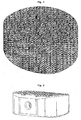
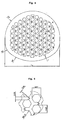
- substantially parallel channels have proven to be advantageous, which are connected by wedge-shaped longitudinal sections along the longitudinal axis of the channels, as in FIG. 2 . 3 and 4 shown.
- the honeycomb structure i. the inner channel structure rises slightly above the substantially flat bone-contacting surface. If the honeycomb structure protrudes beyond a solid edge, in particular in the case of such implants, the advantages of high surface friction and thus very good anchoring and, at the same time, the possibility of mechanical movement due to the small thickness of the honeycomb walls result, which promotes the growth stimulus of the bone.
- the walls between the individual channels i. the honeycomb walls or duct walls have a thickness of 1 ⁇ m to 3,000 ⁇ m, preferably 5 ⁇ m to 1,000 ⁇ m, more preferably 10 ⁇ m to 500 ⁇ m and particularly preferably 50 ⁇ m to 250 ⁇ m.
- the openings in the inner channel structure are arranged such that the entire structure allows micro-movements, preferably friction movements.
- Such movements allow a structure as in FIG. 2 in which the individual channels are connected by wedge-shaped longitudinal sections in the lateral wall regions along the longitudinal axis of the channels.
- the individual can Channel walls are shifted according to the thickness of the wedge-shaped openings against each other, so that micro-movements are possible.
- the bone growth stimulating surface designs of implants are still an object of research, without having previously led to a satisfactory result.
- the above-described raised honeycomb structure with the ability to micro-movements, in particular micro-friction movements seems to represent the long-sought solution to stimulate bone growth in an optimal manner and lead to a rapid penetration of the entire implant.
- This channel structure according to the invention for the bone-contacting, bone-connecting or bone-bridging implants has surprisingly proven to be very advantageous with respect to ingrowth of bone tissue and firm ingrowth with the contacted bone.
- honeycomb structure according to the invention combines the properties of good mechanical stability with optimum filling volume obtained at the same time, so that a rapid and stable penetration of the implant takes place with bone.
- Bone tissue typically comprises three cell types, the osteoblasts, the osteocytes, and the osteoclasts, with the formed bone also having a bone cover layer of bone cover cells.
- the presence of blood is essential for optimal bone formation.
- the osteoblasts, osteocytes and osteoclasts work together.
- Osteoblasts are bone-producing cells responsible for building and maintaining the bone. Non-active osteoblasts on the bone surface are called bone cover cells.
- Osteocytes are former osteoblasts that are built into bone tissue through the process of ossification. They ensure the preservation of the bone by adapting the bone breakdown to the structure.
- Osteoclasts are responsible for the breakdown of the bone. It allows the thickness of the bone to be determined and calcium and phosphate released from the bone.
- the osteoblasts are cells responsible for bone formation. They develop from undifferentiated mesenchymal cells, embryonic connective tissue cells. They attach themselves to bones like skin layers and indirectly form the basis for new bone substance, the bone matrix, in that they mainly excrete calcium phosphates and carbonates into the interstitial space. In this process, they change to a skeleton of unstable osteocytes, which are slowly mineralized and filled with calcium.
- the channel structure according to the invention seems to favor the inflow of blood and thus osteoblasts, which rapidly fill the channel spaces and lead to a significantly better ingrowth of the implant with the bone than conventional implants are able to.
- inventively designed implants have the advantage over porous structures and sponges, for example, that they are less deformable and dimensionally stable, have a defined shape and surface and can be handled and implanted by conventional implantation tools, without running the risk implant, or the channel-like structure in the implant to disregard or damage.
- the inner surfaces of the channels can still be structured, including, for example, a mechanical, chemical or physical roughening counts.
- it can be provided with antibiotics and the outer surface of the outer shell, for example, with a drug-releasing coating, wherein active ingredients such as antibiotics can be stored and continuously released.
- Example 1 relates to a cage, in particular a cervical cage with a longitudinal diameter of 14 mm and a transverse diameter of 12 mm and a height of 8 mm.
- the cage is approximately oval and the longitudinal diameter is understood to be the largest possible diameter and the transverse diameter the smallest possible diameter.
- the cage is made of titanium with a solid at least 1.1 mm thick outer shell and an upper and lower flat surface for contact with the respective vertebral body.
- a honeycomb-shaped structure of channels with hexagonal walls is formed inside the cage.
- the channels extend rectilinearly from the upper bone contacting surface to the lower opposing planar surface contacting the other vertebral body.
- the channels have a diameter given as the distance between two opposing parallel wall surfaces of 870-970 ⁇ m.
- the channels are also connected via recesses in the channel walls.
- the recesses have a wedge-shaped structure, as in FIG. 2 shown, so that the channel walls can be shifted laterally only by the thickness of the recess against each other, which contributes to an increase in the stability of the implant.
- the recess has a thickness of 60 microns.
- Example 2 relates to a cage, in particular a cervical cage with a longitudinal diameter of 16 mm and a transverse diameter of 13 mm and a height of 9 mm.
- the cage is approximately oval and the longitudinal diameter is understood to be the largest possible diameter and the transverse diameter the smallest possible diameter.
- the cage is made of zirconium with a solid 1.2 mm thick outer shell and an upper and lower surface for contact with the respective vertebral body.
- the upper edge of the outer shell is flat and serves to support the upper vertebral body.
- the inner channel structure rises from the edge of the outer shell in a convex shape up to 4 mm beyond the edge of the outer shell, so that the channel structure in the middle of the cage can press up to 4 mm into the underside of the resting vertebral body.
- the inner honeycomb or channel structure extends like a part of a spherical surface in a convex shape in the direction of the upper surface of the underlying vertebral body and digs also in the central region up to 4 mm and in the edge regions correspondingly less in the lower vertebral body.
- a honeycomb-shaped structure of round channels is formed inside the cage.
- the channels extend straight from the upper surface contacting the upper vertebral body to the lower surface contacting the opposite vertebral body. There are about 40 channels per cm 2 bone-contacting surface.
- the channels have a diameter of 850 ⁇ m and the wall thickness of the channel walls is 350 ⁇ m.
- the channels are also connected to each other via recesses in the channel walls, which are designed in the form of longitudinal sections. These longitudinal sections cut through the channel wall in its entire length. However, the longitudinal sections do not cut the channel wall on the shortest path, which is 350 microns, but cut the channel wall obliquely over a distance of about 370 microns in eg east-west direction. The opposite side of the canal we cut again by means of longitudinal section obliquely over a distance of about 370 microns, but now in west-east direction. The thickness of the longitudinal section, ie the connecting channel is 50 microns.
- honeycomb structure allows micro-movements and burrows in upright and underlying vertebral bodies up to a maximum of 4 mm and can stimulate bone growth very start, so that a rapid and good penetration of the implant takes place with newly formed bone.
- Example 3 relates to a cage, in particular a thoracic cage with a longitudinal diameter of 10 mm and a transverse diameter of 8.8 mm and a height of 6.5 mm.
- the cage is approximately oval and the longitudinal diameter is understood to be the largest possible diameter and the transverse diameter the smallest possible diameter.
- the cage consists of medical PEEK with a solid at least 0.9 mm thick outer sheath and an upper and lower flat surface for contact with the respective vertebral body, the top as well as the underside of the caged jagged or toothed with a tooth height of about 0.5 mm.
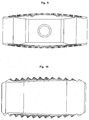
- Such configured top and bottom are, for example, in FIG. 4 and FIG. 10 shown.
- a channel-shaped structure is formed by channels with quadrangular walls.
- the channels extend rectilinearly from the upper bone contacting surface to the lower opposing planar surface contacting the other vertebral body.
- the channels have a diameter given as the distance between two opposite parallel wall surfaces of about 800 microns.
- the channels are also connected via recesses or cuts in the channel walls.
- the recesses or cuts have a rectilinear structure and sever the channel walls in the shortest path, wherein only mutually parallel channel walls are severed, so that no channel wall components are dissolved out of the channel-like structure.
- the recesses or cuts have a thickness of 30 microns.
- the cage according to Example 4 is made of titanium and has the dimensions of the cage according to Example 1 and also has a toothed top and a serrated underside with a maximum tooth height of 0.75 mm.
- the recesses in the channel walls are not wedge-shaped and do not extend over the entire length of the channel wall.
- the recesses are designed as oval slots in the channel walls with a transverse diameter of 7 microns and a longitudinal diameter of 20 microns.
Landscapes
- Health & Medical Sciences (AREA)
- Orthopedic Medicine & Surgery (AREA)
- Engineering & Computer Science (AREA)
- Biomedical Technology (AREA)
- Life Sciences & Earth Sciences (AREA)
- Animal Behavior & Ethology (AREA)
- General Health & Medical Sciences (AREA)
- Heart & Thoracic Surgery (AREA)
- Veterinary Medicine (AREA)
- Public Health (AREA)
- Oral & Maxillofacial Surgery (AREA)
- Cardiology (AREA)
- Transplantation (AREA)
- Vascular Medicine (AREA)
- Neurology (AREA)
- Surgery (AREA)
- Nuclear Medicine, Radiotherapy & Molecular Imaging (AREA)
- Medical Informatics (AREA)
- Molecular Biology (AREA)
- Prostheses (AREA)
- Materials For Medical Uses (AREA)
Applications Claiming Priority (2)
| Application Number | Priority Date | Filing Date | Title |
|---|---|---|---|
| DE102007056993A DE102007056993A1 (de) | 2007-11-27 | 2007-11-27 | Knochenkontaktierende Implantate |
| PCT/DE2008/001994 WO2009068021A1 (de) | 2007-11-27 | 2008-11-27 | Zwischenwirbelimplantat |
Publications (2)
| Publication Number | Publication Date |
|---|---|
| EP2219562A1 EP2219562A1 (de) | 2010-08-25 |
| EP2219562B1 true EP2219562B1 (de) | 2016-02-10 |
Family
ID=40568714
Family Applications (1)
| Application Number | Title | Priority Date | Filing Date |
|---|---|---|---|
| EP08853677.6A Active EP2219562B1 (de) | 2007-11-27 | 2008-11-27 | Zwischenwirbelimplantat |
Country Status (14)
| Country | Link |
|---|---|
| US (1) | US8932356B2 (enExample) |
| EP (1) | EP2219562B1 (enExample) |
| JP (1) | JP5307827B2 (enExample) |
| KR (1) | KR20100106997A (enExample) |
| CN (1) | CN101938957A (enExample) |
| AU (1) | AU2008329318A1 (enExample) |
| BR (1) | BRPI0819665A2 (enExample) |
| CA (1) | CA2706412A1 (enExample) |
| DE (2) | DE102007056993A1 (enExample) |
| IL (1) | IL205893A (enExample) |
| MX (1) | MX2010005798A (enExample) |
| RU (1) | RU2478353C2 (enExample) |
| WO (1) | WO2009068021A1 (enExample) |
| ZA (1) | ZA201003474B (enExample) |
Families Citing this family (85)
| Publication number | Priority date | Publication date | Assignee | Title |
|---|---|---|---|---|
| US20180228621A1 (en) | 2004-08-09 | 2018-08-16 | Mark A. Reiley | Apparatus, systems, and methods for the fixation or fusion of bone |
| US9662158B2 (en) | 2004-08-09 | 2017-05-30 | Si-Bone Inc. | Systems and methods for the fixation or fusion of bone at or near a sacroiliac joint |
| ATE524121T1 (de) | 2004-11-24 | 2011-09-15 | Abdou Samy | Vorrichtungen zur platzierung eines orthopädischen intervertebralen implantats |
| DE102009014184A1 (de) * | 2008-11-07 | 2010-05-20 | Advanced Medical Technologies Ag | Implantat zur Fusion von Wirbelsäulensegmenten |
| US8764806B2 (en) | 2009-12-07 | 2014-07-01 | Samy Abdou | Devices and methods for minimally invasive spinal stabilization and instrumentation |
| KR20130037243A (ko) * | 2010-07-23 | 2013-04-15 | 프리벨로프-스피네 아게 | 수술용 임플란트 |
| US20120065733A1 (en) * | 2010-09-13 | 2012-03-15 | Brian Howard Wieder | Inter-vertebral implant having drain cavities therethrough |
| CN101953726B (zh) * | 2010-09-20 | 2013-06-05 | 李长安 | 一种个性化颅骨修复体的制备方法 |
| US20120191188A1 (en) * | 2011-01-20 | 2012-07-26 | Huang meng-feng | Spinal implant with bone engaging projections |
| US9049452B2 (en) | 2011-01-25 | 2015-06-02 | Mediatek Singapore Pte. Ltd. | Method and apparatus for compressing coding unit in high efficiency video coding |
| US8845728B1 (en) | 2011-09-23 | 2014-09-30 | Samy Abdou | Spinal fixation devices and methods of use |
| US10039556B2 (en) | 2011-11-10 | 2018-08-07 | David Michael Burt | Arthroscopic total shoulder arthroplasty |
| US20130226240A1 (en) | 2012-02-22 | 2013-08-29 | Samy Abdou | Spinous process fixation devices and methods of use |
| US10363140B2 (en) | 2012-03-09 | 2019-07-30 | Si-Bone Inc. | Systems, device, and methods for joint fusion |
| HK1205902A1 (zh) | 2012-03-09 | 2015-12-31 | Si-Bone, Inc | 結合植入物 |
| ES2964578T3 (es) | 2012-05-04 | 2024-04-08 | Si Bone Inc | Implante fenestrado |
| US9198767B2 (en) | 2012-08-28 | 2015-12-01 | Samy Abdou | Devices and methods for spinal stabilization and instrumentation |
| US10864081B2 (en) * | 2012-10-19 | 2020-12-15 | Tyber Medical, LLC | Wedge osteotomy device and method of use |
| US9320617B2 (en) | 2012-10-22 | 2016-04-26 | Cogent Spine, LLC | Devices and methods for spinal stabilization and instrumentation |
| US9936983B2 (en) | 2013-03-15 | 2018-04-10 | Si-Bone Inc. | Implants for spinal fixation or fusion |
| EP2999492B1 (de) * | 2013-05-23 | 2020-04-08 | CeramTec GmbH | Implantat aus keramik mit porenkanälen |
| US11147688B2 (en) | 2013-10-15 | 2021-10-19 | Si-Bone Inc. | Implant placement |
| RU2555777C2 (ru) * | 2013-11-12 | 2015-07-10 | Общество с ограниченной ответственностью "Мед-Инж-Био" | Имплантат для замещения тотальных протяженных дефектов длинных трубчатых костей |
| EP3193752B1 (en) * | 2014-09-18 | 2020-07-22 | SI-Bone, Inc. | Matrix implant |
| US10166033B2 (en) | 2014-09-18 | 2019-01-01 | Si-Bone Inc. | Implants for bone fixation or fusion |
| EP3050540B1 (en) | 2015-01-27 | 2022-04-20 | K2M, Inc. | Spinal implant |
| US10028841B2 (en) | 2015-01-27 | 2018-07-24 | K2M, Inc. | Interbody spacer |
| US10376206B2 (en) | 2015-04-01 | 2019-08-13 | Si-Bone Inc. | Neuromonitoring systems and methods for bone fixation or fusion procedures |
| US10449051B2 (en) | 2015-04-29 | 2019-10-22 | Institute for Musculoskeletal Science and Education, Ltd. | Implant with curved bone contacting elements |
| CN114259328A (zh) | 2015-04-29 | 2022-04-01 | 肌肉骨骼科学教育研究所有限公司 | 线圈状的植入物和系统及其使用方法 |
| US10709570B2 (en) | 2015-04-29 | 2020-07-14 | Institute for Musculoskeletal Science and Education, Ltd. | Implant with a diagonal insertion axis |
| US10492921B2 (en) | 2015-04-29 | 2019-12-03 | Institute for Musculoskeletal Science and Education, Ltd. | Implant with arched bone contacting elements |
| US10857003B1 (en) | 2015-10-14 | 2020-12-08 | Samy Abdou | Devices and methods for vertebral stabilization |
| CN105232169B (zh) * | 2015-10-16 | 2018-07-31 | 福建中科康钛材料科技有限公司 | 多段式种植体组件及其制备方法 |
| KR20180095853A (ko) | 2015-12-16 | 2018-08-28 | 너바시브 인코퍼레이티드 | 다공성 척추 융합 임플란트 |
| CN106913406A (zh) * | 2015-12-25 | 2017-07-04 | 苏州微创脊柱创伤医疗科技有限公司 | 一种脊柱融合器及其制备方法 |
| WO2018053403A1 (en) | 2016-09-16 | 2018-03-22 | Mirus Llc | Interbody fusion devices and related methods of manufacture |
| US11033394B2 (en) | 2016-10-25 | 2021-06-15 | Institute for Musculoskeletal Science and Education, Ltd. | Implant with multi-layer bone interfacing lattice |
| US10744000B1 (en) | 2016-10-25 | 2020-08-18 | Samy Abdou | Devices and methods for vertebral bone realignment |
| US10478312B2 (en) | 2016-10-25 | 2019-11-19 | Institute for Musculoskeletal Science and Education, Ltd. | Implant with protected fusion zones |
| US10973648B1 (en) | 2016-10-25 | 2021-04-13 | Samy Abdou | Devices and methods for vertebral bone realignment |
| RU174198U1 (ru) * | 2017-01-09 | 2017-10-06 | Государственное бюджетное учреждение здравоохранения Свердловской области "Центр специализированных видов медицинской помощи "Уральский институт травматологии и ортопедии имени В.Д. Чаклина" (ГБУЗ СО "ЦСВМП "УИТО им. В.Д. Чаклина") | Имплантат для реконструкции вентральных отделов позвоночника пациентов с остеопорозом |
| US10667924B2 (en) | 2017-03-13 | 2020-06-02 | Institute for Musculoskeletal Science and Education, Ltd. | Corpectomy implant |
| US10512549B2 (en) | 2017-03-13 | 2019-12-24 | Institute for Musculoskeletal Science and Education, Ltd. | Implant with structural members arranged around a ring |
| US10357377B2 (en) | 2017-03-13 | 2019-07-23 | Institute for Musculoskeletal Science and Education, Ltd. | Implant with bone contacting elements having helical and undulating planar geometries |
| US10213317B2 (en) | 2017-03-13 | 2019-02-26 | Institute for Musculoskeletal Science and Education | Implant with supported helical members |
| CN107049566B (zh) * | 2017-05-04 | 2019-01-22 | 西安赛隆金属材料有限责任公司 | 一种人体骶骨假体融合器及其制备方法 |
| US10624760B2 (en) * | 2017-05-22 | 2020-04-21 | Warsaw Orthopedic, Inc. | Spinal implant system and method |
| US10959855B2 (en) | 2017-05-25 | 2021-03-30 | Stryker European Holdings I, Llc | Fusion cage with integrated fixation and insertion features |
| US11006981B2 (en) | 2017-07-07 | 2021-05-18 | K2M, Inc. | Surgical implant and methods of additive manufacturing |
| CA3074834C (en) | 2017-09-08 | 2025-09-16 | Xtant Medical Holdings, Inc. | INTERVERTEBRAL IMPLANTS, INSTRUMENTS AND PROCESSES |
| EP3687422A4 (en) | 2017-09-26 | 2021-09-22 | SI-Bone, Inc. | SYSTEMS AND PROCESSES FOR DECORTICATION OF THE SACROILIAC JOINT |
| US10940015B2 (en) | 2017-11-21 | 2021-03-09 | Institute for Musculoskeletal Science and Education, Ltd. | Implant with improved flow characteristics |
| US10744001B2 (en) | 2017-11-21 | 2020-08-18 | Institute for Musculoskeletal Science and Education, Ltd. | Implant with improved bone contact |
| US10695192B2 (en) | 2018-01-31 | 2020-06-30 | Institute for Musculoskeletal Science and Education, Ltd. | Implant with internal support members |
| US20190298528A1 (en) | 2018-03-28 | 2019-10-03 | Derek P. LINDSEY | Threaded implants and methods of use across bone segments |
| KR102136714B1 (ko) * | 2018-04-04 | 2020-07-23 | 건양대학교 산학협력단 | 개선된 고정부를 구비한 다공성 추간 유합 임플란트 |
| CN112704584B (zh) * | 2018-06-12 | 2022-02-22 | 深圳市立心科学有限公司 | 具有多个支柱的椎间融合器 |
| CN108514466B (zh) * | 2018-06-12 | 2020-06-12 | 深圳市立心科学有限公司 | 具有缓冲部的椎间融合器 |
| CN111920552B (zh) * | 2018-06-12 | 2024-10-01 | 深圳市立心科学有限公司 | 具有多个通孔的椎间融合器 |
| US11179248B2 (en) | 2018-10-02 | 2021-11-23 | Samy Abdou | Devices and methods for spinal implantation |
| CN112888404B (zh) * | 2018-10-23 | 2025-10-10 | 国立大学法人大阪大学 | 植入材料及该植入材料的制造方法 |
| ES2881257T3 (es) | 2018-12-06 | 2021-11-29 | Kilian Kraus | Implante intervertebral y procedimiento para la fabricación de un implante intervertebral |
| US11185423B2 (en) * | 2019-01-09 | 2021-11-30 | Osseus Fusion Systems | Highly radiographically opaque metal based interbody |
| US11039931B2 (en) | 2019-02-01 | 2021-06-22 | Globus Medical, Inc. | Intervertebral spinal implant |
| DE102019000965B4 (de) | 2019-02-09 | 2020-12-24 | Mimeo Medical Gmbh | Knochenverankerungsvorrichtung für den Pedikelzugang |
| EP4613244A3 (en) | 2019-02-14 | 2025-11-12 | SI-Bone Inc. | Implants for spinal fixation and or fusion |
| US11369419B2 (en) | 2019-02-14 | 2022-06-28 | Si-Bone Inc. | Implants for spinal fixation and or fusion |
| FR3093638B1 (fr) * | 2019-03-12 | 2023-11-03 | Fx Solutions | Tige medullaire d'endoprothèse d'articulation |
| US11051953B2 (en) * | 2019-07-31 | 2021-07-06 | Zavation Medical Products, Llc | Porous spinal implant |
| US11534307B2 (en) | 2019-09-16 | 2022-12-27 | K2M, Inc. | 3D printed cervical standalone implant |
| US11123201B2 (en) * | 2019-09-24 | 2021-09-21 | Additive Implants, Inc. | Intervertebral spacer |
| AU2020386985A1 (en) | 2019-11-21 | 2022-06-02 | Si-Bone Inc. | Rod coupling assemblies for bone stabilization constructs |
| WO2021108590A1 (en) | 2019-11-27 | 2021-06-03 | Si-Bone, Inc. | Bone stabilizing implants and methods of placement across si joints |
| JP2023504571A (ja) | 2019-12-09 | 2023-02-03 | エスアイ-ボーン・インコーポレイテッド | 仙腸関節安定化インプラント及び埋込方法 |
| KR102370651B1 (ko) * | 2020-02-06 | 2022-03-04 | 주식회사 지비에스커먼웰스 | 다공성 추간체 유합 보형재 구조 |
| US11957600B2 (en) | 2020-02-18 | 2024-04-16 | Mirus Llc | Anterior lumbar interbody fusion device with bidirectional screws |
| KR102346367B1 (ko) * | 2020-11-11 | 2022-01-03 | (주)시지바이오 | 추간체 유합 보형재 |
| JP2023553120A (ja) | 2020-12-09 | 2023-12-20 | エスアイ-ボーン・インコーポレイテッド | 仙腸関節安定化インプラントおよびインプラント方法 |
| KR102362366B1 (ko) * | 2021-07-29 | 2022-02-14 | (주)메디쎄이 | 환자 맞춤형 후궁성형술용 후궁 절단부 벌림 유지장치 |
| US12161560B2 (en) * | 2021-08-03 | 2024-12-10 | Warsaw Orthopedic, Inc. | Integral graft interbody devices |
| WO2023102533A1 (en) | 2021-12-03 | 2023-06-08 | Si-Bone Inc. | Fusion cages and methods for sacro-iliac joint stabilization |
| US20230310177A1 (en) * | 2022-03-31 | 2023-10-05 | Innovasis, Inc. | Porous interbody implant |
| WO2024160698A1 (en) * | 2023-01-31 | 2024-08-08 | PBC Innovations Limited | Medical device for regenerating bone and a method of manufacture thereof |
| AU2024325368A1 (en) | 2023-08-15 | 2026-03-12 | Si-Bone Inc. | Pelvic stabilization implants, methods of use and manufacture |
Family Cites Families (14)
| Publication number | Priority date | Publication date | Assignee | Title |
|---|---|---|---|---|
| JPS6031706Y2 (ja) * | 1979-11-22 | 1985-09-21 | 京セラ株式会社 | セラミック製脊椎補綴部材 |
| JPS6015139B2 (ja) | 1979-12-04 | 1985-04-17 | 松下電器産業株式会社 | タンタル電解コンデンサの電気回路実装方法 |
| US5609635A (en) | 1988-06-28 | 1997-03-11 | Michelson; Gary K. | Lordotic interbody spinal fusion implants |
| SU1560184A1 (ru) * | 1988-07-29 | 1990-04-30 | Харьковский Научно-Исследовательский Институт Ортопедии И Травматологии Им.Проф.М.И.Ситенко | Эндопротез сегмента позвоночника |
| US5496372A (en) * | 1992-04-17 | 1996-03-05 | Kyocera Corporation | Hard tissue prosthesis including porous thin metal sheets |
| EP0566427B1 (en) * | 1992-04-17 | 2000-03-15 | Kyocera Corporation | A prothesis and a method of making the same |
| JP3450920B2 (ja) * | 1994-12-26 | 2003-09-29 | 京セラ株式会社 | 生体補綴部材の製造方法 |
| US5702449A (en) * | 1995-06-07 | 1997-12-30 | Danek Medical, Inc. | Reinforced porous spinal implants |
| DE19610715C1 (de) * | 1996-03-19 | 1997-06-26 | Axel Kirsch | Verfahren zum Herstellen eines Knochenersatzmaterials |
| RU2200509C2 (ru) * | 2001-02-27 | 2003-03-20 | Галикеев Марат Фаритович | Межтеловой дистрактор позвонков |
| DE10126085A1 (de) * | 2001-05-29 | 2002-12-05 | Tutogen Medical Gmbh | Knochenimplantat |
| CA2533534C (en) * | 2003-07-24 | 2013-03-19 | Tecomet, Inc. | Assembled non-random foams |
| WO2006053291A2 (en) * | 2004-11-09 | 2006-05-18 | Proxy Biomedical Limited | Tissue scaffold |
| FR2887760B1 (fr) * | 2005-06-30 | 2008-07-04 | Kasios Soc Par Actions Simplif | Nouvelle cale destinee a l'osteotomie tibiale ou femorale |
-
2007
- 2007-11-27 DE DE102007056993A patent/DE102007056993A1/de not_active Withdrawn
-
2008
- 2008-11-27 BR BRPI0819665A patent/BRPI0819665A2/pt not_active IP Right Cessation
- 2008-11-27 US US12/744,838 patent/US8932356B2/en active Active
- 2008-11-27 DE DE112008003214T patent/DE112008003214A5/de not_active Withdrawn
- 2008-11-27 CN CN2008801256272A patent/CN101938957A/zh active Pending
- 2008-11-27 EP EP08853677.6A patent/EP2219562B1/de active Active
- 2008-11-27 KR KR1020107014363A patent/KR20100106997A/ko not_active Withdrawn
- 2008-11-27 MX MX2010005798A patent/MX2010005798A/es not_active Application Discontinuation
- 2008-11-27 RU RU2010125904/14A patent/RU2478353C2/ru not_active IP Right Cessation
- 2008-11-27 JP JP2010535214A patent/JP5307827B2/ja active Active
- 2008-11-27 CA CA2706412A patent/CA2706412A1/en not_active Abandoned
- 2008-11-27 WO PCT/DE2008/001994 patent/WO2009068021A1/de not_active Ceased
- 2008-11-27 AU AU2008329318A patent/AU2008329318A1/en not_active Abandoned
-
2010
- 2010-05-17 ZA ZA2010/03474A patent/ZA201003474B/en unknown
- 2010-05-20 IL IL205893A patent/IL205893A/en active IP Right Grant
Also Published As
| Publication number | Publication date |
|---|---|
| MX2010005798A (es) | 2010-10-04 |
| RU2010125904A (ru) | 2012-01-10 |
| DE112008003214A5 (de) | 2010-09-02 |
| ZA201003474B (en) | 2011-07-27 |
| JP5307827B2 (ja) | 2013-10-02 |
| WO2009068021A1 (de) | 2009-06-04 |
| IL205893A (en) | 2012-12-31 |
| AU2008329318A1 (en) | 2009-06-04 |
| KR20100106997A (ko) | 2010-10-04 |
| US8932356B2 (en) | 2015-01-13 |
| JP2011504770A (ja) | 2011-02-17 |
| CN101938957A (zh) | 2011-01-05 |
| DE102007056993A1 (de) | 2009-06-04 |
| IL205893A0 (en) | 2010-11-30 |
| EP2219562A1 (de) | 2010-08-25 |
| US20110082551A1 (en) | 2011-04-07 |
| BRPI0819665A2 (pt) | 2019-09-24 |
| CA2706412A1 (en) | 2009-06-04 |
| RU2478353C2 (ru) | 2013-04-10 |
Similar Documents
| Publication | Publication Date | Title |
|---|---|---|
| EP2219562A1 (de) | Zwischenwirbelimplantat | |
| EP2942035B1 (de) | Medizinisches implantat für den zwischenwirbelraum | |
| EP1274375B1 (de) | Käfigartiges zwischenwirbelimplantat | |
| DE60022891T2 (de) | Eingeschlagenes orthopädisches knochenstützimplantat | |
| DE3639030A1 (de) | Enossales implantat mit polykapillarer struktur | |
| DE68921482T2 (de) | Künstliches spondylodese-implantat. | |
| DE69232517T2 (de) | Chirurgisches prothetisches wirbelkörperimplantat | |
| DE69924864T2 (de) | Selbsträumendes, rotierbares, einsteckbares spondylose implantat | |
| DE3425002C2 (de) | Implantierbare Prothese | |
| WO1997015248A1 (de) | Zwischenwirbel-implantat | |
| CH624573A5 (en) | Intervertebral prosthesis | |
| EP2344087A1 (de) | Implantat zur fusion von wirbelsäulensegmenten | |
| EP4494609A1 (de) | Orthopädische kniegelenkprothese | |
| EP3651685B1 (de) | Knochenaugmentationsstück und bausatz aus knochenaugmentationsstück mit eingesetztem (zahn-) implantat | |
| DE3613951A1 (de) | Implantat | |
| EP3662868B1 (de) | Zwischenwirbelimplantat und verfahren zur herstellung eines zwischenwirbelimplantats | |
| WO2006032311A1 (de) | Prothese zur überbrückung eines wirbelkörpers | |
| EP4025161B1 (de) | Knochenimplantat mit beschichteter poröser struktur | |
| EP4099960A1 (de) | Zwischenwirbelimplantat | |
| DE8607873U1 (de) | Zementfrei implantierbare Prothese mit Rasterprofilierung | |
| WO1999012498A1 (de) | Prothesenteil | |
| EP4691424A1 (de) | Implantat zum ersatz oder auffüllen einer fehlstelle eines flächenartigen knochens sowie verfahren zur herstellung eines solchen implantats | |
| EP2149351B1 (de) | Endoprothesenkomponente | |
| DE112021002214T5 (de) | Knochenimplantat | |
| EP2286767A1 (de) | Verfahren zur Herstellung einer strukturierten Oberfläche an einem Werkstück aus einem metallischen Werkstoff und Implantat mit einer derartigen Oberfläche |
Legal Events
| Date | Code | Title | Description |
|---|---|---|---|
| PUAI | Public reference made under article 153(3) epc to a published international application that has entered the european phase |
Free format text: ORIGINAL CODE: 0009012 |
|
| 17P | Request for examination filed |
Effective date: 20100604 |
|
| AK | Designated contracting states |
Kind code of ref document: A1 Designated state(s): AT BE BG CH CY CZ DE DK EE ES FI FR GB GR HR HU IE IS IT LI LT LU LV MC MT NL NO PL PT RO SE SI SK TR |
|
| AX | Request for extension of the european patent |
Extension state: AL BA MK RS |
|
| DAX | Request for extension of the european patent (deleted) | ||
| 17Q | First examination report despatched |
Effective date: 20130422 |
|
| GRAP | Despatch of communication of intention to grant a patent |
Free format text: ORIGINAL CODE: EPIDOSNIGR1 |
|
| INTG | Intention to grant announced |
Effective date: 20150805 |
|
| GRAS | Grant fee paid |
Free format text: ORIGINAL CODE: EPIDOSNIGR3 |
|
| GRAA | (expected) grant |
Free format text: ORIGINAL CODE: 0009210 |
|
| AK | Designated contracting states |
Kind code of ref document: B1 Designated state(s): AT BE BG CH CY CZ DE DK EE ES FI FR GB GR HR HU IE IS IT LI LT LU LV MC MT NL NO PL PT RO SE SI SK TR |
|
| REG | Reference to a national code |
Ref country code: GB Ref legal event code: FG4D Free format text: NOT ENGLISH |
|
| REG | Reference to a national code |
Ref country code: AT Ref legal event code: REF Ref document number: 774273 Country of ref document: AT Kind code of ref document: T Effective date: 20160215 Ref country code: CH Ref legal event code: EP |
|
| REG | Reference to a national code |
Ref country code: IE Ref legal event code: FG4D Free format text: LANGUAGE OF EP DOCUMENT: GERMAN |
|
| REG | Reference to a national code |
Ref country code: DE Ref legal event code: R096 Ref document number: 502008013824 Country of ref document: DE |
|
| REG | Reference to a national code |
Ref country code: LT Ref legal event code: MG4D |
|
| REG | Reference to a national code |
Ref country code: NL Ref legal event code: MP Effective date: 20160210 |
|
| PG25 | Lapsed in a contracting state [announced via postgrant information from national office to epo] |
Ref country code: GR Free format text: LAPSE BECAUSE OF FAILURE TO SUBMIT A TRANSLATION OF THE DESCRIPTION OR TO PAY THE FEE WITHIN THE PRESCRIBED TIME-LIMIT Effective date: 20160511 Ref country code: NO Free format text: LAPSE BECAUSE OF FAILURE TO SUBMIT A TRANSLATION OF THE DESCRIPTION OR TO PAY THE FEE WITHIN THE PRESCRIBED TIME-LIMIT Effective date: 20160510 Ref country code: HR Free format text: LAPSE BECAUSE OF FAILURE TO SUBMIT A TRANSLATION OF THE DESCRIPTION OR TO PAY THE FEE WITHIN THE PRESCRIBED TIME-LIMIT Effective date: 20160210 Ref country code: IT Free format text: LAPSE BECAUSE OF FAILURE TO SUBMIT A TRANSLATION OF THE DESCRIPTION OR TO PAY THE FEE WITHIN THE PRESCRIBED TIME-LIMIT Effective date: 20160210 Ref country code: FI Free format text: LAPSE BECAUSE OF FAILURE TO SUBMIT A TRANSLATION OF THE DESCRIPTION OR TO PAY THE FEE WITHIN THE PRESCRIBED TIME-LIMIT Effective date: 20160210 Ref country code: ES Free format text: LAPSE BECAUSE OF FAILURE TO SUBMIT A TRANSLATION OF THE DESCRIPTION OR TO PAY THE FEE WITHIN THE PRESCRIBED TIME-LIMIT Effective date: 20160210 |
|
| PG25 | Lapsed in a contracting state [announced via postgrant information from national office to epo] |
Ref country code: SE Free format text: LAPSE BECAUSE OF FAILURE TO SUBMIT A TRANSLATION OF THE DESCRIPTION OR TO PAY THE FEE WITHIN THE PRESCRIBED TIME-LIMIT Effective date: 20160210 Ref country code: NL Free format text: LAPSE BECAUSE OF FAILURE TO SUBMIT A TRANSLATION OF THE DESCRIPTION OR TO PAY THE FEE WITHIN THE PRESCRIBED TIME-LIMIT Effective date: 20160210 Ref country code: LT Free format text: LAPSE BECAUSE OF FAILURE TO SUBMIT A TRANSLATION OF THE DESCRIPTION OR TO PAY THE FEE WITHIN THE PRESCRIBED TIME-LIMIT Effective date: 20160210 Ref country code: PT Free format text: LAPSE BECAUSE OF FAILURE TO SUBMIT A TRANSLATION OF THE DESCRIPTION OR TO PAY THE FEE WITHIN THE PRESCRIBED TIME-LIMIT Effective date: 20160613 Ref country code: IS Free format text: LAPSE BECAUSE OF FAILURE TO SUBMIT A TRANSLATION OF THE DESCRIPTION OR TO PAY THE FEE WITHIN THE PRESCRIBED TIME-LIMIT Effective date: 20160610 Ref country code: PL Free format text: LAPSE BECAUSE OF FAILURE TO SUBMIT A TRANSLATION OF THE DESCRIPTION OR TO PAY THE FEE WITHIN THE PRESCRIBED TIME-LIMIT Effective date: 20160210 Ref country code: LV Free format text: LAPSE BECAUSE OF FAILURE TO SUBMIT A TRANSLATION OF THE DESCRIPTION OR TO PAY THE FEE WITHIN THE PRESCRIBED TIME-LIMIT Effective date: 20160210 |
|
| PG25 | Lapsed in a contracting state [announced via postgrant information from national office to epo] |
Ref country code: DK Free format text: LAPSE BECAUSE OF FAILURE TO SUBMIT A TRANSLATION OF THE DESCRIPTION OR TO PAY THE FEE WITHIN THE PRESCRIBED TIME-LIMIT Effective date: 20160210 Ref country code: EE Free format text: LAPSE BECAUSE OF FAILURE TO SUBMIT A TRANSLATION OF THE DESCRIPTION OR TO PAY THE FEE WITHIN THE PRESCRIBED TIME-LIMIT Effective date: 20160210 |
|
| REG | Reference to a national code |
Ref country code: DE Ref legal event code: R097 Ref document number: 502008013824 Country of ref document: DE |
|
| REG | Reference to a national code |
Ref country code: FR Ref legal event code: PLFP Year of fee payment: 9 |
|
| PG25 | Lapsed in a contracting state [announced via postgrant information from national office to epo] |
Ref country code: RO Free format text: LAPSE BECAUSE OF FAILURE TO SUBMIT A TRANSLATION OF THE DESCRIPTION OR TO PAY THE FEE WITHIN THE PRESCRIBED TIME-LIMIT Effective date: 20160210 Ref country code: SK Free format text: LAPSE BECAUSE OF FAILURE TO SUBMIT A TRANSLATION OF THE DESCRIPTION OR TO PAY THE FEE WITHIN THE PRESCRIBED TIME-LIMIT Effective date: 20160210 Ref country code: CZ Free format text: LAPSE BECAUSE OF FAILURE TO SUBMIT A TRANSLATION OF THE DESCRIPTION OR TO PAY THE FEE WITHIN THE PRESCRIBED TIME-LIMIT Effective date: 20160210 |
|
| PLBE | No opposition filed within time limit |
Free format text: ORIGINAL CODE: 0009261 |
|
| STAA | Information on the status of an ep patent application or granted ep patent |
Free format text: STATUS: NO OPPOSITION FILED WITHIN TIME LIMIT |
|
| 26N | No opposition filed |
Effective date: 20161111 |
|
| PG25 | Lapsed in a contracting state [announced via postgrant information from national office to epo] |
Ref country code: BE Free format text: LAPSE BECAUSE OF NON-PAYMENT OF DUE FEES Effective date: 20161130 Ref country code: BG Free format text: LAPSE BECAUSE OF FAILURE TO SUBMIT A TRANSLATION OF THE DESCRIPTION OR TO PAY THE FEE WITHIN THE PRESCRIBED TIME-LIMIT Effective date: 20160510 Ref country code: SI Free format text: LAPSE BECAUSE OF FAILURE TO SUBMIT A TRANSLATION OF THE DESCRIPTION OR TO PAY THE FEE WITHIN THE PRESCRIBED TIME-LIMIT Effective date: 20160210 |
|
| REG | Reference to a national code |
Ref country code: IE Ref legal event code: MM4A |
|
| PG25 | Lapsed in a contracting state [announced via postgrant information from national office to epo] |
Ref country code: LU Free format text: LAPSE BECAUSE OF NON-PAYMENT OF DUE FEES Effective date: 20161130 |
|
| REG | Reference to a national code |
Ref country code: FR Ref legal event code: PLFP Year of fee payment: 10 |
|
| PG25 | Lapsed in a contracting state [announced via postgrant information from national office to epo] |
Ref country code: IE Free format text: LAPSE BECAUSE OF NON-PAYMENT OF DUE FEES Effective date: 20161127 |
|
| REG | Reference to a national code |
Ref country code: AT Ref legal event code: MM01 Ref document number: 774273 Country of ref document: AT Kind code of ref document: T Effective date: 20161127 |
|
| PG25 | Lapsed in a contracting state [announced via postgrant information from national office to epo] |
Ref country code: AT Free format text: LAPSE BECAUSE OF NON-PAYMENT OF DUE FEES Effective date: 20161127 |
|
| REG | Reference to a national code |
Ref country code: BE Ref legal event code: MM Effective date: 20161130 |
|
| PG25 | Lapsed in a contracting state [announced via postgrant information from national office to epo] |
Ref country code: CY Free format text: LAPSE BECAUSE OF FAILURE TO SUBMIT A TRANSLATION OF THE DESCRIPTION OR TO PAY THE FEE WITHIN THE PRESCRIBED TIME-LIMIT Effective date: 20160210 Ref country code: HU Free format text: LAPSE BECAUSE OF FAILURE TO SUBMIT A TRANSLATION OF THE DESCRIPTION OR TO PAY THE FEE WITHIN THE PRESCRIBED TIME-LIMIT; INVALID AB INITIO Effective date: 20081127 |
|
| PG25 | Lapsed in a contracting state [announced via postgrant information from national office to epo] |
Ref country code: TR Free format text: LAPSE BECAUSE OF FAILURE TO SUBMIT A TRANSLATION OF THE DESCRIPTION OR TO PAY THE FEE WITHIN THE PRESCRIBED TIME-LIMIT Effective date: 20160210 Ref country code: MC Free format text: LAPSE BECAUSE OF FAILURE TO SUBMIT A TRANSLATION OF THE DESCRIPTION OR TO PAY THE FEE WITHIN THE PRESCRIBED TIME-LIMIT Effective date: 20160210 |
|
| PG25 | Lapsed in a contracting state [announced via postgrant information from national office to epo] |
Ref country code: MT Free format text: LAPSE BECAUSE OF FAILURE TO SUBMIT A TRANSLATION OF THE DESCRIPTION OR TO PAY THE FEE WITHIN THE PRESCRIBED TIME-LIMIT Effective date: 20160210 |
|
| REG | Reference to a national code |
Ref country code: CH Ref legal event code: U11 Free format text: ST27 STATUS EVENT CODE: U-0-0-U10-U11 (AS PROVIDED BY THE NATIONAL OFFICE) Effective date: 20251201 |
|
| PGFP | Annual fee paid to national office [announced via postgrant information from national office to epo] |
Ref country code: DE Payment date: 20251110 Year of fee payment: 18 |
|
| PGFP | Annual fee paid to national office [announced via postgrant information from national office to epo] |
Ref country code: GB Payment date: 20251120 Year of fee payment: 18 |
|
| PGFP | Annual fee paid to national office [announced via postgrant information from national office to epo] |
Ref country code: FR Payment date: 20251125 Year of fee payment: 18 |
|
| PGFP | Annual fee paid to national office [announced via postgrant information from national office to epo] |
Ref country code: CH Payment date: 20251201 Year of fee payment: 18 |