EP2166583A1 - Material for organic electroluminescence element, and organic electroluminescence element prepared by using the material - Google Patents
Material for organic electroluminescence element, and organic electroluminescence element prepared by using the material Download PDFInfo
- Publication number
- EP2166583A1 EP2166583A1 EP07832315A EP07832315A EP2166583A1 EP 2166583 A1 EP2166583 A1 EP 2166583A1 EP 07832315 A EP07832315 A EP 07832315A EP 07832315 A EP07832315 A EP 07832315A EP 2166583 A1 EP2166583 A1 EP 2166583A1
- Authority
- EP
- European Patent Office
- Prior art keywords
- group
- optionally substituted
- carbon atoms
- phenanthroline
- organic electroluminescence
- Prior art date
- Legal status (The legal status is an assumption and is not a legal conclusion. Google has not performed a legal analysis and makes no representation as to the accuracy of the status listed.)
- Withdrawn
Links
- 0 c1ncnc2c1c(C=CC=*=C1)c1[n]2 Chemical compound c1ncnc2c1c(C=CC=*=C1)c1[n]2 0.000 description 10
- XUZZNRFPBSKDPR-VURMDHGXSA-N CC1C(C)=CN=Cc2c1[n](C)c(NC=C)c2/C=C\C Chemical compound CC1C(C)=CN=Cc2c1[n](C)c(NC=C)c2/C=C\C XUZZNRFPBSKDPR-VURMDHGXSA-N 0.000 description 1
- ACDOQOPVTKFDQY-UHFFFAOYSA-N Cc(cc1)cc2c1[s]c1c2C=CCC1 Chemical compound Cc(cc1)cc2c1[s]c1c2C=CCC1 ACDOQOPVTKFDQY-UHFFFAOYSA-N 0.000 description 1
- VTKMFJSESAHMLR-UHFFFAOYSA-N Cc(cc12)ccc1[o]c1c2cccc1 Chemical compound Cc(cc12)ccc1[o]c1c2cccc1 VTKMFJSESAHMLR-UHFFFAOYSA-N 0.000 description 1
- LLXSZANPUXEJGA-UHFFFAOYSA-N Cc1ccc2c(ncnc3)c3[nH]c2c1 Chemical compound Cc1ccc2c(ncnc3)c3[nH]c2c1 LLXSZANPUXEJGA-UHFFFAOYSA-N 0.000 description 1
- XUOXKYJULXFMGA-UHFFFAOYSA-N c1cnc(c2c([nH]3)ncnc2)c3c1 Chemical compound c1cnc(c2c([nH]3)ncnc2)c3c1 XUOXKYJULXFMGA-UHFFFAOYSA-N 0.000 description 1
Classifications
-
- C—CHEMISTRY; METALLURGY
- C09—DYES; PAINTS; POLISHES; NATURAL RESINS; ADHESIVES; COMPOSITIONS NOT OTHERWISE PROVIDED FOR; APPLICATIONS OF MATERIALS NOT OTHERWISE PROVIDED FOR
- C09K—MATERIALS FOR MISCELLANEOUS APPLICATIONS, NOT PROVIDED FOR ELSEWHERE
- C09K11/00—Luminescent materials, e.g. electroluminescent or chemiluminescent
- C09K11/06—Luminescent materials, e.g. electroluminescent or chemiluminescent containing organic luminescent materials
-
- H—ELECTRICITY
- H10—SEMICONDUCTOR DEVICES; ELECTRIC SOLID-STATE DEVICES NOT OTHERWISE PROVIDED FOR
- H10K—ORGANIC ELECTRIC SOLID-STATE DEVICES
- H10K85/00—Organic materials used in the body or electrodes of devices covered by this subclass
- H10K85/60—Organic compounds having low molecular weight
- H10K85/649—Aromatic compounds comprising a hetero atom
- H10K85/657—Polycyclic condensed heteroaromatic hydrocarbons
- H10K85/6574—Polycyclic condensed heteroaromatic hydrocarbons comprising only oxygen in the heteroaromatic polycondensed ring system, e.g. cumarine dyes
-
- C—CHEMISTRY; METALLURGY
- C07—ORGANIC CHEMISTRY
- C07D—HETEROCYCLIC COMPOUNDS
- C07D405/00—Heterocyclic compounds containing both one or more hetero rings having oxygen atoms as the only ring hetero atoms, and one or more rings having nitrogen as the only ring hetero atom
- C07D405/14—Heterocyclic compounds containing both one or more hetero rings having oxygen atoms as the only ring hetero atoms, and one or more rings having nitrogen as the only ring hetero atom containing three or more hetero rings
-
- H—ELECTRICITY
- H05—ELECTRIC TECHNIQUES NOT OTHERWISE PROVIDED FOR
- H05B—ELECTRIC HEATING; ELECTRIC LIGHT SOURCES NOT OTHERWISE PROVIDED FOR; CIRCUIT ARRANGEMENTS FOR ELECTRIC LIGHT SOURCES, IN GENERAL
- H05B33/00—Electroluminescent light sources
- H05B33/12—Light sources with substantially two-dimensional [2D] radiating surfaces
- H05B33/14—Light sources with substantially two-dimensional [2D] radiating surfaces characterised by the chemical or physical composition or the arrangement of the electroluminescent material, or by the simultaneous addition of the electroluminescent material in or onto the light source
-
- H—ELECTRICITY
- H10—SEMICONDUCTOR DEVICES; ELECTRIC SOLID-STATE DEVICES NOT OTHERWISE PROVIDED FOR
- H10K—ORGANIC ELECTRIC SOLID-STATE DEVICES
- H10K50/00—Organic light-emitting devices
- H10K50/10—OLEDs or polymer light-emitting diodes [PLED]
- H10K50/11—OLEDs or polymer light-emitting diodes [PLED] characterised by the electroluminescent [EL] layers
-
- H—ELECTRICITY
- H10—SEMICONDUCTOR DEVICES; ELECTRIC SOLID-STATE DEVICES NOT OTHERWISE PROVIDED FOR
- H10K—ORGANIC ELECTRIC SOLID-STATE DEVICES
- H10K50/00—Organic light-emitting devices
- H10K50/10—OLEDs or polymer light-emitting diodes [PLED]
- H10K50/14—Carrier transporting layers
- H10K50/15—Hole transporting layers
-
- H—ELECTRICITY
- H10—SEMICONDUCTOR DEVICES; ELECTRIC SOLID-STATE DEVICES NOT OTHERWISE PROVIDED FOR
- H10K—ORGANIC ELECTRIC SOLID-STATE DEVICES
- H10K50/00—Organic light-emitting devices
- H10K50/10—OLEDs or polymer light-emitting diodes [PLED]
- H10K50/17—Carrier injection layers
-
- H—ELECTRICITY
- H10—SEMICONDUCTOR DEVICES; ELECTRIC SOLID-STATE DEVICES NOT OTHERWISE PROVIDED FOR
- H10K—ORGANIC ELECTRIC SOLID-STATE DEVICES
- H10K85/00—Organic materials used in the body or electrodes of devices covered by this subclass
- H10K85/30—Coordination compounds
- H10K85/341—Transition metal complexes, e.g. Ru(II)polypyridine complexes
- H10K85/342—Transition metal complexes, e.g. Ru(II)polypyridine complexes comprising iridium
-
- H—ELECTRICITY
- H10—SEMICONDUCTOR DEVICES; ELECTRIC SOLID-STATE DEVICES NOT OTHERWISE PROVIDED FOR
- H10K—ORGANIC ELECTRIC SOLID-STATE DEVICES
- H10K85/00—Organic materials used in the body or electrodes of devices covered by this subclass
- H10K85/30—Coordination compounds
- H10K85/341—Transition metal complexes, e.g. Ru(II)polypyridine complexes
- H10K85/346—Transition metal complexes, e.g. Ru(II)polypyridine complexes comprising platinum
-
- H—ELECTRICITY
- H10—SEMICONDUCTOR DEVICES; ELECTRIC SOLID-STATE DEVICES NOT OTHERWISE PROVIDED FOR
- H10K—ORGANIC ELECTRIC SOLID-STATE DEVICES
- H10K85/00—Organic materials used in the body or electrodes of devices covered by this subclass
- H10K85/30—Coordination compounds
- H10K85/341—Transition metal complexes, e.g. Ru(II)polypyridine complexes
- H10K85/348—Transition metal complexes, e.g. Ru(II)polypyridine complexes comprising osmium
-
- H—ELECTRICITY
- H10—SEMICONDUCTOR DEVICES; ELECTRIC SOLID-STATE DEVICES NOT OTHERWISE PROVIDED FOR
- H10K—ORGANIC ELECTRIC SOLID-STATE DEVICES
- H10K85/00—Organic materials used in the body or electrodes of devices covered by this subclass
- H10K85/60—Organic compounds having low molecular weight
- H10K85/631—Amine compounds having at least two aryl rest on at least one amine-nitrogen atom, e.g. triphenylamine
-
- H—ELECTRICITY
- H10—SEMICONDUCTOR DEVICES; ELECTRIC SOLID-STATE DEVICES NOT OTHERWISE PROVIDED FOR
- H10K—ORGANIC ELECTRIC SOLID-STATE DEVICES
- H10K85/00—Organic materials used in the body or electrodes of devices covered by this subclass
- H10K85/60—Organic compounds having low molecular weight
- H10K85/631—Amine compounds having at least two aryl rest on at least one amine-nitrogen atom, e.g. triphenylamine
- H10K85/633—Amine compounds having at least two aryl rest on at least one amine-nitrogen atom, e.g. triphenylamine comprising polycyclic condensed aromatic hydrocarbons as substituents on the nitrogen atom
-
- H—ELECTRICITY
- H10—SEMICONDUCTOR DEVICES; ELECTRIC SOLID-STATE DEVICES NOT OTHERWISE PROVIDED FOR
- H10K—ORGANIC ELECTRIC SOLID-STATE DEVICES
- H10K85/00—Organic materials used in the body or electrodes of devices covered by this subclass
- H10K85/60—Organic compounds having low molecular weight
- H10K85/649—Aromatic compounds comprising a hetero atom
- H10K85/654—Aromatic compounds comprising a hetero atom comprising only nitrogen as heteroatom
-
- H—ELECTRICITY
- H10—SEMICONDUCTOR DEVICES; ELECTRIC SOLID-STATE DEVICES NOT OTHERWISE PROVIDED FOR
- H10K—ORGANIC ELECTRIC SOLID-STATE DEVICES
- H10K85/00—Organic materials used in the body or electrodes of devices covered by this subclass
- H10K85/60—Organic compounds having low molecular weight
- H10K85/649—Aromatic compounds comprising a hetero atom
- H10K85/657—Polycyclic condensed heteroaromatic hydrocarbons
- H10K85/6572—Polycyclic condensed heteroaromatic hydrocarbons comprising only nitrogen in the heteroaromatic polycondensed ring system, e.g. phenanthroline or carbazole
-
- H—ELECTRICITY
- H10—SEMICONDUCTOR DEVICES; ELECTRIC SOLID-STATE DEVICES NOT OTHERWISE PROVIDED FOR
- H10K—ORGANIC ELECTRIC SOLID-STATE DEVICES
- H10K85/00—Organic materials used in the body or electrodes of devices covered by this subclass
- H10K85/60—Organic compounds having low molecular weight
- H10K85/649—Aromatic compounds comprising a hetero atom
- H10K85/657—Polycyclic condensed heteroaromatic hydrocarbons
- H10K85/6576—Polycyclic condensed heteroaromatic hydrocarbons comprising only sulfur in the heteroaromatic polycondensed ring system, e.g. benzothiophene
-
- C—CHEMISTRY; METALLURGY
- C09—DYES; PAINTS; POLISHES; NATURAL RESINS; ADHESIVES; COMPOSITIONS NOT OTHERWISE PROVIDED FOR; APPLICATIONS OF MATERIALS NOT OTHERWISE PROVIDED FOR
- C09K—MATERIALS FOR MISCELLANEOUS APPLICATIONS, NOT PROVIDED FOR ELSEWHERE
- C09K2211/00—Chemical nature of organic luminescent or tenebrescent compounds
- C09K2211/10—Non-macromolecular compounds
- C09K2211/1018—Heterocyclic compounds
- C09K2211/1025—Heterocyclic compounds characterised by ligands
- C09K2211/1029—Heterocyclic compounds characterised by ligands containing one nitrogen atom as the heteroatom
-
- C—CHEMISTRY; METALLURGY
- C09—DYES; PAINTS; POLISHES; NATURAL RESINS; ADHESIVES; COMPOSITIONS NOT OTHERWISE PROVIDED FOR; APPLICATIONS OF MATERIALS NOT OTHERWISE PROVIDED FOR
- C09K—MATERIALS FOR MISCELLANEOUS APPLICATIONS, NOT PROVIDED FOR ELSEWHERE
- C09K2211/00—Chemical nature of organic luminescent or tenebrescent compounds
- C09K2211/10—Non-macromolecular compounds
- C09K2211/1018—Heterocyclic compounds
- C09K2211/1025—Heterocyclic compounds characterised by ligands
- C09K2211/1044—Heterocyclic compounds characterised by ligands containing two nitrogen atoms as heteroatoms
-
- C—CHEMISTRY; METALLURGY
- C09—DYES; PAINTS; POLISHES; NATURAL RESINS; ADHESIVES; COMPOSITIONS NOT OTHERWISE PROVIDED FOR; APPLICATIONS OF MATERIALS NOT OTHERWISE PROVIDED FOR
- C09K—MATERIALS FOR MISCELLANEOUS APPLICATIONS, NOT PROVIDED FOR ELSEWHERE
- C09K2211/00—Chemical nature of organic luminescent or tenebrescent compounds
- C09K2211/10—Non-macromolecular compounds
- C09K2211/1018—Heterocyclic compounds
- C09K2211/1025—Heterocyclic compounds characterised by ligands
- C09K2211/1059—Heterocyclic compounds characterised by ligands containing three nitrogen atoms as heteroatoms
-
- C—CHEMISTRY; METALLURGY
- C09—DYES; PAINTS; POLISHES; NATURAL RESINS; ADHESIVES; COMPOSITIONS NOT OTHERWISE PROVIDED FOR; APPLICATIONS OF MATERIALS NOT OTHERWISE PROVIDED FOR
- C09K—MATERIALS FOR MISCELLANEOUS APPLICATIONS, NOT PROVIDED FOR ELSEWHERE
- C09K2211/00—Chemical nature of organic luminescent or tenebrescent compounds
- C09K2211/10—Non-macromolecular compounds
- C09K2211/1018—Heterocyclic compounds
- C09K2211/1025—Heterocyclic compounds characterised by ligands
- C09K2211/1074—Heterocyclic compounds characterised by ligands containing more than three nitrogen atoms as heteroatoms
-
- C—CHEMISTRY; METALLURGY
- C09—DYES; PAINTS; POLISHES; NATURAL RESINS; ADHESIVES; COMPOSITIONS NOT OTHERWISE PROVIDED FOR; APPLICATIONS OF MATERIALS NOT OTHERWISE PROVIDED FOR
- C09K—MATERIALS FOR MISCELLANEOUS APPLICATIONS, NOT PROVIDED FOR ELSEWHERE
- C09K2211/00—Chemical nature of organic luminescent or tenebrescent compounds
- C09K2211/10—Non-macromolecular compounds
- C09K2211/1018—Heterocyclic compounds
- C09K2211/1025—Heterocyclic compounds characterised by ligands
- C09K2211/1088—Heterocyclic compounds characterised by ligands containing oxygen as the only heteroatom
-
- C—CHEMISTRY; METALLURGY
- C09—DYES; PAINTS; POLISHES; NATURAL RESINS; ADHESIVES; COMPOSITIONS NOT OTHERWISE PROVIDED FOR; APPLICATIONS OF MATERIALS NOT OTHERWISE PROVIDED FOR
- C09K—MATERIALS FOR MISCELLANEOUS APPLICATIONS, NOT PROVIDED FOR ELSEWHERE
- C09K2211/00—Chemical nature of organic luminescent or tenebrescent compounds
- C09K2211/18—Metal complexes
- C09K2211/185—Metal complexes of the platinum group, i.e. Os, Ir, Pt, Ru, Rh or Pd
-
- C—CHEMISTRY; METALLURGY
- C09—DYES; PAINTS; POLISHES; NATURAL RESINS; ADHESIVES; COMPOSITIONS NOT OTHERWISE PROVIDED FOR; APPLICATIONS OF MATERIALS NOT OTHERWISE PROVIDED FOR
- C09K—MATERIALS FOR MISCELLANEOUS APPLICATIONS, NOT PROVIDED FOR ELSEWHERE
- C09K2211/00—Chemical nature of organic luminescent or tenebrescent compounds
- C09K2211/18—Metal complexes
- C09K2211/186—Metal complexes of the light metals other than alkali metals and alkaline earth metals, i.e. Be, Al or Mg
-
- H—ELECTRICITY
- H10—SEMICONDUCTOR DEVICES; ELECTRIC SOLID-STATE DEVICES NOT OTHERWISE PROVIDED FOR
- H10K—ORGANIC ELECTRIC SOLID-STATE DEVICES
- H10K2101/00—Properties of the organic materials covered by group H10K85/00
- H10K2101/10—Triplet emission
-
- H—ELECTRICITY
- H10—SEMICONDUCTOR DEVICES; ELECTRIC SOLID-STATE DEVICES NOT OTHERWISE PROVIDED FOR
- H10K—ORGANIC ELECTRIC SOLID-STATE DEVICES
- H10K50/00—Organic light-emitting devices
- H10K50/10—OLEDs or polymer light-emitting diodes [PLED]
- H10K50/17—Carrier injection layers
- H10K50/171—Electron injection layers
-
- H—ELECTRICITY
- H10—SEMICONDUCTOR DEVICES; ELECTRIC SOLID-STATE DEVICES NOT OTHERWISE PROVIDED FOR
- H10K—ORGANIC ELECTRIC SOLID-STATE DEVICES
- H10K85/00—Organic materials used in the body or electrodes of devices covered by this subclass
- H10K85/30—Coordination compounds
- H10K85/321—Metal complexes comprising a group IIIA element, e.g. Tris (8-hydroxyquinoline) gallium [Gaq3]
- H10K85/324—Metal complexes comprising a group IIIA element, e.g. Tris (8-hydroxyquinoline) gallium [Gaq3] comprising aluminium, e.g. Alq3
-
- H—ELECTRICITY
- H10—SEMICONDUCTOR DEVICES; ELECTRIC SOLID-STATE DEVICES NOT OTHERWISE PROVIDED FOR
- H10K—ORGANIC ELECTRIC SOLID-STATE DEVICES
- H10K85/00—Organic materials used in the body or electrodes of devices covered by this subclass
- H10K85/60—Organic compounds having low molecular weight
- H10K85/631—Amine compounds having at least two aryl rest on at least one amine-nitrogen atom, e.g. triphenylamine
- H10K85/636—Amine compounds having at least two aryl rest on at least one amine-nitrogen atom, e.g. triphenylamine comprising heteroaromatic hydrocarbons as substituents on the nitrogen atom
-
- Y—GENERAL TAGGING OF NEW TECHNOLOGICAL DEVELOPMENTS; GENERAL TAGGING OF CROSS-SECTIONAL TECHNOLOGIES SPANNING OVER SEVERAL SECTIONS OF THE IPC; TECHNICAL SUBJECTS COVERED BY FORMER USPC CROSS-REFERENCE ART COLLECTIONS [XRACs] AND DIGESTS
- Y10—TECHNICAL SUBJECTS COVERED BY FORMER USPC
- Y10S—TECHNICAL SUBJECTS COVERED BY FORMER USPC CROSS-REFERENCE ART COLLECTIONS [XRACs] AND DIGESTS
- Y10S428/00—Stock material or miscellaneous articles
- Y10S428/917—Electroluminescent
Definitions
- the present invention relates to materials for organic electroluminescence devices and organic electroluminescence devices using the materials and, more particularly to materials for organic electroluminescence devices which realize electroluminescence devices exhibiting a high emitting efficiency, causing little pixel defects, exhibiting a high heat resistance and having a long lifetime.
- organic electroluminescence device is a spontaneous emission device which utilizes the phenomenon of fluorescence which occurs by the energy of recombination between holes injected from an anode and electrons injected from a cathode by application of electric field.
- organic EL devices a two-layered structure having a hole transporting (injecting) layer and an electron transporting/light emitting layer and a three-layered structure having a hole transporting (injecting) layer, a light emitting layer and an electron transporting (injecting) layer are well known.
- the structure of the device and the process for forming the device have been studied
- the organic EL devices described above are made into a laminate structure having an anode, a hole transporting layer, an organic light emitting layer, an electron transporting layer (a hole blocking layer), an electron transporting layer and a cathode in this order, while using an organic light emitting layer made of a host compound and a phosphorescent compound (for example, Patent Documents 1-6).
- Patent Documents 1-6 host materials having a dibenzofuran structure or a dibenzothiophene structure are described.
- Patent Documents 7 and 8 disclose compounds prepared by bonding a carbazole structure to dibenzo compounds.
- the proposed compounds are used in a host material for a blue phosphorescent device in examples thereof.
- the compounds of the present invention are not taught and the effect is uncertain.
- Patent Documents 9, 10 and 11 disclose compounds prepared by bonding an anthracene structure to dibenzo compounds.
- the energy level of the excited triplet state of the proposed compounds is small because of the anthracene structure. Therefore, a blue phosphorescent material does not emit light even if any of the proposed compounds is used as a host material for the light emitting layer.
- Patent Document 12 discloses dibenzofuran compounds essentially having at least two polymerizable functional groups.
- the host material of a phosphorescent device has in its molecule a polymerizable group such as propenylene group, vinylene group and 4-propyl-2-pentenylene group which is formed by introducing an unsaturated bond such as double bond and triple bond, radicals are propagatedly generated in the device to adversely affect the emitting efficiency and lifetime.
- a polymerizable group such as propenylene group, vinylene group and 4-propyl-2-pentenylene group which is formed by introducing an unsaturated bond such as double bond and triple bond
- the present invention has been made to overcome the above problems and has an object of providing a material for organic EL devices which realizes an EL device exhibiting a high efficiency of light emission, causing little pixel defects, exhibiting a high heat resistance and having a long lifetime.
- the preset invention provides a material for organic electroluminescence devices for use in combination with at least one phosphorescent metal complex, which comprises a compound represented by the following formula 1: wherein R 1 to R 3 are each independently hydrogen atom, halogen atom, alkyl group having 1 to 40 carbon atoms which is optionally substituted, cycloalkyl group having 3 to 15 carbon atoms which is optionally substituted, heterocyclic group having 3 to 20 carbon atoms which is optionally substituted, alkoxy group having 1 to 40 carbon atoms which is optionally substituted, non-condensed aryl group having 6 to 40 carbon atoms which is optionally substituted, condensed aryl group having 10 to 18 carbon atoms which is optionally substituted, aryloxy group having 6 to 20 carbon atoms which is optionally substituted, aralkyl group having 7 to 20 carbon atoms which is optionally substituted, arylamino group having 6 to 40 carbon atoms which is optionally substituted, alkylamin
- the present invention further provides an organic electroluminescence device which comprises a cathode, an anode and an organic thin film layer having one or more layers, the organic thin film layer being interposed between the cathode and the anode, at least one layer of the organic thin film being a light emitting layer which comprises a host material for use in combination with at least one phosphorescent metal complex, and at least one layer of the organic thin film containing the material for organic electroluminescence devices mentioned above.
- an organic electroluminescence device which comprises a cathode, an anode and an organic thin film layer having one or more layers, the organic thin film layer being interposed between the cathode and the anode, at least one layer of the organic thin film being a light emitting layer which comprises a host material for use in combination with at least one phosphorescent metal complex, and at least one layer of the organic thin film containing the material for organic electroluminescence devices mentioned above.
- the organic EL device made using the material for organic EL devices of the present invention is free from pixel defects, highly efficient, highly heat resistant and durable for a long period of time.
- the material for organic EL devices of the invention is represented by the following formula 1:
- R 1 to R 3 are each independently hydrogen atom, halogen atom, alkyl group having 1 to 40 carbon atoms which is optionally substituted, cycloalkyl group having 3 to 15 carbon atoms which is optionally substituted, heterocyclic group having 3 to 20 carbon atoms which is optionally substituted, alkoxy group having 1 to 40 carbon atoms which is optionally substituted, non-condensed aryl group having 6 to 40 carbon atoms which is optionally substituted, condensed aryl group having 10 to 18 carbon atoms is optionally substituted, aryloxy group having 6 to 20 carbon atoms which is optionally substituted, aralkyl group having 7 to 20 carbon atoms which is optionally substituted, arylamino group having 6 to 40 carbon atoms which is optionally substituted, alkylamino group having 1 to 40 carbon atoms which is optionally substituted, aralkylamino group having 7 to 60 carbon atoms which is optionally substituted, aryl
- R 1 to R 3 are each independently hydrogen atom, halogen atom, alkyl group having 1 to 40 carbon atoms which is optionally substituted, cycloalkyl group having 3 to 15 carbon atoms which is optionally substituted, heterocyclic group having 3 to 20 carbon atoms which is optionally substituted, alkoxy group having 1 to 40 carbon atoms which is optionally substituted, non-condensed aryl group having 6 to 40 carbon atoms which is optionally substituted, condensed aryl group having 10 to 18 carbon atoms which is optionally substituted, aryloxy group having 6 to 20 carbon atoms which is optionally substituted, aralkyl group having 7 to 20 carbon atoms which is optionally substituted, arylamino group having 6 to 40 carbon atoms which is optionally substituted, alkylamino group having 1 to 40 carbon atoms which is optionally substituted, aralkylamino group having 7 to 60 carbon atoms which is optionally substituted, ary
- R 6 and R 10 are each independently hydrogen atom or alkyl group having 1 to 40 carbon atoms which is optionally substituted.
- R 7 to R 9 are each independently hydrogen atom, halogen atom, alkyl group having 1 to 40 carbon atoms which is optionally substituted, cycloalkyl group having 3 to 15 carbon atoms which is optionally substituted, heterocyclic group having 3 to 20 carbon atoms which is optionally substituted, alkoxy group having 1 to 40 carbon atoms which is optionally substituted, non-condensed aryl group having 6 to 40 carbon atoms which is optionally substituted, condensed aryl group having 10 to 18 carbon atoms which is optionally substituted, aryloxy group having 6 to 20 carbon atoms which is optionally substituted, aralkyl group having 7 to 20 carbon atoms which is optionally substituted, arylamino group having 6 to 40 carbon atoms which is optionally substituted, alkylamino group having 1 to 40 carbon atoms which is optionally substituted, aralkylamino group having 7 to 60 carbon atoms which is optionally substituted, arylcarbony
- At least one of R 7 to R 9 is 9-carbazolyl group which is optionally substituted, azacarbazolyl group having 2 to 5 nitrogen atoms which is optionally substituted, or phenyl group or biphenyl group each being substituted by at least one group selected from the group consisting of 9-carbazolyl group which is optionally substituted and azacarbazolyl group having 2 to 5 nitrogen atoms which is optionally substituted.
- azacarbazolyl group having 2 to 5 nitrogen atoms which is optionally substituted are shown below, although not limited thereto.
- the optional substituents are omitted for conciseness and the position of free valence on the azacarbazole ring is not specifically limited.
- R 8 and R 9 , or R 8 and R 7 are optionally bonded to each other to form a ring structure which is optionally substituted.
- R 8 and R 9 , or and R 7 together with the benzene to which R 7 to R 9 are bonded preferably form, for example, the following azacarbazole structure having 2 to 5 nitrogen atoms, dibensofuran structure, dibenzothiophene structure, or fluorene structure (substituents such as P 6 and optional substituents are omitted for conciseness).
- R 8 and R 9 , or R 8 and R 7 together with the benzene ring to which R 7 to R 9 are bonded do not form a carbazole structure.
- R 7 or R 9 When R 8 and R 9 , or R 8 and R 7 are bonded to form the ring structure which is optionally substituted, the remaining R 7 or R 9 which does not form the ring structure is hydrogen atom, halogen atom, alkyl group having 1 to 40 carbon atoms which is optionally substituted, cycloalkyl group having 3 to 15 carbon atoms which is optionally substituted, heterocyclic group having 3 to 20 carbon atoms which is optionally substituted, alkoxy group having 1 to 40 carbon atoms which is optionally substituted, non-condensed aryl group having 6 to 40 carbon atoms which is optionally substituted, condensed, aryl group having 10 to 18 carbon atoms which is optionally substituted, acyloxy group having 6 to 20 carbon atoms which is optionally substituted, aralkyl group having 7 to 20 carbon atoms which is optionally substituted, arylamino group having 6 to 40 carbon atoms which is optionally substituted, alkylamino
- Each of R 1 to R 3 and P 6 to R 10 does not have a polymerizable functional group, for example, vinyl group, 1-methylvinyl group, 1-halovinyl group and 1-trihalomethylvinyl group, at its terminal end.
- a polymerizable functional group for example, vinyl group, 1-methylvinyl group, 1-halovinyl group and 1-trihalomethylvinyl group, at its terminal end.
- the halogen atom includes, for example, fluorine, chlorine, bromine and iodine.
- alkyl group having 1 to 40 carbon atoms which is optionally substituted include methyl group, ethyl group, propyl group, isopropyl group, n-butyl group, s-butyl group, isobutyl group, t-butyl group, n-pentyl group, n-hexyl group, n-heptyl group, n-octyl group, n-nonyl group, n-decyl group, n-undecyl group, n-dodecyl group, n-tridecyl group, n-tetradecyl group, n-pentadecyl group, n-hexadecyl group, n-heptadecyl group, n-octadecyl group, neopentyl group, 1-methylpentyl group, 2-methylpentyl group, 1-pentylhexyl group
- Examples of the cycloalkyl group having 3 to 15 carbon atoms which is optionally substituted include cyclopentyl group, cyclohexyl group, cyclooctyl group, and 3,3,5,5-tetramethylcyclohexyl group, with cyclohexyl group, cyclooctyl group and 3,5-tetramethylcyclohexyl group being preferred.
- the carbon number of the cycloalkyl group (exclusivbe of substituent) is preferably from 3 to 12.
- heterocyclic group having 3 to 20 carbon atoms which is optionally substituted include 1-pyrrolyl group, 2-pyrrolyl group, 3-pyrrolyl group, pyrazinyl group, 2-pyridinyl group, 1-imidazolyl group, 2-imidazolyl group, 1-pyrazolyl group, 1-indolizinyl group, 2-indolizinyl group, 3-indolizinyl group, 5-indolizinyl group, 6-indolizinyl group, 7-indolizinyl group, 8-indolizinyl group, 2-imidazopyridinyl group, 3-imidazopyridinyl group, 5-imidazopyridinyl group, 6-imidazopyridinyl group, 7-imidazopyridinyl group, 8-imidazopyridinyl group, 3-pyridinyl group, 4-pyridinyl group, 1-indolyl group, 2-indolyl group, 3-indolyl group,
- 2-pyridinyl group 1-indolizinyl group, 2-indolizinyl group, 3-indolizinyl group, 5-indolizinyl group, 6-indolizinyl group, 7-indolizinyl group, 8-indolizinyl group, 2-imidazopyridilyl group, 3-imidazopyridinyl group, 5-imidazopyridinyl group, 6-imidazopyridinyl group, 7-imidazopyridmyl group, 8-imidazopyridinyl group, 3-pyridinyl group, 4-pyridinyl group, 1-indolyl group, 2-indolyl group, 3-indolyl group, 4-indolyl group, 5-indolyl group, 6-indolyl group, 7-indolyl group, 1-isoindolyl group, 2-isoindolyl group, 3-isoindolyl group, 4-isoind
- alkoxy group having 1 to 40 carbon atoms which is optionally substituted is represented by -OY wherein Y and its preferred examples are the same as the alkyl groups mentioned above.
- non-condensed aryl group having 6 to 40 carbon atoms which is optionally substituted include phenyl group, 2-biphenylyl group, 3-biphenylyl group, 4-biphenylyl group, p-terphenyl-4-yl group, p-terphenyl-3-yl group, p-terphonyl-2-yl group, m-terphenyl-4-yl group, m-terphenyl-3-yl group, m-terphenyl-2-yl group, o-tolyl group, m-tolyl group, p-tolyl group, p-t-butylphenyl group, p-(2-phenylpropyl)phenyl group, 4'-methylbiphenylyl group, 4"-t-butyl-p-terphenyl-4-yl group, o-cumenyl group, m-cumenyl group, p-cumenyl group, 2,3-
- Examples of the condensed aryl group having 10 to 18 carbon atoms which is optionally substituted include 1-naphthyl group, 2-naphthyl group, 1-phenanthrenyl group, 2-phenanthrenyl group, 3-phenanthrenyl group, 4-phenanthrenyl group, 9-phenanthrenyl group, 1-triphenylenyl group, 2-triphenylenyl group, 3-triphenylenyl group, 4-triphenylenyl group, 1-chrysenyl group, 2-chrysenyl group, 3-chrysenyl group, 4-chrysenyl group, 5-chrysenyl group, and 6-chrysenyl group.
- aryloxy group having 6 to 20 carbon atoms which is optionally substituted is represented by -OAr wherein Ar and its preferred examples are the same as the non-condensed aryl groups mentioned above.
- Examples of the aralkyl group having 7 to 20 carbon atoms which is optionally substituted include benzyl group, 1-phenylethyl group, 2-phenylethyl group, 1-phenylisopropyl group, 2-phenylisopropyl group, phenyl-t-butyl group, ⁇ -naphthylmethyl group, 1- ⁇ -naphthylethyl group, 2- ⁇ -naphthylethyl group, 1- ⁇ -naphthylisapropyl group, 2- ⁇ -naphthylisopropyl group, ⁇ -naphthylmethyl group, 1- ⁇ -naphthylethyl group, 2- ⁇ -naphthylethyl group, 1- ⁇ -naphthylisopropyl group, 2- ⁇ -naphthylisopropyl group, 1-pyrrolylmethyl group, 2-(1-pyrrolyl)e
- Each of the arylamino group having 6 to 40 carbon atoms which is optionally substituted, the alkylamino group having 1 to 40 carbon atoms which is optionally substituted and the aralkylamino group having 7 to 60 carbon atoms which is optionally substituted is represented by -NQ 1 Q 2 , wherein Q 1 and Q 2 are each independently selected from the alkyl groups, aryl groups and aralkyl groups described above. Similarly, preferred examples of Q 1 and Q 2 are the same as those described above.
- the arylthio group having 6 to 20 carbon atoms which is optionally substituted is a group derived from the aryloxy group -OAr by substituting sulfur atom for the oxygen atom.
- Preferred arylthio groups are derived from the preferred aryloxy groups in the same manner.
- arylcarbonyl group having 7 to 40 carbon atoms which is optionally substituted is represented by -COAr 2 , wherein Ar 2 and its preferred examples are the same as the aryl groups mentioned above.
- the alkyl halide group having 1 to 40 carbon atoms which is optionally substituted is, for example, derived from the alkyl group mentioned above by substituting halogen atom for at least one hydrogen atom.
- Preferred alkyl halide groups are derived from the preferred alkyl groups in the same manner.
- the compound of the formula 1 is preferably represented by any of the following formulae 2 to 5:
- R 1 to R 3 , R 6 to R 10 and X are the same as defined above.
- the definitions of R 18 to R 29 are the same as the definition to R 3 except for the proviso.
- the compound of the formula 2 is preferably represented by the following formula 6 or 9:
- R 6 to R 8 , R 10 , R 20 to R 24 and X are the same as defined above.
- the compound of the formula 3 is preferably represented by the following formula 7:
- R 6 , R 7 , R 9 , R 10 , R 20 to R 24 and X are the same as defined above.
- the compound of the formula 4 is preferably represented by the following formula 8:
- R 18 , R 19 , R 22 , R 23 and X are the same as defined above.
- Examples of the substituent groups in the definitions of R 1 to R 3 , R 6 to R 10 and R 18 to R 29 in the formulae 1 to 9 include alkyl group having 1 to 8 carbon atoms (methyl group, ethyl group, propyl group, isopropyl group, n-butyl group, s-butyl group, isobutyl group, t-butyl group, n-pentyl group, n-hexyl group, n-heptyl group, n-octyl group); hydroxyalkyl group having 1 to 5 carbon atoms (hydroxymethyl group, 1-hydroxyethyl group, 2-hydroxyethyl group, 2-hydroxyisobutyl group, 1,2-dihydroxyethyl group, 1,3-dihydroxyisopropyl group, 2,3-dihydroxy-t-butyl group, 1,2,3-trihydroxypropyl group); haloalkyl group having 1 to 4 carbon atoms (chloromethyl group
- At least one of R 7 , R 8 and R 20 to R 24 of the formula 2; at least one of R 7 , R 9 and R 20 to R 24 of the formula 3; at least one of R 7 and R 21 to R 23 of the formula 4; at least one of R 7 , R 8 , R 20 and R 22 to R 29 of the formula 5; at least one of R 7 , R 8 and R 20 to R 24 of the formula 6; at least one of R 7 , R 9 and R 20 to R 24 of the formula 7; at least one of R 22 and R 23 of the formula 8; and at least one of R 7 , R 21 and R 23 of the formula 9 are preferably selected from substituted or non-substituted 9-carbazolyl group, substituted or non-substituted dibenzofuranyl group, substituted or non-substituted azacarbazolyl group having 2 to 5 nitrogen atoms and substituted or non-substituted dibenzothiophenyl group.
- the compound represented by any of the formulae 1 to 9 has a triplet energy gap of 2.3 to 3.2 eV. Examples thereof are shown bellow, although not limited thereto.
- the compounds of the formula 1 may be easily synthesized by Suzuki-Miyaura reaction between an organic boracic acid and an aryl halide according to the follwing reaction scheme.
- the material for organic EL devices of the present invention are preferably used as a host material for the light emitting layer and a hole transporting material.
- the organic EL devices of the present invention will be described below.
- the organic EL devices have an organic thin film having one or more layers between the cathode and the anode. At least one layer of the organic thin film is a light emitting layer which comprises a host material for use in combination with at least one phosphorescent metal complex. At least one layer of the organic thin film contains the material for organic EL devices of the present invention.
- the multi-layered organic EL devices have a multi-layered laminate structure such as anode/hole transporting layer (hole injecting layer)/light emitting layer/cathode, anode/light emitting layer/electron transporting layer (electron injecting layer)/cathode, anode/hole transporting layer (hole injecting layer)/light emitting layer/electron transporting layer (electron injecting layer)/cathode, and anode/hole transporting layer (hole injecting layer)/light emitting layer/hole barrier layer/electron transporting layer (electron injecting layer)/cathode.
- the light emitting layer of the organic EL devices preferably contains the material for organic EL devices as the host material. Further, the light emitting layer comprises a host material, preferably the material for organic EL devices, and a phosphorescent light emitting material.
- Preferred examples of the phosphorescent light emitting material are compounds containing iridium (Ir), osmium (Os) or platinum (Pt) because of their high quantum yield of phosphorescence and their capability of enhancing the external quantum efficiency of light emitting devices, with metal complexes such as iridium complexes, osmium complexes and platinum complexes being more preferred, iridium complexes and platinum complexes being still more preferred, and ortho-metallated iridium complexes being most preferred. Preferred examples of the ortho-metallated iridium complexes are shown below.
- the light emitting layer contains the host material and a phosphorescent light emitting material, for example, a blue-light emitting metal complex having a maximum emitting wavelength of 500 nm or less.
- a blue-light emitting metal complex examples include K-1, K-2, K-3, K-10, K-11, K-12, K-15, K-16, K-17, K-20, and K-21 described above.
- Still another preferred organic EL device includes a hole transporting layer (hole injecting layer) which contains the material for organic EL devices of the invention as a hole transporting material.
- a reducing dopant is preferably added to the interfacial region between the cathode and the organic thin film layer.
- the reducing dopant include at least one compound selected from alkali metals, alkali metal complexes, alkali metal compounds, alkaline earth metals, alkaline earth metal complexes, alkaline earth metal compounds, rare earth metals, rare earth metal complexes, and rare earth metal compounds.
- alkali metals examples include Na (work function: 2.36 eV), K (work function: 2.28 eV), Rb (work function: 2.16 eV), and Cs (work function: 1.95 eV), with those having a work function of 2.9 eV or less being particularly preferred.
- K, Rb or Cs more preferred is Rb or Cs, and most preferred is Cs.
- alkaline earth metals include Ca (work function: 2.9 eV), Sr (work function: 2.0 to 2.5 eV), and Ba (work function: 2.52 eV), with those havng a work function of 2.9 eV or less being particularly preferred.
- rare earth metals examples include Se, Y, Ce, Tb and Yb, with those having a work function of 2.9 eV or less being particularly preferred.
- the preferred metals mentioned above hava a high reducing ability. Therefore, a relatively small amount of addition thereof to the electron injecting zone improves the luminance of emission and prolongs the lifetime.
- alkali metal compounds examples include alkali oxides such as Li 2 O, Cs 2 O and K 2 O and alkali halides such as LiF, NaF, CsF and KF, with LiF, Li 2 O and NaF being preferred.
- alkaline earth metal compounds include BaO, SrO, CaO and mixtures thereof such as Ba x Sr 1-x O (0 ⁇ x ⁇ 1) and Ba x Ca 1-x O (0 ⁇ x ⁇ 1), with BaO, SrO and CaO being preferred.
- rare earth metal compounds examples include YbF 3 , ScF 3 , ScO 3 , Y 2 O 3 , Ce 2 O 3 , GdF 3 and TbF 3 , with YbF 3 , ScF 3 and TbF 3 being preferred.
- the alkali, metal complexes, alkaline earth metal complexes and rare earth metal complexes are not particularly limited as long as containing at lease one metal ions selected from alkali metal ions, alkaline earth metal ions and rare earth metal ions.
- the lingand preferably include, but not limited to, quinolinol, benzoquinolinol, acridinol, phenanthridinol, hydroxyphenyloxazole, hydroxyphenylthiazole, hydroxydiaryloxadiazole, hydroxydiarylthiadiazole, hydroxyphenylpyridine, hydroxyphenylbenzimidazole, hydroxybenzotriazole, hydroxyfulborane, bipyridine, phenanthroline, phthalocyanine, porphyrin, cyclopentadiene, ⁇ -diketones, azomethines, and derivatives thereof.
- the reducing dopant is added to the interfacial region preferably in the form of layers or islands by a resistance-heating vapor deposition in which the reducing dopant is vapor-deposited while vapor-depositing an organic material (a light emitting material or an electron injecting material for forming the interfacial region) at the same time, thereby dispersing the reducing dopant in the organic material.
- the dispersion concentration is 100:1 to 1:100, preferably 5:1 to 1:5 when expressed by a molar ratio of the the organic material to the reducing dopant.
- the reducing dopant When adding the reducing dopant in the form of layer, the reducing dopant is solely vapor-deposited by the resistance-heating vapor deposition into a layer preferably having a thickness of 0.1 to 15 nm after forming an interfacial organic layer from a light emitting material or an electron injecting material.
- the reducing dopant When adding the reducing dopant in the form of islands, the reducing dopant is solely vapor-deposited by the resistance-heating vapor deposition into a form of islands preferably having a thickness of 0.05 to 1 nm after forming an interfacial organic layer from a light emitting material or an electron injecting material.
- the molar ratio of the main components of the organic EL devices of the invention (light emitting material and electron injecting material) and the reducing dopant is preferably 5:1 to 1:5 and more preferably 2:1 to 1:2.
- the organic EL device has an electron injecting layer between the light emitting layer and the cathode, and the electron injecting layer mainly comprises a nitrogen-containing cyclic derivative which is different from the organic EL material of the present invention.
- the electron transporting material for the electron injecting layer is preferably an aromatic heterocyclic compound having one or more heteroatoms in its molecule, particularly an aromatic nitrogen-containing cyclic compound.
- the aromatic nitrogen-containing cyclic compound is preferably a nitrogen-containing, cyclic metal chelate complex represented by the following formula A:
- R 2 to R 7 are each independently hydrogen atom, halogen atom, oxy group, or amino group or hydrocarbon group having 1 to 40 carbon atoms, each being oprtionally substituted.
- halogen atom are the same as mentioned above.
- amino group which is oprtionally substituted include the same groups which are recited as the alkylamino group, arylamino group, and aralkylamino group mentioned above.
- Example of the hydrocarbon group having 1 to 40 carbon atoms include alkyl group, alkenyl group, cycloalkyl group, alkoxy group, aryl group, heterocyclic group, aralkyl group, aryloxy group, and alkoxycarbonyl group, each being optionally substituted.
- Examples of the alkyl group, alkenyl group, cycloalkyl group, alkoxy group, aryl group, heterocyclic group, aralkyl group, and aryloxy group are the same as those mentioned above.
- the alkoxycarbonyl group is represented by -COOY wherein Y is the same alkyl group as mentioned above.
- M in the formula A is aluminum (Al), gallium (Ga) or indium (In), with In being preferred.
- L in the formula A is a group represented by the following formula A' or A": wherein R 8 to R 12 are each independently hydrogen atom or hydrocarbon group having 1 to 40 carbon atoms which is optionally substituted, the groups adjacent to each other optionally forming a ring structure.
- R 13 to R 27 are each independently hydrogen atom or hydrocarbon group having 1 to 40 carbon atoms which optionally substituted, the groups adjacent to each other optionally forming a ring structure.
- Examples of the hydrocarbon group having 1 to 40 carbon atoms of the formulae A' and A" are the same groups as those recited for R 2 to R 7 .
- Examples of the bivalent group which is formed by the adjacent groups of R 8 to R 12 or R 13 to R 27 for forming a ring structure include tetramethyle group, pentamethyle group, hexamethyle group, diphenylmethane-2,2'-diyl group, diphenylethane-3,3'-diyl group, and diphenylpropane-4,4'-diyl group.
- the aromatic, nitrogen-containing cyclic compound includes a nitrogen-containing, five-membered cyclic compound.
- the nitrogen-containing, five-membered ring may include imidazole ring, triazole ring, tetrazole ring, oxadiazole ring, thiadiazole ring, oxatriazole ring, and thiatriazole ring.
- the nitrogen-containing, five-membered cyclic compound has a skeletal structure such as benzimidazole ring, benzotriazole ring, pyridinoimidazole ring, pyrimidinoimidazole ring, and pyridazinoimidazole ring, and is preferably represented by the following formula B:
- L B is a mono- to tetravalent bonding group such as carbon atom, silicon atom, nitrogen atom, boron atom, oxygen atom, sulfur atom, metal (barium, beryllium, etc.), aromatic hydrocarbon ring, and heteroaromatic ring, with carbon atom, nitrogen atom, silicon atom, boron atom, oxygen atom, sulfur atom, aryl group and heteroaromatic group being preferred, and carbon atom, silicon atom, aryl group and heteroaromatic group being more preferred.
- the aryl group or heteroaromatic group for L B may be substituted.
- the substituent group is preferably alkyl group, alkenyl group, alkynylgroup, aryl group, amino group, alkoxy group, aryloxy group, acyl group, alkoxycarbonyl group, aryloxycarbonyl group, acyloxy group, acylamino group, alkoxycarbonylamino group, aryloxycarbonylamino group, sulfonylamino group, sulfamoyl group, carbamoyl group, alkylthio group, arylthio group, sulfonyl group, halogen atom, cyano group, or heteroaromatic group; more preferably alkyl group, aryl group, alkoxy group, acyloxy group, halogen atom, cyano group, or heteroaromatic group; still more preferably alkyl group, aryl group, alkoxy group, aryloxy group, or heteroaromatic group; and particularly preferably alkyl group, ary
- L B Preferred examples of L B are shown below.
- R B2 is hydrogen atom, aliphatic hydrocarbon group, aryl group or heterocyclic group.
- the aliphatic hydrocarbon group for R B2 may be linear, branched or cyclic and includes alkyl groups having preferably 1 to 20 carbon atoms, more preferably 1 to 12 carbon atoms and particularly preferably 1 to 8 carbon atoms such as methyl, ethyl, isopropyl, t-butyl, n-octyl, n-clecyl, n-hexadecyl, cyclopropyl, cyclopentyl, and cyclohexyl; alkenyl groups having preferably 2 to 20 carbon atoms, more preferably 2 to 12 carbon atoms and particularly preferably 2 to 8 carbon atoms such as vinyl, allyl, 2-butenyl, and 3-pentenyl.t and alkynyl groups having preferably 2 to 20 carbon atoms, more preferably 2 to 12 carbon atoms and particularly preferably 2 to 8 carbon atoms such as propargyl and 3-pentynyl, with alkyl groups
- the aryl group for R B2 is a non-condensed or condensed aryl group and has preferably 6 to 30 carbon atoms, more preferably 6 to 20 carbon atoms and still more preferably 6 to 12 carbon atoms.
- Examples thereof include phenyl, 2-methylphenyl, 3-methylphenyl, 4-methylphenyl, 2-methosyphenyl, 3-trifluoromethylphenyl, pentafluorophenyl, 1-naphthyl, and 2-naphthyl,
- the heterocyclic group for R B2 is a non-condensed or condensed heterocyclic group, preferably a heteroaromatic group having at least one atom selected from nitrogen atom, oxygen atom, sulfur atom and selenium atom, and has preferably 1 to 20 carbon atoms, more preferably 1 to 12 carbon atoms and still more preferably 2 to 10 carbon atoms.
- Examples of the basic structure of the heterocyclic group include pyrrolidone, piperidine, piperazine, morpholine, thiophene, selenophene, furan, pyrrole, imidazole, pyrazole, pyridine, pyrazine, pyridazine, pyrimidine, triazole, triazine, indole, indazole, purine, thiazoline, thiazole, thiadiazole, oxazoline, oxazole, oxadiazole, quinoline, isoquinoline, phthalazine, naphthyridine, quinoxaline, quinazoline, cinnoline, pteridine, acridine, phenanthroline, phenazine, tetrazole, benzimidazole, benzoxazole, benzothiazole, benzotriazole, tetraazaindene, carbazole, and aze
- R B2 is preferably aliphatic hydrocarbon group, aryl group or heterocyclic group, more preferably aliphatic hydrocarbon group or aryl group (having preferably 6 to 30 carbon atoms, more preferably 6 to 20 carbon atoms, and still more preferably 6 to 12 carbon atoms), and still more preferably aliphatic hydrocarbon group (having preferably 1 to 20 carbon atoms, more preferably 1 to 12 carbon atoms, and still more preferably 2 to 10 carbon atoms).
- Z B2 is a group of atoms to form an aromatic ring.
- the aromatic ring formed by Z B2 is either of an aromatic hydrocarbon ring or a heteroaromatic ring.
- Examples there of include benzene ring, pyridine ring, pyrazine ring, pyrimidine ring, pyridazine ring, triazine ring, pyrrole ring, furan ring, thiophene ring, selenophene ring, tellurophene ring, imidazole ring, thiazole ring, selenazole ring, tellurazole ring, thiadiazole ring, oxadiazole ring, and pyrazole ring, with benzene ring, pyridine ring, pyrazine ring, pyrimidine ring, and pyridazine ring being preferred, benzene ring, pyridine ring, and pyrazine ring being
- the aromatic ring formed by Z B2 may be fused with another ring to form a condensed ring and may be substituted.
- substituent group are the same as the substituent groups for L B and preferably alkyl group, alkenyl group, alkynylgroup, aryl group, amino group, alkoxy group, aryloxy group, acyl group, alkoxycarbonyl group, aryloxycarbonyl group, acyloxy group, acylamino group, alkoxycarbonylamino group, aryloxycarbonylamino group, sulfonylamino group, sulfamoyl group, carbamoyl group, alkylthio group, arylthio group, sulfonyl group, halogen atom, cyano group, and heterocyclic group more preferably alkyl group, aryl group, alkoxy group, aryloxy group, halogen atom, cyano group, and heterocyclic group more preferably
- the nitrogen-containing five-membered cyclic compound of the formula B is preferably represented by the following formula B':
- R B71 , R B72 , R B73 and their preferred examples are each independently the same as defined in R B2 of the formula B.
- Z B71 , Z B72 , Z B73 and their preferred examples are each independently the same as defined in Z B2 of the formula B.
- L B71 , L B72 and L B73 are each independently single bond or bivalent group as defined in L B of the formula B, preferably single bond, bivalent aromatic hydrocarbon group, bivalent heteroaromatic group or bivalent bonding group composed of a combination thereof, with single bond being preferred.
- T B71 , L B72 and L B73 may be substituted.
- the substituent groups and preferred substituent groups are the same as the substituent groups for L B of the formula B.
- Y is nitrogen atom, 1,3,5-benzenetriyl group or 2,4,6-triazinetriyl group.
- the 1,3,5-benzenetriyl group maybe substituted at 2,4,6-position, for example, by alkyl group, aromatic hydrocarbon group or halogen atom.
- the compounds for forming the electron injecting layer and electron transporting layer may further include an electron-deficient, nitrogen-containing cyclic compound which has a structure combining an electron-deficient, nitrogen-containing 5- or 6-membered cyclic skeleton with a substituted or non-substituted indole skeleton, substituted or non-substituted carbazole skeleton, or substituted or non-substituted azacarbazole skeleton.
- Preferred electron-deficient, nitrogen-containing 5- or 6-membered cyclic skeleton includes each skeleton of pyridine, pyrimidine, pyrazine, triazine, triazole, oxadiazole, pyrazole, imidazole, quinoxaline, pyrrole, and a condensed skeleton thereof such as benzimidazole and imidazopyridine.
- the combination between the pyridine, pyrimidine, pyrazine or triazine skeleton with the carbazole, indole, azacarbazole or quinoxaline skeleton is preferred.
- Each skeleton may be either substituted or not substituted.
- the electron injecting layer and electron transporting layer may be a single-layered structure or multi-layered structure of layers having the same composition or different compositions, each layer being made of one or more kinds of the materials mentioned above, preferably a compound having a nitrogen-containing heterocyclic group with a low ⁇ -electron density.
- the electron injecting layer is preferably incorporated with an inorganic compound such as insulating material and semiconductor.
- an inorganic compound such as insulating material and semiconductor.
- the insulating material or semiconductor incorporated into the electron injecting layer effectively prevents the leak of electric current to enhance the electron injecting properties.
- the insulating material is preferably at least one metal compound selected from the group consisting of alkali metal chalcogenides, alkaline earth metal chalcogenides, alkali metal halides and alkaline earth metal halides.
- the metal compound incorporated into the electron injecting layer further enhances the electron injecting properties.
- Preferred examples of the alkali metal chalcogenides include Li 2 O, K 2 O, Na 2 S, Na 2 Se and Na 2 O
- preferred examples of the alkaline earth metal chalcogenides include CaO, BaO, SrO, BeO, BaS and CaSe.
- Preferred examples of the alkali metal halides include LiF, NaF, KF, LiCl, KCl and NaCl.
- Examples of the alkaline earth metal halides include fluorides such as CaF 2 , BaF 2 , SrF 2 , MgF 2 and BeF 2 and halides other than fluorides.
- Example of the semiconductor may include oxide, nitride or oxynitride each containing at least one element selected from the group consisting of Ba, Ca, Sr, Yb, Al, Ga, In, Li, Na, Cd, Mg, Si, Ta, Sb and Zn.
- the semiconductor may be used singly or in combination of two or more.
- the inorganic compound included in the electron injecting layer preferably forms a microcrystalline or amorphous insulating thin film. When the electron injecting layer is formed from such an insulating thin film, the thin is made more uniform to decrease the pixel defects such as dark spots.
- Examples of such inorganic compound include alkali metal chalcogenides, alkaline earth metal chalcogenides, alkali metalhalides and alkaline earth metalhalide, each being described above.
- the electron injecting layer may be included with the reducing dopant described above.
- the anode of the organic EL devices has a function of injecting holes into the hole transporting layer or light emitting layer
- the anode preferably has a work function of 4.5 eV or more.
- the material for the anode include indium tin oxide (ITO), tin oxide (NESA), gold, salver, platinum and copper.
- the cathode has a function of injecting electrons into the electron injecting layer or light emitting layer, the material for the cathode preferably has a small work function.
- the material for the cathode include, but not limited to, indium, aluminum, magnesium, magnesium-indium alloy, magnesium-aluminum alloy, aluminum-lithium alloy, aluminum-scandium-lithium alloy, and magnesium-silver alloy.
- each layer of the organic EL devices is not critical, and a known method such as a vacuum vapor deposition method and a spin coating method may be employed.
- the organic thin film layer containing the material for organic EL devices of the invention can be formed by a known method such as a vacuum vapor deposition method, molecular beam epitaxy method (MBE method) and a solution coating method, for example, a dipping method, spin coating method, a casting method, a bar coating method and a roll coating method.
- MBE method molecular beam epitaxy method
- the thickness of each organic layer of the organic EL devices is not particularly limited. Generally, an excessively thin layer likely causes defects such as pin holes, and an excessively thick layer requires a high applied voltage to decrease the efficiency. The thickness is preferably from several nanometers to 1 ⁇ m.
- the hole injecting/transport layer is formed from an aromatic amine compound, preferably the aromatic amine derivative represented by the following formula I:
- Ar 1 to Ar 4 are each independently aryl group (inclusive of heteroaryl group) having 5 to 50 ring atoms.
- aryl group having 5 to 50 ring atoms examples include phenyl group, 1-naphthyl group, 2-naphthyl group, 1-anthryl group, 2-anthryl group, 9-anthryl group, 1-phenanthryl group, 2-phenanthryl group, 3-phenanthryl group, 4-phenanthryl group, 9-phenanthryl group, 1-naphthacenyl group, 2-naphthacenyl group, 9-naphthacenyl group, 1-pyrenyl group, 2-pyrenyl group, 4-pyrenyl group, 2-biphenylyl group, 3-biphenylyl group, 4-biphenylyl group, p-terphenyl-4-yl group, p-terphenyl-3-yl group, p-terphenyl-2-yl group, m-terphenyl-4-yl group, m-terphenyl-3-yl group, m-terphenyl group
- L is a bonding group such as arylene group (inclusive of heteroarylene group) having 5 to 50 ring atoms which is optionally substituted or a bivalent group composed of two or more arylene groups which are bonded to each other via a single bond, ether linkage, thioether linkage, alkylene group having 1 to 20 carbon atoms, alkenylene group having 2 to 20 carbon atoms or amino linkage.
- arylene group inclusive of heteroarylene group having 5 to 50 ring atoms which is optionally substituted or a bivalent group composed of two or more arylene groups which are bonded to each other via a single bond, ether linkage, thioether linkage, alkylene group having 1 to 20 carbon atoms, alkenylene group having 2 to 20 carbon atoms or amino linkage.
- Examples of the arylene group having 5 to 50 ring atoms include 1,4-phenylene group, 1,2-phenylene group, 1,3-phenylene group, 1,4-naphthylene group, 2,6-naphthylene group, 1,5-naphthylene group, 9,10-anthranylene group, 9,10-phenanthrenylene group, 3,6-phenanthrenylene group, 1,6-pyrenylene group, 2,7-pyrenylene group, 6,12-chrysenylene group, 4,4'-biphenylene group, 3,3'-biphenylene group, 2,2'-biphenylene group, 2,7-fluorenylene group, 2,5-thiophenylene group, 2,5-silolylene group, and 2,5-oxadiazolylene group, with 1,4-phenylene group, 1,2-phenylene group, 1,3-phenylene group, 1,4-naphthylene group, 9,10-anthranylene group
- the adjacent couple of arylene groups may be bonded via a bivalent group to form a new ring.
- the bivalent group for forming such ring may include tetramethylene group, pentamethylene group, hexamethylene group, diphenylmethane-2,2'-diyl group, diphenylethane-3,3'-diyl group, and diphenylpropane-4,4'-diyl group.
- Examples of the substituent group for Ar 1 to Ar 4 and L include aryl group (inclusive of heteroaryl group) having 5 to 50 ring atoms which is optionally substituted, alkyl group having 1 to 50 carbon atoms which is optionally substituted, alkoxy group having 1 to 50 carbon atoms which is optionally substituted, aralkyl group having 7 to 50 carbon atoms which is optionally substituted, aryloxy group (inclusive of heteroaryloxy group) having 5 to 50 ring atoms which is optionally substituted, arylthio group (inclusive of heteroarylthio group) having 5 to 50 ring atoms which is optionally substituted, alkoxycarbonyl group having 2 to 50 carbon atoms which is optionally substituted, amino group substituted with aryl group (inclusive of heteroaryl group) having 5 to 50 ring atoms which is optionally substituted, halogen group, cyano group, nitro group, and hydroxyl group.
- aryl group inclusivee of heteroary
- aryl group having 5 to 50 ring atoms which is optionally substituted include phenyl group, 1-naphthyl group, 2-naphthyl group, 1-anthryl group, 2-anthryl group, 9-anthryl group, 1-phenanthryl group, 2-phenanthryl group, 3-phenanthryl group, 4-phenanthryl group, 9-phenanthryl group, 1-naphthacenyl group, 2-rtaphthacenyl group, 9-naphthacenyl group, 1-pyrenyl group, 2-pyrenyl group, 4-pyrenyl group, 2-biphenylyl group, 3-biphenylyl group, 4-biphenylyl group, p-terphenyl-4-yl group, p-terphenyl-3-yl group, p-terphenyl-2-yl group, m-terphenyl-4-yl group, m-terphenyl-3-yl group, m-ter
- alkyl group having 1 to 50 carbon atoms which is optionally substituted include methyl group, ethyl group, propyl group, isopropyl group, n-butyl group, s-butyl group, isobutyl group, t-butyl group, n-pentyl group, n-hexyl group, n-heptyl group, n-octyl group, hydroxymethyl group, 1-hydroxyethyl group, 2-hydroxyethyl group, 2-hydroxyisobutyl group, 1,2-dihydroxyethyl group, 1,3-dihydroxyisopropyl group, 2,3-dihydroxy-t-butyl group, 1,2,3-trihydroxypropyl group, chloromethyl group, 1-chloroethyl group, 2-chloroethyl group, 2-chloroisobutyl group, 1,2-dichloroethyl group, 1,3-dichloroisopropyl group, 2,
- the alkoxy group having 1 to 50 carbon atoms which is optionally substituted is represented by -OY, wherein Y is methyl group, ethyl group, propyl group, isopropyl group, n-butyl group, s-butyl group, isobutyl group, t-butyl group, n-pentyl group, n-hexyl group, n-heptyl group, n-octyl group, hydroxymethyl group, 1-hydroxyethyl group, 2-hydroxyethyl group, 2-hydroxyisobutyl group, 1,2-dihydroxyethyl group, 1,3-dihydroxyisopropyl group, 2,3-dihydroxy-t-butyl group, 1,2,3-trihydroxypropyl group, chloromethyl group, 1-chloroethyl group, 2-chloroethyl group, 2-chloroisobutyl group, 1,2-dichloroethyl group, 1,3-d
- Examples of the aralkyl group having 7 to 50 carbon atoms which is optionally substituted include benzyl group, 1-phenylethyl group, 2-phenylethyl group, 1-phenylisopropyl group, 2-phenylisopropyl group, phenyl-t-butyl group, ⁇ -naphthylmethyl group, 1- ⁇ -naphthylethyl group, 2- ⁇ -naphthylethyl group, 1- ⁇ -naphthylisopropyl group, 2- ⁇ -naphthylisopropyl group, ⁇ -naphthylmethyl group, 1- ⁇ -naphthylethyl group, 2- ⁇ -naphthylethyl group, 1- ⁇ -naphthylisopropyl group, 2- ⁇ -naphthylisopropyl group, 1-pyrrolylmethyl group, 2-(1-pyrrolyl)e
- acyloxy group having 5 to 50 ring atoms which is optionally substituted is represented by -OY', wherein Y' is phenol group, 1-naphthyl group, 2-naphthyl group, 1-anthryl group, 2-anthryl group, 9-anthryl group, 1-phenanthryl group, 2-phenanthryl group, 3-phenanthryl group, 4-phenanthryl group, 9-phenanthryl group, 1-naphthacenyl group, 2-naphthacenyl group, 9-naphthacenyl group, 1-pyrenyl group, 2-pyrenyl group, 4-pyrenyl group, 2-biphenylyl group, 3-biphenylyl group, 4-biphenylyl group, p-terphenyl-4-yl group, p-terphenyl-3-yl group, p-terphenyl-2-yl group, m-terphenyl-4-yl group, m-
- arylthio group having 5 to 50 ring atoms which is optionally substituted is represented by -SY", wherein Y" is phenyl group, 1-naphthyl group, 2-naphthyl group, 1-anthryl group, 2-anthryl group, 9-anthryl group, 1-phenanthryl group, 2-phenanthryl group, 3-phenanthryl group, 4-phenanthryl group, 9-phenanthryl group, 1-naphthacenyl group, 2-naphthacenyl group, 9-naphthacenyl group, 1-pyrenyl group, 2-pyrenyl group, 4-pyrenyl group, 2-biphenylyl group, 3-biphenylyl group, 4-biphenylyl group, p-terphenyl-4-yl group, p-terphenyl-3-yl group, p-terphenyl-2-yl group, m-terphenyl-4-yl group,
- the alkoxycarbonyl group having 2 to 50 carbon atoms which is optionally substituted is represented by -COOZ, wherein Z is methyl group, ethyl group, propyl group, isopropyl group, n-butyl group, s-butyl group, isobutyl group, t-butyl group, n-pentyl group, n-hexyl group, n-heptyl group, n-octyl group, hydroxymethyl group, 1-hydroxymethyl group, 2-hydroxyethyl group, 2-hydroxyisobutyl group, 1,2-dihydroxyethyl group, 1,3-dihydroxyisopropyl group, 2,3-dihydroxy-t-butyl group, 1,2,3-trihydroxypropyl group, chloromethyl group, 1-chloroethyl group, 2-chloroethyl group, 2-chloroisobutyl group, 1,2-dichloroethyl group, 1,3-d
- the amino group substituted with aryl group having 5 to 50 ring atoms which is optionally substituted is represented by -NPQ, wherein P and Q are each phenyl group, 1-naphthyl group, 2-naphthyl group, 1-anthryl group, 2-anthryl group, 9-anthryl group, 1-phenanthryl group, 2-phenanthryl group, 3-phenanthryl group, 4-phenanthryl group, 9-phenanthryl group, 1-naphthacenyl group, 2-naphthacenyl group, 9-naphthacenyl group, 1-pyrenyl group, 2-pyrenyl group, 4-pyrenyl group, 2-biphenylyl group, 3-biphenylyl group, 4-biphenylyl group, p-terphenyl-4-yl group, p-terphenyl-3-yl group, p-terphenyl-2-yl group, m-terphenyl-4-
- aromatic amine of the following formula II is suitable as the material for the hole injecting/transport layer.
- each of Ar 1 to Ar 3 is the same as those of the Ar 1 to Ar 4 in the formula I.
- Examples of the compound of the formula II are shown below, although not limited thereto.
- a glass substrate of 25 mm x 75 mm x 1.1 mm thickness having ITO transparent electrode (manufactured by Asahi Glass Company Ltd.) was ultrasonically cleaned in isopropyl alcohol for 5 min and then UV ozone-cleaned for 30 min.
- the cleaned glass substrate having the transparent electrode lines was mounted to a substrate holder of a vacuum vapor deposition apparatus.
- a film of HTM1 (see the formula below) having a thickness of 80 nm was first deposited by resistance heating so as to cover the transparent electrode.
- the HTM1 film functioned as the hole transporting/hole injecting layer.
- a LiF electron injecting electrode (cathode) having a thickness of 0.5 nm was deposited at a film-depositing speed of 0.1 ⁇ /min.
- a metallic Al was deposited on the LiF film to form a metal cathode having a thickness of 150 nm, thereby obtaining an organic EL device.
- the organic EL device thus prepared was driven under a direct current to emit light and measured for the wave length ( ⁇ ), the luminance (L) and the current density to determine the current efficiency (L/J).
- the results at a current density of 1 mA/cm 2 are shown in Table 1.
- Each organic EL device was prepared in the same manner as in Example 1 except for using a host material listed in Table 1 in place of the host Compound No. 5 used in Example 1. The results are shown in Table 1.
- An organic EL device was prepared in the same manner as in Example 1 except for using CBP as the host material in place of the host Compound No. 5 used in Example 1. The results are shown in Table 1.
- Each organic EL device was prepared in the same manner as in Example 1 except for using the compound of the present invention listed in Table 2 as the hole transporting/hole injecting layer in place of HTM1 and using the following compound H-1 as the host material. The results are shown in Table 2.
- the compounds used in comparative examples were poor in the current efficiency and needed a high driving voltage.
- organic EL devices of the invention which is represented by the formulae 1 to 9
- organic EL devices having a high emitting efficiency, causing little pixel defects, being excellent in the heat resistance, and having a long lifetime are obtained. Therefore, such organic EL devices are very useful as the display and light source for various electronic instruments.
Landscapes
- Chemical & Material Sciences (AREA)
- Engineering & Computer Science (AREA)
- Materials Engineering (AREA)
- Physics & Mathematics (AREA)
- Spectroscopy & Molecular Physics (AREA)
- Organic Chemistry (AREA)
- Optics & Photonics (AREA)
- Crystallography & Structural Chemistry (AREA)
- Inorganic Chemistry (AREA)
- Electroluminescent Light Sources (AREA)
- Plural Heterocyclic Compounds (AREA)
- Nitrogen And Oxygen Or Sulfur-Condensed Heterocyclic Ring Systems (AREA)
Abstract
Description
- The present invention relates to materials for organic electroluminescence devices and organic electroluminescence devices using the materials and, more particularly to materials for organic electroluminescence devices which realize electroluminescence devices exhibiting a high emitting efficiency, causing little pixel defects, exhibiting a high heat resistance and having a long lifetime.
- An organic electroluminescence device (organic ELdevice) is a spontaneous emission device which utilizes the phenomenon of fluorescence which occurs by the energy of recombination between holes injected from an anode and electrons injected from a cathode by application of electric field. As the structure of organic EL devices, a two-layered structure having a hole transporting (injecting) layer and an electron transporting/light emitting layer and a three-layered structure having a hole transporting (injecting) layer, a light emitting layer and an electron transporting (injecting) layer are well known. To increase the efficiency of recombination of injected holes and electrons in laminated devices, the structure of the device and the process for forming the device have been studied
- It is recently proposed to use a light emitting layer of a phosphorescent material in addition to a light emitting layer of a fluorescent material. A high efficiency of light emission is achieved by utilizing the excited singlet state and the excited triplet state of the organic phosphorescent material in the light emitting layer. It is considered that the singlet exiton and the triplet exciton are formed in a proportion of 1:3 due to the difference in the spin multiplicity when electrons and holes are recombined in an organic EL device. Therefore, it is expected that an efficiency of light emission 3 to 4 times as great as that of a device utilizing only the fluorescenct material can be achieved by utilizing a phosphorescent material.
- To prevent the excited triplet state or the triplet exciton from quenching, the organic EL devices described above are made into a laminate structure having an anode, a hole transporting layer, an organic light emitting layer, an electron transporting layer (a hole blocking layer), an electron transporting layer and a cathode in this order, while using an organic light emitting layer made of a host compound and a phosphorescent compound (for example, Patent Documents 1-6). In these Patent Documents, host materials having a dibenzofuran structure or a dibenzothiophene structure are described. However, there is nothing about their advantage in the device performace as compared with a host material having a carbazole structure.
Patent Documents 7 and 8 disclose compounds prepared by bonding a carbazole structure to dibenzo compounds. The proposed compounds are used in a host material for a blue phosphorescent device in examples thereof. The compounds of the present invention are not taught and the effect is uncertain.
Patent Documents 9, 10 and 11 disclose compounds prepared by bonding an anthracene structure to dibenzo compounds. However, the energy level of the excited triplet state of the proposed compounds is small because of the anthracene structure. Therefore, a blue phosphorescent material does not emit light even if any of the proposed compounds is used as a host material for the light emitting layer.
Patent Document 12 discloses dibenzofuran compounds essentially having at least two polymerizable functional groups. If the host material of a phosphorescent device has in its molecule a polymerizable group such as propenylene group, vinylene group and 4-propyl-2-pentenylene group which is formed by introducing an unsaturated bond such as double bond and triple bond, radicals are propagatedly generated in the device to adversely affect the emitting efficiency and lifetime. -
- [Patent Document 1]
WO 05/101912 - [Patent Document 2]
JP 5-109485A - [Patent Document 3]
JP 2004-002351A - [Patent Document 4]
WO 04/096945 - [Patent Document 5]
JP 2002-308837A - [Patent Document 6]
WO 2005-113531 - [Patent Document 7]
JP 2005-112765A - [Patent Document 8]
WO 2006-114966 - [Patent Document 9]
JP 2005-314239A - [Patent Document 10]
JP 2007-77094A - [Patent Document 11]
JP 2007-63501A - [Patent Document 12]
JP 2007-110097A - The present invention has been made to overcome the above problems and has an object of providing a material for organic EL devices which realizes an EL device exhibiting a high efficiency of light emission, causing little pixel defects, exhibiting a high heat resistance and having a long lifetime.
- As a result of extensive reasech in view of achiving the above object, the inventors have found that a compound represented by the following formula 1, which has a dibenzothiophene or dibenzofuran structure having at its 2·position substituted with an aromatic hydrocarbon group, creates a excited triplet state having a sufficient energy level enough to prevent the emitting efficiency of a blue phospholescent complex from being reduced. It has been further found that the compound realizes a highly efficient and highly heat-resistant organic EL device causing little pixel defects and having a long lifetime. The present invention is based on these findings.
- Thus, the preset invention provides a material for organic electroluminescence devices for use in combination with at least one phosphorescent metal complex, which comprises a compound represented by the following formula 1:

- R6 and R10 are each independently hydrogen atom or alkyl group having 1 to 40 carbon atoms which is optionally substituted;
- R7 to R9 are each independently hydrogen atom, halogen atom, alkyl group having 1 to 40 carbon atoms which is optionally substituted, cycloalkyl group having 3 to 15 carbon atoms which is optionally substituted, heterocyclic group having 3 to 20 carbon atoms which is optionally substituted, alkoxy group having 1 to 40 carbon atoms which is optionally substituted, non-condensed aryl group having 6 to 40 carbon atoms which is optionally substituted, condensed aryl group having 10 to 18 carbon atoms which is optionally substituted, aryloxy group having 6 to 20 carbon atoms which is optionally substituted, aralkyl group having 7 to 20 carbon atoms which is optionally substituted, arylamino group having 6 to 40 carbon atoms which is optionally substituted, alkylamino group having 1 to 40 carbon atoms which is optionally substituted, aralkylamino group having 7 to 60 carbon atoms which is optionally substituted, arylcarbonyl group having 7 to 40 carbon atoms which is optionally substituted, arylthio group having 6 to 20 carbon atoms which is optionally substituted, alkyl halide group having 1 to 40 carbon atoms which is optionally substituted, or cyano group, with the proviso that when R8 and R9, or R8 and R7 are not bonded to each other thereby do not form a ring structure, at least one of R7 to R9 is 9-carbazolyl group which is optionally substituted, azacarbazolyl group having 2 to 5 nitrogen atoms which is optionally substituted, dibenzofuranyl group which is optionally substituted, dibenzothiophenyl group which is optionally substituted, or phenyl group or biphenyl group each being substituted by at least one group selected from the group consisting of 9-carbazolyl group which is optionally substituted, azacarbazolyl group having 2 to 5 nitrogen storns which is optionally substituted, dibenzofuranyl group which is optionally substituted and dibenzothiophenyl group which is optionally substituted;
- R8 and R9, or R8 and R7 are optionally bonded to each other to form a ring structure which is optionally substituted, and R7 or R9 which does not form the ring structure is hydrogen atom, halogen atom, alkyl group having 1 to 40 carbon atoms which is optionally substituted, cycloalkyl group having 3 to 15 carbon atoms which is optionally substituted, heterocyclic group having 3 to 20 carbon atoms which is optionally substituted, alkoxy group having 1 to 40 carbon atoms which is optionally substituted, non·condensed aryl group having 6 to 40 carbon atoms which is optionally substituted, condensed aryl group having 10 to 18 carbon atoms which is optionally substituted, aryloxy group having 6 to 20 carbon atoms which is optionally substituted, aralkyl group having 7 to 20 carbon atoms which is optionally substituted, arylamino group having 6 to 40 carbon atoms which is optionally substituted, alkylamino group having 1 to 40 carbon atoms which is optionally substituted, aralkylamino group having 7 to 60 carbon atoms which is optionally substituted, arylcarbonyl group having 7 to 40 carbon atoms which is optionally substituted, arylthio group having 6 to 20 carbon atoms which is optionally substituted, alkyl halide group having 1 to 40 carbon atoms which is optionally substituted, or cyano group, with the proviso that R8 and R9, or R8 and R7 together with a benzene ring to which R7 to R9 are bonded do not form carbazolyl group;
- I1 to R3 are all hydrogen atoms when at least one of R7 to R9 is dibenzofuranyl group which is optionally substituted or dibenzothiophenyl group which is optionally substituted;
- each of R1 to R3 and R6 to R10 does not have a polymerizable functional group at its terminal end; and
- X is sulfur atom or oxygen atom.
- The present invention further provides an organic electroluminescence device which comprises a cathode, an anode and an organic thin film layer having one or more layers, the organic thin film layer being interposed between the cathode and the anode, at least one layer of the organic thin film being a light emitting layer which comprises a host material for use in combination with at least one phosphorescent metal complex, and at least one layer of the organic thin film containing the material for organic electroluminescence devices mentioned above.
- The organic EL device made using the material for organic EL devices of the present invention is free from pixel defects, highly efficient, highly heat resistant and durable for a long period of time.
- The material for organic EL devices of the invention is represented by the following formula 1:
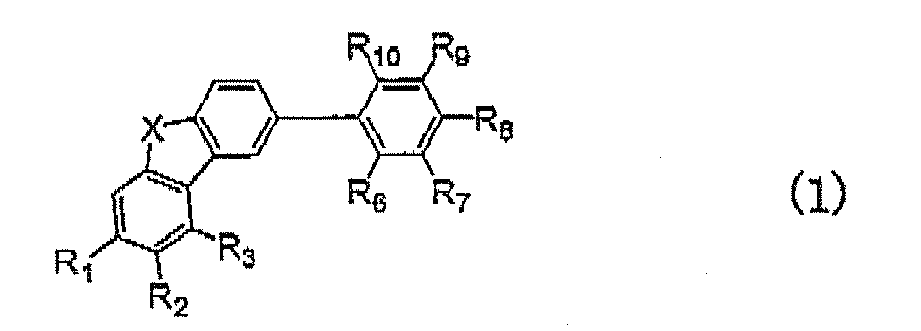
- in the formula 1, R1 to R3 are each independently hydrogen atom, halogen atom, alkyl group having 1 to 40 carbon atoms which is optionally substituted, cycloalkyl group having 3 to 15 carbon atoms which is optionally substituted, heterocyclic group having 3 to 20 carbon atoms which is optionally substituted, alkoxy group having 1 to 40 carbon atoms which is optionally substituted, non-condensed aryl group having 6 to 40 carbon atoms which is optionally substituted, condensed aryl group having 10 to 18 carbon atoms is optionally substituted, aryloxy group having 6 to 20 carbon atoms which is optionally substituted, aralkyl group having 7 to 20 carbon atoms which is optionally substituted, arylamino group having 6 to 40 carbon atoms which is optionally substituted, alkylamino group having 1 to 40 carbon atoms which is optionally substituted, aralkylamino group having 7 to 60 carbon atoms which is optionally substituted, arylcarbonyl group having 7 to 40 carbon atoms which is optionally substituted, arylthio group having 6 to 20 carbon atoms which is optionally substituted, alkyl halide group having 1 to 40 carbon atoms which is optionally substituted, or cyano group. Preferably, R1 to R3 are each independently hydrogen atom, halogen atom, alkyl group having 1 to 40 carbon atoms which is optionally substituted, cycloalkyl group having 3 to 15 carbon atoms which is optionally substituted, heterocyclic group having 3 to 20 carbon atoms which is optionally substituted, alkoxy group having 1 to 40 carbon atoms which is optionally substituted, non-condensed aryl group having 6 to 40 carbon atoms which is optionally substituted, condensed aryl group having 10 to 18 carbon atoms which is optionally substituted, aryloxy group having 6 to 20 carbon atoms which is optionally substituted, aralkyl group having 7 to 20 carbon atoms which is optionally substituted, arylamino group having 6 to 40 carbon atoms which is optionally substituted, alkylamino group having 1 to 40 carbon atoms which is optionally substituted, aralkylamino group having 7 to 60 carbon atoms which is optionally substituted, arylcarbonyl group having 7 to 40 carbon atoms which is optionally substituted, or arylthio group having 6 to 20 carbon atoms which is optionally substituted.
- R6 and R10 are each independently hydrogen atom or alkyl group having 1 to 40 carbon atoms which is optionally substituted.
- R7 to R9 are each independently hydrogen atom, halogen atom, alkyl group having 1 to 40 carbon atoms which is optionally substituted, cycloalkyl group having 3 to 15 carbon atoms which is optionally substituted, heterocyclic group having 3 to 20 carbon atoms which is optionally substituted, alkoxy group having 1 to 40 carbon atoms which is optionally substituted, non-condensed aryl group having 6 to 40 carbon atoms which is optionally substituted, condensed aryl group having 10 to 18 carbon atoms which is optionally substituted, aryloxy group having 6 to 20 carbon atoms which is optionally substituted, aralkyl group having 7 to 20 carbon atoms which is optionally substituted, arylamino group having 6 to 40 carbon atoms which is optionally substituted, alkylamino group having 1 to 40 carbon atoms which is optionally substituted, aralkylamino group having 7 to 60 carbon atoms which is optionally substituted, arylcarbonyl group having 7 to 40 carbon atoms which is optionally substituted, arylthio group having 6 to 20 carbon atoms which is optionally substituted, alkyl halide group having 1 to 40 carbon atoms which is optionally substituted, or cyano group, with the proviso that when R8 and R9, or R8 and R7 are not bonded to each other thereby do not form a ring structure, at least one of R7 to R9 is 9-carbazolyl group which is optionally substituted, azacarbazolyl group having 2 to 5 nitrogen atoms which is optionally substituted, dibenzofuranyl group which is optionally substituted, dibenzothiophenyl group which is optionally substituted, or phenyl group or biphenyl group each being substituted by at least one group selected from the group consisting of 9-carbazolyl group which is optionally substituted, azacarbazolyl group having 2 to 5 nitrogen atoms which is optionally substituted, dibenzofuranyl group which is optionally substituted and dibenzothiophenyl group which is optionally substituted. Preferably, at least one of R7 to R9 is 9-carbazolyl group which is optionally substituted, azacarbazolyl group having 2 to 5 nitrogen atoms which is optionally substituted, or phenyl group or biphenyl group each being substituted by at least one group selected from the group consisting of 9-carbazolyl group which is optionally substituted and azacarbazolyl group having 2 to 5 nitrogen atoms which is optionally substituted.
- Examples of azacarbazolyl group having 2 to 5 nitrogen atoms which is optionally substituted are shown below, although not limited thereto. The optional substituents are omitted for conciseness and the position of free valence on the azacarbazole ring is not specifically limited.


- R8 and R9, or R8 and R7 are optionally bonded to each other to form a ring structure which is optionally substituted. When forming the ring structure, R8 and R9, or and R7 together with the benzene to which R7 to R9 are bonded preferably form, for example, the following azacarbazole structure having 2 to 5 nitrogen atoms, dibensofuran structure, dibenzothiophene structure, or fluorene structure (substituents such as P6 and optional substituents are omitted for conciseness). However, R8 and R9, or R8 and R7 together with the benzene ring to which R7 to R9 are bonded do not form a carbazole structure.


- When R8 and R9, or R8 and R7 are bonded to form the ring structure which is optionally substituted, the remaining R7 or R9 which does not form the ring structure is hydrogen atom, halogen atom, alkyl group having 1 to 40 carbon atoms which is optionally substituted, cycloalkyl group having 3 to 15 carbon atoms which is optionally substituted, heterocyclic group having 3 to 20 carbon atoms which is optionally substituted, alkoxy group having 1 to 40 carbon atoms which is optionally substituted, non-condensed aryl group having 6 to 40 carbon atoms which is optionally substituted, condensed, aryl group having 10 to 18 carbon atoms which is optionally substituted, acyloxy group having 6 to 20 carbon atoms which is optionally substituted, aralkyl group having 7 to 20 carbon atoms which is optionally substituted, arylamino group having 6 to 40 carbon atoms which is optionally substituted, alkylamino group having 1 to 40 carbon atoms which is optionally substituted, aralkylamino group having 7 to 60 carbon atoms which is optionally substituted, arylcarbonyl group having 7 to 40 carbon atoms which is optionally substituted, arylthio group having 6 to 20 carbon atoms which is optionally substituted, alkyl halide group having 1 to 40 carbon atoms which is optionally substituted, or cyano group.
- Each of R1 to R3 and P6 to R10 (inclusive of substituent if substituted) does not have a polymerizable functional group, for example, vinyl group, 1-methylvinyl group, 1-halovinyl group and 1-trihalomethylvinyl group, at its terminal end.
- The halogen atom includes, for example, fluorine, chlorine, bromine and iodine.
- Examples of the alkyl group having 1 to 40 carbon atoms which is optionally substituted include methyl group, ethyl group, propyl group, isopropyl group, n-butyl group, s-butyl group, isobutyl group, t-butyl group, n-pentyl group, n-hexyl group, n-heptyl group, n-octyl group, n-nonyl group, n-decyl group, n-undecyl group, n-dodecyl group, n-tridecyl group, n-tetradecyl group, n-pentadecyl group, n-hexadecyl group, n-heptadecyl group, n-octadecyl group, neopentyl group, 1-methylpentyl group, 2-methylpentyl group, 1-pentylhexyl group, 1-butylpeatyl group, 1-heptyloctyl group, 3-methylpentyl group, hydroxymethyl group, 1-hydroxyethyl group, 2-hydroxyethyl group, 2-hydroxyisobutyl group, 1,2-dihydroxyethyl group, 1,3-dihydroxyisopropyl group, 2,3-dihydroxy-t-butyl group, 1,2,3-trihydroxupropyl group, chloromethyl group, 1-chloroethyl group, 2-chloroethyl group, 2-chloroisobutyl group, 1,2-dichloroethyl group, 1,3-dichloroisopropyl group, 2,3-dichloro-t-butyl group, 1,2,3-trichloropropyl group, bromomethyl group, 1-bromoethyl group, 2-bromoethyl group, 2-bromoisobutyl group, 1,2-dibromoethyl group, 1,3-dibromoisopropyl group, 2,3-dibromo-t-butyl group, 1,2,3-tribromopropyl group, iodomethyl group, 1-iodoethyl group, 2-iodoethyl group, 2-iodoisobutyl group, 1,2-diiodoethyl group, 1,3-diiodoisopropyl group, 2,3-diiodo-t-butyl group, 1,2,3-triiodopropyl group, aminomethyl group, 1-aminoethyl groups, 2-aminoethyl group, 2-aminoisobutyl group, 1,2-diaminoethyl group, 1,3-diaminoisopropyl group, 2,3-diamino-t-butyl group, 1,2,3-triaminopropyl group, cyanomethyl group, 1-cyanoethyl group, 2-cyanoethyl group, 2-cyanoisobutyl group, 1,2-dicyanoethyl group, 1,3-dicyanoisopropyl group, 2,3-dicyano-t-butyl group, 1,2,3-tricyanopropyl group, nitromethyl group, 1-nitroethyl group, 2-nitroethyl group, 1,2-dinitroethyl group, 2,3-dinitro-t-butyl group, and 1,2,3-trinitropropyl group. Preferred are methyl group, ethyl group, propyl group, isopropyl group, n-butyl group, s-butyl group, isobutyl group, t-butyl group, n-pentyl group, n-hexyl group, n-heptyl group, n-octyl group, n-nonyl group, n-decyl group, n-undecyl group, n-dodecyl group, n-tridecyl group, n-tetradecyl group, n-pentadecyl group, n-hexadecyl group, n-heptadecyl group, n-octadecyl group, neopentyl group, 1-methylpentyl group, 1-pentylhexyl group, 1-butylpentyl group, and 1-heptyloctyl group. The carbon number of the alkyl group (exclusivbe of substituent) is preferably from 1 to 10.
- Examples of the cycloalkyl group having 3 to 15 carbon atoms which is optionally substituted include cyclopentyl group, cyclohexyl group, cyclooctyl group, and 3,3,5,5-tetramethylcyclohexyl group, with cyclohexyl group, cyclooctyl group and 3,5-tetramethylcyclohexyl group being preferred. The carbon number of the cycloalkyl group (exclusivbe of substituent) is preferably from 3 to 12.
- Examples of the heterocyclic group having 3 to 20 carbon atoms which is optionally substituted include 1-pyrrolyl group, 2-pyrrolyl group, 3-pyrrolyl group, pyrazinyl group, 2-pyridinyl group, 1-imidazolyl group, 2-imidazolyl group, 1-pyrazolyl group, 1-indolizinyl group, 2-indolizinyl group, 3-indolizinyl group, 5-indolizinyl group, 6-indolizinyl group, 7-indolizinyl group, 8-indolizinyl group, 2-imidazopyridinyl group, 3-imidazopyridinyl group, 5-imidazopyridinyl group, 6-imidazopyridinyl group, 7-imidazopyridinyl group, 8-imidazopyridinyl group, 3-pyridinyl group, 4-pyridinyl group, 1-indolyl group, 2-indolyl group, 3-indolyl group, 4-indolyl group, 5-indolyl group, 6-indolyl group, 7-indolyl group, 1-isoindolyl group, 2-isoindolyl group, 3-isoindolyl group, 4-isoindolyl group, 5-isoindolyl group, 6-isoindolyl group, 7-isoindolyl group, 2-furyl group, 3-furyl group, 2-benzofuranyl group, 3-benzofuranyl group, 4-benzofuranyl group, 5-benzofuranyl group, 6-benzofuranyl group, 7-benzofuranyl group, 1-isobenzofuranyl group, 3-isobenzofuranyl group, 4-isobenzofuranyl group, 5-isobenzefuranyl group, 6-isobenzofuranyl group, 7-isobenzofuranyl group, 2-quinolyl group, 3-quinolyl group, 4-quinolyl group, 5-quinolyl group, 6-quinolyl group, 7-quinolyl group, 8-quinolyl group, 1-isoquinolyl group, 3-isoquinolyl group, 4-isoquinolyl group, 5-isoquinolyl group, 6-isoquinolyl group, 7-isoquinolyl group, 8-isoquinolyl group, 2-quinoxalinyl group, 5-quinoxalinyl group, 6-quinoxalinyl group, 1-carbazolyl group, 2-carbazolyl group, 3-carbazolyl group, 4-carbazolyl group, 9-carbazolyl group, azacarbazole-1-yl group, azacarbazole-2-yl group, azacarbazole-3-yl group, azacarbazole-4-yl group, azaearbazole-5-yl group, azacarbazole-6-yl group, azacarbazole-7-yl group, azacarbazole-8-yl group, azacarbazole-9-yl group, 1-phenanthridinyl group, 2-phenanthridinyl group, 3-phenanthridinyl group, 4-phenanthridinyl group, 6-phenanthridinyl group, 7-phenanthridinyl group, 8-phenanthridinyl group, 9-phenanthridinyl group, 10-phenanthridinyl group, 1-acridinyl group, 2-acridinyl group, 3-acridinyl group, 4-acridinyl group, 9-acridinyl group, 1,7-phenanthroline-2-yl group, 1,7-phenanthroline-3-yl group, 1,7-phenanthroline-4-yl group, 1,7-phenanthroline-5-yl group, 1,7-phenanthroline-6-yl group, 1,7-phenanthroline-8-yl group, 1,7-phenanthroline-9-yl group, 1,7-phenanthroline-10-yl group, 1,8-phenanthroline-2-yl group, 1,8-phenanthroline-8-yl group, 1,8-phenanthroline-4-yl group, 1,8-phenanthroline-5-yl group, 1,8-phenanthroline-6-yl group, 1,8-phenanthroline-7-yl group, 1,8-phenanthroline-9-yl group, 1,8-phenanthroline-10-yl group, 1,9-phenanthroline-2-yl group, 1,9-phenanthroline-3-yl group, 1,9-phenanthroline-4-yl group, 1,9-phenanthroline-5-yl group, 1,9-phenanthroline-6-yl group, 1,9-phenanthroline-7-yl group, 1,9-phenanthroline-8-yl group, 1,9-phenanthroline-10-yl group, 1,10-phenanthroline-2-yl group, 1,10-phenanthroline-3-yl group, 1,10-phenanthroline-4-yl group, 1,10-phenanthroline-5-yl group, 2,9-phenanthroline-1-yl group, 2,9-phenanthroline-8-yl group, 2,9-phenamthroline-4-yl group, 2,9-phenanthroline-5-yl group, 2,9-phenanthroline-6-yl group, 2,9-phenanthrohne-7-yl group, 2,9-phenanthroline-8-yl group, 2,9-phenanthroline-10-yl group, 2,8-phenanthroline-1-yl group, 2,8-phenanthroline-8-yl group, 2,8-phenanthroline-4-yl group, 2,8-phenanthroline5-yl group, 2,8-phenanthroline-6-yl group, 2,8-phenanthroline-7-yl group, 2,8-phenanthroline-9-yl group, 2,8-phenanthroline-10-yl group, 2,7-phenanthroline-1-yl group, 2,7-phenanthroline-3-yl group, 2,7-phenanthroline-4-yl group, 2,7-phenanthroline-5-yl group, 2,7-phenanthroline-6-yl group, 2,7-phenanthroline-8-yl group, 2,7-phenanthroline-9-yl group, 2,7-phenanthroline-10-yl group, 1-phenazinyl group, 2-phenazinyl group, 1-phenothiazinyl group, 2-phenothiazinyl group, 3-phenothiazinyl group, 4-phenothiazinyl group, 10-phenothiazinyl group, 1-phenoxazinyl group, 2-phenoxazinyl group, 3-phenoxazinyl group, 4-phenoxazinyl group, 10-phenoxazinyl group, 2-oxazolyl group, 4-oxazolyl group, 5-oxazolyl group, 2-oxadiazolyl group, 5-oxadiazolyl group, 3-furazanyl group, 2-thienyl group, 3-thienyl group, 2-methylpyrrole-1-yl group, 2.methylpyrrole-3-yl group, 2-methylpyrrole-4-yl group, 2-methylpyrrole-5-yl group, 3-methylpyrrole-1-yl group, 3-methylpyrrole-2-yl group, 3-methylpyrrole-4-yl group, 3-methylpy-rrole-5-yl group, 2-t-butylpyrrole-4-yl group, 3-(2-phenylpropyl)pyrrole-1-yl group, 2-methyl-1-indolyl group, 4-methyl-1-indolyl group, 2-methyl-3-indolyl group, 4-methyl-3-indolyl group, 2-t-butyl-1-indolyl group, 4-t-butyl-1-indolyl group, 2-t-butyl-3-indolyl group, 4-t-butyl-3-indolyl group, 1-dibenzofuranyl group, 2-dibenzofuranyl group, 3-dibenzofuranyl group, 4-dibenzofuranyl group, 1-dibenzothiophenyl group, 2-dibenzothiophenyl group, 3-dibenzothiophenyl group, 4-dlibenzothiophenyl group, 1-silafluorenyl group, 2-silafluorenyl group, 3-silafluorenyl group, 4-silafluorenyl group, 1-germafluorenyl group, 2-germafluorenyl group, 3-germafluorenyl group, and 4-germafluorenyl group.
- Of the above, preferred are 2-pyridinyl group, 1-indolizinyl group, 2-indolizinyl group, 3-indolizinyl group, 5-indolizinyl group, 6-indolizinyl group, 7-indolizinyl group, 8-indolizinyl group, 2-imidazopyridilyl group, 3-imidazopyridinyl group, 5-imidazopyridinyl group, 6-imidazopyridinyl group, 7-imidazopyridmyl group, 8-imidazopyridinyl group, 3-pyridinyl group, 4-pyridinyl group, 1-indolyl group, 2-indolyl group, 3-indolyl group, 4-indolyl group, 5-indolyl group, 6-indolyl group, 7-indolyl group, 1-isoindolyl group, 2-isoindolyl group, 3-isoindolyl group, 4-isoindolyl group, 5-isoindolyl group, 6-isoindolyl group, 7-isoindolyl group, 9-carbazolyl group, 1-dibenzofuranyl group, 2-dibenzofuranyl group, 3-dibenzofuranyl group, 4-dibenzofuranyl group, 1-dibenzothiophenyl group, 2-dibenzothiophenyl group, 3-dibenzothiophenyl group, 4-dibenzothiophenyl group, 1-silafluorenyl group, 2-silafluorenyl group, 3-silafluorenyl group, 4-silafluorenyl group, 1-germafluorenyl group, 2-germafluorenyl group, 3-germafluorenyl group, 4-gerafluorenyl group, azacarbazole-1-yl group, azacarbazole-2-yl group, azacarbazole-3-yl group, azacarbazole-4-yl group, azacarbazole-5-yl group, azacarbazole-6-yl group, azacarbazole-7-yl group, azacarbazole-8-yl group, and azacarbazole-9-yl group. The carbon number of the heterocyclic group (exclusive of substituent) is preferably from 3 to 14.
- The alkoxy group having 1 to 40 carbon atoms which is optionally substituted is represented by -OY wherein Y and its preferred examples are the same as the alkyl groups mentioned above.
- Examples of the non-condensed aryl group having 6 to 40 carbon atoms which is optionally substituted include phenyl group, 2-biphenylyl group, 3-biphenylyl group, 4-biphenylyl group, p-terphenyl-4-yl group, p-terphenyl-3-yl group, p-terphonyl-2-yl group, m-terphenyl-4-yl group, m-terphenyl-3-yl group, m-terphenyl-2-yl group, o-tolyl group, m-tolyl group, p-tolyl group, p-t-butylphenyl group, p-(2-phenylpropyl)phenyl group, 4'-methylbiphenylyl group, 4"-t-butyl-p-terphenyl-4-yl group, o-cumenyl group, m-cumenyl group, p-cumenyl group, 2,3-xylyl group, 3,4-xylyl group, 2,5-xylyl group, mesityl group, and m-quaterphenyl group, with phenyl group, 2-biphenylyl group, 3-biphenylyl group, 4-biphenylyl group, m-terphenyl-4-yl group, m-terphenyl-3-yl group, m-terphenyl-2-yl group, p-tolyl group, 3,4-xylyl group, and m-quaterphenyl-2-yl group being preferred. The carbon number of the non-condensed aryl group (exclusive of substituent) is preferably from 6 to 24.
- Examples of the condensed aryl group having 10 to 18 carbon atoms which is optionally substituted include 1-naphthyl group, 2-naphthyl group, 1-phenanthrenyl group, 2-phenanthrenyl group, 3-phenanthrenyl group, 4-phenanthrenyl group, 9-phenanthrenyl group, 1-triphenylenyl group, 2-triphenylenyl group, 3-triphenylenyl group, 4-triphenylenyl group, 1-chrysenyl group, 2-chrysenyl group, 3-chrysenyl group, 4-chrysenyl group, 5-chrysenyl group, and 6-chrysenyl group.
- The aryloxy group having 6 to 20 carbon atoms which is optionally substituted is represented by -OAr wherein Ar and its preferred examples are the same as the non-condensed aryl groups mentioned above.
- Examples of the aralkyl group having 7 to 20 carbon atoms which is optionally substituted include benzyl group, 1-phenylethyl group, 2-phenylethyl group, 1-phenylisopropyl group, 2-phenylisopropyl group, phenyl-t-butyl group, α-naphthylmethyl group, 1-α-naphthylethyl group, 2-α-naphthylethyl group, 1-α-naphthylisapropyl group, 2-α-naphthylisopropyl group, β-naphthylmethyl group, 1-β-naphthylethyl group, 2-β-naphthylethyl group, 1-β-naphthylisopropyl group, 2-β-naphthylisopropyl group, 1-pyrrolylmethyl group, 2-(1-pyrrolyl)ethyl group, p-methylbenzyl group, m-methylbenzyl group, o-methylbenzyl group, p-chlorobenzyl group, m-chlorobenzyl group, o-ehlorobenzyl group, p-bromobenzyl group, m-bromobenzyl group, o-bromobenzyl group, p-iodabenzyl group, m-iodobenzyl group, o-iodobenzyl group, p-hydroxybenzyl group, m-bydroxybenzyl group, o-hydroxybenzyl group, p-aminobenzyl group, m-aminobenzyl group, o-aminobenzyl group, p-nitrobenzyl group, m-nitrobenzyl group, o-nitrobenzyl group, p-cyanobenzyl group, m-cyanobenzyl group, o-cyanobenzyl group, 1-hydroxy-2-phenylisopropyl group, and 1-choro-2-phenylisopropyl group, with benzyl group, p-cyanobenzyl group, m-cyanobenzyl group, o-cyanobenzyl group, 1-phenylethyl group, 2-phenylethyl group, 1-phenylisopropyl group, and 2-phenylisopropyl group being preferred. The alkyl moiety of the aralkyl group has preferably from 1 to 8 carbon atoms, and the aryl moiety (inclusive of heteroaryl) has preferably from 6 to 18 carbon atoms.
- Each of the arylamino group having 6 to 40 carbon atoms which is optionally substituted, the alkylamino group having 1 to 40 carbon atoms which is optionally substituted and the aralkylamino group having 7 to 60 carbon atoms which is optionally substituted is represented by -NQ1Q2, wherein Q1 and Q2 are each independently selected from the alkyl groups, aryl groups and aralkyl groups described above. Similarly, preferred examples of Q1 and Q2 are the same as those described above.
- The arylthio group having 6 to 20 carbon atoms which is optionally substituted is a group derived from the aryloxy group -OAr by substituting sulfur atom for the oxygen atom. Preferred arylthio groups are derived from the preferred aryloxy groups in the same manner.
- The arylcarbonyl group having 7 to 40 carbon atoms which is optionally substituted is represented by -COAr2, wherein Ar2 and its preferred examples are the same as the aryl groups mentioned above.
- The alkyl halide group having 1 to 40 carbon atoms which is optionally substituted is, for example, derived from the alkyl group mentioned above by substituting halogen atom for at least one hydrogen atom. Preferred alkyl halide groups are derived from the preferred alkyl groups in the same manner.
- The compound of the formula 1 is preferably represented by any of the following formulae 2 to 5:


- In the formulae 2 to 5, R1 to R3, R6 to R10 and X are the same as defined above. The definitions of R18 to R29 are the same as the definition to R3 except for the proviso.
- The compound of the formula 2 is preferably represented by the following formula 6 or 9:

- In the formula 6 and 9, R6 to R8, R10, R20 to R24 and X are the same as defined above.
- The compound of the formula 3 is preferably represented by the following formula 7:

- In the formulae 7, R6, R7, R9, R10, R20 to R24 and X are the same as defined above.
- The compound of the formula 4 is preferably represented by the following formula 8:

- In the formula 8, R18, R19, R22, R23 and X are the same as defined above.
- Examples of the substituent groups in the definitions of R1 to R3, R6 to R10 and R18 to R29 in the formulae 1 to 9 include alkyl group having 1 to 8 carbon atoms (methyl group, ethyl group, propyl group, isopropyl group, n-butyl group, s-butyl group, isobutyl group, t-butyl group, n-pentyl group, n-hexyl group, n-heptyl group, n-octyl group); hydroxyalkyl group having 1 to 5 carbon atoms (hydroxymethyl group, 1-hydroxyethyl group, 2-hydroxyethyl group, 2-hydroxyisobutyl group, 1,2-dihydroxyethyl group, 1,3-dihydroxyisopropyl group, 2,3-dihydroxy-t-butyl group, 1,2,3-trihydroxypropyl group); haloalkyl group having 1 to 4 carbon atoms (chloromethyl group, 1-chloroethyl group, 2-chloroethyl group, 2-chloroisobutyl group, 1,2-dichloroethyl group, 1,3-dichloroispropyl group, 2,3-dichloro-t-butyl group, 1,2,3-trichloropropyl group, bromomethyl group, 1-bromoethyl group, 2-bromoethyl group, 2-bromoisobutyl group, 1,2-dibromoethyl group, 1,3-dibromoisopropyl group, 2,3-dibromo-t-butyl group, 1,2,3-tribromopropyl group, iodomethyl group, 1-iodomethyl group, 2-iodomethyl group, 2-iodoisobutyl group, 1,2-diiodoethyl group, 1,3-diiodoisopropyl group, 2,3-diiodo-t-butyl group, 1,2,3-trxrodopxopyl, group); aminoalkyl group having 1 to 4 carbon atoms (aminomethyl group, 1-aminoethyl group, 2-aminoethyl group, 2-aminoisobutyl group, 1,2-diaminoethyl group, 1,3-diaminoisopropyl group, 2,3-diamino-t-btxtyl group, 1,2,3-triaminopropyl group); cyanoalkyl group having 1 to 4 carbon atoms (cyanomethyl group, 1-cyanoethyl group, 2-cyanoethyl group, 2-cyanoisobutyl group, 1,2-dicyanoethyl group, 1,3-dicyanoisopropyl group, 2,3-dicyano-t-butyl group, 1,2,3-tricyanopropyl group); nitroalkyl group having 1 to 5 carbon atoms (nitromethyl group, 1-nitroethyl group, 2-nitroethyl group, 2-nitroisobutyl group, 1,2-dinitroethyl group, 1,3-dinitroisopropyl group, 2,3-dinitro-t-butyl group, 1,2,3-trinitropropyl group); (alky)cydoalkyl group having 3 to 10 carbon atoms (cyclopropyl group, cyclobutyl group, cyclopentyl group, cyclohexyl group, 4-methylcyclohexyl group, 1-adamantyl group 2-adamantyl group, 1-norbornyl group, 2-norbornyl group); having 1 to 60 carbon atoms alkoxy group(ethoxy group, methoxy group, isopropoxy group, n-propoxy group, s-butoxy group, t-butoxy group, pentoxy group, hexyloxy group); cycloalkoxy group having 3 to 6 carbon atoms (cyclopentoxy group, cyclohexyloxy group); aryl group having 5 to 40 ring atoms; amino group substituted with aryl group having 5 to 40 ring atoms; ester group having aryl group with 5 to 40 ring atoms; ester group having alkyl group with 1 to 60 carbon atoms; cyano group; nitro group; halogen atom; hydroxyl group; amino group; substituted or non-substituted carbazolyl group (1-carbazolyl group, 2-carbazolyl group, 3-carbazolyl group, 4-carbazolyl group, 9-carbazolyl group); substituted or non-substituted dibenzofuranyl group (1-dibenzofuranyl group, 2-dibenzofuranyl group, 3-dibenzofuranyl group, 4-dibenzofuranyl group); and substituted or non-substituted dibenzothiophenyl group (1-dibenzothiophenyl group, 2-dibenzothiophenyl group, 3-dibenzothiophenyl group, 4-dibenzothiophenyl group). The substituent groups for carbazolyl group, dibenzofuranyl group, and dibenzothiophenyl group are selected from the groups recited above.
- At least one of R7, R8 and R20 to R24 of the formula 2; at least one of R7, R9 and R20 to R24 of the formula 3; at least one of R7 and R21 to R23 of the formula 4; at least one of R7, R8, R20 and R22 to R29 of the formula 5; at least one of R7, R8 and R20 to R24 of the formula 6; at least one of R7, R9 and R20 to R24 of the formula 7; at least one of R22 and R23 of the formula 8; and at least one of R7, R21 and R23 of the formula 9 are preferably selected from substituted or non-substituted 9-carbazolyl group, substituted or non-substituted dibenzofuranyl group, substituted or non-substituted azacarbazolyl group having 2 to 5 nitrogen atoms and substituted or non-substituted dibenzothiophenyl group.
- The compound represented by any of the formulae 1 to 9 has a triplet energy gap of 2.3 to 3.2 eV. Examples thereof are shown bellow, although not limited thereto.


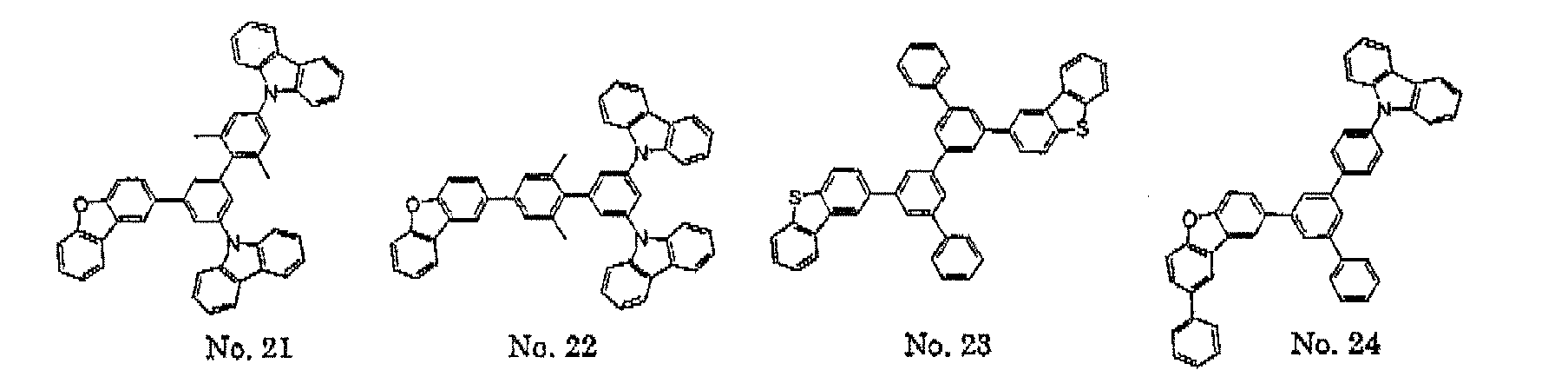


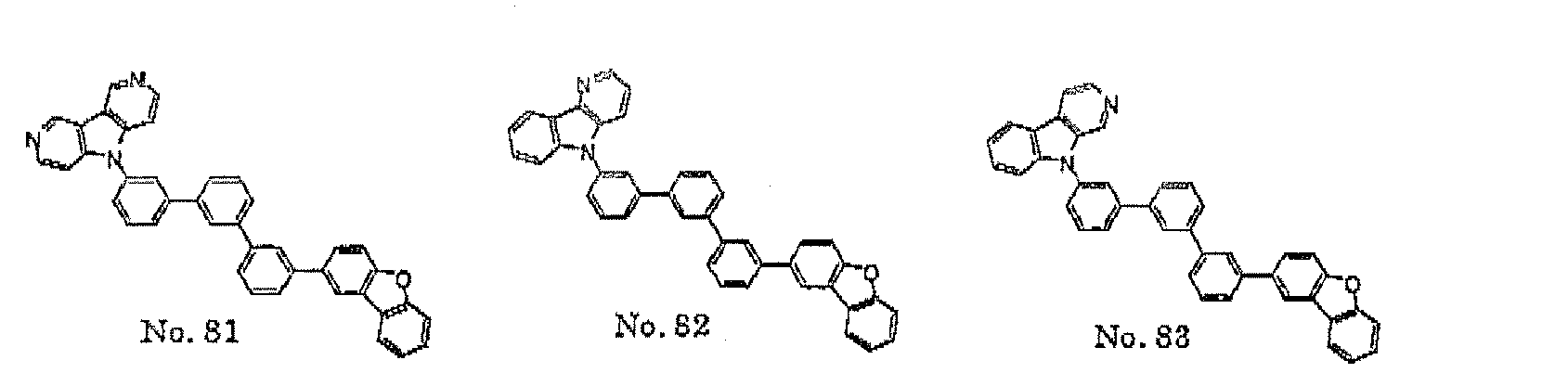


- The compounds of the formula 1 may be easily synthesized by Suzuki-Miyaura reaction between an organic boracic acid and an aryl halide according to the follwing reaction scheme.

- The material for organic EL devices of the present invention are preferably used as a host material for the light emitting layer and a hole transporting material.
- The organic EL devices of the present invention will be described below. The organic EL devices have an organic thin film having one or more layers between the cathode and the anode. At least one layer of the organic thin film is a light emitting layer which comprises a host material for use in combination with at least one phosphorescent metal complex. At least one layer of the organic thin film contains the material for organic EL devices of the present invention.
- The multi-layered organic EL devices have a multi-layered laminate structure such as anode/hole transporting layer (hole injecting layer)/light emitting layer/cathode, anode/light emitting layer/electron transporting layer (electron injecting layer)/cathode, anode/hole transporting layer (hole injecting layer)/light emitting layer/electron transporting layer (electron injecting layer)/cathode, and anode/hole transporting layer (hole injecting layer)/light emitting layer/hole barrier layer/electron transporting layer (electron injecting layer)/cathode.
- The light emitting layer of the organic EL devices preferably contains the material for organic EL devices as the host material. Further, the light emitting layer comprises a host material, preferably the material for organic EL devices, and a phosphorescent light emitting material. Preferred examples of the phosphorescent light emitting material are compounds containing iridium (Ir), osmium (Os) or platinum (Pt) because of their high quantum yield of phosphorescence and their capability of enhancing the external quantum efficiency of light emitting devices, with metal complexes such as iridium complexes, osmium complexes and platinum complexes being more preferred, iridium complexes and platinum complexes being still more preferred, and ortho-metallated iridium complexes being most preferred. Preferred examples of the ortho-metallated iridium complexes are shown below.
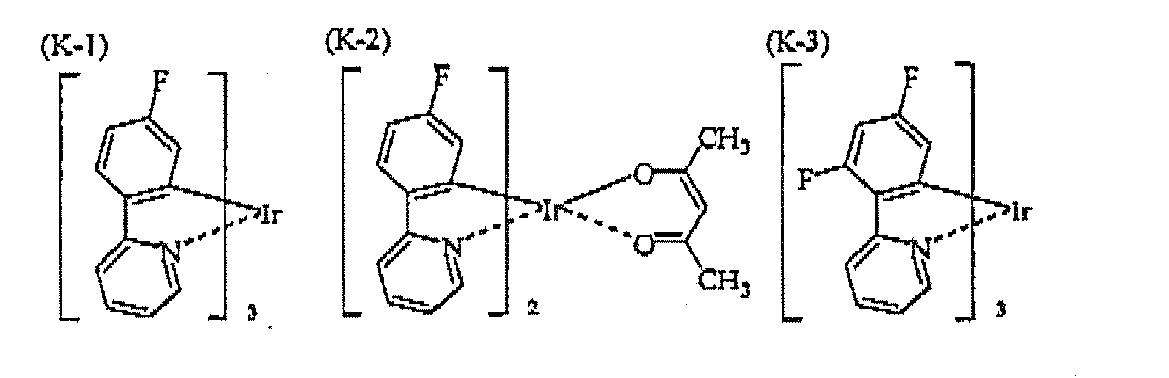


- In another preferred embodiment of the organic EL devices, the light emitting layer contains the host material and a phosphorescent light emitting material, for example, a blue-light emitting metal complex having a maximum emitting wavelength of 500 nm or less. Examples of the blue-light emitting metal complex include K-1, K-2, K-3, K-10, K-11, K-12, K-15, K-16, K-17, K-20, and K-21 described above.
- Still another preferred organic EL device includes a hole transporting layer (hole injecting layer) which contains the material for organic EL devices of the invention as a hole transporting material.
- In the organic EL devices of the invention, a reducing dopant is preferably added to the interfacial region between the cathode and the organic thin film layer. Examples of the reducing dopant include at least one compound selected from alkali metals, alkali metal complexes, alkali metal compounds, alkaline earth metals, alkaline earth metal complexes, alkaline earth metal compounds, rare earth metals, rare earth metal complexes, and rare earth metal compounds.
- Examples of the alkali metals include Na (work function: 2.36 eV), K (work function: 2.28 eV), Rb (work function: 2.16 eV), and Cs (work function: 1.95 eV), with those having a work function of 2.9 eV or less being particularly preferred. Preferred is K, Rb or Cs, more preferred is Rb or Cs, and most preferred is Cs.
Examples of the alkaline earth metals include Ca (work function: 2.9 eV), Sr (work function: 2.0 to 2.5 eV), and Ba (work function: 2.52 eV), with those havng a work function of 2.9 eV or less being particularly preferred.
Examples of the rare earth metals include Se, Y, Ce, Tb and Yb, with those having a work function of 2.9 eV or less being particularly preferred.
Partucularly, the preferred metals mentioned above hava a high reducing ability. Therefore, a relatively small amount of addition thereof to the electron injecting zone improves the luminance of emission and prolongs the lifetime. - Examples of the alkali metal compounds include alkali oxides such as Li2O, Cs2O and K2O and alkali halides such as LiF, NaF, CsF and KF, with LiF, Li2O and NaF being preferred.
Examples of the alkaline earth metal compounds include BaO, SrO, CaO and mixtures thereof such as BaxSr1-xO (0<x<1) and BaxCa1-xO (0<x< 1), with BaO, SrO and CaO being preferred.
Examples of the rare earth metal compounds include YbF3, ScF3, ScO3, Y2O3, Ce2O3, GdF3 and TbF3, with YbF3, ScF3 and TbF3 being preferred. - The alkali, metal complexes, alkaline earth metal complexes and rare earth metal complexes are not particularly limited as long as containing at lease one metal ions selected from alkali metal ions, alkaline earth metal ions and rare earth metal ions. Examples of the lingand preferably include, but not limited to, quinolinol, benzoquinolinol, acridinol, phenanthridinol, hydroxyphenyloxazole, hydroxyphenylthiazole, hydroxydiaryloxadiazole, hydroxydiarylthiadiazole, hydroxyphenylpyridine, hydroxyphenylbenzimidazole, hydroxybenzotriazole, hydroxyfulborane, bipyridine, phenanthroline, phthalocyanine, porphyrin, cyclopentadiene, β-diketones, azomethines, and derivatives thereof.
- The reducing dopant is added to the interfacial region preferably in the form of layers or islands by a resistance-heating vapor deposition in which the reducing dopant is vapor-deposited while vapor-depositing an organic material (a light emitting material or an electron injecting material for forming the interfacial region) at the same time, thereby dispersing the reducing dopant in the organic material. The dispersion concentration is 100:1 to 1:100, preferably 5:1 to 1:5 when expressed by a molar ratio of the the organic material to the reducing dopant.
When adding the reducing dopant in the form of layer, the reducing dopant is solely vapor-deposited by the resistance-heating vapor deposition into a layer preferably having a thickness of 0.1 to 15 nm after forming an interfacial organic layer from a light emitting material or an electron injecting material.
When adding the reducing dopant in the form of islands, the reducing dopant is solely vapor-deposited by the resistance-heating vapor deposition into a form of islands preferably having a thickness of 0.05 to 1 nm after forming an interfacial organic layer from a light emitting material or an electron injecting material.
The molar ratio of the main components of the organic EL devices of the invention (light emitting material and electron injecting material) and the reducing dopant is preferably 5:1 to 1:5 and more preferably 2:1 to 1:2. - In still another preferred embodiment of the invention, the organic EL device has an electron injecting layer between the light emitting layer and the cathode, and the electron injecting layer mainly comprises a nitrogen-containing cyclic derivative which is different from the organic EL material of the present invention. The electron transporting material for the electron injecting layer is preferably an aromatic heterocyclic compound having one or more heteroatoms in its molecule, particularly an aromatic nitrogen-containing cyclic compound.
- For example, the aromatic nitrogen-containing cyclic compound is preferably a nitrogen-containing, cyclic metal chelate complex represented by the following formula A:

- In the formula A, R2 to R7 are each independently hydrogen atom, halogen atom, oxy group, or amino group or hydrocarbon group having 1 to 40 carbon atoms, each being oprtionally substituted.
Examples of the halogen atom are the same as mentioned above. Examples of the amino group which is oprtionally substituted include the same groups which are recited as the alkylamino group, arylamino group, and aralkylamino group mentioned above.
Example of the hydrocarbon group having 1 to 40 carbon atoms include alkyl group, alkenyl group, cycloalkyl group, alkoxy group, aryl group, heterocyclic group, aralkyl group, aryloxy group, and alkoxycarbonyl group, each being optionally substituted. Examples of the alkyl group, alkenyl group, cycloalkyl group, alkoxy group, aryl group, heterocyclic group, aralkyl group, and aryloxy group are the same as those mentioned above. The alkoxycarbonyl group is represented by -COOY wherein Y is the same alkyl group as mentioned above. - M in the formula A is aluminum (Al), gallium (Ga) or indium (In), with In being preferred.
L in the formula A is a group represented by the following formula A' or A":

- Examples of the hydrocarbon group having 1 to 40 carbon atoms of the formulae A' and A" are the same groups as those recited for R2 to R7. Examples of the bivalent group which is formed by the adjacent groups of R8 to R12 or R13 to R27 for forming a ring structure include tetramethyle group, pentamethyle group, hexamethyle group, diphenylmethane-2,2'-diyl group, diphenylethane-3,3'-diyl group, and diphenylpropane-4,4'-diyl group.
- Specific examples of the nitrogen-containing, cyclic metal chelate complex are shown below, although not limited thereto.


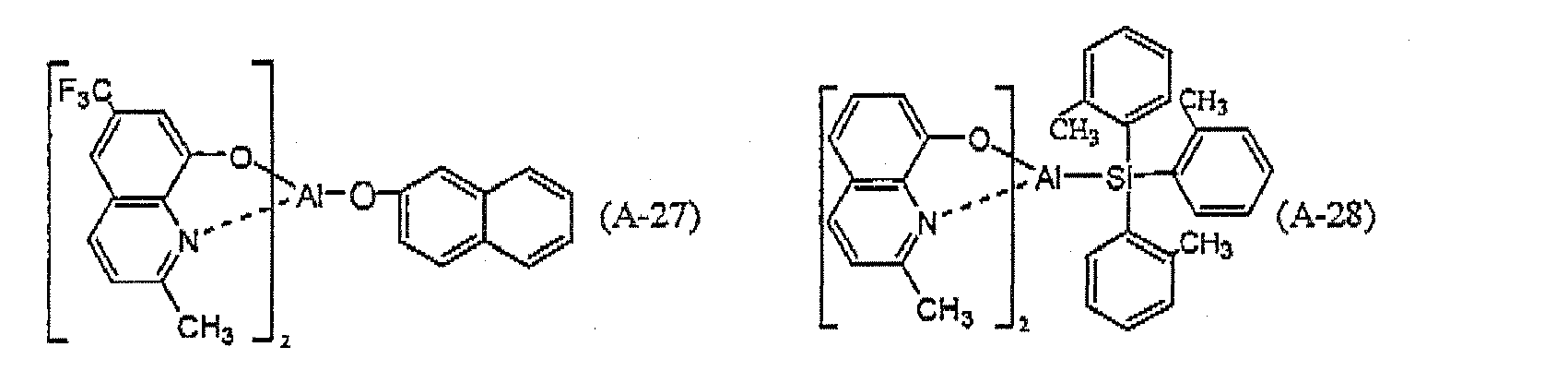


- Another preferred example of the aromatic, nitrogen-containing cyclic compound includes a nitrogen-containing, five-membered cyclic compound. The nitrogen-containing, five-membered ring may include imidazole ring, triazole ring, tetrazole ring, oxadiazole ring, thiadiazole ring, oxatriazole ring, and thiatriazole ring. The nitrogen-containing, five-membered cyclic compound has a skeletal structure such as benzimidazole ring, benzotriazole ring, pyridinoimidazole ring, pyrimidinoimidazole ring, and pyridazinoimidazole ring, and is preferably represented by the following formula B:

- In the formula B, LB is a mono- to tetravalent bonding group such as carbon atom, silicon atom, nitrogen atom, boron atom, oxygen atom, sulfur atom, metal (barium, beryllium, etc.), aromatic hydrocarbon ring, and heteroaromatic ring, with carbon atom, nitrogen atom, silicon atom, boron atom, oxygen atom, sulfur atom, aryl group and heteroaromatic group being preferred, and carbon atom, silicon atom, aryl group and heteroaromatic group being more preferred.
The aryl group or heteroaromatic group for LB may be substituted. The substituent group is preferably alkyl group, alkenyl group, alkynylgroup, aryl group, amino group, alkoxy group, aryloxy group, acyl group, alkoxycarbonyl group, aryloxycarbonyl group, acyloxy group, acylamino group, alkoxycarbonylamino group, aryloxycarbonylamino group, sulfonylamino group, sulfamoyl group, carbamoyl group, alkylthio group, arylthio group, sulfonyl group, halogen atom, cyano group, or heteroaromatic group; more preferably alkyl group, aryl group, alkoxy group, acyloxy group, halogen atom, cyano group, or heteroaromatic group; still more preferably alkyl group, aryl group, alkoxy group, aryloxy group, or heteroaromatic group; and particularly preferably alkyl group, aryl group, alkoxy group, or heteroaromatic group. - Preferred examples of LB are shown below.




- XB2 in the formula B is -O-, -S- or =N-RB2, preferably -O- or =N-RB2, and more preferably =N-RB2. RB2 is hydrogen atom, aliphatic hydrocarbon group, aryl group or heterocyclic group.
The aliphatic hydrocarbon group for RB2 may be linear, branched or cyclic and includes alkyl groups having preferably 1 to 20 carbon atoms, more preferably 1 to 12 carbon atoms and particularly preferably 1 to 8 carbon atoms such as methyl, ethyl, isopropyl, t-butyl, n-octyl, n-clecyl, n-hexadecyl, cyclopropyl, cyclopentyl, and cyclohexyl; alkenyl groups having preferably 2 to 20 carbon atoms, more preferably 2 to 12 carbon atoms and particularly preferably 2 to 8 carbon atoms such as vinyl, allyl, 2-butenyl, and 3-pentenyl.t and alkynyl groups having preferably 2 to 20 carbon atoms, more preferably 2 to 12 carbon atoms and particularly preferably 2 to 8 carbon atoms such as propargyl and 3-pentynyl, with alkyl groups being preferred. - The aryl group for RB2 is a non-condensed or condensed aryl group and has preferably 6 to 30 carbon atoms, more preferably 6 to 20 carbon atoms and still more preferably 6 to 12 carbon atoms. Examples thereof include phenyl, 2-methylphenyl, 3-methylphenyl, 4-methylphenyl, 2-methosyphenyl, 3-trifluoromethylphenyl, pentafluorophenyl, 1-naphthyl, and 2-naphthyl,
- The heterocyclic group for RB2 is a non-condensed or condensed heterocyclic group, preferably a heteroaromatic group having at least one atom selected from nitrogen atom, oxygen atom, sulfur atom and selenium atom, and has preferably 1 to 20 carbon atoms, more preferably 1 to 12 carbon atoms and still more preferably 2 to 10 carbon atoms. Examples of the basic structure of the heterocyclic group include pyrrolidone, piperidine, piperazine, morpholine, thiophene, selenophene, furan, pyrrole, imidazole, pyrazole, pyridine, pyrazine, pyridazine, pyrimidine, triazole, triazine, indole, indazole, purine, thiazoline, thiazole, thiadiazole, oxazoline, oxazole, oxadiazole, quinoline, isoquinoline, phthalazine, naphthyridine, quinoxaline, quinazoline, cinnoline, pteridine, acridine, phenanthroline, phenazine, tetrazole, benzimidazole, benzoxazole, benzothiazole, benzotriazole, tetraazaindene, carbazole, and azepine, with furan, thiophene, pyridine, pyrazine, pyrimidine, pyridazine, triazine, quinoline, phthalazine, naphthyridine, quinoxaline, and quinazoline being preferred, furan, thiophene, pyridine, and quinoline being more preferred, and quinoline being still more preferred.
- The aliphatic hydrocarbon group, aryl group and heterocyclic group for RB2 may be substituted. The substituent groups and preferred substituent groups are the same as the substituent groups for LB mentioned above.
RB2 is preferably aliphatic hydrocarbon group, aryl group or heterocyclic group, more preferably aliphatic hydrocarbon group or aryl group (having preferably 6 to 30 carbon atoms, more preferably 6 to 20 carbon atoms, and still more preferably 6 to 12 carbon atoms), and still more preferably aliphatic hydrocarbon group (having preferably 1 to 20 carbon atoms, more preferably 1 to 12 carbon atoms, and still more preferably 2 to 10 carbon atoms). - ZB2 is a group of atoms to form an aromatic ring. The aromatic ring formed by ZB2 is either of an aromatic hydrocarbon ring or a heteroaromatic ring. Examples there of include benzene ring, pyridine ring, pyrazine ring, pyrimidine ring, pyridazine ring, triazine ring, pyrrole ring, furan ring, thiophene ring, selenophene ring, tellurophene ring, imidazole ring, thiazole ring, selenazole ring, tellurazole ring, thiadiazole ring, oxadiazole ring, and pyrazole ring, with benzene ring, pyridine ring, pyrazine ring, pyrimidine ring, and pyridazine ring being preferred, benzene ring, pyridine ring, and pyrazine ring being more preferred, benzene ring and pyridine ring being still more preferred, and pyridine ring being particularly preferred.
- The aromatic ring formed by ZB2 may be fused with another ring to form a condensed ring and may be substituted. Examples of the substituent group are the same as the substituent groups for LB and preferably alkyl group, alkenyl group, alkynylgroup, aryl group, amino group, alkoxy group, aryloxy group, acyl group, alkoxycarbonyl group, aryloxycarbonyl group, acyloxy group, acylamino group, alkoxycarbonylamino group, aryloxycarbonylamino group, sulfonylamino group, sulfamoyl group, carbamoyl group, alkylthio group, arylthio group, sulfonyl group, halogen atom, cyano group, and heterocyclic group more preferably alkyl group, aryl group, alkoxy group, aryloxy group, halogen atom, cyano group, and heterocyclic group; still more preferably alkyl group, aryl group, alkoxy group, acyloxy group, and heteroaromatic group; and particularly preferably alkyl group, aryl group, alkoxy group, and heteroaromatic group.
nB2 is an integer of 1 to 6, preferably an integer of 1 to 4, and still more preferably 2 or 3. - The nitrogen-containing five-membered cyclic compound of the formula B is preferably represented by the following formula B':

- In the formula B', RB71, RB72, RB73 and their preferred examples are each independently the same as defined in RB2 of the formula B.
ZB71, ZB72, ZB73 and their preferred examples are each independently the same as defined in ZB2 of the formula B.
LB71, LB72 and LB73 are each independently single bond or bivalent group as defined in LB of the formula B, preferably single bond, bivalent aromatic hydrocarbon group, bivalent heteroaromatic group or bivalent bonding group composed of a combination thereof, with single bond being preferred. TB71, LB72 and LB73 may be substituted. The substituent groups and preferred substituent groups are the same as the substituent groups for LB of the formula B.
Y is nitrogen atom, 1,3,5-benzenetriyl group or 2,4,6-triazinetriyl group. The 1,3,5-benzenetriyl group maybe substituted at 2,4,6-position, for example, by alkyl group, aromatic hydrocarbon group or halogen atom. - Specific examples of the nitrogen-containing five-membered cyclic compound of the formula B or B' are shown below, although not limited thereto.


- In addition to the aromatic, nitrogen-containing cyclic compound mentioned above, the compounds for forming the electron injecting layer and electron transporting layer may further include an electron-deficient, nitrogen-containing cyclic compound which has a structure combining an electron-deficient, nitrogen-containing 5- or 6-membered cyclic skeleton with a substituted or non-substituted indole skeleton, substituted or non-substituted carbazole skeleton, or substituted or non-substituted azacarbazole skeleton. Preferred electron-deficient, nitrogen-containing 5- or 6-membered cyclic skeleton includes each skeleton of pyridine, pyrimidine, pyrazine, triazine, triazole, oxadiazole, pyrazole, imidazole, quinoxaline, pyrrole, and a condensed skeleton thereof such as benzimidazole and imidazopyridine. The combination between the pyridine, pyrimidine, pyrazine or triazine skeleton with the carbazole, indole, azacarbazole or quinoxaline skeleton is preferred. Each skeleton may be either substituted or not substituted.
- Examples of the electron-deficient, nitrogen-containing cyclic compound are shown bellow.


- The electron injecting layer and electron transporting layer may be a single-layered structure or multi-layered structure of layers having the same composition or different compositions, each layer being made of one or more kinds of the materials mentioned above, preferably a compound having a nitrogen-containing heterocyclic group with a low π-electron density.
- In addition to the nitrogen-containing cyclic compound and the electron-deficient, nitrogen-containing cyclic compound, the electron injecting layer is preferably incorporated with an inorganic compound such as insulating material and semiconductor. The insulating material or semiconductor incorporated into the electron injecting layer effectively prevents the leak of electric current to enhance the electron injecting properties.
- The insulating material is preferably at least one metal compound selected from the group consisting of alkali metal chalcogenides, alkaline earth metal chalcogenides, alkali metal halides and alkaline earth metal halides. The metal compound incorporated into the electron injecting layer further enhances the electron injecting properties. Preferred examples of the alkali metal chalcogenides include Li2O, K2O, Na2S, Na2Se and Na2O, and preferred examples of the alkaline earth metal chalcogenides include CaO, BaO, SrO, BeO, BaS and CaSe. Preferred examples of the alkali metal halides include LiF, NaF, KF, LiCl, KCl and NaCl. Examples of the alkaline earth metal halides include fluorides such as CaF2, BaF2, SrF2, MgF2 and BeF2 and halides other than fluorides.
- Example of the semiconductor may include oxide, nitride or oxynitride each containing at least one element selected from the group consisting of Ba, Ca, Sr, Yb, Al, Ga, In, Li, Na, Cd, Mg, Si, Ta, Sb and Zn. The semiconductor may be used singly or in combination of two or more. The inorganic compound included in the electron injecting layer preferably forms a microcrystalline or amorphous insulating thin film. When the electron injecting layer is formed from such an insulating thin film, the thin is made more uniform to decrease the pixel defects such as dark spots. Examples of such inorganic compound include alkali metal chalcogenides, alkaline earth metal chalcogenides, alkali metalhalides and alkaline earth metalhalide, each being described above.
The electron injecting layer may be included with the reducing dopant described above. - Since the anode of the organic EL devices has a function of injecting holes into the hole transporting layer or light emitting layer, the anode preferably has a work function of 4.5 eV or more. Examples of the material for the anode include indium tin oxide (ITO), tin oxide (NESA), gold, salver, platinum and copper. Since the cathode has a function of injecting electrons into the electron injecting layer or light emitting layer, the material for the cathode preferably has a small work function. Examples of the material for the cathode include, but not limited to, indium, aluminum, magnesium, magnesium-indium alloy, magnesium-aluminum alloy, aluminum-lithium alloy, aluminum-scandium-lithium alloy, and magnesium-silver alloy.
- The method of forming each layer of the organic EL devices is not critical, and a known method such as a vacuum vapor deposition method and a spin coating method may be employed. The organic thin film layer containing the material for organic EL devices of the invention can be formed by a known method such as a vacuum vapor deposition method, molecular beam epitaxy method (MBE method) and a solution coating method, for example, a dipping method, spin coating method, a casting method, a bar coating method and a roll coating method.
The thickness of each organic layer of the organic EL devices is not particularly limited. Generally, an excessively thin layer likely causes defects such as pin holes, and an excessively thick layer requires a high applied voltage to decrease the efficiency. The thickness is preferably from several nanometers to 1 µm. - The hole injecting/transport layer is formed from an aromatic amine compound, preferably the aromatic amine derivative represented by the following formula I:

- In the formula I, Ar1 to Ar4 are each independently aryl group (inclusive of heteroaryl group) having 5 to 50 ring atoms.
- Examples of the aryl group having 5 to 50 ring atoms include phenyl group, 1-naphthyl group, 2-naphthyl group, 1-anthryl group, 2-anthryl group, 9-anthryl group, 1-phenanthryl group, 2-phenanthryl group, 3-phenanthryl group, 4-phenanthryl group, 9-phenanthryl group, 1-naphthacenyl group, 2-naphthacenyl group, 9-naphthacenyl group, 1-pyrenyl group, 2-pyrenyl group, 4-pyrenyl group, 2-biphenylyl group, 3-biphenylyl group, 4-biphenylyl group, p-terphenyl-4-yl group, p-terphenyl-3-yl group, p-terphenyl-2-yl group, m-terphenyl-4-yl group, m-terphenyl-3-yl group, m-terphenyl-2-yl group, o-tolyl group, m-tolyl group, p-tolyl group, p-t-butylphenyl group, p-(2-phenylpropyl)phenyl group, 3-methyl-2-naphthyl group, 4-methyl-1-naphthyl group, 4-methyl-1-anthryl group, 4'-methylbiphenylyl group, 4"-t-butyl-p-terphenyl-4-yl group, fluoranthenyl group, fluorenyl group, 1-pyrrolyl group, 2-pyrrolyl group, 3-pyrrolyl group, pyrazinyl group, 2-pyridinyl group, 3-pyridinyl group, 4-pyridinyl group, 1-indolyl group, 2-indolyl group, 3-indolyl group, 4-indolyl group, 5-indolyl group, 6-indolyl group, 7-indolyl group, 1-isoindolyl group, 2-isoindolyl group, 3-isoindolyl group, 4-isoindolyl group, 5-isoindolyl group, 6-isoindolyl group, 7-isoindolyl group, 2-furyl group, 3-furyl group, 2-benzofuranyl group, 3-benzofuranyl group, 4-benzoLaranyl group, 5-benzofuranyl group, 6-benzofuranyl group, 7-benzofuranyl group, 1-isobenzofuranyl group, 3-isobenzofuranyl group, 4-isobenzofuranyl group, 5-isobenzofuranyl group, 6-isobenzofuranyl group, 7-isobenzofuranyl group, quinolyl group, 3-quinolyl group, 4-quinolyl group, 5-quinolyl group, 6-quinolyl group, 7-quinolyl group, 8-quinolyl group, 1-isoquinolyl group, 3-isoquinolyl group, 4-isoquinolyl group, 5-isoquinolyl group, 6-isoquinolyl group, 7-isoquinolyl group, 8-isoquinolyl group, 2-quinoxahnyl group, 5-quinoxalinyl group, 6-quinoxalinyl group, 1-carbazolyl group, 2-carbazolyl group, 3-carbazolyl group, 4-carbazolyl group, 9-carbazolyl group, 1-phenanthridinyl group, 2-phenanthridinyl group, 3-phenanthridinyl group, 4-phenanthridinyl group, 6-phenanthridinyl group, 7-phenanthridinyl group, 8-phenanthridinyl group, 9-phenanthridinyl group, 10-phenanthridinyl group, 1-acridinyl group, 2-acridinyl group, 3-acridinyl group, 4-acridinyl group, 9-acridinyl group, 1,7-phenanthroline-2-yl group, 1,7-phenanthroline-3-yl group, 1,7-phenanthroline-4-yl group, 1,7-phenanthroline-5-yl group, 1,7-phenanthroline-6-yl group, 1,7-phenanthroline-8-yl group, 1,7-phenanthroline-9-yl group, 1,7-phenanthroline-10-yl group, 1,8-phenanthroline-2-yl group, 1,8-phenanthroline-3-yl group, 1,8-phenanthroline-4-yl group, 1,8-phenanthroline-5-yl group, 1,8-phenanthroline-6-yl group, 1,8-phenanthroline-7-yl group, 1,8-phenanthroline-9-yl group, 1,8-phenanthroline-10-yl group, 1,9-phenanthroline-2-yl group, 1,9-phenanthroline-3-yl group, 1,9-phenanthroline-4-yl group, 1,9-phenanthroline-5-yl group, 1,9-phenanthroline-6-yl group, 1,9-phenanthroline-7-yl group, 1,9-phenanthroline-8-yl group, 1,9-phenanthroline-10-yl group, 1,10-phenanthroline-2-yl group, 1,10-phenanthroline-3-yl group, 1,10-phenanthroline-4-yl group, 1,10-phenanthroline-5-yl group, 2,9-phenanthroline-1-yl group, 2,9-phenanthroline-3-yl group, 2,9-phenanthroline-4-yl group, 2,9-phenanthroline-5-yl group, 2,9-phenanthroine-6-yl group, 2,9-phenanthroline-7-yl group, 2,9-phenanthroline-8-yl group, 2,9-phenanthroline-10-yl group, 2,8-phenanthroline-1-yl group, 2,8-phenanthroline-3-yl group, 2,8-phenanthroline-4-yl group, 2,8-phenanthroline-5-yl group, 2,8-phenanthroline-6-yl group, 2,8-phenanthroline-7-yl group, 2,8-phenanthroline-9-yl group, 2,8-phenanthroline-10-yl group, 2,7-phenanthroline-1-yl group, 2,7-phenanthroline-3-yl group, 2,7-phenanthroline-4-yl group, 2,7-phenanthroline-5-yl group, 2,7-phenanthroline-6-yl group, 2,7-phenanthroline-8-yl group, 2,7-phenanthroline-9-yl group, 2,7-phenanthroline-10-yl group, 1-phenazinyl group, 2-phenazinyl group, 1-phenothiazinyl group, 2-phenothiaxinyl group, 3-phenothiazinyl group, 4-phenothiazinyl group, 10-phenothiazinyl group, 1-phenoxazinyl group, 2-phenoxazinyl group, 3-phenoxazinyl group, 4-phenoxazinyl group, 10-phenoxazinyl group, 2-oxazolyl group, 4-oxazolyl group, 5-oxazolyl group, 2-oxadiazolyl group, 5-oxadiazolyl group, 3-furazanyl group, 2-thienyl group, 3-thienyl group, 2-methylpyrrole-1-yl group, 2-methylpyrrole-3-yl group, 2-methylpyrrole-4-yl group, 2-methylpyrrole-5-yl group, 3-methylpyrrole-1-yl group, 3-methylpyrrole-2-yl group, 3-methylpyrrole-4-yl group, 3-methylpyrrole-5-yl group, 2-t-butylpyrrole-4-yl group, 3-(2-phenylpropyl)pyrrole-1-yl group, 2-methyl-1-indolyl group, 4-methyl-1-indolyl group, 2-methyl-3-indolyl group, 4-methyl-3-indolyl group, 2-t-butyl-1-indolyl group, 4-t-butyl-1-indolyl group, 2-t-butyl-3-indolyl group, and 4-t-butyl-3-indolyl group, with phenyl group, naphthyl group, biphenyl group, anthranyl group, phenanthryl group, pyrenyl group, chrysenyl group, fluoranthenyl group, and fluorenyl group being preferred.
- L is a bonding group such as arylene group (inclusive of heteroarylene group) having 5 to 50 ring atoms which is optionally substituted or a bivalent group composed of two or more arylene groups which are bonded to each other via a single bond, ether linkage, thioether linkage, alkylene group having 1 to 20 carbon atoms, alkenylene group having 2 to 20 carbon atoms or amino linkage. Examples of the arylene group having 5 to 50 ring atoms include 1,4-phenylene group, 1,2-phenylene group, 1,3-phenylene group, 1,4-naphthylene group, 2,6-naphthylene group, 1,5-naphthylene group, 9,10-anthranylene group, 9,10-phenanthrenylene group, 3,6-phenanthrenylene group, 1,6-pyrenylene group, 2,7-pyrenylene group, 6,12-chrysenylene group, 4,4'-biphenylene group, 3,3'-biphenylene group, 2,2'-biphenylene group, 2,7-fluorenylene group, 2,5-thiophenylene group, 2,5-silolylene group, and 2,5-oxadiazolylene group, with 1,4-phenylene group, 1,2-phenylene group, 1,3-phenylene group, 1,4-naphthylene group, 9,10-anthranylene group, 6,12-chrysenylene group, 4,4'-biphenylene group, 3,3'-biphenylene group, 2,2'-biphenylene group, and 2,7-fluorenylene group being preferred.
- When L is a bonding group composed of two or more arylene groups, the adjacent couple of arylene groups may be bonded via a bivalent group to form a new ring. The bivalent group for forming such ring may include tetramethylene group, pentamethylene group, hexamethylene group, diphenylmethane-2,2'-diyl group, diphenylethane-3,3'-diyl group, and diphenylpropane-4,4'-diyl group.
- Examples of the substituent group for Ar1 to Ar4 and L include aryl group (inclusive of heteroaryl group) having 5 to 50 ring atoms which is optionally substituted, alkyl group having 1 to 50 carbon atoms which is optionally substituted, alkoxy group having 1 to 50 carbon atoms which is optionally substituted, aralkyl group having 7 to 50 carbon atoms which is optionally substituted, aryloxy group (inclusive of heteroaryloxy group) having 5 to 50 ring atoms which is optionally substituted, arylthio group (inclusive of heteroarylthio group) having 5 to 50 ring atoms which is optionally substituted, alkoxycarbonyl group having 2 to 50 carbon atoms which is optionally substituted, amino group substituted with aryl group (inclusive of heteroaryl group) having 5 to 50 ring atoms which is optionally substituted, halogen group, cyano group, nitro group, and hydroxyl group.
- Examples of the aryl group having 5 to 50 ring atoms which is optionally substituted include phenyl group, 1-naphthyl group, 2-naphthyl group, 1-anthryl group, 2-anthryl group, 9-anthryl group, 1-phenanthryl group, 2-phenanthryl group, 3-phenanthryl group, 4-phenanthryl group, 9-phenanthryl group, 1-naphthacenyl group, 2-rtaphthacenyl group, 9-naphthacenyl group, 1-pyrenyl group, 2-pyrenyl group, 4-pyrenyl group, 2-biphenylyl group, 3-biphenylyl group, 4-biphenylyl group, p-terphenyl-4-yl group, p-terphenyl-3-yl group, p-terphenyl-2-yl group, m-terphenyl-4-yl group, m-terphenyl-3-yl group, m-terphenyl-2-yl group, o-tolyl group, m-tolyl group, p-talyl group, p-t-butylphenyl group, p-(2-phenylpropyl)phenyl group, 3-methyl-2-naphthyl group, 4-methyl-1-naphthyl group, 4-methyl-1-anthryl group, 4'-methylbiphenylyl group, 4"-t-butyl-p-terphenyl-4-yl group, fluoranthenyl group, fluorenyl group, 1-pyrrolyl group, 2-pyrrolyl group, 3-pyrrolyl group, pyrazinyl group, 2-pyridinyl group, 3-pyridinyl group, 4-pyridinyl group, 1-indolyl group, 2-indolyl group, 3-indolyl group, 4-indolyl group, 5-indolyl group, 6-indolyl group, 7-indolyl group, 1-isoindolyl group, 2-isoindolyl group, 3-isoindolyl group, 4-isoindolyl group, 5-isoindolyl group, 6-isoindolyl group, 7-isoindolyl group, 2-furyl group, 3-furyl group, 2-benzofuranyl group, 3-benzofuranyl group, 4-benzofuranyl group, 5-benzofuranyl group, 6-benzofuranyl, group, 7-benzofuranyl group, 1-isobenzofuranyl group, 3-isobenzofuranyl group, 4-isobenzofuranyl group, 5-isobenzofuranyl group, 6-isobenzofuranyl group, 7-isobenzofuranyl group, quinolyl group, 3-quinolyl group, 4-quinolyl group, 5-quinolyl group, 6-quinolyl group, 7-quinolyl group, 8-quinolyl group, 1-isoquinolyl group, 3-isoquinolyl group, 4-isoquinolyl group, 5-isoquinolyl group, 6-isoquinolyl group, 7-isoquinolyl group, 8-isoquinolyl group, 2-quinoxalinyl group, 5-quinoxalinyl group, 6-quinoxalinyl group, 1-carbazolyl group, 2-carbazolyl group, 3-carbazolyl group, 4-carbazolyl group, 9-carbazolyl group, 1-phenanthridinyl group, 2-phenanthridinyl group, 3-phenanthridinyl group, 4-phenanthridinyl group, 6-phenanthridinyl group, 7-phenanthridinyl group, 8-phenanthridinyl group, 9-phenanthridinyl group, 10-phenanthridinyl group, 1-acridinyl group, 2-acridinyl group, 3-acridinyl group, 4-acridinyl group, 9-acridinyl group, 1,7-phenanthroline-2-yl group, 1,7-phenanthroline-3-yl group, 1,7-phenanthroline-4-yl group, 1,7-phenanthroline-5-yl group, 1,7-phenanthroline-6-yl group, 1,7-phenanthroline-8-yl group, 1,7-phenanthroline-9-yl group, 1,7-phenanthroline-10-yl group, 1,8-phenanthroline-2-yl group, 1,8-phenanthroline-3-yl group, 1,8-phenauthroline-4-yl group, 1,8-phenanthroline-5-yl group, 1,8-phenanthroline-6-yl group, 1,8-phenanthroline-7-yl group, 1,8-phenanthroline-9-yl group, 1,8-phenanthroline-10-yl group, 1,9-phenanthroline-2-yl group, 1,9-phenanthroline-3-yl group, 1,9-phenanthroline-4-yl group, 1,9-phenanthroline-5-yl group, 1,9-phenanthroline-6-yl group, 1,9-phenanthroline-7-yl group, 1,9-phenanthroline-8-yl group, 1,9-phenanthroline-10-yl group, 1,10-phenanthroline-2-yl group, 1,10-phenanthroline-3-yl group, 1,10-phenanthroline-4-yl group, 1,10-phenanthroline-5-yl group, 2,9-phenanthroline-1-yl group, 2,9-phenauthroline-3-yl group, 2,9-phenanthroline-4-yl group, 2,9-phenanthroline-5-yl group, 2,9-phenanthroline-6-yl group, 2,9-phenanthroline-7-yl group, 2,9-phenanthroline-8-yl group, 2,9-phenanthroline-10-yl group, 2,8-phenanthroline-1-yl group, 2,8-phenanthroline-3-yl group, 2,8-phenanthroline-4-yl group, 2,8-phenanthroline-5-yl group, 2,8-phenanthroline-6-yl group, 2,8-phenanthroline-7-yl group, 2,8-phenanthroline-9-yl group, 2,8-phenanthroline-10-yl group, 2,7-phenanthroline-1-yl group, 2,7-phenanthroline-3-yl group, 2,7-phenanthroline-4-yl group, 2,7-phenanthroline-5-yl group, 2,7-phenanthroline-6-yl group, 2,7-phenanthroline-8-yl group, 2,7-phenanthroline-9-yl group, 2,7-phenanthroline-10-yl group, 1-phenazinyl group, 2-phenazinyl group, 1-phenothiazinyl group, 2-phenothiazinyl group, 3-phenothiaziayl group, 4-phenothiazinyl group, 10-phenothiazinyl group, 1-phenoxazinyl group, 2-phenoxazinyl group, 3-phenoxazinyl group, 4-phenoxazinyl group, 10-phenoxazinyl group, 2-oxazolyl group, 4-oxazolyl group, 5-oxazolyl group, 2-oxadiazolyl group, 5-oxadiazolyl group, 3-furazanyl group, 2-thienyl group, 3-thienyl group, 2-methylpyrrole-1-yl group, 2-methylpyrrole-3-yl group, 2-methylpyrrole-4-yl group, 2-methylpyrrole-5-yl group, 3-methylpyrrole-1-yl group, 3-methylpyrrole-2-yl group, 3-methylpyrrole-4-yl group, 3-anethylpyrrole-5-yl group, 2-t-butylpyrrole-4-yl group, 3-(2-phenylpropyl)pyrrole-1-yl group, 2-methyl-1-indolyl group, 4-methyl-1-indolyl group, 2-methyl-3-indolyl group, 4-methyl-3-indolyl group, 2-t-butyl-1-indolyl group, 4-t-butyl-1-indolyl group, 2-t-butyl-3-indolyl group, and 4-t-butyl-3-indolyl group.
- Examples of the alkyl group having 1 to 50 carbon atoms which is optionally substituted include methyl group, ethyl group, propyl group, isopropyl group, n-butyl group, s-butyl group, isobutyl group, t-butyl group, n-pentyl group, n-hexyl group, n-heptyl group, n-octyl group, hydroxymethyl group, 1-hydroxyethyl group, 2-hydroxyethyl group, 2-hydroxyisobutyl group, 1,2-dihydroxyethyl group, 1,3-dihydroxyisopropyl group, 2,3-dihydroxy-t-butyl group, 1,2,3-trihydroxypropyl group, chloromethyl group, 1-chloroethyl group, 2-chloroethyl group, 2-chloroisobutyl group, 1,2-dichloroethyl group, 1,3-dichloroisopropyl group, 2,3-dichloro-t-butyl group, 1,2,3-trichloropropyl group, bromomethyl group, 1-bromoethyl group, 2-bromoethyl group, 2-bromoisobutyl group, 1,2-dibromoethyl group, 1,3-dibromoisopropyl group, 2,3-dibromo-t-butyl group, 1,2,3-tribromopropyl group, iodomethyl group, 1-iodoethyl group, 2-iodoethyl group, 2-iodoisobutyl group, 1,2-diiodoethyl group, 1,3-diiodoisopropyl group, 2,3-diiodo-t-butyl group, 1,2,3-triiodopropyl group, aminomethyl group, 1-aminoethyl group, 2-aminoethyl group, 2-aminoisobutyl group, 1,2-diaminoethyl group, 1,3-diaminoisopropyl group, 2,3-diamino-t-butyl group, 1,2,3-triaminopropyl group, cyanomethyl group, 1-cyanoethyl group, 2-cyanoethyl group, 2-cyanoisobutyl group, 1,2-dicyanoethyl group, 1,3-dicyanoisopropyl group, 2,3-dicyano-t-butyl group, 1,2,3-tricyanopropyl group, nitromethyl group, 1-nitroethyl group, 2-nitroethyl group, 2-nitroisobutyl group, 1,2-dinitroethyl group, 1,3-dinitroisopropyl group, 2,3-dinitro-t-butyl group, 1,2,3-trinitropropyl group, cyclopropyl group, cyclobutyl group, cyclopentyl group, cyclohexyl group, 4-methylcyclohexyl group, 1-adamantyl group, 2-adamantyl group, 1-norbornyl group, and 2-norbornyl group.
- The alkoxy group having 1 to 50 carbon atoms which is optionally substituted is represented by -OY, wherein Y is methyl group, ethyl group, propyl group, isopropyl group, n-butyl group, s-butyl group, isobutyl group, t-butyl group, n-pentyl group, n-hexyl group, n-heptyl group, n-octyl group, hydroxymethyl group, 1-hydroxyethyl group, 2-hydroxyethyl group, 2-hydroxyisobutyl group, 1,2-dihydroxyethyl group, 1,3-dihydroxyisopropyl group, 2,3-dihydroxy-t-butyl group, 1,2,3-trihydroxypropyl group, chloromethyl group, 1-chloroethyl group, 2-chloroethyl group, 2-chloroisobutyl group, 1,2-dichloroethyl group, 1,3-dichloroisopropyl group, 2,3-dichloro-t-butyl group, 1,2,3-trichloropropyl group, bromomethyl group, 1-bromomethyl group, 2-bromoethyl group, 2-bromoisobutyl group, 1,2-dibromoethyl group, 1,3-dibromoisopropyl group, 2,3-dibromo-t-butyl group, 1,2,3-tribromopropyl group, iodomethyl group, 1-iodoethyl group, 2-iodoethyl group, 2-iodoisobutyl group, 1,2-diiodoethyl group, 1,3-diiodoisopropyl group, 2,3-diiodo-t-butyl group, 1,2,3-triiodopropyl group, aminomethyl group, 1-aminoethyl group, 2-aminoethyl group, 2-ammoisobutyl group, 1,2-diaminoethyl group, 1,3-diaminoisopropyl group, 2,3-diamino-t-butyl group, 1,2,3-triaminopropyl group, cyanomethyl group, 1-cyanoethyl group, 2-cyanoethyl group, 2-cyanoisobutyl group, 1,2-dicyanoethyl group, 1,3-dicyanoisopropyl group, 2,3-dicyanc-t-butyl group, 1,2,3-tricyanopropyl group, nitromethyl group, 1-nitromethyl group, 2-nitroethyl group, 2-nitroisobutyl group, 1,2-dinitroethyl group, 1,3-dinitroisopropyl group, 2,3-dinitro-t-butyl group, or 1,2,3-trinitropropyl group.
- Examples of the aralkyl group having 7 to 50 carbon atoms which is optionally substituted include benzyl group, 1-phenylethyl group, 2-phenylethyl group, 1-phenylisopropyl group, 2-phenylisopropyl group, phenyl-t-butyl group, α-naphthylmethyl group, 1-α-naphthylethyl group, 2-α-naphthylethyl group, 1-α-naphthylisopropyl group, 2-α-naphthylisopropyl group, β-naphthylmethyl group, 1-β-naphthylethyl group, 2-β-naphthylethyl group, 1-β-naphthylisopropyl group, 2-β-naphthylisopropyl group, 1-pyrrolylmethyl group, 2-(1-pyrrolyl)ethyl group, p-methylbenzyl group, m-methylbenzyl group, o-methylbenzyl group, p-chlorobenzyl group, m-chlorobenzyl group, o-chlorobenzyl group, p-bromobenzyl group, m-bromobenzyl group, o-bromobenzyl group, p-iodobenzyl group, m-iodobenzyl group, o-iodobenzyl group, p-hydroxybenzyl group, m-hydroxybenzyl group, o-hydroxybenzyl group, p-aminobenzyl group, m-aminobenzyl group, o-aminobenzyl group, p-nitrobenzyl group, m-nitrobenzyl group, o-nitrobenzyl group, p-cyanobenzyl group, m-cyanobenzyl group, o-cyanobenzyl group, 1-hydroxy-2-phenylisopropyl group, and 1-chloro-2-phenylisopropyl group.
- The acyloxy group having 5 to 50 ring atoms which is optionally substituted is represented by -OY', wherein Y' is phenol group, 1-naphthyl group, 2-naphthyl group, 1-anthryl group, 2-anthryl group, 9-anthryl group, 1-phenanthryl group, 2-phenanthryl group, 3-phenanthryl group, 4-phenanthryl group, 9-phenanthryl group, 1-naphthacenyl group, 2-naphthacenyl group, 9-naphthacenyl group, 1-pyrenyl group, 2-pyrenyl group, 4-pyrenyl group, 2-biphenylyl group, 3-biphenylyl group, 4-biphenylyl group, p-terphenyl-4-yl group, p-terphenyl-3-yl group, p-terphenyl-2-yl group, m-terphenyl-4-yl group, m-terphenyl-3-yl group, m-terphenyl-2-yl group, o-tolyl group, m-tolyl group, p-tolyl group, p-t-butylphenyl group, p-(2-phenylpropyl)phenyl group, 3-methyl-2-naphthyl group, 4-methyl-1-naphthyl group, 4-methyl-1-anthryl group, 4'-methylbiphenylyl group, 4"-t-butyl-p-terphenyl-4-yl group, 2-pyrrolyl group, 3-pyrrolyl group, pyrazinyl group, 2-pyridinyl group, 3-pyridinyl group, 4-pyridinyl group, 2-indolyl group, 3-indolyl group, 4-indolyl group, 5-indolyl group, 6-indolyl group, 7-indolyl group, 1-isoindolyl group, 3-isoindolyl group, 4-isoindolyl group, 5-isoindolyl group, 6-isoindolyl group, 7-isoindolyl group, 2-furyl group, 3-furyl group, 2-benzofuranyl group, 3-benzofuranyl group, 4-benzofuranyl group, 5-benzofuranyl group, 6-benzofuranyl group, 7-benzofuranyl group, 1-isobenzofuranyl group, 3-isobenzofuranyl group, 4-isobenzofuranyl group, 5-isobenzofurranyl group, 6-isobenzofuranyl group, 7-isobenzofuranyl group, 2-quinolyl group, 3-quinolyl group, 4-quinolyl group, 5-quinolyl group, 6-quinolyl group, 7-quinolyl group, 8-quinolyl group, 1-isoquinolyl group, 3-isoquinolyl group, 4-isoquinolyl group, 5-isoquinolyl group, 6-isoquinolyl group, 7-isoquinolyl group, 8-isoquinolyl group, 2-quinoxalinyl group, 5-quinoxalinyl group, 6-quinoxalinyl group, 1-carbazolyl group, 2-carbazolyl group, 3-carbazolyl group, 4-carbazolyl group, 1-phenanthridinyl group, 2-phenanthridinyl group, 3-phenanthridinyl group, 4-phenanthridinyl group, 6-phenanthridinyl group, 7-phenanthridinyl group, 8-phenanthridinyl group, 9-phenanthridinyl group, 10-phenanthridinyl group, 1-acridinyl group, 2-acridinyl group, 3-acridinyl group, 4-acridinyl group, 9-acridinyl group, 1,7-phenanthroline-2-yl group, 1,7-phenanthroline-3-yl group, 1,7-phenanthroline-4-yl group, 1,7-phenanthrolien-5-yl group, 1,7-phenanthroline-6-yl group, 1,7-phenanthroline-8-yl group, 1,7-phenanthroline-9-yl group, 1,7-phenanthroline-10-yl group, 1,8-phenanthroline-2-yl group, 1,8.phenanthroline-3-yl group, 1,8-phenanthroline-4-yl group, 1,8-phenanthroline-5-yl group, 1,8-phenanthroline-6-yl group, 1,8-phenanthroline-7-yl group, 1,8-phenanthroline-9-yl group, 1,8-phenanthrohroline-10-yl group, 1,9-phenanthroline-2-yl group, 1,9-phenanthroline-3-yl group, 1,9-phenanthroline-4-yl group, 1,9-phenanthrohne-5-yl group, 1,9-phenanthroline-6yl group, 1,9-phenanthroline-7-yl group, 1,9-phenanthroline-8-yl group, 1,9-phenanthroline-10-yl group, 1,10-phenanthroline-2-yl group, 1,10-phenanthroline-3-yl group, 1,10-phenanthroline-4-yl group, 1,10-phenanthroline-5-yl group, 2,9-phenanthroline-1-yl group, 2,9-phenanthroline-3-yl group, 2,9-phenanthroline-4-yl group, 2,9-phenanthroline-5-yl group, 2,9-phenanthroline-6-yl group, 2,9-phenanthroline-7-yl group, 2,9-phenanthroline-8-yl group, 2,9-phenanthroline-10-yl group, 2,8-phenanthroline-1-yl group, 2,8-phenanthroline-3-yl group, 2,8-phenanthroline-4-yl group, 2,8-phenanthrohne-5-yl group, 2,8-phenanthroline-6-yl group, 2,8-phenanthroline-7-yl group, 2,8-phenanthroline-9-yl group, 2,8-phenanthroline-10-yl group, 2,7-phenanthroline-1-yl group, 2,7-phenanthroline-3-yl group, 2,7-phenanthroline-4-yl group, 2,7-phenanthroline-5-yl group, 2,7-phenanthroline-6-yl group, 2,7-phenanthroline-8-yl group, 2,7-phenanthroline-9-yl group, 2,7-phenanthroline-10-yl group, 1-phenazinyl group, 2-phenazinyl group, 1-phenothiazinyl group, 2-phenothiazinyl group, 3-phenothiazinyl group, 4-phenothiazinyl group, 1-phenoxazinyl group, 2-phenoxazinyl group, 3-phenoxazinyl group, 4-phenoxazinyl group, 2-oxazolyl group, 4-oxazolyl group, 5-oxazolyl group, 2-oxadiazolyl group, 5-oxadiazolyl group, 3-furazanyl group, 2-thienyl group, 3-thienyl group, 2-methylpyrrole-1-yl group, 2-methylpyrrole-3-yl group, 2-methylpyrrole-4-yl group, 2-methylpyrrole-5-yl group, 3-methylpyrrole-1-yl group, 3-methylpyrrole-2-yl group, 3-methylpyrrole-4-yl group, 3-methylpyrrole-5-yl group, 2-t-butylpyrrole-4-yl group, 3-(2-phenylpropyl)pyrrole-1-yl group, 2-methyl-1-indolyl group, 4-methyl-1-indolyl group, 2-methyl-3-indolyl group, 4-methyl-3-indolyl group, 2-t-butyl-1-indolyl group, 4-t-butyl-1-indolyl group, 2-t-butyl-3-indolyl group, or 4-t-butyl-3-indolyl group,
- The arylthio group having 5 to 50 ring atoms which is optionally substituted is represented by -SY", wherein Y" is phenyl group, 1-naphthyl group, 2-naphthyl group, 1-anthryl group, 2-anthryl group, 9-anthryl group, 1-phenanthryl group, 2-phenanthryl group, 3-phenanthryl group, 4-phenanthryl group, 9-phenanthryl group, 1-naphthacenyl group, 2-naphthacenyl group, 9-naphthacenyl group, 1-pyrenyl group, 2-pyrenyl group, 4-pyrenyl group, 2-biphenylyl group, 3-biphenylyl group, 4-biphenylyl group, p-terphenyl-4-yl group, p-terphenyl-3-yl group, p-terphenyl-2-yl group, m-terphenyl-4-yl group, m-terphenyl-3-yl group, m-terphenyl-2-yl group, o-tolyl group, m-tolyl group, p-tolyl group, p-t-butylphenyl group, p-(2-phenylpropyl)phenyl group, 3-methyl-2-naphthyl group, 4-methyl-1-naphthyl group, 4-methyl-1-anthryl group, 4'-methylbiphenylyl group, 4"-t-butyl-p-terphenyl-4-yl group, 2-pyrrolyl group, 3-pyrrolyl group, pyrazinyl group, 2-pyridinyl group, 3-pyridinyl group, 4-pyridinyl group, 2-indolyl group, 3-indolyl group, 4-indolyl group, 5-indolyl group, 6-indolyl group, 7-indolyl group, 1-isoindolyl group, 3-isoindolyl group, 4-isoindolyl group, 5-isoindolyl group, 6-isoindolyl group, 7-isoindolyl group, 2-furyl group, 3-furyl group, 2-benzofuranyl group, 3-benzofuranyl group, 4-benzofuranyl group, 5-benzofuranyl group, 6-benzofuranyl group, 7-benzofuranyl group, 1-isobenzofuranyl group, 3-isobenzofuranyl group, 4-isobenzofuranyl group, 5-isobenzofuranyl group, 6-isobenzofuranyl group, 7-isobenzofuranyl group, 2-quinolyl group, 3-quinolyl group, 4-quinolyl group, 5-quinolyl group, 6-quinolyl group, 7-quinolyl group, 8-quinolyl group, 1-isoquinolyl group, 3-isoquinolyl group, 4-isoquinolyl group, 5-isoquinolyl group, 6-isoquinolyl group, 7-isoquinolyl group, 8-isoquinolyl group, 2-quinoxalinyl group, 5-quinoxalinyl group, 6-quinoxalinyl group, 1-carbazolyl group, 2-carbazolyl group, 3-carbazolyl group, 4-carbazolyl group, 1-phenanthridinyl group, 2-phenanthridinyl group, 3-phenanthridinyl group, 4-phenanthridinyl group, 6-phenanthridinyl group, 7-phenanthridinyl group, 8-phenanthridinyl group, 9-phenanthridinyl group, 10-phenanthridinyl group, 1-acridinyl group, 2-acridinyl group, 3-acridinyl group, 4-acridinyl group, 9-acridinyl group, 1,7-phenanthroline-2-yl group, 1,7-phenanthroline-3-yl group, 1,7-phenanthroline-4-yl group, 1,7-phenanthroline-5-yl group, 1,7-phenanthroline-6-yl group, 1,7-phenanthroline-8-yl group, 1,7-phenanthroline-9-yl group, 1,7-phenanthroline-10-yl group, 1,8-phenanthroline-2-yl group, 1,8-phenanthroline-3-yl group, 1,8-phenanthroline-4-yl group, 1,8-phenanthroline-5-yl group, 1,8-phenanthroline-6-yl group, 1,8-phenanthroline-7-yl group, 1,8-phenanthroline-9-yl group, 1,8-phenanthroline-10-yl group, 1,9-phenanthroline-2-yl group, 1,9-phenanthroline-3-yl group, 1,9-phenanthroline-4-yl group, 1,9-phenanthroline-5-yl group, 1,9-phenanthroline-6-yl group, 1,9-phenanthroline-7-yl group, 1,9-phenanthroline-8-yl group, 1,9-phena-nthroline-10-yl group, 1,10-phenanthroline-2-yl group, 1,10-phenanthroline-3-yl group, 1,10-phenanthroline-4-yl group, 1,10-phenanthroline-5-yl group, 2,9-phenanthroline-1-yl group, 2,9-phenanthroline-8-yl group, 2,9-phenanthroline-4-yl group, 2,9-phenanthroline-5-yl group, 2,9-phenanthroline-6-yl group, 2,9-phenanthroline-7-yl group, 2,9-phenanthroline-8-yl group, 2,9-phenanthroline-10-yl group, 2,8-phenanthroline-1-yl group, 2,8-phenanthroline-3-yl group, 2,8-phenanthroline-4-yl group, 2,8-phenanthroline-5-yl group, 2,8-phenanthroline-6-yl group, 2,8-phenanthroline-7-yl group, 2,8-phenanthroline-9-yl group, 2,8-phenanthroline-10-yl group, 2,7-phenanthroline-1-yl group, 2,7-phenanthroline-3-yl group, 2,7-phenanthroline-4-yl group, 2,7-phenanthroline-5-yl group, 2,7-phenanthroline-6-yl group, 2,7-phonanthroline-8-yl group, 2,7-phenanthroline-9-yl group, 2,7-phenanthroline-10-yl group, 1-phenazinyl group, 2-phenazinyl group, 1-phenothiazinyl group, 2-phenothiazinyl group, 3-phenothiazinyl group, 4-phenothiazinyl group, 1-phenoxazinyl group, 2-phenoxazinyl group, 3-phenoxazinyl group, 4-phenoxazinyl group, 2-oxazolyl group, 4-oxazolyl group, 5-oxazolyl group, 2-oxadiazolyl group, 5-oxadiazolyl group, 3-furazanyl group, 2-thienyl group, 3-thienyl group, 2-methylpyrrole-l-yl group, 2-methylpyrrole-3-yl group, 2-methylpyrrole-4-yl group, 2-methylpyrrole-5-yl group, 3-methylpyrrole-1-yl group, 3-methylpyrrole-2-yl group, 3-methylpyrrole-4-yl group, 3-methylpyrrole-5-yl group, 2-t-butylpyrrole-4-yl group, 3-(2-phenylpropyl)pyrrole-1-yl group, 2-methyl-1-indolyl group, 4-methyl-1-indolyl group, 2-methyl-3-indolyl group, 4-methyl-3-indolyl group, 2-t-butyl-1-indolyl group, 4-t-butyl-1-indolyl group, 2-t-butyl-3-indolyl group, or 4-t-butyl-3-indolyl group.
- The alkoxycarbonyl group having 2 to 50 carbon atoms which is optionally substituted is represented by -COOZ, wherein Z is methyl group, ethyl group, propyl group, isopropyl group, n-butyl group, s-butyl group, isobutyl group, t-butyl group, n-pentyl group, n-hexyl group, n-heptyl group, n-octyl group, hydroxymethyl group, 1-hydroxymethyl group, 2-hydroxyethyl group, 2-hydroxyisobutyl group, 1,2-dihydroxyethyl group, 1,3-dihydroxyisopropyl group, 2,3-dihydroxy-t-butyl group, 1,2,3-trihydroxypropyl group, chloromethyl group, 1-chloroethyl group, 2-chloroethyl group, 2-chloroisobutyl group, 1,2-dichloroethyl group, 1,3-dichloroisopropyl group, 2,3-dichloro-t-butyl group, 1,2,3-trichloropropyl group, bromomethyl group, 1-bromomethyl group, 2-bromoethyl group, 2-bromoisobutyl group, 1,2-dibromoethyl group, 1,3-dibromoisopropyl group, 2,3-dibromo-t-butyl group, 1,2,3-tribromopropyl group, iodomethyl group, 1-iodoethyl group, 2-iodoethyl group, 2-iodoisobutyl group, 1,2-diiodoethyl group, 1,3-diiodoisopropyl group, 2,3-diiodo-t-butyl group, 1,2,3-triiodopropyl group, aminomethyl group, 1-aminoethyl group, 2-aminoethyl group, 2-aminoisobutyl group, 1,2-diaminoethyl group, 1,3-diaminoisopropyl group, 2,3-diamino-t-butyl group, 1,2,3-triaminopropyl group, cyanomethyl group, 1-cyanoethyl group, 2-cyanoethyl group, 2-cyanoisobutyl group, 1,2-dicyanoethyl group, 1,3-dicyanoisopropyl group, 2,3-dicyano-t-butyl group, 1,2,3-tricyanopropyl group, nitromethyl group, 1-nitroethyl group, 2-nitroethyl group, 2-nitroisobutyl group, 1,2-dinitroethyl group, 1,3-dinitroisopropyl group, 2,3-dinitro-t-butyl group, or 1,2,3-trinitropropyl group.
- The amino group substituted with aryl group having 5 to 50 ring atoms which is optionally substituted is represented by -NPQ, wherein P and Q are each phenyl group, 1-naphthyl group, 2-naphthyl group, 1-anthryl group, 2-anthryl group, 9-anthryl group, 1-phenanthryl group, 2-phenanthryl group, 3-phenanthryl group, 4-phenanthryl group, 9-phenanthryl group, 1-naphthacenyl group, 2-naphthacenyl group, 9-naphthacenyl group, 1-pyrenyl group, 2-pyrenyl group, 4-pyrenyl group, 2-biphenylyl group, 3-biphenylyl group, 4-biphenylyl group, p-terphenyl-4-yl group, p-terphenyl-3-yl group, p-terphenyl-2-yl group, m-terphenyl-4-yl group, m-terphenyl-3-yl group, m-terphenyl-2-yl group, o-tolyl group, m-tolyl group, p-tolyl group, p-t-butylphenyl group, p-(2-phenylpropyl)phenyl group, 3-methyl-2-naphthyl group, 4-methyl-1-naphthyl group, 4-methyl-1-anthryl group, 4-methylbiphenylyl group, 4"-t-butyl-p-terphenyl-4-yl group, 2-pyrrolyl group, 3-pyrrolyl group, pyrazinyl group, 2-pyridinyl group, 3-pyridinyl group, 4-pyridinyl group, 2-indolyl group, 3-indolyl group, 4-indolyl group, 5-indolyl group, 6-indolyl group, 7-indolyl group, 1-isoindolyl group, 3-isoindolyl group, 4-isoindolyl group, 5-isoindolyl group, 6-isoindolyl group, 7-isoindolyl group, 4-furyl groups, 3-furyl group, 2-bensofuranyl group, 3-benzofuranyl group, 4-benzofuranyl group, 5-benzofuranyl group, 6-benzofuranyl group, 7-benzofuranyl group, 1-isobenzofuranyl group, 3-isobenzofuranyl group, 4-isobenzofuranyl group, 5-isobenzofuranyl group, 6-isobenzofuranyl group, 7-isobenzofuranyl group, 2-quinolyl group, 3-quinolyl group, 4-quinolyl group, 5-quinolyl group, 6-quinolyl group, 7-quinolyl group, 8-quinolyl group, 1-isoquinolyl group, 3-isoquinolyl group, 4-isoquinolyl group, 5-isoquinolyl group, 6-isoquinolyl group, 7-isoqumolyl group, 8-isoquinolyl group, 2-quinoxalinyl group, 5-quinoxalinyl group, 6-quinoxalinyl group, 1-carbazolyl group, 2-carbazolyl group, 3-carbazolyl group, 4-carbazolyl group, 1-phenanthridinyl group, 2-phenanthridinyl group, 3-phenanthridinyl group, 4-phenanthridinyl group, 6-phenanthridinyl group, 7-phenanthridinyl group, 8-phenanthridinyl group, 9-phenanthridinyl group, 10-phenanthridinyl group, 1-acridinyl group, 2-acridinyl group, 3-acridinyl group, 4-acridinyl group, 9-acridinyl group, 1,7-phonanthroline-2-yl group, 1,7-phenanthroline-3-yl group, 1,7-phenanthroline-4-yl group, 1,7-phenanthroline-5-yl group, 1,7-phenanthroline-6-yl group, 1,7-phenanthroline-8-yl group, 1,7-phenanthroline-9-yl group, 1,7-phenanthroline-10-yl group, 1,8-phonanthroline-2-yl group, 1,8-phenanthroline-3-yl group, 1,8-phenanthroline-4-yl group, 1,8-phenanthroline-5-yl group, 1,8-phenanthroline-6-yl group, 1,8-phenanthroline-7-yl group, 1,8-phenanthroline-9-yl group, 1,8-phenanthroline-10-yl group, 1,9-phenanthroline-2-yl group, 1,9-phenanthroline-3-yl group, 1,9-phenanthroline-4-yl group, 1,9-phenanthroline-5-yl group, 1,9-phenanthroline-6-yl group, 1,9-phozanthroline-7-yl group, 1,9-phenanthroline-8-yl group, 1,9-phenanthroline-10-yl group, 1,10-phenanthroline-2-yl group, 1,10-phenanthroline-3-yl group, 1,10-phenanthroline-4-yl group, 1,10-phenanthroline-5-yl group, 2,9-phenanthrohne-1-yl group, 2,9-phenanthroline-3-yl group, 2,9-phenanthroline-4-yl group, 2,9-phenanthroline-5-yl group, 2,9-phenanthroline-6-yl group, 2,9-phenanthroline-7-yl group, 2,9-phenanthroline-8-yl group, 2,9-phenanthroline-10-yl group, 2,8-phenanthroline-1-yl group, 2,8-phenantholine-3-yl group, 2,8-phenanthroline-4-yl group, 2,8-phenanthroline-5-yl group, 2,8-phenanthroline-6-yl group, 2,8-phenanthroline-7-yl group, 2,8-phenanthroline-9-yl group, 2,8-phenanthroline-10-yl group, 2,7-phenanthroline-1-yl group, 2,7-phenanthroline-3-yl group, 2,7-phenanthroline-4-yl group, 2,7-phenanthroline-5-yl group, 2,7-phenanthroline-6-yl group, 2,7-phenanthroline-8-yl group, 2,7-phenanthroline-9-yl group, 2,7-phenanthroline-10-yl group, 1-phenazinyl group, 2-phenazinyl group, 1-phenothiazinyl group, 2-phenothiazinyl group, 3-phenothiazinyl group, 4-phenothiazinyl group, 1-phenoxazinyl group, 2-phenoxazinyl group, 3-phenoxazinyl group, 4-phenoxazinyl group, 2-oxazolyl group, 4-oxazolyl group, 5-oxazolyl group, 2-oxadiazolyl group, 5-oxadiazolyl group, 3-furazanyl group, 2-thienyl group, 3-thienyl group, 2-methylpyrrole-1-yl group, 2-methylpyrrole-3-yl group, 2-methylpyrrole-4-yl group, 2-methylpyrrole-5-yl group, 3-mathylpyrrole-1-yl group, 3-methylpyrrole-2-yl group, 3-methylpyrrole-4-yl group, 3-methylpyrrole-5-yl group, 2-t-butylpyrrole-4-yl group, 3-(2-phenylpropyl)pyrrole-1-yl group, 2-methyl-1-indolyl group, 4-methyl-1-indolyl group, 2-methyl-3-indolyl group, 4-methyl-3-indolyl group, 2-t-butyl-1-indolyl group, 4-t-butyl-1-indolyl group, 2-t-butyl-3-indolyl group, or 4-t-butyl-3-indolyl group.
- Examples of the compound of the formula I are shown below, although not limited thereto.


- In addition, the aromatic amine of the following formula II is suitable as the material for the hole injecting/transport layer.

- In the formula II, the definition of each of Ar1 to Ar3 is the same as those of the Ar1 to Ar4 in the formula I. Examples of the compound of the formula II are shown below, although not limited thereto.

- The present invention will be described in more detail with reference to the examples. However it should be noted that the scope of the present invention is not limited to the follwing examples.
-

After the reaction, the reaction product mixture was cooled to room temperature and poured into a separatory funnel. After adding 50 ml of water, the reaction product mixture was extracted with CH2Cl2. The extract was dried over MgSO4, filtrated and condensed. The condensate was dissolved in 300 ml toluene and purified by a column chromatography The purified product was condensed, evaporated to dryness and washed with ethyl acetate (30 ml) three times, to obtain a white powder (No.6) which was then purified by sublimation to obtain 3.5 g of white solid.
FD Mass Spectroscopy Analysis
C36H23NO: calculated 485, found 485 -

After the reaction, the reaction product mixture was cooled to room temperature and poured into 100 ml of methanol. The precipitated solid was filtrate with suction and purified by a column chromatography. The purified product was condensed, evaporated to dryness and recrystallized twice, to obtain a white powder (No. 1) which was then purified by sublimation to obtain 2.6 g of white solid.
FD Mass Spectroscopy Analysis
C42H27NO: calculated 561, found 561 -


After the reaction, the reaction product mixture was cooled to room temperature and poured into a separatory funnel. After adding 50 ml of water, the reaction product mixture was extracted with CH2Cl2. The extract was purified by a column chromatography. The purified product was condensed, evaporated to dryness and recrystallized twice, to obtain a white powder (No. 12) which was then purified by sublimation to obtain 3.2 g of white solid.
FD Mass Spectroscopy Analysis
C42H25NO2: calculated 575, found 575 -

After the reaction, the reaction product mixture was cooled to room temperature and poured into a separatory funnel. After adding 50 ml of water, the reaction product mixture was extracted with CH2Cl2. The extract was purified by a column chromatography. The purified product was condensed, evaporated to dryness and recrystallized twice, to obtain a white powder (No. 18) which was then purified by sublimation to obtain 3.2 g of white solid.
FD Mass Spectroscopy Analysis
C48H29NO2: calculated 651, found 651 -

After the reaction, the reaction product mixture was cooled to room temperature and poured into a separatory funnel. After adding 50 ml of water, the reaction product mixture was extracted with CH2Cl2. The extract was purified by a column chromatography. The purified product was condensed, evaporated to dryness and recrystallized twice, to obtain a white powder (No. 72) which was then purified by sublimation to obtain 2.8 g of white solid.
FD Mass Spectroscopy Analysis
C39H26S2: calculated 558, found 558 -

After the reaction, the reaction product mixture was cooled to room temperature and poured into a separatory funnel. After adding 70 ml of water, the reaction product fixture was extracted with CH2Cl2. The extract was purified by a column chromatography. The purified product was condensed, evaporated to dryness and recrystallized three times, to obtain a white powder (No. 66) which was then purified by sublimation to obtain 4.0 g of white solid.
FD Mass Spectroscopy Analysis
C46H28N4O: calculated 652, found 652 -
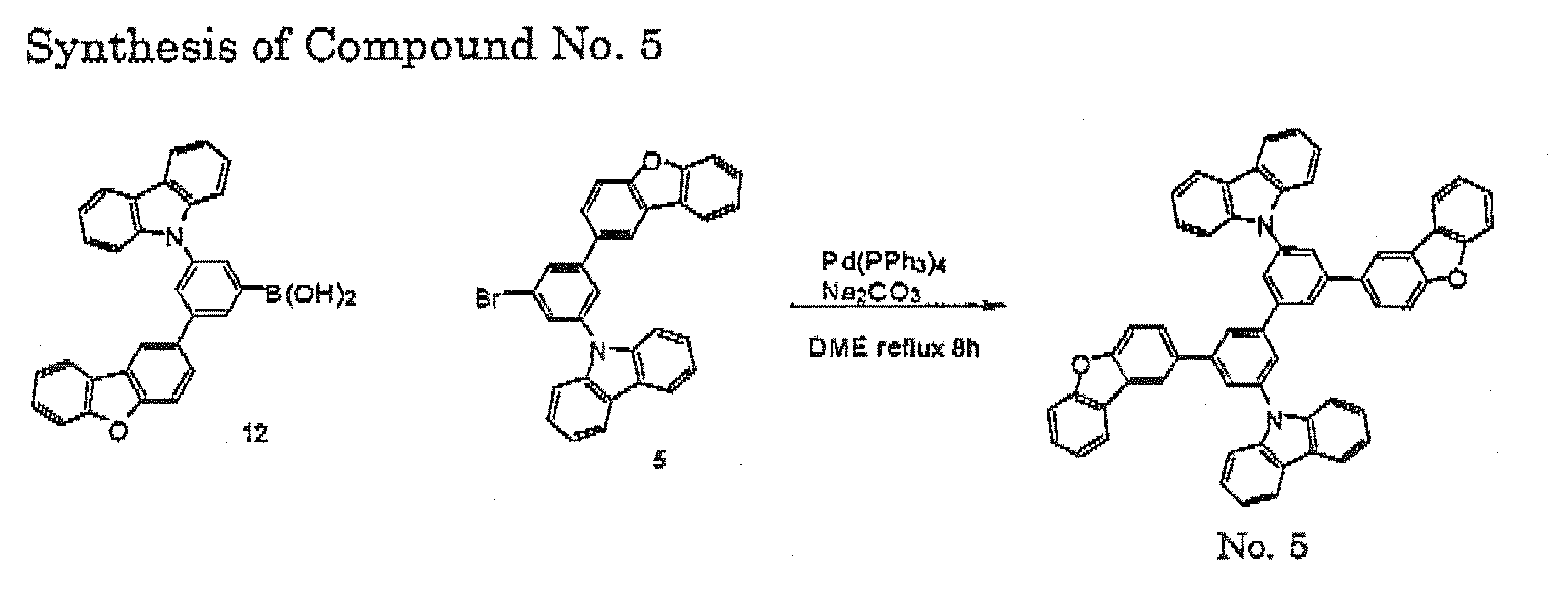
After the reaction, the reaction product mixture was cooled to room temperature and poured into a separatory funnel. After adding 50 ml of water, the reaction product mixture was extracted with CH2Cl2. The extract was purified by a column chromatography. The purified product was condensed, evaporated to dryness and recrystallized three times, to obtain a white powder (No. 5) which was then purified by sublimation to obtain 2.2 g of white solid.
FD Mass Spectroscopy Analysis
C60H36N2O2: calculated 816, found 816
The measuring conditions of FD-MS (field desorption mass spectrometry) used in Synthesis Examples 1 to 7 are shown below.
Apparatus: HX110 manufactured by JEOL, Ltd.
Acceralation Voltage: 8 kV
Scan range: m/z = 50 to 1500
Emitter material carbon
Emitter current: 0 mA → 2 mA/min → 40 mA (maintained for 10 min) - A glass substrate of 25 mm x 75 mm x 1.1 mm thickness having ITO transparent electrode (manufactured by Asahi Glass Company Ltd.) was ultrasonically cleaned in isopropyl alcohol for 5 min and then UV ozone-cleaned for 30 min. The cleaned glass substrate having the transparent electrode lines was mounted to a substrate holder of a vacuum vapor deposition apparatus. On the surface having the transparent electrode lines, a film of HTM1 (see the formula below) having a thickness of 80 nm was first deposited by resistance heating so as to cover the transparent electrode. The HTM1 film functioned as the hole transporting/hole injecting layer. Then, Compound No. 5 as the host material and Complex K-21 as the dopanat material were vapor co-depostited by resistance heating to successively form a film having a thickness of 30 nm on the HTM1 film. The concentration of Complex K-21 was 7.5 % by weight. The co-deposited film functions as the light emitting layer. Then, an ETM1 film having a thickness of 10 nm on the light emitting layer and an ETM2 film having a thickness of 20 nm on the ETM1 film were successively deposited in layers. The ETM1 film and ETM2 film functioned as the first and second electron transporting layer, respectively. Then, a LiF electron injecting electrode (cathode) having a thickness of 0.5 nm was deposited at a film-depositing speed of 0.1 Å/min. Finally, a metallic Al was deposited on the LiF film to form a metal cathode having a thickness of 150 nm, thereby obtaining an organic EL device.

- The organic EL device thus prepared was driven under a direct current to emit light and measured for the wave length (λ), the luminance (L) and the current density to determine the current efficiency (L/J). The results at a current density of 1 mA/cm2 are shown in Table 1.
- Each organic EL device was prepared in the same manner as in Example 1 except for using a host material listed in Table 1 in place of the host Compound No. 5 used in Example 1. The results are shown in Table 1.
- An organic EL device was prepared in the same manner as in Example 1 except for using CBP as the host material in place of the host Compound No. 5 used in Example 1. The results are shown in Table 1.
- An organic EL device was prepared in the same manner as in Example 1 except for using the following compound X-1 descried in
WO 2005/113531 in place of the host Compound No. 5 used in Example 1. The results are shown in Table 1.
Table 1 Host Compound Voltage
(V)Luminance
(cd/m2)L/J
(cd/A)EQE
(%)Wavelength
(nm)Examples 1 No. 5 5.7 178 17.8 8.1 479 2 No. 1 5.5 147 14.7 6.3 481 3 No. 6 5.9 168 16.8 7.4 479 4 No. 12 5.9 140 14.0 5.9 481 5 No. 18 5.8 130 13.8 5.7 479 6 No. 35 5.6 138 13.2 5.6 481 7 No. 72 5.5 148 13.5 5.6 481 8 No. 8 5.9 145 14.5 6.3 479 9 No. 26 5.9 152 15.2 6.4 479 10 No. 38 5.8 146 14.6 6.1 479 11 No. 55 5.6 157 15.7 6.4 481 12 No. 69 5.9 148 14.8 6.2 480 13 No. 84 5.5 154 15.4 6.3 481 14 No. 96 5.9 138 13.8 5.8 481 15 No. 99 5.6 155 15.5 6.4 479 Comparative Examples 1 CBP 6.0 125 8.2 3.7 480 2 X-1 no emission of light - Each organic EL device was prepared in the same manner as in Example 1 except for using the compound of the present invention listed in Table 2 as the hole transporting/hole injecting layer in place of HTM1 and using the following compound H-1 as the host material. The results are shown in Table 2.

- An organic EL device was prepared in the same manner as in Example 16 except for using NPD as the hole transporting material in place of Compound No. 5. The results are shown in Table 2.

Table 2 Hole Transporting Compound Voltage
(V)Luminance
(cd/m2)L/J
(cd/A)EQE
(%)Wavelength
(nm)Examples 16 No.5 6.2 138 13.8 6.3 480 17 No.61 6.4 146 14.6 6.7 481 18 No.107 5.8 157 15.7 7.1 481 19 No.110 6.0 148 14.8 6.8 479 Comparative Example 3 NPD 6.5 101 10.1 4.6 480 - As compared with the compounds used in examples, the compounds used in comparative examples were poor in the current efficiency and needed a high driving voltage.
- As described above, by using the material for organic EL devices of the invention which is represented by the formulae 1 to 9, organic EL devices having a high emitting efficiency, causing little pixel defects, being excellent in the heat resistance, and having a long lifetime are obtained. Therefore, such organic EL devices are very useful as the display and light source for various electronic instruments.
Claims (19)
- A material for organic electroluminescence devices for use in combination with at least one phosphorescent metal complex, which comprises a compound represented by the following formula 1:

R6 and R10 are each independently hydrogen atom of alkyl group having 1 to 40 carbon atoms which is optionally substituted;
R7 to R9 are each independently hydrogen atom, halogen atom, alkyl group having 1 to 40 carbon atoms which is optionally substituted, cycloalkyl group having 3 to 15 carbon atoms which is optionally substituted, heterocyclic group having 3 to 20 carbon atoms which is optionally substituted, alkoxy group having 1 to 40 carbon atoms which is optionally substituted, non-condensed aryl group having 6 to 40 carbon atoms which is optionally substituted, condensed aryl group having 10 to 18 carbon atoms which is optionally substituted, aryloxy group having 6 to 20 carbon atoms which is optionally substituted, aralkyl group having 7 to 20 carbon atoms which is optionally substituted, arylamino group having 6 to 40 carbon atoms which is optionally substituted, alkylamino group having 1 to 40 carbon atoms which is optionally substituted, aralkylamino group having 7 to 60 carbon atoms which is optionally substituted, arylcarbonyl group having 7 to 40 carbon atoms which is optionally substituted, arylthio group having 6 to 20 carbon atoms which is optionally substituted, alkyl halide group having 1 to 40 carbon atoms which is optionally substituted, or cyano group, with the proviso that when R3 and R9, or R8 and R7 are not bonded to each other thereby do not form a ring structure, at least one of R7 to R9 is 9-carbazolyl group which is optionally substituted, azacarbazolyl group having 2 to 5 nitrogen atoms which is optionally substituted, dibenzofuranyl group which is optionally substituted, dibenzothiophenyl group which is optionally substituted, or phenyl group or biphenyl group each being optionally substituted by at least one group selected from the group consisting of 9-carbazolyl group which is optionally substituted, azacarbazolyl group having 2 to 5 nitrogen atoms which is optionally substituted, dibenzofuranyl group which is substituted and dibenzothiophenyl group which is optionally substituted
R8 and R9, or R8 and R7 are optionally bonded to each other to form a ring structure which is optionally substituted, and R7 or R9 which does not form the ring structure is hydrogen atom, halogen atom, alkyl group having 1 to 40 carbon atoms which is optionally substituted, cycloalkyl group having 3 to 15 carbon atoms which is optionally substituted, heterocyclic group having 3 to 20 carbon atoms which is optionally substituted, alkoxy group having 1 to 40 carbon atoms which is optionally substituted, non-condensed aryl group having 6 to 40 carbon atoms which is optionally substituted, condensed aryl group having 10 to 18 carbon atoms which is optionally substituted, aryloxy group having 6 to 20 carbon atoms which is optionally substituted, aralkyl group having 7 to 20 carbon atoms which is optionally substituted, arylamino group having 6 to 40 carbon atoms which is optionally substituted, alkylamino group having 1 to 40 carbon atoms which is optionally substituted, aralkylamino group having 7 to 60 carbon atoms which is optionally substituted, arylcarbonyl group having 7 to 40 carbon atoms which is optionally substituted, arylthio group having 6 to 20 carbon atoms which is optionally substituted, alkyl halide group having 1 to 40 carbon atoms which is optionally substituted, or cyano group, with the proviso that R8 and R9, or R8 and R7 together with a benzene ring to which R7 to R9 are bonded do not form carbazolyl group;
R1 to R3 are all hydrogen atoms when at least one of R7 to R9 is dibenzofuranyl group which is optionally substituted or dibenzothiophenyl group which is optionally substituted;
each of R1 to R3 and R6 to R10 does not have a polymerizable functional group at its terminal end; and
X is sulfur atom or oxygen atom. - The material for organic electroluminescence devices according to claim 1, which is represented by the following formula 2:

- The material for organic electroluminescence devices according to claim 1, which is represented by the following formula 3:

- The material for organic electroluminescence devices according to claim 1, which is represented by the following formula 4:

- The material for organic electroluminescence devices according to claim 1, which is represented by the following formula 5:

- The material for organic electroluminescence devices according to claim. 2, which is represented by the following formula 6:

- The material for organic electroluminescence devices according to claim 3, which is represented by the following formula 7:

- The material for organic electroluminescence devices according to claim 4, which is represented by the following formula 8:

- The material for organic electroluminescence devices according to claim 2, which is represented by the following formula 9:

- The material for organic electroluminescence devices according to any one of claims 2 to 9, wherein at least one of R7, R8 and R20 to R24 of the formula 2, at least one of R7, R9 and R20 to R24 of the formula 3, at least one of R7 and R21 to R23 of the formula 4, at least one of R7, R8, R20 and R22 to R20 of the formula 5, at least one of R7, R8 and R20 to R24 of the formula 6, at least one of R7, R9 and R20 to R24 of the formula 7, at least one of R22 and R23 of the formula 8, or at least one of R7, R21 and R23 of the formula 9 is a group selected from the group consisting of a substituted or non-substituted 9-carbazolyl group, a substituted or non-substituted dibenzofuranyl group, a substituted or non-substituted azacarbazolyl group having 2 to 5 nitrogen atoms and a substituted or non-substituted dibenzothiophenyl group.
- The material for organic electroluminescence devices according to any one of claims 1 to 10, wherein the compound represented by any one of the formulae 1 to 9 has a triplet energy gap of 2.2 to 3.2 eV.
- An organic electroluminescence device which comprises a cathode, an anode and an organic thin film layer having one or more layers, the organic thin film layer being interposed between the cathode and the anode, at least one layer of the organic thin film being a light emitting layer which comprises a host material for use in combination with at least one phosphorescent metal complex, and at least one layer of the organic thin film containing the material for organic electroluminescence devices as defined in any one of claims 1 to 11.
- The organic electroluminescence device according to claim 12, wherein the host material contained in the light emitting layer is the material for organic electroluminescence devices.
- The organic electroluminescence device according to claim 13, wherein the light emitting layer comprises the host material and a phosphorescent material and the host material is the material for organic electroluminescence devices.
- The organic electroluminescence device according to claim 14, wherein the phosphorescent material is a compound containing iridium (Ir), osmium. (Os) or platinum (Pt).
- The organic electroluminescence device according to claim 14, wherein the light emitting layer contains a metal complex which emits blue light having a maximum peak wavelength of 500 nm or less.
- The organic electroluminescence device according to claim 12, wherein at least one layer of the organic thin film layer is an electron injecting layer marly comprising a nitrogen-containing cyclic derivative which is different from the material for organic electroluminescence devices.
- The organic electroluminescence device according to claim 12, wherein at least one layer of the organic thin film layer is a hole transporting layer which comprises the material for organic electroluminescence devices.
- The organic electroluminescence device according to claim 12, which further comprises a reducing dopant at an interface between the cathode and the organic thin film layer.
Applications Claiming Priority (2)
| Application Number | Priority Date | Filing Date | Title |
|---|---|---|---|
| JP2007181142 | 2007-07-10 | ||
| PCT/JP2007/072585 WO2009008099A1 (en) | 2007-07-10 | 2007-11-21 | Material for organic electroluminescence element, and organic electroluminescence element prepared by using the material |
Publications (2)
| Publication Number | Publication Date |
|---|---|
| EP2166583A1 true EP2166583A1 (en) | 2010-03-24 |
| EP2166583A4 EP2166583A4 (en) | 2011-10-19 |
Family
ID=40228295
Family Applications (2)
| Application Number | Title | Priority Date | Filing Date |
|---|---|---|---|
| EP07832315A Withdrawn EP2166583A4 (en) | 2007-07-10 | 2007-11-21 | MATERIAL FOR ORGANIC ELECTROLUMINESCENCE ELEMENT, AND ORGANIC ELECTROLUMINESCENCE ELEMENT PREPARED USING THE MATERIAL |
| EP07832316.9A Active EP2166584B1 (en) | 2007-07-10 | 2007-11-21 | Material for organic electroluminescence element, and organic electroluminescence element prepared by using the material |
Family Applications After (1)
| Application Number | Title | Priority Date | Filing Date |
|---|---|---|---|
| EP07832316.9A Active EP2166584B1 (en) | 2007-07-10 | 2007-11-21 | Material for organic electroluminescence element, and organic electroluminescence element prepared by using the material |
Country Status (6)
| Country | Link |
|---|---|
| US (3) | US7968213B2 (en) |
| EP (2) | EP2166583A4 (en) |
| JP (2) | JP5619418B2 (en) |
| KR (2) | KR101453128B1 (en) |
| TW (2) | TW200903877A (en) |
| WO (2) | WO2009008099A1 (en) |
Cited By (5)
| Publication number | Priority date | Publication date | Assignee | Title |
|---|---|---|---|---|
| WO2012145173A1 (en) * | 2011-04-08 | 2012-10-26 | Universal Display Corporation | Substituted oligoazacarbazoles for light emitting diodes |
| CN103782410A (en) * | 2011-09-09 | 2014-05-07 | 株式会社Lg化学 | Material of organic light emitting device and organic light emitting device using same |
| EP2930763A4 (en) * | 2012-12-10 | 2016-10-05 | Konica Minolta Inc | ORGANIC ELECTROLUMINESCENCE ELEMENT, LIGHTING DEVICE, AND DISPLAY DEVICE |
| GB2548337A (en) * | 2016-03-08 | 2017-09-20 | Cambridge Display Tech Ltd | Compound, composition and organic light-emitting device |
| WO2019114610A1 (en) * | 2017-12-14 | 2019-06-20 | 广州华睿光电材料有限公司 | Carbazole tribenzene organic compound, superpolymer, mixture and composition, and use thereof |
Families Citing this family (744)
| Publication number | Priority date | Publication date | Assignee | Title |
|---|---|---|---|---|
| US9070884B2 (en) | 2005-04-13 | 2015-06-30 | Universal Display Corporation | Hybrid OLED having phosphorescent and fluorescent emitters |
| US9051344B2 (en) | 2005-05-06 | 2015-06-09 | Universal Display Corporation | Stability OLED materials and devices |
| US8586204B2 (en) | 2007-12-28 | 2013-11-19 | Universal Display Corporation | Phosphorescent emitters and host materials with improved stability |
| US8007927B2 (en) | 2007-12-28 | 2011-08-30 | Universal Display Corporation | Dibenzothiophene-containing materials in phosphorescent light emitting diodes |
| KR101425423B1 (en) * | 2005-05-30 | 2014-08-01 | 시바 홀딩 인크 | Electroluminescent device |
| CN101415718B (en) | 2006-02-10 | 2013-05-29 | 通用显示公司 | Cyclometallated imidazo[1,2-f]phenanthridine and diimidazo[1,2-a:1',2'-c]quinazoline ligands and their isoelectronic and benzocyclization analogs metal complexes |
| US8778508B2 (en) | 2006-12-08 | 2014-07-15 | Universal Display Corporation | Light-emitting organometallic complexes |
| JP5493357B2 (en) | 2006-12-13 | 2014-05-14 | コニカミノルタ株式会社 | Organic electroluminescence element, display device and lighting device |
| TWI510598B (en) | 2007-03-08 | 2015-12-01 | Universal Display Corp | Phosphorescent materials |
| US9130177B2 (en) | 2011-01-13 | 2015-09-08 | Universal Display Corporation | 5-substituted 2 phenylquinoline complexes materials for light emitting diode |
| US20130032785A1 (en) | 2011-08-01 | 2013-02-07 | Universal Display Corporation | Materials for organic light emitting diode |
| US8080658B2 (en) * | 2007-07-10 | 2011-12-20 | Idemitsu Kosan Co., Ltd. | Material for organic electroluminescent element and organic electroluminescent element employing the same |
| TW200903877A (en) * | 2007-07-10 | 2009-01-16 | Idemitsu Kosan Co | Material for organic electroluminescence device and organic electroluminescence device utilizing the same |
| US8111001B2 (en) | 2007-07-17 | 2012-02-07 | Cree, Inc. | LED with integrated constant current driver |
| KR20160086983A (en) | 2007-08-08 | 2016-07-20 | 유니버셜 디스플레이 코포레이션 | Benzo-fused thiophene or benzo-fused furan compounds comprising a triphenylene group |
| CN103601609B (en) | 2007-08-08 | 2017-07-28 | 通用显示公司 | The luxuriant and rich with fragrance chromophore of single benzo [9,10] in phosphorescent light emitting diode |
| KR101507783B1 (en) * | 2007-10-01 | 2015-04-03 | 엘지전자 주식회사 | steam home appliance and controlling method of the same |
| JP5193295B2 (en) | 2008-05-29 | 2013-05-08 | 出光興産株式会社 | Aromatic amine derivatives and organic electroluminescence devices using them |
| KR20100000772A (en) * | 2008-06-25 | 2010-01-06 | 다우어드밴스드디스플레이머티리얼 유한회사 | Novel organic electroluminescent compounds and organic electroluminescent device using the same |
| JP5591800B2 (en) | 2008-06-30 | 2014-09-17 | ユニバーサル・ディスプレイ・コーポレーション | Hole transport material containing triphenylene |
| WO2010027583A1 (en) | 2008-09-03 | 2010-03-11 | Universal Display Corporation | Phosphorescent materials |
| US9034483B2 (en) | 2008-09-16 | 2015-05-19 | Universal Display Corporation | Phosphorescent materials |
| WO2010036765A1 (en) | 2008-09-25 | 2010-04-01 | Universal Display Corporation | Organoselenium materials and their uses in organic light emitting devices |
| EP2362889B1 (en) * | 2008-11-11 | 2018-12-26 | Universal Display Corporation | Phosphorescent emitters |
| JP5608095B2 (en) * | 2008-11-25 | 2014-10-15 | 出光興産株式会社 | Aromatic amine derivative and organic electroluminescence device |
| US8815415B2 (en) | 2008-12-12 | 2014-08-26 | Universal Display Corporation | Blue emitter with high efficiency based on imidazo[1,2-f] phenanthridine iridium complexes |
| US9067947B2 (en) | 2009-01-16 | 2015-06-30 | Universal Display Corporation | Organic electroluminescent materials and devices |
| US9617255B2 (en) * | 2009-02-06 | 2017-04-11 | Konica Minolta, Inc. | Organic electroluminescent element, and illumination device and display device each comprising the element |
| EP2399906A4 (en) * | 2009-02-18 | 2012-08-29 | Idemitsu Kosan Co | AROMATIC AMINE DERIVATIVE AND ORGANIC ELECTROLUMINESCENT ELEMENT |
| US8722205B2 (en) | 2009-03-23 | 2014-05-13 | Universal Display Corporation | Heteroleptic iridium complex |
| US8709615B2 (en) | 2011-07-28 | 2014-04-29 | Universal Display Corporation | Heteroleptic iridium complexes as dopants |
| US11910700B2 (en) | 2009-03-23 | 2024-02-20 | Universal Display Corporation | Heteroleptic iridium complexes as dopants |
| KR20120022859A (en) * | 2009-04-01 | 2012-03-12 | 이데미쓰 고산 가부시키가이샤 | Organic electroluminescent device |
| TWI730274B (en) | 2009-04-28 | 2021-06-11 | 美商環球展覽公司 | Iridium complex with methyl-d3 substitution |
| US8586203B2 (en) | 2009-05-20 | 2013-11-19 | Universal Display Corporation | Metal complexes with boron-nitrogen heterocycle containing ligands |
| WO2010150593A1 (en) | 2009-06-24 | 2010-12-29 | コニカミノルタホールディングス株式会社 | Organic electroluminescent element, display device, illuminating device and condensed polycyclic heterocyclic compound |
| KR101108154B1 (en) | 2009-08-10 | 2012-02-08 | 삼성모바일디스플레이주식회사 | Organic light emitting device comprising a condensed cyclic compound and an organic layer including the same |
| KR101097313B1 (en) * | 2009-08-10 | 2011-12-23 | 삼성모바일디스플레이주식회사 | Organic light emitting device |
| JP5742092B2 (en) * | 2009-09-02 | 2015-07-01 | 三菱化学株式会社 | Organic compound, charge transport material, composition for organic electroluminescence device, organic electroluminescence device, organic EL display and organic EL lighting |
| US20120205645A1 (en) * | 2009-10-28 | 2012-08-16 | Basf Se | Heteroleptic carbene complexes and the use thereof in organic electronics |
| US8545996B2 (en) | 2009-11-02 | 2013-10-01 | The University Of Southern California | Ion-pairing soft salts based on organometallic complexes and their applications in organic light emitting diodes |
| US9278926B2 (en) * | 2009-11-16 | 2016-03-08 | Idemitsu Kosan Co., Ltd. | Aromatic amine derivative, and organic electroluminescent element comprising same |
| US8580394B2 (en) | 2009-11-19 | 2013-11-12 | Universal Display Corporation | 3-coordinate copper(I)-carbene complexes |
| US9487548B2 (en) | 2009-12-14 | 2016-11-08 | Udc Ireland Limited | Metal complexes comprising diazabenzimidazolocarbene ligands and the use thereof in OLEDs |
| US8288187B2 (en) | 2010-01-20 | 2012-10-16 | Universal Display Corporation | Electroluminescent devices for lighting applications |
| JP5620125B2 (en) * | 2010-01-28 | 2014-11-05 | ユー・ディー・シー アイルランド リミテッド | Organic electroluminescence device |
| US9156870B2 (en) * | 2010-02-25 | 2015-10-13 | Universal Display Corporation | Phosphorescent emitters |
| US9175211B2 (en) * | 2010-03-03 | 2015-11-03 | Universal Display Corporation | Phosphorescent materials |
| US8963132B2 (en) | 2010-03-25 | 2015-02-24 | Universal Display Corporation | Solution processable doped triarylamine hole injection materials |
| KR101867105B1 (en) * | 2010-03-31 | 2018-06-12 | 이데미쓰 고산 가부시키가이샤 | Material for organic electroluminescence element, and organic electroluminescence element using same |
| US8691401B2 (en) | 2010-04-16 | 2014-04-08 | Basf Se | Bridged benzimidazole-carbene complexes and use thereof in OLEDS |
| JP5646733B2 (en) | 2010-04-28 | 2014-12-24 | ユニバーサル ディスプレイ コーポレイション | Premixed material deposition |
| US8968887B2 (en) | 2010-04-28 | 2015-03-03 | Universal Display Corporation | Triphenylene-benzofuran/benzothiophene/benzoselenophene compounds with substituents joining to form fused rings |
| US8673458B2 (en) | 2010-06-11 | 2014-03-18 | Universal Display Corporation | Delayed fluorescence OLED |
| US8742657B2 (en) | 2010-06-11 | 2014-06-03 | Universal Display Corporation | Triplet-Triplet annihilation up conversion (TTA-UC) for display and lighting applications |
| US9142792B2 (en) | 2010-06-18 | 2015-09-22 | Basf Se | Organic electronic devices comprising a layer comprising at least one metal organic compound and at least one metal oxide |
| US9435021B2 (en) | 2010-07-29 | 2016-09-06 | University Of Southern California | Co-deposition methods for the fabrication of organic optoelectronic devices |
| US9954180B2 (en) | 2010-08-20 | 2018-04-24 | Universal Display Corporation | Bicarbazole compounds for OLEDs |
| EP2617712A4 (en) * | 2010-08-31 | 2014-02-19 | Idemitsu Kosan Co | AROMATIC HETEROCYCLIC DERIVATIVE CONTAINING NITROGEN AND ORGANIC ELECTROLUMINESCENCE DEVICE USING THE SAME |
| JP5847420B2 (en) | 2010-09-08 | 2016-01-20 | ユー・ディー・シー アイルランド リミテッド | Organic electroluminescent device and compound |
| JP5815341B2 (en) | 2010-09-09 | 2015-11-17 | 株式会社半導体エネルギー研究所 | Heterocyclic compounds |
| US8932734B2 (en) | 2010-10-08 | 2015-01-13 | Universal Display Corporation | Organic electroluminescent materials and devices |
| KR101213498B1 (en) | 2010-10-25 | 2012-12-20 | 삼성디스플레이 주식회사 | Organic light emitting display device |
| US8269317B2 (en) | 2010-11-11 | 2012-09-18 | Universal Display Corporation | Phosphorescent materials |
| US20120138906A1 (en) | 2010-12-07 | 2012-06-07 | The University of Southern California USC Stevens Institute for Innovation | Capture agents for unsaturated metal complexes |
| CN103270032B (en) | 2010-12-20 | 2016-05-04 | 出光兴产株式会社 | Aromatic heterocyclic derivative and organic electroluminescent element using same |
| KR101867115B1 (en) * | 2010-12-28 | 2018-07-19 | 이데미쓰 고산 가부시키가이샤 | Material for organic electroluminescent elements, and organic electroluminescent element using same |
| US10008677B2 (en) | 2011-01-13 | 2018-06-26 | Universal Display Corporation | Materials for organic light emitting diode |
| KR101831015B1 (en) | 2011-01-20 | 2018-02-21 | 이데미쓰 고산 가부시키가이샤 | Organic electroluminescent element |
| US8415031B2 (en) | 2011-01-24 | 2013-04-09 | Universal Display Corporation | Electron transporting compounds |
| KR101588941B1 (en) | 2011-02-07 | 2016-01-26 | 이데미쓰 고산 가부시키가이샤 | Biscarbazole derivative and organic electroluminescent element using same |
| EP2674429B1 (en) | 2011-02-07 | 2020-12-23 | Idemitsu Kosan Co., Ltd. | Biscarbazole derivative and organic electroluminescent element using same |
| US8748011B2 (en) | 2011-02-23 | 2014-06-10 | Universal Display Corporation | Ruthenium carbene complexes for OLED material |
| WO2012116231A2 (en) | 2011-02-23 | 2012-08-30 | Universal Display Corporation | Novel tetradentate platinum complexes |
| US8563737B2 (en) | 2011-02-23 | 2013-10-22 | Universal Display Corporation | Methods of making bis-tridentate carbene complexes of ruthenium and osmium |
| US9005772B2 (en) | 2011-02-23 | 2015-04-14 | Universal Display Corporation | Thioazole and oxazole carbene metal complexes as phosphorescent OLED materials |
| US8492006B2 (en) | 2011-02-24 | 2013-07-23 | Universal Display Corporation | Germanium-containing red emitter materials for organic light emitting diode |
| JP5330429B2 (en) * | 2011-03-08 | 2013-10-30 | 株式会社東芝 | Organic electroluminescent element, display device and lighting device |
| US8883322B2 (en) | 2011-03-08 | 2014-11-11 | Universal Display Corporation | Pyridyl carbene phosphorescent emitters |
| WO2012153780A1 (en) | 2011-05-11 | 2012-11-15 | 出光興産株式会社 | Novel compound, material for organic electroluminescence device, and organic electroluminescence device |
| US8927308B2 (en) | 2011-05-12 | 2015-01-06 | Universal Display Corporation | Method of forming bus line designs for large-area OLED lighting |
| US8432095B2 (en) | 2011-05-11 | 2013-04-30 | Universal Display Corporation | Process for fabricating metal bus lines for OLED lighting panels |
| US8564192B2 (en) | 2011-05-11 | 2013-10-22 | Universal Display Corporation | Process for fabricating OLED lighting panels |
| US9212197B2 (en) | 2011-05-19 | 2015-12-15 | Universal Display Corporation | Phosphorescent heteroleptic phenylbenzimidazole dopants |
| US8795850B2 (en) | 2011-05-19 | 2014-08-05 | Universal Display Corporation | Phosphorescent heteroleptic phenylbenzimidazole dopants and new synthetic methodology |
| US8748012B2 (en) | 2011-05-25 | 2014-06-10 | Universal Display Corporation | Host materials for OLED |
| US10158089B2 (en) | 2011-05-27 | 2018-12-18 | Universal Display Corporation | Organic electroluminescent materials and devices |
| US10079349B2 (en) | 2011-05-27 | 2018-09-18 | Universal Display Corporation | Organic electroluminescent materials and devices |
| EP3473634B1 (en) | 2011-06-08 | 2020-07-22 | Universal Display Corporation | Heteroleptic iridium carbene complexes and light emitting device using them |
| KR102090916B1 (en) | 2011-06-14 | 2020-03-19 | 유디씨 아일랜드 리미티드 | Metal complexes comprising azabenzimidazole carbene ligands and the use thereof in oleds |
| US9315724B2 (en) | 2011-06-14 | 2016-04-19 | Basf Se | Metal complexes comprising azabenzimidazole carbene ligands and the use thereof in OLEDs |
| US8884316B2 (en) | 2011-06-17 | 2014-11-11 | Universal Display Corporation | Non-common capping layer on an organic device |
| US8659036B2 (en) | 2011-06-17 | 2014-02-25 | Universal Display Corporation | Fine tuning of emission spectra by combination of multiple emitter spectra |
| US9397310B2 (en) | 2011-07-14 | 2016-07-19 | Universal Display Corporation | Organice electroluminescent materials and devices |
| US9023420B2 (en) | 2011-07-14 | 2015-05-05 | Universal Display Corporation | Composite organic/inorganic layer for organic light-emitting devices |
| WO2013009708A1 (en) | 2011-07-14 | 2013-01-17 | Universal Display Corporation | Inorganic hosts in oleds |
| US9783564B2 (en) | 2011-07-25 | 2017-10-10 | Universal Display Corporation | Organic electroluminescent materials and devices |
| US8409729B2 (en) | 2011-07-28 | 2013-04-02 | Universal Display Corporation | Host materials for phosphorescent OLEDs |
| US8926119B2 (en) | 2011-08-04 | 2015-01-06 | Universal Display Corporation | Extendable light source with variable light emitting area |
| US8552420B2 (en) | 2011-08-09 | 2013-10-08 | Universal Display Corporation | OLED light panel with controlled brightness variation |
| US9493698B2 (en) | 2011-08-31 | 2016-11-15 | Universal Display Corporation | Organic electroluminescent materials and devices |
| KR102048688B1 (en) | 2011-09-09 | 2019-11-26 | 이데미쓰 고산 가부시키가이샤 | Nitrogen-containing heteroaromatic ring compound |
| US9142785B2 (en) | 2011-09-12 | 2015-09-22 | Nippon Steel & Sumikin Chemical Co., Ltd. | Organic electroluminescent element |
| KR101891308B1 (en) | 2011-09-12 | 2018-08-23 | 신닛테츠 수미킨 가가쿠 가부시키가이샤 | Organic electroluminescent element |
| US8652656B2 (en) | 2011-11-14 | 2014-02-18 | Universal Display Corporation | Triphenylene silane hosts |
| US9193745B2 (en) | 2011-11-15 | 2015-11-24 | Universal Display Corporation | Heteroleptic iridium complex |
| US9217004B2 (en) | 2011-11-21 | 2015-12-22 | Universal Display Corporation | Organic light emitting materials |
| US9847501B2 (en) | 2011-11-22 | 2017-12-19 | Idemitsu Kosan Co., Ltd. | Aromatic heterocyclic derivative, material for organic electroluminescent element, and organic electroluminescent element |
| US9512355B2 (en) | 2011-12-09 | 2016-12-06 | Universal Display Corporation | Organic light emitting materials |
| US20130146875A1 (en) | 2011-12-13 | 2013-06-13 | Universal Display Corporation | Split electrode for organic devices |
| JP5857724B2 (en) * | 2011-12-20 | 2016-02-10 | コニカミノルタ株式会社 | ORGANIC ELECTROLUMINESCENT ELEMENT MATERIAL, ORGANIC ELECTROLUMINESCENT ELEMENT, DISPLAY DEVICE, LIGHTING DEVICE, AND ORGANIC ELECTROLUMINESCENT ELEMENT MANUFACTURING METHOD |
| US9461254B2 (en) | 2012-01-03 | 2016-10-04 | Universal Display Corporation | Organic electroluminescent materials and devices |
| US8987451B2 (en) | 2012-01-03 | 2015-03-24 | Universal Display Corporation | Synthesis of cyclometallated platinum(II) complexes |
| US9163174B2 (en) | 2012-01-04 | 2015-10-20 | Universal Display Corporation | Highly efficient phosphorescent materials |
| KR102012047B1 (en) | 2012-01-06 | 2019-08-19 | 유니버셜 디스플레이 코포레이션 | Highly efficient phosphorescent materials |
| US8969592B2 (en) | 2012-01-10 | 2015-03-03 | Universal Display Corporation | Heterocyclic host materials |
| US10211413B2 (en) | 2012-01-17 | 2019-02-19 | Universal Display Corporation | Organic electroluminescent materials and devices |
| US9118017B2 (en) | 2012-02-27 | 2015-08-25 | Universal Display Corporation | Host compounds for red phosphorescent OLEDs |
| US9386657B2 (en) | 2012-03-15 | 2016-07-05 | Universal Display Corporation | Organic Electroluminescent materials and devices |
| US9054323B2 (en) | 2012-03-15 | 2015-06-09 | Universal Display Corporation | Secondary hole transporting layer with diarylamino-phenyl-carbazole compounds |
| US8723209B2 (en) | 2012-04-27 | 2014-05-13 | Universal Display Corporation | Out coupling layer containing particle polymer composite |
| US9184399B2 (en) | 2012-05-04 | 2015-11-10 | Universal Display Corporation | Asymmetric hosts with triaryl silane side chains |
| US9773985B2 (en) | 2012-05-21 | 2017-09-26 | Universal Display Corporation | Organic electroluminescent materials and devices |
| US9670404B2 (en) | 2012-06-06 | 2017-06-06 | Universal Display Corporation | Organic electroluminescent materials and devices |
| US9502672B2 (en) | 2012-06-21 | 2016-11-22 | Universal Display Corporation | Organic electroluminescent materials and devices |
| US9725476B2 (en) | 2012-07-09 | 2017-08-08 | Universal Display Corporation | Silylated metal complexes |
| US9231218B2 (en) | 2012-07-10 | 2016-01-05 | Universal Display Corporation | Phosphorescent emitters containing dibenzo[1,4]azaborinine structure |
| WO2014010823A1 (en) | 2012-07-13 | 2014-01-16 | 주식회사 엘지화학 | Heterocyclic compound and organic electronic element containing same |
| WO2014012972A1 (en) | 2012-07-19 | 2014-01-23 | Basf Se | Dinuclear metal complexes comprising carbene ligands and the use thereof in oleds |
| US9059412B2 (en) | 2012-07-19 | 2015-06-16 | Universal Display Corporation | Transition metal complexes containing substituted imidazole carbene as ligands and their application in OLEDs |
| US9540329B2 (en) | 2012-07-19 | 2017-01-10 | Universal Display Corporation | Organic electroluminescent materials and devices |
| WO2014013721A1 (en) * | 2012-07-20 | 2014-01-23 | 出光興産株式会社 | Nitrogen-containing heteroaromatic ring compound and organic electroluminescence element using same |
| US9663544B2 (en) | 2012-07-25 | 2017-05-30 | Universal Display Corporation | Organic electroluminescent materials and devices |
| US9318710B2 (en) | 2012-07-30 | 2016-04-19 | Universal Display Corporation | Organic electroluminescent materials and devices |
| WO2014030666A1 (en) | 2012-08-24 | 2014-02-27 | コニカミノルタ株式会社 | Transparent electrode, electronic device, and method for manufacturing transparent electrode |
| US9978958B2 (en) | 2012-08-24 | 2018-05-22 | Universal Display Corporation | Phosphorescent emitters with phenylimidazole ligands |
| CN107445930A (en) | 2012-08-31 | 2017-12-08 | 出光兴产株式会社 | Aromatic amine derivative and organic electroluminescent device using same |
| US8952362B2 (en) | 2012-08-31 | 2015-02-10 | The Regents Of The University Of Michigan | High efficiency and brightness fluorescent organic light emitting diode by triplet-triplet fusion |
| US10957870B2 (en) | 2012-09-07 | 2021-03-23 | Universal Display Corporation | Organic light emitting device |
| US9287513B2 (en) | 2012-09-24 | 2016-03-15 | Universal Display Corporation | Organic electroluminescent materials and devices |
| US9312505B2 (en) | 2012-09-25 | 2016-04-12 | Universal Display Corporation | Organic electroluminescent materials and devices |
| JP6194645B2 (en) * | 2012-09-27 | 2017-09-13 | 東ソー株式会社 | Amine compounds and uses thereof |
| US9252363B2 (en) | 2012-10-04 | 2016-02-02 | Universal Display Corporation | Aryloxyalkylcarboxylate solvent compositions for inkjet printing of organic layers |
| US8692241B1 (en) | 2012-11-08 | 2014-04-08 | Universal Display Corporation | Transition metal complexes containing triazole and tetrazole carbene ligands |
| US9748500B2 (en) | 2015-01-15 | 2017-08-29 | Universal Display Corporation | Organic light emitting materials |
| US9634264B2 (en) | 2012-11-09 | 2017-04-25 | Universal Display Corporation | Organic electroluminescent materials and devices |
| US9685617B2 (en) | 2012-11-09 | 2017-06-20 | Universal Display Corporation | Organic electronuminescent materials and devices |
| US8946697B1 (en) | 2012-11-09 | 2015-02-03 | Universal Display Corporation | Iridium complexes with aza-benzo fused ligands |
| US9190623B2 (en) | 2012-11-20 | 2015-11-17 | Universal Display Corporation | Organic electroluminescent materials and devices |
| US10069090B2 (en) | 2012-11-20 | 2018-09-04 | Universal Display Corporation | Organic electroluminescent materials and devices |
| US9512136B2 (en) | 2012-11-26 | 2016-12-06 | Universal Display Corporation | Organic electroluminescent materials and devices |
| US9166175B2 (en) | 2012-11-27 | 2015-10-20 | Universal Display Corporation | Organic electroluminescent materials and devices |
| US9196860B2 (en) | 2012-12-04 | 2015-11-24 | Universal Display Corporation | Compounds for triplet-triplet annihilation upconversion |
| US8716484B1 (en) | 2012-12-05 | 2014-05-06 | Universal Display Corporation | Hole transporting materials with twisted aryl groups |
| US9209411B2 (en) | 2012-12-07 | 2015-12-08 | Universal Display Corporation | Organic electroluminescent materials and devices |
| EP2930762B1 (en) * | 2012-12-10 | 2020-09-16 | Konica Minolta, Inc. | Material for organic electroluminescent element, organic electroluminescent element, illumination device, and display device |
| KR20140080606A (en) | 2012-12-12 | 2014-07-01 | 삼성전자주식회사 | Organometallic complexes, organic electroluminescence device using the same and display |
| US9653691B2 (en) | 2012-12-12 | 2017-05-16 | Universal Display Corporation | Phosphorescence-sensitizing fluorescence material system |
| WO2014112359A1 (en) * | 2013-01-15 | 2014-07-24 | 出光興産株式会社 | Organic electroluminescent element |
| US10400163B2 (en) | 2013-02-08 | 2019-09-03 | Universal Display Corporation | Organic electroluminescent materials and devices |
| US10367154B2 (en) | 2013-02-21 | 2019-07-30 | Universal Display Corporation | Organic electroluminescent materials and devices |
| US8927749B2 (en) | 2013-03-07 | 2015-01-06 | Universal Display Corporation | Organic electroluminescent materials and devices |
| US9419225B2 (en) | 2013-03-14 | 2016-08-16 | Universal Display Corporation | Organic electroluminescent materials and devices |
| JP6377718B2 (en) | 2013-03-20 | 2018-08-22 | ユー・ディー・シー アイルランド リミテッド | Azabenzimidazolecarbene complex as a high efficiency booster in OLED |
| US9997712B2 (en) | 2013-03-27 | 2018-06-12 | Universal Display Corporation | Organic electroluminescent materials and devices |
| JP6269655B2 (en) | 2013-03-29 | 2018-01-31 | コニカミノルタ株式会社 | ORGANIC ELECTROLUMINESCENT ELEMENT MATERIAL, ORGANIC ELECTROLUMINESCENT ELEMENT, DISPLAY DEVICE AND LIGHTING DEVICE |
| EP2980878B1 (en) | 2013-03-29 | 2019-05-01 | Konica Minolta, Inc. | Organic electroluminescent element, and lighting device and display device which are provided with same |
| CN105073763B (en) | 2013-04-29 | 2019-03-01 | Udc 爱尔兰有限责任公司 | Transition metal complexes with carbene ligands and their use in OLEDs |
| US9537106B2 (en) | 2013-05-09 | 2017-01-03 | Universal Display Corporation | Organic electroluminescent materials and devices |
| US9735373B2 (en) | 2013-06-10 | 2017-08-15 | Universal Display Corporation | Organic electroluminescent materials and devices |
| US9673401B2 (en) | 2013-06-28 | 2017-06-06 | Universal Display Corporation | Organic electroluminescent materials and devices |
| US10199581B2 (en) | 2013-07-01 | 2019-02-05 | Universal Display Corporation | Organic electroluminescent materials and devices |
| KR102305557B1 (en) | 2013-07-02 | 2021-09-29 | 유디씨 아일랜드 리미티드 | Monosubstituted diazabenzimidazole carbene metal complexes for use in organic light emitting diodes |
| US10121975B2 (en) | 2013-07-03 | 2018-11-06 | Universal Display Corporation | Organic electroluminescent materials and devices |
| US9761807B2 (en) | 2013-07-15 | 2017-09-12 | Universal Display Corporation | Organic light emitting diode materials |
| US9324949B2 (en) | 2013-07-16 | 2016-04-26 | Universal Display Corporation | Organic electroluminescent materials and devices |
| US9553274B2 (en) | 2013-07-16 | 2017-01-24 | Universal Display Corporation | Organic electroluminescent materials and devices |
| US9224958B2 (en) | 2013-07-19 | 2015-12-29 | Universal Display Corporation | Organic electroluminescent materials and devices |
| US20150028290A1 (en) | 2013-07-25 | 2015-01-29 | Universal Display Corporation | Heteroleptic osmium complex and method of making the same |
| KR102226202B1 (en) | 2013-07-31 | 2021-03-12 | 유디씨 아일랜드 리미티드 | Luminescent diazabenzimidazole carbene metal complexes |
| KR102231935B1 (en) * | 2013-08-05 | 2021-03-25 | 덕산네오룩스 주식회사 | Organic electric element comprising compound for organic electric element and electronic device thereof |
| WO2015020348A1 (en) * | 2013-08-05 | 2015-02-12 | 덕산하이메탈(주) | Organic electrical element using compound for organic electrical element, and electronic device therefor |
| US9831437B2 (en) | 2013-08-20 | 2017-11-28 | Universal Display Corporation | Organic electroluminescent materials and devices |
| US10074806B2 (en) | 2013-08-20 | 2018-09-11 | Universal Display Corporation | Organic electroluminescent materials and devices |
| US9932359B2 (en) | 2013-08-30 | 2018-04-03 | University Of Southern California | Organic electroluminescent materials and devices |
| US10199582B2 (en) | 2013-09-03 | 2019-02-05 | University Of Southern California | Organic electroluminescent materials and devices |
| US9735378B2 (en) | 2013-09-09 | 2017-08-15 | Universal Display Corporation | Organic electroluminescent materials and devices |
| US9748503B2 (en) | 2013-09-13 | 2017-08-29 | Universal Display Corporation | Organic electroluminescent materials and devices |
| JP6119521B2 (en) * | 2013-09-19 | 2017-04-26 | コニカミノルタ株式会社 | Transparent electrode, electronic device, and organic electroluminescence element |
| US10003034B2 (en) | 2013-09-30 | 2018-06-19 | Universal Display Corporation | Organic electroluminescent materials and devices |
| US9831447B2 (en) | 2013-10-08 | 2017-11-28 | Universal Display Corporation | Organic electroluminescent materials and devices |
| US9293712B2 (en) | 2013-10-11 | 2016-03-22 | Universal Display Corporation | Disubstituted pyrene compounds with amino group containing ortho aryl group and devices containing the same |
| US9853229B2 (en) | 2013-10-23 | 2017-12-26 | University Of Southern California | Organic electroluminescent materials and devices |
| US20150115250A1 (en) | 2013-10-29 | 2015-04-30 | Universal Display Corporation | Organic electroluminescent materials and devices |
| US9306179B2 (en) | 2013-11-08 | 2016-04-05 | Universal Display Corporation | Organic electroluminescent materials and devices |
| US9647218B2 (en) | 2013-11-14 | 2017-05-09 | Universal Display Corporation | Organic electroluminescent materials and devices |
| US10033000B2 (en) | 2013-11-15 | 2018-07-24 | Universal Display Corporation | Organic electroluminescent materials and devices |
| US10056565B2 (en) | 2013-11-20 | 2018-08-21 | Universal Display Corporation | Organic electroluminescent materials and devices |
| US10644251B2 (en) | 2013-12-04 | 2020-05-05 | Universal Display Corporation | Organic electroluminescent materials and devices |
| US9876173B2 (en) | 2013-12-09 | 2018-01-23 | Universal Display Corporation | Organic electroluminescent materials and devices |
| US10355227B2 (en) | 2013-12-16 | 2019-07-16 | Universal Display Corporation | Metal complex for phosphorescent OLED |
| KR102140018B1 (en) | 2013-12-17 | 2020-07-31 | 삼성전자주식회사 | Condensed cyclic compound and organic light emitting device including the same |
| US10985329B2 (en) | 2013-12-17 | 2021-04-20 | Samsung Electronics Co., Ltd. | Condensed cyclic compound and organic light-emitting device including the same |
| CN105993083B (en) | 2013-12-20 | 2018-07-03 | Udc 爱尔兰有限责任公司 | Efficient OLED device with extremely short decay time |
| US9847496B2 (en) | 2013-12-23 | 2017-12-19 | Universal Display Corporation | Organic electroluminescent materials and devices |
| US10135008B2 (en) | 2014-01-07 | 2018-11-20 | Universal Display Corporation | Organic electroluminescent materials and devices |
| US9978961B2 (en) | 2014-01-08 | 2018-05-22 | Universal Display Corporation | Organic electroluminescent materials and devices |
| US9755159B2 (en) | 2014-01-23 | 2017-09-05 | Universal Display Corporation | Organic materials for OLEDs |
| US9935277B2 (en) | 2014-01-30 | 2018-04-03 | Universal Display Corporation | Organic electroluminescent materials and devices |
| US9590194B2 (en) | 2014-02-14 | 2017-03-07 | Universal Display Corporation | Organic electroluminescent materials and devices |
| US9847497B2 (en) | 2014-02-18 | 2017-12-19 | Universal Display Corporation | Organic electroluminescent materials and devices |
| US10003033B2 (en) | 2014-02-18 | 2018-06-19 | Universal Display Corporation | Organic electroluminescent materials and devices |
| US10707423B2 (en) | 2014-02-21 | 2020-07-07 | Universal Display Corporation | Organic electroluminescent materials and devices |
| US9502656B2 (en) | 2014-02-24 | 2016-11-22 | Universal Display Corporation | Organic electroluminescent materials and devices |
| US9647217B2 (en) * | 2014-02-24 | 2017-05-09 | Universal Display Corporation | Organic electroluminescent materials and devices |
| US10403825B2 (en) | 2014-02-27 | 2019-09-03 | Universal Display Corporation | Organic electroluminescent materials and devices |
| US9590195B2 (en) | 2014-02-28 | 2017-03-07 | Universal Display Corporation | Organic electroluminescent materials and devices |
| US9673407B2 (en) | 2014-02-28 | 2017-06-06 | Universal Display Corporation | Organic electroluminescent materials and devices |
| US9181270B2 (en) | 2014-02-28 | 2015-11-10 | Universal Display Corporation | Method of making sulfide compounds |
| US9190620B2 (en) | 2014-03-01 | 2015-11-17 | Universal Display Corporation | Organic electroluminescent materials and devices |
| US9397309B2 (en) | 2014-03-13 | 2016-07-19 | Universal Display Corporation | Organic electroluminescent devices |
| US10208026B2 (en) | 2014-03-18 | 2019-02-19 | Universal Display Corporation | Organic electroluminescent materials and devices |
| US9748504B2 (en) | 2014-03-25 | 2017-08-29 | Universal Display Corporation | Organic electroluminescent materials and devices |
| GB201405771D0 (en) * | 2014-03-31 | 2014-05-14 | Cambridge Display Tech Ltd | Iodination process, monomer and polymer |
| CN115160373A (en) | 2014-03-31 | 2022-10-11 | Udc 爱尔兰有限责任公司 | Metal complexes and their use in organic light-emitting diodes |
| US9929353B2 (en) | 2014-04-02 | 2018-03-27 | Universal Display Corporation | Organic electroluminescent materials and devices |
| US9691993B2 (en) | 2014-04-09 | 2017-06-27 | Universal Display Corporation | Organic electroluminescent materials and devices |
| US9847498B2 (en) | 2014-04-14 | 2017-12-19 | Universal Display Corporation | Organic electroluminescent materials and devices |
| US10008679B2 (en) | 2014-04-14 | 2018-06-26 | Universal Display Corporation | Organic electroluminescent materials and devices |
| US10256427B2 (en) | 2014-04-15 | 2019-04-09 | Universal Display Corporation | Efficient organic electroluminescent devices |
| US9450198B2 (en) | 2014-04-15 | 2016-09-20 | Universal Display Corporation | Organic electroluminescent materials and devices |
| US9741941B2 (en) | 2014-04-29 | 2017-08-22 | Universal Display Corporation | Organic electroluminescent materials and devices |
| US10457699B2 (en) | 2014-05-02 | 2019-10-29 | Universal Display Corporation | Organic electroluminescent materials and devices |
| US10301338B2 (en) | 2014-05-08 | 2019-05-28 | Universal Display Corporation | Organic electroluminescent materials and devices |
| US10636983B2 (en) | 2014-05-08 | 2020-04-28 | Universal Display Corporation | Organic electroluminescent materials and devices |
| US10403830B2 (en) | 2014-05-08 | 2019-09-03 | Universal Display Corporation | Organic electroluminescent materials and devices |
| EP3473635B1 (en) | 2014-05-08 | 2020-07-22 | Universal Display Corporation | Stabilized imidazophenanthridine materials |
| US9997716B2 (en) | 2014-05-27 | 2018-06-12 | Universal Display Corporation | Organic electroluminescent materials and devices |
| US10461260B2 (en) | 2014-06-03 | 2019-10-29 | Universal Display Corporation | Organic electroluminescent materials and devices |
| US9911931B2 (en) | 2014-06-26 | 2018-03-06 | Universal Display Corporation | Organic electroluminescent materials and devices |
| US10297762B2 (en) | 2014-07-09 | 2019-05-21 | Universal Display Corporation | Organic electroluminescent materials and devices |
| US10566546B2 (en) | 2014-07-14 | 2020-02-18 | Universal Display Corporation | Organic electroluminescent materials and devices |
| US9929357B2 (en) | 2014-07-22 | 2018-03-27 | Universal Display Corporation | Organic electroluminescent materials and devices |
| WO2016016791A1 (en) | 2014-07-28 | 2016-02-04 | Idemitsu Kosan Co., Ltd (Ikc) | 2,9-functionalized benzimidazolo[1,2-a]benzimidazoles as hosts for organic light emitting diodes (oleds) |
| US11108000B2 (en) | 2014-08-07 | 2021-08-31 | Unniversal Display Corporation | Organic electroluminescent materials and devices |
| EP2982676B1 (en) | 2014-08-07 | 2018-04-11 | Idemitsu Kosan Co., Ltd. | Benzimidazo[2,1-B]benzoxazoles for electronic applications |
| US10411200B2 (en) | 2014-08-07 | 2019-09-10 | Universal Display Corporation | Electroluminescent (2-phenylpyridine)iridium complexes and devices |
| EP2993215B1 (en) | 2014-09-04 | 2019-06-19 | Idemitsu Kosan Co., Ltd. | Azabenzimidazo[2,1-a]benzimidazoles for electronic applications |
| US10749113B2 (en) | 2014-09-29 | 2020-08-18 | Universal Display Corporation | Organic electroluminescent materials and devices |
| US10043987B2 (en) | 2014-09-29 | 2018-08-07 | Universal Display Corporation | Organic electroluminescent materials and devices |
| US10135007B2 (en) | 2014-09-29 | 2018-11-20 | Universal Display Corporation | Organic electroluminescent materials and devices |
| US10361375B2 (en) | 2014-10-06 | 2019-07-23 | Universal Display Corporation | Organic electroluminescent materials and devices |
| JP6516433B2 (en) * | 2014-10-06 | 2019-05-22 | 三星ディスプレイ株式會社Samsung Display Co.,Ltd. | Material for organic electroluminescent device and organic electroluminescent device using the same |
| US10854826B2 (en) | 2014-10-08 | 2020-12-01 | Universal Display Corporation | Organic electroluminescent compounds, compositions and devices |
| US9397302B2 (en) | 2014-10-08 | 2016-07-19 | Universal Display Corporation | Organic electroluminescent materials and devices |
| US10950803B2 (en) | 2014-10-13 | 2021-03-16 | Universal Display Corporation | Compounds and uses in devices |
| US9484541B2 (en) | 2014-10-20 | 2016-11-01 | Universal Display Corporation | Organic electroluminescent materials and devices |
| EP3015469B1 (en) | 2014-10-30 | 2018-12-19 | Idemitsu Kosan Co., Ltd. | 5-(benzimidazol-2-yl)benzimidazo[1,2-a]benzimidazoles for electronic applications |
| US10868261B2 (en) | 2014-11-10 | 2020-12-15 | Universal Display Corporation | Organic electroluminescent materials and devices |
| US10411201B2 (en) | 2014-11-12 | 2019-09-10 | Universal Display Corporation | Organic electroluminescent materials and devices |
| US10038151B2 (en) | 2014-11-12 | 2018-07-31 | Universal Display Corporation | Organic electroluminescent materials and devices |
| US9871212B2 (en) | 2014-11-14 | 2018-01-16 | Universal Display Corporation | Organic electroluminescent materials and devices |
| US9882151B2 (en) | 2014-11-14 | 2018-01-30 | Universal Display Corporation | Organic electroluminescent materials and devices |
| WO2016079667A1 (en) | 2014-11-17 | 2016-05-26 | Idemitsu Kosan Co., Ltd. | Indole derivatives for electronic applications |
| WO2016079169A1 (en) | 2014-11-18 | 2016-05-26 | Basf Se | Pt- or pd-carbene complexes for use in organic light emitting diodes |
| US9761814B2 (en) | 2014-11-18 | 2017-09-12 | Universal Display Corporation | Organic light-emitting materials and devices |
| US10381569B2 (en) | 2014-11-25 | 2019-08-13 | Universal Display Corporation | Organic electroluminescent materials and devices |
| US9444075B2 (en) | 2014-11-26 | 2016-09-13 | Universal Display Corporation | Emissive display with photo-switchable polarization |
| EP3034506A1 (en) | 2014-12-15 | 2016-06-22 | Idemitsu Kosan Co., Ltd | 4-functionalized carbazole derivatives for electronic applications |
| EP3034507A1 (en) | 2014-12-15 | 2016-06-22 | Idemitsu Kosan Co., Ltd | 1-functionalized dibenzofurans and dibenzothiophenes for organic light emitting diodes (OLEDs) |
| US9450195B2 (en) | 2014-12-17 | 2016-09-20 | Universal Display Corporation | Organic electroluminescent materials and devices |
| KR102307238B1 (en) * | 2014-12-26 | 2021-10-01 | 솔루스첨단소재 주식회사 | Organic compound and organic electroluminescent device comprising the same |
| US10253252B2 (en) | 2014-12-30 | 2019-04-09 | Universal Display Corporation | Organic electroluminescent materials and devices |
| US10636978B2 (en) | 2014-12-30 | 2020-04-28 | Universal Display Corporation | Organic electroluminescent materials and devices |
| US9312499B1 (en) | 2015-01-05 | 2016-04-12 | Universal Display Corporation | Organic electroluminescent materials and devices |
| US9406892B2 (en) | 2015-01-07 | 2016-08-02 | Universal Display Corporation | Organic electroluminescent materials and devices |
| US9711730B2 (en) | 2015-01-25 | 2017-07-18 | Universal Display Corporation | Organic electroluminescent materials and devices |
| US10418569B2 (en) | 2015-01-25 | 2019-09-17 | Universal Display Corporation | Organic electroluminescent materials and devices |
| US10418562B2 (en) | 2015-02-06 | 2019-09-17 | Universal Display Corporation | Organic electroluminescent materials and devices |
| US10644247B2 (en) | 2015-02-06 | 2020-05-05 | Universal Display Corporation | Organic electroluminescent materials and devices |
| EP3053918B1 (en) | 2015-02-06 | 2018-04-11 | Idemitsu Kosan Co., Ltd. | 2-carbazole substituted benzimidazoles for electronic applications |
| US10355222B2 (en) | 2015-02-06 | 2019-07-16 | Universal Display Corporation | Organic electroluminescent materials and devices |
| EP3054498B1 (en) | 2015-02-06 | 2017-09-20 | Idemitsu Kosan Co., Ltd. | Bisimidazodiazocines |
| US10177316B2 (en) | 2015-02-09 | 2019-01-08 | Universal Display Corporation | Organic electroluminescent materials and devices |
| JP5831654B1 (en) | 2015-02-13 | 2015-12-09 | コニカミノルタ株式会社 | Aromatic heterocycle derivative, organic electroluminescence device using the same, illumination device and display device |
| US10144867B2 (en) | 2015-02-13 | 2018-12-04 | Universal Display Corporation | Organic electroluminescent materials and devices |
| US10680183B2 (en) | 2015-02-15 | 2020-06-09 | Universal Display Corporation | Organic electroluminescent materials and devices |
| US9929361B2 (en) | 2015-02-16 | 2018-03-27 | Universal Display Corporation | Organic electroluminescent materials and devices |
| EP3061759B1 (en) | 2015-02-24 | 2019-12-25 | Idemitsu Kosan Co., Ltd | Nitrile substituted dibenzofurans |
| US10600966B2 (en) | 2015-02-27 | 2020-03-24 | Universal Display Corporation | Organic electroluminescent materials and devices |
| US11056657B2 (en) | 2015-02-27 | 2021-07-06 | University Display Corporation | Organic electroluminescent materials and devices |
| US10686143B2 (en) | 2015-03-05 | 2020-06-16 | Universal Display Corporation | Organic electroluminescent materials and devices |
| US10270046B2 (en) | 2015-03-06 | 2019-04-23 | Universal Display Corporation | Organic electroluminescent materials and devices |
| US9780316B2 (en) | 2015-03-16 | 2017-10-03 | Universal Display Corporation | Organic electroluminescent materials and devices |
| EP3070144B1 (en) | 2015-03-17 | 2018-02-28 | Idemitsu Kosan Co., Ltd. | Seven-membered ring compounds |
| US9911928B2 (en) | 2015-03-19 | 2018-03-06 | Universal Display Corporation | Organic electroluminescent materials and devices |
| US9871214B2 (en) | 2015-03-23 | 2018-01-16 | Universal Display Corporation | Organic electroluminescent materials and devices |
| US10529931B2 (en) | 2015-03-24 | 2020-01-07 | Universal Display Corporation | Organic Electroluminescent materials and devices |
| EP3072943B1 (en) | 2015-03-26 | 2018-05-02 | Idemitsu Kosan Co., Ltd. | Dibenzofuran/carbazole-substituted benzonitriles |
| US10297770B2 (en) | 2015-03-27 | 2019-05-21 | Universal Display Corporation | Organic electroluminescent materials and devices |
| EP3075737B1 (en) | 2015-03-31 | 2019-12-04 | Idemitsu Kosan Co., Ltd | Benzimidazolo[1,2-a]benzimidazole carrying aryl- or heteroarylnitril groups for organic light emitting diodes |
| US11818949B2 (en) | 2015-04-06 | 2023-11-14 | Universal Display Corporation | Organic electroluminescent materials and devices |
| US20160293855A1 (en) | 2015-04-06 | 2016-10-06 | Universal Display Corporation | Organic Electroluminescent Materials and Devices |
| US11495749B2 (en) | 2015-04-06 | 2022-11-08 | Universal Display Corporation | Organic electroluminescent materials and devices |
| US10403826B2 (en) | 2015-05-07 | 2019-09-03 | Universal Display Corporation | Organic electroluminescent materials and devices |
| US10777749B2 (en) | 2015-05-07 | 2020-09-15 | Universal Display Corporation | Organic electroluminescent materials and devices |
| US9478758B1 (en) | 2015-05-08 | 2016-10-25 | Universal Display Corporation | Organic electroluminescent materials and devices |
| US9859510B2 (en) | 2015-05-15 | 2018-01-02 | Universal Display Corporation | Organic electroluminescent materials and devices |
| KR101879415B1 (en) * | 2015-05-20 | 2018-07-17 | 삼성에스디아이 주식회사 | Organic compound and organic optoelectric device and display device |
| US10256411B2 (en) | 2015-05-21 | 2019-04-09 | Universal Display Corporation | Organic electroluminescent materials and devices |
| US10109799B2 (en) | 2015-05-21 | 2018-10-23 | Universal Display Corporation | Organic electroluminescent materials and devices |
| US10418568B2 (en) | 2015-06-01 | 2019-09-17 | Universal Display Corporation | Organic electroluminescent materials and devices |
| US10033004B2 (en) | 2015-06-01 | 2018-07-24 | Universal Display Corporation | Organic electroluminescent materials and devices |
| KR102900833B1 (en) | 2015-06-03 | 2025-12-16 | 유디씨 아일랜드 리미티드 | Highly efficient oled devices with very short decay times |
| US10818853B2 (en) | 2015-06-04 | 2020-10-27 | University Of Southern California | Organic electroluminescent materials and devices |
| US11925102B2 (en) | 2015-06-04 | 2024-03-05 | Universal Display Corporation | Organic electroluminescent materials and devices |
| US12514110B2 (en) | 2021-08-06 | 2025-12-30 | Universal Display Corporation | Organic electroluminescent materials and devices |
| US10825997B2 (en) | 2015-06-25 | 2020-11-03 | Universal Display Corporation | Organic electroluminescent materials and devices |
| US10873036B2 (en) | 2015-07-07 | 2020-12-22 | Universal Display Corporation | Organic electroluminescent materials and devices |
| US9978956B2 (en) | 2015-07-15 | 2018-05-22 | Universal Display Corporation | Organic electroluminescent materials and devices |
| US11127905B2 (en) | 2015-07-29 | 2021-09-21 | Universal Display Corporation | Organic electroluminescent materials and devices |
| US11018309B2 (en) | 2015-08-03 | 2021-05-25 | Universal Display Corporation | Organic electroluminescent materials and devices |
| US11522140B2 (en) | 2015-08-17 | 2022-12-06 | Universal Display Corporation | Organic electroluminescent materials and devices |
| US10522769B2 (en) | 2015-08-18 | 2019-12-31 | Universal Display Corporation | Organic electroluminescent materials and devices |
| US10181564B2 (en) | 2015-08-26 | 2019-01-15 | Universal Display Corporation | Organic electroluminescent materials and devices |
| US10361381B2 (en) | 2015-09-03 | 2019-07-23 | Universal Display Corporation | Organic electroluminescent materials and devices |
| US11706972B2 (en) | 2015-09-08 | 2023-07-18 | Universal Display Corporation | Organic electroluminescent materials and devices |
| US11302872B2 (en) | 2015-09-09 | 2022-04-12 | Universal Display Corporation | Organic electroluminescent materials and devices |
| US10770664B2 (en) | 2015-09-21 | 2020-09-08 | Universal Display Corporation | Organic electroluminescent materials and devices |
| US20170092880A1 (en) | 2015-09-25 | 2017-03-30 | Universal Display Corporation | Organic electroluminescent materials and devices |
| US10593892B2 (en) | 2015-10-01 | 2020-03-17 | Universal Display Corporation | Organic electroluminescent materials and devices |
| EP3150606B1 (en) | 2015-10-01 | 2019-08-14 | Idemitsu Kosan Co., Ltd. | Benzimidazolo[1,2-a]benzimidazoles carrying benzofurane or benzothiophene groups for organic light emitting diodes |
| WO2017056053A1 (en) | 2015-10-01 | 2017-04-06 | Idemitsu Kosan Co., Ltd. | Benzimidazolo[1,2-a]benzimidazole carrying benzimidazolo[1,2-a]benzimidazolyl groups, carbazolyl groups, benzofurane groups or benzothiophene groups for organic light emitting diodes |
| US10847728B2 (en) | 2015-10-01 | 2020-11-24 | Universal Display Corporation | Organic electroluminescent materials and devices |
| EP3356369B1 (en) | 2015-10-01 | 2022-05-04 | Idemitsu Kosan Co., Ltd | Benzimidazolo[1,2-a]benzimidazole carrying triazine groups for organic light emitting diodes |
| EP3150604B1 (en) | 2015-10-01 | 2021-07-14 | Idemitsu Kosan Co., Ltd. | Benzimidazolo[1,2-a]benzimidazole carrying benzimidazolo[1,2-a]benzimidazolylyl groups, carbazolyl groups, benzofurane groups or benzothiophene groups for organic light emitting diodes |
| US10991895B2 (en) | 2015-10-06 | 2021-04-27 | Universal Display Corporation | Organic electroluminescent materials and devices |
| US10388892B2 (en) | 2015-10-29 | 2019-08-20 | Universal Display Corporation | Organic electroluminescent materials and devices |
| US10177318B2 (en) | 2015-10-29 | 2019-01-08 | Universal Display Corporation | Organic electroluminescent materials and devices |
| US10388893B2 (en) | 2015-10-29 | 2019-08-20 | Universal Display Corporation | Organic electroluminescent materials and devices |
| KR101614738B1 (en) * | 2015-11-02 | 2016-04-22 | 덕산네오룩스 주식회사 | Compound for organic electronic element, organic electronic element using the same, and an electronic device thereof |
| KR20180079328A (en) | 2015-11-04 | 2018-07-10 | 이데미쓰 고산 가부시키가이샤 | Benzimidazole condensed heteroaryl |
| US10998507B2 (en) | 2015-11-23 | 2021-05-04 | Universal Display Corporation | Organic electroluminescent materials and devices |
| KR102617840B1 (en) * | 2015-11-26 | 2023-12-26 | 덕산네오룩스 주식회사 | Compound for organic electronic element, organic electronic element using the same, and an electronic device thereof |
| US10476010B2 (en) | 2015-11-30 | 2019-11-12 | Universal Display Corporation | Organic electroluminescent materials and devices |
| WO2017093958A1 (en) | 2015-12-04 | 2017-06-08 | Idemitsu Kosan Co., Ltd. | Benzimidazolo[1,2-a]benzimidazole derivatives for organic light emitting diodes |
| US20180370981A1 (en) | 2015-12-21 | 2018-12-27 | Idemitsu Kosan Co., Ltd. | Hetero-condensed phenylquinazolines and their use in electronic devices |
| US11024808B2 (en) | 2015-12-29 | 2021-06-01 | Universal Display Corporation | Organic electroluminescent materials and devices |
| US10957861B2 (en) | 2015-12-29 | 2021-03-23 | Universal Display Corporation | Organic electroluminescent materials and devices |
| US10135006B2 (en) | 2016-01-04 | 2018-11-20 | Universal Display Corporation | Organic electroluminescent materials and devices |
| JP6788314B2 (en) | 2016-01-06 | 2020-11-25 | コニカミノルタ株式会社 | Organic electroluminescence element, manufacturing method of organic electroluminescence element, display device and lighting device |
| US10707427B2 (en) | 2016-02-09 | 2020-07-07 | Universal Display Corporation | Organic electroluminescent materials and devices |
| US10457864B2 (en) | 2016-02-09 | 2019-10-29 | Universal Display Corporation | Organic electroluminescent materials and devices |
| US20170229663A1 (en) | 2016-02-09 | 2017-08-10 | Universal Display Corporation | Organic electroluminescent materials and devices |
| US10600967B2 (en) | 2016-02-18 | 2020-03-24 | Universal Display Corporation | Organic electroluminescent materials and devices |
| KR102740106B1 (en) | 2016-03-03 | 2024-12-09 | 메르크 파텐트 게엠베하 | Materials for organic electroluminescent devices |
| US11094891B2 (en) | 2016-03-16 | 2021-08-17 | Universal Display Corporation | Organic electroluminescent materials and devices |
| US10276809B2 (en) | 2016-04-05 | 2019-04-30 | Universal Display Corporation | Organic electroluminescent materials and devices |
| US10236456B2 (en) | 2016-04-11 | 2019-03-19 | Universal Display Corporation | Organic electroluminescent materials and devices |
| US10968229B2 (en) | 2016-04-12 | 2021-04-06 | Idemitsu Kosan Co., Ltd. | Seven-membered ring compounds |
| US10566552B2 (en) | 2016-04-13 | 2020-02-18 | Universal Display Corporation | Organic electroluminescent materials and devices |
| US11228003B2 (en) | 2016-04-22 | 2022-01-18 | Universal Display Corporation | Organic electroluminescent materials and devices |
| US11081647B2 (en) | 2016-04-22 | 2021-08-03 | Universal Display Corporation | Organic electroluminescent materials and devices |
| US11228002B2 (en) | 2016-04-22 | 2022-01-18 | Universal Display Corporation | Organic electroluminescent materials and devices |
| CN107056807B (en) * | 2016-04-25 | 2019-06-07 | 中节能万润股份有限公司 | It is a kind of using equal benzene as the compound of core and its application in organic electroluminescence device |
| US20170324049A1 (en) | 2016-05-05 | 2017-11-09 | Universal Display Corporation | Organic Electroluminescent Materials and Devices |
| US10840458B2 (en) | 2016-05-25 | 2020-11-17 | Universal Display Corporation | Organic electroluminescent materials and devices |
| US10468609B2 (en) | 2016-06-02 | 2019-11-05 | Universal Display Corporation | Organic electroluminescent materials and devices |
| US10672997B2 (en) | 2016-06-20 | 2020-06-02 | Universal Display Corporation | Organic electroluminescent materials and devices |
| US11482683B2 (en) | 2016-06-20 | 2022-10-25 | Universal Display Corporation | Organic electroluminescent materials and devices |
| US10862054B2 (en) | 2016-06-20 | 2020-12-08 | Universal Display Corporation | Organic electroluminescent materials and devices |
| US10651403B2 (en) | 2016-06-20 | 2020-05-12 | Universal Display Corporation | Organic electroluminescent materials and devices |
| US10727423B2 (en) | 2016-06-20 | 2020-07-28 | Universal Display Corporation | Organic electroluminescent materials and devices |
| US10686140B2 (en) | 2016-06-20 | 2020-06-16 | Universal Display Corporation | Organic electroluminescent materials and devices |
| US10957866B2 (en) | 2016-06-30 | 2021-03-23 | Universal Display Corporation | Organic electroluminescent materials and devices |
| US9929360B2 (en) | 2016-07-08 | 2018-03-27 | Universal Display Corporation | Organic electroluminescent materials and devices |
| US10566547B2 (en) | 2016-07-11 | 2020-02-18 | Universal Display Corporation | Organic electroluminescent materials and devices |
| US10153443B2 (en) | 2016-07-19 | 2018-12-11 | Universal Display Corporation | Organic electroluminescent materials and devices |
| US10720587B2 (en) | 2016-07-19 | 2020-07-21 | Universal Display Corporation | Organic electroluminescent materials and devices |
| WO2018025590A1 (en) * | 2016-08-02 | 2018-02-08 | コニカミノルタ株式会社 | Method for producing nitrogen-containing heterocyclic compound, and nitrogen-containing heterocyclic compound |
| US10205105B2 (en) | 2016-08-15 | 2019-02-12 | Universal Display Corporation | Organic electroluminescent materials and devices |
| US10608186B2 (en) | 2016-09-14 | 2020-03-31 | Universal Display Corporation | Organic electroluminescent materials and devices |
| US10505127B2 (en) | 2016-09-19 | 2019-12-10 | Universal Display Corporation | Organic electroluminescent materials and devices |
| US10680187B2 (en) | 2016-09-23 | 2020-06-09 | Universal Display Corporation | Organic electroluminescent materials and devices |
| US11081658B2 (en) | 2016-10-03 | 2021-08-03 | Universal Display Corporation | Organic electroluminescent materials and devices |
| US11196010B2 (en) | 2016-10-03 | 2021-12-07 | Universal Display Corporation | Organic electroluminescent materials and devices |
| US11183642B2 (en) | 2016-10-03 | 2021-11-23 | Universal Display Corporation | Organic electroluminescent materials and devices |
| US11127906B2 (en) | 2016-10-03 | 2021-09-21 | Universal Display Corporation | Organic electroluminescent materials and devices |
| US11189804B2 (en) | 2016-10-03 | 2021-11-30 | Universal Display Corporation | Organic electroluminescent materials and devices |
| US11011709B2 (en) | 2016-10-07 | 2021-05-18 | Universal Display Corporation | Organic electroluminescent materials and devices |
| US11239432B2 (en) | 2016-10-14 | 2022-02-01 | Universal Display Corporation | Organic electroluminescent materials and devices |
| US10608185B2 (en) | 2016-10-17 | 2020-03-31 | Univeral Display Corporation | Organic electroluminescent materials and devices |
| US10236458B2 (en) | 2016-10-24 | 2019-03-19 | Universal Display Corporation | Organic electroluminescent materials and devices |
| US12317745B2 (en) | 2016-11-09 | 2025-05-27 | Universal Display Corporation | Organic electroluminescent materials and devices |
| US10340464B2 (en) | 2016-11-10 | 2019-07-02 | Universal Display Corporation | Organic electroluminescent materials and devices |
| US10680188B2 (en) | 2016-11-11 | 2020-06-09 | Universal Display Corporation | Organic electroluminescent materials and devices |
| US10897016B2 (en) | 2016-11-14 | 2021-01-19 | Universal Display Corporation | Organic electroluminescent materials and devices |
| US10964893B2 (en) | 2016-11-17 | 2021-03-30 | Universal Display Corporation | Organic electroluminescent materials and devices |
| US10662196B2 (en) | 2016-11-17 | 2020-05-26 | Universal Display Corporation | Organic electroluminescent materials and devices |
| US10153445B2 (en) | 2016-11-21 | 2018-12-11 | Universal Display Corporation | Organic electroluminescent materials and devices |
| US10833276B2 (en) | 2016-11-21 | 2020-11-10 | Universal Display Corporation | Organic electroluminescent materials and devices |
| US11555048B2 (en) | 2016-12-01 | 2023-01-17 | Universal Display Corporation | Organic electroluminescent materials and devices |
| WO2018103747A1 (en) * | 2016-12-08 | 2018-06-14 | 广州华睿光电材料有限公司 | Polymer and electroluminescent device |
| US10490753B2 (en) | 2016-12-15 | 2019-11-26 | Universal Display Corporation | Organic electroluminescent materials and devices |
| US11548905B2 (en) | 2016-12-15 | 2023-01-10 | Universal Display Corporation | Organic electroluminescent materials and devices |
| US11545636B2 (en) | 2016-12-15 | 2023-01-03 | Universal Display Corporation | Organic electroluminescent materials and devices |
| US10811618B2 (en) | 2016-12-19 | 2020-10-20 | Universal Display Corporation | Organic electroluminescent materials and devices |
| US11152579B2 (en) | 2016-12-28 | 2021-10-19 | Universal Display Corporation | Organic electroluminescent materials and devices |
| US20180190915A1 (en) | 2017-01-03 | 2018-07-05 | Universal Display Corporation | Organic electroluminescent materials and devices |
| US11201298B2 (en) | 2017-01-09 | 2021-12-14 | Universal Display Corporation | Organic electroluminescent materials and devices |
| US11780865B2 (en) | 2017-01-09 | 2023-10-10 | Universal Display Corporation | Organic electroluminescent materials and devices |
| US10804475B2 (en) | 2017-01-11 | 2020-10-13 | Universal Display Corporation | Organic electroluminescent materials and devices |
| US11545637B2 (en) | 2017-01-13 | 2023-01-03 | Universal Display Corporation | Organic electroluminescent materials and devices |
| US10629820B2 (en) | 2017-01-18 | 2020-04-21 | Universal Display Corporation | Organic electroluminescent materials and devices |
| US10964904B2 (en) | 2017-01-20 | 2021-03-30 | Universal Display Corporation | Organic electroluminescent materials and devices |
| US11053268B2 (en) | 2017-01-20 | 2021-07-06 | Universal Display Corporation | Organic electroluminescent materials and devices |
| US11765968B2 (en) | 2017-01-23 | 2023-09-19 | Universal Display Corporation | Organic electroluminescent materials and devices |
| US11050028B2 (en) | 2017-01-24 | 2021-06-29 | Universal Display Corporation | Organic electroluminescent materials and devices |
| US12089486B2 (en) | 2017-02-08 | 2024-09-10 | Universal Display Corporation | Organic electroluminescent materials and devices |
| EP3360945B1 (en) * | 2017-02-14 | 2019-04-24 | Cynora Gmbh | Organic electroluminescent device |
| US10978647B2 (en) | 2017-02-15 | 2021-04-13 | Universal Display Corporation | Organic electroluminescent materials and devices |
| US10844084B2 (en) | 2017-02-22 | 2020-11-24 | Universal Display Corporation | Organic electroluminescent materials and devices |
| US10745431B2 (en) | 2017-03-08 | 2020-08-18 | Universal Display Corporation | Organic electroluminescent materials and devices |
| US10741780B2 (en) | 2017-03-10 | 2020-08-11 | Universal Display Corporation | Organic electroluminescent materials and devices |
| US10672998B2 (en) | 2017-03-23 | 2020-06-02 | Universal Display Corporation | Organic electroluminescent materials and devices |
| US10873037B2 (en) | 2017-03-28 | 2020-12-22 | Universal Display Corporation | Organic electroluminescent materials and devices |
| US10910577B2 (en) | 2017-03-28 | 2021-02-02 | Universal Display Corporation | Organic electroluminescent materials and devices |
| US11158820B2 (en) | 2017-03-29 | 2021-10-26 | Universal Display Corporation | Organic electroluminescent materials and devices |
| US10844085B2 (en) | 2017-03-29 | 2020-11-24 | Universal Display Corporation | Organic electroluminescent materials and devices |
| US11056658B2 (en) | 2017-03-29 | 2021-07-06 | Universal Display Corporation | Organic electroluminescent materials and devices |
| US10862046B2 (en) | 2017-03-30 | 2020-12-08 | Universal Display Corporation | Organic electroluminescent materials and devices |
| US11139443B2 (en) | 2017-03-31 | 2021-10-05 | Universal Display Corporation | Organic electroluminescent materials and devices |
| US11276829B2 (en) | 2017-03-31 | 2022-03-15 | Universal Display Corporation | Organic electroluminescent materials and devices |
| US10777754B2 (en) | 2017-04-11 | 2020-09-15 | Universal Display Corporation | Organic electroluminescent materials and devices |
| US11038117B2 (en) | 2017-04-11 | 2021-06-15 | Universal Display Corporation | Organic electroluminescent materials and devices |
| KR102458681B1 (en) * | 2017-04-14 | 2022-10-26 | 삼성디스플레이 주식회사 | Heterocyclic compound and organic light emitting device comprising the same |
| US11084838B2 (en) | 2017-04-21 | 2021-08-10 | Universal Display Corporation | Organic electroluminescent materials and device |
| US11101434B2 (en) | 2017-04-21 | 2021-08-24 | Universal Display Corporation | Organic electroluminescent materials and devices |
| US10975113B2 (en) | 2017-04-21 | 2021-04-13 | Universal Display Corporation | Organic electroluminescent materials and devices |
| US10910570B2 (en) | 2017-04-28 | 2021-02-02 | Universal Display Corporation | Organic electroluminescent materials and devices |
| US11038137B2 (en) | 2017-04-28 | 2021-06-15 | Universal Display Corporation | Organic electroluminescent materials and devices |
| US11117897B2 (en) | 2017-05-01 | 2021-09-14 | Universal Display Corporation | Organic electroluminescent materials and devices |
| US10941170B2 (en) | 2017-05-03 | 2021-03-09 | Universal Display Corporation | Organic electroluminescent materials and devices |
| US11201299B2 (en) | 2017-05-04 | 2021-12-14 | Universal Display Corporation | Organic electroluminescent materials and devices |
| US10862055B2 (en) | 2017-05-05 | 2020-12-08 | Universal Display Corporation | Organic electroluminescent materials and devices |
| US10870668B2 (en) | 2017-05-05 | 2020-12-22 | Universal Display Corporation | Organic electroluminescent materials and devices |
| US10930864B2 (en) | 2017-05-10 | 2021-02-23 | Universal Display Corporation | Organic electroluminescent materials and devices |
| US10822362B2 (en) | 2017-05-11 | 2020-11-03 | Universal Display Corporation | Organic electroluminescent materials and devices |
| US10944060B2 (en) | 2017-05-11 | 2021-03-09 | Universal Display Corporation | Organic electroluminescent materials and devices |
| US11038115B2 (en) | 2017-05-18 | 2021-06-15 | Universal Display Corporation | Organic electroluminescent materials and device |
| US10790455B2 (en) | 2017-05-18 | 2020-09-29 | Universal Display Corporation | Organic electroluminescent materials and devices |
| US10944062B2 (en) | 2017-05-18 | 2021-03-09 | Universal Display Corporation | Organic electroluminescent materials and devices |
| US10934293B2 (en) | 2017-05-18 | 2021-03-02 | Universal Display Corporation | Organic electroluminescent materials and devices |
| US10840459B2 (en) | 2017-05-18 | 2020-11-17 | Universal Display Corporation | Organic electroluminescent materials and devices |
| US10930862B2 (en) | 2017-06-01 | 2021-02-23 | Universal Display Corporation | Organic electroluminescent materials and devices |
| US12577268B2 (en) | 2017-06-23 | 2026-03-17 | Universal Display Corporation | Organic electroluminescent materials and devices |
| US11608321B2 (en) | 2017-06-23 | 2023-03-21 | Universal Display Corporation | Organic electroluminescent materials and devices |
| US11174259B2 (en) | 2017-06-23 | 2021-11-16 | Universal Display Corporation | Organic electroluminescent materials and devices |
| US11802136B2 (en) | 2017-06-23 | 2023-10-31 | Universal Display Corporation | Organic electroluminescent materials and devices |
| US11758804B2 (en) | 2017-06-23 | 2023-09-12 | Universal Display Corporation | Organic electroluminescent materials and devices |
| US11552261B2 (en) | 2017-06-23 | 2023-01-10 | Universal Display Corporation | Organic electroluminescent materials and devices |
| US11814403B2 (en) | 2017-06-23 | 2023-11-14 | Universal Display Corporation | Organic electroluminescent materials and devices |
| US11725022B2 (en) | 2017-06-23 | 2023-08-15 | Universal Display Corporation | Organic electroluminescent materials and devices |
| US12098157B2 (en) | 2017-06-23 | 2024-09-24 | Universal Display Corporation | Organic electroluminescent materials and devices |
| US11495757B2 (en) | 2017-06-23 | 2022-11-08 | Universal Display Corporation | Organic electroluminescent materials and devices |
| US10968226B2 (en) | 2017-06-23 | 2021-04-06 | Universal Display Corporation | Organic electroluminescent materials and devices |
| US11678565B2 (en) | 2017-06-23 | 2023-06-13 | Universal Display Corporation | Organic electroluminescent materials and devices |
| US11832510B2 (en) | 2017-06-23 | 2023-11-28 | Universal Display Corporation | Organic electroluminescent materials and devices |
| US12598905B2 (en) | 2017-06-23 | 2026-04-07 | Universal Display Corporation | Organic electroluminescent materials and devices |
| US11469382B2 (en) | 2017-07-12 | 2022-10-11 | Universal Display Corporation | Organic electroluminescent materials and devices |
| US11765970B2 (en) | 2017-07-26 | 2023-09-19 | Universal Display Corporation | Organic electroluminescent materials and devices |
| US11228010B2 (en) | 2017-07-26 | 2022-01-18 | Universal Display Corporation | Organic electroluminescent materials and devices |
| US11917843B2 (en) | 2017-07-26 | 2024-02-27 | Universal Display Corporation | Organic electroluminescent materials and devices |
| US11239433B2 (en) | 2017-07-26 | 2022-02-01 | Universal Display Corporation | Organic electroluminescent materials and devices |
| US11322691B2 (en) | 2017-07-26 | 2022-05-03 | Universal Display Corporation | Organic electroluminescent materials and devices |
| US11968883B2 (en) | 2017-07-26 | 2024-04-23 | Universal Display Corporation | Organic electroluminescent materials and devices |
| US11744141B2 (en) | 2017-08-09 | 2023-08-29 | Universal Display Corporation | Organic electroluminescent materials and devices |
| US11508913B2 (en) | 2017-08-10 | 2022-11-22 | Universal Display Corporation | Organic electroluminescent materials and devices |
| US11744142B2 (en) | 2017-08-10 | 2023-08-29 | Universal Display Corporation | Organic electroluminescent materials and devices |
| US11910699B2 (en) | 2017-08-10 | 2024-02-20 | Universal Display Corporation | Organic electroluminescent materials and devices |
| US11349083B2 (en) | 2017-08-10 | 2022-05-31 | Universal Display Corporation | Organic electroluminescent materials and devices |
| US11723269B2 (en) | 2017-08-22 | 2023-08-08 | Universal Display Corporation | Organic electroluminescent materials and devices |
| US11462697B2 (en) | 2017-08-22 | 2022-10-04 | Universal Display Corporation | Organic electroluminescent materials and devices |
| US11437591B2 (en) | 2017-08-24 | 2022-09-06 | Universal Display Corporation | Organic electroluminescent materials and devices |
| US11605791B2 (en) | 2017-09-01 | 2023-03-14 | Universal Display Corporation | Organic electroluminescent materials and devices |
| US11696492B2 (en) | 2017-09-07 | 2023-07-04 | Universal Display Corporation | Organic electroluminescent materials and devices |
| US11444249B2 (en) | 2017-09-07 | 2022-09-13 | Universal Display Corporation | Organic electroluminescent materials and devices |
| US11424420B2 (en) | 2017-09-07 | 2022-08-23 | Universal Display Corporation | Organic electroluminescent materials and devices |
| US10608188B2 (en) | 2017-09-11 | 2020-03-31 | Universal Display Corporation | Organic electroluminescent materials and devices |
| US11778897B2 (en) | 2017-09-20 | 2023-10-03 | Universal Display Corporation | Organic electroluminescent materials and devices |
| US12389791B2 (en) | 2017-09-21 | 2025-08-12 | Universal Display Corporation | Organic electroluminescent materials and devices |
| US12459946B2 (en) | 2017-10-05 | 2025-11-04 | Universal Display Corporation | Organic host materials for electroluminescent devices |
| US11183646B2 (en) | 2017-11-07 | 2021-11-23 | Universal Display Corporation | Organic electroluminescent materials and devices |
| US11910702B2 (en) | 2017-11-07 | 2024-02-20 | Universal Display Corporation | Organic electroluminescent devices |
| US11214587B2 (en) | 2017-11-07 | 2022-01-04 | Universal Display Corporation | Organic electroluminescent materials and devices |
| US11168103B2 (en) | 2017-11-17 | 2021-11-09 | Universal Display Corporation | Organic electroluminescent materials and devices |
| US11825735B2 (en) | 2017-11-28 | 2023-11-21 | Universal Display Corporation | Organic electroluminescent materials and devices |
| US12180230B2 (en) | 2017-11-28 | 2024-12-31 | University Of Southern California | Carbene compounds and organic electroluminescent devices |
| EP3492480B1 (en) | 2017-11-29 | 2021-10-20 | Universal Display Corporation | Organic electroluminescent materials and devices |
| US11937503B2 (en) | 2017-11-30 | 2024-03-19 | Universal Display Corporation | Organic electroluminescent materials and devices |
| US11233205B2 (en) | 2017-12-14 | 2022-01-25 | Universal Display Corporation | Organic electroluminescent materials and devices |
| US12075690B2 (en) | 2017-12-14 | 2024-08-27 | Universal Display Corporation | Organic electroluminescent materials and devices |
| US11233204B2 (en) | 2017-12-14 | 2022-01-25 | Universal Display Corporation | Organic electroluminescent materials and devices |
| US10971687B2 (en) | 2017-12-14 | 2021-04-06 | Universal Display Corporation | Organic electroluminescent materials and devices |
| US11700765B2 (en) | 2018-01-10 | 2023-07-11 | Universal Display Corporation | Organic electroluminescent materials and devices |
| US11081659B2 (en) | 2018-01-10 | 2021-08-03 | Universal Display Corporation | Organic electroluminescent materials and devices |
| US11515493B2 (en) | 2018-01-11 | 2022-11-29 | Universal Display Corporation | Organic electroluminescent materials and devices |
| US11271177B2 (en) | 2018-01-11 | 2022-03-08 | Universal Display Corporation | Organic electroluminescent materials and devices |
| US11542289B2 (en) | 2018-01-26 | 2023-01-03 | Universal Display Corporation | Organic electroluminescent materials and devices |
| US11845764B2 (en) | 2018-01-26 | 2023-12-19 | Universal Display Corporation | Organic electroluminescent materials and devices |
| US11367840B2 (en) | 2018-01-26 | 2022-06-21 | Universal Display Corporation | Organic electroluminescent materials and devices |
| US12029055B2 (en) | 2018-01-30 | 2024-07-02 | The University Of Southern California | OLED with hybrid emissive layer |
| US11180519B2 (en) | 2018-02-09 | 2021-11-23 | Universal Display Corporation | Organic electroluminescent materials and devices |
| US11239434B2 (en) | 2018-02-09 | 2022-02-01 | Universal Display Corporation | Organic electroluminescent materials and devices |
| US11342509B2 (en) | 2018-02-09 | 2022-05-24 | Universal Display Corporation | Organic electroluminescent materials and devices |
| US11957050B2 (en) | 2018-02-09 | 2024-04-09 | Universal Display Corporation | Organic electroluminescent materials and devices |
| US11217757B2 (en) | 2018-03-12 | 2022-01-04 | Universal Display Corporation | Host materials for electroluminescent devices |
| US11165028B2 (en) | 2018-03-12 | 2021-11-02 | Universal Display Corporation | Organic electroluminescent materials and devices |
| US11279722B2 (en) | 2018-03-12 | 2022-03-22 | Universal Display Corporation | Organic electroluminescent materials and devices |
| US11142538B2 (en) | 2018-03-12 | 2021-10-12 | Universal Display Corporation | Organic electroluminescent materials and devices |
| US11557733B2 (en) | 2018-03-12 | 2023-01-17 | Universal Display Corporation | Organic electroluminescent materials and devices |
| KR102703716B1 (en) | 2018-04-09 | 2024-09-06 | 삼성전자주식회사 | Condensed cyclic compound and organic light-emitting device including the same |
| US11390639B2 (en) | 2018-04-13 | 2022-07-19 | Universal Display Corporation | Organic electroluminescent materials and devices |
| US12522608B2 (en) | 2018-04-13 | 2026-01-13 | Universal Display Corporation | Host materials for electroluminescent devices |
| US11882759B2 (en) | 2018-04-13 | 2024-01-23 | Universal Display Corporation | Organic electroluminescent materials and devices |
| US11616203B2 (en) | 2018-04-17 | 2023-03-28 | Universal Display Corporation | Organic electroluminescent materials and devices |
| US11515494B2 (en) | 2018-05-04 | 2022-11-29 | Universal Display Corporation | Organic electroluminescent materials and devices |
| US11342513B2 (en) | 2018-05-04 | 2022-05-24 | Universal Display Corporation | Organic electroluminescent materials and devices |
| US11753427B2 (en) | 2018-05-04 | 2023-09-12 | Universal Display Corporation | Organic electroluminescent materials and devices |
| US11793073B2 (en) | 2018-05-06 | 2023-10-17 | Universal Display Corporation | Host materials for electroluminescent devices |
| US11459349B2 (en) | 2018-05-25 | 2022-10-04 | Universal Display Corporation | Organic electroluminescent materials and devices |
| US11450822B2 (en) | 2018-05-25 | 2022-09-20 | Universal Display Corporation | Organic electroluminescent materials and devices |
| US11716900B2 (en) | 2018-05-30 | 2023-08-01 | Universal Display Corporation | Host materials for electroluminescent devices |
| US11296283B2 (en) | 2018-06-04 | 2022-04-05 | Universal Display Corporation | Organic electroluminescent materials and devices |
| US11925103B2 (en) | 2018-06-05 | 2024-03-05 | Universal Display Corporation | Organic electroluminescent materials and devices |
| US11339182B2 (en) | 2018-06-07 | 2022-05-24 | Universal Display Corporation | Organic electroluminescent materials and devices |
| CN110577523B (en) * | 2018-06-07 | 2021-07-06 | 江苏三月科技股份有限公司 | Compound containing triarylamine structure and organic electroluminescent device prepared from compound |
| US11228004B2 (en) | 2018-06-22 | 2022-01-18 | Universal Display Corporation | Organic electroluminescent materials and devices |
| US11261207B2 (en) | 2018-06-25 | 2022-03-01 | Universal Display Corporation | Organic electroluminescent materials and devices |
| US11753425B2 (en) | 2018-07-11 | 2023-09-12 | Universal Display Corporation | Organic electroluminescent materials and devices |
| US12378197B2 (en) | 2018-07-13 | 2025-08-05 | Universal Display Corporation | Organic electroluminescent materials and devices |
| KR102703720B1 (en) | 2018-07-20 | 2024-09-06 | 삼성전자주식회사 | Condensed cyclic compound, composition including the same and organic light emitting device including the same |
| US12453279B2 (en) | 2018-08-22 | 2025-10-21 | Universal Display Corporation | Organic electroluminescent materials and devices |
| KR20200023984A (en) | 2018-08-27 | 2020-03-06 | 삼성전자주식회사 | Heterocyclic compound and organic light emitting device including the same |
| US11233203B2 (en) | 2018-09-06 | 2022-01-25 | Universal Display Corporation | Organic electroluminescent materials and devices |
| US12171137B2 (en) | 2018-09-10 | 2024-12-17 | Universal Display Corporation | Organic electroluminescent materials and devices |
| US11485706B2 (en) | 2018-09-11 | 2022-11-01 | Universal Display Corporation | Organic electroluminescent materials and devices |
| US11718634B2 (en) | 2018-09-14 | 2023-08-08 | Universal Display Corporation | Organic electroluminescent materials and devices |
| US11903305B2 (en) | 2018-09-24 | 2024-02-13 | Universal Display Corporation | Organic electroluminescent materials and devices |
| US11495752B2 (en) | 2018-10-08 | 2022-11-08 | Universal Display Corporation | Organic electroluminescent materials and devices |
| US11469383B2 (en) | 2018-10-08 | 2022-10-11 | Universal Display Corporation | Organic electroluminescent materials and devices |
| US11476430B2 (en) | 2018-10-15 | 2022-10-18 | Universal Display Corporation | Organic electroluminescent materials and devices |
| US11515482B2 (en) | 2018-10-23 | 2022-11-29 | Universal Display Corporation | Deep HOMO (highest occupied molecular orbital) emitter device structures |
| US11469384B2 (en) | 2018-11-02 | 2022-10-11 | Universal Display Corporation | Organic electroluminescent materials and devices |
| US11825736B2 (en) | 2018-11-19 | 2023-11-21 | Universal Display Corporation | Organic electroluminescent materials and devices |
| US11963441B2 (en) | 2018-11-26 | 2024-04-16 | Universal Display Corporation | Organic electroluminescent materials and devices |
| US11690285B2 (en) | 2018-11-28 | 2023-06-27 | Universal Display Corporation | Electroluminescent devices |
| US11672165B2 (en) | 2018-11-28 | 2023-06-06 | Universal Display Corporation | Organic electroluminescent materials and devices |
| US11672176B2 (en) | 2018-11-28 | 2023-06-06 | Universal Display Corporation | Host materials for electroluminescent devices |
| US11706980B2 (en) | 2018-11-28 | 2023-07-18 | Universal Display Corporation | Host materials for electroluminescent devices |
| US11716899B2 (en) | 2018-11-28 | 2023-08-01 | Universal Display Corporation | Organic electroluminescent materials and devices |
| US11889708B2 (en) | 2019-11-14 | 2024-01-30 | Universal Display Corporation | Organic electroluminescent materials and devices |
| US11623936B2 (en) | 2018-12-11 | 2023-04-11 | Universal Display Corporation | Organic electroluminescent materials and devices |
| US12281129B2 (en) | 2018-12-12 | 2025-04-22 | Universal Display Corporation | Organic electroluminescent materials and devices |
| US11834459B2 (en) | 2018-12-12 | 2023-12-05 | Universal Display Corporation | Host materials for electroluminescent devices |
| US11737349B2 (en) | 2018-12-12 | 2023-08-22 | Universal Display Corporation | Organic electroluminescent materials and devices |
| EP3896070A4 (en) | 2018-12-14 | 2022-11-16 | Idemitsu Kosan Co., Ltd. | ORGANIC ELECTROLUMINESCENT ELEMENT, COMPOUND, MATERIAL FOR ORGANIC ELECTROLUMINESCENT ELEMENT AND ELECTRONIC DEVICE |
| US12167673B2 (en) | 2018-12-19 | 2024-12-10 | Universal Display Corporation | Organic electroluminescent materials and devices |
| US11780829B2 (en) | 2019-01-30 | 2023-10-10 | The University Of Southern California | Organic electroluminescent materials and devices |
| US11812624B2 (en) | 2019-01-30 | 2023-11-07 | The University Of Southern California | Organic electroluminescent materials and devices |
| US12477890B2 (en) | 2019-02-01 | 2025-11-18 | Universal Display Corporation | Organic electroluminescent materials and devices |
| US12137605B2 (en) | 2019-02-08 | 2024-11-05 | Universal Display Corporation | Organic electroluminescent materials and devices |
| US11325932B2 (en) | 2019-02-08 | 2022-05-10 | Universal Display Corporation | Organic electroluminescent materials and devices |
| US11370809B2 (en) | 2019-02-08 | 2022-06-28 | Universal Display Corporation | Organic electroluminescent materials and devices |
| US11773320B2 (en) | 2019-02-21 | 2023-10-03 | Universal Display Corporation | Organic electroluminescent materials and devices |
| US11871653B2 (en) | 2019-02-22 | 2024-01-09 | Universal Display Corporation | Organic electroluminescent materials and devices |
| US11758807B2 (en) | 2019-02-22 | 2023-09-12 | Universal Display Corporation | Organic electroluminescent materials and devices |
| US12250872B2 (en) | 2019-02-22 | 2025-03-11 | Universal Display Corporation | Organic electroluminescent materials and devices |
| US11512093B2 (en) | 2019-03-04 | 2022-11-29 | Universal Display Corporation | Compound used for organic light emitting device (OLED), consumer product and formulation |
| US11739081B2 (en) | 2019-03-11 | 2023-08-29 | Universal Display Corporation | Organic electroluminescent materials and devices |
| KR102753926B1 (en) | 2019-03-11 | 2025-01-15 | 삼성디스플레이 주식회사 | Heterocyclic compound and organic light emitting device including the same |
| US12082428B2 (en) | 2019-03-12 | 2024-09-03 | Universal Display Corporation | OLED with triplet emitter and excited state lifetime less than 200 ns |
| US11637261B2 (en) | 2019-03-12 | 2023-04-25 | Universal Display Corporation | Nanopatch antenna outcoupling structure for use in OLEDs |
| US11569480B2 (en) | 2019-03-12 | 2023-01-31 | Universal Display Corporation | Plasmonic OLEDs and vertical dipole emitters |
| JP2020158491A (en) | 2019-03-26 | 2020-10-01 | ユニバーサル ディスプレイ コーポレイション | Organic electroluminescence materials and devices |
| US11963438B2 (en) | 2019-03-26 | 2024-04-16 | The University Of Southern California | Organic electroluminescent materials and devices |
| US12240865B2 (en) | 2019-03-27 | 2025-03-04 | Universal Display Corporation | Organic electroluminescent materials and devices |
| US12122793B2 (en) | 2019-03-27 | 2024-10-22 | Universal Display Corporation | Organic electroluminescent materials and devices |
| US11639363B2 (en) | 2019-04-22 | 2023-05-02 | Universal Display Corporation | Organic electroluminescent materials and devices |
| US11613550B2 (en) | 2019-04-30 | 2023-03-28 | Universal Display Corporation | Organic electroluminescent materials and devices comprising benzimidazole-containing metal complexes |
| US12075691B2 (en) | 2019-04-30 | 2024-08-27 | Universal Display Corporation | Organic electroluminescent materials and devices |
| US11560398B2 (en) | 2019-05-07 | 2023-01-24 | Universal Display Corporation | Organic electroluminescent materials and devices |
| US11495756B2 (en) | 2019-05-07 | 2022-11-08 | Universal Display Corporation | Organic electroluminescent materials and devices |
| US11827651B2 (en) | 2019-05-13 | 2023-11-28 | Universal Display Corporation | Organic electroluminescent materials and devices |
| US12103942B2 (en) | 2019-05-13 | 2024-10-01 | Universal Display Corporation | Organic electroluminescent materials and devices |
| US11634445B2 (en) | 2019-05-21 | 2023-04-25 | Universal Display Corporation | Organic electroluminescent materials and devices |
| CN111978297A (en) * | 2019-05-24 | 2020-11-24 | 北京大学深圳研究生院 | Organic electroluminescent material and preparation method and application thereof |
| US12010859B2 (en) | 2019-05-24 | 2024-06-11 | Universal Display Corporation | Organic electroluminescent materials and devices |
| US11647667B2 (en) | 2019-06-14 | 2023-05-09 | Universal Display Corporation | Organic electroluminescent compounds and organic light emitting devices using the same |
| US12077550B2 (en) | 2019-07-02 | 2024-09-03 | Universal Display Corporation | Organic electroluminescent materials and devices |
| US11920070B2 (en) | 2019-07-12 | 2024-03-05 | The University Of Southern California | Luminescent janus-type, two-coordinated metal complexes |
| US11685754B2 (en) | 2019-07-22 | 2023-06-27 | Universal Display Corporation | Heteroleptic organic electroluminescent materials |
| US11926638B2 (en) | 2019-07-22 | 2024-03-12 | Universal Display Corporation | Organic electroluminescent materials and devices |
| US12281128B2 (en) | 2019-07-30 | 2025-04-22 | Universal Display Corporation | Organic electroluminescent materials and devices |
| US12295251B2 (en) | 2019-08-01 | 2025-05-06 | Universal Display Corporation | Organic electroluminescent materials and devices |
| US11708355B2 (en) | 2019-08-01 | 2023-07-25 | Universal Display Corporation | Organic electroluminescent materials and devices |
| US11985888B2 (en) | 2019-08-12 | 2024-05-14 | The Regents Of The University Of Michigan | Organic electroluminescent device |
| US11374181B2 (en) | 2019-08-14 | 2022-06-28 | Universal Display Corporation | Organic electroluminescent materials and devices |
| US12227525B2 (en) | 2019-08-14 | 2025-02-18 | Universal Display Corporation | Organic electroluminescent materials and devices |
| US11930699B2 (en) | 2019-08-15 | 2024-03-12 | Universal Display Corporation | Organic electroluminescent materials and devices |
| US12139501B2 (en) | 2019-08-16 | 2024-11-12 | Universal Display Corporation | Organic electroluminescent materials and devices |
| US12234249B2 (en) | 2019-08-21 | 2025-02-25 | Universal Display Corporation | Organic electroluminescent materials and devices |
| US11925105B2 (en) | 2019-08-26 | 2024-03-05 | Universal Display Corporation | Organic electroluminescent materials and devices |
| US11937494B2 (en) | 2019-08-28 | 2024-03-19 | Universal Display Corporation | Organic electroluminescent materials and devices |
| US11600787B2 (en) | 2019-08-30 | 2023-03-07 | Universal Display Corporation | Organic electroluminescent materials and devices |
| US11820783B2 (en) | 2019-09-06 | 2023-11-21 | Universal Display Corporation | Organic electroluminescent materials and devices |
| CN112457349B (en) | 2019-09-06 | 2024-10-15 | 环球展览公司 | Organic electroluminescent material and device |
| US12144244B2 (en) | 2019-09-10 | 2024-11-12 | Universal Display Corporation | Organic electroluminescent materials and devices |
| CN112479978B (en) * | 2019-09-11 | 2023-11-28 | 江苏三月科技股份有限公司 | Organic compound with carbazole derivative as core and application thereof |
| KR102436480B1 (en) * | 2019-09-25 | 2022-08-25 | 주식회사 엘지화학 | Compound and organic light emitting device comprising the same |
| US12331065B2 (en) | 2019-09-26 | 2025-06-17 | Universal Display Corporation | Organic electroluminescent materials and devices |
| US11999886B2 (en) | 2019-09-26 | 2024-06-04 | Universal Display Corporation | Organic electroluminescent materials and devices |
| US12486296B2 (en) | 2019-10-02 | 2025-12-02 | Universal Display Corporation | Organic electroluminescent materials and devices |
| US11864458B2 (en) | 2019-10-08 | 2024-01-02 | Universal Display Corporation | Organic electroluminescent materials and devices |
| US11950493B2 (en) | 2019-10-15 | 2024-04-02 | Universal Display Corporation | Organic electroluminescent materials and devices |
| US11697653B2 (en) | 2019-10-21 | 2023-07-11 | Universal Display Corporation | Organic electroluminescent materials and devices |
| CN120463729A (en) | 2019-10-25 | 2025-08-12 | 环球展览公司 | Organic electroluminescent materials and devices |
| US11919914B2 (en) | 2019-10-25 | 2024-03-05 | Universal Display Corporation | Organic electroluminescent materials and devices |
| US12522565B2 (en) | 2019-10-25 | 2026-01-13 | Universal Display Corporation | Organic electroluminescent materials and devices |
| US12545690B2 (en) | 2019-10-25 | 2026-02-10 | Universal Display Corporation | Organic electroluminescent materials and devices |
| US12577202B2 (en) | 2021-02-26 | 2026-03-17 | Universal Display Corporation | Organic electroluminescent materials and devices |
| US11765965B2 (en) | 2019-10-30 | 2023-09-19 | Universal Display Corporation | Organic electroluminescent materials and devices |
| US20210135130A1 (en) | 2019-11-04 | 2021-05-06 | Universal Display Corporation | Organic electroluminescent materials and devices |
| JP7488091B2 (en) | 2019-11-14 | 2024-05-21 | ユニバーサル ディスプレイ コーポレイション | Organic electroluminescent materials and devices |
| KR20210076220A (en) * | 2019-12-12 | 2021-06-24 | 삼성디스플레이 주식회사 | Organic light emitting device and apparatus including the same |
| US12538698B2 (en) | 2020-01-06 | 2026-01-27 | Universal Display Corporation | Organic electroluminescent materials and devices |
| US12201013B2 (en) | 2020-01-08 | 2025-01-14 | Universal Display Corporation | Organic electroluminescent materials and devices |
| US12187751B2 (en) | 2020-01-08 | 2025-01-07 | Universal Display Corporation | Organic electroluminescent materials and devices |
| US11778895B2 (en) | 2020-01-13 | 2023-10-03 | Universal Display Corporation | Organic electroluminescent materials and devices |
| US12426495B2 (en) | 2020-01-28 | 2025-09-23 | Universal Display Corporation | Organic electroluminescent materials and devices |
| US11917900B2 (en) | 2020-01-28 | 2024-02-27 | Universal Display Corporation | Organic electroluminescent materials and devices |
| US11932660B2 (en) | 2020-01-29 | 2024-03-19 | Universal Display Corporation | Organic electroluminescent materials and devices |
| US12623919B2 (en) | 2020-02-03 | 2026-05-12 | Universal Display Corporation | Organic electroluminescent materials and devices |
| US12245502B2 (en) | 2020-02-03 | 2025-03-04 | Universal Display Corporation | Organic electroluminescent materials and devices |
| US12156463B2 (en) | 2020-02-07 | 2024-11-26 | Universal Display Corporation | Organic electroluminescent materials and devices |
| US12084465B2 (en) | 2020-02-24 | 2024-09-10 | Universal Display Corporation | Organic electroluminescent materials and devices |
| US12324348B2 (en) | 2020-02-28 | 2025-06-03 | Universal Display Corporation | Organic electroluminescent materials and devices |
| US12234251B2 (en) | 2020-03-04 | 2025-02-25 | Universal Display Corporation | Organic electroluminescent materials and devices |
| JP7367574B2 (en) * | 2020-03-16 | 2023-10-24 | 三菱ケミカル株式会社 | aromatic compounds |
| US12018035B2 (en) | 2020-03-23 | 2024-06-25 | Universal Display Corporation | Organic electroluminescent materials and devices |
| US12598906B2 (en) | 2020-03-31 | 2026-04-07 | Universal Display Corporation | Organic electroluminescent materials and devices |
| US12129269B2 (en) | 2020-04-13 | 2024-10-29 | Universal Display Corporation | Organic electroluminescent materials and devices |
| US11970508B2 (en) | 2020-04-22 | 2024-04-30 | Universal Display Corporation | Organic electroluminescent materials and devices |
| US12279520B2 (en) | 2020-04-22 | 2025-04-15 | Universal Display Corporation | Organic electroluminescent materials and devices |
| US12466844B2 (en) | 2020-05-13 | 2025-11-11 | Universal Display Corporation | Organic electroluminescent materials and devices |
| US12286410B2 (en) | 2020-05-18 | 2025-04-29 | Universal Display Corporation | Organic electroluminescent materials and devices |
| US12035613B2 (en) | 2020-05-26 | 2024-07-09 | Universal Display Corporation | Organic electroluminescent materials and devices |
| US12275747B2 (en) | 2020-06-02 | 2025-04-15 | Universal Display Corporation | Organic electroluminescent materials and devices |
| US12247043B2 (en) | 2020-06-11 | 2025-03-11 | Universal Display Corporation | Organic electroluminescent material and formulations, and its various uses as hosts, fluorescent dopants, and acceptors in organic light emitting diodes |
| US12279516B2 (en) | 2020-06-17 | 2025-04-15 | Universal Display Corporation | Organic electroluminescent materials and devices |
| US12419188B2 (en) | 2020-06-30 | 2025-09-16 | Universal Display Corporation | Organic electroluminescent materials and devices |
| US12336427B2 (en) | 2020-07-09 | 2025-06-17 | Universal Display Corporation | Organic electroluminescent materials and devices |
| EP3937268B1 (en) | 2020-07-10 | 2025-05-07 | Universal Display Corporation | Plasmonic oleds and vertical dipole emitters |
| US12157748B2 (en) | 2020-07-30 | 2024-12-03 | Universal Display Corporation | Organic electroluminescent materials and devices |
| US12617806B2 (en) | 2020-08-05 | 2026-05-05 | The University Of Southern California | Organic electroluminescent materials and devices |
| US12369487B2 (en) | 2020-08-05 | 2025-07-22 | Universal Display Corporation | Organic electroluminescent materials and devices |
| US12065451B2 (en) | 2020-08-19 | 2024-08-20 | Universal Display Corporation | Organic electroluminescent materials and devices |
| US12289986B2 (en) | 2020-08-25 | 2025-04-29 | Universal Display Corporation | Organic electroluminescent materials and devices |
| US12543492B2 (en) | 2020-09-09 | 2026-02-03 | Universal Display Corporation | Organic electroluminescent materials and devices |
| US12369488B2 (en) | 2020-09-09 | 2025-07-22 | Universal Display Corporation | Organic electroluminescent materials and devices |
| US12486295B2 (en) | 2020-09-14 | 2025-12-02 | Universal Display Corporation | Organic electroluminescent materials and devices |
| US12221455B2 (en) | 2020-09-24 | 2025-02-11 | Universal Display Corporation | Organic electroluminescent materials and devices |
| US12252499B2 (en) | 2020-09-29 | 2025-03-18 | Universal Display Corporation | Organic electroluminescent materials and devices |
| US12598908B2 (en) | 2020-09-30 | 2026-04-07 | Universal Display Corporation | Organic electroluminescent materials and devices |
| US12435102B2 (en) | 2020-10-02 | 2025-10-07 | Universal Display Corporation | Organic electroluminescent materials and devices |
| US12460128B2 (en) | 2020-10-02 | 2025-11-04 | Universal Display Corporation | Organic electroluminescent materials and devices |
| US12486451B2 (en) | 2020-10-02 | 2025-12-02 | Universal Display Corporation | Organic electroluminescent materials and devices |
| US12583878B2 (en) | 2020-10-02 | 2026-03-24 | Universal Display Corporation | Organic electroluminescent materials and devices |
| US12610732B2 (en) | 2020-10-02 | 2026-04-21 | Universal Display Corporation | Organic electroluminescent materials and devices |
| US12497420B2 (en) | 2020-10-02 | 2025-12-16 | Universal Display Corporation | Organic electroluminescent materials and devices |
| US12286447B2 (en) | 2020-10-06 | 2025-04-29 | Universal Display Corporation | Organic electroluminescent materials and devices |
| US12520713B2 (en) | 2020-10-08 | 2026-01-06 | Universal Display Corporation | Organic electroluminescent materials and devices |
| US12486288B2 (en) | 2020-10-12 | 2025-12-02 | University Of Southern California | Fast phosphors utilizing HP2H ligands |
| US12312365B2 (en) | 2020-10-12 | 2025-05-27 | Universal Display Corporation | Organic electroluminescent materials and devices |
| US12137606B2 (en) | 2020-10-20 | 2024-11-05 | Universal Display Corporation | Organic electroluminescent materials and devices |
| US12391873B2 (en) | 2020-10-26 | 2025-08-19 | Universal Display Corporation | Organic electroluminescent materials and devices |
| US12247042B2 (en) | 2020-10-26 | 2025-03-11 | Universal Display Corporation | Organic electroluminescent materials and devices |
| US12187748B2 (en) | 2020-11-02 | 2025-01-07 | Universal Display Corporation | Organic electroluminescent materials and devices |
| US12262631B2 (en) | 2020-11-10 | 2025-03-25 | Universal Display Corporation | Organic electroluminescent materials and devices |
| US20220158096A1 (en) | 2020-11-16 | 2022-05-19 | Universal Display Corporation | Organic electroluminescent materials and devices |
| US12528833B2 (en) | 2020-11-18 | 2026-01-20 | Universal Display Corporation | Organic electroluminescent materials and devices |
| US12325717B2 (en) | 2020-11-24 | 2025-06-10 | Universal Display Corporation | Organic electroluminescent materials and devices |
| US12534485B2 (en) | 2020-11-24 | 2026-01-27 | Universal Display Corporation | Organic electroluminescent materials and devices |
| US12516078B2 (en) | 2020-11-24 | 2026-01-06 | Universal Display Corporation | Organic electroluminescent materials and devices |
| US20220165967A1 (en) | 2020-11-24 | 2022-05-26 | Universal Display Corporation | Organic electroluminescent materials and devices |
| US12342716B2 (en) | 2020-12-09 | 2025-06-24 | University Of Southern California | Tandem-carbene phosphors |
| US12331064B2 (en) | 2020-12-09 | 2025-06-17 | University Of Southern California | Tandem carbene phosphors |
| US12466848B2 (en) | 2020-12-10 | 2025-11-11 | Universal Display Corporation | Organic electroluminescent materials and devices |
| US12600739B2 (en) | 2021-01-05 | 2026-04-14 | Universal Display Corporation | Organic electroluminescent materials and devices |
| US12398164B2 (en) | 2021-02-01 | 2025-08-26 | Universal Display Corporation | Organic electroluminescent materials and devices |
| US12459966B2 (en) | 2021-02-02 | 2025-11-04 | Universal Display Corporation | Organic electroluminescent materials and devices |
| US12575316B2 (en) | 2021-02-03 | 2026-03-10 | Universal Display Corporation | Organic electroluminescent materials and devices |
| US12497419B2 (en) | 2021-02-22 | 2025-12-16 | Universal Display Corporation | Organic electroluminescent materials and devices |
| EP4060758A3 (en) | 2021-02-26 | 2023-03-29 | Universal Display Corporation | Organic electroluminescent materials and devices |
| EP4059915B1 (en) | 2021-02-26 | 2025-12-24 | Universal Display Corporation | Organic electroluminescent materials and devices |
| US12484437B2 (en) | 2021-02-26 | 2025-11-25 | Universal Display Corporation | Organic electroluminescent materials and devices |
| US12624055B2 (en) | 2021-03-01 | 2026-05-12 | Universal Display Corporation | Organic electroluminescent materials and devices |
| US12606582B2 (en) | 2021-03-05 | 2026-04-21 | Universal Display Corporation | Organic electroluminescent materials and devices |
| US12428599B2 (en) | 2021-03-09 | 2025-09-30 | Universal Display Corporation | Organic electroluminescent materials and devices |
| US20220298190A1 (en) | 2021-03-12 | 2022-09-22 | Universal Display Corporation | Organic electroluminescent materials and devices |
| US12421262B2 (en) | 2021-03-15 | 2025-09-23 | Universal Display Corporation | Organic electroluminescent materials and devices |
| US20220340607A1 (en) | 2021-04-05 | 2022-10-27 | Universal Display Corporation | Organic electroluminescent materials and devices |
| US12480042B2 (en) | 2021-04-09 | 2025-11-25 | Universal Display Corporation | Organic electroluminescent materials and devices |
| EP4075531A1 (en) | 2021-04-13 | 2022-10-19 | Universal Display Corporation | Plasmonic oleds and vertical dipole emitters |
| US20220352478A1 (en) | 2021-04-14 | 2022-11-03 | Universal Display Corporation | Organic eletroluminescent materials and devices |
| US12600902B2 (en) | 2021-04-16 | 2026-04-14 | Univerals Display Corporation | Organic electroluminescent materials and devices |
| US12628547B2 (en) | 2021-04-23 | 2026-05-12 | Universal Display Corporation | Organic electroluminescent materials and devices |
| US20230006149A1 (en) | 2021-04-23 | 2023-01-05 | Universal Display Corporation | Organic electroluminescent materials and devices |
| US20220407020A1 (en) | 2021-04-23 | 2022-12-22 | Universal Display Corporation | Organic electroluminescent materials and devices |
| US12473317B2 (en) | 2021-06-04 | 2025-11-18 | Universal Display Corporation | Organic electroluminescent materials and devices |
| US20230133787A1 (en) | 2021-06-08 | 2023-05-04 | University Of Southern California | Molecular Alignment of Homoleptic Iridium Phosphors |
| US12495715B2 (en) | 2021-06-29 | 2025-12-09 | Universal Display Corporation | Organic electroluminescent materials and devices |
| US12520715B2 (en) | 2021-07-16 | 2026-01-06 | University Of Southern California | Organic electroluminescent materials and devices |
| US12507586B2 (en) | 2021-07-21 | 2025-12-23 | Universal Display Corporation | Organic electroluminescent materials and devices |
| US12550611B2 (en) | 2021-08-03 | 2026-02-10 | Universal Display Corporation | Organic electroluminescent materials and devices |
| EP4151699A1 (en) | 2021-09-17 | 2023-03-22 | Universal Display Corporation | Organic electroluminescent materials and devices |
| US12473318B2 (en) | 2021-10-08 | 2025-11-18 | Universal Display Corporation | Organic electroluminescent materials and devices |
| US12581848B2 (en) | 2021-10-14 | 2026-03-17 | Universal Display Corporation | Organic electroluminescent materials and devices |
| US12509628B2 (en) | 2021-12-16 | 2025-12-30 | Universal Display Corporation | Organic electroluminescent materials and devices |
| US12414433B2 (en) | 2022-02-11 | 2025-09-09 | Universal Display Corporation | Organic electroluminescent devices |
| US20230292592A1 (en) | 2022-03-09 | 2023-09-14 | Universal Display Corporation | Organic electroluminescent materials and devices |
| US20230337516A1 (en) | 2022-04-18 | 2023-10-19 | Universal Display Corporation | Organic electroluminescent materials and devices |
| US20230389421A1 (en) | 2022-05-24 | 2023-11-30 | Universal Display Corporation | Organic electroluminescent materials and devices |
| EP4293001A1 (en) | 2022-06-08 | 2023-12-20 | Universal Display Corporation | Organic electroluminescent materials and devices |
| US20240016051A1 (en) | 2022-06-28 | 2024-01-11 | Universal Display Corporation | Organic electroluminescent materials and devices |
| US20240107880A1 (en) | 2022-08-17 | 2024-03-28 | Universal Display Corporation | Organic electroluminescent materials and devices |
| US20240180025A1 (en) | 2022-10-27 | 2024-05-30 | Universal Display Corporation | Organic electroluminescent materials and devices |
| US20240188319A1 (en) | 2022-10-27 | 2024-06-06 | Universal Display Corporation | Organic electroluminescent materials and devices |
| US20240188316A1 (en) | 2022-10-27 | 2024-06-06 | Universal Display Corporation | Organic electroluminescent materials and devices |
| US20240196730A1 (en) | 2022-10-27 | 2024-06-13 | Universal Display Corporation | Organic electroluminescent materials and devices |
| US20240188419A1 (en) | 2022-10-27 | 2024-06-06 | Universal Display Corporation | Organic electroluminescent materials and devices |
| US20240247017A1 (en) | 2022-12-14 | 2024-07-25 | Universal Display Corporation | Organic electroluminescent materials and devices |
| US20250204239A1 (en) | 2023-12-15 | 2025-06-19 | Universal Display Corporation | Organic electroluminescent materials and devices |
| US20250204238A1 (en) | 2023-12-15 | 2025-06-19 | Universal Display Corporation | Organic electroluminscent materials and devices |
Family Cites Families (42)
| Publication number | Priority date | Publication date | Assignee | Title |
|---|---|---|---|---|
| JPS519485A (en) | 1974-07-15 | 1976-01-26 | Mitsubishi Heavy Ind Ltd | KIHOSOKUDOKEISOKUHO |
| JPH05109485A (en) | 1991-10-15 | 1993-04-30 | Ricoh Co Ltd | Electroluminescence element |
| JP3266573B2 (en) * | 1998-04-08 | 2002-03-18 | 出光興産株式会社 | Organic electroluminescence device |
| ATE482476T1 (en) * | 2000-07-17 | 2010-10-15 | Fujifilm Corp | LIGHT EMITTING ELEMENT AND AZOLE COMPOUND |
| JP2002308837A (en) | 2001-04-05 | 2002-10-23 | Fuji Photo Film Co Ltd | Novel compound and light emitting device using the same |
| JP2004002351A (en) | 2002-03-27 | 2004-01-08 | Tdk Corp | Organic EL device |
| JP4265219B2 (en) * | 2003-01-06 | 2009-05-20 | コニカミノルタホールディングス株式会社 | Organic electroluminescence element and display device |
| JPWO2004096945A1 (en) | 2003-05-01 | 2006-07-13 | 富士写真フイルム株式会社 | 1,3,6,8-tetrasubstituted pyrene compound, organic EL device and organic EL display |
| TWI354011B (en) | 2003-05-16 | 2011-12-11 | Semiconductor Energy Lab | Carbazole derivative, organic semiconductor elemen |
| JP5112601B2 (en) | 2003-10-07 | 2013-01-09 | 三井化学株式会社 | Heterocyclic compound and organic electroluminescent device containing the compound |
| WO2005101912A1 (en) | 2004-04-14 | 2005-10-27 | Konica Minolta Holdings, Inc. | Organic electroluminescence device, display unit and lighting apparatus |
| JP4384536B2 (en) | 2004-04-27 | 2009-12-16 | 三井化学株式会社 | Anthracene compound and organic electroluminescent device containing the anthracene compound |
| TWI373506B (en) | 2004-05-21 | 2012-10-01 | Toray Industries | Light-emitting element material and light-emitting material |
| KR101249234B1 (en) | 2004-12-08 | 2013-04-01 | 코닌클리즈케 필립스 일렉트로닉스 엔.브이. | 9,9'- and 2,2'-substituted 3,3'-bicarbazolyl derivatives for use in semiconducting materials as a host matrix for phosphorescent emitters |
| US7504769B2 (en) * | 2004-12-16 | 2009-03-17 | E. I. Du Pont De Nemours + Company | Aromatic chalcogen compounds and their use |
| GB2439030B (en) | 2005-04-18 | 2011-03-02 | Konica Minolta Holdings Inc | Organic electroluminescent device, display and illuminating device |
| KR101425423B1 (en) * | 2005-05-30 | 2014-08-01 | 시바 홀딩 인크 | Electroluminescent device |
| EP1894923A1 (en) * | 2005-06-24 | 2008-03-05 | Idemitsu Kosan Co., Ltd. | Benzothiophene derivative and organic electroluminescence device making use of the same |
| US20080166594A1 (en) * | 2005-06-24 | 2008-07-10 | Idemitsu Kosan Co., Ltd. | Benzothiophene derivative and organic electroluminescence device making use of the same |
| JP4807013B2 (en) | 2005-09-02 | 2011-11-02 | 東レ株式会社 | Light emitting device material and light emitting device |
| JP2007110097A (en) | 2005-09-14 | 2007-04-26 | Konica Minolta Holdings Inc | ORGANIC ELECTROLUMINESCENT ELEMENT, METHOD FOR PRODUCING ORGANIC ELECTROLUMINESCENT ELEMENT, DISPLAY DEVICE AND LIGHTING DEVICE |
| JP4726584B2 (en) | 2005-09-15 | 2011-07-20 | 三井化学株式会社 | Aromatic compound and organic electroluminescent device containing the aromatic compound |
| JP2007088307A (en) * | 2005-09-22 | 2007-04-05 | Toyota Central Res & Dev Lab Inc | Electroluminescent device |
| US7651791B2 (en) * | 2005-12-15 | 2010-01-26 | Idemitsu Kosan Co., Ltd. | Material for organic electroluminescence device and electroluminescence device employing the same |
| TW200726317A (en) | 2005-12-30 | 2007-07-01 | Toyo Ink Mfg Co | Organic electroluminescent device |
| US7935434B2 (en) * | 2006-01-05 | 2011-05-03 | Konica Minolta Holdings, Inc. | Organic electroluminescent device, display, and illuminating device |
| JP4972938B2 (en) * | 2006-01-12 | 2012-07-11 | コニカミノルタホールディングス株式会社 | ORGANIC ELECTROLUMINESCENT ELEMENT MATERIAL, ORGANIC ELECTROLUMINESCENT ELEMENT, DISPLAY DEVICE AND LIGHTING DEVICE |
| WO2007108362A1 (en) | 2006-03-17 | 2007-09-27 | Konica Minolta Holdings, Inc. | Organic electroluminescent device, display and illuminating device |
| EP2615153B1 (en) * | 2006-03-23 | 2017-03-01 | Konica Minolta Holdings, Inc. | Organic electroluminescent device, display and illuminating device |
| US20070224446A1 (en) * | 2006-03-24 | 2007-09-27 | Idemitsu Kosan Co., Ltd. | Material for organic electroluminescence device and organic electroluminescence device using the same |
| JP5055818B2 (en) * | 2006-04-19 | 2012-10-24 | コニカミノルタホールディングス株式会社 | ORGANIC ELECTROLUMINESCENT ELEMENT MATERIAL, ORGANIC ELECTROLUMINESCENT ELEMENT, DISPLAY DEVICE AND LIGHTING DEVICE |
| JP4829722B2 (en) * | 2006-08-31 | 2011-12-07 | 三井化学株式会社 | Organic electroluminescent device and aromatic compound |
| JP5011908B2 (en) * | 2006-09-26 | 2012-08-29 | コニカミノルタホールディングス株式会社 | Organic electroluminescence element, display device and lighting device |
| JP5493357B2 (en) * | 2006-12-13 | 2014-05-14 | コニカミノルタ株式会社 | Organic electroluminescence element, display device and lighting device |
| WO2008075517A1 (en) * | 2006-12-18 | 2008-06-26 | Konica Minolta Holdings, Inc. | Multicolor phosphorescent organic electroluminescent element and lighting system |
| JP2008159741A (en) * | 2006-12-22 | 2008-07-10 | Konica Minolta Holdings Inc | Luminous body |
| JP5194456B2 (en) * | 2007-01-23 | 2013-05-08 | コニカミノルタホールディングス株式会社 | Method for manufacturing organic electroluminescence element and method for manufacturing lighting device |
| CN101627102B (en) * | 2007-03-07 | 2013-08-28 | 东丽株式会社 | Light-emitting device material and light-emitting device |
| KR101634393B1 (en) * | 2007-05-21 | 2016-06-28 | 이데미쓰 고산 가부시키가이샤 | Anthracene derivative and organic electroluminescent device using the same |
| JP5444594B2 (en) * | 2007-07-09 | 2014-03-19 | コニカミノルタ株式会社 | Organic electroluminescence element, display device and lighting device |
| TW200903877A (en) | 2007-07-10 | 2009-01-16 | Idemitsu Kosan Co | Material for organic electroluminescence device and organic electroluminescence device utilizing the same |
| US8080658B2 (en) | 2007-07-10 | 2011-12-20 | Idemitsu Kosan Co., Ltd. | Material for organic electroluminescent element and organic electroluminescent element employing the same |
-
2007
- 2007-11-21 TW TW096144139A patent/TW200903877A/en unknown
- 2007-11-21 EP EP07832315A patent/EP2166583A4/en not_active Withdrawn
- 2007-11-21 EP EP07832316.9A patent/EP2166584B1/en active Active
- 2007-11-21 JP JP2009522494A patent/JP5619418B2/en active Active
- 2007-11-21 US US11/943,934 patent/US7968213B2/en active Active
- 2007-11-21 KR KR1020107000442A patent/KR101453128B1/en active Active
- 2007-11-21 JP JP2009522493A patent/JPWO2009008099A1/en active Pending
- 2007-11-21 WO PCT/JP2007/072585 patent/WO2009008099A1/en not_active Ceased
- 2007-11-21 WO PCT/JP2007/072586 patent/WO2009008100A1/en not_active Ceased
- 2007-11-21 KR KR1020107000441A patent/KR20100032888A/en not_active Ceased
- 2007-11-21 US US11/943,879 patent/US8114530B2/en active Active
- 2007-11-21 TW TW096144126A patent/TW200902675A/en unknown
-
2012
- 2012-01-03 US US13/342,778 patent/US9209410B2/en active Active
Cited By (17)
| Publication number | Priority date | Publication date | Assignee | Title |
|---|---|---|---|---|
| WO2012145173A1 (en) * | 2011-04-08 | 2012-10-26 | Universal Display Corporation | Substituted oligoazacarbazoles for light emitting diodes |
| US8580399B2 (en) | 2011-04-08 | 2013-11-12 | Universal Display Corporation | Substituted oligoazacarbazoles for light emitting diodes |
| CN103797605B (en) * | 2011-09-09 | 2016-12-21 | 株式会社Lg化学 | Material for organic light emitting device and organic light emitting device using same |
| US9553270B2 (en) | 2011-09-09 | 2017-01-24 | Lg Chem, Ltd. | Material for organic light-emitting device, and organic light-emitting device using same |
| CN103797605A (en) * | 2011-09-09 | 2014-05-14 | 株式会社Lg化学 | Material for organic light emitting device and organic light emitting device using same |
| EP2755253A4 (en) * | 2011-09-09 | 2015-04-15 | Lg Chemical Ltd | MATERIAL FOR ORGANIC ELECTROLUMINESCENCE DEVICE AND ORGANIC ELECTROLUMINESCENT DEVICE EMPLOYING THE MATERIAL |
| EP2755252A4 (en) * | 2011-09-09 | 2015-04-15 | Lg Chemical Ltd | MATERIAL FOR AN ORGANIC LIGHT-EMITTING DEVICE AND ORGANIC LIGHT-EMITTING DEVICE THEREFOR |
| CN103782410B (en) * | 2011-09-09 | 2017-08-18 | 株式会社Lg化学 | Material of organic light emitting device and organic light emitting device using same |
| CN103782410A (en) * | 2011-09-09 | 2014-05-07 | 株式会社Lg化学 | Material of organic light emitting device and organic light emitting device using same |
| CN103797604A (en) * | 2011-09-09 | 2014-05-14 | 株式会社Lg化学 | Material for organic light emitting device and organic light emitting device using same |
| CN103797604B (en) * | 2011-09-09 | 2017-02-15 | 株式会社Lg化学 | Material for organic light emitting device and organic light emitting device using same |
| US9716232B2 (en) | 2011-09-09 | 2017-07-25 | Lg Chem, Ltd. | Material for organic light-emitting device, and organic light-emitting device using same |
| EP2930763A4 (en) * | 2012-12-10 | 2016-10-05 | Konica Minolta Inc | ORGANIC ELECTROLUMINESCENCE ELEMENT, LIGHTING DEVICE, AND DISPLAY DEVICE |
| US10774261B2 (en) | 2012-12-10 | 2020-09-15 | Konica Minolta, Inc. | Organic electroluminescence element, illumination device, and display device |
| GB2548337A (en) * | 2016-03-08 | 2017-09-20 | Cambridge Display Tech Ltd | Compound, composition and organic light-emitting device |
| US11136303B2 (en) | 2016-03-08 | 2021-10-05 | Cambridge Display Technology Limited | Dibenzofuran and dibenzothiophene derivatives and organic light-emitting devices containing them |
| WO2019114610A1 (en) * | 2017-12-14 | 2019-06-20 | 广州华睿光电材料有限公司 | Carbazole tribenzene organic compound, superpolymer, mixture and composition, and use thereof |
Also Published As
| Publication number | Publication date |
|---|---|
| WO2009008099A1 (en) | 2009-01-15 |
| KR20100031736A (en) | 2010-03-24 |
| TW200902675A (en) | 2009-01-16 |
| US8114530B2 (en) | 2012-02-14 |
| JP5619418B2 (en) | 2014-11-05 |
| JPWO2009008100A1 (en) | 2010-09-02 |
| WO2009008100A1 (en) | 2009-01-15 |
| US20090017330A1 (en) | 2009-01-15 |
| US20120097937A1 (en) | 2012-04-26 |
| US9209410B2 (en) | 2015-12-08 |
| KR101453128B1 (en) | 2014-10-27 |
| US20090017331A1 (en) | 2009-01-15 |
| EP2166584B1 (en) | 2016-06-08 |
| US7968213B2 (en) | 2011-06-28 |
| EP2166584A4 (en) | 2011-10-26 |
| EP2166583A4 (en) | 2011-10-19 |
| JPWO2009008099A1 (en) | 2010-09-02 |
| EP2166584A1 (en) | 2010-03-24 |
| KR20100032888A (en) | 2010-03-26 |
| TW200903877A (en) | 2009-01-16 |
Similar Documents
| Publication | Publication Date | Title |
|---|---|---|
| EP2166584B1 (en) | Material for organic electroluminescence element, and organic electroluminescence element prepared by using the material | |
| US8080658B2 (en) | Material for organic electroluminescent element and organic electroluminescent element employing the same | |
| US9714237B2 (en) | Material for organic electroluminescent device and organic electroluminescent device using same | |
| JP6129075B2 (en) | Biscarbazole derivative and organic electroluminescence device using the same | |
| JP5081821B2 (en) | Material for organic electroluminescence device and organic electroluminescence device using the same | |
| JP6101248B2 (en) | NOVEL COMPOUND, MATERIAL FOR ORGANIC ELECTROLUMINESCENT DEVICE AND ORGANIC ELECTROLUMINESCENT DEVICE | |
| US9923151B2 (en) | Material for organic electroluminescent elements, and organic electroluminescent element using same | |
| US7829204B2 (en) | Material for organic electroluminescent device and organic electroluminescent device using same | |
| JP6060095B2 (en) | Carbazole compound, material for organic electroluminescence device, and organic electroluminescence device | |
| EP2372803A1 (en) | Material for organic electroluminescent element, and organic electroluminescent element | |
| JPWO2007111176A1 (en) | Material for organic electroluminescence device and organic electroluminescence device using the same | |
| JP2015526886A (en) | Biscarbazole derivative host material and red light emitter for OLED light emitting region | |
| EP2338186A1 (en) | Organic light emitting device and materials for use in same | |
| EP2378585A1 (en) | Organic electroluminescent element material and organic electroluminescent element comprising same | |
| JP6034005B2 (en) | Biscarbazole derivative and organic electroluminescence device using the same | |
| EP2372804B1 (en) | Organic electroluminescence element and compound |
Legal Events
| Date | Code | Title | Description |
|---|---|---|---|
| PUAI | Public reference made under article 153(3) epc to a published international application that has entered the european phase |
Free format text: ORIGINAL CODE: 0009012 |
|
| 17P | Request for examination filed |
Effective date: 20100203 |
|
| AK | Designated contracting states |
Kind code of ref document: A1 Designated state(s): AT BE BG CH CY CZ DE DK EE ES FI FR GB GR HU IE IS IT LI LT LU LV MC MT NL PL PT RO SE SI SK TR |
|
| AX | Request for extension of the european patent |
Extension state: AL BA HR MK RS |
|
| DAX | Request for extension of the european patent (deleted) | ||
| A4 | Supplementary search report drawn up and despatched |
Effective date: 20110915 |
|
| RIC1 | Information provided on ipc code assigned before grant |
Ipc: H01L 51/50 20060101AFI20110909BHEP |
|
| 17Q | First examination report despatched |
Effective date: 20130109 |
|
| STAA | Information on the status of an ep patent application or granted ep patent |
Free format text: STATUS: THE APPLICATION IS DEEMED TO BE WITHDRAWN |
|
| 18D | Application deemed to be withdrawn |
Effective date: 20150409 |