EP2155684B1 - Verfahren zur herstellung von cisatracuriumverbindungen und damit assoziierte zwischenprodukte - Google Patents
Verfahren zur herstellung von cisatracuriumverbindungen und damit assoziierte zwischenprodukte Download PDFInfo
- Publication number
- EP2155684B1 EP2155684B1 EP08738290.9A EP08738290A EP2155684B1 EP 2155684 B1 EP2155684 B1 EP 2155684B1 EP 08738290 A EP08738290 A EP 08738290A EP 2155684 B1 EP2155684 B1 EP 2155684B1
- Authority
- EP
- European Patent Office
- Prior art keywords
- compound
- methyl
- acid
- organic solvent
- mixture
- Prior art date
- Legal status (The legal status is an assumption and is not a legal conclusion. Google has not performed a legal analysis and makes no representation as to the accuracy of the status listed.)
- Active
Links
- 238000000034 method Methods 0.000 title claims description 55
- YXSLJKQTIDHPOT-LJCJQEJUSA-N cisatracurium Chemical class C1=C(OC)C(OC)=CC=C1C[C@H]1[N@+](CCC(=O)OCCCCCOC(=O)CC[N@+]2(C)[C@@H](C3=CC(OC)=C(OC)C=C3CC2)CC=2C=C(OC)C(OC)=CC=2)(C)CCC2=CC(OC)=C(OC)C=C21 YXSLJKQTIDHPOT-LJCJQEJUSA-N 0.000 title claims description 23
- 239000000543 intermediate Substances 0.000 title description 5
- YMWUJEATGCHHMB-UHFFFAOYSA-N Dichloromethane Chemical compound ClCCl YMWUJEATGCHHMB-UHFFFAOYSA-N 0.000 claims description 183
- 239000000203 mixture Substances 0.000 claims description 147
- 150000001875 compounds Chemical class 0.000 claims description 144
- XEKOWRVHYACXOJ-UHFFFAOYSA-N Ethyl acetate Chemical compound CCOC(C)=O XEKOWRVHYACXOJ-UHFFFAOYSA-N 0.000 claims description 117
- YXFVVABEGXRONW-UHFFFAOYSA-N Toluene Chemical compound CC1=CC=CC=C1 YXFVVABEGXRONW-UHFFFAOYSA-N 0.000 claims description 92
- RTZKZFJDLAIYFH-UHFFFAOYSA-N Diethyl ether Chemical compound CCOCC RTZKZFJDLAIYFH-UHFFFAOYSA-N 0.000 claims description 86
- 125000003762 3,4-dimethoxyphenyl group Chemical group [H]C1=C([H])C(OC([H])([H])[H])=C(OC([H])([H])[H])C([H])=C1* 0.000 claims description 65
- 239000003960 organic solvent Substances 0.000 claims description 63
- SRSXLGNVWSONIS-UHFFFAOYSA-M benzenesulfonate Chemical compound [O-]S(=O)(=O)C1=CC=CC=C1 SRSXLGNVWSONIS-UHFFFAOYSA-M 0.000 claims description 60
- OKKJLVBELUTLKV-UHFFFAOYSA-N Methanol Chemical group OC OKKJLVBELUTLKV-UHFFFAOYSA-N 0.000 claims description 57
- 125000002496 methyl group Chemical group [H]C([H])([H])* 0.000 claims description 48
- CSCPPACGZOOCGX-UHFFFAOYSA-N Acetone Chemical compound CC(C)=O CSCPPACGZOOCGX-UHFFFAOYSA-N 0.000 claims description 37
- XLYOFNOQVPJJNP-UHFFFAOYSA-N water Substances O XLYOFNOQVPJJNP-UHFFFAOYSA-N 0.000 claims description 35
- DTQVDTLACAAQTR-UHFFFAOYSA-N Trifluoroacetic acid Chemical compound OC(=O)C(F)(F)F DTQVDTLACAAQTR-UHFFFAOYSA-N 0.000 claims description 32
- -1 tetrafluoroborate Chemical compound 0.000 claims description 32
- WYURNTSHIVDZCO-UHFFFAOYSA-N Tetrahydrofuran Chemical compound C1CCOC1 WYURNTSHIVDZCO-UHFFFAOYSA-N 0.000 claims description 30
- 150000003839 salts Chemical class 0.000 claims description 30
- IAZDPXIOMUYVGZ-UHFFFAOYSA-N Dimethylsulphoxide Chemical compound CS(C)=O IAZDPXIOMUYVGZ-UHFFFAOYSA-N 0.000 claims description 26
- 229960004132 diethyl ether Drugs 0.000 claims description 26
- 239000000725 suspension Substances 0.000 claims description 26
- 125000000217 alkyl group Chemical group 0.000 claims description 21
- HEDRZPFGACZZDS-UHFFFAOYSA-N Chloroform Chemical compound ClC(Cl)Cl HEDRZPFGACZZDS-UHFFFAOYSA-N 0.000 claims description 20
- MUBZPKHOEPUJKR-UHFFFAOYSA-N Oxalic acid Chemical compound OC(=O)C(O)=O MUBZPKHOEPUJKR-UHFFFAOYSA-N 0.000 claims description 19
- 125000001072 heteroaryl group Chemical group 0.000 claims description 19
- 125000003118 aryl group Chemical group 0.000 claims description 17
- WEVYAHXRMPXWCK-UHFFFAOYSA-N Acetonitrile Chemical compound CC#N WEVYAHXRMPXWCK-UHFFFAOYSA-N 0.000 claims description 15
- IMNFDUFMRHMDMM-UHFFFAOYSA-N N-Heptane Chemical compound CCCCCCC IMNFDUFMRHMDMM-UHFFFAOYSA-N 0.000 claims description 15
- YLQBMQCUIZJEEH-UHFFFAOYSA-N tetrahydrofuran Natural products C=1C=COC=1 YLQBMQCUIZJEEH-UHFFFAOYSA-N 0.000 claims description 15
- 238000006243 chemical reaction Methods 0.000 claims description 14
- 125000004435 hydrogen atom Chemical class [H]* 0.000 claims description 14
- 239000002253 acid Substances 0.000 claims description 13
- YXWQTVWJNHKSCC-MRXNPFEDSA-N (R)-tetrahydropapaverine Chemical compound C1=C(OC)C(OC)=CC=C1C[C@@H]1C2=CC(OC)=C(OC)C=C2CCN1 YXWQTVWJNHKSCC-MRXNPFEDSA-N 0.000 claims description 12
- LFQSCWFLJHTTHZ-UHFFFAOYSA-N Ethanol Chemical compound CCO LFQSCWFLJHTTHZ-UHFFFAOYSA-N 0.000 claims description 12
- VEXZGXHMUGYJMC-UHFFFAOYSA-N Hydrochloric acid Chemical compound Cl VEXZGXHMUGYJMC-UHFFFAOYSA-N 0.000 claims description 12
- KDLHZDBZIXYQEI-UHFFFAOYSA-N Palladium Chemical compound [Pd] KDLHZDBZIXYQEI-UHFFFAOYSA-N 0.000 claims description 12
- CZXGXYBOQYQXQD-UHFFFAOYSA-N methyl benzenesulfonate Chemical compound COS(=O)(=O)C1=CC=CC=C1 CZXGXYBOQYQXQD-UHFFFAOYSA-N 0.000 claims description 12
- 239000002904 solvent Substances 0.000 claims description 12
- KFZMGEQAYNKOFK-UHFFFAOYSA-N Isopropanol Chemical compound CC(C)O KFZMGEQAYNKOFK-UHFFFAOYSA-N 0.000 claims description 11
- SRSXLGNVWSONIS-UHFFFAOYSA-N benzenesulfonic acid Chemical compound OS(=O)(=O)C1=CC=CC=C1 SRSXLGNVWSONIS-UHFFFAOYSA-N 0.000 claims description 11
- 229940092714 benzenesulfonic acid Drugs 0.000 claims description 11
- 239000002244 precipitate Substances 0.000 claims description 11
- XMBWDFGMSWQBCA-UHFFFAOYSA-N hydrogen iodide Chemical compound I XMBWDFGMSWQBCA-UHFFFAOYSA-N 0.000 claims description 10
- JOXIMZWYDAKGHI-UHFFFAOYSA-N toluene-4-sulfonic acid Chemical compound CC1=CC=C(S(O)(=O)=O)C=C1 JOXIMZWYDAKGHI-UHFFFAOYSA-N 0.000 claims description 10
- CSRZQMIRAZTJOY-UHFFFAOYSA-N trimethylsilyl iodide Chemical compound C[Si](C)(C)I CSRZQMIRAZTJOY-UHFFFAOYSA-N 0.000 claims description 10
- ZWEHNKRNPOVVGH-UHFFFAOYSA-N 2-Butanone Chemical compound CCC(C)=O ZWEHNKRNPOVVGH-UHFFFAOYSA-N 0.000 claims description 9
- UHOVQNZJYSORNB-UHFFFAOYSA-N Benzene Chemical compound C1=CC=CC=C1 UHOVQNZJYSORNB-UHFFFAOYSA-N 0.000 claims description 9
- AFVFQIVMOAPDHO-UHFFFAOYSA-N Methanesulfonic acid Chemical compound CS(O)(=O)=O AFVFQIVMOAPDHO-UHFFFAOYSA-N 0.000 claims description 9
- 229910052739 hydrogen Inorganic materials 0.000 claims description 9
- 239000001257 hydrogen Substances 0.000 claims description 9
- 230000007062 hydrolysis Effects 0.000 claims description 9
- 238000006460 hydrolysis reaction Methods 0.000 claims description 9
- 239000008096 xylene Substances 0.000 claims description 9
- 150000003738 xylenes Chemical class 0.000 claims description 9
- OKJPEAGHQZHRQV-UHFFFAOYSA-N Triiodomethane Natural products IC(I)I OKJPEAGHQZHRQV-UHFFFAOYSA-N 0.000 claims description 8
- 229960000358 cisatracurium Drugs 0.000 claims description 8
- INQOMBQAUSQDDS-UHFFFAOYSA-N iodomethane Chemical compound IC INQOMBQAUSQDDS-UHFFFAOYSA-N 0.000 claims description 8
- VLKZOEOYAKHREP-UHFFFAOYSA-N n-Hexane Chemical compound CCCCCC VLKZOEOYAKHREP-UHFFFAOYSA-N 0.000 claims description 8
- 150000007524 organic acids Chemical class 0.000 claims description 8
- 150000001450 anions Chemical class 0.000 claims description 7
- 238000004519 manufacturing process Methods 0.000 claims description 7
- 239000012022 methylating agents Substances 0.000 claims description 7
- BZLVMXJERCGZMT-UHFFFAOYSA-N Methyl tert-butyl ether Chemical compound COC(C)(C)C BZLVMXJERCGZMT-UHFFFAOYSA-N 0.000 claims description 6
- ALQSHHUCVQOPAS-UHFFFAOYSA-N Pentane-1,5-diol Chemical compound OCCCCCO ALQSHHUCVQOPAS-UHFFFAOYSA-N 0.000 claims description 6
- 125000001797 benzyl group Chemical group [H]C1=C([H])C([H])=C(C([H])=C1[H])C([H])([H])* 0.000 claims description 6
- 125000004432 carbon atom Chemical group C* 0.000 claims description 6
- 125000000753 cycloalkyl group Chemical group 0.000 claims description 6
- 229910052763 palladium Inorganic materials 0.000 claims description 6
- 238000001556 precipitation Methods 0.000 claims description 6
- 150000001252 acrylic acid derivatives Chemical class 0.000 claims description 5
- 238000007259 addition reaction Methods 0.000 claims description 5
- 239000003054 catalyst Substances 0.000 claims description 5
- 238000007327 hydrogenolysis reaction Methods 0.000 claims description 5
- 235000006408 oxalic acid Nutrition 0.000 claims description 5
- XDTMQSROBMDMFD-UHFFFAOYSA-N Cyclohexane Chemical compound C1CCCCC1 XDTMQSROBMDMFD-UHFFFAOYSA-N 0.000 claims description 4
- FEWJPZIEWOKRBE-JCYAYHJZSA-N Dextrotartaric acid Chemical compound OC(=O)[C@H](O)[C@@H](O)C(O)=O FEWJPZIEWOKRBE-JCYAYHJZSA-N 0.000 claims description 4
- ZAFNJMIOTHYJRJ-UHFFFAOYSA-N Diisopropyl ether Chemical compound CC(C)OC(C)C ZAFNJMIOTHYJRJ-UHFFFAOYSA-N 0.000 claims description 4
- CPELXLSAUQHCOX-UHFFFAOYSA-N Hydrogen bromide Chemical compound Br CPELXLSAUQHCOX-UHFFFAOYSA-N 0.000 claims description 4
- NBIIXXVUZAFLBC-UHFFFAOYSA-N Phosphoric acid Chemical compound OP(O)(O)=O NBIIXXVUZAFLBC-UHFFFAOYSA-N 0.000 claims description 4
- QAOWNCQODCNURD-UHFFFAOYSA-N Sulfuric acid Chemical compound OS(O)(=O)=O QAOWNCQODCNURD-UHFFFAOYSA-N 0.000 claims description 4
- 239000003795 chemical substances by application Substances 0.000 claims description 4
- IJOOHPMOJXWVHK-UHFFFAOYSA-N chlorotrimethylsilane Chemical compound C[Si](C)(C)Cl IJOOHPMOJXWVHK-UHFFFAOYSA-N 0.000 claims description 4
- 238000010438 heat treatment Methods 0.000 claims description 4
- 230000003301 hydrolyzing effect Effects 0.000 claims description 4
- 229940098779 methanesulfonic acid Drugs 0.000 claims description 4
- PSZYNBSKGUBXEH-UHFFFAOYSA-N naphthalene-1-sulfonic acid Chemical compound C1=CC=C2C(S(=O)(=O)O)=CC=CC2=C1 PSZYNBSKGUBXEH-UHFFFAOYSA-N 0.000 claims description 4
- KVBGVZZKJNLNJU-UHFFFAOYSA-N naphthalene-2-sulfonic acid Chemical compound C1=CC=CC2=CC(S(=O)(=O)O)=CC=C21 KVBGVZZKJNLNJU-UHFFFAOYSA-N 0.000 claims description 4
- 229910052757 nitrogen Inorganic materials 0.000 claims description 4
- 239000003208 petroleum Substances 0.000 claims description 4
- BASFCYQUMIYNBI-UHFFFAOYSA-N platinum Chemical compound [Pt] BASFCYQUMIYNBI-UHFFFAOYSA-N 0.000 claims description 4
- BDERNNFJNOPAEC-UHFFFAOYSA-N propan-1-ol Chemical compound CCCO BDERNNFJNOPAEC-UHFFFAOYSA-N 0.000 claims description 4
- 125000004169 (C1-C6) alkyl group Chemical group 0.000 claims description 3
- JCXJVPUVTGWSNB-UHFFFAOYSA-N Nitrogen dioxide Chemical compound O=[N]=O JCXJVPUVTGWSNB-UHFFFAOYSA-N 0.000 claims description 3
- 230000002378 acidificating effect Effects 0.000 claims description 3
- 229940077388 benzenesulfonate Drugs 0.000 claims description 3
- 150000001732 carboxylic acid derivatives Chemical class 0.000 claims description 3
- 125000005843 halogen group Chemical group 0.000 claims description 3
- 125000005842 heteroatom Chemical group 0.000 claims description 3
- 239000003456 ion exchange resin Substances 0.000 claims description 3
- 229920003303 ion-exchange polymer Polymers 0.000 claims description 3
- 125000002950 monocyclic group Chemical group 0.000 claims description 3
- 229910052760 oxygen Inorganic materials 0.000 claims description 3
- 239000012264 purified product Substances 0.000 claims description 3
- 229910052717 sulfur Inorganic materials 0.000 claims description 3
- 125000000876 trifluoromethoxy group Chemical group FC(F)(F)O* 0.000 claims description 3
- 125000004417 unsaturated alkyl group Chemical group 0.000 claims description 3
- BMYNFMYTOJXKLE-UHFFFAOYSA-N 3-azaniumyl-2-hydroxypropanoate Chemical compound NCC(O)C(O)=O BMYNFMYTOJXKLE-UHFFFAOYSA-N 0.000 claims description 2
- CPELXLSAUQHCOX-UHFFFAOYSA-M Bromide Chemical compound [Br-] CPELXLSAUQHCOX-UHFFFAOYSA-M 0.000 claims description 2
- VEXZGXHMUGYJMC-UHFFFAOYSA-M Chloride anion Chemical compound [Cl-] VEXZGXHMUGYJMC-UHFFFAOYSA-M 0.000 claims description 2
- UFHFLCQGNIYNRP-UHFFFAOYSA-N Hydrogen Chemical compound [H][H] UFHFLCQGNIYNRP-UHFFFAOYSA-N 0.000 claims description 2
- FEWJPZIEWOKRBE-UHFFFAOYSA-N Tartaric acid Natural products [H+].[H+].[O-]C(=O)C(O)C(O)C([O-])=O FEWJPZIEWOKRBE-UHFFFAOYSA-N 0.000 claims description 2
- 229910000147 aluminium phosphate Inorganic materials 0.000 claims description 2
- IYYIVELXUANFED-UHFFFAOYSA-N bromo(trimethyl)silane Chemical compound C[Si](C)(C)Br IYYIVELXUANFED-UHFFFAOYSA-N 0.000 claims description 2
- GZUXJHMPEANEGY-UHFFFAOYSA-N bromomethane Chemical compound BrC GZUXJHMPEANEGY-UHFFFAOYSA-N 0.000 claims description 2
- IEJIGPNLZYLLBP-UHFFFAOYSA-N dimethyl carbonate Chemical compound COC(=O)OC IEJIGPNLZYLLBP-UHFFFAOYSA-N 0.000 claims description 2
- VAYGXNSJCAHWJZ-UHFFFAOYSA-N dimethyl sulfate Chemical compound COS(=O)(=O)OC VAYGXNSJCAHWJZ-UHFFFAOYSA-N 0.000 claims description 2
- 229910000042 hydrogen bromide Inorganic materials 0.000 claims description 2
- IXCSERBJSXMMFS-UHFFFAOYSA-N hydrogen chloride Substances Cl.Cl IXCSERBJSXMMFS-UHFFFAOYSA-N 0.000 claims description 2
- 229910000041 hydrogen chloride Inorganic materials 0.000 claims description 2
- 229910000043 hydrogen iodide Inorganic materials 0.000 claims description 2
- 229940071870 hydroiodic acid Drugs 0.000 claims description 2
- JMMWKPVZQRWMSS-UHFFFAOYSA-N isopropanol acetate Natural products CC(C)OC(C)=O JMMWKPVZQRWMSS-UHFFFAOYSA-N 0.000 claims description 2
- 229940011051 isopropyl acetate Drugs 0.000 claims description 2
- GWYFCOCPABKNJV-UHFFFAOYSA-N isovaleric acid Chemical compound CC(C)CC(O)=O GWYFCOCPABKNJV-UHFFFAOYSA-N 0.000 claims description 2
- MBXNQZHITVCSLJ-UHFFFAOYSA-N methyl fluorosulfonate Chemical compound COS(F)(=O)=O MBXNQZHITVCSLJ-UHFFFAOYSA-N 0.000 claims description 2
- OIRDBPQYVWXNSJ-UHFFFAOYSA-N methyl trifluoromethansulfonate Chemical compound COS(=O)(=O)C(F)(F)F OIRDBPQYVWXNSJ-UHFFFAOYSA-N 0.000 claims description 2
- MUMZUERVLWJKNR-UHFFFAOYSA-N oxoplatinum Chemical compound [Pt]=O MUMZUERVLWJKNR-UHFFFAOYSA-N 0.000 claims description 2
- NXJCBFBQEVOTOW-UHFFFAOYSA-L palladium(2+);dihydroxide Chemical compound O[Pd]O NXJCBFBQEVOTOW-UHFFFAOYSA-L 0.000 claims description 2
- 229910052697 platinum Inorganic materials 0.000 claims description 2
- 229910003446 platinum oxide Inorganic materials 0.000 claims description 2
- 235000002906 tartaric acid Nutrition 0.000 claims description 2
- 239000011975 tartaric acid Substances 0.000 claims description 2
- FCSKOFQQCWLGMV-UHFFFAOYSA-N 5-{5-[2-chloro-4-(4,5-dihydro-1,3-oxazol-2-yl)phenoxy]pentyl}-3-methylisoxazole Chemical compound O1N=C(C)C=C1CCCCCOC1=CC=C(C=2OCCN=2)C=C1Cl FCSKOFQQCWLGMV-UHFFFAOYSA-N 0.000 claims 1
- JEQLMQDIGPQFJR-UHFFFAOYSA-N methanesulfonic acid;sulfuric acid Chemical compound CS(O)(=O)=O.OS(O)(=O)=O JEQLMQDIGPQFJR-UHFFFAOYSA-N 0.000 claims 1
- 239000000243 solution Substances 0.000 description 76
- 238000004128 high performance liquid chromatography Methods 0.000 description 46
- 125000000956 methoxy group Chemical group [H]C([H])([H])O* 0.000 description 44
- CSNNHWWHGAXBCP-UHFFFAOYSA-L Magnesium sulfate Chemical compound [Mg+2].[O-][S+2]([O-])([O-])[O-] CSNNHWWHGAXBCP-UHFFFAOYSA-L 0.000 description 40
- 239000012044 organic layer Substances 0.000 description 40
- 238000002360 preparation method Methods 0.000 description 32
- 238000001914 filtration Methods 0.000 description 31
- 239000011541 reaction mixture Substances 0.000 description 26
- XXZSQOVSEBAPGS-DONVQRBFSA-L cisatracurium besylate Chemical compound [O-]S(=O)(=O)C1=CC=CC=C1.[O-]S(=O)(=O)C1=CC=CC=C1.C1=C(OC)C(OC)=CC=C1C[C@H]1[N@+](CCC(=O)OCCCCCOC(=O)CC[N@+]2(C)[C@@H](C3=CC(OC)=C(OC)C=C3CC2)CC=2C=C(OC)C(OC)=CC=2)(C)CCC2=CC(OC)=C(OC)C=C21 XXZSQOVSEBAPGS-DONVQRBFSA-L 0.000 description 25
- 229960000970 cisatracurium besylate Drugs 0.000 description 25
- 239000007787 solid Substances 0.000 description 25
- FAPWRFPIFSIZLT-UHFFFAOYSA-M Sodium chloride Chemical compound [Na+].[Cl-] FAPWRFPIFSIZLT-UHFFFAOYSA-M 0.000 description 24
- DYLIWHYUXAJDOJ-OWOJBTEDSA-N (e)-4-(6-aminopurin-9-yl)but-2-en-1-ol Chemical compound NC1=NC=NC2=C1N=CN2C\C=C\CO DYLIWHYUXAJDOJ-OWOJBTEDSA-N 0.000 description 23
- HEDRZPFGACZZDS-MICDWDOJSA-N Trichloro(2H)methane Chemical compound [2H]C(Cl)(Cl)Cl HEDRZPFGACZZDS-MICDWDOJSA-N 0.000 description 22
- 229910052943 magnesium sulfate Inorganic materials 0.000 description 20
- 235000019341 magnesium sulphate Nutrition 0.000 description 20
- HEMHJVSKTPXQMS-UHFFFAOYSA-M Sodium hydroxide Chemical compound [OH-].[Na+] HEMHJVSKTPXQMS-UHFFFAOYSA-M 0.000 description 18
- 238000002441 X-ray diffraction Methods 0.000 description 16
- 238000002329 infrared spectrum Methods 0.000 description 14
- 239000010410 layer Substances 0.000 description 14
- QTBSBXVTEAMEQO-UHFFFAOYSA-N Acetic acid Chemical compound CC(O)=O QTBSBXVTEAMEQO-UHFFFAOYSA-N 0.000 description 12
- 239000000047 product Substances 0.000 description 12
- 239000011780 sodium chloride Substances 0.000 description 12
- 239000002585 base Substances 0.000 description 10
- 239000013078 crystal Substances 0.000 description 10
- VHUUQVKOLVNVRT-UHFFFAOYSA-N Ammonium hydroxide Chemical compound [NH4+].[OH-] VHUUQVKOLVNVRT-UHFFFAOYSA-N 0.000 description 9
- 239000000908 ammonium hydroxide Substances 0.000 description 9
- XXZSQOVSEBAPGS-UHFFFAOYSA-L atracurium besylate Chemical compound [O-]S(=O)(=O)C1=CC=CC=C1.[O-]S(=O)(=O)C1=CC=CC=C1.C1=C(OC)C(OC)=CC=C1CC1[N+](CCC(=O)OCCCCCOC(=O)CC[N+]2(C)C(C3=CC(OC)=C(OC)C=C3CC2)CC=2C=C(OC)C(OC)=CC=2)(C)CCC2=CC(OC)=C(OC)C=C21 XXZSQOVSEBAPGS-UHFFFAOYSA-L 0.000 description 9
- 229960002945 atracurium besylate Drugs 0.000 description 9
- 238000002425 crystallisation Methods 0.000 description 9
- 230000008025 crystallization Effects 0.000 description 9
- KGCAPVMFCOSBQU-ZMAGUBGDSA-N C(C(=O)O)(=O)O.COC=1C=C(C=CC1OC)CC(CC(=O)OC(C)(C)C)[C@H]1NCCC2=CC(=C(C=C12)OC)OC Chemical compound C(C(=O)O)(=O)O.COC=1C=C(C=CC1OC)CC(CC(=O)OC(C)(C)C)[C@H]1NCCC2=CC(=C(C=C12)OC)OC KGCAPVMFCOSBQU-ZMAGUBGDSA-N 0.000 description 7
- 238000010521 absorption reaction Methods 0.000 description 7
- RLDCWNVCIPMSGG-WPHICUJTSA-N benzyl 4-(3,4-dimethoxyphenyl)-3-[(1R)-6,7-dimethoxy-1,2,3,4-tetrahydroisoquinolin-1-yl]-2-methylbutanoate Chemical class CC(C(CC1=CC(=C(C=C1)OC)OC)[C@@H]2C3=CC(=C(C=C3CCN2)OC)OC)C(=O)OCC4=CC=CC=C4 RLDCWNVCIPMSGG-WPHICUJTSA-N 0.000 description 7
- 238000000634 powder X-ray diffraction Methods 0.000 description 7
- 238000005160 1H NMR spectroscopy Methods 0.000 description 6
- ILRZJKVGWJMGDL-PVELCDDRSA-N C(C(=O)O)(=O)O.COC=1C=C(C=CC1OC)CC(CC(=O)N)[C@H]1NCCC2=CC(=C(C=C12)OC)OC Chemical compound C(C(=O)O)(=O)O.COC=1C=C(C=CC1OC)CC(CC(=O)N)[C@H]1NCCC2=CC(=C(C=C12)OC)OC ILRZJKVGWJMGDL-PVELCDDRSA-N 0.000 description 6
- OKTJSMMVPCPJKN-UHFFFAOYSA-N Carbon Chemical compound [C] OKTJSMMVPCPJKN-UHFFFAOYSA-N 0.000 description 6
- VYPSYNLAJGMNEJ-UHFFFAOYSA-N Silicium dioxide Chemical compound O=[Si]=O VYPSYNLAJGMNEJ-UHFFFAOYSA-N 0.000 description 6
- 229960000583 acetic acid Drugs 0.000 description 6
- 230000015572 biosynthetic process Effects 0.000 description 6
- 229920001429 chelating resin Polymers 0.000 description 6
- 239000000706 filtrate Substances 0.000 description 6
- 239000012362 glacial acetic acid Substances 0.000 description 6
- 238000001644 13C nuclear magnetic resonance spectroscopy Methods 0.000 description 5
- FIWILGQIZHDAQG-UHFFFAOYSA-N NC1=C(C(=O)NCC2=CC=C(C=C2)OCC(F)(F)F)C=C(C(=N1)N)N1N=C(N=C1)C1(CC1)C(F)(F)F Chemical compound NC1=C(C(=O)NCC2=CC=C(C=C2)OCC(F)(F)F)C=C(C(=N1)N)N1N=C(N=C1)C1(CC1)C(F)(F)F FIWILGQIZHDAQG-UHFFFAOYSA-N 0.000 description 5
- 239000007864 aqueous solution Substances 0.000 description 5
- AWJUIBRHMBBTKR-UHFFFAOYSA-N isoquinoline Chemical class C1=NC=CC2=CC=CC=C21 AWJUIBRHMBBTKR-UHFFFAOYSA-N 0.000 description 5
- SYSQUGFVNFXIIT-UHFFFAOYSA-N n-[4-(1,3-benzoxazol-2-yl)phenyl]-4-nitrobenzenesulfonamide Chemical class C1=CC([N+](=O)[O-])=CC=C1S(=O)(=O)NC1=CC=C(C=2OC3=CC=CC=C3N=2)C=C1 SYSQUGFVNFXIIT-UHFFFAOYSA-N 0.000 description 5
- GEVPUGOOGXGPIO-UHFFFAOYSA-N oxalic acid;dihydrate Chemical compound O.O.OC(=O)C(O)=O GEVPUGOOGXGPIO-UHFFFAOYSA-N 0.000 description 5
- 238000010992 reflux Methods 0.000 description 5
- NPFLQVKLGAFUGM-HDNCDZPLSA-N tert-butyl 4-(3,4-dimethoxyphenyl)-3-[(1r)-6,7-dimethoxy-1,2,3,4-tetrahydroisoquinolin-2-ium-1-yl]-2-methylbutanoate;iodide Chemical class [I-].C1=C(OC)C(OC)=CC=C1CC(C(C)C(=O)OC(C)(C)C)[C@@H]1C2=CC(OC)=C(OC)C=C2CC[NH2+]1 NPFLQVKLGAFUGM-HDNCDZPLSA-N 0.000 description 5
- 125000000999 tert-butyl group Chemical group [H]C([H])([H])C(*)(C([H])([H])[H])C([H])([H])[H] 0.000 description 5
- UIIMBOGNXHQVGW-UHFFFAOYSA-M Sodium bicarbonate Chemical compound [Na+].OC([O-])=O UIIMBOGNXHQVGW-UHFFFAOYSA-M 0.000 description 4
- MPRYGLQQFNHULP-IBAOSJHQSA-N [I-].COC=1C=C(C=CC=1OC)CC(C(C(=O)OC)C)[C@H]1[NH2+]CCC2=CC(=C(C=C12)OC)OC Chemical class [I-].COC=1C=C(C=CC=1OC)CC(C(C(=O)OC)C)[C@H]1[NH2+]CCC2=CC(=C(C=C12)OC)OC MPRYGLQQFNHULP-IBAOSJHQSA-N 0.000 description 4
- 238000010533 azeotropic distillation Methods 0.000 description 4
- 238000010168 coupling process Methods 0.000 description 4
- 150000002148 esters Chemical class 0.000 description 4
- 150000007522 mineralic acids Chemical class 0.000 description 4
- HLDXYLBUEDSDDA-ZMAGUBGDSA-N C(C(=O)O)(=O)O.COC=1C=C(C=CC1OC)CC(CC(=O)NC(C)(C)C)[C@H]1NCCC2=CC(=C(C=C12)OC)OC Chemical compound C(C(=O)O)(=O)O.COC=1C=C(C=CC1OC)CC(CC(=O)NC(C)(C)C)[C@H]1NCCC2=CC(=C(C=C12)OC)OC HLDXYLBUEDSDDA-ZMAGUBGDSA-N 0.000 description 3
- OPASJLKARQKYDA-JGKYFLAJSA-N C(C(=O)O)(=O)O.COC=1C=C(C=CC1OC)CC(CC(=O)OC)[C@H]1NCCC2=CC(=C(C=C12)OC)OC Chemical compound C(C(=O)O)(=O)O.COC=1C=C(C=CC1OC)CC(CC(=O)OC)[C@H]1NCCC2=CC(=C(C=C12)OC)OC OPASJLKARQKYDA-JGKYFLAJSA-N 0.000 description 3
- CREXPQWZEMQBCC-IMSPUMANSA-N COC=1C=C(C=CC=1OC)CC(C(C(=O)N)C)[C@H]1[NH2+]CCC2=CC(=C(C=C12)OC)OC.[I-] Chemical class COC=1C=C(C=CC=1OC)CC(C(C(=O)N)C)[C@H]1[NH2+]CCC2=CC(=C(C=C12)OC)OC.[I-] CREXPQWZEMQBCC-IMSPUMANSA-N 0.000 description 3
- FKLJPTJMIBLJAV-UHFFFAOYSA-N Compound IV Chemical compound O1N=C(C)C=C1CCCCCCCOC1=CC=C(C=2OCCN=2)C=C1 FKLJPTJMIBLJAV-UHFFFAOYSA-N 0.000 description 3
- WMFOQBRAJBCJND-UHFFFAOYSA-M Lithium hydroxide Chemical compound [Li+].[OH-] WMFOQBRAJBCJND-UHFFFAOYSA-M 0.000 description 3
- KWYUFKZDYYNOTN-UHFFFAOYSA-M Potassium hydroxide Chemical compound [OH-].[K+] KWYUFKZDYYNOTN-UHFFFAOYSA-M 0.000 description 3
- 229960001862 atracurium Drugs 0.000 description 3
- 239000012043 crude product Substances 0.000 description 3
- 239000002274 desiccant Substances 0.000 description 3
- 239000003480 eluent Substances 0.000 description 3
- 238000002955 isolation Methods 0.000 description 3
- 229940035480 nimbex Drugs 0.000 description 3
- 238000000746 purification Methods 0.000 description 3
- 150000003242 quaternary ammonium salts Chemical class 0.000 description 3
- 150000003512 tertiary amines Chemical class 0.000 description 3
- XAMCLRBWHRRBCN-UHFFFAOYSA-N 5-prop-2-enoyloxypentyl prop-2-enoate Chemical compound C=CC(=O)OCCCCCOC(=O)C=C XAMCLRBWHRRBCN-UHFFFAOYSA-N 0.000 description 2
- YXSLJKQTIDHPOT-UHFFFAOYSA-N Atracurium Dibesylate Chemical compound C1=C(OC)C(OC)=CC=C1CC1[N+](CCC(=O)OCCCCCOC(=O)CC[N+]2(C)C(C3=CC(OC)=C(OC)C=C3CC2)CC=2C=C(OC)C(OC)=CC=2)(C)CCC2=CC(OC)=C(OC)C=C21 YXSLJKQTIDHPOT-UHFFFAOYSA-N 0.000 description 2
- 125000006519 CCH3 Chemical group 0.000 description 2
- BAPJBEWLBFYGME-UHFFFAOYSA-N Methyl acrylate Chemical compound COC(=O)C=C BAPJBEWLBFYGME-UHFFFAOYSA-N 0.000 description 2
- CDBYLPFSWZWCQE-UHFFFAOYSA-L Sodium Carbonate Chemical compound [Na+].[Na+].[O-]C([O-])=O CDBYLPFSWZWCQE-UHFFFAOYSA-L 0.000 description 2
- PQLVXDKIJBQVDF-UHFFFAOYSA-N acetic acid;hydrate Chemical compound O.CC(O)=O PQLVXDKIJBQVDF-UHFFFAOYSA-N 0.000 description 2
- 150000001408 amides Chemical class 0.000 description 2
- GCTPMLUUWLLESL-UHFFFAOYSA-N benzyl prop-2-enoate Chemical compound C=CC(=O)OCC1=CC=CC=C1 GCTPMLUUWLLESL-UHFFFAOYSA-N 0.000 description 2
- OSGAYBCDTDRGGQ-UHFFFAOYSA-L calcium sulfate Chemical compound [Ca+2].[O-]S([O-])(=O)=O OSGAYBCDTDRGGQ-UHFFFAOYSA-L 0.000 description 2
- 150000001735 carboxylic acids Chemical class 0.000 description 2
- 150000008280 chlorinated hydrocarbons Chemical class 0.000 description 2
- 238000004440 column chromatography Methods 0.000 description 2
- 230000008878 coupling Effects 0.000 description 2
- 238000005859 coupling reaction Methods 0.000 description 2
- 239000002027 dichloromethane extract Substances 0.000 description 2
- 230000000694 effects Effects 0.000 description 2
- 239000012458 free base Substances 0.000 description 2
- 229940093915 gynecological organic acid Drugs 0.000 description 2
- 238000005342 ion exchange Methods 0.000 description 2
- 230000001035 methylating effect Effects 0.000 description 2
- 125000001624 naphthyl group Chemical group 0.000 description 2
- 239000000842 neuromuscular blocking agent Substances 0.000 description 2
- 235000005985 organic acids Nutrition 0.000 description 2
- CTSLXHKWHWQRSH-UHFFFAOYSA-N oxalyl chloride Chemical compound ClC(=O)C(Cl)=O CTSLXHKWHWQRSH-UHFFFAOYSA-N 0.000 description 2
- 125000001997 phenyl group Chemical group [H]C1=C([H])C([H])=C(*)C([H])=C1[H] 0.000 description 2
- BWHMMNNQKKPAPP-UHFFFAOYSA-L potassium carbonate Chemical compound [K+].[K+].[O-]C([O-])=O BWHMMNNQKKPAPP-UHFFFAOYSA-L 0.000 description 2
- 238000010956 selective crystallization Methods 0.000 description 2
- 239000000377 silicon dioxide Substances 0.000 description 2
- 229910000030 sodium bicarbonate Inorganic materials 0.000 description 2
- 235000017557 sodium bicarbonate Nutrition 0.000 description 2
- 238000010561 standard procedure Methods 0.000 description 2
- 239000000126 substance Substances 0.000 description 2
- 238000003786 synthesis reaction Methods 0.000 description 2
- FYSNRJHAOHDILO-UHFFFAOYSA-N thionyl chloride Chemical compound ClS(Cl)=O FYSNRJHAOHDILO-UHFFFAOYSA-N 0.000 description 2
- 125000003944 tolyl group Chemical group 0.000 description 2
- 239000002699 waste material Substances 0.000 description 2
- WSLDOOZREJYCGB-UHFFFAOYSA-N 1,2-Dichloroethane Chemical compound ClCCCl WSLDOOZREJYCGB-UHFFFAOYSA-N 0.000 description 1
- HTSGKJQDMSTCGS-UHFFFAOYSA-N 1,4-bis(4-chlorophenyl)-2-(4-methylphenyl)sulfonylbutane-1,4-dione Chemical compound C1=CC(C)=CC=C1S(=O)(=O)C(C(=O)C=1C=CC(Cl)=CC=1)CC(=O)C1=CC=C(Cl)C=C1 HTSGKJQDMSTCGS-UHFFFAOYSA-N 0.000 description 1
- YXWQTVWJNHKSCC-UHFFFAOYSA-N 1-[(3,4-dimethoxyphenyl)methyl]-6,7-dimethoxy-1,2,3,4-tetrahydroisoquinoline Chemical compound C1=C(OC)C(OC)=CC=C1CC1C2=CC(OC)=C(OC)C=C2CCN1 YXWQTVWJNHKSCC-UHFFFAOYSA-N 0.000 description 1
- NGNBDVOYPDDBFK-UHFFFAOYSA-N 2-[2,4-di(pentan-2-yl)phenoxy]acetyl chloride Chemical compound CCCC(C)C1=CC=C(OCC(Cl)=O)C(C(C)CCC)=C1 NGNBDVOYPDDBFK-UHFFFAOYSA-N 0.000 description 1
- 125000003903 2-propenyl group Chemical group [H]C([*])([H])C([H])=C([H])[H] 0.000 description 1
- YNXZDIVZVLMWGF-HZPIKELBSA-N 3-[(1r)-2-tert-butyl-1-[(3,4-dimethoxyphenyl)methyl]-6,7-dimethoxy-3,4-dihydroisoquinolin-1-yl]propanamide;oxalic acid Chemical compound OC(=O)C(O)=O.C1=C(OC)C(OC)=CC=C1C[C@]1(CCC(N)=O)C2=CC(OC)=C(OC)C=C2CCN1C(C)(C)C YNXZDIVZVLMWGF-HZPIKELBSA-N 0.000 description 1
- HRPVXLWXLXDGHG-UHFFFAOYSA-N Acrylamide Chemical compound NC(=O)C=C HRPVXLWXLXDGHG-UHFFFAOYSA-N 0.000 description 1
- SZZAFFZCTNEKHW-CWCXVIPOSA-N C(C(=O)[O-])(=O)[O-].COC=1C=C(C=CC1OC)CC(CC(=O)N)[C@H]1[NH2+]CCC2=CC(=C(C=C12)OC)OC.COC=1C=C(C=CC1OC)CC(CC(=O)N)[C@H]1[NH2+]CCC2=CC(=C(C=C12)OC)OC Chemical compound C(C(=O)[O-])(=O)[O-].COC=1C=C(C=CC1OC)CC(CC(=O)N)[C@H]1[NH2+]CCC2=CC(=C(C=C12)OC)OC.COC=1C=C(C=CC1OC)CC(CC(=O)N)[C@H]1[NH2+]CCC2=CC(=C(C=C12)OC)OC SZZAFFZCTNEKHW-CWCXVIPOSA-N 0.000 description 1
- GBQPVAGAVBZHTH-QOHLGTBVSA-N C(C(=O)[O-])(=O)[O-].COC=1C=C(C=CC1OC)CC(CC(=O)NC(C)(C)C)[C@H]1[NH2+]CCC2=CC(=C(C=C12)OC)OC.COC=1C=C(C=CC1OC)CC(CC(=O)NC(C)(C)C)[C@H]1[NH2+]CCC2=CC(=C(C=C12)OC)OC Chemical compound C(C(=O)[O-])(=O)[O-].COC=1C=C(C=CC1OC)CC(CC(=O)NC(C)(C)C)[C@H]1[NH2+]CCC2=CC(=C(C=C12)OC)OC.COC=1C=C(C=CC1OC)CC(CC(=O)NC(C)(C)C)[C@H]1[NH2+]CCC2=CC(=C(C=C12)OC)OC GBQPVAGAVBZHTH-QOHLGTBVSA-N 0.000 description 1
- OFGQTUHKXSZIQU-QOHLGTBVSA-N C(C(=O)[O-])(=O)[O-].COC=1C=C(C=CC1OC)CC(CC(=O)OC(C)(C)C)[C@H]1[NH2+]CCC2=CC(=C(C=C12)OC)OC.COC=1C=C(C=CC1OC)CC(CC(=O)OC(C)(C)C)[C@H]1[NH2+]CCC2=CC(=C(C=C12)OC)OC Chemical compound C(C(=O)[O-])(=O)[O-].COC=1C=C(C=CC1OC)CC(CC(=O)OC(C)(C)C)[C@H]1[NH2+]CCC2=CC(=C(C=C12)OC)OC.COC=1C=C(C=CC1OC)CC(CC(=O)OC(C)(C)C)[C@H]1[NH2+]CCC2=CC(=C(C=C12)OC)OC OFGQTUHKXSZIQU-QOHLGTBVSA-N 0.000 description 1
- JIIDOGULPHBZNP-SWOCBFKHSA-N C(C(=O)[O-])(=O)[O-].COC=1C=C(C=CC1OC)CC(CC(=O)OC)[C@H]1[NH2+]CCC2=CC(=C(C=C12)OC)OC.COC=1C=C(C=CC1OC)CC(CC(=O)OC)[C@H]1[NH2+]CCC2=CC(=C(C=C12)OC)OC Chemical compound C(C(=O)[O-])(=O)[O-].COC=1C=C(C=CC1OC)CC(CC(=O)OC)[C@H]1[NH2+]CCC2=CC(=C(C=C12)OC)OC.COC=1C=C(C=CC1OC)CC(CC(=O)OC)[C@H]1[NH2+]CCC2=CC(=C(C=C12)OC)OC JIIDOGULPHBZNP-SWOCBFKHSA-N 0.000 description 1
- UJPXXAQASIFWTO-PLVGYQDJSA-N C(C(=O)[O-])(=O)[O-].COC=1C=C(C=CC1OC)CC(CC(=O)OCC1=CC=CC=C1)[C@H]1[NH2+]CCC2=CC(=C(C=C12)OC)OC.COC=1C=C(C=CC1OC)CC(CC(=O)OCC1=CC=CC=C1)[C@H]1[NH2+]CCC2=CC(=C(C=C12)OC)OC Chemical compound C(C(=O)[O-])(=O)[O-].COC=1C=C(C=CC1OC)CC(CC(=O)OCC1=CC=CC=C1)[C@H]1[NH2+]CCC2=CC(=C(C=C12)OC)OC.COC=1C=C(C=CC1OC)CC(CC(=O)OCC1=CC=CC=C1)[C@H]1[NH2+]CCC2=CC(=C(C=C12)OC)OC UJPXXAQASIFWTO-PLVGYQDJSA-N 0.000 description 1
- 0 CC1(C(*)=CC(CC(C(C2)C(CC[C@]3(C)CCC4OC4*)=CC(OC)=C2OC)C3(C)C=C)=CC1)OC Chemical compound CC1(C(*)=CC(CC(C(C2)C(CC[C@]3(C)CCC4OC4*)=CC(OC)=C2OC)C3(C)C=C)=CC1)OC 0.000 description 1
- UXVMQQNJUSDDNG-UHFFFAOYSA-L Calcium chloride Chemical compound [Cl-].[Cl-].[Ca+2] UXVMQQNJUSDDNG-UHFFFAOYSA-L 0.000 description 1
- 230000005526 G1 to G0 transition Effects 0.000 description 1
- 206010021118 Hypotonia Diseases 0.000 description 1
- WXNXCEHXYPACJF-ZETCQYMHSA-M N-acetyl-L-leucinate Chemical compound CC(C)C[C@@H](C([O-])=O)NC(C)=O WXNXCEHXYPACJF-ZETCQYMHSA-M 0.000 description 1
- PMZURENOXWZQFD-UHFFFAOYSA-L Sodium Sulfate Chemical compound [Na+].[Na+].[O-]S([O-])(=O)=O PMZURENOXWZQFD-UHFFFAOYSA-L 0.000 description 1
- 230000003213 activating effect Effects 0.000 description 1
- 150000001298 alcohols Chemical class 0.000 description 1
- 125000003342 alkenyl group Chemical group 0.000 description 1
- 125000000304 alkynyl group Chemical group 0.000 description 1
- 229940024606 amino acid Drugs 0.000 description 1
- 150000001413 amino acids Chemical class 0.000 description 1
- 239000003708 ampul Substances 0.000 description 1
- 150000004945 aromatic hydrocarbons Chemical class 0.000 description 1
- GLLXELVDCIFBPA-UHFFFAOYSA-M benzenesulfonate;5-[3-[1-[(3,4-dimethoxyphenyl)methyl]-6,7-dimethoxy-2-methyl-3,4-dihydro-1h-isoquinolin-2-ium-2-yl]propanoyloxy]pentyl 3-[1-[(3,4-dimethoxyphenyl)methyl]-6,7-dimethoxy-2-methyl-3,4-dihydro-1h-isoquinolin-2-ium-2-yl]propanoate Chemical compound [O-]S(=O)(=O)C1=CC=CC=C1.C1=C(OC)C(OC)=CC=C1CC1[N+](CCC(=O)OCCCCCOC(=O)CC[N+]2(C)C(C3=CC(OC)=C(OC)C=C3CC2)CC=2C=C(OC)C(OC)=CC=2)(C)CCC2=CC(OC)=C(OC)C=C21 GLLXELVDCIFBPA-UHFFFAOYSA-M 0.000 description 1
- MVUYKHQFXICOKW-JSTCWRMYSA-N benzyl 4-(3,4-dimethoxyphenyl)-3-[(1R)-6,7-dimethoxy-1,2,3,4-tetrahydroisoquinolin-1-yl]butanoate Chemical compound COC=1C=C(C=CC=1OC)CC(CC(=O)OCC1=CC=CC=C1)[C@H]1NCCC2=CC(=C(C=C12)OC)OC MVUYKHQFXICOKW-JSTCWRMYSA-N 0.000 description 1
- VEZXCJBBBCKRPI-UHFFFAOYSA-N beta-propiolactone Chemical compound O=C1CCO1 VEZXCJBBBCKRPI-UHFFFAOYSA-N 0.000 description 1
- 125000000484 butyl group Chemical group [H]C([*])([H])C([H])([H])C([H])([H])C([H])([H])[H] 0.000 description 1
- 239000001110 calcium chloride Substances 0.000 description 1
- 229910001628 calcium chloride Inorganic materials 0.000 description 1
- 235000011148 calcium chloride Nutrition 0.000 description 1
- 235000011132 calcium sulphate Nutrition 0.000 description 1
- 125000000068 chlorophenyl group Chemical group 0.000 description 1
- 125000001995 cyclobutyl group Chemical group [H]C1([H])C([H])([H])C([H])(*)C1([H])[H] 0.000 description 1
- 125000004210 cyclohexylmethyl group Chemical group [H]C([H])(*)C1([H])C([H])([H])C([H])([H])C([H])([H])C([H])([H])C1([H])[H] 0.000 description 1
- 125000001511 cyclopentyl group Chemical group [H]C1([H])C([H])([H])C([H])([H])C([H])(*)C1([H])[H] 0.000 description 1
- 125000001559 cyclopropyl group Chemical group [H]C1([H])C([H])([H])C1([H])* 0.000 description 1
- 238000000354 decomposition reaction Methods 0.000 description 1
- 229940079593 drug Drugs 0.000 description 1
- 239000003814 drug Substances 0.000 description 1
- 238000001035 drying Methods 0.000 description 1
- 239000000839 emulsion Substances 0.000 description 1
- 150000002170 ethers Chemical class 0.000 description 1
- 229940052303 ethers for general anesthesia Drugs 0.000 description 1
- NLFBCYMMUAKCPC-KQQUZDAGSA-N ethyl (e)-3-[3-amino-2-cyano-1-[(e)-3-ethoxy-3-oxoprop-1-enyl]sulfanyl-3-oxoprop-1-enyl]sulfanylprop-2-enoate Chemical compound CCOC(=O)\C=C\SC(=C(C#N)C(N)=O)S\C=C\C(=O)OCC NLFBCYMMUAKCPC-KQQUZDAGSA-N 0.000 description 1
- 125000001495 ethyl group Chemical group [H]C([H])([H])C([H])([H])* 0.000 description 1
- 238000000605 extraction Methods 0.000 description 1
- 238000003818 flash chromatography Methods 0.000 description 1
- 239000006260 foam Substances 0.000 description 1
- 238000004108 freeze drying Methods 0.000 description 1
- 238000002695 general anesthesia Methods 0.000 description 1
- 150000004820 halides Chemical class 0.000 description 1
- 238000005984 hydrogenation reaction Methods 0.000 description 1
- 125000001449 isopropyl group Chemical group [H]C([H])([H])C([H])(*)C([H])([H])[H] 0.000 description 1
- 150000002576 ketones Chemical class 0.000 description 1
- 238000011031 large-scale manufacturing process Methods 0.000 description 1
- 238000005399 mechanical ventilation Methods 0.000 description 1
- ZAORFKDFTBLJHI-KZVCKPSVSA-N methyl 4-(3,4-dimethoxyphenyl)-3-[(1R)-6,7-dimethoxy-1,2,3,4-tetrahydroisoquinolin-1-yl]-2-methylbutanoate Chemical compound CC(C(CC1=CC(=C(C=C1)OC)OC)[C@@H]2C3=CC(=C(C=C3CCN2)OC)OC)C(=O)OC ZAORFKDFTBLJHI-KZVCKPSVSA-N 0.000 description 1
- 239000012452 mother liquor Substances 0.000 description 1
- 230000036640 muscle relaxation Effects 0.000 description 1
- XFHJDMUEHUHAJW-UHFFFAOYSA-N n-tert-butylprop-2-enamide Chemical compound CC(C)(C)NC(=O)C=C XFHJDMUEHUHAJW-UHFFFAOYSA-N 0.000 description 1
- 125000006501 nitrophenyl group Chemical group 0.000 description 1
- 125000002868 norbornyl group Chemical group C12(CCC(CC1)C2)* 0.000 description 1
- 230000003287 optical effect Effects 0.000 description 1
- 230000037361 pathway Effects 0.000 description 1
- 229910000027 potassium carbonate Inorganic materials 0.000 description 1
- 238000002953 preparative HPLC Methods 0.000 description 1
- 229960000380 propiolactone Drugs 0.000 description 1
- 125000001436 propyl group Chemical group [H]C([*])([H])C([H])([H])C([H])([H])[H] 0.000 description 1
- 230000001698 pyrogenic effect Effects 0.000 description 1
- 238000005956 quaternization reaction Methods 0.000 description 1
- 239000000376 reactant Substances 0.000 description 1
- 238000005057 refrigeration Methods 0.000 description 1
- 229920006395 saturated elastomer Polymers 0.000 description 1
- 229930195734 saturated hydrocarbon Natural products 0.000 description 1
- 125000002914 sec-butyl group Chemical group [H]C([H])([H])C([H])([H])C([H])(*)C([H])([H])[H] 0.000 description 1
- 238000000926 separation method Methods 0.000 description 1
- 239000000741 silica gel Substances 0.000 description 1
- 229910002027 silica gel Inorganic materials 0.000 description 1
- 210000002027 skeletal muscle Anatomy 0.000 description 1
- 229910000029 sodium carbonate Inorganic materials 0.000 description 1
- 229910052938 sodium sulfate Inorganic materials 0.000 description 1
- 235000011152 sodium sulphate Nutrition 0.000 description 1
- 239000007858 starting material Substances 0.000 description 1
- 238000003756 stirring Methods 0.000 description 1
- 238000001356 surgical procedure Methods 0.000 description 1
- AWJMFVFURWCBIZ-COTLDPOVSA-N tert-butyl 4-(3,4-dimethoxyphenyl)-3-[(1R)-6,7-dimethoxy-1,2,3,4-tetrahydroisoquinolin-1-yl]butanoate Chemical compound COC=1C=C(C=CC=1OC)CC(CC(=O)OC(C)(C)C)[C@H]1NCCC2=CC(=C(C=C12)OC)OC AWJMFVFURWCBIZ-COTLDPOVSA-N 0.000 description 1
- ISXSCDLOGDJUNJ-UHFFFAOYSA-N tert-butyl prop-2-enoate Chemical compound CC(C)(C)OC(=O)C=C ISXSCDLOGDJUNJ-UHFFFAOYSA-N 0.000 description 1
- 125000001712 tetrahydronaphthyl group Chemical group C1(CCCC2=CC=CC=C12)* 0.000 description 1
- 238000002627 tracheal intubation Methods 0.000 description 1
- 125000000391 vinyl group Chemical group [H]C([*])=C([H])[H] 0.000 description 1
- 229920002554 vinyl polymer Polymers 0.000 description 1
- 239000010887 waste solvent Substances 0.000 description 1
Images







Classifications
-
- C—CHEMISTRY; METALLURGY
- C07—ORGANIC CHEMISTRY
- C07D—HETEROCYCLIC COMPOUNDS
- C07D217/00—Heterocyclic compounds containing isoquinoline or hydrogenated isoquinoline ring systems
- C07D217/02—Heterocyclic compounds containing isoquinoline or hydrogenated isoquinoline ring systems with only hydrogen atoms or radicals containing only carbon and hydrogen atoms, directly attached to carbon atoms of the nitrogen-containing ring; Alkylene-bis-isoquinolines
- C07D217/10—Quaternary compounds
Definitions
- the present invention relates to organic chemistry and more particularly to processes for producing novel isoquinolinium compounds and to the use of these compounds in the preparation of cisatracurium and salts thereof.
- Cisatracurium besylate has the chemical name (1R,1'R,2R,2'R)-2,2'-[1,5-pentanediylbis[oxy(3-oxo-3,1-propanediyl)]]bis[1-[(3,4-dimethoxyphenyl)methyl]-1,2,3,4-tetrahydro-6,7-dimethoxy-2-methyl-isoquinolinium dibenzenesulfonate and is represented by the structural formula (I) below:
- Cisatracurium besylate is the dibenzenesulfonate salt of 1R-cis,1'R-cis isomer of atracurium.
- the atracurium compound has four chiral centers resulting in 16 possible isomers. Due to the symmetry of the molecule, the number of isomers is reduced to 10.
- the possible isomers of atracurium are detailed by J.B. Stenlake et al. in "Biodegradable neuromuscular blocking agents", Eur. J. Med. Chem. - Chem. Ther., vol. 19, issue 5, pp. 441-450 (1984 ).
- Cisatracurium besylate is a nondepolarizing neuromuscular blocking agent indicated for inpatients and outpatients as an adjunct to general anesthesia, to facilitate tracheal intubation, and to provide skeletal muscle relaxation during surgery or mechanical ventilation in the Intensive Care Unit (ICU). Cisatracurium besylate possesses an activity that is superior to atracurium besylate, with significantly less side effects.
- Cisatracurium besylate is marketed in the United States and Europe by Glaxo and Abbott Laboratories under the trade name Nimbex®.
- Nimbex® is a sterile, non-pyrogenic aqueous solution that is adjusted to pH 3.25 to 3.65 with benzenesulfonic acid.
- the drug is provided in 2.5 ml, 5 ml and 10 ml ampules having a strength of 2 mg/ml cisatracurium besylate.
- a 30 ml vial containing 5 mg/ml cisatracurium besylate is also available.
- Cisatracurium besylate slowly loses potency with time at a rate of approximately 5% per year under refrigeration (5°C).
- Nimbex should be refrigerated at 2° to 8° C (36° to 46°F) in the carton to preserve potency. The rate of loss in potency increases to approximately 5% per month at 25°C (77° F).
- Atracurium besylate otherwise known as 2,2'-[1,5-pentanediylbis[oxy(3-oxo-3,1-propanediyl)]]bis[1-[(3,4-dimethoxyphenyl)methyl]-1,2,3,4-tetrahydro-6,7-dimethoxy-2-methyl-isoquinolinium dibenzenesulfonate, was first disclosed in U.S. Patent No. 4,179,507 (hereinafter U.S. '507).
- U.S. '507 describes a series of bis veratryl isoquinolinium quaternary ammonium salts, preferably among them is atracurium besylate.
- U.S. '507 discloses that the stereoisomerism of atracurium besylate (VI) may be partly controlled by controlling stereochemical configuration of compound (II) to provide the tertiary amine base (V) of a RR-, SS-, or RS- (meso) configuration.
- the quaternization process introduces 2 additional centers of asymmetry resulting in the formation of a mixture of stereoisomers.
- U.S. '507 does not describe separating stereoisomers from the mixture.
- Cisatracurium besylate is disclosed in U.S. Patent No. 5,453,510 (hereinafter U.S. '510).
- U.S. '510 describes the formation of (R)-tetrahydropapaverine (compound IIA) from compound (II) which is converted into a mixture of R and S diastereoisomer salts with the chiral amino acid, N-acetyl-L-leucine, resulting in the formation of a mixture of 83% of the R and 17% of the S diastereoisomer.
- the (R)-tetrahydro-papaverine is subsequently reacted with 1,5-pentamethylene diacrylate followed by oxalic acid to afford the dioxalate salt of (1R,1'R)-2,2'-(3,11-dioxo-4,10-dioxatridecamethylene)-bis-(1,2,3,4-tetrahydro-6,7-dimethoxy-1-veratrylisoquinoline) (i.e., an isomer of compound IV).
- Conversion of the dioxalate salt into the free base, followed by treatment with methyl benzenesulfonate affords an aqueous solution of (1R,1'R)-atracurium besylate.
- Lyophilization results in a pale yellow solid that includes a mixture of three isomers, namely, (1R-cis,1'R-cis); (1R-cis,1'R-trans); (1R-trans,1'R-trans), (hereinafter referred to as the "atracurium besylate mixture"), in a ratio of about 58:34:6 respectively.
- the atracurium besylate mixture is subjected to preparative HPLC column chromatography on silica using a mixture of dichloromethane, methanol and benzenesulfonic acid in the ratio of 4000:500:0.25 as the eluent. The fractions containing the required isomer are collected and washed with water.
- the dichloromethane solution is evaporated to dryness, the residue dissolved in water and the pH of the solution adjusted to 3.5-4.0 with an aqueous solution of benzenesulfonic acid.
- the aqueous solution is lyophilized to afford cisatracurium besylate possessing an isomeric purity of about 99%.
- U.S. Patent No. 5,556,978 recites a process for the preparation of cisatracurium compounds, including cisatracurium besylate, using high performance liquid chromatography with a silica stationary phase and a non aqueous mobile phase in the presence of a strong acid.
- the resulting product may contain less than 2% w/w of other geometrical and optical isomers based on the total weight of the relevant mixture.
- EP 0 219 616 A1 describes a process for the synthesis of cisatracurium besylate which includes a step for reacting tetrahydropapaverine with beta-propiolactone.
- the present invention provides a process for preparing isoquinolinium compounds having the structural formulas (VII), (VIII), (IX) and (X) that are useful intermediates for preparing cisatracurium salts, e.g., cisatracurium besylate (I).
- the present invention provides a process for preparing compound (VII) from (R)-tetrahydropapaverine (IIA) or a salt thereof as outlined in Scheme 2.
- An exemplary process for preparing compound (VII) includes the steps of:
- Compound (X) can be optionally purified by conversion into a salt (IX), e.g., by dissolving compound (X) in an organic solvent and adding an inorganic or organic acid to afford compound (IX).
- the resulting acid addition salt (IX) can be purified by precipitation and isolation from the resulting suspension.
- Compound (IX) can be converted back to compound (X), e.g., by dissolving compound (IX) in water, adding a base and an organic solvent, and isolating compound (X) from the organic layer.
- Compounds (VII) and (VIII) can be purified using standard techniques, e.g., precipitation, crystallization, filtration, extraction, slurrying or any suitable combination of such methods.
- Compound (VIII) is preferably purified by crystallization using standard techniques.
- Compound (VIII) also can be purified by slurrying in an organic solvent, optionally at an elevated temperature, and subsequently collecting compound (VIII) as a purified product.
- Compound (VII) also can be purified by slurrying in an organic solvent, optionally at an elevated temperature, and subsequently collecting compound (VII) as a purified solid.
- compound (VII) can be purified by dissolving in an organic solvent, adding another organic solvent in which compound (VII) is sparingly soluble to precipitate compound (VII), and collecting compound (VII) as a purified solid.
- compound (VII) can be used to synthesize cisatracurium compounds, e.g., cisatracurium besylate (I).
- the present invention provides a process for preparing isoquinolinium compounds having the structural formulas (VII), (VIII), (IX) and (X) that are useful intermediates for preparing cisatracurium salts, e.g., cisatracurium besylate (I).
- the present invention provides a process for preparing compound (VII) from (R)-tetrahydropapaverine, compound (IIA), or a salt thereof, as depicted in Scheme 2.
- compound (VII), (1R-cis)-1-[(3,4-dimethoxyphenyl)methyl]-1,2,3,4-tetrahydro-6,7-dimethoxy-2-methyl-2-carboxyethyl-isoquinolinium salt, wherein X - is an anion, can be obtained by the following process:
- Step (a) preferably includes the steps of:
- the organic solvent of step (i) can be toluene, xylenes, ethyl acetate, dichloromethane, chloroform or a mixture thereof.
- a particularly preferred organic solvent is toluene.
- Y is preferably OR 1 or NR 2 R 3 , wherein R 1 is alkyl, aryl or heteroaryl, and R 2 and R 3 are the same or different and each is independently hydrogen, alkyl, aryl or heteroaryl.
- Y is preferably OR 1 or NR 2 R 3 , wherein R 1 , R 2 and R 3 are the same or different and each is selected from hydrogen, un-substituted alkyl, aryl and heteroaryl.
- Y of compound (X) is OR 1 or NR 2 R 3 , wherein R 1 is alkyl, aryl or heteroaryl, and R 2 and R 3 are the same or different and each is independently hydrogen, alkyl, aryl or heteroaryl.
- alkyl means linear, branched or cyclic hydrocarbon structures, containing from 1 to 20 carbon atoms, and combinations thereof.
- Lower alkyl refers to alkyl groups of from 1 to about 5 carbon atoms. Examples of lower alkyl groups include methyl, ethyl, propyl, isopropyl, butyl, sec-and t-butyl and the like. Preferred alkyl groups include about 6 or fewer carbon atoms.
- Cycloalkyl and bridged alkyl are a subset of alkyl and include cyclic hydrocarbon groups of from 3 to about 13 carbon atoms.
- cycloalkyl groups include cyclopropyl, cyclobutyl, cyclopentyl, norbornyl, adamantly and the like.
- alkyl also refers to unsaturated alkyls such as, for example, alkanyl, alkenyl and alkynyl residues (e.g., vinyl, allyl, isoprenyl, and the like), and also refers to cycloalkyl-substituted alkyls (e.g., cyclohexylmethyl and the like).
- aryl and heteroaryl means a monocyclic or polycyclic aromatic group (e.g., phenyl or naphthyl) or a heteroaromatic ring containing 0-3 heteroatoms selected from O, N or S. Unless otherwise indicated, the aryl and the heteroaryl groups can be un-substituted or substituted with one or more, and in particular one to four groups independently selected from, for example, halo, C 1 -C 6 alkyl, OCF 3 , NO 2 , CN and OC 1 -C 6 alkyl.
- aryl groups include, but are not limited to, phenyl, naphthyl, tetrahydronaphthyl, chlorophenyl, methylphenyl, methoxyphenyl, trifluoromethylphenyl, nitrophenyl, 2,4-methoxychlorophenyl, and the like.
- compound (X) can be optionally purified, e.g., by reacting compound (X) with an inorganic or organic acid, optionally in an organic solvent, to afford compound (IX), which is the salt of compound (X), and isolating compound (IX) from the resulting suspension, e.g., as a precipitate.
- organic solvents that can be used in the acid addition reaction to prepare compound (IX) include toluene, xylenes, benzene, ethyl acetate, dichloromethane, chloroform or a mixture thereof.
- a particularly preferred organic solvent for use in the acid addition reaction is toluene.
- the inorganic or organic acid can include hydrogen chloride, hydrogen bromide, hydrogen iodide, methanesulfonic acid, benzenesulfonic acid, p-toluenesulfonic acid, naphthalene-1-sulfonic acid, naphthalene-2-sulfonic acid, oxalic acid or tartaric acid.
- a preferred organic acid is oxalic acid.
- Exemplary compounds of the formula (IX) include:
- compound (IX) is isolated as a crystalline solid possessing a characteristic X-ray diffraction pattern.
- Compound (IX) can be converted back to compound (X) by reaction with base, e.g., by combining compound (IX) with water, a base and an organic solvent, separating the layers and isolating compound (X) from the organic layer.
- the organic layer can be dried, e.g., by adding a suitable drying agent.
- the base includes ammonium hydroxide, sodium hydroxide, potassium hydroxide, lithium hydroxide, sodium carbonate, potassium carbonate, or any suitable combination thereof.
- a preferred base is ammonium hydroxide.
- the pH of the aqueous layer in the conversion of (IX) into (X) is from about 9 to about 12.
- the organic solvent for isolating (X) includes toluene, xylenes, ethyl acetate, dichloromethane, chloroform, or a mixture thereof.
- a particularly preferred organic solvent for isolating (X) is toluene.
- the organic layer can be dried with a suitable drying agent such as sodium sulfate, magnesium sulfate, calcium chloride or calcium sulfate.
- a particularly preferred drying agent is magnesium sulfate.
- the drying also can be performed by azeotropic distillation of the organic solvent.
- Step (b) includes the steps of:
- the methylating agent used in step (b)(i) preferably includes dimethylcarbonate, dimethylsulfate, iodomethane, bromomethane, methyl triflate, methyl benzenesulfonate, trimethyloxonium tetrafluoroborate or methyl fluorosulfonate.
- Particularly preferred methylating agents are iodomethane and methyl benzenesulfonate.
- the organic solvent that may be used in step (b)(i) can be selected from toluene, xylenes, ethyl acetate, dichloromethane, chloroform, acetonitrile, dimethyl sulfoxide (DMSO) and mixtures thereof.
- the reaction can be carried out without a solvent, that is, the methylating agent, e.g., iodomethane, serves as the reactant as well as the solvent.
- the reaction can be carried out in an at least one organic solvent such as dichloromethane, acetonitrile or a mixture of dichloromethane and DMSO with methylating agents such as methyl benzenesulfonate (methyl besylate).
- Step (b)(ii) preferably includes isolating compound (VIII) by e.g., filtration.
- Compound (VIII) has the structural formula described in Scheme 2, wherein Y is OR 1 or NR 2 R 3 , R 1 , R 2 and R 3 are the same or different and each is independently hydrogen, alkyl, aryl or heteroaryl (with the proviso that Y is not OH), and X - is an anion.
- R 1 is alkyl, aryl or heteroaryl;
- R 2 and R 3 are independently hydrogen, alkyl, aryl or heteroaryl, and
- X - is an anion.
- Exemplary anions X - include chloride, bromide, iodide, methanesulfonate, benzenesulfonate, p-toluenesulfonate, naphthalene-1-sulfonate, naphthalene-2-sulfonate, tetrafluoroborate, oxalate and tartarate.
- a particularly preferred anion is benzenesulfonate.
- compound (VIII) can be conveniently purified e.g., by slurrying or by selective crystallization of compound (VIII) from a mixture of isomers of compound (VIII) to separate the mixture of isomers.
- compound (VIII) can be purified by slurrying in at least one organic solvent, optionally at an elevated temperature, and collecting compound (VIII) as a purified product.
- the at least one organic solvent used for purifying compound (VIII) by slurrying method includes diethyl ether, diisopropyl ether, tert-butyl methyl ether, or a mixture thereof.
- a preferred organic solvent for slurrying compound (VIII) is diethyl ether.
- compound (VIII) in another embodiment, can be purified by crystallization or precipitation, that is, by dissolving it in a first organic solvent and adding a second organic solvent in which compound (VIII) is sparingly soluble to precipitate compound (VIII).
- first organic solvents include methanol, tetrahydrofuran (THF), acetone, dichloromethane, ethyl acetate and mixtures thereof.
- Exemplary second organic solvents in which compound (VIII) is sparingly soluble include diethyl ether, n-hexane, n-heptane, cyclohexane, petroleum ether, and the like.
- compound (VIII) can be purified by crystallization or precipitation from one organic solvent, e.g., THF or acetone.
- compound (VIII) is obtained as a crystalline solid possessing a characteristic X-ray diffraction pattern.
- Exemplary compounds of formula (VIII) include the following:
- Step (d) preferably includes converting compound (VIII) into compound (VII).
- the conversion includes the steps of:
- Exemplary solvents that can be used in the step (d)(i) hydrolysis include organic solvents and/or water.
- Exemplary organic solvents that can be used in step (d)(i) hydrolysis include acetone, methyl ethyl ketone, dichloromethane, chloroform, 1,2-dichloroethane, and mixtures thereof.
- a particularly preferred organic solvent for use in step (d)(i) hydrolysis is dichloromethane.
- Exemplary inorganic or organic acids (including acidic ion exchange resins) that can be used in the step (d)(i) hydrolysis include hydrochloric acid, hydrobromic acid, hydroiodic acid, tetrafluoroboric acid, sulfuric acid, phosphoric acid, trifluoroacetic acid (TFA), methanesulfonic acid, benzenesulfonic acid, p-toluenesulfonic acid, Amberlyst ® 15 hydrogen form, Amberlite ® IR120 hydrogen form or Amberjet ® 1200 hydrogen form.
- Preferred organic acids (including acidic ion exchange resins) are TFA, and Amberlyst ® 15 hydrogen form.
- Compound (VIII) (wherein Y is not OH) optionally can be reacted with a halotrimethylsilane in an organic solvent.
- exemplary halotrimethylsilanes that can be reacted with compound (VIII) include chlorotrimethylsilane, bromotrimethylsilane and iodotrimethylsilane.
- the halotrimethylsilane comprises iodotrimethylsilane.
- the organic solvent used for reacting compound (VIII) with a halotrimethylsilane is a chlorinated hydrocarbon.
- a particularly preferred organic solvent for use in step (d)(i) is dichloromethane.
- Compound (VIII) (wherein Y is OR 1 and R 1 is an un-substituted or substituted benzyl) optionally can be reacted with hydrogen in the presence of a reduction catalyst and an organic solvent to produce the corresponding carboxylic acid.
- a reduction catalyst include palladium, palladium hydroxide, platinum and platinum oxide.
- the reduction catalyst is palladium on activated carbon, e.g., from about 1% Pd to about 10% Pd on activated carbon, more preferably about 5% palladium on activated carbon.
- Exemplary organic solvents that can be used in the hydrogenolysis and which can optionally contain water include methanol, ethanol, isopropanol, n-propanol and mixtures thereof.
- a particularly preferred organic solvent for use in the hydrogenolysis is methanol.
- compound (VII) can be conveniently purified, e.g., by selective crystallization of compound (VII) from a mixture of isomers produced by hydrolyzing a mixture of isomers of compound (VIII).
- Compound (VII) of step (ii) is preferably isolated by filtration. According to a preferred embodiment of the present invention, compound (VII) is isolated as a crystalline solid.
- the present invention additionally provides process for producing compound (VII) in greater than about 98% purity, and preferably greater than about 99% purity, as measured by HPLC.
- Compound (VII) can be purified by any suitable method.
- compound (VII) is purified by a process that includes the steps of:
- Exemplary organic solvents that can be used for purifying compound (VII) according to step (i) include alcohols, ketones, esters, ethers, aromatic hydrocarbons, and chlorinated hydrocarbons, such as: methanol, ethanol, isopropanol, acetone, methyl ethyl ketone, ethyl acetate, isopropyl acetate, diethyl ether, tert-butyl methyl ether, tetrahydrofuran, toluene, xylenes, dichloromethane, chloroform, or a mixture thereof.
- a particularly preferred organic solvent for purifying compound (VII) according to step (i) is methanol.
- Compound (VII) can be isolated by filtration.
- compound (VII) is purified by dissolving it in a first organic solvent and adding a second organic solvent in which compound (VII) is sparingly soluble to precipitate compound (VII).
- first organic solvents that can be used as solvents in the precipitation process include diethylether, isopropyl ether, tert-butyl methyl ether, and mixtures thereof.
- a particularly preferred organic solvent is diethyl ether.
- Exemplary second organic solvents in which compound (VII) is sparingly soluble include C 5 to C 12 saturated hydrocarbons such as n-hexane, n-heptane, cyclohexane, petroleum ether, and the like, and mixtures thereof.
- the present invention further provides a process for producing cisatracurium salt, e.g., cisatracurium besylate which includes converting compound VII or a salt thereof into cisatracurium salt.
- the process for producing cisatracurium salt, e.g., cisatracurium besylate in accordance with the present invention includes coupling compound VII (e.g., about 2 equivalents) with 1,5-pentanediol (HO(CH 2 ) 5 OH), to produce cisatracurium salt, e.g., cisatracurium besylate, and optionally isolating the cisatracurium salt.
- compound VII e.g., about 2 equivalents
- 1,5-pentanediol HO(CH 2 ) 5 OH
- the coupling process can be carried out using any suitable method.
- the coupling process includes activating the carboxylic acid of compound VII, and reacting the activated compound with 1,5-pentanediol.
- Compound VII can be activated using any suitable method, e.g., by converting compound VII into the corresponding acid halide (e.g., acid chloride), activated ester, or by any other suitable methods, including methods that can be used for esterifying carboxylic acids.
- compound (VII) can be used to synthesize cisatracurium besylate (I) without having to resort to difficult HPLC purification or other conventional procedures, e.g., as described in U.S. '510 and U.S. '978.
- the resulting mixture was heated to 80°C and stirred at 80°C for 5 hours. Subsequently, the mixture was cooled to ambient temperature and a solution of oxalic acid dihydrate (7.4 g, 0.0587 moles) in acetone (35 ml) was added to afford a suspension. Ethyl acetate (100 ml) was added to the suspension and the mixture was stirred at ambient temperature for 15 minutes.
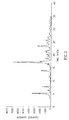
- the characteristic X-ray diffraction peaks are at the following peak positions (2 ⁇ ): 7.8, 11.3, 14.7, 16.7, 17.5, 19.3, 19.6, 22.0, 23.1, 23.4, and 25.5.
- Figure 1 depicts the X-ray powder diffraction pattern.
- the characteristic infrared absorption bands are at 3437.05, 2991.50, 2933.64, 2833.35, 2598.04, 1726.24, 1649.09, 1612.44, 1519.86, 1467.79, 1332.77, 1271.05, 1228.62, 1159.18, 1028.03, 958.59, 858.30, 813.94, 754.14, 704.00, 603.70, 478.33 cm -1 .
- the infrared spectrum is depicted in Fig. 8 .
- the resulting mixture was heated to 80°C and stirred at 80°C for 5 hours. Subsequently, the mixture was cooled to ambient temperature and a solution of oxalic acid dihydrate (11 g, 0.0873 moles) in acetone (50 ml) was added to afford a suspension. Ethyl acetate (100 ml) was added to the suspension and the mixture was stirred at ambient temperature for 15 minutes.
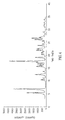
- the characteristic X-ray diffraction peaks are at the following peak positions (2 ⁇ ): 7.8, 10.2, 15.4, 17.4, 18.1, 20.2, 21.5, 23.5, 24.3, 25.5, 27.1.
- Figure 2 depicts the X-ray powder diffraction pattern.
- the characteristic infrared absorption bands are at 3381.11, 3205.60, 3043.58, 2935.57, 2839.13, 2794.77, 2715.69, 1728.17, 1672.23, 1610.51, 1519.86, 1467.79, 1336.63, 1265.27, 1230.55, 1141.83, 1024.17, 866.01, 812.01, 767.65, 705.93, 605.63, 472.55 cm -1 .
- the infrared spectrum is depicted in Figure 9 .
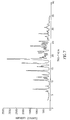
- the characteristic X-ray diffraction peaks are at the following peak positions (2 ⁇ ): 5.2, 7.8, 14.0, 17.3, 17.6, 18.8, 20.3, 21.1, 21.7, 23.5, 25.7.
- Figure 3 depicts the X-ray powder diffraction pattern.
- the characteristic infrared absorption bands are at 3435.12, 3016.58, 2945.21, 2835.28, 2596.11, 1747.46, 1643.30, 1610.51, 1517.93, 1456.21, 1419.57, 1369.42, 1342.42, 1267.19, 1228.62, 1143.75, 1124.47, 1082.03, 1022.24, 966.31, 860.23, 821.65, 756.07, 734.86, 705.93, 626.85, 474.47, 426.26 cm -1 .
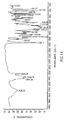
- Figure 10 depicts the infrared spectrum.
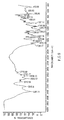
- the characteristic X-ray diffraction peaks are at the following peak positions (2 ⁇ ): 5.4, 6.9, 12.6, 15.8, 17.4, 17.8, 19.3, 22.0, 22.5, 26.2, 26.8.
- Figure 4 depicts the X-ray powder diffraction pattern.
- the characteristic infrared absorption bands are at 3440.91, 3290.46, 2962.57, 2931.71, 2831.42, 2594.18, 1753.24, 1654.88, 1610.51, 1517.93, 1465.86, 1388.71, 1365.56, 1263.34, 1230.55, 1141.83, 1122.54, 1028.03, 948.95, 864.08, 810.08, 704.00, 624.92, 484.12 cm -1 .
- Figure 11 depicts the infrared spectrum.
- This example describes the preparation of a mixture of the cis and trans isomers of (1R)-1-[(3,4-dimethoxyphenyl)methyl]-1,2,3,4-tetrahydro-6,7-dimethoxy-2-methyl-2-tert-butoxycarbonylethyl-isoquinolinium iodide.
- This example describes the preparation of a mixture of the cis and trans isomers of (1R)-1-[(3,4-dimethoxyphenyl)methyl]-1,2,3,4-tetrahydro-6,7-dimethoxy-2-methyl-2-tert-butoxycarbonylethyl-isoquinolinium iodide.
- the physical data of the product was identical to the physical data of the product obtained in example 6A.
- This example describes the preparation of a mixture of the cis and trans isomers of (1R)-1-[(3,4-dimethoxyphenyl)methyl]-1,2,3,4-tetrahydro-6,7-dimethoxy-2-methyl-2-aminocarbonylethyl-isoquinolinium iodide.
- the characteristic X-ray diffraction peaks are at the following peak positions (2 ⁇ ): 4.8, 17.8, 18.3, 18.7, 21.1, 22.8, 24.5, 25.8, 28.3, 29.0.
- Figure 5 depicts the X-ray powder diffraction pattern.
- the characteristic infrared absorption bands are at 3342.54, 3230.67, 3157.38, 2962.57, 2925.93, 2835.28, 1679.95, 1608.58, 1516.00, 1448.50, 1382.92, 1255.62, 1230.55, 1157.26, 1118.68, 1020.31, 989.45, 954.74, 860.23, 817.79, 763.79, 632.63, 563.20, 497.62, 428.18 cm -1 .
- Figure 12 depicts the Infrared spectrum.
- This example describes the preparation of a mixture of the cis and trans isomers of (1R)-1-[(3,4-dimethoxyphenyl)methyl]-1,2,3,4-tetrahydro-6,7-dimethoxy-2-methyl-2-methoxycarbonylethyl-isoquinolinium iodide.
- the product (0.85 g) was admixed with methanol (2 ml) and the mixture was heated to obtain a solution.
- Ethyl acetate (8 ml) was added to the solution and the mixture was cooled to ambient temperature and stirred for 1 hour. Subsequently, the mixture was cooled to 5°C and kept at that temperature for 48 hours.
- This example describes the preparation of a mixture of the cis and trans isomers of (1R)-1-[(3,4-dimethoxyphenyl)methyl]-1,2,3,4-tetrahydro-6,7-dimethoxy-2-methyl-2-benzyloxycarbonylethyl-isoquinolinium besylate.
- Tetrahydrofuran (40 ml) was added to the residual oil and the mixture was heated to obtain a solution. The solution was cooled to ambient temperature and stirred for 1 hour. Subsequently, the mixture was cooled to -20°C and kept at that temperature for 16 hours.
- This example describes the preparation of (1R-cis)-1-[(3,4-dimethoxyphenyl)-methyl]-1,2,3,4-tetrahydro-6,7-dimethoxy-2-methyl-2-benzyloxycarbonylethylisoquinolinium besylate by crystallization of isomeric mixture.
- the characteristic X-ray diffraction peaks are at the following peak positions (2 ⁇ ): 6.3, 11.5, 13.0, 13.3, 13.7, 15.9, 16.7, 18.9, 19.4, 20.0, 20.3, 21.3, 22.6, 23.1, 24.0, 24.7.
- Figure 6 depicts the X-ray powder diffraction pattern.
- the characteristic infrared absorption bands are at 3450.55, 2956.79, 2833.35, 1737.81, 1612.44, 1517.93, 1465.86, 1386.78, 1330.84, 1265.27, 1193.90, 1122.54, 1018.38, 852.51, 804.29, 725.21, 696.28, 613.35, 561.27 cm -1 .
- Figure 13 depicts the infrared spectrum.
- This example describes the preparation (1R-cis)-1-[(3,4-dimethoxyphenyl)-methyl]-1,2,3,4-tetrahydro-6,7-dimethoxy-2-methyl-2-benzyloxycarbonylethyl-isoquinolinium besylate.
- This example describes the preparation of (1R-cis)-1-[(3,4-dimethoxyphenyl)-methyl]-1,2,3,4-tetrahydro-6,7-dimethoxy-2-methyl-2-benzyloxycarbonylethylisoquinolinium besylate.
- Tetrahydrofuran (40 ml) was added to the residual oil to obtain a solution. The solution was kept at 5°C overnight. The solid was collected by filtration, washed with tetrahydrofuran (5 ml) and dried to afford (1R-cis)-1-[(3,4-dimethoxyphenyl)methyl]-1,2,3,4-tetrahydro-6,7-dimethoxy-2-methyl-2-benzyloxycarbonylethyl-isoquinolinium besylate, 5.3 g, (46% yield or 68% yield from the cis isomer), HPLC purity 98.73 % with 1.14% of the trans isomer, m.p.
- This example describes the preparation of a (1R-cis)-1-[(3,4-dimethoxyphenyl)-methyl]-1,2,3,4-tetrahydro-6,7-dimethoxy-2-methyl-2-benzyloxycarbonylethyl-isoquinolinium besylate.
- This example describes the preparation of (1R-cis)-1-[(3,4-dimethoxyphenyl)-methyl]-1,2,3,4-tetrahydro-6,7-dimethoxy-2-methyl-2-tert-butoxycarbonylethyl-isoquinolinium besylate.
- the characteristic X-ray diffraction peaks are at the following peak positions (2 ⁇ ): 7.2, 10.6, 11.8, 14.2, 17.1, 18.6, 21.0, 21.5, 23.6, 25.3, 28.2.
- Figure 7 depicts the X-ray powder diffraction pattern.
- the characteristic infrared absorption bands are at 3429.33, 2997.29, 2956.79, 2835.28, 1728.17, 1610.51, 1597.01, 1517.93, 1444.64, 1367.49, 1334.70, 1265.27, 1193.90, 1157.26, 1120.61, 1016.46, 896.87, 848.65, 759.93, 723.28, 696.28, 611.42, 561.27, 433.97 cm -1 .
- Figure 14 depicts the Infrared spectrum.
- This example describes the preparation of a mixture of the cis and trans isomers of (1R)-1-[(3,4-dimethoxyphenyl)methyl]-1,2,3,4-tetrahydro-6,7-dimethoxy-2-methyl-2-carboxyethyl-isoquinolinium tetrafluoroborate.
- This example describes the isolation of (1R-cis)-1-[(3,4-dimethoxyphenyl)-methyl]-1,2,3,4-tetrahydro-6,7-dimethoxy-2-methyl-2-carboxyethyl-isoquinolinium tetrafluoroborate by slurrying the isomer mixture in dichloromethane.
- This example describes the preparation of (1R-cis)-1-[(3,4-dimethoxyphenyl)-methyl]-1,2,3,4-tetrahydro-6,7-dimethoxy-2-methyl-2-carboxyethyl)-isoquinolinium besylate by hydrogenation of (1R-cis)-1-[(3,4-dimethoxyphenyl)-methyl]-1,2,3,4-tetrahydro-6,7-dimethoxy-2-methyl-2-benzyloxycarbonylethyl-isoquinolinium besylate.
- This example describes the preparation of (1R-cis)-1-[(3,4-dimethoxyphenyl)-methyl]-1,2,3,4-tetrahydro-6,7-dimethoxy-2-methyl-2-carboxyethyl-isoquinolinium besylate by hydrolysis of (1R-cis)-1-[(3,4-dimethoxyphenyl)methyl]-1,2,3,4-tetrahydro-6,7-dimethoxy-2-methyl-2-tert-butoxycarbonylethyl-isoquinolinium besylate.
- This example describes the preparation of crude cisatracurium besylate.
- This example describes the preparation of crude cisatracurium iodide.
- 1,5-pentanediol (0.05 ml, 0.481 mmoles) was added dropwise at 0°C and the reaction mixture was allowed to reach ambient temperature and reaction mixture was stirred at that temperature for 14 hours. After concentrating the reaction mixture under reduced pressure at room temperature, the crude cisatracurium iodide was obtained as a semi-solid oil, 0.752 g, (69% yield); HPLC purity: 80%.
Landscapes
- Chemical & Material Sciences (AREA)
- Organic Chemistry (AREA)
- Pharmaceuticals Containing Other Organic And Inorganic Compounds (AREA)
- Organic Low-Molecular-Weight Compounds And Preparation Thereof (AREA)
Claims (21)
- Ein Verfahren zur Herstellung eines (1R-cis)-1-[(3,4-Dimethoxyphenyl)methyl]-1,2,3,4-tetrahydro-6,7-dimethoxy-2-methyl-2-carboxyethyl-isochinoliniumsalzes mit der Formel VII:

wobei das Verfahren folgendes umfasst:(a) Reagieren von (R)-Tetrahydropapaverin, Verbindung IIA, oder eines Salzes davon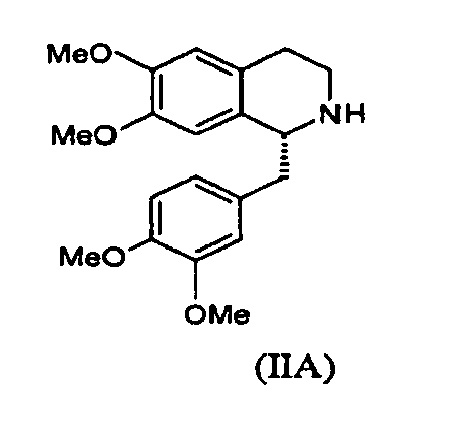
 (b) Reagieren der Verbindung (X), oder eines Salzes davon (IX), mit einem Methylierungsmittel, um Verbindung (VIII) zu bilden;
 (c) wahlweise Reinigen der Verbindung (VIII),(d) Umwandeln der Verbindung (VIII) in Verbindung (VII), und(e) wahlweise Reinigen der Verbindung (VII).
 - Das Verfahren gemäß Anspruch 1, worin das Anion X-gewählt ist aus Chlorid, Bromid, Jodid, Hydrogensulfat Methansulfonat, Benzensulfonat, p-Toluensulfonat, Naphthalen-1-sulfonat, Naphthalen-2-sulfonat, Tetrafluoroborat, Oxalat und Tartrat.
- Das Verfahren gemäß Anspruch 1, worin Schritt (a) folgendes umfasst:(i) Mischen von Verbindung (IIA) oder eines Salzes davon mit einem Acrylsäurederivat (XI) in einem organischen Lösungsmittel; und(ii) Erhitzen der Mischung von Schritt (i), um Verbindung (X) zu erhalten, worin Y OR1 oder NR2R3 ist, während R1 Alkyl, Benzyl, Aryl oder Heteroaryl ist, und R2 und R3 sind gleich oder unterschiedlich und jedes ist unabhängig Wasserstoff, Alkyl, Aryl oder Heteroaryl, wobei Alkyl bei jedem Vorkommen eine lineare, verzweigte oder zyklische Kohlenwasserstoffstruktur ist, enthaltend von 1 bis 20 Kohlenstoffatome, und Kombinationen daraus, einschließlich ungesättigten Alkylen, und wobei Aryl und Heteroaryl monozyklische oder polyzyklische aromatische Gruppen sind oder heteroaromatische Ringe enthaltend 0-3 Heteroatome, gewählt aus O, N oder S, unsubstituiert oder substituiert mit einer oder mehreren Gruppen unabhängig gewählt aus, zum Beispiel, Halo, C1-C6 Alkyl, OCF3, NO2, CN und OC1-C6 Alkyl;
- Das Verfahren gemäß Anspruch 3, worin das organische Lösungsmittel von Schritt (i) gewählt ist aus
Toluen, Xylenen, Ethylacetat, Dichlormethan, Chloroform und einer Mischung daraus. - Das Verfahren gemäß Anspruch 1, weiter umfassend eine Säureadditionsreaktion durch Reagieren von Verbindung (X) mit einer Säure gewählt aus Chlorwasserstoff, Bromwasserstoff, Jodwasserstoff, Methansulfonsäure, Benzensulfonsäure, p-Toluensulfonsäure, Naphthalen-1-sulfonsäure, Naphthalen-2-sulfonsäure, Oxalsäure und Weinsäure, wahlweise in einem organischen Lösungsmittel, um eine Suspension von Verbindung (IX) zu liefern, und Isolieren von Verbindung (IX) als ein Präzipitat in gereinigter Form aus der resultierenden Suspension.
- Das Verfahren gemäß Anspruch 5, worin das organische Lösungsmittel, das in der Säureadditionsreaktion verwendet wurde, um Verbindung (IX) herzustellen, gewählt ist aus Toluen, Xylenen, Benzen, Ethylacetat, Dichlormethan, Chloroform und einer Mischung daraus.
- Das Verfahren gemäß Anspruch 6, worin das organische Lösungsmittel für die Verwendung in der Säureadditionsreaktion Toluen ist.
- Das Verfahren gemäß Anspruch 1, worin das in Schritt (b) (i) verwendete Methylierungsmittel gewählt ist aus Dimethylcarbonat, Dimethylsulfat, Jodmethan, Brommethan, Methyltriflat, Methylbenzensulfonat, Trimethyloxoniumtetrafluoroborat und Methylfluorosulfonat, und die Reaktion in einem organischen Lösungsmittel ausgeführt wird gewählt aus Toluen, Xylenen, Ethylacetat, Dichlormethan, Chloroform, Acetonitril, Dimethylsulfoxid (DMSO) und Mischungen daraus.
- Das Verfahren gemäß Anspruch 1, worin Verbindung (VIII) gereinigt wird durch Aufschlämmen in mindestens einem organischen Lösungsmittel gewählt aus Diethylether, Diisopropylether, tert-Butylmethylether, und Mischungen daraus, wahlweise bei einer erhöhten Temperatur, und Sammeln der Verbindung (VIII) als ein gereinigtes Produkt.
- Das Verfahren gemäß Anspruch 1, worin Verbindung (VIII) gereinigt wird durch Auflösen von Verbindung (VIII) in einem ersten organischen Lösungsmittel und Hinzufügen eines zweiten organischen Lösungsmittels, in welchem Verbindung (VIII) schwer löslich ist, um Verbindung (VIII) auszufällen.
- Das Verfahren gemäß Anspruch 10, worin das erste organische Lösungsmittel gewählt ist aus Methanol, Tetrahydrofuran (THF), Aceton, Dichlormethan, Ethylacetat und Mischungen daraus, und das zweite organische Lösungsmittel, in welchem Verbindung (VIII) schwer löslich ist, ist gewählt aus Diethylether, n-Hexan, n-Heptan, Cyclohexan, und Petroleumether.
- Das Verfahren gemäß Anspruch 1, worin Schritt (d) folgendes umfasst:(i) Hydrolysieren von Verbindung (VIII) durch Reaktion mit einer anorganischen oder organischen Säure, durch Reaktion mit einem Silylierungsmittel, oder durch Hydrogenolyse, in einem Lösungsmittel, um dadurch Verbindung (VII) zu erzeugen; und(ii) Isolieren von Verbindung (VII).
- Das Verfahren gemäß Anspruch 12, worin Schritt (d) (i) das Hydrolysieren der Verbindung (VIII) durch Reaktion mit einer Säure gewählt aus Chlorwasserstoffsäure, Bromwasserstoffsäure, Jodwasserstoffsäure, Tetrafluoroborsäure, Schwefelsäure, Phosphorsäure, Trifluoressigsäure (TFA), Methansulfonsäure, Benzensulfonsäure, p-Toluensulfonsäure, sauren Ionenaustauscherharzen, und Kombinationen daraus, umfasst.
- Das Verfahren gemäß Anspruch 12, worin die Hydrolyse das Reagieren der Verbindung (VIII) in einem organischen Lösungsmittel mit einem Halotrimethylsilan umfasst, das gewählt ist aus Chlortrimethylsilan, Bromtrimethylsilan und Jodtrimethylsilan.
- Das Verfahren gemäß Anspruch 12, umfassend das Reagieren der Verbindung (VIII) mit Wasserstoff in der Anwesenheit eines Reduktionskatalysators gewählt aus Palladium, Palladiumhydroxid, Platin und Platinoxid, um die entsprechende Carbonsäure zu erzeugen, worin, wenn Y OR1 ist, R1 ein unsubstituiertes oder substituiertes Benzyl ist.
- Das Verfahren gemäß Anspruch 15, worin das Lösungsmittel, das in der Hydrogenolysereaktion verwendet wurde, gewählt ist aus Methanol, Ethanol, Isopropanol, n-Propanol, Wasser und Mischungen daraus.
- Das Verfahren gemäß Anspruch 1, worin Verbindung (VII) gereinigt wird durch ein Verfahren, das folgendes umfasst:(i) Mischen von Verbindung (VII) mit einem organischen Lösungsmittel;(ii) wahlweise Erhitzen der Mischung von Schritt (i) auf eine erhöhte Temperatur; und(iii) Sammeln von Verbindung (VII) in einer gereinigten Form.
- Das Verfahren gemäß Anspruch 17, worin das Lösungsmittel gewählt ist aus Methanol, Ethanol, Isopropanol, Aceton, Methylethylketon, Ethylacetat, Isopropylacetat, Diethylether, tert-Butylmethylether, Tetrahydrofuran, Toluen, Xylenen, Dichlormethan, Chloroform, und Mischungen daraus.
- Das Verfahren gemäß Anspruch 1, worin Verbindung (VII) gereinigt wird durch Auflösen von Verbindung (VII) in einem ersten organischen Lösungsmittel und Hinzufügen eines zweiten organischen Lösungsmittels, in welchem Verbindung (VII) schwer löslich ist, um Verbindung (VII) auszufällen.
- Das Verfahren gemäß Anspruch 19, worin das erste in dem Ausfällungsprozess verwendete organische Lösungsmittel gewählt ist aus Diethylether, Isopropylether tert-Butylmethylether und Mischungen daraus, und das zweite organische Lösungsmittel, in welchem Verbindung (VII) schwer löslich ist, ist gewählt aus n-Hexan, n-Heptan, Cyclohexan, Petroleumether, und Mischungen daraus.
- Das Verfahren gemäß Anspruch 1, weiter umfassend das Erzeugen von Cisatracurium durch Reagieren von Verbindung (VII) oder eines aktivierten Derivats davon, mit 1,5-Pentandiol, um Cisatracurium zu erzeugen.
Applications Claiming Priority (2)
| Application Number | Priority Date | Filing Date | Title |
|---|---|---|---|
| US91533107P | 2007-05-01 | 2007-05-01 | |
| PCT/IL2008/000589 WO2008132748A1 (en) | 2007-05-01 | 2008-05-01 | Process for producing cisatracurium compounds and associated intermediates |
Publications (2)
| Publication Number | Publication Date |
|---|---|
| EP2155684A1 EP2155684A1 (de) | 2010-02-24 |
| EP2155684B1 true EP2155684B1 (de) | 2014-04-09 |
Family
ID=39673531
Family Applications (1)
| Application Number | Title | Priority Date | Filing Date |
|---|---|---|---|
| EP08738290.9A Active EP2155684B1 (de) | 2007-05-01 | 2008-05-01 | Verfahren zur herstellung von cisatracuriumverbindungen und damit assoziierte zwischenprodukte |
Country Status (6)
| Country | Link |
|---|---|
| US (1) | US8293912B2 (de) |
| EP (1) | EP2155684B1 (de) |
| AU (1) | AU2008243749B2 (de) |
| BR (1) | BRPI0809893A2 (de) |
| CA (1) | CA2685491A1 (de) |
| WO (1) | WO2008132748A1 (de) |
Families Citing this family (12)
| Publication number | Priority date | Publication date | Assignee | Title |
|---|---|---|---|---|
| AU2008222298A1 (en) * | 2007-03-08 | 2008-09-12 | Chemagis Ltd. | (1R,1'R)-atracurium salts separation process |
| EP2125743A1 (de) * | 2007-03-26 | 2009-12-02 | Chemagis Ltd. | Verfahren zur auftrennung von (1r,1'r)-atracuriumsalzen |
| CA2685488A1 (en) * | 2007-05-01 | 2008-11-06 | Chemagis Ltd. | Novel isoquinolinium compounds useful in the preparation of cisatracurium and associated intermediates |
| CA2687157A1 (en) * | 2007-06-18 | 2008-12-24 | Chemagis Ltd. | (1r,1'r)-atracurium salts separation process |
| BRPI0812625A2 (pt) * | 2007-07-09 | 2019-02-19 | Chemagis Ltd | processo para preparar um sal de cis-atracúrio |
| CA2702535A1 (en) | 2007-10-29 | 2009-05-07 | Chemagis Ltd. | Novel r,r'-atracurium salts |
| CA2722651A1 (en) * | 2008-05-01 | 2009-11-05 | Chemagis Ltd. | Cisatracurium derivatives, preparation and uses thereof |
| CN104292161B (zh) * | 2014-09-19 | 2016-06-22 | 大道隆达(北京)医药科技发展有限公司 | 一种顺苯磺阿曲库铵的精制方法 |
| CN107056699A (zh) * | 2017-01-17 | 2017-08-18 | 连云港贵科药业有限公司 | 一种高纯度顺苯磺酸阿曲库铵的制备方法 |
| CN111777554A (zh) * | 2019-04-04 | 2020-10-16 | 山东瑞安药业有限公司 | 一种合成苯磺顺阿曲库铵的方法 |
| CN113372271A (zh) * | 2020-12-24 | 2021-09-10 | 上海药坦药物研究开发有限公司 | 一种顺苯磺酸阿曲库铵的制备方法 |
| WO2023086696A2 (en) * | 2021-11-10 | 2023-05-19 | ODH IP Corp. | Apparatus and methods for continuous flow synthesis of cisatracurium |
Citations (1)
| Publication number | Priority date | Publication date | Assignee | Title |
|---|---|---|---|---|
| WO2008132746A1 (en) * | 2007-05-01 | 2008-11-06 | Chemagis Ltd. | Novel isoquinolinium compounds useful in the preparation of cisatracurium and associated intermediates |
Family Cites Families (34)
| Publication number | Priority date | Publication date | Assignee | Title |
|---|---|---|---|---|
| AU506657B2 (en) * | 1975-12-10 | 1980-01-17 | Wellcome Foundation Limited, The | Isoquinoline derivatives |
| US4491665A (en) * | 1979-10-19 | 1985-01-01 | Burroughs Wellcome Co. | Method of preparing isomers of bis isoquinolinium compounds |
| US4701460A (en) * | 1980-12-17 | 1987-10-20 | Burroughs Wellcome Co. | Long duration neuromuscular blocking agents |
| GB8418303D0 (en) * | 1984-07-18 | 1984-08-22 | Wellcome Found | Compounds |
| BG41897A1 (en) * | 1985-07-19 | 1987-09-15 | Ivanov | Dichlormethylate of n, n'- 4, 10- dioxa- 3, 11- bis- tetrahydropapaverine and method for its preparation |
| JPS62265266A (ja) * | 1986-05-13 | 1987-11-18 | Takasago Corp | N−アシル−テトラヒドロイソキノリン類の製造法 |
| US4988815A (en) * | 1989-10-26 | 1991-01-29 | Riker Laboratories, Inc. | 3-Amino or 3-nitro quinoline compounds which are intermediates in preparing 1H-imidazo[4,5-c]quinolines |
| GB9015473D0 (en) | 1990-07-13 | 1990-08-29 | Wellcome Found | Neuromuscular blocking agents |
| US5453510A (en) * | 1990-07-13 | 1995-09-26 | Burroughs Wellcome Co. | Neuromuscular blocking agents |
| US5240939A (en) * | 1991-10-31 | 1993-08-31 | Anaquest, Inc. | Nitrogen bridge tetrahydroisoquinolines |
| DE19535762A1 (de) * | 1995-09-26 | 1997-03-27 | Basf Ag | Verfahren zur Racematspaltung |
| US5684154A (en) * | 1996-02-16 | 1997-11-04 | Abbott Laboratories | Process for the preparation and isolation of atracurium besylate |
| CN1203061C (zh) * | 1997-03-25 | 2005-05-25 | 艾弗拉药品公司 | 取代异喹啉类,其制备方法,药物组合物及其制药用途 |
| JP4782334B2 (ja) * | 1999-08-13 | 2011-09-28 | ナームローゼ・フエンノートチヤツプ・オルガノン | 薬物起因性神経筋遮断のための拮抗薬としての化学的キレート化剤の使用 |
| CA2433284A1 (en) * | 2000-12-29 | 2002-07-11 | Pfizer Limited | Reference standards and processes for determining the purity or stability of amlodipine maleate |
| US20060009485A1 (en) * | 2005-06-23 | 2006-01-12 | Chemagis Ltd | Method of reprocessing quaternary ammonium-containing neuromuscular blocking agents |
| EP1951248A4 (de) * | 2005-11-14 | 2011-05-25 | Peter D Winch | Neue farbige lösungen von injizierbaren arzneimitteln und ihren pharmazeutisch annehmbaren salzen |
| KR20070080108A (ko) | 2006-02-06 | 2007-08-09 | 주식회사종근당 | 질소의 알파 위치에 비대칭탄소가 있는 라세믹 유도체의광학 이성질체 분리 방법 |
| AU2007328210B2 (en) * | 2006-12-06 | 2012-11-22 | Cornell Research Foundation, Inc. | Intermediate duration neuromuscular blocking agents and antagonists thereof |
| AU2008222298A1 (en) | 2007-03-08 | 2008-09-12 | Chemagis Ltd. | (1R,1'R)-atracurium salts separation process |
| CN100531734C (zh) | 2007-03-13 | 2009-08-26 | 黄乐群 | 阿曲库铵冷冻干燥组合物 |
| EP2125743A1 (de) * | 2007-03-26 | 2009-12-02 | Chemagis Ltd. | Verfahren zur auftrennung von (1r,1'r)-atracuriumsalzen |
| CA2687157A1 (en) * | 2007-06-18 | 2008-12-24 | Chemagis Ltd. | (1r,1'r)-atracurium salts separation process |
| CN101337935B (zh) | 2007-07-06 | 2011-01-12 | 江苏恒瑞医药股份有限公司 | 一种用两相萃取法纯化苯磺酸阿曲库铵的方法 |
| CN101337936B (zh) | 2007-07-06 | 2011-03-23 | 江苏恒瑞医药股份有限公司 | 一种用柱色谱法纯化苯磺酸阿曲库铵的方法 |
| BRPI0812625A2 (pt) | 2007-07-09 | 2019-02-19 | Chemagis Ltd | processo para preparar um sal de cis-atracúrio |
| CA2702535A1 (en) * | 2007-10-29 | 2009-05-07 | Chemagis Ltd. | Novel r,r'-atracurium salts |
| ITMI20080319A1 (it) * | 2008-02-28 | 2009-08-29 | Recordati Chem Pharm | Processo per la risoluzione di derivati isochinolinici |
| CA2722651A1 (en) | 2008-05-01 | 2009-11-05 | Chemagis Ltd. | Cisatracurium derivatives, preparation and uses thereof |
| IT1396543B1 (it) | 2008-07-16 | 2012-12-14 | Farmabios Spa | Processo per la purificazione di bloccanti neuromuscolari |
| CN101475530A (zh) | 2009-01-16 | 2009-07-08 | 东英(江苏)药业有限公司 | 通过制备液相色谱法分离纯化顺苯磺酸阿曲库铵的方法 |
| CN101845017A (zh) | 2009-03-24 | 2010-09-29 | 天津市炜杰科技有限公司 | 苯磺酸阿曲库铵类中间体的制备方法 |
| WO2010128519A1 (en) | 2009-05-04 | 2010-11-11 | Kumar C Jairaj | A method for detecting neuropathy and predicting foot ulcer development in human beings with health conditions like diabetes mellitus |
| WO2010128518A2 (en) | 2009-05-04 | 2010-11-11 | Gland Pharma Limited | Novel process for the preparation of cisatracurium besylate |
-
2008
- 2008-05-01 US US12/598,385 patent/US8293912B2/en not_active Expired - Fee Related
- 2008-05-01 BR BRPI0809893-0A patent/BRPI0809893A2/pt not_active IP Right Cessation
- 2008-05-01 EP EP08738290.9A patent/EP2155684B1/de active Active
- 2008-05-01 CA CA002685491A patent/CA2685491A1/en not_active Abandoned
- 2008-05-01 WO PCT/IL2008/000589 patent/WO2008132748A1/en not_active Ceased
- 2008-05-01 AU AU2008243749A patent/AU2008243749B2/en not_active Ceased
Patent Citations (1)
| Publication number | Priority date | Publication date | Assignee | Title |
|---|---|---|---|---|
| WO2008132746A1 (en) * | 2007-05-01 | 2008-11-06 | Chemagis Ltd. | Novel isoquinolinium compounds useful in the preparation of cisatracurium and associated intermediates |
Also Published As
| Publication number | Publication date |
|---|---|
| BRPI0809893A2 (pt) | 2014-09-30 |
| CA2685491A1 (en) | 2008-11-06 |
| WO2008132748A1 (en) | 2008-11-06 |
| EP2155684A1 (de) | 2010-02-24 |
| AU2008243749A1 (en) | 2008-11-06 |
| AU2008243749B2 (en) | 2012-05-03 |
| US20100184988A1 (en) | 2010-07-22 |
| US8293912B2 (en) | 2012-10-23 |
Similar Documents
| Publication | Publication Date | Title |
|---|---|---|
| US8293912B2 (en) | Process for producing cisatracurium compounds and associated intermediates | |
| US8357807B2 (en) | Isoquinolinium compounds useful in the preparation of cisatracurium and associated intermediates | |
| US20100256381A1 (en) | Process for producing cisatracurium and associated intermediates | |
| US8354537B2 (en) | R,R1-atracurium salts | |
| KR101540435B1 (ko) | 발리올아민의 입체선택적 합성 | |
| WO2000027798A1 (en) | Production of 2-amino-2-[2-(4-c2-20-alkyl-phenyl)ethyl]propane-1,3-diols | |
| EP0435068B1 (de) | Verfahren zur Produktion von optisch aktivem Atenolol und Zwischenprodukt davon | |
| WO2005044805A1 (en) | A novel process for preparing donepezil and its derivatives | |
| AU696875B2 (en) | New process for the preparation of ropivacaine hydrochloride monohydrate | |
| US3644373A (en) | Method for the production of 3-substituted-1 2 3 4 5 6-hexahydro-6 11-dimethyl-8-hydroxy-2 6-methano-3-benzazocines | |
| IL201806A (en) | Process for preparation of intermediates for cisatricurium | |
| WO2012022994A1 (en) | Preparation process of vildagliptin | |
| CA1085854A (en) | Cis-4a-phenylisoquinolines | |
| CN111777554A (zh) | 一种合成苯磺顺阿曲库铵的方法 | |
| KR20000016898A (ko) | 피롤리디닐하이드록삼산화합물의제조방법 | |
| US5223646A (en) | Process for producing optically active atenolol and intermediate thereof | |
| US6620945B2 (en) | Process for producing stereoisomer of pyrrolidine derivative | |
| CN114105862A (zh) | 盐酸多奈哌齐杂质及其制备方法 | |
| WO2023086696A2 (en) | Apparatus and methods for continuous flow synthesis of cisatracurium | |
| EP0274409A2 (de) | Verfahren zur Herstellung von Alkoxyalkylidenhydrazinopyridazin-Derivaten | |
| HK1133001B (en) | Novel method for producing 4,4'-(1-methyl-1,2-ethanediyl)-bis-(2,6-piperazinedione) | |
| HK1133001A1 (en) | Novel method for producing 4,4'-(1-methyl-1,2-ethanediyl)-bis-(2,6-piperazinedione) |
Legal Events
| Date | Code | Title | Description |
|---|---|---|---|
| PUAI | Public reference made under article 153(3) epc to a published international application that has entered the european phase |
Free format text: ORIGINAL CODE: 0009012 |
|
| 17P | Request for examination filed |
Effective date: 20091105 |
|
| AK | Designated contracting states |
Kind code of ref document: A1 Designated state(s): AT BE BG CH CY CZ DE DK EE ES FI FR GB GR HR HU IE IS IT LI LT LU LV MC MT NL NO PL PT RO SE SI SK TR |
|
| AX | Request for extension of the european patent |
Extension state: AL BA MK RS |
|
| 17Q | First examination report despatched |
Effective date: 20100528 |
|
| GRAP | Despatch of communication of intention to grant a patent |
Free format text: ORIGINAL CODE: EPIDOSNIGR1 |
|
| INTG | Intention to grant announced |
Effective date: 20131021 |
|
| GRAS | Grant fee paid |
Free format text: ORIGINAL CODE: EPIDOSNIGR3 |
|
| GRAA | (expected) grant |
Free format text: ORIGINAL CODE: 0009210 |
|
| AK | Designated contracting states |
Kind code of ref document: B1 Designated state(s): AT BE BG CH CY CZ DE DK EE ES FI FR GB GR HR HU IE IS IT LI LT LU LV MC MT NL NO PL PT RO SE SI SK TR |
|
| AX | Request for extension of the european patent |
Extension state: AL BA MK RS |
|
| REG | Reference to a national code |
Ref country code: GB Ref legal event code: FG4D |
|
| REG | Reference to a national code |
Ref country code: AT Ref legal event code: REF Ref document number: 661292 Country of ref document: AT Kind code of ref document: T Effective date: 20140415 Ref country code: CH Ref legal event code: EP |
|
| REG | Reference to a national code |
Ref country code: IE Ref legal event code: FG4D |
|
| REG | Reference to a national code |
Ref country code: DE Ref legal event code: R096 Ref document number: 602008031400 Country of ref document: DE Effective date: 20140522 |
|
| REG | Reference to a national code |
Ref country code: AT Ref legal event code: MK05 Ref document number: 661292 Country of ref document: AT Kind code of ref document: T Effective date: 20140409 |
|
| REG | Reference to a national code |
Ref country code: NL Ref legal event code: VDEP Effective date: 20140409 |
|
| REG | Reference to a national code |
Ref country code: LT Ref legal event code: MG4D |
|
| PG25 | Lapsed in a contracting state [announced via postgrant information from national office to epo] |
Ref country code: BG Free format text: LAPSE BECAUSE OF FAILURE TO SUBMIT A TRANSLATION OF THE DESCRIPTION OR TO PAY THE FEE WITHIN THE PRESCRIBED TIME-LIMIT Effective date: 20140709 Ref country code: NO Free format text: LAPSE BECAUSE OF FAILURE TO SUBMIT A TRANSLATION OF THE DESCRIPTION OR TO PAY THE FEE WITHIN THE PRESCRIBED TIME-LIMIT Effective date: 20140709 Ref country code: GR Free format text: LAPSE BECAUSE OF FAILURE TO SUBMIT A TRANSLATION OF THE DESCRIPTION OR TO PAY THE FEE WITHIN THE PRESCRIBED TIME-LIMIT Effective date: 20140710 Ref country code: IS Free format text: LAPSE BECAUSE OF FAILURE TO SUBMIT A TRANSLATION OF THE DESCRIPTION OR TO PAY THE FEE WITHIN THE PRESCRIBED TIME-LIMIT Effective date: 20140809 Ref country code: FI Free format text: LAPSE BECAUSE OF FAILURE TO SUBMIT A TRANSLATION OF THE DESCRIPTION OR TO PAY THE FEE WITHIN THE PRESCRIBED TIME-LIMIT Effective date: 20140409 Ref country code: NL Free format text: LAPSE BECAUSE OF FAILURE TO SUBMIT A TRANSLATION OF THE DESCRIPTION OR TO PAY THE FEE WITHIN THE PRESCRIBED TIME-LIMIT Effective date: 20140409 Ref country code: LT Free format text: LAPSE BECAUSE OF FAILURE TO SUBMIT A TRANSLATION OF THE DESCRIPTION OR TO PAY THE FEE WITHIN THE PRESCRIBED TIME-LIMIT Effective date: 20140409 |
|
| PG25 | Lapsed in a contracting state [announced via postgrant information from national office to epo] |
Ref country code: PL Free format text: LAPSE BECAUSE OF FAILURE TO SUBMIT A TRANSLATION OF THE DESCRIPTION OR TO PAY THE FEE WITHIN THE PRESCRIBED TIME-LIMIT Effective date: 20140409 Ref country code: ES Free format text: LAPSE BECAUSE OF FAILURE TO SUBMIT A TRANSLATION OF THE DESCRIPTION OR TO PAY THE FEE WITHIN THE PRESCRIBED TIME-LIMIT Effective date: 20140409 Ref country code: AT Free format text: LAPSE BECAUSE OF FAILURE TO SUBMIT A TRANSLATION OF THE DESCRIPTION OR TO PAY THE FEE WITHIN THE PRESCRIBED TIME-LIMIT Effective date: 20140409 Ref country code: SE Free format text: LAPSE BECAUSE OF FAILURE TO SUBMIT A TRANSLATION OF THE DESCRIPTION OR TO PAY THE FEE WITHIN THE PRESCRIBED TIME-LIMIT Effective date: 20140409 Ref country code: HR Free format text: LAPSE BECAUSE OF FAILURE TO SUBMIT A TRANSLATION OF THE DESCRIPTION OR TO PAY THE FEE WITHIN THE PRESCRIBED TIME-LIMIT Effective date: 20140409 Ref country code: LV Free format text: LAPSE BECAUSE OF FAILURE TO SUBMIT A TRANSLATION OF THE DESCRIPTION OR TO PAY THE FEE WITHIN THE PRESCRIBED TIME-LIMIT Effective date: 20140409 |
|
| REG | Reference to a national code |
Ref country code: DE Ref legal event code: R119 Ref document number: 602008031400 Country of ref document: DE |
|
| PG25 | Lapsed in a contracting state [announced via postgrant information from national office to epo] |
Ref country code: PT Free format text: LAPSE BECAUSE OF FAILURE TO SUBMIT A TRANSLATION OF THE DESCRIPTION OR TO PAY THE FEE WITHIN THE PRESCRIBED TIME-LIMIT Effective date: 20140811 |
|
| REG | Reference to a national code |
Ref country code: CH Ref legal event code: PL |
|
| PG25 | Lapsed in a contracting state [announced via postgrant information from national office to epo] |
Ref country code: MC Free format text: LAPSE BECAUSE OF FAILURE TO SUBMIT A TRANSLATION OF THE DESCRIPTION OR TO PAY THE FEE WITHIN THE PRESCRIBED TIME-LIMIT Effective date: 20140409 Ref country code: LI Free format text: LAPSE BECAUSE OF NON-PAYMENT OF DUE FEES Effective date: 20140531 Ref country code: SK Free format text: LAPSE BECAUSE OF FAILURE TO SUBMIT A TRANSLATION OF THE DESCRIPTION OR TO PAY THE FEE WITHIN THE PRESCRIBED TIME-LIMIT Effective date: 20140409 Ref country code: RO Free format text: LAPSE BECAUSE OF FAILURE TO SUBMIT A TRANSLATION OF THE DESCRIPTION OR TO PAY THE FEE WITHIN THE PRESCRIBED TIME-LIMIT Effective date: 20140409 Ref country code: EE Free format text: LAPSE BECAUSE OF FAILURE TO SUBMIT A TRANSLATION OF THE DESCRIPTION OR TO PAY THE FEE WITHIN THE PRESCRIBED TIME-LIMIT Effective date: 20140409 Ref country code: CZ Free format text: LAPSE BECAUSE OF FAILURE TO SUBMIT A TRANSLATION OF THE DESCRIPTION OR TO PAY THE FEE WITHIN THE PRESCRIBED TIME-LIMIT Effective date: 20140409 Ref country code: BE Free format text: LAPSE BECAUSE OF FAILURE TO SUBMIT A TRANSLATION OF THE DESCRIPTION OR TO PAY THE FEE WITHIN THE PRESCRIBED TIME-LIMIT Effective date: 20140409 Ref country code: CH Free format text: LAPSE BECAUSE OF NON-PAYMENT OF DUE FEES Effective date: 20140531 Ref country code: DK Free format text: LAPSE BECAUSE OF FAILURE TO SUBMIT A TRANSLATION OF THE DESCRIPTION OR TO PAY THE FEE WITHIN THE PRESCRIBED TIME-LIMIT Effective date: 20140409 |
|
| PLBE | No opposition filed within time limit |
Free format text: ORIGINAL CODE: 0009261 |
|
| STAA | Information on the status of an ep patent application or granted ep patent |
Free format text: STATUS: NO OPPOSITION FILED WITHIN TIME LIMIT |
|
| REG | Reference to a national code |
Ref country code: IE Ref legal event code: MM4A |
|
| REG | Reference to a national code |
Ref country code: FR Ref legal event code: ST Effective date: 20150130 |
|
| REG | Reference to a national code |
Ref country code: DE Ref legal event code: R119 Ref document number: 602008031400 Country of ref document: DE Effective date: 20141202 |
|
| 26N | No opposition filed |
Effective date: 20150112 |
|
| GBPC | Gb: european patent ceased through non-payment of renewal fee |
Effective date: 20140709 |
|
| PG25 | Lapsed in a contracting state [announced via postgrant information from national office to epo] |
Ref country code: IT Free format text: LAPSE BECAUSE OF FAILURE TO SUBMIT A TRANSLATION OF THE DESCRIPTION OR TO PAY THE FEE WITHIN THE PRESCRIBED TIME-LIMIT Effective date: 20140409 |
|
| PG25 | Lapsed in a contracting state [announced via postgrant information from national office to epo] |
Ref country code: IE Free format text: LAPSE BECAUSE OF NON-PAYMENT OF DUE FEES Effective date: 20140501 Ref country code: DE Free format text: LAPSE BECAUSE OF NON-PAYMENT OF DUE FEES Effective date: 20141202 |
|
| PG25 | Lapsed in a contracting state [announced via postgrant information from national office to epo] |
Ref country code: FR Free format text: LAPSE BECAUSE OF NON-PAYMENT OF DUE FEES Effective date: 20140610 Ref country code: GB Free format text: LAPSE BECAUSE OF NON-PAYMENT OF DUE FEES Effective date: 20140709 |
|
| PG25 | Lapsed in a contracting state [announced via postgrant information from national office to epo] |
Ref country code: SI Free format text: LAPSE BECAUSE OF FAILURE TO SUBMIT A TRANSLATION OF THE DESCRIPTION OR TO PAY THE FEE WITHIN THE PRESCRIBED TIME-LIMIT Effective date: 20140409 |
|
| PG25 | Lapsed in a contracting state [announced via postgrant information from national office to epo] |
Ref country code: MT Free format text: LAPSE BECAUSE OF FAILURE TO SUBMIT A TRANSLATION OF THE DESCRIPTION OR TO PAY THE FEE WITHIN THE PRESCRIBED TIME-LIMIT Effective date: 20140409 |
|
| PG25 | Lapsed in a contracting state [announced via postgrant information from national office to epo] |
Ref country code: CY Free format text: LAPSE BECAUSE OF FAILURE TO SUBMIT A TRANSLATION OF THE DESCRIPTION OR TO PAY THE FEE WITHIN THE PRESCRIBED TIME-LIMIT Effective date: 20140409 |
|
| PG25 | Lapsed in a contracting state [announced via postgrant information from national office to epo] |
Ref country code: TR Free format text: LAPSE BECAUSE OF FAILURE TO SUBMIT A TRANSLATION OF THE DESCRIPTION OR TO PAY THE FEE WITHIN THE PRESCRIBED TIME-LIMIT Effective date: 20140409 Ref country code: HU Free format text: LAPSE BECAUSE OF FAILURE TO SUBMIT A TRANSLATION OF THE DESCRIPTION OR TO PAY THE FEE WITHIN THE PRESCRIBED TIME-LIMIT; INVALID AB INITIO Effective date: 20080501 Ref country code: LU Free format text: LAPSE BECAUSE OF NON-PAYMENT OF DUE FEES Effective date: 20140501 |