EP2113748A2 - Absolutpositionscodierer vom Längsmessungstyp - Google Patents
Absolutpositionscodierer vom Längsmessungstyp Download PDFInfo
- Publication number
- EP2113748A2 EP2113748A2 EP09158947A EP09158947A EP2113748A2 EP 2113748 A2 EP2113748 A2 EP 2113748A2 EP 09158947 A EP09158947 A EP 09158947A EP 09158947 A EP09158947 A EP 09158947A EP 2113748 A2 EP2113748 A2 EP 2113748A2
- Authority
- EP
- European Patent Office
- Prior art keywords
- absolute
- signal
- absolute position
- light
- detection circuit
- Prior art date
- Legal status (The legal status is an assumption and is not a legal conclusion. Google has not performed a legal analysis and makes no representation as to the accuracy of the status listed.)
- Granted
Links
- 238000005259 measurement Methods 0.000 title claims abstract description 41
- 238000001514 detection method Methods 0.000 claims abstract description 59
- 230000002194 synthesizing effect Effects 0.000 claims abstract description 21
- 238000013461 design Methods 0.000 claims abstract description 13
- 238000000034 method Methods 0.000 claims description 11
- 238000012545 processing Methods 0.000 claims description 9
- CBCKQZAAMUWICA-UHFFFAOYSA-N 1,4-phenylenediamine Chemical compound NC1=CC=C(N)C=C1 CBCKQZAAMUWICA-UHFFFAOYSA-N 0.000 claims description 8
- 238000005315 distribution function Methods 0.000 claims description 6
- 230000008719 thickening Effects 0.000 abstract description 8
- 230000003321 amplification Effects 0.000 description 8
- 238000003199 nucleic acid amplification method Methods 0.000 description 8
- 230000008569 process Effects 0.000 description 8
- 230000015572 biosynthetic process Effects 0.000 description 3
- 238000006243 chemical reaction Methods 0.000 description 3
- 238000004519 manufacturing process Methods 0.000 description 3
- 230000008859 change Effects 0.000 description 2
- 238000003491 array Methods 0.000 description 1
- 230000005540 biological transmission Effects 0.000 description 1
- 238000003708 edge detection Methods 0.000 description 1
- 230000003287 optical effect Effects 0.000 description 1
- 238000005070 sampling Methods 0.000 description 1
- 238000010408 sweeping Methods 0.000 description 1
- 238000013519 translation Methods 0.000 description 1
Images


Classifications
-
- G—PHYSICS
- G01—MEASURING; TESTING
- G01D—MEASURING NOT SPECIALLY ADAPTED FOR A SPECIFIC VARIABLE; ARRANGEMENTS FOR MEASURING TWO OR MORE VARIABLES NOT COVERED IN A SINGLE OTHER SUBCLASS; TARIFF METERING APPARATUS; MEASURING OR TESTING NOT OTHERWISE PROVIDED FOR
- G01D5/00—Mechanical means for transferring the output of a sensing member; Means for converting the output of a sensing member to another variable where the form or nature of the sensing member does not constrain the means for converting; Transducers not specially adapted for a specific variable
- G01D5/12—Mechanical means for transferring the output of a sensing member; Means for converting the output of a sensing member to another variable where the form or nature of the sensing member does not constrain the means for converting; Transducers not specially adapted for a specific variable using electric or magnetic means
- G01D5/244—Mechanical means for transferring the output of a sensing member; Means for converting the output of a sensing member to another variable where the form or nature of the sensing member does not constrain the means for converting; Transducers not specially adapted for a specific variable using electric or magnetic means influencing characteristics of pulses or pulse trains; generating pulses or pulse trains
- G01D5/249—Mechanical means for transferring the output of a sensing member; Means for converting the output of a sensing member to another variable where the form or nature of the sensing member does not constrain the means for converting; Transducers not specially adapted for a specific variable using electric or magnetic means influencing characteristics of pulses or pulse trains; generating pulses or pulse trains using pulse code
- G01D5/2497—Absolute encoders
-
- G—PHYSICS
- G01—MEASURING; TESTING
- G01D—MEASURING NOT SPECIALLY ADAPTED FOR A SPECIFIC VARIABLE; ARRANGEMENTS FOR MEASURING TWO OR MORE VARIABLES NOT COVERED IN A SINGLE OTHER SUBCLASS; TARIFF METERING APPARATUS; MEASURING OR TESTING NOT OTHERWISE PROVIDED FOR
- G01D5/00—Mechanical means for transferring the output of a sensing member; Means for converting the output of a sensing member to another variable where the form or nature of the sensing member does not constrain the means for converting; Transducers not specially adapted for a specific variable
- G01D5/12—Mechanical means for transferring the output of a sensing member; Means for converting the output of a sensing member to another variable where the form or nature of the sensing member does not constrain the means for converting; Transducers not specially adapted for a specific variable using electric or magnetic means
- G01D5/244—Mechanical means for transferring the output of a sensing member; Means for converting the output of a sensing member to another variable where the form or nature of the sensing member does not constrain the means for converting; Transducers not specially adapted for a specific variable using electric or magnetic means influencing characteristics of pulses or pulse trains; generating pulses or pulse trains
- G01D5/245—Mechanical means for transferring the output of a sensing member; Means for converting the output of a sensing member to another variable where the form or nature of the sensing member does not constrain the means for converting; Transducers not specially adapted for a specific variable using electric or magnetic means influencing characteristics of pulses or pulse trains; generating pulses or pulse trains using a variable number of pulses in a train
- G01D5/2454—Encoders incorporating incremental and absolute signals
-
- G—PHYSICS
- G01—MEASURING; TESTING
- G01D—MEASURING NOT SPECIALLY ADAPTED FOR A SPECIFIC VARIABLE; ARRANGEMENTS FOR MEASURING TWO OR MORE VARIABLES NOT COVERED IN A SINGLE OTHER SUBCLASS; TARIFF METERING APPARATUS; MEASURING OR TESTING NOT OTHERWISE PROVIDED FOR
- G01D5/00—Mechanical means for transferring the output of a sensing member; Means for converting the output of a sensing member to another variable where the form or nature of the sensing member does not constrain the means for converting; Transducers not specially adapted for a specific variable
- G01D5/26—Mechanical means for transferring the output of a sensing member; Means for converting the output of a sensing member to another variable where the form or nature of the sensing member does not constrain the means for converting; Transducers not specially adapted for a specific variable characterised by optical transfer means, i.e. using infrared, visible, or ultraviolet light
- G01D5/32—Mechanical means for transferring the output of a sensing member; Means for converting the output of a sensing member to another variable where the form or nature of the sensing member does not constrain the means for converting; Transducers not specially adapted for a specific variable characterised by optical transfer means, i.e. using infrared, visible, or ultraviolet light with attenuation or whole or partial obturation of beams of light
- G01D5/34—Mechanical means for transferring the output of a sensing member; Means for converting the output of a sensing member to another variable where the form or nature of the sensing member does not constrain the means for converting; Transducers not specially adapted for a specific variable characterised by optical transfer means, i.e. using infrared, visible, or ultraviolet light with attenuation or whole or partial obturation of beams of light the beams of light being detected by photocells
- G01D5/347—Mechanical means for transferring the output of a sensing member; Means for converting the output of a sensing member to another variable where the form or nature of the sensing member does not constrain the means for converting; Transducers not specially adapted for a specific variable characterised by optical transfer means, i.e. using infrared, visible, or ultraviolet light with attenuation or whole or partial obturation of beams of light the beams of light being detected by photocells using displacement encoding scales
- G01D5/34776—Absolute encoders with analogue or digital scales
- G01D5/34792—Absolute encoders with analogue or digital scales with only digital scales or both digital and incremental scales
Definitions
- the present invention relates to an absolute position length measurement type encoder that includes a light-emitting element, a scale for forming bright and dark patterns with pseudorandom codes on projection light of the light-emitting element, and a light-receiving element, and in particular to an absolute position length measurement type encoder the arithmetic operation amount of which is small while being highly accurate.
- Accurate position control and measurement are indispensable in measuring instruments and apparatuses. Therefore, an absolute position length measurement type encoder capable of executing absolute position measurement over some length has been used. In particular, where high accuracy is required, a photoelectric type encoder has been used.
- an absolute position length measurement type photoelectric encoder has an absolute pattern (hereinafter called an ABS pattern) to roughly measure a moving distance and an incremental pattern (hereinafter called an INC pattern) to measure a moving distance at high resolution power by interpolating the interval of a roughly obtained moving distance on a scale (For example, Japanese Published Unexamined Patent Application No. 2003-234941 (hereinafter called Patent Document 1), Japanese Translation of International Application (Kohyo) No. 2005-515418 (hereinafter called Patent Document 2)).
- the scale is attached to a moving stage side, and the light-emitting element and light-receiving element are attached to the base side that supports the stage.
- the moving distance can be measured at high accuracy by processing the change in a signal processing circuit.
- rough absolute positions are obtained by the ABS pattern, and a minute position between the absolute positions obtained by the ABS pattern is obtained by the INC pattern. That is, it is necessary that the absolute position itself obtained by the ABS pattern be stabilized with high accuracy.
- the absolute position length measuring type encoder itself can be downsized by using a single pattern based on a pseudorandom code as the ABS pattern.
- the arithmetic operation amount is increased for measurement of the absolute position, it takes a large amount of time for the arithmetic operation, and it is not possible to output a result of measurement of a moving distance at a high speed.
- position measurement based on the INC pattern is regularly carried out without frequently executing position measurement based on the ABS pattern.
- the ABS pattern is provided, correct absolute position is not output if erroneous counting occurs by the INC pattern when moving at a high speed.
- the ABS pattern is required to be formed at an accurate interval based on the pseudorandom codes, the patterns may be made thick or thin depending on the conditions of the formation process. In this case, another problem occurs, by which the accuracy of the absolute position obtained by the ABS pattern may be reduced, and becomes unstable.
- the present invention was developed to solve the prior art problems described above, and it is therefore an object of the present invention to provide an absolute position length type measurement encoder capable of calculating an absolute position with a small arithmetic operation amount even by using pseudorandom codes for ABS pattern, and capable of securing accuracy in absolute positions obtained even in a case where the ABS pattern is made thick or thin.
- a first aspect of the invention of the present application includes:
- a second aspect of the invent ion of the present application is featured in that the light-receiving element is made into an array, and the arrangement pitch thereof is one-third or less the minimum line width of the absolute pattern.
- a third aspect of the invention of the present application is featured in that the scale includes an incremental pattern.
- a fourth aspect of the invention of the present application is featured in including:
- a fifth aspect of the invention of the present application is featured in that the absolute position output circuit usually selects a signal output from the incremental position detection circuit, references the signal to the absolute synthesization position signal once every predetermined interval of time, outputs an absolute synthesization position signal as a position data signal if there is a difference in the absolute positions obtained by two signals, and feeds the position data signal back to the incremental position detection circuit and sets it up as the current position in the inside of the incremental position detection circuit.
- a sixth aspect of the invention of the present application is featured in that the feedback is carried out when data are not renewed in the position data synthesizing circuit by a data refreshing rate.
- a seventh aspect of the invention of the present application is featured in that the peak position detection circuit interpolates respective values of a histogram by fitting a probability distribution function by the least-squares method and obtains the peak position.
- An eighth aspect of the invention of the present application is featured in that the decoding circuit decodes a pseudorandom code from the binarized value using the obtained peak position as the reference position of the pseudorandom code.
- a ninth aspect of the invention of the present application is featured in that the peak position obtained by the decoding circuit is obtained by interpolating the values of the histogram.
- a tenth aspect of the invention of the present application is featured in that the decoding circuit obtains the respective total numbers of the binarized values (0 and 1) in the minimum line width, and determines and decodes the code of the minimum line width based on the value (0 or 1) the total number of which is greater.
- an eleventh aspect of the invention of the present application is featured in that the position detection circuit carries out an arithmetic operations for correlation between the decoded pseudorandom code and the design value of the pseudorandom code, and obtains the absolute position of the scale with respect to the light-receiving element.
- a twelfth aspect of the invention of the present application is featured in that the position data synthesizing circuit synthesizes the position data by adding the peak position of the peak position signal to the absolutepositionof the absolute position signal.
- the present invention it is possible to calculate the absolute position at high accuracy with a small arithmetic operation amount using a pseudorandom code for the ABS pattern. Therefore, since the absolute position can be frequently calculated from the ABS pattern, it is possible to measure the moving distance of a scale with respect to a light-receiving element having a good slaved tracking performance with accuracy maintained in the case where a scale moves rapidly and greatly, for example.
- FIG. 1 is a schematic view showing the entirety of an absolute position length measurement type encoder according to the embodiment.
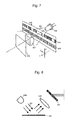
- FIG. 2 is a perspective view exemplarily showing the relationship between a light-emitting element, a scale and a light-receiving element.
- FIG. 3 is a schematic view showing the scale.
- FIG. 4 is a schematic view showing the light-receiving element.
- FIG. 5 is a flowchart showing operations from an edge position detection circuit to a position data synthesizing circuit.
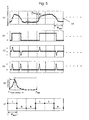
- FIG. 6 is a schematic view showing signals corresponding to respective steps of FIG. 5 .
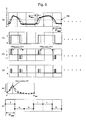
- FIG. 7 is a schematic view showing signals corresponding to respective steps of FIG. 5 when the line width of ABS pattern is subjected to thickening.
- an absolute position length measurement type encoder 100 includes:
- the scale 102 includes the ABS pattern 104 and the INC pattern 106.
- the ABS pattern 104 and the INC pattern 106 can form bright and dark patterns by being brought into a transparent state where the projection light R0 is not interrupted, if the code is 1, and into a non-transparent state where the projection light R0 is interrupted, if the code is 0, for example.
- a pseudorandom code is used for the ABS pattern 104.
- M-sequence code which becomes the longest cycle, of the code series generated by a shift register may be used as the pseudorandom code.
- the line width per one pseudorandom code becomes the minimum line width P ABS of the ABS pattern 104.
- the INC pattern 106 is a pattern consisting of cyclically formed 1 and 0.
- the ABS pattern 104 is disposed upside in the Z-axis direction in FIG. 3 while the INC pattern 106 is disposed downside.
- an LED may be used as the light-emitting element 108.
- the lens 110 may be composed of a single lens (for example, cylindrical lens, etc.) by which two patterns 104 and 106 are simultaneously imaged as shown in FIG. 2 .
- the lens 110 may be composed of two lenses, by which the ABS pattern 104 and the INC pattern 106 are individually imaged.
- the lens 110 may not necessarily be used.
- the light-receiving element 112 includes two light-receiving element arrays 114 and 116, one of which is the ABS light-receiving element array 114, and the other of which is a light-receiving element array 116 for the INC pattern.
- the array arrangement pitch P PDA of the ABS light-receiving element array 114 is as shown in FIG. 4 . That is, the spatial resolution power of the ABS light-receiving element array 114 becomes an array arrangement pitch P PDA .
- the array arrangement pitch P PDA is narrower than the minimum line width P ABS of the ABS pattern 104, and may be made into, for example, one-third thereof or less.
- the ABS light-receiving element array 114 outputs an ABS bright and dark signal SA1 by sweeping the bright and dark patterns formed by the ABS pattern 104 in the array direction (the X-axis direction) .
- the INC light-receiving element array 116 has a four-phase output with a phase difference of 90° (not illustrated).
- the INC light-receiving element array 116 sweeps the bright and dark patterns formed by the INC pattern 106 in the array direction (the X-axis direction), and outputs the INC bright and dark signal SI1. Where the bright and dark patterns formed by the INC pattern 106 are detected by the INC light-receiving element array 116 consisting of four phases with a phase difference of 90°, a four-phase sinusoidal wave signal with a phase difference of 90° is output.
- the array arrangement pitch of the INC light-receiving element array 116 is narrower than the array arrangement pitch P PDA of the ABS light-receiving element array 114 in order to interpolate between an obtained absolute position and the absolute position.
- a noise filter/amplification circuit 120 processes the ABS bright and dark signal SA1 output from the light-receiving element 112. At this time, the noise filter/amplification circuit 120 cuts off high frequency noise by its low-pass filter, carries out amplification at a predetermined gain, and outputs a signal SA2.
- an A/D conversion circuit 122 converts the signal SA2 output from the noise filter/amplification circuit 120 from analog signals to digital signals, and outputs a signal SA3.
- the edge position detection circuit 124 first binarizes a signal SA3 output from the A/D conversion circuit 122, and when carrying out binarization, it is necessary to provide a predetermined threshold value TH.
- a predetermined threshold value TH For example, in the present embodiment, the middle value between the minimum value and the maximum value of signal SA3 may be used as the predetermined threshold value TH.
- Another predetermined threshold value TH may be obtained based on a histogram or a threshold value TH may be obtained for each of the zones with the zones classified.
- the binarized value is output as signal SA4.
- the binarized value is made into an absolute value after being differentiated. The value is output as signal SA5.
- the peak position detection circuit 126 prepares a histogram in regard to the position that becomes a local maximum value (the maximum value in the minimum line width P ABS ) of a value obtained from signal SA5 for each of the minimum line width P ABS of the ABS pattern 104, and obtains the peak position PK from the histogram. The obtained value is output as signal SA6.
- the decoding circuit 128 carries out processing based on a binarized value of the signal SA4 as the peak position PK of the signal SA6 as the position (reference position) where the pseudorandom code to be decoded is changed over as shown in FIG. 1 .
- the decoding circuit 128 decodes the code to the pseudorandom code of 0 or 1 by the unit of the minimum line width P ABS of the ABS pattern 104 from the position shifted only by the peak position PK.
- the decoded code is output as the ABS decoding signal SA7.
- the absolute position detection circuit 130 calculates an absolute position of the scale 102 with respect to the light-receiving element 112 by referencing the decoded pseudorandom code being the ABS decoding signal SA7 to the design value of the pseudorandom code.
- the absolute position detection circuit 130 executes an arithmetic operation for correlation between the input ABS decoding signal SA7 and the design value of the pseudorandom code used to form the ABS pattern 104.
- the design value of the pseudorandom code is tabulated, and an absolute position may be obtained by referencing the pseudorandom codes decoded in the table. The obtained absolute position is output as the ABS position signal SA8.
- the position data synthesizing circuit 132 obtains an accurate absolute position by shifting the ABS position signal SA8 output from the absolute position detection circuit (position detection circuit) 130 only by the peak position PK at the peak position signal SA6 obtained in the peak position detection circuit 126 and synthesizing (correcting) the same.
- the obtained absolute position is output as the ABS synthesization position signal SA9.
- the noise filter/amplification circuit 140 processes a four-phase sinusoidal wave signal with a phase difference of 90°, which is an INC bright and dark signal SI1, as shown in FIG. 1 .
- the noise filter/amplification circuit 140 cuts off high frequency noise by its low pass filter with respect to the INC bright and dark signal SI1, carries out amplification at a predetermined gain, and outputs a signal SI2.
- the INC position detection circuit 142 processes the signal SI2 output from the noise filter/amplification circuit 140 as shown in FIG. 1 .
- the INC position detection circuit 142 generates a two-phase sinusoidal wave signal with a phase difference of 90° from the four-phase sinusoidal wave signal with a phase difference of 90°, carries out an arc tangent operation, obtains the relative position.
- the absolute position output circuit 144 selects, as shown in FIG. 1 , which of the signal SI3 output from the INC position detection circuit 142 or the ABS synthesization position signal SA9 output from the position data synthesizing circuit 132 isoutputasaposition data signal Sout.
- the signal SI3 is selected, and the ABS synthesization position signal SA9 is output as the position data signal Sout if there is a difference in the absolute positions obtained from two signals by referencing the signal SI3 to the ABS synthesization position signal SA9 once every predetermined interval of time (which is appropriately set by the use conditions).
- the position data signal Sout is fed back to the INC position detection circuit 142 and is set as the current value inside the INC position detection circuit 142.
- the feedback is carried out when data are not renewed by a data refreshing rate in the position data synthesizing circuit 132.
- the signal SA3 (refer to FIG. 6(A) ) digitalized by the A/D conversion circuit 122 is binarized by a predetermined threshold value TH in the edge position detection circuit 124 (Step S2) .
- the digitalized signal SA3 is digital data sampled at an interval of array arrangement pitch P PDA of the ABS light-receiving element array 114.
- the binarized and output signal SA4 is brought into a pattern shown in FIG. 6(B) .
- the binarized value is differentiated in the same edge position detection circuit 124, wherein a rise position and a fall position are detected (Step S4).
- the signal at this time is brought into a pattern shown in FIG. 6(C) .
- the obtained differential signal is made into an absolute value in the same edge position detection circuit 124 (Step S6).
- the signal at this time is brought into a pattern shown in FIG. 6(D) .
- the value at this time is the signal SA5.
- a histogram is prepared at a zone of the minimum line width P ABS of the ABS pattern 104 in the peak position detection circuit 126 (Step S8).
- FIG. 6 (E) shows a histogram with respect to the positions where the value is locally maximized in a zone of the minimum line width P ABS of the ABS pattern 104.
- the position where the frequency is maximized is the peak position PK.
- a probability distribution function for example, Gaussian distribution function
- respective values of the histogram are interpolated, and the peak position PK is obtained.
- other probability distribution functions may be adopted, or fitting of not only the probability distribution function but also interpolation between adjacent two points and multiple-order functions may be carried out.
- a position of high frequency may be simply used as the peak position PK as it is.
- the obtained peak position PK is output to the decoding circuit 128 and the position data synthesizing circuit 132 as the peak position signal SA6.
- the numbers of 1 and 0 are added up in the minimum line width P ABS of the respective ABS patterns 104 for every zone of the minimum line width P ABS from the position where shifted only by the peak position PK of the peak position signal SA6, and the total numbers thereof are obtained (Step S12).
- the same decoding circuit 128 compares whether the total number of 1 is greater or the total number of 0 is greater by the unit of the minimum line width P ABS of the ABS pattern 104, and determines the code based on the value of the total number of which is greater. Based on the determined code, the code is decoded (Step S14).
- the ABS decoding signal SA7 output decoded and output from the decoding circuit 128 is brought into a pattern shown in FIG. 6(F) .
- Step S16 an absolute position of the scale 102 to the light-receiving element 112 is obtained.
- the value is output as the ABS position signal SA8.
- position data are synthesized (corrected) by adding the peak position PK of the peak position signal SA6 to the absolute position of the ABS position signal SA8 in the position data synthesizing circuit 132 (Step S18).
- the synthesized value is output as the position data signal Sout.
- the ABS pattern 104 is formed in an ideal shape.
- the signal pattern is shown in FIG. 7 in accordance with the signal processing flow of FIG. 5 .
- FIG. 7 the solid lines show an ideal case of the ABS pattern 104, which corresponds to FIG. 6 , and the broken lines show signals obtained where the ABS pattern 104 is made thick or thin.
- FIG. 7(A) through FIG. 7(F) correspond to FIG. 6(A) through FIG. 6(F) , respectively.
- FIG. 7(B) through FIG. 7(D) if the line width of the ABS pattern 104 is made thick or thin, the rise position and the fall position of the signals shift. However, even in any case of thickening or thinning in the line width of the ABS pattern 104, the shift in the rise position and the fall position of the signals is offset as shown in FIG. 7 (C) .
- the peak position PK does not shift, wherein the peak position PK by the solid line matches the peak position PK by the broken line. That is, even if the ABS pattern 104 is subjected to thickening or thinning, no influence is given to the peak position PK. That is, by using the peak position detection circuit 126 according to the embodiment, it is possible to prevent any influence due to thickening or thinning of the ABS pattern 104. Accordingly, it becomes possible that the allowance range in the pattern dimensional error can be increased in production of the scale 102.
- the arithmetic operation for correlation is not carried out directly from the A/D converted digital value, but the arithmetic operation for correlation with the pseudorandom code of the design value is carried out after binarized and decoded to code by using the edge detection circuit 124, the peak position detection circuit 126, and the decoding circuit 128, the arithmetic operation amount can be remarkably reduced.
- the decoding is carried out by the unit of the minimum line width P ABS of the ABS pattern 104, which is the same as the minimum unit of the pseudorandom code of the design value. Therefore, since the lengths of mutual codes are matched with each other when the arithmetic operation for correlation is carried out, it is possible to remarkably clearly determine whether or not there is any correlation. And, since the absolute position is corrected by the peak position PK capable of eliminating influences due to thickening and so on of the line width of the ABS pattern 104 in the position data synthesizing circuit 132, highly accurate measurement of the absolute position is enabled.
- the absolute position can be calculated at high accuracy with a small arithmetic operation amount even if the pseudorandom code is used for the ABS pattern 104. Therefore, the absolute position can be frequently calculated from the ABS pattern 104, wherein, for example, if the scale 102 quickly moves greatly, measurement of the moving distance of the scale with respect to the light-receiving element 112 can be carried out with a good slaved tracking performance and the accuracy kept.
- Embodiment 1 of the present invention is not limited to Embodiment 1. That is, it is a matter of course that the present invention may be subjected to various improvements and design changes without departing from the spirit of the invention.
- the signal processing circuit 118 is provided with an edge position detection circuit 124, a peak position detection circuit 126, a decoding circuit 128, an absolute position detection circuit (position detection circuit) 130 and a position data synthesizing circuit 132, the present invention is not limited to these circuit names. It is sufficient that the present invention is provided with the functions of the respective circuits described in the present embodiment.
- the bright and dark patterns formed by the scale 102 are formed by transmission light of the scale 102
- the present invention is not limited thereto.
- such a configuration may be adopted, in which bright and dark patterns are formed by the projection light R0 to the scale 102 being reflected, and are imaged on the light-receiving element 112.
- Embodiment 1 although the decoding of pseudorandom codes in the decoding circuit 128 was carried out using the peak position PK as the reference position, the present invention is not limited thereto.
- the decoding may be carried out for each of the minimum line widths P ABS from an optional position.
- decoding is carried out in such a manner that the total numbers of 1 and 0 are obtained at a cycle of the minimum line width P ABS , comparison is carried out with respect to whether the total number of 1 is greater or the total number of 0 is greater, and the code is determined by the value the total number of which is greater.
- the code of the minimum line width P ABS may be determined and decoded by determining that the value at a specified position (for example, the center) of the cycle of the minimum line width P ABS is 1 or 0.
Landscapes
- Physics & Mathematics (AREA)
- General Physics & Mathematics (AREA)
- Optical Transform (AREA)
Applications Claiming Priority (1)
| Application Number | Priority Date | Filing Date | Title |
|---|---|---|---|
| JP2008119773A JP5011201B2 (ja) | 2008-05-01 | 2008-05-01 | 絶対位置測長型エンコーダ |
Publications (3)
| Publication Number | Publication Date |
|---|---|
| EP2113748A2 true EP2113748A2 (de) | 2009-11-04 |
| EP2113748A3 EP2113748A3 (de) | 2013-02-20 |
| EP2113748B1 EP2113748B1 (de) | 2015-10-14 |
Family
ID=41007015
Family Applications (1)
| Application Number | Title | Priority Date | Filing Date |
|---|---|---|---|
| EP09158947.3A Not-in-force EP2113748B1 (de) | 2008-05-01 | 2009-04-28 | Absolutpositionscodierer |
Country Status (3)
| Country | Link |
|---|---|
| US (1) | US8022354B2 (de) |
| EP (1) | EP2113748B1 (de) |
| JP (1) | JP5011201B2 (de) |
Cited By (3)
| Publication number | Priority date | Publication date | Assignee | Title |
|---|---|---|---|---|
| WO2014096764A1 (en) * | 2012-12-20 | 2014-06-26 | Renishaw Plc | Optical element |
| US9605981B1 (en) | 2015-09-22 | 2017-03-28 | Mitsubishi Electric Corporation | Absolute encoder |
| CN113984094A (zh) * | 2021-09-08 | 2022-01-28 | 广州南方卫星导航仪器有限公司 | 一种绝对值编码器的解码方法、设备、介质及产品 |
Families Citing this family (8)
| Publication number | Priority date | Publication date | Assignee | Title |
|---|---|---|---|---|
| JP5203024B2 (ja) * | 2008-04-15 | 2013-06-05 | 株式会社ミツトヨ | 絶対位置測長型エンコーダ |
| JP5103267B2 (ja) * | 2008-05-13 | 2012-12-19 | 株式会社ミツトヨ | 絶対位置測長型エンコーダ |
| JP6533360B2 (ja) * | 2013-10-30 | 2019-06-19 | キヤノン株式会社 | 位置検出装置及びそれを有するレンズ装置及び撮影装置 |
| US9792688B2 (en) * | 2015-10-02 | 2017-10-17 | Mitsubishi Electric Corporation | Position detection device |
| JP6705649B2 (ja) * | 2015-12-22 | 2020-06-03 | 株式会社ミツトヨ | エンコーダ |
| JP6664211B2 (ja) * | 2015-12-22 | 2020-03-13 | 株式会社ミツトヨ | エンコーダ |
| CN116164645B (zh) * | 2023-02-20 | 2023-08-08 | 浙江禾川科技股份有限公司 | 一种绝对位置检测方法、装置、设备及存储介质 |
| WO2025203210A1 (ja) * | 2024-03-26 | 2025-10-02 | ファナック株式会社 | エンコーダ |
Citations (2)
| Publication number | Priority date | Publication date | Assignee | Title |
|---|---|---|---|---|
| JP2003234941A (ja) | 2002-02-07 | 2003-08-22 | Fuji Photo Film Co Ltd | 撮像装置 |
| JP2005515418A (ja) | 2002-01-17 | 2005-05-26 | ドクトル・ヨハネス・ハイデンハイン・ゲゼルシヤフト・ミツト・ベシユレンクテル・ハフツング | 位置測定装置 |
Family Cites Families (6)
| Publication number | Priority date | Publication date | Assignee | Title |
|---|---|---|---|---|
| JPH0518781A (ja) * | 1991-07-12 | 1993-01-26 | Sony Corp | 絶対位置検出装置 |
| JP3352505B2 (ja) * | 1993-08-13 | 2002-12-03 | 株式会社リコー | 特徴量および位置検出方法とその装置 |
| JP3503033B2 (ja) * | 1994-04-08 | 2004-03-02 | 株式会社キーエンス | 光学的変位量測定装置 |
| DE19939643B4 (de) * | 1999-08-18 | 2005-10-13 | Trimble Jena Gmbh | Einrichtung und Verfahren zur Positionsbestimmung zwischen zwei relativ zueinander beweglichen Teilen |
| US7060968B1 (en) * | 2002-06-04 | 2006-06-13 | The United States Of America As Represented By The Administrator Of The National Aeronautics And Space Administration | Method and apparatus for optical encoding with compressible imaging |
| JP4846331B2 (ja) * | 2005-01-18 | 2011-12-28 | 株式会社ミツトヨ | 光電式エンコーダ、及び、そのスケール |
-
2008
- 2008-05-01 JP JP2008119773A patent/JP5011201B2/ja not_active Expired - Fee Related
-
2009
- 2009-04-28 EP EP09158947.3A patent/EP2113748B1/de not_active Not-in-force
- 2009-04-28 US US12/431,340 patent/US8022354B2/en active Active
Patent Citations (2)
| Publication number | Priority date | Publication date | Assignee | Title |
|---|---|---|---|---|
| JP2005515418A (ja) | 2002-01-17 | 2005-05-26 | ドクトル・ヨハネス・ハイデンハイン・ゲゼルシヤフト・ミツト・ベシユレンクテル・ハフツング | 位置測定装置 |
| JP2003234941A (ja) | 2002-02-07 | 2003-08-22 | Fuji Photo Film Co Ltd | 撮像装置 |
Cited By (10)
| Publication number | Priority date | Publication date | Assignee | Title |
|---|---|---|---|---|
| WO2014096764A1 (en) * | 2012-12-20 | 2014-06-26 | Renishaw Plc | Optical element |
| CN105008865A (zh) * | 2012-12-20 | 2015-10-28 | 瑞尼斯豪公司 | 光学元件 |
| CN105008865B (zh) * | 2012-12-20 | 2017-10-20 | 瑞尼斯豪公司 | 编码器设备及其读头、光学元件和制造衍射光栅的方法 |
| US9952068B2 (en) | 2012-12-20 | 2018-04-24 | Renishaw Plc | Optical element |
| US10768026B2 (en) | 2012-12-20 | 2020-09-08 | Renishaw Plc | Optical element |
| US9605981B1 (en) | 2015-09-22 | 2017-03-28 | Mitsubishi Electric Corporation | Absolute encoder |
| WO2017051559A1 (en) * | 2015-09-22 | 2017-03-30 | Mitsubishi Electric Corporation | Absolute encoder |
| CN108027259A (zh) * | 2015-09-22 | 2018-05-11 | 三菱电机株式会社 | 绝对式编码器 |
| CN113984094A (zh) * | 2021-09-08 | 2022-01-28 | 广州南方卫星导航仪器有限公司 | 一种绝对值编码器的解码方法、设备、介质及产品 |
| CN113984094B (zh) * | 2021-09-08 | 2024-01-09 | 广州南方卫星导航仪器有限公司 | 一种绝对值编码器的解码方法、设备、介质及产品 |
Also Published As
| Publication number | Publication date |
|---|---|
| EP2113748A3 (de) | 2013-02-20 |
| EP2113748B1 (de) | 2015-10-14 |
| US20090272886A1 (en) | 2009-11-05 |
| JP5011201B2 (ja) | 2012-08-29 |
| JP2009270861A (ja) | 2009-11-19 |
| US8022354B2 (en) | 2011-09-20 |
Similar Documents
| Publication | Publication Date | Title |
|---|---|---|
| EP2113748B1 (de) | Absolutpositionscodierer | |
| US8110792B2 (en) | Absolute position length measurement type encoder | |
| US8570621B2 (en) | Position measuring device | |
| EP2110645B1 (de) | Absolutpositionscodierer vom Längsmessungstyp | |
| JP4274751B2 (ja) | エンコーダ | |
| JP2008506104A (ja) | スケール読取装置 | |
| JP5641746B2 (ja) | 光電式エンコーダ | |
| JP4498024B2 (ja) | 光学式エンコーダ | |
| JP2009075111A (ja) | 位置測定装置 | |
| US7099790B2 (en) | Sensor signal processor | |
| JP2011064459A (ja) | エンコーダ信号の補正回路 | |
| JP4928206B2 (ja) | エンコーダ | |
| JP2008008903A (ja) | 位置測定装置での傾斜誤差算出用の回路配置および方法 | |
| JP2008008903A5 (de) | ||
| JP2009047595A (ja) | 絶対位置測長型エンコーダ | |
| JP5747342B2 (ja) | 光学式エンコーダ | |
| EP2733469B1 (de) | Messvorrichtung, Messverfahren, und Absolutpositionsgeber | |
| US9322675B2 (en) | Absolute encoder and method of obtaining absolute position by a plurality of quantized data based on a plurality of extrema | |
| WO2017043249A1 (en) | Method and apparatus for determining position on scale | |
| JPH07270182A (ja) | アブソリュートエンコーダ | |
| JP6196539B2 (ja) | 光学式エンコーダ | |
| JP2006329652A (ja) | 光学式変位センサ | |
| JP2004347358A (ja) | 変位測定装置 | |
| JPH04158213A (ja) | 高分解能絶対値エンコーダ |
Legal Events
| Date | Code | Title | Description |
|---|---|---|---|
| PUAI | Public reference made under article 153(3) epc to a published international application that has entered the european phase |
Free format text: ORIGINAL CODE: 0009012 |
|
| AK | Designated contracting states |
Kind code of ref document: A2 Designated state(s): AT BE BG CH CY CZ DE DK EE ES FI FR GB GR HR HU IE IS IT LI LT LU LV MC MK MT NL NO PL PT RO SE SI SK TR |
|
| PUAL | Search report despatched |
Free format text: ORIGINAL CODE: 0009013 |
|
| AK | Designated contracting states |
Kind code of ref document: A3 Designated state(s): AT BE BG CH CY CZ DE DK EE ES FI FR GB GR HR HU IE IS IT LI LT LU LV MC MK MT NL NO PL PT RO SE SI SK TR |
|
| AX | Request for extension of the european patent |
Extension state: AL BA RS |
|
| RIC1 | Information provided on ipc code assigned before grant |
Ipc: G01D 5/249 20060101ALI20130115BHEP Ipc: G01D 5/245 20060101AFI20130115BHEP Ipc: G01D 5/347 20060101ALI20130115BHEP |
|
| 17P | Request for examination filed |
Effective date: 20130521 |
|
| GRAP | Despatch of communication of intention to grant a patent |
Free format text: ORIGINAL CODE: EPIDOSNIGR1 |
|
| RIC1 | Information provided on ipc code assigned before grant |
Ipc: G01D 5/249 20060101ALI20150617BHEP Ipc: G01D 5/245 20060101AFI20150617BHEP Ipc: G01D 5/347 20060101ALI20150617BHEP |
|
| INTG | Intention to grant announced |
Effective date: 20150707 |
|
| GRAS | Grant fee paid |
Free format text: ORIGINAL CODE: EPIDOSNIGR3 |
|
| GRAA | (expected) grant |
Free format text: ORIGINAL CODE: 0009210 |
|
| AK | Designated contracting states |
Kind code of ref document: B1 Designated state(s): AT BE BG CH CY CZ DE DK EE ES FI FR GB GR HR HU IE IS IT LI LT LU LV MC MK MT NL NO PL PT RO SE SI SK TR |
|
| REG | Reference to a national code |
Ref country code: GB Ref legal event code: FG4D |
|
| REG | Reference to a national code |
Ref country code: AT Ref legal event code: REF Ref document number: 755488 Country of ref document: AT Kind code of ref document: T Effective date: 20151015 Ref country code: CH Ref legal event code: EP |
|
| REG | Reference to a national code |
Ref country code: IE Ref legal event code: FG4D |
|
| REG | Reference to a national code |
Ref country code: DE Ref legal event code: R096 Ref document number: 602009034178 Country of ref document: DE |
|
| REG | Reference to a national code |
Ref country code: NL Ref legal event code: MP Effective date: 20151014 |
|
| REG | Reference to a national code |
Ref country code: LT Ref legal event code: MG4D |
|
| REG | Reference to a national code |
Ref country code: AT Ref legal event code: MK05 Ref document number: 755488 Country of ref document: AT Kind code of ref document: T Effective date: 20151014 |
|
| REG | Reference to a national code |
Ref country code: FR Ref legal event code: PLFP Year of fee payment: 8 |
|
| PG25 | Lapsed in a contracting state [announced via postgrant information from national office to epo] |
Ref country code: IS Free format text: LAPSE BECAUSE OF FAILURE TO SUBMIT A TRANSLATION OF THE DESCRIPTION OR TO PAY THE FEE WITHIN THE PRESCRIBED TIME-LIMIT Effective date: 20160214 Ref country code: NL Free format text: LAPSE BECAUSE OF FAILURE TO SUBMIT A TRANSLATION OF THE DESCRIPTION OR TO PAY THE FEE WITHIN THE PRESCRIBED TIME-LIMIT Effective date: 20151014 Ref country code: IT Free format text: LAPSE BECAUSE OF FAILURE TO SUBMIT A TRANSLATION OF THE DESCRIPTION OR TO PAY THE FEE WITHIN THE PRESCRIBED TIME-LIMIT Effective date: 20151014 Ref country code: LT Free format text: LAPSE BECAUSE OF FAILURE TO SUBMIT A TRANSLATION OF THE DESCRIPTION OR TO PAY THE FEE WITHIN THE PRESCRIBED TIME-LIMIT Effective date: 20151014 Ref country code: HR Free format text: LAPSE BECAUSE OF FAILURE TO SUBMIT A TRANSLATION OF THE DESCRIPTION OR TO PAY THE FEE WITHIN THE PRESCRIBED TIME-LIMIT Effective date: 20151014 Ref country code: ES Free format text: LAPSE BECAUSE OF FAILURE TO SUBMIT A TRANSLATION OF THE DESCRIPTION OR TO PAY THE FEE WITHIN THE PRESCRIBED TIME-LIMIT Effective date: 20151014 Ref country code: NO Free format text: LAPSE BECAUSE OF FAILURE TO SUBMIT A TRANSLATION OF THE DESCRIPTION OR TO PAY THE FEE WITHIN THE PRESCRIBED TIME-LIMIT Effective date: 20160114 |
|
| PG25 | Lapsed in a contracting state [announced via postgrant information from national office to epo] |
Ref country code: LV Free format text: LAPSE BECAUSE OF FAILURE TO SUBMIT A TRANSLATION OF THE DESCRIPTION OR TO PAY THE FEE WITHIN THE PRESCRIBED TIME-LIMIT Effective date: 20151014 Ref country code: PT Free format text: LAPSE BECAUSE OF FAILURE TO SUBMIT A TRANSLATION OF THE DESCRIPTION OR TO PAY THE FEE WITHIN THE PRESCRIBED TIME-LIMIT Effective date: 20160215 Ref country code: AT Free format text: LAPSE BECAUSE OF FAILURE TO SUBMIT A TRANSLATION OF THE DESCRIPTION OR TO PAY THE FEE WITHIN THE PRESCRIBED TIME-LIMIT Effective date: 20151014 Ref country code: PL Free format text: LAPSE BECAUSE OF FAILURE TO SUBMIT A TRANSLATION OF THE DESCRIPTION OR TO PAY THE FEE WITHIN THE PRESCRIBED TIME-LIMIT Effective date: 20151014 Ref country code: SE Free format text: LAPSE BECAUSE OF FAILURE TO SUBMIT A TRANSLATION OF THE DESCRIPTION OR TO PAY THE FEE WITHIN THE PRESCRIBED TIME-LIMIT Effective date: 20151014 Ref country code: FI Free format text: LAPSE BECAUSE OF FAILURE TO SUBMIT A TRANSLATION OF THE DESCRIPTION OR TO PAY THE FEE WITHIN THE PRESCRIBED TIME-LIMIT Effective date: 20151014 Ref country code: GR Free format text: LAPSE BECAUSE OF FAILURE TO SUBMIT A TRANSLATION OF THE DESCRIPTION OR TO PAY THE FEE WITHIN THE PRESCRIBED TIME-LIMIT Effective date: 20160115 |
|
| REG | Reference to a national code |
Ref country code: DE Ref legal event code: R097 Ref document number: 602009034178 Country of ref document: DE |
|
| PG25 | Lapsed in a contracting state [announced via postgrant information from national office to epo] |
Ref country code: CZ Free format text: LAPSE BECAUSE OF FAILURE TO SUBMIT A TRANSLATION OF THE DESCRIPTION OR TO PAY THE FEE WITHIN THE PRESCRIBED TIME-LIMIT Effective date: 20151014 |
|
| PLBE | No opposition filed within time limit |
Free format text: ORIGINAL CODE: 0009261 |
|
| STAA | Information on the status of an ep patent application or granted ep patent |
Free format text: STATUS: NO OPPOSITION FILED WITHIN TIME LIMIT |
|
| PG25 | Lapsed in a contracting state [announced via postgrant information from national office to epo] |
Ref country code: RO Free format text: LAPSE BECAUSE OF FAILURE TO SUBMIT A TRANSLATION OF THE DESCRIPTION OR TO PAY THE FEE WITHIN THE PRESCRIBED TIME-LIMIT Effective date: 20151014 Ref country code: BE Free format text: LAPSE BECAUSE OF NON-PAYMENT OF DUE FEES Effective date: 20160430 Ref country code: SK Free format text: LAPSE BECAUSE OF FAILURE TO SUBMIT A TRANSLATION OF THE DESCRIPTION OR TO PAY THE FEE WITHIN THE PRESCRIBED TIME-LIMIT Effective date: 20151014 Ref country code: DK Free format text: LAPSE BECAUSE OF FAILURE TO SUBMIT A TRANSLATION OF THE DESCRIPTION OR TO PAY THE FEE WITHIN THE PRESCRIBED TIME-LIMIT Effective date: 20151014 Ref country code: EE Free format text: LAPSE BECAUSE OF FAILURE TO SUBMIT A TRANSLATION OF THE DESCRIPTION OR TO PAY THE FEE WITHIN THE PRESCRIBED TIME-LIMIT Effective date: 20151014 |
|
| 26N | No opposition filed |
Effective date: 20160715 |
|
| PG25 | Lapsed in a contracting state [announced via postgrant information from national office to epo] |
Ref country code: SI Free format text: LAPSE BECAUSE OF FAILURE TO SUBMIT A TRANSLATION OF THE DESCRIPTION OR TO PAY THE FEE WITHIN THE PRESCRIBED TIME-LIMIT Effective date: 20151014 |
|
| REG | Reference to a national code |
Ref country code: CH Ref legal event code: PL |
|
| PG25 | Lapsed in a contracting state [announced via postgrant information from national office to epo] |
Ref country code: BE Free format text: LAPSE BECAUSE OF FAILURE TO SUBMIT A TRANSLATION OF THE DESCRIPTION OR TO PAY THE FEE WITHIN THE PRESCRIBED TIME-LIMIT Effective date: 20151014 Ref country code: LU Free format text: LAPSE BECAUSE OF FAILURE TO SUBMIT A TRANSLATION OF THE DESCRIPTION OR TO PAY THE FEE WITHIN THE PRESCRIBED TIME-LIMIT Effective date: 20160428 |
|
| REG | Reference to a national code |
Ref country code: IE Ref legal event code: MM4A |
|
| PG25 | Lapsed in a contracting state [announced via postgrant information from national office to epo] |
Ref country code: LI Free format text: LAPSE BECAUSE OF NON-PAYMENT OF DUE FEES Effective date: 20160430 Ref country code: CH Free format text: LAPSE BECAUSE OF NON-PAYMENT OF DUE FEES Effective date: 20160430 |
|
| REG | Reference to a national code |
Ref country code: FR Ref legal event code: PLFP Year of fee payment: 9 |
|
| PG25 | Lapsed in a contracting state [announced via postgrant information from national office to epo] |
Ref country code: IE Free format text: LAPSE BECAUSE OF NON-PAYMENT OF DUE FEES Effective date: 20160428 |
|
| REG | Reference to a national code |
Ref country code: FR Ref legal event code: PLFP Year of fee payment: 10 |
|
| PG25 | Lapsed in a contracting state [announced via postgrant information from national office to epo] |
Ref country code: CY Free format text: LAPSE BECAUSE OF FAILURE TO SUBMIT A TRANSLATION OF THE DESCRIPTION OR TO PAY THE FEE WITHIN THE PRESCRIBED TIME-LIMIT Effective date: 20151014 Ref country code: HU Free format text: LAPSE BECAUSE OF FAILURE TO SUBMIT A TRANSLATION OF THE DESCRIPTION OR TO PAY THE FEE WITHIN THE PRESCRIBED TIME-LIMIT; INVALID AB INITIO Effective date: 20090428 |
|
| PG25 | Lapsed in a contracting state [announced via postgrant information from national office to epo] |
Ref country code: MC Free format text: LAPSE BECAUSE OF FAILURE TO SUBMIT A TRANSLATION OF THE DESCRIPTION OR TO PAY THE FEE WITHIN THE PRESCRIBED TIME-LIMIT Effective date: 20151014 Ref country code: TR Free format text: LAPSE BECAUSE OF FAILURE TO SUBMIT A TRANSLATION OF THE DESCRIPTION OR TO PAY THE FEE WITHIN THE PRESCRIBED TIME-LIMIT Effective date: 20151014 Ref country code: MK Free format text: LAPSE BECAUSE OF FAILURE TO SUBMIT A TRANSLATION OF THE DESCRIPTION OR TO PAY THE FEE WITHIN THE PRESCRIBED TIME-LIMIT Effective date: 20151014 Ref country code: MT Free format text: LAPSE BECAUSE OF NON-PAYMENT OF DUE FEES Effective date: 20160430 |
|
| PG25 | Lapsed in a contracting state [announced via postgrant information from national office to epo] |
Ref country code: BG Free format text: LAPSE BECAUSE OF FAILURE TO SUBMIT A TRANSLATION OF THE DESCRIPTION OR TO PAY THE FEE WITHIN THE PRESCRIBED TIME-LIMIT Effective date: 20151014 |
|
| PGFP | Annual fee paid to national office [announced via postgrant information from national office to epo] |
Ref country code: FR Payment date: 20230424 Year of fee payment: 15 Ref country code: DE Payment date: 20230420 Year of fee payment: 15 |
|
| PGFP | Annual fee paid to national office [announced via postgrant information from national office to epo] |
Ref country code: GB Payment date: 20230419 Year of fee payment: 15 |
|
| REG | Reference to a national code |
Ref country code: DE Ref legal event code: R119 Ref document number: 602009034178 Country of ref document: DE |
|
| GBPC | Gb: european patent ceased through non-payment of renewal fee |
Effective date: 20240428 |
|
| PG25 | Lapsed in a contracting state [announced via postgrant information from national office to epo] |
Ref country code: DE Free format text: LAPSE BECAUSE OF NON-PAYMENT OF DUE FEES Effective date: 20241105 |
|
| PG25 | Lapsed in a contracting state [announced via postgrant information from national office to epo] |
Ref country code: GB Free format text: LAPSE BECAUSE OF NON-PAYMENT OF DUE FEES Effective date: 20240428 |
|
| PG25 | Lapsed in a contracting state [announced via postgrant information from national office to epo] |
Ref country code: FR Free format text: LAPSE BECAUSE OF NON-PAYMENT OF DUE FEES Effective date: 20240430 |
|
| PG25 | Lapsed in a contracting state [announced via postgrant information from national office to epo] |
Ref country code: GB Free format text: LAPSE BECAUSE OF NON-PAYMENT OF DUE FEES Effective date: 20240428 Ref country code: FR Free format text: LAPSE BECAUSE OF NON-PAYMENT OF DUE FEES Effective date: 20240430 Ref country code: DE Free format text: LAPSE BECAUSE OF NON-PAYMENT OF DUE FEES Effective date: 20241105 |