EP2105478A1 - Inkjet recording method and inkjet recording system - Google Patents
Inkjet recording method and inkjet recording system Download PDFInfo
- Publication number
- EP2105478A1 EP2105478A1 EP20090003459 EP09003459A EP2105478A1 EP 2105478 A1 EP2105478 A1 EP 2105478A1 EP 20090003459 EP20090003459 EP 20090003459 EP 09003459 A EP09003459 A EP 09003459A EP 2105478 A1 EP2105478 A1 EP 2105478A1
- Authority
- EP
- European Patent Office
- Prior art keywords
- ink composition
- support
- composition
- ink
- inkjet recording
- Prior art date
- Legal status (The legal status is an assumption and is not a legal conclusion. Google has not performed a legal analysis and makes no representation as to the accuracy of the status listed.)
- Granted
Links
- 238000000034 method Methods 0.000 title claims abstract description 85
- 239000000203 mixture Substances 0.000 claims abstract description 647
- 150000001875 compounds Chemical class 0.000 claims abstract description 241
- 239000003505 polymerization initiator Substances 0.000 claims abstract description 46
- 230000005855 radiation Effects 0.000 claims description 40
- 238000007599 discharging Methods 0.000 claims description 12
- 230000001678 irradiating effect Effects 0.000 claims description 7
- 239000011342 resin composition Substances 0.000 claims description 3
- 239000000976 ink Substances 0.000 description 604
- -1 polyethylene Polymers 0.000 description 163
- NIXOWILDQLNWCW-UHFFFAOYSA-M Acrylate Chemical compound [O-]C(=O)C=C NIXOWILDQLNWCW-UHFFFAOYSA-M 0.000 description 96
- 239000000178 monomer Substances 0.000 description 76
- 239000000975 dye Substances 0.000 description 60
- 239000002585 base Substances 0.000 description 48
- RTZKZFJDLAIYFH-UHFFFAOYSA-N ether Substances CCOCC RTZKZFJDLAIYFH-UHFFFAOYSA-N 0.000 description 42
- 239000000463 material Substances 0.000 description 38
- 239000000049 pigment Substances 0.000 description 38
- 239000011248 coating agent Substances 0.000 description 32
- 238000000576 coating method Methods 0.000 description 32
- 238000001723 curing Methods 0.000 description 31
- 239000003086 colorant Substances 0.000 description 26
- 238000002360 preparation method Methods 0.000 description 24
- 125000003118 aryl group Chemical group 0.000 description 23
- FNYWFRSQRHGKJT-UHFFFAOYSA-N 3-ethyl-3-[(3-ethyloxetan-3-yl)methoxymethyl]oxetane Chemical compound C1OCC1(CC)COCC1(CC)COC1 FNYWFRSQRHGKJT-UHFFFAOYSA-N 0.000 description 22
- MCMNRKCIXSYSNV-UHFFFAOYSA-N Zirconium dioxide Chemical compound O=[Zr]=O MCMNRKCIXSYSNV-UHFFFAOYSA-N 0.000 description 20
- 239000000126 substance Substances 0.000 description 20
- 125000001424 substituent group Chemical group 0.000 description 20
- 239000002270 dispersing agent Substances 0.000 description 19
- 125000004435 hydrogen atom Chemical group [H]* 0.000 description 17
- NIXOWILDQLNWCW-UHFFFAOYSA-N acrylic acid group Chemical group C(C=C)(=O)O NIXOWILDQLNWCW-UHFFFAOYSA-N 0.000 description 16
- 239000002904 solvent Substances 0.000 description 16
- DNIAPMSPPWPWGF-UHFFFAOYSA-N Propylene glycol Chemical compound CC(O)CO DNIAPMSPPWPWGF-UHFFFAOYSA-N 0.000 description 15
- QYKIQEUNHZKYBP-UHFFFAOYSA-N Vinyl ether Chemical class C=COC=C QYKIQEUNHZKYBP-UHFFFAOYSA-N 0.000 description 15
- TXBCBTDQIULDIA-UHFFFAOYSA-N 2-[[3-hydroxy-2,2-bis(hydroxymethyl)propoxy]methyl]-2-(hydroxymethyl)propane-1,3-diol Chemical class OCC(CO)(CO)COCC(CO)(CO)CO TXBCBTDQIULDIA-UHFFFAOYSA-N 0.000 description 14
- LYCAIKOWRPUZTN-UHFFFAOYSA-N Ethylene glycol Chemical compound OCCO LYCAIKOWRPUZTN-UHFFFAOYSA-N 0.000 description 14
- BZHJMEDXRYGGRV-UHFFFAOYSA-N Vinyl chloride Chemical compound ClC=C BZHJMEDXRYGGRV-UHFFFAOYSA-N 0.000 description 14
- 239000000460 chlorine Substances 0.000 description 14
- 238000011156 evaluation Methods 0.000 description 14
- 229920001223 polyethylene glycol Polymers 0.000 description 14
- 238000006116 polymerization reaction Methods 0.000 description 14
- 239000004094 surface-active agent Substances 0.000 description 14
- 239000004743 Polypropylene Substances 0.000 description 13
- 125000000217 alkyl group Chemical group 0.000 description 13
- WXZMFSXDPGVJKK-UHFFFAOYSA-N pentaerythritol Chemical class OCC(CO)(CO)CO WXZMFSXDPGVJKK-UHFFFAOYSA-N 0.000 description 13
- 229920000515 polycarbonate Polymers 0.000 description 13
- 239000004417 polycarbonate Substances 0.000 description 13
- 229920001155 polypropylene Polymers 0.000 description 13
- 238000005259 measurement Methods 0.000 description 12
- 229960000834 vinyl ether Drugs 0.000 description 12
- 125000002723 alicyclic group Chemical group 0.000 description 11
- 150000008365 aromatic ketones Chemical class 0.000 description 11
- 238000001514 detection method Methods 0.000 description 11
- 239000006185 dispersion Substances 0.000 description 11
- 229920000139 polyethylene terephthalate Polymers 0.000 description 11
- 239000005020 polyethylene terephthalate Substances 0.000 description 11
- 230000035945 sensitivity Effects 0.000 description 11
- 102100037681 Protein FEV Human genes 0.000 description 10
- 239000011324 bead Substances 0.000 description 10
- 230000002093 peripheral effect Effects 0.000 description 10
- 125000004122 cyclic group Chemical group 0.000 description 9
- 239000010410 layer Substances 0.000 description 9
- 229920000642 polymer Polymers 0.000 description 9
- 150000003839 salts Chemical class 0.000 description 9
- 229920002554 vinyl polymer Polymers 0.000 description 9
- HRPVXLWXLXDGHG-UHFFFAOYSA-N Acrylamide Chemical group NC(=O)C=C HRPVXLWXLXDGHG-UHFFFAOYSA-N 0.000 description 8
- IAYPIBMASNFSPL-UHFFFAOYSA-N Ethylene oxide Chemical compound C1CO1 IAYPIBMASNFSPL-UHFFFAOYSA-N 0.000 description 8
- 101710198166 Protein FEV Proteins 0.000 description 8
- 125000001183 hydrocarbyl group Chemical group 0.000 description 8
- 238000000691 measurement method Methods 0.000 description 8
- 125000000962 organic group Chemical group 0.000 description 8
- 229910052760 oxygen Inorganic materials 0.000 description 8
- 238000003847 radiation curing Methods 0.000 description 8
- 239000007870 radical polymerization initiator Substances 0.000 description 8
- 229920002799 BoPET Polymers 0.000 description 7
- 239000002202 Polyethylene glycol Substances 0.000 description 7
- 239000002253 acid Substances 0.000 description 7
- 125000002947 alkylene group Chemical group 0.000 description 7
- MTHSVFCYNBDYFN-UHFFFAOYSA-N diethylene glycol Chemical compound OCCOCCO MTHSVFCYNBDYFN-UHFFFAOYSA-N 0.000 description 7
- 238000007542 hardness measurement Methods 0.000 description 7
- 125000005842 heteroatom Chemical group 0.000 description 7
- 230000000977 initiatory effect Effects 0.000 description 7
- 125000002496 methyl group Chemical group [H]C([H])([H])* 0.000 description 7
- 229910052757 nitrogen Inorganic materials 0.000 description 7
- 229940059574 pentaerithrityl Drugs 0.000 description 7
- 238000007639 printing Methods 0.000 description 7
- 229920005989 resin Polymers 0.000 description 7
- 239000011347 resin Substances 0.000 description 7
- 239000012956 1-hydroxycyclohexylphenyl-ketone Substances 0.000 description 6
- PAYRUJLWNCNPSJ-UHFFFAOYSA-N Aniline Chemical compound NC1=CC=CC=C1 PAYRUJLWNCNPSJ-UHFFFAOYSA-N 0.000 description 6
- 239000004593 Epoxy Substances 0.000 description 6
- CERQOIWHTDAKMF-UHFFFAOYSA-N Methacrylic acid Chemical compound CC(=C)C(O)=O CERQOIWHTDAKMF-UHFFFAOYSA-N 0.000 description 6
- ISWSIDIOOBJBQZ-UHFFFAOYSA-N Phenol Chemical compound OC1=CC=CC=C1 ISWSIDIOOBJBQZ-UHFFFAOYSA-N 0.000 description 6
- 239000012965 benzophenone Substances 0.000 description 6
- IISBACLAFKSPIT-UHFFFAOYSA-N bisphenol A Chemical class C=1C=C(O)C=CC=1C(C)(C)C1=CC=C(O)C=C1 IISBACLAFKSPIT-UHFFFAOYSA-N 0.000 description 6
- 229910052799 carbon Inorganic materials 0.000 description 6
- 238000010538 cationic polymerization reaction Methods 0.000 description 6
- 239000003795 chemical substances by application Substances 0.000 description 6
- 230000008878 coupling Effects 0.000 description 6
- 238000010168 coupling process Methods 0.000 description 6
- 238000005859 coupling reaction Methods 0.000 description 6
- 125000003566 oxetanyl group Chemical group 0.000 description 6
- 125000004430 oxygen atom Chemical group O* 0.000 description 6
- 241000894007 species Species 0.000 description 6
- WMYINDVYGQKYMI-UHFFFAOYSA-N 2-[2,2-bis(hydroxymethyl)butoxymethyl]-2-ethylpropane-1,3-diol Chemical compound CCC(CO)(CO)COCC(CC)(CO)CO WMYINDVYGQKYMI-UHFFFAOYSA-N 0.000 description 5
- SUDBRAWXUGTELR-HPFNVAMJSA-N 5-[[(2r,3r,4s,5s,6r)-3,4,5-trihydroxy-6-(hydroxymethyl)oxan-2-yl]oxymethyl]-1h-pyrimidine-2,4-dione Chemical compound O[C@@H]1[C@@H](O)[C@H](O)[C@@H](CO)O[C@H]1OCC1=CNC(=O)NC1=O SUDBRAWXUGTELR-HPFNVAMJSA-N 0.000 description 5
- LFQSCWFLJHTTHZ-UHFFFAOYSA-N Ethanol Chemical compound CCO LFQSCWFLJHTTHZ-UHFFFAOYSA-N 0.000 description 5
- GOOHAUXETOMSMM-UHFFFAOYSA-N Propylene oxide Chemical compound CC1CO1 GOOHAUXETOMSMM-UHFFFAOYSA-N 0.000 description 5
- GWEVSGVZZGPLCZ-UHFFFAOYSA-N Titan oxide Chemical compound O=[Ti]=O GWEVSGVZZGPLCZ-UHFFFAOYSA-N 0.000 description 5
- ZJCCRDAZUWHFQH-UHFFFAOYSA-N Trimethylolpropane Chemical class CCC(CO)(CO)CO ZJCCRDAZUWHFQH-UHFFFAOYSA-N 0.000 description 5
- 150000007514 bases Chemical class 0.000 description 5
- 230000008901 benefit Effects 0.000 description 5
- 150000001721 carbon Chemical group 0.000 description 5
- 230000000052 comparative effect Effects 0.000 description 5
- 239000000986 disperse dye Substances 0.000 description 5
- 150000002148 esters Chemical class 0.000 description 5
- 238000005286 illumination Methods 0.000 description 5
- 238000003384 imaging method Methods 0.000 description 5
- 125000005647 linker group Chemical group 0.000 description 5
- UMRZSTCPUPJPOJ-KNVOCYPGSA-N norbornane Chemical group C1C[C@H]2CC[C@@H]1C2 UMRZSTCPUPJPOJ-KNVOCYPGSA-N 0.000 description 5
- 150000002921 oxetanes Chemical class 0.000 description 5
- 125000000466 oxiranyl group Chemical group 0.000 description 5
- 229920001451 polypropylene glycol Polymers 0.000 description 5
- 150000003254 radicals Chemical class 0.000 description 5
- 239000007787 solid Substances 0.000 description 5
- 229910052717 sulfur Inorganic materials 0.000 description 5
- AZQWKYJCGOJGHM-UHFFFAOYSA-N 1,4-benzoquinone Chemical compound O=C1C=CC(=O)C=C1 AZQWKYJCGOJGHM-UHFFFAOYSA-N 0.000 description 4
- CZAVRNDQSIORTH-UHFFFAOYSA-N 1-ethenoxy-2,2-bis(ethenoxymethyl)butane Chemical compound C=COCC(CC)(COC=C)COC=C CZAVRNDQSIORTH-UHFFFAOYSA-N 0.000 description 4
- JWYVGKFDLWWQJX-UHFFFAOYSA-N 1-ethenylazepan-2-one Chemical compound C=CN1CCCCCC1=O JWYVGKFDLWWQJX-UHFFFAOYSA-N 0.000 description 4
- JUXZNIDKDPLYBY-UHFFFAOYSA-N 3-ethyl-3-(phenoxymethyl)oxetane Chemical compound C=1C=CC=CC=1OCC1(CC)COC1 JUXZNIDKDPLYBY-UHFFFAOYSA-N 0.000 description 4
- LCFVJGUPQDGYKZ-UHFFFAOYSA-N Bisphenol A diglycidyl ether Chemical compound C=1C=C(OCC2OC2)C=CC=1C(C)(C)C(C=C1)=CC=C1OCC1CO1 LCFVJGUPQDGYKZ-UHFFFAOYSA-N 0.000 description 4
- LCGLNKUTAGEVQW-UHFFFAOYSA-N Dimethyl ether Chemical compound COC LCGLNKUTAGEVQW-UHFFFAOYSA-N 0.000 description 4
- 239000006096 absorbing agent Substances 0.000 description 4
- 238000004847 absorption spectroscopy Methods 0.000 description 4
- ORILYTVJVMAKLC-UHFFFAOYSA-N adamantane Chemical group C1C(C2)CC3CC1CC2C3 ORILYTVJVMAKLC-UHFFFAOYSA-N 0.000 description 4
- 239000003963 antioxidant agent Substances 0.000 description 4
- 230000003078 antioxidant effect Effects 0.000 description 4
- 238000005452 bending Methods 0.000 description 4
- MQDJYUACMFCOFT-UHFFFAOYSA-N bis[2-(1-hydroxycyclohexyl)phenyl]methanone Chemical compound C=1C=CC=C(C(=O)C=2C(=CC=CC=2)C2(O)CCCCC2)C=1C1(O)CCCCC1 MQDJYUACMFCOFT-UHFFFAOYSA-N 0.000 description 4
- 150000001768 cations Chemical class 0.000 description 4
- 238000006243 chemical reaction Methods 0.000 description 4
- 229920001577 copolymer Polymers 0.000 description 4
- VVOLVFOSOPJKED-UHFFFAOYSA-N copper phthalocyanine Chemical compound [Cu].N=1C2=NC(C3=CC=CC=C33)=NC3=NC(C3=CC=CC=C33)=NC3=NC(C3=CC=CC=C33)=NC3=NC=1C1=CC=CC=C12 VVOLVFOSOPJKED-UHFFFAOYSA-N 0.000 description 4
- 238000010586 diagram Methods 0.000 description 4
- 235000013870 dimethyl polysiloxane Nutrition 0.000 description 4
- PODOEQVNFJSWIK-UHFFFAOYSA-N diphenylphosphoryl-(2,4,6-trimethoxyphenyl)methanone Chemical compound COC1=CC(OC)=CC(OC)=C1C(=O)P(=O)(C=1C=CC=CC=1)C1=CC=CC=C1 PODOEQVNFJSWIK-UHFFFAOYSA-N 0.000 description 4
- 238000010894 electron beam technology Methods 0.000 description 4
- 239000003822 epoxy resin Substances 0.000 description 4
- FJKIXWOMBXYWOQ-UHFFFAOYSA-N ethenoxyethane Chemical compound CCOC=C FJKIXWOMBXYWOQ-UHFFFAOYSA-N 0.000 description 4
- 125000001495 ethyl group Chemical group [H]C([H])([H])C([H])([H])* 0.000 description 4
- LNEPOXFFQSENCJ-UHFFFAOYSA-N haloperidol Chemical compound C1CC(O)(C=2C=CC(Cl)=CC=2)CCN1CCCC(=O)C1=CC=C(F)C=C1 LNEPOXFFQSENCJ-UHFFFAOYSA-N 0.000 description 4
- WGCNASOHLSPBMP-UHFFFAOYSA-N hydroxyacetaldehyde Natural products OCC=O WGCNASOHLSPBMP-UHFFFAOYSA-N 0.000 description 4
- 239000003112 inhibitor Substances 0.000 description 4
- 150000002605 large molecules Chemical class 0.000 description 4
- QSHDDOUJBYECFT-UHFFFAOYSA-N mercury Chemical compound [Hg] QSHDDOUJBYECFT-UHFFFAOYSA-N 0.000 description 4
- 229910052753 mercury Inorganic materials 0.000 description 4
- 229920000435 poly(dimethylsiloxane) Polymers 0.000 description 4
- 229920000647 polyepoxide Polymers 0.000 description 4
- 230000008569 process Effects 0.000 description 4
- 230000009467 reduction Effects 0.000 description 4
- 238000011160 research Methods 0.000 description 4
- 230000001235 sensitizing effect Effects 0.000 description 4
- 239000007858 starting material Substances 0.000 description 4
- 125000004434 sulfur atom Chemical group 0.000 description 4
- 238000012546 transfer Methods 0.000 description 4
- XLYOFNOQVPJJNP-UHFFFAOYSA-N water Substances O XLYOFNOQVPJJNP-UHFFFAOYSA-N 0.000 description 4
- DTGKSKDOIYIVQL-WEDXCCLWSA-N (+)-borneol Chemical group C1C[C@@]2(C)[C@@H](O)C[C@@H]1C2(C)C DTGKSKDOIYIVQL-WEDXCCLWSA-N 0.000 description 3
- QNODIIQQMGDSEF-UHFFFAOYSA-N (1-hydroxycyclohexyl)-phenylmethanone Chemical compound C=1C=CC=CC=1C(=O)C1(O)CCCCC1 QNODIIQQMGDSEF-UHFFFAOYSA-N 0.000 description 3
- XDWRKTULOHXYGN-UHFFFAOYSA-N 1,3-bis(ethenoxy)-2,2-bis(ethenoxymethyl)propane Chemical compound C=COCC(COC=C)(COC=C)COC=C XDWRKTULOHXYGN-UHFFFAOYSA-N 0.000 description 3
- KJCVRFUGPWSIIH-UHFFFAOYSA-N 1-naphthol Chemical compound C1=CC=C2C(O)=CC=CC2=C1 KJCVRFUGPWSIIH-UHFFFAOYSA-N 0.000 description 3
- ZWEHNKRNPOVVGH-UHFFFAOYSA-N 2-Butanone Chemical compound CCC(C)=O ZWEHNKRNPOVVGH-UHFFFAOYSA-N 0.000 description 3
- VUIWJRYTWUGOOF-UHFFFAOYSA-N 2-ethenoxyethanol Chemical compound OCCOC=C VUIWJRYTWUGOOF-UHFFFAOYSA-N 0.000 description 3
- GTELLNMUWNJXMQ-UHFFFAOYSA-N 2-ethyl-2-(hydroxymethyl)propane-1,3-diol;prop-2-enoic acid Chemical class OC(=O)C=C.OC(=O)C=C.OC(=O)C=C.CCC(CO)(CO)CO GTELLNMUWNJXMQ-UHFFFAOYSA-N 0.000 description 3
- RZVINYQDSSQUKO-UHFFFAOYSA-N 2-phenoxyethyl prop-2-enoate Chemical compound C=CC(=O)OCCOC1=CC=CC=C1 RZVINYQDSSQUKO-UHFFFAOYSA-N 0.000 description 3
- VPWNQTHUCYMVMZ-UHFFFAOYSA-N 4,4'-sulfonyldiphenol Chemical compound C1=CC(O)=CC=C1S(=O)(=O)C1=CC=C(O)C=C1 VPWNQTHUCYMVMZ-UHFFFAOYSA-N 0.000 description 3
- CSCPPACGZOOCGX-UHFFFAOYSA-N Acetone Chemical compound CC(C)=O CSCPPACGZOOCGX-UHFFFAOYSA-N 0.000 description 3
- 229920000178 Acrylic resin Polymers 0.000 description 3
- UHOVQNZJYSORNB-UHFFFAOYSA-N Benzene Chemical compound C1=CC=CC=C1 UHOVQNZJYSORNB-UHFFFAOYSA-N 0.000 description 3
- 239000004215 Carbon black (E152) Substances 0.000 description 3
- YMWUJEATGCHHMB-UHFFFAOYSA-N Dichloromethane Chemical compound ClCCl YMWUJEATGCHHMB-UHFFFAOYSA-N 0.000 description 3
- XEKOWRVHYACXOJ-UHFFFAOYSA-N Ethyl acetate Chemical compound CCOC(C)=O XEKOWRVHYACXOJ-UHFFFAOYSA-N 0.000 description 3
- KFZMGEQAYNKOFK-UHFFFAOYSA-N Isopropanol Chemical compound CC(C)O KFZMGEQAYNKOFK-UHFFFAOYSA-N 0.000 description 3
- CERQOIWHTDAKMF-UHFFFAOYSA-M Methacrylate Chemical compound CC(=C)C([O-])=O CERQOIWHTDAKMF-UHFFFAOYSA-M 0.000 description 3
- OKKJLVBELUTLKV-UHFFFAOYSA-N Methanol Chemical compound OC OKKJLVBELUTLKV-UHFFFAOYSA-N 0.000 description 3
- LRHPLDYGYMQRHN-UHFFFAOYSA-N N-Butanol Chemical compound CCCCO LRHPLDYGYMQRHN-UHFFFAOYSA-N 0.000 description 3
- 229920003171 Poly (ethylene oxide) Polymers 0.000 description 3
- 229920000297 Rayon Polymers 0.000 description 3
- YXFVVABEGXRONW-UHFFFAOYSA-N Toluene Chemical compound CC1=CC=CC=C1 YXFVVABEGXRONW-UHFFFAOYSA-N 0.000 description 3
- 125000002015 acyclic group Chemical group 0.000 description 3
- 125000002252 acyl group Chemical group 0.000 description 3
- 150000001412 amines Chemical class 0.000 description 3
- 125000003277 amino group Chemical group 0.000 description 3
- 150000004056 anthraquinones Chemical class 0.000 description 3
- 125000006615 aromatic heterocyclic group Chemical group 0.000 description 3
- 239000000987 azo dye Substances 0.000 description 3
- RWCCWEUUXYIKHB-UHFFFAOYSA-N benzophenone Chemical group C=1C=CC=CC=1C(=O)C1=CC=CC=C1 RWCCWEUUXYIKHB-UHFFFAOYSA-N 0.000 description 3
- XUCHXOAWJMEFLF-UHFFFAOYSA-N bisphenol F diglycidyl ether Chemical compound C1OC1COC(C=C1)=CC=C1CC(C=C1)=CC=C1OCC1CO1 XUCHXOAWJMEFLF-UHFFFAOYSA-N 0.000 description 3
- 230000001276 controlling effect Effects 0.000 description 3
- ZYGHJZDHTFUPRJ-UHFFFAOYSA-N coumarin Chemical compound C1=CC=C2OC(=O)C=CC2=C1 ZYGHJZDHTFUPRJ-UHFFFAOYSA-N 0.000 description 3
- 230000001186 cumulative effect Effects 0.000 description 3
- 125000000753 cycloalkyl group Chemical group 0.000 description 3
- 230000007423 decrease Effects 0.000 description 3
- 230000001066 destructive effect Effects 0.000 description 3
- 239000012954 diazonium Substances 0.000 description 3
- GYZLOYUZLJXAJU-UHFFFAOYSA-N diglycidyl ether Chemical compound C1OC1COCC1CO1 GYZLOYUZLJXAJU-UHFFFAOYSA-N 0.000 description 3
- 235000019441 ethanol Nutrition 0.000 description 3
- 125000000816 ethylene group Chemical group [H]C([H])([*:1])C([H])([H])[*:2] 0.000 description 3
- 230000005281 excited state Effects 0.000 description 3
- 125000000623 heterocyclic group Chemical group 0.000 description 3
- 229930195733 hydrocarbon Natural products 0.000 description 3
- 125000002887 hydroxy group Chemical group [H]O* 0.000 description 3
- 239000007788 liquid Substances 0.000 description 3
- DZVCFNFOPIZQKX-LTHRDKTGSA-M merocyanine Chemical compound [Na+].O=C1N(CCCC)C(=O)N(CCCC)C(=O)C1=C\C=C\C=C/1N(CCCS([O-])(=O)=O)C2=CC=CC=C2O\1 DZVCFNFOPIZQKX-LTHRDKTGSA-M 0.000 description 3
- 229910052751 metal Inorganic materials 0.000 description 3
- 239000002184 metal Substances 0.000 description 3
- FQPSGWSUVKBHSU-UHFFFAOYSA-N methacrylamide Chemical group CC(=C)C(N)=O FQPSGWSUVKBHSU-UHFFFAOYSA-N 0.000 description 3
- SLCVBVWXLSEKPL-UHFFFAOYSA-N neopentyl glycol Chemical compound OCC(C)(C)CO SLCVBVWXLSEKPL-UHFFFAOYSA-N 0.000 description 3
- 239000003960 organic solvent Substances 0.000 description 3
- 230000036961 partial effect Effects 0.000 description 3
- 239000002245 particle Substances 0.000 description 3
- 125000001997 phenyl group Chemical group [H]C1=C([H])C([H])=C(*)C([H])=C1[H] 0.000 description 3
- FSDNTQSJGHSJBG-UHFFFAOYSA-N piperidine-4-carbonitrile Chemical compound N#CC1CCNCC1 FSDNTQSJGHSJBG-UHFFFAOYSA-N 0.000 description 3
- 239000002985 plastic film Substances 0.000 description 3
- 229920006255 plastic film Polymers 0.000 description 3
- 125000003367 polycyclic group Chemical group 0.000 description 3
- BDERNNFJNOPAEC-UHFFFAOYSA-N propan-1-ol Chemical compound CCCO BDERNNFJNOPAEC-UHFFFAOYSA-N 0.000 description 3
- 125000005373 siloxane group Chemical group [SiH2](O*)* 0.000 description 3
- 230000007480 spreading Effects 0.000 description 3
- 238000003892 spreading Methods 0.000 description 3
- 238000003860 storage Methods 0.000 description 3
- 238000012360 testing method Methods 0.000 description 3
- 125000003396 thiol group Chemical group [H]S* 0.000 description 3
- 238000009281 ultraviolet germicidal irradiation Methods 0.000 description 3
- 239000012855 volatile organic compound Substances 0.000 description 3
- 239000012463 white pigment Substances 0.000 description 3
- 239000001052 yellow pigment Substances 0.000 description 3
- PSGCQDPCAWOCSH-UHFFFAOYSA-N (4,7,7-trimethyl-3-bicyclo[2.2.1]heptanyl) prop-2-enoate Chemical compound C1CC2(C)C(OC(=O)C=C)CC1C2(C)C PSGCQDPCAWOCSH-UHFFFAOYSA-N 0.000 description 2
- OVDYCAUPPUEIJO-UHFFFAOYSA-N (4-tert-butylphenyl)-diphenylphosphorylmethanone Chemical compound C1=CC(C(C)(C)C)=CC=C1C(=O)P(=O)(C=1C=CC=CC=1)C1=CC=CC=C1 OVDYCAUPPUEIJO-UHFFFAOYSA-N 0.000 description 2
- 0 *C1C2C(C3CC4CC3)C4C1CC2 Chemical compound *C1C2C(C3CC4CC3)C4C1CC2 0.000 description 2
- GPHWXFINOWXMDN-UHFFFAOYSA-N 1,1-bis(ethenoxy)hexane Chemical compound CCCCCC(OC=C)OC=C GPHWXFINOWXMDN-UHFFFAOYSA-N 0.000 description 2
- SKYXLDSRLNRAPS-UHFFFAOYSA-N 1,2,4-trifluoro-5-methoxybenzene Chemical compound COC1=CC(F)=C(F)C=C1F SKYXLDSRLNRAPS-UHFFFAOYSA-N 0.000 description 2
- ZXHDVRATSGZISC-UHFFFAOYSA-N 1,2-bis(ethenoxy)ethane Chemical compound C=COCCOC=C ZXHDVRATSGZISC-UHFFFAOYSA-N 0.000 description 2
- LXSVCBDMOGLGFA-UHFFFAOYSA-N 1,2-bis(ethenoxy)propane Chemical compound C=COC(C)COC=C LXSVCBDMOGLGFA-UHFFFAOYSA-N 0.000 description 2
- YXIWHUQXZSMYRE-UHFFFAOYSA-N 1,3-benzothiazole-2-thiol Chemical compound C1=CC=C2SC(S)=NC2=C1 YXIWHUQXZSMYRE-UHFFFAOYSA-N 0.000 description 2
- MWZJGRDWJVHRDV-UHFFFAOYSA-N 1,4-bis(ethenoxy)butane Chemical compound C=COCCCCOC=C MWZJGRDWJVHRDV-UHFFFAOYSA-N 0.000 description 2
- QUQJISPCBFLEDB-UHFFFAOYSA-N 1,6-diisocyanatohexane;ethyl carbamate Chemical compound CCOC(N)=O.O=C=NCCCCCCN=C=O QUQJISPCBFLEDB-UHFFFAOYSA-N 0.000 description 2
- FNDZYHVAAIPVCS-UHFFFAOYSA-N 1-[methoxy(phenyl)phosphoryl]-2,2-dimethylpropan-1-one Chemical compound CC(C)(C)C(=O)P(=O)(OC)C1=CC=CC=C1 FNDZYHVAAIPVCS-UHFFFAOYSA-N 0.000 description 2
- SAMJGBVVQUEMGC-UHFFFAOYSA-N 1-ethenoxy-2-(2-ethenoxyethoxy)ethane Chemical compound C=COCCOCCOC=C SAMJGBVVQUEMGC-UHFFFAOYSA-N 0.000 description 2
- UZKWTJUDCOPSNM-UHFFFAOYSA-N 1-ethenoxybutane Chemical compound CCCCOC=C UZKWTJUDCOPSNM-UHFFFAOYSA-N 0.000 description 2
- LAYAKLSFVAPMEL-UHFFFAOYSA-N 1-ethenoxydodecane Chemical compound CCCCCCCCCCCCOC=C LAYAKLSFVAPMEL-UHFFFAOYSA-N 0.000 description 2
- QJJDJWUCRAPCOL-UHFFFAOYSA-N 1-ethenoxyoctadecane Chemical compound CCCCCCCCCCCCCCCCCCOC=C QJJDJWUCRAPCOL-UHFFFAOYSA-N 0.000 description 2
- OVGRCEFMXPHEBL-UHFFFAOYSA-N 1-ethenoxypropane Chemical compound CCCOC=C OVGRCEFMXPHEBL-UHFFFAOYSA-N 0.000 description 2
- QDJHMOSPJGJYPX-UHFFFAOYSA-N 2,2-dimethyl-1-[phenyl(propan-2-yloxy)phosphoryl]propan-1-one Chemical compound CC(C)OP(=O)(C(=O)C(C)(C)C)C1=CC=CC=C1 QDJHMOSPJGJYPX-UHFFFAOYSA-N 0.000 description 2
- STMDPCBYJCIZOD-UHFFFAOYSA-N 2-(2,4-dinitroanilino)-4-methylpentanoic acid Chemical compound CC(C)CC(C(O)=O)NC1=CC=C([N+]([O-])=O)C=C1[N+]([O-])=O STMDPCBYJCIZOD-UHFFFAOYSA-N 0.000 description 2
- WULAHPYSGCVQHM-UHFFFAOYSA-N 2-(2-ethenoxyethoxy)ethanol Chemical compound OCCOCCOC=C WULAHPYSGCVQHM-UHFFFAOYSA-N 0.000 description 2
- AOBIOSPNXBMOAT-UHFFFAOYSA-N 2-[2-(oxiran-2-ylmethoxy)ethoxymethyl]oxirane Chemical compound C1OC1COCCOCC1CO1 AOBIOSPNXBMOAT-UHFFFAOYSA-N 0.000 description 2
- PTJDGKYFJYEAOK-UHFFFAOYSA-N 2-butoxyethyl prop-2-enoate Chemical compound CCCCOCCOC(=O)C=C PTJDGKYFJYEAOK-UHFFFAOYSA-N 0.000 description 2
- OMIGHNLMNHATMP-UHFFFAOYSA-N 2-hydroxyethyl prop-2-enoate Chemical compound OCCOC(=O)C=C OMIGHNLMNHATMP-UHFFFAOYSA-N 0.000 description 2
- DSSAWHFZNWVJEC-UHFFFAOYSA-N 3-(ethenoxymethyl)heptane Chemical compound CCCCC(CC)COC=C DSSAWHFZNWVJEC-UHFFFAOYSA-N 0.000 description 2
- UWFHYGTWXNRUDH-UHFFFAOYSA-N 3-ethyl-3-[4-[(3-ethyloxetan-3-yl)methoxy]butoxymethyl]oxetane Chemical compound C1OCC1(CC)COCCCCOCC1(CC)COC1 UWFHYGTWXNRUDH-UHFFFAOYSA-N 0.000 description 2
- FWTBRYBHCBCJEQ-UHFFFAOYSA-N 4-[(4-phenyldiazenylnaphthalen-1-yl)diazenyl]phenol Chemical compound C1=CC(O)=CC=C1N=NC(C1=CC=CC=C11)=CC=C1N=NC1=CC=CC=C1 FWTBRYBHCBCJEQ-UHFFFAOYSA-N 0.000 description 2
- HMBNQNDUEFFFNZ-UHFFFAOYSA-N 4-ethenoxybutan-1-ol Chemical compound OCCCCOC=C HMBNQNDUEFFFNZ-UHFFFAOYSA-N 0.000 description 2
- 239000004925 Acrylic resin Substances 0.000 description 2
- 229920006353 Acrylite® Polymers 0.000 description 2
- QGZKDVFQNNGYKY-UHFFFAOYSA-O Ammonium Chemical class [NH4+] QGZKDVFQNNGYKY-UHFFFAOYSA-O 0.000 description 2
- PXKLMJQFEQBVLD-UHFFFAOYSA-N Bisphenol F Natural products C1=CC(O)=CC=C1CC1=CC=C(O)C=C1 PXKLMJQFEQBVLD-UHFFFAOYSA-N 0.000 description 2
- SOGAXMICEFXMKE-UHFFFAOYSA-N Butylmethacrylate Chemical compound CCCCOC(=O)C(C)=C SOGAXMICEFXMKE-UHFFFAOYSA-N 0.000 description 2
- OKTJSMMVPCPJKN-UHFFFAOYSA-N Carbon Chemical compound [C] OKTJSMMVPCPJKN-UHFFFAOYSA-N 0.000 description 2
- HEDRZPFGACZZDS-UHFFFAOYSA-N Chloroform Chemical compound ClC(Cl)Cl HEDRZPFGACZZDS-UHFFFAOYSA-N 0.000 description 2
- XTHFKEDIFFGKHM-UHFFFAOYSA-N Dimethoxyethane Chemical compound COCCOC XTHFKEDIFFGKHM-UHFFFAOYSA-N 0.000 description 2
- JOYRKODLDBILNP-UHFFFAOYSA-N Ethyl urethane Chemical compound CCOC(N)=O JOYRKODLDBILNP-UHFFFAOYSA-N 0.000 description 2
- 206010073306 Exposure to radiation Diseases 0.000 description 2
- 101150015738 Fev gene Proteins 0.000 description 2
- YCKRFDGAMUMZLT-UHFFFAOYSA-N Fluorine atom Chemical compound [F] YCKRFDGAMUMZLT-UHFFFAOYSA-N 0.000 description 2
- 229920004142 LEXAN™ Polymers 0.000 description 2
- 239000004418 Lexan Substances 0.000 description 2
- 229930192627 Naphthoquinone Natural products 0.000 description 2
- 239000004698 Polyethylene Substances 0.000 description 2
- 239000004793 Polystyrene Substances 0.000 description 2
- ATUOYWHBWRKTHZ-UHFFFAOYSA-N Propane Chemical compound CCC ATUOYWHBWRKTHZ-UHFFFAOYSA-N 0.000 description 2
- PPBRXRYQALVLMV-UHFFFAOYSA-N Styrene Chemical compound C=CC1=CC=CC=C1 PPBRXRYQALVLMV-UHFFFAOYSA-N 0.000 description 2
- DKGAVHZHDRPRBM-UHFFFAOYSA-N Tert-Butanol Chemical compound CC(C)(C)O DKGAVHZHDRPRBM-UHFFFAOYSA-N 0.000 description 2
- WYURNTSHIVDZCO-UHFFFAOYSA-N Tetrahydrofuran Chemical compound C1CCOC1 WYURNTSHIVDZCO-UHFFFAOYSA-N 0.000 description 2
- RTAQQCXQSZGOHL-UHFFFAOYSA-N Titanium Chemical compound [Ti] RTAQQCXQSZGOHL-UHFFFAOYSA-N 0.000 description 2
- PSGCQDPCAWOCSH-BREBYQMCSA-N [(1r,3r,4r)-4,7,7-trimethyl-3-bicyclo[2.2.1]heptanyl] prop-2-enoate Chemical compound C1C[C@@]2(C)[C@H](OC(=O)C=C)C[C@@H]1C2(C)C PSGCQDPCAWOCSH-BREBYQMCSA-N 0.000 description 2
- NKJRPAWZCFIXFA-UHFFFAOYSA-N [(2,5-dimethylphenyl)-(2-methylnaphthalene-1-carbonyl)phosphoryl]-(2-methylnaphthalen-1-yl)methanone Chemical compound CC1=CC=C(C)C(P(=O)(C(=O)C=2C3=CC=CC=C3C=CC=2C)C(=O)C=2C3=CC=CC=C3C=CC=2C)=C1 NKJRPAWZCFIXFA-UHFFFAOYSA-N 0.000 description 2
- GUCYFKSBFREPBC-UHFFFAOYSA-N [phenyl-(2,4,6-trimethylbenzoyl)phosphoryl]-(2,4,6-trimethylphenyl)methanone Chemical compound CC1=CC(C)=CC(C)=C1C(=O)P(=O)(C=1C=CC=CC=1)C(=O)C1=C(C)C=C(C)C=C1C GUCYFKSBFREPBC-UHFFFAOYSA-N 0.000 description 2
- 239000000654 additive Substances 0.000 description 2
- 238000004378 air conditioning Methods 0.000 description 2
- 150000001335 aliphatic alkanes Chemical class 0.000 description 2
- 125000001931 aliphatic group Chemical group 0.000 description 2
- 239000001000 anthraquinone dye Substances 0.000 description 2
- 125000002029 aromatic hydrocarbon group Chemical group 0.000 description 2
- ISAOCJYIOMOJEB-UHFFFAOYSA-N benzoin Chemical class C=1C=CC=CC=1C(O)C(=O)C1=CC=CC=C1 ISAOCJYIOMOJEB-UHFFFAOYSA-N 0.000 description 2
- WERYXYBDKMZEQL-UHFFFAOYSA-N butane-1,4-diol Chemical compound OCCCCO WERYXYBDKMZEQL-UHFFFAOYSA-N 0.000 description 2
- 125000005626 carbonium group Chemical group 0.000 description 2
- 125000002091 cationic group Chemical group 0.000 description 2
- 230000008859 change Effects 0.000 description 2
- 150000004696 coordination complex Chemical class 0.000 description 2
- 235000001671 coumarin Nutrition 0.000 description 2
- 238000005336 cracking Methods 0.000 description 2
- 150000001924 cycloalkanes Chemical group 0.000 description 2
- 125000000582 cycloheptyl group Chemical group [H]C1([H])C([H])([H])C([H])([H])C([H])([H])C([H])(*)C([H])([H])C1([H])[H] 0.000 description 2
- 125000000113 cyclohexyl group Chemical group [H]C1([H])C([H])([H])C([H])([H])C([H])(*)C([H])([H])C1([H])[H] 0.000 description 2
- 125000001511 cyclopentyl group Chemical group [H]C1([H])C([H])([H])C([H])([H])C([H])(*)C1([H])[H] 0.000 description 2
- 238000000354 decomposition reaction Methods 0.000 description 2
- 150000001989 diazonium salts Chemical class 0.000 description 2
- CZZYITDELCSZES-UHFFFAOYSA-N diphenylmethane Chemical compound C=1C=CC=CC=1CC1=CC=CC=C1 CZZYITDELCSZES-UHFFFAOYSA-N 0.000 description 2
- VFHVQBAGLAREND-UHFFFAOYSA-N diphenylphosphoryl-(2,4,6-trimethylphenyl)methanone Chemical compound CC1=CC(C)=CC(C)=C1C(=O)P(=O)(C=1C=CC=CC=1)C1=CC=CC=C1 VFHVQBAGLAREND-UHFFFAOYSA-N 0.000 description 2
- 230000000694 effects Effects 0.000 description 2
- 229920001971 elastomer Polymers 0.000 description 2
- 238000001227 electron beam curing Methods 0.000 description 2
- 238000005516 engineering process Methods 0.000 description 2
- 239000004210 ether based solvent Substances 0.000 description 2
- 229940052303 ethers for general anesthesia Drugs 0.000 description 2
- 238000001704 evaporation Methods 0.000 description 2
- 230000008020 evaporation Effects 0.000 description 2
- HOXINJBQVZWYGZ-UHFFFAOYSA-N fenbutatin oxide Chemical compound C=1C=CC=CC=1C(C)(C)C[Sn](O[Sn](CC(C)(C)C=1C=CC=CC=1)(CC(C)(C)C=1C=CC=CC=1)CC(C)(C)C=1C=CC=CC=1)(CC(C)(C)C=1C=CC=CC=1)CC(C)(C)C1=CC=CC=C1 HOXINJBQVZWYGZ-UHFFFAOYSA-N 0.000 description 2
- 229910052731 fluorine Inorganic materials 0.000 description 2
- 239000011737 fluorine Substances 0.000 description 2
- 229910052736 halogen Inorganic materials 0.000 description 2
- 125000005843 halogen group Chemical group 0.000 description 2
- 238000010438 heat treatment Methods 0.000 description 2
- 229910052739 hydrogen Inorganic materials 0.000 description 2
- 238000007373 indentation Methods 0.000 description 2
- IIPYXGDZVMZOAP-UHFFFAOYSA-N lithium nitrate Chemical compound [Li+].[O-][N+]([O-])=O IIPYXGDZVMZOAP-UHFFFAOYSA-N 0.000 description 2
- 238000004519 manufacturing process Methods 0.000 description 2
- 230000007246 mechanism Effects 0.000 description 2
- 125000001434 methanylylidene group Chemical group [H]C#[*] 0.000 description 2
- 125000002950 monocyclic group Chemical group 0.000 description 2
- 150000002791 naphthoquinones Chemical class 0.000 description 2
- 125000001624 naphthyl group Chemical group 0.000 description 2
- 150000002894 organic compounds Chemical class 0.000 description 2
- 150000001451 organic peroxides Chemical class 0.000 description 2
- 125000001820 oxy group Chemical group [*:1]O[*:2] 0.000 description 2
- DXGLGDHPHMLXJC-UHFFFAOYSA-N oxybenzone Chemical compound OC1=CC(OC)=CC=C1C(=O)C1=CC=CC=C1 DXGLGDHPHMLXJC-UHFFFAOYSA-N 0.000 description 2
- 229960001173 oxybenzone Drugs 0.000 description 2
- NFHFRUOZVGFOOS-UHFFFAOYSA-N palladium;triphenylphosphane Chemical compound [Pd].C1=CC=CC=C1P(C=1C=CC=CC=1)C1=CC=CC=C1.C1=CC=CC=C1P(C=1C=CC=CC=1)C1=CC=CC=C1.C1=CC=CC=C1P(C=1C=CC=CC=1)C1=CC=CC=C1.C1=CC=CC=C1P(C=1C=CC=CC=1)C1=CC=CC=C1 NFHFRUOZVGFOOS-UHFFFAOYSA-N 0.000 description 2
- 230000035515 penetration Effects 0.000 description 2
- FDPIMTJIUBPUKL-UHFFFAOYSA-N pentan-3-one Chemical compound CCC(=O)CC FDPIMTJIUBPUKL-UHFFFAOYSA-N 0.000 description 2
- 125000005010 perfluoroalkyl group Chemical group 0.000 description 2
- 238000000016 photochemical curing Methods 0.000 description 2
- 230000000704 physical effect Effects 0.000 description 2
- 125000003386 piperidinyl group Chemical group 0.000 description 2
- 229920003023 plastic Polymers 0.000 description 2
- 239000004033 plastic Substances 0.000 description 2
- 229920002037 poly(vinyl butyral) polymer Polymers 0.000 description 2
- 229920005668 polycarbonate resin Polymers 0.000 description 2
- 239000004431 polycarbonate resin Substances 0.000 description 2
- 229920001225 polyester resin Polymers 0.000 description 2
- 239000004645 polyester resin Substances 0.000 description 2
- 229920000570 polyether Polymers 0.000 description 2
- 229920000573 polyethylene Polymers 0.000 description 2
- 239000004926 polymethyl methacrylate Substances 0.000 description 2
- 229920000098 polyolefin Polymers 0.000 description 2
- 229920001296 polysiloxane Polymers 0.000 description 2
- 229920002223 polystyrene Polymers 0.000 description 2
- 238000012545 processing Methods 0.000 description 2
- 239000000047 product Substances 0.000 description 2
- 125000001436 propyl group Chemical group [H]C([*])([H])C([H])([H])C([H])([H])[H] 0.000 description 2
- 125000004805 propylene group Chemical group [H]C([H])([H])C([H])([*:1])C([H])([H])[*:2] 0.000 description 2
- 125000000561 purinyl group Chemical group N1=C(N=C2N=CNC2=C1)* 0.000 description 2
- JEXVQSWXXUJEMA-UHFFFAOYSA-N pyrazol-3-one Chemical compound O=C1C=CN=N1 JEXVQSWXXUJEMA-UHFFFAOYSA-N 0.000 description 2
- BBEAQIROQSPTKN-UHFFFAOYSA-N pyrene Chemical compound C1=CC=C2C=CC3=CC=CC4=CC=C1C2=C43 BBEAQIROQSPTKN-UHFFFAOYSA-N 0.000 description 2
- 125000004076 pyridyl group Chemical group 0.000 description 2
- 150000003242 quaternary ammonium salts Chemical class 0.000 description 2
- 230000009257 reactivity Effects 0.000 description 2
- 230000002829 reductive effect Effects 0.000 description 2
- 230000001105 regulatory effect Effects 0.000 description 2
- 239000005060 rubber Substances 0.000 description 2
- 238000004611 spectroscopical analysis Methods 0.000 description 2
- 238000006467 substitution reaction Methods 0.000 description 2
- 239000000758 substrate Substances 0.000 description 2
- 230000001629 suppression Effects 0.000 description 2
- 239000002344 surface layer Substances 0.000 description 2
- UWHCKJMYHZGTIT-UHFFFAOYSA-N tetraethylene glycol Chemical compound OCCOCCOCCOCCO UWHCKJMYHZGTIT-UHFFFAOYSA-N 0.000 description 2
- 230000000930 thermomechanical effect Effects 0.000 description 2
- ANRHNWWPFJCPAZ-UHFFFAOYSA-M thionine Chemical compound [Cl-].C1=CC(N)=CC2=[S+]C3=CC(N)=CC=C3N=C21 ANRHNWWPFJCPAZ-UHFFFAOYSA-M 0.000 description 2
- YRHRIQCWCFGUEQ-UHFFFAOYSA-N thioxanthen-9-one Chemical group C1=CC=C2C(=O)C3=CC=CC=C3SC2=C1 YRHRIQCWCFGUEQ-UHFFFAOYSA-N 0.000 description 2
- LDHQCZJRKDOVOX-UHFFFAOYSA-N trans-crotonic acid Natural products CC=CC(O)=O LDHQCZJRKDOVOX-UHFFFAOYSA-N 0.000 description 2
- ZIBGPFATKBEMQZ-UHFFFAOYSA-N triethylene glycol Chemical compound OCCOCCOCCO ZIBGPFATKBEMQZ-UHFFFAOYSA-N 0.000 description 2
- QXJQHYBHAIHNGG-UHFFFAOYSA-N trimethylolethane Chemical compound OCC(C)(CO)CO QXJQHYBHAIHNGG-UHFFFAOYSA-N 0.000 description 2
- AAAQKTZKLRYKHR-UHFFFAOYSA-N triphenylmethane Chemical compound C1=CC=CC=C1C(C=1C=CC=CC=1)C1=CC=CC=C1 AAAQKTZKLRYKHR-UHFFFAOYSA-N 0.000 description 2
- 239000001993 wax Substances 0.000 description 2
- 239000001018 xanthene dye Substances 0.000 description 2
- MXFQRSUWYYSPOC-UHFFFAOYSA-N (2,2-dimethyl-3-prop-2-enoyloxypropyl) prop-2-enoate Chemical class C=CC(=O)OCC(C)(C)COC(=O)C=C MXFQRSUWYYSPOC-UHFFFAOYSA-N 0.000 description 1
- CUNHQIKEVMGCHF-UHFFFAOYSA-N (2,4-dimethylphenyl)-[methoxy(phenyl)phosphoryl]methanone Chemical compound C=1C=CC=CC=1P(=O)(OC)C(=O)C1=CC=C(C)C=C1C CUNHQIKEVMGCHF-UHFFFAOYSA-N 0.000 description 1
- HHQAGBQXOWLTLL-UHFFFAOYSA-N (2-hydroxy-3-phenoxypropyl) prop-2-enoate Chemical compound C=CC(=O)OCC(O)COC1=CC=CC=C1 HHQAGBQXOWLTLL-UHFFFAOYSA-N 0.000 description 1
- MJQHDSIEDGPFAM-UHFFFAOYSA-N (3-benzoylphenyl)-phenylmethanone Chemical compound C=1C=CC(C(=O)C=2C=CC=CC=2)=CC=1C(=O)C1=CC=CC=C1 MJQHDSIEDGPFAM-UHFFFAOYSA-N 0.000 description 1
- UNMJLQGKEDTEKJ-UHFFFAOYSA-N (3-ethyloxetan-3-yl)methanol Chemical compound CCC1(CO)COC1 UNMJLQGKEDTEKJ-UHFFFAOYSA-N 0.000 description 1
- SZCWBURCISJFEZ-UHFFFAOYSA-N (3-hydroxy-2,2-dimethylpropyl) 3-hydroxy-2,2-dimethylpropanoate Chemical compound OCC(C)(C)COC(=O)C(C)(C)CO SZCWBURCISJFEZ-UHFFFAOYSA-N 0.000 description 1
- DKZFIPFKXAGEBP-UHFFFAOYSA-N (3-hydroxy-2,2-dimethylpropyl) benzoate Chemical compound OCC(C)(C)COC(=O)C1=CC=CC=C1 DKZFIPFKXAGEBP-UHFFFAOYSA-N 0.000 description 1
- PGSHZSDDBWTHDU-UHFFFAOYSA-N (3-oxobutan-2-ylideneamino) 4-methylbenzenesulfonate Chemical compound CC(=O)C(C)=NOS(=O)(=O)C1=CC=C(C)C=C1 PGSHZSDDBWTHDU-UHFFFAOYSA-N 0.000 description 1
- MRUDPRFGMHTPFJ-UHFFFAOYSA-N (3-oxobutan-2-ylideneamino) acetate Chemical compound CC(=O)ON=C(C)C(C)=O MRUDPRFGMHTPFJ-UHFFFAOYSA-N 0.000 description 1
- SKCKRZWCOYHBEC-UHFFFAOYSA-N (3-oxobutan-2-ylideneamino) benzoate Chemical compound CC(=O)C(C)=NOC(=O)C1=CC=CC=C1 SKCKRZWCOYHBEC-UHFFFAOYSA-N 0.000 description 1
- JFFCVOSCPLKMLG-UHFFFAOYSA-N (3-oxobutan-2-ylideneamino) propanoate Chemical compound CCC(=O)ON=C(C)C(C)=O JFFCVOSCPLKMLG-UHFFFAOYSA-N 0.000 description 1
- HQLZSJJJXHJANW-UHFFFAOYSA-N (3-oxopentan-2-ylideneamino) acetate Chemical compound CCC(=O)C(C)=NOC(C)=O HQLZSJJJXHJANW-UHFFFAOYSA-N 0.000 description 1
- UUGXDEDGRPYWHG-UHFFFAOYSA-N (dimethylamino)methyl 2-methylprop-2-enoate Chemical compound CN(C)COC(=O)C(C)=C UUGXDEDGRPYWHG-UHFFFAOYSA-N 0.000 description 1
- HIYIGPVBMDKPCR-UHFFFAOYSA-N 1,1-bis(ethenoxymethyl)cyclohexane Chemical compound C=COCC1(COC=C)CCCCC1 HIYIGPVBMDKPCR-UHFFFAOYSA-N 0.000 description 1
- SQECYPINZNWUTE-UHFFFAOYSA-N 1,2,3,5,6,7,8,8a-octahydroindolizine-1,2-diol Chemical compound C1CCCC2C(O)C(O)CN21 SQECYPINZNWUTE-UHFFFAOYSA-N 0.000 description 1
- 125000001399 1,2,3-triazolyl group Chemical group N1N=NC(=C1)* 0.000 description 1
- CGXVUIBINWTLNT-UHFFFAOYSA-N 1,2,3-tris(ethenoxy)propane Chemical compound C=COCC(OC=C)COC=C CGXVUIBINWTLNT-UHFFFAOYSA-N 0.000 description 1
- BVOMRRWJQOJMPA-UHFFFAOYSA-N 1,2,3-trithiane Chemical compound C1CSSSC1 BVOMRRWJQOJMPA-UHFFFAOYSA-N 0.000 description 1
- 125000001376 1,2,4-triazolyl group Chemical group N1N=C(N=C1)* 0.000 description 1
- USGYMDAUQBQWFU-UHFFFAOYSA-N 1,2,5,6-diepoxycyclooctane Chemical compound C1CC2OC2CCC2OC12 USGYMDAUQBQWFU-UHFFFAOYSA-N 0.000 description 1
- RBACIKXCRWGCBB-UHFFFAOYSA-N 1,2-Epoxybutane Chemical compound CCC1CO1 RBACIKXCRWGCBB-UHFFFAOYSA-N 0.000 description 1
- CYIGRWUIQAVBFG-UHFFFAOYSA-N 1,2-bis(2-ethenoxyethoxy)ethane Chemical compound C=COCCOCCOCCOC=C CYIGRWUIQAVBFG-UHFFFAOYSA-N 0.000 description 1
- LFKLPJRVSHJZPL-UHFFFAOYSA-N 1,2:7,8-diepoxyoctane Chemical compound C1OC1CCCCC1CO1 LFKLPJRVSHJZPL-UHFFFAOYSA-N 0.000 description 1
- BCMCBBGGLRIHSE-UHFFFAOYSA-N 1,3-benzoxazole Chemical class C1=CC=C2OC=NC2=C1 BCMCBBGGLRIHSE-UHFFFAOYSA-N 0.000 description 1
- YHMYGUUIMTVXNW-UHFFFAOYSA-N 1,3-dihydrobenzimidazole-2-thione Chemical compound C1=CC=C2NC(S)=NC2=C1 YHMYGUUIMTVXNW-UHFFFAOYSA-N 0.000 description 1
- RYHBNJHYFVUHQT-UHFFFAOYSA-N 1,4-Dioxane Chemical compound C1COCCO1 RYHBNJHYFVUHQT-UHFFFAOYSA-N 0.000 description 1
- ALVZNPYWJMLXKV-UHFFFAOYSA-N 1,9-Nonanediol Chemical compound OCCCCCCCCCO ALVZNPYWJMLXKV-UHFFFAOYSA-N 0.000 description 1
- UHLWGJNVYHBNBV-UHFFFAOYSA-N 1-(1-hydroxypropan-2-yloxy)-3-methoxypropan-2-ol;prop-2-enoic acid Chemical compound OC(=O)C=C.COCC(O)COC(C)CO UHLWGJNVYHBNBV-UHFFFAOYSA-N 0.000 description 1
- DYUWIMGIHNMKSD-UHFFFAOYSA-N 1-(2-chloroethoxy)-2-ethenoxyethane Chemical compound ClCCOCCOC=C DYUWIMGIHNMKSD-UHFFFAOYSA-N 0.000 description 1
- AYMDJPGTQFHDSA-UHFFFAOYSA-N 1-(2-ethenoxyethoxy)-2-ethoxyethane Chemical compound CCOCCOCCOC=C AYMDJPGTQFHDSA-UHFFFAOYSA-N 0.000 description 1
- UNMYKPSSIFZORM-UHFFFAOYSA-N 1-(2-ethenoxyethoxy)butane Chemical compound CCCCOCCOC=C UNMYKPSSIFZORM-UHFFFAOYSA-N 0.000 description 1
- NQUXRXBRYDZZDL-UHFFFAOYSA-N 1-(2-prop-2-enoyloxyethyl)cyclohexane-1,2-dicarboxylic acid Chemical compound OC(=O)C1CCCCC1(CCOC(=O)C=C)C(O)=O NQUXRXBRYDZZDL-UHFFFAOYSA-N 0.000 description 1
- KLWGMEDURRDUPO-UHFFFAOYSA-N 1-(ethenoxymethyl)-4-methylcyclohexane Chemical compound CC1CCC(COC=C)CC1 KLWGMEDURRDUPO-UHFFFAOYSA-N 0.000 description 1
- AWOGBOARESKNBA-UHFFFAOYSA-N 1-[(3-ethyloxetan-3-yl)methoxy]propan-2-ol Chemical compound CC(O)COCC1(CC)COC1 AWOGBOARESKNBA-UHFFFAOYSA-N 0.000 description 1
- SLNREEXJUGEZGZ-UHFFFAOYSA-N 1-[ethenoxy(phenyl)phosphoryl]-2,2-dimethylpropan-1-one Chemical compound CC(C)(C)C(=O)P(=O)(OC=C)C1=CC=CC=C1 SLNREEXJUGEZGZ-UHFFFAOYSA-N 0.000 description 1
- MFULLOGPOIYABI-UHFFFAOYSA-N 1-[methoxy(phenyl)phosphoryl]-2-methylpropan-1-one Chemical compound CC(C)C(=O)P(=O)(OC)C1=CC=CC=C1 MFULLOGPOIYABI-UHFFFAOYSA-N 0.000 description 1
- VVZUXOSFQDGMIH-UHFFFAOYSA-N 1-[methoxy(phenyl)phosphoryl]prop-2-en-1-one Chemical compound C=CC(=O)P(=O)(OC)C1=CC=CC=C1 VVZUXOSFQDGMIH-UHFFFAOYSA-N 0.000 description 1
- DNJRKFKAFWSXSE-UHFFFAOYSA-N 1-chloro-2-ethenoxyethane Chemical compound ClCCOC=C DNJRKFKAFWSXSE-UHFFFAOYSA-N 0.000 description 1
- PNEWSCXZLUPKET-UHFFFAOYSA-N 1-chloro-4-ethenoxybutane Chemical compound ClCCCCOC=C PNEWSCXZLUPKET-UHFFFAOYSA-N 0.000 description 1
- ZFIVBGXETFWLQL-UHFFFAOYSA-N 1-diphenylphosphoryl-2-ethyl-2-methylhexan-1-one Chemical compound C=1C=CC=CC=1P(=O)(C(=O)C(C)(CC)CCCC)C1=CC=CC=C1 ZFIVBGXETFWLQL-UHFFFAOYSA-N 0.000 description 1
- PIOUPIXFXCOVGD-UHFFFAOYSA-N 1-diphenylphosphoryl-2-ethylhexan-1-one Chemical compound C=1C=CC=CC=1P(=O)(C(=O)C(CC)CCCC)C1=CC=CC=C1 PIOUPIXFXCOVGD-UHFFFAOYSA-N 0.000 description 1
- OAWNLHYHBAVUHJ-UHFFFAOYSA-N 1-diphenylphosphoryl-2-methylbenzene Chemical compound CC1=CC=CC=C1P(=O)(C=1C=CC=CC=1)C1=CC=CC=C1 OAWNLHYHBAVUHJ-UHFFFAOYSA-N 0.000 description 1
- CHICHOAVAYZBOD-UHFFFAOYSA-N 1-diphenylphosphoryl-2-methylpropan-1-one Chemical compound C=1C=CC=CC=1P(=O)(C(=O)C(C)C)C1=CC=CC=C1 CHICHOAVAYZBOD-UHFFFAOYSA-N 0.000 description 1
- FSTTVKGSJLFJAC-UHFFFAOYSA-N 1-diphenylphosphoryl-4-methylbenzene Chemical compound C1=CC(C)=CC=C1P(=O)(C=1C=CC=CC=1)C1=CC=CC=C1 FSTTVKGSJLFJAC-UHFFFAOYSA-N 0.000 description 1
- CFDQGLGFAIAYJY-UHFFFAOYSA-N 1-diphenylphosphorylprop-2-en-1-one Chemical compound C=1C=CC=CC=1P(=O)(C(=O)C=C)C1=CC=CC=C1 CFDQGLGFAIAYJY-UHFFFAOYSA-N 0.000 description 1
- RQJCIXUNHZZFMB-UHFFFAOYSA-N 1-ethenoxy-2-(2-ethenoxypropoxy)propane Chemical compound C=COCC(C)OCC(C)OC=C RQJCIXUNHZZFMB-UHFFFAOYSA-N 0.000 description 1
- HWCLMKDWXUGDKL-UHFFFAOYSA-N 1-ethenoxy-2-ethoxyethane Chemical compound CCOCCOC=C HWCLMKDWXUGDKL-UHFFFAOYSA-N 0.000 description 1
- GXZPMXGRNUXGHN-UHFFFAOYSA-N 1-ethenoxy-2-methoxyethane Chemical compound COCCOC=C GXZPMXGRNUXGHN-UHFFFAOYSA-N 0.000 description 1
- OZCMOJQQLBXBKI-UHFFFAOYSA-N 1-ethenoxy-2-methylpropane Chemical compound CC(C)COC=C OZCMOJQQLBXBKI-UHFFFAOYSA-N 0.000 description 1
- MIMKRVLJPMYKID-UHFFFAOYSA-N 1-ethenoxynonane Chemical compound CCCCCCCCCOC=C MIMKRVLJPMYKID-UHFFFAOYSA-N 0.000 description 1
- HAVHPQLVZUALTL-UHFFFAOYSA-N 1-ethenoxypropan-2-ol Chemical compound CC(O)COC=C HAVHPQLVZUALTL-UHFFFAOYSA-N 0.000 description 1
- OSSNTDFYBPYIEC-UHFFFAOYSA-N 1-ethenylimidazole Chemical compound C=CN1C=CN=C1 OSSNTDFYBPYIEC-UHFFFAOYSA-N 0.000 description 1
- XLPJNCYCZORXHG-UHFFFAOYSA-N 1-morpholin-4-ylprop-2-en-1-one Chemical compound C=CC(=O)N1CCOCC1 XLPJNCYCZORXHG-UHFFFAOYSA-N 0.000 description 1
- HECLRDQVFMWTQS-RGOKHQFPSA-N 1755-01-7 Chemical compound C1[C@H]2[C@@H]3CC=C[C@@H]3[C@@H]1C=C2 HECLRDQVFMWTQS-RGOKHQFPSA-N 0.000 description 1
- RNIPJYFZGXJSDD-UHFFFAOYSA-N 2,4,5-triphenyl-1h-imidazole Chemical class C1=CC=CC=C1C1=NC(C=2C=CC=CC=2)=C(C=2C=CC=CC=2)N1 RNIPJYFZGXJSDD-UHFFFAOYSA-N 0.000 description 1
- BTJPUDCSZVCXFQ-UHFFFAOYSA-N 2,4-diethylthioxanthen-9-one Chemical compound C1=CC=C2C(=O)C3=CC(CC)=CC(CC)=C3SC2=C1 BTJPUDCSZVCXFQ-UHFFFAOYSA-N 0.000 description 1
- BQDBORJXHYJUIV-UHFFFAOYSA-N 2-(2-bromophenyl)-2-[2-(2-bromophenyl)-4,5-diphenylimidazol-2-yl]-4,5-diphenylimidazole Chemical compound BrC1=CC=CC=C1C1(C2(N=C(C(=N2)C=2C=CC=CC=2)C=2C=CC=CC=2)C=2C(=CC=CC=2)Br)N=C(C=2C=CC=CC=2)C(C=2C=CC=CC=2)=N1 BQDBORJXHYJUIV-UHFFFAOYSA-N 0.000 description 1
- MYSSRTPFZFYMLM-UHFFFAOYSA-N 2-(2-chlorophenyl)-2-[2-(2-chlorophenyl)-4,5-bis(3-methoxyphenyl)imidazol-2-yl]-4,5-bis(3-methoxyphenyl)imidazole Chemical compound COC1=CC=CC(C=2C(=NC(N=2)(C=2C(=CC=CC=2)Cl)C2(N=C(C(=N2)C=2C=C(OC)C=CC=2)C=2C=C(OC)C=CC=2)C=2C(=CC=CC=2)Cl)C=2C=C(OC)C=CC=2)=C1 MYSSRTPFZFYMLM-UHFFFAOYSA-N 0.000 description 1
- GBOJZXLCJZDBKO-UHFFFAOYSA-N 2-(2-chlorophenyl)-2-[2-(2-chlorophenyl)-4,5-diphenylimidazol-2-yl]-4,5-diphenylimidazole Chemical compound ClC1=CC=CC=C1C1(C2(N=C(C(=N2)C=2C=CC=CC=2)C=2C=CC=CC=2)C=2C(=CC=CC=2)Cl)N=C(C=2C=CC=CC=2)C(C=2C=CC=CC=2)=N1 GBOJZXLCJZDBKO-UHFFFAOYSA-N 0.000 description 1
- BBBUAWSVILPJLL-UHFFFAOYSA-N 2-(2-ethylhexoxymethyl)oxirane Chemical compound CCCCC(CC)COCC1CO1 BBBUAWSVILPJLL-UHFFFAOYSA-N 0.000 description 1
- HLIQLHSBZXDKLV-UHFFFAOYSA-N 2-(2-hydroxyethoxy)-1-phenoxyethanol Chemical compound OCCOCC(O)OC1=CC=CC=C1 HLIQLHSBZXDKLV-UHFFFAOYSA-N 0.000 description 1
- SMZOUWXMTYCWNB-UHFFFAOYSA-N 2-(2-methoxy-5-methylphenyl)ethanamine Chemical compound COC1=CC=C(C)C=C1CCN SMZOUWXMTYCWNB-UHFFFAOYSA-N 0.000 description 1
- GYQVIILSLSOFDA-UHFFFAOYSA-N 2-(2-methylphenyl)-2-[2-(2-methylphenyl)-4,5-diphenylimidazol-2-yl]-4,5-diphenylimidazole Chemical compound CC1=CC=CC=C1C1(C2(N=C(C(=N2)C=2C=CC=CC=2)C=2C=CC=CC=2)C=2C(=CC=CC=2)C)N=C(C=2C=CC=CC=2)C(C=2C=CC=CC=2)=N1 GYQVIILSLSOFDA-UHFFFAOYSA-N 0.000 description 1
- FNHQLSVILKHZNI-UHFFFAOYSA-N 2-(2-nitrophenyl)-2-[2-(2-nitrophenyl)-4,5-diphenylimidazol-2-yl]-4,5-diphenylimidazole Chemical compound [O-][N+](=O)C1=CC=CC=C1C1(C2(N=C(C(=N2)C=2C=CC=CC=2)C=2C=CC=CC=2)C=2C(=CC=CC=2)[N+]([O-])=O)N=C(C=2C=CC=CC=2)C(C=2C=CC=CC=2)=N1 FNHQLSVILKHZNI-UHFFFAOYSA-N 0.000 description 1
- IEQWWMKDFZUMMU-UHFFFAOYSA-N 2-(2-prop-2-enoyloxyethyl)butanedioic acid Chemical compound OC(=O)CC(C(O)=O)CCOC(=O)C=C IEQWWMKDFZUMMU-UHFFFAOYSA-N 0.000 description 1
- JAHNSTQSQJOJLO-UHFFFAOYSA-N 2-(3-fluorophenyl)-1h-imidazole Chemical compound FC1=CC=CC(C=2NC=CN=2)=C1 JAHNSTQSQJOJLO-UHFFFAOYSA-N 0.000 description 1
- LNISTVGOLNXXNU-UHFFFAOYSA-N 2-(7-oxabicyclo[4.1.0]heptan-4-yl)spiro[1,3-dioxane-4,5'-7-oxabicyclo[4.1.0]heptane] Chemical compound C1CC2OC2CC1C(O1)OCCC11C2OC2CCC1 LNISTVGOLNXXNU-UHFFFAOYSA-N 0.000 description 1
- YSUQLAYJZDEMOT-UHFFFAOYSA-N 2-(butoxymethyl)oxirane Chemical compound CCCCOCC1CO1 YSUQLAYJZDEMOT-UHFFFAOYSA-N 0.000 description 1
- UIUSRIAANRCPGF-UHFFFAOYSA-N 2-(ethenoxymethyl)oxolane Chemical compound C=COCC1CCCO1 UIUSRIAANRCPGF-UHFFFAOYSA-N 0.000 description 1
- GOXQRTZXKQZDDN-UHFFFAOYSA-N 2-Ethylhexyl acrylate Chemical compound CCCCC(CC)COC(=O)C=C GOXQRTZXKQZDDN-UHFFFAOYSA-N 0.000 description 1
- GJKGAPPUXSSCFI-UHFFFAOYSA-N 2-Hydroxy-4'-(2-hydroxyethoxy)-2-methylpropiophenone Chemical compound CC(C)(O)C(=O)C1=CC=C(OCCO)C=C1 GJKGAPPUXSSCFI-UHFFFAOYSA-N 0.000 description 1
- XNWFRZJHXBZDAG-UHFFFAOYSA-N 2-METHOXYETHANOL Chemical compound COCCO XNWFRZJHXBZDAG-UHFFFAOYSA-N 0.000 description 1
- RFCQDOVPMUSZMN-UHFFFAOYSA-N 2-Naphthalenethiol Chemical compound C1=CC=CC2=CC(S)=CC=C21 RFCQDOVPMUSZMN-UHFFFAOYSA-N 0.000 description 1
- MJNGDTGKCWWIOP-UHFFFAOYSA-N 2-[(3-ethyloxetan-3-yl)methoxy]ethanol Chemical compound OCCOCC1(CC)COC1 MJNGDTGKCWWIOP-UHFFFAOYSA-N 0.000 description 1
- SNAGVRNJNARVRV-UHFFFAOYSA-N 2-[(3-ethyloxetan-3-yl)methoxymethyl]oxolane Chemical compound C1CCOC1COCC1(CC)COC1 SNAGVRNJNARVRV-UHFFFAOYSA-N 0.000 description 1
- HHRACYLRBOUBKM-UHFFFAOYSA-N 2-[(4-tert-butylphenoxy)methyl]oxirane Chemical compound C1=CC(C(C)(C)C)=CC=C1OCC1OC1 HHRACYLRBOUBKM-UHFFFAOYSA-N 0.000 description 1
- SYEWHONLFGZGLK-UHFFFAOYSA-N 2-[1,3-bis(oxiran-2-ylmethoxy)propan-2-yloxymethyl]oxirane Chemical compound C1OC1COCC(OCC1OC1)COCC1CO1 SYEWHONLFGZGLK-UHFFFAOYSA-N 0.000 description 1
- GMOUFZQRQCICEI-UHFFFAOYSA-N 2-[10-(oxiran-2-yl)decyl]oxirane Chemical compound C1OC1CCCCCCCCCCC1CO1 GMOUFZQRQCICEI-UHFFFAOYSA-N 0.000 description 1
- JGECUZIUOJQRMH-UHFFFAOYSA-N 2-[2,2-bis(1-prop-2-enoyloxypropan-2-yloxymethyl)butoxy]propyl prop-2-enoate Chemical compound C=CC(=O)OCC(C)OCC(CC)(COC(C)COC(=O)C=C)COC(C)COC(=O)C=C JGECUZIUOJQRMH-UHFFFAOYSA-N 0.000 description 1
- MTPIZGPBYCHTGQ-UHFFFAOYSA-N 2-[2,2-bis(2-prop-2-enoyloxyethoxymethyl)butoxy]ethyl prop-2-enoate Chemical compound C=CC(=O)OCCOCC(CC)(COCCOC(=O)C=C)COCCOC(=O)C=C MTPIZGPBYCHTGQ-UHFFFAOYSA-N 0.000 description 1
- XRBWKWGATZNBFW-UHFFFAOYSA-N 2-[2-(2-ethenoxyethoxy)ethoxy]ethanol Chemical compound OCCOCCOCCOC=C XRBWKWGATZNBFW-UHFFFAOYSA-N 0.000 description 1
- OADIZUFHUPTFAG-UHFFFAOYSA-N 2-[2-(2-ethylhexoxy)ethoxy]ethanol Chemical compound CCCCC(CC)COCCOCCO OADIZUFHUPTFAG-UHFFFAOYSA-N 0.000 description 1
- ZHCHRKVXJJJZFX-UHFFFAOYSA-N 2-[2-(2-hydroxyethoxy)ethoxy]-1-phenoxyethanol Chemical compound OCCOCCOCC(O)OC1=CC=CC=C1 ZHCHRKVXJJJZFX-UHFFFAOYSA-N 0.000 description 1
- LCZVSXRMYJUNFX-UHFFFAOYSA-N 2-[2-(2-hydroxypropoxy)propoxy]propan-1-ol Chemical compound CC(O)COC(C)COC(C)CO LCZVSXRMYJUNFX-UHFFFAOYSA-N 0.000 description 1
- DVSDTPMZVLDKRT-UHFFFAOYSA-N 2-[2-[(3-ethyloxetan-3-yl)methoxy]butoxy]ethanol Chemical compound OCCOCC(CC)OCC1(CC)COC1 DVSDTPMZVLDKRT-UHFFFAOYSA-N 0.000 description 1
- SHKUUQIDMUMQQK-UHFFFAOYSA-N 2-[4-(oxiran-2-ylmethoxy)butoxymethyl]oxirane Chemical compound C1OC1COCCCCOCC1CO1 SHKUUQIDMUMQQK-UHFFFAOYSA-N 0.000 description 1
- WTYYGFLRBWMFRY-UHFFFAOYSA-N 2-[6-(oxiran-2-ylmethoxy)hexoxymethyl]oxirane Chemical compound C1OC1COCCCCCCOCC1CO1 WTYYGFLRBWMFRY-UHFFFAOYSA-N 0.000 description 1
- YAOMDDRLRVOOIC-UHFFFAOYSA-N 2-[n-(2-acetyloxyethyl)-4-[(2-cyano-4-nitrophenyl)diazenyl]-3-methylanilino]ethyl acetate Chemical compound CC1=CC(N(CCOC(C)=O)CCOC(=O)C)=CC=C1N=NC1=CC=C([N+]([O-])=O)C=C1C#N YAOMDDRLRVOOIC-UHFFFAOYSA-N 0.000 description 1
- ZCDADJXRUCOCJE-UHFFFAOYSA-N 2-chlorothioxanthen-9-one Chemical compound C1=CC=C2C(=O)C3=CC(Cl)=CC=C3SC2=C1 ZCDADJXRUCOCJE-UHFFFAOYSA-N 0.000 description 1
- MPGABYXKKCLIRW-UHFFFAOYSA-N 2-decyloxirane Chemical compound CCCCCCCCCCC1CO1 MPGABYXKKCLIRW-UHFFFAOYSA-N 0.000 description 1
- IELQNQLDZIHBPK-UHFFFAOYSA-N 2-ethenoxy-1-ethoxy-1-methoxyethane Chemical compound CCOC(OC)COC=C IELQNQLDZIHBPK-UHFFFAOYSA-N 0.000 description 1
- PGYJSURPYAAOMM-UHFFFAOYSA-N 2-ethenoxy-2-methylpropane Chemical compound CC(C)(C)OC=C PGYJSURPYAAOMM-UHFFFAOYSA-N 0.000 description 1
- OUELSYYMNDBLHV-UHFFFAOYSA-N 2-ethenoxyethylbenzene Chemical compound C=COCCC1=CC=CC=C1 OUELSYYMNDBLHV-UHFFFAOYSA-N 0.000 description 1
- VIEXGYLWFCRXOB-UHFFFAOYSA-N 2-ethenoxyprop-1-ene Chemical compound CC(=C)OC=C VIEXGYLWFCRXOB-UHFFFAOYSA-N 0.000 description 1
- GNUGVECARVKIPH-UHFFFAOYSA-N 2-ethenoxypropane Chemical compound CC(C)OC=C GNUGVECARVKIPH-UHFFFAOYSA-N 0.000 description 1
- ROGMVTGBFVTARY-UHFFFAOYSA-N 2-ethyl-1-[methoxy(phenyl)phosphoryl]hexan-1-one Chemical compound CCCCC(CC)C(=O)P(=O)(OC)C1=CC=CC=C1 ROGMVTGBFVTARY-UHFFFAOYSA-N 0.000 description 1
- TZLVUWBGUNVFES-UHFFFAOYSA-N 2-ethyl-5-methylpyrazol-3-amine Chemical compound CCN1N=C(C)C=C1N TZLVUWBGUNVFES-UHFFFAOYSA-N 0.000 description 1
- WDQMWEYDKDCEHT-UHFFFAOYSA-N 2-ethylhexyl 2-methylprop-2-enoate Chemical compound CCCCC(CC)COC(=O)C(C)=C WDQMWEYDKDCEHT-UHFFFAOYSA-N 0.000 description 1
- XMLYCEVDHLAQEL-UHFFFAOYSA-N 2-hydroxy-2-methyl-1-phenylpropan-1-one Chemical compound CC(C)(O)C(=O)C1=CC=CC=C1 XMLYCEVDHLAQEL-UHFFFAOYSA-N 0.000 description 1
- NJRHMGPRPPEGQL-UHFFFAOYSA-N 2-hydroxybutyl prop-2-enoate Chemical compound CCC(O)COC(=O)C=C NJRHMGPRPPEGQL-UHFFFAOYSA-N 0.000 description 1
- 125000000954 2-hydroxyethyl group Chemical group [H]C([*])([H])C([H])([H])O[H] 0.000 description 1
- FLFWJIBUZQARMD-UHFFFAOYSA-N 2-mercapto-1,3-benzoxazole Chemical compound C1=CC=C2OC(S)=NC2=C1 FLFWJIBUZQARMD-UHFFFAOYSA-N 0.000 description 1
- AAMHBRRZYSORSH-UHFFFAOYSA-N 2-octyloxirane Chemical compound CCCCCCCCC1CO1 AAMHBRRZYSORSH-UHFFFAOYSA-N 0.000 description 1
- KTALPKYXQZGAEG-UHFFFAOYSA-N 2-propan-2-ylthioxanthen-9-one Chemical compound C1=CC=C2C(=O)C3=CC(C(C)C)=CC=C3SC2=C1 KTALPKYXQZGAEG-UHFFFAOYSA-N 0.000 description 1
- 125000001698 2H-pyranyl group Chemical group O1C(C=CC=C1)* 0.000 description 1
- IPFDTWHBEBJTLE-UHFFFAOYSA-N 2h-acridin-1-one Chemical compound C1=CC=C2C=C3C(=O)CC=CC3=NC2=C1 IPFDTWHBEBJTLE-UHFFFAOYSA-N 0.000 description 1
- XBNVWXKPFORCRI-UHFFFAOYSA-N 2h-naphtho[2,3-f]quinolin-1-one Chemical class C1=CC=CC2=CC3=C4C(=O)CC=NC4=CC=C3C=C21 XBNVWXKPFORCRI-UHFFFAOYSA-N 0.000 description 1
- KKAJSJJFBSOMGS-UHFFFAOYSA-N 3,6-diamino-10-methylacridinium chloride Chemical compound [Cl-].C1=C(N)C=C2[N+](C)=C(C=C(N)C=C3)C3=CC2=C1 KKAJSJJFBSOMGS-UHFFFAOYSA-N 0.000 description 1
- HGCHXPWVBFSUDT-UHFFFAOYSA-N 3-(2-butoxyethoxymethyl)-3-ethyloxetane Chemical compound CCCCOCCOCC1(CC)COC1 HGCHXPWVBFSUDT-UHFFFAOYSA-N 0.000 description 1
- QISZCVLALJOROC-UHFFFAOYSA-N 3-(2-hydroxyethyl)-4-(2-prop-2-enoyloxyethyl)phthalic acid Chemical compound OCCC1=C(CCOC(=O)C=C)C=CC(C(O)=O)=C1C(O)=O QISZCVLALJOROC-UHFFFAOYSA-N 0.000 description 1
- UXTGJIIBLZIQPK-UHFFFAOYSA-N 3-(2-prop-2-enoyloxyethyl)phthalic acid Chemical compound OC(=O)C1=CC=CC(CCOC(=O)C=C)=C1C(O)=O UXTGJIIBLZIQPK-UHFFFAOYSA-N 0.000 description 1
- SLJFKNONPLNAPF-UHFFFAOYSA-N 3-Vinyl-7-oxabicyclo[4.1.0]heptane Chemical compound C1C(C=C)CCC2OC21 SLJFKNONPLNAPF-UHFFFAOYSA-N 0.000 description 1
- WKXMZIDBVDIVME-UHFFFAOYSA-N 3-[(3-ethyloxetan-3-yl)methoxy]-2,2-bis[(3-ethyloxetan-3-yl)methoxymethyl]propan-1-ol Chemical compound C1OCC1(CC)COCC(CO)(COCC1(CC)COC1)COCC1(CC)COC1 WKXMZIDBVDIVME-UHFFFAOYSA-N 0.000 description 1
- MKNOYISMZFDLQP-UHFFFAOYSA-N 3-[1-[2-(oxetan-3-yl)butoxy]butan-2-yl]oxetane Chemical compound C1OCC1C(CC)COCC(CC)C1COC1 MKNOYISMZFDLQP-UHFFFAOYSA-N 0.000 description 1
- SKKHNUKNMQLBTJ-UHFFFAOYSA-N 3-bicyclo[2.2.1]heptanyl 2-methylprop-2-enoate Chemical compound C1CC2C(OC(=O)C(=C)C)CC1C2 SKKHNUKNMQLBTJ-UHFFFAOYSA-N 0.000 description 1
- FVGDNYRHKDREFL-UHFFFAOYSA-N 3-ethyl-3-(1-phenoxyethoxymethyl)oxetane Chemical compound C=1C=CC=CC=1OC(C)OCC1(CC)COC1 FVGDNYRHKDREFL-UHFFFAOYSA-N 0.000 description 1
- BIDWUUDRRVHZLQ-UHFFFAOYSA-N 3-ethyl-3-(2-ethylhexoxymethyl)oxetane Chemical compound CCCCC(CC)COCC1(CC)COC1 BIDWUUDRRVHZLQ-UHFFFAOYSA-N 0.000 description 1
- PWGAXPBJOGFFMY-UHFFFAOYSA-N 3-ethyl-3-(2-methylpropoxymethoxymethyl)oxetane Chemical compound CC(C)COCOCC1(CC)COC1 PWGAXPBJOGFFMY-UHFFFAOYSA-N 0.000 description 1
- DWFIEBGQPZWYND-UHFFFAOYSA-N 3-ethyl-3-(phenylmethoxymethyl)oxetane Chemical compound C=1C=CC=CC=1COCC1(CC)COC1 DWFIEBGQPZWYND-UHFFFAOYSA-N 0.000 description 1
- DILMQZOSIJKYHA-UHFFFAOYSA-N 3-ethyl-3-[(2,3,4,5,6-pentabromophenoxy)methyl]oxetane Chemical compound BrC=1C(Br)=C(Br)C(Br)=C(Br)C=1OCC1(CC)COC1 DILMQZOSIJKYHA-UHFFFAOYSA-N 0.000 description 1
- FQUZJULGTSCUDF-UHFFFAOYSA-N 3-ethyl-3-[(2,3,4,5,6-pentachlorophenoxy)methyl]oxetane Chemical compound ClC=1C(Cl)=C(Cl)C(Cl)=C(Cl)C=1OCC1(CC)COC1 FQUZJULGTSCUDF-UHFFFAOYSA-N 0.000 description 1
- JCBNYALMACLNBI-UHFFFAOYSA-N 3-ethyl-3-[(3-fluorophenyl)methoxymethyl]oxetane Chemical compound FC1=CC(=CC=C1)COCC1(COC1)CC JCBNYALMACLNBI-UHFFFAOYSA-N 0.000 description 1
- PENKVNGNXDMJKV-UHFFFAOYSA-N 3-ethyl-3-[(4-methoxyphenyl)methoxymethyl]oxetane Chemical compound C=1C=C(OC)C=CC=1COCC1(CC)COC1 PENKVNGNXDMJKV-UHFFFAOYSA-N 0.000 description 1
- SLNCKLVYLZHRKK-UHFFFAOYSA-N 3-ethyl-3-[2-[(3-ethyloxetan-3-yl)methoxy]ethoxymethyl]oxetane Chemical compound C1OCC1(CC)COCCOCC1(CC)COC1 SLNCKLVYLZHRKK-UHFFFAOYSA-N 0.000 description 1
- ARTCZOWQELAGLQ-UHFFFAOYSA-N 3-ethyl-3-[2-[2-[2-[(3-ethyloxetan-3-yl)methoxy]ethoxy]ethoxy]ethoxymethyl]oxetane Chemical compound C1OCC1(CC)COCCOCCOCCOCC1(CC)COC1 ARTCZOWQELAGLQ-UHFFFAOYSA-N 0.000 description 1
- WUGFSEWXAWXRTM-UHFFFAOYSA-N 3-ethyl-3-[2-[2-[2-[2-[(3-ethyloxetan-3-yl)methoxy]ethoxy]ethoxy]ethoxy]ethoxymethyl]oxetane Chemical compound C1OCC1(CC)COCCOCCOCCOCCOCC1(CC)COC1 WUGFSEWXAWXRTM-UHFFFAOYSA-N 0.000 description 1
- UXEOSBGULDWPRJ-UHFFFAOYSA-N 3-ethyl-3-[5-[(3-ethyloxetan-3-yl)methoxy]pentoxymethyl]oxetane Chemical compound C1OCC1(CC)COCCCCCOCC1(CC)COC1 UXEOSBGULDWPRJ-UHFFFAOYSA-N 0.000 description 1
- GBDPVIKGIRHANI-UHFFFAOYSA-N 3-ethyl-3-[6-[(3-ethyloxetan-3-yl)methoxy]hexoxymethyl]oxetane Chemical compound C1OCC1(CC)COCCCCCCOCC1(CC)COC1 GBDPVIKGIRHANI-UHFFFAOYSA-N 0.000 description 1
- HPINXYMPRYQBGF-UHFFFAOYSA-N 3-ethyl-3-[[3-[(3-ethyloxetan-3-yl)methoxy]-2,2-bis[(3-ethyloxetan-3-yl)methoxymethyl]propoxy]methyl]oxetane Chemical compound C1OCC1(CC)COCC(COCC1(CC)COC1)(COCC1(CC)COC1)COCC1(CC)COC1 HPINXYMPRYQBGF-UHFFFAOYSA-N 0.000 description 1
- LMIOYAVXLAOXJI-UHFFFAOYSA-N 3-ethyl-3-[[4-[(3-ethyloxetan-3-yl)methoxymethyl]phenyl]methoxymethyl]oxetane Chemical compound C=1C=C(COCC2(CC)COC2)C=CC=1COCC1(CC)COC1 LMIOYAVXLAOXJI-UHFFFAOYSA-N 0.000 description 1
- CGRJJOYCFCCGPX-UHFFFAOYSA-N 3-ethyloxetane Chemical compound CCC1COC1 CGRJJOYCFCCGPX-UHFFFAOYSA-N 0.000 description 1
- MECNWXGGNCJFQJ-UHFFFAOYSA-N 3-piperidin-1-ylpropane-1,2-diol Chemical compound OCC(O)CN1CCCCC1 MECNWXGGNCJFQJ-UHFFFAOYSA-N 0.000 description 1
- RRXFVFZYPPCDAW-UHFFFAOYSA-N 4-(7-oxabicyclo[4.1.0]heptan-4-ylmethoxymethyl)-7-oxabicyclo[4.1.0]heptane Chemical compound C1CC2OC2CC1COCC1CC2OC2CC1 RRXFVFZYPPCDAW-UHFFFAOYSA-N 0.000 description 1
- HYYPKCMPDGCDHE-UHFFFAOYSA-N 4-(7-oxabicyclo[4.1.0]heptan-4-ylmethyl)-7-oxabicyclo[4.1.0]heptane Chemical compound C1CC2OC2CC1CC1CC2OC2CC1 HYYPKCMPDGCDHE-UHFFFAOYSA-N 0.000 description 1
- BGNGWHSBYQYVRX-UHFFFAOYSA-N 4-(dimethylamino)benzaldehyde Chemical compound CN(C)C1=CC=C(C=O)C=C1 BGNGWHSBYQYVRX-UHFFFAOYSA-N 0.000 description 1
- IMDQDSLAUVKLAO-UHFFFAOYSA-N 4-[2-(4-carboxy-7-oxabicyclo[4.1.0]heptan-4-yl)ethyl]-7-oxabicyclo[4.1.0]heptane-4-carboxylic acid Chemical compound C1CC2OC2CC1(C(O)=O)CCC1(C(=O)O)CC2OC2CC1 IMDQDSLAUVKLAO-UHFFFAOYSA-N 0.000 description 1
- VNGLVZLEUDIDQH-UHFFFAOYSA-N 4-[2-(4-hydroxyphenyl)propan-2-yl]phenol;2-methyloxirane Chemical compound CC1CO1.C=1C=C(O)C=CC=1C(C)(C)C1=CC=C(O)C=C1 VNGLVZLEUDIDQH-UHFFFAOYSA-N 0.000 description 1
- WPSWDCBWMRJJED-UHFFFAOYSA-N 4-[2-(4-hydroxyphenyl)propan-2-yl]phenol;oxirane Chemical compound C1CO1.C=1C=C(O)C=CC=1C(C)(C)C1=CC=C(O)C=C1 WPSWDCBWMRJJED-UHFFFAOYSA-N 0.000 description 1
- XXSLVBDPACXUDO-UHFFFAOYSA-N 4-hydroxy-1-methyl-3-[(3-nitrophenyl)diazenyl]quinolin-2-one Chemical compound CN1C(=O)C(N=NC2=CC(=CC=C2)[N+]([O-])=O)=C(O)C2=CC=CC=C12 XXSLVBDPACXUDO-UHFFFAOYSA-N 0.000 description 1
- 125000001819 4H-chromenyl group Chemical group O1C(=CCC2=CC=CC=C12)* 0.000 description 1
- 125000002471 4H-quinolizinyl group Chemical group C=1(C=CCN2C=CC=CC12)* 0.000 description 1
- FDWQGNULGGFFDP-UHFFFAOYSA-N 5-ethenyl-7-oxabicyclo[4.1.0]heptane Chemical compound C=CC1CCCC2OC12 FDWQGNULGGFFDP-UHFFFAOYSA-N 0.000 description 1
- BWZMRNIRVONKRB-UHFFFAOYSA-N 6-diazo-n-phenylcyclohexa-2,4-dien-1-amine;formaldehyde Chemical compound O=C.[N-]=[N+]=C1C=CC=CC1NC1=CC=CC=C1 BWZMRNIRVONKRB-UHFFFAOYSA-N 0.000 description 1
- XAYDWGMOPRHLEP-UHFFFAOYSA-N 6-ethenyl-7-oxabicyclo[4.1.0]heptane Chemical compound C1CCCC2OC21C=C XAYDWGMOPRHLEP-UHFFFAOYSA-N 0.000 description 1
- RBHIUNHSNSQJNG-UHFFFAOYSA-N 6-methyl-3-(2-methyloxiran-2-yl)-7-oxabicyclo[4.1.0]heptane Chemical compound C1CC2(C)OC2CC1C1(C)CO1 RBHIUNHSNSQJNG-UHFFFAOYSA-N 0.000 description 1
- NQSLZEHVGKWKAY-UHFFFAOYSA-N 6-methylheptyl 2-methylprop-2-enoate Chemical compound CC(C)CCCCCOC(=O)C(C)=C NQSLZEHVGKWKAY-UHFFFAOYSA-N 0.000 description 1
- DXPPIEDUBFUSEZ-UHFFFAOYSA-N 6-methylheptyl prop-2-enoate Chemical compound CC(C)CCCCCOC(=O)C=C DXPPIEDUBFUSEZ-UHFFFAOYSA-N 0.000 description 1
- YXALYBMHAYZKAP-UHFFFAOYSA-N 7-oxabicyclo[4.1.0]heptan-4-ylmethyl 7-oxabicyclo[4.1.0]heptane-4-carboxylate Chemical compound C1CC2OC2CC1C(=O)OCC1CC2OC2CC1 YXALYBMHAYZKAP-UHFFFAOYSA-N 0.000 description 1
- CAKHDJPNOKXIED-UHFFFAOYSA-N 7-oxabicyclo[4.1.0]heptan-5-ylmethyl 2-methylprop-2-enoate Chemical compound CC(=C)C(=O)OCC1CCCC2OC12 CAKHDJPNOKXIED-UHFFFAOYSA-N 0.000 description 1
- ISRHJUURKPOCPC-UHFFFAOYSA-N 7-oxabicyclo[4.1.0]heptan-5-ylmethyl prop-2-enoate Chemical compound C=CC(=O)OCC1CCCC2OC12 ISRHJUURKPOCPC-UHFFFAOYSA-N 0.000 description 1
- QVJGSQBLTKJRSE-UHFFFAOYSA-N 9-ethenoxynonan-1-ol Chemical compound OCCCCCCCCCOC=C QVJGSQBLTKJRSE-UHFFFAOYSA-N 0.000 description 1
- NLHHRLWOUZZQLW-UHFFFAOYSA-N Acrylonitrile Chemical compound C=CC#N NLHHRLWOUZZQLW-UHFFFAOYSA-N 0.000 description 1
- 229910017048 AsF6 Inorganic materials 0.000 description 1
- WVDDGKGOMKODPV-UHFFFAOYSA-N Benzyl alcohol Chemical compound OCC1=CC=CC=C1 WVDDGKGOMKODPV-UHFFFAOYSA-N 0.000 description 1
- LSNNMFCWUKXFEE-UHFFFAOYSA-M Bisulfite Chemical compound OS([O-])=O LSNNMFCWUKXFEE-UHFFFAOYSA-M 0.000 description 1
- DKPFZGUDAPQIHT-UHFFFAOYSA-N Butyl acetate Natural products CCCCOC(C)=O DKPFZGUDAPQIHT-UHFFFAOYSA-N 0.000 description 1
- WJKDFYUHDFJFQZ-UHFFFAOYSA-N C1=CC(P(=O)OC)=CC=C1C1=CC=CC=C1C Chemical compound C1=CC(P(=O)OC)=CC=C1C1=CC=CC=C1C WJKDFYUHDFJFQZ-UHFFFAOYSA-N 0.000 description 1
- LZQZSKIQZTVXHC-UHFFFAOYSA-N C=CC(OC(CC1C2)C2C(C(C2)C3)C1C2C3C(OC1(CC(C2)C3)CC3CC2C1)=O)=O Chemical compound C=CC(OC(CC1C2)C2C(C(C2)C3)C1C2C3C(OC1(CC(C2)C3)CC3CC2C1)=O)=O LZQZSKIQZTVXHC-UHFFFAOYSA-N 0.000 description 1
- NLYVZDQUVAHIHC-UHFFFAOYSA-N C=CC(OC1C(C2)C(C3CC4CC3)C4C2C1)=O Chemical compound C=CC(OC1C(C2)C(C3CC4CC3)C4C2C1)=O NLYVZDQUVAHIHC-UHFFFAOYSA-N 0.000 description 1
- AZWZRNLMQPGSKA-BSNDHVMCSA-N CC(C(OC1C(C2)[C@@H](C3CC4CC3)C4C2C1)=O)=C Chemical compound CC(C(OC1C(C2)[C@@H](C3CC4CC3)C4C2C1)=O)=C AZWZRNLMQPGSKA-BSNDHVMCSA-N 0.000 description 1
- VEISPCMXAIFQEM-UHFFFAOYSA-N CC(C)O[SiH2]Oc(ccc1c2)cc1ccc2OC(C=C)=O Chemical compound CC(C)O[SiH2]Oc(ccc1c2)cc1ccc2OC(C=C)=O VEISPCMXAIFQEM-UHFFFAOYSA-N 0.000 description 1
- XFWHCSDLXKELAG-UHFFFAOYSA-N CC(CC1CCCOCCOCCOC(C=C)=O)C2C1C1CC2CC1 Chemical compound CC(CC1CCCOCCOCCOC(C=C)=O)C2C1C1CC2CC1 XFWHCSDLXKELAG-UHFFFAOYSA-N 0.000 description 1
- GYVGTMNQVIEJSY-UHFFFAOYSA-N CN(C)c(c1ccccc11)ccc1OC(C=C)=O Chemical compound CN(C)c(c1ccccc11)ccc1OC(C=C)=O GYVGTMNQVIEJSY-UHFFFAOYSA-N 0.000 description 1
- RJLQWZFZOUUUHD-UHFFFAOYSA-N COC1=C(C(=O)C=2C(=C(C=CC=2)P(CC(CC(C)(C)C)C)=O)C(C2=C(C=CC=C2OC)OC)=O)C(=CC=C1)OC Chemical compound COC1=C(C(=O)C=2C(=C(C=CC=2)P(CC(CC(C)(C)C)C)=O)C(C2=C(C=CC=C2OC)OC)=O)C(=CC=C1)OC RJLQWZFZOUUUHD-UHFFFAOYSA-N 0.000 description 1
- POATXWYDVORIMN-UHFFFAOYSA-N COP(=O)C1=CC=CC=C1C1=CC=CC=C1C Chemical compound COP(=O)C1=CC=CC=C1C1=CC=CC=C1C POATXWYDVORIMN-UHFFFAOYSA-N 0.000 description 1
- OLBCHARFHHGCJA-UHFFFAOYSA-N COP(=O)CC(=O)C(C)C Chemical compound COP(=O)CC(=O)C(C)C OLBCHARFHHGCJA-UHFFFAOYSA-N 0.000 description 1
- WEIZCBQGLPHHDE-UHFFFAOYSA-N CS(=O)(=O)Nc1ccc(F)c(c1F)[Ti](C1C=CC=C1)(C1C=CC=C1)c1c(F)ccc(NS(C)(=O)=O)c1F Chemical compound CS(=O)(=O)Nc1ccc(F)c(c1F)[Ti](C1C=CC=C1)(C1C=CC=C1)c1c(F)ccc(NS(C)(=O)=O)c1F WEIZCBQGLPHHDE-UHFFFAOYSA-N 0.000 description 1
- VTYYLEPIZMXCLO-UHFFFAOYSA-L Calcium carbonate Chemical compound [Ca+2].[O-]C([O-])=O VTYYLEPIZMXCLO-UHFFFAOYSA-L 0.000 description 1
- 229920001747 Cellulose diacetate Polymers 0.000 description 1
- DQEFEBPAPFSJLV-UHFFFAOYSA-N Cellulose propionate Chemical compound CCC(=O)OCC1OC(OC(=O)CC)C(OC(=O)CC)C(OC(=O)CC)C1OC1C(OC(=O)CC)C(OC(=O)CC)C(OC(=O)CC)C(COC(=O)CC)O1 DQEFEBPAPFSJLV-UHFFFAOYSA-N 0.000 description 1
- 229920002284 Cellulose triacetate Polymers 0.000 description 1
- ZAMOUSCENKQFHK-UHFFFAOYSA-N Chlorine atom Chemical compound [Cl] ZAMOUSCENKQFHK-UHFFFAOYSA-N 0.000 description 1
- NSGIKFWNEORPCC-UHFFFAOYSA-N ClC1=CC=CC(Cl)=C1C(=O)C(CCCCCCCCC[PH2]=O)C(=O)C1=C(Cl)C=CC=C1Cl Chemical compound ClC1=CC=CC(Cl)=C1C(=O)C(CCCCCCCCC[PH2]=O)C(=O)C1=C(Cl)C=CC=C1Cl NSGIKFWNEORPCC-UHFFFAOYSA-N 0.000 description 1
- RYGMFSIKBFXOCR-UHFFFAOYSA-N Copper Chemical compound [Cu] RYGMFSIKBFXOCR-UHFFFAOYSA-N 0.000 description 1
- 239000004641 Diallyl-phthalate Substances 0.000 description 1
- RWSOTUBLDIXVET-UHFFFAOYSA-N Dihydrogen sulfide Chemical class S RWSOTUBLDIXVET-UHFFFAOYSA-N 0.000 description 1
- SNRUBQQJIBEYMU-UHFFFAOYSA-N Dodecane Natural products CCCCCCCCCCCC SNRUBQQJIBEYMU-UHFFFAOYSA-N 0.000 description 1
- BRLQWZUYTZBJKN-UHFFFAOYSA-N Epichlorohydrin Chemical compound ClCC1CO1 BRLQWZUYTZBJKN-UHFFFAOYSA-N 0.000 description 1
- GXBYFVGCMPJVJX-UHFFFAOYSA-N Epoxybutene Chemical compound C=CC1CO1 GXBYFVGCMPJVJX-UHFFFAOYSA-N 0.000 description 1
- 239000005977 Ethylene Substances 0.000 description 1
- QPFXPETVDSOTAM-UHFFFAOYSA-N FC1=CC=C(N2C=CC=C2)C(F)=C1[Ti](C=1C(=C(C=CC=1F)N1C=CC=C1)F)(C1C=CC=C1)C1C=CC=C1 Chemical compound FC1=CC=C(N2C=CC=C2)C(F)=C1[Ti](C=1C(=C(C=CC=1F)N1C=CC=C1)F)(C1C=CC=C1)C1C=CC=C1 QPFXPETVDSOTAM-UHFFFAOYSA-N 0.000 description 1
- 235000000177 Indigofera tinctoria Nutrition 0.000 description 1
- VVQNEPGJFQJSBK-UHFFFAOYSA-N Methyl methacrylate Chemical compound COC(=O)C(C)=C VVQNEPGJFQJSBK-UHFFFAOYSA-N 0.000 description 1
- 241000428199 Mustelinae Species 0.000 description 1
- CNCOEDDPFOAUMB-UHFFFAOYSA-N N-Methylolacrylamide Chemical compound OCNC(=O)C=C CNCOEDDPFOAUMB-UHFFFAOYSA-N 0.000 description 1
- NPKSPKHJBVJUKB-UHFFFAOYSA-N N-phenylglycine Chemical compound OC(=O)CNC1=CC=CC=C1 NPKSPKHJBVJUKB-UHFFFAOYSA-N 0.000 description 1
- 239000000020 Nitrocellulose Substances 0.000 description 1
- QVHMSMOUDQXMRS-UHFFFAOYSA-N PPG n4 Chemical compound CC(O)COC(C)COC(C)COC(C)CO QVHMSMOUDQXMRS-UHFFFAOYSA-N 0.000 description 1
- FQYUMYWMJTYZTK-UHFFFAOYSA-N Phenyl glycidyl ether Chemical compound C1OC1COC1=CC=CC=C1 FQYUMYWMJTYZTK-UHFFFAOYSA-N 0.000 description 1
- LGRFSURHDFAFJT-UHFFFAOYSA-N Phthalic anhydride Natural products C1=CC=C2C(=O)OC(=O)C2=C1 LGRFSURHDFAFJT-UHFFFAOYSA-N 0.000 description 1
- RVGRUAULSDPKGF-UHFFFAOYSA-N Poloxamer Chemical compound C1CO1.CC1CO1 RVGRUAULSDPKGF-UHFFFAOYSA-N 0.000 description 1
- 239000004952 Polyamide Substances 0.000 description 1
- 239000004721 Polyphenylene oxide Substances 0.000 description 1
- OFOBLEOULBTSOW-UHFFFAOYSA-N Propanedioic acid Natural products OC(=O)CC(O)=O OFOBLEOULBTSOW-UHFFFAOYSA-N 0.000 description 1
- 229920001800 Shellac Polymers 0.000 description 1
- PJANXHGTPQOBST-VAWYXSNFSA-N Stilbene Natural products C=1C=CC=CC=1/C=C/C1=CC=CC=C1 PJANXHGTPQOBST-VAWYXSNFSA-N 0.000 description 1
- 235000000126 Styrax benzoin Nutrition 0.000 description 1
- 244000028419 Styrax benzoin Species 0.000 description 1
- AWMVMTVKBNGEAK-UHFFFAOYSA-N Styrene oxide Chemical compound C1OC1C1=CC=CC=C1 AWMVMTVKBNGEAK-UHFFFAOYSA-N 0.000 description 1
- YCUVUDODLRLVIC-UHFFFAOYSA-N Sudan black B Chemical compound C1=CC(=C23)NC(C)(C)NC2=CC=CC3=C1N=NC(C1=CC=CC=C11)=CC=C1N=NC1=CC=CC=C1 YCUVUDODLRLVIC-UHFFFAOYSA-N 0.000 description 1
- UCKMPCXJQFINFW-UHFFFAOYSA-N Sulphide Chemical compound [S-2] UCKMPCXJQFINFW-UHFFFAOYSA-N 0.000 description 1
- 235000008411 Sumatra benzointree Nutrition 0.000 description 1
- GSEJCLTVZPLZKY-UHFFFAOYSA-N Triethanolamine Chemical compound OCCN(CCO)CCO GSEJCLTVZPLZKY-UHFFFAOYSA-N 0.000 description 1
- SLGBZMMZGDRARJ-UHFFFAOYSA-N Triphenylene Natural products C1=CC=C2C3=CC=CC=C3C3=CC=CC=C3C2=C1 SLGBZMMZGDRARJ-UHFFFAOYSA-N 0.000 description 1
- 239000007983 Tris buffer Substances 0.000 description 1
- HCHKCACWOHOZIP-UHFFFAOYSA-N Zinc Chemical compound [Zn] HCHKCACWOHOZIP-UHFFFAOYSA-N 0.000 description 1
- DPQRMIPRAHPPNE-UHFFFAOYSA-N [(1-oxo-1-phenylpropan-2-ylidene)amino] acetate Chemical compound CC(=O)ON=C(C)C(=O)C1=CC=CC=C1 DPQRMIPRAHPPNE-UHFFFAOYSA-N 0.000 description 1
- ZNZDJSGUWLGTLA-UHFFFAOYSA-N [(1-oxo-1-phenylpropan-2-ylidene)amino] benzoate Chemical compound C=1C=CC=CC=1C(=O)C(C)=NOC(=O)C1=CC=CC=C1 ZNZDJSGUWLGTLA-UHFFFAOYSA-N 0.000 description 1
- MTVHMOTUJAWONX-UHFFFAOYSA-N [(2,5-dimethylphenyl)-(2,4,6-trimethylbenzoyl)phosphoryl]-(2,4,6-trimethylphenyl)methanone Chemical compound CC1=CC=C(C)C(P(=O)(C(=O)C=2C(=CC(C)=CC=2C)C)C(=O)C=2C(=CC(C)=CC=2C)C)=C1 MTVHMOTUJAWONX-UHFFFAOYSA-N 0.000 description 1
- GITYWRPNRUSIOF-UHFFFAOYSA-N [(2,6-dichloro-3,4,5-trimethoxybenzoyl)-(2,5-dimethylphenyl)phosphoryl]-(2,6-dichloro-3,4,5-trimethoxyphenyl)methanone Chemical compound COC1=C(OC)C(OC)=C(Cl)C(C(=O)P(=O)(C(=O)C=2C(=C(OC)C(OC)=C(OC)C=2Cl)Cl)C=2C(=CC=C(C)C=2)C)=C1Cl GITYWRPNRUSIOF-UHFFFAOYSA-N 0.000 description 1
- UFROOKCLMGWXKA-UHFFFAOYSA-N [(2,6-dichloro-3,4,5-trimethoxybenzoyl)-(4-ethoxyphenyl)phosphoryl]-(2,6-dichloro-3,4,5-trimethoxyphenyl)methanone Chemical compound C1=CC(OCC)=CC=C1P(=O)(C(=O)C=1C(=C(OC)C(OC)=C(OC)C=1Cl)Cl)C(=O)C1=C(Cl)C(OC)=C(OC)C(OC)=C1Cl UFROOKCLMGWXKA-UHFFFAOYSA-N 0.000 description 1
- QPZWOFKFESGNEY-UHFFFAOYSA-N [(2,6-dichlorobenzoyl)-(2,4-dimethoxyphenyl)phosphoryl]-(2,6-dichlorophenyl)methanone Chemical compound COC1=CC(OC)=CC=C1P(=O)(C(=O)C=1C(=CC=CC=1Cl)Cl)C(=O)C1=C(Cl)C=CC=C1Cl QPZWOFKFESGNEY-UHFFFAOYSA-N 0.000 description 1
- PRRGXULZOZTZDK-UHFFFAOYSA-N [(2,6-dichlorobenzoyl)-(2,5-dimethylphenyl)phosphoryl]-(2,6-dichlorophenyl)methanone Chemical compound CC1=CC=C(C)C(P(=O)(C(=O)C=2C(=CC=CC=2Cl)Cl)C(=O)C=2C(=CC=CC=2Cl)Cl)=C1 PRRGXULZOZTZDK-UHFFFAOYSA-N 0.000 description 1
- RZITUYVIQBQJGJ-UHFFFAOYSA-N [(2,6-dichlorobenzoyl)-(4-ethoxyphenyl)phosphoryl]-(2,6-dichlorophenyl)methanone Chemical compound C1=CC(OCC)=CC=C1P(=O)(C(=O)C=1C(=CC=CC=1Cl)Cl)C(=O)C1=C(Cl)C=CC=C1Cl RZITUYVIQBQJGJ-UHFFFAOYSA-N 0.000 description 1
- UICKNOJKFHBQOK-UHFFFAOYSA-N [(2,6-dichlorobenzoyl)-(4-octylphenyl)phosphoryl]-(2,6-dichlorophenyl)methanone Chemical compound C1=CC(CCCCCCCC)=CC=C1P(=O)(C(=O)C=1C(=CC=CC=1Cl)Cl)C(=O)C1=C(Cl)C=CC=C1Cl UICKNOJKFHBQOK-UHFFFAOYSA-N 0.000 description 1
- ZEDSKTISNTXEQI-UHFFFAOYSA-N [(2,6-dichlorobenzoyl)-(4-propylphenyl)phosphoryl]-(2,6-dichlorophenyl)methanone Chemical compound C1=CC(CCC)=CC=C1P(=O)(C(=O)C=1C(=CC=CC=1Cl)Cl)C(=O)C1=C(Cl)C=CC=C1Cl ZEDSKTISNTXEQI-UHFFFAOYSA-N 0.000 description 1
- YNJCLWHSZGZEAS-UHFFFAOYSA-N [(2,6-dichlorobenzoyl)-naphthalen-1-ylphosphoryl]-(2,6-dichlorophenyl)methanone Chemical compound ClC1=CC=CC(Cl)=C1C(=O)P(=O)(C=1C2=CC=CC=C2C=CC=1)C(=O)C1=C(Cl)C=CC=C1Cl YNJCLWHSZGZEAS-UHFFFAOYSA-N 0.000 description 1
- NXUGFMLCLHCQHS-UHFFFAOYSA-N [(2,6-dichlorobenzoyl)-naphthalen-2-ylphosphoryl]-(2,6-dichlorophenyl)methanone Chemical compound ClC1=CC=CC(Cl)=C1C(=O)P(=O)(C=1C=C2C=CC=CC2=CC=1)C(=O)C1=C(Cl)C=CC=C1Cl NXUGFMLCLHCQHS-UHFFFAOYSA-N 0.000 description 1
- DNRISHWSPBDRTH-UHFFFAOYSA-N [(2,6-dichlorobenzoyl)-phenylphosphoryl]-(2,6-dichlorophenyl)methanone Chemical compound ClC1=CC=CC(Cl)=C1C(=O)P(=O)(C=1C=CC=CC=1)C(=O)C1=C(Cl)C=CC=C1Cl DNRISHWSPBDRTH-UHFFFAOYSA-N 0.000 description 1
- LFOXEOLGJPJZAA-UHFFFAOYSA-N [(2,6-dimethoxybenzoyl)-(2,4,4-trimethylpentyl)phosphoryl]-(2,6-dimethoxyphenyl)methanone Chemical compound COC1=CC=CC(OC)=C1C(=O)P(=O)(CC(C)CC(C)(C)C)C(=O)C1=C(OC)C=CC=C1OC LFOXEOLGJPJZAA-UHFFFAOYSA-N 0.000 description 1
- DSVLQKRMMRSCEB-UHFFFAOYSA-N [(2-chloronaphthalene-1-carbonyl)-(2,5-dimethylphenyl)phosphoryl]-(2-chloronaphthalen-1-yl)methanone Chemical compound CC1=CC=C(C)C(P(=O)(C(=O)C=2C3=CC=CC=C3C=CC=2Cl)C(=O)C=2C3=CC=CC=C3C=CC=2Cl)=C1 DSVLQKRMMRSCEB-UHFFFAOYSA-N 0.000 description 1
- DAYIUENWMHVSAH-UHFFFAOYSA-N [(2-methylnaphthalene-1-carbonyl)-(4-propylphenyl)phosphoryl]-(2-methylnaphthalen-1-yl)methanone Chemical compound C1=CC(CCC)=CC=C1P(=O)(C(=O)C=1C2=CC=CC=C2C=CC=1C)C(=O)C1=C(C)C=CC2=CC=CC=C12 DAYIUENWMHVSAH-UHFFFAOYSA-N 0.000 description 1
- NAZRXCOYVXLVLT-UHFFFAOYSA-N [(2-methylnaphthalene-1-carbonyl)-naphthalen-2-ylphosphoryl]-(2-methylnaphthalen-1-yl)methanone Chemical compound C1=CC=CC2=CC(P(=O)(C(=O)C=3C4=CC=CC=C4C=CC=3C)C(=O)C3=C4C=CC=CC4=CC=C3C)=CC=C21 NAZRXCOYVXLVLT-UHFFFAOYSA-N 0.000 description 1
- NNLVGZFZQQXQNW-ADJNRHBOSA-N [(2r,3r,4s,5r,6s)-4,5-diacetyloxy-3-[(2s,3r,4s,5r,6r)-3,4,5-triacetyloxy-6-(acetyloxymethyl)oxan-2-yl]oxy-6-[(2r,3r,4s,5r,6s)-4,5,6-triacetyloxy-2-(acetyloxymethyl)oxan-3-yl]oxyoxan-2-yl]methyl acetate Chemical compound O([C@@H]1O[C@@H]([C@H]([C@H](OC(C)=O)[C@H]1OC(C)=O)O[C@H]1[C@@H]([C@@H](OC(C)=O)[C@H](OC(C)=O)[C@@H](COC(C)=O)O1)OC(C)=O)COC(=O)C)[C@@H]1[C@@H](COC(C)=O)O[C@@H](OC(C)=O)[C@H](OC(C)=O)[C@H]1OC(C)=O NNLVGZFZQQXQNW-ADJNRHBOSA-N 0.000 description 1
- FJWGYAHXMCUOOM-QHOUIDNNSA-N [(2s,3r,4s,5r,6r)-2-[(2r,3r,4s,5r,6s)-4,5-dinitrooxy-2-(nitrooxymethyl)-6-[(2r,3r,4s,5r,6s)-4,5,6-trinitrooxy-2-(nitrooxymethyl)oxan-3-yl]oxyoxan-3-yl]oxy-3,5-dinitrooxy-6-(nitrooxymethyl)oxan-4-yl] nitrate Chemical compound O([C@@H]1O[C@@H]([C@H]([C@H](O[N+]([O-])=O)[C@H]1O[N+]([O-])=O)O[C@H]1[C@@H]([C@@H](O[N+]([O-])=O)[C@H](O[N+]([O-])=O)[C@@H](CO[N+]([O-])=O)O1)O[N+]([O-])=O)CO[N+](=O)[O-])[C@@H]1[C@@H](CO[N+]([O-])=O)O[C@@H](O[N+]([O-])=O)[C@H](O[N+]([O-])=O)[C@H]1O[N+]([O-])=O FJWGYAHXMCUOOM-QHOUIDNNSA-N 0.000 description 1
- VSCYSXBQCDNELJ-UHFFFAOYSA-N [(4-chlorophenyl)-(2,6-dichlorobenzoyl)phosphoryl]-(2,6-dichlorophenyl)methanone Chemical compound C1=CC(Cl)=CC=C1P(=O)(C(=O)C=1C(=CC=CC=1Cl)Cl)C(=O)C1=C(Cl)C=CC=C1Cl VSCYSXBQCDNELJ-UHFFFAOYSA-N 0.000 description 1
- PDDQIFJFEBLVOX-UHFFFAOYSA-N [(4-ethoxyphenyl)-(2-methoxynaphthalene-1-carbonyl)phosphoryl]-(2-methoxynaphthalen-1-yl)methanone Chemical compound C1=CC(OCC)=CC=C1P(=O)(C(=O)C=1C2=CC=CC=C2C=CC=1OC)C(=O)C1=C(OC)C=CC2=CC=CC=C12 PDDQIFJFEBLVOX-UHFFFAOYSA-N 0.000 description 1
- LADQLHXGCZOGFM-UHFFFAOYSA-N [(4-ethoxyphenyl)-(2-methylnaphthalene-1-carbonyl)phosphoryl]-(2-methylnaphthalen-1-yl)methanone Chemical compound C1=CC(OCC)=CC=C1P(=O)(C(=O)C=1C2=CC=CC=C2C=CC=1C)C(=O)C1=C(C)C=CC2=CC=CC=C12 LADQLHXGCZOGFM-UHFFFAOYSA-N 0.000 description 1
- ARVDXUVOLIRGKW-UHFFFAOYSA-N [(4-tert-butylphenyl)-propan-2-yloxyphosphoryl]-phenylmethanone Chemical compound C=1C=C(C(C)(C)C)C=CC=1P(=O)(OC(C)C)C(=O)C1=CC=CC=C1 ARVDXUVOLIRGKW-UHFFFAOYSA-N 0.000 description 1
- MOOIXEMFUKBQLJ-UHFFFAOYSA-N [1-(ethenoxymethyl)cyclohexyl]methanol Chemical compound C=COCC1(CO)CCCCC1 MOOIXEMFUKBQLJ-UHFFFAOYSA-N 0.000 description 1
- MAHXNHGMCSURBE-UHFFFAOYSA-N [4-[2-(dimethylamino)benzoyl]phenyl]-[2-(dimethylamino)phenyl]methanone Chemical compound CN(C)C1=CC=CC=C1C(=O)C1=CC=C(C(=O)C=2C(=CC=CC=2)N(C)C)C=C1 MAHXNHGMCSURBE-UHFFFAOYSA-N 0.000 description 1
- 238000010521 absorption reaction Methods 0.000 description 1
- 125000001389 aceanthrenyl group Chemical group C1(CC2=CC=CC3=CC4=CC=CC=C4C1=C23)* 0.000 description 1
- 125000004054 acenaphthylenyl group Chemical group C1(=CC2=CC=CC3=CC=CC1=C23)* 0.000 description 1
- 230000002378 acidificating effect Effects 0.000 description 1
- 239000000999 acridine dye Substances 0.000 description 1
- DPKHZNPWBDQZCN-UHFFFAOYSA-N acridine orange free base Chemical compound C1=CC(N(C)C)=CC2=NC3=CC(N(C)C)=CC=C3C=C21 DPKHZNPWBDQZCN-UHFFFAOYSA-N 0.000 description 1
- 150000001251 acridines Chemical class 0.000 description 1
- 125000000641 acridinyl group Chemical group C1(=CC=CC2=NC3=CC=CC=C3C=C12)* 0.000 description 1
- 229940023020 acriflavine Drugs 0.000 description 1
- 230000009471 action Effects 0.000 description 1
- 230000000996 additive effect Effects 0.000 description 1
- 230000002776 aggregation Effects 0.000 description 1
- 238000004220 aggregation Methods 0.000 description 1
- 239000005456 alcohol based solvent Substances 0.000 description 1
- 239000004844 aliphatic epoxy resin Substances 0.000 description 1
- 229910052783 alkali metal Inorganic materials 0.000 description 1
- 150000001340 alkali metals Chemical class 0.000 description 1
- 150000001336 alkenes Chemical class 0.000 description 1
- 150000001345 alkine derivatives Chemical class 0.000 description 1
- 125000005907 alkyl ester group Chemical group 0.000 description 1
- 150000005215 alkyl ethers Chemical class 0.000 description 1
- HSFWRNGVRCDJHI-UHFFFAOYSA-N alpha-acetylene Natural products C#C HSFWRNGVRCDJHI-UHFFFAOYSA-N 0.000 description 1
- 229910052782 aluminium Inorganic materials 0.000 description 1
- XAGFODPZIPBFFR-UHFFFAOYSA-N aluminium Chemical compound [Al] XAGFODPZIPBFFR-UHFFFAOYSA-N 0.000 description 1
- SOIFLUNRINLCBN-UHFFFAOYSA-N ammonium thiocyanate Chemical compound [NH4+].[S-]C#N SOIFLUNRINLCBN-UHFFFAOYSA-N 0.000 description 1
- 238000004458 analytical method Methods 0.000 description 1
- 150000008064 anhydrides Chemical class 0.000 description 1
- 150000001448 anilines Chemical class 0.000 description 1
- 238000010539 anionic addition polymerization reaction Methods 0.000 description 1
- 239000003945 anionic surfactant Substances 0.000 description 1
- 125000002178 anthracenyl group Chemical group C1(=CC=CC2=CC3=CC=CC=C3C=C12)* 0.000 description 1
- PYKYMHQGRFAEBM-UHFFFAOYSA-N anthraquinone Natural products CCC(=O)c1c(O)c2C(=O)C3C(C=CC=C3O)C(=O)c2cc1CC(=O)OC PYKYMHQGRFAEBM-UHFFFAOYSA-N 0.000 description 1
- 125000005428 anthryl group Chemical group [H]C1=C([H])C([H])=C2C([H])=C3C(*)=C([H])C([H])=C([H])C3=C([H])C2=C1[H] 0.000 description 1
- 229910052787 antimony Inorganic materials 0.000 description 1
- 150000001491 aromatic compounds Chemical class 0.000 description 1
- 229910052785 arsenic Inorganic materials 0.000 description 1
- 150000004646 arylidenes Chemical group 0.000 description 1
- 125000002908 as-indacenyl group Chemical group C1(=CC=C2C=CC3=CC=CC3=C12)* 0.000 description 1
- QVGXLLKOCUKJST-UHFFFAOYSA-N atomic oxygen Chemical compound [O] QVGXLLKOCUKJST-UHFFFAOYSA-N 0.000 description 1
- 125000000499 benzofuranyl group Chemical group O1C(=CC2=C1C=CC=C2)* 0.000 description 1
- 229960002130 benzoin Drugs 0.000 description 1
- 150000008366 benzophenones Chemical class 0.000 description 1
- DZBUGLKDJFMEHC-UHFFFAOYSA-N benzoquinolinylidene Natural products C1=CC=CC2=CC3=CC=CC=C3N=C21 DZBUGLKDJFMEHC-UHFFFAOYSA-N 0.000 description 1
- 125000003354 benzotriazolyl group Chemical class N1N=NC2=C1C=CC=C2* 0.000 description 1
- AOJOEFVRHOZDFN-UHFFFAOYSA-N benzyl 2-methylprop-2-enoate Chemical compound CC(=C)C(=O)OCC1=CC=CC=C1 AOJOEFVRHOZDFN-UHFFFAOYSA-N 0.000 description 1
- GCTPMLUUWLLESL-UHFFFAOYSA-N benzyl prop-2-enoate Chemical compound C=CC(=O)OCC1=CC=CC=C1 GCTPMLUUWLLESL-UHFFFAOYSA-N 0.000 description 1
- 125000000649 benzylidene group Chemical group [H]C(=[*])C1=C([H])C([H])=C([H])C([H])=C1[H] 0.000 description 1
- 230000005540 biological transmission Effects 0.000 description 1
- 125000002529 biphenylenyl group Chemical group C1(=CC=CC=2C3=CC=CC=C3C12)* 0.000 description 1
- NENAMKMSJOINIR-UHFFFAOYSA-N bis(2,4,4-trimethylpentan-2-yl) 4-[3,4-bis(2,4,4-trimethylpentan-2-ylperoxycarbonyl)benzoyl]benzene-1,2-dicarboperoxoate Chemical compound C1=C(C(=O)OOC(C)(C)CC(C)(C)C)C(C(=O)OOC(C)(C)CC(C)(C)C)=CC=C1C(=O)C1=CC=C(C(=O)OOC(C)(C)CC(C)(C)C)C(C(=O)OOC(C)(C)CC(C)(C)C)=C1 NENAMKMSJOINIR-UHFFFAOYSA-N 0.000 description 1
- ITXCLKMRLHBUEP-UHFFFAOYSA-N bis(2-methylbutan-2-yl) 4-[3,4-bis(2-methylbutan-2-ylperoxycarbonyl)benzoyl]benzene-1,2-dicarboperoxoate Chemical compound C1=C(C(=O)OOC(C)(C)CC)C(C(=O)OOC(C)(C)CC)=CC=C1C(=O)C1=CC=C(C(=O)OOC(C)(C)CC)C(C(=O)OOC(C)(C)CC)=C1 ITXCLKMRLHBUEP-UHFFFAOYSA-N 0.000 description 1
- YGWAFVKXCAQAGJ-UHFFFAOYSA-N bis(2-methylpentan-2-yl) 4-[3,4-bis(2-methylpentan-2-ylperoxycarbonyl)benzoyl]benzene-1,2-dicarboperoxoate Chemical compound C1=C(C(=O)OOC(C)(C)CCC)C(C(=O)OOC(C)(C)CCC)=CC=C1C(=O)C1=CC=C(C(=O)OOC(C)(C)CCC)C(C(=O)OOC(C)(C)CCC)=C1 YGWAFVKXCAQAGJ-UHFFFAOYSA-N 0.000 description 1
- VRZQMDDQCTXMKG-UHFFFAOYSA-N bis(2-phenylpropan-2-yl) 4-[3,4-bis(2-phenylpropan-2-ylperoxycarbonyl)benzoyl]benzene-1,2-dicarboperoxoate Chemical compound C=1C=CC=CC=1C(C)(C)OOC(=O)C1=CC=C(C(=O)C=2C=C(C(C(=O)OOC(C)(C)C=3C=CC=CC=3)=CC=2)C(=O)OOC(C)(C)C=2C=CC=CC=2)C=C1C(=O)OOC(C)(C)C1=CC=CC=C1 VRZQMDDQCTXMKG-UHFFFAOYSA-N 0.000 description 1
- DJUWPHRCMMMSCV-UHFFFAOYSA-N bis(7-oxabicyclo[4.1.0]heptan-4-ylmethyl) hexanedioate Chemical compound C1CC2OC2CC1COC(=O)CCCCC(=O)OCC1CC2OC2CC1 DJUWPHRCMMMSCV-UHFFFAOYSA-N 0.000 description 1
- QUDWYFHPNIMBFC-UHFFFAOYSA-N bis(prop-2-enyl) benzene-1,2-dicarboxylate Chemical compound C=CCOC(=O)C1=CC=CC=C1C(=O)OCC=C QUDWYFHPNIMBFC-UHFFFAOYSA-N 0.000 description 1
- LMMDJMWIHPEQSJ-UHFFFAOYSA-N bis[(3-methyl-7-oxabicyclo[4.1.0]heptan-4-yl)methyl] hexanedioate Chemical compound C1C2OC2CC(C)C1COC(=O)CCCCC(=O)OCC1CC2OC2CC1C LMMDJMWIHPEQSJ-UHFFFAOYSA-N 0.000 description 1
- LZZMTLWFWQRJIS-UHFFFAOYSA-N bis[2-(4-propan-2-ylphenyl)propan-2-yl] 4-[3,4-bis[2-(4-propan-2-ylphenyl)propan-2-ylperoxycarbonyl]benzoyl]benzene-1,2-dicarboperoxoate Chemical compound C1=CC(C(C)C)=CC=C1C(C)(C)OOC(=O)C1=CC=C(C(=O)C=2C=C(C(C(=O)OOC(C)(C)C=3C=CC(=CC=3)C(C)C)=CC=2)C(=O)OOC(C)(C)C=2C=CC(=CC=2)C(C)C)C=C1C(=O)OOC(C)(C)C1=CC=C(C(C)C)C=C1 LZZMTLWFWQRJIS-UHFFFAOYSA-N 0.000 description 1
- 229910052797 bismuth Inorganic materials 0.000 description 1
- 229920001400 block copolymer Polymers 0.000 description 1
- 230000000903 blocking effect Effects 0.000 description 1
- 238000005282 brightening Methods 0.000 description 1
- 244000309464 bull Species 0.000 description 1
- 125000006226 butoxyethyl group Chemical group 0.000 description 1
- JHIWVOJDXOSYLW-UHFFFAOYSA-N butyl 2,2-difluorocyclopropane-1-carboxylate Chemical compound CCCCOC(=O)C1CC1(F)F JHIWVOJDXOSYLW-UHFFFAOYSA-N 0.000 description 1
- 125000000484 butyl group Chemical group [H]C([*])([H])C([H])([H])C([H])([H])C([H])([H])[H] 0.000 description 1
- QHIWVLPBUQWDMQ-UHFFFAOYSA-N butyl prop-2-enoate;methyl 2-methylprop-2-enoate;prop-2-enoic acid Chemical compound OC(=O)C=C.COC(=O)C(C)=C.CCCCOC(=O)C=C QHIWVLPBUQWDMQ-UHFFFAOYSA-N 0.000 description 1
- 125000000609 carbazolyl group Chemical group C1(=CC=CC=2C3=CC=CC=C3NC12)* 0.000 description 1
- 125000003178 carboxy group Chemical group [H]OC(*)=O 0.000 description 1
- 150000001735 carboxylic acids Chemical class 0.000 description 1
- 150000001767 cationic compounds Chemical class 0.000 description 1
- 238000012663 cationic photopolymerization Methods 0.000 description 1
- 239000003093 cationic surfactant Substances 0.000 description 1
- 229920006217 cellulose acetate butyrate Polymers 0.000 description 1
- 229920001727 cellulose butyrate Polymers 0.000 description 1
- 229920006218 cellulose propionate Polymers 0.000 description 1
- MRQIXHXHHPWVIL-UHFFFAOYSA-N chembl1397023 Chemical compound OC1=CC=C2C=CC=CC2=C1N=NC1=CC=CC=C1 MRQIXHXHHPWVIL-UHFFFAOYSA-N 0.000 description 1
- BQFCCCIRTOLPEF-UHFFFAOYSA-N chembl1976978 Chemical compound CC1=CC=CC=C1N=NC1=C(O)C=CC2=CC=CC=C12 BQFCCCIRTOLPEF-UHFFFAOYSA-N 0.000 description 1
- ALLOLPOYFRLCCX-UHFFFAOYSA-N chembl1986529 Chemical compound COC1=CC=CC=C1N=NC1=C(O)C=CC2=CC=CC=C12 ALLOLPOYFRLCCX-UHFFFAOYSA-N 0.000 description 1
- 229910052801 chlorine Inorganic materials 0.000 description 1
- 125000002676 chrysenyl group Chemical group C1(=CC=CC=2C3=CC=C4C=CC=CC4=C3C=CC12)* 0.000 description 1
- 150000001851 cinnamic acid derivatives Chemical class 0.000 description 1
- 125000000259 cinnolinyl group Chemical group N1=NC(=CC2=CC=CC=C12)* 0.000 description 1
- 239000013065 commercial product Substances 0.000 description 1
- 238000007796 conventional method Methods 0.000 description 1
- 238000007334 copolymerization reaction Methods 0.000 description 1
- 229910052802 copper Inorganic materials 0.000 description 1
- 239000010949 copper Substances 0.000 description 1
- 229960000956 coumarin Drugs 0.000 description 1
- AFYCEAFSNDLKSX-UHFFFAOYSA-N coumarin 460 Chemical compound CC1=CC(=O)OC2=CC(N(CC)CC)=CC=C21 AFYCEAFSNDLKSX-UHFFFAOYSA-N 0.000 description 1
- 150000004775 coumarins Chemical class 0.000 description 1
- 238000004132 cross linking Methods 0.000 description 1
- 239000003431 cross linking reagent Substances 0.000 description 1
- LDHQCZJRKDOVOX-NSCUHMNNSA-N crotonic acid Chemical compound C\C=C\C(O)=O LDHQCZJRKDOVOX-NSCUHMNNSA-N 0.000 description 1
- ZWAJLVLEBYIOTI-UHFFFAOYSA-N cyclohexene oxide Chemical compound C1CCCC2OC21 ZWAJLVLEBYIOTI-UHFFFAOYSA-N 0.000 description 1
- FWFSEYBSWVRWGL-UHFFFAOYSA-N cyclohexene oxide Natural products O=C1CCCC=C1 FWFSEYBSWVRWGL-UHFFFAOYSA-N 0.000 description 1
- 125000000640 cyclooctyl group Chemical group [H]C1([H])C([H])([H])C([H])([H])C([H])([H])C([H])(*)C([H])([H])C([H])([H])C1([H])[H] 0.000 description 1
- PESYEWKSBIWTAK-UHFFFAOYSA-N cyclopenta-1,3-diene;titanium(2+) Chemical class [Ti+2].C=1C=C[CH-]C=1.C=1C=C[CH-]C=1 PESYEWKSBIWTAK-UHFFFAOYSA-N 0.000 description 1
- FOTKYAAJKYLFFN-UHFFFAOYSA-N decane-1,10-diol Chemical compound OCCCCCCCCCCO FOTKYAAJKYLFFN-UHFFFAOYSA-N 0.000 description 1
- 230000003247 decreasing effect Effects 0.000 description 1
- GTBGXKPAKVYEKJ-UHFFFAOYSA-N decyl 2-methylprop-2-enoate Chemical compound CCCCCCCCCCOC(=O)C(C)=C GTBGXKPAKVYEKJ-UHFFFAOYSA-N 0.000 description 1
- 125000002704 decyl group Chemical group [H]C([H])([H])C([H])([H])C([H])([H])C([H])([H])C([H])([H])C([H])([H])C([H])([H])C([H])([H])C([H])([H])C([H])([H])* 0.000 description 1
- FWLDHHJLVGRRHD-UHFFFAOYSA-N decyl prop-2-enoate Chemical compound CCCCCCCCCCOC(=O)C=C FWLDHHJLVGRRHD-UHFFFAOYSA-N 0.000 description 1
- IJGRMHOSHXDMSA-UHFFFAOYSA-O diazynium Chemical class [NH+]#N IJGRMHOSHXDMSA-UHFFFAOYSA-O 0.000 description 1
- 235000014113 dietary fatty acids Nutrition 0.000 description 1
- LXCYSACZTOKNNS-UHFFFAOYSA-N diethoxy(oxo)phosphanium Chemical compound CCO[P+](=O)OCC LXCYSACZTOKNNS-UHFFFAOYSA-N 0.000 description 1
- 238000000113 differential scanning calorimetry Methods 0.000 description 1
- 238000004455 differential thermal analysis Methods 0.000 description 1
- XHFGWHUWQXTGAT-UHFFFAOYSA-N dimethylamine hydrochloride Natural products CNC(C)C XHFGWHUWQXTGAT-UHFFFAOYSA-N 0.000 description 1
- IQDGSYLLQPDQDV-UHFFFAOYSA-N dimethylazanium;chloride Chemical compound Cl.CNC IQDGSYLLQPDQDV-UHFFFAOYSA-N 0.000 description 1
- PPSZHCXTGRHULJ-UHFFFAOYSA-N dioxazine Chemical compound O1ON=CC=C1 PPSZHCXTGRHULJ-UHFFFAOYSA-N 0.000 description 1
- XVKKIGYVKWTOKG-UHFFFAOYSA-N diphenylphosphoryl(phenyl)methanone Chemical compound C=1C=CC=CC=1P(=O)(C=1C=CC=CC=1)C(=O)C1=CC=CC=C1 XVKKIGYVKWTOKG-UHFFFAOYSA-N 0.000 description 1
- MJNOICMZVNDXQA-UHFFFAOYSA-N diphenylphosphoryl(pyridin-3-yl)methanone Chemical compound C=1C=CC=CC=1P(=O)(C=1C=CC=CC=1)C(=O)C1=CC=CN=C1 MJNOICMZVNDXQA-UHFFFAOYSA-N 0.000 description 1
- UTZDKCFZGDSBGI-UHFFFAOYSA-N diphenylphosphoryl-(1-methylcyclohexyl)methanone Chemical compound C=1C=CC=CC=1P(=O)(C=1C=CC=CC=1)C(=O)C1(C)CCCCC1 UTZDKCFZGDSBGI-UHFFFAOYSA-N 0.000 description 1
- HZWAUDKTZOUQPD-UHFFFAOYSA-N diphenylphosphoryl-(2-methylphenyl)methanone Chemical compound CC1=CC=CC=C1C(=O)P(=O)(C=1C=CC=CC=1)C1=CC=CC=C1 HZWAUDKTZOUQPD-UHFFFAOYSA-N 0.000 description 1
- SZXQTJUDPRGNJN-UHFFFAOYSA-N dipropylene glycol Chemical compound OCCCOCCCO SZXQTJUDPRGNJN-UHFFFAOYSA-N 0.000 description 1
- 238000002845 discoloration Methods 0.000 description 1
- 150000002019 disulfides Chemical class 0.000 description 1
- KGGOIDKBHYYNIC-UHFFFAOYSA-N ditert-butyl 4-[3,4-bis(tert-butylperoxycarbonyl)benzoyl]benzene-1,2-dicarboperoxoate Chemical compound C1=C(C(=O)OOC(C)(C)C)C(C(=O)OOC(C)(C)C)=CC=C1C(=O)C1=CC=C(C(=O)OOC(C)(C)C)C(C(=O)OOC(C)(C)C)=C1 KGGOIDKBHYYNIC-UHFFFAOYSA-N 0.000 description 1
- YMRYNEIBKUSWAJ-UHFFFAOYSA-N ditert-butyl benzene-1,3-dicarboperoxoate Chemical compound CC(C)(C)OOC(=O)C1=CC=CC(C(=O)OOC(C)(C)C)=C1 YMRYNEIBKUSWAJ-UHFFFAOYSA-N 0.000 description 1
- GMSCBRSQMRDRCD-UHFFFAOYSA-N dodecyl 2-methylprop-2-enoate Chemical compound CCCCCCCCCCCCOC(=O)C(C)=C GMSCBRSQMRDRCD-UHFFFAOYSA-N 0.000 description 1
- 125000003438 dodecyl group Chemical group [H]C([H])([H])C([H])([H])C([H])([H])C([H])([H])C([H])([H])C([H])([H])C([H])([H])C([H])([H])C([H])([H])C([H])([H])C([H])([H])C([H])([H])* 0.000 description 1
- 238000001035 drying Methods 0.000 description 1
- 238000000921 elemental analysis Methods 0.000 description 1
- 238000000295 emission spectrum Methods 0.000 description 1
- ZSWFCLXCOIISFI-UHFFFAOYSA-N endo-cyclopentadiene Natural products C1C=CC=C1 ZSWFCLXCOIISFI-UHFFFAOYSA-N 0.000 description 1
- 230000007613 environmental effect Effects 0.000 description 1
- YQGOJNYOYNNSMM-UHFFFAOYSA-N eosin Chemical compound [Na+].OC(=O)C1=CC=CC=C1C1=C2C=C(Br)C(=O)C(Br)=C2OC2=C(Br)C(O)=C(Br)C=C21 YQGOJNYOYNNSMM-UHFFFAOYSA-N 0.000 description 1
- 125000003700 epoxy group Chemical group 0.000 description 1
- IINNWAYUJNWZRM-UHFFFAOYSA-L erythrosin B Chemical compound [Na+].[Na+].[O-]C(=O)C1=CC=CC=C1C1=C2C=C(I)C(=O)C(I)=C2OC2=C(I)C([O-])=C(I)C=C21 IINNWAYUJNWZRM-UHFFFAOYSA-L 0.000 description 1
- 229940011411 erythrosine Drugs 0.000 description 1
- 235000012732 erythrosine Nutrition 0.000 description 1
- 239000004174 erythrosine Substances 0.000 description 1
- 239000003759 ester based solvent Substances 0.000 description 1
- AZDCYKCDXXPQIK-UHFFFAOYSA-N ethenoxymethylbenzene Chemical compound C=COCC1=CC=CC=C1 AZDCYKCDXXPQIK-UHFFFAOYSA-N 0.000 description 1
- BIUZXWXXSCLGNK-UHFFFAOYSA-N ethenoxymethylcyclohexane Chemical compound C=COCC1CCCCC1 BIUZXWXXSCLGNK-UHFFFAOYSA-N 0.000 description 1
- YDMWUMUNUXUYKT-UHFFFAOYSA-N ethyl [(1-oxo-1-phenylpropan-2-ylidene)amino] carbonate Chemical compound CCOC(=O)ON=C(C)C(=O)C1=CC=CC=C1 YDMWUMUNUXUYKT-UHFFFAOYSA-N 0.000 description 1
- 229930195729 fatty acid Natural products 0.000 description 1
- 239000000194 fatty acid Substances 0.000 description 1
- 238000001914 filtration Methods 0.000 description 1
- 125000003914 fluoranthenyl group Chemical group C1(=CC=C2C=CC=C3C4=CC=CC=C4C1=C23)* 0.000 description 1
- GVEPBJHOBDJJJI-UHFFFAOYSA-N fluoranthrene Natural products C1=CC(C2=CC=CC=C22)=C3C2=CC=CC3=C1 GVEPBJHOBDJJJI-UHFFFAOYSA-N 0.000 description 1
- GNBHRKFJIUUOQI-UHFFFAOYSA-N fluorescein Chemical compound O1C(=O)C2=CC=CC=C2C21C1=CC=C(O)C=C1OC1=CC(O)=CC=C21 GNBHRKFJIUUOQI-UHFFFAOYSA-N 0.000 description 1
- 125000002541 furyl group Chemical group 0.000 description 1
- 239000007789 gas Substances 0.000 description 1
- 238000004817 gas chromatography Methods 0.000 description 1
- 230000009477 glass transition Effects 0.000 description 1
- 150000002314 glycerols Chemical class 0.000 description 1
- VOZRXNHHFUQHIL-UHFFFAOYSA-N glycidyl methacrylate Chemical compound CC(=C)C(=O)OCC1CO1 VOZRXNHHFUQHIL-UHFFFAOYSA-N 0.000 description 1
- 239000001056 green pigment Substances 0.000 description 1
- 235000019382 gum benzoic Nutrition 0.000 description 1
- 150000004820 halides Chemical class 0.000 description 1
- 230000020169 heat generation Effects 0.000 description 1
- XXMIOPMDWAUFGU-UHFFFAOYSA-N hexane-1,6-diol Chemical compound OCCCCCCO XXMIOPMDWAUFGU-UHFFFAOYSA-N 0.000 description 1
- FUZZWVXGSFPDMH-UHFFFAOYSA-N hexanoic acid Chemical compound CCCCCC(O)=O FUZZWVXGSFPDMH-UHFFFAOYSA-N 0.000 description 1
- 150000002430 hydrocarbons Chemical class 0.000 description 1
- 239000001257 hydrogen Substances 0.000 description 1
- 239000012433 hydrogen halide Substances 0.000 description 1
- 229910000039 hydrogen halide Inorganic materials 0.000 description 1
- XMBWDFGMSWQBCA-UHFFFAOYSA-N hydrogen iodide Chemical class I XMBWDFGMSWQBCA-UHFFFAOYSA-N 0.000 description 1
- 125000000687 hydroquinonyl group Chemical class C1(O)=C(C=C(O)C=C1)* 0.000 description 1
- 125000002632 imidazolidinyl group Chemical group 0.000 description 1
- 125000002883 imidazolyl group Chemical group 0.000 description 1
- 230000006872 improvement Effects 0.000 description 1
- 150000002468 indanes Chemical class 0.000 description 1
- 125000003453 indazolyl group Chemical group N1N=C(C2=C1C=CC=C2)* 0.000 description 1
- 229940097275 indigo Drugs 0.000 description 1
- COHYTHOBJLSHDF-UHFFFAOYSA-N indigo powder Natural products N1C2=CC=CC=C2C(=O)C1=C1C(=O)C2=CC=CC=C2N1 COHYTHOBJLSHDF-UHFFFAOYSA-N 0.000 description 1
- 125000003406 indolizinyl group Chemical group C=1(C=CN2C=CC=CC12)* 0.000 description 1
- 125000001041 indolyl group Chemical group 0.000 description 1
- 239000001013 indophenol dye Substances 0.000 description 1
- 230000002401 inhibitory effect Effects 0.000 description 1
- 230000005764 inhibitory process Effects 0.000 description 1
- 239000003999 initiator Substances 0.000 description 1
- 229910001411 inorganic cation Inorganic materials 0.000 description 1
- 150000002484 inorganic compounds Chemical class 0.000 description 1
- 229910010272 inorganic material Inorganic materials 0.000 description 1
- 239000001023 inorganic pigment Substances 0.000 description 1
- 229910017053 inorganic salt Inorganic materials 0.000 description 1
- 229910052740 iodine Inorganic materials 0.000 description 1
- MGFYSGNNHQQTJW-UHFFFAOYSA-N iodonium Chemical class [IH2+] MGFYSGNNHQQTJW-UHFFFAOYSA-N 0.000 description 1
- XEEYBQQBJWHFJM-UHFFFAOYSA-N iron Substances [Fe] XEEYBQQBJWHFJM-UHFFFAOYSA-N 0.000 description 1
- 229910052742 iron Inorganic materials 0.000 description 1
- 125000001977 isobenzofuranyl group Chemical group C=1(OC=C2C=CC=CC12)* 0.000 description 1
- LDHQCZJRKDOVOX-IHWYPQMZSA-N isocrotonic acid Chemical compound C\C=C/C(O)=O LDHQCZJRKDOVOX-IHWYPQMZSA-N 0.000 description 1
- 125000000904 isoindolyl group Chemical group C=1(NC=C2C=CC=CC12)* 0.000 description 1
- JMMWKPVZQRWMSS-UHFFFAOYSA-N isopropanol acetate Natural products CC(C)OC(C)=O JMMWKPVZQRWMSS-UHFFFAOYSA-N 0.000 description 1
- 229940011051 isopropyl acetate Drugs 0.000 description 1
- 125000005956 isoquinolyl group Chemical group 0.000 description 1
- 125000004628 isothiazolidinyl group Chemical group S1N(CCC1)* 0.000 description 1
- 125000001786 isothiazolyl group Chemical group 0.000 description 1
- GWYFCOCPABKNJV-UHFFFAOYSA-N isovaleric acid Chemical compound CC(C)CC(O)=O GWYFCOCPABKNJV-UHFFFAOYSA-N 0.000 description 1
- 239000005453 ketone based solvent Substances 0.000 description 1
- 150000003951 lactams Chemical group 0.000 description 1
- PBOSTUDLECTMNL-UHFFFAOYSA-N lauryl acrylate Chemical compound CCCCCCCCCCCCOC(=O)C=C PBOSTUDLECTMNL-UHFFFAOYSA-N 0.000 description 1
- VZCYOOQTPOCHFL-UPHRSURJSA-N maleic acid Chemical compound OC(=O)\C=C/C(O)=O VZCYOOQTPOCHFL-UPHRSURJSA-N 0.000 description 1
- 239000011976 maleic acid Substances 0.000 description 1
- 239000006224 matting agent Substances 0.000 description 1
- 238000002844 melting Methods 0.000 description 1
- 230000008018 melting Effects 0.000 description 1
- 229910001507 metal halide Inorganic materials 0.000 description 1
- 150000005309 metal halides Chemical class 0.000 description 1
- LVWZTYCIRDMTEY-UHFFFAOYSA-N metamizole Chemical compound O=C1C(N(CS(O)(=O)=O)C)=C(C)N(C)N1C1=CC=CC=C1 LVWZTYCIRDMTEY-UHFFFAOYSA-N 0.000 description 1
- 125000005395 methacrylic acid group Chemical group 0.000 description 1
- YDKNBNOOCSNPNS-UHFFFAOYSA-N methyl 1,3-benzoxazole-2-carboxylate Chemical compound C1=CC=C2OC(C(=O)OC)=NC2=C1 YDKNBNOOCSNPNS-UHFFFAOYSA-N 0.000 description 1
- XJRBAMWJDBPFIM-UHFFFAOYSA-N methyl vinyl ether Chemical compound COC=C XJRBAMWJDBPFIM-UHFFFAOYSA-N 0.000 description 1
- CXKWCBBOMKCUKX-UHFFFAOYSA-M methylene blue Chemical compound [Cl-].C1=CC(N(C)C)=CC2=[S+]C3=CC(N(C)C)=CC=C3N=C21 CXKWCBBOMKCUKX-UHFFFAOYSA-M 0.000 description 1
- LVHBHZANLOWSRM-UHFFFAOYSA-N methylenebutanedioic acid Natural products OC(=O)CC(=C)C(O)=O LVHBHZANLOWSRM-UHFFFAOYSA-N 0.000 description 1
- 229960000907 methylthioninium chloride Drugs 0.000 description 1
- 125000002757 morpholinyl group Chemical group 0.000 description 1
- 238000000465 moulding Methods 0.000 description 1
- 125000001421 myristyl group Chemical group [H]C([*])([H])C([H])([H])C([H])([H])C([H])([H])C([H])([H])C([H])([H])C([H])([H])C([H])([H])C([H])([H])C([H])([H])C([H])([H])C([H])([H])C([H])([H])C([H])([H])[H] 0.000 description 1
- BZFWSDQZPYVFHP-UHFFFAOYSA-N n,n-dimethyl-4-methylsulfanylaniline Chemical compound CSC1=CC=C(N(C)C)C=C1 BZFWSDQZPYVFHP-UHFFFAOYSA-N 0.000 description 1
- OMNKZBIFPJNNIO-UHFFFAOYSA-N n-(2-methyl-4-oxopentan-2-yl)prop-2-enamide Chemical compound CC(=O)CC(C)(C)NC(=O)C=C OMNKZBIFPJNNIO-UHFFFAOYSA-N 0.000 description 1
- AJDUTMFFZHIJEM-UHFFFAOYSA-N n-(9,10-dioxoanthracen-1-yl)-4-[4-[[4-[4-[(9,10-dioxoanthracen-1-yl)carbamoyl]phenyl]phenyl]diazenyl]phenyl]benzamide Chemical compound O=C1C2=CC=CC=C2C(=O)C2=C1C=CC=C2NC(=O)C(C=C1)=CC=C1C(C=C1)=CC=C1N=NC(C=C1)=CC=C1C(C=C1)=CC=C1C(=O)NC1=CC=CC2=C1C(=O)C1=CC=CC=C1C2=O AJDUTMFFZHIJEM-UHFFFAOYSA-N 0.000 description 1
- KKFHAJHLJHVUDM-UHFFFAOYSA-N n-vinylcarbazole Chemical compound C1=CC=C2N(C=C)C3=CC=CC=C3C2=C1 KKFHAJHLJHVUDM-UHFFFAOYSA-N 0.000 description 1
- 125000004593 naphthyridinyl group Chemical group N1=C(C=CC2=CC=CN=C12)* 0.000 description 1
- 239000000025 natural resin Substances 0.000 description 1
- 150000002815 nickel Chemical class 0.000 description 1
- 239000001005 nitro dye Substances 0.000 description 1
- 125000000449 nitro group Chemical group [O-][N+](*)=O 0.000 description 1
- 229920001220 nitrocellulos Polymers 0.000 description 1
- 239000001006 nitroso dye Substances 0.000 description 1
- 239000002736 nonionic surfactant Substances 0.000 description 1
- LKEDKQWWISEKSW-UHFFFAOYSA-N nonyl 2-methylprop-2-enoate Chemical compound CCCCCCCCCOC(=O)C(C)=C LKEDKQWWISEKSW-UHFFFAOYSA-N 0.000 description 1
- MDYPDLBFDATSCF-UHFFFAOYSA-N nonyl prop-2-enoate Chemical compound CCCCCCCCCOC(=O)C=C MDYPDLBFDATSCF-UHFFFAOYSA-N 0.000 description 1
- 229920003986 novolac Polymers 0.000 description 1
- NZIDBRBFGPQCRY-UHFFFAOYSA-N octyl 2-methylprop-2-enoate Chemical compound CCCCCCCCOC(=O)C(C)=C NZIDBRBFGPQCRY-UHFFFAOYSA-N 0.000 description 1
- 125000002347 octyl group Chemical group [H]C([*])([H])C([H])([H])C([H])([H])C([H])([H])C([H])([H])C([H])([H])C([H])([H])C([H])([H])[H] 0.000 description 1
- ANISOHQJBAQUQP-UHFFFAOYSA-N octyl prop-2-enoate Chemical compound CCCCCCCCOC(=O)C=C ANISOHQJBAQUQP-UHFFFAOYSA-N 0.000 description 1
- 229920002601 oligoester Polymers 0.000 description 1
- 239000013307 optical fiber Substances 0.000 description 1
- 150000002892 organic cations Chemical class 0.000 description 1
- 239000011368 organic material Substances 0.000 description 1
- 239000012860 organic pigment Substances 0.000 description 1
- 150000002902 organometallic compounds Chemical class 0.000 description 1
- YNXCGLKMOXLBOD-UHFFFAOYSA-N oxolan-2-ylmethyl prop-2-enoate Chemical class C=CC(=O)OCC1CCCO1 YNXCGLKMOXLBOD-UHFFFAOYSA-N 0.000 description 1
- 239000001301 oxygen Substances 0.000 description 1
- 125000005704 oxymethylene group Chemical group [H]C([H])([*:2])O[*:1] 0.000 description 1
- 239000003973 paint Substances 0.000 description 1
- 125000000913 palmityl group Chemical group [H]C([*])([H])C([H])([H])C([H])([H])C([H])([H])C([H])([H])C([H])([H])C([H])([H])C([H])([H])C([H])([H])C([H])([H])C([H])([H])C([H])([H])C([H])([H])C([H])([H])C([H])([H])C([H])([H])[H] 0.000 description 1
- FZUGPQWGEGAKET-UHFFFAOYSA-N parbenate Chemical compound CCOC(=O)C1=CC=C(N(C)C)C=C1 FZUGPQWGEGAKET-UHFFFAOYSA-N 0.000 description 1
- 125000005327 perimidinyl group Chemical group N1C(=NC2=CC=CC3=CC=CC1=C23)* 0.000 description 1
- 230000000737 periodic effect Effects 0.000 description 1
- 125000002080 perylenyl group Chemical group C1(=CC=C2C=CC=C3C4=CC=CC5=CC=CC(C1=C23)=C45)* 0.000 description 1
- CSHWQDPOILHKBI-UHFFFAOYSA-N peryrene Natural products C1=CC(C2=CC=CC=3C2=C2C=CC=3)=C3C2=CC=CC3=C1 CSHWQDPOILHKBI-UHFFFAOYSA-N 0.000 description 1
- 125000001792 phenanthrenyl group Chemical group C1(=CC=CC=2C3=CC=CC=C3C=CC12)* 0.000 description 1
- 125000004934 phenanthridinyl group Chemical group C1(=CC=CC2=NC=C3C=CC=CC3=C12)* 0.000 description 1
- 125000004625 phenanthrolinyl group Chemical group N1=C(C=CC2=CC=C3C=CC=NC3=C12)* 0.000 description 1
- 125000001791 phenazinyl group Chemical group C1(=CC=CC2=NC3=CC=CC=C3N=C12)* 0.000 description 1
- 239000005011 phenolic resin Substances 0.000 description 1
- 150000002989 phenols Chemical class 0.000 description 1
- 125000001484 phenothiazinyl group Chemical group C1(=CC=CC=2SC3=CC=CC=C3NC12)* 0.000 description 1
- 125000005954 phenoxathiinyl group Chemical group 0.000 description 1
- 125000001644 phenoxazinyl group Chemical group C1(=CC=CC=2OC3=CC=CC=C3NC12)* 0.000 description 1
- WRAQQYDMVSCOTE-UHFFFAOYSA-N phenyl prop-2-enoate Chemical class C=CC(=O)OC1=CC=CC=C1 WRAQQYDMVSCOTE-UHFFFAOYSA-N 0.000 description 1
- LYXOWKPVTCPORE-UHFFFAOYSA-N phenyl-(4-phenylphenyl)methanone Chemical compound C=1C=C(C=2C=CC=CC=2)C=CC=1C(=O)C1=CC=CC=C1 LYXOWKPVTCPORE-UHFFFAOYSA-N 0.000 description 1
- XYFCBTPGUUZFHI-UHFFFAOYSA-O phosphonium Chemical class [PH4+] XYFCBTPGUUZFHI-UHFFFAOYSA-O 0.000 description 1
- 229910052698 phosphorus Inorganic materials 0.000 description 1
- 150000003018 phosphorus compounds Chemical class 0.000 description 1
- 229920002120 photoresistant polymer Polymers 0.000 description 1
- 125000004592 phthalazinyl group Chemical group C1(=NN=CC2=CC=CC=C12)* 0.000 description 1
- 239000001007 phthalocyanine dye Substances 0.000 description 1
- 229940110337 pigment blue 1 Drugs 0.000 description 1
- 125000004193 piperazinyl group Chemical group 0.000 description 1
- 229920000058 polyacrylate Polymers 0.000 description 1
- 229920002647 polyamide Polymers 0.000 description 1
- 229920006122 polyamide resin Polymers 0.000 description 1
- 229920005672 polyolefin resin Polymers 0.000 description 1
- 229920005749 polyurethane resin Polymers 0.000 description 1
- ZNNZYHKDIALBAK-UHFFFAOYSA-M potassium thiocyanate Chemical compound [K+].[S-]C#N ZNNZYHKDIALBAK-UHFFFAOYSA-M 0.000 description 1
- 229940116357 potassium thiocyanate Drugs 0.000 description 1
- 238000001556 precipitation Methods 0.000 description 1
- 230000001737 promoting effect Effects 0.000 description 1
- KCTAWXVAICEBSD-UHFFFAOYSA-N prop-2-enoyloxy prop-2-eneperoxoate Chemical compound C=CC(=O)OOOC(=O)C=C KCTAWXVAICEBSD-UHFFFAOYSA-N 0.000 description 1
- FBCQUCJYYPMKRO-UHFFFAOYSA-N prop-2-enyl 2-methylprop-2-enoate Chemical compound CC(=C)C(=O)OCC=C FBCQUCJYYPMKRO-UHFFFAOYSA-N 0.000 description 1
- 239000001294 propane Substances 0.000 description 1
- QQONPFPTGQHPMA-UHFFFAOYSA-N propylene Natural products CC=C QQONPFPTGQHPMA-UHFFFAOYSA-N 0.000 description 1
- 125000001042 pteridinyl group Chemical group N1=C(N=CC2=NC=CN=C12)* 0.000 description 1
- KXXXUIKPSVVSAW-UHFFFAOYSA-K pyranine Chemical compound [Na+].[Na+].[Na+].C1=C2C(O)=CC(S([O-])(=O)=O)=C(C=C3)C2=C2C3=C(S([O-])(=O)=O)C=C(S([O-])(=O)=O)C2=C1 KXXXUIKPSVVSAW-UHFFFAOYSA-K 0.000 description 1
- 125000003373 pyrazinyl group Chemical group 0.000 description 1
- 125000003072 pyrazolidinyl group Chemical group 0.000 description 1
- MCSKRVKAXABJLX-UHFFFAOYSA-N pyrazolo[3,4-d]triazole Chemical compound N1=NN=C2N=NC=C21 MCSKRVKAXABJLX-UHFFFAOYSA-N 0.000 description 1
- 125000001725 pyrenyl group Chemical group 0.000 description 1
- 125000002098 pyridazinyl group Chemical group 0.000 description 1
- JUJWROOIHBZHMG-UHFFFAOYSA-O pyridinium Chemical compound C1=CC=[NH+]C=C1 JUJWROOIHBZHMG-UHFFFAOYSA-O 0.000 description 1
- 125000000714 pyrimidinyl group Chemical group 0.000 description 1
- 125000000719 pyrrolidinyl group Chemical group 0.000 description 1
- QEIQICVPDMCDHG-UHFFFAOYSA-N pyrrolo[2,3-d]triazole Chemical compound N1=NC2=CC=NC2=N1 QEIQICVPDMCDHG-UHFFFAOYSA-N 0.000 description 1
- 125000002294 quinazolinyl group Chemical group N1=C(N=CC2=CC=CC=C12)* 0.000 description 1
- TVRGPOFMYCMNRB-UHFFFAOYSA-N quinizarine green ss Chemical compound C1=CC(C)=CC=C1NC(C=1C(=O)C2=CC=CC=C2C(=O)C=11)=CC=C1NC1=CC=C(C)C=C1 TVRGPOFMYCMNRB-UHFFFAOYSA-N 0.000 description 1
- IZMJMCDDWKSTTK-UHFFFAOYSA-N quinoline yellow Chemical compound C1=CC=CC2=NC(C3C(C4=CC=CC=C4C3=O)=O)=CC=C21 IZMJMCDDWKSTTK-UHFFFAOYSA-N 0.000 description 1
- 125000001567 quinoxalinyl group Chemical group N1=C(C=NC2=CC=CC=C12)* 0.000 description 1
- 238000010526 radical polymerization reaction Methods 0.000 description 1
- 239000013557 residual solvent Substances 0.000 description 1
- 230000027756 respiratory electron transport chain Effects 0.000 description 1
- PYWVYCXTNDRMGF-UHFFFAOYSA-N rhodamine B Chemical compound [Cl-].C=12C=CC(=[N+](CC)CC)C=C2OC2=CC(N(CC)CC)=CC=C2C=1C1=CC=CC=C1C(O)=O PYWVYCXTNDRMGF-UHFFFAOYSA-N 0.000 description 1
- 229940043267 rhodamine b Drugs 0.000 description 1
- 229940081623 rose bengal Drugs 0.000 description 1
- 229930187593 rose bengal Natural products 0.000 description 1
- STRXNPAVPKGJQR-UHFFFAOYSA-N rose bengal A Natural products O1C(=O)C(C(=CC=C2Cl)Cl)=C2C21C1=CC(I)=C(O)C(I)=C1OC1=C(I)C(O)=C(I)C=C21 STRXNPAVPKGJQR-UHFFFAOYSA-N 0.000 description 1
- VDNLFJGJEQUWRB-UHFFFAOYSA-N rose bengal free acid Chemical compound OC(=O)C1=C(Cl)C(Cl)=C(Cl)C(Cl)=C1C1=C2C=C(I)C(=O)C(I)=C2OC2=C(I)C(O)=C(I)C=C21 VDNLFJGJEQUWRB-UHFFFAOYSA-N 0.000 description 1
- 239000004576 sand Substances 0.000 description 1
- 229920006395 saturated elastomer Polymers 0.000 description 1
- 229910052711 selenium Inorganic materials 0.000 description 1
- 239000004065 semiconductor Substances 0.000 description 1
- ZLGIYFNHBLSMPS-ATJNOEHPSA-N shellac Chemical compound OCCCCCC(O)C(O)CCCCCCCC(O)=O.C1C23[C@H](C(O)=O)CCC2[C@](C)(CO)[C@@H]1C(C(O)=O)=C[C@@H]3O ZLGIYFNHBLSMPS-ATJNOEHPSA-N 0.000 description 1
- 239000004208 shellac Substances 0.000 description 1
- 229940113147 shellac Drugs 0.000 description 1
- 235000013874 shellac Nutrition 0.000 description 1
- 229920006300 shrink film Polymers 0.000 description 1
- APSBXTVYXVQYAB-UHFFFAOYSA-M sodium docusate Chemical group [Na+].CCCCC(CC)COC(=O)CC(S([O-])(=O)=O)C(=O)OCC(CC)CCCC APSBXTVYXVQYAB-UHFFFAOYSA-M 0.000 description 1
- 238000001179 sorption measurement Methods 0.000 description 1
- PJANXHGTPQOBST-UHFFFAOYSA-N stilbene Chemical compound C=1C=CC=CC=1C=CC1=CC=CC=C1 PJANXHGTPQOBST-UHFFFAOYSA-N 0.000 description 1
- 235000021286 stilbenes Nutrition 0.000 description 1
- 125000005504 styryl group Chemical group 0.000 description 1
- 238000000859 sublimation Methods 0.000 description 1
- 230000008022 sublimation Effects 0.000 description 1
- RWSOTUBLDIXVET-UHFFFAOYSA-O sulfonium Chemical class [SH3+] RWSOTUBLDIXVET-UHFFFAOYSA-O 0.000 description 1
- 150000003464 sulfur compounds Chemical class 0.000 description 1
- MUTNCGKQJGXKEM-UHFFFAOYSA-N tamibarotene Chemical compound C=1C=C2C(C)(C)CCC(C)(C)C2=CC=1NC(=O)C1=CC=C(C(O)=O)C=C1 MUTNCGKQJGXKEM-UHFFFAOYSA-N 0.000 description 1
- 229910052714 tellurium Inorganic materials 0.000 description 1
- 125000001935 tetracenyl group Chemical group C1(=CC=CC2=CC3=CC4=CC=CC=C4C=C3C=C12)* 0.000 description 1
- YLQBMQCUIZJEEH-UHFFFAOYSA-N tetrahydrofuran Natural products C=1C=COC=1 YLQBMQCUIZJEEH-UHFFFAOYSA-N 0.000 description 1
- 125000000383 tetramethylene group Chemical group [H]C([H])([*:1])C([H])([H])C([H])([H])C([H])([H])[*:2] 0.000 description 1
- 238000012719 thermal polymerization Methods 0.000 description 1
- 125000004627 thianthrenyl group Chemical group C1(=CC=CC=2SC3=CC=CC=C3SC12)* 0.000 description 1
- 150000004897 thiazines Chemical class 0.000 description 1
- 125000001544 thienyl group Chemical group 0.000 description 1
- 150000003568 thioethers Chemical class 0.000 description 1
- JOUDBUYBGJYFFP-FOCLMDBBSA-N thioindigo Chemical compound S\1C2=CC=CC=C2C(=O)C/1=C1/C(=O)C2=CC=CC=C2S1 JOUDBUYBGJYFFP-FOCLMDBBSA-N 0.000 description 1
- 150000003573 thiols Chemical class 0.000 description 1
- 125000004568 thiomorpholinyl group Chemical group 0.000 description 1
- 239000010936 titanium Substances 0.000 description 1
- 229910052719 titanium Inorganic materials 0.000 description 1
- 235000010215 titanium dioxide Nutrition 0.000 description 1
- 229950003937 tolonium Drugs 0.000 description 1
- HNONEKILPDHFOL-UHFFFAOYSA-M tolonium chloride Chemical compound [Cl-].C1=C(C)C(N)=CC2=[S+]C3=CC(N(C)C)=CC=C3N=C21 HNONEKILPDHFOL-UHFFFAOYSA-M 0.000 description 1
- DVKJHBMWWAPEIU-UHFFFAOYSA-N toluene 2,4-diisocyanate Chemical compound CC1=CC=C(N=C=O)C=C1N=C=O DVKJHBMWWAPEIU-UHFFFAOYSA-N 0.000 description 1
- VZCYOOQTPOCHFL-UHFFFAOYSA-N trans-butenedioic acid Natural products OC(=O)C=CC(O)=O VZCYOOQTPOCHFL-UHFFFAOYSA-N 0.000 description 1
- 238000013519 translation Methods 0.000 description 1
- 150000003918 triazines Chemical class 0.000 description 1
- PWBHRVGYSMBMIO-UHFFFAOYSA-M tributylstannanylium;acetate Chemical compound CCCC[Sn](CCCC)(CCCC)OC(C)=O PWBHRVGYSMBMIO-UHFFFAOYSA-M 0.000 description 1
- KEROTHRUZYBWCY-UHFFFAOYSA-N tridecyl 2-methylprop-2-enoate Chemical compound CCCCCCCCCCCCCOC(=O)C(C)=C KEROTHRUZYBWCY-UHFFFAOYSA-N 0.000 description 1
- 125000002889 tridecyl group Chemical group [H]C([*])([H])C([H])([H])C([H])([H])C([H])([H])C([H])([H])C([H])([H])C([H])([H])C([H])([H])C([H])([H])C([H])([H])C([H])([H])C([H])([H])C([H])([H])[H] 0.000 description 1
- XOALFFJGWSCQEO-UHFFFAOYSA-N tridecyl prop-2-enoate Chemical compound CCCCCCCCCCCCCOC(=O)C=C XOALFFJGWSCQEO-UHFFFAOYSA-N 0.000 description 1
- 125000005580 triphenylene group Chemical group 0.000 description 1
- 125000003960 triphenylenyl group Chemical group C1(=CC=CC=2C3=CC=CC=C3C3=CC=CC=C3C12)* 0.000 description 1
- GRPURDFRFHUDSP-UHFFFAOYSA-N tris(prop-2-enyl) benzene-1,2,4-tricarboxylate Chemical compound C=CCOC(=O)C1=CC=C(C(=O)OCC=C)C(C(=O)OCC=C)=C1 GRPURDFRFHUDSP-UHFFFAOYSA-N 0.000 description 1
- 229920006305 unsaturated polyester Polymers 0.000 description 1
- 150000003673 urethanes Chemical class 0.000 description 1
- 125000002348 vinylic group Chemical group 0.000 description 1
- 229940042596 viscoat Drugs 0.000 description 1
- 239000002699 waste material Substances 0.000 description 1
- 238000004804 winding Methods 0.000 description 1
- 238000004876 x-ray fluorescence Methods 0.000 description 1
- 150000003732 xanthenes Chemical class 0.000 description 1
- 125000001834 xanthenyl group Chemical group C1=CC=CC=2OC3=CC=CC=C3C(C12)* 0.000 description 1
- 239000001043 yellow dye Substances 0.000 description 1
- 150000003751 zinc Chemical class 0.000 description 1
- 229910052725 zinc Inorganic materials 0.000 description 1
- 239000011701 zinc Substances 0.000 description 1
- INRGAWUQFOBNKL-UHFFFAOYSA-N {4-[(Vinyloxy)methyl]cyclohexyl}methanol Chemical compound OCC1CCC(COC=C)CC1 INRGAWUQFOBNKL-UHFFFAOYSA-N 0.000 description 1
- 125000004933 β-carbolinyl group Chemical group C1(=NC=CC=2C3=CC=CC=C3NC12)* 0.000 description 1
Images


Classifications
-
- C—CHEMISTRY; METALLURGY
- C09—DYES; PAINTS; POLISHES; NATURAL RESINS; ADHESIVES; COMPOSITIONS NOT OTHERWISE PROVIDED FOR; APPLICATIONS OF MATERIALS NOT OTHERWISE PROVIDED FOR
- C09D—COATING COMPOSITIONS, e.g. PAINTS, VARNISHES OR LACQUERS; FILLING PASTES; CHEMICAL PAINT OR INK REMOVERS; INKS; CORRECTING FLUIDS; WOODSTAINS; PASTES OR SOLIDS FOR COLOURING OR PRINTING; USE OF MATERIALS THEREFOR
- C09D11/00—Inks
- C09D11/02—Printing inks
- C09D11/10—Printing inks based on artificial resins
- C09D11/101—Inks specially adapted for printing processes involving curing by wave energy or particle radiation, e.g. with UV-curing following the printing
-
- C—CHEMISTRY; METALLURGY
- C09—DYES; PAINTS; POLISHES; NATURAL RESINS; ADHESIVES; COMPOSITIONS NOT OTHERWISE PROVIDED FOR; APPLICATIONS OF MATERIALS NOT OTHERWISE PROVIDED FOR
- C09D—COATING COMPOSITIONS, e.g. PAINTS, VARNISHES OR LACQUERS; FILLING PASTES; CHEMICAL PAINT OR INK REMOVERS; INKS; CORRECTING FLUIDS; WOODSTAINS; PASTES OR SOLIDS FOR COLOURING OR PRINTING; USE OF MATERIALS THEREFOR
- C09D11/00—Inks
- C09D11/30—Inkjet printing inks
- C09D11/32—Inkjet printing inks characterised by colouring agents
- C09D11/322—Pigment inks
-
- C—CHEMISTRY; METALLURGY
- C09—DYES; PAINTS; POLISHES; NATURAL RESINS; ADHESIVES; COMPOSITIONS NOT OTHERWISE PROVIDED FOR; APPLICATIONS OF MATERIALS NOT OTHERWISE PROVIDED FOR
- C09D—COATING COMPOSITIONS, e.g. PAINTS, VARNISHES OR LACQUERS; FILLING PASTES; CHEMICAL PAINT OR INK REMOVERS; INKS; CORRECTING FLUIDS; WOODSTAINS; PASTES OR SOLIDS FOR COLOURING OR PRINTING; USE OF MATERIALS THEREFOR
- C09D11/00—Inks
- C09D11/30—Inkjet printing inks
- C09D11/40—Ink-sets specially adapted for multi-colour inkjet printing
Definitions
- the present invention relates to an inkjet recording method and an inkjet recording system.
- an electrophotographic system As image recording methods for forming an image on a recording medium such as paper based on an image data signal, there are an electrophotographic system, sublimation type and melt type thermal transfer systems, an inkjet system, etc.
- the electrophotographic system a process of forming an electrostatic latent image on a photosensitive drum by electrically charging and exposing is required, and the system is complicated; as a result, there is the problem that the production cost is high.
- the thermal transfer system although the equipment is inexpensive, due to the use of an ink ribbon there is the problem that the running cost is high and waste material is generated.
- the printing equipment is inexpensive, it is not necessary to use a plate when printing, and since an image is formed directly on a recording medium by discharging an ink only on a required image area, the ink can be used efficiently and the running cost is low particularly in the case of small lot production. Furthermore, there is little noise and it is excellent as an image recording system, and has been attracting attention in recent years.
- an inkjet recording ink that is curable upon exposure to radiation such as UV rays is an excellent system from the viewpoint of it being printed on various types of substrates because of the drying properties being excellent compared with a solvent-based ink since the majority of the ink components cure upon exposure to radiation such as UV rays, and the image being resistant to spreading.
- an ink composition that gives an image (printed material) that is resistant to cracking, etc., and gives a cured coating that has excellent impact resistance and flexibility.
- a cured coating having high flexibility and impact resistance enables a printed material to be displayed and stored for a long period of time in various environments while maintaining high image quality, and also has advantages such as ease of handling of the printed material.
- International Patent Application WO 2007/013368 discloses, as an ink composition, a polymerizable monomer-containing actinic radiation-curing ink for inkjet which comprises as polymerizable monomers, relative to the total polymerizable monomers, 95 to 99.99 wt % of a monofunctional monomer and 0.01 to 5 wt % of a polyfunctional monomer, and for which the ductility of a cured coating exceeds 120%.
- JP-PCT-2007-505964 JP-PCT denotes a published Japanese translation of a PCT application discloses a radiation-curing inkjet ink comprising at least 65 wt % of at least one monofunctional ethylenically unsaturated monomer, and at least one tri- or higher-functional ethylenically unsaturated monomer, the ink having a surface tension at 25°C of no greater than 36 dynes/cm.
- JP-A-2006-169419 JP-A denotes a Japanese unexamined patent application publication
- JP-A-2006-169420 JP-A-2006-169420
- JP-A-2006-169419 JP-A denotes a Japanese unexamined patent application publication
- JP-A-2006-169420 inkjet ink for polycarbonate
- an inkjet recording method and an inkjet recording system that enable printing to be carried out using an ink composition that is optimal for a large variety of supports by means of one inkjet recording system and that enable a printed material having excellent flexibility and scratch resistance to be produced.
- the inkjet recording method of the present invention comprises a preparatory step of preparing an ink set comprising at least ink composition A comprising (a-1) a polymerization initiator and (b-1) a polymerizable compound, at least 65 wt % of the total weight of the polymerizable compound (b-1) being a monofunctional polymerizable compound, and ink composition B comprising (a-2) a polymerization initiator and (b-2) a polymerizable compound, at least 50 wt % of the total weight of the polymerizable compound (b-2) being a polyfunctional polymerizable compound, and a selection step of selecting, as an ink composition used, ink composition A, ink composition B, or the proportions of ink composition A and ink composition B used according to the characteristics and/or the composition of a support used.
- the inkjet recording method of the present invention comprises a preparatory step of preparing an ink set comprising at least ink composition A comprising (a-1) a polymerization initiator and (b-1) a polymerizable compound, at least 65 wt % of the total weight of the polymerizable compound (b-1) being a monofunctional polymerizable compound, and ink composition B comprising (a-2) a polymerization initiator and (b-2) a polymerizable compound, at least 50 wt % of the total weight of the polymerizable compound (b-2) being a polyfunctional polymerizable compound.
- the ink set in the preparatory step may suitably employ an ink set described below.
- the ink set in the preparatory step may comprise one type of ink composition A on its own or two or more types thereof, and may comprise one type of ink composition B on its own or two or more types thereof.
- the ink set in the preparatory step may comprise one type or two or more types of ink compositions other than ink composition A and ink composition B, but it is preferably an ink set that does not comprise an ink composition other than ink composition A and ink composition B, that is, an ink set comprising only one or more types of ink composition A and one or more types of ink composition B.
- the ink set that can be used in the present invention preferably comprises ink composition A and ink composition B of each color such as, for example, yellow, cyan, magenta, black, white, and clear.
- ink composition A and ink composition B of each color such as, for example, yellow, cyan, magenta, black, white, and clear.
- the ink set that can be used in the present invention preferably comprise six types, that is, yellow ink composition A, yellow ink composition B, cyan ink composition A, cyan ink composition B, magenta ink composition A, and magenta ink composition B.
- the inkjet recording method of the present invention comprises a selection step of selecting, as an ink composition used, ink composition A, ink composition B, or the proportions of ink composition A and ink composition B used according to the characteristics and/or the composition of a support used.
- support hardness e.g., ⁇ ⁇ ⁇ ⁇ ⁇ ⁇ ⁇ ⁇ ⁇ ⁇ ⁇ ⁇ ⁇ ⁇ ⁇ ⁇ ⁇ ⁇ ⁇ ⁇ ⁇ ⁇ ⁇ ⁇ ⁇ ⁇ ⁇ ⁇ ⁇ ⁇ ⁇ ⁇ ⁇ ⁇ ⁇ ⁇ ⁇ ⁇ ⁇ ⁇ ⁇ ⁇ ⁇ ⁇ ⁇ ⁇ ⁇ ⁇ ⁇ ⁇ ⁇ ⁇ ⁇ ⁇ ⁇ ⁇ ⁇ ⁇ ⁇ ⁇ ⁇ ⁇ ⁇ ⁇ ⁇ ⁇ ⁇ ⁇ ⁇ ⁇ ⁇ ⁇ ⁇ ⁇ ⁇ ⁇ ⁇ ⁇ ⁇ ⁇ ⁇ ⁇ ⁇ ⁇ ⁇ ⁇ ⁇ ⁇ ⁇ ⁇ ⁇ ⁇ ⁇ ⁇ ⁇ ⁇ ⁇ ⁇ ⁇ ⁇ ⁇ ⁇ ⁇ ⁇ ⁇ ⁇ ⁇ ⁇ ⁇ ⁇ ⁇ ⁇ ⁇ ⁇ ⁇ ⁇ ⁇ ⁇ ⁇ ⁇ ⁇ ⁇
- composition of the support used is not particularly limited, and it may be elemental composition, compound composition, or resin composition such as monomer composition.
- the selection step it is preferable to select an ink composition used according to the support hardness and/or the support thickness in particular, and it is more preferable to select an ink composition used according to the support hardness and the support thickness.
- the support (recording medium) that can be used in the present invention is not particularly limited, and those known as a support or a recording material may be used.
- Examples thereof include paper, paper laminated with a plastic (e.g. polyethylene, polypropylene, polystyrene, etc.), a metal plate (e.g. aluminum, zinc, copper, etc.), a plastic film (e.g. cellulose diacetate, cellulose triacetate, cellulose propionate, cellulose butyrate, cellulose acetate butyrate, cellulose nitrate, polyethylene terephthalate, polyethylene, polystyrene, polypropylene, polycarbonate, polyvinylacetal, etc.), and paper or plastic film laminated or vapor-deposited with the above metal.
- a plastic e.g. polyethylene, polypropylene, polystyrene, etc.
- a metal plate e.g. aluminum, zinc, copper, etc.
- a plastic film e.g. cellulose diacetate, cellulose triacetate, cellulose propionate, cellulose butyrate, cellulose acetate butyrate, cellulose nitrate, polyethylene
- a non-absorbing support such as a plastic or metal plate may suitably be used.
- the selection step according to the characteristics and/or the composition of the support used, as an ink composition used, use of either ink composition A or ink composition B is selected or the proportions of ink composition A and ink composition B used are selected, and it is preferable to select as the ink composition used the proportions of ink composition A and ink composition B used according to the characteristics and/or the composition of a support used.
- the selection step preferably comprises selecting as an ink composition used the proportions used of ink composition A and ink composition B of the same color according to the characteristics and/or the composition of a support used.
- the proportions used of ink composition A and ink composition B of one color may be the same as or different from the proportions used of ink composition A and ink composition B of another color, and the proportions used may be selected appropriately according to the hue of each ink composition used, the type and amount of polymerizable compound used, etc.
- the selection step when an ink composition used is selected according to the hardness of a support used, it is preferable to make the selection by matching the support hardness with the hardness of an ink composition cured coating. For example, when a support having low hardness is used, it is preferable to increase the proportion of ink composition A used or to use ink composition A alone, and when a support having high hardness is used, it is preferable to increase the proportion of ink composition B used or to use ink composition B alone.
- a method of selecting by matching the support hardness with the hardness of an ink composition cured coating include a method in which results of measuring the hardness of various types of supports and results of measuring the hardness of a cured coating of ink composition A, ink composition B, and ink compositions having varied proportions of ink composition A/ink composition B used are registered in advance in an inkjet recording system such as a printer, and a user inputs a type of support into the inkjet recording system or the inkjet recording system comprises means for detecting a support to thus automatically identify it, thereby automatically changing an ink composition used, and a method in which results of measuring the hardness of a cured coating of ink composition A, ink composition B, and ink compositions having varied proportions of ink composition A/ink composition B used are registered in advance in an inkjet recording system such as a printer, and the inkjet recording system comprises means for detecting the hardness of a support to thus automatically measure the hardness of a support, thereby automatically changing an ink
- a method for changing ink composition A, ink composition B, and the proportions of ink composition A/ink composition B used is not particularly limited, and ink composition A or ink composition B may be used on its own or both ink composition A and ink composition B may be used.
- ink composition A and ink composition B may be discharged onto a support via separate heads.
- inks of ink composition A and ink composition B are discharged onto a support via separate heads, it is preferable to discharge ink composition A first and then ink composition B since the flexibility of a cured coating is maintained and the surface hardness increases.
- an intermediate tank may be provided between ink tanks and an ink discharge head, and ink composition A and ink composition B may be mixed in the intermediate tank according to a support and then discharged onto the support via the ink discharge head.
- ink composition A when a support is supplied as a roll, since a printed material is wound up into a roll shape, it is preferable to increase the proportion of ink composition A, which has high flexibility. It is preferable to select an ink composition used by providing a mechanism for inputting into an inkjet recording system a support being in a roll shape or providing an automatic detection mechanism such as a sensor, etc. in the location in an inkjet recording system where a support is disposed.
- the thickness of a support is measured and the thickness is less than 100 ⁇ m, it is preferable to use at least 20 wt % of ink composition A, and when the thickness is 100 ⁇ m or greater, it is preferable to use at least 20 wt % of ink composition B.
- a mode in which when the thickness of a support is measured and the thickness is less than 100 ⁇ m ink composition A alone is used, and when the thickness is 100 ⁇ m or greater ink composition B alone is used may also be carried out.
- the selection step it is more preferable to select an ink composition used according to support hardness and support thickness.
- the support when the support is in a roll shape or the support has a thickness of no greater than 100 ⁇ m, it is preferable, compared with the proportions of ink composition A and ink composition B used that are determined according to the hardness, to increase the proportion of ink composition A used by at least 5 wt % and then discharge it since flexibility can be guaranteed and cracks can be prevented from occurring when a printed material is wound up into a roll shape.
- the inkjet recording method of the present invention preferably comprises a detection step of detecting the characteristics and/or the composition of a support used.
- the detection step is preferably carried out prior to the selection step.
- a support used is inputted into an inkjet recording system, and an ink composition used may be selected according to the support inputted, but from the viewpoint of simplicity and reliability it is preferable for the method to comprise a step of detecting the characteristics and/or the composition of a support used prior to the selection means.
- the methods shown below may be used preferably.
- a known method may be used, and specific preferred examples thereof include micro-indentation hardness measurement methods such as Brinell hardness, Vickers hardness, Knoop hardness, Rockwell hardness, Meyer hardness, Durometer hardness, Barcol hardness, and Monotron hardness, scratch hardness measurement methods such as pencil hardness and Martens hardness, and rebound hardness measurement methods such as Shore hardness.
- micro-indentation hardness measurement methods such as Brinell hardness, Vickers hardness, Knoop hardness, Rockwell hardness, Meyer hardness, Durometer hardness, Barcol hardness, and Monotron hardness
- scratch hardness measurement methods such as pencil hardness and Martens hardness
- rebound hardness measurement methods such as Shore hardness.
- hardness measurement for detecting an indentation depth of an indenter such as Durometer hardness, Barcol hardness, or Monotron hardness is simple and more preferable.
- a known method may be used, and specific preferred examples thereof include noncontact thickness measurement methods such as IR type, laser type, white light spectroscopy, X-ray transmission, and air type, and contact thickness measurement methods such as roll type and slit type. Among them, noncontact thickness measurements such as IR type and laser type are more preferable.
- a known method may be used, and specific preferred examples thereof include a method in which the elongation ratio or the strength of a support is measured when one end of the support is fixed and the support is pulled at a constant speed by means of a clamping tool, etc. equipped with a force gauge.
- thermomechanical measurement method As a method for measuring thermal characteristics, a known method may be used, and preferred examples thereof include a differential scanning calorimetry measurement method, a thermogravimetric measurement method, differential thermal analysis, a thermomechanical measurement method, and a dynamic thermomechanical measurement method.
- detection of the characteristics of a support preferably employs measurement of support hardness and measurement of support thickness in combination.
- a known method may be used; preferred examples thereof include an IR absorption spectroscopic method, a near-infrared absorption spectroscopic method, an elemental analysis method, a gas chromatography/mass spectroscopic method, and an X-ray fluorescence analysis method, and more preferred examples thereof include an IR absorption spectroscopic method and a near-infrared absorption spectroscopic method.
- the method for detecting the characteristics and/or the composition of a support used it may be a destructive detection method or a non-destructive detection method, but a non-destructive detection method is preferable.
- the inkjet recording method of the present invention preferably comprises a discharge step of discharging ink composition A, ink composition B, and/or a mixture of ink composition A and ink composition B onto the support subsequent to the selection step, and a curing step of curing by irradiating with actinic radiation ink composition A, ink composition B, and/or a mixture of ink composition A and ink composition B discharged in the discharge step.
- ink composition A or ink composition B or the proportions of ink composition A and ink composition B used selected in the selection step ink composition A, ink composition B, and/or a mixture of ink composition A and ink composition B is discharged.
- ink composition A and ink composition B may be discharged onto a support via separate inkjet heads or a mixture of ink composition A and ink composition B at predetermined proportions may be discharged onto a support via an inkjet head.
- ink composition A and ink composition B are preferably ink compositions of the same color.
- ink composition A, ink composition B, and/or a mixture of ink composition A and ink composition B discharged in the discharge step are cured by irradiation with actinic radiation.
- the ink composition discharged onto a recording medium (support) is cured by irradiation with actinic radiation.
- a polymerization initiator contained in the ink composition being decomposed by irradiation with actinic radiation, thus generating an initiating species such as a radical or a cation, and the initiating species functioning to cause and promote a polymerization reaction of a polymerizable compound.
- the sensitizer in the system absorbs actinic radiation and attains an excited state, and promotes decomposition of the polymerization initiator by contacting the polymerization initiator, thus enabling a curing reaction at higher sensitivity to be achieved.
- curing of ink composition A, ink composition B, and/or a mixture of ink composition A and ink composition B may be carried out separately or simultaneously.
- Each of the discharged ink compositions may be semi-cured, and all of the discharged ink compositions may be completely cured at the end.
- 'Semi-curing' means partial curing (partially cured; partial curing), and is a state in which an ink composition is partially cured but not completely cured.
- the degree of curing may be nonuniform.
- curing of the ink composition preferably advances in the depth direction.
- irradiation may be carried out after imaging using both ink composition A and ink composition B, or (2) irradiation may be carried out after imaging using ink composition A, and irradiation may further be carried out separately after imaging using ink composition B.
- ink composition A is usually discharged first, and ink composition B is then discharged onto at least one part of uncured or cured ink composition A, thus giving an image in which the surface layer is a layer of cured ink composition B and a lower layer is a layer of cured ink composition A and thereby enabling an image having excellent flexibility and scratch resistance to be obtained.
- ink composition B may be discharged first and ink composition A may be discharged subsequently.
- an ink set that can be used in the present invention comprises two or more types of ink composition A and/or ink composition B, or when an ink set that can be used in the present invention comprises an ink composition other than ink composition A and ink composition B, in the inkjet recording method of the present invention it is preferable that at least one type of ink composition A is discharged first and one type of ink composition B is subsequently discharged, and it is more preferable that, for each color ink, composition A and ink composition B are discharged in that order.
- an inkjet recording method comprising a step of discharging ink composition A onto a support, a step of discharging ink composition B onto at least one part of discharged ink composition A, and a step of curing by irradiating ink composition A and ink composition B with actinic radiation.
- an inkjet recording method comprising a step of discharging ink composition A onto a support, a step of curing or semi-curing by irradiating ink composition A with actinic radiation, a step of discharging ink composition B onto at least one part of cured or semi-cured ink composition A, and a step of curing by irradiating at least ink composition B with actinic radiation.
- the ink composition is preferably discharged after being heated to preferably 25°C to 80°C, and more preferably 25°C to 50°C, so as to reduce the viscosity of the ink composition to preferably 3 to 15 mPa ⁇ s, and more preferably 3 to 13 mPa ⁇ s.
- the ink composition used is one having a viscosity at 25°C of no greater than 50 mPa ⁇ s, discharge can be carried out well. By employing this method, high discharge stability can be realized.
- the radiation-curing ink composition generally has a viscosity that is higher than that of a water-based ink composition normally used for an inkjet recording ink composition, and variation in viscosity due to change in temperature at the time of discharge is large. Viscosity variation in the ink composition has a large effect on changes in liquid droplet size and changes in liquid droplet discharge speed and, consequently, causes the image quality to be degraded. It is therefore necessary to maintain the ink composition discharge temperature as constant as possible.
- the control range for the temperature of the ink composition is preferably ⁇ 5°C of a set temperature, more preferably ⁇ 2°C of the set temperature, and yet more preferably ⁇ 1°C of the set temperature.
- the actinic radiation used in this process may include ⁇ rays, ⁇ rays, an electron beam, X rays, UV rays, visible light, and IR rays. Although it depends on the absorption characteristics of the sensitizer, the peak wavelength of the actinic radiation is, for example, preferably 200 to 600 nm, more preferably 300 to 450 nm, and yet more preferably 350 to 420 nm.
- the polymerization initiation system of the ink composition has sufficient sensitivity for low output actinic radiation. Therefore, the illumination intensity on the exposed surface is preferably 10 to 4,000 mW/cm 2 , and more preferably 20 to 2,500 mW/cm 2 .
- a mercury lamp, a gas/solid laser, etc. are mainly used, and as a light source used for curing a UV photocuring inkjet recording ink, a mercury lamp and a metal halide lamp are widely known.
- a mercury lamp and a metal halide lamp are widely known.
- LEDs (UV-LED) and LDs (UV-LD) have small dimensions, long life, high efficiency, and low cost, and their use as a photocuring inkjet light source can be expected.
- light-emitting diodes and laser diodes (LD) may be used as the source of actinic radiation.
- a UV ray source when a UV ray source is needed, a UV-LED or a UV-LD may be used.
- Nichia Corporation has marketed a violet LED having a wavelength of the main emission spectrum of between 365 nm and 420 nm.
- an LED when a shorter wavelength is needed, as an LED, an LED that can emit actinic radiation whose wavelength is centered between 300 nm and 370 nm, disclosed in US Pat. No. 6,084,250 , can be cited.
- another violet LED is available, and irradiation can be carried out with radiation of a different UV bandwidth.
- the actinic radiation source in the present invention is particularly preferably a UV-LED, and a UV-LED having a peak wavelength at 350 to 420 nm is particularly preferable.
- the maximum illumination intensity of the LED on a support is preferably 10 to 2,000 mW/cm 2 , more preferably 20 to 1,000 mW/cm 2 , and particularly preferably 50 to 800 mW/cm 2 .
- the ink composition of the present invention is desirably exposed to such actinic radiation for preferably 0.01 to 120 sec., and more preferably 0.1 to 90 sec.
- Irradiation conditions and a basic method for irradiation with actinic radiation are disclosed in JP-A-60-132767 .
- irradiation with actinic radiation is carried out after a certain time (preferably 0.01 to 0.5 sec., more preferably 0.01 to 0.3 sec., and yet more preferably 0.01 to 0.15 sec.) has elapsed from when the ink composition has landed.
- a certain time preferably 0.01 to 0.5 sec., more preferably 0.01 to 0.3 sec., and yet more preferably 0.01 to 0.15 sec.
- WO99/54415 discloses, as an irradiation method, a method employing an optical fiber and a method in which a collimated light source is incident on a mirror surface provided on a head unit side face, and a recorded area is irradiated with UV light, and such a curing method can also be applied to the inkjet recording method of the present invention.
- the order in which colored link compositions are discharged is not particularly limited, but it is preferable to start application to a support from a colored ink composition having a low lightness; when as ink compositions yellow, cyan, magenta, and black ink compositions are used, they are preferably applied on top of the support in the order yellow ⁇ cyan ⁇ magenta ⁇ black. Furthermore, when white is additionally used, they are preferably applied on top of the support in the order yellow ⁇ cyan ⁇ magenta ⁇ black ⁇ white. Moreover, when a clear ink composition is additionally used, they are preferably applied on top of the support in the order yellow ⁇ cyan ⁇ magenta ⁇ black ⁇ white ⁇ clear.
- an ink set comprising at least seven colors, that is, light cyan and light magenta ink compositions and cyan, magenta, black, white, and yellow dark color ink compositions is used, they are preferably applied on top of the support in the order light cyan ⁇ light magenta ⁇ yellow ⁇ cyan ⁇ magenta ⁇ black ⁇ white.
- a white ink composition when a color image is printed using a transparent support as a support, by discharging a white ink composition after a reversed image is color-printed, the contrast of the color image is enhanced when viewed from the transparent support side (the side opposite to the printed side), and it is therefore preferable to discharge a white ink composition after color ink compositions such as yellow, cyan, magenta, and black.
- the inkjet recording method of the present invention may suitably be carried out by use of an inkjet recording system shown in FIG. 1 .
- FIG. 1 is a schematic diagram showing one example of an inkjet recording system that can be used suitably in the inkjet recording method of the present invention. A detailed explanation is given below by reference to FIG. 1 .
- a support (not illustrated) is transported by a transport conveyor 6 and recording medium transport means 7A and 7B, and is transported in the right to left direction in FIG. 1 .
- a hardness measurement detector 9 for measuring the hardness of the support and a film thickness measurement detector 10 for measuring the thickness of the support are installed in a first section in the transport direction.
- the support and the support transport means are not particularly limited; in the present embodiment shown in FIG. 1 a plastic film is used as the support, and as the support transport means the transport conveyor 6, a film unwinding machine (7A), and a film winding machine (7B) are used.
- the hardness of the support on the transport conveyor 6 is measured by the hardness measurement detector 9.
- the thickness of the support on the transport conveyor 6 is measured by the film thickness measurement detector 10.
- a third step data obtained in the first step and the second step are fed to a data processing section (not illustrated), in the data processing section ink compositions to be used in the following steps are selected according to the hardness and thickness of the support, and the selection results are fed to a discharge control section (not illustrated).
- a color image is formed by means 2Y for applying a yellow ink composition A onto the support.
- the yellow ink composition A is applied to thus form a yellow image.
- a yellow inkjet recording head can be cited, and a piezo type yellow inkjet head can be cited as a preferred example.
- the yellow ink composition A is cured or semi-cured by means 3Y for exposing to light the yellow ink composition A applied in the fourth step.
- a UV light source is used, and the yellow ink composition A applied onto the support is cured or semi-cured.
- a yellow ink composition B is applied by means 4Y for applying the yellow ink composition B onto the coating of yellow ink composition A cured or semi-cured on the support, thus forming a yellow image.
- means 4Y for applying the yellow ink composition B a yellow inkjet recording head can be cited, and a piezo type yellow inkjet head can be cited as a preferred example.
- the yellow ink composition B applied in the sixth step is cured or semi-cured.
- a UV light, source is used, and the yellow ink composition B applied onto the coating of yellow ink composition A is cured or semi-cured.
- a cyan image is formed on the support or the coating of either yellow ink composition A or B (preferably, immediately above the support or the coating of yellow ink composition B) by means 2C for applying a cyan ink composition A, and then in a ninth step the applied cyan ink composition A is cured or semi-cured by means 3C for exposing to light the cyan ink composition A.
- a cyan ink composition B is applied by means 4C for applying the cyan ink composition B, thus forming a cyan image.
- the cyan ink composition B applied onto the coating of cyan ink composition A is cured or semi-cured by means 5C for exposing to light the cyan ink composition B.
- a magenta image is formed on the support or the coating of either yellow ink composition A or B or cyan ink composition A or B (preferably immediately above the support or the coating of either yellow ink composition B or cyan ink composition B) by means 2M for applying a magenta ink composition A, and then in a thirteenth step the applied magenta ink composition A is cured or semi-cured by means 3M for exposing to light the magenta ink composition A.
- a magenta ink composition B is applied by means 4M for applying the magenta ink composition B, thus forming a magenta image.
- the magenta ink composition B applied onto the coating of magenta ink composition A is cured or semi-cured by means 5M for exposing to light the magenta ink composition B.
- a black image is formed on the support or the coating of either yellow ink composition A or B, cyan ink composition A or B, or magenta ink composition A or B (preferably immediately above the support or the coating of either yellow ink composition B, cyan ink composition B, or magenta ink composition B) by means 2K for applying a black ink composition A, and then in a seventeenth step, the applied black ink composition A is cured or semi-cured by means 3K for exposing to light the black ink composition A.
- a black ink composition B is applied by means 4K for applying the black ink composition B, thus forming a black image.
- the black ink composition B applied onto the coating of black ink composition A is cured or semi-cured by means 5K for exposing to light the black ink composition B.
- a white image is formed on the support or the coating of either yellow ink composition A or B, cyan ink composition A or B, magenta ink composition A or B, or black ink composition A or B (preferably immediately above the support or the coating of either yellow ink composition B, cyan ink composition B, magenta ink composition B, or black ink composition B) by means 2W for applying a white ink composition A, and then in a twenty-first step, the applied white ink composition A is cured or semi-cured by means 3W for exposing to light the white ink composition A. In a twenty-second step, a white ink composition B is applied by means 4W for applying the white ink composition B, thus forming a white image. In a twenty-third step, the white ink composition B applied onto the coating of white ink composition A is cured or semi-cured by means 5W for exposing to light the white ink composition B.
- a clear composition A layer is formed on the support or the coating of either yellow ink composition A or B, cyan ink composition A or B, magenta ink composition A or B, black ink composition A or B, or white ink composition A or B (preferably immediately above the support or the coating of either yellow ink composition B, cyan ink composition B, magenta ink composition B, black ink composition B, or white ink composition B) by means 2CL for applying the clear ink composition A, and then in a twenty-fifth step the applied clear ink composition A is cured or semi-cured by means 3CL for exposing to light the clear ink composition A.
- a clear ink composition B is applied by means 4CL for applying the clear ink composition B, thus forming a clear composition B layer.
- the clear ink composition B applied onto the coating of clear ink composition A is cured or semi-cured by means 5CL for exposing to light the clear ink composition B.
- the relative humidity of air in a region in which the image is completely cured is preferably regulated so as to be no greater than 30% by a precision air conditioning unit. It is possible to omit the twenty-seventh step, and in this case the support onto which the final white ink composition B has been applied may be completely cured without undergoing the semi-curing step.
- an undercoat layer may be provided above the support by a known method.
- an overcoat layer may further be provided by a known method.
- the undercoat layer and the overcoat layer may be formed over the whole face of the support or may be formed only in an area where a color image is formed, and may be formed as appropriate in a desired area.
- the inkjet recording method of the present invention may be carried out suitably using an inkjet recording system shown in FIG. 2 .
- FIG. 2 is a schematic diagram showing another example of an inkjet recording system that can suitably be used in the inkjet recording method of the present invention.
- a full color image formed is completely cured by means 8 for completely curing the full color image formed.
- the relative humidity of air in a region in which the image is completely cured is preferably regulated so as to be no greater than 30% by a precision air conditioning unit.
- the inkjet recording system of the present invention comprises an ink set comprising at least ink composition A comprising (a-1) a polymerization initiator and (b-1) a polymerizable compound, at least 65 wt % of the total weight of the polymerizable compound (b-1) being a monofunctional polymerizable compound, and ink composition B comprising (a-2) a polymerization initiator and (b-2) a polymerizable compound, at least 50 wt % of the total weight of the polymerizable compound (b-2) being a polyfunctional polymerizable compound; and selection means for selecting, as an ink composition used, ink composition A, ink composition B, or the proportions of ink composition A and ink composition B used according to the characteristics and/or the composition of a support used.
- the inkjet recording system of the present invention may be used in the inkjet recording method of the present invention.
- ink sets described later can be cited as preferred examples.
- the selection means is not particularly limited as long as it is possible to select as an ink composition used, according to the characteristics and/or the composition of a support used, ink composition A or ink composition B, or the proportions of ink composition A and ink composition B used, and examples thereof include means in which the type, hardness, thickness, composition, etc. of a support are inputted and reflected in the discharge of each ink composition, and means in which detection data fed from detection means for detecting the hardness or thickness of a support, described later, are reflected in the discharge of each ink composition.
- the inkjet recording system of the present invention preferably comprises means for detecting the characteristics and/or the composition of a support used.
- means for detecting the characteristics of a support known means may be used, and means that can carry out the above-mentioned measurement method is preferably used.
- the inkjet recording system of the present invention more preferably comprises means for measuring the hardness of a support and means for measuring the thickness of a support.
- the inkjet recording system of the present invention preferably comprises an ink composition supply system and an actinic radiation source. Furthermore, the inkjet recording system of the present invention preferably comprises transport means for a support.
- the ink composition supply system comprises, for example, a main tank containing an ink composition, a supply pipe, an ink composition supply tank immediately before an inkjet head, a filter, and a piezo type inkjet head.
- the piezo type inkjet head may be driven so as to discharge multisize dots of preferably 1 to 100 pL, and more preferably 8 to 30 pL, at a resolution of preferably 320 x 320 to 4,000 x 4,000 dpi, more preferably 400 x 400 to 1,600 x 1,600 dpi, and yet more preferably 720 x 720 dpi.
- dpi referred to in the present invention means the number of dots per 2.54 cm.
- inkjet recording systems shown in FIG. 1 and FIG. 2 can be cited as preferred examples.
- a section from the ink composition supply tank to the inkjet head is thermally insulated and heated.
- a method of controlling temperature is not particularly limited, but it is preferable to provide, for example, temperature sensors at a plurality of pipe section positions, and control heating according to the ink composition flow rate and the temperature of the surroundings.
- the temperature sensors may be provided on the ink composition supply tank and in the vicinity of the inkjet head nozzle.
- the head unit that is to be heated is preferably thermally shielded or insulated so that the system main body is not influenced by the temperature of the outside air. In order to reduce the printer start-up time required for heating, or in order to reduce the thermal energy loss, it is preferable to thermally insulate the head unit from other sections and also to reduce the heat capacity of the entire heated unit.
- An ink set that can be used in the present invention comprises at least ink composition A comprising (a-1) a polymerization initiator and (b-1) a polymerizable compound, at least 65 wt % of the total weight of the polymerizable compound (b-1) being a monofunctional polymerizable compound, and ink composition B comprising (a-2) a polymerization initiator and (b-2) a polymerizable compound, at least 50 wt % of the total weight of the polymerizable compound (b-2) being a polyfunctional polymerizable compound.
- the ink set that can be used in the present invention may suitably be used as an inkjet recording ink set.
- an ink composition that gives an image (printed material) that is resistant to cracking, peeling-off, etc., and gives a cured coating that has excellent scratch resistance and flexibility.
- a cured coating having high flexibility and scratch resistance enables a printed material to be displayed and stored for a long period of time in various environments while maintaining high image quality, and also has advantages such as ease of handling of the printed material.
- Ink composition A comprises (a-1) a polymerization initiator and (b-1) a polymerizable compound, and of the total weight of polymerizable compound (b-1), a monofunctional polymerizable compound (hereinafter, also called a 'monofunctional monomer') is at least 65 wt %.
- a monofunctional polymerizable compound hereinafter, also called a 'monofunctional monomer'
- Ink composition B comprises (a-2) a polymerization initiator and (b-2) a polymerizable compound, and of the total weight of polymerizable compound (b-2), a polyfunctional polymerizable compound (hereinafter, also called a 'polyfunctional monomer') is at least 50 wt %.
- a polyfunctional polymerizable compound hereinafter, also called a 'polyfunctional monomer'
- the proportion by weight of the monofunctional polymerizable compound relative to the total weight of polymerizable compounds in the ink composition is also called the 'monofunctional monomer proportion'
- the proportion by weight of the polyfunctional polymerizable compound relative to the total weight of polymerizable compounds in the ink composition is also called the 'polyfunctional monomer proportion'.
- the monofunctional monomer proportion (%) and the polyfunctional monomer proportion (%) in the present invention are values rounded off to the nearest integer.
- the ink composition in the present invention is curable upon exposure to actinic radiation.
- the 'actinic radiation' referred to in the present invention is not particularly limited as long as it is actinic radiation that can provide energy that enables an initiating species to be generated in the ink composition when irradiated, and broadly includes ⁇ rays, ⁇ rays, X rays, UV rays, visible light, and an electron beam; among these, UV rays and an electron beam are preferable from the viewpoint of curing sensitivity and the availability of equipment, and UV rays are particularly preferable.
- the ink composition of the present invention is therefore preferably an ink composition that is curable upon exposure to UV rays as radiation.
- a known radical polymerization initiator and a known cationic polymerization initiator may be used as a polymerization initiator that can be used in the present invention.
- the polymerization initiator that can be used in the present invention may be used singly or in a combination of two or more types.
- the radical polymerization initiator may be used in combination with a cationic polymerization initiator.
- the polymerization initiator that can be used in the ink composition of the present invention is a compound that forms a polymerization initiating species by absorbing external energy.
- the external energy used for initiating polymerization can be broadly divided into heat and actinic radiation, and a thermal polymerization initiator and a photopolymerization initiator are used respectively.
- the actinic radiation include ⁇ rays, ⁇ rays, an electron beam, ultraviolet rays, visible light, and infrared rays.
- the ink composition of the present invention preferably comprises a radical polymerization initiator when using a radically polymerizable compound as a polymerizable compound, and preferably comprises a cationic polymerization initiator when using a cationically polymerizable compound as a polymerizable compound.
- radical polymerization initiator examples include (a-a) an aromatic ketone, (a-b) an acylphosphine compound, (a-c) an aromatic onium salt compound, (a-d) an organic peroxide, (a-e) a thio compound, (a-f) a hexaarylbiimidazole compound, (a-g) a ketoxime ester compound, (a-h) a borate compound, (a-i) an azinium compound, (a-j) a metallocene compound, (a-k) an active ester compound, (a-l) a compound having a carbon-halogen bond, and (a-m) an alkylamine compound.
- radical polymerization initiators the above-mentioned compounds (a-a) to (a-m) may be used singly or in combination.
- the radical polymerization initiator in the present invention may suitably be used singly or in a combination of two or more types.
- Preferred examples of the aromatic ketone (a-a) and the thio compound (a-e) include a compound having a benzophenone skeleton (benzophenone compound) or a compound having a thioxanthone skeleton (thioxanthone compound) described in 'RADIATION CURING IN POLYMER SCIENCE AND TECHNOLOGY' J. P. FOUASSIER J. F. RABEK (1993), pp. 77 to 117 .
- Preferred examples of the aromatic ketone (a-a), the acylphosphine compound (a-b) and the thio compound (a-e) include an ⁇ -thiobenzophenone compound described in JP-B-47-6416 , a benzoin ether compound described in JP-B-47-3981 , an ⁇ -substituted benzoin compound described in JP-B-47-22326 , a benzoin derivative described in JP-B-47-23664 , an aroylphosphonic acid ester described in JP-A-57-30704 , a dialkoxybenzophenone described in JP-B-60-26483 , benzoin ethers described in JP-B-60-26403 and JP-A-62-81345 , ⁇ -aminobenzophenones described in JP-B-1-34242 , US Pat.
- benzophenone compound examples include benzophenone, 4-phenylbenzophenone, isophthalophenone, and 4-benzoyl-4'-methylphenylsulfide.
- thioxanthone compound examples include 2,4-diethylthioxanthone, 2-isopropylthioxanthone, and 2-chlorothioxanthone.
- the aromatic ketone (a-a) is preferably an ⁇ -hydroxyketone, and examples thereof include 1-[4-(2-hydroxyethoxy)phenyl]-2-hydroxy-2-methyl-1-propan-1-one, 2-hydroxy-2-methyl-1-phenylpropan-1-one, and 1-hydroxycyclohexyl phenyl ketone.
- the aromatic ketone (a-a) is particularly preferably a 1-hydroxycyclohexyl phenyl ketone compound.
- the 1-hydroxycyclohexyl phenyl ketone compound referred to in the present invention means 1-hydroxycyclohexyl phenyl ketone and a compound obtained by substituting 1-hydroxycyclohexyl phenyl ketone with any substituent.
- the substituent may be selected freely from a range that enables an ability as a radical polymerization initiator to be exhibited, and specific examples thereof include an alkyl group (e.g. a methyl group, an ethyl group, a propyl group, a butyl group, etc.).
- the acylphosphine compound (a-b) is preferably an acylphosphine oxide compound.
- acylphosphine oxide compound examples include a compound having a structure represented by Formula (b-1) or (b-2).
- the acylphosphine oxide compound is particularly preferably one having a chemical structure represented by Formula (b-3) or (b-4).
- R 6 , R 7 , and R 8 denote an aromatic hydrocarbon group, which may have a methyl group or an ethyl group as a substituent.
- R 9 , R 10 , and R 11 denote an aromatic hydrocarbon group, which may have a methyl group or an ethyl group as a substituent.
- acylphosphine oxide compound a monoacylphosphine oxide compound, a bisacylphosphine oxide compound, etc. may be used, and as the monoacylphosphine oxide compound, a known monoacylphosphine oxide compound may be used. Examples thereof include monoacylphosphine oxide compounds described in JP-B-60-8047 and JP-B-63-40799 .
- methyl isobutyrylmethylphosphinate methyl isobutyrylphenylphosphinate, methyl pivaloylphenylphosphinate, methyl 2-ethylhexanoylphenylphosphinate, isopropyl pivaloylphenylphosphinate, methyl p-tolylphenylphosphinate, methyl o-tolylphenylphosphinate, methyl 2,4-dimethylbenzoylphenylphosphinate, isopropyl p-t-butylbenzoylphenylphosphinate, methyl acryloylphenylphosphinate, isobutyryldiphenylphosphine oxide, 2-ethylhexanoyldiphenylphosphine oxide, o-tolyldiphenylphosphine oxide, p-t-butylbenzoyldiphenylphosphine oxide, 3-pyri
- the bisacylphosphine oxide compound a known bisacylphosphine oxide compound may be used. Examples thereof include bisacylphosphine oxide compounds described in JP-A-3-101686 , JP-A-5-345790 , and JP-A-6-298818 .
- bis(2,6-dichlorobenzoyl)phenylphosphine oxide bis(2,6-dichlorobenzoyl)-2,5-dimethylphenylphosphine oxide, bis(2,6-dichlorobenzoyl)-4-ethoxyphenylphosphine oxide, bis(2,6-dichlorobenzoyl)-4-propylphenylphosphine oxide, bis(2,6-dichlorobenzoyl)-2-naphthylphosphine oxide, bis(2,6-dichlorobenzoyl)-1-naphthylphosphine oxide, bis(2,6-dichlorobenzoyl)-4-chlorophenylphosphine oxide, bis(2,6-dichlorobenzoyl)-2,4-dimethoxyphenylphosphine oxide, bis(2,6-dichlorobenzoyl)decylphosphine oxide, bis
- acylphosphine oxide compound in the present invention include bis(2,4,6-trimethylbenzoyl)phenylphosphine oxide (IRGACURE 819: manufactured by Ciba Specialty Chemicals), bis(2,6-dimethoxybenzoyl)-2,4,4-trimethylpentylphenylphosphine oxide, and 2,4,6-trimethylbenzoyldiphenylphosphine oxide (Darocur TPO: manufactured by Ciba Specialty Chemicals, Lucirin TPO: manufactured by BASF).
- aromatic onium salt compound (a-c) there can be cited aromatic onium salts of elements of Groups 15, 16, and 17 of the periodic table, specifically, N, P, As, Sb, Bi, O, S, Se, Te, and I. Examples thereof include iodonium salts described in EP No. 104143 , US Pat. No. 4837124 , JP-A-2-150848 , and JP-A-2-96514 , diazonium salts (optionally substituted benzenediazoniums, etc.) described in EP Nos. 370693 , 233567 , 297443 , 297442 , 279210 , and 422570 , US Pat. Nos.
- diazonium salt resins diazodiphenylamine formaldehyde resins, etc.
- N-alkoxypyridinium salts etc.
- JP-A-63-138345 JP-A-63-142345 , JP-A-63-142346 , and JP-B-46-42363 ; specific examples thereof include 1-methoxy-4-phenylpyridinium tetrafluoroborate); furthermore, compounds described in JP-B-52-147277 , 52-14278 , and 52-14279 may suitably be used.
- a radical or an acid is formed as an active species.
- organic peroxide (a-d) almost all organic compounds having at least one oxygen-oxygen bond per molecule can be cited, and preferred examples thereof include peroxide ester compounds such as 3,3',4,4'-tetra(t-butylperoxycarbonyl)benzophenone, 3,3',4,4'-tetra(t-amylperoxycarbonyl)benzophenone, 3,3',4,4'-tetra(t-hexylperoxycarbonyl)benzophenone, 3,3',4,4'-tetra(t-octylperoxycarbonyl)benzophenone, 3,3',4,4'-tetra(cumylperoxycarbonyl)benzophenone, 3,3',4,4'-tetra(p-isopropylcumylperoxycarbonyl)benzophenone, and di-t-butyldiperoxyisophthalate.
- peroxide ester compounds such as 3,3',4,4'-tetra
- lophine dimers described in JP-B-45-37377 and JP-B-44-86516 , and examples thereof include 2,2'-bis(o-chlorophenyl)-4,4',5,5'-tetraphenylbiimidazole, 2,2'-bis(o-bromophenyl)-4,4',5,5'-tetraphenylbiimidazole, 2,2'-bis(o,p-dichlorophenyl)-4,4',5,5'-tetraphenylbiimidazole, 2,2'-bis(o-chlorophenyl)-4,4',5,5'-tetra(m-methoxyphenyl)biimidazole, 2,2'-bis(o,o'-dichlorophenyl)-4,4',5,5'-tetraphenylbiimidazole
- ketoxime ester compound (a-g) there can be cited 3-benzoyloxyiminobutan-2-one, 3-acetoxyiminobutan-2-one, 3-propionyloxyiminobutan-2-one, 2-acetoxyiminopentan-3-one, 2-acetoxyimino-1-phenylpropan-1-one, 2-benzoyloxyimino-1-phenylpropan-1-one, 3-p-toluenesulfonyloxyiminobutan-2-one, and 2-ethoxycarbonyloxyimino-1-phenylpropan-1-one.
- borate compound (a-h) examples include compounds described in US Pat. Nos. 3,567,453 and 4,343,891 , and EP Nos. 109,772 and 109,773 .
- Examples of the azinium compound (a-i) include N-O bond-containing compounds described in JP-A-63-138345 , JP-A-63-142345 , JP-A-63-142346 , JP-A-63-143537 , and JP-B-46-42363 .
- Examples of the metallocene compound (a-j) include titanocene compounds described in JP-A-59-152396 , JP-A-61-151197 , JP-A-63-41484 , JP-A-2-249 , and JP-A-2-4705 , and iron-arene complexes described JP-A-1-304453 and JP-A-1-152109 .
- titanocene compound examples include dicyclopentadienyl-Ti-dichloride, dicyclopentadienyl-Ti-bis-phenyl, dicyclopentadienyl-Ti-bis-2,3,4,5,6-pentafluorophen-1-yl, dicyclopentadienyl-Ti-bis-2,3,5,6-tetrafluorophen-1-yl, dicyclopentadienyl-Ti-bis-2,4,6-trifluorophen-1-yl, dicyclopentadienyl-Ti-2,6-difluorophen-1-yl, dicyclopentadienyl-Ti-bis-2,4-difluorophen-1-yl, dimethylcyclopentadienyl-Ti-bis-2,3,4,5,6-pentafluorophen-1-yl, dimethylcyclopentadienyl-Ti-bis-2,3,5,6-te
- Examples of the active ester compound (a-k) include nitrobenzyl ester compounds described in EP Nos. 0290750 , 046083 , 156153 , 271851 , and 0388343 , US Pat. Nos. 3901710 and 4181531 , JP-A-60-198538 , and JP-A-53-133022 , iminosulfonate compounds described in EP Nos. 0199672 , 84515 , 199672 , 044115 , and 0101122 , US Pat. Nos.
- Preferred examples of the compound (a-l) having a carbon-halogen bond include a compound described in Wakabayashi et. al, Bull. Chem. Soc. Japan, 42, 2924 (1969 ), a compound described in British Patent No. 1388492 , a compound described in JP-A-53-133428 , and a compound described in German Patent No. 3337024 .
- Examples further include a compound described in F. C. Schaefer et al., J. Org. Chem., 29, 1527 (1964 ), a compound described in JP-A-62-58241 , a compound described in JP-A-5-281728 , a compound described in German Pat. No. 2641100 , a compound described in German Pat. No. 3333450 , compounds described in German Pat. No. 3021590 , and compounds described in German Pat. No. 3021599 .
- the ink composition of the present invention preferably comprises an acylphosphine oxide compound; it is preferable to use in combination an acylphosphine compound and a benzophenone compound or thioxanthone compound, and it is more preferable to use in combination an acylphosphine compound and an ⁇ -aminoketone compound. It is particularly preferable to use in combination an acylphosphine compound and a benzophenone compound. Due to the above-mentioned combination, an ink composition having excellent curability and anti-blocking properties can be obtained.
- cationic polymerization initiator photo-acid generator
- examples of the cationic polymerization initiator (photo-acid generator) that can be used in the present invention include chemically amplified photoresists and compounds used in cationic photopolymerization ( 'Imejingu you Yukizairyou' (Organic Materials for Imaging), Ed. The Japanese Research Association for Organic Electronics Materials, Bunshin Publishing Co. (1993), pp. 187-192 ).
- B(C 6 F 5 ) 4 - , PF 6 - , AsF 6 - , SbF 6 - , and CF 3 SO 3 - salts of diazonium, ammonium, iodonium, sulfonium, phosphonium, etc. aromatic onium compounds can be cited.
- sulfonated materials that generate a sulfonic acid can be cited.
- halides that photogenerate a hydrogen halide can also be used.
- iron arene complexes can be cited.
- the total amount of polymerization initiator used is preferably 0.01 to 35 wt % relative to the total amount of polymerizable compound used, more preferably 0.5 to 20 wt %, and yet more preferably 1.0 to 20 wt %.
- the ink composition can be cured sufficiently with 0.01 wt % or greater of the polymerization initiator, and a cured film having a uniform degree of curing can be obtained with 35 wt % or less.
- the total amount of polymerization initiator used is preferably 200:1 to 1:200 relative to the sensitizer as a ratio by weight of polymerization initiator : sensitizer, more preferably 50:1 to 1:50, and yet more preferably 20:1 to 1:5.
- the ink composition in the present invention comprises a polymerizable compound.
- the polymerizable compound preferably has a molecular weight of no greater than 1,000, more preferably 50 to 800, and yet more preferably 60 to 500.
- the polymerizable compound is not particularly limited as long as it is a compound that undergoes a polymerization reaction such as a radical polymerization reaction, a cationic polymerization reaction, or an anionic polymerization reaction as a result of application of any type of energy, and cures; any of a monomer, an oligomer, and a polymer may be used, but various types of known polymerizable monomers known as photopolymerizable compounds in which a polymerization reaction is caused by an initiating species generated from the polymerization initiator are particularly preferably used.
- a polymerization reaction such as a radical polymerization reaction, a cationic polymerization reaction, or an anionic polymerization reaction as a result of application of any type of energy, and cures
- any of a monomer, an oligomer, and a polymer may be used, but various types of known polymerizable monomers known as photopolymerizable compounds in which a polymerization reaction is caused by an initiating species generated
- Preferred examples of the polymerizable compound that can be used in the present invention include a radically polymerizable compound and a cationically polymerizable compound.
- the radically polymerizable compound is not particularly limited, and a known radically polymerizable compound may be used; an ethylenically unsaturated compound is preferable, a (meth)acrylate compound, a (meth)acrylamide compound, an N -vinyl compound, and/or a vinyl ether compound are more preferable, and a (meth)acrylate compound and/or an N- vinyl compound are yet more preferable.
- '(meth)acrylic' means acrylic and/or methacrylic.
- a radically polymerizable compound is used in ink composition A
- 67 to 100 wt % is preferably a monofunctional radically polymerizable compound, more preferably 70 to 100 wt %, and yet more preferably 85 to 95 wt %.
- an image obtained has excellent flexibility.
- a radically polymerizable compound is used in ink composition B, with regard to ink composition B, of the total weight of polymerizable compound (b-2), 55 to 100 wt % is preferably a polyfunctional radically polymerizable compound, more preferably 60 to 100 wt %, yet more preferably 80 to 100 wt %, and particularly preferably 100 wt %, that is, all of polymerizable compound (b-2) being a polyfunctional radically polymerizable compound.
- an image obtained has excellent scratch resistance and solvent resistance.
- the radically polymerizable compound may be monofunctional or polyfunctional.
- an N-vinyl compound which is described later, is preferable, and an N-vinyllactam is more preferable.
- ink composition A preferably comprises an N-vinyl compound, which is described later, and particularly preferably comprises an N-vinyllactam.
- polyfunctional (meth)acrylate compound As the polyfunctional radically polymerizable compound, a polyfunctional (meth)acrylate compound, which is described later, is preferable.
- '(meth)acrylate' means acrylate and/or methacrylate.
- polyfunctional radically polymerizable compound use of a difunctional radically polymerizable compound and a tri- or higher-functional radically polymerizable compound in combination is preferable, and use of a difunctional radically polymerizable compound and a trifunctional radically polymerizable compound in combination is more preferable.
- ink composition B preferably comprises, of the total weight of polymerizable compound (b-2), 30 to 100 wt % of a difunctional radically polymerizable compound, more preferably 50 to 95 wt %, and yet more preferably 70 to 90 wt %.
- Ink composition B preferably comprises, of the total weight of polymerizable compound (b-2), 5 to 50 wt % of a tri- or higher-functional radically polymerizable compound, and more preferably 10 to 30 wt %.
- Ink composition B preferably comprises, of the total weight of polymerizable compound (b-2), 5 to 50 wt % of a trifunctional radically polymerizable compound, and more preferably 10 to 30 wt %.
- ink composition A preferably comprises, of the total weight of ink composition A, 50 to 95 wt % of a monofunctional radically polymerizable compound, more preferably 55 to 90 wt %, and yet more preferably 60 to 85 wt %.
- an image obtained has excellent flexibility.
- ink composition B preferably comprises, of the total weight of ink composition B, 50 to 98 wt % of a polyfunctional radically polymerizable compound, more preferably 55 to 95 wt %, and yet more preferably 60 to 90 wt %.
- an image obtained has excellent scratch resistance and solvent resistance.
- the monofunctional radically polymerizable compound and the polyfunctional radically polymerizable compound are explained below.
- radically polymerizable compound a monofunctional radically polymerizable monomer may be used.
- Preferred examples of the monofunctional radically polymerizable monomer include a monofunctional acrylate compound, a monofunctional methacrylate, a monofunctional N-vinyl compound, a monofunctional acrylamide compound, and a monofunctional methacrylamide compound, and more preferred examples thereof include a monofunctional acrylate compound, a monofunctional methacrylate compound, and a monofunctional N -vinyl compound.
- the monofunctional radically polymerizable monomer preferably comprises a monofunctional acrylate compound and a monofunctional N -vinyl compound or a monofunctional methacrylate compound and a monofunctional N -vinyl compound in combination, and particularly preferably comprises a monofunctional acrylate compound and a monofunctional N -vinyl compound in combination.
- a monofunctional radically polymerizable monomer it is preferable to use a monomer having a cyclic structure and only one ethylenically unsaturated double bond group selected from the group consisting of an acryloyloxy group, a methacryloyloxy group, an acrylamide group, a methacrylamide group, and an N -vinyl group.
- R 1 denotes a hydrogen atom or a methyl group.
- X 1 denotes a first divalent linking group in which (-C(O)O-) or (-C(O)NH-) is bonded to the ethylenically unsaturated double bond shown in Formula (1), the first divalent linking group may be bonded to a second divalent linking group that is a single bond, an ether bond (-O-), an ester bond (-C(O)O- or OC(O)-), an amide bond (-C(O)NR'- or -NR'C(O)-), a carbonyl bond (-C(O)-), an optionally branched alkylene group having no greater than 20 carbons, or a combination thereof, and it is preferable for X 1 to be the first divalent linking group alone or one having an ether bond, an ester bond, and/or an alkylene group having no greater than 20 carbons when it has the second divalent linking group.
- R' denotes a hydrogen atom or a monovalent organic group, preferably a hydrogen atom, a alkyl group or an acyl group, more preferably a hydrogen atom, a alkyl group having 1 to 20 carbons or an acyl group having 1 to 20 carbons.
- a alkyl group in the alkyl group and the acyl group of R' may have a linear structure, a branch structure or a cyclic structure.
- R 2 is a group having at least one cyclic structure, and denotes an aromatic group such as a monocyclic aromatic group or a polycyclic aromatic group, or an alicyclic hydrocarbon group having a cycloalkane skeleton, an adamantane skeleton, or a norbornane skeleton.
- the aromatic group and the alicyclic hydrocarbon group may comprise a heteroatom such as O, N, or S in the cyclic structure.
- the aromatic group denoted by R 2 is preferably a phenyl group, which is a monocyclic aromatic group, or a polycyclic aromatic group having 2 to 4 rings, but is not limited thereto, and specific examples thereof include a naphthyl group, an anthryl group, a 1H-indenyl group, a 9H-fluorenyl group, a 1H-phenalenyl group, a phenanthrenyl group, a triphenylenyl group, a pyrenyl group, a naphthacenyl group, a tetraphenylenyl group, a biphenylenyl group, an as-indacenyl group, an s-indacenyl group, an acenaphthylenyl group, a fluoranthenyl group, an acephenanthrenyl group, an aceanthrenyl group, a chrysenyl group, and
- aromatic groups may be aromatic heterocyclic groups containing a heteroatom such as O, N, or S.
- aromatic heterocyclic groups include monocyclic aromatic heterocyclic groups such as a furyl group, a thiophenyl group, a 1 H-pyrrolyl group, a 2H-pyrrolyl group, a 1 H-pyrazolyl group, a 1 H-imidazolyl group, an isooxazolyl group, an isothiazolyl group, a 2H-pyranyl group, a 2H-thiopyranyl group, a pyridyl group, a pyridazinyl group, a pyrimidinyl group, a pyrazinyl group, a 1,2,3-triazolyl group, and a 1,2,4-triazolyl group.
- examples thereof include polycyclic aromatic heterocyclic groups such as a thianthrenyl group, benzofuranyl group, an isobenzofuranyl group, an isochromenyl group, a 4H-chromenyl group, an xanthenyl group, a phenoxathiinyl group, an indolizinyl group, an isoindolyl group, an indolyl group, an indazolyl group, a purinyl group, a 4H-quinolizinyl group, an isoquinolyl group, a quinolino group, a phthalazinyl group, a naphthyridinyl group, a quinoxalinyl group, a quinazolinyl group, a cinnolinyl group, a pteridinyl group, a carbazolyl group, a ⁇ -carbolinyl group, a phenanthridinyl group, an a
- aromatic groups may have one or more halogen atoms, hydroxyl groups, amino groups, thiol groups, siloxane groups, or substituents having no greater than 30 carbons.
- the aromatic group may form a cyclic structure containing a heteroatom such as O, N, or S from two or more substituents thereof as in, for example, phthalic anhydride or phthalimide anhydride.
- R 2 of Formula (1) may be an alicyclic hydrocarbon group. Moreover, it may be an alicyclic hydrocarbon group containing a heteroatom such as O, N, or S.
- the alicyclic hydrocarbon group may be a group having a cycloalkane with 3 to 12 carbons.
- alicyclic hydrocarbon group containing a heteroatom such as O, N, or S include a pyrrolidinyl group, a pyrazolidinyl group, an imidazolidinyl group, an isooxazolidinyl group, an isothiazolidinyl group, a piperidinyl group, a piperazinyl group, a morpholinyl group, and a thiomorpholinyl group.
- R 2 of Formula (1) may be a group having an adamantane skeleton represented by Formula (I) below or an alicyclic hydrocarbon group having a norbornane skeleton represented by Formula (II) below.
- R 3 and R 4 in Formula (I) or Formula (II) independently denote a substituent that may be bonded to any position on each of the alicyclic hydrocarbon structures. Furthermore, the q R 3 s and the r R 4 s may each be identical to or different from each other.
- substitution number q for R 3 denotes an integer of 0 to 5
- substitution number r for R 4 denotes an integer of 0 to 5.
- one carbon atom of the adamantane framework in Formula (I) may be replaced by a carbonyl bond (-C(O)-) and/or an ester bond (-C(O)O-), and one carbon atom of the norbornane framework in Formula (II) may be replaced by an ether bond (-O-) and/or an ester bond (-C(O)O-).
- the norbornane skeleton represented by Formula (II) may have a cyclic hydrocarbon structure represented by Formula (III).
- n in Formula (III) denotes a cyclic hydrocarbon structure whose opposite termini may substitute any positions of the norbornane skeleton, it may be a monocyclic structure or a polycyclic structure, and it may contain a carbonyl bond (-C(O)-) and/or an ester bond (-C(O)O-) in the cyclic hydrocarbon structure as well as the hydrocarbon bonds.
- the cyclic structure represented by Formula (III) above is preferably a structure represented by Formula (IV), Formula (V), or Formula (VI).
- R 5 , R 6 , and R 7 independently denote a substituent, s, t, and u independently denote an integer of 0 to 5, and the s R 5 s, the t R 6 s, and the u R 7 s may each be identical to or different from each other.
- X 1 of Formula (1) may be bonded to any position on each of the alicyclic hydrocarbon structures shown below in Formula (IV), Formula (V), or Formula (VI).
- R 5 , R 6 , and R 7 of Formula (IV), Formula (V), or Formula (VI) independently denote a substituent, and may be bonded to any position on each of the alicyclic hydrocarbon structures shown below in Formula (IV), Formula (V), or Formula (VI).
- the substituents R 5 , R 6 , and R 7 have the same meanings as the substituents R 3 and R 4 of Formula (I) to Formula (III), and preferred ranges are also the same.
- preferred examples of the monofunctional acrylate, the monofunctional methacrylate, the monofunctional vinyloxy compound, the monofunctional acrylamide, and the monofunctional methacrylamide include monofunctional radically polymerizable monomers having a group with a cyclic structure such as a phenyl group, a naphthyl group, an anthracenyl group, a pyridinyl group, a tetrahydrofurfuryl group, a piperidinyl group, a cyclohexyl group, a cyclopentyl group, a cycloheptyl group, an isobornyl group, a tricyclodecanyl group, or a purinyl group.
- a cyclic structure such as a phenyl group, a naphthyl group, an anthracenyl group, a pyridinyl group, a tetrahydrofurfuryl group, a piperidinyl group, a
- Preferred examples of the monofunctional radically polymerizable monomer that can be used in the present invention include norbornyl (meth)acrylate, isobornyl (meth)acrylate, cyclohexyl (meth)acrylate, cyclopentyl (meth)acrylate, cycloheptyl (meth)acrylate, cyclooctyl (meth)acrylate, cyclodecyl (meth)acrylate, dicyclodecyl (meth)acrylate, trimethylcyclohexyl (meth)acrylate, 4- t -butylcyclohexyl (meth)acrylate, acryloylmorpholine, 2-benzyl (meth)acrylate, phenoxyethyl (meth)acrylate, phenoxydiethylene glycol (meth)acrylate, phenoxytriethylene glycol (meth)acrylate, ethylene oxide-modified cresol (meth)acrylate (hereinafter, 'ethylene oxide'
- a hydrocarbon chain is represented by a simplified structural formula in which symbols for carbon (C) and hydrogen (H) are omitted.
- Me denotes a methyl group.
- the monofunctional radically polymerizable monomer it is preferable to use a monofunctional radically polymerizable monomer having an N -vinyl group and a cyclic structure-containing group.
- a monofunctional radically polymerizable monomer having an N -vinyl group and a cyclic structure-containing group it is more preferable to use N -vinylcarbazole, 1-vinylimidazole, or an N -vinyllactam, and it is yet more preferable to use an N -vinyllactam.
- m denotes an integer of 1 to 5; m is preferably an integer of 2 to 4 from the viewpoints of flexibility after the ink composition is cured, adhesion to a support, and starting material availability, m is more preferably 2 or 4, and m is particularly preferably 4, which is N -vinylcaprolactam. N- Vinylcaprolactam is preferable since it has excellent safety, is commonly used and easily available at a relatively low price, and gives particularly good ink curability and adhesion of a cured film to a support or a recording medium.
- the N -vinyllactam may have a substituent such as an alkyl group or an aryl group on the lactam ring, and may have a saturated or unsaturated ring structure bonded thereto.
- the N -vinyllactam above may be contained in the ink composition singly or in a combination of a plurality of types.
- Ink composition A preferably comprises, of the total of ink composition A, 5 to 40 wt % of an N -vinyl group-containing monofunctional cyclic polymerizable monomer, more preferably 10 to 35 wt %, and yet more preferably 12 to 30 wt %. It is preferable for it to be in the above range since it shows good copolymerizability with another polymerizable compound, and an ink composition having excellent curability and blocking resistance is obtained.
- ink composition A preferably comprises the monofunctional N -vinyllactam represented by Formula (2) at 1 to 40 wt % of the total of ink composition A, more preferably 10 to 35 wt %, and yet more preferably 12 to 30 wt %.
- the N -vinyllactam is a compound having a relatively high melting point. It is preferable for the content of the N -vinyllactam to be no greater than 40 wt % since good solubility is exhibited even at a low temperature of 0°C or less, and the temperature range in which the ink composition can be handled becomes large.
- an acyclic monofunctional monomer described below may be used as the monofunctional radically polymerizable monomer.
- the acyclic monofunctional monomer has relatively low viscosity and may be used preferably for the purpose of, for example, decreasing the viscosity of the ink composition.
- the proportion of the acyclic monofunctional monomer below in the total ink composition is preferably no greater than 20 wt %, and more preferably no greater than 15 wt %.
- Specific examples include octyl (meth)acrylate, 2-ethylhexyl (meth)acrylate, decyl (meth)acrylate, dodecyl (meth)acrylate, tridecyl (meth)acrylate, tetradecyl (meth)acrylate, hexadecyl (meth)acrylate, 2-hydroxyethyl (meth)acrylate, butoxyethyl (meth)acrylate, carbitol (meth)acrylate, 2-ethylhexyl diglycol (meth)acrylate, polyethylene glycol (meth)acrylate monomethyl ether, polypropylene glycol (meth)acrylate monomethyl ether, and polytetraethylene glycol (meth)acrylate monomethyl ether.
- examples also include (poly)ethylene glycol mono(meth)acrylate, (poly)ethylene glycol (meth)acrylate methyl ester, (poly)ethylene glycol (meth)acrylate ethyl ester, (poly)propylene glycol mono(meth)acrylate, (poly)propylene glycol (meth)acrylate methyl ester, (poly)propylene glycol (meth)acrylate ethyl ester, 2-ethylhexyl acrylate, n -octyl acrylate, n -nonyl acrylate, n -decyl acrylate, isooctyl acrylate, n -lauryl acrylate, n -tridecyl acrylate, n -cetyl acrylate, n -stearyl acrylate, 2-hydroxyethyl acrylate, butoxyethyl acrylate, oligoester
- examples of the monofunctional radically polymerizable monomer include 2-hydroxy-3-phenoxylpropyl acrylate, 2-hydroxybutyl acrylate, 2-acryloyloxyethylphthalic acid, 2-acryloyloxyethyl-2-hydroxyethylphthalic acid, ethoxylated phenyl acrylate, 2-acryloyloxyethylsuccinic acid, 2-acryloyloxyethylhexahydrophthalic acid, lactone-modified flexible acrylate, butoxyethyl acrylate, 2-hydroxyethyl acrylate, and methoxydipropylene glycol acrylate.
- radically polymerizable compound a polyfunctional radically polymerizable monomer may be used.
- a polyfunctional polymerizable monomer having two or more ethylenically unsaturated double bonds selected from the group consisting of an acryloyloxy group, a methacryloyloxy group, an acrylamide group, a methacrylamide group, a vinyloxy group, and an N-vinyl group can be cited as preferred examples.
- an ink composition having a high cured coating strength is obtained.
- Preferred examples of polyfunctional polymerizable monomers having a radically polymerizable ethylenically unsaturated bond include unsaturated carboxylic acids such as acrylic acid, methacrylic acid, itaconic acid, crotonic acid, isocrotonic acid, and maleic acid, and salts thereof, anhydrides having an ethylenically unsaturated group, acrylonitrile, styrene, and various types of unsaturated polyesters, unsaturated polyethers, unsaturated polyamides, and (meth)acrylic acid esters of unsaturated urethane (meth)acrylic monomers or prepolymers, epoxy monomers or prepolymers, or urethane monomers or prepolymers, which are compounds having two or more ethylenically unsaturated double bonds.
- unsaturated carboxylic acids such as acrylic acid, methacrylic acid, itaconic acid, crotonic acid, isocrotonic acid, and maleic acid, and salt
- neopentyl glycol di(meth)acrylate examples thereof include neopentyl glycol di(meth)acrylate, (poly)ethylene glycol di(meth)acrylate, diethylene glycol di(meth)acrylate, triethylene glycol di(meth)acrylate, tetraethylene glycol di(meth)acrylate, polypropylene glycol di(meth)acrylate, (poly)tetramethylene glycol di(meth)acrylate, bisphenol A propylene oxide (PO) adduct di(meth)acrylate, ethoxylated neopentyl glycol di(meth)acrylate, propoxylated neopentyl glycol di(meth)acrylate, bisphenol A ethylene oxide (EO) adduct di(meth)acrylate, EO-modified pentaerythritol tri(meth)acrylate, PO-modified pentaerythritol tri(meth)acrylate,
- polyfunctional polymerizable monomer those below can be cited as preferred examples.
- Preferred examples of the difunctional radically polymerizable monomer include ethylene glycol di(meth)acrylate, diethylene glycol di(meth)acrylate, triethylene glycol di(meth)acrylate, tetraethylene glycol di(meth)acrylate, polyethylene glycol di(meth)acrylate, propylene glycol di(meth)acrylate, dipropylene glycol di(meth)acrylate, tripropylene glycol di(meth)acrylate, tetrapropylene glycol di(meth)acrylate, polypropylene glycol di(meth)acrylate, ethoxylated neopentyl glycol diacrylate, and propoxylated neopentyl glycol diacrylate.
- R 1 denotes a hydrogen atom or a methyl group
- X 1 denotes an oxygen atom or NR'
- R' denotes a hydrogen atom or an alkyl group
- Z 1 denotes an alkylene group
- Q 1 denotes an m-valent organic group
- n 1 denotes an integer of at least
- m denotes an integer of at least 3
- the m R 1 s, X 1 s, and n 1 s are independently selected from the above, and when there are a plurality of Z 1 s, they may be independently selected from the above, provided that the sum total of the m n 1 s of a compound represented by Formula (3) is an integer of at least 1.
- R 1 in Formula (3) above denotes a hydrogen atom or a methyl group, and is preferably a hydrogen atom from the viewpoint of reactivity and flexibility of a polymer formed by a polymerization reaction.
- the m R 1 s are independently selected from the above.
- X 1 in Formula (3) denotes an oxygen atom or NR', and is preferably an oxygen atom since mobility around a polymerizable site is improved.
- R' denotes a hydrogen atom or an alkyl group, preferably a hydrogen atom or an alkyl group having 1 to 4 carbons, and more preferably a hydrogen atom.
- the m X 1 s are independently selected from the above.
- Z 1 in Formula (3) above denotes an alkylene group, and is preferably an alkylene group having 1 to 6 carbons, more preferably an alkylene group having 2 to 6 carbons, yet more preferably an alkylene group having 2 to 4 carbons such as an ethylene group, a propylene group (straight-chain or branched), or a butylene group (straight-chain or branched), particularly preferably an ethylene group or a propylene group (straight-chain or branched), and most preferably an ethylene group. It is preferable for it to be in the above-mentioned range since a discharged ink composition (in particular, a thin coating portion) has excellent curability. When there are a plurality of Z 1 s, they are independently selected from the above.
- the m n 1 s in Formula (3) above may be independently selected from the group consisting of integers of at least 0, provided that the sum total of the m n 1 s of a compound represented by Formula (3) is an integer of at least 1.
- n 1 is preferably 1 to 80, and more preferably 1 to 25.
- the sum total of the m n 1 s is at least 1, preferably 3 to 100, more preferably 3 to 75, and particularly preferably 6 to 50. It is preferable for n 1 or the sum total of the n 1 s to be in the above-mentioned range since the curability of an ink composition and the flexibility are both excellent.
- m in Formula (3) above is an integer of at least 3, preferably 3 to 12, more preferably 3 to 8, and yet more preferably 3 to 6. It is preferable for it to be in the above-mentioned range since the curability of an ink composition is excellent.
- Q 1 in Formula (3) above denotes an m-valent organic group
- the organic group is preferably an organic group having 3 to 40 carbons, more preferably an organic group having 3 to 30 carbons, and yet more preferably an organic group having 3 to 20 carbons.
- an m-valent hydrocarbon group having 3 to 20 carbons which may optionally be branched or have a ring structure
- an m-valent organic group having 3 to 20 carbons, in which at least two mono- or higher-valent hydrocarbon groups, which may optionally be branched or have a ring structure, and at least one hetero bond are combined, are preferable.
- Examples of the m-valent hydrocarbon group include a group formed by removing m hydrogen atoms from an alkane, an alkene, an alkyne, an aromatic ring, a hydrocarbon ring, or a hydrocarbon in which two or more of the above are bonded.
- hetero bond examples include -O-, -CO-, -COO-, -OCO-, -CONR'-, -NR'CO-, -SO 2 -, and -SO-.
- oxygen atom bonded to Q 1 in Formula (3) above is preferably ethereally bonded.
- Q 1 preferably has 3 to 18 carbons, and more preferably 3 to 10 carbons
- the hydrocarbon group is preferably a group formed by removing m hydrogen atoms from an alkane
- the hetero bond is preferably an ether bond and the number of ether bonds is preferably one.
- the compound represented by Formula (3) is preferably a compound represented by Formula (4) to Formula (7).
- R 1 , X 1 , Z 1 , and n 1 have the same meanings as those of R 1 , X 1 , Z 1 , and n 1 in Formula (3) above, and preferred ranges are also the same. Furthermore, the total number of AOs in a compound represented by Formula (4) to Formula (7) corresponds to m in Formula (3) above.
- Examples of commercial products of the compound represented by Formula (3) include NK Ester AT-30E, ATM-4E, ATM-4P, and ATM-35E manufactured by Shin-Nakamura Chemical Co., Ltd., New Frontier GE3A, TMP-3, TMP-15, TMP-3P, and TMP-2P manufactured by Dai-ichi Kogyo Seiyaku Co., Ltd., Beamset 720 manufactured by Arakawa Chemical Industries Ltd., KAYARAD GPO-303 manufactured by Nippon Kayaku Co., Ltd., SR 9020, SR 454, SR 499, SR 502, SR 9035, SR 415, SR 492, and SR 494 manufactured by Sartomer Company Inc., Viscoat GPT, #360 manufactured by Osaka Organic Chemical Industry Ltd., OTA480, EB53, EB-160, and Ebecryl 40 manufactured by Daicel-Cytec Company Ltd., Light-Acrylate TMP-30EO-A and TMP-6EO-3A manufactured by Kyoeisha Chemical Co
- vinyl ether compounds that are suitably used include di- or tri-vinyl ether compounds such as ethylene glycol divinyl ether, diethylene glycol divinyl ether, triethylene glycol divinyl ether, propylene glycol divinyl ether, dipropylene glycol divinyl ether, butanediol divinyl ether, hexanediol divinyl ether, cyclohexanedimethanol divinyl ether, and trimethylolpropane trivinyl ether; and monovinyl ether compounds such as ethyl vinyl ether, n -butyl vinyl ether, isobutyl vinyl ether, octadecyl vinyl ether, cyclohexyl vinyl ether, hydroxybutyl vinyl ether, 2-ethylhexyl vinyl ether, cyclohexanedimethanol monovinyl ether, n -propyl vinyl ether, isopropyl
- the vinyl ether compound may be used singly or in a combination of two or more types as appropriate.
- the monomers listed above as the radically polymerizable compound have high reactivity, low viscosity, and excellent adhesion to a support.
- an oxetane ring-containing compound and an oxirane ring-containing compound are suitable, and a mode in which both an oxetane ring-containing compound and an oxirane ring-containing compound are contained is preferable.
- the oxirane ring-containing compound (hereinafter, also called an 'oxirane compound') referred to in the present specification, etc. is a compound containing at least one oxirane ring (oxiranyl group, epoxy group) per molecule; specifically, it may be selected as appropriate from those usually used as epoxy resins, and examples thereof include conventionally known aromatic epoxy resins, alicyclic epoxy resins, and aliphatic epoxy resins. It may be any of a monomer, an oligomer, and a polymer.
- the oxetane ring-containing compound (hereinafter, also called an 'oxetane compound') referred to is a compound containing at least one oxetane ring (oxetanyl group) per molecule.
- ink composition A comprises, of the total weight of polymerizable compound (b-1), 65 to 95 wt % of a monofunctional cationically polymerizable compound, more preferably 65 to 85 wt %, and yet more preferably 65 to 75 wt %.
- polymerizable compound (b-1) comprises, of the total weight of polymerizable compound (b-1)), 65 to 95 wt % of a monofunctional cationically polymerizable compound, more preferably 65 to 85 wt %, and yet more preferably 65 to 75 wt %.
- ink composition B preferably comprises, of the total weight of polymerizable compound (b-2), 50 to 90 wt % of a polyfunctional cationically polymerizable compound, more preferably 52 to 75 wt %, and yet more preferably 55 to 65 wt %.
- polymerizable compound (b-2) preferably 50 to 90 wt % of a polyfunctional cationically polymerizable compound, more preferably 52 to 75 wt %, and yet more preferably 55 to 65 wt %.
- the cationically polymerizable compound may be monofunctional or polyfunctional.
- a monofunctional oxirane compound and/or a monofunctional oxetane compound are preferable.
- polyfunctional cationically polymerizable compound a difunctional cationically polymerizable compound is preferable.
- a polyfunctional oxirane compound and/or a polyfunctional oxetane compound are preferable, and use of a polyfunctional oxirane compound and a polyfunctional oxetane compound in combination is more preferable.
- ink composition A comprises, of the total weight of ink composition A, 40 to 95 wt % of a monofunctional cationically polymerizable compound, more preferably 45 to 80 wt %, and yet more preferably 45 to 65 wt %.
- a cationically polymerizable compound used in ink composition A
- ink composition A comprises, of the total weight of ink composition A, 40 to 95 wt % of a monofunctional cationically polymerizable compound, more preferably 45 to 80 wt %, and yet more preferably 45 to 65 wt %.
- ink composition B preferably comprises, of the total weight of ink composition B, 35 to 90 wt % of a polyfunctional cationically polymerizable compound, more preferably 38 to 75 wt %, and yet more preferably 40 to 60 wt %.
- a polyfunctional cationically polymerizable compound more preferably 38 to 75 wt %, and yet more preferably 40 to 60 wt %.
- the monofunctional cationically polymerizable compound and the polyfunctional cationically polymerizable compound that can be used in the present invention are explained in detail below.
- Examples of the cationically polymerizable compound include epoxy compounds, vinyl ether compounds, and oxetane compounds described in JP-A-6-9714 , JP-A-2001-31892 , JP-A-2001-40068 , JP-A-2001-55507 , JP-A-2001-310938 , JP-A-2001-310937 , JP-A-2001-220526 , etc.
- Examples of monofunctional epoxy compounds that can be used in the present invention include phenyl glycidyl ether, p-tert -butylphenyl glycidyl ether, butyl glycidyl ether, 2-ethylhexyl glycidyl ether, allyl glycidyl ether, 1,2-butylene oxide, 1,3-butadiene monooxide, 1,2-epoxydodecane, epichlorohydrin, 1,2-epoxydecane, styrene oxide, cyclohexene oxide, 3-methacryloyloxymethylcyclohexene oxide, 3-acryloyloxymethylcyclohexene oxide, and 3-vinylcyclohexene oxide.
- examples of polyfunctional epoxy compounds include bisphenol A diglycidyl ether, bisphenol F diglycidyl ether, bisphenol S diglycidyl ether, brominated bisphenol A diglycidyl ether, brominated bisphenol F diglycidyl ether, brominated bisphenol S diglycidyl ether, epoxy novolac resins, hydrogenated bisphenol A diglycidyl ether, hydrogenated bisphenol F diglycidyl ether, hydrogenated bisphenol S diglycidyl ether, 3,4-epoxycyclohexylmethyl 3',4'-epoxycyclohexanecarboxylate, 2-(3,4-epoxycyclohexyl)-7,8-epoxy-1,3-dioxaspiro[5.5]undecane, bis(3,4-epoxycyclohexylmethyl) adipate, vinylcyclohexene oxide, 4-vinylepoxycyclohexane, bis(3,4-epoxy
- the aromatic epoxides and the alicyclic epoxides are preferable from the viewpoint of excellent curing speed, and the alicyclic epoxides are particularly preferable.
- Examples of monofunctional vinyl ethers that can be used in the present invention include methyl vinyl ether, ethyl vinyl ether, propyl vinyl ether, n -butyl vinyl ether, t-butyl vinyl ether, 2-ethylhexyl vinyl ether, n-nonyl vinyl ether, lauryl vinyl ether, cyclohexyl vinyl ether, cyclohexylmethyl vinyl ether, 4-methylcyclohexylmethyl vinyl ether, benzyl vinyl ether, dicyclopentenyl vinyl ether, 2-dicyclopentenoxyethyl vinyl ether, methoxyethyl vinyl ether, ethoxyethyl vinyl ether, butoxyethyl vinyl ether, methoxyethoxyethyl vinyl ether, ethoxyethoxyethyl vinyl ether, methoxypolyethylene glycol vinyl ether, tetrahydrofurfuryl vinyl ether, 2-hydroxyethyl
- polyfunctional vinyl ethers include divinyl ethers such as ethylene glycol divinyl ether, diethylene glycol divinyl ether, polyethylene glycol divinyl ether, propylene glycol divinyl ether, butylene glycol divinyl ether, hexanediol divinyl ether, bisphenol A alkylene oxide divinyl ether, and bisphenol F alkylene oxide divinyl ether; and polyfunctional vinyl ethers such as trimethylolethane trivinyl ether, trimethylolpropane trivinyl ether, ditrimethylolpropane tetravinyl ether, glycerol trivinyl ether, pentaerythritol tetravinyl ether, dipentaerythritol pentavinyl ether, dipentaerythritol hexavinyl ether, an ethylene oxide adduct of trimethylolpropane trivinyl
- the vinyl ether compound the di- or tri-vinyl ether compounds are preferable from the viewpoint of curability, adhesion to a support, surface hardness of the image formed, etc., and the divinyl ether compounds are particularly preferable.
- oxetane compound in the present invention a known oxetane compound such as one described in JP-A-2001-220526 , JP-A-2001-310937 , and JP-A-2003-341217 may be selected freely.
- oxetane compound that can be used in the present invention, a compound having 1 to 4 oxetane rings in the structure is preferable. In accordance with the use of such a compound, it becomes easy to maintain the viscosity of the inkjet recording liquid in a range that gives good handling properties and, furthermore, the cured ink can be given high adhesion to a support.
- Examples of monofunctional oxetane compounds that can be used in the present invention include 3-ethyl-3-hydroxymethyloxetane, 3-(meth)allyloxymethyl-3-ethyloxetane, (3-ethyl-3-oxetanylmethoxy)methylbenzene, 4-fluoro-[1-(3-ethyl-3-oxetanylmethoxy)methyl]benzene, 4-methoxy-[1-(3-ethyl-3-oxetanylmethoxy)methyl]benzene, [1-(3-ethyl-3-oxetanylmethoxy)ethyl] phenyl ether, isobutoxymethyl (3-ethyl-3-oxetanylmethyl) ether, isobornyloxyethyl (3-ethyl-3-oxetanylmethyl) ether, isobornyl (3-ethyl-3-oxetanylmethyl)
- polyfunctional oxetane compounds include polyfunctional oxetanes such as 3,7-bis(3-oxetanyl)-5-oxanonane, 3,3'-(1,3-(2-methylenyl)propanediylbis(oxymethylene))bis(3-ethyloxetane), 1,4-bis[(3-ethyl-3-oxetanylmethoxy)methyl]benzene, 1,2-bis[(3-ethyl-3-oxetanylmethoxy)methyl]ethane, 1,3-bis[(3-ethyl-3-oxetanylmethoxy)methyl]propane, ethylene glycol bis(3-ethyl-3-oxetanylmethyl) ether, dicyclopentenylbis(3-ethyl-3-oxetanylmethyl) ether, triethylene glycol bis(3-ethyl-3-oxetanylmethyl) ether,
- Such oxetane compounds are described in detail in JP-A-2003-341217 , paragraphs 0021 to 0084, and the compounds described therein may also be suitably used in the present invention.
- the total weight of polymerizable compound in the ink composition in the present invention is preferably 55 to 95 wt %, and more preferably 60 to 90 wt %, relative to the total weight of the ink composition. When it is in the above-mentioned range, the curability is excellent, and the viscosity is appropriate.
- a process for producing the polymerizable compound that can be used in the present invention is not particularly limited, and it may be synthesized by a known method. Where available, a commercial product may be used.
- the ink composition that can be used in the present invention may contain a colorant in order to improve the visibility of a formed image area.
- the coloring agent that can be used in the present invention is not particularly limited, but a pigment and an oil-soluble dye that have excellent weather resistance and rich color reproduction are preferable, and it may be selected from any known coloring agent such as a soluble dye. It is preferable that the coloring agent that can be suitably used in the ink composition or the inkjet recording ink composition of the present invention does not function as a polymerization inhibitor in a polymerization reaction, which is a curing reaction. This is because the sensitivity of the curing reaction by actinic radiation should not be degraded.
- the pigment that can be used in the present invention is not particularly limited and, for example, organic and inorganic pigments having the numbers below described in the Color Index may be used.
- Pigment Red 3 As a red or magenta pigment, Pigment Red 3, 5, 19, 22, 31, 38, 43, 48:1, 48:2, 48:3, 48:4, 48:5, 49:1, 53:1, 57:1, 57:2, 58:4, 63:1, 81, 81:1, 81:2, 81:3, 81:4, 88, 104, 108, 112, 122, 123, 144, 146, 149, 166, 168, 169, 170, 177, 178, 179, 184, 185, 208, 216, 226, or 257, Pigment Violet 3, 19, 23, 29, 30, 37, 50, or 88, and Pigment Orange 13, 16, 20, or 36; as a blue or cyan pigment, Pigment Blue 1, 15, 15:1, 15:2, 15:3, 15:4, 15:6, 16, 17-1, 22, 27, 28, 29, 36, or 60; as a green pigment, Pigment Green 7, 26, 36, or 50; as a yellow pigment, Pigment Yellow 1, 3, 12, 13, 14, 17, 34, 35, 37, 55,
- Pigment White 6, 18, or 21, etc. may be used according to the intended application.
- oil-soluble dye that can be used in the present invention is explained below.
- the oil-soluble dye that can be used in the present invention means a dye that is substantially insoluble in water.
- the solubility in water at 25°C (the mass of dye that can be dissolved in 100 g of water) is no greater than 1 g, preferably no greater than 0.5 g, and more preferably no greater than 0.1 g. Therefore, the oil-soluble dye means a so-called water-insoluble pigment or an oil-soluble dye, and among these the oil-soluble dye is preferable.
- any may be used.
- examples thereof include aryl or heteryl azo dyes having a coupling component such as a phenol, a naphthol, an aniline, a pyrazolone, a pyridone, or an open-chain active methylene compound; azomethine dyes having a coupling component such as an open-chain active methylene compound; methine dyes such as benzylidene dyes and monomethineoxonol dyes; quinone dyes such as naphthoquinone dyes and anthraquinone dyes; and other dye species such as quinophthalone dyes, nitro/nitroso dyes, acridine dyes, and acridinone dyes.
- any may be used as a magenta dye.
- aryl or heteryl azo dyes having a coupling component such as a phenol, a naphthol, or an aniline
- azomethine dyes having a coupling component such as a pyrazolone or a pyrazolotriazole
- methine dyes such as arylidene dyes, styryl dyes, merocyanine dyes, and oxonol dyes
- carbonium dyes such as diphenylmethane dyes, triphenylmethane dyes, and xanthene dyes
- quinone dyes such as naphthoquinones, anthraquinones, or anthrapyridones
- condensed polycyclic dyes such as dioxazine dyes.
- oil-soluble dyes that can be used in the present invention, as a cyan dye, any may be used.
- examples thereof include indoaniline dyes, indophenol dyes, and azomethine dyes having a coupling component such as a pyrrolotriazole; polymethine dyes such as cyanine dyes, oxonol dyes, and merocyanine dyes; carbonium dyes such as diphenylmethane dyes, triphenylmethane dyes, and xanthene dyes; phthalocyanine dyes; anthraquinone dyes; aryl or heteryl azo dyes having a coupling component such as a phenol, a naphthol, or an aniline; and indigo/thioindigo dyes.
- the above-mentioned dyes may be dyes that exhibit respective colors of yellow, magenta, and cyan only after a part of the chromophore dissociates, and in that case the counter cation may be an inorganic cation such as an alkali metal or ammonium, may be an organic cation such as pyridinium or a quaternary ammonium salt, or may be a polymer cation having the above cation as a partial structure.
- Cl Solvent Black 3, 7, 27, 29, and 34 Cl Solvent Yellow 14, 16, 19, 29, 30, 56, 82, 93, and 162; Cl Solvent Red 1, 3, 8, 18, 24, 27, 43, 49, 51, 72, 73, 109, 122, 132, and 218; Cl Solvent Violet 3; Cl Solvent Blue 2, 11, 25, 35, 38, 67, and 70; Cl Solvent Green 3 and 7; and Cl Solvent Orange 2.
- Particularly preferred examples thereof include Nubian Black PC-0850, Oil Black HBB, Oil Yellow 129, Oil Yellow 105, Oil Pink 312, Oil Red 5B, Oil Scarlet 308, Vali Fast Blue 2606, Oil Blue BOS (manufactured by Orient Chemical Industries, Ltd.), Aizen Spilon Blue GNH (manufactured by Hodogaya Chemical Co., Ltd.), Neopen Yellow 075, Neopen Magenta SE1378, Neopen Blue 808, Neopen Blue FF4012, and Neopen Cyan FF4238 (manufactured by BASF).
- the oil-soluble dye may be used singly or in a combination of two or more types.
- oil soluble dye when used as a colorant, another colorant such as a water-soluble dye, a disperse dye, or a pigment may be contained as necessary in a range that does not interfere with the effects of the present invention.
- a disperse dye may be used in a range that enables it to be dissolved in a water-immiscible organic solvent.
- Disperse dyes generally include water-soluble dyes, but in the present invention it is preferable for the disperse dye to be used in a range such that it dissolves in a water-immiscible organic solvent.
- disperse dye examples include Cl Disperse Yellow 5, 42, 54, 64, 79, 82, 83, 93, 99, 100, 119, 122, 124, 126, 160, 184:1, 186, 198, 199, 201, 204, 224, and 237; Cl Disperse Orange 13, 29, 31:1, 33, 49, 54, 55, 66, 73, 118, 119, and 163; Cl Disperse Red 54, 60, 72, 73, 86, 88, 91, 92, 93, 111, 126, 127, 134, 135, 143, 145, 152, 153, 154, 159, 164, 167:1, 177, 181, 204, 206, 207, 221, 239, 240, 258, 277, 278, 283, 311, 323, 343, 348, 356, and 362; Cl Disperse Violet 33; Cl Disperse Blue 56, 60, 73, 87, 113, 128, 143
- the colorant that can be used in the present invention is preferably added to the ink composition or the inkjet recording ink composition and then dispersed in the ink to an appropriate degree.
- a dispersing machine such as a ball mill, a sand mill, an attritor, a roll mill, an agitator, a Henschel mixer, a colloidal mill, an ultrasonic homogenizer, a pearl mill, a wet type jet mill, or a paint shaker may be used.
- the colorant may be added directly to the ink composition of the present invention, but in order to improve dispersibility it may be added in advance to a solvent or a dispersing medium such as a radically polymerizable compound used in the present invention.
- the colorant in advance to a dispersing medium such as a radically polymerizable compound.
- a dispersing medium such as a radically polymerizable compound.
- a polymerizable compound used it is preferable in terms of dispersion suitability to select a monomer having the lowest viscosity.
- colorants may be used by appropriately selecting one type or two or more types according to the intended purpose of the ink composition.
- the colorant, the dispersant, the dispersing medium, dispersion conditions, and filtration conditions are preferable for the colorant, the dispersant, the dispersing medium, dispersion conditions, and filtration conditions to be set so that the average particle size of colorant particles is preferably 0.005 to 0.5 ⁇ m, more preferably 0.01 to 0.45 ⁇ m, and yet more preferably 0.015 to 0.4 ⁇ m.
- the content of the colorant in the ink composition of the present invention is appropriately selected according to the color and the intended purpose, and is preferably 0.01 to 30 wt % relative to the weight of the entire ink composition.
- the ratio by weight of the dispersant relative to the pigment when the weight of the pigment in the ink composition is P and the weight of the dispersant in the ink composition is R, the ratio by weight (R/P) is 0.05 ⁇ R/P ⁇ 15, preferably 0.1 ⁇ R/P ⁇ 10, and more preferably 0.1 ⁇ R/P ⁇ 5.
- the ratio by weight of the dispersant relative to the pigment exceeds 0.5, after being stored over time there is no aggregation/precipitation of the pigment, the ink viscosity does not increase, and an ink composition having excellent storage stability over time can thus be obtained.
- the ratio when the ratio is 15 or less, an ink composition having a low ink viscosity and excellent discharge properties can be obtained.
- the ink composition comprises a dispersant in order to stably disperse the pigment in the ink composition.
- a polymeric dispersant As the dispersant that can be used in the present invention, a polymeric dispersant is preferable.
- the 'polymeric dispersant' referred to in the present invention means a dispersant having a weight-average molecular weight of 1,000 or greater.
- dispersant examples include polymeric dispersants such as DisperBYK-101, DisperBYK-102, DisperBYK-103, DisperBYK-106, DisperBYK-111, DisperBYK-161, DisperBYK-162, DisperBYK-163, DisperBYK-164, DisperBYK-166, DisperBYK-167, DisperBYK-168, DisperBYK-170, DisperBYK-171, DisperBYK-174, and DisperBYK-182 (all manufactured by BYK Chemie), EFKA4010, EFKA4046, EFKA4080, EFKA5010, EFKA5207, EFKA5244, EFKA6745, EFKA6750, EFKA7414, EFKA745, EFKA7462, EFKA7500, EFKA7570, EFKA7575, and EFKA7580 (all manufactured by EFKA Additives), Disperse Aid 6, Disperse
- the content of the dispersant in the ink composition is appropriately selected according to the intended purpose, and is generally preferably 0.05 to 15 wt % relative to the weight of the entire ink composition.
- the ink composition may comprise another component as necessary.
- Examples of the other component include a sensitizer, a cosensitizer, another polymerizable compound, a surfactant, a UV absorber, an antioxidant, an antifading agent, a conductive salt, a solvent, a polymer compound, and a basic compound.
- the ink composition may contain a sensitizer in order to promote decomposition of the above-mentioned polymerization initiator by absorbing specific actinic radiation, in particular when used for inkjet recording.
- the sensitizer absorbs specific actinic radiation and attains an electronically excited state.
- the sensitizer in the electronically excited state causes actions such as electron transfer, energy transfer, or heat generation upon contact with the polymerization initiator. This causes the polymerization initiator to undergo a chemical change and decompose, thus forming a radical, an acid, or a base.
- sensitizer in the ink composition of the present invention, it is preferable to use a sensitizing dye.
- Preferred examples of the sensitizing dye include those that belong to compounds below and have an adsorption wavelength in the region of 350 nm to 450 nm.
- Polynuclear aromatic compounds e.g. pyrene, perylene, triphenylene
- xanthenes e.g. fluorescein, eosin, erythrosine, rhodamine B, rose bengal
- cyanines e.g. thiacarbocyanine, oxacarbocyanine
- merocyanines e.g. merocyanine, carbomerocyanine
- thiazines e.g. thionine, methylene blue, toluidine blue
- acridines e.g. acridine orange, chloroflavin, acriflavine
- anthraquinones e.g. anthraquinone
- squaryliums e.g. squarylium
- coumarins e.g. 7-diethylamino-4-methylcoumarin
- Preferred examples of the sensitizing dye include compounds represented by Formulae (IX) to (XIII) below.
- a 1 denotes a sulfur atom or NR 50
- R 50 denotes an alkyl group or an aryl group
- L 2 denotes a non-metallic atomic group forming a basic nucleus of a dye in cooperation with a neighboring A 1 and the neighboring carbon atom
- R 51 and R 52 independently denote a hydrogen atom or a monovalent non-metallic atomic group
- R 51 and R 52 may be bonded together to form an acidic nucleus of a dye.
- W denotes an oxygen atom or a sulfur atom.
- Ar 1 and Ar 2 independently denote an aryl group and are connected to each other via a bond of -L 3 -.
- L 3 denotes -O- or -S-.
- W has the same meaning as that shown in Formula (IX).
- a 2 denotes a sulfur atom or NR 59
- L 4 denotes a non-metallic atomic group forming a basic nucleus of a dye in cooperation with the neighboring A 2 and carbon atom
- R 53 , R 54 , R 55 , R 56 , R 57 , and R 58 independently denote a monovalent non-metallic atomic group
- R 59 denotes an alkyl group or an aryl group.
- a 3 and A 4 independently denote -S-, -NR 62 -, or -NR 63 -, R 62 and R 63 independently denote a substituted or unsubstituted alkyl group, or a substituted or unsubstituted aryl group, L 5 and L 6 independently denote a non-metallic atomic group forming a basic nucleus of a dye in cooperation with the neighboring A 3 and A 4 and neighboring carbon atom, and R 60 and R 61 independently denote a hydrogen atom or a monovalent non-metallic atomic group, or are bonded to each other to form an aliphatic or aromatic ring.
- R 66 denotes an aromatic ring or a hetero ring, which may have a substituent
- a 5 denotes an oxygen atom, a sulfur atom, or - NR 67 -.
- R 64 , R 65 , and R 67 independently denote a hydrogen atom or a monovalent non-metallic atomic group, and R 67 and R 64 , and R 65 and R 67 may be bonded to each other to form an aliphatic or aromatic ring.
- the content of the sensitizer in the ink composition of the present invention is appropriately selected according to the intended purpose, but it is generally preferably 0.05 to 4 wt % relative to the weight of the entire ink composition.
- the ink composition preferably comprises a co-sensitizer (the co-sensitizer' is also called a 'supersensitizer').
- the co-sensitizer has the function of further improving the sensitivity of the sensitizing dye to actinic radiation or the function of suppressing inhibition by oxygen of polymerization of a polymerizable compound, etc.
- Examples of such a co-sensitizer include amines such as compounds described in M. R. Sander et al., 'Journal of Polymer Society', Vol. 10, p. 3173 (1972 ), JP-B-44-20189 , JP-A-51-82102 , JP-A-52-134692 , JP-A-59-138205 , JP-A-60-84305 , JP-A-62-18537 , JP-A-64-33104 , and Research Disclosure No. 33825, and specific examples thereof include triethanolamine, ethyl p-dimethylaminobenzoate, p-formyldimethylaniline, and p-methylthiodimethylaniline.
- co-sensitizer examples include thiols and sulfides such as thiol compounds described in JP-A-53-702 , JP-B-55-500806 , and JP-A-5-142772 , and disulfide compounds of JP-A-56-75643 , and specific examples thereof include 2-mercaptobenzothiazole, 2-mercaptobenzoxazole, 2-mercaptobenzimidazole, 2-mercapto-4(3H)-quinazoline, and ⁇ -mercaptonaphthalene.
- co-sensitizer examples include amino acid compounds (e.g. N-phenylglycine, etc.), organometallic compounds described in JP-B-48-42965 (e.g. tributyltin acetate, etc.), hydrogen-donating compounds described in JP-B-55-34414 , sulfur compounds described in JP-A-6-308727 (e.g. trithiane, etc.), phosphorus compounds described in JP-A-6-250387 (diethylphosphite, etc.), and Si-H, Ge-H compounds described in JP-A-8-54735 .
- amino acid compounds e.g. N-phenylglycine, etc.
- organometallic compounds described in JP-B-48-42965 e.g. tributyltin acetate, etc.
- hydrogen-donating compounds described in JP-B-55-34414 examples include sulfur compounds described in JP-A-6-308727 (e.g. trithiane, etc
- the content of the co-sensitizer in the ink composition is appropriately selected according to the intended purpose, but it is generally preferably 0.05 to 4 wt % relative to the weight of the entire ink composition.
- the ink composition may comprise a surfactant in order to impart stable dischargeability for a long period of time.
- surfactant those described in JP-A-62-173463 and JP-A-62-183457 can be cited.
- anionic surfactants such as dialkylsulfosuccinic acid salts, alkylnaphthalenesulfonic acid salts, and fatty acid salts
- nonionic surfactants such as polyoxyethylene alkyl ethers, polyoxyethylene alkyl allyl ethers, acetylene glycols, and polyoxyethylene/polyoxypropylene block copolymers
- cationic surfactants such as alkylamine salts and quaternary ammonium salts.
- a silicone-based surfactant or a fluorine-based surfactant may also be used suitably.
- silicone-based surfactant examples include polydimethylsiloxanes, polyether-modified polydimethylsiloxanes, alkyl-modified polydimethylsiloxanes, and aralkyl-modified polydimethylsiloxanes.
- fluorine-based surfactant examples include perfluoroalkyl polyoxyethylene ethanols, fluorinated alkyl esters, perfluoroalkyl alkoxylates, and alkylperfluoroalkylsulfonic acid salts.
- a UV absorber may be used from the viewpoint of improving the weather resistance of an image obtained and preventing discoloration.
- the UV absorbers include benzotriazole compounds described in JP-A-58-185677 , JP-A-61-190537 , JP-A-2-782 , JP-A-5-197075 and JP-A-9-34057 ; benzophenone compounds described in JP-A-46-2784 , JP-A-5-194483 and US Pat. No.
- JP-W as used herein means an unexamined published international patent application
- compounds described in Research Disclosure No. 24239 and compounds represented by stilbene and benzoxazole compounds, which absorb ultraviolet rays to emit fluorescence, the so-called fluorescent brightening agents.
- the amount thereof added is appropriately selected according to the intended application, and it is generally on the order of 0.5 to 15 wt % on the basis of the solids content in the ink composition.
- an antioxidant may be added.
- the antioxidant include those described in Laid-open European Patent Nos. 223739 , 309401 , 309402 , 310551 , 310552 , and 459416 , Laid-open German Patent No. 3435443 , JP-A-54-48535 , JP-A-62-262047 , JP-A-63-113536 , JP-A-63-163351 , JP-A-2-262654 , JP-A-2-71262 , JP-A-3-121449 , JP-A-5-61166 , JP-A-5-119449 , and US Pat. Nos. 4,814,262 and 4,980,275 .
- the amount thereof added is appropriately selected according to the intended application, and it is preferably on the order of 0.1 to 8 wt % on the basis of the solids content in the ink composition.
- the ink composition may employ various organic and metal complex antifading agents.
- the organic antifading agents include hydroquinones, alkoxyphenols, dialkoxyphenols, phenols, anilines, amines, indanes, chromans, alkoxyanilines, and heterocycles
- the metal complex antifading agents include nickel complexes and zinc complexes. More specifically, there can be used compounds described in patents cited in Research Disclosure, No. 17643, Items VII-I to J, ibid., No.15162, ibid., No.18716, page 650, lefthand column, ibid., No. 36544, page 527, ibid., No. 307105, page 872, and ibid., No. 15162, and compounds contained in general formulae and compound examples of typical compounds described in JP-A-62-21572 , pages 127 to 137.
- the amount thereof added is appropriately selected according to the intended application, and it is preferably on the order of 0.1 to 8 wt % on the basis of the solids content in the ink composition.
- the ink composition may contain, for the purpose of controlling discharge properties, a conductive salt such as potassium thiocyanate, lithium nitrate, ammonium thiocyanate, or dimethylamine hydrochloride.
- a conductive salt such as potassium thiocyanate, lithium nitrate, ammonium thiocyanate, or dimethylamine hydrochloride.
- the solvent examples include ketone-based solvents such as acetone, methyl ethyl ketone, and diethyl ketone, alcohol-based solvents such as methanol, ethanol, 2-propanol, 1-propanol, 1-butanol, and tert-butanol, chlorine-based solvents such as chloroform and methylene chloride, aromatic-based solvents such as benzene and toluene, ester-based solvents such as ethyl acetate, butyl acetate, and isopropyl acetate, ether-based solvents such as diethyl ether, tetrahydrofuran, and dioxane, and glycol ether-based solvents such as ethylene glycol monomethyl ether and ethylene glycol dimethyl ether.
- ketone-based solvents such as acetone, methyl ethyl ketone, and diethyl ketone
- alcohol-based solvents such as methanol
- the amount thereof added is in a range that does not cause problems with the solvent resistance or the VOC, and the amount is preferably in the range of 0.1 to 5 wt % relative to the total amount of the ink composition, and more preferably 0.1 to 3 wt %.
- the ink composition may contain various types of high molecular weight compounds in order to adjust film physical properties.
- the high molecular weight compounds include acrylic polymers, polyvinylbutyral resins, polyurethane resins, polyamide resins, polyester resins, epoxy resins, phenol resins, polycarbonate resins, polyvinylbutyral resins, polyvinylformal resins, shellac, vinylic resins, acrylic resins, rubber-based resins, waxes, and other natural resins. They may be used in a combination of two or more types. Among these, a vinylic copolymer obtained by copolymerization of an acrylic monomer is preferable.
- a copolymer component of the high molecular weight compound a copolymer containing as a structural unit a carboxyl group-containing monomer, an alkyl methacrylate ester, or an alkyl acrylate ester' may preferably be used.
- the basic compound is preferably added from the viewpoint of improving the storage stability of the ink composition.
- a basic compound that can be used in the present invention is a known basic compound, and preferred examples thereof include a basic inorganic compound such as an inorganic salt or a basic organic compound such as an amine.
- the composition may contain as necessary, for example, a leveling additive, a matting agent, a wax for adjusting film physical properties, or a tackifier in order to improve the adhesion to a recording medium such as polyolefin or PET, the tackifier not inhibiting polymerization.
- a leveling additive for example, a matting agent, a wax for adjusting film physical properties, or a tackifier in order to improve the adhesion to a recording medium such as polyolefin or PET, the tackifier not inhibiting polymerization.
- the tackifier include high molecular weight tacky polymers described on pp. 5 and 6 of JP-A-2001-49200 (e.g. a copolymer formed from an ester of (meth)acrylic acid and an alcohol having an alkyl group with 1 to 20 carbons, an ester of (meth)acrylic acid and an alicyclic alcohol having 3 to 14 carbons, or an ester of (meth)acrylic acid and an aromatic alcohol having 6 to 14 carbons), and a low molecular weight tackifying resin having a polymerizable unsaturated bond.
- high molecular weight tacky polymers described on pp. 5 and 6 of JP-A-2001-49200 e.g. a copolymer formed from an ester of (meth)acrylic acid and an alcohol having an alkyl group with 1 to 20 carbons, an ester of (meth)acrylic acid and an alicyclic alcohol having 3 to 14 carbons, or an ester of (meth)acrylic acid and an
- the ink composition has a viscosity at 25°C of preferably no more than 40 mPa ⁇ s, more preferably 5 to 40 mPa ⁇ s, and yet more preferably 7 to 30 mPa ⁇ s.
- the viscosity of the ink composition at the discharge temperature is preferably 3 to 15 mPa ⁇ s, and more preferably 3 to 13 mPa ⁇ s.
- it is preferable that its component ratio is appropriately adjusted so that the viscosity is in the above-mentioned range.
- the viscosity at room temperature is set to be high, even when a porous recording medium is used, penetration of the ink into the recording medium can be prevented, and uncured monomer can be reduced. Furthermore, ink spreading when ink droplets have landed can be suppressed, and as a result there is the advantage that the image quality is improved.
- the surface tension of the ink composition of the present invention at 25°C is preferably 20 to 35 mN/m, and more preferably 23 to 33 mN/m.
- recording medium such as polyolefin, PET, coated paper, and uncoated paper, from the viewpoint of spread and penetration, it is preferably at least 20 mN/m, and from the viewpoint of wettability it is preferably not more than 35 mN/m.
- An ink set that can be used in the present invention is preferably an ink set in which at least four dark color ink compositions of yellow, cyan, magenta, and black are combined, more preferably an ink set in which five dark color ink compositions of yellow, cyan, magenta, black, and white are combined, and yet more preferably an ink set in which five dark color ink compositions of yellow, cyan, magenta, black, and white and a transparent clear ink composition are combined.
- the 'dark color ink composition' referred to in the present invention means an ink composition having a colorant content of greater than 1 wt % of the total ink composition.
- the colorant is not particularly limited; a known colorant may be used, and examples thereof include a pigment and an oil-soluble dye.
- an ink set that can be used in the present invention comprises at least one dark color ink composition and the ink composition of the present invention, and the dark color ink composition and a pale color ink composition comprise similar color colorants
- Mill bases for radically polymerizable ink compositions were prepared as follows.
- Cyan mill base A 300 parts by weight of IRGALITE Blue GLVO, 600 parts by weight of SR 9003, and 100 parts by weight of Solsperse 32000 were stirred and mixed to give Cyan mill base A.
- Preparation of Cyan mill base A was carried out by putting it into an M50 disperser motor mill (manufactured by Eiger) and dispersing using zirconia beads having a diameter of 0.65 mm at a peripheral speed of 9 m/s for 4 hours.
- Magenta mill base B 300 parts by weight of CINQUASIA Magenta RT-335-D, 600 parts by weight of SR 9003, and 100 parts by weight of Solsperse 32000 were stirred and mixed to give Magenta mill base B.
- Preparation of Magenta mill base B was carried out by putting it into an M50 disperser motor mill (manufactured by Eiger) and dispersing using zirconia beads having a diameter of 0.65 mm at a peripheral speed of 9 m/s for 10 hours.
- Yellow mill base C 300 parts by weight of Novoperm Yellow H2G, 600 parts by weight of SR 9003, and 100 parts by weight of Solsperse 32000 were stirred and mixed to give Yellow mill base C.
- Preparation of Yellow mill base C was carried out by putting it into an M50 disperser motor mill (manufactured by Eiger) and dispersing using zirconia beads having a diameter of 0.65 mm at a peripheral speed of 9 m/s for 10 hours.
- Black mill base D 300 parts by weight of Special Black 250, 600 parts by weight of SR 9003, and 100 parts by weight of Solsperse 32000 were stirred and mixed to give Black mill base D.
- Preparation of Black mill base D was carried out by putting it into an M50 disperser motor mill (manufactured by Eiger) and dispersing using zirconia beads having a diameter of 0.65 mm at a peripheral speed of 9 m/s for 7 hours.
- White mill base E 500 parts by weight of Tipaque CR60-2, 450 parts by weight of NK Ester AMP-10G, and 50 parts by weight of Solsperse 36000 were stirred and mixed to give White mill base E.
- Preparation of White mill base E was carried out by putting it into an M50 disperser motor mill (manufactured by Eiger) and dispersing using zirconia beads having a diameter of 0.65 mm at a peripheral speed of 9 m/s for 4 hours.
- the ink composition supply system comprised a main tank, a supply pipe, an ink composition supply tank immediately before an inkjet head, a filter, and a piezo type inkjet head, and a section from the ink composition supply tank to the inkjet head was thermally insulated and heated. Temperature sensors were provided on the ink composition supply tank and in the vicinity of the nozzle of the inkjet head, and the temperature was controlled so that the nozzle section was always at 45°C ⁇ 2°C. The piezo type inkjet head was driven so as to discharge multisize dots of 8 to 30 pL at a resolution of 720 x 720 dpi.
- the exposure system, the main scanning speed, and the discharge frequency were adjusted so that, after landing, UV light was focused to give an exposure area illumination intensity of 1,500 mW/cm 2 , and irradiation started 0.1 sec. after the ink landed on the support.
- the cumulative amount of light applied after discharging each ink composition was adjusted so as to be 750 mJ/cm 2 .
- the UV lamp employed a HAN250NL high-cure mercury lamp (manufactured by GS Yuasa Corporation).
- dpi referred to in the present invention denotes the number of dots per 2.54 cm.
- ink composition A-1 only ink composition A-1 was used, and an image with 100% of each color of yellow (Y), cyan (C), magenta (M), black (K), white (W), and clear (CL) ink compositions was formed on a PET film (HK-31WF, film thickness 188 ⁇ m, manufactured by Higashiyama Film Corporation). The hardness of the image thus formed was measured using a Durometer (model P1-D automatic rubber hardness meter, manufactured by Kobunshi Keiki Co., Ltd.).
- Color image printed materials were produced using the above system by measuring the hardness of the various types of supports below and adjusting the proportion of the ink compositions discharged from each head using yellow (Y), cyan (C), magenta (M), black (K), white (W), and clear (CL) ink compositions in accordance with the results of measurement of the hardness of the support and the hardness of the printed materials using radical ink compositions A-1 and radical ink compositions B-1 shown in Table 3.
- Y yellow
- C cyan
- M magenta
- K black
- W white
- CL clear
- PET film 1 (PET1, hardness: 85, film thickness: 188 ⁇ m): HK-31WF, manufactured by Higashiyama Film Corporation
- PET film 2 (PET2, hardness: 85, film thickness: 100 ⁇ m): HK-31WF, manufactured by Higashiyama Film Corporation
- Acrylic plate (hardness: 90, thickness: 1 mm): Acrylite L, Mitsubishi Rayon Co., Ltd.
- Polycarbonate plate (hardness: 95, thickness: 2 mm): LEXAN 9034 Clear, manufactured by Asahi Glass Co., Ltd.
- Roll type vinyl chloride sheet (roll shape, hardness: 20, thickness: 120 ⁇ m): LLJET glossy type, manufactured by Sakurai Roll type polypropylene sheet (roll shape, hardness: 65, thickness: 50 ⁇ m): Pylen P1111, Toyobo Co., Ltd.
- Color image printed materials 2 were produced in the same manner as in Example 1 using an inkjet recording experimental system having 12 piezo type inkjet nozzles and a UV irradiation lamp arranged as shown in FIG. 2 except that, after discharging all inks, UV light was focused to give an exposure area illumination intensity of 2,100 mW/cm 2 and a cumulative amount of light 5,000 mJ/cm 2 .
- color image printed materials 3 were produced using various types of supports in the same manner as in Example 2.
- color image printed materials 4 were produced using various types of supports in the same manner as in Example 2.
- the bending test was carried out by bending a support with an image formed thereon 1 to 10 times under conditions of 25°C, and evaluation was made according to the presence or absence of cracks in the image area.
- the evaluation criteria were as follows.
- Mill bases for cationically polymerizable ink compositions were prepared as follows.
- cyan pigment mill base F 300 parts by weight of IRGALITE Blue GLVO, 600 parts by weight of OXT-221, and 100 parts by weight of Solsperse 32000 were stirred and mixed to give cyan pigment mill base F.
- Preparation of cyan mill base F was carried out by putting it into an M50 disperser motor mill (manufactured by Eiger) and dispersing using zirconia beads having a diameter of 0.65 mm at a peripheral speed of 9 m/s for 3 hours.
- magenta mill base G 300 parts by weight of CINQUASIA Magenta RT-335-D, 600 parts by weight of OXT-221, and 100 parts by weight of Solsperse 32000 were stirred and mixed to give magenta mill base G.
- Preparation of magenta mill base G was carried out by putting it into an M50 disperser motor mill (manufactured by Eiger) and dispersing using zirconia beads having a diameter of 0.65 mm at a peripheral speed of 9 m/s for 8 hours.
- black mill base I 300 parts by weight of Special Black 250, 600 parts by weight of OXT-221, and 100 parts by weight of Solsperse 32000 were stirred and mixed to give black mill base I.
- Preparation of black mill base I was carried out by putting it into an M50 disperser motor mill (manufactured by Eiger) and dispersing using zirconia beads having a diameter of 0.65 mm at a peripheral speed of 9 m/s for 5.5 hours.
- white mill base J 500 parts by weight of Tipaque CR60-2, 450 parts by weight of OXT-221, and 50 parts by weight of Solsperse 36000 were stirred and mixed to give white mill base J.
- Preparation of white mill base J was carried out by putting it into an M50 disperser motor mill (manufactured by Eiger) and dispersing using zirconia beads having a diameter of 0.65 mm at a peripheral speed of 9 m/s for 3 hours.
- ink composition A-2 In accordance with the same method as in Example 1, only ink composition A-2 was used, and an image with 100% of each color of yellow (Y), cyan (C), magenta (M), black (K), white (W), and clear (CL) ink compositions was formed on PET film (HK-31WF, film thickness 188 ⁇ m, manufactured by Higashiyama Film Corporation). The hardness of the image thus formed was measured using a Durometer.
- color image printed materials were produced by measuring the hardness of the various types of supports below and adjusting the proportions of the ink compositions discharged from each head using yellow (Y), cyan (C), magenta (M), black (K), white (W), and clear (CL) ink compositions in accordance with the results of measurement of the hardness of the support and the hardness of the printed materials using cationic ink compositions A-2 and cationic ink compositions B-2 shown in Table 7.
- Y yellow
- C cyan
- M magenta
- K black
- W white
- CL clear
- PET film 1 (PET1, hardness: 85, film thickness: 188 ⁇ m): HK-31WF, manufactured by Higashiyama Film Corporation
- PET film 2 (PET2, hardness: 85, film thickness: 100 ⁇ m): HK-31WF, manufactured by Higashiyama Film Corporation
- Acrylic plate (hardness: 90, thickness: 1 mm): Acrylite L, Mitsubishi Rayon Co., Ltd.
- Polycarbonate plate (hardness: 95, thickness: 2 mm): LEXAN 9034 Clear, manufactured by Asahi Glass Co., Ltd.
- Roll type vinyl chloride sheet (roll shape, hardness: 20, thickness: 120 ⁇ m): LLJET glossy type, manufactured by Sakurai Roll type polypropylene sheet (roll shape, hardness: 65, thickness: 50 ⁇ m): Pylen P1111, Toyobo Co., Ltd.
- Color image printed materials 6 were produced in the same manner as in Example 3 using the inkjet recording experimental system having 12 piezo type inkjet nozzles and a UV irradiation lamp arranged as shown in FIG. 2 except that, after discharging all inks, UV light was focused to give an exposure area illumination intensity of 2,100 mW/cm 2 and a cumulative amount of light 5,000 mJ/cm 2 .
- color image printed materials 7 were produced using various types of supports in the same manner as in Example 4.
- color image printed materials 8 were produced using various types of supports in the same manner as in Example 4.
Landscapes
- Chemical & Material Sciences (AREA)
- Life Sciences & Earth Sciences (AREA)
- Engineering & Computer Science (AREA)
- Materials Engineering (AREA)
- Wood Science & Technology (AREA)
- Organic Chemistry (AREA)
- Ink Jet Recording Methods And Recording Media Thereof (AREA)
- Ink Jet (AREA)
- Inks, Pencil-Leads, Or Crayons (AREA)
Abstract
Description
- The present invention relates to an inkjet recording method and an inkjet recording system.
- As image recording methods for forming an image on a recording medium such as paper based on an image data signal, there are an electrophotographic system, sublimation type and melt type thermal transfer systems, an inkjet system, etc. In the electrophotographic system, a process of forming an electrostatic latent image on a photosensitive drum by electrically charging and exposing is required, and the system is complicated; as a result, there is the problem that the production cost is high. With regard to the thermal transfer system, although the equipment is inexpensive, due to the use of an ink ribbon there is the problem that the running cost is high and waste material is generated.
- On the other hand, with regard to the inkjet system, the printing equipment is inexpensive, it is not necessary to use a plate when printing, and since an image is formed directly on a recording medium by discharging an ink only on a required image area, the ink can be used efficiently and the running cost is low particularly in the case of small lot production. Furthermore, there is little noise and it is excellent as an image recording system, and has been attracting attention in recent years.
- In particular, an inkjet recording ink that is curable upon exposure to radiation such as UV rays (radiation-curing inkjet recording ink) is an excellent system from the viewpoint of it being printed on various types of substrates because of the drying properties being excellent compared with a solvent-based ink since the majority of the ink components cure upon exposure to radiation such as UV rays, and the image being resistant to spreading.
- There is a demand for an ink composition contained in a radiation-curing ink to cure at high sensitivity in order to form an image with high image quality.
- By achieving high sensitivity for the ink composition, high curability upon exposure to actinic radiation can be imparted, and there are therefore provided various benefits such as a reduction in power consumption, a longer lifetime of an actinic radiation generator due to a decrease in the load thereon, and suppression of evaporation of uncured low-molecular-weight material and of a reduction in the strength of an image formed. There is also a desire for an ink composition that gives an image (printed material) that is resistant to cracking, etc., and gives a cured coating that has excellent impact resistance and flexibility. A cured coating having high flexibility and impact resistance enables a printed material to be displayed and stored for a long period of time in various environments while maintaining high image quality, and also has advantages such as ease of handling of the printed material.
- For example, International Patent Application
WO 2007/013368 discloses, as an ink composition, a polymerizable monomer-containing actinic radiation-curing ink for inkjet which comprises as polymerizable monomers, relative to the total polymerizable monomers, 95 to 99.99 wt % of a monofunctional monomer and 0.01 to 5 wt % of a polyfunctional monomer, and for which the ductility of a cured coating exceeds 120%. - Furthermore,
JP-PCT-2007-505964 - Moreover, an inkjet ink for vinyl chloride (
JP-A-2006-169419 JP-A-2006-169420 - However, although the ink compositions described in International Patent Application
WO 2007/013368 andJP-PCT-2007-505964 - Furthermore, an inkjet ink for vinyl chloride (
JP-A-2006-169419 JP-A-2006-169420 - It is an object of the present invention to provide an inkjet recording method and an inkjet recording system that enable printing to be carried out using an ink composition that is optimal for a large variety of supports by means of one inkjet recording system and to enable a printed material having excellent flexibility and scratch resistance to be produced.
- The above-mentioned object has been accomplished by means described in (1) and (4) below. (2), (3), (5), and (6), which are preferred embodiments, are also shown below.
- (1) An inkjet recording method comprising a preparatory step of preparing an ink set comprising at least ink composition A comprising (a-1) a polymerization initiator and (b-1) a polymerizable compound, at least 65 wt % of the total weight of the polymerizable compound (b-1) being a monofunctional polymerizable compound, and ink composition B comprising (a-2) a polymerization initiator and (b-2) a polymerizable compound, at least 50 wt % of the total weight of the polymerizable compound (b-2) being a polyfunctional polymerizable compound, and a selection step of selecting, as an ink composition used, ink composition A, ink composition B, or the proportions of ink composition A and ink composition B used according to the characteristics and/or the composition of a support used,
- (2) the inkjet recording method according to (1) above, wherein it comprises a step of detecting the characteristics and/or the composition of the support used,
- (3) The inkjet recording method according to (1) or (2) above, wherein the selection step is a step of selecting, as an ink composition used, the proportions of ink composition A and ink composition B used according to the characteristics and/or the composition of the support used,
- (4) an inkjet recording system comprising an ink set comprising at least ink composition A comprising (a-1) a polymerization initiator and (b-1) a polymerizable compound, at least 65 wt % of the total weight of the polymerizable compound (b-1) being a monofunctional polymerizable compound, and ink composition B comprising (a-2) a polymerization initiator and (b-2) a polymerizable compound, at least 50 wt % of the total weight of the polymerizable compound (b-2) being a polyfunctional polymerizable compound, and selection means for selecting, as an ink composition used, ink composition A, ink composition B, or the proportions of ink composition A and ink composition B used according to the characteristics and/or the composition of a support used,
- (5) the inkjet recording system according to (4) above, wherein it comprises means for detecting the characteristics and/or the composition of the support used, and
- (6) the inkjet recording system according to (4) or (5) above, wherein the selection means is means for selecting as an ink composition used the proportions of ink composition A and ink composition B used according to the characteristics and/or the composition of the support used.
- In accordance with the present invention, there can be provided an inkjet recording method and an inkjet recording system that enable printing to be carried out using an ink composition that is optimal for a large variety of supports by means of one inkjet recording system and that enable a printed material having excellent flexibility and scratch resistance to be produced.
-
- (
FIG. 1 ) A schematic diagram showing one example of an inkjet recording system that can suitably be used in the inkjet recording method of the present invention. - (
FIG. 2 ) A schematic diagram showing another example of an inkjet recording system that can suitably be used in the inkjet recording method of the present invention. -
- 1: Inkjet recording system
- 2Y, 2M, 2C, 2K, 2W, 2CL: Means for applying ink composition A
- 3Y, 3M, 3C, 3K, 3W, 3CL: Means for exposing ink composition A to light
- 4Y, 4M, 4C, 4K, 4W, 4CL: Means for applying ink composition B
- 5Y, 5M, 5C, 5K, 5W, 5CL: Means for exposing ink composition B to light
- 6: Transport conveyor
- 7A, 7B: Support transport means
- 8: Means for completely curing image
- 9: Hardness measurement detector
- 10: Film thickness measurement detector
- The present invention is explained in detail below.
- The inkjet recording method of the present invention comprises a preparatory step of preparing an ink set comprising at least ink composition A comprising (a-1) a polymerization initiator and (b-1) a polymerizable compound, at least 65 wt % of the total weight of the polymerizable compound (b-1) being a monofunctional polymerizable compound, and ink composition B comprising (a-2) a polymerization initiator and (b-2) a polymerizable compound, at least 50 wt % of the total weight of the polymerizable compound (b-2) being a polyfunctional polymerizable compound, and a selection step of selecting, as an ink composition used, ink composition A, ink composition B, or the proportions of ink composition A and ink composition B used according to the characteristics and/or the composition of a support used.
- The inkjet recording method of the present invention comprises a preparatory step of preparing an ink set comprising at least ink composition A comprising (a-1) a polymerization initiator and (b-1) a polymerizable compound, at least 65 wt % of the total weight of the polymerizable compound (b-1) being a monofunctional polymerizable compound, and ink composition B comprising (a-2) a polymerization initiator and (b-2) a polymerizable compound, at least 50 wt % of the total weight of the polymerizable compound (b-2) being a polyfunctional polymerizable compound.
- The ink set in the preparatory step may suitably employ an ink set described below.
- The ink set in the preparatory step may comprise one type of ink composition A on its own or two or more types thereof, and may comprise one type of ink composition B on its own or two or more types thereof.
- Furthermore, the ink set in the preparatory step may comprise one type or two or more types of ink compositions other than ink composition A and ink composition B, but it is preferably an ink set that does not comprise an ink composition other than ink composition A and ink composition B, that is, an ink set comprising only one or more types of ink composition A and one or more types of ink composition B.
- Moreover, the ink set that can be used in the present invention preferably comprises ink composition A and ink composition B of each color such as, for example, yellow, cyan, magenta, black, white, and clear. For example, when an image is formed from ink compositions of the three colors yellow, cyan, and magenta, the ink set that can be used in the present invention preferably comprise six types, that is, yellow ink composition A, yellow ink composition B, cyan ink composition A, cyan ink composition B, magenta ink composition A, and magenta ink composition B.
- The inkjet recording method of the present invention comprises a selection step of selecting, as an ink composition used, ink composition A, ink composition B, or the proportions of ink composition A and ink composition B used according to the characteristics and/or the composition of a support used.
- With regard to the characteristics of the support used, there can be cited as examples support hardness, support thickness, support stretching characteristics such as stretching ratio and tensile strength, and support thermal characteristics such as glass transition temperature and coefficient of thermal expansion.
- The composition of the support used is not particularly limited, and it may be elemental composition, compound composition, or resin composition such as monomer composition.
- In the selection step, it is preferable to select an ink composition used according to the support hardness and/or the support thickness in particular, and it is more preferable to select an ink composition used according to the support hardness and the support thickness.
- The support (recording medium) that can be used in the present invention is not particularly limited, and those known as a support or a recording material may be used.
- Examples thereof include paper, paper laminated with a plastic (e.g. polyethylene, polypropylene, polystyrene, etc.), a metal plate (e.g. aluminum, zinc, copper, etc.), a plastic film (e.g. cellulose diacetate, cellulose triacetate, cellulose propionate, cellulose butyrate, cellulose acetate butyrate, cellulose nitrate, polyethylene terephthalate, polyethylene, polystyrene, polypropylene, polycarbonate, polyvinylacetal, etc.), and paper or plastic film laminated or vapor-deposited with the above metal.
- Furthermore, as the support a non-absorbing support such as a plastic or metal plate may suitably be used.
- In the selection step, according to the characteristics and/or the composition of the support used, as an ink composition used, use of either ink composition A or ink composition B is selected or the proportions of ink composition A and ink composition B used are selected, and it is preferable to select as the ink composition used the proportions of ink composition A and ink composition B used according to the characteristics and/or the composition of a support used.
- Furthermore, when an ink set comprising ink composition A and ink composition B for each color is used, the selection step preferably comprises selecting as an ink composition used the proportions used of ink composition A and ink composition B of the same color according to the characteristics and/or the composition of a support used. In this case, the proportions used of ink composition A and ink composition B of one color may be the same as or different from the proportions used of ink composition A and ink composition B of another color, and the proportions used may be selected appropriately according to the hue of each ink composition used, the type and amount of polymerizable compound used, etc.
- Furthermore, in the selection step, when an ink composition used is selected according to the hardness of a support used, it is preferable to make the selection by matching the support hardness with the hardness of an ink composition cured coating. For example, when a support having low hardness is used, it is preferable to increase the proportion of ink composition A used or to use ink composition A alone, and when a support having high hardness is used, it is preferable to increase the proportion of ink composition B used or to use ink composition B alone.
- Specific examples of a method of selecting by matching the support hardness with the hardness of an ink composition cured coating include a method in which results of measuring the hardness of various types of supports and results of measuring the hardness of a cured coating of ink composition A, ink composition B, and ink compositions having varied proportions of ink composition A/ink composition B used are registered in advance in an inkjet recording system such as a printer, and a user inputs a type of support into the inkjet recording system or the inkjet recording system comprises means for detecting a support to thus automatically identify it, thereby automatically changing an ink composition used, and a method in which results of measuring the hardness of a cured coating of ink composition A, ink composition B, and ink compositions having varied proportions of ink composition A/ink composition B used are registered in advance in an inkjet recording system such as a printer, and the inkjet recording system comprises means for detecting the hardness of a support to thus automatically measure the hardness of a support, thereby automatically changing an ink composition used.
- A method for changing ink composition A, ink composition B, and the proportions of ink composition A/ink composition B used is not particularly limited, and ink composition A or ink composition B may be used on its own or both ink composition A and ink composition B may be used.
- When both ink composition A and ink composition B are used, ink composition A and ink composition B may be discharged onto a support via separate heads. When both inks of ink composition A and ink composition B are discharged onto a support via separate heads, it is preferable to discharge ink composition A first and then ink composition B since the flexibility of a cured coating is maintained and the surface hardness increases.
- Furthermore, when both ink composition A and ink composition B are used, an intermediate tank may be provided between ink tanks and an ink discharge head, and ink composition A and ink composition B may be mixed in the intermediate tank according to a support and then discharged onto the support via the ink discharge head.
- Moreover, when a support is supplied as a roll, since a printed material is wound up into a roll shape, it is preferable to increase the proportion of ink composition A, which has high flexibility. It is preferable to select an ink composition used by providing a mechanism for inputting into an inkjet recording system a support being in a roll shape or providing an automatic detection mechanism such as a sensor, etc. in the location in an inkjet recording system where a support is disposed.
- When the thickness of a support is measured and the thickness is less than 100 µm, it is preferable to use at least 20 wt % of ink composition A, and when the thickness is 100 µm or greater, it is preferable to use at least 20 wt % of ink composition B.
- Moreover, a mode in which when the thickness of a support is measured and the thickness is less than 100 µm ink composition A alone is used, and when the thickness is 100 µm or greater ink composition B alone is used may also be carried out.
- Furthermore, in the case of a roll support in which a sheet-shaped support is wound as a roll, it is preferable to carry out discharge by increasing the proportion of ink composition A by at least 5 wt % compared with a normal support. When the proportion of ink composition A is increased by at least 5 wt %, flexibility can be guaranteed, and cracks can be prevented from occurring when a printed material is wound up into a roll shape.
- Moreover, in the selection step, it is more preferable to select an ink composition used according to support hardness and support thickness.
- Specifically, when the support is in a roll shape or the support has a thickness of no greater than 100 µm, it is preferable, compared with the proportions of ink composition A and ink composition B used that are determined according to the hardness, to increase the proportion of ink composition A used by at least 5 wt % and then discharge it since flexibility can be guaranteed and cracks can be prevented from occurring when a printed material is wound up into a roll shape.
- The inkjet recording method of the present invention preferably comprises a detection step of detecting the characteristics and/or the composition of a support used. The detection step is preferably carried out prior to the selection step.
- In the inkjet recording method of the present invention, for example, a support used is inputted into an inkjet recording system, and an ink composition used may be selected according to the support inputted, but from the viewpoint of simplicity and reliability it is preferable for the method to comprise a step of detecting the characteristics and/or the composition of a support used prior to the selection means.
- As a method for detecting the characteristics of a support, for example, the methods shown below may be used preferably.
- As a method for measuring the hardness of a support, a known method may be used, and specific preferred examples thereof include micro-indentation hardness measurement methods such as Brinell hardness, Vickers hardness, Knoop hardness, Rockwell hardness, Meyer hardness, Durometer hardness, Barcol hardness, and Monotron hardness, scratch hardness measurement methods such as pencil hardness and Martens hardness, and rebound hardness measurement methods such as Shore hardness. Among them, hardness measurement for detecting an indentation depth of an indenter such as Durometer hardness, Barcol hardness, or Monotron hardness is simple and more preferable.
- Furthermore, as a method for measuring the thickness of a support, a known method may be used, and specific preferred examples thereof include noncontact thickness measurement methods such as IR type, laser type, white light spectroscopy, X-ray transmission, and air type, and contact thickness measurement methods such as roll type and slit type. Among them, noncontact thickness measurements such as IR type and laser type are more preferable.
- Furthermore, as a method for measuring the stretching ratio or tensile strength of a support, a known method may be used, and specific preferred examples thereof include a method in which the elongation ratio or the strength of a support is measured when one end of the support is fixed and the support is pulled at a constant speed by means of a clamping tool, etc. equipped with a force gauge.
- As a method for measuring thermal characteristics, a known method may be used, and preferred examples thereof include a differential scanning calorimetry measurement method, a thermogravimetric measurement method, differential thermal analysis, a thermomechanical measurement method, and a dynamic thermomechanical measurement method.
- Among them, detection of the characteristics of a support preferably employs measurement of support hardness and measurement of support thickness in combination.
- Furthermore, as a method for detection of the composition of a support used, a known method may be used; preferred examples thereof include an IR absorption spectroscopic method, a near-infrared absorption spectroscopic method, an elemental analysis method, a gas chromatography/mass spectroscopic method, and an X-ray fluorescence analysis method, and more preferred examples thereof include an IR absorption spectroscopic method and a near-infrared absorption spectroscopic method.
- Moreover, as the method for detecting the characteristics and/or the composition of a support used, it may be a destructive detection method or a non-destructive detection method, but a non-destructive detection method is preferable.
- The inkjet recording method of the present invention preferably comprises a discharge step of discharging ink composition A, ink composition B, and/or a mixture of ink composition A and ink composition B onto the support subsequent to the selection step, and a curing step of curing by irradiating with actinic radiation ink composition A, ink composition B, and/or a mixture of ink composition A and ink composition B discharged in the discharge step.
- In the discharge step, according to ink composition A or ink composition B or the proportions of ink composition A and ink composition B used selected in the selection step, ink composition A, ink composition B, and/or a mixture of ink composition A and ink composition B is discharged.
- In the discharge step, ink composition A and ink composition B may be discharged onto a support via separate inkjet heads or a mixture of ink composition A and ink composition B at predetermined proportions may be discharged onto a support via an inkjet head.
- Furthermore, from the viewpoint of the lightness of the ink composition, when ink composition A and ink composition B are mixed, ink composition A and ink composition B are preferably ink compositions of the same color.
- In the curing step, ink composition A, ink composition B, and/or a mixture of ink composition A and ink composition B discharged in the discharge step are cured by irradiation with actinic radiation.
- In the inkjet recording method of the present invention, the ink composition discharged onto a recording medium (support) is cured by irradiation with actinic radiation. This is due to a polymerization initiator contained in the ink composition being decomposed by irradiation with actinic radiation, thus generating an initiating species such as a radical or a cation, and the initiating species functioning to cause and promote a polymerization reaction of a polymerizable compound. In this process, if a sensitizer is present together with the polymerization initiator in the ink composition, the sensitizer in the system absorbs actinic radiation and attains an excited state, and promotes decomposition of the polymerization initiator by contacting the polymerization initiator, thus enabling a curing reaction at higher sensitivity to be achieved.
- In the curing step, curing of ink composition A, ink composition B, and/or a mixture of ink composition A and ink composition B may be carried out separately or simultaneously. Each of the discharged ink compositions may be semi-cured, and all of the discharged ink compositions may be completely cured at the end.
- 'Semi-curing' means partial curing (partially cured; partial curing), and is a state in which an ink composition is partially cured but not completely cured. When another ink composition discharged on top of an ink composition applied onto a support (substrate) is semi-cured, the degree of curing may be nonuniform. For example, curing of the ink composition preferably advances in the depth direction.
- More specifically, when ink composition A and ink composition B are discharged onto a support via separate inkjet heads, with regard to the timing of irradiating with actinic radiation, (1) irradiation may be carried out after imaging using both ink composition A and ink composition B, or (2) irradiation may be carried out after imaging using ink composition A, and irradiation may further be carried out separately after imaging using ink composition B.
- When irradiation is carried out by method (2) above, a method in which the intensity of radiation applied after the use of ink composition A is reduced, imaging using ink composition B is carried out before ink composition A has completely cured, and irradiation is then carried out under conditions in which ink composition A and ink composition B are completely cured is more preferable.
- Furthermore, in the inkjet recording method of the present invention, ink composition A is usually discharged first, and ink composition B is then discharged onto at least one part of uncured or cured ink composition A, thus giving an image in which the surface layer is a layer of cured ink composition B and a lower layer is a layer of cured ink composition A and thereby enabling an image having excellent flexibility and scratch resistance to be obtained. In addition, when transfer, etc. is carried out and a final surface layer of a printed material is reversed, ink composition B may be discharged first and ink composition A may be discharged subsequently.
- When an ink set that can be used in the present invention comprises two or more types of ink composition A and/or ink composition B, or when an ink set that can be used in the present invention comprises an ink composition other than ink composition A and ink composition B, in the inkjet recording method of the present invention it is preferable that at least one type of ink composition A is discharged first and one type of ink composition B is subsequently discharged, and it is more preferable that, for each color ink, composition A and ink composition B are discharged in that order.
- As one example of a preferred embodiment of the inkjet recording method of the present invention, there can be cited an inkjet recording method comprising a step of discharging ink composition A onto a support, a step of discharging ink composition B onto at least one part of discharged ink composition A, and a step of curing by irradiating ink composition A and ink composition B with actinic radiation.
- Furthermore, as another example of a preferred embodiment of the inkjet recording method of the present invention, there can be cited an inkjet recording method comprising a step of discharging ink composition A onto a support, a step of curing or semi-curing by irradiating ink composition A with actinic radiation, a step of discharging ink composition B onto at least one part of cured or semi-cured ink composition A, and a step of curing by irradiating at least ink composition B with actinic radiation.
- In the inkjet recording method of the present invention, the ink composition is preferably discharged after being heated to preferably 25°C to 80°C, and more preferably 25°C to 50°C, so as to reduce the viscosity of the ink composition to preferably 3 to 15 mPa·s, and more preferably 3 to 13 mPa·s. In particular, when the ink composition used is one having a viscosity at 25°C of no greater than 50 mPa·s, discharge can be carried out well. By employing this method, high discharge stability can be realized.
- The radiation-curing ink composition generally has a viscosity that is higher than that of a water-based ink composition normally used for an inkjet recording ink composition, and variation in viscosity due to change in temperature at the time of discharge is large. Viscosity variation in the ink composition has a large effect on changes in liquid droplet size and changes in liquid droplet discharge speed and, consequently, causes the image quality to be degraded. It is therefore necessary to maintain the ink composition discharge temperature as constant as possible. In the present invention, it is desirable that the control range for the temperature of the ink composition is preferably ±5°C of a set temperature, more preferably ±2°C of the set temperature, and yet more preferably ±1°C of the set temperature.
- The actinic radiation used in this process may include α rays, γ rays, an electron beam, X rays, UV rays, visible light, and IR rays. Although it depends on the absorption characteristics of the sensitizer, the peak wavelength of the actinic radiation is, for example, preferably 200 to 600 nm, more preferably 300 to 450 nm, and yet more preferably 350 to 420 nm.
- Furthermore, the polymerization initiation system of the ink composition has sufficient sensitivity for low output actinic radiation. Therefore, the illumination intensity on the exposed surface is preferably 10 to 4,000 mW/cm2, and more preferably 20 to 2,500 mW/cm2.
- As an actinic radiation source, a mercury lamp, a gas/solid laser, etc. are mainly used, and as a light source used for curing a UV photocuring inkjet recording ink, a mercury lamp and a metal halide lamp are widely known. However, from the viewpoint of protection of the environment, there has recently been a strong desire for mercury not to be used, and replacement by a GaN semiconductor UV light emitting device is very useful from industrial and environmental viewpoints. Furthermore, LEDs (UV-LED) and LDs (UV-LD) have small dimensions, long life, high efficiency, and low cost, and their use as a photocuring inkjet light source can be expected.
- Furthermore, light-emitting diodes (LED) and laser diodes (LD) may be used as the source of actinic radiation. In particular, when a UV ray source is needed, a UV-LED or a UV-LD may be used. For example, Nichia Corporation has marketed a violet LED having a wavelength of the main emission spectrum of between 365 nm and 420 nm. Furthermore, when a shorter wavelength is needed, as an LED, an LED that can emit actinic radiation whose wavelength is centered between 300 nm and 370 nm, disclosed in
US Pat. No. 6,084,250 , can be cited. Furthermore, another violet LED is available, and irradiation can be carried out with radiation of a different UV bandwidth. The actinic radiation source in the present invention is particularly preferably a UV-LED, and a UV-LED having a peak wavelength at 350 to 420 nm is particularly preferable. - The maximum illumination intensity of the LED on a support is preferably 10 to 2,000 mW/cm2, more preferably 20 to 1,000 mW/cm2, and particularly preferably 50 to 800 mW/cm2.
- In the inkjet recording method of the present invention, the ink composition of the present invention is desirably exposed to such actinic radiation for preferably 0.01 to 120 sec., and more preferably 0.1 to 90 sec.
- Irradiation conditions and a basic method for irradiation with actinic radiation are disclosed in
JP-A-60-132767 - Furthermore, curing may be completed using another light source that is not driven.
WO99/54415 - By employing such a method, it is possible to maintain a uniform dot diameter for the landed ink composition even for various types of supports having different surface wettability, thereby improving the image quality. In order to obtain a color image, it is preferable to superimpose colors in order from those with a low lightness. By superimposing ink compositions in order from one with low lightness, it is easy for radiation to reach a lower ink composition, the curing sensitivity is good, the amount of residual monomer decreases, and an improvement in adhesion can be expected. Furthermore, although it is possible to discharge all colors and then expose them at the same time, it is preferable to expose one color at a time from the viewpoint of promoting curing.
- The order in which colored link compositions are discharged is not particularly limited, but it is preferable to start application to a support from a colored ink composition having a low lightness; when as ink compositions yellow, cyan, magenta, and black ink compositions are used, they are preferably applied on top of the support in the order yellow → cyan → magenta → black. Furthermore, when white is additionally used, they are preferably applied on top of the support in the order yellow → cyan → magenta → black → white. Moreover, when a clear ink composition is additionally used, they are preferably applied on top of the support in the order yellow → cyan → magenta → black → white → clear. When an ink set comprising at least seven colors, that is, light cyan and light magenta ink compositions and cyan, magenta, black, white, and yellow dark color ink compositions is used, they are preferably applied on top of the support in the order light cyan → light magenta → yellow → cyan → magenta → black → white.
- In particular, when a color image is printed using a transparent support as a support, by discharging a white ink composition after a reversed image is color-printed, the contrast of the color image is enhanced when viewed from the transparent support side (the side opposite to the printed side), and it is therefore preferable to discharge a white ink composition after color ink compositions such as yellow, cyan, magenta, and black.
- For example, the inkjet recording method of the present invention may suitably be carried out by use of an inkjet recording system shown in
FIG. 1 . -
FIG. 1 is a schematic diagram showing one example of an inkjet recording system that can be used suitably in the inkjet recording method of the present invention. A detailed explanation is given below by reference toFIG. 1 . - A support (not illustrated) is transported by a
transport conveyor 6 and recording medium transport means 7A and 7B, and is transported in the right to left direction inFIG. 1 . Ahardness measurement detector 9 for measuring the hardness of the support and a filmthickness measurement detector 10 for measuring the thickness of the support are installed in a first section in the transport direction. - The support and the support transport means are not particularly limited; in the present embodiment shown in
FIG. 1 a plastic film is used as the support, and as the support transport means thetransport conveyor 6, a film unwinding machine (7A), and a film winding machine (7B) are used. - In a first step, the hardness of the support on the
transport conveyor 6 is measured by thehardness measurement detector 9. - In a second step, the thickness of the support on the
transport conveyor 6 is measured by the filmthickness measurement detector 10. - In a third step, data obtained in the first step and the second step are fed to a data processing section (not illustrated), in the data processing section ink compositions to be used in the following steps are selected according to the hardness and thickness of the support, and the selection results are fed to a discharge control section (not illustrated).
- In a fourth step, a color image is formed by
means 2Y for applying a yellow ink composition A onto the support. InFIG. 1 , the yellow ink composition A is applied to thus form a yellow image. As means 2Y for applying the yellow ink composition A, a yellow inkjet recording head can be cited, and a piezo type yellow inkjet head can be cited as a preferred example. - In a fifth step, the yellow ink composition A is cured or semi-cured by means 3Y for exposing to light the yellow ink composition A applied in the fourth step. In
FIG. 1 , as means for exposing to light the yellow ink composition A, a UV light source is used, and the yellow ink composition A applied onto the support is cured or semi-cured. - In a sixth step, a yellow ink composition B is applied by
means 4Y for applying the yellow ink composition B onto the coating of yellow ink composition A cured or semi-cured on the support, thus forming a yellow image. As means 4Y for applying the yellow ink composition B, a yellow inkjet recording head can be cited, and a piezo type yellow inkjet head can be cited as a preferred example. - In a seventh step, the yellow ink composition B applied in the sixth step is cured or semi-cured. In
FIG. 1 , as means 5Y for exposing to light the yellow ink composition B, a UV light, source is used, and the yellow ink composition B applied onto the coating of yellow ink composition A is cured or semi-cured. - Similarly, in an eighth step, a cyan image is formed on the support or the coating of either yellow ink composition A or B (preferably, immediately above the support or the coating of yellow ink composition B) by means 2C for applying a cyan ink composition A, and then in a ninth step the applied cyan ink composition A is cured or semi-cured by means 3C for exposing to light the cyan ink composition A. In a tenth step, a cyan ink composition B is applied by
means 4C for applying the cyan ink composition B, thus forming a cyan image. In an eleventh step, the cyan ink composition B applied onto the coating of cyan ink composition A is cured or semi-cured by means 5C for exposing to light the cyan ink composition B. - Furthermore, similarly, in a twelfth step, a magenta image is formed on the support or the coating of either yellow ink composition A or B or cyan ink composition A or B (preferably immediately above the support or the coating of either yellow ink composition B or cyan ink composition B) by means 2M for applying a magenta ink composition A, and then in a thirteenth step the applied magenta ink composition A is cured or semi-cured by means 3M for exposing to light the magenta ink composition A. In a fourteenth step, a magenta ink composition B is applied by
means 4M for applying the magenta ink composition B, thus forming a magenta image. In a fifteenth step, the magenta ink composition B applied onto the coating of magenta ink composition A is cured or semi-cured by means 5M for exposing to light the magenta ink composition B. - Furthermore, similarly, in a sixteenth step, a black image is formed on the support or the coating of either yellow ink composition A or B, cyan ink composition A or B, or magenta ink composition A or B (preferably immediately above the support or the coating of either yellow ink composition B, cyan ink composition B, or magenta ink composition B) by means 2K for applying a black ink composition A, and then in a seventeenth step, the applied black ink composition A is cured or semi-cured by means 3K for exposing to light the black ink composition A. In an eighteenth step, a black ink composition B is applied by
means 4K for applying the black ink composition B, thus forming a black image. In a nineteenth step, the black ink composition B applied onto the coating of black ink composition A is cured or semi-cured by means 5K for exposing to light the black ink composition B. - Furthermore, similarly, in a twentieth step, a white image is formed on the support or the coating of either yellow ink composition A or B, cyan ink composition A or B, magenta ink composition A or B, or black ink composition A or B (preferably immediately above the support or the coating of either yellow ink composition B, cyan ink composition B, magenta ink composition B, or black ink composition B) by means 2W for applying a white ink composition A, and then in a twenty-first step, the applied white ink composition A is cured or semi-cured by means 3W for exposing to light the white ink composition A. In a twenty-second step, a white ink composition B is applied by
means 4W for applying the white ink composition B, thus forming a white image. In a twenty-third step, the white ink composition B applied onto the coating of white ink composition A is cured or semi-cured by means 5W for exposing to light the white ink composition B. - Furthermore, similarly, in a twenty-fourth step a clear composition A layer is formed on the support or the coating of either yellow ink composition A or B, cyan ink composition A or B, magenta ink composition A or B, black ink composition A or B, or white ink composition A or B (preferably immediately above the support or the coating of either yellow ink composition B, cyan ink composition B, magenta ink composition B, black ink composition B, or white ink composition B) by means 2CL for applying the clear ink composition A, and then in a twenty-fifth step the applied clear ink composition A is cured or semi-cured by means 3CL for exposing to light the clear ink composition A. In a twenty-sixth step, a clear ink composition B is applied by means 4CL for applying the clear ink composition B, thus forming a clear composition B layer. In a twenty-seventh step, the clear ink composition B applied onto the coating of clear ink composition A is cured or semi-cured by means 5CL for exposing to light the clear ink composition B.
- When an ink composition is semi-cured in the above steps, subsequently, in a twenty-eighth step, a full color image formed is completely cured by means (not illustrated) for completely curing the full color image. Furthermore, when an image is formed using a cationically polymerizable ink composition, the relative humidity of air in a region in which the image is completely cured is preferably regulated so as to be no greater than 30% by a precision air conditioning unit. It is possible to omit the twenty-seventh step, and in this case the support onto which the final white ink composition B has been applied may be completely cured without undergoing the semi-curing step.
- Prior to the fourth step, an undercoat layer may be provided above the support by a known method.
- Furthermore, after an image is formed by ink compositions A and B, an overcoat layer may further be provided by a known method. The undercoat layer and the overcoat layer may be formed over the whole face of the support or may be formed only in an area where a color image is formed, and may be formed as appropriate in a desired area.
- Furthermore, for example, the inkjet recording method of the present invention may be carried out suitably using an inkjet recording system shown in
FIG. 2 . -
FIG. 2 is a schematic diagram showing another example of an inkjet recording system that can suitably be used in the inkjet recording method of the present invention. - After the first step to the third step are carried out and even numbered steps after the fourth step are carried out, that is, after yellow, cyan, magenta, black, white, and clear ink compositions A and B are applied onto a support, a full color image formed is completely cured by
means 8 for completely curing the full color image formed. When an image is formed using a cationically polymerizable ink composition, the relative humidity of air in a region in which the image is completely cured is preferably regulated so as to be no greater than 30% by a precision air conditioning unit. - The inkjet recording system of the present invention comprises an ink set comprising at least ink composition A comprising (a-1) a polymerization initiator and (b-1) a polymerizable compound, at least 65 wt % of the total weight of the polymerizable compound (b-1) being a monofunctional polymerizable compound, and ink composition B comprising (a-2) a polymerization initiator and (b-2) a polymerizable compound, at least 50 wt % of the total weight of the polymerizable compound (b-2) being a polyfunctional polymerizable compound; and selection means for selecting, as an ink composition used, ink composition A, ink composition B, or the proportions of ink composition A and ink composition B used according to the characteristics and/or the composition of a support used.
- The inkjet recording system of the present invention may be used in the inkjet recording method of the present invention.
- As an ink set that can be used in the inkjet recording system of the present invention, ink sets described later can be cited as preferred examples.
- The selection means is not particularly limited as long as it is possible to select as an ink composition used, according to the characteristics and/or the composition of a support used, ink composition A or ink composition B, or the proportions of ink composition A and ink composition B used, and examples thereof include means in which the type, hardness, thickness, composition, etc. of a support are inputted and reflected in the discharge of each ink composition, and means in which detection data fed from detection means for detecting the hardness or thickness of a support, described later, are reflected in the discharge of each ink composition.
- The inkjet recording system of the present invention preferably comprises means for detecting the characteristics and/or the composition of a support used.
- As means for detecting the characteristics of a support, known means may be used, and means that can carry out the above-mentioned measurement method is preferably used.
- Furthermore, the inkjet recording system of the present invention more preferably comprises means for measuring the hardness of a support and means for measuring the thickness of a support.
- As a method for measuring the composition of a support, known means may be used, and means that can carry out the above-mentioned measurement method is preferably used.
- The inkjet recording system of the present invention preferably comprises an ink composition supply system and an actinic radiation source. Furthermore, the inkjet recording system of the present invention preferably comprises transport means for a support.
- The ink composition supply system comprises, for example, a main tank containing an ink composition, a supply pipe, an ink composition supply tank immediately before an inkjet head, a filter, and a piezo type inkjet head. The piezo type inkjet head may be driven so as to discharge multisize dots of preferably 1 to 100 pL, and more preferably 8 to 30 pL, at a resolution of preferably 320 x 320 to 4,000 x 4,000 dpi, more preferably 400 x 400 to 1,600 x 1,600 dpi, and yet more preferably 720 x 720 dpi. Here, dpi referred to in the present invention means the number of dots per 2.54 cm.
- For example, inkjet recording systems shown in
FIG. 1 andFIG. 2 can be cited as preferred examples. - Since it is desirable for the radiation-curing ink composition to be discharged at a constant temperature, a section from the ink composition supply tank to the inkjet head is thermally insulated and heated.
- A method of controlling temperature is not particularly limited, but it is preferable to provide, for example, temperature sensors at a plurality of pipe section positions, and control heating according to the ink composition flow rate and the temperature of the surroundings. The temperature sensors may be provided on the ink composition supply tank and in the vicinity of the inkjet head nozzle. Furthermore, the head unit that is to be heated is preferably thermally shielded or insulated so that the system main body is not influenced by the temperature of the outside air. In order to reduce the printer start-up time required for heating, or in order to reduce the thermal energy loss, it is preferable to thermally insulate the head unit from other sections and also to reduce the heat capacity of the entire heated unit.
- An ink set that can be used in the present invention comprises at least ink composition A comprising (a-1) a polymerization initiator and (b-1) a polymerizable compound, at least 65 wt % of the total weight of the polymerizable compound (b-1) being a monofunctional polymerizable compound, and ink composition B comprising (a-2) a polymerization initiator and (b-2) a polymerizable compound, at least 50 wt % of the total weight of the polymerizable compound (b-2) being a polyfunctional polymerizable compound.
- The ink set that can be used in the present invention may suitably be used as an inkjet recording ink set.
- There is a demand for a radiation-curing ink composition to cure at high sensitivity in order to form an image with high image quality.
- By achieving high sensitivity for the ink composition, high curability upon exposure to actinic radiation can be imparted, and there are therefore provided various benefits such as a reduction in power consumption, a longer lifetime of an actinic radiation generator due to a decrease in the load thereon, and suppression of evaporation of uncured low-molecular-weight material and of a reduction in the strength of an image formed. There is also a desire for an ink composition that gives an image (printed material) that is resistant to cracking, peeling-off, etc., and gives a cured coating that has excellent scratch resistance and flexibility. A cured coating having high flexibility and scratch resistance enables a printed material to be displayed and stored for a long period of time in various environments while maintaining high image quality, and also has advantages such as ease of handling of the printed material.
- Ink composition A comprises (a-1) a polymerization initiator and (b-1) a polymerizable compound, and of the total weight of polymerizable compound (b-1), a monofunctional polymerizable compound (hereinafter, also called a 'monofunctional monomer') is at least 65 wt %.
- Ink composition B comprises (a-2) a polymerization initiator and (b-2) a polymerizable compound, and of the total weight of polymerizable compound (b-2), a polyfunctional polymerizable compound (hereinafter, also called a 'polyfunctional monomer') is at least 50 wt %.
- In the ink composition, the proportion by weight of the monofunctional polymerizable compound relative to the total weight of polymerizable compounds in the ink composition is also called the 'monofunctional monomer proportion', and the proportion by weight of the polyfunctional polymerizable compound relative to the total weight of polymerizable compounds in the ink composition is also called the 'polyfunctional monomer proportion'. The monofunctional monomer proportion (%) and the polyfunctional monomer proportion (%) in the present invention are values rounded off to the nearest integer.
- The ink composition in the present invention is curable upon exposure to actinic radiation.
- The 'actinic radiation' referred to in the present invention is not particularly limited as long as it is actinic radiation that can provide energy that enables an initiating species to be generated in the ink composition when irradiated, and broadly includes α rays, γ rays, X rays, UV rays, visible light, and an electron beam; among these, UV rays and an electron beam are preferable from the viewpoint of curing sensitivity and the availability of equipment, and UV rays are particularly preferable. The ink composition of the present invention is therefore preferably an ink composition that is curable upon exposure to UV rays as radiation.
- The components are each explained below.
- As a polymerization initiator that can be used in the present invention, a known radical polymerization initiator and a known cationic polymerization initiator may be used. The polymerization initiator that can be used in the present invention may be used singly or in a combination of two or more types. Furthermore, the radical polymerization initiator may be used in combination with a cationic polymerization initiator.
- The polymerization initiator that can be used in the ink composition of the present invention is a compound that forms a polymerization initiating species by absorbing external energy. The external energy used for initiating polymerization can be broadly divided into heat and actinic radiation, and a thermal polymerization initiator and a photopolymerization initiator are used respectively. Examples of the actinic radiation include γ rays, β rays, an electron beam, ultraviolet rays, visible light, and infrared rays.
- The ink composition of the present invention preferably comprises a radical polymerization initiator when using a radically polymerizable compound as a polymerizable compound, and preferably comprises a cationic polymerization initiator when using a cationically polymerizable compound as a polymerizable compound.
- Examples of the radical polymerization initiator that can be used in the present invention include (a-a) an aromatic ketone, (a-b) an acylphosphine compound, (a-c) an aromatic onium salt compound, (a-d) an organic peroxide, (a-e) a thio compound, (a-f) a hexaarylbiimidazole compound, (a-g) a ketoxime ester compound, (a-h) a borate compound, (a-i) an azinium compound, (a-j) a metallocene compound, (a-k) an active ester compound, (a-l) a compound having a carbon-halogen bond, and (a-m) an alkylamine compound. With regard to these radical polymerization initiators, the above-mentioned compounds (a-a) to (a-m) may be used singly or in combination. The radical polymerization initiator in the present invention may suitably be used singly or in a combination of two or more types.
- Preferred examples of the aromatic ketone (a-a) and the thio compound (a-e) include a compound having a benzophenone skeleton (benzophenone compound) or a compound having a thioxanthone skeleton (thioxanthone compound) described in 'RADIATION CURING IN POLYMER SCIENCE AND TECHNOLOGY' J. P. FOUASSIER J. F. RABEK (1993), pp. 77 to 117. Preferred examples of the aromatic ketone (a-a), the acylphosphine compound (a-b) and the thio compound (a-e) include an α-thiobenzophenone compound described in
JP-B-47-6416 JP-B-47-3981 JP-B-47-22326 JP-B-47-23664 JP-A-57-30704 JP-B-60-26483 JP-B-60-26403 JP-A-62-81345 JP-B-1-34242 US Pat. No. 4,318,791 , andEP No. 0284561A1 , p-di(dimethylaminobenzoyl)benzene described inJP-A-2-211452 JP-A-61-194062 JP-B-2-9597 JP-B-2-9596 JP-B-63-61950 JP-B-59-42864 - Examples of the benzophenone compound include benzophenone, 4-phenylbenzophenone, isophthalophenone, and 4-benzoyl-4'-methylphenylsulfide. Examples of the thioxanthone compound include 2,4-diethylthioxanthone, 2-isopropylthioxanthone, and 2-chlorothioxanthone.
- In the present invention, the aromatic ketone (a-a) is preferably an α-hydroxyketone, and examples thereof include 1-[4-(2-hydroxyethoxy)phenyl]-2-hydroxy-2-methyl-1-propan-1-one, 2-hydroxy-2-methyl-1-phenylpropan-1-one, and 1-hydroxycyclohexyl phenyl ketone.
- Among them, the aromatic ketone (a-a) is particularly preferably a 1-hydroxycyclohexyl phenyl ketone compound. The 1-hydroxycyclohexyl phenyl ketone compound referred to in the present invention means 1-hydroxycyclohexyl phenyl ketone and a compound obtained by substituting 1-hydroxycyclohexyl phenyl ketone with any substituent. The substituent may be selected freely from a range that enables an ability as a radical polymerization initiator to be exhibited, and specific examples thereof include an alkyl group (e.g. a methyl group, an ethyl group, a propyl group, a butyl group, etc.).
- In the present invention, the acylphosphine compound (a-b) is preferably an acylphosphine oxide compound.
- Examples of the acylphosphine oxide compound include a compound having a structure represented by Formula (b-1) or (b-2).


- The acylphosphine oxide compound is particularly preferably one having a chemical structure represented by Formula (b-3) or (b-4).


- As the acylphosphine oxide compound, a monoacylphosphine oxide compound, a bisacylphosphine oxide compound, etc. may be used, and as the monoacylphosphine oxide compound, a known monoacylphosphine oxide compound may be used. Examples thereof include monoacylphosphine oxide compounds described in
JP-B-60-8047 JP-B-63-40799 - As the bisacylphosphine oxide compound, a known bisacylphosphine oxide compound may be used. Examples thereof include bisacylphosphine oxide compounds described in
JP-A-3-101686 JP-A-5-345790 JP-A-6-298818 - Among them, preferred examples of the acylphosphine oxide compound in the present invention include bis(2,4,6-trimethylbenzoyl)phenylphosphine oxide (IRGACURE 819: manufactured by Ciba Specialty Chemicals), bis(2,6-dimethoxybenzoyl)-2,4,4-trimethylpentylphenylphosphine oxide, and 2,4,6-trimethylbenzoyldiphenylphosphine oxide (Darocur TPO: manufactured by Ciba Specialty Chemicals, Lucirin TPO: manufactured by BASF).
- As the aromatic onium salt compound (a-c), there can be cited aromatic onium salts of elements of Groups 15, 16, and 17 of the periodic table, specifically, N, P, As, Sb, Bi, O, S, Se, Te, and I. Examples thereof include iodonium salts described in
EP No. 104143 US Pat. No. 4837124 ,JP-A-2-150848 JP-A-2-96514 EP Nos. 370693 233567 297443 297442 279210 422570 US Pat. Nos. 3902144 ,4933377 ,4760013 ,4734444 , and2833827 , diazonium salt resins (diazodiphenylamine formaldehyde resins, etc.), N-alkoxypyridinium salts, etc. (e.g. those described inUS Pat. No. 4,743,528 ,JP-A-63-138345 JP-A-63-142345 JP-A-63-142346 JP-B-46-42363 JP-B-52-147277 52-14278 52-14279 - As the organic peroxide (a-d), almost all organic compounds having at least one oxygen-oxygen bond per molecule can be cited, and preferred examples thereof include peroxide ester compounds such as 3,3',4,4'-tetra(t-butylperoxycarbonyl)benzophenone, 3,3',4,4'-tetra(t-amylperoxycarbonyl)benzophenone, 3,3',4,4'-tetra(t-hexylperoxycarbonyl)benzophenone, 3,3',4,4'-tetra(t-octylperoxycarbonyl)benzophenone, 3,3',4,4'-tetra(cumylperoxycarbonyl)benzophenone, 3,3',4,4'-tetra(p-isopropylcumylperoxycarbonyl)benzophenone, and di-t-butyldiperoxyisophthalate.
- As the hexaarylbiimidazole compound (a-f), there can be cited lophine dimers described in
JP-B-45-37377 JP-B-44-86516 - As the ketoxime ester compound (a-g), there can be cited 3-benzoyloxyiminobutan-2-one, 3-acetoxyiminobutan-2-one, 3-propionyloxyiminobutan-2-one, 2-acetoxyiminopentan-3-one, 2-acetoxyimino-1-phenylpropan-1-one, 2-benzoyloxyimino-1-phenylpropan-1-one, 3-p-toluenesulfonyloxyiminobutan-2-one, and 2-ethoxycarbonyloxyimino-1-phenylpropan-1-one.
- Examples of the borate compound (a-h) include compounds described in
US Pat. Nos. 3,567,453 and4,343,891 , andEP Nos. 109,772 109,773 - Examples of the azinium compound (a-i) include N-O bond-containing compounds described in
JP-A-63-138345 JP-A-63-142345 JP-A-63-142346 JP-A-63-143537 JP-B-46-42363 - Examples of the metallocene compound (a-j) include titanocene compounds described in
JP-A-59-152396 JP-A-61-151197 JP-A-63-41484 JP-A-2-249 JP-A-2-4705 JP-A-1-304453 JP-A-1-152109 - Specific examples of the titanocene compound include dicyclopentadienyl-Ti-dichloride, dicyclopentadienyl-Ti-bis-phenyl, dicyclopentadienyl-Ti-bis-2,3,4,5,6-pentafluorophen-1-yl, dicyclopentadienyl-Ti-bis-2,3,5,6-tetrafluorophen-1-yl, dicyclopentadienyl-Ti-bis-2,4,6-trifluorophen-1-yl, dicyclopentadienyl-Ti-2,6-difluorophen-1-yl, dicyclopentadienyl-Ti-bis-2,4-difluorophen-1-yl, dimethylcyclopentadienyl-Ti-bis-2,3,4,5,6-pentafluorophen-1-yl, dimethylcyclopentadienyl-Ti-bis-2,3,5,6-tetrafluorophen-1-yl, dimethylcyclopentadienyl-Ti-bis-2,4-difluorophen-1-yl, bis(cyclopentadienyl)bis(2,6-difluoro-3-(pyrr-1-yl)phenyl)titanium, bis(cyclopentadienyl)bis[2,6-difluoro-3-(methylsulfonamido)phenyl]titanium, and bis(cyclopentadienyl)bis[2,6-difluoro-3-(N-butylbiaroylamino)phenyl]titanium.
- Examples of the active ester compound (a-k) include nitrobenzyl ester compounds described in
EP Nos. 0290750 ,046083 156153 271851 0388343 ,US Pat. Nos. 3901710 and4181531 ,JP-A-60-198538 JP-A-53-133022 EP Nos. 0199672 ,84515 199672 044115 0101122 ,US Pat. Nos. 4618564 ,4371605 , and4431774 ,JP-A-64-18143 JP-A-2-245756 JP-A-4-365048 JP-B-62-6223 JP-B-63-14340 JP-A-59-174831 - Preferred examples of the compound (a-l) having a carbon-halogen bond include a compound described in Wakabayashi et. al, Bull. Chem. Soc. Japan, 42, 2924 (1969), a compound described in British Patent No.
1388492 JP-A-53-133428 3337024 - Examples further include a compound described in F. C. Schaefer et al., J. Org. Chem., 29, 1527 (1964), a compound described in
JP-A-62-58241 JP-A-5-281728 2641100 , a compound described in German Pat. No.3333450 , compounds described in German Pat. No.3021590 , and compounds described in German Pat. No.3021599 . - The ink composition of the present invention preferably comprises an acylphosphine oxide compound; it is preferable to use in combination an acylphosphine compound and a benzophenone compound or thioxanthone compound, and it is more preferable to use in combination an acylphosphine compound and an α-aminoketone compound. It is particularly preferable to use in combination an acylphosphine compound and a benzophenone compound. Due to the above-mentioned combination, an ink composition having excellent curability and anti-blocking properties can be obtained.
- Examples of the cationic polymerization initiator (photo-acid generator) that can be used in the present invention include chemically amplified photoresists and compounds used in cationic photopolymerization ('Imejingu you Yukizairyou' (Organic Materials for Imaging), Ed. The Japanese Research Association for Organic Electronics Materials, Bunshin Publishing Co. (1993), pp. 187-192).
- Firstly, B(C6F5)4 -, PF6 -, AsF6 -, SbF6 -, and CF3SO3 - salts of diazonium, ammonium, iodonium, sulfonium, phosphonium, etc. aromatic onium compounds can be cited. Secondly, sulfonated materials that generate a sulfonic acid can be cited. Thirdly, halides that photogenerate a hydrogen halide can also be used. Fourthly, iron arene complexes can be cited.
- In the ink composition of the present invention, the total amount of polymerization initiator used is preferably 0.01 to 35 wt % relative to the total amount of polymerizable compound used, more preferably 0.5 to 20 wt %, and yet more preferably 1.0 to 20 wt %. The ink composition can be cured sufficiently with 0.01 wt % or greater of the polymerization initiator, and a cured film having a uniform degree of curing can be obtained with 35 wt % or less.
- Furthermore, when a sensitizer, which will be described later, is used in the ink composition of the present invention, the total amount of polymerization initiator used is preferably 200:1 to 1:200 relative to the sensitizer as a ratio by weight of polymerization initiator : sensitizer, more preferably 50:1 to 1:50, and yet more preferably 20:1 to 1:5.
- The ink composition in the present invention comprises a polymerizable compound.
- The polymerizable compound preferably has a molecular weight of no greater than 1,000, more preferably 50 to 800, and yet more preferably 60 to 500.
- Furthermore, the polymerizable compound is not particularly limited as long as it is a compound that undergoes a polymerization reaction such as a radical polymerization reaction, a cationic polymerization reaction, or an anionic polymerization reaction as a result of application of any type of energy, and cures; any of a monomer, an oligomer, and a polymer may be used, but various types of known polymerizable monomers known as photopolymerizable compounds in which a polymerization reaction is caused by an initiating species generated from the polymerization initiator are particularly preferably used.
- Preferred examples of the polymerizable compound that can be used in the present invention include a radically polymerizable compound and a cationically polymerizable compound.
- The radically polymerizable compound is not particularly limited, and a known radically polymerizable compound may be used; an ethylenically unsaturated compound is preferable, a (meth)acrylate compound, a (meth)acrylamide compound, an N-vinyl compound, and/or a vinyl ether compound are more preferable, and a (meth)acrylate compound and/or an N-vinyl compound are yet more preferable. In the present invention, '(meth)acrylic' means acrylic and/or methacrylic.
- When a radically polymerizable compound is used in ink composition A, with regard to ink composition A, of the total weight of polymerizable compound (b-1), 67 to 100 wt % is preferably a monofunctional radically polymerizable compound, more preferably 70 to 100 wt %, and yet more preferably 85 to 95 wt %. When in the above-mentioned range, an image obtained has excellent flexibility.
- When a radically polymerizable compound is used in ink composition B, with regard to ink composition B, of the total weight of polymerizable compound (b-2), 55 to 100 wt % is preferably a polyfunctional radically polymerizable compound, more preferably 60 to 100 wt %, yet more preferably 80 to 100 wt %, and particularly preferably 100 wt %, that is, all of polymerizable compound (b-2) being a polyfunctional radically polymerizable compound. When in the above-mentioned range, an image obtained has excellent scratch resistance and solvent resistance.
- Furthermore, the radically polymerizable compound may be monofunctional or polyfunctional.
- As the monofunctional radically polymerizable compound, an N-vinyl compound, which is described later, is preferable, and an N-vinyllactam is more preferable.
- Furthermore, when a radically polymerizable compound is used as the polymerizable compound (b-1) in ink composition A, ink composition A preferably comprises an N-vinyl compound, which is described later, and particularly preferably comprises an N-vinyllactam.
- As the polyfunctional radically polymerizable compound, a polyfunctional (meth)acrylate compound, which is described later, is preferable. In the present invention, '(meth)acrylate' means acrylate and/or methacrylate.
- As the polyfunctional radically polymerizable compound, use of a difunctional radically polymerizable compound and a tri- or higher-functional radically polymerizable compound in combination is preferable, and use of a difunctional radically polymerizable compound and a trifunctional radically polymerizable compound in combination is more preferable.
- When a radically polymerizable compound is used as the polymerizable compound (b-2) in ink composition B, ink composition B preferably comprises, of the total weight of polymerizable compound (b-2), 30 to 100 wt % of a difunctional radically polymerizable compound, more preferably 50 to 95 wt %, and yet more preferably 70 to 90 wt %. Ink composition B preferably comprises, of the total weight of polymerizable compound (b-2), 5 to 50 wt % of a tri- or higher-functional radically polymerizable compound, and more preferably 10 to 30 wt %. Ink composition B preferably comprises, of the total weight of polymerizable compound (b-2), 5 to 50 wt % of a trifunctional radically polymerizable compound, and more preferably 10 to 30 wt %.
- When a radically polymerizable compound is used in ink composition A, ink composition A preferably comprises, of the total weight of ink composition A, 50 to 95 wt % of a monofunctional radically polymerizable compound, more preferably 55 to 90 wt %, and yet more preferably 60 to 85 wt %. When in the above-mentioned range, an image obtained has excellent flexibility.
- When a radically polymerizable compound is used in ink composition B, ink composition B preferably comprises, of the total weight of ink composition B, 50 to 98 wt % of a polyfunctional radically polymerizable compound, more preferably 55 to 95 wt %, and yet more preferably 60 to 90 wt %. When in the above-mentioned range, an image obtained has excellent scratch resistance and solvent resistance.
- The monofunctional radically polymerizable compound and the polyfunctional radically polymerizable compound are explained below.
- As the radically polymerizable compound, a monofunctional radically polymerizable monomer may be used.
- Preferred examples of the monofunctional radically polymerizable monomer include a monofunctional acrylate compound, a monofunctional methacrylate, a monofunctional N-vinyl compound, a monofunctional acrylamide compound, and a monofunctional methacrylamide compound, and more preferred examples thereof include a monofunctional acrylate compound, a monofunctional methacrylate compound, and a monofunctional N-vinyl compound.
- When ink composition A comprises a monofunctional radically polymerizable monomer, the monofunctional radically polymerizable monomer preferably comprises a monofunctional acrylate compound and a monofunctional N-vinyl compound or a monofunctional methacrylate compound and a monofunctional N-vinyl compound in combination, and particularly preferably comprises a monofunctional acrylate compound and a monofunctional N-vinyl compound in combination.
- As a monofunctional radically polymerizable monomer, it is preferable to use a monomer having a cyclic structure and only one ethylenically unsaturated double bond group selected from the group consisting of an acryloyloxy group, a methacryloyloxy group, an acrylamide group, a methacrylamide group, and an N-vinyl group.
- As the radically polymerizable monomer suitably used in the present invention, ethylenically unsaturated compounds represented by Formula (1) below can be cited.

- In Formula (1) above, R1 denotes a hydrogen atom or a methyl group.
- X1 denotes a first divalent linking group in which (-C(O)O-) or (-C(O)NH-) is bonded to the ethylenically unsaturated double bond shown in Formula (1), the first divalent linking group may be bonded to a second divalent linking group that is a single bond, an ether bond (-O-), an ester bond (-C(O)O- or OC(O)-), an amide bond (-C(O)NR'- or -NR'C(O)-), a carbonyl bond (-C(O)-), an optionally branched alkylene group having no greater than 20 carbons, or a combination thereof, and it is preferable for X1 to be the first divalent linking group alone or one having an ether bond, an ester bond, and/or an alkylene group having no greater than 20 carbons when it has the second divalent linking group. R' denotes a hydrogen atom or a monovalent organic group, preferably a hydrogen atom, a alkyl group or an acyl group, more preferably a hydrogen atom, a alkyl group having 1 to 20 carbons or an acyl group having 1 to 20 carbons. A alkyl group in the alkyl group and the acyl group of R' may have a linear structure, a branch structure or a cyclic structure.
- R2 is a group having at least one cyclic structure, and denotes an aromatic group such as a monocyclic aromatic group or a polycyclic aromatic group, or an alicyclic hydrocarbon group having a cycloalkane skeleton, an adamantane skeleton, or a norbornane skeleton. The aromatic group and the alicyclic hydrocarbon group may comprise a heteroatom such as O, N, or S in the cyclic structure.
- In Formula (1), the aromatic group denoted by R2 is preferably a phenyl group, which is a monocyclic aromatic group, or a polycyclic aromatic group having 2 to 4 rings, but is not limited thereto, and specific examples thereof include a naphthyl group, an anthryl group, a 1H-indenyl group, a 9H-fluorenyl group, a 1H-phenalenyl group, a phenanthrenyl group, a triphenylenyl group, a pyrenyl group, a naphthacenyl group, a tetraphenylenyl group, a biphenylenyl group, an as-indacenyl group, an s-indacenyl group, an acenaphthylenyl group, a fluoranthenyl group, an acephenanthrenyl group, an aceanthrenyl group, a chrysenyl group, and a pleiadenyl group.
- These aromatic groups may be aromatic heterocyclic groups containing a heteroatom such as O, N, or S. Specific examples thereof include monocyclic aromatic heterocyclic groups such as a furyl group, a thiophenyl group, a 1 H-pyrrolyl group, a 2H-pyrrolyl group, a 1 H-pyrazolyl group, a 1 H-imidazolyl group, an isooxazolyl group, an isothiazolyl group, a 2H-pyranyl group, a 2H-thiopyranyl group, a pyridyl group, a pyridazinyl group, a pyrimidinyl group, a pyrazinyl group, a 1,2,3-triazolyl group, and a 1,2,4-triazolyl group.
- Furthermore, examples thereof include polycyclic aromatic heterocyclic groups such as a thianthrenyl group, benzofuranyl group, an isobenzofuranyl group, an isochromenyl group, a 4H-chromenyl group, an xanthenyl group, a phenoxathiinyl group, an indolizinyl group, an isoindolyl group, an indolyl group, an indazolyl group, a purinyl group, a 4H-quinolizinyl group, an isoquinolyl group, a quinolino group, a phthalazinyl group, a naphthyridinyl group, a quinoxalinyl group, a quinazolinyl group, a cinnolinyl group, a pteridinyl group, a carbazolyl group, a β-carbolinyl group, a phenanthridinyl group, an acridinyl group, a perimidinyl group, a phenanthrolinyl group, a phenazinyl group, a phenothiazinyl group, a phenoxazinyl group, and a pyrrolizinyl group.
- These aromatic groups may have one or more halogen atoms, hydroxyl groups, amino groups, thiol groups, siloxane groups, or substituents having no greater than 30 carbons. The aromatic group may form a cyclic structure containing a heteroatom such as O, N, or S from two or more substituents thereof as in, for example, phthalic anhydride or phthalimide anhydride.
- Furthermore, R2 of Formula (1) may be an alicyclic hydrocarbon group. Moreover, it may be an alicyclic hydrocarbon group containing a heteroatom such as O, N, or S.
- The alicyclic hydrocarbon group may be a group having a cycloalkane with 3 to 12 carbons.
- Specific examples of the alicyclic hydrocarbon group containing a heteroatom such as O, N, or S include a pyrrolidinyl group, a pyrazolidinyl group, an imidazolidinyl group, an isooxazolidinyl group, an isothiazolidinyl group, a piperidinyl group, a piperazinyl group, a morpholinyl group, and a thiomorpholinyl group.
- These alicyclic hydrocarbon and heteromonocycle-containing alicyclic hydrocarbon groups may have one or more substituents, and examples of the substituent include a halogen atom, a hydroxyl group, an amino group, a thiol group, a siloxane group, and an optionally substituted hydrocarbon group having a total of no greater than 30 carbons. It may have an oxy group ( = O) as a divalent substituent, and two or more substituents of the alicyclic hydrocarbon group may form a heterocyclic structure containing a heteroatom such as O, N, or S.
- Furthermore, R2 of Formula (1) may be a group having an adamantane skeleton represented by Formula (I) below or an alicyclic hydrocarbon group having a norbornane skeleton represented by Formula (II) below.


- R3 and R4 in Formula (I) or Formula (II) independently denote a substituent that may be bonded to any position on each of the alicyclic hydrocarbon structures. Furthermore, the q R3s and the r R4s may each be identical to or different from each other.
- The q R3s and the r R4s may independently be a monovalent or polyvalent substituent; the monovalent substituent is preferably a hydroxyl group, a substituted or unsubstituted amino group, a thiol group, a siloxane group, or an optionally substituted hydrocarbon group or heterocyclic group having a total of no greater than 30 carbons, and a divalent substituent is preferably an oxy group (=O).
- The substitution number q for R3 denotes an integer of 0 to 5, and the substitution number r for R4 denotes an integer of 0 to 5.
- Furthermore, one carbon atom of the adamantane framework in Formula (I) may be replaced by a carbonyl bond (-C(O)-) and/or an ester bond (-C(O)O-), and one carbon atom of the norbornane framework in Formula (II) may be replaced by an ether bond (-O-) and/or an ester bond (-C(O)O-).
- The norbornane skeleton represented by Formula (II) may have a cyclic hydrocarbon structure represented by Formula (III). n in Formula (III) denotes a cyclic hydrocarbon structure whose opposite termini may substitute any positions of the norbornane skeleton, it may be a monocyclic structure or a polycyclic structure, and it may contain a carbonyl bond (-C(O)-) and/or an ester bond (-C(O)O-) in the cyclic hydrocarbon structure as well as the hydrocarbon bonds.

- The cyclic structure represented by Formula (III) above is preferably a structure represented by Formula (IV), Formula (V), or Formula (VI).


- In Formula (IV), Formula (V), and Formula (VI), R5, R6, and R7 independently denote a substituent, s, t, and u independently denote an integer of 0 to 5, and the s R5s, the t R6s, and the u R7s may each be identical to or different from each other.
- X1 of Formula (1) may be bonded to any position on each of the alicyclic hydrocarbon structures shown below in Formula (IV), Formula (V), or Formula (VI).
- R5, R6, and R7 of Formula (IV), Formula (V), or Formula (VI) independently denote a substituent, and may be bonded to any position on each of the alicyclic hydrocarbon structures shown below in Formula (IV), Formula (V), or Formula (VI). The substituents R5, R6, and R7 have the same meanings as the substituents R3 and R4 of Formula (I) to Formula (III), and preferred ranges are also the same.

- In the present invention, preferred examples of the monofunctional acrylate, the monofunctional methacrylate, the monofunctional vinyloxy compound, the monofunctional acrylamide, and the monofunctional methacrylamide include monofunctional radically polymerizable monomers having a group with a cyclic structure such as a phenyl group, a naphthyl group, an anthracenyl group, a pyridinyl group, a tetrahydrofurfuryl group, a piperidinyl group, a cyclohexyl group, a cyclopentyl group, a cycloheptyl group, an isobornyl group, a tricyclodecanyl group, or a purinyl group.
- Preferred examples of the monofunctional radically polymerizable monomer that can be used in the present invention include norbornyl (meth)acrylate, isobornyl (meth)acrylate, cyclohexyl (meth)acrylate, cyclopentyl (meth)acrylate, cycloheptyl (meth)acrylate, cyclooctyl (meth)acrylate, cyclodecyl (meth)acrylate, dicyclodecyl (meth)acrylate, trimethylcyclohexyl (meth)acrylate, 4-t-butylcyclohexyl (meth)acrylate, acryloylmorpholine, 2-benzyl (meth)acrylate, phenoxyethyl (meth)acrylate, phenoxydiethylene glycol (meth)acrylate, phenoxytriethylene glycol (meth)acrylate, ethylene oxide-modified cresol (meth)acrylate (hereinafter, 'ethylene oxide' is also called 'EO'), tetrahydrofurfuryl (meth)acrylate, caprolactone-modified tetrahydrofurfuryl acrylate, nonylphenoxy polyethylene glycol (meth)acrylate, neopentyl glycol benzoate (meth)acrylate, paracumylphenoxyethylene glycol (meth)acrylate, N-phthalimidoethyl (meth)acrylate, pentamethylpiperidyl (meth)acrylate, tetramethylpiperidyl (meth)acrylate, N-cyclohexyl (meth)acrylamide, N-(1,1-dimethyl-2-phenyl)ethyl (meth)acrylamide, N-diphenylmethyl (meth)acrylamide, N-phthalimidomethyl (meth)acrylamide, N-(1,1'-dimethyl-3-(1,2,4-triazol-1-yl))propyl (meth)acrylamide, 5-(meth)acryloyloxymethyl-5-ethyl-1,3-dioxacyclohexane, (poly)ethylene glycol mono(meth)acrylate phenyl ester, (poly)propylene glycol mono(meth)acrylate phenyl ester, tetrahydrofurfuryl acrylate, benzyl acrylate, and epoxy acrylate. Among them, more preferred examples of the monofunctional radically polymerizable monomer include particularly preferably isobornyl (meth)acrylate and/or phenoxyethyl (meth)acrylate.
- Furthermore, preferred specific examples of the monofunctional radically polymerizable monomer that can be used in the present invention are shown in M-1 to M-56 below.
- In some of the compound examples below, a hydrocarbon chain is represented by a simplified structural formula in which symbols for carbon (C) and hydrogen (H) are omitted. Me denotes a methyl group.








- In the present invention, as the monofunctional radically polymerizable monomer, it is preferable to use a monofunctional radically polymerizable monomer having an N-vinyl group and a cyclic structure-containing group. In particular, it is more preferable to use N-vinylcarbazole, 1-vinylimidazole, or an N-vinyllactam, and it is yet more preferable to use an N-vinyllactam.
- Preferred examples of the N-vinyllactam that can be used in the present invention include compounds represented by Formula (2) below.

- In Formula (2), m denotes an integer of 1 to 5; m is preferably an integer of 2 to 4 from the viewpoints of flexibility after the ink composition is cured, adhesion to a support, and starting material availability, m is more preferably 2 or 4, and m is particularly preferably 4, which is N-vinylcaprolactam. N-Vinylcaprolactam is preferable since it has excellent safety, is commonly used and easily available at a relatively low price, and gives particularly good ink curability and adhesion of a cured film to a support or a recording medium.
- The N-vinyllactam may have a substituent such as an alkyl group or an aryl group on the lactam ring, and may have a saturated or unsaturated ring structure bonded thereto. The N-vinyllactam above may be contained in the ink composition singly or in a combination of a plurality of types.
- Ink composition A preferably comprises, of the total of ink composition A, 5 to 40 wt % of an N-vinyl group-containing monofunctional cyclic polymerizable monomer, more preferably 10 to 35 wt %, and yet more preferably 12 to 30 wt %. It is preferable for it to be in the above range since it shows good copolymerizability with another polymerizable compound, and an ink composition having excellent curability and blocking resistance is obtained.
- Furthermore, ink composition A preferably comprises the monofunctional N-vinyllactam represented by Formula (2) at 1 to 40 wt % of the total of ink composition A, more preferably 10 to 35 wt %, and yet more preferably 12 to 30 wt %.
- When the amount of monofunctional N-vinyllactam used is in the above-mentioned range, the curability, the flexibility of a cured coating, and the adhesion to a support of a cured coating are excellent. The N-vinyllactam is a compound having a relatively high melting point. It is preferable for the content of the N-vinyllactam to be no greater than 40 wt % since good solubility is exhibited even at a low temperature of 0°C or less, and the temperature range in which the ink composition can be handled becomes large.
- As the monofunctional radically polymerizable monomer, an acyclic monofunctional monomer described below may be used. The acyclic monofunctional monomer has relatively low viscosity and may be used preferably for the purpose of, for example, decreasing the viscosity of the ink composition. However, from the viewpoint of suppressing tackiness of a cured coating and giving a high film strength so that scratches, etc. do not occur during molding, the proportion of the acyclic monofunctional monomer below in the total ink composition is preferably no greater than 20 wt %, and more preferably no greater than 15 wt %.
- Specific examples include octyl (meth)acrylate, 2-ethylhexyl (meth)acrylate, decyl (meth)acrylate, dodecyl (meth)acrylate, tridecyl (meth)acrylate, tetradecyl (meth)acrylate, hexadecyl (meth)acrylate, 2-hydroxyethyl (meth)acrylate, butoxyethyl (meth)acrylate, carbitol (meth)acrylate, 2-ethylhexyl diglycol (meth)acrylate, polyethylene glycol (meth)acrylate monomethyl ether, polypropylene glycol (meth)acrylate monomethyl ether, and polytetraethylene glycol (meth)acrylate monomethyl ether.
- Other than the above, examples also include (poly)ethylene glycol mono(meth)acrylate, (poly)ethylene glycol (meth)acrylate methyl ester, (poly)ethylene glycol (meth)acrylate ethyl ester, (poly)propylene glycol mono(meth)acrylate, (poly)propylene glycol (meth)acrylate methyl ester, (poly)propylene glycol (meth)acrylate ethyl ester, 2-ethylhexyl acrylate, n-octyl acrylate, n-nonyl acrylate, n-decyl acrylate, isooctyl acrylate, n-lauryl acrylate, n-tridecyl acrylate, n-cetyl acrylate, n-stearyl acrylate, 2-hydroxyethyl acrylate, butoxyethyl acrylate, oligoester acrylate, N-methylolacrylamide, diacetone acrylamide, methyl methacrylate, n-butyl methacrylate, 2-ethylhexyl methacrylate, n-octyl methacrylate, n-nonyl methacrylate, n-decyl methacrylate, isooctyl methacrylate, n-lauryl methacrylate, n-tridecyl methacrylate, n-cetyl methacrylate, n-stearyl methacrylate, allyl methacrylate, glycidyl methacrylate, benzyl methacrylate, dimethylaminomethyl methacrylate, and allyl glycidyl ether.
- Furthermore, examples of the monofunctional radically polymerizable monomer include 2-hydroxy-3-phenoxylpropyl acrylate, 2-hydroxybutyl acrylate, 2-acryloyloxyethylphthalic acid, 2-acryloyloxyethyl-2-hydroxyethylphthalic acid, ethoxylated phenyl acrylate, 2-acryloyloxyethylsuccinic acid, 2-acryloyloxyethylhexahydrophthalic acid, lactone-modified flexible acrylate, butoxyethyl acrylate, 2-hydroxyethyl acrylate, and methoxydipropylene glycol acrylate.
- As the radically polymerizable compound, a polyfunctional radically polymerizable monomer may be used.
- As the polyfunctional radically polymerizable monomer, a polyfunctional polymerizable monomer having two or more ethylenically unsaturated double bonds selected from the group consisting of an acryloyloxy group, a methacryloyloxy group, an acrylamide group, a methacrylamide group, a vinyloxy group, and an N-vinyl group can be cited as preferred examples. By containing a polyfunctional polymerizable monomer, an ink composition having a high cured coating strength is obtained.
- Preferred examples of polyfunctional polymerizable monomers having a radically polymerizable ethylenically unsaturated bond include unsaturated carboxylic acids such as acrylic acid, methacrylic acid, itaconic acid, crotonic acid, isocrotonic acid, and maleic acid, and salts thereof, anhydrides having an ethylenically unsaturated group, acrylonitrile, styrene, and various types of unsaturated polyesters, unsaturated polyethers, unsaturated polyamides, and (meth)acrylic acid esters of unsaturated urethane (meth)acrylic monomers or prepolymers, epoxy monomers or prepolymers, or urethane monomers or prepolymers, which are compounds having two or more ethylenically unsaturated double bonds.
- Specific examples thereof include neopentyl glycol di(meth)acrylate, (poly)ethylene glycol di(meth)acrylate, diethylene glycol di(meth)acrylate, triethylene glycol di(meth)acrylate, tetraethylene glycol di(meth)acrylate, polypropylene glycol di(meth)acrylate, (poly)tetramethylene glycol di(meth)acrylate, bisphenol A propylene oxide (PO) adduct di(meth)acrylate, ethoxylated neopentyl glycol di(meth)acrylate, propoxylated neopentyl glycol di(meth)acrylate, bisphenol A ethylene oxide (EO) adduct di(meth)acrylate, EO-modified pentaerythritol tri(meth)acrylate, PO-modified pentaerythritol tri(meth)acrylate, EO-modified pentaerythritol tetra(meth)acrylate, PO-modified pentaerythritol tetra(meth)acrylate, EO-modified dipentaerythritol tetra(meth)acrylate, PO-modified dipentaerythritol tetra(meth)acrylate, EO-modified trimethylolpropane tri(meth)acrylate, PO-modified trimethylolpropane tri(meth)acrylate, EO-modified tetramethylolmethane tetra(meth)acrylate, PO-modified tetramethylolmethane tetra(meth)acrylate, pentaerythritol tri(meth)acrylate, pentaerythritol tetra(meth)acrylate, dipentaerythritol tetra(meth)acrylate, trimethylolpropane tri(meth)acrylate, tetramethylolmethane tetra(meth)acrylate, trimethylolethane tri(meth)acrylate, trimethylolpropane tri(meth)acrylate, bis(4-(meth)acryloxypolyethoxyphenyl)propane, diallyl phthalate, triallyl trimellitate, 1,6-hexanediol di(meth)acrylate, 1,9-nonanediol di(meth)acrylate, 1,10-decanediol di(meth)acrylate, neopentyl glycol hydroxypivalate di(meth)acrylate, tetramethylolmethane tri(meth)acrylate, dimethyloltricyclodecane di(meth)acrylate, modified glycerol tri(meth)acrylate, bisphenol A diglycidyl ether (meth)acrylic acid adduct, modified bisphenol A di(meth)acrylate, caprolactone-modified dipentaerythritol hexa(meth)acrylate, dipentaerythritol hexa(meth)acrylate, pentaerythritol tri(meth)acrylate tolylene diisocyanate urethane prepolymer, pentaerythritol tri(meth)acrylate hexamethylene diisocyanate urethane prepolymer, ditrimethylolpropane tetra(meth)acrylate, and pentaerythritol tri(meth)acrylate hexamethylene diisocyanate urethane prepolymer. More specifically, commercial products, radically polymerizable or crosslinking monomers, oligomers, and polymers known in the art such as those described in 'Kakyozai Handobukku' (Crosslinking Agent Handbook), Ed. S. Yamashita (Taiseisha, 1981); 'UV·EB Koka Handobukku (Genryo)' (UV·EB Curing Handbook (Starting Materials)) Ed. K. Kato (Kobunshi Kankoukai, 1985); 'UV·EB Koka Gijutsu no Oyo to Shijyo' (Application and Market of UV·EB Curing Technology', p. 79, Ed. Rad Tech (CMC, 1989); and E. Takiyama 'Poriesuteru Jushi Handobukku' (Polyester Resin Handbook), (The Nikkan Kogyo Shimbun Ltd., 1988) may be used.
- Among them, as the polyfunctional polymerizable monomer, those below can be cited as preferred examples.
- Preferred examples of the difunctional radically polymerizable monomer include ethylene glycol di(meth)acrylate, diethylene glycol di(meth)acrylate, triethylene glycol di(meth)acrylate, tetraethylene glycol di(meth)acrylate, polyethylene glycol di(meth)acrylate, propylene glycol di(meth)acrylate, dipropylene glycol di(meth)acrylate, tripropylene glycol di(meth)acrylate, tetrapropylene glycol di(meth)acrylate, polypropylene glycol di(meth)acrylate, ethoxylated neopentyl glycol diacrylate, and propoxylated neopentyl glycol diacrylate.
- As the tri- or higher-functional radically polymerizable monomer, a compound represented by Formula (3) below can be cited as a preferred example.

- In Formula (3), R1 denotes a hydrogen atom or a methyl group, X1 denotes an oxygen atom or NR', R' denotes a hydrogen atom or an alkyl group, Z1 denotes an alkylene group, Q1 denotes an m-valent organic group, n1 denotes an integer of at least 0, m denotes an integer of at least 3, the m R1s, X1s, and n1s are independently selected from the above, and when there are a plurality of Z1s, they may be independently selected from the above, provided that the sum total of the m n1s of a compound represented by Formula (3) is an integer of at least 1.
- R1 in Formula (3) above denotes a hydrogen atom or a methyl group, and is preferably a hydrogen atom from the viewpoint of reactivity and flexibility of a polymer formed by a polymerization reaction. The m R1s are independently selected from the above.
- X1 in Formula (3) denotes an oxygen atom or NR', and is preferably an oxygen atom since mobility around a polymerizable site is improved. R' denotes a hydrogen atom or an alkyl group, preferably a hydrogen atom or an alkyl group having 1 to 4 carbons, and more preferably a hydrogen atom. The m X1s are independently selected from the above.
- Z1 in Formula (3) above denotes an alkylene group, and is preferably an alkylene group having 1 to 6 carbons, more preferably an alkylene group having 2 to 6 carbons, yet more preferably an alkylene group having 2 to 4 carbons such as an ethylene group, a propylene group (straight-chain or branched), or a butylene group (straight-chain or branched), particularly preferably an ethylene group or a propylene group (straight-chain or branched), and most preferably an ethylene group. It is preferable for it to be in the above-mentioned range since a discharged ink composition (in particular, a thin coating portion) has excellent curability. When there are a plurality of Z1s, they are independently selected from the above.
- The m n1s in Formula (3) above may be independently selected from the group consisting of integers of at least 0, provided that the sum total of the m n1s of a compound represented by Formula (3) is an integer of at least 1. n1 is preferably 1 to 80, and more preferably 1 to 25. The sum total of the m n1s is at least 1, preferably 3 to 100, more preferably 3 to 75, and particularly preferably 6 to 50. It is preferable for n1 or the sum total of the n1s to be in the above-mentioned range since the curability of an ink composition and the flexibility are both excellent.
- Furthermore, m in Formula (3) above is an integer of at least 3, preferably 3 to 12, more preferably 3 to 8, and yet more preferably 3 to 6. It is preferable for it to be in the above-mentioned range since the curability of an ink composition is excellent.
- Q1 in Formula (3) above denotes an m-valent organic group, and the organic group is preferably an organic group having 3 to 40 carbons, more preferably an organic group having 3 to 30 carbons, and yet more preferably an organic group having 3 to 20 carbons. Among them, an m-valent hydrocarbon group having 3 to 20 carbons, which may optionally be branched or have a ring structure, and an m-valent organic group having 3 to 20 carbons, in which at least two mono- or higher-valent hydrocarbon groups, which may optionally be branched or have a ring structure, and at least one hetero bond are combined, are preferable.
- Examples of the m-valent hydrocarbon group (m is any integer of at least 1) include a group formed by removing m hydrogen atoms from an alkane, an alkene, an alkyne, an aromatic ring, a hydrocarbon ring, or a hydrocarbon in which two or more of the above are bonded.
- Examples of the hetero bond include -O-, -CO-, -COO-, -OCO-, -CONR'-, -NR'CO-, -SO2-, and -SO-.
- Furthermore, the oxygen atom bonded to Q1 in Formula (3) above is preferably ethereally bonded.
- In particular, from the viewpoint of inkjet suitability of an ink composition, Q1 preferably has 3 to 18 carbons, and more preferably 3 to 10 carbons, the hydrocarbon group is preferably a group formed by removing m hydrogen atoms from an alkane, and when Q1 has a hetero bond, the hetero bond is preferably an ether bond and the number of ether bonds is preferably one.
- Furthermore, the compound represented by Formula (3) is preferably a compound represented by Formula (4) to Formula (7).


- In Formula (4) to Formula (7), R1, X1, Z1, and n1 have the same meanings as those of R1, X1, Z1, and n1 in Formula (3) above, and preferred ranges are also the same. Furthermore, the total number of AOs in a compound represented by Formula (4) to Formula (7) corresponds to m in Formula (3) above.
- Examples of commercial products of the compound represented by Formula (3) include NK Ester AT-30E, ATM-4E, ATM-4P, and ATM-35E manufactured by Shin-Nakamura Chemical Co., Ltd., New Frontier GE3A, TMP-3, TMP-15, TMP-3P, and TMP-2P manufactured by Dai-ichi Kogyo Seiyaku Co., Ltd., Beamset 720 manufactured by Arakawa Chemical Industries Ltd., KAYARAD GPO-303 manufactured by Nippon Kayaku Co., Ltd., SR 9020, SR 454, SR 499, SR 502, SR 9035, SR 415, SR 492, and SR 494 manufactured by Sartomer Company Inc., Viscoat GPT, #360 manufactured by Osaka Organic Chemical Industry Ltd., OTA480, EB53, EB-160, and Ebecryl 40 manufactured by Daicel-Cytec Company Ltd., Light-Acrylate TMP-30EO-A and TMP-6EO-3A manufactured by Kyoeisha Chemical Co., Ltd., LUMICURE ETA-300 manufactured by Dainippon Ink and Chemicals, Incorporated, Aronix M-350, M-360, M-310, and M-320 manufactured by Toagosei Co., Ltd., Photomer 4149 and 4072 manufactured by San Nopco Limited, Laromer LR8863 manufactured by BASF, and Diabeam UK-4153 and UK-4154 manufactured by Mitsubishi Rayon Co., Ltd.
- It is also preferable to use a vinyl ether compound as the radically polymerizable compound.
- Examples of vinyl ether compounds that are suitably used include di- or tri-vinyl ether compounds such as ethylene glycol divinyl ether, diethylene glycol divinyl ether, triethylene glycol divinyl ether, propylene glycol divinyl ether, dipropylene glycol divinyl ether, butanediol divinyl ether, hexanediol divinyl ether, cyclohexanedimethanol divinyl ether, and trimethylolpropane trivinyl ether; and monovinyl ether compounds such as ethyl vinyl ether, n-butyl vinyl ether, isobutyl vinyl ether, octadecyl vinyl ether, cyclohexyl vinyl ether, hydroxybutyl vinyl ether, 2-ethylhexyl vinyl ether, cyclohexanedimethanol monovinyl ether, n-propyl vinyl ether, isopropyl vinyl ether, isopropenyl vinyl ether, dodecyl vinyl ether, diethylene glycol monovinyl ether, octadecyl vinyl ether, ethylene glycol monovinyl ether, hydroxyethyl monovinyl ether, triethylene glycol monovinyl ether, and hydroxynonyl monovinyl ether.
- The vinyl ether compound may be used singly or in a combination of two or more types as appropriate.
- The monomers listed above as the radically polymerizable compound have high reactivity, low viscosity, and excellent adhesion to a support.
- As the cationically polymerizable compound in the present invention, from the viewpoint of curability and scratch resistance, an oxetane ring-containing compound and an oxirane ring-containing compound are suitable, and a mode in which both an oxetane ring-containing compound and an oxirane ring-containing compound are contained is preferable.
- The oxirane ring-containing compound (hereinafter, also called an 'oxirane compound') referred to in the present specification, etc. is a compound containing at least one oxirane ring (oxiranyl group, epoxy group) per molecule; specifically, it may be selected as appropriate from those usually used as epoxy resins, and examples thereof include conventionally known aromatic epoxy resins, alicyclic epoxy resins, and aliphatic epoxy resins. It may be any of a monomer, an oligomer, and a polymer.
- Furthermore, the oxetane ring-containing compound (hereinafter, also called an 'oxetane compound') referred to is a compound containing at least one oxetane ring (oxetanyl group) per molecule.
- When a cationically polymerizable compound is used in ink composition A, ink composition A comprises, of the total weight of polymerizable compound (b-1), 65 to 95 wt % of a monofunctional cationically polymerizable compound, more preferably 65 to 85 wt %, and yet more preferably 65 to 75 wt %. When in the above-mentioned range, an image obtained has excellent flexibility.
- When a cationically polymerizable compound is used in ink composition B, ink composition B preferably comprises, of the total weight of polymerizable compound (b-2), 50 to 90 wt % of a polyfunctional cationically polymerizable compound, more preferably 52 to 75 wt %, and yet more preferably 55 to 65 wt %. When in the above-mentioned range, an image obtained has excellent scratch resistance and solvent resistance.
- Furthermore, the cationically polymerizable compound may be monofunctional or polyfunctional.
- As the monofunctional cationically polymerizable compound, a monofunctional oxirane compound and/or a monofunctional oxetane compound are preferable.
- As the polyfunctional cationically polymerizable compound, a difunctional cationically polymerizable compound is preferable. As the polyfunctional cationically polymerizable compound, a polyfunctional oxirane compound and/or a polyfunctional oxetane compound are preferable, and use of a polyfunctional oxirane compound and a polyfunctional oxetane compound in combination is more preferable.
- When a cationically polymerizable compound is used in ink composition A, ink composition A comprises, of the total weight of ink composition A, 40 to 95 wt % of a monofunctional cationically polymerizable compound, more preferably 45 to 80 wt %, and yet more preferably 45 to 65 wt %. When in the above-mentioned range, an image obtained has excellent flexibility.
- When a cationically polymerizable compound is used in ink composition B, ink composition B preferably comprises, of the total weight of ink composition B, 35 to 90 wt % of a polyfunctional cationically polymerizable compound, more preferably 38 to 75 wt %, and yet more preferably 40 to 60 wt %. When in the above-mentioned range, an image obtained has excellent scratch resistance and solvent resistance.
- The monofunctional cationically polymerizable compound and the polyfunctional cationically polymerizable compound that can be used in the present invention are explained in detail below.
- Examples of the cationically polymerizable compound include epoxy compounds, vinyl ether compounds, and oxetane compounds described in
JP-A-6-9714 JP-A-2001-31892 JP-A-2001-40068 JP-A-2001-55507 JP-A-2001-310938 JP-A-2001-310937 JP-A-2001-220526 - Examples of monofunctional epoxy compounds that can be used in the present invention include phenyl glycidyl ether, p-tert-butylphenyl glycidyl ether, butyl glycidyl ether, 2-ethylhexyl glycidyl ether, allyl glycidyl ether, 1,2-butylene oxide, 1,3-butadiene monooxide, 1,2-epoxydodecane, epichlorohydrin, 1,2-epoxydecane, styrene oxide, cyclohexene oxide, 3-methacryloyloxymethylcyclohexene oxide, 3-acryloyloxymethylcyclohexene oxide, and 3-vinylcyclohexene oxide.
- Furthermore, examples of polyfunctional epoxy compounds include bisphenol A diglycidyl ether, bisphenol F diglycidyl ether, bisphenol S diglycidyl ether, brominated bisphenol A diglycidyl ether, brominated bisphenol F diglycidyl ether, brominated bisphenol S diglycidyl ether, epoxy novolac resins, hydrogenated bisphenol A diglycidyl ether, hydrogenated bisphenol F diglycidyl ether, hydrogenated bisphenol S diglycidyl ether, 3,4-epoxycyclohexylmethyl 3',4'-epoxycyclohexanecarboxylate, 2-(3,4-epoxycyclohexyl)-7,8-epoxy-1,3-dioxaspiro[5.5]undecane, bis(3,4-epoxycyclohexylmethyl) adipate, vinylcyclohexene oxide, 4-vinylepoxycyclohexane, bis(3,4-epoxy-6-methylcyclohexylmethyl) adipate, 3,4-epoxy-6-methylcyclohexyl 3',4'-epoxy-6'-methylcyclohexanecarboxylate, methylenebis(3,4-epoxycyclohexane), dicyclopentadiene diepoxide, the di(3,4-epoxycyclohexylmethyl) ether of ethylene glycol, ethylenebis(3,4-epoxycyclohexanecarboxylate), dioctyl epoxyhexahydrophthalate, di-2-ethylhexyl epoxyhexahydrophthalate, 1,4-butanediol diglycidyl ether, 1,6-hexanediol diglycidyl ether, glycerol triglycidyl ether, trimethylolpropane triglycidyl ether, polyethylene glycol diglycidyl ether, polypropylene glycol diglycidyl ether, 1,13-tetradecadiene dioxide, limonene dioxide, 1,2,7,8-diepoxyoctane, and 1,2,5,6-diepoxycyclooctane.
- Among these epoxy compounds, the aromatic epoxides and the alicyclic epoxides are preferable from the viewpoint of excellent curing speed, and the alicyclic epoxides are particularly preferable.
- Examples of monofunctional vinyl ethers that can be used in the present invention include methyl vinyl ether, ethyl vinyl ether, propyl vinyl ether, n-butyl vinyl ether, t-butyl vinyl ether, 2-ethylhexyl vinyl ether, n-nonyl vinyl ether, lauryl vinyl ether, cyclohexyl vinyl ether, cyclohexylmethyl vinyl ether, 4-methylcyclohexylmethyl vinyl ether, benzyl vinyl ether, dicyclopentenyl vinyl ether, 2-dicyclopentenoxyethyl vinyl ether, methoxyethyl vinyl ether, ethoxyethyl vinyl ether, butoxyethyl vinyl ether, methoxyethoxyethyl vinyl ether, ethoxyethoxyethyl vinyl ether, methoxypolyethylene glycol vinyl ether, tetrahydrofurfuryl vinyl ether, 2-hydroxyethyl vinyl ether, 2-hydroxypropyl vinyl ether, 4-hydroxybutyl vinyl ether, 4-hydroxymethylcyclohexylmethyl vinyl ether, diethylene glycol monovinyl ether, polyethylene glycol vinyl ether, chloroethyl vinyl ether, chlorobutyl vinyl ether, chloroethoxyethyl vinyl ether, phenylethyl vinyl ether, and phenoxypolyethylene glycol vinyl ether.
- Furthermore, examples of polyfunctional vinyl ethers include divinyl ethers such as ethylene glycol divinyl ether, diethylene glycol divinyl ether, polyethylene glycol divinyl ether, propylene glycol divinyl ether, butylene glycol divinyl ether, hexanediol divinyl ether, bisphenol A alkylene oxide divinyl ether, and bisphenol F alkylene oxide divinyl ether; and polyfunctional vinyl ethers such as trimethylolethane trivinyl ether, trimethylolpropane trivinyl ether, ditrimethylolpropane tetravinyl ether, glycerol trivinyl ether, pentaerythritol tetravinyl ether, dipentaerythritol pentavinyl ether, dipentaerythritol hexavinyl ether, an ethylene oxide adduct of trimethylolpropane trivinyl ether, a propylene oxide adduct of trimethylolpropane trivinyl ether, an ethylene oxide adduct of ditrimethylolpropane tetravinyl ether, a propylene oxide adduct of ditrimethylolpropane tetravinyl ether, an ethylene oxide adduct of pentaerythritol tetravinyl ether, a propylene oxide adduct of pentaerythritol tetravinyl ether, an ethylene oxide adduct of dipentaerythritol hexavinyl ether, and a propylene oxide adduct of dipentaerythritol hexavinyl ether.
- As the vinyl ether compound, the di- or tri-vinyl ether compounds are preferable from the viewpoint of curability, adhesion to a support, surface hardness of the image formed, etc., and the divinyl ether compounds are particularly preferable.
- As the oxetane compound in the present invention, a known oxetane compound such as one described in
JP-A-2001-220526 JP-A-2001-310937 JP-A-2003-341217 - As the oxetane compound that can be used in the present invention, a compound having 1 to 4 oxetane rings in the structure is preferable. In accordance with the use of such a compound, it becomes easy to maintain the viscosity of the inkjet recording liquid in a range that gives good handling properties and, furthermore, the cured ink can be given high adhesion to a support.
- Examples of monofunctional oxetane compounds that can be used in the present invention include 3-ethyl-3-hydroxymethyloxetane, 3-(meth)allyloxymethyl-3-ethyloxetane, (3-ethyl-3-oxetanylmethoxy)methylbenzene, 4-fluoro-[1-(3-ethyl-3-oxetanylmethoxy)methyl]benzene, 4-methoxy-[1-(3-ethyl-3-oxetanylmethoxy)methyl]benzene, [1-(3-ethyl-3-oxetanylmethoxy)ethyl] phenyl ether, isobutoxymethyl (3-ethyl-3-oxetanylmethyl) ether, isobornyloxyethyl (3-ethyl-3-oxetanylmethyl) ether, isobornyl (3-ethyl-3-oxetanylmethyl) ether, 2-ethylhexyl (3-ethyl-3-oxetanylmethyl) ether, ethyl diethylene glycol (3-ethyl-3-oxetanylmethyl) ether, dicyclopentadiene (3-ethyl-3-oxetanylmethyl) ether, dicyclopentenyloxyethyl (3-ethyl-3-oxetanylmethyl) ether, dicyclopentenyl (3-ethyl-3-oxetanylmethyl) ether, tetrahydrofurfuryl (3-ethyl-3-oxetanylmethyl) ether, tetrabromophenyl (3-ethyl-3-oxetanylmethyl) ether, 2-tetrabromophenoxyethyl (3-ethyl-3-oxetanylmethyl) ether, tribromophenyl (3-ethyl-3-oxetanytmethyl) ether, 2-tribromophenoxyethyl (3-ethyl-3-oxetanylmethyl) ether, 2-hydroxyethyl (3-ethyl-3-oxetanylmethyl) ether, 2-hydroxypropyl (3-ethyl-3-oxetanylmethyl) ether, butoxyethyl (3-ethyl-3-oxetanylmethyl) ether, pentachlorophenyl (3-ethyl-3-oxetanylmethyl) ether, pentabromophenyl (3-ethyl-3-oxetanylmethyl) ether, and bornyl (3-ethyl-3-oxetanylmethyl) ether.
- Examples of polyfunctional oxetane compounds include polyfunctional oxetanes such as 3,7-bis(3-oxetanyl)-5-oxanonane, 3,3'-(1,3-(2-methylenyl)propanediylbis(oxymethylene))bis(3-ethyloxetane), 1,4-bis[(3-ethyl-3-oxetanylmethoxy)methyl]benzene, 1,2-bis[(3-ethyl-3-oxetanylmethoxy)methyl]ethane, 1,3-bis[(3-ethyl-3-oxetanylmethoxy)methyl]propane, ethylene glycol bis(3-ethyl-3-oxetanylmethyl) ether, dicyclopentenylbis(3-ethyl-3-oxetanylmethyl) ether, triethylene glycol bis(3-ethyl-3-oxetanylmethyl) ether, tetraethylene glycol bis(3-ethyl-3-oxetanylmethyl) ether, tricyclodecanediyldimethylene (3-ethyl-3-oxetanylmethyl) ether, trimethylolpropane tris(3-ethyl-3-oxetanylmethyl) ether, 1,4-bis(3-ethyl-3-oxetanylmethoxy)butane, 1,6-bis(3-ethyl-3-oxetanylmethoxy)hexane, pentaerythritol tris(3-ethyl-3-oxetanylmethyl) ether, pentaerythritol tetrakis(3-ethyl-3-oxetanylmethyl) ether, polyethylene glycol bis(3-ethyl-3-oxetanylmethyl) ether, dipentaerythritol hexakis(3-ethyl-3-oxetanylmethyl) ether, dipentaerythritol pentakis(3-ethyl-3-oxetanylmethyl) ether, dipentaerythritol tetrakis(3-ethyl-3-oxetanylmethyl) ether, caprolactone-modified dipentaerythritol hexakis(3-ethyl-3-oxetanylmethyl) ether, caprolactone-modified dipentaerythritol pentakis(3-ethyl-3-oxetanylmethyl) ether, ditrimethylolpropane tetrakis(3-ethyl-3-oxetanylmethyl) ether, EO-modified bisphenol A bis(3-ethyl-3-oxetanylmethyl) ether, PO-modified bisphenol A bis(3-ethyl-3-oxetanylmethyl) ether, EO-modified hydrogenated bisphenol A bis(3-ethyl-3-oxetanylmethyl) ether, PO-modified hydrogenated bisphenol A bis(3-ethyl-3-oxetanylmethyl) ether, and EO-modified bisphenol F (3-ethyl-3-oxetanylmethyl) ether.
- Such oxetane compounds are described in detail in
JP-A-2003-341217 - In the present invention, only one type of these cationically polymerizable compounds may be used, or two or more types may be used in combination.
- The total weight of polymerizable compound in the ink composition in the present invention is preferably 55 to 95 wt %, and more preferably 60 to 90 wt %, relative to the total weight of the ink composition. When it is in the above-mentioned range, the curability is excellent, and the viscosity is appropriate.
- A process for producing the polymerizable compound that can be used in the present invention is not particularly limited, and it may be synthesized by a known method. Where available, a commercial product may be used.
- The ink composition that can be used in the present invention may contain a colorant in order to improve the visibility of a formed image area.
- The coloring agent that can be used in the present invention is not particularly limited, but a pigment and an oil-soluble dye that have excellent weather resistance and rich color reproduction are preferable, and it may be selected from any known coloring agent such as a soluble dye. It is preferable that the coloring agent that can be suitably used in the ink composition or the inkjet recording ink composition of the present invention does not function as a polymerization inhibitor in a polymerization reaction, which is a curing reaction. This is because the sensitivity of the curing reaction by actinic radiation should not be degraded.
- The pigment that can be used in the present invention is not particularly limited and, for example, organic and inorganic pigments having the numbers below described in the Color Index may be used.
- That is, as a red or magenta pigment, Pigment Red 3, 5, 19, 22, 31, 38, 43, 48:1, 48:2, 48:3, 48:4, 48:5, 49:1, 53:1, 57:1, 57:2, 58:4, 63:1, 81, 81:1, 81:2, 81:3, 81:4, 88, 104, 108, 112, 122, 123, 144, 146, 149, 166, 168, 169, 170, 177, 178, 179, 184, 185, 208, 216, 226, or 257, Pigment Violet 3, 19, 23, 29, 30, 37, 50, or 88, and Pigment Orange 13, 16, 20, or 36;
as a blue or cyan pigment,Pigment Blue 1, 15, 15:1, 15:2, 15:3, 15:4, 15:6, 16, 17-1, 22, 27, 28, 29, 36, or 60;
as a green pigment, Pigment Green 7, 26, 36, or 50;
as a yellow pigment,Pigment Yellow 1, 3, 12, 13, 14, 17, 34, 35, 37, 55, 74, 81, 83, 93, 94, 95, 97, 108, 109, 110, 120, 137, 138, 139, 153, 154, 155, 157, 166, 167, 168, 180, 185, or 193; as a black pigment, - Pigment Black 7, 28, or 26; as a white pigment,
-
Pigment White 6, 18, or 21, etc. may be used according to the intended application. - The oil-soluble dye that can be used in the present invention is explained below.
- The oil-soluble dye that can be used in the present invention means a dye that is substantially insoluble in water. Specifically, the solubility in water at 25°C (the mass of dye that can be dissolved in 100 g of water) is no greater than 1 g, preferably no greater than 0.5 g, and more preferably no greater than 0.1 g. Therefore, the oil-soluble dye means a so-called water-insoluble pigment or an oil-soluble dye, and among these the oil-soluble dye is preferable.
- Among the oil-soluble dyes that can be used in the present invention, as a yellow dye, any may be used. Examples thereof include aryl or heteryl azo dyes having a coupling component such as a phenol, a naphthol, an aniline, a pyrazolone, a pyridone, or an open-chain active methylene compound; azomethine dyes having a coupling component such as an open-chain active methylene compound; methine dyes such as benzylidene dyes and monomethineoxonol dyes; quinone dyes such as naphthoquinone dyes and anthraquinone dyes; and other dye species such as quinophthalone dyes, nitro/nitroso dyes, acridine dyes, and acridinone dyes.
- Among the above-mentioned oil-soluble dyes that can be used in the present invention, as a magenta dye, any may be used. Examples thereof include aryl or heteryl azo dyes having a coupling component such as a phenol, a naphthol, or an aniline; azomethine dyes having a coupling component such as a pyrazolone or a pyrazolotriazole; methine dyes such as arylidene dyes, styryl dyes, merocyanine dyes, and oxonol dyes; carbonium dyes such as diphenylmethane dyes, triphenylmethane dyes, and xanthene dyes; quinone dyes such as naphthoquinones, anthraquinones, or anthrapyridones; and condensed polycyclic dyes such as dioxazine dyes.
- Among the oil-soluble dyes that can be used in the present invention, as a cyan dye, any may be used. Examples thereof include indoaniline dyes, indophenol dyes, and azomethine dyes having a coupling component such as a pyrrolotriazole; polymethine dyes such as cyanine dyes, oxonol dyes, and merocyanine dyes; carbonium dyes such as diphenylmethane dyes, triphenylmethane dyes, and xanthene dyes; phthalocyanine dyes; anthraquinone dyes; aryl or heteryl azo dyes having a coupling component such as a phenol, a naphthol, or an aniline; and indigo/thioindigo dyes.
- The above-mentioned dyes may be dyes that exhibit respective colors of yellow, magenta, and cyan only after a part of the chromophore dissociates, and in that case the counter cation may be an inorganic cation such as an alkali metal or ammonium, may be an organic cation such as pyridinium or a quaternary ammonium salt, or may be a polymer cation having the above cation as a partial structure.
- Although not limited to the following, preferred specific examples thereof include Cl Solvent Black 3, 7, 27, 29, and 34; Cl Solvent Yellow 14, 16, 19, 29, 30, 56, 82, 93, and 162;
Cl Solvent Red - Particularly preferred examples thereof include Nubian Black PC-0850, Oil Black HBB, Oil Yellow 129, Oil Yellow 105, Oil Pink 312, Oil Red 5B, Oil Scarlet 308, Vali Fast Blue 2606, Oil Blue BOS (manufactured by Orient Chemical Industries, Ltd.), Aizen Spilon Blue GNH (manufactured by Hodogaya Chemical Co., Ltd.), Neopen Yellow 075, Neopen Magenta SE1378, Neopen Blue 808, Neopen Blue FF4012, and Neopen Cyan FF4238 (manufactured by BASF).
- In the present invention, the oil-soluble dye may be used singly or in a combination of two or more types.
- Furthermore, when the oil soluble dye is used as a colorant, another colorant such as a water-soluble dye, a disperse dye, or a pigment may be contained as necessary in a range that does not interfere with the effects of the present invention.
- In the present invention, a disperse dye may be used in a range that enables it to be dissolved in a water-immiscible organic solvent. Disperse dyes generally include water-soluble dyes, but in the present invention it is preferable for the disperse dye to be used in a range such that it dissolves in a water-immiscible organic solvent.
- Specific preferred examples of the disperse dye include Cl Disperse Yellow 5, 42, 54, 64, 79, 82, 83, 93, 99, 100, 119, 122, 124, 126, 160, 184:1, 186, 198, 199, 201, 204, 224, and 237; Cl Disperse Orange 13, 29, 31:1, 33, 49, 54, 55, 66, 73, 118, 119, and 163; Cl Disperse Red 54, 60, 72, 73, 86, 88, 91, 92, 93, 111, 126, 127, 134, 135, 143, 145, 152, 153, 154, 159, 164, 167:1, 177, 181, 204, 206, 207, 221, 239, 240, 258, 277, 278, 283, 311, 323, 343, 348, 356, and 362; Cl Disperse Violet 33; Cl Disperse Blue 56, 60, 73, 87, 113, 128, 143, 148, 154, 158, 165, 165:1, 165:2, 176, 183, 185, 197, 198, 201, 214, 224, 225, 257, 266, 267, 287, 354, 358, 365, and 368; and Cl Disperse Green 6:1 and 9.
- The colorant that can be used in the present invention is preferably added to the ink composition or the inkjet recording ink composition and then dispersed in the ink to an appropriate degree. For dispersion of the colorant, for example, a dispersing machine such as a ball mill, a sand mill, an attritor, a roll mill, an agitator, a Henschel mixer, a colloidal mill, an ultrasonic homogenizer, a pearl mill, a wet type jet mill, or a paint shaker may be used.
- The colorant may be added directly to the ink composition of the present invention, but in order to improve dispersibility it may be added in advance to a solvent or a dispersing medium such as a radically polymerizable compound used in the present invention.
- In the present invention, in order to avoid the problem of the solvent resistance being degraded when the solvent remains in the cured image and the VOC (Volatile Organic Compound) problem of the residual solvent, it is preferable to add the colorant in advance to a dispersing medium such as a radically polymerizable compound. As a polymerizable compound used, it is preferable in terms of dispersion suitability to select a monomer having the lowest viscosity.
- These colorants may be used by appropriately selecting one type or two or more types according to the intended purpose of the ink composition.
- When a colorant such as a pigment that is present as a solid in the ink composition of the present invention is used, it is preferable for the colorant, the dispersant, the dispersing medium, dispersion conditions, and filtration conditions to be set so that the average particle size of colorant particles is preferably 0.005 to 0.5 µm, more preferably 0.01 to 0.45 µm, and yet more preferably 0.015 to 0.4 µm. By such control of particle size, clogging of a head nozzle can be suppressed, and the ink storage stability, the ink transparency, and the curing sensitivity can be maintained.
- The content of the colorant in the ink composition of the present invention is appropriately selected according to the color and the intended purpose, and is preferably 0.01 to 30 wt % relative to the weight of the entire ink composition.
- In the present invention, with regard to the ratio by weight of the dispersant relative to the pigment, when the weight of the pigment in the ink composition is P and the weight of the dispersant in the ink composition is R, the ratio by weight (R/P) is 0.05 < R/P ≤ 15, preferably 0.1 ≤ R/P ≤ 10, and more preferably 0.1 ≤ R/P ≤ 5. When the ratio by weight of the dispersant relative to the pigment exceeds 0.5, after being stored over time there is no aggregation/precipitation of the pigment, the ink viscosity does not increase, and an ink composition having excellent storage stability over time can thus be obtained. Furthermore, when the ratio is 15 or less, an ink composition having a low ink viscosity and excellent discharge properties can be obtained.
- The ink composition comprises a dispersant in order to stably disperse the pigment in the ink composition.
- As the dispersant that can be used in the present invention, a polymeric dispersant is preferable. The 'polymeric dispersant' referred to in the present invention means a dispersant having a weight-average molecular weight of 1,000 or greater.
- Examples of the dispersant include polymeric dispersants such as DisperBYK-101, DisperBYK-102, DisperBYK-103, DisperBYK-106, DisperBYK-111, DisperBYK-161, DisperBYK-162, DisperBYK-163, DisperBYK-164, DisperBYK-166, DisperBYK-167, DisperBYK-168, DisperBYK-170, DisperBYK-171, DisperBYK-174, and DisperBYK-182 (all manufactured by BYK Chemie), EFKA4010, EFKA4046, EFKA4080, EFKA5010, EFKA5207, EFKA5244, EFKA6745, EFKA6750, EFKA7414, EFKA745, EFKA7462, EFKA7500, EFKA7570, EFKA7575, and EFKA7580 (all manufactured by EFKA Additives), Disperse Aid 6, Disperse Aid 8, Disperse Aid 15, and Disperse Aid 9100 (manufactured by San Nopco Limited); various types of Solsperse dispersants such as Solsperse 3000, 5000, 9000, 12000, 13240, 13940, 17000, 22000, 24000, 26000, 28000, 32000, 36000, 39000, 41000, and 71000 (manufactured by Avecia); Adeka Pluronic L31, F38, L42, L44, L61, L64, F68, L72, P95, F77, P84, F87, P94, L101, P103, F108, L121, and P-123 (manufactured by Adeka Corporation), Isonet S-20 (manufactured by Sanyo Chemical Industries, Ltd.), and Disparlon KS-860, 873SN, and 874 (polymeric dispersant), #2150 (aliphatic poly carboxylic acid), and #7004 (polyether ester type) (manufactured by Kusumoto Chemicals, Ltd.).
- The content of the dispersant in the ink composition is appropriately selected according to the intended purpose, and is generally preferably 0.05 to 15 wt % relative to the weight of the entire ink composition.
- The ink composition may comprise another component as necessary.
- Examples of the other component include a sensitizer, a cosensitizer, another polymerizable compound, a surfactant, a UV absorber, an antioxidant, an antifading agent, a conductive salt, a solvent, a polymer compound, and a basic compound.
- The ink composition may contain a sensitizer in order to promote decomposition of the above-mentioned polymerization initiator by absorbing specific actinic radiation, in particular when used for inkjet recording. The sensitizer absorbs specific actinic radiation and attains an electronically excited state. The sensitizer in the electronically excited state causes actions such as electron transfer, energy transfer, or heat generation upon contact with the polymerization initiator. This causes the polymerization initiator to undergo a chemical change and decompose, thus forming a radical, an acid, or a base.
- As a sensitizer in the ink composition of the present invention, it is preferable to use a sensitizing dye.
- Preferred examples of the sensitizing dye include those that belong to compounds below and have an adsorption wavelength in the region of 350 nm to 450 nm.
- Polynuclear aromatic compounds (e.g. pyrene, perylene, triphenylene), xanthenes (e.g. fluorescein, eosin, erythrosine, rhodamine B, rose bengal), cyanines (e.g. thiacarbocyanine, oxacarbocyanine), merocyanines (e.g. merocyanine, carbomerocyanine), thiazines (e.g. thionine, methylene blue, toluidine blue), acridines (e.g. acridine orange, chloroflavin, acriflavine), anthraquinones (e.g. anthraquinone), squaryliums (e.g. squarylium), and coumarins (e.g. 7-diethylamino-4-methylcoumarin).
- Preferred examples of the sensitizing dye include compounds represented by Formulae (IX) to (XIII) below.

- In Formula (IX), A1 denotes a sulfur atom or NR50, R50 denotes an alkyl group or an aryl group, L2 denotes a non-metallic atomic group forming a basic nucleus of a dye in cooperation with a neighboring A1 and the neighboring carbon atom, R51 and R52 independently denote a hydrogen atom or a monovalent non-metallic atomic group, and R51 and R52 may be bonded together to form an acidic nucleus of a dye. W denotes an oxygen atom or a sulfur atom.

- In Formula (X), Ar1 and Ar2 independently denote an aryl group and are connected to each other via a bond of -L3-. Here, L3 denotes -O- or -S-. W has the same meaning as that shown in Formula (IX).

- In Formula (XI), A2 denotes a sulfur atom or NR59, L4 denotes a non-metallic atomic group forming a basic nucleus of a dye in cooperation with the neighboring A2 and carbon atom, R53, R54, R55, R56, R57, and R58 independently denote a monovalent non-metallic atomic group, and R59 denotes an alkyl group or an aryl group.

- In Formula (XII), A3 and A4 independently denote -S-, -NR62-, or -NR63-, R62 and R63 independently denote a substituted or unsubstituted alkyl group, or a substituted or unsubstituted aryl group, L5 and L6 independently denote a non-metallic atomic group forming a basic nucleus of a dye in cooperation with the neighboring A3 and A4 and neighboring carbon atom, and R60 and R61 independently denote a hydrogen atom or a monovalent non-metallic atomic group, or are bonded to each other to form an aliphatic or aromatic ring.

- In Formula (XIII), R66 denotes an aromatic ring or a hetero ring, which may have a substituent, and A5 denotes an oxygen atom, a sulfur atom, or - NR67-. R64, R65, and R67 independently denote a hydrogen atom or a monovalent non-metallic atomic group, and R67 and R64, and R65 and R67 may be bonded to each other to form an aliphatic or aromatic ring.
- Specific examples of the compounds represented by Formulae (IX) to (XIII) include (E-1) to (E-20) listed below.


- The content of the sensitizer in the ink composition of the present invention is appropriately selected according to the intended purpose, but it is generally preferably 0.05 to 4 wt % relative to the weight of the entire ink composition.
- The ink composition preferably comprises a co-sensitizer (the co-sensitizer' is also called a 'supersensitizer'). In the present invention, the co-sensitizer has the function of further improving the sensitivity of the sensitizing dye to actinic radiation or the function of suppressing inhibition by oxygen of polymerization of a polymerizable compound, etc.
- Examples of such a co-sensitizer include amines such as compounds described in M. R. Sander et al., 'Journal of Polymer Society', Vol. 10, p. 3173 (1972),
JP-B-44-20189 JP-A-51-82102 JP-A-52-134692 JP-A-59-138205 JP-A-60-84305 JP-A-62-18537 JP-A-64-33104 - Other examples of the co-sensitizer include thiols and sulfides such as thiol compounds described in
JP-A-53-702 JP-B-55-500806 JP-A-5-142772 JP-A-56-75643 - Yet other examples of the co-sensitizer include amino acid compounds (e.g. N-phenylglycine, etc.), organometallic compounds described in
JP-B-48-42965 JP-B-55-34414 JP-A-6-308727 JP-A-6-250387 JP-A-8-54735 - The content of the co-sensitizer in the ink composition is appropriately selected according to the intended purpose, but it is generally preferably 0.05 to 4 wt % relative to the weight of the entire ink composition.
- The ink composition may comprise a surfactant in order to impart stable dischargeability for a long period of time.
- As the surfactant, those described in
JP-A-62-173463 JP-A-62-183457 - Furthermore, as the surfactant, a silicone-based surfactant or a fluorine-based surfactant may also be used suitably.
- Examples of the silicone-based surfactant include polydimethylsiloxanes, polyether-modified polydimethylsiloxanes, alkyl-modified polydimethylsiloxanes, and aralkyl-modified polydimethylsiloxanes.
- Examples of the fluorine-based surfactant include perfluoroalkyl polyoxyethylene ethanols, fluorinated alkyl esters, perfluoroalkyl alkoxylates, and alkylperfluoroalkylsulfonic acid salts.
- A UV absorber may be used from the viewpoint of improving the weather resistance of an image obtained and preventing discoloration.
- The UV absorbers include benzotriazole compounds described in
JP-A-58-185677 JP-A-61-190537 JP-A-2-782 JP-A-5-197075 JP-A-9-34057 JP-A-46-2784 JP-A-5-194483 US Pat. No. 3,214,463 ; cinnamic acid compounds described inJP-B-48-30492 JP-B-56-21141 JP-A-10-88106 JP-A-4-298503 JP-A-8-53427 JP-A-8-239368 JP-A-10-182621 JP-W-8-501291 - The amount thereof added is appropriately selected according to the intended application, and it is generally on the order of 0.5 to 15 wt % on the basis of the solids content in the ink composition.
- In order to improve the stability of the ink composition, an antioxidant may be added. Examples of the antioxidant include those described in Laid-open European Patent Nos.
223739 309401 309402 310551 310552 459416 3435443 ,JP-A-54-48535 JP-A-62-262047 JP-A-63-113536 JP-A-63-163351 JP-A-2-262654 JP-A-2-71262 JP-A-3-121449 JP-A-5-61166 JP-A-5-119449 US Pat. Nos. 4,814,262 and4,980,275 . - The amount thereof added is appropriately selected according to the intended application, and it is preferably on the order of 0.1 to 8 wt % on the basis of the solids content in the ink composition.
- The ink composition may employ various organic and metal complex antifading agents. The organic antifading agents include hydroquinones, alkoxyphenols, dialkoxyphenols, phenols, anilines, amines, indanes, chromans, alkoxyanilines, and heterocycles, and the metal complex antifading agents include nickel complexes and zinc complexes. More specifically, there can be used compounds described in patents cited in Research Disclosure, No. 17643, Items VII-I to J, ibid., No.15162, ibid., No.18716, page 650, lefthand column, ibid., No. 36544, page 527, ibid., No. 307105, page 872, and ibid., No. 15162, and compounds contained in general formulae and compound examples of typical compounds described in
JP-A-62-21572 - The amount thereof added is appropriately selected according to the intended application, and it is preferably on the order of 0.1 to 8 wt % on the basis of the solids content in the ink composition.
- The ink composition may contain, for the purpose of controlling discharge properties, a conductive salt such as potassium thiocyanate, lithium nitrate, ammonium thiocyanate, or dimethylamine hydrochloride.
- It is also effective to add a trace amount of organic solvent to the ink composition in order to improve the adhesion to a support.
- Examples of the solvent include ketone-based solvents such as acetone, methyl ethyl ketone, and diethyl ketone, alcohol-based solvents such as methanol, ethanol, 2-propanol, 1-propanol, 1-butanol, and tert-butanol, chlorine-based solvents such as chloroform and methylene chloride, aromatic-based solvents such as benzene and toluene, ester-based solvents such as ethyl acetate, butyl acetate, and isopropyl acetate, ether-based solvents such as diethyl ether, tetrahydrofuran, and dioxane, and glycol ether-based solvents such as ethylene glycol monomethyl ether and ethylene glycol dimethyl ether.
- In this case, it is effective if the amount thereof added is in a range that does not cause problems with the solvent resistance or the VOC, and the amount is preferably in the range of 0.1 to 5 wt % relative to the total amount of the ink composition, and more preferably 0.1 to 3 wt %.
- The ink composition may contain various types of high molecular weight compounds in order to adjust film physical properties. Examples of the high molecular weight compounds include acrylic polymers, polyvinylbutyral resins, polyurethane resins, polyamide resins, polyester resins, epoxy resins, phenol resins, polycarbonate resins, polyvinylbutyral resins, polyvinylformal resins, shellac, vinylic resins, acrylic resins, rubber-based resins, waxes, and other natural resins. They may be used in a combination of two or more types. Among these, a vinylic copolymer obtained by copolymerization of an acrylic monomer is preferable. Furthermore, as a copolymer component of the high molecular weight compound, a copolymer containing as a structural unit a carboxyl group-containing monomer, an alkyl methacrylate ester, or an alkyl acrylate ester' may preferably be used.
- The basic compound is preferably added from the viewpoint of improving the storage stability of the ink composition. A basic compound that can be used in the present invention is a known basic compound, and preferred examples thereof include a basic inorganic compound such as an inorganic salt or a basic organic compound such as an amine.
- In addition to the above, the composition may contain as necessary, for example, a leveling additive, a matting agent, a wax for adjusting film physical properties, or a tackifier in order to improve the adhesion to a recording medium such as polyolefin or PET, the tackifier not inhibiting polymerization.
- Specific examples of the tackifier include high molecular weight tacky polymers described on pp. 5 and 6 of
JP-A-2001-49200 - In the present invention, the ink composition has a viscosity at 25°C of preferably no more than 40 mPa·s, more preferably 5 to 40 mPa·s, and yet more preferably 7 to 30 mPa·s. Furthermore, the viscosity of the ink composition at the discharge temperature (preferably 25°C to 80°C, and more preferably 25°C to 50°C) is preferably 3 to 15 mPa·s, and more preferably 3 to 13 mPa·s. With regard to the ink composition of the present invention, it is preferable that its component ratio is appropriately adjusted so that the viscosity is in the above-mentioned range. When the viscosity at room temperature is set to be high, even when a porous recording medium is used, penetration of the ink into the recording medium can be prevented, and uncured monomer can be reduced. Furthermore, ink spreading when ink droplets have landed can be suppressed, and as a result there is the advantage that the image quality is improved.
- The surface tension of the ink composition of the present invention at 25°C is preferably 20 to 35 mN/m, and more preferably 23 to 33 mN/m. When recording is carried out on various types of recording medium such as polyolefin, PET, coated paper, and uncoated paper, from the viewpoint of spread and penetration, it is preferably at least 20 mN/m, and from the viewpoint of wettability it is preferably not more than 35 mN/m.
- By taking a relation of '(a surface tension of the ink composition B, which is an upper part of an image) < (a surface tension of the ink compo sition A, which is a lower part of an image)', a flat image is obtained, and a good surface adhesion between the ink composition A and the ink comp osition B is obtained, and it is preferably that a difference between a surfa ce tension of the ink composition A and a surface tension of the ink comp osition B is at least 2 mN/m.
- An ink set that can be used in the present invention is preferably an ink set in which at least four dark color ink compositions of yellow, cyan, magenta, and black are combined, more preferably an ink set in which five dark color ink compositions of yellow, cyan, magenta, black, and white are combined, and yet more preferably an ink set in which five dark color ink compositions of yellow, cyan, magenta, black, and white and a transparent clear ink composition are combined.
- The 'dark color ink composition' referred to in the present invention means an ink composition having a colorant content of greater than 1 wt % of the total ink composition. The colorant is not particularly limited; a known colorant may be used, and examples thereof include a pigment and an oil-soluble dye.
- When an ink set that can be used in the present invention comprises at least one dark color ink composition and the ink composition of the present invention, and the dark color ink composition and a pale color ink composition comprise similar color colorants, the colorant concentration ratio of the dark color ink composition and the pale color ink composition is preferably dark color ink composition: pale color ink composition = 15:1 to 4:1, more preferably 12:1 to 4:1, and yet more preferably 10:1 to 4.5:1. When it is in the above-mentioned range, a vivid full color image with little feeling of grain is obtained.
- The present invention is explained below in further detail by reference to Examples and Comparative Examples. However, the present invention should not be construed as being limited to these Examples.
- In addition, 'parts' described below means 'parts by weight' unless otherwise specified, and '%' described below means 'wt %' unless otherwise specified.
- Starting materials for the radically polymerizable inks used in the present invention are as follows. IRGALITE Blue GLVO (cyan pigment, manufactured by Ciba Specialty Chemicals)
CINQUASIA Magenta RT-335-D (magenta pigment, manufactured by Ciba Specialty Chemicals)
Novoperm Yellow H2G (yellow pigment, manufactured by Clariant)
Special Black 250 (black pigment, manufactured by Ciba Specialty Chemicals)
Tipaque CR-60-2 (white pigment, manufactured by Ishihara Sangyo Kaisha Ltd.) N-Vinylcaprolactam (NVC, manufactured by BASF)
SR 506 (isobornyl acrylate, manufactured by Sartomer Company Inc.)
NK Ester AMP-10G (NK AMP-10G, PEA (phenoxyethyl acrylate), manufactured by Shin-Nakamura Chemical Co., Ltd.)
SR 508 (dipropylene glycol diacrylate, manufactured by Sartomer Company Inc.) SR 9003 (propylene glycol-modified neopentyl glycol diacrylate, manufactured by Sartomer Company Inc.)
SR 504 (EO-modified trimethylolpropane triacrylate (EO 3 mol adduct), manufactured by Sartomer Company Inc.)
Solsperse 32000 (dispersant, manufactured by Noveon)
Solsperse 36000 (dispersant, manufactured by Noveon)
FIRSTCURE ST-1 (polymerization inhibitor, manufactured by ChemFirst)
Lucirin TPO (photoinitiator, manufactured by BASF)
Benzophenone (photoinitiator, manufactured by Wako Pure Chemical Industries, Ltd.)
IRGACURE 184 (photoinitiator, 1-hydroxycyclohexyl phenyl ketone, manufactured by Ciba Specialty Chemicals)
BYK-307 (surfactant, manufactured by BYK Chemie)
FIRSTCURE ITX (sensitizer, manufactured by ChemFirst) - Mill bases for radically polymerizable ink compositions were prepared as follows.
- 300 parts by weight of IRGALITE Blue GLVO, 600 parts by weight of SR 9003, and 100 parts by weight of Solsperse 32000 were stirred and mixed to give Cyan mill base A. Preparation of Cyan mill base A was carried out by putting it into an M50 disperser motor mill (manufactured by Eiger) and dispersing using zirconia beads having a diameter of 0.65 mm at a peripheral speed of 9 m/s for 4 hours.
- 300 parts by weight of CINQUASIA Magenta RT-335-D, 600 parts by weight of SR 9003, and 100 parts by weight of Solsperse 32000 were stirred and mixed to give Magenta mill base B. Preparation of Magenta mill base B was carried out by putting it into an M50 disperser motor mill (manufactured by Eiger) and dispersing using zirconia beads having a diameter of 0.65 mm at a peripheral speed of 9 m/s for 10 hours.
- 300 parts by weight of Novoperm Yellow H2G, 600 parts by weight of SR 9003, and 100 parts by weight of Solsperse 32000 were stirred and mixed to give Yellow mill base C. Preparation of Yellow mill base C was carried out by putting it into an M50 disperser motor mill (manufactured by Eiger) and dispersing using zirconia beads having a diameter of 0.65 mm at a peripheral speed of 9 m/s for 10 hours.
- 300 parts by weight of Special Black 250, 600 parts by weight of SR 9003, and 100 parts by weight of Solsperse 32000 were stirred and mixed to give Black mill base D. Preparation of Black mill base D was carried out by putting it into an M50 disperser motor mill (manufactured by Eiger) and dispersing using zirconia beads having a diameter of 0.65 mm at a peripheral speed of 9 m/s for 7 hours.
- 500 parts by weight of Tipaque CR60-2, 450 parts by weight of NK Ester AMP-10G, and 50 parts by weight of Solsperse 36000 were stirred and mixed to give White mill base E. Preparation of White mill base E was carried out by putting it into an M50 disperser motor mill (manufactured by Eiger) and dispersing using zirconia beads having a diameter of 0.65 mm at a peripheral speed of 9 m/s for 4 hours.
- The components shown in Table 1 were stirred using a high-speed water-cooled stirrer to give cyan (C), magenta (M), yellow (Y), black (K), and white (W) UV inkjet inks A-1. A clear ink (CL) containing no pigment was also prepared.
(Table 1) Ink composition A-1 Color C M Y K W CL Pigment dispersion Cyan mill base A 6 - - - - - Magenta mill base B - 12 - - - - Yellow mill base C - - 12 - - - Black mill base D - - - 6 - - White mill base E - - - - 31 - Monofunctional monomer N-Vinylcaprolactam 17 15 15 17 11 18 NK-AMP 10G (phenoxyethyl acrylate) 33.4 31.4 31.4 33.4 21.4 38.4 SR 506 (isobornyl acrylate) 5 5 5 5 5 5 Polyfunctional monomer SR 508 (dipropylene glycol diacrylate) 20 18 18 20 13 20 SR 504 (EO-modified trimethylolpropane triacrylate) 5 5 5 5 5 5 Polymerization initiator Lucirin TPO 8.5 8.5 8.5 8.5 8.5 8.5 IRGACURE 184 2 2 2 2 2 2 Benzophenone 3 3 3 3 3 3 Polymerization inhibitor FIRSTCURE ST-1 0.05 0.05 0.05 0.05 0.05 0.05 Surfactant BYK 307 0.05 0.05 0.05 0.05 0.05 0.05 Total (wt %) 100.00 100.00 100.00 100.00 100.00 100.00 Total weight of monofunctional monomer (wt %) 55.4 51.4 51.4 55.4 51.35 61.4 Total weight of polyfunctional monomer (including concentration in pigment dispersion) (wt %) 26.8 26.6 26.6 26.8 27.3 25 Monofunctional monomer proportion (%) 67 66 66 67 65 71 - The components shown in Table 2 were stirred using a high-speed water-cooled stirrer to give cyan (C), magenta (M), yellow (Y), black (K), and white (W) UV inkjet inks B-1. A clear ink (CL) containing no pigment was also prepared.
(Table 2) Ink composition B-1 Color C M Y K W CL Pigment dispersion Cyan mill base A 6 - - - - - Magenta mill base B - 12 - - - - Yellow mill base C - - 12 - - - Black mill base D - - - 6 - - White mill base E - - - - 31 - Polyfunctional monomer SR 508 (dipropylene glycol diacrylate) 65.4 59.4 59.4 65.4 47.4 68.4 SR 504 (EO-modified trimethylolpropane triacrylate) 15 15 15 15 8 18 Polymerization initiator Lucirin TPO 8.5 8.5 8.5 8.5 8.5 8.5 IRGACURE 184 2 2 2 2 2 2 Benzophenone 3 3 3 3 3 3 Polymerization inhibitor FIRSTCURE ST-1 0.05 0.05 0.05 0.05 0.05 0.05 Surfactant BYK 307 0.05 0.05 0.05 0.05 0.05 0.05 Total (wt %) 100.00 100.00 100.00 100.00 100.00 100.00 Total weight of monofunctional monomer (wt %) 0 0 0 0 13.95 0 Total weight of polyfunctional monomer (including concentration in pigment dispersion) (wt %) 82.2 78 78 82.2 55.4 86.4 Polyfunctional monomer proportion (%) 100 100 100 100 80 100 - Subsequently, recording was carried out on a support using an inkjet recording system having 12 piezo type inkjet nozzles and 12 UV irradiation lamps arranged as shown in
FIG. 1 . A type D Durometer was installed in order to measure the hardness of a support before printing, and a measurement value was fed back to a discharge control section of the inkjet recording system. An IR film thickness meter was also installed on the transport conveyor in order to detect the thickness of the support, and a measurement value was fed back to the discharge control section of the inkjet recording system. - The ink composition supply system comprised a main tank, a supply pipe, an ink composition supply tank immediately before an inkjet head, a filter, and a piezo type inkjet head, and a section from the ink composition supply tank to the inkjet head was thermally insulated and heated. Temperature sensors were provided on the ink composition supply tank and in the vicinity of the nozzle of the inkjet head, and the temperature was controlled so that the nozzle section was always at 45°C ±2°C. The piezo type inkjet head was driven so as to discharge multisize dots of 8 to 30 pL at a resolution of 720 x 720 dpi.
- The exposure system, the main scanning speed, and the discharge frequency were adjusted so that, after landing, UV light was focused to give an exposure area illumination intensity of 1,500 mW/cm2, and irradiation started 0.1 sec. after the ink landed on the support. The cumulative amount of light applied after discharging each ink composition was adjusted so as to be 750 mJ/cm2. The UV lamp employed a HAN250NL high-cure mercury lamp (manufactured by GS Yuasa Corporation). Here, dpi referred to in the present invention denotes the number of dots per 2.54 cm.
- In accordance with the above method, only ink composition A-1 was used, and an image with 100% of each color of yellow (Y), cyan (C), magenta (M), black (K), white (W), and clear (CL) ink compositions was formed on a PET film (HK-31WF, film thickness 188 µm, manufactured by Higashiyama Film Corporation). The hardness of the image thus formed was measured using a Durometer (model P1-D automatic rubber hardness meter, manufactured by Kobunshi Keiki Co., Ltd.).
- An image with 100% of each color was formed in the same manner using only ink composition B-1, and the hardness of the image formed was measured.
- Furthermore, images with 100% of each color were formed in the same manner using ink composition A-1 and ink composition B-1 at the proportions shown in Table 3, and the hardness of the images formed was measured.
- Results of the measurement of the hardness of each image are given in Table 3.
(Table 3) A-1 B-1 Hardness (wt %) (wt %) 100 0 15 80 20 30 60 40 50 40 60 60 20 80 80 0 100 95 - Color image printed materials were produced using the above system by measuring the hardness of the various types of supports below and adjusting the proportion of the ink compositions discharged from each head using yellow (Y), cyan (C), magenta (M), black (K), white (W), and clear (CL) ink compositions in accordance with the results of measurement of the hardness of the support and the hardness of the printed materials using radical ink compositions A-1 and radical ink compositions B-1 shown in Table 3. In the case of a roll type support and a support having a film thickness of no greater than 100 µm, the amount of ink composition A-1 discharged was increased by 5% of the calculated value, and color image printed
materials 1 were produced.
PET film 1 (PET1, hardness: 85, film thickness: 188 µm): HK-31WF, manufactured by Higashiyama Film Corporation
PET film 2 (PET2, hardness: 85, film thickness: 100 µm): HK-31WF, manufactured by Higashiyama Film Corporation
Acrylic plate (hardness: 90, thickness: 1 mm): Acrylite L, Mitsubishi Rayon Co., Ltd.
Polycarbonate plate (hardness: 95, thickness: 2 mm): LEXAN 9034 Clear, manufactured by Asahi Glass Co., Ltd.
Roll type vinyl chloride sheet (roll shape, hardness: 20, thickness: 120 µm): LLJET glossy type, manufactured by Sakurai
Roll type polypropylene sheet (roll shape, hardness: 65, thickness: 50 µm): Pylen P1111, Toyobo Co., Ltd. - Color image printed materials 2 were produced in the same manner as in Example 1 using an inkjet recording experimental system having 12 piezo type inkjet nozzles and a UV irradiation lamp arranged as shown in
FIG. 2 except that, after discharging all inks, UV light was focused to give an exposure area illumination intensity of 2,100 mW/cm2 and a cumulative amount of light 5,000 mJ/cm2. - Using only ink composition A-1, color image printed materials 3 were produced using various types of supports in the same manner as in Example 2.
- Using only ink composition B-1, color image printed materials 4 were produced using various types of supports in the same manner as in Example 2.
- The flexibility evaluation and scratch resistance evaluation below were carried out. The results are given in Table 4.
- In the examples, as a method for evaluating the flexibility of color image printed materials on PET film 2, roll type vinyl chloride sheet, and roll type polypropylene sheet, a bending test was carried out.
- The bending test was carried out by bending a support with an image formed thereon 1 to 10 times under conditions of 25°C, and evaluation was made according to the presence or absence of cracks in the image area.
- The evaluation criteria were as follows.
- 3: No cracks occurred at all in an area of the color image printed material that was bent 10 times.
- 2: No cracks occurred at all in an area of the color image printed material that was bent 5 times, but cracks occurred in an area that was bent 10 times.
- 1: Cracks occurred in an area of the color image printed material that was bent once.
- A color image printed material was cut into A5 size, a support of the same type and the same size was superimposed thereon, they were placed in an A4 sized box, the box was then shaken horizontally 10 times, and scratches on the printed material were evaluated.
3: No scratches at all.
2: Rub marks remained.
1: There were scratches and there was an area with the image peeled off.(Table 4) Support Hardness Proportion of ink composition A-1 (wt %) Proportion of ink composition B-1 (wt %) Flexibility evaluation Scratch resistance evaluation Ex. 1 PET 185 12.5 87.5 - 3 PET 2 85 17.5 82.5 3 3 Acrylic plate 90 6.25 93.75 - 3 Polycarbonate plate 95 0 100 - 3 Vinyl chloride (roll) 20 98 2 3 3 Polypropylene (roll) 65 42.5 57.5 3 3 Ex. 2 PET 185 12.5 87.5 - 3 PET 2 85 17.5 82.5 3 3 Acrylic plate 90 6.25 93.75 - 3 Polycarbonate plate 95 0 100 - 3 Vinyl chloride (roll) 20 98 2 3 3 Polypropylene (roll) 65 42.5 57.5 3 3 Comp. Ex 1PET 185 100 0 - 1 PET 2 85 100 0 3 1 Acrylic plate 90 100 0 - 1 Polycarbonate plate 95 100 0 - 1 Vinyl chloride (roll) 20 100 0 3 3 Polypropylene (roll) 65 100 0 3 1 Comp. Ex. 2 PET 185 0 100 - 3 PET 2 85 0 100 1 3 Acrylic plate 90 0 100 - 3 Polycarbonate plate 95 0 100 - 3 Vinyl chloride (roll) 20 0 100 1 3 Polypropylene (roll) 65 0 100 1 3 - Starting materials for the cationically polymerizable inks used in the present invention are as follows.
IRGALITE Blue GLVO (cyan pigment, manufactured by Ciba Specialty Chemicals)
CINQUASIA Magenta RT-335-D (magenta pigment, manufactured by Ciba Specialty Chemicals)
Novoperm Yellow H2G (yellow pigment, manufactured by Clariant)
Special Black 250 (black pigment, manufactured by Ciba Specialty Chemicals)
Tipaque CR-60-2 (white pigment, manufactured by Ishihara Sangyo Kaisha Ltd.) Solsperse 32000 (dispersant, manufactured by Noveon)
Solsperse 36000 (dispersant, manufactured by Noveon)
Cyracure UVR6105 (manufactured by Dow Chemical)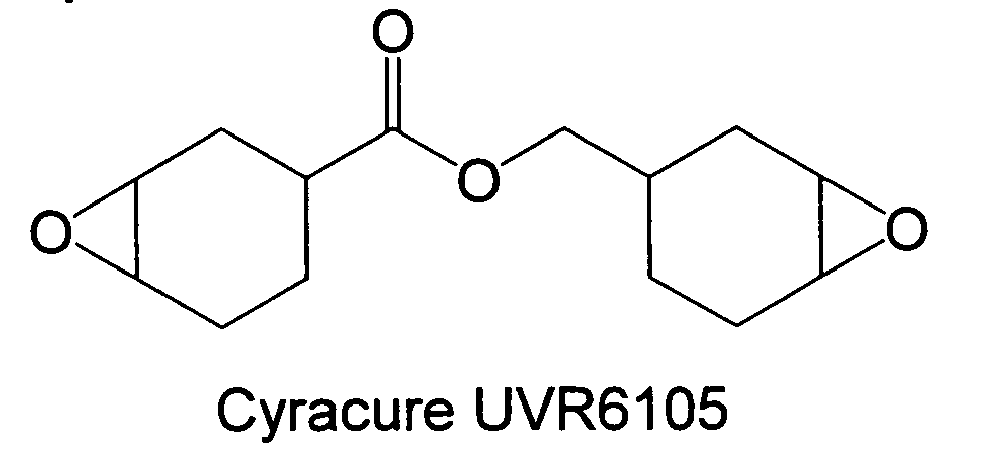
OXT-221 (di[1-ethyl(3-oxetanyl)]methyl ether, manufactured by Toagosei Co., Ltd.)

Dibutoxyanthracene (manufactured by Kawasaki Kasei Chemicals Ltd.)
BYK 307 (manufactured by BYK Chemie) - Mill bases for cationically polymerizable ink compositions were prepared as follows.
- 300 parts by weight of IRGALITE Blue GLVO, 600 parts by weight of OXT-221, and 100 parts by weight of Solsperse 32000 were stirred and mixed to give cyan pigment mill base F. Preparation of cyan mill base F was carried out by putting it into an M50 disperser motor mill (manufactured by Eiger) and dispersing using zirconia beads having a diameter of 0.65 mm at a peripheral speed of 9 m/s for 3 hours.
- 300 parts by weight of CINQUASIA Magenta RT-335-D, 600 parts by weight of OXT-221, and 100 parts by weight of Solsperse 32000 were stirred and mixed to give magenta mill base G. Preparation of magenta mill base G was carried out by putting it into an M50 disperser motor mill (manufactured by Eiger) and dispersing using zirconia beads having a diameter of 0.65 mm at a peripheral speed of 9 m/s for 8 hours.
- 300 parts by weight of Novoperm Yellow H2G, 600 parts by weight of OXT-221, and 100 parts by weight of Solsperse 32000 were stirred and mixed to give yellow mill base H. Preparation of yellow mill base H was carried out by putting it into an M50 disperser motor mill (manufactured by Eiger) and dispersing using zirconia beads having a diameter of 0.65 mm at a peripheral speed of 9 m/s for 8 hours.
- 300 parts by weight of Special Black 250, 600 parts by weight of OXT-221, and 100 parts by weight of Solsperse 32000 were stirred and mixed to give black mill base I. Preparation of black mill base I was carried out by putting it into an M50 disperser motor mill (manufactured by Eiger) and dispersing using zirconia beads having a diameter of 0.65 mm at a peripheral speed of 9 m/s for 5.5 hours.
- 500 parts by weight of Tipaque CR60-2, 450 parts by weight of OXT-221, and 50 parts by weight of Solsperse 36000 were stirred and mixed to give white mill base J. Preparation of white mill base J was carried out by putting it into an M50 disperser motor mill (manufactured by Eiger) and dispersing using zirconia beads having a diameter of 0.65 mm at a peripheral speed of 9 m/s for 3 hours.
- The components shown in Table 5 were stirred using a high-speed water-cooled stirrer to give cyan (C), magenta (M), yellow (Y), black (K), and white (W) UV inkjet ink compositions A-2. A clear ink (CL) containing no pigment was also prepared.
(Table 5) Ink composition A-2 Color C M Y K W CL Pigment dispersion Cyan mill base F 6 - - - - - Magenta mill base G - 12 - - - - Yellow mill base H - - 12 - - - Black mill base I - - - 6 - - White mill base J - - - - 31 - Monofunctional monomer OXT-211 56 53 53 56 47 61.9 Polyfunctional monomer UVR6105 19.9 16.9 16.9 19.9 8.9 20 OXT-221 5 5 5 5 - 5 Polymerization initiator CPI-100P 12 12 12 12 12 12 Dibutoxyanthracene 1 1 1 1 1 1 Surfactant BYK 307 0.1 0.1 0.1 0.1. 0.1 0.1 Total (wt %) 100.00 100.00 100.00 100.00 100.00 100.00 Total weight of monofunctional monomer (wt %) 56 53 53 56 47 61.9 Total weight of polyfunctional monomer (including concentration in pigment dispersion) (wt %) 28.5 29.1 29.1 28.5 22.85 25 Monofunctional monomer proportion (%) 66 65 65 66 67 71 - The components shown in Table 6 were stirred using a high-speed water-cooled stirrer to give cyan (C), magenta (M), yellow (Y), black (K), and white (W) UV inkjet inks B-2. A clear ink (CL) containing no pigment was also prepared.
(Table 6) Ink composition B-2 Color C M Y K W CL Pigment dispersion Cyan mill base F 6 - - - - - Magenta mill base G - 12 - - - - Yellow mill base H - - 12 - - - Black mill base I - - - 6 - - White mill base J - - - - 31 - Monofunctional monomer OXT-211 36 33 33 36 27 33 Polyfunctional monomer UVR6105 19.9 16.9 16.9 19.9 8.9 19.9 OXT-221 25 25 25 25 20 34 Polymerization initiator CPI-100P 12 12 12 12 12 12 Dibutoxyanthracene 1 1 1 1 1 1 Surfactant BYK 307 0.1 0.1 0.1 0.1 0.1 0.1 Total (wt %) 100.00 100.00 100.00 100.00 100.00 100.00 Total weight of monofunctional monomer (wt %) 36 33 33 36 27 33 Total weight of polyfunctional monomer (including concentration in pigment dispersion) (wt %) 48.5 49.1 49.1 48.5 42.85 53.9 Polyfunctional monomer proportion (%) 57 60 60 57 61 62 - In accordance with the same method as in Example 1, only ink composition A-2 was used, and an image with 100% of each color of yellow (Y), cyan (C), magenta (M), black (K), white (W), and clear (CL) ink compositions was formed on PET film (HK-31WF, film thickness 188 µm, manufactured by Higashiyama Film Corporation). The hardness of the image thus formed was measured using a Durometer.
- An image with 100% of each color was formed in the same manner using only ink composition B-2, and the hardness of the image formed was measured.
- Furthermore, images with 100% of each color were formed in the same manner using ink composition A-2 and ink composition B-2 at the proportions shown in Table 7, and the hardness of the images formed was measured.
- The results of measurement of the hardness of the images are given in Table 7.
(Table 7) A-2 (wt %) B-2 (wt %) Hardness 100 0 15 80 20 30 60 40 50 40 60 60 20 80 80 0 100 95 - In accordance with the same system as in Example 1, color image printed materials were produced by measuring the hardness of the various types of supports below and adjusting the proportions of the ink compositions discharged from each head using yellow (Y), cyan (C), magenta (M), black (K), white (W), and clear (CL) ink compositions in accordance with the results of measurement of the hardness of the support and the hardness of the printed materials using cationic ink compositions A-2 and cationic ink compositions B-2 shown in Table 7. In the case of a roll type support and a support having a film thickness of no greater than 100 µm, the amount of ink composition A-2 discharged was increased by 5% of the calculated value, and color image printed materials 5 were produced.
PET film 1 (PET1, hardness: 85, film thickness: 188 µm): HK-31WF, manufactured by Higashiyama Film Corporation
PET film 2 (PET2, hardness: 85, film thickness: 100 µm): HK-31WF, manufactured by Higashiyama Film Corporation
Acrylic plate (hardness: 90, thickness: 1 mm): Acrylite L, Mitsubishi Rayon Co., Ltd.
Polycarbonate plate (hardness: 95, thickness: 2 mm): LEXAN 9034 Clear, manufactured by Asahi Glass Co., Ltd.
Roll type vinyl chloride sheet (roll shape, hardness: 20, thickness: 120 µm): LLJET glossy type, manufactured by Sakurai
Roll type polypropylene sheet (roll shape, hardness: 65, thickness: 50 µm): Pylen P1111, Toyobo Co., Ltd. - Color image printed
materials 6 were produced in the same manner as in Example 3 using the inkjet recording experimental system having 12 piezo type inkjet nozzles and a UV irradiation lamp arranged as shown inFIG. 2 except that, after discharging all inks, UV light was focused to give an exposure area illumination intensity of 2,100 mW/cm2 and a cumulative amount of light 5,000 mJ/cm2. - Using only ink composition A-2, color image printed materials 7 were produced using various types of supports in the same manner as in Example 4.
- Using only ink composition B-2, color image printed
materials 8 were produced using various types of supports in the same manner as in Example 4. - Flexibility evaluation and scratch resistance evaluation were carried out. The results are given in Table 8.
(Table 8) Support Hardness Proportion of ink composition A-2 (wt %) Proportion of ink composition B-2 (wt %) Flexibility evaluation Scratch resistance evaluation Ex. 3 PET 185 12.5 87.5 - 3 PET 2 85 17.5 82.5 3 3 Acrylic plate 90 6.25 93.75 - 3 Polycarbonate plate 95 0 100 - 3 Vinyl chloride (roll) 20 98 2 3 3 Polypropylene (roll) 65 42.5 57.5 3 3 Ex. 4 PET 185 12.5 87.5 - 3 PET 2 85 17.5 82.5 3 3 Acrylic plate 90 6.25 93.75 - 3 Polycarbonate plate 95 0 100 - 3 Vinyl chloride (roll) 20 98 2 3 3 Polypropylene (roll) 65 42.5 57.5 3 3 Comp. Ex. 3 PET 185 100 0 - 1 PET 2 85 100 0 3 1 Acrylic plate 90 100 0 - 1 Polycarbonate plate 95 100 0 - 1 Vinyl chloride (roll) 20 100 0 3 3 Polypropylene (roll) 65 100 0 3 1 Comp. Ex. 4 PET 185 0 100 - 3 PET 2 85 0 100 1 3 Acrylic plate 90 0 100 - 3 Polycarbonate plate 95 0 100 - 3 Vinyl chloride (roll) 20 0 100 1 3 Polypropylene (roll) 65 0 100 1 3
Claims (16)
- An inkjet recording method comprising:a preparatory step of preparing an ink set comprising at least ink composition A comprising (a-1) a polymerization initiator and (b-1) a polymerizable compound, at least 65 wt % of the total weight of the polymerizable compound (b-1) being a monofunctional polymerizable compound, and ink composition B comprising (a-2) a polymerization initiator and (b-2) a polymerizable compound, at least 50 wt % of the total weight of the polymerizable compound (b-2) being a polyfunctional polymerizable compound; anda selection step of selecting, as an ink composition used, ink composition A, ink composition B, or the proportions of ink composition A and ink composition B used according to the characteristics and/or the composition of a support used.
- The inkjet recording method according to Claim 1, wherein it comprises a step of detecting the characteristics and/or the composition of the support used.
- The inkjet recording method according to Claim 2, wherein the characteristics and/or the composition of the support used is at least one characteristic or composition of a support selected from the group consisting of support hardness, support thickness, support stretching characteristics, support thermal characteristics, support elemental composition, support compound composition, and support resin composition.
- The inkjet recording method according to Claim 2 or 3, wherein the characteristics and/or the composition of the support used comprise support hardness and support thickness.
- The inkjet recording method according to any one of Claims 1 to 4, wherein the selection step is a step of selecting, as an ink composition used, the proportions of ink composition A and ink composition B used according to the characteristics and/or the composition of the support used.
- The inkjet recording method according to any one of Claims 1 to 5, wherein it comprises, subsequent to the selection step, a discharge step of discharging ink composition A, ink composition B, and/or a mixture of ink composition A and ink composition B onto a support according to ink composition A, ink composition B, or proportions of ink composition A and ink composition B used selected in the selection step.
- The inkjet recording method according to Claim 6, wherein it comprises a curing step of curing by irradiating with actinic radiation ink composition A, ink composition B, and/or a mixture of ink composition A and ink composition B discharged in the discharge step.
- The inkjet recording method according to any one of Claims 1 to 7, wherein ink composition A and ink composition B are ink compositions of the same color.
- An inkjet recording system comprising:an ink set comprising at least ink composition A comprising (a-1) a polymerization initiator and (b-1) a polymerizable compound, at least 65 wt % of the total weight of the polymerizable compound (b-1) being a monofunctional polymerizable compound, and ink composition B comprising (a-2) a polymerization initiator and (b-2) a polymerizable compound, at least 50 wt % of the total weight of the polymerizable compound (b-2) being a polyfunctional polymerizable compound; andselection means for selecting, as an ink composition used, ink composition A, ink composition B, or the proportions of ink composition A and ink composition B used according to the characteristics and/or the composition of a support used.
- The inkjet recording system according to Claim 9, wherein it comprises means for detecting the characteristics and/or the composition of the support used.
- The inkjet recording system according to Claim 10, wherein the characteristics and/or the composition of the support used is at least one characteristic or composition of a support selected from the group consisting of support hardness, support thickness, support stretching characteristics, support thermal characteristics, support elemental composition, support compound composition, and support resin composition.
- The inkjet recording system according to Claim 10 or 11, wherein the characteristics and/or the composition of the support used comprise support hardness and support thickness.
- The inkjet recording system according to any one of Claims 9 to 12,
wherein the selection means is means for selecting as an ink composition used the proportions of ink composition A and ink composition B used according to the characteristics and/or the composition of the support used. - The inkjet recording system according to any one of Claims 9 to 13, wherein it comprises discharge means for discharging ink composition A, ink composition B, and/or a mixture of ink composition A and ink composition B onto a support according to ink composition A, ink composition B, or proportions of ink composition A and ink composition B used selected by the selection means.
- The inkjet recording system according to Claim 14, wherein it comprises actinic radiation irradiation means for curing by irradiating with actinic radiation the ink composition discharged onto the support.
- The inkjet recording system according to any one of Claims 9 to 15, wherein ink composition A and ink composition B are ink compositions of the same color.
Applications Claiming Priority (1)
| Application Number | Priority Date | Filing Date | Title |
|---|---|---|---|
| JP2008082062A JP4914862B2 (en) | 2008-03-26 | 2008-03-26 | Inkjet recording method and inkjet recording apparatus |
Publications (2)
| Publication Number | Publication Date |
|---|---|
| EP2105478A1 true EP2105478A1 (en) | 2009-09-30 |
| EP2105478B1 EP2105478B1 (en) | 2018-02-28 |
Family
ID=40679518
Family Applications (1)
| Application Number | Title | Priority Date | Filing Date |
|---|---|---|---|
| EP09003459.6A Ceased EP2105478B1 (en) | 2008-03-26 | 2009-03-10 | Inkjet recording method and inkjet recording system |
Country Status (4)
| Country | Link |
|---|---|
| US (1) | US20090244116A1 (en) |
| EP (1) | EP2105478B1 (en) |
| JP (1) | JP4914862B2 (en) |
| CN (1) | CN101544104B (en) |
Cited By (9)
| Publication number | Priority date | Publication date | Assignee | Title |
|---|---|---|---|---|
| EP2354199A1 (en) * | 2010-02-03 | 2011-08-10 | Brother Kogyo Kabushiki Kaisha | Cationic polymerization ink |
| EP2634226A1 (en) * | 2012-02-29 | 2013-09-04 | Seiko Epson Corporation | Photo-curable ink jet ink set and ink jet recording method using the same |
| EP2990448B1 (en) | 2013-04-25 | 2018-01-17 | Toyo Ink SC Holdings Co., Ltd. | White ink for ink-jet printing |
| EP2870207B1 (en) | 2012-07-05 | 2018-11-21 | Hapa AG | Radiation curable inkjet ink based on acrylates |
| EP2501764B1 (en) * | 2009-11-18 | 2019-02-27 | OCE-Technologies B.V. | Radiation curable ink composition |
| EP3255110B1 (en) | 2011-07-08 | 2022-08-17 | Seiko Epson Corporation | Photocurable ink composition for ink jet recording and ink jet recording method |
| EP4050073A1 (en) * | 2021-02-26 | 2022-08-31 | Agfa Nv | Ink set and inkjet printing methods |
| CN115803399A (en) * | 2020-07-15 | 2023-03-14 | 富士胶片株式会社 | Ink set and printed matter |
| CN116940642A (en) * | 2021-02-26 | 2023-10-24 | 爱克发有限公司 | Methods of manufacturing decorative surfaces |
Families Citing this family (26)
| Publication number | Priority date | Publication date | Assignee | Title |
|---|---|---|---|---|
| JP5644146B2 (en) * | 2010-03-17 | 2014-12-24 | セイコーエプソン株式会社 | Clear ink composition and inkjet recording method |
| JP5502675B2 (en) * | 2010-09-22 | 2014-05-28 | 富士フイルム株式会社 | Inkjet recording method |
| CN102051088A (en) * | 2011-01-11 | 2011-05-11 | 珠海保税区天然宝杰数码科技材料有限公司 | White ink composition for ultraviolet curing ink jet recording and ink jet recording method |
| US9493013B2 (en) * | 2011-01-31 | 2016-11-15 | Hewlett-Packard Development Company, L.P. | Inkjet ink set |
| US9573389B2 (en) * | 2011-02-14 | 2017-02-21 | Sericol Limited | Ink-jet printing method |
| CN102673136B (en) | 2011-03-16 | 2016-03-02 | 精工爱普生株式会社 | The manufacture method of printed article and printed article |
| JP5747585B2 (en) * | 2011-03-16 | 2015-07-15 | 東洋インキScホールディングス株式会社 | Ink composition and cured product using the same |
| JP5742411B2 (en) | 2011-04-12 | 2015-07-01 | セイコーエプソン株式会社 | Printed matter and method for producing printed matter |
| JP5419934B2 (en) * | 2011-07-12 | 2014-02-19 | 富士フイルム株式会社 | Inkjet ink composition and inkjet recording method |
| EP2551123B1 (en) | 2011-07-26 | 2016-08-17 | Seiko Epson Corporation | Printing method, printed material and molded article |
| ES2751998T3 (en) * | 2011-08-23 | 2020-04-02 | Sakata Inx Corp | Light cure ink composition for inkjet printing, printed matter, and molded article |
| CN102993824A (en) * | 2011-09-14 | 2013-03-27 | 中国科学院化学研究所 | UV-curable ink used in inkjet printing direct-to-plate, and preparation method and application thereof |
| JP2013095078A (en) * | 2011-11-02 | 2013-05-20 | Seiko Epson Corp | Ink jet recording method |
| JP5803583B2 (en) | 2011-11-07 | 2015-11-04 | 株式会社リコー | Photopolymerizable inkjet ink |
| JP2013193349A (en) * | 2012-03-21 | 2013-09-30 | Fujifilm Corp | Inkjet recording apparatus and inkjet recording method |
| JP6060511B2 (en) * | 2012-04-02 | 2017-01-18 | セイコーエプソン株式会社 | Printing system, printing method and printing medium |
| CN103666051B (en) * | 2013-11-25 | 2016-03-23 | 铜陵方正塑业科技有限公司 | A kind of fast-drying type UV curable ink and preparation method thereof |
| JP6832241B2 (en) * | 2017-05-29 | 2021-02-24 | 株式会社Screenホールディングス | Printing method, printing equipment |
| JP7149768B2 (en) * | 2018-08-20 | 2022-10-07 | 株式会社Screenホールディングス | Printing method and printing device |
| EP3875554B1 (en) * | 2018-11-02 | 2026-01-07 | FUJIFILM Corporation | Ink set and image formation method |
| WO2020189021A1 (en) * | 2019-03-18 | 2020-09-24 | 富士フイルム株式会社 | Printing method, printed object, and printing system |
| JP7382018B2 (en) * | 2019-06-17 | 2023-11-16 | セイコーエプソン株式会社 | Radiation-curable inkjet composition and recording method |
| JP7619047B2 (en) * | 2020-02-12 | 2025-01-22 | 株式会社リコー | Active energy ray curable white ink composition, printing method, printing device, and printed matter |
| WO2022125767A1 (en) * | 2020-12-11 | 2022-06-16 | Videojet Technologies Inc. | High adhesion continuous ink jet inks |
| TWI804445B (en) * | 2021-11-04 | 2023-06-01 | 明揚國際科技股份有限公司 | How to print golf balls |
| TWI804040B (en) * | 2021-11-04 | 2023-06-01 | 明揚國際科技股份有限公司 | Printing device for golf balls |
Citations (158)
| Publication number | Priority date | Publication date | Assignee | Title |
|---|---|---|---|---|
| US2833827A (en) | 1955-01-17 | 1958-05-06 | Bayer Ag | Tri (3, 5-di lower alkyl-4-hydroxy phenyl)-sulfonium chlorides and method of preparing same |
| US3214463A (en) | 1960-05-12 | 1965-10-26 | Du Pont | Uv-absorbing sulfonated benzophenone derivatives |
| JPS4420189B1 (en) | 1965-06-03 | 1969-08-30 | ||
| JPS4537377B1 (en) | 1965-06-03 | 1970-11-27 | ||
| US3567453A (en) | 1967-12-26 | 1971-03-02 | Eastman Kodak Co | Light sensitive compositions for photoresists and lithography |
| JPS462784A (en) | 1971-03-11 | 1971-10-21 | ||
| JPS4642363B1 (en) | 1968-10-09 | 1971-12-15 | ||
| JPS473981B1 (en) | 1968-06-11 | 1972-02-03 | ||
| JPS476416B1 (en) | 1968-04-16 | 1972-02-23 | ||
| JPS4722326B1 (en) | 1968-07-26 | 1972-06-22 | ||
| JPS4723664B1 (en) | 1968-07-26 | 1972-07-01 | ||
| JPS4830492B1 (en) | 1969-10-07 | 1973-09-20 | ||
| JPS4842965B1 (en) | 1968-04-02 | 1973-12-15 | ||
| GB1388492A (en) | 1971-09-03 | 1975-03-26 | Minnesota Mining & Mfg | Chromophore-substituted halomethyl-s-triazines |
| US3901710A (en) | 1972-08-26 | 1975-08-26 | Agfa Gevaert Ag | Photographic material comprising a light-sensitive 1,4-dihydropyridine derivative |
| US3902144A (en) | 1973-04-26 | 1975-08-26 | Siemens Ag | Resilient mounting arrangement for the non-movable magnetic member of an electromagnetic switching apparatus |
| JPS5182102A (en) | 1974-12-10 | 1976-07-19 | Basf Ag | Insatsuinki oyobi hifukuzairyonotameno hikarijugokanonaketsugozai |
| JPS5214277B2 (en) | 1974-05-02 | 1977-04-20 | ||
| JPS5214279B2 (en) | 1974-05-02 | 1977-04-20 | ||
| JPS5214278B2 (en) | 1974-05-02 | 1977-04-20 | ||
| JPS52134692A (en) | 1976-05-04 | 1977-11-11 | Fuji Photo Film Co Ltd | Photopolymerizable composition |
| JPS53702A (en) | 1975-12-23 | 1978-01-06 | Dynachem Corp | Adhesion promoting agent for polymerized film |
| DE2641100A1 (en) | 1976-09-13 | 1978-03-16 | Hoechst Ag | LIGHT SENSITIVE COPY LAYER |
| JPS53133022A (en) | 1977-04-23 | 1978-11-20 | Du Pont | Light sensitive element |
| JPS53133428A (en) | 1977-04-25 | 1978-11-21 | Hoechst Ag | Radiation sensitive copying constitute |
| JPS5448535A (en) | 1977-08-31 | 1979-04-17 | Konishiroku Photo Ind Co Ltd | Color photographic material |
| US4181531A (en) | 1978-04-07 | 1980-01-01 | E. I. Du Pont De Nemours And Company | Positive non-silver systems containing nitrofuryldihydropyridine |
| JPS5534414B2 (en) | 1972-06-02 | 1980-09-06 | ||
| JPS55500806A (en) | 1978-10-19 | 1980-10-16 | ||
| JPS5621141B2 (en) | 1975-10-16 | 1981-05-18 | ||
| JPS5675643A (en) | 1979-11-07 | 1981-06-22 | Hoechst Ag | Photopolymerizable mixture and photopolymerizable copying material using same |
| DE3021590A1 (en) | 1980-06-09 | 1981-12-17 | Hoechst Ag, 6000 Frankfurt | 4-HALOGEN-5- (HALOGENMETHYL-PHENYL) -OXAZOLE DERIVATIVES, A METHOD FOR THE PRODUCTION THEREOF AND THEIR RADIO-SENSITIVE MEASURES |
| DE3021599A1 (en) | 1980-06-09 | 1981-12-24 | Hoechst Ag, 6000 Frankfurt | 2- (HALOGENMETHYL-PHENYL) -4-HALOGENOXAZOL DERIVATIVES, A METHOD FOR THE PRODUCTION THEREOF AND MEASURES CONTAINING THE RADIATION-SENSITIVITY |
| EP0044115A1 (en) | 1980-07-14 | 1982-01-20 | Akzo N.V. | Thermosetting coating composition containing a blocked acid catalyst |
| EP0046083A2 (en) | 1980-08-11 | 1982-02-17 | Minnesota Mining And Manufacturing Company | Photolabile blocked surfactants and compositions containing the same |
| JPS5730704A (en) | 1980-06-24 | 1982-02-19 | Bayer Ag | Photopolymerizable mixture containing aroylphosphoric acid ester as photoinitiator |
| US4318791A (en) | 1977-12-22 | 1982-03-09 | Ciba-Geigy Corporation | Use of aromatic-aliphatic ketones as photo sensitizers |
| US4343891A (en) | 1980-05-23 | 1982-08-10 | Minnesota Mining And Manufacturing Company | Fixing of tetra (hydrocarbyl) borate salt imaging systems |
| US4371605A (en) | 1980-12-09 | 1983-02-01 | E. I. Du Pont De Nemours And Company | Photopolymerizable compositions containing N-hydroxyamide and N-hydroxyimide sulfonates |
| EP0084515A2 (en) | 1982-01-11 | 1983-07-27 | Ciba-Geigy Ag | Acid-curable composition containing a blocked catalyst, and a curing method |
| JPS58185677A (en) | 1982-04-22 | 1983-10-29 | Konishiroku Photo Ind Co Ltd | Uv light absorber |
| US4431774A (en) | 1981-09-14 | 1984-02-14 | Ciba-Geigy Corporation | Process for the curing of stoving lacquers |
| EP0101122A1 (en) | 1982-08-09 | 1984-02-22 | Akzo N.V. | Thermosetting coating composition containing a blocked acid as catalyst |
| EP0104143A1 (en) | 1982-09-18 | 1984-03-28 | Ciba-Geigy Ag | Photopolymerizable compositions containing diaryliodosyl salts |
| EP0109773A2 (en) | 1982-10-25 | 1984-05-30 | Minnesota Mining And Manufacturing Company | Dispersed imaging systems with tetra(hydrocarbyl) borate salts |
| EP0109772A2 (en) | 1982-10-25 | 1984-05-30 | Minnesota Mining And Manufacturing Company | Fixing of tetra(hydrocarbyl)borate salt imaging systems |
| JPS59138205A (en) | 1983-01-20 | 1984-08-08 | チバ−ガイギ− アクチエンゲゼルシヤフト | Coating composition and curing method |
| JPS59152396A (en) | 1983-02-11 | 1984-08-31 | チバ−ガイギ− アクチエンゲゼルシヤフト | Metallocene, manufacture and photopolymerizable composition containing same |
| JPS59174831A (en) | 1983-03-24 | 1984-10-03 | Fuji Photo Film Co Ltd | Photopolymerizable composition |
| JPS5942864B2 (en) | 1979-04-13 | 1984-10-18 | 京セラミタ株式会社 | Method for preparing a projection manuscript and electrostatic photographic transfer film used therein |
| JPS608047B2 (en) | 1978-07-14 | 1985-02-28 | バスフ アクチェン ゲゼルシャフト | Photocurable polyester resin composition |
| DE3333450A1 (en) | 1983-09-16 | 1985-04-11 | Hoechst Ag, 6230 Frankfurt | CARBONYL METHYLENE HETEROCYCLES CONTAINING TRIHALOGEN METHYL GROUPS, METHOD FOR THE PRODUCTION THEREOF AND LIGHT-SENSITIVE MIXTURE THAT CONTAINS THESE COMPOUNDS |
| DE3337024A1 (en) | 1983-10-12 | 1985-04-25 | Hoechst Ag, 6230 Frankfurt | LIGHT SENSITIVE COMPOUNDS HAVING TRICHLORMETHYL GROUPS, METHOD FOR THE PRODUCTION THEREOF AND LIGHT SENSITIVE MIXTURE CONTAINING THESE COMPOUNDS |
| JPS6084305A (en) | 1983-08-30 | 1985-05-13 | バスフ アクチェン ゲゼルシャフト | Photopolymerizable mixture |
| JPS6026483B2 (en) | 1972-07-28 | 1985-06-24 | チバ・ガイギ−・アクチエンゲゼルシヤフト | Sensitizer for polymerization-based photopolymerization reactions containing unsaturated compounds |
| JPS6026403B2 (en) | 1977-05-17 | 1985-06-24 | メルク・パテント・ゲゼルシヤフト・ミツト・ベシユレンクテル・ハフツング | Photosensitizer for photopolymerization of unsaturated compounds |
| JPS60132767A (en) | 1983-12-21 | 1985-07-15 | Seikosha Co Ltd | Inkjet printer |
| EP0156153A1 (en) | 1984-03-22 | 1985-10-02 | Maschinenfabrik Rieter Ag | Yarn quality monitoring system |
| JPS60198538A (en) | 1984-03-22 | 1985-10-08 | Toshiba Corp | Positive type resist material |
| DE3435443A1 (en) | 1984-09-27 | 1986-04-03 | Agfa-Gevaert Ag, 5090 Leverkusen | PHOTOGRAPHIC RECORDING MATERIAL |
| JPS61151197A (en) | 1984-12-20 | 1986-07-09 | チバ‐ガイギー アーゲー | Titanocenes and radiation-curable composition containing same |
| JPS61190537A (en) | 1985-01-22 | 1986-08-25 | チバーガイギー アクチエンゲゼルシヤフト | 2-(2-hydroxy-3-branched alkyl-5-methylphenyl)- 2h-benzotriazole mixture, manufacture and stabilized composition |
| JPS61194062A (en) | 1985-02-21 | 1986-08-28 | メルク・パテント・ゲゼルシヤフト・ミツト・ベシユレンクテル・ハフツング | Photopolymerization initiator using thio-substituted ketone compound |
| US4618564A (en) | 1984-05-25 | 1986-10-21 | Ciba-Geigy Corporation | Process for production of positive images using sulfonic acid precursors |
| EP0199672A1 (en) | 1985-04-12 | 1986-10-29 | Ciba-Geigy Ag | Oxime sulphonates containing reactive groups |
| JPS6218537A (en) | 1985-07-16 | 1987-01-27 | ザ・ミ−ド・コ−ポレ−シヨン | Image forming material using photosensitive microcapsule containing third amine as coinitiator |
| JPS6221572A (en) | 1985-07-22 | 1987-01-29 | Canon Inc | recording device |
| JPS626223B2 (en) | 1979-03-06 | 1987-02-09 | Fuji Photo Film Co Ltd | |
| JPS6258241A (en) | 1985-09-09 | 1987-03-13 | Fuji Photo Film Co Ltd | Photosensitive composition |
| JPS6281345A (en) | 1985-09-28 | 1987-04-14 | チバ―ガイギー アクチェンゲゼルシャフト | Copolymerizable photoinitiator |
| EP0223739A1 (en) | 1985-11-06 | 1987-05-27 | Ciba-Geigy Ag | Dibenzoxaphosphorine |
| JPS62173463A (en) | 1986-01-28 | 1987-07-30 | Fuji Photo Film Co Ltd | Image forming method |
| JPS62183457A (en) | 1986-02-07 | 1987-08-11 | Fuji Photo Film Co Ltd | Image forming method |
| EP0233567A2 (en) | 1986-02-14 | 1987-08-26 | BASF Aktiengesellschaft | Curable compositions containing N-sulfonylaminosulfonium salts as cationically active catalysts |
| JPS62262047A (en) | 1986-04-30 | 1987-11-14 | イ−ストマン コダツク カンパニ− | Photographic element |
| JPS6341484A (en) | 1986-08-01 | 1988-02-22 | チバ−ガイギ− ア−ゲ− | Titanocene, its production and composition containing the same |
| JPS6314340B2 (en) | 1980-09-17 | 1988-03-30 | Fuji Photo Film Co Ltd | |
| US4743528A (en) | 1986-11-21 | 1988-05-10 | Eastman Kodak Company | Enhanced imaging composition containing an azinium activator |
| JPS63113536A (en) | 1986-10-21 | 1988-05-18 | イーストマン コダック カンパニー | Photographic element containing heterocyclic phosphor compound stabilizing agent |
| JPS63138345A (en) | 1986-11-21 | 1988-06-10 | イーストマン コダック カンパニー | Photographic image forming system |
| JPS63142346A (en) | 1986-11-21 | 1988-06-14 | イーストマン コダック カンパニー | Negative type photoresist |
| JPS63143537A (en) | 1986-11-21 | 1988-06-15 | イーストマン コダック カンパニー | Negative type photoresist |
| EP0271851A2 (en) | 1986-12-16 | 1988-06-22 | E.I. Du Pont De Nemours And Company | Light sensitive mixtures for making repeatedly tonable layers |
| JPS63163351A (en) | 1986-12-25 | 1988-07-06 | Konica Corp | Silver halide photographic sensitive material having improved fastness of dye image |
| US4760013A (en) | 1987-02-17 | 1988-07-26 | International Business Machines Corporation | Sulfonium salt photoinitiators |
| JPS6340799B2 (en) | 1978-07-14 | 1988-08-12 | Basf Ag | |
| EP0284561A2 (en) | 1987-03-26 | 1988-09-28 | Ciba-Geigy Ag | Alpha-aminoacetophenones as photo initiators |
| EP0290750A2 (en) | 1987-03-19 | 1988-11-17 | Xytronyx, Inc. | Systems for the visualization of exposure to ultraviolet radiation and for the utilization of ultraviolet radiation to effect color changes |
| JPS6361950B2 (en) | 1981-03-16 | 1988-11-30 | ||
| EP0297443A2 (en) | 1987-07-01 | 1989-01-04 | BASF Aktiengesellschaft | Light sensitive mixture for light sensitive coating materials |
| EP0297442A1 (en) | 1987-07-01 | 1989-01-04 | BASF Aktiengesellschaft | Sulfonium salts comprising groups which are labile in acid environment |
| JPS6418143A (en) | 1987-07-14 | 1989-01-20 | Nippon Kayaku Kk | Photosensitive resin composition |
| JPS6433104A (en) | 1987-06-25 | 1989-02-03 | Ciba Geigy Ag | Photopolymerizable composition |
| US4814262A (en) | 1986-10-10 | 1989-03-21 | Megumi Ide | Silver halide photographic light-sensitive material to provide dye-image with improved color-fastness to light |
| EP0309402A1 (en) | 1987-09-21 | 1989-03-29 | Ciba-Geigy Ag | N-substituted hindered amine stabilizers |
| EP0309401A1 (en) | 1987-09-21 | 1989-03-29 | Ciba-Geigy Ag | Stabilization of coatings with N-hydroxy hindered amines |
| EP0310551A2 (en) | 1987-09-30 | 1989-04-05 | Ciba-Geigy Ag | Phenolic thianederivatives |
| EP0310552A1 (en) | 1987-09-30 | 1989-04-05 | Ciba-Geigy Ag | Stabilizers for colour photographic recording materials |
| US4837124A (en) | 1986-02-24 | 1989-06-06 | Hoechst Celanese Corporation | High resolution photoresist of imide containing polymers |
| JPH01152109A (en) | 1987-12-09 | 1989-06-14 | Toray Ind Inc | Photopolymerizable composition |
| JPH01304453A (en) | 1988-06-02 | 1989-12-08 | Toyobo Co Ltd | Photopolymerizable composition |
| JPH02782A (en) | 1987-12-28 | 1990-01-05 | Ciba Geigy Ag | New 2-(2-hydroxyphenyl)benzotriazole derivative |
| JPH02249A (en) | 1987-12-01 | 1990-01-05 | Ciba Geigy Ag | Titanocene and photopolymerizable composition containing it |
| JPH024239A (en) | 1988-06-21 | 1990-01-09 | Konica Corp | Silver halide color photographic sensitive material |
| JPH024705A (en) | 1988-03-24 | 1990-01-09 | Dentsply Internatl Inc | Titanate initiator for a photosetting composition |
| JPH029597B2 (en) | 1980-09-15 | 1990-03-02 | Basf Ag | |
| JPH029596B2 (en) | 1980-05-27 | 1990-03-02 | Basf Ag | |
| JPH0271262A (en) | 1987-10-09 | 1990-03-09 | Fuji Photo Film Co Ltd | Silver halide color photographic sensitive material |
| JPH0296514A (en) | 1988-03-01 | 1990-04-09 | Alza Corp | Method and means for reducing sensitization and stimulation of percutaneous drug administration |
| EP0370693A2 (en) | 1988-11-21 | 1990-05-30 | Eastman Kodak Company | Novel onium salts and the use thereof as photoinitiators |
| JPH02150848A (en) | 1988-12-02 | 1990-06-11 | Hitachi Ltd | Photobleachable radiation-sensitive composition and pattern formation method using the same |
| US4933377A (en) | 1988-02-29 | 1990-06-12 | Saeva Franklin D | Novel sulfonium salts and the use thereof as photoinitiators |
| JPH02211452A (en) | 1988-12-01 | 1990-08-22 | Polychrome Corp | Light initiator |
| EP0388343A2 (en) | 1989-03-14 | 1990-09-19 | International Business Machines Corporation | Chemically amplified photoresist |
| JPH02245756A (en) | 1989-03-20 | 1990-10-01 | Hitachi Ltd | Pattern forming material containing acid precursor and pattern forming method using same |
| JPH02262654A (en) | 1988-12-06 | 1990-10-25 | Fuji Photo Film Co Ltd | Silver halide color photographic sensitive material |
| US4980275A (en) | 1988-04-13 | 1990-12-25 | Eastman Kodak Company | Photographic material and process comprising a dye stabilizer |
| EP0422570A2 (en) | 1989-10-10 | 1991-04-17 | International Business Machines Corporation | Ultraviolet light sensitive photoinitiator compositions, use thereof and radiation sensitive compositions |
| JPH03101686A (en) | 1989-08-04 | 1991-04-26 | Ciba Geigy Ag | Mono-and di-acylphosphineoxide |
| JPH03121449A (en) | 1989-07-25 | 1991-05-23 | Fuji Photo Film Co Ltd | Silver halide color photographic sensitive material |
| EP0459416A2 (en) | 1990-05-28 | 1991-12-04 | Fuji Photo Film Co., Ltd. | Dye fixing element |
| JPH04298503A (en) | 1990-05-10 | 1992-10-22 | Ciba Geigy Ag | Radiation-curable light-stabilized composition |
| JPH04365048A (en) | 1991-06-12 | 1992-12-17 | Fuji Photo Film Co Ltd | Photosensitive composition material |
| JPH0561166A (en) | 1991-05-28 | 1993-03-12 | Fuji Photo Film Co Ltd | Silver halide color photographic sensitive material |
| JPH05119449A (en) | 1991-10-25 | 1993-05-18 | Fuji Photo Film Co Ltd | Silver halide color photographic sensitive material |
| JPH05142772A (en) | 1991-11-26 | 1993-06-11 | Fuji Photo Film Co Ltd | Photopolymerizable composition |
| JPH05194483A (en) | 1991-07-03 | 1993-08-03 | Ciba Geigy Ag | Phenyl thiophenyl ketone |
| JPH05197075A (en) | 1991-09-05 | 1993-08-06 | Ciba Geigy Ag | Photographic film material incorporating ultraviolet-ray absorbent |
| JPH05281728A (en) | 1992-04-01 | 1993-10-29 | Fuji Photo Film Co Ltd | Photopolymerizable composition |
| JPH05345790A (en) | 1991-09-23 | 1993-12-27 | Ciba Geigy Ag | Alkylbisacylphosphine oxide |
| JPH069714A (en) | 1992-06-29 | 1994-01-18 | Sumitomo Chem Co Ltd | Photopolymerizable composition and production of light control board |
| JPH06250387A (en) | 1993-03-01 | 1994-09-09 | Sumitomo Chem Co Ltd | Process for producing quinonediazide sulfonate and radiation-sensitive resin composition containing quinonediazide sulfonate obtained by the process |
| JPH06298818A (en) | 1993-03-18 | 1994-10-25 | Ciba Geigy Ag | Curable composition containing bis-acylphosphine oxide photo-initiator |
| JPH06308727A (en) | 1993-04-19 | 1994-11-04 | Fuji Photo Film Co Ltd | Photopolymerizable composition |
| JPH08501291A (en) | 1992-09-07 | 1996-02-13 | チバ−ガイギー アクチエンゲゼルシャフト | Hydroxyphenyl-s-triazine |
| JPH0853427A (en) | 1994-07-27 | 1996-02-27 | Ciba Geigy Ag | Trisaryl-s-triazine shifted to red side and composition stabilized therewith |
| JPH0854735A (en) | 1994-08-15 | 1996-02-27 | Fuji Photo Film Co Ltd | Photopolymerizable composition |
| JPH08239368A (en) | 1994-10-10 | 1996-09-17 | Ciba Geigy Ag | Bisresorcinyltriazine |
| JPH0934057A (en) | 1995-06-19 | 1997-02-07 | Eastman Kodak Co | Ultraviolet absorbing polymers based on 2'-hydroxyphenylbenztriazole with specific substituents and photographic elements containing same |
| JPH1088106A (en) | 1996-08-16 | 1998-04-07 | Eastman Kodak Co | Uv-absorbing polymer particle |
| JPH10182621A (en) | 1996-11-20 | 1998-07-07 | Ciba Specialty Chem Holding Inc | Hydroxyphenyl triazine |
| WO1999054415A1 (en) | 1998-04-15 | 1999-10-28 | Nof Corporation | Method for formation of coating film and coating composition |
| US6084250A (en) | 1997-03-03 | 2000-07-04 | U.S. Philips Corporation | White light emitting diode |
| JP2001031892A (en) | 1999-07-23 | 2001-02-06 | Toyo Ink Mfg Co Ltd | UV curable coating composition and use thereof |
| JP2001040068A (en) | 1999-07-27 | 2001-02-13 | Asahi Denka Kogyo Kk | Photopolymerizable composition |
| JP2001049200A (en) | 1999-08-11 | 2001-02-20 | Soken Chem & Eng Co Ltd | Acrylic pressure-sensitive adhesive composition, production of pressure-sensitive adhesive tape by using the composition and pressure-sensitive adhesive tape |
| JP2001055507A (en) | 1999-08-19 | 2001-02-27 | Kansai Paint Co Ltd | Active energy ray-curable composition and method for forming its film |
| JP2001220526A (en) | 2000-02-09 | 2001-08-14 | Brother Ind Ltd | Energy ray curable composition for ink jet recording system |
| JP2001310937A (en) | 2000-04-27 | 2001-11-06 | Hitachi Chem Co Ltd | Curable oxetane composition, its curing method and cured product obtained by the same |
| JP2001310938A (en) | 2000-04-28 | 2001-11-06 | Showa Denko Kk | Polymerizable composition, its cured product and production method |
| JP2003341217A (en) | 2002-05-24 | 2003-12-03 | Konica Minolta Holdings Inc | Image forming method, printed matter and recording device |
| JP2006169420A (en) | 2004-12-17 | 2006-06-29 | Toyo Ink Mfg Co Ltd | Active energy ray-curable inkjet ink for polycarbonate |
| JP2006169419A (en) | 2004-12-17 | 2006-06-29 | Toyo Ink Mfg Co Ltd | Active energy ray curable inkjet ink for polyvinyl chloride sheet |
| WO2007013368A1 (en) | 2005-07-25 | 2007-02-01 | Toyo Ink Mfg. Co., Ltd. | Actinic radiation curable jet-printing ink |
| EP1752504A1 (en) * | 2005-08-12 | 2007-02-14 | Seiko Epson Corporation | Ink composition |
| JP2007505964A (en) | 2003-09-16 | 2007-03-15 | サン・ケミカル・ベスローテン・ベンノートシャップ | Radiation curable jet ink |
| US20070081063A1 (en) * | 2005-10-11 | 2007-04-12 | Seiko Epson Corporation | Ultraviolet curable ink set and image recording method |
| US20070129457A1 (en) * | 2005-12-07 | 2007-06-07 | Seiko Epson Corporation | Photocurable ink composition and photocurable ink set |
Family Cites Families (6)
| Publication number | Priority date | Publication date | Assignee | Title |
|---|---|---|---|---|
| IL111014A (en) * | 1994-09-21 | 1999-05-09 | Scitex Corp Ltd | Ink compositions and a method for making same |
| US6561643B1 (en) * | 1997-06-30 | 2003-05-13 | Hewlett-Packard Co. | Advanced media determination system for inkjet printing |
| JP3774640B2 (en) * | 2001-05-17 | 2006-05-17 | キヤノン株式会社 | Inkjet recording apparatus and inkjet recording method |
| JP2004195852A (en) * | 2002-12-19 | 2004-07-15 | Konica Minolta Holdings Inc | Ink-jet printer |
| JP4701596B2 (en) * | 2003-09-12 | 2011-06-15 | 富士ゼロックス株式会社 | Inkjet recording apparatus and inkjet recording method |
| JP2009227968A (en) * | 2008-02-29 | 2009-10-08 | Seiko Epson Corp | Actinic ray-curable ink composition, and ink set, inkjet printing apparatus and inkjet recording method using the same |
-
2008
- 2008-03-26 JP JP2008082062A patent/JP4914862B2/en not_active Expired - Fee Related
-
2009
- 2009-03-05 US US12/398,393 patent/US20090244116A1/en not_active Abandoned
- 2009-03-10 EP EP09003459.6A patent/EP2105478B1/en not_active Ceased
- 2009-03-26 CN CN2009101298515A patent/CN101544104B/en active Active
Patent Citations (162)
| Publication number | Priority date | Publication date | Assignee | Title |
|---|---|---|---|---|
| US2833827A (en) | 1955-01-17 | 1958-05-06 | Bayer Ag | Tri (3, 5-di lower alkyl-4-hydroxy phenyl)-sulfonium chlorides and method of preparing same |
| US3214463A (en) | 1960-05-12 | 1965-10-26 | Du Pont | Uv-absorbing sulfonated benzophenone derivatives |
| JPS4420189B1 (en) | 1965-06-03 | 1969-08-30 | ||
| JPS4537377B1 (en) | 1965-06-03 | 1970-11-27 | ||
| US3567453A (en) | 1967-12-26 | 1971-03-02 | Eastman Kodak Co | Light sensitive compositions for photoresists and lithography |
| JPS4842965B1 (en) | 1968-04-02 | 1973-12-15 | ||
| JPS476416B1 (en) | 1968-04-16 | 1972-02-23 | ||
| JPS473981B1 (en) | 1968-06-11 | 1972-02-03 | ||
| JPS4722326B1 (en) | 1968-07-26 | 1972-06-22 | ||
| JPS4723664B1 (en) | 1968-07-26 | 1972-07-01 | ||
| JPS4642363B1 (en) | 1968-10-09 | 1971-12-15 | ||
| JPS4830492B1 (en) | 1969-10-07 | 1973-09-20 | ||
| JPS462784A (en) | 1971-03-11 | 1971-10-21 | ||
| GB1388492A (en) | 1971-09-03 | 1975-03-26 | Minnesota Mining & Mfg | Chromophore-substituted halomethyl-s-triazines |
| JPS5534414B2 (en) | 1972-06-02 | 1980-09-06 | ||
| JPS6026483B2 (en) | 1972-07-28 | 1985-06-24 | チバ・ガイギ−・アクチエンゲゼルシヤフト | Sensitizer for polymerization-based photopolymerization reactions containing unsaturated compounds |
| US3901710A (en) | 1972-08-26 | 1975-08-26 | Agfa Gevaert Ag | Photographic material comprising a light-sensitive 1,4-dihydropyridine derivative |
| US3902144A (en) | 1973-04-26 | 1975-08-26 | Siemens Ag | Resilient mounting arrangement for the non-movable magnetic member of an electromagnetic switching apparatus |
| JPS5214277B2 (en) | 1974-05-02 | 1977-04-20 | ||
| JPS5214279B2 (en) | 1974-05-02 | 1977-04-20 | ||
| JPS5214278B2 (en) | 1974-05-02 | 1977-04-20 | ||
| JPS5182102A (en) | 1974-12-10 | 1976-07-19 | Basf Ag | Insatsuinki oyobi hifukuzairyonotameno hikarijugokanonaketsugozai |
| JPS5621141B2 (en) | 1975-10-16 | 1981-05-18 | ||
| JPS53702A (en) | 1975-12-23 | 1978-01-06 | Dynachem Corp | Adhesion promoting agent for polymerized film |
| JPS52134692A (en) | 1976-05-04 | 1977-11-11 | Fuji Photo Film Co Ltd | Photopolymerizable composition |
| DE2641100A1 (en) | 1976-09-13 | 1978-03-16 | Hoechst Ag | LIGHT SENSITIVE COPY LAYER |
| JPS53133022A (en) | 1977-04-23 | 1978-11-20 | Du Pont | Light sensitive element |
| JPS53133428A (en) | 1977-04-25 | 1978-11-21 | Hoechst Ag | Radiation sensitive copying constitute |
| JPS6026403B2 (en) | 1977-05-17 | 1985-06-24 | メルク・パテント・ゲゼルシヤフト・ミツト・ベシユレンクテル・ハフツング | Photosensitizer for photopolymerization of unsaturated compounds |
| JPS5448535A (en) | 1977-08-31 | 1979-04-17 | Konishiroku Photo Ind Co Ltd | Color photographic material |
| US4318791A (en) | 1977-12-22 | 1982-03-09 | Ciba-Geigy Corporation | Use of aromatic-aliphatic ketones as photo sensitizers |
| JPH0134242B2 (en) | 1977-12-22 | 1989-07-18 | Ciba Geigy | |
| US4181531A (en) | 1978-04-07 | 1980-01-01 | E. I. Du Pont De Nemours And Company | Positive non-silver systems containing nitrofuryldihydropyridine |
| JPS6340799B2 (en) | 1978-07-14 | 1988-08-12 | Basf Ag | |
| JPS608047B2 (en) | 1978-07-14 | 1985-02-28 | バスフ アクチェン ゲゼルシャフト | Photocurable polyester resin composition |
| JPS55500806A (en) | 1978-10-19 | 1980-10-16 | ||
| JPS626223B2 (en) | 1979-03-06 | 1987-02-09 | Fuji Photo Film Co Ltd | |
| JPS5942864B2 (en) | 1979-04-13 | 1984-10-18 | 京セラミタ株式会社 | Method for preparing a projection manuscript and electrostatic photographic transfer film used therein |
| JPS5675643A (en) | 1979-11-07 | 1981-06-22 | Hoechst Ag | Photopolymerizable mixture and photopolymerizable copying material using same |
| US4343891A (en) | 1980-05-23 | 1982-08-10 | Minnesota Mining And Manufacturing Company | Fixing of tetra (hydrocarbyl) borate salt imaging systems |
| JPH029596B2 (en) | 1980-05-27 | 1990-03-02 | Basf Ag | |
| DE3021599A1 (en) | 1980-06-09 | 1981-12-24 | Hoechst Ag, 6000 Frankfurt | 2- (HALOGENMETHYL-PHENYL) -4-HALOGENOXAZOL DERIVATIVES, A METHOD FOR THE PRODUCTION THEREOF AND MEASURES CONTAINING THE RADIATION-SENSITIVITY |
| DE3021590A1 (en) | 1980-06-09 | 1981-12-17 | Hoechst Ag, 6000 Frankfurt | 4-HALOGEN-5- (HALOGENMETHYL-PHENYL) -OXAZOLE DERIVATIVES, A METHOD FOR THE PRODUCTION THEREOF AND THEIR RADIO-SENSITIVE MEASURES |
| JPS5730704A (en) | 1980-06-24 | 1982-02-19 | Bayer Ag | Photopolymerizable mixture containing aroylphosphoric acid ester as photoinitiator |
| EP0044115A1 (en) | 1980-07-14 | 1982-01-20 | Akzo N.V. | Thermosetting coating composition containing a blocked acid catalyst |
| EP0046083A2 (en) | 1980-08-11 | 1982-02-17 | Minnesota Mining And Manufacturing Company | Photolabile blocked surfactants and compositions containing the same |
| JPH029597B2 (en) | 1980-09-15 | 1990-03-02 | Basf Ag | |
| JPS6314340B2 (en) | 1980-09-17 | 1988-03-30 | Fuji Photo Film Co Ltd | |
| US4371605A (en) | 1980-12-09 | 1983-02-01 | E. I. Du Pont De Nemours And Company | Photopolymerizable compositions containing N-hydroxyamide and N-hydroxyimide sulfonates |
| JPS6361950B2 (en) | 1981-03-16 | 1988-11-30 | ||
| US4431774A (en) | 1981-09-14 | 1984-02-14 | Ciba-Geigy Corporation | Process for the curing of stoving lacquers |
| EP0084515A2 (en) | 1982-01-11 | 1983-07-27 | Ciba-Geigy Ag | Acid-curable composition containing a blocked catalyst, and a curing method |
| JPS58185677A (en) | 1982-04-22 | 1983-10-29 | Konishiroku Photo Ind Co Ltd | Uv light absorber |
| EP0101122A1 (en) | 1982-08-09 | 1984-02-22 | Akzo N.V. | Thermosetting coating composition containing a blocked acid as catalyst |
| EP0104143A1 (en) | 1982-09-18 | 1984-03-28 | Ciba-Geigy Ag | Photopolymerizable compositions containing diaryliodosyl salts |
| EP0109772A2 (en) | 1982-10-25 | 1984-05-30 | Minnesota Mining And Manufacturing Company | Fixing of tetra(hydrocarbyl)borate salt imaging systems |
| EP0109773A2 (en) | 1982-10-25 | 1984-05-30 | Minnesota Mining And Manufacturing Company | Dispersed imaging systems with tetra(hydrocarbyl) borate salts |
| JPS59138205A (en) | 1983-01-20 | 1984-08-08 | チバ−ガイギ− アクチエンゲゼルシヤフト | Coating composition and curing method |
| JPS59152396A (en) | 1983-02-11 | 1984-08-31 | チバ−ガイギ− アクチエンゲゼルシヤフト | Metallocene, manufacture and photopolymerizable composition containing same |
| JPS59174831A (en) | 1983-03-24 | 1984-10-03 | Fuji Photo Film Co Ltd | Photopolymerizable composition |
| JPS6084305A (en) | 1983-08-30 | 1985-05-13 | バスフ アクチェン ゲゼルシャフト | Photopolymerizable mixture |
| DE3333450A1 (en) | 1983-09-16 | 1985-04-11 | Hoechst Ag, 6230 Frankfurt | CARBONYL METHYLENE HETEROCYCLES CONTAINING TRIHALOGEN METHYL GROUPS, METHOD FOR THE PRODUCTION THEREOF AND LIGHT-SENSITIVE MIXTURE THAT CONTAINS THESE COMPOUNDS |
| DE3337024A1 (en) | 1983-10-12 | 1985-04-25 | Hoechst Ag, 6230 Frankfurt | LIGHT SENSITIVE COMPOUNDS HAVING TRICHLORMETHYL GROUPS, METHOD FOR THE PRODUCTION THEREOF AND LIGHT SENSITIVE MIXTURE CONTAINING THESE COMPOUNDS |
| JPS60132767A (en) | 1983-12-21 | 1985-07-15 | Seikosha Co Ltd | Inkjet printer |
| JPS60198538A (en) | 1984-03-22 | 1985-10-08 | Toshiba Corp | Positive type resist material |
| EP0156153A1 (en) | 1984-03-22 | 1985-10-02 | Maschinenfabrik Rieter Ag | Yarn quality monitoring system |
| US4618564A (en) | 1984-05-25 | 1986-10-21 | Ciba-Geigy Corporation | Process for production of positive images using sulfonic acid precursors |
| DE3435443A1 (en) | 1984-09-27 | 1986-04-03 | Agfa-Gevaert Ag, 5090 Leverkusen | PHOTOGRAPHIC RECORDING MATERIAL |
| JPS61151197A (en) | 1984-12-20 | 1986-07-09 | チバ‐ガイギー アーゲー | Titanocenes and radiation-curable composition containing same |
| JPS61190537A (en) | 1985-01-22 | 1986-08-25 | チバーガイギー アクチエンゲゼルシヤフト | 2-(2-hydroxy-3-branched alkyl-5-methylphenyl)- 2h-benzotriazole mixture, manufacture and stabilized composition |
| JPS61194062A (en) | 1985-02-21 | 1986-08-28 | メルク・パテント・ゲゼルシヤフト・ミツト・ベシユレンクテル・ハフツング | Photopolymerization initiator using thio-substituted ketone compound |
| EP0199672A1 (en) | 1985-04-12 | 1986-10-29 | Ciba-Geigy Ag | Oxime sulphonates containing reactive groups |
| JPS6218537A (en) | 1985-07-16 | 1987-01-27 | ザ・ミ−ド・コ−ポレ−シヨン | Image forming material using photosensitive microcapsule containing third amine as coinitiator |
| JPS6221572A (en) | 1985-07-22 | 1987-01-29 | Canon Inc | recording device |
| JPS6258241A (en) | 1985-09-09 | 1987-03-13 | Fuji Photo Film Co Ltd | Photosensitive composition |
| JPS6281345A (en) | 1985-09-28 | 1987-04-14 | チバ―ガイギー アクチェンゲゼルシャフト | Copolymerizable photoinitiator |
| EP0223739A1 (en) | 1985-11-06 | 1987-05-27 | Ciba-Geigy Ag | Dibenzoxaphosphorine |
| JPS62173463A (en) | 1986-01-28 | 1987-07-30 | Fuji Photo Film Co Ltd | Image forming method |
| JPS62183457A (en) | 1986-02-07 | 1987-08-11 | Fuji Photo Film Co Ltd | Image forming method |
| US4734444A (en) | 1986-02-14 | 1988-03-29 | Basf Aktiengesellschaft | Curable mixtures containing N-sulfonylaminosulfonium salts as cationically active catalysts |
| EP0233567A2 (en) | 1986-02-14 | 1987-08-26 | BASF Aktiengesellschaft | Curable compositions containing N-sulfonylaminosulfonium salts as cationically active catalysts |
| US4837124A (en) | 1986-02-24 | 1989-06-06 | Hoechst Celanese Corporation | High resolution photoresist of imide containing polymers |
| JPS62262047A (en) | 1986-04-30 | 1987-11-14 | イ−ストマン コダツク カンパニ− | Photographic element |
| JPS6341484A (en) | 1986-08-01 | 1988-02-22 | チバ−ガイギ− ア−ゲ− | Titanocene, its production and composition containing the same |
| US4814262A (en) | 1986-10-10 | 1989-03-21 | Megumi Ide | Silver halide photographic light-sensitive material to provide dye-image with improved color-fastness to light |
| JPS63113536A (en) | 1986-10-21 | 1988-05-18 | イーストマン コダック カンパニー | Photographic element containing heterocyclic phosphor compound stabilizing agent |
| JPS63138345A (en) | 1986-11-21 | 1988-06-10 | イーストマン コダック カンパニー | Photographic image forming system |
| JPS63143537A (en) | 1986-11-21 | 1988-06-15 | イーストマン コダック カンパニー | Negative type photoresist |
| US4743528A (en) | 1986-11-21 | 1988-05-10 | Eastman Kodak Company | Enhanced imaging composition containing an azinium activator |
| JPS63142346A (en) | 1986-11-21 | 1988-06-14 | イーストマン コダック カンパニー | Negative type photoresist |
| JPS63142345A (en) | 1986-11-21 | 1988-06-14 | イーストマン コダック カンパニー | High image forming composition containing azinium activating agent |
| EP0271851A2 (en) | 1986-12-16 | 1988-06-22 | E.I. Du Pont De Nemours And Company | Light sensitive mixtures for making repeatedly tonable layers |
| JPS63163351A (en) | 1986-12-25 | 1988-07-06 | Konica Corp | Silver halide photographic sensitive material having improved fastness of dye image |
| EP0279210A1 (en) | 1987-02-17 | 1988-08-24 | International Business Machines Corporation | Sulfonium salt photoinitiators |
| US4760013A (en) | 1987-02-17 | 1988-07-26 | International Business Machines Corporation | Sulfonium salt photoinitiators |
| EP0290750A2 (en) | 1987-03-19 | 1988-11-17 | Xytronyx, Inc. | Systems for the visualization of exposure to ultraviolet radiation and for the utilization of ultraviolet radiation to effect color changes |
| EP0284561A2 (en) | 1987-03-26 | 1988-09-28 | Ciba-Geigy Ag | Alpha-aminoacetophenones as photo initiators |
| JPS6433104A (en) | 1987-06-25 | 1989-02-03 | Ciba Geigy Ag | Photopolymerizable composition |
| EP0297443A2 (en) | 1987-07-01 | 1989-01-04 | BASF Aktiengesellschaft | Light sensitive mixture for light sensitive coating materials |
| EP0297442A1 (en) | 1987-07-01 | 1989-01-04 | BASF Aktiengesellschaft | Sulfonium salts comprising groups which are labile in acid environment |
| JPS6418143A (en) | 1987-07-14 | 1989-01-20 | Nippon Kayaku Kk | Photosensitive resin composition |
| EP0309401A1 (en) | 1987-09-21 | 1989-03-29 | Ciba-Geigy Ag | Stabilization of coatings with N-hydroxy hindered amines |
| EP0309402A1 (en) | 1987-09-21 | 1989-03-29 | Ciba-Geigy Ag | N-substituted hindered amine stabilizers |
| EP0310552A1 (en) | 1987-09-30 | 1989-04-05 | Ciba-Geigy Ag | Stabilizers for colour photographic recording materials |
| EP0310551A2 (en) | 1987-09-30 | 1989-04-05 | Ciba-Geigy Ag | Phenolic thianederivatives |
| JPH0271262A (en) | 1987-10-09 | 1990-03-09 | Fuji Photo Film Co Ltd | Silver halide color photographic sensitive material |
| JPH02249A (en) | 1987-12-01 | 1990-01-05 | Ciba Geigy Ag | Titanocene and photopolymerizable composition containing it |
| JPH01152109A (en) | 1987-12-09 | 1989-06-14 | Toray Ind Inc | Photopolymerizable composition |
| JPH02782A (en) | 1987-12-28 | 1990-01-05 | Ciba Geigy Ag | New 2-(2-hydroxyphenyl)benzotriazole derivative |
| US4933377A (en) | 1988-02-29 | 1990-06-12 | Saeva Franklin D | Novel sulfonium salts and the use thereof as photoinitiators |
| JPH0296514A (en) | 1988-03-01 | 1990-04-09 | Alza Corp | Method and means for reducing sensitization and stimulation of percutaneous drug administration |
| JPH024705A (en) | 1988-03-24 | 1990-01-09 | Dentsply Internatl Inc | Titanate initiator for a photosetting composition |
| US4980275A (en) | 1988-04-13 | 1990-12-25 | Eastman Kodak Company | Photographic material and process comprising a dye stabilizer |
| JPH01304453A (en) | 1988-06-02 | 1989-12-08 | Toyobo Co Ltd | Photopolymerizable composition |
| JPH024239A (en) | 1988-06-21 | 1990-01-09 | Konica Corp | Silver halide color photographic sensitive material |
| EP0370693A2 (en) | 1988-11-21 | 1990-05-30 | Eastman Kodak Company | Novel onium salts and the use thereof as photoinitiators |
| JPH02211452A (en) | 1988-12-01 | 1990-08-22 | Polychrome Corp | Light initiator |
| JPH02150848A (en) | 1988-12-02 | 1990-06-11 | Hitachi Ltd | Photobleachable radiation-sensitive composition and pattern formation method using the same |
| JPH02262654A (en) | 1988-12-06 | 1990-10-25 | Fuji Photo Film Co Ltd | Silver halide color photographic sensitive material |
| EP0388343A2 (en) | 1989-03-14 | 1990-09-19 | International Business Machines Corporation | Chemically amplified photoresist |
| JPH02245756A (en) | 1989-03-20 | 1990-10-01 | Hitachi Ltd | Pattern forming material containing acid precursor and pattern forming method using same |
| JPH03121449A (en) | 1989-07-25 | 1991-05-23 | Fuji Photo Film Co Ltd | Silver halide color photographic sensitive material |
| JPH03101686A (en) | 1989-08-04 | 1991-04-26 | Ciba Geigy Ag | Mono-and di-acylphosphineoxide |
| EP0422570A2 (en) | 1989-10-10 | 1991-04-17 | International Business Machines Corporation | Ultraviolet light sensitive photoinitiator compositions, use thereof and radiation sensitive compositions |
| JPH04298503A (en) | 1990-05-10 | 1992-10-22 | Ciba Geigy Ag | Radiation-curable light-stabilized composition |
| EP0459416A2 (en) | 1990-05-28 | 1991-12-04 | Fuji Photo Film Co., Ltd. | Dye fixing element |
| JPH0561166A (en) | 1991-05-28 | 1993-03-12 | Fuji Photo Film Co Ltd | Silver halide color photographic sensitive material |
| JPH04365048A (en) | 1991-06-12 | 1992-12-17 | Fuji Photo Film Co Ltd | Photosensitive composition material |
| JPH05194483A (en) | 1991-07-03 | 1993-08-03 | Ciba Geigy Ag | Phenyl thiophenyl ketone |
| JPH05197075A (en) | 1991-09-05 | 1993-08-06 | Ciba Geigy Ag | Photographic film material incorporating ultraviolet-ray absorbent |
| JPH05345790A (en) | 1991-09-23 | 1993-12-27 | Ciba Geigy Ag | Alkylbisacylphosphine oxide |
| JPH05119449A (en) | 1991-10-25 | 1993-05-18 | Fuji Photo Film Co Ltd | Silver halide color photographic sensitive material |
| JPH05142772A (en) | 1991-11-26 | 1993-06-11 | Fuji Photo Film Co Ltd | Photopolymerizable composition |
| JPH05281728A (en) | 1992-04-01 | 1993-10-29 | Fuji Photo Film Co Ltd | Photopolymerizable composition |
| JPH069714A (en) | 1992-06-29 | 1994-01-18 | Sumitomo Chem Co Ltd | Photopolymerizable composition and production of light control board |
| JPH08501291A (en) | 1992-09-07 | 1996-02-13 | チバ−ガイギー アクチエンゲゼルシャフト | Hydroxyphenyl-s-triazine |
| JPH06250387A (en) | 1993-03-01 | 1994-09-09 | Sumitomo Chem Co Ltd | Process for producing quinonediazide sulfonate and radiation-sensitive resin composition containing quinonediazide sulfonate obtained by the process |
| JPH06298818A (en) | 1993-03-18 | 1994-10-25 | Ciba Geigy Ag | Curable composition containing bis-acylphosphine oxide photo-initiator |
| JPH06308727A (en) | 1993-04-19 | 1994-11-04 | Fuji Photo Film Co Ltd | Photopolymerizable composition |
| JPH0853427A (en) | 1994-07-27 | 1996-02-27 | Ciba Geigy Ag | Trisaryl-s-triazine shifted to red side and composition stabilized therewith |
| JPH0854735A (en) | 1994-08-15 | 1996-02-27 | Fuji Photo Film Co Ltd | Photopolymerizable composition |
| JPH08239368A (en) | 1994-10-10 | 1996-09-17 | Ciba Geigy Ag | Bisresorcinyltriazine |
| JPH0934057A (en) | 1995-06-19 | 1997-02-07 | Eastman Kodak Co | Ultraviolet absorbing polymers based on 2'-hydroxyphenylbenztriazole with specific substituents and photographic elements containing same |
| JPH1088106A (en) | 1996-08-16 | 1998-04-07 | Eastman Kodak Co | Uv-absorbing polymer particle |
| JPH10182621A (en) | 1996-11-20 | 1998-07-07 | Ciba Specialty Chem Holding Inc | Hydroxyphenyl triazine |
| US6084250A (en) | 1997-03-03 | 2000-07-04 | U.S. Philips Corporation | White light emitting diode |
| WO1999054415A1 (en) | 1998-04-15 | 1999-10-28 | Nof Corporation | Method for formation of coating film and coating composition |
| JP2001031892A (en) | 1999-07-23 | 2001-02-06 | Toyo Ink Mfg Co Ltd | UV curable coating composition and use thereof |
| JP2001040068A (en) | 1999-07-27 | 2001-02-13 | Asahi Denka Kogyo Kk | Photopolymerizable composition |
| JP2001049200A (en) | 1999-08-11 | 2001-02-20 | Soken Chem & Eng Co Ltd | Acrylic pressure-sensitive adhesive composition, production of pressure-sensitive adhesive tape by using the composition and pressure-sensitive adhesive tape |
| JP2001055507A (en) | 1999-08-19 | 2001-02-27 | Kansai Paint Co Ltd | Active energy ray-curable composition and method for forming its film |
| JP2001220526A (en) | 2000-02-09 | 2001-08-14 | Brother Ind Ltd | Energy ray curable composition for ink jet recording system |
| JP2001310937A (en) | 2000-04-27 | 2001-11-06 | Hitachi Chem Co Ltd | Curable oxetane composition, its curing method and cured product obtained by the same |
| JP2001310938A (en) | 2000-04-28 | 2001-11-06 | Showa Denko Kk | Polymerizable composition, its cured product and production method |
| JP2003341217A (en) | 2002-05-24 | 2003-12-03 | Konica Minolta Holdings Inc | Image forming method, printed matter and recording device |
| JP2007505964A (en) | 2003-09-16 | 2007-03-15 | サン・ケミカル・ベスローテン・ベンノートシャップ | Radiation curable jet ink |
| JP2006169420A (en) | 2004-12-17 | 2006-06-29 | Toyo Ink Mfg Co Ltd | Active energy ray-curable inkjet ink for polycarbonate |
| JP2006169419A (en) | 2004-12-17 | 2006-06-29 | Toyo Ink Mfg Co Ltd | Active energy ray curable inkjet ink for polyvinyl chloride sheet |
| WO2007013368A1 (en) | 2005-07-25 | 2007-02-01 | Toyo Ink Mfg. Co., Ltd. | Actinic radiation curable jet-printing ink |
| EP1752504A1 (en) * | 2005-08-12 | 2007-02-14 | Seiko Epson Corporation | Ink composition |
| US20070081063A1 (en) * | 2005-10-11 | 2007-04-12 | Seiko Epson Corporation | Ultraviolet curable ink set and image recording method |
| US20070129457A1 (en) * | 2005-12-07 | 2007-06-07 | Seiko Epson Corporation | Photocurable ink composition and photocurable ink set |
Non-Patent Citations (9)
| Title |
|---|
| "Application and Market of UV·EB Curing Technology", vol. 79, 1989, CMC, article "UVEB Koka Gijutsu no Oyo to Shijyo" |
| "Crosslinking Agent Handbook", 1981, article "Kakyozai Handobukku" |
| "Organic Materials for Imaging", 1993, BUNSHIN PUBLISHING CO., article "Imejingu you Yukizairyou", pages: 187 - 192 |
| "UV EB Curing Handbook", 1985, STARTING MATERIALS, article "UVEB Koka Handobukku (Genryo)" |
| E. TAKIYAMA: "Polyester Resin Handbook", 1988, THE NIKKAN KOGYO SHIMBUN LTD., article "Poriesuteru Jushi Handobukku" |
| F. C. SCHAEFER ET AL., J. ORG. CHEM., vol. 29, 1964, pages 1527 |
| J. P. FOUASSIER; J. F. RABEK, RADIATION CURING IN POLYMER SCIENCE AND TECHNOLOGY, 1993, pages 77 - 117 |
| M. R. SANDER ET AL., JOURNAL OF POLYMER SOCIETY, vol. 10, 1972, pages 3173 |
| WAKABAYASHI, BULL. CHEM. SOC. JAPAN, vol. 42, 1969, pages 2924 |
Cited By (16)
| Publication number | Priority date | Publication date | Assignee | Title |
|---|---|---|---|---|
| EP2501764B1 (en) * | 2009-11-18 | 2019-02-27 | OCE-Technologies B.V. | Radiation curable ink composition |
| EP2354199A1 (en) * | 2010-02-03 | 2011-08-10 | Brother Kogyo Kabushiki Kaisha | Cationic polymerization ink |
| EP3255110B1 (en) | 2011-07-08 | 2022-08-17 | Seiko Epson Corporation | Photocurable ink composition for ink jet recording and ink jet recording method |
| US11898042B2 (en) | 2011-07-08 | 2024-02-13 | Seiko Epson Corporation | Photocurable ink composition for ink jet recording and ink jet recording method |
| EP2634226A1 (en) * | 2012-02-29 | 2013-09-04 | Seiko Epson Corporation | Photo-curable ink jet ink set and ink jet recording method using the same |
| EP2870207B1 (en) | 2012-07-05 | 2018-11-21 | Hapa AG | Radiation curable inkjet ink based on acrylates |
| EP2990448B1 (en) | 2013-04-25 | 2018-01-17 | Toyo Ink SC Holdings Co., Ltd. | White ink for ink-jet printing |
| CN115803399A (en) * | 2020-07-15 | 2023-03-14 | 富士胶片株式会社 | Ink set and printed matter |
| CN115803399B (en) * | 2020-07-15 | 2024-03-08 | 富士胶片株式会社 | Ink sets and printed matter |
| WO2022179880A1 (en) * | 2021-02-26 | 2022-09-01 | Agfa Nv | Ink set and inkjet printing methods |
| CN116897193A (en) * | 2021-02-26 | 2023-10-17 | 爱克发有限公司 | Ink sets and inkjet printing methods |
| CN116940642A (en) * | 2021-02-26 | 2023-10-24 | 爱克发有限公司 | Methods of manufacturing decorative surfaces |
| EP4050073A1 (en) * | 2021-02-26 | 2022-08-31 | Agfa Nv | Ink set and inkjet printing methods |
| US12330410B2 (en) | 2021-02-26 | 2025-06-17 | Agfa Nv | Manufacturing methods of decorative surfaces |
| EP4578646A3 (en) * | 2021-02-26 | 2025-09-24 | Agfa Nv | Ink set and decorative laminate panels |
| US12552954B2 (en) | 2021-02-26 | 2026-02-17 | Agfa Nv | Ink set and inkjet printing methods |
Also Published As
| Publication number | Publication date |
|---|---|
| JP2009233978A (en) | 2009-10-15 |
| JP4914862B2 (en) | 2012-04-11 |
| EP2105478B1 (en) | 2018-02-28 |
| CN101544104A (en) | 2009-09-30 |
| CN101544104B (en) | 2013-12-18 |
| US20090244116A1 (en) | 2009-10-01 |
Similar Documents
| Publication | Publication Date | Title |
|---|---|---|
| EP2105478B1 (en) | Inkjet recording method and inkjet recording system | |
| EP2088176B2 (en) | Ink composition, inkjet recording method, printed material, and molded printed material | |
| EP2042572B1 (en) | Ink composition, inkjet recording method, printed material, and process for producing molded printed material | |
| EP1964893B2 (en) | Ink composition, inkjet recording method, printed material, and ink set | |
| EP1903080B1 (en) | Ink composition, inkjet recording method, and printed material | |
| EP2842763B1 (en) | Image formation method, decorative sheet, decorative sheet molding, process for producing in-mold molded product, in-mold molded product, and ink set | |
| US7815303B2 (en) | Inkjet recording method | |
| EP1975213B1 (en) | Ink composition, injet recording method, printed material, and process for producing lithographic printing plate | |
| EP2230285B1 (en) | Ink composition, inkjet recording method, printed material, and process for producing molded printed material | |
| JP2009221416A (en) | Ink set and inkjet recording method | |
| US20100075119A1 (en) | Ink composition, inkjet recording method, and printed material | |
| EP1958788A1 (en) | Ink composition, inkjet recording method, and printed material | |
| US8932687B2 (en) | Process for producing molded printed material, and molded printed material | |
| EP2966133A1 (en) | Inkjet ink composition, inkjet recording method, printed matter and method of producing formed printed matter | |
| EP2311918A1 (en) | Ink composition, and inkjet recording method | |
| JP4865483B2 (en) | Method for producing molded printed matter, and molded printed matter | |
| JP4865484B2 (en) | Method for producing molded printed matter and molded printed matter |
Legal Events
| Date | Code | Title | Description |
|---|---|---|---|
| PUAI | Public reference made under article 153(3) epc to a published international application that has entered the european phase |
Free format text: ORIGINAL CODE: 0009012 |
|
| AK | Designated contracting states |
Kind code of ref document: A1 Designated state(s): AT BE BG CH CY CZ DE DK EE ES FI FR GB GR HR HU IE IS IT LI LT LU LV MC MK MT NL NO PL PT RO SE SI SK TR |
|
| AX | Request for extension of the european patent |
Extension state: AL BA RS |
|
| 17P | Request for examination filed |
Effective date: 20100123 |
|
| AKX | Designation fees paid |
Designated state(s): DE GB |
|
| 17Q | First examination report despatched |
Effective date: 20130308 |
|
| GRAP | Despatch of communication of intention to grant a patent |
Free format text: ORIGINAL CODE: EPIDOSNIGR1 |
|
| INTG | Intention to grant announced |
Effective date: 20171116 |
|
| GRAS | Grant fee paid |
Free format text: ORIGINAL CODE: EPIDOSNIGR3 |
|
| GRAA | (expected) grant |
Free format text: ORIGINAL CODE: 0009210 |
|
| AK | Designated contracting states |
Kind code of ref document: B1 Designated state(s): DE GB |
|
| REG | Reference to a national code |
Ref country code: GB Ref legal event code: FG4D |
|
| REG | Reference to a national code |
Ref country code: DE Ref legal event code: R096 Ref document number: 602009050941 Country of ref document: DE |
|
| PGFP | Annual fee paid to national office [announced via postgrant information from national office to epo] |
Ref country code: GB Payment date: 20180307 Year of fee payment: 10 Ref country code: DE Payment date: 20180227 Year of fee payment: 10 |
|
| REG | Reference to a national code |
Ref country code: DE Ref legal event code: R097 Ref document number: 602009050941 Country of ref document: DE |
|
| PLBE | No opposition filed within time limit |
Free format text: ORIGINAL CODE: 0009261 |
|
| STAA | Information on the status of an ep patent application or granted ep patent |
Free format text: STATUS: NO OPPOSITION FILED WITHIN TIME LIMIT |
|
| 26N | No opposition filed |
Effective date: 20181129 |
|
| REG | Reference to a national code |
Ref country code: DE Ref legal event code: R119 Ref document number: 602009050941 Country of ref document: DE |
|
| GBPC | Gb: european patent ceased through non-payment of renewal fee |
Effective date: 20190310 |
|
| PG25 | Lapsed in a contracting state [announced via postgrant information from national office to epo] |
Ref country code: DE Free format text: LAPSE BECAUSE OF NON-PAYMENT OF DUE FEES Effective date: 20191001 Ref country code: GB Free format text: LAPSE BECAUSE OF NON-PAYMENT OF DUE FEES Effective date: 20190310 |