EP2098553B1 - Verfahren zur Herstellung von Polycarbonat nach dem Phasengrenzflächenverfahren - Google Patents
Verfahren zur Herstellung von Polycarbonat nach dem Phasengrenzflächenverfahren Download PDFInfo
- Publication number
- EP2098553B1 EP2098553B1 EP09002488A EP09002488A EP2098553B1 EP 2098553 B1 EP2098553 B1 EP 2098553B1 EP 09002488 A EP09002488 A EP 09002488A EP 09002488 A EP09002488 A EP 09002488A EP 2098553 B1 EP2098553 B1 EP 2098553B1
- Authority
- EP
- European Patent Office
- Prior art keywords
- phase
- phosgene
- mixture
- organic
- mol
- Prior art date
- Legal status (The legal status is an assumption and is not a legal conclusion. Google has not performed a legal analysis and makes no representation as to the accuracy of the status listed.)
- Active
Links
Images

Classifications
-
- C—CHEMISTRY; METALLURGY
- C08—ORGANIC MACROMOLECULAR COMPOUNDS; THEIR PREPARATION OR CHEMICAL WORKING-UP; COMPOSITIONS BASED THEREON
- C08G—MACROMOLECULAR COMPOUNDS OBTAINED OTHERWISE THAN BY REACTIONS ONLY INVOLVING UNSATURATED CARBON-TO-CARBON BONDS
- C08G64/00—Macromolecular compounds obtained by reactions forming a carbonic ester link in the main chain of the macromolecule
- C08G64/20—General preparatory processes
- C08G64/22—General preparatory processes using carbonyl halides
- C08G64/24—General preparatory processes using carbonyl halides and phenols
-
- C—CHEMISTRY; METALLURGY
- C08—ORGANIC MACROMOLECULAR COMPOUNDS; THEIR PREPARATION OR CHEMICAL WORKING-UP; COMPOSITIONS BASED THEREON
- C08G—MACROMOLECULAR COMPOUNDS OBTAINED OTHERWISE THAN BY REACTIONS ONLY INVOLVING UNSATURATED CARBON-TO-CARBON BONDS
- C08G64/00—Macromolecular compounds obtained by reactions forming a carbonic ester link in the main chain of the macromolecule
- C08G64/20—General preparatory processes
-
- C—CHEMISTRY; METALLURGY
- C08—ORGANIC MACROMOLECULAR COMPOUNDS; THEIR PREPARATION OR CHEMICAL WORKING-UP; COMPOSITIONS BASED THEREON
- C08G—MACROMOLECULAR COMPOUNDS OBTAINED OTHERWISE THAN BY REACTIONS ONLY INVOLVING UNSATURATED CARBON-TO-CARBON BONDS
- C08G64/00—Macromolecular compounds obtained by reactions forming a carbonic ester link in the main chain of the macromolecule
-
- C—CHEMISTRY; METALLURGY
- C08—ORGANIC MACROMOLECULAR COMPOUNDS; THEIR PREPARATION OR CHEMICAL WORKING-UP; COMPOSITIONS BASED THEREON
- C08G—MACROMOLECULAR COMPOUNDS OBTAINED OTHERWISE THAN BY REACTIONS ONLY INVOLVING UNSATURATED CARBON-TO-CARBON BONDS
- C08G64/00—Macromolecular compounds obtained by reactions forming a carbonic ester link in the main chain of the macromolecule
- C08G64/20—General preparatory processes
- C08G64/22—General preparatory processes using carbonyl halides
Definitions
- the present invention relates to an efficient continuous process for the production of polycarbonate by the interfacial process and the use of a special dispersant for mixing the organic and the aqueous phase in this process.
- the polycarbonate preparation according to the interfacial process is already known from Schnell, "Chemistry and Physics of Polycarbonates", Polymer Reviews, Volume 9, Interscience Publishers, New York, London, Sydney 1964, pp. 33-70 ; DC Prevorsek, BT Debona and Y. Kesten, Corporate Research Center, Allied Chemical Corporation, Morristown, New Jersey 07960 : “ Synthesis of poly (ester carbonates) copolymer "in Journal of Polymer Science, Polymer Chemistry Edition, Vol. 18, (1980)”; Pp. 75-90 . D. Freitag, U. Grigo, PR Muller, N.
- the phosgenation of a disodium salt of a bisphenol or a mixture of different bisphenols in an aqueous alkaline solution or suspension is carried out in the presence of an inert organic solvent or solvent mixture which forms a second organic phase in addition to the aqueous one.
- the resulting, mainly present in the organic phase, oligocarbonates are condensed with the aid of suitable catalysts to high molecular weight, dissolved in the organic phase, polycarbonates, wherein the molecular weight by suitable Kettenabbercher (monofunctional phenols) can be controlled.
- the organic phase is finally separated and the polycarbonate isolated from it by various work-up steps.
- EP 0 517 044 A2 describes the reduction of the phosgene excess by means of a ring-hole nozzle and a flow tube, whereby just enough sodium hydroxide solution is used that BPA remains still dissolved.
- This procedure requires a complex control with a measurement of the chloroformate groups by means of ATR crystal and a controlled subsequent dosing of sodium hydroxide to prevent overacidification of the reaction solution.
- this reaction requires a phase ratio of oil to water that forms a water-in-oil dispersion (phase ratio oil / water greater than 1).
- the residence time in the flow tube is at least several seconds.
- the present invention was therefore based on the object to provide such a method in which it is possible to work with a phosgene excess which is as reduced as possible, in which the disadvantages of the prior art do not occur.
- such a method should allow efficient subsequent separation of the two phases.
- a process for the production of polycarbonate by means of a phase boundary process in which the aqueous and the organic phase are mixed before the reaction by means of a dispersant and the phosgenation step is carried out with a residence time of less than 0.5 s, the reduction of the phosgene excess based on the sum of dihydroxydiarylalkanes used to 15 mol% or less, preferably 13 mol% or less, more preferably 10 mol% or less.
- an oil-in-water or a water-in-oil dispersion can be produced, wherein by oil is meant the organic phase.
- an oil-in-water dispersion is preferably produced.
- the organic phase is continuously dispersed into the aqueous phase by means of the dispersant.
- an oil-in-water dispersion is one in which water forms the outer (continuous) and oil the inner (dispersed) phase, i. Oil droplets are dispersed in water.
- a water-in-oil dispersion is thus one in which oil forms the outer and water forms the inner phase.
- the organic phase may already completely or partially contain the required phosgene before dispersion.
- the organic phase preferably already contains the entire phosgene required, including the phosgene excess used, before the dispersion.
- the entry of the phosgene in the organic phase can be gaseous or liquid.
- the excess of phosgene used, based on the sum of the dihydroxydiarylallcans used, is preferably only 15 mol% or less, particularly preferably 13 mol% or less, very particularly preferably 10 mol% or less.
- the excess of phosgene used, based on the sum of the dihydroxydiarylalkanes used, is preferably between 3 and 15 mol%, preferably between 3 and 13 mol%, very particularly preferably between 5 and 10 mol%.
- the pH of the aqueous phase should preferably be kept between 8.5 and 12, optionally after one or more replenishment of alkali during and after the phosgenation in the alkaline range, while it should be 10 to 14 after the addition of the catalyst. If appropriate, the subsequent metered addition of the alkali metal hydroxide solution can also be effected in the form of a corresponding addition of dihydroxydiarylacan solution in alkali metal hydroxide solution.
- the phosgene dosage takes place before the mixture with the aqueous phase wholly or partly directly into the organic phase. Any partial quantities of phosgene can also be metered into the dispersion before dispersion into the aqueous phase or else after dispersion. Furthermore, the phosgene can be wholly or partially metered into a recycled partial stream of the synthesis mixture from both phases, wherein this partial stream is preferably recycled before the catalyst addition.
- the aqueous phase described are mixed with the phosgene-containing organic phase and then after a residence time of less than 5 seconds added to the above recirculated partial flow or the two phases, the described aqueous phase with the organic phase containing the phosgene are mixed directly in the above recirculated partial flow.
- the complete phosgene dosage preferably takes place directly into the organic phase before mixing with the aqueous phase.
- the pH ranges described above must be taken into account and, if appropriate, adhered to by single or multiple replenishment of sodium hydroxide solution or appropriate replenishment of bisphenolate solution. Likewise, the temperature range may need to be maintained by cooling or dilution.
- the organic phase may consist of one or mixtures of several solvents.
- Suitable solvents are aromatic and / or aliphatic chlorinated hydrocarbons, preferably dichloromethane, trichlorethylene, 1,1,1-trichloroethane, 1,1,2-trichloroethane and chlorobenzene and mixtures thereof.
- aromatic hydrocarbons such as benzene, toluene, m- / p-o-xylene or aromatic ethers, such as anisole alone, in a mixture or additionally or mixed with chlorinated hydrocarbons, preferably dichloromethane and chlorobenzene and mixtures thereof.
- Another embodiment of the synthesis uses solvents which do not dissolve polycarbonate but only swell.
- solvents which are soluble in the aqueous phase such as tetrahydrofuran, 1,3- or 1,4-dioxane or 1,3-dioxolane, can then also be used as solvent if the solvent partner forms the second organic phase.
- Suitable dihydroxydiarylalkanes - previously and hereinafter also referred to inter alia as diphenol - are those of the general formula HO-Z-OH wherein Z is a divalent organic radical of 6 to 30 carbon atoms containing one or more aromatic groups.
- dihydroxydiarylalkanes such as hydroquinone, resorcinol, dihydroxydiphenyl, bis (hydroxyphenyl) alkanes, bis (hydroxyphenyl) -cycloalkanes, bis (hydroxyphenyl) sulfides, bis (hydroxyphenyl ) ethers, bis (hydroxyphenyl) ketones, bis (hydroxyphenyl) sulfones, bis (hydroxyphenyl) sulfoxides, ⁇ , ⁇ '-bis (hydroxyphenyl) diisopropylbenzenes, and their alkylated, nuclear alkylated and labeled compounds.
- dihydroxydiarylalkanes such as hydroquinone, resorcinol, dihydroxydiphenyl, bis (hydroxyphenyl) alkanes, bis (hydroxyphenyl) -cycloalkanes, bis (hydroxyphenyl) sulfides, bis (hydroxyphenyl ) ethers, bis (hydroxyphen
- Preferred dihydroxydiarylalkanes are 4,4'-dihydroxydiphenyl, 2,2-bis- (4-hydroxyphenyl) -1-phenyl-propane, 1,1-bis (4-hydroxyphenyl) -phenyl-ethane, 2,2-bis- (4-hydroxyphenyl) propane (bisphenol A (BPA)), 2,4-bis (4-hydroxyphenyl) -2-methylbutane, 1,3-bis [2- (4-hydroxyphenyl) -2-propyl] benzene (Bisphenol M), 2,2-bis (3-methyl-4-hydroxyphenyl) -propane, bis (3,5-dimethyl-4-hydroxyphenyl) -methane, 2,2-bis (3,5-bis) dimethyl-4-hydroxyphenyl) -propane, bis (3,5-dimethyl-4-hydroxyphenyl) sulfone, 2,4-bis (3,5-dimethyl-4-hydroxyphenyl) -2-methylbutane, 1.3 Bis- [
- dihydroxydiarylalkanes are 4,4'-dihydroxydiphenyl, 1,1-bis (4-hydroxyphenyl) -phenyl-ethane, 2,2-bis- (4-hydroxyphenyl) -propane (bisphenol A (BPA)), 2, 2-bis (3,5-dimethyl-4-hydroxyphenyl) -propane, 1,1-bis- (4-hydroxyphenyl) -cyclohexane and 1,1-bis (4-hydroxyphenyl) -3,3,5-trimethylcyclohexane (Bisphenol TMC).
- alkali metal hydroxide is to be understood as meaning preferably sodium hydroxide solution, potassium hydroxide solution or mixtures thereof, particularly preferably sodium hydroxide solution.
- the aqueous phase in the phase boundary process for the production of the polycarbonate contains alkali metal hydroxide, one or more dihydroxydiarylalkanes and water, the concentration of this aqueous solution being preferably between 1 and 30% by weight, based on the sum of the dihydroxydiarylalkanes, not as alkali metal salt but as free dihydroxydiarylalkane. , more preferably between 3 and 25 wt .-%, most preferably between 8 and 17 wt .-% based on the total weight of the aqueous phase.
- the organic phase in the interfacial process for producing the polycarbonate preferably contains from 12 to 22% by weight of polycarbonates having an M w of greater than 45,000, based on the total weight of the organic phase, and preferably from 12 to 40% by weight, more preferably from 15 to 30 wt .-% polycarbonates having a M w of 45000 or smaller, based on the total weight of the organic phase. It may be necessary at higher concentrations to temper the solutions.
- the alkali hydroxide used to dissolve the dihydroxydiarylalkanes for example, sodium or potassium hydroxide, can be used solid or as the corresponding aqueous alkali metal hydroxide.
- the concentration of the alkali metal hydroxide depends on the target concentration of the desired Dihydroxydiarylalkanaims, but is usually between 5 and 25 wt .-%, preferably 5 and 10 wt .-% based on 100% alkali hydroxide, or is selected more concentrated and then with Diluted with water. In the method with subsequent dilution alkali solutions are used with concentrations between 15 and 75 wt .-%, preferably 25 and 55 wt .-%, optionally tempered.
- the alkali content per mole of dihydroxydiarylalkane is dependent on the structure of the dihydroxydiarylalkane, but generally ranges from 1.5 moles of alkali / mole of dihydroxydiarylalkane to 2.5 moles of alkali / mole of dihydroxydiarylalkane, preferably from 1.8 to 2.2 moles of alkali / mol Dihydroxydiarylalkane and in the particularly preferred case that bisphenol A is used as the sole Dihydroxydiarylalkan, from 1.85 to 2.15 moles of alkali. If more than one Dihydroxydiarylalkan used, they can be solved together.
- Dihydroxydiarylalkanen Since the solubility of Dihydroxydiarylalkanen depends very much on the amount of alkali used, it may be advantageous to have instead of a solution with two Dihydroxydiarylakanen better two solutions each with a dissolved in a suitable alkali metal Dihydroxydiarylalkan, which are then metered separately so that the correct Mixing ratio arises. Furthermore, it may be advantageous to dissolve the dihydroxydiarylalkane (s) not in alkali lye but in dilute dihydroxydiarylalkane solution equipped with additional alkali. The dissolution processes can be based on solid dihydroxydiarylalkane, usually in flakes or prills or else molten dihydroxydiarylalkanes.
- the alkali hydroxide or alkali lye used can be prepared, for example, by the amalgam process or the so-called membrane process. Both methods have been used for a long time and are familiar to the person skilled in the art. In the case of caustic soda, preference is given to using those prepared by the membrane process.
- the dihydroxydiarylalkane (s) are present wholly or partly in the form of the corresponding alkali metal salts or dialkali salts.
- Dihydroxydiarylalkan (s) after or during the phosgene introduction can be carried out as long as phosgene or its immediate derivatives, the chloroformate in the reaction solution are present.
- Suitable catalysts for the process according to the invention are preferably tertiary amines, such as triethylamine, tributylamine, trioctylamine, N-ethylpiperidine, N-methylpiperidine or Ni / n-propylpiperidine, quaternary ammonium salts such as tetrabutylammonium, tributylbenzylammonium, tetraethylammonium hydroxide, - bromide, hydrogen sulfate or tetrafluoroborate and the phosphonium compounds corresponding to the aforementioned ammonium compounds.
- quaternary ammonium salts such as tetrabutylammonium, tributylbenzylammonium, tetraethylammonium hydroxide, - bromide, hydrogen sulfate or tetrafluoroborate and the phosphonium compounds corresponding to the aforementioned ammonium
- the catalysts may be added individually, in admixture or else side by side and sequentially to the synthesis, if appropriate also prior to phosgenation, but preferred are doses after phosgene introduction, unless an onium compound - ie ammonium or phosphonium compound - or mixtures of Onium compounds used as catalysts. In the case of such onium salt catalysis, addition before the phosgene dosage is preferred.
- the metering of the catalyst or catalysts can be carried out in bulk, in an inert solvent, preferably the one or more of the organic phase in the polycarbonate synthesis, or else as an aqueous solution.
- tertiary amines as catalyst
- their dosage in aqueous solution as their ammonium salts with acids, preferably mineral acids, in particular hydrochloric acid take place.
- acids preferably mineral acids, in particular hydrochloric acid
- different dosages can be made at different locations or at different times.
- the total amount of catalysts used is between 0.001 to 10 mol%, preferably 0.01 to 8 mol%, particularly preferably 0.05 to 5 mol% based on moles dihydroxydiarylalkanes.
- To control the molecular weight may optionally be the addition of one or more monofunctional chain terminator (s), such as phenol or alkylphenols, in particular phenol, p-tert.-butylphenol, iso-octylphenol, cumylphenol, their chlorocarbonic acid esters or acid chlorides of monocarboxylic acids or mixtures of these chain terminators to be required.
- chain terminators are optionally added either with the dihydroxydiarylalkane (s) of the reaction or added at any time during the synthesis, as long as in the reaction still phosgene or Chlorkohlenquipreend phenomenon or in the case of acid chlorides and chloroformate as chain terminators as long as enough phenolic end groups of be available polymer forming.
- the chain terminator (s) are added after phosgenation at one point or at a time when phosgene is no longer present but the catalyst has not yet been metered in, i.e. they can be added upstream of the catalyst, together with the catalyst or in parallel with it.
- branching or branching mixtures may be added to the synthesis.
- branching agents are added before the chain terminator (s).
- chain terminator for example, be used as branching trisphenols, quarterphenols, acid chlorides of tri- or tetracarboxylic acids or mixtures of polyphenols or acid chlorides.
- branching compounds having three or more than three phenolic hydroxyl groups are phloroglucinol, 4,6-dimethyl-2,4,6-tri- (4-hydroxyphenyl) -heptene-2, 4,6-dimethyl-2,4 , 6-tri- (4-hydroxyphenyl) -heptane, 1,3,5-tri (4-hydroxyphenyl) -benzene, 1,1,1-tri- (4-hydroxyphenyl) -ethane, tri- (4- hydroxyphenyl) -phenylmethane, 2,2-bis (4,4-bis (4-hydroxyphenyl) cyclohexyl] -propane, 2,4-bis- (4-hydroxyphenyl-isopropyl) -phenol, tetra- (4- hydroxyphenyl) methane.
- trifunctional compounds suitable as branching agents are 2,4-dihydroxybenzoic acid, trimesic acid, cyanuric chloride and 3,3-bis (3-methyl-4-hydroxyphenyl) -2-oxo-2,3-dihydroindole.
- Particularly preferred branching agents are 3,3-bis (3-methyl-4-hydroxyphenyl) -2-oxo-2,3-dihydroindole and 1,1,1-tri- (4-hydroxyphenyl) -ethane.
- the average molecular weight agents given herein are weight average (M w ) determined by gel permeation chromatography (GPC) (using polycarbonate standard).
- the synthesis of polycarbonates from dihydroxydiarylalkanes and phosgene in an alkaline medium is an exothermic reaction and is inventively preferably in a temperature range from -5 ° C to 100 ° C, more preferably 15 ° C to 80 ° C, most preferably 25 to 65 ° C. carried out, depending on the solvent or solvent mixture must optionally be carried out under pressure.
- pressures For example, it is preferably possible to work at a pressure of 0.5 to 20 bar (absolute).
- step (b) is carried out in a flow tube.
- step (c) is carried out in a circulating pump reactor.
- step (d) is carried out in a circulating pump followed by further residence reactors.
- the two phases which form the reaction mixture ie organic and aqueous phase, are mixed according to the invention by means of a dispersing agent.
- Suitable dispersants are preferably nozzles or jet dispersants, in particular those which allow a preferred direction of the dosage.
- Dispersants which are suitable in the context of the invention are known to the person skilled in the art and are described, for example, in US Pat EP-A 1 368 407 and EP-A 1 599 520 described.
- nozzles for example, slit nozzles, annular slit nozzles, hole nozzles, Lefosdüsen or smooth jet nozzles come into question.
- Suitable nozzles according to the invention may be those with a specific energy input of preferably 0.02 ⁇ e 5 to 5.0 ⁇ e 6 W / L (watt / liter), more preferably 0.5 ⁇ e 5 to 1 ⁇ e 6 W / l. Apparatuses of this type are known as jet dispersers, orifice-type and high-pressure homogenizers.
- dispersants with significantly lower pressure it is also possible to use dispersants with significantly lower pressure to be used. This is accomplished by using multiple holes and / or holes have larger diameter, so that increases the total area of all holes. The required number and the diameter of the holes can be calculated via the pressure loss. Such calculation methods are described in the literature and known to the person skilled in the art.
- those dispersants are used in which the organic and aqueous phases are preferably fed separately from one another by a pump to a predisperser.
- the pressure of these pumps is preferably at most 2.5 MPa, preferably from 0.001 to 0.5 MPa.
- the dispersant accordingly comprises a predispersing agent and a homogenizing nozzle.
- any nozzles e.g. Slit nozzles, ring slit nozzles, hole nozzles, Lefos nozzles or smooth jet nozzles and jet dispersers.
- Also suitable as homogenizing nozzles are any desired nozzles, e.g. Slit nozzles, ring slit nozzles, hole nozzles, Lefos nozzles or smooth jet nozzles and jet dispersers.
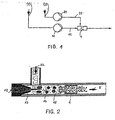
- FIG. 2 shows a preferred embodiment of a predispersant 5 used to prepare an aqueous and organic phase predispersion 9.
- the organic phase 2 is pressed in the mixer 5 via a nozzle bore 11 into the aqueous phase 1 in a premixing chamber 12.
- the organic phase 2 and the aqueous phase 1 are pressed together through a nozzle bore 13, whereby a predispersion 9 is formed.
- the aqueous phase 1 in the mixer 5 can be pressed into the organic phase 2.
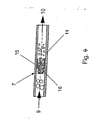
- Fig. 4 shows a preferred embodiment of a homogenizing.
- the predispersion 9 enters the homogenizer (homogenizing nozzle) 7 which has been formed as a jet disperser and consists of a tube and an insert 16 with lateral nozzle bores.
- the predispersion 9 is pushed through the nozzle bores.
- the dispersion 10 exits the jet disperser 7.
- a jet disperser is out DE-A 195 10 651 known.
- it may be such according to Fig. 2 act.
- Principle similar jet dispersants can also be used.
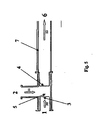
- Fig. 5 shows a preferred embodiment of a dispersant, wherein the aqueous phase 2 in the direction of arrow 11 and the organic phase 1 in the direction of arrow 10 through a pinhole 3 in the pre-dispersion 5 are introduced.
- the predispersed two-phase mixture - also known as predispersion - is then pressed through the pinhole 4 and so the other Subjected to dispersion (homogenization).
- the dispersion 6 then leaves the disperser through the flow tube 7 in the direction of the arrow 12.
- the present invention furthermore relates to the use of one of the dispersants described above for producing a mixture of organic and aqueous phase in the production of polycarbonate by the process according to the invention.
- Particularly suitable for this purpose are those dispersants with which the mixture of organic and aqueous phase produced is an oil-in-water dispersion.
- Such a mixture according to the invention of the organic and aqueous phase by means of such dispersants allows, inter alia, a significantly reduced residence time of less than 0.5 s, preferably even less than 250 ms of the mixture in the reactor of process step (b) with a still high reaction conversion.
- a high energy input in the dispersion of the two streams (organic and aqueous phase) offers advantages in that very small drops, preferably of less than 5 microns, can be formed and the phosgene in times less than 0.5 s, preferably less than 250 ms reacted. This allows both the use of small devices (reactors) for complete phosgene turnover and shortens the handling time of this toxic reactant.
- the process according to the invention enables good phase separation and low water content in the organic phase and low residual monomer content in the aqueous phase.
- aqueous alkaline phase is optionally wholly or partly passed back into the Polycarbonatsynthese as aqueous phase or fed to the wastewater treatment, where solvent and catalyst components are separated and optionally recycled to the polycarbonate synthesis.
- the salt separated after separation of the organic impurities, in particular of solvents and polymer residues, and optionally after the setting of a certain pH, e.g. by sodium hydroxide, the salt separated, which z. B. the chloralkali electrolysis can be supplied while the aqueous phase is optionally fed back to the polycarbonate synthesis.
- the organic, polycarbonate-containing phase may then be used to remove the alkaline, ionic or catalytic contaminants to various persons skilled in the art be cleaned known ways.
- the organic phase usually also contains one or more settling operations, optionally supported by passages through settling tanks, stirred tanks, coalescers or separators or combinations of these measures - optionally water in each or some separation steps under certain circumstances using active or passive mixing devices can be added - still shares the aqueous alkaline phase in fine droplets and the catalyst or the (s). After this coarse separation of the alkaline, aqueous phase, the organic phase can be washed one or more times with dilute acids, mineral, carbon hydroxycarboxylic and / or sulfonic acids. Preference is given to aqueous mineral acids, in particular hydrochloric acid, phosphorous acid, phosphoric acid or mixtures of these acids.
- the concentration of these acids should preferably be in the range from 0.001 to 50% by weight, preferably from 0.01 to 5% by weight.
- the organic phase can be washed repeatedly with desalted or distilled water.
- the separation of, optionally dispersed with parts of the aqueous phase, organic phase after the individual washing steps by means of settling, stirred tank, coalescers or separators or combinations of these measures, the washing water between the washing steps optionally be metered using active or passive mixing devices can.
- acids preferably dissolved in the solvent on which the polymer solution is based, may be added between these washing steps or else after the washing. Hydrogen chloride gas, phosphoric acid or phosphorous acid are preferably used here, which can optionally also be used as mixtures.
- the purified polycarbonate solution thus obtained should preferably contain not more than 5% by weight, preferably less than 1% by weight, very particularly preferably less than 0.5% by weight of water after the last separation process.
- the isolation of the polycarbonate from the solution can be carried out by evaporation of the solvent by means of temperature, vacuum or a heated towing gas.
- Other isolation methods include crystallization and precipitation.
- the residues of the solvent can either directly from the melt with Ausdampfextrudern (see, eg BE-A 866 991 . EP-A 0 411 510 . US Pat. No. 4,980,105 . DE-A 33 32 065 ), Thin-film evaporators (cf., for example EP-A 0 267 025 ), Falling film evaporators, strand evaporators or by friction compaction (cf. EP-A 0 460 450 ), optionally also with the addition of an entraining agent, such as nitrogen or carbon dioxide or by using a vacuum (cf., for example EP-A 0 039 96 .
- an entraining agent such as nitrogen or carbon dioxide or by using a vacuum
- Polycarbonate granules can - if possible - by direct spinning of the melt and subsequent granulation or by the use of Austragsextrudem of which is spun in air or liquid, usually water, are obtained. If extruders are used, additives can be added to the polycarbonate melt before the extruder, optionally with the use of static mixers or by side extruders in this extruder.
- the polycarbonate solution may be subjected to spray evaporation.
- the polycarbonate solution is optionally sprayed after heating either in a vessel with negative pressure or atomized by means of a nozzle with a heated carrier gas, for example nitrogen, argon or steam in a vessel at atmospheric pressure.
- a heated carrier gas for example nitrogen, argon or steam in a vessel at atmospheric pressure.
- powder (diluted) or flakes (concentrated) of the polymer are obtained, from which, if appropriate, the last residues of the solvent have to be removed as above.
- granules can be obtained by means of a compounding extruder and subsequent spinning.
- additives as described above may be added in the periphery or in the extruder itself. Often, it may be necessary to undergo a compaction step for the polymer powder prior to extrusion due to the low bulk density of the powders and flakes.
- the polymer can be largely precipitated by adding a non-solvent for polycarbonate.
- the non-solvents act as precipitant.
- Use as precipitant find here e.g. aliphatic or cycloaliphatic hydrocarbons, especially heptane, i-octane or cyclohexane, alcohols such as e.g. Methanol, ethanol or i-propanol, ketones, e.g. Acetone, or mixtures of these.
- the polymer solution is usually slowly added to the precipitant.
- the polycarbonates thus obtained are processed into granules as described in the spray evaporation and optionally additized.
- precipitation and crystallization products or amorphous solidified products are crystallized in fine-grained form by passing vapors of one or more non-solvents for polycarbonate, with simultaneous heating below the glass transition temperature, and further condensed to higher molecular weights. If these are oligomers optionally with different end groups (phenolic and chain terminator ends), this is referred to as solid phase condensation.
- additives serves to prolong the useful life or to improve the color stability (stabilizers), to simplify the processing (eg demulsifiers, flow aids, antistatic agents) or to adapt the polymer properties to specific loads (impact modifiers such as rubbers, flame retardants, colorants, glass fibers) ,
- additives can be added individually or in any mixtures, together or in several different mixtures of the polymer melt. This can be done directly in the isolation of the polymer or after melting of granules in a so-called compounding step.
- the additives or their mixtures may be added as a solid, preferably as a powder, or as a melt of the polymer melt.
- Another type of dosing is the use of masterbatches or mixtures of masterbatches of the additives or additive mixtures.
- Suitable additives are described, for example, in “ Additives for Plastics Handbook, John Murphy, Elsevier, Oxford 1999”, in the “ Plastics Additives Handbook, Hans Zweifel, Hanser, Kunststoff 2001 ".
- Preferred antioxidants or thermal stabilizers are organic phosphites, phosphonates and phosphanes, usually those in which the organic radicals consist entirely or partially of optionally substituted aromatic radicals.
- o- or m-phosphoric acids fully or partially esterified phosphates or phosphites are suitable as complexing agents for heavy metals and for the neutralization of alkali traces.
- UV absorbers examples include 2- (2'-hydroxyphenyl) benzotriazoles, 2-hydroxybenzophenones, esters of substituted and unsubstituted benzoic acids, acrylates, sterically hindered amines, oxamides, 2- (2-hydroxyphenyl) -1,3, 5-triazines or substituted benzotriazoles are suitable, particularly preferred are substituted benzotriazoles.
- Polypropylene glycols alone or in combination with e.g. Sulfones or sulfonamides as stabilizers can be used against damage by gamma rays.
- stabilizers may be used singly or in combinations and added to the polymer in the above-mentioned forms.
- processing aids such as mold release agents, such as derivatives of long chain fatty acids, may be added.
- processing aids such as mold release agents, such as derivatives of long chain fatty acids.
- Preference is given, for example, to pentaerythritol tetrastearate and glycerol monostearate. They are used alone or in a mixture, preferably in an amount of 0.02 to 1 wt .-%, based on the composition of the composition.
- Suitable flame-retardant additives are phosphate esters, ie triphenyl phosphate, resorcinol diphosphoric acid esters, bromine-containing compounds, such as brominated phosphoric esters, brominated oligocarbonates and polycarbonates, and preferably salts of fluorinated organic sulfonic acids.
- Suitable impact modifiers are butadiene rubber grafted with styrene-acrylonitrile or methyl methacrylate, ethylene-propylene rubbers grafted with maleic anhydride, ethyl and Butylacrylatkautschuke grafted with methyl methacrylate or styrene-acrylonitrile, interpenetrating siloxane and acrylate networks grafted with methyl methacrylate or styrene-acrylonitrile.
- colorants such as organic dyes or pigments and inorganic pigments, IR absorbers, individually, mixed or in combination with stabilizers, glass fibers, glass (hollow) balls or inorganic fillers may be added.
- Polycarbonate melts produced by isolation of the polymer or by compounding may be spun through a die head in strand form, sealed with gas, e.g. Air or nitrogen, or a cooling liquid, usually water, cooled and the solidified strands in commercially available granulators with cutting which are e.g. be granulated on a rotating roll, in air, under inert gas such as nitrogen or argon or under water.
- gas e.g. Air or nitrogen
- a cooling liquid usually water
- a cooling liquid usually water
- solidified strands in commercially available granulators with cutting which are e.g. be granulated on a rotating roll, in air, under inert gas such as nitrogen or argon or under water.
- columnar granules with a round or elliptical cross section and a rough or smooth surface are formed.
- the cut edges may be smooth or have a glassy break with broken cut edges or left-over residues at the cut edges.
- Desirable is a uniformly shaped as possible granules with as few remaining supernatants at the cutting edges. Furthermore, the dust content in the granules is to be kept as low as possible, preferably below 100 mg / kg of granules.
- the diameter of the granules should be between 0.5 mm and 10 mm, preferably 1 to 8 mm, particularly preferably 3 to 6 mm. While the length of the granules should be between 1 to 10 mm, preferably between 2 to 8 mm and the weight between 10 and 50 mg preferably between 15 and 30 mg.
- a granulate whose ratio of diameter, with an elliptical cross section of the average diameter, to the length 0.8 to 1.2, more preferably one with the ratio of about 1.
- These parameters are subject to size distributions, preferred are very narrow distributions, ie as uniformly sized granules.
- Cooling, stripping, granulation and the subsequent transport or promotion of the granules with gas or liquid, and the subsequent storage, optionally after a mixing or homogenization process, are to be designed so that possible, despite the possibly existing static charge no impurities on the polymer -, strand or granule surface are applied, such as dust, abrasion from the machine, aerosol-like lubricants and other liquids and salts from water baths or possibly used cooling.
- the polycarbonates prepared according to the invention are suitable, for example, for the production of extrudates and moldings, in particular those for use in the transparent area, in particular in the field of optical applications, such as, for example, plates, web plates, glazings, Lenses, lamp covers or optical data storage, such as audio CD, CD-R (W), DVD, DVD-R (W), mini discs in their different read only or rewritable, possibly also repeatedly described embodiments.
- dihydroxydiarylalkane 2,2'-bis (4-hydroxyphenyl) propane bisphenol A, BPA
- the solvent of the organic phase is a mixture of 50 wt .-% of methylene chloride and 50 wt .-% monochlorobenzene.
- Example 1 (according to the invention):
- Subsequent phase separation Separating vessel (size 415 m 3 at a level of 50%).
- the temperature in the pumped-circulation reactor was between 42 ° C. (after the heat exchanger) and 45 ° C. (before the heat exchanger.)
- the temperature in the serpentine tube in process step (c) was 46 ° C., in the serpentine tube in process step (d) 45 ° C. and in the separation vessel 40 ° C.
- the dispersion direction was adjusted so that the organic phase was dispersed in the aqueous phase.
- the low water content in the organic phase and the low residual monomer content BPA in the wastewater showed an excellent quality of the phase separation.
- the dispersion showed a good and stable separation behavior.
- the apparatus was used as in Example 1 with the difference of the reversal of the direction of dispersion, i. the aqueous phase was dispersed in the organic phase.
- the temperature in the pumped-circulation reactor was between 42 ° C. (after the heat exchanger) and 45 ° C. (before the heat exchanger.)
- the temperature in the serpentine tube in process step (c) was 46 ° C., in the serpentine tube in process step (d) 45 ° C. and in the separation vessel 40 ° C.
- a mixing cross was used in process step (a) for mixing the organic and the aqueous phase, in which the two streams (aqueous and organic phase) are introduced at opposite points into the pumped-circulation reactor.
- the temperature in the pumped-circulation reactor was between 42 ° C. (after the heat exchanger) and 45 ° C. (before the heat exchanger.)
- the temperature in the serpentine tube in process step (c) was 46 ° C., in the serpentine tube in process step (d) 45 ° C. and in the separation vessel 40 ° C.
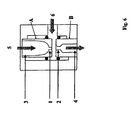
- Fig. 6 shows the schematic drawing of the used for Examples 4 - 8 as a disperser Einlochdüse.
- the small hole 1 of the upper part A has a diameter of 0.75 mm
- the small hole 2 in the lower part B has a diameter of 1.05 mm.
- the diameter 3 of the pipe section in the upper part A of the nozzle is 2 mm
- the diameter 4 of the pipe section in the lower part B of the nozzle is 3 mm.
- aqueous phase for Examples 4-8 a 15% by weight BPA solution (based on total solution weight) was used with a NaOH / BPA mole ratio of 2.1.
- a solvent for the organic phase a mixture of 50% by weight of methylene chloride and 50% by weight of chlorobenzene was used, to which various amounts of phosgene were added in Examples 7 and 8.
- the reactants were dispersed in the nozzle described above, whereby the dispersion direction and thus the pre-adjustment of the dispersion (oil-in-water or water-in-oil) is determined by the inflows (The phase of the vertical upper flow 5 is in the horizontal lateral stream 6 dispersed).
- the pressure drop across the nozzle was about 1.5 bar during the experiments.
- the reaction mixture was then introduced via a capillary into a measuring chamber.
- the total residence time in this measuring chamber was 200 ms.
- the chamber was optionally equipped with an ATR crystal to measure concentrations (phosgene, chloroformate and carbonate groups) or a window to optically determine the particle size distribution (i.e., droplet size distribution).
- concentrations phosgene, chloroformate and carbonate groups
- a window to optically determine the particle size distribution (i.e., droplet size distribution).
- the measurements were carried out both continuously in the flow and after closing the valves at the end of the chamber (stopped flow technique).
- Examples 4-6 were merely for tracking the droplet size distribution effected by the dispersant.
- Examples 7 and 8 were used to quantify the reaction conversion during the extremely short residence time of 200 ms.
- a solvent stream without phosgene (155 g / min) and a stream of aqueous BPA phase (200 g / min) were combined with the dispersion direction adjusted to form a water-in-oil dispersion.
- the size of the dispersed droplets was 46 ⁇ m when flowed through (Sauter diameter, d 32 ).
- the Sauter diameter is known in the art and described for example in Zlokarnik: "mixing, theory and practice" Springer Verlag 1999, p 232. It can be determined by means of known image processing methods by means of microscopic images and counting and measuring of the particles. Stable phase separation took place after 4 s.
- a solvent stream without phosgene (155 g / min) and a stream of aqueous BPA phase (200 g / min) were combined with the dispersion direction adjusted to form an oil-in-water dispersion.
- the size of the dispersed droplets was 53 ⁇ m in flow (Sauter diameter, d 32 ). Stable phase separation took place after 2 s.
- a solvent stream with phosgene (190 g / min) and a stream of aqueous BPA phase (220 g / min) with a molar ratio of phosgene to BPA of 1.09: 1 were combined with the dispersion direction adjusted to provide an oil-in Water dispersion was formed. A very fine homogeneous distribution of the drops was observed.
- the size of the dispersed droplets was at flow below the resolution limit of 5 microns of the microscope, ie less than 5 microns (Sauter diameter, d 32 ). Only 250 ms after stopping the flow, the diameter of the droplets was 50 microns. 1 sec after the flow stopped, rapid coalescence occurred. After a few minutes, stable phase separation.
- Examples 4 - 6 showed that a significantly reduced size of the dispersed particles in a dispersion of aqueous and organic phase is not caused solely by the use of a dispersant, but the surprising effect of significant droplet reduction is observed only in the presence of phosgene.
- the advantageous effect of the previous use of a dispersant is therefore surprisingly high in the inventive reaction of phosgene with Dihydroxydiarylalkanen.
- Phosgene was added to the organic stream with an excess of 20 mol% (based on the molar amount of the BPA used) (365 g / min flow of the organic stream).
- the phase ratio of organic to aqueous phase was 1: 1 (volume ratio). After 200 ms residence time in the feed line to the measuring chamber no phosgene was detectable.
- Phosgene was added to the organic stream without excess (based on the Stoffinenge of the BPA used) (360 g / min flow of the organic stream).
- the phase ratio of organic to aqueous phase was 0.84: 1 (volume ratio). After 200 ms residence time in the feed line to the measuring chamber no phosgene was detectable.
Landscapes
- Chemical & Material Sciences (AREA)
- Health & Medical Sciences (AREA)
- Chemical Kinetics & Catalysis (AREA)
- Medicinal Chemistry (AREA)
- Polymers & Plastics (AREA)
- Organic Chemistry (AREA)
- Polyesters Or Polycarbonates (AREA)
Applications Claiming Priority (1)
| Application Number | Priority Date | Filing Date | Title |
|---|---|---|---|
| DE102008012613A DE102008012613A1 (de) | 2008-03-05 | 2008-03-05 | Verfahren zur Herstellung von Polycarbonat nach dem Phasengrenzflächenverfahren |
Publications (2)
| Publication Number | Publication Date |
|---|---|
| EP2098553A1 EP2098553A1 (de) | 2009-09-09 |
| EP2098553B1 true EP2098553B1 (de) | 2011-08-17 |
Family
ID=40719982
Family Applications (1)
| Application Number | Title | Priority Date | Filing Date |
|---|---|---|---|
| EP09002488A Active EP2098553B1 (de) | 2008-03-05 | 2009-02-21 | Verfahren zur Herstellung von Polycarbonat nach dem Phasengrenzflächenverfahren |
Country Status (10)
| Country | Link |
|---|---|
| US (1) | US7847051B2 (cg-RX-API-DMAC7.html) |
| EP (1) | EP2098553B1 (cg-RX-API-DMAC7.html) |
| JP (1) | JP5324263B2 (cg-RX-API-DMAC7.html) |
| KR (1) | KR101608984B1 (cg-RX-API-DMAC7.html) |
| CN (1) | CN101565501B (cg-RX-API-DMAC7.html) |
| AT (1) | ATE520728T1 (cg-RX-API-DMAC7.html) |
| DE (1) | DE102008012613A1 (cg-RX-API-DMAC7.html) |
| ES (1) | ES2369326T3 (cg-RX-API-DMAC7.html) |
| RU (1) | RU2009107595A (cg-RX-API-DMAC7.html) |
| SG (1) | SG155157A1 (cg-RX-API-DMAC7.html) |
Families Citing this family (8)
| Publication number | Priority date | Publication date | Assignee | Title |
|---|---|---|---|---|
| US10526299B2 (en) | 2004-12-22 | 2020-01-07 | Chemtor, Lp | Fiber conduit reactor with a heat exchange medium inlet and a heat exchange medium outlet |
| US9168469B2 (en) | 2004-12-22 | 2015-10-27 | Chemtor, Lp | Method and system for production of a chemical commodity using a fiber conduit reactor |
| US9468866B2 (en) | 2012-09-18 | 2016-10-18 | Chemtor, Lp | Use of a fiber conduit contactor for metal and/or metalloid extraction |
| WO2015110447A1 (de) * | 2014-01-24 | 2015-07-30 | Bayer Materialscience Ag | Verfahren zur herstellung von polycarbonat nach dem phasengrenzflächenverfahren |
| EP3502160A1 (de) * | 2017-12-20 | 2019-06-26 | Covestro Deutschland AG | Verfahren zur herstellung von polycarbonat |
| EP3719052B1 (de) * | 2019-04-03 | 2022-03-02 | Covestro Deutschland AG | Verfahren zur herstellung von polycarbonat mit reduziertem phosgenüberschuss |
| EP3719051B1 (de) * | 2019-04-03 | 2021-11-03 | Covestro Deutschland AG | Verfahren zur herstellung von polycarbonat-zugabezeitpunkt des kettenabbrechers |
| CN114981367B (zh) | 2020-01-24 | 2024-05-07 | 3D系统公司 | 用于三维印刷应用的蜡质构建材料 |
Family Cites Families (47)
| Publication number | Priority date | Publication date | Assignee | Title |
|---|---|---|---|---|
| DE1007996B (de) | 1955-03-26 | 1957-05-09 | Bayer Ag | Verfahren zur Herstellung thermoplastischer Kunststoffe |
| US2964794A (en) | 1956-05-17 | 1960-12-20 | Bayer Ag | Blown articles from high molecular weight thermoplastic polycarbonates and method of making same |
| US2991273A (en) | 1956-07-07 | 1961-07-04 | Bayer Ag | Process for manufacture of vacuum moulded parts of high molecular weight thermoplastic polycarbonates |
| US3148172A (en) | 1956-07-19 | 1964-09-08 | Gen Electric | Polycarbonates of dihydroxyaryl ethers |
| US2999846A (en) | 1956-11-30 | 1961-09-12 | Schnell Hermann | High molecular weight thermoplastic aromatic sulfoxy polycarbonates |
| US2999835A (en) | 1959-01-02 | 1961-09-12 | Gen Electric | Resinous mixture comprising organo-polysiloxane and polymer of a carbonate of a dihydric phenol, and products containing same |
| NL256449A (cg-RX-API-DMAC7.html) | 1959-10-01 | 1900-01-01 | ||
| US3464198A (en) | 1963-11-14 | 1969-09-02 | Kuraray Co | Process for the manufacture of spinning yarn containing elastic fiber |
| GB1122003A (en) | 1964-10-07 | 1968-07-31 | Gen Electric | Improvements in aromatic polycarbonates |
| NL152889B (nl) | 1967-03-10 | 1977-04-15 | Gen Electric | Werkwijze ter bereiding van een lineair polycarbonaatcopolymeer, alsmede orienteerbare textielvezel van dit copolymeer. |
| DE2036052A1 (en) | 1970-07-21 | 1972-01-27 | Milchwirtschafthche Forschungs und Untersuchungs Gesellschaft mbH, 2100 Hamburg | Working up of additives in fat and protein - contng foodstuffs |
| GB1364310A (en) | 1970-11-03 | 1974-08-21 | Buettner Schilde Haas Ag | Method of and apparatus for drying plastics material granules |
| DE2063050C3 (de) | 1970-12-22 | 1983-12-15 | Bayer Ag, 5090 Leverkusen | Verseifungsbeständige Polycarbonate, Verfahren zu deren Herstellung und deren Verwendung |
| US3879348A (en) | 1970-12-22 | 1975-04-22 | Bayer Ag | Saponification-resistant polycarbonates |
| DE2211956A1 (de) | 1972-03-11 | 1973-10-25 | Bayer Ag | Verfahren zur herstellung verseifungsstabiler blockcopolycarbonate |
| GB1456670A (en) | 1973-07-04 | 1976-11-24 | Ici Ltd | Drying plastics |
| JPS52150496A (en) | 1976-06-09 | 1977-12-14 | Mitsubishi Gas Chem Co Inc | Preparation of polycaronate oligomers |
| DE2701173C2 (de) | 1977-01-13 | 1983-02-10 | Bayer Ag, 5090 Leverkusen | Verwendung von Polycarbonaten zur Herstellung von Linsen für Photo- und Filmkameras |
| DE2721848C2 (de) | 1977-05-14 | 1982-12-02 | Bayer Ag, 5090 Leverkusen | Verfahren zum Konzentrieren von Lösungen mit gleichzeitiger Erstarrung |
| IT1094162B (it) | 1978-02-22 | 1985-07-26 | Montedison Spa | Processo in continuo per il recupero del policarbonato da sue soluzioni |
| US4423207A (en) | 1980-12-18 | 1983-12-27 | General Electric Company | Process for recovery of solid thermoplastic resins from solutions thereof in organic solvents |
| AU574268B2 (en) | 1981-08-12 | 1988-06-30 | Dow Chemical Company, The | Process for converting a thermoplastic polymer into spheroidal agglomerated granules |
| JPS58179224A (ja) | 1982-03-18 | 1983-10-20 | Konishiroku Photo Ind Co Ltd | 光学用樹脂組成物および光学用素子 |
| US5116536A (en) * | 1982-08-14 | 1992-05-26 | Bayer Aktiengesellschaft | Preparation of pharmaceutical or cosmetic dispersions |
| DE3230289A1 (de) * | 1982-08-14 | 1984-02-16 | Bayer Ag, 5090 Leverkusen | Herstellung von pharmazeutischen oder kosmetischen dispersionen |
| DE3332065A1 (de) | 1983-09-06 | 1985-03-21 | Bayer Ag, 5090 Leverkusen | Verfahren zur herstellung von stabilisierter plycarbonat-formkoerper nach dem entgasungsspritzguss- oder dem entgasungsextrusionsverfahren |
| DE3429960A1 (de) | 1984-08-16 | 1986-02-27 | Bayer Ag, 5090 Leverkusen | Verfahren zur isolierung von thermoplastischen polycarbonaten aus seinen loesungen |
| IT1197949B (it) | 1986-11-04 | 1988-12-21 | Montedipe Spa | Evaporatore a film sottile per fluidi ad elevata viscosita |
| CA1337104C (en) | 1986-11-18 | 1995-09-26 | William James Work | Light-scattering thermoplastic polymers |
| US4847352A (en) | 1987-08-26 | 1989-07-11 | The Dow Chemical Company | Polycarbonate production with motionless mixer |
| DE3844633A1 (de) | 1988-08-12 | 1990-04-19 | Bayer Ag | Dihydroxydiphenylcycloalkane, ihre herstellung und ihre verwendung zur herstellung von hochmolekularen polycarbonaten |
| US5227458A (en) | 1988-08-12 | 1993-07-13 | Bayer Aktiengesellschaft | Polycarbonate from dihydroxydiphenyl cycloalkane |
| NO170326C (no) | 1988-08-12 | 1992-10-07 | Bayer Ag | Dihydroksydifenylcykloalkaner |
| US5043421A (en) | 1989-08-04 | 1991-08-27 | General Electric Company | Extruder isolation of polymers from solution |
| US4980105A (en) | 1989-08-28 | 1990-12-25 | General Electric Company | Method for extruder devolatilization of spiro(bis)indane polycarbonates |
| US5306803A (en) | 1990-06-02 | 1994-04-26 | Bayer Aktiengesellschaft | Process for cleaning thermoplasts by friction compacting |
| DE4118232A1 (de) | 1991-06-04 | 1992-12-10 | Bayer Ag | Kontinuierliche herstellung von polycarbonaten |
| DE4121213A1 (de) | 1991-06-27 | 1993-01-14 | Bayer Ag | Kontinuierliche herstellung von polycarbonaten |
| DE4121212A1 (de) * | 1991-06-27 | 1993-01-14 | Bayer Ag | Verfahren zur herstellung von polycarbonat |
| DE4239131C2 (de) * | 1992-11-20 | 1998-04-09 | Bayer Ag | Verfahren zur Herstellung von Polycarbonaten |
| GB9314604D0 (en) | 1993-07-14 | 1993-08-25 | Dow Deutschland Inc | Light diffuser composition |
| DE19510651A1 (de) | 1994-06-03 | 1995-12-07 | Bayer Ag | Wäßrige 2-Komponenten-Polyurethanlack-Emulsionen und Verfahren zu deren Herstellung |
| DE10108484A1 (de) | 2001-02-22 | 2002-09-05 | Bayer Ag | Verbessertes Verfahren zur Herstelung von Polyetherpolyolen |
| DE10118307A1 (de) * | 2001-04-12 | 2002-10-17 | Bayer Ag | Vefahren zur Herstellung von Polycarbonaten |
| JP2006519277A (ja) | 2003-02-28 | 2006-08-24 | バイエル・マテリアルサイエンス・アクチェンゲゼルシャフト | 2成分塗料混合物を製造するための方法および装置 |
| WO2007063795A1 (ja) | 2005-11-29 | 2007-06-07 | Unitika Ltd. | 樹脂組成物及びそれを成形してなる成形品 |
| EP2090605B1 (de) * | 2008-02-13 | 2011-07-13 | Bayer MaterialScience AG | Verfahren zur Herstellung von Polycarbonaten |
-
2008
- 2008-03-05 DE DE102008012613A patent/DE102008012613A1/de not_active Withdrawn
-
2009
- 2009-02-21 ES ES09002488T patent/ES2369326T3/es active Active
- 2009-02-21 AT AT09002488T patent/ATE520728T1/de active
- 2009-02-21 EP EP09002488A patent/EP2098553B1/de active Active
- 2009-03-04 KR KR1020090018557A patent/KR101608984B1/ko active Active
- 2009-03-04 RU RU2009107595/04A patent/RU2009107595A/ru not_active Application Discontinuation
- 2009-03-05 US US12/398,243 patent/US7847051B2/en active Active
- 2009-03-05 SG SG200901549-6A patent/SG155157A1/en unknown
- 2009-03-05 CN CN2009101261794A patent/CN101565501B/zh active Active
- 2009-03-05 JP JP2009051589A patent/JP5324263B2/ja active Active
Also Published As
| Publication number | Publication date |
|---|---|
| DE102008012613A1 (de) | 2009-09-10 |
| ES2369326T3 (es) | 2011-11-29 |
| RU2009107595A (ru) | 2010-09-10 |
| JP5324263B2 (ja) | 2013-10-23 |
| CN101565501B (zh) | 2013-03-06 |
| US20090275709A1 (en) | 2009-11-05 |
| ATE520728T1 (de) | 2011-09-15 |
| JP2009209372A (ja) | 2009-09-17 |
| KR20090095512A (ko) | 2009-09-09 |
| US7847051B2 (en) | 2010-12-07 |
| SG155157A1 (en) | 2009-09-30 |
| EP2098553A1 (de) | 2009-09-09 |
| KR101608984B1 (ko) | 2016-04-04 |
| CN101565501A (zh) | 2009-10-28 |
Similar Documents
| Publication | Publication Date | Title |
|---|---|---|
| EP1609818B1 (de) | Thermostabilisierte Polycarbonat-Zusammensetzungen | |
| EP2098553B1 (de) | Verfahren zur Herstellung von Polycarbonat nach dem Phasengrenzflächenverfahren | |
| EP2268706B1 (de) | Polycarbonate mit umlagerungsstrukturen, cyclischen und linearen oligomeren sowie verbessertem fliessverhalten | |
| EP2285865B1 (de) | Alkylphenol zur einstellung des molekulargewichtes und copolycarbonat mit verbesserten eigenschaften | |
| DE102008008841A1 (de) | Verfahren zur Herstellung von Polycarbonaten | |
| EP2090605B1 (de) | Verfahren zur Herstellung von Polycarbonaten | |
| EP2242788B1 (de) | Alkylphenol zur einstellung des molekulargewichtes und polycarbonatzusammensetzungen mit verbesserten eigenschaften | |
| EP3097135B1 (de) | Verfahren zur herstellung von polycarbonat nach dem phasengrenzflächenverfahren | |
| EP1831283B1 (de) | Verfahren zur herstellung von polycarbonaten | |
| DE102006051306A1 (de) | Substratmaterialien für Extrusionsfolien mit geringen Oberflächenstörungen | |
| EP3719052B1 (de) | Verfahren zur herstellung von polycarbonat mit reduziertem phosgenüberschuss | |
| DE10249270B4 (de) | Rücklöseverfahren | |
| DE102004030664A1 (de) | Benzol- und Toluolsulfonsäureester als Additive in Polycarbonat | |
| EP1565510A1 (de) | Herstellung von besonders wenig durch sauerstoff geschädigtem polycarbonat | |
| DE10248951A1 (de) | Herstellung von Polycarbonat mit Hilfe eines Filtrationskonzeptes | |
| DE10248165A1 (de) | Verfahren zur Abtrennung von Restmonomeren und Oligomeren aus Polycarbonat | |
| DE10249269A1 (de) | Verfahren zur Herstellung von Polycarbonaten unter Rückführung von Polycar-bonatlösung aus Abwasser-und Abfallströmen in den Herstellungsprozess | |
| DE102005017893A1 (de) | Verfahren zur Herstellung von Polycarbonat mittels Raman-Spektroskopie | |
| DE10248021A1 (de) | Verfahren zur Herstellung von Polycarbonat nach dem Phasengrenzflächenverfahren mit Verweiltank | |
| DE102004057349A1 (de) | Benzol- und Toluolsulfonsäureester als Additive in Polycarbonat | |
| EP3719051A1 (de) | Verfahren zur herstellung von polycarbonat-zugabezeitpunkt des kettenabbrechers | |
| DE10248950A1 (de) | Herstellung von besonders wenig durch Sauerstoff geschädigtem Polycarbonat |
Legal Events
| Date | Code | Title | Description |
|---|---|---|---|
| PUAI | Public reference made under article 153(3) epc to a published international application that has entered the european phase |
Free format text: ORIGINAL CODE: 0009012 |
|
| AK | Designated contracting states |
Kind code of ref document: A1 Designated state(s): AT BE BG CH CY CZ DE DK EE ES FI FR GB GR HR HU IE IS IT LI LT LU LV MC MK MT NL NO PL PT RO SE SI SK TR |
|
| AX | Request for extension of the european patent |
Extension state: AL BA RS |
|
| RIN1 | Information on inventor provided before grant (corrected) |
Inventor name: SEEBA, JOHANN, DR. Inventor name: EBERT, WOLFGANG, DR. Inventor name: BACHMANN, ROLF, DR. Inventor name: OBENDORF, LARS, DR. Inventor name: EYNDE, JOHAN VANDEN Inventor name: RUYTINX, BERT Inventor name: KORDS, CHRISTIAN |
|
| 17P | Request for examination filed |
Effective date: 20100309 |
|
| AKX | Designation fees paid |
Designated state(s): AT BE BG CH CY CZ DE DK EE ES FI FR GB GR HR HU IE IS IT LI LT LU LV MC MK MT NL NO PL PT RO SE SI SK TR |
|
| GRAP | Despatch of communication of intention to grant a patent |
Free format text: ORIGINAL CODE: EPIDOSNIGR1 |
|
| GRAS | Grant fee paid |
Free format text: ORIGINAL CODE: EPIDOSNIGR3 |
|
| GRAA | (expected) grant |
Free format text: ORIGINAL CODE: 0009210 |
|
| AK | Designated contracting states |
Kind code of ref document: B1 Designated state(s): AT BE BG CH CY CZ DE DK EE ES FI FR GB GR HR HU IE IS IT LI LT LU LV MC MK MT NL NO PL PT RO SE SI SK TR |
|
| REG | Reference to a national code |
Ref country code: GB Ref legal event code: FG4D Free format text: NOT ENGLISH |
|
| REG | Reference to a national code |
Ref country code: CH Ref legal event code: EP |
|
| REG | Reference to a national code |
Ref country code: IE Ref legal event code: FG4D Free format text: LANGUAGE OF EP DOCUMENT: GERMAN |
|
| REG | Reference to a national code |
Ref country code: DE Ref legal event code: R096 Ref document number: 502009001099 Country of ref document: DE Effective date: 20111020 |
|
| REG | Reference to a national code |
Ref country code: ES Ref legal event code: FG2A Ref document number: 2369326 Country of ref document: ES Kind code of ref document: T3 Effective date: 20111129 |
|
| REG | Reference to a national code |
Ref country code: NL Ref legal event code: T3 |
|
| LTIE | Lt: invalidation of european patent or patent extension |
Effective date: 20110817 |
|
| PG25 | Lapsed in a contracting state [announced via postgrant information from national office to epo] |
Ref country code: NO Free format text: LAPSE BECAUSE OF FAILURE TO SUBMIT A TRANSLATION OF THE DESCRIPTION OR TO PAY THE FEE WITHIN THE PRESCRIBED TIME-LIMIT Effective date: 20111117 Ref country code: SE Free format text: LAPSE BECAUSE OF FAILURE TO SUBMIT A TRANSLATION OF THE DESCRIPTION OR TO PAY THE FEE WITHIN THE PRESCRIBED TIME-LIMIT Effective date: 20110817 Ref country code: LT Free format text: LAPSE BECAUSE OF FAILURE TO SUBMIT A TRANSLATION OF THE DESCRIPTION OR TO PAY THE FEE WITHIN THE PRESCRIBED TIME-LIMIT Effective date: 20110817 Ref country code: PT Free format text: LAPSE BECAUSE OF FAILURE TO SUBMIT A TRANSLATION OF THE DESCRIPTION OR TO PAY THE FEE WITHIN THE PRESCRIBED TIME-LIMIT Effective date: 20111219 Ref country code: FI Free format text: LAPSE BECAUSE OF FAILURE TO SUBMIT A TRANSLATION OF THE DESCRIPTION OR TO PAY THE FEE WITHIN THE PRESCRIBED TIME-LIMIT Effective date: 20110817 Ref country code: IS Free format text: LAPSE BECAUSE OF FAILURE TO SUBMIT A TRANSLATION OF THE DESCRIPTION OR TO PAY THE FEE WITHIN THE PRESCRIBED TIME-LIMIT Effective date: 20111217 |
|
| PG25 | Lapsed in a contracting state [announced via postgrant information from national office to epo] |
Ref country code: PL Free format text: LAPSE BECAUSE OF FAILURE TO SUBMIT A TRANSLATION OF THE DESCRIPTION OR TO PAY THE FEE WITHIN THE PRESCRIBED TIME-LIMIT Effective date: 20110817 Ref country code: SI Free format text: LAPSE BECAUSE OF FAILURE TO SUBMIT A TRANSLATION OF THE DESCRIPTION OR TO PAY THE FEE WITHIN THE PRESCRIBED TIME-LIMIT Effective date: 20110817 Ref country code: GR Free format text: LAPSE BECAUSE OF FAILURE TO SUBMIT A TRANSLATION OF THE DESCRIPTION OR TO PAY THE FEE WITHIN THE PRESCRIBED TIME-LIMIT Effective date: 20111118 Ref country code: LV Free format text: LAPSE BECAUSE OF FAILURE TO SUBMIT A TRANSLATION OF THE DESCRIPTION OR TO PAY THE FEE WITHIN THE PRESCRIBED TIME-LIMIT Effective date: 20110817 Ref country code: CY Free format text: LAPSE BECAUSE OF FAILURE TO SUBMIT A TRANSLATION OF THE DESCRIPTION OR TO PAY THE FEE WITHIN THE PRESCRIBED TIME-LIMIT Effective date: 20110817 |
|
| REG | Reference to a national code |
Ref country code: IE Ref legal event code: FD4D |
|
| PG25 | Lapsed in a contracting state [announced via postgrant information from national office to epo] |
Ref country code: SK Free format text: LAPSE BECAUSE OF FAILURE TO SUBMIT A TRANSLATION OF THE DESCRIPTION OR TO PAY THE FEE WITHIN THE PRESCRIBED TIME-LIMIT Effective date: 20110817 Ref country code: CZ Free format text: LAPSE BECAUSE OF FAILURE TO SUBMIT A TRANSLATION OF THE DESCRIPTION OR TO PAY THE FEE WITHIN THE PRESCRIBED TIME-LIMIT Effective date: 20110817 Ref country code: IE Free format text: LAPSE BECAUSE OF FAILURE TO SUBMIT A TRANSLATION OF THE DESCRIPTION OR TO PAY THE FEE WITHIN THE PRESCRIBED TIME-LIMIT Effective date: 20110817 |
|
| PG25 | Lapsed in a contracting state [announced via postgrant information from national office to epo] |
Ref country code: EE Free format text: LAPSE BECAUSE OF FAILURE TO SUBMIT A TRANSLATION OF THE DESCRIPTION OR TO PAY THE FEE WITHIN THE PRESCRIBED TIME-LIMIT Effective date: 20110817 Ref country code: IT Free format text: LAPSE BECAUSE OF FAILURE TO SUBMIT A TRANSLATION OF THE DESCRIPTION OR TO PAY THE FEE WITHIN THE PRESCRIBED TIME-LIMIT Effective date: 20110817 Ref country code: RO Free format text: LAPSE BECAUSE OF FAILURE TO SUBMIT A TRANSLATION OF THE DESCRIPTION OR TO PAY THE FEE WITHIN THE PRESCRIBED TIME-LIMIT Effective date: 20110817 |
|
| PLBE | No opposition filed within time limit |
Free format text: ORIGINAL CODE: 0009261 |
|
| STAA | Information on the status of an ep patent application or granted ep patent |
Free format text: STATUS: NO OPPOSITION FILED WITHIN TIME LIMIT |
|
| PG25 | Lapsed in a contracting state [announced via postgrant information from national office to epo] |
Ref country code: DK Free format text: LAPSE BECAUSE OF FAILURE TO SUBMIT A TRANSLATION OF THE DESCRIPTION OR TO PAY THE FEE WITHIN THE PRESCRIBED TIME-LIMIT Effective date: 20110817 |
|
| 26N | No opposition filed |
Effective date: 20120521 |
|
| PG25 | Lapsed in a contracting state [announced via postgrant information from national office to epo] |
Ref country code: HR Free format text: LAPSE BECAUSE OF FAILURE TO SUBMIT A TRANSLATION OF THE DESCRIPTION OR TO PAY THE FEE WITHIN THE PRESCRIBED TIME-LIMIT Effective date: 20120328 |
|
| BERE | Be: lapsed |
Owner name: BAYER MATERIALSCIENCE A.G. Effective date: 20120228 |
|
| REG | Reference to a national code |
Ref country code: DE Ref legal event code: R097 Ref document number: 502009001099 Country of ref document: DE Effective date: 20120521 |
|
| PG25 | Lapsed in a contracting state [announced via postgrant information from national office to epo] |
Ref country code: MC Free format text: LAPSE BECAUSE OF NON-PAYMENT OF DUE FEES Effective date: 20120229 |
|
| REG | Reference to a national code |
Ref country code: FR Ref legal event code: ST Effective date: 20121031 |
|
| PG25 | Lapsed in a contracting state [announced via postgrant information from national office to epo] |
Ref country code: BE Free format text: LAPSE BECAUSE OF NON-PAYMENT OF DUE FEES Effective date: 20120228 |
|
| PG25 | Lapsed in a contracting state [announced via postgrant information from national office to epo] |
Ref country code: FR Free format text: LAPSE BECAUSE OF NON-PAYMENT OF DUE FEES Effective date: 20120229 |
|
| PG25 | Lapsed in a contracting state [announced via postgrant information from national office to epo] |
Ref country code: MK Free format text: LAPSE BECAUSE OF FAILURE TO SUBMIT A TRANSLATION OF THE DESCRIPTION OR TO PAY THE FEE WITHIN THE PRESCRIBED TIME-LIMIT Effective date: 20110817 |
|
| PG25 | Lapsed in a contracting state [announced via postgrant information from national office to epo] |
Ref country code: BG Free format text: LAPSE BECAUSE OF FAILURE TO SUBMIT A TRANSLATION OF THE DESCRIPTION OR TO PAY THE FEE WITHIN THE PRESCRIBED TIME-LIMIT Effective date: 20111117 |
|
| PG25 | Lapsed in a contracting state [announced via postgrant information from national office to epo] |
Ref country code: MT Free format text: LAPSE BECAUSE OF FAILURE TO SUBMIT A TRANSLATION OF THE DESCRIPTION OR TO PAY THE FEE WITHIN THE PRESCRIBED TIME-LIMIT Effective date: 20110817 |
|
| REG | Reference to a national code |
Ref country code: CH Ref legal event code: PL |
|
| REG | Reference to a national code |
Ref country code: ES Ref legal event code: FD2A Effective date: 20131018 |
|
| GBPC | Gb: european patent ceased through non-payment of renewal fee |
Effective date: 20130221 |
|
| PG25 | Lapsed in a contracting state [announced via postgrant information from national office to epo] |
Ref country code: CH Free format text: LAPSE BECAUSE OF NON-PAYMENT OF DUE FEES Effective date: 20130228 Ref country code: ES Free format text: LAPSE BECAUSE OF NON-PAYMENT OF DUE FEES Effective date: 20120222 Ref country code: LI Free format text: LAPSE BECAUSE OF NON-PAYMENT OF DUE FEES Effective date: 20130228 |
|
| PG25 | Lapsed in a contracting state [announced via postgrant information from national office to epo] |
Ref country code: HR Free format text: LAPSE BECAUSE OF FAILURE TO SUBMIT A TRANSLATION OF THE DESCRIPTION OR TO PAY THE FEE WITHIN THE PRESCRIBED TIME-LIMIT Effective date: 20110817 |
|
| PG25 | Lapsed in a contracting state [announced via postgrant information from national office to epo] |
Ref country code: GB Free format text: LAPSE BECAUSE OF NON-PAYMENT OF DUE FEES Effective date: 20130221 |
|
| PG25 | Lapsed in a contracting state [announced via postgrant information from national office to epo] |
Ref country code: TR Free format text: LAPSE BECAUSE OF FAILURE TO SUBMIT A TRANSLATION OF THE DESCRIPTION OR TO PAY THE FEE WITHIN THE PRESCRIBED TIME-LIMIT Effective date: 20110817 |
|
| PG25 | Lapsed in a contracting state [announced via postgrant information from national office to epo] |
Ref country code: LU Free format text: LAPSE BECAUSE OF NON-PAYMENT OF DUE FEES Effective date: 20120221 |
|
| REG | Reference to a national code |
Ref country code: DE Ref legal event code: R081 Ref document number: 502009001099 Country of ref document: DE Owner name: COVESTRO DEUTSCHLAND AG, DE Free format text: FORMER OWNER: BAYER MATERIALSCIENCE AKTIENGESELLSCHAFT, 51373 LEVERKUSEN, DE Effective date: 20140526 Ref country code: DE Ref legal event code: R081 Ref document number: 502009001099 Country of ref document: DE Owner name: BAYER INTELLECTUAL PROPERTY GMBH, DE Free format text: FORMER OWNER: BAYER MATERIALSCIENCE AKTIENGESELLSCHAFT, 51373 LEVERKUSEN, DE Effective date: 20140526 |
|
| PG25 | Lapsed in a contracting state [announced via postgrant information from national office to epo] |
Ref country code: HU Free format text: LAPSE BECAUSE OF FAILURE TO SUBMIT A TRANSLATION OF THE DESCRIPTION OR TO PAY THE FEE WITHIN THE PRESCRIBED TIME-LIMIT Effective date: 20090221 |
|
| REG | Reference to a national code |
Ref country code: AT Ref legal event code: MM01 Ref document number: 520728 Country of ref document: AT Kind code of ref document: T Effective date: 20140221 |
|
| PG25 | Lapsed in a contracting state [announced via postgrant information from national office to epo] |
Ref country code: AT Free format text: LAPSE BECAUSE OF NON-PAYMENT OF DUE FEES Effective date: 20140221 |
|
| REG | Reference to a national code |
Ref country code: DE Ref legal event code: R081 Ref document number: 502009001099 Country of ref document: DE Owner name: COVESTRO DEUTSCHLAND AG, DE Free format text: FORMER OWNER: BAYER INTELLECTUAL PROPERTY GMBH, 40789 MONHEIM, DE |
|
| REG | Reference to a national code |
Ref country code: NL Ref legal event code: HC Owner name: COVESTRO DEUTSCHLAND AG; DE Free format text: DETAILS ASSIGNMENT: VERANDERING VAN EIGENAAR(S), VERANDERING VAN NAAM VAN DE EIGENAAR(S); FORMER OWNER NAME: BAYER MATERIALSCIENCE AG Effective date: 20160810 |
|
| PGFP | Annual fee paid to national office [announced via postgrant information from national office to epo] |
Ref country code: NL Payment date: 20220125 Year of fee payment: 14 |
|
| REG | Reference to a national code |
Ref country code: NL Ref legal event code: MM Effective date: 20230301 |
|
| PG25 | Lapsed in a contracting state [announced via postgrant information from national office to epo] |
Ref country code: NL Free format text: LAPSE BECAUSE OF NON-PAYMENT OF DUE FEES Effective date: 20230301 |
|
| PGFP | Annual fee paid to national office [announced via postgrant information from national office to epo] |
Ref country code: DE Payment date: 20260121 Year of fee payment: 18 |