EP2091934B1 - Ketomethioninketale und deren derivate - Google Patents
Ketomethioninketale und deren derivate Download PDFInfo
- Publication number
- EP2091934B1 EP2091934B1 EP07822235.3A EP07822235A EP2091934B1 EP 2091934 B1 EP2091934 B1 EP 2091934B1 EP 07822235 A EP07822235 A EP 07822235A EP 2091934 B1 EP2091934 B1 EP 2091934B1
- Authority
- EP
- European Patent Office
- Prior art keywords
- sugar
- radical
- alcohol
- ketomethionine
- formula
- Prior art date
- Legal status (The legal status is an assumption and is not a legal conclusion. Google has not performed a legal analysis and makes no representation as to the accuracy of the status listed.)
- Not-in-force
Links
- MNNSCZMJIYYESW-BYPYZUCNSA-N (2s)-4-methylsulfanyl-2-nitrosobutanoic acid Chemical compound CSCC[C@H](N=O)C(O)=O MNNSCZMJIYYESW-BYPYZUCNSA-N 0.000 title claims description 59
- 150000001875 compounds Chemical class 0.000 claims description 44
- 150000002148 esters Chemical class 0.000 claims description 26
- 235000000346 sugar Nutrition 0.000 claims description 24
- 241000282849 Ruminantia Species 0.000 claims description 21
- 238000002360 preparation method Methods 0.000 claims description 18
- 238000000034 method Methods 0.000 claims description 17
- PEDCQBHIVMGVHV-UHFFFAOYSA-N Glycerine Chemical compound OCC(O)CO PEDCQBHIVMGVHV-UHFFFAOYSA-N 0.000 claims description 15
- -1 hydroxyethoxy Chemical group 0.000 claims description 14
- 230000008569 process Effects 0.000 claims description 14
- XLYOFNOQVPJJNP-UHFFFAOYSA-N water Substances O XLYOFNOQVPJJNP-UHFFFAOYSA-N 0.000 claims description 14
- 125000002887 hydroxy group Chemical group [H]O* 0.000 claims description 11
- 150000001732 carboxylic acid derivatives Chemical class 0.000 claims description 10
- LFQSCWFLJHTTHZ-UHFFFAOYSA-N Ethanol Chemical compound CCO LFQSCWFLJHTTHZ-UHFFFAOYSA-N 0.000 claims description 9
- 235000019728 animal nutrition Nutrition 0.000 claims description 8
- 238000006243 chemical reaction Methods 0.000 claims description 8
- 235000016709 nutrition Nutrition 0.000 claims description 7
- 230000035764 nutrition Effects 0.000 claims description 7
- 125000003903 2-propenyl group Chemical group [H]C([*])([H])C([H])=C([H])[H] 0.000 claims description 4
- XXROGKLTLUQVRX-UHFFFAOYSA-N allyl alcohol Chemical compound OCC=C XXROGKLTLUQVRX-UHFFFAOYSA-N 0.000 claims description 4
- 125000001797 benzyl group Chemical group [H]C1=C([H])C([H])=C(C([H])=C1[H])C([H])([H])* 0.000 claims description 4
- RXKJFZQQPQGTFL-UHFFFAOYSA-N dihydroxyacetone Chemical compound OCC(=O)CO RXKJFZQQPQGTFL-UHFFFAOYSA-N 0.000 claims description 4
- 125000004356 hydroxy functional group Chemical group O* 0.000 claims description 4
- 125000001997 phenyl group Chemical group [H]C1=C([H])C([H])=C(*)C([H])=C1[H] 0.000 claims description 4
- WQZGKKKJIJFFOK-GASJEMHNSA-N Glucose Natural products OC[C@H]1OC(O)[C@H](O)[C@@H](O)[C@@H]1O WQZGKKKJIJFFOK-GASJEMHNSA-N 0.000 claims description 3
- 229910052783 alkali metal Inorganic materials 0.000 claims description 3
- 239000008103 glucose Substances 0.000 claims description 3
- MNQZXJOMYWMBOU-VKHMYHEASA-N D-glyceraldehyde Chemical compound OC[C@@H](O)C=O MNQZXJOMYWMBOU-VKHMYHEASA-N 0.000 claims description 2
- 229930091371 Fructose Natural products 0.000 claims description 2
- 239000005715 Fructose Substances 0.000 claims description 2
- RFSUNEUAIZKAJO-ARQDHWQXSA-N Fructose Chemical compound OC[C@H]1O[C@](O)(CO)[C@@H](O)[C@@H]1O RFSUNEUAIZKAJO-ARQDHWQXSA-N 0.000 claims description 2
- ISWSIDIOOBJBQZ-UHFFFAOYSA-N Phenol Chemical compound OC1=CC=CC=C1 ISWSIDIOOBJBQZ-UHFFFAOYSA-N 0.000 claims description 2
- CZMRCDWAGMRECN-UGDNZRGBSA-N Sucrose Chemical compound O[C@H]1[C@H](O)[C@@H](CO)O[C@@]1(CO)O[C@@H]1[C@H](O)[C@@H](O)[C@H](O)[C@@H](CO)O1 CZMRCDWAGMRECN-UGDNZRGBSA-N 0.000 claims description 2
- 229930006000 Sucrose Natural products 0.000 claims description 2
- WQZGKKKJIJFFOK-VFUOTHLCSA-N beta-D-glucose Chemical compound OC[C@H]1O[C@@H](O)[C@H](O)[C@@H](O)[C@@H]1O WQZGKKKJIJFFOK-VFUOTHLCSA-N 0.000 claims description 2
- 229940120503 dihydroxyacetone Drugs 0.000 claims description 2
- WVDDGKGOMKODPV-ZQBYOMGUSA-N phenyl(114C)methanol Chemical compound O[14CH2]C1=CC=CC=C1 WVDDGKGOMKODPV-ZQBYOMGUSA-N 0.000 claims description 2
- 239000005720 sucrose Substances 0.000 claims description 2
- 238000005809 transesterification reaction Methods 0.000 claims description 2
- 150000003254 radicals Chemical class 0.000 claims 6
- 125000006702 (C1-C18) alkyl group Chemical group 0.000 claims 4
- 125000004178 (C1-C4) alkyl group Chemical group 0.000 claims 1
- 239000003377 acid catalyst Substances 0.000 claims 1
- 150000004703 alkoxides Chemical class 0.000 claims 1
- CBOIHMRHGLHBPB-UHFFFAOYSA-N hydroxymethyl Chemical compound O[CH2] CBOIHMRHGLHBPB-UHFFFAOYSA-N 0.000 claims 1
- FFEARJCKVFRZRR-BYPYZUCNSA-N L-methionine Chemical compound CSCC[C@H](N)C(O)=O FFEARJCKVFRZRR-BYPYZUCNSA-N 0.000 description 48
- 229960004452 methionine Drugs 0.000 description 44
- 229930182817 methionine Natural products 0.000 description 41
- 239000000047 product Substances 0.000 description 25
- YMWUJEATGCHHMB-UHFFFAOYSA-N Dichloromethane Chemical compound ClCCl YMWUJEATGCHHMB-UHFFFAOYSA-N 0.000 description 21
- 210000004767 rumen Anatomy 0.000 description 20
- RTZKZFJDLAIYFH-UHFFFAOYSA-N Diethyl ether Chemical compound CCOCC RTZKZFJDLAIYFH-UHFFFAOYSA-N 0.000 description 18
- LYCAIKOWRPUZTN-UHFFFAOYSA-N Ethylene glycol Chemical compound OCCO LYCAIKOWRPUZTN-UHFFFAOYSA-N 0.000 description 18
- YXFVVABEGXRONW-UHFFFAOYSA-N Toluene Chemical compound CC1=CC=CC=C1 YXFVVABEGXRONW-UHFFFAOYSA-N 0.000 description 18
- FFEARJCKVFRZRR-UHFFFAOYSA-N L-Methionine Natural products CSCCC(N)C(O)=O FFEARJCKVFRZRR-UHFFFAOYSA-N 0.000 description 17
- 238000010521 absorption reaction Methods 0.000 description 14
- 241001465754 Metazoa Species 0.000 description 13
- IAZDPXIOMUYVGZ-WFGJKAKNSA-N Dimethyl sulfoxide Chemical compound [2H]C([2H])([2H])S(=O)C([2H])([2H])[2H] IAZDPXIOMUYVGZ-WFGJKAKNSA-N 0.000 description 12
- VLKZOEOYAKHREP-UHFFFAOYSA-N n-Hexane Chemical compound CCCCCC VLKZOEOYAKHREP-UHFFFAOYSA-N 0.000 description 12
- 239000000243 solution Substances 0.000 description 12
- 229930195722 L-methionine Natural products 0.000 description 11
- 239000003674 animal food additive Substances 0.000 description 11
- 239000002904 solvent Substances 0.000 description 11
- OKKJLVBELUTLKV-UHFFFAOYSA-N Methanol Chemical compound OC OKKJLVBELUTLKV-UHFFFAOYSA-N 0.000 description 9
- 239000003054 catalyst Substances 0.000 description 9
- 238000004519 manufacturing process Methods 0.000 description 9
- 238000005160 1H NMR spectroscopy Methods 0.000 description 8
- SXFSQZDSUWACKX-UHFFFAOYSA-N 4-methylthio-2-oxobutanoic acid Chemical compound CSCCC(=O)C(O)=O SXFSQZDSUWACKX-UHFFFAOYSA-N 0.000 description 8
- HEDRZPFGACZZDS-UHFFFAOYSA-N Chloroform Chemical compound ClC(Cl)Cl HEDRZPFGACZZDS-UHFFFAOYSA-N 0.000 description 8
- 150000001413 amino acids Chemical class 0.000 description 8
- KFZMGEQAYNKOFK-UHFFFAOYSA-N Isopropanol Chemical compound CC(C)O KFZMGEQAYNKOFK-UHFFFAOYSA-N 0.000 description 7
- 230000002378 acidificating effect Effects 0.000 description 7
- 238000001644 13C nuclear magnetic resonance spectroscopy Methods 0.000 description 6
- CSCPPACGZOOCGX-UHFFFAOYSA-N Acetone Chemical compound CC(C)=O CSCPPACGZOOCGX-UHFFFAOYSA-N 0.000 description 6
- VEXZGXHMUGYJMC-UHFFFAOYSA-N Hydrochloric acid Chemical compound Cl VEXZGXHMUGYJMC-UHFFFAOYSA-N 0.000 description 6
- KWYUFKZDYYNOTN-UHFFFAOYSA-M Potassium hydroxide Chemical compound [OH-].[K+] KWYUFKZDYYNOTN-UHFFFAOYSA-M 0.000 description 6
- HEMHJVSKTPXQMS-UHFFFAOYSA-M Sodium hydroxide Chemical compound [OH-].[Na+] HEMHJVSKTPXQMS-UHFFFAOYSA-M 0.000 description 6
- 239000002253 acid Substances 0.000 description 6
- 230000008901 benefit Effects 0.000 description 6
- 235000013336 milk Nutrition 0.000 description 6
- 239000008267 milk Substances 0.000 description 6
- 210000004080 milk Anatomy 0.000 description 6
- 239000008188 pellet Substances 0.000 description 6
- 239000011241 protective layer Substances 0.000 description 6
- 210000000813 small intestine Anatomy 0.000 description 6
- 239000011734 sodium Substances 0.000 description 6
- JOXIMZWYDAKGHI-UHFFFAOYSA-N toluene-4-sulfonic acid Chemical compound CC1=CC=C(S(O)(=O)=O)C=C1 JOXIMZWYDAKGHI-UHFFFAOYSA-N 0.000 description 6
- 239000003795 chemical substances by application Substances 0.000 description 5
- 239000000126 substance Substances 0.000 description 5
- 241000283690 Bos taurus Species 0.000 description 4
- XUYPXLNMDZIRQH-LURJTMIESA-N N-acetyl-L-methionine Chemical compound CSCC[C@@H](C(O)=O)NC(C)=O XUYPXLNMDZIRQH-LURJTMIESA-N 0.000 description 4
- 239000008346 aqueous phase Substances 0.000 description 4
- 150000001734 carboxylic acid salts Chemical class 0.000 description 4
- 230000015556 catabolic process Effects 0.000 description 4
- 235000013365 dairy product Nutrition 0.000 description 4
- 238000006731 degradation reaction Methods 0.000 description 4
- 230000032050 esterification Effects 0.000 description 4
- 238000005886 esterification reaction Methods 0.000 description 4
- 235000011187 glycerol Nutrition 0.000 description 4
- 229910052500 inorganic mineral Inorganic materials 0.000 description 4
- 238000005907 ketalization reaction Methods 0.000 description 4
- 239000011707 mineral Substances 0.000 description 4
- 239000012074 organic phase Substances 0.000 description 4
- 230000003647 oxidation Effects 0.000 description 4
- 238000007254 oxidation reaction Methods 0.000 description 4
- 239000002243 precursor Substances 0.000 description 4
- 150000003839 salts Chemical class 0.000 description 4
- 238000007127 saponification reaction Methods 0.000 description 4
- 239000007787 solid Substances 0.000 description 4
- UHOVQNZJYSORNB-UHFFFAOYSA-N Benzene Chemical compound C1=CC=CC=C1 UHOVQNZJYSORNB-UHFFFAOYSA-N 0.000 description 3
- LRHPLDYGYMQRHN-UHFFFAOYSA-N Butanol Natural products CCCCO LRHPLDYGYMQRHN-UHFFFAOYSA-N 0.000 description 3
- 102000004316 Oxidoreductases Human genes 0.000 description 3
- 108090000854 Oxidoreductases Proteins 0.000 description 3
- 210000003165 abomasum Anatomy 0.000 description 3
- 150000001298 alcohols Chemical class 0.000 description 3
- 239000003513 alkali Substances 0.000 description 3
- 230000015572 biosynthetic process Effects 0.000 description 3
- 239000008280 blood Substances 0.000 description 3
- 210000004369 blood Anatomy 0.000 description 3
- BTANRVKWQNVYAZ-UHFFFAOYSA-N butan-2-ol Chemical compound CCC(C)O BTANRVKWQNVYAZ-UHFFFAOYSA-N 0.000 description 3
- 159000000007 calcium salts Chemical class 0.000 description 3
- 239000012043 crude product Substances 0.000 description 3
- 238000000921 elemental analysis Methods 0.000 description 3
- 238000001914 filtration Methods 0.000 description 3
- 239000011159 matrix material Substances 0.000 description 3
- 238000002844 melting Methods 0.000 description 3
- 230000008018 melting Effects 0.000 description 3
- 239000000203 mixture Substances 0.000 description 3
- BDERNNFJNOPAEC-UHFFFAOYSA-N n-propyl alcohol Natural products CCCO BDERNNFJNOPAEC-UHFFFAOYSA-N 0.000 description 3
- 238000006386 neutralization reaction Methods 0.000 description 3
- 244000144977 poultry Species 0.000 description 3
- 238000003786 synthesis reaction Methods 0.000 description 3
- FPILLSPTFKEICN-UHFFFAOYSA-N 2-(2-methylsulfanylethyl)-1,3-dioxolane-2-carboxylic acid Chemical compound CSCCC1(C(O)=O)OCCO1 FPILLSPTFKEICN-UHFFFAOYSA-N 0.000 description 2
- GOWQYYFRSQJVDL-UHFFFAOYSA-N 4-(2-methylsulfanylethyl)-2,5,8-trioxabicyclo[2.2.2]octan-3-one Chemical compound O1CC2COC1(CCSC)C(=O)O2 GOWQYYFRSQJVDL-UHFFFAOYSA-N 0.000 description 2
- 0 COC1O*O*1=O Chemical compound COC1O*O*1=O 0.000 description 2
- OKTJSMMVPCPJKN-UHFFFAOYSA-N Carbon Chemical compound [C] OKTJSMMVPCPJKN-UHFFFAOYSA-N 0.000 description 2
- 239000001856 Ethyl cellulose Substances 0.000 description 2
- ZZSNKZQZMQGXPY-UHFFFAOYSA-N Ethyl cellulose Chemical compound CCOCC1OC(OC)C(OCC)C(OCC)C1OC1C(O)C(O)C(OC)C(CO)O1 ZZSNKZQZMQGXPY-UHFFFAOYSA-N 0.000 description 2
- 150000008575 L-amino acids Chemical class 0.000 description 2
- 101710169152 L-amino oxidase Proteins 0.000 description 2
- 239000006038 Mepron® Substances 0.000 description 2
- NBIIXXVUZAFLBC-UHFFFAOYSA-N Phosphoric acid Chemical compound OP(O)(O)=O NBIIXXVUZAFLBC-UHFFFAOYSA-N 0.000 description 2
- 235000021355 Stearic acid Nutrition 0.000 description 2
- QAOWNCQODCNURD-UHFFFAOYSA-N Sulfuric acid Chemical compound OS(O)(=O)=O QAOWNCQODCNURD-UHFFFAOYSA-N 0.000 description 2
- DKGAVHZHDRPRBM-UHFFFAOYSA-N Tert-Butanol Chemical compound CC(C)(C)O DKGAVHZHDRPRBM-UHFFFAOYSA-N 0.000 description 2
- 239000007864 aqueous solution Substances 0.000 description 2
- AQXWCWNGWLLWGV-SCGRZTRASA-L calcium (2S)-4-methylsulfanyl-2-nitrosobutanoate Chemical compound [Ca+2].CSCC[C@H](N=O)C([O-])=O.CSCC[C@H](N=O)C([O-])=O AQXWCWNGWLLWGV-SCGRZTRASA-L 0.000 description 2
- BQOYKDBBEUOLFQ-UHFFFAOYSA-L calcium;2-(2-methylsulfanylethyl)-1,3-dioxolane-2-carboxylate Chemical compound [Ca+2].CSCCC1(C([O-])=O)OCCO1.CSCCC1(C([O-])=O)OCCO1 BQOYKDBBEUOLFQ-UHFFFAOYSA-L 0.000 description 2
- 125000002843 carboxylic acid group Chemical group 0.000 description 2
- 239000011248 coating agent Substances 0.000 description 2
- 238000000576 coating method Methods 0.000 description 2
- 238000001816 cooling Methods 0.000 description 2
- 229920001577 copolymer Polymers 0.000 description 2
- 125000000753 cycloalkyl group Chemical group 0.000 description 2
- 235000005911 diet Nutrition 0.000 description 2
- 230000037213 diet Effects 0.000 description 2
- 238000009792 diffusion process Methods 0.000 description 2
- 238000004821 distillation Methods 0.000 description 2
- POULHZVOKOAJMA-UHFFFAOYSA-N dodecanoic acid Chemical compound CCCCCCCCCCCC(O)=O POULHZVOKOAJMA-UHFFFAOYSA-N 0.000 description 2
- 238000001035 drying Methods 0.000 description 2
- 235000019325 ethyl cellulose Nutrition 0.000 description 2
- 229920001249 ethyl cellulose Polymers 0.000 description 2
- LELOWRISYMNNSU-UHFFFAOYSA-N hydrogen cyanide Chemical compound N#C LELOWRISYMNNSU-UHFFFAOYSA-N 0.000 description 2
- 238000011065 in-situ storage Methods 0.000 description 2
- ZXEKIIBDNHEJCQ-UHFFFAOYSA-N isobutanol Chemical compound CC(C)CO ZXEKIIBDNHEJCQ-UHFFFAOYSA-N 0.000 description 2
- 125000001449 isopropyl group Chemical group [H]C([H])([H])C([H])(*)C([H])([H])[H] 0.000 description 2
- 125000001360 methionine group Chemical group N[C@@H](CCSC)C(=O)* 0.000 description 2
- 230000000813 microbial effect Effects 0.000 description 2
- 125000000896 monocarboxylic acid group Chemical group 0.000 description 2
- SLCVBVWXLSEKPL-UHFFFAOYSA-N neopentyl glycol Chemical compound OCC(C)(C)CO SLCVBVWXLSEKPL-UHFFFAOYSA-N 0.000 description 2
- QIQXTHQIDYTFRH-UHFFFAOYSA-N octadecanoic acid Chemical compound CCCCCCCCCCCCCCCCCC(O)=O QIQXTHQIDYTFRH-UHFFFAOYSA-N 0.000 description 2
- OQCDKBAXFALNLD-UHFFFAOYSA-N octadecanoic acid Natural products CCCCCCCC(C)CCCCCCCCC(O)=O OQCDKBAXFALNLD-UHFFFAOYSA-N 0.000 description 2
- 125000004430 oxygen atom Chemical group O* 0.000 description 2
- 125000006239 protecting group Chemical group 0.000 description 2
- 230000001681 protective effect Effects 0.000 description 2
- 108090000623 proteins and genes Proteins 0.000 description 2
- 102000004169 proteins and genes Human genes 0.000 description 2
- 238000010992 reflux Methods 0.000 description 2
- 229920006395 saturated elastomer Polymers 0.000 description 2
- 159000000000 sodium salts Chemical class 0.000 description 2
- 239000008117 stearic acid Substances 0.000 description 2
- 238000003860 storage Methods 0.000 description 2
- 239000000725 suspension Substances 0.000 description 2
- 238000005891 transamination reaction Methods 0.000 description 2
- 229910052723 transition metal Inorganic materials 0.000 description 2
- 150000003624 transition metals Chemical class 0.000 description 2
- HDPNBNXLBDFELL-UHFFFAOYSA-N 1,1,1-trimethoxyethane Chemical compound COC(C)(OC)OC HDPNBNXLBDFELL-UHFFFAOYSA-N 0.000 description 1
- BINDPFUXHYGSSV-UHFFFAOYSA-N 2-(hydroxymethyl)butanethioic s-acid Chemical compound CCC(CO)C(S)=O BINDPFUXHYGSSV-UHFFFAOYSA-N 0.000 description 1
- WSGYTJNNHPZFKR-UHFFFAOYSA-N 3-hydroxypropanenitrile Chemical compound OCCC#N WSGYTJNNHPZFKR-UHFFFAOYSA-N 0.000 description 1
- 239000004322 Butylated hydroxytoluene Substances 0.000 description 1
- NLZUEZXRPGMBCV-UHFFFAOYSA-N Butylhydroxytoluene Chemical compound CC1=CC(C(C)(C)C)=C(O)C(C(C)(C)C)=C1 NLZUEZXRPGMBCV-UHFFFAOYSA-N 0.000 description 1
- 102000004190 Enzymes Human genes 0.000 description 1
- 108090000790 Enzymes Proteins 0.000 description 1
- DGAQECJNVWCQMB-PUAWFVPOSA-M Ilexoside XXIX Chemical compound C[C@@H]1CC[C@@]2(CC[C@@]3(C(=CC[C@H]4[C@]3(CC[C@@H]5[C@@]4(CC[C@@H](C5(C)C)OS(=O)(=O)[O-])C)C)[C@@H]2[C@]1(C)O)C)C(=O)O[C@H]6[C@@H]([C@H]([C@@H]([C@H](O6)CO)O)O)O.[Na+] DGAQECJNVWCQMB-PUAWFVPOSA-M 0.000 description 1
- KDXKERNSBIXSRK-YFKPBYRVSA-N L-lysine Chemical compound NCCCC[C@H](N)C(O)=O KDXKERNSBIXSRK-YFKPBYRVSA-N 0.000 description 1
- AYFVYJQAPQTCCC-GBXIJSLDSA-N L-threonine Chemical compound C[C@@H](O)[C@H](N)C(O)=O AYFVYJQAPQTCCC-GBXIJSLDSA-N 0.000 description 1
- 239000005639 Lauric acid Substances 0.000 description 1
- KDXKERNSBIXSRK-UHFFFAOYSA-N Lysine Natural products NCCCCC(N)C(O)=O KDXKERNSBIXSRK-UHFFFAOYSA-N 0.000 description 1
- 239000004472 Lysine Substances 0.000 description 1
- 101100513612 Microdochium nivale MnCO gene Proteins 0.000 description 1
- 241000588774 Providencia sp. Species 0.000 description 1
- 241000283984 Rodentia Species 0.000 description 1
- 235000019764 Soybean Meal Nutrition 0.000 description 1
- 229920002472 Starch Polymers 0.000 description 1
- 241000282887 Suidae Species 0.000 description 1
- 241000282898 Sus scrofa Species 0.000 description 1
- AYFVYJQAPQTCCC-UHFFFAOYSA-N Threonine Natural products CC(O)C(N)C(O)=O AYFVYJQAPQTCCC-UHFFFAOYSA-N 0.000 description 1
- 239000004473 Threonine Substances 0.000 description 1
- 238000005299 abrasion Methods 0.000 description 1
- 238000005903 acid hydrolysis reaction Methods 0.000 description 1
- 150000007513 acids Chemical class 0.000 description 1
- 230000009471 action Effects 0.000 description 1
- 229910001854 alkali hydroxide Inorganic materials 0.000 description 1
- 150000001340 alkali metals Chemical class 0.000 description 1
- 229910052784 alkaline earth metal Inorganic materials 0.000 description 1
- 229910001860 alkaline earth metal hydroxide Inorganic materials 0.000 description 1
- 150000001342 alkaline earth metals Chemical class 0.000 description 1
- 125000005233 alkylalcohol group Chemical group 0.000 description 1
- 229910000147 aluminium phosphate Inorganic materials 0.000 description 1
- 150000001408 amides Chemical class 0.000 description 1
- 150000004945 aromatic hydrocarbons Chemical class 0.000 description 1
- 239000002585 base Substances 0.000 description 1
- 238000009835 boiling Methods 0.000 description 1
- 244000309464 bull Species 0.000 description 1
- 235000010354 butylated hydroxytoluene Nutrition 0.000 description 1
- 229940095259 butylated hydroxytoluene Drugs 0.000 description 1
- 239000011575 calcium Substances 0.000 description 1
- VSGNNIFQASZAOI-UHFFFAOYSA-L calcium acetate Chemical compound [Ca+2].CC([O-])=O.CC([O-])=O VSGNNIFQASZAOI-UHFFFAOYSA-L 0.000 description 1
- 239000001639 calcium acetate Substances 0.000 description 1
- 235000011092 calcium acetate Nutrition 0.000 description 1
- 229960005147 calcium acetate Drugs 0.000 description 1
- 150000001720 carbohydrates Chemical class 0.000 description 1
- 235000014633 carbohydrates Nutrition 0.000 description 1
- 150000004649 carbonic acid derivatives Chemical class 0.000 description 1
- 150000001733 carboxylic acid esters Chemical class 0.000 description 1
- 150000008280 chlorinated hydrocarbons Chemical class 0.000 description 1
- 238000003776 cleavage reaction Methods 0.000 description 1
- 239000007859 condensation product Substances 0.000 description 1
- 230000008878 coupling Effects 0.000 description 1
- 238000010168 coupling process Methods 0.000 description 1
- 238000005859 coupling reaction Methods 0.000 description 1
- 230000001419 dependent effect Effects 0.000 description 1
- 239000002274 desiccant Substances 0.000 description 1
- 235000015872 dietary supplement Nutrition 0.000 description 1
- 238000006471 dimerization reaction Methods 0.000 description 1
- 150000002009 diols Chemical class 0.000 description 1
- 238000009826 distribution Methods 0.000 description 1
- 229940079593 drug Drugs 0.000 description 1
- 239000003814 drug Substances 0.000 description 1
- 230000002255 enzymatic effect Effects 0.000 description 1
- SRBJTMXGIFRATE-UHFFFAOYSA-N ethene;4-methylsulfanyl-2-oxobutanoic acid Chemical group C=C.CSCCC(=O)C(O)=O SRBJTMXGIFRATE-UHFFFAOYSA-N 0.000 description 1
- 230000007062 hydrolysis Effects 0.000 description 1
- 238000006460 hydrolysis reaction Methods 0.000 description 1
- 230000002209 hydrophobic effect Effects 0.000 description 1
- 150000004679 hydroxides Chemical class 0.000 description 1
- 238000001727 in vivo Methods 0.000 description 1
- 229910010272 inorganic material Inorganic materials 0.000 description 1
- 239000011147 inorganic material Substances 0.000 description 1
- 210000000936 intestine Anatomy 0.000 description 1
- 150000002632 lipids Chemical class 0.000 description 1
- 150000002634 lipophilic molecules Chemical class 0.000 description 1
- 210000004185 liver Anatomy 0.000 description 1
- 244000144972 livestock Species 0.000 description 1
- 150000004668 long chain fatty acids Chemical class 0.000 description 1
- 239000011777 magnesium Substances 0.000 description 1
- 230000007246 mechanism Effects 0.000 description 1
- 230000004060 metabolic process Effects 0.000 description 1
- 150000002741 methionine derivatives Chemical class 0.000 description 1
- 230000004048 modification Effects 0.000 description 1
- 238000012986 modification Methods 0.000 description 1
- NJTGANWAUPEOAX-UHFFFAOYSA-N molport-023-220-454 Chemical compound OCC(O)CO.OCC(O)CO NJTGANWAUPEOAX-UHFFFAOYSA-N 0.000 description 1
- 239000000178 monomer Substances 0.000 description 1
- 230000000050 nutritive effect Effects 0.000 description 1
- QWVGKYWNOKOFNN-UHFFFAOYSA-N o-cresol Chemical compound CC1=CC=CC=C1O QWVGKYWNOKOFNN-UHFFFAOYSA-N 0.000 description 1
- 150000002905 orthoesters Chemical class 0.000 description 1
- 238000004806 packaging method and process Methods 0.000 description 1
- 238000009304 pastoral farming Methods 0.000 description 1
- WXZMFSXDPGVJKK-UHFFFAOYSA-N pentaerythritol Chemical compound OCC(CO)(CO)CO WXZMFSXDPGVJKK-UHFFFAOYSA-N 0.000 description 1
- 238000005191 phase separation Methods 0.000 description 1
- YDQQQBLEBBDMSF-UHFFFAOYSA-M potassium;5-hydroxy-2-(2-methylsulfanylethyl)-1,3-dioxane-2-carboxylate Chemical compound [K+].CSCCC1(C([O-])=O)OCC(O)CO1 YDQQQBLEBBDMSF-UHFFFAOYSA-M 0.000 description 1
- 239000003755 preservative agent Substances 0.000 description 1
- 230000002335 preservative effect Effects 0.000 description 1
- 125000002924 primary amino group Chemical group [H]N([H])* 0.000 description 1
- OVARTBFNCCXQKS-UHFFFAOYSA-N propan-2-one;hydrate Chemical compound O.CC(C)=O OVARTBFNCCXQKS-UHFFFAOYSA-N 0.000 description 1
- 239000000376 reactant Substances 0.000 description 1
- 239000011541 reaction mixture Substances 0.000 description 1
- 230000009467 reduction Effects 0.000 description 1
- 238000007363 ring formation reaction Methods 0.000 description 1
- 230000007017 scission Effects 0.000 description 1
- 229910052708 sodium Inorganic materials 0.000 description 1
- 239000004455 soybean meal Substances 0.000 description 1
- 235000019698 starch Nutrition 0.000 description 1
- 239000008107 starch Substances 0.000 description 1
- 238000003756 stirring Methods 0.000 description 1
- 150000008163 sugars Chemical class 0.000 description 1
- 239000013589 supplement Substances 0.000 description 1
- 150000004072 triols Chemical class 0.000 description 1
- 230000035899 viability Effects 0.000 description 1
Classifications
-
- C—CHEMISTRY; METALLURGY
- C07—ORGANIC CHEMISTRY
- C07D—HETEROCYCLIC COMPOUNDS
- C07D493/00—Heterocyclic compounds containing oxygen atoms as the only ring hetero atoms in the condensed system
- C07D493/12—Heterocyclic compounds containing oxygen atoms as the only ring hetero atoms in the condensed system in which the condensed system contains three hetero rings
- C07D493/18—Bridged systems
-
- A—HUMAN NECESSITIES
- A23—FOODS OR FOODSTUFFS; TREATMENT THEREOF, NOT COVERED BY OTHER CLASSES
- A23K—FODDER
- A23K20/00—Accessory food factors for animal feeding-stuffs
- A23K20/10—Organic substances
- A23K20/142—Amino acids; Derivatives thereof
-
- A—HUMAN NECESSITIES
- A23—FOODS OR FOODSTUFFS; TREATMENT THEREOF, NOT COVERED BY OTHER CLASSES
- A23K—FODDER
- A23K50/00—Feeding-stuffs specially adapted for particular animals
- A23K50/10—Feeding-stuffs specially adapted for particular animals for ruminants
-
- C—CHEMISTRY; METALLURGY
- C07—ORGANIC CHEMISTRY
- C07D—HETEROCYCLIC COMPOUNDS
- C07D317/00—Heterocyclic compounds containing five-membered rings having two oxygen atoms as the only ring hetero atoms
- C07D317/08—Heterocyclic compounds containing five-membered rings having two oxygen atoms as the only ring hetero atoms having the hetero atoms in positions 1 and 3
- C07D317/10—Heterocyclic compounds containing five-membered rings having two oxygen atoms as the only ring hetero atoms having the hetero atoms in positions 1 and 3 not condensed with other rings
- C07D317/14—Heterocyclic compounds containing five-membered rings having two oxygen atoms as the only ring hetero atoms having the hetero atoms in positions 1 and 3 not condensed with other rings with substituted hydrocarbon radicals attached to ring carbon atoms
- C07D317/18—Radicals substituted by singly bound oxygen or sulfur atoms
- C07D317/22—Radicals substituted by singly bound oxygen or sulfur atoms etherified
-
- C—CHEMISTRY; METALLURGY
- C07—ORGANIC CHEMISTRY
- C07D—HETEROCYCLIC COMPOUNDS
- C07D319/00—Heterocyclic compounds containing six-membered rings having two oxygen atoms as the only ring hetero atoms
- C07D319/04—1,3-Dioxanes; Hydrogenated 1,3-dioxanes
- C07D319/06—1,3-Dioxanes; Hydrogenated 1,3-dioxanes not condensed with other rings
-
- C—CHEMISTRY; METALLURGY
- C07—ORGANIC CHEMISTRY
- C07D—HETEROCYCLIC COMPOUNDS
- C07D321/00—Heterocyclic compounds containing rings having two oxygen atoms as the only ring hetero atoms, not provided for by groups C07D317/00 - C07D319/00
- C07D321/02—Seven-membered rings
- C07D321/04—Seven-membered rings not condensed with other rings
- C07D321/08—1,4-Dioxepines; Hydrogenated 1,4-dioxepines
Definitions
- the present invention relates to ketomethionine ketals or -communketale and their derivatives and their preparation and their use as feed additives, in particular for the nutrition of ruminants.
- Amino acids such as methionine, lysine or threonine are important components of animal nutrition as feed additives. They enable faster growth and more efficient utilization of the feed. This usually represents a significant economic advantage.
- the markets for feed additives are of great industrial and economic importance. In addition, they are strong growth markets, not least due to the growing importance of countries such as China and India.
- methionine is the first limiting amino acid for many animal species, including ruminants.
- efficient milk production in terms of quantity and quality is highly dependent on a sufficient intake of methionine.
- the methionine requirement of high-performance dairy cows can not be covered by the rumen-formed microbial protein or by rumen-degraded protein from the fodder ( Graulet et al., J. Animal and Feed Sciences (2004), 269 ). It is therefore advantageous to supplement methionine with the feed in order to increase the efficiency of milk production and the quality of the milk.
- MHA M ethionin- H ydroxy- A nalogue
- HMB Hydroxymethylthiobutterklare
- dietary supplementation with methionine is not effective in ruminants as the majority of ruminants in the ruminal rumen are degraded by microbes. Because of this degradation, therefore, only a fraction of the supplemented methionine enters the small intestine of the animal, where in general the absorption of methionine into the blood occurs.
- MHA is only partially degraded in the rumen and therefore at least 20-40% of the supplemented MHA can enter the metabolism after absorption in the small intestine.
- mode of action of MHA in ruminants is discussed differently.
- MHA can only pass through the rumen successfully and finally reach absorption into the small intestine when MHA is administered in very large amounts of 60-120 g / day / animal. However, this is no longer an economic viability.
- methionine as D, L-methionine or rac -MHA are with high efficiency available, a protected before the rumen degradation form must be used.
- the challenge here is to find a suitable methionine product, which gives the methionine as high a rumen stability as possible and still ensures a high and efficient absorption of methionine in the intestine.
- methionine is usually a technically complicated and expensive process and is therefore expensive.
- the superficial coating of the finished pellets can be easily damaged by mechanical stress and abrasion during feed processing, which can lead to the reduction or even to complete loss of protection. Therefore, it is also not possible to process the protected methionine pellets into a larger compound feed pellet and pelletize again, as this in turn would break the protective layer by the mechanical stress. This severely restricts the use of such products, as compound feed pelleting is a widely used method of feed processing.
- the free ketomethionine as ⁇ -ketocarboxylic acid and its salts such as the sodium or calcium salt have long been known from the literature and were prepared both biochemically and chemically.
- Meister obtained, for example, the sodium salt of ⁇ -ketomethionine in a yield of 77% by the L-aminooxidases catalyzed oxidation of methionine ( Meister, J. Biol. Chem. 1952, 197, 309 ).
- Waelsch et al. Showed that the amino oxidases present in liver can convert methionine to ⁇ -ketomethionine ( Waelsch et al., J. Am. Chem. Soc. 1938, 61, 2252 ).
- ketomethionine by the L-amino oxidases catalyzed oxidation of methionine. Immobilized Providencia sp. PCM 1298 cells used ( Mosbach et al., Enzyme Microb. Technol. 1982, 4, 409 ).
- Sakurai et al. 1957 the first chemical synthesis route for the preparation of ⁇ -ketomethionine. Methyl- ⁇ -methoxalyl- ⁇ -methylmercapto-propionate was hydrolyzed as a key step with dilute hydrochloric acid to ketomethionine ( Sakurai et al., J. of Biochemistry 1957, 44, 9, 557 ). Yamada et al. published almost the same time the same synthetic route, after initial attempts to prepare ⁇ -ketomethionine via an intermediately formed ⁇ -Oximoester only low yield ( Chibata et al., Bull. Agr. Chem. Soc. Japan 1957, 21, 6, 336 ).
- ⁇ -ketomethionine The bioavailability of the sodium salt of ⁇ -ketomethionine was first determined in 1977 in rodent and poultry feeding trials and is well above that of MHA ( Baker and Harter, Proceedings for the Society for Experimental Biology and Medicine 1977, 156, 2001 ). In ruminants, however, ⁇ -ketomethionine or its salts are degraded in the rumen and therefore offer no advantages over HMB or methionine. Moreover, as a free ⁇ -ketocarboxylic acid, ⁇ -ketomethionine has the disadvantage that it is dimerized in the shortest possible time and subsequently cyclized irreversibly and therefore is not stable as a biowateable monomer, and therefore escapes direct use as a feed additive.
- the object was to provide a rumen-stable, chemically protected methionine product for ruminants, in particular for dairy cows, which can serve the animals as an efficient source of methionine and does not have the disadvantages of the known products or to a reduced extent.
- Another object was to find a feed or a feed additive with very high biopower, which should have good handling and storage stability and stability under the usual conditions of compound feed processing, in particular pelleting.
- the product should go beyond that as widely as possible be used as feed additive in animal nutrition.
- ketomethionine ketals according to the invention and their derivatives according to formula I, in particular their use as feed, preferably for ruminants.
- HMBi overcome.
- the present invention is a chemical compound of general formula I.
- R is OR 'and R' is C 1 -C 18 -alkyl and R 3 is C 2 H 4 .
- This compound can be prepared by esterification of ketomethionine with a corresponding C 1 -C 18 -alcohol in the presence of acidic catalysts and preferably subsequent ketalization with ethylene glycol.
- R 4 is a C 5 H 10 radical or a C 5 H 10 O 2 radical.
- Particularly preferred is a compound characterized by the formula which can be prepared from ketomethionine and neopentylideneglycol in the presence of acidic catalysts.
- an analogous compound of the formula which can be prepared from ketomethionine and pentaerythritol in the presence of acidic catalysts.
- Both compounds - the 1,2-ketal and the 1,3-ketal - can be prepared from ketomethionine and glycerol in the presence of acidic catalysts, preferably under dehydrating conditions.
- all compounds of general formula I are outstandingly suitable for use in animal nutrition, preferably for the nutrition of livestock.
- Preferred for use is the diet of ruminants, in particular dairy cows.
- the compounds according to the invention can be used for the production of animal feed.
- feed preparations containing at least one of the abovementioned compounds according to the invention, preferably for the nutrition of ruminants.
- mixtures of the compounds according to the invention can be prepared with common feedstuffs.
- the compounds of the invention in suitable amounts in commercial feed types, such as mineral feed, organic feed (eg soybean meal) or milk power feed are mixed.
- Suitable amounts are as a rule proportions of 0.1% to 5% of methionine equivalents in the form of the compounds according to the invention, the proportions being different depending on the type of feed.
- Milk feed is preferably mixed with ⁇ 0.5% methionine equivalent, mineral feed with up to 5% and organic feed in the range of 0.5 to 3%, preferably up to 1%.
- a methionine equivalent in this context is the proportion by weight of compound according to the invention which corresponds to the same amount of methionine on a molar basis.
- the alcohol is a branched or straight-chain C 1 -C 18 -alkyl alcohol or C 3 -C 19 -cycloalkyl alcohol, allyl alcohol, benzyl alcohol, phenyl alcohol, C 2 -C 6 -hydroxyalkyl alcohol, preferably HOC 2 H 4 OH, C 3 -C 6 -dihydroxyalkyl alcohol, preferably glycerol, or a C 3 -C 12 sugar, preferably glyceraldehyde, dihydroxyacetone, glucose, fructose or sucrose are used.
- the formation of the desired product can be influenced.
- one molar equivalent of C 1 -C 18 alkyl alcohol is preferably formed according to the non-inventive corresponding ester
- Suitable solvents are, for example, aromatic hydrocarbons, such as benzene or toluene, and also chlorinated hydrocarbons, such as methylene chloride or chloroform, and alcohols.
- a process is preferred in which water formed during the reaction is removed from the equilibrium. This can be achieved both by distillation, preferably by using a solvent and / or entraining agent such as toluene. It is advantageous if the solvent simultaneously entrainer and possibly still acts as a reactant. Also, the alcohols used for the esterification or ketalization can additionally be used as a solvent and / or entrainer.
- the solvent When used as an entraining agent, the solvent should have a suitable boiling point. This should normally not exceed 120 ° C.
- Suitable for this purpose Alcohols are, for example, C 1 -C 4 -alkyl alcohols, that is to say methanol, ethanol, 1- or 2-propanol and 1- or 2-butanol, isobutanol, tert -butanol.
- Another possibility for water removal consists in the use of dehydrating agents such as orthoesters, such as trimethyl orthoacetate or triethyl ester.
- dehydrating agents such as orthoesters, such as trimethyl orthoacetate or triethyl ester.
- the resulting as coupling products Essigklaremethyl- or - ethyl ester can then be easily removed by distillation from the reaction mixture and continue to be used.
- the hydroxides used here are NaOH, KOH, Mg (OH) 2 , Ca (OH) 2 , Zn (OH) 2 or Mn (OH) 2 and as carbonates Na 2 CO 3 , K 2 CO 3 , MgCO 3 , CaCO 3 , ZnCO 3 or MnCO 3 are preferably used.
- Ketomethioninketalen or Ketomethioninketalester thus allows for the first time an active control of the absorption site of the "methionine equivalent".
- the use of the compounds of the general formula I allows the active control of the absorption site in the organism of the ruminant.
- Ketomethionine ketals and ketomethionine ketal esters have a very high bioavailability because they can be hydrolyzed in vivo to form ⁇ -ketomethionine.
- the bio-value of ketomethionine is much higher than that of MHA, as it can be converted to L-methionine in only one step in the organism. In contrast, MHA requires two and HMBi even three stages.
- ketomethionine ketals and ketomethionine ketal esters represents a significant economic advantage, as less feed additive is needed.
- the compounds of general formula I can generally be used as feed additives in livestock farming, including in the diet of poultry or pigs.
- ketomethionine ketals and ketomethionine ketal esters can be produced in a simpler manner and thus at generally lower production costs than physically protected methionine forms.
- the symmetrical ketomethionine ketals of the general formula I are achiral in contrast to MHA, HMBi or D, L-methionine.
- the natural L-methionine is formed directly from these achiral precursors in the animal organism. A conversion of the unnatural enantiomer is thereby eliminated.
- the following examples show possibilities for preparing the compounds according to the invention without being restrictive.
- toluene 100 ml
- the toluene was then stripped off under reduced pressure and the crude product was admixed with methanol (200 ml) and, after addition of an aqueous solution of 2M sodium hydroxide (200 ml), saponified alkaline for about 2 hours.
- the reaction solution was then shaken out with diethyl ether and the aqueous phase acidified with dilute hydrochloric acid.
- the product was extracted at pH 1-2 with diethyl ether, the organic phase washed with water, dried over Na 2 SO 4 and the solvent removed on a rotary evaporator.
- Example 6 Preparation of ketomethionine ketal salts of the formula I, 5 using the example of saponification of 1,2-ketal or 1,3-ketal from Example 5 (not part of the invention);
Landscapes
- Chemical & Material Sciences (AREA)
- Organic Chemistry (AREA)
- Life Sciences & Earth Sciences (AREA)
- Polymers & Plastics (AREA)
- Animal Husbandry (AREA)
- Zoology (AREA)
- Engineering & Computer Science (AREA)
- Food Science & Technology (AREA)
- Birds (AREA)
- Proteomics, Peptides & Aminoacids (AREA)
- Fodder In General (AREA)
- Saccharide Compounds (AREA)
- Feed For Specific Animals (AREA)
- Heterocyclic Carbon Compounds Containing A Hetero Ring Having Oxygen Or Sulfur (AREA)
- Organic Low-Molecular-Weight Compounds And Preparation Thereof (AREA)
- Pharmaceuticals Containing Other Organic And Inorganic Compounds (AREA)
Description
- Die vorliegende Erfindung betrifft Ketomethioninketale bzw. -halbketale und deren Derivate sowie deren Herstellung und deren Verwendung als Futtermitteladditive, insbesondere für die Ernährung von Wiederkäuern.
- Aminosäuren wie Methionin, Lysin oder Threonin sind als Futtermitteladditive wichtige Bestandteile der Tierernährung. Sie ermöglichen ein schnelleres Wachstum sowie eine effizientere Verwertung des Futters. Dies stellt meist einen deutlichen wirtschaftlichen Vorteil dar. Die Märkte für Futtermitteladditive sind von großer industrieller und wirtschaftlicher Bedeutung. Zudem sind sie starke Wachstumsmärkte, was nicht zuletzt auf die steigende Bedeutung von Ländern wie beispielsweise China und Indien zurückzuführen ist.
- Aus
WO 2004008874 ist unter anderem bekannt, dass Methionin für vielen Tierarten, darunter auch Wiederkäuer, die erste limitierende Aminosäure darstellt. So ist beispielsweise bei Milchkühen die effiziente Milchproduktion hinsichtlich der Menge und Qualität sehr stark von einer ausreichenden Zufuhr von Methionin abhängig. Der Methioninbedarf von Hochleistungsmilchkühen kann dabei nicht durch das im Pansen gebildete Mikrobeneiweiß bzw. durch im Pansen nicht abgebautes Eiweiß aus dem Futter gedeckt werden (Graulet et al., J. Animal and Feed Sciences (2004), 269). Es ist daher vorteilhaft, Methionin dem Futter zu supplementieren, um die Wirtschaftlichkeit der Milchproduktion und die Qualität der Milch zu erhöhen. - Bei monogastrischen Tieren wie z.B. Geflügel und Schweinen wird üblicherweise Methionin und das Methionin-Hydroxy-Analog (MHA), welches auch als Hydroxymethylthiobuttersäure (HMB) bezeichnet wird, als Futtermitteladditiv verwendet. Dadurch wird die verfügbare Menge an L-Methionin im Organismus erhöht, die dann dem Tier zum Wachstum zur Verfügung stehen kann.
- Im Gegensatz dazu ist die Supplementierung des Futters mit Methionin bei Wiederkäuern nicht effektiv, da die Hauptmenge im Pansen (Rumen) der Wiederkäuer durch Mikroben abgebaut wird. Aufgrund dieses Abbaus gelangt daher nur ein Bruchteil des supplementierten Methionins in den Dünndarm des Tiers, wo im Allgemeinen die Absorption des Methionins ins Blut erfolgt.
- In
WO 99/04647 WO 200028835 - Damit dem Wiederkäuer Methioninprodukte wie D,L-Methionin bzw. rac-MHA mit hoher Effizienz zur Verfügung stehen, muss eine vor dem Pansenabbau geschützte Form eingesetzt werden. Die Herausforderung ist hierbei, ein geeignetes Methioninprodukt aufzufinden, das dem Methionin eine möglichst hohe Pansenstabilität verleiht und trotzdem eine hohe und effiziente Absorption des Methionins im Darm gewährleistet. Dabei gibt es mehrere Möglichkeiten, dem
- D,L-Methionin oder rac-MHA diese Eigenschaften zu verleihen:
- Durch Anbringung einer geeigneten Schutzschicht bzw. Verteilung des Methionins in einer Schutzmatrix kann eine hohe Pansenstabiliät erreicht werden. Dadurch kann das Methionin den Pansen praktisch ohne Verlust passieren. Im weiteren Verlauf wird die Schutzschicht dann z. B. im Labmagen durch saure Hydrolyse geöffnet oder entfernt und das freiwerdende Methionin kann dann im Dünndarm vom Tier absorbiert werden. Die Schutzschicht bzw. -matrix kann aus einer Kombination von mehreren Substanzen wie z.B. Lipiden, anorganische Materialien und Kohlenhydraten bestehen. Folgende Produktformen sind kommerziell erhältlich:
- i) Met-Plus™ von Nisso America ist ein lipidgeschütztes Methionin mit einem D,L-Methioningehalt von 65%. Die Schutzmatrix besteht aus den Calciumsalzen langkettiger Fettsäuren wie z.B. Laurinsäure. Als Konservierungsstoff dient butyliertes Hydroxytoluol.
- ii) Mepron® M85 von Degussa AG ist ein kohlenhydratgeschütztes Methionin, das einen Kern aus D,L-Methionin, Stärke und Stearinsäure besitzt.
Als Schutzschicht wird Ethylcellulose verwendet. Das Produkt hat einen Gehalt von 85% D,L-Methionin. - iii) Smartamine™ M von Adisseo ist ein polymergeschütztes Methionin. Die Pellets enthalten neben Stearinsäure mind. 70% D,L-Methionin. Die Schutzschicht enthält Vinylpyridin-Styrol-Copolymer.
- Obwohl der physikalische Schutz den mikrobiellen Abbau des Methionins im Pansen verhindert und dadurch die Zufuhr und Verwertung von Methionin im Tier erhöht werden kann, gibt es einige gravierende Nachteile.
- Die Herstellung bzw. die Beschichtung von Methionin stellt meist ein technisch kompliziertes und aufwendiges Verfahren dar und ist daher teuer. Zudem kann die oberflächliche Beschichtung der fertigen Pellets leicht durch mechanische Belastung und Abrieb während der Futterverarbeitung beschädigt werden, was zur Verminderung bzw. bis zum vollständigen Verlust des Schutzes führen kann. Deshalb ist es auch nicht möglich, die geschützten Methioninpellets in ein größeres Mischfutterpellet zu verarbeiten und neu zu pelletieren, da dadurch wiederum die schützende Schicht durch die mechanische Beanspruchung aufbrechen würde. Dies schränkt die Verwendung solcher Produkte stark ein, da die Mischfutterpelletierung eine weit verbreitete Methode der Futterverarbeitung darstellt.
- Eine erhöhte Pansenstabilität von Methionin kann neben den rein physikalischen Schutzmöglichkeiten auch durch Modifikation der chemischen Struktur, beispielsweise durch Veresterung der Carbonsäuregruppe, erreicht werden. Zurzeit sind folgende Produkte kommerziell erhältlich oder in der Literatur beschrieben:
- i) Methioninester wie z.B. D,L-tert-Butylmethionin: Die Ester wurden getestet und zeigten nur einen moderate Pansenstabilität (Loerch und Oke; "Rumen Protected Amino Acids in Ruminant Nutrition" in "Absorption and Utilization of Amino Acids" Vol. 3, 1989, 187-200, CRC Press Boca Raton, Florida). Für D,L-tert-Butylmethionin wurde dagegen in
WO 0028835 - ii) Metasmart™ von Adisseo ist der racemische iso-Propylester von MHA (HMBi). Diese Verbindung wird auch unter dem Trademark "Sequent" von der amerikanischen Firma Novus vermarktet. In
WO 00/28835 EP 1358805 wurde eine vergleichbare Biowertigkeit für HMBi publiziert. Bei diesen Untersuchungen war HMBi auf einem porösen Träger aufgebracht. In einer weiteren Veröffentlichung wurde von der Europäischen Kommission berichtet, dass wiederum ca. 50% HMBi über die Pansenwand absorbiert werden (European Commission: Report of the Scientific Committee on Animal Nutrition on the Use of HMBi; 25 April 2003). Graulet et al. veröffentlichte 2004 im Journal of Animal and Feed Science (269), dass durch die lipophilen Eigenschaften der iso-Propylgruppe von HMBi eine bessere Diffusion über die Pansenwand ermöglicht wird.
Zur Herstellung von HMBi sind zwei verschiedene Verfahren veröffentlicht worden. So kann HMBi entweder direkt in einer Stufe aus dem entsprechenden Cyanhydrin (WO 00-59877 WO 01-58864 WO 01-56980 - iii) Ketomethionin und seine Carbonsäurederivate: Die Anwendung dieser Verbindungsklasse insbesondere von Ketomethionin selbst als Futtermitteladditive wurde erst vor kurzem in Anmeldung
WO 2006-072711 beschrieben. Dort wurde auch ein technisches Verfahren zur Herstellung von Ketomethionin und seiner Carbonsäurederivate beschrieben. Ketomethionin stellt die direkte Vorstufe von Methionin dar und kann im Organismus in einem Schritt mittels Transaminierung leicht zu L-Methionin umgesetzt werden. Im Vergleich dazu besitzen sowohl MHA als auch HMBi den Nachteil, dass sie zwei bzw. drei Schritte zur Umwandlung zu L-Methionin im Organismus benötigen. So muss HMBi zuerst zu freiem MHA hydrolysiert und anschließend mit Hilfe einer Oxidase zum Ketomethionin oxidiert werden. Erst dann kann wiederum das Ketomethionin direkt zu L-Methionin reduktiv aminiert werden [Baker; "Utilization of Precursors for L-Amino Acids" in "Amino Acids in Farm Animal Nutrition" (D'Mello, J.P.F., ed.), 1994, 37-64. CAB Intl., Wallingford, Oxon, UK.] - Das freie Ketomethionin als α-Ketocarbonsäure und seine Salze wie z.B. das Natrium- oder Calciumsalz sind bereits seit längerer Zeit literaturbekannte Verbindungen und wurden sowohl biochemisch als auch chemisch hergestellt. Meister erhielt beispielsweise das Natriumsalz von α-Ketomethionin in einer Ausbeute von 77% durch die L-Aminooxidasen katalysierte Oxidation von Methionin (Meister, J. Biol. Chem. 1952, 197, 309). Zuvor zeigte Waelsch et al., dass, die in Leber enthaltenen Aminooxidasen, Methionin zu α-Ketomethionin umwandeln können (Waelsch et al., J. Am. Chem. Soc. 1938, 61, 2252). Mosbach et al. beschrieb ebenfalls die Herstellung von Ketomethionin durch die L-Aminooxidasen katalytisierte Oxidation von Methionin. Dabei wurden immobilisierte Providencia sp. PCM 1298 Zellen verwendet (Mosbach et al., Enzyme Microb. Technol. 1982, 4, 409).
- Als weitere Synthesemöglichkeit veröffentlichte Sakurai et al. 1957 die erste chemische Syntheseroute zur Darstellung von α-Ketomethionin. Dabei wurde als Schlüsselschritt Methyl-α-methoxalyl-γ-methylmercapto-propionat mit verdünnter Salzsäure zu Ketomethionin hydrolysiert (Sakurai et al., J. of Biochemistry 1957, 44, 9, 557). Yamada et al. publizierte fast zeitgleich dieselbe Syntheseroute, nachdem erste Versuche zur Darstellung von α-Ketomethionin über einen intermediär gebildeten α-Oximoester lediglich niedrige Ausbeute lieferten (Chibata et al., Bull. Agr. Chem. Soc. Japan 1957, 21, 6, 336).
- Die Biowertigkeit des Natriumsalzes von α-Ketomethionin wurde erstmals 1977 in Fütterungsversuchen bei Nagetieren und Geflügel bestimmt und liegt deutlich über der von MHA (Baker und Harter, Proceedings for the Society for Experimental Biology and Medicine 1977, 156, 2001). Bei Wiederkäuern wird α-Ketomethionin bzw. dessen Salze jedoch im Pansen abgebaut und bietet daher keinerlei Vorteile gegenüber HMB oder Methionin. Als freie α-Ketocarbonsäure hat α-Ketomethionin zudem noch den Nachteil, dass es in kürzester Zeit dimerisiert und anschließend irreversibel cyclisiert und daher als biowertiges Monomer nicht stabil ist, und sich daher einer direkten Verwendung als Futtermitteladditiv entzieht.
- Vor dem Hintergrund der Nachteile des Standes der Technik war es die Aufgabe, ein pansenstabiles, chemisch geschütztes Methioninprodukt für Wiederkäuer, insbesondere für Milchkühe bereitzustellen, das den Tieren als effiziente Methioninquelle dienen kann und die Nachteile der bekannten Produkte nicht oder in verringertem Umfang aufweist. Dies hätte den Vorteil, dass sich damit die Milchproduktion und -qualität erhöhen lassen könnte, was zu einer deutlichen Steigerung der Wirtschaftlichkeit führen würde.
- Eine weitere Aufgabe war es, ein Futtermittel bzw. einen Futtermittelzusatzstoff mit sehr hoher Biowertigkeit aufzufinden, das gute Handhabbarkeit und Lagerfähigkeit sowie Stabilität unter den üblichen Bedingungen der Mischfutterverarbeitung, insbesondere der Pelletierung aufweisen sollte. Das Produkt sollte darüber hinaus möglichst generell als Futtermittelzusatzstoff in der Tierernährung einsetzbar sein.
- Gelöst werden diese sowie weitere nicht explizit genannte Aufgaben, die jedoch aus den hierin diskutierten Zusammenhängen ohne weiteres ableitbar oder erschließbar sind durch die erfindungsgemäßen Ketomethioninketale und deren Derivate gemäß Formel I, insbesondere deren Verwendung als Futtermittel, vorzugsweise für Wiederkäuer. Damit werden sowohl die Nachteile der "physikalisch geschützten" Methioninvarianten wie z.B. Smartamine als auch die Nachteile der "chemisch geschützten" Varianten wie z.B. HMBi überwunden.
- Gegenstand der vorliegenden Erfindung ist eine chemische Verbindung der allgemeinen Formel I


C3-C18-Cycloalkyl-,
Allyl-,
Benzyl-,
Phenyl- oder
C1-C18-Alkyloxymethyl-, vorzugsweise C2H5OCH2
C2-C6-Hydroxyalkyl-, vorzugsweise HOC2H4-,
C3-C6-Dihydroxyalkyl-, vorzugsweise (HO)2C3H5-, oder ein C3-C12-Zuckerrest, bei dem eine OH-Gruppe des Zuckers jeweils vom Ketal-O-Atom oder vom Carbonsäure- O-Atom ersetzt ist,
oder A =
wobei R' jeweils ein verzweigtes oder geradkettiges C1-C18-Alkyl- bzw.
C3-C18-Cycloalkyl-,
Allyl-,
Benzyl-,
Phenyl- oder
C1-C18-Alkyloxymethyl-, vorzugsweise C2H5OCH2-,
C2-C6-Hydroxyalkyl-, vorzugsweise HOC2H4-,
C3-C6-Dihydroxyalkyl-, vorzugsweise (HO)2C3H5-, oder ein C3-C12-Zuckerrest, bei dem eine OH-Gruppe des Zuckers vom Carbonsäure-O-Atom ersetzt ist
und R3 eine C2-C4-Alkylenbrücke darstellt, vorzugsweise C2H4, oder einen C3-C12-Zuckerrest, bei dem zwei OH-Gruppen des Zuckers von den beiden Ketal-O-Atomen ersetzt sind,
oder A =
oder A =
- Gegenstand der Beschreibung (aber nicht der Erfindung) ist eine chemische Verbindung der allgemeinen Formel I, wobei
A=
- Teil der Beschreibung (aber nicht der Erfindung) ist auch eine Verbindung der Formel I, 2, bei der R = Hydroxy und R3 = C2H4 ist:

- Diese ist leicht herstellbar durch Ketalisierung von Ketomethionin mit stöchiometrischen Mengen Ethylenglykol in Gegenwart saurer Katalysatoren oder mit überstöchiometrischen Mengen Ethylenglykol und anschließende Verseifung des intermediär gebildeten Ketomethioninethylenketalethylenglykolesters mit Alkali und nachfolgender Neutralisation (vgl. Beispiel 2).
- Erfindungsgemäß bevorzugt ist eine Verbindung gemäß Formel I,2, bei der R = OR' und R'= C1-C18-Alkyl und R3 = C2H4, ist. Diese Verbindung kann hergestellt werden durch Veresterung von Ketomethionin mit einem entsprechenden C1-C18-Alkohol in Gegenwart saurer Katalysatoren und vorzugsweise anschließender Ketalisierung mit Ethylenglykol.
- Besonders bevorzugt ist dabei eine Verbindung gemäß Formel I,2, bei der R' = C1-C4-Alkyl ist.
- Weiterhin bevorzugt ist eine Verbindung gemäß Formel I,2, bei der R = OR' und R'= Hydroxyethoxy und R3 = C2H4 ist:

- Darüber hinaus bevorzugt ist eine Verbindung gemäß Formel 1,3, bei der R4 ein C5H10-Rest oder ein C5H10O2-Rest ist.
- Besonders bevorzugt ist dabei eine Verbindung, gekennzeichnet durch die Formel

- Ebenso bevorzugt ist eine analoge Verbindung der Formel
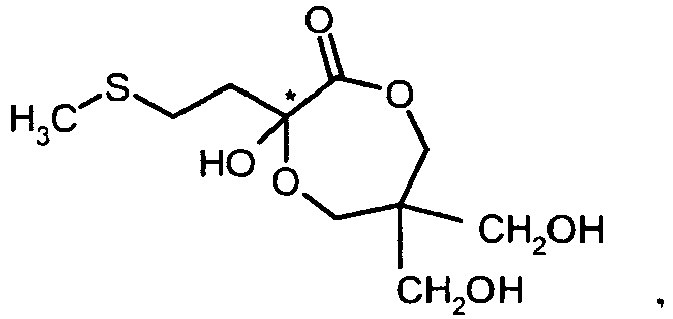
- Weiterhin bevorzugt ist eine Verbindung gemäß Formel 1,4, bei der R5 ein C3H5-Rest ist.
- Besonders bevorzugt ist dabei eine Verbindung gekennzeichnet durch die Formel (1,2-Ketal)


- Beide Verbindungen - das 1,2-Ketal und das 1,3-Ketal - können aus Ketomethionin und Glycerin in Gegenwart saurer Katalysatoren, vorzugsweise unter wasserentziehenden Bedingungen hergestellt werden.
- Alle Verbindungen der allgemeinen Formel I eignen sich erfindungsgemäß hervorragend zur Verwendung in der Tierernährung, vorzugsweise zur Ernährung von Nutztieren.
- Dabei bevorzugt ist die Verwendung zur Ernährung von Wiederkäuern, insbesondere von Milchkühen.
- Zu diesem Zweck können die erfindungsgemäßen Verbindungen zur Herstellung von Futtermitteln verwendet werden.
- Dabei wiederum bevorzugt ist die Verwendung zur Herstellung von Futtermitteln für Wiederkäuer.
- Ebenso Gegenstand der vorliegenden Erfindung sind Futtermittelzubereitungen, enthaltend mindestens eine der vorstehend genannten erfindungsgemäßen Verbindungen, vorzugsweise zur Ernährung von Wiederkäuern.
- Demgemäß können Mischungen der erfindungsgemäßen Verbindungen mit gängigen Futtermitteln hergestellt werden. Dazu werden die erfindungsgemäßen Verbindungen in geeigneten Mengen in handelsübliche Futterarten, wie Mineralfutter, organische Futter (z.B. Sojaschrot) oder Milchleistungsfutter eingemischt.
- Geeignete Mengen sind in der Regel Anteile von 0,1% bis 5% an Methioninäquivalenten in Form der erfindungsgemäßen Verbindungen, wobei die Anteile je nach Futterart verschieden sind. Milchleistungsfutter wird vorzugsweise mit < 0.5% an Methioninäquivalenten gemischt, Mineralfutter mit bis zu 5% und organische Futter im Bereich von 0,5 bis 3%, vorzugsweise bis 1%. Ein Methioninäquivalent ist in diesem Zusammenhang der Gewichtsanteil an erfindungsgemäßer Verbindung, der der gleichen Menge an Methionin auf molarer Basis entspricht.
- Ein weiterer Gegenstand der vorliegenden Erfindung ist ein Verfahren zur Herstellung von Carbonsäure- oder Esterverbindungen der allgemeinen Formel I, 1-4, dadurch gekennzeichnet, dass man Ketomethionin mit einem entsprechenden einwertigen, zweiwertigen, dreiwertigen Alkohol oder einem C3-C12-Zucker in Gegenwart saurer Katalysatoren zum Esterprodukt der Formel 1 - 2, mit R = OR' ; oder zum Esterprodukt 3-4 umsetzt.
- Entsprechend der genannten bevorzugten Verbindungen wird dabei ein Verfahren bevorzugt, bei dem als Alkohol ein verzweigter oder geradekettiger C1-C18-Alkylalkohol bzw.C3-C19-Cycloalkylalkohol, Allylalkohol, Benzylalkohol, Phenylalkohol, C2-C6-Hydroxyalkylalkohol, vorzugsweise HOC2H4OH, C3-C6-Dihydroxyalkylalkohol, vorzugsweise Glycerin, oder einen C3-C12-Zucker, bevorzugt Glycerinaldehyd, Dihydroxyaceton, Glucose, Fructose oder Saccharose eingesetzt werden.
- Dabei kann insbesondere durch geeignete Auswahl der Menge der Moläquivalente des zur Ketalisierung benötigten Alkohols bzw. Zuckers die Bildung des gewünschten Produktes beeinflusst werden. Bei Verwendung von einem Moläquivalent C1-C18-Alkylalkohol bildet sich bevorzugt der nichterfindungsgemäße entsprechende Ester, bei Verwendung von zwei Moläquivalenten bildet sich bevorzugt das Carbonsäureketal der Formel I, 1 mit R = OH und bei Verwendung von drei Moläquivalenten bevorzugt die entsprechenden Esterketale der Formel I, 1 mit R = OR'. Entsprechend wird bei Einsatz von einem halben Moläquivalent C2-C6-Hydroxyalkylalkohol - wie z.B. HOC2H4OH -, entsprechend zwei Hydroxyäquivalenten das entsprechende Carbonsäureketal der Formel I, 2 mit R = OH und R3 = C2H4 gebildet.
- Die Herstellung der Carbonsäure- oder Esterverbindungen kann vorteilhaft in Gegenwart eines Lösungsmittels durchgeführt werden. Geeignete Lösungsmittel sind beispielsweise aromatische Kohlenwasserstoffe wie Benzol oder Toluol sowie chlorierte Kohlenwasserstoffe wie Methylenchlorid oder Chloroform und Alkohole.
- Im Interesse einer möglichst hohen Ausbeute an gewünschten Kondensationsprodukten wird dabei ein Verfahren bevorzugt, bei dem während der Reaktion entstehendes Wasser aus dem Gleichgewicht entfernt wird. Dies kann sowohl destillativ, vorzugsweise durch Verwendung eines Lösungsmittels und/oder Schleppmittels wie beispielsweise Toluol erreicht werden. Vorteilhaft dabei ist, wenn das Lösemittel gleichzeitig Schleppmittel und ggf. noch als Reaktant fungiert. Auch können dabei die zur Veresterung bzw. Ketalisierung eingesetzten Alkohole zusätzlich als Lösungsmittel und/oder Schleppmittel verwendet werden.
- Bei Verwendung als Schleppmittel sollte das Lösungsmittel einen geeigneten Siedepunkt haben. Dieser sollte in der Regel 120°C nicht überschreiten. Für diesen Zweck geeignete Alkohole sind z.B. C1-C4-Alkylalkohole, also Methanol, Ethanol, 1- oder 2-Propanol und 1- oder 2-Butanol, Isobutanol, tert-Butanol.
- Eine andere Möglichkeit zur Wasserentfernung besteht in der Verwendung von Wasserentziehenden Mitteln beispielsweise von Orthoestern, wie zum Beispiel Orthoessigsäuretrimethylester oder -triethylester. Die dabei als Koppelprodukte entstehenden Essigsäuremethyl- bzw. - ethylester können anschließend leicht destillativ aus dem Reaktionsgemisch entfernt und weiterverwendet werden.
- Dabei können die nicht erfindungsgemäßen oder Carbonsäuresalze der allgemeinen Formel I, 1-2 oder 5, bei denen der Rest R = OH oder OM und der Rest X = H oder M ist, bevorzugt so hergestellt werden, indem ein Carbonsäureesterprodukt der Formel I, 1 oder 2 mit R = OR', oder der Formel I, 4 durch Verseifung mit einem Alkali- oder Erdalkalihydroxid oder einem ein- bzw. zweiwertigen Übergangsmetallhydroxid in das entsprechende Carbonsäuresalz der Formel I, 1 oder 2 mit R = OM bzw. der Formel 5 mit X = M überführt wird und ggf. daraus die freie Carbonsäure mit R = OH bzw. X= H mit Hilfe einer Mineralsäure freigesetzt wird. Geeignete Mineralsäuren sind dabei insbesondere Schwefelsäure, Salzsäure und Phosphorsäure.
- Gegenstand der Beschreibung (aber nicht der Erfindung) ist auch ein Verfahren zur Herstellung von Carbonsäuresalzen der allgemeinen Formel I, 1- 2 oder 5, wobei der Rest R = OM bzw. der Rest X = M ist, das dadurch gekennzeichnet ist, dass ein Säureprodukt der Formel I, 1 -2 mit R = OH bzw. ein Säureprodukt der Formel I, 5 mit X= H mit einem Alkali- oder Erdalkali- oder einem ein- bzw. zweiwertigen Übergangsmetallhydroxid oder - carbonat zur entsprechenden Carbonsäure neutralisiert wird.
- Zur Herstellung der oben genannten Carbonsäuresalze durch Verseifung oder Neutralisation werden dabei als Hydroxide NaOH, KOH, Mg (OH)2, Ca (OH)2, Zn(OH)2 oder Mn(OH)2 und als Carbonate Na2CO3, K2CO3, MgCO3, CaCO3, ZnCO3 oder MnCO3 bevorzugt verwendet.
- Gegenstand der Beschreibung (aber nicht der Erfindung) ist auch ein Verfahren zur Herstellung von Carbonsäureamiden der allgemeinen Formel I, 1-2 mit R = NH2, NHR', NR'R" , dadurch gekennzeichnet, dass ein Esterprodukt der Formel I, 1 -2, mit R = OR', durch Umsetzung mit einer N-haltigen Base der Formel NH3, NH2R' oder NHR'R" in das entsprechende Amid überführt wird.
- Gegenstand der Erfindung ist auch ein Verfahren zur Herstellung von Esterverbindungen der allgemeinen Formel I, 1 -2, mit R = OR', welches dadurch gekennzeichnet ist, dass ein Esterprodukt I ,1 -2, durch Umesterung mit einem Alkalialkoholat M'OR' (M' = Alkali) in ein entsprechendes Esterprodukt der Formel I, 1- 2 überführt wird, mit der Maßgabe, dass R' im eingesetzten Esterprodukt I, 1-2 nicht gleich dem Rest R' im eingesetzten Alkoholat M'OR' sein darf. Einmal hergestellte Ketomethioninketalester können auf diese Weise ganz leicht in andere gewünschte Ketomethioninketalester überführt werden.
- Die nicht erfindungsgemäßen Ketomethioninketale der allgemeinen Formel I, 1 ,2 bzw. 5 mit R = OH oder OM bzw., X= H oder M sind polare und nicht lipophile Verbindungen. Aufgrund der Ketal-Schutzgruppe sind diese Verbindungen pansenstabil und können nicht mikrobiell abgebaut werden. Durch die lipophobe Carbonsäuregruppe werden sie jedoch nicht wie HMBi über die Pansenwand absorbiert, sondern gelangen ohne Abbau in den Labmangen (Abomasum) des Wiederkäuers, wo sie aufgrund der stark sauren Bedingungen hydrolysiert werden. Die Absorption des freiwerdenden Ketomethionins erfolgt dann anschließend im Dünndarm.
- Bei den erfindungsgemäßen Ketomethioninketalestern der allgemeinen Formel I, 1, 2 mit R = OR' bzw. der allgemeinen Formel I, 4 handelt es sich um lipophile und nicht polare Verbindungen. Aufgrund der beiden chemischen Schutzgruppen "Ketal" und "Ester" sind diese Verbindungen pansenstabil. Die Absorption erfolgt im Gegensatz zu den Ketomethioninketalen schnell und effektiv über die Pansenwand analog dem Mechanismus von HMBi. Die anschließende enzymatische Spaltung zum freien Ketomethionin erfolgt dann im Blut des Wiederkäuers.
- Die Verwendung von Ketomethioninketalen oder Ketomethioninketalester ermöglicht damit erstmals eine aktive Steuerung der Absorptionsstelle des "Methioninäquivalents".
- Die Ketomethioninketale bzw. Ketomethioninketalester und deren Derivate haben mehrere Vorteile gegenüber den im Stand der Technik bekannten Verbindungen:
- Im Gegensatz zum freien Ketomethionin sind
- Ketomethioninketale, Ketomethioninketalester,
- Ketomethioninhalbketalester und Ketomethioninketalamide der allgemeinen Formel I in Hinblick auf Dimerisierung und
- Cyclisierung chemisch stabil, eine Voraussetzung für die Lagerung und Transport als Futtermitteladditive.
- Die Verwendung der Verbindungen der allgemeinen Formel I erlaubt die aktive Steuerung der Absorptionsstelle im Organismus des Wiederkäuers. Dabei erfolgt die Absorption der hydrophilen Ketomethioninketale der Formel I, 1, 2 mit R = OH, OM oder der Formel I, 5 mit X = H, M im Dünndarm nach Hydrolyse im Abomasum bzw. die Absorption der lipophilen Ketomethioninketalester der allgemeinen Formel I, 1, 2 mit R = OR' bzw. der allgemeinen Formel I, 4 direkt über die Pansenwand.
- Im Falle der Verwendung von bestimmten Diolen wie z.B. Ethylenglykol oder ausgewählten Triolen wie z.B. Glycerin oder Zuckern wie z.B. Glucose als Bausteine zur Ketal- bzw. Esterbildung mit Ketomethionin zu den entsprechenden Verbindungen der allgemeinen Formel I, besitzen diese zusätzlich eine nutritive Wirkung, aufgrund der im Organismus wieder freisetzbaren Zucker- bzw. Alkohol-Bausteine.
- Ketomethioninketale und Ketomethioninketalester besitzen eine sehr hohe Biowertigkeit, da sie in vivo zu α-Ketomethionin hydrolysiert werden können. Die Biowertigkeit von Ketomethionin ist dabei wesentlich höher als die von MHA, da es im Gegensatz dazu in nur einer Stufe im Organismus zu L-Methionin umgewandelt werden kann. Dagegen benötigt MHA zwei und HMBi sogar drei Stufen.
- Die hohe Biowertigkeit der Ketomethioninketale und Ketomethioninketalester stellt einen deutlichen wirtschaftlichen Vorteil dar, da weniger Futtermitteladditiv benötigt wird.
- Aufgrund des chemischen Schutzes kann das Produkt und damit der Pansenschutz nicht durch physikalische Kräfte wie z.B. Reibung beschädigt werden. Daher ist es im Vergleich zu einer physikalisch geschützten Methioninform wie z.B. Smartamine möglich, Ketomethioninketale, Ketomethioninketalester, Ketomethioninhalbketalester und Ketomethioninketalamide der allgemeinen Formel I zu pelletieren. Dies stellt einen außerordentlichen Vorteil dar, weil damit eine breite Verwendbarkeit bei der Mischfutter-Herstellung und -Konfektionierung sichergestellt wird.
- Darüber hinaus können die genannten Verbindungen der allgemeinen Formel I generell als Futtermitteladditive in der Nutztierhaltung eingesetzt werden, also auch bei der Ernährung von Geflügel oder Schweinen.
- Insbesondere Ketomethioninketale und Ketomethioninketalester können auf einfachere Art und damit zu in der Regel niedrigeren Herstellkosten als physikalisch geschützte Methioninformen produziert werden.
- Die symmetrischen Ketomethioninketale der allgemeinen Formel I sind achiral im Gegensatz zu MHA, HMBi oder D,L-Methionin. Das natürliche L-Methionin wird aus diesen achiralen Vorstufen im tierischen Organismus direkt gebildet. Eine Umwandlung des unnatürlichen Enantiomeren entfällt dadurch. Die nachfolgenden Beispiele zeigen Möglichkeiten zur Herstellung der erfindungsgemäßen Verbindungen auf ohne dabei beschränkend zu wirken.
-

- Zu einer Suspension aus 43.3 g Calcium-Ketomethioninat (M = 334.42 g/mol, 98% Reinheit, in der Trockenmasse 21% Wassergehalt) in 120 ml H2O und 320 ml Diethylether wurde bei 0°C unter kräftigem Rühren eine 10%ige wässrige Salzsäurelösung langsam zugetropft bis der pH-Wert < 2 erreicht wurde. Nach der Phasentrennung wurde die wässrige Phase dreimal mit je 120 ml Diethylether gewaschen. Anschließend werden die vereinten organischen Phasen über Na2SO4 getrocknet. Nach der Filtration des Trockenmittels wurde der Diethylether am Rotationsverdampfer bei 30°C und leichtem Vakuum abdestilliert. Die letzten Lösungsmittelreste wurden im Hochvakuum entfernt. Zurück blieben 29.1 g eines leicht gelblichen Öls an freiem Ketomethionin (Ausbeute = 98%, M = 148.18 g/mol).
- 1H-NMR von Calcium-Ketomethioninat 500 MHz, DMSO-d6):
- δ = 2.04 (s, 3H, CH3), 2.62 (t, 3 J = 7.3 Hz, 2H, CH2), 2.82 (t, 3 J = 7.3 Hz, 2H, CH2).
- 1H-NMR von Ketomethionin (500 MHz, DMSO-d6):
- δ = 2.06 (s, 3H, CH3), 2.66 (t, 3 J = 7.2 Hz, 2H, CH2), 3.09 (t, 3 J = 7.2 Hz, 2H, CH2).
- 13C-NMR von Ketomethionin (125.8 MHz, DMSO-d6): δ = 14.7 (CH3), 26.7 (CH2), 38.5 (CH2), 162.2 (COOH), 194.9 (CO).
-

- Eine Lösung von Ketomethionin (174 mmol, M = 148.18 g/mol) in Toluol (100 ml) wurde über 2 h tropfenweise zu einer Lösung von 1 g (~3 Mol%) p-Toluolsulfonsäure als Katalysator und Ethylenglykol (335 mmol, M = 62.07 g/mol) in Toluol (250 ml) zugegeben und die Reaktion solange unter Rückfluss gehalten bis sich am aufgesetzten Wasserabscheider kein weiteres Wasser mehr abschied (ca. 2 h). Anschließend wurde das Toluol unter Vakuum abgezogen und das Rohprodukt mit Methanol (200 ml) versetzt und nach Zugabe einer wässrigen Lösung von 2M Natriumhydroxid (200 ml) für ca. 2h alkalisch verseift. Die Reaktionslösung wurde anschließend mit Diethylether ausgeschüttelt und die wässerige Phase mit verdünnter Salzsäure angesäuert. Das Produkt wurde bei pH 1-2 mit Diethylether extrahiert, die organische Phase mit Wasser gewaschen, über Na2SO4 getrocknet und das Lösungsmittel am Rotationsverdampfer entfernt. Das ölige Produkt (I,2) wurde anschließend aus Methylenchlorid/n-Hexan umkristallisiert und fiel als weißer kristalliner Feststoff an. (24.6 g, Ausbeute = 74 %, M = 192,23 g/mol, Schmelzpunkt: 74°C Methylenchlorid/n-Hexan).
- 1H-NMR von 2-(2-(Methylthio)ethyl)-1,3-dioxolan-2-carbonsäure (I,2) (500 MHz, CDCl3) : δ = 2.11 (s, 3H, SCH3), 2.24-2.28 (m, 2H, CH2), 2.58-2.61 (m, 2H, CH2), 4.07-4.14 (m, 4H, OCH2CH2O).
- 13C-NMR von 2-(2-(Methylthio)ethyl)-1,3-dioxolan-2-carbonsäure (I,2) (125.8 MHz, CDCl3) : δ = 15.5 (SCH3), 27.1 (CH2), 34.9 (CH2), 66.1 (2 OCH2), 105.9 (C), 174.1 (COO).
- Elementaranalyse für C7H12O4S (M = 192,24 g/mol): C 43.74; H 6.29; S 16.68 Gefunden: C 43.80; H 6.25; S 16.61.
-

- Zu einer Lösung aus 1.0 g (5.20 mmol) 4-(Methylthio)-2-ketobuttersäure-ethylenketal in 2.0 ml Wasser und 3.0 ml Aceton wurde bei RT langsam eine wässrige Lösung aus 0.44 g Calciumacetat (93%ig) in 2 ml Wasser zugetropft. Anschließend wurden 3 ml Aceton zugegeben und über Nacht bei RT gerührt. Der gebildete weiße Feststoff wurde abgesaugt und mit 100 ml einer 1:10 Wasser-Aceton-Mischung gründlich gewaschen. Das Produkt wurde anschließend im Trockenschrank bzw. im Hochvakuum getrocknet. (0.96 g, Ausbeute = 82%, 6.3% Wassergehalt nach K.F.-Methode).
- 1H-NMR von Calcium 2-(2-(Methylthio)ethyl)-1,3-dioxolan-2-carboxylat (1,2) (500 MHz, DMSO-D6): δ = 1.98-2.00 (m, 2H, CH2, 2.03 (s, 3H, SCH3), 2.44-2.47 (m, 2H, CH2), 3.81-3.84 (m, 2H, CH2), 3.95-4.00 (m, 2H, CH2).
- 13C-NMR von Calcium 2-(2-(Methylthio)ethyl)-1,3-dioxolan-2-carboxylat (1,2) (125.8 MHz, DMSO-D6/DCl): δ = 15.1 (SCH3), 27.0 (CH2), 35.2 (CH2), 65.7, 66.0 (2 OCH2), 105.6 (C), 171.0 (COO).
-

- Zu einer Lösung aus 11.1 g Ketomethionin (75 mmol, M=148.18 g/mol) in 200 ml absolutem ethanolfreiem Chloroform wurden 8.9 g 2,2-Dimethyl-1,3-propandiol (85 mmol, M=104.15 g/mol) und 0.8 g(~5 Mol%) p-Toluolsulfonsäure als Katalysator zugegeben und solange unter Rückfluss gehalten bis sich am aufgesetzten Wasserabscheider.kein weiteres Wasser mehr abschied (ca. 3.5 h). Nach dem Abkühlen wurde die Lösung mit halbgesättigter NaHCO3-Lösung gewaschen, die wässrige Phase nochmals mit Chloroform rückgewaschen und die vereinten organischen Phasen über Na2SO4 getrocknet. Nach Filtration wurde das Lösungsmittel am Rotationsverdampfer entfernt und das ölige Rohprodukt aus Methylenchlorid/n-Hexan kristallisiert. Das Produkt (I,3) fiel als weißer kristalliner Feststoff an (10.8 g, Ausbeute = 62%, M = 234,32 g/mol, Schmelzpunkt = 109°C (Methylenchlorid/n-Hexan)).
- 1H-NMR von rac-4,4-Dimethyl-7-hydroxy-7-(2-(methylthio)-ethyl)-6-oxa-caprolacton (I,3) (500 MHz, CDCl3) : δ = 0.92 (s, 3H, CH3), 0.99 (s, 3H, CH3), 2.04-2.19 (m, 2H, CH2), 2.08 (s, 3H, SCH3),2.47-2.52 (m, 1H, SCHH), 2.61-2.66 (m, 1H, SCHH), 2.92 (d, 2 J = 8.0 Hz, 1H, OCHH), 3.25 (d, 2 J = 8.0 Hz, 1H, OCHH), 3.72 (d, 2 J = 10.4 Hz, 1H, COOCHH), 4.30 (d, 2 J = 10.4 Hz, 1H, COOCHH), 4.50 (s, 1H, OH).
- 13C-NMR von rac-4,4-Dimethyl-7-hydroxy-7-(2-(methylthio)-ethyl)-6-oxa-caprolacton (I,3) (125.8 MHz, CDCl3) : δ = 15.7 (SCH3), 21.9, 21.3 (2 CH3), 27.7 (CH2), 37.7 (CH2), 66.0 (OCH2), 70.9 (OCH2), 96.5 (COH), 172.5 (COO).
- Elementaranalyse für C10H18O4S (M = 234,32 g/mol): C 51.26; H 7.74; S 13.68 Gefunden: C 50.82; H 7.73; S 13.52.
-

- Zu einer Lösung aus 12.0 g Keto-Methionin (81 mmol, M = 148.18 g/mol) in 120 ml absolutem Toluol wurden 7.8 g Glycerin (1,2,3-Propantriol)(85 mmol, M = 92.09 g/mol) und 0.8 g (~5 Mol%) p-Toluolsulfonsäure als Katalysator zugegeben und solange unter Rückfluss gehalten bis sich am aufgesetzten Wasserabscheider kein weiteres Wasser mehr abschied (ca. 2.5 h). Nach dem Abkühlen wurde die Lösung mit halbgesättigter NaHCO3-Lösung gewaschen, die wässrige Phase nochmals mit Chloroform rückgewaschen und die vereinten organischen Phasen über Na2SO4 getrocknet. Nach Filtration wurde das Lösungsmittel am Rotationsverdampfer entfernt und das ölige Rohprodukt (Verhältnis (1,3-Ketal: 1,2-Ketal = 70:30) chromatographiert (Diethylether/n-Hexan 1:1). Dabei wurden die beiden Verbindungen voneinander getrennt. Das Hauptprodukt (1,3-Ketal) kristallisierte in Form farbloser Nadeln aus einer Mischung aus Methylenchlorid/n-Hexan aus (8.8 g, Ausbeute = 53%, M = 204,25 g/mol, Schmelzpunkt = 39.5°C (Methylenchlorid/n-Hexan)).
- 1H-NMR von 4-(2-(Methylthio)ethyl)-2,5,8-trioxabicyclo[2.2.2]-octan-3-on (1,3-Ketal) (500 MHz, CDCl3): δ = 2.13 (s, 3H, SCH3), 2.17-2.20 (m, 2H, CH2), 2.65-2.68 (m, 2H, CH2), 4.12-4.13 (m, 4H, 2 CH2), 4.76 (s, 1H, CH).
- 13C-NMR von 4-(2-(Methylthio)ethyl)-2,5,8-trioxabicyclo[2.2.2]-octan-3-on (1,3-Ketal) (125.8 MHz, CDC13) : δ = 15.4 (SCH3), 26.9 (CH2), 33.2 (CH2), 66.5 (2 OCH2), 70.9 (CH), 92.9 (C), 166.2 (COO).
- Elementaranalyse für C8H12O4S (M = 204,25 g/mol): C 47.04; H 5.92; S 15.70 Gefunden: C 47.21; H 5.93; S 15.69.
-

- Zu einer Suspension aus 50 mg (0.24 mmol) des 1,3-Ketals aus Beispiel 5 in 1.0 ml Methanol und 1.5 ml Wasser wurde bei RT 15 mg Kaliumhydroxid zugegeben und die Lösung 30 Min bei RT gerührt. Nach Entfernen des Lösungsmittels und Trocknung unter Vakuum wurde das Produkt als ein weißer Feststoff erhalten. (0.60 g, Ausbeute = 96%).
- 1H-NMR von Kalium 5-hydroxy-2-(2-(methylthio)ethyl)-1,3-dioxan-2-carboxylat (500 MHz, D2O/TSP): δ = 1.96-2.02 (m, 2H, CH2), 2.10 (t, 3H, CH3), 2.51-2.54 (m, 2H, CH2), 3.48-3.52 (m, 2H, CH2), 3.81-3.87 (m, 1H, CH), 3.98-4.01 (m, 2H, CH2).
Claims (15)
- Chemische Verbindung der allgemeinen Formel I


C3-C18-Cycloalkyl-,
Allyl-,
Benzyl-,
Phenyl- oder
C1-C18-Alkyloxymethyl-, vorzugsweise C2H5OCH2 C2-C6-Hydroxyalkyl-, vorzugsweise HOC2H4-, C3-C6-Dihydroxyalkyl-, vorzugsweise (HO)2C3H5-, oder ein C3-C12-Zuckerrest, bei dem eine OH-Gruppe des Zuckers jeweils vom Ketal-O-Atom oder vom Carbonsäure-O-Atom ersetzt ist,
oder A =
wobei R' jeweils ein verzweigtes oder geradkettiges C1-C18-Alkyl- bzw.
C3-C18-Cycloalkyl-,
Allyl-,
Benzyl-,
Phenyl- oder
C1-C18-Alkyloxymethyl-, vorzugsweise C2H5OCH2-,
C2-C6-Hydroxyalkyl-, vorzugsweise HOC2H4-,
C3-C6-Dihydroxyalkyl-, vorzugsweise (HO)2C3H5-, oder ein C3-C12-Zuckerrest, bei dem eine OH-Gruppe des Zuckers vom Carbonsäure-O-Atom ersetzt ist
und R3 eine C2-C4-Alkylenbrücke darstellt, vorzugsweise C2H4, oder einen C3-C12-Zuckerrest, bei dem zwei OH-Gruppen des Zuckers von den beiden Ketal-O-Atomen ersetzt sind,
oder A =
oder A =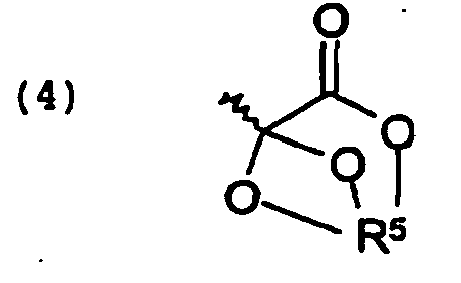
- Verbindung gemäß Anspruch 1, dadurch gekennzeichnet,
dass R = OR' und R'= C1-C18-Alkyl und R3 = C2H4 ist, bevorzugt
dass R' = C1-C4-Alkyl ist, oder
dass R = OR' und R'= Hydroxyethoxy und R3 = C2H4 ist, oder dass R4 ein C5H10-Rest oder ein C5H10O2-Rest ist. - Verbindung gemäß Anspruch 2, gekennzeichnet durch die Formel:

- Verbindung gemäß Anspruch 1, dadurch gekennzeichnet, dass R5 ein C3H5-Rest ist.
- Verbindung gemäß Anspruch 4, gekennzeichnet durch die Formel:

durch die Formel:
- Verwendung von Verbindungen gemäß Anspruch 1 - 5 in der Tierernährung.
- Verwendung gemäß Anspruch 6 zur Ernährung von Wiederkäuern.
- Verwendung von Verbindungen gemäß Anspruch 1 - 5 zur Herstellung von Futtermitteln.
- verwendung gemäß Anspruch 8 zur Herstellung von Futtermitteln für Wiederkäuer.
- Futtermittelzubereitung, enthaltend mindestens eine Verbindung gemäß Anspruch 1 - 5.
- Futtermittelzubereitung gemäß Anspruch 9 zur Ernährung von Wiederkäuern.
- Verfahren zur Herstellung von Carbonsäure- oder Esterverbindungen der allgemeinen Formel I, 1 - 4 gemäß Anspruch 1, dadurch gekennzeichnet, dass man Ketomethionin mit einem entsprechenden einwertigen, zweiwertigen, dreiwertigen Alkohol oder einem C3-C12-Zucker in Gegenwart saurer Katalysatoren zum Esterprodukt der Formel 1 - 2, mit R = OR' oder zum Esterprodukt 3-4
umsetzt. - Verfahren gemäß Anspruch 12, dadurch gekennzeichnet, dass als Alkohol ein verzweigter oder geradekettiger C1-C18-Alkylalkohol bzw. C3-C18-Cycloalkylalkohol, Allylalkohol, Benzylalkohol, Phenylalkohol, C2-C6-Hydroxyalkylalkohol, vorzugsweise HOC2H4OH, C3-C6-Dihydroxyalkylalkohol, vorzugsweise Glycerin, oder einen C3-C12-Zucker, vorzugsweise Glycerinaldehyd, Dihydroxyaceton, Glucose, Fructose oder Saccharose eingesetzt werden.
- Verfahren gemäß einem der Ansprüche 12 - 13, dadurch gekennzeichnet, dass während der Reaktion entstehendes Wasser entfernt wird.
- Verfahren zur Herstellung von Esterverbindungen der allgemeinen Formel I, 1 -2 gemäß Anspruch 1, mit R = OR', dadurch gekennzeichnet, dass ein Esterprodukt I,1 -2, durch Umesterung mit Alkalialkoholat M'OR' in ein entsprechendes Esterprodukt der Formel I, 1 - 2 überführt wird, mit der Maßgabe, dass R' im eingesetzten Esterprodukt 1-2 nicht gleich dem Rest R' im eingesetzten Alkoholat M'OR' sein darf.
Applications Claiming Priority (2)
| Application Number | Priority Date | Filing Date | Title |
|---|---|---|---|
| DE102006055470A DE102006055470A1 (de) | 2006-11-24 | 2006-11-24 | Ketomethioninketale und deren Derivate |
| PCT/EP2007/061908 WO2008061871A1 (de) | 2006-11-24 | 2007-11-06 | Ketomethioninketale und deren derivate |
Publications (2)
| Publication Number | Publication Date |
|---|---|
| EP2091934A1 EP2091934A1 (de) | 2009-08-26 |
| EP2091934B1 true EP2091934B1 (de) | 2013-04-24 |
Family
ID=39046826
Family Applications (1)
| Application Number | Title | Priority Date | Filing Date |
|---|---|---|---|
| EP07822235.3A Not-in-force EP2091934B1 (de) | 2006-11-24 | 2007-11-06 | Ketomethioninketale und deren derivate |
Country Status (11)
| Country | Link |
|---|---|
| US (1) | US7815950B2 (de) |
| EP (1) | EP2091934B1 (de) |
| JP (1) | JP5096481B2 (de) |
| CN (1) | CN101541777A (de) |
| BR (1) | BRPI0719340A2 (de) |
| CA (1) | CA2669893C (de) |
| DE (1) | DE102006055470A1 (de) |
| ES (1) | ES2422298T3 (de) |
| MX (1) | MX2009005101A (de) |
| MY (1) | MY147268A (de) |
| WO (1) | WO2008061871A1 (de) |
Families Citing this family (17)
| Publication number | Priority date | Publication date | Assignee | Title |
|---|---|---|---|---|
| BRPI0618901A2 (pt) | 2005-11-22 | 2011-09-13 | Aromagen Corp | cetais de glicerol levulinatos e seus usos |
| DE102007031917A1 (de) * | 2007-07-09 | 2009-01-15 | Evonik Degussa Gmbh | Verfahren zur Herstellung von Ketosäuren und deren Derivaten |
| DE102007062199A1 (de) * | 2007-12-21 | 2009-06-25 | Evonik Degussa Gmbh | 2-Methylthioethyl-substituierte Heterocyclen als Futtermitteladditive |
| EP2367811A1 (de) * | 2008-09-25 | 2011-09-28 | Segetis, Inc. | Ketalesterderivate |
| DE102008042932A1 (de) | 2008-10-17 | 2010-04-22 | Evonik Degussa Gmbh | Herstellung und Verwendung von Methionylmethionin als Futtermitteladditiv für Fische und Krustentiere |
| DE102009002044A1 (de) * | 2009-03-31 | 2010-10-07 | Evonik Degussa Gmbh | Dipeptide als Futtermitteladditive |
| CN102459219A (zh) | 2009-06-22 | 2012-05-16 | 赛格提斯公司 | 缩酮化合物及其用途 |
| US20110300083A1 (en) | 2010-05-10 | 2011-12-08 | Segetis, Inc. | Personal care formulations containing alkyl ketal esters and methods of manufacture |
| AU2011289224B2 (en) * | 2010-08-12 | 2015-04-16 | Gfbiochemicals Limited | Carboxy ester ketal removal compositions, methods of manufacture, and uses thereof |
| US9074065B2 (en) | 2010-08-12 | 2015-07-07 | Segetis, Inc. | Latex coating compositions including carboxy ester ketal coalescents, methods of manufacture, and uses thereof |
| US8632612B2 (en) | 2010-09-07 | 2014-01-21 | Segetis, Inc. | Compositions for dyeing keratin fibers |
| WO2012054505A2 (en) | 2010-10-18 | 2012-04-26 | Segetis, Inc. | Water reducible coating compositions including carboxy ester ketals, methods of manufacture, and uses thereof |
| US20130087073A1 (en) * | 2011-10-11 | 2013-04-11 | Segetis, Inc. | Stabilized levulinic ester ketals |
| WO2014047428A1 (en) | 2012-09-21 | 2014-03-27 | Segetis, Inc. | Cleaning, surfactant, and personal care compositions |
| WO2014085609A1 (en) | 2012-11-29 | 2014-06-05 | Segetis, Inc. | Carboxy ester ketals, methods of manufacture, and uses thereof |
| CN103073558A (zh) * | 2013-01-04 | 2013-05-01 | 华南理工大学 | 一种合成1-甲基-2-氧代-3,6,7-三氧杂二环[2,2,2]辛烷的方法 |
| CN117924309A (zh) * | 2024-01-17 | 2024-04-26 | 北京大学 | 一种大环(缩酮-酯)单体和可化学回收的聚(缩酮-酯)及其合成方法 |
Family Cites Families (7)
| Publication number | Priority date | Publication date | Assignee | Title |
|---|---|---|---|---|
| DE2205210C3 (de) * | 1972-02-04 | 1978-09-21 | Deutsche Gold- Und Silber-Scheideanstalt Vormals Roessler, 6000 Frankfurt | Futtermittel für Wiederkäuer |
| DE3917880A1 (de) * | 1989-06-01 | 1990-12-06 | Kali Chemie Ag | Neue acylaminosaeurederivate enthaltende arzneimittel und diaetetika |
| JP2926352B2 (ja) * | 1990-05-15 | 1999-07-28 | 日本曹達株式会社 | 無発情または鈍性発情牛の治療方法 |
| US6017563A (en) * | 1997-07-25 | 2000-01-25 | Novus International, Inc. | Process for optimizing milk production |
| FR2785773B1 (fr) * | 1998-11-13 | 2001-04-20 | Rhone Poulenc Nutrition Animal | Utilisation d'esters de methionine en nutrition animale |
| FR2880345A1 (fr) * | 2004-12-30 | 2006-07-07 | Adisseo Ireland Ltd | Synthese et applications de l'acide 2-oxo-4-methylthiobutyrique, ses tels et ses derives |
| FR2890535B1 (fr) * | 2005-09-12 | 2012-04-20 | Adisseo Ireland Ltd | Combinaison de methionine biodisponible avec au moins une huile essentielle |
-
2006
- 2006-11-24 DE DE102006055470A patent/DE102006055470A1/de not_active Withdrawn
-
2007
- 2007-11-06 WO PCT/EP2007/061908 patent/WO2008061871A1/de not_active Ceased
- 2007-11-06 CA CA2669893A patent/CA2669893C/en not_active Expired - Fee Related
- 2007-11-06 EP EP07822235.3A patent/EP2091934B1/de not_active Not-in-force
- 2007-11-06 CN CNA2007800431867A patent/CN101541777A/zh active Pending
- 2007-11-06 BR BRPI0719340-8A2A patent/BRPI0719340A2/pt not_active IP Right Cessation
- 2007-11-06 MX MX2009005101A patent/MX2009005101A/es active IP Right Grant
- 2007-11-06 ES ES07822235T patent/ES2422298T3/es active Active
- 2007-11-06 JP JP2009537588A patent/JP5096481B2/ja not_active Expired - Fee Related
- 2007-11-06 MY MYPI20091916A patent/MY147268A/en unknown
- 2007-11-20 US US11/943,082 patent/US7815950B2/en not_active Expired - Fee Related
Also Published As
| Publication number | Publication date |
|---|---|
| DE102006055470A1 (de) | 2008-05-29 |
| RU2009123646A (ru) | 2010-12-27 |
| BRPI0719340A2 (pt) | 2014-02-04 |
| US7815950B2 (en) | 2010-10-19 |
| CA2669893A1 (en) | 2008-05-29 |
| MY147268A (en) | 2012-11-30 |
| JP5096481B2 (ja) | 2012-12-12 |
| JP2010509928A (ja) | 2010-04-02 |
| CN101541777A (zh) | 2009-09-23 |
| EP2091934A1 (de) | 2009-08-26 |
| ES2422298T3 (es) | 2013-09-10 |
| CA2669893C (en) | 2014-12-30 |
| WO2008061871A1 (de) | 2008-05-29 |
| MX2009005101A (es) | 2009-05-27 |
| US20080124426A1 (en) | 2008-05-29 |
Similar Documents
| Publication | Publication Date | Title |
|---|---|---|
| EP2091934A1 (de) | Ketomethioninketale und deren derivate | |
| EP2348881B1 (de) | Herstellung und verwendung von methionylmethionin als futtermitteladditiv für fische und krustentiere | |
| EP2953480B1 (de) | Verbesserung der bioverfügbarkeit von wertstoffen aus mikroorganismen | |
| DE60317770T2 (de) | Astaxanthinester | |
| EP2762008A1 (de) | Verbesserung der Bioverfügbarkeit von Wertstoffen aus Mikroorganismen durch Verwendung eines Rotor-Stator Systems für den Zellaufschluss | |
| DE102010029399A1 (de) | Cyclische Dipeptide als Futtermitteladditive | |
| EP0035119A2 (de) | Polyätherverbindungen und ihre Herstellung, entsprechende Präparate und die Verwendung dieser Produkte als Heilmittel oder wachstumsfördernde Mittel bei Wiederkäuern | |
| EP2222654B1 (de) | 2-methylthioethyl-substituierte heterocyclen als futtermitteladditive | |
| DE2710930A1 (de) | Futterzusatz fuer wiederkaeuer | |
| EP0279219B1 (de) | Mittel gegen Protozoen bei Insekten | |
| NZ196809A (en) | Cyclopropane carboxylic acid derivatives and pesticidal compositions:intermediates | |
| DE3878535T2 (de) | Antiparasit-derivate. | |
| DE2035814B2 (de) | Pleuromutilin-Derivate, Verfahren zu ihrer Herstellung und Verwendung | |
| RU2483062C2 (ru) | Кетометионинкетали и их производные | |
| DE102016203477A1 (de) | Herstellung und Verwendung von Alkalimetalldiformiaten mit mittelkettigen Fettsäurederivaten | |
| WO2004057977A1 (de) | Verwendung von hydroformiat(en) | |
| DD209812A5 (de) | Verfahren zur herstellung von carbazinsaeurederivaten | |
| DE2902889A1 (de) | Tierfutterzusatz, verfahren zur herstellung desselben und verwendung desselben | |
| KR102838363B1 (ko) | 펩신 소화율이 우수한 고단백 미세조류 바이오매스, 배양 방법 및 이의 용도 | |
| EP0523582A1 (de) | Verbessertes Verfahren zur Herstellung des Mononatriumsalzes von Riboflavin 5'-phosphat | |
| DE1926522C (de) | Gegen Pilze wirksame Zubereitungen | |
| RU2050147C1 (ru) | Способ откорма сельскохозяйственной птицы | |
| EP0011859A1 (de) | Urethan-Derivate und deren Salze, die Herstellung dieser Verbindungen, sowie entsprechende Präparate | |
| DE1223676B (de) | Futtermittel | |
| DE3535664A1 (de) | Fungizide mittel auf imidazolinylpyridin-derivat-basis |
Legal Events
| Date | Code | Title | Description |
|---|---|---|---|
| PUAI | Public reference made under article 153(3) epc to a published international application that has entered the european phase |
Free format text: ORIGINAL CODE: 0009012 |
|
| 17P | Request for examination filed |
Effective date: 20090522 |
|
| AK | Designated contracting states |
Kind code of ref document: A1 Designated state(s): AT BE BG CH CY CZ DE DK EE ES FI FR GB GR HU IE IS IT LI LT LU LV MC MT NL PL PT RO SE SI SK TR |
|
| DAX | Request for extension of the european patent (deleted) | ||
| 17Q | First examination report despatched |
Effective date: 20100512 |
|
| GRAP | Despatch of communication of intention to grant a patent |
Free format text: ORIGINAL CODE: EPIDOSNIGR1 |
|
| GRAS | Grant fee paid |
Free format text: ORIGINAL CODE: EPIDOSNIGR3 |
|
| GRAA | (expected) grant |
Free format text: ORIGINAL CODE: 0009210 |
|
| AK | Designated contracting states |
Kind code of ref document: B1 Designated state(s): AT BE BG CH CY CZ DE DK EE ES FI FR GB GR HU IE IS IT LI LT LU LV MC MT NL PL PT RO SE SI SK TR |
|
| REG | Reference to a national code |
Ref country code: GB Ref legal event code: FG4D Free format text: NOT ENGLISH |
|
| REG | Reference to a national code |
Ref country code: CH Ref legal event code: EP |
|
| REG | Reference to a national code |
Ref country code: AT Ref legal event code: REF Ref document number: 608578 Country of ref document: AT Kind code of ref document: T Effective date: 20130515 |
|
| REG | Reference to a national code |
Ref country code: IE Ref legal event code: FG4D Free format text: LANGUAGE OF EP DOCUMENT: GERMAN |
|
| REG | Reference to a national code |
Ref country code: DE Ref legal event code: R096 Ref document number: 502007011673 Country of ref document: DE Effective date: 20130620 |
|
| REG | Reference to a national code |
Ref country code: ES Ref legal event code: FG2A Ref document number: 2422298 Country of ref document: ES Kind code of ref document: T3 Effective date: 20130910 |
|
| REG | Reference to a national code |
Ref country code: LT Ref legal event code: MG4D |
|
| REG | Reference to a national code |
Ref country code: NL Ref legal event code: VDEP Effective date: 20130424 |
|
| PG25 | Lapsed in a contracting state [announced via postgrant information from national office to epo] |
Ref country code: PT Free format text: LAPSE BECAUSE OF FAILURE TO SUBMIT A TRANSLATION OF THE DESCRIPTION OR TO PAY THE FEE WITHIN THE PRESCRIBED TIME-LIMIT Effective date: 20130826 Ref country code: IS Free format text: LAPSE BECAUSE OF FAILURE TO SUBMIT A TRANSLATION OF THE DESCRIPTION OR TO PAY THE FEE WITHIN THE PRESCRIBED TIME-LIMIT Effective date: 20130824 Ref country code: SE Free format text: LAPSE BECAUSE OF FAILURE TO SUBMIT A TRANSLATION OF THE DESCRIPTION OR TO PAY THE FEE WITHIN THE PRESCRIBED TIME-LIMIT Effective date: 20130424 Ref country code: LT Free format text: LAPSE BECAUSE OF FAILURE TO SUBMIT A TRANSLATION OF THE DESCRIPTION OR TO PAY THE FEE WITHIN THE PRESCRIBED TIME-LIMIT Effective date: 20130424 Ref country code: FI Free format text: LAPSE BECAUSE OF FAILURE TO SUBMIT A TRANSLATION OF THE DESCRIPTION OR TO PAY THE FEE WITHIN THE PRESCRIBED TIME-LIMIT Effective date: 20130424 Ref country code: SI Free format text: LAPSE BECAUSE OF FAILURE TO SUBMIT A TRANSLATION OF THE DESCRIPTION OR TO PAY THE FEE WITHIN THE PRESCRIBED TIME-LIMIT Effective date: 20130424 Ref country code: GR Free format text: LAPSE BECAUSE OF FAILURE TO SUBMIT A TRANSLATION OF THE DESCRIPTION OR TO PAY THE FEE WITHIN THE PRESCRIBED TIME-LIMIT Effective date: 20130725 |
|
| PG25 | Lapsed in a contracting state [announced via postgrant information from national office to epo] |
Ref country code: LV Free format text: LAPSE BECAUSE OF FAILURE TO SUBMIT A TRANSLATION OF THE DESCRIPTION OR TO PAY THE FEE WITHIN THE PRESCRIBED TIME-LIMIT Effective date: 20130424 Ref country code: CY Free format text: LAPSE BECAUSE OF FAILURE TO SUBMIT A TRANSLATION OF THE DESCRIPTION OR TO PAY THE FEE WITHIN THE PRESCRIBED TIME-LIMIT Effective date: 20130424 Ref country code: PL Free format text: LAPSE BECAUSE OF FAILURE TO SUBMIT A TRANSLATION OF THE DESCRIPTION OR TO PAY THE FEE WITHIN THE PRESCRIBED TIME-LIMIT Effective date: 20130424 Ref country code: BG Free format text: LAPSE BECAUSE OF FAILURE TO SUBMIT A TRANSLATION OF THE DESCRIPTION OR TO PAY THE FEE WITHIN THE PRESCRIBED TIME-LIMIT Effective date: 20130724 |
|
| PG25 | Lapsed in a contracting state [announced via postgrant information from national office to epo] |
Ref country code: SK Free format text: LAPSE BECAUSE OF FAILURE TO SUBMIT A TRANSLATION OF THE DESCRIPTION OR TO PAY THE FEE WITHIN THE PRESCRIBED TIME-LIMIT Effective date: 20130424 Ref country code: CZ Free format text: LAPSE BECAUSE OF FAILURE TO SUBMIT A TRANSLATION OF THE DESCRIPTION OR TO PAY THE FEE WITHIN THE PRESCRIBED TIME-LIMIT Effective date: 20130424 Ref country code: EE Free format text: LAPSE BECAUSE OF FAILURE TO SUBMIT A TRANSLATION OF THE DESCRIPTION OR TO PAY THE FEE WITHIN THE PRESCRIBED TIME-LIMIT Effective date: 20130424 Ref country code: DK Free format text: LAPSE BECAUSE OF FAILURE TO SUBMIT A TRANSLATION OF THE DESCRIPTION OR TO PAY THE FEE WITHIN THE PRESCRIBED TIME-LIMIT Effective date: 20130424 |
|
| PG25 | Lapsed in a contracting state [announced via postgrant information from national office to epo] |
Ref country code: RO Free format text: LAPSE BECAUSE OF FAILURE TO SUBMIT A TRANSLATION OF THE DESCRIPTION OR TO PAY THE FEE WITHIN THE PRESCRIBED TIME-LIMIT Effective date: 20130424 Ref country code: IT Free format text: LAPSE BECAUSE OF FAILURE TO SUBMIT A TRANSLATION OF THE DESCRIPTION OR TO PAY THE FEE WITHIN THE PRESCRIBED TIME-LIMIT Effective date: 20130424 Ref country code: NL Free format text: LAPSE BECAUSE OF FAILURE TO SUBMIT A TRANSLATION OF THE DESCRIPTION OR TO PAY THE FEE WITHIN THE PRESCRIBED TIME-LIMIT Effective date: 20130424 |
|
| PLBE | No opposition filed within time limit |
Free format text: ORIGINAL CODE: 0009261 |
|
| STAA | Information on the status of an ep patent application or granted ep patent |
Free format text: STATUS: NO OPPOSITION FILED WITHIN TIME LIMIT |
|
| 26N | No opposition filed |
Effective date: 20140127 |
|
| REG | Reference to a national code |
Ref country code: DE Ref legal event code: R097 Ref document number: 502007011673 Country of ref document: DE Effective date: 20140127 |
|
| GBPC | Gb: european patent ceased through non-payment of renewal fee |
Effective date: 20131106 |
|
| PG25 | Lapsed in a contracting state [announced via postgrant information from national office to epo] |
Ref country code: MC Free format text: LAPSE BECAUSE OF FAILURE TO SUBMIT A TRANSLATION OF THE DESCRIPTION OR TO PAY THE FEE WITHIN THE PRESCRIBED TIME-LIMIT Effective date: 20130424 |
|
| REG | Reference to a national code |
Ref country code: IE Ref legal event code: MM4A |
|
| PG25 | Lapsed in a contracting state [announced via postgrant information from national office to epo] |
Ref country code: IE Free format text: LAPSE BECAUSE OF NON-PAYMENT OF DUE FEES Effective date: 20131106 |
|
| PG25 | Lapsed in a contracting state [announced via postgrant information from national office to epo] |
Ref country code: GB Free format text: LAPSE BECAUSE OF NON-PAYMENT OF DUE FEES Effective date: 20131106 |
|
| REG | Reference to a national code |
Ref country code: AT Ref legal event code: MM01 Ref document number: 608578 Country of ref document: AT Kind code of ref document: T Effective date: 20131106 |
|
| PG25 | Lapsed in a contracting state [announced via postgrant information from national office to epo] |
Ref country code: AT Free format text: LAPSE BECAUSE OF NON-PAYMENT OF DUE FEES Effective date: 20131106 |
|
| PG25 | Lapsed in a contracting state [announced via postgrant information from national office to epo] |
Ref country code: TR Free format text: LAPSE BECAUSE OF FAILURE TO SUBMIT A TRANSLATION OF THE DESCRIPTION OR TO PAY THE FEE WITHIN THE PRESCRIBED TIME-LIMIT Effective date: 20130424 |
|
| PG25 | Lapsed in a contracting state [announced via postgrant information from national office to epo] |
Ref country code: LU Free format text: LAPSE BECAUSE OF NON-PAYMENT OF DUE FEES Effective date: 20131106 Ref country code: HU Free format text: LAPSE BECAUSE OF FAILURE TO SUBMIT A TRANSLATION OF THE DESCRIPTION OR TO PAY THE FEE WITHIN THE PRESCRIBED TIME-LIMIT; INVALID AB INITIO Effective date: 20071106 |
|
| PG25 | Lapsed in a contracting state [announced via postgrant information from national office to epo] |
Ref country code: MT Free format text: LAPSE BECAUSE OF FAILURE TO SUBMIT A TRANSLATION OF THE DESCRIPTION OR TO PAY THE FEE WITHIN THE PRESCRIBED TIME-LIMIT Effective date: 20130424 |
|
| REG | Reference to a national code |
Ref country code: FR Ref legal event code: PLFP Year of fee payment: 9 |
|
| REG | Reference to a national code |
Ref country code: FR Ref legal event code: PLFP Year of fee payment: 10 |
|
| PGFP | Annual fee paid to national office [announced via postgrant information from national office to epo] |
Ref country code: DE Payment date: 20161121 Year of fee payment: 10 Ref country code: FR Payment date: 20161118 Year of fee payment: 10 Ref country code: CH Payment date: 20161121 Year of fee payment: 10 |
|
| PGFP | Annual fee paid to national office [announced via postgrant information from national office to epo] |
Ref country code: BE Payment date: 20161118 Year of fee payment: 10 Ref country code: ES Payment date: 20161110 Year of fee payment: 10 |
|
| REG | Reference to a national code |
Ref country code: DE Ref legal event code: R119 Ref document number: 502007011673 Country of ref document: DE |
|
| PG25 | Lapsed in a contracting state [announced via postgrant information from national office to epo] |
Ref country code: LI Free format text: LAPSE BECAUSE OF NON-PAYMENT OF DUE FEES Effective date: 20171130 Ref country code: CH Free format text: LAPSE BECAUSE OF NON-PAYMENT OF DUE FEES Effective date: 20171130 |
|
| REG | Reference to a national code |
Ref country code: FR Ref legal event code: ST Effective date: 20180731 Ref country code: BE Ref legal event code: MM Effective date: 20171130 |
|
| PG25 | Lapsed in a contracting state [announced via postgrant information from national office to epo] |
Ref country code: FR Free format text: LAPSE BECAUSE OF NON-PAYMENT OF DUE FEES Effective date: 20171130 Ref country code: DE Free format text: LAPSE BECAUSE OF NON-PAYMENT OF DUE FEES Effective date: 20180602 |
|
| PG25 | Lapsed in a contracting state [announced via postgrant information from national office to epo] |
Ref country code: BE Free format text: LAPSE BECAUSE OF NON-PAYMENT OF DUE FEES Effective date: 20171130 |
|
| REG | Reference to a national code |
Ref country code: ES Ref legal event code: FD2A Effective date: 20181226 |
|
| PG25 | Lapsed in a contracting state [announced via postgrant information from national office to epo] |
Ref country code: ES Free format text: LAPSE BECAUSE OF NON-PAYMENT OF DUE FEES Effective date: 20171107 |