EP2087147B1 - Procede non electrolytique perfectionne de metallisation d'un substrat par voie de reduction de sel(s) metallique(s) et par projection d'aerosol(s) - Google Patents
Procede non electrolytique perfectionne de metallisation d'un substrat par voie de reduction de sel(s) metallique(s) et par projection d'aerosol(s) Download PDFInfo
- Publication number
- EP2087147B1 EP2087147B1 EP07847348A EP07847348A EP2087147B1 EP 2087147 B1 EP2087147 B1 EP 2087147B1 EP 07847348 A EP07847348 A EP 07847348A EP 07847348 A EP07847348 A EP 07847348A EP 2087147 B1 EP2087147 B1 EP 2087147B1
- Authority
- EP
- European Patent Office
- Prior art keywords
- projection
- spraying
- substrate
- wetting
- duration
- Prior art date
- Legal status (The legal status is an assumption and is not a legal conclusion. Google has not performed a legal analysis and makes no representation as to the accuracy of the status listed.)
- Active
Links
Images

Classifications
-
- C—CHEMISTRY; METALLURGY
- C23—COATING METALLIC MATERIAL; COATING MATERIAL WITH METALLIC MATERIAL; CHEMICAL SURFACE TREATMENT; DIFFUSION TREATMENT OF METALLIC MATERIAL; COATING BY VACUUM EVAPORATION, BY SPUTTERING, BY ION IMPLANTATION OR BY CHEMICAL VAPOUR DEPOSITION, IN GENERAL; INHIBITING CORROSION OF METALLIC MATERIAL OR INCRUSTATION IN GENERAL
- C23C—COATING METALLIC MATERIAL; COATING MATERIAL WITH METALLIC MATERIAL; SURFACE TREATMENT OF METALLIC MATERIAL BY DIFFUSION INTO THE SURFACE, BY CHEMICAL CONVERSION OR SUBSTITUTION; COATING BY VACUUM EVAPORATION, BY SPUTTERING, BY ION IMPLANTATION OR BY CHEMICAL VAPOUR DEPOSITION, IN GENERAL
- C23C18/00—Chemical coating by decomposition of either liquid compounds or solutions of the coating forming compounds, without leaving reaction products of surface material in the coating; Contact plating
- C23C18/16—Chemical coating by decomposition of either liquid compounds or solutions of the coating forming compounds, without leaving reaction products of surface material in the coating; Contact plating by reduction or substitution, e.g. electroless plating
-
- C—CHEMISTRY; METALLURGY
- C23—COATING METALLIC MATERIAL; COATING MATERIAL WITH METALLIC MATERIAL; CHEMICAL SURFACE TREATMENT; DIFFUSION TREATMENT OF METALLIC MATERIAL; COATING BY VACUUM EVAPORATION, BY SPUTTERING, BY ION IMPLANTATION OR BY CHEMICAL VAPOUR DEPOSITION, IN GENERAL; INHIBITING CORROSION OF METALLIC MATERIAL OR INCRUSTATION IN GENERAL
- C23C—COATING METALLIC MATERIAL; COATING MATERIAL WITH METALLIC MATERIAL; SURFACE TREATMENT OF METALLIC MATERIAL BY DIFFUSION INTO THE SURFACE, BY CHEMICAL CONVERSION OR SUBSTITUTION; COATING BY VACUUM EVAPORATION, BY SPUTTERING, BY ION IMPLANTATION OR BY CHEMICAL VAPOUR DEPOSITION, IN GENERAL
- C23C18/00—Chemical coating by decomposition of either liquid compounds or solutions of the coating forming compounds, without leaving reaction products of surface material in the coating; Contact plating
- C23C18/16—Chemical coating by decomposition of either liquid compounds or solutions of the coating forming compounds, without leaving reaction products of surface material in the coating; Contact plating by reduction or substitution, e.g. electroless plating
- C23C18/31—Coating with metals
- C23C18/38—Coating with copper
- C23C18/40—Coating with copper using reducing agents
-
- C—CHEMISTRY; METALLURGY
- C23—COATING METALLIC MATERIAL; COATING MATERIAL WITH METALLIC MATERIAL; CHEMICAL SURFACE TREATMENT; DIFFUSION TREATMENT OF METALLIC MATERIAL; COATING BY VACUUM EVAPORATION, BY SPUTTERING, BY ION IMPLANTATION OR BY CHEMICAL VAPOUR DEPOSITION, IN GENERAL; INHIBITING CORROSION OF METALLIC MATERIAL OR INCRUSTATION IN GENERAL
- C23C—COATING METALLIC MATERIAL; COATING MATERIAL WITH METALLIC MATERIAL; SURFACE TREATMENT OF METALLIC MATERIAL BY DIFFUSION INTO THE SURFACE, BY CHEMICAL CONVERSION OR SUBSTITUTION; COATING BY VACUUM EVAPORATION, BY SPUTTERING, BY ION IMPLANTATION OR BY CHEMICAL VAPOUR DEPOSITION, IN GENERAL
- C23C18/00—Chemical coating by decomposition of either liquid compounds or solutions of the coating forming compounds, without leaving reaction products of surface material in the coating; Contact plating
- C23C18/16—Chemical coating by decomposition of either liquid compounds or solutions of the coating forming compounds, without leaving reaction products of surface material in the coating; Contact plating by reduction or substitution, e.g. electroless plating
- C23C18/1601—Process or apparatus
- C23C18/1617—Purification and regeneration of coating baths
-
- C—CHEMISTRY; METALLURGY
- C23—COATING METALLIC MATERIAL; COATING MATERIAL WITH METALLIC MATERIAL; CHEMICAL SURFACE TREATMENT; DIFFUSION TREATMENT OF METALLIC MATERIAL; COATING BY VACUUM EVAPORATION, BY SPUTTERING, BY ION IMPLANTATION OR BY CHEMICAL VAPOUR DEPOSITION, IN GENERAL; INHIBITING CORROSION OF METALLIC MATERIAL OR INCRUSTATION IN GENERAL
- C23C—COATING METALLIC MATERIAL; COATING MATERIAL WITH METALLIC MATERIAL; SURFACE TREATMENT OF METALLIC MATERIAL BY DIFFUSION INTO THE SURFACE, BY CHEMICAL CONVERSION OR SUBSTITUTION; COATING BY VACUUM EVAPORATION, BY SPUTTERING, BY ION IMPLANTATION OR BY CHEMICAL VAPOUR DEPOSITION, IN GENERAL
- C23C18/00—Chemical coating by decomposition of either liquid compounds or solutions of the coating forming compounds, without leaving reaction products of surface material in the coating; Contact plating
- C23C18/16—Chemical coating by decomposition of either liquid compounds or solutions of the coating forming compounds, without leaving reaction products of surface material in the coating; Contact plating by reduction or substitution, e.g. electroless plating
- C23C18/1601—Process or apparatus
- C23C18/1619—Apparatus for electroless plating
-
- C—CHEMISTRY; METALLURGY
- C23—COATING METALLIC MATERIAL; COATING MATERIAL WITH METALLIC MATERIAL; CHEMICAL SURFACE TREATMENT; DIFFUSION TREATMENT OF METALLIC MATERIAL; COATING BY VACUUM EVAPORATION, BY SPUTTERING, BY ION IMPLANTATION OR BY CHEMICAL VAPOUR DEPOSITION, IN GENERAL; INHIBITING CORROSION OF METALLIC MATERIAL OR INCRUSTATION IN GENERAL
- C23C—COATING METALLIC MATERIAL; COATING MATERIAL WITH METALLIC MATERIAL; SURFACE TREATMENT OF METALLIC MATERIAL BY DIFFUSION INTO THE SURFACE, BY CHEMICAL CONVERSION OR SUBSTITUTION; COATING BY VACUUM EVAPORATION, BY SPUTTERING, BY ION IMPLANTATION OR BY CHEMICAL VAPOUR DEPOSITION, IN GENERAL
- C23C18/00—Chemical coating by decomposition of either liquid compounds or solutions of the coating forming compounds, without leaving reaction products of surface material in the coating; Contact plating
- C23C18/16—Chemical coating by decomposition of either liquid compounds or solutions of the coating forming compounds, without leaving reaction products of surface material in the coating; Contact plating by reduction or substitution, e.g. electroless plating
- C23C18/1601—Process or apparatus
- C23C18/1633—Process of electroless plating
- C23C18/1655—Process features
- C23C18/1658—Process features with two steps starting with metal deposition followed by addition of reducing agent
-
- C—CHEMISTRY; METALLURGY
- C23—COATING METALLIC MATERIAL; COATING MATERIAL WITH METALLIC MATERIAL; CHEMICAL SURFACE TREATMENT; DIFFUSION TREATMENT OF METALLIC MATERIAL; COATING BY VACUUM EVAPORATION, BY SPUTTERING, BY ION IMPLANTATION OR BY CHEMICAL VAPOUR DEPOSITION, IN GENERAL; INHIBITING CORROSION OF METALLIC MATERIAL OR INCRUSTATION IN GENERAL
- C23C—COATING METALLIC MATERIAL; COATING MATERIAL WITH METALLIC MATERIAL; SURFACE TREATMENT OF METALLIC MATERIAL BY DIFFUSION INTO THE SURFACE, BY CHEMICAL CONVERSION OR SUBSTITUTION; COATING BY VACUUM EVAPORATION, BY SPUTTERING, BY ION IMPLANTATION OR BY CHEMICAL VAPOUR DEPOSITION, IN GENERAL
- C23C18/00—Chemical coating by decomposition of either liquid compounds or solutions of the coating forming compounds, without leaving reaction products of surface material in the coating; Contact plating
- C23C18/16—Chemical coating by decomposition of either liquid compounds or solutions of the coating forming compounds, without leaving reaction products of surface material in the coating; Contact plating by reduction or substitution, e.g. electroless plating
- C23C18/1601—Process or apparatus
- C23C18/1633—Process of electroless plating
- C23C18/1655—Process features
- C23C18/166—Process features with two steps starting with addition of reducing agent followed by metal deposition
-
- C—CHEMISTRY; METALLURGY
- C23—COATING METALLIC MATERIAL; COATING MATERIAL WITH METALLIC MATERIAL; CHEMICAL SURFACE TREATMENT; DIFFUSION TREATMENT OF METALLIC MATERIAL; COATING BY VACUUM EVAPORATION, BY SPUTTERING, BY ION IMPLANTATION OR BY CHEMICAL VAPOUR DEPOSITION, IN GENERAL; INHIBITING CORROSION OF METALLIC MATERIAL OR INCRUSTATION IN GENERAL
- C23C—COATING METALLIC MATERIAL; COATING MATERIAL WITH METALLIC MATERIAL; SURFACE TREATMENT OF METALLIC MATERIAL BY DIFFUSION INTO THE SURFACE, BY CHEMICAL CONVERSION OR SUBSTITUTION; COATING BY VACUUM EVAPORATION, BY SPUTTERING, BY ION IMPLANTATION OR BY CHEMICAL VAPOUR DEPOSITION, IN GENERAL
- C23C18/00—Chemical coating by decomposition of either liquid compounds or solutions of the coating forming compounds, without leaving reaction products of surface material in the coating; Contact plating
- C23C18/16—Chemical coating by decomposition of either liquid compounds or solutions of the coating forming compounds, without leaving reaction products of surface material in the coating; Contact plating by reduction or substitution, e.g. electroless plating
- C23C18/1601—Process or apparatus
- C23C18/1633—Process of electroless plating
- C23C18/1675—Process conditions
-
- C—CHEMISTRY; METALLURGY
- C23—COATING METALLIC MATERIAL; COATING MATERIAL WITH METALLIC MATERIAL; CHEMICAL SURFACE TREATMENT; DIFFUSION TREATMENT OF METALLIC MATERIAL; COATING BY VACUUM EVAPORATION, BY SPUTTERING, BY ION IMPLANTATION OR BY CHEMICAL VAPOUR DEPOSITION, IN GENERAL; INHIBITING CORROSION OF METALLIC MATERIAL OR INCRUSTATION IN GENERAL
- C23C—COATING METALLIC MATERIAL; COATING MATERIAL WITH METALLIC MATERIAL; SURFACE TREATMENT OF METALLIC MATERIAL BY DIFFUSION INTO THE SURFACE, BY CHEMICAL CONVERSION OR SUBSTITUTION; COATING BY VACUUM EVAPORATION, BY SPUTTERING, BY ION IMPLANTATION OR BY CHEMICAL VAPOUR DEPOSITION, IN GENERAL
- C23C18/00—Chemical coating by decomposition of either liquid compounds or solutions of the coating forming compounds, without leaving reaction products of surface material in the coating; Contact plating
- C23C18/16—Chemical coating by decomposition of either liquid compounds or solutions of the coating forming compounds, without leaving reaction products of surface material in the coating; Contact plating by reduction or substitution, e.g. electroless plating
- C23C18/1601—Process or apparatus
- C23C18/1633—Process of electroless plating
- C23C18/1675—Process conditions
- C23C18/1683—Control of electrolyte composition, e.g. measurement, adjustment
-
- C—CHEMISTRY; METALLURGY
- C23—COATING METALLIC MATERIAL; COATING MATERIAL WITH METALLIC MATERIAL; CHEMICAL SURFACE TREATMENT; DIFFUSION TREATMENT OF METALLIC MATERIAL; COATING BY VACUUM EVAPORATION, BY SPUTTERING, BY ION IMPLANTATION OR BY CHEMICAL VAPOUR DEPOSITION, IN GENERAL; INHIBITING CORROSION OF METALLIC MATERIAL OR INCRUSTATION IN GENERAL
- C23C—COATING METALLIC MATERIAL; COATING MATERIAL WITH METALLIC MATERIAL; SURFACE TREATMENT OF METALLIC MATERIAL BY DIFFUSION INTO THE SURFACE, BY CHEMICAL CONVERSION OR SUBSTITUTION; COATING BY VACUUM EVAPORATION, BY SPUTTERING, BY ION IMPLANTATION OR BY CHEMICAL VAPOUR DEPOSITION, IN GENERAL
- C23C18/00—Chemical coating by decomposition of either liquid compounds or solutions of the coating forming compounds, without leaving reaction products of surface material in the coating; Contact plating
- C23C18/16—Chemical coating by decomposition of either liquid compounds or solutions of the coating forming compounds, without leaving reaction products of surface material in the coating; Contact plating by reduction or substitution, e.g. electroless plating
- C23C18/18—Pretreatment of the material to be coated
- C23C18/20—Pretreatment of the material to be coated of organic surfaces, e.g. resins
-
- C—CHEMISTRY; METALLURGY
- C23—COATING METALLIC MATERIAL; COATING MATERIAL WITH METALLIC MATERIAL; CHEMICAL SURFACE TREATMENT; DIFFUSION TREATMENT OF METALLIC MATERIAL; COATING BY VACUUM EVAPORATION, BY SPUTTERING, BY ION IMPLANTATION OR BY CHEMICAL VAPOUR DEPOSITION, IN GENERAL; INHIBITING CORROSION OF METALLIC MATERIAL OR INCRUSTATION IN GENERAL
- C23C—COATING METALLIC MATERIAL; COATING MATERIAL WITH METALLIC MATERIAL; SURFACE TREATMENT OF METALLIC MATERIAL BY DIFFUSION INTO THE SURFACE, BY CHEMICAL CONVERSION OR SUBSTITUTION; COATING BY VACUUM EVAPORATION, BY SPUTTERING, BY ION IMPLANTATION OR BY CHEMICAL VAPOUR DEPOSITION, IN GENERAL
- C23C18/00—Chemical coating by decomposition of either liquid compounds or solutions of the coating forming compounds, without leaving reaction products of surface material in the coating; Contact plating
- C23C18/16—Chemical coating by decomposition of either liquid compounds or solutions of the coating forming compounds, without leaving reaction products of surface material in the coating; Contact plating by reduction or substitution, e.g. electroless plating
- C23C18/31—Coating with metals
- C23C18/32—Coating with nickel, cobalt or mixtures thereof with phosphorus or boron
- C23C18/34—Coating with nickel, cobalt or mixtures thereof with phosphorus or boron using reducing agents
-
- Y—GENERAL TAGGING OF NEW TECHNOLOGICAL DEVELOPMENTS; GENERAL TAGGING OF CROSS-SECTIONAL TECHNOLOGIES SPANNING OVER SEVERAL SECTIONS OF THE IPC; TECHNICAL SUBJECTS COVERED BY FORMER USPC CROSS-REFERENCE ART COLLECTIONS [XRACs] AND DIGESTS
- Y02—TECHNOLOGIES OR APPLICATIONS FOR MITIGATION OR ADAPTATION AGAINST CLIMATE CHANGE
- Y02T—CLIMATE CHANGE MITIGATION TECHNOLOGIES RELATED TO TRANSPORTATION
- Y02T50/00—Aeronautics or air transport
- Y02T50/60—Efficient propulsion technologies, e.g. for aircraft
Definitions
- the technical field of the invention is that of surface treatments, in particular treatments of substrate coatings or materials of any kind, in particular non-conductors such as plastics (eg acrylonitrile-butadiene-styrene, polypropylene) with the aid of metal film, mono- or multi-layer and composed of a single metal or metal alloy.
- non-conductors such as plastics (eg acrylonitrile-butadiene-styrene, polypropylene) with the aid of metal film, mono- or multi-layer and composed of a single metal or metal alloy.
- the invention relates to a non-electrolytic method for metallizing a substrate of any kind, for example non-conductive, by aerosol spraying containing a solution of oxidizing metal cation and reducing agent capable of transforming this cation into metal, for forming a film deposited on the surface of the substrate to be metallized.
- This metal film may comprise a charge of fibers and / or particles and thus form a composite film.
- the substrates more specifically concerned with metallization are non-conductive materials such as plastics, glass, ceramics, wood, minerals, plaster or cement articles and a host of other objects. non-conductive like plants (flowers), insects (butterflies) or carved wooden articles ...
- electrolytic deposition techniques in a liquid medium electroplating, electroforming and electro-refining, which are commonly used in industry, can be cited.
- electrochemical metal deposits involve the use of an external power source. Obtaining metal coating thickness between 350 and 500 microns, requires more than one hour under industrial conditions. The Electrolytic metallization is therefore expensive. It is also complex because it requires the use of relatively sophisticated equipment.
- the prior sensitization step consists in applying to the surface to be treated, a solution of stannous chloride (SnCl 2 ).
- This sensitizing step can be completed by an activation step involving a solution of palladium chloride (PdCl 2 ), then finally rinsing with hydrochloric acid or sodium hydroxide.
- the methods described in the aforementioned references necessarily comprise a SnCl 2 sensitization step and / or an activation step with PdCl 2 or AgNO 3 . This is particularly binding on the industrial level.
- the prior documents relating to spray metallization of oxidizing / reducing aerosols are limited to silver and gold.
- they can only be an intermediate step in the metallization of a substrate and not a metallization technique per se.
- the silver thicknesses are very limited (maximum 0.15 ⁇ m) and kinetically very slow.
- One of the essential objectives of the present invention is to improve the method of chemical metallization by aerosol spraying (s) oxidizing / reducer (Ox / Red) according to the patent FR-B-2 763 962 .
- the present invention which relates, in the first place, to an improved non-electrolytic method for metallizing at least a portion of the surface of a substrate (hereinafter referred to as the surface to be metallized ), by spraying with suitable means at least one aqueous and / or organic aerosol containing at least one metal in cationic form (oxidizing) and at least one reducing agent, capable of transforming the metal cation into metal, of the type of those consisting essentially of: - a - optionally sensitizing and / or activating the surface to be metallized, - b - effecting the metallization projection in a succession of at least two projection phases, alternating with relaxation phases: (i ) by fixing the duration Dp of the projection phases between 10 -2 and 5 s, preferably between 10 -1 and 3 s for the same surface unit, and the duration Dr of the relaxation phases between 10 -2 and 10 s, preferably between 2 x 10 -1 and 4 s
- the improvement according to the invention gives the metallization process that it concerns, an industrial dimension (pilot stage and larger scale), while improving the quality of the metal deposits over large areas, in terms of regularity and hardness of the layers. deposited metal, but also with regard to the control and reproducibility of the properties of said deposited metal layers, among others.
- the improved method of metallization according to the invention also makes it possible to obtain metal layers whose resistivity is lowered (better conduction). Without wishing to be bound by the theory this can be explained by the fact that the oxidation of the layers is less, and this because of the better management offered by the invention with regard to the contributions of chemical solutions consumed (Ox / Red).
- the improved method according to the invention has the advantage of being applicable to a multiplicity of conductive or non-conductive substrates, among which mention may be made of metals such as copper, non-anodized aluminum, mild steel, iron, nickel, magnesium, titanium and metal alloys such as brass, bronze, stainless steels or plastics such as ABS, PVC, polycarbonates, polypropylenes, polymethylmethacrylates, epoxy resins , glass, ceramics, semi-crystalline polymers, wood, polyesters.
- metals such as copper, non-anodized aluminum, mild steel, iron, nickel, magnesium, titanium and metal alloys such as brass, bronze, stainless steels or plastics such as ABS, PVC, polycarbonates, polypropylenes, polymethylmethacrylates, epoxy resins , glass, ceramics, semi-crystalline polymers, wood, polyesters.
- metals or depositable alloys are very wide.
- these may advantageously be selected from group VIII of the classification as well as from groups Ib, IIb, IIIa, IVa (transition metals) and VIb of the classification.
- Different binary and tertiary alloys based on Ni, Co, Zn, Fe, Cu and B are achievable using a mixture of metal salts.
- alloys mention may be made of: Ni-B, Ni-B-Zn, Ni-Cu-B, Ni-Co-B, Ni-Fe-B, Ni-Cu-Co-B, NiSn -B ...
- the levels of adhesion of the metal film to the substrate are quite satisfactory. It should be noted in this regard that the metal film obtained by this method is chemically adsorbed on the surface of the substrate. It is an element which is decisive with regard to the adhesion and which is, moreover, perfectly distinctive with respect to the deposits according to the state of the art. It should be noted that the prior steps of sensitization and / or activation are not absolutely necessary, as was the case previously for non-catalytic substrates.
- stage a and / or to carry out an in situ activation consisting in incorporating into the aerosol or the spray aerosols at least a coupling agent which acts as a surface modifier and improves the adhesion of metal films to non-catalytic substrates such as plastics and / or catalyses the reaction at the surface.
- a coupling agent which acts as a surface modifier and improves the adhesion of metal films to non-catalytic substrates such as plastics and / or catalyses the reaction at the surface.
- this temperature of the chamber may be between 20 and 60 ° C.
- the regulation of the temperature of the metallization chamber is obtained easily by means of any suitable air conditioning equipment.
- One of the elements of the improvement according to the invention is based on the prior step -a p - wetting the substrate so as to form a liquid film on it, knowing that the projection according to step -b- is initiated advantageously when the liquid film generated by the wetting is still present on the surface of the substrate.
- the projection according to step -b- begins at the latest 60 seconds, preferably at the latest 40 seconds, and more preferably still, at the latest 20 seconds after the end of the wetting.
- end of wetting is understood to mean the moment when the contacting of all or part of the surface of the substrate with at least one source of fluid (liquid or vapors).
- this film generated by the wetting preferably in combination with the setting in motion of the substrate, makes it possible to ensure a homogeneous deposition of the metal layer, by favoring the mixing of the two active substances (oxidant and reducer) projected simultaneously and as the spreading of the mixture.
- the preliminary step -a p - of wetting that is to say the bringing into contact of all or part of the "surface of the substrate with at least one source of fluid (liquid or vapor) wetting, is performed by spraying a wetting liquid aerosol and / or by immersion in a wetting liquid bath, said wetting liquid being optionally heated, and / or by spraying fogging liquid vapors onto the substrate, which condenses on the surface of said substrate.
- the heating of the wetting liquid, as well as the control of the temperature of the metallization chamber, are interesting modalities for catalyzing the deposition kinetics at the start of the step -b- of the projection of the oxidizing / reducing aerosol.
- the heating temperature of the wetting liquid may for example be between 20 ° C and 60 ° C.
- the choice of the wetting liquid is preferably carried out in the group comprising: deionized water or not, optionally added with at least one cationic or neutral anionic surfactant, an alcoholic solution comprising at least one alcohol (for example isopropanol or ethanol) and their mixtures.
- the liquid be essentially aqueous for obvious reasons of industrial convenience.
- the duration of the wetting is not a paramount parameter of the improvement according to the invention. This wetting time depends on the surface of the substrate considered, the technique chosen projection or immersion, and in the case of wetting by projection, the projection rate of the fountain aerosol.
- the means for effecting the projection of an aerosol or vapors of wetting liquid for this preliminary step -a p may be identical or different from those used for the projection of the oxidant / reductant aerosol. Preferably, these projection means are different. It is possible to use for example an independent pneumatic single-screw gun.
- the UCC can also control and control the completion of the prior step -a p - wetting, in particular by actuating the projection of the aerosol or vapors of wetting liquid and the displacement of the corresponding projection means.
- the improvement according to the invention consists partly in a dynamic operating mode during the projection and relaxation phases.
- This dynamic mode concerns, on the one hand, the projection means and, on the other hand, optionally but nevertheless advantageous, the substrate itself.
- the substrate can be rotated at least partially during the metallization projection (step -b-).
- the substrate is rotated during step -b-, preferably intermittently, at a rate of between 1 and 30 rpm, preferably between 5 and 20 rpm.
- the axis of rotation of the substrate may be arbitrary.
- the axis of rotation of the substrate may be substantially orthogonal to the axis of displacement of the projection means.
- the rotation of the substrate can be envisaged on a limited angular section.
- the substrate has a generally planar shape, its rotation can be carried out over an angle of preferably between 1 and 120 ° and corresponding for example to 45 °.
- This rotation of the substrate may be intermittent during the projection / relaxation phases.
- the axis of rotation of the substrate passes or not through the center of gravity of said substrate.
- the rotational speed of the substrate may vary between 1 and 20 revolutions per second, for example of the order of 10 ⁇ 2 revolutions per second.
- the metallization projection is carried out in a dynamic mode.
- the projection means scan the surface to be metallized of the substrate while projecting, preferably continuously, the oxidizing aerosol / reducer.
- the sweep covers the entire surface to be metallized.
- This scanning is periodic, that is to say when the projection means have traveled the trajectory T OA between the point of origin O and the arrival point A at a projection speed V OA , they regain the point of origin O at a speed V AO of displacement without projection, according to a trajectory T AO .
- the step -b- is cyclic, each cycle comprising a projection phase and a relaxation phase, which corresponds to a round-trip means of projection between O and A and, moreover, the total number of N cycles implemented is chosen according to the metal deposition rate finally targeted and the metal deposition rate obtained at each cycle, this total number of N cycles being between 2 and 5000, preferably between 50 and 500, more preferably between 80 and 200.
- the final metal deposition rate and the rate of metal deposition per cycle are parameters that depend in particular on the projection rates and the projection velocity V OA .
- the oxidant is nickel of oxidation state II
- the latter is present in a proportion of 1 to 7 mg / cm 2
- the reducing agent is present on the surface of the substrate in a proportion of 1 to 14 mg / cm 2 at the end of each projection phase.
- the projection velocity V OA it is chosen according to the type of metal. Indeed, certain metals require a longer projection and a speed V OA slower projection displacement.
- this velocity V OA projection displacement is for example between 0.01 to 10 m / s, preferably between 0.5 and 2 m / s , or more precisely eg of the order of 1 m / s.
- the invention is not limited to the case where the trajectory T OA is rectilinear and direct.
- this trajectory T OA is also three-dimensional, for example helical, to scan the entire surface to metallize the substrate concerned.
- the return speed V AO on this trajectory T AO is such that, for each surface unit of the surface to be metallized and for each cycle, the relaxation phase meets the specifications of duration Dr between 10 -2 and 10s, preferably between 2.10 -2 and 4s.
- the projection and relaxation times are defined by a constant k varying according to the type of metal between 10 -1 to 13 s, preferably between 0.5 and 9 s.
- the calculation and control unit UCC determines and controls the return movement of the projection means from the arrival point A to the origin point O at a speed V AO .
- the UCC acts on the projection means to stop them when the arrival point A is reached and also acts on the displacement system of said projection means to bring them back to the state inactive at their point of origin.
- V AO AO / k - OA / V AO
- the UCC is programmed to also control the start-up of the projection means as well as their displacement on the trajectory T OA "to go” at a speed V OA which can be, for example, between 0.1 and 20m / s, preferably between 1 and 6 m / s.
- the speed V OA may be, for example, between 0.01 and 20m / s, preferably between 0.1 and 6m / s.
- At least one rinsing phase is provided, preferably after each ⁇ S sequence of n projection / relaxation cycles.
- the number n of the projection / relaxation cycles of each ⁇ S sequence is, for example, between 2 and 30, preferably between 5 and 20.
- the rinsing step is carried out by spraying an aerosol of rinsing liquid. and / or by immersion in a bath of rinsing liquid.
- the means for effecting the spraying of an aerosol of rinsing liquid may be identical to or different from those used for the projection of the oxidant / reductant aerosol and / or those used for the preliminary step -a p - mooring.
- these projection means are different from the means used for the projection of the oxidant / reductant aerosol and are the same as those for wetting, which may be for example, an independent pneumatic single-nozzle gun.
- the rinsing liquid spraying means are preferably associated with a system for moving said means.
- the UCC can also control and control the realization of the rinsing step, in particular by actuating the projection of the aerosol of rinsing liquid and the displacement of the corresponding projection means.
- the aerosol (s) spray (s) are produced by nebulization and / or atomization of solution (s) and / or dispersion (s), so to obtain a mist of droplets of size less than 100 microns, preferably 60 microns, and more preferably still between 0.1 and 50 microns.
- At least one solution of metal cation (s) and at least one reducing agent solution are simultaneously sprayed onto the surface in one or more aerosols ( s) in the same projection phase.
- the mixture between the oxidizing solution and the reducing solution can be carried out just before the formation of the spray aerosol or else by melting an aerosol produced from the oxidizing solution and an aerosol produced from the reducing solution, preferably before contacting the surface of the metallized substrate.
- step b consists in projecting, during each projection phase, and via one or more aerosols, at least one cation solution.
- metal s
- at least one solution of reducer s
- This second possibility corresponds to an alternating projection of the reducing solution (s) and the metal salt (s).
- durations of the relaxation phases may be identical or different from each other. The same goes for the projection phases, as well as all phases together.
- one or more sequences ⁇ S "of n” projection / relaxation cycles in which the cycles of projection / relaxation of the reducer alternate with the cycles of projection / relaxation of the oxidizing metal salt.
- the total number N "of these projection / relaxation cycles depends on the surface to be metallized and the target thickness for the metallization layer, this number N" may, for example, be between 4 and 5000, preferably between 50 and 500, more preferably still between 80 and 200.
- the combination of several oxidizing metal cations to form a multilayer of different metals or alloys is such that the different salts are preferably projected naturally separately from the reducer but also separately from each other and successively. It goes without saying that in addition to the different nature of metal cations, it is possible to use different counter-anions between them.
- the growth of the deposited metal coating is preferably followed by the evolution of the weight, for example by means of a quartz balance equipped with a probe subject to the projection in the same way as the surface to be metallized.
- the mixture of the oxidant (s) and the reducing agent (s) is made to be metastable and, after spraying the mixture, the latter is activated so that the transformation into metal is initiated, preferably by placing in contact with an initiator, advantageously brought by means of at least one aerosol, before, during or after the projection of the reaction mixture.
- an initiator advantageously brought by means of at least one aerosol, before, during or after the projection of the reaction mixture.
- This variant makes it possible to premix the oxidant and the reducing agent while delaying their reaction until they line the surface of the substrate after projection. The initiation or activation of the reaction is then obtained by any physical means (temperature, UV ...) or chemical.
- the concentrations of oxidizing metal salt are between 1 g / l and 60 g / l and preferably between 7 and 30 g / l.
- reducing agents is preferably made in the following group of products: sodium borohydrides, dimethylamino borane, hydrazine, sodium hypophosphite, formaldehyde, lithium aluminum hydrides, reducing sugars and mixtures thereof.
- the selection of the gearbox requires consideration of the pH and the target properties for the metallization film. These routine gropings are within the reach of those skilled in the art.
- the reducing agent concentrations are between 0.5 g / l and 60 g / l and preferably between 8 and 20 g / l.
- the bonding agents act as surface modifiers by virtue of their ability to hydrolyze in an aqueous medium to give rise to an amorphous and inorganic film, chemisorbed on the surface which serves as a "primer” for the surface and optionally as a catalyst for the reaction.
- titanates As a class of preferred products for the selection of these surface modifiers, reference will be made to: titanates, aluminates, silanes, zirconates, zircoaluminates.
- the organic fillers may for example be Teflon or PTFE polytetrafluoroethylene beads.
- the inorganic fillers may be, for example, graphite particles, glass beads, silica particles, or pigments or dyes.
- the particles or fibers are suspended for example in the solution of metal salts. Any particle capable of modifying the tribological properties of the deposited metal film can be used in this solution.
- the composite films obtained for the process according to the invention have all the properties of simple metal films and are homogeneous.
- the solutions can be supplemented with many other additives, in particular such as viscosity modifiers, such as ethylene glycol.
- viscosity modifiers such as ethylene glycol.
- a fine adjustment of the viscosity makes it possible to avoid flow phenomena on the substrate.
- the reagents thus remain longer in the same place in contact with the substrate. It follows that the deposited mass and thus the efficiency of the oxidation-reduction reaction are improved.
- the increase in viscosity improves the dispersion and the suspension of the particles or fibers, in the case of composite deposition.
- the advantages of the improved process according to the invention are numerous. It is automated. The solutions are used in limited quantities compatible with the economic requirements on an industrial scale.
- the adhesion of the deposit is excellent regardless of the substrate (metal, plastic, ceramic). It is possible to achieve significant thicknesses in minutes with kinetics of several tens of microns per hour.
- the coating can be obtained at room temperature, instantaneously, without the need for further processing (eg thermal). However, it goes without saying that such treatments can be envisaged if it is desired to modify the surface structure of the deposit.
- the deposits made can be for decoration, finishing, protection against corrosion (nickel, zinc, Cu ). These deposits may also make it possible to functionalize the substrate by conferring on it particular surface properties (electrical, magnetic, mechanical). This may for example be plastic case protection for electronic equipment for electromagnetic shielding.
- the improved process according to the invention not only reduces the consumption of raw materials, but offers advantageous recycling possibilities.
- the recovery of sludge is an easy operation to implement, as well as filtration.
- the advantage of the improved process according to the invention is that the filtration makes it possible, on the one hand, to isolate the solid material from the sludge which contains the recyclable metal oxides, and, on the other hand, to produce a non-liquid filtrate. ecotoxic, which is therefore easily manageable on the environmental level.
- the strong acid that can be used for the dissolution of the filtration retentate is, for example, chosen from the group comprising nitric acid, sulfuric acid, boric acid, acetic acid and mixtures thereof.
- the solution of acid (s) used (s) for this dissolution has a strong acid concentration (s) between 0.5 and 5 moles per liter, preferably of the order of 1 mole per liter.
- a base selected from the group comprising: sodium hydroxide, ammonia, lime and mixtures thereof.
- the concentration of the basic solution used for this purpose is, for example, between 0.1 and 5 mol / l, preferably between 0.5 and 3 mol / l, and even more preferably between 1 and 2 mol / l.
- the collection of the precipitate or precipitates of metal hydroxides is easily effected by filtration, decantation or centrifugation, for example.
- the different solid metal hydroxide (s) obtained may be easily re-dissolved and reused in the improved metallization process according to the invention.
- the present invention relates to a device for implementing the improved method as defined above.
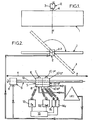
- the figure 1 shows a rectangular generally flat substrate, designated by reference 1.
- This substrate 1 is in this example a thin parallelepiped plate of plastic polymer.
- This plate 1 is supported by holding means 2 comprising rotating means 3 (for example a motor associated with a digital dimmer) and support means 4 directly supporting the substrate 1.
- rotating means 3 for example a motor associated with a digital dimmer
- support means 4 directly supporting the substrate 1.
- the possible rotation, preferably partial and alternately, substrate 1 is made around the vertical axis ZZ.
- the figure 2 taken again from above, the substrate 1 rotatably mounted on the rotating means 3 equipped with a digital dimmer.
- the device of the figure 2 also comprises means 5 for projecting the metal in cationic form (oxidizing) and the reducing agent.
- These projection means 5 comprise a portion 6 carrying at least one jet nozzle 7, in this case a, and a portion 8 of admission, and optionally mixing, oxidizing and reducing solutions.
- These projection means 5 are mounted on a displacement system 9 comprising an axis 10 supporting the means 5 and drivable in rotation by a motor 11.
- the device also includes a calculation and control unit: UCC, preferably a microcomputer, to which the projection means 5, the displacement system 9 of the projection means 5, and the rotation means are slaved. 3 of the substrate 1.
- UCC preferably a microcomputer
- the device comprises means 5 '/ 5 "of aerosol spraying or vapors of wetting liquid and rinsing liquid, these means 5' / 5" are constituted by a 6 '/ 6 "carrier part of minus one 7 '/ 7 "projection nozzle, in this case one, and an 8' / 8" portion for admitting the wetting fluid in liquid or vapor form, and these 5 '/ 5 "projection means are mounted on the displacement system 9 described above and which allows to put in motion the (s) spray gun (s) vapor and / or aerosol fountain liquid or rinse liquid, by translation along T trajectories OA and T AO .
- the device further comprises reservoirs 12 1 , 12 2 , 14 1 and 14 2 connected to an air compressor 13, so as to supply, respectively, the projection means 5 in oxidizing solution 12 1 and in reducing solution 12 2 and the projection means 5 '/ 5 "in wetting liquid vapor or wetting liquid 14 1 and rinse liquid 14 2 , as appropriate.
- the figure 2 also comprises an axis OA symbolizing the path "go" T OA and the trajectory "return” T AO of scanning projection means 7 driven by the displacement system 9 for the metallization of the substrate 1 drivable in rotation about the axis ZZ shown on the figure 1 .
- the axis ZZ is substantially orthogonal to the axis OA symbolizing the trajectories T OA and T AO of the moving projection means.
- the nozzle 7 of the projection means 5 or the nozzle 7 '/ 7 "of the projection means 5' / 5" produces, during the path OA corresponding to the projection phase, an aerosol projection cone Ox and / or Red or an aerosol spraying cone or wetting liquid vapor which sweeps the surface to be metallized, wetted or rinsed from the substrate 1.
- the invention is likely to have spin-offs in all areas concerned with surface treatment, namely for example the automobile, aeronautics, mechanics, electronics and in general all areas where the chemical nickel is employee.
- surface treatment namely for example the automobile, aeronautics, mechanics, electronics and in general all areas where the chemical nickel is employee.
- the device used in the examples is of the type described above with reference to the Figures 1 and 2 .
- the holding means 2 of the substrate to be metallized comprise a motor 3 for rotating the substrate 1 (brushless servomotor controlled by a SERAD MD230 / M / 2 digital variator.
- This motor is equipped with a rotary plate on which can be fixed the substrate.
- the displacement system 9 of the projection means 5 comprises an aluminum frame including an axis 10 linear axis EL Z60 motorized (motor 11 servomotor brushless ) controlled by a digital drive SERAD MD230 / M / 2 to set in motion the ( s) spray gun (s) 6.7 per translation along trajectories T OA and T AO .
- the device comprises combined means 5 '/ 5 "projection of the aerosol or vapors of wetting liquid and rinsing liquid, these means 5' / 5" are constituted by a pneumatic single-screw projection 7 '/ 7 " connected to a carrier part 6 '/ 6 ".
- the UCC is able to manage the wetting / rinsing switch within the combined 5 '/ 5 "means.
- the growth of the metal films is monitored using a quartz scale of the "Maxtek PM 500" type. It is an apparatus that makes it possible to measure the mass deposited on a given surface, in this case on a probe exposed to the metallization projection, in the same way as the surface to be metallized. It is thus possible to go back to the thickness of the film knowing some important factors such as the density and the acoustic impedance of the deposited film.
- the measurement is carried out during the relaxation phases, that is to say during the sweep according to T OA , the thickness of the film is measured with the balance after the rinsing phases.
- the surfaces of the substrates may or may not be subjected to a chemical and / or mechanical treatment.
- the latter may be abrasive polishing with sandpaper or sandblasting with alumina granules.
- chemical treatments conventional etching solutions, such as sulfochromic mixtures or permanganates, are used. The purpose of these treatments is to increase the adhesion of the films.
- a printing primer varnish
- an activation step by a colloidal solution of PdSn is necessary for plastic substrates. A duration of 25 minutes in the colloidal solution makes it possible to activate at saturation.
- the 1M HCI acceleration stage lasts one minute.
- the alcohols are used: methanol 1 for plastics and a 50/50 mixture of toluene and acetone for conductive substrates.
- aqueous degreasers can be used to simplify the procedure and preserve the environment.
- the projection device used comprises an air compressor, 2 tanks and a manual gun type MSV 2 K.
- the substrate is subdivided into 3 zones on each of which a fog obtained by nebulization of the mixed oxidizing and reducing solutions is sprayed, the size of the droplets of this fog being 50 ⁇ m, according to a protocol as defined in FIG. figure 1 patent FR-B-2 763 962 .
- R Rinsing step t: time M: mass.
- ⁇ t 550 ms
- ⁇ t 550 ms
- the solutions are projected.
- ⁇ S represents a projection sequence corresponding to 50 pulsations (or projections) relaxations.
- the projection distance conditions are such that the trajectory is rectilinear with respect to the surface.
- the projection fog is caused by nebulization of the solutions whose droplet size is 50 microns.
- Comparative Example 1 The nickel deposit obtained is weldable and adherent. The hardness of the deposit is of the order of 400 to 500 Vickers.
- Example 1 The nickel film thus obtained is weldable and very adherent over the entire surface of the room. It is perfectly homogeneous. Its thickness is 0.5 ⁇ m. The hardness of the deposit is of the order of 400 to 500 Vickers.
- FIGS 4A and 4B represent the deposits obtained in Comparative Example 1 and in Example 1.
- Example 1 The consumption of raw materials in Example 1 is significantly lower than that of Comparative Example 1. More precisely, the computerized management of the flows allows a ratio of the consumption of oxidizing solution and reducing solution in Comparative Example 1 on the consumption of oxidizing solution and reducing solution in Example 1, is of the order of 1.5.
- Example 3 Deposition of a Cu Metal Film on an Epoxy Surface-Loaded Fiberglass Polymer Substrate 300cm 2 (30cm * 10cm)
- the total number N of projection / relaxation cycles performed is 100.
- the copper films thus obtained are weldable and very adherent over the entire surface of the piece. They are perfectly homogeneous. Their thickness is of the order of 0.5 microns. The electrical resistivity of the metal film obtained is of the order of 0.02 ⁇ / cm.
- the total number N of projection / relaxation cycles performed is 100.
- the nickel-boron-phosphorus film thus obtained is weldable and very adherent over the entire surface of the substrate. It is perfectly homogeneous. Its thickness is 0.64 ⁇ m.
- the total number N of projection / relaxation cycles performed is 100.
- the nickel-boron-phosphorus-PTFE film thus obtained is weldable and very adherent over the entire surface of the workpiece. It is perfectly homogeneous. Its thickness is 0.64 ⁇ m.
- the Deposit contains 4 to 5% Boron and 4 to 5% Phosphorus and 22% PTFE.
- the coefficient of friction obtained is of the order of 0.1.
- Example 6 Depositing a Cu / Ni-Coated Multilayer Metal Film on a Surface-Covered Epoxy-Filled Glass Polymer Substrate 300cm 2 (30cm * 10cm)
- the resulting multilayer metal film has a salt spray resistance of the order of 500 hours in the ASTM B117 test with 5% NaCl at 35 ° C at pH 6.5 and 7.
- the total number N of projection / relaxation cycles performed is 40
- the silver films thus obtained are weldable and very adherent over the entire surface of the piece. They are perfectly homogeneous. Their thickness is of the order of 0.15 microns. The deposit is bright and very reflective.
- the total number N of projection / relaxation cycles performed is 40.
- the silver films thus obtained are weldable and very adherent over the entire surface of the piece. They are perfectly homogeneous. Their thickness is of the order of 0.15 microns. The deposit is bright and very reflective.
Landscapes
- Chemical & Material Sciences (AREA)
- Mechanical Engineering (AREA)
- Organic Chemistry (AREA)
- Chemical Kinetics & Catalysis (AREA)
- Engineering & Computer Science (AREA)
- Materials Engineering (AREA)
- General Chemical & Material Sciences (AREA)
- Metallurgy (AREA)
- Electrochemistry (AREA)
- Chemically Coating (AREA)
- Other Surface Treatments For Metallic Materials (AREA)
- Electrolytic Production Of Metals (AREA)
- Electrolytic Production Of Non-Metals, Compounds, Apparatuses Therefor (AREA)
- Electroplating Methods And Accessories (AREA)
- Electroplating And Plating Baths Therefor (AREA)
Priority Applications (1)
| Application Number | Priority Date | Filing Date | Title |
|---|---|---|---|
| PL07847348T PL2087147T3 (pl) | 2006-11-24 | 2007-11-26 | Udoskonalona metoda nieelektrolityczna metalizacji substratu za pomocą redukcji soli metalicznej (metalicznych) i natryskiwania aerozolem (aerozolami) |
Applications Claiming Priority (2)
| Application Number | Priority Date | Filing Date | Title |
|---|---|---|---|
| FR0610287A FR2909101B1 (fr) | 2006-11-24 | 2006-11-24 | Procede non electrolytique prefectionne de metallisation d'un substrat par voie de reduction de sel(s) metallique(s) et par projection d'aerosol(s) |
| PCT/EP2007/062815 WO2008062070A1 (fr) | 2006-11-24 | 2007-11-26 | Procede non electrolytique perfectionne de metallisation d'un substrat par voie de reduction de sel(s) metallique(s) et par projection d'aerosol(s) |
Publications (2)
| Publication Number | Publication Date |
|---|---|
| EP2087147A1 EP2087147A1 (fr) | 2009-08-12 |
| EP2087147B1 true EP2087147B1 (fr) | 2011-03-23 |
Family
ID=38217232
Family Applications (1)
| Application Number | Title | Priority Date | Filing Date |
|---|---|---|---|
| EP07847348A Active EP2087147B1 (fr) | 2006-11-24 | 2007-11-26 | Procede non electrolytique perfectionne de metallisation d'un substrat par voie de reduction de sel(s) metallique(s) et par projection d'aerosol(s) |
Country Status (16)
| Country | Link |
|---|---|
| US (1) | US8507043B2 (pl) |
| EP (1) | EP2087147B1 (pl) |
| JP (1) | JP5647789B2 (pl) |
| KR (1) | KR101509825B1 (pl) |
| CN (1) | CN101605924B (pl) |
| AT (1) | ATE503036T1 (pl) |
| BR (1) | BRPI0719012B1 (pl) |
| CA (1) | CA2670213C (pl) |
| DE (1) | DE602007013454D1 (pl) |
| DK (1) | DK2087147T3 (pl) |
| ES (1) | ES2366262T3 (pl) |
| FR (1) | FR2909101B1 (pl) |
| MX (1) | MX2009005488A (pl) |
| PL (1) | PL2087147T3 (pl) |
| PT (1) | PT2087147E (pl) |
| WO (1) | WO2008062070A1 (pl) |
Families Citing this family (10)
| Publication number | Priority date | Publication date | Assignee | Title |
|---|---|---|---|---|
| FR2934609B1 (fr) * | 2008-07-30 | 2011-07-22 | Jet Metal Technologies | Procede non eletrolytique de metallisation en ligne de substrats par projection avec traitement de surface prealable et dispositif pour la mise en oeuvre du procede. |
| FR2934964B1 (fr) * | 2008-08-12 | 2010-10-22 | Jet Metal Technologies | Procede de traitement optophysique de surface de substrats polymere et dispositif pour la mise en oeuvre du procede |
| FR2943144B1 (fr) | 2009-03-13 | 2012-12-14 | Jet Metal Technologies | Miroir anticorrosion, son procede de fabrication et ses applications dans la recuperation de l'energie solaire |
| IT1401234B1 (it) * | 2010-07-14 | 2013-07-12 | Polymtec Engineering Ag Mauren Fl Succursale Di Lugano | Serbatoio per contenere carburante e relativo procedimento di realizzazione. |
| FR2994197B1 (fr) * | 2012-08-06 | 2014-08-22 | Plastic Omnium Cie | Procede de metallisation d'une surface d'une piece pour vehicule automobile |
| WO2014098774A1 (en) * | 2012-12-21 | 2014-06-26 | Agency For Science, Technology And Research | Porous metallic membrane |
| FR3032724B1 (fr) * | 2015-02-12 | 2019-12-13 | Jet Metal Technologies | Procede et dispositif de realisation de motifs metalliques sur un substrat a des fins decoratives et/ou fonctionnelles fabrication d'objets integrant cette realisation et ensemble de consommables utilises |
| US9433826B1 (en) * | 2015-03-27 | 2016-09-06 | Acushnet Company | Golf ball incorporating metallic film and method of making |
| KR102233897B1 (ko) * | 2020-11-18 | 2021-03-31 | (주)엔젤엠엘 | 항균 손잡이의 제조 방법 및 이에 의해 제조된 항균 손잡이 |
| FR3120077B1 (fr) | 2021-02-19 | 2023-03-03 | Porcher Ind | Composant en textile avec électronique imprimée |
Family Cites Families (15)
| Publication number | Priority date | Publication date | Assignee | Title |
|---|---|---|---|---|
| US3783005A (en) * | 1972-02-04 | 1974-01-01 | Western Electric Co | Method of depositing a metal on a surface of a nonconductive substrate |
| US4144361A (en) * | 1977-07-06 | 1979-03-13 | Nathan Feldstein | Methods for applying metallic silver coatings |
| HU184308B (en) * | 1980-07-04 | 1984-08-28 | Bacsmegyei Allami Epitoeipari | Process for coating glas threads with metal-glas |
| CN87100440B (zh) * | 1987-01-27 | 1988-05-11 | 中国人民解放军装甲兵工程学院 | 在不导电材料上刷镀铜的方法 |
| US5976383A (en) * | 1991-04-08 | 1999-11-02 | Romar Technologies, Inc. | Recycle process for removing dissolved heavy metals from water with aluminum particles |
| US6268016B1 (en) * | 1996-06-28 | 2001-07-31 | International Business Machines Corporation | Manufacturing computer systems with fine line circuitized substrates |
| FR2763962B1 (fr) * | 1997-05-29 | 1999-10-15 | Guy Stremsdoerfer | Procede non electrolytique de metallisation d'un substrat par voie de reduction de sel(s) metallique(s) et par projection d'aerosol(s) |
| JPH11335858A (ja) | 1998-05-27 | 1999-12-07 | Yuji Shikamata | 銀鏡面の形成方法及びその溶液 |
| JP3352422B2 (ja) * | 1999-02-10 | 2002-12-03 | セントラル硝子株式会社 | 銀被膜形成用薬液および銀被膜形成方法 |
| FR2796962B1 (fr) | 1999-07-30 | 2003-11-21 | Bio Merieux | Procede de culture in vitro de virus des familles togaviridae et flaviviridae, lignee cellulaire et utilisations |
| JP3866012B2 (ja) * | 2000-06-02 | 2007-01-10 | 株式会社荏原製作所 | 無電解めっき方法及び装置 |
| US6843852B2 (en) * | 2002-01-16 | 2005-01-18 | Intel Corporation | Apparatus and method for electroless spray deposition |
| KR100566840B1 (ko) * | 2002-01-30 | 2006-04-03 | 가부시끼가이샤 도시바 | 성막 방법 및 성막 장치 |
| GB0301933D0 (en) * | 2003-01-28 | 2003-02-26 | Conductive Inkjet Tech Ltd | Method of forming a conductive metal region on a substrate |
| JP2006111938A (ja) * | 2004-10-15 | 2006-04-27 | Tokyo Electron Ltd | 無電解めっき装置 |
-
2006
- 2006-11-24 FR FR0610287A patent/FR2909101B1/fr not_active Expired - Fee Related
-
2007
- 2007-11-26 KR KR1020097013085A patent/KR101509825B1/ko not_active Expired - Fee Related
- 2007-11-26 PT PT07847348T patent/PT2087147E/pt unknown
- 2007-11-26 US US12/515,461 patent/US8507043B2/en active Active
- 2007-11-26 EP EP07847348A patent/EP2087147B1/fr active Active
- 2007-11-26 CA CA2670213A patent/CA2670213C/fr active Active
- 2007-11-26 CN CN2007800497991A patent/CN101605924B/zh not_active Expired - Fee Related
- 2007-11-26 JP JP2009537655A patent/JP5647789B2/ja not_active Expired - Fee Related
- 2007-11-26 BR BRPI0719012-3A patent/BRPI0719012B1/pt not_active IP Right Cessation
- 2007-11-26 DK DK07847348.5T patent/DK2087147T3/da active
- 2007-11-26 MX MX2009005488A patent/MX2009005488A/es active IP Right Grant
- 2007-11-26 PL PL07847348T patent/PL2087147T3/pl unknown
- 2007-11-26 DE DE602007013454T patent/DE602007013454D1/de active Active
- 2007-11-26 AT AT07847348T patent/ATE503036T1/de not_active IP Right Cessation
- 2007-11-26 ES ES07847348T patent/ES2366262T3/es active Active
- 2007-11-26 WO PCT/EP2007/062815 patent/WO2008062070A1/fr not_active Ceased
Also Published As
| Publication number | Publication date |
|---|---|
| EP2087147A1 (fr) | 2009-08-12 |
| KR20090097892A (ko) | 2009-09-16 |
| CN101605924A (zh) | 2009-12-16 |
| KR101509825B1 (ko) | 2015-04-06 |
| US20100075053A1 (en) | 2010-03-25 |
| MX2009005488A (es) | 2009-08-07 |
| FR2909101A1 (fr) | 2008-05-30 |
| US8507043B2 (en) | 2013-08-13 |
| ATE503036T1 (de) | 2011-04-15 |
| JP2010510389A (ja) | 2010-04-02 |
| DE602007013454D1 (de) | 2011-05-05 |
| BRPI0719012A2 (pt) | 2014-01-14 |
| BRPI0719012B1 (pt) | 2018-10-16 |
| PL2087147T3 (pl) | 2011-11-30 |
| JP5647789B2 (ja) | 2015-01-07 |
| FR2909101B1 (fr) | 2009-02-27 |
| PT2087147E (pt) | 2011-07-04 |
| CN101605924B (zh) | 2013-05-29 |
| WO2008062070A1 (fr) | 2008-05-29 |
| CA2670213C (fr) | 2014-10-14 |
| ES2366262T3 (es) | 2011-10-18 |
| DK2087147T3 (da) | 2011-07-18 |
| CA2670213A1 (fr) | 2008-05-29 |
Similar Documents
| Publication | Publication Date | Title |
|---|---|---|
| WO2008062070A1 (fr) | Procede non electrolytique perfectionne de metallisation d'un substrat par voie de reduction de sel(s) metallique(s) et par projection d'aerosol(s) | |
| EP2326747B1 (fr) | Procédé non électrolytique de métallisation en ligne de substrats par projection avec traitement de surface préalable et dispositif pour la mise en oeuvre du procédé | |
| Carvalho et al. | Self-assembled monolayers of eicosanethiol on palladium and their use in microcontact printing | |
| WO2010103125A1 (fr) | Miroir anticorrosion, son procede de fabrication et ses applications dans la recuperation de l'energie solaire | |
| JP6347724B2 (ja) | 耐熱性鏡面コーティング | |
| EP1557483A1 (en) | Method for forming thin silver mirror film, and method for forming coating film comprising thin silver mirror film | |
| WO2016128695A1 (fr) | Procédé et dispositif de réalisation de motifs métalliques sur un substrat a des fins décoratives et/ou fonctionnelles fabrication d'objets intégrant cette réalisation et ensemble de consommables utilises | |
| WO1998054378A1 (fr) | Procede non electrolytique de metallisation d'un substrat par voie de reduction de sel(s) metallique(s) et par projection d'aerosol(s) | |
| CH690570A5 (fr) | Procédé de formation d'une couche protectrice sur une couche métallique réfléchissante dépourvue de cuivre. | |
| EP3602197B1 (fr) | Procédé de fabrication d'un composant horloger en métal-céramique | |
| Xu et al. | A new activation method for electroless metal plating: Palladium laden via bonding with self-assembly monolayers | |
| CH710579A1 (fr) | Procédé de placage autocatalytique d'un métal précieux. | |
| KR100965238B1 (ko) | 생체물질 고정용 기판 및 이의 제조방법 | |
| Kono et al. | Electroless Deposition of Metal Micropatterns Using Ink-jetted ZnO Thin Films as Templates | |
| Pandey et al. | Synthesis of Smart Coating |
Legal Events
| Date | Code | Title | Description |
|---|---|---|---|
| PUAI | Public reference made under article 153(3) epc to a published international application that has entered the european phase |
Free format text: ORIGINAL CODE: 0009012 |
|
| 17P | Request for examination filed |
Effective date: 20090612 |
|
| AK | Designated contracting states |
Kind code of ref document: A1 Designated state(s): AT BE BG CH CY CZ DE DK EE ES FI FR GB GR HU IE IS IT LI LT LU LV MC MT NL PL PT RO SE SI SK TR |
|
| 17Q | First examination report despatched |
Effective date: 20090907 |
|
| DAX | Request for extension of the european patent (deleted) | ||
| GRAP | Despatch of communication of intention to grant a patent |
Free format text: ORIGINAL CODE: EPIDOSNIGR1 |
|
| RIN1 | Information on inventor provided before grant (corrected) |
Inventor name: STREMSDOERFER, SAMUEL |
|
| GRAS | Grant fee paid |
Free format text: ORIGINAL CODE: EPIDOSNIGR3 |
|
| GRAA | (expected) grant |
Free format text: ORIGINAL CODE: 0009210 |
|
| AK | Designated contracting states |
Kind code of ref document: B1 Designated state(s): AT BE BG CH CY CZ DE DK EE ES FI FR GB GR HU IE IS IT LI LT LU LV MC MT NL PL PT RO SE SI SK TR |
|
| REG | Reference to a national code |
Ref country code: GB Ref legal event code: FG4D Free format text: NOT ENGLISH |
|
| REG | Reference to a national code |
Ref country code: CH Ref legal event code: EP |
|
| REG | Reference to a national code |
Ref country code: IE Ref legal event code: FG4D |
|
| REF | Corresponds to: |
Ref document number: 602007013454 Country of ref document: DE Date of ref document: 20110505 Kind code of ref document: P |
|
| REG | Reference to a national code |
Ref country code: DE Ref legal event code: R096 Ref document number: 602007013454 Country of ref document: DE Effective date: 20110505 |
|
| REG | Reference to a national code |
Ref country code: RO Ref legal event code: EPE |
|
| REG | Reference to a national code |
Ref country code: PT Ref legal event code: SC4A Free format text: AVAILABILITY OF NATIONAL TRANSLATION Effective date: 20110622 |
|
| REG | Reference to a national code |
Ref country code: NL Ref legal event code: T3 |
|
| REG | Reference to a national code |
Ref country code: SE Ref legal event code: TRGR |
|
| REG | Reference to a national code |
Ref country code: DK Ref legal event code: T3 |
|
| PG25 | Lapsed in a contracting state [announced via postgrant information from national office to epo] |
Ref country code: GR Free format text: LAPSE BECAUSE OF FAILURE TO SUBMIT A TRANSLATION OF THE DESCRIPTION OR TO PAY THE FEE WITHIN THE PRESCRIBED TIME-LIMIT Effective date: 20110624 Ref country code: LV Free format text: LAPSE BECAUSE OF FAILURE TO SUBMIT A TRANSLATION OF THE DESCRIPTION OR TO PAY THE FEE WITHIN THE PRESCRIBED TIME-LIMIT Effective date: 20110323 Ref country code: LT Free format text: LAPSE BECAUSE OF FAILURE TO SUBMIT A TRANSLATION OF THE DESCRIPTION OR TO PAY THE FEE WITHIN THE PRESCRIBED TIME-LIMIT Effective date: 20110323 |
|
| LTIE | Lt: invalidation of european patent or patent extension |
Effective date: 20110323 |
|
| PG25 | Lapsed in a contracting state [announced via postgrant information from national office to epo] |
Ref country code: FI Free format text: LAPSE BECAUSE OF FAILURE TO SUBMIT A TRANSLATION OF THE DESCRIPTION OR TO PAY THE FEE WITHIN THE PRESCRIBED TIME-LIMIT Effective date: 20110323 Ref country code: BG Free format text: LAPSE BECAUSE OF FAILURE TO SUBMIT A TRANSLATION OF THE DESCRIPTION OR TO PAY THE FEE WITHIN THE PRESCRIBED TIME-LIMIT Effective date: 20110623 Ref country code: SI Free format text: LAPSE BECAUSE OF FAILURE TO SUBMIT A TRANSLATION OF THE DESCRIPTION OR TO PAY THE FEE WITHIN THE PRESCRIBED TIME-LIMIT Effective date: 20110323 Ref country code: AT Free format text: LAPSE BECAUSE OF FAILURE TO SUBMIT A TRANSLATION OF THE DESCRIPTION OR TO PAY THE FEE WITHIN THE PRESCRIBED TIME-LIMIT Effective date: 20110323 Ref country code: CY Free format text: LAPSE BECAUSE OF FAILURE TO SUBMIT A TRANSLATION OF THE DESCRIPTION OR TO PAY THE FEE WITHIN THE PRESCRIBED TIME-LIMIT Effective date: 20110323 |
|
| REG | Reference to a national code |
Ref country code: CH Ref legal event code: NV Representative=s name: KELLER & PARTNER PATENTANWAELTE AG |
|
| REG | Reference to a national code |
Ref country code: ES Ref legal event code: FG2A Ref document number: 2366262 Country of ref document: ES Kind code of ref document: T3 Effective date: 20111018 |
|
| PG25 | Lapsed in a contracting state [announced via postgrant information from national office to epo] |
Ref country code: EE Free format text: LAPSE BECAUSE OF FAILURE TO SUBMIT A TRANSLATION OF THE DESCRIPTION OR TO PAY THE FEE WITHIN THE PRESCRIBED TIME-LIMIT Effective date: 20110323 |
|
| PG25 | Lapsed in a contracting state [announced via postgrant information from national office to epo] |
Ref country code: SK Free format text: LAPSE BECAUSE OF FAILURE TO SUBMIT A TRANSLATION OF THE DESCRIPTION OR TO PAY THE FEE WITHIN THE PRESCRIBED TIME-LIMIT Effective date: 20110323 Ref country code: IS Free format text: LAPSE BECAUSE OF FAILURE TO SUBMIT A TRANSLATION OF THE DESCRIPTION OR TO PAY THE FEE WITHIN THE PRESCRIBED TIME-LIMIT Effective date: 20110723 |
|
| REG | Reference to a national code |
Ref country code: PL Ref legal event code: T3 |
|
| PLBE | No opposition filed within time limit |
Free format text: ORIGINAL CODE: 0009261 |
|
| STAA | Information on the status of an ep patent application or granted ep patent |
Free format text: STATUS: NO OPPOSITION FILED WITHIN TIME LIMIT |
|
| 26N | No opposition filed |
Effective date: 20111227 |
|
| REG | Reference to a national code |
Ref country code: DE Ref legal event code: R097 Ref document number: 602007013454 Country of ref document: DE Effective date: 20111227 |
|
| PG25 | Lapsed in a contracting state [announced via postgrant information from national office to epo] |
Ref country code: MC Free format text: LAPSE BECAUSE OF NON-PAYMENT OF DUE FEES Effective date: 20111130 |
|
| PG25 | Lapsed in a contracting state [announced via postgrant information from national office to epo] |
Ref country code: MT Free format text: LAPSE BECAUSE OF FAILURE TO SUBMIT A TRANSLATION OF THE DESCRIPTION OR TO PAY THE FEE WITHIN THE PRESCRIBED TIME-LIMIT Effective date: 20110323 |
|
| PG25 | Lapsed in a contracting state [announced via postgrant information from national office to epo] |
Ref country code: HU Free format text: LAPSE BECAUSE OF FAILURE TO SUBMIT A TRANSLATION OF THE DESCRIPTION OR TO PAY THE FEE WITHIN THE PRESCRIBED TIME-LIMIT Effective date: 20110323 |
|
| REG | Reference to a national code |
Ref country code: CH Ref legal event code: PCAR Free format text: NEW ADDRESS: EIGERSTRASSE 2 POSTFACH, 3000 BERN 14 (CH) |
|
| REG | Reference to a national code |
Ref country code: FR Ref legal event code: PLFP Year of fee payment: 9 |
|
| REG | Reference to a national code |
Ref country code: FR Ref legal event code: PLFP Year of fee payment: 10 |
|
| REG | Reference to a national code |
Ref country code: FR Ref legal event code: PLFP Year of fee payment: 11 |
|
| REG | Reference to a national code |
Ref country code: CH Ref legal event code: PFA Owner name: JET METAL TECHNOLOGIES, FR Free format text: FORMER OWNER: JET METAL TECHNOLOGIES, FR |
|
| PGFP | Annual fee paid to national office [announced via postgrant information from national office to epo] |
Ref country code: NL Payment date: 20231023 Year of fee payment: 17 |
|
| PGFP | Annual fee paid to national office [announced via postgrant information from national office to epo] |
Ref country code: LU Payment date: 20231023 Year of fee payment: 17 |
|
| PGFP | Annual fee paid to national office [announced via postgrant information from national office to epo] |
Ref country code: GB Payment date: 20231120 Year of fee payment: 17 |
|
| PGFP | Annual fee paid to national office [announced via postgrant information from national office to epo] |
Ref country code: ES Payment date: 20231218 Year of fee payment: 17 |
|
| PGFP | Annual fee paid to national office [announced via postgrant information from national office to epo] |
Ref country code: TR Payment date: 20231113 Year of fee payment: 17 Ref country code: SE Payment date: 20231117 Year of fee payment: 17 Ref country code: RO Payment date: 20231101 Year of fee payment: 17 Ref country code: PT Payment date: 20231018 Year of fee payment: 17 Ref country code: IT Payment date: 20231109 Year of fee payment: 17 Ref country code: IE Payment date: 20231019 Year of fee payment: 17 Ref country code: FR Payment date: 20231023 Year of fee payment: 17 Ref country code: DK Payment date: 20231025 Year of fee payment: 17 Ref country code: DE Payment date: 20231107 Year of fee payment: 17 Ref country code: CZ Payment date: 20231020 Year of fee payment: 17 Ref country code: CH Payment date: 20231201 Year of fee payment: 17 |
|
| PGFP | Annual fee paid to national office [announced via postgrant information from national office to epo] |
Ref country code: PL Payment date: 20231030 Year of fee payment: 17 Ref country code: BE Payment date: 20231113 Year of fee payment: 17 |
|
| REG | Reference to a national code |
Ref country code: DE Ref legal event code: R119 Ref document number: 602007013454 Country of ref document: DE |
|
| REG | Reference to a national code |
Ref country code: DK Ref legal event code: EBP Effective date: 20241130 |
|
| REG | Reference to a national code |
Ref country code: CH Ref legal event code: PL |
|
| REG | Reference to a national code |
Ref country code: SE Ref legal event code: EUG |
|
| REG | Reference to a national code |
Ref country code: NL Ref legal event code: MM Effective date: 20241201 |
|
| PG25 | Lapsed in a contracting state [announced via postgrant information from national office to epo] |
Ref country code: LU Free format text: LAPSE BECAUSE OF NON-PAYMENT OF DUE FEES Effective date: 20241126 |
|
| REG | Reference to a national code |
Ref country code: CH Ref legal event code: PL |
|
| PG25 | Lapsed in a contracting state [announced via postgrant information from national office to epo] |
Ref country code: PT Free format text: LAPSE BECAUSE OF NON-PAYMENT OF DUE FEES Effective date: 20250526 |
|
| GBPC | Gb: european patent ceased through non-payment of renewal fee |
Effective date: 20241126 |
|
| PG25 | Lapsed in a contracting state [announced via postgrant information from national office to epo] |
Ref country code: CH Free format text: LAPSE BECAUSE OF NON-PAYMENT OF DUE FEES Effective date: 20241130 |
|
| PG25 | Lapsed in a contracting state [announced via postgrant information from national office to epo] |
Ref country code: RO Free format text: LAPSE BECAUSE OF NON-PAYMENT OF DUE FEES Effective date: 20241126 |
|
| PG25 | Lapsed in a contracting state [announced via postgrant information from national office to epo] |
Ref country code: CZ Free format text: LAPSE BECAUSE OF NON-PAYMENT OF DUE FEES Effective date: 20241126 |
|
| PG25 | Lapsed in a contracting state [announced via postgrant information from national office to epo] |
Ref country code: NL Free format text: LAPSE BECAUSE OF NON-PAYMENT OF DUE FEES Effective date: 20241201 |
|
| REG | Reference to a national code |
Ref country code: BE Ref legal event code: MM Effective date: 20241130 |
|
| PG25 | Lapsed in a contracting state [announced via postgrant information from national office to epo] |
Ref country code: DK Free format text: LAPSE BECAUSE OF NON-PAYMENT OF DUE FEES Effective date: 20241130 Ref country code: DE Free format text: LAPSE BECAUSE OF NON-PAYMENT OF DUE FEES Effective date: 20250603 |
|
| PG25 | Lapsed in a contracting state [announced via postgrant information from national office to epo] |
Ref country code: IT Free format text: LAPSE BECAUSE OF NON-PAYMENT OF DUE FEES Effective date: 20241126 Ref country code: SE Free format text: LAPSE BECAUSE OF NON-PAYMENT OF DUE FEES Effective date: 20241127 |
|
| PG25 | Lapsed in a contracting state [announced via postgrant information from national office to epo] |
Ref country code: GB Free format text: LAPSE BECAUSE OF NON-PAYMENT OF DUE FEES Effective date: 20241126 Ref country code: BE Free format text: LAPSE BECAUSE OF NON-PAYMENT OF DUE FEES Effective date: 20241130 |
|
| PG25 | Lapsed in a contracting state [announced via postgrant information from national office to epo] |
Ref country code: FR Free format text: LAPSE BECAUSE OF NON-PAYMENT OF DUE FEES Effective date: 20241130 |
|
| PG25 | Lapsed in a contracting state [announced via postgrant information from national office to epo] |
Ref country code: IE Free format text: LAPSE BECAUSE OF NON-PAYMENT OF DUE FEES Effective date: 20241126 |
|
| REG | Reference to a national code |
Ref country code: ES Ref legal event code: FD2A Effective date: 20260105 |
|
| PG25 | Lapsed in a contracting state [announced via postgrant information from national office to epo] |
Ref country code: ES Free format text: LAPSE BECAUSE OF NON-PAYMENT OF DUE FEES Effective date: 20241127 |
|
| PG25 | Lapsed in a contracting state [announced via postgrant information from national office to epo] |
Ref country code: TR Free format text: LAPSE BECAUSE OF NON-PAYMENT OF DUE FEES Effective date: 20241126 |
|
| PG25 | Lapsed in a contracting state [announced via postgrant information from national office to epo] |
Ref country code: PL Free format text: LAPSE BECAUSE OF NON-PAYMENT OF DUE FEES Effective date: 20241126 |