EP2081925B1 - Benzoylpyrazole, ihre Verwendung als Herbizide, und Zwischenprodukte - Google Patents
Benzoylpyrazole, ihre Verwendung als Herbizide, und Zwischenprodukte Download PDFInfo
- Publication number
- EP2081925B1 EP2081925B1 EP07818631A EP07818631A EP2081925B1 EP 2081925 B1 EP2081925 B1 EP 2081925B1 EP 07818631 A EP07818631 A EP 07818631A EP 07818631 A EP07818631 A EP 07818631A EP 2081925 B1 EP2081925 B1 EP 2081925B1
- Authority
- EP
- European Patent Office
- Prior art keywords
- methyl
- alkyl
- formula
- ethyl
- tetrazol
- Prior art date
- Legal status (The legal status is an assumption and is not a legal conclusion. Google has not performed a legal analysis and makes no representation as to the accuracy of the status listed.)
- Not-in-force
Links
- 0 Cc1n[n](*)c(OC)c1 Chemical compound Cc1n[n](*)c(OC)c1 0.000 description 4
- AUNGFAYSGBWNTK-UHFFFAOYSA-N OC(c(ccc(Cl)c1OCC[n]2nnnc2)c1Cl)=O Chemical compound OC(c(ccc(Cl)c1OCC[n]2nnnc2)c1Cl)=O AUNGFAYSGBWNTK-UHFFFAOYSA-N 0.000 description 1
Classifications
-
- C—CHEMISTRY; METALLURGY
- C07—ORGANIC CHEMISTRY
- C07D—HETEROCYCLIC COMPOUNDS
- C07D403/00—Heterocyclic compounds containing two or more hetero rings, having nitrogen atoms as the only ring hetero atoms, not provided for by group C07D401/00
- C07D403/02—Heterocyclic compounds containing two or more hetero rings, having nitrogen atoms as the only ring hetero atoms, not provided for by group C07D401/00 containing two hetero rings
- C07D403/12—Heterocyclic compounds containing two or more hetero rings, having nitrogen atoms as the only ring hetero atoms, not provided for by group C07D401/00 containing two hetero rings linked by a chain containing hetero atoms as chain links
-
- A—HUMAN NECESSITIES
- A01—AGRICULTURE; FORESTRY; ANIMAL HUSBANDRY; HUNTING; TRAPPING; FISHING
- A01N—PRESERVATION OF BODIES OF HUMANS OR ANIMALS OR PLANTS OR PARTS THEREOF; BIOCIDES, e.g. AS DISINFECTANTS, AS PESTICIDES OR AS HERBICIDES; PEST REPELLANTS OR ATTRACTANTS; PLANT GROWTH REGULATORS
- A01N43/00—Biocides, pest repellants or attractants, or plant growth regulators containing heterocyclic compounds
- A01N43/48—Biocides, pest repellants or attractants, or plant growth regulators containing heterocyclic compounds having rings with two nitrogen atoms as the only ring hetero atoms
- A01N43/56—1,2-Diazoles; Hydrogenated 1,2-diazoles
-
- A—HUMAN NECESSITIES
- A01—AGRICULTURE; FORESTRY; ANIMAL HUSBANDRY; HUNTING; TRAPPING; FISHING
- A01N—PRESERVATION OF BODIES OF HUMANS OR ANIMALS OR PLANTS OR PARTS THEREOF; BIOCIDES, e.g. AS DISINFECTANTS, AS PESTICIDES OR AS HERBICIDES; PEST REPELLANTS OR ATTRACTANTS; PLANT GROWTH REGULATORS
- A01N43/00—Biocides, pest repellants or attractants, or plant growth regulators containing heterocyclic compounds
- A01N43/713—Biocides, pest repellants or attractants, or plant growth regulators containing heterocyclic compounds having rings with four or more nitrogen atoms as the only ring hetero atoms
Definitions
- the present invention relates to novel benzoylpyrazoles, their use as herbicides, to process for their preparation and to their novel intermediates.
- the present inventors have intensively studied to create novel compounds having higher efficacy as herbicides and being safer. As a result, the present inventors have found novel benzoylpyrazoles represented by the formula set forth below which exhibit superior herbicidal activity and safety against crops.
- Preparation process (b) compounds of formula (I) wherein R 3 represents alkyl, alkenyl, alkynyl, aralkyl, alkylsulfonyl, optionally substituted phenylsulfonyl, acyl or acylalkyl:
- the benzoylpyrazoles of the formula (I) provided by the present disclosure have a more potent herbicidal activity than the compounds described in the above prior art documents while exhibiting extremely superior efficacy as selective herbicides without substantially no phytotoxity to crops.
- the benzoylpyrazoles of the formula (I) exhibit extremely superior efficacy as herbicides for Leguminous dry field crops such as soy beans and Poaceae dry field crops such as wheat, barley, oats and corn.
- benzoylpyrazoles of the formula (I) of the present disclosure are particularly useful as herbicides for dry field.
- halogen means fluorine, chlorine, bromine or iodine, and preferably chlorine and bromine.
- alkyl may be those of a linear or branched chain, and means for example C 1-6 alkyl. Specifically, examples of “alkyl” include methyl, ethyl, n- or iso-propyl, n-, iso-, sec- or tert-butyl, n-, iso-, neo- or tert-pentyl, n- or iso-hexyl.
- cycloalkyl examples include cyclopropyl, cyclobutyl, cyclopentyl, cyclohexyl, cycloheptyl.
- alkenyl examples include allyl, 1-methylallyl, 1,1-dimethylallyl, 2-butenyl, 2-pentenyl, 2-hexenyl, 2-heptenyl.
- alkynyl examples include ethynyl, 2-propynyl, 1-methyl-2-propynyl, 1,1-dimethyl-2-propynyl, 2-butynyl, 2-pentynyl, 2-hexynyl, 2-heptynyl.
- aralkyl means, for example, an arylalkyl group the alkyl moiety of which has the above meaning, and the "aryl” means, for example, phenyl, naphthyl, and specifically, benzyl.
- alkoxy means, for example, an alkyl-O- group the alkyl moiety of which has the above meaning, and can be, for example, C 1-6 alkoxy.
- alkoxy include methoxy, ethoxy, n- or iso-propoxy, n-, iso-, sec- or tert-butoxy, n-pentyloxy, n-hexyloxy.
- alkylthio means an alkyl-S- group the alkyl moiety of which has the above meaning, and can be, for example, C 1-6 alkylthio.
- alkylthio include methylthio, ethylthio, n- or iso-propylthio, n-, iso-, sec- or tert-butylthio, n-penthylthio, n-hexylthio.
- alkylsulfonyl means an alkyl-SO 2 - group the alkyl moiety of which has the above meaning, and can be, for example, C 1-6 alkylsulfonyl.
- alkylsulfonyl include methylsulfonyl, ethylsulfonyl, n- or iso-propylsulfonyl, n-, iso-, sec- or tert-butylsulfonyl, n-pentylsulfonyl, n-hexylsulfonyl.
- Acyl is an acyl group derived from aliphatic saturated monocarboxylic acid, or aliphatic or aromatic hydrocarbon ring carboxylic acid, and means for example, a C 1-6 alkyl-CO- group the alkyl moiety of which has the above meaning, or an aryl-CO- group the aryl moiety of which is as defined above.
- examples of "acyl” include acetyl, propionyl, butyryl, isobutyryl, valeryl, isovaleryl, pivaloyl, n-pentylcarbonyl, n-hexylcarbonyl, benzoyl.
- Acylalkyl is an acylalkyl group the acyl and alkyl moieties of which have the above meaning, and means for example, a benzoyl-C 1-6 alkyl group, and specifically, includes phenacyl.
- a preferable group of the compounds of the invention includes those of the formula (I), wherein
- the compounds of the formula (I) of the present invention can exist as tautomers when R 3 represents hydrogen, as shown by the following formulae (Ia), (Ib) and (Ic). or
- JP-A- Japanese Patent KOKAI Publication No. 2-173
- JP-A- Japanese Patent KOKAI Publication No.
- a part of the compounds represented by the above formula (V) are novel compounds not described in prior literatures and can be prepared in accordance with the processes described in literatures, for example, JP-A-2-173 , WO93/18031 , and WO03/66607 . Namely, they can be prepared by reacting compounds represented by the formula (VI): wherein X, Y, n and T are as defined above with halogenating agents such as, for example, phosphorus oxychloride, phosphorus oxybromide, phosphorus trichloride, phosphorus tribromide, phosgene, oxalyl dichloride, thionyl chloride and thionyl bromide.
- halogenating agents such as, for example, phosphorus oxychloride, phosphorus oxybromide, phosphorus trichloride, phosphorus tribromide, phosgene, oxalyl dichloride, thionyl chloride and
- a part of the compounds represented by the above formula (VI) are novel compounds not described in prior literatures and can be prepared in accordance with the processes described in literatures, for example, JP-A-2-1-73 and WO03/66607 . Namely, they can be prepared by hydrolyzing compounds represented by the formula (VII): wherein X, Y, n and T are as defined above and R 5 represents C 1-4 alkyl, preferably methyl or ethyl in the presence of a suitable base, for example, sodium hydroxide in a diluent, for example, aqueous dioxane.
- a suitable base for example, sodium hydroxide in a diluent, for example, aqueous dioxane.
- a part of the compounds represented by the above formula (VII) are novel compounds not described in prior literatures and can be prepared in accordance with the processes described in literatures, for example, German Patent No. 10039723 and WO03/66607 . Namely, they can be prepared by reacting compounds represented by the formula (VIII): wherein X, Y and n and are as defined above and R 5 represents C 1-4 alkyl, preferably methyl or ethyl, and Hal represents halogen, preferably chlorine or bromine with the compounds represented by the formula (IX) T-H (IX) wherein T is as defined above, in the presence of a suitable condensing agent, for example, potassium carbonate in a suitable diluent, for example, N,N-dimethylformamide.
- a suitable condensing agent for example, potassium carbonate in a suitable diluent, for example, N,N-dimethylformamide.
- Representative examples of the compounds of the formula (II) used as raw materials in the above preparation process (a) include those described below.
- 5- ⁇ 2,4-Dichloro-3-[2-(1H-tetrazol-1-yl)ethyloxy]-benzoyloxy ⁇ -1,3-dimethylpyrazole 5- ⁇ 2,4-dichloro-3-[2-(2H-tetrazol-2-yl)ethyloxy]-benzoyloxy ⁇ -1,3-dimethylpyrazole
- 5- ⁇ 2-methyl-3-[2-(5-methyl-1H-tetrazol-1-yl)-ethyloxy]-4-bromobenzoyloxy ⁇ -1,3-dimethylpyrazole 5- ⁇ 2-methyl-3-[2-(5-methyl-2H-tetra
- Representative examples of the compounds of the formula (IV) used as raw materials in the preparation of the compounds of the above formula (II) include those described below. 1,3-Dimethyl-5-hydroxypyrazole, 1-methyl-3-ethyl-5-hydroxypyrazole, 1-methyl-3-cyclopropyl-5-hydroxypyrazole, 1-ethyl-3-methyl-5-hydroxypyrazole, 1-ethyl-3-cyclopropyl-5-hydroxypyrazole, and etc.
- Representative examples of the compounds of the formula (VII) used as raw materials in the preparation of the compounds of the above formula (VI) include those described below. Ethyl 2,4-dichloro-3-[2-(1H-tetrazol-1-yl)ethyloxy]-benzoate, ethyl 2,4-dichloro-3-[2-(2H-tetrazol-2-yl)ethyloxy]-benzoate, ethyl 2-methyl-3-[2-(5-methyl-1H-tetrazol-1-yl)-ethyloxy]-4-bromobenzoate, ethyl 2-methyl-3-[2-(5-methyl-2H-tetrazol-2-yl)-ethyloxy]-4-bromobenzoate, methyl 2-methyl-3-[2-(1H-tetrazol-1-yl)ethyloxy]-4-chlorobenzoate, ethyl 2,4-dichloro-3-[2-(5-
- Representative examples of the compounds of the formula (VIII) used as raw materials in the preparation of the compounds of the above formula (VII) include those described below. Ethyl 2,4-dichloro-3-(2-bromoethoxy)benzoate, ethyl 2-methyl-3-(2-bromoethoxy)-4-bromobenzoate, methyl 2-methyl-3-(2-bromoethoxy)-4-chlorobenzoate, ethyl 2,4-dichloro-3-(2-chloroethoxy)benzoate, ethyl 2,4-dichloro-3-(2-iodoethoxy)benzoate, ethyl 2,4-dichloro-3-(3-bromopropyloxy)benzoate, and etc.
- Representative examples of the compounds of the formula (IX) used as raw materials in the preparation of the compounds of the above formula (VII) include those described below. 1H-tetrazole, 5-methyl-1H-tetrazole, 5-ethyl-1H-tetrazole, 5-methylthio-1H-tetrazole, 5-methoxy-1H-tetrazole, and etc.
- the compounds of the formula (Ia), which are raw materials in the above preparation process (b), constitute a part of the compounds represented by the formula (I) of the present invention and can be easily prepared in accordance with the above preparation process (a).
- the compounds of the formula (III), which are raw materials in the above preparation process (b), are halogenated alkyl, halogenated alkenyl, halogenated alkynyl, halogenated aralkyl, halogenated acyl, halogenated sulfonyl and acylalkyl halide that are well known themselves in the field of organic chemistry, and those described below can be exemplified.
- the reaction of the above preparation process (a) can be carried out in a suitable diluent and examples thereof that may be used during the process include aliphatic, alicyclic and aromatic hydrocarbons (which may be optionally chlorinated), for example, pentane, hexane, cyclohexane, petroleum ether, ligroin, toluene, xylene, dichloromethane, 1,2-dichloroethane; ethers such as for example, ethyl ether, methyl ethyl ether, isopropyl ether, butyl ether, dioxane, dimethoxyethane (DME), tetrahydrofuran (THF) and diethylene glycol dimethyl ether (DGM); ketones such as for example, acetone, methyl ethyl ketone (MEK), methyl isopropyl ketone and methyl isobutyl ketone (MIBK); nitrile
- the preparation process (a) can be carried out in the presence of a base.
- a base includes, from inorganic bases, carbonates and bicarbonates of alkali metal and alkali earth metal such as for example, sodium bicarbonate, potassium bicarbonate, sodium carbonate and potassium carbonate; and from organic bases, tertiary amines, dialkylaminoanilines and pyridines such as for example, triethylamine, 1,1,4,4-tetramethylethylenediamine (TMEDA), N,N-dimethylaniline, N,N-diethylaniline, pyridine, 4-dimethylaminopyridine (DMAP), 1,4-diazabicyclo[2,2,2]octane (DABCO) and 1,8-diazabicyclo[5,4,0]undec-7-ene (DBU).
- TEDA 1,1,4,4-tetramethylethylenediamine
- DMAP 1,4-diazabicyclo[2,2,2]oct
- the preparation process (a) can be carried out in the presence of cyanide.
- the catalysts include sodium cyanide, potassium cyanide, acetone cyanohydrin and hydrogen cyanide.
- a diluent that may be used during the preparation include aliphatic, alicyclic and aromatic hydrocarbons (which may be optionally chlorinated), for example, pentane, hexane, cyclohexane, petroleum ether, ligroin, toluene, xylene and dichloromethane.
- ethers such as for example, ethyl ether, methyl ethyl ether, isopropyl ether, butyl ether, dioxane, dimethoxyethane (DME), tetrahydrofuran (THF) and diethylene glycol dimethyl ether (DGM); nitriles such as for example, acetonitrile and propionitrile.
- phase-transfer catalysts examples include crown ethers such as for example, dibenzo-18-crown-6, dicyclohexyl-18-crown-6, 18-crown-6 and 15-crown-5.
- the preparation process (a) can be carried out within a substantially wide range of temperatures.
- the suitable range of temperatures is between 5°C to 200°C and preferably 25°C to 130°C.
- the reaction is conducted desirably under normal pressure, but it can also be operated under elevated pressure or reduced pressure.
- the suitable range of temperatures is between -10°C to 80°C and preferably 5°C to 40°C.
- the reaction is conducted desirably under normal pressure, but it can also be operated under elevated pressure or reduced pressure.
- the compounds of the formula (I) can be obtained by starting from the compounds of the formula (VI) and continuously carrying out one pot reaction without isolating the compounds of the formula (V) and those of the formula (II).
- the reaction of the above preparation process (b) can be carried out in a suitable diluent and examples thereof that may be used during the process include water; aliphatic, alicyclic and aromatic hydrocarbons (which may be optionally chlorinated), for example, pentane, hexane, cyclohexane, petroleum ether, ligroin, benzene, toluene, xylene, dichloromethane, chloroform, carbon tetrachloride, 1,2-dichloroethane, chlorobenzene, dichlorobenzene and the like; ethers such as for example, ethyl ether, methyl ethyl ether, isopropyl ether, butyl ether, dioxane, dimethoxyethane (DME), tetrahydrofuran (THF) and diethylene glycol dimethyl ether (DGM); ketones such as for example, acetone, methyl ethyl
- the preparation process (b) can be carried out in the presence of acid coupling agents.
- the acid coupling agents include, from inorganic bases, hydrides, hydroxides, carbonates and bicarbonates of alkali metal and alkali earth metal such as for example, sodium hydride, lithium hydride, sodium bicarbonate, potassium bicarbonate, sodium carbonate, potassium carbonate, lithium hydroxide, sodium hydroxide, potassium hydroxide and calcium hydroxide; and from organic bases, alkolates, tertiary amines, dialkylaminoanilines and pyridines such as for example, triethylamine, 1,1,4,4-tetramethylethylenediamine (TMEDA), N,N-dimethylaniline, N,N-diethylaniline, pyridine, 4-dimethylaminopyridine (DMAP), 1,4-diazabicydo[2,2,2]octane (DABCO) and 1,8-diazabicyclo[5,4,0]undec-7
- the preparation process (b) can also be carried out by a process of using phase-transfer catalysts.
- a diluent that may be used during the preparation include water; aliphatic, alicyclic and aromatic hydrocarbons (which may be optionally chlorinated), for example, pentane, hexane, cyclohexane, petroleum ether, ligroin, benzene, toluene, xylene, dichloromethane, chlorobenzene, dichlorobenzene and the like; ethers such as for example, ethyl ether, methyl ethyl ether, isopropyl ether, butyl ether, dioxane, dimethoxyethane (DME), tetrahydrofuran (THF) and diethylene glycol dimethyl ether (DGM); nitriles such as for example, acetonitrile, propionitrile and acrylonitrile.
- phase-transfer catalysts include quaternary ions such as for example, tetramethylammonium bromide, tetrapropylammonium bromide, tetrabutylammonium bromide, tetrabutylammonium bissulfate, tetrabutylammonium iodide, trioctylmethylammonium chloride, benzyltriethylammonium bromide, butylpyridinium bromide, heptylpyridinium bromide and benzyltriethylammonium chloride; crown ethers such as for example, dibenzo-18-crown-6, dicyclohexyl-18-crown-6 and 18-crown-6; cryptands such as for example, [2.2.2]-cryptate, [2.1.1]-cryptate, [2.2.1]-cryptate, [2.2.B]-cryptate, [20202S]-cryptate and [3.2.2
- the preparation process (b) can be carried out within a substantially wide range of temperatures.
- the suitable range of temperatures is between -20°C to 140°C and preferably 0°C to 100°C.
- the reaction is conducted desirably under normal pressure, but it can also be operated under elevated pressure or reduced pressure.
- the active compounds of the formula (I) according to the present invention exhibit superior herbicidal activity for various weeds as shown in Biological Test Examples to be described later and can be used as herbicides.
- weeds mean, in the broadest sense, all plants that grow in locations where they are undesired.
- the compounds of the present invention act as selective herbicides depending on the application concentration.
- the active compounds according to the present invention can be used, for example, between the following weeds and cultures.
- Echinochlona From the genus of monocotyledonous weeds: Echinochlona, Setaria, Panicum, Digitaria, Phleum, Poa, Festuca, Eleusine, Lolium, Bromus, Avena, Cyperus, Sorghum, Agropyron, Monochoria, Fimbristylis, Sagittaria, Eleocharis, Scirpus, Paspalum, Ischaemum, Agrostis, Alopecurus, Cynodon, Commelina, Brachiaria, Leptochloa, and the like.
- the use of the active compounds of the formula (I) of the present invention is not limited to the above species of weeds but can also be applied to other species of weeds similarly.
- the use of the active compounds of the present invention is not limited to the above plants but can also be applied to other plants similarly.
- the active compounds of the present invention can non-selectively control weeds and can be used, for example, in industrial areas such as factories, railway tracks, roads, plantations, non plantation and the like, depending on the application concentration.
- the compounds can also be used for controlling weeds in perennial plant cultivation such as, for example, afforestations, decorative tree plantings, orchards, vineyards, citrus groves, nut orchards, banana plantations, coffee plantations, tee plantations, rubber plantations, oil palm plantations, cocoa plantations, soft fruit plantings and hopfields.
- the compounds of the present invention can also be applied for selectively controlling weeds in annual plant cultivation.
- the active compounds of the present invention can be made into the customary formulations for actual use.
- the formulation forms include solutions, wettable powders, emulsions, suspensions, dusts, water-dispersible granules, tablets, granules, suspended emulsifiable concentrates, microcapsules in a polymer substance and etc.
- formulations can be produced by known methods per se. For example, they can be prepared by mixing the active compounds with extenders, namely, liquid or solid diluents or carriers and, optionally, with surfactants, namely, emulsifiers and/or dispersants and/or foam formers.
- extenders namely, liquid or solid diluents or carriers
- surfactants namely, emulsifiers and/or dispersants and/or foam formers.
- liquid diluents or carriers examples include aromatic hydrocarbons (for example, xylene, toluene, alkylnaphthalene and the like), chlorinated aromatic hydrocarbons or chlorinated aliphatic hydrocarbons (for example, chlorobenzenes, ethylene chlorides, methylene chloride and the like), aliphatic hydrocarbons [for example, cyclohexane and the like, paraffins (mineral oil fractions and the like)], alcohols (for example, butanol, glycol and the like), and ethers and esters thereof, ketones (for example, acetone, methyl ethyl ketone, methyl isobutyl ketone, cyclohexanone and the like), strongly polar solvents (for example, dimethylformamide, dimethylsulfoxide and the like), water, etc.
- organic solvents can be used as auxiliary solvents.
- solid diluents may include ground natural minerals (for example, kaolins, clays, talc, chalk, quartz, attapulgite, montmorillonite or diatomaceous earth) and ground synthetic minerals (for example, highly dispersed silicic acid, alumina and silicate).
- ground natural minerals for example, kaolins, clays, talc, chalk, quartz, attapulgite, montmorillonite or diatomaceous earth
- ground synthetic minerals for example, highly dispersed silicic acid, alumina and silicate.
- solid carriers for granules may include crushed and fractionated rocks (for example, calcite, marble, pumice, sepiolite and dolomite), synthetic granules of inorganic or organic powders, and organic materials (for example, sawdust, coconut shells, maize cobs and tobacco stalks).
- crushed and fractionated rocks for example, calcite, marble, pumice, sepiolite and dolomite
- synthetic granules of inorganic or organic powders for example, sawdust, coconut shells, maize cobs and tobacco stalks.
- emulsifiers and/or foam formers may include nonionic and anionic emulsifiers [for example, polyoxyethylene fatty acid esters, polyoxyethylene fatty acid alcohol ethers (for example, alkylaryl polyglycol ether), alkyl sulfonates, alkyl sulfates and aryl sulfonates] and albumin hydrolysates.
- nonionic and anionic emulsifiers for example, polyoxyethylene fatty acid esters, polyoxyethylene fatty acid alcohol ethers (for example, alkylaryl polyglycol ether), alkyl sulfonates, alkyl sulfates and aryl sulfonates
- albumin hydrolysates for example, albumin hydrolysates.
- the dispersants include lignin sulfite waste liquor and methylcellulose.
- Binders may also be used in the formulations (powders, granules and emulsifiable concentrates).
- examples of the binders may include carboxymethyl cellulose, natural or synthetic polymers (for example, gum arabic, polyvinyl alcohol and polyvinyl acetate).
- Colorants may also be used.
- the colorants may include inorganic pigments (for example, iron oxide, titanium oxide and Prussian blue), organic colorants such as Alizarin colorants, azo colorants or metal phthalocyanine colorants, and further, trace nutrients such as salts of iron, manganese, boron, copper, cobalt, molybdenum or zinc.
- the formulations can contain the active compounds of the formula (I) in a range of generally 0.1 to 95% by weight and preferably 0.5 to 90% by weight.
- the active compounds of the formula (I) of the present invention can be used for controlling weeds as such or in their formulation forms.
- the active compounds of the formula (I) of the present invention can be used also in combination with known herbicides.
- a mixed herbicide composition with known herbicides may be previously prepared as a final formulation form, or can be prepared by tank-mixing on occasion of application.
- herbicides shown in common names can be exemplified as specific examples of herbicides that can be used in combination with the active compounds of the formula (I) of the present invention.
- Sulfonylurea type herbicides for example, chlorsulfuron, sulfometuron methyl, chlorimuron ethyl, triasulfuron, amidosulfuron, oxasulfuron, tribenuron ethyl, prosulfuron, ethametsulfuron methyl, triflusulfuron methyl, thifensulfuron methyl, flazasulfuron, rimsulfuron, nicosulfuron, flupyrsulfuron, bensulfuron methyl, pyrazosulfuron ethyl, foramsulfuron, sulfosulfuron, cinosulfuron, azimsulfuron, metsulfuronmethyl, halosulfuron methyl, ethoxysulfuron, cyclosulfamuron and iodosulfuron; carbamate type herbicides: for example, phenmedipham, chlor
- the active compounds listed above are known herbicides described in " Pesticide Manual,” 2000, published by British Crop Protect Council .
- the active compounds of the formula (I) of the present invention can be also mixed with safeners to reduce phytotoxicity and to provide wider weed-controlling spectrum by the mixing, thereby their application as selective herbicides can be broadened.
- the mixed herbicide compositions comprising the active compounds of the formula (I) of the present invention and the above herbicides can be further mixed with the above safeners to reduce phytotoxicity and to provide wider weed-control spectrum by the mixing, thereby their application as selective herbicides can be broadened.
- the active compounds of the formula (I) of the present invention can be directly used as such or used in formulation forms such as formulated solutions for spraying, emulsifiable concentrates, tablets, suspensions, powders, granules or used in the use forms prepared by further dilution.
- the active compounds of the present invention can be applied, for example, watering, spraying, atomizing, scattering granules, and etc.
- the active compounds of the formula (I) of the present invention can be used at any stage before and after germination of plants. Further, they can be also taken into the soil before sawing.
- the application amount of the active compounds of the formula (I) can vary and fundamentally differs depending on the nature of the desired effect.
- examples of the application amount, in terms of the active compounds can be in the range of 0.005 to 4 kg per hectare and preferably 0.01 to 2 kg per hectare.
- T1 represents a group: and T2 represents a group:
- Me represents methyl
- Et represents ethyl
- Pr-n represents n-propyl
- cyclo-Pro represents cyclopropyl
- OMe methoxy
- SMe represents methylthio
- SO 2 Me represents methanesulfonyl (methylsulfonyl)
- Ph represents phenyl
- Ph-4-Me represents 4-methylphenyl.
- a suitable formulation of an active compound is obtained as an emulsifiable concentrate by mixing 1 part by weight of the active compound with the stated amounts of the carrier and emulsifier. A prescribed amount of the formulation is diluted with water.
- the seeds of field weeds ( Amaranthus lividus and Setaria viridis ) were inoculated by one species per pot on the surface layer in 16 cm 2 pots filled with field soil (sand loam) and covered with soil.
- the prescribed and diluted solutions of the formulations of respective active compounds prepared according to the above preparation method were sprayed to the soil.
- the herbicidal efficacy of respective active compounds was examined. The evaluation of the herbicidal efficacy was carried out by rating complete death as 100% and as 0% in case of no herbicidal efficacy. In case of showing herbicidal efficacy of 80% or more, such active compounds are evaluated to be practical as herbicides.
- the evaluation of the herbicidal efficacy and crop phytotoxicity was carried out by rating complete death as 100% and as 0% in case of no herbicidal efficacy and no crop phytotoxicity. In case of showing herbicidal efficacy of 80% or more, such active compounds are evaluated to be practical as herbicides and in case of showing phytotoxicity of 20% or less, such active compounds are evaluated as being superior in safety as herbicides. As typical examples, the study results with Compound No. 12 are shown in Table 4 below.
- Clay mineral particles (95 parts) having particle size distribution of 0.2-2 mm are charged in a rotary mixer, Compound No.14 (5 parts) of the present invention was sprayed together with a liquid diluent under rotation, wetted uniformly and then dried at 40-50°C to obtain granules.
- Compound No.154 (15 parts) of the present invention, a mixture of white carbon (hydrous amorphous silicon oxide fine powder) and powder clay (1 : 5) (80 parts), sodium alkylbenzene sulfonate (2 parts) and a polymer (3 parts) of sodium alkyl naphthalene sulfonate formalin polymer were mixed in powder form and made into to wettable powders.
- Compound No.104 (20 parts) of the present invention, sodium ligninsulfonate (30 parts), bentonite (15 parts) and calcined diatomaceous earth powder (35 parts) are well mixed, water was added thereto and the mixture was extruded with a screen of 0.3 mm and dried to obtain water-dispersible granules.
Landscapes
- Life Sciences & Earth Sciences (AREA)
- Organic Chemistry (AREA)
- Chemical & Material Sciences (AREA)
- Dentistry (AREA)
- Health & Medical Sciences (AREA)
- Engineering & Computer Science (AREA)
- Plant Pathology (AREA)
- General Health & Medical Sciences (AREA)
- Wood Science & Technology (AREA)
- Zoology (AREA)
- Environmental Sciences (AREA)
- Pest Control & Pesticides (AREA)
- Agronomy & Crop Science (AREA)
- Plural Heterocyclic Compounds (AREA)
- Agricultural Chemicals And Associated Chemicals (AREA)
Claims (4)
- Benzoylpyrazole gemäß Formel (I):

R1 C1-6-Alkyl bedeutet;
R2 C1-6-Alkyl oder C3-7-Cycloalkyl bedeutet;
R3 Wasserstoff, C1-6-Alkyl, C3-7-Alkenyl, C3-7-Alkinyl, C7-12-Aralkyl, C1-6-Alkylsulfonyl, gegebenenfalls C1-6-alkylsubstituiertes Phenylsulfonyl, C1-6-Alkylcarbonyl, Benzoyl oder Benzoyl-C1-6-alkyl bedeutet;
X Halogen oder C1-6-Alkyl bedeutet;
Y Halogen bedeutet;
n 2 oder 3 bedeutet; und
T eine Gruppe T1 oder eine Gruppe T2 bedeutet:
- Verbindung nach Anspruch 1, in der
R1 Methyl oder Ethyl bedeutet;
R2 Methyl, Ethyl oder Cyclopropyl bedeutet;
R3 Wasserstoff, Methyl, Allyl, Propargyl, Benzyl, Methansulfonyl, n-Propansulfonyl, gegebenenfalls durch Methyl substituiertes Phenylsulfonyl, Acyl, Benzoyl oder Phenacyl bedeutet;
X Chlor, Brom oder Methyl bedeutet;
Y Chlor oder Brom bedeutet;
n 2 oder 3 bedeutet; und
T eine Gruppe T1 oder eine Gruppe T2 bedeutet: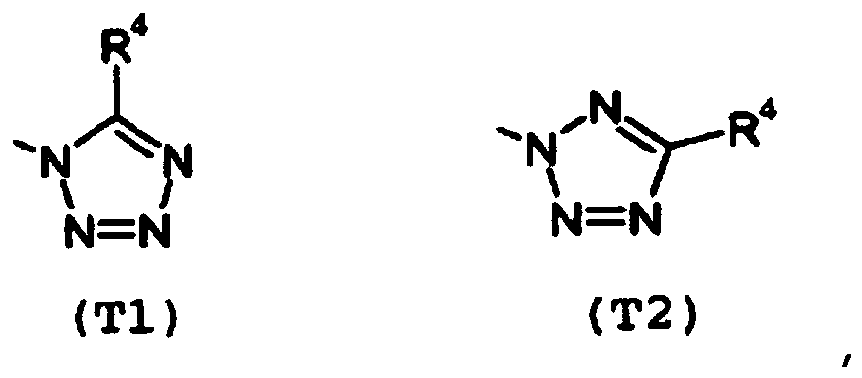
- Herbizid, das als Wirkstoff die Verbindung nach Anspruch 1 oder 2 umfasst.
- Verbindung gemäß Formel (II):


Applications Claiming Priority (2)
| Application Number | Priority Date | Filing Date | Title |
|---|---|---|---|
| JP2006279533A JP5209194B2 (ja) | 2006-10-13 | 2006-10-13 | ベンゾイルピラゾール類及び除草剤 |
| PCT/EP2007/008551 WO2008043456A1 (en) | 2006-10-13 | 2007-10-02 | Benzoylpyrazoles, their use as as herbicides, and intermediates |
Publications (2)
| Publication Number | Publication Date |
|---|---|
| EP2081925A1 EP2081925A1 (de) | 2009-07-29 |
| EP2081925B1 true EP2081925B1 (de) | 2012-02-15 |
Family
ID=38694833
Family Applications (1)
| Application Number | Title | Priority Date | Filing Date |
|---|---|---|---|
| EP07818631A Not-in-force EP2081925B1 (de) | 2006-10-13 | 2007-10-02 | Benzoylpyrazole, ihre Verwendung als Herbizide, und Zwischenprodukte |
Country Status (15)
| Country | Link |
|---|---|
| US (1) | US8084398B2 (de) |
| EP (1) | EP2081925B1 (de) |
| JP (1) | JP5209194B2 (de) |
| KR (1) | KR20090068275A (de) |
| CN (1) | CN101522663A (de) |
| AR (1) | AR063254A1 (de) |
| AT (1) | ATE545643T1 (de) |
| AU (1) | AU2007306726A1 (de) |
| BR (1) | BRPI0717748B1 (de) |
| CA (1) | CA2666347A1 (de) |
| CL (1) | CL2007002960A1 (de) |
| CO (1) | CO6160268A2 (de) |
| EA (1) | EA015425B1 (de) |
| TW (1) | TW200821300A (de) |
| WO (1) | WO2008043456A1 (de) |
Families Citing this family (1)
| Publication number | Priority date | Publication date | Assignee | Title |
|---|---|---|---|---|
| CN112409263B (zh) * | 2019-08-23 | 2024-04-05 | 东莞市东阳光农药研发有限公司 | 取代的苯甲酰类化合物及其应用 |
Family Cites Families (12)
| Publication number | Priority date | Publication date | Assignee | Title |
|---|---|---|---|---|
| JPS61257974A (ja) | 1985-05-11 | 1986-11-15 | Nissan Chem Ind Ltd | ピラゾ−ル誘導体,その製造方法および選択性除草剤 |
| DE68919709T2 (de) | 1988-11-18 | 1995-04-06 | Zeneca Inc | Trisubstituierte benzoesäure-zwischenverbindungen. |
| EP0629623B1 (de) * | 1992-03-03 | 1999-05-19 | Idemitsu Kosan Company Limited | Pyrazolderivate |
| JPH06247891A (ja) | 1993-02-25 | 1994-09-06 | Hokko Chem Ind Co Ltd | シクロヘキサンジオン誘導体および除草剤 |
| JPH07206808A (ja) | 1994-01-17 | 1995-08-08 | Hokko Chem Ind Co Ltd | シクロヘキサンジオン誘導体および除草剤 |
| JPH10109976A (ja) | 1996-04-26 | 1998-04-28 | Ishihara Sangyo Kaisha Ltd | ピラゾール系化合物、それらの製造方法及びそれらを含有する除草剤 |
| DE10039723A1 (de) | 2000-01-17 | 2001-07-19 | Bayer Ag | Substituierte Arylketone |
| JP2003506443A (ja) * | 1999-08-10 | 2003-02-18 | バイエルクロップサイエンス株式会社 | 除草性テトラゾリノン誘導体 |
| DE19953136A1 (de) * | 1999-11-04 | 2001-05-10 | Aventis Cropscience Gmbh | Benzoylcyclohexandione und Benzoylpyrazole, Verfahren zu ihrer Herstellung und ihre Verwendung als Herbizide und Pflanzenwachstumsregulatoren |
| CN1509285A (zh) * | 2000-01-17 | 2004-06-30 | 被取代的芳基酮类 | |
| JP2003238540A (ja) * | 2002-02-08 | 2003-08-27 | Bayer Ag | テトラゾール誘導体及び除草剤 |
| DE10235945A1 (de) * | 2002-08-06 | 2004-02-19 | Bayer Cropscience Gmbh | 3-Aminocarbonyl substituierte Benzoylpyrazolone |
-
2006
- 2006-10-13 JP JP2006279533A patent/JP5209194B2/ja not_active Expired - Fee Related
-
2007
- 2007-10-02 CN CNA2007800380973A patent/CN101522663A/zh active Pending
- 2007-10-02 WO PCT/EP2007/008551 patent/WO2008043456A1/en not_active Ceased
- 2007-10-02 AU AU2007306726A patent/AU2007306726A1/en not_active Abandoned
- 2007-10-02 EA EA200900442A patent/EA015425B1/ru not_active IP Right Cessation
- 2007-10-02 CA CA002666347A patent/CA2666347A1/en not_active Abandoned
- 2007-10-02 US US12/444,554 patent/US8084398B2/en not_active Expired - Fee Related
- 2007-10-02 EP EP07818631A patent/EP2081925B1/de not_active Not-in-force
- 2007-10-02 AT AT07818631T patent/ATE545643T1/de active
- 2007-10-02 BR BRPI0717748-8A patent/BRPI0717748B1/pt not_active IP Right Cessation
- 2007-10-02 KR KR1020097009531A patent/KR20090068275A/ko not_active Withdrawn
- 2007-10-11 TW TW096138009A patent/TW200821300A/zh unknown
- 2007-10-11 AR ARP070104510A patent/AR063254A1/es not_active Application Discontinuation
- 2007-10-12 CL CL200702960A patent/CL2007002960A1/es unknown
-
2009
- 2009-04-13 CO CO09036953A patent/CO6160268A2/es unknown
Also Published As
| Publication number | Publication date |
|---|---|
| US20100094023A1 (en) | 2010-04-15 |
| AR063254A1 (es) | 2009-01-14 |
| BRPI0717748A2 (pt) | 2013-10-22 |
| WO2008043456A1 (en) | 2008-04-17 |
| BRPI0717748B1 (pt) | 2014-12-02 |
| KR20090068275A (ko) | 2009-06-25 |
| JP5209194B2 (ja) | 2013-06-12 |
| CA2666347A1 (en) | 2008-04-17 |
| JP2008094771A (ja) | 2008-04-24 |
| CL2007002960A1 (es) | 2008-03-14 |
| EP2081925A1 (de) | 2009-07-29 |
| EA200900442A1 (ru) | 2009-10-30 |
| AU2007306726A1 (en) | 2008-04-17 |
| EA015425B1 (ru) | 2011-08-30 |
| CN101522663A (zh) | 2009-09-02 |
| TW200821300A (en) | 2008-05-16 |
| CO6160268A2 (es) | 2010-05-20 |
| ATE545643T1 (de) | 2012-03-15 |
| US8084398B2 (en) | 2011-12-27 |
Similar Documents
| Publication | Publication Date | Title |
|---|---|---|
| JP5097116B2 (ja) | 除草剤としてのスルホンアニリド類の使用 | |
| WO2005000824A1 (en) | Lazolidine derivatives as herbicidal agents | |
| EP2185536B1 (de) | Herbizide triazolylpyridinketone | |
| JP2007530613A (ja) | 除草剤として有用なジフルオロメタンスルホニルアニリド誘導体 | |
| JP2009046418A (ja) | スルホンアニリド類の除草剤としての利用 | |
| JP4101286B2 (ja) | 複素環式ベンゾニトリル類 | |
| EP1208090A1 (de) | Herbizide tetrazolinon-derivate | |
| US5776858A (en) | 1-azinyl-tetrazolinones | |
| US8084398B2 (en) | Benzoylpyrazoles and herbicide | |
| JPH07188251A (ja) | 4−シアノフエニルイミノ複素環 | |
| KR20030011372A (ko) | 신규한 테트라졸 유도체 | |
| US20050090398A1 (en) | Novel tetrazole derivative useful as herbicides | |
| US4836844A (en) | Novel N-benzothiazolyl-2,5-dihydropyrroles | |
| RU2276666C2 (ru) | Производные тетразола, гербицидная композиция на их основе и промежуточные соединения | |
| JPH0717954A (ja) | 置換されたトリアゾリノン | |
| JP2006513130A (ja) | 除草剤として有用な新規テトラゾール誘導体 | |
| WO2000040568A1 (en) | Novel tetrazolinone derivatives | |
| WO2007068352A1 (en) | A use of barbituric acid derivatives as herbicidal efficacy-enhancing agents or herbicidal agents and process for their preparation |
Legal Events
| Date | Code | Title | Description |
|---|---|---|---|
| PUAI | Public reference made under article 153(3) epc to a published international application that has entered the european phase |
Free format text: ORIGINAL CODE: 0009012 |
|
| 17P | Request for examination filed |
Effective date: 20090513 |
|
| AK | Designated contracting states |
Kind code of ref document: A1 Designated state(s): AT BE BG CH CY CZ DE DK EE ES FI FR GB GR HU IE IS IT LI LT LU LV MC MT NL PL PT RO SE SI SK TR |
|
| RIN1 | Information on inventor provided before grant (corrected) |
Inventor name: HILLS, MARTIN Inventor name: NAKAMURA, SHIN Inventor name: YANAGI, AKIHIKO Inventor name: NARABU, SHINICHI Inventor name: UKAWA, SEIJI Inventor name: YONETA, YASUSHI Inventor name: DITTGEN, JAN Inventor name: KEHNE, HEINZ Inventor name: ROSINGER, CHRISTOPHER Inventor name: SHIRAKURA, SHINICHI Inventor name: FEUCHT, DIETER Inventor name: ICHIHARA, TERUYUKI |
|
| DAX | Request for extension of the european patent (deleted) | ||
| 17Q | First examination report despatched |
Effective date: 20101130 |
|
| GRAP | Despatch of communication of intention to grant a patent |
Free format text: ORIGINAL CODE: EPIDOSNIGR1 |
|
| RIC1 | Information provided on ipc code assigned before grant |
Ipc: C07D 403/12 20060101AFI20111028BHEP Ipc: A01N 43/56 20060101ALI20111028BHEP Ipc: A01N 43/713 20060101ALI20111028BHEP |
|
| RTI1 | Title (correction) |
Free format text: BENZOYLPYRAZOLES, THEIR USE AS HERBICIDES, AND INTERMEDIATES |
|
| GRAS | Grant fee paid |
Free format text: ORIGINAL CODE: EPIDOSNIGR3 |
|
| GRAA | (expected) grant |
Free format text: ORIGINAL CODE: 0009210 |
|
| AK | Designated contracting states |
Kind code of ref document: B1 Designated state(s): AT BE BG CH CY CZ DE DK EE ES FI FR GB GR HU IE IS IT LI LT LU LV MC MT NL PL PT RO SE SI SK TR |
|
| REG | Reference to a national code |
Ref country code: CH Ref legal event code: EP Ref country code: GB Ref legal event code: FG4D |
|
| REG | Reference to a national code |
Ref country code: IE Ref legal event code: FG4D |
|
| REG | Reference to a national code |
Ref country code: AT Ref legal event code: REF Ref document number: 545643 Country of ref document: AT Kind code of ref document: T Effective date: 20120315 |
|
| REG | Reference to a national code |
Ref country code: DE Ref legal event code: R096 Ref document number: 602007020732 Country of ref document: DE Effective date: 20120412 |
|
| REG | Reference to a national code |
Ref country code: NL Ref legal event code: VDEP Effective date: 20120215 |
|
| LTIE | Lt: invalidation of european patent or patent extension |
Effective date: 20120215 |
|
| PG25 | Lapsed in a contracting state [announced via postgrant information from national office to epo] |
Ref country code: IS Free format text: LAPSE BECAUSE OF FAILURE TO SUBMIT A TRANSLATION OF THE DESCRIPTION OR TO PAY THE FEE WITHIN THE PRESCRIBED TIME-LIMIT Effective date: 20120615 Ref country code: LT Free format text: LAPSE BECAUSE OF FAILURE TO SUBMIT A TRANSLATION OF THE DESCRIPTION OR TO PAY THE FEE WITHIN THE PRESCRIBED TIME-LIMIT Effective date: 20120215 Ref country code: NL Free format text: LAPSE BECAUSE OF FAILURE TO SUBMIT A TRANSLATION OF THE DESCRIPTION OR TO PAY THE FEE WITHIN THE PRESCRIBED TIME-LIMIT Effective date: 20120215 |
|
| PG25 | Lapsed in a contracting state [announced via postgrant information from national office to epo] |
Ref country code: FI Free format text: LAPSE BECAUSE OF FAILURE TO SUBMIT A TRANSLATION OF THE DESCRIPTION OR TO PAY THE FEE WITHIN THE PRESCRIBED TIME-LIMIT Effective date: 20120215 Ref country code: PT Free format text: LAPSE BECAUSE OF FAILURE TO SUBMIT A TRANSLATION OF THE DESCRIPTION OR TO PAY THE FEE WITHIN THE PRESCRIBED TIME-LIMIT Effective date: 20120615 Ref country code: PL Free format text: LAPSE BECAUSE OF FAILURE TO SUBMIT A TRANSLATION OF THE DESCRIPTION OR TO PAY THE FEE WITHIN THE PRESCRIBED TIME-LIMIT Effective date: 20120215 Ref country code: GR Free format text: LAPSE BECAUSE OF FAILURE TO SUBMIT A TRANSLATION OF THE DESCRIPTION OR TO PAY THE FEE WITHIN THE PRESCRIBED TIME-LIMIT Effective date: 20120516 Ref country code: LV Free format text: LAPSE BECAUSE OF FAILURE TO SUBMIT A TRANSLATION OF THE DESCRIPTION OR TO PAY THE FEE WITHIN THE PRESCRIBED TIME-LIMIT Effective date: 20120215 Ref country code: BE Free format text: LAPSE BECAUSE OF FAILURE TO SUBMIT A TRANSLATION OF THE DESCRIPTION OR TO PAY THE FEE WITHIN THE PRESCRIBED TIME-LIMIT Effective date: 20120215 |
|
| REG | Reference to a national code |
Ref country code: AT Ref legal event code: MK05 Ref document number: 545643 Country of ref document: AT Kind code of ref document: T Effective date: 20120215 |
|
| PG25 | Lapsed in a contracting state [announced via postgrant information from national office to epo] |
Ref country code: CY Free format text: LAPSE BECAUSE OF FAILURE TO SUBMIT A TRANSLATION OF THE DESCRIPTION OR TO PAY THE FEE WITHIN THE PRESCRIBED TIME-LIMIT Effective date: 20120215 |
|
| PG25 | Lapsed in a contracting state [announced via postgrant information from national office to epo] |
Ref country code: DK Free format text: LAPSE BECAUSE OF FAILURE TO SUBMIT A TRANSLATION OF THE DESCRIPTION OR TO PAY THE FEE WITHIN THE PRESCRIBED TIME-LIMIT Effective date: 20120215 Ref country code: SE Free format text: LAPSE BECAUSE OF FAILURE TO SUBMIT A TRANSLATION OF THE DESCRIPTION OR TO PAY THE FEE WITHIN THE PRESCRIBED TIME-LIMIT Effective date: 20120215 Ref country code: EE Free format text: LAPSE BECAUSE OF FAILURE TO SUBMIT A TRANSLATION OF THE DESCRIPTION OR TO PAY THE FEE WITHIN THE PRESCRIBED TIME-LIMIT Effective date: 20120215 Ref country code: RO Free format text: LAPSE BECAUSE OF FAILURE TO SUBMIT A TRANSLATION OF THE DESCRIPTION OR TO PAY THE FEE WITHIN THE PRESCRIBED TIME-LIMIT Effective date: 20120215 Ref country code: SI Free format text: LAPSE BECAUSE OF FAILURE TO SUBMIT A TRANSLATION OF THE DESCRIPTION OR TO PAY THE FEE WITHIN THE PRESCRIBED TIME-LIMIT Effective date: 20120215 Ref country code: CZ Free format text: LAPSE BECAUSE OF FAILURE TO SUBMIT A TRANSLATION OF THE DESCRIPTION OR TO PAY THE FEE WITHIN THE PRESCRIBED TIME-LIMIT Effective date: 20120215 |
|
| PG25 | Lapsed in a contracting state [announced via postgrant information from national office to epo] |
Ref country code: IT Free format text: LAPSE BECAUSE OF FAILURE TO SUBMIT A TRANSLATION OF THE DESCRIPTION OR TO PAY THE FEE WITHIN THE PRESCRIBED TIME-LIMIT Effective date: 20120215 Ref country code: SK Free format text: LAPSE BECAUSE OF FAILURE TO SUBMIT A TRANSLATION OF THE DESCRIPTION OR TO PAY THE FEE WITHIN THE PRESCRIBED TIME-LIMIT Effective date: 20120215 |
|
| PLBE | No opposition filed within time limit |
Free format text: ORIGINAL CODE: 0009261 |
|
| STAA | Information on the status of an ep patent application or granted ep patent |
Free format text: STATUS: NO OPPOSITION FILED WITHIN TIME LIMIT |
|
| 26N | No opposition filed |
Effective date: 20121116 |
|
| PG25 | Lapsed in a contracting state [announced via postgrant information from national office to epo] |
Ref country code: AT Free format text: LAPSE BECAUSE OF FAILURE TO SUBMIT A TRANSLATION OF THE DESCRIPTION OR TO PAY THE FEE WITHIN THE PRESCRIBED TIME-LIMIT Effective date: 20120215 |
|
| PGFP | Annual fee paid to national office [announced via postgrant information from national office to epo] |
Ref country code: DE Payment date: 20120927 Year of fee payment: 6 |
|
| REG | Reference to a national code |
Ref country code: DE Ref legal event code: R097 Ref document number: 602007020732 Country of ref document: DE Effective date: 20121116 |
|
| PG25 | Lapsed in a contracting state [announced via postgrant information from national office to epo] |
Ref country code: ES Free format text: LAPSE BECAUSE OF FAILURE TO SUBMIT A TRANSLATION OF THE DESCRIPTION OR TO PAY THE FEE WITHIN THE PRESCRIBED TIME-LIMIT Effective date: 20120526 |
|
| PG25 | Lapsed in a contracting state [announced via postgrant information from national office to epo] |
Ref country code: MC Free format text: LAPSE BECAUSE OF NON-PAYMENT OF DUE FEES Effective date: 20121031 |
|
| REG | Reference to a national code |
Ref country code: CH Ref legal event code: PL |
|
| GBPC | Gb: european patent ceased through non-payment of renewal fee |
Effective date: 20121002 |
|
| REG | Reference to a national code |
Ref country code: IE Ref legal event code: MM4A |
|
| PG25 | Lapsed in a contracting state [announced via postgrant information from national office to epo] |
Ref country code: GB Free format text: LAPSE BECAUSE OF NON-PAYMENT OF DUE FEES Effective date: 20121002 Ref country code: IE Free format text: LAPSE BECAUSE OF NON-PAYMENT OF DUE FEES Effective date: 20121002 Ref country code: LI Free format text: LAPSE BECAUSE OF NON-PAYMENT OF DUE FEES Effective date: 20121031 Ref country code: CH Free format text: LAPSE BECAUSE OF NON-PAYMENT OF DUE FEES Effective date: 20121031 Ref country code: BG Free format text: LAPSE BECAUSE OF FAILURE TO SUBMIT A TRANSLATION OF THE DESCRIPTION OR TO PAY THE FEE WITHIN THE PRESCRIBED TIME-LIMIT Effective date: 20120515 |
|
| PG25 | Lapsed in a contracting state [announced via postgrant information from national office to epo] |
Ref country code: MT Free format text: LAPSE BECAUSE OF FAILURE TO SUBMIT A TRANSLATION OF THE DESCRIPTION OR TO PAY THE FEE WITHIN THE PRESCRIBED TIME-LIMIT Effective date: 20120215 |
|
| PG25 | Lapsed in a contracting state [announced via postgrant information from national office to epo] |
Ref country code: TR Free format text: LAPSE BECAUSE OF FAILURE TO SUBMIT A TRANSLATION OF THE DESCRIPTION OR TO PAY THE FEE WITHIN THE PRESCRIBED TIME-LIMIT Effective date: 20120215 |
|
| PG25 | Lapsed in a contracting state [announced via postgrant information from national office to epo] |
Ref country code: LU Free format text: LAPSE BECAUSE OF NON-PAYMENT OF DUE FEES Effective date: 20121002 |
|
| REG | Reference to a national code |
Ref country code: DE Ref legal event code: R119 Ref document number: 602007020732 Country of ref document: DE Effective date: 20140501 |
|
| PG25 | Lapsed in a contracting state [announced via postgrant information from national office to epo] |
Ref country code: HU Free format text: LAPSE BECAUSE OF FAILURE TO SUBMIT A TRANSLATION OF THE DESCRIPTION OR TO PAY THE FEE WITHIN THE PRESCRIBED TIME-LIMIT Effective date: 20071002 |
|
| PG25 | Lapsed in a contracting state [announced via postgrant information from national office to epo] |
Ref country code: DE Free format text: LAPSE BECAUSE OF NON-PAYMENT OF DUE FEES Effective date: 20140501 |
|
| REG | Reference to a national code |
Ref country code: FR Ref legal event code: PLFP Year of fee payment: 9 |
|
| REG | Reference to a national code |
Ref country code: FR Ref legal event code: PLFP Year of fee payment: 10 |
|
| PGFP | Annual fee paid to national office [announced via postgrant information from national office to epo] |
Ref country code: FR Payment date: 20160928 Year of fee payment: 10 |
|
| REG | Reference to a national code |
Ref country code: FR Ref legal event code: ST Effective date: 20180629 |
|
| PG25 | Lapsed in a contracting state [announced via postgrant information from national office to epo] |
Ref country code: FR Free format text: LAPSE BECAUSE OF NON-PAYMENT OF DUE FEES Effective date: 20171031 |