EP2022332B1 - Wässeriges Desinfektionsmittel zur Herabsetzung der Keimzahl in Luft - Google Patents
Wässeriges Desinfektionsmittel zur Herabsetzung der Keimzahl in Luft Download PDFInfo
- Publication number
- EP2022332B1 EP2022332B1 EP08009091A EP08009091A EP2022332B1 EP 2022332 B1 EP2022332 B1 EP 2022332B1 EP 08009091 A EP08009091 A EP 08009091A EP 08009091 A EP08009091 A EP 08009091A EP 2022332 B1 EP2022332 B1 EP 2022332B1
- Authority
- EP
- European Patent Office
- Prior art keywords
- aqueous disinfectant
- concentration
- weight
- air
- acid
- Prior art date
- Legal status (The legal status is an assumption and is not a legal conclusion. Google has not performed a legal analysis and makes no representation as to the accuracy of the status listed.)
- Active
Links
Images



Classifications
-
- B—PERFORMING OPERATIONS; TRANSPORTING
- B41—PRINTING; LINING MACHINES; TYPEWRITERS; STAMPS
- B41N—PRINTING PLATES OR FOILS; MATERIALS FOR SURFACES USED IN PRINTING MACHINES FOR PRINTING, INKING, DAMPING, OR THE LIKE; PREPARING SUCH SURFACES FOR USE AND CONSERVING THEM
- B41N3/00—Preparing for use and conserving printing surfaces
- B41N3/08—Damping; Neutralising or similar differentiation treatments for lithographic printing formes; Gumming or finishing solutions, fountain solutions, correction or deletion fluids, or on-press development
-
- A—HUMAN NECESSITIES
- A01—AGRICULTURE; FORESTRY; ANIMAL HUSBANDRY; HUNTING; TRAPPING; FISHING
- A01N—PRESERVATION OF BODIES OF HUMANS OR ANIMALS OR PLANTS OR PARTS THEREOF; BIOCIDES, e.g. AS DISINFECTANTS, AS PESTICIDES OR AS HERBICIDES; PEST REPELLANTS OR ATTRACTANTS; PLANT GROWTH REGULATORS
- A01N59/00—Biocides, pest repellants or attractants, or plant growth regulators containing elements or inorganic compounds
Definitions
- the invention relates to the use of an aqueous disinfectant for air disinfection and / or air germ reduction.
- Airborne germ reduction and air disinfection with aerosol disinfectants plays a role in various areas of commercial production, such as in food processing, in the pharmaceutical and / or cosmetics industries.
- disinfectants are also used in crop protection, for example in greenhouses.
- the airborne germ reduction and air disinfection with active ingredient aerosols is also for medical purposes or in the context of a renovation of buildings, especially with regard to the infestation with mold.
- the DE 202006016535 U1 describes a highly concentrated hydrogen peroxide solution of at least 50% hydrogen peroxide for the disinfection of air conditioning systems in the form of aerosols.
- a sufficient effect is achieved only by the high concentration and dosage of the peroxide. Due to the oxidizing properties of the aerosol, however, this can only be used in closed systems or extensive protective measures must be taken for exposed persons. This is generally required for disinfectants when the atomized solutions have a pH in the strongly acidic range, oxidizing and / or corrosive, for example, against the device material and / or produced products act.
- Propylene glycol is z. B. used as a means to maintain the moisture in tobacco and to protect against mold. Similar to the use of ethanol for disinfection purposes very high concentrations of the solvent are used here. Concentrations on the order of five percent and less are not used in combination antimicrobial preparations.
- aerosols of aqueous-alcoholic solutions with peroxides and weak acids are used to prevent or inactivate the development of undesirable microorganisms. Due to the high peroxide concentration of more than 10% by weight ( US 6,106,854 ), based on the total weight of the disinfectant, such aerosols are not suitable for permanent use for the disinfection of air in rooms in which people work or in which sensitive products are.
- the WO 2004/035718 A2 relates to a concentrate of a detergent for dissolving biofouling.
- the WO 03/045144 A1 relates to a means for reducing the germ count and stabilizing water and aqueous solutions.
- the US 2003/0035754 A1 relates to a device for decontamination.
- this further comprises a weak organic acid selected from the group consisting of pyruvic acid, lactic acid, sorbic acid, salts thereof, derivatives thereof and mixtures thereof. Particularly preferred are pyruvic acid and / or lactic acid.
- L - (+) - lactic acid is used as a weak organic acid.
- Acetic acid has proven to be particularly suitable because of their good solubility.
- the weak organic acids have 2 to 6 carbon atoms.
- the weak organic acid has a pKa in the range of from 2 to 7, preferably from 2 to 5.5, and is preferably a saturated acid.
- aqueous disinfectant to be used according to the invention comprises less than 1% by weight, preferably less than 0.1% by weight, more preferably no strong acid, based on the total weight of the aqueous disinfectant.
- Strong acids are preferably acids having a pKa value of less than 1.9. Strong acids are, for example, sulfuric acid and / or hydrochloric acid.
- the aqueous disinfectant to be used in the present invention contains less than 1% by weight, preferably less than 0.01% by weight, phosphoric acid, phosphorous acid, phosphonic acid, phosphinic acid, peroxophosphoric acid, hypodiphosphonic acid, diphosphonic acid, hypodiphosphonic acid, diphosphoric acid, peroxodiphosphoric acid, derivatives thereof , Salts and / or mixtures thereof, based on the total weight of the aqueous disinfectant.
- the aqueous disinfectant to be used in the present invention contains less than 1% by weight, preferably less than 0.01% by weight, of inorganic acid, based on the total weight of the aqueous disinfectant.
- the aqueous disinfectant to be used according to the invention comprises less than 0.1% by weight, more preferably none, surfactants, based on the total weight of the aqueous disinfectant.
- Surfactants are preferably to be understood as meaning amphiphilic organic compounds having surface-active reactions, which are preferably used in detergents, degreasers, detergents, dishwashing detergents and / or shampoos as detergents.
- the surfactants may be anionic, amphoteric, nonionic, cationic surfactants and / or mixtures thereof.
- the surfactants preferably have amphiphilic properties.
- the surfactants have longer-chain alkyl groups as the nonpolar radical. It may also be polyalkylene glycols.
- the aqueous disinfectant to be used according to the invention comprises less than 1% by weight, preferably less than 0.1% by weight, more preferably none, substances selected from the group consisting of benzalkonium chloride, didecyldimethylammonium chloride, meconium acetyl sulfate, octenidine , Polyhexamethylene biguanide, chlorhexidine gluconate, chlorhexidine acetate, cetrimide, cetylpyridinium chloride, hexetidine, alkylthiuronium compounds, benzyl alcohol, phenoxyethanol, phenoxypropanol, ethylhexylglycerol, undecylic acid, 2-biphenol, triclosan, p-chloro-m-xylenol, thymol, urea, benzoic acid, ozone, derivatives thereof and Mixtures thereof, based on the total weight of the aqueous disinfectant.
- the aqueous disinfectant to be used in the present invention comprises less than 0.1% by weight, more preferably none, chelating agents based on the total weight of the aqueous disinfectant.
- the chelating agents are, for example, citric acid, glycine, salicylic acid, aspartic acid, glutamic acid, malonic acid, oxalic acid, succinic acid, Picolinic, phthalic, dipicolinic, aminophosphate, EDTA or mixtures thereof.
- the peroxide compound is selected from the group consisting of alkali peroxide, alkaline earth peroxide, hydrogen peroxide, peroxyacids, perborates, perphosphates, percarbonates, persilicates, persulfates, derivatives, and mixtures thereof.
- alkali peroxide alkaline earth peroxide
- hydrogen peroxide peroxide
- peroxyacids alkaline earth peroxide
- perborates perphosphates, percarbonates, persilicates, persulfates, derivatives, and mixtures thereof.
- potassium peroxymonosulfate, potassium peroxydisulfate, potassium peroxoborate, sodium peroxoborate, carbamide peroxide or mixtures thereof are suitable.
- hydrogen peroxide is used.
- the hydrogen peroxide is stabilized only to a small degree.
- the hydrogen peroxide preferably contains less than 1% by weight of phosphoric acid and / or other stabilizers, based on the total weight of the hydrogen peroxide or of the hydrogen peroxide solution. Most preferably, the hydrogen peroxide or hydrogen peroxide solution contains less than 0.01% by weight and / or other stabilizers, based on the total weight of the hydrogen peroxide or hydrogen peroxide solution.
- the peroxide compound and the weak organic acid may react with each other to form peroxide compounds of the weak organic acid (peroxyacids) in the aqueous disinfectant.
- peroxide compounds of the weak organic acid directly in the aqueous disinfectant according to the invention.
- the aqueous disinfectant according to the invention may contain peroxyacetic acid, peroxypyruvic acid, peroxylactic acid, peroxysorbic acid.
- the weak organic acids have 2 to 6 carbon atoms.
- the concentration of the weak organic peroxyacids may be from 0.000001 to 0.1% by weight, preferably from 0.005 to 0.03% by weight, based on the total weight of the aqueous disinfectant.
- the aqueous disinfectant comprises an organic solvent selected from the group consisting of glycerol, ethylene glycol, propylene glycol, diethylene glycol, monomethyl ether dipropylene glycol, methanol, ethanol, 1-propanol, isopropanol, glycol ethers, and mixtures thereof.
- organic solvent selected from the group consisting of glycerol, ethylene glycol, propylene glycol, diethylene glycol, monomethyl ether dipropylene glycol, methanol, ethanol, 1-propanol, isopropanol, glycol ethers, and mixtures thereof.
- propylene glycol 1,2-propylene glycol and / or 1,3-propylene glycol is suitable.
- Particularly suitable organic solvents are aliphatic, linear or branched alcohols, preferably having 1 to 4 carbon atoms, more preferably having 2 or 3 carbon atoms, in particular ethanol, 1-propanol and / or isopropanol proved.
- ethers or glycol ethers are diethyl ether, 2-methoxyethanol, 2-ethoxyethanol, 2-propoxyethanol, 2-isopropoxyethanol, 2-butoxyethanol, 2- (2-ethoxyethoxy) ethanol, 2- (2-butoxyethoxy) ethanol, dimethoxyethane, diethoxyethane, Dibutoxyethane or mixtures thereof are suitable.
- the pH of the aqueous disinfectant to be used in the present invention is in the range of 5.5 and 6.8.
- the pH may also be stabilized by a buffer, e.g. B. by combining weak organic acids with their salts.
- the latter comprises the peroxide compound in a molar excess, based on the amount of weak organic acid.
- the molar excess is preferably in a range from 10: 1 to 1000: 1, more preferably from 50: 1 to 500: 1, based on the ratio of peroxide compound to weak organic acid.
- the aqueous disinfectant to be used according to the invention contains the peroxide compound in a concentration of 0.001 to 10% by weight, preferably 0.5 to 5% by weight, more preferably 1 to 3% by weight, based on the total weight of the aqueous disinfectant.
- the latter contains the organic solvent in a concentration of from 0.01 to 10% by weight, preferably from 0.1% by weight to 5% by weight, more preferably from 0.1 to 2 wt .-%, based on the total weight of the aqueous disinfectant.
- the aqueous disinfectant to be used in the present invention contains the weak organic acid in a concentration of 0.00001 to 5% by weight, preferably 0.001 to 1% by weight, more preferably 0.01 to 0.1% by weight. %, based on the total weight of the aqueous disinfectant.
- the aqueous disinfectant to be used according to the invention surprisingly exhibits, with low toxicity, a sufficiently good activity against bacteria, mold spores and / or yeasts. Due to the low toxicity, the aqueous disinfectant to be used according to the invention can also be used in the processing of foods. Furthermore, it is also suitable for disinfecting in the production of medicaments, cosmetics and / or in the medical field, in particular in hospitals. The disinfection may preferably be carried out even in the presence of persons.
- the specific combination of at least one peroxide compound, at least one organic solvent and at least acetic acid provides an aqueous disinfectant which is excellent for air disinfection and / or airborne germ reduction.
- aqueous disinfectant which is excellent for air disinfection and / or airborne germ reduction.
- the microbicidal action of peroxides is primarily due to the oxidation of the cell wall and membrane, which is synergistically enhanced by the addition of aliphatic ethers and / or alcohols and a weak organic acid. It is believed that the aliphatic ethers and / or alcohols cause structural loosening and disintegration of the lipid membranes, spore capsule and cell wall, and the weak organic acid stabilizes the peroxide compound.
- aqueous disinfectant after application as an aerosol.
- these substances can ensure a sufficient disinfecting effect in surprisingly low concentrations.
- the specific combinations of a peroxide compound, a specific ether and / or alcohol and a weak organic acid mentioned in this application have excellent long-term stabilization and long-term action.
- the aqueous disinfectant to be used according to the invention is used for air disinfection and / or air-germ reduction.
- the microorganisms may be, for example, bacteria, archaea, microalgae, viruses, protozoa, yeasts, chlamydia, and / or fungi. This preferably includes the respective spore forms.
- the bacteria may be Gram-positive and / or Gram-negative.
- the disinfectant to be used according to the invention is, in particular as an aerosol, effective against problem germs of medical importance.
- the disinfectant according to the invention preferably acts as an aerosol against bacteria such as Staphylococcus aureus, in particular methicillin-resistant forms (MRSA), Streptococcus pneumoniae, Haemophilus influenzae, Mycoplasma pneumoniae, Legionella pneumophila, Pseudomonas aeruginosa, Klebsiella pneumoniae, Proteus mirabilis, Mycobacterium tuberculosis and /. or chlamydia pneumoniae.
- MRSA methicillin-resistant forms
- the disinfectant to be used according to the invention preferably acts, in particular as an aerosol, against yeasts such as candida albicans.
- the disinfectant to be used according to the invention in particular as an aerosol, also acts against viruses such as influenza A and / or B, parainfluenza virus, adenoviruses, respiratory syncytial virus, adenoviruses, vesicular stomatitis virus, SARS coronavirus and / or Lassa virus.
- viruses such as influenza A and / or B, parainfluenza virus, adenoviruses, respiratory syncytial virus, adenoviruses, vesicular stomatitis virus, SARS coronavirus and / or Lassa virus.
- the spectrum against the disinfectant susceptible to be used according to the invention also preferably includes typical pathogens of foodborne infections and intoxications such as Campylobacter jejuni, Clostridium perfringens, Escherichia coli 0157: H7, Listeria monocytogenes, Salmonella species, Toxoplasma gondii, Clostridium botulinum, Staphylococcus species , Bacillus cereus and / or molds such as Aspergillus flavus, Aspergillus niger and / or Penicillium species.
- typical pathogens of foodborne infections and intoxications such as Campylobacter jejuni, Clostridium perfringens, Escherichia coli 0157: H7, Listeria monocytogenes, Salmonella species, Toxoplasma gondii, Clostridium botulinum, Staphylococcus species , Bacillus cereus and / or molds such as Aspergillus flavus,
- Air disinfection is preferably to be understood as meaning a reduction of the microorganisms by at least a factor of 10 4 to 10 5 .
- air-nuclide reduction is preferably a reduction of the microorganisms in a range of the factor 10 1/2 to 10 3 to understand, more preferably from 10 1/2 to 10 second
- the aqueous disinfectant can be used, for example, for air disinfection and / or air-germ reduction in the production of foodstuffs, in food packaging, in food storage, in cooling and maturing rooms, in the sale of foodstuffs, in the production and / or packaging of pharmaceuticals, in biotechnological processes, in private households, in sports facilities, in swimming pools, in medical areas and / or in ventilation and air conditioning systems.
- aqueous disinfectant to be used according to the invention installations for industrial production, buildings and premises for industrial production, including food production and / or processing, can be disinfected or the number of germs can be reduced. Furthermore, with the aqueous disinfectant to be used according to the invention, a packaging pre-sterilization and / or remediation of air conditioning and ventilation systems can be carried out.
- the object is further achieved by the use of the aqueous disinfectant in a process for air disinfection and / or reducing the bacterial count in the air, wherein the aqueous disinfectant to be used according to the invention is applied in the form of an aerosol in the air.
- the aerosol can be prepared by spraying, atomizing, evaporating and / or cold fogging.
- the aerosol is produced by ultrasonic cold fogging.
- the aerosol can be produced or deployed by means of an ultrasound cold-atomizer that is electronically regulated in terms of volume and time.
- the aqueous disinfectant is further preferred in the air in a concentration of 0.01 to 50 ml of aqueous disinfectant per m 3 of air per hour, preferably 0.02 to 10 ml of aqueous disinfectant per m 3 of air per hour 0.04 to 1 ml of aqueous disinfectant per m 3 of air per hour, introduced in the form of an aerosol.
- the liquid droplets of the aerosol have a average drop size in a range of 20 nm to 50 microns, preferably in a range of 25 nm to 5 microns, on.
- the concentration of peroxides in the aerosol is in the range between 0.00005 and 1.5 g per m 3 volume per hour, the concentration of the organic solvent between 0.0000015 and 2.5 g per m 3 volume per volume Hour and / or the concentration of weak organic acid between 0.000000001 and 0.15 g per m 3 volume per hour.
- the concentration of peroxides in the aerosol is in the range between 0.0001 and 0.3 g per m 3 volume per hour, the concentration of the solvent between 0.000003 and 0.5 g per m 3 volume per hour and / or concentration the acid between 0.000000002 and 0.03 g per m 3 volume per hour.
- the aerosol is applied continuously or at intervals in the air to be disinfected.
- the treatment duration of the intervals or the continuous treatment is from 2 minutes to 7 days, preferably 1 hour to 1 day.
- the total duration of treatment can last from 2 weeks to 5 years.
- the treatment can take place in the entire room air or in room air compartments, which are partially or completely separated from the environment.
- Example 4 (comparative example , not falling within the scope of the invention)
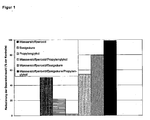
- FIGS. 1 and 2 show the percentage reduction of the bacterial counts compared to the river water sample treated with tap water only.
- the samples treated with ethanol or propylene glycol or acetic acid show only a small reduction in the total bacterial count.
- Improved efficacy was achieved in combination with hydrogen peroxide.
- a reduction of the bacteria of over 90% was achieved.
- an aqueous disinfectant was introduced as aerosol with an ultrasonic cold nebulizer from BOGA with an electronically controlled dosage of 10 ml / hour. Based on the volume of the room, the dosage of the solution used was thus 0.33 ml per m 3 of room volume per hour.
- the mean droplet size of the aerosol was in the range between one and 8 microns.
- the basal cell counts (predominantly bacteria, including Bacillus species, Staphylococcus epidermidis, Micrococcus species) and the number of mold spores and yeasts (including Aspergillus species) were each in the range of 200 to 1000 colony forming units / cubic meter volume.
- the aqueous disinfectant comprised an aqueous solution containing 1.5% by weight of hydrogen peroxide, 0.1% by weight of acetic acid, 0.2% by weight of propylene glycol and 0.5% by weight of ethanol, based on the total weight of the aqueous disinfectant.
- Approximately 36 hours after making the solution with 1.5% hydrogen peroxide, 0.1% acetic acid, 0.2% propylene glycol or 0.5 wt .-% ethanol was with semi-quantitative test strips a concentration of 0.25 wt .-% Peracetic acid, based on the total weight of the aqueous disinfectant, measured in this aqueous disinfectant.
- the total bacterial count (number of bacteria) as well as the number of yeasts and mold spores was determined before and 24 hours after the permanent discharge of water or aqueous disinfectant in the air. In each case, the mean values from three different experiments with duplicate determinations of each individual experiment were determined. A sample volume of 100 l of room air was conducted with the air germ collector RCS Plus from Biotest HYCON via the air germ indicators TC and SDX.
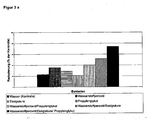
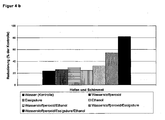
- FIG. 3 and 4 show the percentage reduction of the germ counts compared to the untreated air.
- the only treated with hydrogen peroxide, acetic acid, ethanol or propylene glycol samples showed only a small reduction in the total bacterial count of the molds and yeasts.
- Improved efficacy has been achieved in two-component combinations with hydrogen peroxide.
- a reduction of bacteria, molds and yeasts of more than 80% was achieved already after 24 hours.
- the inventive aqueous disinfectant is also suitable for air disinfection.
Landscapes
- Life Sciences & Earth Sciences (AREA)
- Dentistry (AREA)
- Zoology (AREA)
- Inorganic Chemistry (AREA)
- Pest Control & Pesticides (AREA)
- Plant Pathology (AREA)
- Health & Medical Sciences (AREA)
- Agronomy & Crop Science (AREA)
- General Health & Medical Sciences (AREA)
- Engineering & Computer Science (AREA)
- Wood Science & Technology (AREA)
- Chemical & Material Sciences (AREA)
- Environmental Sciences (AREA)
- Agricultural Chemicals And Associated Chemicals (AREA)
- Disinfection, Sterilisation Or Deodorisation Of Air (AREA)
- Printing Plates And Materials Therefor (AREA)
Description
- Die Erfindung betrifft die Verwendung eines wässerigen Desinfektionsmittels zur Luftdesinfektion und/oder Luftkeimreduzierung.
- Die Luftkeimreduzierung und Luftdesinfektion mit Desinfektionsmitteln in Form von Aerosolen spielt in verschiedenen Bereichen der gewerblichen Produktion eine Rolle, wie bei der Lebensmittelverarbeitung, in der pharmazeutischen und/oder der Kosmetikindustrie. Darüber hinaus werden auch im Pflanzenschutz, beispielsweise in Gewächshäusern, Desinfektionsmittel eingesetzt. Die Luftkeimreduzierung und Luftdesinfektion mit Wirkstoff-Aerosolen erfolgt ferner zu medizinischen Zwecken oder im Rahmen einer Sanierung von Gebäuden, vor allem im Hinblick auf den Befall mit Schimmel.
- Die
DE 202006016535 U1 beschreibt eine hoch konzentrierte Wasserstoffperoxidlösung von mindestens 50 % Wasserstoffperoxid zur Desinfektion von Klimaanlagen in Form von Aerosolen. Eine ausreichende Wirkung wird jedoch nur durch die hohe Konzentration und Dosierung des Peroxids erzielt. Aufgrund der oxidierenden Eigenschaften des Aerosols kann dieses jedoch nur in geschlossenen Systemen verwendet werden oder es müssen umfangreiche Schutzmaßnahmen für exponierte Personen ergriffen werden. Dies ist generell bei Desinfektionsmitteln erforderlich, wenn die vernebelten Lösungen einen pH-Wert im stark sauren Bereich aufweisen, oxidierend und/oder korrosiv, z.B. gegenüber dem Geräte-Material und/oder produzierten Produkten, wirken. - Um diese unerwünschten Effekte zu verringern, werden Kombinationen aus Peroxiden mit anderen antimikrobiellen Substanzen eingesetzt, die beispielsweise durch Reduktion der Oberflächenspannung von Flüssigkeiten synergistisch den antimikrobiellen Effekt der Peroxide unterstützen.
- In der
DE 102004022392 A1 ist eine Lösung aus Percarbonsäuren und nichtionischen Tensiden beschrieben, die für die Luftdesinfektion vernebelt werden. Tenside können jedoch unerwünsche Rückstände auf Lebensmitteln hinterlassen. - Propylenglykol wird z. B. als Mittel zum Erhalten der Feuchtigkeit in Tabak und zum Schutz gegen Schimmelbefall eingesetzt. Ähnlich wie bei der Anwendung von Ethanol zu Desinfektionszwecken sind hier sehr hohe Konzentrationen des Lösungsmittels gebräuchlich. Konzentrationen in einer Größenordnung von fünf Prozent und weniger werden in antimikrobiellen Kombinationspräparaten nicht genutzt.
- Im Stand der Technik kommen Aerosole aus wässerigen-alkoholischen Lösungen mit Peroxiden und schwachen Säuren zur Anwendung, um der Entwicklung von unerwünschten Mikroorganismen vorzubeugen bzw. diese zu inaktivieren. Aufgrund der hohen Peroxidkonzentration von über 10 Gew.-% (
US 6,106,854 ), bezogen auf das Gesamtgewicht des Desinfektionsmittels, sind derartige Aerosole nicht zur dauerhaften Anwendung zur Desinfektion von Luft in Räumen geeignet, in denen Personen arbeiten oder in welchen sich empfindliche Produkte befinden. - Die
WO 2004/035718 A2 betrifft ein Konzentrat eines Reinigungsmittels zum Auflösen von Biofouling. DieWO 03/045144 A1 US 2003/0035754 A1 betrifft eine Vorrichtung zur Dekontamination. - Es ist Aufgabe der vorliegenden Erfindung, ein Desinfektionsmittel zur Herabsetzung der Keimzahl in der Luft und/oder zur Desinfektion der Luft bereit zu stellen, das in Form eines Aerosols anwendbar ist, eine starke und langfristige Wirkung aufweist, nicht toxisch und/oder nicht korrosiv wirkt.
- Die Aufgabe wird durch die Verwendung eines wässerigen Desinfektionsmittels gemäß Anspruch 1 gelöst, umfassend:
- a) mindestens eine Peroxidverbindung,
- b) mindestens ein organisches Lösungsmittel, ausgewählt aus einem aliphatischen Alkohol und/oder aliphatischen Ether, und
- c) Essigsäure,
- Bei einer Ausführungsform besteht das erfindungsgemäß zu verwendende wässerige Desinfektionmittel aus
- a) mindestens einer Peroxidverbindung,
- b) mindestens einem organischen Lösungsmittel, ausgewählt aus einem aliphatischen Alkohol und/oder aliphatischen Ether, und
- c) Essigsäure,
- Bei einer Ausführungsform des erfindungsgemäße zu verwendenden wässerigen Desinfektionsmittels umfasst dieses ferner eine schwache organische Säure, ausgewählt aus der Gruppe, bestehend aus, Brenztraubensäure, Milchsäure, Sorbinsäure, Salze davon, Derivate davon und Mischungen davon. Besonders bevorzugt sind, Brenztraubensäure und/oder Milchsäure. Insbesondere wird L-(+)-Milchsäure als schwache organische Säure eingesetzt. Essigsäure hat sich aufgrund ihrer guten Löslichkeit als besonders geeignet erwiesen. Vorzugsweise weisen die schwachen organischen Säuren 2 bis 6 Kohlenstoffatome auf. Vorzugsweise weist die schwache organische Säure einen pKs-Wert im Bereich von 2 bis 7, vorzugsweise von 2 bis 5,5, auf Vorzugsweise handelt es sich um eine gesältigte Säure.
- Bei einer bevorzugten Ausführungsform des erfindungsgemäß zu verwendenden wässerigen Desinfektionsmittels umfasst dieses weniger als 1 Gew.-%, vorzugsweise weniger als 0,1 Gew.-%, weiter bevorzugt keine starke Säure, bezogen auf das Gesamtgewicht des wässerigen Desinfektionsmittels. Unter starken Säuren sind vorzugsweise Säuren mit einem pKs-Wert kleiner 1,9 zu verstehen. Starke Säuren sind beispielsweise Schwefelsäure und/oder Salzsäure.
- Vorzugsweise enthält das erfindungsgemäß zu verwendende wässerige Desinfektionsmittel weniger als 1 Gew.-%, vorzugsweise weniger als 0,01 Gew.-%, Phosphorsäure, phosphorige Säure, Phosphonsäure, Phosphinsäure, Peroxophosphorsäure, Hypodiphosphonsäure, Diphosphonsäure, Hypodiphosphonsäure, Diphosphorsäure, Peroxodiphosphorsäure, Derivate davon, Salze und/oder Mischungen davon, bezogen auf das Gesamtgewicht des wässerigen Desinfektionsmittels. Am meisten bevorzugt enthält das erfindungsgemäß zu verwendende wässerige Desinfektionsmittel weniger als 1 Gew.-%, vorzugsweise weniger als 0,01 Gew.-%, anorganische Säure, bezogen auf das Gesamtgewicht des wässerigen Desinfektionsmittels.
- Das erfindungsgemäß zu verwendende wässerige Desinfektionsmittel umfasst weniger als 0,1 Gew.-%, weiter bevorzugt keine, Tenside, bezogen auf das Gesamtgewicht des wässerigen Desinfektionsmittels.
- Unter Tensiden sind vorzugsweise amphiphile organische Verbindungen mit grenzflächenaktiven Reaktionen zu verstehen, die vorzugsweise in Reinigungsmitteln, Entfettern, Waschmitteln, Spülmitteln und/oder Shampoos als Detergentien verwendet werden. Bei den Tensiden kann es sich um anionische, amphotere, nicht-ionische, kationische Tenside und/oder Mischungen davon handeln. Die Tenside besitzen vorzugsweise amphiphile Eigenschaften. Beispielsweise weisen die Tenside längerkettige Alkylgruppen als unpolaren Rest auf. Es kann sich auch um Polyalkylenglykole handeln.
- Bei einer Ausführungsform des erfindungsgemäß zu verwendenden wässerigen Desinfektionsmittels umfasst dieses weniger als 1 Gew.-%, vorzugsweise weniger als 0,1 Gew.-%, weiter bevorzugt keine, Stoffe, ausgewählt aus der Gruppe, bestehend aus Benzalkoniumchlorid, Didecyldimethylammoniumchlorid, Mecetroniumetilsulfat, Octenidin, Polyhexamethylenbiguanid, Chlorhexidingluconat, Chlorhexidinacetat, Cetrimid, Cetylpyridiniumchlorid, Hexetidin, Alkylthiuroniumverbindungen, Benzylalkohol, Phenoxyethanol, Phenoxypropanol, Ethylhexylglycerin, Undecylsäure, 2-Biphenol, Triclosan, p-Chlor-m-Xylenol, Thymol, Harnstoff, Benzoesäure, Ozon, Derivate davon und Mischungen davon, bezogen auf das Gesamtgewicht des wässerigen Desinfektionsmittels.
- Das erfindungsgemäß zu verwendende wässerige Desinfektionsmittel umfasst weniger als 0,1 Gew.-%, weiter bevorzugt keine, Chelatisierungsmittel, bezogen auf das Gesamtgewicht des wässerigen Desinfektionsmittels.
- Bei den Chelatisierungsmitteln, vorzugsweise mit ein- bis zu mehrzähnigen Liganden, handelt es sich beispielsweise um Zitronensäure, Glycin, Salicylsäure, Asparaginsäure, Glutaminsäure, Malonsäure, Oxalsäure, Bernsteinsäure, Picolinsäure, Phthalsäure, Dipicolinsäure, Aminophosphat, EDTA oder Mischungen davon.
- Bei einer Ausführungsform ist die Peroxidverbindung aus der Gruppe, bestehend aus Alkaliperoxid, Erdalkaliperoxid, Wasserstoffperoxid, Peroxysäuren, Perboraten, Perphosphaten, Percarbonaten, Persilikaten, Persulfaten, Derivaten und Mischungen davon, ausgewählt. Beispielsweise sind Kaliumperoxymonosulfat, Kaliumperoxydisulfat, Kaliumperoxoborat, Natriumperoxoborat, Carbamidperoxid oder Mischungen davon geeignet. Bei einer Ausführungsform wird Wasserstoffperoxid eingesetzt. Vorzugsweise ist das Wasserstoffperoxid nur zu einem geringen Grad stabilisiert. Vorzugsweise enthält das Wasserstoffperoxid weniger als 1 Gew.-% Phosphorsäure und/oder andere Stabilisatoren, bezogen auf das Gesamtgewicht des Wasserstoffperoxids bzw. der Wasserstoffperoxidlösung. Am meisten bevorzugt enthält das Wasserstoffperoxid oder die Wasserstoffperoxidlösung weniger als 0,01 Gew.-% und/oder andere Stabilisatoren, bezogen auf das Gesamtgewicht des Wasserstoffperoxids oder der Wasserstoffperoxidlösung.
- Die Peroxidverbindung und die schwache organische Säure können miteinander zu Peroxidverbindungen der schwachen organischen Säure (Peroxysäuren) in dem wässerigen Desinfektionsmittel reagieren. Alternativ können auch direkt Peroxidverbindungen der schwachen organischen Säure in dem erfindungsgemäßen wässerigen Desinfektionsmittel eingesetzt werden. Insbesondere kann das erfindungsgemäße wässerige Desinfektionsmittel Peroxyessigsäure, Peroxybrenztraubensäure, Peroxymilchsäure, Peroxysorbinsäure enthalten. Vorzugsweise weisen die schwachen organischen Säuren 2 bis 6 Kohlenstoffatome auf.
- Die Konzentration der schwachen organischen Peroxysäuren kann von 0,000001 bis 0,1 Gew.-%, vorzugsweise von 0,005 bis 0,03 Gew.-%, bezogen auf das Gesamtgewicht des wässerigen Desinfektionsmittels, betragen.
- Bei einer Ausführungsform umfasst das wässerige Desinfektionsmittel ein organisches Lösungsmittel ausgewählt aus der Gruppe, bestehend aus Glycerin, Ethylenglycol, Propylenglykol, Diethylenglycol, Monomethyletherdipropylenglycol, Methanol, Ethanol, 1-Propanol, Isopropanol, Glycolether und Mischungen davon. Als Propylenglycol ist 1,2-Propylenglycol und/oder 1,3-Propylenglycol geeignet.
- Als besonders geeignete organische Lösungsmittel haben sich aliphatische, lineare oder verzweigte Alkohole, vorzugsweise mit 1 bis 4 Kohlenstoffatomen, weiter bevorzugt mit 2 oder 3 Kohlenstoffatomen, wie insbesondere Ethanol, 1-Propanol und/oder Isopropanol, erwiesen.
- Als Ether oder Glycolether sind beispielsweise Diethylether, 2-Methoxyethanol, 2-Ethoxyethanol, 2-Propoxyethanol, 2-Isopropoxyethanol, 2-Butoxyethanol, 2-(2-Ethoxyethoxy)ethanol, 2-(2-Butoxyethoxy)ethanol, Dimethoxyethan, Diethoxyethan, Dibutoxyethan oder Mischungen davon geeignet.
- Vorzugsweise liegt der pH-Wert des erfindungsgemäß zu verwendenden wässerigen Desinfektionsmittels in einem Bereich von 5,5 und 6,8. Der pH-Wert kann auch durch einen Puffer stabilisiert sein, z. B. durch Kombination von schwachen organischen Säuren mit ihren Salzen.
- Bei einer Ausführungsform des erfindungsgemäß zu verwendenden wässerigen Desinfektionsmittels umfasst dieses die Peroxidverbindung in einem molaren Überschuß, bezogen auf die Menge der schwachen organischen Säure. Der molare Überschuß liegt dabei vorzugsweise in einem Bereich von 10:1 bis 1000:1, weiter bevorzugt von 50:1 bis 500:1, bezogen auf das Verhältnis von Peroxidverbindung zu schwacher organischer Säure.
- Bei einer Ausführungsform des erfindungsgemäß zu verwendenden wässerigen Desinfektionsmittels enthält dieses die Peroxidverbindung in einer Konzentration von 0,001 bis 10 Gew.-%, vorzugsweise von 0,5 bis 5 Gew.-%, weiter bevorzugt von 1 bis 3 Gew.-%, bezogen auf das Gesamtgewicht des wässerigen Desinfektionsmittels.
- Bei einer Ausführungsform des erfindungsgemäß zu verwendenden wässerigen Desinfektionsmittels enthält dieses das organische Lösungsmittel in einer Konzentration von 0,01 bis 10 Gew.-%, vorzugsweise von 0,1 Gew.-% bis 5 Gew.-%, weiter bevorzugt von 0,1 bis 2 Gew.-%, bezogen auf das Gesamtgewicht des wässerigen Desinfektionsmittels.
- Bei einer Ausführungsform des erfindungsgemäß zu verwendenden wässerigen Desinfektionsmittels enthält dieses die schwache organische Säure in einer Konzentration von 0,00001 bis 5 Gew.%, vorzugsweise von 0,001 bis 1 Gew.-%, weiter bevorzugt von 0,01 bis 0,1 Gew.-%, bezogen auf das Gesamtgewicht des wässerigen Desinfektionsmittels.
- Das erfindungsgemäß zu verwendende wässerige Desinfektionsmittel weist überraschenderweise bei niedriger Toxizität eine ausreichend gute Wirksamkeit gegen Bakterien, Schimmelpilzsporen und/oder Hefen auf. Aufgrund der geringen Toxizität kann das erfindungsgemäß zu verwendende wässerige Desinfektionsmittel auch bei der Verarbeitung von Lebensmitteln eingesetzt werden. Ferner ist es auch zur Desinfektion bei der Herstellung von Arzneimitteln, Kosmetika und/oder im medizinischen Bereich, insbesondere in Krankenhäusern, geeignet. Die Desinfektion kann vorzugsweise sogar in Gegenwart von Personen durchgeführt werden.
- Die spezielle Kombination aus wenigstens einer Peroxidverbindung, wenigstens einem organischem Lösungsmittel und wenigstens Essigsäure stellt ein wässeriges Desinfektionsmittel bereit, das hervorragend zur Luftdesinfektion und/oder Luftkeimreduzierung geeignet ist. Ohne an eine Theorie gebunden zu sein, wird davon ausgegangen, dass die mikrobizide Wirkung von Peroxiden vor allem auf der Oxidation der Zellwand und -membran beruht, die durch die Zugabe von aliphatischen Ethern und/oder Alkoholen sowie einer schwachen organischen Säure synergistisch verstärkt wird. Es wird vermutet, dass die aliphatischen Ether und/oder Alkohole eine strukturelle Auflockerung und Disintegration der Lipidmembranen, Sporenkapsel und Zellwand bewirken, und die schwache organische Säure die Peroxidverbindung stabilisiert. Dies bewirkt vermutlich eine verlängerte Aktivität des wässerigen Desinfektionsmittels nach dem Ausbringen als Aerosol. Somit können in einem erfindungsgemäßen antimikrobiellen Aerosol, das die vollständige Wirkung über Stunden bis zu mehreren Wochen entfaltet, diese Stoffe in überraschend niedrigen Konzentrationen eine ausreichende Desinfektionswirkung gewährleisten. Insbesondere die speziellen in dieser Anmeldung genannten Kombinationen aus einer Peroxidverbindung, einem speziellen Ether und/oder Alkohol und einer schwachen organischen Säure weisen eine hervorragende Langzeitstabilisierung und Langzeitwirkung auf.
- Aus bislang nicht verstandenen Gründen sind folgende erfindungsgemäß zu verwendende wässerige Desinfektionsmittel besonders wirksam, welche folgende Stoffe umfassen:
- Wasserstoffperoxid, Essigsäure und Ethanol oder
- Wasserstoffperoxid, Essigsäure und Propylenglycol.
- Das erfindungsgemäß zu verwendende wässerige Desinfektionsmittel wird zur Luftdesinfektion und/oder Luftkeimreduzierung eingesetzt. Bei den Mikroorganismen kann es sich beispielsweise um Bakterien, Archaea, Mikroalgen, Viren, Protozoen, Hefen, Chlamydien, und/oder Pilze handeln. Dies umfasst vorzugsweise die jeweiligen Sporenformen.
- Die Bakterien können gram-positiv und/oder gram-negativ sein. Das erfindungsgemäß zu verwendende Desinfektionsmittel ist, insbesondere als Aerosol, wirksam gegen Problemkeime von medizinischer Bedeutung. Insbesondere wirkt das erfindungsgemäße Desinfektionsmittel, vorzugsweise als Aerosol, gegen Bakterien wie Staphylococcus aureus, insbesondere Methicillin-resistente Formen (MRSA), Streptococcus pneumoniae, Haemophilus influenzae, Mycoplasma pneumoniae, Legionella pneumophila, Pseudomonas aeruginosa, Klebsiella pneumoniae, Proteus mirabilis, Mycobacterium tuberculosis und/oder chlamydia pneumoniae.
- Vorzugsweise wirkt das erfindungsgemäß zu verwendende Desinfektionsmittel, insbesondere als Aerosol, gegen Hefen wie candida albicans.
- Vorzugsweise wirkt das erfindungsgemäß zu verwendende Desinfektionsmittel, insbesondere als Aerosol, auch gegen Viren, wie Influenza A und/oder B, Parainfluenzavirus, Adenoviren, Respiratory Syncytial Virus, Adenoviren, Vesiculäres Stomatitis Virus, SARS-Coronavirus und/oder Lassa-Virus.
- Zu dem Spektrum gegen das erfindungsgemäß zu verwendende Desinfektionsmittel empfindlicher Keime gehören vorzugsweise auch typische Erreger von Lebensmittelinfektionen und -intoxikationen, wie beispielsweise Campylobacter jejuni, Clostridium perfringens, Escherichia coli 0157:H7, Listeria monocytogenes, Salmonella species, Toxoplasma gondii, Clostridium botulinum, Staphylococcus species, Bacillus cereus und/oder Schimmelpilze, wie Aspergillus flavus, Aspergillus niger und/oder Penicillium species.
- Unter Luftdesinfektion ist vorzugsweise eine Reduktion der Mikroorganismen um mindestens den Faktor 104 bis 105 zu verstehen. Unter Luftkeimreduzierung ist vorzugsweise eine Reduktion der Mikroorganismen in einem Bereich des Faktors 101/2 bis 103 zu verstehen, besonders bevorzugt von 101/2 bis 102.
- Das wässerige Desinfektionsmittel kann beispielsweise zur Luftdesinfektion und/oder Luftkeimreduzierung bei der Produktion von Lebensmitteln, bei der Verpackung von Lebensmitteln, bei der Lebensmittellagerung, in Kühl- und Reiferäumen, beim Lebensmittelverkauf, bei der Herstellung und/oder Verpackung von Arzneimitteln, bei biotechnologischen Verfahren, in privaten Haushalten, in Sporteinrichtungen, in Schwimmbädern, in medizinischen Bereichen und/oder in Lüftungs- und Klimaanlagen eingesetzt werden.
- Mit dem erfindungsgemäß zu verwendenden wässerigen Desinfektionsmittel können Anlagen zur industriellen Produktion, Gebäude und Räume zur industriellen Produktion, einschließlich der Lebensmittelherstellung und/oder -verarbeitung desinfiziert oder die Keimzahl reduziert werden. Ferner kann mit dem erfindungsgemäß zu verwendenden wässerigen Desinfektionsmittel eine Packstoff-Vorentkeimung und/oder Sanierung von Klima- und Lüftungsanlagen durchgeführt werden.
- Die Aufgabe wird ferner durch die Verwendung des wässrigen Desinfektionsmittels in einem Verfahren zur Luftdesinfektion und/oder Reduzierung der Keimzahl in der Luft gelöst, wobei das erfindungsgemäß zu verwendende wässerige Desinfektionsmittel in Form eines Aerosols in die Luft ausgebracht wird. Das Aerosol kann durch Sprühen, Verdüsen, Verdampfen und/oder Kaltvernebelung hergestellt werden. Vorzugsweise wird das Aerosol durch Ultraschallkaltvernebelung hergestellt. Beispielsweise kann das Aerosol durch einen hinsichtlich Volumen und Zeit elektronisch geregelten Ultraschall-Kaltvernebler hergestellt bzw. ausgebracht werden.
- Bei einer Ausführungsform der erfindungsgemäßen Verwendung wird das wässerige Desinfektionsmittel in die Luft in einer Konzentration von 0,01 bis 50 ml wässeriges Desinfektionsmittel pro m3 Luft pro h, vorzugsweise 0,02 bis 10 ml wässeriges Desinfektionsmittel pro m3 Luft pro h, weiter bevorzugt 0,04 bis 1 ml wässeriges Desinfektionsmittel pro m3 Luft pro h, in Form eines Aerosols eingebracht. Vorzugsweise weisen die Flüssigkeitströpfchen des Aerosols eine mittlere Tropfengröße in einem Bereich von 20 nm bis 50 µm, vorzugsweise in einem Bereich von 25 nm bis 5 µm, auf.
- Bei einer Ausführungsform der erfindungsgemäßen Verwendung liegt die Konzentration der Peroxide im Aerosol im Bereich zwischen 0,00005 und 1,5 g pro m3 Raumvolumen pro Stunde, die Konzentration des organischen Lösungsmittels zwischen 0,0000015 und 2,5 g pro m3 Raumvolumen pro Stunde und/oder die Konzentration der schwachen organischen Säure zwischen 0,000000001 und 0,15 g pro m3 Raumvolumen pro Stunde. Vorzugsweise liegt die Konzentration der Peroxide im Aerosol im Bereich zwischen 0,0001 und 0,3 g pro m3 Raumvolumen pro Stunde, die Konzentration der Lösungsmittel zwischen 0,000003 und 0,5 g pro m3 Raumvolumen pro Stunde und/oder die Konzentration der Säure zwischen 0,000000002 und 0,03 g pro m3 Raumvolumen pro Stunde.
- Bei der erfindungsgemäßen Verwendung wird das Aerosol kontinuierlich oder in Intervallen in die zu desinfizierende Luft ausgebracht. Dabei beträgt die Behandlungsdauer der Intervalle bzw. der kontinuierlichen Behandlung von 2 Minuten bis 7 Tagen, vorzugsweise 1 h bis 1 Tag. Die Gesamtdauer der Behandlung kann von 2 Wochen bis zu 5 Jahren dauern. Die Behandlung kann in der gesamten Raumluft oder in Raumluft-Kompartimenten, die teilweise oder vollständig von der Umgebung abgegrenzt sind, erfolgen.
- Die nachfolgenden Figuren und Beispiele sollen die vorliegende Erfindung erläutern, aber in keiner Weise beschränken.
-
Figur 1 (nicht unter den Umfang der Erfindung fallend) zeigt ein Balkendiagramm mit der prozentualen Reduktion der Gesamtkeimzahl der Bakterien in Flusswasser, bezogen auf die Gesamtkeimzahl der Bakterien einer nur mit Leitungswasser behandelten Flusswasserprobe. Als Desinfektionsmittel wurden unterschiedliche Kombinationen aus H2O2, Essigsäure und Propylenglycol eingesetzt. -
Figur 2 (nicht unter den Umfang der Erfindung fallend) zeigt ein Balkendiagramm mit der prozentualen Reduktion der Gesamtkeimzahl der Bakterien in Flusswasser, bezogen auf die Gesamtkeimzahl der Bakterien einer nur mit Leitungswasser behandelten Flusswasserprobe. Als wässeriges Desinfektionsmittel wurden unterschiedliche Kombinationen aus H2O2, Essigsäure und Ethanol eingesetzt. -
Figur 3 zeigt ein Balkendiagramm mit der prozentualen Reduktion der Gesamtkeimzahl der Bakterien (Figur 3a ) bzw. der prozentualen Reduktion von Schimmelpilzsporen und Hefen (Figur 3b ) in der Luft eines Raumes, der 24 h mit einem Aerosol aus wässerigem Desinfektionsmittel behandelt wurde, bezogen auf die Menge an Bakterien bzw. Schimmelpilzsporen und Hefen in der unbehandelten Raumluft. Als wässeriges Desinfektionsmittel wurden unterschiedliche Kombinationen aus H2O2, Essigsäure und Propylenglycol eingesetzt. -
Figur 4 zeigt ein Balkendiagramm mit der prozentualen Reduktion der Gesamtkeimzahl der Bakterien (Figur 4a ) bzw. der prozentualen Reduktion von Schimmelpilzsporen und Hefen (Figur 4b ) in der Luft eines Raumes, der 24 h mit einem Aerosol aus wässerigem Desinfektionsmittel behandelt wurde, bezogen auf die Menge an Bakterien bzw. Schimmelpilzsporen und Hefen in der unbehandelten Raumluft. Als wässeriges Desinfektionsmittel wurden unterschiedliche Kombinationen aus H2O2, Essigsäure und Ethanol eingesetzt. - Das wässerige Desinfektionsmittel wurde mit einer Konzentration
- 1,5 Gew.- % Wasserstoffperoxid,
- 0,1 Gew.-% 1,2-Propylenglykol,
- 0,1 Gew.-% Essigsäure,
- 0,025 Gew.- % Peroxyessigsäure,
- Eine weitere bevorzugte Ausführungsform des erfindungsgemäß zu verwendenden wässerigen Desinfektionsmittels zur Luftkeimreduzierung und Luftdesinfektion, mit einem gegen grampositive und gramnegative Bakterien und Schimmelpilzsporen gerichteten Wirkspektrum, enthielt die Komponenten:
- 1,5 Gew.-% Wasserstoffperoxid,
- 0,1 Gew.-% Propylenglykol,
- 0,025 bis 0,1 Gew.-% Essigsäure,
- 0,001 bis 0,025 Gew.-% Peressigsäure,
- Eine bevorzugte Ausführungsform des erfindungsgemäß zu verwendenden wässerigen Desinfektionsmittels zur Raumdesinfektion, mit Wirksamkeit insbesondere gegen Schimmelpilzsporen, enthielt die Komponenten:
- 1,5 Gew.-% Wasserstoffperoxid
- 0,1 Gew.-% Propylenglykol
- 0,1 bis 0,2 Gew.-% Essigsäure
- 0,025 bis 0,05 Gew.-% Peressigsäure,
- Bei Raumtemperatur wurde zu Flusswasser (Verdünnung 1:5 bis 1:10, Gesamtkeimzahl 103 bis 104/ml nach der Verdünnung) 0,002 Gew.-% Wasserstoffperoxid, 0,1 Gew.-% Essigsäure, 0,15 Gew.-% Propylenglykol oder 0,15 Gew.-% Ethanol, bezogen auf das Gesamtgewicht des Flusswassers, jeweils allein oder in unterschiedlichen Kombinationen zugegeben. Nach 24 Stunden Einwirkzeit bei Raumtemperatur wurde 1 ml Flusswasser auf Compact Dry TC Kulturplatten der Firma HyServe, Uffing b. München, aufgebracht. Die Kulturplatten wurden 48 Stunden bei 35 °C inkubiert. Die Ergebnisse aus jeweils 3 Versuchen wurden gemittelt. Die prozentuale Reduzierung der Gesamtkeimzahl der Bakterien im behandelten Flusswasser wurde gegenüber einer mit dem gleichen Volumen Leitungswasser behandelten Probe bestimmt.
-
Figuren 1 und2 zeigen die prozentuale Reduzierung der Keimzahlen gegenüber der nur mit Leitungswasser behandelten Flusswasserprobe. Die nur mit Ethanol oder Propylenglykol oder Essigsäure behandelten Proben zeigen nur eine geringe Reduzierung der Gesamtkeimzahl der Bakterien. Eine verbesserte Wirksamkeit wurde in Kombination mit Wasserstoffperoxid erreicht. Überraschenderweise wurde bei der Behandlung mit einer Dreier-Kombination aus H2O2, Essigsäure und Ethanol bzw. Propylenglykol eine Reduktion der Bakterien von über 90 % erreicht. - In einem Testraum mit einer Grundfläche von 12 Quadratmetern bei 2,5 Metern Raumhöhe (Raumvolumen 30 Kubikmeter) wurde als Aerosol ein wässeriges Desinfektionsmittel mit einem Ultraschall-Kaltvernebler der Firma BOGA mit einer elektronisch geregelten Dosierung von 10 ml/Stunde eingebracht. Bezogen auf das Raumvolumen betrug die Dosierung der eingesetzten Lösung somit 0,33 ml pro m3 Raumvolumen pro Stunde. Die mittlere Tropfengröße des Aerosols lag im Bereich zwischen einem und 8 µm.
- Die Ausgangswerte bei der Gesamtkeimzahl (vorwiegend Bakterien, darunter Bacillus Species, Staphylokokkus epidermidis, Mikrococcus Species) und bei der Zahl der Schimmelpilzsporen und Hefen (darunter Aspergillus Species) lagen jeweils im Bereich zwischen 200 und 1000 Kolonie bildende Einheiten/Kubikmeter Raumvolumen.
- Das wässerige Desinfektionsmittel umfasste eine wässerige Lösung mit 1,5 Gew.-% Wasserstoffperoxid, 0,1 Gew.-% Essigsäure, 0,2 Gew.-% Propylenglykol bzw. 0,5 Gew.-% Ethanol, bezogen auf das Gesamtgewicht des wässerigen Desinfektionsmittels. Ca. 36 Stunden nach Herstellen der Lösung mit 1,5 % Wasserstoffperoxid, 0,1 % Essigsäure, 0,2 % Propylenglykol bzw. 0,5 Gew.-% Ethanol wurde mit semi-quantitativen Teststreifen eine Konzentration von 0,25 Gew.-% Peressigsäure, bezogen auf das Gesamtgewicht des wässerigen Desinfektionsmittels, in diesem wässerigen Desinfektionsmittel gemessen.
- Die Gesamtkeimzahl (überwiegend Bakterien) als auch die Zahl von Hefen und Schimmelpilzsporen wurde vor und 24 Stunden nach dem dauerhaften Ausbringen von Wasser oder wässerigem Desinfektionsmittel in der Luft bestimmt. Bestimmt wurden jeweils die Mittelwerte aus drei verschiedenen Versuchen mit Doppelbestimmungen jedes einzelnen Versuches. Dabei wurde ein Probenvolumen von 100 I Raumluft mit dem Luftkeimsammler RCS Plus der Firma Biotest HYCON über die Luftkeimindikatoren TC und SDX geführt.
-
Figur 3 und4 zeigen die prozentuale Reduzierung der Keimzahlen gegenüber der unbehandelten Luft. Die nur mit Wasserstoffperoxid, Essigsäure, Ethanol bzw. Propylenglykol behandelten Proben zeigten nur eine geringe Reduzierung der Gesamtkeimzahl der Bakterien bzw. der Schimmelpilze und Hefen. Eine verbesserte Wirksamkeit wurde bei Zweier-Kombinationen mit Wasserstoffperoxid erreicht. Überraschenderweise wurde bei der Behandlung mit einer Dreier-Kombination aus H2O2, Essigsäure und Ethanol bzw. Propylenglykol eine Reduktion der Bakterien, Schimmelpilze und Hefen von über 80 % bereits nach 24 Stunden erreicht. Dieser Versuch zeigt, dass überraschenderweise das erfindungsgemäße wässerige Desinfektionsmittel auch zur Luftdesinfektion geeignet ist.
Claims (11)
- Verwendung eines wässerigen Desinfektionsmittels zur Luftdesinfektion und/oder Luftkeimreduzierung, umfassend:a) mindestens eine Peroxidverbindung,b) mindestens ein organisches Lösungsmittel, ausgewählt aus einem aliphatischen Alkohol und/oder aliphatischen Ether, undc) Essigsäure,wobei die Peroxidverbindung in einer Konzentration von weniger als 10 Gew.-%, Tenside in einer Konzentration von weniger als 0,1 Gew.-% und Chelatisierungsmittel in einer Konzentration von weniger als 0,1 Gew.-%, bezogen auf das Gesamtgewicht des wässerigen Desinfektionsmittels, in dem wässerigen Desinfektionsmittel enthalten sind.
- Verwendung eines wässerigen Desinfektionsmittels nach Anspruch 1, ferner umfassend eine schwache organische Säure, ausgewählt aus der Gruppe, bestehend aus Brenztraubensäure, Milchsäure, Sorbinsäure, Salze davon, Derivate davon und Mischungen davon.
- Verwendung eines wässerigen Desinfektionsmittels nach Anspruch 1 oder 2, wobei die Peroxidverbindung aus der Gruppe, bestehend aus Alkaliperoxid, Erdalkaliperoxid, Wasserstoffperoxid, Peroxysäuren, Perboraten, Perphosphaten, Percarbonaten, Persilikaten, Persulfaten, Derivaten und Mischungen davon, ausgewählt ist.
- Verwendung eines wässerigen Desinfektionsmittels nach einem der vorhergehenden Ansprüche, wobei das organische Lösungsmittel aus der Gruppe, bestehend aus Glycerin, Ethylenglycol, Propylenglykol, Diethylenglycol, Monomethyletherdipropylenglycol, Methanol, Ethanol, 1-Propanol, Isopropanol, Glycolether und Mischungen davon, ausgewählt ist.
- Verwendung eines wässerigen Desinfektionsmittels nach einem der vorhergehenden Ansprüche, wobei die Peroxidverbindung in einer Konzentration von 0,001 bis 10 Gew.-%, bezogen auf das Gesamtgewicht des wässerigen Desinfektionsmittels, in dem wässerigen Desinfektionsmittel enthalten ist.
- Verwendung eines wässerigen Desinfektionsmittels nach einem der vorhergehenden Ansprüche, wobei das organische Lösungsmittel in einer Konzentration von 0,01 bis 10 Gew.-%, bezogen auf das Gesamtgewicht des wässerigen Desinfektionsmittels, in dem wässerigen Desinfektionsmittel enthalten ist.
- Verwendung eines wässerigen Desinfektionsmittels nach einem der vorhergehenden Ansprüche, wobei die schwache organische Säure in einer Konzentration von 0,00001 bis 5 Gew.-%, bezogen auf das Gesamtgewicht des wässerigen Desinfektionsmittels, in dem wässerigen Desinfektionsmittel enthalten ist.
- Verwendung des wässerigen Desinfektionsmittels nach einem der vorhergehenden Ansprüche zur Luftdesinfektion und/oder Luftkeimreduzierung bei der Produktion von Lebensmitteln, bei der Verpackung von Lebensmitteln, bei der Lebensmittellagerung, in Kühl- und Reiferäumen, beim Lebensmittelverkauf, bei der Herstellung und/oder Verpackung von Arzneimitteln, bei biotechnologischen Verfahren, in privaten Haushalten, in Sporteinrichtungen, in Schwimmbädern, in medizinischen Bereichen und/oder in Lüftungs- und Klimaanlagen.
- Verwendung des Desinfektionsmittels nach einem der vorhergehenden Ansprüche zur Desinfektion von Luft, wobei das wässerige Desinfektionsmittel nach einem der Ansprüche 1 bis 8 in die Luft in einer Konzentration von 0,01 bis 50 ml wässerigem Desinfektionsmittel pro m3 Luft pro h in Form eines Aerosols ausgebracht wird.
- Verwendung nach Anspruch 9, wobei das Aerosol Flüssigkeitströpfchen mit einer mittleren Tropfengröße aus einem Bereich von 20 nm bis 50 µm aufweist.
- Verwendung nach Anspruch 9 oder 10, wobei die Konzentration der Peroxide im Bereich zwischen 0,00005 und 1,5 g pro m3 Raumvolumen pro Stunde, die Konzentration des organischen Lösungsmittels zwischen 0,0000015 und 2,5 g pro m3 Raumvolumen pro Stunde und/oder die Konzentration der schwachen organischen Säure zwischen 0,000000001 und 0,15 g pro m3 Raumvolumen pro Stunde liegt.
Priority Applications (4)
| Application Number | Priority Date | Filing Date | Title |
|---|---|---|---|
| EP08009091A EP2022332B1 (de) | 2007-08-02 | 2008-05-16 | Wässeriges Desinfektionsmittel zur Herabsetzung der Keimzahl in Luft |
| DE202008017594U DE202008017594U1 (de) | 2007-08-02 | 2008-05-16 | Wässriges Desinfektionsmittel zur Herabsetzung der Keimzahl in Luft |
| SI200830572T SI2022332T1 (sl) | 2007-08-02 | 2008-05-16 | Vodno dezinfekcijsko sredstvo za zmanjšanje števila klic v zraku |
| PL08009091T PL2022332T3 (pl) | 2007-08-02 | 2008-05-16 | Wodny środek odkażający do redukcji liczby zarodników w powietrzu |
Applications Claiming Priority (2)
| Application Number | Priority Date | Filing Date | Title |
|---|---|---|---|
| EP07015174A EP2022331A1 (de) | 2007-08-02 | 2007-08-02 | Desinfektionsmittel zur Herabsetzung der Keimzahl und Verringerung von Biofilmen |
| EP08009091A EP2022332B1 (de) | 2007-08-02 | 2008-05-16 | Wässeriges Desinfektionsmittel zur Herabsetzung der Keimzahl in Luft |
Publications (2)
| Publication Number | Publication Date |
|---|---|
| EP2022332A1 EP2022332A1 (de) | 2009-02-11 |
| EP2022332B1 true EP2022332B1 (de) | 2012-01-04 |
Family
ID=39544946
Family Applications (3)
| Application Number | Title | Priority Date | Filing Date |
|---|---|---|---|
| EP07015174A Withdrawn EP2022331A1 (de) | 2007-08-02 | 2007-08-02 | Desinfektionsmittel zur Herabsetzung der Keimzahl und Verringerung von Biofilmen |
| EP08009091A Active EP2022332B1 (de) | 2007-08-02 | 2008-05-16 | Wässeriges Desinfektionsmittel zur Herabsetzung der Keimzahl in Luft |
| EP08009115A Withdrawn EP2020180A1 (de) | 2007-08-02 | 2008-05-16 | Feuchtmittel und dessen Verwendung in Druckanlagen |
Family Applications Before (1)
| Application Number | Title | Priority Date | Filing Date |
|---|---|---|---|
| EP07015174A Withdrawn EP2022331A1 (de) | 2007-08-02 | 2007-08-02 | Desinfektionsmittel zur Herabsetzung der Keimzahl und Verringerung von Biofilmen |
Family Applications After (1)
| Application Number | Title | Priority Date | Filing Date |
|---|---|---|---|
| EP08009115A Withdrawn EP2020180A1 (de) | 2007-08-02 | 2008-05-16 | Feuchtmittel und dessen Verwendung in Druckanlagen |
Country Status (9)
| Country | Link |
|---|---|
| EP (3) | EP2022331A1 (de) |
| AT (1) | ATE539613T1 (de) |
| DE (1) | DE202008017594U1 (de) |
| DK (1) | DK2022332T3 (de) |
| ES (1) | ES2380598T3 (de) |
| HR (1) | HRP20120292T1 (de) |
| PL (1) | PL2022332T3 (de) |
| PT (1) | PT2022332E (de) |
| SI (1) | SI2022332T1 (de) |
Families Citing this family (9)
| Publication number | Priority date | Publication date | Assignee | Title |
|---|---|---|---|---|
| US20110177145A1 (en) * | 2009-07-27 | 2011-07-21 | E.I. Du Pont De Nemours And Company | In situ preparation of peracid-based removable antimicrobial coating compositions and methods of use |
| AU2010281409B2 (en) * | 2009-07-27 | 2014-08-14 | The Chemours Company Fc, Llc | Enzymatic in situ preparation of peracid-based removable antimicrobial coating compositions and methods of use |
| TWI652074B (zh) * | 2016-08-09 | 2019-03-01 | 大日本除蟲菊股份有限公司 | 防霉劑組成物、防霉用噴霧製品及防霉方法 |
| GB2572364B (en) | 2018-03-27 | 2023-04-12 | Selden Res Ltd | Improved Bleaching Compositions |
| CN108902145A (zh) * | 2018-08-16 | 2018-11-30 | 中粮华夏长城葡萄酒有限公司 | 一种杀菌组合物及其制剂和应用 |
| JP7634346B2 (ja) * | 2019-05-10 | 2025-02-21 | 花王株式会社 | 水系システム用バイオフィルム除去用組成物 |
| DE102019117861A1 (de) * | 2019-07-02 | 2021-01-07 | Dantor Biotech Ag | Anwendungsfertiges Desinfektionsmittel |
| DE202020105154U1 (de) | 2020-09-07 | 2021-09-08 | Steffen Berger | Vollständig biologisch abbaubares Biozid |
| CN113925986B (zh) * | 2021-10-13 | 2023-04-07 | 深圳市沃尔德外科医疗器械技术有限公司 | 一种医疗器械灭菌和抗菌协同处理方法及智能型医疗器械 |
Family Cites Families (29)
| Publication number | Priority date | Publication date | Assignee | Title |
|---|---|---|---|---|
| US4604952A (en) * | 1984-05-16 | 1986-08-12 | Inmont Corporation | Quick drying fountain solutions |
| DE3702983A1 (de) * | 1986-06-09 | 1987-12-10 | Henkel Kgaa | Desinfektionsmittel und ihre verwendung zur haut- und schleimhautdesinfektion |
| SU1567395A1 (ru) * | 1988-05-18 | 1990-05-30 | Всесоюзный Научно-Исследовательский Институт Комплексных Проблем Полиграфии | Увлажн ющий раствор дл офсетных печатных форм |
| JPH0624118A (ja) * | 1992-07-08 | 1994-02-01 | Dainippon Ink & Chem Inc | オフセット印刷方法及びオフセット印刷機 |
| WO1995004001A1 (de) * | 1993-07-28 | 1995-02-09 | Heimo Wessollek | Mittel zur herabsetzung der keimzahl und stabilisierung von trink- und brauchwasser |
| GB2292888A (en) * | 1994-09-02 | 1996-03-13 | Bruce Philip Green | Wide spectrum water soluble biocide for medical instruments based on potassium monoperoxysulphate, malic & sulphamic acids, EDTA sodium salt & a glycol ether |
| GB2319179A (en) * | 1996-11-12 | 1998-05-20 | Reckitt & Colman Inc | Cleaning and disinfecting compositions |
| BE1011452A6 (nl) * | 1997-09-12 | 1999-09-07 | Os Jan Van | Middel voor het bestrijden of het voorkomen van micro-organismen en bereidingswijze hiervoor. |
| US6106854A (en) | 1998-03-25 | 2000-08-22 | Belfer; William A. | Disinfectant composition for infectious water and surface contaminations |
| EP1117294B1 (de) * | 1998-10-01 | 2006-01-25 | Minntech Corporation | Vielteilige antimikrobielle sterilisationsmittel und verfahren |
| KR100426937B1 (ko) * | 1998-10-19 | 2004-04-13 | 사라야 컴퍼니 리미티드 | 살균·소독용 과초산 조성물 |
| DE29903415U1 (de) * | 1999-02-25 | 2000-07-06 | Arconia Gmbh, Chur | Desodorierendes und stark keimreduzierendes Mittel für Abwässer u.dgl. zu entsorgende Stoffe |
| DE60017113T2 (de) * | 1999-05-06 | 2006-01-12 | Intecon Systems, Inc., Carlsbad | Reinigung von partikelfeststoffen und chemischen verunreinigungen von händen |
| DE19925425A1 (de) * | 1999-06-02 | 2000-12-07 | Wessollek Heimo | Mittel zur Entkeimung bzw. keimreduzierenden Gestaltung von Reinigungs-, Sanitär- und Toilettenartikeln sowie kosmetischen Artikeln, Körperpflegeartikeln und dergleichen verkeimungsgefährdeten Gegenständen |
| DE19932808A1 (de) * | 1999-07-14 | 2001-01-18 | Wessollek Heimo | Tierhaarprodukt und Verfahren zur Bearbeitung, insbesondere Reinigung von Tierhaarpodukten |
| FR2823978B1 (fr) * | 2001-04-27 | 2004-03-05 | Bioxal | Nouvelle composition desinfectante pour les dispositifs ophtalmologiques, son utilisation et le procede de desinfection |
| FR2825634B1 (fr) * | 2001-06-07 | 2005-03-18 | Anios Lab Sarl | Composition desinfectante et solution additive pour la preparation d'une telle composition |
| US20040157931A1 (en) * | 2001-07-06 | 2004-08-12 | Ra Jeong Chan | Acid disinfectant composition comprising an anion surfacant |
| WO2003045144A1 (de) * | 2001-11-15 | 2003-06-05 | Wessollek Heimo Joerg | Mittel zur herabsetzung der keimzahl von wasser in lebensmittelqualität |
| EP1374679A3 (de) * | 2002-06-21 | 2004-01-21 | Nippon Peroxide Co., Ltd. | Sterilisierende Zusammensetzung und Verfahren zur Sterilisation unter Verwendung derselben |
| JP2005538223A (ja) * | 2002-09-05 | 2005-12-15 | ボクフリー インコーポレーティッド | 速乾性コーティング |
| AU2003285288A1 (en) * | 2002-10-14 | 2004-05-04 | Arconia Gmbh | Composition |
| EP1955593B1 (de) * | 2002-11-15 | 2013-04-17 | Virox Technologies Inc. | Benzylalkohol enthaltendes Wasserstoffperoxid-Desinfektionsmittel |
| BE1016047A3 (nl) * | 2004-02-04 | 2006-02-07 | Geetruy Philip Adolf Van | Waterstofperoxide-oplossing. |
| DE102004022392B4 (de) | 2004-05-06 | 2009-04-02 | Gerhard Ruff Gmbh | Desinfektionsmittel-Zusammensetzung enthaltend zumindest eine Persäure-Verbindung und deren Verwendung zur Raum- und Luftdesinfektion |
| AU2005244462B2 (en) * | 2004-05-14 | 2010-12-16 | Virox Technologies Inc. | Hydrogen peroxide-based skin disinfectant |
| NL1026799C2 (nl) * | 2004-08-06 | 2006-02-07 | Lotec Bv | Desinfectans en waterbehandelingsinstallatie voor badwater. |
| DE102005024001A1 (de) * | 2005-05-25 | 2006-11-30 | Schneiders, Josef | Desinfektions- und Entkeimungsmittel |
| DE202006016535U1 (de) | 2006-10-19 | 2007-03-01 | Schablitzki, Jürgen | Desinfektionsmittel für Klimaanlagen |
-
2007
- 2007-08-02 EP EP07015174A patent/EP2022331A1/de not_active Withdrawn
-
2008
- 2008-05-16 DK DK08009091.3T patent/DK2022332T3/da active
- 2008-05-16 ES ES08009091T patent/ES2380598T3/es active Active
- 2008-05-16 PL PL08009091T patent/PL2022332T3/pl unknown
- 2008-05-16 EP EP08009091A patent/EP2022332B1/de active Active
- 2008-05-16 SI SI200830572T patent/SI2022332T1/sl unknown
- 2008-05-16 EP EP08009115A patent/EP2020180A1/de not_active Withdrawn
- 2008-05-16 PT PT08009091T patent/PT2022332E/pt unknown
- 2008-05-16 AT AT08009091T patent/ATE539613T1/de active
- 2008-05-16 DE DE202008017594U patent/DE202008017594U1/de not_active Expired - Lifetime
-
2012
- 2012-04-03 HR HR20120292T patent/HRP20120292T1/hr unknown
Also Published As
| Publication number | Publication date |
|---|---|
| EP2022332A1 (de) | 2009-02-11 |
| DE202008017594U1 (de) | 2010-09-02 |
| EP2022331A1 (de) | 2009-02-11 |
| DK2022332T3 (da) | 2012-04-10 |
| PT2022332E (pt) | 2012-03-30 |
| PL2022332T3 (pl) | 2012-06-29 |
| SI2022332T1 (sl) | 2012-04-30 |
| EP2020180A1 (de) | 2009-02-04 |
| ATE539613T1 (de) | 2012-01-15 |
| HRP20120292T1 (hr) | 2012-04-30 |
| ES2380598T3 (es) | 2012-05-16 |
Similar Documents
| Publication | Publication Date | Title |
|---|---|---|
| EP2022332A1 (de) | Wässeriges Desinfektionsmittel zur Herabsetzung der Keimzahl in Luft | |
| DE3586959T2 (de) | Desinfektionsverfahren sowie zusammensetzung dafuer. | |
| EP0252276B1 (de) | Desinfektions- und Reinigungsmittel | |
| DE3229097C2 (de) | ||
| DE60215616T2 (de) | Quarternäre ammoniumverbindungen enthaltende konservierungsmittelmischungen | |
| DE2708001A1 (de) | Desinfektionsmittel | |
| DE2606519A1 (de) | Desinfizierende zusammensetzung | |
| US20090304608A1 (en) | Aqueous Hydrogen Peroxide Solution for Use as a Disinfectant or Anti-Microbial Personal Care Product | |
| JP2004524321A (ja) | ヨードプロピニル誘導体とケトン酸若しくはその塩及び/又は芳香族カルボン酸若しくはその塩との併用法 | |
| WO2009094198A1 (en) | Liquid preservative compositions | |
| EP4326068B1 (de) | Desinfektionsmittel und dessen verwendung | |
| DE102021002147A1 (de) | Desinfektionsmittel und dessen Verwendung | |
| DE102020204730A1 (de) | Hautdesinfektionsmittel | |
| DE2611957C2 (de) | Antimikrobielle Mittel | |
| JP2540777B2 (ja) | 液状消毒剤 | |
| EP2621281A1 (de) | Lösung von guanidinium-verbindungen, verfahren unter einsatz dieser lösung sowie deren verwendung | |
| DE102015115024A1 (de) | Flüssigkonzentrat für die Konservierung von Kosmetika | |
| DE2312280A1 (de) | Verwendung von beta-hydroxycarbonsaeuren als antimikrobielle substanzen | |
| EP0998912B1 (de) | Verwendung von Persäuren zur Händedesinfektion oder -dekontamination | |
| DE102020204728A1 (de) | Hautdesinfektionsmittel | |
| EP1448055A1 (de) | Mittel zur herabsetzung der keimzahl von wasser in lebensmittelqualität | |
| DE29904320U1 (de) | Flächiges Gebilde wie z.B. ein Tuch auf der Basis von Papier-, Kunststoff- oder Textilmaterial o.dgl. | |
| EP1454638A1 (de) | Desinfektionsmittelkonzentrate auf Basis quaternärer Ammoniumverbindungen sowie die Verwendung derselben zur chemothermischen Instrumentenaufbereitung | |
| EP1458239A1 (de) | Fungizide desinfektions- und konservierungsmittelzusammensetzungen | |
| EP2900068B1 (de) | Desinfektionsreiniger für trinkwasserversorgungsanlagen und seine verwendungen |
Legal Events
| Date | Code | Title | Description |
|---|---|---|---|
| PUAI | Public reference made under article 153(3) epc to a published international application that has entered the european phase |
Free format text: ORIGINAL CODE: 0009012 |
|
| 17P | Request for examination filed |
Effective date: 20080516 |
|
| AK | Designated contracting states |
Kind code of ref document: A1 Designated state(s): AT BE BG CH CY CZ DE DK EE ES FI FR GB GR HR HU IE IS IT LI LT LU LV MC MT NL NO PL PT RO SE SI SK TR |
|
| AX | Request for extension of the european patent |
Extension state: AL BA MK RS |
|
| 17Q | First examination report despatched |
Effective date: 20090115 |
|
| AKX | Designation fees paid |
Designated state(s): AT BE BG CH CY CZ DE DK EE ES FI FR GB GR HR HU IE IS IT LI LT LU LV MC MT NL NO PL PT RO SE SI SK TR |
|
| GRAP | Despatch of communication of intention to grant a patent |
Free format text: ORIGINAL CODE: EPIDOSNIGR1 |
|
| GRAS | Grant fee paid |
Free format text: ORIGINAL CODE: EPIDOSNIGR3 |
|
| TPAC | Observations filed by third parties |
Free format text: ORIGINAL CODE: EPIDOSNTIPA |
|
| GRAA | (expected) grant |
Free format text: ORIGINAL CODE: 0009210 |
|
| AK | Designated contracting states |
Kind code of ref document: B1 Designated state(s): AT BE BG CH CY CZ DE DK EE ES FI FR GB GR HR HU IE IS IT LI LT LU LV MC MT NL NO PL PT RO SE SI SK TR |
|
| REG | Reference to a national code |
Ref country code: GB Ref legal event code: FG4D Free format text: NOT ENGLISH |
|
| REG | Reference to a national code |
Ref country code: CH Ref legal event code: EP |
|
| REG | Reference to a national code |
Ref country code: AT Ref legal event code: REF Ref document number: 539613 Country of ref document: AT Kind code of ref document: T Effective date: 20120115 |
|
| REG | Reference to a national code |
Ref country code: IE Ref legal event code: FG4D |
|
| REG | Reference to a national code |
Ref country code: CH Ref legal event code: NV Representative=s name: FIAMMENGHI-FIAMMENGHI |
|
| REG | Reference to a national code |
Ref country code: DE Ref legal event code: R096 Ref document number: 502008006021 Country of ref document: DE Effective date: 20120308 |
|
| REG | Reference to a national code |
Ref country code: RO Ref legal event code: EPE |
|
| REG | Reference to a national code |
Ref country code: NL Ref legal event code: T3 |
|
| REG | Reference to a national code |
Ref country code: PT Ref legal event code: SC4A Free format text: AVAILABILITY OF NATIONAL TRANSLATION Effective date: 20120320 |
|
| REG | Reference to a national code |
Ref country code: HR Ref legal event code: TUEP Ref document number: P20120292 Country of ref document: HR |
|
| REG | Reference to a national code |
Ref country code: DK Ref legal event code: T3 |
|
| REG | Reference to a national code |
Ref country code: SE Ref legal event code: TRGR |
|
| REG | Reference to a national code |
Ref country code: HR Ref legal event code: T1PR Ref document number: P20120292 Country of ref document: HR |
|
| REG | Reference to a national code |
Ref country code: NO Ref legal event code: T2 Effective date: 20120104 |
|
| REG | Reference to a national code |
Ref country code: ES Ref legal event code: FG2A Ref document number: 2380598 Country of ref document: ES Kind code of ref document: T3 Effective date: 20120516 |
|
| REG | Reference to a national code |
Ref country code: GR Ref legal event code: EP Ref document number: 20120400583 Country of ref document: GR Effective date: 20120417 |
|
| REG | Reference to a national code |
Ref country code: SK Ref legal event code: T3 Ref document number: E 11343 Country of ref document: SK |
|
| REG | Reference to a national code |
Ref country code: EE Ref legal event code: FG4A Ref document number: E006387 Country of ref document: EE Effective date: 20120327 |
|
| REG | Reference to a national code |
Ref country code: PL Ref legal event code: T3 |
|
| PG25 | Lapsed in a contracting state [announced via postgrant information from national office to epo] |
Ref country code: IS Free format text: LAPSE BECAUSE OF FAILURE TO SUBMIT A TRANSLATION OF THE DESCRIPTION OR TO PAY THE FEE WITHIN THE PRESCRIBED TIME-LIMIT Effective date: 20120504 |
|
| REG | Reference to a national code |
Ref country code: HU Ref legal event code: AG4A Ref document number: E013759 Country of ref document: HU |
|
| PLBI | Opposition filed |
Free format text: ORIGINAL CODE: 0009260 |
|
| PG25 | Lapsed in a contracting state [announced via postgrant information from national office to epo] |
Ref country code: CY Free format text: LAPSE BECAUSE OF FAILURE TO SUBMIT A TRANSLATION OF THE DESCRIPTION OR TO PAY THE FEE WITHIN THE PRESCRIBED TIME-LIMIT Effective date: 20120104 |
|
| 26 | Opposition filed |
Opponent name: AIR SOLUTION GMBH Effective date: 20120824 |
|
| PLAB | Opposition data, opponent's data or that of the opponent's representative modified |
Free format text: ORIGINAL CODE: 0009299OPPO |
|
| R26 | Opposition filed (corrected) |
Opponent name: AIR SOLUTION GMBH Effective date: 20120824 |
|
| REG | Reference to a national code |
Ref country code: DE Ref legal event code: R026 Ref document number: 502008006021 Country of ref document: DE Effective date: 20120824 |
|
| PLAX | Notice of opposition and request to file observation + time limit sent |
Free format text: ORIGINAL CODE: EPIDOSNOBS2 |
|
| PG25 | Lapsed in a contracting state [announced via postgrant information from national office to epo] |
Ref country code: MC Free format text: LAPSE BECAUSE OF NON-PAYMENT OF DUE FEES Effective date: 20120531 |
|
| PLBB | Reply of patent proprietor to notice(s) of opposition received |
Free format text: ORIGINAL CODE: EPIDOSNOBS3 |
|
| PG25 | Lapsed in a contracting state [announced via postgrant information from national office to epo] |
Ref country code: MT Free format text: LAPSE BECAUSE OF FAILURE TO SUBMIT A TRANSLATION OF THE DESCRIPTION OR TO PAY THE FEE WITHIN THE PRESCRIBED TIME-LIMIT Effective date: 20120104 |
|
| PLAB | Opposition data, opponent's data or that of the opponent's representative modified |
Free format text: ORIGINAL CODE: 0009299OPPO |
|
| R26 | Opposition filed (corrected) |
Opponent name: AIR SOLUTION GMBH Effective date: 20120824 |
|
| PLCK | Communication despatched that opposition was rejected |
Free format text: ORIGINAL CODE: EPIDOSNREJ1 |
|
| REG | Reference to a national code |
Ref country code: DE Ref legal event code: R100 Ref document number: 502008006021 Country of ref document: DE |
|
| PLBN | Opposition rejected |
Free format text: ORIGINAL CODE: 0009273 |
|
| STAA | Information on the status of an ep patent application or granted ep patent |
Free format text: STATUS: OPPOSITION REJECTED |
|
| 27O | Opposition rejected |
Effective date: 20141115 |
|
| REG | Reference to a national code |
Ref country code: DE Ref legal event code: R100 Ref document number: 502008006021 Country of ref document: DE Effective date: 20141115 |
|
| REG | Reference to a national code |
Ref country code: FR Ref legal event code: PLFP Year of fee payment: 9 |
|
| REG | Reference to a national code |
Ref country code: FR Ref legal event code: PLFP Year of fee payment: 10 |
|
| REG | Reference to a national code |
Ref country code: FR Ref legal event code: PLFP Year of fee payment: 11 |
|
| REG | Reference to a national code |
Ref country code: HR Ref legal event code: ODRP Ref document number: P20120292 Country of ref document: HR Payment date: 20190329 Year of fee payment: 12 |
|
| REG | Reference to a national code |
Ref country code: HR Ref legal event code: ODRP Ref document number: P20120292 Country of ref document: HR Payment date: 20200331 Year of fee payment: 13 |
|
| REG | Reference to a national code |
Ref country code: HR Ref legal event code: ODRP Ref document number: P20120292 Country of ref document: HR Payment date: 20210514 Year of fee payment: 14 |
|
| REG | Reference to a national code |
Ref country code: HR Ref legal event code: ODRP Ref document number: P20120292 Country of ref document: HR Payment date: 20220516 Year of fee payment: 15 |
|
| REG | Reference to a national code |
Ref country code: HR Ref legal event code: ODRP Ref document number: P20120292 Country of ref document: HR Payment date: 20230511 Year of fee payment: 16 |
|
| REG | Reference to a national code |
Ref country code: HR Ref legal event code: ODRP Ref document number: P20120292 Country of ref document: HR Payment date: 20240328 Year of fee payment: 17 |
|
| REG | Reference to a national code |
Ref country code: HR Ref legal event code: ODRP Ref document number: P20120292 Country of ref document: HR Payment date: 20250324 Year of fee payment: 18 |
|
| PGFP | Annual fee paid to national office [announced via postgrant information from national office to epo] |
Ref country code: FI Payment date: 20250513 Year of fee payment: 18 |
|
| PGFP | Annual fee paid to national office [announced via postgrant information from national office to epo] |
Ref country code: DE Payment date: 20250319 Year of fee payment: 18 |
|
| PGFP | Annual fee paid to national office [announced via postgrant information from national office to epo] |
Ref country code: DK Payment date: 20250516 Year of fee payment: 18 Ref country code: ES Payment date: 20250605 Year of fee payment: 18 |
|
| PGFP | Annual fee paid to national office [announced via postgrant information from national office to epo] |
Ref country code: HU Payment date: 20250415 Year of fee payment: 18 Ref country code: NO Payment date: 20250509 Year of fee payment: 18 |
|
| PGFP | Annual fee paid to national office [announced via postgrant information from national office to epo] |
Ref country code: BE Payment date: 20250410 Year of fee payment: 18 Ref country code: LU Payment date: 20250516 Year of fee payment: 18 Ref country code: IT Payment date: 20250422 Year of fee payment: 18 |
|
| PGFP | Annual fee paid to national office [announced via postgrant information from national office to epo] |
Ref country code: HR Payment date: 20250423 Year of fee payment: 18 |
|
| PGFP | Annual fee paid to national office [announced via postgrant information from national office to epo] |
Ref country code: PT Payment date: 20250516 Year of fee payment: 18 |
|
| PGFP | Annual fee paid to national office [announced via postgrant information from national office to epo] |
Ref country code: EE Payment date: 20250410 Year of fee payment: 18 |
|
| PGFP | Annual fee paid to national office [announced via postgrant information from national office to epo] |
Ref country code: GR Payment date: 20250416 Year of fee payment: 18 |
|
| PGFP | Annual fee paid to national office [announced via postgrant information from national office to epo] |
Ref country code: CH Payment date: 20250601 Year of fee payment: 18 |
|
| PGFP | Annual fee paid to national office [announced via postgrant information from national office to epo] |
Ref country code: RO Payment date: 20250409 Year of fee payment: 18 Ref country code: AT Payment date: 20250425 Year of fee payment: 18 |
|
| PGFP | Annual fee paid to national office [announced via postgrant information from national office to epo] |
Ref country code: TR Payment date: 20250507 Year of fee payment: 18 Ref country code: SK Payment date: 20250416 Year of fee payment: 18 |
|
| PGFP | Annual fee paid to national office [announced via postgrant information from national office to epo] |
Ref country code: CZ Payment date: 20250430 Year of fee payment: 18 |
|
| PGFP | Annual fee paid to national office [announced via postgrant information from national office to epo] |
Ref country code: SE Payment date: 20260312 Year of fee payment: 19 |
|
| PGFP | Annual fee paid to national office [announced via postgrant information from national office to epo] |
Ref country code: LT Payment date: 20260323 Year of fee payment: 19 Ref country code: GB Payment date: 20260312 Year of fee payment: 19 |
|
| PGFP | Annual fee paid to national office [announced via postgrant information from national office to epo] |
Ref country code: IE Payment date: 20260310 Year of fee payment: 19 |
|
| PGFP | Annual fee paid to national office [announced via postgrant information from national office to epo] |
Ref country code: NL Payment date: 20260317 Year of fee payment: 19 |
|
| PGFP | Annual fee paid to national office [announced via postgrant information from national office to epo] |
Ref country code: FR Payment date: 20260309 Year of fee payment: 19 |
|
| PGFP | Annual fee paid to national office [announced via postgrant information from national office to epo] |
Ref country code: PL Payment date: 20260311 Year of fee payment: 19 |
|
| PGFP | Annual fee paid to national office [announced via postgrant information from national office to epo] |
Ref country code: LV Payment date: 20260320 Year of fee payment: 19 |
|
| PGFP | Annual fee paid to national office [announced via postgrant information from national office to epo] |
Ref country code: SI Payment date: 20260325 Year of fee payment: 19 |
|
| PGFP | Annual fee paid to national office [announced via postgrant information from national office to epo] |
Ref country code: BG Payment date: 20260316 Year of fee payment: 19 |