EP2022116B1 - Electrode textile et accumulateur contenant une telle electrode. - Google Patents
Electrode textile et accumulateur contenant une telle electrode. Download PDFInfo
- Publication number
- EP2022116B1 EP2022116B1 EP07766073A EP07766073A EP2022116B1 EP 2022116 B1 EP2022116 B1 EP 2022116B1 EP 07766073 A EP07766073 A EP 07766073A EP 07766073 A EP07766073 A EP 07766073A EP 2022116 B1 EP2022116 B1 EP 2022116B1
- Authority
- EP
- European Patent Office
- Prior art keywords
- electrode
- accumulator
- textile
- separator
- lithium
- Prior art date
- Legal status (The legal status is an assumption and is not a legal conclusion. Google has not performed a legal analysis and makes no representation as to the accuracy of the status listed.)
- Not-in-force
Links
- 239000004753 textile Substances 0.000 title claims abstract description 55
- 238000006243 chemical reaction Methods 0.000 claims abstract description 29
- 229910052723 transition metal Inorganic materials 0.000 claims abstract description 18
- 150000003624 transition metals Chemical class 0.000 claims abstract description 18
- 239000002105 nanoparticle Substances 0.000 claims abstract description 17
- 239000000463 material Substances 0.000 claims abstract description 16
- 239000011262 electrochemically active material Substances 0.000 claims abstract description 15
- 150000001875 compounds Chemical class 0.000 claims abstract description 14
- 239000000835 fiber Substances 0.000 claims abstract description 8
- 230000000737 periodic effect Effects 0.000 claims abstract description 4
- 229910052751 metal Inorganic materials 0.000 claims description 36
- 239000002184 metal Substances 0.000 claims description 36
- 229910001416 lithium ion Inorganic materials 0.000 claims description 22
- HBBGRARXTFLTSG-UHFFFAOYSA-N Lithium ion Chemical compound [Li+] HBBGRARXTFLTSG-UHFFFAOYSA-N 0.000 claims description 21
- XEEYBQQBJWHFJM-UHFFFAOYSA-N Iron Chemical compound [Fe] XEEYBQQBJWHFJM-UHFFFAOYSA-N 0.000 claims description 17
- 239000011651 chromium Substances 0.000 claims description 17
- 239000003792 electrolyte Substances 0.000 claims description 12
- 239000011149 active material Substances 0.000 claims description 10
- 229910052804 chromium Inorganic materials 0.000 claims description 10
- VYZAMTAEIAYCRO-UHFFFAOYSA-N Chromium Chemical compound [Cr] VYZAMTAEIAYCRO-UHFFFAOYSA-N 0.000 claims description 9
- 229910052742 iron Inorganic materials 0.000 claims description 8
- 238000003780 insertion Methods 0.000 claims description 7
- 230000037431 insertion Effects 0.000 claims description 7
- 239000011244 liquid electrolyte Substances 0.000 claims description 7
- 229910003002 lithium salt Inorganic materials 0.000 claims description 7
- 159000000002 lithium salts Chemical class 0.000 claims description 7
- PXHVJJICTQNCMI-UHFFFAOYSA-N Nickel Chemical compound [Ni] PXHVJJICTQNCMI-UHFFFAOYSA-N 0.000 claims description 6
- 229910052782 aluminium Inorganic materials 0.000 claims description 5
- XAGFODPZIPBFFR-UHFFFAOYSA-N aluminium Chemical compound [Al] XAGFODPZIPBFFR-UHFFFAOYSA-N 0.000 claims description 5
- 229910052802 copper Inorganic materials 0.000 claims description 5
- 239000010949 copper Substances 0.000 claims description 5
- 239000000203 mixture Substances 0.000 claims description 5
- 229920000642 polymer Polymers 0.000 claims description 5
- 150000003623 transition metal compounds Chemical class 0.000 claims description 5
- 150000004770 chalcogenides Chemical class 0.000 claims description 4
- 229910052759 nickel Inorganic materials 0.000 claims description 4
- RYGMFSIKBFXOCR-UHFFFAOYSA-N Copper Chemical compound [Cu] RYGMFSIKBFXOCR-UHFFFAOYSA-N 0.000 claims description 3
- 239000011532 electronic conductor Substances 0.000 claims description 3
- 239000010935 stainless steel Substances 0.000 claims description 3
- 229910001220 stainless steel Inorganic materials 0.000 claims description 3
- 150000001412 amines Chemical group 0.000 claims description 2
- 229910017052 cobalt Inorganic materials 0.000 claims description 2
- 239000010941 cobalt Substances 0.000 claims description 2
- GUTLYIVDDKVIGB-UHFFFAOYSA-N cobalt atom Chemical compound [Co] GUTLYIVDDKVIGB-UHFFFAOYSA-N 0.000 claims description 2
- 150000004820 halides Chemical class 0.000 claims description 2
- WPBNNNQJVZRUHP-UHFFFAOYSA-L manganese(2+);methyl n-[[2-(methoxycarbonylcarbamothioylamino)phenyl]carbamothioyl]carbamate;n-[2-(sulfidocarbothioylamino)ethyl]carbamodithioate Chemical compound [Mn+2].[S-]C(=S)NCCNC([S-])=S.COC(=O)NC(=S)NC1=CC=CC=C1NC(=S)NC(=O)OC WPBNNNQJVZRUHP-UHFFFAOYSA-L 0.000 claims description 2
- 229920006317 cationic polymer Polymers 0.000 claims 1
- 229920005596 polymer binder Polymers 0.000 claims 1
- 239000002491 polymer binding agent Substances 0.000 claims 1
- 229910052744 lithium Inorganic materials 0.000 description 22
- WHXSMMKQMYFTQS-UHFFFAOYSA-N Lithium Chemical compound [Li] WHXSMMKQMYFTQS-UHFFFAOYSA-N 0.000 description 14
- 239000004744 fabric Substances 0.000 description 11
- 239000011248 coating agent Substances 0.000 description 10
- 238000000576 coating method Methods 0.000 description 10
- 238000000151 deposition Methods 0.000 description 8
- 230000015572 biosynthetic process Effects 0.000 description 7
- 239000011572 manganese Substances 0.000 description 7
- 238000011282 treatment Methods 0.000 description 7
- 230000008021 deposition Effects 0.000 description 6
- 150000002739 metals Chemical class 0.000 description 6
- 238000000034 method Methods 0.000 description 6
- 239000000126 substance Substances 0.000 description 6
- 230000008901 benefit Effects 0.000 description 5
- 238000001962 electrophoresis Methods 0.000 description 5
- 229910045601 alloy Inorganic materials 0.000 description 4
- 239000000956 alloy Substances 0.000 description 4
- 239000007864 aqueous solution Substances 0.000 description 4
- 238000005516 engineering process Methods 0.000 description 4
- 238000010438 heat treatment Methods 0.000 description 4
- 229910052748 manganese Inorganic materials 0.000 description 4
- 150000003839 salts Chemical class 0.000 description 4
- KMTRUDSVKNLOMY-UHFFFAOYSA-N Ethylene carbonate Chemical compound O=C1OCCO1 KMTRUDSVKNLOMY-UHFFFAOYSA-N 0.000 description 3
- 229910013870 LiPF 6 Inorganic materials 0.000 description 3
- 125000002091 cationic group Chemical group 0.000 description 3
- IEJIGPNLZYLLBP-UHFFFAOYSA-N dimethyl carbonate Chemical compound COC(=O)OC IEJIGPNLZYLLBP-UHFFFAOYSA-N 0.000 description 3
- 239000007788 liquid Substances 0.000 description 3
- 239000000178 monomer Substances 0.000 description 3
- 230000007704 transition Effects 0.000 description 3
- 229910013684 LiClO 4 Inorganic materials 0.000 description 2
- 229910000831 Steel Inorganic materials 0.000 description 2
- 239000004480 active ingredient Substances 0.000 description 2
- QVGXLLKOCUKJST-UHFFFAOYSA-N atomic oxygen Chemical compound [O] QVGXLLKOCUKJST-UHFFFAOYSA-N 0.000 description 2
- 239000011230 binding agent Substances 0.000 description 2
- 125000004122 cyclic group Chemical group 0.000 description 2
- 230000005611 electricity Effects 0.000 description 2
- 150000002500 ions Chemical class 0.000 description 2
- 229910001092 metal group alloy Inorganic materials 0.000 description 2
- 230000001590 oxidative effect Effects 0.000 description 2
- 229910052760 oxygen Inorganic materials 0.000 description 2
- 239000001301 oxygen Substances 0.000 description 2
- 230000001603 reducing effect Effects 0.000 description 2
- 230000009467 reduction Effects 0.000 description 2
- 239000000243 solution Substances 0.000 description 2
- 239000010959 steel Substances 0.000 description 2
- 238000009941 weaving Methods 0.000 description 2
- 238000004438 BET method Methods 0.000 description 1
- 229910001369 Brass Inorganic materials 0.000 description 1
- 229910000906 Bronze Inorganic materials 0.000 description 1
- OKTJSMMVPCPJKN-UHFFFAOYSA-N Carbon Chemical compound [C] OKTJSMMVPCPJKN-UHFFFAOYSA-N 0.000 description 1
- BVKZGUZCCUSVTD-UHFFFAOYSA-L Carbonate Chemical compound [O-]C([O-])=O BVKZGUZCCUSVTD-UHFFFAOYSA-L 0.000 description 1
- 229910000599 Cr alloy Inorganic materials 0.000 description 1
- 101100536354 Drosophila melanogaster tant gene Proteins 0.000 description 1
- UFHFLCQGNIYNRP-UHFFFAOYSA-N Hydrogen Chemical compound [H][H] UFHFLCQGNIYNRP-UHFFFAOYSA-N 0.000 description 1
- 229910015015 LiAsF 6 Inorganic materials 0.000 description 1
- 229910013075 LiBF Inorganic materials 0.000 description 1
- 229910013063 LiBF 4 Inorganic materials 0.000 description 1
- 229910012735 LiCo1/3Ni1/3Mn1/3O2 Inorganic materials 0.000 description 1
- 229910012851 LiCoO 2 Inorganic materials 0.000 description 1
- -1 LiCoO 2 Chemical compound 0.000 description 1
- 229910010707 LiFePO 4 Inorganic materials 0.000 description 1
- 229910015643 LiMn 2 O 4 Inorganic materials 0.000 description 1
- 229910012513 LiSbF 6 Inorganic materials 0.000 description 1
- PWHULOQIROXLJO-UHFFFAOYSA-N Manganese Chemical compound [Mn] PWHULOQIROXLJO-UHFFFAOYSA-N 0.000 description 1
- 229910000990 Ni alloy Inorganic materials 0.000 description 1
- BUGBHKTXTAQXES-UHFFFAOYSA-N Selenium Chemical compound [Se] BUGBHKTXTAQXES-UHFFFAOYSA-N 0.000 description 1
- NINIDFKCEFEMDL-UHFFFAOYSA-N Sulfur Chemical compound [S] NINIDFKCEFEMDL-UHFFFAOYSA-N 0.000 description 1
- 239000013543 active substance Substances 0.000 description 1
- 125000002015 acyclic group Chemical group 0.000 description 1
- 239000004411 aluminium Substances 0.000 description 1
- 239000010951 brass Substances 0.000 description 1
- 239000010974 bronze Substances 0.000 description 1
- 229910052799 carbon Inorganic materials 0.000 description 1
- 239000006229 carbon black Substances 0.000 description 1
- 238000005229 chemical vapour deposition Methods 0.000 description 1
- 230000002860 competitive effect Effects 0.000 description 1
- 239000000470 constituent Substances 0.000 description 1
- KUNSUQLRTQLHQQ-UHFFFAOYSA-N copper tin Chemical compound [Cu].[Sn] KUNSUQLRTQLHQQ-UHFFFAOYSA-N 0.000 description 1
- 238000010586 diagram Methods 0.000 description 1
- 230000000694 effects Effects 0.000 description 1
- 238000003487 electrochemical reaction Methods 0.000 description 1
- 239000003344 environmental pollutant Substances 0.000 description 1
- 125000005843 halogen group Chemical group 0.000 description 1
- 229910052739 hydrogen Inorganic materials 0.000 description 1
- 239000001257 hydrogen Substances 0.000 description 1
- 238000007654 immersion Methods 0.000 description 1
- 230000006872 improvement Effects 0.000 description 1
- 229910052500 inorganic mineral Inorganic materials 0.000 description 1
- 238000009940 knitting Methods 0.000 description 1
- ACFSQHQYDZIPRL-UHFFFAOYSA-N lithium;bis(1,1,2,2,2-pentafluoroethylsulfonyl)azanide Chemical compound [Li+].FC(F)(F)C(F)(F)S(=O)(=O)[N-]S(=O)(=O)C(F)(F)C(F)(F)F ACFSQHQYDZIPRL-UHFFFAOYSA-N 0.000 description 1
- 238000004519 manufacturing process Methods 0.000 description 1
- 150000002736 metal compounds Chemical class 0.000 description 1
- 229910044991 metal oxide Inorganic materials 0.000 description 1
- 150000004706 metal oxides Chemical group 0.000 description 1
- 239000011707 mineral Substances 0.000 description 1
- 238000012986 modification Methods 0.000 description 1
- 230000004048 modification Effects 0.000 description 1
- 230000003472 neutralizing effect Effects 0.000 description 1
- 239000005486 organic electrolyte Substances 0.000 description 1
- 239000003960 organic solvent Substances 0.000 description 1
- 230000003647 oxidation Effects 0.000 description 1
- 238000007254 oxidation reaction Methods 0.000 description 1
- 239000004033 plastic Substances 0.000 description 1
- 231100000719 pollutant Toxicity 0.000 description 1
- 238000006116 polymerization reaction Methods 0.000 description 1
- 238000002360 preparation method Methods 0.000 description 1
- RUOJZAUFBMNUDX-UHFFFAOYSA-N propylene carbonate Chemical compound CC1COC(=O)O1 RUOJZAUFBMNUDX-UHFFFAOYSA-N 0.000 description 1
- 239000002994 raw material Substances 0.000 description 1
- 230000002441 reversible effect Effects 0.000 description 1
- 238000004626 scanning electron microscopy Methods 0.000 description 1
- 238000007789 sealing Methods 0.000 description 1
- 229910052711 selenium Inorganic materials 0.000 description 1
- 239000011669 selenium Substances 0.000 description 1
- 239000007787 solid Substances 0.000 description 1
- 239000002904 solvent Substances 0.000 description 1
- 229910052596 spinel Inorganic materials 0.000 description 1
- 239000011029 spinel Substances 0.000 description 1
- 238000005507 spraying Methods 0.000 description 1
- 229910052717 sulfur Inorganic materials 0.000 description 1
- 239000011593 sulfur Substances 0.000 description 1
- 238000004381 surface treatment Methods 0.000 description 1
- 229910052714 tellurium Inorganic materials 0.000 description 1
- PORWMNRCUJJQNO-UHFFFAOYSA-N tellurium atom Chemical compound [Te] PORWMNRCUJJQNO-UHFFFAOYSA-N 0.000 description 1
- 239000010409 thin film Substances 0.000 description 1
- 230000009466 transformation Effects 0.000 description 1
- 238000011144 upstream manufacturing Methods 0.000 description 1
- 239000002759 woven fabric Substances 0.000 description 1
Images
Classifications
-
- H—ELECTRICITY
- H01—ELECTRIC ELEMENTS
- H01M—PROCESSES OR MEANS, e.g. BATTERIES, FOR THE DIRECT CONVERSION OF CHEMICAL ENERGY INTO ELECTRICAL ENERGY
- H01M10/00—Secondary cells; Manufacture thereof
- H01M10/05—Accumulators with non-aqueous electrolyte
- H01M10/052—Li-accumulators
- H01M10/0525—Rocking-chair batteries, i.e. batteries with lithium insertion or intercalation in both electrodes; Lithium-ion batteries
-
- H—ELECTRICITY
- H01—ELECTRIC ELEMENTS
- H01M—PROCESSES OR MEANS, e.g. BATTERIES, FOR THE DIRECT CONVERSION OF CHEMICAL ENERGY INTO ELECTRICAL ENERGY
- H01M4/00—Electrodes
- H01M4/02—Electrodes composed of, or comprising, active material
-
- H—ELECTRICITY
- H01—ELECTRIC ELEMENTS
- H01M—PROCESSES OR MEANS, e.g. BATTERIES, FOR THE DIRECT CONVERSION OF CHEMICAL ENERGY INTO ELECTRICAL ENERGY
- H01M4/00—Electrodes
- H01M4/02—Electrodes composed of, or comprising, active material
- H01M4/04—Processes of manufacture in general
- H01M4/049—Manufacturing of an active layer by chemical means
- H01M4/0492—Chemical attack of the support material
-
- H—ELECTRICITY
- H01—ELECTRIC ELEMENTS
- H01M—PROCESSES OR MEANS, e.g. BATTERIES, FOR THE DIRECT CONVERSION OF CHEMICAL ENERGY INTO ELECTRICAL ENERGY
- H01M4/00—Electrodes
- H01M4/02—Electrodes composed of, or comprising, active material
- H01M4/13—Electrodes for accumulators with non-aqueous electrolyte, e.g. for lithium-accumulators; Processes of manufacture thereof
- H01M4/131—Electrodes based on mixed oxides or hydroxides, or on mixtures of oxides or hydroxides, e.g. LiCoOx
-
- H—ELECTRICITY
- H01—ELECTRIC ELEMENTS
- H01M—PROCESSES OR MEANS, e.g. BATTERIES, FOR THE DIRECT CONVERSION OF CHEMICAL ENERGY INTO ELECTRICAL ENERGY
- H01M4/00—Electrodes
- H01M4/02—Electrodes composed of, or comprising, active material
- H01M4/64—Carriers or collectors
- H01M4/66—Selection of materials
- H01M4/669—Steels
-
- H—ELECTRICITY
- H01—ELECTRIC ELEMENTS
- H01M—PROCESSES OR MEANS, e.g. BATTERIES, FOR THE DIRECT CONVERSION OF CHEMICAL ENERGY INTO ELECTRICAL ENERGY
- H01M4/00—Electrodes
- H01M4/02—Electrodes composed of, or comprising, active material
- H01M4/64—Carriers or collectors
- H01M4/70—Carriers or collectors characterised by shape or form
- H01M4/72—Grids
- H01M4/74—Meshes or woven material; Expanded metal
-
- H—ELECTRICITY
- H01—ELECTRIC ELEMENTS
- H01M—PROCESSES OR MEANS, e.g. BATTERIES, FOR THE DIRECT CONVERSION OF CHEMICAL ENERGY INTO ELECTRICAL ENERGY
- H01M4/00—Electrodes
- H01M4/02—Electrodes composed of, or comprising, active material
- H01M4/64—Carriers or collectors
- H01M4/70—Carriers or collectors characterised by shape or form
- H01M4/72—Grids
- H01M4/74—Meshes or woven material; Expanded metal
- H01M4/747—Woven material
-
- B—PERFORMING OPERATIONS; TRANSPORTING
- B82—NANOTECHNOLOGY
- B82Y—SPECIFIC USES OR APPLICATIONS OF NANOSTRUCTURES; MEASUREMENT OR ANALYSIS OF NANOSTRUCTURES; MANUFACTURE OR TREATMENT OF NANOSTRUCTURES
- B82Y30/00—Nanotechnology for materials or surface science, e.g. nanocomposites
-
- H—ELECTRICITY
- H01—ELECTRIC ELEMENTS
- H01M—PROCESSES OR MEANS, e.g. BATTERIES, FOR THE DIRECT CONVERSION OF CHEMICAL ENERGY INTO ELECTRICAL ENERGY
- H01M4/00—Electrodes
- H01M4/02—Electrodes composed of, or comprising, active material
- H01M2004/021—Physical characteristics, e.g. porosity, surface area
-
- H—ELECTRICITY
- H01—ELECTRIC ELEMENTS
- H01M—PROCESSES OR MEANS, e.g. BATTERIES, FOR THE DIRECT CONVERSION OF CHEMICAL ENERGY INTO ELECTRICAL ENERGY
- H01M4/00—Electrodes
- H01M4/02—Electrodes composed of, or comprising, active material
- H01M2004/026—Electrodes composed of, or comprising, active material characterised by the polarity
- H01M2004/027—Negative electrodes
-
- H—ELECTRICITY
- H01—ELECTRIC ELEMENTS
- H01M—PROCESSES OR MEANS, e.g. BATTERIES, FOR THE DIRECT CONVERSION OF CHEMICAL ENERGY INTO ELECTRICAL ENERGY
- H01M4/00—Electrodes
- H01M4/02—Electrodes composed of, or comprising, active material
- H01M4/36—Selection of substances as active materials, active masses, active liquids
- H01M4/48—Selection of substances as active materials, active masses, active liquids of inorganic oxides or hydroxides
- H01M4/485—Selection of substances as active materials, active masses, active liquids of inorganic oxides or hydroxides of mixed oxides or hydroxides for inserting or intercalating light metals, e.g. LiTi2O4 or LiTi2OxFy
-
- Y—GENERAL TAGGING OF NEW TECHNOLOGICAL DEVELOPMENTS; GENERAL TAGGING OF CROSS-SECTIONAL TECHNOLOGIES SPANNING OVER SEVERAL SECTIONS OF THE IPC; TECHNICAL SUBJECTS COVERED BY FORMER USPC CROSS-REFERENCE ART COLLECTIONS [XRACs] AND DIGESTS
- Y02—TECHNOLOGIES OR APPLICATIONS FOR MITIGATION OR ADAPTATION AGAINST CLIMATE CHANGE
- Y02E—REDUCTION OF GREENHOUSE GAS [GHG] EMISSIONS, RELATED TO ENERGY GENERATION, TRANSMISSION OR DISTRIBUTION
- Y02E60/00—Enabling technologies; Technologies with a potential or indirect contribution to GHG emissions mitigation
- Y02E60/10—Energy storage using batteries
-
- Y—GENERAL TAGGING OF NEW TECHNOLOGICAL DEVELOPMENTS; GENERAL TAGGING OF CROSS-SECTIONAL TECHNOLOGIES SPANNING OVER SEVERAL SECTIONS OF THE IPC; TECHNICAL SUBJECTS COVERED BY FORMER USPC CROSS-REFERENCE ART COLLECTIONS [XRACs] AND DIGESTS
- Y02—TECHNOLOGIES OR APPLICATIONS FOR MITIGATION OR ADAPTATION AGAINST CLIMATE CHANGE
- Y02T—CLIMATE CHANGE MITIGATION TECHNOLOGIES RELATED TO TRANSPORTATION
- Y02T10/00—Road transport of goods or passengers
- Y02T10/60—Other road transportation technologies with climate change mitigation effect
- Y02T10/70—Energy storage systems for electromobility, e.g. batteries
Definitions
- the invention relates to a novel electrode based on a textile of nanostructured wires and / or metal fibers on the surface, and a half-accumulator and an accumulator containing such an electrode.
- Lithium metal or Li metal terminology generally defines the technology in which the anode or negative electrode comprises metal, the electrolyte contains lithium ions, and the cathode or positive electrode comprises at least one electrochemically reversible material with lithium.
- the electrochemically reactive material reversibly with lithium is for example an insertion material, containing or not lithium.
- the electrolyte generally contains lithium ions, whether the electrolyte is liquid or a polymer loaded with lithium salt - in this case, it is generally said that the polymer is dry.
- the lithium ion (Li ion) terminology generally defines the technology in which the cathode comprises an insertion material comprising lithium, the anode comprises at least one electrochemically reactive material reversibly with lithium, and the electrolyte contains ions.
- the electrochemically reactive material reversibly with lithium is for example an insertion material, containing or not lithium, or carbon.
- the electrolyte generally contains lithium ions, whether in liquid form or in the form of polymer impregnated with liquid - in this case, in this case, plastic electrolyte is generally used.
- Lithium metal technology, and lithium ion technology are likely to meet the needs of electric vehicles, hybrids or plug-in hybrids, but remain at high prices given the nature of the materials used and an insufficient level of security.
- the mass energy density of the above accumulators remains an important limitation of the batteries for their application to electric transport, for example in electric vehicles, hybrids with electric autonomy (rechargeable or not) or electric buses.
- the best current lithium-ion type batteries have a mass energy density of between 100 and 120 Wh / kg at a cost that is still too high for large scale use.
- the French patent application FR 2,870,639 in the name of the Applicant describes an electrode for lithium-ion or lithium-metal accumulators characterized by the presence, on the surface of the electron collector, of a coating of electrochemically active material "nanostructured" containing nanoparticles consisting of a compound for example an oxide, metal or metals forming the electron collector.
- nanostructured containing nanoparticles consisting of a compound for example an oxide, metal or metals forming the electron collector.
- the mass energy density of these batteries is, however, always limited, among other things due to the limitation of the mass capacity of the electrodes.
- geometric surface refers to the macroscopic scale dimensions of the metal fabric. This geometric surface is independent of the structure of the textile, that is to say the number, shape and size of the son constituting it or the size of the mesh of the fabric. The geometric surface therefore only reflects the size of the textile inside the accumulator.
- developed surface here refers to the surface of the metallic fabric at the microscopic scale, ie the actual interface between the metal wires (electron collector) and the surrounding medium (before formation of the conversion layer) or the interface between the conversion layer formed on the surface of the metal wires and the environment. This surface is expressed in m 2 .
- the metallic textile will also be characterized by its "specific surface”, determined by the BET method and corresponding to the ratio between the "developed surface” and the “geometrical surface”, expressed in m 2 / m 2 .
- the value of the ratio C - / S dev is related to the chemical nature and the thickness of the layer of electrochemically active material present in the electrode. Indeed, it can be written as the product of the capacity per unit mass of active substance (C - / m ai ) and mass of active material per unit of developed area (m ai / S dev ).
- the capacity per unit mass of active material (C - / m ai ) is proportional to the number of electrons involved in the equation of the electrochemical reaction taking place at the electrode. It is fixed by the chemical nature of the electrochemically active material.
- the mass of active material per unit area developed corresponds to the product of the thickness of the electrochemically active material layer and the density of the active material. It is thus fixed by the chemical nature of the active ingredient and its manufacturing process which determines the thickness of the layer.
- the Applicant has found a way to increase the mass capacity of an electrode for lithium-ion or lithium-metal type accumulators, and consequently the mass energy density of these accumulators, by configuring one of the electrodes of such a cell.
- accumulator in the form of a textile based on wires and / or metal fibers (electron collector) comprising a nanostructured electrochemically active material coating as described in the application FR 2,870,639 .
- the nanostructured layer containing nanoparticles of at least one compound of a transition metal present in the electron collector is a conversion layer, that is to say a layer obtained by chemical or electrochemical transformation of the metal surface of the support.
- a conversion layer that is to say a layer obtained by chemical or electrochemical transformation of the metal surface of the support.
- the formation of an electrochemically active layer by depositing a coating on the textile structure entails a significant risk of closing the openings (meshes) of the textile which would nullify the advantages inherent to such a textile structure. This risk of closing the openings of the textile is obviously all the stronger as the openings are small.
- the preparation of the active ingredient by formation of a conversion layer limits the risk of clogging of the openings of the textile because no metal or other material is brought from the outside and the microscopic dimensions (diameter and spacing of the threads) of the electrode (electron collector + active material) are thus substantially identical to those of the starting textile used.
- the wire textile used to form the electrode according to the invention may be a woven, non-woven or knitted fabric. It is preferably a woven fabric.
- the metal fabric used to form the electrode of the present invention is preferably formed of very fine threads, relatively little spaced from each other. In fact, the finer the threads and the greater the number of threads per unit area, the higher the BET surface area as defined above (developed area per m 2 of geometric area) is high. The fineness of the yarns can however be limited by the drawing ability of the metals or metal alloys used.
- the equivalent diameter of the section of the wires or metal fibers forming the starting textile or of the textile electrode wires covered with an active material conversion layer is between 5 ⁇ m and 1 mm, preferably between 10 ⁇ m and 100 ⁇ m and in particular between 15 ⁇ m and 50 ⁇ m.
- equivalent diameter is meant the diameter of the circle having the same surface as the section of the wires.
- the small equivalent diameter of the son forming the electrode of the present invention advantageously allows to limit the mass thereof, for use in accumulators.
- the electrode according to the invention consisting of the electron collector covered with a conversion layer, presents advantageously a basis weight less than 1000 g / m 2 of geometric surface, preferably between 10 and 500 g / m 2 of geometric surface.
- the main objective of the present invention is to provide electrodes for lithium-ion or lithium-metal accumulators having a maximum active surface area for a minimum of electron collector mass (reduction of costs related to the raw material metal) and for a minimum of space (miniaturization of the accumulators).
- the Applicant has succeeded in preparing electrodes having a specific surface area (expressed per unit area) of between 2 and 100 m 2 / m 2 , preferably between 20 and 80 m 2 / m 2 of electrode geometrical surface, or a developed surface per unit of electrode mass of between 10 -3 and 5 m 2 / g, preferably between 10 -2 and 3 m 2 / g of electrode.
- the electrode according to the present invention differs from that disclosed and claimed in the application FR 2,870,639 of the Applicant mainly by its textile structure.
- the technical characteristics of the electrode of the present invention are similar to those disclosed in FIG. FR 2,870,639 with the exception that it is necessary to select from among the metals and metal alloys disclosed herein those having suitable drawing and weaving ability.
- the at least one transition metal of the Electron collectors are selected from the group consisting of nickel, cobalt, manganese, copper, chromium and iron, preferably from iron and chromium.
- these metals are converted by a suitable treatment, described in more detail below, into a compound of said transition metal (s).
- This compound is preferably a mineral compound and is advantageously chosen from chalcogenides and halides, preferably from chalcogenides (oxygen, sulfur, selenium and tellurium), and particularly preferably the metal compound present in the conversion layer is a metal oxide.
- the transition metal compound is a compound of the formula M x O y , where 1 ⁇ x ⁇ 3 and 1 ⁇ y ⁇ 5, preferably 1 ⁇ y ⁇ 4, and M is at least one transition metal.
- This compound is preferably selected from the group formed by AB 2 O 4 spinel structures, where A is at least one transition metal selected from the group consisting of Fe, Mn, Cr, Ni, Co and Cu, and B is at least one metal selected from the group formed by Fe, Cr and Mn, and / or from the group formed by the sesquioxides M ' 2 O 3 , where M' is at least one transition metal selected from the group formed by Fe, Mn , Cr, Ni, Co and Cu.
- the valency of M is equal to 2 or 3, in particular equal to 3.
- the compounds of formula Fe x ' Cr y' Mn z ' O 4 include, for example, compounds of formula Fe x' Cr 1-x ' Cr 2 O 4 where x 'has the value indicated above.
- the conversion layer of the textile electrode of the present invention is a "nanostructured" layer containing nanoparticles having a mean diameter of between 1 and 1000 nm, preferably between 10 and 300 nm.
- a nanostructured layer is distinguished by a rough and porous structure, and contains at least 50% by weight, preferably at least 70% by weight of nanoparticles
- the nanoparticles are preferably grouped and agglomerated to each other, the agglomerates preferably having a mean size of between 1 and 10,000 nm, in particular between 10 and 3000 nm.
- the porous structure based on agglomerates of nanoparticles can be demonstrated for example by scanning electron microscopy.
- the conversion layer (electrochemically active material) preferably completely covers the surface of the electron collector and preferably has a thickness between 30 nm and 15000 nm, in particular between 30 nm and 12000 nm.
- the electron collector is a fabric formed of an alloy containing chromium, for example an alloy iron and chrome.
- the electron collector is stainless steel.
- Metal fabrics based on transition metals that can be used, after formation of a nanostructured conversion layer as described above, as the electrode of a lithium-ion or lithium-metal accumulator are known in the technique and are available on the market for example under the following names: solid square mesh, cross square mesh, united frame reps, cross frame reps, plain chain reps, cross chain reps.
- the formation of the nanostructured conversion layer is described in the application FR 2,870,639 .
- the treatment used in this document can be applied without further precautions or modifications to the metal textiles described above.
- Said conversion treatment is, for example, a high temperature heat treatment in a reducing, neutral or oxidizing atmosphere. These treatments are treatments known to those skilled in the art and are commonly used.
- It may for example be a treatment under hydrogen at a temperature between 500 and 1000 ° C, preferably between 600 and 800 ° C, for example at a temperature of 700 ° C, for a duration of 1h at 16 o'clock.
- the conversion layer formed at the end of the oxidizing or reducing heat treatment does not generally have the desired definite nanostructured structure of the textile electrode of the invention.
- the final nanostructuration of the electrode that is to say the formation of nanoparticles, occurs only during the first discharge of the accumulator. It is of course possible to subject the textile electrode to such a discharge before incorporating it into a lithium battery.
- This first discharge can be done for example by reduction of the textile electrode relative to a lithium electrode in an organic electrolyte charged with lithium salt, at a reduced current density (0.05 to 0.5 mA / cm 2 electrode geometrical surface area) up to a potential of 20 mV with respect to lithium, then oxidation of said textile electrode at a reduced current density (0.05 to 0.5 mA / cm 2 of geometrical surface area). electrode) up to a potential of 3000 mV with respect to lithium.
- the present invention further relates to an electrochemical half-battery and an electrochemical accumulator containing a textile electrode as described above.
- An electrochemical half-battery according to the invention comprises a textile electrode with a nanostructured conversion layer, as described above, said textile electrode being covered over its entire surface with a coating providing the function of battery electrode separator.
- This coating is intended to electrically separate the two electrodes of the accumulator.
- This separator must also be able to be impregnated with a liquid electrolyte comprising at least one lithium salt and therefore preferably has a porous structure or a polymer-type structure that can be swollen by the electrolyte.
- the deposition of the separator must not close the openings or meshes of the metal textile forming the electrode, but must preferably preserve at least 50%, in particular at least 70% and ideally all the openings of the starting metal fabric . Closing or preserving these openings depends inter alia on the thickness of the separator deposited. This must have a sufficiently small thickness so that at least a portion of the openings of the textile electrode are not closed by said separator.
- the deposition of such a separator can be done by various appropriate methods, such as immersion, spraying or chemical vapor deposition
- the deposition of this coating is preferably electrochemically and in particular according to a technique known as cataphoresis.
- This technique where the metal structure or the wire to be coated is introduced, as a cathode, into an aqueous solution containing the basic components of the coating to deposit, allows indeed an extremely fine deposit, regular and continuous, covering the entire surface of a structure, even very complex geometry.
- the component to be deposited must have a positive charge. It is known, for example, to use cationic monomers which, after deposition on the cathode and polymerization, form an insoluble polymer coating.
- the separator is deposited by cataphoresis from an aqueous solution containing such cationic monomers, preferably cationic monomers having quaternary amine functions.
- the separator is deposited by cataphoresis, from said aqueous solution, on the textile electrode with a nanostructured conversion layer, as described above.
- the separator is deposited by cataphoresis, from said aqueous solution, on the son or metal fibers having a nanostructured conversion layer, as described above, before these are assembled by example by a weaving or knitting technique for producing a textile structure.
- the half-accumulator described above formed by the textile electrode coated with a separator, can be incorporated in an electrochemical accumulator, object of the present invention, comprising, in addition to said half-accumulator, a liquid electrolyte impregnating the separator of the half-accumulator, and an electrode of polarity opposite that of the half-accumulator, preferably covering completely the surface of the separator impregnated with the electrolyte.
- Liquid electrolytes comprising a lithium salt, usable in lithium-ion accumulators, are known to those skilled in the art.
- lithium salts LiCF 3 SO 3 , LiClO 4 , LiN (C 2 F 5 SO 2 ) 2 , LiN (CF 3 SO 2 ) 2 , LiAsF 6 , LiSbF 6 , LiPF 6 and LiBF may be mentioned as examples. 4 .
- said salt is selected from the group consisting of LiCF 3 SO 3 , LiClO 4 , LiPF 6 , and LiBF 4 .
- said salt is dissolved in an anhydrous organic solvent, generally consisting of mixtures of varying proportions of propylene carbonate, dimethyl carbonate and ethylene carbonate.
- said electrolyte generally comprises, as it is known to those skilled in the art, at least one cyclic or acyclic carbonate, preferably cyclic.
- said electrolyte is LP30, a commercial compound of the company Merck comprising EC (ethylene carbonate), DMC (dimethyl carbonate), and LiPF 6 salt, the solution being 1 molar salt and 50 % / 50% by weight of solvent.
- the cathode of the lithium-ion accumulator comprises, for example, in known manner, at least one insertion material with lithium ions, such as LiCoO 2 , LiFePO 4 , LiCo 1/3 Ni 1/3 Mn 1/3 O 2 or LiMn 2 O 4 or a LiMX 2 compound where M is a transition metal and X is a halogen atom.
- the material forming the opposite charging electrode in particularly the cathode of the lithium-ion accumulator.
- the material forming the electrode of opposite polarity to that of the textile electrode preferably fills at least a portion of the openings or meshes of the half-accumulator, the accumulator then appearing in the form of a continuous sheet or of an assembly of sheets, each sheet enclosing the textile structure described above.
- the accumulator comprises a textile structure ensuring not only the functions of electrode and separator, that is to say half-accumulator, but also the function collector current for the opposite polarity electrode.
- the half-accumulator function is then provided for example by the warp son of the textile structure and that of the current collector for the opposite polarity electrode by the weft son, or vice versa.
- the warp yarns are metal yarns consisting of one or more transition metals of groups 4 to 12 of the Periodic Table of Elements with a nanostructured conversion layer and coated with a separator layer, as described above.
- the weft son are metal son that can act as a current collector for the positive electrode, for example aluminum.
- the invention further relates to the use of an accumulator as described above as a battery for hybrid vehicles (rechargeable or not), electric vehicles, portable equipment and stationary applications.
- the invention finally relates to a supercapacitor comprising a textile electrode according to the present invention.
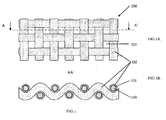
- the Figure 1 represents a diagram of a half-accumulator according to the invention, seen from above ( FIG. 1A .) and in section ( FIG. 1B .) along line AA 'of the Figure 1A .
- a half-accumulator 200 comprises an electron collector 100, typically in the form of tissue seen on its edge on the Figure 1A on the surface of which a layer 101 of active material has been formed. This layer of active material has been produced by heat treatment, for example in high temperature air, of the collector 100.
- the collector 100 is typically made of stainless steel.
- No external material has been added, such as a secondary electronic conductor such as carbon black, a binder or other metal.
- a separator layer 102 in the form of a thin film completely covering the surface of the wires of the metal fabric with their conversion layer.
- This coating 102 has been deposited so as not to close the openings 103 of the fabric that can be distinguished on the Figure 1A .
- This separator has the particularity of being impregnated by a liquid electrolyte for lithium-ion battery.
Landscapes
- Chemical & Material Sciences (AREA)
- General Chemical & Material Sciences (AREA)
- Chemical Kinetics & Catalysis (AREA)
- Electrochemistry (AREA)
- Engineering & Computer Science (AREA)
- Materials Engineering (AREA)
- Manufacturing & Machinery (AREA)
- Battery Electrode And Active Subsutance (AREA)
- Secondary Cells (AREA)
- Cell Electrode Carriers And Collectors (AREA)
- Cell Separators (AREA)
- Inert Electrodes (AREA)
- Electric Double-Layer Capacitors Or The Like (AREA)
Applications Claiming Priority (2)
| Application Number | Priority Date | Filing Date | Title |
|---|---|---|---|
| FR0604693A FR2901641B1 (fr) | 2006-05-24 | 2006-05-24 | Electrode textile et accumulateur contenant une telle electrode |
| PCT/FR2007/051299 WO2007135331A1 (fr) | 2006-05-24 | 2007-05-18 | Electrode textile et accumulateur contenant une telle electrode |
Publications (2)
| Publication Number | Publication Date |
|---|---|
| EP2022116A1 EP2022116A1 (fr) | 2009-02-11 |
| EP2022116B1 true EP2022116B1 (fr) | 2010-08-04 |
Family
ID=37668123
Family Applications (1)
| Application Number | Title | Priority Date | Filing Date |
|---|---|---|---|
| EP07766073A Not-in-force EP2022116B1 (fr) | 2006-05-24 | 2007-05-18 | Electrode textile et accumulateur contenant une telle electrode. |
Country Status (13)
| Country | Link |
|---|---|
| US (1) | US8815442B2 (enExample) |
| EP (1) | EP2022116B1 (enExample) |
| JP (1) | JP5559533B2 (enExample) |
| KR (1) | KR101485974B1 (enExample) |
| CN (1) | CN101449409B (enExample) |
| AT (1) | ATE476760T1 (enExample) |
| CA (1) | CA2653114C (enExample) |
| DE (1) | DE602007008232D1 (enExample) |
| DK (1) | DK2022116T3 (enExample) |
| ES (1) | ES2349345T3 (enExample) |
| FR (1) | FR2901641B1 (enExample) |
| PT (1) | PT2022116E (enExample) |
| WO (1) | WO2007135331A1 (enExample) |
Families Citing this family (39)
| Publication number | Priority date | Publication date | Assignee | Title |
|---|---|---|---|---|
| DE102007059443A1 (de) | 2007-12-10 | 2009-06-18 | Li-Tec Vermögensverwaltungs GmbH | Elektrode für einen Energiespeicher |
| FR2931298B1 (fr) | 2008-05-13 | 2010-09-03 | Electricite De France | Accumulateur fer-air a mediateur lithium |
| JP2010073533A (ja) * | 2008-09-19 | 2010-04-02 | National Institute Of Advanced Industrial Science & Technology | 充放電可能な電池 |
| JP2010129412A (ja) * | 2008-11-28 | 2010-06-10 | Seiko Epson Corp | 電気化学装置 |
| FR2947841B1 (fr) * | 2009-07-08 | 2012-01-06 | Jean-Marc Fleury | Systemes de conversion de l'energie a champ electrique augmente. |
| KR101072289B1 (ko) * | 2010-07-02 | 2011-10-11 | 주식회사 샤인 | 섬유상의 구조체들을 포함하는 전극 조립체 |
| KR101088073B1 (ko) * | 2010-10-16 | 2011-12-01 | 주식회사 샤인 | 금속 장섬유를 포함하는 전극 구조를 갖는 전지 및 이의 제조 방법 |
| FR2968137B1 (fr) * | 2010-11-30 | 2013-01-04 | Calicea | Surface textile et materiau textile pour absorber les ondes electromagnetiques, et dispositif de protection comportant une surface textile ou un materiau textile |
| US10932720B2 (en) | 2011-03-08 | 2021-03-02 | Nanowear Inc. | Smart materials, dry textile sensors, and electronics integration in clothing, bed sheets, and pillow cases for neurological, cardiac and/or pulmonary monitoring |
| US20130281795A1 (en) * | 2012-04-18 | 2013-10-24 | The Board Of Trustees Of The University Of Arkansas | Wearable remote electrophysiological monitoring system |
| ITTO20110297A1 (it) * | 2011-04-01 | 2012-10-02 | Torino Politecnico | Dispositivo di elettrodo tessile e relativo procedimento di realizzazione |
| FR2973949B1 (fr) * | 2011-04-06 | 2013-10-11 | Electricite De France | Precurseur d'accumulateur lithium-ion a electrode sacrificielle de lithium et electrode textile negative a conversion |
| FR2973950B1 (fr) * | 2011-04-06 | 2013-10-04 | Electricite De France | Precurseur d'accumulateur lithium-ion a electrode sacrificielle de lithium et electrode textile positive a conversion |
| US20130217289A1 (en) * | 2011-09-13 | 2013-08-22 | Nanosi Advanced Technologies, Inc. | Super capacitor thread, materials and fabrication method |
| KR101980198B1 (ko) | 2012-11-12 | 2019-05-21 | 삼성전자주식회사 | 신축성 트랜지스터용 채널층 |
| WO2015108268A1 (ko) * | 2014-01-15 | 2015-07-23 | 주식회사 제낙스 | 이차 전지용 전극 및 이의 제조 방법 |
| KR101526800B1 (ko) * | 2014-05-02 | 2015-06-05 | 한국섬유개발연구원 | 가요성 이차전지의 집전체용 직물 및 그 제조방법 |
| US11111593B2 (en) | 2015-01-16 | 2021-09-07 | Nanowear Inc. | Large scale manufacturing of hybrid nanostructured textile sensors |
| US10131993B2 (en) | 2015-01-16 | 2018-11-20 | Nanowear, Inc. | Large scale manufacturing of hybrid nanostructured textile sensors |
| US10231623B2 (en) | 2016-02-04 | 2019-03-19 | Nanowear Inc. | Roll-to-roll printing process for manufacturing a wireless nanosensor |
| KR102167913B1 (ko) * | 2016-09-26 | 2020-10-20 | 주식회사 엘지화학 | 전극 와이어들을 포함하는 이차전지용 전극 및 이의 제조 방법 |
| KR101911925B1 (ko) * | 2016-12-29 | 2018-12-28 | 성재욱 | 직물 타입 이차전지 |
| JP6745782B2 (ja) * | 2017-01-26 | 2020-08-26 | 本田技研工業株式会社 | リチウムイオン二次電池用負極及びリチウムイオン二次電池 |
| US10959634B2 (en) | 2017-05-02 | 2021-03-30 | Nanowear Inc. | Wearable congestive heart failure management system |
| CN108400337B (zh) * | 2018-01-09 | 2020-07-10 | 浙江南都电源动力股份有限公司 | 锂离子电池用集流体和锂离子电池 |
| CN109103503B (zh) * | 2018-07-18 | 2020-11-03 | 惠州亿纬锂能股份有限公司 | 锂离子电池的制备方法 |
| CN110148337A (zh) * | 2019-04-29 | 2019-08-20 | 东华大学 | 线圈循环原理纬编针织织物电极电阻理论模型构建方法 |
| US11011742B2 (en) * | 2019-06-10 | 2021-05-18 | GM Global Technology Operations LLC | Silicon embedded copper anodes and battery cells incorporating the same |
| US11642280B2 (en) | 2020-11-10 | 2023-05-09 | Corning Incorporated | Glass containers and sealing assemblies for maintaining seal integrity at low storage temperatures |
| EP4330147A1 (en) | 2021-04-26 | 2024-03-06 | Corning Incorporated | Container closure system and sealing assemblies for maintaining seal integrity at low storage temperatures |
| US12642745B2 (en) | 2021-07-27 | 2026-06-02 | Corning Incorporated | Pharmaceutical containers comprising necks with non-uniform outer surfaces and methods regarding the same |
| JP2024531413A (ja) | 2021-08-31 | 2024-08-29 | コーニング インコーポレイテッド | 低い貯蔵温度でシール完全性を維持するための容器蓋システムおよび密閉アセンブリ |
| CN118043017A (zh) | 2021-09-30 | 2024-05-14 | 康宁公司 | 用于储存药品组合物的玻璃容器 |
| US12447106B2 (en) | 2021-09-30 | 2025-10-21 | Corning Incorporated | Glass containers for storing pharmaceutical compositions |
| US12226370B2 (en) | 2021-09-30 | 2025-02-18 | Corning Incorporated | Glass containers for storing pharmaceutical compositions |
| TW202327941A (zh) | 2021-09-30 | 2023-07-16 | 美商康寧公司 | 用於儲存藥品組合物的玻璃容器 |
| CN118488918A (zh) | 2021-11-22 | 2024-08-13 | 康宁股份有限公司 | 用于药物容器封闭物件系统的盖帽设计 |
| JP2026508929A (ja) * | 2023-03-12 | 2026-03-13 | エーシーエス インダストリーズ、インク. | 電気化学セル用の全金属製スペーサーニットメッシュ |
| KR102878004B1 (ko) * | 2023-05-08 | 2025-10-29 | 삼원액트 주식회사 | 직조 금속와이어 전극 |
Family Cites Families (14)
| Publication number | Priority date | Publication date | Assignee | Title |
|---|---|---|---|---|
| JPS62198055A (ja) | 1986-02-24 | 1987-09-01 | Kobe Steel Ltd | 燃料電池用電極の製造方法 |
| JPH01239770A (ja) * | 1988-03-19 | 1989-09-25 | Hitachi Maxell Ltd | 渦巻形リチウム電池 |
| US5294319A (en) | 1989-12-26 | 1994-03-15 | Olin Corporation | High surface area electrode structures for electrochemical processes |
| JPH0765819A (ja) * | 1993-08-30 | 1995-03-10 | Shin Kobe Electric Mach Co Ltd | 鉛蓄電池用極板 |
| JPH08213026A (ja) * | 1994-11-28 | 1996-08-20 | Katayama Tokushu Kogyo Kk | 電池電極基板用金属多孔体、電池電極板およびその製造方法 |
| JPH0945334A (ja) * | 1995-07-26 | 1997-02-14 | Katayama Tokushu Kogyo Kk | リチウム二次電池極板用基材、該基材を用いた極板および該極板を用いた二次電池 |
| JPH09143510A (ja) * | 1995-11-14 | 1997-06-03 | Kataoka Tokushu Kogyo Kk | 電池電極基板用金属繊維多孔体、電池電極板およびその製造方法 |
| FR2762142B1 (fr) * | 1997-04-11 | 1999-07-02 | Guy Leichle | Nouveau produit utilisable comme support d'electrode de batterie, du type a structure textile |
| JP3624088B2 (ja) * | 1998-01-30 | 2005-02-23 | キヤノン株式会社 | 粉末材料、電極構造体、それらの製造方法、及びリチウム二次電池 |
| JP2001110445A (ja) * | 1999-10-12 | 2001-04-20 | Sony Corp | コード型バッテリ |
| KR100922740B1 (ko) * | 2002-01-07 | 2009-10-22 | 삼성에스디아이 주식회사 | 양이온성 고분자를 포함하는 리튬전지용 세퍼레이터, 전극및 이를 채용한 리튬전지 |
| JP2003317794A (ja) * | 2002-04-22 | 2003-11-07 | Kawasaki Heavy Ind Ltd | ファイバー電池及びその製造方法 |
| KR100625892B1 (ko) * | 2004-04-12 | 2006-09-20 | 경상대학교산학협력단 | 실형태의 가변형 전지 |
| FR2870639B1 (fr) * | 2004-05-19 | 2006-11-10 | Electricite De France | Support type collecteur de courant et son utilisation en tant qu'electrode de batterie |
-
2006
- 2006-05-24 FR FR0604693A patent/FR2901641B1/fr not_active Expired - Fee Related
-
2007
- 2007-05-18 PT PT07766073T patent/PT2022116E/pt unknown
- 2007-05-18 CN CN2007800188150A patent/CN101449409B/zh not_active Expired - Fee Related
- 2007-05-18 DK DK07766073.6T patent/DK2022116T3/da active
- 2007-05-18 EP EP07766073A patent/EP2022116B1/fr not_active Not-in-force
- 2007-05-18 WO PCT/FR2007/051299 patent/WO2007135331A1/fr not_active Ceased
- 2007-05-18 ES ES07766073T patent/ES2349345T3/es active Active
- 2007-05-18 CA CA2653114A patent/CA2653114C/fr not_active Expired - Fee Related
- 2007-05-18 AT AT07766073T patent/ATE476760T1/de active
- 2007-05-18 JP JP2009511554A patent/JP5559533B2/ja not_active Expired - Fee Related
- 2007-05-18 DE DE602007008232T patent/DE602007008232D1/de active Active
- 2007-05-18 US US12/301,822 patent/US8815442B2/en not_active Expired - Fee Related
- 2007-05-18 KR KR1020087031458A patent/KR101485974B1/ko not_active Expired - Fee Related
Also Published As
| Publication number | Publication date |
|---|---|
| JP2009537963A (ja) | 2009-10-29 |
| CA2653114C (fr) | 2013-03-19 |
| ATE476760T1 (de) | 2010-08-15 |
| ES2349345T3 (es) | 2010-12-30 |
| DK2022116T3 (da) | 2010-11-15 |
| CN101449409A (zh) | 2009-06-03 |
| WO2007135331A9 (fr) | 2009-03-12 |
| WO2007135331A1 (fr) | 2007-11-29 |
| DE602007008232D1 (de) | 2010-09-16 |
| CA2653114A1 (fr) | 2007-11-29 |
| PT2022116E (pt) | 2010-10-25 |
| US8815442B2 (en) | 2014-08-26 |
| FR2901641A1 (fr) | 2007-11-30 |
| CN101449409B (zh) | 2011-12-07 |
| US20100273049A1 (en) | 2010-10-28 |
| JP5559533B2 (ja) | 2014-07-23 |
| EP2022116A1 (fr) | 2009-02-11 |
| KR20090014304A (ko) | 2009-02-09 |
| FR2901641B1 (fr) | 2009-04-24 |
| KR101485974B1 (ko) | 2015-01-23 |
Similar Documents
| Publication | Publication Date | Title |
|---|---|---|
| CA2653114C (fr) | Electrode textile et accumulateur contenant une telle electrode | |
| EP1870949B1 (fr) | Accumulateur lithium-ion comprenant TiO2-B comme matériau actif d'électrode négative | |
| EP2318315B1 (fr) | Matériau d'électrode positive formé d'un oxyde de type lamellaire pour accumulateur au lithium. | |
| KR101400994B1 (ko) | 고용량 리튬 이차전지용 전극 및 이를 함유하는 리튬이차전지 | |
| EP2274791B1 (fr) | Accumulateur fer-air a mediateur lithium | |
| WO2007023235A1 (fr) | Materiau d'electrode positive haute tension de structure spinelle a base de nickel et de manganese pour accumulateurs au lithium | |
| EP2695231B1 (fr) | Precurseur d'accumulateur lithium-ion a electrode sacrificielle de lithium et electrode textile positive a conversion | |
| EP3571734B1 (fr) | Matériau d'électrode positive a base d'un oxyde lamellaire lithie recouvert, en tout ou partie, par un autre oxyde a base de manganèse et procédé de préparation de ce matériau | |
| EP2757068B1 (fr) | Procédé de synthèse d'un composé LiM1-x-y-zNyQzFexPO4 et son utilisation comme matériau d'électrode pour accumulateur au lithium | |
| WO2019097189A1 (fr) | Utilisation d'un melange de sels a titre d'additif dans une batterie au lithium gelifiee | |
| EP1846331B1 (fr) | Procede de modification d'un oxyde lithie comprenant au moins un metal de transition utilisant des ions de phosphate | |
| EP2695226B1 (fr) | Précurseur d'accumulateur lithium-ion à électrode sacrificielle de lithium et électrode textile négative à conversion | |
| EP1756893B1 (fr) | Composant comprenant un collecteur d'electrons et de la matiere active, et son utilisation en tant qu'electrode de batterie | |
| EP3648206B1 (fr) | Accumulateur électrochimique au lithium du type lithium-soufre comprenant un matériau d'électrode négative spécifique | |
| EP3391437B1 (fr) | Electrode en halogénure de métal auto-formée et procédé de fabrication associé | |
| FR2725709A1 (fr) | Oxyde de lithium et son utilisation comme matiere active d'une electrode | |
| EP3391441B1 (fr) | Electrode en halogénure de métal à conductivité améliorée et procédé de fabrication associé | |
| WO2023118772A1 (fr) | Matériau d'électrode enrobé d'un composé particulier |
Legal Events
| Date | Code | Title | Description |
|---|---|---|---|
| PUAI | Public reference made under article 153(3) epc to a published international application that has entered the european phase |
Free format text: ORIGINAL CODE: 0009012 |
|
| 17P | Request for examination filed |
Effective date: 20081113 |
|
| AK | Designated contracting states |
Kind code of ref document: A1 Designated state(s): AT BE BG CH CY CZ DE DK EE ES FI FR GB GR HU IE IS IT LI LT LU LV MC MT NL PL PT RO SE SI SK TR |
|
| AX | Request for extension of the european patent |
Extension state: AL BA HR MK RS |
|
| 17Q | First examination report despatched |
Effective date: 20090312 |
|
| GRAP | Despatch of communication of intention to grant a patent |
Free format text: ORIGINAL CODE: EPIDOSNIGR1 |
|
| DAX | Request for extension of the european patent (deleted) | ||
| GRAS | Grant fee paid |
Free format text: ORIGINAL CODE: EPIDOSNIGR3 |
|
| GRAA | (expected) grant |
Free format text: ORIGINAL CODE: 0009210 |
|
| AK | Designated contracting states |
Kind code of ref document: B1 Designated state(s): AT BE BG CH CY CZ DE DK EE ES FI FR GB GR HU IE IS IT LI LT LU LV MC MT NL PL PT RO SE SI SK TR |
|
| REG | Reference to a national code |
Ref country code: GB Ref legal event code: FG4D Free format text: NOT ENGLISH |
|
| REG | Reference to a national code |
Ref country code: CH Ref legal event code: EP |
|
| REG | Reference to a national code |
Ref country code: IE Ref legal event code: FG4D Free format text: LANGUAGE OF EP DOCUMENT: FRENCH |
|
| REF | Corresponds to: |
Ref document number: 602007008232 Country of ref document: DE Date of ref document: 20100916 Kind code of ref document: P |
|
| REG | Reference to a national code |
Ref country code: CH Ref legal event code: NV Representative=s name: ISLER & PEDRAZZINI AG |
|
| REG | Reference to a national code |
Ref country code: DK Ref legal event code: T3 |
|
| REG | Reference to a national code |
Ref country code: SE Ref legal event code: TRGR |
|
| REG | Reference to a national code |
Ref country code: NL Ref legal event code: VDEP Effective date: 20100804 |
|
| REG | Reference to a national code |
Ref country code: ES Ref legal event code: FG2A Effective date: 20101217 |
|
| LTIE | Lt: invalidation of european patent or patent extension |
Effective date: 20100804 |
|
| PG25 | Lapsed in a contracting state [announced via postgrant information from national office to epo] |
Ref country code: LT Free format text: LAPSE BECAUSE OF FAILURE TO SUBMIT A TRANSLATION OF THE DESCRIPTION OR TO PAY THE FEE WITHIN THE PRESCRIBED TIME-LIMIT Effective date: 20100804 Ref country code: FI Free format text: LAPSE BECAUSE OF FAILURE TO SUBMIT A TRANSLATION OF THE DESCRIPTION OR TO PAY THE FEE WITHIN THE PRESCRIBED TIME-LIMIT Effective date: 20100804 Ref country code: NL Free format text: LAPSE BECAUSE OF FAILURE TO SUBMIT A TRANSLATION OF THE DESCRIPTION OR TO PAY THE FEE WITHIN THE PRESCRIBED TIME-LIMIT Effective date: 20100804 |
|
| PG25 | Lapsed in a contracting state [announced via postgrant information from national office to epo] |
Ref country code: SI Free format text: LAPSE BECAUSE OF FAILURE TO SUBMIT A TRANSLATION OF THE DESCRIPTION OR TO PAY THE FEE WITHIN THE PRESCRIBED TIME-LIMIT Effective date: 20100804 Ref country code: PL Free format text: LAPSE BECAUSE OF FAILURE TO SUBMIT A TRANSLATION OF THE DESCRIPTION OR TO PAY THE FEE WITHIN THE PRESCRIBED TIME-LIMIT Effective date: 20100804 Ref country code: IS Free format text: LAPSE BECAUSE OF FAILURE TO SUBMIT A TRANSLATION OF THE DESCRIPTION OR TO PAY THE FEE WITHIN THE PRESCRIBED TIME-LIMIT Effective date: 20101204 Ref country code: CY Free format text: LAPSE BECAUSE OF FAILURE TO SUBMIT A TRANSLATION OF THE DESCRIPTION OR TO PAY THE FEE WITHIN THE PRESCRIBED TIME-LIMIT Effective date: 20100804 Ref country code: BG Free format text: LAPSE BECAUSE OF FAILURE TO SUBMIT A TRANSLATION OF THE DESCRIPTION OR TO PAY THE FEE WITHIN THE PRESCRIBED TIME-LIMIT Effective date: 20101104 |
|
| REG | Reference to a national code |
Ref country code: IE Ref legal event code: FD4D |
|
| PG25 | Lapsed in a contracting state [announced via postgrant information from national office to epo] |
Ref country code: GR Free format text: LAPSE BECAUSE OF FAILURE TO SUBMIT A TRANSLATION OF THE DESCRIPTION OR TO PAY THE FEE WITHIN THE PRESCRIBED TIME-LIMIT Effective date: 20101105 Ref country code: LV Free format text: LAPSE BECAUSE OF FAILURE TO SUBMIT A TRANSLATION OF THE DESCRIPTION OR TO PAY THE FEE WITHIN THE PRESCRIBED TIME-LIMIT Effective date: 20100804 |
|
| PG25 | Lapsed in a contracting state [announced via postgrant information from national office to epo] |
Ref country code: IE Free format text: LAPSE BECAUSE OF FAILURE TO SUBMIT A TRANSLATION OF THE DESCRIPTION OR TO PAY THE FEE WITHIN THE PRESCRIBED TIME-LIMIT Effective date: 20100804 |
|
| PG25 | Lapsed in a contracting state [announced via postgrant information from national office to epo] |
Ref country code: SK Free format text: LAPSE BECAUSE OF FAILURE TO SUBMIT A TRANSLATION OF THE DESCRIPTION OR TO PAY THE FEE WITHIN THE PRESCRIBED TIME-LIMIT Effective date: 20100804 Ref country code: CZ Free format text: LAPSE BECAUSE OF FAILURE TO SUBMIT A TRANSLATION OF THE DESCRIPTION OR TO PAY THE FEE WITHIN THE PRESCRIBED TIME-LIMIT Effective date: 20100804 Ref country code: RO Free format text: LAPSE BECAUSE OF FAILURE TO SUBMIT A TRANSLATION OF THE DESCRIPTION OR TO PAY THE FEE WITHIN THE PRESCRIBED TIME-LIMIT Effective date: 20100804 Ref country code: EE Free format text: LAPSE BECAUSE OF FAILURE TO SUBMIT A TRANSLATION OF THE DESCRIPTION OR TO PAY THE FEE WITHIN THE PRESCRIBED TIME-LIMIT Effective date: 20100804 |
|
| PLBE | No opposition filed within time limit |
Free format text: ORIGINAL CODE: 0009261 |
|
| STAA | Information on the status of an ep patent application or granted ep patent |
Free format text: STATUS: NO OPPOSITION FILED WITHIN TIME LIMIT |
|
| 26N | No opposition filed |
Effective date: 20110506 |
|
| REG | Reference to a national code |
Ref country code: DE Ref legal event code: R097 Ref document number: 602007008232 Country of ref document: DE Effective date: 20110506 |
|
| PG25 | Lapsed in a contracting state [announced via postgrant information from national office to epo] |
Ref country code: MT Free format text: LAPSE BECAUSE OF FAILURE TO SUBMIT A TRANSLATION OF THE DESCRIPTION OR TO PAY THE FEE WITHIN THE PRESCRIBED TIME-LIMIT Effective date: 20100804 Ref country code: MC Free format text: LAPSE BECAUSE OF NON-PAYMENT OF DUE FEES Effective date: 20110531 |
|
| PG25 | Lapsed in a contracting state [announced via postgrant information from national office to epo] |
Ref country code: LU Free format text: LAPSE BECAUSE OF NON-PAYMENT OF DUE FEES Effective date: 20110518 |
|
| PG25 | Lapsed in a contracting state [announced via postgrant information from national office to epo] |
Ref country code: TR Free format text: LAPSE BECAUSE OF FAILURE TO SUBMIT A TRANSLATION OF THE DESCRIPTION OR TO PAY THE FEE WITHIN THE PRESCRIBED TIME-LIMIT Effective date: 20100804 |
|
| PG25 | Lapsed in a contracting state [announced via postgrant information from national office to epo] |
Ref country code: HU Free format text: LAPSE BECAUSE OF FAILURE TO SUBMIT A TRANSLATION OF THE DESCRIPTION OR TO PAY THE FEE WITHIN THE PRESCRIBED TIME-LIMIT Effective date: 20100804 |
|
| REG | Reference to a national code |
Ref country code: FR Ref legal event code: PLFP Year of fee payment: 9 |
|
| PGFP | Annual fee paid to national office [announced via postgrant information from national office to epo] |
Ref country code: ES Payment date: 20150525 Year of fee payment: 9 Ref country code: PT Payment date: 20150417 Year of fee payment: 9 Ref country code: DK Payment date: 20150420 Year of fee payment: 9 Ref country code: SE Payment date: 20150515 Year of fee payment: 9 Ref country code: CH Payment date: 20150506 Year of fee payment: 9 |
|
| PGFP | Annual fee paid to national office [announced via postgrant information from national office to epo] |
Ref country code: BE Payment date: 20150529 Year of fee payment: 9 Ref country code: AT Payment date: 20150420 Year of fee payment: 9 Ref country code: IT Payment date: 20150512 Year of fee payment: 9 |
|
| REG | Reference to a national code |
Ref country code: FR Ref legal event code: PLFP Year of fee payment: 10 |
|
| PG25 | Lapsed in a contracting state [announced via postgrant information from national office to epo] |
Ref country code: BE Free format text: LAPSE BECAUSE OF NON-PAYMENT OF DUE FEES Effective date: 20160531 |
|
| REG | Reference to a national code |
Ref country code: CH Ref legal event code: PL |
|
| REG | Reference to a national code |
Ref country code: DK Ref legal event code: EBP Effective date: 20160531 |
|
| REG | Reference to a national code |
Ref country code: AT Ref legal event code: MM01 Ref document number: 476760 Country of ref document: AT Kind code of ref document: T Effective date: 20160518 |
|
| PG25 | Lapsed in a contracting state [announced via postgrant information from national office to epo] |
Ref country code: LI Free format text: LAPSE BECAUSE OF NON-PAYMENT OF DUE FEES Effective date: 20160531 Ref country code: CH Free format text: LAPSE BECAUSE OF NON-PAYMENT OF DUE FEES Effective date: 20160531 |
|
| PG25 | Lapsed in a contracting state [announced via postgrant information from national office to epo] |
Ref country code: IT Free format text: LAPSE BECAUSE OF NON-PAYMENT OF DUE FEES Effective date: 20160518 Ref country code: PT Free format text: LAPSE BECAUSE OF NON-PAYMENT OF DUE FEES Effective date: 20161118 Ref country code: SE Free format text: LAPSE BECAUSE OF NON-PAYMENT OF DUE FEES Effective date: 20160519 Ref country code: AT Free format text: LAPSE BECAUSE OF NON-PAYMENT OF DUE FEES Effective date: 20160518 |
|
| REG | Reference to a national code |
Ref country code: FR Ref legal event code: PLFP Year of fee payment: 11 |
|
| PG25 | Lapsed in a contracting state [announced via postgrant information from national office to epo] |
Ref country code: DK Free format text: LAPSE BECAUSE OF NON-PAYMENT OF DUE FEES Effective date: 20160531 |
|
| REG | Reference to a national code |
Ref country code: FR Ref legal event code: PLFP Year of fee payment: 12 |
|
| PG25 | Lapsed in a contracting state [announced via postgrant information from national office to epo] |
Ref country code: ES Free format text: LAPSE BECAUSE OF NON-PAYMENT OF DUE FEES Effective date: 20160519 |
|
| REG | Reference to a national code |
Ref country code: ES Ref legal event code: FD2A Effective date: 20181204 |
|
| PGFP | Annual fee paid to national office [announced via postgrant information from national office to epo] |
Ref country code: GB Payment date: 20200527 Year of fee payment: 14 |
|
| PGFP | Annual fee paid to national office [announced via postgrant information from national office to epo] |
Ref country code: DE Payment date: 20210507 Year of fee payment: 15 |
|
| GBPC | Gb: european patent ceased through non-payment of renewal fee |
Effective date: 20210518 |
|
| PG25 | Lapsed in a contracting state [announced via postgrant information from national office to epo] |
Ref country code: GB Free format text: LAPSE BECAUSE OF NON-PAYMENT OF DUE FEES Effective date: 20210518 |
|
| PGFP | Annual fee paid to national office [announced via postgrant information from national office to epo] |
Ref country code: FR Payment date: 20220422 Year of fee payment: 16 |
|
| REG | Reference to a national code |
Ref country code: DE Ref legal event code: R119 Ref document number: 602007008232 Country of ref document: DE |
|
| PG25 | Lapsed in a contracting state [announced via postgrant information from national office to epo] |
Ref country code: DE Free format text: LAPSE BECAUSE OF NON-PAYMENT OF DUE FEES Effective date: 20221201 |
|
| PG25 | Lapsed in a contracting state [announced via postgrant information from national office to epo] |
Ref country code: FR Free format text: LAPSE BECAUSE OF NON-PAYMENT OF DUE FEES Effective date: 20230531 |