EP2017883A2 - Procédé de fabrication de dispositif électronique et dispositif électronique - Google Patents
Procédé de fabrication de dispositif électronique et dispositif électronique Download PDFInfo
- Publication number
- EP2017883A2 EP2017883A2 EP08158511A EP08158511A EP2017883A2 EP 2017883 A2 EP2017883 A2 EP 2017883A2 EP 08158511 A EP08158511 A EP 08158511A EP 08158511 A EP08158511 A EP 08158511A EP 2017883 A2 EP2017883 A2 EP 2017883A2
- Authority
- EP
- European Patent Office
- Prior art keywords
- insulating layer
- bump
- modulus
- layer
- laminated
- Prior art date
- Legal status (The legal status is an assumption and is not a legal conclusion. Google has not performed a legal analysis and makes no representation as to the accuracy of the status listed.)
- Withdrawn
Links
Images


Classifications
-
- H—ELECTRICITY
- H01—ELECTRIC ELEMENTS
- H01L—SEMICONDUCTOR DEVICES NOT COVERED BY CLASS H10
- H01L21/00—Processes or apparatus adapted for the manufacture or treatment of semiconductor or solid state devices or of parts thereof
- H01L21/67—Apparatus specially adapted for handling semiconductor or electric solid state devices during manufacture or treatment thereof; Apparatus specially adapted for handling wafers during manufacture or treatment of semiconductor or electric solid state devices or components ; Apparatus not specifically provided for elsewhere
- H01L21/683—Apparatus specially adapted for handling semiconductor or electric solid state devices during manufacture or treatment thereof; Apparatus specially adapted for handling wafers during manufacture or treatment of semiconductor or electric solid state devices or components ; Apparatus not specifically provided for elsewhere for supporting or gripping
- H01L21/6835—Apparatus specially adapted for handling semiconductor or electric solid state devices during manufacture or treatment thereof; Apparatus specially adapted for handling wafers during manufacture or treatment of semiconductor or electric solid state devices or components ; Apparatus not specifically provided for elsewhere for supporting or gripping using temporarily an auxiliary support
-
- H—ELECTRICITY
- H01—ELECTRIC ELEMENTS
- H01L—SEMICONDUCTOR DEVICES NOT COVERED BY CLASS H10
- H01L23/00—Details of semiconductor or other solid state devices
- H01L23/48—Arrangements for conducting electric current to or from the solid state body in operation, e.g. leads, terminal arrangements ; Selection of materials therefor
-
- H—ELECTRICITY
- H01—ELECTRIC ELEMENTS
- H01L—SEMICONDUCTOR DEVICES NOT COVERED BY CLASS H10
- H01L23/00—Details of semiconductor or other solid state devices
- H01L23/28—Encapsulations, e.g. encapsulating layers, coatings, e.g. for protection
- H01L23/31—Encapsulations, e.g. encapsulating layers, coatings, e.g. for protection characterised by the arrangement or shape
- H01L23/3107—Encapsulations, e.g. encapsulating layers, coatings, e.g. for protection characterised by the arrangement or shape the device being completely enclosed
- H01L23/3114—Encapsulations, e.g. encapsulating layers, coatings, e.g. for protection characterised by the arrangement or shape the device being completely enclosed the device being a chip scale package, e.g. CSP
-
- H—ELECTRICITY
- H01—ELECTRIC ELEMENTS
- H01L—SEMICONDUCTOR DEVICES NOT COVERED BY CLASS H10
- H01L23/00—Details of semiconductor or other solid state devices
- H01L23/28—Encapsulations, e.g. encapsulating layers, coatings, e.g. for protection
- H01L23/31—Encapsulations, e.g. encapsulating layers, coatings, e.g. for protection characterised by the arrangement or shape
- H01L23/3157—Partial encapsulation or coating
- H01L23/3171—Partial encapsulation or coating the coating being directly applied to the semiconductor body, e.g. passivation layer
-
- H—ELECTRICITY
- H01—ELECTRIC ELEMENTS
- H01L—SEMICONDUCTOR DEVICES NOT COVERED BY CLASS H10
- H01L23/00—Details of semiconductor or other solid state devices
- H01L23/52—Arrangements for conducting electric current within the device in operation from one component to another, i.e. interconnections, e.g. wires, lead frames
- H01L23/522—Arrangements for conducting electric current within the device in operation from one component to another, i.e. interconnections, e.g. wires, lead frames including external interconnections consisting of a multilayer structure of conductive and insulating layers inseparably formed on the semiconductor body
- H01L23/525—Arrangements for conducting electric current within the device in operation from one component to another, i.e. interconnections, e.g. wires, lead frames including external interconnections consisting of a multilayer structure of conductive and insulating layers inseparably formed on the semiconductor body with adaptable interconnections
-
- H—ELECTRICITY
- H01—ELECTRIC ELEMENTS
- H01L—SEMICONDUCTOR DEVICES NOT COVERED BY CLASS H10
- H01L24/00—Arrangements for connecting or disconnecting semiconductor or solid-state bodies; Methods or apparatus related thereto
- H01L24/01—Means for bonding being attached to, or being formed on, the surface to be connected, e.g. chip-to-package, die-attach, "first-level" interconnects; Manufacturing methods related thereto
- H01L24/10—Bump connectors ; Manufacturing methods related thereto
- H01L24/11—Manufacturing methods
-
- H—ELECTRICITY
- H01—ELECTRIC ELEMENTS
- H01L—SEMICONDUCTOR DEVICES NOT COVERED BY CLASS H10
- H01L24/00—Arrangements for connecting or disconnecting semiconductor or solid-state bodies; Methods or apparatus related thereto
- H01L24/01—Means for bonding being attached to, or being formed on, the surface to be connected, e.g. chip-to-package, die-attach, "first-level" interconnects; Manufacturing methods related thereto
- H01L24/10—Bump connectors ; Manufacturing methods related thereto
- H01L24/12—Structure, shape, material or disposition of the bump connectors prior to the connecting process
-
- H—ELECTRICITY
- H01—ELECTRIC ELEMENTS
- H01L—SEMICONDUCTOR DEVICES NOT COVERED BY CLASS H10
- H01L2221/00—Processes or apparatus adapted for the manufacture or treatment of semiconductor or solid state devices or of parts thereof covered by H01L21/00
- H01L2221/67—Apparatus for handling semiconductor or electric solid state devices during manufacture or treatment thereof; Apparatus for handling wafers during manufacture or treatment of semiconductor or electric solid state devices or components; Apparatus not specifically provided for elsewhere
- H01L2221/683—Apparatus for handling semiconductor or electric solid state devices during manufacture or treatment thereof; Apparatus for handling wafers during manufacture or treatment of semiconductor or electric solid state devices or components; Apparatus not specifically provided for elsewhere for supporting or gripping
- H01L2221/68304—Apparatus for handling semiconductor or electric solid state devices during manufacture or treatment thereof; Apparatus for handling wafers during manufacture or treatment of semiconductor or electric solid state devices or components; Apparatus not specifically provided for elsewhere for supporting or gripping using temporarily an auxiliary support
- H01L2221/68377—Apparatus for handling semiconductor or electric solid state devices during manufacture or treatment thereof; Apparatus for handling wafers during manufacture or treatment of semiconductor or electric solid state devices or components; Apparatus not specifically provided for elsewhere for supporting or gripping using temporarily an auxiliary support with parts of the auxiliary support remaining in the finished device
-
- H—ELECTRICITY
- H01—ELECTRIC ELEMENTS
- H01L—SEMICONDUCTOR DEVICES NOT COVERED BY CLASS H10
- H01L2224/00—Indexing scheme for arrangements for connecting or disconnecting semiconductor or solid-state bodies and methods related thereto as covered by H01L24/00
- H01L2224/01—Means for bonding being attached to, or being formed on, the surface to be connected, e.g. chip-to-package, die-attach, "first-level" interconnects; Manufacturing methods related thereto
- H01L2224/02—Bonding areas; Manufacturing methods related thereto
- H01L2224/023—Redistribution layers [RDL] for bonding areas
- H01L2224/0231—Manufacturing methods of the redistribution layers
- H01L2224/02313—Subtractive methods
-
- H—ELECTRICITY
- H01—ELECTRIC ELEMENTS
- H01L—SEMICONDUCTOR DEVICES NOT COVERED BY CLASS H10
- H01L2224/00—Indexing scheme for arrangements for connecting or disconnecting semiconductor or solid-state bodies and methods related thereto as covered by H01L24/00
- H01L2224/01—Means for bonding being attached to, or being formed on, the surface to be connected, e.g. chip-to-package, die-attach, "first-level" interconnects; Manufacturing methods related thereto
- H01L2224/02—Bonding areas; Manufacturing methods related thereto
- H01L2224/023—Redistribution layers [RDL] for bonding areas
- H01L2224/0231—Manufacturing methods of the redistribution layers
- H01L2224/02319—Manufacturing methods of the redistribution layers by using a preform
-
- H—ELECTRICITY
- H01—ELECTRIC ELEMENTS
- H01L—SEMICONDUCTOR DEVICES NOT COVERED BY CLASS H10
- H01L2224/00—Indexing scheme for arrangements for connecting or disconnecting semiconductor or solid-state bodies and methods related thereto as covered by H01L24/00
- H01L2224/01—Means for bonding being attached to, or being formed on, the surface to be connected, e.g. chip-to-package, die-attach, "first-level" interconnects; Manufacturing methods related thereto
- H01L2224/02—Bonding areas; Manufacturing methods related thereto
- H01L2224/023—Redistribution layers [RDL] for bonding areas
- H01L2224/0233—Structure of the redistribution layers
- H01L2224/02333—Structure of the redistribution layers being a bump
-
- H—ELECTRICITY
- H01—ELECTRIC ELEMENTS
- H01L—SEMICONDUCTOR DEVICES NOT COVERED BY CLASS H10
- H01L2224/00—Indexing scheme for arrangements for connecting or disconnecting semiconductor or solid-state bodies and methods related thereto as covered by H01L24/00
- H01L2224/01—Means for bonding being attached to, or being formed on, the surface to be connected, e.g. chip-to-package, die-attach, "first-level" interconnects; Manufacturing methods related thereto
- H01L2224/02—Bonding areas; Manufacturing methods related thereto
- H01L2224/04—Structure, shape, material or disposition of the bonding areas prior to the connecting process
- H01L2224/0401—Bonding areas specifically adapted for bump connectors, e.g. under bump metallisation [UBM]
-
- H—ELECTRICITY
- H01—ELECTRIC ELEMENTS
- H01L—SEMICONDUCTOR DEVICES NOT COVERED BY CLASS H10
- H01L2224/00—Indexing scheme for arrangements for connecting or disconnecting semiconductor or solid-state bodies and methods related thereto as covered by H01L24/00
- H01L2224/01—Means for bonding being attached to, or being formed on, the surface to be connected, e.g. chip-to-package, die-attach, "first-level" interconnects; Manufacturing methods related thereto
- H01L2224/02—Bonding areas; Manufacturing methods related thereto
- H01L2224/04—Structure, shape, material or disposition of the bonding areas prior to the connecting process
- H01L2224/05—Structure, shape, material or disposition of the bonding areas prior to the connecting process of an individual bonding area
- H01L2224/0554—External layer
- H01L2224/05541—Structure
- H01L2224/05548—Bonding area integrally formed with a redistribution layer on the semiconductor or solid-state body
-
- H—ELECTRICITY
- H01—ELECTRIC ELEMENTS
- H01L—SEMICONDUCTOR DEVICES NOT COVERED BY CLASS H10
- H01L2224/00—Indexing scheme for arrangements for connecting or disconnecting semiconductor or solid-state bodies and methods related thereto as covered by H01L24/00
- H01L2224/01—Means for bonding being attached to, or being formed on, the surface to be connected, e.g. chip-to-package, die-attach, "first-level" interconnects; Manufacturing methods related thereto
- H01L2224/10—Bump connectors; Manufacturing methods related thereto
- H01L2224/11—Manufacturing methods
- H01L2224/113—Manufacturing methods by local deposition of the material of the bump connector
- H01L2224/1133—Manufacturing methods by local deposition of the material of the bump connector in solid form
- H01L2224/1134—Stud bumping, i.e. using a wire-bonding apparatus
-
- H—ELECTRICITY
- H01—ELECTRIC ELEMENTS
- H01L—SEMICONDUCTOR DEVICES NOT COVERED BY CLASS H10
- H01L2224/00—Indexing scheme for arrangements for connecting or disconnecting semiconductor or solid-state bodies and methods related thereto as covered by H01L24/00
- H01L2224/01—Means for bonding being attached to, or being formed on, the surface to be connected, e.g. chip-to-package, die-attach, "first-level" interconnects; Manufacturing methods related thereto
- H01L2224/10—Bump connectors; Manufacturing methods related thereto
- H01L2224/12—Structure, shape, material or disposition of the bump connectors prior to the connecting process
- H01L2224/13—Structure, shape, material or disposition of the bump connectors prior to the connecting process of an individual bump connector
- H01L2224/13001—Core members of the bump connector
- H01L2224/13099—Material
-
- H—ELECTRICITY
- H01—ELECTRIC ELEMENTS
- H01L—SEMICONDUCTOR DEVICES NOT COVERED BY CLASS H10
- H01L2224/00—Indexing scheme for arrangements for connecting or disconnecting semiconductor or solid-state bodies and methods related thereto as covered by H01L24/00
- H01L2224/01—Means for bonding being attached to, or being formed on, the surface to be connected, e.g. chip-to-package, die-attach, "first-level" interconnects; Manufacturing methods related thereto
- H01L2224/10—Bump connectors; Manufacturing methods related thereto
- H01L2224/12—Structure, shape, material or disposition of the bump connectors prior to the connecting process
- H01L2224/13—Structure, shape, material or disposition of the bump connectors prior to the connecting process of an individual bump connector
- H01L2224/13001—Core members of the bump connector
- H01L2224/13099—Material
- H01L2224/131—Material with a principal constituent of the material being a metal or a metalloid, e.g. boron [B], silicon [Si], germanium [Ge], arsenic [As], antimony [Sb], tellurium [Te] and polonium [Po], and alloys thereof
- H01L2224/13138—Material with a principal constituent of the material being a metal or a metalloid, e.g. boron [B], silicon [Si], germanium [Ge], arsenic [As], antimony [Sb], tellurium [Te] and polonium [Po], and alloys thereof the principal constituent melting at a temperature of greater than or equal to 950°C and less than 1550°C
- H01L2224/13144—Gold [Au] as principal constituent
-
- H—ELECTRICITY
- H01—ELECTRIC ELEMENTS
- H01L—SEMICONDUCTOR DEVICES NOT COVERED BY CLASS H10
- H01L2924/00—Indexing scheme for arrangements or methods for connecting or disconnecting semiconductor or solid-state bodies as covered by H01L24/00
- H01L2924/01—Chemical elements
- H01L2924/01004—Beryllium [Be]
-
- H—ELECTRICITY
- H01—ELECTRIC ELEMENTS
- H01L—SEMICONDUCTOR DEVICES NOT COVERED BY CLASS H10
- H01L2924/00—Indexing scheme for arrangements or methods for connecting or disconnecting semiconductor or solid-state bodies as covered by H01L24/00
- H01L2924/01—Chemical elements
- H01L2924/01006—Carbon [C]
-
- H—ELECTRICITY
- H01—ELECTRIC ELEMENTS
- H01L—SEMICONDUCTOR DEVICES NOT COVERED BY CLASS H10
- H01L2924/00—Indexing scheme for arrangements or methods for connecting or disconnecting semiconductor or solid-state bodies as covered by H01L24/00
- H01L2924/01—Chemical elements
- H01L2924/01015—Phosphorus [P]
-
- H—ELECTRICITY
- H01—ELECTRIC ELEMENTS
- H01L—SEMICONDUCTOR DEVICES NOT COVERED BY CLASS H10
- H01L2924/00—Indexing scheme for arrangements or methods for connecting or disconnecting semiconductor or solid-state bodies as covered by H01L24/00
- H01L2924/01—Chemical elements
- H01L2924/01019—Potassium [K]
-
- H—ELECTRICITY
- H01—ELECTRIC ELEMENTS
- H01L—SEMICONDUCTOR DEVICES NOT COVERED BY CLASS H10
- H01L2924/00—Indexing scheme for arrangements or methods for connecting or disconnecting semiconductor or solid-state bodies as covered by H01L24/00
- H01L2924/01—Chemical elements
- H01L2924/01022—Titanium [Ti]
-
- H—ELECTRICITY
- H01—ELECTRIC ELEMENTS
- H01L—SEMICONDUCTOR DEVICES NOT COVERED BY CLASS H10
- H01L2924/00—Indexing scheme for arrangements or methods for connecting or disconnecting semiconductor or solid-state bodies as covered by H01L24/00
- H01L2924/01—Chemical elements
- H01L2924/01024—Chromium [Cr]
-
- H—ELECTRICITY
- H01—ELECTRIC ELEMENTS
- H01L—SEMICONDUCTOR DEVICES NOT COVERED BY CLASS H10
- H01L2924/00—Indexing scheme for arrangements or methods for connecting or disconnecting semiconductor or solid-state bodies as covered by H01L24/00
- H01L2924/01—Chemical elements
- H01L2924/01029—Copper [Cu]
-
- H—ELECTRICITY
- H01—ELECTRIC ELEMENTS
- H01L—SEMICONDUCTOR DEVICES NOT COVERED BY CLASS H10
- H01L2924/00—Indexing scheme for arrangements or methods for connecting or disconnecting semiconductor or solid-state bodies as covered by H01L24/00
- H01L2924/01—Chemical elements
- H01L2924/01033—Arsenic [As]
-
- H—ELECTRICITY
- H01—ELECTRIC ELEMENTS
- H01L—SEMICONDUCTOR DEVICES NOT COVERED BY CLASS H10
- H01L2924/00—Indexing scheme for arrangements or methods for connecting or disconnecting semiconductor or solid-state bodies as covered by H01L24/00
- H01L2924/01—Chemical elements
- H01L2924/01037—Rubidium [Rb]
-
- H—ELECTRICITY
- H01—ELECTRIC ELEMENTS
- H01L—SEMICONDUCTOR DEVICES NOT COVERED BY CLASS H10
- H01L2924/00—Indexing scheme for arrangements or methods for connecting or disconnecting semiconductor or solid-state bodies as covered by H01L24/00
- H01L2924/01—Chemical elements
- H01L2924/01078—Platinum [Pt]
-
- H—ELECTRICITY
- H01—ELECTRIC ELEMENTS
- H01L—SEMICONDUCTOR DEVICES NOT COVERED BY CLASS H10
- H01L2924/00—Indexing scheme for arrangements or methods for connecting or disconnecting semiconductor or solid-state bodies as covered by H01L24/00
- H01L2924/01—Chemical elements
- H01L2924/01079—Gold [Au]
-
- H—ELECTRICITY
- H01—ELECTRIC ELEMENTS
- H01L—SEMICONDUCTOR DEVICES NOT COVERED BY CLASS H10
- H01L2924/00—Indexing scheme for arrangements or methods for connecting or disconnecting semiconductor or solid-state bodies as covered by H01L24/00
- H01L2924/01—Chemical elements
- H01L2924/01082—Lead [Pb]
-
- H—ELECTRICITY
- H01—ELECTRIC ELEMENTS
- H01L—SEMICONDUCTOR DEVICES NOT COVERED BY CLASS H10
- H01L2924/00—Indexing scheme for arrangements or methods for connecting or disconnecting semiconductor or solid-state bodies as covered by H01L24/00
- H01L2924/01—Chemical elements
- H01L2924/01088—Radium [Ra]
-
- H—ELECTRICITY
- H01—ELECTRIC ELEMENTS
- H01L—SEMICONDUCTOR DEVICES NOT COVERED BY CLASS H10
- H01L2924/00—Indexing scheme for arrangements or methods for connecting or disconnecting semiconductor or solid-state bodies as covered by H01L24/00
- H01L2924/013—Alloys
- H01L2924/014—Solder alloys
-
- H—ELECTRICITY
- H01—ELECTRIC ELEMENTS
- H01L—SEMICONDUCTOR DEVICES NOT COVERED BY CLASS H10
- H01L2924/00—Indexing scheme for arrangements or methods for connecting or disconnecting semiconductor or solid-state bodies as covered by H01L24/00
- H01L2924/15—Details of package parts other than the semiconductor or other solid state devices to be connected
- H01L2924/151—Die mounting substrate
- H01L2924/156—Material
- H01L2924/15786—Material with a principal constituent of the material being a non metallic, non metalloid inorganic material
- H01L2924/15788—Glasses, e.g. amorphous oxides, nitrides or fluorides
-
- H—ELECTRICITY
- H01—ELECTRIC ELEMENTS
- H01L—SEMICONDUCTOR DEVICES NOT COVERED BY CLASS H10
- H01L2924/00—Indexing scheme for arrangements or methods for connecting or disconnecting semiconductor or solid-state bodies as covered by H01L24/00
- H01L2924/30—Technical effects
- H01L2924/35—Mechanical effects
- H01L2924/351—Thermal stress
- H01L2924/3511—Warping
Definitions
- the present invention relates to a method of manufacturing an electronic device and the electronic device, and more particularly, to a method of manufacturing an electronic device having a structure in which a substrate body and a conductive pattern formed thereon through an insulating layer are connected to each other by using a bump, and to a corresponding electronic device.
- an electronic apparatus in which an electrode and a conductive pattern are formed on a substrate such as a semiconductor substrate or a glass substrate.
- the chip size package has a structure in which a rewiring is formed through an insulating layer (a protecting layer) on a surface of a semiconductor chip obtained by dicing a wafer to be a semiconductor substrate on which a device is formed.
- a plurality of electrodes is first formed on a semiconductor chip region of a semiconductor wafer and a bump is formed on each of the electrodes.
- the bump is formed through a bonding wire by using a bonding device.
- the semiconductor wafer having the bump formed thereon is covered with a resin to be an insulating layer, and furthermore, an upper surface of the bump is exposed from the insulating layer.
- a conductive pattern (which is also referred to as a rewiring) is formed to be electrically connected to each bump exposed to an upper part of the insulating layer, and furthermore, a solder resist is formed thereon.
- a solder ball is formed on the conductive pattern through an opening formed on the solder resist.
- a division processing (a dicing processing) is individually carried out over the semiconductor wafer every semiconductor chip region. Consequently, a chip size package is manufactured.
- the insulating layer has conventionally had a single layer structure formed by a single material.
- a high-modulus resin material capable of enhancing an electrical bonding property of the bump and the conductive pattern is generally selected.
- a reliability of an electrical connection can be enhanced because the bump and the conductive pattern are covered and hardened and are thus protected by a hard resin.
- the high-modulus resin material generally contracts greatly after heat curing in a formation, causing a problem in that a warpage is generated on a wafer or a chip size package obtained after a division.
- the low-modulus resin has a smaller contraction after the heat curing than the high-modulus resin material. Therefore, it is possible to suppress the generation of the warpage on the wafer or the chip size package obtained after the division.
- the low-modulus resin is used as the insulating layer, however, a stress is generated between the bump and the conductive pattern. In the worst case, the bump is peeled from the conductive pattern. As a result, there is a problem in that a reliability of an electrical connection is deteriorated greatly.
- a method of manufacturing an electronic device according to claim 1 and an electronic device according to claim 7 are provided advantages, features, aspects and details of the invention are evident from the dependent claims, the description and the drawings. According to a first aspect of the invention, there is provided a method of manufacturing an electronic device including:
- a third aspect of the invention there is provided the method of manufacturing an electronic device according to the first or second aspect, wherein the first and second insulating layers are formed by non-conductive resins.
- the method of manufacturing an electronic device according to any one of the first to third aspects wherein the substrate is a semiconductor substrate.
- a sixth aspect of the invention there is provided the method of manufacturing an electronic device according to any one of the first to fifth aspects, wherein the bump is formed through a bonding wire at the first step.
- an electronic device including:
- the electronic device according to the seventh aspect, wherein the first insulating layer has an elastic modulus which is equal to or higher than 20 MPa and is lower than 1,000 MPa, and the second insulating layer has an elastic modulus which is equal to or higher than 1,000 MPa.
- a method of manufacturing an electronic device comprises the steps of forming a bump on an electrode pad provided on a semiconductor chip, forming a low-modulus insulating layer on the semiconductor chip and laminating, on the low-modulus insulating layer, a high-modulus insulating layer having a higher elastic modulus than an elastic modulus of the low-modulus insulating layer, thereby forming a laminated insulating layer, exposing a part of the bump from an upper surface of the laminated insulating layer, and forming a conductive pattern connected to the bump.
- the second insulating layer having a higher elastic modulus than the elastic modulus of the first insulating layer is present around the connecting position of the bump and the conductive pattern. Even if a stress acts in the connecting position of the bump and the conductive pattern, therefore, it is absorbed, fixed and protected by the second insulating layer having the high elastic modulus. Accordingly, it is possible to enhance an electrical connecting reliability of the bump and the conductive pattern.
- the first insulating layer having a lower elastic modulus than the elastic modulus of the second insulating layer is present in the position in which the laminated insulating layer is connected to the substrate body. Therefore, a cure shrinkage of the whole laminated insulating layer can be set to be lower than that in the case in which the whole laminated insulating layer is formed by a single layer having a high elastic modulus. Accordingly, it is possible to reduce a warpage generated in the electronic device.
- the invention is also directed to apparatuses for carrying out the disclosed methods and including apparatus parts for performing each described method steps. These method steps may be performed by way of hardware components, a computer programmed by appropriate software, by any combination of the two or in any other manner. Furthermore, the invention is also directed to methods by which the described apparatus operates. It includes method steps for carrying out every function of the apparatus or manufacturing every part of the apparatus.
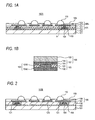
- Fig. 1A shows an electronic device according to a first example of the invention.
- description will be given by taking, as an example of the electronic device, a semiconductor device 100A (CSP) set to have a chip size.
- CSP semiconductor device 100A
- the semiconductor device 100A has a structure in which a laminated insulating layer 105 (which will be described below) and a conductive pattern 106 are laminated and formed on a protecting layer (a passivation layer) 102 of a semiconductor chip 101 on which an electrode pad 103 is formed. Moreover, a bump 104 constituted by Au is formed on the electrode bump 103, for example. The bump 104 is formed through a bonding wire by using a wire bonding device, for example.
- the conductive pattern 106 is referred to as a rewiring in some cases and is provided to cause a position of the electrode pad 103 of the semiconductor chip 101 to be different from that of a solder bump 110 serving as an external connecting terminal (in order to carry out fan in and a terminal arrangement in an optional position).
- the laminated insulating layer 105 is constituted by an epoxy based resin, for example, and serves to protect a surface (a main surface) of the semiconductor chip 101 on which a circuit is formed and serves as a base material in the formation of the conductive pattern 106.
- the conductive pattern 106 has a structure in which a first conductive pattern 107 and a second conductive pattern 108 are laminated, and furthermore, the first conductive pattern 107 has a structure in which a titanium film 114 and a copper film 115 are laminated as shown in an enlarged view of Fig. 1B .
- the first conductive pattern 107 (the titanium film 114, the copper film 115) is formed by a sputtering process (a PVD process) .
- Fig. 1B is an enlarged view showing a region (the vicinity of the bump 104) of the semiconductor device 100A which is surrounded by a broken line indicated as A in Fig. 1 .
- the first conductive pattern 107 is connected to the bump 104 so that the conductive pattern 106 is connected to an electronic circuit of the semiconductor chip 101 through the bump 104.
- a solder resist layer (an insulating layer) 109 is formed to cover the laminated insulating layer 105 and a part of the conductive pattern 106 around the solder bump 110.
- the bump 104 is constituted by a bump body 104A to be bonded to the electrode pad 103 and a protruded portion 104B which is protruded from the bump body 104A as shown in Fig. 1B .
- the bump 104 is formed by a bonding wire constituted by Au, for example, through a wire bonding device.
- the wire bonding device continuously bonds the bonding wire to the electrode pad 103 and cuts the bonding wire after the bonding, thereby forming the bump body 104A to be bonded to the bump 103 and the protruded portion 104B which is protruded from the bump body 104A.
- the laminated insulating layer 105 will be noted.
- the laminated insulating layer 105 has a structure in which a low-modulus insulating layer 120 (a first insulating layer) and a high-modulus insulating layer 121 (a second insulating layer) are laminated.
- the low-modulus insulating layer 120 is formed on the semiconductor chip 101 side and the high-modulus insulating layer 121 is formed on the conductive pattern 106 side.
- Both the low-modulus insulating layer 120 and the high-modulus insulating layer 121 are constituted by resin materials (non-conductive films) to which a hardness regulating material such as a filler referred to as NCF is rarely added.
- a hardness regulating material such as a filler referred to as NCF is rarely added.
- the high-modulus insulating layer 121 having an elastic modulus which is equal to or higher than 1,000 MPa.
- the materials of the low-modulus insulating layer 120 and the high-modulus insulating layer 121 are not restricted to the NCF but it is also possible to use a buildup resin (an epoxy resin containing a filler) and a resin material referred to as ACF if they can implement the characteristics.
- the high-modulus insulating layer 121 having a higher elastic modulus than the low-modulus insulating layer 120 is present around the connecting position of the bump 104 (the protruded portion 104B) and the conductive pattern 106 (the first conductive pattern 107).
- the low-modulus insulating layer 120 having a lower elastic modulus than the high-modulus insulating layer 121 is present in a position in which the laminated insulating layer 105 is connected to the semiconductor chip 101 (including the protecting layer 102). Accordingly, interfacial peeling from the protecting layer 102 can be prevented. Therefore, a cure shrinkage of the whole laminated insulating layer 105 can be set to be lower than that in the case in which all of the insulating layers are formed by the high-modulus material as in the conventional art. As compared with the case in which all of the insulating layers are formed by the high-modulus material, consequently, it is possible to reduce a warpage generated in the semiconductor device 100A.
- the semiconductor device 100A in accordance with the example thus, it is possible to prevent the warpage from being generated in the semiconductor device 100A while enhancing an electrical connecting reliability of the bump 104 and the conductive pattern 106.
- Fig. 2 shows a semiconductor device 100B according to a second example of the invention.
- corresponding structures to those shown in Fig. 1 have the same reference numerals and description thereof will be omitted.
- the semiconductor device 100A according to the first example has the structure in which the laminated insulating layer 105 has the low-modulus insulating layer 120 and the high-modulus insulating layer 121 laminated thereon.
- the semiconductor device 100B according to the example is characterized in that a division insulating layer 130 is provided in place of the laminated insulating layer 105.
- the division insulating layer 130 has a structure in which the high-modulus insulating layer 121 is formed in only a vicinal position of a bump 104 and the low-modulus insulating layer 120 is formed in the other portions.
- the high-modulus insulating layer 121 is formed cylindrically to surround the bump 104.
- the low-modulus insulating layer 120 and the high-modulus insulating layer 121 are not laminated as in the first example but are formed wholly in a vertical direction from a semiconductor chip 101 to a conductive pattern 106.
- Each of the low-modulus insulating layer 120 and the high-modulus insulating layer 121 has an elastic modulus which is set to be equal to that in the first example.
- the high-modulus insulating layer 121 is present around a bonding position of the bump 104 and the conductive pattern 106, and the semiconductor chip 101 and the division insulating layer 130 are mostly bonded to each other through the low-modulus insulating layer 120. Even if a stress acts in the connecting position of the bump 104 and the conductive pattern 106, therefore, it is firmly fixed by covering the connecting position with the high-modulus insulating layer 121 having a high elastic modulus, and furthermore, it is possible to reduce a warpage generated in the semiconductor device 100A through the low-modulus insulating layer 120. By the semiconductor device 100B, accordingly, it is possible to prevent the warpage from being generated in the semiconductor device 100B while enhancing an electrical connecting reliability of the bump 104 and the conductive pattern 106.
- a method of manufacturing the semiconductor device 100A according to the first example will be described with reference to Figs. 3A to 3M .
- Figs. 3A to 3M corresponding structures to those shown in Figs. 1 and 2 have the same reference numerals and description thereof will be omitted.
- a semiconductor substrate 101A (a wafer which will be hereinafter referred to as a substrate 101A) having a plurality of regions 101a (like a grid, for example) in which an electronic circuit is formed is manufactured by using a well-known method at a step shown in Fig. 3A .
- the region 101a corresponds to the semiconductor chip 101.
- An electrode pad 103 is formed on a device forming surface 101b of the region 101a on which an electronic circuit is formed.
- a protecting layer (a passivation layer) 102 formed of SiN (Si 3 N 4 ) is provided in a portion other than the electrode pad 103 in the device forming surface 101b. Consequently, the device forming surface 101b is protected.
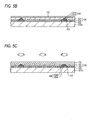
- Fig. 3B shows the enlarged region 101a of the substrate 101A illustrated in Fig. 3A .
- the region 101a is enlarged for convenience of illustration and explanation.
- the bump 104 is formed on the electrode pad 103 by using a wire bonding device, for example.
- the bump 104 is formed through a bonding wire formed of Au.
- the wire bonding device continuously bonds the bonding wire to the electrode pad 103 and cuts the bonding wire after the bonding, thereby forming a bump body 104A to be bonded to the electrode pad 103 and a protruded portion 104B which is protruded from the bump body 104A.
- a laminated insulating layer 105 is formed.
- the laminated insulating layer 105 has a structure in which the low-modulus insulating layer 120 and the high-modulus insulating layer 121 are laminated.
- the laminated insulating layer 105 As a method of manufacturing the laminated insulating layer 105, it is possible to propose a method of separately preparing low-modulus NCF serving as the low-modulus insulating layer 120 and high-modulus NCF serving as the high-modulus insulating layer 121, first providing the low-modulus NCF on the substrate 101A (the protecting layer 102) and disposing the high-modulus NCF thereon, thereby forming the laminated insulating layer 105 in which the low-modulus insulating layer 120 and the high-modulus insulating layer 121 are laminated.
- a material having an elastic modulus which is equal to or higher than 20 MPa and is lower than 1,000 MPa is selected as the low-modulus insulating layer 120 and a material having an elastic modulus which is equal to or higher than 1,000 MPa is selected as the high-modulus insulating layer 121.
- the materials of the low-modulus insulating layer 120 and the high-modulus insulating layer 121 are not restricted to the NCF but it is also possible to use a buildup resin (an epoxy resin containing a filler) and a resin material referred to as ACF which can implement the characteristics.
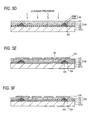
- a copper foil 112 is provided on the laminated insulating layer 105 and a pressure bonding treatment is carried out as shown in Fig. 3E . Consequently, the laminated insulating layer 105 is also pressed so that a part of the protruded portion 104B in the bump 104 is exposed from an upper surface of the laminated insulating layer 105 (an upper surface of the high-modulus insulating layer 121).
- the NCF to be the laminated insulating layer 105 is a comparatively soft resin material. Therefore, it is possible to reliably expose the protruded portion 104B from the laminated insulating layer 105. Moreover, a thickness of the laminated insulating layer 105 is also selected in such a manner that the protruded portion 104B is reliably protruded from the upper surface of the laminated insulating layer 105 in the pressure bonding treatment. By the pressure bonding treatment, furthermore, the protruded portion 104B of the bump 104 is pressed by the copper foil 112 and a height of a tip portion thereof is made uniform (leveling).
- Fig. 3F shows a state in which the copper foil 112 is removed.
- the protruded portion 104B is exposed from the laminated insulating layer 105 and is subjected to leveling in the pressure bonding treatment. In the state in which the copper foil 112 is removed, therefore, the protruded portion 104B is exposed from the laminated insulating layer 105.
- a first conductive layer 107A is formed on the upper surfaces of the laminated insulating layer 105 and the bump body 104A.
- the first conductive layer 107A is formed by using a sputtering process to be a kind of depositing process, for example.
- the first conductive layer 107A has a structure in which a titanium film 114 and a copper film 115 are laminated. Therefore, sputtering is first carried out by using Ti as a target to form the titanium film 114, and subsequently, the sputtering is carried out by using Cu as a target to form the copper film 115 in order to form the first conductive layer 107A on the laminated insulating layer 105.
- the titanium film 114 and the copper film 115 can be continuously formed by using an identical sputtering device.
- a thickness of the titanium film 114 is set to be 0.1 ⁇ m and a thickness of the copper film 115 is set to be 1.0 ⁇ m, for example (for convenience of illustration in Figs. 3G and 3H , the titanium film 114 and the copper film 115 are exaggeratedly drawn to be thicker than the other layers).
- the first conductive layer 107A has such a structure that the titanium film 114 and the copper film 115 are laminated in the example, moreover, it is also possible to use a chromium film (a thickness of 0.035 ⁇ m, for example) in place of the titanium film 114. Furthermore, it is also possible to constitute the first conductive layer 107A by only the copper film 115 without providing the titanium film 114 and the chromium film.
- a conductive pattern 106 to be connected to the bump 104 is formed through electrolytic plating using the conductive layer 107A as a feeding layer (a seed layer).
- a method of forming the conductive pattern 106 includes so-called subtractive and semiadditive processes. In the example, description will be given to an example in which the subtractive process is used.
- a conductive layer 108A formed of Cu is laminated on the conductive layer 107A through the electrolytic plating using the conductive layer 107A (the titanium film 114 and the copper film 115) as the feeding layer.
- a mask pattern R1 having an opening portion Ra is formed on the conductive layer 108A.
- the mask pattern R1 can be formed by forming a resist layer through an application or sticking of a film and patterning the resist layer using a photolithographic process.
- the conductive layers 107A and 108A are subjected to pattern etching using the mask pattern R1 as a mask. Consequently, a first conductive layer 107 and a second conductive layer 108 are laminated, and a conductive pattern 106 connected to the bump 104 is formed.
- the first conductive pattern 107 is formed to have a thickness of approximately 1 to 2 ⁇ m and the second conductive pattern 108 is formed to have a thickness of approximately 10 to 30 ⁇ m, and the numeric values are only illustrative and the invention is not restricted to the numeric values.
- the electrolytic plating method In order to form the conductive pattern 106, it is easy to use the electrolytic plating method by setting the conductive layer 107A to be the feeding layer. In the case in which the feeding layer (seed layer) is formed through a nonelectrolytic plating method, for example, it is necessary to carry out a treatment for roughening a surface of an insulating layer (a so-called desmear treatment). Thus, a treatment for forming a plated layer is complicated.
- the desmear treatment is not required. Consequently, it is possible to easily form the feeding layer (the conductive layer 107A) by a simple method. According to the method, therefore, a method of manufacturing a semiconductor device is simplified so that a manufacturing cost is reduced.
- a roughening treatment is carried out over a surface of the conductive pattern 106 (Cu) if necessary, and a solder resist layer (an insulating layer) 109 having an opening portion 109A is then formed on the laminated insulating layer 105. A part of the conductive pattern 106 is exposed from the opening portion 109A.
- the low-modulus insulating layer 120 having a low elastic modulus is provided in a position of the laminated insulating layer 105 which is close to the substrate 101A. Even if the substrate 101A is thinned so that a mechanical strength is reduced, accordingly, it is possible to prevent a warpage from being generated on the substrate 101A through the low-modulus insulating layer 120. Even if the semiconductor device 100A is thinned, accordingly, it is possible to effectively prevent the warpage from being generated.
- a solder bump 110 is formed on the conductive pattern 106 exposed from the opening portion 109A if necessary. Furthermore, the substrate 101A is subjected to dicing to divide the semiconductor chip into pieces. Consequently, it is possible to manufacture the semiconductor device 100A shown in Fig. 1A .
- the conductive pattern 106 is formed by the subtractive process in the manufacturing method, it may be formed by using the semiadditive process. In this case, for example, it is preferable to execute the steps shown in Figs. 3A to 3G in the manufacturing method and to then carry out steps which will be described below in place of the steps shown in Figs. 3H to 3J .
- a mask pattern R2 having an opening portion Rb is formed on a conductive layer 107A.
- the mask pattern R2 can be formed by forming a resist layer through an application or sticking of a film and patterning the resist layer using a photolithographic process.
- electrolytic plating using the conductive layer 107A as a feeding layer (a seed layer) is executed to form a second conductive pattern on the conductive layer 107A exposed from the opening portion Rb.
- the mask pattern R2 is peeled, and furthermore, the excessive feeding layer 107A exposed by peeling the mask pattern R2 is removed by etching. Consequently, it is possible to form the conductive pattern 106 shown in Fig. 3J .
- Figs. 5A to 5F show the method of manufacturing a semiconductor device according to the second example.
- corresponding structures to those shown in Fig. 3A to 3M have the same reference numerals and description thereof will be omitted.
- Fig. 5A shows an equivalent state to the state shown in Fig. 3 described above, and a state in which a bump 104 is formed on an electrode pad 103 provided on a substrate 101A.
- a laminated insulating layer 105 is formed. Also in the example, the laminated insulating layer 105 has a structure in which a low-modulus insulating layer 120 and a high-modulus insulating layer 121 are laminated.
- the laminated insulating layer 105 in a method of manufacturing the laminated insulating layer 105, it is also possible to first provide low-modulus NCF on the substrate 101A and to dispose high-modulus NCF thereon or to prepare laminated NCF in which the low-modulus NCF and the high-modulus NCF are previously laminated and to provide the laminated NCF on the substrate 101A, thereby forming the laminated insulating layer 105 in a batch. Since materials of the low-modulus insulating layer 120 and the high-modulus insulating layer 121 which are used at this time are the same as those in the first example, description thereof will be omitted.
- a copper foil 112 is provided on the laminated insulating layer 105 and a pressure bonding treatment is carried out as shown in Fig. 5C .
- a thickness of the copper foil 112 is set to be equal to or slightly greater than a thickness of a copper film to be used as a conductive pattern 106 in the example.
- the laminated insulating layer 105 is pressed and a part of a protruded portion 104B in the bump 104 is exposed from an upper surface of the laminated insulating layer 105 (an upper surface of the high-modulus insulating layer 121).
- the copper foil 112 is present on the laminated insulating layer 105. Therefore, the protruded portion 104B of the bump 104 is pressure bonded to the copper foil 112 and is electrically connected thereto.
- the copper foil 112 is pressure bonded to an upper surface of the high-modulus insulating layer 121 to be a resin. For this reason, the copper foil 112 is bonded to the upper surface of the laminated insulating layer 105 (the high-modulus insulating layer 121) by a bonding force of the high-modulus insulating layer 121.
- a cleaning treatment is carried out over a surface of the copper foil 112.
- the cleaning treatment is executed by using alkali cleaning and acid cleaning, for example.
- the copper foil 112 is processed by using a subtractive process to form the conductive pattern 106.
- a mask pattern R1 having an opening portion Ra is formed on the copper foil 112 as shown in Fig. 5E .
- the mask pattern R1 can be formed by forming a resist layer through an application or sticking of a film and patterning the resist layer using a photolithographic process.
- the copper foil 112 is subjected to pattern etching using the mask pattern R1 as a mask so that the conductive pattern 106 connected to the bump 104 is formed.
- the substrate 101A it is also possible to use a glass substrate or a multilayer wiring board for the substrate 101A in place of the semiconductor substrate. Accordingly, it is possible to carry out an application to various electronic devices using the substrates.
Landscapes
- Engineering & Computer Science (AREA)
- Microelectronics & Electronic Packaging (AREA)
- Computer Hardware Design (AREA)
- Power Engineering (AREA)
- Physics & Mathematics (AREA)
- Condensed Matter Physics & Semiconductors (AREA)
- General Physics & Mathematics (AREA)
- Manufacturing & Machinery (AREA)
- Internal Circuitry In Semiconductor Integrated Circuit Devices (AREA)
Applications Claiming Priority (1)
| Application Number | Priority Date | Filing Date | Title |
|---|---|---|---|
| JP2007160614A JP4121543B1 (ja) | 2007-06-18 | 2007-06-18 | 電子装置 |
Publications (2)
| Publication Number | Publication Date |
|---|---|
| EP2017883A2 true EP2017883A2 (fr) | 2009-01-21 |
| EP2017883A3 EP2017883A3 (fr) | 2009-07-22 |
Family
ID=39704899
Family Applications (1)
| Application Number | Title | Priority Date | Filing Date |
|---|---|---|---|
| EP08158511A Withdrawn EP2017883A3 (fr) | 2007-06-18 | 2008-06-18 | Procédé de fabrication de dispositif électronique et dispositif électronique |
Country Status (6)
| Country | Link |
|---|---|
| US (1) | US8102048B2 (fr) |
| EP (1) | EP2017883A3 (fr) |
| JP (1) | JP4121543B1 (fr) |
| KR (1) | KR20080111391A (fr) |
| CN (1) | CN101330027A (fr) |
| TW (1) | TW200908178A (fr) |
Families Citing this family (7)
| Publication number | Priority date | Publication date | Assignee | Title |
|---|---|---|---|---|
| JP4121542B1 (ja) * | 2007-06-18 | 2008-07-23 | 新光電気工業株式会社 | 電子装置の製造方法 |
| JP5295928B2 (ja) * | 2009-10-23 | 2013-09-18 | 新光電気工業株式会社 | 半導体装置及びその製造方法 |
| JP2012134270A (ja) * | 2010-12-21 | 2012-07-12 | Shinko Electric Ind Co Ltd | 半導体装置及びその製造方法 |
| US8756546B2 (en) | 2012-07-25 | 2014-06-17 | International Business Machines Corporation | Elastic modulus mapping of a chip carrier in a flip chip package |
| US8650512B1 (en) | 2012-11-15 | 2014-02-11 | International Business Machines Corporation | Elastic modulus mapping of an integrated circuit chip in a chip/device package |
| TWI858305B (zh) | 2021-08-06 | 2024-10-11 | 群創光電股份有限公司 | 封裝元件 |
| CN115706065A (zh) * | 2021-08-06 | 2023-02-17 | 群创光电股份有限公司 | 封装元件 |
Citations (1)
| Publication number | Priority date | Publication date | Assignee | Title |
|---|---|---|---|---|
| JP2002313985A (ja) | 2002-04-05 | 2002-10-25 | Oki Electric Ind Co Ltd | チップサイズパッケージの製造方法 |
Family Cites Families (14)
| Publication number | Priority date | Publication date | Assignee | Title |
|---|---|---|---|---|
| JP3313547B2 (ja) * | 1995-08-30 | 2002-08-12 | 沖電気工業株式会社 | チップサイズパッケージの製造方法 |
| AU4726397A (en) | 1997-10-30 | 1999-05-24 | Hitachi Limited | Semiconductor device and method for manufacturing the same |
| JPH11219984A (ja) * | 1997-11-06 | 1999-08-10 | Sharp Corp | 半導体装置パッケージおよびその製造方法ならびにそのための回路基板 |
| KR100266698B1 (ko) * | 1998-06-12 | 2000-09-15 | 김영환 | 반도체 칩 패키지 및 그 제조방법 |
| JP3477375B2 (ja) | 1998-08-05 | 2003-12-10 | 松下電器産業株式会社 | 半導体装置及びその製造方法 |
| CA2340677C (fr) | 1999-06-15 | 2005-07-05 | Fujikura Ltd. | Boitier a semi-conducteur, dispositif semi-conducteur, dispositif electronique et procede de fabrication de boitier a semi-conducteur |
| JP4526651B2 (ja) * | 1999-08-12 | 2010-08-18 | 富士通セミコンダクター株式会社 | 半導体装置 |
| US6605525B2 (en) * | 2001-05-01 | 2003-08-12 | Industrial Technologies Research Institute | Method for forming a wafer level package incorporating a multiplicity of elastomeric blocks and package formed |
| JPWO2003012863A1 (ja) * | 2001-07-31 | 2004-12-09 | 株式会社ルネサステクノロジ | 半導体装置及びその製造方法 |
| JP3542350B2 (ja) * | 2002-05-31 | 2004-07-14 | 沖電気工業株式会社 | 半導体装置及びその製造方法 |
| JP2004193497A (ja) * | 2002-12-13 | 2004-07-08 | Nec Electronics Corp | チップサイズパッケージおよびその製造方法 |
| JP3721175B2 (ja) * | 2003-06-03 | 2005-11-30 | 沖電気工業株式会社 | 半導体装置の製造方法 |
| DE10345395B4 (de) * | 2003-09-30 | 2006-09-14 | Infineon Technologies Ag | Halbleitermodul und Verfahren zur Herstellung eines Halbleitermoduls |
| JP3929966B2 (ja) * | 2003-11-25 | 2007-06-13 | 新光電気工業株式会社 | 半導体装置及びその製造方法 |
-
2007
- 2007-06-18 JP JP2007160614A patent/JP4121543B1/ja active Active
-
2008
- 2008-05-29 KR KR1020080050000A patent/KR20080111391A/ko not_active Withdrawn
- 2008-06-11 TW TW097121651A patent/TW200908178A/zh unknown
- 2008-06-17 US US12/140,651 patent/US8102048B2/en active Active
- 2008-06-17 CN CNA2008101266168A patent/CN101330027A/zh active Pending
- 2008-06-18 EP EP08158511A patent/EP2017883A3/fr not_active Withdrawn
Patent Citations (1)
| Publication number | Priority date | Publication date | Assignee | Title |
|---|---|---|---|---|
| JP2002313985A (ja) | 2002-04-05 | 2002-10-25 | Oki Electric Ind Co Ltd | チップサイズパッケージの製造方法 |
Also Published As
| Publication number | Publication date |
|---|---|
| JP4121543B1 (ja) | 2008-07-23 |
| US20080315413A1 (en) | 2008-12-25 |
| CN101330027A (zh) | 2008-12-24 |
| TW200908178A (en) | 2009-02-16 |
| JP2008311593A (ja) | 2008-12-25 |
| KR20080111391A (ko) | 2008-12-23 |
| US8102048B2 (en) | 2012-01-24 |
| EP2017883A3 (fr) | 2009-07-22 |
Similar Documents
| Publication | Publication Date | Title |
|---|---|---|
| EP2006908B1 (fr) | Dispositif électronique et son procédé de fabrication | |
| US8106504B2 (en) | Stacking package structure with chip embedded inside and die having through silicon via and method of the same | |
| US7795127B2 (en) | Electronic device manufacturing method and electronic device | |
| US20090096098A1 (en) | Inter-connecting structure for semiconductor package and method of the same | |
| US8102048B2 (en) | Electronic device manufacturing method and electronic device | |
| US20090218678A1 (en) | Semiconductor ic-embedded substrate and method for manufacturing same | |
| KR20230011439A (ko) | 반도체 패키지 및 그 제조 방법 | |
| US20090096093A1 (en) | Inter-connecting structure for semiconductor package and method of the same | |
| JP2009033153A (ja) | 半導体素子パッケージ用の相互接続構造およびその方法 | |
| US7829378B2 (en) | Method of manufacturing electronic device, substrate and semiconductor device | |
| US7981724B2 (en) | Manufacturing method for semiconductor device embedded substrate | |
| US7906833B2 (en) | Semiconductor device and manufacturing method thereof | |
| US7915078B2 (en) | Manufacturing method for semiconductor device embedded substrate | |
| US7763977B2 (en) | Semiconductor device and manufacturing method therefor | |
| JP5292848B2 (ja) | 部品内蔵基板及びその製造方法 | |
| JP2004319656A (ja) | ウエハーレベルcspの製造方法 | |
| US7985619B2 (en) | Manufacturing method for semiconductor device embedded substrate | |
| JP2010040954A (ja) | 電子部品の製造方法 |
Legal Events
| Date | Code | Title | Description |
|---|---|---|---|
| PUAI | Public reference made under article 153(3) epc to a published international application that has entered the european phase |
Free format text: ORIGINAL CODE: 0009012 |
|
| PUAI | Public reference made under article 153(3) epc to a published international application that has entered the european phase |
Free format text: ORIGINAL CODE: 0009012 |
|
| AK | Designated contracting states |
Kind code of ref document: A2 Designated state(s): AT BE BG CH CY CZ DE DK EE ES FI FR GB GR HR HU IE IS IT LI LT LU LV MC MT NL NO PL PT RO SE SI SK TR |
|
| AX | Request for extension of the european patent |
Extension state: AL BA MK RS |
|
| PUAL | Search report despatched |
Free format text: ORIGINAL CODE: 0009013 |
|
| AK | Designated contracting states |
Kind code of ref document: A3 Designated state(s): AT BE BG CH CY CZ DE DK EE ES FI FR GB GR HR HU IE IS IT LI LT LU LV MC MT NL NO PL PT RO SE SI SK TR |
|
| AX | Request for extension of the european patent |
Extension state: AL BA MK RS |
|
| 17P | Request for examination filed |
Effective date: 20100121 |
|
| AKX | Designation fees paid |
Designated state(s): DE |
|
| STAA | Information on the status of an ep patent application or granted ep patent |
Free format text: STATUS: THE APPLICATION HAS BEEN WITHDRAWN |
|
| 18W | Application withdrawn |
Effective date: 20150312 |