EP2014459A2 - Korrosionsinhibitoren in Klebeverbindungen von Fahrzeugkarosserien - Google Patents
Korrosionsinhibitoren in Klebeverbindungen von Fahrzeugkarosserien Download PDFInfo
- Publication number
- EP2014459A2 EP2014459A2 EP08009629A EP08009629A EP2014459A2 EP 2014459 A2 EP2014459 A2 EP 2014459A2 EP 08009629 A EP08009629 A EP 08009629A EP 08009629 A EP08009629 A EP 08009629A EP 2014459 A2 EP2014459 A2 EP 2014459A2
- Authority
- EP
- European Patent Office
- Prior art keywords
- adhesive
- corrosion
- composition
- microcapsules
- panel
- Prior art date
- Legal status (The legal status is an assumption and is not a legal conclusion. Google has not performed a legal analysis and makes no representation as to the accuracy of the status listed.)
- Withdrawn
Links
- 238000005260 corrosion Methods 0.000 title claims abstract description 66
- 230000007797 corrosion Effects 0.000 title claims abstract description 66
- 239000003112 inhibitor Substances 0.000 title description 31
- 238000004026 adhesive bonding Methods 0.000 title description 10
- 239000000853 adhesive Substances 0.000 claims abstract description 70
- 230000001070 adhesive effect Effects 0.000 claims abstract description 70
- 239000000203 mixture Substances 0.000 claims abstract description 50
- 239000003094 microcapsule Substances 0.000 claims abstract description 45
- 230000002401 inhibitory effect Effects 0.000 claims abstract description 22
- 229910000838 Al alloy Inorganic materials 0.000 claims abstract description 14
- 229910000861 Mg alloy Inorganic materials 0.000 claims abstract description 11
- 238000000034 method Methods 0.000 claims description 9
- 239000003054 catalyst Substances 0.000 claims description 7
- ZCDOYSPFYFSLEW-UHFFFAOYSA-N chromate(2-) Chemical compound [O-][Cr]([O-])(=O)=O ZCDOYSPFYFSLEW-UHFFFAOYSA-N 0.000 claims description 7
- 229910001092 metal group alloy Inorganic materials 0.000 claims description 7
- 239000000956 alloy Substances 0.000 claims description 3
- CWYNVVGOOAEACU-UHFFFAOYSA-N Fe2+ Chemical compound [Fe+2] CWYNVVGOOAEACU-UHFFFAOYSA-N 0.000 claims 2
- 229910045601 alloy Inorganic materials 0.000 claims 2
- MEFBJEMVZONFCJ-UHFFFAOYSA-N molybdate Chemical compound [O-][Mo]([O-])(=O)=O MEFBJEMVZONFCJ-UHFFFAOYSA-N 0.000 claims 2
- 230000001737 promoting effect Effects 0.000 claims 2
- 239000000463 material Substances 0.000 abstract description 43
- 239000010959 steel Substances 0.000 abstract description 12
- 229910000831 Steel Inorganic materials 0.000 abstract description 11
- 229910052751 metal Inorganic materials 0.000 abstract description 11
- 239000002184 metal Substances 0.000 abstract description 10
- 229910052782 aluminium Inorganic materials 0.000 abstract description 9
- XAGFODPZIPBFFR-UHFFFAOYSA-N aluminium Chemical compound [Al] XAGFODPZIPBFFR-UHFFFAOYSA-N 0.000 abstract description 9
- 239000011777 magnesium Substances 0.000 abstract description 6
- 229910052749 magnesium Inorganic materials 0.000 abstract description 6
- FYYHWMGAXLPEAU-UHFFFAOYSA-N Magnesium Chemical compound [Mg] FYYHWMGAXLPEAU-UHFFFAOYSA-N 0.000 abstract description 5
- 238000009792 diffusion process Methods 0.000 abstract description 4
- 239000012530 fluid Substances 0.000 abstract description 3
- 239000011253 protective coating Substances 0.000 abstract description 2
- 230000001681 protective effect Effects 0.000 abstract description 2
- XEEYBQQBJWHFJM-UHFFFAOYSA-N Iron Chemical compound [Fe] XEEYBQQBJWHFJM-UHFFFAOYSA-N 0.000 abstract 2
- 229920006332 epoxy adhesive Polymers 0.000 abstract 1
- 229910052742 iron Inorganic materials 0.000 abstract 1
- 239000003981 vehicle Substances 0.000 description 11
- 239000011324 bead Substances 0.000 description 10
- 239000011159 matrix material Substances 0.000 description 9
- 125000006850 spacer group Chemical group 0.000 description 9
- 239000002775 capsule Substances 0.000 description 8
- 239000010410 layer Substances 0.000 description 8
- 238000009472 formulation Methods 0.000 description 6
- 238000006243 chemical reaction Methods 0.000 description 5
- 238000007739 conversion coating Methods 0.000 description 5
- LYCAIKOWRPUZTN-UHFFFAOYSA-N Ethylene glycol Chemical compound OCCO LYCAIKOWRPUZTN-UHFFFAOYSA-N 0.000 description 4
- ABLZXFCXXLZCGV-UHFFFAOYSA-N Phosphorous acid Chemical compound OP(O)=O ABLZXFCXXLZCGV-UHFFFAOYSA-N 0.000 description 4
- VYPSYNLAJGMNEJ-UHFFFAOYSA-N Silicium dioxide Chemical compound O=[Si]=O VYPSYNLAJGMNEJ-UHFFFAOYSA-N 0.000 description 4
- 239000002131 composite material Substances 0.000 description 4
- 239000011162 core material Substances 0.000 description 4
- 238000005304 joining Methods 0.000 description 4
- 239000007788 liquid Substances 0.000 description 4
- 239000000126 substance Substances 0.000 description 4
- 239000012790 adhesive layer Substances 0.000 description 3
- 230000000295 complement effect Effects 0.000 description 3
- 230000005764 inhibitory process Effects 0.000 description 3
- 230000002093 peripheral effect Effects 0.000 description 3
- OKTJSMMVPCPJKN-UHFFFAOYSA-N Carbon Chemical compound [C] OKTJSMMVPCPJKN-UHFFFAOYSA-N 0.000 description 2
- 229910000640 Fe alloy Inorganic materials 0.000 description 2
- 229910001209 Low-carbon steel Inorganic materials 0.000 description 2
- 229910019142 PO4 Inorganic materials 0.000 description 2
- 239000003677 Sheet moulding compound Substances 0.000 description 2
- -1 Sodium carboxylate Chemical class 0.000 description 2
- WGLPBDUCMAPZCE-UHFFFAOYSA-N Trioxochromium Chemical compound O=[Cr](=O)=O WGLPBDUCMAPZCE-UHFFFAOYSA-N 0.000 description 2
- 230000009471 action Effects 0.000 description 2
- 230000001464 adherent effect Effects 0.000 description 2
- 150000001412 amines Chemical class 0.000 description 2
- 239000010405 anode material Substances 0.000 description 2
- 239000007864 aqueous solution Substances 0.000 description 2
- 150000001558 benzoic acid derivatives Chemical class 0.000 description 2
- 229910052799 carbon Inorganic materials 0.000 description 2
- 239000010406 cathode material Substances 0.000 description 2
- 239000003822 epoxy resin Substances 0.000 description 2
- 150000002222 fluorine compounds Chemical class 0.000 description 2
- 238000010438 heat treatment Methods 0.000 description 2
- WGCNASOHLSPBMP-UHFFFAOYSA-N hydroxyacetaldehyde Natural products OCC=O WGCNASOHLSPBMP-UHFFFAOYSA-N 0.000 description 2
- 239000012729 immediate-release (IR) formulation Substances 0.000 description 2
- 150000002739 metals Chemical class 0.000 description 2
- TUFJPPAQOXUHRI-KTKRTIGZSA-N n'-[(z)-octadec-9-enyl]propane-1,3-diamine Chemical compound CCCCCCCC\C=C/CCCCCCCCNCCCN TUFJPPAQOXUHRI-KTKRTIGZSA-N 0.000 description 2
- 150000002823 nitrates Chemical class 0.000 description 2
- 239000003921 oil Substances 0.000 description 2
- 235000021317 phosphate Nutrition 0.000 description 2
- 150000003013 phosphoric acid derivatives Chemical class 0.000 description 2
- 229920000647 polyepoxide Polymers 0.000 description 2
- 150000004760 silicates Chemical class 0.000 description 2
- 239000000377 silicon dioxide Substances 0.000 description 2
- 239000011734 sodium Substances 0.000 description 2
- 229910052708 sodium Inorganic materials 0.000 description 2
- 235000015393 sodium molybdate Nutrition 0.000 description 2
- 239000011684 sodium molybdate Substances 0.000 description 2
- TVXXNOYZHKPKGW-UHFFFAOYSA-N sodium molybdate (anhydrous) Chemical compound [Na+].[Na+].[O-][Mo]([O-])(=O)=O TVXXNOYZHKPKGW-UHFFFAOYSA-N 0.000 description 2
- 239000000758 substrate Substances 0.000 description 2
- NWONKYPBYAMBJT-UHFFFAOYSA-L zinc sulfate Chemical compound [Zn+2].[O-]S([O-])(=O)=O NWONKYPBYAMBJT-UHFFFAOYSA-L 0.000 description 2
- 229960001763 zinc sulfate Drugs 0.000 description 2
- 229910000368 zinc sulfate Inorganic materials 0.000 description 2
- IBUJXWOXORWGGW-UHFFFAOYSA-N 3h-1,3-benzothiazole-2-thione;copper;sodium Chemical compound [Na].[Cu].C1=CC=C2SC(=S)NC2=C1 IBUJXWOXORWGGW-UHFFFAOYSA-N 0.000 description 1
- 229910000851 Alloy steel Inorganic materials 0.000 description 1
- RYGMFSIKBFXOCR-UHFFFAOYSA-N Copper Chemical compound [Cu] RYGMFSIKBFXOCR-UHFFFAOYSA-N 0.000 description 1
- 108010010803 Gelatin Proteins 0.000 description 1
- 239000004825 One-part adhesive Substances 0.000 description 1
- FAPWRFPIFSIZLT-UHFFFAOYSA-M Sodium chloride Chemical compound [Na+].[Cl-] FAPWRFPIFSIZLT-UHFFFAOYSA-M 0.000 description 1
- 238000010521 absorption reaction Methods 0.000 description 1
- 239000004840 adhesive resin Substances 0.000 description 1
- 229920006223 adhesive resin Polymers 0.000 description 1
- 229910052783 alkali metal Inorganic materials 0.000 description 1
- 150000001340 alkali metals Chemical class 0.000 description 1
- WNROFYMDJYEPJX-UHFFFAOYSA-K aluminium hydroxide Chemical compound [OH-].[OH-].[OH-].[Al+3] WNROFYMDJYEPJX-UHFFFAOYSA-K 0.000 description 1
- 230000003466 anti-cipated effect Effects 0.000 description 1
- 230000002902 bimodal effect Effects 0.000 description 1
- 230000015572 biosynthetic process Effects 0.000 description 1
- 238000005266 casting Methods 0.000 description 1
- 230000003197 catalytic effect Effects 0.000 description 1
- 239000013043 chemical agent Substances 0.000 description 1
- 239000003795 chemical substances by application Substances 0.000 description 1
- 238000007744 chromate conversion coating Methods 0.000 description 1
- 150000001875 compounds Chemical class 0.000 description 1
- 238000007906 compression Methods 0.000 description 1
- 230000006835 compression Effects 0.000 description 1
- 238000010276 construction Methods 0.000 description 1
- 229910052802 copper Inorganic materials 0.000 description 1
- 239000010949 copper Substances 0.000 description 1
- 230000008878 coupling Effects 0.000 description 1
- 238000010168 coupling process Methods 0.000 description 1
- 238000005859 coupling reaction Methods 0.000 description 1
- 238000005336 cracking Methods 0.000 description 1
- GDVKFRBCXAPAQJ-UHFFFAOYSA-A dialuminum;hexamagnesium;carbonate;hexadecahydroxide Chemical compound [OH-].[OH-].[OH-].[OH-].[OH-].[OH-].[OH-].[OH-].[OH-].[OH-].[OH-].[OH-].[OH-].[OH-].[OH-].[OH-].[Mg+2].[Mg+2].[Mg+2].[Mg+2].[Mg+2].[Mg+2].[Al+3].[Al+3].[O-]C([O-])=O GDVKFRBCXAPAQJ-UHFFFAOYSA-A 0.000 description 1
- 239000006185 dispersion Substances 0.000 description 1
- 238000006073 displacement reaction Methods 0.000 description 1
- 238000009826 distribution Methods 0.000 description 1
- 238000001125 extrusion Methods 0.000 description 1
- 239000000835 fiber Substances 0.000 description 1
- 229920000159 gelatin Polymers 0.000 description 1
- 239000008273 gelatin Substances 0.000 description 1
- 235000019322 gelatine Nutrition 0.000 description 1
- 235000011852 gelatine desserts Nutrition 0.000 description 1
- 239000011521 glass Substances 0.000 description 1
- LNEPOXFFQSENCJ-UHFFFAOYSA-N haloperidol Chemical compound C1CC(O)(C=2C=CC(Cl)=CC=2)CCN1CCCC(=O)C1=CC=C(F)C=C1 LNEPOXFFQSENCJ-UHFFFAOYSA-N 0.000 description 1
- 238000009957 hemming Methods 0.000 description 1
- 229960001545 hydrotalcite Drugs 0.000 description 1
- 229910001701 hydrotalcite Inorganic materials 0.000 description 1
- 238000007654 immersion Methods 0.000 description 1
- 230000013011 mating Effects 0.000 description 1
- 230000007246 mechanism Effects 0.000 description 1
- 239000007769 metal material Substances 0.000 description 1
- 239000004005 microsphere Substances 0.000 description 1
- 238000000465 moulding Methods 0.000 description 1
- 239000003973 paint Substances 0.000 description 1
- 229920000642 polymer Polymers 0.000 description 1
- 238000006116 polymerization reaction Methods 0.000 description 1
- 239000004814 polyurethane Substances 0.000 description 1
- 229920002635 polyurethane Polymers 0.000 description 1
- 230000002028 premature Effects 0.000 description 1
- 230000008569 process Effects 0.000 description 1
- 230000002035 prolonged effect Effects 0.000 description 1
- 239000003586 protic polar solvent Substances 0.000 description 1
- 150000003839 salts Chemical class 0.000 description 1
- 238000000926 separation method Methods 0.000 description 1
- 239000011780 sodium chloride Substances 0.000 description 1
- KIEOKOFEPABQKJ-UHFFFAOYSA-N sodium dichromate Chemical compound [Na+].[Na+].[O-][Cr](=O)(=O)O[Cr]([O-])(=O)=O KIEOKOFEPABQKJ-UHFFFAOYSA-N 0.000 description 1
- VLDHWMAJBNWALQ-UHFFFAOYSA-M sodium;1,3-benzothiazol-3-ide-2-thione Chemical compound [Na+].C1=CC=C2SC([S-])=NC2=C1 VLDHWMAJBNWALQ-UHFFFAOYSA-M 0.000 description 1
- 239000000243 solution Substances 0.000 description 1
- 238000001179 sorption measurement Methods 0.000 description 1
- 239000002344 surface layer Substances 0.000 description 1
- 229920002803 thermoplastic polyurethane Polymers 0.000 description 1
- 229920001187 thermosetting polymer Polymers 0.000 description 1
- 230000007704 transition Effects 0.000 description 1
- 239000011345 viscous material Substances 0.000 description 1
- XLYOFNOQVPJJNP-UHFFFAOYSA-N water Substances O XLYOFNOQVPJJNP-UHFFFAOYSA-N 0.000 description 1
- 238000003466 welding Methods 0.000 description 1
Images
Classifications
-
- C—CHEMISTRY; METALLURGY
- C09—DYES; PAINTS; POLISHES; NATURAL RESINS; ADHESIVES; COMPOSITIONS NOT OTHERWISE PROVIDED FOR; APPLICATIONS OF MATERIALS NOT OTHERWISE PROVIDED FOR
- C09J—ADHESIVES; NON-MECHANICAL ASPECTS OF ADHESIVE PROCESSES IN GENERAL; ADHESIVE PROCESSES NOT PROVIDED FOR ELSEWHERE; USE OF MATERIALS AS ADHESIVES
- C09J5/00—Adhesive processes in general; Adhesive processes not provided for elsewhere, e.g. relating to primers
- C09J5/06—Adhesive processes in general; Adhesive processes not provided for elsewhere, e.g. relating to primers involving heating of the applied adhesive
-
- B—PERFORMING OPERATIONS; TRANSPORTING
- B60—VEHICLES IN GENERAL
- B60J—WINDOWS, WINDSCREENS, NON-FIXED ROOFS, DOORS, OR SIMILAR DEVICES FOR VEHICLES; REMOVABLE EXTERNAL PROTECTIVE COVERINGS SPECIALLY ADAPTED FOR VEHICLES
- B60J5/00—Doors
- B60J5/04—Doors arranged at the vehicle sides
- B60J5/0401—Upper door structure
- B60J5/0405—Inboard or outboard side of window frame formed integrally with the lower door structure
-
- B—PERFORMING OPERATIONS; TRANSPORTING
- B60—VEHICLES IN GENERAL
- B60J—WINDOWS, WINDSCREENS, NON-FIXED ROOFS, DOORS, OR SIMILAR DEVICES FOR VEHICLES; REMOVABLE EXTERNAL PROTECTIVE COVERINGS SPECIALLY ADAPTED FOR VEHICLES
- B60J5/00—Doors
- B60J5/04—Doors arranged at the vehicle sides
- B60J5/048—Doors arranged at the vehicle sides characterised by the material
- B60J5/0484—Doors arranged at the vehicle sides characterised by the material hybrid, i.e. plastic moulded onto metal parts
-
- C—CHEMISTRY; METALLURGY
- C09—DYES; PAINTS; POLISHES; NATURAL RESINS; ADHESIVES; COMPOSITIONS NOT OTHERWISE PROVIDED FOR; APPLICATIONS OF MATERIALS NOT OTHERWISE PROVIDED FOR
- C09J—ADHESIVES; NON-MECHANICAL ASPECTS OF ADHESIVE PROCESSES IN GENERAL; ADHESIVE PROCESSES NOT PROVIDED FOR ELSEWHERE; USE OF MATERIALS AS ADHESIVES
- C09J11/00—Features of adhesives not provided for in group C09J9/00, e.g. additives
- C09J11/02—Non-macromolecular additives
- C09J11/04—Non-macromolecular additives inorganic
-
- C—CHEMISTRY; METALLURGY
- C08—ORGANIC MACROMOLECULAR COMPOUNDS; THEIR PREPARATION OR CHEMICAL WORKING-UP; COMPOSITIONS BASED THEREON
- C08K—Use of inorganic or non-macromolecular organic substances as compounding ingredients
- C08K3/00—Use of inorganic substances as compounding ingredients
- C08K3/01—Use of inorganic substances as compounding ingredients characterized by their specific function
-
- C—CHEMISTRY; METALLURGY
- C08—ORGANIC MACROMOLECULAR COMPOUNDS; THEIR PREPARATION OR CHEMICAL WORKING-UP; COMPOSITIONS BASED THEREON
- C08K—Use of inorganic or non-macromolecular organic substances as compounding ingredients
- C08K3/00—Use of inorganic substances as compounding ingredients
- C08K3/18—Oxygen-containing compounds, e.g. metal carbonyls
- C08K3/20—Oxides; Hydroxides
- C08K3/22—Oxides; Hydroxides of metals
-
- C—CHEMISTRY; METALLURGY
- C08—ORGANIC MACROMOLECULAR COMPOUNDS; THEIR PREPARATION OR CHEMICAL WORKING-UP; COMPOSITIONS BASED THEREON
- C08K—Use of inorganic or non-macromolecular organic substances as compounding ingredients
- C08K9/00—Use of pretreated ingredients
- C08K9/10—Encapsulated ingredients
-
- C—CHEMISTRY; METALLURGY
- C09—DYES; PAINTS; POLISHES; NATURAL RESINS; ADHESIVES; COMPOSITIONS NOT OTHERWISE PROVIDED FOR; APPLICATIONS OF MATERIALS NOT OTHERWISE PROVIDED FOR
- C09J—ADHESIVES; NON-MECHANICAL ASPECTS OF ADHESIVE PROCESSES IN GENERAL; ADHESIVE PROCESSES NOT PROVIDED FOR ELSEWHERE; USE OF MATERIALS AS ADHESIVES
- C09J2301/00—Additional features of adhesives in the form of films or foils
- C09J2301/40—Additional features of adhesives in the form of films or foils characterized by the presence of essential components
- C09J2301/412—Additional features of adhesives in the form of films or foils characterized by the presence of essential components presence of microspheres
-
- C—CHEMISTRY; METALLURGY
- C09—DYES; PAINTS; POLISHES; NATURAL RESINS; ADHESIVES; COMPOSITIONS NOT OTHERWISE PROVIDED FOR; APPLICATIONS OF MATERIALS NOT OTHERWISE PROVIDED FOR
- C09J—ADHESIVES; NON-MECHANICAL ASPECTS OF ADHESIVE PROCESSES IN GENERAL; ADHESIVE PROCESSES NOT PROVIDED FOR ELSEWHERE; USE OF MATERIALS AS ADHESIVES
- C09J2400/00—Presence of inorganic and organic materials
- C09J2400/10—Presence of inorganic materials
- C09J2400/16—Metal
- C09J2400/163—Metal in the substrate
-
- Y—GENERAL TAGGING OF NEW TECHNOLOGICAL DEVELOPMENTS; GENERAL TAGGING OF CROSS-SECTIONAL TECHNOLOGIES SPANNING OVER SEVERAL SECTIONS OF THE IPC; TECHNICAL SUBJECTS COVERED BY FORMER USPC CROSS-REFERENCE ART COLLECTIONS [XRACs] AND DIGESTS
- Y10—TECHNICAL SUBJECTS COVERED BY FORMER USPC
- Y10T—TECHNICAL SUBJECTS COVERED BY FORMER US CLASSIFICATION
- Y10T428/00—Stock material or miscellaneous articles
- Y10T428/29—Coated or structually defined flake, particle, cell, strand, strand portion, rod, filament, macroscopic fiber or mass thereof
- Y10T428/2982—Particulate matter [e.g., sphere, flake, etc.]
- Y10T428/2984—Microcapsule with fluid core [includes liposome]
Definitions
- This disclosure pertains to the joining of automotive vehicle components formed of dissimilar materials. More specifically this disclosure pertains to adhesive bonding of vehicle body parts, for example panels or panels and frame members, so as to minimize corrosion between the different metals or metal and composite materials, especially where the parts are exposed to an atmospheric moisture and salt containing environment.
- the building of automotive vehicle bodies usually involves the joining of complementary panels or the attachment of a panel to a frame structure.
- Vehicle doors and other closure members are often made of inner and outer panels.
- the panels are usually made of like materials, for example stamped steel sheet workpieces or stamped aluminum sheets, and joined by welding, hemming, mechanical fasteners, or adhesive bonding.
- panels are made of polymeric composite moldings and adhesively bonded.
- Structural adhesives are known for joining panels of like metal alloys and panels molded of fiber reinforced sheet molding compound for automotive applications.
- commercial epoxy resins are suitable for this purpose.
- Urethane resins are also used in structural adhesive bonding applications.
- Adhesives for structural applications are dispensed in either one or two parts, where, in a two-part formulation; one of the parts contains the catalyst that hardens the adhesive.
- the catalytic curing agent is contained in the adhesive resin formulation.
- the adhesive is formulated as a mobile viscous material that can be withdrawn from a reservoir, separate streams mixed if a two-part adhesive is employed, and extruded as a bead or layer onto a surface using, for example, a programmed robotic applicator.
- the adhesive is applied to the bonding surface of at least one of like-material workpieces and the intended bonding surfaces of the workpieces are pressed together.
- the assembly is then typically treated (usually by heating) to activate the catalyzed polymerization reactions by which the adhesive is hardened or cured in a strong adherent bond between surfaces of the panels or other part combinations.
- inner and outer door panels, lift gate panels, hoods and deck lids can be made of any combination of steel panels, aluminum panels, magnesium panels, carbon composite panels, or SMC panels to satisfy structural, weight, and appearance requirements.
- Similar uses of mixed materials may be employed to create structural subsystems or body frames involving panels and structural members of various shapes including castings and extrusions. But the use of such combinations of mixed materials presents issues of how the body members can be efficiently and effectively attached and how corrosion due to galvanic action between closely spaced different materials can be minimized.
- sheet metal workpieces formed of dissimilar metal alloys are adhesively bonded in structural applications.
- a steel door outer panel and an aluminum alloy door inner panel are bonded at facing surfaces to form a vehicle door structure for containing a window and other functional vehicle door components.
- the joining is accomplished using an adhesive composition comprising microcapsules containing a releasable material for reacting with and inhibiting corrosion on one or more facing surfaces of the bonded panels or other parts.
- the adhesive composition may also comprise uniformly sized spacer beads for maintaining an interfacial gap between the facing parts and preventing adhesive from being squeezed from between the bonding surfaces before the adhesive is activated and cured.
- the spacer beads may, for example, be 0.762 mm (0.030 inch) or 0.508 mm (0.020 in.) or 0.254 mm (0.010 in.) in diameter, common bond thicknesses, which then provide an adhesive bond layer for a bonded sheet assembly.
- the actual bond thickness desired is a function of the adhesive and substrate(s) being used in the assembly.
- the adhesive is cured to form a bond between the metal workpieces.
- the selection of the corrosion resistant material is based on the metal alloys selected for the mixed metal workpieces. Of course, various combinations of metal alloy pieces may be selected for adhesive bonding. In many embodiments of the invention, the selection of the corrosion inhibiting material will depend on the difference in potential between the materials giving rise to the galvanic coupling as well as the surface-adsorption characteristics of the inhibitor on the anodic and cathodic sites. In general, while aluminum alloys may not require corrosion inhibition when adhesively bonded to magnesium alloys or steels, magnesium alloys normally do require protection when bonded to steel. Aluminum alloys are often used as transition layers between magnesium and steel components so as to mitigate corrosion issues.
- corrosion inhibitors are often used for aluminum and steel (even when not coupled to another material) if the material is expected to experience a corrosive environment (e.g., a warm, moist, and/or saline environment). Because aluminum joints can entrap moisture for prolonged durations, corrosive environments are often found, especially in structural members in or near the engine compartment, wherein higher temperatures can result.
- a corrosive environment e.g., a warm, moist, and/or saline environment.
- the corrosion inhibiting material is contained within a suitable encapsulating material and mixed into the adhesive.
- the capsules are of a size (usually smaller than that of the spacer beads) that they may be dispersed within the mobile adhesive material and distributed in an interface between parts to be joined. Thus, the capsules will have diameters measurable in micrometers, and are often referred to in this specification as microcapsules.
- the microcapsules may have polymeric or gelatin shells and cores of corrosion inhibiting material.
- the corrosion inhibiting material may be in the form of a solution or a mobile dispersion so that after the adhesive has been applied to a structural metal workpiece the corrosion inhibitor may be released from the microcapsules and migrate to the surface to be protected from galvanic corrosion.
- the microcapsules may be broken at a time when the workpieces are pressed together for bonding (e.g., against the spacer beads) and before the adhesive is cured, or in the nozzle during dispensing, or the encapsulating material may be formulated to more slowly release the corrosion inhibiting material after the adhesive bonding process is completed and during the life of the bonded assembly.
- suitable chromate compositions may be used in protecting aluminum alloy or magnesium alloy parts. Chromates often offer anodic corrosion protection (i.e., where the potential electrochemical corrosive attack at the metal surface is an anodic reaction). Zinc sulfate is a common cathodic corrosion inhibitor for surfaces of these metals. Phosphates, silicates, nitrates, fluorides, benzoates, and various soluble oils are also useful inhibitors. Where an aluminum alloy contains copper, sodium mercaptobenzothiazole may be a useful inhibitor. Sodium carboxylate is often a suitable inhibitor for magnesium alloy surfaces.
- Sodium molybdate formulations may be used to protect ferrous alloys from galvanic corrosion due to the close proximity in an adhesively bonded assembly of a more anodic/cathodic material.
- phosphonic acid e.g., trinitrilotrismethylene phosphonic acid
- fatty amines such as N-oleyl-1, 3-propane diamine
- one or more such corrosion inhibitors or surface layer conversion compounds are brought to the adhesive bonding interface between the dissimilar material surfaces in microcapsules dispersed in the mobile adhesive.
- the corrosion resistant contents of the microcapsules are released after the adhesive is applied to one or both of the parts and compacted between the assembled facing parts.
- the release of the corrosion inhibitor may be sudden or gradual. The release may occur before or after the adhesive is cured.
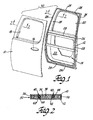
- Figure 1 illustrates representative shapes of inner and outer door panels of different metal alloy materials that are in a juxtaposed position for adhesive bonding.
- Figure 2 is a portion of a cross-sectional view at 2-2 of the juxtaposed panels of Figure 1 illustrating an adhesive layer with small spacer beads and microcapsules containing corrosion inhibiting material for bonding the panel members.
- the invention may be used in bonding inner and outer vehicle closure panels such as panels for doors, tailgates, deck lids, engine compartment hoods and the like.
- inner and outer vehicle closure panels such as panels for doors, tailgates, deck lids, engine compartment hoods and the like.
- a low carbon steel for the outer panel and a readily formable aluminum alloy for the inner panel.
- Other candidate combinations include steel/ magnesium alloy panels, aluminum/carbon composite panels and aluminum/magnesium panels.
- a low carbon steel outer panel 10 is seen positioned with its inner side (not visible in the figure) facing the inner side 14 of an aluminum alloy inner panel 12.
- Steel outer panel 10 has been stamped from blank sheet material to have the top to bottom curvature of the side of a vehicle, a formed region 16 for a handle for opening and closing the door, and a framed-in window opening 18.
- Inner panel 12 has been stamped from blank aluminum alloy sheet material to complement the shape of outer panel 10.
- Inner panel is shaped to define its corresponding window opening 20 and to provide a compartment (indicated generally at 22) for containing a mechanism for opening and closing a window and other components to be fitted within the bonded door panel assembly.
- each stamping has peripheral surfaces 24 (on inner panel 12) and a belt line surface 26 for adhesive bonding to the facing side of the mating panel.
- a strip or band of adhesive 28 is applied in a suitable pattern to surfaces 24 and 26 on inner surface 14 of inner panel 12.
- the outer panel 10 is than aligned against inner panel 12 in an assembly 30 with like peripheral and beltline surfaces of the inner side of the outer panel pressed against the applied adhesive.
- Figure 2 is a portion of the cross-section taken at locations 2-2 of Figure 1 showing the interface between facing panels 10, 12 with an interfacial layer of adhesive mixture 32.
- the thickness of the adhesive mixture of Figure 2 is enlarged with respect to the thicknesses of the layers of the facing panels 10, 12 to better illustrate the microcapsules included in the adhesive mixture 32.
- the thicknesses of panels 10, 12 is often in the range of about one to two millimeters and the thickness of the cured or hardened adhesive layer 32 is, nominally, less than one millimeter.
- adhesive mixture layer 32 is of generally uniform thickness.
- Layer 32 contains a polymerizable matrix 34 or vehicle of epoxy resin composition or other suitable thermosetting polymeric composition.
- Spacer bodies 36 Dispersed in the adhesive matrix 34 are spacer bodies 36 for maintaining a predetermined separation distance between facing sides of panels 10, 12 until the adhesive matrix composition 34 has been activated and hardened to form a strongly adherent interfacial bond.
- Spacer bodies 36 may be spherical glass beads which are chemically inert in the interfacial environment and are required only to prevent unhardened adhesive from being squeezed from between the surfaces to be joined. Only two spacer bodies 36 are illustrated in Figure 2 but they would be used in a sufficient number per unit of area to serve their spacing function at the bonding surfaces of the facing parts.
- a catalyst-containing microcapsule 38 is illustrated in the polymerizable matrix 34.
- Catalyst capsules 38 may be used in one-part adhesive formulations to prevent premature curing of the adhesive matrix 34. Once the adhesive mixture 32 has been applied to peripheral surfaces 24 and beltline surface 26 of panel surface(s) 12, 14 and the panels mated and supported for hardening of the adhesive, the catalyst capsules 38 may be activated by heating, exposure to ultrasonic energy, cracking of the microcapsules during dispensing, or other suitable means.
- the polymerizable matrix 34 also contains corrosion inhibiter filled microcapsules 40.
- Microcapsules 40 comprise breakable or porous spherical walls 42 with a liquid or suitably mobile core 44 of corrosion inhibitor composition. Again, only two corrosion inhibitor microcapsules 40 are illustrated in Figure 2 for simplicity of illustration. But they would be incorporated in the adhesive matrix 34 in suitable abundance and area density to provide corrosion protection to one or both of the adhesive bound surfaces of panels 10, 12.
- the volume fraction of all capsules and (spacer) beads in the adhesive phase is preferably kept below about forty percent, thereby ensuring good mechanical properties of the adhesive in addition to providing sufficient corrosion inhibition.
- a feature of the invention is to mix a corrosion inhibitor or conversion coating material into the adhesive.
- the adhesive with dispersed microcapsules of inhibitor or conversion coating is "painted" or sprayed, or otherwise coated, on one of the substrates to be joined.
- corrosion inhibitor-containing microcapsules 38 are illustrated as unbroken, as they have been mixed with the adhesive matrix 34 in preparing the microcapsule-containing adhesive composition 32.
- corrosion inhibitor material is released from the capsules to flow to one or both surfaces of the facing panels. Two modes are envisioned for corrosion inhibitor release: immediate and slow-release.
- the immediate release would be as the adhesive is applied or the adhesive coated panel surfaces are pressed together.
- the inhibitor microcapsules may be broken by action of the adhesive applicator device, by pressure of the assembled bonding surfaces, or by application of disruptive energy (e.g., heat or ultrasonic energy) during or shortly after adhesive application.
- disruptive energy e.g., heat or ultrasonic energy
- the use of larger sized microcapsules i.e., 200 to 500 micrometers in diameter
- the core material of the corrosion inhibitor microcapsules comprised a polar protic solvent such as water or a glycol
- a polar protic solvent such as water or a glycol
- Many corrosion inhibitor materials have been employed in aqueous solutions. It may be preferred to formulate such materials in a glycol, or similar medium, and encapsulate the liquid core material in a shell composed of a polymer (such as polyurethane).
- microcapsules 38 are cracked or broken within the adhesive matrix 32 when panels 10, 12 are positioned and pressed together in the bonding operation.
- Corrosion inhibitor fluid leaks from the microcapsules 38 and flows into contact with the facing surfaces of panels 10, 12.
- the inhibitor material reacts with one or both of the material surfaces as specified to form a protective coating (not illustrated) on a surface to prevent galvanic corrosion in the adhesive bond area.
- the microcapsules are cracked or broken upon dispensing to mix the chemicals contained in the microcapsules. Because it is desired to maintain the adhesive layer thickness by the sphere size in many adhesive applications, it is proposed that some of the spheres (microcapsules) be thin walled or otherwise be designed to crack upon force applied to fixture the joint. Hence a bimodal distribution of spheres can be envisioned, with some spheres that crack and release chemical agents, while others maintain structural integrity under expected compressive forces.
- ultrasonic energy As mentioned, a different way to crack or disrupt the microcapsules may be through the use of ultrasonic energy. Ultrasonic compression waves would be highly effective over the size range envisioned for microcapsules. Further, ultrasonic energy could be equally effective at disrupting microcapsules with either rigid or pliable walls. In some embodiments, the ultrasonic energy may be supplied through the metal after the parts are joined.
- heat may be used to cause the microcapsules to crack and/or increase the rate of chemical dispensing, or where heat can be used to instigate an exothermic reaction to cause any of the above described methods for release of the inhibitor material from the microcapsules, for example in an oven used to bake paint.
- the necessary corrosion-related chemicals would be prepared and contained in some microcapsules that do not crack when the adhesive joint is formed. Instead the size and material of these microcapsules would release the corrosion inhibiting chemicals slowly, possibly over the anticipated life of the part. This would allow for a continued replenishment of the conversion coating or inhibition throughout a long duration (perhaps 10 years if diffusion rates through the bead surface are correctly adjusted via porosity and thickness changes of the bead material).
- the corrosion inhibiting material may be encapsulated in, for example, porous silica. Diffusion through the walls of the silica capsules and through the cured adhesive may be slow, but absorption and reaction of the inhibitor with the nascent corrosion product will continue to provide a concentration gradient for continued diffusion.
- Chromate conversion coatings are typically used to retard the corrosion of aluminum alloy workpiece surfaces or magnesium alloy surfaces.
- the surfaces are immersed in or brought into contact with in aqueous solutions containing, for example, 4 g/l of CrO 3 , 3.5 g/l of Na 2 Cr 2 O 7 , and 0.8 g/l NaF. Normally a 30 second immersion is used to treat the Al or Mg surface.
- Alodine ® a product of the Henkel Company is a suitable chromate conversion material for inclusion in suitable microcapsules.
- Zinc sulfate is a common cathodic corrosion inhibitor for surfaces of aluminum and magnesium alloy surfaces. Phosphates, silicates, nitrates, fluorides, benzoates, and various soluble oils are also useful inhibitors. Where an aluminum alloy contains copper sodium mercaptobenzothiazole may be a useful inhibitor. Sodium carboxylate is often a suitable inhibitor for magnesium alloy surfaces. Aqueous-based hydrotalcite-based conversion coatings may also be used to promote the formation of protective alkali metal/aluminum hydroxide layers over aluminum surfaces and magnesium workpiece surfaces.
- Sodium molybdate formulations may be used to protect ferrous alloys from galvanic corrosion due to the close proximity in an adhesively bonded assembly of a more anodic/cathodic material.
- phosphonic acid e.g., trinitrilotrismethylene phosphonic acid
- fatty amines such as N-oleyl-1,3-propane diamine
- a vacuum-capable autoclave may be used to force fluids of conversion coating materials or inhibitors into commercially available microspheres or microcapsules at low temperature and under moderate pressure.
Landscapes
- Chemical & Material Sciences (AREA)
- Organic Chemistry (AREA)
- Engineering & Computer Science (AREA)
- Mechanical Engineering (AREA)
- Inorganic Chemistry (AREA)
- Adhesives Or Adhesive Processes (AREA)
Applications Claiming Priority (1)
| Application Number | Priority Date | Filing Date | Title |
|---|---|---|---|
| US11/760,282 US8101036B2 (en) | 2007-06-08 | 2007-06-08 | Corrosion inhibitors in adhesive bonding of vehicle body structures |
Publications (2)
| Publication Number | Publication Date |
|---|---|
| EP2014459A2 true EP2014459A2 (de) | 2009-01-14 |
| EP2014459A3 EP2014459A3 (de) | 2009-06-10 |
Family
ID=39734215
Family Applications (1)
| Application Number | Title | Priority Date | Filing Date |
|---|---|---|---|
| EP08009629A Withdrawn EP2014459A3 (de) | 2007-06-08 | 2008-05-27 | Korrosionsinhibitoren in Klebeverbindungen von Fahrzeugkarosserien |
Country Status (2)
| Country | Link |
|---|---|
| US (1) | US8101036B2 (de) |
| EP (1) | EP2014459A3 (de) |
Families Citing this family (20)
| Publication number | Priority date | Publication date | Assignee | Title |
|---|---|---|---|---|
| US20090278396A1 (en) * | 2008-05-12 | 2009-11-12 | Gm Global Technology Operations, Inc. | Corrosion isolation of magnesium components |
| US9011977B2 (en) * | 2009-09-11 | 2015-04-21 | GM Global Technology Operations LLC | Corrosion inhibitors in breakable microcapsules to passivate scratched metals |
| GB201104675D0 (en) * | 2011-03-18 | 2011-05-04 | Aston Martin Lagonda Ltd | Methods of forming bonded structures and bonded structures formed thereby |
| US8657366B2 (en) | 2012-06-20 | 2014-02-25 | GM Global Technology Operations LLC | Panel to panel bonding using a branched channel |
| US9328266B2 (en) | 2012-07-09 | 2016-05-03 | Gm Global Technology Operations, Llc | Method for mitigating cure shrinkage in high temperature-processed thermosetting adhesives and SMC |
| US9605162B2 (en) | 2013-03-15 | 2017-03-28 | Honda Motor Co., Ltd. | Corrosion inhibiting compositions and methods of making and using |
| US9816189B2 (en) | 2013-03-15 | 2017-11-14 | Honda Motor Co., Ltd. | Corrosion inhibiting compositions and coatings including the same |
| US8974259B2 (en) * | 2013-03-18 | 2015-03-10 | International Business Machines Corporation | Electrical connectors with encapsulated corrosion inhibitor |
| US10577522B2 (en) * | 2013-07-26 | 2020-03-03 | Zephyros, Inc. | Thermosetting adhesive films including a fibrous carrier |
| US9604676B2 (en) | 2013-08-15 | 2017-03-28 | Ford Global Technologies, Llc | Method of providing a corrosion barrier between dissimilar metals with an epoxy insulator |
| US9273401B2 (en) * | 2013-08-22 | 2016-03-01 | GM Global Technology Operations LLC | Galvanic corrosion mitigation with metallic polymer matrix paste |
| WO2015196200A1 (en) * | 2014-06-20 | 2015-12-23 | Clifford Lee | A micro-encapsulated, improved vapor corrosion inhibitor |
| HUE042062T2 (hu) * | 2014-09-22 | 2019-06-28 | Arcelormittal | Eljárás ajtó elõállítására |
| GB201417985D0 (en) | 2014-10-10 | 2014-11-26 | Zephyros Inc | Improvements in or relating to structural adhesives |
| US10246565B2 (en) | 2015-03-24 | 2019-04-02 | The Boeing Company | Rapidly curing adhesives using encapsulated catalyst and focused ultrasound |
| WO2017205343A1 (en) * | 2016-05-24 | 2017-11-30 | Hubbell Incorporated | Oxide inhibitor capsule |
| US20190031249A1 (en) * | 2017-07-31 | 2019-01-31 | Nio Usa, Inc. | Hemless a-class panel joining for vehicle body construction |
| EP3823745A4 (de) * | 2018-07-16 | 2022-03-30 | SAS Nanotechnologies LLC | Auf lippen ansprechende mikrobehälter zur freisetzung von einkapselungen |
| GB201820560D0 (en) | 2018-12-17 | 2019-01-30 | Aston Martin Lagonda Ltd | Assemblies for engines |
| JP2024056396A (ja) * | 2022-10-11 | 2024-04-23 | スズキ株式会社 | 自動車車体のヘミング部構造 |
Citations (5)
| Publication number | Priority date | Publication date | Assignee | Title |
|---|---|---|---|---|
| DE2049255A1 (de) | 1965-08-02 | 1971-04-22 | Ncr Co | Mit einer durch Druck aktivierbaren Beschichtung versehenes Verbindungselement oder Werkstuck |
| WO2001029143A1 (en) | 1999-10-21 | 2001-04-26 | 3M Innovative Properties Company | Assembly comprising a vehicle panel or inner structure and an adhesive article |
| WO2003004327A1 (en) * | 2001-07-03 | 2003-01-16 | Lord Corporation | Procedure for repairing vehicle bodies with adhesively bonded replacement panels |
| WO2004101692A1 (de) | 2003-05-19 | 2004-11-25 | Fraunhofer-Gesellschaft zur Förderung der angewandten Forschung e.V. | Korrosionsschutzmittel und dessen verwendung |
| US20050140158A1 (en) * | 2003-10-20 | 2005-06-30 | Shinichi Ogawa | Joint structure for vehicle body members |
Family Cites Families (8)
| Publication number | Priority date | Publication date | Assignee | Title |
|---|---|---|---|---|
| US3874883A (en) * | 1972-07-07 | 1975-04-01 | American Metal Climax Inc | Corrosion inhibiting pigment and method of making same |
| US4855209A (en) * | 1987-12-04 | 1989-08-08 | Xerox Corporation | Low melting encapsulated toners |
| US5022545A (en) * | 1990-08-03 | 1991-06-11 | Continental White Cap, Inc. | Tamper evident closure |
| US6075072A (en) * | 1998-03-13 | 2000-06-13 | 3M Innovative Properties Company | Latent coating for metal surface repair |
| WO2001046290A1 (en) * | 1999-12-20 | 2001-06-28 | 3M Innovative Properties Company | Ambient-temperature-stable, one-part curable epoxy adhesive |
| DE10058595A1 (de) * | 2000-11-25 | 2002-06-06 | Daimler Chrysler Ag | Überzug für Metalle sowie Lack zur Herstellung des Überzugs |
| US7041193B2 (en) * | 2003-05-14 | 2006-05-09 | L & L Products, Inc. | Method of adhering members and an assembly formed thereby |
| US7842146B2 (en) * | 2007-01-26 | 2010-11-30 | Dow Global Technologies Inc. | Ultrasonic energy for adhesive bonding |
-
2007
- 2007-06-08 US US11/760,282 patent/US8101036B2/en not_active Expired - Fee Related
-
2008
- 2008-05-27 EP EP08009629A patent/EP2014459A3/de not_active Withdrawn
Patent Citations (5)
| Publication number | Priority date | Publication date | Assignee | Title |
|---|---|---|---|---|
| DE2049255A1 (de) | 1965-08-02 | 1971-04-22 | Ncr Co | Mit einer durch Druck aktivierbaren Beschichtung versehenes Verbindungselement oder Werkstuck |
| WO2001029143A1 (en) | 1999-10-21 | 2001-04-26 | 3M Innovative Properties Company | Assembly comprising a vehicle panel or inner structure and an adhesive article |
| WO2003004327A1 (en) * | 2001-07-03 | 2003-01-16 | Lord Corporation | Procedure for repairing vehicle bodies with adhesively bonded replacement panels |
| WO2004101692A1 (de) | 2003-05-19 | 2004-11-25 | Fraunhofer-Gesellschaft zur Förderung der angewandten Forschung e.V. | Korrosionsschutzmittel und dessen verwendung |
| US20050140158A1 (en) * | 2003-10-20 | 2005-06-30 | Shinichi Ogawa | Joint structure for vehicle body members |
Also Published As
| Publication number | Publication date |
|---|---|
| US8101036B2 (en) | 2012-01-24 |
| EP2014459A3 (de) | 2009-06-10 |
| US20080305362A1 (en) | 2008-12-11 |
Similar Documents
| Publication | Publication Date | Title |
|---|---|---|
| US8101036B2 (en) | Corrosion inhibitors in adhesive bonding of vehicle body structures | |
| CN1229521C (zh) | 飞机铝合金部件接合表面的处理方法及其制品 | |
| JP6386507B2 (ja) | 車両の補剛構造 | |
| US9194408B2 (en) | Mechanical method for improving bond joint strength | |
| CA2427866A1 (en) | Structural hot melt material and methods | |
| CA2674338A1 (en) | Conductive, organic coatings with low layer thickness and good plasticity | |
| JP2005088651A (ja) | 充填構造体 | |
| DE10108136B4 (de) | Verfahren zum Beschichten eines Substrates mit einer Dichtmasse, Dichtmasse vor und nach der Aushärtung sowie Verwendung der nicht-ausgehärteten Dichtmasse | |
| Eduok et al. | Self-healing composite coatings with protective and anticorrosion potentials: Classification by healing mechanism | |
| CA2013089A1 (en) | Steel plate with organic coating having improved corrosion resistance in as-worked state | |
| EP3749703B1 (de) | Beschichtungszusammensetzungen | |
| JP2020199899A (ja) | クラッシュボックス及びその製造方法 | |
| JP2005247295A (ja) | 自動車のための錆つかない骨組構造物 | |
| GB2348849A (en) | Plastic-coated metal plate for car body | |
| WO2024009908A1 (ja) | 自動車構造材の製造方法 | |
| KR960040468A (ko) | 내크롬용출성, 내수이차밀착성 및 가공후 내식성이 뛰어난 유기 복합 피복 강판 | |
| JP2979156B2 (ja) | ゴムコートガスケット用積層物 | |
| JPH0119437B2 (de) | ||
| CN102796477B (zh) | 短时间粘合的粘合剂及其用法 | |
| Kalyani et al. | Self-healing and water-repellent nanopaint | |
| KR102159112B1 (ko) | 마그네슘 부재의 표면처리방법 및 이를 이용하여 처리된 마그네슘 부재 | |
| KR100357583B1 (ko) | 자동차 햄 플랜지 구조물용 접착제 조성물 및 이 접착제조성물을 이용한 자동차 햄 플랜지 구조물의 제조방법 | |
| JPH11141054A (ja) | 耐食性に優れる被覆鋼線 | |
| EP4584326A1 (de) | Härtbare polymerzusammensetzung mit verbesserter auswaschbeständigkeit | |
| JP4102723B2 (ja) | 表面処理材とその製造方法、交通輸送手段の構体及び鉄道車両の構体 |
Legal Events
| Date | Code | Title | Description |
|---|---|---|---|
| PUAI | Public reference made under article 153(3) epc to a published international application that has entered the european phase |
Free format text: ORIGINAL CODE: 0009012 |
|
| PUAI | Public reference made under article 153(3) epc to a published international application that has entered the european phase |
Free format text: ORIGINAL CODE: 0009012 |
|
| AK | Designated contracting states |
Kind code of ref document: A2 Designated state(s): AT BE BG CH CY CZ DE DK EE ES FI FR GB GR HR HU IE IS IT LI LT LU LV MC MT NL NO PL PT RO SE SI SK TR |
|
| AX | Request for extension of the european patent |
Extension state: AL BA MK RS |
|
| PUAL | Search report despatched |
Free format text: ORIGINAL CODE: 0009013 |
|
| AK | Designated contracting states |
Kind code of ref document: A3 Designated state(s): AT BE BG CH CY CZ DE DK EE ES FI FR GB GR HR HU IE IS IT LI LT LU LV MC MT NL NO PL PT RO SE SI SK TR |
|
| AX | Request for extension of the european patent |
Extension state: AL BA MK RS |
|
| RIC1 | Information provided on ipc code assigned before grant |
Ipc: C09J 11/04 20060101ALI20090505BHEP Ipc: C09J 5/06 20060101ALI20090505BHEP Ipc: B32B 15/01 20060101AFI20080912BHEP |
|
| 17P | Request for examination filed |
Effective date: 20091203 |
|
| 17Q | First examination report despatched |
Effective date: 20100112 |
|
| AKX | Designation fees paid |
Designated state(s): DE |
|
| RAP1 | Party data changed (applicant data changed or rights of an application transferred) |
Owner name: GM GLOBAL TECHNOLOGY OPERATIONS LLC |
|
| STAA | Information on the status of an ep patent application or granted ep patent |
Free format text: STATUS: THE APPLICATION IS DEEMED TO BE WITHDRAWN |
|
| 18D | Application deemed to be withdrawn |
Effective date: 20130101 |