EP2009332A2 - Dichtungselement - Google Patents
Dichtungselement Download PDFInfo
- Publication number
- EP2009332A2 EP2009332A2 EP08010544A EP08010544A EP2009332A2 EP 2009332 A2 EP2009332 A2 EP 2009332A2 EP 08010544 A EP08010544 A EP 08010544A EP 08010544 A EP08010544 A EP 08010544A EP 2009332 A2 EP2009332 A2 EP 2009332A2
- Authority
- EP
- European Patent Office
- Prior art keywords
- seal
- sealing member
- gap
- radiator
- attachment tool
- Prior art date
- Legal status (The legal status is an assumption and is not a legal conclusion. Google has not performed a legal analysis and makes no representation as to the accuracy of the status listed.)
- Withdrawn
Links
Images


Classifications
-
- F—MECHANICAL ENGINEERING; LIGHTING; HEATING; WEAPONS; BLASTING
- F01—MACHINES OR ENGINES IN GENERAL; ENGINE PLANTS IN GENERAL; STEAM ENGINES
- F01P—COOLING OF MACHINES OR ENGINES IN GENERAL; COOLING OF INTERNAL-COMBUSTION ENGINES
- F01P3/00—Liquid cooling
- F01P3/18—Arrangements or mounting of liquid-to-air heat-exchangers
-
- B—PERFORMING OPERATIONS; TRANSPORTING
- B60—VEHICLES IN GENERAL
- B60K—ARRANGEMENT OR MOUNTING OF PROPULSION UNITS OR OF TRANSMISSIONS IN VEHICLES; ARRANGEMENT OR MOUNTING OF PLURAL DIVERSE PRIME-MOVERS IN VEHICLES; AUXILIARY DRIVES FOR VEHICLES; INSTRUMENTATION OR DASHBOARDS FOR VEHICLES; ARRANGEMENTS IN CONNECTION WITH COOLING, AIR INTAKE, GAS EXHAUST OR FUEL SUPPLY OF PROPULSION UNITS IN VEHICLES
- B60K11/00—Arrangement in connection with cooling of propulsion units
- B60K11/02—Arrangement in connection with cooling of propulsion units with liquid cooling
- B60K11/04—Arrangement or mounting of radiators, radiator shutters, or radiator blinds
-
- F—MECHANICAL ENGINEERING; LIGHTING; HEATING; WEAPONS; BLASTING
- F16—ENGINEERING ELEMENTS AND UNITS; GENERAL MEASURES FOR PRODUCING AND MAINTAINING EFFECTIVE FUNCTIONING OF MACHINES OR INSTALLATIONS; THERMAL INSULATION IN GENERAL
- F16J—PISTONS; CYLINDERS; SEALINGS
- F16J15/00—Sealings
- F16J15/02—Sealings between relatively-stationary surfaces
- F16J15/021—Sealings between relatively-stationary surfaces with elastic packing
- F16J15/022—Sealings between relatively-stationary surfaces with elastic packing characterised by structure or material
- F16J15/024—Sealings between relatively-stationary surfaces with elastic packing characterised by structure or material the packing being locally weakened in order to increase elasticity
- F16J15/025—Sealings between relatively-stationary surfaces with elastic packing characterised by structure or material the packing being locally weakened in order to increase elasticity and with at least one flexible lip
-
- B—PERFORMING OPERATIONS; TRANSPORTING
- B60—VEHICLES IN GENERAL
- B60Y—INDEXING SCHEME RELATING TO ASPECTS CROSS-CUTTING VEHICLE TECHNOLOGY
- B60Y2200/00—Type of vehicle
- B60Y2200/10—Road Vehicles
- B60Y2200/14—Trucks; Load vehicles, Busses
Definitions
- the present invention relates to a sealing member arranged at, for example, a gap between a cabin and a radiator of a tilt-cab vehicle.
- a sealing member of Japanese Patent Application Publication No. JP-A-2005-262961 is arranged at a gap between a cabin and a radiator of a tilt-cab vehicle.
- the sealing member prevents engine heat from being transmitted to the front of the radiator through the gap between the cabin and the radiator.
- the sealing member extends upward from the radiator. Specifically, the bottom of the sealing member is secured to the upper surface of the radiator with a bolt. On the other hand, the protruding end of the sealing member is in elastic contact with a floor of the cabin.
- the cabin and the radiator are displaceable independent from each other. Therefore, while driving, for example, the gap between the cabin and the radiator changes irregularly. An elastic deformation of the sealing member allows the gap changing irregularly to be sealed.
- the sealing member is designed to adjust with a large gap, the length of the sealing member in a cabin-radiator direction (length in a vertical direction) becomes large. Therefore, when the gap becomes small, the protruding end of the sealing member comes into excessive pressure contact with a floor of the cabin. Thus, the sealing member is bent, whereby the durability of the sealing member decreases.
- a sealing member of the present invention has been completed in view of the problem described above.
- the present invention has an object of providing the sealing member which is less prone to decrease in durability even in the case where the gap change between two adjacent members is large.
- the phrase "approximately in contact” refers to a state where the first seal and the second seal are in contact, or are arranged with a small gap therebetween.
- the sealing member of the present aspect includes the first seal and the second seal.
- the overlapping section is arranged between the first seal and the second seal at least in the farthest state.
- the overlapping section is formed by an overlap of the first seal and the second seal in a direction intersecting with the stroke direction (direction in which the first member and the second member are relatively displaced to become distant or close).
- the first seal and the second seal are approximately in contact in the overlapping section.
- the overlapping section is arranged in the farthest state. Therefore, in the farthest state, an object to be sealed (for example, sound and heat) can reliably be sealed.
- the protruding end of the first seal and the protruding end of the second seal do not come into pressure contact in the stroke direction. Therefore, the first seal and the second seal are unlikely to bend.
- the durability of the sealing member is less prone to decrease.
- the first seal and the second seal are approximately in contact in the overlapping section. Therefore, the first seal and the second seal have excellent sealing performance.
- the first seal and the second seal are in contact. Therefore, the gap between the first member and the second member (hereinafter appropriately referred to as a "gap between the members") can more reliably be sealed.
- one of the contact surfaces acts as a sliding guide of the other of the contact surfaces when the width of the gap between the members becomes small.
- the first seal and the second seal are applied with a load, which causes deformation of the first seal and the second seal in opposite directions, via the respective contact surfaces. Therefore, the pressure contact of the protruding end of the first seal and the protruding end of the second seal in the closest state can reliably be prevented.
- the first seal and the second seal are arranged alternately in the closest state. Therefore, the pressure contact of the protruding end of the first seal and the protruding end of the second seal in the closest state can more reliably be prevented.
- the first seal and the second seal are curved in opposite directions. Therefore, a curvature radius of the curve can be large compared to a case where the first seal and the second seal are curved in the same direction, which means the curve is gentler.
- the minimum width of the gap between the first seal and the second seal (hereinafter appropriately referred to as a "gap between the seals") is greater than 0 mm, because the first seal and the second seal relatively slide in the case where the minimum width is 0 mm, whereby the durability likely decreases due to wear.
- the minimum width of the gap between the seals is smaller than 5 mm, because the gap between the seals becomes large in the case where the minimum width is greater than or equal to 5 mm, whereby it becomes difficult to seal the gap between the members.
- the first seal and the second seal seal the gap between the members in the zigzag shape. Therefore, an object to be sealed (for example, sound and heat) can be prevented from leaking through the gap between the seals.
- a deformation space of the first seal increases in the case where, for example, the first attachment tool extends approximately in the orthogonal direction with respect to the stroke direction, compared to a case where the first attachment tool extends in the stroke direction.
- the same can be said for the second attachment tool. Therefore, even in the case where a change of the gap between the members is large, the deformation of the first seal or the second seal can sufficiently adjust with the change of the gap between the members.
- this configuration uses the sealing member of an aspect of the present invention for a radiator seal of a tilt-cab vehicle.
- hot air due to a heat exchange of the radiator and heat of the engine itself can be prevented from re-flowing in the radiator.
- the sealing member which is less prone to decrease in durability can be provided even in the case where the gap change between the first member and the second member is large.
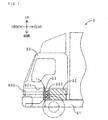
- FIG. 1 shows a transparent side view of a tilt-cab truck in which the sealing member of this embodiment is arranged.
- a tilt-cab truck 9 includes a cabin 90, a chassis frame 91, an engine 92, a radiator 93, and a sealing member 1.
- the engine 92 and the radiator 93 are mounted between a pair of the left and right chassis frames 91.
- the radiator 93 is arranged in front of the engine 92.
- a cooling fan 920 is arranged on the front surface of the engine 92.
- the cabin 90 is arranged above the engine 92 and the radiator 93.
- the cabin 90 is displaced irregularly in vertical directions with respect to the engine 92 and the radiator 93.
- On the lower front surface of the cabin 90 a lattice grill 900 is arranged.
- the grill 900 and the radiator 93 are aligned in the front-rear direction.
- the sealing member 1 is set between the upper surface of the radiator 93 and a floor of the cabin 90.
- the sealing member 1 seals a gap between the upper surface of the radiator 93 and the floor of the cabin 90.
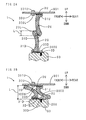
- FIGs. 2A and 2B show sectional views of the sealing member of this embodiment.
- FIG. 2A shows a farthest state
- FIG. 2B shows a closest state.
- the sealing member 1 of this embodiment includes a first seal 2U, a second seal 2D, a first attachment tool 3U, and a second attachment tool 3D.
- the first attachment tool 3U is formed of metal, and has a strip shape.
- the first attachment tool 3U extends in the front-rear direction. That is, the first attachment tool 3U extends in an orthogonal direction with respect to a stroke direction (vertical direction).
- the first attachment tool 3U includes a securing section 30U and a burial section 31U.
- the securing section 30U is secured to the lower surface of a floor 901 of the cabin with a bolt 300U and a nut 301U.
- the burial section 31U is provided behind the securing section 30U continuously with a step therebetween.
- the first seal 2U is formed of porous urethane foam, and has a rib shape.
- the first seal 2U extends in a horizontal direction for a length of the radiator 93 described below in the horizontal direction.
- the burial section 31 U is buried at the bottom of the first seal 2U. In other words, the first seal 2U extends downward from the burial section 31 U, i.e., from the first attachment tool 3U.
- the contact surface 20U has a curved surface shape bending toward the front in an arc shape.
- the second attachment tool 3D is identical with the first attachment tool 3U.
- the second attachment tool 3D is arranged in a state where the first attachment tool 3U is rotated 180° in the vertical direction.
- the second attachment tool 3D is arranged in a position slightly misaligned rearward with respect to the first attachment tool 3U.
- the second attachment tool 3D extends in the front-rear direction. That is, the second attachment tool 3D extends in the orthogonal direction with respect to the stroke direction (vertical direction).
- the second attachment tool 3D includes a securing section 30D and a burial section 31D.
- the securing section 30D is secured to the upper surface of the radiator 93 with a bolt 300D.
- the burial section 31D is provided in front of the securing section 30D continuously with a step therebetween.
- the second seal 2D is identical with the first seal 2U.
- the second seal 2D is arranged in a state where the first seal 2U is rotated 180° in the vertical direction.
- the second seal 2D extends in the horizontal direction for the length of the radiator 93 in the horizontal direction.
- the burial section 31D is buried at the bottom of the second seal 2D.
- the second seal 2D extends upward from the burial section 31D, i.e., from the second attachment tool 3D.
- On the rear surface of the second seal 2D a contact surface 20D is arranged.
- the contact surface 20D has a curved surface shape bending toward the rear in an arc shape.
- the contact surface 20D and the contact surface 20U are in sliding contact. Between the first seal 2U and the second seal 2D, an overlapping section L in which the first seal 2U and the second seal 2D overlap in the front-rear direction is arranged.
- FIG. 1 air is introduced to the tilt-cab truck 9 from the front via the grill 900.
- the introduced air is sucked in by the cooling fan 920, and exchanges heat with a coolant (not shown) flowing in the radiator 93.
- the hot air due to the heat exchange passes through the surrounding area of the engine 92 and is discharged outside the car from a discharge opening (not shown).
- the sealing member 1 prevents the hot air from moving to the front of the radiator 93 with the gap between the cabin 90 and the radiator 93.
- the cabin 90 and the radiator 93 are relatively displaced irregularly by a stroke from the farthest state shown in FIG. 2A to the closest state shown in FIG. 2B .
- the first seal 2U and the second seal 2D extend approximately in the vertical direction.
- the lower end of the contact surface 20U and the upper end of the contact surface 20D are in elastic contact. The elastic contact allows the gap between the cabin 90 and the radiator 93 to be sealed.
- the contact surface 20U and the contact surface 20D come into sliding contact.
- the sliding contact allows the gap between the cabin 90 and the radiator 93 to be constantly sealed even though the gap width changes.
- the contact surface 20U extends downward while being curved toward the rear.
- the contact surface 20D extends upward while being curved toward the front. Therefore, the contact surface 20U is applied with a rearward component force via a sliding contact boundary surface.
- the contact surface 20D is applied with a forward component force.
- the first seal 2U is deformed such that the lower end is curved toward the rear by the sliding contact of the contact surface 20U and the contact surface 20D.
- the second seal 2D is deformed such that the upper end is curved toward the front.
- the second seal 2D and the first seal 2U are arranged alternately in the front-rear direction.
- the lower end of the first seal 2U relatively descends to the vicinity of the upper surface of the radiator 93.
- the upper end of the second seal 2D relatively ascends to the vicinity of the lower surface of the floor 901 of the cabin 90.
- the middle section of the contact surface 20U and the middle section of the contact surface 20D are in elastic contact.
- the lower end of the first seal 2U is contiguous with the upper surface of the radiator 93
- the upper end of the second seal 2D is contiguous with the lower surface of the floor 901
- the contact surface 20U and the contact surface 20D are in elastic contact, whereby the gap between the cabin 90 and the radiator 93 is sealed.
- the sealing member 1 of this embodiment the overlapping section L is arranged in the farthest state as shown in FIG. 2A . Therefore, in the farthest state, the hot air can reliably be prevented from moving to the front of the radiator 93. As shown in FIG. 2B , in the closest state, the lower end of the first seal 2U and the upper end of the second seal 2D do not come into pressure contact in the vertical direction. Therefore, the first seal 2U and the second seal 2D are unlikely to bend. Thus, the durability of the sealing member 1 is less prone to decrease.
- the sealing member 1 of this embodiment With the sealing member 1 of this embodiment, the first seal 2U and the second seal 2D are in contact. Therefore, the gap between the cabin 90 and the radiator 93 can more reliably be sealed.
- one of the contact surfaces 20U and 20D acts as a sliding guide of the other of the contact surfaces 20D and 20U when the width of the gap between the cabin 90 and the radiator 93 becomes small.
- the first seal 2U and the second seal 2D are applied with a load, which causes deformation of the first seal 2U and the second seal 2D in opposite directions, via the respective contact surfaces 20U and 20D. Therefore, the pressure contact of the first seal 2U and the second seal 2D in the closest state can more reliably be prevented.
- the first seal 2U and the second seal 2D are arranged alternately in the closest state. Therefore, the pressure contact of the first seal 2U and the second seal 2D in the closest state can more reliably be prevented.
- the first seal 2U and the second seal 2D are curved in opposite directions. Therefore, a curvature radius of the curve can be large compared to a case where the first seal 2U and the second seal 2D are curved in the same direction. That is, the curve is gentler.
- a sliding resistance when the contact surfaces 20U and 20D come in sliding contact with each other can be reduced compared to a case where the contact surfaces 20U and 20D are angular.
- the first seal 2U and the second seal 2D are the same components. Therefore, the manufacturing cost of the first seal 2U and the second seal 2D can be reduced by sharing the common parts.
- the first attachment tool 3U and the second attachment tool 3D are the same components. The manufacturing cost of the first attachment tool 3U and the second attachment tool 3D can be reduced by sharing the common parts.
- the first attachment tool 3U and the second attachment tool 3D extend in the orthogonal direction (front-rear direction) with respect to the stroke direction (vertical direction). Therefore, a deformation space of the first seal 2U and the second seal 2D increases compared to a case where the first attachment tool 3U and the second attachment tool 3D extend in the stroke direction. Therefore, even in the case where the change of the gap between the cabin 90 and the radiator 93 is large, the deformation of the first seal 2U and the second seal 2D can sufficiently adjust with the change of the gap between the cabin 90 and the radiator 93.
- FIGs. 3A and 3B show sectional views of the sealing member of this embodiment.
- FIG. 3A shows the farthest state
- FIG 3B shows the closest state. Note that components corresponding to those in FIGs. 2A and 2B are denoted by the same reference symbols.
- the first attachment tool 3U includes a securing section 30U and a burial section 31U.
- the securing section 30U is secured to the lower surface of the floor 901 of the cabin with the bolt 300U and the nut 301U.
- the burial section 31U protrudes downward from the rear end of the securing section 30U.
- the first seal 2U is formed of porous urethane foam, and has a rib shape. From a lower end 21 U of the first seal 2U, a first extending section 210U protrudes toward the rear.
- the second attachment tool 3D is identical with the first attachment tool 3U.
- the second attachment tool 3D is arranged in a state where the first attachment tool 3U is rotated 180° in the vertical direction.
- the second attachment tool 3D includes the securing section 30D and the burial section 31D.
- the securing section 30D is secured to the upper surface of the radiator 93 with the bolt 300D.
- the burial section 31D protrudes upward from the front end of the securing section 30D.
- the second seal 2D is identical with the first seal 2U.
- the second seal 2D is arranged in a state where the first seal 2U is rotated 180° in the vertical direction. From an upper end 2 1 D of the second seal 2D, a second extending section 210D protrudes toward the front.
- the first seal 2U and the second seal 2D are not in contact. That is, the first seal 2U and the second seal 2D are adjacent with a gap C having a minimum width of 3 mm therebetween.
- the sealing member of this embodiment has an advantageous effect similar to that of the sealing member of the first embodiment for parts which share a common configuration.
- the first seal 2U and the second seal 2D are adjacent with the gap C having the minimum width of 3 mm therebetween. Therefore, the first seal 2U and the second seal 2D are less prone to come into sliding contact. Thus, the first seal 2U and the second seal 2D are less prone to be worn.
- the gap between the cabin 90 and the radiator 93 can reliably be sealed to an extent that the hot air does not leak.
- the first seal 2U and the second seal 2D seal the gap between the cabin 90 and the radiator 93 in a zigzag shape. Therefore, the hot air can be prevented from leaking with the gap between the first seal 2U and the second seal 2D.
- sealing member of this embodiment is that the sealing member is arranged not only on the upper surface of the radiator but also on the side surface of the radiator. Thus, only the difference will be described.
- FIG. 4 shows a transparent front view of a tilt-cab truck in which the sealing member of this embodiment is arranged. Note that components corresponding to those in FIG. 1 are denoted by the same reference symbols.
- the sealing member 1 is arranged at the gap between a side wall 902 of the cabin 90 and the side surface of the radiator 93, in addition to the gap between the floor 901 of the cabin 90 and an upper surface the radiator 93. That is, a total of three sealing members 1 are arranged.
- the sealing member of this embodiment has an advantageous effect similar to that of the sealing member of the first embodiment for parts which share a common configuration.
- the sealing member 1 of this embodiment With the sealing member 1 of this embodiment, the gap between the side wall 902 of the cabin 90 and the side surface of the radiator 93 can reliably be sealed even in the case where the change of the gap width is large.
- the sealing member which has a C shape with an opening facing downward when seen from the front, extends from the left surface to the right surface via the upper surface of the radiator.
- the load is concentrated in an angular section (boundary section between the upper surface and the left and right surfaces) in the closest state. Therefore, it is necessary that a separate measure be taken such as forming a slit in the angular section.
- the three sealing members 1 are independent from each other in this embodiment. Therefore, the measure for the angular section is unnecessary.
- first attachment tool 3U and the second attachment tool 3D are misaligned in the front-rear direction in the embodiments described above, the first attachment tool 3U and the second attachment tool 3D may also not be misaligned.
- first seal 2U and the second seal 2D are curved in opposite directions as shown in FIG. 2B in the first embodiment described above, the first seal 2U and the second seal 2D may also be curved in the same direction.
- the sealing member of the present invention is used for a radiator seal in the embodiments described above, the sealing member may also be used for a seal for a gap between the cabin 90 and the chassis frame 91 of the tilt-cab truck. The sealing member may also be used for a seal for a gap between an engine room and an engine hood.
Landscapes
- Engineering & Computer Science (AREA)
- General Engineering & Computer Science (AREA)
- Mechanical Engineering (AREA)
- Chemical & Material Sciences (AREA)
- Combustion & Propulsion (AREA)
- Transportation (AREA)
- Seal Device For Vehicle (AREA)
- Cooling, Air Intake And Gas Exhaust, And Fuel Tank Arrangements In Propulsion Units (AREA)
- Gasket Seals (AREA)
- Fluid-Damping Devices (AREA)
Applications Claiming Priority (1)
| Application Number | Priority Date | Filing Date | Title |
|---|---|---|---|
| JP2007170181A JP2009006848A (ja) | 2007-06-28 | 2007-06-28 | シール部材 |
Publications (2)
| Publication Number | Publication Date |
|---|---|
| EP2009332A2 true EP2009332A2 (de) | 2008-12-31 |
| EP2009332A3 EP2009332A3 (de) | 2009-11-18 |
Family
ID=39893964
Family Applications (1)
| Application Number | Title | Priority Date | Filing Date |
|---|---|---|---|
| EP08010544A Withdrawn EP2009332A3 (de) | 2007-06-28 | 2008-06-10 | Dichtungselement |
Country Status (3)
| Country | Link |
|---|---|
| US (1) | US20090001675A1 (de) |
| EP (1) | EP2009332A3 (de) |
| JP (1) | JP2009006848A (de) |
Families Citing this family (10)
| Publication number | Priority date | Publication date | Assignee | Title |
|---|---|---|---|---|
| US8644449B2 (en) | 2009-01-15 | 2014-02-04 | Canon Kabushiki Kaisha | X-ray imaging apparatus and method of X-ray imaging |
| US10414266B1 (en) * | 2017-04-28 | 2019-09-17 | Oshkosh Defense, Llc | Vehicle cooling systems and methods |
| US9303715B2 (en) | 2013-03-10 | 2016-04-05 | Oshkosh Defense, Llc | Limiting system for a vehicle suspension component |
| US12491943B1 (en) | 2013-03-10 | 2025-12-09 | Oshkosh Defense, Llc | Systems and methods for a military vehicle |
| JP6339481B2 (ja) * | 2014-11-10 | 2018-06-06 | 小島プレス工業株式会社 | バンパアブソーバ及びシール構造 |
| CN105015628A (zh) * | 2015-07-23 | 2015-11-04 | 广西柳工机械股份有限公司 | 发动机罩密封装置 |
| JP7006328B2 (ja) * | 2018-02-02 | 2022-01-24 | トヨタ自動車株式会社 | グリルシャッタ装置 |
| CN109603549A (zh) * | 2018-12-13 | 2019-04-12 | 南京东南工业装备股份有限公司 | Scr反应装置内部催化剂固定防泄漏装置 |
| KR102650727B1 (ko) * | 2019-07-11 | 2024-03-25 | 한온시스템 주식회사 | 차량용 열교환기 |
| NL2025813B1 (en) * | 2020-06-11 | 2022-02-16 | Trelleborg Ridderkerk B V | Method for building a sealed structure comprising two tubular members, a sealed structure, an offshore wind turbine and a sealing system |
Citations (1)
| Publication number | Priority date | Publication date | Assignee | Title |
|---|---|---|---|---|
| JP2005262961A (ja) | 2004-03-17 | 2005-09-29 | Tokai Rubber Ind Ltd | ラジエータ周りの遮熱用シール材 |
Family Cites Families (5)
| Publication number | Priority date | Publication date | Assignee | Title |
|---|---|---|---|---|
| DE3615584A1 (de) * | 1986-05-09 | 1987-11-12 | Porsche Ag | Kraftfahrzeug, insbesondere personenwagen |
| US5101921A (en) * | 1990-11-07 | 1992-04-07 | Navistar International Transportation Corp. | Truck hood motion control apparatus |
| JP3885415B2 (ja) * | 1999-06-10 | 2007-02-21 | 日立建機株式会社 | 熱交換器設置部のサーキュレーション防止装置 |
| DE10319461B4 (de) * | 2003-04-29 | 2017-11-30 | Mahle International Gmbh | Einbauanordnung |
| US20050198904A1 (en) * | 2004-03-12 | 2005-09-15 | Browne Alan L. | Active seal assemblies for movable windows |
-
2007
- 2007-06-28 JP JP2007170181A patent/JP2009006848A/ja active Pending
-
2008
- 2008-06-10 EP EP08010544A patent/EP2009332A3/de not_active Withdrawn
- 2008-06-18 US US12/213,350 patent/US20090001675A1/en not_active Abandoned
Patent Citations (1)
| Publication number | Priority date | Publication date | Assignee | Title |
|---|---|---|---|---|
| JP2005262961A (ja) | 2004-03-17 | 2005-09-29 | Tokai Rubber Ind Ltd | ラジエータ周りの遮熱用シール材 |
Also Published As
| Publication number | Publication date |
|---|---|
| EP2009332A3 (de) | 2009-11-18 |
| US20090001675A1 (en) | 2009-01-01 |
| JP2009006848A (ja) | 2009-01-15 |
Similar Documents
| Publication | Publication Date | Title |
|---|---|---|
| US20090001675A1 (en) | Sealing member | |
| EP1880928A2 (de) | Abdeckung | |
| EP2679471B1 (de) | Wasserkastenstruktur eines kraftfahrzeuges | |
| CN109677257B (zh) | 百叶格栅 | |
| CN103029755A (zh) | 车辆前部构造 | |
| US11077886B2 (en) | Joint structure for vehicle | |
| CN110173338B (zh) | 车辆用冷却装置 | |
| JP6202389B2 (ja) | 車両のルーフパネル構造 | |
| US10131303B2 (en) | Bumper assemblies and vehicles with integrated air deflectors | |
| US10967717B2 (en) | Door structure | |
| JP2007230388A (ja) | 係合固定構造および係合固定方法 | |
| CN102030043B (zh) | 车用前围板的成形方法 | |
| WO2009110255A1 (ja) | 乗用車のカウル構造 | |
| US20140041956A1 (en) | Bulldozer | |
| WO2020196409A1 (ja) | クロスメンバ及び車体フレーム | |
| US10131305B2 (en) | Bumper assemblies and vehicles with integrated air deflectors | |
| JP2016168890A (ja) | バンパアブソーバ構造 | |
| JP6569478B2 (ja) | 車両のラジエータのシール構造 | |
| JP2010115985A (ja) | 自動車のシール部材 | |
| JP7136034B2 (ja) | グリルシャッタ取付構造 | |
| JP2011194918A (ja) | 車両用ルーフの排水装置 | |
| CN101644112A (zh) | 外开把手安装结构 | |
| US20190225048A1 (en) | Register and method of manufacturing the same | |
| JP7517247B2 (ja) | 車両のカウルルーバ | |
| JP6353874B2 (ja) | カウルトップ |
Legal Events
| Date | Code | Title | Description |
|---|---|---|---|
| PUAI | Public reference made under article 153(3) epc to a published international application that has entered the european phase |
Free format text: ORIGINAL CODE: 0009012 |
|
| AK | Designated contracting states |
Kind code of ref document: A2 Designated state(s): AT BE BG CH CY CZ DE DK EE ES FI FR GB GR HR HU IE IS IT LI LT LU LV MC MT NL NO PL PT RO SE SI SK TR |
|
| AX | Request for extension of the european patent |
Extension state: AL BA MK RS |
|
| PUAL | Search report despatched |
Free format text: ORIGINAL CODE: 0009013 |
|
| AK | Designated contracting states |
Kind code of ref document: A3 Designated state(s): AT BE BG CH CY CZ DE DK EE ES FI FR GB GR HR HU IE IS IT LI LT LU LV MC MT NL NO PL PT RO SE SI SK TR |
|
| AX | Request for extension of the european patent |
Extension state: AL BA MK RS |
|
| RIC1 | Information provided on ipc code assigned before grant |
Ipc: B60K 11/04 20060101ALI20091012BHEP Ipc: F01P 3/18 20060101ALI20091012BHEP Ipc: F16J 15/32 20060101AFI20081110BHEP |
|
| AKX | Designation fees paid | ||
| STAA | Information on the status of an ep patent application or granted ep patent |
Free format text: STATUS: THE APPLICATION IS DEEMED TO BE WITHDRAWN |
|
| 18D | Application deemed to be withdrawn |
Effective date: 20100519 |
|
| REG | Reference to a national code |
Ref country code: DE Ref legal event code: 8566 |