EP2007693B1 - Verfahren zur funktionalisierung einer glasverstärkung für einen verbundwerkstoff - Google Patents
Verfahren zur funktionalisierung einer glasverstärkung für einen verbundwerkstoff Download PDFInfo
- Publication number
- EP2007693B1 EP2007693B1 EP07731848.3A EP07731848A EP2007693B1 EP 2007693 B1 EP2007693 B1 EP 2007693B1 EP 07731848 A EP07731848 A EP 07731848A EP 2007693 B1 EP2007693 B1 EP 2007693B1
- Authority
- EP
- European Patent Office
- Prior art keywords
- glass
- reinforcement
- plasma
- les
- impregnation
- Prior art date
- Legal status (The legal status is an assumption and is not a legal conclusion. Google has not performed a legal analysis and makes no representation as to the accuracy of the status listed.)
- Not-in-force
Links
- 230000002787 reinforcement Effects 0.000 title claims description 64
- 239000011521 glass Substances 0.000 title claims description 55
- 238000000034 method Methods 0.000 title claims description 43
- 239000002131 composite material Substances 0.000 title claims description 29
- 230000008569 process Effects 0.000 title claims description 25
- 238000005470 impregnation Methods 0.000 claims description 35
- 239000011159 matrix material Substances 0.000 claims description 29
- 239000007789 gas Substances 0.000 claims description 26
- 239000000203 mixture Substances 0.000 claims description 22
- 239000000758 substrate Substances 0.000 claims description 12
- IJGRMHOSHXDMSA-UHFFFAOYSA-N Atomic nitrogen Chemical compound N#N IJGRMHOSHXDMSA-UHFFFAOYSA-N 0.000 claims description 11
- 239000007822 coupling agent Substances 0.000 claims description 9
- 238000004381 surface treatment Methods 0.000 claims description 9
- QVGXLLKOCUKJST-UHFFFAOYSA-N atomic oxygen Chemical compound [O] QVGXLLKOCUKJST-UHFFFAOYSA-N 0.000 claims description 7
- 239000000839 emulsion Substances 0.000 claims description 7
- 238000007254 oxidation reaction Methods 0.000 claims description 7
- 239000001301 oxygen Substances 0.000 claims description 7
- 229910052760 oxygen Inorganic materials 0.000 claims description 7
- 239000000725 suspension Substances 0.000 claims description 7
- XKRFYHLGVUSROY-UHFFFAOYSA-N Argon Chemical compound [Ar] XKRFYHLGVUSROY-UHFFFAOYSA-N 0.000 claims description 6
- 239000012298 atmosphere Substances 0.000 claims description 6
- 238000005121 nitriding Methods 0.000 claims description 5
- 229910052757 nitrogen Inorganic materials 0.000 claims description 5
- 239000004745 nonwoven fabric Substances 0.000 claims description 5
- 230000001590 oxidative effect Effects 0.000 claims description 5
- 230000003647 oxidation Effects 0.000 claims description 4
- 229910052786 argon Inorganic materials 0.000 claims description 3
- 230000008021 deposition Effects 0.000 claims description 3
- 239000001307 helium Substances 0.000 claims description 2
- 229910052734 helium Inorganic materials 0.000 claims description 2
- SWQJXJOGLNCZEY-UHFFFAOYSA-N helium atom Chemical compound [He] SWQJXJOGLNCZEY-UHFFFAOYSA-N 0.000 claims description 2
- 239000002253 acid Substances 0.000 claims 1
- 150000001875 compounds Chemical class 0.000 claims 1
- 239000011261 inert gas Substances 0.000 claims 1
- 229910052500 inorganic mineral Inorganic materials 0.000 claims 1
- 239000011707 mineral Substances 0.000 claims 1
- 239000004744 fabric Substances 0.000 description 29
- 238000009832 plasma treatment Methods 0.000 description 27
- 238000011282 treatment Methods 0.000 description 21
- 238000004519 manufacturing process Methods 0.000 description 13
- 239000000835 fiber Substances 0.000 description 11
- 239000007788 liquid Substances 0.000 description 11
- 230000004048 modification Effects 0.000 description 9
- 238000012986 modification Methods 0.000 description 9
- 239000004810 polytetrafluoroethylene Substances 0.000 description 8
- 229920001343 polytetrafluoroethylene Polymers 0.000 description 8
- 238000004513 sizing Methods 0.000 description 8
- 238000004320 controlled atmosphere Methods 0.000 description 7
- 238000009434 installation Methods 0.000 description 7
- 239000000126 substance Substances 0.000 description 7
- 239000000463 material Substances 0.000 description 6
- 241000894007 species Species 0.000 description 6
- 210000001519 tissue Anatomy 0.000 description 6
- 230000008901 benefit Effects 0.000 description 5
- 229920000642 polymer Polymers 0.000 description 5
- 230000003014 reinforcing effect Effects 0.000 description 5
- 239000000243 solution Substances 0.000 description 5
- 239000004568 cement Substances 0.000 description 4
- 238000005253 cladding Methods 0.000 description 4
- 239000011248 coating agent Substances 0.000 description 4
- 238000000576 coating method Methods 0.000 description 4
- 230000006870 function Effects 0.000 description 4
- 238000007306 functionalization reaction Methods 0.000 description 4
- 239000008246 gaseous mixture Substances 0.000 description 4
- 239000010410 layer Substances 0.000 description 4
- -1 polytetrafluoroethylene Polymers 0.000 description 4
- 239000004800 polyvinyl chloride Substances 0.000 description 4
- 229920000915 polyvinyl chloride Polymers 0.000 description 4
- 230000032258 transport Effects 0.000 description 4
- XLYOFNOQVPJJNP-UHFFFAOYSA-N water Substances O XLYOFNOQVPJJNP-UHFFFAOYSA-N 0.000 description 4
- 239000004593 Epoxy Substances 0.000 description 3
- 241001080024 Telles Species 0.000 description 3
- 239000007864 aqueous solution Substances 0.000 description 3
- 239000003125 aqueous solvent Substances 0.000 description 3
- 239000013626 chemical specie Substances 0.000 description 3
- 238000000151 deposition Methods 0.000 description 3
- 239000011152 fibreglass Substances 0.000 description 3
- 239000003365 glass fiber Substances 0.000 description 3
- 238000010438 heat treatment Methods 0.000 description 3
- 239000000314 lubricant Substances 0.000 description 3
- 150000001282 organosilanes Chemical class 0.000 description 3
- 229920002689 polyvinyl acetate Polymers 0.000 description 3
- 239000011118 polyvinyl acetate Substances 0.000 description 3
- 238000012545 processing Methods 0.000 description 3
- 150000003254 radicals Chemical class 0.000 description 3
- 230000000717 retained effect Effects 0.000 description 3
- 239000002344 surface layer Substances 0.000 description 3
- 229920001169 thermoplastic Polymers 0.000 description 3
- 239000004416 thermosoftening plastic Substances 0.000 description 3
- 241000238631 Hexapoda Species 0.000 description 2
- 239000004372 Polyvinyl alcohol Substances 0.000 description 2
- 241001639412 Verres Species 0.000 description 2
- 230000032683 aging Effects 0.000 description 2
- 239000007900 aqueous suspension Substances 0.000 description 2
- 239000000470 constituent Substances 0.000 description 2
- 229920001577 copolymer Polymers 0.000 description 2
- 238000004132 cross linking Methods 0.000 description 2
- 238000010790 dilution Methods 0.000 description 2
- 239000012895 dilution Substances 0.000 description 2
- 238000009826 distribution Methods 0.000 description 2
- 230000000694 effects Effects 0.000 description 2
- 230000008030 elimination Effects 0.000 description 2
- 238000003379 elimination reaction Methods 0.000 description 2
- 238000005516 engineering process Methods 0.000 description 2
- 238000007654 immersion Methods 0.000 description 2
- 238000001802 infusion Methods 0.000 description 2
- 238000010884 ion-beam technique Methods 0.000 description 2
- 150000002500 ions Chemical class 0.000 description 2
- 239000002184 metal Substances 0.000 description 2
- 230000007935 neutral effect Effects 0.000 description 2
- 239000002245 particle Substances 0.000 description 2
- 230000037361 pathway Effects 0.000 description 2
- 229920000728 polyester Polymers 0.000 description 2
- 229920002451 polyvinyl alcohol Polymers 0.000 description 2
- 235000019422 polyvinyl alcohol Nutrition 0.000 description 2
- 238000002360 preparation method Methods 0.000 description 2
- 230000004224 protection Effects 0.000 description 2
- 230000001681 protective effect Effects 0.000 description 2
- 239000012783 reinforcing fiber Substances 0.000 description 2
- 229910052814 silicon oxide Inorganic materials 0.000 description 2
- 239000004753 textile Substances 0.000 description 2
- 229910017107 AlOx Inorganic materials 0.000 description 1
- 101100166838 Caenorhabditis elegans ces-2 gene Proteins 0.000 description 1
- OKTJSMMVPCPJKN-UHFFFAOYSA-N Carbon Chemical compound [C] OKTJSMMVPCPJKN-UHFFFAOYSA-N 0.000 description 1
- 241001415961 Gaviidae Species 0.000 description 1
- CERQOIWHTDAKMF-UHFFFAOYSA-M Methacrylate Chemical compound CC(=C)C([O-])=O CERQOIWHTDAKMF-UHFFFAOYSA-M 0.000 description 1
- 239000004698 Polyethylene Substances 0.000 description 1
- 241000220317 Rosa Species 0.000 description 1
- BLRPTPMANUNPDV-UHFFFAOYSA-N Silane Chemical compound [SiH4] BLRPTPMANUNPDV-UHFFFAOYSA-N 0.000 description 1
- XUIMIQQOPSSXEZ-UHFFFAOYSA-N Silicon Chemical compound [Si] XUIMIQQOPSSXEZ-UHFFFAOYSA-N 0.000 description 1
- 229920002472 Starch Polymers 0.000 description 1
- 239000002174 Styrene-butadiene Substances 0.000 description 1
- 241000897276 Termes Species 0.000 description 1
- 229910010421 TiNx Inorganic materials 0.000 description 1
- 229910003087 TiOx Inorganic materials 0.000 description 1
- ATJFFYVFTNAWJD-UHFFFAOYSA-N Tin Chemical compound [Sn] ATJFFYVFTNAWJD-UHFFFAOYSA-N 0.000 description 1
- 240000008042 Zea mays Species 0.000 description 1
- WCQRKTASWMKJOB-UHFFFAOYSA-N [Si].[N].[F].[C].[O] Chemical compound [Si].[N].[F].[C].[O] WCQRKTASWMKJOB-UHFFFAOYSA-N 0.000 description 1
- 238000005299 abrasion Methods 0.000 description 1
- 238000010521 absorption reaction Methods 0.000 description 1
- 230000002378 acidificating effect Effects 0.000 description 1
- NIXOWILDQLNWCW-UHFFFAOYSA-N acrylic acid group Chemical group C(C=C)(=O)O NIXOWILDQLNWCW-UHFFFAOYSA-N 0.000 description 1
- 229920006397 acrylic thermoplastic Polymers 0.000 description 1
- 230000009471 action Effects 0.000 description 1
- 230000004913 activation Effects 0.000 description 1
- 238000004026 adhesive bonding Methods 0.000 description 1
- 239000003570 air Substances 0.000 description 1
- 150000004996 alkyl benzenes Chemical class 0.000 description 1
- PNEYBMLMFCGWSK-UHFFFAOYSA-N aluminium oxide Inorganic materials [O-2].[O-2].[O-2].[Al+3].[Al+3] PNEYBMLMFCGWSK-UHFFFAOYSA-N 0.000 description 1
- 150000001412 amines Chemical class 0.000 description 1
- 230000004888 barrier function Effects 0.000 description 1
- 239000011230 binding agent Substances 0.000 description 1
- 230000015572 biosynthetic process Effects 0.000 description 1
- 238000003490 calendering Methods 0.000 description 1
- 229910052799 carbon Inorganic materials 0.000 description 1
- 230000015556 catabolic process Effects 0.000 description 1
- 238000006243 chemical reaction Methods 0.000 description 1
- 239000003638 chemical reducing agent Substances 0.000 description 1
- 239000003795 chemical substances by application Substances 0.000 description 1
- 238000003851 corona treatment Methods 0.000 description 1
- 230000008878 coupling Effects 0.000 description 1
- 238000010168 coupling process Methods 0.000 description 1
- 238000005859 coupling reaction Methods 0.000 description 1
- 238000005520 cutting process Methods 0.000 description 1
- 230000007547 defect Effects 0.000 description 1
- 238000007598 dipping method Methods 0.000 description 1
- 230000005684 electric field Effects 0.000 description 1
- 229940082150 encore Drugs 0.000 description 1
- 239000003822 epoxy resin Substances 0.000 description 1
- 230000005281 excited state Effects 0.000 description 1
- 238000001125 extrusion Methods 0.000 description 1
- 239000002657 fibrous material Substances 0.000 description 1
- 238000009730 filament winding Methods 0.000 description 1
- 235000013305 food Nutrition 0.000 description 1
- 238000000227 grinding Methods 0.000 description 1
- LNEPOXFFQSENCJ-UHFFFAOYSA-N haloperidol Chemical compound C1CC(O)(C=2C=CC(Cl)=CC=2)CCN1CCCC(=O)C1=CC=C(F)C=C1 LNEPOXFFQSENCJ-UHFFFAOYSA-N 0.000 description 1
- 239000012761 high-performance material Substances 0.000 description 1
- 229930195733 hydrocarbon Natural products 0.000 description 1
- 150000002430 hydrocarbons Chemical class 0.000 description 1
- 230000003301 hydrolyzing effect Effects 0.000 description 1
- 230000006872 improvement Effects 0.000 description 1
- 238000011065 in-situ storage Methods 0.000 description 1
- 150000007529 inorganic bases Chemical class 0.000 description 1
- 230000010354 integration Effects 0.000 description 1
- 230000001050 lubricating effect Effects 0.000 description 1
- 238000001755 magnetron sputter deposition Methods 0.000 description 1
- 210000003632 microfilament Anatomy 0.000 description 1
- 150000004767 nitrides Chemical class 0.000 description 1
- 239000013307 optical fiber Substances 0.000 description 1
- 150000002894 organic compounds Chemical class 0.000 description 1
- 230000035515 penetration Effects 0.000 description 1
- 230000002688 persistence Effects 0.000 description 1
- ISWSIDIOOBJBQZ-UHFFFAOYSA-N phenol group Chemical group C1(=CC=CC=C1)O ISWSIDIOOBJBQZ-UHFFFAOYSA-N 0.000 description 1
- 239000000049 pigment Substances 0.000 description 1
- 239000011505 plaster Substances 0.000 description 1
- 229920003229 poly(methyl methacrylate) Polymers 0.000 description 1
- 229920000647 polyepoxide Polymers 0.000 description 1
- 239000004645 polyester resin Substances 0.000 description 1
- 229920001225 polyester resin Polymers 0.000 description 1
- 229920000573 polyethylene Polymers 0.000 description 1
- 229920001296 polysiloxane Polymers 0.000 description 1
- 239000004814 polyurethane Substances 0.000 description 1
- 229920002635 polyurethane Polymers 0.000 description 1
- 230000002035 prolonged effect Effects 0.000 description 1
- 230000009257 reactivity Effects 0.000 description 1
- 239000012779 reinforcing material Substances 0.000 description 1
- 229920005989 resin Polymers 0.000 description 1
- 239000011347 resin Substances 0.000 description 1
- 238000000518 rheometry Methods 0.000 description 1
- 238000007493 shaping process Methods 0.000 description 1
- 229910000077 silane Inorganic materials 0.000 description 1
- 150000004756 silanes Chemical class 0.000 description 1
- 229910052710 silicon Inorganic materials 0.000 description 1
- 239000010703 silicon Substances 0.000 description 1
- 239000007787 solid Substances 0.000 description 1
- 239000002904 solvent Substances 0.000 description 1
- 239000007921 spray Substances 0.000 description 1
- 235000019698 starch Nutrition 0.000 description 1
- 239000008107 starch Substances 0.000 description 1
- 229920003048 styrene butadiene rubber Polymers 0.000 description 1
- 238000006557 surface reaction Methods 0.000 description 1
- 230000003746 surface roughness Effects 0.000 description 1
- 239000004094 surface-active agent Substances 0.000 description 1
- 230000008961 swelling Effects 0.000 description 1
- ISXSCDLOGDJUNJ-UHFFFAOYSA-N tert-butyl prop-2-enoate Chemical compound CC(C)(C)OC(=O)C=C ISXSCDLOGDJUNJ-UHFFFAOYSA-N 0.000 description 1
- 238000012360 testing method Methods 0.000 description 1
- 229920001187 thermosetting polymer Polymers 0.000 description 1
- HLLICFJUWSZHRJ-UHFFFAOYSA-N tioxidazole Chemical compound CCCOC1=CC=C2N=C(NC(=O)OC)SC2=C1 HLLICFJUWSZHRJ-UHFFFAOYSA-N 0.000 description 1
- 230000009466 transformation Effects 0.000 description 1
- 238000000844 transformation Methods 0.000 description 1
- 230000007704 transition Effects 0.000 description 1
- 238000003828 vacuum filtration Methods 0.000 description 1
- 230000003313 weakening effect Effects 0.000 description 1
- 239000002759 woven fabric Substances 0.000 description 1
Images

Classifications
-
- C—CHEMISTRY; METALLURGY
- C03—GLASS; MINERAL OR SLAG WOOL
- C03C—CHEMICAL COMPOSITION OF GLASSES, GLAZES OR VITREOUS ENAMELS; SURFACE TREATMENT OF GLASS; SURFACE TREATMENT OF FIBRES OR FILAMENTS MADE FROM GLASS, MINERALS OR SLAGS; JOINING GLASS TO GLASS OR OTHER MATERIALS
- C03C25/00—Surface treatment of fibres or filaments made from glass, minerals or slags
- C03C25/62—Surface treatment of fibres or filaments made from glass, minerals or slags by application of electric or wave energy; by particle radiation or ion implantation
- C03C25/6293—Plasma or corona discharge
-
- A—HUMAN NECESSITIES
- A61—MEDICAL OR VETERINARY SCIENCE; HYGIENE
- A61P—SPECIFIC THERAPEUTIC ACTIVITY OF CHEMICAL COMPOUNDS OR MEDICINAL PREPARATIONS
- A61P35/00—Antineoplastic agents
-
- Y—GENERAL TAGGING OF NEW TECHNOLOGICAL DEVELOPMENTS; GENERAL TAGGING OF CROSS-SECTIONAL TECHNOLOGIES SPANNING OVER SEVERAL SECTIONS OF THE IPC; TECHNICAL SUBJECTS COVERED BY FORMER USPC CROSS-REFERENCE ART COLLECTIONS [XRACs] AND DIGESTS
- Y10—TECHNICAL SUBJECTS COVERED BY FORMER USPC
- Y10T—TECHNICAL SUBJECTS COVERED BY FORMER US CLASSIFICATION
- Y10T428/00—Stock material or miscellaneous articles
- Y10T428/31—Surface property or characteristic of web, sheet or block
- Y10T428/315—Surface modified glass [e.g., tempered, strengthened, etc.]
-
- Y—GENERAL TAGGING OF NEW TECHNOLOGICAL DEVELOPMENTS; GENERAL TAGGING OF CROSS-SECTIONAL TECHNOLOGIES SPANNING OVER SEVERAL SECTIONS OF THE IPC; TECHNICAL SUBJECTS COVERED BY FORMER USPC CROSS-REFERENCE ART COLLECTIONS [XRACs] AND DIGESTS
- Y10—TECHNICAL SUBJECTS COVERED BY FORMER USPC
- Y10T—TECHNICAL SUBJECTS COVERED BY FORMER US CLASSIFICATION
- Y10T428/00—Stock material or miscellaneous articles
- Y10T428/31504—Composite [nonstructural laminate]
- Y10T428/31551—Of polyamidoester [polyurethane, polyisocyanate, polycarbamate, etc.]
- Y10T428/31645—Next to addition polymer from unsaturated monomers
Definitions
- the present invention relates to a process for obtaining composite materials comprising a step of impregnating glass reinforcements with an organic matrix, said reinforcements being indifferently in the form of locks, grids, woven, nonwoven, etc.
- composite materials depend essentially on the quality of the interface and in particular the adhesion between the glass substrate and the organic matrix.
- the composites are currently made from one or more constituents according to different basic processes, in which the dry pathways are distinguished by extrusion and the wet pathways by impregnation.
- glass substrate it is particularly understood within the meaning of the present description, non-exhaustively, glass fabrics, nonwovens of the complex type, sails, mats, glass grids, especially for a building application.
- a typical sequence of the steps of a wet process comprises suspending the constituent polymer of the matrix and the glass substrate or reinforcement in an aqueous solvent, vacuum filtration and shaping of the product, for example by calendering. . The residual water is then removed in an oven. So, in the case where the manufacture of the composite material is carried out wet, the quality of the impregnation (speed, coating homogeneity of the coating, etc.) is a key factor for the choice of the most efficient process. This factor conditions in particular the performance of the composites finally obtained and the resulting customer satisfaction.
- a visible impregnation defect even minimal and not disrupting the overall performance of the material, may give a bias against the product.
- the lack of adhesion between the glass reinforcement and the organic matrix is essentially the result of poor wettability of the sized fiber constituting the reinforcement in the impregnating solution.
- the lack of adhesion can thus be directly related to the chemical reactivity of the surface of the glass reinforcement by the solution used.
- glass reinforcements for composite materials whether in the form of locks, grids, woven, non-woven or other, require for their manufacture, more particularly during the fiberizing fiberglass constituting them, the use of complex organic compositions. These compositions provide both the bond between the glass filaments in the fiber and between the reinforcement and the matrix and play a lubricating and protective role against the abrasion of the filaments between them.
- the role of this coupling agent is to improve the adhesion between the glass reinforcement and the organic matrix.
- the step of removing the size can be carried out by a heat treatment of the glass reinforcement at a temperature of about 400 ° C for a few hours, or even a few tens of hours. It has been observed that the treatment has to be prolonged until the total elimination of the size, the persistence of a very small amount of sizing resulting in a very sharp decrease in the adhesion properties between the reinforcement and the matrix in the composite product. This treatment thus has major drawbacks related to its very low productivity and its energy cost.
- the patent US5,585,147 describes a method of surface treatment of a glass fabric in which a total elimination of the size is ensured by an atmospheric plasma of a gas preheated to a temperature between 100 and 500 ° C, before a step of setting in contact with a coupling agent consisting of an organosilane.
- the glass reinforcement can be treated by means of a filament electrical discharge in air at atmospheric pressure, of the CORONA type.
- the documents GB 2290729 and JP62111493 describe similar processes comprising an intermediate step of depositing an organosilane to improve the compatibility of the glass fiber and the organic matrix, after plasma removal of the sizing.
- the document JP 58156546 relates to the field of optical fibers.
- Plasma treatment is intended to eliminate microcracks on the surface of fibers to increase their mechanical strength.
- a similar process is described in the application GB 1,355,769 .
- the document JP 64001733 describes a method in which a plasma is used for removing the size present on the fibers to allow the fiberizing step, prior to impregnation in the matrix.
- the document WO 99/50199 discloses a method of functionalizing the surface of the glass fibers to deposit an increased amount of silane, i.e., coupling agent with the matrix.
- the glass reinforcement must be clean, that is to say free from sizing before the plasma treatment used.
- WO 01/85635 discloses a method very far from the present invention in which, in a first step, a plasma is used to clean the surface of the fibers and to generate on the glass surface radicals, and in which in a second step, a layer of hydrocarbons is formed on said radicals.
- a surface treatment carried out using a "CORONA" type electric discharge is characterized by a filament type electric discharge regime at atmospheric pressure in the air.
- micro-discharges whose characteristics are in particular a service life of less than 10 -9 s, a mean radius of less than 100 ⁇ m, and a current density of between 100 and 1000 A / cm 2 .
- the micro-discharges are switched on and off randomly over the entire surface of the electrodes, at least one of which can be covered with a dielectric barrier.
- the materials to be treated are directly brought into contact with the electric discharge, that is to say between the two electrodes (in situ treatment), the surface treatment of the materials generally being more or less homogeneous.
- the transformations induced by this type of treatment by filamentous discharges are very heterogeneous.
- a surface portion of the material having undergone a series of micro-discharges will be much more modified, even in the extreme cases attacked and degraded than another portion that will not undergo, even on inorganic bases such as glass .
- the electric discharge type "CORONA” because of its intensity, tends to create, at the level of the impact zones of the micro-filaments with the surface of the reinforcement, zones of weakening (local heating, preferential primer of cracks) that decrease the mechanical properties of the final composite product.
- the object of the present invention is to provide a new process for obtaining a composite material comprising in particular a step of treating the glass substrate before it is impregnated, the process being simpler and more economical than those previously described.
- the invention relates to a process for obtaining a composite material comprising a substrate or glass reinforcement in an organic or inorganic matrix in the form of locks, grids, sails, woven, nonwoven or the like according to attached claims.
- the homogeneous plasma is generally used at a pressure below atmospheric pressure, of the order of 10 -5 bar and preferably substantially at atmospheric pressure.
- the temperature of the gaseous mixture is less than 90 ° C.
- the gaseous mixture may comprise or consist of oxygen.
- the gaseous mixture comprises or consists of N 2 or of a mixture of N 2 and a reducing gas of the H 2 or NH 3 type or also comprises or consists of NH 3 .
- the invention also relates to the composite material that can be obtained by the process as previously described.
- the organic matrix is chosen from the group consisting of thermoplastic or thermosetting matrices, for example in the group consisting of polyvinylalcohol, polyvinylacetate polyvinylchloride, polytetrafluoroethylene and copolymers derived from these polymers such as polyvinylacetate. polyethylene.
- the glass reinforcement is preferably chosen from glass fabrics, nonwovens of the complex type, sails, mats, glass grids, in particular for a building application, single son sized or previously transformed, the composite yarns, the type of glass that can be chosen from among the glasses E, R, ECR, S, or any glass composition known for its anticorrosive properties with respect to acidic or basic conditions, and or high mechanical strength.
- the homogeneous plasma electric discharge according to the invention is initiated between two electrodes subjected to a suitable potential difference, in a controlled atmosphere of a selected gas mixture.
- the gas ionizes (avalanche principle).
- the electrons and the created ions acquire velocity and interact with the neutral particles of the gas. Depending on their kinetic energy, this results in the creation of new ionized particles and chemical species in an excited state.
- the active species created within an ionized gas are in principle the electrons, the positive and negative ions, the metastable atoms and molecules, the species having kinetic or vibrational energy, the free radicals, the photons. All of these species are likely to interact with the surface of the materials. Their action is variable depending on the type of electrical discharge and the experimental conditions that determine in particular their number, their distribution and their energy.
- the energy distribution of the electrons is centered on a few electron volts, typically between 0.5 and 100 eV.
- the aforementioned species come into contact with the surface of the reinforcement to be treated, that is to say, mainly with the organic size used for fiberizing the reinforcement. Each species is likely to cause more or less profound chemical changes in the size according to its energy and its average free path in the solid.
- the surprising effects observed by the Applicant on the speed and / or the impregnation qualities of the reinforcements treated according to the invention could be explained by a surface activation of the reinforcements, related to various structural changes such as crosslinking or functionalization (in particular by grafting of new chemical functions) of the substrate, or to a modification of roughness, physico-chemistry, electric charge or mechanics (density, crosslinking) of the treated organic surfaces.
- the sizes that can be modified on the surface by the present process are, for example, size sizing for bulk composites, such as those used in automotive applications, which must ensure a very strong bond with the organic matrix, with the aim of obtaining very high values of mechanical properties (epoxy composite some thermoplastic type PA high temperature) or aging by ensuring chemical bonds less sensitive to hydrolytic reactions (applications in wet or corrosive environment).
- the compositions of these sizes are mainly mixtures of emulsions based on various polymers (epoxy, polyester, polyurethane, polyvinyl acetate, etc.) associated with coupling agents (silanes, etc.) and processing agents ( lubricants, surfactants, etc.).
- the emulsions or suspensions that can be used according to the present invention are, for example, aqueous solutions of PVA, PVC, SBR, acrylic, PTFE, silicone, etc.
- According to the invention can be used as reinforcement open products of grid type or non-woven wide mesh (Laid scrims) for building applications (cladding facade), paper reinforcement, protective clothing, phenolic grafting (grinding wheels).
- the deposition of the coating on the treated reinforcement can be carried out according to any known method of impregnation, among which the so-called roll, dip, spray methods, according to the English terms used in the art.
- the basic products can also be of the closed-fabric, mat or sail or chopped yarn (thermoplastic, automotive) type or products intended for filament winding applications (tanks, pipes, etc.).
- the glass fibers transformed or not in the form of produced products are intended to strengthen mainly polymeric organic matrices.
- the compatibility and the quality of the impregnation by the matrix to be reinforced are two key factors that have a very important influence on the mechanical properties and the durability of the composite obtained.
- Plasma surface modification technology has the advantage of having great flexibility and variety in the types of treatments that can be applied and therefore may be applicable to a significant portion of the reinforcing products, particularly first stage of processing such as fabrics, grids, mats etc.
- the glass-based reinforcing material 1 is directed within a surface treatment zone, in an installation generating a homogeneous plasma adapted to the implementation of the method.
- This installation schematically illustrated by the figure 1 is of a known type.
- the controlled atmosphere of gas When the controlled atmosphere of gas is at low pressure, it comprises an enclosure represented by the reference 9 on the figure 1 .
- the enclosure 9 is waterproof with respect to the external environment and can thus be the seat of a controlled atmosphere in composition and pressure.
- the plasma device comprises two electrodes 2 and 3, respectively connected to the terminals of a variable frequency voltage generator 4.
- the electrodes positioned facing each other delimit between them a treatment volume 5 adapted for the passage of the glass reinforcement 1 which can be indifferently in the form of wicks, grids, woven, nonwoven or others.
- each of the electrodes 2, 3 is coated with a dielectric layer 6, 7 directed towards the treatment volume 5.
- each dielectric layer 6, 7 is for example based on alumina and is separated by a thickness of between 0.1 to 20 mm, preferably between 1 and 6 mm.
- the controlled atmosphere consists of a low pressure oxidizing or nitriding gas, typically of the order of 10 -5 bar.
- the gas consists mainly of nitrogen, alone or in mixture with reducing species (NH 3 , H 2 , etc.), or a neutral gas helium or argon , mixed with one or more oxidizing species (in particular obtained by ionization of O 2 , CO 2 , H 2 O, etc.).
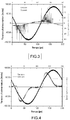
- a discharge is said to be homogeneous as opposed to a CORONA discharge when it is not possible, on the macroscopic and microscopic scale, to perceive between the electrodes the presence of arcs or filaments, micro-discharges, between two electrodes subjected to a potential difference, in a controlled atmosphere of a gas mixture as defined above, and at atmospheric pressure.
- the nature of the regime can be highlighted by a voltage / current oscillogram (cf. Figures 3 and 4 ).
- the presence of a homogeneous discharge confined between the electrodes 6 and 7, at the level of the treatment zone 5, in an oxidizing or nitriding plasma atmosphere advantageously makes it possible to chemically activate the surface of the sized glass reinforcement, in particular to prepare it for the impregnation stage, schematically illustrated by the immersion of the treated reinforcement in a bath 8 of an aqueous solution of an emulsion or a suspension of the organic matrix.
- the impregnation of the glass reinforcement can also be performed by direct immersion in the matrix, that is to say without intermediate step such as the deposition of a coupling agent.
- the influence of a homogeneous plasma treatment according to the present invention on a glass fabric as a reinforcement in a composite material was measured.
- the fabric is formed from a 9 ⁇ m / 68 tex / Z20 base yarn.
- the fabric having a density of 209 g / m 2 , comprises 173 threads / 10 cm in warp and 126 threads / 10 cm in weft.
- the size used is a conventional starch-based textile size, mixed with lubricants.
- the glass fabric is subjected to a homogeneous plasma treatment in a plasma reactor comprising a chamber or vacuum chamber including two flat metal electrodes, connected to a radio frequency generator (capacitive coupling reactor with parallel electrodes).
- the air contained in the chamber is sucked by a turbo-molecular pump coupled to a rotary pump, to obtain a final pressure of the order of 5.10 -5 bar.
- the substrate to be treated is placed on the lower electrode.
- the plasma gas is injected into the reactor by means of a mass flow controller.
- the substrate is kept at room temperature (about 21 ° C).
- the formation of the plasma is obtained by applying a rf potential of 13.56 MHz to the driving electrode.
- the gas used is either oxygen at a pressure of 60 mTorr (ie about 8 Pascals) or NH 3 under a pressure of 150 mTorr (or about 20 Pa).
- the driving electrode is fed at a power of 280 Watts.
- the driving electrode is fed at a power of 190 Watts.
- the duration of the plasma treatment is 5 minutes in all cases.
- the reinforcements thus obtained are subjected to a tensile strength test according to the standard NF-EN-ISO 13934-1, measuring the tensile properties of the fabrics by the method of the bands (determination of the maximum force and the maximum elongation fabric).
- Example 2 On different glass fabrics of the same type as those of Example 1, having undergone oxidative plasma treatment or Like the reductant described in Example 1, the chemical composition of the surface layer was measured by XPS over a thickness of 5 nm. The compositions obtained can be compared, thanks to Table 2, to that of a reinforcement fabric that has not undergone the surface functionalization plasma treatment according to the invention.
- the rate of impregnation of a reinforcing fabric obtained by homogeneous plasma treatment under a reduced oxygen atmosphere according to Example 1 was evaluated by measuring the time required for the total penetration of a drop of water of 3. ⁇ l in the tissue, by means of a device comprising a camera connected to a measuring computer.
- the time required for total absorption is 22.5 seconds for the untreated tissue while it is 2.4 seconds for the fabric previously treated by the homogeneous plasma.
- the device of the Wilhelmy scale includes a precision scale (0.1 mg) under which it is possible to fix a thin metal hook connected to the measuring plate. This hook makes it possible to suspend a sample of fiberglass strand or a sample of fabric.
- the samples are prepared by cutting strips 5 cm long and 0.5 cm wide in the reinforcing fabrics. These samples are taken from reels of tissue stored for 24 hours at 20 ° C ⁇ 3 ° C at a residual moisture of 50% ⁇ 5%.
- the strips are initially suspended from the Wilhelmy scale by means of the hook below.
- the fabric suspended from the scale by means of the hook is then brought into contact with a liquid.
- the capillary rise of the liquid in the yarn or fabric measured by the balance is recorded as a function of time.
- the fabric When the fabric has reached saturation of liquid, it is removed and its mass is raised.
- the measured mass corresponds to the sum of the mass of the dry tissue and that of the impregnated liquid.
- a glass reinforcing wick composed of a fiber of 2400 tex (2000 filaments, 2.4 ⁇ m) and incorporating a sizing of the epoxy type including amine and methacrylate coupling agents and wax and alkylbenzene lubricants, is used according to this example.
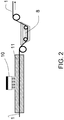
- Said wick has been treated according to the invention by a plasma source deported at atmospheric pressure according to the principles described above in connection with the figure 2 , with a plasma gas N 2 .
- the plasma source used is marketed by the company Acxys technology under the reference UL120.
- the glass wick advances in the plasma zone at a speed of 2 meters per minute.
- the nitrogen is injected into the tubular reactor of length 1 m at a rate of 250 liters per minute.
- the Acxys plasma source is activated at a power of 2000 W.
- the impregnation capacity of the wick thus treated in an aqueous solvent is evaluated by dipping the end of the wick into a water container containing a colored pigment, in comparison with an untreated wick. After two minutes, the colored water rose 14 cm by the simple effect of capillarity in the sample treated against 10 cm in the untreated sample.
Landscapes
- Chemical & Material Sciences (AREA)
- Life Sciences & Earth Sciences (AREA)
- Engineering & Computer Science (AREA)
- Chemical Kinetics & Catalysis (AREA)
- General Chemical & Material Sciences (AREA)
- Organic Chemistry (AREA)
- Physics & Mathematics (AREA)
- Materials Engineering (AREA)
- Health & Medical Sciences (AREA)
- Geochemistry & Mineralogy (AREA)
- General Life Sciences & Earth Sciences (AREA)
- Plasma & Fusion (AREA)
- Nuclear Medicine, Radiotherapy & Molecular Imaging (AREA)
- Veterinary Medicine (AREA)
- Public Health (AREA)
- General Health & Medical Sciences (AREA)
- Animal Behavior & Ethology (AREA)
- Pharmacology & Pharmacy (AREA)
- Medicinal Chemistry (AREA)
- Treatments For Attaching Organic Compounds To Fibrous Goods (AREA)
- Chemical Or Physical Treatment Of Fibers (AREA)
- Surface Treatment Of Glass (AREA)
Claims (6)
- Verfahren zum Erhalten eines Verbundwerkstoffs, umfassend eine Glasverstärkung in einer thermoplastischen organischen Matrix, ausgewählt aus der Gruppe, die von Polyvinylalkohol, Polyvinylacetat, Polyvinylchlorid, Polytetrafluorethylen und den von diesen Polymeren abgeleiteten Copolymeren gebildet ist, wobei die Verstärkung in Form von Fasersträngen, Gittern, Flor, Gewirken, Vliesstoffen oder dergleichen vorliegt und auf ihrer Oberfläche eine organische Schlichte aufweist, wobei das Verfahren mindestens die folgenden Schritte umfasst:- Oberflächenbehandeln der Glasverstärkung mit einem homogenen Plasma eines Gasgemischs in einer kontrollierten Gasatmosphäre, die eine Oxidation oder eine Nitrierung der auf der Oberfläche der Glasverstärkung befindlichen organischen Schlichte erlaubt, wobei das homogene Plasma umgesetzt wird :a) bei einem Druck von zirka 10-5 bar oderb) durch ein Plasma bei atmosphärischem Druck, wobei das Gas mehrheitlich von Stickstoff, allein oder im Gemisch mit reduzierenden Spezies, oder von einem neutralen Gas, ausgewählt aus Helium oder Argon im Gemisch mit einer oder mehreren oxidierenden Spezies, gebildet ist,- Imprägnieren der funktionalisierten Verstärkung durch eine Emulsion oder wässrige Suspension der Matrix oder direkt durch die Matrix ohne Zwischenschritt wie die Anlagerung eines Kopplungsmittels.
- Verfahren nach vorangehendem Anspruch, wobei die Temperatur des Gasgemischs unter 90 °C liegt.
- Verfahren nach einem der vorangehenden Ansprüche, wobei das Gasgemisch Sauerstoff umfasst oder davon gebildet ist.
- Verfahren nach einem der Ansprüche 1 oder 2, wobei das Gasgemisch N2 oder ein Gemisch aus N2 und einem Reduktionsgas vom Typ H2 oder NH3 umfasst oder davon gebildet ist.
- Verfahren nach einem der Ansprüche 1 oder 2, wobei das Gasgemisch NH3 umfasst oder davon gebildet ist.
- Verfahren nach einem der vorangehenden Ansprüche, wobei die Glasverstärkung aus den Glasgeweben, den Vliesstoffen komplexer Art, den Floren, den Matten, den Glasgittern, insbesondere für eine bauliche Anwendung, den geschlichteten oder im Vorfeld verarbeiteten Einzelfäden, den zusammengesetzten Fäden ausgewählt ist, wobei die Glasart aus den Glasarten E, R, ECR, S oder auch aus jeder wegen ihrer antikorrosiven Eigenschaften gegenüber sauren oder basischen Bedingungen und/oder hohen mechanischen Festigkeit bekannten Glaszusammensetzung ausgewählt sein kann.
Applications Claiming Priority (2)
| Application Number | Priority Date | Filing Date | Title |
|---|---|---|---|
| FR0651157A FR2899224B1 (fr) | 2006-03-31 | 2006-03-31 | Procede de fonctionnalisation d'un renfort verrier pour materiau composite |
| PCT/FR2007/051044 WO2007113444A2 (fr) | 2006-03-31 | 2007-03-30 | Procede de fonctionnalisation d'un renfort verrier pour materiau composite |
Publications (2)
| Publication Number | Publication Date |
|---|---|
| EP2007693A2 EP2007693A2 (de) | 2008-12-31 |
| EP2007693B1 true EP2007693B1 (de) | 2018-02-28 |
Family
ID=37433633
Family Applications (1)
| Application Number | Title | Priority Date | Filing Date |
|---|---|---|---|
| EP07731848.3A Not-in-force EP2007693B1 (de) | 2006-03-31 | 2007-03-30 | Verfahren zur funktionalisierung einer glasverstärkung für einen verbundwerkstoff |
Country Status (7)
| Country | Link |
|---|---|
| US (1) | US8318264B2 (de) |
| EP (1) | EP2007693B1 (de) |
| CN (1) | CN101415651B (de) |
| EA (1) | EA016170B1 (de) |
| FR (1) | FR2899224B1 (de) |
| MX (1) | MX2008012536A (de) |
| WO (1) | WO2007113444A2 (de) |
Families Citing this family (9)
| Publication number | Priority date | Publication date | Assignee | Title |
|---|---|---|---|---|
| EP2975175A4 (de) * | 2013-03-12 | 2016-09-07 | Kurashiki Boseki Kk | Fasern zur verwendung in einem faserverstärkten harz und herstellungsverfahren dafür |
| DK3102392T3 (da) * | 2014-02-06 | 2021-07-05 | Owens Corning Intellectual Capital Llc | Fiberforstærkede kompositer |
| CN106232894A (zh) * | 2014-04-30 | 2016-12-14 | 3M创新有限公司 | 用于处理增强纤维的方法以及经处理的增强纤维 |
| RU2592578C1 (ru) * | 2015-07-22 | 2016-07-27 | Общество с ограниченной ответственностью "Новые композитные технологии - разработки и коммерциализация" | Способ увеличения физико-механических параметров стеклопластика |
| DK3147393T3 (da) * | 2015-09-25 | 2022-05-16 | Leibniz Institut Fuer Plasmaforschung Und Tech E V | Tekstilforstærkning indeholdende et garn og en fremgangsmåde til fremstilling af et garn |
| RU2661575C1 (ru) * | 2016-01-14 | 2018-07-17 | федеральное государственное бюджетное образовательное учреждение высшего образования "Казанский национальный исследовательский технологический университет" (ФГБОУ ВО "КНИТУ") | Полимерная композиция для изготовления сотовых панелей |
| CN107350125A (zh) * | 2016-05-10 | 2017-11-17 | 东莞市维迪光电器材有限公司 | 一种玻璃表面处理设备及方法 |
| CN110129771B (zh) * | 2019-04-16 | 2021-04-20 | 中国科学院电工研究所 | 一种薄膜沉积镀膜系统及对薄膜进行沉积镀膜的方法 |
| CN118988624B (zh) * | 2024-10-18 | 2025-01-24 | 常州市恒永翔科技有限公司 | 一种电动工具外壳部件表面喷漆处理装置 |
Family Cites Families (8)
| Publication number | Priority date | Publication date | Assignee | Title |
|---|---|---|---|---|
| DD94879A1 (de) * | 1971-07-21 | 1973-01-12 | ||
| JPS58156546A (ja) * | 1982-03-11 | 1983-09-17 | Nippon Telegr & Teleph Corp <Ntt> | 高強度光フアイバの製造方法 |
| JPS62111493A (ja) * | 1985-11-08 | 1987-05-22 | ユニチカ株式会社 | ガラスクロスの処理方法 |
| JPS641733A (en) * | 1987-06-25 | 1989-01-06 | Matsushita Electric Works Ltd | Production of laminated board |
| US5585147A (en) * | 1994-06-28 | 1996-12-17 | Matsushita Electric Works, Ltd. | Process for a surface treatment of a glass fabric |
| US6106653A (en) | 1998-03-31 | 2000-08-22 | Exxon Research And Engineering Co. | Water vapor plasma treatment of glass surfaces |
| JP2001349013A (ja) * | 2000-04-04 | 2001-12-21 | Canon Inc | 外装材および太陽電池モジュール、その製造方法、製造装置および施工方法、並びに建築物および太陽光発電装置 |
| EP1280742A1 (de) | 2000-05-10 | 2003-02-05 | NKT Research A/S | Verfahren zur beschichtung eines anorganischen substrats mit einem organischen material und das dargestellte produkt |
-
2006
- 2006-03-31 FR FR0651157A patent/FR2899224B1/fr not_active Expired - Fee Related
-
2007
- 2007-03-30 CN CN200780011680.5A patent/CN101415651B/zh not_active Expired - Fee Related
- 2007-03-30 MX MX2008012536A patent/MX2008012536A/es active IP Right Grant
- 2007-03-30 WO PCT/FR2007/051044 patent/WO2007113444A2/fr not_active Ceased
- 2007-03-30 US US12/294,956 patent/US8318264B2/en not_active Expired - Fee Related
- 2007-03-30 EP EP07731848.3A patent/EP2007693B1/de not_active Not-in-force
- 2007-03-30 EA EA200870392A patent/EA016170B1/ru not_active IP Right Cessation
Also Published As
| Publication number | Publication date |
|---|---|
| EA200870392A1 (ru) | 2009-04-28 |
| EA016170B1 (ru) | 2012-02-28 |
| WO2007113444A3 (fr) | 2008-03-06 |
| CN101415651A (zh) | 2009-04-22 |
| FR2899224B1 (fr) | 2009-12-04 |
| CN101415651B (zh) | 2015-12-02 |
| EP2007693A2 (de) | 2008-12-31 |
| US20110076500A1 (en) | 2011-03-31 |
| US8318264B2 (en) | 2012-11-27 |
| WO2007113444A2 (fr) | 2007-10-11 |
| MX2008012536A (es) | 2008-10-10 |
| FR2899224A1 (fr) | 2007-10-05 |
Similar Documents
| Publication | Publication Date | Title |
|---|---|---|
| EP2007693A2 (de) | Verfahren zur funktionalisierung einer glasverstärkung für einen verbundwerkstoff | |
| WO2007057595A2 (fr) | Procédé de fonctionnalisation d'une portion de surface d'une fibre polymérique | |
| EP2373596B1 (de) | Verfahren zum verarbeiten keramischer fasern | |
| CN107548420B (zh) | 新型uhmwpe纤维及生产方法 | |
| CA2990173A1 (fr) | Procede de traitement de fibres de carbure de silicium | |
| JP2015501736A (ja) | オレフィンコーティングを有する金属化繊維複合材シート | |
| Wang et al. | Surface characteristic of poly (p‐phenylene terephthalamide) fibers with oxygen plasma treatment | |
| EP1716085B1 (de) | Elektrisch leitendes glasgarn und konstruktionen damit | |
| EP1044939A1 (de) | Geformte Faserzementgegenstände und Fasern für die Verstärkung derselben und Verfahren zur Behandlung von solchen Fasern | |
| US11834761B2 (en) | Adhesive tape substrate with glass cloth and fluorine resin, and adhesive tape | |
| JP2019513672A (ja) | 反射防止、耐引掻性ガラス基板およびその製造方法 | |
| CA2212921C (fr) | Procede de fabrication d'un mat de verre et produit en resultant | |
| Teli et al. | Hydrophobic silk fabric using atmospheric pressure plasma | |
| EP3237549B1 (de) | Wässrige zusammensetzung für bindemittel für faser und erhaltenes faseriges product | |
| EP0434575A1 (de) | Verfahren zur Herstellung einer textilen Armierung | |
| EP0657490A1 (de) | Verfahren zur Herstellung eines Verbundwerkstoffes und damit erhaltener Werkstoff | |
| FR2613383A1 (fr) | Materiau a base d'une nappe textile non tissee utilisable comme armature de renforcement de revetements d'etancheite | |
| EP0695384B1 (de) | Verfahren zur ummantelung von garnen und fasern in textilen gegenständen | |
| Bubert et al. | Analytical investigation of plasma-treated carbon fibres | |
| FR2675141A1 (fr) | Materiau composite a matrice ceramique avec interphase lamellaire entre fibres de renfort refractaires et matrice, et procede pour sa fabrication. | |
| EP0214066A1 (de) | Verfestigtes mikroporöses Material, Verfahren zu seiner Herstellung und Verwendungen, insbesondere zur Herstellung von Kathoden | |
| BE1026867B1 (fr) | Matériau multicouche de protection de câble pour hautes températures | |
| WO1998033847A1 (de) | Verfahren zur modifizierung von substratoberflächen aus polymeren oder copolymeren mit methacrylatanteil | |
| WO2016001607A1 (fr) | Mat de fibres minérales et produits bitumes incorporant ledit mat | |
| EP1362937A1 (de) | Verfahren zur Herstellung von geformten Faserzementgegenständen und Fasern für die Verstärkung derselben |
Legal Events
| Date | Code | Title | Description |
|---|---|---|---|
| PUAI | Public reference made under article 153(3) epc to a published international application that has entered the european phase |
Free format text: ORIGINAL CODE: 0009012 |
|
| 17P | Request for examination filed |
Effective date: 20081031 |
|
| AK | Designated contracting states |
Kind code of ref document: A2 Designated state(s): AT BE BG CH CY CZ DE DK EE ES FI FR GB GR HU IE IS IT LI LT LU LV MC MT NL PL PT RO SE SI SK TR |
|
| AX | Request for extension of the european patent |
Extension state: AL BA HR MK RS |
|
| 17Q | First examination report despatched |
Effective date: 20090504 |
|
| DAX | Request for extension of the european patent (deleted) | ||
| RIC1 | Information provided on ipc code assigned before grant |
Ipc: C03C 17/32 20060101AFI20170703BHEP Ipc: C03C 25/62 20060101ALI20170703BHEP |
|
| GRAP | Despatch of communication of intention to grant a patent |
Free format text: ORIGINAL CODE: EPIDOSNIGR1 |
|
| INTG | Intention to grant announced |
Effective date: 20170818 |
|
| GRAJ | Information related to disapproval of communication of intention to grant by the applicant or resumption of examination proceedings by the epo deleted |
Free format text: ORIGINAL CODE: EPIDOSDIGR1 |
|
| GRAL | Information related to payment of fee for publishing/printing deleted |
Free format text: ORIGINAL CODE: EPIDOSDIGR3 |
|
| GRAS | Grant fee paid |
Free format text: ORIGINAL CODE: EPIDOSNIGR3 |
|
| INTC | Intention to grant announced (deleted) | ||
| GRAR | Information related to intention to grant a patent recorded |
Free format text: ORIGINAL CODE: EPIDOSNIGR71 |
|
| GRAA | (expected) grant |
Free format text: ORIGINAL CODE: 0009210 |
|
| INTG | Intention to grant announced |
Effective date: 20180118 |
|
| AK | Designated contracting states |
Kind code of ref document: B1 Designated state(s): AT BE BG CH CY CZ DE DK EE ES FI FR GB GR HU IE IS IT LI LT LU LV MC MT NL PL PT RO SE SI SK TR |
|
| REG | Reference to a national code |
Ref country code: GB Ref legal event code: FG4D Free format text: NOT ENGLISH Ref country code: CH Ref legal event code: EP |
|
| REG | Reference to a national code |
Ref country code: AT Ref legal event code: REF Ref document number: 973902 Country of ref document: AT Kind code of ref document: T Effective date: 20180315 |
|
| REG | Reference to a national code |
Ref country code: IE Ref legal event code: FG4D Free format text: LANGUAGE OF EP DOCUMENT: FRENCH |
|
| REG | Reference to a national code |
Ref country code: FR Ref legal event code: PLFP Year of fee payment: 12 |
|
| REG | Reference to a national code |
Ref country code: DE Ref legal event code: R096 Ref document number: 602007054056 Country of ref document: DE |
|
| REG | Reference to a national code |
Ref country code: NL Ref legal event code: MP Effective date: 20180228 |
|
| REG | Reference to a national code |
Ref country code: LT Ref legal event code: MG4D |
|
| REG | Reference to a national code |
Ref country code: AT Ref legal event code: MK05 Ref document number: 973902 Country of ref document: AT Kind code of ref document: T Effective date: 20180228 |
|
| PG25 | Lapsed in a contracting state [announced via postgrant information from national office to epo] |
Ref country code: LT Free format text: LAPSE BECAUSE OF FAILURE TO SUBMIT A TRANSLATION OF THE DESCRIPTION OR TO PAY THE FEE WITHIN THE PRESCRIBED TIME-LIMIT Effective date: 20180228 Ref country code: NL Free format text: LAPSE BECAUSE OF FAILURE TO SUBMIT A TRANSLATION OF THE DESCRIPTION OR TO PAY THE FEE WITHIN THE PRESCRIBED TIME-LIMIT Effective date: 20180228 Ref country code: ES Free format text: LAPSE BECAUSE OF FAILURE TO SUBMIT A TRANSLATION OF THE DESCRIPTION OR TO PAY THE FEE WITHIN THE PRESCRIBED TIME-LIMIT Effective date: 20180228 Ref country code: FI Free format text: LAPSE BECAUSE OF FAILURE TO SUBMIT A TRANSLATION OF THE DESCRIPTION OR TO PAY THE FEE WITHIN THE PRESCRIBED TIME-LIMIT Effective date: 20180228 Ref country code: CY Free format text: LAPSE BECAUSE OF FAILURE TO SUBMIT A TRANSLATION OF THE DESCRIPTION OR TO PAY THE FEE WITHIN THE PRESCRIBED TIME-LIMIT Effective date: 20180228 |
|
| PG25 | Lapsed in a contracting state [announced via postgrant information from national office to epo] |
Ref country code: LV Free format text: LAPSE BECAUSE OF FAILURE TO SUBMIT A TRANSLATION OF THE DESCRIPTION OR TO PAY THE FEE WITHIN THE PRESCRIBED TIME-LIMIT Effective date: 20180228 Ref country code: SE Free format text: LAPSE BECAUSE OF FAILURE TO SUBMIT A TRANSLATION OF THE DESCRIPTION OR TO PAY THE FEE WITHIN THE PRESCRIBED TIME-LIMIT Effective date: 20180228 Ref country code: GR Free format text: LAPSE BECAUSE OF FAILURE TO SUBMIT A TRANSLATION OF THE DESCRIPTION OR TO PAY THE FEE WITHIN THE PRESCRIBED TIME-LIMIT Effective date: 20180529 Ref country code: BG Free format text: LAPSE BECAUSE OF FAILURE TO SUBMIT A TRANSLATION OF THE DESCRIPTION OR TO PAY THE FEE WITHIN THE PRESCRIBED TIME-LIMIT Effective date: 20180528 Ref country code: AT Free format text: LAPSE BECAUSE OF FAILURE TO SUBMIT A TRANSLATION OF THE DESCRIPTION OR TO PAY THE FEE WITHIN THE PRESCRIBED TIME-LIMIT Effective date: 20180228 |
|
| PG25 | Lapsed in a contracting state [announced via postgrant information from national office to epo] |
Ref country code: MT Free format text: LAPSE BECAUSE OF FAILURE TO SUBMIT A TRANSLATION OF THE DESCRIPTION OR TO PAY THE FEE WITHIN THE PRESCRIBED TIME-LIMIT Effective date: 20180228 |
|
| PG25 | Lapsed in a contracting state [announced via postgrant information from national office to epo] |
Ref country code: IT Free format text: LAPSE BECAUSE OF FAILURE TO SUBMIT A TRANSLATION OF THE DESCRIPTION OR TO PAY THE FEE WITHIN THE PRESCRIBED TIME-LIMIT Effective date: 20180228 Ref country code: PL Free format text: LAPSE BECAUSE OF FAILURE TO SUBMIT A TRANSLATION OF THE DESCRIPTION OR TO PAY THE FEE WITHIN THE PRESCRIBED TIME-LIMIT Effective date: 20180228 Ref country code: EE Free format text: LAPSE BECAUSE OF FAILURE TO SUBMIT A TRANSLATION OF THE DESCRIPTION OR TO PAY THE FEE WITHIN THE PRESCRIBED TIME-LIMIT Effective date: 20180228 Ref country code: RO Free format text: LAPSE BECAUSE OF FAILURE TO SUBMIT A TRANSLATION OF THE DESCRIPTION OR TO PAY THE FEE WITHIN THE PRESCRIBED TIME-LIMIT Effective date: 20180228 |
|
| REG | Reference to a national code |
Ref country code: CH Ref legal event code: PL |
|
| REG | Reference to a national code |
Ref country code: DE Ref legal event code: R097 Ref document number: 602007054056 Country of ref document: DE |
|
| PG25 | Lapsed in a contracting state [announced via postgrant information from national office to epo] |
Ref country code: SK Free format text: LAPSE BECAUSE OF FAILURE TO SUBMIT A TRANSLATION OF THE DESCRIPTION OR TO PAY THE FEE WITHIN THE PRESCRIBED TIME-LIMIT Effective date: 20180228 Ref country code: CZ Free format text: LAPSE BECAUSE OF FAILURE TO SUBMIT A TRANSLATION OF THE DESCRIPTION OR TO PAY THE FEE WITHIN THE PRESCRIBED TIME-LIMIT Effective date: 20180228 Ref country code: MC Free format text: LAPSE BECAUSE OF FAILURE TO SUBMIT A TRANSLATION OF THE DESCRIPTION OR TO PAY THE FEE WITHIN THE PRESCRIBED TIME-LIMIT Effective date: 20180228 Ref country code: DK Free format text: LAPSE BECAUSE OF FAILURE TO SUBMIT A TRANSLATION OF THE DESCRIPTION OR TO PAY THE FEE WITHIN THE PRESCRIBED TIME-LIMIT Effective date: 20180228 |
|
| REG | Reference to a national code |
Ref country code: BE Ref legal event code: MM Effective date: 20180331 |
|
| REG | Reference to a national code |
Ref country code: IE Ref legal event code: MM4A |
|
| PG25 | Lapsed in a contracting state [announced via postgrant information from national office to epo] |
Ref country code: LU Free format text: LAPSE BECAUSE OF NON-PAYMENT OF DUE FEES Effective date: 20180330 |
|
| PLBE | No opposition filed within time limit |
Free format text: ORIGINAL CODE: 0009261 |
|
| STAA | Information on the status of an ep patent application or granted ep patent |
Free format text: STATUS: NO OPPOSITION FILED WITHIN TIME LIMIT |
|
| PG25 | Lapsed in a contracting state [announced via postgrant information from national office to epo] |
Ref country code: IE Free format text: LAPSE BECAUSE OF NON-PAYMENT OF DUE FEES Effective date: 20180330 |
|
| 26N | No opposition filed |
Effective date: 20181129 |
|
| PG25 | Lapsed in a contracting state [announced via postgrant information from national office to epo] |
Ref country code: LI Free format text: LAPSE BECAUSE OF NON-PAYMENT OF DUE FEES Effective date: 20180331 Ref country code: BE Free format text: LAPSE BECAUSE OF NON-PAYMENT OF DUE FEES Effective date: 20180331 Ref country code: CH Free format text: LAPSE BECAUSE OF NON-PAYMENT OF DUE FEES Effective date: 20180331 Ref country code: SI Free format text: LAPSE BECAUSE OF FAILURE TO SUBMIT A TRANSLATION OF THE DESCRIPTION OR TO PAY THE FEE WITHIN THE PRESCRIBED TIME-LIMIT Effective date: 20180228 |
|
| PG25 | Lapsed in a contracting state [announced via postgrant information from national office to epo] |
Ref country code: TR Free format text: LAPSE BECAUSE OF FAILURE TO SUBMIT A TRANSLATION OF THE DESCRIPTION OR TO PAY THE FEE WITHIN THE PRESCRIBED TIME-LIMIT Effective date: 20180228 |
|
| PG25 | Lapsed in a contracting state [announced via postgrant information from national office to epo] |
Ref country code: PT Free format text: LAPSE BECAUSE OF FAILURE TO SUBMIT A TRANSLATION OF THE DESCRIPTION OR TO PAY THE FEE WITHIN THE PRESCRIBED TIME-LIMIT Effective date: 20180228 Ref country code: HU Free format text: LAPSE BECAUSE OF FAILURE TO SUBMIT A TRANSLATION OF THE DESCRIPTION OR TO PAY THE FEE WITHIN THE PRESCRIBED TIME-LIMIT; INVALID AB INITIO Effective date: 20070330 |
|
| PG25 | Lapsed in a contracting state [announced via postgrant information from national office to epo] |
Ref country code: IS Free format text: LAPSE BECAUSE OF FAILURE TO SUBMIT A TRANSLATION OF THE DESCRIPTION OR TO PAY THE FEE WITHIN THE PRESCRIBED TIME-LIMIT Effective date: 20180628 |
|
| PGFP | Annual fee paid to national office [announced via postgrant information from national office to epo] |
Ref country code: FR Payment date: 20230329 Year of fee payment: 17 |
|
| PGFP | Annual fee paid to national office [announced via postgrant information from national office to epo] |
Ref country code: GB Payment date: 20230209 Year of fee payment: 17 Ref country code: DE Payment date: 20230131 Year of fee payment: 17 |
|
| P01 | Opt-out of the competence of the unified patent court (upc) registered |
Effective date: 20230510 |
|
| REG | Reference to a national code |
Ref country code: DE Ref legal event code: R119 Ref document number: 602007054056 Country of ref document: DE |
|
| GBPC | Gb: european patent ceased through non-payment of renewal fee |
Effective date: 20240330 |
|
| PG25 | Lapsed in a contracting state [announced via postgrant information from national office to epo] |
Ref country code: DE Free format text: LAPSE BECAUSE OF NON-PAYMENT OF DUE FEES Effective date: 20241001 |
|
| PG25 | Lapsed in a contracting state [announced via postgrant information from national office to epo] |
Ref country code: GB Free format text: LAPSE BECAUSE OF NON-PAYMENT OF DUE FEES Effective date: 20240330 |
|
| PG25 | Lapsed in a contracting state [announced via postgrant information from national office to epo] |
Ref country code: FR Free format text: LAPSE BECAUSE OF NON-PAYMENT OF DUE FEES Effective date: 20240331 |
|
| PG25 | Lapsed in a contracting state [announced via postgrant information from national office to epo] |
Ref country code: GB Free format text: LAPSE BECAUSE OF NON-PAYMENT OF DUE FEES Effective date: 20240330 Ref country code: FR Free format text: LAPSE BECAUSE OF NON-PAYMENT OF DUE FEES Effective date: 20240331 Ref country code: DE Free format text: LAPSE BECAUSE OF NON-PAYMENT OF DUE FEES Effective date: 20241001 |