EP2001871B1 - Rhodamine-labeled oligonucleotides - Google Patents
Rhodamine-labeled oligonucleotides Download PDFInfo
- Publication number
- EP2001871B1 EP2001871B1 EP07759970.2A EP07759970A EP2001871B1 EP 2001871 B1 EP2001871 B1 EP 2001871B1 EP 07759970 A EP07759970 A EP 07759970A EP 2001871 B1 EP2001871 B1 EP 2001871B1
- Authority
- EP
- European Patent Office
- Prior art keywords
- group
- oligonucleotide
- rhodamine
- carbon atoms
- phosphoramidite
- Prior art date
- Legal status (The legal status is an assumption and is not a legal conclusion. Google has not performed a legal analysis and makes no representation as to the accuracy of the status listed.)
- Active
Links
- 0 **(*)c1c(*)c(*)c(C(c2c(*)c(*=I)c(*)c(*)c22)(c3c(*)c(*)c(*(*)*)c(*)c3O3)OC2=O)c3c1* Chemical compound **(*)c1c(*)c(*)c(C(c2c(*)c(*=I)c(*)c(*)c22)(c3c(*)c(*)c(*(*)*)c(*)c3O3)OC2=O)c3c1* 0.000 description 2
Images






Classifications
-
- C—CHEMISTRY; METALLURGY
- C07—ORGANIC CHEMISTRY
- C07F—ACYCLIC, CARBOCYCLIC OR HETEROCYCLIC COMPOUNDS CONTAINING ELEMENTS OTHER THAN CARBON, HYDROGEN, HALOGEN, OXYGEN, NITROGEN, SULFUR, SELENIUM OR TELLURIUM
- C07F9/00—Compounds containing elements of Groups 5 or 15 of the Periodic Table
- C07F9/02—Phosphorus compounds
- C07F9/547—Heterocyclic compounds, e.g. containing phosphorus as a ring hetero atom
- C07F9/6561—Heterocyclic compounds, e.g. containing phosphorus as a ring hetero atom containing systems of two or more relevant hetero rings condensed among themselves or condensed with a common carbocyclic ring or ring system, with or without other non-condensed hetero rings
-
- C—CHEMISTRY; METALLURGY
- C07—ORGANIC CHEMISTRY
- C07D—HETEROCYCLIC COMPOUNDS
- C07D311/00—Heterocyclic compounds containing six-membered rings having one oxygen atom as the only hetero atom, condensed with other rings
- C07D311/96—Heterocyclic compounds containing six-membered rings having one oxygen atom as the only hetero atom, condensed with other rings spiro-condensed with carbocyclic rings or ring systems
-
- C—CHEMISTRY; METALLURGY
- C07—ORGANIC CHEMISTRY
- C07F—ACYCLIC, CARBOCYCLIC OR HETEROCYCLIC COMPOUNDS CONTAINING ELEMENTS OTHER THAN CARBON, HYDROGEN, HALOGEN, OXYGEN, NITROGEN, SULFUR, SELENIUM OR TELLURIUM
- C07F9/00—Compounds containing elements of Groups 5 or 15 of the Periodic Table
- C07F9/02—Phosphorus compounds
- C07F9/06—Phosphorus compounds without P—C bonds
- C07F9/22—Amides of acids of phosphorus
- C07F9/24—Esteramides
- C07F9/2404—Esteramides the ester moiety containing a substituent or a structure which is considered as characteristic
- C07F9/2408—Esteramides the ester moiety containing a substituent or a structure which is considered as characteristic of hydroxyalkyl compounds
-
- C—CHEMISTRY; METALLURGY
- C07—ORGANIC CHEMISTRY
- C07F—ACYCLIC, CARBOCYCLIC OR HETEROCYCLIC COMPOUNDS CONTAINING ELEMENTS OTHER THAN CARBON, HYDROGEN, HALOGEN, OXYGEN, NITROGEN, SULFUR, SELENIUM OR TELLURIUM
- C07F9/00—Compounds containing elements of Groups 5 or 15 of the Periodic Table
- C07F9/02—Phosphorus compounds
- C07F9/06—Phosphorus compounds without P—C bonds
- C07F9/22—Amides of acids of phosphorus
- C07F9/24—Esteramides
- C07F9/2404—Esteramides the ester moiety containing a substituent or a structure which is considered as characteristic
- C07F9/242—Esteramides the ester moiety containing a substituent or a structure which is considered as characteristic of hydroxyaryl compounds
-
- C—CHEMISTRY; METALLURGY
- C07—ORGANIC CHEMISTRY
- C07F—ACYCLIC, CARBOCYCLIC OR HETEROCYCLIC COMPOUNDS CONTAINING ELEMENTS OTHER THAN CARBON, HYDROGEN, HALOGEN, OXYGEN, NITROGEN, SULFUR, SELENIUM OR TELLURIUM
- C07F9/00—Compounds containing elements of Groups 5 or 15 of the Periodic Table
- C07F9/02—Phosphorus compounds
- C07F9/547—Heterocyclic compounds, e.g. containing phosphorus as a ring hetero atom
- C07F9/645—Heterocyclic compounds, e.g. containing phosphorus as a ring hetero atom having two nitrogen atoms as the only ring hetero atoms
- C07F9/6509—Six-membered rings
- C07F9/650952—Six-membered rings having the nitrogen atoms in the positions 1 and 4
-
- C—CHEMISTRY; METALLURGY
- C07—ORGANIC CHEMISTRY
- C07F—ACYCLIC, CARBOCYCLIC OR HETEROCYCLIC COMPOUNDS CONTAINING ELEMENTS OTHER THAN CARBON, HYDROGEN, HALOGEN, OXYGEN, NITROGEN, SULFUR, SELENIUM OR TELLURIUM
- C07F9/00—Compounds containing elements of Groups 5 or 15 of the Periodic Table
- C07F9/02—Phosphorus compounds
- C07F9/547—Heterocyclic compounds, e.g. containing phosphorus as a ring hetero atom
- C07F9/6527—Heterocyclic compounds, e.g. containing phosphorus as a ring hetero atom having nitrogen and oxygen atoms as the only ring hetero atoms
- C07F9/653—Five-membered rings
- C07F9/65306—Five-membered rings containing two nitrogen atoms
- C07F9/65312—Five-membered rings containing two nitrogen atoms having the two nitrogen atoms in positions 1 and 2
-
- C—CHEMISTRY; METALLURGY
- C07—ORGANIC CHEMISTRY
- C07F—ACYCLIC, CARBOCYCLIC OR HETEROCYCLIC COMPOUNDS CONTAINING ELEMENTS OTHER THAN CARBON, HYDROGEN, HALOGEN, OXYGEN, NITROGEN, SULFUR, SELENIUM OR TELLURIUM
- C07F9/00—Compounds containing elements of Groups 5 or 15 of the Periodic Table
- C07F9/02—Phosphorus compounds
- C07F9/547—Heterocyclic compounds, e.g. containing phosphorus as a ring hetero atom
- C07F9/655—Heterocyclic compounds, e.g. containing phosphorus as a ring hetero atom having oxygen atoms, with or without sulfur, selenium, or tellurium atoms, as the only ring hetero atoms
- C07F9/65515—Heterocyclic compounds, e.g. containing phosphorus as a ring hetero atom having oxygen atoms, with or without sulfur, selenium, or tellurium atoms, as the only ring hetero atoms the oxygen atom being part of a five-membered ring
-
- C—CHEMISTRY; METALLURGY
- C07—ORGANIC CHEMISTRY
- C07H—SUGARS; DERIVATIVES THEREOF; NUCLEOSIDES; NUCLEOTIDES; NUCLEIC ACIDS
- C07H19/00—Compounds containing a hetero ring sharing one ring hetero atom with a saccharide radical; Nucleosides; Mononucleotides; Anhydro-derivatives thereof
- C07H19/02—Compounds containing a hetero ring sharing one ring hetero atom with a saccharide radical; Nucleosides; Mononucleotides; Anhydro-derivatives thereof sharing nitrogen
- C07H19/04—Heterocyclic radicals containing only nitrogen atoms as ring hetero atom
-
- C—CHEMISTRY; METALLURGY
- C07—ORGANIC CHEMISTRY
- C07H—SUGARS; DERIVATIVES THEREOF; NUCLEOSIDES; NUCLEOTIDES; NUCLEIC ACIDS
- C07H21/00—Compounds containing two or more mononucleotide units having separate phosphate or polyphosphate groups linked by saccharide radicals of nucleoside groups, e.g. nucleic acids
- C07H21/04—Compounds containing two or more mononucleotide units having separate phosphate or polyphosphate groups linked by saccharide radicals of nucleoside groups, e.g. nucleic acids with deoxyribosyl as saccharide radical
-
- C—CHEMISTRY; METALLURGY
- C09—DYES; PAINTS; POLISHES; NATURAL RESINS; ADHESIVES; COMPOSITIONS NOT OTHERWISE PROVIDED FOR; APPLICATIONS OF MATERIALS NOT OTHERWISE PROVIDED FOR
- C09B—ORGANIC DYES OR CLOSELY-RELATED COMPOUNDS FOR PRODUCING DYES, e.g. PIGMENTS; MORDANTS; LAKES
- C09B11/00—Diaryl- or thriarylmethane dyes
- C09B11/04—Diaryl- or thriarylmethane dyes derived from triarylmethanes, i.e. central C-atom is substituted by amino, cyano, alkyl
- C09B11/10—Amino derivatives of triarylmethanes
- C09B11/24—Phthaleins containing amino groups ; Phthalanes; Fluoranes; Phthalides; Rhodamine dyes; Phthaleins having heterocyclic aryl rings; Lactone or lactame forms of triarylmethane dyes
Definitions
- fluorescent dyes as detection labels has found widespread use in molecular biology, cell biology and molecular genetics.
- fluorescently-labeled oligonucleotides is now widespread in a variety of different assays, including polynucleotide sequencing, fluorescence in situ hybridization (FISH), hybridization assays on nucleic acid arrays, fluorescence polarization studies, and nucleic acid amplification assays, including polymerase chain amplification assays carried out with fluorescent probes and/or primers.
- FISH fluorescence in situ hybridization
- nucleic acid amplification assays including polymerase chain amplification assays carried out with fluorescent probes and/or primers.
- fluorescent labels can be attached to nascent or completed oligonucleotide chains synthesized in situ using fluorescent phosphoramidite reagents.
- fluorescent phosphoramidite reagents are available commercially ( see. e . g ., 2006 product catalog of Glen Research Corporation, Sterling, VA ). In such reagents, the 3'- and 6'-exocyclic oxygen atoms of the fluorescein ring are protected with pivaloyl groups to prevent side reactions.
- Modification of the fluorescien ring with these groups also holds the carboxylate group at the 3-position in the closed, spiro lactone form, presenting proton donation from the carboxylate to the phosphoramidite group, which would convert this phosphoramidite group into a good leaving group, leading to decomposition of the reagent.
- the fluorescein ring is also stable to the conditions used to oxidize the nascent oligonucleotide and to treatment with aqueous ammonium, the standard method by which the nucleobase protecting groups are removed and the synthetic oligonucleotide is cleaved from the synthesis resin.
- rhodamine dyes are susceptible to chemical modification when treated with the reagents commonly employed to oxidize and deprotect/cleave synthetic oligonucleotides negatively impacting their fluorescent properties.
- rhodamine dyes are commonly attached to oligonucleotides following synthesis, deprotection and cleavage from the synthesis resin. This adds additional steps and manual labor, resulting in greater cost and inconvenience in the overall synthesis of rhodamine-labeled oligonucleotides.
- rhodamine dyes that are commercially available as phosphoramidite reagents: tetramethyl rhodamine (“TAMRA”) and rhodamine X (“ROX"). Additional reagents that permit labeling of oligonucleotides with myriad different rhodamine dyes during solid phase chemical synthesis would be desirable.
- TAMRA tetramethyl rhodamine
- ROX rhodamine X
- WO 2006/020947 A2 describes phosphonate fluorescent dyes and conjugates. Reagents are provided for the introduction of phosphonate groups into fluorescent dyes. Methods are also provided for preparing dye conjugates.
- the present invention provides an oligonucleotide labeled with a NH-rhodamine-fluorescein energy transfer dye pair, which is obtainable by labeling a support-bound oligonucleotide with each member of the dye pair in a step-wise fashion comprising:
- Alkyl "by itself or as part of another substituent, refers to a saturated branched, straight-chain or cyclic, monovalent hydrocarbon radical having the stated number of carbon atoms (i.e ., C1-C6 means one to six carbon atoms) that is derived by the removal of one hydrogen atom from a single carbon atom of a parent alkane.
- Typical alkyl groups include, but are not limited to, methyl; ethanyl; propan-1-yl, propan-2-yl, cyclopropan-1-yl; butan-1-yl, butan-2-yl, 2-methyl-propan-1-yl, 2-methyl-propan-2-yl, cyclobutan-1-yl ; and the like.
- "lower alkyl” means (C1-C8) alkyl.
- Alkanyl by itself or as part of another substituent, refers to a saturated branched, straight-chain or cyclic alkyl derived by the removal of one hydrogen atom from a single carbon atom of a parent alkane.
- Typical alkanyl groups include, but are not limited to, methanyl; ethanyl; propanyls such as propan-1-yl, propan-2-yl (isopropyl), cyclopropan-1-yl, etc.; butanyls such as butan-1-yl, butan-2-yl ( sec -butyl), 2-methyl-propan-1-yl (isobutyl), 2-methyl-propan-2-yl ( t -butyl), cyclobutan-1-yl, etc.; and the like.
- “lower alkanyl” means (C1-C8) alkanyl.
- Alkenyl by itself or as part of another substituent refers, to an unsaturated branched, straight-chain or cyclic alkyl having at least one carbon-carbon double bond derived by the removal of one hydrogen atom from a single carbon atom of a parent alkene.
- the group may be in either the cis or trans conformation about the double bond(s).
- Typical alkenyl groups include, but are not limited to, ethenyl; propenyls such as prop-1-en-1-yl , prop-1-en-2-yl, prop-2-en-1-yl, prop-2-en-2-yl, cycloprop-1-en-1-yl; cycloprop-2-en-1-yl ; butenyls such as but-1-en-1-yl, but-1-en-2-yl, 2-methyl-prop-1-en-1-yl, but-2-en-1-yl, but-2-en-2-yl, buta-1,3-dien-1-yl, buta-1,3-dien-2-yl, cyclobut-1-en-1-yl, cyclobut-1-en-3-yl, cyclobuta-1,3-dien-1-yl, etc.; and the like.
- "lower alkenyl” means (C2-C8) alkenyl.
- Alkynyl by itself or as part of another substituent, refers to an unsaturated branched, straight-chain or cyclic Alkyl having at least one carbon-carbon triple bond derived by the removal of one hydrogen atom from a single carbon atom of a parent alkyne.
- Typical alkynyl groups include, but are not limited to, ethynyl; propynyls such as prop-1-yn-1-yl , prop-2-yn-1-yl, etc.; butynyls such as but-1-yn-1-yl, but-1-yn-3-yl, but-3-yn-1-yl , etc.; and the like.
- “lower alkynyl” means (C2-C8) alkynyl.
- Alkyldiyl by itself or as part of another substituent, refers to a saturated or unsaturated, branched, straight-chain or cyclic divalent hydrocarbon group having the stated number of carbon atoms (i.e., C1-C6 means from one to six carbon atoms) derived by the removal of one hydrogen atom from each of two different carbon atoms of a parent alkane, alkene or alkyne, or by the removal of two hydrogen atoms from a single carbon atom of a parent alkane, alkene or alkyne.
- the two monovalent radical centers or each valency of the divalent radical center can form bonds with the same or different atoms.
- Typical alkyldiyl groups include, but are not limited to, methandiyl; ethyldiyls such as ethan-1,1-diyl, ethan-1,2-diyl, ethen-1,1,diyl, ethen-1,2diyl, propyldiyls such as propan-1,1-diyl, propan-1,2-diyl, propan-2,2-diyl, propan-1,3-diyl, cyclopropan-1,1-diyl, cyclopropan-1,2-diyl, prop-1-en-1,1-diyl, prop-1-en-1,2-diyl, prop-2-en-1,2-diyl, prop-1-en-1,3-diyl, cycloprop-1-en-1,2-diyl, cycloprop-2-en-1,2-diyl, cycloprop-2-en-1,2-di
- alkanyldiyl alkenyldiyl and/or alkynyldiyl
- alkylidene alkylidene
- Specific embodiments include saturated acyclic alkanyldiyl groups in which the radical centers arc at the terminal carbons, e.g ., methandiyl (methano); ethan-1,2-diyl (ethano); propan-1.3-diyl (propano); butan-1,4-diyl (butano); and the like (also referred to as alkylenos, defined infra ).
- “lower alkyldiyl” means (C1-C8) alkyldiyl.
- Alkylene by itself or as part of another substituent, refers to a straight-chain saturated or unsaturated alkyldiyl group having two terminal monovalent radical centers derived by the removal of one hydrogen atom from each of two terminal carbon atoms of straight-chain or branched parent alkane, alkene or alkyne, or by the removal of one hydrogen atom from each of two different ring atoms of a parent cycloalkyl.
- the locant of a double bond or triple bond, if present, in a particular alkylene is indicated in square brackets.
- Typical alkylene groups include, but are not limited to, methylene (methano); ethylenes such as ethano, etheno, ethyno; propylenes such as propano, prop[1]eno, propa[1,2]dieno, prop[1]yno, etc.; butylenes such as butano, but[1]eno, but[2]eno, buta[1,3]dieno, but[1]yno, but[2]yno, buta[1,3]diyno, etc.; and the like. Where specific levels of saturation are intended, the nomenclature alkano, alkeno and/or alkyno is used.
- the alkylene group is (C1-C8) or (C1-C3) alkylene.
- Specific embodiments include straight-chain saturated alkano groups, e.g ., methano, ethano, propano, butano, and the like.
- "lower alkylene” means (C1-C8) alkylene.
- Heteroalkyl Heteroalkanyl , Heteroalkenyl ,” Heteroalkynyl ,” Heteroalkyldiyl “ and “ Heteroalkylene ,” by themselves or as part of another substituent, refer to alkyl, alkanyl, alkenyl, alkynyl, alkyldiyl and alkylene groups, respectively, in which one or more of the carbon atoms are each independently replaced with the same or different heteroatoms or heteroatomic groups.
- Typical heteroatoms and/or heteroatomic groups which can replace the carbon atoms include, but are not limited to. -O-.
- R' is hydrogen or a substitutents, such as, for example, (C1-C8) alkyl, (C6-C14) aryl or (C7-C20) arylalkyl.
- Typical cycloalkyl groups include, but are not limited to, cyclopropyl; cyclobutyls such as cyclobutanyl and cyclobutenyl: cyclupentyls such as cyclopentanyl and cyclopentenyl; cyclohexyls such as cyclohexanyl and cyclohexenyl; and the like.
- Typical heterocycloalkyl groups include, but are not limited to, tetrahydrofuranyl (e.g ., tetrahydrofuran-2-yl, tetrahydrofuran-3-yl, etc.), piperidinyl (e.g ., piperidin-1-yl, piperidin-2-yl, etc.), morpholinyl (e.g ., morpholin-3-yl, morpholin-4-yl, etc.), piperazinyl ( e.g ., piperazin-1-yl, piperazin-2-yl, etc.), and the like.
- tetrahydrofuranyl e.g ., tetrahydrofuran-2-yl, tetrahydrofuran-3-yl, etc.
- piperidinyl e.g ., piperidin-1-yl, piperidin-2-yl, etc.
- morpholinyl e.g ., morph
- Parent Aromatic Ring System refers to an unsaturated cyclic or polycyclic ring system having a conjugated ⁇ electron system. Specifically included within the definition of "parent aromatic ring system” are fused ring systems in which one or more of the rings are aromatic and one or more of the rings are saturated or unsaturated, such as, for example, fluorene, indane, indene, phenalene, tetrahydronaphthalene, etc.
- Typical parent aromatic ring systems include, but are not limited to, aceanthrylene, acenaphthylene, acephenanthrylene, anthracene, azulene, benzene, chrysene, coronene, fluoranthene, fluorene, hexacene, hexaphene, hexalene, indacene, s -indacene, indane, indene, naphtalene, octacene, octaphene, octalene, ovalene, pentacene, pentalene, pentaphene, perylene, phenalene, phenanthrene, picene, pleiadene, pyrene, pyranthrene, rubicene, tetrahydronaphthalene, triphenylene, trinaphthalene, and the like.
- Aryl by itself or as part of another substituent, refers to a monovalent aromatic hydrocarbon group having the stated number of carbon atoms (i.e ., C6-C14 means from 6 to 14 carbon atoms) derived by the removal of one hydrogen atom from a single carbon atom of a parent aromatic ring system.
- Typical aryl groups include, but arc not limited to, groups derived from accanthrylene, acenaphthylene, acephenanthrylene, anthracene, azulene, benzene, chrysene, coronene, fluoranthene, fluorene, hexacene, hexaphene, hexalene, as -indacene, s -indacene, indane, indene, naphthalene, octacene, octaphene, octalene, ovalene, pentacene, pentalene, pentaphene, perylene, phenalene, phenanthrene, picene, pleiadene, pyrene, pyranthrene, rubicene, triphenylene, trinaphthalene, and the like, as well as the various hydro isomers thereof.
- Arylalkyl by itself or as part of another substituent, refers to an acyclic alkyl group in which one of the hydrogen atoms bonded to a carbon atom, in some embodiments a terminal or sp 3 carbon atom, is replaced with an aryl group.
- Typical arylalkyl groups include, but are not i limited to, benzyl,2phenylethan-1-yl, naphthylmethyl, 2-naphthylethan-1-yl, , naphthobenzyl, 2-naphthophenylethan-1-yl and the like.
- a defined number of carbon atoms are stated, for example, (C7-C20) arylalkyl the number refers to the total number of carbon atoms comprising the arylalkyl group.
- Parent Heteroaromatic Ring System refers to a parent aromatic ring system in which one or more carbon atoms are each independently replaced with the same or different heteroatoms or heteroatomic groups. Typical heteroatoms or heteroatomic groups to replace the carbon atoms include, but are not limited to, N, NH, P, O, S, S(O), SO 2 , Si, etc. Specifically included within the definition of "parent heteroaromatic ring systems” are fused ring systems in which one or more of the rings arc aromatic and one or more of the rings are saturated or unsaturated, such as, for example, benzodioxan, benzufuran, chromane, chromene, indole, indoline, xanthene, etc.
- parent heteroaromatic ring system those recognized rings that include common substituents, such as, for example, benzopyrone and 1-methyl-1,2,3,4-tetrazole.
- Typical parent heteroaromatic ring systems include, but are not limited to, acridine, benzimidazole, benzisoxazole, benzodioxan, benzodioxole, benzofuran, benzopyrone, benzothiadiazole, benzothiazole, benzotriazole, benzoxaxine, benzoxazole, benzoxazoline, carbazole, ⁇ -carboline, chromane, chronene, cinnoline, furan, imidazole, indazole, indole, indoline, indolizine, isobenzofuran, isochromene, isoindole, isoindoline, isoquinoline, isothiazole, isox
- Heteroaryl by itself or as part of another substituent, refers to a monovalent heteroaromatic group having the stated number ofring atoms (e.g., "5-14 membered” means from 5 to 14 ring atoms) derived by the removal of one hydrogen atom from a single atom of a parent heteroaromatic ring system.
- Typical heteroaryl groups include, but are not limited to, groups derived from acridine, benzimidazole, benzisoxazole, benzodioxan, benzodiaxole, benzofuran, benzopyrone, benzothiadiazole, benzothiazole, benzotriazole.
- Heteroarylalkyl by itself or as part of another substituent, refers to an acyclic alkyl group in which one of the hydrogen atoms bonded to a carbon atom, in some embodiments a terminal or sp 3 carbon atom, is replaced with a heteroaryl group.
- alkyl moieties having a specified degree of saturation are intended, the nomenclature heteroarylalkanyl, heteroarylalkenyl and/or heteroarylalkynyl is used.
- a defined number of atoms are stated, for example, 6-20-membered hetoerorylalkyl, the number refers to the total number of atoms comprising the arylalkyl group.
- Haloalkyl by itself or as part of another substituent, refers to an alkyl group in which one or more of the hydrogen atoms is replaced with a halogen.
- haloalkyl is meant to include monohaloalkyls, dihaloalkyls, trihaloalkyls, etc. up to perhaloalkyls.
- (C1-C2) haloalkyl includes fluoromethyl, difluoromethyl, trifluoromethyl, 1-fluoroethyl, 1,1-difluoroethyl, 1,2-difluoroethyl, 1,1,1-trifluoroethyl, perfluoroethyl, etc.
- alkyloxy and/or alkoxy refer to a group of the formula -OR
- alkylamine refers to a group of the formula -NHR
- dialkylamine refers to a group of the formula -NR"R", where each R" is an alkyl.
- the present disclosure provides reagents that can be used to chemically synthesize oligonucleotides bearing label moieties that comprise rhodamine dyes.
- Previously it has been difficult to chemically synthesize rhodamine-labeled oligonucleotides owing, in part, to the lack of availability of rhodamine-containing synthesis reagents that are stable to the synthesis and/or deprotection conditions commonly employed in the step-wise chemical synthesis of oligonucleotides.
- N-protected NH-rhodamine dyes that are stable to the chemical synthesis and deprotection conditions commonly employed in the solid-phase synthesis of oligonucleotides.
- the N-protected NH-rhodamines can be incorporated into reagents that can be used to synthesize oligonucleotides labeled with label moieties that comprise rhodamine dyes, thereby obviating the need to attach the labels post-synthesis. Because the labels are attached during synthesis, the resultant labeled oligonucleotide can be purified for use without the use uf HPLC.
- the reagents take advantage of various features of reagents and chemistries that are well-known for the step-wise solid phase synthesis of oligonucleotides, and are in the form of synthesis reagents that are coupled to a hydroxyl group during the step-wise solid phase synthesis of an oligonucleotide chain.
- the synthesis reagents are non-nucleotide in nature.
- All of the reagents described herein include a label moiety that comprises an N-protected NH-rhodamine dye or moiety.
- the synthesis reagents additionally include a phosphate ester precursor group useful for coupling the reagent to a primary hydroxyl group, and include a synthesis handles.
- each synthon typically includes one or more linking groups suitable for forming the desired linkages.
- the linking group comprises a functional group F y that is capable of reacting with, or that is capable of being activated so as to be able to react with, another functional group F z to yield a covalent linkage Y-Z, where Y represents the portion of the linkage contributed by F y and Z the portion contributed by F z .
- groups F y and F z are referred to herein as "complementary functional groups.”
- Pairs of complementary functional groups capable of forming covalent linkages with one another are well-known in the art.
- One F y or F z comprises a nucleophilic group and the other one of F y or F z comprises an electrophilic group.
- Complementary nucleophilic and electrophilic groups useful for forming linkages (or precursors thereof that are or that can be suitably activated so as to form linkages) that are stable to a variety of synthesis and other conditions arc well-known in the art.
- Examples of suitable complementary nucleophilic and electrophilic groups that can be used to effect linkages in the various reagents described herein, as well as the resultant linkages formed therefrom, are provided in Table 1, below: Table 1 Electrophilic Group Nucleophilic Group Resultant Covalent Linkage activated esters* amines/anilines carboxamides acyl azides** amines/anilines carboxamides acyl halides amines/anilines carboxamides acyl halides alcohols/phenols esters acyl nitriles alcohols/phenols esters acyl nitriles amines/anilines carboxamides aldehydes amines/anilines imines aldehydes or ketones hydrazines hydrazones aldehydes or ketones hydroxylamines oximes Alkyl halides amines/anilines alkyl amines Alkyl halides carboxylic acids esters Alkyl halides thiols thioether
- linker synthons can generally be described by the formula LG-Sp-LG, where each LG represents, independently of the other, a linking group, and Sp represents the spacing moiety.
- linker synthons can be described by the formula F z -Sp-F z , where each F z represents, independently of the other, one member of a pair of complementary nucleophilic or electrophilic functional groups as described above.
- each F z is, independently of the other, selected from the groups listed in Table 1, supra.
- Linker synthons of this type form linker moieties of the formula -Z-Sp-Z-, where each Z represents, independently of the other, a portion of a linkage as described above.
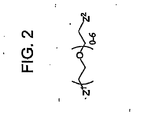
- FIG. 2 Non-limiting exemplary embodiments of linkers that can be used to link the various groups and moieties comprising the reagents described herein to one another are illustrated in FIG. 2 .
- Z 1 and Z 2 each represent, independently of one another, a portion of a linkage contributed by a functional group F z , as previously described, and K is selected from -CH- and -N-.
- one of Z 1 or Z 2 is -NH- and the other is selected from -O-, -C(O)- and -S(O) 2 -.
- rhodamine dyes are characterized by four main features: (1) a parent xanthene ring; (2) an exocyclic amine substituent; (3) an exocyclic imminium substituent; and (4) a phenyl group substituted at the ortho position with a carboxyl group.
- exocyclic amine and/or imminium groups are typically positioned at the C3 and C6 carbon atoms of the parent xanthene ring, although "extended" rhodamine in which the parent xanthene ring comprises a benzo group fused to the C3 and C4 carbons and/or the C5 and C6 carbons are also known. In these extended rhodamines, the characteristic exocyclic amine and imminium groups are positioned at the corresponding positions of the extended xanthene ring.
- rhodamine dyes can exist in two different forms:(1) the open, acid form; and (2) the closed, lactone form. While not intending to be bound by any theory of operation, because NMR spectra of exemplary N-protected NH-rhodamine dyes described herein are consistent with the closed spiro lactone form of the dye, it is believed that the N-protected NH-rhodamine dyes comprising the label moiety of the reagents described herein are in the closed, spiro lactone form.
- protecting groups R 9 that are stable to the organic synthesis conditions used to synthesize oligonucleotides should be used.
- Acyl protecting groups R 9 that protect the amine in the form of a carboxamide are selected, as protecting the exocyclic amines in this matter is believed to "lock" the protected NH-rhodamine in the closed, lactone, form, contributing to the stability of the reagents described herein.
- protecting groups R 9 that are labile under the conditions used to remove the groups protecting the exocyclic amines of the nucleobases of the synthetic oligonucleotide, so that all protecting groups can be removed in a single step.
- synthesis methods that employ phosphoramidite reagents involve multiple rounds of:(i) DMT deprotection to reveal a free hydroxyl, which can be effected by treatment with 2.5% or 3% di- or tri-chloroacetic acid in dichloromethane; (ii) coupling of nucleoside or other phosphoramidite reagents to the free hydroxyl, which can be carried out in acetonitrile containing 0.45 M or 0.5 M tetrazole; (iii) oxidation, which can be carried out by treatment with I 2 /2,6-lutidine/H 2 O; and capping, which can be carried out by treatment with 6.5% acetic anhydride in tetrahydrofuran (THF) followed by treatment with 10% 1-methylimidazole (NMI) in THF.
- DMT deprotection to reveal a free hydroxyl
- NMI 1-methylimidazole
- phosphoramidite coupling can be carried out in acetonitrile containing 0.25 M 5-ethylthio-1H-tetrazole, 0.25 M4,5-dicyanoimidazole (DCI) or 0.25 M 5-benzylthio-1H-tetrazole (BTT).
- Oxidation an be carried out in 0.1 M, 0.05 M or 0.02 M I 2 in THF/H 2 O/pyridine (7:2:1).
- Capping can be carried out by treatment with THF/lutidine/acetic anhydride followed by treatment with 16% NMI in THF; by treatment with 6.5% DMAP in THF followed by treatment with 10% Melm in THF; or by treatment with 10% Melm in THF followed by treatment with 16% Melm in THF.
- Removal of any protecting groups and cleavage from the synthesis reagent is typically effected by treatment with concentrated ammonium hydroxide at (0°C for 1-12 hr, although nucleoside phosphoramidite reagents protected with groups that can be removed under milder conditions, such as by treatment with concentrated ammonium hydroxide at room temperature for 4-17 hrs or treatment with 0.05 M potassium carbonate in methanol, or treatment with 25% t-butylamine in H 2 O/EtOH, are also known and used.
- Skilled artisans will be readily able to select protecting groups having properties suitable for use under specific synthesis and deprotection and/or cleavage conditions.
- a wide variety of amine protecting groups are taught, for example in, Greene & Wuts, "Protective Groups In Organic Chemistry," 3d Edition, John Wiley & Sons, 1999 (hereinafter "Green & Wuts") at for example, pages 309-405 .
- Skilled artisans can readily select protecting groups R 9 having suitable properties from amongst those taught in Green & Wuts.
- the protecting groups R 9 are acyl groups of the formula -C(O)R 10 , where R 10 is selected from hydrogen, lower alkyl, methyl, -CX 3 ,-CHX 2 , -CH 2 X, -CH 2 -OR d and phenyl optionally mono-substituted with a lower alkyl, methyl, -X, -OR d , cyano or nitro group, where R d is selected from lower alkyl, phenyl and pyridyl, and each X is a halo group, typically fluoro, or chloro.
- R 10 is methyl.
- R 10 is trifluoromethyl.
- Acyl protecting groups such as those defined by -C(O)R 10 can be removed under a variety of basic conditions, including the mild conditions used to remove protecting groups from oligos synthesized with "base labile" phosphoramidite reagents, as are well-known in the art. Examplary conditions that can be used are specified above.
- the N-protected NH-rhodamine comprising the label moiety of the various reagents described herein excludes 4,7-dichloro R6G (5- and/or 6-isomers) and/or rhodamines described by structural formula (IIIa) in which:
- the N-protected NH-rhodamine moieties according to structural formulae (IIIa), (IIIb) and (IIIc), are, respectively, selected from moieties defined by structural formulae (IIIa.1), (IIIa.2), (IIIb.1), (IIIb.2), (IIIc.1), and (IIIc.2), below: wherein R', R", R 1 , R 2' , R 2" , R 3' , R 4' , R 4" , R 5' , R 5" , R 6' , R 7' , R 7" , R 8' , R 4 , R 5 , R 6 , R 7 , R 9 and Y are as previously defined for structural formulae (IIIa), (IIIb) and (IIIc).
- moieties defined by structural formulae (IIIa), (IIIa.1), (IIIa.2), (IIIb), (IIIb.1), (IIIb.2), (IIIc), (IIIc.1) and (IIIc.2) include structures that have one or more applicable features selected from:
- the reagents described herein include a phosphate ester precursor group ("PEP") as defined above.
- PEP phosphate ester precursor group
- the PEP group When used in a step-wise synthesis to synthesize a labeled oligonucleotide, the PEP group is coupled to the 5'-hydroxyl group of a nascent synthetic oligonucleotide, ultimately contributing, after any required oxidation and/or deprotection steps, a linkage linking the label moiety to the synthetic oligonucleotide.
- the linkage formed is a phosphate ester linkage or a modified phosphate ester linkage as is know in the art.
- PEP groups used in the reagents described herein are phosphoramidite groups (see , e.g., Letsinger et al., 1969. J. Am. Chem, Soc. 91:3350-3355 ; Letsinger et al., 1975 J. Am. Chem. Soc. 97:3278 ; Matteucci & Caruthers, 19881. J. Am. Chem. Soc. 103:3185 ; Beaucage & Caruthers, 1981, Tetrahedron Lert.
- the PEP group is a phosphoramidite group of the formula (P.1): wherein:
- R 20 is 2-cyanoethyl and R 21 and R 22 are each isopropyl.
- the reagents described herein include a synthesis handles that provides, after suitable deprotection, a site that can be used for the attachment of additional groups or moieties to the synthetic labeled oligonucleotide.
- the groups are attached to a synthesis handle during the course of synthesizing the labeled oligonucleotide.
- the synthesis handle comprises a protected primary hydroxyl of the formula -OR e , where R e represents an acid-labile protecting group that can be selectively removed during the course of synthesizing an oligonucleotide.
- Acid labile protecting groups suitable for protecting primary hydroxyl groups in the context of oligonucleotide synthesis are known in the art, and include, by way of example and not limitation, triphenylmethyl (trityl), 4-monomethoxytrityl, 4,4'-dimethoxytrityl, 4,4',4"-trimethoxytrityl, bis (p-anisyl)phenylmethyl, naphthyldiphenytmethyl, p-(p'-bromophenacyloxy)phenyldiphenylmethyl, 9-anthryl, 9-(9-phenyl)xanthenyl and 9-(9-phenyl-10-oxo)anthryl.
- the synthesis reagents described herein include one synthesis handle useful for the attachment of additional groups and/or moieties.
- Synthesis handles of the formula -OR e where R e represents an acid-labile protecting group as previously described, provide a primary hydroxyl group to which additional nucleotides can be attached.
- synthesis reagents that include such a synthesis handle can be used to label synthetic oligonucleotides with other phosphoramidite labeling reagents, permitting the synthesis of oligonucleotides containing a plurality of label moieties, according to the method of the invention.
- any one of the specific embodiments of label moiety LM described herein can be included in any of the specifically exemplified embodiments of non-nucleosidic synthesis reagents described herein.
- any one of the specific embodiments of phosphate ester precursor group PEP such as the phosphoramidite group of structural formula (P.1), supra, can be included in any of the synthesis reagents described herein.
- the various reagents described herein can be used in the step-wise synthesis of oligonucleotides to synthesize oligonucleotides labeled with rhodamine dyes directly on the synthesis resin.
- the various reagents make available the ability to synthetically label oligonucleotides with myriad different rhodamines, obviating the need for laborious post-synthesis modifications.
- the reagents described herein permit the ability to synthesize oligonucleotides labeled with energy transfer dyes and/or NH-rhodamine-quencher dye pairs, that are synthesized in situ.
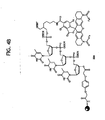
- Exemplary syntheses of oligonucleotides labeled with NH-rhodamine-fluorescein energy transfer dye pairs that illustrate the versatility provided by the reagents described herein are illustrated in 4A-4D.
- oligonucleotides labeled with energy transfer dye pairs having spectral properties that are adjusted for specified applications can be conveniently synthesized in situ, without the need for post synthesis modification.
- oligonucleotides labeled with myriad different energy transfer dye pair combinations can be synthesized from individual monomer reagents, obviating the need to make synthesis reagents containing specified dye pairs.
- Each member of the dye pair can be attached to the nascent oligonucleotide in a step-wise fashion, with or without the addition of intervening linking moieties.
- nascent support-bound oligonucleotide 220 can be labeled with an NH-rhodamine-fluorescein dye pair synthesized in situ by coupling N-protected NH-rhodamine phosphoramidite synthesis reagent 222 to the 5'-hydroxyl of oligonucleotide 220, which, after oxidation, yields NH-rhodamine-labeled oligonucleotide 224.
- linker phosphoramidite 230 is coupled to rhodamine-labeled oligonucleotide 225, yielding reagent 232. Coupling with FAM-phosphoramidite followed by oxidation, deprotection and cleavage yields oligonucleotide 234, which is labeled with an NH-rhodamine-FAM energy transfer dye pair.
- "Sp" is a spacer, as previously defined.
- the length and properties of the linker linking the NH-rhodamine and FAM dyes can be adjusted by coupling additional linker phosphoramidites to reagent 232 prior to coupling with the FAM-phosphoramidite.
- the linker phosphosphoramites could be the same, or they could be different. In this way, oligonucleotides labeled with energy transfer dye pairs in which the donor and acceptor dyes, as well as the linker linking the donor and acceptors, are tailored for specific purposes can be readily synthesized in situ.
- FIGS. 4A-4D and FIGS. 5A-5C exemplify the use of a specific N-protected NH-rhodamine reagent
- any N-protected NH-rhodamine reagent that acts as an acceptor for FAM could be used.
- other O-protected fluoresceins could be used, as could other types of phosphormidite dyes. Since the dyes are added as monomers, the number of energy transfer dye labels available is greater than the number of phosphoramidite reagents necessary to synthesize them.
- oligonucleotides labeled with 9 different energy-transfer dye pairs can be synthesized from 3 different N-protected NH-rhodamine phosphoramidite reagents (reagents A, B and C ) and 3 different O-protected fluorescein phosphoramidite reagents (reagents 1 , 2 and 3 ): oligo- A1 , oligo- A2 , oligo- A3 , oligo- B1 , oligo- B2 , oligo- B3 , oligo- C1 , oligo- C2 and oligo- C3 .
- Example 1 Synthesis of a Non-Nucleosidic Phosphoramidite Synthesis Reagent Including an Optional Synthesis Handle
- a non-nucleosidic phosphoramidite synthesis reagent that includes an optional synthesis handle of the formula -OR e was synthesized as illustrated below:
- Bis-TFA derivative 9 (1.354 mmol) was dissolved in a solution of DIPEA (0.236 mL) in DCM (30 mL). To the stirred solution, linker synthon 29 and DCM (0.609 g, 1.355 mmol; synthesized as described in Nelson et al., 1992, Nucl. Acids Res. 20:6253-6259 ) was added stirring continued a room temperature for 2h. EtOAc was added and the mixture was loaded on a silica column. Pure product was isolated by elution using a gradient of EtOAcDCM from 5:95 to 1:5. Evaporation of the appropriate fractions gave 1.25 g (80%) of bis-TFA-rhodamine-hydroxy amide 30.
- Oligonucleotides labeled with the N-protected NH-rhodamine phosphoramidite synthesis reagents were synthesized on polystyrene solid supports using the standard operating conditions on an AB 3900 automated DNA synthesizer.
- N-protected NH-rhodamine phosphoramidites were soluble in the acetonitrile solvent for the coupling reactions, and the N-protected Nh-rhodamine dye adducts were stable to repeated synthesis cycles which employed removal of DMT with dichloroacetic acid, addition of nucleoside phosphoramidite monomers, capping with acetic anhydride and oxidation with iodine to generate the internueleotide phosphate linkages.
- This class of NH-rhodamine was also found to be stable to the conditions used to deprotect and cleave the synthesized labeled oligonucleotide from the solid support (treatment with ammonium hydroxide at 60°C for 1-2 h).
- the overall scheme used to synthesize the labeled oligonucleotide is illustrated below:
- TFA-rhodamine DMT phosphoramidite 31 was coupled to the 5'-hydroxyl of a support-bound oligonucleotide to give the phosphite intermediate 32.
- Fluorescein phosphoramidite (Glenn Research) was coupled to the free hydroxyl of intermediate 32.
- the resultant labeled oligo was oxidized, cleaved from the support with concentrated ammonia hydroxide for 1 to 2 hours at 60 °C, washed with aceonitrile/water and dried under reduced pressure to yield labeled oligonucleotide 33.
- Oligo 33 was re-precipitated using a standard sodium acetate/EtOH precipitation protocol. Labeled oligo 33 was produced in greater then 90 % purity and in greater than 85 % yield (170,000 pM from 0.2 uM support) and used without further purification.
- Poly(dT) 10 oligonucleotides labeled with NH-rhodamines or NH-rhodamine-fluorescein dye pairs were synthesized as illustrated above. Following cleavage, fluorescence spectra were recorded. All labeled oligos synthesized exhibited good fluorescence properties.
Landscapes
- Chemical & Material Sciences (AREA)
- Organic Chemistry (AREA)
- Health & Medical Sciences (AREA)
- Life Sciences & Earth Sciences (AREA)
- Biochemistry (AREA)
- Molecular Biology (AREA)
- General Health & Medical Sciences (AREA)
- Biotechnology (AREA)
- Engineering & Computer Science (AREA)
- Genetics & Genomics (AREA)
- Saccharide Compounds (AREA)
- Measuring Or Testing Involving Enzymes Or Micro-Organisms (AREA)
- Heterocyclic Carbon Compounds Containing A Hetero Ring Having Oxygen Or Sulfur (AREA)
- Investigating Or Analysing Materials By The Use Of Chemical Reactions (AREA)
- Nitrogen And Oxygen Or Sulfur-Condensed Heterocyclic Ring Systems (AREA)
- Investigating Or Analysing Biological Materials (AREA)
Applications Claiming Priority (2)
| Application Number | Priority Date | Filing Date | Title |
|---|---|---|---|
| US78777706P | 2006-03-31 | 2006-03-31 | |
| PCT/US2007/065798 WO2007115265A2 (en) | 2006-03-31 | 2007-04-02 | Reagents useful for synthesizing rhodamine-labeled oligonucleotides |
Publications (3)
| Publication Number | Publication Date |
|---|---|
| EP2001871A2 EP2001871A2 (en) | 2008-12-17 |
| EP2001871A4 EP2001871A4 (en) | 2010-10-20 |
| EP2001871B1 true EP2001871B1 (en) | 2014-07-16 |
Family
ID=38564295
Family Applications (1)
| Application Number | Title | Priority Date | Filing Date |
|---|---|---|---|
| EP07759970.2A Active EP2001871B1 (en) | 2006-03-31 | 2007-04-02 | Rhodamine-labeled oligonucleotides |
Country Status (7)
| Country | Link |
|---|---|
| US (5) | US9040674B2 (https=) |
| EP (1) | EP2001871B1 (https=) |
| JP (3) | JP2009533022A (https=) |
| CN (1) | CN101454315B (https=) |
| AU (1) | AU2007234451A1 (https=) |
| CA (1) | CA2647827A1 (https=) |
| WO (1) | WO2007115265A2 (https=) |
Families Citing this family (26)
| Publication number | Priority date | Publication date | Assignee | Title |
|---|---|---|---|---|
| CN102282155B (zh) | 2008-12-02 | 2017-06-09 | 日本波涛生命科学公司 | 磷原子修饰的核酸的合成方法 |
| RU2612521C2 (ru) | 2009-07-06 | 2017-03-09 | Онтории, Инк. | Новые пролекарства нуклеиновых кислот и способы их применения |
| JP5868324B2 (ja) | 2010-09-24 | 2016-02-24 | 株式会社Wave Life Sciences Japan | 不斉補助基 |
| CN103597093A (zh) | 2010-12-29 | 2014-02-19 | 生命技术公司 | 作为荧光参考标准品的ddao化合物 |
| CN103796657B (zh) | 2011-07-19 | 2017-07-11 | 波涛生命科学有限公司 | 合成官能化核酸的方法 |
| EP2823270B1 (en) | 2012-03-09 | 2022-05-04 | Promega Corporation | pH SENSORS |
| KR102213609B1 (ko) | 2012-07-13 | 2021-02-08 | 웨이브 라이프 사이언시스 리미티드 | 키랄 제어 |
| PL2872485T3 (pl) | 2012-07-13 | 2021-05-31 | Wave Life Sciences Ltd. | Asymetryczna grupa pomocnicza |
| CA2879066C (en) | 2012-07-13 | 2019-08-13 | Shin Nippon Biomedical Laboratories, Ltd. | Chiral nucleic acid adjuvant |
| CN103122379A (zh) * | 2012-12-24 | 2013-05-29 | 深圳先进技术研究院 | 基因转染实时监测的方法 |
| CN103232489B (zh) * | 2013-02-18 | 2016-09-28 | 常州津坛生物科技有限公司 | 一种荧光探针化合物及其制备方法和用途 |
| DK2964624T3 (en) * | 2013-03-08 | 2017-04-03 | Illumina Cambridge Ltd | RHODAMINE COMPOUNDS AND USE AS FLUORESCING LABELS |
| US10322173B2 (en) | 2014-01-15 | 2019-06-18 | Shin Nippon Biomedical Laboratories, Ltd. | Chiral nucleic acid adjuvant having anti-allergic activity, and anti-allergic agent |
| JPWO2015108048A1 (ja) | 2014-01-15 | 2017-03-23 | 株式会社新日本科学 | 抗腫瘍作用を有するキラル核酸アジュバンド及び抗腫瘍剤 |
| JPWO2015108047A1 (ja) | 2014-01-15 | 2017-03-23 | 株式会社新日本科学 | 免疫誘導活性を有するキラル核酸アジュバンド及び免疫誘導活性剤 |
| BR112016016400A2 (pt) | 2014-01-16 | 2017-10-03 | Wave Life Sciences Ltd | Composições de oligonucleotídeos quiralmente controlados, seu uso, sua composição farmacêutica, e métodos |
| CN106281309B (zh) * | 2016-08-03 | 2018-07-10 | 陕西师范大学 | 硼酸衍生物功能化荧光探针在检测5-羟甲基胞嘧啶中的应用 |
| CN106350064B (zh) * | 2016-08-30 | 2019-03-29 | 上海大学 | 利用微波加热法水热炭化造纸黑液制备水溶性荧光碳材料的方法 |
| US12071547B2 (en) | 2018-05-07 | 2024-08-27 | Cepheid | Sulforhodamine phosphoramidite dyes |
| EP3833715B1 (en) | 2018-08-10 | 2026-01-07 | Life Technologies Corporation | Silicon-substituted rhodamine dyes and dye conjugates |
| SG11202106124UA (en) * | 2018-12-20 | 2021-07-29 | Life Technologies Corp | Modified rhodamine dye and use thereof in biological assays |
| KR20230034333A (ko) | 2020-07-02 | 2023-03-09 | 라이프 테크놀로지스 코포레이션 | 트리뉴클레오티드 캡 유사체, 제조 및 이의 용도 |
| EP4185596A1 (en) | 2020-07-23 | 2023-05-31 | Life Technologies Corporation | Energy transfer dye conjugates for use in biological assays |
| WO2022020731A2 (en) | 2020-07-23 | 2022-01-27 | Life Technologies Corporation | Compositions, systems and methods for biological analysis involving energy transfer dye conjugates and analytes comprising the same |
| US20250092261A1 (en) | 2021-07-21 | 2025-03-20 | Life Technologies Corporation | Dibenzoxanthene Quenchers, Uses, and Methods of Preparation |
| CN116333006A (zh) * | 2023-04-07 | 2023-06-27 | 苏州欧利生物医药科技有限公司 | 一种带有荧光标记物的寡核苷酸的固相合成方法 |
Citations (1)
| Publication number | Priority date | Publication date | Assignee | Title |
|---|---|---|---|---|
| US4557862A (en) * | 1983-10-28 | 1985-12-10 | University Patents, Inc. | Rhodamine derivatives as fluorogenic substrates for proteinases |
Family Cites Families (15)
| Publication number | Priority date | Publication date | Assignee | Title |
|---|---|---|---|---|
| US4965349A (en) * | 1987-12-24 | 1990-10-23 | Applied Biosystems, Inc. | Method of synthesizing oligonucleotides labeled with ammonia-labile groups on solid phase supports |
| US5231191A (en) * | 1987-12-24 | 1993-07-27 | Applied Biosystems, Inc. | Rhodamine phosphoramidite compounds |
| US5451463A (en) * | 1989-08-28 | 1995-09-19 | Clontech Laboratories, Inc. | Non-nucleoside 1,3-diol reagents for labeling synthetic oligonucleotides |
| US5366860A (en) * | 1989-09-29 | 1994-11-22 | Applied Biosystems, Inc. | Spectrally resolvable rhodamine dyes for nucleic acid sequence determination |
| US6028190A (en) * | 1994-02-01 | 2000-02-22 | The Regents Of The University Of California | Probes labeled with energy transfer coupled dyes |
| US6020481A (en) * | 1996-04-01 | 2000-02-01 | The Perkin-Elmer Corporation | Asymmetric benzoxanthene dyes |
| US6080852A (en) * | 1996-06-27 | 2000-06-27 | The Perkin-Elmer Corporation | 4,7-dichlororhodamine dyes |
| US6583168B1 (en) * | 1997-11-25 | 2003-06-24 | Applera Corporation | Sulfonated diarylrhodamine dyes |
| US6255476B1 (en) * | 1999-02-22 | 2001-07-03 | Pe Corporation (Ny) | Methods and compositions for synthesis of labelled oligonucleotides and analogs on solid-supports |
| US6248884B1 (en) * | 1999-06-03 | 2001-06-19 | The Perkin-Elmer Corporation | Extended rhodamine compounds useful as fluorescent labels |
| US7183405B2 (en) | 1999-06-25 | 2007-02-27 | Syn Gen, Inc. | Compositions and methods for labeling oligonucleotides |
| US6750357B1 (en) * | 1999-06-25 | 2004-06-15 | Syngen, Inc. | Rhodamine-based fluorophores useful as labeling reagents |
| US20040014131A1 (en) * | 2002-07-09 | 2004-01-22 | Pfizer Inc. | Assay methods |
| US20050113584A1 (en) * | 2003-07-14 | 2005-05-26 | Irm Llc | Methods for the preparation of rhodamine |
| JP5214967B2 (ja) * | 2004-08-13 | 2013-06-19 | エポック バイオサイエンシズ インコーポレーティッド | ホスホン酸蛍光色素および複合体 |
-
2007
- 2007-04-02 CN CN200780019599.1A patent/CN101454315B/zh not_active Expired - Fee Related
- 2007-04-02 AU AU2007234451A patent/AU2007234451A1/en not_active Abandoned
- 2007-04-02 CA CA002647827A patent/CA2647827A1/en not_active Abandoned
- 2007-04-02 WO PCT/US2007/065798 patent/WO2007115265A2/en not_active Ceased
- 2007-04-02 US US11/695,548 patent/US9040674B2/en active Active
- 2007-04-02 JP JP2009503336A patent/JP2009533022A/ja active Pending
- 2007-04-02 EP EP07759970.2A patent/EP2001871B1/en active Active
-
2012
- 2012-11-28 JP JP2012259617A patent/JP5698206B2/ja active Active
-
2014
- 2014-01-24 JP JP2014011166A patent/JP2014079254A/ja not_active Withdrawn
-
2015
- 2015-05-01 US US14/702,499 patent/US9783560B2/en active Active
-
2017
- 2017-09-01 US US15/694,279 patent/US20180057516A1/en not_active Abandoned
-
2020
- 2020-01-30 US US16/776,682 patent/US11407773B2/en active Active
-
2022
- 2022-06-30 US US17/854,220 patent/US20230096149A1/en not_active Abandoned
Patent Citations (1)
| Publication number | Priority date | Publication date | Assignee | Title |
|---|---|---|---|---|
| US4557862A (en) * | 1983-10-28 | 1985-12-10 | University Patents, Inc. | Rhodamine derivatives as fluorogenic substrates for proteinases |
Also Published As
| Publication number | Publication date |
|---|---|
| CA2647827A1 (en) | 2007-10-11 |
| EP2001871A4 (en) | 2010-10-20 |
| WO2007115265A2 (en) | 2007-10-11 |
| US9040674B2 (en) | 2015-05-26 |
| JP2014079254A (ja) | 2014-05-08 |
| US20230096149A1 (en) | 2023-03-30 |
| US9783560B2 (en) | 2017-10-10 |
| US20080071070A1 (en) | 2008-03-20 |
| CN101454315B (zh) | 2016-08-17 |
| JP2013048635A (ja) | 2013-03-14 |
| CN101454315A (zh) | 2009-06-10 |
| AU2007234451A1 (en) | 2007-10-11 |
| US20200270287A1 (en) | 2020-08-27 |
| WO2007115265A3 (en) | 2008-01-17 |
| JP2009533022A (ja) | 2009-09-17 |
| US11407773B2 (en) | 2022-08-09 |
| WO2007115265A9 (en) | 2007-11-29 |
| US20150232494A1 (en) | 2015-08-20 |
| EP2001871A2 (en) | 2008-12-17 |
| JP5698206B2 (ja) | 2015-04-08 |
| US20180057516A1 (en) | 2018-03-01 |
Similar Documents
| Publication | Publication Date | Title |
|---|---|---|
| EP2001871B1 (en) | Rhodamine-labeled oligonucleotides | |
| US5321131A (en) | Site-specific functionalization of oligodeoxynucleotides for non-radioactive labelling | |
| JP2025060648A (ja) | 非対称ローダミン染料及びバイオアッセイにおけるそれらの使用 | |
| AU2017272215B2 (en) | Polymorphic forms of an oxysterol and methods of making them | |
| Guzaev et al. | Solid support synthesis of ester linked hydrophobic conjugates of oligonucleotides | |
| CN107098936B (zh) | 一种taf核苷衍生物的制备方法 | |
| US6096899A (en) | Cylic imidazole compounds having relatively low hydrogen content and relatively high nitrogen content and polymers formed therefrom | |
| KR20030036218A (ko) | 아크릴로니트릴 보집제를 이용한 합성올리고뉴클레오티드의 디프로텍팅 | |
| US20240239791A1 (en) | Processes for the synthesis of valbenazine | |
| WO2022191172A1 (ja) | 核酸固相合成のためのリンカー及び担体 | |
| CA1108629A (en) | Maleic acid halfamides | |
| CN119350415A (zh) | 化合物晶型及其制备方法和应用 | |
| CN118745198A (zh) | 芳氧基氨基磷酸酯化合物的制备方法 | |
| CA2613047C (en) | Method of synthesis of azole-containing amino acids | |
| JP5192807B2 (ja) | シュードウリジン保護体の安定結晶 | |
| JPS6222774A (ja) | 新規な1−オキサ−3−アザ−シクロペンタン誘導体 | |
| EP2794622B1 (en) | Protected linker compounds | |
| HU196964B (en) | Process for producing amino-nitro-pyridine derivatives | |
| EP3943502A1 (en) | Method for preparing chenodeoxycholic acid derivative | |
| JPH02160799A (ja) | 2′−デオキシ−β−アデノシンの製造法 | |
| WO2006097121A1 (en) | Method for producing biphenyl-tetrazole compounds |
Legal Events
| Date | Code | Title | Description |
|---|---|---|---|
| PUAI | Public reference made under article 153(3) epc to a published international application that has entered the european phase |
Free format text: ORIGINAL CODE: 0009012 |
|
| 17P | Request for examination filed |
Effective date: 20081017 |
|
| AK | Designated contracting states |
Kind code of ref document: A2 Designated state(s): AT BE BG CH CY CZ DE DK EE ES FI FR GB GR HU IE IS IT LI LT LU LV MC MT NL PL PT RO SE SI SK TR |
|
| A4 | Supplementary search report drawn up and despatched |
Effective date: 20100922 |
|
| RIC1 | Information provided on ipc code assigned before grant |
Ipc: C07F 9/00 20060101ALI20100916BHEP Ipc: C07D 405/00 20060101AFI20081024BHEP |
|
| 17Q | First examination report despatched |
Effective date: 20110615 |
|
| DAX | Request for extension of the european patent (deleted) | ||
| REG | Reference to a national code |
Ref country code: DE Ref legal event code: R079 Ref document number: 602007037660 Country of ref document: DE Free format text: PREVIOUS MAIN CLASS: C07D0405000000 Ipc: C07H0021040000 |
|
| GRAP | Despatch of communication of intention to grant a patent |
Free format text: ORIGINAL CODE: EPIDOSNIGR1 |
|
| RIC1 | Information provided on ipc code assigned before grant |
Ipc: C07H 21/04 20060101AFI20130917BHEP |
|
| INTG | Intention to grant announced |
Effective date: 20131007 |
|
| GRAP | Despatch of communication of intention to grant a patent |
Free format text: ORIGINAL CODE: EPIDOSNIGR1 |
|
| INTG | Intention to grant announced |
Effective date: 20140131 |
|
| RAP1 | Party data changed (applicant data changed or rights of an application transferred) |
Owner name: APPLIED BIOSYSTEMS, LLC |
|
| GRAS | Grant fee paid |
Free format text: ORIGINAL CODE: EPIDOSNIGR3 |
|
| GRAA | (expected) grant |
Free format text: ORIGINAL CODE: 0009210 |
|
| AK | Designated contracting states |
Kind code of ref document: B1 Designated state(s): AT BE BG CH CY CZ DE DK EE ES FI FR GB GR HU IE IS IT LI LT LU LV MC MT NL PL PT RO SE SI SK TR |
|
| REG | Reference to a national code |
Ref country code: GB Ref legal event code: FG4D |
|
| REG | Reference to a national code |
Ref country code: CH Ref legal event code: EP Ref country code: CH Ref legal event code: NV Representative=s name: OFFICE ERNEST T. FREYLINGER S.A., CH |
|
| REG | Reference to a national code |
Ref country code: IE Ref legal event code: FG4D |
|
| REG | Reference to a national code |
Ref country code: AT Ref legal event code: REF Ref document number: 677574 Country of ref document: AT Kind code of ref document: T Effective date: 20140815 |
|
| REG | Reference to a national code |
Ref country code: DE Ref legal event code: R096 Ref document number: 602007037660 Country of ref document: DE Effective date: 20140828 |
|
| REG | Reference to a national code |
Ref country code: NL Ref legal event code: T3 |
|
| REG | Reference to a national code |
Ref country code: AT Ref legal event code: MK05 Ref document number: 677574 Country of ref document: AT Kind code of ref document: T Effective date: 20140716 |
|
| REG | Reference to a national code |
Ref country code: LT Ref legal event code: MG4D |
|
| PG25 | Lapsed in a contracting state [announced via postgrant information from national office to epo] |
Ref country code: LT Free format text: LAPSE BECAUSE OF FAILURE TO SUBMIT A TRANSLATION OF THE DESCRIPTION OR TO PAY THE FEE WITHIN THE PRESCRIBED TIME-LIMIT Effective date: 20140716 Ref country code: GR Free format text: LAPSE BECAUSE OF FAILURE TO SUBMIT A TRANSLATION OF THE DESCRIPTION OR TO PAY THE FEE WITHIN THE PRESCRIBED TIME-LIMIT Effective date: 20141017 Ref country code: BG Free format text: LAPSE BECAUSE OF FAILURE TO SUBMIT A TRANSLATION OF THE DESCRIPTION OR TO PAY THE FEE WITHIN THE PRESCRIBED TIME-LIMIT Effective date: 20141016 Ref country code: PT Free format text: LAPSE BECAUSE OF FAILURE TO SUBMIT A TRANSLATION OF THE DESCRIPTION OR TO PAY THE FEE WITHIN THE PRESCRIBED TIME-LIMIT Effective date: 20141117 Ref country code: SE Free format text: LAPSE BECAUSE OF FAILURE TO SUBMIT A TRANSLATION OF THE DESCRIPTION OR TO PAY THE FEE WITHIN THE PRESCRIBED TIME-LIMIT Effective date: 20140716 Ref country code: ES Free format text: LAPSE BECAUSE OF FAILURE TO SUBMIT A TRANSLATION OF THE DESCRIPTION OR TO PAY THE FEE WITHIN THE PRESCRIBED TIME-LIMIT Effective date: 20140716 Ref country code: FI Free format text: LAPSE BECAUSE OF FAILURE TO SUBMIT A TRANSLATION OF THE DESCRIPTION OR TO PAY THE FEE WITHIN THE PRESCRIBED TIME-LIMIT Effective date: 20140716 |
|
| PG25 | Lapsed in a contracting state [announced via postgrant information from national office to epo] |
Ref country code: IS Free format text: LAPSE BECAUSE OF FAILURE TO SUBMIT A TRANSLATION OF THE DESCRIPTION OR TO PAY THE FEE WITHIN THE PRESCRIBED TIME-LIMIT Effective date: 20141116 Ref country code: AT Free format text: LAPSE BECAUSE OF FAILURE TO SUBMIT A TRANSLATION OF THE DESCRIPTION OR TO PAY THE FEE WITHIN THE PRESCRIBED TIME-LIMIT Effective date: 20140716 Ref country code: LV Free format text: LAPSE BECAUSE OF FAILURE TO SUBMIT A TRANSLATION OF THE DESCRIPTION OR TO PAY THE FEE WITHIN THE PRESCRIBED TIME-LIMIT Effective date: 20140716 Ref country code: CY Free format text: LAPSE BECAUSE OF FAILURE TO SUBMIT A TRANSLATION OF THE DESCRIPTION OR TO PAY THE FEE WITHIN THE PRESCRIBED TIME-LIMIT Effective date: 20140716 Ref country code: PL Free format text: LAPSE BECAUSE OF FAILURE TO SUBMIT A TRANSLATION OF THE DESCRIPTION OR TO PAY THE FEE WITHIN THE PRESCRIBED TIME-LIMIT Effective date: 20140716 |
|
| REG | Reference to a national code |
Ref country code: DE Ref legal event code: R097 Ref document number: 602007037660 Country of ref document: DE |
|
| PG25 | Lapsed in a contracting state [announced via postgrant information from national office to epo] |
Ref country code: EE Free format text: LAPSE BECAUSE OF FAILURE TO SUBMIT A TRANSLATION OF THE DESCRIPTION OR TO PAY THE FEE WITHIN THE PRESCRIBED TIME-LIMIT Effective date: 20140716 Ref country code: SK Free format text: LAPSE BECAUSE OF FAILURE TO SUBMIT A TRANSLATION OF THE DESCRIPTION OR TO PAY THE FEE WITHIN THE PRESCRIBED TIME-LIMIT Effective date: 20140716 Ref country code: IT Free format text: LAPSE BECAUSE OF FAILURE TO SUBMIT A TRANSLATION OF THE DESCRIPTION OR TO PAY THE FEE WITHIN THE PRESCRIBED TIME-LIMIT Effective date: 20140716 Ref country code: DK Free format text: LAPSE BECAUSE OF FAILURE TO SUBMIT A TRANSLATION OF THE DESCRIPTION OR TO PAY THE FEE WITHIN THE PRESCRIBED TIME-LIMIT Effective date: 20140716 Ref country code: RO Free format text: LAPSE BECAUSE OF FAILURE TO SUBMIT A TRANSLATION OF THE DESCRIPTION OR TO PAY THE FEE WITHIN THE PRESCRIBED TIME-LIMIT Effective date: 20140716 Ref country code: CZ Free format text: LAPSE BECAUSE OF FAILURE TO SUBMIT A TRANSLATION OF THE DESCRIPTION OR TO PAY THE FEE WITHIN THE PRESCRIBED TIME-LIMIT Effective date: 20140716 |
|
| PLBE | No opposition filed within time limit |
Free format text: ORIGINAL CODE: 0009261 |
|
| STAA | Information on the status of an ep patent application or granted ep patent |
Free format text: STATUS: NO OPPOSITION FILED WITHIN TIME LIMIT |
|
| 26N | No opposition filed |
Effective date: 20150417 |
|
| PG25 | Lapsed in a contracting state [announced via postgrant information from national office to epo] |
Ref country code: SI Free format text: LAPSE BECAUSE OF FAILURE TO SUBMIT A TRANSLATION OF THE DESCRIPTION OR TO PAY THE FEE WITHIN THE PRESCRIBED TIME-LIMIT Effective date: 20140716 Ref country code: MC Free format text: LAPSE BECAUSE OF FAILURE TO SUBMIT A TRANSLATION OF THE DESCRIPTION OR TO PAY THE FEE WITHIN THE PRESCRIBED TIME-LIMIT Effective date: 20140716 Ref country code: LU Free format text: LAPSE BECAUSE OF FAILURE TO SUBMIT A TRANSLATION OF THE DESCRIPTION OR TO PAY THE FEE WITHIN THE PRESCRIBED TIME-LIMIT Effective date: 20150402 |
|
| REG | Reference to a national code |
Ref country code: IE Ref legal event code: MM4A |
|
| REG | Reference to a national code |
Ref country code: FR Ref legal event code: PLFP Year of fee payment: 10 |
|
| PG25 | Lapsed in a contracting state [announced via postgrant information from national office to epo] |
Ref country code: IE Free format text: LAPSE BECAUSE OF NON-PAYMENT OF DUE FEES Effective date: 20150402 |
|
| PG25 | Lapsed in a contracting state [announced via postgrant information from national office to epo] |
Ref country code: BE Free format text: LAPSE BECAUSE OF FAILURE TO SUBMIT A TRANSLATION OF THE DESCRIPTION OR TO PAY THE FEE WITHIN THE PRESCRIBED TIME-LIMIT Effective date: 20140716 |
|
| PG25 | Lapsed in a contracting state [announced via postgrant information from national office to epo] |
Ref country code: MT Free format text: LAPSE BECAUSE OF FAILURE TO SUBMIT A TRANSLATION OF THE DESCRIPTION OR TO PAY THE FEE WITHIN THE PRESCRIBED TIME-LIMIT Effective date: 20140716 |
|
| REG | Reference to a national code |
Ref country code: FR Ref legal event code: PLFP Year of fee payment: 11 |
|
| PG25 | Lapsed in a contracting state [announced via postgrant information from national office to epo] |
Ref country code: HU Free format text: LAPSE BECAUSE OF FAILURE TO SUBMIT A TRANSLATION OF THE DESCRIPTION OR TO PAY THE FEE WITHIN THE PRESCRIBED TIME-LIMIT; INVALID AB INITIO Effective date: 20070402 |
|
| PG25 | Lapsed in a contracting state [announced via postgrant information from national office to epo] |
Ref country code: TR Free format text: LAPSE BECAUSE OF FAILURE TO SUBMIT A TRANSLATION OF THE DESCRIPTION OR TO PAY THE FEE WITHIN THE PRESCRIBED TIME-LIMIT Effective date: 20140716 |
|
| REG | Reference to a national code |
Ref country code: FR Ref legal event code: PLFP Year of fee payment: 12 |
|
| PGFP | Annual fee paid to national office [announced via postgrant information from national office to epo] |
Ref country code: NL Payment date: 20230330 Year of fee payment: 17 |
|
| PGFP | Annual fee paid to national office [announced via postgrant information from national office to epo] |
Ref country code: FR Payment date: 20230428 Year of fee payment: 17 Ref country code: DE Payment date: 20230411 Year of fee payment: 17 Ref country code: CH Payment date: 20230502 Year of fee payment: 17 |
|
| PGFP | Annual fee paid to national office [announced via postgrant information from national office to epo] |
Ref country code: GB Payment date: 20230418 Year of fee payment: 17 |
|
| REG | Reference to a national code |
Ref country code: DE Ref legal event code: R119 Ref document number: 602007037660 Country of ref document: DE |
|
| REG | Reference to a national code |
Ref country code: CH Ref legal event code: PL |
|
| REG | Reference to a national code |
Ref country code: NL Ref legal event code: MM Effective date: 20240501 |
|
| GBPC | Gb: european patent ceased through non-payment of renewal fee |
Effective date: 20240402 |
|
| PG25 | Lapsed in a contracting state [announced via postgrant information from national office to epo] |
Ref country code: DE Free format text: LAPSE BECAUSE OF NON-PAYMENT OF DUE FEES Effective date: 20241105 |
|
| PG25 | Lapsed in a contracting state [announced via postgrant information from national office to epo] |
Ref country code: NL Free format text: LAPSE BECAUSE OF NON-PAYMENT OF DUE FEES Effective date: 20240501 |
|
| PG25 | Lapsed in a contracting state [announced via postgrant information from national office to epo] |
Ref country code: GB Free format text: LAPSE BECAUSE OF NON-PAYMENT OF DUE FEES Effective date: 20240402 |
|
| PG25 | Lapsed in a contracting state [announced via postgrant information from national office to epo] |
Ref country code: FR Free format text: LAPSE BECAUSE OF NON-PAYMENT OF DUE FEES Effective date: 20240430 |
|
| PG25 | Lapsed in a contracting state [announced via postgrant information from national office to epo] |
Ref country code: NL Free format text: LAPSE BECAUSE OF NON-PAYMENT OF DUE FEES Effective date: 20240501 Ref country code: GB Free format text: LAPSE BECAUSE OF NON-PAYMENT OF DUE FEES Effective date: 20240402 Ref country code: FR Free format text: LAPSE BECAUSE OF NON-PAYMENT OF DUE FEES Effective date: 20240430 Ref country code: DE Free format text: LAPSE BECAUSE OF NON-PAYMENT OF DUE FEES Effective date: 20241105 Ref country code: CH Free format text: LAPSE BECAUSE OF NON-PAYMENT OF DUE FEES Effective date: 20240430 |