EP1982963B1 - Procedé de production d'un composant optique en verre quartzeux synthétique avec une résistance aux rayonnements élevée, et ébauche pour la production du composant - Google Patents
Procedé de production d'un composant optique en verre quartzeux synthétique avec une résistance aux rayonnements élevée, et ébauche pour la production du composant Download PDFInfo
- Publication number
- EP1982963B1 EP1982963B1 EP08154312.6A EP08154312A EP1982963B1 EP 1982963 B1 EP1982963 B1 EP 1982963B1 EP 08154312 A EP08154312 A EP 08154312A EP 1982963 B1 EP1982963 B1 EP 1982963B1
- Authority
- EP
- European Patent Office
- Prior art keywords
- quartz glass
- temperature
- blank
- treatment
- mean
- Prior art date
- Legal status (The legal status is an assumption and is not a legal conclusion. Google has not performed a legal analysis and makes no representation as to the accuracy of the status listed.)
- Active
Links
Images

Classifications
-
- C—CHEMISTRY; METALLURGY
- C03—GLASS; MINERAL OR SLAG WOOL
- C03B—MANUFACTURE, SHAPING, OR SUPPLEMENTARY PROCESSES
- C03B25/00—Annealing glass products
- C03B25/02—Annealing glass products in a discontinuous way
-
- C—CHEMISTRY; METALLURGY
- C03—GLASS; MINERAL OR SLAG WOOL
- C03B—MANUFACTURE, SHAPING, OR SUPPLEMENTARY PROCESSES
- C03B19/00—Other methods of shaping glass
- C03B19/14—Other methods of shaping glass by gas- or vapour- phase reaction processes
- C03B19/1453—Thermal after-treatment of the shaped article, e.g. dehydrating, consolidating, sintering
-
- C—CHEMISTRY; METALLURGY
- C03—GLASS; MINERAL OR SLAG WOOL
- C03B—MANUFACTURE, SHAPING, OR SUPPLEMENTARY PROCESSES
- C03B32/00—Thermal after-treatment of glass products not provided for in groups C03B19/00, C03B25/00 - C03B31/00 or C03B37/00, e.g. crystallisation, eliminating gas inclusions or other impurities; Hot-pressing vitrified, non-porous, shaped glass products
-
- C—CHEMISTRY; METALLURGY
- C03—GLASS; MINERAL OR SLAG WOOL
- C03C—CHEMICAL COMPOSITION OF GLASSES, GLAZES OR VITREOUS ENAMELS; SURFACE TREATMENT OF GLASS; SURFACE TREATMENT OF FIBRES OR FILAMENTS MADE FROM GLASS, MINERALS OR SLAGS; JOINING GLASS TO GLASS OR OTHER MATERIALS
- C03C3/00—Glass compositions
- C03C3/04—Glass compositions containing silica
- C03C3/06—Glass compositions containing silica with more than 90% silica by weight, e.g. quartz
-
- C—CHEMISTRY; METALLURGY
- C03—GLASS; MINERAL OR SLAG WOOL
- C03C—CHEMICAL COMPOSITION OF GLASSES, GLAZES OR VITREOUS ENAMELS; SURFACE TREATMENT OF GLASS; SURFACE TREATMENT OF FIBRES OR FILAMENTS MADE FROM GLASS, MINERALS OR SLAGS; JOINING GLASS TO GLASS OR OTHER MATERIALS
- C03C4/00—Compositions for glass with special properties
- C03C4/0085—Compositions for glass with special properties for UV-transmitting glass
-
- C—CHEMISTRY; METALLURGY
- C03—GLASS; MINERAL OR SLAG WOOL
- C03B—MANUFACTURE, SHAPING, OR SUPPLEMENTARY PROCESSES
- C03B2201/00—Type of glass produced
- C03B2201/06—Doped silica-based glasses
- C03B2201/07—Impurity concentration specified
- C03B2201/075—Hydroxyl ion (OH)
-
- C—CHEMISTRY; METALLURGY
- C03—GLASS; MINERAL OR SLAG WOOL
- C03B—MANUFACTURE, SHAPING, OR SUPPLEMENTARY PROCESSES
- C03B2201/00—Type of glass produced
- C03B2201/06—Doped silica-based glasses
- C03B2201/20—Doped silica-based glasses doped with non-metals other than boron or fluorine
- C03B2201/21—Doped silica-based glasses doped with non-metals other than boron or fluorine doped with molecular hydrogen
-
- C—CHEMISTRY; METALLURGY
- C03—GLASS; MINERAL OR SLAG WOOL
- C03C—CHEMICAL COMPOSITION OF GLASSES, GLAZES OR VITREOUS ENAMELS; SURFACE TREATMENT OF GLASS; SURFACE TREATMENT OF FIBRES OR FILAMENTS MADE FROM GLASS, MINERALS OR SLAGS; JOINING GLASS TO GLASS OR OTHER MATERIALS
- C03C2201/00—Glass compositions
- C03C2201/06—Doped silica-based glasses
- C03C2201/20—Doped silica-based glasses containing non-metals other than boron or halide
- C03C2201/21—Doped silica-based glasses containing non-metals other than boron or halide containing molecular hydrogen
-
- C—CHEMISTRY; METALLURGY
- C03—GLASS; MINERAL OR SLAG WOOL
- C03C—CHEMICAL COMPOSITION OF GLASSES, GLAZES OR VITREOUS ENAMELS; SURFACE TREATMENT OF GLASS; SURFACE TREATMENT OF FIBRES OR FILAMENTS MADE FROM GLASS, MINERALS OR SLAGS; JOINING GLASS TO GLASS OR OTHER MATERIALS
- C03C2201/00—Glass compositions
- C03C2201/06—Doped silica-based glasses
- C03C2201/20—Doped silica-based glasses containing non-metals other than boron or halide
- C03C2201/23—Doped silica-based glasses containing non-metals other than boron or halide containing hydroxyl groups
-
- C—CHEMISTRY; METALLURGY
- C03—GLASS; MINERAL OR SLAG WOOL
- C03C—CHEMICAL COMPOSITION OF GLASSES, GLAZES OR VITREOUS ENAMELS; SURFACE TREATMENT OF GLASS; SURFACE TREATMENT OF FIBRES OR FILAMENTS MADE FROM GLASS, MINERALS OR SLAGS; JOINING GLASS TO GLASS OR OTHER MATERIALS
- C03C2203/00—Production processes
- C03C2203/40—Gas-phase processes
- C03C2203/42—Gas-phase processes using silicon halides as starting materials
-
- C—CHEMISTRY; METALLURGY
- C03—GLASS; MINERAL OR SLAG WOOL
- C03C—CHEMICAL COMPOSITION OF GLASSES, GLAZES OR VITREOUS ENAMELS; SURFACE TREATMENT OF GLASS; SURFACE TREATMENT OF FIBRES OR FILAMENTS MADE FROM GLASS, MINERALS OR SLAGS; JOINING GLASS TO GLASS OR OTHER MATERIALS
- C03C2203/00—Production processes
- C03C2203/50—After-treatment
- C03C2203/52—Heat-treatment
-
- Y—GENERAL TAGGING OF NEW TECHNOLOGICAL DEVELOPMENTS; GENERAL TAGGING OF CROSS-SECTIONAL TECHNOLOGIES SPANNING OVER SEVERAL SECTIONS OF THE IPC; TECHNICAL SUBJECTS COVERED BY FORMER USPC CROSS-REFERENCE ART COLLECTIONS [XRACs] AND DIGESTS
- Y02—TECHNOLOGIES OR APPLICATIONS FOR MITIGATION OR ADAPTATION AGAINST CLIMATE CHANGE
- Y02P—CLIMATE CHANGE MITIGATION TECHNOLOGIES IN THE PRODUCTION OR PROCESSING OF GOODS
- Y02P40/00—Technologies relating to the processing of minerals
- Y02P40/50—Glass production, e.g. reusing waste heat during processing or shaping
- Y02P40/57—Improving the yield, e-g- reduction of reject rates
Definitions
- the invention relates to a method for producing an optical component of synthetic quartz glass with increased radiation resistance for use in a microlithography apparatus with a working wavelength below 250 nm, wherein a quartz glass blank having an average hydroxyl group content of between 5 and 50 ppm by weight provided and subjected to a multi-stage annealing treatment becomes.
- the invention relates to a blank for producing a quartz glass optical component for use in a microlithography apparatus with a working wavelength below 250 nm, wherein the quartz glass has on average a fictitious temperature below 1080 ° C and an average content of hydroxyl groups between 5 to 50 wt . ppm, and has an average hydrogen content in the range between 5 x 10 15 and 1 x 10 17 molecules / cm 3 .
- Quartz glass optical components are used for the transmission of high-energy, ultraviolet laser radiation in microlithographic exposure and projection systems for the production of highly integrated circuits on substrates.
- Modern microlithographic projection systems use excimer lasers that emit high-energy, pulsed UV radiation at a wavelength of 248 nm (KrF laser) or 193 nm (ArF laser).
- KrF laser pulsed UV radiation
- ArF laser 193 nm
- there is generally the requirement that a light distribution provided in the region of an object plane of the illumination system is transmitted as homogeneously as possible and with the greatest possible resolution to an image plane of the projection objective conjugated to the object plane on the substrate to be exposed.
- Any change in the angular spectrum produced in the light path leads to a distortion of the intensity distribution in the objective pupil, which leads to an asymmetrical irradiation and thus to a deterioration of the imaging performance.
- the silica glass for the quartz glass blank is prepared by flame hydrolysis of silicon-containing starting materials by processes known as VAD (Vapor Phase Axial Deposition), OVD (Outside Vapor Phase Deposition), MCVD (Modified Chemical Vapor Deposition) and PCVD (or also PECVD processes; plasma enhanced chemical vapor deposition) are generally known.
- VAD Vapor Phase Axial Deposition
- OVD Outside Vapor Phase Deposition
- MCVD Modified Chemical Vapor Deposition
- PCVD plasma enhanced chemical vapor deposition
- SiO 2 particles are typically produced by means of a burner and deposited in layers on a support which moves relative to a reaction zone. At a sufficiently high temperature in the region of the support surface, there is an immediate vitrification of the SiO 2 particles ("direct glazing").
- the temperature during the deposition of the SiO 2 particles is so low that a porous soot layer is obtained, which is sintered in a separate process step to form transparent quartz glass.
- Both the direct glazing and the soot process result in blanks of synthetic quartz glass in the form of cylinders, rods, blocks, tubes or plates, which are further processed into optical components such as lenses, windows, filters, masking plates for use in microlithography.
- the quartz glass blank is usually carefully tempered.
- an annealing program is proposed in which the blank is subjected to a 50-hour hold at a temperature of about 1100 ° C, and then cooled in a slow cooling step at an average cooling rate of 2 ° C / h to 900 ° C before the free cooling in a closed oven.
- a multi-stage annealing treatment for achieving a compacting-resistant glass structure is disclosed in US Pat EP 1 586 544 A1 proposed.
- a quartz glass blank having a hydroxyl group content between 10 and 250 ppm by weight is first heated to 1130 ° C during a holding time of 8 hours and then cooled at an average cooling rate of 4 ° C / h to a temperature of 1030 ° C and in this Temperature maintained for 4 hours. Subsequently, the quartz glass cylinder is cooled at a higher average cooling rate to a temperature of 300 ° C, after which the furnace is turned off and the quartz glass cylinder is left to free cooling of the furnace.
- Similar annealing programs are also from the EP 921 104 A1 and from the EP 1 134 197 A1 known.
- quartz glass blanks which have a hydroxyl group content of less than 50 ppm by weight and a hydrogen content of 3 ⁇ 10 16 molecules / cm 3 . Furthermore, their mean fictitious temperatures are 1055 ° C and 1075 ° C, respectively.
- the method for producing such quartz glass blanks includes inter alia a multi-stage annealing step for adjusting the fictitious temperature.
- US 2007/0004579 A1 A method for loading a component of synthetic quartz glass with hydrogen is described.
- the loading is carried out at a temperature of less than 700 ° C, wherein the component is subjected to an annealing prior to loading, in which it receives a fictitious temperature in the range of 800 to 1150 ° C.
- a distinction is made between a fast tempering treatment and a slow tempering treatment.
- the slow tempering treatment takes place in multi-stage treatment phases.
- the invention is therefore based on the object to provide a method for producing an optical component of synthetic quartz glass, which is optimized in terms of compaction and central birefringence and has a comparatively low wavefront distortion when used as intended.
- the invention has for its object to provide a suitable for the preparation of the component blank of synthetic quartz glass.
- a lower fictitious temperature has an advantageous effect on the UV radiation resistance of synthetic quartz glass, in particular on its compaction behavior.
- the invention is based on a model which assumes that the quartz glass can have different phases, which differ in their sensitivity to UV radiation and possibly also in their density.
- the phase formed at high temperature is hereinafter referred to as "high-temperature phase”. This has a rather higher density and, consequently, a lower Kompakt istsneist.
- the low temperature thermodynamically stable "low temperature phase” shows a lower density and a higher compaction tendency under UV irradiation.
- the process of the invention is collectively characterized by a treatment phase (a) during which a high high-temperature phase content is set in the quartz glass, followed by multi-stage cooling of the quartz glass comprising a first cooling step (b) quenching the quartz glass from the high Temperature and which is characterized by a relatively high mean cooling rate to suppress the conversion of the high-temperature phase in the low-temperature phase; followed by a second cooling step (c), which corresponds to a tempering of the quartz glass, and which is characterized by a relatively low cooling rate, to thereby set the lowest possible fictitious temperature.
- high average cooling rate means that the quotient of the temperature range which the "quartz glass passes through between the process steps (a) and (b) and the duration required for it is large enough, by an average fictitious temperature above 1100 ° C, and which is greater than the "low average cooling rate", which is the quotient of the temperature range, the "quartz glass between the steps (b) and (c) passes through and the time required for it, and at the same time low enough is to set a low fictitious temperature that is at least 50 ° C lower than the high fictitious temperature.
- the first average cooling rate for cooling the quartz glass blank from the upper temperature range is greater than the second average cooling rate for cooling the quartz glass blank from the lower temperature range. The faster the quenching operation is from the temperature in the upper temperature range, the lower the proportion of the quartz glass network structure converted into the low temperature phase.
- an optical component for use in a projection or exposure objective of a microlithographic apparatus is produced from the blank.
- the first treatment phase comprises annealing the quartz glass blank in the temperature range from 1150 ° C. to 1210 ° C.
- the second treatment phase comprises annealing in the temperature range of 1000 ° C to 1100 ° C.
- the tempering in the second treatment phase serves to lower the initially high fictive temperature of the quartz glass.
- the treatment at a tempering temperature in the above-mentioned range - ie at a medium temperature - causes a faster relaxation of the network structure and still economically acceptable Times for lowering the fictitious temperature.
- a procedure in which the quenching temperature is lower by at least 50 ° C., preferably by at least 80 ° C., than the treatment temperature in the upper temperature range has proven particularly useful.
- quenching the quartz glass over a wide temperature range makes subsequent adjustment of a low fictive temperature of the quartz glass difficult. Quenching over a temperature range greater than 150 ° C is therefore not preferred.
- the quenching temperature is lower than 1090 ° C, preferably lower than 1070 ° C.
- the average cooling rate during quenching is therefore preferably a multiple of the average cooling rate when cooling from the temperature from the lower temperature range, ie at least twice.
- the first average cooling rate is at least 1 ° C / h, preferably at least 2 ° C / h, more preferably at least 4 ° C / h, and when the second average cooling rate is less than 1 ° C / h, preferably less than 0.8 ° C / h.
- a further improvement in the UV radiation resistance of the quartz glass results when the second treatment phase comprises a chronological sequence of heating and cooling steps in the lower temperature range.
- the setting of the lowest possible fictitious temperature during the second treatment phase requires a modification of the network structure and a density change not only in the microscopic, but also a deformation on a macroscopic scale.
- a relaxation of the network structure over the entire volume of the quartz glass block is required, also to reduce or avoid stresses. It has surprisingly been found that this relaxation of the network structure of the entire quartz glass blank is facilitated by an oscillating annealing treatment, in which quasi temperature waves generated by heating and cooling processes run through the entire blank.
- the multi-stage tempering treatment comprises a post-tempering in the temperature range between 650 ° C and 850 ° C.
- the quartz glass is once again given the opportunity to relax.
- the temperature distribution within the quartz glass blank is homogenized and actual and "frozen" thermal gradients leading to stress birefringence are reduced.
- the fictive temperature of the quartz glass after completion of the tempering treatment is below 1045 ° C., preferably below 1035 ° C.
- the setting of a particularly low fictitious temperature because of the quenching of the quartz glass from the upper temperature range in the inventive method requires comparatively long treatment periods in the lower temperature range. Fictitious temperatures below 1000 ° C are therefore generally not achieved.
- the first treatment duration is at least 5 h.
- the high temperature treatment time also includes the one or more heating and cooling ramps as long as the blank has a temperature in the upper temperature range. It can easily be done up to treatment periods of 40 hours.
- a long second treatment period of at least 100 hours is required to set the desired low fictive temperature of the quartz glass blank.
- treatment periods longer than twelve days are disadvantageous not only for cost reasons, but also for changes in the glass structure, in particular through the formation of inhomogeneities due to outdiffusion of components and contamination by diffusing impurities and increasing conversion to low temperature phase.
- the quartz glass blank is charged with hydrogen after the annealing treatment, the mean hydrogen content of the quartz glass being set to a value between 5 ⁇ 10 15 and 1 ⁇ 10 17 molecules / cm 3 .
- SiH groups in quartz glass are undesirable since, upon irradiation with high-energy UV light, they form a so-called E'-center, which causes absorption at a wavelength of 210 nm and also manifests itself in the adjacent UV wavelength range. In order to avoid the formation of SiH groups already in the hydrogen loading, this takes place at a low temperature below 500 ° C.
- the hydrogen content (H 2 content) is determined by means of a Raman measurement, the first time by Khotimchenko et al. Zhurnal Prikladnoi Spectroscopy, Vol. 46, No. 6 (June 1987), pp. 987-991, has been proposed ("Determining the Content of Hydrogen Dissolved in Quartz Glass Using the Methods of Raman Scattering and Mass Spectrometry") ).
- the average hydroxyl group content of the quartz glass is adjusted to a value between 10 and 35 ppm by weight.
- the viscosity of the quartz glass and its relaxation behavior are significantly influenced by its hydroxyl group content (OH content). It can be assumed that the conversion of high-temperature phase into low-temperature phase by hydroxyl groups is facilitated and accompanied by a rearrangement of hydroxyl groups. This rearrangement mechanism is all the more likely and easier the more hydroxyl groups are available. Therefore, a low hydroxyl group content reduces the sensitivity of the glass structure to phase change processes, and a quartz glass having a hydroxyl group content in the above-mentioned range is characterized by a particularly low compaction tendency.
- the hydroxyl group content is determined by measuring the IR absorption by the method by DM Dodd and DB Fraser, "Optical determination of OH in fused silica", J. Appl. Physics, Vol. 37 (1966), p. 3911 ,
- the abovementioned object starting from a blank of the type mentioned in the introduction, is achieved according to the invention in that the blank is produced by means of the method according to the invention.
- the quartz glass blank according to the invention is characterized by its manufacturing method. This is then designed to maintain the highest possible proportion of "high-temperature phase" in the quartz glass of the blank in the course of the annealing process and at the same time impart an acceptably low fictitious temperature to the quartz glass.
- the measures known from the prior art for setting the lowest possible fictive temperature of the quartz glass counteract the maintenance of the highest possible proportion of high-temperature phase.
- the method according to the invention explained in more detail above teaches a suitable compromise which makes it possible to produce a quartz glass blank with a compacting-resistant quartz glass structure.
- an optical component which is manufactured from a quartz glass blank according to the invention, undergoes a comparatively small anisotropic and isotropic density change when used with high-energy UV laser radiation, so that it is particularly well suited for use for the transmission of linearly polarized UV radiation of a wavelength between 190 nm and 250 nm.
- the finished blank according to the invention in addition to the highest possible proportion of high-temperature phase further preferably has a fictitious temperature (average) below 1035 ° C, and an average content of hydroxyl groups between 10 and 35 ppm by weight.
- a soot body is produced by flame hydrolysis of SiCl 4 using the known OVD method.
- the soot body is dehydrated at a temperature of 1200 ° C in a heating furnace with a graphite heating element under vacuum. After completion of the dehydration treatment after 100 hours, the average hydroxyl group content of the soot body is about 30 ppm by weight.
- the dried soot body is then introduced into a doping furnace and treated therein at a temperature of 1100 ° C for 20 hours in an atmosphere of 5% oxygen, balance inert gas. This treatment is designed to remove any oxygen deficiencies.
- the dried and after-treated soot body is vitrified in a sintering furnace at a temperature of about 1750 ° C under vacuum (10 -2 mbar) to form a transparent quartz glass blank.
- This is then homogenized by thermal mechanical homogenization (twisting) and formation of a quartz glass cylinder.
- the hydroxyl group content of the quartz glass cylinder is thereafter still about 30 ppm by weight.
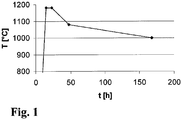
- the quartz glass cylinder is subjected to an annealing treatment, such as the temper profile T (t) of FIG. 1 in an embodiment shows.
- the quartz glass cylinder is heated within 15 hours to a temperature of 1180 ° C and held at this temperature in a first treatment phase for 8 hours under air and atmospheric pressure. Subsequently, the quartz glass cylinder is quenched with a high cooling rate of 4 ° C / h to a temperature of 1080 ° C.
- This cooling ramp thus has a total duration of 114 hours.
- the quartz glass cylinder thus treated has an outer diameter of 350 mm and a thickness of 60 mm.
- the quartz glass has a mean fictitious temperature of 1038 ° C. From the end faces of the quartz glass cylinder, a portion of the excess to the component contour is removed before the next treatment step, namely a thickness of 3 mm.
- the quartz glass cylinder in a pure hydrogen atmosphere at 380 ° C first at an absolute pressure of 2 bar for a period of 300 hours and then at the same temperature at a hydrogen partial pressure of 0 bar for a period of 25 h, and then at an absolute pressure of 0 , 1 bar held for a period of 850 hours.
- the quartz glass cylinder obtained thereafter is substantially free of chlorine, oxygen defect sites and SiH groups (below the detection limit of 5 ⁇ 10 16 molecules / cm 3 ), and it has a mean hydrogen content of 3 within a diameter of 280 mm (CA range) x 10 16 molecules / cm 3 , a mean hydroxyl group content of 30 ppm by weight and a mean fictitious temperature of 1038 ° C from.
- a plurality of quartz glass cylinders were produced by varying the annealing conditions of the first and second treatment phases.
- a variation of the annealing conditions is to cool during the second treatment phase to a temperature of 1050 ° C and then starting from this temperature in the temperature range up to 1080 ° C a cyclic sequence of sinusoidal heating and cooling ramps of 0.33 ° C / min and with to follow an amplitude of 30 ° C.
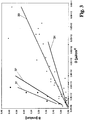
- the first term (t / ⁇ ) 1.5 describes the probability of a conversion of high-temperature phase into low-temperature phase and is thus a measure of the proportion of low-temperature phase in the respective quartz glass.
- the second term (Tf-Tf0) is a measure of the fictitious temperature of the quartz glass.
- the diagram of FIG. 2 shows that the model function for the compaction "fit", which takes into account these two influencing factors, scales with the actually measured compaction. That is, as the proportion of the low-temperature phase and the fictitious temperature increase, the sensitivity of the quartz glass samples with respect to an isotropic density change upon irradiation with linearly polarized laser light of a wavelength of 193 nm increases.
- the quartz glass sample whose preparation is explained in more detail above, is in FIG. 2 designated by the reference numeral 21.
- the corresponding radiation resistance of the quartz glass sample can be considered very good.
- quartz glass is significantly lower than other quartz glass qualities.
- Optical components made of a corresponding quartz glass grade are particularly suitable for use in a projection system of an immersion lithography exposure machine for the purpose of transmitting ultraviolet, pulsed and linearly polarized UV laser radiation of wavelength between 190 nm and 250 nm.
Landscapes
- Chemical & Material Sciences (AREA)
- Engineering & Computer Science (AREA)
- Organic Chemistry (AREA)
- Materials Engineering (AREA)
- Chemical Kinetics & Catalysis (AREA)
- Life Sciences & Earth Sciences (AREA)
- Physics & Mathematics (AREA)
- Thermal Sciences (AREA)
- General Chemical & Material Sciences (AREA)
- Geochemistry & Mineralogy (AREA)
- Manufacturing & Machinery (AREA)
- Glass Compositions (AREA)
- Glass Melting And Manufacturing (AREA)
- Preparing Plates And Mask In Photomechanical Process (AREA)
Claims (17)
- Procédé pour la fabrication d'un composant optique en verre de quartz synthétique avec une résistance aux rayonnements élevée destiné à être utilisé dans un appareil microlithograpique dans une longueurs d'ondes de travail inférieure à 250 nm, une ébauche de verre de quartz étant préparée avec une teneur en groupes hydroxyles comprise entre 5 et 50 ppm en poids et soumise à un traitement thermique multiphase qui comprend les étapes suivantes :(a) une première phase de traitement, pendant laquelle l'ébauche de verre de quartz est traitée à une plage de températures comprises entre 1130°C et 1230°C pendant une première durée de traitement,(b) un refroidissement de l'ébauche de verre de quartz avec une première vitesse de refroidissement moyenne à une température de trempe inférieure à 1100°C, une température fictive avec une valeur moyenne élevée égale ou supérieure à 1100°C étant établie dans le verre de quartz,(c) une seconde phase de traitement, où l'ébauche de verre de quartz est traitée dans une seconde durée de température dans une plage de températures comprises entre 950°C et 1100°C, de manière à obtenir une température fictive dont la valeur moyenne est inférieure d'au moins 50°C à la valeur moyenne élevée de la température fictive selon l'étape de procédé (b), et qui comprend un refroidissement de l'ébauche de verre de quartz à une seconde vitesse de refroidissement moyenne qui est inférieure à la première vitesse de refroidissement moyenne.
- Procédé selon la revendication 1, caractérisé en ce que la première phase de traitement comprend un tempérage dans la plage de températures comprises entre 1150°C et 1210°C.
- Procédé selon la revendication 1 ou 2, caractérisé en ce que la seconde phase de traitement comprend un tempérage dans la plage de températures comprises entre 1000°C et 1100°C.
- Procédé selon l'une des revendications précédentes, caractérisé en ce que la température de refroidissement est inférieure d'au moins 50°C de préférence d'au moins 80°C à la température de traitement dans la plage de température supérieure.
- Procédé selon l'une des revendications précédentes, caractérisé en ce que la température de refroidissement est inférieure à 1090°C, de préférence inférieure à 1070°C.
- Procédé selon l'une des revendications précédentes, caractérisé en ce que la première vitesse moyenne de refroidissement est au moins 1°C/h, de préférence 2°C/h, en particulier 4°C/h.
- Procédé selon l'une des revendications précédentes, caractérisé en ce que la seconde vitesse de refroidissement est inférieure à 1°C/h de préférence inférieure à 0,8°C/h.
- Procédé selon l'une des revendications précédentes, caractérisé en ce que la première vitesse moyenne de refroidissement est au moins le double de la seconde vitesse de refroidissement.
- Procédé selon l'une des revendications précédentes, caractérisé en ce que la seconde phase de traitement comprend une succession temporelle d'étapes de chauffage et de refroidissement dans la plage de température inférieure.
- Procédé selon l'une des revendications précédentes, caractérisé en ce que le traitement thermique multiphase comprend un tempérage ultérieure dans la plage de températures comprises entre 650°C et 850°C
- Procédé selon l'une des revendications précédentes, caractérisé en ce que la température fictive du verre de quartz à la fin du traitement thermique est inférieure à 1045°C, de préférence inférieure à 1035°C.
- Procédé selon l'une des revendications précédentes, caractérisé en ce que la première durée de traitement est d'au moins 5 heures.
- Procédé selon l'une des revendications précédentes, caractérisé en ce que la seconde durée de traitement est au moins de 100 heures et maximal 12 jours.
- Procédé selon l'une des revendications précédentes, caractérisé en ce que l'ébauche de verre de quartz est chargée d'hydrogène après le traitement thermique, la teneur moyenne en hydrogène du verre de quartz étant définie à une valeur comprise entre 5 x 10¹⁵ et 1 x 10¹⁷ molécule/cm3.
- Procédé selon l'une des revendications précédentes, caractérisé en ce que la teneur moyenne en groupes hydroxyles du verre de quartz est définie à une valeur comprise entre 10 et 35 ppm en poids.
- Ebauche en verre de quartz synthétique pour la fabrication d'un composant optique destiné à être utilisé un appareil microlithographique avec une longueur d'ondes de travail inférieure à 250 nm, le verre de quartz présentant en moyenne une température fictive inférieure à 1080°C, une teneur moyenne en groupes hydroxyles comprise entre 5 et 50 ppm en poids, ainsi qu'une teneur moyenne en hydrogène comprise entre 5 x 10¹⁵ et 1 x 10¹⁷ molécules/cm3, caractérisée en ce que l'ébauche est fabriquée selon un procédé de la revendication 14.
- Ebauche selon la revendication 16, caractérisée en ce que le verre de quartz présente en moyenne une température fictive inférieure à 1035°C et une teneur moyenne en groupes hydroxyles comprise entre 10 et 35 ppm en poids
Applications Claiming Priority (1)
| Application Number | Priority Date | Filing Date | Title |
|---|---|---|---|
| DE102007019154A DE102007019154B4 (de) | 2007-04-20 | 2007-04-20 | Verfahren zur Herstellung eines optischen Bauteils aus synthetischem Quarzglas mit erhöhter Strahlenbeständigkeit |
Publications (2)
| Publication Number | Publication Date |
|---|---|
| EP1982963A1 EP1982963A1 (fr) | 2008-10-22 |
| EP1982963B1 true EP1982963B1 (fr) | 2017-03-15 |
Family
ID=39638828
Family Applications (1)
| Application Number | Title | Priority Date | Filing Date |
|---|---|---|---|
| EP08154312.6A Active EP1982963B1 (fr) | 2007-04-20 | 2008-04-10 | Procedé de production d'un composant optique en verre quartzeux synthétique avec une résistance aux rayonnements élevée, et ébauche pour la production du composant |
Country Status (4)
| Country | Link |
|---|---|
| US (1) | US7980098B2 (fr) |
| EP (1) | EP1982963B1 (fr) |
| JP (1) | JP5117912B2 (fr) |
| DE (1) | DE102007019154B4 (fr) |
Families Citing this family (12)
| Publication number | Priority date | Publication date | Assignee | Title |
|---|---|---|---|---|
| US8263511B2 (en) * | 2008-12-31 | 2012-09-11 | Corning Incorporated | High purity fused silica with low absolute refractive index |
| US9067814B2 (en) * | 2009-01-19 | 2015-06-30 | Shin-Etsu Chemical Co., Ltd. | Method of producing synthetic quartz glass for excimer laser |
| DE102010005152B4 (de) | 2009-05-26 | 2013-04-04 | J-Plasma Gmbh | Verfahren zur Herstellung von solarisationsbeständigen Lichtwellenleitern aus Glasmaterialien mittels Faserziehprozess |
| CN102472980B (zh) * | 2009-08-18 | 2015-02-25 | 卡尔蔡司Smt有限责任公司 | 极紫外微光刻的基底与反射镜以及制造它们的方法 |
| US8713969B2 (en) * | 2009-08-31 | 2014-05-06 | Corning Incorporated | Tuning Tzc by the annealing of ultra low expansion glass |
| DE102010052685A1 (de) * | 2010-11-26 | 2012-05-31 | J-Fiber Gmbh | Verfahren zur Herstellung von strahlungsresistentem Quarzglasmaterial und danach hergestellte Quarzglaskörper |
| CN102515490B (zh) * | 2011-12-15 | 2014-03-05 | 航天科工惯性技术有限公司 | 一种石英摆片的稳定化处理工艺 |
| WO2014073389A1 (fr) * | 2012-11-08 | 2014-05-15 | Hoya株式会社 | Procédé de production d'une ébauche de masque et procédé de production d'un masque de transfert |
| JP6336792B2 (ja) * | 2013-04-25 | 2018-06-06 | Hoya株式会社 | マスクブランクの製造方法および転写用マスクの製造方法 |
| CN108383365B (zh) * | 2018-04-11 | 2020-09-15 | 中国建筑材料科学研究总院有限公司 | 一种石英玻璃的退火方法 |
| CN114427019A (zh) * | 2021-12-14 | 2022-05-03 | 中国电建集团上海能源装备有限公司 | 一种合金钢法兰槽热处理工艺 |
| CN115108713B (zh) * | 2022-06-15 | 2024-01-26 | 江苏亨芯石英科技有限公司 | 一种高光学均匀性石英玻璃的制备工艺 |
Family Cites Families (10)
| Publication number | Priority date | Publication date | Assignee | Title |
|---|---|---|---|---|
| US5086352A (en) * | 1989-06-09 | 1992-02-04 | Shin-Etsu Quartz Products Co., Ltd. | Optical members and blanks or synthetic silica glass and method for their production |
| KR100554091B1 (ko) * | 1997-12-08 | 2006-05-16 | 가부시키가이샤 니콘 | 엑시머레이저내성을향상시킨석영글래스의제조방법및석영글래스부재 |
| WO2001012566A1 (fr) | 1999-08-12 | 2001-02-22 | Nikon Corporation | Procede de preparation de silice vitreuse synthetique et appareil de traitement thermique |
| JP2002121038A (ja) * | 2000-10-10 | 2002-04-23 | Sumitomo Metal Ind Ltd | 合成石英ガラスの熱処理方法 |
| JP3582500B2 (ja) * | 2001-05-23 | 2004-10-27 | ウシオ電機株式会社 | 超高圧水銀ランプ |
| US7534733B2 (en) * | 2004-02-23 | 2009-05-19 | Corning Incorporated | Synthetic silica glass optical material having high resistance to laser induced damage |
| DE102004017031B4 (de) * | 2004-04-02 | 2008-10-23 | Heraeus Quarzglas Gmbh & Co. Kg | Optisches Bauteil aus Quarzglas, Verfahren zur Herstellung des Bauteils und Verwendung desselben |
| JP4826118B2 (ja) * | 2005-03-29 | 2011-11-30 | 旭硝子株式会社 | 合成石英ガラスの製造方法及び光学部材用合成石英ガラス |
| DE102005017752B4 (de) * | 2005-04-15 | 2016-08-04 | Heraeus Quarzglas Gmbh & Co. Kg | Optisches Bauteil aus Quarzglas, Verfahren zur Herstellung des Bauteils und Verwendung desselben |
| US7928026B2 (en) * | 2005-06-30 | 2011-04-19 | Corning Incorporated | Synthetic silica material with low fluence-dependent-transmission and method of making the same |
-
2007
- 2007-04-20 DE DE102007019154A patent/DE102007019154B4/de active Active
-
2008
- 2008-04-08 JP JP2008100081A patent/JP5117912B2/ja not_active Expired - Fee Related
- 2008-04-10 EP EP08154312.6A patent/EP1982963B1/fr active Active
- 2008-04-18 US US12/148,338 patent/US7980098B2/en active Active
Non-Patent Citations (1)
| Title |
|---|
| None * |
Also Published As
| Publication number | Publication date |
|---|---|
| US20090004088A1 (en) | 2009-01-01 |
| US7980098B2 (en) | 2011-07-19 |
| JP2008285400A (ja) | 2008-11-27 |
| DE102007019154B4 (de) | 2012-07-26 |
| EP1982963A1 (fr) | 2008-10-22 |
| JP5117912B2 (ja) | 2013-01-16 |
| DE102007019154A1 (de) | 2008-10-23 |
Similar Documents
| Publication | Publication Date | Title |
|---|---|---|
| DE102007019154B4 (de) | Verfahren zur Herstellung eines optischen Bauteils aus synthetischem Quarzglas mit erhöhter Strahlenbeständigkeit | |
| DE60033481T2 (de) | Optischer Werkstoff aus Quarzglas für Excimer Laser und Excimer Lampe, und Verfahren zu dessen Herstellung | |
| DE69015453T3 (de) | Optische Teile und Rohlinge aus synthetischem Siliziumdioxidglas und Verfahren zu ihrer Herstellung. | |
| DE69816758T2 (de) | Synthetisches quarzglas zur verwendung in uv-strahlung und verfahren zu seiner herstellung | |
| DE69118101T2 (de) | Optisches Bauteil aus hochreinem und transparentem, synthetischem Quarzglas und Verfahren zu seiner Herstellung und sein Rohling | |
| DE102009055326B4 (de) | Hochreines Quarzglas mit niedrigem absolutem Brechungsindex | |
| DE102004017031B4 (de) | Optisches Bauteil aus Quarzglas, Verfahren zur Herstellung des Bauteils und Verwendung desselben | |
| EP2958869B1 (fr) | Composant optique en verre de quartz destiné à être utilisé en lithographie par laser à excimère ar-f et procédé de fabrication dudit composant | |
| DE60015684T2 (de) | Optisches Element aus Quarzglas zum Durchlassen von Fluor-Excimer-Laserstrahlung und Verfahren zu seiner Herstellung | |
| EP1712528B1 (fr) | Composant optique en verre quartzeux , son procede de production et son utilisation | |
| DE102007017004A1 (de) | Optisches Bauteil aus synthetischem Quarzglas mit erhöhter Strahlenbeständigkeit, sowie Verfahren zur Herstellung des Bauteils | |
| EP3033306B1 (fr) | Procédé de production de verre de silice dopé au titane pour utilisation en lithographie euv | |
| DE10159961C2 (de) | Quarzglasrohling für ein optisches Bauteil sowie Verfahren zur Herstellung und Verwendung desselben | |
| EP1327612B1 (fr) | Ebauche en verre de silice pour la fabrication d'un element optique ainsi que sa preparation et application de celle-ci | |
| EP3000791B1 (fr) | Procédé de fabrication d'une ébauche en verre contenant de l'acide silicique à haute densité, du fluor et doté de titane pour l'utilisation dans la lithographie EUV et ébauche ainsi obtenue | |
| DE29813318U1 (de) | Optisches Bauteil | |
| EP1327613B1 (fr) | Ebauche en verre de silice pour la fabrication d'un element optique et application de celle-ci | |
| DE102010009589B4 (de) | Verfahren zur Herstellung eines Rohlings aus Titan-dotiertem, hochkieselsäurehaltigem Glas für ein Spiegelsubstrat für den Einsatz in der EUV-Lithographie | |
| DE69909983T2 (de) | Synthetische, optische quarzglas-elemente und verfahren zur herstellung derselben | |
| EP1101741A2 (fr) | Corp en verre de quartz pour un élément optique et procédé de sa fabrication | |
| EP0999190A2 (fr) | Verre de coeur pour une préforme de fibre optique, une préforme realisée avec le verre de coeur et procédés de fabrication du verre de coeur et d'une fibre optique | |
| WO2000015570A1 (fr) | Composant optique en verre quartzeux et son procede de production | |
| DE102004009577B3 (de) | Verfahren zur Herstellung eines optischen Bauteils | |
| WO2012069382A1 (fr) | Procédé pour la fabrication de matériau en verre de quartz résistant au rayonnement et corps en verre de quartz fabriqué selon ce procédé |
Legal Events
| Date | Code | Title | Description |
|---|---|---|---|
| PUAI | Public reference made under article 153(3) epc to a published international application that has entered the european phase |
Free format text: ORIGINAL CODE: 0009012 |
|
| AK | Designated contracting states |
Kind code of ref document: A1 Designated state(s): AT BE BG CH CY CZ DE DK EE ES FI FR GB GR HR HU IE IS IT LI LT LU LV MC MT NL NO PL PT RO SE SI SK TR |
|
| AX | Request for extension of the european patent |
Extension state: AL BA MK RS |
|
| 17P | Request for examination filed |
Effective date: 20090305 |
|
| 17Q | First examination report despatched |
Effective date: 20090415 |
|
| AKX | Designation fees paid |
Designated state(s): DE FR GB |
|
| REG | Reference to a national code |
Ref country code: DE Ref legal event code: R079 Ref document number: 502008015117 Country of ref document: DE Free format text: PREVIOUS MAIN CLASS: C03B0020000000 Ipc: C03B0019140000 |
|
| RIC1 | Information provided on ipc code assigned before grant |
Ipc: C03B 19/14 20060101AFI20160831BHEP Ipc: C03B 32/00 20060101ALI20160831BHEP Ipc: C03C 4/00 20060101ALI20160831BHEP Ipc: C03B 25/02 20060101ALI20160831BHEP Ipc: C03C 3/06 20060101ALI20160831BHEP |
|
| GRAP | Despatch of communication of intention to grant a patent |
Free format text: ORIGINAL CODE: EPIDOSNIGR1 |
|
| INTG | Intention to grant announced |
Effective date: 20161024 |
|
| GRAS | Grant fee paid |
Free format text: ORIGINAL CODE: EPIDOSNIGR3 |
|
| GRAA | (expected) grant |
Free format text: ORIGINAL CODE: 0009210 |
|
| AK | Designated contracting states |
Kind code of ref document: B1 Designated state(s): DE FR GB |
|
| REG | Reference to a national code |
Ref country code: GB Ref legal event code: FG4D Free format text: NOT ENGLISH |
|
| REG | Reference to a national code |
Ref country code: FR Ref legal event code: PLFP Year of fee payment: 10 |
|
| REG | Reference to a national code |
Ref country code: DE Ref legal event code: R096 Ref document number: 502008015117 Country of ref document: DE |
|
| REG | Reference to a national code |
Ref country code: DE Ref legal event code: R097 Ref document number: 502008015117 Country of ref document: DE |
|
| PLBE | No opposition filed within time limit |
Free format text: ORIGINAL CODE: 0009261 |
|
| STAA | Information on the status of an ep patent application or granted ep patent |
Free format text: STATUS: NO OPPOSITION FILED WITHIN TIME LIMIT |
|
| 26N | No opposition filed |
Effective date: 20171218 |
|
| GBPC | Gb: european patent ceased through non-payment of renewal fee |
Effective date: 20170615 |
|
| REG | Reference to a national code |
Ref country code: FR Ref legal event code: PLFP Year of fee payment: 11 |
|
| PG25 | Lapsed in a contracting state [announced via postgrant information from national office to epo] |
Ref country code: GB Free format text: LAPSE BECAUSE OF NON-PAYMENT OF DUE FEES Effective date: 20170615 |
|
| PGFP | Annual fee paid to national office [announced via postgrant information from national office to epo] |
Ref country code: FR Payment date: 20200420 Year of fee payment: 13 |
|
| PG25 | Lapsed in a contracting state [announced via postgrant information from national office to epo] |
Ref country code: FR Free format text: LAPSE BECAUSE OF NON-PAYMENT OF DUE FEES Effective date: 20210430 |
|
| P01 | Opt-out of the competence of the unified patent court (upc) registered |
Effective date: 20230530 |
|
| REG | Reference to a national code |
Ref country code: DE Ref legal event code: R082 Ref document number: 502008015117 Country of ref document: DE Representative=s name: BRAND, NORMEN, DR. RER. NAT., DE |
|
| PGFP | Annual fee paid to national office [announced via postgrant information from national office to epo] |
Ref country code: DE Payment date: 20250422 Year of fee payment: 18 |