EP1972516B2 - Procédé et servomoteur destinés à détecter le freinage d'un véhicule et procédé de fabrication d'un tel servomoteur - Google Patents
Procédé et servomoteur destinés à détecter le freinage d'un véhicule et procédé de fabrication d'un tel servomoteur Download PDFInfo
- Publication number
- EP1972516B2 EP1972516B2 EP08101847.5A EP08101847A EP1972516B2 EP 1972516 B2 EP1972516 B2 EP 1972516B2 EP 08101847 A EP08101847 A EP 08101847A EP 1972516 B2 EP1972516 B2 EP 1972516B2
- Authority
- EP
- European Patent Office
- Prior art keywords
- sensor
- plunger
- master cylinder
- braking
- casing
- Prior art date
- Legal status (The legal status is an assumption and is not a legal conclusion. Google has not performed a legal analysis and makes no representation as to the accuracy of the status listed.)
- Active
Links
Images


Classifications
-
- B—PERFORMING OPERATIONS; TRANSPORTING
- B60—VEHICLES IN GENERAL
- B60T—VEHICLE BRAKE CONTROL SYSTEMS OR PARTS THEREOF; BRAKE CONTROL SYSTEMS OR PARTS THEREOF, IN GENERAL; ARRANGEMENT OF BRAKING ELEMENTS ON VEHICLES IN GENERAL; PORTABLE DEVICES FOR PREVENTING UNWANTED MOVEMENT OF VEHICLES; VEHICLE MODIFICATIONS TO FACILITATE COOLING OF BRAKES
- B60T13/00—Transmitting braking action from initiating means to ultimate brake actuator with power assistance or drive; Brake systems incorporating such transmitting means, e.g. air-pressure brake systems
- B60T13/10—Transmitting braking action from initiating means to ultimate brake actuator with power assistance or drive; Brake systems incorporating such transmitting means, e.g. air-pressure brake systems with fluid assistance, drive, or release
- B60T13/24—Transmitting braking action from initiating means to ultimate brake actuator with power assistance or drive; Brake systems incorporating such transmitting means, e.g. air-pressure brake systems with fluid assistance, drive, or release the fluid being gaseous
- B60T13/46—Vacuum systems
- B60T13/52—Vacuum systems indirect, i.e. vacuum booster units
-
- B—PERFORMING OPERATIONS; TRANSPORTING
- B60—VEHICLES IN GENERAL
- B60T—VEHICLE BRAKE CONTROL SYSTEMS OR PARTS THEREOF; BRAKE CONTROL SYSTEMS OR PARTS THEREOF, IN GENERAL; ARRANGEMENT OF BRAKING ELEMENTS ON VEHICLES IN GENERAL; PORTABLE DEVICES FOR PREVENTING UNWANTED MOVEMENT OF VEHICLES; VEHICLE MODIFICATIONS TO FACILITATE COOLING OF BRAKES
- B60T11/00—Transmitting braking action from initiating means to ultimate brake actuator without power assistance or drive or where such assistance or drive is irrelevant
- B60T11/10—Transmitting braking action from initiating means to ultimate brake actuator without power assistance or drive or where such assistance or drive is irrelevant transmitting by fluid means, e.g. hydraulic
- B60T11/16—Master control, e.g. master cylinders
-
- G—PHYSICS
- G01—MEASURING; TESTING
- G01D—MEASURING NOT SPECIALLY ADAPTED FOR A SPECIFIC VARIABLE; ARRANGEMENTS FOR MEASURING TWO OR MORE VARIABLES NOT COVERED IN A SINGLE OTHER SUBCLASS; TARIFF METERING APPARATUS; MEASURING OR TESTING NOT OTHERWISE PROVIDED FOR
- G01D5/00—Mechanical means for transferring the output of a sensing member; Means for converting the output of a sensing member to another variable where the form or nature of the sensing member does not constrain the means for converting; Transducers not specially adapted for a specific variable
- G01D5/12—Mechanical means for transferring the output of a sensing member; Means for converting the output of a sensing member to another variable where the form or nature of the sensing member does not constrain the means for converting; Transducers not specially adapted for a specific variable using electric or magnetic means
- G01D5/25—Selecting one or more conductors or channels from a plurality of conductors or channels, e.g. by closing contacts
- G01D5/251—Selecting one or more conductors or channels from a plurality of conductors or channels, e.g. by closing contacts one conductor or channel
- G01D5/2515—Selecting one or more conductors or channels from a plurality of conductors or channels, e.g. by closing contacts one conductor or channel with magnetically controlled switches, e.g. by movement of a magnet
Definitions
- the present invention relates to a method for detecting the braking of a vehicle.
- a device 100 ( figure 1 ) braking of a vehicle is generally controlled by a driver by means of a brake pedal 102 intended to transmit the control force f exerted on this pedal 102 to a braking system 113 comprising, for example, a caliper equipped with a piston and brake pads intended to clamp a disc integral with a braked wheel.
- a pneumatic brake booster 104 To amplify the force f exerted by this conductor into a force F transmitted to the braking system, it is known to use a pneumatic brake booster 104 .
- this booster 104 comprises a housing 106, cooperating with a control rod 108, connected to the brake pedal 102, and with a push rod 110 connected to a master cylinder 112 connected to the braking system 113, so so that when the control rod 108 is moved by means of an action f transmitted by the brake pedal 102, the booster 106 moves the rod 110 by means of a thrust F of an intensity greater than the intensity of the command f.
- the housing 106 comprises a cover 114 and a cylinder 116 cooperating with this cover 114 in a sealed manner, the internal volume of the housing 106 then being divided into a first chamber 118, called the rear chamber, and into a second chamber 120, said front chamber, by means of a rigid skirt 122 and a flexible membrane 124 ensuring the seal between these two chambers 118 and 120.
- the pressure in the rear 118 and front 120 chambers is maintained below atmospheric pressure at the means of a pumping device not shown.
- control rod 108 moves by the action of the control f and activates a pneumatic mechanism 126 so that an air intake at atmospheric pressure takes place in the rear chamber 118.
- the pressure in the rear chamber 118 being greater than the pressure in the front chamber 120, the membrane 122 and the skirt 124 are subjected to a thrust F of an intensity equal to ⁇ P ⁇ S where ⁇ P is the difference in pressure between the two chambers and S the surface of the membrane.
- the detection of braking is an essential operation in a vehicle, for example to generate a signal intended to turn on brake lights at the rear of the vehicle, thus indicating to other vehicles the start of braking, or to activate various electronic systems linked to braking, such as the Anti Blocking System (ABS).
- ABS Anti Blocking System
- Such detection currently uses a sensor 128 of the displacement of the brake pedal 102 which comprises a first fixed connector 130a and a second connector 130b movable on the pedal so that the latter comes into contact with the first, closing an electrical circuit, when the driver presses the brake pedal 102.
- WO 02/066307 A discloses a method for detecting braking of a vehicle equipped with a master cylinder and a primary piston. The present invention results from the observation of various problems raised by the braking detection method according to the prior art.
- DE 32 40680 A1 discloses a braking detection method according to the preamble of claim 1.
- a first problem resides in the fact that the current sensor 128 is a mechanical contact sensor which therefore presents significant wear and, consequently, an increasing risk of failures over time.
- a second problem results from the fact that, during the manufacture of the vehicle, it is necessary to carry out a specific mounting of the sensor 128, of its connectors 130a and 130b and of the cables associated with these elements (not shown) below the pedal 102 brake, which represents a cost in production time specific to the assembly of these various elements.
- the invention solves at least one of these problems. It relates to a braking detection method according to claim 1.
- the braking detection device of the vehicle is integrated into the booster in such a way that this function no longer requires assembly and specific adjustments on the assembly line of the vehicle, thus reducing the cost of assembly of this device. detection in the vehicle.
- the invention allows the use of sensors without contacts vis-à-vis which there is no longer mechanical wear so that the life of the detector and its reliability are improved.
- the problem of interoperability of the various systems is reduced in the event of breakdowns or subsequent changes by integrating the device braking detection in the booster because the distribution of parts between the passenger compartment and the engine no longer requires the use of a given type of device.
- the needle slides in a housing of the master cylinder.
- the needle is secured to the plate by means of a spring with contiguous coils making it possible to correct coaxiality defects linked to the construction of the assembly.
- the senor uses a flexible blade switch sensitive to a magnetic field which varies according to the movement of the needle.
- the senor uses the Hall effect to detect a movement of the needle.
- the needle generates a magnetic field in its end close to the sensor, this sensor being sensitive to the magnetic field of the needle.
- the senor is a contactor sensor comprising a movable control of a switch, the needle coming into contact with the control when the needle moves.
- the senor is located in a casing arranged in the master cylinder.
- the case is sealed.
- the housing is positioned relative to the master cylinder by means of at least one rail of the master cylinder and an abutment on this rail, the rail and the abutment making it possible to ensure axial positioning without play .
- the box is fixed to the rail by means of an elastic clip encircling the box.
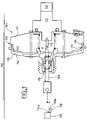
- a booster 250 according to the invention, that is to say comprising a needle 220 associated with the movement of the push rod 200 of the booster, this rod 200 being similar to the push rod 110 described in figure 1 .
- the braking detection method of a vehicle is provided with a master cylinder 202, 400 and a primary piston 200, characterized in that a needle 220,305,404 is used, arranged parallel to the primary piston 200 so as to reproduce the displacements of the primary piston 200, and a displacement sensor 230,300 of the needle 220,305,404, to detect braking.
- the piston 200 is provided with a plate 210, for example made of plastic, which allows the needle 220 to be placed parallel to the piston 200.
- the needle 220 is kept parallel to the piston 200 thanks to a housing 222 of the master cylinder providing a vacuum seal between the needle 220 and the housing 222, in which the needle 220 slides.
- a sensor 230 of the movements of the needle 220 is integrated in a casing 232 associated with the master cylinder 202 of the booster so that the needle 222 slides in this casing 232, in the vicinity of the detector 230, during its movements.
- the sensor 230 integrated in the case 232 can be a flexible reed switch, hereinafter referred to as an I.L.S. switch, comprising two metal reeds, facing each other, sensitive to a magnetic field and forming a detection circuit.
- an I.L.S. switch comprising two metal reeds, facing each other, sensitive to a magnetic field and forming a detection circuit.
- these metal blades are such that, depending on whether they are in the presence or absence of a magnetic field, they come into contact, closing the detection circuit, or they remain distant, opening the detection circuit, the one from the other.
- the needle 220 is magnetized at its sliding end in the vicinity of the detector 230, it appears that, depending on the position of the end of the needle relative to the blades, these are either in contact when the needle 222 s approach, or distant when the needle 222 moves away.
- a variable current is obtained at the output of the ILS sensor 230 as a function of the position of the needle 220, that is to say as a function of the position of the piston 200 and, consequently, of the command of braking.
- the box 232 comprises a mechanical sensor contactor, or "micro-switch in English", described in detail below using the figures 3a and 3b .
- such a sensor 300 has been shown at rest on the picture 3a , that is to say when no braking is commanded.
- this sensor 300 comprises an electrical circuit 320 as well as a switch 302 which, when the needle 305 is kept remote, keeps the circuit open so that no current can flow through the circuit 320.
- the current flowing through circuit 320 is used in this embodiment as an easily detectable braking signal, this current being zero when no braking is commanded and non-zero when such braking is performed.
- this arrangement can be easily exchanged so as to have a non-zero current at rest and a zero current in the event of braking.
- the senor 230 integrated in the housing 232 uses the Hall effect to detect the movement of the needle, the latter being magnetized as in the first embodiment.
- the casing must be particularly resistant to the difficult conditions of the engine compartment, namely the high temperature and the need for strong sealing, vis-à-vis an intense jet of cleaning liquid.
- this case is made of polyamide 66, comprising 30% glass, a material known for its thermal resistance and sealing properties.
- the needle is made of rigid plastic.
- the figure 4 shows a three-dimensional view of one embodiment of the arrangement of a housing 402, containing a sensor not shown, of a needle 404 and of a plate 406 (equivalent to the plate 210 of the figure 2 ) to a master cylinder 400.
- the plate 406 is made of plastic. It includes elastic lugs 408 allowing it to be snapped into the groove of the primary piston.
- the needle 404 is connected to the plate 406, at a conical projection 410 of the plate 406, via a helical spring 412 with contiguous turns.
- the diameter of the spring 412 is slightly smaller than the diameter of the projection 410 of the plate on which it is screwed in force or fits.
- the sensor (regardless of its type) is soldered or glued to the housing 402.
- Housing 402 is fixed to master cylinder 400 by means of a clip 414 or elastic curved blade, placed in force according to arrow 420 and which surrounds housing 402 to rest on two rails 416 of master cylinder 400.
- the housing 402 is immobilized parallel to the axis of the master cylinder 400 and perpendicular to this axis.
- the rail(s) 416 and the stop allowing to ensure an axial positioning without play of the housing on the master cylinder 400.
- the present invention is susceptible of many variants depending on various parameters such as, for example and without limitation, the choice of the type of sensor 230, the choice passing or open of the circuit crossing the sensor 230 according to the detection or not of braking and the positioning of the sensor 230 along the body of the master cylinder.
Landscapes
- Engineering & Computer Science (AREA)
- Transportation (AREA)
- Mechanical Engineering (AREA)
- Physics & Mathematics (AREA)
- General Physics & Mathematics (AREA)
- Braking Systems And Boosters (AREA)
- Transmission Of Braking Force In Braking Systems (AREA)
- Braking Arrangements (AREA)
- Braking Elements And Transmission Devices (AREA)
- Measurement Of Length, Angles, Or The Like Using Electric Or Magnetic Means (AREA)
- Regulating Braking Force (AREA)
- Automobile Manufacture Line, Endless Track Vehicle, Trailer (AREA)
Description
- La présente invention se rapporte à un procédé destiné à détecter le freinage d'un véhicule.
- Un dispositif 100 (
figure 1 ) de freinage d'un véhicule est généralement commandé par un conducteur au moyen d'une pédale 102 de frein destinée à transmettre la force f de commande exercée sur cette pédale 102 jusqu'à un système de freinage 113 comprenant, par exemple, un étrier équipé d'un piston et de plaquettes de frein destinées à serrer un disque solidaire d'une roue freinée. - Pour amplifier la force f exercée par ce conducteur en une force F transmise au système de freinage, il est connu d'utiliser un servomoteur 104 pneumatique d'assistance au freinage.
- Pour cela, ce servomoteur 104 comporte un boîtier 106, coopérant avec une tige 108 de commande, reliée à la pédale 102 de frein, et avec une tige 110 de poussée reliée à un maître-cylindre 112 relié au système 113 de freinage, de telle sorte que lorsque la tige 108 de commande est déplacée au moyen d'une action f transmise par la pédale 102 de frein, le servomoteur 106 déplace la tige 110 au moyen d'une poussée F d'intensité supérieure à l'intensité de la commande f.
- A cet effet, le boîtier 106 comprend un couvercle 114 et un cylindre 116 coopérant avec ce couvercle 114 de manière étanche, le volume interne du boîtier 106 étant alors divisé en une première chambre 118, dite chambre arrière, et en une deuxième chambre 120, dite chambre avant, au moyen d'une jupe rigide 122 et d'une membrane 124 flexible assurant l'étanchéité entre ces deux chambres 118 et 120.
- Dans un premier temps, lorsque le servomoteur 104 est inactif, c'est-à-dire lorsque aucun freinage n'est sollicité par le conducteur du véhicule, la pression dans les chambres arrière 118 et avant 120 est maintenue inférieure à la pression atmosphérique au moyen d'un dispositif de pompage non représenté.
- Dans un deuxième temps, lorsque le conducteur du véhicule appuie sur la pédale 102 de frein, la tige 108 de commande se déplace par l'action de la commande f et active un mécanisme 126 pneumatique de telle sorte qu'une entrée d'air à pression atmosphérique s'effectue dans la chambre arrière 118.
- La pression dans la chambre arrière 118 étant supérieure à la pression dans la chambre avant 120, la membrane 122 et la jupe 124 sont soumises à une poussée F d'intensité égale à ΔP×S où ΔP est l'écart de pression entre les deux chambres et S la surface de la membrane.
- Le déplacement de la jupe 122, et de la tige 110 associée, transmet ainsi une poussée F au maître-cylindre 112 associé au système de freinage.
- Par ailleurs, la détection d'un freinage est une opération essentielle dans un véhicule, par exemple pour générer un signal destiné à allumer des feux de stop à l'arrière du véhicule, indiquant ainsi à d'autres véhicules le début du freinage, ou pour activer différentes systèmes électroniques liés au freinage, tel que l'Anti Blocking System (ABS).
- Une telle détection utilise actuellement un capteur 128 de déplacement de la pédale 102 de frein qui comprend un premier connecteur 130a fixe et un second connecteur 130b mobile sur la pédale de telle sorte que cette dernière vienne au contact de la première, fermant un circuit électrique, lorsque le conducteur appuie sur la pédale 102 de frein.
WO 02/066307 A DE 32 40680 A1 révèle un procédé de détection de freinage selon le préambule de la revendication 1. - Un premier problème réside dans le fait que le capteur 128 actuel est un capteur à contact mécanique qui présente donc une usure significative et, par conséquent, un risque de défaillances croissant avec le temps.
- Un deuxième problème résulte du fait que, lors de la fabrication du véhicule, il est nécessaire d'effectuer un montage spécifique du capteur 128, de ses connecteurs 130a et 130b et des câbles associés à ces éléments (non représentés) en dessous de la pédale 102 de frein, ce qui représente un coût en temps de production propre au montage de ces différents éléments.
- De plus, ces montages, et les réglages postérieurs de ces éléments, sont particulièrement pénibles et difficiles pour les personnes chargées de ce travail étant donnée la position de la pédale de frein, si tuée dans un espace restreint et d'accès difficile en bas de l'habitacle du véhicule.
- L'invention résout au moins un de ces problèmes. Elle concerne un procédé de détection de freinage selon la revendication 1.
- Grâce à l'invention, le dispositif de détection de freinage du véhicule est intégré au servomoteur de telle sorte que cette fonction ne nécessite plus de montage et de réglages propres sur la chaîne de montage du véhicule, réduisant ainsi le coût de montage de ce dispositif de détection dans le véhicule.
- L'invention permet utilisation de capteurs sans contacts vis-à-vis desquels il ne se produit plus d'usure mécanique de telle sorte que la durée de vie du détecteur et sa fiabilité sont améliorées.
- Par ailleurs, on diminue la problématique d'interopérabilité des différents systèmes en cas de pannes ou de changements ultérieurs en intégrant le dispositif de détection de freinage dans le servomoteur car la distribution de pièces entre l'habitacle et le moteur n'impose plus l'utilisation d'un type de dispositif donné.
- Enfin, on élimine aussi les efforts particulièrement pénibles sur la chaîne de montage relatifs à la position du dispositif de détection qui n'est plus située dans un espace d'accès difficile dans l'habitacle conducteur.
- Dans une réalisation, le pointeau coulisse dans un logement du maître cylindre.
- Dans une réalisation, le pointeau est solidaire du plateau par l'intermédiaire d'un ressort à spires jointives permettant de corriger les défauts de coaxialité liés à la construction de l'ensemble.
- Dans une réalisation, le capteur utilise un interrupteur à lame souple sensible à un champ magnétique qui varie en fonction du déplacement du pointeau.
- Selon une réalisation, le capteur utilise l'effet Hall pour détecter un déplacement du pointeau.
- Dans une réalisation, le pointeau génère un champ magnétique dans son extrémité proche du capteur, ce capteur étant sensible au champ magnétique du pointeau.
- Selon une réalisation, le capteur est un capteur à contacteur comprenant une commande mobile d'un interrupteur, le pointeau venant en contact de la commande lorsque le pointeau se déplace.
- Dans une réalisation, le capteur est situé dans un boîtier agencé au maître cylindre.
- Selon une réalisation, le boîtier est étanche.
- Dans une réalisation, le boîtier est positionné par rapport au maître cylindre par l'intermédiaire d'au moins un rail du maître-cylindre et d'une butée sur ce rail, le rail et la butée permettant d'assurer un positionnement axial sans jeu.
- Selon une réalisation, le boîtier est fixé au rail par l'intermédiaire d'une pince élastique ceinturant le boîtier.
- D'autres caractéristiques et avantages de l'invention apparaîtront avec la description effectuée ci-dessous, à titre non limitatif, en référence aux figures ci-jointes sur lesquelles :
- La
figure 1 , déjà décrite ci-dessus, est un schéma du fonctionnement d'un dispositif de freinage connu, - La
figure 2 représente une coupe axiale schématique d'un servomoteur conforme à l'invention, et - Les
figures 3a et 3b représentent une réalisation d'un capteur mécanique mis en oeuvre dans le servomoteur décrit à lafigure 2 . - La
figure 4 représente une vue en trois dimensions d'une réalisation de l'agencement d'un boîtier 402, contenant un capteur non représenté, d'un pointeau 404 et d'un plateau 406 (équivalent au plateau 210 de lafigure 2 ) à un maître cylindre 400. Le plateau 406 est réalisé en matière plastique. Il comprend des pattes 408 élastiques permettant de l'encliqueter dans la gorge du piston primaire. - Sur la
figure 2 est représenté un servomoteur 250 conforme à l'invention, c'est-à-dire comprenant un pointeau 220 associé au mouvement de la tige 200 de poussée du servomoteur, cette tige 200 étant analogue à la tige 110 de poussée décrite à lafigure 1 . - Selon l'invention, le procédé de détection de freinage d'un véhicule est muni d'un maître cylindre 202, 400 et d'un piston primaire 200, caractérisé en ce qu'on utilise un pointeau 220,305,404, agencé parallèlement au piston primaire 200 de façon à reproduire les déplacements du piston primaire 200, et un capteur 230,300 de déplacement du pointeau 220,305,404, pour détecter un freinage.
- Pour cela, le piston 200 est muni d'un plateau 210, par exemple en plastique, qui permet de disposer le pointeau 220 parallèlement au piston 200.
- En outre, le pointeau 220 est maintenu parallèle au piston 200 grâce à un logement 222 du maître cylindre réalisant une étanchéité au vide entre le pointeau 220 et le logement 222, dans lequel coulisse le pointeau 220.
- Par ailleurs, un capteur 230 des déplacements du pointeau 220 est intégré dans un boîtier 232 associé au maître cylindre 202 du servomoteur de telle sorte que le pointeau 222 coulisse dans ce boîtier 232, au voisinage du détecteur 230, lors de ses déplacements.
- Le capteur 230 intégré dans le boîtier 232 peut être un interrupteur à lame souple, dénommé par la suite interrupteur I.L.S., comprenant deux lames métalliques, en vis-à-vis, sensibles à un champs magnétique et formant un circuit de détection.
- Plus précisément, ces lames métalliques sont telles que, selon qu'elles soient en présence ou en absence d'un champ magnétique, elles viennent en contact, fermant le circuit de détection, ou elles restent distantes, ouvrant le circuit de détection, l'une de l'autre.
- Ainsi, en considérant que le pointeau 220 est aimanté à son extrémité coulissant au voisinage du détecteur 230, il apparaît que, selon la position de l'extrémité du pointeau par rapport aux lames, celles-ci sont soit en contact lorsque le pointeau 222 s'approche, soit distantes lorsque le pointeau 222 s'éloigne.
- En d'autres termes, un courant variable est obtenu en sortie du capteur ILS 230 en fonction de la position du pointeau 220, c'est-à-dire en fonction de la position du piston 200 et, par conséquent, de la commande d'un freinage.
- Dans une autre réalisation, le boîtier 232 comprend un capteur mécanique à contacteur, ou « micro-switch en anglais », décrit en détail ci-dessous à l'aide des
figures 3a et 3b . - Plus précisément, on a représenté un tel capteur 300 au repos sur la
figure 3a , c'est-à-dire lorsque aucun freinage n'est commandé. - Il apparaît que ce capteur 300 comprend un circuit électrique 320 ainsi qu'un interrupteur 302 qui, lorsque le pointeau 305 est maintenu distant, maintient le circuit ouvert de telle sorte qu'aucun courant ne peut parcourir le circuit 320.
- Inversement, lorsqu'un freinage est commandé (
figure 3b ), l'extrémité 305 du pointeau vient au contact d'une commande 310 de l'interrupteur 302 qui ferme alors le circuit 320, permettant le passage du courant dans ce dernier. - Ainsi, le courant qui traverse le circuit 320 est utilisé dans cette réalisation comme un signal de freinage aisément détectable, ce courant étant nul lorsque aucun freinage n'est commandé et non nul lorsqu'un tel freinage est effectué.
- Toutefois, il convient de signaler que cette disposition peut être facilement échangée de façon à disposer d'un courant non nul au repos et d'un courant nul en cas de freinage.
- Dans une troisième réalisation, le capteur 230 intégré dans le boîtier 232 utilise l'effet Hall pour détecter le déplacement du pointeau, ce dernier étant aimanté comme dans la première réalisation.
- Il convient de noter que le boîtier doit être particulièrement résistant aux conditions difficiles du compartiment moteur, à savoir la température élevée et la nécessité d'une étanchéité forte, par vis-à-vis d'un jet de liquide intense de nettoyage.
- C'est pourquoi, dans une réalisation, ce boîtier est en polyamide 66, comprenant 30% de verre, matériau connu pour ses propriétés de résistances thermiques et d'étanchéité.
- Par ailleurs, le pointeau est en plastique rigide.
- La
figure 4 représente une vue en trois dimensions d'une réalisation de l'agencement d'un boîtier 402, contenant un capteur non représenté, d'un pointeau 404 et d'un plateau 406 (équivalent au plateau 210 de lafigure 2 ) à un maître cylindre 400. Le plateau 406 est réalisé en matière plastique. Il comprend des pattes 408 élastiques permettant de l'encliqueter dans la gorge du piston primaire. - Le pointeau 404 est relié au plateau 406, au niveau d'une saillie 410 conique du plateau 406, par l'intermédiaire d'un ressort 412 hélicoïdal à spires jointives. Le diamètre du ressort 412 est légèrement inférieur au diamètre de la saillie 410 du plateau sur laquelle il se visse en force ou s'ajuste.
- Ce ressort 412 réalise deux fonctions :
- Réglage de la course du pointeau 404 : comme il faut ajuster la course du pointeau 404 de façon à bien régler sa coopération avec le capteur, il suffit alors d'effectuer ce réglage en vissant ou en ajustant plus ou moins le ressort 412 sur la saillie 410.
- Alignement : ce ressort 412 peut travailler perpendiculairement à son axe grâce à son élasticité pour ainsi pouvoir corriger tout le long de la vie utile du maître cylindre 400 d'éventuels légers défauts d'alignements entre la saillie 410 du plateau 406, le logement du maître-cylindre 400 que traverse le pointeau 404 et l'entrée du boîtier 402 contenant le capteur.
- Le capteur (indépendamment de son type) est soudé ou collé au boîtier 402.
- Le boîtier 402 est fixé sur le maître cylindre 400 grâce à une pince 414 ou lame recourbée élastique, placée en force selon la flèche 420 et qui ceinture le boîtier 402 pour reposer sur deux rails 416 du maître cylindre 400.
- Ensuite, il est possible de faire coulisser (selon la flèche 418) le boîtier 402 jusqu'à une butée du maître cylindre 400 pour placer au mieux le boîtier en vue de respecter l'alignement plateau 406, pointeau 404 et boîtier 402.
- Ainsi, le boîtier 402 est immobilisé parallèlement à l'axe du maître cylindre 400 et perpendiculairement à cet axe.
- Le ou les rails 416 et la butée permettant d'assurer un positionnement axial sans jeu du boîtier sur le maître cylindre 400.
- La présente invention est susceptible de nombreuses variantes en fonction de divers paramètres comme, par exemple et sans limitation, le choix du type de capteur 230, le choix passant ou ouvert du circuit traversant le capteur 230 selon la détection ou pas de freinage et le positionnement du capteur 230 le long du corps du maître cylindre.
Claims (11)
- Procédé de détection de freinage d'un véhicule muni d'un maître cylindre (202, 400) et d'un piston primaire (200), dans lequel on utilise un pointeau (220, 305, 404), agencé parallèlement au piston primaire (200) de façon à reproduire les déplacements du piston primaire (200), et un capteur (230, 300) de déplacement du pointeau (220, 305, 404), pour détecter un freinage,
caractérisé en ce que le pointeau (220, 305, 404) est solidaire du piston primaire du maître cylindre (200) par l'intermédiaire d'un plateau (210, 406) situé dans le boîtier d'un servomoteur (250) associé au maître cylindre (202, 400). - Procédé selon la revendication 1, caractérisé en ce que le pointeau (220, 305, 404) coulisse dans un logement (222) du maître-cylindre (202, 400).
- Procédé selon la revendication 2, caractérisé en ce que le pointeau (220, 305, 404) est solidaire du plateau (210, 406) par l'intermédiaire d'un ressort (412) à spires jointives.
- Procédé selon la revendication 1 ou 2, caractérisé en ce que le capteur (230) utilise un interrupteur à lame souple sensible à un champ magnétique qui varie en fonction du déplacement du pointeau (220, 404).
- Procédé selon la revendication 1 ou 2, caractérisé en ce que le capteur (230) utilise l'effet Hall pour détecter un déplacement du pointeau (220, 404).
- Procédé selon l'une des revendications précédentes, caractérisé en ce que le pointeau (220, 404) génère un champ magnétique dans son extrémité proche du capteur (230), ce capteur étant sensible au champ magnétique du pointeau.
- Procédé selon la revendication 1, 2 ou 3, caractérisé en ce que le capteur (230, 300) est un capteur (230, 300) à contacteur comprenant une commande (310) mobile d'un interrupteur (302), le pointeau (220, 305, 404) venant en contact de la commande (310) lorsque ce pointeau (220, 305, 404) se déplace.
- Procédé selon l'une des revendications précédentes caractérisé en ce que le capteur (230, 300) est situé dans un boîtier (232, 402) solidaire du maître cylindre (202, 400) .
- Procédé selon la revendication 8, caractérisé en ce que le boîtier (232, 402) du capteur (230, 300) est étanche.
- Procédé selon la revendication 8 ou 9, caractérisé en ce que le boîtier (402) est positionné par rapport au maître cylindre (400) par l'intermédiaire d'au moins un rail (416) du maître cylindre (400) et d'une butée sur ce rail (416), le rail (416) et la butée permettant d'assurer un positionnement axial sans jeu.
- Procédé selon la revendication 10, caractérisé en ce que le boîtier (402) est fixé au rail (416) par l'intermédiaire d'une pince (414) élastique ceinturant le boîtier (402).
Priority Applications (1)
| Application Number | Priority Date | Filing Date | Title |
|---|---|---|---|
| PL08101847.5T PL1972516T5 (pl) | 2007-03-22 | 2008-02-21 | Sposób i siłownik przeznaczone do wykrywania hamowania pojazdu i sposób wytwarzania takiego siłownika |
Applications Claiming Priority (1)
| Application Number | Priority Date | Filing Date | Title |
|---|---|---|---|
| FR0702099A FR2913937B1 (fr) | 2007-03-22 | 2007-03-22 | Procede et servomoteur destines a detecter le freinage d'un vehicule et procede de fabrication d'un tel servomoteur |
Publications (4)
| Publication Number | Publication Date |
|---|---|
| EP1972516A2 EP1972516A2 (fr) | 2008-09-24 |
| EP1972516A3 EP1972516A3 (fr) | 2016-11-16 |
| EP1972516B1 EP1972516B1 (fr) | 2017-09-27 |
| EP1972516B2 true EP1972516B2 (fr) | 2022-10-26 |
Family
ID=38716303
Family Applications (1)
| Application Number | Title | Priority Date | Filing Date |
|---|---|---|---|
| EP08101847.5A Active EP1972516B2 (fr) | 2007-03-22 | 2008-02-21 | Procédé et servomoteur destinés à détecter le freinage d'un véhicule et procédé de fabrication d'un tel servomoteur |
Country Status (6)
| Country | Link |
|---|---|
| US (1) | US8136892B2 (fr) |
| EP (1) | EP1972516B2 (fr) |
| JP (1) | JP5165430B2 (fr) |
| ES (1) | ES2654041T5 (fr) |
| FR (1) | FR2913937B1 (fr) |
| PL (1) | PL1972516T5 (fr) |
Families Citing this family (14)
| Publication number | Priority date | Publication date | Assignee | Title |
|---|---|---|---|---|
| JP2011505574A (ja) | 2007-12-03 | 2011-02-24 | シーティーエス・コーポレーション | リニアポジションセンサー |
| CN202101680U (zh) * | 2008-11-26 | 2012-01-04 | Cts公司 | 带有抗转器的线性位置传感器 |
| DE112010004761T5 (de) * | 2009-12-09 | 2012-11-29 | Cts Corporation | Antriebs- und Sensoranordnung |
| DE102010031063A1 (de) * | 2010-07-07 | 2012-01-12 | Robert Bosch Gmbh | Sensoreinrichtung für ein Pedal und Verfahren zum Bereitstellen einer Information bezüglich einer Betätigung eines Pedals |
| US9435630B2 (en) | 2010-12-08 | 2016-09-06 | Cts Corporation | Actuator and linear position sensor assembly |
| FR2969092B1 (fr) * | 2010-12-15 | 2012-12-28 | Bosch Gmbh Robert | Dispositif d'assistance au freinage et vehicule automobile comportant un tel dispositif |
| KR101702844B1 (ko) * | 2014-02-27 | 2017-02-06 | 주식회사 만도 | 브레이크 마스터 실린더 |
| KR101447165B1 (ko) | 2014-03-03 | 2014-10-10 | 한국델파이주식회사 | 브레이크 라이트 센서 모듈 |
| FR3037548B1 (fr) * | 2015-06-22 | 2019-05-17 | Robert Bosch Gmbh | Maitre-cylindre tandem |
| FR3037547B1 (fr) * | 2015-06-22 | 2019-07-05 | Robert Bosch Gmbh | Maitre-cylindre tandem equipe d'un commutateur de feux de stop |
| JP6878430B2 (ja) | 2015-12-10 | 2021-05-26 | ボーンズ・インコーポレーテッドBourns,Incorporated | 広範囲(long range)磁気近接センサ |
| US10146246B2 (en) | 2016-08-24 | 2018-12-04 | Cts Corporation | Rotor for vehicle pedal with contacting sensor |
| CN106871936A (zh) * | 2017-02-17 | 2017-06-20 | 西安航空制动科技有限公司 | 一种指令传感器及其设计参数的确定方法 |
| DE102018006237A1 (de) * | 2018-08-07 | 2020-02-13 | Lucas Automotive Gmbh | Elektromechinscher Bremskraftverstärker, Fahrzeugbremsanlage und Baugruppe hierfür |
Citations (15)
| Publication number | Priority date | Publication date | Assignee | Title |
|---|---|---|---|---|
| DE3124755A1 (de) † | 1981-06-24 | 1983-01-13 | Robert Bosch Gmbh, 7000 Stuttgart | Fahrzeugbremsanlage |
| DE3240680A1 (de) † | 1982-11-04 | 1984-05-10 | Robert Bosch Gmbh, 7000 Stuttgart | Hauptbremszylinder |
| DE3301042A1 (de) † | 1983-01-14 | 1984-07-19 | Robert Bosch Gmbh, 7000 Stuttgart | Hydraulischer zweikreis-tandem-hauptbremszylinder |
| DE3723916A1 (de) † | 1987-07-18 | 1989-01-26 | Daimler Benz Ag | Hydraulische zweikreis-bremsanlage |
| DE3723914A1 (de) † | 1987-07-18 | 1989-02-02 | Daimler Benz Ag | Bremsgeraet mit integriertem bremskraftverstaerker |
| DE3723842A1 (de) † | 1987-07-18 | 1989-02-02 | Daimler Benz Ag | Bremsgeraet |
| DE3723839A1 (de) † | 1987-07-18 | 1989-02-02 | Daimler Benz Ag | Bremsgeraet |
| DE3844068A1 (de) † | 1988-12-15 | 1990-08-23 | Bosch Gmbh Robert | Bremsanlage |
| DE3928874C1 (fr) † | 1989-08-31 | 1991-01-10 | Mercedes-Benz Aktiengesellschaft, 7000 Stuttgart, De | |
| EP0480608A1 (fr) † | 1990-10-10 | 1992-04-15 | Ford Motor Company Limited | Système d'avertissement en cas d'excès de déplacement de la pédale du frein |
| DE19915832A1 (de) † | 1999-04-08 | 2000-07-06 | Bayerische Motoren Werke Ag | Fahrzeug mit einem Stellungsgeber |
| WO2002036400A1 (fr) † | 2000-10-31 | 2002-05-10 | Continental Teves Ag & Co. Ohg | Emetteur de signaux comportant un capteur de hall, integre dans un maitre-cylindre |
| DE10323655A1 (de) † | 2002-08-27 | 2004-04-01 | Continental Teves Ag & Co. Ohg | Bremskraftverstärker |
| DE10137602B4 (de) † | 2001-08-01 | 2004-08-26 | Hella Kg Hueck & Co. | Elektrisches Bremssystem |
| KR100654335B1 (ko) † | 2003-05-13 | 2006-12-07 | 주식회사 만도 | 페달 스트로크센서의 설치구조 |
Family Cites Families (18)
| Publication number | Priority date | Publication date | Assignee | Title |
|---|---|---|---|---|
| FR2331774A1 (fr) * | 1975-11-12 | 1977-06-10 | Radiotechnique Compelec | Procede de reperage dynamique de positions particulieres de pieces mobiles a l'aide d'un cristal a effet hall et dispositifs de mise en oeuvre du procede |
| FR2388248A1 (fr) * | 1977-04-20 | 1978-11-17 | Radiotechnique Compelec | Detecteur de position a effet hall |
| DE3410736A1 (de) * | 1984-03-23 | 1985-10-03 | Wabco Westinghouse Fahrzeug | Analoger wegsensor |
| DE3511975C2 (de) * | 1985-04-02 | 1987-01-22 | Daimler-Benz Ag, 7000 Stuttgart | Hydraulischer Bremskraftverstärker |
| US5477675A (en) * | 1989-02-17 | 1995-12-26 | Nartron Corporation | Fluid power assist method and apparatus |
| JPH08226826A (ja) * | 1995-02-22 | 1996-09-03 | Mikuni Corp | 磁気式位置センサ |
| US6244049B1 (en) * | 1998-01-08 | 2001-06-12 | Jidosha Kiki Co., Ltd. | Brake system |
| US6304078B1 (en) * | 1998-12-09 | 2001-10-16 | Cts Corporation | Linear position sensor |
| JP2001001883A (ja) * | 1999-04-23 | 2001-01-09 | Bosch Braking Systems Co Ltd | ブレーキシステム |
| JP2001138885A (ja) * | 1999-11-18 | 2001-05-22 | Bosch Braking Systems Co Ltd | 電気制御ブレーキシステム |
| WO2002066307A2 (fr) * | 2001-02-20 | 2002-08-29 | Robert Bosch Gmbh | Systeme de mesure |
| DE10133163A1 (de) * | 2001-02-20 | 2002-08-29 | Bosch Gmbh Robert | Messsystem |
| US6619039B2 (en) * | 2001-04-25 | 2003-09-16 | Delphi Technologies, Inc. | Brake master cylinder-sensor system and method |
| US6652039B1 (en) * | 2002-09-30 | 2003-11-25 | Robert Bosch Corporation | Anti-lock braking system with accumulator volume monitoring |
| US7221151B2 (en) * | 2003-01-31 | 2007-05-22 | Delphi Technologies, Inc. | Magnetic array position sensor |
| FR2851538B1 (fr) * | 2003-02-21 | 2006-04-28 | Bosch Gmbh Robert | Maitre-cylindre de vehicule automobile avec dispositif de detection d'actionnement d'un systeme de freinage |
| DE102004014808A1 (de) * | 2003-04-07 | 2004-11-25 | Continental Teves Ag & Co. Ohg | Vorrichtung zur Überwachung von Position und Bewegung eines Bremspedals |
| EP1489385B1 (fr) * | 2003-06-11 | 2016-07-20 | FTE automotive GmbH | Dispositif pour détecter la position axiale d'un premier corps se deplaçant relativement à un second corps |
-
2007
- 2007-03-22 FR FR0702099A patent/FR2913937B1/fr not_active Expired - Fee Related
-
2008
- 2008-02-21 PL PL08101847.5T patent/PL1972516T5/pl unknown
- 2008-02-21 ES ES08101847T patent/ES2654041T5/es active Active
- 2008-02-21 EP EP08101847.5A patent/EP1972516B2/fr active Active
- 2008-03-18 US US12/050,564 patent/US8136892B2/en active Active
- 2008-03-21 JP JP2008073358A patent/JP5165430B2/ja active Active
Patent Citations (15)
| Publication number | Priority date | Publication date | Assignee | Title |
|---|---|---|---|---|
| DE3124755A1 (de) † | 1981-06-24 | 1983-01-13 | Robert Bosch Gmbh, 7000 Stuttgart | Fahrzeugbremsanlage |
| DE3240680A1 (de) † | 1982-11-04 | 1984-05-10 | Robert Bosch Gmbh, 7000 Stuttgart | Hauptbremszylinder |
| DE3301042A1 (de) † | 1983-01-14 | 1984-07-19 | Robert Bosch Gmbh, 7000 Stuttgart | Hydraulischer zweikreis-tandem-hauptbremszylinder |
| DE3723839A1 (de) † | 1987-07-18 | 1989-02-02 | Daimler Benz Ag | Bremsgeraet |
| DE3723914A1 (de) † | 1987-07-18 | 1989-02-02 | Daimler Benz Ag | Bremsgeraet mit integriertem bremskraftverstaerker |
| DE3723842A1 (de) † | 1987-07-18 | 1989-02-02 | Daimler Benz Ag | Bremsgeraet |
| DE3723916A1 (de) † | 1987-07-18 | 1989-01-26 | Daimler Benz Ag | Hydraulische zweikreis-bremsanlage |
| DE3844068A1 (de) † | 1988-12-15 | 1990-08-23 | Bosch Gmbh Robert | Bremsanlage |
| DE3928874C1 (fr) † | 1989-08-31 | 1991-01-10 | Mercedes-Benz Aktiengesellschaft, 7000 Stuttgart, De | |
| EP0480608A1 (fr) † | 1990-10-10 | 1992-04-15 | Ford Motor Company Limited | Système d'avertissement en cas d'excès de déplacement de la pédale du frein |
| DE19915832A1 (de) † | 1999-04-08 | 2000-07-06 | Bayerische Motoren Werke Ag | Fahrzeug mit einem Stellungsgeber |
| WO2002036400A1 (fr) † | 2000-10-31 | 2002-05-10 | Continental Teves Ag & Co. Ohg | Emetteur de signaux comportant un capteur de hall, integre dans un maitre-cylindre |
| DE10137602B4 (de) † | 2001-08-01 | 2004-08-26 | Hella Kg Hueck & Co. | Elektrisches Bremssystem |
| DE10323655A1 (de) † | 2002-08-27 | 2004-04-01 | Continental Teves Ag & Co. Ohg | Bremskraftverstärker |
| KR100654335B1 (ko) † | 2003-05-13 | 2006-12-07 | 주식회사 만도 | 페달 스트로크센서의 설치구조 |
Also Published As
| Publication number | Publication date |
|---|---|
| ES2654041T3 (es) | 2018-02-12 |
| ES2654041T5 (es) | 2023-03-14 |
| US20080230328A1 (en) | 2008-09-25 |
| EP1972516B1 (fr) | 2017-09-27 |
| PL1972516T5 (pl) | 2025-06-23 |
| US8136892B2 (en) | 2012-03-20 |
| PL1972516T3 (pl) | 2018-02-28 |
| EP1972516A2 (fr) | 2008-09-24 |
| EP1972516A3 (fr) | 2016-11-16 |
| FR2913937B1 (fr) | 2009-05-01 |
| JP2008230602A (ja) | 2008-10-02 |
| FR2913937A1 (fr) | 2008-09-26 |
| JP5165430B2 (ja) | 2013-03-21 |
Similar Documents
| Publication | Publication Date | Title |
|---|---|---|
| EP1972516B1 (fr) | Procédé et servomoteur destinés à détecter le freinage d'un véhicule et procédé de fabrication d'un tel servomoteur | |
| EP0493154B1 (fr) | Dispositif de mesure de la position d'une tige de poussée d'un servomoteur pneumatique | |
| FR2586222A1 (fr) | Servo de frein pneumatique | |
| EP2407361B1 (fr) | Dispositif maître-cylindre pour véhicule automobile | |
| FR2951680A1 (fr) | Installation de freins a maitre-cylindre et servofrein sans tige de poussee | |
| EP0230823A1 (fr) | Servomoteur d'assistance au freinage à double disque de réaction | |
| FR2476577A1 (fr) | Servomoteur d'assistance au freinage | |
| EP1511662B1 (fr) | Valve pneumatique pour systemes de freinage | |
| FR2872767A1 (fr) | Maitre-cylindre comportant des moyens de detection du deplacement d'un element mobile | |
| EP2253521B1 (fr) | Servofrein à électrovalve | |
| FR2737457A1 (fr) | Servofrein d'automobile | |
| EP0648170B1 (fr) | Dispositif de transmission d'effort a appui plan | |
| EP2058196B1 (fr) | Palpeur pour servomoteur d'assistance au freinage | |
| EP1635149B1 (fr) | Système de détection optique d'une commande de freinage de véhicule | |
| FR2834253A1 (fr) | Dispositif de commande des feux de freinage sur un vehicule automobile | |
| EP2085278A1 (fr) | Maître-cylindre pour servomoteur d'assistance pneumatique au freinage et servomoteur d'assistance pneumatique au freinage muni d'un tel maître-cylindre | |
| EP1375951A1 (fr) | Système de pilotage d'un embrayage | |
| EP0467724A1 (fr) | Distributeur d'un fluide sous pression | |
| FR2834254A1 (fr) | Dispositif de commande des feux de freinage dans un vehicule automobile | |
| FR2919251A1 (fr) | Dispositif detecteur de freinage et de commande de feux arriere d'un vehicule. | |
| FR2834255A1 (fr) | Dispositif de commande des feux de freinage sur un vehicule automobile | |
| EP1900584B1 (fr) | Servomoteur d'assistance au freinage | |
| FR2824038A1 (fr) | Dispositif de detection d'actionnement d'un systeme de freinage, et application | |
| EP2734427B1 (fr) | Dispositif d'assistance au freinage pour vehicule automobile | |
| WO2004056636A1 (fr) | Servomoteur d'assistance au freinage, son procede de fabrication et dispositif |
Legal Events
| Date | Code | Title | Description |
|---|---|---|---|
| PUAI | Public reference made under article 153(3) epc to a published international application that has entered the european phase |
Free format text: ORIGINAL CODE: 0009012 |
|
| AK | Designated contracting states |
Kind code of ref document: A2 Designated state(s): AT BE BG CH CY CZ DE DK EE ES FI FR GB GR HR HU IE IS IT LI LT LU LV MC MT NL NO PL PT RO SE SI SK TR |
|
| AX | Request for extension of the european patent |
Extension state: AL BA MK RS |
|
| PUAL | Search report despatched |
Free format text: ORIGINAL CODE: 0009013 |
|
| AK | Designated contracting states |
Kind code of ref document: A3 Designated state(s): AT BE BG CH CY CZ DE DK EE ES FI FR GB GR HR HU IE IS IT LI LT LU LV MC MT NL NO PL PT RO SE SI SK TR |
|
| AX | Request for extension of the european patent |
Extension state: AL BA MK RS |
|
| RIC1 | Information provided on ipc code assigned before grant |
Ipc: G01D 5/14 20060101ALI20161010BHEP Ipc: B60T 13/52 20060101AFI20161010BHEP Ipc: B60T 11/16 20060101ALI20161010BHEP Ipc: B60Q 1/44 20060101ALI20161010BHEP |
|
| STAA | Information on the status of an ep patent application or granted ep patent |
Free format text: STATUS: REQUEST FOR EXAMINATION WAS MADE |
|
| 17P | Request for examination filed |
Effective date: 20170516 |
|
| RBV | Designated contracting states (corrected) |
Designated state(s): AT BE BG CH CY CZ DE DK EE ES FI FR GB GR HR HU IE IS IT LI LT LU LV MC MT NL NO PL PT RO SE SI SK TR |
|
| GRAP | Despatch of communication of intention to grant a patent |
Free format text: ORIGINAL CODE: EPIDOSNIGR1 |
|
| STAA | Information on the status of an ep patent application or granted ep patent |
Free format text: STATUS: GRANT OF PATENT IS INTENDED |
|
| AKX | Designation fees paid |
Designated state(s): AT BE BG CH CY CZ DE DK EE ES FI FR GB GR HR HU IE IS IT LI LT LU LV MC MT NL NO PL PT RO SE SI SK TR |
|
| AXX | Extension fees paid |
Extension state: MK Extension state: AL Extension state: BA Extension state: RS |
|
| INTG | Intention to grant announced |
Effective date: 20170628 |
|
| GRAS | Grant fee paid |
Free format text: ORIGINAL CODE: EPIDOSNIGR3 |
|
| GRAA | (expected) grant |
Free format text: ORIGINAL CODE: 0009210 |
|
| STAA | Information on the status of an ep patent application or granted ep patent |
Free format text: STATUS: THE PATENT HAS BEEN GRANTED |
|
| AK | Designated contracting states |
Kind code of ref document: B1 Designated state(s): AT BE BG CH CY CZ DE DK EE ES FI FR GB GR HR HU IE IS IT LI LT LU LV MC MT NL NO PL PT RO SE SI SK TR |
|
| REG | Reference to a national code |
Ref country code: GB Ref legal event code: FG4D Free format text: NOT ENGLISH |
|
| REG | Reference to a national code |
Ref country code: CH Ref legal event code: EP |
|
| REG | Reference to a national code |
Ref country code: AT Ref legal event code: REF Ref document number: 931644 Country of ref document: AT Kind code of ref document: T Effective date: 20171015 |
|
| REG | Reference to a national code |
Ref country code: IE Ref legal event code: FG4D Free format text: LANGUAGE OF EP DOCUMENT: FRENCH |
|
| REG | Reference to a national code |
Ref country code: DE Ref legal event code: R096 Ref document number: 602008052226 Country of ref document: DE |
|
| PG25 | Lapsed in a contracting state [announced via postgrant information from national office to epo] |
Ref country code: NO Free format text: LAPSE BECAUSE OF FAILURE TO SUBMIT A TRANSLATION OF THE DESCRIPTION OR TO PAY THE FEE WITHIN THE PRESCRIBED TIME-LIMIT Effective date: 20171227 Ref country code: SE Free format text: LAPSE BECAUSE OF FAILURE TO SUBMIT A TRANSLATION OF THE DESCRIPTION OR TO PAY THE FEE WITHIN THE PRESCRIBED TIME-LIMIT Effective date: 20170927 Ref country code: LT Free format text: LAPSE BECAUSE OF FAILURE TO SUBMIT A TRANSLATION OF THE DESCRIPTION OR TO PAY THE FEE WITHIN THE PRESCRIBED TIME-LIMIT Effective date: 20170927 Ref country code: HR Free format text: LAPSE BECAUSE OF FAILURE TO SUBMIT A TRANSLATION OF THE DESCRIPTION OR TO PAY THE FEE WITHIN THE PRESCRIBED TIME-LIMIT Effective date: 20170927 Ref country code: FI Free format text: LAPSE BECAUSE OF FAILURE TO SUBMIT A TRANSLATION OF THE DESCRIPTION OR TO PAY THE FEE WITHIN THE PRESCRIBED TIME-LIMIT Effective date: 20170927 |
|
| REG | Reference to a national code |
Ref country code: NL Ref legal event code: MP Effective date: 20170927 |
|
| REG | Reference to a national code |
Ref country code: ES Ref legal event code: FG2A Ref document number: 2654041 Country of ref document: ES Kind code of ref document: T3 Effective date: 20180212 Ref country code: LT Ref legal event code: MG4D |
|
| REG | Reference to a national code |
Ref country code: AT Ref legal event code: MK05 Ref document number: 931644 Country of ref document: AT Kind code of ref document: T Effective date: 20170927 |
|
| PG25 | Lapsed in a contracting state [announced via postgrant information from national office to epo] |
Ref country code: GR Free format text: LAPSE BECAUSE OF FAILURE TO SUBMIT A TRANSLATION OF THE DESCRIPTION OR TO PAY THE FEE WITHIN THE PRESCRIBED TIME-LIMIT Effective date: 20171228 Ref country code: LV Free format text: LAPSE BECAUSE OF FAILURE TO SUBMIT A TRANSLATION OF THE DESCRIPTION OR TO PAY THE FEE WITHIN THE PRESCRIBED TIME-LIMIT Effective date: 20170927 Ref country code: BG Free format text: LAPSE BECAUSE OF FAILURE TO SUBMIT A TRANSLATION OF THE DESCRIPTION OR TO PAY THE FEE WITHIN THE PRESCRIBED TIME-LIMIT Effective date: 20171227 |
|
| PG25 | Lapsed in a contracting state [announced via postgrant information from national office to epo] |
Ref country code: NL Free format text: LAPSE BECAUSE OF FAILURE TO SUBMIT A TRANSLATION OF THE DESCRIPTION OR TO PAY THE FEE WITHIN THE PRESCRIBED TIME-LIMIT Effective date: 20170927 |
|
| PG25 | Lapsed in a contracting state [announced via postgrant information from national office to epo] |
Ref country code: CZ Free format text: LAPSE BECAUSE OF FAILURE TO SUBMIT A TRANSLATION OF THE DESCRIPTION OR TO PAY THE FEE WITHIN THE PRESCRIBED TIME-LIMIT Effective date: 20170927 Ref country code: RO Free format text: LAPSE BECAUSE OF FAILURE TO SUBMIT A TRANSLATION OF THE DESCRIPTION OR TO PAY THE FEE WITHIN THE PRESCRIBED TIME-LIMIT Effective date: 20170927 |
|
| PG25 | Lapsed in a contracting state [announced via postgrant information from national office to epo] |
Ref country code: IS Free format text: LAPSE BECAUSE OF FAILURE TO SUBMIT A TRANSLATION OF THE DESCRIPTION OR TO PAY THE FEE WITHIN THE PRESCRIBED TIME-LIMIT Effective date: 20180127 Ref country code: EE Free format text: LAPSE BECAUSE OF FAILURE TO SUBMIT A TRANSLATION OF THE DESCRIPTION OR TO PAY THE FEE WITHIN THE PRESCRIBED TIME-LIMIT Effective date: 20170927 Ref country code: SK Free format text: LAPSE BECAUSE OF FAILURE TO SUBMIT A TRANSLATION OF THE DESCRIPTION OR TO PAY THE FEE WITHIN THE PRESCRIBED TIME-LIMIT Effective date: 20170927 Ref country code: AT Free format text: LAPSE BECAUSE OF FAILURE TO SUBMIT A TRANSLATION OF THE DESCRIPTION OR TO PAY THE FEE WITHIN THE PRESCRIBED TIME-LIMIT Effective date: 20170927 |
|
| REG | Reference to a national code |
Ref country code: DE Ref legal event code: R026 Ref document number: 602008052226 Country of ref document: DE |
|
| PLBI | Opposition filed |
Free format text: ORIGINAL CODE: 0009260 |
|
| PG25 | Lapsed in a contracting state [announced via postgrant information from national office to epo] |
Ref country code: DK Free format text: LAPSE BECAUSE OF FAILURE TO SUBMIT A TRANSLATION OF THE DESCRIPTION OR TO PAY THE FEE WITHIN THE PRESCRIBED TIME-LIMIT Effective date: 20170927 |
|
| 26 | Opposition filed |
Opponent name: LUCAS AUTOMOTIVE GMBH Effective date: 20180622 |
|
| PLAX | Notice of opposition and request to file observation + time limit sent |
Free format text: ORIGINAL CODE: EPIDOSNOBS2 |
|
| REG | Reference to a national code |
Ref country code: CH Ref legal event code: PL |
|
| PG25 | Lapsed in a contracting state [announced via postgrant information from national office to epo] |
Ref country code: MT Free format text: LAPSE BECAUSE OF FAILURE TO SUBMIT A TRANSLATION OF THE DESCRIPTION OR TO PAY THE FEE WITHIN THE PRESCRIBED TIME-LIMIT Effective date: 20170927 Ref country code: MC Free format text: LAPSE BECAUSE OF FAILURE TO SUBMIT A TRANSLATION OF THE DESCRIPTION OR TO PAY THE FEE WITHIN THE PRESCRIBED TIME-LIMIT Effective date: 20170927 |
|
| GBPC | Gb: european patent ceased through non-payment of renewal fee |
Effective date: 20180221 |
|
| REG | Reference to a national code |
Ref country code: IE Ref legal event code: MM4A |
|
| REG | Reference to a national code |
Ref country code: BE Ref legal event code: MM Effective date: 20180228 |
|
| PG25 | Lapsed in a contracting state [announced via postgrant information from national office to epo] |
Ref country code: LI Free format text: LAPSE BECAUSE OF NON-PAYMENT OF DUE FEES Effective date: 20180228 Ref country code: CH Free format text: LAPSE BECAUSE OF NON-PAYMENT OF DUE FEES Effective date: 20180228 Ref country code: SI Free format text: LAPSE BECAUSE OF FAILURE TO SUBMIT A TRANSLATION OF THE DESCRIPTION OR TO PAY THE FEE WITHIN THE PRESCRIBED TIME-LIMIT Effective date: 20170927 Ref country code: LU Free format text: LAPSE BECAUSE OF NON-PAYMENT OF DUE FEES Effective date: 20180221 |
|
| REG | Reference to a national code |
Ref country code: FR Ref legal event code: ST Effective date: 20181031 |
|
| PLBB | Reply of patent proprietor to notice(s) of opposition received |
Free format text: ORIGINAL CODE: EPIDOSNOBS3 |
|
| PG25 | Lapsed in a contracting state [announced via postgrant information from national office to epo] |
Ref country code: IE Free format text: LAPSE BECAUSE OF NON-PAYMENT OF DUE FEES Effective date: 20180221 |
|
| PG25 | Lapsed in a contracting state [announced via postgrant information from national office to epo] |
Ref country code: FR Free format text: LAPSE BECAUSE OF NON-PAYMENT OF DUE FEES Effective date: 20180228 Ref country code: BE Free format text: LAPSE BECAUSE OF NON-PAYMENT OF DUE FEES Effective date: 20180228 Ref country code: GB Free format text: LAPSE BECAUSE OF NON-PAYMENT OF DUE FEES Effective date: 20180221 |
|
| PG25 | Lapsed in a contracting state [announced via postgrant information from national office to epo] |
Ref country code: TR Free format text: LAPSE BECAUSE OF FAILURE TO SUBMIT A TRANSLATION OF THE DESCRIPTION OR TO PAY THE FEE WITHIN THE PRESCRIBED TIME-LIMIT Effective date: 20170927 |
|
| RAP2 | Party data changed (patent owner data changed or rights of a patent transferred) |
Owner name: ROBERT BOSCH GMBH |
|
| PG25 | Lapsed in a contracting state [announced via postgrant information from national office to epo] |
Ref country code: PT Free format text: LAPSE BECAUSE OF FAILURE TO SUBMIT A TRANSLATION OF THE DESCRIPTION OR TO PAY THE FEE WITHIN THE PRESCRIBED TIME-LIMIT Effective date: 20170927 Ref country code: HU Free format text: LAPSE BECAUSE OF FAILURE TO SUBMIT A TRANSLATION OF THE DESCRIPTION OR TO PAY THE FEE WITHIN THE PRESCRIBED TIME-LIMIT; INVALID AB INITIO Effective date: 20080221 |
|
| PG25 | Lapsed in a contracting state [announced via postgrant information from national office to epo] |
Ref country code: CY Free format text: LAPSE BECAUSE OF FAILURE TO SUBMIT A TRANSLATION OF THE DESCRIPTION OR TO PAY THE FEE WITHIN THE PRESCRIBED TIME-LIMIT Effective date: 20170927 |
|
| PLAB | Opposition data, opponent's data or that of the opponent's representative modified |
Free format text: ORIGINAL CODE: 0009299OPPO |
|
| R26 | Opposition filed (corrected) |
Opponent name: ZF ACTIVE SAFETY GMBH Effective date: 20180622 |
|
| RIC2 | Information provided on ipc code assigned after grant |
Ipc: B60T 11/16 20060101ALI20210126BHEP Ipc: G01D 5/251 20060101AFI20210126BHEP Ipc: B60T 13/52 20060101ALI20210126BHEP |
|
| PLAB | Opposition data, opponent's data or that of the opponent's representative modified |
Free format text: ORIGINAL CODE: 0009299OPPO |
|
| R26 | Opposition filed (corrected) |
Opponent name: ZF ACTIVE SAFETY GMBH Effective date: 20180622 |
|
| APBM | Appeal reference recorded |
Free format text: ORIGINAL CODE: EPIDOSNREFNO |
|
| APBP | Date of receipt of notice of appeal recorded |
Free format text: ORIGINAL CODE: EPIDOSNNOA2O |
|
| APAH | Appeal reference modified |
Free format text: ORIGINAL CODE: EPIDOSCREFNO |
|
| APBM | Appeal reference recorded |
Free format text: ORIGINAL CODE: EPIDOSNREFNO |
|
| APBP | Date of receipt of notice of appeal recorded |
Free format text: ORIGINAL CODE: EPIDOSNNOA2O |
|
| APBQ | Date of receipt of statement of grounds of appeal recorded |
Free format text: ORIGINAL CODE: EPIDOSNNOA3O |
|
| APBQ | Date of receipt of statement of grounds of appeal recorded |
Free format text: ORIGINAL CODE: EPIDOSNNOA3O |
|
| APBC | Information on closure of appeal procedure deleted |
Free format text: ORIGINAL CODE: EPIDOSDNOA9O |
|
| APBU | Appeal procedure closed |
Free format text: ORIGINAL CODE: EPIDOSNNOA9O |
|
| APBU | Appeal procedure closed |
Free format text: ORIGINAL CODE: EPIDOSNNOA9O |
|
| PUAH | Patent maintained in amended form |
Free format text: ORIGINAL CODE: 0009272 |
|
| STAA | Information on the status of an ep patent application or granted ep patent |
Free format text: STATUS: PATENT MAINTAINED AS AMENDED |
|
| 27A | Patent maintained in amended form |
Effective date: 20221026 |
|
| AK | Designated contracting states |
Kind code of ref document: B2 Designated state(s): AT BE BG CH CY CZ DE DK EE ES FI FR GB GR HR HU IE IS IT LI LT LU LV MC MT NL NO PL PT RO SE SI SK TR |
|
| REG | Reference to a national code |
Ref country code: DE Ref legal event code: R102 Ref document number: 602008052226 Country of ref document: DE |
|
| REG | Reference to a national code |
Ref country code: ES Ref legal event code: DC2A Ref document number: 2654041 Country of ref document: ES Kind code of ref document: T5 Effective date: 20230314 |
|
| REG | Reference to a national code |
Ref country code: DE Ref legal event code: R084 Ref document number: 602008052226 Country of ref document: DE |
|
| PGFP | Annual fee paid to national office [announced via postgrant information from national office to epo] |
Ref country code: CZ Payment date: 20240214 Year of fee payment: 17 |
|
| PGFP | Annual fee paid to national office [announced via postgrant information from national office to epo] |
Ref country code: ES Payment date: 20250318 Year of fee payment: 18 |
|
| PGFP | Annual fee paid to national office [announced via postgrant information from national office to epo] |
Ref country code: IT Payment date: 20250228 Year of fee payment: 18 |
|
| PGFP | Annual fee paid to national office [announced via postgrant information from national office to epo] |
Ref country code: DE Payment date: 20250422 Year of fee payment: 18 Ref country code: PL Payment date: 20240213 Year of fee payment: 17 |
|
| PG25 | Lapsed in a contracting state [announced via postgrant information from national office to epo] |
Ref country code: CZ Free format text: LAPSE BECAUSE OF NON-PAYMENT OF DUE FEES Effective date: 20250221 |