EP1965977B1 - Interlayers for laminated safety glass with superior de-airing and laminating properties and process for making the same - Google Patents
Interlayers for laminated safety glass with superior de-airing and laminating properties and process for making the same Download PDFInfo
- Publication number
- EP1965977B1 EP1965977B1 EP20060844724 EP06844724A EP1965977B1 EP 1965977 B1 EP1965977 B1 EP 1965977B1 EP 20060844724 EP20060844724 EP 20060844724 EP 06844724 A EP06844724 A EP 06844724A EP 1965977 B1 EP1965977 B1 EP 1965977B1
- Authority
- EP
- European Patent Office
- Prior art keywords
- film
- laminate
- interlayer sheet
- thermoplastic interlayer
- interlayer
- Prior art date
- Legal status (The legal status is an assumption and is not a legal conclusion. Google has not performed a legal analysis and makes no representation as to the accuracy of the status listed.)
- Active
Links
Images

Classifications
-
- B—PERFORMING OPERATIONS; TRANSPORTING
- B32—LAYERED PRODUCTS
- B32B—LAYERED PRODUCTS, i.e. PRODUCTS BUILT-UP OF STRATA OF FLAT OR NON-FLAT, e.g. CELLULAR OR HONEYCOMB, FORM
- B32B17/00—Layered products essentially comprising sheet glass, or glass, slag, or like fibres
- B32B17/06—Layered products essentially comprising sheet glass, or glass, slag, or like fibres comprising glass as the main or only constituent of a layer, next to another layer of a specific material
- B32B17/10—Layered products essentially comprising sheet glass, or glass, slag, or like fibres comprising glass as the main or only constituent of a layer, next to another layer of a specific material of synthetic resin
- B32B17/10005—Layered products essentially comprising sheet glass, or glass, slag, or like fibres comprising glass as the main or only constituent of a layer, next to another layer of a specific material of synthetic resin laminated safety glass or glazing
- B32B17/1055—Layered products essentially comprising sheet glass, or glass, slag, or like fibres comprising glass as the main or only constituent of a layer, next to another layer of a specific material of synthetic resin laminated safety glass or glazing characterized by the resin layer, i.e. interlayer
- B32B17/10559—Shape of the cross-section
- B32B17/10577—Surface roughness
-
- B—PERFORMING OPERATIONS; TRANSPORTING
- B29—WORKING OF PLASTICS; WORKING OF SUBSTANCES IN A PLASTIC STATE IN GENERAL
- B29C—SHAPING OR JOINING OF PLASTICS; SHAPING OF MATERIAL IN A PLASTIC STATE, NOT OTHERWISE PROVIDED FOR; AFTER-TREATMENT OF THE SHAPED PRODUCTS, e.g. REPAIRING
- B29C59/00—Surface shaping of articles, e.g. embossing; Apparatus therefor
- B29C59/02—Surface shaping of articles, e.g. embossing; Apparatus therefor by mechanical means, e.g. pressing
- B29C59/022—Surface shaping of articles, e.g. embossing; Apparatus therefor by mechanical means, e.g. pressing characterised by the disposition or the configuration, e.g. dimensions, of the embossments or the shaping tools therefor
-
- B—PERFORMING OPERATIONS; TRANSPORTING
- B32—LAYERED PRODUCTS
- B32B—LAYERED PRODUCTS, i.e. PRODUCTS BUILT-UP OF STRATA OF FLAT OR NON-FLAT, e.g. CELLULAR OR HONEYCOMB, FORM
- B32B17/00—Layered products essentially comprising sheet glass, or glass, slag, or like fibres
- B32B17/06—Layered products essentially comprising sheet glass, or glass, slag, or like fibres comprising glass as the main or only constituent of a layer, next to another layer of a specific material
- B32B17/10—Layered products essentially comprising sheet glass, or glass, slag, or like fibres comprising glass as the main or only constituent of a layer, next to another layer of a specific material of synthetic resin
- B32B17/10005—Layered products essentially comprising sheet glass, or glass, slag, or like fibres comprising glass as the main or only constituent of a layer, next to another layer of a specific material of synthetic resin laminated safety glass or glazing
- B32B17/10009—Layered products essentially comprising sheet glass, or glass, slag, or like fibres comprising glass as the main or only constituent of a layer, next to another layer of a specific material of synthetic resin laminated safety glass or glazing characterized by the number, the constitution or treatment of glass sheets
- B32B17/10036—Layered products essentially comprising sheet glass, or glass, slag, or like fibres comprising glass as the main or only constituent of a layer, next to another layer of a specific material of synthetic resin laminated safety glass or glazing characterized by the number, the constitution or treatment of glass sheets comprising two outer glass sheets
-
- B—PERFORMING OPERATIONS; TRANSPORTING
- B32—LAYERED PRODUCTS
- B32B—LAYERED PRODUCTS, i.e. PRODUCTS BUILT-UP OF STRATA OF FLAT OR NON-FLAT, e.g. CELLULAR OR HONEYCOMB, FORM
- B32B17/00—Layered products essentially comprising sheet glass, or glass, slag, or like fibres
- B32B17/06—Layered products essentially comprising sheet glass, or glass, slag, or like fibres comprising glass as the main or only constituent of a layer, next to another layer of a specific material
- B32B17/10—Layered products essentially comprising sheet glass, or glass, slag, or like fibres comprising glass as the main or only constituent of a layer, next to another layer of a specific material of synthetic resin
- B32B17/10005—Layered products essentially comprising sheet glass, or glass, slag, or like fibres comprising glass as the main or only constituent of a layer, next to another layer of a specific material of synthetic resin laminated safety glass or glazing
- B32B17/1055—Layered products essentially comprising sheet glass, or glass, slag, or like fibres comprising glass as the main or only constituent of a layer, next to another layer of a specific material of synthetic resin laminated safety glass or glazing characterized by the resin layer, i.e. interlayer
- B32B17/10743—Layered products essentially comprising sheet glass, or glass, slag, or like fibres comprising glass as the main or only constituent of a layer, next to another layer of a specific material of synthetic resin laminated safety glass or glazing characterized by the resin layer, i.e. interlayer containing acrylate (co)polymers or salts thereof
-
- B—PERFORMING OPERATIONS; TRANSPORTING
- B32—LAYERED PRODUCTS
- B32B—LAYERED PRODUCTS, i.e. PRODUCTS BUILT-UP OF STRATA OF FLAT OR NON-FLAT, e.g. CELLULAR OR HONEYCOMB, FORM
- B32B17/00—Layered products essentially comprising sheet glass, or glass, slag, or like fibres
- B32B17/06—Layered products essentially comprising sheet glass, or glass, slag, or like fibres comprising glass as the main or only constituent of a layer, next to another layer of a specific material
- B32B17/10—Layered products essentially comprising sheet glass, or glass, slag, or like fibres comprising glass as the main or only constituent of a layer, next to another layer of a specific material of synthetic resin
- B32B17/10005—Layered products essentially comprising sheet glass, or glass, slag, or like fibres comprising glass as the main or only constituent of a layer, next to another layer of a specific material of synthetic resin laminated safety glass or glazing
- B32B17/1055—Layered products essentially comprising sheet glass, or glass, slag, or like fibres comprising glass as the main or only constituent of a layer, next to another layer of a specific material of synthetic resin laminated safety glass or glazing characterized by the resin layer, i.e. interlayer
- B32B17/10761—Layered products essentially comprising sheet glass, or glass, slag, or like fibres comprising glass as the main or only constituent of a layer, next to another layer of a specific material of synthetic resin laminated safety glass or glazing characterized by the resin layer, i.e. interlayer containing vinyl acetal
-
- B—PERFORMING OPERATIONS; TRANSPORTING
- B32—LAYERED PRODUCTS
- B32B—LAYERED PRODUCTS, i.e. PRODUCTS BUILT-UP OF STRATA OF FLAT OR NON-FLAT, e.g. CELLULAR OR HONEYCOMB, FORM
- B32B17/00—Layered products essentially comprising sheet glass, or glass, slag, or like fibres
- B32B17/06—Layered products essentially comprising sheet glass, or glass, slag, or like fibres comprising glass as the main or only constituent of a layer, next to another layer of a specific material
- B32B17/10—Layered products essentially comprising sheet glass, or glass, slag, or like fibres comprising glass as the main or only constituent of a layer, next to another layer of a specific material of synthetic resin
- B32B17/10005—Layered products essentially comprising sheet glass, or glass, slag, or like fibres comprising glass as the main or only constituent of a layer, next to another layer of a specific material of synthetic resin laminated safety glass or glazing
- B32B17/1055—Layered products essentially comprising sheet glass, or glass, slag, or like fibres comprising glass as the main or only constituent of a layer, next to another layer of a specific material of synthetic resin laminated safety glass or glazing characterized by the resin layer, i.e. interlayer
- B32B17/1077—Layered products essentially comprising sheet glass, or glass, slag, or like fibres comprising glass as the main or only constituent of a layer, next to another layer of a specific material of synthetic resin laminated safety glass or glazing characterized by the resin layer, i.e. interlayer containing polyurethane
-
- B—PERFORMING OPERATIONS; TRANSPORTING
- B32—LAYERED PRODUCTS
- B32B—LAYERED PRODUCTS, i.e. PRODUCTS BUILT-UP OF STRATA OF FLAT OR NON-FLAT, e.g. CELLULAR OR HONEYCOMB, FORM
- B32B17/00—Layered products essentially comprising sheet glass, or glass, slag, or like fibres
- B32B17/06—Layered products essentially comprising sheet glass, or glass, slag, or like fibres comprising glass as the main or only constituent of a layer, next to another layer of a specific material
- B32B17/10—Layered products essentially comprising sheet glass, or glass, slag, or like fibres comprising glass as the main or only constituent of a layer, next to another layer of a specific material of synthetic resin
- B32B17/10005—Layered products essentially comprising sheet glass, or glass, slag, or like fibres comprising glass as the main or only constituent of a layer, next to another layer of a specific material of synthetic resin laminated safety glass or glazing
- B32B17/1055—Layered products essentially comprising sheet glass, or glass, slag, or like fibres comprising glass as the main or only constituent of a layer, next to another layer of a specific material of synthetic resin laminated safety glass or glazing characterized by the resin layer, i.e. interlayer
- B32B17/10788—Layered products essentially comprising sheet glass, or glass, slag, or like fibres comprising glass as the main or only constituent of a layer, next to another layer of a specific material of synthetic resin laminated safety glass or glazing characterized by the resin layer, i.e. interlayer containing ethylene vinylacetate
-
- B—PERFORMING OPERATIONS; TRANSPORTING
- B32—LAYERED PRODUCTS
- B32B—LAYERED PRODUCTS, i.e. PRODUCTS BUILT-UP OF STRATA OF FLAT OR NON-FLAT, e.g. CELLULAR OR HONEYCOMB, FORM
- B32B17/00—Layered products essentially comprising sheet glass, or glass, slag, or like fibres
- B32B17/06—Layered products essentially comprising sheet glass, or glass, slag, or like fibres comprising glass as the main or only constituent of a layer, next to another layer of a specific material
- B32B17/10—Layered products essentially comprising sheet glass, or glass, slag, or like fibres comprising glass as the main or only constituent of a layer, next to another layer of a specific material of synthetic resin
- B32B17/10005—Layered products essentially comprising sheet glass, or glass, slag, or like fibres comprising glass as the main or only constituent of a layer, next to another layer of a specific material of synthetic resin laminated safety glass or glazing
- B32B17/10807—Making laminated safety glass or glazing; Apparatus therefor
- B32B17/10816—Making laminated safety glass or glazing; Apparatus therefor by pressing
- B32B17/10825—Isostatic pressing, i.e. using non rigid pressure-exerting members against rigid parts
- B32B17/10862—Isostatic pressing, i.e. using non rigid pressure-exerting members against rigid parts using pressing-rolls
-
- B—PERFORMING OPERATIONS; TRANSPORTING
- B32—LAYERED PRODUCTS
- B32B—LAYERED PRODUCTS, i.e. PRODUCTS BUILT-UP OF STRATA OF FLAT OR NON-FLAT, e.g. CELLULAR OR HONEYCOMB, FORM
- B32B17/00—Layered products essentially comprising sheet glass, or glass, slag, or like fibres
- B32B17/06—Layered products essentially comprising sheet glass, or glass, slag, or like fibres comprising glass as the main or only constituent of a layer, next to another layer of a specific material
- B32B17/10—Layered products essentially comprising sheet glass, or glass, slag, or like fibres comprising glass as the main or only constituent of a layer, next to another layer of a specific material of synthetic resin
- B32B17/10005—Layered products essentially comprising sheet glass, or glass, slag, or like fibres comprising glass as the main or only constituent of a layer, next to another layer of a specific material of synthetic resin laminated safety glass or glazing
- B32B17/10807—Making laminated safety glass or glazing; Apparatus therefor
- B32B17/10981—Pre-treatment of the layers
-
- B—PERFORMING OPERATIONS; TRANSPORTING
- B29—WORKING OF PLASTICS; WORKING OF SUBSTANCES IN A PLASTIC STATE IN GENERAL
- B29C—SHAPING OR JOINING OF PLASTICS; SHAPING OF MATERIAL IN A PLASTIC STATE, NOT OTHERWISE PROVIDED FOR; AFTER-TREATMENT OF THE SHAPED PRODUCTS, e.g. REPAIRING
- B29C59/00—Surface shaping of articles, e.g. embossing; Apparatus therefor
- B29C59/02—Surface shaping of articles, e.g. embossing; Apparatus therefor by mechanical means, e.g. pressing
- B29C59/022—Surface shaping of articles, e.g. embossing; Apparatus therefor by mechanical means, e.g. pressing characterised by the disposition or the configuration, e.g. dimensions, of the embossments or the shaping tools therefor
- B29C2059/023—Microembossing
-
- B—PERFORMING OPERATIONS; TRANSPORTING
- B29—WORKING OF PLASTICS; WORKING OF SUBSTANCES IN A PLASTIC STATE IN GENERAL
- B29C—SHAPING OR JOINING OF PLASTICS; SHAPING OF MATERIAL IN A PLASTIC STATE, NOT OTHERWISE PROVIDED FOR; AFTER-TREATMENT OF THE SHAPED PRODUCTS, e.g. REPAIRING
- B29C59/00—Surface shaping of articles, e.g. embossing; Apparatus therefor
- B29C59/02—Surface shaping of articles, e.g. embossing; Apparatus therefor by mechanical means, e.g. pressing
- B29C59/04—Surface shaping of articles, e.g. embossing; Apparatus therefor by mechanical means, e.g. pressing using rollers or endless belts
-
- Y—GENERAL TAGGING OF NEW TECHNOLOGICAL DEVELOPMENTS; GENERAL TAGGING OF CROSS-SECTIONAL TECHNOLOGIES SPANNING OVER SEVERAL SECTIONS OF THE IPC; TECHNICAL SUBJECTS COVERED BY FORMER USPC CROSS-REFERENCE ART COLLECTIONS [XRACs] AND DIGESTS
- Y10—TECHNICAL SUBJECTS COVERED BY FORMER USPC
- Y10T—TECHNICAL SUBJECTS COVERED BY FORMER US CLASSIFICATION
- Y10T428/00—Stock material or miscellaneous articles
- Y10T428/24—Structurally defined web or sheet [e.g., overall dimension, etc.]
- Y10T428/24355—Continuous and nonuniform or irregular surface on layer or component [e.g., roofing, etc.]
-
- Y—GENERAL TAGGING OF NEW TECHNOLOGICAL DEVELOPMENTS; GENERAL TAGGING OF CROSS-SECTIONAL TECHNOLOGIES SPANNING OVER SEVERAL SECTIONS OF THE IPC; TECHNICAL SUBJECTS COVERED BY FORMER USPC CROSS-REFERENCE ART COLLECTIONS [XRACs] AND DIGESTS
- Y10—TECHNICAL SUBJECTS COVERED BY FORMER USPC
- Y10T—TECHNICAL SUBJECTS COVERED BY FORMER US CLASSIFICATION
- Y10T428/00—Stock material or miscellaneous articles
- Y10T428/24—Structurally defined web or sheet [e.g., overall dimension, etc.]
- Y10T428/24479—Structurally defined web or sheet [e.g., overall dimension, etc.] including variation in thickness
-
- Y—GENERAL TAGGING OF NEW TECHNOLOGICAL DEVELOPMENTS; GENERAL TAGGING OF CROSS-SECTIONAL TECHNOLOGIES SPANNING OVER SEVERAL SECTIONS OF THE IPC; TECHNICAL SUBJECTS COVERED BY FORMER USPC CROSS-REFERENCE ART COLLECTIONS [XRACs] AND DIGESTS
- Y10—TECHNICAL SUBJECTS COVERED BY FORMER USPC
- Y10T—TECHNICAL SUBJECTS COVERED BY FORMER US CLASSIFICATION
- Y10T428/00—Stock material or miscellaneous articles
- Y10T428/24—Structurally defined web or sheet [e.g., overall dimension, etc.]
- Y10T428/24479—Structurally defined web or sheet [e.g., overall dimension, etc.] including variation in thickness
- Y10T428/24612—Composite web or sheet
-
- Y—GENERAL TAGGING OF NEW TECHNOLOGICAL DEVELOPMENTS; GENERAL TAGGING OF CROSS-SECTIONAL TECHNOLOGIES SPANNING OVER SEVERAL SECTIONS OF THE IPC; TECHNICAL SUBJECTS COVERED BY FORMER USPC CROSS-REFERENCE ART COLLECTIONS [XRACs] AND DIGESTS
- Y10—TECHNICAL SUBJECTS COVERED BY FORMER USPC
- Y10T—TECHNICAL SUBJECTS COVERED BY FORMER US CLASSIFICATION
- Y10T428/00—Stock material or miscellaneous articles
- Y10T428/24—Structurally defined web or sheet [e.g., overall dimension, etc.]
- Y10T428/24628—Nonplanar uniform thickness material
- Y10T428/24669—Aligned or parallel nonplanarities
- Y10T428/24694—Parallel corrugations
- Y10T428/24702—Parallel corrugations with locally deformed crests or intersecting series of corrugations
-
- Y—GENERAL TAGGING OF NEW TECHNOLOGICAL DEVELOPMENTS; GENERAL TAGGING OF CROSS-SECTIONAL TECHNOLOGIES SPANNING OVER SEVERAL SECTIONS OF THE IPC; TECHNICAL SUBJECTS COVERED BY FORMER USPC CROSS-REFERENCE ART COLLECTIONS [XRACs] AND DIGESTS
- Y10—TECHNICAL SUBJECTS COVERED BY FORMER USPC
- Y10T—TECHNICAL SUBJECTS COVERED BY FORMER US CLASSIFICATION
- Y10T428/00—Stock material or miscellaneous articles
- Y10T428/31504—Composite [nonstructural laminate]
- Y10T428/31551—Of polyamidoester [polyurethane, polyisocyanate, polycarbamate, etc.]
- Y10T428/31645—Next to addition polymer from unsaturated monomers
-
- Y—GENERAL TAGGING OF NEW TECHNOLOGICAL DEVELOPMENTS; GENERAL TAGGING OF CROSS-SECTIONAL TECHNOLOGIES SPANNING OVER SEVERAL SECTIONS OF THE IPC; TECHNICAL SUBJECTS COVERED BY FORMER USPC CROSS-REFERENCE ART COLLECTIONS [XRACs] AND DIGESTS
- Y10—TECHNICAL SUBJECTS COVERED BY FORMER USPC
- Y10T—TECHNICAL SUBJECTS COVERED BY FORMER US CLASSIFICATION
- Y10T428/00—Stock material or miscellaneous articles
- Y10T428/31504—Composite [nonstructural laminate]
- Y10T428/31551—Of polyamidoester [polyurethane, polyisocyanate, polycarbamate, etc.]
- Y10T428/31645—Next to addition polymer from unsaturated monomers
- Y10T428/31649—Ester, halide or nitrile of addition polymer
Definitions
- thermoplastic interlayer In the fabrication of laminated safety glass, it is customary to place a piece of thermoplastic sheeting between two pieces of float glass. It is also common that the thermoplastic interlayer's surface can be roughened to avoid blocking, i.e., one layer of interlayer sticking to another. The roughness on the interlayer can also allow the interlayer to be moved while the two pieces of glass are aligned as the glass/interlayer/glass sandwich (hereinafter, "assembly") is constructed. In constructing such an assembly, air is trapped in the interstitial space between the glass surface and the bulk of the thermoplastic interlayer. Trapped air can be removed either by vacuum de-airing or by nipping the assembly between a pair of rollers.
- the degree to which air must be removed (reduced) from between the glass and interlayer will depend on the nature of the interlayer to absorb the air (dissolution) during further lamination steps, e.g., autoclaving, such that the air forms a 'solution' with the interlayer.
- the presence of a gaseous phase within the laminate will take the form of bubbles or pockets of gas between the interlayer and glass interface.
- Autoclaving is a step typically utilized in the production of laminated glass using a combination of heat and pressure to hasten the dissolution of any residual air (gaseous component) within the laminate assembly.
- external pressure on the laminate is increased (by thermodynamic principals), it restricts the ability for gaseous components to either remain or to form.
- the desire for creation of a 'solid-phase' interlayer, essentially free of a gas phase is paramount.
- the laminate should remain 'bubble-free' for a substantial period of time (years) under end-use conditions to fulfill its commercial role.
- pre-press In the case of vacuum de-airing, air is removed while the assembly is at ambient temperature. Tacking of the interlayer to the glass and sealing of the edges is accomplished by heating the entire assembly while it is still under vacuum.
- the assembly, after the heating step, is generally referred to as a pre-press or a pre-laminate.
- the assembly In the case of nipping, the assembly is generally heated to a temperature between 50-100°C, and is then passed through one or more sets of nip rolls. Edge sealing is accomplished by the force of the rollers exerted on the two pieces of glass. At the end of the nipping step, the assembly is called a pre-press.
- the nip rolls In windshield manufacture, the nip rolls are often articulated so as to accommodate the curvature in the windshield. When complex shapes and angles are involved, or when several models of windshields are made concurrently, it is often more convenient to use the vacuum de-airing method.
- interlayers can lead to edge sealing before sufficient air is removed, and can leave air trapped inside the pre-press. This problem is commonly referred to as pre-mature edge seal, and can be especially common with polyvinyl butyral (PVB) interlayers.
- PVB polyvinyl butyral
- Safety glasses can be obtained using various types of interlayer materials, including, for example, PVB; thermoplastic polyurethane (TPU); ethylene copolymers such as ethylene vinyl acetate (EVA); silicone polymers; polyvinyl chloride (PVC); and ethylene acid copolymers and ionomers derived therefrom.
- Polymeric interlayer materials are thermoplastic: Thermoplastic interlayers are typically heated during the lamination process to soften the interlayer and facilitate adhesion to glass or plastic material. Surface patterns on the interlayers can be provided to allow for rapid de-airing even at high temperatures, and also allow good edge seal to be obtained. Choice or design of an ideal surface pattern can depend on the lamination process parameters as well as on the interlayer material.
- plasticized PVB which is often used in safety glass as an interlayer material, is tacky and can be readily adhered to glass even at room temperature.
- Various surface patterns can be used on the surface(s) of interlayer sheeting formed of plasticized PVB, but typically the patterns are designed to account for the physical characteristics of the specific interlayer and/or the specific process.
- specific PVB interlayer surface patterns designed for safety glass glazing applications see, e.g., U.S. Patent Nos. 4,452,935 ; 5,091,258 ; 5,455,103 ; 5,626,809 ; 6,093,471 ; 6,800,355 ; and 6,863,956 .
- high modulus polymeric materials are those polymeric materials having a Storage Young's Modulus of 50-1,000 MPa (mega Pascals) at 0.3 Hz and 25°C determined according to ASTM D 5026-95a.
- Polymeric materials that fall into this modulus range may include, but are not limited to, certain non-plasticized or low plasticized grades of polyvinyl butyral (PVB); polyurethane (PU); polyvinylchloride (PVC); metallocene-catalyzed linear low density polyethylenes; ethylenevinyl acetate (EVA); ethylene acid copolymer and ionomers derived therefrom; polymeric fatty acid polyamides; polyester resins such as poly(ethylene terephthalate); silicone elastomers; epoxy resins; elastomeric and crystalline polycarbonates; and the like.
- PVB polyvinyl butyral
- PU polyurethane
- PVC polyvinylchloride
- EVA ethylenevinyl acetate
- EVA ethylene acid copolymer and ionomers derived therefrom
- polymeric fatty acid polyamides polyester resins such as poly(ethylene terephthalate); silicone elastomers; epoxy resins;
- the surface patterns for interlayer sheeting formed of plasticized PVB tend to be deep to allow air to escape during the lamination process.
- the broad melting or softening range of plasticized PVB allows the use of such deep patterns.
- the use of deep patterns on interlayer sheeting formed of unplasticized high modulus polymers can be problematic. This is because sheets or films formed of unplasticized high modulus polymers are much stiffer than those formed of PVB, and therefore, during the pre-pressing process, more heat and/or energy will be required to compress such sheets or films having a deep surface pattern.
- sheets or films formed of unplasticized high modulus polymers are prone to attract dirt and therefore deep patterns tend to allow more dust or dirt to settle on the surface of the interlayer sheet or film and can give rise to "pattern haze" in laminates comprising the same.
- the sharper melting range of an unplasticized, non-cured (non-cross-linked) interlayer sheet or film can lead to trapped air in the laminate.
- US 2003/022015 A1 relates to thermoplastic interlayers for laminate safety glass made from poly(vinylbutyral). These interlayers have a surface pattern on at least one of the surfaces comprising channels for de-airing with a depth of preferably around 40 ⁇ m.
- the present invention provides certain surface patterns which can effectively facilitate de-airing during the lamination process when they are incorporated on the surface(s) of interlayer sheets or films formed of unplasticized high modulus polymeric compositions.
- the present invention is directed to a thermoplastic interlayer sheet or film comprising an unplasticized polymer and at least one embossed surface, wherein said unplasticized high modulus polymer is an ethylene acid copolymer or an ionomer derived therefrom, or a combination thereof, and wherein the embossed surface comprises a surface pattern that provides relatively uninterrupted channels for de-airing in at least two non-parallel directions, wherein said channels are spaced 0.1 to 1 mm apart and have a depth of 14 to 20 ⁇ m and a width of 30 to 300 ⁇ m.
- the unplasticized polymer used herein is an ethylene acid copolymer or an ionomer derived therefrom.
- the at least one embossed surface has a total area roughness, AR t , of less than 32 ⁇ m, a ratio of AR p /AR t of between 0.42 and 0.62, and an area kurtosis, AKu, of less than about 5.
- both surfaces of the thermoplastic interlayer sheet or film comprises an embossed surface pattern that provides relatively uninterrupted channels for de-airing in at least two non-parallel directions, wherein said channels are spaced 0.1 to 1 mm apart and have a depth of less than 20 ⁇ m and a width of 30 to 300 ⁇ m.
- the present invention is directed to a pre-laminate comprising the thermoplastic interlayer sheet or film and a glass surface.
- the glass laminate of the present invention comprises two layers of glass and therebetween laminated the at least one layer of the thermoplastic interlayer sheet or film.
- the invention is further directed to a process of preparing a glass laminate comprising providing the pre-laminate and laminating the thermoplastic interlayer sheet to the glass surface.
- the terms “comprises,” “comprising,” “includes,” “including,” “containing,” “characterized by,” “has,” “having” or any other variation thereof, are intended to cover a non-exclusive inclusion.
- a process, method, article, or apparatus that comprises a list of elements is not necessarily limited to only those elements but may include other elements not expressly listed or inherent to such process, method, article, or apparatus.
- "or” refers to an inclusive or and not to an exclusive or. For example, a condition A or B is satisfied by any one of the following: A is true (or present) and B is false (or not present), A is false (or not present) and B is. true (or present), and both A and B are true (or present).
- the present invention is an interlayer sheet or film suitable for use in laminar structures comprising at least one ply of glass.
- An interlayer sheet or film of the present invention is a thermoplastic interlayer that can be heated and be caused to form an adhesive bond with other interlayer materials, with rigid plastic materials, and/or with glass. More specifically, the interlayer sheet or film of the present invention comprises at least one surface layer that is formed of an unplasticized high modulus polymeric material, such as, an ethylene acid copolymer or an ionomer derived therefrom, and that the outside surface of the at least one surface layer is embossed with certain patterns.
- the interlayer sheet or film of the present invention contains at least one surface layer comprising an unplasticized high modulus polymeric material.
- the unplasticized high modulus polymeric material used herein is an ethylene acid copolymer, or an ionomer derived therefrom, or a combination thereof.
- the ethylene acid copolymer used herein is a copolymer of polymerized residues of alpha olefin(s) and polymerized residues of alpha, beta ethylenically unsaturated carboxylic acid comonomer(s) and the ionomers used herein are derived from certain ethylene acid copolymers that are partial or fully neutralized with metallic ion(s).
- the ethylene acid copolymers and the ionomers independently contain from 1 to 30 weight percent of polymerized residues of alpha, beta ethylenically unsaturated carboxylic acid comonomers based on the total weight of each copolymer.
- the acid copolymers and the ionomers independently contain from 5 to 25 weight percent, or more preferably, from 10 to 22 weight percent, of polymerized residues of alpha, beta ethylenically unsaturated carboxylic acid comonomers based on the total weight of each copolymer for enhanced adhesion and physical properties, such as higher flexural moduli and stiffness.
- the alpha olefin used herein may incorporate from 2 to 10 carbon atoms.
- the alpha olefin is selected from the group consisting of ethylene, propylene, 1-butene, 1-pentene, 1-hexene, 1-heptene, 3-methyl-1-butene, 4-methyl-1-pentene, and the like and mixtures thereof. More preferably, the alpha olefin is ethylene.
- the alpha, beta ethylenically unsaturated carboxylic acid comonomers used herein are selected from the group consisting of acrylic acid, methacrylic acid, itaconic acid, maleic acid, maleic anhydride, fumaric acid, monomethyl maleic acid, and mixtures thereof. More preferably, the alpha, beta ethylenically unsaturated carboxylic acid comonomers are selected from the group consisting of acrylic acid, methacrylic acid and mixtures thereof.
- the ethylene acid copolymers and the ionomers may optionally independently contain other unsaturated comonomers.
- preferable other unsaturated comonomers include, but are not limited to, methyl acrylate, methyl methacrylate, ethyl acrylate, ethyl methacrylate, propyl acrylate, propyl methacrylate, isopropyl acrylate, isopropyl methacrylate, butyl acrylate, butyl methacrylate, isobutyl acrylate, isobutyl methacrylate, tert-butyl acrylate, tert-butyl methacrylate, octyl acrylate, octyl methacrylate, undecyl acrylate, undecyl methacrylate, octadecyl acrylate, octadecyl methacrylate, dodecyl acrylate, dodecyl me
- the other unsaturated comonomers are selected from the group consisting of; methyl acrylate, methyl methacrylate, butyl acrylate, butyl methacrylate, glycidyl methacrylate, vinyl acetate, and mixtures thereof.
- the acid copolymers and ionomers used herein incorporate from 0 to 50 weight percent, or more preferably, from 0 to 30 weight percent, or, yet more preferably, from 0 to 20 weight percent, of polymerized residues of the other unsaturated comonomer, based on the total weight of the composition.
- the ethylene acid copolymers used herein may be polymerized as disclosed, for example, in U.S. Patent Nos. 3,404,134 ; 5,028,674 ; 6,500,888 ; and 6,518,365 .
- the ethylene acid copolymers used herein may be neutralized from 0 to 100 percent with metallic ions based on the total carboxylic acid content to produce the ionomers.
- the metallic ions may be monovalent, divalent, trivalent, multivalent, and mixtures thereof.
- Preferable monovalent metallic ions include, but are not limited to, sodium, potassium, lithium, silver, mercury, copper, and the like and mixtures thereof.
- Preferable divalent metallic ions include, but are not limited to, beryllium, magnesium, calcium, strontium, barium, copper, cadmium, mercury, tin, lead, iron, cobalt, nickel, zinc, and the like and mixtures thereof.
- Preferable trivalent metallic ions include, but are not limited to, aluminum, scandium, iron, yttrium, and the like and mixtures thereof.
- Preferable multivalent metallic ions include, but are not limited to, titanium, zirconium, hafnium, vanadium, tantalum, tungsten, chromium, cerium, iron, and the like and mixtures thereof.
- complexing agents such as stearate, oleate, salicylate, and phenolate radicals, are included, as disclosed within U.S. Patent No. 3,404,134 . More preferably, the metallic ion is selected from the group consisting of sodium, lithium, magnesium, zinc, aluminum, and mixtures thereof.
- the metallic ion is selected from the group consisting of sodium, zinc, and mixtures thereof.
- the acid copolymers are neutralized from 10 to 90 percent, or more preferably, from 20 to 80 percent, with metallic ions based on the total carboxylic acid content.
- the ethylene acid copolymers used herein may be neutralized as disclosed, for example, in U.S. Patent No. 3,404,134 .
- the unplasticized high modulus polymeric compositions used herein may further incorporate additives which effectively reduce the melt flow of the resin, to the limit of producing thermoset films and sheets.
- additives which effectively reduce the melt flow of the resin, to the limit of producing thermoset films and sheets.
- the use of such additives will enhance the upper end-use temperature of the sheet or film and laminates produced therefrom. Typically, the end-use temperature will be enhanced up to 20°C to 70°C.
- laminates produced from such materials will be fire resistant. By reducing the melt flow of the interlayer sheet or film, the material will have a reduced tendency to melt and flow out of the laminate and, in turn, serve as additional fuel for a fire.
- melt flow reducing additives include organic peroxides, such as 2,5-dimethylhexane-2,5-dihydroperoxide, 2,5-dimethyl-2,5-di(tert-betylperoxy)hexane-3, di-tert-butyl peroxide, tert-butylcumyl peroxide, 2,5-dimethyl-2,5-di(tert-butylperoxy)hexane, dicumyl peroxide, alpha, alpha'-bis(tert-butyl-peroxyisopropynbenzene, n-butyl-4,4-bis(tert-butylperoxy)valerate, 2,2-bis(tert-butylperoxy)butane, 1,1-bis(tert-butyl-peroxy)cyclohexane, 1,1-bis(tert-butylperoxy)-3,3,5-trimethyl-cyclohexane, tert-but-but
- the organic peroxide decomposes at a temperature of 100°C or higher to generate radicals. More preferably, the organic peroxides have a decomposition temperature which affords a half life of 10 hours at 70°C or higher to provide improved stability for blending operations.
- the organic peroxides will be added at a level of between 0.01 to 10 weight percent based on the total weight of the acid copolymer or ionomer composition.
- initiators such as dibutyltin dilaurate, may be used. Typically, initiators are added at a level of from 0.01 to 0.05 weight percent based on the total weight of the acid copolymer or ionomer composition.
- inhibitors such as hydroquinone, hydroquinone monomethyl ether, p-benzoquinone, and methylhydroquinone, may be added for the purpose of enhancing control to the reaction and stability. Typically, the inhibitors would be added at a level of less than about 5 weight percent based on the total weight of the polymeric composition.
- the unplasticized high modulus polymeric compositions used herein may further contain any additive known within the art, such as, plasticizers, processing aides, flow enhancing additives, lubricants, pigments, dyes, flame retardants, impact modifiers, nucleating agents to increase crystallinity, anti-blocking agents such as silica, thermal stabilizers, UV absorbers, UV stabilizers, dispersants, surfactants, chelating agents, coupling agents, adhesives, primers, reinforcement additives, such as glass fiber, fillers and the like.
- additives such as, plasticizers, processing aides, flow enhancing additives, lubricants, pigments, dyes, flame retardants, impact modifiers, nucleating agents to increase crystallinity, anti-blocking agents such as silica, thermal stabilizers, UV absorbers, UV stabilizers, dispersants, surfactants, chelating agents, coupling agents, adhesives, primers, reinforcement additives, such as glass fiber, fillers and the like.
- thermal stabilizers are well-known in the art. Any known thermal stabilizer will find utility within the present invention.
- Preferable general classes of thermal stabilizers include, but are not limited to, phenolic antioxidants, alkylated monophenols, alkylthlomethylphenols, hydroquinones, alkylated hydroquinones; tocopherols, hydroxylated thiodiphenyl ethers, alkylidenebisphenols, O-, N- and S-benzyl compounds, hydroxybenzylated malonates, aromatic hydroxybenzyl compounds, triazine compounds, aminic antioxidants, aryl amines, diaryl amines, polyaryl amines, acylaminophenols, oxamides, metal deactivators, phosphites, phosphonites, benzylphosphonates, ascorbic acid (vitamin C), compounds which destroy peroxide, hydroxyl
- the unplasticized high modulus polymeric compositions used herein may incorporate an effective amount of UV absorbers.
- UV absorbers are well-known in the art. Any known UV absorber will find utility within the present invention.
- Preferable general classes of UV absorbers include, but are not limited to, benzotriazoles, hydroxybenzophenones, hydroxyphenyl triazines, esters of substituted and un-substituted benzoic acids, and the like and mixtures thereof.
- the polymeric compositions used herein may incorporate 0 to 10.0, or preferably, 0 to 5.0 weight percent, or more preferably, 0 to 1.0 weight percent, of UV absorbers, based on the total weight of the composition.
- the unplasticized polymeric compositions used herein may incorporate an effective amount of hindered amine light stabilizers (HALS).
- HALS hindered amine light stabilizers
- Hindered amine light stabilizers are generally well-known in the art. Generally, hindered amine light stabilizers are disclosed to be secondary, tertiary, acetylated, N-hydrocarbyloxy substituted, hydroxy substituted N-hydrocarbyloxy substituted, or other substituted cyclic amines which further incorporate steric hindrance, generally derived from aliphatic substitution on the carbon atoms adjacent to the amine function. This should not be considered limiting, essentially any hindered amine light stabilizer known within the art may find utility within the present invention.
- the polymeric compositions used herein may incorporate 0 to 10.0 weight percent, or preferably, 0 to 5.0 weight percent, or most preferably, 0 to 1.0 weight percent, of hindered amine light stabilizers, based on the total weight of the composition.
- the interlayer sheet or film disclosed herein may be a single-layer sheet or film that is formed of the unplasticized high modulus polymeric material described above and has at least one surface embossed with certain patterns.
- the interlayer sheet or film disclosed herein may be a multilayer sheet or film having at least one surface layer that is formed of the unplasticized high modulus polymeric material described above and has the outside surface of the at least one surface layer embossed with certain patterns.
- the multilayer sheets or films disclosed herein may be varied through each layer's composition, each layer's thickness and the positioning of the various layers within the multilayer sheet or film.
- the unplasticized polymeric material, described above may be contained in the surface layers serving to enhance the adhesion, optical clarity, anti-block or physical properties, while the middle layer may provide optical clarity, structural support, shock absorbance, and the like or simply to provide a more cost efficient structure.
- the other layers in the multilayer interlayer sheets or films of the present invention may be formed from any suitable polymeric material.
- suitable materials include, but are not limited to, acid copolymer composition, ionomers, ethylene vinyl acetates, polyolefins, polyethylenes, metallocene-catalyzed polyolefins, metallocene-catalyzed polyethylenes, ethylene (meth)acrylate copolymers, polyamides, polyesters, poly(vinyl chloride) compositions, poly(vinyl butyral) compositions, polyurethanes, fluoropolymers, silicone polymers and combinations thereof.
- the interlayer sheets or films of the present invention may be produced by any suitable process known or yet to be known within the art.
- the sheets or films may be formed through dipcoating, solution casting, compression molding, injection molding, melts extrusions, melt blowing, or any other procedures that are known to those of skill in the art.
- the interlayer sheet or film comprises multiple layers, it may be formed through coextrusion, blown film, dipcoating, solution coating, blade, puddle, air-knife, printing, Dahlgren, gravure, powder coating, spraying; plying of preformed films and sheets, or other processes known in the art.
- the multilayer sheets or films are produced through plying of preformed sheets or films or through extrusion casting processes.
- one or both surfaces of the interlayer sheet or film may be treated to enhance the adhesion to other laminate layers.
- This treatment may take any form known within the art, including adhesives, primers, such as silanes, flame treatments, such as those disclosed within U.S. Patent Nos. 2,632,921 ; 2,648,097 ; 2,683,894 ; and 2,704,382 , plasma treatments, such as those disclosed in U.S: Patent No. 4,732,814 , electron beam treatments, oxidation treatments, corona discharge treatments, chemical treatments, chromic acid treatments, hot air treatments, ozone treatments, ultraviolet light treatments, sand blast treatments, solvent treatments, and the like and combinations thereof.
- a thin layer of carbon may be deposited on one or both surfaces of the sheet or film through vacuum sputtering as disclosed in U.S. Patent No. 4,865,711 .
- a hydroxy-acrylic hydrosol primer coating may serve as an adhesion-promoting primer for poly(ethylene terephthalate) films.
- the at least one embossed surface of the interlayer sheet or film should have certain surface pattern to prevent air entrapment.
- Conventional surface patterns or textures require a large percentage of the volume of the material that is raised above the imaginary plane of the flattened interlayer sheet to flow to areas that lie below the imaginary plane.
- Interlayer material that is above (primarily) and below the plane must flow through a combination of heat, applied pressure, and time.
- Each particular pattern of different peak heights, spacing, volume, and other descriptors necessary to define the surface geometry will yield a corresponding amount of work or energy to compress the surface pattern.
- the present invention provides certain surface patterns, when incorporated in the surface(s) of interlayer sheeting derived from unplasticized high modulus polymers, such as, ethylene acid copolymers or ionomers derived therefrom, can prevent premature contact or sealing to occur prior to sufficient air removal being accomplished whether air removal is to be achieved by conventional techniques such as roll pre-pressing or vacuum bags/rings and the like.
- the surface patterns disclosed herein can allow for efficient de-airing but require less energy for compression (or at a controlled and desired level tailored for the prepress/de-airing process).
- TMA Thermomechanical Analyzer
- the use of the TMA test is to mimic the lamination roll-prepress process where a laminate would be heated to a given temperature and a certain force-time history would be applied to the sample in an attempt to drive air out from between the interlayer/glass interface(s) and once done (and often in the same step) also achieve an adequate edge seal (tack) around the perimeter of the laminate assembly.
- the latent elasticity measurements using the TMA test can resemble the compression behavior of the surface pattern (roughness) within the lamination process since direct in-situ measurements are not readily obtainable.
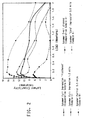
- the surface pattern used herein should provide the unplasticized high modulus interlayer sheet or film a latent elasticity of 5 to 10 microns after the application of 0.031 Newtons/mm 2 pressure for 3 seconds and less than 5 microns after the application of 0.407 Newtons/mm 2 pressure for 3 seconds.
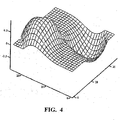
- the surface pattern of the present invention comprises projections upward from the base surface as well as voids, or depressions, downward from the base surface in a way that the projections and depressions are of similar or the same volume, and located in close proximity to each other.
- the projections and depressions are located such that heating and compressing the interlayer surface would result in more localized flow of the thermoplastic material from an area of higher thermoplastic mass (that is, a projection) to a void area (that is, depression), i.e., the voids would be filled with the mass from a local projection, such as the surface patterns shown in Figures 4 .
- thermoplastic resin material to obtain a flattened surface would require less of an energy investment than a more conventional pattern, which requires a mass flow of thermoplastic material across the entire surface of the interlayer. Accordingly, the surface pattern disclosed herein can be flattened with relative ease as compared with the conventional surface patterns, when they are incorporated to surface(s) of interlayer sheeting formed of unplasticized high modulus polymers.
- the surface pattern disclosed herein comprises at least two uninterrupted channels for de-airing in at least two non-parallel directions, wherein the channels have a width ranging from 30 to 300 ⁇ m, or preferably from 40 to 250 ⁇ m, or more preferably, from 50 to 200 ⁇ m, and a depth ranging from 2 to 80 ⁇ m, or preferably, from 2 to 25 ⁇ m, or more preferably, from 12 to 25 ⁇ m, or yet more preferably, from 14 to 20 ⁇ m.
- the surface channels are preferably spaced from 0.1 to 1 mm apart, or more preferably, from 0.1 to 0.9 mm apart, or yet more preferably, from 0.15 to 0.85 mm apart.
- the surface pattern preferably contains channels in two or more directions.
- the preferred embodiments contain channels in two directions, preferably (in one embodiment) perpendicular to each other, such as shown in Figure 6 .
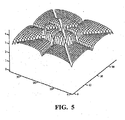
- Other embodiments can have channels in three or more directions, such as shown in Figure 5 .
- Surface roughness, Rz can be expressed in microns by a 10-point average roughness in accordance with ISO-R468 of the International Organization for Standardization and ASMEB46.1 of the American Society of Mechanical Engineers.
- 10-point average roughness, Rz of up to 80 ⁇ m is sufficient to prevent air entrapment.
- Surface roughness, Rz measurements from single-trace profilometer measurements can be adequate in characterizing the average peak height of a surface with roughness peaks and valleys that are nearly randomly distributed. However a single trace profilometer may not be sufficient in characterizing the texture of a surface that has certain regularities, particularly straight lines.
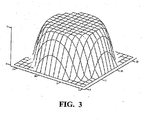
- AR p is the distance between the highest point in the roughness profile over an area to the plane if all the material constituting the roughness is melted down.
- AR t is the difference in elevation between the highest peak and the lowest valley in the roughness profile over the area measured.
- the surface pattern disclosed herein has a AR t less than 32 ⁇ m, a ratio of AR p to AR t ranging between 0.42 and 0.62, or preferably, between 0.52 and 0.62, and an area kurtosis less than 5, or preferably, less than 2.5.
- the interlayer sheet or film of the present invention can be embossed on one or both sides.
- the embossed surface pattern and/or the depth thereof can be asymmetric with respect to the two sides of the interlayer sheet or film. That is, the embossed surface patterns can be the same or different, as can be the depth of the pattern on either side of the sheet or film.
- the interlayer sheet or film of the present invention has an embossed surface pattern on each side wherein the depth of the pattern on each side is in the range of about 12 to about 25 ⁇ m.
- embossed surface pattern on one side of the interlayer sheet or film that is orthogonal to the edges of the sheet or film, while the identical embossed pattern is slanted at some angle that is greater than or less than 90° to the edges, and the depth of the embossed patterns is in the range of from 12 to 25 ⁇ m. Offsetting the patterns in this manner can eliminate an undesirable optical effect in the sheet or film.
- the surface pattern may be applied to the sheet or film through common art processes.
- an interlayer sheet or film when it is produced through extrusion, it may be passed over a specially prepared surface of a die roll positioned in close proximity to the exit of the die which imparts the desired surface characteristics to one side of the molten polymer.
- the sheet or film formed of polymer cast thereon will have a rough surface on the side which contacts the roll, and the rough surface will generally conform respectively to the valleys and peaks of the roll surface.
- Such die rolls are disclosed in, for example, U.S. Patent No. 4,035,549 . As it is known, this rough surface is only temporary and particularly functions to facilitate de-airing during laminating, and after which, it is melted smooth from the elevated temperature and pressure associated with autoclaving and other lamination processes.
- the present invention is a laminate comprising at least one layer derived from the interlayer sheet or film described above.
- the laminate of the present invention may be formed by laminating at least one layer of the present interlayer sheet or film with one or more layers of glass, polymeric films, polymeric sheets, metal films, metal sheets, and the like and combinations thereof.
- the laminate of the present invention comprises at least one layer of glass and at least one layer of the present interlayer sheet or film. More preferably, the laminate of the present invention comprises two outside layers of glass and one inner layer formed of the present interlayer sheet or film.
- Rz can be expressed in microns by a 10-point average roughness in accordance with ISO-R468 of the International Organization for Standardization.
- Roughness measurements are made using a stylus-type profilometer (Surfcom 1500A manufactured by Tokyo Seimitsu Kabushiki Kaisha of Tokyo, Japan) as described in ASME B46.1-1995 using a trace length of 26 mm.
- AR p and AR t , and the area kurtosis are measured by tracing the roughness over a 5.6 mm x 5.6 mm area in 201 steps using the Perthometer Concept system manufactured by Mahr GmbH, Gottingen, Germany.
- De-airing efficiency of an interlayer with a specified pattern is determined by measuring the absolute pressure of the interstitial space in an assembly.
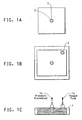
- the interlayer to be tested is assembled as a normal assembly, except that the top plate of glass has a hole (1) drilled through its center.
- the glass, the interlayer, and all auxiliary equipment are equilibrated to 22.5 ⁇ 2.5°C for one hour before testing. If an interlayer has two distinctly different patterns on either side, the side with the surface pattern to be evaluated is placed in contact with the piece of glass that has the hole (1).
- a pressure (or vacuum) coupler (2) is affixed and sealed around the hole in the glass (a pressure or vacuum coupler is a device which, when connected, enables air to move between an enclosure and the outside).
- a piece of fabric (about 30 mm wide) is wrapped around the edges of the assembly.
- the base of another vacuum coupler (3) is placed on top of two layers of cotton fabric (50 mm x 50 mm) in one of the corners.
- the assembly with the peripheral breather and two base plates of couplers are then placed inside a 0.1-mm thick nylon bag (4). The bag is sealed. Cross-marks are cut through the bag just above the base plates. Vacuum couplers are attached through the nylon bag and care is taken to ensure that there are no leaks.
- the corner plate is attached to the vacuum source (nominally 84 kPa below atmospheric), while the center plate is attached to a vacuum gauge or a calibrated pressure transducer.
- the gauge reading (or transducer output) is recorded at given intervals after the vacuum is applied.
- the recorded data contain the absolute interstitial pressure at 10-second- intervals for the first minute after vacuum is applied, at 15-second intervals thereafter for one-half minute, at 30-second intervals thereafter for another one-half minute, and at one-minute intervals thereafter up to 10 minutes after the application of vacuum.
- a surface that allows for efficient vacuum de-airing would cause the absolute interstitial pressure to drop rapidly within a few minutes.
- the interstitial pressure at 90 seconds after evacuation is indicative of how well the interlayer de-airs. If at 90 seconds after evacuation, the absolute interstitial pressure is above 53.3 kPa, de-airing is inadequate, and the interlayer is not suitable for vacuum de-airing.
- Determination of de-airing efficiency at high (elevated) ambient temperature is the same as that at room temperature, except that the interlayer to be tested, the glass, couplers are all equilibrated to 30.5 ⁇ 2.5°C prior to testing. If at 90 seconds after evacuation, the absolute interstitial pressure is above 53.5 kPa, de-airing is inadequate, and the interlayer is not suitable for vacuum de-airing when the ambient temperature is elevated, as in the summer.
- a pre-press is made from each interlayer tested.
- the TAAT glass orientation is used.
- An interlayer is placed between two pieces of glass, the excess interlayer is trimmed.
- the glass/interlayer/glass sandwich referred to as an assembly, is placed in a 0.1-mm (nylon) plastic bag.
- a vacuum adapter allows a vacuum hose to be connected to the inside of the plastic bag after it is sealed.
- the bag with the assembly inside is evacuated for 90 seconds at 53.3 kPa vacuum (48.0 kPa absolute pressure) at ambient temperature (22.5°C ⁇ 2.5°C). After the initial vacuum, the nylon bag and its contents and the vacuum hose is placed inside an oven and kept at 120-122°C for 6 minutes.
- the nylon bag is removed from the oven and the vacuum hose is disconnected immediately.
- the glass/interlayer/glass structure at this stage is called a pre-press.
- the pre-press may appear hazy or clear.
- Haze is measured by using a Hazegard hazemeter from Gardner in eight places in the prepress. The results can be averaged.
- ionomers having about 19 weight percent of polymerized residues of a methacrylic acid and about 37% neutralized with sodium ion were used to form various 2.3 mm thick and 600 mm square big ionomer sheets.
- ionomer sheets with low haze and smooth, essentially parallel surfaces were obtained as follows. First, the ionomer sheeting was placed between two sheets of abrasion-resistant coated polycarbonate (LexanTM MR 3/16" thickness). This sandwich structure was then vacuum-bagged using standard techniques and a vacuum was drawn on the assembly for 30 minutes at about 30 torr absolute pressure. After this de-airing step, the vacuum-bagged assembly was heated in a conventional air oven to 120°C for 45 minutes after which it was cooled back down to room temperature while under vacuum.
- abrasion-resistant coated polycarbonate LithanTM MR 3/16" thickness
- the sheet was placed between two rubber plates.
- the rubber surfaces in contact with the ionomer sheet were engraved with a pattern with ridges that form a grid pattern.
- the ridges were approximately 12 ⁇ m in width and 45 ⁇ m in height, and were spaced such that there were approximately 9 grids per square mm.
- the rubber/sheet/rubber sandwich assembly was placed between two pieces of nominally 3.2 mm thick annealed glass.
- The-5-ply sandwich was put inside of a woven nylon bag, and the nylon bag and its contents were placed inside of a rubber vacuum bag.
- the rubber vacuum bag was fitted with a piece of tubing which was sealed through the edge of the bag, and which enabled connection to a vacuum source.
- the open end of the vacuum bag was closed.
- Vacuum at least 80 kPa below atmospheric
- the vacuum bag with its contents was placed in an oven at 120°C for 40 minutes. After that time, the vacuum bag was removed from the oven. Vacuum was disconnected, and the vacuum bag and its contents were allowed to cool to room temperature.
- One of the engraved rubber plates was gently removed to expose the now embossed ionomer sheet. The ionomer sheet was then gently peeled off from the second embossed rubber plate.
- the embossed pattern on the ionomer sheet has a grid-pattern with ridges approximately 12 ⁇ m wide and 41 ⁇ m deep, and with approximately 9 grids per square mm.
- ionomer sheeting with embossed surface(s) was produced by the use of an extrusion line consisting of a twin-screw extruder, a sheet die, and a calendar roll.
- the calendar roll which has an embossed surface pattern engraved into the metal surface imparts to varying degrees a reverse image of the surface texture onto the polymer melt as it passes between and around the textured rolls.
- ionomer sheeting of the same composition having an embossed diamond pattern with an impression depth of about 2 mils (Rz 61.8 ⁇ m) was prepared.
- the diamonds were 'raised' areas on the sheet surface leaving relatively continuous channels to allow for air to flow when either vacuum was applied to the assembly or if outward force was applied (e.g. roll prepress nips) to progressively force a portion of the air out of the laminate assembly.
- ionomer sheeting of the same composition having an embossed random pattern of finer detail than the diamond pattern was prepared.
- Such sheeting had a surface roughness, Rz, of 14.9 ⁇ m.
- TMA Thermomechanical Analyzer
- the pre-smoothed ionomer interlayers were embossed with a variety of surface textures by placing a textured surface against the interlayer and applying pressure and slightly heating (extending from room temperature up through a complete molten state (e.g. 120°C).
- Such ionomer interlayers with various embossed surface patterns were subject to TMA test at a temperature of about 70°C, and their latent elasticity values under different pressures were recorded.
- Shown in Figure 2 is a plot of the latent elasticity of each embossed ionomer sheet subtracting the latent elasticity of a pre-smoothed ionomer sheet at the same condition.
- the ionomer interlayers with embossed surfaces were also used to prepare Numerous laminates (300 mm square) by the above mentioned roll pre-pressing to check laminating performance and quality.
- Annealed glass (3 mm thickness) was washed with detergent (trisodium phosphate at 3 gms/liter) and rinsed thoroughly with de-mineralized water and allowed to air dry.
- Pre-laminate assemblies were created by sandwiching the respective interlayers between two pieces of said glass and taping in a couple locations to secure the relative positions of the layers to one another.
- an ionomer sheet should have an embossed surface pattern that affords a latent elasticity of 5 to 10 microns after a 3-sec application of a 0.031 Newtons/mm 2 pressure and a latent elasticity of less than 5 microns after a 3-sec application of a 0.407 Newtons/mm 2 pressure. It is worth mentioning that during the embossing process, the aluminum screen was completely pressed into the surface of the ionomer sheet of Comparative Sample B, and when the aluminum screen was being separated from the sheet, major rupture was generated on the sheet surface, which caused the edge blowin in the final laminate.
- processing temperature range was found to be quite narrow (15°C) for both Comparative Samples C and D as compared with Samples D, E and F where the process window is expanded to 35°C (@2.0 m/min linear speed). This is due to the rapid softening of the ionomer material as the processing temperature approached and exceeded the melting point for ionomers ( ⁇ 96°C by DSC). Little change in the process window temperatures was noted between the two different roll pre-press speeds tested (2 and 3.5 m/min.), which provides greater processing rates/throughput during manufacturing.
Landscapes
- Engineering & Computer Science (AREA)
- Mechanical Engineering (AREA)
- Joining Of Glass To Other Materials (AREA)
- Laminated Bodies (AREA)
- Manufacture Of Macromolecular Shaped Articles (AREA)
- Shaping Of Tube Ends By Bending Or Straightening (AREA)
Applications Claiming Priority (2)
| Application Number | Priority Date | Filing Date | Title |
|---|---|---|---|
| US11/292,721 US7351468B2 (en) | 2000-10-26 | 2005-12-02 | Interlayers for laminated safety glass with superior de-airing and laminating properties and process for making the same |
| PCT/US2006/046056 WO2007064922A1 (en) | 2005-12-02 | 2006-12-01 | Interlayers for laminated safety glass with superior de-airing and laminating properties and process for making the same |
Publications (2)
| Publication Number | Publication Date |
|---|---|
| EP1965977A1 EP1965977A1 (en) | 2008-09-10 |
| EP1965977B1 true EP1965977B1 (en) | 2015-03-04 |
Family
ID=37882163
Family Applications (1)
| Application Number | Title | Priority Date | Filing Date |
|---|---|---|---|
| EP20060844724 Active EP1965977B1 (en) | 2005-12-02 | 2006-12-01 | Interlayers for laminated safety glass with superior de-airing and laminating properties and process for making the same |
Country Status (6)
| Country | Link |
|---|---|
| US (1) | US7351468B2 (enExample) |
| EP (1) | EP1965977B1 (enExample) |
| JP (1) | JP2009518467A (enExample) |
| CN (1) | CN101321619B (enExample) |
| AU (1) | AU2006320431C1 (enExample) |
| WO (1) | WO2007064922A1 (enExample) |
Cited By (1)
| Publication number | Priority date | Publication date | Assignee | Title |
|---|---|---|---|---|
| DE102018125998A1 (de) * | 2018-10-19 | 2020-04-23 | Polyplast Sander Gmbh | Verfahren zur herstellung einer kunststoff-verbundscheibe sowie kunststoff-verbundscheibe und deren verwendung |
Families Citing this family (50)
| Publication number | Priority date | Publication date | Assignee | Title |
|---|---|---|---|---|
| US8048587B2 (en) * | 2002-11-27 | 2011-11-01 | Delphi Technologies, Inc. | Compliant current collector for fuel cell anode and cathode |
| US7334371B2 (en) * | 2003-04-04 | 2008-02-26 | E.I. Du Pont De Nemours And Company | Glass laminates having improved structural integrity against severe stresses for use in external pressure plate glazing applications |
| US20050042422A1 (en) * | 2003-06-13 | 2005-02-24 | Bennison Stephen J. | Point attachment systems for laminated glass |
| US20060005482A1 (en) * | 2003-07-31 | 2006-01-12 | Bennison Stephen J | Point attachment systems for laminated glass and a process for preparing same |
| AU2004299510A1 (en) * | 2003-12-16 | 2005-06-30 | Performance Materials Na, Inc. | Glass laminates having improved structural integrity against severe impacts comprising a flexible attachment |
| US7445683B2 (en) * | 2005-11-30 | 2008-11-04 | E. I. Du Pont De Nemours And Company | Thermoplastic resin compositions suitable for use in laminated safety glass |
| US7678441B2 (en) | 2005-12-02 | 2010-03-16 | E.I. Du Pont De Nemours And Company | Interlayers for laminated safety glass with superior de-airing and laminating properties and process for making the same |
| US7851694B2 (en) * | 2006-07-21 | 2010-12-14 | E. I. Du Pont De Nemours And Company | Embossed high modulus encapsulant sheets for solar cells |
| US8772624B2 (en) * | 2006-07-28 | 2014-07-08 | E I Du Pont De Nemours And Company | Solar cell encapsulant layers with enhanced stability and adhesion |
| US7847184B2 (en) * | 2006-07-28 | 2010-12-07 | E. I. Du Pont De Nemours And Company | Low modulus solar cell encapsulant sheets with enhanced stability and adhesion |
| US7968008B2 (en) * | 2006-08-03 | 2011-06-28 | Fry's Metals, Inc. | Particles and inks and films using them |
| US20080099064A1 (en) * | 2006-10-27 | 2008-05-01 | Richard Allen Hayes | Solar cells which include the use of high modulus encapsulant sheets |
| US8168885B2 (en) * | 2007-02-12 | 2012-05-01 | E.I. Du Pont De Nemours And Company | Low modulus solar cell encapsulant sheets with enhanced stability and adhesion |
| US20080196760A1 (en) * | 2007-02-15 | 2008-08-21 | Richard Allen Hayes | Articles such as safety laminates and solar cell modules containing high melt flow acid copolymer compositions |
| US8691372B2 (en) * | 2007-02-15 | 2014-04-08 | E I Du Pont De Nemours And Company | Articles comprising high melt flow ionomeric compositions |
| US20080254302A1 (en) | 2007-04-13 | 2008-10-16 | David Paul Bourcier | Multiple layer polymer interlayers having a melt fractured surface |
| US20080268204A1 (en) * | 2007-04-29 | 2008-10-30 | David Paul Bourcier | Multiple layer polymer interlayers having an embossed surface |
| US20080264471A1 (en) * | 2007-04-30 | 2008-10-30 | Richard Allen Hayes | Solar cell modules comprising compositionally distinct encapsulant layers |
| US8080726B2 (en) | 2007-04-30 | 2011-12-20 | E. I. Du Pont De Nemours And Company | Solar cell modules comprising compositionally distinct encapsulant layers |
| US20080302461A1 (en) * | 2007-06-08 | 2008-12-11 | E. I. Du Pont De Nemours And Company | Transparent Colored High Modulus Interlayers and Laminates Therefrom |
| US20080318063A1 (en) * | 2007-06-22 | 2008-12-25 | Anderson Jerrel C | Glass laminates with improved weatherability |
| EP2190663A1 (en) * | 2007-09-17 | 2010-06-02 | E. I. du Pont de Nemours and Company | Process for the manufacture of a glass laminate |
| US8097113B2 (en) * | 2007-09-17 | 2012-01-17 | E. I. Du Pont De Nemours And Company | Glass laminate containing poly vinyl acetal |
| US8097114B2 (en) * | 2007-09-17 | 2012-01-17 | E. I. Du Pont De Nemours And Company | Glass laminate containing ionomer |
| US20090155576A1 (en) * | 2007-12-18 | 2009-06-18 | E. I. Du Pont De Nemours And Company | Glass-less glazing laminates |
| ES2751084T3 (es) | 2008-06-02 | 2020-03-30 | Performance Mat Na Inc | Módulo de células solares que tiene una capa encapsulante de baja turbidez |
| WO2010051523A1 (en) * | 2008-10-31 | 2010-05-06 | E. I. Du Pont De Nemours And Company | High-clarity ionomer compositions and articles comprising the same |
| US20100154867A1 (en) * | 2008-12-19 | 2010-06-24 | E. I. Du Pont De Nemours And Company | Mechanically reliable solar cell modules |
| EP2376549B1 (en) | 2008-12-30 | 2013-12-25 | E. I. du Pont de Nemours and Company | High-clarity blended ionomer compositions and articles comprising the same |
| WO2010077428A1 (en) * | 2008-12-31 | 2010-07-08 | E. I. Du Pont De Nemours And Company | Ionomer compositions with low haze and high moisture resistance and articles comprising the same |
| CH701494A1 (de) * | 2009-07-21 | 2011-01-31 | 3S Swiss Solar Systems Ag | Laminierverfahren. |
| US20120135191A1 (en) * | 2010-11-30 | 2012-05-31 | Lora Lee Spangler | Systems, Methods and Apparatuses for Direct Embossment of a Polymer Melt Sheet |
| WO2012082923A1 (en) * | 2010-12-15 | 2012-06-21 | E. I. Du Pont De Nemours And Company | Method for sealing electrical leads extending through a collapsed stem and module produced thereby |
| EP2767393A1 (de) * | 2013-02-14 | 2014-08-20 | Kuraray Europe GmbH | Verfahren zur Herstellung von Verbundglaslaminaten mit Schalldämmeigenschaften durch Laminieren von Glasscheiben mit mindestens einer dünnen weichmacherarmen Schicht auf Basis von Polyvinylacetal und mindestens einer weiteren Schicht aus weichmacherhaltigem Polyvinylacetal |
| US9574028B2 (en) * | 2013-04-09 | 2017-02-21 | Solutia Inc. | Embossed polymer sheet |
| JP6311395B2 (ja) * | 2014-03-28 | 2018-04-18 | 東レ株式会社 | 凹凸構造フィルムの製造方法および製造装置 |
| EP3150373A1 (en) * | 2015-09-30 | 2017-04-05 | AGC Glass Europe | Vehicle glazing |
| KR102451436B1 (ko) | 2016-05-09 | 2022-10-05 | 쿠라라이 유럽 게엠베하 | 다층 중간층 및 유리 적층체 |
| JP2019535620A (ja) | 2016-10-28 | 2019-12-12 | クラレ・アメリカ・インコーポレイテッド | 楔形多層中間膜及び合わせガラス |
| CN116675925A (zh) | 2017-07-31 | 2023-09-01 | 可乐丽美国股份有限公司 | 粘附特性增强的离聚物夹层 |
| JP6984293B2 (ja) * | 2017-10-05 | 2021-12-17 | 日本電気硝子株式会社 | 合わせガラスの製造方法 |
| EP3921151A1 (en) | 2019-02-04 | 2021-12-15 | Kuraray Europe GmbH | Hurricane-resistant acoustic glazing |
| KR102363361B1 (ko) * | 2019-12-31 | 2022-02-14 | 에스케이씨 주식회사 | 접합용 필름 및 이를 포함하는 광투과 적층체 |
| US12017443B2 (en) | 2020-05-22 | 2024-06-25 | Kuraray Europe Gmbh | Interlayer and laminate with controlled debonding zone treatments with enhanced performance |
| WO2022063795A1 (en) | 2020-09-28 | 2022-03-31 | Kuraray Europe Gmbh | Glass laminates with reduced creep at elevated temperature |
| WO2022132418A2 (en) | 2020-12-16 | 2022-06-23 | Kuraray Europe Gmbh | Laminated structures with composite adhesive polymeric interlayer comprising cohesive debonding zones for enhanced performance |
| JP2024510201A (ja) * | 2021-03-12 | 2024-03-06 | ソルティア・インコーポレーテッド | テクスチャー加工中間層 |
| EP4437057A1 (en) | 2021-11-23 | 2024-10-02 | Kuraray Europe GmbH | Interlayer and laminate with controlled debonding zone treatments |
| EP4543981A1 (en) | 2022-06-22 | 2025-04-30 | Kuraray America Inc. | Ionomer resin composition |
| US20240227366A9 (en) * | 2022-10-25 | 2024-07-11 | Delstar Technologies, Inc. | Optical interlayers and methods of making the same |
Family Cites Families (43)
| Publication number | Priority date | Publication date | Assignee | Title |
|---|---|---|---|---|
| US2904844A (en) | 1956-02-10 | 1959-09-22 | Du Pont | Process for embossing polyvinyl acetal sheets |
| FR1183541A (fr) | 1956-10-18 | 1959-07-08 | Du Pont | Verre de sécurité stratifié perfectionné |
| NL129542C (enExample) | 1961-08-31 | 1900-01-01 | ||
| US3471460A (en) | 1961-08-31 | 1969-10-07 | Du Pont | Amine-modified hydrocarbon polymers |
| US3344014A (en) | 1963-02-28 | 1967-09-26 | Du Pont | Safety glass |
| US3437718A (en) | 1967-01-23 | 1969-04-08 | Du Pont | Polymer blends |
| US4035549A (en) | 1975-05-19 | 1977-07-12 | Monsanto Company | Interlayer for laminated safety glass |
| US4323247A (en) | 1981-01-19 | 1982-04-06 | Acushnet Company | Golf ball cover |
| JPS57150532A (en) | 1981-03-12 | 1982-09-17 | Mitsubishi Monsanto Chem Co | Intermediate membrane made of thermoplastic resin |
| US4452935A (en) | 1981-06-01 | 1984-06-05 | Sekisui Kagaku Kogyo Kabushiki Kaisha | Interlayer film for laminated glass |
| US4668574A (en) | 1983-05-03 | 1987-05-26 | Advanced Glass Systems, Corp. | Laminated safety glass |
| US4663228A (en) | 1983-05-03 | 1987-05-05 | Advanced Glass Systems Corp. | Laminated safety glass |
| US4906703A (en) | 1984-08-17 | 1990-03-06 | Artistic Glass Products Company | Ionomer resin films and laminates thereof |
| US4619973A (en) | 1984-08-17 | 1986-10-28 | Advanced Glass Systems, Inc. | Ionomer resin films |
| US4799346A (en) | 1988-07-16 | 1989-01-24 | Advanced Glass Systems Corp. | Laminated glazing unit |
| US5002820A (en) * | 1989-05-25 | 1991-03-26 | Artistic Glass Products | Laminated safety glass |
| US5061748A (en) | 1990-06-28 | 1991-10-29 | Artistic Glass Products Company | Fire resistant windows |
| US5124208A (en) | 1990-06-28 | 1992-06-23 | Artistic Glass Products | Fire resistant windows |
| US5091258A (en) | 1990-08-20 | 1992-02-25 | Monsanto Company | Laminate for a safety glazing |
| JPH04108641A (ja) | 1990-08-28 | 1992-04-09 | Stanley Electric Co Ltd | 積層透明基板の製造方法 |
| CA2039629A1 (en) | 1990-10-23 | 1992-04-24 | Nelson Bolton | Method for preparing laminated safety glass |
| US5571878A (en) | 1991-09-24 | 1996-11-05 | Chevron Chemical Company | Ethylene-alkyl acrylate copolymers and derivatives having improved melt-point temperatures and adhesive strength and processes for preparing same |
| US5455103A (en) | 1994-01-24 | 1995-10-03 | Monsanto Company | Rough-surfaced interlayer |
| BE1008385A3 (nl) | 1994-05-30 | 1996-04-02 | Tale Consultants Ltd | Werkwijze voor het vervaardigen van gelaagd glas en werkwijze voor het vervaardigen van een daarbij gebruikt vel van polyvinylbutyral. |
| US5496640A (en) | 1994-08-15 | 1996-03-05 | Artistic Glass Products Company | Fire resistant transparent laminates |
| US5536347A (en) | 1994-09-22 | 1996-07-16 | Monsanto Company | No autoclave process for forming a safety glass laminate |
| IT1282848B1 (it) | 1995-06-13 | 1998-04-01 | Ipm Ind Plastica Monregalese S | Vetro laminato o stratificato e metodo per la sua fabbricazione. |
| US6159608A (en) | 1995-09-28 | 2000-12-12 | Saint-Gobain Performance Plastics Corporation | Thermoplastic interlayer film |
| FR2743802B1 (fr) | 1996-01-19 | 1998-03-20 | Saint Gobain Vitrage | Vitrage feuillete et primaire utilise pour sa realisation |
| JP3895798B2 (ja) * | 1996-03-07 | 2007-03-22 | 積水化学工業株式会社 | 合わせガラス用中間膜 |
| US5763062A (en) | 1996-11-08 | 1998-06-09 | Artistic Glass Products Company | Ionomer resin films and laminates thereof |
| DE19729336A1 (de) | 1997-07-09 | 1999-01-14 | Vetrotech Saint Gobain Int Ag | Feuerwiderstandsfähige Verbundglasscheibe |
| CA2330157A1 (en) | 1998-05-14 | 1999-11-18 | E.I. Du Pont De Nemours And Company | Glass laminates for threat resistant window systems |
| US6093471A (en) | 1999-02-08 | 2000-07-25 | Solutia Inc. | Polyvinyl butyral sheet |
| AU780388B2 (en) | 1999-07-01 | 2005-03-17 | Sekisui Chemical Co., Ltd. | Interlayer for laminated glass and laminated glass |
| AU3227301A (en) | 2000-02-18 | 2001-08-27 | Bridgestone Corporation | Sealing film for solar cell and method for manufacturing solar cell |
| EP1268196B2 (en) | 2000-03-29 | 2009-09-30 | E.I. Du Pont De Nemours And Company | Glass/polyvinylbutyral laminates having directional surface patterns and a process for preparing same |
| DE60101268T3 (de) | 2000-03-29 | 2010-01-21 | E.I. Dupont De Nemours And Co., Wilmington | Zwischenschicht für verbundglasscheiben mit hohen entlüftungs- und laminierungseigenschaften und verfahren zu ihrer herstellung |
| US20030124296A1 (en) | 2000-10-26 | 2003-07-03 | Smith Charles Anthony | Glass laminates for threat resistant window systems |
| US20020155302A1 (en) | 2001-04-19 | 2002-10-24 | Smith Novis W. | Method for preparing laminated safety glass |
| JP3895950B2 (ja) * | 2001-08-01 | 2007-03-22 | 積水化学工業株式会社 | 合わせガラス用中間膜 |
| US20030044579A1 (en) | 2001-08-25 | 2003-03-06 | Nelson Bolton | Anti-spalling laminated safety glass |
| JP2003204074A (ja) | 2001-10-29 | 2003-07-18 | Sharp Corp | 太陽電池用封止膜、およびこれを用いた太陽電池パネルの製造方法 |
-
2005
- 2005-12-02 US US11/292,721 patent/US7351468B2/en not_active Expired - Fee Related
-
2006
- 2006-12-01 EP EP20060844724 patent/EP1965977B1/en active Active
- 2006-12-01 WO PCT/US2006/046056 patent/WO2007064922A1/en not_active Ceased
- 2006-12-01 AU AU2006320431A patent/AU2006320431C1/en not_active Ceased
- 2006-12-01 JP JP2008543501A patent/JP2009518467A/ja active Pending
- 2006-12-01 CN CN2006800452411A patent/CN101321619B/zh active Active
Cited By (2)
| Publication number | Priority date | Publication date | Assignee | Title |
|---|---|---|---|---|
| DE102018125998A1 (de) * | 2018-10-19 | 2020-04-23 | Polyplast Sander Gmbh | Verfahren zur herstellung einer kunststoff-verbundscheibe sowie kunststoff-verbundscheibe und deren verwendung |
| DE102018125998B4 (de) | 2018-10-19 | 2023-03-09 | Polyplast Sander Gmbh | Verfahren zur herstellung einer kunststoff-verbundscheibe |
Also Published As
| Publication number | Publication date |
|---|---|
| WO2007064922A1 (en) | 2007-06-07 |
| EP1965977A1 (en) | 2008-09-10 |
| AU2006320431C1 (en) | 2011-11-03 |
| CN101321619A (zh) | 2008-12-10 |
| AU2006320431B2 (en) | 2010-12-16 |
| CN101321619B (zh) | 2013-07-10 |
| US20060141212A1 (en) | 2006-06-29 |
| JP2009518467A (ja) | 2009-05-07 |
| AU2006320431A1 (en) | 2007-06-07 |
| US7351468B2 (en) | 2008-04-01 |
Similar Documents
| Publication | Publication Date | Title |
|---|---|---|
| EP1965977B1 (en) | Interlayers for laminated safety glass with superior de-airing and laminating properties and process for making the same | |
| US7678441B2 (en) | Interlayers for laminated safety glass with superior de-airing and laminating properties and process for making the same | |
| US7851694B2 (en) | Embossed high modulus encapsulant sheets for solar cells | |
| EP1268195B2 (en) | Interlayers for laminated safety glass with superior de-airing and laminating properties and process for making the same | |
| US8101267B2 (en) | Multilayer polymeric laminates and high strength laminates produced therefrom | |
| AU2001247869A1 (en) | Interlayers for laminated safety glass with superior de-airing and laminating properties and process for making the same | |
| US20120085482A1 (en) | Process for producing glass laminates | |
| JP2011507278A (ja) | ターイオノマーフィルムまたはシートおよびそれを含む太陽電池モジュール | |
| JP2000203901A (ja) | 合わせガラス用中間膜 | |
| JP2001019499A (ja) | 合わせガラス用中間膜 | |
| JPH1135348A (ja) | 合わせガラス用中間膜の製造方法 | |
| JP2000203900A (ja) | 合わせガラス用中間膜 | |
| JP2000256043A (ja) | 合わせガラス用中間膜および合わせガラス | |
| CN114127214B (zh) | 接合用薄膜、包括该薄膜的透光层叠体及包括该透光层叠体的交通工具 | |
| JP2004067414A (ja) | 合わせガラス用中間膜および合わせガラス | |
| JPH08143346A (ja) | 合わせガラス用中間膜の製造方法 | |
| JPH11147735A (ja) | 合わせガラス用中間膜 | |
| JP2000256044A (ja) | 合わせガラス用中間膜の製造方法 | |
| JP2004083312A (ja) | 合わせガラス用中間膜および合わせガラス |
Legal Events
| Date | Code | Title | Description |
|---|---|---|---|
| PUAI | Public reference made under article 153(3) epc to a published international application that has entered the european phase |
Free format text: ORIGINAL CODE: 0009012 |
|
| 17P | Request for examination filed |
Effective date: 20080611 |
|
| AK | Designated contracting states |
Kind code of ref document: A1 Designated state(s): AT BE BG CH CY CZ DE DK EE ES FI FR GB GR HU IE IS IT LI LT LU LV MC NL PL PT RO SE SI SK TR |
|
| 17Q | First examination report despatched |
Effective date: 20090213 |
|
| DAX | Request for extension of the european patent (deleted) | ||
| RIC1 | Information provided on ipc code assigned before grant |
Ipc: B29C 59/04 20060101ALN20140909BHEP Ipc: B32B 17/10 20060101AFI20140909BHEP Ipc: B29C 59/02 20060101ALI20140909BHEP |
|
| GRAP | Despatch of communication of intention to grant a patent |
Free format text: ORIGINAL CODE: EPIDOSNIGR1 |
|
| INTG | Intention to grant announced |
Effective date: 20141104 |
|
| GRAS | Grant fee paid |
Free format text: ORIGINAL CODE: EPIDOSNIGR3 |
|
| GRAA | (expected) grant |
Free format text: ORIGINAL CODE: 0009210 |
|
| AK | Designated contracting states |
Kind code of ref document: B1 Designated state(s): AT BE BG CH CY CZ DE DK EE ES FI FR GB GR HU IE IS IT LI LT LU LV MC NL PL PT RO SE SI SK TR |
|
| REG | Reference to a national code |
Ref country code: GB Ref legal event code: FG4D |
|
| REG | Reference to a national code |
Ref country code: CH Ref legal event code: EP |
|
| REG | Reference to a national code |
Ref country code: IE Ref legal event code: FG4D |
|
| REG | Reference to a national code |
Ref country code: AT Ref legal event code: REF Ref document number: 713469 Country of ref document: AT Kind code of ref document: T Effective date: 20150415 |
|
| REG | Reference to a national code |
Ref country code: DE Ref legal event code: R096 Ref document number: 602006044728 Country of ref document: DE Effective date: 20150416 |
|
| REG | Reference to a national code |
Ref country code: AT Ref legal event code: MK05 Ref document number: 713469 Country of ref document: AT Kind code of ref document: T Effective date: 20150304 Ref country code: NL Ref legal event code: VDEP Effective date: 20150304 |
|
| PG25 | Lapsed in a contracting state [announced via postgrant information from national office to epo] |
Ref country code: FI Free format text: LAPSE BECAUSE OF FAILURE TO SUBMIT A TRANSLATION OF THE DESCRIPTION OR TO PAY THE FEE WITHIN THE PRESCRIBED TIME-LIMIT Effective date: 20150304 Ref country code: ES Free format text: LAPSE BECAUSE OF FAILURE TO SUBMIT A TRANSLATION OF THE DESCRIPTION OR TO PAY THE FEE WITHIN THE PRESCRIBED TIME-LIMIT Effective date: 20150304 Ref country code: SE Free format text: LAPSE BECAUSE OF FAILURE TO SUBMIT A TRANSLATION OF THE DESCRIPTION OR TO PAY THE FEE WITHIN THE PRESCRIBED TIME-LIMIT Effective date: 20150304 Ref country code: LT Free format text: LAPSE BECAUSE OF FAILURE TO SUBMIT A TRANSLATION OF THE DESCRIPTION OR TO PAY THE FEE WITHIN THE PRESCRIBED TIME-LIMIT Effective date: 20150304 |
|
| REG | Reference to a national code |
Ref country code: LT Ref legal event code: MG4D |
|
| PG25 | Lapsed in a contracting state [announced via postgrant information from national office to epo] |
Ref country code: GR Free format text: LAPSE BECAUSE OF FAILURE TO SUBMIT A TRANSLATION OF THE DESCRIPTION OR TO PAY THE FEE WITHIN THE PRESCRIBED TIME-LIMIT Effective date: 20150605 Ref country code: AT Free format text: LAPSE BECAUSE OF FAILURE TO SUBMIT A TRANSLATION OF THE DESCRIPTION OR TO PAY THE FEE WITHIN THE PRESCRIBED TIME-LIMIT Effective date: 20150304 Ref country code: LV Free format text: LAPSE BECAUSE OF FAILURE TO SUBMIT A TRANSLATION OF THE DESCRIPTION OR TO PAY THE FEE WITHIN THE PRESCRIBED TIME-LIMIT Effective date: 20150304 |
|
| PG25 | Lapsed in a contracting state [announced via postgrant information from national office to epo] |
Ref country code: NL Free format text: LAPSE BECAUSE OF FAILURE TO SUBMIT A TRANSLATION OF THE DESCRIPTION OR TO PAY THE FEE WITHIN THE PRESCRIBED TIME-LIMIT Effective date: 20150304 |
|
| PG25 | Lapsed in a contracting state [announced via postgrant information from national office to epo] |
Ref country code: CZ Free format text: LAPSE BECAUSE OF FAILURE TO SUBMIT A TRANSLATION OF THE DESCRIPTION OR TO PAY THE FEE WITHIN THE PRESCRIBED TIME-LIMIT Effective date: 20150304 Ref country code: SK Free format text: LAPSE BECAUSE OF FAILURE TO SUBMIT A TRANSLATION OF THE DESCRIPTION OR TO PAY THE FEE WITHIN THE PRESCRIBED TIME-LIMIT Effective date: 20150304 Ref country code: PT Free format text: LAPSE BECAUSE OF FAILURE TO SUBMIT A TRANSLATION OF THE DESCRIPTION OR TO PAY THE FEE WITHIN THE PRESCRIBED TIME-LIMIT Effective date: 20150706 Ref country code: EE Free format text: LAPSE BECAUSE OF FAILURE TO SUBMIT A TRANSLATION OF THE DESCRIPTION OR TO PAY THE FEE WITHIN THE PRESCRIBED TIME-LIMIT Effective date: 20150304 Ref country code: RO Free format text: LAPSE BECAUSE OF FAILURE TO SUBMIT A TRANSLATION OF THE DESCRIPTION OR TO PAY THE FEE WITHIN THE PRESCRIBED TIME-LIMIT Effective date: 20150304 |
|
| REG | Reference to a national code |
Ref country code: FR Ref legal event code: PLFP Year of fee payment: 10 |
|
| PG25 | Lapsed in a contracting state [announced via postgrant information from national office to epo] |
Ref country code: PL Free format text: LAPSE BECAUSE OF FAILURE TO SUBMIT A TRANSLATION OF THE DESCRIPTION OR TO PAY THE FEE WITHIN THE PRESCRIBED TIME-LIMIT Effective date: 20150304 Ref country code: IS Free format text: LAPSE BECAUSE OF FAILURE TO SUBMIT A TRANSLATION OF THE DESCRIPTION OR TO PAY THE FEE WITHIN THE PRESCRIBED TIME-LIMIT Effective date: 20150704 |
|
| REG | Reference to a national code |
Ref country code: DE Ref legal event code: R097 Ref document number: 602006044728 Country of ref document: DE |
|
| PG25 | Lapsed in a contracting state [announced via postgrant information from national office to epo] |
Ref country code: IT Free format text: LAPSE BECAUSE OF FAILURE TO SUBMIT A TRANSLATION OF THE DESCRIPTION OR TO PAY THE FEE WITHIN THE PRESCRIBED TIME-LIMIT Effective date: 20150304 |
|
| PLBE | No opposition filed within time limit |
Free format text: ORIGINAL CODE: 0009261 |
|
| STAA | Information on the status of an ep patent application or granted ep patent |
Free format text: STATUS: NO OPPOSITION FILED WITHIN TIME LIMIT |
|
| PG25 | Lapsed in a contracting state [announced via postgrant information from national office to epo] |
Ref country code: DK Free format text: LAPSE BECAUSE OF FAILURE TO SUBMIT A TRANSLATION OF THE DESCRIPTION OR TO PAY THE FEE WITHIN THE PRESCRIBED TIME-LIMIT Effective date: 20150304 |
|
| 26N | No opposition filed |
Effective date: 20151207 |
|
| PG25 | Lapsed in a contracting state [announced via postgrant information from national office to epo] |
Ref country code: SI Free format text: LAPSE BECAUSE OF FAILURE TO SUBMIT A TRANSLATION OF THE DESCRIPTION OR TO PAY THE FEE WITHIN THE PRESCRIBED TIME-LIMIT Effective date: 20150304 |
|
| PG25 | Lapsed in a contracting state [announced via postgrant information from national office to epo] |
Ref country code: BE Free format text: LAPSE BECAUSE OF NON-PAYMENT OF DUE FEES Effective date: 20151231 |
|
| PG25 | Lapsed in a contracting state [announced via postgrant information from national office to epo] |
Ref country code: LU Free format text: LAPSE BECAUSE OF FAILURE TO SUBMIT A TRANSLATION OF THE DESCRIPTION OR TO PAY THE FEE WITHIN THE PRESCRIBED TIME-LIMIT Effective date: 20151201 Ref country code: MC Free format text: LAPSE BECAUSE OF FAILURE TO SUBMIT A TRANSLATION OF THE DESCRIPTION OR TO PAY THE FEE WITHIN THE PRESCRIBED TIME-LIMIT Effective date: 20150304 |
|
| REG | Reference to a national code |
Ref country code: CH Ref legal event code: PL |
|
| PG25 | Lapsed in a contracting state [announced via postgrant information from national office to epo] |
Ref country code: BE Free format text: LAPSE BECAUSE OF FAILURE TO SUBMIT A TRANSLATION OF THE DESCRIPTION OR TO PAY THE FEE WITHIN THE PRESCRIBED TIME-LIMIT Effective date: 20150304 |
|
| REG | Reference to a national code |
Ref country code: IE Ref legal event code: MM4A |
|
| PG25 | Lapsed in a contracting state [announced via postgrant information from national office to epo] |
Ref country code: CH Free format text: LAPSE BECAUSE OF NON-PAYMENT OF DUE FEES Effective date: 20151231 Ref country code: IE Free format text: LAPSE BECAUSE OF NON-PAYMENT OF DUE FEES Effective date: 20151201 Ref country code: LI Free format text: LAPSE BECAUSE OF NON-PAYMENT OF DUE FEES Effective date: 20151231 |
|
| REG | Reference to a national code |
Ref country code: FR Ref legal event code: PLFP Year of fee payment: 11 |
|
| PG25 | Lapsed in a contracting state [announced via postgrant information from national office to epo] |
Ref country code: HU Free format text: LAPSE BECAUSE OF FAILURE TO SUBMIT A TRANSLATION OF THE DESCRIPTION OR TO PAY THE FEE WITHIN THE PRESCRIBED TIME-LIMIT; INVALID AB INITIO Effective date: 20061201 Ref country code: BG Free format text: LAPSE BECAUSE OF FAILURE TO SUBMIT A TRANSLATION OF THE DESCRIPTION OR TO PAY THE FEE WITHIN THE PRESCRIBED TIME-LIMIT Effective date: 20150304 |
|
| PG25 | Lapsed in a contracting state [announced via postgrant information from national office to epo] |
Ref country code: CY Free format text: LAPSE BECAUSE OF FAILURE TO SUBMIT A TRANSLATION OF THE DESCRIPTION OR TO PAY THE FEE WITHIN THE PRESCRIBED TIME-LIMIT Effective date: 20150304 |
|
| PG25 | Lapsed in a contracting state [announced via postgrant information from national office to epo] |
Ref country code: TR Free format text: LAPSE BECAUSE OF FAILURE TO SUBMIT A TRANSLATION OF THE DESCRIPTION OR TO PAY THE FEE WITHIN THE PRESCRIBED TIME-LIMIT Effective date: 20150304 |
|
| REG | Reference to a national code |
Ref country code: FR Ref legal event code: PLFP Year of fee payment: 12 |
|
| REG | Reference to a national code |
Ref country code: FR Ref legal event code: PLFP Year of fee payment: 13 |
|
| REG | Reference to a national code |
Ref country code: GB Ref legal event code: 732E Free format text: REGISTERED BETWEEN 20200102 AND 20200108 |
|
| REG | Reference to a national code |
Ref country code: DE Ref legal event code: R081 Ref document number: 602006044728 Country of ref document: DE Owner name: DOW GLOBAL TECHNOLOGIES LLC (N.D.GES.D.STAATES, US Free format text: FORMER OWNER: E.I. DU PONT DE NEMOURS AND CO., WILMINGTON, DEL., US |
|
| REG | Reference to a national code |
Ref country code: DE Ref legal event code: R081 Ref document number: 602006044728 Country of ref document: DE Owner name: DOW GLOBAL TECHNOLOGIES LLC (N.D.GES.D.STAATES, US Free format text: FORMER OWNER: THE DOW CHEMICAL CO. (N.D.GES.D. STAATES DELAWARE), MIDLAND, MI, US |
|
| REG | Reference to a national code |
Ref country code: GB Ref legal event code: 732E Free format text: REGISTERED BETWEEN 20211125 AND 20211201 |
|
| P01 | Opt-out of the competence of the unified patent court (upc) registered |
Effective date: 20230525 |
|
| PGFP | Annual fee paid to national office [announced via postgrant information from national office to epo] |
Ref country code: DE Payment date: 20241001 Year of fee payment: 19 |
|
| PGFP | Annual fee paid to national office [announced via postgrant information from national office to epo] |
Ref country code: GB Payment date: 20241001 Year of fee payment: 19 |
|
| PGFP | Annual fee paid to national office [announced via postgrant information from national office to epo] |
Ref country code: FR Payment date: 20250930 Year of fee payment: 20 |