EP1948720B1 - Verwendung eines diazoniumsalzs in einem verfahren zur modifizierung von isolierenden oder halbleitenden oberflächen und resultierende produkte - Google Patents
Verwendung eines diazoniumsalzs in einem verfahren zur modifizierung von isolierenden oder halbleitenden oberflächen und resultierende produkte Download PDFInfo
- Publication number
- EP1948720B1 EP1948720B1 EP06820167A EP06820167A EP1948720B1 EP 1948720 B1 EP1948720 B1 EP 1948720B1 EP 06820167 A EP06820167 A EP 06820167A EP 06820167 A EP06820167 A EP 06820167A EP 1948720 B1 EP1948720 B1 EP 1948720B1
- Authority
- EP
- European Patent Office
- Prior art keywords
- diazonium salt
- diazonium
- process according
- groups
- grafting
- Prior art date
- Legal status (The legal status is an assumption and is not a legal conclusion. Google has not performed a legal analysis and makes no representation as to the accuracy of the status listed.)
- Active
Links
Images
Classifications
-
- C—CHEMISTRY; METALLURGY
- C08—ORGANIC MACROMOLECULAR COMPOUNDS; THEIR PREPARATION OR CHEMICAL WORKING-UP; COMPOSITIONS BASED THEREON
- C08J—WORKING-UP; GENERAL PROCESSES OF COMPOUNDING; AFTER-TREATMENT NOT COVERED BY SUBCLASSES C08B, C08C, C08F, C08G or C08H
- C08J7/00—Chemical treatment or coating of shaped articles made of macromolecular substances
- C08J7/12—Chemical modification
-
- H—ELECTRICITY
- H10—SEMICONDUCTOR DEVICES; ELECTRIC SOLID-STATE DEVICES NOT OTHERWISE PROVIDED FOR
- H10P—GENERIC PROCESSES OR APPARATUS FOR THE MANUFACTURE OR TREATMENT OF DEVICES COVERED BY CLASS H10
- H10P50/00—Etching of wafers, substrates or parts of devices
-
- C—CHEMISTRY; METALLURGY
- C08—ORGANIC MACROMOLECULAR COMPOUNDS; THEIR PREPARATION OR CHEMICAL WORKING-UP; COMPOSITIONS BASED THEREON
- C08K—Use of inorganic or non-macromolecular organic substances as compounding ingredients
- C08K5/00—Use of organic ingredients
- C08K5/16—Nitrogen-containing compounds
- C08K5/22—Compounds containing nitrogen bound to another nitrogen atom
-
- H—ELECTRICITY
- H10—SEMICONDUCTOR DEVICES; ELECTRIC SOLID-STATE DEVICES NOT OTHERWISE PROVIDED FOR
- H10P—GENERIC PROCESSES OR APPARATUS FOR THE MANUFACTURE OR TREATMENT OF DEVICES COVERED BY CLASS H10
- H10P95/00—Generic processes or apparatus for manufacture or treatments not covered by the other groups of this subclass
-
- C—CHEMISTRY; METALLURGY
- C08—ORGANIC MACROMOLECULAR COMPOUNDS; THEIR PREPARATION OR CHEMICAL WORKING-UP; COMPOSITIONS BASED THEREON
- C08J—WORKING-UP; GENERAL PROCESSES OF COMPOUNDING; AFTER-TREATMENT NOT COVERED BY SUBCLASSES C08B, C08C, C08F, C08G or C08H
- C08J2323/00—Characterised by the use of homopolymers or copolymers of unsaturated aliphatic hydrocarbons having only one carbon-to-carbon double bond; Derivatives of such polymers
- C08J2323/02—Characterised by the use of homopolymers or copolymers of unsaturated aliphatic hydrocarbons having only one carbon-to-carbon double bond; Derivatives of such polymers not modified by chemical after treatment
- C08J2323/10—Homopolymers or copolymers of propene
-
- C—CHEMISTRY; METALLURGY
- C08—ORGANIC MACROMOLECULAR COMPOUNDS; THEIR PREPARATION OR CHEMICAL WORKING-UP; COMPOSITIONS BASED THEREON
- C08J—WORKING-UP; GENERAL PROCESSES OF COMPOUNDING; AFTER-TREATMENT NOT COVERED BY SUBCLASSES C08B, C08C, C08F, C08G or C08H
- C08J2371/00—Characterised by the use of polyethers obtained by reactions forming an ether link in the main chain; Derivatives of such polymers
- C08J2371/08—Polyethers derived from hydroxy compounds or from their metallic derivatives
- C08J2371/10—Polyethers derived from hydroxy compounds or from their metallic derivatives from phenols
Definitions
- the subject of the present invention is a process for modifying insulating or semiconductive surfaces or binary or ternary compounds, in particular by grafting an aromatic group originating from a diazonium salt carrying said aromatic group, as well as products such as as obtained.
- Electrografting allows the functionalization of electrically conductive surfaces.
- One of the considerable advantages of electrografting is that the energy that allows both the formation of the interface bonds and the growth of the films is provided at the surface: it is therefore the surface itself that is generating of its own functionalization.
- This property has, for example, the effect that the electrografted layers marry with great precision the topology of the surfaces on which they were made, even at nanoscale scales.
- electrografting allows coatings on parts having a form of arbitrary complexity with the same quality everywhere: wherever the surface of the part is in contact with the electrografting solution, there is formation of an electrografted film.
- the patent US 6,555,175 relates to a process for treating polymeric materials comprising the use of a diazonium salt. More specifically, this method relates to the thermal decomposition of concentrated solutions of diazonium salts formed in situ from amphiphilic amines on aromatic polymers. This method does not include the use of reducing agents but requires a heating step at 70 ° C of the reagents. In addition, the reaction time is about 8 hours, which is a problem, since the decomposition of the diazonium salt takes place in a short time.
- the present invention aims to provide a method of grafting insulators with aryl groups derived from diazonium salts.
- the object of the present invention is to provide a method of modifying insulating or semiconducting surfaces or of binary or ternary compounds, comprising the implementation of grafting reactions of aryl groups whose kinetics are considerably faster than those of current processes. .
- the present invention also aims to provide a method for modifying highly resistive substrates, in particular highly resistive semiconductors or very resistive binary or ternary compounds, as is obtained by electrochemical solicitation, but without having the disadvantages related to ohmic drop effects for example.
- the present invention also aims to provide composite material surfaces comprising at least two of the materials selected from insulating surfaces, semiconductor surfaces and binary or ternary compounds.
- the present invention relates to the use of an RN 2 + diazonium salt carrying an aromatic group R, for the grafting of said aromatic group on surfaces insulators, semiconductors or binary or ternary compounds or composite materials, said surfaces having a resistivity greater than or equal to 10 -5 ⁇ .m, and preferably greater than or equal to 10 -3 ⁇ .m, said diazonium salt being present at a concentration greater than 0.05 M, and preferably ranging from about 0.5 M to about 4 M, and especially at a concentration close to its solubility limit under the conditions of the experiment (solvent and temperature ).
- the diazonium salt is present at a concentration greater than 0.1 M.
- aromatic group R a radical derived from a cyclic compound having one or more independent or fused benzene rings, and / or one or more complex nuclei derived from benzene.
- This radical can of course also comprise heterocyclic rings and / or various substituents as well as hydrocarbon chains optionally comprising heteroatoms such as N, O and S.
- insulating surfaces refers to the surface of a material that does not allow the displacement of electrons or holes and whose resistivity is of the order of at least 10 10 ⁇ .m.
- polymers that are insulators have resistivities of the order of 10 13 to 10 15 ⁇ .m; thus, for the polyethylene used here, the resistivity is of the order of 10 13 ⁇ .m and that of the polypropylene is of the order of 10 14 ⁇ .m.
- semiconductor surfaces refers to the surface of a semiconductor material, that is, a material in which the current is transported by electrons and holes and whose electrical conductivity, when it is very pure, exponentially increases with temperature and can be increased by several orders of magnitude from its intrinsic value by doping with electrically active impurities.
- Semiconductors are characterized by the value of the band gap that separates the valence band from the conduction band ( LI Berger, Pamplin BR, Handbook of Chemistry and Physics, 84th edition, CRC Press; Boca Raton, p. 12-97 ).
- the theoretical resistivity of the intrinsic silicon is of the order of 3 ⁇ .m and depends on its purity.
- the doping is between 10 15 and 10 19 atoms / cm 2 and the resistivity then depends on the type of dopant (boron for p, arsenic, phosphorus or antimony doping for doping). ).
- silicon with n doping with arsenic (10 15 atoms / cm 2 ) has a resistivity of 3.10 -2 ⁇ .m
- silicon with doping n by arsenic (10 19 atoms / cm 2 ) has a resistivity of 4.4 ⁇ 10 -5 ⁇ .m
- silicon with p-doping with boron (10 15 atoms / cm 2 ) has a resistivity of 9.10 -2 ⁇ .m
- silicon with p-doping with boron (10 19 atoms / cm 2 ) has a resistivity of 9.10 -5 ⁇ .m.
- binary or ternary compounds refers to binary or ternary compounds having different phases, for example Ta, TaN x , TaSi x N y , TiN x , TaSi x N y , WN x , WC x N y and WSi x N y . These compounds are widely used in the microelectronics industry, particularly in the process known as the Damascene process which has been described for example in Chang, CY and Sze, SM, 1996, "ULSI Technology” Mc Graw-Hill, New York .
- the aforementioned thin films serve in particular as a diffusion or copper migration barrier or as electrodes for the magnetic information storage or gate material layers for the Complementary Metal Oxide Semiconductors (CMOS) transistors.
- CMOS Complementary Metal Oxide Semiconductors
- the electrical resistivity of these thin layers depends very strongly on the deposition conditions and extends over a range from 2.10 -3 ⁇ .m up to 2.10 -1 ⁇ .m.
- electrochemical grafting processes become ineffective because of the ohmic drop in the material.
- the barrier layers of these materials used in the Damascene process have too high a resistance to electrochemically allow a homogeneous copper deposit at the plate scale.
- composite materials refers to composite materials comprising at least two of the materials selected from insulating surfaces, semiconductive surfaces and binary or ternary compounds as defined above, it being understood that said composite materials are composites surface.
- these composite materials there may be mentioned, for example, silica surfaces comprising trenches filled with copper (applications in microelectronics), surfaces comprising in part a dielectric such as silica and a binary compound such as TiN or TaN, organic polymer surfaces comprising certain metal parts or hip prostheses whose surface is composed of titanium and ceramic. It is also conceivable to have a composite material comprising two materials of the same class, for example a material comprising two different insulators or comprising two different semiconductors.
- concentration of the diazonium salt near its solubility limit refers to the concentration from which, at a given temperature and in a given solvent, the diazonium salt precipitates.
- the concentration of the diazonium salt is too low given the reactivity of the radical and is therefore too far from the solubility limit of said salt, the grafting reaction will not be sufficiently effective and the yield of this reaction will be very low.
- the bonds formed on the polymer are aliphatic or aromatic C -C aromatic bonds whose energy is of the order of 400 kJ per mole.
- Electrochemical grafting has been attributed to the formation of aryl radicals after transfer of an electron to the diazonium salt.
- the present invention is based on the homogeneous formation of aryl radicals in homogeneous solution either with the aid of a reducing agent, or by photochemistry of a charge transfer complex, or by activation by ultrasound.
- the aryl radicals are not formed on the surface of the electrode to be modified as in the case of electrochemical reductions, they are produced within the solution and most of them react with the components of the solution. Only a small portion of these aryl radicals reacts with the surface to lead to the grafting thereof. It is therefore necessary, as indicated in the present application, to use high concentrations of diazonium salt to obtain sufficient concentrations of aryl radicals capable of grafting to the surface.
- the grafting of an aromatic group on insulating surfaces or semiconductor surfaces or on surfaces of binary or ternary compounds or on surfaces of composite materials makes it possible to obtain modified insulating or semiconducting surfaces or modified surfaces of binary or ternary compounds or modified surfaces of composite materials, i.e. surfaces on which said aromatic group is grafted.
- charge transfer complex or "donor-acceptor complex” refers to a complex, that is to say the association of two chemical species and in particular of two molecules, where these two species exchange at least part a doublet of electrons; the donor molecule provides either a pair of non-binding electrons (n) or ⁇ electrons to an acceptor molecule deficient in electrons, here the diazonium salt.
- These charge transfer complexes are generally characterized by their UV-visible spectrum different from the sum of the spectra of the donor and acceptor molecules ( J. March, Advanced Organic Chemistry, 4th edition, John Wiley, New York, p.79 ).
- photochemical irradiation of a charge transfer complex formed from the diazonium salt refers to the irradiation with visible or ultraviolet (preferably ultraviolet) light of a solution containing an acceptor molecule, the salt of diazonium and a donor molecule capable of forming a charge transfer complex.
- ultrasonic diazonium salt treatment refers to the process of subjecting a solution of diazonium salt to ultrasound.
- a homogeneous reducing agent which is a reducing agent dissolved in the same phase as the diazonium salt, a sufficiently concentrated solution of diazonium salt, a large quantity of aryl radicals is created.
- Part of the homogeneously produced radicals in the solution react with a dipping surface in the solution. This therefore makes it possible to modify the surface of organic polymers and, more generally, of insulators by aryl radicals, in particular by tearing off atoms. of hydrogen and radical coupling, by addition S H to aromatics ( Kochi, JK Free Radicals Vol 1 and 2: New York, 1973 ) or Merweein addition ( Dombrovski Russian Chem. Rev. 1984, 53, 943 ; Rondestvedt Org. React. 1976, 24, 225 ) on double bonds. It is also possible to react said radicals with microelectronic substrates such as SiO 2 .
- the present invention also relates to a method of modifying the surface of an insulating material, a semiconductor material, a binary or ternary compound or a composite material, to obtain an insulating material, a semi-material conductor, a binary or ternary compound or a composite material whose surface is modified by grafting aromatic groups on said surface, optionally substituted with functional groups, wherein the nature of the bond between the surface and the grafted aromatic groups which modify it is a covalent type bond, and in particular such that it resists ultrasonic washing,
- said method comprising contacting said surface with a diazonium salt and reducing said diazonium salt carrying said aromatic group to a concentration near its solubility limit at a concentration greater than 0.05 M and preferably varying from about 0.5 M to about 4 M, especially a concentration close to its solubility limit, especially by the use of a reducing agent, by the photochemical irradiation of a charge transfer complex formed from said salt of diazonium or by the treatment of said diazonium salt by ultrasound, to obtain said aromatic groups grafted on said surface.
- the diazonium salt is present at a concentration greater than 0.1 M.
- the surface is modified so that said process results in the formation of bonds between the surface and the groups.
- grafted aromatic compounds corresponding to covalent bonds between a carbon atom of said aromatic group and an atom of said surface.
- the process of the invention is characterized in that the duration of the bringing into contact with the surface and the reduced diazonium salt is less than about 60 minutes, and in particular lasts about 1 to 60 minutes, and preferably about 1 to 10 minutes.
- the process of the invention is characterized in that the duration of the bringing into contact with the surface and the reduced diazonium salt by the use of a reducing agent or by the photochemical irradiation of a charge transfer complex lasts about 1 to 10 minutes.
- the process of the invention is characterized in that the duration of the bringing into contact with the surface and the reduced diazonium salt by the use of ultrasound lasts approximately 10 to 60 minutes and preferably 20 minutes.
- the process of the invention is characterized in that the diazonium salt corresponds to the formula ArN 2 + X - , in which Ar represents the aromatic group and X represents an anion advantageously chosen from: halogens , sulfates, phosphates, perchlorates, tetrafluoroborates, carboxylates and hexafluorophosphates.
- the anion may be a substituent of the aryl group, for example a sulphonate group, an amphiphilic molecule comprising a diazonium salt is then obtained.
- the present invention also relates to a process as defined above, characterized in that the aromatic group is a C 6 -C 14 aromatic residue, optionally substituted by one or more functional substituents or a heteroaromatic residue of 4 to 14 atoms, optionally substituted with one or more functional substituents, having one or more heteroatoms selected from oxygen, nitrogen, sulfur or phosphorus.
- the process of the invention is characterized in that the aromatic group comprises one or more substituents capable of reacting directly with organic resins, biological molecules, chemical molecules or complexing agents, where one or several precursor substituents which, after transformation, are capable of reacting with organic resins, biological molecules, chemical molecules or complexing agents.
- substituteduents capable of reacting directly with polymers, chemical or biological molecules denotes the substituents of the aromatic group attached to the surface and having reactive functions capable of reacting with the chemical functions carried by other molecules.
- reactive functional groups carried by the aromatic group are allyl or vinyl or acetylenic functions, halogens, alcohols, for example of the - (CH 2 ) n --CH 2 --OH type, carboxylic acids, for example of the type - (CH 2 ) n -COOH, anhydrides or acid halides, nitriles, isocyanates, amines, for example of the - (CH 2 ) n -NH 2 type , n being an integer ranging from 0 to 10, sulfonic acids or sulfonates, phosphonic acids or phosphonates.
- precursor substituents which, after transformation, are capable of reacting with polymers, chemical or biological molecules denotes substituents which after one or more transformations are capable of reacting with polymers, chemical or biological molecules.
- Phenacylsulfonyl chloride or acetyl chloride are examples of amine protecting groups.
- organic resin refers to polymers carrying reactive functions, for example functionalized styrene-co-divinylbenzene polymers (aminomethyl polystyrene, bromopolystyrene, hydroxymethyl polystyrene) used in combinatorial synthesis, polymers used in peptide synthesis (for example Wang resin: polystyrene bearing alkoxybenzyl alcohol functions).
- biological molecule refers to a molecule involved in biological systems such as enzymes or antigens.
- chemical molecule refers to all the molecules comprising functional groups capable of reacting with the functionalized aryl group: allylic or vinyl or acetylenic groups, halogens, alcohols, for example of the - (CH 2 ) n --CH 2 - type.
- complexing agent denotes a molecule capable of complexing, for example, metal ions. These include EDTA (ethylenediaminetetraacetic acid), 8-aminoquinoline, crown ethers, cryptates and phenylalanine.
- the present invention also relates to a process as defined above, characterized in that the aromatic group comprises one or more substituents capable of reacting directly with an organic resin and selected from the group consisting of allylic or vinyl or acetylenic groups, halogens, alcohols for example of - (CH 2 ) n -CH 2 -OH type, carboxylic acids for example of - (CH 2 ) n -COOH type, acid anhydrides or halides, nitriles, isocyanates, amines for example of the type - (CH 2 ) n -NH 2 , n being an integer ranging from 0 to 10, sulphonic acids or sulphonates, phosphonic acids or phosphonates, or one or more precursor substituents capable of reacting after transformation with an organic resin and selected from the group consisting of NO 2 , N 2 + , ( CH 2 ) n -CN, (CH 2 ) n -CHO, (CH 2 ) n -COOP
- a preferred process according to the present invention is a process as defined above, characterized in that the aromatic group comprises one or more substituents capable of reacting directly with a biological molecule and chosen from the group of allylic or vinyl or acetylenic functions, halogens, alcohols for example of - (CH 2 ) n --CH 2 -OH type, carboxylic acids for example of - (CH 2 ) n -COOH type, acid anhydrides or halides, nitriles, isocyanates , amines for example of - (CH 2 ) n -NH 2 type , n being an integer ranging from 0 to 10, sulphonic acids or sulphonates, phosphonic acids or phosphonates, or one or more precursor substituents capable of react after transformation with an organic resin and selected from the group consisting of NO 2 , N 2 + , (CH 2 ) n -CN, (CH 2 ) n -CHO, (CH 2 ) n -COOP
- the process of the invention is characterized in that the aromatic group comprises one or more substituents capable of reacting directly with functional organic molecules and chosen from the group of allylic or vinyl or acetylenic functions, halogens alcohols, for example of - (CH 2 ) n -CH 2 -OH type, carboxylic acids for example of the - (CH 2 ) n -COOH type, acid anhydrides or halides, nitriles, isocyanates, amines, for example of the - (CH 2 ) n -NH 2 type , n being an integer ranging from 0 to 10, sulphonic acids or sulphonates, phosphonic acids or phosphonates, or one or more precursor substituents which are capable of reacting after transformation with an organic resin and selected from the group consisting of NO 2 , N 2 + , (CH 2 ) n -CN, (CH 2 ) n -CHO, (CH 2 ) n -COOP
- the present invention also relates to a process as defined above, characterized in that the diazonium salt is chosen from:
- the present invention also relates to a process as defined above, characterized in that the diazonium salt is a diazoresine.
- diazoresin refers to a polymer obtained by condensation of formaldehyde with diazonium salts, and particularly with the diazonium salts of substituted or unsubstituted diphenylamine. These diazoresins are compounds used industrially as a photosensitive layer in the manufacture of plates for printing ( Zhao C., Chen JY, Cao, WX, Angewandte Makromolekulare Chemie, 1998, 259, 77-82 ; US Patent No. 6165689 ).
- the present invention relates to a process as defined above, characterized in that the insulating material or the binary or ternary compound is chosen from: doped or non-doped Si, AsGa, SiO 2 , SiC, TiN, TaN, TaN / Ta and WCN.
- the present invention relates to a method as defined above, characterized in that it comprises the use of a reducer.
- reductant refers to a compound capable of providing an electron to an oxidant.
- the reducing agent is chosen from: reducing agents having oxidation potentials close to 0 V / SCE or negative, hypophosphorous acid, halide salts, in particular sodium iodide, ferrocene and its derivatives, in particular ferrocene-methanol or ferrocene carboxylic acid, ascorbic acid, dimethylaminoborane, sodium borohydride, viologen salts, in particular methyl- or benzylviologenes, and phenolates, especially bisphenolates.
- the process of the invention comprises the use of a reducing agent
- said method is characterized in that it comprises bringing the surface into contact with the diazonium salt and the reducing agent, said reducing agent being present in stoichiometric amount or greater than the stoichiometry with respect to said diazonium salt.
- the process of the invention comprises the use of a reducing agent
- said process is characterized in that it is carried out in aqueous solution or in an aprotic solvent chosen from: acetonitrile, dimethylformamide, benzonitrile, butyronitrile, dimethylsulfoxide, tetrahydrofuran, dioxane and acetamide.
- the present invention also relates to a process as defined above, characterized in that it comprises the photochemical irradiation of a charge transfer complex formed from the diazonium salt.
- the process of the invention comprises the formation of a charge transfer complex by the reaction of a diazonium salt and an electron-donating aromatic compound, and the irradiation of said complex charge transfer, to obtain the reduction of the diazonium salt and the formation of aryl radicals which bind to said surface.
- the process of the invention as defined above, comprising the photochemical irradiation of a charge transfer complex formed from the diazonium salt is characterized in that the aromatic donor compound of electrons originates from the surface to be modified, said surface being an aromatic polymer chosen from: polycarbonate (PC), phenylene polysulfide (PPS), polyphenylene ether (PPE), polyetheretherketone (PEEK), polyterephthalate d (PET), polyether sulphone (PES), aromatic polyamide (PPA), bisphenol polyterephthalate (PAR), polyetherimide (PEI), polyamide-imide (PAI, Torlon ® ), polypyrromellitide (Kapton ® ), polystyrene (PS), poly (4-methylstyrene), poly (4-vinylpyridine) (4VP) or poly (2-vinylpyridine) (2VP) and polyvinylcarbazole.
- PC polycarbonate
- PPS phenylene polysulfide
- the process of the invention as defined above, comprising the photochemical irradiation of a charge transfer complex formed from the diazonium salt is characterized in that it is carried out in an aprotic solvent selected from: acetonitrile, dimethylformamide, benzonitrile, butyronitrile, dimethylsulfoxide, tetrahydrofuran, dioxane and acetamide.
- an aprotic solvent selected from: acetonitrile, dimethylformamide, benzonitrile, butyronitrile, dimethylsulfoxide, tetrahydrofuran, dioxane and acetamide.
- the process of the invention as defined above, comprising the photochemical irradiation of a charge transfer complex formed from the diazonium salt is characterized in that the aromatic donor compound electron is selected from: 1,4-dimethoxybenzene, toluene, p- xylene, mesitylene, naphthalene, anthracene, pyrene, p- dimethoxybenzene and p- diethoxybenzene.
- the process of the invention as defined above, comprising the photochemical irradiation of a charge transfer complex formed from the diazonium salt is characterized in that the diazonium salt is chosen from: 4-bromobenzene diazonium, 4-iodobenzene diazonium and 4-diazoniumbenzoic acid.
- the present invention also relates to a method as defined above, characterized in that it comprises the use of ultrasound.
- the method of the invention is characterized in that it comprises a step of contacting the surface with the diazonium salt and ultrasonic treatment.
- the method of the invention is characterized in that it comprises a single step during which the material is immersed in the ultrasonically irradiated diazonium salt solution.
- the method of the invention as defined above, comprising the use of ultrasound is characterized in that it is carried out in an acidic aqueous medium, in ethyl alcohol or in a aprotic solvent chosen from: acetonitrile, dimethylformamide, benzonitrile, butyronitrile, dimethylsulfoxide, tetrahydrofuran, dioxane and acetamide.
- aprotic solvent chosen from: acetonitrile, dimethylformamide, benzonitrile, butyronitrile, dimethylsulfoxide, tetrahydrofuran, dioxane and acetamide.
- the present invention also relates to modified surfaces of an insulating material of organic or inorganic nature or of a semiconductor material of inorganic nature or of a binary or ternary compound or of a composite material, obtained by the implementation of the process as defined above.
- the process of the invention makes it possible to prepare modified surfaces of polymers or inorganic compounds whose structure and internal composition are independent of those of the surface. We can then give the surface specific properties. For example, polymers whose mechanical properties are ensured by the chemical nature of the aliphatic or aromatic chains and whose surface has functions that can be adjusted according to the objective can be prepared. targeted application (biomedical, supported drug ).
- the method of the invention also makes it possible to prepare inorganic materials having on the surface organic functions and which can serve as microelectronic sensor or specific layer.
- the surfaces modified according to the process of the invention are characterized in that the grafted aromatic group is likely to undergo subsequent functionalization reactions.
- subsequent functionalization reactions designates, for example, the coupling reaction, on the initially grafted layer, of a molecule with pharmacological activity, for example an anti-inflammatory, an antibiotic, an antimitotic, an enzyme, a complexing agent, a polymer, a dye, but also (in the case of inorganic substrates) complexing molecules that can be used for the manufacture of sensors.
- a molecule with pharmacological activity for example an anti-inflammatory, an antibiotic, an antimitotic, an enzyme, a complexing agent, a polymer, a dye, but also (in the case of inorganic substrates) complexing molecules that can be used for the manufacture of sensors.
- the grafting of aromatic groups on polymers is ensured by reduction by homogeneous reducing agents, by photochemistry or by activation by ultrasound.
- Non-activation grafting tests were carried out beforehand, clearly showing that activation is essential for the diazonium salts to react on polymers or dielectrics.
- radicals from diazonium salts is the basis of the dediazotation reaction. This can be heterolytic (Ar + formation) or homolytic (Ar ° formation). It is this last reaction that we seek to promote ( Galli, C. Chem. Rev.1988, 88, 765 ).
- the first reaction is shown schematically below:
- the contact angles of the water were also measured before and after treatment with the reducer: ⁇ b> Table 6.
- ⁇ / b> Contact angles of samples grafted with diazonium salt of 4-aminobenzoic acid.
- Sample Contact angle before treatment Contact angle after treatment PP a) 124 114 72 (after 10 minutes) 69 (after 20 minutes) FART 90 62 PEEK 87 55 (after 10 ') a) the angle takes some time to reach a limit value without there being a noticeable evaporation of the drop.
- hypophosphorous acid has been used to reduce diazonium salts (Pandurangappa et al., 2002, cited above; Miklukhin, GP; Rekasheva, AF; Pisarzhevskii, LV Doklady Akad. Nauk., 1952, 85, 82 ; Kornblum, N .; Kelley, AE; Cooper, GDJ Am. Chem. Soc., 1952, 74, 3074 ) and in particular in the presence of carbon black, which makes it possible to modify the surface of the carbon black by the aryl groups originating from the diazonium.
- the same reducer is used to reduce 4-bromobenzene diazonium in the presence of PE, Teflon and ABS.
- three test tubes each containing a polymer sample, 272 mg of 4-bromobenzenediazonium tetrafluoroborate are placed and 5 ml of hypophosphorous acid (50% solution in water) is added. The final concentration of the diazonium is 0.2 M.
- the tubes are placed for 10 minutes in an ultrasonic tank to ensure mixing. The final solution is cloudy, with a strong aromatic odor.
- the samples are thoroughly rinsed with hot water under the tap and then twice 10 minutes under ultrasound with distilled water, then 10 minutes in acetone (PP, Teflon) or isopropanol (ABS) under ultrasound.
- the infrared and ToF-SIMS spectra indicate the existence of the grafting, in particular the fragments containing bromophenyl groups.
- the ToF-SIMS spectra confirm the grafting of trifluoromethylphenyl groups (in particular, the presence of trifluoromethylphenyl fragments) on the surface of the dielectrics, but the presence of phosphoric acid residues clearly visible on the spectra is noteworthy.
- JK Kochi shows that the diazonium salts (pentafluorobenzenediazonium and 2,4,6-trichloro-3,5-difluorobenzene diazonium, ie diazonium salts with Electroattractant chemical groups that make them more easily reducible) form, with electron-rich aromatics such as naphthalene or 1,4-dimethoxybenzene, charge-transfer complexes characterized by absorptions in the visible.
- diazonium salts penentafluorobenzenediazonium and 2,4,6-trichloro-3,5-difluorobenzene diazonium, ie diazonium salts with Electroattractant chemical groups that make them more easily reducible
- the samples are placed in a test tube and 2 ml of each of the solutions are added, the golden yellow color of the mixture corresponding to the formation of the charge transfer complex is observed.
- Example 8 Formation and irradiation of a charge transfer complex between the diazonium salt of 4-aminobenzoic acid and 1,4-dimethoxybenzene
- the contact angles of the water were measured before and after treatment with the charge transfer complex. ⁇ b> Table 14 ⁇ / b>. Contact angles of samples grafted with the diazonium salt of 4-aminobenzoic acid. Sample Pre-treatment contact angle Contact angle after treatment 123 PP a) 124 72 (after 10 minutes) 70 (after 20 minutes) FART 90 79 PEEK 87 58 a) the angle takes some time to reach a limit value without there being a noticeable evaporation of the drop.
- an electron rich flavor was added to the irradiated solution to form the charge transfer complex.
- the aromatic compound was removed so that the polymer itself (PEEK, PET, ABS, electron rich) could be used to form the charge transfer complex.
- bromine and trifluoromethylphenyl groups are characteristic of the grafting of bromophenyl and trifluoromethylphenyl groups on the surface of the polymers.
- PP polypropylene sheet (Goodfellow supplier)
- PET polyethyl terephthalate sheet (supplier DSM)
- PEEK polyetheretherketone sheet (Goodfellow supplier) TiN, SiC, SiOC, SiO 2
- Diazonium salt 4-bromobenzene diazonium tetrafluoroborate (Aldrich) 4-nitrobenzene diazonium tetrafluoroborate (Aldrich) Diazonium tetrafluoroborate of 4-aminobenzoic acid (Alchimer) 4-trifluoromethylbenzene diazonium tetrafluoroborate (Alchimer)
- the ultrasonic tank used is a Sonorex Super RK 103H tank of power 2 x 320 W used at half of its power, its frequency is 35 kHz.
- Example 12 Grafting the polymer surface with bromophenyl groups Reaction in aqueous solution.
- the peaks corresponding to brominated products characterized by the presence of the two isotopes of bromine 79 and 81 (with two very similar height peaks separated by two units or three peaks of relative height 1/2/1 in case of presence of two bromine atoms).
- Example 13 Grafting polymers with carboxyphenyl groups. Solution in acetonitrile
- a sample of polymer (PP, PET or PEEK) is immersed in a solution of 4-aminobenzoic acid diazonium tetrafluoroborate (1.4 g, solubility limit - 0.4 M in acetonitrile (15 mL) ) and left one hour under ultrasound; at the end of the irradiation, the temperature reaches 45 ° C.
- the samples are rinsed with acetone under ultrasound for 10 minutes, with distilled water under ultrasound (10 minutes) and finally in acetonitrile for ultrasound analysis (10 minutes).
- the samples are then analyzed by IR. ⁇ b> Table 19 ⁇ / b>. IR analysis of samples grafted with the diazonium salt of 4-aminobenzoic acid.
- the contact angles of the water were measured before and after treatment: ⁇ b> Table 20 ⁇ / b>.
- Contact angles of samples grafted with the diazonium salt of 4-aminobenzoic acid were measured before and after treatment: ⁇ b> Table 20 ⁇ / b>.
- Contact angles of samples grafted with the diazonium salt of 4-aminobenzoic acid were measured before and after treatment: ⁇ b> Table 20 ⁇ / b>.
- Contact angles of samples grafted with the diazonium salt of 4-aminobenzoic acid were measured before and after treatment: ⁇ b> Table 20 ⁇ / b>.
- Example 14 Grafting polymers with anthraquinone groups. Solution in acetonitrile
- Example 15 Grafting of polymers with trifluoromethylphenyl groups Variation of grafting as a function of the reaction time.
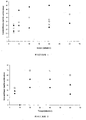
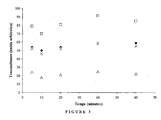
- PP Five tubes each containing a sample of PP are prepared, as are samples of PET and PEEK. 45 ml of 0.15 M solution of 4-trifluoromethylbenzenediazonium in acetonitrile are prepared and distributed into the tubes at the rate of 3 ml per tube. The tubes are immediately placed in the ultrasonic tank. Three samples (PP, PET, PEEK) are removed after 5, 10, 20, 40 and 60 minutes in order to examine the variation of the grafting rate as a function of time. The samples are washed twice with acetone (10 minutes under ultrasound) and then with acetonitrile (10 minutes under ultrasound) and dried under vacuum at 40 ° C.
- the similarity of the variation in the intensity of the different CF 3 bands indicates that the observed variation is not due to an artifact.
- the average of the variation of these intensities reaches a limit value after 20 minutes. This duration of irradiation with ultrasound is therefore sufficient to obtain the maximum grafting.
- Example 16 Grafting in an aqueous solution of binary or ternary compounds and inorganic dielectrics with trifluoromethylphenyl groups.
- Example 17 Grafting of Kapton ® and PET in the presence of 4-nitrobenzene diazonium in an alcoholic solution or in an unbuffered aqueous solution.
- Bunnett Bunnett, JF; Yjima, CJ Org. Chem. 1977, 42, 639
- a sample of Kapton ® was placed in a basic methanol solution 0.1 M (4% of tetramethylammonium hydroxide in methanol) which was treated as above.
- a basic methanol solution 0.1 M 4% of tetramethylammonium hydroxide in methanol
- Example 18 grafting of balloons used in the installation of arterial stents to improve the adhesion of the stent on the balloon.
- Stents are devices placed inside the arteries suffering from stenosis (that is, partially blocked).
- a small balloon (deflated and folded on itself) is introduced, generally made of polyamide, itself fixed at the end of a long catheter.
- the cardiologist introduces into an artery the stent crimped onto the balloon at the end of the catheter. He pushes the device to the location of the stenosis, inflates the balloon which itself dilates the stent. Once the stent is in place, the balloon is deflated and discharged from the artery through the catheter.
- the stent must be sufficiently bonded to the balloon, so the catheter, not to be released before its introduction and at the same time the bond must be low enough for the balloon to separate from the stent when it is deflated. Adhesion between the balloon and the stent has been improved by treating the balloon surface with ultrasound diazonium salts.
- balloons attached to the end of the catheter are held under vacuum by suction using a syringe attached to the other end of the catheter. They are then cleaned in ethanol for 10 minutes and then dried in an oven at 40 ° C for two hours. They are then placed in a solution (10 mM H 2 SO 4 ) of the diazonium salt of 4-aminobenzoic acid (0.15 M) under ultrasound in the tank described above for one hour. They are then rinsed with distilled water (5 minutes) and then with acetone (1 minute) under ultrasound and finally dried under vacuum at 40 ° C.
- Acid fluorides are highly reactive species, it is possible to form esters or amides (by reaction with alcohols or amines) to over-functionalize the surface.
- ToF-SIMS spectrum of chemical groups C ⁇ sub> 6 ⁇ / sub> H ⁇ sub> 4 ⁇ / sub> COF grafted onto the surface of balloons.
- Example 20 Grafting in an aqueous acid solution of Kapton ® in the presence of 4-nitrobenzene diazonium. Use of ultrasonic tanks of the PCT Systems Company.
- the samples were treated in pairs (SiO 2 + Kapton ® ) in a quartz beaker placed on the transducer.
- 150 ml of 0.02 M aqueous sulfuric acid solution containing 4-nitrobenzenediazonium (0.15 M) were used and replenished at each pair of samples.
- Photochemistry of a charge transfer complex It has been possible to perform the grafting either by using 1,4-dimethoxybenzene as the electron donor in the excited state, or by using the electron-rich polymers themselves such as PET, PEEK or ABS. Bromo- or trifluoro- or carboxyphenyl groups could thus be grafted.
- the reaction is possible either in organic solvent or in aqueous solution. The reaction times are short, which increases the practical interest of this reaction.
- the reaction makes it possible to graft nitro, bromo, carboxylic, anthraquinone and trifluoromethyl groups.
- the graft samples include both organic polymers and inorganic dielectrics.
- the reaction can be carried out either in an aprotic solvent such as acetonitrile, or in water.
- the graft reaches its maximum after about 20 minutes of irradiation.
Landscapes
- Chemical & Material Sciences (AREA)
- Health & Medical Sciences (AREA)
- Chemical Kinetics & Catalysis (AREA)
- Medicinal Chemistry (AREA)
- Polymers & Plastics (AREA)
- Organic Chemistry (AREA)
- General Chemical & Material Sciences (AREA)
- Organic Low-Molecular-Weight Compounds And Preparation Thereof (AREA)
- Treatments Of Macromolecular Shaped Articles (AREA)
- Formation Of Insulating Films (AREA)
- Pharmaceuticals Containing Other Organic And Inorganic Compounds (AREA)
Claims (15)
- Verwendung eines Diazoniumsalzes R-N2 +, das eine aromatische Gruppe R trägt, zum Pfropfen der aromatischen Gruppe auf die isolierenden, halbleitenden Oberflächen von binäreren oder ternären Verbindungen oder von Verbundmaterialien, wobei die Oberflächen einen spezifischen Widerstand größer oder gleich 10-5 Ω.m und bevorzugt größer oder gleich 10-3 Ω.m aufweisen, wobei das Diazoniumsalz in einer Konzentration nahe an dessen Löslichkeitsgrenze, insbesondere in einer Konzentration von mehr als 0,05 M und bevorzugt zwischen etwa 0,5 M und etwa 4 M variierend, vorhanden ist.
- Verwendung nach Anspruch 1, wobei die gepfropfte aromatische Gruppe aus der Reduktion des Diazoniumsalzes stammt, insbesondere- durch Verwendung eines Diazoniumsalzreduktionsmittels,- durch photochemische Bestrahlung eines Ladungsübertragungskomplexes, der aus dem Diazoniumsalz gebildet wurde, oder- durch Ultraschallbehandlung des Diazoniumsalzes.
- Verfahren zur Veränderung der Oberfläche eines isolierendes Materials, eines halbleitendes Materials, einer binären oder ternären Verbindung oder eines Verbundmaterials, um ein isolierendes Material, ein halbleitendes Material, eine binäre oder ternäre Verbindung oder ein Verbundmaterial zu erhalten, deren Oberfläche durch Pfropfen von aromatischen Gruppen, die gegebenenfalls mit funktionellen Gruppen substituiert sind, auf die Oberfläche modifiziert ist, wobei die Art der Verbindung zwischen der Oberfläche und den gepfropften aromatischen Gruppen, die sie modifizieren, eine Verbindung kovalenten Typs ist, die im Wesentlichen derart ist, dass sie gegen eine Ultraschallwäsche beständig,
wobei das Verfahren das Inkontaktbringen der Oberfläche mit einem Diazoniumsalz und die Reduktion des Diazoniumsalzes, das die aromatische Gruppe in einer Konzentration nahe dessen Löslichkeitsgrenze, insbesondere in einer Konzentration von mehr als 0,05 M, und bevorzugt zwischen etwa 0,5 M und etwa 4 M variierend, trägt, insbesondere durch die Verwendung eines Reduktionsmittels, durch photochemische Bestrahlung eines Ladungsübertragungskomplexes, der aus dem Diazoniumsalz gebildet wurde, oder durch die Ultraschallbehandlung des Diazoniumsalzes umfasst, um die gepfropften aromatischen Gruppen auf der Oberfläche zu erhalten. - Verfahren nach Anspruch 3, dadurch gekennzeichnet, dass die Dauer des Zusammenbringens der Oberfläche und des reduzierten Diazoniumsalzes weniger als etwa 60 Minuten beträgt, und insbesondere etwa 1 bis 60 Minuten und bevorzugt etwa 1 bis 10 Minuten dauert.
- Verfahren nach Anspruch 3 oder 4, dadurch gekennzeichnet, dass das Diazoniumsalz der Formel ArN2 +X-entspricht, worin Ar für die aromatische Gruppe steht und X für ein Anion steht, das vorteilhafterweise ausgewählt ist aus: Halogenen, Sulfaten, Phosphaten, Perchloraten, Tetrafluorboraten, Carboxylaten und Hexafluorphosphaten.
- Verfahren nach einem der Ansprüche 3 bis 5, dadurch gekennzeichnet, dass das Diazoniumsalz:- entweder ein Diazoharz,- oder ein Diazoniumsalz ist, ausgewählt aus:


- Verfahren nach einem der Ansprüche 3 bis 6, dadurch gekennzeichnet, dass es die Verwendung eines Reduktionsmittels umfasst.
- Verfahren nach Anspruch 7, wobei das Reduktionsmittel ausgewählt ist aus: Reduktionsmitteln, die Oxidationspotentiale nahe an 0 V/SCE oder negative Oxidationspotentiale aufweisen, Hypophosphorsäure, Halogenidsalze, insbesondere Natriumiodid, Ferrocen und dessen Derivate, insbesondere Ferrocenmethanol oder Ferrocencarbonsäure, Ascorbinsäure, Dimethylaminoboran, Natriumborhydrid, Viologensalze, insbesondere Methyl- oder Benzylviologen und Phenolate, insbesondere Bisphenolate.
- Verfahren nach Anspruch 7 oder 8, dadurch gekennzeichnet, dass es das Inkontaktbringen der Oberfläche mit dem Diazoniumsalz und dem Reduktionsmittel umfasst, wobei das Reduktionsmittel, bezogen auf das Diazoniumsalz, in stöchiometrischer Menge oder überstöchiometrisch vorhanden ist.
- Verfahren nach einem der Ansprüche 3 bis 6, dadurch gekennzeichnet, dass es die photochemische Bestrahlung eines Ladungsübertragungskomplexes umfasst, der aus dem Diazoniumsalz gebildet wurde.
- Verfahren nach Anspruch 10, das die Bildung eines Ladungsübergangskomplexes durch die Umsetzung eines Diazoniumsalzes mit einer elektronengebenden aromatischen Verbindung und die Bestrahlung des Ladungsübertragungskomplexes umfasst, um die Reduktion des Diazoniumsalzes und die Bildung von Arylradikalen zu erhalten, die sich mit der Oberfläche verbinden.
- Verfahren nach Anspruch 11, das die folgenden Schritte umfasst:- Inkontaktbringen der Oberfläche mit dem Diazoniumsalz und einer elektronengebenden aromatischen Verbindung, um einen Ladungsübertragungskomplex zu erhalten, und- Bestrahlen, insbesondere mittels Photochemie, des Ladungsübertragungskomplexes, um die Reduktion des Diazoniumsalzes und die Bildung von Arylradikalen zu erhalten, die sich mit der Oberfläche verbinden.
- Verfahren nach einem der Ansprüche 3 bis 6, dadurch gekennzeichnet, dass es die Verwendung von Ultraschall umfasst.
- Verfahren nach Anspruch 13, dadurch gekennzeichnet, dass es einen Schritt zum Inkontaktbringen der Oberfläche mit dem Diazoniumsalz und zur Ultraschallbehandlung umfasst.
- Modifizierte Oberflächen eines isolierenden Materials organischer oder anorganischer Art oder eines halbleitenden Materials anorganischer Art oder einer binären oder ternären Metallverbindung oder eines Verbundmaterials, die durch die Durchführung des Verfahrens nach einem der Ansprüche 3 bis 14 erhalten wurden.
Applications Claiming Priority (2)
| Application Number | Priority Date | Filing Date | Title |
|---|---|---|---|
| FR0510914A FR2892325B1 (fr) | 2005-10-26 | 2005-10-26 | Procede de modification de surfaces isolantes, semi-conductrices ou metalliques, et produits tels qu'obtenus |
| PCT/FR2006/002260 WO2007048894A1 (fr) | 2005-10-26 | 2006-10-09 | Procede de modification de surfaces isolantes ou semi- conductrices, et produits tels qu'obtenus |
Publications (2)
| Publication Number | Publication Date |
|---|---|
| EP1948720A1 EP1948720A1 (de) | 2008-07-30 |
| EP1948720B1 true EP1948720B1 (de) | 2011-03-30 |
Family
ID=36603677
Family Applications (1)
| Application Number | Title | Priority Date | Filing Date |
|---|---|---|---|
| EP06820167A Active EP1948720B1 (de) | 2005-10-26 | 2006-10-09 | Verwendung eines diazoniumsalzs in einem verfahren zur modifizierung von isolierenden oder halbleitenden oberflächen und resultierende produkte |
Country Status (12)
| Country | Link |
|---|---|
| US (1) | US8133549B2 (de) |
| EP (1) | EP1948720B1 (de) |
| JP (1) | JP5210170B2 (de) |
| KR (1) | KR101367781B1 (de) |
| CN (1) | CN101346419B (de) |
| AT (1) | ATE503794T1 (de) |
| CA (1) | CA2627222C (de) |
| DE (1) | DE602006021049D1 (de) |
| ES (1) | ES2373299T3 (de) |
| FR (1) | FR2892325B1 (de) |
| IL (1) | IL191022A (de) |
| WO (1) | WO2007048894A1 (de) |
Families Citing this family (16)
| Publication number | Priority date | Publication date | Assignee | Title |
|---|---|---|---|---|
| US9725602B2 (en) | 2006-12-19 | 2017-08-08 | Commissariat A L'energie Atomique Et Aux Energies Alternatives | Method for preparing an organic film at the surface of a solid support under non-electrochemical conditions, solid support thus obtained and preparation kit |
| FR2910006B1 (fr) | 2006-12-19 | 2009-03-06 | Commissariat Energie Atomique | Procede de preparation d'un film organique a la surface d'un support solide dans des conditions non-electrochimiques, support solide ainsi obtenu et kit de preparation |
| FR2910010B1 (fr) * | 2006-12-19 | 2009-03-06 | Commissariat Energie Atomique | Procede de preparation d'un film organique a la surface d'un support solide dans des conditions non-electrochimiques, support solide ainsi obtenu et kit de preparation |
| FR2910007B1 (fr) * | 2006-12-19 | 2009-03-06 | Commissariat Energie Atomique | Procede de preparation d'un film organique a la surface d'un support solide dans des conditions non-electrochimiques, support solide ainsi obtenu et kit de preparation |
| FR2929618B1 (fr) * | 2008-04-03 | 2011-03-18 | Commissariat Energie Atomique | Procede pour assembler deux surfaces ou une surface avec une molecule d'interet |
| KR101096031B1 (ko) | 2009-03-31 | 2011-12-19 | 한양대학교 산학협력단 | 자기조립단분자막 형성방법과 이를 이용한 반도체 소자의 구리배선 및 그의 형성방법 |
| FR2943930B1 (fr) * | 2009-04-02 | 2011-09-30 | Commissariat Energie Atomique | Procede pour modifier l'energie de surface d'un solide |
| US8287699B2 (en) * | 2009-07-27 | 2012-10-16 | Nanotek Instruments, Inc. | Production of chemically functionalized nano graphene materials |
| FR2969628B1 (fr) * | 2010-12-22 | 2013-09-27 | Pegastech | Procede de revetement par greffage chimique electrocatalyse d'une surface d'un substrat par une couche polymere. |
| WO2013152967A1 (en) | 2012-04-13 | 2013-10-17 | Universite Libre De Bruxelles (Ulb) | Materials coated with calixarenes |
| FR3019477B1 (fr) | 2014-04-03 | 2023-03-17 | Commissariat Energie Atomique | Procede de fonctionnalisation de surface |
| US10407556B2 (en) * | 2014-06-11 | 2019-09-10 | The Royal Institution For The Advancement Of Learning/Mcgill University | Surface modification methods for biomedical scaffolds |
| RU2640768C1 (ru) * | 2016-12-29 | 2018-01-11 | Федеральное государственное бюджетное образовательное учреждение высшего образования "Российский экономический университет имени Г.В. Плеханова" (ФГБОУ ВО "РЭУ им. Г.В. Плеханова") | Способ модификации поверхности эластомера |
| EP3638963B1 (de) * | 2017-06-16 | 2021-02-17 | Carrier Corporation | Elektrokalorisches element, ein wärmeübertragungssystem mit einem elektrokalorischen element und ein verfahren zu ihrer herstellung |
| CN109401360B (zh) * | 2017-08-18 | 2020-08-21 | 中国科学院化学研究所 | 一种对高温结构陶瓷材料进行表面改性的方法 |
| CA3033917A1 (fr) * | 2019-02-15 | 2020-08-15 | Nicolas DELAPORTE | Separateurs a base de cellulose avec retardateur de flamme, et leurs utilisations en electrochimie |
Family Cites Families (15)
| Publication number | Priority date | Publication date | Assignee | Title |
|---|---|---|---|---|
| DE3311889A1 (de) * | 1983-03-31 | 1984-10-11 | Byk-Mallinckrodt Chemische Produkte Gmbh, 6057 Dietzenbach | Verfahren zur irreversiblen bindung von protein an polystyroloberflaechen unter erhaltung der biologischen aktivitaet, so erhaltene polystyroloberflaechen und ihre verwendung |
| DE3425328A1 (de) * | 1984-07-10 | 1986-01-16 | Hoechst Ag, 6230 Frankfurt | Lichtempfindliches gemisch und damit hergestelltes lichtempfindliches aufzeichnungsmaterial |
| FR2672307B1 (fr) * | 1991-02-01 | 1993-06-04 | Centre Nat Rech Scient | Procede de modification de la surface de materiaux carbones par reduction electrochimique de sels de diazonium, notamment de fibres de carbone pour materiaux composites, materiaux carbones ainsi modifies. |
| FR2761377B1 (fr) * | 1997-03-27 | 1999-05-07 | Centre Nat Rech Scient | Procede de realisation par voie electrochimique d'un materiau carbone dont la surface est modifiee par des groupes organiques, utilisation du materiau modifie |
| US6458458B1 (en) * | 1998-10-13 | 2002-10-01 | Cabot Corporation | Polymer coated carbon products and other pigments and methods of making same by aqueous media polymerizations or solvent coating methods |
| FR2804973B1 (fr) * | 2000-02-11 | 2002-09-20 | Univ Paris 7 Denis Diderot | Materiau metallique dont la surface est modifiee, son procede de preparation et utilisation du materiau modifie |
| US7250147B2 (en) * | 2001-01-29 | 2007-07-31 | Tour James M | Process for derivatizing carbon nanotubes with diazonium species |
| US6555175B2 (en) * | 2001-02-20 | 2003-04-29 | Joseph E. Johnson | Process for the surface modification of a polymeric substrate |
| FR2829046B1 (fr) * | 2001-08-28 | 2005-01-14 | Commissariat Energie Atomique | Procede de greffage et de croissance d'un film organique conducteur sur une surface |
| US7176146B2 (en) * | 2002-02-01 | 2007-02-13 | William Marsh Rice University | Method of making a molecule-surface interface |
| FR2838048B1 (fr) * | 2002-04-03 | 2005-05-27 | Prod Dentaires Pierre Rolland | Produit dentaire reticulable/dereticulable |
| CN1852863A (zh) * | 2003-07-29 | 2006-10-25 | 威廉马歇莱思大学 | 碳纳米管的选择性官能化 |
| FR2871162B1 (fr) * | 2004-06-02 | 2007-06-29 | Univ Paris 7 Denis Diderot | Materiau de surface modifiee, son procede de preparation et ses utilisations |
| KR101224063B1 (ko) * | 2006-02-28 | 2013-01-18 | 알쉬메 | 전기 전도성 또는 반전도성 표면들의 표면상에 유기 전기-그래프트된 필름의 형성 |
| FR2904319B1 (fr) * | 2006-07-27 | 2009-10-30 | Commissariat Energie Atomique | Sels de diazonium polymerisables, procede de fabrication et utilisations de ceux-ci |
-
2005
- 2005-10-26 FR FR0510914A patent/FR2892325B1/fr not_active Expired - Lifetime
-
2006
- 2006-10-09 CN CN2006800491558A patent/CN101346419B/zh active Active
- 2006-10-09 JP JP2008537128A patent/JP5210170B2/ja active Active
- 2006-10-09 AT AT06820167T patent/ATE503794T1/de not_active IP Right Cessation
- 2006-10-09 CA CA2627222A patent/CA2627222C/fr not_active Expired - Fee Related
- 2006-10-09 WO PCT/FR2006/002260 patent/WO2007048894A1/fr not_active Ceased
- 2006-10-09 KR KR1020087012553A patent/KR101367781B1/ko not_active Expired - Fee Related
- 2006-10-09 EP EP06820167A patent/EP1948720B1/de active Active
- 2006-10-09 DE DE602006021049T patent/DE602006021049D1/de active Active
- 2006-10-09 US US12/091,894 patent/US8133549B2/en active Active - Reinstated
- 2006-10-09 ES ES06820167T patent/ES2373299T3/es active Active
-
2008
- 2008-04-27 IL IL191022A patent/IL191022A/en active IP Right Grant
Also Published As
| Publication number | Publication date |
|---|---|
| KR20080072003A (ko) | 2008-08-05 |
| IL191022A (en) | 2013-08-29 |
| ATE503794T1 (de) | 2011-04-15 |
| EP1948720A1 (de) | 2008-07-30 |
| WO2007048894A1 (fr) | 2007-05-03 |
| KR101367781B1 (ko) | 2014-02-27 |
| JP2009518459A (ja) | 2009-05-07 |
| CA2627222A1 (fr) | 2007-05-03 |
| CN101346419B (zh) | 2012-05-09 |
| DE602006021049D1 (de) | 2011-05-12 |
| ES2373299T3 (es) | 2012-02-02 |
| US20090301862A1 (en) | 2009-12-10 |
| FR2892325B1 (fr) | 2008-01-18 |
| JP5210170B2 (ja) | 2013-06-12 |
| CA2627222C (fr) | 2014-08-05 |
| FR2892325A1 (fr) | 2007-04-27 |
| US8133549B2 (en) | 2012-03-13 |
| CN101346419A (zh) | 2009-01-14 |
Similar Documents
| Publication | Publication Date | Title |
|---|---|---|
| EP1948720B1 (de) | Verwendung eines diazoniumsalzs in einem verfahren zur modifizierung von isolierenden oder halbleitenden oberflächen und resultierende produkte | |
| EP0473224B1 (de) | Mischungen aus polaren Polymeren und elektrisch fähigen dedopierten Polymeren, Verfahren zur Herstellung dieser Mischungen und Verwendung dieser Mischungen in elektronischen optoelektrischen elektrotechnischen und elektromechanischen Gegenständen | |
| CN104412376A (zh) | 半导体装置及其制造方法及冲洗液 | |
| TW200947540A (en) | Method of dielectric film treatment | |
| EP1966288B1 (de) | Film aus vernetztem polymer mit ionischen gruppierungen | |
| TW583274B (en) | Polyimide resin precursor solution, laminates for electronic components made by using the solution and process for production of the laminates | |
| Chen et al. | Fabrication of a covalently attached self-assembly multilayer film via H-bonding attraction and subsequent UV-irradiation | |
| WO2022023672A1 (fr) | Séparateur pour accumulateur comprenant une membrane poreuse fonctionnalisée par un copolymère comprenant un motif réticulable et un motif comprenant un cation alcalin ou alcalino-terreux et accumulateur correspondant | |
| CN105051872B (zh) | 复合体的制造方法及组合物 | |
| Zhong et al. | Fabrication of Covalently Attached Ultrathin Films Based on Dendrimers via H‐Bonding Attraction and Subsequent UV Irradiation | |
| WO2011073363A1 (fr) | Membrane échangeuse de cations à sélectivité améliorée, son procédé de préparation et ses utilisations. | |
| EP3159917B1 (de) | Dichtungszusammensetzung und herstellungsverfahren für halbleiterbauelement | |
| TWI677031B (zh) | 基板中間體、貫通介層窗電極基板及貫通介層窗電極形成方法 | |
| EP1937758B1 (de) | Verfahren zur modifizierung von polymeroberflächen, wie die hydroxylierung von polymeroberflächen, und so erhaltene produkte | |
| TWI286147B (en) | Composition for film formation and insulating film | |
| FR2910006A1 (fr) | Procede de preparation d'un film organique a la surface d'un support solide dans des conditions non-electrochimiques, support solide ainsi obtenu et kit de preparation | |
| TW583212B (en) | Polymer, process for production, composition for film formation containing the same, method of film formation, and insulating film | |
| JP2016103539A (ja) | 複合体の製造方法 | |
| Imamura et al. | Electrochemically Controlled Deposition of Oriented Fluorinated Covalent Organic Framework Films for Selective Electrochemical Sensing | |
| TWI920500B (zh) | 導電性材料組成物、導電膜、及導電膜之形成方法 | |
| EP2676740A1 (de) | Kovalentes Pfropfverfahren einer Polyarylenschicht auf eine leitfähige oder halbleitende Oberfläche für Strom | |
| FR3045674A1 (fr) | Procede de metallisation d'un substrat semi-conducteur avec du cuivre mettant en oeuvre un siliciure de cobalt ou de nickel | |
| Cao et al. | Grafting low-k organic films onto copper surface by one-step electrografting method via aryldiazonium chemistry | |
| FR2886643A1 (fr) | Nouveau type de jonction moleculaire entre semi-conducteur et un metal | |
| EP0537047A1 (de) | Leitfähiges Verbundmaterial, Überzugsmittel und Messfühler durch Anwendung dieses leitfähigen Materials |
Legal Events
| Date | Code | Title | Description |
|---|---|---|---|
| PUAI | Public reference made under article 153(3) epc to a published international application that has entered the european phase |
Free format text: ORIGINAL CODE: 0009012 |
|
| 17P | Request for examination filed |
Effective date: 20080421 |
|
| AK | Designated contracting states |
Kind code of ref document: A1 Designated state(s): AT BE BG CH CY CZ DE DK EE ES FI FR GB GR HU IE IS IT LI LT LU LV MC NL PL PT RO SE SI SK TR |
|
| 17Q | First examination report despatched |
Effective date: 20091118 |
|
| GRAC | Information related to communication of intention to grant a patent modified |
Free format text: ORIGINAL CODE: EPIDOSCIGR1 |
|
| GRAP | Despatch of communication of intention to grant a patent |
Free format text: ORIGINAL CODE: EPIDOSNIGR1 |
|
| RTI1 | Title (correction) |
Free format text: USE OF A DIAZONIUM SALT IN A METHOD FOR MODIFYING INSULATING OR SEMI-CONDUCTIVE SURFACES, AND RESULTING PRODUCTS |
|
| DAX | Request for extension of the european patent (deleted) | ||
| GRAS | Grant fee paid |
Free format text: ORIGINAL CODE: EPIDOSNIGR3 |
|
| GRAA | (expected) grant |
Free format text: ORIGINAL CODE: 0009210 |
|
| AK | Designated contracting states |
Kind code of ref document: B1 Designated state(s): AT BE BG CH CY CZ DE DK EE ES FI FR GB GR HU IE IS IT LI LT LU LV MC NL PL PT RO SE SI SK TR |
|
| REG | Reference to a national code |
Ref country code: GB Ref legal event code: FG4D Free format text: NOT ENGLISH |
|
| REG | Reference to a national code |
Ref country code: CH Ref legal event code: EP |
|
| REG | Reference to a national code |
Ref country code: IE Ref legal event code: FG4D |
|
| REF | Corresponds to: |
Ref document number: 602006021049 Country of ref document: DE Date of ref document: 20110512 Kind code of ref document: P |
|
| REG | Reference to a national code |
Ref country code: DE Ref legal event code: R096 Ref document number: 602006021049 Country of ref document: DE Effective date: 20110512 |
|
| REG | Reference to a national code |
Ref country code: NL Ref legal event code: VDEP Effective date: 20110330 |
|
| PG25 | Lapsed in a contracting state [announced via postgrant information from national office to epo] |
Ref country code: SE Free format text: LAPSE BECAUSE OF FAILURE TO SUBMIT A TRANSLATION OF THE DESCRIPTION OR TO PAY THE FEE WITHIN THE PRESCRIBED TIME-LIMIT Effective date: 20110330 Ref country code: LT Free format text: LAPSE BECAUSE OF FAILURE TO SUBMIT A TRANSLATION OF THE DESCRIPTION OR TO PAY THE FEE WITHIN THE PRESCRIBED TIME-LIMIT Effective date: 20110330 Ref country code: GR Free format text: LAPSE BECAUSE OF FAILURE TO SUBMIT A TRANSLATION OF THE DESCRIPTION OR TO PAY THE FEE WITHIN THE PRESCRIBED TIME-LIMIT Effective date: 20110701 Ref country code: LV Free format text: LAPSE BECAUSE OF FAILURE TO SUBMIT A TRANSLATION OF THE DESCRIPTION OR TO PAY THE FEE WITHIN THE PRESCRIBED TIME-LIMIT Effective date: 20110330 |
|
| RAP2 | Party data changed (patent owner data changed or rights of a patent transferred) |
Owner name: ALCHIMER Owner name: ALCHIMEDICS |
|
| LTIE | Lt: invalidation of european patent or patent extension |
Effective date: 20110330 |
|
| PG25 | Lapsed in a contracting state [announced via postgrant information from national office to epo] |
Ref country code: SI Free format text: LAPSE BECAUSE OF FAILURE TO SUBMIT A TRANSLATION OF THE DESCRIPTION OR TO PAY THE FEE WITHIN THE PRESCRIBED TIME-LIMIT Effective date: 20110330 Ref country code: CY Free format text: LAPSE BECAUSE OF FAILURE TO SUBMIT A TRANSLATION OF THE DESCRIPTION OR TO PAY THE FEE WITHIN THE PRESCRIBED TIME-LIMIT Effective date: 20110330 Ref country code: FI Free format text: LAPSE BECAUSE OF FAILURE TO SUBMIT A TRANSLATION OF THE DESCRIPTION OR TO PAY THE FEE WITHIN THE PRESCRIBED TIME-LIMIT Effective date: 20110330 Ref country code: AT Free format text: LAPSE BECAUSE OF FAILURE TO SUBMIT A TRANSLATION OF THE DESCRIPTION OR TO PAY THE FEE WITHIN THE PRESCRIBED TIME-LIMIT Effective date: 20110330 |
|
| PG25 | Lapsed in a contracting state [announced via postgrant information from national office to epo] |
Ref country code: EE Free format text: LAPSE BECAUSE OF FAILURE TO SUBMIT A TRANSLATION OF THE DESCRIPTION OR TO PAY THE FEE WITHIN THE PRESCRIBED TIME-LIMIT Effective date: 20110330 Ref country code: PT Free format text: LAPSE BECAUSE OF FAILURE TO SUBMIT A TRANSLATION OF THE DESCRIPTION OR TO PAY THE FEE WITHIN THE PRESCRIBED TIME-LIMIT Effective date: 20110801 |
|
| PG25 | Lapsed in a contracting state [announced via postgrant information from national office to epo] |
Ref country code: CZ Free format text: LAPSE BECAUSE OF FAILURE TO SUBMIT A TRANSLATION OF THE DESCRIPTION OR TO PAY THE FEE WITHIN THE PRESCRIBED TIME-LIMIT Effective date: 20110330 Ref country code: IS Free format text: LAPSE BECAUSE OF FAILURE TO SUBMIT A TRANSLATION OF THE DESCRIPTION OR TO PAY THE FEE WITHIN THE PRESCRIBED TIME-LIMIT Effective date: 20110730 Ref country code: SK Free format text: LAPSE BECAUSE OF FAILURE TO SUBMIT A TRANSLATION OF THE DESCRIPTION OR TO PAY THE FEE WITHIN THE PRESCRIBED TIME-LIMIT Effective date: 20110330 Ref country code: RO Free format text: LAPSE BECAUSE OF FAILURE TO SUBMIT A TRANSLATION OF THE DESCRIPTION OR TO PAY THE FEE WITHIN THE PRESCRIBED TIME-LIMIT Effective date: 20110330 |
|
| PG25 | Lapsed in a contracting state [announced via postgrant information from national office to epo] |
Ref country code: NL Free format text: LAPSE BECAUSE OF FAILURE TO SUBMIT A TRANSLATION OF THE DESCRIPTION OR TO PAY THE FEE WITHIN THE PRESCRIBED TIME-LIMIT Effective date: 20110330 |
|
| REG | Reference to a national code |
Ref country code: ES Ref legal event code: FG2A Ref document number: 2373299 Country of ref document: ES Kind code of ref document: T3 Effective date: 20120202 |
|
| PLBE | No opposition filed within time limit |
Free format text: ORIGINAL CODE: 0009261 |
|
| STAA | Information on the status of an ep patent application or granted ep patent |
Free format text: STATUS: NO OPPOSITION FILED WITHIN TIME LIMIT |
|
| PG25 | Lapsed in a contracting state [announced via postgrant information from national office to epo] |
Ref country code: PL Free format text: LAPSE BECAUSE OF FAILURE TO SUBMIT A TRANSLATION OF THE DESCRIPTION OR TO PAY THE FEE WITHIN THE PRESCRIBED TIME-LIMIT Effective date: 20110330 Ref country code: DK Free format text: LAPSE BECAUSE OF FAILURE TO SUBMIT A TRANSLATION OF THE DESCRIPTION OR TO PAY THE FEE WITHIN THE PRESCRIBED TIME-LIMIT Effective date: 20110330 |
|
| 26N | No opposition filed |
Effective date: 20120102 |
|
| REG | Reference to a national code |
Ref country code: DE Ref legal event code: R097 Ref document number: 602006021049 Country of ref document: DE Effective date: 20120102 |
|
| BERE | Be: lapsed |
Owner name: ALCHIMER Effective date: 20111031 |
|
| PG25 | Lapsed in a contracting state [announced via postgrant information from national office to epo] |
Ref country code: MC Free format text: LAPSE BECAUSE OF NON-PAYMENT OF DUE FEES Effective date: 20111031 |
|
| REG | Reference to a national code |
Ref country code: CH Ref legal event code: PL |
|
| PG25 | Lapsed in a contracting state [announced via postgrant information from national office to epo] |
Ref country code: CH Free format text: LAPSE BECAUSE OF NON-PAYMENT OF DUE FEES Effective date: 20111031 Ref country code: BE Free format text: LAPSE BECAUSE OF NON-PAYMENT OF DUE FEES Effective date: 20111031 Ref country code: LI Free format text: LAPSE BECAUSE OF NON-PAYMENT OF DUE FEES Effective date: 20111031 |
|
| PG25 | Lapsed in a contracting state [announced via postgrant information from national office to epo] |
Ref country code: LU Free format text: LAPSE BECAUSE OF NON-PAYMENT OF DUE FEES Effective date: 20111009 |
|
| PG25 | Lapsed in a contracting state [announced via postgrant information from national office to epo] |
Ref country code: BG Free format text: LAPSE BECAUSE OF FAILURE TO SUBMIT A TRANSLATION OF THE DESCRIPTION OR TO PAY THE FEE WITHIN THE PRESCRIBED TIME-LIMIT Effective date: 20110630 |
|
| PG25 | Lapsed in a contracting state [announced via postgrant information from national office to epo] |
Ref country code: TR Free format text: LAPSE BECAUSE OF FAILURE TO SUBMIT A TRANSLATION OF THE DESCRIPTION OR TO PAY THE FEE WITHIN THE PRESCRIBED TIME-LIMIT Effective date: 20110330 |
|
| PG25 | Lapsed in a contracting state [announced via postgrant information from national office to epo] |
Ref country code: HU Free format text: LAPSE BECAUSE OF FAILURE TO SUBMIT A TRANSLATION OF THE DESCRIPTION OR TO PAY THE FEE WITHIN THE PRESCRIBED TIME-LIMIT Effective date: 20110330 |
|
| REG | Reference to a national code |
Ref country code: FR Ref legal event code: PLFP Year of fee payment: 10 |
|
| REG | Reference to a national code |
Ref country code: FR Ref legal event code: PLFP Year of fee payment: 11 |
|
| REG | Reference to a national code |
Ref country code: FR Ref legal event code: PLFP Year of fee payment: 12 |
|
| REG | Reference to a national code |
Ref country code: FR Ref legal event code: PLFP Year of fee payment: 13 |
|
| REG | Reference to a national code |
Ref country code: DE Ref legal event code: R082 Ref document number: 602006021049 Country of ref document: DE Representative=s name: CBDL PATENTANWAELTE GBR, DE Ref country code: DE Ref legal event code: R082 Ref document number: 602006021049 Country of ref document: DE Representative=s name: CBDL PATENTANWAELTE, DE Ref country code: DE Ref legal event code: R081 Ref document number: 602006021049 Country of ref document: DE Owner name: ALCHIMEDICS, FR Free format text: FORMER OWNER: ALCHIMER, MASSY, FR Ref country code: DE Ref legal event code: R081 Ref document number: 602006021049 Country of ref document: DE Owner name: AVENI, FR Free format text: FORMER OWNER: ALCHIMER, MASSY, FR |
|
| REG | Reference to a national code |
Ref country code: GB Ref legal event code: 732E Free format text: REGISTERED BETWEEN 20191003 AND 20191009 |
|
| REG | Reference to a national code |
Ref country code: GB Ref legal event code: 732E Free format text: REGISTERED BETWEEN 20191010 AND 20191016 |
|
| REG | Reference to a national code |
Ref country code: DE Ref legal event code: R082 Ref document number: 602006021049 Country of ref document: DE Representative=s name: CBDL PATENTANWAELTE GBR, DE Ref country code: DE Ref legal event code: R082 Ref document number: 602006021049 Country of ref document: DE Representative=s name: CBDL PATENTANWAELTE EGBR, DE |
|
| P01 | Opt-out of the competence of the unified patent court (upc) registered |
Effective date: 20230526 |
|
| PGFP | Annual fee paid to national office [announced via postgrant information from national office to epo] |
Ref country code: GB Payment date: 20241028 Year of fee payment: 19 |
|
| PGFP | Annual fee paid to national office [announced via postgrant information from national office to epo] |
Ref country code: IE Payment date: 20241021 Year of fee payment: 19 |
|
| PGFP | Annual fee paid to national office [announced via postgrant information from national office to epo] |
Ref country code: IT Payment date: 20241010 Year of fee payment: 19 Ref country code: ES Payment date: 20241108 Year of fee payment: 19 |
|
| PGFP | Annual fee paid to national office [announced via postgrant information from national office to epo] |
Ref country code: FR Payment date: 20250924 Year of fee payment: 20 |
|
| PGFP | Annual fee paid to national office [announced via postgrant information from national office to epo] |
Ref country code: DE Payment date: 20250923 Year of fee payment: 20 |