EP1943779B1 - Communication apparatus, control method for communication apparatus, and communication system - Google Patents
Communication apparatus, control method for communication apparatus, and communication system Download PDFInfo
- Publication number
- EP1943779B1 EP1943779B1 EP06833849A EP06833849A EP1943779B1 EP 1943779 B1 EP1943779 B1 EP 1943779B1 EP 06833849 A EP06833849 A EP 06833849A EP 06833849 A EP06833849 A EP 06833849A EP 1943779 B1 EP1943779 B1 EP 1943779B1
- Authority
- EP
- European Patent Office
- Prior art keywords
- master
- master device
- restart
- communication apparatus
- standby time
- Prior art date
- Legal status (The legal status is an assumption and is not a legal conclusion. Google has not performed a legal analysis and makes no representation as to the accuracy of the status listed.)
- Not-in-force
Links
Images








Classifications
-
- H—ELECTRICITY
- H04—ELECTRIC COMMUNICATION TECHNIQUE
- H04L—TRANSMISSION OF DIGITAL INFORMATION, e.g. TELEGRAPHIC COMMUNICATION
- H04L12/00—Data switching networks
- H04L12/28—Data switching networks characterised by path configuration, e.g. LAN [Local Area Networks] or WAN [Wide Area Networks]
-
- H—ELECTRICITY
- H04—ELECTRIC COMMUNICATION TECHNIQUE
- H04W—WIRELESS COMMUNICATION NETWORKS
- H04W84/00—Network topologies
- H04W84/18—Self-organising networks, e.g. ad-hoc networks or sensor networks
- H04W84/20—Leader-follower arrangements
-
- H—ELECTRICITY
- H04—ELECTRIC COMMUNICATION TECHNIQUE
- H04B—TRANSMISSION
- H04B7/00—Radio transmission systems, i.e. using radiation field
- H04B7/24—Radio transmission systems, i.e. using radiation field for communication between two or more posts
-
- H—ELECTRICITY
- H04—ELECTRIC COMMUNICATION TECHNIQUE
- H04L—TRANSMISSION OF DIGITAL INFORMATION, e.g. TELEGRAPHIC COMMUNICATION
- H04L9/00—Cryptographic mechanisms or cryptographic arrangements for secret or secure communications; Network security protocols
- H04L9/40—Network security protocols
Definitions
- the present invention relates to a communication apparatus that operates in a network as master or slave.
- each device in the network When communication via a wireless network is performed between a plurality of devices, the respective roles of each device in the network may differ. There are systems in which communication is performed with devices assuming the role of either a "master” that manages the identification information of other devices and entry into or withdrawal from the network, or a “slave” that operates based on instructions from the master.
- the device that is better suited in terms of capability preferably operates as the master. For example, in the case where a device without a display unit is the master, the user will be unable to readily identify accessible devices in the same network.
- a device provided with a display unit capable of displaying the devices in the same network is the master, users are able to check which devices are participants in the network. Further, if an operation unit that is able to designate a data transfer destination from among the displayed devices is included, data communication with desired parties can be readily performed.
- An object of the present invention is to provide a communication apparatus, a control method and a communication system, the communication apparatus being capable of readily becoming a master device, even when entering a network that already has a master device. Further objects of the present invention will become apparent from the following description and drawings.
- the present invention provides a communication apparatus according to any one of claims 1 and 8, a control method according to any one of claims 12 and 13, and a communication system according to claim 14.
- the other claims relate to further developments.
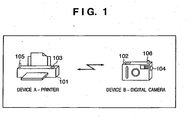
- FIG. 1 is a configuration diagram of a communication system according to first and third embodiments.
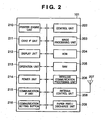
- FIG. 2 is a block configuration diagram of a printer according to the embodiments of the present invention.
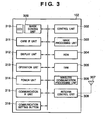
- FIG. 3 is a block configuration diagram of a digital camera according to the embodiments of the present invention.
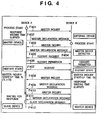
- FIG. 4 shows an operation sequence in the first embodiment.
- FIG. 5 shows an operation algorithm in the first to fourth embodiments.
- FIG. 6 shows an operation algorithm of the restart process of FIG. 5 in the first embodiment.
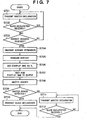
- FIG. 7 shows an operation algorithm of the master process of FIG. 5 in the first embodiment.
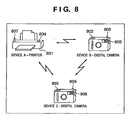
- FIG. 8 is a configuration diagram of a communication system according to the second and fourth embodiments.
- FIG. 9 shows an operation sequence in the second embodiment.
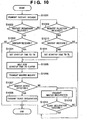
- FIG. 10 shows an operation algorithm of the restart process of FIG. 5 in the second embodiment.
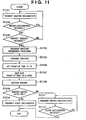
- FIG. 11 shows an operation algorithm of the master process of FIG. 5 in the second embodiment.
- FIG. 12 shows an operation sequence in the third embodiment.
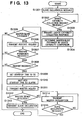
- FIG. 13 shows an operation algorithm of the restart process of FIG. 5 in the third embodiment.
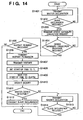
- FIG. 14 shows an operation algorithm of the master process of FIG. 5 in the third embodiment.
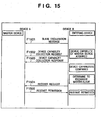
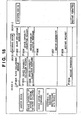
- FIG. 15 shows an operation sequence of the master-slave exchange determination process in FIG. 12 .
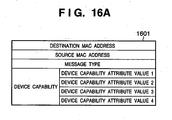
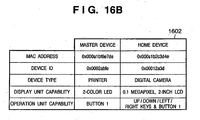
- FIGS. 16A , 16B and 16C respectively show the data structure regarding device capability and device capability comparison, and an accessible device list display in a wireless communication apparatus according to the third and fourth embodiments.
- FIG. 17 shows an operation sequence in the fourth embodiment.
- FIG. 18 shows an operation sequence of the master-slave exchange determination process in FIG. 17 .
- FIG. 19 shows an operation algorithm of the restart process of FIG. 5 in the fourth embodiment.
- FIG. 20 shows an operation algorithm of the master process of FIG. 5 in the fourth embodiment.
- the device that constructs a new network becomes the master. Subsequently, the master device manages the MAC (Media Access Control) addresses and the like of other devices existing in the same network. The master device also makes requests to slave devices for transmission of device capability, and slave devices transmit their device capability in accordance with the instructions from the master device.
- device capability information includes the type of device (printer, digital camera, etc.), the capability of the display unit such as a monitor, and the capability of operation units such as buttons.
- the master and slaves both periodically perform notification of their respective existence (master declaration and slave declaration).
- FIG. 1 shows the configuration of a communication system according to a first embodiment.
- the 101 and 102 are respectively a printer (device A) and a digital camera (device B).
- the printer 101 has an 802.11 wireless LAN as a wireless communication function 105, and the configuration of an ad hoc network for performing direct communication between devices is possible by pressing a communication setting button 103.
- the digital camera 102 also has an 802.11 wireless LAN as a wireless communication function 106, and the configuration of an ad hoc network is possible by pressing a communication setting button 104.
- FIG. 2 shows a block configuration of the printer 101 in the present embodiment.
- 202 is a control unit for controlling the operation of the entire printer 101.
- 203 is an image processing unit that administers the encoding, decoding and format conversion of image data.
- 204 is a ROM (Read Only Memory) that stores programs for the various controls of FIGS. 5 , 7 , 11 , 14 and 20 (described below) performed by the control unit 202, while 205 is a RAM (Random Access Memory).
- 206 is a wireless communication processing unit for controlling 802.11 wireless LAN communication
- 207 is an antenna
- 208 is an antenna control unit.
- 209 is a paper feed/discharge unit for feeding and discharging printer paper
- 210 is a printer engine unit for controlling printing by the printer 101.
- 211 is a card interface unit for controlling a recording media card that stores images.
- 212 is a display unit realized by a CRT, a liquid crystal display or the like.
- 213 is an operation unit, 214 is a power unit, and 215 is a communication interface unit such as a USB or an IEEE1394.
- 216 is a communication setting button for starting up an operation to enter the ad hoc network in which direct communication is performed between devices.
- FIG. 3 shows a block configuration of the digital camera 102 in the present embodiment.
- 302 is a control unit for controlling the operation of the entire digital camera 102.
- 303 is an image processing unit that administers the encoding, decoding and format conversion of image data.
- 304 is a ROM storing programs for the various controls of FIGS. 5 , 6 , 10 , 13 and 19 (described below) performed by the control unit 302, while 305 is a RAM.
- 306 is a wireless communication processing unit for controlling 802.11 wireless LAN communication
- 307 is an antenna
- 308 is an antenna control unit.
- 309 is an image sensing unit that imports pixel signal input from a CCD 310.
- 311 is a card interface unit for controlling a recording media card that stores sensed images and setting information.
- 312 is a display unit realized by a CRT, a liquid crystal display or the like.
- 313 is an operation unit that includes buttons such as image-sensing instruction, play, and setting buttons.
- 314 is a power unit, while 315 is a communication interface unit such as a USB or an IEEE1394.
- 316 is a communication setting button for starting up an operation to enter the ad hoc network in which direct communication is performed between devices.
- the present embodiment is described in relation to processing performed in the case where the printer 101 initially forms an ad hoc network and is operating as the master, when the digital camera 102 enters the network.
- FIG. 4 shows an operation sequence in the first embodiment.
- Processing for connecting to an ad hoc network is started when the communication setting button 103 of the device A is pressed, and the device A broadcasts a master inquiry F401.
- the device A decides that a master device is not entered in the ad hoc network, and becomes the master device by transmitting a master declaration message F402.
- the device A also continues to broadcast master declaration messages periodically.
- the device B broadcasts a master inquiry F403.
- the device B detects that a master device exists in the ad hoc network.
- the device B stores the MAC address of the device A from the source MAC address of the master declaration message F404.
- the device B Having detected the master device, the device B transmits a restart request F405 to the MAC address of the device A in order to start a master-slave exchange.
- the device A stores the MAC address of the device B from the source MAC address of the received restart request F405. After transmitting a restart permission F406 to the MAC address of the device B, the device A then transmits a restart F407 and transfers to a restart state.
- the device B stores the receipt of the restart permission F406, and waits to receive a restart. On receiving the restart F407 from the device A, the device B transfers to a restart state.
- the restart state is a state in which the devices are temporarily released from their role as master or slave, and an attempt is made to reconstruct the network.
- the restart request is a signal requesting transfer to the restart state.
- the device A having transferred to the restart state, sets the master inquiry start-up time to TL, and waits for the TL time to elapse.
- the device B having transferred to the restart state, sets a master inquiry start-up time to TS, and waits for time TS to elapse.
- the master inquiry start-up time TS is set to a smaller value than the master inquiry start-up time TL. This results in the device B, which transmitted the restart request, transmitting a master inquiry before the device A, which received the restart request.
- TL which is set by the device that receives a restart request
- TS which is set by the device that transmits a restart request and receives a restart permission
- the device B broadcasts a master inquiry F408. If the response waiting time elapses without receiving a master declaration message from another device, the device B broadcasts a master declaration message F409. The device B thereafter operates as the master.
- the device A broadcasts a master inquiry F410 when the master inquiry start-up time TL elapses.
- the device A On receiving a master declaration message F411 from the device B, which is now the master, the device A transmits a slave declaration message F412 to the device B. The device B thereafter operates as a slave.
- FIG. 5 shows an operation algorithm of the devices in the present embodiment.
- step S501 When the process to connect to an ad hoc network is started by pressing the communication setting button, the device broadcasts a master inquiry (step S501).
- the device determines whether a master declaration message has been received within a response waiting time for the master inquiry (step S502). If a master device is detected by receiving a master declaration message (step S502: YES), the device performs the restart process (step S503). The restart process is described in detail below with reference to FIG. 6 . If the response waiting time elapses without receiving a master declaration message, the device decides that a master device has not been detected (step S502: NO), and performs master process (step S504). The master process is described in detail below with reference to FIG. 7 .
- FIG. 6 shows an operation algorithm of the restart process (S503) in the flowchart of FIG. 5 .
- the device starting the restart process first transmits a restart request to the master device (step S601). This corresponds to transmission of the restart request F405 in FIG. 4 .
- step S602 the device determines whether a restart permission from the master device has been received. If a restart permission has been received (step S602: YES), the device stores the restart permission receipt and proceeds to step S603. If a restart permission has not been received (step S602: NO), the device ends the process.
- step S603 the device determines whether a restart from the master device has been received. If a restart has been received (step S603: YES), the device proceeds to step S604, and if a restart has not been received (step S603: NO), the device ends the process.
- the device sets the master inquiry start-up time to TS.
- the device then waits for the master inquiry start-up time TS to elapse (step S605).
- the device broadcasts a master inquiry (step S606). This corresponds to transmission of the master inquiry F408 in FIG. 4 .
- step S607 the device determines whether a master declaration message has been received within the response waiting time for the master inquiry. If a master device is detected by receiving a master declaration message (step S607: YES), the device proceeds to step S608. If a master device is not detected (step S607: NO), the device proceeds to step 5609.
- the device transmits a slave declaration message to the master device.
- the MAC address of the master device can be stored by looking at the source MAC address of the master declaration message.
- the device itself becomes the master device and transmits a master declaration message, since a master device was not detected. This corresponds to transmission of the master declaration message F409 in FIG. 4 .
- step S610 determines whether a slave declaration message has been received within the response time for the master declaration message. If a slave declaration message has been received (step S610: YES), the device ends the process. If a slave declaration message has not been received (step S610: NO), the device returns to step S609 and again transmits a master declaration message.
- FIG. 7 shows an operation algorithm of the master process (S504) in the flowchart of FIG. 5 .
- the device that starts the master process transmits a master declaration message (step S701). This corresponds to the master declaration message F402 in FIG. 4 .
- step S702 the device checks whether a slave declaration message has been received. If a slave declaration message has been received (step S701: YES), the device returns to step S701 and again transmits a master declaration message. If a slave declaration message has not been received (step S701: NO), the device proceeds to step S703, and if a slave declaration has been received (step S702: YES), the device returns to step S701.
- step S703 the device checks whether a restart request has been received, and if a restart request has been received (step S703: YES), the device proceeds to step S704. If a restart request has not been received (step S703: NO), the device returns to step S701 and again transmits a master declaration message. At step S704, the device transmits a restart permission to the source MAC address of the restart request as the transmission destination. This corresponds to transmission of the restart permission F406 in FIG. 4 .
- step S705 the device transmits a restart to the source MAC address of the restart request as the transmission destination. This corresponds to transmission of the restart F407 in FIG. 4 .
- the device After transmitting the restart, the device sets the master inquiry start-up time to TL (step S706). Then, after waiting for the master inquiry start-up time TL to elapse (step S707), the device broadcasts a master inquiry (step S708). This corresponds to transmission of the master inquiry F410 in FIG. 4 .
- step S709 the device checks whether a master declaration message has been received within the response waiting time for the master inquiry. If a master device is detected by receipt of a master declaration message (step S709: YES), the device transmits a slave declaration message to the master device (step S710). This corresponds to transmission of the slave declaration message F412 in FIG. 4 . If a master device is not detected (step S709: NO), the device proceeds to step S711, and transmits a master declaration message to itself to become the master device. Next, the device determines whether a slave declaration message has been received within the response time of the master declaration message (step S712). If a slave declaration message has been received (step S712: YES), the device ends the process. If a slave declaration message has not been received (step S712: NO), the device returns to step S711 and again transmits a master declaration message.
- a restart request may be preset depending on the device. For example, a digital camera may be set to transmit a restart request upon detecting a master device, while a printer may be set to not transmit a restart request even upon detecting a master device. This makes it possible to exchange master and slave devices only when a device that is predetermined to be suitable as the master device is entered in the network.
- the device newly entering the network transmits a restart request to a device already operating as the master device, and if a restart permission is received, the device transfers to the restart state and transmits a master inquiry before the master device can do so. This enables a device newly entering a network to operate as the master even if a master device already exists in the network.
- FIG. 8 shows the configuration of a communication system according to a second embodiment.
- 801, 802 and 803 refer respectively to a printer 801 (device A), a digital camera 802 (device B) and a digital camera 803 (device C). These devices constituting an ad hoc network.
- the devices are each provided with 802.11 wireless LAN by way of wireless communication functions 807, 808 and 809, respectively. Connection to the ad hoc network is possible by pressing communication setting buttons 804, 805 and 806. Note that descriptions of the block configurations of the devices, being the same as FIGS. 2 and 3 in embodiment 1, are omitted here.
- FIG. 9 shows an operation sequence in the second embodiment.
- Processing in order to connect to an ad hoc network is started when the communication setting button 804 of the device A is pressed, and the device A broadcasts a master inquiry F901.
- the device A decides that a master device is not entered in the ad hoc network, and becomes the master device by transmitting a master declaration message F902.
- the device A also continues to broadcast master declaration messages periodically.
- the device B broadcasts a master inquiry F903.
- the device C broadcasts a master inquiry F904.
- the devices B and C On receiving a master declaration message F905 from the device A in response to the master inquiries, the devices B and C detect that a master device exists in the ad hoc network. The devices B and C then respectively transmit restart requests F906 and F907 to the device A in order to start a master-slave exchange.
- the device A received the restart requests F906 and F907 from the devices B and C within the response waiting time until the next master declaration message after the transmission of the master declaration message F905.
- the device A stores the MAC addresses of the devices B and C from the source MAC addresses of the received restart requests F906 and F907.
- the device A then transmits a restart rejection F908 to the device B, and a restart permission F909 to the device C.
- the device A transmits restarts F910 and F911 to the devices B and C, and transfers to the restart state.
- the decision as to whether to transmit a restart rejection or a restart permission is made in accordance with specific determination criteria. For example, one method involves transmitting a restart permission to the source device of the first restart request to be received, while another method involves referring to the lexicographic order of the MAC addresses of the source devices, and transmitting a restart permission to the device with the highest value.
- the device A having transferred to the restart state, sets the master inquiry start-up time to TL, and waits for the TL time to elapse.
- the device B having transferred to the restart state, sets the master inquiry start-up time to TL' since a restart permission was not received, and waits for the TL time to elapse.
- the device C having transferred to the restart state, sets the master inquiry start-up time to TS upon storing the received restart permission, and waits for the TS time to elapse.
- the master inquiry start-up time TL is set to be longer than the master inquiry start-up time TS. This results in the device C, which received the restart permission, being the first to transmit a master inquiry.
- TL and TS are stored in each device.
- TL values are set by the device when it receives a restart request or it transmits a restart request and receives a restart rejection.
- TS values are set by the device when it transmits a restart request and receives a restart permission.
- TS and TL values are prestored in the RAMs 205 and 305. TL and TS are set depending on the situation.
- the device C broadcasts a master inquiry F912, and if the response waiting time elapses without receiving a master declaration message from another device, the device C broadcasts a master declaration message F913 and becomes the master device.
- the devices A and B broadcast master inquires F914 and 915 after the elapse of the master inquiry start-up time TL.
- the device C which has already become the master device, transmits a master declaration message F916 in response to the master inquires.
- the devices A and B having received the master declaration message, transmit slave declaration messages F917 and F918 to the device C, and become slave devices.
- the operation algorithm of the devices in the present embodiment is the same as the flowchart shown in FIG. 5 of the first embodiment, except for the restart process (S503) and the master process (S504).
- the device starting the restart process transmits a restart request to the master device (step S1001). This corresponds to transmission of the restart request F906 or F907 in FIG. 9 .
- step S1002 the device determines whether a restart permission from the master device has been received. If a restart permission has been received (step S1002: YES), the device stores the receipt of restart permission and proceeds to step S1003, and if a restart permission has not been received (step S1002: NO), the device proceeds to step S1009.
- step S1003 the device determines whether a restart from the master device has been received. If a restart has been received (step S1003: YES), the device proceeds to step S1004, and if a restart has not been received (step S1003: NO), the device ends the process.
- step S1004 the device sets the master inquiry start-up time to TS.
- the device then waits for the master inquiry start-up time TS to elapse (step S1005).
- the device broadcasts a master inquiry (step S1006). This corresponds to transmission of the master inquiry F912 in FIG. 9 .
- step S1007 the device checks whether a master declaration message has been received within the response waiting time for the master inquiry. If a master device is detected by receiving a master declaration message (step S1007: YES), the device proceeds to step S1008. If a master device is not detected (step S1007: NO), the device proceeds to step S1012.
- the device transmits a slave declaration message to the master device.
- the MAC address of the master device can be stored by looking at the source MAC address of the master declaration message.
- step S1009 the device determines whether a request rejection has been received from the master device. If a request rejection has been received (step S1009: YES), the device proceeds to step S1010, and if a request rejection has not been received (step S1009: YES), the device ends the process.
- step S1010 the device determines whether a restart from the master device has been received. If a restart has been received (step S1010: YES), the device proceeds to step S1011, and if a request start has not been received (step S1010: YES), the device ends the process.
- step S1011 the device sets the master inquiry start-up time to TL, and proceeds to step S1005.
- the device itself becomes the master device and broadcasts a master declaration message. This corresponds to transmission of the master declaration message F913 in FIG. 9 .
- step S1013 the device determines whether a slave declaration message has been received within the response time for the master determination. If a slave declaration message has been received (step S1013: YES), the device ends the process, and if a slave declaration message has not been received (step S1013: NO), the device returns to step S1012 and again transmits a master declaration message.
- the device that receives the restart permission is the first to transmit a master inquiry since the master inquiry start-up time of this device is set to a smaller value than the device that did not receive the restart permission.
- FIG. 11 shows an operation algorithm of the master process (S504 in FIG. 5 ) in the present embodiment. Note that S1101 to S1103 and S1105 to S1112 in the flowchart of FIG. 11 are the same as S701 to S703, and S705 to S712 in the flowchart of FIG. 7 in the first embodiment, while the process of S1104 is different from that of S704.
- the device rather than transmitting a restart permission to all the devices that have transmitted a restart request, transmits a restart rejection or a restart permission to each device.
- restart permission is only transmitted to the device that is to newly become the master device.
- a restart request may be preset depending on the device. For example, a digital camera is set to transmit a restart request upon detecting a master device, while a printer is set to not transmit a restart request even upon detecting a master device. As a result, a master device and slave device can be exchanged only when a device that is predetermined to be suitable as a master device is entered in the network.
- a restart permission is only transmitted to the device that is to newly become the master device.
- the device that receives a restart permission is able to newly become the master device after transmitting a master inquiry before the previous master device and the device that received the restart rejection.
- a restart rejection is transmitted to devices that transmit a restart request other than the device that is to become the new master, it is not absolutely necessary to transmit a restart rejection.
- similar effects can be obtained by setting the master inquiry start-up time to TL in the case where a device that transmits a restart request receives a restart without receiving a restart permission.
- the configuration of a communication system according to a third embodiment is the same as the configuration of the communication system shown in FIG. 1 in the first embodiment.
- FIG. 12 shows an operation sequence in the present embodiment.
- Process for connecting to an ad hoc network is started when the communication setting button 103 of the device A is pressed, and the device A broadcasts a master inquiry F1201.
- the device A decides that a master device is not entered in the ad hoc network, and becomes the master device by transmitting a master declaration message F1202.
- the device A also continues to broadcast master declaration messages periodically.
- the device B broadcasts a master inquiry F1203.
- the device B detects that a master device exists in the ad hoc network.
- the master-slave exchange determination process F1205 is then started.
- the master-slave exchange determination process is described with reference to FIG. 15 .
- the device B having detected that a master device exists in the ad hoc network, transmits a slave declaration message F1501 ( FIG. 15 ) to the master (device A).
- the device A having received the slave declaration message, transmits a device capability collection request F1502 to the device B. Note that the device A also includes its own device capability in the transmitted device capability collection request.
- the device B acquires the device capability of the master device included in the received device capability collection request.
- the device B transmits its own device capability to the device A as a device capability collection response F1503. Note that the device capability collection response F1503 need not be returned since the comparison of device capabilities is performed in the device B, as described below.
- the device B compares the device capability of the device A with its own device capability, and decides which device is better suited to be master.
- FIGS. 16A to 16C show the data structure of a device capability and a device capability comparison, and an accessible device list displayed on a display unit.
- FIG. 16A An exemplary data structure of the device capability collection request F1502 and the device capability collection response F1503 is shown in 1601 of FIG. 16A .
- the message type is written following the destination MAC address and the source MAC address.
- the message type stores a value showing either device capability collection request or device capability collection response.
- Device capability data is written in the form of a list of device capability attribute values. In the example shown in the data structure 1601, the device capability attribute consists of four items.
- FIG. 16B An exemplary data structure of a device capability comparison is shown in 1602 of FIG. 16B .
- the MAC addresses and device capability attribute values of devices are enumerated to enable a comparison of the master device and the home device.
- device ID device ID
- device type display unit capability
- operation unit capability device capability attributes. Which device is better suited as the master device is decided by comparing this information.
- the digital camera with the high-performance display unit that can display images and the high-performance operation unit that has lots of keys and buttons is better suited as the master device.
- the device may perform this decision automatically according to prescribed decision criteria or a user instruction.
- the digital camera that newly becomes the master device is able to display device types and device IDs as an accessible device list on the display unit 312.
- An exemplary accessible device list displayed on the display unit 312 of the digital camera is shown in 1603 of FIG. 16C . This enables the user to find out the devices that are entered in the network, and also to select a destination device using the user interface when transferring data.
- the device B transmits a restart request F1504 to the device A in the case where master device and slave device are to be exchanged as a result of comparing the device capabilities.
- the device A having received the restart request, transmits a restart permission F1505 to the device B.
- the device B On receipt of the restart permission F1505, the device B stores the receipt of restart permission, and waits to receive a restart.
- the device A transmits a restart S1206 to the device B, and transfers to the restart state.
- the device B transfers to the restart state.
- the device A having transferred to the restart state, sets the master inquiry start-up time to TL, and waits for the TL time to elapse.
- the device B having transferred to the restart state, sets the master inquiry start-up time to TS after the receipt of restart permission is stored, and waits for the TS time to elapse.
- the master inquiry start-up time TS is set to a smaller value than the master inquiry start-up time TL. This results in the device B, which is to newly become the master device, transmitting a master inquiry before the device A.
- TL which are set by the device receiving a restart request
- TS which is set by the device transmitting a restart request and receiving a restart permission
- the device B broadcasts a master inquiry F1207. If the response waiting time elapses without receiving a master declaration message from another device, the device B broadcasts a master declaration message F1208. The device B thereafter operates as master.
- the device A broadcasts a master inquiry F1209 when the master inquiry start-up time TL elapses.
- the device A On receiving a master declaration message F1210 from the device B which is now the master device, the device A transmits a slave declaration message F1211 to the device B. The device B thereafter operates as a slave device.
- the operation algorithm of the devices in the present embodiment is the same as the flowchart shown in FIG. 5 of the first embodiment, except for the operations involved in the restart process (S503) and the master process (S504).
- the device transmits a slave declaration message to the master device. This corresponds to transmission of the slave declaration message F1501 in FIG. 15 .
- step S1302 the device determines whether a device capability collection request has been received from the master device. If a device capability collection request has been received (step S1302: YES), the device proceeds to step S1303, and if a device capability collection request has not been received (step S1302: NO), the device continues to wait for receipt.
- the device transmits a device capability.collection response to the master device. This corresponds to transmission of the device capability collection response F1503 in FIG. 15 .
- step S1304 the device compares the device capabilities as shown in FIGS. 16A to 16C , and determines whether to carry out master-slave exchange. If a master-slave exchange will be performed (step S1305: YES), the device proceeds to step S1306, and if a master-slave exchange will not be performed (step S1306: NO), the device ends the process.
- the device transmits a restart request to the master device. This corresponds to transmission of the restart request F1504 in FIG. 15 .
- step S1307 the device determines whether a restart permission has been received from the master device. If a restart permission has been received (step S1307: YES), the device proceeds to step S1308. If a restart permission has not been received (step S1307: NO), the device ends the process.
- step S1308 the device determines whether a restart has been received. If a restart has been received (step S1308: YES), the device proceeds to step S1309, and sets the master inquiry start-up time to TS. If a restart has not been received (step S1308: NO), the device ends the process.
- the device waits for the master inquiry start-up time TS to elapse.
- the device broadcasts a master inquiry (step S1311). This corresponds to transmission of the master inquiry F1207 in FIG. 12 .
- step S1312 the device checks whether a master declaration message has been received within the response waiting time for the master inquiry. If a master device is detected by receiving a master declaration message (step S1312: YES), the device proceeds to step S1313, and if a master device is not detected (step S1312: NO), the device proceeds to step S1314.
- the device transmits a slave declaration message to the master device.
- the device itself becomes the master device and transmits a master declaration message, since a master device was not detected. This corresponds to transmission of the master declaration message F1208 in FIG. 12 .
- step S1315 the device determines whether a slave declaration message has been received within the response time for the master declaration. If a slave declaration message has been received (step S1315: YES), the device ends the process. If a slave declaration message has not been received (step S1315: NO), the device returns to step S1314 and periodically transmits master declaration messages.
- FIG. 14 shows an operation algorithm of the master process (S504 in FIG. 5 ) in the present embodiment.
- step S1401 the device broadcasts a master declaration message. This corresponds to the master declaration message F1204 in FIG. 12 .
- step S1402 the device determines whether a slave declaration message has been received in response to the master declaration. If a slave declaration message has been received (step S1402: YES), the device proceeds to step S1403, and if a slave declaration message has not been received (steep S1402: NO), the device returns to step S1401.
- the device transmits a device capability collection request to the source device of the slave declaration message. This corresponds to the device capability collection request F1502 in FIG. 15 .
- step S1404 the device determines whether a device capability collection response has been received. If a device capability collection response has been received (step S1404: YES), the device proceeds to step S1405, and if a device capability collection response has not been received (step S1404: NO), the device continues to wait for receipt.
- step S1405 the device determines whether a restart request has been received. If a restart request has been received (step S1405: YES), the device proceeds to step S1406, and if a restart request has not been received (step S1405: NO), the device ends the process.
- the device transmits a restart permission to the source device of the restart request. This corresponds to transmission of the restart permission F1505 in FIG. 15 .
- the device transmits a restart to the source device of the restart request. This corresponds to transmission of the restart F1206 in FIG. 12 .
- the device then sets the master inquiry start-up time to TL (step S1408).
- the device waits for the master inquiry start-up time TL to elapse (step S1409), and when the TL time elapses, the device broadcasts a master inquiry (step S1410). This corresponds to transmission of the master inquiry F1207 in FIG. 12 .
- step S1411 the device checks whether a master declaration message has been received within the response waiting time for the master inquiry. If a master device is detected by receiving a master declaration message (step S1411: YES), the device proceeds to step S1412. If a master device is not detected (step S1411: NO), the device proceeds to step S1413.
- the device transmits a slave declaration message to the master device. This corresponds to transmission of the slave declaration message F1211 in FIG. 12 .
- the device itself becomes the master device and transmits a master declaration message, since a master device was not detected.
- step S1414 the device determines whether a slave declaration message has been received within the response time for the master declaration. If a slave declaration message has been received (step S1414: YES), the device ends the process. If a slave declaration message has not been received (step S1414: NO), the device returns to step S1413 and transmits master declaration messages periodically.
- a device newly entering a network receives a device capability from the master device, and compares its own device capability with that of the master device. Only in the case where the device decides that it is better suited as the master device does the device newly become the master device by transmitting a restart request similar to the first embodiment. Consequently, the better-suited device is able to newly become the master device even if a master device already exists.
- the configuration of a communication system according to a fourth embodiment is the same as the configuration of the communication system shown in FIG. 8 in the second embodiment.
- FIG. 17 shows an operation sequence in the present embodiment.
- Processing for connecting to an ad hoc network is started when the communication setting button 804 of the device A is pressed, and a master inquiry F1701 is broadcast.
- the device A decides that a master device is not entered in the ad hoc network, and becomes the master device by transmitting a master declaration message F1702.
- the device A also continues to broadcast master declaration messages periodically.
- a master inquiry F1704 is broadcast.
- the devices B and C On receiving a master declaration message F1705 from the device A in response to respective master inquiries, the devices B and C detect that a master device exists in the network. The master-slave exchange determination process F1706 is then started. The master-slave exchange determination process is described with reference to FIG. 18 .
- the devices B and C having detected that a master device exists in the ad hoc network, transmit slave declaration messages F1801 and F1802 ( FIG. 18 ) to the master (device A).
- the device A having received the slave declaration messages, transmits device capability collection requests F1803 and F1804 to the devices B and C. Note that the device A als includes its own device capability in the transmitted device capability collection requests.
- the devices B and C having received the device capability collection requests, transmit their own device capability to the device A as device capability collection responses F1805 and F1806.
- the device A compares the device capability of the devices B and C acquired from the device capability collection responses F1805 and F1806 with its own device capability, and determines whether to perform a master-slave exchange with the device B or the device C.
- description relates to the case in which the device A determines to perform master-slave exchange with the device C.
- the device A transmits a master designation F1807 to the device C in the case where it has been determined to exchange the roles of master and slave with the device C.
- the device C On receiving the master designation F1807 from the device A, the device C transmits a restart request F1808 to the device A.
- the device A On receiving the restart request F1808 from the device C, the device A transmits a restart permission F1809 to the device C. On receiving the restart permission F1809 from the device A, the device C stores the receipt of restart permission, and waits to receive a restart.
- the device A transmits restarts F1707 and F1708 to the devices B and C, and transfers to the restart state.
- the devices B and C having received the restarts F1707 and F1708, also transfer to the restart state.
- the device A having transferred to the restart state, sets the master inquiry start-up time to TL, and waits for the TL time to elapse.
- the device B having transferred to the restart state, sets the master inquiry start-up time to TL since a restart permission was not received in the master-slave exchange determination process, and waits for the TL time to elapse.
- the device C having transferred to the restart, state, sets the master inquiry start-up time to TS since the receipt of restart permission was stored in the master-slave exchange determination process, and waits for the TS time to elapse.
- the master inquiry start-up time TS is set to a smaller value than the master inquiry start-up time TL. This results in the device C, which is to newly become the master, transmitting a master inquiry before the devices A and B.
- TL which are set by the device that receives a restart request
- TS which are set by the device that transmits a restart request and receives a restart permission
- the device C broadcasts a master inquiry F1709. If the response waiting time elapses without receiving a master declaration message from another device, the device C broadcasts a master declaration message F1710. The device C thereafter operates as the master device.
- the device A broadcasts a master inquiry F1711.
- the device A On receiving a master declaration message F1713 from the device C, which is now the master device, the device A transmits a slave declaration message F1714 to the device C. The device A thereafter operates as a slave device.
- the device B broadcasts a master inquiry F1712.
- the device B On receiving the master declaration message F1713 from the device C, which is now the master device, the device B transmits a slave declaration message F1715 to the device C.
- the device B thus continues to operate as a slave device.
- the operation algorithm of the devices in the present embodiment is the same as the flowchart shown in FIG. 5 of the first embodiment, except for the operation of.the restart process (S503) and the master process (S504).
- the device transmits a slave declaration message to the master device. This corresponds to transmission of the slave declaration messages F1801 and F1802 in FIG. 18 .
- step S1902 the device waits to receive a device capability collection request from the master device. If a device capability collection request is received (step S1902: YES), the device proceeds to step S1903, and if a device capability collection request is not' received (step S1902: NO), the device continues to wait for receipt.
- the device transmits a device capability collection response to the master device. This corresponds to transmission of the device capability collection response F1805 or F1806 in FIG. 18 .
- step S1904 the device determines whether a master designation has been received from the master device. If a master designation has been received (step S1904: YES), the device proceeds to step S1905, and if a master designation has not been received (step S1904: NO), the device proceeds to step S1907.
- the device transmits a restart request to the master device. This corresponds to transmission of the restart request F1808 in FIG. 18 .
- step S1906 the device determines whether a restart permission has been received from the master device. If a restart permission has been received (step S1906: YES), the device stores the receipt of restart permission and proceeds to step S1907. If a restart permission has not been received (step S1906: NO), the device ends the process.
- step S1907 the device determines whether a restart has been received. If a restart has been received (step 51907: YES), the device proceeds to step S1908, and if a restart has not been received (step S1907: NO), the device ends the process.
- step S1908 processing branches depending on whether the receipt of restart permission was stored at step 51906. If a restart permission had been received (step S1908: YES), the device proceeds to step S1909, and sets the master inquiry start-up time to TS. If a restart permission had not been received (step 51908: NO), the device proceeds to step S1910, and sets the master inquiry start-up time to TL.
- the device then waits for the master inquiry start-up time to elapse (step S1911), and when the master inquiry start-up time elapses, the device transmits a master inquiry (step S1912). This corresponds to transmission of the master inquiry F1709 or the master inquiry F1712 in FIG. 17 .
- step S1913 the device checks whether a master declaration message has been received within the response waiting time for the master inquiry. If a master device is detected by receiving a master declaration message (step S1913: YES), the device proceeds to step S1914, and if a master device is not detected (step S1913: NO), the device proceeds to step S1915.
- the device transmits a slave declaration message to the master device. This corresponds to transmission of the slave declaration message F1715 in FIG. 17 .
- the device itself becomes the master device and transmits a master declaration message. This corresponds to transmission of the master declaration message F1713 in FIG. 17 .
- the device determines whether a slave declaration message has been received, and if a slave declaration message has been received (step S1916: YES), the device ends the process. If a slave declaration message has not been received (step S1916: NO), the device returns to step S1915 and periodically transmits master declaration messages.
- step S2001 the device broadcasts a master declaration message.
- step S2002 the device then determines whether a slave declaration message has been received in response to the master declaration. If a slave declaration message has been received (step S2002: YES), the device proceeds to step S2003, and if a slave declaration message has not been received (step S2002: NO), the device returns to step S2001.
- the device transmits a device capability collection request to the source device of the slave declaration message. This corresponds to the device capability collection requests F1803 and F1804 in FIG. 18 .
- step S2004 the device determines whether a device capability collection response from a slave device has been received. If a device capability collection response has been received (step S2004: YES), the device proceeds to step S2005, and if a device capability collection response has not been received (step S2004: NO), the device ends the process.
- step S2005 the device performs the master-slave exchange determination process by device capability comparison, and if master-slave exchange will be performed (step S2006: YES), the device proceeds to step S2007. If master-slave exchange will not be performed (step S2006: NO), the device ends the process without performing master-slave exchange.
- the device transmits a master designation to the device that is to newly become the master device. This corresponds to transmission of the master designation F1807 in FIG. 18 .
- step S2008 the device determines whether a restart request from the device to which the master designation was transmitted has been received. If a restart request has been received (step S2008: YES), the device proceeds to step S2009, and if a restart request has not been received (step S2008: NO), the device ends the process.
- the device transmits a restart permission to the source device of the restart request. This corresponds to transmission of the restart permission F1809 in FIG. 18 .
- the device transmits a restart to the slave device. This corresponds to transmission of the restarts F1707 and F1708 in FIG. 17 .
- the device sets the master inquiry start-up time to TL (step S2011). Then, the device waits for the master inquiry start-up time TL to elapse (step S2012), and when the TL time elapses, the device broadcasts a master inquiry (step S2013). This corresponds to transmission of the master inquiry F1711 in FIG. 17 .
- step S2014 the device checks whether a master declaration message has been received within the response waiting time for the master inquiry. If a master device is detected by receiving a master declaration message (step S2014: YES), the device proceeds to step S2015. If a master device is not detected (step S2014: NO), the device proceeds to step 52016.
- the device transmits a slave declaration message to the new master device. This corresponds to transmission of the slave declaration message F1714 in FIG. 17 .
- step S2016 the device itself becomes the master device and transmits a master declaration message.
- the device determines whether a slave declaration message has been received, and if a slave declaration message has been received (step S2017: YES), the device ends the process. If a slave declaration message has not been received (step S2017: NO), the device returns to step S2016 and transmits master declaration messages periodically.
- the master device collects and compares the device capabilities of devices existing in a network, and transmits a master designation to the device that is to newly become the master device. Similar to the second embodiment, the device that receives the master declaration can newly become the master device by transmitting a restart request. Consequently, the better suited device is able to become the master device irrespective of the order of entry into the network.
- the collection request for device capability information may be transmitted when the number of slave devices reaches a prescribed number or more, rather than transmitting a collection request every time a slave declaration is received. Also, the collection request may be transmitted when the devices newly entering the network after the change to a new master device reaches a prescribed number or more. This makes it is possible both to reduce the load on the master device and traffic on the network, and to avoid the frequent occurrence of a restart process resulting from master-slave exchange.
- the master device may store the device capabilities collected up until that point, and only collect device capabilities from devices newly entering the network from then on. This makes it possible to reduce the load on the master device and traffic on the network, since it is no longer necessary to collect device capabilities from all of the devices every time.
- the device that constructs a new network becomes the master device and subsequently manages the MAC addresses of other devices existing in the same network
- the definition of a master device is not limited to this.
- the master device only constructs the new network, with subsequent management and the like being carried out by another device.
- network management is performed by the master device, and network construction is performed by a different device.
- printers and digital cameras as wireless communication apparatuses
- the fact that the present invention is also applicable in devices capable of being equipped with a wireless communication function such as a camcorder, a monitor or a projector is noted here.
- wireless LAN as wireless communication
- the fact that the present invention is also applicable in other forms of wireless communication such as Bluetooth, Wireless USB, Wireless 1394, UWB and WiMAX is noted here.
- the present invention not being limited to wireless communication, is also applicable in cable communication such as cable LAN, USB and IEEE1394.
- the better suited device is able to newly become the master device even if a master device already exists in the network.
Landscapes
- Engineering & Computer Science (AREA)
- Computer Networks & Wireless Communication (AREA)
- Signal Processing (AREA)
- Computer Security & Cryptography (AREA)
- Mobile Radio Communication Systems (AREA)
- Small-Scale Networks (AREA)
Applications Claiming Priority (2)
| Application Number | Priority Date | Filing Date | Title |
|---|---|---|---|
| JP2005342228A JP4829600B2 (ja) | 2005-11-28 | 2005-11-28 | 通信装置及び通信装置の制御方法 |
| PCT/JP2006/324047 WO2007061140A1 (en) | 2005-11-28 | 2006-11-24 | Communication apparatus, control method for communication apparatus, and communication system |
Publications (3)
| Publication Number | Publication Date |
|---|---|
| EP1943779A1 EP1943779A1 (en) | 2008-07-16 |
| EP1943779A4 EP1943779A4 (en) | 2009-05-27 |
| EP1943779B1 true EP1943779B1 (en) | 2011-11-02 |
Family
ID=38067352
Family Applications (1)
| Application Number | Title | Priority Date | Filing Date |
|---|---|---|---|
| EP06833849A Not-in-force EP1943779B1 (en) | 2005-11-28 | 2006-11-24 | Communication apparatus, control method for communication apparatus, and communication system |
Country Status (6)
| Country | Link |
|---|---|
| US (1) | US8706829B2 (enExample) |
| EP (1) | EP1943779B1 (enExample) |
| JP (1) | JP4829600B2 (enExample) |
| KR (1) | KR101010373B1 (enExample) |
| CN (1) | CN101317387B (enExample) |
| WO (1) | WO2007061140A1 (enExample) |
Families Citing this family (41)
| Publication number | Priority date | Publication date | Assignee | Title |
|---|---|---|---|---|
| JP2006203655A (ja) * | 2005-01-21 | 2006-08-03 | Ricoh Co Ltd | 画像形成装置設定方法、画像形成装置 |
| JP4006452B2 (ja) * | 2005-06-13 | 2007-11-14 | キヤノン株式会社 | 通信装置、通信方法及びその通信方法をコンピュータに実行させるためのコンピュータプログラム |
| JP4902857B2 (ja) * | 2006-12-18 | 2012-03-21 | 三菱電機株式会社 | 通信システム、通信端末、通信方法及び通信プログラム |
| JP4789817B2 (ja) | 2007-01-29 | 2011-10-12 | キヤノン株式会社 | 通信装置及び通信装置の通信方法、プログラム |
| JP4893505B2 (ja) * | 2007-06-29 | 2012-03-07 | 株式会社デンソー | 無線usbを用いた車両間通信装置 |
| JP5328141B2 (ja) * | 2007-12-05 | 2013-10-30 | キヤノン株式会社 | 通信装置、通信装置の制御方法、コンピュータプログラム |
| JP5270937B2 (ja) | 2008-03-17 | 2013-08-21 | キヤノン株式会社 | 通信装置及びその制御方法 |
| JP5705415B2 (ja) | 2009-04-06 | 2015-04-22 | ソニー株式会社 | 無線通信装置、通信システム、通信方法及びプログラム |
| JP5418065B2 (ja) * | 2009-08-24 | 2014-02-19 | ヤマハ株式会社 | マスタ装置切り替え方法 |
| JP5288486B2 (ja) * | 2009-09-24 | 2013-09-11 | Necインフロンティア株式会社 | 携帯情報端末システム及び該システムに用いられる通信方法 |
| ES2464773T3 (es) * | 2010-04-23 | 2014-06-04 | F. Hoffmann-La Roche Ag | Método para generar una red médica |
| JP5598081B2 (ja) * | 2010-05-17 | 2014-10-01 | ソニー株式会社 | 無線通信装置、無線通信方法、プログラム、および無線通信システム |
| JP5672627B2 (ja) * | 2010-09-09 | 2015-02-18 | 富士ゼロックス株式会社 | 印刷装置およびプログラム |
| US8621056B2 (en) * | 2010-12-02 | 2013-12-31 | Microsoft Corporation | Enabling plural computing devices to communicate using a master account |
| CN103270792B (zh) | 2010-12-24 | 2018-03-30 | 三星电子株式会社 | 用于在wi‑fi直连通信方案中保护内容的方法和设备 |
| JP5724465B2 (ja) * | 2011-03-03 | 2015-05-27 | 株式会社リコー | 電子機器、情報処理システム、及びプログラム |
| KR101267983B1 (ko) * | 2011-04-21 | 2013-05-27 | 아이테크 도쿄 코포레이션 | 무선랜 기반 피어투피어 응용간 연결 방법, 무선랜 기반 피어투피어 응용간 연결성 유지 방법 및 무선랜 기반 피어 단말 |
| JP2013005120A (ja) * | 2011-06-14 | 2013-01-07 | Canon Inc | 通信装置、通信装置の制御方法、及びプログラム |
| JP5736986B2 (ja) * | 2011-06-14 | 2015-06-17 | ブラザー工業株式会社 | 無線通信装置 |
| JP5754254B2 (ja) | 2011-06-14 | 2015-07-29 | ブラザー工業株式会社 | 無線通信装置 |
| JP5754255B2 (ja) * | 2011-06-14 | 2015-07-29 | ブラザー工業株式会社 | 無線通信装置 |
| JP5834568B2 (ja) * | 2011-07-19 | 2015-12-24 | ソニー株式会社 | 情報処理装置、情報処理方法およびコンピュータプログラム |
| WO2013014834A1 (ja) * | 2011-07-25 | 2013-01-31 | パナソニック株式会社 | 通信装置、通信方法、および通信プログラム |
| JP5467610B2 (ja) * | 2011-07-26 | 2014-04-09 | パナソニック株式会社 | 通信装置、通信システム、通信方法、及び通信プログラム |
| JP5821390B2 (ja) * | 2011-08-10 | 2015-11-24 | 株式会社リコー | 無線通信装置、無線通信プログラム及び無線通信方法 |
| JP5787667B2 (ja) * | 2011-08-23 | 2015-09-30 | キヤノン株式会社 | ネットワーク管理装置及びその制御方法、ならびに通信装置及びその制御方法 |
| WO2013170436A1 (zh) * | 2012-05-15 | 2013-11-21 | 深圳市华奥通通信技术有限公司 | 一种无线通信系统及方法 |
| US20130325952A1 (en) * | 2012-06-05 | 2013-12-05 | Cellco Partnership D/B/A Verizon Wireless | Sharing information |
| JP5651662B2 (ja) | 2012-09-12 | 2015-01-14 | 株式会社東芝 | 無線通信装置 |
| JP6041619B2 (ja) * | 2012-10-23 | 2016-12-14 | キヤノン株式会社 | 通信装置、データ処理装置、それらの制御方法、プログラム |
| US20140214940A1 (en) * | 2013-01-31 | 2014-07-31 | Sony Corporation | Networked devices matching capabilities with tasks |
| JP6347633B2 (ja) * | 2013-06-14 | 2018-06-27 | キヤノン株式会社 | 通信装置、通信方法およびプログラム |
| EP2819484A1 (en) * | 2013-06-28 | 2014-12-31 | NEC Corporation | Method for recovering a local area network, and terminal to that end |
| JP5708862B2 (ja) * | 2014-04-14 | 2015-04-30 | ソニー株式会社 | 情報処理装置および方法、並びに、プログラム |
| GB2533819B (en) * | 2015-01-05 | 2018-11-07 | Displaylink Uk Ltd | A docking system |
| JP6156478B2 (ja) * | 2015-12-18 | 2017-07-05 | ソニー株式会社 | 情報処理装置、および情報処理方法 |
| CN106161086B (zh) * | 2016-06-23 | 2019-06-07 | 杭州迪普科技股份有限公司 | 主控板重启的控制方法及装置 |
| US10541868B2 (en) * | 2017-02-24 | 2020-01-21 | Quanta Computer Inc. | System and method for automatically updating bios setup options |
| JP6918565B2 (ja) | 2017-05-02 | 2021-08-11 | 株式会社メガチップス | 通信端末装置、情報通信システム、プログラムおよび情報通信方法 |
| JP7429200B2 (ja) * | 2021-01-21 | 2024-02-07 | Tvs Regza株式会社 | 受信装置 |
| JP7710413B2 (ja) | 2022-05-20 | 2025-07-18 | 株式会社メガチップス | 通信端末装置、情報通信システム、プログラムおよび情報通信方法 |
Family Cites Families (26)
| Publication number | Priority date | Publication date | Assignee | Title |
|---|---|---|---|---|
| AU730712B2 (en) | 1996-11-07 | 2001-03-15 | Nec Corporation | Method for determining optimal parent terminal and ad hoc network for the same |
| JP2867980B2 (ja) | 1996-11-22 | 1999-03-10 | 日本電気株式会社 | アドホック通信ネットワークシステム |
| US6092214A (en) * | 1997-11-06 | 2000-07-18 | Cisco Technology, Inc. | Redundant network management system for a stackable fast ethernet repeater |
| JPH11355867A (ja) | 1998-02-24 | 1999-12-24 | Nec Corp | 通信システム及びその発信機 |
| CN1171200C (zh) * | 1998-10-02 | 2004-10-13 | 国际商业机器公司 | 通过会话虚拟机进行会话式计算的系统和方法 |
| KR100283478B1 (ko) * | 1998-12-01 | 2001-03-02 | 전주범 | 단말기간의 마스터/슬레이브 결정시 듀타임값설정 방법 |
| JP2001103570A (ja) | 1999-09-30 | 2001-04-13 | Toshiba Corp | 通信システム、この通信システムに用いられる通信装置及び通信方法 |
| US6965948B1 (en) * | 1999-11-12 | 2005-11-15 | Telefonaktiebolaget Lm Ericsson (Publ) | Method and apparatus for selective network access |
| US20020196763A1 (en) * | 1999-12-08 | 2002-12-26 | Reynolds Russell R. | Wireless network system software protocol |
| GB0004919D0 (en) * | 2000-03-02 | 2000-04-19 | Koninkl Philips Electronics Nv | Ad-hoc radio communication system |
| KR100620289B1 (ko) * | 2000-07-25 | 2006-09-07 | 삼성전자주식회사 | 마스터 이탈시 사설 간이 네트워크 운영 방법 |
| US6876850B2 (en) | 2000-08-30 | 2005-04-05 | Sony Corporation | Communication apparatus and communication method |
| JP4806868B2 (ja) * | 2000-08-30 | 2011-11-02 | ソニー株式会社 | 通信装置及び通信方法 |
| WO2002025879A1 (en) | 2000-09-20 | 2002-03-28 | Telefonaktiebolaget Lm Ericsson (Publ) | Traffic dependent bluetooth scatternet optimization procedure |
| WO2002041587A2 (en) * | 2000-10-23 | 2002-05-23 | Bluesocket, Inc. | Method and system for enabling centralized control of wireless local area networks |
| KR100781373B1 (ko) * | 2001-01-05 | 2007-11-30 | 삼성전자주식회사 | 무선 통신기기 및 그 통신방법 및 이를 적용한 무선통신시스템 |
| JP4548960B2 (ja) | 2001-03-19 | 2010-09-22 | キヤノン株式会社 | 無線通信装置の通信方法およびプログラム |
| JP2005051277A (ja) | 2001-06-08 | 2005-02-24 | Sony Corp | 無線ネットワークを構築する方法、無線通信システム、無線通信装置、並びに通信方法 |
| JP3700839B2 (ja) * | 2001-08-30 | 2005-09-28 | ソニー株式会社 | 無線通信装置及び無線通信装置の制御方法、並びにコンピュータ・プログラム |
| US7356360B2 (en) | 2002-02-05 | 2008-04-08 | Honda Giken Kogyo Kabushiki Kaisha | Radio communication system |
| JP2004032552A (ja) | 2002-06-27 | 2004-01-29 | Uniden Corp | 通信端末装置、通信システム及びプログラム |
| JP3848235B2 (ja) | 2002-10-04 | 2006-11-22 | ソニー株式会社 | 通信処理装置、通信処理システム、および方法、並びにコンピュータ・プログラム |
| CN1536840A (zh) * | 2003-04-11 | 2004-10-13 | 中兴通讯股份有限公司 | 一种实现无线局域网设备之间的协作的方法 |
| EP1629643B1 (en) * | 2003-06-02 | 2008-02-06 | Matsushita Electric Industrial Co., Ltd. | Device, method, and program for performing master/slave switching process |
| US7675869B1 (en) * | 2004-07-06 | 2010-03-09 | Marvell International Limited | Apparatus and method for master election and topology discovery in an Ethernet network |
| US7819865B2 (en) * | 2006-09-20 | 2010-10-26 | Covidien Ag | Electrosurgical radio frequency energy transmission medium |
-
2005
- 2005-11-28 JP JP2005342228A patent/JP4829600B2/ja not_active Expired - Fee Related
-
2006
- 2006-11-24 WO PCT/JP2006/324047 patent/WO2007061140A1/en not_active Ceased
- 2006-11-24 US US12/092,948 patent/US8706829B2/en not_active Expired - Fee Related
- 2006-11-24 EP EP06833849A patent/EP1943779B1/en not_active Not-in-force
- 2006-11-24 CN CN2006800444294A patent/CN101317387B/zh not_active Expired - Fee Related
- 2006-11-24 KR KR1020087015830A patent/KR101010373B1/ko not_active Expired - Fee Related
Also Published As
| Publication number | Publication date |
|---|---|
| EP1943779A4 (en) | 2009-05-27 |
| EP1943779A1 (en) | 2008-07-16 |
| US20090240781A1 (en) | 2009-09-24 |
| CN101317387A (zh) | 2008-12-03 |
| JP2007150712A (ja) | 2007-06-14 |
| KR101010373B1 (ko) | 2011-01-21 |
| KR20080080598A (ko) | 2008-09-04 |
| JP4829600B2 (ja) | 2011-12-07 |
| US8706829B2 (en) | 2014-04-22 |
| WO2007061140A1 (en) | 2007-05-31 |
| CN101317387B (zh) | 2013-01-09 |
Similar Documents
| Publication | Publication Date | Title |
|---|---|---|
| KR101010373B1 (ko) | 통신 장치, 통신 장치의 제어 방법, 및 통신 시스템 | |
| EP1616409B1 (en) | Establishment of a wireless communication channel on a one-to-one basis between two wireless communication devices in an environment including a plurality of wireless communication devices | |
| CN100399758C (zh) | 无线通信系统、以及无线通信装置和控制方法 | |
| CN104917911B (zh) | 信息处理设备和用于控制信息处理设备的方法 | |
| EP1718012B1 (en) | Communication apparatus, communication system, and method for setting communication parameters of the communication apparatus | |
| EP2939494B1 (en) | Communication apparatus, control method, and computer-readable storage medium | |
| CN101316207A (zh) | 通信装置及控制通信装置的方法 | |
| JP6360316B2 (ja) | 通信装置、その制御方法、及びプログラム | |
| JP5977529B2 (ja) | 無線通信装置およびその制御方法、プログラム | |
| WO2006134772A1 (en) | Communication apparatus and communication parameter configuration method thereof | |
| US7474425B2 (en) | Printing system, printing apparatus, printing server and printing method utilizing wireless communication | |
| CN105426134A (zh) | 信息处理终端及信息处理方法 | |
| WO2007094183A1 (en) | Communication apparatus, method and system | |
| CN106325782A (zh) | 信息处理装置及其控制方法 | |
| JP2016225949A (ja) | 通信装置、通信装置の制御方法及びプログラム | |
| JP6702916B2 (ja) | 通信装置、外部装置、通信装置の制御方法、外部装置の制御方法、及び、プログラム | |
| WO2016051724A1 (en) | Communication apparatus, control method, and storage medium | |
| JP2015201676A (ja) | 無線通信システムおよびその制御方法、並びにプログラム | |
| EP2950607B1 (en) | Communication device, method for controlling communication device, and program | |
| JP2015042050A (ja) | 無線給電システム、受電装置、送電装置及びその制御方法、並びにプログラム | |
| JP7328754B2 (ja) | 通信装置、通信装置の制御方法、およびプログラム | |
| JP2015142368A (ja) | 管理装置および管理方法 | |
| JP6789669B2 (ja) | 画像印刷システム、画像処理装置、画像印刷方法、印刷装置、およびプログラム | |
| US9787527B1 (en) | System, method, and computer program for network connectivity policy exchange based on a location of a mobile device | |
| JP7131039B2 (ja) | 画像処理装置、および画像処理システム |
Legal Events
| Date | Code | Title | Description |
|---|---|---|---|
| PUAI | Public reference made under article 153(3) epc to a published international application that has entered the european phase |
Free format text: ORIGINAL CODE: 0009012 |
|
| 17P | Request for examination filed |
Effective date: 20080521 |
|
| AK | Designated contracting states |
Kind code of ref document: A1 Designated state(s): AT BE BG CH CY CZ DE DK EE ES FI FR GB GR HU IE IS IT LI LT LU LV MC NL PL PT RO SE SI SK TR |
|
| A4 | Supplementary search report drawn up and despatched |
Effective date: 20090423 |
|
| 17Q | First examination report despatched |
Effective date: 20090728 |
|
| GRAP | Despatch of communication of intention to grant a patent |
Free format text: ORIGINAL CODE: EPIDOSNIGR1 |
|
| RTI1 | Title (correction) |
Free format text: COMMUNICATION APPARATUS, CONTROL METHOD FOR COMMUNICATION APPARATUS, AND COMMUNICATION SYSTEM |
|
| GRAS | Grant fee paid |
Free format text: ORIGINAL CODE: EPIDOSNIGR3 |
|
| GRAA | (expected) grant |
Free format text: ORIGINAL CODE: 0009210 |
|
| AK | Designated contracting states |
Kind code of ref document: B1 Designated state(s): AT BE BG CH CY CZ DE DK EE ES FI FR GB GR HU IE IS IT LI LT LU LV MC NL PL PT RO SE SI SK TR |
|
| DAX | Request for extension of the european patent (deleted) | ||
| REG | Reference to a national code |
Ref country code: GB Ref legal event code: FG4D |
|
| RIN1 | Information on inventor provided before grant (corrected) |
Inventor name: OTSUKA, MITSURU |
|
| REG | Reference to a national code |
Ref country code: CH Ref legal event code: EP |
|
| REG | Reference to a national code |
Ref country code: IE Ref legal event code: FG4D |
|
| REG | Reference to a national code |
Ref country code: DE Ref legal event code: R096 Ref document number: 602006025619 Country of ref document: DE Effective date: 20120119 |
|
| REG | Reference to a national code |
Ref country code: NL Ref legal event code: VDEP Effective date: 20111102 |
|
| LTIE | Lt: invalidation of european patent or patent extension |
Effective date: 20111102 |
|
| PG25 | Lapsed in a contracting state [announced via postgrant information from national office to epo] |
Ref country code: LT Free format text: LAPSE BECAUSE OF FAILURE TO SUBMIT A TRANSLATION OF THE DESCRIPTION OR TO PAY THE FEE WITHIN THE PRESCRIBED TIME-LIMIT Effective date: 20111102 Ref country code: IS Free format text: LAPSE BECAUSE OF FAILURE TO SUBMIT A TRANSLATION OF THE DESCRIPTION OR TO PAY THE FEE WITHIN THE PRESCRIBED TIME-LIMIT Effective date: 20120302 |
|
| PG25 | Lapsed in a contracting state [announced via postgrant information from national office to epo] |
Ref country code: SE Free format text: LAPSE BECAUSE OF FAILURE TO SUBMIT A TRANSLATION OF THE DESCRIPTION OR TO PAY THE FEE WITHIN THE PRESCRIBED TIME-LIMIT Effective date: 20111102 Ref country code: PL Free format text: LAPSE BECAUSE OF FAILURE TO SUBMIT A TRANSLATION OF THE DESCRIPTION OR TO PAY THE FEE WITHIN THE PRESCRIBED TIME-LIMIT Effective date: 20111102 Ref country code: PT Free format text: LAPSE BECAUSE OF FAILURE TO SUBMIT A TRANSLATION OF THE DESCRIPTION OR TO PAY THE FEE WITHIN THE PRESCRIBED TIME-LIMIT Effective date: 20120302 Ref country code: GR Free format text: LAPSE BECAUSE OF FAILURE TO SUBMIT A TRANSLATION OF THE DESCRIPTION OR TO PAY THE FEE WITHIN THE PRESCRIBED TIME-LIMIT Effective date: 20120203 Ref country code: BE Free format text: LAPSE BECAUSE OF FAILURE TO SUBMIT A TRANSLATION OF THE DESCRIPTION OR TO PAY THE FEE WITHIN THE PRESCRIBED TIME-LIMIT Effective date: 20111102 Ref country code: LV Free format text: LAPSE BECAUSE OF FAILURE TO SUBMIT A TRANSLATION OF THE DESCRIPTION OR TO PAY THE FEE WITHIN THE PRESCRIBED TIME-LIMIT Effective date: 20111102 Ref country code: NL Free format text: LAPSE BECAUSE OF FAILURE TO SUBMIT A TRANSLATION OF THE DESCRIPTION OR TO PAY THE FEE WITHIN THE PRESCRIBED TIME-LIMIT Effective date: 20111102 Ref country code: SI Free format text: LAPSE BECAUSE OF FAILURE TO SUBMIT A TRANSLATION OF THE DESCRIPTION OR TO PAY THE FEE WITHIN THE PRESCRIBED TIME-LIMIT Effective date: 20111102 |
|
| PG25 | Lapsed in a contracting state [announced via postgrant information from national office to epo] |
Ref country code: MC Free format text: LAPSE BECAUSE OF NON-PAYMENT OF DUE FEES Effective date: 20111130 Ref country code: CY Free format text: LAPSE BECAUSE OF FAILURE TO SUBMIT A TRANSLATION OF THE DESCRIPTION OR TO PAY THE FEE WITHIN THE PRESCRIBED TIME-LIMIT Effective date: 20111102 |
|
| REG | Reference to a national code |
Ref country code: CH Ref legal event code: PL |
|
| PG25 | Lapsed in a contracting state [announced via postgrant information from national office to epo] |
Ref country code: SK Free format text: LAPSE BECAUSE OF FAILURE TO SUBMIT A TRANSLATION OF THE DESCRIPTION OR TO PAY THE FEE WITHIN THE PRESCRIBED TIME-LIMIT Effective date: 20111102 Ref country code: DK Free format text: LAPSE BECAUSE OF FAILURE TO SUBMIT A TRANSLATION OF THE DESCRIPTION OR TO PAY THE FEE WITHIN THE PRESCRIBED TIME-LIMIT Effective date: 20111102 Ref country code: EE Free format text: LAPSE BECAUSE OF FAILURE TO SUBMIT A TRANSLATION OF THE DESCRIPTION OR TO PAY THE FEE WITHIN THE PRESCRIBED TIME-LIMIT Effective date: 20111102 Ref country code: LI Free format text: LAPSE BECAUSE OF NON-PAYMENT OF DUE FEES Effective date: 20111130 Ref country code: CH Free format text: LAPSE BECAUSE OF NON-PAYMENT OF DUE FEES Effective date: 20111130 Ref country code: BG Free format text: LAPSE BECAUSE OF FAILURE TO SUBMIT A TRANSLATION OF THE DESCRIPTION OR TO PAY THE FEE WITHIN THE PRESCRIBED TIME-LIMIT Effective date: 20120202 Ref country code: CZ Free format text: LAPSE BECAUSE OF FAILURE TO SUBMIT A TRANSLATION OF THE DESCRIPTION OR TO PAY THE FEE WITHIN THE PRESCRIBED TIME-LIMIT Effective date: 20111102 |
|
| REG | Reference to a national code |
Ref country code: IE Ref legal event code: MM4A |
|
| PG25 | Lapsed in a contracting state [announced via postgrant information from national office to epo] |
Ref country code: RO Free format text: LAPSE BECAUSE OF FAILURE TO SUBMIT A TRANSLATION OF THE DESCRIPTION OR TO PAY THE FEE WITHIN THE PRESCRIBED TIME-LIMIT Effective date: 20111102 Ref country code: IT Free format text: LAPSE BECAUSE OF FAILURE TO SUBMIT A TRANSLATION OF THE DESCRIPTION OR TO PAY THE FEE WITHIN THE PRESCRIBED TIME-LIMIT Effective date: 20111102 |
|
| PLBE | No opposition filed within time limit |
Free format text: ORIGINAL CODE: 0009261 |
|
| STAA | Information on the status of an ep patent application or granted ep patent |
Free format text: STATUS: NO OPPOSITION FILED WITHIN TIME LIMIT |
|
| REG | Reference to a national code |
Ref country code: AT Ref legal event code: MK05 Ref document number: 532293 Country of ref document: AT Kind code of ref document: T Effective date: 20111102 |
|
| REG | Reference to a national code |
Ref country code: FR Ref legal event code: ST Effective date: 20120817 |
|
| 26N | No opposition filed |
Effective date: 20120803 |
|
| GBPC | Gb: european patent ceased through non-payment of renewal fee |
Effective date: 20120202 |
|
| PG25 | Lapsed in a contracting state [announced via postgrant information from national office to epo] |
Ref country code: IE Free format text: LAPSE BECAUSE OF NON-PAYMENT OF DUE FEES Effective date: 20111124 |
|
| REG | Reference to a national code |
Ref country code: DE Ref legal event code: R097 Ref document number: 602006025619 Country of ref document: DE Effective date: 20120803 |
|
| PG25 | Lapsed in a contracting state [announced via postgrant information from national office to epo] |
Ref country code: GB Free format text: LAPSE BECAUSE OF NON-PAYMENT OF DUE FEES Effective date: 20120202 Ref country code: AT Free format text: LAPSE BECAUSE OF FAILURE TO SUBMIT A TRANSLATION OF THE DESCRIPTION OR TO PAY THE FEE WITHIN THE PRESCRIBED TIME-LIMIT Effective date: 20111102 |
|
| PG25 | Lapsed in a contracting state [announced via postgrant information from national office to epo] |
Ref country code: FR Free format text: LAPSE BECAUSE OF NON-PAYMENT OF DUE FEES Effective date: 20120102 |
|
| PG25 | Lapsed in a contracting state [announced via postgrant information from national office to epo] |
Ref country code: LU Free format text: LAPSE BECAUSE OF NON-PAYMENT OF DUE FEES Effective date: 20111124 |
|
| PG25 | Lapsed in a contracting state [announced via postgrant information from national office to epo] |
Ref country code: FI Free format text: LAPSE BECAUSE OF FAILURE TO SUBMIT A TRANSLATION OF THE DESCRIPTION OR TO PAY THE FEE WITHIN THE PRESCRIBED TIME-LIMIT Effective date: 20111102 |
|
| PG25 | Lapsed in a contracting state [announced via postgrant information from national office to epo] |
Ref country code: TR Free format text: LAPSE BECAUSE OF FAILURE TO SUBMIT A TRANSLATION OF THE DESCRIPTION OR TO PAY THE FEE WITHIN THE PRESCRIBED TIME-LIMIT Effective date: 20111102 |
|
| PG25 | Lapsed in a contracting state [announced via postgrant information from national office to epo] |
Ref country code: HU Free format text: LAPSE BECAUSE OF FAILURE TO SUBMIT A TRANSLATION OF THE DESCRIPTION OR TO PAY THE FEE WITHIN THE PRESCRIBED TIME-LIMIT Effective date: 20111102 Ref country code: ES Free format text: LAPSE BECAUSE OF FAILURE TO SUBMIT A TRANSLATION OF THE DESCRIPTION OR TO PAY THE FEE WITHIN THE PRESCRIBED TIME-LIMIT Effective date: 20120213 |
|
| PGFP | Annual fee paid to national office [announced via postgrant information from national office to epo] |
Ref country code: DE Payment date: 20151130 Year of fee payment: 10 |
|
| REG | Reference to a national code |
Ref country code: DE Ref legal event code: R119 Ref document number: 602006025619 Country of ref document: DE |
|
| PG25 | Lapsed in a contracting state [announced via postgrant information from national office to epo] |
Ref country code: DE Free format text: LAPSE BECAUSE OF NON-PAYMENT OF DUE FEES Effective date: 20170601 |