EP1913007B1 - Verfahren zur herstellung optisch aktiver diphosphane - Google Patents
Verfahren zur herstellung optisch aktiver diphosphane Download PDFInfo
- Publication number
- EP1913007B1 EP1913007B1 EP06778006A EP06778006A EP1913007B1 EP 1913007 B1 EP1913007 B1 EP 1913007B1 EP 06778006 A EP06778006 A EP 06778006A EP 06778006 A EP06778006 A EP 06778006A EP 1913007 B1 EP1913007 B1 EP 1913007B1
- Authority
- EP
- European Patent Office
- Prior art keywords
- formula
- aryl
- radicals
- alkyl
- group
- Prior art date
- Legal status (The legal status is an assumption and is not a legal conclusion. Google has not performed a legal analysis and makes no representation as to the accuracy of the status listed.)
- Not-in-force
Links
- 238000004519 manufacturing process Methods 0.000 title claims abstract description 9
- 229910052723 transition metal Inorganic materials 0.000 claims abstract description 15
- 150000003624 transition metals Chemical class 0.000 claims abstract description 15
- 239000003054 catalyst Substances 0.000 claims abstract description 14
- -1 cyclic alkyl radical Chemical class 0.000 claims description 311
- 238000000034 method Methods 0.000 claims description 59
- 150000001875 compounds Chemical class 0.000 claims description 49
- 230000008569 process Effects 0.000 claims description 46
- 150000003254 radicals Chemical class 0.000 claims description 37
- 238000006243 chemical reaction Methods 0.000 claims description 26
- 125000004432 carbon atom Chemical group C* 0.000 claims description 24
- 125000001424 substituent group Chemical group 0.000 claims description 22
- 229910052736 halogen Inorganic materials 0.000 claims description 19
- ZJIPHXXDPROMEF-UHFFFAOYSA-N dihydroxyphosphanyl dihydrogen phosphite Chemical compound OP(O)OP(O)O ZJIPHXXDPROMEF-UHFFFAOYSA-N 0.000 claims description 18
- 239000002585 base Substances 0.000 claims description 12
- 150000002367 halogens Chemical class 0.000 claims description 12
- 125000004400 (C1-C12) alkyl group Chemical group 0.000 claims description 11
- 239000012634 fragment Substances 0.000 claims description 11
- 239000003153 chemical reaction reagent Substances 0.000 claims description 8
- 125000001997 phenyl group Chemical group [H]C1=C([H])C([H])=C(*)C([H])=C1[H] 0.000 claims description 8
- 150000005840 aryl radicals Chemical class 0.000 claims description 7
- 229910052799 carbon Inorganic materials 0.000 claims description 7
- 150000002009 diols Chemical class 0.000 claims description 7
- 125000002496 methyl group Chemical group [H]C([H])([H])* 0.000 claims description 7
- 150000003623 transition metal compounds Chemical class 0.000 claims description 7
- 125000001931 aliphatic group Chemical group 0.000 claims description 6
- 230000009467 reduction Effects 0.000 claims description 6
- 125000005842 heteroatom Chemical group 0.000 claims description 5
- 125000000472 sulfonyl group Chemical group *S(*)(=O)=O 0.000 claims description 5
- BGCPLWWYPZAURQ-UHFFFAOYSA-N 5-[[5-chloro-2-(2,2,6,6-tetramethylmorpholin-4-yl)pyrimidin-4-yl]amino]-3-(3-hydroxy-3-methylbutyl)-1-methylbenzimidazol-2-one Chemical compound ClC=1C(=NC(=NC=1)N1CC(OC(C1)(C)C)(C)C)NC1=CC2=C(N(C(N2CCC(C)(C)O)=O)C)C=C1 BGCPLWWYPZAURQ-UHFFFAOYSA-N 0.000 claims description 4
- FWXAUDSWDBGCMN-DNQXCXABSA-N [(2r,3r)-3-diphenylphosphanylbutan-2-yl]-diphenylphosphane Chemical compound C=1C=CC=CC=1P([C@H](C)[C@@H](C)P(C=1C=CC=CC=1)C=1C=CC=CC=1)C1=CC=CC=C1 FWXAUDSWDBGCMN-DNQXCXABSA-N 0.000 claims description 4
- 238000002425 crystallisation Methods 0.000 claims description 4
- 230000008025 crystallization Effects 0.000 claims description 4
- AFVFQIVMOAPDHO-UHFFFAOYSA-N Methanesulfonic acid Chemical compound CS(O)(=O)=O AFVFQIVMOAPDHO-UHFFFAOYSA-N 0.000 claims description 3
- DTQVDTLACAAQTR-UHFFFAOYSA-M Trifluoroacetate Chemical compound [O-]C(=O)C(F)(F)F DTQVDTLACAAQTR-UHFFFAOYSA-M 0.000 claims description 3
- 150000004820 halides Chemical class 0.000 claims description 3
- ITMCEJHCFYSIIV-UHFFFAOYSA-M triflate Chemical compound [O-]S(=O)(=O)C(F)(F)F ITMCEJHCFYSIIV-UHFFFAOYSA-M 0.000 claims description 3
- QTBSBXVTEAMEQO-UHFFFAOYSA-M Acetate Chemical compound CC([O-])=O QTBSBXVTEAMEQO-UHFFFAOYSA-M 0.000 claims description 2
- 229910052783 alkali metal Inorganic materials 0.000 claims description 2
- 150000008044 alkali metal hydroxides Chemical class 0.000 claims description 2
- 229910052784 alkaline earth metal Inorganic materials 0.000 claims description 2
- 229910001860 alkaline earth metal hydroxide Inorganic materials 0.000 claims description 2
- 239000000010 aprotic solvent Substances 0.000 claims description 2
- WPYMKLBDIGXBTP-UHFFFAOYSA-N benzoic acid Chemical compound OC(=O)C1=CC=CC=C1 WPYMKLBDIGXBTP-UHFFFAOYSA-N 0.000 claims description 2
- 229910052802 copper Inorganic materials 0.000 claims description 2
- 125000000113 cyclohexyl group Chemical group [H]C1([H])C([H])([H])C([H])([H])C([H])(*)C([H])([H])C1([H])[H] 0.000 claims description 2
- 229910052737 gold Inorganic materials 0.000 claims description 2
- 229910052739 hydrogen Inorganic materials 0.000 claims description 2
- 239000001257 hydrogen Substances 0.000 claims description 2
- 229910052741 iridium Inorganic materials 0.000 claims description 2
- 229910052742 iron Inorganic materials 0.000 claims description 2
- 229910052759 nickel Inorganic materials 0.000 claims description 2
- 229910052763 palladium Inorganic materials 0.000 claims description 2
- 229910052697 platinum Inorganic materials 0.000 claims description 2
- 229910052703 rhodium Inorganic materials 0.000 claims description 2
- 229910052707 ruthenium Inorganic materials 0.000 claims description 2
- 229910052709 silver Inorganic materials 0.000 claims description 2
- OJMIONKXNSYLSR-UHFFFAOYSA-N phosphorous acid Chemical compound OP(O)O OJMIONKXNSYLSR-UHFFFAOYSA-N 0.000 claims 2
- LSNNMFCWUKXFEE-UHFFFAOYSA-M Bisulfite Chemical compound OS([O-])=O LSNNMFCWUKXFEE-UHFFFAOYSA-M 0.000 claims 1
- 150000001735 carboxylic acids Chemical class 0.000 claims 1
- 125000004435 hydrogen atom Chemical class [H]* 0.000 claims 1
- 229910052751 metal Inorganic materials 0.000 claims 1
- 239000002184 metal Substances 0.000 claims 1
- JOXIMZWYDAKGHI-UHFFFAOYSA-N toluene-4-sulfonic acid Chemical compound CC1=CC=C(S(O)(=O)=O)C=C1 JOXIMZWYDAKGHI-UHFFFAOYSA-N 0.000 claims 1
- 239000003446 ligand Substances 0.000 abstract description 10
- 150000000180 1,2-diols Chemical class 0.000 abstract description 3
- 239000000460 chlorine Substances 0.000 description 30
- 239000000243 solution Substances 0.000 description 28
- 238000002360 preparation method Methods 0.000 description 23
- KWYUFKZDYYNOTN-UHFFFAOYSA-M Potassium hydroxide Chemical compound [OH-].[K+] KWYUFKZDYYNOTN-UHFFFAOYSA-M 0.000 description 18
- WTEVQBCEXWBHNA-JXMROGBWSA-N geranial Chemical compound CC(C)=CCC\C(C)=C\C=O WTEVQBCEXWBHNA-JXMROGBWSA-N 0.000 description 18
- IAZDPXIOMUYVGZ-UHFFFAOYSA-N Dimethylsulphoxide Chemical compound CS(C)=O IAZDPXIOMUYVGZ-UHFFFAOYSA-N 0.000 description 16
- 239000012074 organic phase Substances 0.000 description 15
- NEHNMFOYXAPHSD-UHFFFAOYSA-N citronellal Chemical compound O=CCC(C)CCC=C(C)C NEHNMFOYXAPHSD-UHFFFAOYSA-N 0.000 description 13
- HEMHJVSKTPXQMS-UHFFFAOYSA-M sodium hydroxide Inorganic materials [OH-].[Na+] HEMHJVSKTPXQMS-UHFFFAOYSA-M 0.000 description 11
- WTEVQBCEXWBHNA-UHFFFAOYSA-N Citral Natural products CC(C)=CCCC(C)=CC=O WTEVQBCEXWBHNA-UHFFFAOYSA-N 0.000 description 10
- XEKOWRVHYACXOJ-UHFFFAOYSA-N Ethyl acetate Chemical compound CCOC(C)=O XEKOWRVHYACXOJ-UHFFFAOYSA-N 0.000 description 10
- 239000000203 mixture Substances 0.000 description 10
- OKKJLVBELUTLKV-UHFFFAOYSA-N Methanol Chemical compound OC OKKJLVBELUTLKV-UHFFFAOYSA-N 0.000 description 9
- 239000000047 product Substances 0.000 description 9
- 125000003710 aryl alkyl group Chemical group 0.000 description 8
- 239000007787 solid Substances 0.000 description 8
- 239000007858 starting material Substances 0.000 description 8
- 125000006539 C12 alkyl group Chemical group [H]C([H])([H])C([H])([H])C([H])([H])C([H])([H])C([H])([H])C([H])([H])C([H])([H])C([H])([H])C([H])([H])C([H])([H])C([H])([H])C([H])([H])* 0.000 description 7
- ABLZXFCXXLZCGV-UHFFFAOYSA-N Phosphorous acid Chemical class OP(O)=O ABLZXFCXXLZCGV-UHFFFAOYSA-N 0.000 description 7
- 239000008346 aqueous phase Substances 0.000 description 7
- 239000004305 biphenyl Substances 0.000 description 7
- 125000006269 biphenyl-2-yl group Chemical group [H]C1=C([H])C([H])=C(C([H])=C1[H])C1=C(*)C([H])=C([H])C([H])=C1[H] 0.000 description 7
- 125000006268 biphenyl-3-yl group Chemical group [H]C1=C([H])C([H])=C(C([H])=C1[H])C1=C([H])C(*)=C([H])C([H])=C1[H] 0.000 description 7
- 239000011541 reaction mixture Substances 0.000 description 7
- 238000010992 reflux Methods 0.000 description 7
- OFBQJSOFQDEBGM-UHFFFAOYSA-N Pentane Chemical compound CCCCC OFBQJSOFQDEBGM-UHFFFAOYSA-N 0.000 description 6
- 125000003118 aryl group Chemical group 0.000 description 6
- 230000015572 biosynthetic process Effects 0.000 description 6
- 239000007795 chemical reaction product Substances 0.000 description 6
- 229930003633 citronellal Natural products 0.000 description 6
- 235000000983 citronellal Nutrition 0.000 description 6
- 230000007935 neutral effect Effects 0.000 description 6
- 238000003786 synthesis reaction Methods 0.000 description 6
- FYSNRJHAOHDILO-UHFFFAOYSA-N thionyl chloride Chemical compound ClS(Cl)=O FYSNRJHAOHDILO-UHFFFAOYSA-N 0.000 description 6
- MGSRCZKZVOBKFT-UHFFFAOYSA-N thymol Chemical compound CC(C)C1=CC=C(C)C=C1O MGSRCZKZVOBKFT-UHFFFAOYSA-N 0.000 description 6
- XLYOFNOQVPJJNP-UHFFFAOYSA-N water Substances O XLYOFNOQVPJJNP-UHFFFAOYSA-N 0.000 description 6
- 125000000217 alkyl group Chemical group 0.000 description 5
- 235000019439 ethyl acetate Nutrition 0.000 description 5
- 238000003756 stirring Methods 0.000 description 5
- 241000134874 Geraniales Species 0.000 description 4
- QAOWNCQODCNURD-UHFFFAOYSA-N Sulfuric acid Chemical compound OS(O)(=O)=O QAOWNCQODCNURD-UHFFFAOYSA-N 0.000 description 4
- 125000002252 acyl group Chemical group 0.000 description 4
- WTEVQBCEXWBHNA-YFHOEESVSA-N citral B Natural products CC(C)=CCC\C(C)=C/C=O WTEVQBCEXWBHNA-YFHOEESVSA-N 0.000 description 4
- 125000004122 cyclic group Chemical group 0.000 description 4
- 238000001914 filtration Methods 0.000 description 4
- 239000002198 insoluble material Substances 0.000 description 4
- ZYTMANIQRDEHIO-KXUCPTDWSA-N isopulegol Chemical compound C[C@@H]1CC[C@@H](C(C)=C)[C@H](O)C1 ZYTMANIQRDEHIO-KXUCPTDWSA-N 0.000 description 4
- 229920006395 saturated elastomer Polymers 0.000 description 4
- 239000002904 solvent Substances 0.000 description 4
- 238000006467 substitution reaction Methods 0.000 description 4
- UHOVQNZJYSORNB-UHFFFAOYSA-N Benzene Chemical compound C1=CC=CC=C1 UHOVQNZJYSORNB-UHFFFAOYSA-N 0.000 description 3
- WKBOTKDWSSQWDR-UHFFFAOYSA-N Bromine atom Chemical compound [Br] WKBOTKDWSSQWDR-UHFFFAOYSA-N 0.000 description 3
- ZAMOUSCENKQFHK-UHFFFAOYSA-N Chlorine atom Chemical compound [Cl] ZAMOUSCENKQFHK-UHFFFAOYSA-N 0.000 description 3
- YFPJFKYCVYXDJK-UHFFFAOYSA-N Diphenylphosphine oxide Chemical compound C=1C=CC=CC=1[P+](=O)C1=CC=CC=C1 YFPJFKYCVYXDJK-UHFFFAOYSA-N 0.000 description 3
- ZMXDDKWLCZADIW-UHFFFAOYSA-N N,N-Dimethylformamide Chemical compound CN(C)C=O ZMXDDKWLCZADIW-UHFFFAOYSA-N 0.000 description 3
- 239000005844 Thymol Substances 0.000 description 3
- CUJRVFIICFDLGR-UHFFFAOYSA-N acetylacetonate Chemical compound CC(=O)[CH-]C(C)=O CUJRVFIICFDLGR-UHFFFAOYSA-N 0.000 description 3
- 239000002253 acid Substances 0.000 description 3
- 150000007513 acids Chemical class 0.000 description 3
- 230000009471 action Effects 0.000 description 3
- 238000009876 asymmetric hydrogenation reaction Methods 0.000 description 3
- GDTBXPJZTBHREO-UHFFFAOYSA-N bromine Substances BrBr GDTBXPJZTBHREO-UHFFFAOYSA-N 0.000 description 3
- 229910052794 bromium Inorganic materials 0.000 description 3
- OWBTYPJTUOEWEK-UHFFFAOYSA-N butane-2,3-diol Chemical compound CC(O)C(C)O OWBTYPJTUOEWEK-UHFFFAOYSA-N 0.000 description 3
- 229910052801 chlorine Inorganic materials 0.000 description 3
- 238000001816 cooling Methods 0.000 description 3
- PFURGBBHAOXLIO-UHFFFAOYSA-N cyclohexane-1,2-diol Chemical compound OC1CCCCC1O PFURGBBHAOXLIO-UHFFFAOYSA-N 0.000 description 3
- 239000007789 gas Substances 0.000 description 3
- 229960000790 thymol Drugs 0.000 description 3
- 239000001871 (1R,2R,5S)-5-methyl-2-prop-1-en-2-ylcyclohexan-1-ol Substances 0.000 description 2
- GHYOCDFICYLMRF-UTIIJYGPSA-N (2S,3R)-N-[(2S)-3-(cyclopenten-1-yl)-1-[(2R)-2-methyloxiran-2-yl]-1-oxopropan-2-yl]-3-hydroxy-3-(4-methoxyphenyl)-2-[[(2S)-2-[(2-morpholin-4-ylacetyl)amino]propanoyl]amino]propanamide Chemical compound C1(=CCCC1)C[C@@H](C(=O)[C@@]1(OC1)C)NC([C@H]([C@@H](C1=CC=C(C=C1)OC)O)NC([C@H](C)NC(CN1CCOCC1)=O)=O)=O GHYOCDFICYLMRF-UTIIJYGPSA-N 0.000 description 2
- POILWHVDKZOXJZ-ARJAWSKDSA-M (z)-4-oxopent-2-en-2-olate Chemical compound C\C([O-])=C\C(C)=O POILWHVDKZOXJZ-ARJAWSKDSA-M 0.000 description 2
- 125000003903 2-propenyl group Chemical group [H]C([*])([H])C([H])=C([H])[H] 0.000 description 2
- RQZYATSEWICBFV-UHFFFAOYSA-N 3a,4,5,6,7,7a-hexahydrobenzo[d][1,3,2]dioxathiole 2,2-dioxide Chemical compound C1CCCC2OS(=O)(=O)OC21 RQZYATSEWICBFV-UHFFFAOYSA-N 0.000 description 2
- POVNYOLUWDFQOZ-UHFFFAOYSA-N 4,5-dimethyl-1,3,2-dioxathiolane 2,2-dioxide Chemical compound CC1OS(=O)(=O)OC1C POVNYOLUWDFQOZ-UHFFFAOYSA-N 0.000 description 2
- CPELXLSAUQHCOX-UHFFFAOYSA-M Bromide Chemical compound [Br-] CPELXLSAUQHCOX-UHFFFAOYSA-M 0.000 description 2
- OYPRJOBELJOOCE-UHFFFAOYSA-N Calcium Chemical compound [Ca] OYPRJOBELJOOCE-UHFFFAOYSA-N 0.000 description 2
- VEXZGXHMUGYJMC-UHFFFAOYSA-M Chloride anion Chemical compound [Cl-] VEXZGXHMUGYJMC-UHFFFAOYSA-M 0.000 description 2
- LFQSCWFLJHTTHZ-UHFFFAOYSA-N Ethanol Chemical compound CCO LFQSCWFLJHTTHZ-UHFFFAOYSA-N 0.000 description 2
- VEXZGXHMUGYJMC-UHFFFAOYSA-N Hydrochloric acid Chemical compound Cl VEXZGXHMUGYJMC-UHFFFAOYSA-N 0.000 description 2
- DGAQECJNVWCQMB-PUAWFVPOSA-M Ilexoside XXIX Chemical compound C[C@@H]1CC[C@@]2(CC[C@@]3(C(=CC[C@H]4[C@]3(CC[C@@H]5[C@@]4(CC[C@@H](C5(C)C)OS(=O)(=O)[O-])C)C)[C@@H]2[C@]1(C)O)C)C(=O)O[C@H]6[C@@H]([C@H]([C@@H]([C@H](O6)CO)O)O)O.[Na+] DGAQECJNVWCQMB-PUAWFVPOSA-M 0.000 description 2
- 229910019142 PO4 Inorganic materials 0.000 description 2
- XYFCBTPGUUZFHI-UHFFFAOYSA-N Phosphine Chemical compound P XYFCBTPGUUZFHI-UHFFFAOYSA-N 0.000 description 2
- 229910018286 SbF 6 Inorganic materials 0.000 description 2
- DWAQJAXMDSEUJJ-UHFFFAOYSA-M Sodium bisulfite Chemical compound [Na+].OS([O-])=O DWAQJAXMDSEUJJ-UHFFFAOYSA-M 0.000 description 2
- QAOWNCQODCNURD-UHFFFAOYSA-L Sulfate Chemical compound [O-]S([O-])(=O)=O QAOWNCQODCNURD-UHFFFAOYSA-L 0.000 description 2
- 125000002777 acetyl group Chemical group [H]C([H])([H])C(*)=O 0.000 description 2
- 238000011914 asymmetric synthesis Methods 0.000 description 2
- 125000001797 benzyl group Chemical group [H]C1=C([H])C([H])=C(C([H])=C1[H])C([H])([H])* 0.000 description 2
- VBQDSLGFSUGBBE-UHFFFAOYSA-N benzyl(triethyl)azanium Chemical compound CC[N+](CC)(CC)CC1=CC=CC=C1 VBQDSLGFSUGBBE-UHFFFAOYSA-N 0.000 description 2
- YOUGRGFIHBUKRS-UHFFFAOYSA-N benzyl(trimethyl)azanium Chemical compound C[N+](C)(C)CC1=CC=CC=C1 YOUGRGFIHBUKRS-UHFFFAOYSA-N 0.000 description 2
- 125000000051 benzyloxy group Chemical group [H]C1=C([H])C([H])=C(C([H])=C1[H])C([H])([H])O* 0.000 description 2
- 125000002619 bicyclic group Chemical group 0.000 description 2
- 238000009835 boiling Methods 0.000 description 2
- MIOPJNTWMNEORI-UHFFFAOYSA-N camphorsulfonic acid Chemical compound C1CC2(CS(O)(=O)=O)C(=O)CC1C2(C)C MIOPJNTWMNEORI-UHFFFAOYSA-N 0.000 description 2
- FWXAUDSWDBGCMN-ZEQRLZLVSA-N chiraphos Chemical compound C=1C=CC=CC=1P([C@@H](C)[C@H](C)P(C=1C=CC=CC=1)C=1C=CC=CC=1)C1=CC=CC=C1 FWXAUDSWDBGCMN-ZEQRLZLVSA-N 0.000 description 2
- 229940043350 citral Drugs 0.000 description 2
- 229940125797 compound 12 Drugs 0.000 description 2
- NTBIYBAYFBNTCD-UHFFFAOYSA-N dibenzoyl 2,3-dihydroxybutanedioate Chemical compound C=1C=CC=CC=1C(=O)OC(=O)C(O)C(O)C(=O)OC(=O)C1=CC=CC=C1 NTBIYBAYFBNTCD-UHFFFAOYSA-N 0.000 description 2
- 238000010438 heat treatment Methods 0.000 description 2
- XMBWDFGMSWQBCA-UHFFFAOYSA-N hydrogen iodide Chemical compound I XMBWDFGMSWQBCA-UHFFFAOYSA-N 0.000 description 2
- 238000005984 hydrogenation reaction Methods 0.000 description 2
- 125000002887 hydroxy group Chemical group [H]O* 0.000 description 2
- 238000011065 in-situ storage Methods 0.000 description 2
- 239000000543 intermediate Substances 0.000 description 2
- PNDPGZBMCMUPRI-UHFFFAOYSA-N iodine Chemical compound II PNDPGZBMCMUPRI-UHFFFAOYSA-N 0.000 description 2
- 229940095045 isopulegol Drugs 0.000 description 2
- 239000007788 liquid Substances 0.000 description 2
- ZYTMANIQRDEHIO-UHFFFAOYSA-N neo-Isopulegol Natural products CC1CCC(C(C)=C)C(O)C1 ZYTMANIQRDEHIO-UHFFFAOYSA-N 0.000 description 2
- 238000006386 neutralization reaction Methods 0.000 description 2
- SJYNFBVQFBRSIB-UHFFFAOYSA-N norbornadiene Chemical compound C1=CC2C=CC1C2 SJYNFBVQFBRSIB-UHFFFAOYSA-N 0.000 description 2
- 239000012038 nucleophile Substances 0.000 description 2
- 235000021317 phosphate Nutrition 0.000 description 2
- AQSJGOWTSHOLKH-UHFFFAOYSA-N phosphite(3-) Chemical compound [O-]P([O-])[O-] AQSJGOWTSHOLKH-UHFFFAOYSA-N 0.000 description 2
- 150000003013 phosphoric acid derivatives Chemical class 0.000 description 2
- 235000010267 sodium hydrogen sulphite Nutrition 0.000 description 2
- CBXCPBUEXACCNR-UHFFFAOYSA-N tetraethylammonium Chemical compound CC[N+](CC)(CC)CC CBXCPBUEXACCNR-UHFFFAOYSA-N 0.000 description 2
- QEMXHQIAXOOASZ-UHFFFAOYSA-N tetramethylammonium Chemical compound C[N+](C)(C)C QEMXHQIAXOOASZ-UHFFFAOYSA-N 0.000 description 2
- JOXIMZWYDAKGHI-UHFFFAOYSA-M toluene-4-sulfonate Chemical compound CC1=CC=C(S([O-])(=O)=O)C=C1 JOXIMZWYDAKGHI-UHFFFAOYSA-M 0.000 description 2
- NOOLISFMXDJSKH-UTLUCORTSA-N (+)-Neomenthol Chemical compound CC(C)[C@@H]1CC[C@@H](C)C[C@@H]1O NOOLISFMXDJSKH-UTLUCORTSA-N 0.000 description 1
- LPYLNJHERBLCRN-QMDOQEJBSA-N (1z,5z)-cycloocta-1,5-diene;rhodium;hexafluorophosphate Chemical compound [Rh].F[P-](F)(F)(F)(F)F.C\1C\C=C/CC\C=C/1.C\1C\C=C/CC\C=C/1 LPYLNJHERBLCRN-QMDOQEJBSA-N 0.000 description 1
- LYXHWHHENVLYCN-QMDOQEJBSA-N (1z,5z)-cycloocta-1,5-diene;rhodium;tetrafluoroborate Chemical compound [Rh].F[B-](F)(F)F.C\1C\C=C/CC\C=C/1.C\1C\C=C/CC\C=C/1 LYXHWHHENVLYCN-QMDOQEJBSA-N 0.000 description 1
- VUTUHLLWFPRWMT-QMDOQEJBSA-M (1z,5z)-cycloocta-1,5-diene;rhodium;trifluoromethanesulfonate Chemical compound [Rh].C\1C\C=C/CC\C=C/1.C\1C\C=C/CC\C=C/1.[O-]S(=O)(=O)C(F)(F)F VUTUHLLWFPRWMT-QMDOQEJBSA-M 0.000 description 1
- 125000005919 1,2,2-trimethylpropyl group Chemical group 0.000 description 1
- WTIPFYCAMXYLQJ-UHFFFAOYSA-N 1,2,3,4,4a,5,6,7,8,8a-decahydronaphthalene-2,3-diol Chemical compound C1CCCC2CC(O)C(O)CC21 WTIPFYCAMXYLQJ-UHFFFAOYSA-N 0.000 description 1
- 125000005918 1,2-dimethylbutyl group Chemical group 0.000 description 1
- VYXHVRARDIDEHS-UHFFFAOYSA-N 1,5-cyclooctadiene Chemical compound C1CC=CCCC=C1 VYXHVRARDIDEHS-UHFFFAOYSA-N 0.000 description 1
- 239000004912 1,5-cyclooctadiene Substances 0.000 description 1
- RMSGQZDGSZOJMU-UHFFFAOYSA-N 1-butyl-2-phenylbenzene Chemical group CCCCC1=CC=CC=C1C1=CC=CC=C1 RMSGQZDGSZOJMU-UHFFFAOYSA-N 0.000 description 1
- 125000006218 1-ethylbutyl group Chemical group [H]C([H])([H])C([H])([H])C([H])([H])C([H])(*)C([H])([H])C([H])([H])[H] 0.000 description 1
- GCUWBTGMXUIKOB-UHFFFAOYSA-N 1-methyl-4-(4-methylphenyl)phosphonoylbenzene Chemical compound C1=CC(C)=CC=C1P(=O)C1=CC=C(C)C=C1 GCUWBTGMXUIKOB-UHFFFAOYSA-N 0.000 description 1
- 125000004343 1-phenylethyl group Chemical group [H]C1=C([H])C([H])=C(C([H])=C1[H])C([H])(*)C([H])([H])[H] 0.000 description 1
- 125000004338 2,2,3-trimethylbutyl group Chemical group [H]C([H])([H])C([H])(C([H])([H])[H])C(C([H])([H])[H])(C([H])([H])[H])C([H])([H])* 0.000 description 1
- 125000003562 2,2-dimethylpentyl group Chemical group [H]C([H])([H])C([H])([H])C([H])([H])C(C([H])([H])[H])(C([H])([H])[H])C([H])([H])* 0.000 description 1
- YQTCQNIPQMJNTI-UHFFFAOYSA-N 2,2-dimethylpropan-1-one Chemical group CC(C)(C)[C]=O YQTCQNIPQMJNTI-UHFFFAOYSA-N 0.000 description 1
- 125000003660 2,3-dimethylpentyl group Chemical group [H]C([H])([H])C([H])([H])C([H])(C([H])([H])[H])C([H])(C([H])([H])[H])C([H])([H])* 0.000 description 1
- 125000003764 2,4-dimethylpentyl group Chemical group [H]C([H])([H])C([H])(C([H])([H])[H])C([H])([H])C([H])(C([H])([H])[H])C([H])([H])* 0.000 description 1
- ZRPAUEVGEGEPFQ-UHFFFAOYSA-N 2-[4-[2-(2,3-dihydro-1H-inden-2-ylamino)pyrimidin-5-yl]pyrazol-1-yl]-1-(2,4,6,7-tetrahydrotriazolo[4,5-c]pyridin-5-yl)ethanone Chemical compound C1C(CC2=CC=CC=C12)NC1=NC=C(C=N1)C=1C=NN(C=1)CC(=O)N1CC2=C(CC1)NN=N2 ZRPAUEVGEGEPFQ-UHFFFAOYSA-N 0.000 description 1
- 125000006176 2-ethylbutyl group Chemical group [H]C([H])([H])C([H])([H])C([H])(C([H])([H])*)C([H])([H])C([H])([H])[H] 0.000 description 1
- 125000004493 2-methylbut-1-yl group Chemical group CC(C*)CC 0.000 description 1
- 125000003229 2-methylhexyl group Chemical group [H]C([H])([H])C([H])([H])C([H])([H])C([H])([H])C([H])(C([H])([H])[H])C([H])([H])* 0.000 description 1
- 125000005916 2-methylpentyl group Chemical group 0.000 description 1
- 125000003890 2-phenylbutyl group Chemical group [H]C1=C([H])C([H])=C(C([H])=C1[H])C([H])(C([H])([H])*)C([H])([H])C([H])([H])[H] 0.000 description 1
- 125000000094 2-phenylethyl group Chemical group [H]C1=C([H])C([H])=C(C([H])=C1[H])C([H])([H])C([H])([H])* 0.000 description 1
- XEPOSDIFXDZJCO-UHFFFAOYSA-N 2h-pyran-3,4-diol Chemical compound OC1=C(O)C=COC1 XEPOSDIFXDZJCO-UHFFFAOYSA-N 0.000 description 1
- 125000004336 3,3-dimethylpentyl group Chemical group [H]C([H])([H])C([H])([H])C(C([H])([H])[H])(C([H])([H])[H])C([H])([H])C([H])([H])* 0.000 description 1
- 125000003542 3-methylbutan-2-yl group Chemical group [H]C([H])([H])C([H])(*)C([H])(C([H])([H])[H])C([H])([H])[H] 0.000 description 1
- 125000003469 3-methylhexyl group Chemical group [H]C([H])([H])C([H])([H])C([H])([H])C([H])(C([H])([H])[H])C([H])([H])C([H])([H])* 0.000 description 1
- 125000005917 3-methylpentyl group Chemical group 0.000 description 1
- 125000006201 3-phenylpropyl group Chemical group [H]C1=C([H])C([H])=C(C([H])=C1[H])C([H])([H])C([H])([H])C([H])([H])* 0.000 description 1
- SAPINXZHMGNTEC-UHFFFAOYSA-N 4,5-dimethyl-1,3,2-dioxathiolane 2-oxide Chemical compound CC1OS(=O)OC1C SAPINXZHMGNTEC-UHFFFAOYSA-N 0.000 description 1
- ZCYVEMRRCGMTRW-UHFFFAOYSA-N 7553-56-2 Chemical compound [I] ZCYVEMRRCGMTRW-UHFFFAOYSA-N 0.000 description 1
- HBAQYPYDRFILMT-UHFFFAOYSA-N 8-[3-(1-cyclopropylpyrazol-4-yl)-1H-pyrazolo[4,3-d]pyrimidin-5-yl]-3-methyl-3,8-diazabicyclo[3.2.1]octan-2-one Chemical class C1(CC1)N1N=CC(=C1)C1=NNC2=C1N=C(N=C2)N1C2C(N(CC1CC2)C)=O HBAQYPYDRFILMT-UHFFFAOYSA-N 0.000 description 1
- 241000143518 Bicyclus Species 0.000 description 1
- FCYFBCTZADDVEC-UHFFFAOYSA-N CC(C)(C)C1=C(C(C)(C)C)C(OC)=CC=C1P(=O)C1=CC=C(OC)C(C(C)(C)C)=C1C(C)(C)C Chemical compound CC(C)(C)C1=C(C(C)(C)C)C(OC)=CC=C1P(=O)C1=CC=C(OC)C(C(C)(C)C)=C1C(C)(C)C FCYFBCTZADDVEC-UHFFFAOYSA-N 0.000 description 1
- NOOLISFMXDJSKH-UHFFFAOYSA-N DL-menthol Natural products CC(C)C1CCC(C)CC1O NOOLISFMXDJSKH-UHFFFAOYSA-N 0.000 description 1
- VURFVHCLMJOLKN-UHFFFAOYSA-N Diphosphine Natural products PP VURFVHCLMJOLKN-UHFFFAOYSA-N 0.000 description 1
- SNRUBQQJIBEYMU-UHFFFAOYSA-N Dodecane Natural products CCCCCCCCCCCC SNRUBQQJIBEYMU-UHFFFAOYSA-N 0.000 description 1
- PXGOKWXKJXAPGV-UHFFFAOYSA-N Fluorine Chemical compound FF PXGOKWXKJXAPGV-UHFFFAOYSA-N 0.000 description 1
- 229910003771 Gold(I) chloride Inorganic materials 0.000 description 1
- UFHFLCQGNIYNRP-UHFFFAOYSA-N Hydrogen Chemical compound [H][H] UFHFLCQGNIYNRP-UHFFFAOYSA-N 0.000 description 1
- 239000002841 Lewis acid Substances 0.000 description 1
- 101100189356 Mus musculus Papolb gene Proteins 0.000 description 1
- FXHOOIRPVKKKFG-UHFFFAOYSA-N N,N-Dimethylacetamide Chemical compound CN(C)C(C)=O FXHOOIRPVKKKFG-UHFFFAOYSA-N 0.000 description 1
- SECXISVLQFMRJM-UHFFFAOYSA-N N-Methylpyrrolidone Chemical compound CN1CCCC1=O SECXISVLQFMRJM-UHFFFAOYSA-N 0.000 description 1
- CTQNGGLPUBDAKN-UHFFFAOYSA-N O-Xylene Chemical compound CC1=CC=CC=C1C CTQNGGLPUBDAKN-UHFFFAOYSA-N 0.000 description 1
- 101150003085 Pdcl gene Proteins 0.000 description 1
- VYPSYNLAJGMNEJ-UHFFFAOYSA-N Silicium dioxide Chemical compound O=[Si]=O VYPSYNLAJGMNEJ-UHFFFAOYSA-N 0.000 description 1
- LSNNMFCWUKXFEE-UHFFFAOYSA-N Sulfurous acid Chemical compound OS(O)=O LSNNMFCWUKXFEE-UHFFFAOYSA-N 0.000 description 1
- RAHZWNYVWXNFOC-UHFFFAOYSA-N Sulphur dioxide Chemical group O=S=O RAHZWNYVWXNFOC-UHFFFAOYSA-N 0.000 description 1
- 238000006579 Tsuji-Trost allylation reaction Methods 0.000 description 1
- 230000004913 activation Effects 0.000 description 1
- 229910000086 alane Inorganic materials 0.000 description 1
- 150000001340 alkali metals Chemical class 0.000 description 1
- 150000001342 alkaline earth metals Chemical class 0.000 description 1
- 125000004453 alkoxycarbonyl group Chemical group 0.000 description 1
- 125000002947 alkylene group Chemical group 0.000 description 1
- AZDRQVAHHNSJOQ-UHFFFAOYSA-N alumane Chemical compound [AlH3] AZDRQVAHHNSJOQ-UHFFFAOYSA-N 0.000 description 1
- 238000004458 analytical method Methods 0.000 description 1
- 150000001450 anions Chemical class 0.000 description 1
- RDOXTESZEPMUJZ-UHFFFAOYSA-N anisole Chemical compound COC1=CC=CC=C1 RDOXTESZEPMUJZ-UHFFFAOYSA-N 0.000 description 1
- 239000007864 aqueous solution Substances 0.000 description 1
- 150000007514 bases Chemical class 0.000 description 1
- 125000001584 benzyloxycarbonyl group Chemical group C(=O)(OCC1=CC=CC=C1)* 0.000 description 1
- LMXRTXPFJNGAAX-UHFFFAOYSA-N bis(3,5-dimethylphenyl)-oxophosphanium Chemical compound CC1=CC(C)=CC([P+](=O)C=2C=C(C)C=C(C)C=2)=C1 LMXRTXPFJNGAAX-UHFFFAOYSA-N 0.000 description 1
- 244000309464 bull Species 0.000 description 1
- 125000000484 butyl group Chemical group [H]C([*])([H])C([H])([H])C([H])([H])C([H])([H])[H] 0.000 description 1
- 125000004744 butyloxycarbonyl group Chemical group 0.000 description 1
- 125000004063 butyryl group Chemical group O=C([*])C([H])([H])C([H])([H])C([H])([H])[H] 0.000 description 1
- 239000011575 calcium Substances 0.000 description 1
- 229910052791 calcium Inorganic materials 0.000 description 1
- 239000000920 calcium hydroxide Substances 0.000 description 1
- 229910001861 calcium hydroxide Inorganic materials 0.000 description 1
- 150000004649 carbonic acid derivatives Chemical class 0.000 description 1
- 125000002915 carbonyl group Chemical group [*:2]C([*:1])=O 0.000 description 1
- 230000003197 catalytic effect Effects 0.000 description 1
- 125000002091 cationic group Chemical group 0.000 description 1
- 239000003638 chemical reducing agent Substances 0.000 description 1
- LNAMMBFJMYMQTO-FNEBRGMMSA-N chloroform;(1e,4e)-1,5-diphenylpenta-1,4-dien-3-one;palladium Chemical compound [Pd].[Pd].ClC(Cl)Cl.C=1C=CC=CC=1\C=C\C(=O)\C=C\C1=CC=CC=C1.C=1C=CC=CC=1\C=C\C(=O)\C=C\C1=CC=CC=C1.C=1C=CC=CC=1\C=C\C(=O)\C=C\C1=CC=CC=C1 LNAMMBFJMYMQTO-FNEBRGMMSA-N 0.000 description 1
- 238000004587 chromatography analysis Methods 0.000 description 1
- 238000003776 cleavage reaction Methods 0.000 description 1
- 238000004440 column chromatography Methods 0.000 description 1
- 238000010668 complexation reaction Methods 0.000 description 1
- 239000012043 crude product Substances 0.000 description 1
- UQEULBWLTDQNIX-UHFFFAOYSA-N cycloocta-1,3-dien-1-ol Chemical compound OC1=CC=CCCCC1 UQEULBWLTDQNIX-UHFFFAOYSA-N 0.000 description 1
- URYYVOIYTNXXBN-UPHRSURJSA-N cyclooctene Chemical compound C1CCC\C=C/CC1 URYYVOIYTNXXBN-UPHRSURJSA-N 0.000 description 1
- 239000004913 cyclooctene Substances 0.000 description 1
- 125000003074 decanoyl group Chemical group [H]C([H])([H])C([H])([H])C([H])([H])C([H])([H])C([H])([H])C([H])([H])C([H])([H])C([H])([H])C([H])([H])C(*)=O 0.000 description 1
- 125000002704 decyl group Chemical group [H]C([H])([H])C([H])([H])C([H])([H])C([H])([H])C([H])([H])C([H])([H])C([H])([H])C([H])([H])C([H])([H])C([H])([H])* 0.000 description 1
- 230000005595 deprotonation Effects 0.000 description 1
- 238000010537 deprotonation reaction Methods 0.000 description 1
- WMKGGPCROCCUDY-PHEQNACWSA-N dibenzylideneacetone Chemical compound C=1C=CC=CC=1\C=C\C(=O)\C=C\C1=CC=CC=C1 WMKGGPCROCCUDY-PHEQNACWSA-N 0.000 description 1
- 229960001760 dimethyl sulfoxide Drugs 0.000 description 1
- 125000003438 dodecyl group Chemical group [H]C([H])([H])C([H])([H])C([H])([H])C([H])([H])C([H])([H])C([H])([H])C([H])([H])C([H])([H])C([H])([H])C([H])([H])C([H])([H])C([H])([H])* 0.000 description 1
- HHFAWKCIHAUFRX-UHFFFAOYSA-N ethoxide Chemical compound CC[O-] HHFAWKCIHAUFRX-UHFFFAOYSA-N 0.000 description 1
- 125000001495 ethyl group Chemical group [H]C([H])([H])C([H])([H])* 0.000 description 1
- 238000002474 experimental method Methods 0.000 description 1
- 239000011737 fluorine Substances 0.000 description 1
- 229910052731 fluorine Inorganic materials 0.000 description 1
- 239000006260 foam Substances 0.000 description 1
- 125000002485 formyl group Chemical group [H]C(*)=O 0.000 description 1
- 238000004817 gas chromatography Methods 0.000 description 1
- FDWREHZXQUYJFJ-UHFFFAOYSA-M gold monochloride Chemical compound [Cl-].[Au+] FDWREHZXQUYJFJ-UHFFFAOYSA-M 0.000 description 1
- 125000000268 heptanoyl group Chemical group O=C([*])C([H])([H])C([H])([H])C([H])([H])C([H])([H])C([H])([H])C([H])([H])[H] 0.000 description 1
- 125000003187 heptyl group Chemical group [H]C([*])([H])C([H])([H])C([H])([H])C([H])([H])C([H])([H])C([H])([H])C([H])([H])[H] 0.000 description 1
- 125000003104 hexanoyl group Chemical group O=C([*])C([H])([H])C([H])([H])C([H])([H])C([H])([H])C([H])([H])[H] 0.000 description 1
- 125000004051 hexyl group Chemical group [H]C([H])([H])C([H])([H])C([H])([H])C([H])([H])C([H])([H])C([H])([H])* 0.000 description 1
- 125000005935 hexyloxycarbonyl group Chemical group 0.000 description 1
- 238000006197 hydroboration reaction Methods 0.000 description 1
- 238000007037 hydroformylation reaction Methods 0.000 description 1
- 150000002431 hydrogen Chemical class 0.000 description 1
- 238000003402 intramolecular cyclocondensation reaction Methods 0.000 description 1
- 239000011630 iodine Substances 0.000 description 1
- 229910052740 iodine Inorganic materials 0.000 description 1
- 125000000959 isobutyl group Chemical group [H]C([H])([H])C([H])(C([H])([H])[H])C([H])([H])* 0.000 description 1
- 125000004491 isohexyl group Chemical group C(CCC(C)C)* 0.000 description 1
- 238000006317 isomerization reaction Methods 0.000 description 1
- 125000001972 isopentyl group Chemical group [H]C([H])([H])C([H])(C([H])([H])[H])C([H])([H])C([H])([H])* 0.000 description 1
- 125000001449 isopropyl group Chemical group [H]C([H])([H])C([H])(*)C([H])([H])[H] 0.000 description 1
- 150000007517 lewis acids Chemical class 0.000 description 1
- 239000012280 lithium aluminium hydride Substances 0.000 description 1
- 125000000040 m-tolyl group Chemical group [H]C1=C([H])C(*)=C([H])C(=C1[H])C([H])([H])[H] 0.000 description 1
- VTHJTEIRLNZDEV-UHFFFAOYSA-L magnesium dihydroxide Chemical compound [OH-].[OH-].[Mg+2] VTHJTEIRLNZDEV-UHFFFAOYSA-L 0.000 description 1
- 239000000347 magnesium hydroxide Substances 0.000 description 1
- 229910001862 magnesium hydroxide Inorganic materials 0.000 description 1
- XDKQUSKHRIUJEO-UHFFFAOYSA-N magnesium;ethanolate Chemical compound [Mg+2].CC[O-].CC[O-] XDKQUSKHRIUJEO-UHFFFAOYSA-N 0.000 description 1
- 229940041616 menthol Drugs 0.000 description 1
- 125000005394 methallyl group Chemical group 0.000 description 1
- 125000001624 naphthyl group Chemical group 0.000 description 1
- 125000001971 neopentyl group Chemical group [H]C([*])([H])C(C([H])([H])[H])(C([H])([H])[H])C([H])([H])[H] 0.000 description 1
- 229910052757 nitrogen Inorganic materials 0.000 description 1
- 125000001402 nonanoyl group Chemical group O=C([*])C([H])([H])C([H])([H])C([H])([H])C([H])([H])C([H])([H])C([H])([H])C([H])([H])C([H])([H])[H] 0.000 description 1
- 125000001400 nonyl group Chemical group [H]C([*])([H])C([H])([H])C([H])([H])C([H])([H])C([H])([H])C([H])([H])C([H])([H])C([H])([H])C([H])([H])[H] 0.000 description 1
- 125000003261 o-tolyl group Chemical group [H]C1=C([H])C(*)=C(C([H])=C1[H])C([H])([H])[H] 0.000 description 1
- 125000002801 octanoyl group Chemical group C(CCCCCCC)(=O)* 0.000 description 1
- 125000002347 octyl group Chemical group [H]C([*])([H])C([H])([H])C([H])([H])C([H])([H])C([H])([H])C([H])([H])C([H])([H])C([H])([H])[H] 0.000 description 1
- 230000003287 optical effect Effects 0.000 description 1
- 125000002524 organometallic group Chemical group 0.000 description 1
- 229910052762 osmium Inorganic materials 0.000 description 1
- 150000003891 oxalate salts Chemical class 0.000 description 1
- 239000007800 oxidant agent Substances 0.000 description 1
- 230000003647 oxidation Effects 0.000 description 1
- 238000007254 oxidation reaction Methods 0.000 description 1
- 150000002924 oxiranes Chemical class 0.000 description 1
- SSYDTHANSGMJTP-UHFFFAOYSA-N oxolane-3,4-diol Chemical compound OC1COCC1O SSYDTHANSGMJTP-UHFFFAOYSA-N 0.000 description 1
- 125000003538 pentan-3-yl group Chemical group [H]C([H])([H])C([H])([H])C([H])(*)C([H])([H])C([H])([H])[H] 0.000 description 1
- 125000001147 pentyl group Chemical group C(CCCC)* 0.000 description 1
- 125000001148 pentyloxycarbonyl group Chemical group 0.000 description 1
- UYWQUFXKFGHYNT-UHFFFAOYSA-N phenylmethyl ester of formic acid Natural products O=COCC1=CC=CC=C1 UYWQUFXKFGHYNT-UHFFFAOYSA-N 0.000 description 1
- PARWUHTVGZSQPD-UHFFFAOYSA-N phenylsilane Chemical compound [SiH3]C1=CC=CC=C1 PARWUHTVGZSQPD-UHFFFAOYSA-N 0.000 description 1
- 229910000073 phosphorus hydride Inorganic materials 0.000 description 1
- 125000000612 phthaloyl group Chemical group C(C=1C(C(=O)*)=CC=CC1)(=O)* 0.000 description 1
- 239000003880 polar aprotic solvent Substances 0.000 description 1
- BDAWXSQJJCIFIK-UHFFFAOYSA-N potassium methoxide Chemical compound [K+].[O-]C BDAWXSQJJCIFIK-UHFFFAOYSA-N 0.000 description 1
- 239000002243 precursor Substances 0.000 description 1
- 125000001501 propionyl group Chemical group O=C([*])C([H])([H])C([H])([H])[H] 0.000 description 1
- 125000001436 propyl group Chemical group [H]C([*])([H])C([H])([H])C([H])([H])[H] 0.000 description 1
- 125000004742 propyloxycarbonyl group Chemical group 0.000 description 1
- 238000000746 purification Methods 0.000 description 1
- 230000006340 racemization Effects 0.000 description 1
- 239000012429 reaction media Substances 0.000 description 1
- 230000035484 reaction time Effects 0.000 description 1
- 238000001953 recrystallisation Methods 0.000 description 1
- 238000007142 ring opening reaction Methods 0.000 description 1
- 150000003839 salts Chemical class 0.000 description 1
- 230000007017 scission Effects 0.000 description 1
- 125000002914 sec-butyl group Chemical group [H]C([H])([H])C([H])([H])C([H])(*)C([H])([H])[H] 0.000 description 1
- 125000003548 sec-pentyl group Chemical group [H]C([H])([H])C([H])([H])C([H])([H])C([H])(*)C([H])([H])[H] 0.000 description 1
- 239000000741 silica gel Substances 0.000 description 1
- 229910002027 silica gel Inorganic materials 0.000 description 1
- QRUBYZBWAOOHSV-UHFFFAOYSA-M silver trifluoromethanesulfonate Chemical compound [Ag+].[O-]S(=O)(=O)C(F)(F)F QRUBYZBWAOOHSV-UHFFFAOYSA-M 0.000 description 1
- 229910052708 sodium Inorganic materials 0.000 description 1
- 239000011734 sodium Substances 0.000 description 1
- 239000000126 substance Substances 0.000 description 1
- LSNNMFCWUKXFEE-UHFFFAOYSA-L sulfite Chemical compound [O-]S([O-])=O LSNNMFCWUKXFEE-UHFFFAOYSA-L 0.000 description 1
- HXJUTPCZVOIRIF-UHFFFAOYSA-N sulfolane Chemical compound O=S1(=O)CCCC1 HXJUTPCZVOIRIF-UHFFFAOYSA-N 0.000 description 1
- 150000003871 sulfonates Chemical class 0.000 description 1
- 125000000999 tert-butyl group Chemical group [H]C([H])([H])C(*)(C([H])([H])[H])C([H])([H])[H] 0.000 description 1
- 125000005931 tert-butyloxycarbonyl group Chemical group [H]C([H])([H])C(OC(*)=O)(C([H])([H])[H])C([H])([H])[H] 0.000 description 1
- 125000001973 tert-pentyl group Chemical group [H]C([H])([H])C([H])([H])C(*)(C([H])([H])[H])C([H])([H])[H] 0.000 description 1
- OSBSFAARYOCBHB-UHFFFAOYSA-N tetrapropylammonium Chemical compound CCC[N+](CCC)(CCC)CCC OSBSFAARYOCBHB-UHFFFAOYSA-N 0.000 description 1
- MPKQTNAUFAZSIJ-UHFFFAOYSA-N thiophene-3,4-diol Chemical compound OC1=CSC=C1O MPKQTNAUFAZSIJ-UHFFFAOYSA-N 0.000 description 1
- ZDHXKXAHOVTTAH-UHFFFAOYSA-N trichlorosilane Chemical compound Cl[SiH](Cl)Cl ZDHXKXAHOVTTAH-UHFFFAOYSA-N 0.000 description 1
- 239000005052 trichlorosilane Substances 0.000 description 1
- QQQSFSZALRVCSZ-UHFFFAOYSA-N triethoxysilane Chemical compound CCO[SiH](OCC)OCC QQQSFSZALRVCSZ-UHFFFAOYSA-N 0.000 description 1
- GBXQPDCOMJJCMJ-UHFFFAOYSA-M trimethyl-[6-(trimethylazaniumyl)hexyl]azanium;bromide Chemical compound [Br-].C[N+](C)(C)CCCCCC[N+](C)(C)C GBXQPDCOMJJCMJ-UHFFFAOYSA-M 0.000 description 1
- 125000002948 undecyl group Chemical group [H]C([*])([H])C([H])([H])C([H])([H])C([H])([H])C([H])([H])C([H])([H])C([H])([H])C([H])([H])C([H])([H])C([H])([H])C([H])([H])[H] 0.000 description 1
- 125000003774 valeryl group Chemical group O=C([*])C([H])([H])C([H])([H])C([H])([H])C([H])([H])[H] 0.000 description 1
- 238000005406 washing Methods 0.000 description 1
- 239000008096 xylene Substances 0.000 description 1
Classifications
-
- C—CHEMISTRY; METALLURGY
- C07—ORGANIC CHEMISTRY
- C07F—ACYCLIC, CARBOCYCLIC OR HETEROCYCLIC COMPOUNDS CONTAINING ELEMENTS OTHER THAN CARBON, HYDROGEN, HALOGEN, OXYGEN, NITROGEN, SULFUR, SELENIUM OR TELLURIUM
- C07F9/00—Compounds containing elements of Groups 5 or 15 of the Periodic Table
- C07F9/02—Phosphorus compounds
- C07F9/28—Phosphorus compounds with one or more P—C bonds
- C07F9/50—Organo-phosphines
- C07F9/5027—Polyphosphines
-
- Y—GENERAL TAGGING OF NEW TECHNOLOGICAL DEVELOPMENTS; GENERAL TAGGING OF CROSS-SECTIONAL TECHNOLOGIES SPANNING OVER SEVERAL SECTIONS OF THE IPC; TECHNICAL SUBJECTS COVERED BY FORMER USPC CROSS-REFERENCE ART COLLECTIONS [XRACs] AND DIGESTS
- Y02—TECHNOLOGIES OR APPLICATIONS FOR MITIGATION OR ADAPTATION AGAINST CLIMATE CHANGE
- Y02P—CLIMATE CHANGE MITIGATION TECHNOLOGIES IN THE PRODUCTION OR PROCESSING OF GOODS
- Y02P20/00—Technologies relating to chemical industry
- Y02P20/50—Improvements relating to the production of bulk chemicals
- Y02P20/582—Recycling of unreacted starting or intermediate materials
Definitions
- the present invention relates to a process for preparing optically active bis-phosphinylalkanes starting from the correspondingly substituted, racemic 1,2-diols.
- the thus available optically active bis-phosphinylalkanes are suitable as ligands for the preparation of chiral transition metal catalysts.
- the DE-A 100 33 956 discloses a process for the preparation of symmetrical and unsymmetrical bisphosphino compounds by reacting a cyclic alkylene sulfate with a phosphorus (III) alkoxide compound.
- the EP-A 0 807 636 discloses special diphosphines which are present as ammonium carboxylates, sulfonates or phosphonates with singly or multiply charged diphosphine anion and the corresponding number of ammonium cations as counterions.
- a process for preparing these compounds by reacting diphenylphosphine oxide in the presence of a base with a corresponding dihalide.
- the DE 196 09 336 relates to specific bis (diarylphoshines) which have amine-substituted aryl radicals and can be present in cationic form with a counterion and a process for their preparation in which the individual phosphine ligands are sequentially linked by substitution with a suitable dihalide.
- Synthesis 1983, 71-73 describes a preparation process for 1,2-di-substituted diphosphanoethanes starting from Diarylphosphinoxiden by reaction with ditosylate and subsequent reduction. No racemic resolution is achieved. Also not disclosed are transition metal complex catalysts containing chiraphos or a manufacturing process for citronellal.
- Helvetica Chimica Acta 2001, vol 84, 230-242 discloses a method of preparing citronellal by hydrogenation of geranial or neral via (R, R) -ghiraphos and [Rh 4 (CO) 12 ]. Chiraphos was produced by a method deviating from the present invention. A mixture of geranial and neral was also not used.
- the inventive method is suitable for the preparation of optically active bis-phosphinylalkanen of formula (I), wherein the radicals R 1 to R 4 and the substituents R 5 to R 15 have the meanings given above.
- the number of carbon atoms mentioned for the radicals R 1 to R 4 does not in this case encompass those of the substituents which are each linked to the radicals.
- the following meanings are given by way of example for the abovementioned substituents:
- C 1 - to C 6 -alkyl is, for example, methyl, ethyl, propyl, 1-methylethyl, butyl, 1-methyl-propyl, 2-methylpropyl, 1,1-dimethylethyl, pentyl, 1-methylbutyl, 2-methylbutyl, 3 Methylbutyl, 2,2-dimethylpropyl, 1-ethylpropyl, hexyl, 1,1-dimethylpropyl, 1,2-dimethylpropyl, 1-methylpentyl, 2-methylpentyl, 3-methylpentyl, 4-methylpentyl, 1,1-dimethylbutyl , 1,2-dimethylbutyl, 1,3-dimethylbutyl, 2,2-dimethylbutyl, 2,3-dimethylbutyl, 3,3-dimethylbutyl, 1-ethylbutyl, 2-ethylbutyl, 1,1,2-trimethylpropyl, 1,2 , 2-tri
- C 1 - to C 12 -alkyl is, for example, as above-mentioned C 1 - to C 6 -alkyl and furthermore heptyl, 2-methylhexyl, 3-methylhexyl, 3-ethylhexyl, 2,2-dimethylpentyl, 3,3-dimethylpentyl, 2,3-dimethylpentyl, 2,4-dimethylpentyl, 2,2,3-trimethylbutyl, octyl, 2-methylheptyl, 3-methylheptyl, 4-methylheptyl, 3-ethylhexyl, 4-ethylhexyl, 2,2-dimethylhexyl, 3, 3-dimethylhexyl, 2,3-dimethylhexyl, 2,4-dimethylhexyl, 2,5-dimethylhexyl, 3,4-dimethylhexyl, 3,5-dimethylhexyl, 2,3,4-trimethylpentyl
- halogen in the context of the present invention means fluorine, chlorine, bromine or iodine, preferably chlorine, bromine or iodine.
- C 6 - to C 12 -aryl is, for example, phenyl, 1-methylphenyl, 2-methylphenyl, 3-methylphenyl, 1-ethylphenyl, 2-ethylphenyl, 3-ethylphenyl, 1-propylphenyl, 2-propylphenyl, 3-propylphenyl, 1 -iso-propylphenyl, 2-iso-propylphenyl, 3-iso-propylphenyl, 1-butylphenyl, 2-butylphenyl, 3-butylphenyl, 1-iso-butylphenyl, 2-iso-butylphenyl, 3-iso-butylphenyl, 1 sec Butylphenyl, 2-sec-butylphenyl, 3-sec-butylphenyl, 1-tert-butylphenyl, 2-tert-butylphenyl, 3-tert-butylphenyl, 1- (1-pentenyl) phen
- C 1 - to C 10 acyl represents a straight-chain, branched or cyclic acyl radical having 1 to 10 carbon atoms such as: formyl, acetyl, propionyl, butanoyl, pentanoyl, hexanoyl, heptanoyl, octanoyl, nonanoyl, decanoyl, pivaloyl, 1-cyclohexylformyl , Phthaloyl, alkyloxycarbonyl, such as.
- C 1 - to C 10 -sulphonyl in the context of the present invention represents a sulphonyl radical having 1 to 10 carbon atoms, for example methylsulphonyl, ethylsulphonyl, propylsulphonyl, butylsulphonyl, pentylsulphonyl, hexylsulphonyl, heptylsulphonyl, octylsulphonyl, nonylsulphonyl, decylsulphonyl, phenylsulphonyl, (3-bromo ) phenylsulphonyl, (3-methyl) phenylsulphonyl or trifluoromethylsulphonyl.
- C 7 -C 17 Aralkyl in the context of the present invention is, for example, phenylmethyl, 1-phenylethyl, 2-phenylethyl, 1-phenylpropyl, 2-phenylpropyl, 3-phenylpropyl, 1-phenylbutyl, 2-phenylbutyl, 3-phenylbutyl, 4- Phenylbutyl, 1-phenylpentyl, 2-phenylpentyl, 3-phenylpentyl, 4-phenylpentyl, 5-phenylpentyl, 6-phenylhexyl, 7-phenylheptyl, 8-phenyloctyl, 9-phenylnonyl, 10-phenyldecyl, 11-phenylundecyl, methyl (1) naphthyl), methyl (2-naphthyl), 2-ethyl (1-naphthyl), 2-ethyl (2-naphthyl
- the symbol (*) denotes an asymmetrically substituted carbon atom, that is, a tetrahedral carbon atom with four different residues, which is predominantly in one of its two possible mirror-image forms.
- the process according to the invention is preferably suitable for preparing optically active bisphosphinylalkanes of the formula (I) in which the radicals R 1 and R 2 are identical or different, preferably identical and in each case a straight-chain, branched or cyclic alkyl radical having 1 to 12, preferably 1 to 6 carbon atoms and may together form an aliphatic cycle or bicyclic having 4 to 12 ring members, the one or more, usually 1 to about 3, substituents selected from the group of the substituents halogen, C 6 - to C 10 -Aryl C 1 -C 10 acyl and C 1 -C 10 sulfonyl, and one or more heteroatoms may comprise O or NR 9 .
- the radicals R 3 and R 4 are preferably identical or different and each represent an aryl radical having 6 to 10 carbon atoms, each one or more, usually 1 to about 3, identical or different substituents selected from the group of the substituents C 1 - to C 6 -alkyl, halogen, NR 5 " R 6" , NHR 7 " , OR 8" , sulfonyl and NR 10 R 11 R 12 R 13 , C (O) OR 14 , C (O) NR 14 ' R 14 " .
- Process products of the general formula (I) which are particularly preferred according to the invention are those in which the radicals R 1 and R 2 together form a cyclohexyl ring and the radicals R 3 and R 4 each represent substituted or unsubstituted phenyl as described above.
- process products of the formula (I) in which the radicals R 1 and R 2 are each methyl and the radicals R 3 and R 4 are each substituted or unsubstituted phenyl as described above.
- step c) of the process according to the invention in the form of their two enantiomers according to the invention.
- leaving group is to be understood as meaning those structural elements which can be substituted by attack of or reaction with nucleophiles.
- Suitable starting compounds for the preparation of the compounds of the formula (III) are 1,2-diols of the formula (II) which can be used in the form of mixtures of the possible diastereomers, but if desired also in the form of stereochemically uniform compounds.
- Examples of preferred starting compounds of the formula (II) which may be mentioned are: 2,3-butanediol, 1,2-cyclohexanediol, 2,3-dihydroxydecalin, 3,4-dihydroxypyran, 3,4-dihydroxytetrahydrofuran, N-methyl-3,4- dihydroxypyrolidine, N-benzyl-3,4-dihydroxypyrolidine, N-acetyl-3,4-dihydroxypyrolidine, N-pivaloyl-3,4-dihydroxypyrolidine or 3,4-dihydroxythiophene.
- the two hydroxy groups of the respectively selected starting compound of the formula (II) are converted into suitable leaving groups according to step a) of the present invention.
- suitable leaving groups are: halide, preferably chloride, bromide or iodide, mesylate, tosylate, triflate, nonaflate, acetate, trifluoroacetate and benzoate.
- Particularly preferred leaving groups according to the invention according to step a) are chlorine, bromine, iodine, tosylate, mesylate or trifluoroacetate.
- the two structural elements Z in formula (III) can be selected in common for a structural fragment from the group of the structural fragments -O-S (O) 2 -O-, -OP (O) (OR 15 ) 2 -O- , -OC (O) -O- and -OC (O) -C (O) -O-wherein R 15 is C 1 - to C 12 -alkyl, C 7 - to C 17 -aralkyl or C 6 to C 12 aryl stand.
- the compounds of the formula (III) are then cyclic sulfates, phosphates, carbonates or oxalates, where the said phosphates are esterified with suitable groups as indicated above, preferably with methyl, phenyl or benzyl.
- a diol of the formula (II) is converted into a cyclic sulfate of the formula (VII).
- step a) The intermediates of the general formula (III) thus obtainable according to step a) can be isolated in the customary manner and further purified if necessary. They serve as starting compounds for step b) of the process according to the invention.
- step b) of the process according to the invention the compound of the formula (III) obtained in step a) is reacted with a phosphite of the formula (IV) in which the radicals R 3 and R 4 have the meanings desired for the process product of the formula (I).
- the reaction is carried out in the presence of a base which is capable of deprotonating the phosphite of the formula (IV) used.
- step b) of the process a racemic, 1,2-transconfigured diphosphite of the formula (V) where the radicals R 1 to R 4 have the meanings which are desired for the process product of the formula (I) and correspond to the compounds of the formulas (II) or (III) which have passed according to step a).
- the leaving groups or the cyclic leaving group Z are substituted by the nucleophile formed from the phosphite of the formula (IV) and the base used by deprotonation.
- the reaction is preferably carried out in a dipolar aprotic solvent, e.g. Dimethylsulphoxide, dimethylformamide, dimethylacetamide, N-methylpyrolidinone, sulfolane or other solvents which appear suitable to the person skilled in the art in the presence of water.
- Particularly suitable bases include at least partially water-soluble bases such as alkali metal hydroxides (e.g., sodium or potassium hydroxide), alkaline earth metal hydroxides (e.g., calcium or magnesium hydroxide), alkali metal alcoholates (e.g., sodium or potassium methoxide or ethoxide), and alkaline earth metal alcoholates (e.g., calcium or magnesium ethanolate).
- alkali metal hydroxides e.g., sodium or potassium hydroxide
- alkaline earth metal hydroxides e.g., calcium or magnesium hydroxide
- alkali metal alcoholates e.g., sodium or potassium methoxide or ethoxide
- alkaline earth metal alcoholates e.g., calcium or magnesium ethanolate
- the abovementioned bases are usually employed in molar amounts of from about 1 to about 10 equivalents, based on the phosphite of the formula (IV) to be deprotonated, preferably in the form of aqueous
- step b) of the present Invention prepared diphosphites of the general formula (V) often have a higher diastereomeric purity than the corresponding precursor compounds used Formula (III) or (II), which suggests a isomerization followed by the double substitution reaction, possibly by the action of the base used.
- the diphosphites of the formula (V) prepared according to step b) are obtained in high diastereomeric purity in the form of racemic mixtures. And are further treated according to the invention as described in step c).
- step c) of the present invention a racemate resolution of the racemic diphosphite of the formula (V) obtained in step b) is obtained to obtain an optically active diphosphite of the formula (V *) in which the radicals R 1 to R 4 are the compounds of the formulas (II), (III), (IV) and (V) which are desired for the process product of the formula (I) and correspond to the compounds of steps a) and b) and wherein the symbol * designates an asymmetrically substituted carbon atom.
- racemate resolution of the racemic diphosphite of the formula (V) obtained in step b) is preferably carried out by adduct formation with suitable chiral auxiliary reagents such as, for example, chiral acids such as chiral carboxylic or sulphonic acids in optically active form.
- suitable chiral acids are (+) - or (-) - dibenzoyl tartrate or (+) - or (-) - camphorsulfonic acid.
- step c) of the process according to the invention a crystallization of the racemates of the formula (V) obtained in step b) in the presence of said enantiomerically pure auxiliary reagents optionally at reduced temperatures.
- the resulting diastereomeric adducts can then be isolated in a manner known to those skilled in the art. From the thus obtained diastereomeric adducts are obtained by cleavage of the same, the free optically active diphosphites of the formula (V *) and the chiral auxiliary reagent used, which can be reused in further reactions.
- optically active diphosphites of the formula (V *) thus obtained according to step c) of the process according to the invention are finally reduced according to step d) to give the desired optically active bis-phosphinylalkane of the formula (I).
- An optionally undesired optical isomer can be racemized, for example, in the presence of a base and used again in step c) of the process. Reductions of Diphosphites to bis-phosphinylalkanes are known and described for example by Matteoli et al. in Tetrahedron: Asymmetry 1997, 8, 1403-1409 using trichlorosilane in boiling xylene described.
- Suitable reduction methods are to be regarded as those in which there is little or no racemization of the particular chiral diphosphite of the formula (V *) or the thereby formed bis-phosphinylalkan of the formula (I).
- Other suitable reducing agents that can be used advantageously in step d) of the process according to the invention are exemplified: lithium aluminum hydride, alane, triethoxysilane or phenylsilane.
- the process according to the invention provides economic access to optically active chiral bis-phosphinylalkanes of the formula (I) which can be prepared by simple reaction in all four stages and the use of inexpensive starting materials (these can be used in the form of racemic mixtures of diastereomers) and reagents. Since procedurally problematic reaction conditions such as a high number of stages, low temperatures or aggressive reagents are avoided, the inventive method is particularly suitable for use on an industrial scale.
- optically active chiral bisphosphinylalkanes of the formula (I) are suitable for use as ligands for organometallic, especially transition metal organic, catalysts for asymmetric synthesis. Specifically, they are useful in the preparation of chiral transition metal catalysts for asymmetric hydrogenations, hydroformylations, hydroborations, and allylic alkylations as described, for example, in US Pat Catalytic Asymmetric Synthesis, Wiley-VCH 2000, I. Ojima, (Ed .).
- the present invention accordingly also relates to a process for the preparation of optically active transition metal catalysts by preparing an optically active chiral bis-phosphinylalkans of the formula (I) according to the method described above and then contacting the thus prepared bis-phosphinylalkans of the formula (I) with a suitable transition metal compound.
- suitable transition metals for example Fe, Ru, Os, Co, Rh, Ir, Ni, Pd, Pt, Cu, Ag or Au advantageously in the form of compounds which are soluble in the selected reaction medium, such as salts or complex compounds with suitable ligands for example carbonyl, acetylacetonate, hydroxy, cyclooctadiene, norbornadiene, cyclooctene, methoxy, benzene, thymol, halide, such as chloride, bromide or iodide, acetyl or other aliphatic or aromatic carboxylates, with the chiral bis-phosphinylalkane of the formula (I) brought into contact.
- suitable ligands for example carbonyl, acetylacetonate, hydroxy, cyclooctadiene, norbornadiene, cyclooctene, methoxy, benzene, thymol, halide, such as chloride, bro
- Preferred transition metal compounds in the context of the process according to the invention are, for example, Rh (I), Rh (II) and Rh (III) and Rh (O) compounds, Ir (I), Ir (II) -, Ir (III), Ir (IV) - and Ir (O) compounds, Ru (II), Ru (III), Ru (IV) and Ru (0) compounds, Pd (II) -, Pd (IV) - and Pd (0 ) Compounds and Pt (II), Pt (IV) and Pt (O) compounds, Cu (I), Cu (II), Cu (III) compounds, Ag (I) or Ag (III )-Links, Au (I) or Au (III) compounds, by way of example in the form of: Ru (cod) methallyl 2 , Ru (cod) allyl 2 , [Ru (benzene) Cl] 2 , [Ru (thymol) Cl] 2 , [Ru (thymol) l] 2, RhCl 3, Rh (OA
- transition metal compounds can be brought into contact with the optically active chiral bis-phosphinylalkane of the formula (I) prepared according to the invention in a manner known to the person skilled in the art, such as, for example, US Pat Transition Metals for Organic Synthesis, Wiley-VCH 1998, M. Beller, C. Bolm, (ed ).
- the thus accessible chiral transition metal catalysts can be isolated and reused or formed in situ as part of a reaction to be catalyzed.
- the process according to the invention is suitable for the preparation of optically active transition metal catalysts for the asymmetric hydrogenation of citral, ie mixtures of geranial and neral to optically active citronellal.
- the present invention accordingly also relates to a process for the preparation of optically active citronellal, preferably D-citronellal, by asymmetric hydrogenation of citral or geranial and / or neral in the presence of an optically active transition metal catalyst prepared as described above.
- chiral transition metal catalysts preferred are those acac by contacting an optically active chiral produced by the inventive method bisphosphinylalkane of formulas (1) to (7), and one of the aforementioned preferred transition metal compounds, in particular Rh (CO) 2, [Rh (cod) OH] 2 , [Rh (cod) OMe] 2 , Rh 4 (CO) 12 , Rh 6 (CO) 16 and Ir 4 (CO) 12 , respectively.
- a particularly preferred chiral transition metal catalyst in this aspect of the present invention is R, R-chiraphos of formula (1).
- optically active citronellal which is accessible in this way, provides a valuable flavoring substance as well as a valuable intermediate for the production of highly refined products
- optically active citronellal is suitable for the preparation of optically active isopulegol by intramolecular cyclization. Hydrogenation of optically active isopulegol enables the production of optically active menthol.
- the diastereomeric purity of the reaction products described was determined by gas chromatographic analysis under the following conditions: Analysis: gas chromatography; Column: OV-1 Macherey & Nagel, 25 m (Examples 1 and 2) and 10 m, respectively; Temperature program: 50 ° C, 5 min (Example 1) or 2 min; 20 ° C / min, 300 ° C).
- Hexahydrobenzo [1,3,2] dioxathiol-2,2-dioxide was obtained in the form of a colorless liquid (39 mmol, 6.9 g, 32%) as a -2: 1 cis / trans mixture.
Landscapes
- Chemical & Material Sciences (AREA)
- Organic Chemistry (AREA)
- Health & Medical Sciences (AREA)
- Life Sciences & Earth Sciences (AREA)
- Biochemistry (AREA)
- General Health & Medical Sciences (AREA)
- Molecular Biology (AREA)
- Organic Low-Molecular-Weight Compounds And Preparation Thereof (AREA)
- Low-Molecular Organic Synthesis Reactions Using Catalysts (AREA)
Description
- Die vorliegende Erfindung betrifft ein Verfahren zur Herstellung optisch aktiver Bis-Phosphinylalkane ausgehend von den entsprechend substituierten, racemischen 1,2-Diolen. Die so zugänglichen optisch aktiven Bis-Phosphinylalkane eignen sich als Liganden zur Herstellung chiraler Übergangsmetallkatalysatoren.
- Die Verwendung chiraler Bis-Phosphinylalkane zur Herstellung chiraler Übergangsmetallkatalysatoren ist wohlbekannt. Als für viele Anwendungen besonders leistungsfähiger Katalysator hat sich die Kombination eines Rh-Komplexes mit einem chiralen Bisphosphan wie z.B. (R,R)-2,3-Bisdiphenylphosphinobutan ("(R,R)-Chiraphos") erwiesen. Dieser Ligand sowie ein Verfahren zu dessen Herstellung wurde bereits 1977 vorbeschrieben (Bosnich et al. J. Am. Chem. Soc. 1977, 99, 6262-6267). Im Laufe der Jahre sind weitere Methoden zu Herstellung dieses Liganden beschrieben worden (Jansen et al. Tetrahedron:Asymmetry 1990, 1, 719-720; Matteoli et al. Tetrahedron:Asymmetry 1997, 8, 1403-1410). Herstellmethoden ähnlicher Liganden wurden ebenfalls beschrieben (Chem. Ber. 1986, 119, 3326; Tetrahedron:Asymmetry 1990, 1, 895-912; Chem. Pharm. Bull. 1990, 38, 818; Synthesis 1992, 951; J. Organomet. Chem. 1998, 560, 257;
EP1182205 ). - Die bisher beschriebenen Methoden/Verfahren zur Herstellung von (R,R)-Chiraphos sowie dessen Analoga eignen sich nicht für eine wirtschaftlich vorteilhafte Anwendung im technischen Maßstab.
- Die
DE-A 100 33 956 offenbart ein Verfahren zur Herstellung von symmetrischen und unsymmetrischen Bisphosphino-Verbindungen durch Umsetzung eines cyclischen Alkylensulfats mit einer Phosphor(III)-Alkaliverbindung. - R.L. Wife et al beschreiben in J. Chem. Soc., Chem. Comm., 1983, 805 - 805 die Synthese von 1,2-Ethylen-bis(diarylphosphinoxiden) durch Umsetzung von Diarylphosphinoxid-anionen mit geeigneten Oxiranen. Dabei findet eine sequentielle Ringöffnung und Substitution statt.
- Das entsprechende Verfahren, das dadurch gekennzeichnet ist, dass man es in einem polaren aprotischen Lösungsmittel und in Gegenwart einer basischen Verbindung durchführt, welche zur Bildung eines Phosphinoylanions befähigt ist, offenbart die
EP-A 0 111 950 . - Die
EP-A 0 807 636 offenbart spezielle Diphosphine, die als Ammoniumcarboxylate, -sulfonate oder -phosphonate mit ein- bzw. mehrfach geladenem Diphosphin-Anion und der korrespondierenden Anzahl Ammonium-Kationen als Gegenionen vorliegen. Darüber hinaus wird auch ein Verfahren zur Herstellung dieser Verbindungen offenbart, bei dem Diphenylphosphinoxid in Gegenwart einer Base mit einem entsprechenden Dihalogenid umgesetzt wird. - Die
DE 196 09 336 betrifft spezielle Bis(diarylphoshine), die Aminsubstituierte Arylreste aufweisen und in kationischer Form mit einem Gegenion vorliegen können sowie ein Verfahren zu deren Herstellung, bei dem die einzelnen Phosphanliganden nacheinander durch Substitution mit einem geeigneten Dihalogenid verknüpft werden. - Synthesis 1983, 71-73 beschreibt ein Herstellverfahren für 1,2-di-substituierte Diphosphanoethane ausgehend von Diarylphosphinoxiden durch Reaction mit Ditosylat und nachfolgender Reduktion. Dabei wird keine racemische Auflösung erreicht. Auch nicht offenbart werden Übergangsmetallkomplex-Katalysatoren enthaltend Chiraphos oder ein Herstellprozess für Citronellal.
- Helvetica Chimica Acta 2001, vol 84, 230-242 offenbart ein Herstellverfahren für Citronellal durch Hydrierung von Geranial oder Neral mittels (R,R)-Ghiraphos und [Rh4(CO)12]. Chiraphos wurde dabei durch ein von der vorliegenden Erfindung abweichendem Verfahren hergestellt. Eine Mischung von Geranial und Neral wurde ebenfalls nicht eingesetzt.
- Der vorliegenden Erfindung lag die Aufgabe zu Grunde ein Verfahren zur Herstellung optisch aktiver vicinaler Bis-Phosphinylalkane bereitzustellen, das sich durch eine geringe Gesamtstufenzahl ausgehend von wohlfeilen, gut zugänglichen Edukten in hohen Ausbeuten durchführen lässt und für Umsetzungen im technischen Maßstab geeignet ist.
- Die Aufgabe wurde erfindungsgemäß gelöst durch die Bereitstellung eines Verfahrens zur Herstellung von optisch aktiven Bis-phosphinylalkanen der Formel (I)

- R1 und R2
- gleich oder verschieden sein können und jeweils einen gerad- kettigen, verzweigten oder cyclischen Alkylrest mit 1 bis 12 Kohlenstoffatomen, der einen oder mehrere gleiche oder ver- schiedene Substituenten, ausgewählt aus der Gruppe der Sub- stituenten Halogen, C6- bis C12-Aryl, NR5R6, NHR7 und OR8 aufweisen kann, oder einen Arylrest mit 6 bis 12 Kohlenstoff- atomen, der einen oder mehrere gleiche oder verschieden Sub- stituenten, ausgewählt aus der Gruppe der Substituenten C1- bis C12-Alkyl, Halogen, C6- bis C12-Aryl, NR5'R6', NHR7' und OR8' aufweisen kann, bedeuten oder gemeinsam einen aliphatischen Cyclus oder Bicyclus mit 4 bis 12 Ringgliedern bilden können, der einen oder mehrere Substituenten, ausgewählt aus der Gruppe der Substituenten Halogen, Oxo, C6- bis C12-Aryl, C1- bis C10-Acyl und C1- bis C10-Sulfonyl aufweisen kann und der eines oder mehrere Heteroatome O oder NR9 umfassen kann, und
- R3 und R4
- gleich oder verschieden sein können und jeweils einen gerad- kettigen, verzweigten oder cyclischen Alkylrest mit 1 bis 12 Kohlenstoffatomen oder einen Arylrest mit 6 bis 12 Kohlenstoff- atomen bedeuten, die jeweils einen oder mehrere gleiche oder verschieden Substituenten, ausgewählt aus der Gruppe der Substituenten C1- bis C12-Alkyl, Halogen, NR5"R6", NHR7", OR8", Sulphonyl und NR10R11R12R13, C(O)OR14, C(O)NR14'R14" und wobei die Reste
- R5, R6 bis R5", R6"
- jeweils unabhängig voneinander C1- bis C12-Alkyl oder C6-bis C12-Aryl,
- R7 bis R7"
- C1- bis C10- Acyl oder C1-C10-Sulfonyl,
- R8 bis R8"
- C1- bis C12-Alkyl oder C6-bis C12-Aryl,
- R9
- C1- bis C12-Alkyl, C6-bis C12-Aryl, C1- bis C10-Acyl oder C1- bis C10- Sulfonyl,
- R10 bis R13
- unabhängig voneinander C1-C12-Alkyl, C6-C12-Aryl oder C7-C17 Aralkyl,
- R14, R14'
- Wasserstoff, C1-C12-Alkyl, C6-C12-Aryl oder C7-C17 Aralkyl,
- R14"
- C1-C12-Alkyl, C6-C12-Aryl oder C7-C17 Aralkyl,
- *
- ein asymmetrisch substituiertes Kohlenstoffatom bezeichnet,
- a) Umsetzung eines Diols der Formel (II)


- Z
- jeweils für eine Abgangsgruppe stehen oder gemeinsam für ein Struktur- fragment ausgewählt aus der Gruppe der Strukturfragmente -O-S(O)2-O-, - O-P(O)(OR15)2-O-, -O-C(O)-O- und -O-C(O)-C(O)-O- stehen, wobei R15 für C1- bis C12-Alkyl, C7- bis C17-Aralkyl oder C6- bis C12-Aryl stehen kann,
- b) Umsetzung der in Schritt a) erhaltenen Verbindung der Formel (III) mit einem Phosphit der Formel (IV)

in Gegenwart einer Base, die befähigt ist, das eingesetzte Phosphit der Formel (IV) zu deprotonieren,
zu einem racemischen, 1,2-trans-konfigurierten Diphosphit der Formel (V)
- c) Racematspaltung des in Schritt b) erhaltenen racemischen Diphosphits der Formel (V) unter Erhalt eines optisch aktiven Diphosphits der Formel (V*)

- * ein asymmetrisch substituiertes Kohlenstoffatom bezeichnet, und
- d) Reduktion der in Schritt c) erhaltenen Verbindung der Formel (V*) zur Verbindung der Formel (I).
- Das erfindungsgemäße Verfahren eignet sich zur Herstellung von optisch aktiven Bis-phosphinylalkanen der Formel (I), wobei den Resten R1 bis R4 sowie den Substituenten R5 bis R15 die vorstehend genannten Bedeutungen zukommen. Die für die Reste R1 bis R4 jeweils genannte Anzahl von Kohlenstoffatomen umfasst dabei nicht die der jeweils mit den Resten verknüpften Substituenten. Für die genannten Substituenten seien beispielhaft die folgenden, Bedeutungen angegeben:
- C1- bis C6-Alkyl steht beispielsweise für Methyl, Ethyl, Propyl, 1-Methylethyl, Butyl, 1-Methyl-propyl, 2-Methylpropyl, 1,1-Dimethylethyl, Pentyl, 1-Methylbutyl, 2-Methylbutyl, 3-Methylbutyl, 2,2-Di-methylpropyl, 1-Ethylpropyl, Hexyl, 1,1-Dimethylpropyl, 1,2-Dimethylpropyl, 1-Methylpentyl, 2-Methylpentyl, 3-Methylpentyl, 4-Methylpentyl, 1,1-Dimethylbutyl, 1,2-Dimethylbutyl, 1,3-Dimethylbutyl, 2,2-Dimethylbutyl, 2,3-Dimethylbutyl, 3,3-Dimethylbutyl, 1-Ethylbutyl, 2-Ethylbutyl, 1,1,2-Trimethylpropyl, 1,2,2-Trimethylpropyl, 1-Ethyl-1-methylpropyl oder 1-Ethyl-2-methylpropyl.
- C1- bis C12-Alkyl bedeutet beispielsweise wie vorstehend genanntes C1- bis C6-Alkyl und darüber hinaus Heptyl, 2-Methylhexyl, 3-Methylhexyl, 3-Ethylhexyl, 2,2-Dimethylpentyl, 3,3-Dimethylpentyl, 2,3-Dimethylpentyl, 2,4-Dimethylpentyl, 2,2,3-Trimethylbutyl, Octyl, 2-Methylheptyl, 3-Methylheptyl,4-Methylheptyl, 3-Ethylhexyl, 4-Ethylhexyl, 2,2-Dimethylhexyl, 3,3-Dimethylhexyl, 2,3-Dimethylhexyl, 2,4-Dimethylhexyl, 2,5-Dimethylhexyl, 3,4-Dimethylhexyl, 3,5-Dimethylhexyl, 2,3,4-Trimethylpentyl, 2,2,3-Trimethylpentyl, 2,2,4-Trimethylpentyl, 2,3,3-Trimethylpentyl, 3-Ethyl-2-Methylpentyl, 3-Ethyl-3-Methylpentyl, 2,2,3,3-Tetramethybutyl, Nonyl, 2-Methyloctyl, 3-Methyloctyl,4-Methyloctyl, 3-Ethylheptyl, 4-Ethylheptyl, 2,2-Dimethylheptyl, 3,3-Dimethylheptyl, 4,4-Dimethylheptyl, 2,3-Dimethylheptyl, 2,4-Dimethylheptyl, 2,5-Dimethylheptyl, 2,6-Dimethylheptyl, 3,4-Dimethylheptyl, 3,5-Dimethylheptyl, 3,6-Dimethylheptyl, 2,3,4-Trimethyl hexyl, 2,2,3-Trimethylhexyl, 2,2,4-Trimethylhexyl, 2,2,5-Trimethylhexyl, 2,3,3-Trimethylhexyl, 3,3,4-Trimethylhexyl, 3,3,5-Trimethylhexyl, 3-Ethyl-2-Methylhexyl, 3-Ethyl-3-Methylhexyl, 3-Ethyl-4-Methylhexyl, 3-Ethyl-5-Methylhexyl, 2,2,3,3-Tetramethylpentyl, 2,2,4,4-Tetramethylpentyl, 2,2,3,4-Tetramethylpentyl, 2,3,3,4-Tetramethylpentyl, 3,3-Tetraethylpentyl, Decyl, 2-Methylnonyl, 3-Methylnonyl,4-Methylnonyl, 5-Methylnonyl, 3-Ethyloctyl, 4-Ethyloctyl, 5-Ethyloctyl, 2,2-Dimethyloctyl, 3,3-Dimethyloctyl, 4,4-Dimethyloctyl, 5,5-Dimethyloctyl, 2,3-Dimethyloctyl, 2,4-Dimethyloctyl, 2,5-Dimethyloctyl, 2,6-Dimethyloctyl, 2,7-Dimethyloctyl, 3,4-Dimethyloctyl, 3,5-Dimethyloctyl, 3,6-Dimethyloctyl, 4,5-Dimethyloctyl, 2,3,4-Trimethylheptyl, 2,2,3-Trimethylheptyl, 2,2,4-Trimethylheptyl, 2,2,5-Trimethylheptyl, 2,3,3-Trimethylheptyl, 3,3,4-Trimethylheptyl, 3,3,5-Trimethylheptyl, 3-Ethyl-2-Methylheptyl, 3-Ethyl-3-Methylheptyl, 3-Ethyl-4-Methylheptyl, 3-Ethyl-5-Methylheptyl, 2,2,3,3-Tetramethylhexyl, 2,2,4,4-Tetramethylhexyl, 2,2,3,4-Tetramethylhexyl, 2,3,3,4-Tetramethylhexyl, 3,3-Tetraethylhexyl, Undecyl, 2-Methyldecyl, 3-Methyldecyl,4-Methyldecyl, 5-Methyldecyl, 3-Ethylnonyl, 4-Ethylnonyl, 5-Ethylnonyl, 2,2-Dimethylnonyl, 3,3-Dimethylnonyl, 4,4-Dimethylnonyl, 5,5-Dimethylnonyl, 2,3-Dimethylnonyl, 2,4-Dimethylnonyl, 2,5-Dimethylnonyl, 2,6-Dimethylnonyl, 2,7-Dimethylnonyl, 3,4-Dimethylnonyl, 3,5-Dimethylnonyl, 3,6-Dimethylnonyl, 4,5-Dimethylnonyl, 2,3,4-Trimethyloctyl, 2,2,3-Trimethyloctyl, 2,2,4-Trimethyloctyl, 2,2,5-Trimethyloctyl, 2,3,3-Trimethyloctyl, 3,3,4-Trimethyloctyl, 3,3,5-Trimethyloctyl, 3-Ethyl-2-Methyloctyl, 3-Ethyl-3-Methyloctyl, 3-Ethyl-4-Methyloctyl, 3-Ethyl-5-Methyloctyl, 2,2,3,3-Tetramethylheptyl, 2,2,4,4-Tetramethylheptyl, 2,2,3,4-Tetramethylheptyl, 2,3,3,4-Tetramethylheptyl, 3,3-Tetraethylheptyl, Dodecyl, 2-Methylundecyl, 3-Methylundecyl,4-Methylundecyl, 5-Methylundecyl, 3-Ethyldecyl, 4-Ethyldecyl, 5-Ethyldecyl, 2,2-Dimethyldecyl, 3,3-Dimethyldecyl, 4,4-Dimethyldecyl, 5,5-Dimethyldecyl, 2,3-Dimethyldecyl, 2,4-Dimethyldecyl, 2,5-Dimethyldecyl, 2,6-Dimethyldecyl, 2,7-Dimethyldecyl, 3,4-Dimethyldecyl, 3,5-Dimethyldecyl, 3,6-Dimethyldecyl, 4,5-Dimethyldecyl, 2,3,4-Trimethylnonyl, 2,2,3-Trimethylnonyl, 2,2,4-Trimethylnonyl, 2,2,5-Trimethylnonyl, 2,3,3-Trimethylnonyl, 3,3,4-Trimethylnonyl, 3,3,5-Trimethylnonyl, 3-Ethyl-2-Methylnonyl, 3-Ethyl-3-Methylnonyl, 3-Ethyl-4-Methylnonyl, 3-Ethyl-5-Methylnonyl, 2,2,3,3-Tetramethyloctyl, 2,2,4,4-Tetramethyloctyl, 2,2,3,4-Tetramethyloctyl, 2,3,3,4-Tetramethyloctyl, 3,3-Tetraethyloctyl.
- Darüber hinaus bedeutet im Rahmen der vorliegenden Erfindung Halogen Fluor, Chlor, Brom oder Jod, bevorzugt Chlor, Brom oder Iod.
- C6- bis C12-Aryl steht beispielsweise für Phenyl, 1-Methylphenyl, 2-Methylphenyl, 3-Methylphenyl, 1-Ethylphenyl, 2-Ethylphenyl, 3-Ethylphenyl, 1-Propylphenyl, 2-Propylphenyl, 3-Propylphenyl, 1-iso-Propylphenyl, 2-iso-Propylphenyl, 3-iso-Propylphenyl, 1-Butylphenyl, 2-Butylphenyl, 3-Butylphenyl, 1-iso-Butylphenyl, 2-iso-Butylphenyl, 3-iso-Butylphenyl, 1-sec-Butylphenyl, 2-sec-Butylphenyl, 3-sec-Butylphenyl, 1-tert-Butylphenyl, 2-tert-Butylphenyl, 3-tert-Butylphenyl, 1-(1-pentenyl)phenyl, 2-(1-pentenyl)phenyl, 3-(1-pentenyl)phenyl, 1-(2-pentenyl)phenyl, 2-(2-pentenyl)phenyl, 3-(2-pentenyl)phenyl, 1-(3-pentenyl)phenyl, 2-(3-pentenyl)phenyl, 3-(3-pentenyl)phenyl, 1-(1-(2-methylbutyl))phenyl, 2-(1-(2-methylbutyl))phenyl, 3-(1-(2-methylbutyl))phenyl, 1-(2-(2-methylbutyl))phenyl, 2-(2-(2-methylbutyl))phenyl, 3-(2-(2-methylbutyl))phenyl, 1-(3-(2-methylbutyl))phenyl, 2-(3-(2-methylbutyl))phenyl, 3-(3-(2-methylbutyl))phenyl, 1-(4-(2-methylbutyl))phenyl, 2-(4-(2-methylbutyl))phenyl, 3-(4-(2-methylbutyl))phenyl, 1-(1-(2,2-Dimethylpropyl))phenyl, 2-(1-(2,2-Dimethylpropyl)-)phenyl, 3-(1-(2,2-Dimethylpropyl))phenyl, 1-(1-hexenyl)phenyl, 2-(1-hexenyl)phenyl, 3-(1-hexenyl)phenyl, 1-(2-hexenyl)phenyl, 2-(2-hexenyl)phenyl, 3-(2-hexenyl)phenyl, 1-(3-hexenyl)phenyl, 2-(3-hexenyl)phenyl, 3-(3-hexenyl)phenyl, 1-(1-(2-Methylpentenyl))phenyl, 2-(1-(2-Methylpentenyl))phenyl, 3-(1-(2-Methylpentenyl))phenyl, 1-(2-(2-Methylpentenyl))phenyl, 2-(2-(2-Methylpentenyl))phenyl, 3-(2-(2-Methylpentenyl))phenyl, 1-(3-(2-Methylpentenyl))phenyl, 2-(3-(2-Methylpentenyl))phenyl, 3-(3-(2-Methylpentenyl))phenyl, 1-(4-(2-Methylpentenyl))phenyl, 2-(4-(2-Methylpentenyl))phenyl, 3-(4-(2-Methylpentenyl))phenyl, 1-(5-(2-Methylpentenyl))phenyl, 2-(5-(2-Methylpentenyl))phenyl, 3-(5-(2-Methylpentenyl))phenyl, 1-(1-(2,2-Dimethylbutenyl))phenyl, 2-(1-(2,2-Dimethylbutenyl))phenyl, 3-(1-(2,2-Dimethylbutenyl))phenyl, 1-(3-(2,2-Dimethylbutenyl))phenyl, 2-(3-(2,2-Dimethylbutenyl))phenyl, 3-(3-(2,2-Dimethylbutenyl))phenyl, 1-(4-(2,2-Dimethylbutenyl))phenyl, 2-(4-(2,2-Dimethylbutenyl))phenyl, 3-(4-(2,2-Dimethylbutenyl))phenyl oder Naphtyl.
- C1- bis C10-Acyl steht für einen geradkettigen, verzweigten oder cyclischen Acylrest mit 1 bis 10 Kohlenstoffatomen wie beispielsweise: Formyl, Acetyl, Propionyl, Butanoyl, Pentanoyl, Hexanoyl, Heptanoyl, Octanoyl, Nonaoyl, Decanoyl, Pivaloyl, 1-Cyclohexylformyl, Phthaloyl, Alkyloxycarbonyl, wie z. B. Methyloxycarbonyl, Ethyloxycarbonyl, Propyloxycarbonyl, Butyloxycarbonyl, Pentyloxycarbonyl, Hexyloxycarbonyl, Heptyloxycarbonyl, Octyloxycarbonyl, Nonyloxycarbonyl, tert.-Butyloxycarbonyl, Benzyloxycarbonyl oder Alkylamidocarbonyl, wie z. B. N,N-Dimethylamidocarbonyl.
- C1- bis C10-Sulphonyl steht im Rahmen der vorliegenden Erfindung für einen Sulphonylrest mit 1 bis 10 Kohlenstoffatomen wie beispielsweise Methylsulphonyl, Ethylsulphonyl, Propylsulphonyl, Butylsulphonyl, Pentylsulphonyl, Hexylsulphonyl, Heptylsulphonyl, Octylsulphonyl, Nonylsulphonyl, Decylsulphonyl, Phenylsulphonyl, (3-Brom)phenylsulphonyl, (3-Methyl)phenylsulphonyl oder Trifluormethylsulphonyl.
- C7-C17 Aralkyl steht im Rahmen der vorliegenden Erfindung beispielsweise für Phenylmethyl, 1-Phenylethyl, 2-Phenylethyl, 1-Phenylpropyl, 2-Phenylpropyl, 3-Phenylpropyl, 1-Phenylbutyl, 2-Phenylbutyl, 3-Phenylbutyl, 4-Phenylbutyl, 1-Phenylpentyl, 2-Phenylpentyl, 3-Phenylpentyl, 4-Phenylpentyl, 5-Phenylpentyl, 6-Phenylhexyl, 7-Phenylheptyl, 8-Phenyloctyl, 9-Phenylnonyl, 10-Phenyldecyl, 11-Phenylundecyl, Methyl(1-naphthyl), Methyl(2-naphthyl), 2-Ethyl(1-naphthyl), 2-Ethyl(2-naphthyl), 3-Propyl(1-naphthyl), 3-Propyl(2-naphthyl), 4-Butyl(1-naphthyl), 4-Butyl(2-naphthyl), 5-Pentyl(1-naphthyl), 5-Pentyl(2-naphthyl), 6-Hexyl(1-naphthyl), 6-Hexyl(2-naphthyl), 7-Heptyl(1-naphthyl), 7-Heptyl(2-naphthyl), Methyl(1-biphenyl), Methyl(2-biphenyl), Methyl(3-biphenyl), 2-Ethyl(1-biphenyl), 2-Ethyl(2-biphenyl), 2-Ethyl(3-biphenyl), 3-Propyl(1-biphenyl), 3-Propyl(2-biphenyl), 3-Propyl(3-biphenyl), 4-Butyl(1-biphenyl), 4-Butyl(2-biphenyl), 4-Butyl(3-biphenyl), 5-Pentyl(1-biphenyl), 5-Pentyl(2-biphenyl), 5-Pentyl(3-biphenyl), 6-Hexyl(1-biphenyl), 6-Hexyl(2-biphenyl), 6-Hexyl(3-biphenyl), 7-Heptyl(1-biphenyl), 7-Heptyl(2-biphenyl), 7-Heptyl(3-biphenyl) oder Methylanthracenyl.
- Für die genannten Substituenten seien beispielhaft die folgenden bevorzugten Bedeutungen angegeben:
- NR5R6 wie z.B. Dimethylamino, Diethylamino, Dipropylamino, Dibutylamino, Diphenylamino, Di(3-Methoxyphenyl)amino, Di(3-Bromphenyl)amino, Dibenzylamino, Di(3-Methoxyphenyl)amino, Di(3'-Bromphenylmethyl)amino oder Phthaloylamino,
- NHR7 wie z.B. Acetylamino, Propanoylamino, Butanoylamino, Pivaloylamino, Tosyl oder Methansulphonylamino,
- OR8 wie z.B. Methoxy, Ethoxy, iso-Propoxy, tert-Butoxy oder Benzyloxy,
- NR9 wie z.B. Phenylamino, Acetylamino, Methylsulfonylamino, und Toluensulphonylamino und
- NR10R11R12R13 wie z.B. Tetramethylammonium, Tetraethylammonium, Benzyltrimethylammonium oder Benzyl-triethylammonium.
- Das Zeichen (*) bezeichnet ein asymmetrisch substituiertes Kohlenstoffatom, das heißt ein tetraedrisches Kohlenstoffatom mit vier verschiedenen Resten, das zum überwiegenden Teil in einer seiner beiden möglichen spiegelbildlichen Formen vorliegt.
- Bevorzugt eignet sich das erfindungsgemäße Verfahren zur Herstellung von optisch aktiven Bis-phosphinylalkanen der Formel (I), bei denen die Reste R1 und R2 gleich oder verschieden, bevorzugt gleich sind und jeweils einen geradkettigen, verzweigten oder cyclischen Alkylrest mit 1 bis 12, bevorzugt 1 bis 6 Kohlenstoffatomen bedeuten und gemeinsam einen aliphatischen Cyclus oder Bicyclus mit 4 bis 12 Ringgliedern bilden können, der einen oder mehrere, in der Regel 1 bis etwa 3, Substituenten, ausgewählt aus der Gruppe der Substituenten Halogen, C6- bis C10-Aryl C1- bis C10-Acyl und Ci- bis C10-Sulfonyl aufweisen kann und der eines oder mehrere Heteroatome O oder NR9 umfassen kann. Die Reste R3 und R4 sind bevorzugt gleich oder verschieden und bedeuten jeweils einen Arylrest mit 6 bis 10 Kohlenstoffatomen, der jeweils einen oder mehrere, in der Regel 1 bis etwa 3, gleiche oder verschieden Substituenten, ausgewählt aus der Gruppe der Substituenten C1- bis C6-Alkyl, Halogen, NR5"R6", NHR7", OR8", Sulphonyl und NR10R11R12R13, C(O)OR14, C(O)NR14'R14" aufweisen kann.
- Erfindungsgemäß besonders bevorzugte Verfahrenprodukte der allgemeinen Formel (I) sind solche, bei denen die Reste R1 und R2 gemeinsam einen Cyclohexylring bilden und die Reste R3 und R4 jeweils wie vorstehend beschrieben substituiertes oder unsubstituiertes Phenyl bedeuten. Ebenfalls erfindungsgemäß bevorzugt sind Verfahrensprodukte der Formel (I), bei denen die Reste R1 und R2 jeweils Methyl und die Reste R3 und R4 jeweils wie vorstehend beschrieben substituiertes oder unsubstituiertes Phenyl bedeuten.
- Die folgenden Verbindungen der Formeln (1) bis (7) seien beispielhaft als erfindungsgemäß bevorzugte Verfahrensprodukte angegeben:


- Die genannten Verfahrensprodukte der allgemeinen Formel (I) können wahlweise, in Abhängigkeit der Ausgestaltung von Schritt c) des erfindungsgemäßen Verfahrens, in Form ihrer beiden Enantiomere erfindungsgemäß hergestellt werden.
- Das erfindungsgemäße Verfahren umfasst die Reaktionsschritte a) bis d), die im folgenden näher erläutert werden:
- Gemäß Schritt a) des erfindungsgemäßen Verfahrens setzt man eine Diol der allgemeinen Formel (II) als Ausgangsverbindung


- Unter dem Begriff Abgangangsgruppe sind im Rahmen der vorliegenden Erfindung solche Strukturelemente zu verstehen, die sich durch Angriff von bzw. die Umsetzung mit Nucleophilen substituieren lassen.
- Als Ausgangsverbindungen zur Herstellung der Verbindungen der Formel (III) eignen sich 1,2-Diole der Formel (II), die in Form von Gemischen der möglichen Diastereomere, gewünschtenfalls aber auch in Form stereochemisch einheitlicher Verbindungen eingesetzt werden können. Als bevorzugte Ausgangsverbindungen der Formel (11) seien beispielhaft genannt: 2,3-Butandiol, 1,2-Cyclohexandiol, 2,3-Dihydroxydecalin, 3,4-Dihydroxypyran, 3,4-Dihydroxytetrahydrofuran, N-Methyl-3,4-dihydroxypyrolidin, N-Benzyl-3,4-dihydroxypyrolidin, N-Acetyl-3,4-dihydroxypyrolidin, N-Pivaloyl-3,4-dihydroxypyrolidin oder 3,4-Dihydroxythiophen.
- Die beiden Hydroxygruppen der jeweils gewählten Ausgangsverbindung der Formel (II) werden gemäß Schritt a) der vorliegenden in geeignete Abgangsgruppen umgewandelt. Als geeignete Abgangsgruppen seien beispielhaft genannt: Halogenid, bevorzugt Chlorid, Bromid oder Iodid, Mesylat, Tosylat, Triflat, Nonaflat, Acetat,Trifluoracetat und Benzoat. Erfindungsgemäß insbesondere bevorzugte Abgangsgruppen gemäß Schritt a) sind Chlor, Brom, Iod, Tosylat, Mesylat oder Trifluoracetat. Verfahren zur Überführung der gewählten Ausgangsverbindungen der Formel (II) in die Verbindungen der Formel (III) sind dem Fachmann an sich bekannt und beispielsweise in J. Am. Chem. Soc. 1977, 99, 6262-6267 oder Synthesis 1992, 951 beschrieben. Daneben kann auch eine Aktivierung der Hydroxylgruppen zur Substitution in situ z.B. durch Komplexierung mit einer Lewis-Säure oder Anwendung von Bedingungen, wie sie von Mitsunobu, O. in Synthesis 1981, 1 beschrieben, vorgenommen werden.
- Die beiden Strukturelemente Z in Formel (III) können im Rahmen einer weiteren Ausführungsform gemeinsam für ein Strukturfragment ausgewählt aus der Gruppe der Strukturfragmente -0-S(O)2-O-, -O-P(O)(OR15)2-O-, -O-C(O)-O- und -O-C(O)-C(O)-O-stehen, wobei R15 für C1- bis C12-Alkyl, C7- bis C17-Aralkyl oder C6 bis C12-Aryl stehen. Die Verbindungen der Formel (III) stellen dann cyclische Sulfate, Phosphate, Carbonate oder Oxalate dar, wobei die genannten Phosphate mit geeigneten, wie vorstehend bezeichneten Gruppen, bevorzugt mit Methyl, Phenyl oder Benzyl verestert sind. Im Rahmen einer bevorzugten Ausführungsform des erfindungsgemäßen Verfahrens überführt man ein Diol der Formel (II) in ein cyclisches Sulfat der Formel (VII).

- Die erfolgt zweckmäßig durch Sulphonierung des eingesetzte Diols der Formel (II), beispielsweise durch Einwirkung von Thionylchlorid zum cyclischen Sulfit der Formel (VI) und anschließender Oxidation durch Einwirkung geeigneter Oxidationsmittel wie beispielsweise KMnO4 oder TPAP (Tetrapropylammoniumperruthenat).
- Die so gemäß Schritt a) zugänglichen Zwischenprodukte der allgemeinenen Formel (III) können in üblicher Weise isoliert und bei Bedarf weiter aufgereinigt werden. Sie dienen als Ausgangsverbindungen für Schritt b) des erfindungsgemäßen Verfahrens.
- Gemäß Schritt b) des erfindungsgemäßen Verfahrens setzt man die in Schritt a) erhaltenen Verbindung der Formel (III) mit einem Phosphit der Formel (IV)


- Gemäß Schritt b) werden die Abgangsgruppen bzw. die cyclische Abgangsgruppe Z durch das aus dem eingesetzten Phosphit der Formel (IV) und der eingesetzten Base durch Deprotonierung gebildeten Nucleophil substituiert. Die Reaktion erfolgt vorzugsweise in einem dipolar-aprotischen Lösungsmittel wie z.B. Dimethylsulphoxid, Dimethylformamid, Dimethylacetamid, N-Methylpyrolidinon, Sulfolan oder weiteren, dem Fachmann geeignet erscheinenden Lösungsmitteln in Gegenwart von Wasser. Als geeignete Basen seien insbesondere zumindest teilweise wasserlösliche Basen genannt wie Alkalimetallhydroxide (z.B. Natrium- oder Kaliumhydroxid), Erdalkalimetallhydroxide (z.B. Calcium- oder Magnesiumhydroxid), Alkalimetallalkoholate (z.B. Natrium- oder Kaliummethanolat oder-ethanolat) und Erdalkalimetallalkoholate (z.B. Calcium- oder Magnesiumethanolat). Die genannten Basen werden üblicherweise in molaren Mengen von etwa 1 bis etwa 10 Äquivalenten, bezogen auf das zu deprotonierende Phosphit der Formel (IV) eingesetzt, bevorzugt in Form wässriger Lösungen eingesetzt. Die Umsetzung wird zweckmäßig bei Temperaturen oberhalb von etwa 0°C durchgeführt. Weitere substrat- bzw. reagenzspezifische Reaktionsbedingungen lassen sich durch Routineversuche ermitteln.
- Man erhält auf diese Weise in hohen Ausbeuten und Selektivitäten die gewünschten 1,2 trans-konfigurierten Diphosphite der Formel (V), die sich durch dem Fachmann an sich bekannte Methoden isolieren und, beispielweise durch Kristallisation weiter aufreinigen lassen. Es hat sich gezeigt, dass die gemäß Schritt b) der vorliegenden Erfindung hergestellten Diphosphite der allgemeinen Formel (V) oft eine höhere Diastereomerenreinheit aufweisen als die entsprechend eingesetzten Vorläuferverbindungen der Formel (III) bzw. (II), was auf eine der zweifachen Substitutionsreaktion nachgeschaltete Isomerisiereng, möglicherweise durch Einwirkung der eingesetzten Base, rückschließen lässt. Die gemäß Schritt b) hergestellten Diphosphite der Formel (V) fallen demnach in hoher Diastereomerenreinheit in Form racemischer Gemische an. Und werden erfindungsgemäß wie unter Schritt c) beschrieben weiterbehandelt.
- Gemäß Schritt c) der vorliegenden Erfindung nimmt man eine Racematspaltung des in Schritt b) erhaltenen racemischen Diphosphits der Formel (V) unter Erhalt eines optisch aktiven Diphosphits der Formel (V*)

- Racematspaltungen von chiralen Diphosphiten sind bekannt und beispielsweise in J. Org. Chem. 1986, 51, 629-635 beschrieben. Vorzugsweise führt man die Racematspaltung des in Schritt b) erhaltenen racemische Diphosphits der Formel (V) durch Addukt-Bildung mit geeigneten chiralen Hilfsreagenzien wie z.B. chiralen Säuren wie etwa chiralen Carbon- oder Sulphonsäuren in optisch aktiver Form durch. Hierfür geeignete chirale Säuren sind beispielsweise (+)- oder (-)-Dibenzoyltartrat oder (+)- oder (-)-Camphersulfonsäure. Zweckmäßigerweise führt man gemäß Schritt c) des erfindungsgemäßen Verfahrens eine Kristallisation der in Schritt b) erhaltenen Racemate der Formel (V) in Gegenwart der genannten enantiomerenreinen Hilfsreagenzien gegebenenfalls bei verminderten Temperaturen durch. Die dabei erhaltenen diastereomeren Addukte können dann in dem Fachmann bekannter Weise isoliert werden. Aus den so gewonnenen diastereomeren Addukten erhält man durch Spaltung derselben die freien optisch aktiven Diphosphite der Formel (V*) sowie das eingesetzte chirale Hilfsreagenz, das im Rahmen weiterer Umsetzungen wiederverwendet werden kann.
- Die so gemäß Schritt c) des erfindungsgemäßen Verfahrens erhaltenen optisch aktiven Diphosphite der Formel (V*) werden abschließend gemäß Schritt d) zum gewünschten optisch aktiven Bis-phosphinylalkan der Formel (I) reduziert. Ein gegebenenfalls ungewünschtes optisches Isomer kann z.B. in Gegenwart einer Base racemisiert werden und wieder in Schritt c) des Verfahrens eingesetzt werden. Reduktionen von Diphosphiten zu Bis-phosphinylalkanen sind bekannt und beispielsweise von Matteoli et al. in Tetrahedron: Asymmetry 1997, 8, 1403-1409 unter Verwendung von Trichlorsilan in siedendem Xylen beschrieben. Als geeignete Reduktionsverfahren sind solche zu betrachten, bei denen es nicht oder nur in geringem Ausmaß zur Racemisierung des jeweils eingesetzten chiralen Diphosphits der Formel (V*) bzw. dem dabei gebildeten Bis-phosphinylalkan der Formel (I) kommt. Als weitere geeignete, und damit im Rahmen von Schritt d) des erfindungsgemäßen Verfahrens vorteilhaft einsetzbare Reduktionsmittel seien beispielhaft genannt: Lithiumaluminiumhydrid, Alan, Triethoxysilan oder Phenylsilan.
- Das erfindungsgemäße Verfahren eröffnet einen wirtschaftlichen Zugang zu optisch aktiven chiralen Bis-phosphinylalkanen der Formel (I), der sich durch einfache Reaktionsführung in allen vier Stufen und die Verwendung wohlfeiler Ausgangsstoffe (diese können in Form racemischer Diastereomerengemische eingesetzt werden) und Reagenzien. Da verfahrenstechnisch problematische Reaktionsbedingungen wie beispielsweise eine hohe Stufenzahl, tiefe Temperaturen oder aggressive Reagenzien vermieden werden, eignet sich das erfindungsgemäße Verfahren in besonderem Maße zur Anwendung im technischen Maßstab.
- Die durch das erfindungsgemäße Verfahren zugänglichen optisch aktiven chiralen Bisphosphinylalkane der Formel (I) eignen sich zur Anwendung als Liganden für metallorganische, speziell übergangsmetallorganische Katalysatoren für die asymmetrische Synthese. Speziell eignen sie sich zur Herstellung von chiralen Übergangsmetallkatalysatoren für asymmetrische Hydrierungen, Hydroformylierungen, Hydroborierungen, und allylische Alkylierungen wie beispielsweise beschrieben in Catalytic Asymmetric Synthesis, Wiley-VCH 2000, I. Ojima, (Hrsg.).
- Die vorliegende Erfindung betrifft demzufolge auch ein Verfahren zur Herstellung von optisch aktiven Übergangsmetallkatalysatoren durch Herstellung eines optisch aktiven chiralen Bis-phosphinylalkans der Formel (I) gemäß dem vorstehend beschriebenen Verfahren und anschließendes Inkontaktbringen des so hergestellten Bis-phosphinylalkans der Formel (I) mit einer geeigneten Übergangsmetallverbindung. Dazu werden geeignete Übergangsmetalle, beispielsweise Fe, Ru, Os, Co, Rh, Ir, Ni, Pd, Pt, Cu, Ag oder Au vorteilhaft in Form von Verbindungen, die im gewählten Reaktionsmedium löslich sind, wie beispielsweise Salze oder Komplexverbindungen mit geeigneten Liganden wie z.B. Carbonyl, Acetylacetonat, Hydroxy, Cyclooctadien, Norbornadien, Cycloocten, Methoxy, Benzol, Thymol, Halogenid, wie Chlorid, Bromid oder Iodid, Acetyl oder sonstige aliphatische oder aromatische Carboxylate, mit den erfindungsgemäß hergestellten chiralen Bis-phosphinylalkan der Formel (I) in Kontakt gebracht. Bevorzugte Übergangsmetallverbindungen im Rahmen des erfindungsgemäßen Verfahrens sind beispielsweise Rh (I), Rh(II)- und Rh(III)- sowie Rh(O)-Verbindungen, Ir(I), Ir(II)-, Ir(III), Ir(IV)- sowie Ir(O)-Verbindungen, Ru(II), Ru(III), Ru(IV)-sowie Ru(0)-verbindungen, Pd(II)-, Pd(IV)- sowie Pd(0)-Verbindungen und Pt(II)-, Pt(IV)-sowie Pt(O)-Verbindungen, Cu(I)-, Cu(II), Cu(III)-Verbindungen, Ag(I)- oder Ag(III)-Verbindungen, Au(I)- oder Au(III)-Verbindungen, beispielhaft in Form von: Ru(cod)methallyl2, Ru(cod)allyl2, [Ru(benzol)Cl]2, [Ru(thymol)Cl]2, [Ru(thymol)l]2,RhCl3, Rh(OAc)3, [Rh(cod)Cl]2, Rh(CO)2acac, [Rh(cod)OH]2, [Rh(cod)OMe]2, [Rh(cod)2]BF4, [Rh(cod)2]PF6, [Rh(cod)2]OTf, [Rh(cod)2]SbF6, [Rh(nbd)Cl]2, [Rh(nbd)OH]2, [Rh(nbd)OMe]2, [Rh(nbd)2]BF4, [Rh(nbd)2]PF6, [Rh(nbd)2]OTf, [Rh(nbd)2]SbF6 Rh4(CO)12, Rh6(CO)16 bzw. Ir4(CO)12, [Ir(cod)Cl]2, [Ir(cod)2]BF4, [Ir(nbd)Cl]2, [Ir(nbd)2]BF4, Pd(OAC)2, Pd(OC(O)CF)3, [Pd(allyl)Cl]2, Pd(dba)2, Pd2(dba)3CHCl3, PdCl2, PtCl2, [Pt(cod)2]OTf2. [Pt(cod)2](BF4)2, [Pt(nbd)2]OTf2, [Pt(nbd)2](BF4)2 CuOTf, AgOTf, AuCl3 wobei "acac" für einen Acetylacetonat-, "dba" für Dibenzylidenaceton, "cod" für einen 1,5-Cyclooctadien-Liganden und "nbd" für einen Norbornadien-Liganden und "Tf" für Triflat steht.
- Die genannten Übergangsmetallverbindungen können mit den erfindungsgemäß hergestellten optisch aktiven chiralen Bis-phosphinylalkan der Formel (I) in dem Fachmann bekannter Weise in Kontakt gebracht werden, wie beispielsweise in Transition Metals for Organic Synthesis, Wiley-VCH 1998, M. Beller, C. Bolm, (Hrsg) beschrieben. Die so zugänglichen chiralen Übergangsmetallkatalysatoren können isoliert und weiterverwendet oder in situ im Rahmen einer zu katalysierenden Reaktion gebildet werden.
- Die genannten und weitere geeignete Übergangsmetallverbindungen und -komplexe sind bekannt und in der Literatur hinreichend beschrieben oder können vom Fachmann analog zu den bereits bekannten Verbindungen hergestellt werden.
- Im Rahmen einer besonders bevorzugten Ausführungsform eignet sich das erfindungsgemäße Verfahren zur Herstellung von optisch aktiven Übergangsmetallkatalysatoren zur asymmetrischen Hydrierung von Citral, d.h. von Gemischen aus Geranial und Neral zu optisch aktivem Citronellal. Die vorliegende Erfindung betrifft demgemäß auch ein Verfahren zur Herstellung von optisch aktivem Citronellal, bevorzugt D-Citronellal durch asymmetrische Hydrierung von Citral bzw. Geranial und/oder Neral in Gegenwart eines wie vorstehend beschrieben hergestellten optisch aktiven Übergangsmetallkatalysators. In diesem Sinne bevorzugte chirale Übergangsmetallkatalysatoren sind solche, die durch Inkontaktbringen eines nach dem erfindungsgemäßen Verfahren hergestellten optisch aktiven chiralen Bis-phosphinylalkan der Formeln (1) bis (7), und einem der vorstehend genannte bevorzugten Übergangsmetallverbindungen, insbesondere Rh(CO)2acac, [Rh(cod)OH]2, [Rh(cod)OMe]2, Rh4(CO)12, Rh6(CO)16 bzw. Ir4(CO)12 hergestellt werden kann. Ein im Rahmen dieses Aspekts der vorliegenden Erfindung besonders bevorzugter chiraler Übergangsmetallkatalysator ist R,R-Chiraphos der Formel (1).
- Das auf diese Weise zugängliche optisch aktive Citronellal stellt einen wertvollen Aromastoff sowie einen wertvolles Intermediat zur Herstellung höher veredelter Produkte dar. Insbesondere eignet sich optisch aktives Citronellal zur Herstellung von optisch aktivem Isopulegol durch intramolekulare Cyclisierung. Durch Hydrierung von optisch aktivem Isopulegol ist die Herstellung von optisch aktivem Menthol möglich.
- Die folgenden Beispiele dienen der Erläuterung der Erfindung, ohne sie in irgend einer Weise einzuschränken:
- Die Diastereomerenreinheit der beschriebenen Reaktionsprodukte wurde durch gaschromatographische Analyse unter folgenden Bedinungen bestimmt: Analytik: Gaschromatographie; Säule: OV-1 Macherey&Nagel, 25 m (Beispiele 1 und 2) bzw. 10 m; Temperaturprogramm: 50°C, 5 min (Beispiel 1) bzw. 2 min; 20°C/min, 300°C).
- Zu einer Lösung von of 0,44 mol (40 g) 2,3-Dihydroxybutan (cis/trans-Gemisch) in 200 ml CH2Cl2 wurden 0,88 mol (105 g) Thionylchlorid unter Kühlung und kräftigem Rühren über eine Zeitspanne von 3h bei Raumtemperatur getropft. Das entstehende HCl-Gas wurde zur Neutralisation durch eine mit NaOH-Lösung gefüllte Waschschflasche geleitet. Nach Beendigung der Zugabe wurde die Reaktionsmischung 1 h unter Rückfluss gerührt. Das Lösungsmittel wurde im Vakuum entfernt und der Rückstand sofort für die Weiterumsetzung verwendet.
- Zu einer Lösung von 0,37 mol (50,7 g) 4,5-Dimethyl-[1,3,2]dioxathiolan-2-oxid in 400 ml CH2Cl2 wurden 1300 ml Schwefelsäure (10%) bei 0°C gegeben. Unter starkem Rühren wurden 0,42 mol (66 g) KMnO4 in kleinen Portionen so zugegeben, dass die Innentemperatur unter 10°C blieb. Die Zugabe war vollständig, wenn die violette Farbe mindestens für 5 Minuten bestehen blieb. Nach Erhitzen für 1 h unter Rückfluss wurde auf Raumtemperatur abgekühlt und die Reaktion durch Zugabe von Natriumbisulfit abgebrochen. Die organische Phase wurde abgetrennt, die wässrige Phase 5 mal mit CH2Cl2 extrahiert, die vereinigten organischen Phasen neutral gewaschen, über MgSO4 getrocknet und im Vakuum eingedampft. Man erhielt 4,5-Dimethyl-[1,3,2]dioxathiolan-2,2-dioxid in Form einer bräunlichen Flüssigkeit (193 mmol, 33 g, 44%) als cis/trans Gemisch (ca. 2:1) aus der sich nach einiger Zeit ein weißer Feststoff abschied.
- Zu einer Lösung von 0,16 mol (19 g) 1,2-Dihydroxycyclohexan (cis/trans-Gemisch) in 150 ml CH2Cl2 wurden 0,32 mol (38 g) Thionylchlorid unter Kühlung und kräftigem Rühren über eine Zeitspanne von 3h bei Raumtemperatur getropft. Das entstandene HCl-Gas wurde zur Neutralisation durch eine mit NaOH-Lösung gefüllte Waschflasche geleitet. Nach Beendigung der Zugabe wurde die Reaktionsmischung 1 h unter Rückfluss gerührt. Das Lösungsmittel wurde im Vakuum entfernt und der Rückstand (0,15 mol, 24,4 g, 92%) sofort für die weitere Umsetzung verwendet.
- Zu einer Lösung von 0,12 mol (19,6 g) des so erhaltenen Sulfits in 100 ml CH2Cl2 wurden 400 ml Schwefelsäure (10%) bei 0°C gegeben. Unter starkem Rühren wurden 0,25 mol (40 g) KMnO4 in kleinen Portionen so zugegeben, dass die Innentemperatur unter 10°C blieb. Die Zugabe war vollständig, wenn die violette Farbe mindestens für 5 Minuten bestehen blieb. Nach Erhitzen für 1 h unter Rückfluss wurde auf Raumtemperatur abgekühlt und die Reaktion durch Zugabe von Natriumbisulfit abgebrochen. Die organische Phase wurde abgetrennt, die wässrige Phase 5 mal mit CH2Cl2 extrahiert, die vereinigten organischen Phasen neutral gewaschen, über MgSO4 getrocknet und im Vakuum eingedampft. Man erhielt Hexahydro-benzo[1,3,2]dioxathiol-2,2-dioxid in Form einer farblosen Flüssigkeit (39 mmol, 6,9 g, 32%) als -2:1 cis/trans-Gemisch.
-

- Zu einer Lösung von 121 mmol (24,4 g) Diphenylphosphinoxid in 125 ml DMSO wurden nacheinander unter Rühren und Eiskühlung 30 ml einer 50% Lösung von Kaliumhydroxid in Wasser sowie 41 mmol (6,25 g) des Reaktionsprodukts aus Beispiel 1 gegeben (cis/trans -2:1) und 72 h bei Raumtemperatur gerührt. Die zuerst gebildete Mischung aus cis- und trans-Chiraphosdioxid isomerisierte über die Reaktionszeit fast vollständig zur gewünschten trans-Verbindung. Nach beendeter Reaktion wurde durch Zugabe von 1000 ml ges. KHSO4-Lösung neutralisiert, mit 300 ml CH2Cl2 verdünnt und der resultierende nicht lösliche Feststoff abfiltriert. Die organische Phase wurde abgetrennt und die wässrige Phase 5 mal mit insgesamt 1000 ml CH2Cl2 extrahiert. Die vereinigten organischen Phasen wurden im Vakuum bei 50°C vollständig eingeengt, 3 mal mit wenig Pentan gewaschen und im Vakuum getrocknet. Man erhielt 40,6 mmol (18,6 g) leicht gelb gefärbtes Rohprodukt (cis/trans > 95:5). Nach Kristallisation aus Et2O wurden 28,1 mmol (12,9 g, 68%) der Verbindung (8) in Form eines kristallinen weißen Feststoffes mit einem trans-Gehalt >98% erhalten.
-
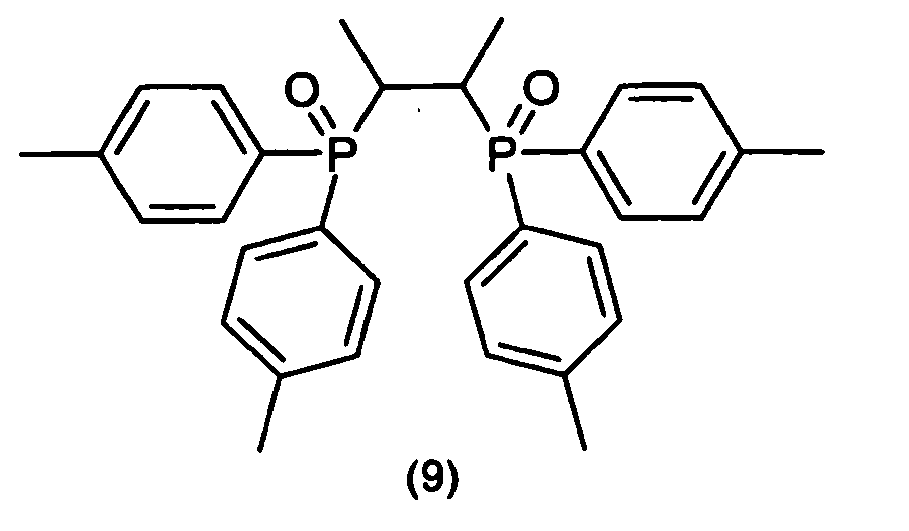
- Zu einer Lösung von of 19,5 mmol (4,5 g) Di-paratolylphosphinoxid (J. Gen. Chem. USSR 1992, 62, 1833 -1839) in 25 ml DMSO wurden 5 ml einer 50% KOH-Lösung in Wasser bei 0°C gegeben. Zu der nun orangen Lösung wurden 7,2 mmol (1,1 g) des Reaktionsprodukts aus Beispiel 1 gegeben (cis/trans ∼2:1). Die Reaktionsmischung wurde auf Raumtemperatur erwärmt und weitere 72 h gerührt. Die Reaktion wurde durch Zugabe von 1000 ml ges. KHSO4-Lösung und 400 ml CH2Cl2 sowie Abfiltrieren von unlöslichem Material beendet. Die organische Phase wird abgetrennt und die wässrige Phase wird 5 mal mit CH2Cl2 extrahiert. Die vereinigten organischen Phasen weren neutral gewaschen, über MgSO4 getrocknet und zur trockene eingeengt. Die Verbindung (9) wurde in Form eines gelben Schaums erhalten (5,9 mmol, 3,0 g, 82%, trans-Gehalt >98%).
-
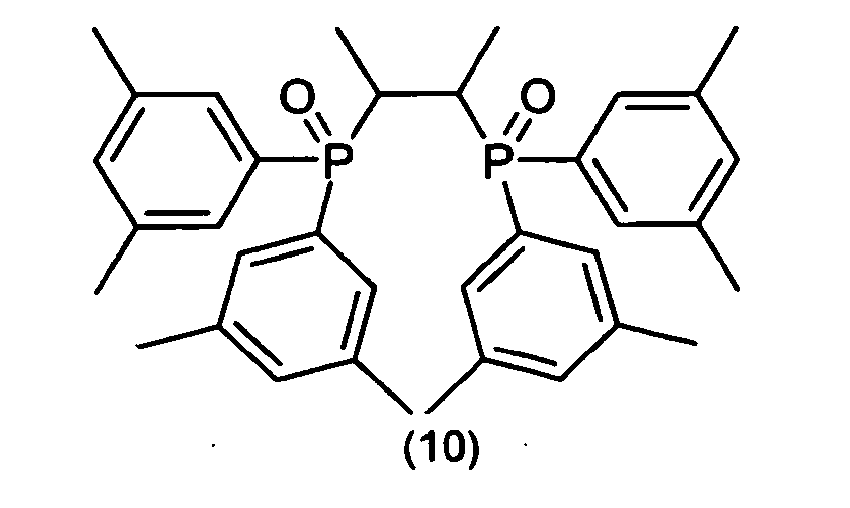
- Zu einer Lösung von of 38,7 mmol (10,0 g) Bis-(3,5-dimethylphenyl)-phosphinoxid (org. Lett. 2001, 3, 243 - 246) in 75 ml DMSO wurden 10 ml einer 50% KOH-Lösung in Wasser bei 0°C gegeben. Zu der nun orangen Lösung wurden 14,5 mmol (2,2 g) des Reaktionsprodukts aus Beispiel 1 gegeben (cis/trans ∼2:1). Die Reaktionsmischung wurde auf Raumtemperatur erwärmt und weitere 18 h gerührt. Danach wurde für 14h bei 60°C gerührt. Die Reaktion wurde durch Zugabe von 1000 ml ges. KHSO4-Lösung und 300 ml CH2Cl2 sowie Abfiltrieren von unlöslichem Material beendet. Die organische Phase wurde abgetrennt und die wässrige Phase 5 mal mit CH2Cl2 extrahiert. Die vereinigten organischen Phasen wurden neutral gewaschen, über MgSO4 getrocknet und zur trockene eingeengt. Es wurde die Verbindung (10) in Form eines gelben Feststoffes erhalten (14,4 mmol, 8,2 g, 99%, trans-Gehalt >98%).
-

- Zu einer warmen Lösung von of 18,5 mmol (9,0 g) Bis-(2,3-di-tert-butyl-4-methoxyphenyl)-phoshinoxid (Synth. Catal. 2003, 345, 180-4)in 450 ml DMSO wurden bei 40°C 5 ml einer 50% KOH-Lösung in Wasser gegeben. Zu der nun orangen Lösung wurden 7,2 mmol (1,1 g) des Reaktionsprodukts aus Beispiel 1 gegeben (cis/trans ∼2:1). Die Reaktionsmischung wurde auf Raumtemperatur abgekühlt und weitere 24 h gerührt. Danach wurde für 4h bei 60°C und abschliessend für 72 h bei Raumtemperatur gerührt. Die Reaktion wurde durch Zugabe von 400 ml ges. KHSO4-Lösung und 400 ml CH2Cl2 sowie Abfiltrieren von unlöslichem Material beendet. Die organische Phase wurde abgetrennt und die wässrige Phase 5 mal mit CH2Cl2 extrahiert. Die vereinigten organischen Phasen wurden neutral gewaschen, über MgSO4 getrocknet und zur trockene eingeengt. Der Rückstand wurde in 80 ml MeOH aufgenommen, filtriert und zur trockene eingeengt. Man erhielt die Verbindung (11) als weissen Feststoff erhalten. Nach säulenchromatographischer Reinigung an Kieselgel (MeOH/EtOAc = 1:5) und Waschen mit Pentan wurden (7,30 mmol, 0,75 g, 11 %, trans-Gehalt >98%).
-

- Zu einer Lösung von of 84,2 mmol (17,0 g) Diphenylphosphinoxid in 125 ml DMSO werden 22 ml einer 50% KOH-Lösung in Wasser gegeben. Zu der nun orangen Lösung wurden 28,1 mmol (5,0 g) des Reaktionsprodukts aus Beispiel 2 gegeben (cis/trans ~2:1). Die Reaktionsmischung wurde weitere 96 h gerührt. Die Reaktion wurde durch Zugabe von 500 ml ges. KHSO4-Lösung und 300 ml CH2Cl2 sowie Abfiltrieren von unlöslichem Material beendet. Die organische Phase wurde abgetrennt und die wässrige Phase 5 mal mit CH2Cl2 extrahiert. Die vereinigten organischen Phasen wurden neutral gewaschen, über MgSO4 getrocknet und zur trockene eingeengt. Man erhielt die verbindung (12) als weißen Feststoff (20,2 mmol, 9,81 g, 72%, trans-Gehalt >98%).
-

- 35 mmol (16,1 g) der Verbindung 8 wurden in 100 ml CH2Cl2 unter Rückfluss gelöst. Aus einem zweiten Kolben wurde eine siedende Lösung von 35 mmol (12,54 g) (+)-Dibenzoyltartrat ((+)-DBT) in 100 ml EtOAc zu dieser Lösung mittels einer Kanüle gegeben. Nach 2-3 min unter Rückfluss wird die Reaktionsmischung auf Raumtemperatur abgekühlt, die Lösungsmittel im Vakuum entfernt und der Rückstand 3 mal in Pentan aufgenommen und abdestilliert. Der Rückstand wurde in 450 ml EtOAc aufgenommen und zum Rückfluss erwärmt. Das schwerlösliche Addukt aus 8 und (+)DBT wurde abfiltriert. Die klare Lösung wurde auf etwa 200 ml eingeengt und weiteres Addukt von 8 und (+)-DBT wurde abfiltriert. Es wurden insgesamt 7,6 mmol (6,23 g) des Adduktes erhalten. Der Feststoff wurde in 100 ml CH2Cl2 gelöst und 10 mal mit 0,1 N NaOH gewaschen. Die organische Phase wurde abgetrennt, über MgSO4 getrocknet und zur Trockene eingedampft. Es wurde Verbindung (8*) in Form eines weißen Feststoffes erhalten (9,2 mmol, 4,2 g, 52%).
-

- Ausgehend von 10,3 mmol (5,0 g) der Verbidung 12, 10,6 mmol (3,8g) (+)-DBT, 20 ml CH2Cl2 und 20 ml EtOAc werden unter gleichem Vorgehen wie in Beispiel 8 1,03 mmol (0,5 g, 20%) der Verbindung 12* erhalten.
-

- Ausgehend von 56 mmol (28,8 g) der Verbindung (9), 56 mmol (20,1g) (+)-DBT, 160 ml CH2Cl2 und 160 ml EtOAc wurden unter analogem Vorgehen wie in Beispiel 8 23,9 mmol (12,3 g, 43%) der Verbindung (9*) nach dreimaligem umkristallisieren erhalten.
-

- Ausgehend von 22,5 mmol (11,6 g) der Verbindung (9*) wurden in Analogie dem Vorgehen in Matteoli et al. (Tetrahedron:Asymmetry 1997, 8, 1403-1410) nach Umkristallisation aus 100 ml Methanol und anschließendem umkristallisieren aus 200 ml Ethanol 17,5 mmol (9,0 g, 79%) Verbindung (13) erhalten.
Claims (14)
- Verfahren zur Herstellung von optisch aktiven Bis-phosphinylalkanen der Formel (I)
 R1 und R2 gleich oder verschieden sein können und jeweils einen ge- radkettigen, verzweigten oder cyclischen Alkylrest mit 1 bis 12 Kohlenstoffatomen, der einen oder mehrere gleiche oder verschiedene Substituenten, ausgewählt aus der Gruppe der Substituenten Halogen, C6- bis C12-Aryl, NR5R6, NHR7 und OR8 aufweisen kann, oder einen Arylrest mit 6 bis 12 Koh- lenstoffatomen, der einen oder mehrere gleiche oder ver- schiedene Substituenten, ausgewählt aus der Gruppe der Substituenten C1- bis C6-Alkyl, Halogen, C6- bis C12-Aryl, NR5'R6', NHR7' und OR8' aufweisen kann, bedeuten oder ge- meinsam einen aliphatischen Cyclus oder Bicyclus mit 4 bis 12 Ringgliedern bilden können, der einen oder mehrere Sub- stituenten, ausgewählt aus der Gruppe der Substituenten Ha- logen, Oxo, C6- bis C12-Aryl, C1- bis C10-Acyl und C1- bis C10- Sulfonyl aufweisen kann und der eines oder mehrere Hetero- atome O oder NR9 umfassen kann, undR3 und R4 gleich oder verschieden sein können und jeweils einen ge- radkettigen, verzweigten oder cyclischen Alkylrest mit 1 bis 12 Kohlenstoffatomen oder einen Arylrest mit 6 bis 12 Koh- lenstoffatomen bedeuten, die jeweils einen oder mehrere gleiche oder verschiedene Substituenten, ausgewählt aus der Gruppe der Substituenten C1- bis C12-Alkyl, Halogen, NR5"R6", NHR7", OR8", Sulphonyl und NR10R11R12R13, C(O)OR14, C(O)NR14'R14" und wobei die ResteR5, R6 bis R5", R6" jeweils unabhängig voneinander C1- bis C12-Alkyl oder C6-bis C12-Aryl,R7 bis R7" C1- bis C10- Acyl oder C1-C10-SulfonylR8 bis R8" C1- bis C12-Alkyl oder C6-bis C12-Aryl,R9 C1- bis C12-Alkyl, C6-bis C12-Aryl, C1- bis C10-Acyl oder C1- bis C10- Sulfonyl,R10 bis R13 unabhängig voneinander C1-C12-Alkyl, C6-C12-Aryl oder C7- C17 Aralkyl,R14, R14' Wasserstoff, C1-C12-Alkyl, C6-C12-Aryl oder C7-C17 Aralkyl,R14" C1-C12-Alkyl, C6-C12-Aryl oder C7-C17 Aralkyl,bedeuten können, und wobei* ein asymmetrisch substituiertes Kohlenstoffatom bezeichnet,umfassend die folgenden Reaktionsschritte a) bis d):a) Umsetzung eines Diols der Formel (II)
zu einer Verbindung der Formel (III)
und die ResteZ jeweils für eine Abgangsgruppe stehen oder gemeinsam für ein Strukturfragment ausgewählt aus der Gruppe der Strukturfragmente - O-S(O)2-O-, -O-P(O)(OR15)2-O-, -O-C(O)-O- und -O-C(O)-C(O)-O- stehen, wobei R15 für C1- bis C12-Alkyl, C7- bis C17-Aralkyl oder C6- bis C12-Aryl stehen kann,b) Umsetzung der in Schritt a) erhaltenen Verbindung der Formel (III) mit einem Phosphit der Formel (IV)
in Gegenwart einer Base, die befähigt ist, das eingesetzte Phosphit der Formel (IV) zu deprotonieren,
zu einem racemischen, 1,2-trans-konfigurierten Diphosphit der Formel (V)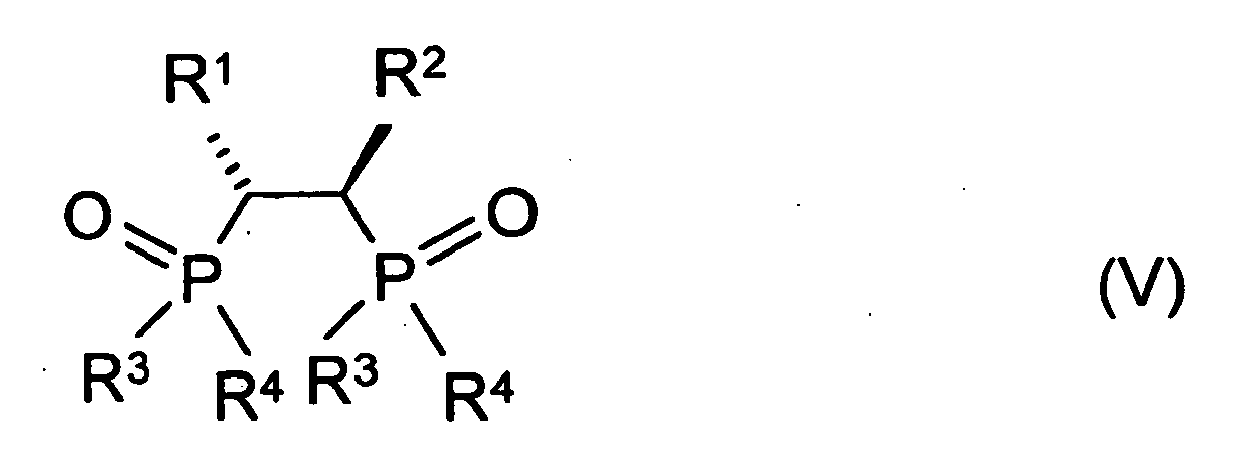 c) Racematspaltung des in Schritt b) erhaltenen racemischen Diphosphits der Formel (V) unter Erhalt eines optisch aktiven Diphosphits der Formel (V*)
 * ein asymmetrisch substituiertes Kohlenstoffatom bezeichnet, undd) Reduktion der in Schritt c) erhaltenen Verbindung der Formel (V*) zur Verbindung der Formel (I).
 - Verfahren nach Anspruch 1, dadurch gekennzeichnet, dass die ResteR1 und R2 gleich oder verschieden sein können und jeweils einen geradkettigen, verzweigten oder cyclischen Alkylrest mit 1 bis 12 Kohlenstoffatomen bedeuten oder gemeinsam einen aliphatischen Cyclus oder Bicyclus mit 4 bis 12 Ringgliedern bilden können, der einen oder mehrere Substituenten, ausgewählt aus der Gruppe der Substituenten Halo- gen, Oxo, C6- bis C12-Aryl, C1- bis C10-Acyl und C1- bis C10-Sulfonyl aufweisen kann und der eines oder mehrere Heteroatome O oder NR9 umfassen kann, undR3 und R4 gleich oder verschieden sein können und jeweils einen Arylrest mit 6 bis 12 Kohlenstoffatomen bedeuten, die jeweils einen oder mehrere gleiche oder verschiedene Substituenten, ausgewählt aus der Gruppe der Substituenten C1- bis C6-Alkyl, Halogen, NR5"R6", NHR7'. OR8", Carboxy, Sulphonyl und NR10R11R12R13 aufweisen kannbedeuten.
- Verfahren nach Anspruch 1, dadurch gekennzeichnet, dass die ResteR1 und R2 gleich sind und einen geradkettigen, verzweigten oder cyclischen Al- kylrest mit 1 bis 6 Kohlenstoffatomen bedeuten oder gemeinsam ei- nen aliphatischen Cyclus oder Bicyclus mit 4 bis 12 Ringgliedern bil- den können, der einen oder mehrere Substituenten, ausgewählt aus der Gruppe der Substituenten Halogen, Oxo, C6- bis C12-Aryl, C1- bis C10-Acyl und C1- bis C10-Sulfonyl aufweisen kann und der eines oder mehrere Heteroatome O oder NR9 umfassen kann, bilden können undR3 und R4 gleich sind und einen Arylrest mit 6 bis 12 Kohlenstoffatomen bedeu- ten, der einen oder mehrere gleiche oder verschiedene Substituen- ten, ausgewählt aus der Gruppe der Substituenten C1- bis C12-Alkyl, Halogen, NR5"R6", NHR7', OR8", Carboxy, Sulphonyl und NR10R11R12R13 aufweisen kannbedeuten.
- Verfahren nach Anspruch 1, dadurch gekennzeichnet, dass die Reste R1 und R2 gemeinsam einen Cyclohexylring bilden und die Reste R3 und R4 jeweils substituiertes oder unsubstituiertes Phenyl bedeuten.
- Verfahren nach Anspruch 1, dadurch gekennzeichnet, dass die Reste R1 und R2 jeweils Methyl und die Reste R3 und R4 jeweils substituiertes oder unsubstituiertes Phenyl bedeuten.
- Verfahren nach einem der Ansprüche 1 bis 5, dadurch gekennzeichnet, dass die Abgangsgruppen Z in Formel (III) ausgewählt sind aus der Gruppe der Abgangsgruppen Halogenid, Mesylat, Tosylat, Triflat, Nonaflat, Acetat,Trifluoracetat und Benzoat.
- Verfahren nach einem der Ansprüche 1 bis 6, dadurch gekennzeichnet, dass die Abgangsgruppen Z in Formel (III) gemeinsam für ein Strukturfragment ausgewählt aus der Gruppe der Strukturfragmente-O-S(O)2-O-, -O-P(O)(OR15)2-O-, - O-C(O)-O- und -O-C(O)-C(O)-O- stehen, wobei R15 für C1- bis C12 Alkyl, C7- bis C17-Aralkyl oder C6- bis C12-Aryl stehen kann.
- Verfahren nach einem der Ansprüche 1 bis 7, dadurch gekennzeichnet, dass Schritt b) in Gegenwart eines dipolar-aprotischen Lösungsmittels durchgeführt wird.
- Verfahren nach einem der Ansprüche 1 bis 8, dadurch gekennzeichnet, dass die in Schritt b) einzusetzende Base ausgewählt ist aus der Gruppe der Alkalimetallhydroxide, Erdalkalimetallhydroxide, Alkalimetallalkoholate und Erdalkalimetallalkoholate.
- Verfahren nach einem der Ansprüche 1 bis 9, dadurch gekennzeichnet, dass man zur Racematspaltung in Schritt c) eine Kristallisation in Gegenwart eines chiralen Hilfsreagenzes durchführt.
- Verfahren nach Anspruch 10, dadurch gekennzeichnet, dass man als chirales Hilfsreagenz eine chirale Carbon- oder Sulfonsäure in optisch aktiver Form einsetzt.
- Verfahren zur Herstellung von optisch aktiven Übergangsmetallkatalysatoren durch Herstellung eines optisch aktiven chiralen Bis-phosphinylalkans der Formel (I) gemäß einem der Ansprüche 1 bis 11 und Inkontaktbringen mit einer geeigneten Übergangsmetallverbindung.
- Verfahren nach Anspruch 12, dadurch gekennzeichnet, dass man als Übergangsmetallverbindung eine Verbindung eines Metalls, ausgewählt aus der Gruppe Fe, Ru, Co, Rh, Ir, Ni, Pd, Pt, Cu, Ag und Au einsetzt.
- Verfahren nach Anspruch 12 oder 13, dadurch gekennzeichnet, dass man als chirales Bis-phosphinylalkan (R, R)-Chiraphos einsetzt.
Applications Claiming Priority (2)
| Application Number | Priority Date | Filing Date | Title |
|---|---|---|---|
| DE102005036340A DE102005036340A1 (de) | 2005-07-29 | 2005-07-29 | Verfahren zur Herstellung optisch aktiver Bis-Phosphinylalkane |
| PCT/EP2006/064709 WO2007012655A1 (de) | 2005-07-29 | 2006-07-26 | Verfahren zur herstellung optisch aktiver diphosphane |
Publications (2)
| Publication Number | Publication Date |
|---|---|
| EP1913007A1 EP1913007A1 (de) | 2008-04-23 |
| EP1913007B1 true EP1913007B1 (de) | 2011-06-22 |
Family
ID=37223114
Family Applications (1)
| Application Number | Title | Priority Date | Filing Date |
|---|---|---|---|
| EP06778006A Not-in-force EP1913007B1 (de) | 2005-07-29 | 2006-07-26 | Verfahren zur herstellung optisch aktiver diphosphane |
Country Status (8)
| Country | Link |
|---|---|
| US (1) | US9469662B2 (de) |
| EP (1) | EP1913007B1 (de) |
| JP (1) | JP5322641B2 (de) |
| CN (1) | CN101253183B (de) |
| AT (1) | ATE513840T1 (de) |
| DE (1) | DE102005036340A1 (de) |
| ES (1) | ES2366920T3 (de) |
| WO (1) | WO2007012655A1 (de) |
Families Citing this family (5)
| Publication number | Priority date | Publication date | Assignee | Title |
|---|---|---|---|---|
| JP5479320B2 (ja) * | 2007-04-25 | 2014-04-23 | ビーエーエスエフ ソシエタス・ヨーロピア | 光学活性カルボニル化合物の調製方法 |
| CN109232518A (zh) * | 2018-09-14 | 2019-01-18 | 珠海市赛纬电子材料股份有限公司 | 一种环三硫酸乙烯酯的制备方法 |
| JP7714236B2 (ja) * | 2020-07-31 | 2025-07-29 | 片山化学工業株式会社 | ジアリールホスフィンオキシド誘導体 |
| CN113861238B (zh) * | 2021-10-20 | 2024-03-12 | 华东师范大学 | 一种钯/手性配体催化的同时合成膦手性中心二级/三级膦氧化合物的方法 |
| CN116535385B (zh) * | 2022-08-29 | 2025-03-11 | 苏州华一新能源科技股份有限公司 | 一种制备硫酸乙烯酯的方法 |
Family Cites Families (8)
| Publication number | Priority date | Publication date | Assignee | Title |
|---|---|---|---|---|
| FR2396735A1 (fr) * | 1977-07-04 | 1979-02-02 | Rhone Poulenc Ind | Procede de preparation de citronellal optiquement actif |
| DE3369325D1 (en) * | 1982-12-20 | 1987-02-26 | Shell Int Research | Process for the preparation of bisphosphine dioxides |
| JPS63216893A (ja) * | 1987-03-06 | 1988-09-09 | Toyotama Koryo Kk | 非対称ビスホスフイン誘導体 |
| US5171892A (en) * | 1991-07-02 | 1992-12-15 | E. I. Du Pont De Nemours And Company | Chiral phospholanes via chiral 1,4-diol cyclic sulfates |
| DE19609336C1 (de) * | 1996-03-11 | 1997-03-13 | Hoechst Ag | Substituierte Diphenyldiphosphane und ein Verfahren zu ihrer Herstellung |
| DE19619528A1 (de) * | 1996-05-15 | 1997-11-20 | Hoechst Ag | Substituierte Diphosphine und ein Verfahren zu ihrer Herstellung |
| DE10033956A1 (de) | 1999-07-19 | 2001-03-08 | Basf Ag | Verfahren zur Herstellung von Bis(phosphino/arsino)-Verbindungen |
| EP1182205A1 (de) | 2000-08-24 | 2002-02-27 | PPG-Sipsy S.C.A. | Chirale Diphosphine via 2,3-sigmatropische Umlagerung. Verwendung in asymmetrischen Übergangsmetallen Katalysis |
-
2005
- 2005-07-29 DE DE102005036340A patent/DE102005036340A1/de not_active Withdrawn
-
2006
- 2006-07-26 EP EP06778006A patent/EP1913007B1/de not_active Not-in-force
- 2006-07-26 AT AT06778006T patent/ATE513840T1/de active
- 2006-07-26 WO PCT/EP2006/064709 patent/WO2007012655A1/de not_active Ceased
- 2006-07-26 ES ES06778006T patent/ES2366920T3/es active Active
- 2006-07-26 CN CN2006800318179A patent/CN101253183B/zh not_active Expired - Fee Related
- 2006-07-26 US US11/997,027 patent/US9469662B2/en not_active Expired - Fee Related
- 2006-07-26 JP JP2008523361A patent/JP5322641B2/ja not_active Expired - Fee Related
Non-Patent Citations (1)
| Title |
|---|
| MAIER, HELV. CHIM. ACTA, 1968, pages 405 - 413 * |
Also Published As
| Publication number | Publication date |
|---|---|
| ES2366920T3 (es) | 2011-10-26 |
| US20080242893A1 (en) | 2008-10-02 |
| JP5322641B2 (ja) | 2013-10-23 |
| ATE513840T1 (de) | 2011-07-15 |
| CN101253183B (zh) | 2013-07-10 |
| WO2007012655A1 (de) | 2007-02-01 |
| CN101253183A (zh) | 2008-08-27 |
| US9469662B2 (en) | 2016-10-18 |
| JP2009502874A (ja) | 2009-01-29 |
| DE102005036340A1 (de) | 2007-02-01 |
| EP1913007A1 (de) | 2008-04-23 |
Similar Documents
| Publication | Publication Date | Title |
|---|---|---|
| EP0398132B1 (de) | Phosphorverbindungen | |
| DE69717406T2 (de) | Chirale Diphosphin-Verbindung, Zwischenprodukte zu ihrer Herstellung, Übergangsmetall-Komplexe davon und asymmetrischer Hydrierungskatalysator | |
| DE69220061T2 (de) | Herstellung von chiralen phospholanen aus chiralen zyklischen sulfaten von 1,4-diolen | |
| EP2459579B1 (de) | Imidazolgruppenhaltige phosphinoboran-verbindungen und verfahren zur herstellung von imidazolgruppenhaltige phosphorverbindungen | |
| EP0643065A1 (de) | Neue Bisphosphine für asymmetrische Hydrierkatalysatoren | |
| DE69721257T2 (de) | Neue chirale bisphosphine | |
| EP0749973B1 (de) | Neue Bisphosphine als Katalysatoren für asymmetrische Reaktionen | |
| WO2009101162A1 (de) | Imidazolgruppenhaltige phosphorverbindungen | |
| JP3100982B2 (ja) | キラルな三座ビス(ホスホラン)配位子 | |
| DE10223593A1 (de) | Hydroxydiphosphine und deren Verwendung in der Katalyse | |
| DE60203193T2 (de) | Neue diphosphine, deren komplexe mit übergangsmetallen und deren verwendung in der asymmetrischen synthese | |
| DE602004008478T2 (de) | Biphosphinrutheniumkomplexe mit chiralen diaminliganden als katalysatoren | |
| DE102005036340A1 (de) | Verfahren zur Herstellung optisch aktiver Bis-Phosphinylalkane | |
| AU2011301115B2 (en) | Biaryl diphosphine ligands, intermediates of the same and their use in asymmetric catalysis | |
| DE69623428T2 (de) | Verfahren zur Herstellung von optisch aktiven Benzhydrolverbindungen | |
| DE69104999T2 (de) | Verfahren zur hydrierung von olefinischen ungesättigten verbindungen ud ruthenium-katalysatoren zu ihrer durchführung. | |
| DE60203360T2 (de) | Neuer asymmetrischer Phosphin-Ligand | |
| DE102004022900A1 (de) | Chirale Diphosphorverbindungen und deren Übergangsmetallkomplexe | |
| US20030120067A1 (en) | Process for producing optically active amide from alpha beta- unsaturated amide derivative in the presence of transition metal complex containing phosphine-phosphorane compound and transition metal | |
| DE102008033165A1 (de) | Verfahren zum Herstellen eines optisch aktiven ß-Hydroxycarbonsäurederivats | |
| DE4040314A1 (de) | Verfahren zur herstellung wasserloeslicher diphosphane | |
| EP0512416B1 (de) | Neue homochirale Diphosphine | |
| EP1636243B1 (de) | Chirale liganden zur anwendung in asymmetrischen synthesen | |
| DE60200393T2 (de) | Verfahren zur Herstellung optisch aktiven y-Butyrolactons | |
| EP1516880B1 (de) | Chirale Phosphane zur Verwendung in asymmetrischen Synthesen |
Legal Events
| Date | Code | Title | Description |
|---|---|---|---|
| PUAI | Public reference made under article 153(3) epc to a published international application that has entered the european phase |
Free format text: ORIGINAL CODE: 0009012 |
|
| 17P | Request for examination filed |
Effective date: 20080229 |
|
| AK | Designated contracting states |
Kind code of ref document: A1 Designated state(s): AT BE BG CH CY CZ DE DK EE ES FI FR GB GR HU IE IS IT LI LT LU LV MC NL PL PT RO SE SI SK TR |
|
| DAX | Request for extension of the european patent (deleted) | ||
| 17Q | First examination report despatched |
Effective date: 20080620 |
|
| GRAP | Despatch of communication of intention to grant a patent |
Free format text: ORIGINAL CODE: EPIDOSNIGR1 |
|
| GRAS | Grant fee paid |
Free format text: ORIGINAL CODE: EPIDOSNIGR3 |
|
| GRAA | (expected) grant |
Free format text: ORIGINAL CODE: 0009210 |
|
| AK | Designated contracting states |
Kind code of ref document: B1 Designated state(s): AT BE BG CH CY CZ DE DK EE ES FI FR GB GR HU IE IS IT LI LT LU LV MC NL PL PT RO SE SI SK TR |
|
| REG | Reference to a national code |
Ref country code: GB Ref legal event code: FG4D Free format text: NOT ENGLISH |
|
| REG | Reference to a national code |
Ref country code: CH Ref legal event code: EP |
|
| REG | Reference to a national code |
Ref country code: IE Ref legal event code: FG4D Free format text: LANGUAGE OF EP DOCUMENT: GERMAN |
|
| REG | Reference to a national code |
Ref country code: DE Ref legal event code: R096 Ref document number: 502006009718 Country of ref document: DE Effective date: 20110811 |
|
| REG | Reference to a national code |
Ref country code: NL Ref legal event code: T3 |
|
| REG | Reference to a national code |
Ref country code: ES Ref legal event code: FG2A Ref document number: 2366920 Country of ref document: ES Kind code of ref document: T3 Effective date: 20111026 |
|
| PG25 | Lapsed in a contracting state [announced via postgrant information from national office to epo] |
Ref country code: LT Free format text: LAPSE BECAUSE OF FAILURE TO SUBMIT A TRANSLATION OF THE DESCRIPTION OR TO PAY THE FEE WITHIN THE PRESCRIBED TIME-LIMIT Effective date: 20110622 Ref country code: SE Free format text: LAPSE BECAUSE OF FAILURE TO SUBMIT A TRANSLATION OF THE DESCRIPTION OR TO PAY THE FEE WITHIN THE PRESCRIBED TIME-LIMIT Effective date: 20110622 |
|
| PG25 | Lapsed in a contracting state [announced via postgrant information from national office to epo] |
Ref country code: GR Free format text: LAPSE BECAUSE OF FAILURE TO SUBMIT A TRANSLATION OF THE DESCRIPTION OR TO PAY THE FEE WITHIN THE PRESCRIBED TIME-LIMIT Effective date: 20110923 Ref country code: SI Free format text: LAPSE BECAUSE OF FAILURE TO SUBMIT A TRANSLATION OF THE DESCRIPTION OR TO PAY THE FEE WITHIN THE PRESCRIBED TIME-LIMIT Effective date: 20110622 Ref country code: FI Free format text: LAPSE BECAUSE OF FAILURE TO SUBMIT A TRANSLATION OF THE DESCRIPTION OR TO PAY THE FEE WITHIN THE PRESCRIBED TIME-LIMIT Effective date: 20110622 Ref country code: LV Free format text: LAPSE BECAUSE OF FAILURE TO SUBMIT A TRANSLATION OF THE DESCRIPTION OR TO PAY THE FEE WITHIN THE PRESCRIBED TIME-LIMIT Effective date: 20110622 Ref country code: CY Free format text: LAPSE BECAUSE OF FAILURE TO SUBMIT A TRANSLATION OF THE DESCRIPTION OR TO PAY THE FEE WITHIN THE PRESCRIBED TIME-LIMIT Effective date: 20110622 |
|
| REG | Reference to a national code |
Ref country code: IE Ref legal event code: FD4D |
|
| BERE | Be: lapsed |
Owner name: BASF SE Effective date: 20110731 |
|
| PG25 | Lapsed in a contracting state [announced via postgrant information from national office to epo] |
Ref country code: EE Free format text: LAPSE BECAUSE OF FAILURE TO SUBMIT A TRANSLATION OF THE DESCRIPTION OR TO PAY THE FEE WITHIN THE PRESCRIBED TIME-LIMIT Effective date: 20110622 Ref country code: IS Free format text: LAPSE BECAUSE OF FAILURE TO SUBMIT A TRANSLATION OF THE DESCRIPTION OR TO PAY THE FEE WITHIN THE PRESCRIBED TIME-LIMIT Effective date: 20111022 Ref country code: PT Free format text: LAPSE BECAUSE OF FAILURE TO SUBMIT A TRANSLATION OF THE DESCRIPTION OR TO PAY THE FEE WITHIN THE PRESCRIBED TIME-LIMIT Effective date: 20111024 Ref country code: CZ Free format text: LAPSE BECAUSE OF FAILURE TO SUBMIT A TRANSLATION OF THE DESCRIPTION OR TO PAY THE FEE WITHIN THE PRESCRIBED TIME-LIMIT Effective date: 20110622 Ref country code: IE Free format text: LAPSE BECAUSE OF FAILURE TO SUBMIT A TRANSLATION OF THE DESCRIPTION OR TO PAY THE FEE WITHIN THE PRESCRIBED TIME-LIMIT Effective date: 20110622 |
|
| PG25 | Lapsed in a contracting state [announced via postgrant information from national office to epo] |
Ref country code: SK Free format text: LAPSE BECAUSE OF FAILURE TO SUBMIT A TRANSLATION OF THE DESCRIPTION OR TO PAY THE FEE WITHIN THE PRESCRIBED TIME-LIMIT Effective date: 20110622 Ref country code: RO Free format text: LAPSE BECAUSE OF FAILURE TO SUBMIT A TRANSLATION OF THE DESCRIPTION OR TO PAY THE FEE WITHIN THE PRESCRIBED TIME-LIMIT Effective date: 20110622 Ref country code: MC Free format text: LAPSE BECAUSE OF NON-PAYMENT OF DUE FEES Effective date: 20110731 Ref country code: PL Free format text: LAPSE BECAUSE OF FAILURE TO SUBMIT A TRANSLATION OF THE DESCRIPTION OR TO PAY THE FEE WITHIN THE PRESCRIBED TIME-LIMIT Effective date: 20110622 |
|
| PLBE | No opposition filed within time limit |
Free format text: ORIGINAL CODE: 0009261 |
|
| STAA | Information on the status of an ep patent application or granted ep patent |
Free format text: STATUS: NO OPPOSITION FILED WITHIN TIME LIMIT |
|
| PG25 | Lapsed in a contracting state [announced via postgrant information from national office to epo] |
Ref country code: BE Free format text: LAPSE BECAUSE OF NON-PAYMENT OF DUE FEES Effective date: 20110731 |
|
| 26N | No opposition filed |
Effective date: 20120323 |
|
| PG25 | Lapsed in a contracting state [announced via postgrant information from national office to epo] |
Ref country code: IT Free format text: LAPSE BECAUSE OF FAILURE TO SUBMIT A TRANSLATION OF THE DESCRIPTION OR TO PAY THE FEE WITHIN THE PRESCRIBED TIME-LIMIT Effective date: 20110622 |
|
| PG25 | Lapsed in a contracting state [announced via postgrant information from national office to epo] |
Ref country code: DK Free format text: LAPSE BECAUSE OF FAILURE TO SUBMIT A TRANSLATION OF THE DESCRIPTION OR TO PAY THE FEE WITHIN THE PRESCRIBED TIME-LIMIT Effective date: 20110622 |
|
| REG | Reference to a national code |
Ref country code: DE Ref legal event code: R097 Ref document number: 502006009718 Country of ref document: DE Effective date: 20120323 |
|
| REG | Reference to a national code |
Ref country code: AT Ref legal event code: MM01 Ref document number: 513840 Country of ref document: AT Kind code of ref document: T Effective date: 20110726 |
|
| PG25 | Lapsed in a contracting state [announced via postgrant information from national office to epo] |
Ref country code: AT Free format text: LAPSE BECAUSE OF NON-PAYMENT OF DUE FEES Effective date: 20110726 |
|
| PG25 | Lapsed in a contracting state [announced via postgrant information from national office to epo] |
Ref country code: LU Free format text: LAPSE BECAUSE OF NON-PAYMENT OF DUE FEES Effective date: 20110726 |
|
| PG25 | Lapsed in a contracting state [announced via postgrant information from national office to epo] |
Ref country code: BG Free format text: LAPSE BECAUSE OF FAILURE TO SUBMIT A TRANSLATION OF THE DESCRIPTION OR TO PAY THE FEE WITHIN THE PRESCRIBED TIME-LIMIT Effective date: 20110922 |
|
| PG25 | Lapsed in a contracting state [announced via postgrant information from national office to epo] |
Ref country code: TR Free format text: LAPSE BECAUSE OF FAILURE TO SUBMIT A TRANSLATION OF THE DESCRIPTION OR TO PAY THE FEE WITHIN THE PRESCRIBED TIME-LIMIT Effective date: 20110622 |
|
| PG25 | Lapsed in a contracting state [announced via postgrant information from national office to epo] |
Ref country code: HU Free format text: LAPSE BECAUSE OF FAILURE TO SUBMIT A TRANSLATION OF THE DESCRIPTION OR TO PAY THE FEE WITHIN THE PRESCRIBED TIME-LIMIT Effective date: 20110622 |
|
| REG | Reference to a national code |
Ref country code: FR Ref legal event code: PLFP Year of fee payment: 11 |
|
| REG | Reference to a national code |
Ref country code: FR Ref legal event code: PLFP Year of fee payment: 12 |
|
| REG | Reference to a national code |
Ref country code: FR Ref legal event code: PLFP Year of fee payment: 13 |
|
| PGFP | Annual fee paid to national office [announced via postgrant information from national office to epo] |
Ref country code: FR Payment date: 20180726 Year of fee payment: 13 Ref country code: NL Payment date: 20180724 Year of fee payment: 13 Ref country code: ES Payment date: 20180828 Year of fee payment: 13 |
|
| PGFP | Annual fee paid to national office [announced via postgrant information from national office to epo] |
Ref country code: CH Payment date: 20180726 Year of fee payment: 13 Ref country code: GB Payment date: 20180731 Year of fee payment: 13 |
|
| PGFP | Annual fee paid to national office [announced via postgrant information from national office to epo] |
Ref country code: DE Payment date: 20180928 Year of fee payment: 13 |
|
| REG | Reference to a national code |
Ref country code: DE Ref legal event code: R119 Ref document number: 502006009718 Country of ref document: DE |
|
| REG | Reference to a national code |
Ref country code: CH Ref legal event code: PL |
|
| GBPC | Gb: european patent ceased through non-payment of renewal fee |
Effective date: 20190726 |
|
| PG25 | Lapsed in a contracting state [announced via postgrant information from national office to epo] |
Ref country code: NL Free format text: LAPSE BECAUSE OF NON-PAYMENT OF DUE FEES Effective date: 20190801 Ref country code: DE Free format text: LAPSE BECAUSE OF NON-PAYMENT OF DUE FEES Effective date: 20200201 Ref country code: GB Free format text: LAPSE BECAUSE OF NON-PAYMENT OF DUE FEES Effective date: 20190726 |
|
| REG | Reference to a national code |
Ref country code: NL Ref legal event code: MM Effective date: 20190801 |
|
| PG25 | Lapsed in a contracting state [announced via postgrant information from national office to epo] |
Ref country code: LI Free format text: LAPSE BECAUSE OF NON-PAYMENT OF DUE FEES Effective date: 20190731 Ref country code: CH Free format text: LAPSE BECAUSE OF NON-PAYMENT OF DUE FEES Effective date: 20190731 |
|
| PG25 | Lapsed in a contracting state [announced via postgrant information from national office to epo] |
Ref country code: FR Free format text: LAPSE BECAUSE OF NON-PAYMENT OF DUE FEES Effective date: 20190731 |
|
| REG | Reference to a national code |
Ref country code: ES Ref legal event code: FD2A Effective date: 20201202 |
|
| PG25 | Lapsed in a contracting state [announced via postgrant information from national office to epo] |
Ref country code: ES Free format text: LAPSE BECAUSE OF NON-PAYMENT OF DUE FEES Effective date: 20190727 |