EP1516880B1 - Chirale Phosphane zur Verwendung in asymmetrischen Synthesen - Google Patents
Chirale Phosphane zur Verwendung in asymmetrischen Synthesen Download PDFInfo
- Publication number
- EP1516880B1 EP1516880B1 EP04021174A EP04021174A EP1516880B1 EP 1516880 B1 EP1516880 B1 EP 1516880B1 EP 04021174 A EP04021174 A EP 04021174A EP 04021174 A EP04021174 A EP 04021174A EP 1516880 B1 EP1516880 B1 EP 1516880B1
- Authority
- EP
- European Patent Office
- Prior art keywords
- bis
- diyl
- biphenyl
- dichloro
- phosphine
- Prior art date
- Legal status (The legal status is an assumption and is not a legal conclusion. Google has not performed a legal analysis and makes no representation as to the accuracy of the status listed.)
- Expired - Lifetime
Links
- 150000003003 phosphines Chemical class 0.000 title abstract description 4
- 238000011914 asymmetric synthesis Methods 0.000 title 1
- XYFCBTPGUUZFHI-UHFFFAOYSA-N Phosphine Chemical compound P XYFCBTPGUUZFHI-UHFFFAOYSA-N 0.000 claims abstract description 187
- 229910000073 phosphorus hydride Inorganic materials 0.000 claims abstract description 78
- 238000002360 preparation method Methods 0.000 claims abstract description 18
- 239000003054 catalyst Substances 0.000 claims abstract description 16
- 229910052723 transition metal Inorganic materials 0.000 claims abstract description 16
- 150000003624 transition metals Chemical class 0.000 claims abstract description 15
- 229910052739 hydrogen Inorganic materials 0.000 claims abstract description 9
- 229910052801 chlorine Inorganic materials 0.000 claims abstract description 8
- -1 cyano, phenyl Chemical group 0.000 claims description 295
- 150000001875 compounds Chemical class 0.000 claims description 85
- 239000000460 chlorine Substances 0.000 claims description 27
- 238000006243 chemical reaction Methods 0.000 claims description 21
- UFHFLCQGNIYNRP-UHFFFAOYSA-N Hydrogen Chemical compound [H][H] UFHFLCQGNIYNRP-UHFFFAOYSA-N 0.000 claims description 10
- 125000001255 4-fluorophenyl group Chemical group [H]C1=C([H])C(*)=C([H])C([H])=C1F 0.000 claims description 9
- ZAMOUSCENKQFHK-UHFFFAOYSA-N Chlorine atom Chemical compound [Cl] ZAMOUSCENKQFHK-UHFFFAOYSA-N 0.000 claims description 9
- 125000001997 phenyl group Chemical group [H]C1=C([H])C([H])=C(*)C([H])=C1[H] 0.000 claims description 9
- 125000000113 cyclohexyl group Chemical group [H]C1([H])C([H])([H])C([H])([H])C([H])(*)C([H])([H])C1([H])[H] 0.000 claims description 8
- 239000001257 hydrogen Substances 0.000 claims description 8
- GPAYUJZHTULNBE-UHFFFAOYSA-N diphenylphosphine Chemical compound C=1C=CC=CC=1PC1=CC=CC=C1 GPAYUJZHTULNBE-UHFFFAOYSA-N 0.000 claims description 7
- 125000002496 methyl group Chemical group [H]C([H])([H])* 0.000 claims description 7
- 125000004169 (C1-C6) alkyl group Chemical group 0.000 claims description 6
- 125000003682 3-furyl group Chemical group O1C([H])=C([*])C([H])=C1[H] 0.000 claims description 5
- 125000001162 cycloheptenyl group Chemical group C1(=CCCCCC1)* 0.000 claims description 5
- 125000001511 cyclopentyl group Chemical group [H]C1([H])C([H])([H])C([H])([H])C([H])(*)C1([H])[H] 0.000 claims description 5
- 238000000034 method Methods 0.000 claims description 5
- 125000001037 p-tolyl group Chemical group [H]C1=C([H])C(=C([H])C([H])=C1*)C([H])([H])[H] 0.000 claims description 5
- RMSGQZDGSZOJMU-UHFFFAOYSA-N 1-butyl-2-phenylbenzene Chemical group CCCCC1=CC=CC=C1C1=CC=CC=C1 RMSGQZDGSZOJMU-UHFFFAOYSA-N 0.000 claims description 4
- 125000001495 ethyl group Chemical group [H]C([H])([H])C([H])([H])* 0.000 claims description 4
- 239000011737 fluorine Substances 0.000 claims description 4
- 229910052731 fluorine Inorganic materials 0.000 claims description 4
- 125000001449 isopropyl group Chemical group [H]C([H])([H])C([H])(*)C([H])([H])[H] 0.000 claims description 4
- 238000004519 manufacturing process Methods 0.000 claims description 4
- 125000004108 n-butyl group Chemical group [H]C([H])([H])C([H])([H])C([H])([H])C([H])([H])* 0.000 claims description 4
- 125000004123 n-propyl group Chemical group [H]C([H])([H])C([H])([H])C([H])([H])* 0.000 claims description 4
- 125000004199 4-trifluoromethylphenyl group Chemical group [H]C1=C([H])C(=C([H])C([H])=C1*)C(F)(F)F 0.000 claims description 3
- PXGOKWXKJXAPGV-UHFFFAOYSA-N Fluorine Chemical compound FF PXGOKWXKJXAPGV-UHFFFAOYSA-N 0.000 claims description 3
- 229910052736 halogen Inorganic materials 0.000 claims description 3
- 150000002367 halogens Chemical class 0.000 claims description 3
- 125000004178 (C1-C4) alkyl group Chemical group 0.000 claims description 2
- 125000004191 (C1-C6) alkoxy group Chemical group 0.000 claims description 2
- 125000000172 C5-C10 aryl group Chemical group 0.000 claims description 2
- RTZKZFJDLAIYFH-UHFFFAOYSA-N Diethyl ether Chemical compound CCOCC RTZKZFJDLAIYFH-UHFFFAOYSA-N 0.000 claims 2
- JXLHNMVSKXFWAO-UHFFFAOYSA-N azane;7-fluoro-2,1,3-benzoxadiazole-4-sulfonic acid Chemical compound N.OS(=O)(=O)C1=CC=C(F)C2=NON=C12 JXLHNMVSKXFWAO-UHFFFAOYSA-N 0.000 claims 1
- 125000000484 butyl group Chemical group [H]C([*])([H])C([H])([H])C([H])([H])C([H])([H])[H] 0.000 claims 1
- 230000007704 transition Effects 0.000 claims 1
- 125000000217 alkyl group Chemical group 0.000 abstract description 7
- 125000001424 substituent group Chemical group 0.000 abstract description 4
- 125000003118 aryl group Chemical group 0.000 abstract description 3
- 125000005085 alkoxycarbonylalkoxy group Chemical group 0.000 abstract 2
- 125000002877 alkyl aryl group Chemical group 0.000 abstract 2
- YCWSUKQGVSGXJO-NTUHNPAUSA-N nifuroxazide Chemical group C1=CC(O)=CC=C1C(=O)N\N=C\C1=CC=C([N+]([O-])=O)O1 YCWSUKQGVSGXJO-NTUHNPAUSA-N 0.000 abstract 2
- MPQXHAGKBWFSNV-UHFFFAOYSA-N oxidophosphanium Chemical class [PH3]=O MPQXHAGKBWFSNV-UHFFFAOYSA-N 0.000 abstract 1
- MDDUHVRJJAFRAU-YZNNVMRBSA-N tert-butyl-[(1r,3s,5z)-3-[tert-butyl(dimethyl)silyl]oxy-5-(2-diphenylphosphorylethylidene)-4-methylidenecyclohexyl]oxy-dimethylsilane Chemical compound C1[C@@H](O[Si](C)(C)C(C)(C)C)C[C@H](O[Si](C)(C)C(C)(C)C)C(=C)\C1=C/CP(=O)(C=1C=CC=CC=1)C1=CC=CC=C1 MDDUHVRJJAFRAU-YZNNVMRBSA-N 0.000 description 49
- 239000010948 rhodium Substances 0.000 description 45
- 125000002933 cyclohexyloxy group Chemical group C1(CCCCC1)O* 0.000 description 24
- ZMXDDKWLCZADIW-UHFFFAOYSA-N N,N-Dimethylformamide Chemical compound CN(C)C=O ZMXDDKWLCZADIW-UHFFFAOYSA-N 0.000 description 20
- HFPZCAJZSCWRBC-UHFFFAOYSA-N p-cymene Chemical compound CC(C)C1=CC=C(C)C=C1 HFPZCAJZSCWRBC-UHFFFAOYSA-N 0.000 description 20
- YMWUJEATGCHHMB-UHFFFAOYSA-N Dichloromethane Chemical compound ClCCl YMWUJEATGCHHMB-UHFFFAOYSA-N 0.000 description 18
- 239000000203 mixture Substances 0.000 description 17
- 229910052703 rhodium Inorganic materials 0.000 description 15
- 229910052741 iridium Inorganic materials 0.000 description 14
- GKOZUEZYRPOHIO-UHFFFAOYSA-N iridium atom Chemical compound [Ir] GKOZUEZYRPOHIO-UHFFFAOYSA-N 0.000 description 14
- BWHMMNNQKKPAPP-UHFFFAOYSA-L potassium carbonate Chemical compound [K+].[K+].[O-]C([O-])=O BWHMMNNQKKPAPP-UHFFFAOYSA-L 0.000 description 14
- MHOVAHRLVXNVSD-UHFFFAOYSA-N rhodium atom Chemical compound [Rh] MHOVAHRLVXNVSD-UHFFFAOYSA-N 0.000 description 14
- 229910052707 ruthenium Inorganic materials 0.000 description 12
- 150000003623 transition metal compounds Chemical class 0.000 description 12
- 239000000047 product Substances 0.000 description 11
- CPELXLSAUQHCOX-UHFFFAOYSA-M Bromide Chemical compound [Br-] CPELXLSAUQHCOX-UHFFFAOYSA-M 0.000 description 10
- VEXZGXHMUGYJMC-UHFFFAOYSA-M Chloride anion Chemical compound [Cl-] VEXZGXHMUGYJMC-UHFFFAOYSA-M 0.000 description 10
- YFPJFKYCVYXDJK-UHFFFAOYSA-N Diphenylphosphine oxide Chemical compound C=1C=CC=CC=1[P+](=O)C1=CC=CC=C1 YFPJFKYCVYXDJK-UHFFFAOYSA-N 0.000 description 10
- KJTLSVCANCCWHF-UHFFFAOYSA-N Ruthenium Chemical compound [Ru] KJTLSVCANCCWHF-UHFFFAOYSA-N 0.000 description 10
- ITMCEJHCFYSIIV-UHFFFAOYSA-M triflate Chemical compound [O-]S(=O)(=O)C(F)(F)F ITMCEJHCFYSIIV-UHFFFAOYSA-M 0.000 description 10
- VYXHVRARDIDEHS-UHFFFAOYSA-N 1,5-cyclooctadiene Chemical compound C1CC=CCCC=C1 VYXHVRARDIDEHS-UHFFFAOYSA-N 0.000 description 9
- OKKJLVBELUTLKV-UHFFFAOYSA-N Methanol Chemical compound OC OKKJLVBELUTLKV-UHFFFAOYSA-N 0.000 description 9
- 239000002585 base Substances 0.000 description 9
- UHOVQNZJYSORNB-UHFFFAOYSA-N Benzene Chemical compound C1=CC=CC=C1 UHOVQNZJYSORNB-UHFFFAOYSA-N 0.000 description 8
- BTBUEUYNUDRHOZ-UHFFFAOYSA-N Borate Chemical compound [O-]B([O-])[O-] BTBUEUYNUDRHOZ-UHFFFAOYSA-N 0.000 description 8
- LFQSCWFLJHTTHZ-UHFFFAOYSA-N Ethanol Chemical compound CCO LFQSCWFLJHTTHZ-UHFFFAOYSA-N 0.000 description 8
- 125000004432 carbon atom Chemical group C* 0.000 description 8
- 229930007927 cymene Natural products 0.000 description 8
- 239000003446 ligand Substances 0.000 description 8
- VLTRZXGMWDSKGL-UHFFFAOYSA-M perchlorate Chemical compound [O-]Cl(=O)(=O)=O VLTRZXGMWDSKGL-UHFFFAOYSA-M 0.000 description 8
- 239000002904 solvent Substances 0.000 description 8
- 239000004912 1,5-cyclooctadiene Substances 0.000 description 7
- 229910000027 potassium carbonate Inorganic materials 0.000 description 7
- 150000003254 radicals Chemical group 0.000 description 7
- 238000003756 stirring Methods 0.000 description 7
- 239000000758 substrate Substances 0.000 description 7
- XLYOFNOQVPJJNP-UHFFFAOYSA-N water Chemical compound O XLYOFNOQVPJJNP-UHFFFAOYSA-N 0.000 description 7
- IAZDPXIOMUYVGZ-UHFFFAOYSA-N Dimethylsulphoxide Chemical compound CS(C)=O IAZDPXIOMUYVGZ-UHFFFAOYSA-N 0.000 description 6
- XEKOWRVHYACXOJ-UHFFFAOYSA-N Ethyl acetate Chemical compound CCOC(C)=O XEKOWRVHYACXOJ-UHFFFAOYSA-N 0.000 description 6
- HEMHJVSKTPXQMS-UHFFFAOYSA-M Sodium hydroxide Chemical compound [OH-].[Na+] HEMHJVSKTPXQMS-UHFFFAOYSA-M 0.000 description 6
- 150000001450 anions Chemical class 0.000 description 6
- AUONHKJOIZSQGR-UHFFFAOYSA-N oxophosphane Chemical compound P=O AUONHKJOIZSQGR-UHFFFAOYSA-N 0.000 description 6
- 229910052717 sulfur Inorganic materials 0.000 description 6
- WEVYAHXRMPXWCK-UHFFFAOYSA-N Acetonitrile Chemical compound CC#N WEVYAHXRMPXWCK-UHFFFAOYSA-N 0.000 description 5
- WKBOTKDWSSQWDR-UHFFFAOYSA-N Bromine atom Chemical compound [Br] WKBOTKDWSSQWDR-UHFFFAOYSA-N 0.000 description 5
- AFVFQIVMOAPDHO-UHFFFAOYSA-M Methanesulfonate Chemical compound CS([O-])(=O)=O AFVFQIVMOAPDHO-UHFFFAOYSA-M 0.000 description 5
- AFVFQIVMOAPDHO-UHFFFAOYSA-N Methanesulfonic acid Chemical compound CS(O)(=O)=O AFVFQIVMOAPDHO-UHFFFAOYSA-N 0.000 description 5
- WRQNANDWMGAFTP-UHFFFAOYSA-N Methylacetoacetic acid Chemical compound COC(=O)CC(C)=O WRQNANDWMGAFTP-UHFFFAOYSA-N 0.000 description 5
- 229910018286 SbF 6 Inorganic materials 0.000 description 5
- JFDZBHWFFUWGJE-UHFFFAOYSA-N benzonitrile Chemical compound N#CC1=CC=CC=C1 JFDZBHWFFUWGJE-UHFFFAOYSA-N 0.000 description 5
- DHCWLIOIJZJFJE-UHFFFAOYSA-L dichlororuthenium Chemical compound Cl[Ru]Cl DHCWLIOIJZJFJE-UHFFFAOYSA-L 0.000 description 5
- 239000011541 reaction mixture Substances 0.000 description 5
- UQRONKZLYKUEMO-UHFFFAOYSA-N 4-methyl-1-(2,4,6-trimethylphenyl)pent-4-en-2-one Chemical group CC(=C)CC(=O)Cc1c(C)cc(C)cc1C UQRONKZLYKUEMO-UHFFFAOYSA-N 0.000 description 4
- QTBSBXVTEAMEQO-UHFFFAOYSA-M Acetate Chemical compound CC([O-])=O QTBSBXVTEAMEQO-UHFFFAOYSA-M 0.000 description 4
- QGZKDVFQNNGYKY-UHFFFAOYSA-O Ammonium Chemical compound [NH4+] QGZKDVFQNNGYKY-UHFFFAOYSA-O 0.000 description 4
- HEDRZPFGACZZDS-UHFFFAOYSA-N Chloroform Chemical compound ClC(Cl)Cl HEDRZPFGACZZDS-UHFFFAOYSA-N 0.000 description 4
- 229910020366 ClO 4 Inorganic materials 0.000 description 4
- VGGSQFUCUMXWEO-UHFFFAOYSA-N Ethene Chemical compound C=C VGGSQFUCUMXWEO-UHFFFAOYSA-N 0.000 description 4
- VYPSYNLAJGMNEJ-UHFFFAOYSA-N Silicium dioxide Chemical compound O=[Si]=O VYPSYNLAJGMNEJ-UHFFFAOYSA-N 0.000 description 4
- 239000004305 biphenyl Substances 0.000 description 4
- 229910001914 chlorine tetroxide Inorganic materials 0.000 description 4
- 238000004587 chromatography analysis Methods 0.000 description 4
- 238000005984 hydrogenation reaction Methods 0.000 description 4
- 239000000741 silica gel Substances 0.000 description 4
- 229910002027 silica gel Inorganic materials 0.000 description 4
- 239000000243 solution Substances 0.000 description 4
- IJGRMHOSHXDMSA-UHFFFAOYSA-N Atomic nitrogen Chemical compound N#N IJGRMHOSHXDMSA-UHFFFAOYSA-N 0.000 description 3
- LYCAIKOWRPUZTN-UHFFFAOYSA-N Ethylene glycol Chemical compound OCCO LYCAIKOWRPUZTN-UHFFFAOYSA-N 0.000 description 3
- JUJWROOIHBZHMG-UHFFFAOYSA-N Pyridine Chemical compound C1=CC=NC=C1 JUJWROOIHBZHMG-UHFFFAOYSA-N 0.000 description 3
- YXFVVABEGXRONW-UHFFFAOYSA-N Toluene Chemical compound CC1=CC=CC=C1 YXFVVABEGXRONW-UHFFFAOYSA-N 0.000 description 3
- ZMANZCXQSJIPKH-UHFFFAOYSA-N Triethylamine Chemical compound CCN(CC)CC ZMANZCXQSJIPKH-UHFFFAOYSA-N 0.000 description 3
- DHKHKXVYLBGOIT-UHFFFAOYSA-N acetaldehyde Diethyl Acetal Natural products CCOC(C)OCC DHKHKXVYLBGOIT-UHFFFAOYSA-N 0.000 description 3
- 150000001241 acetals Chemical class 0.000 description 3
- 125000002015 acyclic group Chemical group 0.000 description 3
- 238000009876 asymmetric hydrogenation reaction Methods 0.000 description 3
- 150000005347 biaryls Chemical group 0.000 description 3
- GDTBXPJZTBHREO-UHFFFAOYSA-N bromine Substances BrBr GDTBXPJZTBHREO-UHFFFAOYSA-N 0.000 description 3
- 229910052794 bromium Inorganic materials 0.000 description 3
- 125000004122 cyclic group Chemical group 0.000 description 3
- URYYVOIYTNXXBN-UPHRSURJSA-N cyclooctene Chemical compound C1CCC\C=C/CC1 URYYVOIYTNXXBN-UPHRSURJSA-N 0.000 description 3
- 239000004913 cyclooctene Substances 0.000 description 3
- 230000000694 effects Effects 0.000 description 3
- 239000000706 filtrate Substances 0.000 description 3
- 238000002156 mixing Methods 0.000 description 3
- VLKZOEOYAKHREP-UHFFFAOYSA-N n-Hexane Chemical compound CCCCCC VLKZOEOYAKHREP-UHFFFAOYSA-N 0.000 description 3
- SJYNFBVQFBRSIB-UHFFFAOYSA-N norbornadiene Chemical compound C1=CC2C=CC1C2 SJYNFBVQFBRSIB-UHFFFAOYSA-N 0.000 description 3
- PONXTPCRRASWKW-ZIAGYGMSSA-N (1r,2r)-1,2-diphenylethane-1,2-diamine Chemical compound C1([C@@H](N)[C@H](N)C=2C=CC=CC=2)=CC=CC=C1 PONXTPCRRASWKW-ZIAGYGMSSA-N 0.000 description 2
- LPYLNJHERBLCRN-QMDOQEJBSA-N (1z,5z)-cycloocta-1,5-diene;rhodium;hexafluorophosphate Chemical compound [Rh].F[P-](F)(F)(F)(F)F.C\1C\C=C/CC\C=C/1.C\1C\C=C/CC\C=C/1 LPYLNJHERBLCRN-QMDOQEJBSA-N 0.000 description 2
- LYXHWHHENVLYCN-QMDOQEJBSA-N (1z,5z)-cycloocta-1,5-diene;rhodium;tetrafluoroborate Chemical compound [Rh].F[B-](F)(F)F.C\1C\C=C/CC\C=C/1.C\1C\C=C/CC\C=C/1 LYXHWHHENVLYCN-QMDOQEJBSA-N 0.000 description 2
- VUTUHLLWFPRWMT-QMDOQEJBSA-M (1z,5z)-cycloocta-1,5-diene;rhodium;trifluoromethanesulfonate Chemical compound [Rh].C\1C\C=C/CC\C=C/1.C\1C\C=C/CC\C=C/1.[O-]S(=O)(=O)C(F)(F)F VUTUHLLWFPRWMT-QMDOQEJBSA-M 0.000 description 2
- WDYGPMAMBXJESZ-SFHVURJKSA-N (2s)-1,1-bis(4-methoxyphenyl)-3-methylbutane-1,2-diamine Chemical compound C1=CC(OC)=CC=C1C(N)([C@@H](N)C(C)C)C1=CC=C(OC)C=C1 WDYGPMAMBXJESZ-SFHVURJKSA-N 0.000 description 2
- POILWHVDKZOXJZ-ARJAWSKDSA-M (z)-4-oxopent-2-en-2-olate Chemical compound C\C([O-])=C\C(C)=O POILWHVDKZOXJZ-ARJAWSKDSA-M 0.000 description 2
- AUHZEENZYGFFBQ-UHFFFAOYSA-N 1,3,5-trimethylbenzene Chemical compound CC1=CC(C)=CC(C)=C1 AUHZEENZYGFFBQ-UHFFFAOYSA-N 0.000 description 2
- XKRFYHLGVUSROY-UHFFFAOYSA-N Argon Chemical compound [Ar] XKRFYHLGVUSROY-UHFFFAOYSA-N 0.000 description 2
- WHXSMMKQMYFTQS-UHFFFAOYSA-N Lithium Chemical compound [Li] WHXSMMKQMYFTQS-UHFFFAOYSA-N 0.000 description 2
- BZLVMXJERCGZMT-UHFFFAOYSA-N Methyl tert-butyl ether Chemical compound COC(C)(C)C BZLVMXJERCGZMT-UHFFFAOYSA-N 0.000 description 2
- PXHVJJICTQNCMI-UHFFFAOYSA-N Nickel Chemical compound [Ni] PXHVJJICTQNCMI-UHFFFAOYSA-N 0.000 description 2
- NHNBFGGVMKEFGY-UHFFFAOYSA-N Nitrate Chemical compound [O-][N+]([O-])=O NHNBFGGVMKEFGY-UHFFFAOYSA-N 0.000 description 2
- CTQNGGLPUBDAKN-UHFFFAOYSA-N O-Xylene Chemical compound CC1=CC=CC=C1C CTQNGGLPUBDAKN-UHFFFAOYSA-N 0.000 description 2
- KDLHZDBZIXYQEI-UHFFFAOYSA-N Palladium Chemical compound [Pd] KDLHZDBZIXYQEI-UHFFFAOYSA-N 0.000 description 2
- ZLMJMSJWJFRBEC-UHFFFAOYSA-N Potassium Chemical compound [K] ZLMJMSJWJFRBEC-UHFFFAOYSA-N 0.000 description 2
- 229910019891 RuCl3 Inorganic materials 0.000 description 2
- WQDUMFSSJAZKTM-UHFFFAOYSA-N Sodium methoxide Chemical compound [Na+].[O-]C WQDUMFSSJAZKTM-UHFFFAOYSA-N 0.000 description 2
- NINIDFKCEFEMDL-UHFFFAOYSA-N Sulfur Chemical compound [S] NINIDFKCEFEMDL-UHFFFAOYSA-N 0.000 description 2
- 230000006978 adaptation Effects 0.000 description 2
- 150000001336 alkenes Chemical class 0.000 description 2
- 150000007854 aminals Chemical class 0.000 description 2
- 239000008346 aqueous phase Substances 0.000 description 2
- QVGXLLKOCUKJST-UHFFFAOYSA-N atomic oxygen Chemical compound [O] QVGXLLKOCUKJST-UHFFFAOYSA-N 0.000 description 2
- 235000010290 biphenyl Nutrition 0.000 description 2
- 125000006267 biphenyl group Chemical group 0.000 description 2
- 229910052799 carbon Inorganic materials 0.000 description 2
- 238000001816 cooling Methods 0.000 description 2
- 239000012043 crude product Substances 0.000 description 2
- 238000005661 deetherification reaction Methods 0.000 description 2
- 150000004985 diamines Chemical class 0.000 description 2
- 239000003480 eluent Substances 0.000 description 2
- 150000002148 esters Chemical class 0.000 description 2
- 125000001207 fluorophenyl group Chemical group 0.000 description 2
- 125000002485 formyl group Chemical group [H]C(*)=O 0.000 description 2
- 125000005842 heteroatom Chemical group 0.000 description 2
- XMBWDFGMSWQBCA-UHFFFAOYSA-N hydrogen iodide Chemical compound I XMBWDFGMSWQBCA-UHFFFAOYSA-N 0.000 description 2
- 239000000543 intermediate Substances 0.000 description 2
- 238000006317 isomerization reaction Methods 0.000 description 2
- 150000002576 ketones Chemical class 0.000 description 2
- 229910052744 lithium Inorganic materials 0.000 description 2
- 125000005394 methallyl group Chemical group 0.000 description 2
- YDCHPLOFQATIDS-UHFFFAOYSA-N methyl 2-bromoacetate Chemical compound COC(=O)CBr YDCHPLOFQATIDS-UHFFFAOYSA-N 0.000 description 2
- 229910052757 nitrogen Inorganic materials 0.000 description 2
- 239000003960 organic solvent Substances 0.000 description 2
- 239000001301 oxygen Substances 0.000 description 2
- 229910052760 oxygen Inorganic materials 0.000 description 2
- 239000012071 phase Substances 0.000 description 2
- ZUOUZKKEUPVFJK-UHFFFAOYSA-N phenylbenzene Natural products C1=CC=CC=C1C1=CC=CC=C1 ZUOUZKKEUPVFJK-UHFFFAOYSA-N 0.000 description 2
- 238000010992 reflux Methods 0.000 description 2
- YBCAZPLXEGKKFM-UHFFFAOYSA-K ruthenium(iii) chloride Chemical compound [Cl-].[Cl-].[Cl-].[Ru+3] YBCAZPLXEGKKFM-UHFFFAOYSA-K 0.000 description 2
- 239000011593 sulfur Substances 0.000 description 2
- 125000000999 tert-butyl group Chemical group [H]C([H])([H])C(*)(C([H])([H])[H])C([H])([H])[H] 0.000 description 2
- 150000003512 tertiary amines Chemical class 0.000 description 2
- DZLFLBLQUQXARW-UHFFFAOYSA-N tetrabutylammonium Chemical class CCCC[N+](CCCC)(CCCC)CCCC DZLFLBLQUQXARW-UHFFFAOYSA-N 0.000 description 2
- IMFACGCPASFAPR-UHFFFAOYSA-N tributylamine Chemical compound CCCCN(CCCC)CCCC IMFACGCPASFAPR-UHFFFAOYSA-N 0.000 description 2
- ZDHXKXAHOVTTAH-UHFFFAOYSA-N trichlorosilane Chemical compound Cl[SiH](Cl)Cl ZDHXKXAHOVTTAH-UHFFFAOYSA-N 0.000 description 2
- 239000005052 trichlorosilane Substances 0.000 description 2
- 239000008096 xylene Substances 0.000 description 2
- RRKODOZNUZCUBN-CCAGOZQPSA-N (1z,3z)-cycloocta-1,3-diene Chemical compound C1CC\C=C/C=C\C1 RRKODOZNUZCUBN-CCAGOZQPSA-N 0.000 description 1
- 0 **Oc(c(-c1c(*)ccc(N)c1O*)c(*)cc1)c1N Chemical compound **Oc(c(-c1c(*)ccc(N)c1O*)c(*)cc1)c1N 0.000 description 1
- XNWFRZJHXBZDAG-UHFFFAOYSA-N 2-METHOXYETHANOL Chemical compound COCCO XNWFRZJHXBZDAG-UHFFFAOYSA-N 0.000 description 1
- MONMFXREYOKQTI-UHFFFAOYSA-M 2-bromopropanoate Chemical compound CC(Br)C([O-])=O MONMFXREYOKQTI-UHFFFAOYSA-M 0.000 description 1
- HBAQYPYDRFILMT-UHFFFAOYSA-N 8-[3-(1-cyclopropylpyrazol-4-yl)-1H-pyrazolo[4,3-d]pyrimidin-5-yl]-3-methyl-3,8-diazabicyclo[3.2.1]octan-2-one Chemical class C1(CC1)N1N=CC(=C1)C1=NNC2=C1N=C(N=C2)N1C2C(N(CC1CC2)C)=O HBAQYPYDRFILMT-UHFFFAOYSA-N 0.000 description 1
- KXDHJXZQYSOELW-UHFFFAOYSA-M Carbamate Chemical compound NC([O-])=O KXDHJXZQYSOELW-UHFFFAOYSA-M 0.000 description 1
- BVKZGUZCCUSVTD-UHFFFAOYSA-L Carbonate Chemical compound [O-]C([O-])=O BVKZGUZCCUSVTD-UHFFFAOYSA-L 0.000 description 1
- KZBUYRJDOAKODT-UHFFFAOYSA-N Chlorine Chemical compound ClCl KZBUYRJDOAKODT-UHFFFAOYSA-N 0.000 description 1
- 239000005977 Ethylene Substances 0.000 description 1
- DGAQECJNVWCQMB-PUAWFVPOSA-M Ilexoside XXIX Chemical compound C[C@@H]1CC[C@@]2(CC[C@@]3(C(=CC[C@H]4[C@]3(CC[C@@H]5[C@@]4(CC[C@@H](C5(C)C)OS(=O)(=O)[O-])C)C)[C@@H]2[C@]1(C)O)C)C(=O)O[C@H]6[C@@H]([C@H]([C@@H]([C@H](O6)CO)O)O)O.[Na+] DGAQECJNVWCQMB-PUAWFVPOSA-M 0.000 description 1
- FXHOOIRPVKKKFG-UHFFFAOYSA-N N,N-Dimethylacetamide Chemical compound CN(C)C(C)=O FXHOOIRPVKKKFG-UHFFFAOYSA-N 0.000 description 1
- SECXISVLQFMRJM-UHFFFAOYSA-N N-Methylpyrrolidone Chemical compound CN1CCCC1=O SECXISVLQFMRJM-UHFFFAOYSA-N 0.000 description 1
- 229910002651 NO3 Inorganic materials 0.000 description 1
- 229910021604 Rhodium(III) chloride Inorganic materials 0.000 description 1
- KEAYESYHFKHZAL-UHFFFAOYSA-N Sodium Chemical compound [Na] KEAYESYHFKHZAL-UHFFFAOYSA-N 0.000 description 1
- 239000003905 agrochemical Substances 0.000 description 1
- 150000001298 alcohols Chemical class 0.000 description 1
- 229910052783 alkali metal Inorganic materials 0.000 description 1
- 150000001340 alkali metals Chemical class 0.000 description 1
- 150000001341 alkaline earth metal compounds Chemical class 0.000 description 1
- 150000004703 alkoxides Chemical class 0.000 description 1
- 150000001408 amides Chemical class 0.000 description 1
- 125000002178 anthracenyl group Chemical group C1(=CC=CC2=CC3=CC=CC=C3C=C12)* 0.000 description 1
- 229910052786 argon Inorganic materials 0.000 description 1
- 150000004945 aromatic hydrocarbons Chemical class 0.000 description 1
- 150000005840 aryl radicals Chemical class 0.000 description 1
- 125000000499 benzofuranyl group Chemical group O1C(=CC2=C1C=CC=C2)* 0.000 description 1
- 125000004196 benzothienyl group Chemical group S1C(=CC2=C1C=CC=C2)* 0.000 description 1
- 125000001584 benzyloxycarbonyl group Chemical group C(=O)(OCC1=CC=CC=C1)* 0.000 description 1
- 125000002529 biphenylenyl group Chemical group C1(=CC=CC=2C3=CC=CC=C3C12)* 0.000 description 1
- 239000012267 brine Substances 0.000 description 1
- AQNQQHJNRPDOQV-UHFFFAOYSA-N bromocyclohexane Chemical compound BrC1CCCCC1 AQNQQHJNRPDOQV-UHFFFAOYSA-N 0.000 description 1
- BRPQOXSCLDDYGP-UHFFFAOYSA-N calcium oxide Chemical compound [O-2].[Ca+2] BRPQOXSCLDDYGP-UHFFFAOYSA-N 0.000 description 1
- 239000000292 calcium oxide Substances 0.000 description 1
- ODINCKMPIJJUCX-UHFFFAOYSA-N calcium oxide Inorganic materials [Ca]=O ODINCKMPIJJUCX-UHFFFAOYSA-N 0.000 description 1
- GGRQQHADVSXBQN-FGSKAQBVSA-N carbon monoxide;(z)-4-hydroxypent-3-en-2-one;rhodium Chemical compound [Rh].[O+]#[C-].[O+]#[C-].C\C(O)=C\C(C)=O GGRQQHADVSXBQN-FGSKAQBVSA-N 0.000 description 1
- 150000004649 carbonic acid derivatives Chemical class 0.000 description 1
- 150000007942 carboxylates Chemical class 0.000 description 1
- 239000007795 chemical reaction product Substances 0.000 description 1
- 239000003153 chemical reaction reagent Substances 0.000 description 1
- CWJSHJJYOPWUGX-UHFFFAOYSA-N chlorpropham Chemical compound CC(C)OC(=O)NC1=CC=CC(Cl)=C1 CWJSHJJYOPWUGX-UHFFFAOYSA-N 0.000 description 1
- 125000004093 cyano group Chemical group *C#N 0.000 description 1
- RRKODOZNUZCUBN-UHFFFAOYSA-N cycloocta-1,3-diene Chemical compound C1CCC=CC=CC1 RRKODOZNUZCUBN-UHFFFAOYSA-N 0.000 description 1
- URYYVOIYTNXXBN-UHFFFAOYSA-N cyclooctene Chemical compound [CH]1[CH]CCCCCC1 URYYVOIYTNXXBN-UHFFFAOYSA-N 0.000 description 1
- HBIHVBJJZAHVLE-UHFFFAOYSA-L dibromoruthenium Chemical compound Br[Ru]Br HBIHVBJJZAHVLE-UHFFFAOYSA-L 0.000 description 1
- HRSOSLBSWOHVPK-UHFFFAOYSA-L diiodoruthenium Chemical compound I[Ru]I HRSOSLBSWOHVPK-UHFFFAOYSA-L 0.000 description 1
- 239000003814 drug Substances 0.000 description 1
- 238000001035 drying Methods 0.000 description 1
- 150000002081 enamines Chemical class 0.000 description 1
- ZSWFCLXCOIISFI-UHFFFAOYSA-N endo-cyclopentadiene Natural products C1C=CC=C1 ZSWFCLXCOIISFI-UHFFFAOYSA-N 0.000 description 1
- 150000002084 enol ethers Chemical class 0.000 description 1
- PQJJJMRNHATNKG-UHFFFAOYSA-N ethyl bromoacetate Chemical compound CCOC(=O)CBr PQJJJMRNHATNKG-UHFFFAOYSA-N 0.000 description 1
- 230000007717 exclusion Effects 0.000 description 1
- 125000003983 fluorenyl group Chemical group C1(=CC=CC=2C3=CC=CC=C3CC12)* 0.000 description 1
- 125000001153 fluoro group Chemical group F* 0.000 description 1
- 125000002541 furyl group Chemical group 0.000 description 1
- 239000011521 glass Substances 0.000 description 1
- 125000004435 hydrogen atom Chemical group [H]* 0.000 description 1
- 150000004679 hydroxides Chemical class 0.000 description 1
- 125000002887 hydroxy group Chemical group [H]O* 0.000 description 1
- GEOVEUCEIQCBKH-UHFFFAOYSA-N hypoiodous acid Chemical compound IO GEOVEUCEIQCBKH-UHFFFAOYSA-N 0.000 description 1
- 150000002466 imines Chemical class 0.000 description 1
- 238000011065 in-situ storage Methods 0.000 description 1
- 125000001041 indolyl group Chemical group 0.000 description 1
- 239000012442 inert solvent Substances 0.000 description 1
- 238000011835 investigation Methods 0.000 description 1
- 239000000463 material Substances 0.000 description 1
- 125000001827 mesitylenyl group Chemical group [H]C1=C(C(*)=C(C([H])=C1C([H])([H])[H])C([H])([H])[H])C([H])([H])[H] 0.000 description 1
- OETHQSJEHLVLGH-UHFFFAOYSA-N metformin hydrochloride Chemical compound Cl.CN(C)C(=N)N=C(N)N OETHQSJEHLVLGH-UHFFFAOYSA-N 0.000 description 1
- KTNBTRACXKIQTJ-UFXYQILXSA-N methyl (2s)-2-[6-chloro-2-[3-chloro-6-diphenylphosphanyl-2-(1-methoxy-1-oxopropan-2-yl)oxyphenyl]-3-diphenylphosphanylphenoxy]propanoate Chemical compound C=1C=CC=CC=1P(C=1C=CC=CC=1)C=1C=CC(Cl)=C(O[C@@H](C)C(=O)OC)C=1C=1C(OC(C)C(=O)OC)=C(Cl)C=CC=1P(C=1C=CC=CC=1)C1=CC=CC=C1 KTNBTRACXKIQTJ-UFXYQILXSA-N 0.000 description 1
- 125000001280 n-hexyl group Chemical group C(CCCCC)* 0.000 description 1
- 125000001624 naphthyl group Chemical group 0.000 description 1
- 229910052759 nickel Inorganic materials 0.000 description 1
- 150000002825 nitriles Chemical class 0.000 description 1
- QJGQUHMNIGDVPM-UHFFFAOYSA-N nitrogen group Chemical group [N] QJGQUHMNIGDVPM-UHFFFAOYSA-N 0.000 description 1
- 239000012074 organic phase Substances 0.000 description 1
- 125000002971 oxazolyl group Chemical group 0.000 description 1
- CFHIDWOYWUOIHU-UHFFFAOYSA-N oxomethyl Chemical compound O=[CH] CFHIDWOYWUOIHU-UHFFFAOYSA-N 0.000 description 1
- 229910052763 palladium Inorganic materials 0.000 description 1
- 239000003444 phase transfer catalyst Substances 0.000 description 1
- 125000001792 phenanthrenyl group Chemical group C1(=CC=CC=2C3=CC=CC=C3C=CC12)* 0.000 description 1
- SUSQOBVLVYHIEX-UHFFFAOYSA-N phenylacetonitrile Chemical compound N#CCC1=CC=CC=C1 SUSQOBVLVYHIEX-UHFFFAOYSA-N 0.000 description 1
- UYWQUFXKFGHYNT-UHFFFAOYSA-N phenylmethyl ester of formic acid Natural products O=COCC1=CC=CC=C1 UYWQUFXKFGHYNT-UHFFFAOYSA-N 0.000 description 1
- 229910052700 potassium Inorganic materials 0.000 description 1
- 239000011591 potassium Substances 0.000 description 1
- 239000000843 powder Substances 0.000 description 1
- 239000002244 precipitate Substances 0.000 description 1
- BDERNNFJNOPAEC-UHFFFAOYSA-N propan-1-ol Chemical compound CCCO BDERNNFJNOPAEC-UHFFFAOYSA-N 0.000 description 1
- VXPLXMJHHKHSOA-UHFFFAOYSA-N propham Chemical compound CC(C)OC(=O)NC1=CC=CC=C1 VXPLXMJHHKHSOA-UHFFFAOYSA-N 0.000 description 1
- 125000003373 pyrazinyl group Chemical group 0.000 description 1
- 125000002098 pyridazinyl group Chemical group 0.000 description 1
- 125000004076 pyridyl group Chemical group 0.000 description 1
- 125000000714 pyrimidinyl group Chemical group 0.000 description 1
- 125000001453 quaternary ammonium group Chemical group 0.000 description 1
- 125000002943 quinolinyl group Chemical group N1=C(C=CC2=CC=CC=C12)* 0.000 description 1
- SONJTKJMTWTJCT-UHFFFAOYSA-K rhodium(iii) chloride Chemical compound [Cl-].[Cl-].[Cl-].[Rh+3] SONJTKJMTWTJCT-UHFFFAOYSA-K 0.000 description 1
- 125000004469 siloxy group Chemical group [SiH3]O* 0.000 description 1
- 229910052708 sodium Inorganic materials 0.000 description 1
- 239000011734 sodium Substances 0.000 description 1
- HPALAKNZSZLMCH-UHFFFAOYSA-M sodium;chloride;hydrate Chemical compound O.[Na+].[Cl-] HPALAKNZSZLMCH-UHFFFAOYSA-M 0.000 description 1
- 125000003107 substituted aryl group Chemical group 0.000 description 1
- BDHFUVZGWQCTTF-UHFFFAOYSA-M sulfonate Chemical compound [O-]S(=O)=O BDHFUVZGWQCTTF-UHFFFAOYSA-M 0.000 description 1
- 239000000725 suspension Substances 0.000 description 1
- 238000003786 synthesis reaction Methods 0.000 description 1
- 125000005931 tert-butyloxycarbonyl group Chemical group [H]C([H])([H])C(OC(*)=O)(C([H])([H])[H])C([H])([H])[H] 0.000 description 1
- 125000001412 tetrahydropyranyl group Chemical group 0.000 description 1
- 125000000335 thiazolyl group Chemical group 0.000 description 1
- 125000001425 triazolyl group Chemical group 0.000 description 1
- GBXQPDCOMJJCMJ-UHFFFAOYSA-M trimethyl-[6-(trimethylazaniumyl)hexyl]azanium;bromide Chemical compound [Br-].C[N+](C)(C)CCCCCC[N+](C)(C)C GBXQPDCOMJJCMJ-UHFFFAOYSA-M 0.000 description 1
Classifications
-
- B—PERFORMING OPERATIONS; TRANSPORTING
- B01—PHYSICAL OR CHEMICAL PROCESSES OR APPARATUS IN GENERAL
- B01J—CHEMICAL OR PHYSICAL PROCESSES, e.g. CATALYSIS OR COLLOID CHEMISTRY; THEIR RELEVANT APPARATUS
- B01J31/00—Catalysts comprising hydrides, coordination complexes or organic compounds
- B01J31/16—Catalysts comprising hydrides, coordination complexes or organic compounds containing coordination complexes
- B01J31/24—Phosphines, i.e. phosphorus bonded to only carbon atoms, or to both carbon and hydrogen atoms, including e.g. sp2-hybridised phosphorus compounds such as phosphabenzene, phosphole or anionic phospholide ligands
- B01J31/2404—Cyclic ligands, including e.g. non-condensed polycyclic ligands, the phosphine-P atom being a ring member or a substituent on the ring
- B01J31/2409—Cyclic ligands, including e.g. non-condensed polycyclic ligands, the phosphine-P atom being a ring member or a substituent on the ring with more than one complexing phosphine-P atom
-
- C—CHEMISTRY; METALLURGY
- C07—ORGANIC CHEMISTRY
- C07B—GENERAL METHODS OF ORGANIC CHEMISTRY; APPARATUS THEREFOR
- C07B53/00—Asymmetric syntheses
-
- C—CHEMISTRY; METALLURGY
- C07—ORGANIC CHEMISTRY
- C07F—ACYCLIC, CARBOCYCLIC OR HETEROCYCLIC COMPOUNDS CONTAINING ELEMENTS OTHER THAN CARBON, HYDROGEN, HALOGEN, OXYGEN, NITROGEN, SULFUR, SELENIUM OR TELLURIUM
- C07F15/00—Compounds containing elements of Groups 8, 9, 10 or 18 of the Periodic Table
- C07F15/0006—Compounds containing elements of Groups 8, 9, 10 or 18 of the Periodic Table compounds of the platinum group
- C07F15/0046—Ruthenium compounds
-
- C—CHEMISTRY; METALLURGY
- C07—ORGANIC CHEMISTRY
- C07F—ACYCLIC, CARBOCYCLIC OR HETEROCYCLIC COMPOUNDS CONTAINING ELEMENTS OTHER THAN CARBON, HYDROGEN, HALOGEN, OXYGEN, NITROGEN, SULFUR, SELENIUM OR TELLURIUM
- C07F9/00—Compounds containing elements of Groups 5 or 15 of the Periodic Table
- C07F9/02—Phosphorus compounds
- C07F9/28—Phosphorus compounds with one or more P—C bonds
- C07F9/50—Organo-phosphines
- C07F9/5027—Polyphosphines
-
- C—CHEMISTRY; METALLURGY
- C07—ORGANIC CHEMISTRY
- C07F—ACYCLIC, CARBOCYCLIC OR HETEROCYCLIC COMPOUNDS CONTAINING ELEMENTS OTHER THAN CARBON, HYDROGEN, HALOGEN, OXYGEN, NITROGEN, SULFUR, SELENIUM OR TELLURIUM
- C07F9/00—Compounds containing elements of Groups 5 or 15 of the Periodic Table
- C07F9/02—Phosphorus compounds
- C07F9/28—Phosphorus compounds with one or more P—C bonds
- C07F9/50—Organo-phosphines
- C07F9/53—Organo-phosphine oxides; Organo-phosphine thioxides
- C07F9/5329—Polyphosphine oxides or thioxides
-
- B—PERFORMING OPERATIONS; TRANSPORTING
- B01—PHYSICAL OR CHEMICAL PROCESSES OR APPARATUS IN GENERAL
- B01J—CHEMICAL OR PHYSICAL PROCESSES, e.g. CATALYSIS OR COLLOID CHEMISTRY; THEIR RELEVANT APPARATUS
- B01J2231/00—Catalytic reactions performed with catalysts classified in B01J31/00
- B01J2231/60—Reduction reactions, e.g. hydrogenation
- B01J2231/64—Reductions in general of organic substrates, e.g. hydride reductions or hydrogenations
- B01J2231/641—Hydrogenation of organic substrates, i.e. H2 or H-transfer hydrogenations, e.g. Fischer-Tropsch processes
- B01J2231/643—Hydrogenation of organic substrates, i.e. H2 or H-transfer hydrogenations, e.g. Fischer-Tropsch processes of R2C=O or R2C=NR (R= C, H)
-
- B—PERFORMING OPERATIONS; TRANSPORTING
- B01—PHYSICAL OR CHEMICAL PROCESSES OR APPARATUS IN GENERAL
- B01J—CHEMICAL OR PHYSICAL PROCESSES, e.g. CATALYSIS OR COLLOID CHEMISTRY; THEIR RELEVANT APPARATUS
- B01J2231/00—Catalytic reactions performed with catalysts classified in B01J31/00
- B01J2231/60—Reduction reactions, e.g. hydrogenation
- B01J2231/64—Reductions in general of organic substrates, e.g. hydride reductions or hydrogenations
- B01J2231/641—Hydrogenation of organic substrates, i.e. H2 or H-transfer hydrogenations, e.g. Fischer-Tropsch processes
- B01J2231/645—Hydrogenation of organic substrates, i.e. H2 or H-transfer hydrogenations, e.g. Fischer-Tropsch processes of C=C or C-C triple bonds
-
- B—PERFORMING OPERATIONS; TRANSPORTING
- B01—PHYSICAL OR CHEMICAL PROCESSES OR APPARATUS IN GENERAL
- B01J—CHEMICAL OR PHYSICAL PROCESSES, e.g. CATALYSIS OR COLLOID CHEMISTRY; THEIR RELEVANT APPARATUS
- B01J2531/00—Additional information regarding catalytic systems classified in B01J31/00
- B01J2531/02—Compositional aspects of complexes used, e.g. polynuclearity
- B01J2531/0261—Complexes comprising ligands with non-tetrahedral chirality
- B01J2531/0266—Axially chiral or atropisomeric ligands, e.g. bulky biaryls such as donor-substituted binaphthalenes, e.g. "BINAP" or "BINOL"
-
- B—PERFORMING OPERATIONS; TRANSPORTING
- B01—PHYSICAL OR CHEMICAL PROCESSES OR APPARATUS IN GENERAL
- B01J—CHEMICAL OR PHYSICAL PROCESSES, e.g. CATALYSIS OR COLLOID CHEMISTRY; THEIR RELEVANT APPARATUS
- B01J2531/00—Additional information regarding catalytic systems classified in B01J31/00
- B01J2531/80—Complexes comprising metals of Group VIII as the central metal
- B01J2531/82—Metals of the platinum group
- B01J2531/821—Ruthenium
Definitions
- the present invention relates to biaryl bisphosphines and intermediates thereof. Furthermore, the scope of the invention comprises catalysts producible from the biaryl bisphosphines and their use in asymmetric syntheses.
- Enantiomerically enriched biarylbisphosphines especially those derived from substituted binaphthylene and biphenylene, often lead to good to very good enantioselectivity as ligands of transition metal complex catalysts (see, for example, US Pat Helv. Chim. Acta 1988, 71, 897-929 ; Acc. Chem. Res. 1990, 23, 345-350 ; Synlett 1994, 501-503 ; Angew. Chem. 2001, 113, 40-75 ).
- the number of such industrial processes is limited so far because the number of ligands available that can be widely used for a larger number of substrates is small. Rather, the extensive investigations in this area show that, because of the substrate specificity of the catalyst, which is often tailor-made for a very specific substrate, even slight changes within the same substrate group can not achieve the required enantiomeric purity for a very similar product.
- EP-A 643,065 and EP-A 749 973 are representatives of substituted in 5,5'- and 6,6'-position biphenylbisphosphines known by varying the Phosphansubstituenten allow adaptation of the catalysts obtainable from these ligands to particular substrates so as to achieve optimized enantioselectivities.
- the invention encompasses both stereoisomerically enriched compounds of the formula (I) and optically non-active mixtures of compounds of the formula (I).
- Optically non-active mixtures of compounds of the formula (I) are, in particular, racemic mixtures or, in the presence of diastereomers, mixtures of racemic mixtures
- an ee of 80% or more more preferably an ee of 90% or more, and most preferably especially an ee of 98% or more.
- a molar stereoisomeric purity of 99.5% and more or an enantiomeric purity of 99% ee or more the terms stereoisomerically pure or enantiomerically pure are also used.
- Alkyl is, for example and preferably, unbranched, branched, cyclic or acyclic C 1 -C 12 -alkyl radicals which may be either unsubstituted or at least partially substituted by fluorine, chlorine, or unsubstituted or substituted aryl, or C 1 -C 6 -alkoxy.
- Alkyl is particularly preferably branched, cyclic or acyclic C 1 -C 12 -alkyl radicals which are not further substituted.
- Aryl is, for example, carbocyclic aromatic radicals having 6 to 18 skeletal carbon atoms or heteroaromatic radicals having 5 to 18 skeletal carbon atoms, in which none, one, two or three skeletal carbon atoms per cycle, in the entire molecule at least one skeleton carbon atom, by heteroatoms, selected from the group nitrogen, sulfur or oxygen, may be substituted.
- carbocyclic aromatic radicals or heteroaromatic radicals may be substituted with up to five identical or different substituents per cycle, selected from the group free or protected hydroxy, iodine, bromine, chlorine, fluorine, cyano, free or protected formyl, C 1 -C 12 -alkyl such as methyl, ethyl, n-propyl, iso-propyl, n-butyl, tert-butyl, cyclohexyl, n-hexyl, n-octyl or iso-octyl, C 6 -C 12 aryl, such as for example, phenyl, C 1 -C 6 alkoxy, tri (C 1 -C 6 alkyl) siloxyl, such as trimethylsiloxyl, triethylsiloxyl and tri-n-butylsiloxyl.
- substituents per cycle selected from the group free or protected hydroxy, iodine, bro
- carbocyclic aromatic radicals having 6 to 18 skeleton carbon atoms are, for example, phenyl, naphthyl, phenanthrenyl, anthracenyl or fluorenyl, heteroaromatic radicals having 5 to 18 skeletal carbon atoms in which none, one, two or three skeletal carbon atoms per cycle, but at least one skeletal carbon atom in the entire molecule
- pyridinyl, oxazolyl, thiophenyloxy, benzofuranyl, benzothiophenyl, dibenzofuran-yl, dibenzothiophen-yl, furanyl, indolyl, pyridazinyl, pyrazinyl, pyrimidinyl may be substituted by heteroatoms selected from the group consisting of nitrogen, sulfur or oxygen , Thiazolyl, triazolyl or quinolinyl.
- Protected formyl in the context of the invention is a formyl radical which is protected by conversion into an aminal, acetal or a mixed aminal acetal, where the aminals, acetals and mixed aminal acetals can be acyclic or cyclic.
- Protected hydroxy in the context of the invention is a hydroxy radical which is protected by conversion into an acetal, carbonate, carbamate or carboxylate. Examples thereof are the conversion into a tetrahydropyranyl adduct, into a benzyloxycarbonyl, allyloxycarbonyl or a tert-butyloxycarbonyl derivative.
- steps b1) and b2) are, of course, preferably carried out in one reaction.
- compounds of formula (II) are used for the preparation of compounds of formula (I), preferably the compounds of formula (VII) in a conventional manner, for example by reaction with a chiral auxiliary reagent or by continuous or discontinuous chromatography when enantiomers on a chiral column material in the stereoisomers.
- the ether cleavage according to step a) can be carried out, for example, in a manner known per se by reaction with BBr 3 and subsequent treatment with water.
- reaction of the compounds of the formula (III) with compounds of the formula (IV) in step b1) and the reaction of the compounds of the formula (V) with compounds of the formula (VI) in step b2) are preferably carried out in organic solvent in the presence of bases carried out.
- Particularly suitable solvents are alcohols such as, for example, methanol, ethanol, propanol, ethylene glycol or ethylene glycol monomethyl ether and amide solvents such as e.g. N, N-dimethylformamide, N, N-dimethylacetamide or N-methylpyrrolidone or mixtures of the solvents mentioned.
- alcohols such as, for example, methanol, ethanol, propanol, ethylene glycol or ethylene glycol monomethyl ether
- amide solvents such as e.g. N, N-dimethylformamide, N, N-dimethylacetamide or N-methylpyrrolidone or mixtures of the solvents mentioned.
- bases examples include alkali metal and alkaline earth metal compounds such as oxides, hydroxides, carbonates or alkoxides, for example: calcium oxide, sodium hydroxide, potassium carbonate or sodium methoxide. It is also possible to use tertiary amines such as e.g. Use triethylamine or tributylamine as bases.
- the molar ratio between the compound of the formula (III) or (V) used and the compound of the formula (IV) or (VI) is preferably between 1: 1 and 1: 1.5 or 1: 2 and 1:10 for identical ones Compounds of formulas (IV) and (VI); In general, a complete excess of compounds of the formulas (IV) or (VI) is also sufficient for complete reaction.
- the base is preferably used in at least an equivalent amount to the compound of the formulas (III) or (V). When using insoluble in the solvent bases, such as potassium carbonate in DMF, it is expedient to use four to ten times the molar amount and at the same time to ensure intensive mixing of the suspension.
- the reaction according to step b) can also be carried out in a two-phase system, wherein the non-aqueous phase used are solvents in which the resulting product of the formulas (V) or (VII) is at least predominantly soluble.
- the non-aqueous phase used are solvents in which the resulting product of the formulas (V) or (VII) is at least predominantly soluble.
- dichloromethane is suitable for this purpose.
- phase transfer catalysts such as e.g. to use quaternary ammonium or phosphine salts and tetrabutylammonium salts. Preference is given to tetrabutylammonium salts.
- reaction temperature in the reaction of compounds of the formula (III) for the preparation of the compounds of the formula (IV) may, for example, in the range of about 20 ° C to 100 ° C, preferably in the range of 20 ° C to 80 ° C.
- reaction of compounds of formula (V) for the preparation of the compounds of formula (VII) may, for example, in the range of about 20 ° C to 100 ° C, preferably in the range of 20 ° C to 80 ° C.
- step c) The reduction of the compounds of the formula (VII) to the compounds of the formula (I) in step c) is preferably carried out by methods known per se, for example by reaction with trichlorosilane in inert solvents such as toluene or xylene and in the presence of tertiary amines such as tri -nbutylamine at reflux temperature, (see, eg EP-A 398 132 . EP-A 749 973 such as EP-A 926,152 ).
- the compounds of formula (I), preferably in stereoisomerically enriched form, are particularly useful as ligands for the preparation of transition metal complexes which can be used as catalysts for processes for preparing enantiomerically enriched compounds.
- the invention includes both transition metal complexes containing compounds of formula (I), as well as catalysts containing the transition metal complexes of the invention.
- Preferred transition metal complexes are those which are obtainable by reacting compounds of the formula (I) in the presence of transition metal compounds.
- Preferred transition metal compounds are compounds of rhodium, iridium, ruthenium, palladium and nickel, with those of rhodium, iridium and ruthenium being more preferred.
- transition metal compounds cyclopentadienyl 2 Ru, Rh (acac) (CO) 2 , Ir (pyridine) 2 (1,5-cyclooctadiene) or polynuclear bridged complexes such as [Rh (1,5-cyclooctadiene) Cl] 2 and [ Rh (1,5-cyclooctadiene) Br] 2 , [Rh (ethene) 2 Cl] 2 , [Rh (cyclooctene) 2 Cl] 2 , [Ir (1,5-cyclooctadiene) Cl] 2 and [Ir (1, 5-cyclooctadiene) Br] 2 , [Ir (ethene) 2 Cl] 2 , and [Ir (cyclooctene) 2 Cl] 2 .
- transition metal complexes such as, for example, those of the formulas (IXa-c) and (Xa-e) and transition metal complexes prepared in situ, the latter being preferred.
- the transition metal complexes and catalysts for asymmetric hydrogenations are preferably used.
- Particularly preferred asymmetric hydrogenations are hydrogenations of prochiral ketones, in particular alpha- and beta-keto esters, such as, for example, acetoacetic esters or chloroacetoacetic esters.
- the amount of the transition metal compound or the transition metal complex used can be, for example, 0.001 to 5 mol%, based on the substrate used, preferably 0.01 to 2 mol%.
- the enantiomerically enriched compounds which can be prepared according to the invention are particularly suitable for the production of agrochemicals, pharmaceuticals or intermediates thereof.
- the advantage of the present invention is that enantioselectivities and activities are achieved with the aid of the catalysts according to the invention, which have hitherto not been achievable with similar catalysts.
- the phosphine oxide from Example 2a (0.686 g, 0.86 mmol) was initially charged with xylene (18 ml) under argon, the resulting mixture was initially treated with tri- (n-butyl) amine (3.5 ml, 15 mmol) and trichlorosilane ( 1.5 ml, 15 mmol) and then heated at reflux for 2 hours. It was allowed to cool, briefly stirred with degassed NaOH solution (30%, 15 ml), 25 ml of degassed water added and the phases were separated. The aqueous phase was extracted 3 times with methyl tert-butyl ether (10 ml) and the combined organic phases were washed first with sat. Brine and then dried over MgSO 4 . The organic solvent was removed in vacuo to give the product as a colorless powder. Yield: 95% of theory 31 P NMR: - 13.4 ppm.
- Example 2b The phosphine oxide from Example 2b was reduced completely analogously to Example 5 and obtained in a yield of 92%.
- Example 3b The phosphine oxide from Example 3b was reduced completely analogously to Example 5 and obtained in a yield of 91%.
- Example 4 The phosphine oxide from Example 4 was reduced completely analogously to Example 5 and obtained in a yield of 94%.
Landscapes
- Chemical & Material Sciences (AREA)
- Organic Chemistry (AREA)
- Biochemistry (AREA)
- Health & Medical Sciences (AREA)
- General Health & Medical Sciences (AREA)
- Molecular Biology (AREA)
- Life Sciences & Earth Sciences (AREA)
- Inorganic Chemistry (AREA)
- Engineering & Computer Science (AREA)
- Materials Engineering (AREA)
- Chemical Kinetics & Catalysis (AREA)
- Organic Low-Molecular-Weight Compounds And Preparation Thereof (AREA)
- Catalysts (AREA)
- Low-Molecular Organic Synthesis Reactions Using Catalysts (AREA)
Description
- Die vorliegende Erfindung betrifft Biarylbisphosphine und Zwischenprodukte davon. Weiterhin umfasst der Rahmen der Erfindung aus den Biarylbisphosphinen herstellbare Katalysatoren und deren Anwendung in asymmetrischen Synthesen.
- Enantiomerenangereicherte Biarylbisphosphine, wie insbesondere solche, die sich von substituierten Binaphthylen und Biphenylen ableiten, führen als Liganden von Übergangsmetallkomplex-Katalysatoren oft zu guter bis sehr guter Enantioselektivität (s. z.B. Helv. Chim. Acta 1988, 71, 897 - 929; Acc. Chem. Res. 1990, 23, 345 - 350; Synlett 1994, 501 - 503; Angew. Chem. 2001, 113, 40 - 75).
- Sterische und elektronische Faktoren, die durch Art und Anordnung von Substituenten am Biarylsystem bzw. innerhalb der Phosphingruppen bestimmt werden, beeinflussen sowohl die Enantioselektivität als auch die Aktivität der aus solchen Liganden hergestellten Katalysatoren.
- In Einzelfällen werden Rh- und Ru-Katalysatoren dieser Art für enantioselektive C=C-Doppelbindungsisomerisierungen und für enantioselektive Hydrierungen industriell verwendet. Die Zahl derartiger industrieller Prozesse ist bislang beschränkt, weil die Zahl der verfügbaren Liganden, die breit für eine größere Zahl von Substraten mit Erfolg eingesetzt werden können, klein ist. Vielmehr zeigen die umfangreichen Untersuchungen auf diesem Gebiet, dass wegen der prinzipiell vorhandenen Substratspezifität des oft für ein ganz bestimmtes Substrat "maßgeschneiderten" Katalysators schon geringfügige Veränderungen innerhalb der gleichen Substratgruppe die erforderliche Enantiomerenreinheit für ein sehr ähnliches Produkt nicht erreichen lassen.
- Aus
EP-A 643 065 EP-A 749 973 - Es besteht jedoch weiterhin das Bedürfnis, eine Gruppe von Liganden bzw. daraus herstellbare Katalysatoren bereitzustellen, die sowohl ein allgemein hohes Niveau an Enantioselektivität und Aktivität ermöglichen, als auch eine Anpassung an ein bestimmtes Substrat durch Variation der Substituenten am Ligandensystem in einfacher Weise zulassen.
- Gegenstand der vorliegenden Erfindung sind nun Verbindungen der Formel (I),

- B
- für CHR', wobei R1 für Wasserstoff oder C1-C4-Alkyl steht und
- R2
- für Methyl, Ethyl, n-Propyl, iso-Propyl, n-Butyl oder tert.-Butyl und
- R3
- für C1-c6-Alkyl oder B-COOR2 und
- G
- für Chlor oder Wasserstoff und
- R' und R"
- jeweils unabhängig voneinander, oder jeweils identisch für C3-C8-Alkyl oder C5-C10-Aryl, das nicht, einfach oder mehrfach mit Resten substituiert ist, die ausgewählt sind aus der Gruppe Chlor, Fluor, Cyano, Phenyl, C1-C6-Alkoxy und C1-C6-Alkyl, besonders bevorzugt für Cyclopentyl, Cyclohexyl, Cycloheptenyl, Phenyl, o-, m-, p-Tolyl, 3,5-Dimethylphenyl, 3,5-Di-tert.-butylphenyl, 3,5-Dimethyl-4-meth-oxyphenyl, 3,5-Di-tert.-butyl-4-methylphenyl, 4-Trifluormethylphenyl, 4-Fluorphenyl, 2-, 3-Furyl, 2-, 3-Thiophen-yl, 2-N-Methyl-pyrrolyl, N-Methyl-2-indolyl und 2-Thiazolyl, stehen.
- Von der Erfindung sind sowohl stereoisomerenangereicherte Verbindungen der Formel (I) als auch optisch nicht aktive Mischungen von Verbindungen der Formel (I) umfasst. Optisch nicht aktive Mischungen von Verbindungen der Formel (I) sind insbesondere racemische Gemische oder bei Vorliegen von Diastereomeren Mischungen von racemischen Mischungen
Bevorzugt sind die stereoisomerenangereicherte Verbindungen der Formel (I) die eine molare Stereoisomerenreinheit von 90 % und mehr, besonders bevorzugt von 95 % oder mehr und ganz besonders bevorzugt 99 % oder mehr aufweisen. Bei Verbindungen der Formel (I) die in zwei enantiomeren Formen auftreten können, ist dementsprechend ein ee von 80 % oder mehr bevorzugt, besonders bevorzugt ein ee von 90 % oder mehr und ganz besonders bevorzugt besonders ein ee von 98 % oder mehr. Bei einer molaren Stereoisomerenreinheit von 99,5 % und mehr bzw. einer Enantiomerenreinheit von 99 % ee oder mehr werden auch die Begriffe stereoisomerenrein bzw. enantiomerenrein verwendet. - Im Rahmen der Erfindung können alle oben stehenden und im Folgenden aufgeführten, allgemeinen oder in Vorzugsbereichen genannten Restedefinitionen, Parameter und Erläuterungen untereinander, also auch zwischen den jeweiligen Bereichen und Vorzugsbereichen in beliebiger Weise kombiniert werden.
- Alkyl steht beispielsweise und bevorzugt für unverzweigte, verzweigte, cyclische oder acyclische C1-C12-Alkylreste, die entweder nicht oder zumindest teilweise durch Fluor, Chlor, oder unsubstituiertes oder substituiertes Aryl, oder C1-C6-Alkoxy substituiert sein können. Besonders bevorzugt steht Alkyl für verzweigte, cyclische oder acyclische C1-C12-Alkylreste, die nicht weiter substituiert sind.
- Aryl steht beispielsweise für carbocyclische aromatische Reste mit 6 bis 18 Gerüstkohlenstoffatomen oder heteroaromatische Reste mit 5 bis 18 Gerüstkohlenstoffatomen, in denen keines, ein, zwei oder drei Gerüstkohlenstoffatome pro Cyclus, im gesamten Molekül mindestens jedoch ein Gerüstkohlenstoffatom, durch Heteroatome, ausgewählt aus der Gruppe Stickstoff, Schwefel oder Sauerstoff, substituiert sein können. Weiterhin können die carbocyclischen aromatischen Reste oder heteroaromatische Reste mit bis zu fünf gleichen oder verschiedenen Substituenten pro Cyclus substituiert sein, ausgewählt aus der Gruppe freies oder geschütztes Hydroxy, Iod, Brom, Chlor, Fluor, Cyano, freies oder geschütztes Formyl, C1-C12-Alkyl wie zum Beispiel Methyl, Ethyl, n-Propyl, iso-Propyl, n-Butyl, tert.-Butyl, Cyclohexyl, n-Hexyl, n-Octyl oder iso-Octyl, C6-C12-Aryl, wie zum Beispiel Phenyl, C1-C6-Alkoxy, Tri(C1-C6-alkyl)siloxyl wie zum Beispiel Trimethylsiloxyl, Triethylsiloxyl und Tri-n-butylsiloxyl.
- Beispiele für carbocyclische aromatische Reste mit 6 bis 18 Gerüstkohlenstoffatomen sind zum Beispiel Phenyl, Naphtyl, Phenanthrenyl, Anthracenyl oder Fluorenyl, heteroaromatische Reste mit 5 bis 18 Gerüstkohlenstoffatomen in denen keines, ein, zwei oder drei Gerüstkohlenstoffatome pro Cyclus, im gesamten Molekül mindestens jedoch ein Gerüstkohlenstoffatom, durch Heteroatome, ausgewählt aus der Gruppe Stickstoff, Schwefel oder Sauerstoff, substituiert sein können sind beispielsweise Pyridinyl, Oxazolyl, Thiophen-yl, Benzofuranyl, Benzothiophen-yl, Dibenzofuran-yl, Dibenzothiophen-yl, Furanyl, Indolyl, Pyridazinyl, Pyrazinyl, Pyrimidinyl, Thiazolyl, Triazolyl oder Chinolinyl.
- Geschütztes Formyl steht im Rahmen der Erfindung für einen Formyl-Rest, der durch Überführung in ein Aminal, Acetal oder ein gemischtes Aminalacetal geschützt ist, wobei die Aminale, Acetale und gemischten Aminalacetale acyclisch oder cyclisch sein können.
- Geschütztes Hydroxy steht im Rahmen der Erfindung für einen Hydroxy-Rest, der durch Überführung in ein Acetal, Carbonat, Carbamat oder Carboxylat geschützt ist. Beispiele dafür sind die Überführung in ein Tetrahydropyranyladdukt, in ein Benzyloxycarbonyl-, Allyloxycarbonyl- oder ein Tert.-Butyloxycarbonyl-Derivat.
- Im Folgenden werden die Vorzugsbereiche für Verbindungen der Formel (I) definiert.
- B
- steht bevorzugt für CHR1, wobei R1 für Wasserstoff oder Methyl steht.
- R3
- steht bevorzugt für Cyclohexyl, Methoxycarbonylmethyl, Ethoxycarbonylmethyl, n-Propoxycarbonylmethyl, iso-Propoxycarbonylmethyl, n-Butoxycarbonylmethyl und tert.-Butylcarbonyl-methyl, 1-Methoxycarbonylethyl, 1-Ethoxycarbonyl-ethyl, 1-n-Propoxycarbonyl-ethyl, 1-iso-Propoxycarbonyl-ethyl, 1-n-Butoxycarbonyl-ethyl und 1-tert.-Butoxycarbonyl-ethyl.
- Für den Fall, dass R3
- für Reste des Typs B-COOR2 steht, ist dieser Rest vorzugsweise identisch mit dem zweiten Rest des Typs B-COOR2.
- R' und R"
- stehen bevorzugt jeweils unabhängig voneinander, weiter bevorzugt jeweils identisch für Cyclopentyl, Cyclohexyl, Cycloheptenyl, Phenyl, o-, m-, p-Tolyl, 3,5-Dimethylphenyl, 3,5-Di-tert.-butylphenyl, 3,5-Dimethyl-4-methoxyphenyl, 3,5-Di-tert.-butyl-4-methylphenyl, 4-Trifluormethylphenyl, 4-Fluorphenyl, 2-, 3-Furyl, 2-, 3-Thiophen-yl, 2-N-Methyl-pyrrolyl, N-Methyl-2-indolyl und 2-Thiazolyl.
- Als besonders bevorzugte Verbindungen der Formel (I) seien genannt:
- (R)- und (S)-[5,5'-Dichlor-6,6'-bis(1-methoxycarbonyl-ethoxy)-biphenyl-2,2'-diyl]-bis-[(di-phenyl)phosphin, (R)- und (S)-[5,5'-Dichlor-6,6'-bis(1-ethoxycarbonylethoxy)-biphenyl-2,2'-diyl]-bis-[(di-phenyl)phosphin, (R)- und (S)-[5,5'-Dichlor-6,6'-bis(methoxycarbonyl-methoxy)-biphenyl-2,2'-diyl]-bis-[(di-phenyl)phosphin, (R)-und (S)-[5,5'-Dichlor-6,6'-bis(1-ethoxycarbonyl-methoxy)-biphenyl-2,2'-diyl]-bis-[(di-phenyl)phosphin, (R)- und (S)-[5,5'-Dichlor-6-(methoxycarbonyl-methoxy)-6'-(cyclohexyloxy)-biphenyl-2,2'-diyl]-bis-[(di-phenyl)phosphin, (R)- und (S)-[5,5'-Dichlor-6-(ethoxycarbonyl-methoxy)-6'-(cyclohexyloxy)biphenyl-2,2'-diyl]-bis-[(diphenyl)phosphin,
- (R)- und (S)-[5,5'-Dichlor-6,6'-bis(1-methoxycarbonyl-ethoxy)-biphenyl-2,2'-diyl]-bis-[(di-cyclohexyl)phosphin, (R)- und (S)-[5,5'-Dichlor-6,6'-bis(ethoxycarbonylethoxy)-biphenyl-2,2'-diyl]-bis-[(di-cyclohexyl)phosphin, (R)- und (S)-[5,5'-Dichlor-6,6'-bis(methoxycarbonyl-methoxy)-biphenyl-2,2'-diyl]-bis-[(di-cyclohexyl)phosphin, (R)- und (S)-[5,5'-Dichlor-6,6'-bis(ethoxycarbonyl-methoxy)-biphenyl-2,2'-diyl]-bis-[(di-cyclohexyl)phosphin, (R)- und (S)-[5,5'-Dichlor-6-(methoxycarbonylmethoxy)-6'-(cyclohexyloxy)-biphenyl-2,2'-diyl]-bis-[(di-cyclohexyl)phosphin, (R)-und (S)-[5,5'-Dichlor-6-(ethoxycarbonyl-methoxy)-6'-(cyclohexyloxy)biphenyl-2,2'-diyl]-bis-[(di-cyclohexyl)phosphin,
- (R)- und (S)-[5,5'-Dichlor-6,6'-bis(1-methoxycarbonyl-ethoxy)-biphenyl-2,2'-diyl]-bis-[(di-3,5-di-tert.-butyl-4-methoxyphenyl)phosphin, (R)- und (S)-[5,5'-Dichlor-6,6'-bis(1-ethoxycarbonyl-ethoxy)-biphenyl-2,2'-diyl]-bis-[(di-3,5-di-tert.-butyl-4-methoxyphenyl)phosphin, (R)- und (S)-[5,5'-Dichlor-6,6'-bis(methoxycarbonyl-methoxy)-biphenyl-2,2'-diyl]-bis-[(di-3,5-di-tert.-butyl-4-methoxyphenyl)phosphin, (R)- und (S)-[5,5'-Dichlor-6,6'-bis(ethoxycarbonyl-methoxy)-biphenyl-2,2'-diyl]-bis-[(di-3,5-di-tert.-butyl-4-methoxyphenyl)phosphin, (R)- und (S)-[5,5'-Dichlor-6-(methoxycarbonyl-methoxy)-6'-(cyclohexyloxy)-biphenyl-2,2'-diyl]-bis-[(di-3,5-ditert.-butyl-4-methoxyphenyl)phosphin, (R)- und (S)-[5,5'-Dichlor-6-(ethoxycarbonylmethoxy)-6'-(cyclohexyloxy)biphenyl-2,2'-diyl]-bis-[(di-3,5-di-tert.-butyl-4-methoxyphenyl)phosphin,
- (R)- und (S)-[5,5'-Dichlor-6,6'-bis(1-methoxycarbonyl-ethoxy)-biphenyl-2,2'-diyl]-bis-[(di-3,5-dimethyl-4-methoxyphenyl)phosphin, (R)- und (S)-[5,5'-Dichlor-6,6'-bis(1-ethoxycarbonyl-ethoxy)-biphenyl-2,2'-diyl]-bis-[(di-3,5-dimethyl-4-methoxyphenyl)phosphin, (R)- und (S)-[5,5'-Dichlor-6,6'-bis(methoxycarbonyl-methoxy)-biphenyl-2,2'-diyl]-bis-[(di-3,5-dimethyl-4-methoxyphenyl)phosphin, (R)- und (S)-[5,5'-Dichlor-6,6'-bis(ethoxycarbonyl-methoxy)-biphenyl-2,2'-diyl]-bis-[(di-3,5-dimethyl-4-methoxyphenyl)phosphin, (R)- und (S)-[5,5'-Dichlor-6-(methoxycarbonylmethoxy)-6'-(cyclohexyloxy)-biphenyl-2,2'-diyl]-bis-[(di-3,5-dimethyl-4-methoxyphenyl)phosphin, (R)- und (S)-[5,5'-Dichlor-6-(ethoxycarbonyl-methoxy)-6'-(cyclohexyloxy)biphenyl-2,2'-diyl]-bis-[(di-3,5-dimethyl-4-methoxyphenyl)phosphin,
- (R)- und (S)-[5,5'-Dichlor-6,6'-bis(1-methoxycarbonyl-ethoxy)-biphenyl-2,2'-diyl]-bis-[(di-3,5-di-tert.-butylphenyl)phosphin, (R)- und (S)-[5,5'-Dichlor-6,6'-bis(1-ethoxycarbonyl-ethoxy)-biphenyl-2,2'-diyl]-bis-[(di-3,5-di-tert.-butylphenyl)phosphin, (R)- und (S)-[5,5'-Dichlor-6,6'-bis(methoxycarbonyl-methoxy)-biphenyl-2,2'-diyl]-bis-[(di-3,5-di-tert.-butylphenyl)phosphin, (R)- und (S)-[5,5'-Dichlor-6,6'-bis-(ethoxycarbonyl-methoxy)-biphenyl-2,2'-diyl]-bis-[(di-3,5-di-tert.-butylphenyl)phosphin, (R)- und (S)-[5,5'-Dichlor-6-(methoxycarbonyl-methoxy)-6'-(cyclohexyloxy)-biphenyl-2,2'-diyl]-bis-[(di-3,5-di-tert.-butylphenyl)phosphin, (R)- und (S)-[5,5'-Dichlor-6-(ethoxycarbonyl-methoxy)-6'-(cyclohexyloxy)biphenyl-2,2'-diyl]-bis-[(di-3,5-di-tert.-butylphenyl)phosphin,
- (R)- und (S)-[5,5'-Dichlor-6,6'-bis(1-methoxycarbonyl-ethoxy)-biphenyl-2,2'-diyl]-bis-[(di-4-fluorphenyl)phosphin, (R)- und (S)-[5,5'-Dichlor-6,6'-bis(1-ethoxycarbonyl-ethoxy)-biphenyl-2,2'-diyl]-bis-[(di-4-fluorphenyl)phosphin, (R)- und (S)-[5,5'-Dichlor-6,6'-bis(methoxycarbonyl-methoxy)-biphenyl-2,2'-diyl]-bis-[(di-4-fluorphenyl)phosphin, (R)- und (S)-[5,5'-Dichlor-6,6'-bis(ethoxycarbonyl-methoxy)-biphenyl-2,2'-diyl]-bis-[(di-4-fluorphenyl)phosphin, (R)- und (S)-[5,5'-Dichlor-6-(methoxycarbonyl-methoxy)-6'-(cyclohexyloxy)-biphenyl-2,2'-diyl]-bis-[(di-4-fluorphenyl)phosphin sowie (R)- und (S)-[5,5'-Dichlor-6-(ethoxycarbonyl-methoxy)-6'-(cyclohexyloxy)biphenyl-2,2'-diyl]-bis-[(di-4-fluorphenyl)phosphin,
- sowie die analogen in 5,5'-Position unsubstituierten Verbindungen und im Falle eines stereogenen Zentrums in den in 6 und/oder 6'-Position gebundenen Resten auch die entsprechenden in den genannten Resten (R)- und (S)-konfigurierten Verbindungen.
- Die erfindungsgemäßen Verbindungen der Formel (I) können beispielsweise so hergestellt werden, dass
- in einem Schritt a)
Verbindungen der Formel (II)

- in einem Schritt b1)
die Verbindungen der Formel (III) durch Umsetzung mit Verbindungen der Formel (IV)
R3-Akt (IV)
in Gegenwart von Base zu Verbindungen der Formel (V) umgesetzt werden,
- in einem Schritt b2)
die Verbindungen der Formel (V) durch Umsetzung mit Verbindungen der Formel (VI)
R2OOC-B-Akt (VI)
in Gegenwart von Base zu Verbindungen der Formel (VII) umgesetzt werden,
- und in einem Schritt c)
die Verbindungen der Formel (VII) zu Verbindungen der Formel (I) reduziert werden, - Sind die eingesetzten Verbindungen der Formeln (IV) und (VI) identisch werden die Schritte b1) und b2) natürlich vorzugsweise in einer Reaktion durchgeführt.
- Sofern nicht bereits enantiomerenangereicherte Verbindungen der Formel (II) zur Herstellung von Verbindungen der Formel (I) eingesetzt werden, lassen sich vorzugsweise die Verbindungen der Formel (VII) in an sich bekannter Weise beispielsweise durch Umsetzung mit einem chiralen Hilfsreagenz oder durch kontinuierliche oder diskontinuierliche Chromatographie bei Enantiomeren an einem chiralen Säulenmaterial in die Stereoisomeren auftrennen.
- Die Etherspaltung gemäß Schritt a) kann beispielsweise in an sich bekannter Weise durch Umsetzung mit BBr3 und anschließender Behandlung mit Wasser erfolgen.
- Die Umsetzung der Verbindungen der Formel (III) mit Verbindungen der Formel (IV) gemäß Schritt b1) sowie die Umsetzung der Verbindungen der Formel (V) mit Verbindungen der Formel (VI) gemäß Schritt b2) werden bevorzugt in organischem Lösungsmittel in Gegenwart von Basen durchgeführt.
- Als Lösungsmittel eignen sich insbesondere Alkohole, wie beispielsweise Methanol, Ethanol, Propanol, Ethylenglykol oder Ethylenglykohnonomethylether und amidische Lösungsmittel wie z.B. N,N-Dimethylformamid, N,N-Dimethylacetamid oder N-Methylpyrrolidon oder Mischungen der genannten Lösungsmittel.
- Als Basen können beispielsweise Alkali- und Erdalkali-Verbindungen wie Oxide, Hydroxide, Carbonate oder Alkoholate verwendet werden, beispielsweise seien genannt: Calciumoxid, Natriumhydroxid, Kaliumcarbonat oder Natriummethanolat. Es ist auch möglich, tertiäre Amine wie z.B. Triethylamin oder Tributylamin als Basen einzusetzen.
- Das molare Verhältnis zwischen eingesetzter Verbindung der Formel (III) bzw. (V) und Verbindung der Formel (IV) bzw. (VI) liegt vorzugsweise zwischen 1:1 und 1:1,5 respektive 1:2 und 1:10 bei identischen Verbindungen der Formeln (IV) und (VI); i.A. genügt auch für eine vollständige Umsetzung ein geringfügiger Überschuss an Verbindungen der Formeln (IV) bzw. (VI). Die Base wird vorzugsweise in mindestens äquivalenter Menge zur Verbindung der Formeln (III) bzw. (V) eingesetzt. Bei der Verwendung von im Lösungsmittel unlöslichen Basen, beispielsweise von Kaliumcarbonat in DMF, ist es zweckmäßig, die vier- bis zehnfache molare Menge zu verwenden und gleichzeitig für eine intensive Durchmischung der Suspension zu sorgen.
- Die Reaktion gemäß Schritt b) kann auch in einem zweiphasigen System ausgeführt werden, wobei als nicht-wässrige Phase Lösungsmittel eingesetzt werden, in denen die entstehenden Produkt der Formeln (V) bzw. (VII) zumindest überwiegend löslich ist. Dafür eignet sich beispielsweise Dichlormethan. Es ist zweckmäßig, bei dieser Variante der Umsetzung Phasentransferkatalysatoren wie z.B. quatäre Ammoniumoder Phosphinsalze und Tetrabutylammoniumsalze zu verwenden. Bevorzugt sind Tetrabutylammoniumsalze.
- Die Reaktionstemperatur bei der Umsetzung von Verbindungen der Formel (III) zur Herstellung der Verbindungen der Formel (IV) kann beispielsweise im Bereich von etwa 20°C bis 100°C, vorzugsweise im Bereich von 20°C bis 80°C, liegen. Analoges gilt bei der Umsetzung von Verbindungen der Formel (V) zur Herstellung der Verbindungen der Formel (VII).
- Die Reduktion der Verbindungen der Formel (VII) zu den Verbindungen der Formel (I) gemäß Schritt c) wird vorzugsweise nach an sich bekannten Methoden durchgeführt, beispielsweise durch Umsetzung mit Trichlorsilan in inerten Lösungsmitteln wie Toluol oder Xylol und in Gegenwart von tertiären Aminen wie Tri-nbutylamin bei Rückflusstemperatur, (siehe z.B.
EP-A 398 132 EP-A 749 973 EP-A 926 152 - Prinzipiell ist auch zunächst die Umsetzung von Verbindungen der Formel (III) mit Verbindungen der Formel (VI) und die anschließende Umsetzung mit Verbindungen der Formel (IV) möglich.
- Das beschriebene Verfahren zur Herstellung von Verbindungen der Formel (VII) und (I) ist ebenso von der Erfindung umfasst, wie die zur Herstellung von Verbindungen der Formel (I) zwangsläufig benötigten Verbindungen der Formeln (V) und (VII) und zwar sowohl in Form ihrer reinen Stereoisomeren als auch in beliebigen Mischungen davon wie insbesondere der racemischen Mischung.
- Als Verbindungen der Formel (VII) seien genannt:
- (R)- und (S)-[5,5'-Dichlor-6,6'-bis(1-methoxycarbonyl-ethoxy)-biphenyl-2,2'-diyl]-bis-[(di-phenyl)phosphinoxid, (R)- und (S)-[5,5'-Dichlor-6,6'-bis(1-ethoxycarbonylethoxy)-biphenyl-2,2'-diyl]-bis-[(di-phenyl)phosphinoxid, (R)- und (S)-[5,5'-Dichlor-6,6'-bis(methoxycarbonyl-methoxy)-biphenyl-2,2'-diyl]-bis-[(di-phenyl)phosphinoxid, (R)- und (S)-[5,5'-Dichlor-6,6'-bis(ethoxycarbonyl-methoxy)-biphenyl-2,2'-diyl]-bis-[(di-phenyl)phosphinoxid, (R)- und (S)-[5,5'-Dichlor-6-(methoxycarbonylmethoxy)-6'-(cyclohexyloxy)-biphenyl-2,2'-diyl]-bis-[(di-phenyl)phosphinoxid, (R)-und (S)-[5,5'-Dichlor-6-(ethoxycarbonyl-methoxy)-6'-(cyclohexyloxy)biphenyl-2,2'-diyl]-bis-[(di-phenyl)phosphinoxid,
- (R)- und (S)-[5,5'-Dichlor-6,6'-bis(1-methoxycarbonyl-ethoxy)-biphenyl-2,2'-diyl]-bis-[(di-cyclohexyl)phosphinoxid, (R)- und (S)-[5,5'-Dichlor-6,6'-bis(1-ethoxycarbonyl-ethoxy)-biphenyl-2,2'-diyl]-bis-[(di-cyclohexyl)phosphinoxid, (R)- und (S)-[5,5'-Dichlor-6,6'-bis(methoxycarbonyl-methoxy)-biphenyl-2,2'-diyl]-bis-[(di-cyclohexyl)phosphinoxid, (R)- und (S)-[5,5'-Dichlor-6,6'-bis(ethoxycarbonyl-methoxy)-biphenyl-2,2'-diyl]-bis-[(di-cyclohexyl)phosphinoxid, (R)- und (S)-[5,5'-Dichlor-6-(methoxycarbonyl-methoxy)-6'-(cyclohexyloxy)-biphenyl-2,2'-diyl]-bis-[(di-cyclohexyl)phosphinoxid, (R)- und (S)-[5,5'-Dichlor-6-(ethoxycarbonyl-methoxy)-6'-(cyclohexyloxy)biphenyl-2,2'-diyl]-bis-[(di-cyclohexyl)phosphinoxid,
- (R)- und (S)-[5,5'-Dichlor-6,6'-bis(1-methoxycarbonyl-ethoxy)-biphenyl-2,2'-diyl]-bis-[(di-3,5-di-tert.-butyl-4-methoxyphenyl)phosphinoxid, (R)- und (S)-[5,5'-Dichlor-6,6'-bis(1-ethoxycarbonyl-ethoxy)-biphenyl-2,2'-diyl]-bis-[(di-3,5-di-tert.-butyl-4-methoxyphenyl)phosphinoxid, (R)- und (S)-[5,5'-Dichlor-6,6'-bis(methoxycarbonylmethoxy)-biphenyl-2,2'-diyl]-bis-[(di-3,5-di-tert.-butyl-4-methoxyphenyl)-phosphinoxid, (R)- und (S)-[5,5'-Dichlor-6,6'-bis(ethoxycarbonyl-methoxy)-biphenyl-2,2'-diyl]-bis-[(di-3,5-di-tert.-butyl-4-methoxyphenyl)phosphinoxid, (R)-und (S)-[5,5'-Dichlor-6-(methoxycarbonyl-methoxy)-6'-(cyclohexyloxy)-biphenyl-2,2'-diyl]-bis-[(di-3,5-di-tert.-butyl-4-methoxyphenyl)phosphinoxid, (R)- und (S)-[5,5'-Dichlor-6-(ethoxycarbonyl-methoxy)-6'-(cyclohexyloxy)biphenyl-2,2'-diyl]-bis-[(di-3,5-di-tert.-butyl-4-methoxyphenyl)phosphinoxid,
- (R)- und (S)-[5,5'-Dichlor-6,6'-bis(1-methoxycarbonyl-ethoxy)-biphenyl-2,2'-diyl]-bis-[(di-3,5-dimethyl-4-methoxyphenyl)phosphinoxid, (R)- und (S)-[5,5'-Dichlor-6,6'-bis(1-ethoxycarbonyl-ethoxy)-biphenyl-2,2'-diyl]-bis-[(di-3,5-dimethyl-4-methoxyphenyl)phosphinoxid, (R)- und (S)-[5,5'-Dichlor-6,6'-bis(methoxycarbonylmethoxy)-biphenyl-2,2'-diyl]-bis-[(di-3,5-dimethyl-4-methoxyphenyl)phosphinoxid, (R)- und (S)-[5,5'-Dichlor-6,6'-bis(ethoxycarbonyl-methoxy)-biphenyl-2,2'-diyl]-bis-[(di-3,5-dimethyl-4-methoxyphenyl)phosphinoxid, (R)- und (S)-[5,5'-Dichlor-6-(methoxycarbonyl-methoxy)-6'-(cyclohexyloxy)-biphenyl-2,2'-diyl]-bis-[(di-3,5-dimethyl-4-methoxyphenyl)phosphinoxid, (R)- und (S)-[5,5'-Dichlor-6-(ethoxycarbonyl-methoxy)-6'-(cyclohexyloxy)biphenyl-2,2'-diyl]-bis-[(di-3,5-dimethyl-4-methoxyphenyl)phosphinoxid,
- (R)- und (S)-[5,5'-Dichlor-6,6'-bis(1-methoxycarbonyl-ethoxy)-biphenyl-2,2'-diyl]-bis-[(di-3,5-di-tert.-butylphenyl)phosphinoxid, (R)- und (S)-[5,5'-Dichlor-6,6'-bis(1-ethoxycarbonyl-ethoxy)-biphenyl-2,2'-diyl]-bis-[(di-3,5-di-tert.-butylphenyl)phosphinoxid, (R)- und (S)-[5,5'-Dichlor-6,6'-bis(methoxycarbonyl-methoxy)-biphenyl-2,2'-diyl]-bis-[(di-3,5-di-tert.-butylphenyl)phosphinoxid, (R)- und (S)-[5,5'-Dichlor-6,6'-bis(ethoxycarbonyl-methoxy)-biphenyl-2,2'-diyl]-bis-[(di-3,5-di-tert.-butylphenyl)phosphinoxid, (R)- und (S)-[5,5'-Dichlor-6-(methoxycarbonyl-methoxy)-6'-(cyclohexyloxy)-biphenyl-2,2'-diyl]-bis-[(di-3,5-di-tert.-butylphenyl)phosphinoxid, (R)- und (S)-[5,5'-Dichlor-6-(ethoxycarbonyl-methoxy)-6'-(cyclohexyloxy)biphenyl-2,2'-diyl]-bis-[(di-3,5-di-tert.-butylphenyl)phosphinoxid,
- (R)- und (S)-[5,5'-Dichlor-6,6'-bis(1-methoxycarbonyl-ethoxy)-biphenyl-2,2'-diyl]-bis-[(di-4-fluorphenyl)phosphinoxid, (R)- und (S)-[5,5'-Dichlor-6,6'-bis(1-ethoxycarbonyl-ethoxy)-biphenyl-2,2'-diyl]-bis-[(di-4-fluorphenyl)phosphinoxid, (R)- und (S)-[5,5'-Dichlor-6,6'-bis(methoxycarbonyl-methoxy)-biphenyl-2,2'-diyl]-bis-[(di-4-fluorphenyl)phosphinoxid, (R)- und (S)-[5,5'-Dichlor-6,6'-bis(ethoxycarbonylmethoxy)-biphenyl-2,2'-diyl]-bis-[(di-4-fluorphenyl)phosphinoxid, (R)- und (S)-[5,5'-Dichlor-6-(methoxycarbonyl-methoxy)-6'-(cyclohexyloxy)-biphenyl-2,2'-diyl]-bis-[(di-4-fluorphenyl)phosphinoxid sowie (R)- und (S)-[5,5'-Dichlor-6-(ethoxycarbonylmethoxy)-6'-(cyclohexyloxy)biphenyl-2,2'-diyl]-bis-[(di-4-fluorphenyl)phosphinoxid,
- sowie die analogen in 5,5'-Position unsubstituierten Verbindungen und im Falle eines sterogenen Zentrums in den in 6 und/oder 6'-Position gebundenen Resten auch die entsprechenden in den genannten Resten (R)- und (S)-konfigurierten Verbindungen.
- Als Verbindungen der Formel (V) seien genannt:
- (R)- und (S)-[5,5'-Dichlor-6-(1-methoxycarbonyl-ethoxy)-6'-hydroxy-biphenyl-2,2'-diyl]bis-[(di-phenyl)phosphinoxid, (R)- und (S)-[5,5'-Dichlor-6-(methoxycarbonylmethoxy)-6'-hydroxy-biphenyl-2,2'-diyl]-bis-[(di-phenyl)phosphinoxid, (R)- und (S)-[5,5'-Dichlor-6-(1-ethoxycarbonyl-ethoxy)-6'-hydroxy-biphenyl-2,2'-diyl]bis-[(diphenyl)phosphinoxid, (R)- und (S)-[5,5'-Dichlor-6-(ethoxycarbonyl-methoxy)-6'-hydroxy-biphenyl-2,2'-diyl]-bis-[(di-phenyl)phosphinoxid, (R)- und (S)-[5,5'-Dichlor-6-cyclohexyloxy-6'-hydroxy-biphenyl-2,2'-diyl]bis-[(di-phenyl)phosphinoxid,
- (R)- und (S)-[5,5'-Dichlor-6-(1-methoxycarbonyl-ethoxy)-6'-hydroxy-biphenyl-2,2'-diyl]bis-[(di-cyclohexyl)phosphinoxid, (R)- und (S)-[5,5'-Dichlor-6-(methoxycarbonyl-methoxy)-6'-hydroxy-biphenyl-2,2'-diyl]-bis-[(di-cyclohexyl)phosphinoxid, (R)- und (S)-[5,5'-Dichlor-6-(1-ethoxycarbonyl-ethoxy)-6'-hydroxy-biphenyl-2,2'-diyl]bis-[(di-cyclohexyl)phosphinoxid, (R)- und (S)-[5,5'-Dichlor-6-(ethoxycarbonylmethoxy)-6'-hydroxy-biphenyl-2,2'-diyl]-bis-[(di-cyclohexyl)phosphinoxid, (R)- und (S)-[5,5'-Dichlor-6-cyclohexyloxy-6'-hydroxy-biphenyl-2,2'-diyl]bis-[(dicyclohexyl)phosphinoxid,
- (R)- und (S)-[5,5'-Dichlor-6-(1-methoxycarbonyl-ethoxy)-6'-hydroxy-biphenyl-2,2'-diyl]bis-[(di-3,5-di-tert.-butyl-4-methoxyphenyl)phosphinoxid, (R)- und (S)-[5,5'-Dichlor-6-(methoxycarbonyl-methoxy)-6'-hydroxy-biphenyl-2,2'-diyl]-bis-[(di-3,5-di-tert.-butyl-4-methoxyphenyl)phosphinoxid, (R)- und (S)-[5,5'-Dichlor-6-(1-ethoxycarbonyl-ethoxy)-6'-hydroxy-biphenyl-2,2'-diyl]bis-[(di-3,5-di-tert.-butyl-4-methoxyphenyl)phosphinoxid, (R)- und (S)-[5,5'-Dichlor-6-(ethoxycarbonylmethoxy)-6'-hydroxy-biphenyl-2,2'-diyl]-bis-[(di-3,5-di-tert.-butyl-4-methoxyphenyl)phosphinoxid, (R)- und (S)-[5,5'-Dichlor-6-cyclohexyloxy-6'-hydroxybiphenyl-2,2'-diyl]bis-[(di-3,5-di-tert.-butyl-4-methoxyphenyl)phosphinoxid,
- (R)- und (S)-[5,5'-Dichlor-6-(1-methoxycarbonyl-ethoxy)-6'-hydroxy-biphenyl-2,2'-diyl]bis-[(di-3,5-methyl-4-methoxyphenyl)phosphinoxid, (R)- und (S)-[5,5'-Dichlor-6-(methoxycarbonyl-methoxy)-6'-hydroxy-biphenyl-2,2'-diyl]-bis-[(di-3,5-methyl-4-methoxyphenyl)phosphinoxid, (R)- und (S)-[5,5'-Dichlor-6-(1-ethoxycarbonylethoxy)-6'-hydroxy-biphenyl-2,2'-diyl]bis-[(di-3,5-methyl-4-methoxyphenyl)phosphinoxid, (R)- und (S)-[5,5'-Dichlor-6-(ethoxycarbonyl-methoxy)-6'-hydroxy-biphenyl-2,2'-diyl]-bis-[(di-3,5-methyl-4-methoxyphenyl)phosphinoxid, (R)- und (S)-[5,5'-Dichlor-6-cyclohexyloxy-6'-hydroxy-biphenyl-2,2'-diyl]bis-[(di-3,5-methyl-4-methoxyphenyl)phosphinoxid,
- (R)- und (S)-[5,5'-Dichlor-6-(1-methoxycarbonyl-ethoxy)-6'-hydroxy-biphenyl-2,2'-diyl]bis-[(di-3,5-di-tert.-butylphenyl)phosphinoxid, (R)- und (S)-[5,5'-Dichlor-6-(methoxycarbonyl-methoxy)-6'-hydroxy-biphenyl-2,2'-diyl]-bis-[(di-3,5-di-tert.butylphenyl)phosphinoxid, (R)- und (S)-[5,5'-Dichlor-6-(1-ethoxycarbonyl-ethoxy)-6'-hydroxy-biphenyl-2,2'-diyl]bis-[(di-3,5-di-tert.-butylphenyl)phosphinoxid, (R)-und (S)-[5,5'-Dichlor-6-(ethoxycarbonyl-methoxy)-6'-hydroxy-biphenyl-2,2'-diyl]-bis-[(di-3,5-di-tert.-butylphenyl)phosphinoxid, (R)- und (S)-[5,5'-Dichlor-6-cyclohexyloxy-6'-hydroxy-biphenyl-2,2'-diyl]bis-[(di-3,5-di-tert.-butylphenyl)phosphinoxid,
- (R)- und (S)-[5,5'-Dichlor-6-(1-methoxycarbonyl-ethoxy)-6'-hydroxy-biphenyl-2,2'-diyl]bis-[(di-4-fluorphenyl)phosphinoxid, (R)- und (S)-[5,5'-Dichlor-6-(methoxycarbonyl-methoxy)-6'-hydroxy-biphenyl-2,2'-diyl]-bis-[(di-4-fluorphenyl)phosphinoxid, (R)- und (S)-[5,5'-Dichlor-6-(1-ethoxycarbonyl-ethoxy)-6'-hydroxy-biphenyl-2,2'-diyl]bis-[(di-4-fluorphenyl)phosphinoxid, (R)- und (S)-[5,5'-Dichlor-6-(ethoxycarbonyl-methoxy)-6'-hydroxy-biphenyl-2,2'-diyl]-bis-[(di-4-fluorphenyl)phosphinoxid, (R)- und (S)-[5,5'-Dichlor-6-cyclohexyloxy-6'-hydroxy-biphenyl-2,2'-diyl]bis-[(di-4-fluorphenyl)phosphinoxid,
- sowie die analogen in 5,5'-Position unsubstituierten Verbindungen und im Falle eines sterogenen Zentrums in den in 6 und/oder 6'-Position gebundenen Resten auch die entsprechenden in den genannten Resten (R)- und (S)-konfigurierten Verbindungen.
- Die Verbindungen der Formel (I), vorzugsweise in stereoisomerenangereicherter Form, eignen sich insbesondere als Liganden für die Herstellung von Übergangsmetallkomplexen, die als Katalysatoren für Verfahren zur Herstellung von enantiomerenangereicherten Verbindungen verwendet werden können.
- Die Vorzugsbereiche für Verbindungen der Formel (I) gelten im Folgenden in gleicher Weise wie oben beschrieben.
- Daher sind von Erfindung sowohl Übergangsmetallkomplexe enthaltend Verbindungen der Formel (I) umfasst, als auch Katalysatoren, die die erfindungsgemäßen Übergangsmetallkomplexe enthalten.
- Bevorzugte Übergangsmetallkomplexe sind dabei solche, die durch Umsetzung von Verbindungen der Formel (I) in Gegenwart von Übergangsmetallverbindungen erhältlich sind.
- Bevorzugte Übergangsmetallverbindungen sind Verbindungen von Rhodium, Iridium, Ruthenium, Palladium und Nickel, wobei solche von Rhodium, Iridium und Ruthenium weiter bevorzugt sind.
- Bevorzugte Übergangsmetallverbindungen sind beispielsweise solche der Formel (VIIIa)
M(Y1)3 (VIIIa)
in der - M
- für Ruthenium, Rhodium, Iridium und
- Y1
- für Chlorid, Bromid, Acetat, Nitrat, Methansulfonat, Trifluormethansulfonat oder Acetylacetonat und
- M
- für Ruthenium, Rhodium, Iridium und
- Y2
- für Chlorid, Bromid, Acetat, Methansulfonat, Trifluormethansulfonat, Tetrafluoroborat, Hexafluorophosphat Perchlorat, Hexafluoroantimonat, Tetra(bis-3,5-trifluormethylphenyl)borat oder Tetraphenylborat steht und
- p
- für Rhodium und Iridium für 1 und
für Ruthenium für 2 steht, - B1
- jeweils für ein C2-C12-Alken wie beispielsweise Ethylen oder Cycloocten, oder ein Nitril wie beispielsweise Acetonitril, Benzonitril oder Benzylnitril steht, oder
- B1 2
- zusammen für ein (C4-C12)-Dien wie beispielsweise Norbornadien oder 1,5-Cyclooctadien steht
- M
- für Ruthenium und
- B2
- für Arylreste wie zum Beispiel Cymol, Mesityl, Phenyl oder Cyclooctadien, Norbornadien oder Methylallyl steht
- M
- für Iridium oder Rhodium und
- Y3
- für Chlorid oder Bromid steht und
- Me
- für Lithium, Natrium, Kalium, Ammonium oder organisches Ammonium steht und
- M
- für Iridium oder Rhodium und
- B3
- für ein (C4-C12)-Dien wie beispielsweise Norbornadien oder 1,5-Cyclooctadien steht
- An
- für ein nicht oder schwach koordinierendes Anion wie zum Beispiel Methansulfonat, Trifluormethansulfonat, Tetrafluoroborat, Hexafluoro-phosphat Perchlorat, Hexafluoroantimonat, Tetra(bis-3,5-trifluormethylphenyl)borat oder Tetraphenylborat steht.
- Darüber hinaus sind als Übergangsmetallverbindungen Cyclopentadienyl2Ru, Rh(acac)(CO)2, Ir(pyridin)2(1,5-Cyclooctadien) oder mehrkernige verbrückte Komplexe wie beispielsweise [Rh(1,5-cyclooctadien)Cl]2 und [Rh(1,5-cyclooctadien)Br]2, [Rh(Ethen)2Cl]2, [Rh(Cycloocten)2Cl]2, [Ir(1,5-cyclooctadien)Cl]2 und [Ir(1,5-cyclooctadien)Br]2, [Ir(Ethen)2Cl]2, und [Ir(Cycloocten)2Cl]2 bevorzugt.
- Ganz besonders bevorzugt werden als Übergangsmetallmetallverbindungen eingesetzt:
- [Rh(cod)Cl]2, [Rh(cod)2Br], [Rh(cod)2]ClO4, [Rh(cod)2]BF4, [Rh(cod)2]PF6, [Rh(cod)2]OTf, [Rh(cod)2]BAr4 (Ar = 3,5-bistrifluormethylphenyl) [Rh(cod)2]SbF6 RuCl2(cod), [(Cymol)RuCl2]2, [(Benzol)RuCl2]2, [(Mesityl)RuCl2]2, [(Cymol)RuBr2]2, [(Cymol)RuI2]2, [(Cymol)Ru(BF4)2]2, [(Cymol)Ru(PF6)2]2, [(Cymol)Ru(BAr4)2]2, (Ar = 3,5-bistrifluormethylphenyl), [(Cymol)Ru(SbF6)2]2, [Ir(cod)2Cl]2, [Ir(cod)2]PF6, [Ir(cod)2]ClO4, [Ir(cod)2]SbF6 [Ir(cod)2]BF4, [Ir(cod)2]OTf, [Ir(cod)2]BAr4 (Ar = 3,5-bistrifluormethylphenyl) RuCl3, RhCl3, [Rh(nbd)Cl]2, [Rh(nbd)2Br], [Rh(nbd)2]ClO4, [Rh(nbd)2]BF4, [Rh(nbd)2]PF6, [Rh(nbd)2]OTf, [Rh(nbd)2]BAr4 (Ar = 3,5-bistrifluormethylphenyl) [Rh(nbd)2]SbF6 RuCl2(nbd), [Ir(nbd)2]PF6, [Ir(nbd)2]ClO4, [Ir(nbd)2]SbF6 [Ir(nbd)2]BF4, [Ir(nbd)2]OTf, [Ir(nbd)2]BAr4 (Ar = 3,5-bistrifluormethylphenyl), Ir(pyridin)2(nbd), RuCl3, [Ru(DMSO)4Cl2], [Ru(CH3CN)4Cl2], [Ru(PhCN)4Cl2], [Ru(cod)Cl2]n, [Ru(cod)(Methallyl)2] und [Ru(acetylacetonat)3].
- Besonders bevorzugte Übergangsmetallkomplexe sind solche der Formeln (VIIIa,b,c)
[M(I)Hal]2 (IXa)
[M(cod)(I)]An (IXb)
[M(nbd)(I)]An (IXc)
in denen - M
- für Rhodium oder Iridium steht und
- Hal
- für Chlorid, Bromid oder Iodid und
- (I)
- für eine Verbindung der Formel (I) steht und
- An
- für ein nicht oder schwach koordinierendes Anion wie zum Beispiel Methansulfonat, Trifluormethansulfonat, Tetrafluoroborat, Hexafluoro-phosphat Perchlorat, Hexafluoroantimonat, Tetra(bis-3,5-trifluormethylphenyl)borat oder Tetraphenylborat steht und
- Verbindungen der Formeln (Xa,b,c,d,e,f)
[Ru(AcO)2(I)] (Xa)
[Ru2Cl4(I)2NEt3] (Xb)
[RuHal(I)(AR)]2 (Xc)
[Ru(I)](An)2 (Xd)
[{RuHal(I)}2(µ-Hal)3]- [(R"')2NH2]+ (Xe)
[RuHal2(I)(Diamin)] (Xf)
in denen - Hal
- für Chlorid, Bromid oder Iodid und
- (I)
- für eine Verbindung der Formel (I) steht und
- An
- für ein nicht oder schwach koordinierendes Anion wie zum Beispiel Methansulfonat, Trifluormethansulfonat, Tetrafluoroborat, Hexafluoro-phosphat Perchlorat, Hexafluoroantimonat, Tetra(bis-3,5-trifluormethylphenyl)borat oder Tetraphenylborat steht und
- R'''
- jeweils unabhängig für C1-C6-Alkyl steht und
- Diamin
- für chirale 1,2-Diamine steht, die vorzugsweise ausgewählt sind aus der Gruppe (S,S) und (R,R)-1,2-Diphenyl-ethylen-diamin und (R)-oder (S)-1,1-Bis-(4-methoxyphenyl)-3-methyl-1,2-butandiamin und
- AR
- für einen Arenliganden steht, der vorzugsweise ausgewählt ist aus der Gruppe Benzol, p-Cymol und Mesitylen.
- Die Herstellung solcher Komplextypen ist prinzipiell bekannt und beispielsweise analog zu Chemistry Letters, 1851, 1989; J. Organomet. Chem., 1992, 428, 213 (IXa,b,c); J. Chem. Soc., Chem. Commun., 922, 1985 (Xa,b,c,d),
EP-A 945 457 - Die erfindungsgemäßen Übergangsmetallkomplexe und Katalysatoren eignen sich insbesondere für den Einsatz in einem Verfahren zur übergangsmetallkatalysierten Herstellung von enantiomerenangereicherten Verbindungen und für C=C-Doppelbindungsisomerisierungen, das von der Erfindung ebenfalls umfasst ist.
- Dabei können sowohl isolierte Übergangsmetallkomplexe wie zum Beispiel solche der Formeln (IXa-c) und (Xa-e) als auch in situ hergestellte Übergangsmetallkomplexe eingesetzt werden, wobei letztere bevorzugt sind.
- Bevorzugt werden die Übergangsmetallkomplexe und Katalysatoren für asymmetrische Hydrogenierungen eingesetzt. Bevorzugte asymmetrische Hydrogenierungen sind beispielsweise Hydrogenierungen von prochiralen C=C-Bindungen wie zum Beispiel prochirale Enamine, Olefine, Enolether, C=O-Bindungen wie zum Beispiel prochirale Ketone und C=N-Bindungen wie zum Beispiel prochirale Imine. Besonders bevorzugte asymmetrische Hydrogenierungen sind Hydrogenierungen von prochiralen Ketonen wie insbesondere alpha- und beta-Ketoestern wie beispielsweise Acetessigester oder Chloracetessigester.
- Die Menge der eingesetzten Übergangsmetallverbindung oder des eingesetzten Übergangsmetallkomplexes kann dabei beispielsweise 0.001 bis 5 mol-%, bezogen auf das eingesetzte Substrat betragen, bevorzugt sind 0.01 bis 2 mol-%.
- Die erfindungsgemäß herstellbaren enantiomerenangereicherten Verbindungen eignen sich insbesondere zur Herstellung von Agrochemikalien, Pharmazeutika oder Zwischenprodukten davon.
- Der Vorteil vorliegender Erfindung ist, dass mit Hilfe der erfindungsgemäßen Katalysatoren Enantioselektivitäten und Aktivitäten erreicht werden, die bislang mit ähnlichen Katalysatoren nicht erzielbar waren.
- In eine Lösung von 8 g (S)-[5,5'-Dichlor-6,6'-dimethoxybiphenyl-2,2'-diyl]bis(diphenyl-phosphinoxid) in 160 ml über CaH2 getrocknetem Methylenchlorid, die in einem Rührgefäß unter Feuchtigkeitsausschluss auf -78°C gekühlt wurde, tropfte man 3,4 ml BBr3 (= 8,77 g) unter Rühren ein und hielt die Reaktionsmischung 1 Stunde bei dieser Temperatur. Dann ließ man die Temperatur innerhalb von 2 Stunden auf Raumtemperatur ansteigen und rührte bei dieser Temperatur weitere 24 Stunden. Unter Eiskühlung wurden anschließend unter guter Durchmischung innerhalb 1 Stunde insgesamt 50 ml Wasser zugetropft, danach wurde das Methylenchlorid abdestilliert und nach Zugabe von weiteren 110 ml Wasser 6 Stunden unter Rühren bei 80°C gehalten. Nach dem Abkühlen auf RT wurde der entstandene Niederschlag über eine Glasfilterfritte abgesaugt, mit 100 ml Wasser und danach mit 200 ml Methylenchlorid unter intensiver Durchmischung ausgewaschen. Nach dem Trocknen des verbleibenden Produktes erhielt man 6,3 g (= 82 % d.Th.) reines (S)-[5,5'-Dichlor-6,6'-dihydroxybiphenyl-2,2'-diyl]bis(diphenyl-phosphinoxid), Fp. 236 - 237°C.
- 5 g (7,6 mmol) des nach Beispiel 1 hergestellten Produktes wurden zusammen mit 12,6 g (91,6 mmol) Kaliumcarbonat in 150 ml Dimethylformamid bei Raumtemperatur eine Stunde unter Verwendung eines gut wirksamen Rührers intensiv vermischt. Dann wurden 4,67 g (30,4 mmol) Bromessigsäuremethylester zugegeben und das Reaktionsgemisch unter Rühren weitere 36 Stunden bei Raumtemperatur gehalten. Danach wurde die Mischung filtriert, aus dem erhaltenen Filtrat im Rotationsverdampfer das Lösungsmittel im Vakuum abdestilliert und der Rückstand in 100 ml Dichlormethan gelöst. Diese Lösung wurde über 20 g Kieselgel filtriert und anschließend im Vakuum das Lösungsmittel entfernt. Man erhielt 5,61 g (92 % d.Th.) des (S)-Enantiomers der gewünschten Verbindung, Fp.: 69°C-72°C; [α]D = +19° (c=1, CHCl3).
- 0,25 g (0,38 mmol) des nach Beispiel 1 hergestellten Produktes wurden zusammen mit 0,21 g (1,52 mmol) Kaliumcarbonat in 5 ml Dimethylformamid bei Raumtemperatur eine Stunde unter Verwendung eines gut wirksamen Rührers intensiv vermischt. Dann wurden 0,127 g (1,52 mmol) Bromessigsäureethylester zugegeben und das Reaktionsgemisch unter Rühren weitere 8 Stunden bei 80°C gehalten. Danach wurde die Mischung auf Raumtemperatur abgekühlt, filtriert und aus dem erhaltenen Filtrat im Rotationsverdampfer das Lösungsmittel im Vakuum abdestilliert. Das erhaltene Rohprodukt wurde durch Chromatographie gereinigt (Kieselgel Merck Typ 9385, Eluent: Hexan/Ethylacetat/Methanol, 2:3:0,5). Man erhielt 0,248 g reines (S)-[5,5'-Dichlor-6,6'-bis-(ethoxycarbonyl-methoxy)-biphenyl-2,2'-diyl]-bis(diphenylphosphinoxid), Fp.: 148°C-149°C; [α]D = +24,1° (c=1, CHCl3).
- 2,6 g (4,43 mmol) (S)-[6,6'-Dihydroxybiphenyl-2,2'-diyl]bis(diphenyl-phosphinoxid) das völlig analog zur Verbindung aus Beispiel 1 erhalten werden kann, 2,44 g (17,72 mmol) Kaliumcarbonat und 2,71 g (17,7 mmol) Cyclohexylbromid wurden in 30 ml Dimethylformamid bei Raumtemperatur 48 Stunden unter Rühren intensiv vermischt. Das Reaktionsgemisch wurde anschließend filtriert und das Filtrat im Vakuum in einem Rotationsverdampfer eingeengt. Das erhaltene Produkt wurde dreimal mit je 50 ml Dichlormethan extrahiert, die Lösung über Kieselgel filtriert und eingeengt. Man erhielt 3,2 g (93 % d.Th.) reines (S)-[6-Cyclohexyloxy-6'-hydroxy-biphenyl-2,2'-diyl]-bis(diphenyl-phosphinoxid). Fp.: 91°C-92°C; [α]D = -35,2° (c=1, CHCl3).
- 0,48 g (0,718 mmol) des nach Beispiel 3a erhaltenen Produktes, 0,198 g (1,43 mmol) Kaliumcarbonat und 0,218 g (1,43 mmol) Bromessigsäuremethylester wurden in 7 nl Dimethylformamid bei 80°C 6 Stunden unter Rühren intensiv vermischt. Das entstandene Reaktionsgemisch wurde analog Beispiel 3a aufgearbeitet und das erhaltene Rohprodukt durch Chromatographie gereinigt (Kieselgel Merck Typ 9385, Eluent: Ethylacetat/Methanol/Wasser, 75:5:1). Man erhielt 340 mg (64 % d.Th.) reines (S)-Enantiomer der gewünschten Verbindung. Fp.: 104°C-106°C, [α]D = -68,1° (c=1, CHCl3).
- 0,25 g (0,38 mmol) der Verbindung aus Beispiel 1, 0,21 g (1,52 mmol) Kaliumcarbonat und 0,253 g (0,152 mmol) racemischer 2-Brompropionsäuremethylester wurden in 5 ml Dimethylformamid bei 80°C 6 Stunden durch Rühren intensiv vermischt.
- Anschließend wurde analog zu Beispiel 3b aufgearbeitet und das Gemisch der Reaktionsprodukte durch Chromatographie getrennt.
- Man erhielt 2 reine Stereoisomere der nachstehenden Formel:
- 94 mg, Fp.: 201°C-202°C, [α]D = -32,9° (c=0,8, CHCl3), [(S)(R,R) oder (S),(S,S) Enantiomer].
- 55 mg, Fp. 108°C-110°C, [α]D = -36,7° (c=0,8, CHCl3), [(S)(R,S)-Enantiomer) und
- 75 mg eines Gemisches dieser beiden Stereoisomeren.
- Das Phosphinoxid aus Beispiel 2a (0,686 g, 0,86 mmol) wurde mit Xylol (18 ml) unter Argon vorgelegt, die resultierende Mischung zunächst mit Tri-(n-butyl)amin (3,5 ml, 15 mmol) und Trichlorsilan (1,5 ml, 15 mmol) versetzt und dann für 2 Stunden unter Rückfluss erhitzt. Es wurde abkühlen gelassen, mit entgaster NaOH-Lösung (30 %, 15 ml) kurz nachgerührt, 25 ml entgastes Wasser zugegeben und die Phasen getrennt. Die wässrige Phase wurde 3 mal mit Methyl-tert.-butylether (10 ml) extrahiert und die vereinigten organischen Phasen zunächst mit ges. Kochsalzlösung gewaschen und dann über MgSO4 getrocknet. Das organische Lösungsmittel wurde im Vakuum entfernt und man erhielt das Produkt als farbloses Pulver.
Ausbeute: 95 % d.Th.
31P-NMR: - 13,4 ppm. - Das Phosphinoxid aus Beispiel 2b wurde völlig analog zu Beispiel 5 reduziert und in einer Ausbeute von 92 % erhalten.
- Das Phosphinoxid aus Beispiel 3b wurde völlig analog zu Beispiel 5 reduziert und in einer Ausbeute von 91 % erhalten.
- Das Phosphinoxid aus Beispiel 4 wurde völlig analog zu Beispiel 5 reduziert und in einer Ausbeute von 94 % erhalten.
- (S)-[5,5'-Dichlor-6,6'-bis-(methoxycarbonyl-methoxy)-biphenyl-2,2'-diyl]-bis(diphenyl-phosphin) (5,3 mg, 0,02 mol %) aus Beispiel 5, RuCl3 (1,4 mg, 0,01 mol-%) und 4 g S2 wurden in Ethanol (10ml) vorgelegt und die Mischung unter einem Wasserstoffdruck von 90 bar für 1 h auf 80 °C erhitzt. Nach dieser Zeit wurde eine Enantiomerenreinheit des Produktes von 97,8 % ee ermittelt.
- (S)-[6-(Methoxycarbonylmethoxy)-6'-(cyclohexyloxy)-biphenyl-2,2'-diyl]-bis(diphenyl-phosphin) (4,9 mg, 0,02 mol %) aus Beispiel 7, RuCl3 (1,4 mg, 0,01 mol-%) und 4 g S2 wurden in Ethanol (10ml) vorgelegt und die Mischung unter einem Wasserstoffdruck von 90 bar für 1 h auf 80 °C erhitzt. Nach dieser Zeit wurde eine Enantiomerenreinheit des Produktes von 97,4 % ee ermittelt.
- (S)-[5,5'-Dichlor-6,6'-dimethoxy-biphenyl-2,2'-diyl]-bis(diphenyl)-phosphin (4,5 mg, 0,02 mol %), RuCl3 (1,4 mg, 0,01 mol-%) und 4 g S2 wurden Ethanol (10ml) vorgelegt und die Mischung unter einem Wasserstoffdruck von 90 bar für 1 h auf 80 °C erhitzt. Nach dieser Zeit wurde eine Enantiomerenreinheit des Produktes von 96,4 % ee ermittelt.
Akt für Halogen oder ein Sulfonat, vorzugsweise für Chlor oder Brom besonders bevorzugt für Brom steht und
R4 in Formel (II) für C1-C6-Alkyl steht.
M(Y2)pB1 2 (VIIIb)
in der
[MB2Y1 2]2 (VIIIc)
in der
Me3[M(Y3)4] (VIIId),
wobei
[M(B3)2]An (VIIIe),
wobei

Claims (8)
- Verbindungen der Formel (I),
 B für CHR1, wobei R1 für Wasserstoff oder C1-C4-Alkyl steht undR2 für Methyl, Ethyl, n-Propyl, iso-Propyl, n-Butyl oder tert.-Butyl undR3 für C1-C6-Alkyl oder B-COOR2 undG für Chlor oder Wasserstoff undR' und R" jeweils unabhängig voneinander, oder jeweils identisch für C3-C8-Alkyl oder C5-C10-Aryl, das nicht, einfach oder mehrfach mit Resten substituiert ist, die ausgewählt sind aus der Gruppe Chlor, Fluor, Cyano, Phenyl, C1-C6-Alkoxy und C1-C6-Alkyl, besonders bevorzugt für Cyclopentyl, Cyclohexyl, Cycloheptenyl, Phenyl, o-, m-, p-Tolyl, 3,5-Dimethylphenyl, 3,5-Di-tert.-butylphenyl, 3,5-Dimethyl-4-meth-oxyphenyl, 3,5-Di-tert.-butyl-4-methylphenyl, 4-Trifluormethylphenyl, 4-Fluorphenyl, 2-, 3-Furyl, 2-, 3-Thiophen-yl, 2-N-Methyl-pyrrolyl, N-Methyl-2-indolyl und 2- Thiazolyl, stehen.
 - Folgende Verbindungen nach Anspruch 1:(R)- und (S)-[5,5'-Dichlor-6,6'-bis(1-methoxycarbonyl-ethoxy)-biphenyl-2,2'-diyl]-bis-[(di-phenyl)phosphin, (R)- und (S)-[5,5'-Dichlor-6,6'-bis(1-ethoxycarbonyl-ethoxy)-biphenyl-2,2'-diyl]-bis-[(di-phenyl)phosphin, (R)- und (S)-[5,5'-Dichlor-6,6'-bis(methoxycarbonyl-methoxy)-biphenyl-2,2'-diyl]-bis-[(diphenyl)phosphin, (R)- und (S)-[5,5'-Dichlor-6,6'-bis(ethoxycarbonyl-meth-oxy)-biphenyl-2,2'-diyl]-bis-[(di-phenyl)phosphin, (R)- und (S)-[5,5'-Dichlor-6-(methoxycarbonyl-methoxy)-6'-(cyclohexyloxy)-biphenyl-2,2'-diyl]-bis-[(di-phenyl)phosphin, (R)- und (S)-[5,5'-Dichlor-6-(ethoxycarbonyl-methoxy)-6'-(cyclohexyloxy)biphenyl-2,2'-diyl]-bis-[(di-phenyl)phosphin,(R)- und (S)-[5,5'-Dichlor-6,6'-bis(1-methoxycarbonyl-ethoxy)-biphenyl-2,2'-diyl]-bis-[(di-cyclohexyl)phosphin, (R)- und (S)-[5,5'-Dichlor-6,6'-bis(1-ethoxycarbonyl-ethoxy)-biphenyl-2,2'-diyl]-bis-[(di-cyclohexyl)phosphin, (R)- und (S)-[5,5'-Dichlor-6,6'-bis(methoxycarbonyl-methoxy)-biphenyl-2,2'-diyl]-bis-[(di-cyclohexyl)phosphin, (R)- und (S)-[5,5'-Dichlor-6,6'-bis(ethoxycarbonyl-methoxy)-biphenyl-2,2'-diyl]-bis-[(di-cyclohexyl)phosphin, (R)- und (S)-[5,5'-Dichlor-6-(methoxycarbonyl-methoxy)-6'-(cyclohexyloxy)-biphenyl-2,2'-diyl]-bis-[(di-cyclohexyl)phosphin, (R)- und (S)-[5,5'-Dichlor-6-(ethoxycarbonyl-methoxy)-6'-(cyclohexyloxy)biphenyl-2,2'-diyl]-bis-[(dicyclohexyl)phosphin,(R)- und (S)-[5,5'-Dichlor-6,6'-bis(1-methoxycarbonyl-ethoxy)-biphenyl-2,2'-diyl]-bis-[(di-3,5-di-tert.-butyl-4-methoxyphenyl)phosphin, (R)- und (S)-[5,5'-Dichlor-6,6'-bis(1-ethoxycarbonyl-ethoxy)-biphenyl-2,2'-diyl]-bis-[(di-3,5-di-tert.-butyl-4-methoxyphenyl)phosphin, (R)- und (S)-[5,5'-Dichlor-6,6'-bis(methoxycarbonyl-methoxy)-biphenyl-2,2'-diyl]-bis-[(di-3,5-di-tert.-butyl-4-methoxyphenyl)phosphin, (R)- und (S)-[5,5'-Dichlor-6,6'-bis(ethoxycarbonyl-methoxy)-biphenyl-2,2'-diyl]-bis-[(di-3,5-di-tert.-butyl-4-methoxyphenyl)phosphin, (R)- und (S)-[5,5'-Dichlor-6-(methoxycarbonyl-methoxy)-6'-(cyclohexyloxy)-biphenyl-2,2'-diyl]-bis-[(di-3,5-di-tert.-butyl-4-methoxyphenyl)phosphin, (R)- und (S)-[5,5'-Dichlor-6-(ethoxycarbonyl-methoxy)-6'-(cyclohexyloxy)biphenyl-2,2'-diyl]-bis-[(di-3,5-di-tert.-butyl-4-methoxyphenyl)phosphin,(R)- und (S)-[5,5'-Dichlor-6,6'-bis(1-methoxycarbonyl-ethoxy)-biphenyl-2,2'-diyl]-bis-[(di-3,5-dimethyl-4-methoxyphenyl)phosphin, (R)- und (S)-[5,5'-Dichlor-6,6'-bis(1-ethoxycarbonyl-ethoxy)-biphenyl-2,2'-diyl]-bis-[(di-3,5-dimethyl-4-methoxyphenyl)phosphin, (R)- und (S)-[5,5'-Dichlor-6,6'-bis-(methoxycarbonyl-methoxy)-biphenyl-2,2'-diyl]-bis-[(di-3,5-dimethyl-4-methoxyphenyl)phosphin, (R)- und (S)-[5,5'-Dichlor-6,6'-bis(ethoxycarbonyl-methoxy)-biphenyl-2,2'-diyl]-bis-[(di-3,5-dimethyl-4-methoxyphenyl)phosphin, (R)- und (S)-[5,5'-Dichlor-6-(methoxycarbonyl-methoxy)-6'-(cyclo-hexyloxy)-biphenyl-2,2'-diyl]-bis-[(di-3,5-dimethyl-4-methoxyphenyl)phosphin, (R)- und (S)-[5,5'-Dichlor-6-(ethoxycarbonyl-methoxy)-6'-(cyclohexyl-oxy)biphenyl-2,2'-diyl]-bis-[(di-3,5-dimethyl-4-methoxyphenyl)phosphin,(R)- und (S)-[5,5'-Dichlor-6,6'-bis(1-methoxycarbonyl-ethoxy)-biphenyl-2,2'-diyl]-bis-[(di-3,5-di-tert.-butylphenyl)phosphin, (R)- und (S)-[5,5'-Dichlor-6,6'-bis(1-ethoxycarbonyl-ethoxy)-biphenyl-2,2'-diyl]-bis-[(di-3,5-di-tert.-butylphenyl)phosphin, (R)- und (S)-[5,5'-Dichlor-6,6'-bis(methoxycarbonyl-methoxy)-biphenyl-2,2'-diyl]-bis-[(di-3,5-di-tert.-butylphenyl)phosphin, (R)- und (S)-[5,5'-Dichlor-6,6'-bis(ethoxycarbonyl-methoxy)-biphenyl-2,2'-diyl]-bis-[(di-3,5-di-tert.-butylphenyl)phosphin, (R)- und (S)-[5,5'-Dichlor-6-(methoxycarbonyl-methoxy)-6'-(cyclohexyloxy)-biphenyl-2,2'-diyl]-bis-[(di-3,5-di-tert.-butylphenyl)phosphin, (R)- und (S)-[5,5'-Dichlor-6-(ethoxycarbonyl-methoxy)-6'-(cyclohexyloxy)biphenyl-2,2'-diyl]-bis-[(di-3,5-di-tert.-butylphenyl)phosphin,(R)- und (S)-[5,5'-Dichlor-6,6'-bis(1-methoxycarbonyl-ethoxy)-biphenyl-2,2'-diyl]-bis-[(di-4-fluorphenyl)phosphin, (R)- und (S)-[5,5'-Dichlor-6,6'-bis(1-ethoxycarbonyl-ethoxy)-biphenyl-2,2'-diyl]-bis-[(di-4-fluorphenyl)phosphin,(R)- und (S)-[5,5'-Dichlor-6,6'-bis(methoxycarbonyl-methoxy)-biphenyl-2,2'-diyl]-bis-[(di-4-fluorphenyl)phosphin, (R)- und (S)-[5,5'-Dichlor-6,6'-bis-(ethoxycarbonyl-methoxy)-biphenyl-2,2'-diyl]-bis-[(di-4-fluorphenyl)phosphin, (R)- und (S)-[5,5'-Dichlor-6-(methoxycarbonyl-methoxy)-6'-(cyclo-hexyloxy)-biphenyl-2,2'-diyl]-bis-[(di-4-fluorphenyl)phosphin sowie (R)- und (S)-[5,5'-Dichlor-6-(ethoxycarbonyl-methoxy)-6'-(cyclohexyloxy)biphenyl-2,2'-diyl]-bis-[(di-4-fluorphenyl)phosphin,sowie die analogen in 5,5'-Position unsubstituierten Verbindungen und im Falle eines stereogenen Zentrums in den in 6 und/oder 6'-Position gebundenen Resten auch die entsprechenden in den genannten Resten (R)-und (S)-konfigurierten Verbindungen.
- Verfahren zur Herstellung von Verbindungen gemäß einem der Ansprüche 1 und 2, dadurch gekennzeichnet, dass• in einem Schritt a)
Verbindungen der Formel (II)
 • in einem Schritt b1)
die Verbindungen der Formel (III) durch Umsetzung mit Verbindungen der Formel (IV)
R3-Akt (IV)
in Gegenwart von Base zu Verbindungen der Formel (V) umgesetzt werden,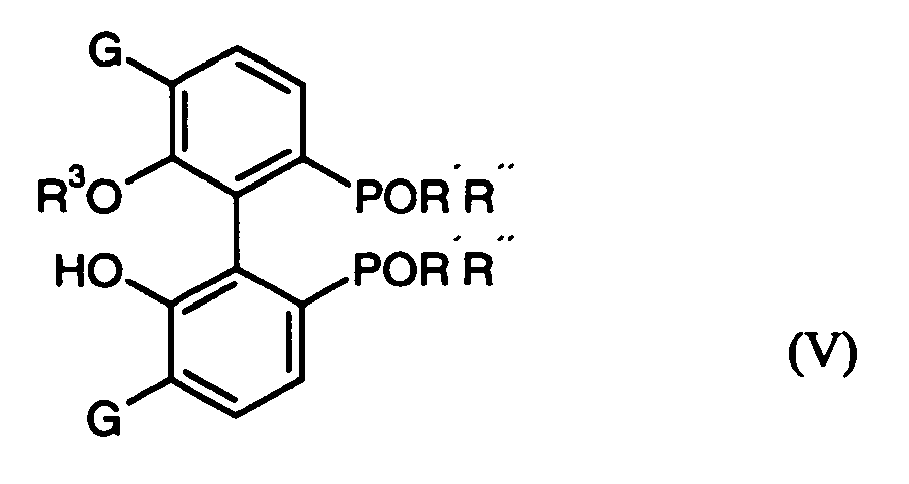 • in einem Schritt b2)
die Verbindungen der Formel (V) durch Umsetzung mit Verbindungen der Formel (VI)
R2OOC-B-Akt (VI)
in Gegenwart von Base zu Verbindungen der Formel (VII) umgesetzt werden, • und in einem Schritt c)wobei in den genannten Formeln B, R2, R3, G, R' und R" die gleichen Bedeutungen besitzen, die unter der Formel (I) in Anspruch 1 definiert wurde und
die Verbindungen der Formel (VII) zu Verbindungen der Formel (I) reduziert werden,
Akt für Halogen oder ein Sulfonat steht und
R4 in Formel (II) für C1-C6-Alkyl steht. - Verbindungen der Formel (VII)

- Verbindungen der Formel (V)

- Übergangsmetallkomplexe enthaltend Verbindungen der Formel (I) gemäß Anspruch 1.
- Katalysatoren, enthaltend Übergangsmetallkomplexe gemäß Anspruch 6.
- Verfahren zur übergangsmetallkatalysierten Herstellung von enantiomerenangereicherten Verbindungen, dadurch gekennzeichnet, dass als Katalysatoren solche gemäß Anspruch 7 verwendet werden.
Applications Claiming Priority (2)
| Application Number | Priority Date | Filing Date | Title |
|---|---|---|---|
| DE10342672A DE10342672A1 (de) | 2003-09-16 | 2003-09-16 | Chirale Phosphane zur Verwendung in asymmetrischen Synthesen |
| DE10342672 | 2003-09-16 |
Publications (2)
| Publication Number | Publication Date |
|---|---|
| EP1516880A1 EP1516880A1 (de) | 2005-03-23 |
| EP1516880B1 true EP1516880B1 (de) | 2008-12-24 |
Family
ID=34177774
Family Applications (1)
| Application Number | Title | Priority Date | Filing Date |
|---|---|---|---|
| EP04021174A Expired - Lifetime EP1516880B1 (de) | 2003-09-16 | 2004-09-07 | Chirale Phosphane zur Verwendung in asymmetrischen Synthesen |
Country Status (6)
| Country | Link |
|---|---|
| US (2) | US7625443B2 (de) |
| EP (1) | EP1516880B1 (de) |
| JP (1) | JP4902952B2 (de) |
| AT (1) | ATE418561T1 (de) |
| DE (2) | DE10342672A1 (de) |
| ES (1) | ES2316904T3 (de) |
Families Citing this family (1)
| Publication number | Priority date | Publication date | Assignee | Title |
|---|---|---|---|---|
| DE10342672A1 (de) * | 2003-09-16 | 2005-04-21 | Bayer Chemicals Ag | Chirale Phosphane zur Verwendung in asymmetrischen Synthesen |
Family Cites Families (10)
| Publication number | Priority date | Publication date | Assignee | Title |
|---|---|---|---|---|
| DK350383A (da) * | 1982-08-27 | 1984-02-28 | Hoffmann La Roche | Phosphorforbindelser |
| US4879416A (en) * | 1987-11-23 | 1989-11-07 | Eastman Kodak Company | Preparation of bidentate ligands |
| US5110955A (en) * | 1989-04-14 | 1992-05-05 | Hoffmann-La Roche Inc. | Tocopherol synthesis: chromane cyclization and catalysis |
| EP0583433B1 (de) * | 1992-01-31 | 1999-05-12 | F. Hoffmann-La Roche Ag | Diphosphinliganden |
| DE19522293A1 (de) * | 1995-06-20 | 1997-01-02 | Bayer Ag | Neue Bisphospine als Katalysatoren für asymmetrische Reaktionen |
| DE69908889T2 (de) * | 1998-11-19 | 2004-05-06 | Solvias Ag | Chirale Diphenyldiphosphine und d-8 Metall-Komplexe davon |
| EP1078632A1 (de) * | 1999-08-16 | 2001-02-28 | Sanofi-Synthelabo | Verwendung von Monoamin Oxydase Inhibitoren zu Herstellung eines Medikaments zur Behandlung der Fettleibigkeit |
| HK1046250A1 (zh) * | 1999-09-20 | 2003-01-03 | The Penn State Research Foundation | 手性磷化氢配体、其过渡金属复合物,及二者在不对称反应中的应用 |
| WO2004031110A2 (de) * | 2002-10-01 | 2004-04-15 | Dieter Arlt | Isomerisierung von chiral einheitlichen o,o'-dihydroxy-biphenylderivaten |
| DE10342672A1 (de) * | 2003-09-16 | 2005-04-21 | Bayer Chemicals Ag | Chirale Phosphane zur Verwendung in asymmetrischen Synthesen |
-
2003
- 2003-09-16 DE DE10342672A patent/DE10342672A1/de not_active Withdrawn
-
2004
- 2004-09-07 DE DE502004008727T patent/DE502004008727D1/de not_active Expired - Lifetime
- 2004-09-07 AT AT04021174T patent/ATE418561T1/de not_active IP Right Cessation
- 2004-09-07 EP EP04021174A patent/EP1516880B1/de not_active Expired - Lifetime
- 2004-09-07 ES ES04021174T patent/ES2316904T3/es not_active Expired - Lifetime
- 2004-09-14 JP JP2004267421A patent/JP4902952B2/ja not_active Expired - Lifetime
- 2004-09-14 US US10/940,785 patent/US7625443B2/en not_active Expired - Lifetime
-
2009
- 2009-10-14 US US12/578,904 patent/US7981827B2/en not_active Expired - Lifetime
Also Published As
| Publication number | Publication date |
|---|---|
| DE10342672A1 (de) | 2005-04-21 |
| US7625443B2 (en) | 2009-12-01 |
| ES2316904T3 (es) | 2009-04-16 |
| ATE418561T1 (de) | 2009-01-15 |
| US7981827B2 (en) | 2011-07-19 |
| US20050085377A1 (en) | 2005-04-21 |
| EP1516880A1 (de) | 2005-03-23 |
| US20100099902A1 (en) | 2010-04-22 |
| JP4902952B2 (ja) | 2012-03-21 |
| DE502004008727D1 (de) | 2009-02-05 |
| JP2005089462A (ja) | 2005-04-07 |
Similar Documents
| Publication | Publication Date | Title |
|---|---|---|
| EP2459579B1 (de) | Imidazolgruppenhaltige phosphinoboran-verbindungen und verfahren zur herstellung von imidazolgruppenhaltige phosphorverbindungen | |
| DE69114986T2 (de) | Eine Phosphino-Binapthyl-Verbindung und Übergangsmetall-Komplexe davon. | |
| EP0643065A1 (de) | Neue Bisphosphine für asymmetrische Hydrierkatalysatoren | |
| EP0582692B1 (de) | Diphosphinliganden | |
| EP2254895A1 (de) | Imidazolgruppenhaltige phosphorverbindungen | |
| DE69521605T2 (de) | Optisch aktive diphosphine und herstellungsverfahren durch auftrennung der racematmischung | |
| DE602004008478T2 (de) | Biphosphinrutheniumkomplexe mit chiralen diaminliganden als katalysatoren | |
| DE602004002114T2 (de) | Substituierte ferrocenyldiphosphinligande für homogene hydrogenieringskatalysatoren | |
| EP0803510B1 (de) | 2,2'-Disubstituierte 1,1'-Diphosphino-ferrocene und 1',2-disubstituierte 1-Phosphino-ferrocene, Verfahren zu ihrer Herstellung, ihre Verwendung sowie sie enthaltende Übergangsmetallkomplexe | |
| EP0031877A1 (de) | Optisch aktive 1,2-Bis(diphenylphosphino)-verbindungen, diese als chirale Liganden enthaltende Metallkomplexe und deren Verwendung | |
| DE10240803A1 (de) | Verfahren zur Herstellung von Phosphiten und Übergangsmetallkomplexen | |
| EP1200452A1 (de) | Neue chirale phosphorliganden und ihre verwendung in der herstellung optisch aktiver produkte | |
| EP1636243B1 (de) | Chirale liganden zur anwendung in asymmetrischen synthesen | |
| EP2099801B1 (de) | Imidazoý1,5-b¨pyridazin-amido-liganden und deren komplexverbindungen | |
| EP1516880A1 (de) | Chirale phosphane zur verwendung in asymetrischen synthesen | |
| DE10148551A1 (de) | Chirale Monophosphorverbindungen | |
| EP1082328B1 (de) | Herstellung optisch aktiver phospholane | |
| EP1611114A2 (de) | Amin-substituierte diphenyldiphosphine und deren verwendung in metallkomplexen für asymmetrische synthesen | |
| DE10327109A1 (de) | Liganden zur Anwendung in stereoselektiven Synthesen | |
| DE102008033165A1 (de) | Verfahren zum Herstellen eines optisch aktiven ß-Hydroxycarbonsäurederivats | |
| EP1119574B1 (de) | Substituierte isophosphindoline und ihre verwendung | |
| EP1409493B1 (de) | Verfahren zur herstellung von nicht-chiralen und optisch aktiven hydroxygruppen enthaltenden organischen verbindungen | |
| DE10337013A1 (de) | Chirale Liganden zur Anwendung in asymmetrischen Synthesen | |
| DE60307724T2 (de) | Neue Diphosphinverbindung, Zwischenprodukte für deren Herstellung, Übergangsmetallkomplex enthaltend die Verbindung als Ligand und Katalysator für asymmetrische Hydrierungen, welcher den Komplex enthält | |
| DE102008033164B4 (de) | Verfahren zum Herstellen einer optisch aktiven Allylverbindung |
Legal Events
| Date | Code | Title | Description |
|---|---|---|---|
| PUAI | Public reference made under article 153(3) epc to a published international application that has entered the european phase |
Free format text: ORIGINAL CODE: 0009012 |
|
| AK | Designated contracting states |
Kind code of ref document: A1 Designated state(s): AT BE BG CH CY CZ DE DK EE ES FI FR GB GR HU IE IT LI LU MC NL PL PT RO SE SI SK TR |
|
| AX | Request for extension of the european patent |
Extension state: AL HR LT LV MK |
|
| RAP1 | Party data changed (applicant data changed or rights of an application transferred) |
Owner name: LANXESS DEUTSCHLAND GMBH |
|
| 17P | Request for examination filed |
Effective date: 20050923 |
|
| AKX | Designation fees paid |
Designated state(s): AT BE BG CH CY CZ DE DK EE ES FI FR GB GR HU IE IT LI LU MC NL PL PT RO SE SI SK TR |
|
| RAP1 | Party data changed (applicant data changed or rights of an application transferred) |
Owner name: SALTIGO GMBH |
|
| 17Q | First examination report despatched |
Effective date: 20060922 |
|
| RAP1 | Party data changed (applicant data changed or rights of an application transferred) |
Owner name: SALTIGO GMBH |
|
| GRAP | Despatch of communication of intention to grant a patent |
Free format text: ORIGINAL CODE: EPIDOSNIGR1 |
|
| RIC1 | Information provided on ipc code assigned before grant |
Ipc: B01J 31/24 20060101ALI20080612BHEP Ipc: C07F 15/00 20060101ALI20080612BHEP Ipc: C07F 9/53 20060101ALI20080612BHEP Ipc: C07B 53/00 20060101ALI20080612BHEP Ipc: C07F 9/50 20060101AFI20080612BHEP |
|
| GRAS | Grant fee paid |
Free format text: ORIGINAL CODE: EPIDOSNIGR3 |
|
| GRAA | (expected) grant |
Free format text: ORIGINAL CODE: 0009210 |
|
| RAP1 | Party data changed (applicant data changed or rights of an application transferred) |
Owner name: BOEHRINGER INGELHEIM INTERNATIONAL GMBH |
|
| AK | Designated contracting states |
Kind code of ref document: B1 Designated state(s): AT BE BG CH CY CZ DE DK EE ES FI FR GB GR HU IE IT LI LU MC NL PL PT RO SE SI SK TR |
|
| REG | Reference to a national code |
Ref country code: GB Ref legal event code: FG4D Free format text: NOT ENGLISH |
|
| REG | Reference to a national code |
Ref country code: CH Ref legal event code: EP |
|
| REG | Reference to a national code |
Ref country code: IE Ref legal event code: FG4D Free format text: LANGUAGE OF EP DOCUMENT: GERMAN |
|
| REF | Corresponds to: |
Ref document number: 502004008727 Country of ref document: DE Date of ref document: 20090205 Kind code of ref document: P |
|
| REG | Reference to a national code |
Ref country code: ES Ref legal event code: FG2A Ref document number: 2316904 Country of ref document: ES Kind code of ref document: T3 |
|
| PG25 | Lapsed in a contracting state [announced via postgrant information from national office to epo] |
Ref country code: NL Free format text: LAPSE BECAUSE OF FAILURE TO SUBMIT A TRANSLATION OF THE DESCRIPTION OR TO PAY THE FEE WITHIN THE PRESCRIBED TIME-LIMIT Effective date: 20081224 Ref country code: FI Free format text: LAPSE BECAUSE OF FAILURE TO SUBMIT A TRANSLATION OF THE DESCRIPTION OR TO PAY THE FEE WITHIN THE PRESCRIBED TIME-LIMIT Effective date: 20081224 Ref country code: PL Free format text: LAPSE BECAUSE OF FAILURE TO SUBMIT A TRANSLATION OF THE DESCRIPTION OR TO PAY THE FEE WITHIN THE PRESCRIBED TIME-LIMIT Effective date: 20081224 Ref country code: SI Free format text: LAPSE BECAUSE OF FAILURE TO SUBMIT A TRANSLATION OF THE DESCRIPTION OR TO PAY THE FEE WITHIN THE PRESCRIBED TIME-LIMIT Effective date: 20081224 |
|
| NLV1 | Nl: lapsed or annulled due to failure to fulfill the requirements of art. 29p and 29m of the patents act | ||
| REG | Reference to a national code |
Ref country code: IE Ref legal event code: FD4D |
|
| PG25 | Lapsed in a contracting state [announced via postgrant information from national office to epo] |
Ref country code: EE Free format text: LAPSE BECAUSE OF FAILURE TO SUBMIT A TRANSLATION OF THE DESCRIPTION OR TO PAY THE FEE WITHIN THE PRESCRIBED TIME-LIMIT Effective date: 20081224 Ref country code: BG Free format text: LAPSE BECAUSE OF FAILURE TO SUBMIT A TRANSLATION OF THE DESCRIPTION OR TO PAY THE FEE WITHIN THE PRESCRIBED TIME-LIMIT Effective date: 20090324 Ref country code: IE Free format text: LAPSE BECAUSE OF FAILURE TO SUBMIT A TRANSLATION OF THE DESCRIPTION OR TO PAY THE FEE WITHIN THE PRESCRIBED TIME-LIMIT Effective date: 20081224 Ref country code: RO Free format text: LAPSE BECAUSE OF FAILURE TO SUBMIT A TRANSLATION OF THE DESCRIPTION OR TO PAY THE FEE WITHIN THE PRESCRIBED TIME-LIMIT Effective date: 20081224 |
|
| PG25 | Lapsed in a contracting state [announced via postgrant information from national office to epo] |
Ref country code: CZ Free format text: LAPSE BECAUSE OF FAILURE TO SUBMIT A TRANSLATION OF THE DESCRIPTION OR TO PAY THE FEE WITHIN THE PRESCRIBED TIME-LIMIT Effective date: 20081224 Ref country code: PT Free format text: LAPSE BECAUSE OF FAILURE TO SUBMIT A TRANSLATION OF THE DESCRIPTION OR TO PAY THE FEE WITHIN THE PRESCRIBED TIME-LIMIT Effective date: 20090525 Ref country code: SE Free format text: LAPSE BECAUSE OF FAILURE TO SUBMIT A TRANSLATION OF THE DESCRIPTION OR TO PAY THE FEE WITHIN THE PRESCRIBED TIME-LIMIT Effective date: 20090324 |
|
| PG25 | Lapsed in a contracting state [announced via postgrant information from national office to epo] |
Ref country code: SK Free format text: LAPSE BECAUSE OF FAILURE TO SUBMIT A TRANSLATION OF THE DESCRIPTION OR TO PAY THE FEE WITHIN THE PRESCRIBED TIME-LIMIT Effective date: 20081224 |
|
| PG25 | Lapsed in a contracting state [announced via postgrant information from national office to epo] |
Ref country code: DK Free format text: LAPSE BECAUSE OF FAILURE TO SUBMIT A TRANSLATION OF THE DESCRIPTION OR TO PAY THE FEE WITHIN THE PRESCRIBED TIME-LIMIT Effective date: 20081224 |
|
| PLBE | No opposition filed within time limit |
Free format text: ORIGINAL CODE: 0009261 |
|
| STAA | Information on the status of an ep patent application or granted ep patent |
Free format text: STATUS: NO OPPOSITION FILED WITHIN TIME LIMIT |
|
| 26N | No opposition filed |
Effective date: 20090925 |
|
| BERE | Be: lapsed |
Owner name: BOEHRINGER INGELHEIM INTERNATIONAL G.M.B.H. Effective date: 20090930 |
|
| PG25 | Lapsed in a contracting state [announced via postgrant information from national office to epo] |
Ref country code: MC Free format text: LAPSE BECAUSE OF NON-PAYMENT OF DUE FEES Effective date: 20090930 |
|
| GBPC | Gb: european patent ceased through non-payment of renewal fee |
Effective date: 20090907 |
|
| REG | Reference to a national code |
Ref country code: FR Ref legal event code: ST Effective date: 20100531 |
|
| PG25 | Lapsed in a contracting state [announced via postgrant information from national office to epo] |
Ref country code: FR Free format text: LAPSE BECAUSE OF NON-PAYMENT OF DUE FEES Effective date: 20090930 |
|
| PG25 | Lapsed in a contracting state [announced via postgrant information from national office to epo] |
Ref country code: BE Free format text: LAPSE BECAUSE OF NON-PAYMENT OF DUE FEES Effective date: 20090930 |
|
| PG25 | Lapsed in a contracting state [announced via postgrant information from national office to epo] |
Ref country code: GR Free format text: LAPSE BECAUSE OF FAILURE TO SUBMIT A TRANSLATION OF THE DESCRIPTION OR TO PAY THE FEE WITHIN THE PRESCRIBED TIME-LIMIT Effective date: 20090325 |
|
| PG25 | Lapsed in a contracting state [announced via postgrant information from national office to epo] |
Ref country code: AT Free format text: LAPSE BECAUSE OF NON-PAYMENT OF DUE FEES Effective date: 20090907 Ref country code: GB Free format text: LAPSE BECAUSE OF NON-PAYMENT OF DUE FEES Effective date: 20090907 |
|
| PG25 | Lapsed in a contracting state [announced via postgrant information from national office to epo] |
Ref country code: LU Free format text: LAPSE BECAUSE OF NON-PAYMENT OF DUE FEES Effective date: 20090907 |
|
| PG25 | Lapsed in a contracting state [announced via postgrant information from national office to epo] |
Ref country code: HU Free format text: LAPSE BECAUSE OF FAILURE TO SUBMIT A TRANSLATION OF THE DESCRIPTION OR TO PAY THE FEE WITHIN THE PRESCRIBED TIME-LIMIT Effective date: 20090625 |
|
| PG25 | Lapsed in a contracting state [announced via postgrant information from national office to epo] |
Ref country code: TR Free format text: LAPSE BECAUSE OF FAILURE TO SUBMIT A TRANSLATION OF THE DESCRIPTION OR TO PAY THE FEE WITHIN THE PRESCRIBED TIME-LIMIT Effective date: 20081224 |
|
| PG25 | Lapsed in a contracting state [announced via postgrant information from national office to epo] |
Ref country code: CY Free format text: LAPSE BECAUSE OF FAILURE TO SUBMIT A TRANSLATION OF THE DESCRIPTION OR TO PAY THE FEE WITHIN THE PRESCRIBED TIME-LIMIT Effective date: 20081224 |
|
| PGFP | Annual fee paid to national office [announced via postgrant information from national office to epo] |
Ref country code: DE Payment date: 20230920 Year of fee payment: 20 |
|
| PGFP | Annual fee paid to national office [announced via postgrant information from national office to epo] |
Ref country code: ES Payment date: 20231123 Year of fee payment: 20 |
|
| PGFP | Annual fee paid to national office [announced via postgrant information from national office to epo] |
Ref country code: IT Payment date: 20230927 Year of fee payment: 20 Ref country code: CH Payment date: 20231001 Year of fee payment: 20 |
|
| REG | Reference to a national code |
Ref country code: DE Ref legal event code: R071 Ref document number: 502004008727 Country of ref document: DE |
|
| REG | Reference to a national code |
Ref country code: CH Ref legal event code: PL |
|
| REG | Reference to a national code |
Ref country code: ES Ref legal event code: FD2A Effective date: 20240927 |
|
| PG25 | Lapsed in a contracting state [announced via postgrant information from national office to epo] |
Ref country code: ES Free format text: LAPSE BECAUSE OF EXPIRATION OF PROTECTION Effective date: 20240908 |
|
| PG25 | Lapsed in a contracting state [announced via postgrant information from national office to epo] |
Ref country code: ES Free format text: LAPSE BECAUSE OF EXPIRATION OF PROTECTION Effective date: 20240908 |