EP1904082B1 - VERFAHREN ZUR BESTIMMUNG DER KONZENTRATION DER ADIPOZYTAREN FORM DES FATTY ACID BINDUNG PROTEIN (A-FABP, FABP4, aP2) - Google Patents
VERFAHREN ZUR BESTIMMUNG DER KONZENTRATION DER ADIPOZYTAREN FORM DES FATTY ACID BINDUNG PROTEIN (A-FABP, FABP4, aP2) Download PDFInfo
- Publication number
- EP1904082B1 EP1904082B1 EP06795383A EP06795383A EP1904082B1 EP 1904082 B1 EP1904082 B1 EP 1904082B1 EP 06795383 A EP06795383 A EP 06795383A EP 06795383 A EP06795383 A EP 06795383A EP 1904082 B1 EP1904082 B1 EP 1904082B1
- Authority
- EP
- European Patent Office
- Prior art keywords
- fabp
- concentration
- antibodies
- carrier material
- elisa
- Prior art date
- Legal status (The legal status is an assumption and is not a legal conclusion. Google has not performed a legal analysis and makes no representation as to the accuracy of the status listed.)
- Not-in-force
Links
- 238000000034 method Methods 0.000 title claims abstract description 28
- 102000030914 Fatty Acid-Binding Human genes 0.000 title claims abstract description 6
- 108091022862 fatty acid binding Proteins 0.000 title claims abstract description 6
- 102100030431 Fatty acid-binding protein, adipocyte Human genes 0.000 title abstract description 66
- 101710118908 Fatty acid-binding protein, adipocyte Proteins 0.000 title abstract description 62
- 101001062864 Homo sapiens Fatty acid-binding protein, adipocyte Proteins 0.000 title description 7
- 208000001145 Metabolic Syndrome Diseases 0.000 claims abstract description 32
- 201000000690 abdominal obesity-metabolic syndrome Diseases 0.000 claims abstract description 32
- 238000003745 diagnosis Methods 0.000 claims abstract description 8
- 238000004458 analytical method Methods 0.000 claims abstract 2
- 238000002965 ELISA Methods 0.000 claims description 15
- 239000000126 substance Substances 0.000 claims description 15
- 239000012876 carrier material Substances 0.000 claims description 14
- 210000002966 serum Anatomy 0.000 claims description 14
- NOESYZHRGYRDHS-UHFFFAOYSA-N insulin Chemical compound N1C(=O)C(NC(=O)C(CCC(N)=O)NC(=O)C(CCC(O)=O)NC(=O)C(C(C)C)NC(=O)C(NC(=O)CN)C(C)CC)CSSCC(C(NC(CO)C(=O)NC(CC(C)C)C(=O)NC(CC=2C=CC(O)=CC=2)C(=O)NC(CCC(N)=O)C(=O)NC(CC(C)C)C(=O)NC(CCC(O)=O)C(=O)NC(CC(N)=O)C(=O)NC(CC=2C=CC(O)=CC=2)C(=O)NC(CSSCC(NC(=O)C(C(C)C)NC(=O)C(CC(C)C)NC(=O)C(CC=2C=CC(O)=CC=2)NC(=O)C(CC(C)C)NC(=O)C(C)NC(=O)C(CCC(O)=O)NC(=O)C(C(C)C)NC(=O)C(CC(C)C)NC(=O)C(CC=2NC=NC=2)NC(=O)C(CO)NC(=O)CNC2=O)C(=O)NCC(=O)NC(CCC(O)=O)C(=O)NC(CCCNC(N)=N)C(=O)NCC(=O)NC(CC=3C=CC=CC=3)C(=O)NC(CC=3C=CC=CC=3)C(=O)NC(CC=3C=CC(O)=CC=3)C(=O)NC(C(C)O)C(=O)N3C(CCC3)C(=O)NC(CCCCN)C(=O)NC(C)C(O)=O)C(=O)NC(CC(N)=O)C(O)=O)=O)NC(=O)C(C(C)CC)NC(=O)C(CO)NC(=O)C(C(C)O)NC(=O)C1CSSCC2NC(=O)C(CC(C)C)NC(=O)C(NC(=O)C(CCC(N)=O)NC(=O)C(CC(N)=O)NC(=O)C(NC(=O)C(N)CC=1C=CC=CC=1)C(C)C)CC1=CN=CN1 NOESYZHRGYRDHS-UHFFFAOYSA-N 0.000 claims description 12
- 210000001789 adipocyte Anatomy 0.000 claims description 9
- 238000001514 detection method Methods 0.000 claims description 9
- 239000000243 solution Substances 0.000 claims description 8
- 238000012360 testing method Methods 0.000 claims description 7
- WQZGKKKJIJFFOK-GASJEMHNSA-N Glucose Natural products OC[C@H]1OC(O)[C@H](O)[C@@H](O)[C@@H]1O WQZGKKKJIJFFOK-GASJEMHNSA-N 0.000 claims description 6
- 102000004877 Insulin Human genes 0.000 claims description 6
- 108090001061 Insulin Proteins 0.000 claims description 6
- 239000008103 glucose Substances 0.000 claims description 6
- 229940125396 insulin Drugs 0.000 claims description 6
- WQZGKKKJIJFFOK-VFUOTHLCSA-N beta-D-glucose Chemical compound OC[C@H]1O[C@@H](O)[C@H](O)[C@@H](O)[C@@H]1O WQZGKKKJIJFFOK-VFUOTHLCSA-N 0.000 claims description 5
- 150000003626 triacylglycerols Chemical class 0.000 claims description 5
- 238000008214 LDL Cholesterol Methods 0.000 claims description 4
- 102000016267 Leptin Human genes 0.000 claims description 4
- 108010092277 Leptin Proteins 0.000 claims description 4
- 229940039781 leptin Drugs 0.000 claims description 4
- NRYBAZVQPHGZNS-ZSOCWYAHSA-N leptin Chemical compound O=C([C@H](CO)NC(=O)[C@H](CC(C)C)NC(=O)[C@H](CC(O)=O)NC(=O)[C@H](CC(C)C)NC(=O)[C@H](CCC(N)=O)NC(=O)[C@H](CC=1C2=CC=CC=C2NC=1)NC(=O)[C@H](CC(C)C)NC(=O)[C@@H](NC(=O)[C@H](CC(O)=O)NC(=O)[C@H](CCC(N)=O)NC(=O)[C@H](CC(C)C)NC(=O)[C@H](CO)NC(=O)CNC(=O)[C@H](CCC(N)=O)NC(=O)[C@@H](N)CC(C)C)CCSC)N1CCC[C@H]1C(=O)NCC(=O)N[C@@H](CS)C(O)=O NRYBAZVQPHGZNS-ZSOCWYAHSA-N 0.000 claims description 4
- 230000004060 metabolic process Effects 0.000 claims description 4
- 238000005406 washing Methods 0.000 claims description 4
- 102000011690 Adiponectin Human genes 0.000 claims description 3
- 108010076365 Adiponectin Proteins 0.000 claims description 3
- 108010023302 HDL Cholesterol Proteins 0.000 claims description 3
- 238000011534 incubation Methods 0.000 claims description 3
- 102000000476 Fatty Acid Transport Proteins Human genes 0.000 claims description 2
- 108010055870 Fatty Acid Transport Proteins Proteins 0.000 claims description 2
- 102100030421 Fatty acid-binding protein 5 Human genes 0.000 claims 1
- 101710083187 Fatty acid-binding protein 5 Proteins 0.000 claims 1
- 108010028554 LDL Cholesterol Proteins 0.000 claims 1
- -1 QUICKI Proteins 0.000 claims 1
- 239000012482 calibration solution Substances 0.000 claims 1
- 239000003550 marker Substances 0.000 claims 1
- 208000001072 type 2 diabetes mellitus Diseases 0.000 abstract description 16
- 210000001124 body fluid Anatomy 0.000 abstract description 13
- 206010022489 Insulin Resistance Diseases 0.000 abstract description 12
- 208000008589 Obesity Diseases 0.000 abstract description 10
- 235000020824 obesity Nutrition 0.000 abstract description 9
- 208000030159 metabolic disease Diseases 0.000 abstract description 6
- 208000037265 diseases, disorders, signs and symptoms Diseases 0.000 abstract description 5
- 208000035475 disorder Diseases 0.000 abstract description 3
- 238000012502 risk assessment Methods 0.000 abstract description 3
- 238000012544 monitoring process Methods 0.000 abstract description 2
- 208000037921 secondary disease Diseases 0.000 abstract description 2
- 201000010099 disease Diseases 0.000 abstract 2
- 101100226596 Gallus gallus FABP gene Proteins 0.000 abstract 1
- 230000004129 fatty acid metabolism Effects 0.000 abstract 1
- 238000011321 prophylaxis Methods 0.000 abstract 1
- 238000011160 research Methods 0.000 abstract 1
- 238000011282 treatment Methods 0.000 abstract 1
- 239000000427 antigen Substances 0.000 description 16
- 102000036639 antigens Human genes 0.000 description 16
- 108091007433 antigens Proteins 0.000 description 16
- 210000004369 blood Anatomy 0.000 description 14
- 239000008280 blood Substances 0.000 description 14
- 239000010839 body fluid Substances 0.000 description 12
- HVYWMOMLDIMFJA-DPAQBDIFSA-N cholesterol Chemical compound C1C=C2C[C@@H](O)CC[C@]2(C)[C@@H]2[C@@H]1[C@@H]1CC[C@H]([C@H](C)CCCC(C)C)[C@@]1(C)CC2 HVYWMOMLDIMFJA-DPAQBDIFSA-N 0.000 description 12
- 102000004169 proteins and genes Human genes 0.000 description 9
- 108090000623 proteins and genes Proteins 0.000 description 9
- 241000283707 Capra Species 0.000 description 7
- 238000011084 recovery Methods 0.000 description 7
- 241000283973 Oryctolagus cuniculus Species 0.000 description 6
- 239000000463 material Substances 0.000 description 6
- 239000012491 analyte Substances 0.000 description 5
- 235000012000 cholesterol Nutrition 0.000 description 5
- 241000588724 Escherichia coli Species 0.000 description 4
- 239000002671 adjuvant Substances 0.000 description 4
- 208000032928 Dyslipidaemia Diseases 0.000 description 3
- 208000017170 Lipid metabolism disease Diseases 0.000 description 3
- 208000029078 coronary artery disease Diseases 0.000 description 3
- 238000011161 development Methods 0.000 description 3
- 206010012601 diabetes mellitus Diseases 0.000 description 3
- 238000009826 distribution Methods 0.000 description 3
- 239000003814 drug Substances 0.000 description 3
- 239000012634 fragment Substances 0.000 description 3
- 230000003834 intracellular effect Effects 0.000 description 3
- 238000005259 measurement Methods 0.000 description 3
- 230000003287 optical effect Effects 0.000 description 3
- YBJHBAHKTGYVGT-ZKWXMUAHSA-N (+)-Biotin Chemical compound N1C(=O)N[C@@H]2[C@H](CCCCC(=O)O)SC[C@@H]21 YBJHBAHKTGYVGT-ZKWXMUAHSA-N 0.000 description 2
- 241000894006 Bacteria Species 0.000 description 2
- 108010010234 HDL Lipoproteins Proteins 0.000 description 2
- 208000035150 Hypercholesterolemia Diseases 0.000 description 2
- FAPWRFPIFSIZLT-UHFFFAOYSA-M Sodium chloride Chemical compound [Na+].[Cl-] FAPWRFPIFSIZLT-UHFFFAOYSA-M 0.000 description 2
- 150000001413 amino acids Chemical class 0.000 description 2
- 239000000872 buffer Substances 0.000 description 2
- 230000002596 correlated effect Effects 0.000 description 2
- 230000000875 corresponding effect Effects 0.000 description 2
- 238000010790 dilution Methods 0.000 description 2
- 239000012895 dilution Substances 0.000 description 2
- 239000000975 dye Substances 0.000 description 2
- 238000011156 evaluation Methods 0.000 description 2
- 235000021588 free fatty acids Nutrition 0.000 description 2
- 230000002068 genetic effect Effects 0.000 description 2
- PCHJSUWPFVWCPO-UHFFFAOYSA-N gold Chemical compound [Au] PCHJSUWPFVWCPO-UHFFFAOYSA-N 0.000 description 2
- 239000010931 gold Substances 0.000 description 2
- 229910052737 gold Inorganic materials 0.000 description 2
- BPHPUYQFMNQIOC-NXRLNHOXSA-N isopropyl beta-D-thiogalactopyranoside Chemical compound CC(C)S[C@@H]1O[C@H](CO)[C@H](O)[C@H](O)[C@H]1O BPHPUYQFMNQIOC-NXRLNHOXSA-N 0.000 description 2
- 150000002632 lipids Chemical class 0.000 description 2
- 238000002360 preparation method Methods 0.000 description 2
- 108090000765 processed proteins & peptides Proteins 0.000 description 2
- 238000000746 purification Methods 0.000 description 2
- 230000035945 sensitivity Effects 0.000 description 2
- 239000000758 substrate Substances 0.000 description 2
- 238000002560 therapeutic procedure Methods 0.000 description 2
- 210000001519 tissue Anatomy 0.000 description 2
- QFVHZQCOUORWEI-UHFFFAOYSA-N 4-[(4-anilino-5-sulfonaphthalen-1-yl)diazenyl]-5-hydroxynaphthalene-2,7-disulfonic acid Chemical compound C=12C(O)=CC(S(O)(=O)=O)=CC2=CC(S(O)(=O)=O)=CC=1N=NC(C1=CC=CC(=C11)S(O)(=O)=O)=CC=C1NC1=CC=CC=C1 QFVHZQCOUORWEI-UHFFFAOYSA-N 0.000 description 1
- 102000002260 Alkaline Phosphatase Human genes 0.000 description 1
- 108020004774 Alkaline Phosphatase Proteins 0.000 description 1
- 201000001320 Atherosclerosis Diseases 0.000 description 1
- 102000000131 Beta tubulin Human genes 0.000 description 1
- 208000024172 Cardiovascular disease Diseases 0.000 description 1
- 208000035762 Disorder of lipid metabolism Diseases 0.000 description 1
- 102000004190 Enzymes Human genes 0.000 description 1
- 108090000790 Enzymes Proteins 0.000 description 1
- 241000282414 Homo sapiens Species 0.000 description 1
- 108010001336 Horseradish Peroxidase Proteins 0.000 description 1
- 206010060378 Hyperinsulinaemia Diseases 0.000 description 1
- 208000031226 Hyperlipidaemia Diseases 0.000 description 1
- 208000031773 Insulin resistance syndrome Diseases 0.000 description 1
- 241001465754 Metazoa Species 0.000 description 1
- 239000000020 Nitrocellulose Substances 0.000 description 1
- 206010033307 Overweight Diseases 0.000 description 1
- 239000002033 PVDF binder Substances 0.000 description 1
- 208000037273 Pathologic Processes Diseases 0.000 description 1
- 108010090804 Streptavidin Proteins 0.000 description 1
- 101710172711 Structural protein Proteins 0.000 description 1
- 229930006000 Sucrose Natural products 0.000 description 1
- CZMRCDWAGMRECN-UGDNZRGBSA-N Sucrose Chemical compound O[C@H]1[C@H](O)[C@@H](CO)O[C@@]1(CO)O[C@@H]1[C@H](O)[C@@H](O)[C@H](O)[C@@H](CO)O1 CZMRCDWAGMRECN-UGDNZRGBSA-N 0.000 description 1
- 108090000704 Tubulin Proteins 0.000 description 1
- 238000002835 absorbance Methods 0.000 description 1
- 210000000577 adipose tissue Anatomy 0.000 description 1
- 238000001042 affinity chromatography Methods 0.000 description 1
- 238000001261 affinity purification Methods 0.000 description 1
- SHGAZHPCJJPHSC-YCNIQYBTSA-N all-trans-retinoic acid Chemical compound OC(=O)\C=C(/C)\C=C\C=C(/C)\C=C\C1=C(C)CCCC1(C)C SHGAZHPCJJPHSC-YCNIQYBTSA-N 0.000 description 1
- 238000011091 antibody purification Methods 0.000 description 1
- 230000006907 apoptotic process Effects 0.000 description 1
- 208000037849 arterial hypertension Diseases 0.000 description 1
- 210000000227 basophil cell of anterior lobe of hypophysis Anatomy 0.000 description 1
- 230000008901 benefit Effects 0.000 description 1
- 208000036815 beta tubulin Diseases 0.000 description 1
- 229960002685 biotin Drugs 0.000 description 1
- 235000020958 biotin Nutrition 0.000 description 1
- 239000011616 biotin Substances 0.000 description 1
- 230000000903 blocking effect Effects 0.000 description 1
- 239000007853 buffer solution Substances 0.000 description 1
- 238000011088 calibration curve Methods 0.000 description 1
- 150000001720 carbohydrates Chemical class 0.000 description 1
- 235000014633 carbohydrates Nutrition 0.000 description 1
- 230000015556 catabolic process Effects 0.000 description 1
- 210000004027 cell Anatomy 0.000 description 1
- 238000004113 cell culture Methods 0.000 description 1
- 239000001913 cellulose Substances 0.000 description 1
- 229920002678 cellulose Polymers 0.000 description 1
- 239000011248 coating agent Substances 0.000 description 1
- 238000000576 coating method Methods 0.000 description 1
- 238000012937 correction Methods 0.000 description 1
- 239000012228 culture supernatant Substances 0.000 description 1
- 210000000805 cytoplasm Anatomy 0.000 description 1
- 230000001086 cytosolic effect Effects 0.000 description 1
- 230000034994 death Effects 0.000 description 1
- 230000001419 dependent effect Effects 0.000 description 1
- 238000000586 desensitisation Methods 0.000 description 1
- 235000005911 diet Nutrition 0.000 description 1
- 230000037213 diet Effects 0.000 description 1
- 235000014113 dietary fatty acids Nutrition 0.000 description 1
- 229940079593 drug Drugs 0.000 description 1
- 230000000694 effects Effects 0.000 description 1
- 230000009881 electrostatic interaction Effects 0.000 description 1
- 230000037149 energy metabolism Effects 0.000 description 1
- 238000010195 expression analysis Methods 0.000 description 1
- 238000000605 extraction Methods 0.000 description 1
- 229930195729 fatty acid Natural products 0.000 description 1
- 239000000194 fatty acid Substances 0.000 description 1
- 150000004665 fatty acids Chemical class 0.000 description 1
- 230000002349 favourable effect Effects 0.000 description 1
- 239000007850 fluorescent dye Substances 0.000 description 1
- 239000011521 glass Substances 0.000 description 1
- 230000003054 hormonal effect Effects 0.000 description 1
- 229940088597 hormone Drugs 0.000 description 1
- 239000005556 hormone Substances 0.000 description 1
- 230000003451 hyperinsulinaemic effect Effects 0.000 description 1
- 201000008980 hyperinsulinism Diseases 0.000 description 1
- 208000006575 hypertriglyceridemia Diseases 0.000 description 1
- 238000002649 immunization Methods 0.000 description 1
- 230000003053 immunization Effects 0.000 description 1
- 230000006872 improvement Effects 0.000 description 1
- 229910052500 inorganic mineral Inorganic materials 0.000 description 1
- 230000003993 interaction Effects 0.000 description 1
- 238000011835 investigation Methods 0.000 description 1
- 230000037356 lipid metabolism Effects 0.000 description 1
- 230000000512 lipotoxic effect Effects 0.000 description 1
- 238000012423 maintenance Methods 0.000 description 1
- 239000011707 mineral Substances 0.000 description 1
- 229920001220 nitrocellulos Polymers 0.000 description 1
- 238000010606 normalization Methods 0.000 description 1
- 239000002245 particle Substances 0.000 description 1
- 230000009054 pathological process Effects 0.000 description 1
- 230000003234 polygenic effect Effects 0.000 description 1
- 229920002981 polyvinylidene fluoride Polymers 0.000 description 1
- 230000008092 positive effect Effects 0.000 description 1
- 102000004196 processed proteins & peptides Human genes 0.000 description 1
- 229940127293 prostanoid Drugs 0.000 description 1
- 150000003814 prostanoids Chemical class 0.000 description 1
- 229930002330 retinoic acid Natural products 0.000 description 1
- 239000012898 sample dilution Substances 0.000 description 1
- 230000028327 secretion Effects 0.000 description 1
- 238000000926 separation method Methods 0.000 description 1
- 238000012163 sequencing technique Methods 0.000 description 1
- 238000012883 sequential measurement Methods 0.000 description 1
- 230000011664 signaling Effects 0.000 description 1
- 239000011780 sodium chloride Substances 0.000 description 1
- 238000002415 sodium dodecyl sulfate polyacrylamide gel electrophoresis Methods 0.000 description 1
- 239000007790 solid phase Substances 0.000 description 1
- 238000001228 spectrum Methods 0.000 description 1
- 239000005720 sucrose Substances 0.000 description 1
- 239000006228 supernatant Substances 0.000 description 1
- 238000002198 surface plasmon resonance spectroscopy Methods 0.000 description 1
- 208000024891 symptom Diseases 0.000 description 1
- 208000011580 syndromic disease Diseases 0.000 description 1
- 238000004448 titration Methods 0.000 description 1
- 230000032258 transport Effects 0.000 description 1
- 229960001727 tretinoin Drugs 0.000 description 1
- UFTFJSFQGQCHQW-UHFFFAOYSA-N triformin Chemical compound O=COCC(OC=O)COC=O UFTFJSFQGQCHQW-UHFFFAOYSA-N 0.000 description 1
- 238000000539 two dimensional gel electrophoresis Methods 0.000 description 1
- XLYOFNOQVPJJNP-UHFFFAOYSA-N water Substances O XLYOFNOQVPJJNP-UHFFFAOYSA-N 0.000 description 1
- 238000001262 western blot Methods 0.000 description 1
- 238000010626 work up procedure Methods 0.000 description 1
Images












Classifications
-
- G—PHYSICS
- G01—MEASURING; TESTING
- G01N—INVESTIGATING OR ANALYSING MATERIALS BY DETERMINING THEIR CHEMICAL OR PHYSICAL PROPERTIES
- G01N33/00—Investigating or analysing materials by specific methods not covered by groups G01N1/00 - G01N31/00
- G01N33/48—Biological material, e.g. blood, urine; Haemocytometers
- G01N33/50—Chemical analysis of biological material, e.g. blood, urine; Testing involving biospecific ligand binding methods; Immunological testing
- G01N33/92—Chemical analysis of biological material, e.g. blood, urine; Testing involving biospecific ligand binding methods; Immunological testing involving lipids, e.g. cholesterol, lipoproteins, or their receptors
-
- A—HUMAN NECESSITIES
- A61—MEDICAL OR VETERINARY SCIENCE; HYGIENE
- A61P—SPECIFIC THERAPEUTIC ACTIVITY OF CHEMICAL COMPOUNDS OR MEDICINAL PREPARATIONS
- A61P3/00—Drugs for disorders of the metabolism
-
- A—HUMAN NECESSITIES
- A61—MEDICAL OR VETERINARY SCIENCE; HYGIENE
- A61P—SPECIFIC THERAPEUTIC ACTIVITY OF CHEMICAL COMPOUNDS OR MEDICINAL PREPARATIONS
- A61P3/00—Drugs for disorders of the metabolism
- A61P3/04—Anorexiants; Antiobesity agents
-
- A—HUMAN NECESSITIES
- A61—MEDICAL OR VETERINARY SCIENCE; HYGIENE
- A61P—SPECIFIC THERAPEUTIC ACTIVITY OF CHEMICAL COMPOUNDS OR MEDICINAL PREPARATIONS
- A61P3/00—Drugs for disorders of the metabolism
- A61P3/08—Drugs for disorders of the metabolism for glucose homeostasis
- A61P3/10—Drugs for disorders of the metabolism for glucose homeostasis for hyperglycaemia, e.g. antidiabetics
-
- A—HUMAN NECESSITIES
- A61—MEDICAL OR VETERINARY SCIENCE; HYGIENE
- A61P—SPECIFIC THERAPEUTIC ACTIVITY OF CHEMICAL COMPOUNDS OR MEDICINAL PREPARATIONS
- A61P43/00—Drugs for specific purposes, not provided for in groups A61P1/00-A61P41/00
-
- A—HUMAN NECESSITIES
- A61—MEDICAL OR VETERINARY SCIENCE; HYGIENE
- A61P—SPECIFIC THERAPEUTIC ACTIVITY OF CHEMICAL COMPOUNDS OR MEDICINAL PREPARATIONS
- A61P5/00—Drugs for disorders of the endocrine system
- A61P5/48—Drugs for disorders of the endocrine system of the pancreatic hormones
- A61P5/50—Drugs for disorders of the endocrine system of the pancreatic hormones for increasing or potentiating the activity of insulin
-
- G—PHYSICS
- G01—MEASURING; TESTING
- G01N—INVESTIGATING OR ANALYSING MATERIALS BY DETERMINING THEIR CHEMICAL OR PHYSICAL PROPERTIES
- G01N2800/00—Detection or diagnosis of diseases
- G01N2800/04—Endocrine or metabolic disorders
- G01N2800/042—Disorders of carbohydrate metabolism, e.g. diabetes, glucose metabolism
-
- G—PHYSICS
- G01—MEASURING; TESTING
- G01N—INVESTIGATING OR ANALYSING MATERIALS BY DETERMINING THEIR CHEMICAL OR PHYSICAL PROPERTIES
- G01N2800/00—Detection or diagnosis of diseases
- G01N2800/04—Endocrine or metabolic disorders
- G01N2800/044—Hyperlipemia or hypolipemia, e.g. dyslipidaemia, obesity
-
- Y—GENERAL TAGGING OF NEW TECHNOLOGICAL DEVELOPMENTS; GENERAL TAGGING OF CROSS-SECTIONAL TECHNOLOGIES SPANNING OVER SEVERAL SECTIONS OF THE IPC; TECHNICAL SUBJECTS COVERED BY FORMER USPC CROSS-REFERENCE ART COLLECTIONS [XRACs] AND DIGESTS
- Y10—TECHNICAL SUBJECTS COVERED BY FORMER USPC
- Y10S—TECHNICAL SUBJECTS COVERED BY FORMER USPC CROSS-REFERENCE ART COLLECTIONS [XRACs] AND DIGESTS
- Y10S436/00—Chemistry: analytical and immunological testing
- Y10S436/811—Test for named disease, body condition or organ function
Definitions
- the invention relates to a method for determining the concentration of the adipocyte form of the fatty acid binding protein (A-FABP, FABP4, P2) for the diagnosis of the metabolic syndrome,
- the metabolic syndrome also referred to as syndrome X, insulin resistance syndrome or multiple metabolic syndrome, represents a disorder of metabolism of lipids, carbohydrates, proteins, minerals, etc. of the organism, which may be caused by genetic factors and / or living conditions.
- the metabolic syndrome includes insulin resistance, dyslipidemia, arterial hypertension and obesity.
- Insulin resistance is defined as insensitivity to the body's own insulin. Not only patients with type II diabetes suffer from insulin resistance, but also about 20% of practically healthy, not overweight people. The causes of insulin resistance are still unclear. Signs of insulin resistance include depletion of ⁇ -cells, their desensitization and apoptosis, caused by hyperinsulinemia and glucose and lipotoxicity.
- Dyslipidemia is a disorder of lipid metabolism in the form of hypercholesterolemia, hypertriglyceridemia, hyperlipidemia (elevated blood lipid levels as a generic term). This is characterized by high triglyceride and low HDL cholesterol levels, small, dense LDL particles and a high content of free Fatty acids. The spectrum of involvement ranges from "common” (polygenic) hypercholesterolemia (about 10% of the population) to rare genetic lipid metabolism disorders. Dyslipidaemias are risk factors for atherosclerosis, especially for coronary heart disease. In addition, the free fatty acids contribute to the maintenance of the state of insulin resistance.
- Cardiovascular diseases and in particular coronary heart disease represent the prognostically significant complications of the metabolic syndrome and thus also the main cause of death of this patient group.
- the aim of the invention is the early detection and / or observation of the metabolic syndrome.
- the invention is based on the object of developing methods with which it is possible to use suitable parameters for risk assessment and course monitoring in the diagnosis and therapy of the metabolic syndrome.
- the invention is realized according to claim 1 and claim 19, the dependent claims are preferred variants.
- the invention is based on the core idea that the concentration of A-FABP in serum or plasma is determined and used to diagnose the metabolic syndrome.
- a central role in the development, development and course of the metabolic syndrome and diabetes type II are the fat cells and lipid metabolism.
- a cytoplasmic fat cell protein is the adipocyte form of the fatty acid binding protein (abbreviated to A-FABP, FABP4 or P2), which transports longer fatty acids, prostanoids, retinoic acid and similar non-water soluble molecules into the fat cell cytoplasm.
- A-FABP fatty acid binding protein
- A-FABP is an intracellular fat cell protein that is unlikely to be present in the circulation, normal serum levels of A-FABP are in the nanogram range (ng / ml). As serum A-FABP levels are about twice those of the adipocytic hormone leptin (leptin concentrations ⁇ 8 ng / ml, A-FABP is ⁇ 16-20 ng / ml), it seems likely that A-FABP is active is secreted into the circulation. Furthermore, it can not be ruled out that A-FABP is attributable to another (signaling) effect which is independent of its intracellular function. However, it was completely unexpected that the measurement of the concentration of A-FABP in body fluids was suitable for the detection and observation of the metabolic syndrome.
- the invention is therefore based on the completely surprisingly obtained knowledge that a significantly increased content of A-FABP in serum or plasma is associated with the metabolic syndrome and.
- the invention therefore relates to a method in which the concentration of F-ABP in the serum (fatty acid transport capacity) is used to diagnose the metabolic syndrome. Furthermore, it was completely unexpected that the concentration of A-FABP in body fluids, particularly serum, correlated significantly with the concentration of other metabolic syndrome parameters, type II diabetes, insulin resistance, obesity, and related metabolic disorders. To diagnose and monitor the metabolic syndrome and metabolic disorders, the concentration of A-FABP in body fluids and / or solutions diluted therefrom is determined.
- immunometric systems especially in combination with an optical and / or biosensory evaluation special suitable because they allow a simple determination of the concentration of A-FABP in or from body fluids.
- a variety of systems can be used, with the help of which the concentration of A-FABP can be determined, for example by the parallel or sequential measurement of different concentrations of the body fluid to be determined, especially if in addition a normalization / calibration with defined or known A-FABP Concentrations, by titration or by the use of various defined concentration of capture molecules bound to a solid phase / support material and having affinity for A-FABP or structures derived therefrom.
- carrier materials on whose surface substances are immobilized which are suitable for determining the concentration of A-FABP in or from body fluids.
- These may in particular be molecules or substances composed thereof, preferably proteins, which have affinity for F-ABP, for example anti-F-ABP antibodies. It is also possible to use immobilized substances which have affinity for partial fragments of A-FABP, in particular peptide chains, or peptides composed of partial fragments.
- Suitable carrier materials are any materials or coated materials on the surface of which molecules can be immobilized, in particular nitrocellulose or PVDF or other materials for biophysical immobilization, for example in wells of ELISA plates.
- immobilization via electrostatic interaction or immobilization by chemical bonding is also possible.
- Suitable for immobilization, in particular for biosensory measurements, for example of surface plasmon resonance or electrochemical quantities, is also gold or coated gold surfaces.
- Particularly advantageous for carrying out the method according to the invention are support materials having surfaces which are at least partially planar, for example glass or plastic chips or ELISA plates, since they allow a particularly simple implementation of the method according to the invention, for example with the aid of scanners or ELISA readers. allow.
- planar surfaces on which localized areas, such as spots, with immobilized Catcher molecules, in particular with anti-AFABP antibodies are formed for example on surfaces of cellulose or chips, in particular, the bottom surfaces of the wells of ELISA plates for determining the A-FABP concentration from body fluids are suitable.
- the so-called enzyme-linked immunosorbent assay (ELISA) or comparable systems using dye-labeled molecules which makes possible a particularly high sensitivity of the system for determining the A-FABP concentration
- ELISA enzyme-linked immunosorbent assay
- a carrier material on which one or more substances, for example antibodies, are immobilized with affinity for A-FABP or derived molecules is brought into contact with body fluid or solutions containing body fluid, so that the A-FABP or the derived
- the form / sequence which may be in the body fluid solution, may associate with the substances near the surface of the carrier material.
- the body fluid can be dissolved in an incubation solution, for example blocking buffer, which, for example, leads to an improvement of the signal / noise ratio by reducing unspecific interactions.
- an incubation solution for example blocking buffer
- a dissolved substance preferably anti-A-FABP antibody, placed on the carrier material, wherein the dissolved analyte also has affinity for A-FABP and to which binds to the A-FABP associated near the support material.
- the detection of the analyte bound to A-FABP or molecules derived therefrom / antibody can be done in a variety of ways.
- the detection substance or anti-A-FABP antibody is already provided with a label, for example with a dye, in particular fluorescent dye, or with an enzyme that can implement a substrate, for example from a detection solution, optically detectable, eg Horseradish peroxidase or alkaline phosphatase.
- a dye in particular fluorescent dye
- an enzyme that can implement a substrate
- optically detectable eg Horseradish peroxidase or alkaline phosphatase.
- the analyte, in particular antibody can also be provided with a molecule, eg biotin, which in turn has affinity for another labeled substance, eg streptavidin.
- analyte anti-A-FABP antibody is not self-labeled, in particular labeled secondary antibodies are suitable, which are added, usually after a washing step, and the analyte / anti-A-FABP antibodies make visible on the surface of the substrate or allow the subsequent optical evaluation.
- the invention measured A-FABP concentration with other parameters, eg Age or sex, the body mass index or with components of the metabolism that are characteristic of the metabolic syndrome, in particular insulin (bpsw Quicki values), glucose, triglycerides, adiponectin, leptin, total cholesterol, HDL cholesterol and / or LDL cholesterol is related.
- Duch the implementation of the invention can be in the simplest way back to characteristics of the metabolic syndrome, which is a particularly simple and inexpensive to be implemented diagnosis of metabolic syndrome is made possible.
- diagnosis of metabolic syndrome is made possible.
- no removal of tissue samples is necessary because it is possible to conclude directly on the pathological processes in the tissue or in the cells.
- early stages of the metabolic syndrome can already be detected. This also makes it possible, for the first time, to initiate countermeasures for the patient, for example by prescribing a diet or sport or by administering suitable medicine, early on before the occurrence of the symptoms associated with the metabolic syndrome.
- the invention also makes it possible to use A-FABP as hormone-like substance for influencing the fat, sugar and energy metabolism (cf. FIG. 20 ). If there is a positive effect of A-FABP, it or its fragments or its mimetics is applicable as a drug. When negative, A-FABP blockers are of medicinal benefit.
- FIG. 20 Figure 2 shows a two-dimensional electrophoresis of the cell culture supernatant of an adipocyte culture showing a very large and clear spot of the A-FABP (the identity of the protein is determined by N-terminal sequencing with a mass spectrometer).
- the fact that no beta-tubulin (an intracellular structural protein) was detected in the supernatant with the Western blot indicates that the A-FABP does NOT enter the medium through the breakdown of fat cells, but rather through secretion.
- the invention thus provides a completely new possibility of risk assessment and follow-up in the diagnosis and therapy of metabolic syndrome and type II diabetes.
- A-FABP body mass index
- QUICKI quantitative insulin sensitivity check index
- adiponectin adiponectin and E-FABP (epidermal fatty acid binding protein):
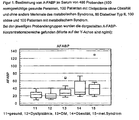
- A-FABP concentration ranges were determined as in FIG. 1 shown, found.
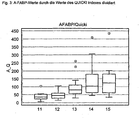
- a correction to the body mass index (A-FABP divided by BMI) resulted in distributions according to FIG. 2 ,
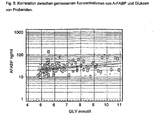
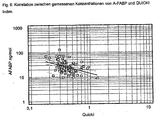
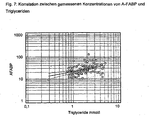
- the concentrations of glucose, insulin, quantitative insulin sensitivity check index (QUICKI) and triglycerides were further measured and correlated with the measured values of A-FABP ( Figures 4-7 ). It was clearly evident that the measured values of glucose, insulin, QUICKI and triglycerides, ie characteristic parameters for the metabolic syndrome, are in direct correlation with the concentration of the measured A-FABP. If you subtract the values FIG. 1 and FIG. 2 It becomes clear that the measured values of A-FABP from body fluids are directly related to the metabolic syndrome and the related metabolic diseases.
- A-FABP correlates closely with the main parameters of metabolic syndrome, type II diabetes, insulin resistance, obesity (obesity / obesity / obesity) and related metabolic disorders.
- A-FABP was detectable within lanes 2-5 as a distinct protein band, whereas control lane 1 showed no corresponding band.
- Polyclonal antibodies were prepared and affinity purified against A-FABP.
- Goat No. 589 was immunized according to the following scheme: 1 day 8x intradermally 1000ug antigen + CFA, 1: 1 21st day 2x subcutaneously 1000ug antigen + ICFA, 1: 1 28th day 2x subcutaneously 500ug antigen + ICFA, 1: 1 35th day 2x subcutaneously 500ug antigen + ICFA, 1: 1 45th day blood collection 160 ml of blood 105th day 2x subcutaneously 500ug antigen + ICFA, 1: 1 112th day 2x subcutaneously 500ug antigen + ICFA, 1: 1 122nd day blood collection 200 ml of blood 182nd day 2x subcutaneously 500ug antigen + ICFA, 1: 1 189th day 2x subcutaneously 500ug antigen + ICFA, 1: 1 199th day blood collection 200 ml of blood CFA Complete Freunds Adjuvant IFCA Incomplete Freunds Adjuvant
- Rabbit Nos. 68 and 69 were immunized according to the following scheme: 1 day 8x intradermally 200ug antigen + CFA, 1: 1 21st day 2x subcutaneously 200ug antigen + ICFA, 1: 1 28th day 2x subcutaneously 100ug antigen + ICFA, 1: 1 35th day 2x subcutaneously 100ug antigen + ICFA, 1: 1 45th day blood collection 50 ml of blood 105th day 2x subcutaneously 100ug antigen + ICFA, 1: 1 112th day 2x subcutaneously 100ug antigen + ICFA, 1: 1 122nd day blood collection 50 ml of blood 182nd day 2x subcutaneously 100ug antigen + ICFA, 1: 1 189th day 2x subcutaneously 100ug antigen + ICFA, 1: 1 199th day blood collection 50 ml of blood CFA Complete Freunds Adjuvant IFCA Incomplete Freunds Adjuvant
- Blood (from both goat and rabbit) was centrifuged at 4 ° C and 2400 G for 20 minutes, and the recovered serum stored at -20 ° C.
- Antibodies were bound to the column in 0.1 M PBS, pH 7.4 and eluted with 0.1 PBS, 13 mM HCl, 0.15 mM NaCl.
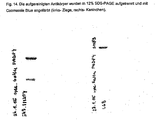
- the purified antibodies were separated in 12% SDS-PAGE and stained with Coomassie Blue (FIG. 14).
- the affinity-purified goat antibody (4 ⁇ g / ml) in bicarbonate buffer (0.1 M) was used. After overnight coating at 4.0 ° C, the plates were washed with PBS and blocked with 0.5% BSA in TPS, 4% sucrose for 30 minutes at room temperature.
- Affinity purified rabbit antibody was probed with biotin-LC-LC-NHS-sulfo, Pierce, Cat. No. 21338 conjugated according to the manufacturer's instructions and used in a concentration of 33 ug / ml.
Landscapes
- Health & Medical Sciences (AREA)
- Life Sciences & Earth Sciences (AREA)
- Engineering & Computer Science (AREA)
- Chemical & Material Sciences (AREA)
- Hematology (AREA)
- General Health & Medical Sciences (AREA)
- Medicinal Chemistry (AREA)
- Diabetes (AREA)
- Molecular Biology (AREA)
- Nuclear Medicine, Radiotherapy & Molecular Imaging (AREA)
- Veterinary Medicine (AREA)
- Pharmacology & Pharmacy (AREA)
- General Chemical & Material Sciences (AREA)
- Animal Behavior & Ethology (AREA)
- Chemical Kinetics & Catalysis (AREA)
- Public Health (AREA)
- Bioinformatics & Cheminformatics (AREA)
- Organic Chemistry (AREA)
- Urology & Nephrology (AREA)
- Immunology (AREA)
- Biomedical Technology (AREA)
- Endocrinology (AREA)
- Obesity (AREA)
- Analytical Chemistry (AREA)
- Physics & Mathematics (AREA)
- Cell Biology (AREA)
- Biophysics (AREA)
- Microbiology (AREA)
- Pathology (AREA)
- Food Science & Technology (AREA)
- Biotechnology (AREA)
- General Physics & Mathematics (AREA)
- Biochemistry (AREA)
- Emergency Medicine (AREA)
- Child & Adolescent Psychology (AREA)
- Investigating Or Analysing Biological Materials (AREA)
- Medicines That Contain Protein Lipid Enzymes And Other Medicines (AREA)
- Peptides Or Proteins (AREA)
- Investigating Or Analysing Materials By The Use Of Chemical Reactions (AREA)
Description
- Die Erfindung betrifft ein Verfahren zur Bestimmung der Konzentration der adipozytären Form des fatty acid binding protein (A-FABP, FABP4, P2) für die Diagnostik des Metabolischen Syndroms,
- Anwendungsgebiete sind die Medizin und hier besonders die medizinische Diagnostik.
- Das Metabolische Syndrom, auch als Syndrom X, Insulinresistenz-Syndrom oder Multiples Metabolisches Syndrom bezeichnet, stellt eine Störung der Verstoffwechslung von Lipiden, Kohlenhydraten, Proteinen, Mineralstoffen usw. des Organismus dar, die durch Erbfaktoren und/oder Lebensbedingungen hervorgerufen werden kann. Zum Metabolischem Syndrom gehören: Insulinresistenz, Dyslipidämie, arterielle Hypertonie und Adipositas.
- Insulinresistenz wird als eine Unempfindlichkeit gegenüber dem körpereigenen Insulin definiert. An der Insulinresistenz leiden nicht nur die Patienten mit Diabetes Typ II, sondern auch ca. 20% der praktisch gesunden, nicht übergewichtigen Menschen. Die Ursachen der Insulinresistenz sind bis heute noch nicht eindeutig geklärt. Zu den Kennzeichen der Insulinresistenz zählen durch die Hyperinsulinämie und Gluko- und Lipotoxität hervorgerufenen Erschöpfung von β-Zellen, ihre Desensibilisierung und Apoptose.
- Dyslipidämie ist eine Störung des Fettstoffwechsels in Form von Hypercholesterinämie, Hypertriglyceridämie, Hyperlipidämie (erhöhte Blutfettwerte als Oberbegriff). Diese ist charakterisiert durch hohe Triglyzerid- und niedrige HDL-Cholesterin-Werte, kleine, dichte LDL-Partikel und einen hohen Gehalt an freien Fettsäuren. Das Spektrum der Betroffenheit reicht von der "gewöhnlichen" (polygenen) Hypercholesterinämie (ca. 10% der Bevölkerung) bis zu seltenen, genetisch bedingten Lipidstoffwechselstörungen. Dyslipidämien sind Risikofaktoren für die Atherosklerose, insbesondere für die koronare Herzkrankheit. Darüber hinaus tragen die freien Fettsäuren zur Aufrechterhaltung des Zustandes der Insulinresistenz bei.
- Kardiovaskuläre Erkrankungen und insbesondere die koronare Herzkrankheit (KHK) stellen die prognostisch wesentlichen komplikationen des metabolischen Syndroms und damit auch die Haupttodesursache dieser Patientengruppe dar.
- Ziel der Erfindung ist die Früherkennung und/oder die Beobachtung des metabolischen Syndroms. Der Erfindung liegt die Aufgabe zu Grunde, Verfahren zu entwickeln, mit denen es möglich ist, geeignete Parameter zur Risikoabschätzung und Verlaufsbeobachtung bei der Diagnostik und Therapie des metabolischen Syndroms.
- Die Erfindung wird gemäß Anspruch 1 und Anspruch 19 realisiert, die Unteransprüche sind Vorzugsvarianten. Der Erfindung liegt der Kerngedanke zugrunde, dass die Konzentration von A-FABP in Serum oder Plasma bestimmt wird und zur Diagnose des metabolischen Syndroms verwendet wird.
- Eine ganz zentrale Rolle bei der Entstehung, Entwicklung und Verlauf des metabolischen Syndroms und des Diabetes Typ II spielen die Fettzellen und der Fettstoffwechsel. Ein zytoplasmatisches Protein der Fettzelle ist die adipozytäre Form des fatty acid binding protein (abgekürzt A-FABP, FABP4 oder P2), welches längere Fettsäuren, Prostanoide, Retinsäure und ähnliche nicht wasserlösliche Molekule im Zytoplasma der Fettzelle transportiert. Die Konzentration des A-FABP wurde im Serum von Normalpersonen und Diabetikern Typ II verglichen, wobei der Body Mass Index als Hinweis auf den Anteil des Fettgewebes an der Körpermasse der untersuchten Personen berücksichtigt wurde. Obwohl A-FABP ein intrazelluläres Protein der Fettzellen ist, das in der Zirkulation kaum vorkommen sollte, finden sich in normalen gesunden Personen im Serum A-FABP-Spiegel im Nanogrammbereich (ng/ml).
Da die A-FABP Spiegel im Serum etwa doppelt so hoch liegen wie die des adipozytaeren Hormons Leptin (Leptinkonzentrationen ± 8 ng/ml; A-FABP liegt bei ± 16-20 ng/ml), liegt es nahe, dass A-FABP aktiv in die Zirkulation sezerniert wird. Ferner ist es nicht auszuschliessen, dass A-FABP noch eine andere (Signal-) Wirkung zuzuschreiben ist, die von seiner intrazellulären Funktion unabhängig ist. Vollkommen unerwartet war jedoch die Feststellung, dass die Messung der Konzentration von A-FABP in Körperflüssigkeiten für die Feststellung und Beobachtung des Metabolischen Syndroms, geeignet ist. - Der Erfindung liegt also die vollkommen überraschend erhaltene Erkenntnis zugrunde, dass ein signifikant erhöhter Gehalt von A-FABP in Serum oder Plasma mit dem metabolischen Sydrom und in Verbindung steht.
- Die Erfindung betrifft deshalb ein Verfahren, bei dem die Konzentration des F-ABP im Serum (Fettsäuretransportkapazität) zur Diagnose des metabolischen Syndroms genutzt wird. Weiterhin vollkommen unerwartet war die Festellung, dass die Konzentration von A-FABP in Körperflüssigkeiten, insbesondere Serum, signifikant mit der Konzentration von anderen Parametern des metabolischen Syndroms, von Diabetes Typ II, Insulinresistenz, Obesität und verwandten Störungen des Stoffwechsels korreliert. Zur Diagnose und Beobachtung des Metabolischen Syndroms und der genannten Stoffwechselstörungen wird die Konzentration von A-FABP in Körperflüssigkeiten und/oder daraus verdünnten Lösungen bestimmt.
Für die Umsetzung der Erfindung sind immunometrische Systeme, insbesondere in Kombination mit einer optischen und/oder biosensorischen Auswertung besonders geeignet, da sie eine einfache Bestimmung der Konzentration von A-FABP in bzw. aus Körperflüssigkeiten erlauben. Verwendbar sind dabei verschiedenste Systeme, mit deren Hilfe sich die Konzentration von A-FABP bestimmen läßt, beispielsweise durch die parallele oder aufeinanderfolgende Vermessung von verschiedenen, Konzentrationen der zu bestimmenden Körperflüssigkeit, insbesondere wenn daneben eine Normalisierung/Eichung mit definierten bzw. bekannten A-FABP-Konzentrationen durchgeführt wird, durch Titration oder durch die Verwendung verschiedener definierter Konzentration an Fängermolekülen, die an einer Festphase/Trägermaterial gebunden sind und Affinität zu A-FABP oder davon abgeleiteten Strukturen haben. - Günstig sind dabei solche Verfahren, die Trägermaterialien umfassen, an deren Oberfläche Substanzen immobilisiert sind, die zur Bestimmung der Konzentration von A-FABP in bzw. aus Körperflüssigkeiten geeignet sind. Dies können insbesondere Moleküle oder aus diesen zusammengesetzte Stoffe, vorzugsweise Proteine, sein, die Affinität zu F-ABP haben, zum Beispiel anti- F-ABP Antikörper. Möglich ist auch die Verwendung von immobilisierten Substanzen, die Affinität zu Teilfragmenten von A-FABP, insbesondere Peptidketten, oder aus Teilfragmenten zusammengesetzten Peptiden haben.
Als Trägermaterial sind alle möglichen Materialien oder beschichtete Materialien geeignet, an deren Oberfläche sich Moleküle immobilisieren lassen, insbesondere Nitrocellulose bzw. PVDF oder andere Materialien zur biophysikalischen Immobilisierung, z.B. in Vertiefungen von ELISA-Platten. Aber auch eine Immobilisierung über elektrostatische Wechselwirkung oder eine Immobilisierung durch chemische Bindung, beispielsweise bei Verwendung sogenannter (Cross-) Linker, ist möglich. Geeignet zur Immobilisierung, insbesondere für biosensorische Messungen, beispielsweise von Oberflächenplasmonenresonanz oder elektrochemischen Größen, ist etwa auch Gold oder beschichtete Goldoberflächen. Vorteilhaft für die Durchführung des erfindungsgemäßen Verfahrens sind insbesondere Trägermaterialien mit zumindest teilweise planar gebildeten Oberflächen, zum Beispiel Glas- oder Kunstoff-Chips oder ELISA-Platten, da sie eine besonders einfache Umsetzung des erfindungsgemäßen Verfahrens, beispielsweise mit Hilfe von Scannern oder ELISA-Readern, erlauben. Neben planaren Oberflächen, auf denen ortsadressierte Bereiche, zum Beispiel Spots, mit immobilisierten Fängermolekülen, insbesondere mit anti-AFABP-Antikörpem gebildet sind, zum Beipiel auf Oberflächen von Cellulose oder Chips, sind insbesondere auch die Bodenflächen der Vertiefungen von ELISA-Platten zur Bestimmung der A-FABP-Konzentration aus Körperflüssigkeiten geeignet. - Als immunometrisches System bietet sich insbesondere der sogenannte Enzyme Linked Immunosorbent Assay (ELISA) an oder vergleichbare Systeme, die Farbstoffmarkierte Moleküle verwenden, wodurch eine besonders hohe Sensitivität des Systems zur Bestimmung der A-FABP-Konzentration ermöglicht wird. Dabei wird ein Trägermaterial, auf dem eine oder mehrere Substanzen, z.B. Antikörper, mit Affinität zu A-FABP oder abgeleiten Molekülen immobilisiert sind, mit Körperfüssigkeit oder Lösungen, die Körperflüssigkeit enthalten, in Kontakt gebracht, so dass das A-FABP bzw. die abgeleitete Form/Sequenz, das sich gegebenfalls in der Lösung mit Körperflüssigkeit befindet, mit den Substanzen in der Nähe der Oberfläche des Trägermaterials assoziieren kann. Dazu kann die Köperflüssigkeit in einer Inkubationslösung, z.B. Blockierungspuffer, gelöst sein, die beipielsweise durch Verminderung unspezifischer Wechselwirkungen zu einer Verbesserung des Signal-/Rausch-Verhältnisses führt. Zum Nachweis des assoziierten A-FABP oder abgeleiteter Moleküle an der Oberfläche wird, meist nach einem Waschschritt, eine gelöste Substanz, vorzugsweise anti-A-FABP Antikörper, auf das Trägermaterial gebracht, wobei die gelöste Nachweissubstanz ebenfalls Affinität zu A-FABP hat und an das auf dem in der Nähe des Trägermaterials assoziierte A-FABP bindet.
Die Detektion der an A-FABP bzw. davon abgeleiteten Moleküle gebundenen Nachweissubstanz/Antikörper kann auf unterschiedlichste Weise erfolgen.
Möglich ist, daß die Nachweissubstanz bzw. anti-A-FABP-Antiköper bereits mit einer Markierung versehen ist, beispielsweise mit einem Farbstoff, insbesondere Fluoreszenzfarbstoff, oder mit einem Enzym, das ein Substrat, beispielsweise aus einer Detektionslösung, optisch nachweisbar umsetzen kann, z.B. Meerrettich-Peroxidase oder alkalische Phosphatase. Die Nachweissubstanz, insbesondere Antikörper, kann aber auch mit einem Molekül, z.B. Biotin versehen sein, das wiederum Affinität zu einem anderen markierten Stoff, z.B. Streptavidin, hat.
Ist die Nachweissubstanzlanti-A-FABP-Antikörper nicht selbst markiert, sind insbesondere markierte Sekundärantikörper geeignet, die, meist nach einem Waschschritt, zugegeben werden und die Nachweissubstanz/anti-A-FABP-Antikörper an der Oberfläche des Trägermaterials sichtbar machen bzw. die nachfolgende optische Auswertung ermöglichen.
Für die Diagnose und Erforschung des metabolischen Syndroms, seiner Frühformen, Begleit- und Folgeerkrankungen, Diabetes Typ II, Insulinresistenz, Obesität oder verwandten Störungen des Stoffwechsels ist auch vorteilhaft geeignet, daß die erfindungsgemäß gemessenen A-FABP-Konzentration mit anderen Kenngrößen, bspw. dem Alter oder Geschlecht, dem Body-Mass-Index oder mit Komponenten des Stoffwechsels, die für das metabolische Syndrom kennzeichnend sind, insbesondere Insulin (bpsw. Quicki-Werte), Glucose, Triglyceride, Adiponectin, Leptin, Gesamt-Cholesterin, HDL-Cholesterin und/oder LDL-Cholesterin in Bezug gesetzt wird. Durch die Verbindung von A-FABP mit wenigstens einem weiteren Parameter kann vorteilhafterweise auch eine Vorhersage von anderen Parametern des Metabolischen Syndroms erfolgen.
Duch die Umsetzung der Erfindung läßt sich auf einfachste Weise auf Kenngrößen des metabolischen Syndroms zurückschließen, womit eine besonders einfache und kostengünstig umzusetzende Diagnose des metabolischen Syndroms ermöglicht wird. Dadurch ist beispielsweise auch keine Entnahme von Gewebeproben nötig, da sich direkt auf die krankhaften Vorgänge im Gewebe bzw. in den Zellen schließen läßt. Vorteilhaft ist insbesondere auch, dass bereits Frühstadien des Metabolischen Syndroms detektierbar sind. Dadurch wird es auch erstmalig möglich, bereits frühzeitig vor dem Auftreten der mit dem Metabolische Syndrom in Verbindung stehenden Krankheitserscheinungen Gegenmaßnahmen für den Patienten, beispielsweise durch Verordnung einer Diät oder Sport oder durch Verabreichung einer geeigneten Medizin, einzuleiten. - Durch die Erfindung wird auch die Nutzung von A-FABP als hormonähnliche Substanz zur Beeinflussung des Fett-, Zucker- und Energiestoffwechsels ermöglicht (vgl.
Figur 20 ). Wenn eine positive Wirkung von A-FABP vorliegt, ist es oder seine Fragmente oder seine Mimetika als Arzneimittel anwendbar. Bei negativer Wirkung sind A-FABP-Blocker von medizinischem Nutzen. -
Figur 20 zeigt eine zweidimensionale Elekrophorese des Zellkulturüberstandes einer adipozytären Kultur, in der ein sehr großer und deutlicher Spot des A-FABP zu sehen ist (die Identität des Proteins wird mittels N-terminaler Sequenzierung mit einem Massenspektrometer bestimmt). Die Tatsache, das kein beta-Tubulin (ein intrazelluläres Strukturprotein) im Überstand mit dem Western Blot nachzuweisen war, deutet darauf hin, dass das A-FABP NICHT durch den Zerfall der Fettzellen, sondern wirklich durch Sekretion in das Medium gelangt. - Die Erfindung liefert somit eine vollkommen neue Möglichkeit der Risikoabschätzung und der Verlaufsbeobachtung bei der Diagnostik und Therapie des Metabolischen Syndroms und des Diabetes Typ II.
- Die Erfindung soll nachfolgend durch Anwendungsbeispiele näher erläutert werden:
- Bei 486 Probanden wurde A-FABP im Serum bestimmt. Es handelte sich um 100 normgewichtige gesunde Personen, 100 Patienten mit Dyslipidämie ohne Obesität und ohne andere Merkmale des metabolischen Syndroms, 86 Diabetiker Typ II, 100 oböse und 100 Patienten mit metabolischem Syndrom. Neben A-FABP wurden noch folgende Parameter bestimmt: Body Mass Index (BMI), Glukose, Insulin, quantitativer Insulin-Sensitivitaets-Check-Index (QUICKI), Adiponectin und E-FABP (epidermal fatty acid binding protein):
- Bei den jeweiligen Probandengruppen wurden A-FABP- Konzentrationsbereiche, wie in
Figur 1 dargestellt, gefunden. - Eine Korrektur auf den Body Mass Index (A-FABP geteilt durch BMI) resultierte in Verteilungen gemäß
Figur 2 . - Nach der Teilung der A-FABP-Werte durch die Werte des QUICKI Indexes ergab sich die in
Figur 3 dargestellte Verteilung. - Aus den gemessenen Daten war vollkommen überraschend und deutlich ersichtlich, dass die A-FABP-Spiegel sehr wirksam zwischen gesunden Normalpersonen und Patienten mit metabolischem Syndrom diskriminieren, und zwar unabhängig vom Body Mass Index.
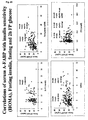
- Es wurden weiterhin die Konzentrationen von Glukose, Insulin, quantitativem Insulin-Sensitivitäts-Check-Index (QUICKI) und Triglyceriden gemessen und mit den gemessenen Werten von A-FABP in Korrelation gesetzt (
Figuren 4-7 ).
Es war deutlich erkennbar, daß die gemessenen Werte von Glukose, Insulin, QUICKI und Triglyceriden, also kennzeichnende Parameter für das Metabolische Syndrom, in direkter Korrelation mit der Konzentration des gemessenen A-FABP stehen.
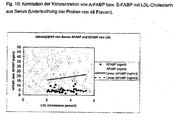
Zieht man dazu noch die Werte ausFigur 1 undFigur 2 heran, wird deutlich, dass die gemessenen Werte des A-FABP aus Körperflüssigkeiten in direktem Zusammenhang mit dem Metabolischen Syndrom und den verwandten Stoffwechselerkrankungen stehen. - Von 48 Frauen, deren Serumproben zur Verfügung standen unter welchen sich auch Frauen mit metabolischem Syndrom befinden könnten, wurden die Konzentrationen von A-FABP, E-FABP, Gesamt-Cholesterin, HDL-Cholesterin und LDL-Cholesterin bestimmt. Die Auftragung der Werte von A-FABP bzw. E-FABP jeweils gegen die Werte von Gesamt-Cholesterin (
Figur 8 ), HDL-Cholesterin (Figur 9 ) und LDL-Cholesterin (Figur 10 ), zeigte deutlich, dass A-FABP eng mit den wichtigsten Parametern des metabolischen Syndroms, von Diabetes Typ II, Insulinresistenz, Obesität (Obesitas/Adipositas/Fettsucht) und verwandten Störungen des Stoffwechsels korreliert. - Herstellung des rekombinanten humanen A-FABP:


- Das exprimierte Protein enthielt keine zusätzlichen Aminosäuren oder Tags.
- Proteingrösse: 132 Aminosäuren ; Molare Masse: ca. 14720 Da
- Expressionsstamm: E.coli: BL21DE3(pRSET-FABP4)-1
- Expressionsverfahren:
- SOB-Mediumo (4,5 L) wurde mit einer Übernachtkultur von E.coli BL21DE3(pRSET-FABP4)-1 beimpft
- Kultivierung verlief bei 37° C auf einem Schüttler.
- Induktor IPTG wurde nach 3,5 Stunden der Kultivierung bei OD = 0,69 dazugegeben.
- Die Expression wurde nach 4 Stunden beendet. Die optische Dichte erreichte OD = 1,52.
- Die Bakterien wurden abzentrifugiert und eingeengt auf eine theoretische OD = 100 in 68,4 ml PBS Puffer.
- Durch Ultraschallbehandlung der Bakterien wurde lösliches A-FABP gewonnen.
- Als Ergebnis der Proteinauftrennung war A-FABP innerhalb der Bahnen 2-5 als deutliche Proteinbande detektierbar, während die Kontrollbahn 1 keine entsprechende Bande zeigte.
- Gegen A-FABP wurden polyklonale Antikörper hergestellt und affinitätsgereinigt.
- Ziege Nr. 589 wurde nach folgendem Schema immunisiert:
1. Tag 8x intradermal 1000ug Antigen + CFA, 1:1 21. Tag 2x subkutan 1000ug Antigen + ICFA, 1:1 28. Tag 2x subkuttan 500ug Antigen + ICFA, 1:1 35. Tag 2x subkutan 500ug Antigen + ICFA, 1:1 45. Tag Blutabnahme 160 ml Blut 105. Tag 2x subkutan 500ug Antigen + ICFA, 1:1 112. Tag 2x subkutan 500ug Antigen + ICFA, 1:1 122. Tag Blutabnahme 200 ml Blut 182. Tag 2x subkutan 500ug Antigen + ICFA, 1:1 189. Tag 2x subkutan 500ug Antigen + ICFA, 1:1 199. Tag Blutabnahme 200 ml Blut CFA- Komplettes Freund-Adjuvans
IFCA- Inkomplettes Freund-Adjuvans - Kaninchen Nr. 68 und 69 wurden nach folgendem Schema immunisiert:
1. Tag 8x intradermal 200ug Antigen + CFA, 1:1 21. Tag 2x subkutan 200ug Antigen + ICFA, 1:1 28. Tag 2x subkuttan 100ug Antigen + ICFA, 1:1 35. Tag 2x subkutan 100ug Antigen + ICFA, 1:1 45. Tag Blutabnahme 50 ml Blut 105. Tag 2x subkutan 100ug Antigen + ICFA, 1:1 112. Tag 2x subkutan 100ug Antigen + ICFA, 1:1 122. Tag Blutabnahme 50 ml Blut 182. Tag 2x subkutan 100ug Antigen + ICFA, 1:1 189. Tag 2x subkutan 100ug Antigen + ICFA, 1:1 199. Tag Blutabnahme 50 ml Blut CFA- Komplettes Freund-Adjuvans
IFCA- Inkomplettes Freund-Adjuvans - Blut (sowohl von Ziege als auch Kaninchen) wurde bei 4° C und bei 2400 G für 20 Minuten zentrifugiert, und das gewonnene Serum bei -20° C gelagert.
- Poros AL (Applied Biosystems), 0,45g, wurde nach Anleitung des Herstellers mit 1mg A-FABP bestückt.
- Antikörper wurden im 0,1 M PBS, pH 7,4 an die Kolonne gebunden und mit 0, 1 PBS, 13 mM HCl, 0,15mM NaCl eluiert.
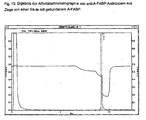
- Die Ergebnisse der Affinitätschromatographien sind in
Figur 12 (Aufreinigung von Antikörpern aus Kaninchen) und inFigur 13 (Aufreinigung von Antikörpern aus Ziege) dargestellt. - Eine Mikrotiterplatte (Nunc) wurde mit 25ng/Vertiefung A-FABP beschichtet. Affinitätsgereinigte Antikörper wurden in einer Ausgangskonzentration von 1 mg/ml pipettiert und weiter reihenweise 1:3 verdünnt. Titer wurde definiert als eine solche Antikörperverdünnung, die eine Absorbanz von nicht weniger als 1,5 hat:
- Ziege:
- Titer: 270 000.-, Menge 4,4 mg
- Kaninchen:
- Titer: größer 90 000, Menge: 4,8 mg
- Zur Beschichtung der Mikrotiterplatte wurde der affinitätsgereinigte Ziegenantikörper (4ug/ml) in Hydrogenkarbonatpuffer (0,1 M) verwendet. Nach einer Übernacht-Beschichtung bei 4,0 °C wurden die Platten mit PBS gewaschen und mit 0,5% BSA im TPS, 4% Sacharose 30 Minuten bei Zimmertemperatur blockiert.
- Affinitätsgereinigter Kaninchenantikörper wurde mit Biotin-LC-LC-NHS-sulfo, Pierce, Cat. No. 21338 nach Anleitung des Herstellers konjugiert und in einer Konzentration von 33 ug/ml eingesetzt.
- Streptavidin-HRP Konjugat wurde von der Firma Roche bezogen (Katalognummer 1 089 153)
- Kalibrator:
- Rekombinantes humanes A-FABP wurde lyophilisiert und in einer Ausgangskonzentration von 500 ng/ml als Master-Kalibrator verwendet.
- Der eigentliche Elisa-Test wurde, wie in
Figur 15 dargestellt, durchgeführt
Abschließend wurden folgende Charakteristika des Tests festgelegt:
a) Typische Kalibrationskurve für humanes A-FABP: Mit dem durchgeführten ELISA ergab sich eine Sensitivität der Konzentrationsmessung von A-FABP von weniger als 100 pg /mL (Figur 16 ).
b) Recovery (Wiederfindung) / Verdünnung (s. Tabelle 1).Tabelle 1 Sample Dilution Observed (ng/ml) Expected (ng/ml) Recovery O/E (%) 1 - 36.8 - - 1:2 19.6 18.4 106.5 1:4 9.9 9.2 107.6 1:8 4.9 4.6 106.5 2 - 28.1 - - 1:2 14.1 14.1 100.0 1:4 7.8 7.0 111.0 1:8 3.9 3.5 111.0
c) Recovery (Wiederfindung) / Zugabe (s. Tabelle 2).Tabelle 2 Sample Observed (ng/ml) Expected (ng/ml) Recovery O/E (%) 1 8.9 - - 16.5 18.9 87.3 24.1 28.9 83.4 55.5 58.9 94.2 2 6.8 - - 15.4 16.8 91.7 24.2 26.8 90.3 53.1 36.8 93.5
d) Präzisions-Intraassay (s. Tabelle 3)Tabelle 3 Sample Mean (ng/ml) SD (ng/ml) CV (%) 1 13.9 0.92 6.6 2 27.3 1.08 3.9
e) Präzisions-Intraassay (s. Tabelle 4).Tabelle 4 Sample Mean (ng/ml) SD (ng/ml) CV (%) 1 12.5 0.32 2.6 2 31.1 1.58 5.1
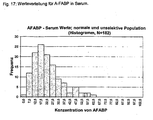
f) Es ergab sich eine Werteverteilung für A-FABP bei gesunden Erwachsenen wie inFigur 17 dargestellt.
g) Der Einfluss des Alters auf die A-FABP-Werte wurde entsprechendFigur 18 festgestellt.
h) Der Einfluss des Geschlechts auf die A-FABP-Werte wurde ermittelt (s. Tabelle 5).Tabelle 5 Age Total cholesterol mmol/l HDL-chol mmol/l LDL-chol mmol/l triglyceride mmol/l AFABP ng/ml MEAN (WOMEN): 45,5 5,21 1,46 3,35 1,13 21.18 MEAN (MEN): 43,7 5,08 1,06 3,70 1,61 21,44
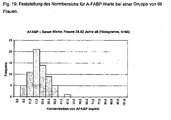
i) Bei einer Gruppe von 66 Frauen wurde der Normbereich festgestellt bzw. festgelegt (s. auchFigur 18 ): - Minimum: 7,7 ng/ml
- Maximum: 45,1 ng/ml
- Mean: 19, 58 ng/ml
- Standard Deviation: 8,16
- Normal Range (x+/- 2s): 19,8 +/- 16,32 ng/ml
Claims (19)
- Verfahren zur Diagnose des metabolischen Syndroms,
dadurch gekennzeichnet, dass die Konzentration der adipozytären Form des fatty acid binding protein (A-FABP) in Serum oder Plasma bestimmt und als Indikator für die Fettsäuretransportkapazität benutzt wird. - Verfahren nach Anspruch 1, dadurch gekennzeichnet, dass die Konzentration von A-FABP in Serum bestimmt wird.
- Verfahren nach einem der Ansprüche 1-2, dadurch gekennzeichnet, dass zur Bestimmung der Konzentration des A-FABP ein immunometrisches System verwendet wird.
- Verfahren nach Anspruch 3, dadurch gekennzeichnet, dass Trägermaterial verwendet wird, auf dem Substanzen immobilisiert sind, die Affinität zu A-FABP oder Teilen davon haben.
- Verfahren nach Anspruch 4, dadurch gekennzeichnet, dass die immobilisierten Substanzen mit Affinität zu A-FABP oder Teilen davon als Antikörper gebildet sind.
- Verfahren nach Anspruch 4, dadurch gekennzeichnet, dass das Trägermaterial zumindest teilweise planar gebildet ist.
- Verfahren nach einem der Ansprüche 4-5, dadurch gekennzeichnet, dass das Trägermaterial von einer ELISA-Platte umfaßt wird.
- Verfahren nach einem der Ansprüche 3-6, dadurch gekennzeichnet, dass das immunometrische System ein ELISA ist.
- Verfahren nach Anspruch 7, dadurch gekennzeichnet, dass der ELISA anti-A-FABP-Antikörper, sekundäre Detektionsantikörper, Trägermaterialien, Wasch-, Inkubations- und Detektionslösungen enthält.
- Verfahren nach einem der Ansprüche 3-9, dadurch gekennzeichnet, dass zur Auswertung ein Scanner oder ELISA-Reader verwendet wird.
- Verfahren nach einem der Ansprüche 1-9, dadurch gekennzeichnet, dass die Konzentration von A-FABP mit wenigstens einer weiteren Kenngröße, nämlich dem Alter oder Geschlecht, dem Body-Mass-Index oder Komponenten des Stoffwechsels ausgewählt aus der Gruppe Insulin, Glukose, Triglyceride, QUICKI, Adiponectin, Leptin, Gesamt-Cholesterin, HDL-Cholesterin, LDL-Cholesterin und E-FABP in Bezug gesetzt wird.
- Verfahren nach einem der Ansprüche 1-11, dadurch gekennzeichnet, dass ein Testkit verwendet wird, der ein geeignetes Trägermaterial enthält, auf dem Substanzen mit Affinität zu A-FABP oder Teilen davon immobilisiert sind.
- Verfahren nach Anspruch 12, dadurch gekennzeichnet, dass die immobilisierten Substanzen mit Affinität zu A-FABP oder Teilen davon als Antikörper gebildet sind.
- Verfahren nach den Ansprüchen 12-13, dadurch gekennzeichnet, dass das Trägermaterial zumindest teilweise planar gebildet ist.
- Verfahren nach den Ansprüchen 12-14, dadurch gekennzeichnet, dass das Trägermaterial von einer ELISA-Platte umfaßt wird.
- Verfahren nach den Ansprüchen 12-15, dadurch gekennzeichnet, dass das Testkit Trägermaterial, Substanzen und Lösungen beinhaltet, die zur Durchführung eines ELISA geeignet sind.
- Verfahren nach Anspruch 16, dadurch gekennzeichnet, dass das Testkit anti-A-FABP-Antikörper, sekundäre Detektionsantikörper, Trägermaterialien, Wasch-, Inkubations- und Detektionslösungen enthält.
- Verfahren nach einem der Ansprüche 16-17, dadurch gekennzeichnet, dass das Testkit wenigstens eine Eichlösung beinhaltet, die rekombinantes A-FABP enthält.
- Verwendung von A-FABP als Serummarker für die Diagnose des metabolischen Syndroms.
Priority Applications (1)
| Application Number | Priority Date | Filing Date | Title |
|---|---|---|---|
| PL06795383T PL1904082T3 (pl) | 2005-07-21 | 2006-07-21 | PROCEDURA OZNACZANIA STĘŻENIA ADIPOCYTOWEJ FORMY BIAŁKA WIĄŻĄCEGO KWASY TŁUSZCZOWE (A-FABP, FABP4, aP2) |
Applications Claiming Priority (2)
| Application Number | Priority Date | Filing Date | Title |
|---|---|---|---|
| DE102005034788 | 2005-07-21 | ||
| PCT/IB2006/002383 WO2007063363A2 (de) | 2005-07-21 | 2006-07-21 | Verfahren zur bestimmung der konzentration der adipozytären form des fatty acid binding protein (a-fabp, fabp4, ap2) |
Publications (2)
| Publication Number | Publication Date |
|---|---|
| EP1904082A2 EP1904082A2 (de) | 2008-04-02 |
| EP1904082B1 true EP1904082B1 (de) | 2010-05-19 |
Family
ID=38048068
Family Applications (1)
| Application Number | Title | Priority Date | Filing Date |
|---|---|---|---|
| EP06795383A Not-in-force EP1904082B1 (de) | 2005-07-21 | 2006-07-21 | VERFAHREN ZUR BESTIMMUNG DER KONZENTRATION DER ADIPOZYTAREN FORM DES FATTY ACID BINDUNG PROTEIN (A-FABP, FABP4, aP2) |
Country Status (9)
| Country | Link |
|---|---|
| US (2) | US8846413B2 (de) |
| EP (1) | EP1904082B1 (de) |
| JP (1) | JP5222138B2 (de) |
| AT (1) | ATE468128T1 (de) |
| AU (1) | AU2006321321B2 (de) |
| CA (1) | CA2614340A1 (de) |
| DE (1) | DE502006006990D1 (de) |
| PL (1) | PL1904082T3 (de) |
| WO (1) | WO2007063363A2 (de) |
Families Citing this family (11)
| Publication number | Priority date | Publication date | Assignee | Title |
|---|---|---|---|---|
| WO2007119481A1 (ja) * | 2006-03-22 | 2007-10-25 | Dainippon Sumitomo Pharma Co., Ltd. | 血中腸型脂肪酸結合蛋白測定による急性腸炎診断 |
| CN107141353A (zh) | 2009-03-05 | 2017-09-08 | 哈佛学院董事会 | 分泌的aP2及其抑制方法 |
| EP2392927A1 (de) * | 2011-03-11 | 2011-12-07 | F. Hoffmann-La Roche AG | Diagnose von Stoffwechselstörungen in HIV-infizierten Patienten |
| CZ304067B6 (cs) | 2011-11-11 | 2013-09-18 | Biovendor - Laboratorní Medicína A.S. | Metoda pro stanovení koncentrace uromodulinu v séru a jeho pouzití jako sérového markeru pro diagnózu nefropatie |
| US20150309053A1 (en) * | 2012-10-23 | 2015-10-29 | Riken | Test method and test kit for psychiatric ailments |
| KR101834857B1 (ko) * | 2015-01-05 | 2018-03-07 | 서울대학교산학협력단 | 제2형 당뇨병의 조기 진단을 위한 단백질 바이오 마커 |
| EP3288584A2 (de) | 2015-04-30 | 2018-03-07 | President and Fellows of Harvard College | Anti-ap2-antikörper und antigenbindemittel zur behandlung von stoffwechselerkrankungen |
| JP6558729B2 (ja) * | 2015-06-15 | 2019-08-14 | 北海道公立大学法人 札幌医科大学 | 糸球体障害の検査方法 |
| CA3066733A1 (en) | 2017-06-09 | 2018-12-13 | President And Fellows Of Harvard College | Method to identify compounds useful to treat dysregulated lipogenesis, diabetes, and related disorders |
| CN112744118B (zh) * | 2019-10-31 | 2022-12-09 | 比亚迪股份有限公司 | 电池管理系统、方法与车辆 |
| CN117362427A (zh) * | 2022-06-30 | 2024-01-09 | 中国科学院深圳先进技术研究院 | 一种a-fabp单克隆抗体2b8及其制备方法和用途 |
Family Cites Families (8)
| Publication number | Priority date | Publication date | Assignee | Title |
|---|---|---|---|---|
| WO2000066784A2 (en) * | 1999-05-05 | 2000-11-09 | Ohio University | Growth hormone-regulatable brown adipose tissue genes, corresponding proteins and uses thereof |
| US7371563B2 (en) * | 2000-11-08 | 2008-05-13 | Surface Logix, Inc. | Peelable and resealable devices for biochemical assays |
| JP2004065194A (ja) * | 2002-08-09 | 2004-03-04 | Sumitomo Chem Co Ltd | 脂肪細胞関連因子の分析方法 |
| WO2004042360A2 (en) * | 2002-11-04 | 2004-05-21 | The Regents Of The Univeristy Of California | Deuterated glucose or fat tolerance tests for high-throughput measurement of the metabolism of sugars or fatty acids in the body |
| CA2532130C (en) * | 2003-09-20 | 2016-07-19 | Electrophoretics Limited | Diagnostic method for brain damage-related disorders |
| DE602004022575D1 (de) * | 2003-10-15 | 2009-09-24 | Sekisui Medical Co Ltd | Verfahren zum selektiven testen von adiponectinmultimeren |
| EP1692521A1 (de) * | 2003-12-11 | 2006-08-23 | Beth Israel Deaconess Medical Center, Inc. | Rbp4 bei insulinempfindlichkeit/-resistenz, diabetes und obesität |
| WO2005116189A2 (en) * | 2004-05-06 | 2005-12-08 | The Trustees Of The University Of Pennsylvania | Compositions and use of inflammation-20 (inf-20) gene |
-
2006
- 2006-07-21 JP JP2008522092A patent/JP5222138B2/ja not_active Expired - Fee Related
- 2006-07-21 DE DE502006006990T patent/DE502006006990D1/de active Active
- 2006-07-21 AT AT06795383T patent/ATE468128T1/de active
- 2006-07-21 EP EP06795383A patent/EP1904082B1/de not_active Not-in-force
- 2006-07-21 US US11/988,822 patent/US8846413B2/en not_active Expired - Fee Related
- 2006-07-21 WO PCT/IB2006/002383 patent/WO2007063363A2/de not_active Ceased
- 2006-07-21 AU AU2006321321A patent/AU2006321321B2/en not_active Ceased
- 2006-07-21 CA CA002614340A patent/CA2614340A1/en not_active Abandoned
- 2006-07-21 PL PL06795383T patent/PL1904082T3/pl unknown
-
2014
- 2014-09-10 US US14/482,339 patent/US20150093769A1/en not_active Abandoned
Non-Patent Citations (1)
| Title |
|---|
| INTERNET CITATION, Retrieved from the Internet <URL:http://web.archive.org/web/20050605002411/http://www.biovendor.com/> [retrieved on 20040126] * |
Also Published As
| Publication number | Publication date |
|---|---|
| ATE468128T1 (de) | 2010-06-15 |
| WO2007063363A2 (de) | 2007-06-07 |
| EP1904082A2 (de) | 2008-04-02 |
| AU2006321321B2 (en) | 2011-07-28 |
| DE502006006990D1 (de) | 2010-07-01 |
| US20090181886A1 (en) | 2009-07-16 |
| CA2614340A1 (en) | 2007-06-07 |
| US20150093769A1 (en) | 2015-04-02 |
| JP5222138B2 (ja) | 2013-06-26 |
| WO2007063363A3 (de) | 2007-08-30 |
| AU2006321321A1 (en) | 2007-06-07 |
| JP2009501926A (ja) | 2009-01-22 |
| PL1904082T3 (pl) | 2010-12-31 |
| US8846413B2 (en) | 2014-09-30 |
Similar Documents
| Publication | Publication Date | Title |
|---|---|---|
| DE69632734T2 (de) | QUANTIFIZIERUNG VON p97 ZUR DIAGNOSE UND ÜBERWACHUNG DER ALZHEIMHER-KRANKHEIT | |
| EP2030023B1 (de) | In vitro multiparameter-bestimmungsverf ahren zur diagnose und frühdiagnose von demenzerkrankungen | |
| DE112009001703T5 (de) | Mittel und Verfahren zur Diagnostik von Magenbypass und damit verbundenen Zuständen | |
| DE602004013135T2 (de) | Verfahren für die Diagnose von schwerkranken Patienten | |
| EP1318407A1 (de) | Verwendungen der Aldose-1-Epimerase (Mutarotase) für die Diagnose und Therapie von Entzündungserkrankungen und Sepsis | |
| EP1904082A2 (de) | Verfahren zur bestimmung der konzentration der adipozytaren form des fatty acidebindung protein (a-fabp, fabp p22) | |
| EP1910841B1 (de) | In vitro verfahren zur diagnose von neurodegenerativen erkrankungen | |
| DE102005029845B4 (de) | Verfahren zur Diagnose von rheumatischen Erkrankungen | |
| DE69831229T2 (de) | Schnelle bestimmung des verhältnisses von biologischen molekülen | |
| DE60035267T2 (de) | Verfahren zur analyse der menge an intraabdominalem fettgewebe | |
| DE202005020939U1 (de) | Kit zur Messung der Aktivierung neutrophiler Zellen | |
| EP2016416B1 (de) | In vitro verfahren zur erkennung und früherkennung und zur begleitenden kontrolle der therapie von arznei- und suchtmittelinduzierten leberschäden | |
| EP1904855A1 (de) | Liquordiagnostisches in vitro verfahren zur diagnose von demenz-erkrankungen und neuroinflammatorischen erkrankungen | |
| EP1318406A1 (de) | Verwendung der Glycin-N-Acyl-Transferase (GNAT) für die Diagnose und Therapie von Entzündungserkrankungen und Sepsis | |
| EP1242825B1 (de) | Gewinnung von lipoproteinen aus körperflüssigkeiten | |
| EP4158355A2 (de) | Bestimmung krankheitsspezifischer protein-aggregate in stuhlproben | |
| DE3689767T2 (de) | Immunverstärker und verwandte Zusammensetzungen. | |
| DE102006034607A1 (de) | Verfahren zur Bestimmung der Konzentration der adipozytären Form des fatty acid binding protein (A-FABP, FABP4, P2) | |
| EP1664789B1 (de) | Verfahren zur diagnose von erkrankungen unter bestimmung von apolipoprotein c-i | |
| DE10101792B4 (de) | Verfahren zum Nachweis von Pankreaskarzinom oder chronischer Pankreatitis und Verwendung von Antikörpern | |
| DE10131922A1 (de) | Verwendung des Calcineurin B Homologen Proteins (CHP) für die Diagnose und Therapie von Entzündungserkrankungen und Sepsis | |
| DE69024348T2 (de) | Verfahren zum nachweis des diabetischen zustandes | |
| EP2097755A1 (de) | In vitro verfahren zur diagnose und frühdiagnose von neurodegenerativen erkrankungen | |
| DE60034525T2 (de) | Bestimmung von Proteinen wie Immunglobuline E (IgE) in Nasensekreten | |
| WO2008138475A1 (de) | Verwendung von crmp1 als marker für chronisch psychiatrische erkrankungen und monoklonaler antikörper gegen crmp1 |
Legal Events
| Date | Code | Title | Description |
|---|---|---|---|
| PUAI | Public reference made under article 153(3) epc to a published international application that has entered the european phase |
Free format text: ORIGINAL CODE: 0009012 |
|
| 17P | Request for examination filed |
Effective date: 20080129 |
|
| AK | Designated contracting states |
Kind code of ref document: A2 Designated state(s): AT BE BG CH CY CZ DE DK EE ES FI FR GB GR HU IE IS IT LI LT LU LV MC NL PL PT RO SE SI SK TR |
|
| AX | Request for extension of the european patent |
Extension state: AL BA HR MK YU |
|
| DAX | Request for extension of the european patent (deleted) | ||
| 17Q | First examination report despatched |
Effective date: 20080602 |
|
| GRAP | Despatch of communication of intention to grant a patent |
Free format text: ORIGINAL CODE: EPIDOSNIGR1 |
|
| RTI1 | Title (correction) |
Free format text: METHOD FOR DETERMINING THE CONCENTRATION OF THE ADIPOCYTIC FORM OF THE FATTY ACID BINDING PROTEIN (A-FABP, FABP4, AP2) |
|
| DAX | Request for extension of the european patent (deleted) | ||
| GRAS | Grant fee paid |
Free format text: ORIGINAL CODE: EPIDOSNIGR3 |
|
| GRAA | (expected) grant |
Free format text: ORIGINAL CODE: 0009210 |
|
| AK | Designated contracting states |
Kind code of ref document: B1 Designated state(s): AT BE BG CH CY CZ DE DK EE ES FI FR GB GR HU IE IS IT LI LT LU LV MC NL PL PT RO SE SI SK TR |
|
| REG | Reference to a national code |
Ref country code: GB Ref legal event code: FG4D Free format text: NOT ENGLISH |
|
| REG | Reference to a national code |
Ref country code: CH Ref legal event code: EP |
|
| REG | Reference to a national code |
Ref country code: IE Ref legal event code: FG4D Free format text: LANGUAGE OF EP DOCUMENT: GERMAN |
|
| REF | Corresponds to: |
Ref document number: 502006006990 Country of ref document: DE Date of ref document: 20100701 Kind code of ref document: P |
|
| REG | Reference to a national code |
Ref country code: SE Ref legal event code: TRGR |
|
| REG | Reference to a national code |
Ref country code: NL Ref legal event code: T3 |
|
| LTIE | Lt: invalidation of european patent or patent extension |
Effective date: 20100519 |
|
| PG25 | Lapsed in a contracting state [announced via postgrant information from national office to epo] |
Ref country code: LT Free format text: LAPSE BECAUSE OF FAILURE TO SUBMIT A TRANSLATION OF THE DESCRIPTION OR TO PAY THE FEE WITHIN THE PRESCRIBED TIME-LIMIT Effective date: 20100519 Ref country code: ES Free format text: LAPSE BECAUSE OF FAILURE TO SUBMIT A TRANSLATION OF THE DESCRIPTION OR TO PAY THE FEE WITHIN THE PRESCRIBED TIME-LIMIT Effective date: 20100830 |
|
| PG25 | Lapsed in a contracting state [announced via postgrant information from national office to epo] |
Ref country code: LV Free format text: LAPSE BECAUSE OF FAILURE TO SUBMIT A TRANSLATION OF THE DESCRIPTION OR TO PAY THE FEE WITHIN THE PRESCRIBED TIME-LIMIT Effective date: 20100519 Ref country code: IS Free format text: LAPSE BECAUSE OF FAILURE TO SUBMIT A TRANSLATION OF THE DESCRIPTION OR TO PAY THE FEE WITHIN THE PRESCRIBED TIME-LIMIT Effective date: 20100919 Ref country code: FI Free format text: LAPSE BECAUSE OF FAILURE TO SUBMIT A TRANSLATION OF THE DESCRIPTION OR TO PAY THE FEE WITHIN THE PRESCRIBED TIME-LIMIT Effective date: 20100519 Ref country code: SI Free format text: LAPSE BECAUSE OF FAILURE TO SUBMIT A TRANSLATION OF THE DESCRIPTION OR TO PAY THE FEE WITHIN THE PRESCRIBED TIME-LIMIT Effective date: 20100519 |
|
| PG25 | Lapsed in a contracting state [announced via postgrant information from national office to epo] |
Ref country code: CY Free format text: LAPSE BECAUSE OF FAILURE TO SUBMIT A TRANSLATION OF THE DESCRIPTION OR TO PAY THE FEE WITHIN THE PRESCRIBED TIME-LIMIT Effective date: 20100526 Ref country code: GR Free format text: LAPSE BECAUSE OF FAILURE TO SUBMIT A TRANSLATION OF THE DESCRIPTION OR TO PAY THE FEE WITHIN THE PRESCRIBED TIME-LIMIT Effective date: 20100820 |
|
| REG | Reference to a national code |
Ref country code: PL Ref legal event code: T3 |
|
| REG | Reference to a national code |
Ref country code: IE Ref legal event code: FD4D |
|
| PG25 | Lapsed in a contracting state [announced via postgrant information from national office to epo] |
Ref country code: PT Free format text: LAPSE BECAUSE OF FAILURE TO SUBMIT A TRANSLATION OF THE DESCRIPTION OR TO PAY THE FEE WITHIN THE PRESCRIBED TIME-LIMIT Effective date: 20100920 Ref country code: IE Free format text: LAPSE BECAUSE OF FAILURE TO SUBMIT A TRANSLATION OF THE DESCRIPTION OR TO PAY THE FEE WITHIN THE PRESCRIBED TIME-LIMIT Effective date: 20100519 Ref country code: EE Free format text: LAPSE BECAUSE OF FAILURE TO SUBMIT A TRANSLATION OF THE DESCRIPTION OR TO PAY THE FEE WITHIN THE PRESCRIBED TIME-LIMIT Effective date: 20100519 Ref country code: DK Free format text: LAPSE BECAUSE OF FAILURE TO SUBMIT A TRANSLATION OF THE DESCRIPTION OR TO PAY THE FEE WITHIN THE PRESCRIBED TIME-LIMIT Effective date: 20100519 |
|
| PG25 | Lapsed in a contracting state [announced via postgrant information from national office to epo] |
Ref country code: RO Free format text: LAPSE BECAUSE OF FAILURE TO SUBMIT A TRANSLATION OF THE DESCRIPTION OR TO PAY THE FEE WITHIN THE PRESCRIBED TIME-LIMIT Effective date: 20100519 Ref country code: MC Free format text: LAPSE BECAUSE OF NON-PAYMENT OF DUE FEES Effective date: 20100731 Ref country code: SK Free format text: LAPSE BECAUSE OF FAILURE TO SUBMIT A TRANSLATION OF THE DESCRIPTION OR TO PAY THE FEE WITHIN THE PRESCRIBED TIME-LIMIT Effective date: 20100519 |
|
| PLBE | No opposition filed within time limit |
Free format text: ORIGINAL CODE: 0009261 |
|
| STAA | Information on the status of an ep patent application or granted ep patent |
Free format text: STATUS: NO OPPOSITION FILED WITHIN TIME LIMIT |
|
| 26N | No opposition filed |
Effective date: 20110222 |
|
| REG | Reference to a national code |
Ref country code: DE Ref legal event code: R097 Ref document number: 502006006990 Country of ref document: DE Effective date: 20110221 |
|
| PG25 | Lapsed in a contracting state [announced via postgrant information from national office to epo] |
Ref country code: HU Free format text: LAPSE BECAUSE OF FAILURE TO SUBMIT A TRANSLATION OF THE DESCRIPTION OR TO PAY THE FEE WITHIN THE PRESCRIBED TIME-LIMIT Effective date: 20101120 Ref country code: BG Free format text: LAPSE BECAUSE OF FAILURE TO SUBMIT A TRANSLATION OF THE DESCRIPTION OR TO PAY THE FEE WITHIN THE PRESCRIBED TIME-LIMIT Effective date: 20100519 Ref country code: LU Free format text: LAPSE BECAUSE OF NON-PAYMENT OF DUE FEES Effective date: 20100721 |
|
| PG25 | Lapsed in a contracting state [announced via postgrant information from national office to epo] |
Ref country code: TR Free format text: LAPSE BECAUSE OF FAILURE TO SUBMIT A TRANSLATION OF THE DESCRIPTION OR TO PAY THE FEE WITHIN THE PRESCRIBED TIME-LIMIT Effective date: 20100519 |
|
| PG25 | Lapsed in a contracting state [announced via postgrant information from national office to epo] |
Ref country code: BG Free format text: LAPSE BECAUSE OF FAILURE TO SUBMIT A TRANSLATION OF THE DESCRIPTION OR TO PAY THE FEE WITHIN THE PRESCRIBED TIME-LIMIT Effective date: 20100819 |
|
| REG | Reference to a national code |
Ref country code: FR Ref legal event code: PLFP Year of fee payment: 11 |
|
| PGFP | Annual fee paid to national office [announced via postgrant information from national office to epo] |
Ref country code: NL Payment date: 20160721 Year of fee payment: 11 |
|
| PGFP | Annual fee paid to national office [announced via postgrant information from national office to epo] |
Ref country code: IT Payment date: 20160721 Year of fee payment: 11 Ref country code: GB Payment date: 20160722 Year of fee payment: 11 Ref country code: CH Payment date: 20160726 Year of fee payment: 11 |
|
| PGFP | Annual fee paid to national office [announced via postgrant information from national office to epo] |
Ref country code: FR Payment date: 20160722 Year of fee payment: 11 Ref country code: AT Payment date: 20160720 Year of fee payment: 11 Ref country code: CZ Payment date: 20160711 Year of fee payment: 11 Ref country code: SE Payment date: 20160721 Year of fee payment: 11 Ref country code: PL Payment date: 20160711 Year of fee payment: 11 |
|
| PGFP | Annual fee paid to national office [announced via postgrant information from national office to epo] |
Ref country code: BE Payment date: 20160721 Year of fee payment: 11 |
|
| PGFP | Annual fee paid to national office [announced via postgrant information from national office to epo] |
Ref country code: DE Payment date: 20160929 Year of fee payment: 11 |
|
| REG | Reference to a national code |
Ref country code: DE Ref legal event code: R082 Ref document number: 502006006990 Country of ref document: DE |
|
| REG | Reference to a national code |
Ref country code: DE Ref legal event code: R119 Ref document number: 502006006990 Country of ref document: DE |
|
| REG | Reference to a national code |
Ref country code: CH Ref legal event code: PL |
|
| REG | Reference to a national code |
Ref country code: NL Ref legal event code: MM Effective date: 20170801 |
|
| REG | Reference to a national code |
Ref country code: SE Ref legal event code: EUG |
|
| REG | Reference to a national code |
Ref country code: AT Ref legal event code: MM01 Ref document number: 468128 Country of ref document: AT Kind code of ref document: T Effective date: 20170721 |
|
| GBPC | Gb: european patent ceased through non-payment of renewal fee |
Effective date: 20170721 |
|
| REG | Reference to a national code |
Ref country code: FR Ref legal event code: ST Effective date: 20180330 |
|
| PG25 | Lapsed in a contracting state [announced via postgrant information from national office to epo] |
Ref country code: DE Free format text: LAPSE BECAUSE OF NON-PAYMENT OF DUE FEES Effective date: 20180201 Ref country code: SE Free format text: LAPSE BECAUSE OF NON-PAYMENT OF DUE FEES Effective date: 20170722 Ref country code: NL Free format text: LAPSE BECAUSE OF NON-PAYMENT OF DUE FEES Effective date: 20170801 Ref country code: CH Free format text: LAPSE BECAUSE OF NON-PAYMENT OF DUE FEES Effective date: 20170731 Ref country code: CZ Free format text: LAPSE BECAUSE OF NON-PAYMENT OF DUE FEES Effective date: 20170721 Ref country code: LI Free format text: LAPSE BECAUSE OF NON-PAYMENT OF DUE FEES Effective date: 20170731 Ref country code: GB Free format text: LAPSE BECAUSE OF NON-PAYMENT OF DUE FEES Effective date: 20170721 |
|
| PG25 | Lapsed in a contracting state [announced via postgrant information from national office to epo] |
Ref country code: FR Free format text: LAPSE BECAUSE OF NON-PAYMENT OF DUE FEES Effective date: 20170731 Ref country code: AT Free format text: LAPSE BECAUSE OF NON-PAYMENT OF DUE FEES Effective date: 20170721 |
|
| REG | Reference to a national code |
Ref country code: BE Ref legal event code: MM Effective date: 20170731 |
|
| PG25 | Lapsed in a contracting state [announced via postgrant information from national office to epo] |
Ref country code: BE Free format text: LAPSE BECAUSE OF NON-PAYMENT OF DUE FEES Effective date: 20170731 Ref country code: IT Free format text: LAPSE BECAUSE OF NON-PAYMENT OF DUE FEES Effective date: 20170721 |
|
| PG25 | Lapsed in a contracting state [announced via postgrant information from national office to epo] |
Ref country code: PL Free format text: LAPSE BECAUSE OF NON-PAYMENT OF DUE FEES Effective date: 20170721 |