EP1896818B1 - Knocking determination device for internal combustion engine - Google Patents
Knocking determination device for internal combustion engine Download PDFInfo
- Publication number
- EP1896818B1 EP1896818B1 EP06767751A EP06767751A EP1896818B1 EP 1896818 B1 EP1896818 B1 EP 1896818B1 EP 06767751 A EP06767751 A EP 06767751A EP 06767751 A EP06767751 A EP 06767751A EP 1896818 B1 EP1896818 B1 EP 1896818B1
- Authority
- EP
- European Patent Office
- Prior art keywords
- vibrations
- frequency band
- waveform
- internal combustion
- combustion engine
- Prior art date
- Legal status (The legal status is an assumption and is not a legal conclusion. Google has not performed a legal analysis and makes no representation as to the accuracy of the status listed.)
- Expired - Lifetime
Links
Images





Classifications
-
- F—MECHANICAL ENGINEERING; LIGHTING; HEATING; WEAPONS; BLASTING
- F02—COMBUSTION ENGINES; HOT-GAS OR COMBUSTION-PRODUCT ENGINE PLANTS
- F02D—CONTROLLING COMBUSTION ENGINES
- F02D45/00—Electrical control not provided for in groups F02D41/00 - F02D43/00
-
- G—PHYSICS
- G01—MEASURING; TESTING
- G01L—MEASURING FORCE, STRESS, TORQUE, WORK, MECHANICAL POWER, MECHANICAL EFFICIENCY, OR FLUID PRESSURE
- G01L23/00—Devices or apparatus for measuring or indicating or recording rapid changes, such as oscillations, in the pressure of steam, gas, or liquid; Indicators for determining work or energy of steam, internal-combustion, or other fluid-pressure engines from the condition of the working fluid
- G01L23/22—Devices or apparatus for measuring or indicating or recording rapid changes, such as oscillations, in the pressure of steam, gas, or liquid; Indicators for determining work or energy of steam, internal-combustion, or other fluid-pressure engines from the condition of the working fluid for detecting or indicating knocks in internal-combustion engines; Units comprising pressure-sensitive members combined with ignitors for firing internal-combustion engines
- G01L23/221—Devices or apparatus for measuring or indicating or recording rapid changes, such as oscillations, in the pressure of steam, gas, or liquid; Indicators for determining work or energy of steam, internal-combustion, or other fluid-pressure engines from the condition of the working fluid for detecting or indicating knocks in internal-combustion engines; Units comprising pressure-sensitive members combined with ignitors for firing internal-combustion engines for detecting or indicating knocks in internal combustion engines
- G01L23/225—Devices or apparatus for measuring or indicating or recording rapid changes, such as oscillations, in the pressure of steam, gas, or liquid; Indicators for determining work or energy of steam, internal-combustion, or other fluid-pressure engines from the condition of the working fluid for detecting or indicating knocks in internal-combustion engines; Units comprising pressure-sensitive members combined with ignitors for firing internal-combustion engines for detecting or indicating knocks in internal combustion engines circuit arrangements therefor
-
- F—MECHANICAL ENGINEERING; LIGHTING; HEATING; WEAPONS; BLASTING
- F02—COMBUSTION ENGINES; HOT-GAS OR COMBUSTION-PRODUCT ENGINE PLANTS
- F02D—CONTROLLING COMBUSTION ENGINES
- F02D35/00—Controlling engines, dependent on conditions exterior or interior to engines, not otherwise provided for
-
- F—MECHANICAL ENGINEERING; LIGHTING; HEATING; WEAPONS; BLASTING
- F02—COMBUSTION ENGINES; HOT-GAS OR COMBUSTION-PRODUCT ENGINE PLANTS
- F02D—CONTROLLING COMBUSTION ENGINES
- F02D41/00—Electrical control of supply of combustible mixture or its constituents
- F02D41/22—Safety or indicating devices for abnormal conditions
-
- G—PHYSICS
- G01—MEASURING; TESTING
- G01L—MEASURING FORCE, STRESS, TORQUE, WORK, MECHANICAL POWER, MECHANICAL EFFICIENCY, OR FLUID PRESSURE
- G01L23/00—Devices or apparatus for measuring or indicating or recording rapid changes, such as oscillations, in the pressure of steam, gas, or liquid; Indicators for determining work or energy of steam, internal-combustion, or other fluid-pressure engines from the condition of the working fluid
- G01L23/22—Devices or apparatus for measuring or indicating or recording rapid changes, such as oscillations, in the pressure of steam, gas, or liquid; Indicators for determining work or energy of steam, internal-combustion, or other fluid-pressure engines from the condition of the working fluid for detecting or indicating knocks in internal-combustion engines; Units comprising pressure-sensitive members combined with ignitors for firing internal-combustion engines
Definitions
- the present invention relates to a knocking determination device and, more specifically, to a knocking determination device for an internal combustion engine that determines whether knocking occurred or not, based on a waveform of vibrations of the internal combustion engine.
- Japanese Patent Laying-Open No. 2001-227400 discloses a knock control device for an internal combustion engine that can accurately determine whether the engine knocks.
- 2001-227400 includes a signal detector detecting a signal representing a waveform of vibrations occurring in the internal combustion engine (or a vibration waveform signal), an occurrence period detector detecting a period as an occurrence period during which the vibration waveform signal detected by the signal detector assumes a predetermined value or higher, a peak position detector detecting a peak position in the occurrence period detected by the occurrence period detector, a knock determiner determining whether the internal combustion engine knocks based on the relation between the occurrence period and the peak position, and a knock controller controlling an operation state of the internal combustion engine in accordance with a determination result of the knock determiner.
- the knock determiner determines knock (knocking) occurs when the peak position relative to the occurrence period is in a predetermined range.
- the signal detector detects a prescribed frequency component particular to a knock signal as the vibration waveform signal.
- a signal representing a waveform of vibrations occurring in the internal combustion engine is detected by a signal detector.
- An occurrence period during which the vibration waveform signal assumes a predetermined value or higher and a peak position therein are detected by an occurrence period detector and a peak position detector, respectively.
- the knock determiner can determine whether the engine knocks by detecting the position of the peak in the occurrence period of the vibration waveform signal. According to the knock determination result, the operation state of the internal combustion engine is controlled.
- the knock determiner When the peak position relative to the occurrence period is in a predetermined range, that is, when a waveform has such a shape that the peak position appears earlier relative to a predetermined length of the occurrence period of the vibration waveform signal, the knock determiner recognizes it as being particular to knocking. Thus, even in a transition state where an operation state of the internal combustion engine abruptly changes or when electric loads are turned on/off, whether or not the internal combustion engine knocks is accurately determined, and the operation state of the internal combustion engine can be controlled appropriately.
- the frequency component particular to knocking is not constant. Accordingly, it is necessary to detect frequency components included in predetermined frequency bands. Thus, the detected frequency components may include those which are not particular to knocking. Such a problem is not considered in the knock control device for an internal combustion engine disclosed in Japanese Patent Laying-Open No. 2001-227400 . Accordingly, some frequency bands may include great noise components. In this case, there has been a problem that the magnitude or peak of vibrations cannot be detected appropriately and the accuracy of knocking determination is deteriorated.
- EP 0 423 031 A discloses a knocking determination device for an internal combustion engine according to the preamble of claim 1.
- vibrations at a predetermined frequency band are extracted from the vibrations of the internal combustion engine.
- vibrations at a frequency band that is broader than the predetermined frequency band are extracted from the vibrations of the internal combustion engine.
- the vibrations at the narrow frequency band and the vibrations at the broad frequency band can be extracted.
- vibrations particular to knocking occur at a specific frequency band. Accordingly, narrowing the bandwidth of the frequency band to be extracted, vibrations, specifically, the magnitude of the vibrations particular to knocking, can be extracted with high accuracy.
- the broad frequency band includes the narrow frequency band.
- the waveform that can include with high accuracy the vibrations attributed to knocking can be detected.
- whether knocking occurred or not can be determined with high accuracy, considering whether the waveform and magnitude of the vibrations are particular to knocking or not. Accordingly, the knocking determination device that can determine whether knocking occurred or not with high accuracy can be provided.
- the predetermined frequency band is specified in a plurality of numbers.
- the vibrations at a plurality of narrow frequency bands are extracted.
- the vibrations attributed to knocking can be extracted with high accuracy. As a result, whether knocking occurred or not can be determined with high accuracy.
- the plurality of predetermined frequency bands are identical in bandwidth.
- the vibrations particular to knocking fall within a range of the median value of frequency band ⁇ X (wherein X is a natural number) kHz, irrespective of the frequency bands, vibrations are extracted at a plurality of frequency bands with a uniform bandwidth.
- the bandwidth of frequency band is prevented from becoming unnecessarily broad, whereby detection of many noises can be suppressed.
- the vibrations particular to knocking can be detected with high accuracy. As a result, whether knocking occurred or not can be determined with high accuracy.
- the knocking determination device for an internal combustion engine further includes: a first detecting unit detecting a first timing at which the magnitude of the vibrations extracted by the first extracting unit becomes maximum; and a second detecting unit detecting a second timing at which a magnitude of the vibrations extracted by the second extracting unit becomes maximum, based on the first timing.
- the determining unit determines whether knocking occurred in the internal combustion engine or not, based on a result of comparison between the detected waveform and the stored waveform, in a state where the second timing and a timing at which a magnitude of the vibrations becomes maximum in the stored waveform are matched.
- the second timing is detected based on the first timing.
- the detected waveform and the stored waveform are compared with each other. Based on the result, whether knocking occurred or not is determined.
- the timing at which the knocking possibly occurred as the starting point the detected waveform and the stored waveform can be compared with each other. Accordingly, whether knocking occurred or not can be determined with high accuracy, considering the behavior of the vibrations in a case where knocking occurred.
- the second detecting unit detects the second timing, in a range that is set based on the first timing.
- the second timing is detected.
- the second timing at which the magnitude of vibrations at the broad frequency band becomes maximum can be detected with high accuracy.
- the knocking determination device of the present embodiment is implemented by a program executed, for example, by an engine ECU Electronic Control Unit) 200.
- Engine 100 is an internal combustion engine, in which a mixture of air taken through an air cleaner 102 and a fuel injected by an injector 104 is ignited by a spark plug 106 and burned in a combustion-chamber.
- the burning of air-fuel mixture causes combustion pressure that presses a piston 108 down, whereby a crank shaft 110 rotates.
- the combusted air-fuel mixture (or exhaust gas) is purified by a three-way catalyst 112 and thereafter discharged outside the vehicle.
- the amount of air taken into engine 100 is adjuster by a throttle valve 114.
- Engine 100 is controlled by engine ECU 200 having connected thereto a knock sensor 300, a water temperature sensor 302, a crank position sensor 306 arranged opposite a timing rotor 304, a throttle opening sensor 308, a vehicle speed sensor 310, and an ignition switch 312.
- Knock sensor 300 is provided at a cylinder block of engine 100. Knock sensor 300 is implemented by a piezoelectric element. As engine 100 vibrates, knock sensor 300 generates a voltage having a magnitude corresponding to that of the vibrations. Knock sensor 300 transmits a signal representing the voltage to engine ECU 200. Water temperature sensor 302 detects temperature of cooling water in engine 100 at a water jacket and transmits a signal representing the detection result to engine ECU 200.
- Timing rotor 304 is provided at a crank shaft 110 and rotates as crank shaft 110 does. Timing rotor 304 is provided at its circumference with a plurality of protrusions at predetermined intervals. Crank position sensor 306 is arranged opposite the protrusions of timing rotor 304. When timing rotor 304 rotates, an air gap between the protrusions of timing rotor 304 and-crank position sensor 306 varies, so that magnetic flux passing through a coil portion of crank position sensor 306 increases/decreases, thus generating electromotive force. Crank position sensor 306 transmits a signal representing the electromotive force to engine ECU 200. From the signal transmitted from crank position sensor 306, engine ECU 200 detects a crank angle.
- Throttle opening sensor 308 detects a throttle open position and transmits a signal representing a detection result to engine ECU. 200.
- Vehicle speed sensor 310 detects number of rotation of a wheel (not shown) and transmits a signal representing a detection result to engine ECU 200. from the number of rotation of the wheel, engine ECU 200 calculates the vehicle speed.
- Ignition switch 312 is turned on by a driver, for starting engine 100.
- Engine ECU 200 uses the signals transmitted from each sensor and ignition switch 312 as well as a map and program stored in a memory 202 to perform an operation to control equipment so that engine 100 attains a desired driving condition.
- engine ECU 200 uses a signal transmitted from knock sensor 300 and a crank angle, detects a waveform of vibrations of engine 100 at a predetermined knock detection gate (a section from a predetermined first-crank angle to a predetermined second crank angle) (hereinafter such a waveform of vibrations will also be referred to as a "vibration waveform") and from the defected vibration waveform determines whether engine 100 knocks.
- a predetermined knock detection gate a section from a predetermined first-crank angle to a predetermined second crank angle
- the knock detection gate of the present embodiment is from the top dead center (0°) to 90° in a combustion stroke. It is noted that the knock detection gate is not limited thereto.
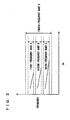
- vibrations occur in engine 100 at frequencies around the frequencies represented by solid lines in Fig. 2 .
- the frequencies of the vibrations attributed to knocking are not constant, and have a prescribed bandwidth. Accordingly, in the present embodiment, as shown in Fig. 2 , vibrations included in a first frequency band A, a second frequency band B and a third frequency band C are detected.
- CA represents a crank angle.
- the number of frequency bands of vibrations attributed to knocking is not limited to three.
- first frequency band A, second frequency band B and third frequency band C are set to have a bandwidth of a fixed value so that the bandwidth is the same irrespective of the frequency bands, and then vibrations are detected.
- the bandwidth is set to be within 2 ⁇ X kHz.
- the vibrations at first frequency band A, second frequency band B and third frequency band C are used to calculate a peak value in magnitude of vibrations.
- the bandwidth of each frequency band may be set to be different among the frequency bands, so long as the bandwidth does not become excessively great.
- one of the frequency bands may be set to have a bandwidth of 2 ⁇ X kHz, while another frequency band among the rest of the frequency bands may be set to have a bandwidth smaller than 2 ⁇ X kHz.
- vibrations in a fourth frequency band D that is broad and that includes first to third frequency bands A-C are detected, so as to include the noises.
- the vibrations of fourth frequency band D are used to detect a vibration waveform of engine 100.
- Engine ECU 200 includes an A/D (analog/digital) converter 400, a bandpass filter (1) 410, a bandpass filter (2) 420, a bandpass filter (3) 430, a band pass filter (4) 440, and an integrating unit 450.
- A/D analog/digital
- A/D converter 400 converts an analog signal transmitted from knock sensor 300 into a digital signal.
- Bandpass filter (1) 410 allows only a signal at first frequency band A to pass among the signals transmitted from knock sensor 300. That is, from the vibrations detected by knock sensor 300, only the vibrations at first frequency band A are extracted by bandpass filter (1) 410.
- Bandpass filter (2) 420 allows only a signal of second frequency band B to pass among the signals transmitted from knock sensor 300. That is, from the vibrations detected by knock sensor 300, only the vibrations at second frequency band B are extracted by bandpass filter (2) 420.
- Bandpass filter (3) 430 allows only a signal of third frequency band C to pass among the signals transmitted from knock sensor 300. That is, from the vibrations detected by knock sensor 300, only the vibrations at third frequency band C are extracted by bandpass filter (3) 430.
- Bandpass filter (4) 440 allows only a signal of fourth frequency band D to pass among the signals transmitted from knock sensor 300. That is, from the vibrations detected by knock sensor 300, only the vibrations of fourth frequency band D are extracted by bandpass filter (4) 440.
- Integrating unit 450 integrates the signals, that is, the magnitude of vibrations, selected by bandpass filter (1) 410-bandpass filter (4) 440 for a crank angle of every five degrees.
- the value obtained by such an integration also referred to as an integrated value.
- the integrated values are calculated for each frequency band.
- the integrated values of first to third frequency bands A-C are added in correspondence with the crank angles. That is, a vibration waveform of the first to third frequency bands A to C is synthesized. Additionally, the integrated values of fourth frequency band D are used as a vibration waveform of engine 100.
- the vibration waveform detected by the integrated values of fourth frequency band D is compared with a knock waveform model shown in Fig. 5 , and whether knocking occurred or not is determined.
- the knock waveform model is a model vibration waveform when engine 100 knocks.
- the knock waveform model is stored in memory 202 of engine ECU 200.
- magnitude of vibrations is represented by a dimensionless number of 0 to 1 and does not uniquely correspond to a crank angle. More specifically, for the knock waveform model of the present embodiment, while it is determined that the vibrations decrease in magnitude as the-crank angle increase after the peak value in magnitude of vibrations, the crank angle at which the vibration magnitude assumes the peak value is not determined.
- the knock waveform model of the present embodiment corresponds to the vibrations after the peak value in the magnitude of the vibrations occurred by knocking.
- a knock waveform model that corresponds to vibrations after the rise of the vibrations attributed to knocking may be stored.
- the knock waveform model is obtained as follows: an experiment or the like is conducted to force knocking of engine 100, and the vibration waveform of engine 100 is detected, based on which the knock waveform model is created and stored in advance. It should be noted, however, that the models might be created by a different method.
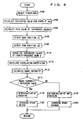
- step (hereinafter simply referred to as "S") 100 engine ECU 200 detects the vibration magnitude of engine 100 based on a signal transmitted from knock sensor 300.
- the vibration magnitude is represented by a value of voltage output from knock-sensor 300.
- the vibration magnitude may be represented by a value corresponding to the value of the voltage output from knock sensor 300.
- the vibration magnitude is detected in a combustion stroke for an angle from a top dead center to (a crank angle of) 90°.
- engine ECU 200 calculates for a crank angle of every five degrees an integration (an "integrated value") of values of voltage output from knock sensor 300 (i.e., representing magnitude of vibrations).
- the integrated values are calculated for vibrations of each of the first to fourth frequency bands A to D.
- integrated values of first to third frequency bands A-C are added in correspondence with crank angles (i.e., a waveform is synthesized).
- the integrated values of fourth frequency band D are calculated, whereby the vibration waveform of engine 100 is detected.
- engine ECU 200 calculates the largest of the integrated values (the peak value) in the synthesized waveform of first to third frequency bands A-C.
- engine ECU 200 detects a position (crank angle) of the peak value, i.e., a timing, at which the integrated value becomes maximum, in the synthesized waveform of first to third frequency bands A-C.
- a position of the peak value in the synthesized waveform of first to third frequency bands A-C is referred to as "peak position (1)".
- engine ECU 200 detects a position of the peak value, i.e., a timing at which the integrated value becomes maximum, in fourth frequency band D, within a range (crank angle) from the position (crank angle) of the peak value.
- a position of the peak value in fourth frequency band D is referred to as "peak position (2)".
- peak position (2) is detected from a range preceding peak position (1).
- peak position (2) is detected from three positions of integrated values preceding peak position (1).
- the position of the integrated values of fourth frequency band D that is the largest in the range preceding peak position (1) is detected as peak position (2). It is noted that the range from which peak position (2) is detected is not limited thereto, and may be the range following peak position (1).
- engine ECU 200 normalizes the integrated values of fourth frequency band D (the vibration waveform of engine 100).
- the normalization means division of each integrated value by peak value calculated at S104 to represent the vibration magnitude by a dimensionless number of 0 to 1. It should be noted, however, that the normalization might be done by a different method. For example, each integrated value may be divided by an integrated value at peak position (2).
- engine ECU 200 calculates a coefficient of correlation K, which is a value related to a deviation between the normalized vibration waveform and the knock waveform model.
- a coefficient of correlation K is a value related to a deviation between the normalized vibration waveform and the knock waveform model.
- engine ECU 200 calculates a knock intensity N.
- the BGL is stored in memory 202. Note that knock intensity N may be calculated by a different method.
- engine ECU 200 determines whether knock intensity N is larger than a predetermined reference value. If the knock intensity N is larger than the predetermined reference value (YES at S116), the control proceeds to S118.
- engine ECU 200 determines that engine 100 knocks.
- engine ECU 200 introduces a spark retard.
- engine ECU 200 determines that engine 100 does not knock.
- engine ECU 200 introduces a spark advance.
- vibration magnitude of engine 100 is detected from a signal transmitted from knock sensor 300 (S100).
- first to fourth frequency bands A-D In a combustion stroke for a range from the top dead center to 90°, an integrated value for every five degrees is calculated for respective vibrations of eath of first to fourth frequency bands A-D (S102).
- the integrated values of first to third frequency bands A-C are added in correspondence with crank angles.
- a vibration waveform is synthesized as represented by an alternate long-and-short dashed line in Fig. 7 .
- the integrated values of fourth frequency band D as represented by a solid line in Fig. 7 are used as a vibration waveform of engine 100.
- peak value P of the integrated values in the synthesized waveform of first to third frequency bands A-C is calculated (S104).
- the bandwidth of first to third frequency bands A-C is uniformly set to a width as much as necessary to include vibrations attributed to knocking, the bandwidth is prevented from becoming unnecessarily broad.
- the noises included in the detected vibrations can be suppressed. Accordingly, erroneous calculation of peak value P due to the noises can be suppressed.
- peak position (1) A position of peak value P (peak position (1)) is detected (S106).
- peak position (1) is at the sixth position from the left (the position of the integrated value for 25° to 30°).
- peak position (2) is detected (S108). Specifically, in fourth frequency band D, out of the fourth, fifth and sixth positions from the left a position of an integrated value larger than the two adjacent integrated values is detected as peak position (2).
- the fifth integrated value from the left is larger than the two adjacent integrated values (the fourth and sixth integrated values), and therefore the position of the fifth integrated value from the left is detected as peak position (2).
- fourth frequency-band D The integrated values in fourth frequency-band D are divided by peak value P in the synthesized waveform of first to third frequency bands A-C, and as represented by a solid line in Fig. 8 , the vibration waveform is normalized (S110).
- vibration magnitude in the vibration waveform is represented by a dimensionless number of 0 to 1.
- the detected vibration waveform can be compared with the knock waveform model regardless of the vibration magnitude. This can eliminate the necessity of storing a large number of knock waveform models corresponding to the magnitude of vibrations and thus, facilitates preparation of the knock waveform model.
- comparing the vibration waveform with the knock waveform model whether the vibrations are attributed to knocking or not can be analyzed from the behavior of the vibrations, such as trend of attenuation of the vibrations.
- the product of the calculated coefficient of correlation K and peak value P is divided by the BGL to calculate knock intensity N (S114).
- knock intensity N S114
- whether the vibrations of engine 100 are attributed to knocking can be analyzed in greater detail, using vibration magnitude in addition to the degree of matching between the detected vibration waveform and the knock waveform model.
- the product of coefficient of correlation K and the integrated value for 20°-25° is divided by BGL to calculate knock intensity N.
- knock intensity N is larger than a predetermined reference value (YES at S116) a determination is made that engine knocks (S 118), and a spark retard is introduced (S120), whereby occurrence of knocking is suppressed.
- the engine ECU extracts vibrations at first frequency band A, second frequency band B, third frequency band C and fourth frequency band D including first to third frequency bands A-C, from the vibrations detected by the knock sensor.
- the magnitudes of vibrations included in each frequency band are integrated for a crank angle of every five degrees.
- the integrated values of first to third frequency bands A-C that are narrowband are added in correspondence with crank angles, and a vibration waveform of first to third frequency bands A-C is synthesized.
- a peak value of the integrated values in the synthesized waveform is calculated.
- a vibration waveform of the engine is detected from the integrated values of the fourth frequency band that is broadband.
- a vibration waveform which includes vibrations attributed to noise components and with which vibrations attributed to knocking and vibrations attributed to noises can easily be distinguished from each other, can be obtained.
- a vibration waveform which includes vibrations attributed to noise components and with which vibrations attributed to knocking and vibrations attributed to noises can easily be distinguished from each other.
- whether knocking occurred or not is determined.
- whether knocking occurred or not can be determined with high accuracy, considering whether the waveform and magnitude of vibrations are particular to knocking or not.
- the number of frequency bands that are narrowband is three, it may be one, two, or four or more.
Landscapes
- Engineering & Computer Science (AREA)
- Chemical & Material Sciences (AREA)
- Combustion & Propulsion (AREA)
- Mechanical Engineering (AREA)
- General Engineering & Computer Science (AREA)
- Physics & Mathematics (AREA)
- General Physics & Mathematics (AREA)
- Combined Controls Of Internal Combustion Engines (AREA)
- Measurement Of Mechanical Vibrations Or Ultrasonic Waves (AREA)
- Testing Of Engines (AREA)
Applications Claiming Priority (2)
| Application Number | Priority Date | Filing Date | Title |
|---|---|---|---|
| JP2005192043A JP4404813B2 (ja) | 2005-06-30 | 2005-06-30 | 内燃機関のノッキング判定装置 |
| PCT/JP2006/313173 WO2007004597A1 (en) | 2005-06-30 | 2006-06-26 | Knocking determination device for internal combustion engine |
Publications (2)
| Publication Number | Publication Date |
|---|---|
| EP1896818A1 EP1896818A1 (en) | 2008-03-12 |
| EP1896818B1 true EP1896818B1 (en) | 2011-01-12 |
Family
ID=36928443
Family Applications (1)
| Application Number | Title | Priority Date | Filing Date |
|---|---|---|---|
| EP06767751A Expired - Lifetime EP1896818B1 (en) | 2005-06-30 | 2006-06-26 | Knocking determination device for internal combustion engine |
Country Status (11)
| Country | Link |
|---|---|
| US (1) | US7669459B2 (enExample) |
| EP (1) | EP1896818B1 (enExample) |
| JP (1) | JP4404813B2 (enExample) |
| KR (1) | KR100950882B1 (enExample) |
| CN (1) | CN101213434B (enExample) |
| AR (1) | AR055982A1 (enExample) |
| DE (1) | DE602006019590D1 (enExample) |
| ES (1) | ES2357475T3 (enExample) |
| MY (1) | MY140802A (enExample) |
| WO (1) | WO2007004597A1 (enExample) |
| ZA (1) | ZA200800815B (enExample) |
Families Citing this family (19)
| Publication number | Priority date | Publication date | Assignee | Title |
|---|---|---|---|---|
| KR100823253B1 (ko) * | 2004-09-02 | 2008-04-17 | 삼성전자주식회사 | 이미지 형성 장치 및 이미지 형성장치의 저장부 |
| JP2006177259A (ja) * | 2004-12-22 | 2006-07-06 | Toyota Motor Corp | 内燃機関のノッキング判定装置 |
| JP4358198B2 (ja) | 2006-03-20 | 2009-11-04 | トヨタ自動車株式会社 | 内燃機関のノッキング判定装置 |
| JP4357501B2 (ja) * | 2006-05-29 | 2009-11-04 | トヨタ自動車株式会社 | 内燃機関のノッキング判定装置 |
| JP4447576B2 (ja) | 2006-05-29 | 2010-04-07 | トヨタ自動車株式会社 | 内燃機関のノッキング判定装置 |
| JP4575902B2 (ja) * | 2006-05-29 | 2010-11-04 | トヨタ自動車株式会社 | 内燃機関のノッキング判定装置 |
| JP4390786B2 (ja) * | 2006-06-06 | 2009-12-24 | トヨタ自動車株式会社 | 内燃機関のノッキング判定装置 |
| JP4490455B2 (ja) * | 2006-10-06 | 2010-06-23 | トヨタ自動車株式会社 | 内燃機関のノッキング判定装置、ノッキング判定方法、その方法を実現するプログラムおよびそのプログラムを記録した記録媒体 |
| JP2008095602A (ja) * | 2006-10-12 | 2008-04-24 | Denso Corp | 内燃機関のノック判定装置 |
| JP4600431B2 (ja) | 2007-05-30 | 2010-12-15 | トヨタ自動車株式会社 | 内燃機関のノッキング判定装置 |
| JP4949167B2 (ja) | 2007-08-08 | 2012-06-06 | 株式会社デンソー | 内燃機関のノック判定装置 |
| JP4997026B2 (ja) * | 2007-09-03 | 2012-08-08 | トヨタ自動車株式会社 | 内燃機関のノッキング判定装置、ノッキング判定方法およびその方法をコンピュータに実現させるプログラムならびにそのプログラムを記録した記録媒体 |
| US8056396B2 (en) * | 2008-02-27 | 2011-11-15 | Denso Corporation | Knock detection device and knock detection system diagnosis device |
| JP4980956B2 (ja) | 2008-03-03 | 2012-07-18 | トヨタ自動車株式会社 | 内燃機関の点火時期制御装置 |
| JP2009209751A (ja) * | 2008-03-04 | 2009-09-17 | Denso Corp | 内燃機関のノック検出装置 |
| US8151627B2 (en) * | 2008-03-05 | 2012-04-10 | Denso Corporation | Knock detection device and knock detection system diagnosis device |
| CN105242782B (zh) * | 2015-09-25 | 2019-03-29 | 联想(北京)有限公司 | 电子设备和信息处理方法 |
| JP6414003B2 (ja) * | 2015-10-07 | 2018-10-31 | 株式会社デンソー | エンジン制御装置 |
| US11255288B2 (en) * | 2018-05-23 | 2022-02-22 | Ford Global Technologies, Llc | Method and system for determining engine knock background noise levels |
Family Cites Families (21)
| Publication number | Priority date | Publication date | Assignee | Title |
|---|---|---|---|---|
| DE3044745A1 (de) * | 1980-11-27 | 1982-07-08 | Daimler-Benz Ag, 7000 Stuttgart | "vorrichtung zum erkennen unerwuenschter verbrennungsverlaeufe bei fremdgezuendeten brennkraftmaschinen" |
| JPS6114526A (ja) * | 1984-06-29 | 1986-01-22 | Mitsubishi Electric Corp | 内燃機関のノツク判別装置 |
| FR2652896B1 (fr) * | 1989-10-11 | 1994-05-27 | Marelli Autronica | Procede et dispositif de detection de cliquetis. |
| US5230316A (en) | 1990-04-27 | 1993-07-27 | Hitachi, Ltd. | Method and apparatus for detecting knock in an internal combustion engine |
| GB2245382B (en) | 1990-04-28 | 1994-03-23 | Motorola Inc | Automotive diagnostic system |
| US5373448A (en) * | 1991-04-24 | 1994-12-13 | Hitachi, Ltd. | Knock detection device for an internal combustion engine |
| US5608633A (en) * | 1991-07-29 | 1997-03-04 | Nissan Motor Co., Ltd. | System and method for detecting knocking for internal combustion engine |
| US5400644A (en) * | 1992-09-29 | 1995-03-28 | Motorola, Inc. | Knock detection system |
| JPH07109949A (ja) | 1993-10-15 | 1995-04-25 | Nippondenso Co Ltd | 内燃機関のノッキング検出装置 |
| JPH08326594A (ja) | 1995-06-02 | 1996-12-10 | Hitachi Ltd | 内燃機関のノッキング検出装置 |
| JP3954679B2 (ja) | 1997-01-20 | 2007-08-08 | ヤンマー株式会社 | ノッキング検出方法 |
| JP3753583B2 (ja) | 2000-02-15 | 2006-03-08 | 株式会社デンソー | 内燃機関用ノック制御装置 |
| JP2002047993A (ja) | 2000-08-01 | 2002-02-15 | Denso Corp | 内燃機関のノック検出装置 |
| JP4134797B2 (ja) | 2003-04-14 | 2008-08-20 | 株式会社デンソー | ノッキング検出装置 |
| JP4297734B2 (ja) * | 2003-05-28 | 2009-07-15 | 株式会社デンソー | 内燃機関のノック制御装置 |
| JP4165751B2 (ja) * | 2003-07-03 | 2008-10-15 | 株式会社デンソー | 内燃機関のノック検出装置 |
| JP4311657B2 (ja) * | 2004-04-15 | 2009-08-12 | 株式会社デンソー | 内燃機関のノック検出装置 |
| JP4410674B2 (ja) | 2004-04-22 | 2010-02-03 | トヨタ自動車株式会社 | 内燃機関のノッキング判定装置およびその装置を含む点火制御システム |
| US7243020B2 (en) * | 2004-12-03 | 2007-07-10 | Fujitsu Ten Limited | Knock detection apparatus and knock detection method |
| JP2006161649A (ja) * | 2004-12-06 | 2006-06-22 | Denso Corp | ノック検出装置 |
| JP4557709B2 (ja) * | 2004-12-24 | 2010-10-06 | トヨタ自動車株式会社 | 内燃機関のノッキング判定装置 |
-
2005
- 2005-06-30 JP JP2005192043A patent/JP4404813B2/ja not_active Expired - Fee Related
-
2006
- 2006-06-20 MY MYPI20062913A patent/MY140802A/en unknown
- 2006-06-26 ES ES06767751T patent/ES2357475T3/es not_active Expired - Lifetime
- 2006-06-26 CN CN2006800241073A patent/CN101213434B/zh not_active Expired - Fee Related
- 2006-06-26 DE DE602006019590T patent/DE602006019590D1/de not_active Expired - Lifetime
- 2006-06-26 WO PCT/JP2006/313173 patent/WO2007004597A1/en not_active Ceased
- 2006-06-26 EP EP06767751A patent/EP1896818B1/en not_active Expired - Lifetime
- 2006-06-26 KR KR1020087002348A patent/KR100950882B1/ko not_active Expired - Fee Related
- 2006-06-28 US US11/475,993 patent/US7669459B2/en active Active
- 2006-06-30 AR ARP060102834A patent/AR055982A1/es not_active Application Discontinuation
-
2008
- 2008-01-28 ZA ZA200800815A patent/ZA200800815B/xx unknown
Also Published As
| Publication number | Publication date |
|---|---|
| US20070012090A1 (en) | 2007-01-18 |
| ZA200800815B (en) | 2008-12-31 |
| CN101213434B (zh) | 2010-12-22 |
| DE602006019590D1 (de) | 2011-02-24 |
| CN101213434A (zh) | 2008-07-02 |
| KR100950882B1 (ko) | 2010-04-06 |
| ES2357475T3 (es) | 2011-04-26 |
| JP4404813B2 (ja) | 2010-01-27 |
| KR20080027898A (ko) | 2008-03-28 |
| EP1896818A1 (en) | 2008-03-12 |
| US7669459B2 (en) | 2010-03-02 |
| MY140802A (en) | 2010-01-15 |
| AR055982A1 (es) | 2007-09-12 |
| JP2007009814A (ja) | 2007-01-18 |
| WO2007004597A1 (en) | 2007-01-11 |
Similar Documents
| Publication | Publication Date | Title |
|---|---|---|
| EP1880180B1 (en) | Internal combustion engine knock determination device | |
| EP2024722B1 (en) | Knock determination device and method for internal combustion engine | |
| US7669459B2 (en) | Knocking determination device for internal combustion engine | |
| EP2150794B1 (en) | Knocking determination device and knocking determination method for internal combustion engine | |
| EP2071170A1 (en) | Internal combustion engine knocking judging device and knocking judging method | |
| WO2006115300A1 (en) | Internal combustion engine knock determination device | |
| EP1848974A1 (en) | Knock determination device for internal combustion engine | |
| EP1896815B1 (en) | Knocking determination device for internal combustion engine | |
| CN101321946A (zh) | 用于对内燃机的点火正时进行控制的设备和方法 | |
| US20060236753A1 (en) | Internal combustion engine knock determination device | |
| JP4221013B2 (ja) | 内燃機関の点火時期制御装置 | |
| JP2007315363A (ja) | 内燃機関のノッキング判定装置 | |
| JP2006307711A (ja) | 内燃機関のノッキング判定装置 |
Legal Events
| Date | Code | Title | Description |
|---|---|---|---|
| PUAI | Public reference made under article 153(3) epc to a published international application that has entered the european phase |
Free format text: ORIGINAL CODE: 0009012 |
|
| 17P | Request for examination filed |
Effective date: 20071206 |
|
| AK | Designated contracting states |
Kind code of ref document: A1 Designated state(s): DE ES FR GB IT SE |
|
| DAX | Request for extension of the european patent (deleted) | ||
| 17Q | First examination report despatched |
Effective date: 20080416 |
|
| DAX | Request for extension of the european patent (deleted) | ||
| RBV | Designated contracting states (corrected) |
Designated state(s): DE ES FR GB IT SE |
|
| GRAP | Despatch of communication of intention to grant a patent |
Free format text: ORIGINAL CODE: EPIDOSNIGR1 |
|
| GRAS | Grant fee paid |
Free format text: ORIGINAL CODE: EPIDOSNIGR3 |
|
| GRAA | (expected) grant |
Free format text: ORIGINAL CODE: 0009210 |
|
| RIN1 | Information on inventor provided before grant (corrected) |
Inventor name: IWADE, KIYOSHI Inventor name: SENDA, KENJI Inventor name: KASASHIMA, KENJI Inventor name: YOSHIHARA, MASATOMO Inventor name: TAKEMURA, YUICHI Inventor name: OE, SHUHEI Inventor name: ASO, KOJI Inventor name: KANEKO, RIHITO |
|
| AK | Designated contracting states |
Kind code of ref document: B1 Designated state(s): DE ES FR GB IT SE |
|
| REG | Reference to a national code |
Ref country code: GB Ref legal event code: FG4D |
|
| REF | Corresponds to: |
Ref document number: 602006019590 Country of ref document: DE Date of ref document: 20110224 Kind code of ref document: P |
|
| REG | Reference to a national code |
Ref country code: DE Ref legal event code: R096 Ref document number: 602006019590 Country of ref document: DE Effective date: 20110224 |
|
| REG | Reference to a national code |
Ref country code: SE Ref legal event code: TRGR |
|
| RAP2 | Party data changed (patent owner data changed or rights of a patent transferred) |
Owner name: TOYOTA JIDOSHA KABUSHIKI KAISHA Owner name: NIPPON SOKEN, INC. Owner name: DENSO CORPORATION |
|
| REG | Reference to a national code |
Ref country code: GB Ref legal event code: 732E Free format text: REGISTERED BETWEEN 20110317 AND 20110323 |
|
| REG | Reference to a national code |
Ref country code: ES Ref legal event code: FG2A Ref document number: 2357475 Country of ref document: ES Kind code of ref document: T3 Effective date: 20110426 |
|
| REG | Reference to a national code |
Ref country code: ES Ref legal event code: PC2A Owner name: NIPPON SOKEN, INC. Effective date: 20110701 |
|
| REG | Reference to a national code |
Ref country code: FR Ref legal event code: TQ |
|
| PLBE | No opposition filed within time limit |
Free format text: ORIGINAL CODE: 0009261 |
|
| STAA | Information on the status of an ep patent application or granted ep patent |
Free format text: STATUS: NO OPPOSITION FILED WITHIN TIME LIMIT |
|
| 26N | No opposition filed |
Effective date: 20111013 |
|
| REG | Reference to a national code |
Ref country code: DE Ref legal event code: R097 Ref document number: 602006019590 Country of ref document: DE Effective date: 20111013 |
|
| PGFP | Annual fee paid to national office [announced via postgrant information from national office to epo] |
Ref country code: SE Payment date: 20120612 Year of fee payment: 7 Ref country code: GB Payment date: 20120620 Year of fee payment: 7 Ref country code: FR Payment date: 20120619 Year of fee payment: 7 |
|
| PGFP | Annual fee paid to national office [announced via postgrant information from national office to epo] |
Ref country code: IT Payment date: 20120620 Year of fee payment: 7 |
|
| PGFP | Annual fee paid to national office [announced via postgrant information from national office to epo] |
Ref country code: ES Payment date: 20120621 Year of fee payment: 7 |
|
| PG25 | Lapsed in a contracting state [announced via postgrant information from national office to epo] |
Ref country code: SE Free format text: LAPSE BECAUSE OF NON-PAYMENT OF DUE FEES Effective date: 20130627 |
|
| REG | Reference to a national code |
Ref country code: SE Ref legal event code: EUG |
|
| GBPC | Gb: european patent ceased through non-payment of renewal fee |
Effective date: 20130626 |
|
| REG | Reference to a national code |
Ref country code: FR Ref legal event code: ST Effective date: 20140228 |
|
| PG25 | Lapsed in a contracting state [announced via postgrant information from national office to epo] |
Ref country code: GB Free format text: LAPSE BECAUSE OF NON-PAYMENT OF DUE FEES Effective date: 20130626 |
|
| PG25 | Lapsed in a contracting state [announced via postgrant information from national office to epo] |
Ref country code: IT Free format text: LAPSE BECAUSE OF NON-PAYMENT OF DUE FEES Effective date: 20130626 Ref country code: FR Free format text: LAPSE BECAUSE OF NON-PAYMENT OF DUE FEES Effective date: 20130701 |
|
| REG | Reference to a national code |
Ref country code: ES Ref legal event code: FD2A Effective date: 20140708 |
|
| PG25 | Lapsed in a contracting state [announced via postgrant information from national office to epo] |
Ref country code: ES Free format text: LAPSE BECAUSE OF NON-PAYMENT OF DUE FEES Effective date: 20130627 |
|
| REG | Reference to a national code |
Ref country code: DE Ref legal event code: R084 Ref document number: 602006019590 Country of ref document: DE |
|
| PGFP | Annual fee paid to national office [announced via postgrant information from national office to epo] |
Ref country code: DE Payment date: 20230620 Year of fee payment: 18 |
|
| REG | Reference to a national code |
Ref country code: DE Ref legal event code: R119 Ref document number: 602006019590 Country of ref document: DE |
|
| PG25 | Lapsed in a contracting state [announced via postgrant information from national office to epo] |
Ref country code: DE Free format text: LAPSE BECAUSE OF NON-PAYMENT OF DUE FEES Effective date: 20250101 |