EP1868052A2 - Verschiebungsdetektor und Maschine mit dem Verschiebungsdetektor - Google Patents
Verschiebungsdetektor und Maschine mit dem Verschiebungsdetektor Download PDFInfo
- Publication number
- EP1868052A2 EP1868052A2 EP07011076A EP07011076A EP1868052A2 EP 1868052 A2 EP1868052 A2 EP 1868052A2 EP 07011076 A EP07011076 A EP 07011076A EP 07011076 A EP07011076 A EP 07011076A EP 1868052 A2 EP1868052 A2 EP 1868052A2
- Authority
- EP
- European Patent Office
- Prior art keywords
- machine
- power
- determining device
- machine tool
- displaced
- Prior art date
- Legal status (The legal status is an assumption and is not a legal conclusion. Google has not performed a legal analysis and makes no representation as to the accuracy of the status listed.)
- Withdrawn
Links
Images





Classifications
-
- G—PHYSICS
- G05—CONTROLLING; REGULATING
- G05B—CONTROL OR REGULATING SYSTEMS IN GENERAL; FUNCTIONAL ELEMENTS OF SUCH SYSTEMS; MONITORING OR TESTING ARRANGEMENTS FOR SUCH SYSTEMS OR ELEMENTS
- G05B19/00—Program-control systems
- G05B19/02—Program-control systems electric
- G05B19/18—Numerical control [NC], i.e. automatically operating machines, in particular machine tools, e.g. in a manufacturing environment, so as to execute positioning, movement or co-ordinated operations by means of program data in numerical form
- G05B19/404—Numerical control [NC], i.e. automatically operating machines, in particular machine tools, e.g. in a manufacturing environment, so as to execute positioning, movement or co-ordinated operations by means of program data in numerical form characterised by control arrangements for compensation, e.g. for backlash, overshoot, tool offset, tool wear, temperature, machine construction errors, load, inertia
-
- G—PHYSICS
- G08—SIGNALLING
- G08B—SIGNALLING SYSTEMS, e.g. PERSONAL CALLING SYSTEMS; ORDER TELEGRAPHS; ALARM SYSTEMS
- G08B13/00—Burglar, theft or intruder alarms
- G08B13/02—Mechanical actuation
- G08B13/14—Mechanical actuation by lifting or attempted removal of hand-portable articles
- G08B13/1436—Mechanical actuation by lifting or attempted removal of hand-portable articles with motion detection
-
- G—PHYSICS
- G05—CONTROLLING; REGULATING
- G05B—CONTROL OR REGULATING SYSTEMS IN GENERAL; FUNCTIONAL ELEMENTS OF SUCH SYSTEMS; MONITORING OR TESTING ARRANGEMENTS FOR SUCH SYSTEMS OR ELEMENTS
- G05B2219/00—Program-control systems
- G05B2219/30—Nc systems
- G05B2219/37—Measurements
- G05B2219/37134—Gyroscope
-
- G—PHYSICS
- G05—CONTROLLING; REGULATING
- G05B—CONTROL OR REGULATING SYSTEMS IN GENERAL; FUNCTIONAL ELEMENTS OF SUCH SYSTEMS; MONITORING OR TESTING ARRANGEMENTS FOR SUCH SYSTEMS OR ELEMENTS
- G05B2219/00—Program-control systems
- G05B2219/30—Nc systems
- G05B2219/37—Measurements
- G05B2219/37241—Displacement of tool, miss inserted
Definitions
- the present invention relates mainly to a displacement detector that determines whether a machine such as a machine tool has been displaced from a predetermined installation site and a machine having the displacement detector.
- Japanese Laid-Open Patent Publication No. 2003-35595 discloses a technique in which a vibration detector detects vibration of a machine tool caused by displacement of the machine tool or by an earthquake. When such vibration is detected, activation of the machine tool is prohibited or operation of the machine tool is suspended.
- the device of this document detects all types of vibrations including those caused by the operation of the machine tool and an earthquake, it is difficult to determine whether such vibration has been brought about by displacement of the machine tool.
- a displacement detector that determines whether a machine installed at a predetermined position has been displaced from the position.
- the detector includes an element and a determining device.
- the element detects rotation of the machine caused by change of the orientation of the machine.
- the determining device determines whether the machine has been displaced based on rotation data of the machine obtained by the element.
- a machine having the displacement detector according to the above first aspect has a displacement determination processing section that communicates information with the displacement detector.
- the determining device transmits information indicating whether the machine has been displaced to the displacement determination processing section.
- the displacement determination processing section outputs an ON instruction to the power ON/OFF circuit and receives the information indicating whether the machine has been displaced. If the machine has been displaced, the displacement determination processing section restricts operation of the machine.
- a displacement detector according to a first embodiment of the present invention will now be described with reference to Figs. 1 to 8.
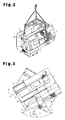
- a machine tool 1, or a machine has an installing portion 3 formed in a bottom portion of a machine body 2.
- the machine tool 1 is installed horizontally at an installation site 4 through the installing portion 3.
- a control panel 5 and a power port 6 are provided at a rear surface of the machine body 2.
- a control panel 7 is arranged at a front surface of the machine body 2.
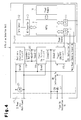
- a rotation detecting unit 8 is incorporated in the control panel 5 as a determining device. The rotation detecting unit 8 performs a communication procedure with a displacement determination processing section 2a, which is provided in the machine body 2. In accordance with the communication procedure, it is determined whether the machine tool 1 has been displaced.
- the rotation detecting unit 8 includes an MPU 9.
- a flash memory 10 and an input-output device 11 are connected to the MPU 9.
- a gyro sensor 12 serving as an element is connected to the MPU 9 through an A/D converter 13.
- the gyro sensor 12 detects rotation of the machine tool 1 caused by change of the orientation Y of the machine tool 1.
- the machine tool 1 rotates about the vertical line V, which is perpendicular to the horizontal surface H at the installation site 4.
- a power ON/OFF circuit 15 of a power supply circuit 14 is connected to the MPU 9.
- a main power terminal 17 of the rotation detecting unit 8 is connected to a non-illustrated main power source (a DC power source).
- a non-illustrated body power switch of the machine tool 1 When a non-illustrated body power switch of the machine tool 1 is turned on, the power is supplied from the main power terminal 17 to the rotation detecting unit 8.
- the main power terminal 17 is connected to a power switching circuit 18.
- a secondary battery 20 is connected to the power switching circuit 18.
- the secondary battery 20 is charged by the main power terminal 17 through a battery charging circuit 19. The power is supplied selectively from the main power terminal 17 and the secondary battery 20 to the power ON/OFF circuit 15 through the power switching circuit 18.
- the power switching circuit 18 When receiving power from the main power terminal 17, the power switching circuit 18 supplies the power to the power ON/OFF circuit 15. Contrastingly, when receiving no power from the main power terminal 17, the power switching circuit 18 supplies the power from the secondary battery 20 to the power ON/OFF circuit 15.
- a relay coil 21 is connected to the main power terminal 17.
- a normally closed contact 22 is connected to the power ON/OFF circuit 15. The normally closed contact 22 is selectively opened and closed through excitation or de-excitation of the relay coil 21.
- the MPU 9 Based on a signal input from the gyro sensor 12 or the like, the MPU 9 performs different types of procedures based on the flowcharts of Figs. 5 to 8 and stores different types of data in the flash memory 10.
- Such power supply to the machine tool 1 is suspended if the power cable 16 is removed from the power port 6 or the breaker trips due to power outage caused by an earthquake or the like or the machine tool 1 is displaced from the installation site 4.
- the power supply to the rotation detecting unit 8 is also stopped.
- the relay coil 21 is de-excited and the normally closed contact 22 is closed.
- an ON instruction Sa is sent to the power ON/OFF circuit 15.
- the power is supplied from the secondary battery 20 to the MPU 9 through the power switching circuit 18 and the power ON/OFF circuit 15.
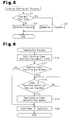
- the MPU 9 executes a rotation detecting unit procedure.
- the MPU 9 receives a main power checking signal Sb from the main power terminal 17 through the input-output device 11.
- the MPU 9 checks the state of the main power in step S1.
- the MPU 9 performs step S2 to detect rotation data of the machine tool 1 and thus carries out the detection procedure represented in Fig. 7.
- the machine tool 1 may be temporarily placed at a different position in transportation from the installation site 4 or installed in a different site.
- the power cable 16 is connected to the power port 6 and the body power switch of the machine tool 1 is turned on so that the procedure represented in Fig. 8 is carried out.
- the MPU 9 receives a power ON instruction Sc from the displacement determination processing section 2a of the machine body 2.
- the MPU 9 is turned on by the power supplied from the main power terminal 17.
- the MPU 9 checks the state of the main power in step S1.
- the MPU 9 carries out step S3 to perform the communication procedure represented in Fig. 6. Data is transferred from the rotation detecting unit 8 to the machine body 2 through the communication procedure.
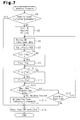
- step S4 of the detection procedure represented in Fig. 7 the MPU 9 determines whether the machine tool 1 has been displaced based on the condition signal that has been previously generated. If it is determined that the machine tool 1 has not been displaced, the MPU 9 carries out step S5. In step S5, the MPU 9 resets Val 1 , Max 1 , and Min 1 to 0. Val 1 represents displacement detection internal data, or a rotation angle.
- Max 1 represents rotation data in terms of the forward direction of the rotating directions X shown in Fig. 3.
- Min 1 represents rotation data in terms of the reverse direction of the rotating directions X shown in the drawing.
- step S6 in accordance with the detection data obtained by the gyro sensor 12, the MPU 9 acquires the rotation data of the machine tool 1 as the rotation angle ⁇ . The MPU 9 then performs step S7.
- Val 1 is a rotation angle and set to 0° at the start of the detection. Val 1 is used as internal data in accordance with which it is determined whether the machine tool 1 has been displaced.
- step 88 the MPU 9 compares Val 1 with Max 1 . If Val 1 exceeds Max 1 , the MPU 9 updates Val 1 to Max 1 in step S9. If Val 1 does not exceed Max 1 , the MPU 9 carries out step S10 without updating Val 1 to Max 1 and compares Val 1 with Min 1 . If Val 1 is less than Min 1 , the MPU 9 updates Val 1 to Min 1 in step S11. If Val 1 is not less than Min 1 , the MPU 9 carries out step S12 without updating Val 1 to Min 1 .
- step S12 the MPU 9 compares the maximal rotation angle ⁇ m 1 (see Fig. 3), or the difference between Max 1 and Min 1 , with the predetermined value ⁇ r 1 (the minimal value of the rotation angle in the rotation assumed to have been caused by displacement of the machine tool 1). If ⁇ m 1 does not exceed ⁇ r 1 , the MPU 9 carries out step S13. In step S13, the MPU 9 checks the state of the main power source. If it is determined that the main power is OFF, it is likely that the power cable 16 has been removed from the power port 6 to displace the machine tool 1 from the installation site 4. In this case, the MPU 9 repeats step S6 and detects the rotation data of the machine tool 1 repeatedly. If ⁇ m 1 exceeds ⁇ r 1 , the MPU 9 performs step S14 and sets a condition signal indicating that the machine tool 1 has been displaced. The MPU 9 then carries out step S15.
- ⁇ m 1 see Fig. 3
- ⁇ r 1 the minimal value of the rotation angle in
- step S15 the MPU 9 determines that the machine tool 1 has been displaced in step S4, the MPU 9 executes step S15 without detecting the rotation data of the machine tool 1, which has been described.
- the MPU 9 performs step S15 also when the MPU 9 determines that the main power is ON in step S13.
- step S15 the MPU 9 sends an OFF instruction Sd to the power ON/OFF circuit 15 (see Fig. 4).
- the power ON/OFF circuit 15 is turned off and the power supply to the MPU 9 is stopped.
- the detection procedure is thus ended.
- Max 1 and Min 1 are updated and the maximal rotation angle ⁇ m 1 is detected. As long as the maximal rotation angle ⁇ m 1 does not exceed the predetermined value ⁇ r 1 , the detection procedure is repeatedly carried out. However, once the maximal rotation angle ⁇ m 1 exceeds the predetermined value ⁇ r 1 , the detection procedure is ended.
- the communication procedure represented in Fig. 6 is performed if the power cable 16 is reconnected to the power port 6 and the body power switch of the machine tool 1 is turned on when the machine tool 1 is temporarily placed at a different position in transportation from the installation site 4 or installed in a different installation site.
- the displacement determination processing section 2a of the machine body 2 outputs the power ON instruction Sc.
- the power ON/OFF circuit 15 is turned on (see Fig. 4). This supplies the power from the main power source to the MPU 9 through the power switching circuit 18.
- step S16 a condition signal indicating whether the machine tool 1 has been displaced is sent from the MPU 9 to the displacement determination processing section 2a.
- step S17 based on the condition signal, the MPU 9 determines whether the machine tool 1 has been displaced. If the MPU 9 determines that the machine tool 1 has been displaced, the MPU 9 performs step S18, or determines whether a condition reset instruction has been output from the displacement determination processing section 2a. If it is determined that the condition reset instruction has been output, the MPU 9 performs step S19.
- step S19 the MPU 9 resets the condition signal indicating that the machine tool 1 has been displaced.
- the MPU 9 then carries out step S20. If it is determined that the condition reset instruction has not been output, the MPU 9 repeatedly determines whether the condition reset instruction has been output. If the MPU 9 determines that the machine tool 1 has not been displaced based on the condition signal in step S17, the MPU 9 performs step S20.
- step S20 the MPU 9 provides the OFF instruction Sd to the power ON/OFF circuit 15 (see Fig. 4). In response to the OFF instruction Sd, the power ON/OFF circuit 15 is turned off and the power supply from the main power source to the MPU 9 is suspended. The communication procedure is thus ended.
- the MPU 9 In the series of processing from steps S16 to S20, after having sent the condition signal indicating whether the machine tool 1 has been displaced to the displacement determination processing section 2a, the MPU 9 resets the condition signal, which indicates whether the machine tool 1 has been displaced, based on the instruction provided by the displacement determination processing section 2a. The MPU 9 then ends the communication procedure.
- the procedure represented in Fig. 8 is performed. Specifically, when the body power switch of the machine tool 1 is turned on, the displacement determination processing section 2a sends the power ON instruction Sc to the rotation detecting unit 8 in step S21. In response to the power ON instruction Sc, the power ON/OFF circuit 15 is activated and the power supply from the main power source to the MPU 9 is started. In step S22, the above-described communication procedure is carried out between the rotation detecting unit 8 and the displacement determination processing section 2a. In step S23, the displacement determination processing section 2a determines whether the machine tool 1 has been displaced based on the condition signal.
- step S23 If the determination of step S23 is positive, the displacement determination processing section 2a informs the operator that the machine tool 1 has been displaced through an alarm or a display screen provided on the control panel 7, and restricts the operation of the machine tool 1 in step S24. Such restriction is performed by, for example, prohibiting automatic activation of the machine.
- step S25 a canceling operation is performed to permit the machine tool 1 to operate.
- the canceling operation is carried out through manipulation of a switch with a key or inputting of a password to turn on a cancel switch.
- step S26 the displacement determination processing section 2a determines whether the canceling operation has been carried out correctly. If determination of step S26 is positive, the displacement determination processing section 2a performs step S27. If the determination is negative, the displacement determination processing section 2a repeats step S25, or determines whether the canceling operation has been performed correctly.
- step S27 the above-described communication procedure is performed between the rotation detecting unit 8 and the displacement determination processing section 2a.
- the displacement determination processing section 2a sends a condition reset instruction to the rotation detecting unit 8.
- Step S28 is then performed.
- step S28 the displacement determination processing section 2a stops displaying information on the display or stops generating the alarm on the control panel 7.
- the displacement determination processing section 2a also cancels the restriction on the operation of the machine tool 1.
- the body power ON procedure is thus ended. If it is determined that the machine tool 1 has not been displaced in step S23, the displacement determination processing section 2a carries out step S28 without executing the above-described series of processing. The procedure is thus ended.
- the first embodiment has the following advantages.
- a displacement detector according to a second embodiment of the present invention will be explained with reference to Figs. 1 to 3, 5, 8, and 9 to 13.
- the explanation will focus on the differences between the first embodiment and the second embodiment.
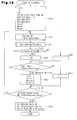
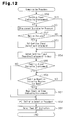
- Figs. 9 and 12 correspond to Figs. 4 and 6, respectively.
- Figs. 10 and 11 each correspond to Fig. 7.
- a vibration sensor 23 is connected in series with the normally closed contact 22 in the rotation detecting unit 8.
- the vibration sensor 23 is switched from OFF to ON when sensing vibration exceeding a predetermined level.
- the relay coil 21 is de-excited and the normally closed contact 22 is closed.
- an ON instruction Sa is sent to the power ON/OFF circuit 15.
- the MPU 9 receives the power from the secondary battery 20 through the power switching circuit 18 and the power ON/OFF circuit 15.
- the MPU 9 performs different procedures and stores different types of data in the flash memory 10 based on an input signal from the gyro sensor 12 or the like and in accordance with the flowcharts illustrated in Figs. 5, 8, and 10 to 12.
- the communication procedure is carried out only after the machine tool 1 is re-installed at a final installation site and the body power switch of the machine tool 1 is turned on.
- the machine tool 1 may be temporarily placed at a plurality of positions in transportation from the initial installation site to the final installation site.
- the above-described detection procedure is performed continuously throughout such transportation.
- the detection procedure is not performed. The detection procedure is carried out only once each time the machine tool 1 is moved from one site to another.
- a first cycle of the detection procedure is performed when the machine tool 1 is located at a site between the original installation site 4 and a first installation site. That is, an nth cycle of detection procedure is carried out when the machine tool 1 is located at a position between an (n-1)th installation site and an n th installation site.
- step S29 the MPU 9 resets n to n+1, i to 0, j to 0, the detected angle to 0, Max 2 data (n) to 0, Min 2 data (n) to 0, Val 2 to 0, Max 2 to 0, and Min 2 to 0.
- the MPU 9 sets the detection start time (n), or a detection start point in time.
- the reference index i represents a rotation non-detected count and the reference index j represents a vibration non-detected count.
- Val 2 represents internal data for detection of rotation, or a rotation angle.
- Max 2 represents rotation data in terms of the forward direction of the rotating directions X.
- Min 2 represents rotation data in terms of the reverse direction of the rotating directions X.
- the detection start time (n), the detection end time (n), Max 2 data (n), Min 2 data (n), and the detected angle (n) are history data obtained in the nth cycle of the detection procedure.
- the MPU 9 acquires the rotation data of the machine tool 1 as the rotation angle ⁇ based on the detection data obtained by the gyro sensor 12. Subsequently, the MPU 9 carries out step S31, or performs the data updating procedure (steps S32 to S41) illustrated in Fig. 11.
- the detected angle is the rotation angle and set to 0° at the start of the detection.
- the detected angle is used in computation of the history data.
- step S33 the MPU 9 compares the detected angle with the Max 2 data (n). If the detected angle exceeds the Max 2 data (n), the MPU 9 updates the detected angle to the Max 2 data (n) in step S34. If the detected angle does not exceed the Max 2 data (n), the MPU 9 performs step S35 without updating the detected angle to the Max 2 data (n). In step S35, the MPU 9 compares the detected angle with the Min 2 data (n).
- the MPU 9 updates the detected angle to the Min 2 data (n) in step S36. If the detected angle is not less than the Min 2 data (n), the MPU 9 performs step S37 without updating the detected angle to the Min 2 data (n). In the series of processing from step S32 to step S36, the Max 2 data (n) and the Min 2 data (n) are updated each time the data of the corresponding cycle is updated.
- Val 2 is the rotation angle and set to 0° in the latest determination that the machine tool 1 has been rotated. Val 2 is used as internal data to determine whether the machine tool 1 has been rotated.
- step S38 the MPU 9 compares Val 2 with Max 2 . If Val 2 exceeds Max 2 , the MPU 9 updates Val 2 to Max 2 in step S39. If Val 2 does not exceed Max 2 , the MPU 9 performs step S40 without updating Val 2 to Max 2 .
- step S40 the MPU 9 compares Val 2 with Min 2 . If Val 2 is less than Min 2 , the MPU 9 updates Val 2 to Min 2 in step S41.
- Step S42 If Val 2 is not less than Min 2 , the MPU 9 performs step S42 without updating Val 2 to Min 2 .
- Max 2 data and Min 2 data are updated each time the data of the corresponding cycle is updated.
- the vibration sensor 23 In transportation of the machine tool 1, the vibration sensor 23 is switched on when detecting vibration of the machine tool 1. The vibration sensor 23 then outputs a vibration signal, which is input to the MPU 9. As illustrated in Fig. 10, in step S42, the MPU 9 determines whether the machine tool 1 has been vibrated based on the vibration signal. If such determination is positive, the MPU 9 performs step S43. In step S43, the MPU 9 resets j to 0 and carries out step S45. Contrastingly, if the determination is negative, the MPU 9 performs step S44. The MPU 9 counts vibration non-detection in step S44 and then carries out step S45.
- step S45 the MPU 9 compares the maximal rotation angle ⁇ m2 , or the difference between Max 2 and Min 2 , with a predetermined angle ⁇ r 2 . If ⁇ m 2 exceeds ⁇ r 2 , the MPU 9 determines that the machine tool 1 has been rotated. Then, the MPU 9 resets i, Val 2 , Max 2 , and Min 2 to 0 in step S46 and then performs step S48. Contrastingly, if ⁇ m 2 does not exceed ⁇ r 2 , the MPU 9 carries out step S47 and counts the rotation non-detection. In step S48, the MPU 9 determines whether i and j both exceed the predetermined values. If such determination is positive, the MPU 9 performs step S49.
- the vibration non-detection count j and the rotation non-detection count i are the values that can be converted into time.
- the MPU 9 sets the detected angle (n) and the detection end time (n), or the detection end timing, and provides an OFF instruction Sd to the power ON/OFF circuit 15 in step S49. The MPU 9 then ends the detection procedure.
- step S48 it is determined that the detection of vibration by the vibration sensor 23 or the detection of rotation data by the gyro sensor 12 has ended within the predetermined time, or that at least one of i and j is less than the corresponding one of the predetermined values, the MPU 9 performs step S30 and repeats the above-described detection procedure.
- Max 2 and Min 2 are updated in each cycle of the detection procedure.
- the detection procedure is repeatedly performed as long as detection of the rotation data or the vibration of the machine tool 1 ends within the predetermined time. However, if such detection lasts beyond the predetermined time, the detection procedure is ended.
- the communication procedure represented in Fig. 12 is carried out when the body power switch of the machine tool 1 is turned on.
- the displacement determination processing section 2a outputs a power ON instruction Sc.
- the power ON/OFF circuit 15 is turned on and the power is supplied from the main power terminal 17 to the MPU 9 through the power switching circuit 18.
- the MPU 9 determines whether the machine tool 1 has been displaced based on the condition signal that has been previously input. If it is determined that the machine tool 1 has been displaced, the MPU 9 carries out step S51.
- Fig. 13 represents the history data representing Max 2 data (n), Min 2 data (n), and the detected angle for each of the first to nth cycles of the detection procedure, which starts at the detection start time and ends at the detection end time.
- the MPU 9 determines the ⁇ detected angle obtained by sequentially adding the detected angles from the cycles of the detection procedure together, the absolute value converted from the Max 2 data (n) obtained by adding the previous E detected angle to the current Max 2 data (n), the absolute value converted from the Min 2 data (n) obtained by adding the previous ⁇ detected angle to the current Min 2 data (n), the final reference value corresponding to the maximum of the absolute value converted from the Max 2 data (n) of each cycle, and the final reference value corresponding to the minimum of the absolute value converted from the Min 2 data (n) of each cycle.
- the machine tool 1 displays the history data on the display screen of the control panel 7 or prints the data on paper.
- step S51 the MPU 9 performs the displacement determination procedure similar to the corresponding procedure of the first embodiment, using the history data.
- the displacement determination procedure is carried out in the series of the detection procedure illustrated in Fig. 7.
- the displacement determination procedure is performed in the communication procedure represented in Fig. 12.
- Max 1 and Min 1 in step S12 correspond to the final reference value of the absolute value converted from Max 2 data (n) and the final reference value of the absolute value converted from Min 2 data (n). If, in the current cycle of the detection procedure, the detection time from the detection start time to the detection end time is shorter than a predetermined time, it is indicated that rotation of the machine tool 1 has not been detected after the original detection of vibration of the machine tool 1. The MPU 9 thus ignores the data from such detection.
- step S53 the MPU 9 sets the condition signal indicating that the machine tool 1 has been displaced.
- step S54 the MPU 9 determines that the machine tool 1 has been displaced in step S50 or that the machine tool 1 has not been displaced in step S52.
- step S54 the condition signal indicating whether the machine tool 1 has been displaced is sent from the MPU 9 to the displacement determination processing section 2a. Based on the condition signal, in step S55, the MPU 9 determines whether the machine tool 1 has been displaced.
- step S56 If the MPU 9 determines that the machine tool 1 has been displaced, the MPU 9 performs step S56. If, in step S56, the MPU 9 receives the condition reset instruction from the displacement determination processing section 2a, the MPU 9 carries out step S57. The MPU 9 resets the condition signal indicating that the machine tool 1 has been displaced in step S57 and then performs step S58. If the MPU 9 determines that the MPU 9 has not received the condition reset instruction from the displacement determination processing section 2a in step S56, the MPU 9 repeatedly determines whether the condition reset instruction has been received. If it is determined that the machine tool 1 has not been displaced in step S55, the MPU 9 performs step S58.
- step S58 the MPU 9 resets n to 0 and initializes the detection procedure.
- the MPU 9 then performs step S59 in which the MPU 9 outputs an OFF instruction Sd to the power ON/OFF circuit 15.
- the power ON/OFF circuit 15 is turned off so that the power supply to the MPU 9 is blocked. The communication procedure is thus ended.
- the second embodiment has the following advantages.
- the gyro sensor 12 detects rotation of the machine tool 1 on the horizontal surface H.
- the gyro sensor 12 may detect rotation of the machine tool 1 on a vertical plane.
- a two-axis acceleration sensor may be used to obtain an angular speed, or a geomagnetic sensor may be employed to detect rotation.
- the present invention may be used to detect whether a measurement device or a laser oscillator has been displaced, other than the machine tool 1.
Landscapes
- Engineering & Computer Science (AREA)
- Physics & Mathematics (AREA)
- General Physics & Mathematics (AREA)
- Human Computer Interaction (AREA)
- Manufacturing & Machinery (AREA)
- Automation & Control Theory (AREA)
- Numerical Control (AREA)
- Machine Tool Sensing Apparatuses (AREA)
- Burglar Alarm Systems (AREA)
Applications Claiming Priority (1)
| Application Number | Priority Date | Filing Date | Title |
|---|---|---|---|
| JP2006162037A JP4173513B2 (ja) | 2006-06-12 | 2006-06-12 | 機器移設有無検知装置及びその機器移設有無検知装置を備えた機器 |
Publications (1)
| Publication Number | Publication Date |
|---|---|
| EP1868052A2 true EP1868052A2 (de) | 2007-12-19 |
Family
ID=38473095
Family Applications (1)
| Application Number | Title | Priority Date | Filing Date |
|---|---|---|---|
| EP07011076A Withdrawn EP1868052A2 (de) | 2006-06-12 | 2007-06-05 | Verschiebungsdetektor und Maschine mit dem Verschiebungsdetektor |
Country Status (4)
| Country | Link |
|---|---|
| US (1) | US20080005604A1 (de) |
| EP (1) | EP1868052A2 (de) |
| JP (1) | JP4173513B2 (de) |
| CN (1) | CN101089554A (de) |
Families Citing this family (12)
| Publication number | Priority date | Publication date | Assignee | Title |
|---|---|---|---|---|
| JP5080091B2 (ja) * | 2007-01-17 | 2012-11-21 | 株式会社ミツトヨ | 移設検出装置及び設置型機器 |
| JP2009146376A (ja) * | 2007-11-22 | 2009-07-02 | Fanuc Ltd | 移設検出機能を備えた数値制御装置 |
| JP4945471B2 (ja) * | 2008-02-06 | 2012-06-06 | ファナック株式会社 | 移設防止機能を有する数値制御装置 |
| JP5101338B2 (ja) * | 2008-02-28 | 2012-12-19 | スター精密株式会社 | 工作機械、不正移設通知装置および機械動作制限方法 |
| JP2009271855A (ja) * | 2008-05-09 | 2009-11-19 | Fanuc Ltd | 移設検出機能を備えた数値制御装置 |
| CN102200492B (zh) * | 2010-02-26 | 2014-08-13 | 兄弟工业株式会社 | 移设检测系统 |
| JP5504090B2 (ja) | 2010-07-30 | 2014-05-28 | Dmg森精機株式会社 | 移設検知方法及び移設検知ユニット |
| JP5606247B2 (ja) * | 2010-09-28 | 2014-10-15 | シチズンホールディングス株式会社 | 対象物の位置判断装置 |
| US8843346B2 (en) * | 2011-05-13 | 2014-09-23 | Amazon Technologies, Inc. | Using spatial information with device interaction |
| JP2015146140A (ja) * | 2014-02-04 | 2015-08-13 | 古野電気株式会社 | 航法演算装置、盗難報知装置、盗難報知システム、および盗難検出方法 |
| JP2016151774A (ja) | 2015-02-16 | 2016-08-22 | ファナック株式会社 | 装置の移設を検出する移設検出装置 |
| JP6875347B2 (ja) * | 2018-10-12 | 2021-05-26 | ファナック株式会社 | 熱変位補正装置及び数値制御装置 |
Family Cites Families (10)
| Publication number | Priority date | Publication date | Assignee | Title |
|---|---|---|---|---|
| JPS4835259A (de) * | 1971-09-10 | 1973-05-24 | ||
| JP2941953B2 (ja) * | 1990-12-04 | 1999-08-30 | キヤノン株式会社 | 基準位置の検出方法および回転検出計 |
| US6205259B1 (en) * | 1992-04-09 | 2001-03-20 | Olympus Optical Co., Ltd. | Image processing apparatus |
| JPH08285753A (ja) * | 1995-04-12 | 1996-11-01 | Bridgestone Corp | 粘弾性体の発熱疲労測定方法及びサーボ式フレクソメータ |
| NZ336412A (en) * | 1998-06-26 | 2001-01-26 | Meinan Machinery Works | Centering log on veneer lathe by rotating log through one revolution to determine centres of each end |
| KR100956520B1 (ko) * | 2002-04-26 | 2010-05-06 | 혼다 기켄 고교 가부시키가이샤 | 다리식 이동 로봇의 자기위치 추정 장치 |
| JP4744811B2 (ja) * | 2004-02-25 | 2011-08-10 | 株式会社東芝 | 情報処理装置及びその制御方法 |
| US8705022B2 (en) * | 2004-07-13 | 2014-04-22 | Trimble Navigation Limited | Navigation system using both GPS and laser reference |
| US7328125B2 (en) * | 2004-09-01 | 2008-02-05 | Canon Kabushiki Kaisha | Measuring method of cylindrical body |
| JP4532363B2 (ja) * | 2005-07-07 | 2010-08-25 | 株式会社リコー | デジタル速度制御装置、デジタルモータ制御装置、紙搬送装置、デジタル速度制御方法、その方法をコンピュータに実行させるプログラム、コンピュータ読み取り可能な記録媒体、および画像形成装置 |
-
2006
- 2006-06-12 JP JP2006162037A patent/JP4173513B2/ja active Active
-
2007
- 2007-06-05 EP EP07011076A patent/EP1868052A2/de not_active Withdrawn
- 2007-06-11 CN CNA2007101119342A patent/CN101089554A/zh active Pending
- 2007-06-11 US US11/761,057 patent/US20080005604A1/en not_active Abandoned
Also Published As
| Publication number | Publication date |
|---|---|
| CN101089554A (zh) | 2007-12-19 |
| JP2007334395A (ja) | 2007-12-27 |
| US20080005604A1 (en) | 2008-01-03 |
| JP4173513B2 (ja) | 2008-10-29 |
Similar Documents
| Publication | Publication Date | Title |
|---|---|---|
| EP1868052A2 (de) | Verschiebungsdetektor und Maschine mit dem Verschiebungsdetektor | |
| EP4224285B1 (de) | Rechnersystem mit einem algorithmus zur fusion von daten aus trägheitssensoren und verfahren | |
| US8760471B2 (en) | Information processing system, information processing method and program for synthesizing and displaying an image | |
| JP5490304B2 (ja) | 放電加工装置および放電加工システム | |
| US20100096148A1 (en) | Independent position sensor and a system to determine the position of a tool on a works machine using position sensors | |
| EP2464094B1 (de) | Mittel und Verfahren zur Unterstützung der Installation einer Überwachungskamera | |
| CN101346744A (zh) | 配置用于监视空间区域的监视设备的方法 | |
| KR20190087953A (ko) | 작업 기계의 표시 장치 및 표시 시스템 | |
| JP2010034904A (ja) | 携帯端末装置 | |
| JP6088049B2 (ja) | 建設機械 | |
| EP4056319A1 (de) | Werkzeugsystem, werkzeugverwaltungsverfahren und programm | |
| JP2012232663A (ja) | 可搬型情報処理装置の保持装置及び情報処理システム | |
| KR102934888B1 (ko) | 차량의 로터리 스위치 장치 | |
| JP2006292522A (ja) | 経路案内装置 | |
| US10502560B2 (en) | Optoelectronic measuring device having magnetic compass and compensation functionality | |
| JP2015204062A (ja) | ドライブレコーダ及びドライブレコーダにおける加速度補正プログラム | |
| US7429930B2 (en) | Projector device with theft prevention function and theft preventing method | |
| KR20030069091A (ko) | 전자 기기, 표시 제어 방법, 기록 매체, 및 프로그램 | |
| CN109154500A (zh) | 激光水准检查 | |
| JP2008129706A (ja) | 工作機械の起動制限システム | |
| JP2009205317A (ja) | 不正移設検出装置、工作機械及び動作制限方法 | |
| JPH10254010A (ja) | レンズ装置およびこれを備えた光学機器 | |
| JP5549924B2 (ja) | 歩数計、歩数計のモード判定方法、コンピュータプログラム | |
| EP1275932B1 (de) | Programmaktualisierung in einem Messgerät | |
| JP2016024134A (ja) | モーダル解析支援装置及び同様の支援機構を備えた実稼働解析支援装置 |
Legal Events
| Date | Code | Title | Description |
|---|---|---|---|
| PUAI | Public reference made under article 153(3) epc to a published international application that has entered the european phase |
Free format text: ORIGINAL CODE: 0009012 |
|
| AK | Designated contracting states |
Kind code of ref document: A2 Designated state(s): AT BE BG CH CY CZ DE DK EE ES FI FR GB GR HU IE IS IT LI LT LU LV MC MT NL PL PT RO SE SI SK TR |
|
| AX | Request for extension of the european patent |
Extension state: AL BA HR MK YU |
|
| STAA | Information on the status of an ep patent application or granted ep patent |
Free format text: STATUS: THE APPLICATION HAS BEEN WITHDRAWN |
|
| 18W | Application withdrawn |
Effective date: 20090409 |