EP1864738B1 - Hole machining tool - Google Patents
Hole machining tool Download PDFInfo
- Publication number
- EP1864738B1 EP1864738B1 EP07010176A EP07010176A EP1864738B1 EP 1864738 B1 EP1864738 B1 EP 1864738B1 EP 07010176 A EP07010176 A EP 07010176A EP 07010176 A EP07010176 A EP 07010176A EP 1864738 B1 EP1864738 B1 EP 1864738B1
- Authority
- EP
- European Patent Office
- Prior art keywords
- tool body
- insert
- tool
- hole
- cutting edge
- Prior art date
- Legal status (The legal status is an assumption and is not a legal conclusion. Google has not performed a legal analysis and makes no representation as to the accuracy of the status listed.)
- Not-in-force
Links
- 238000003754 machining Methods 0.000 title claims abstract description 37
- 238000005520 cutting process Methods 0.000 claims abstract description 70
- 238000003825 pressing Methods 0.000 claims abstract description 57
- 230000002093 peripheral effect Effects 0.000 claims abstract description 48
- 239000002826 coolant Substances 0.000 description 10
- 230000002452 interceptive effect Effects 0.000 description 4
- 238000003780 insertion Methods 0.000 description 3
- 230000037431 insertion Effects 0.000 description 3
- 238000007599 discharging Methods 0.000 description 2
- 230000002708 enhancing effect Effects 0.000 description 2
- 230000003746 surface roughness Effects 0.000 description 2
- 239000000463 material Substances 0.000 description 1
- 230000000149 penetrating effect Effects 0.000 description 1
- 230000002035 prolonged effect Effects 0.000 description 1
- 238000005476 soldering Methods 0.000 description 1
Images


Classifications
-
- B—PERFORMING OPERATIONS; TRANSPORTING
- B23—MACHINE TOOLS; METAL-WORKING NOT OTHERWISE PROVIDED FOR
- B23D—PLANING; SLOTTING; SHEARING; BROACHING; SAWING; FILING; SCRAPING; LIKE OPERATIONS FOR WORKING METAL BY REMOVING MATERIAL, NOT OTHERWISE PROVIDED FOR
- B23D77/00—Reaming tools
-
- B—PERFORMING OPERATIONS; TRANSPORTING
- B23—MACHINE TOOLS; METAL-WORKING NOT OTHERWISE PROVIDED FOR
- B23D—PLANING; SLOTTING; SHEARING; BROACHING; SAWING; FILING; SCRAPING; LIKE OPERATIONS FOR WORKING METAL BY REMOVING MATERIAL, NOT OTHERWISE PROVIDED FOR
- B23D77/00—Reaming tools
- B23D77/02—Reamers with inserted cutting edges
- B23D77/04—Reamers with inserted cutting edges with cutting edges adjustable to different diameters along the whole cutting length
- B23D77/044—Reamers with inserted cutting edges with cutting edges adjustable to different diameters along the whole cutting length by means of screws
-
- B—PERFORMING OPERATIONS; TRANSPORTING
- B23—MACHINE TOOLS; METAL-WORKING NOT OTHERWISE PROVIDED FOR
- B23D—PLANING; SLOTTING; SHEARING; BROACHING; SAWING; FILING; SCRAPING; LIKE OPERATIONS FOR WORKING METAL BY REMOVING MATERIAL, NOT OTHERWISE PROVIDED FOR
- B23D77/00—Reaming tools
- B23D77/02—Reamers with inserted cutting edges
-
- B—PERFORMING OPERATIONS; TRANSPORTING
- B23—MACHINE TOOLS; METAL-WORKING NOT OTHERWISE PROVIDED FOR
- B23D—PLANING; SLOTTING; SHEARING; BROACHING; SAWING; FILING; SCRAPING; LIKE OPERATIONS FOR WORKING METAL BY REMOVING MATERIAL, NOT OTHERWISE PROVIDED FOR
- B23D2277/00—Reaming tools
- B23D2277/08—Adjustment mechanisms
- B23D2277/081—Adjustment mechanisms for axial adjustment of the cutting edge, cutting insert or cutting bit
-
- Y—GENERAL TAGGING OF NEW TECHNOLOGICAL DEVELOPMENTS; GENERAL TAGGING OF CROSS-SECTIONAL TECHNOLOGIES SPANNING OVER SEVERAL SECTIONS OF THE IPC; TECHNICAL SUBJECTS COVERED BY FORMER USPC CROSS-REFERENCE ART COLLECTIONS [XRACs] AND DIGESTS
- Y10—TECHNICAL SUBJECTS COVERED BY FORMER USPC
- Y10S—TECHNICAL SUBJECTS COVERED BY FORMER USPC CROSS-REFERENCE ART COLLECTIONS [XRACs] AND DIGESTS
- Y10S408/00—Cutting by use of rotating axially moving tool
- Y10S408/705—Drilling deep holes
-
- Y—GENERAL TAGGING OF NEW TECHNOLOGICAL DEVELOPMENTS; GENERAL TAGGING OF CROSS-SECTIONAL TECHNOLOGIES SPANNING OVER SEVERAL SECTIONS OF THE IPC; TECHNICAL SUBJECTS COVERED BY FORMER USPC CROSS-REFERENCE ART COLLECTIONS [XRACs] AND DIGESTS
- Y10—TECHNICAL SUBJECTS COVERED BY FORMER USPC
- Y10T—TECHNICAL SUBJECTS COVERED BY FORMER US CLASSIFICATION
- Y10T407/00—Cutters, for shaping
- Y10T407/19—Rotary cutting tool
- Y10T407/1906—Rotary cutting tool including holder [i.e., head] having seat for inserted tool
- Y10T407/1908—Face or end mill
- Y10T407/1912—Tool adjustable relative to holder
- Y10T407/1914—Radially
-
- Y—GENERAL TAGGING OF NEW TECHNOLOGICAL DEVELOPMENTS; GENERAL TAGGING OF CROSS-SECTIONAL TECHNOLOGIES SPANNING OVER SEVERAL SECTIONS OF THE IPC; TECHNICAL SUBJECTS COVERED BY FORMER USPC CROSS-REFERENCE ART COLLECTIONS [XRACs] AND DIGESTS
- Y10—TECHNICAL SUBJECTS COVERED BY FORMER USPC
- Y10T—TECHNICAL SUBJECTS COVERED BY FORMER US CLASSIFICATION
- Y10T407/00—Cutters, for shaping
- Y10T407/19—Rotary cutting tool
- Y10T407/1906—Rotary cutting tool including holder [i.e., head] having seat for inserted tool
- Y10T407/1928—Tool adjustable relative to holder
- Y10T407/193—Radially
-
- Y—GENERAL TAGGING OF NEW TECHNOLOGICAL DEVELOPMENTS; GENERAL TAGGING OF CROSS-SECTIONAL TECHNOLOGIES SPANNING OVER SEVERAL SECTIONS OF THE IPC; TECHNICAL SUBJECTS COVERED BY FORMER USPC CROSS-REFERENCE ART COLLECTIONS [XRACs] AND DIGESTS
- Y10—TECHNICAL SUBJECTS COVERED BY FORMER USPC
- Y10T—TECHNICAL SUBJECTS COVERED BY FORMER US CLASSIFICATION
- Y10T408/00—Cutting by use of rotating axially moving tool
- Y10T408/81—Tool having crystalline cutting edge
-
- Y—GENERAL TAGGING OF NEW TECHNOLOGICAL DEVELOPMENTS; GENERAL TAGGING OF CROSS-SECTIONAL TECHNOLOGIES SPANNING OVER SEVERAL SECTIONS OF THE IPC; TECHNICAL SUBJECTS COVERED BY FORMER USPC CROSS-REFERENCE ART COLLECTIONS [XRACs] AND DIGESTS
- Y10—TECHNICAL SUBJECTS COVERED BY FORMER USPC
- Y10T—TECHNICAL SUBJECTS COVERED BY FORMER US CLASSIFICATION
- Y10T408/00—Cutting by use of rotating axially moving tool
- Y10T408/83—Tool-support with means to move Tool relative to tool-support
- Y10T408/85—Tool-support with means to move Tool relative to tool-support to move radially
- Y10T408/858—Moving means including wedge, screw or cam
-
- Y—GENERAL TAGGING OF NEW TECHNOLOGICAL DEVELOPMENTS; GENERAL TAGGING OF CROSS-SECTIONAL TECHNOLOGIES SPANNING OVER SEVERAL SECTIONS OF THE IPC; TECHNICAL SUBJECTS COVERED BY FORMER USPC CROSS-REFERENCE ART COLLECTIONS [XRACs] AND DIGESTS
- Y10—TECHNICAL SUBJECTS COVERED BY FORMER USPC
- Y10T—TECHNICAL SUBJECTS COVERED BY FORMER US CLASSIFICATION
- Y10T408/00—Cutting by use of rotating axially moving tool
- Y10T408/83—Tool-support with means to move Tool relative to tool-support
- Y10T408/85—Tool-support with means to move Tool relative to tool-support to move radially
- Y10T408/858—Moving means including wedge, screw or cam
- Y10T408/8598—Screw extending perpendicular to tool-axis
-
- Y—GENERAL TAGGING OF NEW TECHNOLOGICAL DEVELOPMENTS; GENERAL TAGGING OF CROSS-SECTIONAL TECHNOLOGIES SPANNING OVER SEVERAL SECTIONS OF THE IPC; TECHNICAL SUBJECTS COVERED BY FORMER USPC CROSS-REFERENCE ART COLLECTIONS [XRACs] AND DIGESTS
- Y10—TECHNICAL SUBJECTS COVERED BY FORMER USPC
- Y10T—TECHNICAL SUBJECTS COVERED BY FORMER US CLASSIFICATION
- Y10T408/00—Cutting by use of rotating axially moving tool
- Y10T408/89—Tool or Tool with support
- Y10T408/909—Having peripherally spaced cutting edges
Definitions
- the present invention relates to a hole machining tool which is inserted into a pilot hole formed in advance in a workpiece to cut the inner surface of the pilot hole.
- a tool according to the preamble of claim 1 is for example known from US 2006/0056925 .
- a reamer in which an edge portion having a cutting edge is soldered to a front end of a tool body rotating about an axis line and having a longitudinal cylinder shape is known.
- the reamer rotates about the axis line, is fed in the axial direction, is inserted into a pilot hole formed in advance in a workpiece to cut the inner surface of the pilot hole with the cutting edge formed in the edge portion, thereby forming a machined hole having a predetermined inner diameter.
- an insert type reamer in which an insert having a cutting edge is detachably attached to the front end of the tool body and a positioning mechanism for adjusting a position of the cutting edge of the insert in the diameter direction of the tool body is provided.
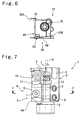
- Figs. 7 and 8 show an example of the known insert type reamer having the positioning mechanism.
- the reamer 1 shown in Figs. 7 and 8 has a tool body 2 rotating about an axis line O and having a longitudinal cylinder shape.
- a recessed portion 3 opened to the front side of the tool body 2 and the outside in the diameter direction of the tool body 2 is formed in a front outer periphery of the tool body 2 and an attachment seat 4 is formed on the rear side of the recessed portion 3 in the tool rotation direction T.
- a plurality of guide pads 5 is disposed on the outer periphery of the tool body 2 with a constant gap in the circumferential direction.
- the guide pads interfering with the recessed portion 3 and the attachment seat 4 extend from the recessed portion 3 and the attachment seat 4 to the rear end of the tool body 2 and the other guide pads 5 extend to the front end of the tool body 2.
- a panel-shaped insert 6 having a cutting edge 6A is attached to the attachment seat 4 in a state where the thickness direction thereof is matched with the tool rotation direction T, and is fixed thereto with a clamp screw 7.
- the cutting edge 6A of the insert 6 is directed to the outside in the diameter direction of the tool body 2 and the front end side of the tool body 2 and two adjustment screws 8 and 9 as an adjustment mechanism for adjusting the position of the insert in the diameter direction are disposed in the inside of the insert 6 in the diameter direction of the tool body 2 so as to be arranged in the axial direction O.
- the adjustment screw located on the rear end side of the tool body 2 is a first adjustment screw 8 and the adjustment screw located on the front end side of the tool body 2 is a second adjustment screw 9.
- the front end surfaces of the first and second adjustment screws 8 and 9 abut a surface of the insert 6 facing the inside in the diameter direction of the tool body 2.
- a receiving hole 10 opened to the outside in the diameter direction of the tool body 2 is formed on the side of the attachment seat 4 close to the rear end of the tool body 2 and an adjustment wedge 11 for adjusting the position of the insert 6 in the axial direction O is inserted into the receiving hole 10.
- the reamer 1 having the above-mentioned configuration is fitted to a primary shaft end of a machining tool, is fed to the front end side in the axial direction O with the rotation about the axis line O, is inserted into a pilot hole formed in advance in a workpiece to cut the inner surface of the pilot hole with the cutting edge 6A of the insert 6, thereby forming a machined hole having a predetermined inner diameter.
- the guide pads 5 slide on the inner surface of the machined hole and thus the fluctuation of the axis line O of the reamer 1, thereby enhancing the dimensional precision.
- the inclination angle (back taper) of the cutting edge 6A formed in the insert 6 about the axis line O and the position of the cutting edge 6A in the diameter direction of the tool body 2 can be adjusted using the first adjustment screw 8 and the second adjustment screw 9, thereby forming the machined hole having a predetermined inner diameter with excellent dimensional precision.
- By appropriately attaching the back taper it is possible to prevent unnecessary contact between the inner surface of the machined hole and the insert 6, thereby reducing cutting resistance.
- the recessed portion 3 occupies a large portion of the tool body 2, the weight balance is poor in the section perpendicular to the axis line O and the movement at the time of rotating the tool body 2 about the axis line O at a high speed is not balanced. Accordingly, the position of the axis line O is disturbed, thereby not forming a machined hole having a high circularity with excellent dimensional precision.
- a plurality of guide pads 5 extend to the rear end of the tool body 2 from the recessed portion 3 and the guide pads 5 does not slide on the machined hole with good balance on the front end side of the tool body 2, thereby disturbing the axis line O of the reamer 1.
- the guide pads 5 are shortened, thereby increasing the disturbance of the axis line O.
- the recessed portion 3 the clamp screw hole 12 into which a clamp screw 7 is screwed, adjustment screw holes 13 and 13 for receiving two adjustment screws 8 and 9, and the receiving hole 10 for receiving the adjustment wedge 11 in the front end portion of the tool body 2 and portions of the tool body 2 to be cut out increase, thereby reducing the rigidity of the tool body 2. Accordingly, a vibration may occur at the time of rotating the tool body 2 at a high speed.
- the reamer 1 has a small diameter
- the recessed portion 3, the clamp screw hole 12 there is no space for forming the adjustment screw holes 13, and the receiving hole 10, thereby not providing the insert type reamer having the above-mentioned adjustment mechanism.
- the adjustment mechanism for adjusting the back taper and the adjustment mechanism for adjusting the position in the diameter direction of the tool body 2 are embodied by the first and second adjustment screws 8 and 9. Accordingly, for example, when the back taper is first adjusted and then the position in the diameter direction of the tool body 2, the previously adjusted back taper varies and the back taper should be adjusted again. Therefore, much time and labor is required for adjusting the insert 6 and the positioning of the insert 6 could not be performed simply and precisely.
- An object of the invention is to provide a hole machining tool in which movement balance and rigidity of the tool body are enhanced by reducing portions cut out from the tool body and which can simply and precisely adjust the position of the insert to form a machined hole having a high circularity with high dimensional precision.
- a so-called longitudinal insert having a panel shape in which the thickness direction thereof is matched with the diameter direction of the tool body, the surface thereof facing the front side in the tool rotation direction becomes the inclined surface, and the peripheral cutting edge is formed in the ridge portion of the inclined surface on the outside in the diameter direction of the tool body, is attached as the insert, it is possible to seat the insert in a state where the thickness direction thereof is approximately matched with the diameter direction of the tool body, to reduce the portions cut out from the tool body so as to form the attachment seat, and to reduce the size of the recessed portion located on the front side of the attachment seat in the tool rotation direction.
- the pressing member is disposed on the rear end side of the attachment seat, it is also possible to reduce the portions cut out from the tool body. Accordingly, the movement balance and the rigidity of the tool body can be enhanced, thereby preventing the vibration of the tool body and forming the machined hole with high dimensional precision. It is possible to construct an insert type hole machining tool for forming a machined hole having a small diameter in which the diameter can be adjusted.
- the portions for forming the recessed portion and the attachment seat can be reduced in size. Accordingly, for example, when the guide pads are disposed on the outer periphery of the tool body, the portions interfering with the recessed portion and the attachment seat are reduced and the guide pads can be disposed to the vicinity of the front end of the tool body with good balance. In addition, the disturbance of the axis line of the tool body can be satisfactorily prevented by means of the sliding between the machined hole and the guide pads, thereby forming a machined hole having a high circularity.
- a pressing pin in which a pressing surface abutting the pressed surface is formed at the front end thereof is disposed on the rear side of the attachment seat in the tool rotation direction so as to extend in a direction intersecting a movement direction of the insert.
- a pressing screw for adjusting a pressing force at the time of pressing the insert with the pressing pin is disposed on the rear side of the pressing pin. Accordingly, by adjusting the pressing force by the use of the insertion amount of the pressing screw, it is possible to adjust the position of the peripheral cutting edge in the diameter direction, thereby more simply adjusting the insert. Since the pressing pin is disposed to extend in the direction intersecting the movement direction, it is not necessary to cut out the rear side of the attachment seat in the tool rotation direction, thereby enhancing the rigidity and the weight balance of the tool body.
- An adjustment member for pressing a side surface of the insert facing the rear side of the tool body to adjust a position of the insert in the axial direction is disposed on the rear side of the attachment seat. Accordingly, it is possible to adjust the amount (so-called an advance amount) of the bevel edge of the insert protruding from the front end surface of the tool body toward the front end of the tool body, thereby performing the cutting process well and preventing damage of the insert due to the cutting resistance at the time of cutting.
- a cutting edge portion formed of a diamond-sintered body is provided in the insert and the peripheral cutting edge and the bevel edge are formed in the cutting edge portion. Accordingly, it is possible to enhance the wear resistance of the cutting edge, thereby elongating the lifetime of the insert.
- the cutting edge portion has a panel shape and a thickness direction thereof is disposed so as to face a flank surface connected to the bevel edge of the insert. Accordingly, when regrinding is performed, grinding is carried out along the inclined surface and variation of an axial position of the bevel edge becomes very small. Whereby, positional adjustment of the bevel edge after regrinding can be performed simply.
- the portions cut out from the tool body can be reduced in size to enhance the movement balance and the rigidity of the tool body and to simply and precisely adjust the position of the insert, thereby providing a hole machining tool capable of precisely forming a machined hole having a high circularity.
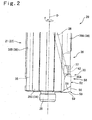
- FIG. 1 A reamer as the hole machining tool according to the exemplary embodiment of the invention is shown in Figs. 1 to 3 .
- the reamer 20 has a tool body 21 having a multi-stepped cylinder shape about an axis line O.
- the front end side (lower side in Fig. 1 ) of the tool body 21 becomes a machining section 22 having an approximately cylinder shape and a guard section 23 having a diameter larger than the machining section 22 is formed on the rear end side (upper side in Fig. 1 ) of the tool body 21.
- An attachment section 24 to which a tool holder (not shown) for fitting the reamer 20 to a primary shaft end of a machining tool is formed on the further rear end side of the guard section 23.
- a pilot 25 having a diameter smaller than that of the machining section 22 is disposed on the front end surface of the tool body 21.
- a coolant supply hole 26 extending from the attachment section 24 along the axis line O and reaching a portion retreating by about 1/5 of the entire length of the machining section 22 from the front end surface of the tool body 21 is formed in the tool body 21 and a coolant ejecting hole 27 extending from the coolant supply hole 26 to the outside in the diameter direction of the tool body 21 and being opened from the outer peripheral surface of the tool body 21 is formed in the tool body 21.
- a recessed portion 30 opened to the front end side of the tool body 21 and the outside in the diameter direction is formed on the front end side of the tool body 21 (machining section 22).
- a wall surface 30A of the recessed portion 30 close to the rear end of the tool body 21 forms a concave-curved surface shape which is recessed to the inside in the diameter direction of the tool body 21 and the rear end side of the tool body 21.
- a coolant discharging hole 28 extending from the coolant ejecting hole 27 to the front end side in the diameter direction of the tool body 21 and the rear side in a tool rotation direction T is opened in the wall surface 30A.
- the recessed portion 30 in the section perpendicular to the axis line O, the recessed portion 30 forms a concave-curved line shape which is recessed to the inside in the diameter direction of the tool body 21 and extends in parallel to the axis line O to the rear end side of the tool body 21.
- the amount of the bottom 30B (portion most recessed to the inside in the diameter direction) the concave-curved line recessed from the outer peripheral surface of the tool body 21 is about 1/3 of the outer diameter of the tool body 21 (2/3 of the radius of the tool body 21) and the size of the recessed portion 30 in the circumferential direction is about 1/8 of the outer circumference of the tool body 21.
- the length of the recessed portion 30 in the direction of the axis line O is about 1/20 of the entire length of the machining section 22, as shown in Fig. 1 .
- An attachment seat 31 for detachably seating an insert 50 to be described later is formed on the rear side of the recessed portion 30 in the tool rotation direction T.
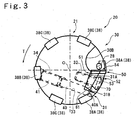
- the attachment seat 31 has a wall surface 31A facing the outside in the diameter direction of the tool body 21 and the wall surface 31A is connected to one end (the rear end side in the tool rotation direction T) of the concave-curved line forming the recessed portion 30, as shown in Fig. 3 .
- the wall surface 31A of the attachment seat 31 facing the outside in the diameter direction of the tool body 21 is formed so that the distance in the diameter direction from the axis line O increases as it goes to the front side from the rear side in the tool rotation direction T, as shown in Fig. 3 , in the section perpendicular to the axis line O and so that the wall surface 31A extends parallel to the axis line 0, as shown in Fig. 2 , in the side view of the tool body 21.
- a clamp screw hole 32 extending in the direction perpendicular to the axis line O is formed in the wall surface 31A.
- a pin hole 33 which is opened in the wall surface of the attachment seat 31 facing the front side in the tool rotation direction T and which extends in a direction perpendicular to the direction in which the wall surface 31A facing the outside in the diameter direction of the tool body 21 is formed on the rear side of the attachment seat 31 in the tool rotation direction T.
- a pressing screw hole 34 extending coaxial with the pin hole 33 is formed on the side of the pin hole 33 opposite to the attachment seat 31.
- the pressing screw hole 34 has a diameter larger by one step than that of the pin hole 33 and a female screw is formed on the inner peripheral surface.
- a large-diameter hole 35 which communicates with the pressing screw hole 34 and is opened in the outer peripheral surface of the tool body 21 is formed in the tool body 21.
- a pressing pin 40 having an approximately cylinder shape is inserted into the pin hole 33 and a pressing surface 40A protruding to the attachment seat 31 toward the front side in the tool rotation direction T is formed at the front end of the pressing pin 40.
- the pressing surface 40A is inclined about the axis line of the pressing pin 40 so as to gradually go to the inside of the pressing pin 40 as it goes to the front end side of the pressing pin 40.
- a pressing screw 41 having an approximately cylinder shape and having a male screw formed on the outer peripheral surface is screwed into the pressing screw hole 34 and the front end surface of the pressing screw 41 abuts the rear end surface of the pressing pin 40.
- An engagement hole (not shown) engaging with a working tool such as a wrench is formed in the rear end surface of the pressing screw 41 and the engagement hole is opened toward the outer peripheral surface of the tool body 21 through the large-diameter hole 35.
- a notch 36 opened toward the outside in the diameter direction of the tool body 21 is formed on the side of the recessed portion 30 close to the rear end side of the tool body 21 and a screw through hole 37 extending to the attachment seat 31 is formed in the surface of the notch 36 facing the rear end side of the tool body 21.
- An adjustment screw 42 having an approximately cylinder shape and having a male screw formed on the outer peripheral surface thereof is screwed into the screw through hole 37.
- a plurality of guide pads 38 which is formed of a hard material of which an outer shape is an approximately elliptical panel shape is disposed on the outer periphery of the machining section 22 of the tool body 21 so as to extend parallel to the axis line O and six guide pads 38 are disposed with a constant pitch in the circumferential direction as shown in Fig. 3 in this embodiment. As shown in Fig.
- the guide pad 38A disposed in a portion interfering with the recessed portion 30, the attachment seat 31, and the notch 36 extends to the rear end of the tool body 21 from the notch 36 and the guide pad 38B disposed in a portion interfering with the large-diameter hole 35 is divided into two portions to the front end side and the rear end side of the tool body 21 with the large-diameter hole 35 therebetween.
- the other guide pads 38C extend to the front end surface of the tool body 21.
- the insert 50 has an approximately rectangular plane shape as shown in Figs. 2 and 3 and has two faces facing the thickness direction thereof and four side faces.
- One face facing the thickness direction of the insert 50 becomes a seating surface 51 which is seated on the wall surface 31A of the attachment seat 31 facing the outside in the diameter direction of the tool body 21 toward the inside in the diameter direction of the tool body 21.
- the other face facing the thickness direction becomes a peripheral flank surface 52 toward the outside in the diameter direction of the tool body 21.
- An insertion hole 53 penetrating the insert 50 in the thickness direction is formed in the one face (seating surface 51) and the other face (peripheral flank surface 52).
- One side face of the insert 50 becomes the inclined surface 54 toward the front side in the tool rotation direction T and a panel-shaped cutting edge portion 55 formed of a diamond-sintered body is disposed on one end side (front end side of the tool body 21) of the side face forming the inclined surface 54.
- a peripheral cutting edge 56 is formed at an intersection ridge portion between the cutting edge portion 55 and the other face (peripheral flank surface 52) facing the thickness direction, thereby forming a longitudinal-edge insert 50.
- the inclined surface 54 is disposed so as to intersect the seating surface 51 at an obtuse angle as shown in Fig. 3 .
- a chamfered portion 58 is formed at the intersection between the side face facing the front end of the tool body 21 and the other face as the peripheral flank surface 52 and a bevel edge 59 is formed at the intersection ridge portion between the chamfered portion 58 and the cutting edge portion 55. That is, as shown in Fig. 2 , as viewed from the side opposite to the inclined surface 54, the bevel edge 59 inclined to retreat to the inside in the diameter direction of the tool body 21 as it goes to the front end of the tool body 21 is connected to the side of the peripheral cutting edge 56 close to the front end of the tool body 21.
- the side face opposite to the side face as the inclined surface 54 that is, the side face facing the rear side in the tool rotation direction T, becomes a pressed surface 61 abutting the pressing surface of the pressing pin.
- the pressed surface 61 is formed so as to intersect the seating surface 51 at an obtuse angle and so as to protrude to the rear side in the tool rotation direction T as it goes to the outside in the diameter direction of the tool body 21. Accordingly, the section of the insert 50 perpendicular to the axis line O has an approximately trapezoid shape when being attached to the attachment seat 31, as shown in Fig. 3 .
- the peripheral flank surface 52 facing the outside in the diameter direction of the tool body 21 is inclined about the axis line O so as to be directed to the inside in the diameter direction of the tool body 21 as it goes toward the rear end of the tool body 21, as shown in Fig. 2 , as viewed from the side opposite to the inclined surface 54 and the back taper is attached to the peripheral cutting edge 56 formed at the intersection ridge portion between the peripheral flank surface 52 and the cutting edge portion 55 so as to be directed to the inside in the diameter direction of the tool body 21 as it goes to the rear end of the tool body 21.
- the amount of back taper is set in the range of 40 ⁇ m/15 mm to 80 ⁇ m/15 mm and more preferably 60 ⁇ m/15 mm.
- the insert 50 having the above-mentioned configuration is attached to the attachment seat 31 of the tool body 21 as follows.
- the insert 50 is seated on the attachment seat 31 so that the side face as the inclined surface 54 is directed to the front side in the tool rotation direction T and the one face (seating surface 51) facing the thickness direction of the insert 50 abuts the wall surface 31A of the attachment seat 31 facing the outside in the diameter direction of the tool body 21.
- the pressed surface 61 of the insert 50 abuts the pressing surface 40A of the pressing pin 40 and the side face of the insert 50 facing the rear end of the tool body 21 abuts the front end of the adjustment screw 42.
- the insert 50 is attached to the attachment seat 31.
- the reamer 20 constructed by attaching the insert 50 to the attachment seat 31 of the tool body 21 in this way is fitted to the primary shaft end of a machining tool through a tool holder mounted on the attachment section 24, is fed to the front end side in the direction of the axis line O with the rotation about the axis line O, is inserted into the pilot hole formed in advance in a workpiece, to cut the inner surface of the pilot hole by the use of the bevel edge 59, and the peripheral cutting edge 56, thereby forming a machined hole having a predetermined inner diameter.
- the coolant supplied from the machining tool is ejected toward the inner surface of the machined hole from the coolant ejecting hole 27 through the coolant supply hole 26 so as to smooth the sliding between the guide pads 38 and the inner surface of the machined hole and the coolant is discharged toward the insert 50 from the coolant discharging hole 28 to cool the peripheral cutting edge 56 and the bevel edge 59, thereby satisfactorily performing the cutting process.
- the positioning of the insert 50 in the reamer 20 is performed as follows. A working tool is allowed to engage with the engagement hole exposed from the outer peripheral surface of the tool body 21 through the large-diameter hole 35, the pressing screw 41 is inserted thereto, and then the pressing pin 40 is allowed to move to the attachment seat 31.
- the pressing surface 40A presses the pressed surface 61 and thus the insert 50 moves to the front side in the tool rotation direction T along the wall surface 31A of the attachment seat 31 facing the outside in the diameter direction of the tool body 21.
- the wall surface 31A of the attachment seat 31 facing the outside in the diameter direction of the tool body 21 is disposed so that the distance from the axis line O in the diameter direction gradually increases as it goes to the front side from the rear side in the tool rotation direction T, as shown in Fig. 3 , in the section perpendicular to the axis line O, the insert 50 protrudes to the outside in the diameter direction of the tool body 21.
- the peripheral flank surface 52 of the insert 50 retreats to the inside in the diameter direction of the tool body 21 as it goes to the rear end of the tool body 21, the back taper is attached to the peripheral cutting edge 56 already, and the amount of back taper does not vary even when the insert 50 moves to the front side in the tool rotation direction T. Accordingly, it is not necessary to adjust the back taper of the peripheral cutting edge 56.
- the so-called longitudinal-edge insert is attached as the insert 50, in which the one face facing the thickness direction is used as the seating surface 51 facing the inside in the diameter direction of the tool body 21, the other face facing the thickness direction is used as the peripheral flank surface 52 facing the outside in the diameter direction of the tool body 21, the side face facing the front side in the tool rotation direction T, and the peripheral cutting edge 56 is formed at the intersection ridge portion between the inclined surface 54 and the peripheral flank surface 52. Accordingly, the insert can be attached to the tool body in the state where the thickness direction of the insert 50 is approximately matched with the diameter direction of the tool body 21, thereby reducing the portions cut out from the tool body 21 so as to form the attachment seat 31 and reducing the recessed portion 30 located on the front side in the tool rotation direction T of the attachment seat 31.
- the movement balance and the rigidity of the tool body 21 can be enhanced, thereby preventing the vibration of the tool body 21 and forming a machined hole with high dimensional precision. It is possible to construct an insert type hole machining tool capable of adjusting the diameter thereof in a reamer for forming a machined hole having a small diameter.
- the amount of the bottom 30A (the portion most recessed to the inside in the diameter direction) of the concave-curved line formed by the section of the recessed portion 30 perpendicular to the axis line O recessed from the outer peripheral surface of the tool body 21 is about 1/3 of the outer diameter of the tool body 21 (2/3 of the radius of the tool body 21) and is small relative to the tool body 21.
- two guide pads 38A of six guide pads 38 formed on the periphery of the machining section 22 can be formed to extend to the rear end of the tool body 21 from the recessed portion 30 and the attachment seat 31, the guide pad 38B disposed in the portion in which the large-diameter hole 35 is formed can be divided into two portions by the large-diameter hole 35 and can extend to the front end of the tool body 21, and the other three guide pads 35C can be formed to extend to the front end surface of the tool body 21.
- the guide pad 38A disposed from the recessed portion 30 and the attachment seat 21 to the rear end of the tool body 21 can extend to the vicinity of the tool body 21.
- the guide pads 38 can be disposed in this way, the machined hole and the guide pads 38 can be allowed to slide with good balance in the vicinity of the insert 50 for performing the cutting process and the disturbance of the axis line O of the reamer 20 can be surely prevented, thereby forming the machined hole having a high circularity with high dimensional precision. Since the machined hole having the high circularity can be formed, the reamer 20 can be used to machine a machined hole (for example, a cam hole of an engine) requiring the high dimensional tolerance which could not be machined by the known reamer, thereby efficiently forming the machined hole.
- a machined hole for example, a cam hole of an engine
- a notch 36 is formed in the portion of the attachment seat 31 close to the rear end of the tool body 21 and the adjustment screw 42 screwed into the screw through hole 37 formed in the surface of the notch 36 facing the rear end of the tool body 21 abuts the side face of the insert 50 facing the rear end of the tool body 21, it is possible to adjust the amount (advance amount) of the bevel edge 59 of the insert 50 protruding from the front end surface of the tool body 21 toward the front end of the tool body 21.
- the cutting edge portion 55 formed of a diamond-sintered body is formed in the insert 50 and the peripheral cutting edge 56 and the bevel edge 59 are formed in the cutting edge portion 55, it is possible to improve the wear resistance of the peripheral cutting edge 56 and the bevel edge 59, thereby elongating the lifetime of the insert 50.
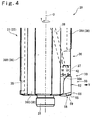
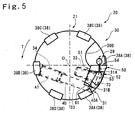
- the hole machining tool according to the second exemplary embodiment is different from that of the first embodiment only for the configuration of the insert 50.
- the cutting edge portion 55 formed of the diamond-sintered body has a substantially panel shape and the cutting edge portion 55 is disposed so as to be laminated on the chamfered portion 58 connected to the bevel edge 59 of the insert 50.
- a surface roughness of a diamond-sintered body is better about three times at a surface not subjected to grinding, and in this embodiment, a portion having a good surface roughness of the cutting edge portion 55 is formed to be faced as a flank surface connected to the bevel edge 59. Accordingly, a friction resistance is reduced so that wear at the cutting edge portion 55 is controlled and the lifetime of the insert 50 can be prolonged.
- the present invention is not limited to the reamer configuration, but may have a reamer configuration in which the tool body has a constant outer diameter over the entire length without the guard section and the read end portion of the tool body is inserted into a fitting hole formed in a cutting tool.
- the present invention is not limited to it, but the arrangement and number of the guide pads may be appropriately selected in consideration of the cutting condition, etc.
- the pressing pin is provided as the pressing member
- the present invention is not limited to it, but another pressing member such as a wedge member may be provided.
- the adjustment screw is provided as the adjustment member for adjusting the amount (advance amount) of the bevel edge protruding from the front end surface of the tool body
- the present invention is not limited to it, but another adjustment member such as a wedge member may be provided or the adjustment member may be not provided.
- the amount of the back taper provided in the peripheral cutting edge facing the outside in the diameter direction of the tool body is in the range of 40 ⁇ m/15 mm to 80 ⁇ m/15 mm and more preferably 60 ⁇ m/15 mm
- the present invention is not limited to it, but the amount of the back taper may be appropriately set in consideration of the cutting condition, etc.
- the amount of back taper in the above-mentioned range, it is possible to satisfactorily prevent the inner surface of the machined hole and the rear end portion of the peripheral cutting edge from sliding and thus to smoothly finish the inner surface of the machined hole.
- the insert has the cutting edge portion formed of a diamond-sintered body
- the insert may have a cutting edge portion formed of cemented carbide or cBN-sintered body.
- the shape of the insert is not limited to that of the embodiment, but the insert may have any panel-shape.
Landscapes
- Engineering & Computer Science (AREA)
- Mechanical Engineering (AREA)
- Milling, Broaching, Filing, Reaming, And Others (AREA)
- Drilling And Boring (AREA)
- Crystals, And After-Treatments Of Crystals (AREA)
- Polishing Bodies And Polishing Tools (AREA)
- Drilling Tools (AREA)
Priority Applications (2)
| Application Number | Priority Date | Filing Date | Title |
|---|---|---|---|
| EP09171082.2A EP2130634B1 (en) | 2006-06-05 | 2007-05-22 | Insert |
| PL09171082T PL2130634T3 (pl) | 2006-06-05 | 2007-05-22 | Wkładka |
Applications Claiming Priority (2)
| Application Number | Priority Date | Filing Date | Title |
|---|---|---|---|
| JP2006156367 | 2006-06-05 | ||
| JP2007038308A JP4816496B2 (ja) | 2006-06-05 | 2007-02-19 | 穴加工工具 |
Related Child Applications (2)
| Application Number | Title | Priority Date | Filing Date |
|---|---|---|---|
| EP09171082.2A Division EP2130634B1 (en) | 2006-06-05 | 2007-05-22 | Insert |
| EP09171082.2 Division-Into | 2009-09-23 |
Publications (2)
| Publication Number | Publication Date |
|---|---|
| EP1864738A1 EP1864738A1 (en) | 2007-12-12 |
| EP1864738B1 true EP1864738B1 (en) | 2010-09-08 |
Family
ID=38477052
Family Applications (2)
| Application Number | Title | Priority Date | Filing Date |
|---|---|---|---|
| EP07010176A Not-in-force EP1864738B1 (en) | 2006-06-05 | 2007-05-22 | Hole machining tool |
| EP09171082.2A Not-in-force EP2130634B1 (en) | 2006-06-05 | 2007-05-22 | Insert |
Family Applications After (1)
| Application Number | Title | Priority Date | Filing Date |
|---|---|---|---|
| EP09171082.2A Not-in-force EP2130634B1 (en) | 2006-06-05 | 2007-05-22 | Insert |
Country Status (8)
| Country | Link |
|---|---|
| US (1) | US7862266B2 (enExample) |
| EP (2) | EP1864738B1 (enExample) |
| JP (1) | JP4816496B2 (enExample) |
| KR (2) | KR101146386B1 (enExample) |
| AT (1) | ATE480358T1 (enExample) |
| DE (1) | DE602007008975D1 (enExample) |
| ES (1) | ES2537970T3 (enExample) |
| PL (1) | PL2130634T3 (enExample) |
Families Citing this family (9)
| Publication number | Priority date | Publication date | Assignee | Title |
|---|---|---|---|---|
| US8641334B2 (en) * | 2006-06-05 | 2014-02-04 | Mitsubishi Materials Corporation | Insert |
| DE102008045327B3 (de) * | 2008-08-21 | 2010-02-18 | MAPAL Fabrik für Präzisionswerkzeuge Dr. Kress KG | Reibahle |
| JP5572640B2 (ja) | 2009-02-24 | 2014-08-13 | コメート グループ ゲーエムベーハー | 位置調整可能なプレート要素を備えた機械工具 |
| SE0950110A1 (sv) * | 2009-03-03 | 2010-05-11 | Seco Tools Ab | Roterande verktyg innefattande ett flertal långsträckta organ och ett stöd |
| US20120121348A1 (en) * | 2010-11-15 | 2012-05-17 | Daimler Ag | Boring tool and method for cylinder bores |
| CN102151857A (zh) * | 2011-01-21 | 2011-08-17 | 宁波华星新能源有限公司 | 微调刀具 |
| DE102012018643A1 (de) | 2012-09-17 | 2014-04-10 | MAPAL Fabrik für Präzisionswerkzeuge Dr. Kress KG | Werkzeug zur spanenden Bearbeitung von Werkstücken |
| JP2017042870A (ja) * | 2015-08-26 | 2017-03-02 | アイシン・エィ・ダブリュ株式会社 | リーマ |
| CN111215698B (zh) * | 2020-03-18 | 2024-06-14 | 上海新山田精密刀具有限公司 | 一种能够双向调节直径的高精度铰刀 |
Family Cites Families (24)
| Publication number | Priority date | Publication date | Assignee | Title |
|---|---|---|---|---|
| DE2948250A1 (de) * | 1979-11-30 | 1981-07-23 | August Beck GmbH & Co, 7472 Winterlingen | Reibahle mit einer flachrechteckfoermigen wendeschneidplatte |
| US4353669A (en) * | 1980-10-20 | 1982-10-12 | Georg Striegl | Device for machine reamer |
| DE3232804C1 (de) * | 1982-09-03 | 1991-04-18 | Mapal Fabrik für Präzisionswerkzeuge Dr.Kress KG, 7080 Aalen | Einmesser-Reibahle |
| DE3520179C2 (de) * | 1985-06-05 | 1994-05-11 | Frits Weyler | Maschinenreibahle mit einstellbarer Wendeschneidplatte |
| FR2633856B1 (fr) | 1988-07-08 | 1994-05-20 | Planche Simon | Outil a lame longitudinale rapportee et plus particulierement mais non exclusivement a un alesoir |
| DE4115317A1 (de) | 1990-05-11 | 1992-01-02 | Gte Valenite Corp | Einstellbare reibahle |
| EP0552774B1 (de) * | 1992-01-23 | 1997-05-28 | Alfred Müller | Stufensenker |
| DE4343404A1 (de) * | 1993-12-18 | 1995-06-22 | Gildemeister Devlieg System | Verfahren und Vorrichtung zum Einstellen von Reibahlen und dergleichen |
| US5639189A (en) * | 1994-11-08 | 1997-06-17 | Ingersoll Cutting Tool Company | Plunge milling insert |
| IT240848Y1 (it) | 1996-08-13 | 2001-04-11 | Omus System S P A | Barenatore a inserto pluritagliente |
| IL119776A0 (en) * | 1996-12-06 | 1997-03-18 | Iscar Ltd | Cutting tool assembly |
| JP3178364B2 (ja) * | 1997-02-28 | 2001-06-18 | 三菱マテリアル株式会社 | スローアウェイ式リーマ |
| JP3472752B2 (ja) * | 2000-08-03 | 2003-12-02 | 住友電気工業株式会社 | スローアウェイチップ及びそれを用いたピンミラーカッタ |
| JP2002160124A (ja) * | 2000-11-24 | 2002-06-04 | Mitsubishi Materials Corp | スローアウェイ式リーマ |
| JP2002200523A (ja) * | 2000-12-28 | 2002-07-16 | Sumitomo Electric Ind Ltd | 高精度加工用リーマ及びそれを用いた軸穴の仕上加工方法 |
| JP4860047B2 (ja) * | 2001-03-16 | 2012-01-25 | 富士精工株式会社 | スローアウェイリーマ |
| JP3875092B2 (ja) | 2001-12-19 | 2007-01-31 | 富士精工株式会社 | リーマおよび切削工具用チップ |
| DE10231339B3 (de) * | 2002-07-11 | 2004-01-22 | Fette Gmbh | Tangential-Wendeschneidplatte |
| JP4330925B2 (ja) | 2003-05-16 | 2009-09-16 | 株式会社タンガロイ | スローアウェイ式リーマ |
| DE10326662A1 (de) * | 2003-06-11 | 2005-01-05 | Sandvik Ab | Schneideinsatz zum Drehen und Fräsen |
| DE102004022941A1 (de) * | 2004-05-04 | 2005-12-01 | MAPAL Fabrik für Präzisionswerkzeuge Dr. Kress KG | Messerplatte und Reibahle |
| IL164023A (en) * | 2004-09-12 | 2009-07-20 | Gil Hecht | Cutting placement and cutting tools |
| JP2007130739A (ja) * | 2005-11-14 | 2007-05-31 | Mitsubishi Materials Corp | 穴加工工具 |
| JP4910648B2 (ja) * | 2006-11-14 | 2012-04-04 | 三菱マテリアル株式会社 | 穴加工工具及び穴加工工具の製造方法 |
-
2007
- 2007-02-19 JP JP2007038308A patent/JP4816496B2/ja not_active Expired - Fee Related
- 2007-05-22 ES ES09171082.2T patent/ES2537970T3/es active Active
- 2007-05-22 DE DE602007008975T patent/DE602007008975D1/de active Active
- 2007-05-22 AT AT07010176T patent/ATE480358T1/de not_active IP Right Cessation
- 2007-05-22 EP EP07010176A patent/EP1864738B1/en not_active Not-in-force
- 2007-05-22 EP EP09171082.2A patent/EP2130634B1/en not_active Not-in-force
- 2007-05-22 PL PL09171082T patent/PL2130634T3/pl unknown
- 2007-05-23 US US11/752,371 patent/US7862266B2/en not_active Expired - Fee Related
- 2007-06-04 KR KR1020070054195A patent/KR101146386B1/ko not_active Expired - Fee Related
-
2009
- 2009-05-25 KR KR1020090045269A patent/KR101146374B1/ko not_active Expired - Fee Related
Also Published As
| Publication number | Publication date |
|---|---|
| US20070280799A1 (en) | 2007-12-06 |
| KR101146386B1 (ko) | 2012-05-17 |
| EP2130634A2 (en) | 2009-12-09 |
| EP2130634A3 (en) | 2012-03-14 |
| JP2008012655A (ja) | 2008-01-24 |
| US7862266B2 (en) | 2011-01-04 |
| ATE480358T1 (de) | 2010-09-15 |
| DE602007008975D1 (de) | 2010-10-21 |
| EP2130634B1 (en) | 2015-03-25 |
| EP1864738A1 (en) | 2007-12-12 |
| KR101146374B1 (ko) | 2012-05-17 |
| KR20070116546A (ko) | 2007-12-10 |
| KR20090078764A (ko) | 2009-07-20 |
| ES2537970T3 (es) | 2015-06-16 |
| JP4816496B2 (ja) | 2011-11-16 |
| PL2130634T3 (pl) | 2015-07-31 |
Similar Documents
| Publication | Publication Date | Title |
|---|---|---|
| EP1864738B1 (en) | Hole machining tool | |
| EP2022584B1 (en) | Cutting tool and cutting insert | |
| JP2006524582A (ja) | 多機能切削加工用ツールホルダ組立体とそのためのアダプタ | |
| EP2682211A1 (en) | Guide pad, cutting tool body, and cutting tool | |
| JP4816723B2 (ja) | インサート | |
| JP2008018515A (ja) | 切削インサート及び切削工具 | |
| JP2003025120A (ja) | 穴加工方法および穴加工工具 | |
| US8641334B2 (en) | Insert | |
| US20200030894A1 (en) | Drilling Tool Comprising A Replaceable Cutting Disk | |
| CN113631309B (zh) | 切削刀片及旋转切削工具 | |
| JP5272693B2 (ja) | インサート着脱式カッタ | |
| JP2006150535A (ja) | 切削工具 | |
| JP5050492B2 (ja) | 刃振れ調整機構および刃振れ調整機構を備えたスローアウェイ式切削工具 | |
| JP4765807B2 (ja) | 穴加工工具及びインサート | |
| JPH06320318A (ja) | 切削工具 | |
| JP4876748B2 (ja) | 穴加工工具 | |
| EP4015122B1 (en) | Face milling cutter | |
| JP4483200B2 (ja) | スローアウェイ式リーマ | |
| JP4946229B2 (ja) | 穴加工工具 | |
| JP2826039B2 (ja) | 切削工具 | |
| JP2008000829A (ja) | インサート着脱式球面カッタ | |
| JP2007130739A (ja) | 穴加工工具 | |
| JP2009125842A (ja) | 切削工具 | |
| JP7000226B2 (ja) | 回転切削工具 | |
| US20220072625A1 (en) | Machining tool with adjustably fixed cutting insert |
Legal Events
| Date | Code | Title | Description |
|---|---|---|---|
| PUAI | Public reference made under article 153(3) epc to a published international application that has entered the european phase |
Free format text: ORIGINAL CODE: 0009012 |
|
| AK | Designated contracting states |
Kind code of ref document: A1 Designated state(s): AT BE BG CH CY CZ DE DK EE ES FI FR GB GR HU IE IS IT LI LT LU LV MC MT NL PL PT RO SE SI SK TR |
|
| AX | Request for extension of the european patent |
Extension state: AL BA HR MK YU |
|
| 17P | Request for examination filed |
Effective date: 20080327 |
|
| 17Q | First examination report despatched |
Effective date: 20080506 |
|
| AKX | Designation fees paid |
Designated state(s): AT BE BG CH CY CZ DE DK EE ES FI FR GB GR HU IE IS IT LI LT LU LV MC MT NL PL PT RO SE SI SK TR |
|
| GRAP | Despatch of communication of intention to grant a patent |
Free format text: ORIGINAL CODE: EPIDOSNIGR1 |
|
| RAP1 | Party data changed (applicant data changed or rights of an application transferred) |
Owner name: MITSUBISHI MATERIALS CORPORATION |
|
| GRAS | Grant fee paid |
Free format text: ORIGINAL CODE: EPIDOSNIGR3 |
|
| GRAA | (expected) grant |
Free format text: ORIGINAL CODE: 0009210 |
|
| AK | Designated contracting states |
Kind code of ref document: B1 Designated state(s): AT BE BG CH CY CZ DE DK EE ES FI FR GB GR HU IE IS IT LI LT LU LV MC MT NL PL PT RO SE SI SK TR |
|
| REG | Reference to a national code |
Ref country code: GB Ref legal event code: FG4D |
|
| REG | Reference to a national code |
Ref country code: CH Ref legal event code: EP |
|
| REG | Reference to a national code |
Ref country code: IE Ref legal event code: FG4D |
|
| REF | Corresponds to: |
Ref document number: 602007008975 Country of ref document: DE Date of ref document: 20101021 Kind code of ref document: P |
|
| REG | Reference to a national code |
Ref country code: NL Ref legal event code: VDEP Effective date: 20100908 |
|
| PG25 | Lapsed in a contracting state [announced via postgrant information from national office to epo] |
Ref country code: FI Free format text: LAPSE BECAUSE OF FAILURE TO SUBMIT A TRANSLATION OF THE DESCRIPTION OR TO PAY THE FEE WITHIN THE PRESCRIBED TIME-LIMIT Effective date: 20100908 Ref country code: LT Free format text: LAPSE BECAUSE OF FAILURE TO SUBMIT A TRANSLATION OF THE DESCRIPTION OR TO PAY THE FEE WITHIN THE PRESCRIBED TIME-LIMIT Effective date: 20100908 Ref country code: AT Free format text: LAPSE BECAUSE OF FAILURE TO SUBMIT A TRANSLATION OF THE DESCRIPTION OR TO PAY THE FEE WITHIN THE PRESCRIBED TIME-LIMIT Effective date: 20100908 |
|
| LTIE | Lt: invalidation of european patent or patent extension |
Effective date: 20100908 |
|
| PG25 | Lapsed in a contracting state [announced via postgrant information from national office to epo] |
Ref country code: PL Free format text: LAPSE BECAUSE OF FAILURE TO SUBMIT A TRANSLATION OF THE DESCRIPTION OR TO PAY THE FEE WITHIN THE PRESCRIBED TIME-LIMIT Effective date: 20100908 Ref country code: CY Free format text: LAPSE BECAUSE OF FAILURE TO SUBMIT A TRANSLATION OF THE DESCRIPTION OR TO PAY THE FEE WITHIN THE PRESCRIBED TIME-LIMIT Effective date: 20100908 Ref country code: SI Free format text: LAPSE BECAUSE OF FAILURE TO SUBMIT A TRANSLATION OF THE DESCRIPTION OR TO PAY THE FEE WITHIN THE PRESCRIBED TIME-LIMIT Effective date: 20100908 |
|
| PG25 | Lapsed in a contracting state [announced via postgrant information from national office to epo] |
Ref country code: SE Free format text: LAPSE BECAUSE OF FAILURE TO SUBMIT A TRANSLATION OF THE DESCRIPTION OR TO PAY THE FEE WITHIN THE PRESCRIBED TIME-LIMIT Effective date: 20100908 Ref country code: NL Free format text: LAPSE BECAUSE OF FAILURE TO SUBMIT A TRANSLATION OF THE DESCRIPTION OR TO PAY THE FEE WITHIN THE PRESCRIBED TIME-LIMIT Effective date: 20100908 Ref country code: GR Free format text: LAPSE BECAUSE OF FAILURE TO SUBMIT A TRANSLATION OF THE DESCRIPTION OR TO PAY THE FEE WITHIN THE PRESCRIBED TIME-LIMIT Effective date: 20101209 Ref country code: LV Free format text: LAPSE BECAUSE OF FAILURE TO SUBMIT A TRANSLATION OF THE DESCRIPTION OR TO PAY THE FEE WITHIN THE PRESCRIBED TIME-LIMIT Effective date: 20100908 |
|
| PG25 | Lapsed in a contracting state [announced via postgrant information from national office to epo] |
Ref country code: CZ Free format text: LAPSE BECAUSE OF FAILURE TO SUBMIT A TRANSLATION OF THE DESCRIPTION OR TO PAY THE FEE WITHIN THE PRESCRIBED TIME-LIMIT Effective date: 20100908 Ref country code: SK Free format text: LAPSE BECAUSE OF FAILURE TO SUBMIT A TRANSLATION OF THE DESCRIPTION OR TO PAY THE FEE WITHIN THE PRESCRIBED TIME-LIMIT Effective date: 20100908 Ref country code: IS Free format text: LAPSE BECAUSE OF FAILURE TO SUBMIT A TRANSLATION OF THE DESCRIPTION OR TO PAY THE FEE WITHIN THE PRESCRIBED TIME-LIMIT Effective date: 20110108 Ref country code: EE Free format text: LAPSE BECAUSE OF FAILURE TO SUBMIT A TRANSLATION OF THE DESCRIPTION OR TO PAY THE FEE WITHIN THE PRESCRIBED TIME-LIMIT Effective date: 20100908 Ref country code: PT Free format text: LAPSE BECAUSE OF FAILURE TO SUBMIT A TRANSLATION OF THE DESCRIPTION OR TO PAY THE FEE WITHIN THE PRESCRIBED TIME-LIMIT Effective date: 20110110 Ref country code: RO Free format text: LAPSE BECAUSE OF FAILURE TO SUBMIT A TRANSLATION OF THE DESCRIPTION OR TO PAY THE FEE WITHIN THE PRESCRIBED TIME-LIMIT Effective date: 20100908 |
|
| PG25 | Lapsed in a contracting state [announced via postgrant information from national office to epo] |
Ref country code: BE Free format text: LAPSE BECAUSE OF FAILURE TO SUBMIT A TRANSLATION OF THE DESCRIPTION OR TO PAY THE FEE WITHIN THE PRESCRIBED TIME-LIMIT Effective date: 20100908 Ref country code: ES Free format text: LAPSE BECAUSE OF FAILURE TO SUBMIT A TRANSLATION OF THE DESCRIPTION OR TO PAY THE FEE WITHIN THE PRESCRIBED TIME-LIMIT Effective date: 20101219 |
|
| PLBE | No opposition filed within time limit |
Free format text: ORIGINAL CODE: 0009261 |
|
| STAA | Information on the status of an ep patent application or granted ep patent |
Free format text: STATUS: NO OPPOSITION FILED WITHIN TIME LIMIT |
|
| 26N | No opposition filed |
Effective date: 20110609 |
|
| PG25 | Lapsed in a contracting state [announced via postgrant information from national office to epo] |
Ref country code: DK Free format text: LAPSE BECAUSE OF FAILURE TO SUBMIT A TRANSLATION OF THE DESCRIPTION OR TO PAY THE FEE WITHIN THE PRESCRIBED TIME-LIMIT Effective date: 20100908 |
|
| REG | Reference to a national code |
Ref country code: DE Ref legal event code: R097 Ref document number: 602007008975 Country of ref document: DE Effective date: 20110609 |
|
| PG25 | Lapsed in a contracting state [announced via postgrant information from national office to epo] |
Ref country code: MT Free format text: LAPSE BECAUSE OF FAILURE TO SUBMIT A TRANSLATION OF THE DESCRIPTION OR TO PAY THE FEE WITHIN THE PRESCRIBED TIME-LIMIT Effective date: 20100908 Ref country code: MC Free format text: LAPSE BECAUSE OF NON-PAYMENT OF DUE FEES Effective date: 20110531 |
|
| REG | Reference to a national code |
Ref country code: CH Ref legal event code: PL |
|
| PG25 | Lapsed in a contracting state [announced via postgrant information from national office to epo] |
Ref country code: LI Free format text: LAPSE BECAUSE OF NON-PAYMENT OF DUE FEES Effective date: 20110531 Ref country code: CH Free format text: LAPSE BECAUSE OF NON-PAYMENT OF DUE FEES Effective date: 20110531 |
|
| REG | Reference to a national code |
Ref country code: IE Ref legal event code: MM4A |
|
| PG25 | Lapsed in a contracting state [announced via postgrant information from national office to epo] |
Ref country code: IE Free format text: LAPSE BECAUSE OF NON-PAYMENT OF DUE FEES Effective date: 20110522 |
|
| PG25 | Lapsed in a contracting state [announced via postgrant information from national office to epo] |
Ref country code: LU Free format text: LAPSE BECAUSE OF NON-PAYMENT OF DUE FEES Effective date: 20110522 |
|
| PG25 | Lapsed in a contracting state [announced via postgrant information from national office to epo] |
Ref country code: TR Free format text: LAPSE BECAUSE OF FAILURE TO SUBMIT A TRANSLATION OF THE DESCRIPTION OR TO PAY THE FEE WITHIN THE PRESCRIBED TIME-LIMIT Effective date: 20100908 Ref country code: BG Free format text: LAPSE BECAUSE OF FAILURE TO SUBMIT A TRANSLATION OF THE DESCRIPTION OR TO PAY THE FEE WITHIN THE PRESCRIBED TIME-LIMIT Effective date: 20101208 |
|
| PG25 | Lapsed in a contracting state [announced via postgrant information from national office to epo] |
Ref country code: HU Free format text: LAPSE BECAUSE OF FAILURE TO SUBMIT A TRANSLATION OF THE DESCRIPTION OR TO PAY THE FEE WITHIN THE PRESCRIBED TIME-LIMIT Effective date: 20100908 |
|
| REG | Reference to a national code |
Ref country code: FR Ref legal event code: PLFP Year of fee payment: 9 |
|
| REG | Reference to a national code |
Ref country code: FR Ref legal event code: PLFP Year of fee payment: 10 |
|
| REG | Reference to a national code |
Ref country code: FR Ref legal event code: PLFP Year of fee payment: 11 |
|
| REG | Reference to a national code |
Ref country code: FR Ref legal event code: PLFP Year of fee payment: 12 |
|
| PGFP | Annual fee paid to national office [announced via postgrant information from national office to epo] |
Ref country code: DE Payment date: 20190521 Year of fee payment: 13 Ref country code: IT Payment date: 20190527 Year of fee payment: 13 |
|
| PGFP | Annual fee paid to national office [announced via postgrant information from national office to epo] |
Ref country code: FR Payment date: 20190523 Year of fee payment: 13 |
|
| PGFP | Annual fee paid to national office [announced via postgrant information from national office to epo] |
Ref country code: GB Payment date: 20190521 Year of fee payment: 13 |
|
| REG | Reference to a national code |
Ref country code: DE Ref legal event code: R119 Ref document number: 602007008975 Country of ref document: DE |
|
| GBPC | Gb: european patent ceased through non-payment of renewal fee |
Effective date: 20200522 |
|
| PG25 | Lapsed in a contracting state [announced via postgrant information from national office to epo] |
Ref country code: FR Free format text: LAPSE BECAUSE OF NON-PAYMENT OF DUE FEES Effective date: 20200531 Ref country code: GB Free format text: LAPSE BECAUSE OF NON-PAYMENT OF DUE FEES Effective date: 20200522 |
|
| PG25 | Lapsed in a contracting state [announced via postgrant information from national office to epo] |
Ref country code: DE Free format text: LAPSE BECAUSE OF NON-PAYMENT OF DUE FEES Effective date: 20201201 |
|
| PG25 | Lapsed in a contracting state [announced via postgrant information from national office to epo] |
Ref country code: IT Free format text: LAPSE BECAUSE OF NON-PAYMENT OF DUE FEES Effective date: 20200522 |