EP1861344B1 - Procede de production combinee de paraxylene et de benzene de productivite amelioree - Google Patents
Procede de production combinee de paraxylene et de benzene de productivite amelioree Download PDFInfo
- Publication number
- EP1861344B1 EP1861344B1 EP06726084A EP06726084A EP1861344B1 EP 1861344 B1 EP1861344 B1 EP 1861344B1 EP 06726084 A EP06726084 A EP 06726084A EP 06726084 A EP06726084 A EP 06726084A EP 1861344 B1 EP1861344 B1 EP 1861344B1
- Authority
- EP
- European Patent Office
- Prior art keywords
- xylene
- unit
- fraction
- feed
- benzene
- Prior art date
- Legal status (The legal status is an assumption and is not a legal conclusion. Google has not performed a legal analysis and makes no representation as to the accuracy of the status listed.)
- Ceased
Links
- URLKBWYHVLBVBO-UHFFFAOYSA-N Para-Xylene Chemical group CC1=CC=C(C)C=C1 URLKBWYHVLBVBO-UHFFFAOYSA-N 0.000 title claims abstract description 222
- UHOVQNZJYSORNB-UHFFFAOYSA-N Benzene Chemical compound C1=CC=CC=C1 UHOVQNZJYSORNB-UHFFFAOYSA-N 0.000 title claims abstract description 129
- 238000000034 method Methods 0.000 title claims abstract description 55
- 238000004519 manufacturing process Methods 0.000 title claims abstract description 32
- YXFVVABEGXRONW-UHFFFAOYSA-N Toluene Natural products CC1=CC=CC=C1 YXFVVABEGXRONW-UHFFFAOYSA-N 0.000 claims abstract description 95
- 238000007323 disproportionation reaction Methods 0.000 claims abstract description 61
- 238000001179 sorption measurement Methods 0.000 claims abstract description 47
- 239000008096 xylene Substances 0.000 claims abstract description 32
- 150000003738 xylenes Chemical class 0.000 claims abstract description 31
- 230000000295 complement effect Effects 0.000 claims abstract description 8
- 238000002425 crystallisation Methods 0.000 claims description 59
- 230000008025 crystallization Effects 0.000 claims description 59
- CTQNGGLPUBDAKN-UHFFFAOYSA-N O-Xylene Chemical group CC1=CC=CC=C1C CTQNGGLPUBDAKN-UHFFFAOYSA-N 0.000 claims description 51
- YNQLUTRBYVCPMQ-UHFFFAOYSA-N Ethylbenzene Chemical compound CCC1=CC=CC=C1 YNQLUTRBYVCPMQ-UHFFFAOYSA-N 0.000 claims description 50
- 238000006317 isomerization reaction Methods 0.000 claims description 44
- IVSZLXZYQVIEFR-UHFFFAOYSA-N m-xylene Chemical group CC1=CC=CC(C)=C1 IVSZLXZYQVIEFR-UHFFFAOYSA-N 0.000 claims description 40
- 230000008569 process Effects 0.000 claims description 39
- 238000004821 distillation Methods 0.000 claims description 12
- 239000012452 mother liquor Substances 0.000 claims description 11
- 239000000203 mixture Substances 0.000 claims description 10
- 238000006243 chemical reaction Methods 0.000 claims description 6
- 239000007791 liquid phase Substances 0.000 claims description 5
- 229930195733 hydrocarbon Natural products 0.000 claims description 4
- 150000002430 hydrocarbons Chemical class 0.000 claims description 4
- 239000012071 phase Substances 0.000 claims description 4
- 230000002745 absorbent Effects 0.000 claims 1
- 239000002250 absorbent Substances 0.000 claims 1
- 239000003463 adsorbent Substances 0.000 abstract description 20
- 230000032683 aging Effects 0.000 abstract description 8
- 238000004064 recycling Methods 0.000 abstract description 4
- 125000003944 tolyl group Chemical group 0.000 abstract 1
- 125000003118 aryl group Chemical group 0.000 description 8
- 238000009434 installation Methods 0.000 description 8
- 238000000926 separation method Methods 0.000 description 6
- 239000003054 catalyst Substances 0.000 description 5
- 239000013078 crystal Substances 0.000 description 5
- 230000007423 decrease Effects 0.000 description 5
- 241000196324 Embryophyta Species 0.000 description 4
- ATUOYWHBWRKTHZ-UHFFFAOYSA-N Propane Chemical compound CCC ATUOYWHBWRKTHZ-UHFFFAOYSA-N 0.000 description 4
- 230000008859 change Effects 0.000 description 4
- 239000007789 gas Substances 0.000 description 4
- 238000002347 injection Methods 0.000 description 4
- 239000007924 injection Substances 0.000 description 4
- 230000004048 modification Effects 0.000 description 4
- 238000012986 modification Methods 0.000 description 4
- 238000010586 diagram Methods 0.000 description 3
- 239000000463 material Substances 0.000 description 3
- 238000002156 mixing Methods 0.000 description 3
- 239000002808 molecular sieve Substances 0.000 description 3
- BASFCYQUMIYNBI-UHFFFAOYSA-N platinum Chemical compound [Pt] BASFCYQUMIYNBI-UHFFFAOYSA-N 0.000 description 3
- URGAHOPLAPQHLN-UHFFFAOYSA-N sodium aluminosilicate Chemical compound [Na+].[Al+3].[O-][Si]([O-])=O.[O-][Si]([O-])=O URGAHOPLAPQHLN-UHFFFAOYSA-N 0.000 description 3
- 239000002904 solvent Substances 0.000 description 3
- DSNHSQKRULAAEI-UHFFFAOYSA-N 1,4-Diethylbenzene Chemical compound CCC1=CC=C(CC)C=C1 DSNHSQKRULAAEI-UHFFFAOYSA-N 0.000 description 2
- 239000004215 Carbon black (E152) Substances 0.000 description 2
- OTMSDBZUPAUEDD-UHFFFAOYSA-N Ethane Chemical compound CC OTMSDBZUPAUEDD-UHFFFAOYSA-N 0.000 description 2
- VGGSQFUCUMXWEO-UHFFFAOYSA-N Ethene Chemical compound C=C VGGSQFUCUMXWEO-UHFFFAOYSA-N 0.000 description 2
- KKEYFWRCBNTPAC-UHFFFAOYSA-N Terephthalic acid Chemical compound OC(=O)C1=CC=C(C(O)=O)C=C1 KKEYFWRCBNTPAC-UHFFFAOYSA-N 0.000 description 2
- 229910021536 Zeolite Inorganic materials 0.000 description 2
- 238000013459 approach Methods 0.000 description 2
- 150000004945 aromatic hydrocarbons Chemical class 0.000 description 2
- 229910052799 carbon Inorganic materials 0.000 description 2
- 238000004587 chromatography analysis Methods 0.000 description 2
- HNPSIPDUKPIQMN-UHFFFAOYSA-N dioxosilane;oxo(oxoalumanyloxy)alumane Chemical compound O=[Si]=O.O=[Al]O[Al]=O HNPSIPDUKPIQMN-UHFFFAOYSA-N 0.000 description 2
- 238000005516 engineering process Methods 0.000 description 2
- 238000001914 filtration Methods 0.000 description 2
- 239000001257 hydrogen Substances 0.000 description 2
- 229910052739 hydrogen Inorganic materials 0.000 description 2
- -1 polyethylene terephthalate Polymers 0.000 description 2
- 239000001294 propane Substances 0.000 description 2
- 238000010992 reflux Methods 0.000 description 2
- 239000010457 zeolite Substances 0.000 description 2
- XDTMQSROBMDMFD-UHFFFAOYSA-N Cyclohexane Chemical compound C1CCCCC1 XDTMQSROBMDMFD-UHFFFAOYSA-N 0.000 description 1
- 239000005977 Ethylene Substances 0.000 description 1
- UFHFLCQGNIYNRP-UHFFFAOYSA-N Hydrogen Chemical compound [H][H] UFHFLCQGNIYNRP-UHFFFAOYSA-N 0.000 description 1
- LGRFSURHDFAFJT-UHFFFAOYSA-N Phthalic anhydride Natural products C1=CC=C2C(=O)OC(=O)C2=C1 LGRFSURHDFAFJT-UHFFFAOYSA-N 0.000 description 1
- 241001080024 Telles Species 0.000 description 1
- 240000008042 Zea mays Species 0.000 description 1
- 150000001336 alkenes Chemical class 0.000 description 1
- 150000004996 alkyl benzenes Chemical class 0.000 description 1
- 230000002152 alkylating effect Effects 0.000 description 1
- 230000008901 benefit Effects 0.000 description 1
- 239000001273 butane Substances 0.000 description 1
- JHIWVOJDXOSYLW-UHFFFAOYSA-N butyl 2,2-difluorocyclopropane-1-carboxylate Chemical compound CCCCOC(=O)C1CC1(F)F JHIWVOJDXOSYLW-UHFFFAOYSA-N 0.000 description 1
- 125000004432 carbon atom Chemical group C* 0.000 description 1
- 238000001833 catalytic reforming Methods 0.000 description 1
- 238000005119 centrifugation Methods 0.000 description 1
- 230000020335 dealkylation Effects 0.000 description 1
- 238000006900 dealkylation reaction Methods 0.000 description 1
- 230000000694 effects Effects 0.000 description 1
- 238000001704 evaporation Methods 0.000 description 1
- 230000008020 evaporation Effects 0.000 description 1
- 239000011552 falling film Substances 0.000 description 1
- 230000002349 favourable effect Effects 0.000 description 1
- 239000000945 filler Substances 0.000 description 1
- 239000010408 film Substances 0.000 description 1
- 150000002431 hydrogen Chemical class 0.000 description 1
- 239000012535 impurity Substances 0.000 description 1
- 235000020094 liqueur Nutrition 0.000 description 1
- IJDNQMDRQITEOD-UHFFFAOYSA-N n-butane Chemical compound CCCC IJDNQMDRQITEOD-UHFFFAOYSA-N 0.000 description 1
- OFBQJSOFQDEBGM-UHFFFAOYSA-N n-pentane Natural products CCCCC OFBQJSOFQDEBGM-UHFFFAOYSA-N 0.000 description 1
- 239000004033 plastic Substances 0.000 description 1
- 229920003023 plastic Polymers 0.000 description 1
- 229910052697 platinum Inorganic materials 0.000 description 1
- 229920000139 polyethylene terephthalate Polymers 0.000 description 1
- 239000005020 polyethylene terephthalate Substances 0.000 description 1
- 230000002035 prolonged effect Effects 0.000 description 1
- 238000011084 recovery Methods 0.000 description 1
- 230000009467 reduction Effects 0.000 description 1
- 239000003507 refrigerant Substances 0.000 description 1
- 229920005989 resin Polymers 0.000 description 1
- 239000011347 resin Substances 0.000 description 1
- 239000000243 solution Substances 0.000 description 1
- 230000003068 static effect Effects 0.000 description 1
- 238000004230 steam cracking Methods 0.000 description 1
- 239000000725 suspension Substances 0.000 description 1
- 229920002994 synthetic fiber Polymers 0.000 description 1
- 239000004758 synthetic textile Substances 0.000 description 1
- 230000009466 transformation Effects 0.000 description 1
- 238000005406 washing Methods 0.000 description 1
Images
Classifications
-
- C—CHEMISTRY; METALLURGY
- C07—ORGANIC CHEMISTRY
- C07C—ACYCLIC OR CARBOCYCLIC COMPOUNDS
- C07C6/00—Preparation of hydrocarbons from hydrocarbons containing a different number of carbon atoms by redistribution reactions
- C07C6/08—Preparation of hydrocarbons from hydrocarbons containing a different number of carbon atoms by redistribution reactions by conversion at a saturated carbon-to-carbon bond
- C07C6/12—Preparation of hydrocarbons from hydrocarbons containing a different number of carbon atoms by redistribution reactions by conversion at a saturated carbon-to-carbon bond of exclusively hydrocarbons containing a six-membered aromatic ring
-
- C—CHEMISTRY; METALLURGY
- C07—ORGANIC CHEMISTRY
- C07C—ACYCLIC OR CARBOCYCLIC COMPOUNDS
- C07C6/00—Preparation of hydrocarbons from hydrocarbons containing a different number of carbon atoms by redistribution reactions
- C07C6/08—Preparation of hydrocarbons from hydrocarbons containing a different number of carbon atoms by redistribution reactions by conversion at a saturated carbon-to-carbon bond
- C07C6/12—Preparation of hydrocarbons from hydrocarbons containing a different number of carbon atoms by redistribution reactions by conversion at a saturated carbon-to-carbon bond of exclusively hydrocarbons containing a six-membered aromatic ring
- C07C6/123—Preparation of hydrocarbons from hydrocarbons containing a different number of carbon atoms by redistribution reactions by conversion at a saturated carbon-to-carbon bond of exclusively hydrocarbons containing a six-membered aromatic ring of only one hydrocarbon
-
- C—CHEMISTRY; METALLURGY
- C07—ORGANIC CHEMISTRY
- C07C—ACYCLIC OR CARBOCYCLIC COMPOUNDS
- C07C6/00—Preparation of hydrocarbons from hydrocarbons containing a different number of carbon atoms by redistribution reactions
-
- C—CHEMISTRY; METALLURGY
- C07—ORGANIC CHEMISTRY
- C07C—ACYCLIC OR CARBOCYCLIC COMPOUNDS
- C07C7/00—Purification; Separation; Use of additives
-
- C—CHEMISTRY; METALLURGY
- C07—ORGANIC CHEMISTRY
- C07C—ACYCLIC OR CARBOCYCLIC COMPOUNDS
- C07C7/00—Purification; Separation; Use of additives
- C07C7/005—Processes comprising at least two steps in series
Definitions
- paraxylene Typical uses of paraxylene (PX) are the production of terephthalic acid, phthalic anhydride and polyethylene terephthalate resins, to provide synthetic textiles, audio and video cassettes and more generally plastics.
- Benzene is another petrochemical intermediate with many uses, for example the production of linear alkylbenzenes used in laundry, the production of cyclohexane.
- the present invention relates to an improved process for the combined production of paraxylene and benzene from a first aromatic feedstock comprising xylenes and a second toluene feedstock.
- Paraxylene (PX) is typically present in C8 (to 8 carbon atom) aromatic cuts of catalytic reforming and / or steam cracking.
- Paraxylene production is understood as the separation of high purity paraxylene, greater than 99%, and for example at least 99.7% by weight, from such a complex C8 hydrocarbon fraction, optionally comprising minor amounts of C 7 and / or C 9 aromatic hydrocarbons and minor amounts of non-aromatic hydrocarbons, for example C 8 naphthenes.
- the invention which typically employs these two process steps to increase the total production of paraxylene, can employ any of the methods known in the prior art to effect isomerization and disproportionation, and is not limited. to one or some of these methods. However, preferably, a selective disproportionation of toluene is used.
- the two techniques, or methods of producing (actually separating) paraxylene commonly used, alone or in combination, are simulated moving bed adsorption (SMB) and crystallization.
- the first of these well-known separation techniques is the simulated moving bed adsorption using an adsorbent having an adsorption selectivity between paraxylene and the other xylenes.
- adsorbent having an adsorption selectivity between paraxylene and the other xylenes.
- US 2,985,589 simulated countercurrent
- US4,402,832 simulated co-current
- the adsorption plant typically comprises at least one, and often 2, chromatographic columns each comprising a plurality of beds that are interconnected in a closed loop.
- the second well-known separation technique is crystallization, which provides high purity PX crystals and ML mother liquor comprising relatively low purity PX.
- the crystallization charge can typically be an effluent from a simulated bed adsorption unit (so-called hybrid technology) or an effluent from a disproportionation unit of toluene.
- a crystallization there are typically 3 steps: 1) manufacture of crystals (scraped refrigerant tubes, mixing and expansion with evaporation of CO2 or propane, film falling); 2) filtration of crystals in suspension; 3) recovering and washing the crystals to remove the residual mother liquor.
- a static crystallizer using the falling film crystallization technique.
- This type of equipment generally makes it possible to divide the impurity content of the paraxylene by a factor of between 10 and 15.
- modules can be used in parallel and / or in series. When xylenes of selective disproportionation of toluene are treated, the content of the PX filler is typically about 85% by weight. It is then possible to produce in a first module the PX of typical purity of between 98.5% and 99%, and to obtain in a second series module a purity of 99.85% to 99.9%. The mother liquor produced in the second module can be recycled to the first module.
- a first object of the invention is an improved process for producing paraxylene to increase the production of paraxylene, by operating differently existing units.
- a second object is a method for limiting the drop in production resulting from the natural and / or accidental aging of the adsorbent over time.
- a third object is is a method to achieve a debottlenecking, including about 20 to 25% additional capacity, with limited modifications of existing units, typically by reusing all major equipment and adding a limited number of equipment .
- the method according to the invention typically uses high purity PX production using in parallel SMB simulated moving bed adsorption, and crystallization of a selective disproportionation effluent of toluene.
- One of the essential characteristics of the invention is to substitute, when the operation of the SMB degrades due to the aging of the adsorbent, a fraction Ea of the distilled extract E at the initial crystallization charge, to produce a paraxylene crystallization practically pure and thus compensate for the decrease in purity over time of the extract E of the SMB, whose purity can then fall below the required value.
- the adsorption and crystallization units then operate partially in series (and not completely in series as in the hybrid configuration).
- the PX-rich selective disproportionation xylenes are then advantageously recycled to the SMB, which improves its operation and makes it possible to increase its feed rate.
- Crystallization, fed by a high purity current also has improved operation and can operate at a greatly increased flow rate.
- the adsorption raffinate is typically isomerized and then recycled.
- the invention makes it possible to maintain high production of PX and benzene despite aging of the adsorbent.
- the preferred embodiment of the invention therefore uses the four basic units: adsorption (SMB), crystallization, isomerization, selective disproportionation. These 4 units are already used in some petrochemical complexes.
- the complex does not include crystallization, then it is also necessary to install such a unit, typically adapted to the flow rate of fractional effluent (C8 cut) of selective disproportionation.
- C8 cut fractional effluent
- the process cycle designates a paraxylene production period in which the adsorbent (adsorption screen of the SMB) is new at the beginning of the cycle, and where the SMB installation is stopped at the end of the cycle. cycle to replace this adsorbent, which is then used, with new adsorbent. There is therefore a continuous aging of the adsorbent between the beginning and the end of a cycle.
- the final fraction of the operating cycle of the process is the part of the complementary cycle of the initial fraction of the operating cycle.
- the high purity paraxylene product HPPX is constituted by the totality of the distilled extract E. This paraxylene is then typically at the required purity, very generally at least 99.7 %, for example at least 99.8%.
- the purity of PX1 is at least 99.8%, that of Ea and Eb is less than 99.7% and that of HPPX is at least 99%. , 7%.
- the crystallization unit is fed with a crystallization charge consisting of at least part or all of the C8 disproportionation stream.
- the crystallization unit is then in service, fed with C8 disproportionation of paraxylene concentration typically close to 85% by weight. It produces paraxylene PX1 with a typical concentration of at least 99.7%, which is added to the distilled extract E to form the high purity paraxylene HPPX.
- the prior crystallization charge (disproportionation C8, with a typical concentration of about 85% by weight in PX) is typically rocked towards adsorption in simulated moving bed SMB. This enriches the load of SMB in PX, which improves its operation (yield and / or purity).
- the crystallization unit is not in service.
- This variant is advantageously used when the benzene market is surplus or the poor recovery of benzene alone does not justify the combined operating costs of disproportionation and crystallization.
- the situation is modified at the end of the cycle because the supply of disproportionation C8, with a typical high PX concentration (ex: 85%) enriches the load of the SMB in PX and thus makes it possible to produce more PX and / or to improve its purity out of the SMB.
- the operation of the disproportionation / crystallization unit makes it possible both to produce benzene and to produce additional para-xylene and / or higher purity, which makes it possible to extend the cycle time by maintaining a given production.
- the flow rate of the crystallization charge is significantly higher during the final fraction FF of the cycle than during the initial fraction IF of the cycle.
- This flow rate of the crystallization charge is typically at least increased by 50%, or even doubled or even higher during the final fraction of the cycle than the initial IF fraction of the cycle.
- the mother liquor ML is recycled to the adsorption feed, thereby recovering additional PX.
- the plant for carrying out the process which is another subject of the invention, also comprises at least one isomerization unit fed by the distilled raffinate (R, R 1, R 2), and at least a part thereof.
- the isomerization effluent (from its C8 fraction) is recycled and integrated into the adsorption feedstock.
- the chromatographic column (or the 2-column SMB unit) produces a first raffinate R 1 * comprising ethylbenzene, orthoxylene and metaxylene, and a second raffinate R2 * substantially exempt of ethylbenzene and comprising orthoxylene and metaxylene
- the first raffinate R1 is fed, after distillation to substantially eliminate the desorbent it contains, in a first isomerization unit, in the gas phase, to convert at least one part from ethylbenzene to benzene and / or xylenes
- the second raffinate R2 is fed after distillation to substantially eliminate the desorbent it contains, in a second isomerization unit, in the liquid phase, and at least one part of each of the isomerization effluents in the adsorption feedstock.
- dealkylating isomerization is more general (with 1 or 2 raffinates).
- the distilled raffinate (R, R1) is then fed into a dealkylating isomerization unit to convert at least a portion of the ethylbenzene to benzene, and the unit then produces benzene, part of which comes from the disproportionate unit of benzene. toluene and another part comes from the dealkylating isomerization unit.
- the first isomerization unit (R1) in the gas phase, is often a dealkylating isomerization unit for converting at least a portion of the ethylbenzene to benzene
- the second isomerization unit (of R2) in the liquid phase, is typically a converting and non-dealkylating isomerization unit for converting at least a majority of the orthoxylene and paraxylene to a mixture of xylenes including PX. (typically close to thermodynamic equilibrium), and benzene is produced, part of which comes from the toluene disproportion unit and another part comes from the dealkylating isomerization unit.
- the second isomerization unit in the liquid phase thus makes it possible to increase the amount of paraxylene.
- the first isomerization unit can also be converting and non-dealkylating.
- the isomerization effluents are recycled to the adsorption unit.
- the different fractions of the essentially aromatic isomerate in particular benzene and the light ones comprising in particular propane, butane
- the essentially aromatic C 8 cut is recycled.
- the first batch is pre-distilled in a xylenes distillation column, from which a top fraction comprising most of the metaxylene, paraxylene, ethylbenzene and at least a portion of the orthoxylene is drawn off. , head fraction that is incorporated in the adsorption feed, and a bottom fraction comprising C 9 -C 10 hydrocarbons and / or the remaining part of orthoxylene.
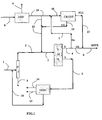
- the scheme of the figure 1 represents an initial charge distillation (D), a simulated moving bed adsorption unit (SMB), an isomerization unit (ISOM), a toluene selective disproportionation unit (DISP), and a unit (CRYST) of crystallization of paraxylene PX.
- the first aromatic charge including xylenes and typically a minor C9 / C10 fraction, enters line 1 in distillation (D). It is mixed with an isomerate flowing through line 16, and then fractionated into an overhead section through line 2, comprising most of PX, MX, ethylbenzene EB, and at least a portion of OX. At the bottom of the column, line 3 leaves a C9 / C10 hydrocarbon stream and the remaining part of the OX.
- the overhead section supplemented with streams from line 11 feeds simulated moving bed adsorption (SMB), typically at simulated countercurrent and at least 4 adsorption zones.
- SMB simulated moving bed adsorption
- the desorbent used (whose entry into the SMB is not shown) may be especially toluene or paradiethylbenzene, or any other selective solvent. It leaves the SMB unit an extract E *, which is distilled (not shown) to remove the solvent, which is recycled, and produce a distilled extract E by the line 4. It also outputs a raffinate R *, which is distilled (also not shown) to remove the solvent, which is recycled, and produce a distilled raffinate R through line 5.
- This extract E generally has, when the adsorbent is new, a purity of 99.85 and is obtained with a yield of 97%.
- E is then mixed with the crystallization effluent PX1 (crystallized paraxylene, separated from the mother liquor ML, typically washed and remelted, purity typical 99.7% to 99.8%) circulating in line 13. This yields high purity paraxylene HPPX. It is also possible to operate by pushing the charge rate of the SMB to produce an increased quantity of PX (extract E) of just satisfactory purity, for example between 99.7 and 99.75%.
- the distilled raffinate R containing OX, MX and EB feeds the isomerization, typically dealkylating (ISOM) via line 5, producing after distillation a small amount of incondensable light products via line 14 and benzene via line 15. Toluene can also be removed in mixture by the line 15 or by a separate line not referenced.
- C8 containing paraxylene (isomerate) are recycled to the inlet of column D through line 16. Often this isomerization recycling is subjected to a preliminary treatment with the earth, not shown, to remove traces of olefins present .
- a charge of toluene is also fed via line 8 in the unit (DISP) of selective disproportionation of toluene to benzene and xylenes (mainly PX).
- DISP unit of selective disproportionation of toluene to benzene and xylenes
- benzene is removed via line 9, and a C8 cut, rich in PX (about 85% by weight) is transferred via line 10 to the crystallization unit (CRYST).
- This unit produces PX of high purity (sufficient, for example between 99.7% and 99.85%) and ML mother liquor which is recycled to the unit (SMB) by lines 12 and 11.
- the plant produces, at the beginning of the cycle (maximum efficiency adsorbent), HPPX high purity PX in maximum quantity and / or purity (s) coming in parallel from the unit (SMB), whose purity of the distilled extract then typically exceeds or is close to 99.7%, and secondly of the crystallization unit.
- the flow rate of PX1 relative to that of E is then often between 8% and 40%, and preferably between 10% and 25% of E.
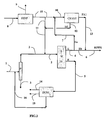
- the figure 2 represents the typical circulation of the various currents at the end of the cycle, when the adsorbent has aged, has a limited efficiency and / or selectivity, resulting in a (limited) drop in the purity of E below 99.7% by weight for example between about 99.45 and 99.7% by weight.
- the current E is divided into a stream Ea recycled on crystallization (CRYST) via line 7, and a complementary current Eb which continues to form a fraction of HPPX, but in a lower proportion than at the beginning of the cycle.
- the invention thus makes it possible to maintain target purity without having to stop the SMB unit, even when the purity of the extract of this unit falls below the target value.
- the invention therefore makes it possible to produce in a maximal way, and to maintain a high purity at the end of the cycle, without having to reduce substantially the production of HPPX.
- the invention also allows a considerable debottlenecking of existing installations that do not have these units, without having to modify or double the most expensive unit (SMB).
- SMB most expensive unit
- one unit can be used with two R1 * and R2 * raffinates instead of one, and / or one non-alkylating isomerization unit for ethylbenzene, and / or various configurations of crystallization units.
- the installation of the process according to Example 1 corresponds to that indicated in figure 1 , and comprises a single raffinate SMB unit, and dealkylating isomerization. However, the lines shown in dotted lines in this figure (line 7 and first part of line 11) are not included in this installation.
- the flow diagram remains the same, between the beginning of the cycle and the end of the cycle, but with a first load flow which decreases and a production of PX output SMB which decreases appreciably at the end of the cycle so as to be able to maintain the minimum required purity. (99.7%) for paraxylene.
- the efficiency of the SMB also drops as well as the production of benzene.
- Table 1 presents a material balance (in tonnes per hour) of the different flows referenced in figure 1 at the beginning of the cycle (new adsorbent), and Table 2 shows the same material balance but at the end of the cycle (used adsorbent, just before its replacement).
- PX paraxylene
- OX orthoxylene
- MX metaxylene
- EB ethylbenzene
- T toluene
- BZ benzene
- LPG C4 / C3, and possibly small amounts of C2 and C1.
- the invention makes it possible to maintain, at the end of the cycle, identical production without loss of paraxylene or of benzene. This leads to significant gains over the prior art.
- the purity of the paraxylene HPPX which was greater than 99.7% at the beginning of the cycle, simply dropped to the required value of 99.7% at the end of the cycle.
Landscapes
- Chemical & Material Sciences (AREA)
- Organic Chemistry (AREA)
- Chemical Kinetics & Catalysis (AREA)
- Engineering & Computer Science (AREA)
- Analytical Chemistry (AREA)
- Oil, Petroleum & Natural Gas (AREA)
- Water Supply & Treatment (AREA)
- Organic Low-Molecular-Weight Compounds And Preparation Thereof (AREA)
- Treatment Of Liquids With Adsorbents In General (AREA)
Applications Claiming Priority (2)
| Application Number | Priority Date | Filing Date | Title |
|---|---|---|---|
| FR0502621A FR2883283B1 (fr) | 2005-03-16 | 2005-03-16 | Procede de production combinee de paraxylene et de benzene de productivite amelioree |
| PCT/FR2006/000557 WO2006097618A1 (fr) | 2005-03-16 | 2006-03-14 | Procede de production combinee de paraxylene et de benzene de productivite amelioree |
Publications (2)
| Publication Number | Publication Date |
|---|---|
| EP1861344A1 EP1861344A1 (fr) | 2007-12-05 |
| EP1861344B1 true EP1861344B1 (fr) | 2008-12-10 |
Family
ID=35276165
Family Applications (1)
| Application Number | Title | Priority Date | Filing Date |
|---|---|---|---|
| EP06726084A Ceased EP1861344B1 (fr) | 2005-03-16 | 2006-03-14 | Procede de production combinee de paraxylene et de benzene de productivite amelioree |
Country Status (8)
| Country | Link |
|---|---|
| US (1) | US8030533B2 (enExample) |
| EP (1) | EP1861344B1 (enExample) |
| JP (1) | JP5205255B2 (enExample) |
| KR (1) | KR101284979B1 (enExample) |
| CN (1) | CN101253136B (enExample) |
| DE (1) | DE602006004195D1 (enExample) |
| FR (1) | FR2883283B1 (enExample) |
| WO (1) | WO2006097618A1 (enExample) |
Families Citing this family (26)
| Publication number | Priority date | Publication date | Assignee | Title |
|---|---|---|---|---|
| KR100843435B1 (ko) * | 2007-04-27 | 2008-07-03 | 삼성토탈 주식회사 | 유사 이동층 크실렌 혼합물 전처리 공정 및 추가의 크실렌이성질화 공정을 포함하는 방향족 화합물의 분리 방법 |
| KR100843436B1 (ko) * | 2007-04-27 | 2008-07-03 | 삼성토탈 주식회사 | 유사 이동층 크실렌 혼합물 전처리 공정 및 추가의 크실렌이성질화 공정을 포함하는 방향족 화합물의 분리 방법 |
| JP5142692B2 (ja) * | 2007-12-11 | 2013-02-13 | 株式会社東芝 | 不揮発性半導体記憶装置 |
| KR100963746B1 (ko) * | 2008-03-13 | 2010-06-14 | 삼성토탈 주식회사 | 유사 이동층 분리법에 의한 방향족 화합물의 분리방법 |
| US8609922B2 (en) * | 2010-08-25 | 2013-12-17 | Uop Llc | Energy conservation in heavy-hydrocarbon distillation |
| US8993825B2 (en) * | 2010-08-25 | 2015-03-31 | Uop Llc | Energy conservation in heavy-hydrocarbon distillation |
| US8754281B2 (en) * | 2010-08-25 | 2014-06-17 | Uop Llc | Energy conservation in heavy-hydrocarbon distillation |
| JP5876883B2 (ja) * | 2010-10-29 | 2016-03-02 | エクソンモービル ケミカル パテンツ インコーポレイテッド | パラキシレンの製造方法 |
| KR101530139B1 (ko) * | 2010-10-29 | 2015-06-18 | 엑손모빌 케미칼 패턴츠 인코포레이티드 | 정제된 자일렌 이성질체의 제조 방법 |
| FR2976501B1 (fr) | 2011-06-16 | 2013-05-31 | IFP Energies Nouvelles | Procede et dispositif de separation chromatographique a contre-courant simule utilisant deux adsorbeurs en parallele pour la production optimisee de paraxylene. |
| US8802914B2 (en) | 2011-12-15 | 2014-08-12 | Uop Llc | Process and apparatus for para-xylene production using multiple adsorptive separation units and a split fractionating column |
| US8558049B2 (en) | 2011-12-15 | 2013-10-15 | Uop Llc | Process and apparatus for para-xylene production using multiple adsorptive separation units and multiple adsorptive bed feed points |
| US8697928B2 (en) | 2011-12-15 | 2014-04-15 | Uop Llc | Process and apparatus for para-xylene production using multiple adsorptive separation units |
| US8937209B2 (en) | 2011-12-15 | 2015-01-20 | Uop Llc | Process and apparatus for para-xylene production using multiple adsorptive separation units with shared raffinate processing |
| US9469578B2 (en) | 2012-11-30 | 2016-10-18 | Exxonmobil Chemical Patents Inc. | Energy efficient processes for xylenes production |
| US9302955B2 (en) * | 2013-09-27 | 2016-04-05 | Uop Llc | Systems and methods for separating xylene isomers using selective adsorption |
| WO2016148755A1 (en) | 2015-03-19 | 2016-09-22 | Exxonmobil Chemical Patents Inc. | Process and apparatus for the production of para-xylene |
| KR101974770B1 (ko) * | 2015-04-30 | 2019-05-02 | 엑손모빌 케미칼 패턴츠 인코포레이티드 | 파라-자일렌의 제조를 위한 방법 및 장치 |
| CN108430958B (zh) * | 2015-12-16 | 2021-01-01 | 环球油品公司 | 用于芳族化合物复合设备中的甲苯甲基化的方法及装置 |
| CN111655355B (zh) * | 2017-12-05 | 2022-06-07 | 英力士美国化学公司 | 对二甲苯回收系统的改装方法 |
| KR102734157B1 (ko) * | 2018-07-20 | 2024-11-25 | 에스씨지 케미컬스 퍼블릭 컴퍼니 리미티드 | 파라-자일렌 생산을 위한 통합 공정 |
| CN111099954B (zh) * | 2018-10-25 | 2023-01-24 | 中国石油化工股份有限公司 | 对二甲苯的生产方法 |
| CN110283033B (zh) * | 2019-06-28 | 2021-11-02 | 中国石油天然气集团有限公司 | 多区协控微循环高容量吸附结晶耦合芳烃生产方法及系统 |
| CN110330403B (zh) * | 2019-06-28 | 2022-02-18 | 中国石油天然气集团有限公司 | 设有甲苯择形歧化的吸附结晶耦合芳烃生产方法及系统 |
| CN112824364B (zh) * | 2019-11-21 | 2023-01-03 | 中国石化工程建设有限公司 | 歧化烷基芳烃的方法 |
| US12358857B2 (en) | 2020-07-31 | 2025-07-15 | Exxonmobil Chemicals Patents Inc. | Processes for producing high-octane-number fuel component |
Family Cites Families (15)
| Publication number | Priority date | Publication date | Assignee | Title |
|---|---|---|---|---|
| US3699181A (en) * | 1968-12-19 | 1972-10-17 | Ashland Oil Inc | Alkyl transfer of alkyl aromatics with group vib metals on mordenite |
| US3813452A (en) * | 1972-10-20 | 1974-05-28 | Universal Oil Prod Co | Process for separating para-xylene |
| TW200454B (enExample) * | 1991-09-05 | 1993-02-21 | Inst Of France Petroleum | |
| JPH0611056A (ja) * | 1992-06-24 | 1994-01-21 | Tsukishima Kikai Co Ltd | 流路分配装置、疑似移動床および連続吸着法 |
| FR2719233B1 (fr) * | 1994-04-28 | 1996-07-19 | Inst Francais Du Petrole | Procédé de séparation en lit mobile simulé à débit de recyclage constant. |
| FR2721528B1 (fr) * | 1994-06-22 | 1996-09-06 | Inst Francais Du Petrole | Procédé de séparation par chromatographie en lit mobile simulé avec correction de volume mort par desynchronisation des périodes. |
| JPH08323104A (ja) * | 1995-05-30 | 1996-12-10 | Tsukishima Kikai Co Ltd | 流路分配装置、疑似移動床および連続吸着法 |
| FR2739375B1 (fr) * | 1995-09-29 | 1997-12-05 | Inst Francais Du Petrole | Production de paraxylene a partir d'un effluent de dismutation paraselective du toluene par un procede de cristallisation associe a une adsorption en lit mobile simule |
| FR2756751B1 (fr) * | 1996-12-05 | 1999-01-08 | Inst Francais Du Petrole | Dispositif de rincage dans une unite d'adsorption en lit mobile simule comprenant deux lignes de distribution de fluides et son utilisation |
| US6004452A (en) * | 1997-11-14 | 1999-12-21 | Chevron Chemical Company Llc | Process for converting hydrocarbon feed to high purity benzene and high purity paraxylene |
| FR2785196B1 (fr) * | 1998-10-29 | 2000-12-15 | Inst Francais Du Petrole | Procede et dispositif de separation avec des zones chromatographiques a longueur variable |
| JP2004050041A (ja) * | 2002-07-19 | 2004-02-19 | Sumitomo Chem Co Ltd | 充填槽の切り替え方法 |
| FR2862638B1 (fr) * | 2003-11-26 | 2005-12-30 | Inst Francais Du Petrole | Procede de production de paraxylene comprenant une etape d'adsorption et deux etapes d'isomerisation |
| KR100843436B1 (ko) * | 2007-04-27 | 2008-07-03 | 삼성토탈 주식회사 | 유사 이동층 크실렌 혼합물 전처리 공정 및 추가의 크실렌이성질화 공정을 포함하는 방향족 화합물의 분리 방법 |
| KR100963746B1 (ko) * | 2008-03-13 | 2010-06-14 | 삼성토탈 주식회사 | 유사 이동층 분리법에 의한 방향족 화합물의 분리방법 |
-
2005
- 2005-03-16 FR FR0502621A patent/FR2883283B1/fr not_active Expired - Fee Related
-
2006
- 2006-03-14 DE DE602006004195T patent/DE602006004195D1/de active Active
- 2006-03-14 WO PCT/FR2006/000557 patent/WO2006097618A1/fr not_active Ceased
- 2006-03-14 KR KR1020077023584A patent/KR101284979B1/ko not_active Expired - Fee Related
- 2006-03-14 JP JP2008501363A patent/JP5205255B2/ja not_active Expired - Fee Related
- 2006-03-14 US US11/908,704 patent/US8030533B2/en not_active Expired - Fee Related
- 2006-03-14 CN CN2006800080391A patent/CN101253136B/zh not_active Expired - Fee Related
- 2006-03-14 EP EP06726084A patent/EP1861344B1/fr not_active Ceased
Also Published As
| Publication number | Publication date |
|---|---|
| JP2008538106A (ja) | 2008-10-09 |
| CN101253136A (zh) | 2008-08-27 |
| FR2883283B1 (fr) | 2007-05-18 |
| KR101284979B1 (ko) | 2013-07-10 |
| JP5205255B2 (ja) | 2013-06-05 |
| CN101253136B (zh) | 2012-08-15 |
| FR2883283A1 (fr) | 2006-09-22 |
| DE602006004195D1 (de) | 2009-01-22 |
| KR20070110558A (ko) | 2007-11-19 |
| US8030533B2 (en) | 2011-10-04 |
| US20090069612A1 (en) | 2009-03-12 |
| EP1861344A1 (fr) | 2007-12-05 |
| WO2006097618A1 (fr) | 2006-09-21 |
Similar Documents
| Publication | Publication Date | Title |
|---|---|---|
| EP1861344B1 (fr) | Procede de production combinee de paraxylene et de benzene de productivite amelioree | |
| EP3169653B1 (fr) | Procédé de production de paraxylène à haute pureté à partir d'une coupe xylènes, utilisant deux unités de séparation en lit mobile simulé fonctionnant en série et deux unités d'isomérisation | |
| EP3169654B1 (fr) | Procédé de production de paraxylène comprenant deux unités de séparation en lit mobile simulé et deux unités d'isomérisation dont l'une en phase gaz | |
| EP1689695B1 (fr) | Procede de production de paraxylene comprenant une etape d'adsorption et deux etapes d' isomerisation | |
| EP0800499B1 (fr) | Procede de separation de paraxylene comportant au moins deux etages de cristallisation a haute temperature | |
| EP3169655B1 (fr) | Procédé de production de paraxylène à haute pureté à partir d'une coupe xylène, procédé utilisant une unité de séparation en lit mobile simulé et deux unités d'isomérisation, l'une en phase gaz l'autre en phase liquide | |
| EP0804394B1 (fr) | Procede de production de paraxylene comportant une cristallisation a haute temperature a au moins un etage et une fusion partielle des cristaux | |
| EP1245552B1 (fr) | Procédé de coproduction de para-xylène et de méta-xylène comprenant deux étapes de séparation | |
| JP6085002B2 (ja) | 溶融結晶化分離及び精製方法 | |
| FR2915481A1 (fr) | Procede de production de metaxylene a haute purete comprenant une adsorption en lit mobile simule et une cristallisation | |
| FR2795069A1 (fr) | Procede de coproduction et de separation d'ethylbenzene et de paraxylene | |
| EP2970048B1 (en) | Process for recovering paraxylene from at least two feedstreams containing xylene isomers | |
| EP3587384B1 (fr) | Procédé de production de paraxylène utilisant une étape en lit mobile simulé, et une étape de fractionnement via une colonne de 3 coupes | |
| FR2782714A1 (fr) | Procede de coproduction de metaxylene et de paraxylene | |
| CA2209100C (fr) | Procede de separation de paraxylene comportant au moins un etage de cristallisation a haute temperature et au moins un traitement a la terre situe en amont de la zone d'adsorption | |
| FR2773149A1 (fr) | Procede de coproduction et de separation d'ethylbenzene et de paraxylene | |
| EP3814307B1 (fr) | Procede de production de paraxylene utilisant une etape en lit mobile simule, et une etape de fractionnement de deux fractions dans une colonnes de 2 coupes | |
| EP3428141B1 (fr) | Nouveau schema de production de benzene a partir de reformat sans colonne de toluene |
Legal Events
| Date | Code | Title | Description |
|---|---|---|---|
| PUAI | Public reference made under article 153(3) epc to a published international application that has entered the european phase |
Free format text: ORIGINAL CODE: 0009012 |
|
| 17P | Request for examination filed |
Effective date: 20071016 |
|
| AK | Designated contracting states |
Kind code of ref document: A1 Designated state(s): DE FR IT NL |
|
| 17Q | First examination report despatched |
Effective date: 20080122 |
|
| DAX | Request for extension of the european patent (deleted) | ||
| RBV | Designated contracting states (corrected) |
Designated state(s): DE FR IT NL |
|
| GRAP | Despatch of communication of intention to grant a patent |
Free format text: ORIGINAL CODE: EPIDOSNIGR1 |
|
| GRAS | Grant fee paid |
Free format text: ORIGINAL CODE: EPIDOSNIGR3 |
|
| GRAS | Grant fee paid |
Free format text: ORIGINAL CODE: EPIDOSNIGR3 |
|
| GRAA | (expected) grant |
Free format text: ORIGINAL CODE: 0009210 |
|
| AK | Designated contracting states |
Kind code of ref document: B1 Designated state(s): DE FR IT NL |
|
| REF | Corresponds to: |
Ref document number: 602006004195 Country of ref document: DE Date of ref document: 20090122 Kind code of ref document: P |
|
| PLBE | No opposition filed within time limit |
Free format text: ORIGINAL CODE: 0009261 |
|
| STAA | Information on the status of an ep patent application or granted ep patent |
Free format text: STATUS: NO OPPOSITION FILED WITHIN TIME LIMIT |
|
| 26N | No opposition filed |
Effective date: 20090911 |
|
| REG | Reference to a national code |
Ref country code: FR Ref legal event code: CD |
|
| REG | Reference to a national code |
Ref country code: FR Ref legal event code: ST Effective date: 20101130 |
|
| PG25 | Lapsed in a contracting state [announced via postgrant information from national office to epo] |
Ref country code: FR Free format text: LAPSE BECAUSE OF NON-PAYMENT OF DUE FEES Effective date: 20100331 |
|
| REG | Reference to a national code |
Ref country code: DE Ref legal event code: R081 Ref document number: 602006004195 Country of ref document: DE Owner name: IFP ENERGIES NOUVELLES, FR Free format text: FORMER OWNER: INSTITUT FRANCAIS DU PETROLE, RUEIL-MALMAISON, HAUTS-DE-SEINE, FR Effective date: 20110331 Ref country code: DE Ref legal event code: R081 Ref document number: 602006004195 Country of ref document: DE Owner name: IFP ENERGIES NOUVELLES, FR Free format text: FORMER OWNER: INSTITUT FRANCAIS DU PETROLE, RUEIL-MALMAISON, FR Effective date: 20110331 |
|
| REG | Reference to a national code |
Ref country code: FR Ref legal event code: RN Effective date: 20121217 |
|
| REG | Reference to a national code |
Ref country code: FR Ref legal event code: D3 Effective date: 20120509 |
|
| PGRI | Patent reinstated in contracting state [announced from national office to epo] |
Ref country code: FR Effective date: 20120509 |
|
| REG | Reference to a national code |
Ref country code: FR Ref legal event code: PLFP Year of fee payment: 11 |
|
| REG | Reference to a national code |
Ref country code: FR Ref legal event code: PLFP Year of fee payment: 12 |
|
| REG | Reference to a national code |
Ref country code: FR Ref legal event code: PLFP Year of fee payment: 13 |
|
| PGFP | Annual fee paid to national office [announced via postgrant information from national office to epo] |
Ref country code: NL Payment date: 20220325 Year of fee payment: 17 Ref country code: IT Payment date: 20220323 Year of fee payment: 17 Ref country code: FR Payment date: 20220325 Year of fee payment: 17 |
|
| PGFP | Annual fee paid to national office [announced via postgrant information from national office to epo] |
Ref country code: DE Payment date: 20220428 Year of fee payment: 17 |
|
| REG | Reference to a national code |
Ref country code: DE Ref legal event code: R119 Ref document number: 602006004195 Country of ref document: DE |
|
| REG | Reference to a national code |
Ref country code: NL Ref legal event code: MM Effective date: 20230401 |
|
| PG25 | Lapsed in a contracting state [announced via postgrant information from national office to epo] |
Ref country code: NL Free format text: LAPSE BECAUSE OF NON-PAYMENT OF DUE FEES Effective date: 20230401 |
|
| PG25 | Lapsed in a contracting state [announced via postgrant information from national office to epo] |
Ref country code: FR Free format text: LAPSE BECAUSE OF NON-PAYMENT OF DUE FEES Effective date: 20230331 Ref country code: DE Free format text: LAPSE BECAUSE OF NON-PAYMENT OF DUE FEES Effective date: 20231003 |
|
| PG25 | Lapsed in a contracting state [announced via postgrant information from national office to epo] |
Ref country code: IT Free format text: LAPSE BECAUSE OF NON-PAYMENT OF DUE FEES Effective date: 20230314 |