EP1848524B1 - Targeted duct injection for so3 control - Google Patents
Targeted duct injection for so3 control Download PDFInfo
- Publication number
- EP1848524B1 EP1848524B1 EP06720288.7A EP06720288A EP1848524B1 EP 1848524 B1 EP1848524 B1 EP 1848524B1 EP 06720288 A EP06720288 A EP 06720288A EP 1848524 B1 EP1848524 B1 EP 1848524B1
- Authority
- EP
- European Patent Office
- Prior art keywords
- reagent
- combustion
- process according
- catalyst
- magnesium hydroxide
- Prior art date
- Legal status (The legal status is an assumption and is not a legal conclusion. Google has not performed a legal analysis and makes no representation as to the accuracy of the status listed.)
- Not-in-force
Links
- 238000002347 injection Methods 0.000 title description 4
- 239000007924 injection Substances 0.000 title description 4
- 239000003153 chemical reaction reagent Substances 0.000 claims description 32
- 239000003054 catalyst Substances 0.000 claims description 28
- 238000000034 method Methods 0.000 claims description 23
- 238000002485 combustion reaction Methods 0.000 claims description 17
- 239000000446 fuel Substances 0.000 claims description 16
- VTHJTEIRLNZDEV-UHFFFAOYSA-L magnesium dihydroxide Chemical compound [OH-].[OH-].[Mg+2] VTHJTEIRLNZDEV-UHFFFAOYSA-L 0.000 claims description 15
- 239000000347 magnesium hydroxide Substances 0.000 claims description 15
- 229910001862 magnesium hydroxide Inorganic materials 0.000 claims description 15
- 238000006722 reduction reaction Methods 0.000 claims description 13
- 239000003795 chemical substances by application Substances 0.000 claims description 12
- 239000002245 particle Substances 0.000 claims description 11
- 239000000567 combustion gas Substances 0.000 claims description 9
- NINIDFKCEFEMDL-UHFFFAOYSA-N Sulfur Chemical compound [S] NINIDFKCEFEMDL-UHFFFAOYSA-N 0.000 claims description 8
- 229910052717 sulfur Inorganic materials 0.000 claims description 8
- 239000011593 sulfur Substances 0.000 claims description 8
- 238000010531 catalytic reduction reaction Methods 0.000 claims description 6
- 239000012530 fluid Substances 0.000 claims description 6
- QJGQUHMNIGDVPM-UHFFFAOYSA-N nitrogen group Chemical group [N] QJGQUHMNIGDVPM-UHFFFAOYSA-N 0.000 claims description 6
- 230000003647 oxidation Effects 0.000 claims description 6
- 238000007254 oxidation reaction Methods 0.000 claims description 6
- 238000011282 treatment Methods 0.000 claims description 6
- 238000010438 heat treatment Methods 0.000 claims description 5
- 239000002105 nanoparticle Substances 0.000 claims description 5
- 239000002002 slurry Substances 0.000 claims description 4
- QVGXLLKOCUKJST-UHFFFAOYSA-N atomic oxygen Chemical compound [O] QVGXLLKOCUKJST-UHFFFAOYSA-N 0.000 claims description 3
- 239000001301 oxygen Substances 0.000 claims description 3
- 229910052760 oxygen Inorganic materials 0.000 claims description 3
- 238000011144 upstream manufacturing Methods 0.000 claims description 2
- AKEJUJNQAAGONA-UHFFFAOYSA-N sulfur trioxide Chemical compound O=S(=O)=O AKEJUJNQAAGONA-UHFFFAOYSA-N 0.000 description 88
- MWUXSHHQAYIFBG-UHFFFAOYSA-N nitrogen oxide Inorganic materials O=[N] MWUXSHHQAYIFBG-UHFFFAOYSA-N 0.000 description 78
- QGZKDVFQNNGYKY-UHFFFAOYSA-N Ammonia Chemical compound N QGZKDVFQNNGYKY-UHFFFAOYSA-N 0.000 description 33
- 229910021529 ammonia Inorganic materials 0.000 description 15
- XSQUKJJJFZCRTK-UHFFFAOYSA-N Urea Chemical compound NC(N)=O XSQUKJJJFZCRTK-UHFFFAOYSA-N 0.000 description 10
- 239000004202 carbamide Substances 0.000 description 10
- 239000007789 gas Substances 0.000 description 10
- XLYOFNOQVPJJNP-UHFFFAOYSA-N water Chemical compound O XLYOFNOQVPJJNP-UHFFFAOYSA-N 0.000 description 10
- 239000002253 acid Substances 0.000 description 9
- 238000005260 corrosion Methods 0.000 description 8
- 230000007797 corrosion Effects 0.000 description 8
- 230000008901 benefit Effects 0.000 description 7
- 239000007787 solid Substances 0.000 description 7
- 239000000126 substance Substances 0.000 description 7
- QAOWNCQODCNURD-UHFFFAOYSA-N Sulfuric acid Chemical compound OS(O)(=O)=O QAOWNCQODCNURD-UHFFFAOYSA-N 0.000 description 6
- 239000000243 solution Substances 0.000 description 6
- 239000000463 material Substances 0.000 description 5
- 239000003921 oil Substances 0.000 description 5
- IJGRMHOSHXDMSA-UHFFFAOYSA-N Atomic nitrogen Chemical compound N#N IJGRMHOSHXDMSA-UHFFFAOYSA-N 0.000 description 4
- 238000005516 engineering process Methods 0.000 description 4
- 239000000376 reactant Substances 0.000 description 4
- OKTJSMMVPCPJKN-UHFFFAOYSA-N Carbon Chemical compound [C] OKTJSMMVPCPJKN-UHFFFAOYSA-N 0.000 description 3
- 238000009825 accumulation Methods 0.000 description 3
- BFNBIHQBYMNNAN-UHFFFAOYSA-N ammonium sulfate Chemical compound N.N.OS(O)(=O)=O BFNBIHQBYMNNAN-UHFFFAOYSA-N 0.000 description 3
- 229910052921 ammonium sulfate Inorganic materials 0.000 description 3
- 235000011130 ammonium sulphate Nutrition 0.000 description 3
- 238000006243 chemical reaction Methods 0.000 description 3
- 239000007788 liquid Substances 0.000 description 3
- 238000004519 manufacturing process Methods 0.000 description 3
- 229910052751 metal Inorganic materials 0.000 description 3
- 239000002184 metal Substances 0.000 description 3
- 239000000203 mixture Substances 0.000 description 3
- 230000001590 oxidative effect Effects 0.000 description 3
- 239000000443 aerosol Substances 0.000 description 2
- BIGPRXCJEDHCLP-UHFFFAOYSA-N ammonium bisulfate Chemical compound [NH4+].OS([O-])(=O)=O BIGPRXCJEDHCLP-UHFFFAOYSA-N 0.000 description 2
- 230000003197 catalytic effect Effects 0.000 description 2
- 238000006555 catalytic reaction Methods 0.000 description 2
- -1 e.g. Substances 0.000 description 2
- 230000000694 effects Effects 0.000 description 2
- 229910052602 gypsum Inorganic materials 0.000 description 2
- 239000010440 gypsum Substances 0.000 description 2
- QAOWNCQODCNURD-UHFFFAOYSA-M hydrogensulfate Chemical compound OS([O-])(=O)=O QAOWNCQODCNURD-UHFFFAOYSA-M 0.000 description 2
- VNWKTOKETHGBQD-UHFFFAOYSA-N methane Chemical compound C VNWKTOKETHGBQD-UHFFFAOYSA-N 0.000 description 2
- 239000003595 mist Substances 0.000 description 2
- 229910000069 nitrogen hydride Inorganic materials 0.000 description 2
- OYPRJOBELJOOCE-UHFFFAOYSA-N Calcium Chemical compound [Ca] OYPRJOBELJOOCE-UHFFFAOYSA-N 0.000 description 1
- UXVMQQNJUSDDNG-UHFFFAOYSA-L Calcium chloride Chemical compound [Cl-].[Cl-].[Ca+2] UXVMQQNJUSDDNG-UHFFFAOYSA-L 0.000 description 1
- UGFAIRIUMAVXCW-UHFFFAOYSA-N Carbon monoxide Chemical compound [O+]#[C-] UGFAIRIUMAVXCW-UHFFFAOYSA-N 0.000 description 1
- 235000008733 Citrus aurantifolia Nutrition 0.000 description 1
- RYGMFSIKBFXOCR-UHFFFAOYSA-N Copper Chemical compound [Cu] RYGMFSIKBFXOCR-UHFFFAOYSA-N 0.000 description 1
- ZOKXTWBITQBERF-UHFFFAOYSA-N Molybdenum Chemical compound [Mo] ZOKXTWBITQBERF-UHFFFAOYSA-N 0.000 description 1
- 229910000831 Steel Inorganic materials 0.000 description 1
- 235000011941 Tilia x europaea Nutrition 0.000 description 1
- RTAQQCXQSZGOHL-UHFFFAOYSA-N Titanium Chemical compound [Ti] RTAQQCXQSZGOHL-UHFFFAOYSA-N 0.000 description 1
- 230000002411 adverse Effects 0.000 description 1
- 239000003513 alkali Substances 0.000 description 1
- 239000007864 aqueous solution Substances 0.000 description 1
- 238000000149 argon plasma sintering Methods 0.000 description 1
- 230000009286 beneficial effect Effects 0.000 description 1
- 230000033228 biological regulation Effects 0.000 description 1
- 230000015572 biosynthetic process Effects 0.000 description 1
- 239000012267 brine Substances 0.000 description 1
- 229910052791 calcium Inorganic materials 0.000 description 1
- 239000011575 calcium Substances 0.000 description 1
- YLUIKWVQCKSMCF-UHFFFAOYSA-N calcium;magnesium;oxygen(2-) Chemical compound [O-2].[O-2].[Mg+2].[Ca+2] YLUIKWVQCKSMCF-UHFFFAOYSA-N 0.000 description 1
- 229910052799 carbon Inorganic materials 0.000 description 1
- 239000003518 caustics Substances 0.000 description 1
- 239000003638 chemical reducing agent Substances 0.000 description 1
- 238000004140 cleaning Methods 0.000 description 1
- 239000003245 coal Substances 0.000 description 1
- 239000000571 coke Substances 0.000 description 1
- 230000002860 competitive effect Effects 0.000 description 1
- 238000009833 condensation Methods 0.000 description 1
- 230000005494 condensation Effects 0.000 description 1
- 229910052802 copper Inorganic materials 0.000 description 1
- 239000010949 copper Substances 0.000 description 1
- 230000008021 deposition Effects 0.000 description 1
- 239000003085 diluting agent Substances 0.000 description 1
- 238000010790 dilution Methods 0.000 description 1
- 239000012895 dilution Substances 0.000 description 1
- 238000009826 distribution Methods 0.000 description 1
- 230000005496 eutectics Effects 0.000 description 1
- 239000003546 flue gas Substances 0.000 description 1
- 239000010881 fly ash Substances 0.000 description 1
- 239000010763 heavy fuel oil Substances 0.000 description 1
- 239000000413 hydrolysate Substances 0.000 description 1
- 239000004571 lime Substances 0.000 description 1
- 150000002681 magnesium compounds Chemical class 0.000 description 1
- 230000008018 melting Effects 0.000 description 1
- 238000002844 melting Methods 0.000 description 1
- 150000002739 metals Chemical class 0.000 description 1
- 229910052750 molybdenum Inorganic materials 0.000 description 1
- 239000011733 molybdenum Substances 0.000 description 1
- 239000003345 natural gas Substances 0.000 description 1
- 229910052757 nitrogen Inorganic materials 0.000 description 1
- 239000010815 organic waste Substances 0.000 description 1
- 239000013520 petroleum-based product Substances 0.000 description 1
- 238000010248 power generation Methods 0.000 description 1
- 150000003839 salts Chemical class 0.000 description 1
- 239000013535 sea water Substances 0.000 description 1
- 238000000926 separation method Methods 0.000 description 1
- HPALAKNZSZLMCH-UHFFFAOYSA-M sodium;chloride;hydrate Chemical compound O.[Na+].[Cl-] HPALAKNZSZLMCH-UHFFFAOYSA-M 0.000 description 1
- 238000005507 spraying Methods 0.000 description 1
- 239000003381 stabilizer Substances 0.000 description 1
- 239000010959 steel Substances 0.000 description 1
- 238000003860 storage Methods 0.000 description 1
- 229910052815 sulfur oxide Inorganic materials 0.000 description 1
- 230000004083 survival effect Effects 0.000 description 1
- 229910052719 titanium Inorganic materials 0.000 description 1
- 239000010936 titanium Substances 0.000 description 1
- WFKWXMTUELFFGS-UHFFFAOYSA-N tungsten Chemical compound [W] WFKWXMTUELFFGS-UHFFFAOYSA-N 0.000 description 1
- 229910052721 tungsten Inorganic materials 0.000 description 1
- 239000010937 tungsten Substances 0.000 description 1
- 229910052720 vanadium Inorganic materials 0.000 description 1
- GPPXJZIENCGNKB-UHFFFAOYSA-N vanadium Chemical compound [V]#[V] GPPXJZIENCGNKB-UHFFFAOYSA-N 0.000 description 1
Images
Classifications
-
- B—PERFORMING OPERATIONS; TRANSPORTING
- B01—PHYSICAL OR CHEMICAL PROCESSES OR APPARATUS IN GENERAL
- B01D—SEPARATION
- B01D53/00—Separation of gases or vapours; Recovering vapours of volatile solvents from gases; Chemical or biological purification of waste gases, e.g. engine exhaust gases, smoke, fumes, flue gases, aerosols
- B01D53/34—Chemical or biological purification of waste gases
- B01D53/46—Removing components of defined structure
- B01D53/48—Sulfur compounds
- B01D53/50—Sulfur oxides
- B01D53/508—Sulfur oxides by treating the gases with solids
-
- B—PERFORMING OPERATIONS; TRANSPORTING
- B01—PHYSICAL OR CHEMICAL PROCESSES OR APPARATUS IN GENERAL
- B01D—SEPARATION
- B01D53/00—Separation of gases or vapours; Recovering vapours of volatile solvents from gases; Chemical or biological purification of waste gases, e.g. engine exhaust gases, smoke, fumes, flue gases, aerosols
- B01D53/34—Chemical or biological purification of waste gases
- B01D53/46—Removing components of defined structure
- B01D53/48—Sulfur compounds
- B01D53/50—Sulfur oxides
- B01D53/501—Sulfur oxides by treating the gases with a solution or a suspension of an alkali or earth-alkali or ammonium compound
- B01D53/505—Sulfur oxides by treating the gases with a solution or a suspension of an alkali or earth-alkali or ammonium compound in a spray drying process
-
- B—PERFORMING OPERATIONS; TRANSPORTING
- B01—PHYSICAL OR CHEMICAL PROCESSES OR APPARATUS IN GENERAL
- B01D—SEPARATION
- B01D53/00—Separation of gases or vapours; Recovering vapours of volatile solvents from gases; Chemical or biological purification of waste gases, e.g. engine exhaust gases, smoke, fumes, flue gases, aerosols
- B01D53/34—Chemical or biological purification of waste gases
- B01D53/46—Removing components of defined structure
- B01D53/54—Nitrogen compounds
- B01D53/56—Nitrogen oxides
-
- B—PERFORMING OPERATIONS; TRANSPORTING
- B01—PHYSICAL OR CHEMICAL PROCESSES OR APPARATUS IN GENERAL
- B01D—SEPARATION
- B01D53/00—Separation of gases or vapours; Recovering vapours of volatile solvents from gases; Chemical or biological purification of waste gases, e.g. engine exhaust gases, smoke, fumes, flue gases, aerosols
- B01D53/34—Chemical or biological purification of waste gases
- B01D53/46—Removing components of defined structure
- B01D53/60—Simultaneously removing sulfur oxides and nitrogen oxides
-
- B—PERFORMING OPERATIONS; TRANSPORTING
- B01—PHYSICAL OR CHEMICAL PROCESSES OR APPARATUS IN GENERAL
- B01D—SEPARATION
- B01D53/00—Separation of gases or vapours; Recovering vapours of volatile solvents from gases; Chemical or biological purification of waste gases, e.g. engine exhaust gases, smoke, fumes, flue gases, aerosols
- B01D53/34—Chemical or biological purification of waste gases
- B01D53/74—General processes for purification of waste gases; Apparatus or devices specially adapted therefor
- B01D53/86—Catalytic processes
- B01D53/8603—Removing sulfur compounds
- B01D53/8609—Sulfur oxides
-
- B—PERFORMING OPERATIONS; TRANSPORTING
- B01—PHYSICAL OR CHEMICAL PROCESSES OR APPARATUS IN GENERAL
- B01D—SEPARATION
- B01D53/00—Separation of gases or vapours; Recovering vapours of volatile solvents from gases; Chemical or biological purification of waste gases, e.g. engine exhaust gases, smoke, fumes, flue gases, aerosols
- B01D53/34—Chemical or biological purification of waste gases
- B01D53/74—General processes for purification of waste gases; Apparatus or devices specially adapted therefor
- B01D53/86—Catalytic processes
- B01D53/8621—Removing nitrogen compounds
- B01D53/8625—Nitrogen oxides
-
- B—PERFORMING OPERATIONS; TRANSPORTING
- B01—PHYSICAL OR CHEMICAL PROCESSES OR APPARATUS IN GENERAL
- B01D—SEPARATION
- B01D2251/00—Reactants
- B01D2251/20—Reductants
- B01D2251/206—Ammonium compounds
- B01D2251/2062—Ammonia
-
- B—PERFORMING OPERATIONS; TRANSPORTING
- B01—PHYSICAL OR CHEMICAL PROCESSES OR APPARATUS IN GENERAL
- B01D—SEPARATION
- B01D2251/00—Reactants
- B01D2251/20—Reductants
- B01D2251/206—Ammonium compounds
- B01D2251/2067—Urea
-
- B—PERFORMING OPERATIONS; TRANSPORTING
- B01—PHYSICAL OR CHEMICAL PROCESSES OR APPARATUS IN GENERAL
- B01D—SEPARATION
- B01D2251/00—Reactants
- B01D2251/40—Alkaline earth metal or magnesium compounds
- B01D2251/402—Alkaline earth metal or magnesium compounds of magnesium
-
- B—PERFORMING OPERATIONS; TRANSPORTING
- B01—PHYSICAL OR CHEMICAL PROCESSES OR APPARATUS IN GENERAL
- B01D—SEPARATION
- B01D2251/00—Reactants
- B01D2251/60—Inorganic bases or salts
- B01D2251/604—Hydroxides
-
- B—PERFORMING OPERATIONS; TRANSPORTING
- B82—NANOTECHNOLOGY
- B82Y—SPECIFIC USES OR APPLICATIONS OF NANOSTRUCTURES; MEASUREMENT OR ANALYSIS OF NANOSTRUCTURES; MANUFACTURE OR TREATMENT OF NANOSTRUCTURES
- B82Y30/00—Nanotechnology for materials or surface science, e.g. nanocomposites
-
- Y—GENERAL TAGGING OF NEW TECHNOLOGICAL DEVELOPMENTS; GENERAL TAGGING OF CROSS-SECTIONAL TECHNOLOGIES SPANNING OVER SEVERAL SECTIONS OF THE IPC; TECHNICAL SUBJECTS COVERED BY FORMER USPC CROSS-REFERENCE ART COLLECTIONS [XRACs] AND DIGESTS
- Y02—TECHNOLOGIES OR APPLICATIONS FOR MITIGATION OR ADAPTATION AGAINST CLIMATE CHANGE
- Y02A—TECHNOLOGIES FOR ADAPTATION TO CLIMATE CHANGE
- Y02A50/00—TECHNOLOGIES FOR ADAPTATION TO CLIMATE CHANGE in human health protection, e.g. against extreme weather
- Y02A50/20—Air quality improvement or preservation, e.g. vehicle emission control or emission reduction by using catalytic converters
Definitions
- the invention relates to a process that eliminates constraints on proven NO x and SO 3 reduction technology, by providing a specialized treatment with efficiently controlled reagent introduction for maintaining economy while addressing serious emissions control problems.
- Nitrogen oxides are invariably formed with combustion and are often treated by selective non catalytic reactions (SNCR) or selective catalytic reactions (SCR). Burning other fuels, like No. 6 oil, will create NO x and can cause other problems for boiler operators - including high temperature slagging/fouling and related eutectic corrosion, cold end corrosion/fouling and opacity issues related to carbon particulate and acid mist.
- sulfur in the oil e.g ., 1-5%
- SO 3 sulfur trioxide
- SO 3 can condense as sulfuric acid on the back end surfaces (where the temperature has typically been reduced to less than about 150 °C) and promote corrosion and acid plume.
- SO 3 can be result from oxidation by SCR catalysts.
- SO 3 vapor readily converts to gaseous sulfuric acid when combined with water vapor in the flue gas. As gas and surface temperatures cool through the system the SO 3 , vapors form a fine aerosol mist of sulfuric acid.
- the acid aerosol contains sub-micron particles of acid, which can evade separation or capture in gas cleaning devices and exit the stack. Even relatively low SO 3 concentrations exiting the stack cause significant light scattering and can easily create a visible plume and high opacity reading. As a general rule, every 1 part per million by volume of SO 3 will contribute from 1 to 3 % opacity. Thus, exhaust gas concentrations of only 10 to 20 ppm SO 3 can cause opacity and acid plume problems.
- deposition or formation of acid on any metal surfaces below the acid dew point causes corrosion within the unit, such as at the air heater, duct work and stack liners.
- an SCR unit can further exacerbate the SO 3 problem by oxidizing SO 2 to SO 3 . It is not uncommon for the SO 3 levels to double (or more) across the SCR catalyst
- a suitable catalyst which reduces the NO x to nitrogen (N 2 ) and water (H 2 O) by a reagent comprising ammonia (NH 3 ), urea [(NH 2 )CO(NH 2 )], or the like.
- the catalyst effective to reduce the NO x in the presence of these reagents also strongly promotes the oxidation of SO 2 to SO 3 .
- SO 2 can also be oxidized to SO 3 by other equipment There is a clear need to reduce NO x , but the SO 3 burden created by an SCR or other oxidizing unit must also be controlled.
- SCR units are large and costly. To be effective, they must operate at relatively low temperatures and often fill all available space between the combustor and an air heater which uses residual heating capacity of the effluent to heat incoming combustion air. Because of the typical low temperature operation and the presence of significant SO 3 concentrations following an SCR unit, it is sometimes necessary to heat the effluent to avoid corrosion, plume, opacity and related problems. Heating in this manner is a further source of inefficiency, and it would be beneficial if there were a way to avoid it.
- SO 3 has been reduced by introducing an SO 3 treatment agent like magnesium hydroxide at appropriate positions in the duct work. Not all alkaline treatment agents will be useful because SO 3 also reacts with water vapor and ammonia used for the SCR reaction to form ammonium sulfate and ammonium bisulfate. Both of these ammonia salts can cause fouling and corrosion problems in the system.
- Ammonium bisulfate has a melting point under 149°C (300°F) and ammonium sulfate at just over 232°C (450°F), making both molten or tacky at typical SCR and air heater operating temperatures and making it possible for them to coat, foul and corrode the air heater.
- US 2004018133 describes introducing magnesium compounds into the furnace to react with SO 3 within the furnace.
- a yet further but more specific object is to effectively make use of reagents of nano-sized particles of SO 3 reagent and CFD to maximize SO 3 reduction while minimizing chemical consumption.
- the invention provides a process for reducing NO x and SO 3 emissions from combustion of a sulfur containing carbonaceous fuel in the combustion zone of a combustor, comprising: combusting a sulfur containing carbonaceous fuel with an overall excess of oxygen to form combustion gases comprising NO x and SO 2 ; introducing a nitrogen containing NO x control agent into the combustion gases at a point upstream of a selective catalytic reduction catalyst for reduction of NO x ; and following the catalyst and prior to contact with an air heater for heating incoming combustion air, introducing magnesium hydroxide in amounts and with droplet sizes and concentrations effective to form nano-sized particles in the effluent and reduce SO 3 caused by the oxidation of SO 2 in the catalyst.
- computational fluid dynamics is employed to determine flow rates and select reagent introduction rates, reagent introduction location(s), reagent concentration, reagent droplet size and/or reagent momentum.
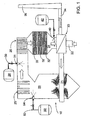
- Figure 1 is a schematic view of one embodiment of the invention.
- Figure 1 shows a large combuster 10 of the type used for producing steam for electrical power generation, process steam, heating or incineration.
- Fuel (from a source not shown) is burned with air in a combustion zone 20.
- the fuel can be any combustible material, including gas, oil, coal, organic waste or any other combustible material suitable for the combuster.
- the process of the invention has particular advantage with fuels, such as petroleum based products containing sulfur, e.g ., in amounts of 500 ppm or more, and 1% to 5% in particular.
- residual, typically heavy fuels e.g ., residual fuels like No. 4, 5 and 6 oils.
- oils are characterized by high viscosities, being just barely pourable or unpourable at 21°C (70°F), contain significant sulfur and high levels of condensed aromatics and tend to be difficult to combust fully and cleanly.
- the air, supplied by duct 21, is preferably brought in via duct 22 and preheated by a gas-to-gas heat exchanger 23 which transfers heat from duct 24 at the exit end of the combuster.
- Hot combustion gases rise and flow past heat exchangers 25, which transfer heat from the combustion gases to water for the generation of steam.
- Other heat exchangers, including economizer 26 may also be provided according to the design of the particular boiler.
- the combustion gases will contain NO x , which is generated by the heat of combustion alone or due to the presence of nitrogen-containing compounds in the fuel. They will also contain SO x , principally as SO 2 .
- a suitable nitrogen containing NO x control agent such as ammonia or aqueous urea is introduced from a suitable source 28 through line with valve 30.
- the urea can be introduced at a temperature suitable for SNCR with residual ammonia or other gaseous NO x reducing species passing through the duct to SCR catalyst units 32,32' and 32".
- Techniques have been developed, inter alia, for SCR using ammonia with a variety of catalysts (e.g., Kato et al. in U.S. Patent 4,138,469 and Henke in U.S. Patent 4,393,031 ), hybrids of SCR and SNCR (e.g., Hofmann, et al., U.S.
- Patent 5,139,754 multi-level SNCR injection (e.g., Epperly, et al., U.S. Patent 4,777,024 ) utilizing urea, a hydrolysate of urea or ammonia, or a related chemical such as any of those described by any of these.
- catalysts suitable for the NO x reduction are those advertised for this purpose by the manufacturers.
- useful SCR catalysts are those described in the representative reference processes herein.
- Selective catalytic reduction processes for reducing NO x are well known and utilize a variety of catalytic agents.
- Eichholtz and Weiler discuss the catalytic removal of nitrogen oxides using activated charcoal or activated coke, with the addition of ammonia, as a catalyst.
- 4,393,031 disclose the catalytic reduction of NO x using platinum group metals and/or other metals such as titanium, copper, molybdenum, vanadium, tungsten, or oxides thereof with the addition of ammonia to achieve the desired catalytic reduction.
- one catalyst section could be an oxidation catalyst.
- the NO x reducing catalysts are effective to reduces the NO x to nitrogen (N 2 ) and water (H 2 O) by a reagent comprising ammonia (NH 3 ), urea [(NH 2 )CO(NH 2 )], or the like.
- the effluent containing NO x and some SO 2 is passed over a NO x reducing catalyst which is effective to reduce the NO x in the presence of these reagents. It also strongly promotes the oxidation of SO 2 to SO 3 . It is an advantage of the invention that NO x can be controlled and the SO 3 burden created by an SCR unit or other SO 2 oxidizing source or equipment is also controlled.
- the NO x -control agent is urea or ammonia, stored for use as an aqueous solution, such as in tank 28.
- the urea solution can be at the concentration desired for use or it can be concentrated for dilution at the time of use. It can also be stored dry and hydrated to the desired degree on an as-needed basis.
- the nitrogenous NO x control agent is preferably present in a ratio of the nitrogen in the control agent to the nitrogen oxides level between about 0.5 and about 3.5.
- the nitrogenous NO x control agent is included in an amount of about 3% to about 35% by weight of the total composition, including diluent ( i.e., water).
- the solution can be fed to one or more injectors, such as nozzle 31.
- the nozzles can be of conventional design for spraying solutions and can be of the liquid-only or liquid and gas design. Where nozzles of the liquid and gas type are employed, internal mix nozzles are preferred to assure consistency of droplet size. Introduction of the urea under the preferred conditions results in production of ammonia and other species in addition to effecting NO x reduction in the area of introduction.
- the NO x control agent containing effluent is most preferably passed over the SCR catalyst while the effluent is at a temperature at least 100°C and below about 600°C, preferably at least 250°C.
- the effluent will preferably contain an excess of oxygen, e.g., from about 1 to about 10%.
- An additional layer or unit of catalyst is effective in reducing ammonia by reacting with NO x to provide NO x reduction and ammonia slip control. Where high solid loading is a concern, this typically requires additional catalyst due to increased pitch size.
- a relatively short duct section 24 which guides the effluent to an air heater 23 and then out duct 34 to stack 36.
- a nozzle 40 or series of such nozzles is provided for introducing magnesium hydroxide slurry from vessel 42.
- An important feature of the invention is the discovery that if the particle size of the magnesium hydroxide in the slurry is carefully controlled to have a mean diameter of under 8 microns, preferably under 5 microns, e.g ., from about 3 to 4.5 microns, the heat available in the effluent in duct 24, while low, will still be high enough to vaporize the water from the slurry and leave micro sized particles of active chemical to react with the SO 3 sufficiently to actually decrease the tendency of the SO 3 to form ammonium sulfate and bisulfate compositions, increase the pH of the effluent and decrease the tendency of the effluent to corrode the air heater or cause acid plume from the stack.
- the SO 3 and/or MgO reactants will be captured to some to an extent on the heat transfer surfaces of the air heater 23, which will then carry the captured reactant to increase the opportunity for gas to solid contact to occur.
- the capture of either of the two reactants on the heat transfer surfaces will increase the apparent rate of reaction by increasing gas/solid reactant contact.
- Any configuration of surface can be employed for the heat transfer surfaces of the air heater 23, but those characterized by heat transfer surfaces receptive to adherence of MgO, such as those available from Ljungstrom as recuperative air heaters, are believed especially effective.
- Any surface material can be employed for the heat transfer surfaces of the air heater 23, but those characterized by coated or uncoated steel, are believed especially effective.
- the temperature of the surfaces is believed to be optimally maintained within the range of from about 150 to about 350 °C.
- the magnesium hydroxide reagent is preferably prepared from brines containing calcium and other salts, usually from underground brine pools or seawater. Dolomitic lime is mixed with these brines to form calcium chloride solution and magnesium hydroxide which is precipitated and filtered out of the solution.
- This form of magnesium hydroxide can be mixed with water, with or without stabilizers, to concentrations suitable for storage and handling, e.g ., from 25 to 65% solids by weight. For use in the process, it is diluted as determined by computational fluid dynamics (CFD) to within the range of from 0.1 to 10%, more narrowly from 1 to 5%.
- CFD computational fluid dynamics
- nano-sized particles When it contacts the effluent in the small space between the catalyst and the air heater, it is reduced to nano-sized particles, e.g ., under 200 nanometers and preferably below about 100 nanometers. Median particle sizes of from 50 to about 150 nanometers are useful ranges for the process of the invention. Other forms of MgO can also be employed where necessary or desired, e.g ., "light burn” or “caustic” can be employed where it is available in the desired particle size range.
- the invention will preferably take advantage of CFD to project flow rates and select reagent introduction rates, reagent introduction location(s), reagent concentration, reagent droplet size and reagent momentum.
- CFD is a well understood science, but is not always utilized when it can be of benefit, such as in this case, where space limitations are so extreme. It is essential to obtain the correct concentrations, rates and introduction rates for the proper form of magnesium hydroxide to enable chemical reductant to be added with effect and without fouling in the short ( e.g ., often under 7,6 m (25 feet), and 3 to 6 m (10 to 20 feet) in cases) duct 24 following an SCR unit.
- the implementation of CFD to the invention can be accomplished as set out in U. S. Patent Application No. 10/754072 .
- Particulate removal equipment (not shown) can be employed to remove particulates prior to passing the effluent up the stack.
- combustion catalysts and or effluent treatment chemicals can be added to the fuel, combustion zone or otherwise as described, for example in U. S. Patent Application No. 10/754072, filed January 8,2004 .
- a suitable reagent such as magnesium hydroxide is introduced from vessel 50 through line 52 and nozzle 54.
Landscapes
- Engineering & Computer Science (AREA)
- Chemical & Material Sciences (AREA)
- Environmental & Geological Engineering (AREA)
- Health & Medical Sciences (AREA)
- Biomedical Technology (AREA)
- Analytical Chemistry (AREA)
- General Chemical & Material Sciences (AREA)
- Oil, Petroleum & Natural Gas (AREA)
- Chemical Kinetics & Catalysis (AREA)
- Treating Waste Gases (AREA)
- Chimneys And Flues (AREA)
Priority Applications (1)
| Application Number | Priority Date | Filing Date | Title |
|---|---|---|---|
| PL06720288T PL1848524T3 (pl) | 2005-02-04 | 2006-02-06 | Ukierunkowane wtryskiwanie do kanału w celu kontroli SO3 |
Applications Claiming Priority (2)
| Application Number | Priority Date | Filing Date | Title |
|---|---|---|---|
| US65005405P | 2005-02-04 | 2005-02-04 | |
| PCT/US2006/003976 WO2006086251A2 (en) | 2005-02-04 | 2006-02-06 | Targeted duct injection for so3 control |
Publications (3)
| Publication Number | Publication Date |
|---|---|
| EP1848524A2 EP1848524A2 (en) | 2007-10-31 |
| EP1848524A4 EP1848524A4 (en) | 2013-04-17 |
| EP1848524B1 true EP1848524B1 (en) | 2014-10-15 |
Family
ID=36793586
Family Applications (1)
| Application Number | Title | Priority Date | Filing Date |
|---|---|---|---|
| EP06720288.7A Not-in-force EP1848524B1 (en) | 2005-02-04 | 2006-02-06 | Targeted duct injection for so3 control |
Country Status (12)
| Country | Link |
|---|---|
| US (1) | US7332143B2 (enExample) |
| EP (1) | EP1848524B1 (enExample) |
| JP (1) | JP5165386B2 (enExample) |
| KR (1) | KR101169831B1 (enExample) |
| CN (1) | CN101522287B (enExample) |
| AU (1) | AU2006212947B2 (enExample) |
| BR (1) | BRPI0607004A2 (enExample) |
| CA (1) | CA2596893C (enExample) |
| ES (1) | ES2527422T3 (enExample) |
| PL (1) | PL1848524T3 (enExample) |
| RU (1) | RU2007131784A (enExample) |
| WO (1) | WO2006086251A2 (enExample) |
Families Citing this family (30)
| Publication number | Priority date | Publication date | Assignee | Title |
|---|---|---|---|---|
| US7514489B2 (en) * | 2005-11-28 | 2009-04-07 | Martin Marietta Materials, Inc. | Flame-retardant magnesium hydroxide compositions and associated methods of manufacture and use |
| US7891324B2 (en) * | 2007-06-06 | 2011-02-22 | Franklin David A | Method and apparatus for heating a circulating fluid in an indirect heat exchanger |
| CL2009001571A1 (es) * | 2008-07-11 | 2010-03-12 | Fuel Tech Inc | Proceso que limpia y mantiene una camara de combustion debido a la combustion de carbon que tiene un contenido de hierro mayor al 15% basado en el peso de la ceniza y expresado como fe203 y/0 un contenido de calcio mayor al 5% basado en el peso de ceniza y expresado como cao. |
| US8316647B2 (en) * | 2009-01-19 | 2012-11-27 | General Electric Company | System and method employing catalytic reactor coatings |
| US20110017110A1 (en) * | 2009-07-24 | 2011-01-27 | Higgins Brian S | Methods and systems for improving combustion processes |
| WO2011106429A1 (en) * | 2010-02-23 | 2011-09-01 | Fuel Tech, Inc. | Methods, apparatus and systems for improving the operation of cyclone boilers |
| CN102563595A (zh) * | 2011-01-01 | 2012-07-11 | 王志凯 | 黄磷尾气燃烧热能回收装置 |
| CN102179171B (zh) * | 2011-03-28 | 2014-07-02 | 浙江大学 | 具有前置流场均匀装置的多级热解耦合脱硝方法及其装置 |
| CN102512952B (zh) * | 2011-11-14 | 2014-04-02 | 浙江天蓝环保技术股份有限公司 | 一种基于流化床的烟气联合脱硫脱硝工艺 |
| US8501131B2 (en) * | 2011-12-15 | 2013-08-06 | General Electric Company | Method and apparatus to inject reagent in SNCR/SCR emission system for boiler |
| US9291082B2 (en) | 2012-09-26 | 2016-03-22 | General Electric Company | System and method of a catalytic reactor having multiple sacrificial coatings |
| US9181888B2 (en) | 2013-10-28 | 2015-11-10 | Cummins Inc. | Selectively trapping and storing SO3 in an exhaust gas effluent |
| US8906333B1 (en) * | 2013-11-27 | 2014-12-09 | Alstom Technology Ltd | Dry scrubber system with air preheater protection |
| CN103785275B (zh) * | 2014-01-23 | 2015-09-02 | 冀文平 | 脱硫、除灰、脱硝一体式烟气净化器 |
| US10055523B2 (en) | 2014-04-24 | 2018-08-21 | Toyota Motor Engineering & Manufacturing North America, Inc. | Method for analyzing oxidation in an internal combustion engine |
| CN104474897A (zh) * | 2014-12-02 | 2015-04-01 | 中国大唐集团科学技术研究院有限公司 | 脱除燃煤烟气中三氧化硫的方法 |
| WO2017053499A1 (en) * | 2015-09-25 | 2017-03-30 | Fuel Tech, Inc. | Process and apparatus for reducing plume |
| CN105879641B (zh) * | 2016-06-02 | 2019-09-13 | 北京国电龙源环保工程有限公司 | 一种碱液喷射雾化脱除烟气中三氧化硫的装置及方法 |
| CN106000037A (zh) * | 2016-07-06 | 2016-10-12 | 北京国电龙源环保工程有限公司 | 一种脱除烟气中酸性气体并辅助脱硫脱硝的系统和方法 |
| CN106039967A (zh) * | 2016-07-19 | 2016-10-26 | 中国华电科工集团有限公司 | 脱除燃煤机组烟道气中so3的装置及方法 |
| CN107008120A (zh) * | 2017-04-20 | 2017-08-04 | 北京国电龙源环保工程有限公司 | 利用尿素热解余热的so3脱除系统及其脱除方法 |
| CN107715668A (zh) * | 2017-10-30 | 2018-02-23 | 东方电气集团东方锅炉股份有限公司 | 一种烟气高浓度NOx实现超低排放的装置 |
| CN110339686A (zh) * | 2018-04-03 | 2019-10-18 | 中国电力工程顾问集团华北电力设计院有限公司 | 通过脱除so3实现全负荷脱硝并提高锅炉效率的方法及装置 |
| CN108607361B (zh) * | 2018-07-05 | 2023-09-19 | 苏州西热节能环保技术有限公司 | 一种一体化喷射系统 |
| CN108607362B (zh) * | 2018-07-05 | 2023-09-19 | 苏州西热节能环保技术有限公司 | 一种具有一体化喷射系统的脱除烟气中三氧化硫与NOx的装置 |
| CN109289430B (zh) * | 2018-11-07 | 2023-06-30 | 国能龙源环保南京有限公司 | 一种干湿耦合一体化烟气消白及除尘装置 |
| CN110180335A (zh) * | 2019-05-17 | 2019-08-30 | 天津华赛尔传热设备有限公司 | 一种炉窑含湿烟气消白系统 |
| CN110559852A (zh) * | 2019-09-30 | 2019-12-13 | 大唐郓城发电有限公司 | 一种脱除烟气中三氧化硫的方法 |
| CN111054176A (zh) * | 2019-12-16 | 2020-04-24 | 湖南正明环保股份有限公司 | 用于工业窑炉烟气除尘消白的一体化系统及方法 |
| CN117437987B (zh) * | 2023-12-20 | 2024-02-23 | 河北大唐国际王滩发电有限责任公司 | 串塔式烟气湿法脱硫装置颗粒物协同脱除效果计算方法 |
Family Cites Families (23)
| Publication number | Priority date | Publication date | Assignee | Title |
|---|---|---|---|---|
| DE1962587A1 (de) * | 1969-12-13 | 1971-06-24 | Grillo Werke Ag | Verfahren zur gezielten Entfernung von Schwefeltrioxid aus Abgasen |
| JPS5710769B2 (enExample) * | 1974-06-03 | 1982-02-27 | ||
| IT1051474B (it) * | 1974-12-18 | 1981-04-21 | Sumitomo Chemical Co | Procedimento per il ricupero del calore in un processo di eliminazione di ossidi di azoto da gas di scarico |
| JPS53117683A (en) * | 1977-03-23 | 1978-10-14 | Kawasaki Heavy Ind Ltd | Removing method for sulfure oxides contained in exhayst gas |
| US4245573A (en) * | 1978-12-22 | 1981-01-20 | Chemed Corporation | Air heater corrosion prevention |
| EP0114477B2 (en) * | 1982-12-22 | 1991-04-10 | F.L. Smidth & Co. A/S | Method of and apparatus for removing sulfur oxides from hot flue gases |
| DK548786A (da) * | 1985-11-28 | 1987-05-29 | Aalborg Vaerft As | Fremgangsmaade til rensning, navnlig afsvovling, af roeggas |
| DE3701527A1 (de) * | 1987-01-21 | 1988-08-04 | Metallgesellschaft Ag | Verfahren zur gleichzeitigen entstickung und entschwefelung eines sauerstoffhaltigen abgases |
| US4848995A (en) * | 1988-02-05 | 1989-07-18 | Shell Oil Company | Removal of sulfur oxides from flue gas |
| US5039499A (en) * | 1988-04-29 | 1991-08-13 | Dravo Lime Company | Process for desulfurization of sulfur dioxide-containing gas streams |
| JP3032247B2 (ja) * | 1990-06-22 | 2000-04-10 | バブコツク日立株式会社 | 微粉脱硫剤を燃焼排ガスに噴霧する脱硫法 |
| WO1994026659A1 (en) * | 1993-05-07 | 1994-11-24 | Nalco Fuel Tech | Process and apparatus for enhancing distribution of nox-reducing chemicals in a high-solids environment |
| JPH07194930A (ja) * | 1993-12-31 | 1995-08-01 | Chiyoda Corp | 排ガスの処理方法及び装置 |
| JPH0938452A (ja) * | 1995-07-25 | 1997-02-10 | Babcock Hitachi Kk | 湿式排煙脱硫装置 |
| CN1187382A (zh) * | 1996-10-15 | 1998-07-15 | 德拉夫·里姆公司 | 从燃烧气中除去二氧化硫和氮氧化物的方法 |
| JP3281287B2 (ja) * | 1997-05-13 | 2002-05-13 | 田中貴金属工業株式会社 | 燃焼触媒体及びこれを用いたファンヒータ |
| JP3773668B2 (ja) * | 1998-09-07 | 2006-05-10 | 呉羽環境株式会社 | 焼却炉排ガスの高度処理方法 |
| JP2000317260A (ja) * | 1999-05-13 | 2000-11-21 | Ishikawajima Harima Heavy Ind Co Ltd | 排煙処理設備 |
| US6722295B2 (en) * | 2000-09-29 | 2004-04-20 | Bert Zauderer | Method for the combined reduction of nitrogen oxide and sulfur dioxide concentrations in the furnace region of boilers |
| JP2003161428A (ja) * | 2001-11-22 | 2003-06-06 | Mitsubishi Heavy Ind Ltd | 灰溶融炉の排ガス処理装置 |
| EP1316354A1 (de) * | 2001-11-30 | 2003-06-04 | OMG AG & Co. KG | Katalysator zur Verminderung der Stickoxide im Abgas von Magermotoren |
| US6997119B2 (en) * | 2002-07-23 | 2006-02-14 | Radway Jerrold E | Combustion emissions control and utilization of byproducts |
| US7574968B2 (en) * | 2002-10-08 | 2009-08-18 | Energy & Environmental Research Center | Method and apparatus for capturing gas phase pollutants such as sulfur trioxide |
-
2006
- 2006-02-06 WO PCT/US2006/003976 patent/WO2006086251A2/en not_active Ceased
- 2006-02-06 CA CA2596893A patent/CA2596893C/en not_active Expired - Fee Related
- 2006-02-06 CN CN2006800106705A patent/CN101522287B/zh not_active Expired - Fee Related
- 2006-02-06 ES ES06720288.7T patent/ES2527422T3/es active Active
- 2006-02-06 KR KR1020077019723A patent/KR101169831B1/ko not_active Expired - Fee Related
- 2006-02-06 EP EP06720288.7A patent/EP1848524B1/en not_active Not-in-force
- 2006-02-06 BR BRPI0607004-3A patent/BRPI0607004A2/pt not_active Application Discontinuation
- 2006-02-06 RU RU2007131784/15A patent/RU2007131784A/ru not_active Application Discontinuation
- 2006-02-06 US US11/275,944 patent/US7332143B2/en not_active Expired - Fee Related
- 2006-02-06 AU AU2006212947A patent/AU2006212947B2/en not_active Ceased
- 2006-02-06 PL PL06720288T patent/PL1848524T3/pl unknown
- 2006-02-06 JP JP2007554272A patent/JP5165386B2/ja not_active Expired - Fee Related
Also Published As
| Publication number | Publication date |
|---|---|
| JP2008532734A (ja) | 2008-08-21 |
| JP5165386B2 (ja) | 2013-03-21 |
| US20060177366A1 (en) | 2006-08-10 |
| AU2006212947A1 (en) | 2006-08-17 |
| KR20070107728A (ko) | 2007-11-07 |
| US7332143B2 (en) | 2008-02-19 |
| BRPI0607004A2 (pt) | 2009-07-28 |
| EP1848524A2 (en) | 2007-10-31 |
| WO2006086251A3 (en) | 2009-04-16 |
| ES2527422T3 (es) | 2015-01-23 |
| AU2006212947B2 (en) | 2012-02-02 |
| KR101169831B1 (ko) | 2012-07-30 |
| RU2007131784A (ru) | 2009-03-10 |
| EP1848524A4 (en) | 2013-04-17 |
| CN101522287A (zh) | 2009-09-02 |
| CA2596893A1 (en) | 2006-08-17 |
| CA2596893C (en) | 2013-04-09 |
| PL1848524T3 (pl) | 2015-04-30 |
| CN101522287B (zh) | 2012-11-21 |
| WO2006086251A2 (en) | 2006-08-17 |
Similar Documents
| Publication | Publication Date | Title |
|---|---|---|
| EP1848524B1 (en) | Targeted duct injection for so3 control | |
| JP2008532734A5 (enExample) | ||
| EP1040863B1 (en) | Process for removing NOx and SOx from exhaust gas | |
| US3837820A (en) | Combustion control by additives introduced in both hot and cold zones | |
| US6997119B2 (en) | Combustion emissions control and utilization of byproducts | |
| PT1339479E (pt) | Redução catalítica selectiva do no, possibilitada pela decomposição de ureia numa corerente secundária | |
| CN101384335B (zh) | 再生器烟气中CO和NOx的还原 | |
| JP2000279751A (ja) | 加圧流動床ボイラの脱硝方法及び脱硝装置 | |
| EP1399695B1 (en) | Flue gas purification device for an incinerator | |
| JP4475697B2 (ja) | ガス精製方法 | |
| US7162960B2 (en) | Process for reducing plume opacity | |
| JPH08192029A (ja) | 脱硝・脱硫方法及び装置 | |
| CN100589866C (zh) | 排放控制系统及其方法 | |
| CN113262614B (zh) | 基于湿法吸收的同时脱硫脱硝脱碳的脱除装置 | |
| US10197272B2 (en) | Process and apparatus for reducing acid plume | |
| US20030157007A1 (en) | Method and device for the catalytically treating exhaust gas containing dust and oxygen | |
| CA2391710C (en) | Method and device for catalytically treating exhaust gas containing dust and oxygen | |
| US10124288B2 (en) | Controlling injection of magnesium oxide for controlling SO3 with enhanced boiler efficiency | |
| CN212777392U (zh) | 含盐废液焚烧处理系统 | |
| JP2002273159A (ja) | イオウを含む化石燃料の燃焼排ガスの中和処理方法 | |
| CN216825626U (zh) | 一种燃原油锅炉设备的脱硫脱氮装置 | |
| CN113262615B (zh) | 一种有机废液分级脱硝装置及其方法 | |
| CN116078133A (zh) | 一种浆渣焚烧烟气处理方法 | |
| CN1236662A (zh) | 减少燃烧废气中硫酸和硫酸酐的方法和燃烧废气流动系统 | |
| JPS6328485A (ja) | 排煙脱硫工程からの排水の処理方法 |
Legal Events
| Date | Code | Title | Description |
|---|---|---|---|
| PUAI | Public reference made under article 153(3) epc to a published international application that has entered the european phase |
Free format text: ORIGINAL CODE: 0009012 |
|
| 17P | Request for examination filed |
Effective date: 20070822 |
|
| AK | Designated contracting states |
Kind code of ref document: A2 Designated state(s): AT BE BG CH CY CZ DE DK EE ES FI FR GB GR HU IE IS IT LI LT LU LV MC NL PL PT RO SE SI SK TR |
|
| AX | Request for extension of the european patent |
Extension state: AL BA HR MK YU |
|
| DAX | Request for extension of the european patent (deleted) | ||
| R17D | Deferred search report published (corrected) |
Effective date: 20090416 |
|
| REG | Reference to a national code |
Ref country code: DE Ref legal event code: R079 Ref document number: 602006043360 Country of ref document: DE Free format text: PREVIOUS MAIN CLASS: B01D0053600000 Ipc: B01D0053500000 |
|
| A4 | Supplementary search report drawn up and despatched |
Effective date: 20130319 |
|
| RIC1 | Information provided on ipc code assigned before grant |
Ipc: B01D 53/50 20060101AFI20130313BHEP Ipc: B01D 53/86 20060101ALI20130313BHEP Ipc: B01D 53/60 20060101ALI20130313BHEP |
|
| GRAP | Despatch of communication of intention to grant a patent |
Free format text: ORIGINAL CODE: EPIDOSNIGR1 |
|
| INTG | Intention to grant announced |
Effective date: 20140424 |
|
| GRAS | Grant fee paid |
Free format text: ORIGINAL CODE: EPIDOSNIGR3 |
|
| GRAA | (expected) grant |
Free format text: ORIGINAL CODE: 0009210 |
|
| AK | Designated contracting states |
Kind code of ref document: B1 Designated state(s): AT BE BG CH CY CZ DE DK EE ES FI FR GB GR HU IE IS IT LI LT LU LV MC NL PL PT RO SE SI SK TR |
|
| REG | Reference to a national code |
Ref country code: CH Ref legal event code: EP Ref country code: GB Ref legal event code: FG4D |
|
| REG | Reference to a national code |
Ref country code: IE Ref legal event code: FG4D |
|
| REG | Reference to a national code |
Ref country code: AT Ref legal event code: REF Ref document number: 691361 Country of ref document: AT Kind code of ref document: T Effective date: 20141115 |
|
| REG | Reference to a national code |
Ref country code: DE Ref legal event code: R096 Ref document number: 602006043360 Country of ref document: DE Effective date: 20141127 |
|
| REG | Reference to a national code |
Ref country code: ES Ref legal event code: FG2A Ref document number: 2527422 Country of ref document: ES Kind code of ref document: T3 Effective date: 20150123 |
|
| REG | Reference to a national code |
Ref country code: NL Ref legal event code: VDEP Effective date: 20141015 |
|
| REG | Reference to a national code |
Ref country code: AT Ref legal event code: MK05 Ref document number: 691361 Country of ref document: AT Kind code of ref document: T Effective date: 20141015 |
|
| REG | Reference to a national code |
Ref country code: LT Ref legal event code: MG4D |
|
| PG25 | Lapsed in a contracting state [announced via postgrant information from national office to epo] |
Ref country code: NL Free format text: LAPSE BECAUSE OF FAILURE TO SUBMIT A TRANSLATION OF THE DESCRIPTION OR TO PAY THE FEE WITHIN THE PRESCRIBED TIME-LIMIT Effective date: 20141015 |
|
| REG | Reference to a national code |
Ref country code: GR Ref legal event code: EP Ref document number: 20150400032 Country of ref document: GR Effective date: 20150220 |
|
| RAP2 | Party data changed (patent owner data changed or rights of a patent transferred) |
Owner name: FUEL TECH, INC. |
|
| PG25 | Lapsed in a contracting state [announced via postgrant information from national office to epo] |
Ref country code: IS Free format text: LAPSE BECAUSE OF FAILURE TO SUBMIT A TRANSLATION OF THE DESCRIPTION OR TO PAY THE FEE WITHIN THE PRESCRIBED TIME-LIMIT Effective date: 20150215 Ref country code: FI Free format text: LAPSE BECAUSE OF FAILURE TO SUBMIT A TRANSLATION OF THE DESCRIPTION OR TO PAY THE FEE WITHIN THE PRESCRIBED TIME-LIMIT Effective date: 20141015 Ref country code: LT Free format text: LAPSE BECAUSE OF FAILURE TO SUBMIT A TRANSLATION OF THE DESCRIPTION OR TO PAY THE FEE WITHIN THE PRESCRIBED TIME-LIMIT Effective date: 20141015 Ref country code: PT Free format text: LAPSE BECAUSE OF FAILURE TO SUBMIT A TRANSLATION OF THE DESCRIPTION OR TO PAY THE FEE WITHIN THE PRESCRIBED TIME-LIMIT Effective date: 20150216 |
|
| REG | Reference to a national code |
Ref country code: PL Ref legal event code: T3 |
|
| PG25 | Lapsed in a contracting state [announced via postgrant information from national office to epo] |
Ref country code: CY Free format text: LAPSE BECAUSE OF FAILURE TO SUBMIT A TRANSLATION OF THE DESCRIPTION OR TO PAY THE FEE WITHIN THE PRESCRIBED TIME-LIMIT Effective date: 20141015 Ref country code: LV Free format text: LAPSE BECAUSE OF FAILURE TO SUBMIT A TRANSLATION OF THE DESCRIPTION OR TO PAY THE FEE WITHIN THE PRESCRIBED TIME-LIMIT Effective date: 20141015 Ref country code: SE Free format text: LAPSE BECAUSE OF FAILURE TO SUBMIT A TRANSLATION OF THE DESCRIPTION OR TO PAY THE FEE WITHIN THE PRESCRIBED TIME-LIMIT Effective date: 20141015 Ref country code: AT Free format text: LAPSE BECAUSE OF FAILURE TO SUBMIT A TRANSLATION OF THE DESCRIPTION OR TO PAY THE FEE WITHIN THE PRESCRIBED TIME-LIMIT Effective date: 20141015 |
|
| REG | Reference to a national code |
Ref country code: DE Ref legal event code: R097 Ref document number: 602006043360 Country of ref document: DE |
|
| PG25 | Lapsed in a contracting state [announced via postgrant information from national office to epo] |
Ref country code: RO Free format text: LAPSE BECAUSE OF FAILURE TO SUBMIT A TRANSLATION OF THE DESCRIPTION OR TO PAY THE FEE WITHIN THE PRESCRIBED TIME-LIMIT Effective date: 20141015 Ref country code: EE Free format text: LAPSE BECAUSE OF FAILURE TO SUBMIT A TRANSLATION OF THE DESCRIPTION OR TO PAY THE FEE WITHIN THE PRESCRIBED TIME-LIMIT Effective date: 20141015 Ref country code: DK Free format text: LAPSE BECAUSE OF FAILURE TO SUBMIT A TRANSLATION OF THE DESCRIPTION OR TO PAY THE FEE WITHIN THE PRESCRIBED TIME-LIMIT Effective date: 20141015 Ref country code: CZ Free format text: LAPSE BECAUSE OF FAILURE TO SUBMIT A TRANSLATION OF THE DESCRIPTION OR TO PAY THE FEE WITHIN THE PRESCRIBED TIME-LIMIT Effective date: 20141015 Ref country code: SK Free format text: LAPSE BECAUSE OF FAILURE TO SUBMIT A TRANSLATION OF THE DESCRIPTION OR TO PAY THE FEE WITHIN THE PRESCRIBED TIME-LIMIT Effective date: 20141015 |
|
| PLBE | No opposition filed within time limit |
Free format text: ORIGINAL CODE: 0009261 |
|
| STAA | Information on the status of an ep patent application or granted ep patent |
Free format text: STATUS: NO OPPOSITION FILED WITHIN TIME LIMIT |
|
| PG25 | Lapsed in a contracting state [announced via postgrant information from national office to epo] |
Ref country code: IT Free format text: LAPSE BECAUSE OF FAILURE TO SUBMIT A TRANSLATION OF THE DESCRIPTION OR TO PAY THE FEE WITHIN THE PRESCRIBED TIME-LIMIT Effective date: 20141015 |
|
| 26N | No opposition filed |
Effective date: 20150716 |
|
| PG25 | Lapsed in a contracting state [announced via postgrant information from national office to epo] |
Ref country code: LU Free format text: LAPSE BECAUSE OF FAILURE TO SUBMIT A TRANSLATION OF THE DESCRIPTION OR TO PAY THE FEE WITHIN THE PRESCRIBED TIME-LIMIT Effective date: 20150206 |
|
| REG | Reference to a national code |
Ref country code: CH Ref legal event code: PL |
|
| PG25 | Lapsed in a contracting state [announced via postgrant information from national office to epo] |
Ref country code: CH Free format text: LAPSE BECAUSE OF NON-PAYMENT OF DUE FEES Effective date: 20150228 Ref country code: LI Free format text: LAPSE BECAUSE OF NON-PAYMENT OF DUE FEES Effective date: 20150228 Ref country code: MC Free format text: LAPSE BECAUSE OF FAILURE TO SUBMIT A TRANSLATION OF THE DESCRIPTION OR TO PAY THE FEE WITHIN THE PRESCRIBED TIME-LIMIT Effective date: 20141015 |
|
| REG | Reference to a national code |
Ref country code: IE Ref legal event code: MM4A |
|
| REG | Reference to a national code |
Ref country code: FR Ref legal event code: ST Effective date: 20151030 |
|
| PG25 | Lapsed in a contracting state [announced via postgrant information from national office to epo] |
Ref country code: IE Free format text: LAPSE BECAUSE OF NON-PAYMENT OF DUE FEES Effective date: 20150206 |
|
| PG25 | Lapsed in a contracting state [announced via postgrant information from national office to epo] |
Ref country code: FR Free format text: LAPSE BECAUSE OF NON-PAYMENT OF DUE FEES Effective date: 20150302 Ref country code: SI Free format text: LAPSE BECAUSE OF FAILURE TO SUBMIT A TRANSLATION OF THE DESCRIPTION OR TO PAY THE FEE WITHIN THE PRESCRIBED TIME-LIMIT Effective date: 20141015 |
|
| PGFP | Annual fee paid to national office [announced via postgrant information from national office to epo] |
Ref country code: ES Payment date: 20160226 Year of fee payment: 11 |
|
| PGFP | Annual fee paid to national office [announced via postgrant information from national office to epo] |
Ref country code: GR Payment date: 20170224 Year of fee payment: 12 Ref country code: DE Payment date: 20170227 Year of fee payment: 12 |
|
| PG25 | Lapsed in a contracting state [announced via postgrant information from national office to epo] |
Ref country code: HU Free format text: LAPSE BECAUSE OF FAILURE TO SUBMIT A TRANSLATION OF THE DESCRIPTION OR TO PAY THE FEE WITHIN THE PRESCRIBED TIME-LIMIT; INVALID AB INITIO Effective date: 20060206 Ref country code: BG Free format text: LAPSE BECAUSE OF FAILURE TO SUBMIT A TRANSLATION OF THE DESCRIPTION OR TO PAY THE FEE WITHIN THE PRESCRIBED TIME-LIMIT Effective date: 20141015 |
|
| PGFP | Annual fee paid to national office [announced via postgrant information from national office to epo] |
Ref country code: PL Payment date: 20170120 Year of fee payment: 12 Ref country code: GB Payment date: 20170227 Year of fee payment: 12 |
|
| PG25 | Lapsed in a contracting state [announced via postgrant information from national office to epo] |
Ref country code: TR Free format text: LAPSE BECAUSE OF FAILURE TO SUBMIT A TRANSLATION OF THE DESCRIPTION OR TO PAY THE FEE WITHIN THE PRESCRIBED TIME-LIMIT Effective date: 20141015 |
|
| PG25 | Lapsed in a contracting state [announced via postgrant information from national office to epo] |
Ref country code: BE Free format text: LAPSE BECAUSE OF FAILURE TO SUBMIT A TRANSLATION OF THE DESCRIPTION OR TO PAY THE FEE WITHIN THE PRESCRIBED TIME-LIMIT Effective date: 20141015 |
|
| REG | Reference to a national code |
Ref country code: ES Ref legal event code: FD2A Effective date: 20180705 |
|
| PG25 | Lapsed in a contracting state [announced via postgrant information from national office to epo] |
Ref country code: ES Free format text: LAPSE BECAUSE OF NON-PAYMENT OF DUE FEES Effective date: 20170207 |
|
| REG | Reference to a national code |
Ref country code: DE Ref legal event code: R119 Ref document number: 602006043360 Country of ref document: DE |
|
| GBPC | Gb: european patent ceased through non-payment of renewal fee |
Effective date: 20180206 |
|
| PG25 | Lapsed in a contracting state [announced via postgrant information from national office to epo] |
Ref country code: GR Free format text: LAPSE BECAUSE OF NON-PAYMENT OF DUE FEES Effective date: 20180904 |
|
| PG25 | Lapsed in a contracting state [announced via postgrant information from national office to epo] |
Ref country code: DE Free format text: LAPSE BECAUSE OF NON-PAYMENT OF DUE FEES Effective date: 20180901 |
|
| PG25 | Lapsed in a contracting state [announced via postgrant information from national office to epo] |
Ref country code: GB Free format text: LAPSE BECAUSE OF NON-PAYMENT OF DUE FEES Effective date: 20180206 |
|
| PG25 | Lapsed in a contracting state [announced via postgrant information from national office to epo] |
Ref country code: PL Free format text: LAPSE BECAUSE OF NON-PAYMENT OF DUE FEES Effective date: 20180206 |