EP1845690B1 - Information-transmission apparatus and information-transmission method - Google Patents
Information-transmission apparatus and information-transmission method Download PDFInfo
- Publication number
- EP1845690B1 EP1845690B1 EP07106115.4A EP07106115A EP1845690B1 EP 1845690 B1 EP1845690 B1 EP 1845690B1 EP 07106115 A EP07106115 A EP 07106115A EP 1845690 B1 EP1845690 B1 EP 1845690B1
- Authority
- EP
- European Patent Office
- Prior art keywords
- data
- transmission
- frame
- encoded
- threshold
- Prior art date
- Legal status (The legal status is an assumption and is not a legal conclusion. Google has not performed a legal analysis and makes no representation as to the accuracy of the status listed.)
- Active
Links
Images




Classifications
-
- H—ELECTRICITY
- H04—ELECTRIC COMMUNICATION TECHNIQUE
- H04N—PICTORIAL COMMUNICATION, e.g. TELEVISION
- H04N21/00—Selective content distribution, e.g. interactive television or video on demand [VOD]
- H04N21/20—Servers specifically adapted for the distribution of content, e.g. VOD servers; Operations thereof
- H04N21/23—Processing of content or additional data; Elementary server operations; Server middleware
- H04N21/238—Interfacing the downstream path of the transmission network, e.g. adapting the transmission rate of a video stream to network bandwidth; Processing of multiplex streams
-
- H—ELECTRICITY
- H04—ELECTRIC COMMUNICATION TECHNIQUE
- H04L—TRANSMISSION OF DIGITAL INFORMATION, e.g. TELEGRAPHIC COMMUNICATION
- H04L65/00—Network arrangements, protocols or services for supporting real-time applications in data packet communication
- H04L65/60—Network streaming of media packets
- H04L65/70—Media network packetisation
-
- H—ELECTRICITY
- H04—ELECTRIC COMMUNICATION TECHNIQUE
- H04L—TRANSMISSION OF DIGITAL INFORMATION, e.g. TELEGRAPHIC COMMUNICATION
- H04L65/00—Network arrangements, protocols or services for supporting real-time applications in data packet communication
- H04L65/60—Network streaming of media packets
- H04L65/75—Media network packet handling
- H04L65/762—Media network packet handling at the source
-
- H—ELECTRICITY
- H04—ELECTRIC COMMUNICATION TECHNIQUE
- H04L—TRANSMISSION OF DIGITAL INFORMATION, e.g. TELEGRAPHIC COMMUNICATION
- H04L65/00—Network arrangements, protocols or services for supporting real-time applications in data packet communication
- H04L65/80—Responding to QoS
-
- H—ELECTRICITY
- H04—ELECTRIC COMMUNICATION TECHNIQUE
- H04N—PICTORIAL COMMUNICATION, e.g. TELEVISION
- H04N19/00—Methods or arrangements for coding, decoding, compressing or decompressing digital video signals
- H04N19/10—Methods or arrangements for coding, decoding, compressing or decompressing digital video signals using adaptive coding
- H04N19/102—Methods or arrangements for coding, decoding, compressing or decompressing digital video signals using adaptive coding characterised by the element, parameter or selection affected or controlled by the adaptive coding
- H04N19/115—Selection of the code volume for a coding unit prior to coding
-
- H—ELECTRICITY
- H04—ELECTRIC COMMUNICATION TECHNIQUE
- H04N—PICTORIAL COMMUNICATION, e.g. TELEVISION
- H04N19/00—Methods or arrangements for coding, decoding, compressing or decompressing digital video signals
- H04N19/10—Methods or arrangements for coding, decoding, compressing or decompressing digital video signals using adaptive coding
- H04N19/102—Methods or arrangements for coding, decoding, compressing or decompressing digital video signals using adaptive coding characterised by the element, parameter or selection affected or controlled by the adaptive coding
- H04N19/127—Prioritisation of hardware or computational resources
-
- H—ELECTRICITY
- H04—ELECTRIC COMMUNICATION TECHNIQUE
- H04N—PICTORIAL COMMUNICATION, e.g. TELEVISION
- H04N19/00—Methods or arrangements for coding, decoding, compressing or decompressing digital video signals
- H04N19/10—Methods or arrangements for coding, decoding, compressing or decompressing digital video signals using adaptive coding
- H04N19/134—Methods or arrangements for coding, decoding, compressing or decompressing digital video signals using adaptive coding characterised by the element, parameter or criterion affecting or controlling the adaptive coding
- H04N19/142—Detection of scene cut or scene change
-
- H—ELECTRICITY
- H04—ELECTRIC COMMUNICATION TECHNIQUE
- H04N—PICTORIAL COMMUNICATION, e.g. TELEVISION
- H04N19/00—Methods or arrangements for coding, decoding, compressing or decompressing digital video signals
- H04N19/10—Methods or arrangements for coding, decoding, compressing or decompressing digital video signals using adaptive coding
- H04N19/134—Methods or arrangements for coding, decoding, compressing or decompressing digital video signals using adaptive coding characterised by the element, parameter or criterion affecting or controlling the adaptive coding
- H04N19/146—Data rate or code amount at the encoder output
-
- H—ELECTRICITY
- H04—ELECTRIC COMMUNICATION TECHNIQUE
- H04N—PICTORIAL COMMUNICATION, e.g. TELEVISION
- H04N19/00—Methods or arrangements for coding, decoding, compressing or decompressing digital video signals
- H04N19/10—Methods or arrangements for coding, decoding, compressing or decompressing digital video signals using adaptive coding
- H04N19/134—Methods or arrangements for coding, decoding, compressing or decompressing digital video signals using adaptive coding characterised by the element, parameter or criterion affecting or controlling the adaptive coding
- H04N19/146—Data rate or code amount at the encoder output
- H04N19/149—Data rate or code amount at the encoder output by estimating the code amount by means of a model, e.g. mathematical model or statistical model
-
- H—ELECTRICITY
- H04—ELECTRIC COMMUNICATION TECHNIQUE
- H04N—PICTORIAL COMMUNICATION, e.g. TELEVISION
- H04N19/00—Methods or arrangements for coding, decoding, compressing or decompressing digital video signals
- H04N19/10—Methods or arrangements for coding, decoding, compressing or decompressing digital video signals using adaptive coding
- H04N19/134—Methods or arrangements for coding, decoding, compressing or decompressing digital video signals using adaptive coding characterised by the element, parameter or criterion affecting or controlling the adaptive coding
- H04N19/164—Feedback from the receiver or from the transmission channel
-
- H—ELECTRICITY
- H04—ELECTRIC COMMUNICATION TECHNIQUE
- H04N—PICTORIAL COMMUNICATION, e.g. TELEVISION
- H04N19/00—Methods or arrangements for coding, decoding, compressing or decompressing digital video signals
- H04N19/10—Methods or arrangements for coding, decoding, compressing or decompressing digital video signals using adaptive coding
- H04N19/169—Methods or arrangements for coding, decoding, compressing or decompressing digital video signals using adaptive coding characterised by the coding unit, i.e. the structural portion or semantic portion of the video signal being the object or the subject of the adaptive coding
- H04N19/17—Methods or arrangements for coding, decoding, compressing or decompressing digital video signals using adaptive coding characterised by the coding unit, i.e. the structural portion or semantic portion of the video signal being the object or the subject of the adaptive coding the unit being an image region, e.g. an object
- H04N19/172—Methods or arrangements for coding, decoding, compressing or decompressing digital video signals using adaptive coding characterised by the coding unit, i.e. the structural portion or semantic portion of the video signal being the object or the subject of the adaptive coding the unit being an image region, e.g. an object the region being a picture, frame or field
-
- H—ELECTRICITY
- H04—ELECTRIC COMMUNICATION TECHNIQUE
- H04N—PICTORIAL COMMUNICATION, e.g. TELEVISION
- H04N19/00—Methods or arrangements for coding, decoding, compressing or decompressing digital video signals
- H04N19/46—Embedding additional information in the video signal during the compression process
-
- H—ELECTRICITY
- H04—ELECTRIC COMMUNICATION TECHNIQUE
- H04N—PICTORIAL COMMUNICATION, e.g. TELEVISION
- H04N21/00—Selective content distribution, e.g. interactive television or video on demand [VOD]
- H04N21/20—Servers specifically adapted for the distribution of content, e.g. VOD servers; Operations thereof
- H04N21/23—Processing of content or additional data; Elementary server operations; Server middleware
- H04N21/238—Interfacing the downstream path of the transmission network, e.g. adapting the transmission rate of a video stream to network bandwidth; Processing of multiplex streams
- H04N21/23805—Controlling the feeding rate to the network, e.g. by controlling the video pump
-
- H—ELECTRICITY
- H04—ELECTRIC COMMUNICATION TECHNIQUE
- H04N—PICTORIAL COMMUNICATION, e.g. TELEVISION
- H04N21/00—Selective content distribution, e.g. interactive television or video on demand [VOD]
- H04N21/20—Servers specifically adapted for the distribution of content, e.g. VOD servers; Operations thereof
- H04N21/23—Processing of content or additional data; Elementary server operations; Server middleware
- H04N21/238—Interfacing the downstream path of the transmission network, e.g. adapting the transmission rate of a video stream to network bandwidth; Processing of multiplex streams
- H04N21/2385—Channel allocation; Bandwidth allocation
-
- H—ELECTRICITY
- H04—ELECTRIC COMMUNICATION TECHNIQUE
- H04N—PICTORIAL COMMUNICATION, e.g. TELEVISION
- H04N21/00—Selective content distribution, e.g. interactive television or video on demand [VOD]
- H04N21/20—Servers specifically adapted for the distribution of content, e.g. VOD servers; Operations thereof
- H04N21/23—Processing of content or additional data; Elementary server operations; Server middleware
- H04N21/24—Monitoring of processes or resources, e.g. monitoring of server load, available bandwidth, upstream requests
- H04N21/2402—Monitoring of the downstream path of the transmission network, e.g. bandwidth available
-
- H—ELECTRICITY
- H04—ELECTRIC COMMUNICATION TECHNIQUE
- H04N—PICTORIAL COMMUNICATION, e.g. TELEVISION
- H04N21/00—Selective content distribution, e.g. interactive television or video on demand [VOD]
- H04N21/80—Generation or processing of content or additional data by content creator independently of the distribution process; Content per se
- H04N21/85—Assembly of content; Generation of multimedia applications
- H04N21/854—Content authoring
- H04N21/85406—Content authoring involving a specific file format, e.g. MP4 format
Definitions
- the present invention relates to information-transmission apparatuses that transmit data and information-transmission methods for transmitting data, where generation amount per unit time of the data changes, and more particularly, to an information-transmission apparatus and an information-transmission method that are capable of efficiently transmitting data.
- Japanese Patent No. 2675130 discloses an image-data transfer apparatus.
- an excess data portion which is a portion of a piece of encoded data in excess of a threshold
- a deterioration of image quality of a frame that has a large amount of encoded data can be suppressed, and the amount of data to be transmitted falls under the threshold.
- Fig. 4 is a block diagram showing an example of a configuration of an image-data transfer apparatus of the related art.
- Analog original image data (moving image) received at an input terminal 4101 is converted into digital moving-image data by an analog-to-digital (A/D) converter 4102, and the digital moving-image data is stored in a frame memory 4103.
- the digital moving-image data stored in the frame memory 4103 is read according to need and input to an encoder 4104.
- the encoder 4104 encodes the received digital moving-image data using a predetermined method.
- the encoder 4104 also generates a frame number for each encoded frame, and outputs the generated frame numbers to a switch (SW) 4108 and a main frame-number generator 4112.
- SW switch
- the encoded data is stored, for each frame, in one of memories 4109 to 4111 (memory numbers 1 to N) through the switch 4108.
- memories 4109 to 4111 memory numbers 1 to N
- the switch 4108 is controlled such that the encoded data corresponding to the frame number X is stored in the memory whose memory number is n+1.
- the switch 4108 is controlled such that encoded data corresponding to the frame number 33 is stored in the memory 4.
- encoded data whose frame number is 33 is stored in the memory 4
- encoded data whose frame number is 32 is stored in the memory 3
- encoded data whose frame number is 31 is stored in the memory 2
- encoded data whose frame number is 30 is stored in the memory 1
- encoded data whose frame number is 29 is stored in the memory 5.
- the value obtained from n+1 is obtained.
- the switch 4108 is controlled.
- encoded frames are sequentially stored in the memories 1 to N.
- the frame number of the encoded frame that is read from one of the memories 1 to N and that is output to a multiplexer 4116 is represented by a main frame number, Xnext, output from the main-frame-number generator 4112.
- An encoded frame corresponding to the main frame number, Xnext, corresponds to an encoded frame stored in the m+1th memory.
- m represents the remainder obtained by dividing the main frame number, Xnext, by N (the number of memories).
- the main frame number, Xnext is represented by a difference between the current frame number X and a value obtained from N-1.
- the main frame number, Xnext is 29.
- a main frame is equal to the first stored (or oldest) encoded frame in one of the memories 1 to N.
- the scene change frame number generation circuit 4115 determines that the detected frame is a scene change frame.
- the scene change frame number Xc is also output to a selector switch 4114 and the multiplexer 4116.
- the selector switch 4114 interprets the contents of a memory whose memory number is k+1 determined from the scene change frame number Xc as an encoded frame corresponding to a scene change frame. Then, the selector switch 4114 reads a desired portion of the contents of the memory whose memory number is k+1 from among the memories 1 to N.
- k represents the remainder obtained by dividing the scene change frame number Xc by the total number N of memories.
- an encoded frame corresponding to the frame number 33 is determined to be encoded data of a scene change frame.
- the encoded data is stored, is read in parallel to data of the encoded frame corresponding to the main frame number, Xnext, (that is, the contents of the memory 5).
- the read contents of the memory 4 and the read contents of the memory 5 are multiplexed with each other by the multiplexer 4116, and are stored in a buffer memory 4105.
- the stored contents are sequentially read and input to a recorder 4106.
- the multiplexed data input to the recorder 4106 is recorded on a recording medium 4107 under the control of the recorder 4106.
- a portion of the encoded data corresponding to the frame number 33 (a portion of the contents of the memory 4) is also multiplexed with encoded data of other frames subsequent to the encoded data corresponding to the frame number 29 (the contents of the memory 5). More specifically, encoded data corresponding to the frame number 30 (the contents of the memory 1), encoded data corresponding to the frame number 31 (the contents of the memory 2), and encoded data corresponding to the frame number 32 (the contents of the memory 3) are also read at the same time, and are input to the multiplexer 4116.
- the way in which a portion of encoded data of a scene change frame that is to be multiplexed with encoded data of another frame is determined is not particularly limited.
- the encoded data corresponding to the frame number 33 which is a scene change frame
- the main frame corresponding to a main frame number, Xnext
- the remaining encoded data which is data other than the portion multiplexed with the preceding frames and transmitted, is transmitted as encoded data of the main frame.
- Such an image-data transfer apparatus of the related art is provided to control the transmission data amount when recording onto a recording medium whose write data rate is fixed and stable is performed.
- an environment in which the quality of a transmission channel used for transmission of encoded data read from the buffer memory 4105 to the recorder 4106 dynamically changes is not assumed.
- a threshold for detecting a scene change frame is fixed. This does not cause a big problem when the quality of the transmission channel is excellent. However, when the quality is deteriorated, overflow of the buffer memory 4105 may occur even if the encoded data amount does not reach the threshold.
- An excess code amount is equally allocated to a plurality of preceding frames (see part (b) of Fig. 5 ). Thus, even if the encoded data amount of the preceding frame is small and multiplication of a larger amount of encoded data is possible, only multiplication of a fixed amount of encoded data is performed. Thus, the use efficiency of a transmission band cannot be maintained at a high level. In addition, if the encoded data amount of a frame to be multiplexed is close to the threshold, multiplexing may not be able to be performed.
- US 2002/0080267 describes a method for transmitting a video stream in which an input buffer is provided that is capable of holding at least a maximum size frame for each input video stream.
- an input buffer is provided that is capable of holding at least a maximum size frame for each input video stream.
- the video frame is divided into two parts and part of the video frame is transmitted earlier than the corresponding frame time in the output stream.
- the present invention provides an information-transmission apparatus and an information-transmission method that are capable of efficiently transmitting data whose generation amount per time changes.
- the present invention in its first aspect provides an information-transmission apparatus as specified in claims 1 to 5.
- the present invention in its second aspect provides an information-transmission method as specified in claim 6.
- the present invention in its third aspect provides a program as specified in claim 7.
- Fig. 1 is a block diagram showing an example of a configuration of an image encoding and transmission apparatus, which is an example of an information-transmission apparatus according to a first embodiment of the present invention, and an example of a configuration of an information-transmission system using the image encoding and transmission apparatus. That is, in the first embodiment, an information-transmission apparatus that transmits image data as data whose generation amount per unit time changes will be described.
- a moving-image signal (analog original image) input to an input terminal 1001 of an image encoding and transmission apparatus 100 is converted into digital moving-image data by an A/D converter 1002, and the digital moving-image data is temporarily stored in a frame memory 1003. If digital moving-image data is input to the input terminal 1001, the A/D converter 1002 can be bypassed or a configuration in which the A/D converter 1002 is not present can be adopted.
- the digital moving-image data stored in the frame memory 1003 is read for each frame or the like, and the read digital moving-image data is input to an encoder 1004.
- the encoder 1004 compresses and encodes the digital moving-image data using a predetermined encoding method, and outputs the compressed and encoded digital moving-image data as an encoded frame to a switch (SW) 1008 and a code-amount detection circuit 1016.
- Image data may be encoded by the encoder 1004 in units of frames, slices, or macroblocks.
- the encoder 1004 When outputting the encoded frame, the encoder 1004 also generates a frame number corresponding to the encoded frame, and at the same time, outputs the generated frame number to a main frame-number generator 1012, the switch 1008, and the code-amount detection circuit 1016.
- the switch 1008 selects one of N memories 1009 to 1011 for the encoded frame output from the encoder 1004.
- the encoded frame is stored in one of the memories 1009 to 1011.
- the total number N of memories is set to 5.
- the switch 1008 connects an output of the encoder 1004 to an input of the memory 2 (1100). Accordingly, the encoded frame whose frame number is 41 is stored in the memory 2.
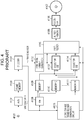
- the code-amount detection circuit 1016 acquires from a controller 1006 a threshold T (or a transmission bit rate R) to be compared with a code amount generated in the encoder 1004 (step S101).
- the threshold T is an optimal code amount that is dynamically determined by the controller 1006, as described below.
- the code-amount detection circuit 1016 calculates the code amount S of the received encoded frame, and compares the code amount S with the threshold T (step S103).
- step S105 If it is determined in step S105 that the code amount S is smaller than or equal to the threshold T (that is, if the determination in step S105 is NO), the code-amount detection circuit 1016 calculates a difference value (T-S) between the threshold T and the code amount S of the encoded frame. Then, in addition to the frame number corresponding to the encoded frame, the difference value is stored as a code-amount margin in a difference map 1017 (step S113).
- T-S difference value
- step S105 If it is determined in step S105 that the code amount S is larger than the threshold T (that is, if the determination in step S105 is YES), the code amount detection circuit 1016 outputs the frame number to a selector switch (SW) 1014 and a multiplexing and filing device 1015. At the same time, the frame number and an arbitrarily defined value (this value indicates that there is no code-amount margin) are stored in the difference map 1017. Then, as described below, processing for allocating a portion that exceeds the threshold T is performed (step S107).
- SW selector switch
- an encoded frame corresponding to the frame number 40 is stored in the memory 1
- an encoded frame corresponding to the frame number 41 is stored in the memory 2
- an encoded frame corresponding to the frame number 37 is stored in the memory 3
- an encoded frame corresponding to the frame number 38 is stored in the memory 4
- an encoded frame corresponding to the frame number 39 is stored in the memory 5.
- the current (latest) frame is the encoded frame whose frame number is 41 and is stored in the memory 2.
- the oldest written encoded frame is to be read next.
- the main frame number, Xnext is calculated using equation (1).
- Xnext frame number X of the latest encoded frame N ⁇ 1
- the main frame number Xnext is 37.
- a memory in which an encoded frame whose frame number X is 37 is stored will be read next.
- the code-amount detection circuit 1016 determines in step S105 that the code amount of the latest encoded frame, that is, the code amount S of the encoded frame corresponding to the frame number 41 is smaller than or equal to the threshold T (that is, if the determination in step S105 is NO)
- the code-amount detection circuit 1016 causes a selector switch 1013 to select the memory 3 and causes the selector switch 1014 to output GND (that is, level 0).
- the code-amount detection circuit 1016 also calculates the difference (T-S) as a code-amount margin, and stores the code-amount margin in association with the frame number 41 in the difference map 1017 (step S113).
- the multiplexing and filing device 1015 Since the output from the selector switch 1014 is zero, only the encoded frame corresponding to the frame number 37, which is an output of the selector switch 1013 (that is, the contents of the memory 3), is supplied to the multiplexing and filing device 1015.
- the multiplexing and filing device 1015 performs filing (packing) of the encoded frame as media data in accordance with an International Organization for Standardization (ISO) file format, and the filed media data is temporarily stored in a transmission buffer 1005 (step S115).
- ISO International Organization for Standardization
- the code-amount detection circuit 1016 determines in step S105 that the code amount S of the encoded frame corresponding to the frame number 41 is larger than the threshold T (that is, the determination in step S105 is YES), the code-amount detection circuit 1016 performs allocation processing for multiplexing at least the code amount corresponding to the difference (S-T) with one or more preceding frames displayed prior to the encoded frame corresponding to the frame number 41 and for transmitting the multiplexed code amount (step S107).
- the code-amount detection circuit 1016 acquires the main frame number, Xnext, (in this case, 37) to be read next.
- the main frame number Xnext can be acquired by the code-amount detection circuit 1016 in accordance with equation (1) or can be acquired from the main frame number generator 1012. Alternatively, the main frame number, Xnext, may be informed from the controller 1006.
- the code-amount detection circuit 1016 also calculates the memory numbers L in which encoded frames corresponding to the frame numbers X that have code-amount margins M1, M3, M4, and M5 stored in the difference map 1017.
- the code-amount detection circuit 1016 determines the amount of segmentation of the encoded frame corresponding to the frame number 41 whose code amount exceeds the threshold T. A method for segmenting an encoded frame and for performing allocation in the image encoding and transmission apparatus according to the first embodiment will be described with reference to Figs. 2A to 2C .
- the code amount detection circuit 1016 performs processing of segmentation and allocation.
- Fig. 2A schematically shows a state in which it is determined that the code amount S of the encoded frame corresponding to the frame number 41 exceeds the threshold T and the code amounts S of the preceding frames 37 to 40 do not reach the threshold T.
- an excess data portion (that is, a portion of a piece of encoded data, the portion being of a data amount by which the piece of encoded data exceeds the threshold T) of the encoded frame corresponding to the frame number 41 whose code amount exceeds the threshold T is segmented in accordance with processing (1) to (3), and is allocated to preceding encoded frames.
- segmentation points are set in units of slices or macroblocks constituting a frame. However, segmentation may be performed using other methods (for example, segmentation points may be set in units of bytes).
- Information on the segmentation points and information on the frames to which the code amounts are to be allocated are stored as segmentation information in, for example, an internal memory (step S109) and are reported to the controller 1006. Since the selector switches 1013 and 1014, memory reading processing, and filing processing are controlled using such segmentation information, a portion of encoded data of a frame whose code amount exceeds the threshold can be multiplexed when filing processing of a frame that has a code-amount margin is performed.
- the encoded frame whose code amount S exceeds the threshold T is segmented into three segments 2001, 2002, and 2003. Then, the segment 2001, which is a part of the excess data portion, is multiplexed with the encoded frame corresponding to the frame number 37, and the segment 2002, which is another part of the excess data portion, is multiplexed with the encoded frame corresponding to the frame number 38. Accordingly, all the encoded frames corresponding to the frame numbers 37 to 41 can be transmitted such that each of the code amounts does not exceed the threshold T.
- a code-amount margin with respect to the threshold T is calculated and stored for each encoded frame. If an encoded frame whose code amount exceeds the threshold T is generated, an excess data portion of the encoded frame whose code amount exceeds the threshold T is segmented in accordance with the code-amount margin of a preceding encoded frame to be read. Then, when the preceding encoded frame is transmitted, multiplication is performed and the multiplexed encoded frame is transmitted.
- the ISO file generated by the multiplexing and filing device 1015 is temporarily stored in the transmission buffer 1005, as described above.
- the code amount S of the encoded frame corresponding to the frame number 42 exceeds the threshold T, as shown in Fig. 2C .
- the code-amount detection circuit 1016 reads, in accordance with the acquired main frame number, Xnext, the code-amount margins (MX) and the frame numbers X for (N-2) frames from the difference map 1017 in the order of output. That is, in this case, since the main frame number, Xnext, is 38 and the value obtained from N-2 is 3, the code amount margins M4, M5, and M1 of the encoded frames corresponding to the frame numbers 38 to 40 are read.
- the code-amount detection circuit 1016 also calculates memory numbers L in which encoded frames corresponding to frame numbers X having the code amount margins M1, M4, and M5 that are stored in the difference map 1017 are stored.
- the excess-encoded-data portion (excess data portion) of the encoded data of the encoded frame corresponding to the frame number 42 whose code amount exceeds the threshold T is segmented as described above, and the segmented excess data is allocated to a preceding encoded frame.
- the code amount margin M4 corresponding to the frame number 38 has already been occupied by the encoded frame corresponding to the frame number 41.
- the excess-data portion is segmented from the beginning, and a segment having size G3 (that is, a segment 2004 shown in Fig. 2C ), which is smaller than or equal to the code amount margin M5 of the encoded frame corresponding to the frame number 39 is obtained.
- a segmentation point S3 is stored. If the remaining code amount of the encoded frame corresponding to the frame number 42 after the segment 2004 is removed does not exceed the threshold T, segmentation is stopped. If the remaining code amount exceeds the threshold T, the above-mentioned processing is repeated until the remaining code amount does not exceed the threshold T.
- an encoded frame whose code amount exceeds the threshold T is segmented, and a segment having a size corresponding to a difference between the code amount of an encoded frame to which the encoded frame whose code amount exceeds the threshold is to be transmitted and the threshold is obtained.
- data having an amount close to the threshold can be transmitted, thus improving the use efficiency of transmission capacity.
- N the total number of memories
- MPEG moving picture experts group
- the number of memories be equal to or larger than the number of frames (for example, fifteen or more) constituting a GOP.
- the encoded frame group stored in the transmission buffer 1005 and packed into ISO file format is output to a communication device 1007 according to need under the control of the controller 1006.
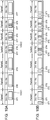
- the communication device 1007 refers to the received packet based on the ISO file format, and determines whether a transmission time stamp (ST) is described in a "User Data Box", which will be described below. If the transmission time stamp (ST) is described in the "User Data Box", the communication device 1007 outputs the packet based on the ISO file format to a communication line 1018 in accordance with the transmission time stamp (ST) (see Fig. 10B ). In contrast, if the transmission time stamp (ST) is not described in the "User Data Box", the communication device 1007 calculates a transmission start time optimal for the packet and outputs the packet to the communication line 1018 in accordance with the calculated optimal transmission start time (see Fig. 10A ). The transmission start time can be calculated in accordance with the data configuration of the packet (for example, a decoding start time (DT) of encoded data constituting the packet) and a transmission start time of the packet that was output immediately previously.
- DT decoding start time
- a transmission start time can be calculated such that the highest use efficiency of the communication line 1018 can be achieved in accordance with the earliest time of a plurality of decoding start times (DT) and a transmission start time of the packet that was output immediately previously.
- the packet output to the communication line 1018 is transmitted to a receiver side via an access point 1020 and a communication line 1019.
- the controller 1006 calculates the time at which transmission of the file starts, and outputs, as necessary, transmission start time information 1021 to the multiplexing and filing device 1015.
- Type udta
- the additional information that can be added by the multiplexing and filing device 1015 is not necessarily transmission start time information.
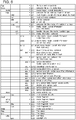
- Fig. 6 shows a list of boxes defined by the ISO file format.
- Fig. 6 six lines, the first to sixth lines from the left, represent the type of box defined by the ISO file format and the relation of inclusion.
- the rightmost line represents an explanation of the corresponding box.
- Type represented using four bytes for identifying the type of a box is allocated to each of the boxes. Normally, “Type” is represented using four alphanumeric characters. "Type”, which is represented using four alphanumeric characters, is described in the six leftmost lines. In the following descriptions, “Type” is used to represent a particular box.
- a box in a certain line includes a box on the right side is shown in Fig. 6 .
- a box “moov” on the second row from the top includes boxes “mvhd”, “trak”, “mvex”, “udta”, and the like.
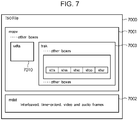
- Fig. 7 is a simplified illustration of a data configuration of the ISO file format.
- a normal box configuration based on the ISO file format includes a box (moov) 7001 for storing metadata of media data and a box (mdat) 7002 for storing actual media data.
- Media data is, for example, sample data of a moving image or sound.
- Metadata of media data is information, such as management information of a moving image or sound sample, of the media data.
- a box (trak) 7003 which is a box corresponding to media data, is included in the box (moov) 7001.
- the media data within the box (mdat) 7002 is segmented into a set (chunk) of a plurality of samples of continuous moving images or sound.
- a chunk array is stored in a data field of the box (mdat) 7002.
- the size of the chunk and the number of samples contained in the chunk are not particularly limited.
- the size of the chunk and the number of samples contained in the chunk can be determined in accordance with the environment and conditions.
- the box (udta) 7010 corresponds to "udta" (User Data Box) in the box list shown in Fig. 6 . According to the ISO file format, the box (udta) 7010 exists immediately below the box (moov) 7001.
- the contents of additional information stored in the "User Data Box" are not limited to transmission start time information, and any type of information can be stored in a desired format.
- the controller 1006 also acquires specification information, such as a buffer capacity, data processing capability, and the like of a receiver, via the communication device 1007, and calculates the maximum bit rate at which processing can be performed, an allowable delay time for the bit rate, and the like.
- the controller 1006 detects an instantaneous value of the circuit capacity, and calculates the average circuit capacity for a defined period of time and a range of an instantaneous circuit capacity with respect to the calculated average circuit capacity.
- the controller 1006 calculates an optimal code amount W for a unit display time (for example, a code amount for each frame) using the acquired or calculated values as parameters, under the conditions in which the use efficiency of the circuit capacity is a predetermined value or more and processing of the receiver side is successfully performed.
- the controller 1006 outputs the calculated optimal code amount 1022 to the encoder 1004 and the code amount detection circuit 1016.
- the encoder 1004 sets the target (upper limit) value of a generation code amount to the received optimal code amount 1022, and controls code amount.
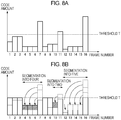
- the code-amount detection circuit 1016 sets the threshold T, which is to be compared with the generation code amount in the encoder 1004 (see Figs. 8A and 8B ), to the optimal code amount (1022).
- the controller 1006 is capable of requesting the access point 1020 to perform allocation of the circuit capacity. More specifically, the controller 1006 requests the access point 1020 to perform allocation of the circuit capacity in accordance with a necessary code amount U, which is a value (W+V) obtained by adding a prediction value of an overhead V when the multiplexing and filing device 1015 performs ISO filing to the above-described optimal code amount W. Then, the controller 1006 acquires an allocation value A of the circuit capacity from the access point 1020.
- a necessary code amount U which is a value (W+V) obtained by adding a prediction value of an overhead V when the multiplexing and filing device 1015 performs ISO filing to the above-described optimal code amount W.
- the controller 1006 outputs to the code-amount detection circuit 1016 and the encoder 1004 the value (A-V), as the optimal code amount W, obtained by subtracting the overhead V generated when ISO filing is performed from the circuit capacity A allocated by the access point 1020.
- the controller 1006 is capable of receiving information from the receiver through the communication device 1007.
- the controller 1006 When receiving information on an error rate, a distribution stop request, or the like, the controller 1006 is capable of controlling encoding processing in response to a request from the receiver side by outputting to the encoder 1004 control information, such as an instruction to increase or decrease a code amount, to stop encoding processing, or the like.
- an excess-data portion of encoded data of a frame whose code amount exceeds a threshold is multiplexed with encoded data of a preceding frame whose code amount does not reach the threshold, and the multiplexed encoded data is transmitted. Since the amount of excess encoded data to be multiplexed is increased or decreased in accordance with the difference between the code amount of the frame to be multiplexed with the excess encoded data and the threshold, the use efficiency of a line can be increased while a deterioration of image quality can be suppressed.
- the threshold is dynamically changed in accordance with the state of the line, even if transmission is performed using a line whose communication quality dynamically changes, a high use efficiency of the line can be achieved while overflow of a communication buffer is prevented.
- the size of a transmission packet can be flexibly changed in accordance with the circumstances.
- a packet transmission time can be embedded.
- a transmission server is capable of transmitting the packet in accordance with the transmission time provided as the additional information. Therefore, the burden imposed on the server to calculate the packet transmission time is reduced.
- the receiver when the receiver includes means for transmitting a change request, if it is determined that overflow or underflow of a buffer may occur in accordance with the predicted code amount of the subsequent frame, the receiver is capable of transmitting a request to change the encoding rate (transmission bit rate) to a transmitter (encoder) side. If the controller 1006 controls the threshold T in response to the change request, a possibility of preventing a processing failure, such as overflow or underflow of the buffer in the receiver, can be increased.
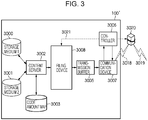
- Fig. 3 is a block diagram showing an example of a configuration of a moving-image distribution apparatus 100', which is an example of an information-transmission apparatus according to the second embodiment, and an example of a configuration of an information-transmission system using the moving-image distribution apparatus.
- a plurality of moving-image contents that has already been encoded using a predetermined method is stored in a storage medium 1 (3000), such as a hard disk drive.
- a content server 3002 detects a code amount of the updated contents for each display time or for each frame, and generates a code-amount map of the entire contents.
- the content server 3002 stores the code amount of content and information for identifying the content (for example, a content ID) in association with each other in a code-amount-map storage device 3003.
- Fig. 8A schematically shows a code amount map generated in accordance with a code amount for each frame.
- the map is represented by a bar chart.
- a code amount for each frame is recorded as a numerical value.
- a controller 3006 When receiving a request from a receiver (not shown) to distribute contents, a controller 3006 calculates an optimal transmission bit rate R taking into consideration the circuit capacity ensured at the point in time and the capability of the receiver. The controller 3006 outputs a distribution start instruction, together with a content ID of the content that is requested to be distributed and the bit rate R, to the content server 3002.
- the content server 3002 When receiving the distribution start instruction, the content server 3002 reads a code amount map corresponding to the designated content ID from the code amount map storage device 3003. The content server 3002 calculates a code-amount margin of each frame in accordance with the code amount of the corresponding frame and the calculated optimal transmission bit rate R, and detects a frame (excess frame) having a code amount that cannot be transmitted within a predetermined frame time at the bit rate R.
- An excess data portion of the frame that has an excess code amount with respect to the optimal transmission bit rate R is read from the storage medium 1 (3000), and the read excess data portion is temporarily stored in a storage medium 2 (3001).
- the temporarily stored encoded data has at least a code amount by which the code amount of the frame exceeds the bit rate R. For example, when a frame is temporarily stored in units of blocks, an amount that is larger than the amount corresponding to the real excess data portion may be temporarily stored. Thus, the frame that has an excess code amount may be segmented to obtain a segment having a size that is smaller than or equal to the code amount corresponding to the bit rate R.
- At least an excess data portion of the frame that has an excess code amount is segmented such that the code amount of the excess data portion does not exceed a corresponding code amount margin by referring to code amount margins of a plurality of preceding frames (the number of frames is not limited) in the order of display in the receiver. That is, the number of segments of the excess data portion that is temporarily stored in the storage medium 2 (3001), the segmentation ratio, and frames (frame numbers) with which multiplication is to be performed are determined such that the code amount of the excess frame and the code amount of each of the preceding frames do not exceed the code amount corresponding to the bit rate R. Then, the determined number of segments, segmentation ratio, and frame numbers of frames with which multiplication is performed are stored in the storage medium 2 (3001) in association with the excess data portion.
- the code amount corresponding to the optimal transmission bit rate R is represented as a threshold T, as in the first embodiment.
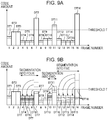
- the frame number of the first appeared excess frame is 7.
- the content server 3002 reads code amount margins of the frames corresponding to the frame numbers 1 to 6, which precede the excess frame corresponding to the frame number 7.
- the code amount margins are arranged in a descending order relatively (in this case, for example, in the order of 4, 5, 6, 1, 2, and 3).
- the number of segments of the excess data portion and destinations of the multiplication are determined by comparing the code amount of the excess data portion with the code amount margins of the frames corresponding to the frame numbers, 4, 5, 6, 1, 2, and 3.
- the excess data portion is segmented into three segments whose sizes do not exceed the code amount margins corresponding to the selected frame numbers 4, 5, and 6.
- the excess data portion and another portion of the frame corresponding to the frame number 7 are segmented to obtain three segments having the same size.
- segments do not necessarily have the same size.
- the number of segments of an excess data portion that is to be multiplexed with other encoded frames, a segmentation ratio, or the code amount (size) of each of the segments can be determined in a desired manner.
- the excess data portion of the frame corresponding to the frame number 7 and information that is capable of identifying which part of the excess data portion is to be multiplexed with which frame are stored in the storage medium 2 (3001). More specifically, the frame number of a frame to be multiplexed and the combination of the start address of the storage medium 2 (3001) in which the excess data portion to be subjected to multiplication is stored and the data amount may be stored.
- the content server 3002 performs above-described processing for all the frames of contents that are requested from the controller 3006 to be distributed. When the above-described processing is completed, distribution of the requested contents starts.
- the entire excess data portion of the frame whose code amount exceeds the threshold T is moved from the storage medium 1 (3000) to the storage medium 2 (3001).
- the code amount of each frame of the contents that are requested to be distributed, which is stored in the storage medium 1 (3000) is smaller than or equal to the optimal transmission bit rate R.
- frames of the contents that are requested to be distributed are read in a predetermined order and input to the content server 3002.
- the content server 3002 monitors the frame number of a frame read from the storage medium 1 (3000). When a frame with which a segment of the excess data portion stored in the storage medium 2 (3001) is to be multiplexed is read from the storage medium 1 (3000), the corresponding segment is read from the storage medium 2 (3001). Then, the read encoded data are multiplexed (combined) with each other and output to a filing device 3008.
- the frame number 4 is read from the storage medium 1 (3000).
- a segment of an excess data portion to be multiplexed with the encoded data corresponding to the frame number 4 is read from the storage medium 2 (3001).
- the content server 3002 multiplexes the read segment of the excess data portion with the encoded data corresponding to the frame number 4 and inputs the multiplexed encoded data to the filing device 3008.
- a segment of an excess data portion to be multiplexed with the encoded data corresponding to the frame number 5 is read from the storage medium 2 (3001) at the same time.
- the content server 3002 multiplexes the read segment of the excess data portion with the encoded data corresponding to the frame number 5 and inputs the multiplexed encoded data to the filing device 3008.
- Such reading processing may be performed under the self-control of the content server 3002 or under the control of the controller 3006.
- segmentation processing based on a circuit capacity set at the reception of a distribution request is not necessarily performed.
- segmentation processing can be performed in advance by assuming a constant circuit capacity (bit rate) Rt.
- decoding time stamp representing the time at which decoding of an encoded frame starts is added to the corresponding encoded frame in the receiver.
- the encoded frame input from the storage medium 1 (3000) to the content server 3002 is multiplexed with part of a code amount (that is, a segment of an excess data portion) of the subsequent frame and information on the frame number, the decoding start time (DT), and the display start time (CT), according to need, and input to the filing device 3008.
- the frames 1 and 4 shown in Fig. 9B will be explained.
- An excess data portion of the subsequent frame is not allocated to the frame 1, which is constituted by only data having a single decoding time stamp (DT).
- the filing device 3008 generates a file (a packet) in the ISO file format from only encoded data of the frame 1, as represented by reference numeral 10001 shown in Fig. 10A .
- part of the code amount of the frame 7 whose code amount exceeds the threshold T is allocated to the frame 4.
- a packet is generated from the multiplexed data constituted by the encoded data of the frame 4 and the part of the encoded data of the frame 7.
- DT decoding start times
- Encoded data packed (filed) in the ISO file format in the filing device 3008 is temporarily stored in a transmission buffer 3005.
- the controller 3006 when the encoded frame is input to the filing device 3008, the controller 3006 is capable of predicting the time at which the encoded frame packed (packetized) into the ISO file format is to be transmitted from the communication device 3007.
- the predicted time can be stored as a transmission time stamp (ST) in the "User Data Box" in the ISO file format (see reference numeral 7010 shown in Fig. 7 ).
- Fig. 10B shows an example in which the transmission time stamp (ST) is stored.
- the packets (encoded contents) temporarily stored in the transmission buffer 3005 are read as necessary under the control of the controller 3006 and input to the communication device 3007.
- the packet is output to a communication channel 3018 in accordance with the time designated by the transmission time stamp (ST).
- the controller 3006 calculates the time at which the packet is output to the communication channel 3018, and the controller 3006 outputs the packet to the communication channel 3018 in accordance with the calculated time.
- This time can be calculated in accordance with, for example, the free area of the transmission buffer 3005, the state of the communication channel 3018, the time at which the immediately preceding packet was output, and the like.
- the packet output to the communication channel 3018 is distributed to a receiver (not shown) via the access point 3020 and a communication channel 3019.
- the foregoing embodiments can be implemented by use of software on a computer (or a central processing unit (CPU), a microprocessing unit (MPU), or the like) of a system or an apparatus.
- a computer or a central processing unit (CPU), a microprocessing unit (MPU), or the like
- CPU central processing unit
- MPU microprocessing unit
- a computer program supplied to the computer also implements an aspect of the present invention. That is, a computer program for attaining functions of the foregoing embodiments embodies the present invention.
- Any type of program may be used as the computer program that attains the foregoing embodiments as long as it can be read by the computer.
- object code a program to be executed by an interpreter, or script data to be supplied to an operating system (OS) may be used.
- OS operating system
- the type of computer program is not limited to the above examples.
- the computer program to attain the foregoing embodiments is supplied to the computer via a storage medium, wired communication, or wireless communication.
- the storage medium for supplying the program may be, for example, a flexible disk, a hard disk, a magnetic storage medium, such as a magnetic tape, an optical or magnetooptical storage medium, such as an MO, a compact disc (CD), or a digital versatile disc (DVD), or a nonvolatile semiconductor memory.
- a method using a server of a computer network As a method for supplying a computer program using wired or wireless communication, a method using a server of a computer network is available.
- a data file (program file) that may serve as a computer program constituting an aspect of the present invention is stored in a server.
- the program file may be in an executable form or may be source code.
- the program file is supplied to the client computer that accesses the server by downloading the program file.
- the program file may be segmented into a plurality of segment files and the segment files can be distributed to different servers.
- a server apparatus that provides the client computer with the program file may attain the foregoing embodiments.
- a computer program to attain the foregoing embodiments may be encoded and stored in a storage medium, and may be distributed to users.
- Key information for decoding the encoded program may be supplied to only a user who satisfies predetermined conditions and the computer program can be installed on a computer owned by the user.
- the key information can be supplied, for example, by downloading from a homepage via the Internet.
- the computer program to attain the foregoing embodiments may use a function of the OS running on the computer.
- part of the computer program to attain the foregoing embodiments may be formed by firmware, such as an expansion board or the like installed in the computer or may be executed by a CPU included in the expansion board.
Landscapes
- Engineering & Computer Science (AREA)
- Multimedia (AREA)
- Signal Processing (AREA)
- Computer Networks & Wireless Communication (AREA)
- Computer Security & Cryptography (AREA)
- Theoretical Computer Science (AREA)
- Computing Systems (AREA)
- Algebra (AREA)
- General Physics & Mathematics (AREA)
- Mathematical Analysis (AREA)
- Mathematical Optimization (AREA)
- Pure & Applied Mathematics (AREA)
- Physics & Mathematics (AREA)
- Compression Or Coding Systems Of Tv Signals (AREA)
- Communication Control (AREA)
- Telephonic Communication Services (AREA)
- Detection And Prevention Of Errors In Transmission (AREA)
- Compression, Expansion, Code Conversion, And Decoders (AREA)
Applications Claiming Priority (1)
| Application Number | Priority Date | Filing Date | Title |
|---|---|---|---|
| JP2006111360A JP4994698B2 (ja) | 2006-04-13 | 2006-04-13 | 情報伝送装置及び情報伝送方法 |
Publications (3)
| Publication Number | Publication Date |
|---|---|
| EP1845690A2 EP1845690A2 (en) | 2007-10-17 |
| EP1845690A3 EP1845690A3 (en) | 2016-04-13 |
| EP1845690B1 true EP1845690B1 (en) | 2018-07-25 |
Family
ID=38255311
Family Applications (1)
| Application Number | Title | Priority Date | Filing Date |
|---|---|---|---|
| EP07106115.4A Active EP1845690B1 (en) | 2006-04-13 | 2007-04-13 | Information-transmission apparatus and information-transmission method |
Country Status (5)
| Country | Link |
|---|---|
| US (1) | US8923410B2 (enExample) |
| EP (1) | EP1845690B1 (enExample) |
| JP (1) | JP4994698B2 (enExample) |
| KR (2) | KR100883811B1 (enExample) |
| CN (1) | CN100559876C (enExample) |
Families Citing this family (15)
| Publication number | Priority date | Publication date | Assignee | Title |
|---|---|---|---|---|
| JP5236332B2 (ja) * | 2008-03-28 | 2013-07-17 | アイベックステクノロジー株式会社 | 符号化装置、符号化方法および符号化プログラム |
| EP2107811A1 (en) * | 2008-03-31 | 2009-10-07 | British Telecmmunications public limited campany | Encoder |
| EP2129130A1 (fr) * | 2008-05-26 | 2009-12-02 | THOMSON Licensing | Procédé de transmission simplifié d'un flux de signaux entre un émetteur et un appareil électronique |
| US9380091B2 (en) | 2012-06-12 | 2016-06-28 | Wi-Lan Labs, Inc. | Systems and methods for using client-side video buffer occupancy for enhanced quality of experience in a communication network |
| JP5199219B2 (ja) * | 2009-11-17 | 2013-05-15 | 株式会社日立国際電気 | デジタル放送装置、デジタル放送方法、および、デジタル放送プログラム |
| WO2011108893A2 (en) | 2010-03-05 | 2011-09-09 | Samsung Electronics Co., Ltd. | Method and apparatus for generating and reproducing adaptive stream based on file format, and recording medium thereof |
| US9762774B2 (en) * | 2011-08-12 | 2017-09-12 | Samsung Electronics Co., Ltd. | Receiving apparatus and receiving method thereof |
| US9772958B2 (en) * | 2011-10-31 | 2017-09-26 | Hewlett Packard Enterprise Development Lp | Methods and apparatus to control generation of memory access requests |
| KR102181776B1 (ko) * | 2012-06-05 | 2020-11-24 | 삼성전자주식회사 | 범용 디바이스에서의 파일 송/수신 장치 및 방법 |
| US10063606B2 (en) | 2012-06-12 | 2018-08-28 | Taiwan Semiconductor Manufacturing Co., Ltd. | Systems and methods for using client-side video buffer occupancy for enhanced quality of experience in a communication network |
| JP5947641B2 (ja) * | 2012-07-06 | 2016-07-06 | キヤノン株式会社 | 動画像符号化装置及びその制御方法、コンピュータプログラム |
| TWI505699B (zh) * | 2012-11-23 | 2015-10-21 | 財團法人資訊工業策進會 | 資料串流傳輸方法 |
| JP6801539B2 (ja) * | 2017-03-17 | 2020-12-16 | 株式会社リコー | 情報処理システム、情報処理装置、情報処理プログラム及び情報処理方法 |
| US20230133271A1 (en) * | 2020-03-31 | 2023-05-04 | Sony Group Corporation | Decoding apparatus, decoding method, encoding apparatus, and encoding method |
| US20230396357A1 (en) * | 2022-06-01 | 2023-12-07 | Qualcomm Incorporated | Indication of network condition at a remote ue |
Family Cites Families (23)
| Publication number | Priority date | Publication date | Assignee | Title |
|---|---|---|---|---|
| JP2675130B2 (ja) * | 1989-03-29 | 1997-11-12 | 株式会社日立製作所 | 画像データ転送再生方法および転送再生装置 |
| US5473569A (en) * | 1994-08-01 | 1995-12-05 | Motorola, Inc. | Method for operating a flash memory |
| JP3156705B1 (ja) * | 1995-06-14 | 2001-04-16 | 松下電器産業株式会社 | データ送信方法 |
| JPH09149066A (ja) * | 1995-11-21 | 1997-06-06 | Hitachi Cable Ltd | スイッチングハブ |
| US6115420A (en) * | 1997-03-14 | 2000-09-05 | Microsoft Corporation | Digital video signal encoder and encoding method |
| KR100231924B1 (ko) | 1997-03-21 | 1999-12-01 | 윤종용 | 가변 블럭 기반 색도 상관성을 이용한 영상 부호화 방법 |
| GB2324668A (en) * | 1997-04-21 | 1998-10-28 | Racal Communications Syst Ltd | Error resilient video processing technique |
| KR100266590B1 (ko) * | 1997-12-11 | 2000-09-15 | 구자홍 | 디지탈스틸카메라의화상압축제어방법 |
| KR100258563B1 (ko) | 1997-12-30 | 2000-06-15 | 김덕중 | 비동기 전송 모드 수신 시스템의 메모리 할당 방법 |
| JP3560217B2 (ja) * | 1998-04-30 | 2004-09-02 | ソニー株式会社 | データ符号化装置、データ符号化方法及びデータ伝送方法 |
| JP3147862B2 (ja) | 1998-07-08 | 2001-03-19 | 日本電気株式会社 | 複数オンライン制御プログラムのトレース採取方法 |
| JP4362793B2 (ja) * | 1999-07-05 | 2009-11-11 | 日本ビクター株式会社 | 動画像符号化装置及びその方法 |
| US20020080267A1 (en) * | 2000-11-28 | 2002-06-27 | Allan Moluf | High capacity, low-latency multiplexer |
| JP4016647B2 (ja) * | 2001-05-17 | 2007-12-05 | 日本電気株式会社 | 移動通信システム、基地局、移動局及びそれらに用いるしきい値設定方法並びにそのプログラム |
| JP4432284B2 (ja) * | 2001-06-26 | 2010-03-17 | ソニー株式会社 | 記録装置および方法 |
| KR100438069B1 (ko) * | 2001-12-04 | 2004-07-02 | 엘지전자 주식회사 | 이동통신시스템에서의 데이터전송율 설정 방법 |
| US7292690B2 (en) * | 2002-01-02 | 2007-11-06 | Sony Corporation | Video scene change detection |
| KR20040020638A (ko) * | 2002-08-31 | 2004-03-09 | 삼성전자주식회사 | 무선 채널 특성을 반영한 동적 패킷 세그먼트 임계치관리방법 |
| US7957486B2 (en) * | 2002-09-30 | 2011-06-07 | Intel Corporation | Transmission link adaptation |
| JP4110521B2 (ja) * | 2002-11-21 | 2008-07-02 | ソニー株式会社 | 情報処理システムおよび方法、情報処理装置および方法、プログラム、並びにデータ構造 |
| US20060209947A1 (en) * | 2003-06-06 | 2006-09-21 | Gerard De Haan | Video compression |
| JP2005191933A (ja) * | 2003-12-25 | 2005-07-14 | Funai Electric Co Ltd | 送信装置、送受信システム |
| CN101366227A (zh) * | 2006-02-07 | 2009-02-11 | 艾利森电话股份有限公司 | 用于高速分组数据通信中的扩展控制面信令的装置和方法 |
-
2006
- 2006-04-13 JP JP2006111360A patent/JP4994698B2/ja not_active Expired - Fee Related
-
2007
- 2007-03-21 US US11/689,338 patent/US8923410B2/en not_active Expired - Fee Related
- 2007-04-02 KR KR20070032217A patent/KR100883811B1/ko not_active Expired - Fee Related
- 2007-04-13 EP EP07106115.4A patent/EP1845690B1/en active Active
- 2007-04-13 CN CNB2007100982128A patent/CN100559876C/zh not_active Expired - Fee Related
-
2008
- 2008-10-16 KR KR1020080101418A patent/KR100920195B1/ko not_active Expired - Fee Related
Non-Patent Citations (1)
| Title |
|---|
| None * |
Also Published As
| Publication number | Publication date |
|---|---|
| EP1845690A2 (en) | 2007-10-17 |
| KR100883811B1 (ko) | 2009-02-16 |
| US8923410B2 (en) | 2014-12-30 |
| KR20070102393A (ko) | 2007-10-18 |
| KR100920195B1 (ko) | 2009-10-06 |
| CN100559876C (zh) | 2009-11-11 |
| JP2007288364A (ja) | 2007-11-01 |
| EP1845690A3 (en) | 2016-04-13 |
| JP4994698B2 (ja) | 2012-08-08 |
| CN101056401A (zh) | 2007-10-17 |
| US20070286279A1 (en) | 2007-12-13 |
| KR20080103483A (ko) | 2008-11-27 |
Similar Documents
| Publication | Publication Date | Title |
|---|---|---|
| EP1845690A2 (en) | Information-transmission apparatus and information-transmission method | |
| US6327421B1 (en) | Multiple speed fast forward/rewind compressed video delivery system | |
| EP2606641B1 (en) | Method and apparatus for reducing deterioration of a quality of experience of a multimedia service in a multimedia system | |
| JP4729570B2 (ja) | トリックモードおよび速度移行 | |
| US10298971B2 (en) | Encoding optimization using bitrate range comparisons for encoded segments | |
| JP6225446B2 (ja) | 動画像データ配信装置、方法、プログラム、及びシステム | |
| US11350142B2 (en) | Intelligent video frame dropping for improved digital video flow control over a crowded wireless network | |
| WO2014145011A2 (en) | Method and apparatus for streaming video | |
| JP2009182442A (ja) | 動画像符号化・復号システム、並びにそれに用いる動画像符号化装置および動画像復号装置 | |
| CN101600100B (zh) | 比特率转换装置以及转换方法 | |
| JP2011029936A (ja) | ファイル転送システムおよびファイル転送方法 | |
| JP6258168B2 (ja) | 配信装置、再生装置および配信システム | |
| CN1298166C (zh) | 实现可选择可变特技模式回放速度的系统与方法 | |
| US11563990B2 (en) | Method and apparatus for automatic HLS bitrate adaptation | |
| US10652166B2 (en) | Non-real time adaptive bitrate recording scheduler | |
| KR101454809B1 (ko) | 트랜스코딩 작업 스케줄링 방법 및 이를 이용한 트랜스코딩 시스템 | |
| EP1323055B1 (en) | Dynamic quality adjustment based on changing streaming constraints | |
| US6674804B1 (en) | Method for generating a multiplexed sequence of media units | |
| CN113747209A (zh) | 多路ts流节目的重组方法及装置 | |
| JPH1141608A (ja) | 画像伝送装置および画像符号化方法および画像符号化装置 | |
| JPH11234671A (ja) | 信号処理装置 | |
| KR20040105459A (ko) | 멀티미디어 데이터 재전송 방법 및 그 시스템 | |
| JP2001502125A (ja) | データ伝送における又はデータ伝送に関する改良 | |
| JP3719530B2 (ja) | 映像信号伝送方法及び映像信号伝送装置 | |
| KR101391600B1 (ko) | 어댑티브 녹화 방법 및 장치 |
Legal Events
| Date | Code | Title | Description |
|---|---|---|---|
| PUAI | Public reference made under article 153(3) epc to a published international application that has entered the european phase |
Free format text: ORIGINAL CODE: 0009012 |
|
| AK | Designated contracting states |
Kind code of ref document: A2 Designated state(s): AT BE BG CH CY CZ DE DK EE ES FI FR GB GR HU IE IS IT LI LT LU LV MC MT NL PL PT RO SE SI SK TR |
|
| AX | Request for extension of the european patent |
Extension state: AL BA HR MK YU |
|
| PUAL | Search report despatched |
Free format text: ORIGINAL CODE: 0009013 |
|
| AK | Designated contracting states |
Kind code of ref document: A3 Designated state(s): AT BE BG CH CY CZ DE DK EE ES FI FR GB GR HU IE IS IT LI LT LU LV MC MT NL PL PT RO SE SI SK TR |
|
| AX | Request for extension of the european patent |
Extension state: AL BA HR MK RS |
|
| RIC1 | Information provided on ipc code assigned before grant |
Ipc: H04N 5/00 20110101ALI20160308BHEP Ipc: H04L 29/06 20060101AFI20160308BHEP |
|
| 17P | Request for examination filed |
Effective date: 20161013 |
|
| RBV | Designated contracting states (corrected) |
Designated state(s): AT BE BG CH CY CZ DE DK EE ES FI FR GB GR HU IE IS IT LI LT LU LV MC MT NL PL PT RO SE SI SK TR |
|
| AKX | Designation fees paid |
Designated state(s): AT BE BG CH CY CZ DE DK EE ES FI FR GB GR HU IE IS IT LI LT LU LV MC MT NL PL PT RO SE SI SK TR |
|
| AXX | Extension fees paid |
Extension state: BA Extension state: RS Extension state: HR Extension state: MK Extension state: AL |
|
| STAA | Information on the status of an ep patent application or granted ep patent |
Free format text: STATUS: EXAMINATION IS IN PROGRESS |
|
| 17Q | First examination report despatched |
Effective date: 20170620 |
|
| GRAP | Despatch of communication of intention to grant a patent |
Free format text: ORIGINAL CODE: EPIDOSNIGR1 |
|
| STAA | Information on the status of an ep patent application or granted ep patent |
Free format text: STATUS: GRANT OF PATENT IS INTENDED |
|
| RIC1 | Information provided on ipc code assigned before grant |
Ipc: H04N 19/127 20140101ALI20180116BHEP Ipc: H04N 19/149 20140101ALI20180116BHEP Ipc: H04N 19/146 20140101ALI20180116BHEP Ipc: H04N 21/24 20110101ALI20180116BHEP Ipc: H04N 19/115 20140101ALI20180116BHEP Ipc: H04N 21/854 20110101ALI20180116BHEP Ipc: H04N 19/164 20140101ALI20180116BHEP Ipc: H04N 21/2385 20110101ALI20180116BHEP Ipc: H04L 29/06 20060101AFI20180116BHEP Ipc: H04N 21/238 20110101ALI20180116BHEP Ipc: H04N 19/172 20140101ALI20180116BHEP Ipc: H04N 19/46 20140101ALI20180116BHEP Ipc: H04N 19/142 20140101ALI20180116BHEP |
|
| INTG | Intention to grant announced |
Effective date: 20180212 |
|
| RIN1 | Information on inventor provided before grant (corrected) |
Inventor name: HAMANAKA, AKIYOSHI |
|
| GRAS | Grant fee paid |
Free format text: ORIGINAL CODE: EPIDOSNIGR3 |
|
| GRAA | (expected) grant |
Free format text: ORIGINAL CODE: 0009210 |
|
| STAA | Information on the status of an ep patent application or granted ep patent |
Free format text: STATUS: THE PATENT HAS BEEN GRANTED |
|
| AK | Designated contracting states |
Kind code of ref document: B1 Designated state(s): AT BE BG CH CY CZ DE DK EE ES FI FR GB GR HU IE IS IT LI LT LU LV MC MT NL PL PT RO SE SI SK TR |
|
| REG | Reference to a national code |
Ref country code: GB Ref legal event code: FG4D |
|
| REG | Reference to a national code |
Ref country code: CH Ref legal event code: EP |
|
| REG | Reference to a national code |
Ref country code: AT Ref legal event code: REF Ref document number: 1022972 Country of ref document: AT Kind code of ref document: T Effective date: 20180815 |
|
| REG | Reference to a national code |
Ref country code: DE Ref legal event code: R096 Ref document number: 602007055486 Country of ref document: DE |
|
| REG | Reference to a national code |
Ref country code: IE Ref legal event code: FG4D |
|
| REG | Reference to a national code |
Ref country code: NL Ref legal event code: MP Effective date: 20180725 |
|
| REG | Reference to a national code |
Ref country code: LT Ref legal event code: MG4D |
|
| PG25 | Lapsed in a contracting state [announced via postgrant information from national office to epo] |
Ref country code: NL Free format text: LAPSE BECAUSE OF FAILURE TO SUBMIT A TRANSLATION OF THE DESCRIPTION OR TO PAY THE FEE WITHIN THE PRESCRIBED TIME-LIMIT Effective date: 20180725 |
|
| REG | Reference to a national code |
Ref country code: AT Ref legal event code: MK05 Ref document number: 1022972 Country of ref document: AT Kind code of ref document: T Effective date: 20180725 |
|
| PG25 | Lapsed in a contracting state [announced via postgrant information from national office to epo] |
Ref country code: AT Free format text: LAPSE BECAUSE OF FAILURE TO SUBMIT A TRANSLATION OF THE DESCRIPTION OR TO PAY THE FEE WITHIN THE PRESCRIBED TIME-LIMIT Effective date: 20180725 Ref country code: BG Free format text: LAPSE BECAUSE OF FAILURE TO SUBMIT A TRANSLATION OF THE DESCRIPTION OR TO PAY THE FEE WITHIN THE PRESCRIBED TIME-LIMIT Effective date: 20181025 Ref country code: SE Free format text: LAPSE BECAUSE OF FAILURE TO SUBMIT A TRANSLATION OF THE DESCRIPTION OR TO PAY THE FEE WITHIN THE PRESCRIBED TIME-LIMIT Effective date: 20180725 Ref country code: LT Free format text: LAPSE BECAUSE OF FAILURE TO SUBMIT A TRANSLATION OF THE DESCRIPTION OR TO PAY THE FEE WITHIN THE PRESCRIBED TIME-LIMIT Effective date: 20180725 Ref country code: PL Free format text: LAPSE BECAUSE OF FAILURE TO SUBMIT A TRANSLATION OF THE DESCRIPTION OR TO PAY THE FEE WITHIN THE PRESCRIBED TIME-LIMIT Effective date: 20180725 Ref country code: FI Free format text: LAPSE BECAUSE OF FAILURE TO SUBMIT A TRANSLATION OF THE DESCRIPTION OR TO PAY THE FEE WITHIN THE PRESCRIBED TIME-LIMIT Effective date: 20180725 Ref country code: IS Free format text: LAPSE BECAUSE OF FAILURE TO SUBMIT A TRANSLATION OF THE DESCRIPTION OR TO PAY THE FEE WITHIN THE PRESCRIBED TIME-LIMIT Effective date: 20181125 Ref country code: GR Free format text: LAPSE BECAUSE OF FAILURE TO SUBMIT A TRANSLATION OF THE DESCRIPTION OR TO PAY THE FEE WITHIN THE PRESCRIBED TIME-LIMIT Effective date: 20181026 |
|
| REG | Reference to a national code |
Ref country code: CH Ref legal event code: PK Free format text: BERICHTIGUNGEN |
|
| RIC2 | Information provided on ipc code assigned after grant |
Ipc: H04N 19/115 20140101ALI20180116BHEP Ipc: H04N 19/142 20140101ALI20180116BHEP Ipc: H04N 19/127 20140101ALI20180116BHEP Ipc: H04N 19/146 20140101ALI20180116BHEP Ipc: H04L 29/06 20060101AFI20180116BHEP Ipc: H04N 19/46 20140101ALI20180116BHEP Ipc: H04N 19/172 20140101ALI20180116BHEP Ipc: H04N 21/238 20110101ALI20180116BHEP Ipc: H04N 21/24 20110101ALI20180116BHEP Ipc: H04N 19/149 20140101ALI20180116BHEP Ipc: H04N 21/854 20110101ALI20180116BHEP Ipc: H04N 21/2385 20110101ALI20180116BHEP Ipc: H04N 19/164 20140101ALI20180116BHEP |
|
| PG25 | Lapsed in a contracting state [announced via postgrant information from national office to epo] |
Ref country code: LV Free format text: LAPSE BECAUSE OF FAILURE TO SUBMIT A TRANSLATION OF THE DESCRIPTION OR TO PAY THE FEE WITHIN THE PRESCRIBED TIME-LIMIT Effective date: 20180725 Ref country code: ES Free format text: LAPSE BECAUSE OF FAILURE TO SUBMIT A TRANSLATION OF THE DESCRIPTION OR TO PAY THE FEE WITHIN THE PRESCRIBED TIME-LIMIT Effective date: 20180725 |
|
| REG | Reference to a national code |
Ref country code: DE Ref legal event code: R097 Ref document number: 602007055486 Country of ref document: DE |
|
| PG25 | Lapsed in a contracting state [announced via postgrant information from national office to epo] |
Ref country code: RO Free format text: LAPSE BECAUSE OF FAILURE TO SUBMIT A TRANSLATION OF THE DESCRIPTION OR TO PAY THE FEE WITHIN THE PRESCRIBED TIME-LIMIT Effective date: 20180725 Ref country code: CZ Free format text: LAPSE BECAUSE OF FAILURE TO SUBMIT A TRANSLATION OF THE DESCRIPTION OR TO PAY THE FEE WITHIN THE PRESCRIBED TIME-LIMIT Effective date: 20180725 Ref country code: EE Free format text: LAPSE BECAUSE OF FAILURE TO SUBMIT A TRANSLATION OF THE DESCRIPTION OR TO PAY THE FEE WITHIN THE PRESCRIBED TIME-LIMIT Effective date: 20180725 Ref country code: IT Free format text: LAPSE BECAUSE OF FAILURE TO SUBMIT A TRANSLATION OF THE DESCRIPTION OR TO PAY THE FEE WITHIN THE PRESCRIBED TIME-LIMIT Effective date: 20180725 |
|
| PG25 | Lapsed in a contracting state [announced via postgrant information from national office to epo] |
Ref country code: SK Free format text: LAPSE BECAUSE OF FAILURE TO SUBMIT A TRANSLATION OF THE DESCRIPTION OR TO PAY THE FEE WITHIN THE PRESCRIBED TIME-LIMIT Effective date: 20180725 Ref country code: DK Free format text: LAPSE BECAUSE OF FAILURE TO SUBMIT A TRANSLATION OF THE DESCRIPTION OR TO PAY THE FEE WITHIN THE PRESCRIBED TIME-LIMIT Effective date: 20180725 |
|
| PLBE | No opposition filed within time limit |
Free format text: ORIGINAL CODE: 0009261 |
|
| STAA | Information on the status of an ep patent application or granted ep patent |
Free format text: STATUS: NO OPPOSITION FILED WITHIN TIME LIMIT |
|
| 26N | No opposition filed |
Effective date: 20190426 |
|
| PG25 | Lapsed in a contracting state [announced via postgrant information from national office to epo] |
Ref country code: SI Free format text: LAPSE BECAUSE OF FAILURE TO SUBMIT A TRANSLATION OF THE DESCRIPTION OR TO PAY THE FEE WITHIN THE PRESCRIBED TIME-LIMIT Effective date: 20180725 |
|
| REG | Reference to a national code |
Ref country code: DE Ref legal event code: R119 Ref document number: 602007055486 Country of ref document: DE |
|
| REG | Reference to a national code |
Ref country code: CH Ref legal event code: PL |
|
| REG | Reference to a national code |
Ref country code: BE Ref legal event code: MM Effective date: 20190430 |
|
| PG25 | Lapsed in a contracting state [announced via postgrant information from national office to epo] |
Ref country code: MC Free format text: LAPSE BECAUSE OF FAILURE TO SUBMIT A TRANSLATION OF THE DESCRIPTION OR TO PAY THE FEE WITHIN THE PRESCRIBED TIME-LIMIT Effective date: 20180725 Ref country code: LU Free format text: LAPSE BECAUSE OF NON-PAYMENT OF DUE FEES Effective date: 20190413 |
|
| PG25 | Lapsed in a contracting state [announced via postgrant information from national office to epo] |
Ref country code: CH Free format text: LAPSE BECAUSE OF NON-PAYMENT OF DUE FEES Effective date: 20190430 Ref country code: LI Free format text: LAPSE BECAUSE OF NON-PAYMENT OF DUE FEES Effective date: 20190430 Ref country code: DE Free format text: LAPSE BECAUSE OF NON-PAYMENT OF DUE FEES Effective date: 20191101 |
|
| PG25 | Lapsed in a contracting state [announced via postgrant information from national office to epo] |
Ref country code: FR Free format text: LAPSE BECAUSE OF NON-PAYMENT OF DUE FEES Effective date: 20190430 Ref country code: BE Free format text: LAPSE BECAUSE OF NON-PAYMENT OF DUE FEES Effective date: 20190430 |
|
| PG25 | Lapsed in a contracting state [announced via postgrant information from national office to epo] |
Ref country code: TR Free format text: LAPSE BECAUSE OF FAILURE TO SUBMIT A TRANSLATION OF THE DESCRIPTION OR TO PAY THE FEE WITHIN THE PRESCRIBED TIME-LIMIT Effective date: 20180725 |
|
| PG25 | Lapsed in a contracting state [announced via postgrant information from national office to epo] |
Ref country code: IE Free format text: LAPSE BECAUSE OF NON-PAYMENT OF DUE FEES Effective date: 20190413 |
|
| PG25 | Lapsed in a contracting state [announced via postgrant information from national office to epo] |
Ref country code: PT Free format text: LAPSE BECAUSE OF FAILURE TO SUBMIT A TRANSLATION OF THE DESCRIPTION OR TO PAY THE FEE WITHIN THE PRESCRIBED TIME-LIMIT Effective date: 20181125 |
|
| PG25 | Lapsed in a contracting state [announced via postgrant information from national office to epo] |
Ref country code: CY Free format text: LAPSE BECAUSE OF FAILURE TO SUBMIT A TRANSLATION OF THE DESCRIPTION OR TO PAY THE FEE WITHIN THE PRESCRIBED TIME-LIMIT Effective date: 20180725 |
|
| PG25 | Lapsed in a contracting state [announced via postgrant information from national office to epo] |
Ref country code: HU Free format text: LAPSE BECAUSE OF FAILURE TO SUBMIT A TRANSLATION OF THE DESCRIPTION OR TO PAY THE FEE WITHIN THE PRESCRIBED TIME-LIMIT; INVALID AB INITIO Effective date: 20070413 Ref country code: MT Free format text: LAPSE BECAUSE OF FAILURE TO SUBMIT A TRANSLATION OF THE DESCRIPTION OR TO PAY THE FEE WITHIN THE PRESCRIBED TIME-LIMIT Effective date: 20180725 |
|
| PGFP | Annual fee paid to national office [announced via postgrant information from national office to epo] |
Ref country code: GB Payment date: 20260319 Year of fee payment: 20 |