EP1842563A1 - Foam/film composite medical articles - Google Patents
Foam/film composite medical articles Download PDFInfo
- Publication number
- EP1842563A1 EP1842563A1 EP07107693A EP07107693A EP1842563A1 EP 1842563 A1 EP1842563 A1 EP 1842563A1 EP 07107693 A EP07107693 A EP 07107693A EP 07107693 A EP07107693 A EP 07107693A EP 1842563 A1 EP1842563 A1 EP 1842563A1
- Authority
- EP
- European Patent Office
- Prior art keywords
- foam
- adhesive
- film
- dressing
- nonwoven
- Prior art date
- Legal status (The legal status is an assumption and is not a legal conclusion. Google has not performed a legal analysis and makes no representation as to the accuracy of the status listed.)
- Withdrawn
Links
- 239000006260 foam Substances 0.000 title claims abstract description 106
- 239000002131 composite material Substances 0.000 title description 22
- 239000000853 adhesive Substances 0.000 claims abstract description 99
- 230000001070 adhesive effect Effects 0.000 claims abstract description 64
- 230000002745 absorbent Effects 0.000 claims abstract description 25
- 239000002250 absorbent Substances 0.000 claims abstract description 25
- 239000010408 film Substances 0.000 description 84
- 238000011156 evaluation Methods 0.000 description 38
- 206010052428 Wound Diseases 0.000 description 37
- 208000027418 Wounds and injury Diseases 0.000 description 37
- 239000010410 layer Substances 0.000 description 33
- 239000012790 adhesive layer Substances 0.000 description 25
- FAPWRFPIFSIZLT-UHFFFAOYSA-M Sodium chloride Chemical compound [Na+].[Cl-] FAPWRFPIFSIZLT-UHFFFAOYSA-M 0.000 description 18
- 239000000835 fiber Substances 0.000 description 18
- 229920000058 polyacrylate Polymers 0.000 description 18
- XLYOFNOQVPJJNP-UHFFFAOYSA-N water Substances O XLYOFNOQVPJJNP-UHFFFAOYSA-N 0.000 description 17
- 210000000416 exudates and transudate Anatomy 0.000 description 14
- 239000000203 mixture Substances 0.000 description 13
- 239000000463 material Substances 0.000 description 11
- 239000011780 sodium chloride Substances 0.000 description 11
- 229920000297 Rayon Polymers 0.000 description 10
- 229920002635 polyurethane Polymers 0.000 description 10
- 239000004814 polyurethane Substances 0.000 description 10
- 239000002964 rayon Substances 0.000 description 10
- 238000000034 method Methods 0.000 description 9
- 239000004745 nonwoven fabric Substances 0.000 description 9
- 229920000642 polymer Polymers 0.000 description 8
- LOKCTEFSRHRXRJ-UHFFFAOYSA-I dipotassium trisodium dihydrogen phosphate hydrogen phosphate dichloride Chemical compound P(=O)(O)(O)[O-].[K+].P(=O)(O)([O-])[O-].[Na+].[Na+].[Cl-].[K+].[Cl-].[Na+] LOKCTEFSRHRXRJ-UHFFFAOYSA-I 0.000 description 7
- 239000000155 melt Substances 0.000 description 7
- 239000002953 phosphate buffered saline Substances 0.000 description 7
- 238000012360 testing method Methods 0.000 description 7
- 229920005830 Polyurethane Foam Polymers 0.000 description 6
- 239000004772 Sontara Substances 0.000 description 6
- PPBRXRYQALVLMV-UHFFFAOYSA-N Styrene Chemical compound C=CC1=CC=CC=C1 PPBRXRYQALVLMV-UHFFFAOYSA-N 0.000 description 6
- 230000005540 biological transmission Effects 0.000 description 6
- 229920000728 polyester Polymers 0.000 description 6
- 239000011496 polyurethane foam Substances 0.000 description 6
- 229910000831 Steel Inorganic materials 0.000 description 5
- 239000003242 anti bacterial agent Substances 0.000 description 5
- 229920001971 elastomer Polymers 0.000 description 5
- 239000011888 foil Substances 0.000 description 5
- 229920001296 polysiloxane Polymers 0.000 description 5
- 239000005060 rubber Substances 0.000 description 5
- 239000010959 steel Substances 0.000 description 5
- 238000003475 lamination Methods 0.000 description 4
- 238000004519 manufacturing process Methods 0.000 description 4
- 238000010998 test method Methods 0.000 description 4
- XEKOWRVHYACXOJ-UHFFFAOYSA-N Ethyl acetate Chemical compound CCOC(C)=O XEKOWRVHYACXOJ-UHFFFAOYSA-N 0.000 description 3
- 229920001410 Microfiber Polymers 0.000 description 3
- 229920002614 Polyether block amide Polymers 0.000 description 3
- 230000001427 coherent effect Effects 0.000 description 3
- 239000006261 foam material Substances 0.000 description 3
- -1 isooctyl Chemical group 0.000 description 3
- 239000003658 microfiber Substances 0.000 description 3
- 229920006264 polyurethane film Polymers 0.000 description 3
- 230000008569 process Effects 0.000 description 3
- 239000000243 solution Substances 0.000 description 3
- GHXZTYHSJHQHIJ-UHFFFAOYSA-N Chlorhexidine Chemical class C=1C=C(Cl)C=CC=1NC(N)=NC(N)=NCCCCCCN=C(N)N=C(N)NC1=CC=C(Cl)C=C1 GHXZTYHSJHQHIJ-UHFFFAOYSA-N 0.000 description 2
- 239000004820 Pressure-sensitive adhesive Substances 0.000 description 2
- 229920002125 Sokalan® Polymers 0.000 description 2
- 239000004433 Thermoplastic polyurethane Substances 0.000 description 2
- 238000010521 absorption reaction Methods 0.000 description 2
- 229920001400 block copolymer Polymers 0.000 description 2
- 238000007664 blowing Methods 0.000 description 2
- 230000001413 cellular effect Effects 0.000 description 2
- 238000010276 construction Methods 0.000 description 2
- 229920001577 copolymer Polymers 0.000 description 2
- 238000010227 cup method (microbiological evaluation) Methods 0.000 description 2
- 239000008367 deionised water Substances 0.000 description 2
- 229910021641 deionized water Inorganic materials 0.000 description 2
- 239000003814 drug Substances 0.000 description 2
- 229910052740 iodine Inorganic materials 0.000 description 2
- 239000011630 iodine Substances 0.000 description 2
- 230000003902 lesion Effects 0.000 description 2
- 239000007788 liquid Substances 0.000 description 2
- 238000005259 measurement Methods 0.000 description 2
- 239000012528 membrane Substances 0.000 description 2
- 239000000178 monomer Substances 0.000 description 2
- 239000004584 polyacrylic acid Substances 0.000 description 2
- 230000010076 replication Effects 0.000 description 2
- 150000003839 salts Chemical class 0.000 description 2
- 231100000444 skin lesion Toxicity 0.000 description 2
- 206010040882 skin lesion Diseases 0.000 description 2
- 238000002791 soaking Methods 0.000 description 2
- 230000001954 sterilising effect Effects 0.000 description 2
- 238000004659 sterilization and disinfection Methods 0.000 description 2
- 239000004094 surface-active agent Substances 0.000 description 2
- 229920005613 synthetic organic polymer Polymers 0.000 description 2
- 229920001897 terpolymer Polymers 0.000 description 2
- 230000000930 thermomechanical effect Effects 0.000 description 2
- 229920001169 thermoplastic Polymers 0.000 description 2
- 229920002803 thermoplastic polyurethane Polymers 0.000 description 2
- 230000029663 wound healing Effects 0.000 description 2
- CPKVUHPKYQGHMW-UHFFFAOYSA-N 1-ethenylpyrrolidin-2-one;molecular iodine Chemical compound II.C=CN1CCCC1=O CPKVUHPKYQGHMW-UHFFFAOYSA-N 0.000 description 1
- SMZOUWXMTYCWNB-UHFFFAOYSA-N 2-(2-methoxy-5-methylphenyl)ethanamine Chemical compound COC1=CC=C(C)C=C1CCN SMZOUWXMTYCWNB-UHFFFAOYSA-N 0.000 description 1
- NIXOWILDQLNWCW-UHFFFAOYSA-N 2-Propenoic acid Natural products OC(=O)C=C NIXOWILDQLNWCW-UHFFFAOYSA-N 0.000 description 1
- DXPPIEDUBFUSEZ-UHFFFAOYSA-N 6-methylheptyl prop-2-enoate Chemical compound CC(C)CCCCCOC(=O)C=C DXPPIEDUBFUSEZ-UHFFFAOYSA-N 0.000 description 1
- ZCYVEMRRCGMTRW-UHFFFAOYSA-N 7553-56-2 Chemical compound [I] ZCYVEMRRCGMTRW-UHFFFAOYSA-N 0.000 description 1
- QTBSBXVTEAMEQO-UHFFFAOYSA-M Acetate Chemical compound CC([O-])=O QTBSBXVTEAMEQO-UHFFFAOYSA-M 0.000 description 1
- 241000894006 Bacteria Species 0.000 description 1
- RGHNJXZEOKUKBD-SQOUGZDYSA-M D-gluconate Chemical compound OC[C@@H](O)[C@@H](O)[C@H](O)[C@@H](O)C([O-])=O RGHNJXZEOKUKBD-SQOUGZDYSA-M 0.000 description 1
- IAYPIBMASNFSPL-UHFFFAOYSA-N Ethylene oxide Chemical compound C1CO1 IAYPIBMASNFSPL-UHFFFAOYSA-N 0.000 description 1
- 239000004831 Hot glue Substances 0.000 description 1
- VEXZGXHMUGYJMC-UHFFFAOYSA-N Hydrochloric acid Chemical compound Cl VEXZGXHMUGYJMC-UHFFFAOYSA-N 0.000 description 1
- 229920000153 Povidone-iodine Polymers 0.000 description 1
- 240000008042 Zea mays Species 0.000 description 1
- 235000005824 Zea mays ssp. parviglumis Nutrition 0.000 description 1
- 235000002017 Zea mays subsp mays Nutrition 0.000 description 1
- 239000002313 adhesive film Substances 0.000 description 1
- 230000004075 alteration Effects 0.000 description 1
- 229920006187 aquazol Polymers 0.000 description 1
- 230000004888 barrier function Effects 0.000 description 1
- 229960000686 benzalkonium chloride Drugs 0.000 description 1
- CADWTSSKOVRVJC-UHFFFAOYSA-N benzyl(dimethyl)azanium;chloride Chemical compound [Cl-].C[NH+](C)CC1=CC=CC=C1 CADWTSSKOVRVJC-UHFFFAOYSA-N 0.000 description 1
- 239000007975 buffered saline Substances 0.000 description 1
- MTAZNLWOLGHBHU-UHFFFAOYSA-N butadiene-styrene rubber Chemical compound C=CC=C.C=CC1=CC=CC=C1 MTAZNLWOLGHBHU-UHFFFAOYSA-N 0.000 description 1
- 238000005266 casting Methods 0.000 description 1
- 229960003260 chlorhexidine Drugs 0.000 description 1
- 235000005822 corn Nutrition 0.000 description 1
- 230000003111 delayed effect Effects 0.000 description 1
- 230000002708 enhancing effect Effects 0.000 description 1
- 238000001125 extrusion Methods 0.000 description 1
- 239000012530 fluid Substances 0.000 description 1
- 239000011521 glass Substances 0.000 description 1
- 229940050410 gluconate Drugs 0.000 description 1
- 230000005660 hydrophilic surface Effects 0.000 description 1
- 230000002209 hydrophobic effect Effects 0.000 description 1
- 208000014674 injury Diseases 0.000 description 1
- 239000000976 ink Substances 0.000 description 1
- 238000007443 liposuction Methods 0.000 description 1
- 238000002074 melt spinning Methods 0.000 description 1
- 238000000386 microscopy Methods 0.000 description 1
- 239000004005 microsphere Substances 0.000 description 1
- 238000012986 modification Methods 0.000 description 1
- 230000004048 modification Effects 0.000 description 1
- 239000002736 nonionic surfactant Substances 0.000 description 1
- 239000002245 particle Substances 0.000 description 1
- 229920001983 poloxamer Polymers 0.000 description 1
- 229920005749 polyurethane resin Polymers 0.000 description 1
- 229920000036 polyvinylpyrrolidone Polymers 0.000 description 1
- 235000013855 polyvinylpyrrolidone Nutrition 0.000 description 1
- 229960001621 povidone-iodine Drugs 0.000 description 1
- 239000000843 powder Substances 0.000 description 1
- 238000011160 research Methods 0.000 description 1
- 238000004626 scanning electron microscopy Methods 0.000 description 1
- GCLGEJMYGQKIIW-UHFFFAOYSA-H sodium hexametaphosphate Chemical compound [Na]OP1(=O)OP(=O)(O[Na])OP(=O)(O[Na])OP(=O)(O[Na])OP(=O)(O[Na])OP(=O)(O[Na])O1 GCLGEJMYGQKIIW-UHFFFAOYSA-H 0.000 description 1
- GGCZERPQGJTIQP-UHFFFAOYSA-N sodium;9,10-dioxoanthracene-2-sulfonic acid Chemical compound [Na+].C1=CC=C2C(=O)C3=CC(S(=O)(=O)O)=CC=C3C(=O)C2=C1 GGCZERPQGJTIQP-UHFFFAOYSA-N 0.000 description 1
- 239000002904 solvent Substances 0.000 description 1
- 239000007858 starting material Substances 0.000 description 1
- SEEPANYCNGTZFQ-UHFFFAOYSA-N sulfadiazine Chemical compound C1=CC(N)=CC=C1S(=O)(=O)NC1=NC=CC=N1 SEEPANYCNGTZFQ-UHFFFAOYSA-N 0.000 description 1
- 229960004306 sulfadiazine Drugs 0.000 description 1
- 230000008961 swelling Effects 0.000 description 1
- 229920001059 synthetic polymer Polymers 0.000 description 1
- 229920005992 thermoplastic resin Polymers 0.000 description 1
- 239000004416 thermosoftening plastic Substances 0.000 description 1
- 230000008733 trauma Effects 0.000 description 1
- 229920002554 vinyl polymer Polymers 0.000 description 1
- 239000011800 void material Substances 0.000 description 1
- 238000003466 welding Methods 0.000 description 1
Images
Classifications
-
- A—HUMAN NECESSITIES
- A61—MEDICAL OR VETERINARY SCIENCE; HYGIENE
- A61L—METHODS OR APPARATUS FOR STERILISING MATERIALS OR OBJECTS IN GENERAL; DISINFECTION, STERILISATION OR DEODORISATION OF AIR; CHEMICAL ASPECTS OF BANDAGES, DRESSINGS, ABSORBENT PADS OR SURGICAL ARTICLES; MATERIALS FOR BANDAGES, DRESSINGS, ABSORBENT PADS OR SURGICAL ARTICLES
- A61L15/00—Chemical aspects of, or use of materials for, bandages, dressings or absorbent pads
- A61L15/16—Bandages, dressings or absorbent pads for physiological fluids such as urine or blood, e.g. sanitary towels, tampons
- A61L15/42—Use of materials characterised by their function or physical properties
- A61L15/58—Adhesives
-
- A—HUMAN NECESSITIES
- A61—MEDICAL OR VETERINARY SCIENCE; HYGIENE
- A61L—METHODS OR APPARATUS FOR STERILISING MATERIALS OR OBJECTS IN GENERAL; DISINFECTION, STERILISATION OR DEODORISATION OF AIR; CHEMICAL ASPECTS OF BANDAGES, DRESSINGS, ABSORBENT PADS OR SURGICAL ARTICLES; MATERIALS FOR BANDAGES, DRESSINGS, ABSORBENT PADS OR SURGICAL ARTICLES
- A61L15/00—Chemical aspects of, or use of materials for, bandages, dressings or absorbent pads
- A61L15/16—Bandages, dressings or absorbent pads for physiological fluids such as urine or blood, e.g. sanitary towels, tampons
- A61L15/22—Bandages, dressings or absorbent pads for physiological fluids such as urine or blood, e.g. sanitary towels, tampons containing macromolecular materials
- A61L15/26—Macromolecular compounds obtained otherwise than by reactions only involving carbon-to-carbon unsaturated bonds; Derivatives thereof
-
- A—HUMAN NECESSITIES
- A61—MEDICAL OR VETERINARY SCIENCE; HYGIENE
- A61L—METHODS OR APPARATUS FOR STERILISING MATERIALS OR OBJECTS IN GENERAL; DISINFECTION, STERILISATION OR DEODORISATION OF AIR; CHEMICAL ASPECTS OF BANDAGES, DRESSINGS, ABSORBENT PADS OR SURGICAL ARTICLES; MATERIALS FOR BANDAGES, DRESSINGS, ABSORBENT PADS OR SURGICAL ARTICLES
- A61L15/00—Chemical aspects of, or use of materials for, bandages, dressings or absorbent pads
- A61L15/16—Bandages, dressings or absorbent pads for physiological fluids such as urine or blood, e.g. sanitary towels, tampons
- A61L15/42—Use of materials characterised by their function or physical properties
- A61L15/425—Porous materials, e.g. foams or sponges
Definitions
- the present invention is directed to medical articles, such as wound dressings. Such articles are useful in the treatment of skin lesions, for example.
- Wound dressings should preferably absorb exudate from lesions without adhering to wound surfaces or floating away from the wound surface. Adhesion problems can occur when the wound has dried out due to the lack of production of exudate. Attempts to remove the dressing will result in disturbance of the newly forming layer of the skin over the wound and hence wound healing is delayed. The problem of dressings that float away from exuding lesions typically occurs when the wound produces particularly large volumes of exudate. Solutions to such problems involve, for example, using a continuous layer that retards the rate of loss of water, thereby preventing adhesion of the dressing to the wound, or providing the dressing with holes so that the exudate can pass through the holes to an absorbent, thereby keeping the dressing in contact with the wound.
- wound dressings that do not allow the wound to dry out completely and that do not allow exudate to pool.
- a breathable wound dressing is desired that can absorb exudate, but not allow the wound to dry out.
- wound dressings that include foams that attempt to address these problems; however, these dressings can have problems with breathability and swelling of the foam, which can place pressure on the wound, or alternatively, with poor absorption of exudate.
- the present invention provides medical articles, such as wound dressings.
- the medical article includes a backing, an absorbent foam, and a fibrous adhesive disposed between the backing and the absorbent foam, wherein the backing includes a liquid-iznpervious, moisture-vapor permeable polymeric film.
- the medical article includes a backing, an absorbent, substantially nonswellable foam, and an adhesive disposed therebetween.
- the medical article includes a backing, a foam, and a fibrous adhesive disposed therebetween.
- the medical articles have a dry MVTR of less than about 2000 g/m 2 /24 hours and a wet MVTR. of at least about 3000 g/m 2 /24 hours at 38°C and 20% relative humidity.
- the medical articles have a wet MVTR of at least about 5000 g/m 2 /24 hours at 38°C and 20% relative humidity.
- the liquid-impervious, moisture-vapor permeable polymeric film has a dry MVTR of at least about 300 g/m 2 /24 hours at 38°C and 20% relative humidity Preferably, it has a wet MVTR of at least about 3000 g/m 2 /24 hours at 38°C and 20% relative humidity.
- the liquid-impervious, moisture-vapor permeable polymeric film comprises one or more layers.
- the liquid-impervious, moisture-vapor permeable polymeric film is a thermoplastic polyurethane.
- the foam is preferably absorbent and absorbs greater than 250 wt-% aqueous saline solution when immersed in phosphate buffered saline containing 0.9 wt-% NaCl at 37°C for 30 minutes.
- the foam is also substantially nonswellable and increases in volume by no greater than about 10% following a 30-minute soaking in phosphate buffered saline at 37°C.
- the foam is an open cell foam.
- the foam is a polyurethane foam.
- the backing includes a liquid-impervious, moisture-vapor permeable polymeric film and a nonwoven web.
- the liquid-impervious, moisture-vapor permeable polymeric film can be disposed between the nonwoven web and the foam, or the nonwoven web can be disposed between the liquid-impervious, moisture-vapor permeable polymeric film and the foam.
- the moisture-vapor polymeric film can be bonded to the nonwoven web with a fibrous adhesive, such as a polyacrylate fibrous adhesive, or thermomechanically, for example.
- the present invention is directed to medical articles, such as wound dressings that are useful in the treatment of skin lesions, for example.
- medical articles of the present invention include, for example, diapers and medical padding such as liposuction padding, hygiene pads, corn and callous pads, toe cushioning pads, ostomy pads, and pads for protecting and cushioning tube sites such as tracheotomy tubes.
- Medical articles of the present invention include a backing, preferably a liquid-impervious, moisture-vapor permeable polymeric film, a foam, preferably an absorbent foam, and more preferably an absorbent, substantially nonswellable foam, and an adhesive disposed therebetween.
- a "foam” refers to a cellular polymeric structure, preferably an open-cell foam. The foam may be in discrete islands such that the foam is not coextensive with the backing.
- Medical articles of the present invention are capable of absorbing aqueous saline solutions, hence they arc capable of absorbing exudate.
- they can absorb greater than 250 weight percent (wt-%), more preferably at least about 500 wt-%, and most preferably at least about 800 wt-%, aqueous saline solution based on the dry weight of the article.
- wt-% weight percent
- these values are obtained using a saline absorbency test in which a dry, weighed sample is immersed for 30 minutes at 37°C in phosphate-buffered saline containing 0.9 wt-% NaCl.
- medical articles of the present invention typically have a relatively low dry moisture vapor transmission rate (MVTR) and a relatively high wet MVTR. This s is important to allow the wound under the dressing to heal under moist conditions without causing the skin surrounding the wound to become macerated.
- MVTR dry moisture vapor transmission rate
- dry MVTR is measured by ASTM E-96-80 (American Society of Testing Materials) at 38°C and 20% relative humidity using an upright cup method
- wet MVTR is measured by a similar method except that the sample jars are inverted so the water is in direct contact with the test sample.
- medical articles of the present invention have a dry MVTR of less than about 2000 g/m 2 /24 hours, more preferably less than about 1800 g/m 2 /24 hours, and most preferably less than about 1500 g/m 2 /24 hours.
- they also have a wet moisture vapor transmission rate of at least about 3000 g/m 2 /24 hours, more preferably at least about 5000 g/m 2 /24 hours, even more preferably at least about 7500 g/m 2 /24 hours, and most preferably at least about 10,000 g/m 2 /24 hours.
- the backing typically includes a liquid-impervious, moisture-vapor permeable polymeric film, although it can include a variety of other materials, which are preferably used in combination with a liquid-impervious, moisture-vapor permeable polymeric film.
- the liquid-impervious, moisture-vapor permeable polymeric film is a conformable organic polymeric material that preferably retains its structural integrity in a moist environment.
- conformable films are those that conform to a surface, even upon movement of the surface, as with the surface of a body part. Suitable films have a composition and thickness that allow for the passage of moisture vapor through them. The film aids in the regulation of water vapor loss from the wound area beneath the dressing. The film also acts as a barrier to both bacteria and to liquid water or other liquids.
- the moisture-vapor permeable polymeric films can be of a wide range of thicknesses. Preferably, they are at least about 10 microns (micrometers) thick, and more preferably at least about 12 microns thick. Preferably, they are no greater than about 250 microns, and more preferably no greater than about 75 microns thick. Furthermore, they can include one or more layers tailored to have the desired properties. These layers can be coextruded and/or bonded together with adhesive layers, for example, as long as the overall properties of the film and article, as described herein, are met.
- suitable films for use in the medical articles of the present invention have differential moisture vapor transmission properties.
- a suitable film has a dry MVTR that is less than the film's wet MVTR.
- suitable films have a dry MVTR of at least about 300 g/m 2 /24 hours and a wet MVTR of at least about 3000 g/m 2 /24 hours. The films can be tested using the same methods described above for the article.
- suitable materials for the liquid-impervious, moisture-vapor permeable polymeric films include synthetic organic polymers including, but not limited to: polyurethanes commercially available from B.F. Goodrich, Cleveland, OH, under the trade designation ESTANE, including ESTANE 58237 and ESTANE 58245; polyether-amide block copolymers commercially available from Elf Atochem, Philadelphia, PA, under the trade designation PEBAX, including PEBAX MV 1074; polyether-ester block copolymers commercially available from DuPont, Wilmington, DE, under the trade designation HYTREL.
- synthetic organic polymers including, but not limited to: polyurethanes commercially available from B.F. Goodrich, Cleveland, OH, under the trade designation ESTANE, including ESTANE 58237 and ESTANE 58245; polyether-amide block copolymers commercially available from Elf Atochem, Philadelphia, PA, under the trade designation PEBAX, including PEBAX MV 1074; polyether-ester
- the polymeric films can be made of one or more types of monomers (e.g., copolymers) or mixtures (e.g., blends) of polymers.
- Preferred materials are thermoplastic polymers (e.g., those that soften when exposed to heat and return to their original condition when cooled).
- a particularly preferred material is a thermoplastic polyurethane.
- Backings of the medical articles of the present invention can also include other breathable materials including, for example, nonwoven, woven, and knit webs, porous films (e.g., provided by perforations or microporous structure), foams, paper, or other known backings.
- a preferred backing includes a combination of a liquid-impervious, moisture-vapor permeable polymeric film and a moisture-vapor permeable nonwoven web that can, among other advantages, impart enhanced structural integrity and improved aesthetics to the dressings. These layers of film and web may or may not be coextensive.
- a preferred such nonwoven web is a melt processed polyurethane (such as that available under the trade designation MORTHANE PS-440 from Morton International, Seabrook, NH), or hydroentangled nonwoven polyester or rayon-polyester webs (such as those available under the trade designation SONTARA 8010 or SONTARA 8411 from DuPont, Wilmington, DE).
- MORTHANE PS-440 from Morton International, Seabrook, NH
- hydroentangled nonwoven polyester or rayon-polyester webs such as those available under the trade designation SONTARA 8010 or SONTARA 8411 from DuPont, Wilmington, DE.
- the layers within the backing are preferably bonded together using an adhesive layer, for example, that can be continuous or discontinuous (e.g., such as that produced with a pattern-coated adhesive layer), although other means of bonding can be used including thermomechanical bonding, such as thermal bonding or ultrasonic welding.
- Suitable adhesives for use on the backing can be any of those useful for wound dressings, such as those disclosed in International Publication Nos. WO 99/27975 and 99/28539 (both to Joseph, et al.) and in U.S. Pat. Nos. Re. 24,906 (Ulrich ) and 5,849,325 (Heinecke, et al. ).
- the adhesive is a fibrous adhesive as disclosed in International Publication Nos. WO 99/2797-5 and 99/28539 .
- such fibrous adhesives are formed from coherent pressure-sensitive adhesive fibers that are intimately entangled each with the other in the form of a coherent breathable fibrous adhesive nonwoven web.
- Suitable pressure-sensitive adhesive fiber webs can be formed as melt blown microfiber webs.
- Preferred microfine fibers are termed melt blown fibers and are generally substantially continuous and form into a coherent web by entanglement.
- Other such fibers can be formed by conventional melt spinning processes.
- Such adhesive fibers are typically 100 microns or less in diameter, and preferably about 50 microns or less.
- Preferred fibrous adhesives include polyacrylates.
- More preferred fibrous adhesives include those formed from polyacrylate copolymers and terpolymers, e.g., the polymer comprised of isooctyl polyacrylate, polyacrylic acid, and styrene macromer in a 92/4/4 wt-% ratio.
- Medical articles of the present invention include a foam, preferably an absorbent foam, and more preferably an absorbent foam that is also a substantially nonswellable foam.
- an "absorbent" foam is one that is capable of absorbing saline water, and hence, exudate from a wound.
- suitable foams are those that can absorb greater than 250%, more preferably at least about 500%, and most preferably at least about 800%, by weight aqueous saline solution based on the dry weight of the foam.
- these values are obtained using a saline absorbency test in which a dry, weighed sample is immersed for 30 minutes at 37°C in phosphate-buffered saline containing 0.9 wt-%) NaCl.
- Preferred foams are also substantially nonswellable.
- substantially nonswellable means that there is little or no increase in volume of the foam upon absorption of water or saline, and hence, exudate from a wound.
- suitable foams increase in volume by no greater than about 10%, and more preferably by no greater than about 5%, following a 30-minute soaking in phosphate buffered saline, as defined in the test method in the examples below, at 37°C.
- the foams can be of a wide range of thicknesses. Preferably, they are at least about 0.5 millimeter, and more preferably at least about 1 millimeter thick. Preferably, they are no greater than about 80 millimeters, and more preferably no greater than about 30 millimeters thick. Furthermore, they can include one or more layers tailored to have the desired properties. These layers can be directly bonded to each other or bonded together with adhesive layers, for example, as long as the overall properties of the foam and article, as described herein, are met. Optionally, disposed between these layers can be one or more layers of polymeric netting or nonwoven, woven, or knit webs for enhancing the physical integrity of the foam.
- the medical article can optionally include other absorbent materials, such as superabsorbent fibers or particles, such as blended nonwoven rayon/"Oasis" superabsorbent fibers that are available from National Nonwovens, Cincinnati, OH.
- absorbent materials such as superabsorbent fibers or particles, such as blended nonwoven rayon/"Oasis" superabsorbent fibers that are available from National Nonwovens, Cincinnati, OH.
- a second absorbent pad an internal pad is shown in Figure 3.
- Suitable open cell foams preferably have an average cell size (typically, the longest dimension of a cell, such as the diameter) of at least about 30 microns, more preferably at least about 50 microns, and preferably no greater than about 800 microns, more preferably no greater than about 500 microns, as measured by scanning electron microscopy (SEM) or light microscopy.
- SEM scanning electron microscopy
- the foam includes a synthetic polymer that is adapted to form a conformable open cell foam that absorbs the wound exudate.
- suitable materials for the absorbent, substantially nonswellable foams include synthetic organic polymers including, but not limited to: polyurethanes, carboxylated butadiene-styrene rubbers, polyesters, and polyacrylates.
- the polymeric foams can be made of one or more types of monomers (e.g., copolymers) or mixtures (e.g., blends) of polymers.
- Preferred foam materials are polyurethanes.
- a particularly preferred foam is a polyurethane, available under the trade designation POLYCRIL 400 from Fulflex, Inc, Middleton, RI.
- suitable foams may be hydrophilic per se, they are preferably hydrophobic and treated to render them more hydrophilic, for example with surfactants such as nonionic surfactants, e.g., the oxypropylene-oxyethylene block copolymers available under the trade designation PLURONIC from BASF Wyandotte, Mount Olive, N.J.
- surfactants such as nonionic surfactants, e.g., the oxypropylene-oxyethylene block copolymers available under the trade designation PLURONIC from BASF Wyandotte, Mount Olive, N.J.
- foams, or surfactants incorporated therein, that possess a hydrophilic surface reduces the tendency for the exudate to coagulate rapidly in the foam. This helps to keep the wound in a moist condition even when production of exudate has ceased from the wound.
- the backing is preferably bonded to the foam using an adhesive layer that can be continuous or discontinuous (e.g., a pattern-coated adhesive layer).
- Suitable adhesives for use on the backing can be any of those useful for wound dressings, such as those disclosed in International Publication Nos. WO 99/27975 and 99/28539 (both to Joseph, et al.) and in U.S. Pat. Nos. Re. 24,906 (Ulrich ), 5,849,325 (Heinecke, et al. ), and 4,871,812 (Lucast, et. al .).
- the adhesive is a fibrous adhesive as disclosed in International Publication Nos. WO 99/27975 and 99/28539 .
- Preferred fibrous adhesives include polyacrylates. More preferred fibrous adhesives include those formed from polyacrylate copolymers and terpolymers, e.g., the polymer comprised of isooctyl polyacrylate, polyacrylic acid, and styrene macromer in a 92/4/4 wt-% ratio.
- the backing will be coextensive with the foam, although in certain embodiments the backing (or at least one of the layers of the backing) will have a greater surface area than the surface area of the foam (i.e., the backing will extend beyond the periphery of the foam).
- the backing can include an adhesive disposed on the surface to which the foam is bonded around the periphery of the foam for adhesion to a surface such as skin.
- Suitable adhesives for use around the periphery of the foam can be any of those that are compatible with skin and useful for wound dressings, such as those disclosed in U.S. Pat. Nos. Re.
- the medical articles of the present invention can optionally included wound-contacting layer bonded to the exposed surface of the foam (i.e., the surface opposite the surface to which the film is bonded).
- wound-contacting layers include polymeric netting and porous (e.g., perforated) films, or other conventional materials that prevent the dressing from sticking to the wound.
- This wound-contacting layer can be bonded directly bonded to the foam (e.g., cast or thermomechanical bonding), or bonded to the foam using an adhesive layer, for example.
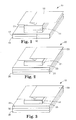
- Fig. 1 is representation of a medical dressing 10 that includes a foam pad 11 adhesively attached to a film 12 with an adhesive layer 13, which arc all coextensive.
- This construction of foam/adhesive/film is adhesively attached to a nonwoven web 16 with an adhesive layer 17, both of which extend beyond the periphery of the foam/adhesive film construction.
- the film 12, adhesive 17, and nonwoven web 16 are not coextensive, they are referred to herein as the "backing" for the foam pad 11.
- a liner 19 such as a J-fold liner, for example.
- Fig. 2 is a representation of a medical dressing 20 that includes a foam pad 21 adhesively attached to a film 22 with an adhesive layer 23.
- the film 22 is attached to a nonwoven web 26.
- the film 22, nonwoven web 26, and adhesive layer 23 are coextensive and extend beyond the periphery of the foam pad 21. Also shown is a liner 29.
- Fig. 3 is a representation of a medical article 30 that includes a foam pad 31 and second absorbent pad 35 that are adhesively attached to a film 32 with an adhesive layer 33.
- the film 32 is attached to a nonwoven web 36.
- the film 32, nonwoven web 36, and the adhesive layer 33 are coextensive and extend beyond the periphery of the foam pad 31.
- the medical articles of the invention can include graphics printed on the liquid-impervious, moisture-vapor permeable polymeric film. Suitable inks and methods of applying such graphics are disclosed in International Publication No. 99/19410 (Dunshee, et al. ). Such graphics can be placed on either major surface of the film.
- the medical articles of the invention can contain a topically active medicament, such as an antibacterial agent.
- the antibacterial agent is a broad-spectrum antibacterial agent such as a silver salt, a sulphadiazine, an acceptable iodine source such as povidone iodine (also called polyvinyl pyrrolidone-iodine or PVP/I), chlorhexidine salts such as the gluconate, acetate, hydrochloride or the like salts or quaternary antibacterial agents such as benzalkonium chloride.
- an antibacterial agent is a broad-spectrum antibacterial agent such as a silver salt, a sulphadiazine, an acceptable iodine source such as povidone iodine (also called polyvinyl pyrrolidone-iodine or PVP/I), chlorhexidine salts such as the gluconate, acetate, hydrochloride or the like salts or quaternary antibacterial agents such as benz
- the medical articles of this invention are sterile and are provided sealed within a bacteria-proof package.
- the medical article may be rendered sterile by any suitable sterilization means, for example by gamma irradiation, steam sterilization, or ethylene oxide.
- One process of manufacturing the dressings of the present invention is by sequential or simultaneous lamination of film, adhesive, foam, and optional nonwoven layers together at elevated temperatures.
- the films can be made from an appropriate thermoplastic resin by conventional extrusion processes, for example, as described in U.S. Pat. No. 4,499,896 (Heinecke ).
- the film is generally supported on a standard release liner during the foam-casting operation.
- the "dry" moisture vapor transmission rate (MVTR) was measured according to ASTM E-96-80 using a modified Payne cup method. Specifically, a sample (3.5-cm diameter) was placed between adhesive-containing surfaces of two foil adhesive rings, each having a 2.54-cm diameter hole. The holes of each ring were carefully aligned. Finger pressure was used to form a foil/sample/foil assembly that was flat, wrinkle-frec, and had no void areas in the exposed sample.
- a 120-ml glass jar was filled to the halfway level with deionized water.
- the jar was fitted with a screw-on cap having a 3.8-cm diameter hole in the center thereof and with a 4.45-cm diameter rubber washer having a 2.84-cm diameter hole in its center.
- the rubber washer was placed on the lip of the jar and the foil/sample assembly was placed on the rubber washer. The lid was then screwed loosely on the jar.
- the assembly was placed in a chamber at 38°C and 20% relative humidity for four hours. At the end of four hours, the cap was tightened inside the chamber so that the sample was level with the cap (no bulging) and the rubber washer was in proper seating position.
- the foil/sample assembly was then removed from the chamber and weighed immediately to the nearest 0.01 gram (initial weight W 1 ). The assembly was then returned to the chamber for at least 18 hours, after which it was removed and weighed immediately to the nearest 0.01 gram (final weight W 2 ).
- MVTR values are reported as g/m 2 /24 hrs.
- the inverted "wet” MVTR was measured using the following test procedure. After obtaining the final “dry” weight (W 2 ) as described for the "dry” MVTR procedure, the assembly was returned to the chamber (38°C and 20% relative humidity) for at least 18 additional hours with the sample jars inverted so that the deionized water was in direct contact with the test sample. The sample was then removed from the chamber and weighed to the nearest 0.01 gram (final "wet" weight, W3).
- Adhesive 1 (Blown Micro Fiber (BMF)-Acrylate-PSA Web)
- a porous polyacrylate-based BMF-PSA web was prepared using a melt blowing process similar to that described, for example, in Wente, Van A., "Superfine Thermoplastic Fibers," in Industrial Engineering Chemistry, Vol. 48, pages 1342 et seq (1956 ) or in Report No. 4364 of the Naval Research Laboratories, published May 25, 1954, entitled “Manufacture of Superfine Organic Fibers” by Wente, Van A.; Boone. C.D.; and Fluharty, E.L. , except that the BMF apparatus utilized a single extruder which fed its extrudate to a gear pump that controlled the polymer melt flow.
- the gear pump fed a feedblock assembly that was connected to a melt-blowing die having circular smooth surface orifices (10/cm) with a 5:1 length to diameter ratio.
- the primary air was maintained at 220°C and 241 KPa with a 0.076-cm gap width to produce a uniform web.
- the feedblock assembly was fed by a polymer melt stream (240°C) comprised of isooctyl acrylate/acrylic acid/styrene macromer (IOA/AA/Sty, 92/4/4 ratio, Inherent Viscosity ⁇ 0.65 as measured by conventional means using a Cannon-Fenski #50 viscometer in a water bath controlled at 25°C to measure the flow time of 10 ml of a polymer solution (0.2 g per deciliter polymer in ethyl acetate) PSA, prepared as described in Example 2 of U.S. Patent No. 5,648,166 .
- Both the die and feedblock assembly were maintained at 220°C', and the die was operated at a rate of 178 g/hr/cm die width.
- the BMF-PSA web was collected on a double-coated silicone release paper (DCP-L,ohja, Westchester, 1L) which passed around a rotating drum collector at a collector to die distance of 17.8 cm.
- the resulting BMF-PSA web comprising PSA microfibers having an average diameter of less than about 25 microns (as determined using a scanning electron microscope), had a basis weight of about 60 g/m 2 .
- a sheet of 4.8-mm thick polyurethane foam (POLYCRILTM 400, Fulflex, Inc., Middleton, RI) and 1.0-mil (25-microns) thick polyurethane film (extruded from a polyurethane resin available under the trade designation ESTANE 58237 from B. F. Goodrich, Cleveland, OH as described in U.S. Pat. No.
- the polyacrylate T3MF-PSA web (Adhesive 1, including release liner) was laminated to a melt blown polyurethane nonwoven web (basis weight 100 g/m 2 ; prepared from MORTHANE PS-440 (Morton International, Seabrook, NH) as described in Example 1 of U.S. Pat. No. 5,230,701 ("Meyer ”)), using a laboratory laminator having two steel rollers with the bottom roller temperature set at 93°C and the top roller temperature set at 113°C. The gap width between rollers was 0.2 mm, the nip pressure was 620 KPa, and the line speed was 122 cm/min.
- the release liner was removed from the resulting fibrous-adhesive/nonwoven laminate and an island dressing was constructed by placing a 7.6-cm x 7.6-cm pad of the foam/fibrous-adhesive/film composite of Example 1 in the center of a 10-cm x 10-cm sample of the fibrous-adhesive/nonwoven laminate (film layer in direct contact with the adhesive layer) and applying light finger pressure to the pad to ensure good adhesion to the nonwoven layer.
- a 10-cm x 10-cm standard J-fold silicone product release liner (DCP-Lohja, Westchester, IL) was placed over the foam layer and pressed against the adhesive layer to form the completed dressing. The dressing was then cut into samples that were later used in absorbency, swell, and MVTR evaluations. Evaluation results are reported in Table 1.
- An island dressing was constructed as described in Example 2, except that a hydroentangled nonwoven polyester web (available under the trade designation SONTARA 8010 from Dupont, Wilmington, DE) was substituted for the melt blown polyurethane nonwoven web, and the top roller temperature, during lamination, was set at 149°C.
- the resulting dressing was cut into samples that were later used in absorbency, swell, and MVTR evaluations. Evaluation results are reported in Table 1.
- the polyacrylate BMF-PSA web (Adhesive 1, including release liner) was laminated to the melt blown polyurethane nonwoven web (basis weight 100 g/m 2 ; prepared from MORTHANE PS-440) as described in Example 2.
- the release liner was removed and the fibrous-adhesive/nonwoven laminate was further laminated (same conditions as described in Example 2, except the gap width was 0.3 mm) to a sheet of 1.0-mil thick polyurethane film (ESTANE 58237) on standard MUL carrier paper.
- the carrier paper was stripped off and the film/adhesive/nonwoven laminate was further laminated (same conditions as described in Example 2, except the bottom roller temperature was 93°C, the top roller temperature was 107°C, and the gap width was 0.3 mm) to the polyacrylate BMF-PSA web (Adhesive 1, including release liner) such that the nonwoven layer was in direct contact with the added adhesive layer.
- the polyacrylate BMF-PSA web Adhesive 1, including release liner
- the release liner was removed from the resulting adhesive/nonwoven/adhesive/film laminate and an island dressing was constructed by placing a 7.6-cm x 7.6-cm pad of4.8-mm thick polyurethane foam (POLYCRIL 400) in the center of a 10-cm x 10-cm sample of the laminate (film layer in direct contact with the adhesive layer) and applying light finger pressure to the pad to ensure good adhesion to the nonwoven layer.
- a 10-cm x 10-cm standard J-fold silicone product release liner (DCP-Lohja, Westchester, IL) was placed over the foam layer and pressed against the adhesive layer to form the completed dressing. The dressing was then cut into samples that were later used in absorbency, swell, and MVTR evaluations. Evaluation results are reported in Table 1.
- An island dressing was constructed as described in Example 4, except that the film/adhesive/nonwoven laminate was further laminated to the polyacrylate BMF-PSA web such that the film layer was in direct contact with the added adhesive layer.
- the completed dressing was cut into samples that were later used in absorbency, swell, and MVTR evaluations. Evaluation results are reported in Table 1.
- a sheet of 1.0-mil (25-microns) thick polyurethane film (ESTANE 58237) on standard MUL carrier paper was heat laminated to a melt blown polyurethane nonwoven web (web as described in Example 2) using a laboratory laminator having two steel rollers with the bottom roller temperature set at 107°C and the top roller temperature set at 141°C. The gap width between rollers was 0.2 mm, the nip pressure was 1378 KPa, and the line speed was 366 cm/min.
- the carrier paper was stripped off and the film/nonwoven laminate was further laminated to the polyacrylate BMF-PSA web (Adhesive 1, including release liner) such that the film layer was in direct contact with the adhesive layer.
- Lamination conditions were: bottom steel roller temperature - 93°C, top steel roller temperature - 107°C, gap width - 0.3 mm, nip pressure - 620 KPa, and line speed - 122 cm/min.
- the release liner was removed from the resulting fibrous-adhesive/film/nonwoven laminate and an island dressing was constructed by placing a 7.6-cm x 7.6-cm pad of 4.8-mm thick polyurethane foam (POLYCRIL, 400) in the center of a 10-cm x 10-cm sample of the laminate (foam pad in direct contact with the adhesive layer) and applying light finger pressure to the pad to ensure good adhesion to the film layer.
- POLYCRIL 7.6-cm x 7.6-cm pad of 4.8-mm thick polyurethane foam
- Example 6 An island dressing was constructed as described in Example 6, except that the film/nonwoven laminate was further laminated to the polyacrylate BMF-PSA web such that the nonwoven layer was in direct contact with the adhesive layer.
- the completed dressing was cut into samples that were later used in absorbency, swell, and MVTR evaluations. Evaluation results are reported in Table 1,
- An island dressing was constructed as described in Example 4, except that the composite contained a 5-cm x 5-cm internal pad of blended nonwoven rayon/"Oasis" superabsorbent fibers (National Nonwovens, Cincinnati, OH) in order to enhance the absorbent capacity of the composition.
- the polyurethane foam pad was placed directly over the internal pad that had been placed in the center of the laminate. The outer edge of the foam pad extended beyond the entire perimeter of the internal pad and was adhered to the adhesive surface of the laminate by applying finger pressure to the foam pad. The foam pad thus entirely encompassed the internal pad.
- a standard J-fold silicone product release liner was placed over the foam layer and pressed against the adhesive layer to form the completed dressing. The dressing was then cut into samples that were later used in absorbency, swell, and MVTR evaluations. Evaluation results are reported in Table 1.
- Example 5 An island dressing was constructed as described in Example 5, except that the composite contained a 5-cm x 5-cm internal pad of blended nonwoven rayon/"Oasis" superabsorbent fibers (National Nonwovens) in order to enhance the absorbent capacity of the composition.
- the internal pad was built into the composition as described in Example 8. The completed dressing was then cut into samples that were later used in absorbency, swell, and MVTR evaluations. Evaluation results are reported in Table 1.
- Example 6 An island dressing was constructed as described in Example 6, except that the composite contained a 5-cm x 5-cm internal pad of blended nonwoven rayon/"Oasis'" superabsorbent fibers (National Nonwovens) in order to enhance the absorbent capacity of the composition.
- the internal pad was built into the composition as described in Example 8. The completed dressing was then cut into samples that were later used in absorbency, swell, and MVTR evaluations. Evaluation results are reported in Table 1.
- Example 7 An island dressing was constructed as described in Example 7, except that the composite contained an internal pad of blended nonwoven rayon/"Oasis" superabsorbent fibers (National Nonwovens) in order to enhance the absorbent capacity of the composition.
- the internal pad was built into the composition as described in Example 8. The completed dressing was then cut into samples that were later used in absorbency, swell, and MVTR evaluations. Evaluation results are reported in Table 1.
- An island dressing was constructed as described in Example 4, except that a hydroentangled nonwoven polyester web (SONTARA 8010, Dupont) was substituted for the melt blown polyurethane nonwoven web, and the top roller temperature, during lamination of the polyacrylate adhesive to the nonwoven, was set at 149°C.
- the resulting dressing was cut into samples that were later used in absorbency, swell, and MVTR evaluations. Evaluation results are reported in Table 1.
- Example 12 An island dressing was constructed as described in Example 12, except that a hydroentangled, nonwoven rayon (30%)/polyester (70%) web (SONTARA 8411, Dupont) was substituted for the SONTARA 8010 web. The completed dressing was then cut into samples that were later used in absorbency, swell, and MVTR evaluations. Evaluation results are reported in Table 1.
- Example 12 An island dressing was constructed as described in Example 12, except that the film/adhesive/nonwoven laminate was further laminated to the polyacrylate adhesive such that the film layer was in direct contact with the outer adhesive layer.
- the completed dressing was cut into samples that were later used in absorbency, swell, and MVTR evaluations. Evaluation results are reported in Table 1.
- Example 12 An island dressing was constructed as described in Example 12, except that the composite contained a 5-cm x 5-cm internal pad of blended nonwoven rayon/"Oasis" superabsorbent fibers (National Nonwovens) in order to enhance the absorbent capacity of the composite.
- the internal pad was built into the composite as described in Example 8. The completed dressing was then cut into samples that were later used in absorbency, swell, and MVTR evaluations. Evaluation results are reported in Table 1.
- Example 13 An island dressing was constructed as described in Example 13, except that the composite contained a 5-cm x 5-cm internal pad of blended nonwoven rayon/"Oasis" superabsorbent fibers (National Nonwovens) in order to enhance the absorbent capacity of the composite.
- the internal pad was built into the composite as described in Example 8. The completed dressing was then cut into samples that were later used in absorbency, swell, and MVTR evaluations. Evaluation results are reported in Table 1.
- Example 14 An island dressing was constructed as described in Example 14, except that the composite contained a 5-cm x 5-cm internal pad of blended nonwoven rayon/"Oasis" superabsorbent fibers (National Nonwovens) in order to enhance the absorbent capacity of the composite.
- the internal pad was built into the composite as described in Example 8. The completed dressing was then cut into samples that were later used in absorbency, swell, and MVTR evaluations. Evaluation results are reported in Table 1.
- An island dressing was constructed as described in U.S. Pat. No. 5,738,642 (Heinecke, et. al .) utilizing a conventional adhesive similar to those described in U.S. Pat. No. 4,871,812 (Lucast et. al .) (except adhesive was reinforced with 1% polyethyloxazoline as opposed to the indicated 1.5 - 8%).
- the release liner was removed from the adhesive-coated film and the dressing was completed by placing a 7.6-cm x 7.6-cm pad of 4.8-mm thick polyurethane foam (POLYCRIL 400) in the center of a 10-cm x 10-cm sample of the backing and applying light finger pressure to the pad to ensure good adhesion to the film layer.
- POLYCRIL 400 7.6-cm x 7.6-cm pad of 4.8-mm thick polyurethane foam
- Example 18 An island dressing was constructed as described in Example 18, except that the composite contained a 5-cm x 5-cm internal pad of blended nonwoven rayon/"Oasis" superabsorbent fibers (National Nonwovens) in order to enhance the absorbent capacity of the composite.
- the internal pad was built into the composite as described in Example 8. The completed dressing was then cut into samples that were later used in absorbency, swell, and MVTR evaluations. Evaluation results are reported in Table 1.
- Dressings from Examples 1-19 were cut into appropriate sample sizes and evaluated for water absorbency, swell, "Dry” MVTR, and "Wet” MVTR. The results are shown in Table 1 along with results for four commercial adhesive-containing foam dressings, ALLEVYN Adhesive (Smith & Nephew, York, England), POL,YMEM Membrane adhesive dressing (Ferris Mfg. Co., Burr Ridge, IL,), LyoFoam A (ConvaTec, Skillman, NJ), and Tielle (Johnson & Johnson, Arlington, TX).
- ALLEVYN Adhesive Smith & Nephew, York, England
- POL,YMEM Membrane adhesive dressing Frerris Mfg. Co., Burr Ridge, IL,
- LyoFoam A ConvaTec, Skillman, NJ
- Tielle Johnson & Johnson, Arlington, TX.
- composite dressings of the present invention all had swell values less than 10%. In contrast, the commercial dressings had swell values in the range of 30-250%. Additionally, the composite dressings of the present invention had dry MVTR values less than 2500 g/m 2 /24 hours, and in some cases less than 2000 g/m 2 /24 hours; and, except for Examples 18-19 that used a film continuously coated with adhesive, had wet MVTR values of greater than 5000 g/m 2 /24 hours.
- the data from Table 2 show that among the four foam samples evaluated only POLYCRIL 400 had low swell (8%) coupled with high absorbency (1089%).
Landscapes
- Health & Medical Sciences (AREA)
- Chemical & Material Sciences (AREA)
- General Health & Medical Sciences (AREA)
- Public Health (AREA)
- Materials Engineering (AREA)
- Epidemiology (AREA)
- Life Sciences & Earth Sciences (AREA)
- Animal Behavior & Ethology (AREA)
- Hematology (AREA)
- Engineering & Computer Science (AREA)
- Veterinary Medicine (AREA)
- Chemical Kinetics & Catalysis (AREA)
- Dispersion Chemistry (AREA)
- Materials For Medical Uses (AREA)
- Laminated Bodies (AREA)
- Adhesives Or Adhesive Processes (AREA)
Applications Claiming Priority (2)
| Application Number | Priority Date | Filing Date | Title |
|---|---|---|---|
| US09/507,107 US6548727B1 (en) | 2000-02-17 | 2000-02-17 | Foam/film composite medical articles |
| EP00959228.8A EP1255575B2 (en) | 2000-02-17 | 2000-08-11 | Foam/film composite medical articles |
Related Parent Applications (2)
| Application Number | Title | Priority Date | Filing Date |
|---|---|---|---|
| EP00959228.8A Division EP1255575B2 (en) | 2000-02-17 | 2000-08-11 | Foam/film composite medical articles |
| EP00959228.8A Division-Into EP1255575B2 (en) | 2000-02-17 | 2000-08-11 | Foam/film composite medical articles |
Publications (1)
| Publication Number | Publication Date |
|---|---|
| EP1842563A1 true EP1842563A1 (en) | 2007-10-10 |
Family
ID=24017274
Family Applications (2)
| Application Number | Title | Priority Date | Filing Date |
|---|---|---|---|
| EP07107693A Withdrawn EP1842563A1 (en) | 2000-02-17 | 2000-08-11 | Foam/film composite medical articles |
| EP00959228.8A Expired - Lifetime EP1255575B2 (en) | 2000-02-17 | 2000-08-11 | Foam/film composite medical articles |
Family Applications After (1)
| Application Number | Title | Priority Date | Filing Date |
|---|---|---|---|
| EP00959228.8A Expired - Lifetime EP1255575B2 (en) | 2000-02-17 | 2000-08-11 | Foam/film composite medical articles |
Country Status (12)
| Country | Link |
|---|---|
| US (2) | US6548727B1 (enExample) |
| EP (2) | EP1842563A1 (enExample) |
| JP (1) | JP4860872B2 (enExample) |
| AT (1) | ATE386555T1 (enExample) |
| AU (2) | AU7058200A (enExample) |
| BR (1) | BR0017124A (enExample) |
| CA (1) | CA2398722C (enExample) |
| DE (1) | DE60038131T2 (enExample) |
| ES (1) | ES2300273T3 (enExample) |
| MX (1) | MXPA02007872A (enExample) |
| WO (1) | WO2001060422A1 (enExample) |
| ZA (1) | ZA200206547B (enExample) |
Cited By (2)
| Publication number | Priority date | Publication date | Assignee | Title |
|---|---|---|---|---|
| DE102008029051A1 (de) * | 2008-06-18 | 2009-12-24 | Paul Hartmann Ag | OP-Abdeckung mit integrierter Flüssigkeitsbarriere |
| US11479693B2 (en) | 2018-05-03 | 2022-10-25 | Avery Dennison Corporation | Adhesive laminates and method for making adhesive laminates |
Families Citing this family (131)
| Publication number | Priority date | Publication date | Assignee | Title |
|---|---|---|---|---|
| US6831205B2 (en) * | 1999-11-29 | 2004-12-14 | Clozex Medical, Llc | Bandage for wound or incision closure |
| US6548727B1 (en) * | 2000-02-17 | 2003-04-15 | 3M Innovative Properties Company | Foam/film composite medical articles |
| US20040002676A1 (en) * | 2002-06-28 | 2004-01-01 | Siegwart Kathleen Ann | Adhesive bandage having a selectively placed layer |
| US7119247B2 (en) * | 2002-10-22 | 2006-10-10 | George Medical, Llc | Dressing and a method for making and applying a dressing |
| KR100550807B1 (ko) * | 2002-10-29 | 2006-02-09 | 주식회사 바이오폴 | 충전형 폴리우레탄 폼 드레싱재 및 그 제조방법 |
| DE10301835A1 (de) * | 2003-01-20 | 2004-07-29 | Beiersdorf Ag | Pflaster mit bedruckter Wundauflage und transparenter Fixierfolie |
| US6838589B2 (en) | 2003-02-19 | 2005-01-04 | 3M Innovative Properties Company | Conformable wound dressing |
| US7285576B2 (en) * | 2003-03-12 | 2007-10-23 | 3M Innovative Properties Co. | Absorbent polymer compositions, medical articles, and methods |
| US7414168B2 (en) * | 2003-07-24 | 2008-08-19 | Clozex Medical Llc | Device for laceration or incision closure |
| US7838718B2 (en) * | 2003-07-24 | 2010-11-23 | Clozex Medical, Llc | Device for laceration or incision closure |
| US8636763B2 (en) * | 2003-07-24 | 2014-01-28 | Clozex Medical, Llc | Device for laceration or incision closure |
| US20050021081A1 (en) * | 2003-07-24 | 2005-01-27 | Clozex Medical, Llc | Device for laceration or incision closure |
| US7354446B2 (en) * | 2003-07-24 | 2008-04-08 | Clozex Medical, Llc | Device for laceration or incision closure |
| US7118761B2 (en) | 2003-08-14 | 2006-10-10 | Canada T Andrew | Method for producing a silver-containing wound care device |
| US20050037057A1 (en) * | 2003-08-14 | 2005-02-17 | Schuette Robert L. | Silver-containing antimicrobial fabric |
| US8563447B2 (en) * | 2003-08-14 | 2013-10-22 | Milliken & Company | Silver-containing wound care device |
| US7842306B2 (en) * | 2003-08-14 | 2010-11-30 | Milliken & Company | Wound care device having fluid transfer properties |
| US20050147657A1 (en) * | 2003-08-14 | 2005-07-07 | Milliken & Company | White silver-containing wound care device |
| US7332641B2 (en) * | 2003-10-10 | 2008-02-19 | Clozex Medical Llc | Interlaced compositions and methods of production |
| US20050123621A1 (en) * | 2003-12-05 | 2005-06-09 | 3M Innovative Properties Company | Silver coatings and methods of manufacture |
| US7745509B2 (en) * | 2003-12-05 | 2010-06-29 | 3M Innovative Properties Company | Polymer compositions with bioactive agent, medical articles, and methods |
| US20050123590A1 (en) * | 2003-12-05 | 2005-06-09 | 3M Innovative Properties Company | Wound dressings and methods |
| US20060035039A1 (en) * | 2004-08-12 | 2006-02-16 | 3M Innovative Properties Company | Silver-releasing articles and methods of manufacture |
| US7563941B2 (en) | 2004-09-10 | 2009-07-21 | Clozex Medical, Llc | Modular wound dressing system |
| US20060063455A1 (en) * | 2004-09-21 | 2006-03-23 | Andover Coated Products, Inc. | Hand-tearable non-elastic tape |
| US20080171958A1 (en) * | 2005-02-24 | 2008-07-17 | Boerge Gundersen | Wound Dressing |
| EP1709947A1 (en) | 2005-04-08 | 2006-10-11 | 3M Innovative Properties Company | Compression bandage system |
| US8399027B2 (en) * | 2005-04-14 | 2013-03-19 | 3M Innovative Properties Company | Silver coatings and methods of manufacture |
| US8105353B2 (en) | 2005-08-09 | 2012-01-31 | Clozex Medical, Llc | Wound closure kit and method of using the same |
| US20070038246A1 (en) * | 2005-08-09 | 2007-02-15 | Clozex Medical, Llc | Four component wound closure device with locking strip |
| US20070166399A1 (en) * | 2006-01-13 | 2007-07-19 | 3M Innovative Properties Company | Silver-containing antimicrobial articles and methods of manufacture |
| US20070243258A1 (en) * | 2006-04-13 | 2007-10-18 | 3M Innovative Properties Company | Method and apparatus for forming crosslinked chromonic nanoparticles |
| US20080014386A1 (en) * | 2006-06-01 | 2008-01-17 | Andover Healthcare, Inc. | Cohesive articles with a foam layer |
| US20100098949A1 (en) * | 2006-10-18 | 2010-04-22 | Burton Scott A | Antimicrobial articles and method of manufacture |
| KR100777908B1 (ko) * | 2006-12-19 | 2007-11-28 | 주식회사 바이오폴 | 보수율이 향상된 폴리우레탄 폼 드레싱재 |
| DE602008003899D1 (de) | 2007-06-25 | 2011-01-20 | Coloplast As | Stomavorrichtung mit mehreren abziehfolien |
| US20090088707A1 (en) * | 2007-10-01 | 2009-04-02 | Michael Adams | Dressing, method and kit for skin crack repair |
| GB2455962A (en) * | 2007-12-24 | 2009-07-01 | Ethicon Inc | Reinforced adhesive backing sheet, for plaster |
| GB2457470A (en) * | 2008-02-13 | 2009-08-19 | Pulse Medical Technologies Ltd | Silver ion wound dressing with electromagnetic coil |
| BRPI0906093A2 (pt) | 2008-03-05 | 2016-10-25 | Kci Licensing Inc | sistema de tratamento com pressão reduzida, curativo com pressão reduzida adaptado pra distribuir uma pressão reduzida a um sítio tecidual, método para coletar fluido em um curativo posicionado em um sítio tecidual e kit de curativo com pressão reduzida. |
| GB0804654D0 (en) | 2008-03-13 | 2008-04-16 | Smith & Nephew | Vacuum closure device |
| EP2140888A1 (de) * | 2008-07-04 | 2010-01-06 | Bayer MaterialScience AG | Schichtenverbund, geeignet als Wundauflage, umfassend eine Polyurethanschaumschicht, eine Absorberschicht und eine Deckschicht |
| US20100030170A1 (en) * | 2008-08-01 | 2010-02-04 | Keith Alan Keller | Absorptive Pad |
| US8454990B2 (en) * | 2008-08-01 | 2013-06-04 | Milliken & Company | Composite article suitable for use as a wound dressing |
| US8581017B2 (en) | 2008-10-24 | 2013-11-12 | 3M Innovative Properties Company | Conformable wound dressing |
| WO2010069326A1 (en) * | 2008-12-18 | 2010-06-24 | Coloplast A/S | An ostomy appliance with a release liner having a predefined folding line |
| US9062914B2 (en) * | 2009-03-19 | 2015-06-23 | Cygnus Medical, Llc | Method of preventing damage of sterile wraps using a tray liner including a foam layer and a paper layer |
| BR112012010858B8 (pt) | 2009-11-09 | 2018-10-02 | 3M Innovative Properties Co | ''artigo médico e método para aumentar a taxa de transmissão de vapor de umidade. |
| CN102596560B (zh) | 2009-11-09 | 2015-11-25 | 3M创新有限公司 | 医疗制品及使用可混溶组合物进行制备的方法 |
| US8814842B2 (en) | 2010-03-16 | 2014-08-26 | Kci Licensing, Inc. | Delivery-and-fluid-storage bridges for use with reduced-pressure systems |
| WO2011119393A2 (en) | 2010-03-26 | 2011-09-29 | 3M Innovative Properties Company | Method of sterilization of wound dressings |
| US8821458B2 (en) * | 2010-04-16 | 2014-09-02 | Kci Licensing, Inc. | Evaporative body-fluid containers and methods |
| GB2488749A (en) | 2011-01-31 | 2012-09-12 | Systagenix Wound Man Ip Co Bv | Laminated silicone coated wound dressing |
| CN106974683B (zh) | 2011-02-04 | 2020-02-21 | 马萨诸塞州大学 | 负压伤口闭合装置 |
| US9421132B2 (en) | 2011-02-04 | 2016-08-23 | University Of Massachusetts | Negative pressure wound closure device |
| US20120220973A1 (en) * | 2011-02-28 | 2012-08-30 | Jennifer Wing-Yee Chan | Adhesive bandage |
| GB201106491D0 (en) | 2011-04-15 | 2011-06-01 | Systagenix Wound Man Ip Co Bv | Patterened silicone coating |
| FR2974005B1 (fr) | 2011-04-15 | 2014-05-02 | Urgo Lab | Pansement adhesif mince tres absorbant, ses utilisations pour le traitement des plaies chroniques |
| FR2974004B1 (fr) * | 2011-04-15 | 2014-05-02 | Urgo Lab | Pansement absorbant hydrocellulaire, ses utilisations pour le traitement des plaies chroniques et aigues |
| DE202011005579U1 (de) * | 2011-04-21 | 2011-10-14 | Medi1One Medical Grosshandels Gmbh | Zweilagige Kompresse, insbesondere Trachealkompresse |
| US8739796B2 (en) | 2011-09-29 | 2014-06-03 | Covidien Lp | Tracheal tube flange member |
| CA2858074C (en) | 2011-12-16 | 2020-08-25 | Kci Licensing, Inc. | Releasable medical drapes |
| US10940047B2 (en) | 2011-12-16 | 2021-03-09 | Kci Licensing, Inc. | Sealing systems and methods employing a hybrid switchable drape |
| US9132039B2 (en) | 2012-03-29 | 2015-09-15 | Principle Business Enterprises, Inc. | Disposable absorbent moisture management dressing |
| AU2013291693B2 (en) | 2012-05-22 | 2018-03-01 | Smith & Nephew Plc | Wound closure device |
| MX2014014266A (es) | 2012-05-22 | 2015-06-23 | Smith & Nephew | Aparatos y metodos para terapia de heridas. |
| AU2013264937B2 (en) | 2012-05-24 | 2018-04-19 | Smith & Nephew Inc. | Devices and methods for treating and closing wounds with negative pressure |
| EP2854880B1 (en) | 2012-05-29 | 2019-03-13 | 3M Innovative Properties Company | Absorbent article comprising polymeric foam |
| RU2015104581A (ru) | 2012-07-16 | 2016-09-10 | Смит Энд Нефью, Инк. | Устройство для закрытия раны с использованием отрицательного давления |
| BR112015011271B1 (pt) | 2012-11-16 | 2022-03-03 | 3M Innovative Properties Company | Campo cirúrgico, sistema e método de fabricação de um campo cirúrgico |
| GB201222770D0 (en) | 2012-12-18 | 2013-01-30 | Systagenix Wound Man Ip Co Bv | Wound dressing with adhesive margin |
| US10617425B2 (en) | 2014-03-10 | 2020-04-14 | Conformal Medical, Inc. | Devices and methods for excluding the left atrial appendage |
| US10124098B2 (en) | 2013-03-13 | 2018-11-13 | Smith & Nephew, Inc. | Negative pressure wound closure device and systems and methods of use in treating wounds with negative pressure |
| US9943315B2 (en) | 2013-03-13 | 2018-04-17 | Conformal Medical, Inc. | Devices and methods for excluding the left atrial appendage |
| US11399842B2 (en) | 2013-03-13 | 2022-08-02 | Conformal Medical, Inc. | Devices and methods for excluding the left atrial appendage |
| BR112015021123A2 (pt) | 2013-03-14 | 2017-07-18 | Smith & Nephew | enchimentos compressíveis de ferimentos e sistemas e métodos para o uso no tratamento de ferimentos com pressão negativa |
| EP3434236B2 (en) | 2013-03-14 | 2025-04-09 | Solventum Intellectual Properties Company | Absorbent dressing with hybrid drape |
| WO2014209620A1 (en) | 2013-06-28 | 2014-12-31 | 3M Innovative Properties Company | Fibrin-coated wound dressing |
| JP2016528964A (ja) | 2013-07-16 | 2016-09-23 | スミス アンド ネフュー ピーエルシーSmith & Nephew Public Limited Company | 創傷治療のための装置および方法 |
| JP6502938B2 (ja) * | 2013-08-05 | 2019-04-17 | スリーエム イノベイティブ プロパティズ カンパニー | 含有緩衝体を備えた支持装置 |
| WO2015030963A1 (en) | 2013-08-26 | 2015-03-05 | Kci Licensing, Inc. | Dressing interface with moisture controlling feature and sealing function |
| WO2015061352A2 (en) | 2013-10-21 | 2015-04-30 | Smith & Nephew, Inc. | Negative pressure wound closure device |
| WO2015065742A1 (en) | 2013-10-28 | 2015-05-07 | Kci Licensing, Inc. | Hybrid sealing tape |
| EP3744361B1 (en) | 2013-10-30 | 2024-07-24 | Solventum Intellectual Properties Company | Absorbent conduit and system |
| EP3513773A1 (en) | 2013-10-30 | 2019-07-24 | KCI Licensing, Inc. | Condensate absorbing and dissipating system |
| ES2670710T3 (es) | 2013-10-30 | 2018-05-31 | Kci Licensing, Inc. | Apósito con perforaciones dimensionadas diferencialmente |
| WO2015065616A1 (en) | 2013-10-30 | 2015-05-07 | Kci Licensing, Inc. | Dressing with sealing and retention intereface |
| CN110974539A (zh) | 2014-01-21 | 2020-04-10 | 史密夫及内修公开有限公司 | 用于负压伤口治疗的可塌缩敷料 |
| CA2937397A1 (en) | 2014-01-21 | 2015-07-30 | Smith & Nephew Plc | Wound treatment apparatuses |
| EP3479803B1 (en) | 2014-02-28 | 2021-03-31 | 3M Innovative Properties Company | Hybrid drape having a gel-coated perforated mesh |
| US11026844B2 (en) | 2014-03-03 | 2021-06-08 | Kci Licensing, Inc. | Low profile flexible pressure transmission conduit |
| US10406266B2 (en) | 2014-05-02 | 2019-09-10 | Kci Licensing, Inc. | Fluid storage devices, systems, and methods |
| JP6640748B2 (ja) | 2014-06-05 | 2020-02-05 | ケーシーアイ ライセンシング インコーポレイテッド | 流体獲得および分配特徴を備えるドレッシング |
| WO2016053875A1 (en) | 2014-10-01 | 2016-04-07 | 3M Innovative Properties Company | Medical dressings comprising fluid management articles and methods of using same |
| WO2016100098A1 (en) | 2014-12-17 | 2016-06-23 | Kci Licensing, Inc. | Dressing with offloading capability |
| WO2016100089A1 (en) | 2014-12-19 | 2016-06-23 | 3M Innovative Properties Company | Viscoelastic wound closure dressing |
| WO2016144751A1 (en) | 2015-03-06 | 2016-09-15 | Zoll Medical Corporation | Long-term wear electrode |
| EP3274002B1 (en) | 2015-03-27 | 2021-09-22 | 3M Innovative Properties Company | Fibrin composition, method and wound articles |
| US11439539B2 (en) | 2015-04-29 | 2022-09-13 | University Of Massachusetts | Negative pressure wound closure device |
| EP3294245B1 (en) | 2015-05-08 | 2019-09-04 | KCI Licensing, Inc. | Low acuity dressing with integral pump |
| EP3344205B1 (en) | 2015-09-01 | 2020-09-30 | KCI Licensing, Inc. | Dressing with increased apposition force |
| WO2017048866A1 (en) | 2015-09-17 | 2017-03-23 | Kci Licensing, Inc. | Hybrid silicone and acrylic adhesive cover for use with wound treatment |
| CN108136067A (zh) | 2015-10-05 | 2018-06-08 | 3M创新有限公司 | 包含柔性聚合物泡沫以及中间体的吸收制品 |
| US11471586B2 (en) | 2015-12-15 | 2022-10-18 | University Of Massachusetts | Negative pressure wound closure devices and methods |
| CN108431161A (zh) | 2015-12-30 | 2018-08-21 | 3M创新有限公司 | 含有活性酶的压敏粘合剂 |
| US11135351B2 (en) | 2016-08-30 | 2021-10-05 | Smith & Nephew Plc | Systems and methods for applying reduced pressure therapy |
| WO2018060144A1 (en) | 2016-09-27 | 2018-04-05 | Smith & Nephew Plc | Wound closure devices with dissolvable portions |
| US10940233B2 (en) | 2016-10-05 | 2021-03-09 | 3M Innovative Properties Company | Fibrinogen composition, method and wound articles |
| EP3522942B1 (en) | 2016-10-05 | 2023-12-27 | 3M Innovative Properties Company | Fibrin composition comprising carrier material, method and wound articles |
| US11426172B2 (en) | 2016-10-27 | 2022-08-30 | Conformal Medical, Inc. | Devices and methods for excluding the left atrial appendage |
| JP7071350B2 (ja) | 2016-10-27 | 2022-05-18 | コンフォーマル・メディカル・インコーポレイテッド | 左心耳を排除するためのデバイスおよび方法 |
| EP3534856A1 (en) | 2016-11-02 | 2019-09-11 | Smith & Nephew, Inc | Wound closure devices |
| CN108785287B (zh) * | 2017-04-28 | 2021-09-24 | 日东电工株式会社 | 透皮吸收制剂前体 |
| JP7179022B2 (ja) | 2017-06-13 | 2022-11-28 | スミス アンド ネフュー ピーエルシー | 創傷閉鎖装置および使用方法 |
| US11324876B2 (en) | 2017-06-13 | 2022-05-10 | Smith & Nephew Plc | Collapsible structure and method of use |
| US11395873B2 (en) | 2017-06-14 | 2022-07-26 | Smith & Nephew, Inc. | Control of wound closure and fluid removal management in wound therapy |
| CA3063859A1 (en) | 2017-06-14 | 2018-12-20 | Smith & Nephew, Inc. | Fluid removal management and control of wound closure in wound therapy |
| EP3638170B1 (en) | 2017-06-14 | 2024-03-13 | Smith & Nephew PLC | Collapsible structure for wound closure and method of use |
| AU2018285239B2 (en) | 2017-06-14 | 2023-09-21 | Smith & Nephew Plc | Collapsible sheet for wound closure and method of use |
| EP3658090B1 (en) | 2017-07-27 | 2021-11-10 | Smith & Nephew PLC | Customizable wound closure device |
| EP3664756B1 (en) | 2017-08-07 | 2024-01-24 | Smith & Nephew plc | Wound closure device with protective layer |
| WO2019042790A1 (en) | 2017-08-29 | 2019-03-07 | Smith & Nephew Plc | SYSTEMS AND METHODS FOR MONITORING WOUND CLOSURE |
| WO2019229600A1 (en) * | 2018-05-29 | 2019-12-05 | 3M Innovative Properties Company | Device for enumerating microorganisms |
| USD918398S1 (en) | 2018-12-10 | 2021-05-04 | Johnson & Johnson Consumer Inc. | Adhesive bandage with decorated pad |
| USD913507S1 (en) | 2018-12-10 | 2021-03-16 | Johnson & Johnson Consumer Inc. | Adhesive bandage with decorated pad |
| US12144508B2 (en) | 2019-02-08 | 2024-11-19 | Conformal Medical, Inc. | Devices and methods for excluding the left atrial appendage |
| US12268394B2 (en) | 2019-02-08 | 2025-04-08 | Conformal Medical, Inc. | Devices and methods for excluding the left atrial appendage |
| US20230190988A1 (en) | 2020-06-12 | 2023-06-22 | 3M Innovative Properties Company | Wound Dressing Material and Methods of Making and Using the Same |
| US20230372578A1 (en) | 2020-09-23 | 2023-11-23 | 3M Innovative Properties Company | Wound Dressing Material and Methods of Making and Using the Same |
| EP4398856A1 (en) | 2021-09-10 | 2024-07-17 | Solventum Intellectual Properties Company | Compression bandage systems with areas of increased local pressure |
| CN118556088A (zh) | 2021-12-20 | 2024-08-27 | 3M创新有限公司 | 可热脱粘的粘合剂 |
Citations (8)
| Publication number | Priority date | Publication date | Assignee | Title |
|---|---|---|---|---|
| GB1310460A (en) * | 1970-01-28 | 1973-03-21 | Parke Davis & Co | Surgical dressing for burns and like wounds |
| EP0099748A1 (en) * | 1982-07-21 | 1984-02-01 | Smith and Nephew Associated Companies p.l.c. | Adhesive wound dressing |
| US4753231A (en) * | 1981-02-13 | 1988-06-28 | Smith & Nephew Associated Companies P.L.C. | Adhesive wound dressing |
| EP0335669A2 (en) * | 1988-03-29 | 1989-10-04 | Ferris Mfg., Corp. | Hydrophilic foam compositions |
| EP0541390A1 (en) * | 1991-11-07 | 1993-05-12 | JOHNSON & JOHNSON MEDICAL, INC. | Wound dressing comprising polyurethane foam |
| US5409472A (en) * | 1989-08-03 | 1995-04-25 | Smith & Nephew Plc | Adhesive polymeric foam dressings |
| WO1999028539A1 (en) * | 1997-12-01 | 1999-06-10 | Minnesota Mining And Manufacturing Company | Acrylate copolymeric fibers |
| GB2336367A (en) * | 1998-04-15 | 1999-10-20 | Johnson & Johnson Medical Ltd | Polyurethane foams for use in wound dressings |
Family Cites Families (59)
| Publication number | Priority date | Publication date | Assignee | Title |
|---|---|---|---|---|
| US560878A (en) † | 1896-05-26 | Building-directory | ||
| USRE24906E (en) | 1955-11-18 | 1960-12-13 | Pressure-sensitive adhesive sheet material | |
| BE789739A (fr) | 1971-10-05 | 1973-04-05 | Lock Peter M | Pansement chirurgical |
| CA1042600A (en) | 1972-05-03 | 1978-11-14 | Louis L. Wood | Crosslinked hydrophilic polyurethane foams |
| US3978855A (en) | 1975-01-17 | 1976-09-07 | Ionics Lyo Products Company | Polyurethane foam surgical dressing |
| JPS51139900A (en) | 1975-05-15 | 1976-12-02 | Grace W R & Co | Hydrophilic polyurethane foam like natural sponge |
| US4499896A (en) | 1982-03-30 | 1985-02-19 | Minnesota Mining And Manufacturing Co. | Reservoir wound dressing |
| US4595001A (en) | 1982-04-08 | 1986-06-17 | Smith And Nephew Associated Companies P.L.C. | Surgical adhesive dressing |
| ATE27904T1 (de) | 1983-04-06 | 1987-07-15 | Smith & Nephew Ass | Verband. |
| GB8309993D0 (en) | 1983-04-13 | 1983-05-18 | Smith & Nephew Ass | Surgical adhesive dressing |
| US4561435A (en) | 1984-04-04 | 1985-12-31 | Chesebrough-Ponds, Inc. | Wound dressing |
| GB8419745D0 (en) | 1984-08-02 | 1984-09-05 | Smith & Nephew Ass | Wound dressing |
| USRE33353E (en) | 1985-01-24 | 1990-09-25 | Minnesota Mining And Manufacturing Company | Thin film surgical dressing with delivery system |
| US4598004A (en) | 1985-01-24 | 1986-07-01 | Minnesota Mining And Manufacturing Company | Thin film surgical dressing with delivery system |
| US5183664A (en) | 1986-09-20 | 1993-02-02 | Smith And Nephew Associated Companies P.L.C. | Thin film adhesive dressings preparation and use |
| US4871812A (en) | 1986-11-28 | 1989-10-03 | Minnesota Mining And Manufacturing Company | Moldable medical adhesive |
| US4833179A (en) | 1987-07-27 | 1989-05-23 | Minnesota Mining And Manufacturing Company | Suspension polymerization |
| US4906240A (en) * | 1988-02-01 | 1990-03-06 | Matrix Medica, Inc. | Adhesive-faced porous absorbent sheet and method of making same |
| US5098500A (en) | 1988-02-01 | 1992-03-24 | Polymedica Industries, Inc. | Adhesive-faced porous absorbent sheet and method of making same |
| US5254301A (en) | 1988-03-29 | 1993-10-19 | Ferris Mfg. Corp. | Process for preparing a sheet of polymer-based foam |
| US5065752A (en) | 1988-03-29 | 1991-11-19 | Ferris Mfg. Co. | Hydrophilic foam compositions |
| JP2768494B2 (ja) | 1988-05-05 | 1998-06-25 | スミス アンド ネフュー ピーエルシー | ドレッシングシステム |
| US5230701A (en) | 1988-05-13 | 1993-07-27 | Minnesota Mining And Manufacturing Company | Elastomeric adhesive and cohesive materials |
| US4897982A (en) | 1988-10-17 | 1990-02-06 | Fulflex International Co. | Plastic lined packaging |
| US5088483A (en) | 1988-11-04 | 1992-02-18 | Minnesota Mining And Manufacturing Co. | Adhesive frame bandage |
| US4917928A (en) | 1988-12-02 | 1990-04-17 | Minnesota Mining And Manufacturing Company | Folded adhesive film dressing |
| US4948575A (en) † | 1989-01-24 | 1990-08-14 | Minnesota Mining And Manufacturing Company | Alginate hydrogel foam wound dressing |
| GB8906100D0 (en) | 1989-03-16 | 1989-04-26 | Smith & Nephew | Laminates |
| US5271943A (en) | 1989-10-27 | 1993-12-21 | Scott Health Care | Wound gel compositions containing sodium chloride and method of using them |
| US5160315A (en) | 1991-04-05 | 1992-11-03 | Minnesota Mining And Manufacturing Company | Combined adhesive strip and transparent dressing delivery system |
| TW246682B (enExample) * | 1991-08-12 | 1995-05-01 | Procter & Gamble | |
| US5294258A (en) * | 1992-04-08 | 1994-03-15 | Nordson Corporation | Apparatus for producing an integral adhesive matrix |
| US6326410B1 (en) * | 1992-11-04 | 2001-12-04 | Johnson & Johnson Medical, Inc. | Wound dressing comprising polyurethane foam |
| GB9302970D0 (en) | 1993-02-15 | 1993-03-31 | Smith & Nephew | Absorbant dressing,manufacture and use |
| KR100355857B1 (ko) | 1993-03-22 | 2003-03-31 | 미네소타 마이닝 앤드 매뉴팩춰링 캄파니 | 접착성합성체드레싱및그제조방법 |
| US5338766A (en) † | 1993-03-26 | 1994-08-16 | The Procter & Gamble Company | Superabsorbent polymer foam |
| JPH07109443A (ja) * | 1993-10-08 | 1995-04-25 | Nitto Denko Corp | 通気性粘着シート |
| US5695777A (en) | 1994-05-10 | 1997-12-09 | Medtronic, Inc. | Absorptive wound dressing for wound healing promotion |
| GB9411429D0 (en) * | 1994-06-08 | 1994-07-27 | Seton Healthcare Group Plc | Wound dressings |
| US5653699A (en) † | 1994-09-13 | 1997-08-05 | Polymedica Industries, Inc. | Spyrosorbent wound dressings for exudate management |
| US5512041A (en) | 1994-10-07 | 1996-04-30 | Scott Health Care | Wound dressing for promoting moist wound healing |
| US5614310A (en) | 1994-11-04 | 1997-03-25 | Minnesota Mining And Manufacturing Company | Low trauma wound dressing with improved moisture vapor permeability |
| JPH08188530A (ja) † | 1995-01-06 | 1996-07-23 | Nitto Denko Corp | 貼付剤および貼付製剤 |
| US6107538A (en) | 1995-01-10 | 2000-08-22 | The Procter & Gamble Company | Absorbent members for absorbing body liquids |
| US5648166A (en) | 1995-02-21 | 1997-07-15 | Minnesota Mining And Manufacturing Company | Pressure-sensitive adhesives and tape articles |
| US5873869A (en) † | 1995-03-02 | 1999-02-23 | The Procter & Gamble Company | Absorbent article with foam absorbent structure providing improved menses acquisition and fit |
| US5650450A (en) | 1996-01-25 | 1997-07-22 | Foamex L.P. | Hydrophilic urethane foam |
| US5744509A (en) | 1996-07-01 | 1998-04-28 | Woodbridge Foam Corporation | Foamed polymer and process for production thereof |
| US5849325A (en) | 1996-10-07 | 1998-12-15 | Minnesota Mining And Manufacturing Company | Moisture-regulating adhesive dressing |
| DE69815547T2 (de) | 1997-10-15 | 2004-04-22 | Minnesota Mining & Manufacturing Company, St. Paul | Abrasionsbeständige tinenzusammensetzungen und verwendungsverfahren |
| US6171985B1 (en) * | 1997-12-01 | 2001-01-09 | 3M Innovative Properties Company | Low trauma adhesive article |
| US6007914A (en) | 1997-12-01 | 1999-12-28 | 3M Innovative Properties Company | Fibers of polydiorganosiloxane polyurea copolymers |
| EP0963760A1 (en) † | 1998-06-09 | 1999-12-15 | The Procter & Gamble Company | Low viscosity thermoplastic compositions for moisture vapour permeable structures and the utilisation thereof in absorbent articles |
| US5947917A (en) | 1998-08-28 | 1999-09-07 | Avery Dennison Corporation | Adhesive bandage or tape |
| US6410464B1 (en) * | 1998-10-02 | 2002-06-25 | 3M Innovative Properties Company | Hand-tearable tape |
| US6548727B1 (en) * | 2000-02-17 | 2003-04-15 | 3M Innovative Properties Company | Foam/film composite medical articles |
| WO2006102603A2 (en) † | 2005-03-24 | 2006-09-28 | Medtronic, Inc. | Modification of thermoplastic polymers |
| WO2013138505A1 (en) | 2012-03-13 | 2013-09-19 | Salk Institute For Biological Studies | Selective cell targeting using adenovirus and chemical dimers |
| US9913865B2 (en) | 2015-12-28 | 2018-03-13 | Ingeneron Inc. | Induced pacemaker and Purkinje cells from adult stem cells |
-
2000
- 2000-02-17 US US09/507,107 patent/US6548727B1/en not_active Expired - Lifetime
- 2000-08-11 ES ES00959228T patent/ES2300273T3/es not_active Expired - Lifetime
- 2000-08-11 AU AU7058200A patent/AU7058200A/xx active Pending
- 2000-08-11 BR BR0017124-7A patent/BR0017124A/pt not_active Application Discontinuation
- 2000-08-11 AU AU2000270582A patent/AU2000270582B2/en not_active Ceased
- 2000-08-11 CA CA002398722A patent/CA2398722C/en not_active Expired - Fee Related
- 2000-08-11 EP EP07107693A patent/EP1842563A1/en not_active Withdrawn
- 2000-08-11 AT AT00959228T patent/ATE386555T1/de not_active IP Right Cessation
- 2000-08-11 DE DE60038131T patent/DE60038131T2/de not_active Expired - Lifetime
- 2000-08-11 JP JP2001559517A patent/JP4860872B2/ja not_active Expired - Fee Related
- 2000-08-11 EP EP00959228.8A patent/EP1255575B2/en not_active Expired - Lifetime
- 2000-08-11 MX MXPA02007872A patent/MXPA02007872A/es unknown
- 2000-08-11 WO PCT/US2000/022258 patent/WO2001060422A1/en not_active Ceased
-
2002
- 2002-08-15 ZA ZA200206547A patent/ZA200206547B/en unknown
-
2003
- 2003-01-27 US US10/351,932 patent/US6881875B2/en not_active Expired - Lifetime
Patent Citations (8)
| Publication number | Priority date | Publication date | Assignee | Title |
|---|---|---|---|---|
| GB1310460A (en) * | 1970-01-28 | 1973-03-21 | Parke Davis & Co | Surgical dressing for burns and like wounds |
| US4753231A (en) * | 1981-02-13 | 1988-06-28 | Smith & Nephew Associated Companies P.L.C. | Adhesive wound dressing |
| EP0099748A1 (en) * | 1982-07-21 | 1984-02-01 | Smith and Nephew Associated Companies p.l.c. | Adhesive wound dressing |
| EP0335669A2 (en) * | 1988-03-29 | 1989-10-04 | Ferris Mfg., Corp. | Hydrophilic foam compositions |
| US5409472A (en) * | 1989-08-03 | 1995-04-25 | Smith & Nephew Plc | Adhesive polymeric foam dressings |
| EP0541390A1 (en) * | 1991-11-07 | 1993-05-12 | JOHNSON & JOHNSON MEDICAL, INC. | Wound dressing comprising polyurethane foam |
| WO1999028539A1 (en) * | 1997-12-01 | 1999-06-10 | Minnesota Mining And Manufacturing Company | Acrylate copolymeric fibers |
| GB2336367A (en) * | 1998-04-15 | 1999-10-20 | Johnson & Johnson Medical Ltd | Polyurethane foams for use in wound dressings |
Cited By (3)
| Publication number | Priority date | Publication date | Assignee | Title |
|---|---|---|---|---|
| DE102008029051A1 (de) * | 2008-06-18 | 2009-12-24 | Paul Hartmann Ag | OP-Abdeckung mit integrierter Flüssigkeitsbarriere |
| US8813755B2 (en) | 2008-06-18 | 2014-08-26 | Paul Hartmann Ag | Surgical cover having integrated fluid barrier |
| US11479693B2 (en) | 2018-05-03 | 2022-10-25 | Avery Dennison Corporation | Adhesive laminates and method for making adhesive laminates |
Also Published As
| Publication number | Publication date |
|---|---|
| EP1255575B1 (en) | 2008-02-20 |
| EP1255575B2 (en) | 2018-12-12 |
| DE60038131T2 (de) | 2009-02-12 |
| MXPA02007872A (es) | 2003-02-10 |
| JP4860872B2 (ja) | 2012-01-25 |
| CA2398722A1 (en) | 2001-08-23 |
| DE60038131D1 (de) | 2008-04-03 |
| WO2001060422A1 (en) | 2001-08-23 |
| ATE386555T1 (de) | 2008-03-15 |
| US20030125685A1 (en) | 2003-07-03 |
| US6548727B1 (en) | 2003-04-15 |
| ZA200206547B (en) | 2003-07-28 |
| AU7058200A (en) | 2001-08-27 |
| US6881875B2 (en) | 2005-04-19 |
| EP1255575A1 (en) | 2002-11-13 |
| JP2003522606A (ja) | 2003-07-29 |
| AU2000270582B2 (en) | 2005-06-30 |
| BR0017124A (pt) | 2003-03-05 |
| ES2300273T3 (es) | 2008-06-16 |
| CA2398722C (en) | 2009-02-10 |
Similar Documents
| Publication | Publication Date | Title |
|---|---|---|
| EP1255575B1 (en) | Foam/film composite medical articles | |
| EP1255574B1 (en) | Foam-on-film medical articles | |
| AU2000270582A1 (en) | Foam/film composite medical articles | |
| AU2000269055A1 (en) | Foam-on-film medical articles | |
| US12502456B2 (en) | Wound dressing | |
| EP0825843B1 (en) | Spyrosorbent wound dressings for exudate management | |
| CN101547709B (zh) | 具有亲水性创伤接触层的多层吸收性创伤敷料 | |
| US4753231A (en) | Adhesive wound dressing | |
| EP1435247B1 (en) | Wound dressings comprising an alginate fabric and a superabsorbent | |
| KR100667292B1 (ko) | 창상피복용 드레싱재 |
Legal Events
| Date | Code | Title | Description |
|---|---|---|---|
| PUAI | Public reference made under article 153(3) epc to a published international application that has entered the european phase |
Free format text: ORIGINAL CODE: 0009012 |
|
| 17P | Request for examination filed |
Effective date: 20070508 |
|
| AC | Divisional application: reference to earlier application |
Ref document number: 1255575 Country of ref document: EP Kind code of ref document: P |
|
| AK | Designated contracting states |
Kind code of ref document: A1 Designated state(s): AT BE CH CY DE DK ES FI FR GB GR IE IT LI LU MC NL PT SE |
|
| AKX | Designation fees paid |
Designated state(s): AT BE CH CY DE DK ES FI FR GB GR IE IT LI LU MC NL PT SE |
|
| 17Q | First examination report despatched |
Effective date: 20080527 |
|
| STAA | Information on the status of an ep patent application or granted ep patent |
Free format text: STATUS: THE APPLICATION IS DEEMED TO BE WITHDRAWN |
|
| 18D | Application deemed to be withdrawn |
Effective date: 20120929 |