EP1836331B1 - Anodisieren von Aluminiumlegierungen - Google Patents
Anodisieren von Aluminiumlegierungen Download PDFInfo
- Publication number
- EP1836331B1 EP1836331B1 EP06701753A EP06701753A EP1836331B1 EP 1836331 B1 EP1836331 B1 EP 1836331B1 EP 06701753 A EP06701753 A EP 06701753A EP 06701753 A EP06701753 A EP 06701753A EP 1836331 B1 EP1836331 B1 EP 1836331B1
- Authority
- EP
- European Patent Office
- Prior art keywords
- anodising
- oxide
- acid
- volts
- minutes
- Prior art date
- Legal status (The legal status is an assumption and is not a legal conclusion. Google has not performed a legal analysis and makes no representation as to the accuracy of the status listed.)
- Expired - Lifetime
Links
Images

Classifications
-
- C—CHEMISTRY; METALLURGY
- C25—ELECTROLYTIC OR ELECTROPHORETIC PROCESSES; APPARATUS THEREFOR
- C25D—PROCESSES FOR THE ELECTROLYTIC OR ELECTROPHORETIC PRODUCTION OF COATINGS; ELECTROFORMING; APPARATUS THEREFOR
- C25D11/00—Electrolytic coating by surface reaction, i.e. forming conversion layers
- C25D11/02—Anodisation
- C25D11/04—Anodisation of aluminium or alloys based thereon
- C25D11/12—Anodising more than once, e.g. in different baths
-
- C—CHEMISTRY; METALLURGY
- C25—ELECTROLYTIC OR ELECTROPHORETIC PROCESSES; APPARATUS THEREFOR
- C25D—PROCESSES FOR THE ELECTROLYTIC OR ELECTROPHORETIC PRODUCTION OF COATINGS; ELECTROFORMING; APPARATUS THEREFOR
- C25D11/00—Electrolytic coating by surface reaction, i.e. forming conversion layers
-
- C—CHEMISTRY; METALLURGY
- C25—ELECTROLYTIC OR ELECTROPHORETIC PROCESSES; APPARATUS THEREFOR
- C25D—PROCESSES FOR THE ELECTROLYTIC OR ELECTROPHORETIC PRODUCTION OF COATINGS; ELECTROFORMING; APPARATUS THEREFOR
- C25D11/00—Electrolytic coating by surface reaction, i.e. forming conversion layers
- C25D11/02—Anodisation
-
- C—CHEMISTRY; METALLURGY
- C25—ELECTROLYTIC OR ELECTROPHORETIC PROCESSES; APPARATUS THEREFOR
- C25D—PROCESSES FOR THE ELECTROLYTIC OR ELECTROPHORETIC PRODUCTION OF COATINGS; ELECTROFORMING; APPARATUS THEREFOR
- C25D11/00—Electrolytic coating by surface reaction, i.e. forming conversion layers
- C25D11/02—Anodisation
- C25D11/04—Anodisation of aluminium or alloys based thereon
-
- C—CHEMISTRY; METALLURGY
- C25—ELECTROLYTIC OR ELECTROPHORETIC PROCESSES; APPARATUS THEREFOR
- C25D—PROCESSES FOR THE ELECTROLYTIC OR ELECTROPHORETIC PRODUCTION OF COATINGS; ELECTROFORMING; APPARATUS THEREFOR
- C25D11/00—Electrolytic coating by surface reaction, i.e. forming conversion layers
- C25D11/02—Anodisation
- C25D11/04—Anodisation of aluminium or alloys based thereon
- C25D11/06—Anodisation of aluminium or alloys based thereon characterised by the electrolytes used
- C25D11/08—Anodisation of aluminium or alloys based thereon characterised by the electrolytes used containing inorganic acids
-
- C—CHEMISTRY; METALLURGY
- C25—ELECTROLYTIC OR ELECTROPHORETIC PROCESSES; APPARATUS THEREFOR
- C25D—PROCESSES FOR THE ELECTROLYTIC OR ELECTROPHORETIC PRODUCTION OF COATINGS; ELECTROFORMING; APPARATUS THEREFOR
- C25D21/00—Processes for servicing or operating cells for electrolytic coating
- C25D21/12—Process control or regulation
-
- Y—GENERAL TAGGING OF NEW TECHNOLOGICAL DEVELOPMENTS; GENERAL TAGGING OF CROSS-SECTIONAL TECHNOLOGIES SPANNING OVER SEVERAL SECTIONS OF THE IPC; TECHNICAL SUBJECTS COVERED BY FORMER USPC CROSS-REFERENCE ART COLLECTIONS [XRACs] AND DIGESTS
- Y10—TECHNICAL SUBJECTS COVERED BY FORMER USPC
- Y10T—TECHNICAL SUBJECTS COVERED BY FORMER US CLASSIFICATION
- Y10T428/00—Stock material or miscellaneous articles
- Y10T428/12—All metal or with adjacent metals
- Y10T428/12479—Porous [e.g., foamed, spongy, cracked, etc.]
Definitions
- the invention relates to the formation of anodic oxide films on aluminium or aluminium alloys which is particularly, but not exclusively, useful to the aerospace and automobile industries where aluminium alloys (typically 2000, 5000, 6000 and 7000 series) are provided with a coating of aluminium oxide or hydrated oxide by an anodising process. More particularly the process provides an anodic oxide coating which is suitable for adhesive bonding of aluminium alloy workpieces.
- aluminium alloy structures are anodised for two main reasons. Firstly, to create a layer of aluminium oxide or hydrated oxide (hereafter called the anodic oxide film) on the surface of the component to provide an impermeable barrier, thereby protecting the component from atmospheric corrosion. Secondly, to create a layer on the surface of a component to act as an adherent surface for a range of organic coatings including primers, coupling agents, lacquers adhesives and paints.
- the specific function of the anodic coating is determined by its thickness and degree of porosity. Thicker less porous coatings provide corrosion protection whilst thinner more porous coatings provide highly adherent surfaces for adhesive bonding and painting: The thickness and degree of coating porosity depend on the specific anodising process used to treat the component.
- the currently available anodising technologies include the following:
- US-A-415 158 and GB 374,806 describe processes whereby anodic coatings are produced by first treating with an AC current and then with a DC current.
- US-A-5 486 283 describes an aluminium workpiece comprising an anodic film having a two-layer structure with the layers possessing different porosities.
- the invention of a new process whereby a layer of aluminium oxide or hydrated oxide is grown on the surface of an aluminium alloy structure firstly by the application of AC (alternating current) followed by DC (direct current) whilst the structure is immersed in a suitable electrolyte made up of one of more acids.
- the present invention as defined in claim 1 provides a method of producing an anodic oxide film on an aluminium or aluminium alloy workpiece which comprises the steps of:
- anodising solution comprising in volume % from 1 to 10 % sulphuric acid and from 1 to 10% phosphoric acid.
- Anodic films produced by the method of the present invention have a duplex or biphasic structure consisting of a thin porous oxide outer phase, typically of less than 1 micrometre having a pore diameter of 20 to 40 nm and a relatively thick, less porous inner oxide layer with a thickness of up to 8 micrometres.
- the biphasic structure of anodic films of the present invention having a thin porous outer oxide layer and a thicker non-porous inner oxide layer have an optimum combination of properties for subsequent organic coating and corrosion protection pf the workpiece,
- the invention provides an aluminium or aluminium alloy workpiece comprising an anodic oxide film wherein the anodic oxide film has an outer phase comprising pores of from 20 to 40nm and an inner phase that is substantially non porous.
- the porous outer phase has a thickness of 0.1 to 1 ⁇ m.
- the less porous inner phase preferably has a thickness of from 1 to 8 ⁇ m.
- the biphasic nature of the films produced according to the present invention are particularly useful for applications where a coating such as adhesive or paint is to be applied to the component since the pores of the outer phase provide optimum dimensions for retention of adhesive or other coating whilst the substantially non-porous inner phase provides a high degree of corrosion resistance and the films also exhibit comparable or superior peel bond strength compared to conventional anodic oxide films.
- the anodic films produced by the method of the present invention have a duplex or biphasic structure in that they comprise an outer porous phase or region which comprises a plurality of pores which are typically from 20-40 nm diameter and which overlies the inner phase or region which is relatively less porous and is substantially non-porous in that those pores which might be present in the inner phases are blind pores or of small diameter so as to provide an effective barrier to corrosion.
- the degree of porosity and thickness of the inner and outer oxide phases can be varied to produce films having optimum properties for particular applications by varying the anodising conditions, in particular the bath temperature and composition, AC anodising voltage and time and DC anodising voltage and time.
- the anodising solution is a multi-acid system comprising two or more acids. Multi-acid systems provide greater flexibility in obtaining desired anodic film properties.
- anodising solutions include a combination of sulphuric acid and phosphoric acid, the solution comprises from 1 to 10% by volume sulphuric acid and from 1 to 10 % phosphoric acid, more preferably from 1.5 to 5% sulphuric acid and from 1.5 to 5 % phosphoric acid, most preferably about 2.5% sulphuric acid and about 2.5% phosphoric acid.
- other acids may be used as well as or in place of phosphoric and sulphuric acid such as oxalic acid or boric acid.
- the anodising solution is maintained at a temperature of 15 to 50°C, preferably 25 to 40°C and more preferably about 35°C.
- the AC anodising step is carried out for 30 seconds to 10 minutes at a voltage of 5 to 30 volts, preferably for 1 to 4 minutes at a voltage of 10 to 25 volt and more preferably for about 2 minutes at 15 volts.
- a 50Hz single-phase current is used.
- the DC anodising step is carried out, preferably immediately after the AC step in the same bath, by applying a DC current at 5 to 30 volts for 1 to 20 minutes, preferably 10 to 25 volts for 2.5 to 12.5 minutes, more preferably at 20 volts for about 10 minutes.
- the duplex oxide When incorporated into an adhesive bond the duplex oxide gives equivalent or better bond strength and durability than the current processes.
- This process comprises an anodise step followed by rinsing.
- the duplex oxide does not require the application of adhesive primer following anodising and prior to bonding. Such could be applied if preferred. This is due to the fact that the outer porous oxide does not readily hydrate and the pore structure is therefore stable.
- the time restrictions between anodising and painting for the duplex oxide coating process can be extended compared to that for the current technology processes. This is dependant on the anodised surfaces being kept clean.
- the duplex oxide also provides equivalent or better corrosion protection, compared to the current technology processes, when subjected to industry standard tests.
- Phosphorous is incorporated into the porous outer oxide layer during the process.
- Phosphorous is a known corrosion inhibitor in aluminium oxide coatings. Sealing of the aluminium oxide coating produced by this process to increase corrosion protection is not required, but may be preferred.
- An unclad 2024 aluminium alloy workpiece was connected to the anode of an anodising tank having a series of cathodes along the walls of the tank. No degreasing or deoxidisation treatment was applied to the workpiece prior to anodising.
- the anodising solution comprised 2.5% sulphuric acid and 2.5% phosphoric acid.
- the bath was maintained at a temperature of 35°C.
- the workpiece was anodised with a 50Hz shingle phase AC current at 15 volts for 120 seconds. This was immediately followed by DC anodising in the same bath using a DC current at 20 volts for 600 seconds. After anodising the workpiece was rinsed in water to remove traces of anodising solution.
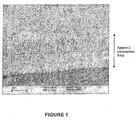
- anodic oxide film showed a film having a duplex structure with an outer layer of approximately 0.5 microns thickness and pores of approximately 30 nanometres in diameter.
- the inner layer was of approximately 1.5 microns thickness and substantially non porous as shown in Fig 1 .
- the anodic oxide film should be strongly bonded to the underlying aluminium alloy substrate, particularly when the component is to be used for adhesive bonding. Subsequent testing of the T-peel bond strength of the anodic oxide films of the invention compared to chromic acid anodising gave improved bond strengths. T-peel bond test results gave values of 167 N for chromic acid anodising and 172 N for the AC/DC anodising process.
- Figures 2 and 3 show SEM images of an aluminium alloy surface that has been degreased and a surface after AC anodising at 15 volts for 240 seconds and demonstrate the etching effect on the aluminium alloy substrate during the AC current part of the process. Due to this it is not necessary to carry out a separate deoxidise process.
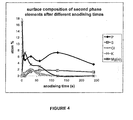
- Figure 4 shows how the elemental composition of the surface changes of different elements after the application of differing AC current anodising times.
- the second phase elements are removed while phosphorous is incorporated into the surface layer.
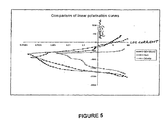
- the curves of Figure 5 show that the response of the AC/DC anodised surface is similar to or better than the chromic acid anodised surface.
- the curves represent linear polarisation curves for degreased only (DG only), chromic acid anodised (CAA), and AC/DC anodised (DC + 120sAC) 2024 material, i.e. 10 minutes DC and 120 seconds AC.
Landscapes
- Chemical & Material Sciences (AREA)
- Engineering & Computer Science (AREA)
- Metallurgy (AREA)
- Chemical Kinetics & Catalysis (AREA)
- Electrochemistry (AREA)
- Materials Engineering (AREA)
- Organic Chemistry (AREA)
- Inorganic Chemistry (AREA)
- Automation & Control Theory (AREA)
- Application Of Or Painting With Fluid Materials (AREA)
- Other Surface Treatments For Metallic Materials (AREA)
- Cleaning And De-Greasing Of Metallic Materials By Chemical Methods (AREA)
- Photoreceptors In Electrophotography (AREA)
- Laminated Bodies (AREA)
Claims (10)
- Verfahren zum Erzeugen einer anodischen Oxidschicht auf einem Werkstück aus Aluminium oder einer Aluminiumlegierung, umfassend die Schritte:a) bilden einer anodischen Oxidschicht auf dem Werkstück durch Wechselstromelektrolyse, gefolgt vonb) behandeln des Werkstücks mit Gleichstromelektrolyse,wobei das Verfahren gekennzeichnet ist, durch eine Anodisierungslösung, die zwischen 1 und 10 Vol.-% Schwefelsäure und zwischen 1 und 10 Vol.-% Phosphorsäure umfasst.
- Verfahren gemäß Anspruch 1, wobei die Anodisierungslösung ein Mehrsäurensystem ist, das mehr als zwei Säuren umfasst.
- Verfahren gemäß Anspruch 1 oder 2, wobei das Anodisierungsbad auf einer Temperatur zwischen 15 und 50°C, vorzugsweise zwischen 25 und 40°C gehalten wird.
- Verfahren gemäß einem der Ansprüche 1 bis 3, wobei der Schritt des Wechselstromanodisierens bei einer Spannung zwischen 5 und 30 Volt für 30 Sekunden bis 10 Minuten durchgeführt wird.
- Verfahren gemäß Anspruch 4, wobei der Schritt des Wechselstromanodisierens bei einer Spannung zwischen 10 und 25 Volt für 1 bis 4 Minuten durchgeführt wird.
- Verfahren gemäß einem der Ansprüche 1 bis 5, wobei der Wechselstrom ein 50Hz-Einphasenwechselstrom ist.
- Verfahren gemäß einem der Ansprüche 1 bis 6, wobei der Schritt des Gleichstromanodisierens bei einer Spannung zwischen 5 und 30 Volt für eine Zeitspanne von 1 bis 20 Minuten durchgeführt wird.
- Verfahren gemäß Anspruch 7, wobei der Schritt des Gleichstromanodisierens bei einer Spannung zwischen 10 und 25 Volt für 2,5 bis 12,5 Minuten durchgeführt wird.
- Verfahren gemäß einem der Ansprüche 1 bis 8, wobei die Anodisierungslösung zwischen 1,5 und 5% Schwefelsäure und zwischen 1,5 und 5% Phosphorsäure umfasst.
- Verfahren gemäß einem der Ansprüche 1 bis 8, wobei die Anodisierungslösung 2,5% Schwefelsäure und 2,5% Phosphorsäure umfasst, und die Lösung bei 35°C gehalten wird, der Schritt des Wechselstromanodisierens bei 15 Volt für 2 Minuten durchgeführt wird, und der Schritt des Gleichstromanodisierens bei 20 Volt für 10 Minuten durchgeführt wird.
Applications Claiming Priority (2)
| Application Number | Priority Date | Filing Date | Title |
|---|---|---|---|
| GBGB0500407.2A GB0500407D0 (en) | 2005-01-10 | 2005-01-10 | Anodising aluminium alloy |
| PCT/GB2006/000077 WO2006072804A2 (en) | 2005-01-10 | 2006-01-10 | Anodising aluminum alloy |
Publications (2)
| Publication Number | Publication Date |
|---|---|
| EP1836331A2 EP1836331A2 (de) | 2007-09-26 |
| EP1836331B1 true EP1836331B1 (de) | 2010-02-24 |
Family
ID=34203835
Family Applications (1)
| Application Number | Title | Priority Date | Filing Date |
|---|---|---|---|
| EP06701753A Expired - Lifetime EP1836331B1 (de) | 2005-01-10 | 2006-01-10 | Anodisieren von Aluminiumlegierungen |
Country Status (7)
| Country | Link |
|---|---|
| US (1) | US7922889B2 (de) |
| EP (1) | EP1836331B1 (de) |
| CN (1) | CN101128624B (de) |
| CA (1) | CA2593489C (de) |
| DE (1) | DE602006012443D1 (de) |
| GB (2) | GB0500407D0 (de) |
| WO (1) | WO2006072804A2 (de) |
Families Citing this family (23)
| Publication number | Priority date | Publication date | Assignee | Title |
|---|---|---|---|---|
| DE102006004653A1 (de) * | 2006-01-31 | 2007-08-02 | Zipprich, Holger, Dipl.-Ing. | Verfahren zur Herstellung eines Metallkörpers sowie Metallkörper |
| US7732068B2 (en) | 2007-08-28 | 2010-06-08 | Alcoa Inc. | Corrosion resistant aluminum alloy substrates and methods of producing the same |
| US8309237B2 (en) | 2007-08-28 | 2012-11-13 | Alcoa Inc. | Corrosion resistant aluminum alloy substrates and methods of producing the same |
| CN101565823B (zh) * | 2009-05-19 | 2011-09-07 | 温贤林 | 卷盘铝带表面处理工艺 |
| WO2012119306A1 (en) * | 2011-03-08 | 2012-09-13 | Nano And Advanced Materials Institute Limited | Method for Producing White Anodized Aluminum Oxide |
| CN102330138B (zh) * | 2011-09-14 | 2014-04-23 | 湖南大学 | 铝或铝合金双层阳极氧化膜的制备及其多色彩着色膜的制备 |
| EP2857558B1 (de) * | 2012-05-30 | 2019-04-03 | Mitsubishi Chemical Corporation | Verfahren zur herstellung eines formartikels mit feiner unebener struktur auf der oberfläche |
| CN102888604A (zh) * | 2012-09-21 | 2013-01-23 | 虞伟财 | 金属铝表面防腐蚀处理方法 |
| JP5937937B2 (ja) * | 2012-09-26 | 2016-06-22 | 株式会社神戸製鋼所 | アルミニウム陽極酸化皮膜 |
| US10941501B2 (en) * | 2013-03-29 | 2021-03-09 | Analytical Specialties, Inc. | Method and composition for metal finishing |
| US9512536B2 (en) | 2013-09-27 | 2016-12-06 | Apple Inc. | Methods for forming white anodized films by metal complex infusion |
| CH708829A1 (fr) * | 2013-11-11 | 2015-05-15 | Panerai Ag Off | Composant en alliage aluminium-lithium comprenant un revêtement céramique et procédé pour former le revêtement. |
| GB2521460A (en) | 2013-12-20 | 2015-06-24 | Dublin Inst Of Technology | Method of forming a multi-layer anodic coating |
| JP5904425B2 (ja) * | 2014-03-27 | 2016-04-13 | スズキ株式会社 | 陽極酸化皮膜及びその処理方法並びに内燃機関用ピストン |
| JP6418498B2 (ja) | 2014-03-27 | 2018-11-07 | スズキ株式会社 | 陽極酸化処理方法及び内燃機関の構造 |
| WO2015199639A1 (en) * | 2014-06-23 | 2015-12-30 | Apple Inc. | Interference coloring of thick, porous, oxide films |
| US20160017510A1 (en) * | 2014-07-21 | 2016-01-21 | United Technologies Corporation | Multifunctional anodized layer |
| US10351966B2 (en) * | 2015-09-25 | 2019-07-16 | Apple Inc. | Process for cleaning anodic oxide pore structures |
| CN108350598B (zh) | 2015-10-30 | 2021-03-30 | 苹果公司 | 具有增强特征的阳极膜 |
| EP3445896B1 (de) | 2016-04-18 | 2023-10-18 | Fokker Aerostructures B.V. | Verfahren zur anodisierung eines artikels aus aluminium oder einer legierung davon |
| KR102652258B1 (ko) * | 2016-07-12 | 2024-03-28 | 에이비엠 주식회사 | 금속부품 및 그 제조 방법 및 금속부품을 구비한 공정챔버 |
| KR102722042B1 (ko) * | 2020-03-12 | 2024-10-28 | 노벨리스 인크. | 금속 기판의 전해 가공 |
| CN113774454A (zh) * | 2021-10-28 | 2021-12-10 | 航天精工股份有限公司 | 一种铝合金铆钉硫酸阳极化加工方法 |
Family Cites Families (9)
| Publication number | Priority date | Publication date | Assignee | Title |
|---|---|---|---|---|
| US415158A (en) | 1889-11-12 | Method of weaving seamless hip-pockets | ||
| GB374806A (en) | 1931-12-18 | 1932-06-16 | Vaw Ver Aluminium Werke Ag | Improvements in the production of oxide coatings on aluminium and its alloys |
| US4152158A (en) * | 1971-10-08 | 1979-05-01 | Polychrome Corporation | Electrochemically treated photo-lithographic plates |
| JPS5311135A (en) * | 1976-07-19 | 1978-02-01 | Fuji Satsushi Kogyo Kk | Process for forming stripe pattern on aluminum or aluminum alloy |
| JPS6021298A (ja) * | 1983-07-18 | 1985-02-02 | Fuji Photo Film Co Ltd | 平版印刷版用支持体の製造方法 |
| JPS6227591A (ja) * | 1985-07-27 | 1987-02-05 | Fuji Electric Co Ltd | アルミニウム含油軸受 |
| US4894127A (en) * | 1989-05-24 | 1990-01-16 | The Boeing Company | Method for anodizing aluminum |
| US5486283A (en) | 1993-08-02 | 1996-01-23 | Rohr, Inc. | Method for anodizing aluminum and product produced |
| US6197178B1 (en) * | 1999-04-02 | 2001-03-06 | Microplasmic Corporation | Method for forming ceramic coatings by micro-arc oxidation of reactive metals |
-
2005
- 2005-01-10 GB GBGB0500407.2A patent/GB0500407D0/en not_active Ceased
-
2006
- 2006-01-10 WO PCT/GB2006/000077 patent/WO2006072804A2/en not_active Ceased
- 2006-01-10 DE DE602006012443T patent/DE602006012443D1/de not_active Expired - Lifetime
- 2006-01-10 EP EP06701753A patent/EP1836331B1/de not_active Expired - Lifetime
- 2006-01-10 GB GB0600424A patent/GB2421959A/en not_active Withdrawn
- 2006-01-10 CA CA2593489A patent/CA2593489C/en not_active Expired - Lifetime
- 2006-01-10 US US11/794,889 patent/US7922889B2/en active Active
- 2006-01-10 CN CN2006800020564A patent/CN101128624B/zh not_active Expired - Fee Related
Also Published As
| Publication number | Publication date |
|---|---|
| WO2006072804A3 (en) | 2007-03-29 |
| EP1836331A2 (de) | 2007-09-26 |
| GB2421959A (en) | 2006-07-12 |
| GB0500407D0 (en) | 2005-02-16 |
| CA2593489A1 (en) | 2006-07-13 |
| CA2593489C (en) | 2014-08-05 |
| CN101128624B (zh) | 2012-07-18 |
| US7922889B2 (en) | 2011-04-12 |
| GB0600424D0 (en) | 2006-02-15 |
| DE602006012443D1 (de) | 2010-04-08 |
| US20080213618A1 (en) | 2008-09-04 |
| WO2006072804A2 (en) | 2006-07-13 |
| CN101128624A (zh) | 2008-02-20 |
Similar Documents
| Publication | Publication Date | Title |
|---|---|---|
| EP1836331B1 (de) | Anodisieren von Aluminiumlegierungen | |
| US10309029B2 (en) | Method for forming a multi-layer anodic coating | |
| US4624752A (en) | Surface pretreatment of aluminium and aluminium alloys prior to adhesive bonding, electroplating or painting | |
| EP0181173B1 (de) | Anodischer Aluminiumoxidfilm und Verfahren zur Herstellung | |
| JP3895300B2 (ja) | 金属の構造用接着剤接着のための耐腐食性表面処理 | |
| CN106715762B (zh) | 用于镁合金的电瓷涂料 | |
| JP3183512B2 (ja) | マグネシウムコーティングの2段階化学/電気化学的方法 | |
| WO1994018362A1 (en) | Two-step electrochemical process for coating magnesium | |
| EP2977491A1 (de) | Multifunktionelle anodisierte schicht | |
| JP5079103B2 (ja) | アルミニウム部材の多機能皮膜 | |
| WO2015146440A1 (ja) | 陽極酸化皮膜及びその封孔処理方法 | |
| US20240133073A1 (en) | A process to protect light metal substrates | |
| TWI762503B (zh) | 在輕合金上創建薄功能塗層之方法 | |
| JP4414745B2 (ja) | 耐食性に優れ、環境負荷の小さい塗装金属板 | |
| JP2004018906A (ja) | 表面処理アルミニウム材、その製造方法、アルミニウム成形体及びアルミニウム缶 | |
| JP6695767B2 (ja) | アルミニウム塗装材の製造方法 | |
| Hyland | Surface chemistry of adhesion to aluminum | |
| GB2141139A (en) | Pretreatment of aluminium prior to bonding electroplating or painting | |
| KR100226274B1 (ko) | 화학/전기 화학적 2단계 마그네슘 코팅방법 | |
| Raj | Anti-Corrosion Properties of a Non-chromate Conversion Coating for Aerospace Aluminum Alloys: Performance Optimisation and Early Stage Failure Mechanisms | |
| Salles Pinheiro et al. | Chromium/Nickel-Free Conversion Coating as Cold Post-Treatment to Anodized Aa2024-T3 for Corrosion Resistance Enhancement | |
| Hyland | Surface Chemistry of Adhesion to Aluminum | |
| JPH03104633A (ja) | 耐食性に優れた表面処理鋼材 | |
| Moji | Improved chromic acid anodize seal for optimum paint adhesion |
Legal Events
| Date | Code | Title | Description |
|---|---|---|---|
| PUAI | Public reference made under article 153(3) epc to a published international application that has entered the european phase |
Free format text: ORIGINAL CODE: 0009012 |
|
| 17P | Request for examination filed |
Effective date: 20070710 |
|
| AK | Designated contracting states |
Kind code of ref document: A2 Designated state(s): AT BE BG CH CY CZ DE DK EE ES FI FR GB GR HU IE IS IT LI LT LU LV MC NL PL PT RO SE SI SK TR |
|
| AX | Request for extension of the european patent |
Extension state: AL BA HR MK YU |
|
| 17Q | First examination report despatched |
Effective date: 20080102 |
|
| DAX | Request for extension of the european patent (deleted) | ||
| RBV | Designated contracting states (corrected) |
Designated state(s): DE FR GB |
|
| GRAP | Despatch of communication of intention to grant a patent |
Free format text: ORIGINAL CODE: EPIDOSNIGR1 |
|
| GRAS | Grant fee paid |
Free format text: ORIGINAL CODE: EPIDOSNIGR3 |
|
| GRAA | (expected) grant |
Free format text: ORIGINAL CODE: 0009210 |
|
| AK | Designated contracting states |
Kind code of ref document: B1 Designated state(s): DE FR GB |
|
| REG | Reference to a national code |
Ref country code: GB Ref legal event code: FG4D |
|
| REF | Corresponds to: |
Ref document number: 602006012443 Country of ref document: DE Date of ref document: 20100408 Kind code of ref document: P |
|
| PLBE | No opposition filed within time limit |
Free format text: ORIGINAL CODE: 0009261 |
|
| STAA | Information on the status of an ep patent application or granted ep patent |
Free format text: STATUS: NO OPPOSITION FILED WITHIN TIME LIMIT |
|
| 26N | No opposition filed |
Effective date: 20101125 |
|
| REG | Reference to a national code |
Ref country code: FR Ref legal event code: PLFP Year of fee payment: 10 |
|
| REG | Reference to a national code |
Ref country code: FR Ref legal event code: PLFP Year of fee payment: 11 |
|
| REG | Reference to a national code |
Ref country code: FR Ref legal event code: PLFP Year of fee payment: 12 |
|
| REG | Reference to a national code |
Ref country code: FR Ref legal event code: PLFP Year of fee payment: 13 |
|
| REG | Reference to a national code |
Ref country code: DE Ref legal event code: R082 Ref document number: 602006012443 Country of ref document: DE Representative=s name: HGF EUROPE LLP, DE Ref country code: DE Ref legal event code: R082 Ref document number: 602006012443 Country of ref document: DE Representative=s name: HGF EUROPE LP, DE |
|
| PGFP | Annual fee paid to national office [announced via postgrant information from national office to epo] |
Ref country code: DE Payment date: 20230110 Year of fee payment: 18 |
|
| PGFP | Annual fee paid to national office [announced via postgrant information from national office to epo] |
Ref country code: FR Payment date: 20240102 Year of fee payment: 19 |
|
| REG | Reference to a national code |
Ref country code: DE Ref legal event code: R119 Ref document number: 602006012443 Country of ref document: DE |
|
| PG25 | Lapsed in a contracting state [announced via postgrant information from national office to epo] |
Ref country code: DE Free format text: LAPSE BECAUSE OF NON-PAYMENT OF DUE FEES Effective date: 20240801 |
|
| PG25 | Lapsed in a contracting state [announced via postgrant information from national office to epo] |
Ref country code: DE Free format text: LAPSE BECAUSE OF NON-PAYMENT OF DUE FEES Effective date: 20240801 |
|
| PGFP | Annual fee paid to national office [announced via postgrant information from national office to epo] |
Ref country code: GB Payment date: 20241217 Year of fee payment: 20 |
|
| PG25 | Lapsed in a contracting state [announced via postgrant information from national office to epo] |
Ref country code: FR Free format text: LAPSE BECAUSE OF NON-PAYMENT OF DUE FEES Effective date: 20250131 |
|
| REG | Reference to a national code |
Ref country code: GB Ref legal event code: PE20 Expiry date: 20260109 |