EP1806352B1 - Wolfram- und Molybdän-Verbindungen und ihre Verwendung für die Chemical Vapour Deposition (CVD) - Google Patents
Wolfram- und Molybdän-Verbindungen und ihre Verwendung für die Chemical Vapour Deposition (CVD) Download PDFInfo
- Publication number
- EP1806352B1 EP1806352B1 EP07000051A EP07000051A EP1806352B1 EP 1806352 B1 EP1806352 B1 EP 1806352B1 EP 07000051 A EP07000051 A EP 07000051A EP 07000051 A EP07000051 A EP 07000051A EP 1806352 B1 EP1806352 B1 EP 1806352B1
- Authority
- EP
- European Patent Office
- Prior art keywords
- alkyl
- tungsten
- molybdenum
- layers
- compounds according
- Prior art date
- Legal status (The legal status is an assumption and is not a legal conclusion. Google has not performed a legal analysis and makes no representation as to the accuracy of the status listed.)
- Not-in-force
Links
- 0 *C(C(*)=N*)=N* Chemical compound *C(C(*)=N*)=N* 0.000 description 5
Classifications
-
- C—CHEMISTRY; METALLURGY
- C07—ORGANIC CHEMISTRY
- C07F—ACYCLIC, CARBOCYCLIC OR HETEROCYCLIC COMPOUNDS CONTAINING ELEMENTS OTHER THAN CARBON, HYDROGEN, HALOGEN, OXYGEN, NITROGEN, SULFUR, SELENIUM OR TELLURIUM
- C07F17/00—Metallocenes
-
- C—CHEMISTRY; METALLURGY
- C23—COATING METALLIC MATERIAL; COATING MATERIAL WITH METALLIC MATERIAL; CHEMICAL SURFACE TREATMENT; DIFFUSION TREATMENT OF METALLIC MATERIAL; COATING BY VACUUM EVAPORATION, BY SPUTTERING, BY ION IMPLANTATION OR BY CHEMICAL VAPOUR DEPOSITION, IN GENERAL; INHIBITING CORROSION OF METALLIC MATERIAL OR INCRUSTATION IN GENERAL
- C23C—COATING METALLIC MATERIAL; COATING MATERIAL WITH METALLIC MATERIAL; SURFACE TREATMENT OF METALLIC MATERIAL BY DIFFUSION INTO THE SURFACE, BY CHEMICAL CONVERSION OR SUBSTITUTION; COATING BY VACUUM EVAPORATION, BY SPUTTERING, BY ION IMPLANTATION OR BY CHEMICAL VAPOUR DEPOSITION, IN GENERAL
- C23C16/00—Chemical coating by decomposition of gaseous compounds, without leaving reaction products of surface material in the coating, i.e. chemical vapour deposition [CVD] processes
- C23C16/22—Chemical coating by decomposition of gaseous compounds, without leaving reaction products of surface material in the coating, i.e. chemical vapour deposition [CVD] processes characterised by the deposition of inorganic material, other than metallic material
- C23C16/30—Deposition of compounds, mixtures or solid solutions, e.g. borides, carbides, nitrides
- C23C16/34—Nitrides
-
- C—CHEMISTRY; METALLURGY
- C07—ORGANIC CHEMISTRY
- C07F—ACYCLIC, CARBOCYCLIC OR HETEROCYCLIC COMPOUNDS CONTAINING ELEMENTS OTHER THAN CARBON, HYDROGEN, HALOGEN, OXYGEN, NITROGEN, SULFUR, SELENIUM OR TELLURIUM
- C07F11/00—Compounds containing elements of Groups 6 or 16 of the Periodic Table
-
- C—CHEMISTRY; METALLURGY
- C07—ORGANIC CHEMISTRY
- C07F—ACYCLIC, CARBOCYCLIC OR HETEROCYCLIC COMPOUNDS CONTAINING ELEMENTS OTHER THAN CARBON, HYDROGEN, HALOGEN, OXYGEN, NITROGEN, SULFUR, SELENIUM OR TELLURIUM
- C07F11/00—Compounds containing elements of Groups 6 or 16 of the Periodic Table
- C07F11/005—Compounds containing elements of Groups 6 or 16 of the Periodic Table compounds without a metal-carbon linkage
-
- C—CHEMISTRY; METALLURGY
- C23—COATING METALLIC MATERIAL; COATING MATERIAL WITH METALLIC MATERIAL; CHEMICAL SURFACE TREATMENT; DIFFUSION TREATMENT OF METALLIC MATERIAL; COATING BY VACUUM EVAPORATION, BY SPUTTERING, BY ION IMPLANTATION OR BY CHEMICAL VAPOUR DEPOSITION, IN GENERAL; INHIBITING CORROSION OF METALLIC MATERIAL OR INCRUSTATION IN GENERAL
- C23C—COATING METALLIC MATERIAL; COATING MATERIAL WITH METALLIC MATERIAL; SURFACE TREATMENT OF METALLIC MATERIAL BY DIFFUSION INTO THE SURFACE, BY CHEMICAL CONVERSION OR SUBSTITUTION; COATING BY VACUUM EVAPORATION, BY SPUTTERING, BY ION IMPLANTATION OR BY CHEMICAL VAPOUR DEPOSITION, IN GENERAL
- C23C16/00—Chemical coating by decomposition of gaseous compounds, without leaving reaction products of surface material in the coating, i.e. chemical vapour deposition [CVD] processes
- C23C16/06—Chemical coating by decomposition of gaseous compounds, without leaving reaction products of surface material in the coating, i.e. chemical vapour deposition [CVD] processes characterised by the deposition of metallic material
- C23C16/18—Chemical coating by decomposition of gaseous compounds, without leaving reaction products of surface material in the coating, i.e. chemical vapour deposition [CVD] processes characterised by the deposition of metallic material from metallo-organic compounds
-
- Y—GENERAL TAGGING OF NEW TECHNOLOGICAL DEVELOPMENTS; GENERAL TAGGING OF CROSS-SECTIONAL TECHNOLOGIES SPANNING OVER SEVERAL SECTIONS OF THE IPC; TECHNICAL SUBJECTS COVERED BY FORMER USPC CROSS-REFERENCE ART COLLECTIONS [XRACs] AND DIGESTS
- Y10—TECHNICAL SUBJECTS COVERED BY FORMER USPC
- Y10T—TECHNICAL SUBJECTS COVERED BY FORMER US CLASSIFICATION
- Y10T428/00—Stock material or miscellaneous articles
- Y10T428/12—All metal or with adjacent metals
- Y10T428/12014—All metal or with adjacent metals having metal particles
- Y10T428/1216—Continuous interengaged phases of plural metals, or oriented fiber containing
- Y10T428/12174—Mo or W containing
Definitions
- the present invention relates to special, new tungsten and molybdenum compounds, their use for the deposition of tungsten or molybdenum-containing layers by means of chemical vapor deposition and the tungsten or molybdenum-containing layers produced according to this process.
- Tungsten nitride is a promising material for barrier layers in integrated circuits with copper traces, e.g. Because of its resistance, its excellent thermal, chemical and mechanical resistance. Its electrical conductivity is high, and it does not form mixed phases with copper.
- W-N based layers for use in Si microelectronics can currently be fabricated by plasma vapor deposition (PVD) processes.
- PVD plasma vapor deposition
- step coverage conformal layer deposition on structured surfaces
- CVD chemical vapor deposition
- ALD atomic layer deposition
- halides are predominantly used for the CVD W-based layer structures, such as WF 6 or WCl 6 , see, for example, US Pat. BJ PIu, WY Hsu, JD Luttmer, L.K. Magel and HL Tsai, J. Electrochem Soc 145 (1998), L21-L23 , or AE Kaloyeros and E. Eisenbraun, Annu. Rev Mater Sci. 30 (2000), 363-385
- halogen radicals are often undesirable for the construction of complex layer structures due to their corrosive / corrosive properties
- tungsten fluoride has disadvantages due to the low volatility and high deposition temperature.
- the films made with these raw materials very often contain high, undesirable levels of carbon and exhibit relatively low conductivity.
- the object underlying the present invention was to provide such precursors.
- the invention further relates to the analogous molybdenum compounds. These are suitable for. B. as CVD precursors for conductive molybdenum nitride layers (MoN).
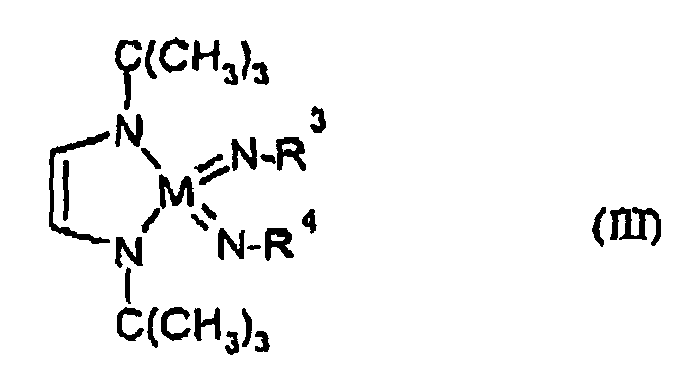
- tungsten and molybdenum compounds having tert-butyl-substituted DAD ligands which have the structure (III): in which R 3 and R 4 independently of one another represent a radical from the group of the C 1 - to C 5 -alkyl radicals, optionally substituted by one to three C 1 - to C 5 -alkyl groups-substituted C 6 - C 10 -aryl radicals - preferably optionally substituted phenyl- Radicals - SiR 3 or NR 2 are.
- Alkyl or alkoxy in each case independently represents a straight-chain, cyclic or branched alkyl or alkoxy radical, it being possible where appropriate for the radicals mentioned to be further substituted.
- C 1 -C 4 -alkyl is, for example, methyl, ethyl, n-propyl, isopropyl, n-butyl, sec-butyl, tert-butyl, C 1 -C 5 -alkyl, moreover, for example, n -Pentyl, 1-methylbutyl, 2-methylbutyl, 3-methylbutyl, neo-pentyl, 1-ethylpropyl, 1,1-dimethylpropyl, 1,2-dimethylpropyl, 1,2-dimethylpropyl, C 1 -C 6 alkyl for example, n-hexyl, 1-methylpentyl, 2-methylpentyl, 3-methylpentyl, 4-methylpentyl, 1,1-dimethylbutyl, 1,2-dimethylbutyl, 1,3-dimethylbutyl, 2,2-dimethylbutyl, 2,3- Dimethylbutyl, 3,3
- 1-alkenyl, 2-alkenyl, 3-alkenyl is, for example, the alkenyl groups corresponding to the preceding alkyl groups.
- C 1 -C 4 -alkoxy is, for example, the alkoxy groups corresponding to the preceding alkyl groups, such as, for example, methoxy, ethoxy, n-propoxy, isopropoxy, n-butoxy, sec-butoxy, tert-butoxy.
- C 5 -C 12 -cycloalkyl is, for example, optionally substituted mono-, bi- or tricylic alkyl radicals. Examples which may be mentioned are cyclopentyl, cyclohexyl, cycloheptyl, pinanyl, adamantyl, the isomeric menthyls, n-nonyl, n-decyl, n-dodecyl.
- Preferred as C 5 -C 6 -cycloalkyl are cylopentyl and cyclohexyl.
- Aryl is in each case independently an aromatic radical having 6 to 14, preferably 6 to 10, skeletal carbon atoms in which none, one, two or three skeletal carbon atoms per cycle can be substituted by heteroatoms selected from the group of nitrogen, sulfur or oxygen, but preferably for a carbocyclic aromatic radical having 6 to 14, preferably 6 to 10 skeleton carbon atoms.
- C 6 -C 10 -aryl examples include phenyl, 2,6-diisopropylphenyl, o-, p-, m-tolyl or naphthyl.
- carbocyclic aromatic radical or heteroaromatic radical may be substituted with up to five identical or different substituents per cycle, which are selected from the group fluorine, cyano, C 1 -C 12 alkyl, C 1 -C 12 fluoroalkyl, C 1 -C 12 fluoroalkoxy, C 1 -C 12 alkoxy or di (C 1 -C 8 alkyl) amino.
- the compounds according to the invention can be prepared in a simple manner by reacting DAD ligand precursors of the general formula (B) in which R 1 , R 2 , R 5 and R 6 have the abovementioned meaning,
- Suitable reducing agents are base metals such as Mg, Zn, Li, Na, Al, etc. in question.
- Suitable solvents are, for example, ethers, such as THF, diethyl ether or 1,2-dimethoxyethane, dipolar aprotic solvents, such as acetonitrile, N, N-dimethylformamide or tertiary amines or aliphatic or aromatic hydrocarbons, such as toluene, pentane, hexane , etc., as well as mixtures of these.
- the Mo or W complexes of the general formula (C) [M (NR 3 ) (NR 4 ) Cl 2 L 2 ] can be prepared by generally known processes in isolated form or in situ.
- DAD ligand precursor of the general formula (B) in a suitable solvent with the reducing agent, so that solutions of the pre-reduced DAD ligands, such as when using Li as a reducing agent Li [DAD] or Li 2 [DAD] are reacted with the solution of the complexes of the general formula (C).
- solutions of the pre-reduced DAD ligands such as when using Li as a reducing agent Li [DAD] or Li 2 [DAD] are reacted with the solution of the complexes of the general formula (C).
- the reaction temperature between -20 ° C and 120 ° C, it is also possible to produce the compounds of the invention in a one-pot synthesis, in which, for example WCl 6 with the amine (s) H 2 NR 3 or H 2 NR 4 , the reducing agent and the DAD ligand precursor of general formula (B) are combined and reacted.
- the solvent is removed, for example, by distillation under reduced pressure, and it may be followed by further cleaning by means of washing and subsequent drying. Such suitable methods are known to the person skilled in the art.
- Tungsten and / or molybdenum-containing metals, metal alloys, oxides, nitrides and carbides, and mixtures thereof and / or compounds in amorphous and / or crystalline form by means of CVD, ALD (Atomic Layer Deposition), can be prepared from the tungsten and molybdenum compounds according to the invention. and thermal decomposition. Application find such mixtures and compounds z.
- dielectric layers in capacitors and gates in transistors microwave ceramics, piezoceramics, thermal and chemical barrier layers, diffusion barrier layers, hard coatings, electrically conductive layers, antireflection layers, optical layers and layers for IR mirror.
- the tungsten and molybdenum compounds according to the invention are suitable as precursors for flame pyrolysis for the production of powders.
- the invention therefore also relates to the use of the tungsten and molybdenum compounds according to the invention for the deposition of tungsten or molybdenum-containing layers, optionally with admixture of further compounds for the defined adjustment of certain concentrations of the respective elements in the layer by means of chemical vapor deposition (CVD).
- CVD chemical vapor deposition
- WN tungsten nitride
- molybdenum nitride layers by means of CVD.
- the invention furthermore relates to the tungsten or molybdenum-containing layers which are produced correspondingly from the compounds according to the invention by means of CVD, preferably WN or MoN layers.
- the invention furthermore relates to substrates which have one or more such tungsten- or molybdenum-containing layers according to the invention, preferably WN or MoN layers.
- substrates may be, for example, silicon wafers or already other surface-structured single- or multi-layer silicon wafers, as are typically used for the production of Si-based integrated circuits. Accordingly, substrates within the scope of the invention may, for example, also be metal or dielectric surfaces.
- the precise concentrations of the educts generally depend on the thermal decomposition properties of the respective educts in the CVD process.
- the educts are preferably used in the following molar ratios: N-educt (s) / inventive W or Mo compound in ratios of from 0: 1 to 20,000: 1 and Si educt (s) / inventive W or Mo starting material in ratios of 0: 1 to 100: 1.
- the surface temperature of the substrate is preferably at temperatures in the range of 300 ° C. set to 600 ° C.
- the total pressure of carrier gas and educts is preferably set to pressures in the range of 10 hPa to 1000 hPa, wherein the ratio of the partial pressure of the sum of all starting materials to the partial pressure of the carrier gas is preferably between 0.0001 to 0.5.
- the deposition rate is preferably 0.05 nm / min to 50 nm / min.
Landscapes
- Chemical & Material Sciences (AREA)
- Organic Chemistry (AREA)
- General Chemical & Material Sciences (AREA)
- Chemical Kinetics & Catalysis (AREA)
- Engineering & Computer Science (AREA)
- Materials Engineering (AREA)
- Mechanical Engineering (AREA)
- Metallurgy (AREA)
- Inorganic Chemistry (AREA)
- Chemical Vapour Deposition (AREA)
- Organic Low-Molecular-Weight Compounds And Preparation Thereof (AREA)
- Electrodes Of Semiconductors (AREA)
Description
- Die vorliegende Erfindung betrifft spezielle, neue Wolfram- und Molybdänverbindungen, deren Verwendung zur Abscheidung Wolfram- bzw. Molybdänhaltiger Schichten mittels Chemical Vapor Deposition sowie die gemäß diesem Verfahren hergestellten Wolfram- bzw. Molybdänhaltigen Schichten.
- Wolfromnitrid ist ein vielversprechendes Material für Barriereschichten in integrierten Schaltkreisen mit Kupfer-Leiterbahnen, z. B. wegen seiner Widerstandsfähigkeit, seiner exzellenten thermisehen, chemischen und mechanischen Beständigkeit. Seine elektrische Leitfühigkeit ist hoch, und es bildet keine Mischphasen mit Kupfer. Solche W-N-basierenden Schichten für die Anwendung in der Si-Mikroclektronik können gegenwärtig durch plasmabasierende Abscheidevorfahren (Physical Vapour Deposition, PVD) hergestellt werden. Im Hinblick auf die extremen Anforderungen für immer höher integrierte Schaltkreise, z.B. der konformen Schichlabscheidung auf strukturierten Oberflächen ("step coverage"), stoßen PVD-Verfahren jedoch an die Grenzen der technischen Realieierbarkeit. Für diese Anwendungen worden verstärkt chemische Gasphasenabscheidungen (Chemical Vapour Deposition, CVD) bis hin zur atomlagen-genauen Abscheidung mit einem Spezialverfahren der CVD, der sogenannten Atomic Layer Deposition (ALD), eingesetzt. Für diese CVD-Verfahren müssen naturgemäß für die jeweiligen gewünschten Schichten entsprechende chemische Ausgangsstoffe der einzelnen Elemente zur Verfügung stehen.
- Zum gegenwärtigen Zeitpunkt werden für die CVD W-basierender Schichtstrukturen vorwiegend Halogenide verwendet, wie z.B. WF6 oder WCl6, siehe z. B. J. P. I.u, W. Y. Hsu, J. D. Luttmer, L. K Magel und H. L. Tsai, J. Electrochem Soc 145 (1998), L21- L23, oder A. E. Kaloyeros und E. Eisenbraun, Annu. Rev Mater Sci. 30 (2000), 363 - 385 Dies ist mit verschiedenen Nachteilen behaftet Zum einen sind Halogenrudikale vielfach aufgrund ihrer ätzenden/korrodierenden Eigenschaften für den Aufbau komplexer Schichtstrukturen unerwünscht, andererseits hat Wolframfluorid Nachteile durch die geringe Flüchtigkeit und hohe Abscheidetemperatur. Wolfram(VI)-amidimide, wie z.B. (tBuN=)2W(NH1Bu)z (siehe H. T. Chiu und S. H. Chuang, J Mater Res. 8 (1993), 1353) oder (tBuN=)2W(NMe)3 oder (tBuN=)2W(NMeEt)2 (siehe J. S. Becker, S. Suh, S. Wang und R. G. Gordon, Chem Mater. 15 (2003), 2969 - 2976 oder
WO 2004/007796 ) werden ebenfalls vorgeschlagen. Die mit diesen Ausgangsstoffen hergestellten Filme enthalten sehr oft hohe, unerwünschte Konzentrationen an Kohlenstoff und zeigen eine relativ geringe Leitfähigkeit. - Somit besteht ein erheblicher Bedarf nach weiteren, neuen Prekursoren, insbesondere für WN-Schichten, die die vorgenannten Nachteile nicht aufweisen oder zumindest deutliche Verbesserungen gegenüber den bekannten Prekursoren bewirken.
- Somit bestand die Aufgabe, die der vorliegenden Erfindung zugrunde lag, darin, solche Precursoren bereitzustellen.
- Überraschend wurde nun gefunden, dass komplexe Wolframamide mit einem DAD-Liganden diese Voraussetzungen erfüllen. DAD steht für vom 1,4-Diaza-butadien abgeleitete Reste der allgemeinen Struktur (A)

- R1 und R2
- unabhängig voneinander gegebenenfalls substituierte C1- bis C12-Alkyl-, C5- bis C12-Cycloalkyl-, C6- bis C10-Aryl-Reste, 1-Alkenyl-, 2-Alkenyl-, 3-Alkenylreste, Triorganosilylreste -SiR3 oder Aminoreste NR2 stehen, worin R für einen C1- bis C4-Alkylrest steht,
- R5 und R6
- unabhängig voneinander H, gegebenenfalls substituierte C1-bis C12-Alkyl-, C5- bis C12-Cycloalkyl- oder C6- bis C10-Aryl-Reste bedeuten.
- Die Erfindung betrifft weiterhin die analogen Molybdän-Verbindungen. Diese eignen sich z. B. als CVD-Prekursoren für leitfähige Molybdän-Nitrid-Schichten (MoN).
- Gegenstand der Erfindung sind daher Verbindungen der allgemeinen Formel (I),

- M
- für Mo oder W steht,
- R1 und
- R1 unabhängig voneinander für einen gegebenenfalls substituierten C1- bis C12-Alkyl-, C5- bis C12-Cycloalkyl-, C6- bis C10-Azyl-Reste, 1-Alkenyl-, 2-Alkenyl-, 3-Alkenylreste, Trior- ganosilylreste -SiR3 oder Aminoreste NR2 stehen, worin R für einen C1- bis C4-Alkylrest steht,
- R3 und R4
- unabhängig voneinander für einen gegebenenfalls substituierten C1- bis C8-Alkyl-, C5- bis C10-Cycloalkyl-, C6- bis C14-Aryl-Rest, SiR3 oder NR2 stehen, wobei R die oben ge- nannte Bedeutung hat, und
- R5 und R6
- unabhängig voneinander für H oder einen gegebenenfalls substituierten C1- bis C12- Alkyl-, C5- bis C12-Cycloalkyl- oder C6- bis C10-Aryl-Rest stehen.
- Unter substituiert wird hier, wenn nicht anders erwähnt, eine Substitution mit C1- bis C4-Alkoxy-oder Di(C1-bis C4-Alkyl)-amino-Resten verstanden.
- Bevorzugte erfindungsgemäße Verbindungen der allgemeinen Formel (I) sind Wolfram- und Molybdänverbindungen der allgemeinen Formel (II),

- M
- für W oder Mo steht,
- R1 und R2
- gleiche C1- bis C5-Alkyl- oder C5- bis C6-Cycloalkyl-Reste, und
- R3 und R4
- unabhängig voneinander einen C1- bis C5-Alkylrest, einen C5- bis C6-Cycloalkylrest, einen gegebenenfalls durch eine bis drei C1 bis C5-Alkylgruppen substituierten C6- C10- Arylrest - bevorzugt gegebenenfalls substituierten Phenyl-Rest - SiR3 oder NR2, wobei R für C1-C4-Alkyl steht, bedeuten.
- Besonders bevorzugt sind dies Wolfram- und Molybdänverbindungen mit tert-Butyl-substituierten DAD-Liganden, welche die Struktur (III) aufweisen:

R3 und R4 unabhängig voneinander für einen Rest aus der Gruppe der C1- bis C5-Alkylreste, gegebenenfalls durch eine bis drei C1- bis C5-Alkylgruppen substituierte C6- C10-Arylreste - bevorzugt gegebenenfalls substituierten Phenyl-Reste - SiR3 oder NR2 stehen. - Ganz besonders bevorzugt sind dies Verbindungen der Struktur (IV)

- Alkyl beziehungsweise Alkoxy steht jeweils unabhängig für einen geradkettigen, cyclischen oder verzweigten Alkyl- beziehungsweise Alkoxy-Rest, wobei die genannten Reste gegebenenfalls weiter substituiert sein können. Gleiches gilt für den Alkylteil eines Trialkylsilyl- bzw. Mono- oder Dialkylaminorestes oder den Alkylteil von Mono- oder Dialkylhydranzinen oder Mono-, Di-, Tri-oder Tetraalkylsilanen.
- C1-C4-Alkyl steht im Rahmen der Erfindung beispielsweise für Methyl, Ethyl, n-Propyl, isoPropyl, n-Butyl, sec.-Butyl, tert.-Butyl, C1-C5-Alkyl darüber hinaus beispielsweise für n-Pentyl, 1-Methylbutyl, 2-Methylbutyl, 3-Methylbutyl, neo-Pentyl, 1-Ethylpropyl, 1,1-Dimethylpropyl, 1,2-Dimethylpropyl, 1,2-Dimethylpropyl, C1-C6-Alkyl darüber hinaus beispielsweise für n-Hexyl, 1-Methylpentyl, 2-Methylpentyl, 3-Methylpentyl, 4-Methylpentyl, 1,1-Dimethylbutyl, 1,2-Dimethylbutyl, 1,3-Dimethylbutyl, 2,2-Dimethylbutyl, 2,3-Dimethylbutyl, 3,3-Dimethylbutyl, 1-Ethylbutyl, 2-Ethylbutyl, 1,1,2-Trimethylpropyl, 1,2,2-Trimethylpropyl, 1-Ethyl-1-methylpropyl, 1-Ethyl-2-methylpropyl oder 1-Ethyl-2-methylpropyl, C1-C12-Alkyl darüber hinaus beispielsweise für n-Heptyl und n-Octyl, n-Nonyl, n-Decyl und n-Dodecyl.
- 1-Alkenyl, 2-Alkenyl, 3-Alkenyl steht beispielsweise für die den vorangehenden Alkylgruppen entsprechenden Alkenylgruppen. C1-C4-Alkoxy steht beispielsweise für die den vorangehenden Alkylgruppen entsprechenden Alkoxygruppen, wie z.B. Methoxy, Ethoxy, n-Propoxy, iso-Propoxy, n-Butoxy, sec.-Butoxy, tert.-Butoxy.
- C5-C12-Cycloalkyl steht beispielsweise für gegebenenfalls substituierte mono-, bi- oder tricylische Alkylreste. Als Beispiele seien Cylopentyl, Cyclohexyl, Cycloheptyl, Pinanyl, Adamantyl, die isomeren Menthyle, n-Nonyl, n-Decyl, n-Dodecyl. Bevorzugt als C5-C6-Cycloalkyl sind Cylopentyl und Cyclohexyl.
- Aryl steht jeweils unabhängig für einen aromatischen Rest mit 6 bis 14, bevorzugt 6 bis 10 Gerüstkohlenstoffatomen, in denen keines, ein, zwei oder drei Gerüstkohlenstoffatome pro Cyclus durch Heteroatome, ausgewählt aus der Gruppe Stickstoff, Schwefel oder Sauerstoff, substituiert sein können, vorzugsweise jedoch für einen carbocyclischen aromatischen Rest mit 6 bis 14, bevorzugt 6 bis 10 Gerüstkohlenstoffatomen.
- Beispiele für gegebenenfalls substituierte C6-C10-Aryl sind Phenyl, 2,6-Diisopropylphenyl, o-, p-, m-Tolyl oder Naphthyl.
- Weiterhin kann der carbocyclische aromatische Rest oder heteroaromatische Rest mit bis zu fünf gleichen oder verschiedenen Substituenten pro Cyclus substituiert sein, die ausgewählt sind aus der Gruppe Fluor, Cyano, C1-C12-Alkyl, C1-C12-Fluoralkyl, C1-C12-Fluoralkoxy, C1-C12-Alkoxy oder Di(C1-C8-alkyl)amino.
- Die erfindungsgemäßen Verbindungen können auf einfache Weise hergestellt werden, indem DAD-Ligandenvorläufer der allgemeinen Formel (B)

- in Gegenwart wenigstens eines Reduktionsmittels mit Mo- oder W-Komplexen der allgemeinen Formel (C),
[M(NR3)(NR4)Cl2L2]
worin - M
- für W oder Mo steht
- L
- für einen Liganden ausgewählt aus aliphatischen oder aromatischen Aminen, Ethern, Halogenid, bevorzugt Chlorid, oder Nitrilen, bevorzugt Acetonitril,
- R3 oder R4
- die vorangehend genannte Bedeutung haben,
- Als geeignete Reduktionsmittel kommen unedle Metalle wie z.B. Mg, Zn, Li, Na, Al etc. in Frage. Geeignete Lösungsmittel sind beispielsweise Ether, wie z.B. THF, Diethylether oder 1,2-Dimethoxyethan, dipolar-aprotische Lösungsmittel, wie z.B. Acetonitril, N,N-Dimethylformamid oder tert.-Amine oder aliphatische oder aromatische Kohlenwasserstoffe, wie z.B. Toluol, Pentan, Hexan, etc., sowie Mischungen aus diesen. Die Mo- oder W-Komplexe der allgemeinen Formel (C) [M(NR3)(NR4)Cl2L2] sind nach allgemein bekannten Verfahren in isolierter Form oder in-situ herstellbar.
- Darüber hinaus ist es auch möglich, den DAD-Ligandenvorläufer der allgemeinen Formel (B) vorab in einem geeigneten Lösungsmittel mit dem Reduktionsmittel zu reduzieren, so dass Lösungen der vorreduzierten DAD-Liganden, wie z.B. bei Verwendung von Li als Reduktionsmittel Li[DAD] oder Li2[DAD], mit der Lösung der Komplexe der allgemeinen Formel (C) umgesetzt werden. Bei sorgfältiger Wahl und Kontrolle der Reaktionstemperatur zwischen -20°C und 120°C ist es auch möglich, die erfindungsgemäßen Verbindungen in einer Eintopfsynthese herzustellen, bei der z.B. WCl6 mit dem oder den Amin(en) H2NR3 oder H2NR4, dem Reduktionsmittel und dem DAD-Ligandenvorläufer der allgemeinen Formel (B) zusammengegeben und zur Reaktion gebracht wird.
- Zur Isolation der erfindungsgemäßen Verbindungen wird das Lösungsmittel beispielsweise mittels Abdestillieren unter vermindertem Druck entfernt, und es kann sich eine weitere Reinigung mittels Waschen sowie eine nachfolgende Trocknung anschließen. Solche geeigneten Verfahren sind dem Fachmann bekannt.
- Aus den erfindungsgemäßen Wolfram- und Molybdänverbindungen können Wolfram- und/oder Molybdän-haltige Metalle, Metalllegierungen, Oxide, Nitride und Carbide, sowie deren Mischungen und/oder Verbindungen in amorpher und/oder kristalliner Form, mittels CVD, ALD (Atomic Layer Deposition) und thermischer Zersetzung erzeugt werden. Anwendung finden derartige Mischungen und Verbindungen z. B. als dielektrische Schichten in Kondensatoren und Gates in Transistoren, Mikrowellenkeramiken, Piezokeramiken, thermische und chemische Barriereschichten, Diffusionsbarriereschichten, Hartstoffbeschichtungen, elektrisch leitfähigen Schichten, Antireflektionsschichten, optische Schichten und Schichten für IR-Spiegel. Auch als Prekursoren für Flammpyrolysen zur Herstellung von Pulvern sind die erfindungsgemäßen Wolfram- und Molybdänverbindungen geeignet.
- Die Erfindung betrifft daher auch die Verwendung der erfindungsgemäßen Wolfram und Molybdänverbindungen zur Abscheidung Wolfram- bzw. Molybdän-haltiger Schichten gegebenenfalls unter Beimischung weiterer Verbindungen zur definierten Einstellung bestimmter Konzentrationen der jeweiligen Elemente in der Schicht mittels Chemical Vapour Deposition (CVD).
- Bevorzugt ist die Verwendung der erfindungsgemäßen Verbindungen als Prekursoren für Wolframnitrid-(WN)-schichten oder Molybdännitridschichten mittels CVD.
- Weiterhin Gegenstand der Erfindung sind die entsprechend aus den erfindungsgemäßen Verbindungen mittels CVD hergestellten Wolfram- bzw. Molybdän-haltigen Schichten, bevorzugt WN-oder MoN-Schichten.
- Weiterhin Gegenstand der Erfindung sind Substrate, die eine oder mehrere solcher erfindungsgemäßen Wolfram- bzw. Molybdän-haltigen Schichten, bevorzugt WN- oder MoN-Schichten aufweisen. Solche Substrate können beispielsweise Silizium-Scheiben oder bereits weitere oberflächenstrukturierte Einzel- oder Mehrfachschichten aufweisende Silizium-Scheiben, wie sie typischerweise für die Herstellung von Si-basierenden integrierten Schaltkreisen eingesetzt werden. Demzufolge können Substrate im Rahmen der Erfindung beispielsweise auch Metall- oder Dielektrika-Oberflächen sein.
- Bevorzugt werden die erfindungsgemäßen Verbindungen in einem CVD-Verfahren mit folgenden Verfahrensschritten eingesetzt:
- Ein geeignetes Substrat, wie z.B. eine Si-Scheibe oder auch eine bereits weitere oberflächenstrukturierte Einzel- oder Mehrfachschichten aufweisende Si-Scheibe, wie sie typischerweise für die Herstellung von Si-basierenden integrierten Schaltkreisen eingesetzt werden, wird in eine CVD-Anlage eingebracht und auf eine für die Schichtabscheidung geeignete Temperatur im Bereich von 250 °C bis 700 °C aufgeheizt. Ein Trägergas wird mit den Edukten in definierten Konzentrationen beladen, wobei inerte Gase wie z.B. N2 und/oder Ar, auch in Kombination mit inerten, verdampften Lösungsmitteln wie z.B. Hexan, Heptan, Octan, Toluol oder Butylacetat, als Trägergas eingesetzt werden können, und auch reaktive, z. B. reduzierende Gase, wie z. B. H2, zugesetzt werden können. Das beladene Trägergas wird für eine definierte Expositionsdauer über die Oberfläche des aufgeheizten Substrates geleitet, wobei die jeweiligen Konzentrationen an Edukten und die Expositionsdauer mit der Maßgabe aufeinander abgestimmt sind, dass eine W- bzw. Mo-haltige Schicht mit einer vorgegebenen Schichtdicke und einer vorgegebenen Zusammensetzung auf der Oberfläche des Substrats entweder amorph, nano- oder mikrokristallin bzw. polykristallin gebildet wird. Typische Expositionsdauem sind je nach Abscheiderate beispielsweise wenige Sekunden bis hin zu mehreren Minuten oder Stunden. Typische Abscheideraten können beispielsweise von 0,1 nm/sec bis 1 nm/sec sein Es sind jedoch auch andere Abscheideraten möglich. Typische Schichtdicken sind beispielsweise 0,1 bis 100 nm, bevorzugt 0,5 bis 50 nm, besonders bevorzugt 1 bis 10 nm.
- Vorteilhafterweise werden im Rahmen der CVD-Technologie neben den Edukten gemäß allgemeiner Formel (I), bevorzugt der allgemeinen Formeln (II) bis (IV), zur Herstellung von reinen W-bzw. Mo-Metallschichten, W- bzw. Mo-reichen Schichten als auch W-N- bzw. Mo-N-haltigen Mischschichten auch die folgenden Edukte zur gezielten Einstellung der Stickstoffkonzentration (N-Konzentration) von W-N- bzw. Mo-N-haltigen Mischsystemschichten - auch nachfolgend N-Edukte genannt - eingesetzt:
- Ammoniak (NH3), Mono(C1-C12-alkyl)hydrazine, insbesondere tert.Butylhydrazin (tBu-NH-NH2), und/oder 1,1-Di(C1-C5-alkyl)hydrazine, insbesondere 1,1-Dimethylhydrazin ((CH3)2N-NH2). Insbesondere zur Beeinflussung der Stabilität der hergestellten Mischsystemschichten in nachfolgenden Hochtemperaturausheizschritten kann es günstig sein, weitere Elemente in der CVD-Abscheidung beizumischen, um das Rekristallisationsverhalten der gebildeten Schicht zu beeinflussen. Für die Anwendung in Si-basierenden integrierten Schaltkreisen kommt hierfür besonders das Element Silizium (Si) in Frage. Vorteilhafterweise werden für die Herstellung von W-N-Si-oder Mo-N-Si-haltigen Mischsystemschichten neben den oben angesprochenen Edukten die folgenden Edukte für die Einstellung der Siliziumkonzentration - auch nachfolgend Si-Edukte genannt - in der CVD-Technologie eingesetzt:
- Silan (SiH4), Disilan (Si2H6), Mono(C1-C12-alkyl)silane, insbesondere tert.Butylsilan (tBu-SiH3), Di(C1-C12-alkyl)silane, insbesondere Di-tert.butylsilan (tBu2SiH2), Tri(C1-C12-alkyl)silane, insbesondere Triethylsilan ((C2H5)3SiH), und/oder Tetra(C1-C12-alkyl)silane, insbesondere Tetraethylsilan ((C2H5)4Si ).
- Bei der Durchführung des erfindungsgemäßen Verfahrens richten sich die genauen Konzentrationen der Edukte grundsätzlich nach den thermischen Zerlegungseigenschaften der jeweiligen Edukte im CVD-Prozess. Vorzugsweise werden die Edukte in folgenden Mol-Verhältnissen eingesetzt: N-Edukt(e)/erfindungsgemäße W- bzw. Mo-Verbindung in Verhältnissen von 0 : 1 bis 20 000 : 1 und Si-Edukt(e)/ erfindungsgemäße W- bzw. Mo-Edukt in Verhältnissen von 0 : 1 bis 100 : 1. Die Oberflächentemperatur des Substrats wird bevorzugt auf Temperaturen im Bereich von 300 °C. bis 600 °C eingestellt. Der Gesamtdruck von Trägergas und Edukten wird bevorzugt auf Drücke im Bereich von 10 hPa bis 1000 hPa eingestellt, wobei das Verhältnis des Partialdrucks der Summe aller Edukte zum Partialdruck des Trägergases bevorzugt zwischen 0,0001 bis 0,5 liegt. Die Abscheiderate beträgt bevorzugt 0,05 nm/min bis 50 nm/min.
- Als technische Vorteile der vorliegenden Erfindung sind die folgenden Punkte anzusehen:
- 1) Die Synthese der flüchtigen Wolfram- und Molybdänvrbindungen verzichtet auf teure Lithiumalkyle oder -amide.
- 2) Die Einführung des DAD-Liganden als CVD-geeignete Abgangsgruppe für W(III)- oder Mo(III)-Schichten reduziert die Gefahr eines unerwünschten Kohlensoff-Einbaus in die Substratbeschichtung.
- 3) In der Kombination mit N-Edukten, beispielsweise mit Hydrazin-Derivaten (z.B. 1,1-Dimethylhydrazin oder tert.-Butylhydrazin), ist bei der CVD eine gezielte Veränderung der Schicht-Zusammensetzung möglich.
- Die folgenden Beispiele dienen der beispielhaften Erläuterung der Erfindung und sind nicht als Beschränkung aufzufassen.
- In den nachfolgenden Beispielen bedeuten die Abkürzungen und abgekürzten Verbindungsnamen folgende Strukturen:
- DtBuAD =
- 1,4-Di-tert.-butyl-1,4-diaza-butadien
- bzw. sein zweiwertiger Rest =
-

- tBu =
- tert. Butyl
- tBuN =
- tBu-N= tert.-Butylimino
- Py =
- Pyridin
- DME =
- Dimethoxyethan
- 1,69 g DtBuAD (10,0 mmol) und 0,24 g Mg-Pulver (10,0 mmol) werden zu einer Lösung von 4,00 g Mo(NtBu)2Cl2(dme) (10,0 mmol) in 50 ml THF bei 0 °C zugegeben. Das Reaktionsgemisch wird 1 d bei 23 °C gerührt. Das Lösungsmittel wird danach bei 20 mbar abgezogen und das Produkt zweimal mit jeweils 100 ml Hexan extrahiert. Anschließend wird das Hexan abgedampft und der Rückstand bei 90 °C/10-2 mbar sublimiert. Ausbeute: 2,44 g (60%), orangefarbener Feststoff; Schmp. 79 °C.
Elementaranalyse für C18H38N4Mo (M = 406,47 g-mol-1): ber. (%) C 53,19; H 9,42; N 13,78; gef. (%) C 52,62; H 9,35; N 13,65.
1H-NMR (C6D6, 300 MHz, 300 K): 6,05 (s, 2H, CH-DAD), 1,56 (s, 9H, N tBu), 1,33 (s, 18H, tBu-DAD), 1,26 (s, 9H, N tBu).
13C{1H}-NMR (C6D6, 75 MHz, 300 K): 113,4 (CH-DAD), 66,7 und 65,9 (NC(CH3)3), 55,9 (C(CH3)3-DAD), 33,6 und 33,1 (NC(CH3)3), 32,0 (C(CH3)3-DAD).
IR (KBr, cm-1): 3182 (w), 3010 (w), 1414 (w), 1361 (s), 1262 (w), 1246 (m), 1217 (s), 1120 (w), 1055 (w), 1021 (w), 936 (w), 875 (w), 814 (w), 805 (w), 773 (w), 724 (w), 673 (w), 638 (w), 605 (w), 581 (w), 551 (w), 518 (w), 470 (w). - 610 mg D tBuAD (3,6 mmol) und 90 mg Mg-Pulver (3,7 mmol) werden zu einer Lösung von 2,00 g W(NtBu)2Cl2Py2 (3,6 mmol) in 50 ml THF bei 0 °C zugegeben. Das Reaktionsgemisch wird 1 d bei RT gerührt. Das Lösungsmittel wird bei 20 mbar entfernt und das Produkt zweimal mit jeweils 100 ml Hexan extrahiert. Anschließend wird das Hexan abgedampft und der Rückstand bei 100 °C/10-2 mbar sublimiert. Ausbeute: 590 mg (28%), orangegelber Feststoff; Schmp. 73,5 °C.
Elementaranalyse für C18H38N4W (M = 494,38 g·mol-1): ber. (%) C 43,73; H 7,75; N 11,33; gef. (%) C 43,19; H 7,72; N 11,27.
1H-NMR (C6D6, 300 MHz, 300 K): 6,27 (s, 2H, CH-DAD), 1,89 (s, 9H, N tBu), 1,64 (s, 18H, tBu-DAD), 1,62 (s, 9H, N tBu).
13C{1H}-NMR (C6D6, 75 MHz, 300 K): 109,2 (CH-DAD), 65,4 und 65,3 (NC(CH3)3), 56,3 (C(CH3)3-DAD), 34,3 und 34,1 (NC(CH3)3), 32,0 (C(CH3)3-DAD).
IR (KBr, cm-1): 3026 (w), 1489 (w), 1402 (w), 1364 (m), 1354 (w), 1294 (m), 1248 (s), 1219 (s), 1163 (w), 1144 (w), 1113 (w), 1067 (w), 1026 (w), 972 (w), 872 (m), 814 (w), 808 (w), 774 (m), 721 (w), 660 (w), 598 (w), 673 (w), 544 (w), 519 (w), 476 (w).
Claims (12)
- Verbindungen der allgemeinen Formel (I)
 M für W oder Mo steht,R1 und R2 unabhängig voneinander für einen C1- bis C12- Alkyl-, C5- bis C12-Cyoloalkyl-, C6- bis C10-Aryl-Reste, 1-Alkenyl-, 2-Alkenyl-, 3- Alkenylreste, Triorganosilylreste -SiR3 oder Aminoreste NR2 stehen, worin R für einen C1- bis C4-Alkylrest steht,R3 und R4 unabhängig voneinander für einen C1- bis C8- Alkyl-, C5- bis C10-Cycloalkyl-, C6- bis C14-Aryl-Rest, SiR3 oder NR2 stehen, wo- bei R die oben genannte Bedeutung hat, undR5 und R6 unabhängig voneinander für H oder einen C1- bis C12-Alkyl-, C5- bis C13-Cycloalkyl- oder C6- bis C10-Aryl-Rest stehen.
 - Verbindungen gemäß Anspruch 1, dadurch gekennzeichnet, dass R1, R2, R3, R4, R5 und R6 jeweils unabhängig voneinander mit einem C1-C4-Alkoxy- oder Di(C1- C4-Alkyl)aminorest substituiert sein kann.
- Verbindungen nach Anspruch 1 oder 2 dadurch gekennzeichnet, dass sie der allgemeinen Formel (II) entsprechen,
 M, R1 und R2 die in Anspruch 1 genannte Bedeutung haben undR3 und R4 unabhängig voneinander für einen C1- bis C5-Alkylrest, einen C5- bis C6- Cycloalkylrest, einen C6- C10-Arylrest, SiR3 oder NR3 stehen, wobei R für C1-C4-Alkyl steht
 - Verbindungen gemäß Anspruch 3, dadurch gekennzeichnet, dass der C6-C10 Arylrest in R3 und R8 durch eine bis drei C1-C5-Alkylgruppen substituiert sein kann.
- Verbindungen nach wenigsten einem+ der Ansprüche 1 bis 4 dadurch gekennzeichnet, dass sie der allgemeinen Formel (III) entsprechen,
- Verbundungen nach wenigstens einem der Ansprüche 1 bis 5, dadurch gekennzeichnet, dass sie der allgemeinen Formel (IV) entsprechen,

- Verfahren zur Herstellung von Verbindungen gemäß den Ansprüchen 1 bis 6, dadurch gekennzeichnet, dass DAD-Ligandenvorläufer der allgemeinen Formel (B)

in Gegenwart wenigstens eines Reduktionsmittels mit Mo- oder W-Komplexen der allgemeinen Formel (C),
[M(NR3)(NR4)Cl2L2]
worinM für W oder Mo stehtL für einen Liganden ausgewählt aus aliphatischen oder aromatischen Aminen, E- them, Halogenid, bevorzugt Chlorid, oder Nitrilen, bevorzugt Acetonitril,R3 oder R4 die in Anspruch 1 genannte Bedeutung haben,in einem geeigneten Lösungsmittel bevorzugt bei einer Temperatur von -20°C bis 120°C umgesetzt werden. - Verwendung von Verbindungen gemäß den Ansprüchen 1 bis 6 als Vorläuferverbindung (Prekursor) für die Herstellung Wolfram- bzw. Molybdän-haltiger Schichten mittels des Chemical Vapour Deposition-Verfahrens.
- Verwendung gemäß Anspruch 8, dadurch gekennzeichnet, dass Wolfram- bzw. Molybdän-haltige Schichten Wolframnitrid-(WN)-schichten bzw. Molybdännitrid-(MoN)-schichten sind.
- Wolfram- bzw. Molybdän-haltige Schichten hergestellt mittels des Chemical Vapour Deposition-Verfahrens unter Verwendung von Verbindungen gemäß den Ansprechen 1 bis 6 als Vorläuferverbindungen (Prekursoren).
- Wolfram- bzw. Molybdän-haltige Schichten gemäß Anspruch 10, dadurch gekennzeichnet, dass es sich um Wolframnitrid-(WN)-schichten bzw. Molybdärmitrid-(MoN)-schichten handelt.
- Substrate aufweisend eine Wolfram- bzw. Molybdän-haltige Schicht gemäß Anspruch 10 oder 11.
Applications Claiming Priority (1)
| Application Number | Priority Date | Filing Date | Title |
|---|---|---|---|
| DE102006000823A DE102006000823A1 (de) | 2006-01-05 | 2006-01-05 | Wolfram- und Molybdän-Verbindungen und ihre Verwendung für die Chemical Vapour Deposition (CVD) |
Publications (2)
| Publication Number | Publication Date |
|---|---|
| EP1806352A1 EP1806352A1 (de) | 2007-07-11 |
| EP1806352B1 true EP1806352B1 (de) | 2010-12-29 |
Family
ID=37897741
Family Applications (1)
| Application Number | Title | Priority Date | Filing Date |
|---|---|---|---|
| EP07000051A Not-in-force EP1806352B1 (de) | 2006-01-05 | 2007-01-03 | Wolfram- und Molybdän-Verbindungen und ihre Verwendung für die Chemical Vapour Deposition (CVD) |
Country Status (8)
| Country | Link |
|---|---|
| US (1) | US7754908B2 (de) |
| EP (1) | EP1806352B1 (de) |
| JP (1) | JP2007182443A (de) |
| KR (1) | KR20070073636A (de) |
| AT (1) | ATE493424T1 (de) |
| DE (2) | DE102006000823A1 (de) |
| IL (1) | IL180362A0 (de) |
| TW (1) | TW200738737A (de) |
Cited By (1)
| Publication number | Priority date | Publication date | Assignee | Title |
|---|---|---|---|---|
| US9637395B2 (en) | 2012-09-28 | 2017-05-02 | Entegris, Inc. | Fluorine free tungsten ALD/CVD process |
Families Citing this family (48)
| Publication number | Priority date | Publication date | Assignee | Title |
|---|---|---|---|---|
| US6969539B2 (en) * | 2000-09-28 | 2005-11-29 | President And Fellows Of Harvard College | Vapor deposition of metal oxides, silicates and phosphates, and silicon dioxide |
| EP1490529A1 (de) | 2002-03-28 | 2004-12-29 | President And Fellows Of Harvard College | Dampfphasenabscheidung von sio2-nanolaminaten |
| US20080026576A1 (en) * | 2006-07-31 | 2008-01-31 | Rohm And Haas Electronic Materials Llc | Organometallic compounds |
| US8636845B2 (en) | 2008-06-25 | 2014-01-28 | L'Air Liquide, Société Anonyme pour l'Etude et l'Exploitation des Procédés Georges Claude | Metal heterocyclic compounds for deposition of thin films |
| JP5779823B2 (ja) * | 2010-11-17 | 2015-09-16 | ユーピー ケミカル カンパニー リミテッド | ジアザジエン系金属化合物、これの製造方法及びこれを利用した薄膜形成方法 |
| WO2012176989A1 (en) * | 2011-06-24 | 2012-12-27 | Up Chemical Co., Ltd. | A diamine compound or its salt, preparing method of the same, and uses of the same |
| WO2013046157A1 (en) | 2011-09-27 | 2013-04-04 | L'air Liquide, Societe Anonyme Pour L'etude Et L'exploitation Des Procedes Georges Claude | Nickel bis diazabutadiene precursors, their synthesis, and their use for nickel containing film depositions |
| WO2013046155A1 (en) | 2011-09-27 | 2013-04-04 | L'air Liquide, Societe Anonyme Pour L'etude Et L'exploitation Des Procedes Georges Claude | Tungsten diazabutadiene precursors, their synthesis, and their use for tungsten containing film depositions |
| JP6209168B2 (ja) * | 2012-01-26 | 2017-10-04 | シグマ−アルドリッチ・カンパニー、エルエルシー | モリブデンアリル錯体及び薄膜堆積におけるその使用 |
| WO2013192220A1 (en) * | 2012-06-18 | 2013-12-27 | University Of Florida Research Foundation, Inc. | Tungsten nitrido precursors for the cvd of tungsten nitride, carbonitride, and oxide films |
| DE102012210796A1 (de) * | 2012-06-26 | 2014-01-02 | Schaeffler Technologies AG & Co. KG | Verfahren zur Herstellung eines tribologisch belasteten Schichtverbunds, Schichtverbund und Verwendung einer metallorganischen Verbindung zur Herstellung einer Funktionsschicht des Schichtverbunds |
| US8859417B2 (en) | 2013-01-03 | 2014-10-14 | Globalfoundries Inc. | Gate electrode(s) and contact structure(s), and methods of fabrication thereof |
| KR101485519B1 (ko) * | 2013-04-25 | 2015-01-28 | 한국화학연구원 | 아미노싸이올레이트를 이용한 텅스텐 전구체, 이의 제조방법, 및 이를 이용하여 박막을 형성하는 방법 |
| KR101485520B1 (ko) * | 2013-04-25 | 2015-01-28 | 한국화학연구원 | 아미노싸이올레이트를 이용한 텅스텐 전구체, 이의 제조방법, 및 이를 이용하여 박막을 형성하는 방법 |
| KR101485522B1 (ko) * | 2013-04-25 | 2015-01-28 | 한국화학연구원 | 아미노싸이올레이트를 이용한 몰리브데넘 전구체, 이의 제조방법, 및 이를 이용하여 박막을 형성하는 방법 |
| KR101485521B1 (ko) * | 2013-04-25 | 2015-01-28 | 한국화학연구원 | 아미노싸이올레이트를 이용한 몰리브데넘 전구체, 이의 제조방법, 및 이를 이용하여 박막을 형성하는 방법 |
| WO2014189339A1 (ko) * | 2013-05-24 | 2014-11-27 | 주식회사 유피케미칼 | 텅스텐 화합물을 이용한 텅스텐-함유 막의 증착 방법 및 상기 텅스텐 화합물을 포함하는 텅스텐-함유 막 증착용 전구체 조성물 |
| KR101505125B1 (ko) * | 2013-10-14 | 2015-03-24 | 한국화학연구원 | 몰리브데넘 화합물, 이의 제조 방법 및 이를 이용하여 박막을 형성하는 방법 |
| KR20160017094A (ko) | 2014-06-13 | 2016-02-15 | 주식회사 유피케미칼 | 액체 전구체 조성물, 이의 제조 방법, 및 상기 조성물을 이용한 막의 형성 방법 |
| TWI656232B (zh) | 2014-08-14 | 2019-04-11 | 法商液態空氣喬治斯克勞帝方法研究開發股份有限公司 | 鉬組成物及其用於形成氧化鉬膜之用途 |
| US20170309490A1 (en) * | 2014-09-24 | 2017-10-26 | Hitachi Kokusai Electric Inc. | Method of manufacturing semiconductor device |
| WO2016204772A1 (en) | 2015-06-18 | 2016-12-22 | Intel Corporation | Inherently selective precursors for deposition of second or third row transition metal thin films |
| KR101581314B1 (ko) * | 2015-07-20 | 2015-12-31 | (주)마이크로켐 | 텅스텐 전구체 및 이를 포함하는 텅스텐 함유 필름 증착방법 |
| US10573522B2 (en) | 2016-08-16 | 2020-02-25 | Lam Research Corporation | Method for preventing line bending during metal fill process |
| KR102727616B1 (ko) | 2016-10-07 | 2024-11-07 | 삼성전자주식회사 | 유기 금속 전구체, 이를 이용한 막 형성 방법 및 이를 이용한 반도체 장치의 제조 방법 |
| KR102474876B1 (ko) * | 2017-06-15 | 2022-12-07 | 삼성전자주식회사 | 텅스텐 전구체 및 이를 이용한 텅스텐 함유막의 형성 방법 |
| CN113169056A (zh) | 2018-11-19 | 2021-07-23 | 朗姆研究公司 | 用于钨的钼模板 |
| CN116970925A (zh) | 2019-01-28 | 2023-10-31 | 朗姆研究公司 | 金属膜的沉积 |
| KR102211654B1 (ko) | 2019-02-13 | 2021-02-03 | 주식회사 메카로 | 텅스텐 전구체 화합물 및 이를 이용하여 제조된 텅스텐 함유 박막 |
| WO2020185618A1 (en) * | 2019-03-11 | 2020-09-17 | Lam Research Corporation | Precursors for deposition of molybdenum-containing films |
| EP4018471A4 (de) | 2019-08-22 | 2024-01-17 | Lam Research Corporation | Im wesentlichen kohlenstofffreie molybdän- und wolframhaltige filme bei der herstellung von halbleitervorrichtungen |
| US12334351B2 (en) | 2019-09-03 | 2025-06-17 | Lam Research Corporation | Molybdenum deposition |
| US12327762B2 (en) | 2019-10-15 | 2025-06-10 | Lam Research Corporation | Molybdenum fill |
| KR102793252B1 (ko) * | 2020-03-25 | 2025-04-08 | 삼성전자주식회사 | 몰리브덴 화합물과 이를 이용한 집적회로 소자의 제조 방법 |
| JP7686761B2 (ja) | 2021-02-23 | 2025-06-02 | ラム リサーチ コーポレーション | 3d-nand用の酸化物表面上へのモリブデン膜の堆積 |
| JP2024514605A (ja) | 2021-04-14 | 2024-04-02 | ラム リサーチ コーポレーション | モリブデンの堆積 |
| KR20240008230A (ko) | 2021-05-14 | 2024-01-18 | 램 리써치 코포레이션 | 고 선택도 도핑된 하드마스크 막들 |
| KR102650935B1 (ko) | 2021-11-24 | 2024-03-26 | 한국화학연구원 | 신규한 몰리브데넘 또는 텅스텐 유기금속화합물, 이의 제조방법 및 이를 이용하여 박막을 제조하는 방법 |
| KR102735110B1 (ko) | 2022-01-19 | 2024-11-27 | 한국화학연구원 | 신규한 몰리브데넘 유기금속화합물, 이의 제조방법 및 이를 이용하여 박막을 제조하는 방법 |
| KR102570721B1 (ko) | 2022-03-30 | 2023-08-25 | 한국화학연구원 | 신규한 다성분계 유기금속 화합물, 이의 제조방법 및 이를 이용하여 박막을 제조하는 방법 |
| KR102573398B1 (ko) | 2022-09-06 | 2023-08-30 | 한국화학연구원 | 이종금속 칼코게나이드 박막형성을 위한 용액공정용 조성물, 및 이를 이용한 박막의 제조방법 |
| WO2023191355A1 (ko) * | 2022-03-30 | 2023-10-05 | 한국화학연구원 | 신규한 다성분계 유기금속 화합물, 이를 포함하는 용액공정용 조성물 및 이를 이용한 박막의 제조방법 |
| KR20230169618A (ko) * | 2022-06-09 | 2023-12-18 | 솔브레인 주식회사 | 박막 전구체 화합물, 이를 이용한 박막 형성 방법 및 이로부터 제조된 반도체 기판 |
| KR102793187B1 (ko) | 2022-09-05 | 2025-04-08 | 한국화학연구원 | 신규한 몰리브데넘 유기금속화합물, 이의 제조방법 및 이를 이용하여 박막을 제조하는 방법 |
| KR102841546B1 (ko) | 2022-12-27 | 2025-08-04 | 세종대학교산학협력단 | 텅스텐 전구체, 이를 이용한 텅스텐 박막 증착 방법 및 장치 |
| US12595556B2 (en) | 2023-03-02 | 2026-04-07 | L'Air Liquide, Société Anonyme pour l'Etude et l'Exploitation des Procédés Georges Claude | Molybdenum imido alkyl/allyl complexes for deposition of molybdenum-containing films |
| KR102812241B1 (ko) * | 2023-06-16 | 2025-05-23 | 에스케이트리켐 주식회사 | 신규한 몰리브데넘 함유 박막 형성용 전구체 및 이를 이용한 몰리브데넘 함유 박막의 형성 방법. |
| US20260209259A1 (en) * | 2025-01-22 | 2026-07-23 | Entegris, Inc. | High purity precursor compositions and related methods |
Family Cites Families (1)
| Publication number | Priority date | Publication date | Assignee | Title |
|---|---|---|---|---|
| US7560581B2 (en) * | 2002-07-12 | 2009-07-14 | President And Fellows Of Harvard College | Vapor deposition of tungsten nitride |
-
2006
- 2006-01-05 DE DE102006000823A patent/DE102006000823A1/de not_active Withdrawn
- 2006-12-26 IL IL180362A patent/IL180362A0/en unknown
-
2007
- 2007-01-03 EP EP07000051A patent/EP1806352B1/de not_active Not-in-force
- 2007-01-03 DE DE502007006068T patent/DE502007006068D1/de active Active
- 2007-01-03 AT AT07000051T patent/ATE493424T1/de active
- 2007-01-04 JP JP2007000193A patent/JP2007182443A/ja not_active Withdrawn
- 2007-01-04 KR KR1020070000943A patent/KR20070073636A/ko not_active Withdrawn
- 2007-01-04 TW TW096100264A patent/TW200738737A/zh unknown
- 2007-01-04 US US11/649,504 patent/US7754908B2/en not_active Expired - Fee Related
Cited By (1)
| Publication number | Priority date | Publication date | Assignee | Title |
|---|---|---|---|---|
| US9637395B2 (en) | 2012-09-28 | 2017-05-02 | Entegris, Inc. | Fluorine free tungsten ALD/CVD process |
Also Published As
| Publication number | Publication date |
|---|---|
| US20070160761A1 (en) | 2007-07-12 |
| KR20070073636A (ko) | 2007-07-10 |
| ATE493424T1 (de) | 2011-01-15 |
| TW200738737A (en) | 2007-10-16 |
| JP2007182443A (ja) | 2007-07-19 |
| DE102006000823A1 (de) | 2007-07-12 |
| US7754908B2 (en) | 2010-07-13 |
| EP1806352A1 (de) | 2007-07-11 |
| DE502007006068D1 (de) | 2011-02-10 |
| IL180362A0 (en) | 2007-07-04 |
Similar Documents
| Publication | Publication Date | Title |
|---|---|---|
| EP1806352A1 (de) | Wolfram- und Molybdän-Verbindungen und ihre Verwendung für die Chemical Vapour Deposition (CVD) | |
| KR101538982B1 (ko) | 고분자량 알킬알릴 코발트트리카르보닐 착체 및 유전체 박막 제조를 위한 그 용도 | |
| EP1757612B1 (de) | Tantal- und Niob- Verbindungen und ihre Verwendung für die Chemical Vapour Deposition (CVD) | |
| DE102011012515A1 (de) | Metallkomplexe mit N-Amino-Amidinat-Liganden | |
| KR20210156444A (ko) | 몰리브데넘 함유 전구체, 이를 이용한 몰리브데넘 함유 박막 및 이의 제조 방법. | |
| EP1894937B1 (de) | Tantal- und Niob-Verbindungen und ihre Verwendung für die Chemical Vapour Deposition (CVD) | |
| KR101936162B1 (ko) | 액체 전구체 조성물, 이의 제조 방법, 및 상기 조성물을 이용한 막의 형성 방법 | |
| EP3342899A1 (de) | Ausgangsmaterial für chemische dampfabscheidung mit einem binuklearen rutheniumkomplex und verfahren zur chemischen dampfabscheidung mit verwendung des ausgangsmaterials für chemische dampfabscheidung | |
| KR20020063696A (ko) | 비대칭형 β-케토이미네이트 리간드 화합물, 이의제조방법, 및 이를 포함하는 유기금속 전구체 | |
| EP2048146B1 (de) | Neue Tantal- und Niob-Verbindungen | |
| EP1296933B1 (de) | Sich selbst reduzierende kupfer (ii) reagenzien zur cvd von kupfermetall | |
| EP4737461A1 (de) | Neuartige verbindung, vorläuferzusammensetzung damit und verfahren zur herstellung einer dünnschicht damit | |
| KR102824713B1 (ko) | 불소를 포함하지 않는 텅스텐 화합물, 이의 제조방법 및 이를 이용하여 박막을 형성하는 방법 | |
| KR102563460B1 (ko) | 신규한 유기백금 화합물, 이의 제조방법 및 이를 이용하여 박막을 제조하는 방법 | |
| KR101428443B1 (ko) | 헤테로렙틱 피롤카르브알디민 전구체 | |
| KR101965217B1 (ko) | 탄탈럼 화합물, 이의 제조 방법, 이를 포함하는 막 증착용 전구체 조성물, 및 이를 이용하는 막의 증착 방법 | |
| JP2006063065A (ja) | アルキルテトラゾール誘導体及び該誘導体を用いた窒素含有膜の製造方法並びにアルキルテトラゾール誘導体の精製方法 | |
| KR20230050655A (ko) | 할로겐을 포함하지 않는 텅스텐 화합물, 이의 제조방법 및 이를 이용하여 박막을 형성하는 방법 |
Legal Events
| Date | Code | Title | Description |
|---|---|---|---|
| PUAI | Public reference made under article 153(3) epc to a published international application that has entered the european phase |
Free format text: ORIGINAL CODE: 0009012 |
|
| AK | Designated contracting states |
Kind code of ref document: A1 Designated state(s): AT BE BG CH CY CZ DE DK EE ES FI FR GB GR HU IE IS IT LI LT LU LV MC NL PL PT RO SE SI SK TR |
|
| AX | Request for extension of the european patent |
Extension state: AL BA HR MK YU |
|
| RAP1 | Party data changed (applicant data changed or rights of an application transferred) |
Owner name: H.C. STARCK GMBH |
|
| 17P | Request for examination filed |
Effective date: 20080111 |
|
| AKX | Designation fees paid |
Designated state(s): AT BE BG CH CY CZ DE DK EE ES FI FR GB GR HU IE IS IT LI LT LU LV MC NL PL PT RO SE SI SK TR |
|
| 17Q | First examination report despatched |
Effective date: 20080325 |
|
| RAP1 | Party data changed (applicant data changed or rights of an application transferred) |
Owner name: H.C. STARCK CLEVIOS GMBH |
|
| GRAP | Despatch of communication of intention to grant a patent |
Free format text: ORIGINAL CODE: EPIDOSNIGR1 |
|
| GRAC | Information related to communication of intention to grant a patent modified |
Free format text: ORIGINAL CODE: EPIDOSCIGR1 |
|
| GRAS | Grant fee paid |
Free format text: ORIGINAL CODE: EPIDOSNIGR3 |
|
| GRAA | (expected) grant |
Free format text: ORIGINAL CODE: 0009210 |
|
| AK | Designated contracting states |
Kind code of ref document: B1 Designated state(s): AT BE BG CH CY CZ DE DK EE ES FI FR GB GR HU IE IS IT LI LT LU LV MC NL PL PT RO SE SI SK TR |
|
| REG | Reference to a national code |
Ref country code: GB Ref legal event code: FG4D Free format text: NOT ENGLISH |
|
| REG | Reference to a national code |
Ref country code: CH Ref legal event code: EP |
|
| REG | Reference to a national code |
Ref country code: IE Ref legal event code: FG4D Free format text: LANGUAGE OF EP DOCUMENT: GERMAN |
|
| REF | Corresponds to: |
Ref document number: 502007006068 Country of ref document: DE Date of ref document: 20110210 Kind code of ref document: P |
|
| REG | Reference to a national code |
Ref country code: DE Ref legal event code: R096 Ref document number: 502007006068 Country of ref document: DE Effective date: 20110210 |
|
| REG | Reference to a national code |
Ref country code: NL Ref legal event code: VDEP Effective date: 20101229 |
|
| PG25 | Lapsed in a contracting state [announced via postgrant information from national office to epo] |
Ref country code: LT Free format text: LAPSE BECAUSE OF FAILURE TO SUBMIT A TRANSLATION OF THE DESCRIPTION OR TO PAY THE FEE WITHIN THE PRESCRIBED TIME-LIMIT Effective date: 20101229 |
|
| LTIE | Lt: invalidation of european patent or patent extension |
Effective date: 20101229 |
|
| PG25 | Lapsed in a contracting state [announced via postgrant information from national office to epo] |
Ref country code: SE Free format text: LAPSE BECAUSE OF FAILURE TO SUBMIT A TRANSLATION OF THE DESCRIPTION OR TO PAY THE FEE WITHIN THE PRESCRIBED TIME-LIMIT Effective date: 20101229 Ref country code: CY Free format text: LAPSE BECAUSE OF FAILURE TO SUBMIT A TRANSLATION OF THE DESCRIPTION OR TO PAY THE FEE WITHIN THE PRESCRIBED TIME-LIMIT Effective date: 20101229 Ref country code: SI Free format text: LAPSE BECAUSE OF FAILURE TO SUBMIT A TRANSLATION OF THE DESCRIPTION OR TO PAY THE FEE WITHIN THE PRESCRIBED TIME-LIMIT Effective date: 20101229 Ref country code: LV Free format text: LAPSE BECAUSE OF FAILURE TO SUBMIT A TRANSLATION OF THE DESCRIPTION OR TO PAY THE FEE WITHIN THE PRESCRIBED TIME-LIMIT Effective date: 20101229 Ref country code: BG Free format text: LAPSE BECAUSE OF FAILURE TO SUBMIT A TRANSLATION OF THE DESCRIPTION OR TO PAY THE FEE WITHIN THE PRESCRIBED TIME-LIMIT Effective date: 20110329 Ref country code: FI Free format text: LAPSE BECAUSE OF FAILURE TO SUBMIT A TRANSLATION OF THE DESCRIPTION OR TO PAY THE FEE WITHIN THE PRESCRIBED TIME-LIMIT Effective date: 20101229 |
|
| REG | Reference to a national code |
Ref country code: IE Ref legal event code: FD4D |
|
| PG25 | Lapsed in a contracting state [announced via postgrant information from national office to epo] |
Ref country code: ES Free format text: LAPSE BECAUSE OF FAILURE TO SUBMIT A TRANSLATION OF THE DESCRIPTION OR TO PAY THE FEE WITHIN THE PRESCRIBED TIME-LIMIT Effective date: 20110409 Ref country code: CZ Free format text: LAPSE BECAUSE OF FAILURE TO SUBMIT A TRANSLATION OF THE DESCRIPTION OR TO PAY THE FEE WITHIN THE PRESCRIBED TIME-LIMIT Effective date: 20101229 Ref country code: GR Free format text: LAPSE BECAUSE OF FAILURE TO SUBMIT A TRANSLATION OF THE DESCRIPTION OR TO PAY THE FEE WITHIN THE PRESCRIBED TIME-LIMIT Effective date: 20110330 Ref country code: EE Free format text: LAPSE BECAUSE OF FAILURE TO SUBMIT A TRANSLATION OF THE DESCRIPTION OR TO PAY THE FEE WITHIN THE PRESCRIBED TIME-LIMIT Effective date: 20101229 Ref country code: PT Free format text: LAPSE BECAUSE OF FAILURE TO SUBMIT A TRANSLATION OF THE DESCRIPTION OR TO PAY THE FEE WITHIN THE PRESCRIBED TIME-LIMIT Effective date: 20110429 Ref country code: IS Free format text: LAPSE BECAUSE OF FAILURE TO SUBMIT A TRANSLATION OF THE DESCRIPTION OR TO PAY THE FEE WITHIN THE PRESCRIBED TIME-LIMIT Effective date: 20110429 |
|
| BERE | Be: lapsed |
Owner name: H.C. STARCK CLEVIOS G.M.B.H. Effective date: 20110131 |
|
| PG25 | Lapsed in a contracting state [announced via postgrant information from national office to epo] |
Ref country code: RO Free format text: LAPSE BECAUSE OF FAILURE TO SUBMIT A TRANSLATION OF THE DESCRIPTION OR TO PAY THE FEE WITHIN THE PRESCRIBED TIME-LIMIT Effective date: 20101229 Ref country code: MC Free format text: LAPSE BECAUSE OF NON-PAYMENT OF DUE FEES Effective date: 20110131 Ref country code: SK Free format text: LAPSE BECAUSE OF FAILURE TO SUBMIT A TRANSLATION OF THE DESCRIPTION OR TO PAY THE FEE WITHIN THE PRESCRIBED TIME-LIMIT Effective date: 20101229 Ref country code: PL Free format text: LAPSE BECAUSE OF FAILURE TO SUBMIT A TRANSLATION OF THE DESCRIPTION OR TO PAY THE FEE WITHIN THE PRESCRIBED TIME-LIMIT Effective date: 20101229 Ref country code: NL Free format text: LAPSE BECAUSE OF FAILURE TO SUBMIT A TRANSLATION OF THE DESCRIPTION OR TO PAY THE FEE WITHIN THE PRESCRIBED TIME-LIMIT Effective date: 20101229 |
|
| REG | Reference to a national code |
Ref country code: CH Ref legal event code: PL |
|
| PG25 | Lapsed in a contracting state [announced via postgrant information from national office to epo] |
Ref country code: CH Free format text: LAPSE BECAUSE OF NON-PAYMENT OF DUE FEES Effective date: 20110131 Ref country code: IE Free format text: LAPSE BECAUSE OF FAILURE TO SUBMIT A TRANSLATION OF THE DESCRIPTION OR TO PAY THE FEE WITHIN THE PRESCRIBED TIME-LIMIT Effective date: 20101229 Ref country code: LI Free format text: LAPSE BECAUSE OF NON-PAYMENT OF DUE FEES Effective date: 20110131 Ref country code: DK Free format text: LAPSE BECAUSE OF FAILURE TO SUBMIT A TRANSLATION OF THE DESCRIPTION OR TO PAY THE FEE WITHIN THE PRESCRIBED TIME-LIMIT Effective date: 20101229 |
|
| PLBE | No opposition filed within time limit |
Free format text: ORIGINAL CODE: 0009261 |
|
| STAA | Information on the status of an ep patent application or granted ep patent |
Free format text: STATUS: NO OPPOSITION FILED WITHIN TIME LIMIT |
|
| GBPC | Gb: european patent ceased through non-payment of renewal fee |
Effective date: 20110329 |
|
| PG25 | Lapsed in a contracting state [announced via postgrant information from national office to epo] |
Ref country code: BE Free format text: LAPSE BECAUSE OF NON-PAYMENT OF DUE FEES Effective date: 20110131 |
|
| 26N | No opposition filed |
Effective date: 20110930 |
|
| REG | Reference to a national code |
Ref country code: DE Ref legal event code: R119 Ref document number: 502007006068 Country of ref document: DE Effective date: 20110802 |
|
| REG | Reference to a national code |
Ref country code: FR Ref legal event code: ST Effective date: 20111125 |
|
| PG25 | Lapsed in a contracting state [announced via postgrant information from national office to epo] |
Ref country code: FR Free format text: LAPSE BECAUSE OF NON-PAYMENT OF DUE FEES Effective date: 20110228 |
|
| PG25 | Lapsed in a contracting state [announced via postgrant information from national office to epo] |
Ref country code: GB Free format text: LAPSE BECAUSE OF NON-PAYMENT OF DUE FEES Effective date: 20110329 |
|
| PG25 | Lapsed in a contracting state [announced via postgrant information from national office to epo] |
Ref country code: IT Free format text: LAPSE BECAUSE OF FAILURE TO SUBMIT A TRANSLATION OF THE DESCRIPTION OR TO PAY THE FEE WITHIN THE PRESCRIBED TIME-LIMIT Effective date: 20101229 |
|
| REG | Reference to a national code |
Ref country code: AT Ref legal event code: MM01 Ref document number: 493424 Country of ref document: AT Kind code of ref document: T Effective date: 20120103 |
|
| PG25 | Lapsed in a contracting state [announced via postgrant information from national office to epo] |
Ref country code: LU Free format text: LAPSE BECAUSE OF NON-PAYMENT OF DUE FEES Effective date: 20110103 |
|
| PG25 | Lapsed in a contracting state [announced via postgrant information from national office to epo] |
Ref country code: DE Free format text: LAPSE BECAUSE OF NON-PAYMENT OF DUE FEES Effective date: 20110802 Ref country code: AT Free format text: LAPSE BECAUSE OF NON-PAYMENT OF DUE FEES Effective date: 20120103 |
|
| PG25 | Lapsed in a contracting state [announced via postgrant information from national office to epo] |
Ref country code: TR Free format text: LAPSE BECAUSE OF FAILURE TO SUBMIT A TRANSLATION OF THE DESCRIPTION OR TO PAY THE FEE WITHIN THE PRESCRIBED TIME-LIMIT Effective date: 20101229 |
|
| PG25 | Lapsed in a contracting state [announced via postgrant information from national office to epo] |
Ref country code: HU Free format text: LAPSE BECAUSE OF FAILURE TO SUBMIT A TRANSLATION OF THE DESCRIPTION OR TO PAY THE FEE WITHIN THE PRESCRIBED TIME-LIMIT Effective date: 20101229 |