EP1760609A1 - Web page translation device and web page translation method - Google Patents
Web page translation device and web page translation method Download PDFInfo
- Publication number
- EP1760609A1 EP1760609A1 EP05745636A EP05745636A EP1760609A1 EP 1760609 A1 EP1760609 A1 EP 1760609A1 EP 05745636 A EP05745636 A EP 05745636A EP 05745636 A EP05745636 A EP 05745636A EP 1760609 A1 EP1760609 A1 EP 1760609A1
- Authority
- EP
- European Patent Office
- Prior art keywords
- translation
- web page
- user
- information
- language
- Prior art date
- Legal status (The legal status is an assumption and is not a legal conclusion. Google has not performed a legal analysis and makes no representation as to the accuracy of the status listed.)
- Withdrawn
Links
Images




Classifications
-
- G—PHYSICS
- G06—COMPUTING OR CALCULATING; COUNTING
- G06F—ELECTRIC DIGITAL DATA PROCESSING
- G06F40/00—Handling natural language data
- G06F40/40—Processing or translation of natural language
- G06F40/58—Use of machine translation, e.g. for multi-lingual retrieval, for server-side translation for client devices or for real-time translation
Definitions
- the present invention relates to, for example, a WEB translation apparatus and a WEB page translation method for use in a translation server for translating contents of a WEB (World Wide Web) page accessed by a user on the Internet written in another language into a user's language.
- WEB World Wide Web
- the WEB page displayed in a language different from the language used by the user is translated at a translation server and the WEB page reflecting the translated results is displayed on a user' s terminal device.
- Japanese Unexamined Laid-open Patent Publication No. 2000-330992 Japanese Unexamined Laid-open Patent Publication No. 2000-330992 .
- HTML HyperText Markup Language
- a WEB page was created in a description language called HTML(HyperText Markup Language) which is a common language for transmitting information of the hypertext document on the WWW.
- HTML HyperText Markup Language
- description languages other than HTML such as, e.g. , a javascript, has become popular to be used together with HTML or independently.
- the present invention aims to provide a WEB page translation apparatus and a translation method capable of translating a portion described in a description language other than HTML as well as a portion described in HTML.
- the present invention provides the following means to solve the aforementioned objects.
- the translation target portion discriminated to be described in HTML by the description language identification means it is translated into another language by the first translation means.
- the translation target portion discriminated not to be described in HTML it is translated into another language by the second translation means. Therefore, a translation apparatus which can translate not only the portion described in HTML in a traditional way, but also can translate the portion described in a language other HTML.
- a reconstruction means for reconstructing the WEB page reflecting the translation result by the first translation means and the second translation means and a display control means for displaying the reconstructed WEB page on the display screen of the user terminal.
- the WEB page translation apparatus as recited in the aforementioned Item 1 or 2, further comprising a user information reflection means configured to deliver information to be given by a user to the portion translated by the second translation means to the access destination in the same condition as giving information in an original WEB page in the WEB page reconstructed and displayed on the display screen of the user terminal.
- a user information reflection means for delivering information to be given by a user to the portion translated by the second translation means to the access destination in the same condition as giving information in an original WEB page in the WEB page reconstructed and displayed on the display screen of the user terminal. Therefore, the information given by the user to the portion described in a description language other than HTML can be delivered to the WEB page provider side of an access destination in the same condition as giving information on the original WEB page. Therefore, a user can input various kinds of information with the same feeling as operating the original WEB page, without caring about the difference in language.
- a user can select a desired menu from a plurality of menus, without caring about a difference in language.
- a user can select a desired menu from a plurality of menus, without caring about a difference in language.
- a user when a user inputs characters on the screen of the user terminal, they will be delivered to the access destination in a proper condition. Therefore, the user can input in his/her own language, without caring about a difference in language.
- a WEB page translation method comprising:
- the translation target portion discriminated to be described in HTML by the description language identification means it is translated into another language at the first translation step.
- the translation target portion discriminated not to be described in HTML it is translated into another language at the second translation step. Therefore, a translation apparatus which can translate not only the portion described in HTML in a traditional way, but also can translate the portion described in a language other HTML.
- the user can brows the WEB page, without caring about a difference in language.
- the information given by the user to the portion described in a description language other than HTML can be delivered to the WEB page provider side in the same condition as giving information on the original WEB page. Therefore, a user can input various kinds of information with the same feeling as operating the original WEB page, without caring about the difference in language.
- a user can select a desired menu from a plurality of menus, without caring about a difference in language.
- a user can select a desired menu from a plurality of menus, without caring about a difference in language.
- a user can select a desired menu from a plurality of menus, without caring about a difference in language.
- Fig. 1 is a block diagram showing a schematic structure of a WEB page translation system in which a translation server as a translation apparatus is used according to an embodiment of the present invention.
- the reference numeral “1" denotes a terminal device, such as, e. g. , a personal computer (hereinafter referred to as "user terminal”.)
- This user terminal 1 is provided with a display device 11 having, e.g., a liquid display, and configured to be connected by the WEB browser 12 to a translation server 3 via the Internet 2.
- the translation server 3 is provided with a net interface portion 30, an undefined character code list storing portion 31, a WEB page storing portion 32, a description language identification/decomposition portion 33, a language identification portion 34, a first translation portion 35, a second translation portion 36, a translated file storing portion 37, a WEB page reconstruction portion 38, and a controlling portion 39.
- the net interface portion 30 functions as an input/output portion which connects the Internet 2 to the translation server 3.
- undefined character code list storing portion 31 lists of undefined character codes to which no character is allotted in a character code table are previously stored each of a plurality of languages.
- undefined character codes A1-A16 in the character code table are previously stored as an undefined character code list.
- undefined character codes B1-B6 in the character code table are stored as an undefined character code list.
- an undefined character code list is previously stored.
- the WEB page storing portion 32 stores contents of a WEB page having an address specified by the user with an URL (Uniform Resource Locator) at the user terminal 1.
- URL Uniform Resource Locator
- the description language identification/decomposition portion 33 analyzes the tag of the description language of the WEB page stored in the WEB page storing portion 32, and decomposes it into a description language portion described in HTML and a description language portion described in a language other than HTML from the analysis output.
- JavaScript shall be used as a description language other than HTML.
- the language identification portion 34 automatically identifies the language of the character string displayed on the WEB page stored in the WEB page storing portion 32.
- the concrete identification processing will be explained later.
- the first translation portion 35 is configured to translate the description portion described in HTML identified and decomposed by the description language identification/decomposition portion 33.
- the first translation portion 35 is provided with a plurality of translation engines corresponding to each language, and translates the character string of the WEB page whose language was identified by the language identification portion 34 into a language used by the user. For example, in cases where it is discriminated that the HTML description portion of the WEB page accessed by a Japanese user is an English page, the contents of the portion will be translated into Japanese. In the case of Chinese, Chinese will be translated into Japanese.
- the second translation portion 36 is configured to translate the description portion described in JavaScript, which is a description language other than HTML, and identified and decomposed by the description language identification/decomposition portion 33.
- This second translation portion 36 is provided with a plurality of translation engines corresponding to each language like the first translation portion, and translates the character string of the WEB page whose language was identified by the language identification portion 34 into a user's language.
- the second translation portion is provided with a processing portion 361.
- the processing portion 361 performs processing for delivering the information to be given by a user to the portion translated by the second translation means to an access destination in the same condition as giving information on the original WEB page on a translated WEB page displayed on the display device 11 of the user terminal 1.
- Examples of the information to be given by a user to the portion translated by the second translation portion 36 include information about selecting a desired menu from a plurality of menus by specifying a selection button or a selection box provided on the screen of a user terminal corresponding to each menu.
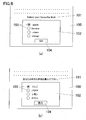
- FIG. 8(a) A concrete example is shown in Fig. 8(a).
- the pull down menu 102 of "apple, " “banana,” “lemon,” and “orange” will be displayed together with selection buttons 103 or selection boxes (check boxes) located ahead of each menu.
- selection buttons 103 or selection boxes check boxes located ahead of each menu.
- the second translation portion 36 of the translation server 3 translates the character string 101 of "Select your favorite fruit.” into as shown in Fig. 8(b). Also, it translates each menu of "apple,” “banana,” “lemon,” and “orange” into and respectively, and further translates "GO" into
- the processing portion 361 embeds the same parameter as the parameter used in the original WEB page about each menu in the translated WEB page. Furthermore, the processing portion 361 correlates the translated character of with the parameter to be delivered to the original WEB page, and embeds it in the translated WEB page (the same will be applied to the "next" button). With this, when a certain menu is chosen from the translated menus and the button is pushed, it is configured to recognize that the certain menu was selected from “apple,” “banana,” “lemon,” and “orange” via the corresponding parameter.
- Examples of the information to be given by a user to the portion translated by the second translation portion 36 include information about selecting a desired menu from a plurality of menus by directly specifying each menu on the screen of the user terminal 1.
- FIG. 9(a) A concrete example is shown in Fig. 9(a).
- a character string 201 of "Select your favorite fruit” described in JavaScript on the original WEB page 200.
- the pull down menu 202 of "apple, " "banana,” “lemon,” and “orange” will be displayed. After pointing the cursor to the desired menu, the user clicking the desired menu to transmit the selected content.
- the second translation portion 36 of the translation server 3 translates the "Select your favorite fruit.” into Also it translates “apple,” “banana,” “lemon,” and “orange” into and
- the processing portion 361 embeds the same parameter as the parameter used in the original WEB page about each menu in the translated WEB page. Furthermore, the processing portion 361 correlates the translated character of with the parameter to be delivered to the original WEB page, and embeds it in the translated WEB page (the same will be applied to the "next" button). With this, when a certain menu is chosen from the translated menus and the button is pushed, it is configured to recognize that the certain menu was selected from “apple,” “banana,” “lemon,” and “orange” via the corresponding parameter. At this time, the processing portion 361 correlates the parameter of each menu of the original WEB page with the translated contents of each menu and embeds it in the translated WEB page. With this , when the translated certainmenu is chosen, it is configured to recognize that the corresponding menu among "apple,” “banana,” “lemon,” and “orange” in the original is selected.
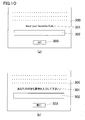
- Examples of the information to be given by a user to the portion translated by the second translation portion 36 include information about character inputting on the screen of the user terminal 1.
- FIG. 10 A concrete example is shown in Fig. 10.
- a character string 301 of "Input your favorite fruit” described in JavaScript on the original WEB page 300.
- a cursor is pointed to the character string, a character input column 302 and the "GO" button will be displayed.
- the user presses the "GO" button to transmit the selected content.
- the second translation portion 36 of the translation server 3 translates "Input your favorite fruit” into and translates "GO" into
- the language identification portion 34 identifies the language of the characters inputted by the user, and the second translation portion 36 translates the contents inputted by the user into the original language, so that it can recognize the user's inputted contents.
- the translated file storing portion 37 saves the translation results by the first and second translation portions 35 and 36.
- the WEB page reconstruction portion 38 refers to the original WEB page stored in the WEB page storing portion 32 and reconstructs the WEB page reflecting the translation results saved in the translated file storing portion 37.
- the controlling portion 39 integrally controls the entire translation server 3.
- the controlling portion 39 makes the WEB page storing portion 32 take in the WEB page having the URL specified by the user and store it, makes the description language identification portion 33, the language identification portion 34 and the translation portions 35 and 35 identify or translate, makes the translated file storing portion 37 store the translated file, makes the WEB page reconstruction portion 38 reconstruct the WEB page reflecting the translation results , transmits the reconstructed WEB page to the user terminal 1 to display it, and also transmits the information given by the user on the translated WEB page to the WEB page provider side (the user's access destination).
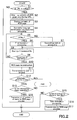
- the controlling portion 39 of the translation server 3 discriminates whether a URL is specified. If not specified (NO at S1), the processing terminates. If a URL is specified (YES at S1), after acquiring the contents of the WEB page specified by the URL through the Internet 2 and the net interface portion 30 at S2, the controlling portion 39 stores the contents of the acquired WEB page in the WEB page storing portion 32 at S3.
- the description language identification/decomposition portion 33 identifies the description language of the WEB page, and decomposes it into the HTML portion and the JavaScript portion.
- the WEB page reconstruction portion 38 reconstructs the WEB page into a WEB page in which the character string is translated based on the contents of the WEB page stored in the WEB page storing portion 32 and the translated file saved in the translated file storing portion 37.
- the controlling portion discriminates whether the information was given from the user to the translated WEB page at S12.
- the routine terminates. If the information from the user is not given (NO at S12), the routine terminates. If the information from a user is given (YES at S12), it is discriminated whether the information given by the user is caused by selection of a menu at S13. If it is caused by the selection of a menu (YES at S13), at S14, the contents of the selected menu are transmitted to the WEB page provide side, and the processing terminates. In this case, since the translated menu and the original menu are related by the parameter, Even if the user selects the translated menu, the same proper contents as the contents which are selected on the original WEB page will be transmitted to the WEB page provider side.
- the processing terminates. If it was the character inputting (YES at S15), after performing the third translation processing at S16, the translation result, i.e., the contents in which the user inputted the characters are transmitted to the WEB page provider side, and the processing terminates.
- Fig. 3 is a flow chart showing the contents of the first translation processing S6 in Fig. 2.
- the language identification portion 34 performs the language identification processing to identify the original language.
- the first translation portion 35 translates the original language into the user's language, and the routine returns.
- Fig. 4 is a flowchart showing the contents of the second translation processing S7 in Fig. 2.
- the language identification portion 34 performs the language identification processing to identify the original language.
- the second translation portion 36 translates the original language into a user's language.
- a character display button such as, e.g. , a "GO" button 104 and 303 as shown in Fig. 8 or Fig. 10 exists. If such a character display button does not exist (NO at S77), the routine returns. If it exists (YES at S77), at S78, the aforementioned parameter for connecting the original menu selection and the translated menu selection is embedded, and the routine returns.
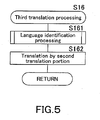
- Fig. 5 is a flowchart showing the contents of the third translation processing S16 in Fig. 2.
- the language identification portion 34 identifies the language of the character string inputted by the user. After translating the character string by the user into the original language, the second translation portion 36 translates the character string by the user into the original language at S162, and then the routine returns.
- Fig. 6 is a flowchart showing the contents of the language identification processing of S61, S71, and S161 in the flowchart of Figs. 3 to 5.
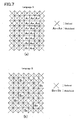
- the language identification portion 34 discriminates whether the character code corresponds to one language stored in the undefined character code list storing portion 31, e.g., the undefined character code of the language A as shown in Fig. 7(a) (A1 to A16 in Fig. 7(a)) about the first character of the character string.
- the first character of the character string corresponds to another language, e.g., the undefined character code (B1 to B6 in Fig. 7(b)) of the language B shown in Fig. 7(b).
- another language e.g., the undefined character code (B1 to B6 in Fig. 7(b)) of the language B shown in Fig. 7(b).
- narrowing down of the language candidate by collating processing of S612 to S616 is performed about the character of the second character string. Collating processing will be performed about the character of the third character, the fourth character,...., of the character string until the candidate of language is narrowed down to one.
- the language candidate is the language to be translated at the stage that the language candidate is narrowed down to one.
- the language identification can be performed after completion of collating with the undefined character code list of all of the languages about all of the characters of the character string.
- first translation portion 35 and the second translation portion 36 are provided, only one translation portion can be used as the first and second translation portions.
Landscapes
- Engineering & Computer Science (AREA)
- Theoretical Computer Science (AREA)
- Health & Medical Sciences (AREA)
- Artificial Intelligence (AREA)
- Audiology, Speech & Language Pathology (AREA)
- Computational Linguistics (AREA)
- General Health & Medical Sciences (AREA)
- Physics & Mathematics (AREA)
- General Engineering & Computer Science (AREA)
- General Physics & Mathematics (AREA)
- Information Transfer Between Computers (AREA)
- Machine Translation (AREA)
Applications Claiming Priority (2)
| Application Number | Priority Date | Filing Date | Title |
|---|---|---|---|
| JP2004169042A JP4048188B2 (ja) | 2004-06-07 | 2004-06-07 | Webページ翻訳装置及びwebページ翻訳方法 |
| PCT/JP2005/010181 WO2005122005A1 (ja) | 2004-06-07 | 2005-06-02 | Webページ翻訳装置及びwebページ翻訳方法 |
Publications (1)
| Publication Number | Publication Date |
|---|---|
| EP1760609A1 true EP1760609A1 (en) | 2007-03-07 |
Family
ID=35498947
Family Applications (1)
| Application Number | Title | Priority Date | Filing Date |
|---|---|---|---|
| EP05745636A Withdrawn EP1760609A1 (en) | 2004-06-07 | 2005-06-02 | Web page translation device and web page translation method |
Country Status (7)
| Country | Link |
|---|---|
| US (1) | US20080172218A1 (https=) |
| EP (1) | EP1760609A1 (https=) |
| JP (1) | JP4048188B2 (https=) |
| KR (1) | KR20070040784A (https=) |
| CN (1) | CN101023425A (https=) |
| TW (1) | TW200611147A (https=) |
| WO (1) | WO2005122005A1 (https=) |
Families Citing this family (13)
| Publication number | Priority date | Publication date | Assignee | Title |
|---|---|---|---|---|
| US20080243475A1 (en) * | 2007-03-16 | 2008-10-02 | Steven Scott Everhart | Web content translation system, method, and software |
| KR100953627B1 (ko) | 2008-04-11 | 2010-04-20 | 엔에이치엔(주) | 웹 페이지에 포함되는 이미지 상의 텍스트를 판독하고 이에대한 번역 서비스를 제공하기 위한 방법, 장치 및 컴퓨터판독 가능한 기록 매체 |
| AU2009342361A1 (en) * | 2009-03-18 | 2011-10-06 | Google Inc. | Web translation with display replacement |
| US9128918B2 (en) | 2010-07-13 | 2015-09-08 | Motionpoint Corporation | Dynamic language translation of web site content |
| CN101916247A (zh) * | 2010-09-03 | 2010-12-15 | 无锡诺宝科技发展有限公司 | 基于单一轴心语言的互联网多语种同步翻译方法 |
| CN101916248A (zh) * | 2010-09-03 | 2010-12-15 | 无锡诺宝科技发展有限公司 | 一种互联网网页翻译方法 |
| CN102722479B (zh) * | 2011-03-30 | 2015-11-04 | 腾讯科技(深圳)有限公司 | 一种实现语言翻译的方法及装置 |
| US9015030B2 (en) * | 2011-04-15 | 2015-04-21 | International Business Machines Corporation | Translating prompt and user input |
| CN103678284A (zh) * | 2012-08-31 | 2014-03-26 | 上海斐讯数据通信技术有限公司 | 页面文字翻译方法及装置 |
| KR20140040379A (ko) * | 2012-09-26 | 2014-04-03 | 삼성전자주식회사 | 휴대단말기의 어플리케이션 처리 장치 및 방법 |
| US20150254236A1 (en) * | 2014-03-13 | 2015-09-10 | Michael Lewis Moravitz | Translation software built into internet |
| SG11202008173QA (en) * | 2018-02-26 | 2020-09-29 | Loveland Co Ltd | Webpage translation system, webpage translation apparatus, webpage providing apparatus, and webpage translation method |
| CN109471802A (zh) * | 2018-11-01 | 2019-03-15 | 郑州云海信息技术有限公司 | 一种Python网页中的异常处理的方法及装置 |
Family Cites Families (13)
| Publication number | Priority date | Publication date | Assignee | Title |
|---|---|---|---|---|
| US6470306B1 (en) * | 1996-04-23 | 2002-10-22 | Logovista Corporation | Automated translation of annotated text based on the determination of locations for inserting annotation tokens and linked ending, end-of-sentence or language tokens |
| AUPQ539700A0 (en) * | 2000-02-02 | 2000-02-24 | Worldlingo.Com Pty Ltd | Translation ordering system |
| US7216072B2 (en) * | 2000-02-29 | 2007-05-08 | Fujitsu Limited | Relay device, server device, terminal device, and translation server system utilizing these devices |
| US6470094B1 (en) * | 2000-03-14 | 2002-10-22 | Intel Corporation | Generalized text localization in images |
| JP2002108855A (ja) * | 2000-09-29 | 2002-04-12 | Brother Ind Ltd | 文書処理装置 |
| US7970437B2 (en) * | 2000-11-29 | 2011-06-28 | Nokia Corporation | Wireless terminal device with user interaction system |
| US6983238B2 (en) * | 2001-02-07 | 2006-01-03 | American International Group, Inc. | Methods and apparatus for globalizing software |
| JP2003141018A (ja) * | 2001-11-02 | 2003-05-16 | Fujitsu Ltd | サーバ、中継装置、情報提供方法、およびプログラム |
| JP3809863B2 (ja) * | 2002-02-28 | 2006-08-16 | インターナショナル・ビジネス・マシーンズ・コーポレーション | サーバ |
| JP3737779B2 (ja) * | 2002-05-29 | 2006-01-25 | 富士通株式会社 | 翻訳サーバ、翻訳方法及びプログラム |
| US20040044518A1 (en) * | 2002-08-27 | 2004-03-04 | Reed John E. | Method and system for multilingual display generation |
| US7496230B2 (en) * | 2003-06-05 | 2009-02-24 | International Business Machines Corporation | System and method for automatic natural language translation of embedded text regions in images during information transfer |
| US7444590B2 (en) * | 2003-06-25 | 2008-10-28 | Microsoft Corporation | Systems and methods for declarative localization of web services |
-
2004
- 2004-06-07 JP JP2004169042A patent/JP4048188B2/ja not_active Expired - Fee Related
-
2005
- 2005-06-02 CN CNA2005800261782A patent/CN101023425A/zh active Pending
- 2005-06-02 US US11/628,734 patent/US20080172218A1/en not_active Abandoned
- 2005-06-02 EP EP05745636A patent/EP1760609A1/en not_active Withdrawn
- 2005-06-02 KR KR1020077000299A patent/KR20070040784A/ko not_active Withdrawn
- 2005-06-02 WO PCT/JP2005/010181 patent/WO2005122005A1/ja not_active Ceased
- 2005-06-07 TW TW094118747A patent/TW200611147A/zh unknown
Non-Patent Citations (1)
| Title |
|---|
| See references of WO2005122005A1 * |
Also Published As
| Publication number | Publication date |
|---|---|
| JP4048188B2 (ja) | 2008-02-13 |
| WO2005122005A1 (ja) | 2005-12-22 |
| JP2005346666A (ja) | 2005-12-15 |
| KR20070040784A (ko) | 2007-04-17 |
| US20080172218A1 (en) | 2008-07-17 |
| CN101023425A (zh) | 2007-08-22 |
| TW200611147A (en) | 2006-04-01 |
Similar Documents
| Publication | Publication Date | Title |
|---|---|---|
| US12339880B2 (en) | Automated patent claim scope concept mapping | |
| KR102345002B1 (ko) | 특허 문서 작성 장치, 방법, 컴퓨터 프로그램, 컴퓨터로 판독 가능한 기록매체, 서버 및 시스템 | |
| JP3959180B2 (ja) | 通信翻訳装置 | |
| US20190243880A1 (en) | Method and system for providing suggested tags associated with a target web page for manipulation by a useroptimal rendering engine | |
| US7516154B2 (en) | Cross language advertising | |
| EP1760608A2 (en) | Language identification equipment, translation equipment, translation server, language identification method, and translation processing method | |
| US20080243475A1 (en) | Web content translation system, method, and software | |
| CN102054024B (zh) | 信息处理设备、信息提取方法、程序和信息处理系统 | |
| US20020120645A1 (en) | Method and system for providing an index to linked sites on a web page for individuals with visual disabilities | |
| EP1760609A1 (en) | Web page translation device and web page translation method | |
| US6738827B1 (en) | Method and system for alternate internet resource identifiers and addresses | |
| EP1690197A2 (en) | Document placemarker | |
| US20070005649A1 (en) | Contextual title extraction | |
| JPH1097541A (ja) | 文書ブラウズ支援システムおよび文書処理システム | |
| JP2017117021A (ja) | キーワード抽出装置、コンテンツ生成システム、キーワード抽出方法、およびプログラム | |
| JP2004240859A (ja) | 言い換えシステム | |
| KR20000039748A (ko) | 다국어 웹 문서 번역 서비스 장치 및 이를 이용한번역 서비스 방법 | |
| KR100905334B1 (ko) | 개인화된 통합 정보검색 방법 | |
| AU2006219600A1 (en) | Language information system | |
| JP2003345798A (ja) | 翻訳制御方法,翻訳制御装置およびその処理プログラム | |
| JP6995405B1 (ja) | 情報提供方法、情報提供装置、情報提供プログラムおよび記録媒体 | |
| JP2008191879A (ja) | 情報表示装置、情報表示装置の表示方法、情報表示プログラム、および情報表示プログラムを記録した記録媒体 | |
| KR20010088527A (ko) | 번역 소프트웨어의 인터넷 웹 문서 쌍방향 번역 처리방법및 이 번역 소프트웨어를 탑재한 기록매체 | |
| KR20010103545A (ko) | 광고 병행 인터넷 번역 기록매체, 시스템 및 장치 | |
| CN113722467A (zh) | 用户搜索意图的处理方法、系统、装置和存储介质 |
Legal Events
| Date | Code | Title | Description |
|---|---|---|---|
| PUAI | Public reference made under article 153(3) epc to a published international application that has entered the european phase |
Free format text: ORIGINAL CODE: 0009012 |
|
| 17P | Request for examination filed |
Effective date: 20070105 |
|
| AK | Designated contracting states |
Kind code of ref document: A1 Designated state(s): AT BE BG CH CY CZ DE DK EE ES FI FR GB GR HU IE IS IT LI LT LU MC NL PL PT RO SE SI SK TR |
|
| DAX | Request for extension of the european patent (deleted) | ||
| STAA | Information on the status of an ep patent application or granted ep patent |
Free format text: STATUS: THE APPLICATION IS DEEMED TO BE WITHDRAWN |
|
| 18D | Application deemed to be withdrawn |
Effective date: 20090102 |