EP1749055B1 - Composition de caoutchouc a adhesion amelioree vis-a-vis d"un renfort metallique - Google Patents
Composition de caoutchouc a adhesion amelioree vis-a-vis d"un renfort metallique Download PDFInfo
- Publication number
- EP1749055B1 EP1749055B1 EP05736921.7A EP05736921A EP1749055B1 EP 1749055 B1 EP1749055 B1 EP 1749055B1 EP 05736921 A EP05736921 A EP 05736921A EP 1749055 B1 EP1749055 B1 EP 1749055B1
- Authority
- EP
- European Patent Office
- Prior art keywords
- composite
- rubber
- composition according
- phr
- tyre
- Prior art date
- Legal status (The legal status is an assumption and is not a legal conclusion. Google has not performed a legal analysis and makes no representation as to the accuracy of the status listed.)
- Expired - Lifetime
Links
Images
Classifications
-
- C—CHEMISTRY; METALLURGY
- C08—ORGANIC MACROMOLECULAR COMPOUNDS; THEIR PREPARATION OR CHEMICAL WORKING-UP; COMPOSITIONS BASED THEREON
- C08L—COMPOSITIONS OF MACROMOLECULAR COMPOUNDS
- C08L21/00—Compositions of unspecified rubbers
-
- B—PERFORMING OPERATIONS; TRANSPORTING
- B60—VEHICLES IN GENERAL
- B60C—VEHICLE TYRES; TYRE INFLATION; TYRE CHANGING; CONNECTING VALVES TO INFLATABLE ELASTIC BODIES IN GENERAL; DEVICES OR ARRANGEMENTS RELATED TO TYRES
- B60C1/00—Tyres characterised by the chemical composition or the physical arrangement or mixture of the composition
-
- B—PERFORMING OPERATIONS; TRANSPORTING
- B60—VEHICLES IN GENERAL
- B60C—VEHICLE TYRES; TYRE INFLATION; TYRE CHANGING; CONNECTING VALVES TO INFLATABLE ELASTIC BODIES IN GENERAL; DEVICES OR ARRANGEMENTS RELATED TO TYRES
- B60C15/00—Tyre beads, e.g. ply turn-up or overlap
- B60C15/06—Flipper strips, fillers, or chafing strips and reinforcing layers for the construction of the bead
-
- C—CHEMISTRY; METALLURGY
- C08—ORGANIC MACROMOLECULAR COMPOUNDS; THEIR PREPARATION OR CHEMICAL WORKING-UP; COMPOSITIONS BASED THEREON
- C08J—WORKING-UP; GENERAL PROCESSES OF COMPOUNDING; AFTER-TREATMENT NOT COVERED BY SUBCLASSES C08B, C08C, C08F, C08G or C08H
- C08J5/00—Manufacture of articles or shaped materials containing macromolecular substances
- C08J5/04—Reinforcing macromolecular compounds with loose or coherent fibrous material
- C08J5/10—Reinforcing macromolecular compounds with loose or coherent fibrous material characterised by the additives used in the polymer mixture
-
- C—CHEMISTRY; METALLURGY
- C08—ORGANIC MACROMOLECULAR COMPOUNDS; THEIR PREPARATION OR CHEMICAL WORKING-UP; COMPOSITIONS BASED THEREON
- C08K—Use of inorganic or non-macromolecular organic substances as compounding ingredients
- C08K13/00—Use of mixtures of ingredients not covered by one single of the preceding main groups, each of these compounds being essential
- C08K13/02—Organic and inorganic ingredients
-
- C—CHEMISTRY; METALLURGY
- C08—ORGANIC MACROMOLECULAR COMPOUNDS; THEIR PREPARATION OR CHEMICAL WORKING-UP; COMPOSITIONS BASED THEREON
- C08K—Use of inorganic or non-macromolecular organic substances as compounding ingredients
- C08K5/00—Use of organic ingredients
- C08K5/0091—Complexes with metal-heteroatom-bonds
-
- C—CHEMISTRY; METALLURGY
- C08—ORGANIC MACROMOLECULAR COMPOUNDS; THEIR PREPARATION OR CHEMICAL WORKING-UP; COMPOSITIONS BASED THEREON
- C08K—Use of inorganic or non-macromolecular organic substances as compounding ingredients
- C08K5/00—Use of organic ingredients
- C08K5/04—Oxygen-containing compounds
- C08K5/09—Carboxylic acids; Metal salts thereof; Anhydrides thereof
- C08K5/098—Metal salts of carboxylic acids
-
- B—PERFORMING OPERATIONS; TRANSPORTING
- B60—VEHICLES IN GENERAL
- B60C—VEHICLE TYRES; TYRE INFLATION; TYRE CHANGING; CONNECTING VALVES TO INFLATABLE ELASTIC BODIES IN GENERAL; DEVICES OR ARRANGEMENTS RELATED TO TYRES
- B60C9/00—Reinforcements or ply arrangement of pneumatic tyres
- B60C9/0007—Reinforcements made of metallic elements, e.g. cords, yarns, filaments or fibres made from metal
- B60C2009/0021—Coating rubbers for steel cords
-
- Y—GENERAL TAGGING OF NEW TECHNOLOGICAL DEVELOPMENTS; GENERAL TAGGING OF CROSS-SECTIONAL TECHNOLOGIES SPANNING OVER SEVERAL SECTIONS OF THE IPC; TECHNICAL SUBJECTS COVERED BY FORMER USPC CROSS-REFERENCE ART COLLECTIONS [XRACs] AND DIGESTS
- Y10—TECHNICAL SUBJECTS COVERED BY FORMER USPC
- Y10T—TECHNICAL SUBJECTS COVERED BY FORMER US CLASSIFICATION
- Y10T428/00—Stock material or miscellaneous articles
- Y10T428/12—All metal or with adjacent metals
- Y10T428/12493—Composite; i.e., plural, adjacent, spatially distinct metal components [e.g., layers, joint, etc.]
- Y10T428/12535—Composite; i.e., plural, adjacent, spatially distinct metal components [e.g., layers, joint, etc.] with additional, spatially distinct nonmetal component
- Y10T428/12556—Organic component
- Y10T428/12562—Elastomer
Definitions
- the present invention relates to rubber compositions and metal / rubber composites, in particular to compositions and composites which can be used for the manufacture of ground connection systems of motor vehicles, in particular tires.
- Metal / rubber composites especially for tires, are well known, they generally consist of a diene rubber matrix, crosslinkable with sulfur, comprising reinforcing elements (or “reinforcements") metal, generally in the form of wire (s). ) or wire assemblies.
- these composites must in a known manner satisfy a large number of technical criteria, sometimes contradictory, such as uniformity, flexibility, endurance in flexion and compression, tensile, wear and corrosion resistance, and maintain these performances at a very high level as long as possible.
- novel adhesion promoter additives which are significantly less expensive than cobalt compounds, which, unexpectedly, also make it possible to improve the adhesive performance of the rubber compositions with respect to metal reinforcements, especially after thermal aging, especially under moisture conditions. They can advantageously replace all or part of the cobalt compounds mentioned above.
- a first object of the invention is a rubber composition that can be used for the manufacture of a metal / rubber composite and capable of adhering to a metal reinforcement, comprising at least one diene elastomer, a reinforcing filler, crosslinking and an adhesion promoter, characterized in that said adhesion promoter comprises between 0.1 and 10 phr of a lanthanide compound as recited in claim 1.
- the invention also relates to the use as a promoter of adhesion to a metal reinforcement, in a diene rubber composition, of such a lanthanide compound at a level of between 0.1 and 10 phr.
- the invention also relates per se to a metal / rubber adhesion promoter system characterized in that it comprises in combination a lanthanide compound and a cobalt compound.
- the invention also relates to a metal / rubber composite comprising a diene rubber composition according to the invention and at least one metal reinforcement adhered to said rubber composition.
- This composite metal / rubber is characterized by an improved metal-rubber adhesive interphase, offering a level of adhesion at least as good in the initial state (directly after baking), compared to prior known solutions, with further significantly improved performance after an aging of the thermal type, especially under moisture conditions.
- the invention also relates to the use of such a composite for the manufacture or reinforcement of ground connection systems of motor vehicles, such as pneumatic tire, internal safety support for tire, wheel, rubber spring, elastomeric articulation, other suspension and anti-vibratory element, or semi-finished rubber products intended for such systems of ground connection.
- motor vehicles such as pneumatic tire, internal safety support for tire, wheel, rubber spring, elastomeric articulation, other suspension and anti-vibratory element, or semi-finished rubber products intended for such systems of ground connection.
- the composite according to the invention is particularly intended for reinforcements for reinforcing the crown, the carcass or the bead zone of tires intended to equip motor vehicles of the tourism type, SUV (" Sport Utility Vehicles "), two-wheeled vehicles (in particular motorcycles), airplanes, such as industrial vehicles chosen from light trucks, "heavy vehicles” - that is to say, metro, bus, road transport vehicles (trucks, tractors, trailers), off-the-road vehicles such as agricultural or civil engineering vehicles; other transport or handling vehicles.
- SUV Sport Utility Vehicles
- two-wheeled vehicles in particular motorcycles
- airplanes such as industrial vehicles chosen from light trucks, "heavy vehicles” - that is to say, metro, bus, road transport vehicles (trucks, tractors, trailers), off-the-road vehicles such as agricultural or civil engineering vehicles; other transport or handling vehicles.
- the invention also relates to the ground connection systems and the semi-finished rubber products themselves, when they comprise a composite according to the invention.
- the invention shows in particular its interest in the carcass reinforcement tires for heavy-duty vehicles which are expected today, thanks to the technical progress of retreading, they are able to endure over a million kilometers , as well as in the crown reinforcement of tires for both passenger vehicles and industrial vehicles.
- the longevity of the tires can thus be substantially improved, in particular that of tires subjected to particularly severe driving conditions, especially in a humid and corrosive atmosphere.
- the breaking force measurements denoted Fm (maximum load in N), breaking strength denoted Rm (in MPa) and elongation at break denoted At ( total elongation in%) are carried out in tension according to the ISO 6892 standard of 1984.
- the modulus measurements are made in tension, unless otherwise expressly indicated according to the ASTM D 412 standard of 1998 (test specimen "VS”); the secant moduli are measured in second elongation (ie, after an accommodation cycle), that is to say, brought back to the actual section of the test tube at 10% elongation, denoted E10 and expressed in MPa (conditions normal temperature and humidity according to ASTM D 1349 of 1999).
- the quality of the connection between the metal reinforcement and the rubber matrix is assessed by a test in which the force, called the tearing force, required to extract the metal reinforcement of the rubber matrix in the vulcanized state is measured.
- the metal / rubber composite used in this test is a block of rubber composition, consisting of two 300 mm by 150 mm (millimeter) and 3.5 mm thick plates, applied to each other before cooking; the thickness of the resulting block is then 7 mm. It is during the making of this block that the reinforcements, for example twelve in number, are trapped between the two raw plates; only a specified length of reinforcement, for example 12.5 mm, is left free to come into contact with the rubber composition to which this length of reinforcement will bind during cooking; the rest of the length of the reinforcements is isolated from the rubber composition (for example using a plastic or metal film) to prevent adhesion outside the determined contact zone. Each reinforcement passes through the block of rubber from one side, at least one of its free ends being kept of sufficient length (at least 5 cm, for example between 5 and 10 cm) to allow the subsequent tracing of the reinforcement.
- the block comprising the twelve reinforcements is then placed in a suitable mold and then cooked, unless otherwise indicated, for 40 minutes at 150 ° C. under a pressure of about 11 bars.
- the block is cut into sample specimens, each containing a reinforcement that is pulled out of the rubber block, using a traction machine; the pulling speed is 50 mm / min; the adhesion is thus characterized by the force necessary to pull the reinforcement out of the test piece at a temperature of 20 ° C .; the tearing force (noted Fa) represents the average of the 12 measurements corresponding to the 12 reinforcements of the composite.
- the metal / rubber composite of the invention which can be used for the manufacture or reinforcement of ground connection systems of motor vehicles such as, for example, tires, comprises at least one rubber composition or matrix, itself a subject of the invention. invention, and a metal reinforcement to which it is capable of adhering, both described in detail below.
- composition of the invention is an elastomeric composition based (i.e., comprising the reaction mixture or product) of at least one diene elastomer, a reinforcing filler, a crosslinking system and an adhesion promoter.
- adhesion promoter consists, in whole or in part, of a lanthanide compound.
- iene elastomer or indistinctly rubber is meant in known manner an elastomer derived at least in part (ie, a homopolymer or a copolymer) from monomers dienes (monomers carrying two carbon-carbon double bonds, conjugated or not) .
- diene elastomers can be classified in known manner into two categories: those known as “essentially unsaturated” and those known as “essentially saturated”.
- the term "diene elastomer” is used herein to mean a diene elastomer derived at least in part from conjugated diene monomers having a level of units or units of diene origin (conjugated dienes) which is greater than 15% (%). in moles).
- conjugated diene monomers having a level of units or units of diene origin (conjugated dienes) which is greater than 15% (%). in moles).
- diene elastomers such as butyl rubbers or copolymers of dienes and alpha-olefins of the EPDM type do not fall within the above definition and may in particular be described as "essentially saturated” diene elastomers.
- the term “highly unsaturated” diene elastomer is particularly understood to mean a diene elastomer having a content of units of diene origin (conjugated dienes) which is greater than 50%.
- diene elastomer any type of diene elastomer, one skilled in the art of the tire will understand that the present invention is first used with essentially unsaturated diene elastomers, in particular of the type (a) or ( b) above.
- the diene elastomer is chosen from the group consisting of polybutadienes (BR), natural rubber (NR), synthetic polyisoprenes (IR), the various butadiene copolymers, the various copolymers of isoprene, and the mixtures of these elastomers.
- Such copolymers are more preferably chosen from the group consisting of butadiene-styrene copolymers (SBR), the latter being prepared by emulsion polymerization (ESBR) as in solution (SSBR), the isoprene-butadiene copolymers (BIR ), isoprene-styrene copolymers (SIR) and isoprene-butadiene-styrene copolymers (SBIR).
- SBR butadiene-styrene copolymers
- ESBR emulsion polymerization
- SBIR isoprene-butadiene copolymers
- SIR isoprene-styrene copolymers
- SBIR isoprene-butadiene-styrene copolymers
- Particularly suitable polybutadienes are those having a 1,2-unit content of between. 4% and 80% or those with a cis-1,4 content greater than 80%.
- synthetic polyisoprenes cis-1,4-polyisoprenes are particularly suitable, preferably those having a cis-1,4 bond ratio greater than 90%.
- copolymers of butadiene or isoprene is meant in particular the copolymers obtained by copolymerization of at least one of these two monomers with one or more vinyl-aromatic compounds having from 8 to 20 carbon atoms.
- Suitable vinyl aromatic compounds are, for example, styrene, ortho-, meta-, para-methylstyrene, the commercial "vinyl-toluene" mixture, para-tert-butylstyrene, methoxystyrenes, chlorostyrenes, vinylmesitylene and divinylbenzene. vinyl naphthalene.
- the copolymers may contain between 99% and 20% by weight of diene units and between 1% and 80% by weight of vinyl aromatic units.
- the composites in accordance with the invention are preferentially intended for tires, in particular for carcass reinforcement of tires for industrial vehicles such as vans or heavy goods vehicles, as well as for tire crown reinforcement intended both for passenger vehicles and for passenger vehicles. industrial vehicles.
- At least one isoprene elastomer is preferably an isoprene homopolymer or copolymer, in other words a diene elastomer chosen from the group consisting of rubber, is preferably used.
- the isoprene elastomer is preferably natural rubber, or a synthetic polyisoprene of the cis-1,4 type preferably having a cis-1,4 bond ratio greater than 90%, more preferably still greater than 98%.
- the rubber compositions may contain diene elastomers other than isoprenic, especially SBR and / or BR elastomers as mentioned above, regardless of whether the isoprene elastomer is predominantly present or not. all the diene elastomers used.
- an SBR copolymer having a Tg glass transition temperature, measured according to ASTM D3418. preferably between -70 ° C. and -10 ° C., whether it is prepared in emulsion (ESBR) or in solution (SSBR), in a proportion of 0 to 70 phr (parts by weight per hundred parts of elastomer) the remainder (30 to 100 phr) consisting of the isoprene elastomer. More particularly, an SSBR is used.
- SBR SSBR or ESBR
- a BR preferably having more than 90% of cis-1,4 bonds, said BR having a Tg preferably between -110 ° C and -50 ° C.
- the rubber matrix may contain one or more diene elastomers, the latter or these may be used in combination with any type of synthetic elastomer other than diene, or even with polymers other than elastomers, for example polymers. thermoplastics.
- reinforcing filler known for its ability to reinforce a rubber composition which can be used for the manufacture of tires, for example a organic filler such as carbon black, or a reinforcing inorganic filler such as silica to which is associated in a known manner a coupling agent.
- Carbon black is preferably used. Carbon blacks are suitable for all carbon blacks, in particular blacks of the HAF, ISAF, SAF type conventionally used in tires (so-called pneumatic grade blacks). Among these, the reinforcing carbon blacks of the 100, 200 or 300 series (ASTM grades), for example the N115, N134, N234, N326, N330, N339, N347 or N375 blacks, or even targeted applications, blacks of higher series (eg N660, N683, N772).
- Reinforcing inorganic filler means any inorganic or mineral filler, irrespective of its color and origin (natural or synthetic), also called “white” filler or sometimes “clear” filler as opposed to carbon black. capable of reinforcing on its own, with no other means than an intermediate coupling agent, a rubber composition intended for the manufacture of tires, in other words able to replace, in its reinforcing function, a conventional carbon black pneumatic grade; such a filler is generally characterized, in known manner, by the presence of hydroxyl groups (-OH) on its surface.
- -OH hydroxyl groups
- Suitable reinforcing inorganic fillers are, in particular, mineral fillers of the siliceous type, in particular silica (SiO 2 ), or of the aluminous type, in particular alumina (Al 2 O 3 ).
- the silica used may be any reinforcing silica known to those skilled in the art, in particular any precipitated or fumed silica having a BET surface and a CTAB specific surface both less than 450 m 2 / g, preferably from 30 to 400 m 2 / g.
- HDS highly dispersible precipitated silicas
- the Ultrasil 7000 and Ultrasil 7005 silicas from Degussa mention may be made of, for example, the Ultrasil 7000 and Ultrasil 7005 silicas from Degussa, the Zeosil 1165MP, 1135MP and 1115MP silicas from Rhodia, the Hi-Sil EZ150G silica from the PPG company, the Zeopol 8715, 8745 and 8755 silicas of the Huber Company.
- reinforcing aluminas examples include “Baikalox”"A125” or “CR125” aluminums from Baikowski, “APA-100RDX” from Condea, “Aluminoxid C” from Degussa or “AKP-G015" from Sumitomo Chemicals .
- a well-known at least bifunctional coupling agent (or bonding agent) will be used in a well known manner to provide a sufficient chemical and / or physical connection between the inorganic filler. (surface of its particles) and the diene elastomer, in particular organosilanes or bifunctional polyorganosiloxanes.
- the total reinforcing filler content (carbon black and / or reinforcing inorganic filler) is between 20 and 200 phr, more preferably between 30 and 150 phr, the optimum being in a known manner different according to the intended applications.
- the crosslinking system is preferably a vulcanization system, that is to say a system based on sulfur (or a sulfur-donor agent) and a primary vulcanization accelerator.
- a vulcanization system that is to say a system based on sulfur (or a sulfur-donor agent) and a primary vulcanization accelerator.
- various known secondary accelerators or vulcanization activators such as zinc oxide.
- Sulfur is used at a preferential level of between 0.5 and 10 phr, more preferably between 1 and 8 phr, in particular between 1 and 6 phr, when the composition of the invention is intended, according to a preferred embodiment of the invention. invention, to constitute an "eraser" (or rubber composition) internal tire.
- the primary vulcanization accelerator is used at a preferred level of between 0.5 and 10 phr, more preferably between 0.5 and 5.0 phr.
- Any compound that can act as an accelerator for vulcanizing diene elastomers in the presence of sulfur especially thiazole accelerators and their derivatives, accelerators of the thiuram type, zinc dithiocarbamates, may be used as accelerator.
- These primary accelerators are more preferably selected from the group consisting of 2-mercaptobenzothiazyl disulfide (abbreviated "MBTS”), N-cyclohexyl-2-benzothiazyl sulfenamide (abbreviated “CBS”), N, N-dicyclohexyl-2-benzothiazyl sulphenamide (abbreviated "DCBS”), N-tert-butyl-2-benzothiazyl sulphenamide (abbreviated "TBBS”), N-tert-butyl-2-benzothiazyl sulphenimide (abbreviated "TBSI”) and mixtures of these compounds .
- MBTS 2-mercaptobenzothiazy
- lanthanide is reserved for metals, called “rare earths”, whose atomic number varies from 57 (lanthanum) to 71 (lutetium).
- the lanthanide is selected from the group consisting of lanthanum, cerium, praseodymium, neodymium, samarium, erbium and mixtures of these rare earths. More preferably, cerium or neodymium, in particular neodymium, is used.
- organic lanthanide or "organolanthanide” compound selected from the group consisting of abietates, acetates, acetylacetonates, benzoates, butyrates, formates, linoleates, maleates, oleates, propionates, naphthenates, resinates, stearates, and mixtures (salts, complexes, or other mixed derivatives) of such compounds.
- Acetylacetonates and naphthenates are the preferred organolanthanides in the majority of cases, more particularly acetylacetonates.
- the content of lanthanide compound is between 0.1 and 10 phr. Below 0.1 phr, the technical effect is likely to be insufficient, whereas beyond 10 phr, there is an increase in costs and the risk of degrading certain mechanical properties of the compositions, the initial state as after aging. For these various reasons, said level of lanthanide compound is more preferably between 0.2 and 5 phr, more preferably between 0.5 and 2.5 phr.
- the lanthanide compounds for example neodymium salts such as carboxylates
- polymerization catalysts for polymers or elastomers such as dienes
- examples US-A-3,803,053 , US-A-5,484,897 , US-A-5,858,903 , US-A-5,914,377 , US-B-6,800,705 see by way of examples US-A-3,803,053 , US-A-5,484,897 , US-A-5,858,903 , US-A-5,914,377 , US-B-6,800,705 ).
- the rubber matrices of the composites according to the invention also comprise all or part of the additives normally used in rubber compositions intended for the manufacture of ground connection systems of motor vehicles, in particular tires, such as, for example, anti-aging agents, antioxidants, plasticizers or extension oils, whether these are of aromatic or non-aromatic nature, especially very low or non-aromatic oils (eg, naphthenic or paraffinic oils, MES or TDAE oils), agents facilitating the use of the compositions in the green state, a crosslinking system based on either sulfur, or sulfur and / or peroxide donors, accelerators, vulcanization activators or retardants, anti-eversion agents such as for example sodium hexathiosulfonate or N, N'-m-phenylene-biscitraconimide, methyl acceptors and donors ene (for example resorcinol, HMT or H3M) or other reinforcing resins, bismaleimides, other adhesion promoter systems vis-à-
- a particular embodiment consists in using a bismaleimide compound.
- This type of compound usable without hardener, has a cooking kinetics well adapted to that of tires, it is likely to activate the kinetics of adhesion and further improve, in the composites according to the invention, the endurance in wet aging conditions of adhesive interphases.
- the bismaleimides respond, in known manner, to the following formula: wherein R is a substituted or unsubstituted hydrocarbon, aromatic or aliphatic, cyclic or acyclic radical, such radical may include a heteroatom selected from O, N and S; this radical R preferably comprises from 2 to 24 carbon atoms.
- a bismaleimide chosen from the group consisting of N, N'-ethylene-bismaleimides, N, N'-hexamethylene-bismaleimides, N, N '- (m-phenylene) -bismaleimides, is used, N, N '- (p-phenylene) -bismaleimides, N, N' - (p-tolylene) -bismaleimides, N, N '- (methylenedi-p-phenylene) -bismaleimides, N, N' - (oxidizing) p-phenylene) -bismaleimides and mixtures of these compounds.
- Such bismaleimides are well known to those skilled in the art.
- a reinforcing resin or a bismaleimide is used, it is present in the composite of the invention at a preferred level of between 0.1 and 20%, more preferably between 1 and 8% by weight of rubber composition.
- a preferred level of between 0.1 and 20%, more preferably between 1 and 8% by weight of rubber composition For rates above the maximum values indicated, there is a risk of excessive stiffening of the compositions, and thus to embrittlement of the composites; for rates below the indicated minima, the intended technical effect may be insufficient.
- the composition comprises, in combination with the lanthanide compound, at least one cobalt compound at a preferential rate of between 0.1 and 10 phr. It has been found that a certain synergy can exist between the two compounds, in particular resulting in a greater improvement of the adhesive performance under thermal and wet aging conditions. For the same reasons as those indicated previously for the lanthanide compound, the level of cobalt compound is then more preferably between 0.2 and 5 phr, more preferably between 0.5 and 2.5 phr.
- the cobalt compound is preferably an organic cobalt compound, chosen more preferentially from the group consisting of abietates, acetates, acetylacetonates, benzoates, butyrates, formates, linoleates, maleates, oleates, propionates, naphthenates, resinates, stearates, and mixtures (ie salts, complexes, or other mixed derivatives) of such compounds, in particular among the abietates, acetylacetonates, naphthenates, resinates and mixtures of such compounds. Acetylacetonates and naphthenates are preferred in the majority of cases.
- compositions are manufactured in appropriate mixers, using two successive preparation phases well known to those skilled in the art: a first phase of work or thermomechanical mixing (so-called “non-productive” phase) at high temperature, up to a maximum of maximum temperature between 110 ° C and 190 ° C, preferably between 130 ° C and 180 ° C, followed by a second phase of mechanical work (so-called “productive” phase) to a lower temperature, typically less than 110 ° C, finishing phase during which the crosslinking system is incorporated.
- a first phase of work or thermomechanical mixing at high temperature, up to a maximum of maximum temperature between 110 ° C and 190 ° C, preferably between 130 ° C and 180 ° C
- a second phase of mechanical work so-called “productive” phase
- the non-productive phase is carried out in a single thermomechanical step of a few minutes (for example between 2 and 10 min) during which, in the course of a suitable mixer such as a conventional internal mixer, all the necessary basic constituents and other additives, with the exception of the crosslinking or vulcanization system. After cooling the mixture thus obtained, it is then incorporated in an external mixer such as a roll mill, maintained at low temperature (for example between 30 ° C and 100 ° C), the vulcanization system. The whole is then mixed (productive phase) for a few minutes (for example between 5 and 15 min).
- a suitable mixer such as a conventional internal mixer
- an external mixer such as a roll mill
- the final composition thus obtained can then be calendered, for example in the form of a sheet, a plate or extruded, for example to form a rubber profile used for the manufacture of a composite or a semi product.
- -fini such as for example webs, strips, sub-layers, other rubber blocks reinforced with metal reinforcements, intended to form for example a portion of the structure of a tire.
- the vulcanization (or firing) may then be carried out in a known manner at a temperature generally of between 130 ° C. and 200 ° C., preferably under pressure, for a sufficient time which may vary, for example, between 5 and 90 min, depending in particular on the firing temperature, the vulcanization system adopted and the vulcanization kinetics of the composition under consideration.
- the invention relates to rubber compositions and composites both in the so-called “raw” state (i.e., prior to firing) and in the so-called “fired” or vulcanized state (i.e. after vulcanization).
- Metal reinforcement means any reinforcing element capable of reinforcing the rubber matrix, whether it is entirely metallic or not, of which at least the surface or external part, intended to come into contact with the rubber, is made of metal.
- This reinforcement may be in various forms, preferably in the form of a unitary yarn (monofilament), a film (for example a strip or a ribbon) or an assembly of threads, that these threads are twisted together. (For example, in the form of a cable) or substantially parallel to each other (for example in the form of a packet of son, a continuous fiber or a set of short fibers).
- this reinforcement is more preferably in the form of a unitary yarn or an assembly of yarns, for example a cable or a strand manufactured with devices and methods of cabling or stranding known to those skilled in the art, which are not described here for the simplicity of the presentation.
- the metal, or surface metal if appropriate, of the metal reinforcement is preferably selected from Fe, Cu, Zn, Al, Sn, Ni, Co, Cr, Mn, the oxides, hydroxides and alloys of these elements, more preferably from Fe, Cu, Zn, Al, Sn, their oxides, hydroxides and alloys.
- carbon steel When a carbon steel is used, its carbon content is preferably between 0.1% and 1.2%, especially between 0.5% and 1.1% (% by weight of steel); it is more preferably between 0.6% and 1.0%, such a content representing a good compromise between the mechanical properties required for the tire and the feasibility of the son.
- the metal or steel used can be used as such (steel called “clear") or be itself coated with an additional metal layer improving for example the properties of implementation of the metal reinforcement and / or its constituent elements, or the properties of use of the reinforcement and / or the composite themselves.
- the steel used especially when it is a carbon steel, is covered with an additional layer of metal chosen from aluminum, zinc, copper and binary alloys. or ternary of these metals.
- aluminum alloys those selected from Al-Mg, Al-Cu, Al-Ni and Al-Zn binary alloys and the ternary alloys of Al and two of the elements Mg, Cu and Ni are preferably used.
- Zn more particularly an Al-Zn alloy.
- zinc alloys those selected from Zn-Cu, Zn-Al, Zn-Mn, Zn-Co, Zn-Mo, Zn-Fe, Zn-Ni, Zn-Sn and alloy alloys are preferably used.
- ternary Zn and two of the elements for example Zn-Cu-Ni or Zn-Cu-Co), more particularly a Zn-Cu alloy (brass) or a Zn-Al alloy as mentioned above.
- the preferred binary alloys are those of Cu-Zn (above-mentioned brass) and Cu-Sn (bronze).
- an additional metal layer is deposited on the metal reinforcement or on the individual elements constituting this reinforcement, in particular when it is an assembly, it is possible to use any deposition method capable of applying, continuously or discontinuous, a metal coating on a metal substrate.
- a simple run-in dipping technique is used, in a bath containing the metal or alloy in the liquid state, an electrolytic deposition technique or else by spraying.
- the additional metal layer will preferably be deposited on the wires, and not on the final cable.
- the deposit will advantageously be made on a so-called "intermediate" diameter wire, for example of the order of a millimeter, at the outlet of the last heat treatment (patenting) preceding the step wet final wire drawing for obtaining the fine wire having the final diameter referred to.
- the rubber composition of the invention and the metal reinforcement described above can be used for the manufacture of a metal / rubber composite which constitutes another subject of the invention, a composite in which the adhesion between the metal and the rubber is ensured. thanks to the use in said composition of the lanthanide compound.
- This composite may be in various forms, for example in the form of a sheet, a strip, strip or a rubber block in which is incorporated the metal reinforcement, or a coating of rubber coating the metal reinforcement, the latter being in direct contact with the rubber composition.
- the final adhesion between the metal and the rubber composition can be obtained at the end of the firing of the finished article comprising the composite; preferably, this cooking is operated under pressure.
- the composites according to the invention are preferably intended for tires, in particular for radial tires to form all or part of the crown reinforcement, of the carcass reinforcement or the reinforcement of the bead zone of such tires.
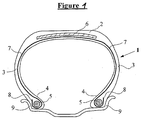
- the appended figure very schematically represents a radial section of a tire 1 with a radial carcass reinforcement according to the invention, intended for a heavy-duty vehicle as for a passenger vehicle in this general representation.
- This tire 1 comprises a crown 2, two sidewalls 3, two beads 4, a carcass reinforcement 7 extending from one bead to the other.
- the top 2 surmounted by a tread (not shown in this schematic figure, for simplification), is in a manner known per se reinforced by a crown reinforcement 6 constituted for example by at least two superimposed crossed vertex plies (plies so-called "working" top), optionally covered with at least one protective ply or with a zero degree hooping crown ply.
- the carcass reinforcement 7 is wound around the two rods 5 in each bead 4, the upturn 8 of this armature 7 being for example disposed towards the outside of the tire 1 which is shown here mounted on its rim 9.
- the armature of carcass 7 consists of at least one ply reinforced by so-called "radial” cables, that is to say that these cables are arranged substantially parallel to each other and extend from one bead to the other of to form an angle between 80 ° and 90 ° with the median circumferential plane (plane perpendicular to the axis of rotation of the tire which is located halfway between the two beads 4 and passes through the middle of the crown reinforcement 6).
- this tire 1 also comprises, in a known manner, an inner rubber or elastomer layer (commonly called “inner rubber”) which defines the radially inner face of the tire and which is intended to protect the carcass ply from the diffusion of the tire. air from the interior space to the tire.
- inner rubber commonly called "inner rubber”
- it may further comprise an intermediate reinforcing elastomer layer which is located between the carcass ply and the inner layer, intended to reinforce the inner layer and, by Therefore, the carcass ply, also intended to partially relocate the forces experienced by the carcass reinforcement.
- the tire according to the invention has the essential characteristic of comprising in its structure at least one metal / rubber composite in accordance with the invention, this composite possibly being, for example, a portion of the bead zone 4 comprising the bead wire 5, a cross-ply web or a protective ply of the crown reinforcement 6, a ply forming all or part of the carcass reinforcement 7.
- the composite of the invention is advantageously usable in the crown reinforcement of all types of tires, for example for tourism vehicles, vans or heavy vehicles.
- the rubber composition of the invention preferably has, in the vulcanized state (ie, after curing), a modulus E10 which is greater than 4 MPa, more preferably between 6 and 20 MPa, for example between 6 and 15 MPa.
- the composite of the invention can have an equally advantageous use in a carcass reinforcement of a tire for an industrial vehicle such as heavyweight.
- the rubber composition of the invention has, in the vulcanized state, a modulus E10 which is less than 9 MPa, more preferably between 4 and 9 MPa.
- the diene elastomer (or the mixture of diene elastomers) is introduced into an internal mixer, filled to 70% and whose initial tank temperature is approximately 60 ° C. , if applicable), the reinforcing filler and the various other ingredients with the exception of the vulcanization system.
- the mixture thus obtained is recovered, cooled and the vulcanization system (sulfur and sulfenamide accelerator) is added to an external mixer (homo-finisher) at 30 ° C., mixing the whole (productive phase), for example for 3 to 4 hours. 10 minutes.
- vulcanization system sulfur and sulfenamide accelerator
- compositions thus obtained are then either extruded in the form of plates (thickness of 2 to 3 mm) for the measurement of their physical or mechanical properties, or calendered for producing a metallic cabled fabric constituting a part of the crown reinforcement. of a passenger car tire.
- the following tests use eight different compositions or rubber matrices, denoted M-1 to M-8, based on natural rubber and carbon black, having after cooking an E10 modulus of between 8 and 12 MPa (about 11 MPa for compositions M-1 to M-4 and about 9 MPa for matrices M-5 to M-8).
- compositions have been reported in the attached Tables 1 and 2.
- elastomer and the reinforcing filler comprise essentially a paraffinic oil, an antioxidant, zinc oxide, stearic acid, sulfur and a sulfenamide accelerator, for some of them ( M-1 to M-4) a reinforcing resin (phenolic resin plus methylene donor), finally a metal / rubber adhesion promoter comprising either a cobalt compound alone for the control compositions (M-1 and M-5), either a cobalt compound and a lanthanide compound for the compositions according to the invention (M-2 to M-4, M-6 to M-8).
- Cables made of fine brass-coated carbon steel wires suitable for reinforcement of touring tire crown reinforcement are used.
- the fine carbon steel wires are prepared starting from, for example, machine wires (diameter 5 to 6 mm) that are first cold-worked by rolling and / or drawing to an intermediate diameter of about 1 mm. or starting directly from commercial intermediate threads whose diameter is close to 1 mm.
- the steel used is a known carbon steel, for example of the USA AISI 1069 type, the carbon content of which is about 0.8%, comprising about 0.5% of manganese, the remainder being iron and unavoidable impurities.
- typical of the steel manufacturing process for example, silicon content: 0.25%, phosphorus: 0.01%, sulfur: 0.01%, chromium: 0.11%, nickel: 0.03% copper: 0.01%, aluminum: 0.005%, nitrogen: 0.003%).
- Each carbon steel wire is coated with a layer of brass (64% copper and 36% zinc).
- the brass coating has a very small thickness, well below the micrometer, which equates to about 0.35 to 0.40 g of brass per 100 g of wire.
- 8 carbon / rubber / C-1 to C-8 rubber / rubber composites are prepared by calendering. intended for the adhesion test described in paragraph I-2 above.
- Composite C-1 is the control comprising a conventional rubber matrix further comprising a reinforcing resin and a cobalt compound as adhesion promoter (matrix M-1).
- Composites C-2 to C-4, all three according to the invention, are distinguished only by the additional presence of an organolanthanide (neodymium, cerium or samarium) in their rubber matrix (M-2 to M-4) .
- the composites according to the invention all have an initial adhesion (tearing force Fa) which is slightly greater than that of the control (C-1) however characterized by a starting adhesion level which is very high (of the order of 30 daN) for the composite considered.
- organolanthanide compound thus makes it possible to slightly improve the initial adhesion and to considerably increase the adhesive performance after thermal aging.
- Composite C-5 is the control comprising a conventional rubber matrix containing in particular a cobalt compound as an adhesion promoter and also without reinforcing resin (matrix M-5).
- Composites C-6 to C-8, all three according to the invention, are distinguished only by the additional presence. organolanthanide (neodymium, cerium or samarium) in their rubber matrix (M-6 to M-8).
- the preceding tests clearly demonstrate that the organic lanthanide salts are very effective promoters of the adhesion between metal and rubber and allow a significant increase in the life of the metal / rubber composites, and therefore the tires comprising them, after an aging of the thermal type, especially under moisture conditions.
- Rubber composition M-5 M-6 M-7 M-8 diene elastomer (1) 100 100 100 100 carbon black (2) 55 55 55 55 antioxidant (3) 1.5 1.5 1.5 1.5 1.5 plasticizer (paraffinic oil) 2 2 2 2 zinc oxide 8 8 8 8 stearic acid 0.6 0.6 0.6 0.6 cobalt compound (4) 1.0 1.0 1.0 1.0 neodymium acetylacetonate (5) - 1.0 - - cerium acetylacetonate (6) - - 1.0 - samarium acetylacetonate (7) - - - 1.0 sulfur 4.5 4.5 4.5 4.5 4.5 4.5 sulfenamide (8) 0.8 0.8 0.8 0.8 (1) natural rubber; (2) N330 (designation according to ASTM D-1765); (3) N- (1,3-dimethylbutyl) -N'-phenyl-p-phenylenediamine;("Santoflex6-PPD" from Flexsys); (4) cobalt naphthen
Landscapes
- Chemical & Material Sciences (AREA)
- Health & Medical Sciences (AREA)
- Chemical Kinetics & Catalysis (AREA)
- Medicinal Chemistry (AREA)
- Polymers & Plastics (AREA)
- Organic Chemistry (AREA)
- Engineering & Computer Science (AREA)
- Mechanical Engineering (AREA)
- Manufacturing & Machinery (AREA)
- Materials Engineering (AREA)
- Compositions Of Macromolecular Compounds (AREA)
- Adhesives Or Adhesive Processes (AREA)
- Tires In General (AREA)
- Ropes Or Cables (AREA)
Applications Claiming Priority (2)
| Application Number | Priority Date | Filing Date | Title |
|---|---|---|---|
| FR0404603A FR2869618B1 (fr) | 2004-04-30 | 2004-04-30 | Composition de caoutchouc a adhesion amelioree vis a vis d'un renfort metallique. |
| PCT/EP2005/004613 WO2005113666A1 (fr) | 2004-04-30 | 2005-04-29 | Composition de caoutchouc a adhesion amelioree vis-a-vis d’un renfort metallique |
Publications (2)
| Publication Number | Publication Date |
|---|---|
| EP1749055A1 EP1749055A1 (fr) | 2007-02-07 |
| EP1749055B1 true EP1749055B1 (fr) | 2016-08-31 |
Family
ID=34944564
Family Applications (1)
| Application Number | Title | Priority Date | Filing Date |
|---|---|---|---|
| EP05736921.7A Expired - Lifetime EP1749055B1 (fr) | 2004-04-30 | 2005-04-29 | Composition de caoutchouc a adhesion amelioree vis-a-vis d"un renfort metallique |
Country Status (8)
| Country | Link |
|---|---|
| US (2) | US20080026244A1 (https=) |
| EP (1) | EP1749055B1 (https=) |
| JP (1) | JP4959551B2 (https=) |
| KR (1) | KR101216981B1 (https=) |
| CN (1) | CN1976987B (https=) |
| BR (1) | BRPI0510368A (https=) |
| FR (1) | FR2869618B1 (https=) |
| WO (1) | WO2005113666A1 (https=) |
Families Citing this family (46)
| Publication number | Priority date | Publication date | Assignee | Title |
|---|---|---|---|---|
| JP5101865B2 (ja) * | 2006-04-11 | 2012-12-19 | 住友ゴム工業株式会社 | ビードエイペックス用ゴム組成物およびそれを用いたビードエイペックスを有するタイヤ |
| JP5475032B2 (ja) * | 2006-04-11 | 2014-04-16 | 住友ゴム工業株式会社 | ビードエイペックス用ゴム組成物およびそれを用いたビードエイペックスを有するタイヤ |
| US7694708B2 (en) * | 2006-10-10 | 2010-04-13 | The Goodyear Tire & Rubber Company | Tire with sidewall insert |
| FR2908416B1 (fr) | 2006-11-09 | 2009-01-16 | Michelin Soc Tech | Composition de caoutchouc pour pneumatique incorporant un nouveau systeme anti-oxydant |
| JP5467869B2 (ja) * | 2007-12-27 | 2014-04-09 | 株式会社ブリヂストン | スチールコード−ゴム複合体 |
| JP5524522B2 (ja) * | 2008-08-19 | 2014-06-18 | 株式会社ブリヂストン | ゴム組成物 |
| FR2943269B1 (fr) | 2009-03-20 | 2011-04-22 | Michelin Soc Tech | Renfort composite auto-adherent |
| FR2943690B1 (fr) | 2009-03-31 | 2011-08-19 | Michelin Soc Tech | Procede et dispositif de fabrication d'un cable a trois couches du type gomme un situ |
| FR2943691B1 (fr) | 2009-03-31 | 2011-08-19 | Michelin Soc Tech | Procede et dispositif de fabrication d'un cable a trois couches du type gomme in situ |
| FR2945826B1 (fr) | 2009-05-25 | 2011-12-02 | Michelin Soc Tech | Renfort composite auto-adherent |
| FR2947274B1 (fr) | 2009-06-24 | 2013-02-08 | Michelin Soc Tech | Composition de caoutchouc pour pneumatique comportant un compose acetylacetonate |
| JP4588100B1 (ja) * | 2009-06-26 | 2010-11-24 | 株式会社ブリヂストン | ゴム複合体及びゴム組成物 |
| FR2947575B1 (fr) | 2009-07-03 | 2011-08-19 | Michelin Soc Tech | Cable multitorons dont les torons elementaires sont des cables a deux couches gommes in situ. |
| FR2947574B1 (fr) | 2009-07-03 | 2012-11-09 | Michelin Soc Tech | Cable multitorons dont les torons elementaires sont des cables a deux couches gommes in situ. |
| FR2948598B1 (fr) | 2009-07-31 | 2011-08-19 | Michelin Soc Tech | Renfort composite |
| FR2952076B1 (fr) | 2009-10-29 | 2011-12-02 | Michelin Soc Tech | Renfort composite |
| FR2954332B1 (fr) * | 2009-12-22 | 2012-01-13 | Michelin Soc Tech | Article notamment pneumatique avec melange de caoutchouc externe comportant un sel de lanthanide |
| FR2963579B1 (fr) | 2010-08-05 | 2013-04-26 | Michelin Soc Tech | Renfort composite |
| FR2965208B1 (fr) | 2010-09-23 | 2012-10-12 | Michelin Soc Tech | Renfort composite |
| FR2965209B1 (fr) | 2010-09-23 | 2014-04-18 | Michelin Soc Tech | Renfort composite auto-adherent |
| FR2967604B1 (fr) * | 2010-11-22 | 2012-12-14 | Michelin Soc Tech | Renfort composite auto-adherent |
| JP5779257B2 (ja) * | 2011-01-19 | 2015-09-16 | ブリヂストン アメリカズ タイヤ オペレイションズ エルエルシー | キャッププライゴム組成物 |
| FR2971188B1 (fr) | 2011-02-03 | 2013-03-08 | Michelin Soc Tech | Renfort composite gaine d'une couche de polymere auto-adherente au caoutchouc |
| FR2971187B1 (fr) * | 2011-02-03 | 2013-03-08 | Michelin Soc Tech | Renfort composite gaine d'une couche de polymere auto-adherente au caoutchouc |
| US20120241066A1 (en) * | 2011-03-24 | 2012-09-27 | Paul Harry Sandstrom | Tire containing an internal composite comprised of metal cord reinforced rubber layer with auxiliary buffer rubber layer |
| CN102558633B (zh) * | 2011-12-05 | 2013-04-17 | 莱芜固可力轮胎有限公司 | 摩托车胎冠配方 |
| FR2986455B1 (fr) * | 2012-02-08 | 2014-10-31 | Michelin & Cie | Renfort composite gaine d'une couche de polymere auto-adherente au caoutchouc |
| FR2986456B1 (fr) | 2012-02-08 | 2014-03-07 | Michelin & Cie | Renfort composite gaine d'une couche de polymere auto-adherente au caoutchouc |
| FR2987310B1 (fr) | 2012-02-29 | 2014-03-21 | Michelin & Cie | Stratifie multicouche utilisable pour le renforcement d'une ceinture de pneumatique |
| KR101523290B1 (ko) * | 2014-04-16 | 2015-06-01 | 평화오일씰공업 주식회사 | 탄소강 기재 상의 고무 접착 방법 |
| TWI662048B (zh) * | 2015-07-31 | 2019-06-11 | 日商橫浜橡膠股份有限公司 | Rubber composition, rubber composition metal laminate, and vulcanized rubber product |
| JP6657759B2 (ja) * | 2015-10-15 | 2020-03-04 | 横浜ゴム株式会社 | タイヤ用ゴム組成物 |
| FR3043680B1 (fr) * | 2015-11-13 | 2017-12-08 | Michelin & Cie | Composition de caoutchouc comprenant un polymere dienique fonctionnel |
| FR3043591A1 (fr) * | 2015-11-13 | 2017-05-19 | Michelin & Cie | Composite a base de composant metallique et d'une matrice polymere fonctionnelle |
| FR3049282B1 (fr) | 2016-03-24 | 2018-03-23 | Compagnie Generale Des Etablissements Michelin | Produit renforce comprenant un renfort composite auto-adherent comprenant un copolymere a blocs |
| FR3049283B1 (fr) | 2016-03-24 | 2018-03-23 | Compagnie Generale Des Etablissements Michelin | Produit renforce comprenant un renfort composite auto-adherent comprenant un copolymere a blocs |
| FR3049291B1 (fr) | 2016-03-24 | 2018-03-23 | Compagnie Generale Des Etablissements Michelin | Element composite auto-adherent comprenant un copolymere a blocs |
| FR3058148A1 (fr) * | 2016-10-31 | 2018-05-04 | Compagnie Generale Des Etablissements Michelin | Composition de caoutchouc comprenant une charge renforcante specifique |
| WO2019086798A1 (fr) | 2017-10-30 | 2019-05-09 | Compagnie Generale Des Etablissements Michelin | Pneumatique pourvu d'une couche interne a base d'au moins un elastomere isoprenique, une resine renforçante et un sel metallique |
| CN109227035A (zh) * | 2018-08-14 | 2019-01-18 | 宁国宏泰铸业有限公司 | 一种颚式破碎机衬板的制造方法 |
| FR3086296B1 (fr) | 2018-09-21 | 2020-09-25 | Michelin & Cie | Composition de caoutchouc comprenant un elastomere epoxyde et un compose polyphenolique |
| FR3090653A3 (fr) | 2018-12-19 | 2020-06-26 | Michelin & Cie | Pneumatique comprenant une poudrette de caoutchouc |
| FR3090648A3 (fr) * | 2018-12-19 | 2020-06-26 | Michelin & Cie | Pneumatique comprenant une composition de caoutchouc comprenant un pro-oxydant et une poudrette de caoutchouc |
| JP7397637B2 (ja) | 2019-09-30 | 2023-12-13 | 株式会社ブリヂストン | 金属-ゴム複合体、コンベヤベルト、ホース、ゴムクローラ及びタイヤ |
| FR3112714B1 (fr) * | 2020-07-24 | 2022-07-29 | Michelin & Cie | Traitement thermique d’un élément de renfort |
| US20230167281A1 (en) * | 2021-12-01 | 2023-06-01 | The Goodyear Tire & Rubber Company | Tire bead insulation containing dimaleimide |
Family Cites Families (18)
| Publication number | Priority date | Publication date | Assignee | Title |
|---|---|---|---|---|
| US3324100A (en) * | 1962-10-29 | 1967-06-06 | Phillips Petroleum Co | Masticating polybutadiene |
| US3681329A (en) * | 1970-05-04 | 1972-08-01 | Allied Chem | Process for the preparation of cyclic iminoethers |
| US3903332A (en) * | 1973-02-15 | 1975-09-02 | Uniroyal Inc | Adhesion of polyester to rubber using an adhesive containing added metal compounds |
| US4137359A (en) * | 1977-10-31 | 1979-01-30 | Mooney Chemicals, Inc. | Elastomers with improved metal adhesion |
| MX158710A (es) * | 1980-09-19 | 1989-03-03 | Goodyear Tire & Rubber | Mejoras en refuerzo de filamento de alambre revestido con una composicion de caucho |
| FR2534263B1 (fr) * | 1982-10-08 | 1986-09-19 | Rhone Poulenc Spec Chim | Procede de stabilisation de polymeres a base de chlorure de vinyle |
| US4605693A (en) * | 1984-02-27 | 1986-08-12 | The Goodyear Tire & Rubber Company | Rubber-metal adhesion promoters |
| US4785033A (en) * | 1984-02-27 | 1988-11-15 | The Goodyear Tire & Rubber Company | Rubber-metal adhesion promoters |
| JPS61103948A (ja) * | 1984-10-26 | 1986-05-22 | Bridgestone Corp | ゴム組成物 |
| US5394919A (en) * | 1993-06-18 | 1995-03-07 | The Goodyear Tire & Rubber Company | Tire with rubber/cord belt laminate |
| DE69608387T2 (de) * | 1995-09-29 | 2001-01-04 | Bridgestone Corp., Tokio/Tokyo | Haftende Kautschukzusammensetzung für Stahlkord |
| US6136919A (en) | 1998-05-27 | 2000-10-24 | The Goodyear Tire & Rubber Company | Rubber composition and tire having tread thereof |
| US6562752B2 (en) * | 1998-06-25 | 2003-05-13 | Institut Francais Du Petrole | Metallic sulphide catalysts, processes for synthesising said catalysts and use thereof |
| DE19919870A1 (de) * | 1999-04-30 | 2000-11-02 | Bayer Ag | Verfahren zur Suspensions-Polymerisation von konjugierten Dienen |
| BR0116890A (pt) * | 2001-12-21 | 2004-06-22 | Pirelli | Pneu para rodas de veìculos, banda de rodagem de pneu para rodas de veìculos, composição elastomérica, e, produto manufaturado elastomérico reticulado |
| WO2004056737A1 (en) * | 2002-12-23 | 2004-07-08 | Council Of Scientific And Industrial Research | Process for the preparation of metal acetylacetonates |
| JP2005041927A (ja) * | 2003-07-23 | 2005-02-17 | Sumitomo Rubber Ind Ltd | タイヤトレッド用ゴム組成物およびそれをトレッドに用いたタイヤ |
| FR2866028B1 (fr) * | 2004-02-11 | 2006-03-24 | Michelin Soc Tech | Systeme plastifiant pour composition de caoutchouc |
-
2004
- 2004-04-30 FR FR0404603A patent/FR2869618B1/fr not_active Expired - Lifetime
-
2005
- 2005-04-29 BR BRPI0510368-1A patent/BRPI0510368A/pt not_active Application Discontinuation
- 2005-04-29 CN CN2005800218886A patent/CN1976987B/zh not_active Expired - Fee Related
- 2005-04-29 US US11/579,228 patent/US20080026244A1/en not_active Abandoned
- 2005-04-29 JP JP2007509976A patent/JP4959551B2/ja not_active Expired - Fee Related
- 2005-04-29 EP EP05736921.7A patent/EP1749055B1/fr not_active Expired - Lifetime
- 2005-04-29 WO PCT/EP2005/004613 patent/WO2005113666A1/fr not_active Ceased
-
2006
- 2006-11-30 KR KR1020067025275A patent/KR101216981B1/ko not_active Expired - Fee Related
-
2009
- 2009-12-01 US US12/628,935 patent/US20100168306A1/en not_active Abandoned
Also Published As
| Publication number | Publication date |
|---|---|
| US20080026244A1 (en) | 2008-01-31 |
| CN1976987A (zh) | 2007-06-06 |
| KR20070006934A (ko) | 2007-01-11 |
| KR101216981B1 (ko) | 2013-01-02 |
| JP2007535598A (ja) | 2007-12-06 |
| EP1749055A1 (fr) | 2007-02-07 |
| WO2005113666A1 (fr) | 2005-12-01 |
| FR2869618A1 (fr) | 2005-11-04 |
| FR2869618B1 (fr) | 2008-10-10 |
| JP4959551B2 (ja) | 2012-06-27 |
| BRPI0510368A (pt) | 2007-11-06 |
| US20100168306A1 (en) | 2010-07-01 |
| CN1976987B (zh) | 2012-04-25 |
Similar Documents
| Publication | Publication Date | Title |
|---|---|---|
| EP1749055B1 (fr) | Composition de caoutchouc a adhesion amelioree vis-a-vis d"un renfort metallique | |
| EP1311591B1 (fr) | Composite (metal/caoutchouc) pour pneumatique | |
| EP2900863B1 (fr) | Cable gomme in situ comprenant une composition comprenant un polysulfure organique | |
| EP3102406B1 (fr) | Composite de caoutchouc renforcé d'au moins un élément de renfort en acier adhérisé par une composition adhésive à base d'aldéhyde aromatique et de polyphénol | |
| EP1747103B1 (fr) | Pneumatique | |
| EP2432826B1 (fr) | Composition de caoutchouc pour pneumatique comportant un compose acetylacetonate | |
| EP3206890B1 (fr) | Produit renforce comprenant une composition a faible taux de soufre et pneumatique comprenant ledit produit renforce | |
| EP2576894B1 (fr) | Renfort filaire composite pour pneumatique, enrobe d'un caoutchouc a propriete de barriere a l'eau amelioree | |
| EP3207080B1 (fr) | Produit renforce comprenant une composition comprenant un systeme oxyde metallique et derive d'acide stearique equilibre et pneumatique comprenant ledit produit renforce | |
| EP3532306B1 (fr) | Composition de caoutchouc comprenant une charge renforcante specifique | |
| EP1756356B1 (fr) | Pneumatique comprenant un cable metallique | |
| EP3206891B1 (fr) | Produit renforce comprenant une composition comprenant un accelerateur de vulcanisation rapide et pneumatique comprenant ledit produit renforce | |
| FR3027028A1 (fr) | Produit renforce comprenant une composition a faible taux de soufre et pneumatique comprenant ledit produit renforce | |
| EP2914444B1 (fr) | Câble gommé in situ comprenant une composition comprenant un copolymère de styrène-butadiène | |
| WO2010149580A1 (fr) | Composition de caoutchouc pour pneumatique comportant un composé acétylacétonate | |
| WO2004090023A1 (fr) | Composite metal/ caoutchouc pour pneumatique | |
| FR3045671A1 (fr) | Pneu renforce par un ruban en acier au carbone | |
| EP3898788B1 (fr) | Produit renforce comprenant une composition comportant un compose polysulfuré | |
| WO2026002801A1 (fr) | Produit renforcé à base d'au moins un élément de renfort métallique et d'une composition de caoutchouc | |
| WO2020128261A1 (fr) | Produit renforce comprenant une composition comportant un compose polysulfuré | |
| FR3041633A1 (fr) | Compose esterifie pour eviter la reticulation precoce d'une resine phenol aldehyde |
Legal Events
| Date | Code | Title | Description |
|---|---|---|---|
| PUAI | Public reference made under article 153(3) epc to a published international application that has entered the european phase |
Free format text: ORIGINAL CODE: 0009012 |
|
| 17P | Request for examination filed |
Effective date: 20061130 |
|
| AK | Designated contracting states |
Kind code of ref document: A1 Designated state(s): AT BE BG CH CY CZ DE DK EE ES FI FR GB GR HU IE IS IT LI LT LU MC NL PL PT RO SE SI SK TR |
|
| RIN1 | Information on inventor provided before grant (corrected) |
Inventor name: POUZET, GERARD Inventor name: CABIOCH, JEAN-LUC Inventor name: GREIVELDINGER, MARC Inventor name: BARBOTIN, FANNY |
|
| DAX | Request for extension of the european patent (deleted) | ||
| 17Q | First examination report despatched |
Effective date: 20080529 |
|
| RAP1 | Party data changed (applicant data changed or rights of an application transferred) |
Owner name: COMPAGNIE GENERALE DES ETABLISSEMENTS MICHELIN Owner name: MICHELIN RECHERCHE ET TECHNIQUE S.A. |
|
| GRAP | Despatch of communication of intention to grant a patent |
Free format text: ORIGINAL CODE: EPIDOSNIGR1 |
|
| INTG | Intention to grant announced |
Effective date: 20160502 |
|
| GRAS | Grant fee paid |
Free format text: ORIGINAL CODE: EPIDOSNIGR3 |
|
| GRAA | (expected) grant |
Free format text: ORIGINAL CODE: 0009210 |
|
| AK | Designated contracting states |
Kind code of ref document: B1 Designated state(s): AT BE BG CH CY CZ DE DK EE ES FI FR GB GR HU IE IS IT LI LT LU MC NL PL PT RO SE SI SK TR |
|
| REG | Reference to a national code |
Ref country code: CH Ref legal event code: EP Ref country code: GB Ref legal event code: FG4D Free format text: NOT ENGLISH |
|
| REG | Reference to a national code |
Ref country code: IE Ref legal event code: FG4D Free format text: LANGUAGE OF EP DOCUMENT: FRENCH |
|
| REG | Reference to a national code |
Ref country code: DE Ref legal event code: R096 Ref document number: 602005050122 Country of ref document: DE |
|
| REG | Reference to a national code |
Ref country code: AT Ref legal event code: REF Ref document number: 824955 Country of ref document: AT Kind code of ref document: T Effective date: 20161015 |
|
| REG | Reference to a national code |
Ref country code: LT Ref legal event code: MG4D |
|
| REG | Reference to a national code |
Ref country code: NL Ref legal event code: MP Effective date: 20160831 |
|
| REG | Reference to a national code |
Ref country code: AT Ref legal event code: MK05 Ref document number: 824955 Country of ref document: AT Kind code of ref document: T Effective date: 20160831 |
|
| PG25 | Lapsed in a contracting state [announced via postgrant information from national office to epo] |
Ref country code: FI Free format text: LAPSE BECAUSE OF FAILURE TO SUBMIT A TRANSLATION OF THE DESCRIPTION OR TO PAY THE FEE WITHIN THE PRESCRIBED TIME-LIMIT Effective date: 20160831 Ref country code: LT Free format text: LAPSE BECAUSE OF FAILURE TO SUBMIT A TRANSLATION OF THE DESCRIPTION OR TO PAY THE FEE WITHIN THE PRESCRIBED TIME-LIMIT Effective date: 20160831 |
|
| PG25 | Lapsed in a contracting state [announced via postgrant information from national office to epo] |
Ref country code: GR Free format text: LAPSE BECAUSE OF FAILURE TO SUBMIT A TRANSLATION OF THE DESCRIPTION OR TO PAY THE FEE WITHIN THE PRESCRIBED TIME-LIMIT Effective date: 20161201 Ref country code: NL Free format text: LAPSE BECAUSE OF FAILURE TO SUBMIT A TRANSLATION OF THE DESCRIPTION OR TO PAY THE FEE WITHIN THE PRESCRIBED TIME-LIMIT Effective date: 20160831 Ref country code: ES Free format text: LAPSE BECAUSE OF FAILURE TO SUBMIT A TRANSLATION OF THE DESCRIPTION OR TO PAY THE FEE WITHIN THE PRESCRIBED TIME-LIMIT Effective date: 20160831 Ref country code: AT Free format text: LAPSE BECAUSE OF FAILURE TO SUBMIT A TRANSLATION OF THE DESCRIPTION OR TO PAY THE FEE WITHIN THE PRESCRIBED TIME-LIMIT Effective date: 20160831 Ref country code: SE Free format text: LAPSE BECAUSE OF FAILURE TO SUBMIT A TRANSLATION OF THE DESCRIPTION OR TO PAY THE FEE WITHIN THE PRESCRIBED TIME-LIMIT Effective date: 20160831 |
|
| REG | Reference to a national code |
Ref country code: FR Ref legal event code: PLFP Year of fee payment: 13 |
|
| PG25 | Lapsed in a contracting state [announced via postgrant information from national office to epo] |
Ref country code: RO Free format text: LAPSE BECAUSE OF FAILURE TO SUBMIT A TRANSLATION OF THE DESCRIPTION OR TO PAY THE FEE WITHIN THE PRESCRIBED TIME-LIMIT Effective date: 20160831 Ref country code: EE Free format text: LAPSE BECAUSE OF FAILURE TO SUBMIT A TRANSLATION OF THE DESCRIPTION OR TO PAY THE FEE WITHIN THE PRESCRIBED TIME-LIMIT Effective date: 20160831 |
|
| PG25 | Lapsed in a contracting state [announced via postgrant information from national office to epo] |
Ref country code: PL Free format text: LAPSE BECAUSE OF FAILURE TO SUBMIT A TRANSLATION OF THE DESCRIPTION OR TO PAY THE FEE WITHIN THE PRESCRIBED TIME-LIMIT Effective date: 20160831 Ref country code: PT Free format text: LAPSE BECAUSE OF FAILURE TO SUBMIT A TRANSLATION OF THE DESCRIPTION OR TO PAY THE FEE WITHIN THE PRESCRIBED TIME-LIMIT Effective date: 20170102 Ref country code: DK Free format text: LAPSE BECAUSE OF FAILURE TO SUBMIT A TRANSLATION OF THE DESCRIPTION OR TO PAY THE FEE WITHIN THE PRESCRIBED TIME-LIMIT Effective date: 20160831 Ref country code: CZ Free format text: LAPSE BECAUSE OF FAILURE TO SUBMIT A TRANSLATION OF THE DESCRIPTION OR TO PAY THE FEE WITHIN THE PRESCRIBED TIME-LIMIT Effective date: 20160831 Ref country code: SK Free format text: LAPSE BECAUSE OF FAILURE TO SUBMIT A TRANSLATION OF THE DESCRIPTION OR TO PAY THE FEE WITHIN THE PRESCRIBED TIME-LIMIT Effective date: 20160831 Ref country code: BG Free format text: LAPSE BECAUSE OF FAILURE TO SUBMIT A TRANSLATION OF THE DESCRIPTION OR TO PAY THE FEE WITHIN THE PRESCRIBED TIME-LIMIT Effective date: 20161130 |
|
| REG | Reference to a national code |
Ref country code: DE Ref legal event code: R097 Ref document number: 602005050122 Country of ref document: DE |
|
| PG25 | Lapsed in a contracting state [announced via postgrant information from national office to epo] |
Ref country code: IT Free format text: LAPSE BECAUSE OF FAILURE TO SUBMIT A TRANSLATION OF THE DESCRIPTION OR TO PAY THE FEE WITHIN THE PRESCRIBED TIME-LIMIT Effective date: 20160831 |
|
| PLBE | No opposition filed within time limit |
Free format text: ORIGINAL CODE: 0009261 |
|
| STAA | Information on the status of an ep patent application or granted ep patent |
Free format text: STATUS: NO OPPOSITION FILED WITHIN TIME LIMIT |
|
| 26N | No opposition filed |
Effective date: 20170601 |
|
| PG25 | Lapsed in a contracting state [announced via postgrant information from national office to epo] |
Ref country code: SI Free format text: LAPSE BECAUSE OF FAILURE TO SUBMIT A TRANSLATION OF THE DESCRIPTION OR TO PAY THE FEE WITHIN THE PRESCRIBED TIME-LIMIT Effective date: 20160831 |
|
| REG | Reference to a national code |
Ref country code: CH Ref legal event code: PL |
|
| REG | Reference to a national code |
Ref country code: IE Ref legal event code: MM4A |
|
| PG25 | Lapsed in a contracting state [announced via postgrant information from national office to epo] |
Ref country code: MC Free format text: LAPSE BECAUSE OF FAILURE TO SUBMIT A TRANSLATION OF THE DESCRIPTION OR TO PAY THE FEE WITHIN THE PRESCRIBED TIME-LIMIT Effective date: 20160831 |
|
| PG25 | Lapsed in a contracting state [announced via postgrant information from national office to epo] |
Ref country code: CH Free format text: LAPSE BECAUSE OF NON-PAYMENT OF DUE FEES Effective date: 20170430 Ref country code: LU Free format text: LAPSE BECAUSE OF NON-PAYMENT OF DUE FEES Effective date: 20170429 Ref country code: LI Free format text: LAPSE BECAUSE OF NON-PAYMENT OF DUE FEES Effective date: 20170430 |
|
| REG | Reference to a national code |
Ref country code: BE Ref legal event code: MM Effective date: 20170430 |
|
| REG | Reference to a national code |
Ref country code: FR Ref legal event code: PLFP Year of fee payment: 14 |
|
| PG25 | Lapsed in a contracting state [announced via postgrant information from national office to epo] |
Ref country code: IE Free format text: LAPSE BECAUSE OF NON-PAYMENT OF DUE FEES Effective date: 20170429 |
|
| PG25 | Lapsed in a contracting state [announced via postgrant information from national office to epo] |
Ref country code: BE Free format text: LAPSE BECAUSE OF NON-PAYMENT OF DUE FEES Effective date: 20170430 |
|
| PG25 | Lapsed in a contracting state [announced via postgrant information from national office to epo] |
Ref country code: HU Free format text: LAPSE BECAUSE OF FAILURE TO SUBMIT A TRANSLATION OF THE DESCRIPTION OR TO PAY THE FEE WITHIN THE PRESCRIBED TIME-LIMIT; INVALID AB INITIO Effective date: 20050429 |
|
| PG25 | Lapsed in a contracting state [announced via postgrant information from national office to epo] |
Ref country code: CY Free format text: LAPSE BECAUSE OF NON-PAYMENT OF DUE FEES Effective date: 20160831 |
|
| PG25 | Lapsed in a contracting state [announced via postgrant information from national office to epo] |
Ref country code: TR Free format text: LAPSE BECAUSE OF FAILURE TO SUBMIT A TRANSLATION OF THE DESCRIPTION OR TO PAY THE FEE WITHIN THE PRESCRIBED TIME-LIMIT Effective date: 20160831 |
|
| PG25 | Lapsed in a contracting state [announced via postgrant information from national office to epo] |
Ref country code: IS Free format text: LAPSE BECAUSE OF FAILURE TO SUBMIT A TRANSLATION OF THE DESCRIPTION OR TO PAY THE FEE WITHIN THE PRESCRIBED TIME-LIMIT Effective date: 20161231 |
|
| PGFP | Annual fee paid to national office [announced via postgrant information from national office to epo] |
Ref country code: FR Payment date: 20220421 Year of fee payment: 18 Ref country code: DE Payment date: 20220420 Year of fee payment: 18 |
|
| REG | Reference to a national code |
Ref country code: DE Ref legal event code: R119 Ref document number: 602005050122 Country of ref document: DE |
|
| REG | Reference to a national code |
Ref country code: GB Ref legal event code: 732E Free format text: REGISTERED BETWEEN 20231116 AND 20231122 |
|
| REG | Reference to a national code |
Ref country code: DE Ref legal event code: R081 Ref document number: 602005050122 Country of ref document: DE Owner name: COMPAGNIE GENERALE DES ETABLISSEMENTS MICHELIN, FR Free format text: FORMER OWNERS: COMPAGNIE GENERALE DES ETABLISSEMENTS MICHELIN, CLERMONT-FERRAND, FR; MICHELIN RECHERCHE ET TECHNIQUE S.A., GRANGES-PACCOT, CH |
|
| PG25 | Lapsed in a contracting state [announced via postgrant information from national office to epo] |
Ref country code: FR Free format text: LAPSE BECAUSE OF NON-PAYMENT OF DUE FEES Effective date: 20230430 Ref country code: DE Free format text: LAPSE BECAUSE OF NON-PAYMENT OF DUE FEES Effective date: 20231103 |
|
| PGFP | Annual fee paid to national office [announced via postgrant information from national office to epo] |
Ref country code: GB Payment date: 20240418 Year of fee payment: 20 |
|
| REG | Reference to a national code |
Ref country code: GB Ref legal event code: PE20 Expiry date: 20250428 |
|
| PG25 | Lapsed in a contracting state [announced via postgrant information from national office to epo] |
Ref country code: GB Free format text: LAPSE BECAUSE OF EXPIRATION OF PROTECTION Effective date: 20250428 |