EP1731902A1 - Elektrode für superoxidanion und diese enthaltender sensor - Google Patents
Elektrode für superoxidanion und diese enthaltender sensor Download PDFInfo
- Publication number
- EP1731902A1 EP1731902A1 EP04720166A EP04720166A EP1731902A1 EP 1731902 A1 EP1731902 A1 EP 1731902A1 EP 04720166 A EP04720166 A EP 04720166A EP 04720166 A EP04720166 A EP 04720166A EP 1731902 A1 EP1731902 A1 EP 1731902A1
- Authority
- EP
- European Patent Office
- Prior art keywords
- electrode
- metal
- superoxide anions
- thiofurylporphyrin
- axial ligand
- Prior art date
- Legal status (The legal status is an assumption and is not a legal conclusion. Google has not performed a legal analysis and makes no representation as to the accuracy of the status listed.)
- Ceased
Links
- OUUQCZGPVNCOIJ-UHFFFAOYSA-M Superoxide Chemical compound [O-][O] OUUQCZGPVNCOIJ-UHFFFAOYSA-M 0.000 title abstract description 5
- -1 superoxide anions Chemical class 0.000 claims abstract description 104
- 229910052751 metal Inorganic materials 0.000 claims abstract description 63
- 239000002184 metal Substances 0.000 claims abstract description 63
- 239000003446 ligand Substances 0.000 claims abstract description 53
- 229920006254 polymer film Polymers 0.000 claims abstract description 29
- 238000006116 polymerization reaction Methods 0.000 claims abstract description 16
- 239000002574 poison Substances 0.000 claims abstract description 13
- 231100000614 poison Toxicity 0.000 claims abstract description 13
- QVGXLLKOCUKJST-UHFFFAOYSA-N atomic oxygen Chemical compound [O] QVGXLLKOCUKJST-UHFFFAOYSA-N 0.000 claims description 17
- 239000001301 oxygen Substances 0.000 claims description 17
- 229910052760 oxygen Inorganic materials 0.000 claims description 17
- 230000003647 oxidation Effects 0.000 claims description 15
- 238000007254 oxidation reaction Methods 0.000 claims description 15
- 150000001875 compounds Chemical class 0.000 claims description 13
- VTLYFUHAOXGGBS-UHFFFAOYSA-N Fe3+ Chemical compound [Fe+3] VTLYFUHAOXGGBS-UHFFFAOYSA-N 0.000 claims description 10
- XLYOFNOQVPJJNP-UHFFFAOYSA-N water Substances O XLYOFNOQVPJJNP-UHFFFAOYSA-N 0.000 claims description 10
- 238000000034 method Methods 0.000 claims description 9
- 150000002460 imidazoles Chemical class 0.000 claims description 7
- 230000033116 oxidation-reduction process Effects 0.000 claims description 6
- 230000009918 complex formation Effects 0.000 claims description 4
- MMIPFLVOWGHZQD-UHFFFAOYSA-N manganese(3+) Chemical compound [Mn+3] MMIPFLVOWGHZQD-UHFFFAOYSA-N 0.000 claims description 3
- 238000006479 redox reaction Methods 0.000 claims description 2
- MHAJPDPJQMAIIY-UHFFFAOYSA-N Hydrogen peroxide Chemical compound OO MHAJPDPJQMAIIY-UHFFFAOYSA-N 0.000 abstract description 40
- 150000004032 porphyrins Chemical class 0.000 abstract description 19
- 238000001727 in vivo Methods 0.000 abstract description 14
- 239000003054 catalyst Substances 0.000 abstract description 10
- 238000000338 in vitro Methods 0.000 abstract description 6
- 231100000572 poisoning Toxicity 0.000 abstract description 5
- 230000000607 poisoning effect Effects 0.000 abstract description 5
- 238000001514 detection method Methods 0.000 abstract description 4
- 238000012207 quantitative assay Methods 0.000 abstract 1
- XEEYBQQBJWHFJM-UHFFFAOYSA-N Iron Chemical compound [Fe] XEEYBQQBJWHFJM-UHFFFAOYSA-N 0.000 description 37
- RAXXELZNTBOGNW-UHFFFAOYSA-N imidazole Natural products C1=CNC=N1 RAXXELZNTBOGNW-UHFFFAOYSA-N 0.000 description 24
- HEDRZPFGACZZDS-UHFFFAOYSA-N Chloroform Chemical compound ClC(Cl)Cl HEDRZPFGACZZDS-UHFFFAOYSA-N 0.000 description 22
- 239000000047 product Substances 0.000 description 18
- 210000004027 cell Anatomy 0.000 description 17
- 229910052742 iron Inorganic materials 0.000 description 17
- BASFCYQUMIYNBI-UHFFFAOYSA-N platinum Chemical compound [Pt] BASFCYQUMIYNBI-UHFFFAOYSA-N 0.000 description 17
- OKKJLVBELUTLKV-UHFFFAOYSA-N Methanol Chemical compound OC OKKJLVBELUTLKV-UHFFFAOYSA-N 0.000 description 15
- 238000006243 chemical reaction Methods 0.000 description 15
- ZMXDDKWLCZADIW-UHFFFAOYSA-N N,N-Dimethylformamide Chemical compound CN(C)C=O ZMXDDKWLCZADIW-UHFFFAOYSA-N 0.000 description 12
- 239000000243 solution Substances 0.000 description 11
- OKTJSMMVPCPJKN-UHFFFAOYSA-N Carbon Chemical compound [C] OKTJSMMVPCPJKN-UHFFFAOYSA-N 0.000 description 10
- 230000000052 comparative effect Effects 0.000 description 10
- YMWUJEATGCHHMB-UHFFFAOYSA-N Dichloromethane Chemical compound ClCCl YMWUJEATGCHHMB-UHFFFAOYSA-N 0.000 description 9
- 229910021397 glassy carbon Inorganic materials 0.000 description 9
- CPELXLSAUQHCOX-UHFFFAOYSA-M Bromide Chemical compound [Br-] CPELXLSAUQHCOX-UHFFFAOYSA-M 0.000 description 8
- 108010075031 Cytochromes c Proteins 0.000 description 8
- 238000005868 electrolysis reaction Methods 0.000 description 8
- 239000010931 gold Substances 0.000 description 8
- 125000001997 phenyl group Chemical group [H]C1=C([H])C([H])=C(*)C([H])=C1[H] 0.000 description 8
- 230000002829 reductive effect Effects 0.000 description 8
- 229910052709 silver Inorganic materials 0.000 description 8
- 239000004332 silver Substances 0.000 description 8
- 229910021576 Iron(III) bromide Inorganic materials 0.000 description 7
- PCHJSUWPFVWCPO-UHFFFAOYSA-N gold Chemical compound [Au] PCHJSUWPFVWCPO-UHFFFAOYSA-N 0.000 description 7
- 229910052737 gold Inorganic materials 0.000 description 7
- 239000000463 material Substances 0.000 description 7
- 239000000203 mixture Substances 0.000 description 7
- 229910000510 noble metal Inorganic materials 0.000 description 7
- 229910052697 platinum Inorganic materials 0.000 description 7
- 239000002904 solvent Substances 0.000 description 7
- FEONEKOZSGPOFN-UHFFFAOYSA-K tribromoiron Chemical compound Br[Fe](Br)Br FEONEKOZSGPOFN-UHFFFAOYSA-K 0.000 description 7
- LRFVTYWOQMYALW-UHFFFAOYSA-N 9H-xanthine Chemical compound O=C1NC(=O)NC2=C1NC=N2 LRFVTYWOQMYALW-UHFFFAOYSA-N 0.000 description 6
- 102100030497 Cytochrome c Human genes 0.000 description 6
- KAESVJOAVNADME-UHFFFAOYSA-N Pyrrole Chemical compound C=1C=CNC=1 KAESVJOAVNADME-UHFFFAOYSA-N 0.000 description 6
- BQCADISMDOOEFD-UHFFFAOYSA-N Silver Chemical compound [Ag] BQCADISMDOOEFD-UHFFFAOYSA-N 0.000 description 6
- 229910021607 Silver chloride Inorganic materials 0.000 description 6
- RTAQQCXQSZGOHL-UHFFFAOYSA-N Titanium Chemical compound [Ti] RTAQQCXQSZGOHL-UHFFFAOYSA-N 0.000 description 6
- 108010093894 Xanthine oxidase Proteins 0.000 description 6
- 102100033220 Xanthine oxidase Human genes 0.000 description 6
- 230000015572 biosynthetic process Effects 0.000 description 6
- 239000011810 insulating material Substances 0.000 description 6
- 238000005259 measurement Methods 0.000 description 6
- HKZLPVFGJNLROG-UHFFFAOYSA-M silver monochloride Chemical compound [Cl-].[Ag+] HKZLPVFGJNLROG-UHFFFAOYSA-M 0.000 description 6
- 229910001220 stainless steel Inorganic materials 0.000 description 6
- 239000010935 stainless steel Substances 0.000 description 6
- 238000012360 testing method Methods 0.000 description 6
- 229910052719 titanium Inorganic materials 0.000 description 6
- 239000010936 titanium Substances 0.000 description 6
- 102000004190 Enzymes Human genes 0.000 description 5
- 108090000790 Enzymes Proteins 0.000 description 5
- 229910052799 carbon Inorganic materials 0.000 description 5
- BMYNFMYTOJXKLE-UHFFFAOYSA-N 3-azaniumyl-2-hydroxypropanoate Chemical compound NCC(O)C(O)=O BMYNFMYTOJXKLE-UHFFFAOYSA-N 0.000 description 4
- XKRFYHLGVUSROY-UHFFFAOYSA-N Argon Chemical compound [Ar] XKRFYHLGVUSROY-UHFFFAOYSA-N 0.000 description 4
- HEDRZPFGACZZDS-MICDWDOJSA-N Trichloro(2H)methane Chemical compound [2H]C(Cl)(Cl)Cl HEDRZPFGACZZDS-MICDWDOJSA-N 0.000 description 4
- 125000004429 atom Chemical group 0.000 description 4
- 201000010099 disease Diseases 0.000 description 4
- 208000037265 diseases, disorders, signs and symptoms Diseases 0.000 description 4
- 235000013305 food Nutrition 0.000 description 4
- 239000000523 sample Substances 0.000 description 4
- 239000012085 test solution Substances 0.000 description 4
- KKKDZZRICRFGSD-UHFFFAOYSA-N 1-benzylimidazole Chemical compound C1=CN=CN1CC1=CC=CC=C1 KKKDZZRICRFGSD-UHFFFAOYSA-N 0.000 description 3
- QTBSBXVTEAMEQO-UHFFFAOYSA-N Acetic acid Chemical compound CC(O)=O QTBSBXVTEAMEQO-UHFFFAOYSA-N 0.000 description 3
- 229910000599 Cr alloy Inorganic materials 0.000 description 3
- 102000019197 Superoxide Dismutase Human genes 0.000 description 3
- 108010012715 Superoxide dismutase Proteins 0.000 description 3
- 239000007983 Tris buffer Substances 0.000 description 3
- 229910045601 alloy Inorganic materials 0.000 description 3
- 239000000956 alloy Substances 0.000 description 3
- 239000012300 argon atmosphere Substances 0.000 description 3
- 230000008859 change Effects 0.000 description 3
- 239000000788 chromium alloy Substances 0.000 description 3
- UPHIPHFJVNKLMR-UHFFFAOYSA-N chromium iron Chemical compound [Cr].[Fe] UPHIPHFJVNKLMR-UHFFFAOYSA-N 0.000 description 3
- 238000005260 corrosion Methods 0.000 description 3
- 230000007797 corrosion Effects 0.000 description 3
- XBDQKXXYIPTUBI-UHFFFAOYSA-N dimethylselenoniopropionate Natural products CCC(O)=O XBDQKXXYIPTUBI-UHFFFAOYSA-N 0.000 description 3
- 238000007323 disproportionation reaction Methods 0.000 description 3
- 230000000694 effects Effects 0.000 description 3
- 239000008151 electrolyte solution Substances 0.000 description 3
- 238000001914 filtration Methods 0.000 description 3
- 229910002804 graphite Inorganic materials 0.000 description 3
- 239000010439 graphite Substances 0.000 description 3
- 125000002883 imidazolyl group Chemical group 0.000 description 3
- 125000001434 methanylylidene group Chemical group [H]C#[*] 0.000 description 3
- 238000002360 preparation method Methods 0.000 description 3
- 235000018102 proteins Nutrition 0.000 description 3
- 102000004169 proteins and genes Human genes 0.000 description 3
- 108090000623 proteins and genes Proteins 0.000 description 3
- 150000003254 radicals Chemical class 0.000 description 3
- 239000011541 reaction mixture Substances 0.000 description 3
- 230000002441 reversible effect Effects 0.000 description 3
- 239000007787 solid Substances 0.000 description 3
- 238000003756 stirring Methods 0.000 description 3
- 238000003786 synthesis reaction Methods 0.000 description 3
- RMVRSNDYEFQCLF-UHFFFAOYSA-N thiophenol Chemical compound SC1=CC=CC=C1 RMVRSNDYEFQCLF-UHFFFAOYSA-N 0.000 description 3
- 238000002211 ultraviolet spectrum Methods 0.000 description 3
- 238000002371 ultraviolet--visible spectrum Methods 0.000 description 3
- 229940075420 xanthine Drugs 0.000 description 3
- 238000005160 1H NMR spectroscopy Methods 0.000 description 2
- RBIGKSZIQCTIJF-UHFFFAOYSA-N 3-formylthiophene Chemical compound O=CC=1C=CSC=1 RBIGKSZIQCTIJF-UHFFFAOYSA-N 0.000 description 2
- PAYRUJLWNCNPSJ-UHFFFAOYSA-N Aniline Chemical compound NC1=CC=CC=C1 PAYRUJLWNCNPSJ-UHFFFAOYSA-N 0.000 description 2
- 206010028980 Neoplasm Diseases 0.000 description 2
- NBIIXXVUZAFLBC-UHFFFAOYSA-N Phosphoric acid Chemical compound OP(O)(O)=O NBIIXXVUZAFLBC-UHFFFAOYSA-N 0.000 description 2
- WCUXLLCKKVVCTQ-UHFFFAOYSA-M Potassium chloride Chemical compound [Cl-].[K+] WCUXLLCKKVVCTQ-UHFFFAOYSA-M 0.000 description 2
- JUJWROOIHBZHMG-UHFFFAOYSA-N Pyridine Chemical compound C1=CC=NC=C1 JUJWROOIHBZHMG-UHFFFAOYSA-N 0.000 description 2
- NYTOUQBROMCLBJ-UHFFFAOYSA-N Tetranitromethane Chemical compound [O-][N+](=O)C([N+]([O-])=O)([N+]([O-])=O)[N+]([O-])=O NYTOUQBROMCLBJ-UHFFFAOYSA-N 0.000 description 2
- 238000002835 absorbance Methods 0.000 description 2
- PNEYBMLMFCGWSK-UHFFFAOYSA-N aluminium oxide Inorganic materials [O-2].[O-2].[O-2].[Al+3].[Al+3] PNEYBMLMFCGWSK-UHFFFAOYSA-N 0.000 description 2
- 229910052786 argon Inorganic materials 0.000 description 2
- WPYMKLBDIGXBTP-UHFFFAOYSA-N benzoic acid Chemical compound OC(=O)C1=CC=CC=C1 WPYMKLBDIGXBTP-UHFFFAOYSA-N 0.000 description 2
- 201000011510 cancer Diseases 0.000 description 2
- 238000000354 decomposition reaction Methods 0.000 description 2
- 239000007772 electrode material Substances 0.000 description 2
- 239000007789 gas Substances 0.000 description 2
- ARRNBPCNZJXHRJ-UHFFFAOYSA-M hydron;tetrabutylazanium;phosphate Chemical compound OP(O)([O-])=O.CCCC[N+](CCCC)(CCCC)CCCC ARRNBPCNZJXHRJ-UHFFFAOYSA-M 0.000 description 2
- FDGQSTZJBFJUBT-UHFFFAOYSA-N hypoxanthine Chemical compound O=C1NC=NC2=C1NC=N2 FDGQSTZJBFJUBT-UHFFFAOYSA-N 0.000 description 2
- 230000004048 modification Effects 0.000 description 2
- 238000012986 modification Methods 0.000 description 2
- JPXMTWWFLBLUCD-UHFFFAOYSA-N nitro blue tetrazolium(2+) Chemical compound COC1=CC(C=2C=C(OC)C(=CC=2)[N+]=2N(N=C(N=2)C=2C=CC=CC=2)C=2C=CC(=CC=2)[N+]([O-])=O)=CC=C1[N+]1=NC(C=2C=CC=CC=2)=NN1C1=CC=C([N+]([O-])=O)C=C1 JPXMTWWFLBLUCD-UHFFFAOYSA-N 0.000 description 2
- 239000012299 nitrogen atmosphere Substances 0.000 description 2
- 229920000642 polymer Polymers 0.000 description 2
- 239000002244 precipitate Substances 0.000 description 2
- 125000000168 pyrrolyl group Chemical group 0.000 description 2
- 239000012488 sample solution Substances 0.000 description 2
- 239000010865 sewage Substances 0.000 description 2
- 238000010898 silica gel chromatography Methods 0.000 description 2
- 239000000126 substance Substances 0.000 description 2
- 125000001424 substituent group Chemical group 0.000 description 2
- 239000003115 supporting electrolyte Substances 0.000 description 2
- 239000008399 tap water Substances 0.000 description 2
- 235000020679 tap water Nutrition 0.000 description 2
- KBLZDCFTQSIIOH-UHFFFAOYSA-M tetrabutylazanium;perchlorate Chemical compound [O-]Cl(=O)(=O)=O.CCCC[N+](CCCC)(CCCC)CCCC KBLZDCFTQSIIOH-UHFFFAOYSA-M 0.000 description 2
- VZGDMQKNWNREIO-UHFFFAOYSA-N tetrachloromethane Chemical compound ClC(Cl)(Cl)Cl VZGDMQKNWNREIO-UHFFFAOYSA-N 0.000 description 2
- XOLBLPGZBRYERU-UHFFFAOYSA-N tin dioxide Chemical compound O=[Sn]=O XOLBLPGZBRYERU-UHFFFAOYSA-N 0.000 description 2
- GETQZCLCWQTVFV-UHFFFAOYSA-N trimethylamine Chemical compound CN(C)C GETQZCLCWQTVFV-UHFFFAOYSA-N 0.000 description 2
- 238000003911 water pollution Methods 0.000 description 2
- DNIAPMSPPWPWGF-GSVOUGTGSA-N (R)-(-)-Propylene glycol Chemical compound C[C@@H](O)CO DNIAPMSPPWPWGF-GSVOUGTGSA-N 0.000 description 1
- MCTWTZJPVLRJOU-UHFFFAOYSA-N 1-methyl-1H-imidazole Chemical compound CN1C=CN=C1 MCTWTZJPVLRJOU-UHFFFAOYSA-N 0.000 description 1
- HYZJCKYKOHLVJF-UHFFFAOYSA-N 1H-benzimidazole Chemical compound C1=CC=C2NC=NC2=C1 HYZJCKYKOHLVJF-UHFFFAOYSA-N 0.000 description 1
- LRMSQVBRUNSOJL-UHFFFAOYSA-N 2,2,3,3,3-pentafluoropropanoic acid Chemical compound OC(=O)C(F)(F)C(F)(F)F LRMSQVBRUNSOJL-UHFFFAOYSA-N 0.000 description 1
- PQAMFDRRWURCFQ-UHFFFAOYSA-N 2-ethyl-1h-imidazole Chemical compound CCC1=NC=CN1 PQAMFDRRWURCFQ-UHFFFAOYSA-N 0.000 description 1
- LXBGSDVWAMZHDD-UHFFFAOYSA-N 2-methyl-1h-imidazole Chemical compound CC1=NC=CN1 LXBGSDVWAMZHDD-UHFFFAOYSA-N 0.000 description 1
- MKBBSFGKFMQPPC-UHFFFAOYSA-N 2-propyl-1h-imidazole Chemical compound CCCC1=NC=CN1 MKBBSFGKFMQPPC-UHFFFAOYSA-N 0.000 description 1
- YSWBFLWKAIRHEI-UHFFFAOYSA-N 4,5-dimethyl-1h-imidazole Chemical compound CC=1N=CNC=1C YSWBFLWKAIRHEI-UHFFFAOYSA-N 0.000 description 1
- 239000005711 Benzoic acid Substances 0.000 description 1
- 108010052832 Cytochromes Proteins 0.000 description 1
- 102000018832 Cytochromes Human genes 0.000 description 1
- 102000001554 Hemoglobins Human genes 0.000 description 1
- 108010054147 Hemoglobins Proteins 0.000 description 1
- UFHFLCQGNIYNRP-UHFFFAOYSA-N Hydrogen Chemical compound [H][H] UFHFLCQGNIYNRP-UHFFFAOYSA-N 0.000 description 1
- UGQMRVRMYYASKQ-UHFFFAOYSA-N Hypoxanthine nucleoside Natural products OC1C(O)C(CO)OC1N1C(NC=NC2=O)=C2N=C1 UGQMRVRMYYASKQ-UHFFFAOYSA-N 0.000 description 1
- 229910021575 Iron(II) bromide Inorganic materials 0.000 description 1
- PWKSKIMOESPYIA-BYPYZUCNSA-N L-N-acetyl-Cysteine Chemical compound CC(=O)N[C@@H](CS)C(O)=O PWKSKIMOESPYIA-BYPYZUCNSA-N 0.000 description 1
- FFEARJCKVFRZRR-BYPYZUCNSA-N L-methionine Chemical compound CSCC[C@H](N)C(O)=O FFEARJCKVFRZRR-BYPYZUCNSA-N 0.000 description 1
- 101100189356 Mus musculus Papolb gene Proteins 0.000 description 1
- 102000004316 Oxidoreductases Human genes 0.000 description 1
- 108090000854 Oxidoreductases Proteins 0.000 description 1
- ISWSIDIOOBJBQZ-UHFFFAOYSA-N Phenol Chemical compound OC1=CC=CC=C1 ISWSIDIOOBJBQZ-UHFFFAOYSA-N 0.000 description 1
- KWYUFKZDYYNOTN-UHFFFAOYSA-M Potassium hydroxide Chemical compound [OH-].[K+] KWYUFKZDYYNOTN-UHFFFAOYSA-M 0.000 description 1
- NINIDFKCEFEMDL-UHFFFAOYSA-N Sulfur Chemical compound [S] NINIDFKCEFEMDL-UHFFFAOYSA-N 0.000 description 1
- LEHOTFFKMJEONL-UHFFFAOYSA-N Uric Acid Chemical compound N1C(=O)NC(=O)C2=C1NC(=O)N2 LEHOTFFKMJEONL-UHFFFAOYSA-N 0.000 description 1
- TVWHNULVHGKJHS-UHFFFAOYSA-N Uric acid Natural products N1C(=O)NC(=O)C2NC(=O)NC21 TVWHNULVHGKJHS-UHFFFAOYSA-N 0.000 description 1
- 229960004308 acetylcysteine Drugs 0.000 description 1
- 239000013543 active substance Substances 0.000 description 1
- 125000000217 alkyl group Chemical group 0.000 description 1
- 229910000147 aluminium phosphate Inorganic materials 0.000 description 1
- 150000001450 anions Chemical class 0.000 description 1
- 230000000844 anti-bacterial effect Effects 0.000 description 1
- 125000003118 aryl group Chemical group 0.000 description 1
- 235000010233 benzoic acid Nutrition 0.000 description 1
- 230000008033 biological extinction Effects 0.000 description 1
- 239000008280 blood Substances 0.000 description 1
- 210000004369 blood Anatomy 0.000 description 1
- 239000007853 buffer solution Substances 0.000 description 1
- 239000007795 chemical reaction product Substances 0.000 description 1
- 239000003638 chemical reducing agent Substances 0.000 description 1
- 239000003795 chemical substances by application Substances 0.000 description 1
- GTKRFUAGOKINCA-UHFFFAOYSA-M chlorosilver;silver Chemical compound [Ag].[Ag]Cl GTKRFUAGOKINCA-UHFFFAOYSA-M 0.000 description 1
- 238000003759 clinical diagnosis Methods 0.000 description 1
- 239000011248 coating agent Substances 0.000 description 1
- 238000000576 coating method Methods 0.000 description 1
- 238000004440 column chromatography Methods 0.000 description 1
- 239000002131 composite material Substances 0.000 description 1
- 238000007796 conventional method Methods 0.000 description 1
- 150000004696 coordination complex Chemical class 0.000 description 1
- 239000013078 crystal Substances 0.000 description 1
- 150000001923 cyclic compounds Chemical class 0.000 description 1
- 238000002484 cyclic voltammetry Methods 0.000 description 1
- XUJNEKJLAYXESH-UHFFFAOYSA-N cysteine Natural products SCC(N)C(O)=O XUJNEKJLAYXESH-UHFFFAOYSA-N 0.000 description 1
- 235000018417 cysteine Nutrition 0.000 description 1
- 230000009849 deactivation Effects 0.000 description 1
- 230000003247 decreasing effect Effects 0.000 description 1
- 238000011161 development Methods 0.000 description 1
- UNXNGGMLCSMSLH-UHFFFAOYSA-N dihydrogen phosphate;triethylazanium Chemical compound OP(O)(O)=O.CCN(CC)CC UNXNGGMLCSMSLH-UHFFFAOYSA-N 0.000 description 1
- ZOMNIUBKTOKEHS-UHFFFAOYSA-L dimercury dichloride Chemical class Cl[Hg][Hg]Cl ZOMNIUBKTOKEHS-UHFFFAOYSA-L 0.000 description 1
- 238000012674 dispersion polymerization Methods 0.000 description 1
- 238000001035 drying Methods 0.000 description 1
- 238000001704 evaporation Methods 0.000 description 1
- 239000000835 fiber Substances 0.000 description 1
- 238000011049 filling Methods 0.000 description 1
- 238000010528 free radical solution polymerization reaction Methods 0.000 description 1
- 125000002541 furyl group Chemical group 0.000 description 1
- HNDVDQJCIGZPNO-UHFFFAOYSA-N histidine Natural products OC(=O)C(N)CC1=CN=CN1 HNDVDQJCIGZPNO-UHFFFAOYSA-N 0.000 description 1
- 239000001257 hydrogen Substances 0.000 description 1
- 229910052739 hydrogen Inorganic materials 0.000 description 1
- GPRLSGONYQIRFK-UHFFFAOYSA-N hydron Chemical compound [H+] GPRLSGONYQIRFK-UHFFFAOYSA-N 0.000 description 1
- 125000004464 hydroxyphenyl group Chemical group 0.000 description 1
- 230000003100 immobilizing effect Effects 0.000 description 1
- 230000006872 improvement Effects 0.000 description 1
- 238000012623 in vivo measurement Methods 0.000 description 1
- PJXISJQVUVHSOJ-UHFFFAOYSA-N indium(III) oxide Inorganic materials [O-2].[O-2].[O-2].[In+3].[In+3] PJXISJQVUVHSOJ-UHFFFAOYSA-N 0.000 description 1
- 229940079865 intestinal antiinfectives imidazole derivative Drugs 0.000 description 1
- 230000003834 intracellular effect Effects 0.000 description 1
- 150000004698 iron complex Chemical class 0.000 description 1
- GYCHYNMREWYSKH-UHFFFAOYSA-L iron(ii) bromide Chemical compound [Fe+2].[Br-].[Br-] GYCHYNMREWYSKH-UHFFFAOYSA-L 0.000 description 1
- 230000000670 limiting effect Effects 0.000 description 1
- 229960002523 mercuric chloride Drugs 0.000 description 1
- QSHDDOUJBYECFT-UHFFFAOYSA-N mercury Chemical compound [Hg] QSHDDOUJBYECFT-UHFFFAOYSA-N 0.000 description 1
- 229910052753 mercury Inorganic materials 0.000 description 1
- LWJROJCJINYWOX-UHFFFAOYSA-L mercury dichloride Chemical compound Cl[Hg]Cl LWJROJCJINYWOX-UHFFFAOYSA-L 0.000 description 1
- 238000006263 metalation reaction Methods 0.000 description 1
- 229930182817 methionine Natural products 0.000 description 1
- XLSZMDLNRCVEIJ-UHFFFAOYSA-N methylimidazole Natural products CC1=CNC=N1 XLSZMDLNRCVEIJ-UHFFFAOYSA-N 0.000 description 1
- 239000013081 microcrystal Substances 0.000 description 1
- 210000001700 mitochondrial membrane Anatomy 0.000 description 1
- VMGAPWLDMVPYIA-HIDZBRGKSA-N n'-amino-n-iminomethanimidamide Chemical compound N\N=C\N=N VMGAPWLDMVPYIA-HIDZBRGKSA-N 0.000 description 1
- 125000004433 nitrogen atom Chemical group N* 0.000 description 1
- QJGQUHMNIGDVPM-UHFFFAOYSA-N nitrogen group Chemical group [N] QJGQUHMNIGDVPM-UHFFFAOYSA-N 0.000 description 1
- 239000003960 organic solvent Substances 0.000 description 1
- 239000007800 oxidant agent Substances 0.000 description 1
- 230000010287 polarization Effects 0.000 description 1
- 238000005498 polishing Methods 0.000 description 1
- 230000000379 polymerizing effect Effects 0.000 description 1
- 239000001103 potassium chloride Substances 0.000 description 1
- 235000011164 potassium chloride Nutrition 0.000 description 1
- 239000000843 powder Substances 0.000 description 1
- 235000019260 propionic acid Nutrition 0.000 description 1
- 238000000746 purification Methods 0.000 description 1
- UMJSCPRVCHMLSP-UHFFFAOYSA-N pyridine Natural products COC1=CC=CN=C1 UMJSCPRVCHMLSP-UHFFFAOYSA-N 0.000 description 1
- IUVKMZGDUIUOCP-BTNSXGMBSA-N quinbolone Chemical compound O([C@H]1CC[C@H]2[C@H]3[C@@H]([C@]4(C=CC(=O)C=C4CC3)C)CC[C@@]21C)C1=CCCC1 IUVKMZGDUIUOCP-BTNSXGMBSA-N 0.000 description 1
- 239000002994 raw material Substances 0.000 description 1
- 238000001953 recrystallisation Methods 0.000 description 1
- 230000009467 reduction Effects 0.000 description 1
- 238000006722 reduction reaction Methods 0.000 description 1
- BOLDJAUMGUJJKM-LSDHHAIUSA-N renifolin D Natural products CC(=C)[C@@H]1Cc2c(O)c(O)ccc2[C@H]1CC(=O)c3ccc(O)cc3O BOLDJAUMGUJJKM-LSDHHAIUSA-N 0.000 description 1
- 230000027756 respiratory electron transport chain Effects 0.000 description 1
- 230000035945 sensitivity Effects 0.000 description 1
- 238000001228 spectrum Methods 0.000 description 1
- 238000006467 substitution reaction Methods 0.000 description 1
- 239000000758 substrate Substances 0.000 description 1
- 229910052717 sulfur Inorganic materials 0.000 description 1
- 239000011593 sulfur Substances 0.000 description 1
- 230000002194 synthesizing effect Effects 0.000 description 1
- WGHUNMFFLAMBJD-UHFFFAOYSA-M tetraethylazanium;perchlorate Chemical compound [O-]Cl(=O)(=O)=O.CC[N+](CC)(CC)CC WGHUNMFFLAMBJD-UHFFFAOYSA-M 0.000 description 1
- 238000011282 treatment Methods 0.000 description 1
- LENZDBCJOHFCAS-UHFFFAOYSA-N tris Chemical compound OCC(N)(CO)CO LENZDBCJOHFCAS-UHFFFAOYSA-N 0.000 description 1
- 229940116269 uric acid Drugs 0.000 description 1
- 238000005406 washing Methods 0.000 description 1
Images






Classifications
-
- G—PHYSICS
- G01—MEASURING; TESTING
- G01N—INVESTIGATING OR ANALYSING MATERIALS BY DETERMINING THEIR CHEMICAL OR PHYSICAL PROPERTIES
- G01N27/00—Investigating or analysing materials by the use of electric, electrochemical, or magnetic means
- G01N27/26—Investigating or analysing materials by the use of electric, electrochemical, or magnetic means by investigating electrochemical variables; by using electrolysis or electrophoresis
- G01N27/28—Electrolytic cell components
- G01N27/30—Electrodes, e.g. test electrodes; Half-cells
- G01N27/333—Ion-selective electrodes or membranes
- G01N27/3335—Ion-selective electrodes or membranes the membrane containing at least one organic component
-
- C—CHEMISTRY; METALLURGY
- C25—ELECTROLYTIC OR ELECTROPHORETIC PROCESSES; APPARATUS THEREFOR
- C25D—PROCESSES FOR THE ELECTROLYTIC OR ELECTROPHORETIC PRODUCTION OF COATINGS; ELECTROFORMING; APPARATUS THEREFOR
- C25D9/00—Electrolytic coating other than with metals
Definitions
- the present invention relates to an electrode for superoxide anions such as in vivo superoxide anion radicals (O 2 - ⁇ ) and to a sensor for measuring the concentration of the superoxide anions using the electrode. More specifically, the present invention relates to an electrode for superoxide anions that can be applied in vivo without being affected by a catalyst poison such as hydrogen peroxide that may be present in the system to be assayed, and to a sensor for measuring the concentration of superoxide anions.
- a catalyst poison such as hydrogen peroxide that may be present in the system to be assayed
- Superoxide anion radicals which are active oxygen species, are produced in vivo by oxidation of xanthine, hypoxanthine, and the like into uric acid by xanthine-xanthine oxidase (XOD), reduction of oxygen by hemoglobin, and the like.
- the superoxide anion radicals have an important role in vivo in the synthesis of physiologically active substances, bactericidal action, onset of senility, and the like.
- Various active oxygen species derived from the superoxide anion radicals are reported to cause various diseases such as cancer. Therefore, measuring the concentration of the active oxygen species including superoxide anion radicals in vivo is believed to be important for specifying these various diseases.
- This dismutation reaction consists of formation of HO 2 ⁇ by the addition of protons to the superoxide anion radicals, formation of hydrogen peroxide and oxygen molecules by the reaction of HO 2 . with oxygen molecules, and formation of hydrogen peroxide and oxygen molecules by collision of HO 2 ⁇ radicals (formulas (1)-(4)).
- the superoxide anion radical functions as an electron acceptor (oxidizing agent), an electron donor (reducing agent), and a hydrogen ion acceptor (base).
- the former two functions have been applied to measuring the concentration of superoxide anion radicals.
- the concentration of superoxide anion radicals was measured using the reaction for converting ferricytochrome c (trivalent) into ferrocytochrome c (divalent), the reaction for producing blue formazan from nitro blue tetrazolium (NBT), and the reaction for reducing tetranitromethane (TNM). All of these reactions were carried out on an in vitro basis.
- the method is based on the following measurement principle. That is, cytochrome c (trivalent) (cyt.c(Fe 3+ )) reacts with superoxide anion radicals and is reduced to cytochrome c (divalent) (cyt.c(Fe 2+ )) according to the reaction formula (5). Next, cytochrome c (divalent) reduced with O 2 - is electrochemically reoxidized according to the reaction formula (6). The oxidation current generated in this reaction is measured, whereby the concentration of the superoxide anion radicals is quantitatively determined in an indirect manner.
- cytochrome c is an electron transfer protein which is present in vivo on intracellular mitochondrial membranes, a large number of cells (e.g. 10 5 -10 6 cells) is required to form an electrode on which cytochrome c is immobilized in an amount sufficient for the measurement.
- the enzyme used is deactivated in several days.
- an electrode produced by forming a polymer film of a metal porphyrin complex, formed by introducing a metal atom into the center of a porphyrin compound, on the surface of a conductive component does not require a large amount of enzymes, is free from the problem of deactivation, and can be applied to detecting active oxygen species and measuring their concentration.
- the inventors have applied for a patent ( WO 03/054536 ) based on this invention.
- the present invention provides an electrode for superoxide anions comprising a film produced by electrolytic polymerization of a metal thiofurylporphyrin/axial ligand complex formed on the surface of a conductive component.
- the present invention further provides a sensor for measuring the concentration of superoxide anions comprising an electrode for active oxygen species comprising a polymer film of a metal thiofurylporphyrin/axial ligand complex formed on the surface of a conductive component, a counter electrode, and a reference electrode.
- the present invention provides a method for detecting superoxide anions in a sample comprising measuring the current produced by an oxidation-reduction reaction between the metal in a polymer film of a metal thiofurylporphyrin/axial ligand complex and the superoxide anions, using the above sensor.
- the electrode for superoxide anions of the present invention (hereinafter referred to as "electrode”) comprises a polymer film of a metal thiofurylporphyrin/axial ligand complex formed on the surface of a conductive component.
- any component commonly used for electrodes can be used as a conductive component for the electrode of the present invention without specific limitations.
- Examples include carbons such as glassy carbon (GC), graphite, pyrolytic graphite (PG), highly oriented pyrolytic graphite (HOPG), and activated carbon, noble metals such as platinum, gold, and silver, and In 2 O 3 /SnO 2 (ITO).
- GC glassy carbon
- PG pyrolytic graphite
- HOPG highly oriented pyrolytic graphite
- ITO In 2 O 3 /SnO 2
- shape of the conductive component inasmuch as such a shape is usable as an electrode.
- Various shapes such as a cylinder, square pillar, needle, and fiber can be used.
- a needle-like shape is preferable for measuring the concentration of superoxide anions in vivo, for example.
- a polymer film of a metal thiofurylporphyrin/axial ligand complex is formed on the surface of the conductive component in the present invention.
- the metal thiofurylporphyrin/axial ligand complex for producing the polymer film the compounds of the following formula (I) can be given.
- M is a metal of which the oxidation-reduction potential between the two valence form and the three valence form is higher than the oxidation potential of O 2 - ⁇ and lower than the oxidation potential of water
- at least one of the four Rs indicates a thiofuryl group
- at least one of the two Ls indicates an axial ligand having a coefficient of complex formation of 10 4 M -2 or more that produces a stable 5 coordinated complex or 6 coordinated complex.
- metal thiofurylporphyrin complex represented by the above formula (I) iron (III), manganese (III), and the like can be given as the metal of which the oxidation-reduction potential between the two valence form and the three valence form is higher than the oxidation potential of O 2 - and lower than the oxidation potential of water represented by M.
- thiofuryl group represented by R a 2-thiofuryl group, a 3-thiofuryl group, and the like can be given.
- imidazole derivatives for example, alkylimidazoles such as methylimidazole, ethylimidazole, propylimidazole, and dimethylimidazole; arylalkylimidazoles such as benzylimidazole; benzimidazole; and the like can be given.
- the metal thiofurylporphyrin/axial ligand complex of the present invention is a complex compound having an axial ligand and a metal atom coordinated to a thiofurylporphyrin compound.
- This thiofurylporphyrin compound is a cyclic compound formed from four pyrrole rings in which four methine groups bond at each of the ⁇ -positions and the four nitrogen atoms are positioned face-to-face toward the center, the compound containing at least one thiofuryl group as a substituent of a methine group (R in the formula (I)).
- substituents of other methine groups may be either the same thiofuryl group or another group such as a pyrrolyl group, furyl group, mercaptophenyl group, aminophenyl group, hydroxyphenyl group, alkyl group, or aryl group, or may be hydrogen.
- thiofurylporphyrin compound used in the present invention 5,10,15,20-tetrakis(2-thiofuryl)porphyrin, 5,10,15,20-tetrakis(3-thiofuryl)porphyrin, [5,10,15-tris(2-thiofuryl)-20-mono(phenyl)]porphyrin, [5,10,15-tris(3-thiofuryl)-20-mono(phenyl)]porphyrin, [5, 1 0-bis(2-thiofuryl)-15,20-di(phenyl)]porphyrin, [5,10-bis(3-thiofuryl)-15,20-di(phenyl)]porphyrin, [5,15-bis(2-thiofuryl)-10,20-di(phenyl)]porphyrin, [5,15-bis(3-thiofuryl)-10,20-di(phenyl)]porphyrin, [
- At least one of the axial ligands (L in the formula (I)) to the thiofurylporphyrin compound must be the above-mentioned imidazole derivative.
- the other axial ligands may be either the imidazole derivative or other compounds, for example, a nitrogen-containing axial ligand such as pyridine and its derivatives, aniline and its derivatives, histidine and its derivatives, and trimethylamine and its derivatives, a sulfur-containing axial ligand such as thiophenol and its derivatives, cysteine and its derivatives, and methionine and its derivatives, or an oxygen-containing axial ligand such as benzoic acid and its derivatives, acetic acid and its derivatives, phenol and its derivatives, aliphatic alcohol and its derivatives, and water.
- a nitrogen-containing axial ligand such as pyridine and its derivatives, aniline and its derivatives, histidine and its derivatives, and trimethylamine and its derivatives
- a metal thiofurylporphyrin/axial ligand complex can be formed as a complex compound by inserting a metal atom (M in the formula (I)) in the thiofurylporphyrin compound having the above-mentioned axial ligands.
- a conventional method for producing a metal complex such as metalation can be used to introduce a metal atom into the center of a thiofurylporphyrin/axial ligand complex.
- polymerization methods such as electrolytic polymerization, solution polymerization, and heterogeneous polymerization can be used in the present invention to form the polymer film of a metal thiofurylporphyrin/axial ligand complex on the surface of the conductive component.
- electrolytic polymerization is preferable.
- the polymer film of a metal thiofurylporphyrin/axial ligand complex can be formed on the surface of the conductive component by polymerization.
- the polymerization is carried out by two-electrode (working electrode and counter electrode) electrolysis or three-electrode (working electrode, counter electrode, and reference electrode) electrolysis, including three-electrode constant potential electrolysis, three-electrode constant current electrolysis, three-electrode reversible potential sweep electrolysis, and three-electrode pulse electrolysis, using a suitable supporting electrolyte such as tetrabutylammonium perchlorate (TBAP: Bu 4 NClO 4 ), tetrapropylammonium perchlorate (TPAP: Pr 4 NClO 4 ), or tetraethylammonium perchlorate (TEAP: Et 4 NClO 4 ) in an organic solvent such as dichloromethane, chloroform, or carbon tetrachloride, using the conductive component as the working electrode, an insoluble electrode such as a noble-metal electrode (e.g. Pt electrode), a titanium electrode, a carbon electrode, or
- the electrolytic polymerization is preferably carried out by reversible potential sweep electrolysis or the like using a three-electrode cell as shown in Figure 1, for example.
- Figure 1 indicates a cell container; 2, a conductive component; 3, a counter electrode; 4, a reference electrode; 5, a metal thiofurylporphyrin/axial ligand complex solution; 6, a potentiostat; and 7, an X-Y recorder.
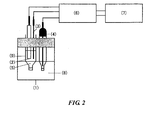
- FIG. 2 When using a high concentration metal thiofurylporphyrin/axial ligand complex solution, a two-chamber three-electrode cell as shown in Figure 2, for example, may be used.
- numerals 1-7 indicate the same items as in Figure 1, 8 indicates an electrolyte solution, and 9 is a sample vial.
- a needle-type electrode 10 and a three-electrode cell as shown in Figures 3(A) and 3(B), for example, may be used.
- 1 indicates a cell container; 4, a reference electrode; 5, a metal thiofurylporphyrin/axial ligand complex solution; 6, a potentiostat; 7, an X-Y recorder; 8, an electrolyte solution; 9, a sample vial; 10, a needle-type electrode; 11, a counter electrode; 12, the end of a conductive component (metal thiofurylporphyrin/axial ligand complex polymer film-formed area); 13, an electrical insulating material; and 14, a counter electrode wire.
- this electrode is prepared by filling a small tube made of an electrical insulating material 13 with a conductive component.
- This small tube is covered with a material such as a metal used as the counter electrode 11.
- the electrode can be used as a needle-type electrode by forming a metal thiofurylporphyrin/axial ligand complex polymer film on the surface at the tip 12 of the conductive component.
- the thickness of the polymer film of the metal thiofurylporphyrin/axial ligand complex is appropriately determined according to the type of the electrode and the metal thiofurylporphyrin/axial ligand complex, and the like.
- a thickness of 10 ⁇ m or less is preferable from the viewpoint of electrode activity, modification stability, and the like.
- the conductivity is preferably 10 -3 S/cm or more.
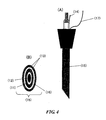
- an improved needle-type electrode 15 as shown in Figure 4(A) and a three-electrode cell as shown in Figure 3(A) may be used, for example.
- 11 indicates a counter electrode; 12, a tip of the conductive component (metal porphyrin polymer film-formed area); 13, an electrical insulating material; 14, a counter electrode wire; 15, an improved needle-type electrode; 16, a ground; and 17, a ground wire.
- this electrode has a conductive component inserted in an electrical insulating material 13 (two-layer structure).
- the electrical insulating material 13 is placed in a counter electrode material 11 (three-layer structure), the counter electrode material 11 is housed in an electrical insulating material 13 (four-layer structure), and finally, the outside of the resulting small tube is coated with a material such as a metal capable of functioning as a ground (five-layer structure).
- the coating acts as the ground 16.
- the electrode can be used as an improved simplified electrode for superoxide anions (improved needle-type electrode) by forming a metal porphyrin polymer film on the surface at the tip 12 of the conductive component.
- the thickness of the polymer film of the metal thiofurylporphyrin/axial ligand complex is appropriately determined according to the type of the electrode and the metal thiofurylporphyrin/axial ligand complex, and the like.
- a thickness of 10 ⁇ m or less is preferable from the viewpoint of electrode activity, modification stability, and the like.
- the conductivity is preferably 10 -3 S/cm or more.
- This improved needle-type electrode can also be used for measuring composite materials and the like. In such a case, it is possible to fabricate an electrode having a structure of up to ten or more layers.
- a noble metal such as platinum, gold, and silver, titanium, stainless steel, a corrosion-resistant alloy such as an iron-chromium alloy, carbon, or the like can be used. Since the ground frequently comes in contact with the inside of living bodies, a material with a high safety such as a noble metal (e.g. platinum, gold, silver), titanium, stainless steel, and carbon is preferable.
- a noble metal e.g. platinum, gold, silver
- titanium, stainless steel, and carbon is preferable.
- the electrode of the present invention for measuring superoxide anions, particularly for measuring the concentration of superoxide anions, it is preferable to combine the electrode with (1) a counter electrode and a reference electrode (three-electrode type) or (2) a counter electrode (two-electrode type).
- a noble metal such as platinum, gold, and silver, titanium, stainless steel, a corrosion-resistant alloy such as an iron-chromium alloy, carbon, or the like can be used. Since the counter electrode frequently comes in contact with the inside of living bodies, a material with a high safety such as a noble metal (e.g. platinum, gold, silver), titanium, stainless steel, and carbon is preferable.
- reference electrode various reference electrodes such as a silver/silver chloride electrode and a mercury/mercuric chloride electrode can be usually used.
- a solid standard electrode can also be used.
- other materials such as noble metals such as platinum, gold, and silver, titanium, stainless steel, a corrosion resistant alloy such as iron-chromium alloy, carbons, and the like can also be used.
- FIG 5 A specific example of the measuring device that can be used for measuring superoxide anions is shown in Figure 5.
- numerals 1, 3, 4, 6, and 7 indicate the same items as in Figure 1, 18 indicates a measuring electrode (working electrode), 19 indicates a microsyringe, 20 indicates a solution to be measured, 21 indicates a magnetic stirrer, and 22 is a stirrer.
- FIG. 6 Another specific example of the measuring device used for measuring superoxide anions is shown in Figure 6.
- numerals 1, 6, 7, and 19-22 indicate the same items as in Figure 4 and 10 indicates a needle-type electrode.
- the electrode for superoxide anions of the present invention can be used as an electrode for detecting superoxide anions using the above-described device, the electrode can also be used as a sensor for measuring the concentration of superoxide anions by using in combination with (1) a counter electrode and a reference electrode (three-electrode type) or (2) a counter electrode (two-electrode type).
- the sensor for measuring the concentration of superoxide anions of this configuration is used in a system containing superoxide anion radicals, for example, the metal in the metal thiofurylporphyrin/axial ligand complex forming the polymer film is reduced by the superoxide anion radicals.
- the metal is iron
- Fe 3+ is reduced to Fe 2+ by the superoxide anion radicals (formula (7)).
- the concentration of the superoxide anion radicals dissolved in the sample solution can be quantitatively detected from the oxidation current.
- the concentration of the superoxide anion radicals can be determined based on the same principle of the above formulas (5) and (6).
- the electrode for superoxide anions of the present invention has a polymer film of a metal thiofurylporphyrin/axial ligand complex on the surface of a conductive component, not only is the electrode affected by a catalyst poison such as hydrogen peroxide only with difficulty, but also the polymer film of the metal thiofurylporphyrin/axial ligand complex is strong as compared with an electrode of a conventional polymer film of a metal porphyrin. The electrode can therefore withstand repeated use.
- the polymer film of the metal thiofurylporphyrin/axial ligand complex is formed by electrolytic polymerization or the like, preparation of the electrode of the present invention is very easy as compared with a conventional electrode.
- the electrode of the present invention can be produced in a shape particularly suitable for application in vivo, for example, a needle-like shape.
- the electrode for superoxide anions of the present invention can not only detect superoxide anion radicals, but also quantitatively measure the superoxide anions by combining with a counter electrode and reference electrode in any environment including in vivo environment as well as in vitro environment.
- the electrode of the present invention therefore can be widely used in various fields.
- various diseases such as cancer can be specified by measuring the concentration of superoxide anions in vivo, for example, in blood.
- decomposition conditions of food can be observed by measuring superoxide anions and their concentration in food.
- Water pollution conditions can also be observed by measuring the superoxide anions and their concentration in tap water, sewage water, and the like.
- the concentrations of superoxide dismutase which is an enzyme with a function of eliminating superoxide anion radicals and the anions, can be measured by determining the extinction degree of the superoxide anion radicals when a sample containing the SOD is added.
- a catalyst poison such as hydrogen peroxide is thought to poison a substance by coordinating to a metal such as iron which is the active center of the substance. If an imidazole, which is an axial ligand, previously coordinates to and occupies the fifth or sixth coordination position of iron, hydrogen peroxide cannot coordinate to the iron (since the first and fourth positions of iron are already coordinated by pyrrole of porphyrin). In this manner, because an axial ligand such as an imidazole coordinates to iron of the active center to prevent poisoning by hydrogen peroxide, superoxide anion radicals can be stably measured even in the presence of hydrogen peroxide.
- a hexa coordination structure was confirmed from the fact that in the magnetic circularly polarized light dichroism spectrum, the polarization angle in the neighborhood of 580 nm and 600 nm decreased due to coordination of imidazole.
- Figure 7 shows the UV spectrum of 5,10,15,20-tetrakis(3-thiofuryl)porphyrinate iron (III) bromide of the raw material.
- Figure 8 shows the UV spectrum of [5,10,15,20-tetrakis(3-thiofuryl)porphyrinate iron (III) bis(1-methylimidazolyl)] bromide of the product.
- a glassy carbon (GC) electrode (diameter: 1.0 mm) was polished using an alumina polishing agent (0.05 ⁇ m). After washing with water, the electrode was further washed with methanol. A polymer film was formed on the surface of this electrode by electrolytic polymerization using the following electrolytic solution and procedure to prepare a glassy carbon electrode with a polymer film in which two imidazole molecules were coordinated to 5,10,15,20-tetrakis(3-thiofuryl)porphyrinate iron (III) formed on the surface (Invention Product 1).
- Electrolytic polymerization was carried out by reversible potential sweep electrolysis using a three-electrode cell having a configuration shown in Figure 1 (working electrode: GC, counter electrode: Pt line, reference electrode: SCE).
- the sweep range was 0 to 2.0 V for SCE in the case of preparing an electrode for superoxide anions using a polymer film in which two imidazole molecules were coordinated to 5,10,15,20-tetrakis(3-thiofuryl)porphyrinate iron (III); the range was -0.2 to 1.8 V for SCE in the case of preparing an electrode for superoxide anions using a polymer film in which two 1-benzylimidazole molecules were coordinated to the 5,10,15,20-tetrakis(3-thiofuryl)porphyrinate iron (III) of Reference Example 2.
- the sweep rate was 0.05 V/s in both cases.
- the number of times of sweep was 15 in both cases.
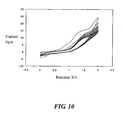
- Figure 10 shows a CV curve during electrolytic polymerization of the electrode (Invention Product 1) prepared using [5,10,15,20-tetrakis(3-thiofuryl)porphyrinate iron (III) bis(imidazolyl)] bromide as the metal thiofurylporphyrin/axial ligand complex.
- the results confirmed that a polymer film of the metal thiofurylporphyrin/axial ligand complex (a complex in which two imidazole molecules were coordinated to 5,10,15,20-tetrakis(3-thiofuryl)porphyrinate iron (III)) was formed on the surface of the GC electrode.
- a glassy carbon electrode covered with a metal thiofurylporphyrin polymer film (Comparative Product 1) was prepared in the same manner as in Reference Example 3 using metal thiofurylporphyrin [5,10,15,20-tetrakis(3-thiofuryl)porphyrinate iron (III) bromide] to which no axial ligand is coordinated prepared in Reference Example 3.
- the amount of superoxide anion radicals was measured using the electrodes of Invention Product 1 and Comparative Product 1.
- the electrode of Invention Product 1 or Comparative Product 1 as a working electrode and a Pt line as a counter electrode were put into a cell container and a silver/silver chloride electrode (Ag/AgCl) was used as a reference electrode to form a three-electrode cell for the test.
- the apparatus shown in Figure 5 was prepared using the three-electrode cell for the test at the center.
- the potential sweep range was set at -0.2 to 0.25 V (for Ag/AgCl) for the electrode of Comparative Product 1 and at -0.5 to 0.5 V (for Ag/AgCl) for the electrode of Invention Product 1. Measurements were carried out using several sweep rates.
- a 2 mM aqueous potassium hydroxide solution containing 14.4 mM xanthine and a 10 mM Tris buffer solution containing 10 mM potassium chloride (pH 7.5) were prepared. 0.365 ml of the former and 14.635 ml of the latter were mixed to prepare a 0.35 mM xanthine solution, which was used as a test solution. Oxygen dissolved in the test solution was removed using high-purity argon gas.
- test solution was added to the three-electrode cells for the test.
- a potential of 0.2 V (for Ag/AgCl) which is sufficiently higher than the oxidation-reduction potential of each electrode was applied.
- Xanthine oxidase (XOD) was added to the test solution to make the final concentration 0-100 mU/ml. The change over time in the oxidation current was recorded.
- XOD had been dialyzed with a 10 ml phosphoric acid buffer solution (pH 7.0) before use. All measurements were carried out at room temperature.
- the Comparative Product electrode is affected by a disturbance current of hydrogen peroxide, resulting in a rapid decrease in the detection current of superoxide anions, whereas a constant detection current is observed in the electrode obtained by polymerizing an imidazole-coordinated complex of [5,10,15,20-tetrakis(3-thiofuryl)porphyrinate iron (III) bis(1-methylimidazolyl)] bromide.
- the electrode for superoxide anions of the present invention exhibits not only the excellent performance of an electrode provided with the metal porphyrin complex polymer film, but also has the capability of preventing poisoning by a catalyst poison such as hydrogen peroxide. Accordingly, in any of in vitro or in vivo environments, this electrode for superoxide anion enables detection of superoxide anion radicals without suffering any influence from a catalyst poison such as hydrogen peroxide. In addition, it is possible to quantitatively determine these superoxide anions by combining the electrode with a counter electrode or a reference electrode. The electrode thus can be widely used in various fields.
- various diseases can be specified from active oxygen species and other active radical species in the living body.
Landscapes
- Chemical & Material Sciences (AREA)
- Life Sciences & Earth Sciences (AREA)
- Health & Medical Sciences (AREA)
- Electrochemistry (AREA)
- Chemical Kinetics & Catalysis (AREA)
- General Physics & Mathematics (AREA)
- Pathology (AREA)
- Analytical Chemistry (AREA)
- Biochemistry (AREA)
- General Health & Medical Sciences (AREA)
- Molecular Biology (AREA)
- Immunology (AREA)
- Physics & Mathematics (AREA)
- Engineering & Computer Science (AREA)
- Materials Engineering (AREA)
- Metallurgy (AREA)
- Organic Chemistry (AREA)
- Electrolytic Production Of Non-Metals, Compounds, Apparatuses Therefor (AREA)
- Polyoxymethylene Polymers And Polymers With Carbon-To-Carbon Bonds (AREA)
- Measurement Of The Respiration, Hearing Ability, Form, And Blood Characteristics Of Living Organisms (AREA)
Applications Claiming Priority (1)
| Application Number | Priority Date | Filing Date | Title |
|---|---|---|---|
| PCT/JP2004/003259 WO2005088290A1 (ja) | 2004-03-12 | 2004-03-12 | スーパーオキシドアニオン用電極およびこれを用いるセンサー |
Publications (2)
| Publication Number | Publication Date |
|---|---|
| EP1731902A1 true EP1731902A1 (de) | 2006-12-13 |
| EP1731902A4 EP1731902A4 (de) | 2010-09-15 |
Family
ID=34975706
Family Applications (1)
| Application Number | Title | Priority Date | Filing Date |
|---|---|---|---|
| EP04720166A Ceased EP1731902A4 (de) | 2004-03-12 | 2004-03-12 | Elektrode für superoxidanion und diese enthaltender sensor |
Country Status (6)
| Country | Link |
|---|---|
| US (3) | US20080289960A1 (de) |
| EP (1) | EP1731902A4 (de) |
| JP (1) | JP4382088B2 (de) |
| CN (1) | CN1954206A (de) |
| EA (1) | EA009451B1 (de) |
| WO (1) | WO2005088290A1 (de) |
Families Citing this family (5)
| Publication number | Priority date | Publication date | Assignee | Title |
|---|---|---|---|---|
| JP4872527B2 (ja) * | 2006-08-17 | 2012-02-08 | ニプロ株式会社 | 透析装置 |
| CN104034786B (zh) * | 2014-06-26 | 2016-06-01 | 华东理工大学 | 基于贵金属合金/碳复合材料的超氧阴离子传感器的制备 |
| TWI518317B (zh) * | 2014-09-22 | 2016-01-21 | 國立清華大學 | 基於導電高分子之導電率變化的自由基測量方法 |
| CN104897765B (zh) * | 2015-05-21 | 2017-07-28 | 南京师范大学 | 基于双金属卟啉配位聚合物的电化学传感器检测过氧化氢和亚硝酸盐的方法 |
| DE102020111802A1 (de) | 2020-04-30 | 2021-11-04 | Endress+Hauser Conducta Gmbh+Co. Kg | Kalibriervorrichtung, flexibler Beutel mit Komponenten einer Kalibriervorrichtung und Verfahren zum Kalibrieren eines Sensors |
Family Cites Families (5)
| Publication number | Priority date | Publication date | Assignee | Title |
|---|---|---|---|---|
| JPS62180263A (ja) * | 1986-02-04 | 1987-08-07 | Terumo Corp | 酸素センサ− |
| JPH0812173B2 (ja) * | 1987-01-29 | 1996-02-07 | テルモ株式会社 | 酸素センサ |
| DE60211213T2 (de) * | 2001-12-20 | 2007-02-08 | Yuasa, Makoto, Soka | Elektrode für aktive sauerstoffspezies und die elektrode verwendender sensor |
| JP5053547B2 (ja) * | 2003-02-24 | 2012-10-17 | 真 湯浅 | 活性酸素種等測定装置 |
| US20050008687A1 (en) * | 2003-07-07 | 2005-01-13 | Makoto Yuasa | Metal-porphyrin-complex-embedded liposomes, production process thereof, and medicines making use of the same |
-
2004
- 2004-03-12 EA EA200601682A patent/EA009451B1/ru unknown
- 2004-03-12 US US10/592,469 patent/US20080289960A1/en not_active Abandoned
- 2004-03-12 WO PCT/JP2004/003259 patent/WO2005088290A1/ja not_active Ceased
- 2004-03-12 JP JP2006510844A patent/JP4382088B2/ja not_active Expired - Fee Related
- 2004-03-12 EP EP04720166A patent/EP1731902A4/de not_active Ceased
- 2004-03-12 CN CNA2004800429524A patent/CN1954206A/zh active Pending
-
2011
- 2011-10-11 US US13/270,608 patent/US20120145562A1/en not_active Abandoned
-
2014
- 2014-11-03 US US14/531,666 patent/US20150160152A1/en not_active Abandoned
Also Published As
| Publication number | Publication date |
|---|---|
| EA009451B1 (ru) | 2007-12-28 |
| US20150160152A1 (en) | 2015-06-11 |
| EP1731902A4 (de) | 2010-09-15 |
| CN1954206A (zh) | 2007-04-25 |
| US20120145562A1 (en) | 2012-06-14 |
| WO2005088290A1 (ja) | 2005-09-22 |
| JPWO2005088290A1 (ja) | 2008-01-31 |
| EA200601682A1 (ru) | 2007-02-27 |
| JP4382088B2 (ja) | 2009-12-09 |
| US20080289960A1 (en) | 2008-11-27 |
Similar Documents
| Publication | Publication Date | Title |
|---|---|---|
| EP1457773B1 (de) | Elektrode für aktive sauerstoffspezies und die elektrode verwendender sensor | |
| Dang et al. | AuNPs-NH2/Cu-MOF modified glassy carbon electrode as enzyme-free electrochemical sensor detecting H2O2 | |
| MansouriMajd et al. | Fabrication of electrochemical theophylline sensor based on manganese oxide nanoparticles/ionic liquid/chitosan nanocomposite modified glassy carbon electrode | |
| Ensafi et al. | Highly sensitive voltammetric sensor based on catechol-derivative-multiwall carbon nanotubes for the catalytic determination of captopril in patient human urine samples | |
| Yang et al. | Hydrogen peroxide biosensor based on myoglobin/colloidal gold nanoparticles immobilized on glassy carbon electrode by a Nafion film | |
| EP2623974B1 (de) | Sensor, sensorsystem und herstellungsverfahren für den sensor | |
| Rohani et al. | A new method for electrocatalytic oxidation of ascorbic acid at the Cu (II) zeolite-modified electrode | |
| Sharifi et al. | DNA/nickel oxide nanoparticles/osmium (III)-complex modified electrode toward selective oxidation of l-cysteine and simultaneous detection of l-cysteine and homocysteine | |
| US20150160152A1 (en) | Electrode for superoxide anion and sensor including the same | |
| Endo et al. | Electrochemistry of tris (. BETA.-diketonato) ruthenium (III) complexes at platinum electrodes in nonaqueous solutions and substituent effects on their reversible half-wave potentials. | |
| Shi et al. | Sensitive acetaminophen electrochemical sensor with amplified signal strategy via non-covalent functionalization of soluble tetrahydroxyphthalocyanine and graphene | |
| Rebis et al. | Electrochemical properties of metallated porphyrazines possessing isophthaloxybutylsulfanyl substituents: Application in the electrocatalytic oxidation of hydrazine | |
| WO2016108671A1 (ko) | 전기화학적 바이오센서 | |
| Yuasa et al. | Electrochemical sensor for superoxide anion radical using polymeric iron porphyrin complexes containing axial 1‐methylimidazole ligand as cytochrome c mimics | |
| Shamagsumova et al. | Electrochemistry and electrochemical assessment of host–guest complexation of substituted pillar [m] arene [n] quinones | |
| Li et al. | A study on the mimics of Cu–Zn superoxide dismutase with high activity and stability: two copper (II) complexes of 1, 4, 7-triazacyclononane with benzimidazole groups | |
| Wu et al. | A structurally precise Ag (I) complex bulk-modified carbon paste electrode for effective H2O2-sensing | |
| Tu et al. | A Novel Electrochemical Microsensor for Nitric Oxide Based on Electropolymerized Film ofo‐Aminobenzaldehyde‐ethylene‐diamine Nickel | |
| JP4909632B2 (ja) | 金属ポルフィリン錯体の重合膜、その製造法及びこれを用いるスーパーオキシドアニオンラジカル測定用電極 | |
| Fratilescu et al. | One A3B porphyrin structure—Three successful applications. Nanomaterials 2022, 12, 1930 | |
| Zakharova et al. | The voltammetric determination of peroxynitrite at a mercury film electrode | |
| Khorasani-Motlagh et al. | Electrocatalytic determination of L-ascorbic acid by modified glassy carbon with Ni (Me2 (CH3CO) 2 [14] tetraenoN4) complex | |
| KR20070014144A (ko) | 슈퍼옥사이드 음이온용 전극 및 이를 포함하는 센서 | |
| Alizadeh et al. | Electrochemical monitoring of hydrogen peroxide by a signal-amplified microfluidic chip coupled with colloidal VO 2 nanostructures as a peroxidase enzyme mimic | |
| JP5128055B2 (ja) | 抗血液凝固性被膜および抗血栓性活性酸素測定用センサー |
Legal Events
| Date | Code | Title | Description |
|---|---|---|---|
| PUAI | Public reference made under article 153(3) epc to a published international application that has entered the european phase |
Free format text: ORIGINAL CODE: 0009012 |
|
| 17P | Request for examination filed |
Effective date: 20061010 |
|
| AK | Designated contracting states |
Kind code of ref document: A1 Designated state(s): AT BE BG CH CY CZ DE DK EE ES FI FR GB GR HU IE IT LI LU MC NL PL PT RO SE SI SK TR |
|
| DAX | Request for extension of the european patent (deleted) | ||
| A4 | Supplementary search report drawn up and despatched |
Effective date: 20100818 |
|
| 17Q | First examination report despatched |
Effective date: 20101119 |
|
| REG | Reference to a national code |
Ref country code: DE Ref legal event code: R003 |
|
| STAA | Information on the status of an ep patent application or granted ep patent |
Free format text: STATUS: THE APPLICATION HAS BEEN REFUSED |
|
| 18R | Application refused |
Effective date: 20120708 |