EP1730291B1 - Nitrilhydratase aus rhodococcus - Google Patents
Nitrilhydratase aus rhodococcus Download PDFInfo
- Publication number
- EP1730291B1 EP1730291B1 EP05715626A EP05715626A EP1730291B1 EP 1730291 B1 EP1730291 B1 EP 1730291B1 EP 05715626 A EP05715626 A EP 05715626A EP 05715626 A EP05715626 A EP 05715626A EP 1730291 B1 EP1730291 B1 EP 1730291B1
- Authority
- EP
- European Patent Office
- Prior art keywords
- seq
- polynucleotide
- nucleotide sequence
- nitrile hydratase
- sequences
- Prior art date
- Legal status (The legal status is an assumption and is not a legal conclusion. Google has not performed a legal analysis and makes no representation as to the accuracy of the status listed.)
- Expired - Lifetime
Links
- 108010024026 Nitrile hydratase Proteins 0.000 title claims description 53
- 241000316848 Rhodococcus <scale insect> Species 0.000 title claims description 13
- 108090000623 proteins and genes Proteins 0.000 claims description 89
- 108091033319 polynucleotide Proteins 0.000 claims description 55
- 102000040430 polynucleotide Human genes 0.000 claims description 55
- 239000002157 polynucleotide Substances 0.000 claims description 55
- 102000004169 proteins and genes Human genes 0.000 claims description 35
- 230000000694 effects Effects 0.000 claims description 34
- 239000002773 nucleotide Substances 0.000 claims description 31
- 125000003729 nucleotide group Chemical group 0.000 claims description 31
- 108090000790 Enzymes Proteins 0.000 claims description 30
- 102000004190 Enzymes Human genes 0.000 claims description 30
- 244000005700 microbiome Species 0.000 claims description 30
- 229910017052 cobalt Inorganic materials 0.000 claims description 24
- 239000010941 cobalt Substances 0.000 claims description 24
- GUTLYIVDDKVIGB-UHFFFAOYSA-N cobalt atom Chemical compound [Co] GUTLYIVDDKVIGB-UHFFFAOYSA-N 0.000 claims description 24
- 238000000034 method Methods 0.000 claims description 23
- 150000002825 nitriles Chemical class 0.000 claims description 22
- 239000000523 sample Substances 0.000 claims description 22
- 241001524101 Rhodococcus opacus Species 0.000 claims description 21
- 150000001408 amides Chemical class 0.000 claims description 21
- 125000004432 carbon atom Chemical group C* 0.000 claims description 21
- 239000013598 vector Substances 0.000 claims description 21
- 125000000217 alkyl group Chemical group 0.000 claims description 18
- 229920001184 polypeptide Polymers 0.000 claims description 17
- 108091028043 Nucleic acid sequence Proteins 0.000 claims description 16
- 108090000765 processed proteins & peptides Proteins 0.000 claims description 16
- 102000004196 processed proteins & peptides Human genes 0.000 claims description 16
- 230000000295 complement effect Effects 0.000 claims description 12
- 238000005406 washing Methods 0.000 claims description 11
- 238000004519 manufacturing process Methods 0.000 claims description 8
- 230000015572 biosynthetic process Effects 0.000 claims description 7
- 239000002028 Biomass Substances 0.000 claims description 5
- 230000002068 genetic effect Effects 0.000 claims description 5
- 230000035772 mutation Effects 0.000 claims description 5
- 150000001875 compounds Chemical class 0.000 claims description 4
- 230000000284 resting effect Effects 0.000 claims description 4
- 241000588921 Enterobacteriaceae Species 0.000 claims description 3
- 241000588722 Escherichia Species 0.000 claims description 3
- 125000004414 alkyl thio group Chemical group 0.000 claims description 3
- 125000002947 alkylene group Chemical group 0.000 claims description 3
- 125000000753 cycloalkyl group Chemical group 0.000 claims description 3
- 230000007935 neutral effect Effects 0.000 claims description 3
- 241000894006 Bacteria Species 0.000 claims description 2
- 230000001747 exhibiting effect Effects 0.000 claims description 2
- 125000003275 alpha amino acid group Chemical group 0.000 claims 3
- 210000004027 cell Anatomy 0.000 description 39
- 108020004414 DNA Proteins 0.000 description 35
- 235000018102 proteins Nutrition 0.000 description 33
- 241000588724 Escherichia coli Species 0.000 description 29
- 238000006243 chemical reaction Methods 0.000 description 24
- 108010078791 Carrier Proteins Proteins 0.000 description 18
- 239000012634 fragment Substances 0.000 description 17
- 238000009396 hybridization Methods 0.000 description 17
- 230000014509 gene expression Effects 0.000 description 15
- -1 2-amino amides Chemical class 0.000 description 14
- 150000001413 amino acids Chemical class 0.000 description 12
- 239000013612 plasmid Substances 0.000 description 11
- 150000003839 salts Chemical class 0.000 description 11
- 239000002609 medium Substances 0.000 description 9
- 230000001965 increasing effect Effects 0.000 description 8
- 238000003752 polymerase chain reaction Methods 0.000 description 8
- WEVYAHXRMPXWCK-UHFFFAOYSA-N Acetonitrile Chemical compound CC#N WEVYAHXRMPXWCK-UHFFFAOYSA-N 0.000 description 7
- SHZGCJCMOBCMKK-UHFFFAOYSA-N D-mannomethylose Natural products CC1OC(O)C(O)C(O)C1O SHZGCJCMOBCMKK-UHFFFAOYSA-N 0.000 description 7
- PNNNRSAQSRJVSB-UHFFFAOYSA-N L-rhamnose Natural products CC(O)C(O)C(O)C(O)C=O PNNNRSAQSRJVSB-UHFFFAOYSA-N 0.000 description 7
- FWMNVWWHGCHHJJ-SKKKGAJSSA-N 4-amino-1-[(2r)-6-amino-2-[[(2r)-2-[[(2r)-2-[[(2r)-2-amino-3-phenylpropanoyl]amino]-3-phenylpropanoyl]amino]-4-methylpentanoyl]amino]hexanoyl]piperidine-4-carboxylic acid Chemical compound C([C@H](C(=O)N[C@H](CC(C)C)C(=O)N[C@H](CCCCN)C(=O)N1CCC(N)(CC1)C(O)=O)NC(=O)[C@H](N)CC=1C=CC=CC=1)C1=CC=CC=C1 FWMNVWWHGCHHJJ-SKKKGAJSSA-N 0.000 description 6
- SHZGCJCMOBCMKK-JFNONXLTSA-N L-rhamnopyranose Chemical compound C[C@@H]1OC(O)[C@H](O)[C@H](O)[C@H]1O SHZGCJCMOBCMKK-JFNONXLTSA-N 0.000 description 6
- NBIIXXVUZAFLBC-UHFFFAOYSA-N Phosphoric acid Chemical compound OP(O)(O)=O NBIIXXVUZAFLBC-UHFFFAOYSA-N 0.000 description 6
- 235000001014 amino acid Nutrition 0.000 description 6
- 239000000872 buffer Substances 0.000 description 6
- 239000001963 growth medium Substances 0.000 description 6
- 229930182817 methionine Natural products 0.000 description 6
- 235000006109 methionine Nutrition 0.000 description 6
- 239000000203 mixture Substances 0.000 description 6
- 108091034117 Oligonucleotide Proteins 0.000 description 5
- JLCPHMBAVCMARE-UHFFFAOYSA-N [3-[[3-[[3-[[3-[[3-[[3-[[3-[[3-[[3-[[3-[[3-[[5-(2-amino-6-oxo-1H-purin-9-yl)-3-[[3-[[3-[[3-[[3-[[3-[[5-(2-amino-6-oxo-1H-purin-9-yl)-3-[[5-(2-amino-6-oxo-1H-purin-9-yl)-3-hydroxyoxolan-2-yl]methoxy-hydroxyphosphoryl]oxyoxolan-2-yl]methoxy-hydroxyphosphoryl]oxy-5-(5-methyl-2,4-dioxopyrimidin-1-yl)oxolan-2-yl]methoxy-hydroxyphosphoryl]oxy-5-(6-aminopurin-9-yl)oxolan-2-yl]methoxy-hydroxyphosphoryl]oxy-5-(6-aminopurin-9-yl)oxolan-2-yl]methoxy-hydroxyphosphoryl]oxy-5-(6-aminopurin-9-yl)oxolan-2-yl]methoxy-hydroxyphosphoryl]oxy-5-(6-aminopurin-9-yl)oxolan-2-yl]methoxy-hydroxyphosphoryl]oxyoxolan-2-yl]methoxy-hydroxyphosphoryl]oxy-5-(5-methyl-2,4-dioxopyrimidin-1-yl)oxolan-2-yl]methoxy-hydroxyphosphoryl]oxy-5-(4-amino-2-oxopyrimidin-1-yl)oxolan-2-yl]methoxy-hydroxyphosphoryl]oxy-5-(5-methyl-2,4-dioxopyrimidin-1-yl)oxolan-2-yl]methoxy-hydroxyphosphoryl]oxy-5-(5-methyl-2,4-dioxopyrimidin-1-yl)oxolan-2-yl]methoxy-hydroxyphosphoryl]oxy-5-(6-aminopurin-9-yl)oxolan-2-yl]methoxy-hydroxyphosphoryl]oxy-5-(6-aminopurin-9-yl)oxolan-2-yl]methoxy-hydroxyphosphoryl]oxy-5-(4-amino-2-oxopyrimidin-1-yl)oxolan-2-yl]methoxy-hydroxyphosphoryl]oxy-5-(4-amino-2-oxopyrimidin-1-yl)oxolan-2-yl]methoxy-hydroxyphosphoryl]oxy-5-(4-amino-2-oxopyrimidin-1-yl)oxolan-2-yl]methoxy-hydroxyphosphoryl]oxy-5-(6-aminopurin-9-yl)oxolan-2-yl]methoxy-hydroxyphosphoryl]oxy-5-(4-amino-2-oxopyrimidin-1-yl)oxolan-2-yl]methyl [5-(6-aminopurin-9-yl)-2-(hydroxymethyl)oxolan-3-yl] hydrogen phosphate Polymers Cc1cn(C2CC(OP(O)(=O)OCC3OC(CC3OP(O)(=O)OCC3OC(CC3O)n3cnc4c3nc(N)[nH]c4=O)n3cnc4c3nc(N)[nH]c4=O)C(COP(O)(=O)OC3CC(OC3COP(O)(=O)OC3CC(OC3COP(O)(=O)OC3CC(OC3COP(O)(=O)OC3CC(OC3COP(O)(=O)OC3CC(OC3COP(O)(=O)OC3CC(OC3COP(O)(=O)OC3CC(OC3COP(O)(=O)OC3CC(OC3COP(O)(=O)OC3CC(OC3COP(O)(=O)OC3CC(OC3COP(O)(=O)OC3CC(OC3COP(O)(=O)OC3CC(OC3COP(O)(=O)OC3CC(OC3COP(O)(=O)OC3CC(OC3COP(O)(=O)OC3CC(OC3COP(O)(=O)OC3CC(OC3COP(O)(=O)OC3CC(OC3CO)n3cnc4c(N)ncnc34)n3ccc(N)nc3=O)n3cnc4c(N)ncnc34)n3ccc(N)nc3=O)n3ccc(N)nc3=O)n3ccc(N)nc3=O)n3cnc4c(N)ncnc34)n3cnc4c(N)ncnc34)n3cc(C)c(=O)[nH]c3=O)n3cc(C)c(=O)[nH]c3=O)n3ccc(N)nc3=O)n3cc(C)c(=O)[nH]c3=O)n3cnc4c3nc(N)[nH]c4=O)n3cnc4c(N)ncnc34)n3cnc4c(N)ncnc34)n3cnc4c(N)ncnc34)n3cnc4c(N)ncnc34)O2)c(=O)[nH]c1=O JLCPHMBAVCMARE-UHFFFAOYSA-N 0.000 description 5
- 239000002253 acid Substances 0.000 description 5
- 230000004186 co-expression Effects 0.000 description 5
- 239000013604 expression vector Substances 0.000 description 5
- 102000039446 nucleic acids Human genes 0.000 description 5
- 108020004707 nucleic acids Proteins 0.000 description 5
- 150000007523 nucleic acids Chemical class 0.000 description 5
- 239000000047 product Substances 0.000 description 5
- 239000000758 substrate Substances 0.000 description 5
- 108091032973 (ribonucleotides)n+m Proteins 0.000 description 4
- VWWOJJANXYSACS-UHFFFAOYSA-N 2-hydroxy-4-methylsulfanylbutanenitrile Chemical compound CSCCC(O)C#N VWWOJJANXYSACS-UHFFFAOYSA-N 0.000 description 4
- IJGRMHOSHXDMSA-UHFFFAOYSA-N Atomic nitrogen Chemical compound N#N IJGRMHOSHXDMSA-UHFFFAOYSA-N 0.000 description 4
- 108091081024 Start codon Proteins 0.000 description 4
- 150000007513 acids Chemical class 0.000 description 4
- 125000003118 aryl group Chemical group 0.000 description 4
- JFDZBHWFFUWGJE-UHFFFAOYSA-N benzonitrile Chemical compound N#CC1=CC=CC=C1 JFDZBHWFFUWGJE-UHFFFAOYSA-N 0.000 description 4
- 230000002255 enzymatic effect Effects 0.000 description 4
- 230000012010 growth Effects 0.000 description 4
- 239000012528 membrane Substances 0.000 description 4
- 230000002018 overexpression Effects 0.000 description 4
- 238000002360 preparation method Methods 0.000 description 4
- 239000000126 substance Substances 0.000 description 4
- QTBSBXVTEAMEQO-UHFFFAOYSA-N Acetic acid Chemical compound CC(O)=O QTBSBXVTEAMEQO-UHFFFAOYSA-N 0.000 description 3
- NLHHRLWOUZZQLW-UHFFFAOYSA-N Acrylonitrile Chemical compound C=CC#N NLHHRLWOUZZQLW-UHFFFAOYSA-N 0.000 description 3
- 229910021580 Cobalt(II) chloride Inorganic materials 0.000 description 3
- LFQSCWFLJHTTHZ-UHFFFAOYSA-N Ethanol Chemical compound CCO LFQSCWFLJHTTHZ-UHFFFAOYSA-N 0.000 description 3
- PEDCQBHIVMGVHV-UHFFFAOYSA-N Glycerine Chemical compound OCC(O)CO PEDCQBHIVMGVHV-UHFFFAOYSA-N 0.000 description 3
- STNJBCKSHOAVAJ-UHFFFAOYSA-N Methacrolein Chemical compound CC(=C)C=O STNJBCKSHOAVAJ-UHFFFAOYSA-N 0.000 description 3
- GYCMBHHDWRMZGG-UHFFFAOYSA-N Methylacrylonitrile Chemical compound CC(=C)C#N GYCMBHHDWRMZGG-UHFFFAOYSA-N 0.000 description 3
- KWYUFKZDYYNOTN-UHFFFAOYSA-M Potassium hydroxide Chemical compound [OH-].[K+] KWYUFKZDYYNOTN-UHFFFAOYSA-M 0.000 description 3
- HEMHJVSKTPXQMS-UHFFFAOYSA-M Sodium hydroxide Chemical compound [OH-].[Na+] HEMHJVSKTPXQMS-UHFFFAOYSA-M 0.000 description 3
- YXFVVABEGXRONW-UHFFFAOYSA-N Toluene Chemical compound CC1=CC=CC=C1 YXFVVABEGXRONW-UHFFFAOYSA-N 0.000 description 3
- 229910000147 aluminium phosphate Inorganic materials 0.000 description 3
- DFNYGALUNNFWKJ-UHFFFAOYSA-N aminoacetonitrile Chemical compound NCC#N DFNYGALUNNFWKJ-UHFFFAOYSA-N 0.000 description 3
- 230000003321 amplification Effects 0.000 description 3
- 239000011942 biocatalyst Substances 0.000 description 3
- 108091008053 gene clusters Proteins 0.000 description 3
- 238000003199 nucleic acid amplification method Methods 0.000 description 3
- 239000008057 potassium phosphate buffer Substances 0.000 description 3
- 238000011160 research Methods 0.000 description 3
- 108091008146 restriction endonucleases Proteins 0.000 description 3
- 230000009466 transformation Effects 0.000 description 3
- BNBRIFIJRKJGEI-UHFFFAOYSA-N 2,6-difluorobenzonitrile Chemical compound FC1=CC=CC(F)=C1C#N BNBRIFIJRKJGEI-UHFFFAOYSA-N 0.000 description 2
- XOWUYFUCZLKVEJ-UHFFFAOYSA-N 2-(aminomethylsulfanyl)butanenitrile Chemical compound CCC(C#N)SCN XOWUYFUCZLKVEJ-UHFFFAOYSA-N 0.000 description 2
- JCLSEQJEXYHVTC-UHFFFAOYSA-N 2-amino-2-methylbutanenitrile Chemical compound CCC(C)(N)C#N JCLSEQJEXYHVTC-UHFFFAOYSA-N 0.000 description 2
- ZMMPZEFSSVTIIW-UHFFFAOYSA-N 2-amino-3-methylbutanenitrile Chemical compound CC(C)C(N)C#N ZMMPZEFSSVTIIW-UHFFFAOYSA-N 0.000 description 2
- DQQIUVCNBOJDGF-UHFFFAOYSA-N 2-aminobutanenitrile Chemical compound CCC(N)C#N DQQIUVCNBOJDGF-UHFFFAOYSA-N 0.000 description 2
- MWFMGBPGAXYFAR-UHFFFAOYSA-N 2-hydroxy-2-methylpropanenitrile Chemical compound CC(C)(O)C#N MWFMGBPGAXYFAR-UHFFFAOYSA-N 0.000 description 2
- NHSSTOSZJANVEV-UHFFFAOYSA-N 2-hydroxybutanenitrile Chemical compound CCC(O)C#N NHSSTOSZJANVEV-UHFFFAOYSA-N 0.000 description 2
- JEWPACUDYNBTSN-UHFFFAOYSA-N 2-hydroxyheptanenitrile Chemical compound CCCCCC(O)C#N JEWPACUDYNBTSN-UHFFFAOYSA-N 0.000 description 2
- VKIGAWAEXPTIOL-UHFFFAOYSA-N 2-hydroxyhexanenitrile Chemical compound CCCCC(O)C#N VKIGAWAEXPTIOL-UHFFFAOYSA-N 0.000 description 2
- RDXMEUDCEWSFDP-UHFFFAOYSA-N 3-chloro-2-hydroxypropanenitrile Chemical compound ClCC(O)C#N RDXMEUDCEWSFDP-UHFFFAOYSA-N 0.000 description 2
- HGINCPLSRVDWNT-UHFFFAOYSA-N Acrolein Chemical compound C=CC=O HGINCPLSRVDWNT-UHFFFAOYSA-N 0.000 description 2
- HRPVXLWXLXDGHG-UHFFFAOYSA-N Acrylamide Chemical compound NC(=O)C=C HRPVXLWXLXDGHG-UHFFFAOYSA-N 0.000 description 2
- QGZKDVFQNNGYKY-UHFFFAOYSA-N Ammonia Chemical compound N QGZKDVFQNNGYKY-UHFFFAOYSA-N 0.000 description 2
- NLXLAEXVIDQMFP-UHFFFAOYSA-N Ammonia chloride Chemical compound [NH4+].[Cl-] NLXLAEXVIDQMFP-UHFFFAOYSA-N 0.000 description 2
- 241000228212 Aspergillus Species 0.000 description 2
- OKTJSMMVPCPJKN-UHFFFAOYSA-N Carbon Chemical compound [C] OKTJSMMVPCPJKN-UHFFFAOYSA-N 0.000 description 2
- 108020004635 Complementary DNA Proteins 0.000 description 2
- 241001646716 Escherichia coli K-12 Species 0.000 description 2
- DHMQDGOQFOQNFH-UHFFFAOYSA-N Glycine Chemical compound NCC(O)=O DHMQDGOQFOQNFH-UHFFFAOYSA-N 0.000 description 2
- XEEYBQQBJWHFJM-UHFFFAOYSA-N Iron Chemical compound [Fe] XEEYBQQBJWHFJM-UHFFFAOYSA-N 0.000 description 2
- FFEARJCKVFRZRR-BYPYZUCNSA-N L-methionine Chemical compound CSCC[C@H](N)C(O)=O FFEARJCKVFRZRR-BYPYZUCNSA-N 0.000 description 2
- CSNNHWWHGAXBCP-UHFFFAOYSA-L Magnesium sulfate Chemical compound [Mg+2].[O-][S+2]([O-])([O-])[O-] CSNNHWWHGAXBCP-UHFFFAOYSA-L 0.000 description 2
- 241000235648 Pichia Species 0.000 description 2
- 241000589516 Pseudomonas Species 0.000 description 2
- 108020005091 Replication Origin Proteins 0.000 description 2
- 241000187693 Rhodococcus rhodochrous Species 0.000 description 2
- QAOWNCQODCNURD-UHFFFAOYSA-N Sulfuric acid Chemical compound OS(O)(=O)=O QAOWNCQODCNURD-UHFFFAOYSA-N 0.000 description 2
- XSQUKJJJFZCRTK-UHFFFAOYSA-N Urea Chemical compound NC(N)=O XSQUKJJJFZCRTK-UHFFFAOYSA-N 0.000 description 2
- BTGRAWJCKBQKAO-UHFFFAOYSA-N adiponitrile Chemical compound N#CCCCCC#N BTGRAWJCKBQKAO-UHFFFAOYSA-N 0.000 description 2
- 150000001340 alkali metals Chemical class 0.000 description 2
- SJNALLRHIVGIBI-UHFFFAOYSA-N allyl cyanide Chemical compound C=CCC#N SJNALLRHIVGIBI-UHFFFAOYSA-N 0.000 description 2
- UAMZETBJZRERCQ-UHFFFAOYSA-N alpha-aminopropionitrile Chemical compound CC(N)C#N UAMZETBJZRERCQ-UHFFFAOYSA-N 0.000 description 2
- 235000011114 ammonium hydroxide Nutrition 0.000 description 2
- 229960000723 ampicillin Drugs 0.000 description 2
- AVKUERGKIZMTKX-NJBDSQKTSA-N ampicillin Chemical compound C1([C@@H](N)C(=O)N[C@H]2[C@H]3SC([C@@H](N3C2=O)C(O)=O)(C)C)=CC=CC=C1 AVKUERGKIZMTKX-NJBDSQKTSA-N 0.000 description 2
- QVGXLLKOCUKJST-UHFFFAOYSA-N atomic oxygen Chemical compound [O] QVGXLLKOCUKJST-UHFFFAOYSA-N 0.000 description 2
- 238000010923 batch production Methods 0.000 description 2
- AGSPXMVUFBBBMO-UHFFFAOYSA-N beta-aminopropionitrile Chemical compound NCCC#N AGSPXMVUFBBBMO-UHFFFAOYSA-N 0.000 description 2
- KVNRLNFWIYMESJ-UHFFFAOYSA-N butyronitrile Chemical compound CCCC#N KVNRLNFWIYMESJ-UHFFFAOYSA-N 0.000 description 2
- AXCZMVOFGPJBDE-UHFFFAOYSA-L calcium dihydroxide Chemical compound [OH-].[OH-].[Ca+2] AXCZMVOFGPJBDE-UHFFFAOYSA-L 0.000 description 2
- 239000000920 calcium hydroxide Substances 0.000 description 2
- 229910001861 calcium hydroxide Inorganic materials 0.000 description 2
- 159000000007 calcium salts Chemical class 0.000 description 2
- 239000006285 cell suspension Substances 0.000 description 2
- 238000005119 centrifugation Methods 0.000 description 2
- 229960005091 chloramphenicol Drugs 0.000 description 2
- WIIZWVCIJKGZOK-RKDXNWHRSA-N chloramphenicol Chemical compound ClC(Cl)C(=O)N[C@H](CO)[C@H](O)C1=CC=C([N+]([O-])=O)C=C1 WIIZWVCIJKGZOK-RKDXNWHRSA-N 0.000 description 2
- 238000010367 cloning Methods 0.000 description 2
- 239000002299 complementary DNA Substances 0.000 description 2
- 230000001419 dependent effect Effects 0.000 description 2
- 235000014113 dietary fatty acids Nutrition 0.000 description 2
- 235000019441 ethanol Nutrition 0.000 description 2
- 210000003527 eukaryotic cell Anatomy 0.000 description 2
- 229930195729 fatty acid Natural products 0.000 description 2
- 239000000194 fatty acid Substances 0.000 description 2
- 150000004665 fatty acids Chemical class 0.000 description 2
- 238000000855 fermentation Methods 0.000 description 2
- 230000004151 fermentation Effects 0.000 description 2
- 238000003306 harvesting Methods 0.000 description 2
- IPCSVZSSVZVIGE-UHFFFAOYSA-N hexadecanoic acid Chemical compound CCCCCCCCCCCCCCCC(O)=O IPCSVZSSVZVIGE-UHFFFAOYSA-N 0.000 description 2
- 238000004128 high performance liquid chromatography Methods 0.000 description 2
- LRDFRRGEGBBSRN-UHFFFAOYSA-N isobutyronitrile Chemical compound CC(C)C#N LRDFRRGEGBBSRN-UHFFFAOYSA-N 0.000 description 2
- 238000002955 isolation Methods 0.000 description 2
- QHDRKFYEGYYIIK-UHFFFAOYSA-N isovaleronitrile Chemical compound CC(C)CC#N QHDRKFYEGYYIIK-UHFFFAOYSA-N 0.000 description 2
- 238000010369 molecular cloning Methods 0.000 description 2
- 229910052757 nitrogen Inorganic materials 0.000 description 2
- 239000001301 oxygen Substances 0.000 description 2
- 229910052760 oxygen Inorganic materials 0.000 description 2
- 210000001236 prokaryotic cell Anatomy 0.000 description 2
- FVSKHRXBFJPNKK-UHFFFAOYSA-N propionitrile Chemical compound CCC#N FVSKHRXBFJPNKK-UHFFFAOYSA-N 0.000 description 2
- 229920006395 saturated elastomer Polymers 0.000 description 2
- IAHFWCOBPZCAEA-UHFFFAOYSA-N succinonitrile Chemical compound N#CCCC#N IAHFWCOBPZCAEA-UHFFFAOYSA-N 0.000 description 2
- 238000003786 synthesis reaction Methods 0.000 description 2
- 238000001890 transfection Methods 0.000 description 2
- 238000011144 upstream manufacturing Methods 0.000 description 2
- 108700026220 vif Genes Proteins 0.000 description 2
- OWEGMIWEEQEYGQ-UHFFFAOYSA-N 100676-05-9 Natural products OC1C(O)C(O)C(CO)OC1OCC1C(O)C(O)C(O)C(OC2C(OC(O)C(O)C2O)CO)O1 OWEGMIWEEQEYGQ-UHFFFAOYSA-N 0.000 description 1
- PAWQVTBBRAZDMG-UHFFFAOYSA-N 2-(3-bromo-2-fluorophenyl)acetic acid Chemical compound OC(=O)CC1=CC=CC(Br)=C1F PAWQVTBBRAZDMG-UHFFFAOYSA-N 0.000 description 1
- GOJUJUVQIVIZAV-UHFFFAOYSA-N 2-amino-4,6-dichloropyrimidine-5-carbaldehyde Chemical group NC1=NC(Cl)=C(C=O)C(Cl)=N1 GOJUJUVQIVIZAV-UHFFFAOYSA-N 0.000 description 1
- SNBCLPGEMZEWLU-QXFUBDJGSA-N 2-chloro-n-[[(2r,3s,5r)-3-hydroxy-5-(5-methyl-2,4-dioxopyrimidin-1-yl)oxolan-2-yl]methyl]acetamide Chemical compound O=C1NC(=O)C(C)=CN1[C@@H]1O[C@H](CNC(=O)CCl)[C@@H](O)C1 SNBCLPGEMZEWLU-QXFUBDJGSA-N 0.000 description 1
- MLIREBYILWEBDM-UHFFFAOYSA-M 2-cyanoacetate Chemical compound [O-]C(=O)CC#N MLIREBYILWEBDM-UHFFFAOYSA-M 0.000 description 1
- INTUDBWOILOBCE-UHFFFAOYSA-N 2-hydroxy-4-methylsulfanylbutanamide Chemical compound CSCCC(O)C(N)=O INTUDBWOILOBCE-UHFFFAOYSA-N 0.000 description 1
- GZPHSAQLYPIAIN-UHFFFAOYSA-N 3-pyridinecarbonitrile Chemical compound N#CC1=CC=CN=C1 GZPHSAQLYPIAIN-UHFFFAOYSA-N 0.000 description 1
- 241001136792 Alle Species 0.000 description 1
- GUBGYTABKSRVRQ-XLOQQCSPSA-N Alpha-Lactose Chemical compound O[C@@H]1[C@@H](O)[C@@H](O)[C@@H](CO)O[C@H]1O[C@@H]1[C@@H](CO)O[C@H](O)[C@H](O)[C@H]1O GUBGYTABKSRVRQ-XLOQQCSPSA-N 0.000 description 1
- ATRRKUHOCOJYRX-UHFFFAOYSA-N Ammonium bicarbonate Chemical compound [NH4+].OC([O-])=O ATRRKUHOCOJYRX-UHFFFAOYSA-N 0.000 description 1
- VHUUQVKOLVNVRT-UHFFFAOYSA-N Ammonium hydroxide Chemical compound [NH4+].[OH-] VHUUQVKOLVNVRT-UHFFFAOYSA-N 0.000 description 1
- 239000004254 Ammonium phosphate Substances 0.000 description 1
- 241000193830 Bacillus <bacterium> Species 0.000 description 1
- 241000908115 Bolivar Species 0.000 description 1
- 101100263837 Bovine ephemeral fever virus (strain BB7721) beta gene Proteins 0.000 description 1
- 101100000858 Caenorhabditis elegans act-3 gene Proteins 0.000 description 1
- 244000060011 Cocos nucifera Species 0.000 description 1
- 235000013162 Cocos nucifera Nutrition 0.000 description 1
- 241001485655 Corynebacterium glutamicum ATCC 13032 Species 0.000 description 1
- 239000004470 DL Methionine Substances 0.000 description 1
- 238000000018 DNA microarray Methods 0.000 description 1
- 108090000204 Dipeptidase 1 Proteins 0.000 description 1
- 101100316840 Enterobacteria phage P4 Beta gene Proteins 0.000 description 1
- 229930091371 Fructose Natural products 0.000 description 1
- 239000005715 Fructose Substances 0.000 description 1
- RFSUNEUAIZKAJO-ARQDHWQXSA-N Fructose Chemical compound OC[C@H]1O[C@](O)(CO)[C@@H](O)[C@@H]1O RFSUNEUAIZKAJO-ARQDHWQXSA-N 0.000 description 1
- 241001200922 Gagata Species 0.000 description 1
- WQZGKKKJIJFFOK-GASJEMHNSA-N Glucose Natural products OC[C@H]1OC(O)[C@H](O)[C@@H](O)[C@@H]1O WQZGKKKJIJFFOK-GASJEMHNSA-N 0.000 description 1
- WHUUTDBJXJRKMK-UHFFFAOYSA-N Glutamic acid Natural products OC(=O)C(N)CCC(O)=O WHUUTDBJXJRKMK-UHFFFAOYSA-N 0.000 description 1
- 239000004471 Glycine Substances 0.000 description 1
- 101100175482 Glycine max CG-3 gene Proteins 0.000 description 1
- HEFNNWSXXWATRW-UHFFFAOYSA-N Ibuprofen Chemical compound CC(C)CC1=CC=C(C(C)C(O)=O)C=C1 HEFNNWSXXWATRW-UHFFFAOYSA-N 0.000 description 1
- DGAQECJNVWCQMB-PUAWFVPOSA-M Ilexoside XXIX Chemical compound C[C@@H]1CC[C@@]2(CC[C@@]3(C(=CC[C@H]4[C@]3(CC[C@@H]5[C@@]4(CC[C@@H](C5(C)C)OS(=O)(=O)[O-])C)C)[C@@H]2[C@]1(C)O)C)C(=O)O[C@H]6[C@@H]([C@H]([C@@H]([C@H](O6)CO)O)O)O.[Na+] DGAQECJNVWCQMB-PUAWFVPOSA-M 0.000 description 1
- QNAYBMKLOCPYGJ-REOHCLBHSA-N L-alanine Chemical compound C[C@H](N)C(O)=O QNAYBMKLOCPYGJ-REOHCLBHSA-N 0.000 description 1
- AGPKZVBTJJNPAG-UHNVWZDZSA-N L-allo-Isoleucine Chemical compound CC[C@@H](C)[C@H](N)C(O)=O AGPKZVBTJJNPAG-UHNVWZDZSA-N 0.000 description 1
- CKLJMWTZIZZHCS-REOHCLBHSA-N L-aspartic acid Chemical compound OC(=O)[C@@H](N)CC(O)=O CKLJMWTZIZZHCS-REOHCLBHSA-N 0.000 description 1
- ROHFNLRQFUQHCH-YFKPBYRVSA-N L-leucine Chemical compound CC(C)C[C@H](N)C(O)=O ROHFNLRQFUQHCH-YFKPBYRVSA-N 0.000 description 1
- KZSNJWFQEVHDMF-BYPYZUCNSA-N L-valine Chemical compound CC(C)[C@H](N)C(O)=O KZSNJWFQEVHDMF-BYPYZUCNSA-N 0.000 description 1
- GUBGYTABKSRVRQ-QKKXKWKRSA-N Lactose Natural products OC[C@H]1O[C@@H](O[C@H]2[C@H](O)[C@@H](O)C(O)O[C@@H]2CO)[C@H](O)[C@@H](O)[C@H]1O GUBGYTABKSRVRQ-QKKXKWKRSA-N 0.000 description 1
- ROHFNLRQFUQHCH-UHFFFAOYSA-N Leucine Natural products CC(C)CC(N)C(O)=O ROHFNLRQFUQHCH-UHFFFAOYSA-N 0.000 description 1
- 239000006137 Luria-Bertani broth Substances 0.000 description 1
- GUBGYTABKSRVRQ-PICCSMPSSA-N Maltose Natural products O[C@@H]1[C@@H](O)[C@H](O)[C@@H](CO)O[C@@H]1O[C@@H]1[C@@H](CO)OC(O)[C@H](O)[C@H]1O GUBGYTABKSRVRQ-PICCSMPSSA-N 0.000 description 1
- 239000004677 Nylon Substances 0.000 description 1
- 235000021314 Palmitic acid Nutrition 0.000 description 1
- 235000019483 Peanut oil Nutrition 0.000 description 1
- RFFFKMOABOFIDF-UHFFFAOYSA-N Pentanenitrile Chemical compound CCCCC#N RFFFKMOABOFIDF-UHFFFAOYSA-N 0.000 description 1
- 239000001888 Peptone Substances 0.000 description 1
- 108010080698 Peptones Proteins 0.000 description 1
- OAICVXFJPJFONN-UHFFFAOYSA-N Phosphorus Chemical compound [P] OAICVXFJPJFONN-UHFFFAOYSA-N 0.000 description 1
- 241000589776 Pseudomonas putida Species 0.000 description 1
- 241000187602 Pseudonocardia thermophila Species 0.000 description 1
- 241000187562 Rhodococcus sp. Species 0.000 description 1
- 240000004808 Saccharomyces cerevisiae Species 0.000 description 1
- 238000012300 Sequence Analysis Methods 0.000 description 1
- 238000002105 Southern blotting Methods 0.000 description 1
- 235000019764 Soybean Meal Nutrition 0.000 description 1
- 229920002472 Starch Polymers 0.000 description 1
- 235000021355 Stearic acid Nutrition 0.000 description 1
- 241000187747 Streptomyces Species 0.000 description 1
- CZMRCDWAGMRECN-UGDNZRGBSA-N Sucrose Chemical compound O[C@H]1[C@H](O)[C@@H](CO)O[C@@]1(CO)O[C@@H]1[C@H](O)[C@@H](O)[C@H](O)[C@@H](CO)O1 CZMRCDWAGMRECN-UGDNZRGBSA-N 0.000 description 1
- 229930006000 Sucrose Natural products 0.000 description 1
- 235000019486 Sunflower oil Nutrition 0.000 description 1
- KZSNJWFQEVHDMF-UHFFFAOYSA-N Valine Natural products CC(C)C(N)C(O)=O KZSNJWFQEVHDMF-UHFFFAOYSA-N 0.000 description 1
- 240000008042 Zea mays Species 0.000 description 1
- 235000005824 Zea mays ssp. parviglumis Nutrition 0.000 description 1
- 235000002017 Zea mays subsp mays Nutrition 0.000 description 1
- 230000003213 activating effect Effects 0.000 description 1
- 239000012190 activator Substances 0.000 description 1
- 239000011149 active material Substances 0.000 description 1
- 239000011543 agarose gel Substances 0.000 description 1
- 235000004279 alanine Nutrition 0.000 description 1
- PNNNRSAQSRJVSB-BXKVDMCESA-N aldehydo-L-rhamnose Chemical compound C[C@H](O)[C@H](O)[C@@H](O)[C@@H](O)C=O PNNNRSAQSRJVSB-BXKVDMCESA-N 0.000 description 1
- 229910052783 alkali metal Inorganic materials 0.000 description 1
- 229910000272 alkali metal oxide Inorganic materials 0.000 description 1
- 229910052784 alkaline earth metal Inorganic materials 0.000 description 1
- 229910001860 alkaline earth metal hydroxide Inorganic materials 0.000 description 1
- 150000001342 alkaline earth metals Chemical class 0.000 description 1
- 101150087698 alpha gene Proteins 0.000 description 1
- 125000005219 aminonitrile group Chemical group 0.000 description 1
- 229910021529 ammonia Inorganic materials 0.000 description 1
- 239000001099 ammonium carbonate Substances 0.000 description 1
- 235000012501 ammonium carbonate Nutrition 0.000 description 1
- 235000019270 ammonium chloride Nutrition 0.000 description 1
- 229910000148 ammonium phosphate Inorganic materials 0.000 description 1
- 235000019289 ammonium phosphates Nutrition 0.000 description 1
- BFNBIHQBYMNNAN-UHFFFAOYSA-N ammonium sulfate Chemical compound N.N.OS(O)(=O)=O BFNBIHQBYMNNAN-UHFFFAOYSA-N 0.000 description 1
- 229910052921 ammonium sulfate Inorganic materials 0.000 description 1
- 235000011130 ammonium sulphate Nutrition 0.000 description 1
- 230000003698 anagen phase Effects 0.000 description 1
- 239000003674 animal food additive Substances 0.000 description 1
- 239000003242 anti bacterial agent Substances 0.000 description 1
- 229940088710 antibiotic agent Drugs 0.000 description 1
- 239000002518 antifoaming agent Substances 0.000 description 1
- 238000013459 approach Methods 0.000 description 1
- 238000003491 array Methods 0.000 description 1
- 235000003704 aspartic acid Nutrition 0.000 description 1
- 150000007514 bases Chemical class 0.000 description 1
- BHXFKXOIODIUJO-UHFFFAOYSA-N benzene-1,4-dicarbonitrile Chemical compound N#CC1=CC=C(C#N)C=C1 BHXFKXOIODIUJO-UHFFFAOYSA-N 0.000 description 1
- WQZGKKKJIJFFOK-VFUOTHLCSA-N beta-D-glucose Chemical compound OC[C@H]1O[C@@H](O)[C@H](O)[C@@H](O)[C@@H]1O WQZGKKKJIJFFOK-VFUOTHLCSA-N 0.000 description 1
- OQFSQFPPLPISGP-UHFFFAOYSA-N beta-carboxyaspartic acid Natural products OC(=O)C(N)C(C(O)=O)C(O)=O OQFSQFPPLPISGP-UHFFFAOYSA-N 0.000 description 1
- 102000006635 beta-lactamase Human genes 0.000 description 1
- GUBGYTABKSRVRQ-QUYVBRFLSA-N beta-maltose Chemical compound OC[C@H]1O[C@H](O[C@H]2[C@H](O)[C@@H](O)[C@H](O)O[C@@H]2CO)[C@H](O)[C@@H](O)[C@@H]1O GUBGYTABKSRVRQ-QUYVBRFLSA-N 0.000 description 1
- 230000002210 biocatalytic effect Effects 0.000 description 1
- 238000012742 biochemical analysis Methods 0.000 description 1
- 238000010364 biochemical engineering Methods 0.000 description 1
- 101150049515 bla gene Proteins 0.000 description 1
- 239000006227 byproduct Substances 0.000 description 1
- 229940041514 candida albicans extract Drugs 0.000 description 1
- 239000004202 carbamide Substances 0.000 description 1
- 150000001720 carbohydrates Chemical class 0.000 description 1
- 235000014633 carbohydrates Nutrition 0.000 description 1
- 229910052799 carbon Inorganic materials 0.000 description 1
- 125000003178 carboxy group Chemical group [H]OC(*)=O 0.000 description 1
- 230000015556 catabolic process Effects 0.000 description 1
- 239000003054 catalyst Substances 0.000 description 1
- 238000004113 cell culture Methods 0.000 description 1
- 210000002421 cell wall Anatomy 0.000 description 1
- 239000001913 cellulose Substances 0.000 description 1
- 229920002678 cellulose Polymers 0.000 description 1
- 235000010980 cellulose Nutrition 0.000 description 1
- 230000007073 chemical hydrolysis Effects 0.000 description 1
- 238000001311 chemical methods and process Methods 0.000 description 1
- 239000003795 chemical substances by application Substances 0.000 description 1
- 239000013611 chromosomal DNA Substances 0.000 description 1
- 210000000349 chromosome Anatomy 0.000 description 1
- 101150113191 cmr gene Proteins 0.000 description 1
- 150000001868 cobalt Chemical class 0.000 description 1
- 230000002860 competitive effect Effects 0.000 description 1
- 230000021615 conjugation Effects 0.000 description 1
- 238000010276 construction Methods 0.000 description 1
- 235000005822 corn Nutrition 0.000 description 1
- 239000013601 cosmid vector Substances 0.000 description 1
- NKKMVIVFRUYPLQ-NSCUHMNNSA-N crotononitrile Chemical compound C\C=C\C#N NKKMVIVFRUYPLQ-NSCUHMNNSA-N 0.000 description 1
- 238000012364 cultivation method Methods 0.000 description 1
- 238000012258 culturing Methods 0.000 description 1
- 235000018417 cysteine Nutrition 0.000 description 1
- XUJNEKJLAYXESH-UHFFFAOYSA-N cysteine Natural products SCC(N)C(O)=O XUJNEKJLAYXESH-UHFFFAOYSA-N 0.000 description 1
- 238000006731 degradation reaction Methods 0.000 description 1
- 238000001514 detection method Methods 0.000 description 1
- MNNHAPBLZZVQHP-UHFFFAOYSA-N diammonium hydrogen phosphate Chemical compound [NH4+].[NH4+].OP([O-])([O-])=O MNNHAPBLZZVQHP-UHFFFAOYSA-N 0.000 description 1
- AIUDWMLXCFRVDR-UHFFFAOYSA-N dimethyl 2-(3-ethyl-3-methylpentyl)propanedioate Chemical class CCC(C)(CC)CCC(C(=O)OC)C(=O)OC AIUDWMLXCFRVDR-UHFFFAOYSA-N 0.000 description 1
- ZPWVASYFFYYZEW-UHFFFAOYSA-L dipotassium hydrogen phosphate Chemical compound [K+].[K+].OP([O-])([O-])=O ZPWVASYFFYYZEW-UHFFFAOYSA-L 0.000 description 1
- 238000005516 engineering process Methods 0.000 description 1
- 239000013613 expression plasmid Substances 0.000 description 1
- 239000000284 extract Substances 0.000 description 1
- 239000003925 fat Substances 0.000 description 1
- 235000019197 fats Nutrition 0.000 description 1
- 238000005187 foaming Methods 0.000 description 1
- 230000005021 gait Effects 0.000 description 1
- 239000007789 gas Substances 0.000 description 1
- 238000001502 gel electrophoresis Methods 0.000 description 1
- 238000010353 genetic engineering Methods 0.000 description 1
- 239000008103 glucose Substances 0.000 description 1
- 235000013922 glutamic acid Nutrition 0.000 description 1
- 239000004220 glutamic acid Substances 0.000 description 1
- ZTOMUSMDRMJOTH-UHFFFAOYSA-N glutaronitrile Chemical compound N#CCCCC#N ZTOMUSMDRMJOTH-UHFFFAOYSA-N 0.000 description 1
- 239000003102 growth factor Substances 0.000 description 1
- AILKHAQXUAOOFU-UHFFFAOYSA-N hexanenitrile Chemical compound CCCCCC#N AILKHAQXUAOOFU-UHFFFAOYSA-N 0.000 description 1
- 238000006460 hydrolysis reaction Methods 0.000 description 1
- 230000001771 impaired effect Effects 0.000 description 1
- 230000001939 inductive effect Effects 0.000 description 1
- 230000005764 inhibitory process Effects 0.000 description 1
- 150000002484 inorganic compounds Chemical class 0.000 description 1
- 229910010272 inorganic material Inorganic materials 0.000 description 1
- 230000003834 intracellular effect Effects 0.000 description 1
- 150000002500 ions Chemical class 0.000 description 1
- 229910052742 iron Inorganic materials 0.000 description 1
- 229910000358 iron sulfate Inorganic materials 0.000 description 1
- BAUYGSIQEAFULO-UHFFFAOYSA-L iron(2+) sulfate (anhydrous) Chemical compound [Fe+2].[O-]S([O-])(=O)=O BAUYGSIQEAFULO-UHFFFAOYSA-L 0.000 description 1
- LAQPNDIUHRHNCV-UHFFFAOYSA-N isophthalonitrile Chemical compound N#CC1=CC=CC(C#N)=C1 LAQPNDIUHRHNCV-UHFFFAOYSA-N 0.000 description 1
- WOFDVDFSGLBFAC-UHFFFAOYSA-N lactonitrile Chemical compound CC(O)C#N WOFDVDFSGLBFAC-UHFFFAOYSA-N 0.000 description 1
- 239000008101 lactose Substances 0.000 description 1
- 239000003446 ligand Substances 0.000 description 1
- 229910052943 magnesium sulfate Inorganic materials 0.000 description 1
- 235000019341 magnesium sulphate Nutrition 0.000 description 1
- CUONGYYJJVDODC-UHFFFAOYSA-N malononitrile Chemical compound N#CCC#N CUONGYYJJVDODC-UHFFFAOYSA-N 0.000 description 1
- 235000013372 meat Nutrition 0.000 description 1
- 108020004999 messenger RNA Proteins 0.000 description 1
- 229910052751 metal Inorganic materials 0.000 description 1
- 239000002184 metal Substances 0.000 description 1
- 150000002739 metals Chemical class 0.000 description 1
- FFEARJCKVFRZRR-UHFFFAOYSA-N methionine Chemical compound CSCCC(N)C(O)=O FFEARJCKVFRZRR-UHFFFAOYSA-N 0.000 description 1
- 238000002493 microarray Methods 0.000 description 1
- 235000013379 molasses Nutrition 0.000 description 1
- 229910000402 monopotassium phosphate Inorganic materials 0.000 description 1
- 235000019796 monopotassium phosphate Nutrition 0.000 description 1
- WQEPLUUGTLDZJY-UHFFFAOYSA-N n-Pentadecanoic acid Natural products CCCCCCCCCCCCCCC(O)=O WQEPLUUGTLDZJY-UHFFFAOYSA-N 0.000 description 1
- QJGQUHMNIGDVPM-UHFFFAOYSA-N nitrogen group Chemical group [N] QJGQUHMNIGDVPM-UHFFFAOYSA-N 0.000 description 1
- 229920001778 nylon Polymers 0.000 description 1
- QIQXTHQIDYTFRH-UHFFFAOYSA-N octadecanoic acid Chemical compound CCCCCCCCCCCCCCCCCC(O)=O QIQXTHQIDYTFRH-UHFFFAOYSA-N 0.000 description 1
- OQCDKBAXFALNLD-UHFFFAOYSA-N octadecanoic acid Natural products CCCCCCCC(C)CCCCCCCCC(O)=O OQCDKBAXFALNLD-UHFFFAOYSA-N 0.000 description 1
- 235000014593 oils and fats Nutrition 0.000 description 1
- 230000003287 optical effect Effects 0.000 description 1
- 150000007524 organic acids Chemical class 0.000 description 1
- 235000005985 organic acids Nutrition 0.000 description 1
- 239000003960 organic solvent Substances 0.000 description 1
- 238000012261 overproduction Methods 0.000 description 1
- 239000000312 peanut oil Substances 0.000 description 1
- 235000019319 peptone Nutrition 0.000 description 1
- 229940066779 peptones Drugs 0.000 description 1
- 230000002093 peripheral effect Effects 0.000 description 1
- PJNZPQUBCPKICU-UHFFFAOYSA-N phosphoric acid;potassium Chemical compound [K].OP(O)(O)=O PJNZPQUBCPKICU-UHFFFAOYSA-N 0.000 description 1
- 229910052698 phosphorus Inorganic materials 0.000 description 1
- 239000011574 phosphorus Substances 0.000 description 1
- XQZYPMVTSDWCCE-UHFFFAOYSA-N phthalonitrile Chemical compound N#CC1=CC=CC=C1C#N XQZYPMVTSDWCCE-UHFFFAOYSA-N 0.000 description 1
- 229920006391 phthalonitrile polymer Polymers 0.000 description 1
- 231100000572 poisoning Toxicity 0.000 description 1
- 230000000607 poisoning effect Effects 0.000 description 1
- 229920001522 polyglycol ester Polymers 0.000 description 1
- 230000004481 post-translational protein modification Effects 0.000 description 1
- 235000011118 potassium hydroxide Nutrition 0.000 description 1
- 239000011541 reaction mixture Substances 0.000 description 1
- 230000001105 regulatory effect Effects 0.000 description 1
- 230000003252 repetitive effect Effects 0.000 description 1
- 238000012216 screening Methods 0.000 description 1
- 230000035945 sensitivity Effects 0.000 description 1
- 238000002864 sequence alignment Methods 0.000 description 1
- 238000012163 sequencing technique Methods 0.000 description 1
- 229910052708 sodium Inorganic materials 0.000 description 1
- 239000011734 sodium Substances 0.000 description 1
- 235000011121 sodium hydroxide Nutrition 0.000 description 1
- 239000002904 solvent Substances 0.000 description 1
- 239000004455 soybean meal Substances 0.000 description 1
- 239000003549 soybean oil Substances 0.000 description 1
- 235000012424 soybean oil Nutrition 0.000 description 1
- 238000010561 standard procedure Methods 0.000 description 1
- 239000008107 starch Substances 0.000 description 1
- 235000019698 starch Nutrition 0.000 description 1
- 239000007858 starting material Substances 0.000 description 1
- 239000008117 stearic acid Substances 0.000 description 1
- 230000000707 stereoselective effect Effects 0.000 description 1
- 238000003756 stirring Methods 0.000 description 1
- 238000006467 substitution reaction Methods 0.000 description 1
- 239000005720 sucrose Substances 0.000 description 1
- 235000000346 sugar Nutrition 0.000 description 1
- 150000008163 sugars Chemical class 0.000 description 1
- 239000002600 sunflower oil Substances 0.000 description 1
- 230000009897 systematic effect Effects 0.000 description 1
- 238000010361 transduction Methods 0.000 description 1
- 230000026683 transduction Effects 0.000 description 1
- 239000004474 valine Substances 0.000 description 1
- 235000013343 vitamin Nutrition 0.000 description 1
- 239000011782 vitamin Substances 0.000 description 1
- 229940088594 vitamin Drugs 0.000 description 1
- 229930003231 vitamin Natural products 0.000 description 1
- XLYOFNOQVPJJNP-UHFFFAOYSA-N water Substances O XLYOFNOQVPJJNP-UHFFFAOYSA-N 0.000 description 1
- 239000012138 yeast extract Substances 0.000 description 1
Images


Classifications
-
- C—CHEMISTRY; METALLURGY
- C07—ORGANIC CHEMISTRY
- C07K—PEPTIDES
- C07K14/00—Peptides having more than 20 amino acids; Gastrins; Somatostatins; Melanotropins; Derivatives thereof
- C07K14/435—Peptides having more than 20 amino acids; Gastrins; Somatostatins; Melanotropins; Derivatives thereof from animals; from humans
- C07K14/46—Peptides having more than 20 amino acids; Gastrins; Somatostatins; Melanotropins; Derivatives thereof from animals; from humans from vertebrates
- C07K14/47—Peptides having more than 20 amino acids; Gastrins; Somatostatins; Melanotropins; Derivatives thereof from animals; from humans from vertebrates from mammals
-
- C—CHEMISTRY; METALLURGY
- C12—BIOCHEMISTRY; BEER; SPIRITS; WINE; VINEGAR; MICROBIOLOGY; ENZYMOLOGY; MUTATION OR GENETIC ENGINEERING
- C12N—MICROORGANISMS OR ENZYMES; COMPOSITIONS THEREOF; PROPAGATING, PRESERVING, OR MAINTAINING MICROORGANISMS; MUTATION OR GENETIC ENGINEERING; CULTURE MEDIA
- C12N9/00—Enzymes; Proenzymes; Compositions thereof; Processes for preparing, activating, inhibiting, separating or purifying enzymes
- C12N9/88—Lyases (4.)
-
- C—CHEMISTRY; METALLURGY
- C12—BIOCHEMISTRY; BEER; SPIRITS; WINE; VINEGAR; MICROBIOLOGY; ENZYMOLOGY; MUTATION OR GENETIC ENGINEERING
- C12P—FERMENTATION OR ENZYME-USING PROCESSES TO SYNTHESISE A DESIRED CHEMICAL COMPOUND OR COMPOSITION OR TO SEPARATE OPTICAL ISOMERS FROM A RACEMIC MIXTURE
- C12P13/00—Preparation of nitrogen-containing organic compounds
- C12P13/02—Amides, e.g. chloramphenicol or polyamides; Imides or polyimides; Urethanes, i.e. compounds comprising N-C=O structural element or polyurethanes
Definitions
- the invention relates to a polynucleotide cluster from Rhodococcus containing for polypeptides having the activity of a nitrile hydratase, a nucleotide sequences encoding this enzyme activating auxiliary protein P15K and a cobalt transporter, thus transformed microorganisms in which the nucleotide sequences coding for these proteins are amplified and the use of the transformed microorganisms for the preparation of amides from nitriles.
- Nitrile hydratases have already been described in large numbers in the literature (Synthetic applications of nitrile-converting enzymes; Martinkova, Ludmila; Mylerova, Veronica; Current Organic Chemistry (2003), 7 (13), 1279-1295 ). For the production of acrylamide in the scale of several thousand tons per year, nitrile hydratases have been used since 1983. This biocatalytic process has proven to be competitive with the chemical processes (Enzymic synthesis of acrylamide: a success story not yet over; Kobayashi, Michihiko; Nagasawa, Toru; Yamada, Trends in Biotechnology (1992), 10 (11), 402-8 ).
- nitrile hydratases that can be used for the reaction of acrylonitrile
- those have been described which are particularly suitable for the reaction of methacrylonitrile (A nitrile hydratase of Pseudonocardia thermophila and the gene encoding and manufacture of the enzymes for conversion of nitriles to amides ( EP 790310 ), 3-cyanopyridine (Process for producing amides with Rhodococcus nitrile hydratase ( WO 2002055670 or 2-hydroxynitriles such as 2-hydroxy-4-methylthiobutyronitrile (A nitrile hydratase of Rhodococcus and its use in the manufacture of amides (US Pat.
- amides can also be reacted with alkali metal or alkaline earth metal hydroxides to form the corresponding salts of the acids.
- This procedure is particularly preferred when using calcium hydroxide for the reaction of 4-methylthio- ⁇ -hydroxybutyramide (MHA amide), since the calcium salt of MHA can be used directly as an alternative product form to methionine or MHA as a feed additive.
- Rhodococcus rhodochrous J1 in addition to the structural genes and the helper protein gene, another gene coding for a cobalt transporter was found in a gene cluster (A novel transporter involved in cobalt uptake, Komeda, Hidenobu et al., Proceedings of the National Academy of Sciences of the United States of America (1997), 94 (1), 36-41 ). Both overexpression in Rhodococcus and in E. coli leads to increased uptake of Co 2+ ions from the culture medium.
- the object of the invention is to make available nitrile hydratases with high activity, which in particular convert ⁇ -aminonitriles to amides.
- Vector DNA can be introduced into eukaryotic or prokaryotic cells by known transformation or transfection techniques.
- Transformation refers to techniques known in the art to introduce foreign DNA.
- the invention also relates to polynucleotides consisting essentially of a polynucleotide sequence which can be obtained by screening by hybridization of a corresponding gene bank of Rhodococcus opacus containing the complete gene or parts thereof, with a probe containing the sequences of the polynucleotides according to the invention from the SEQ ID No: 1 or fragments thereof and isolation of said polynucleotide sequence.
- Polynucleotides containing the sequences of the invention are useful as hybridization probes for RNA, cDNA and DNA to isolate full-length nucleic acids or polynucleotides or genes encoding the proteins of the invention Isolate nucleic acids or polynucleotides or genes that have a high similarity of the sequences with those of the genes of the invention. They can also be applied as a probe to so-called “arrays", “micro arrays” or “DNA chips” in order to detect and determine the corresponding polynucleotides or sequences derived therefrom, such as RNA or cDNA.
- Polynucleotides containing the sequences according to the invention are furthermore suitable as primers with the aid of which the polymerase chain reaction (PCR) can be used to produce DNA from genes which code for the proteins according to the invention.
- PCR polymerase chain reaction
- oligonucleotides serving as probes or primers contain at least 25 or 30, preferably at least 20, most preferably at least 15 consecutive nucleotides. Also suitable are oligonucleotides with a length of at least 40 or 50 nucleotides. Optionally, oligonucleotides with a length of at least 100, 150, 200, 250 or 300 nucleotides are suitable.
- Isolated means separated from its natural environment.
- Polynucleotide generally refers to polyribonucleotides and polydeoxyribonucleotides, which may be unmodified RNA or DNA or modified RNA or DNA.
- polynucleotides according to the invention include polynucleotides according to SEQ ID no. 1 or fragments contained therein and also those which are at least 90%, 93%, 95%, 97% or 99% identical to the polynucleotides according to SEQ ID NO: 1 or fragments contained therein.
- polypeptides is meant peptides or proteins containing two or more amino acids linked by peptide bonds.
- polypeptides according to the invention include a polypeptide according to the sequences SEQ ID NO: 2 to SEQ ID NO: 4 and SEQ ID NO: 6, and also those containing at least 90%, and more preferably at least 91%, 95%, 97% or 99% are identical to the polypeptides according to the sequences SEQ ID NO: 2 to SEQ ID NO: 4 and SEQ ID NO: 6.
- the polynucleotide SEQ ID NO: 1 contains several individual sequences which code for different proteins.
- the genes encoding the ⁇ - and ⁇ -subunit of nitrile hydratase must be co-expressed to obtain an active protein.
- SEQ ID NO: 2 represents the amino acid sequence of the ⁇ subunit and SEQ ID NO: 3 represents the ⁇ subunit of the protein exhibiting nitrile hydratase activity.
- SEQ ID NO: 2 is derived from positions 1 to 708 and SEQ ID NO: 3 from positions 710 to 1327 of the nucleotide sequence SEQ ID NO: 1.
- helper protein P15K The amino acid sequence of the so-called helper protein P15K can be found in SEQ ID NO: 6, corresponding to positions 1324 to 1737 in the nucleotide sequence SEQ ID NO: 1.
- the helper protein activates the nitrile hydratase and must be present together with this enzyme in the nitrile hydratase-forming microorganism.
- SEQ ID NO: 4 stands for the amino acid sequence of the cobalt transporter and is derived from the positions 2076 to 3146 of the nucleotide sequence SEQ ID NO: 1.
- the start codon ttg in SEQ ID NO: 4 is translated by PatentIN version 3.1 with leucine, the start codon gtg in SEQ ID NO: 6 with valine. It must be really hot methionine.
- co-expression of the cobalt transporter increases the nitrile hydratase activity in E. coli many times over. This also applies if high cobalt concentrations in the medium are used which are orders of magnitude above the naturally occurring concentrations. Surprisingly, the co-expression of the cobalt transporter does not lead to a poisoning of the organism but only to a slightly increased sensitivity of the cells to high cobalt concentrations in the medium.
- E. coli Escherichia coli
- the creation of gene banks is written down in well-known textbooks and manuals. As an example, be that Textbook by Winnacker: Genes and Clones, An Introduction to Genetic Engineering (Verlag Chemie, Weinheim, Germany, 1990 ), or the manual of Sambrook et al .: Molecular Cloning, A Laboratory Manual (Cold Spring Harbor Laboratory Press, 1989 ) called.
- a well-known gene bank is that of the E. coli K-12 strain W3110, which is from Kohara et al. (Cell 50, 495-508 (1987 )) in ⁇ vectors. Bathe et al.
- plasmids such as pBR322 ( Bolivar, Life Sciences, 25, 807-818 (1979 )) or pUC9 ( Vieira et al., 1982, Gene, 19: 259-268 ) be used.
- Hosts that are particularly suitable are those E. coli strains that are restriction and recombination-defective.
- An example of this is the strain DH5 ⁇ mcr, which is derived from Grant et al. (Proceedings of the National Academy of Sciences USA, 87 (1990) 4645-4649 ) has been described.
- DNA sequences obtained can then be analyzed using known algorithms or sequence analysis programs, such as those of, for example, US Pat Staden (Nucleic Acids Research 14, 217-232 (1986 )), of Marck (Nucleic Acids Research 16, 1829-1836 (1988 )) or the GCG program of Butler (Methods of Biochemical Analysis 39, 74-97 (1998 )) to be examined.
- known algorithms or sequence analysis programs such as those of, for example, US Pat Staden (Nucleic Acids Research 14, 217-232 (1986 )), of Marck (Nucleic Acids Research 16, 1829-1836 (1988 )) or the GCG program of Butler (Methods of Biochemical Analysis 39, 74-97 (1998 )) to be examined.
- Coding DNA sequences which consist of the in SEQ ID NO. 1 sequences resulting from the degeneracy of the genetic code, are also part of the invention.
- DNA sequences which hybridize to these sequences or parts thereof are part of the invention.
- Conservative amino acid substitutions such as replacement of glycine for alanine or aspartic acid for glutamic acid in proteins, are also known in the art as "sense mutations" which do not lead to any fundamental change in the activity of the protein, ie are functionally neutral.
- sense mutations which do not lead to any fundamental change in the activity of the protein, ie are functionally neutral.
- changes at the N- and / or C-terminus of a protein can not significantly affect or even stabilize its function. Information on this is the expert, among others Ben-Bassat et al.
- DNA sequences are part of the invention, which are prepared by the polymerase chain reaction (PCR) using primers, which result from SEQ ID NO: 1.
- PCR polymerase chain reaction
- Such oligonucleotides are typically at least 15 nucleotides in length.
- the hybridization takes place under stringent conditions, that is, only hybrids are formed in which the probe and target sequence, ie the polynucleotides treated with the probe, are at least 90% identical. It is known that the stringency of the hybridization including the washing steps is influenced or determined by varying the buffer composition, the temperature and the salt concentration. The hybridization reaction is preferably carried out at a relatively low stringency compared to the washing steps ( Hybaid Hybridization Guide, Hybaid Limited, Teddington, UK, 1996 ).
- a 5x SSC buffer at a temperature of about 50 ° C - 68 ° C can be used.
- probes can also hybridize with polynucleotides having less than 70% identity to the sequence of the probe. Such hybrids are less stable and are removed by washing under stringent conditions. This can be, for example by lowering the salt concentration to 2x SSC and optionally subsequently 0.5x SSC ( The DIG System User's Guide for Filter Hybridization, Boehringer Mannheim, Mannheim, Germany, 1995 ), wherein a temperature of about 50 ° C - 68 ° C is set. It may be possible to lower the salt concentration to 0.1x SSC.
- polynucleotide fragments By gradually increasing the hybridization temperature in steps of about 1 - 2 ° C from 50 ° C to 68 ° C polynucleotide fragments can be isolated, for example, have at least 90% to 95% identity to the sequence of the probe used. Further instructions for hybridization are available on the market in the form of so-called kits (eg DIG Easy Hyb from Roche Diagnostics GmbH, Mannheim, Germany, Catalog No. 1603558).
- one proceeds by cloning a gene which can be expressed well into a vector with a low copy number, genes with weaker expression power on a vector with a higher copy number and / or strong promoter.
- the host cells are transformed with these vectors in such a way that compared to the starting organism they contain at least one additional copy of the nucleotide sequences coding for the formation of nitrile hydratase or of the further proteins.
- nucleotides coding for the ⁇ - and ⁇ -subunit and the helper protein are preferably together on a vector, with a common or two separate promoters.
- the transformed or recombinant microorganisms thus produced are also part of the invention.
- enhancement in this context describes the enhancement of the intracellular activity of one or more enzymes in a microorganism which are encoded by the corresponding DNA, for example by increasing the copy number of the gene (s), using a strong promoter or a gene used which codes for a corresponding enzyme with a high activity and optionally combines these measures.
- the promoter and regulatory region or ribosome binding site located upstream of the structural gene may be mutated.
- expression cassettes act, which are installed upstream of the structural gene.
- Inducible promoters also make it possible to increase expression in the course of fermentative amino acid production. By measures for extension the lifetime of mRNA also improves expression.
- genes or gene constructs may either be present in different copy number plasmids or be integrated and amplified in the chromosome. Alternatively, overexpression of the genes in question can be achieved by changing the composition of the medium and culture.
- the activity or concentration of the corresponding protein is generally increased by at least 10%, 25%, 50%, 75%, 100%, 150%, 200%, 300%, 400% or 500%. , Up to 1000% or 2000%, based on the wild-type protein or the activity or concentration of the protein increased in not transformed with the nucleotide sequences according to the invention microorganisms.
- Another object of the invention is the provision of in the selected host strains generally autonomously replicable vectors that are compatible with each other and contain at least nucleotide sequences according to claims 2, 3 and 4 or a nucleotide sequence according to claim 4.
- Vector DNA can be introduced into eukaryotic or prokaryotic cells by known transformation techniques.
- microorganisms for which there are expression systems such as Pseudomonas, Pichia, various yeasts, Saccaromyces, Aspergillus or the family Streptomyces, especially E. coli.
- Microorganisms of the genus Rhodococcus are also suitable.
- the recombinant nitrile hydratase produced converts ⁇ -amino nitriles with an activity of> 50 U / mg dry biomass.
- microorganisms used according to the invention can be cultivated continuously or discontinuously in the batch process (batch culturing) or in the fed batch (feed process) or repeated fed batch process (repetitive feed process).
- batch culturing batch culturing
- feed process fed batch
- repetitive feed process repeated fed batch process
- a summary of known cultivation methods is in the textbook of Chmiel (Bioreatechnik 1. Introduction to bioprocess engineering (Gustav Fischer Verlag, Stuttgart, 1991 )) or in the textbook of Storhas (bioreactors and peripheral facilities (Vieweg Verlag, Braunschweig / Wiesbaden, 1994 )).
- the culture medium to be used must suitably satisfy the requirements of the respective strains. Descriptions of culture media of various microorganisms are in the handbook " Manual of Methods for General Bacteriology of the American Society for Bacteriology (Washington DC, USA, 1981 ) contain.
- sugars and carbohydrates such as e.g. Glucose, sucrose, lactose, fructose, maltose, molasses, starch and cellulose, oils and fats, e.g. Soybean oil, sunflower oil, peanut oil and coconut fat, fatty acids such as e.g. Palmitic acid, stearic acid and linoleic acid, alcohols such as e.g. Glycerol and ethanol and organic acids, e.g. Acetic acid can be used. These substances can be used individually or as a mixture.
- oils and fats e.g. Soybean oil, sunflower oil, peanut oil and coconut fat
- fatty acids such as e.g. Palmitic acid, stearic acid and linoleic acid
- alcohols such as e.g. Glycerol and ethanol
- organic acids e.g. Acetic acid
- nitrogen-containing compounds such as peptones, yeast extract, meat extract, malt extract, corn steep liquor, soybean meal and urea, or inorganic compounds such as ammonium sulfate, ammonium chloride, ammonium phosphate, ammonium carbonate and ammonium nitrate may be used.
- the nitrogen sources can be used singly or as a mixture.
- Phosphoric acid, potassium dihydrogen phosphate or dipotassium hydrogen phosphate or the corresponding sodium-containing salts can be used as the phosphorus source.
- the culture medium must further contain salts of metals, e.g. Magnesium sulfate or iron sulfate necessary for growth.
- essential growth factors such as amino acids and vitamins can be used in addition to the above-mentioned substances.
- the said starting materials can be added to the culture in the form of a one-time batch or fed in during the cultivation in a suitable manner.
- the temperature of the culture is usually 10 ° C to 40 ° C, and preferably 10 ° C to 30 ° C.
- the culture is preferably continued at least until it has passed through the logarithmic growth phase. This goal is usually reached within 10 hours to 70 hours.
- the cells are harvested, washed and taken up in a buffer at a pH of 5-9, in particular from 6.8 to 7.9.
- the cell concentration of the resting cells is generally 1-25%, especially 1.5-15% (wet weight / v). They can be so permeabilized by physical or chemical methods, e.g. As toluene as in Wilms et al., J. Biotechnol., Vol. 86 (2001), 19-30 described that the nitrile compounds to be converted penetrate the cell wall and the resulting amide can escape.
- the biocatalyst (whole-cell catalyst) shows excellent stability, so that product concentrations of more than 100 g / l can be achieved.
- nitrile hydratase it is also possible to separate the nitrile hydratase according to the invention from the cells by known methods, optionally to purify them and to use them for the reaction of the nitriles.
- the concentration of the reacting nitriles in the reaction solution is not limited to specific ranges.
- the concentration of the nitrile is generally kept at 0.001 to 10 w / w%, in particular 0.1 to 2 w / w%, based on the amount of the biocatalyst as a dried cell mass.
- the substrate can be added continuously or discontinuously at the beginning of the reaction as a whole or during the course of the reaction.
- solubility of the nitrile compound in the aqueous reaction system is too low, a solubilizer may be added.
- reaction can also be carried out in a two-phase system of water / organic solvents.
- the amount of the cells used to the substrate amount preferably to 0.001 to 8 w / w% behaves as a dried cell mass.
- the dry weight of the cell mass is determined with a Moisture Analyzer MA45 (Sartorius).
- the reaction is generally carried out at temperatures of -5 ° C to 50 ° C, especially 0 ° C to 30 ° C, and a period of 0.1 to 100 hours.
- the pH of the reaction mixture to be maintained is not limited to specific values as long as the enzymatic activity is not impaired.
- the formed amide can be separated and purified from the reaction solution as known.
- the invention also provides a process in which the amide or the solution containing the amide z. B. separated from the cells of the biomass and the amide is either saponified to the corresponding acid or reacted with the addition of alkali metal or alkaline earth metal to the corresponding salts of the acids.
- MHA amide is saponified with calcium hydroxide and the corresponding calcium salt is isolated.
- Rhodococcus opacus chromosomal DNA was digested with the restriction enzymes PinAI, PstI and XmaI (Roche) and the fragments were separated on a 0.8% agarose gel.
- a Southern blot was prepared by standard methods (eg in Sambrook et al .: Molecular Cloning, A Laboratory Manual, Cold Spring Habor Laboratory Pess, 1989 ) was performed on a positively charged nylon membrane (Hybond-N +, Amersham). Hybridization was with a DIG labeled probe as directed by the manufacturer (Roche). The probe was prepared by PCR with the degenerate primers 1F and 1R with genomic DNA as template.
- the primers were derived from homologous regions of the ⁇ subunit, which were determined by sequence alignment of different NHases. Their sequences were obtained from databases. For isolation of a detected approx. 2.2 kb PinAI fragment were PinAI cut DNA fragments between 2 and 2.5 kb purified by preparative gel electrophoresis, ligated into the cut with XmaI vector pUC18 (Promega) and the ligation batch in E. coli JM109 (Promega) transformed , Positive transformants were identified by colony hybridization with the same probe. The clones thus obtained contained an insert of 2206 nt with the gene of the ⁇ -subunit and the majority of the gene of the ⁇ -subunit of nitrile hydratase.
- a new probe was prepared with the above-described method with the primers 2F and 2R, which hybridizes at the 3 'end of the cloned PinAI fragment.
- the template used was the PinAI fragment cloned in pUC18.
- the color signals and the first probe were first removed from the membrane described above as directed by the manufacturer (Roche). On this membrane, an approximately 2 kb PstI band was detected with the second probe.
- the corresponding DNA fragment was cloned into the PstI-opened vector pUC18, the product transformed into E. coli JM109, and positive clones identified via colony hybridization.
- the PstI fragment is 1883 nt in size and contains a (3 ') part of the ⁇ -subunit of nitrile hydratase, the auxiliary protein P15K gene and a (5') part of the cobalt transporter gene.
- a new probe was prepared with the primers 3F and 3R and the PstI fragment cloned in pUC18 as template, which are located at the 3 'end of the cloned PstI fragment hybridized.
- This probe an approximately 1.7 kb XmaI band was detected on the same membrane from which color signals and the second probe had previously been removed.
- the corresponding DNA fragment was cloned into the XmaI opened vector pUC18, the product transformed into E. coli JM109 and positive clones identified via colony hybridization.
- a probe was used which had been amplified with primers 4F and 3R.
- the XmaI fragment is 1747 nt in size and contains one (3 ') part of the cobalt transporter gene.
- the sequential sequence of the gene cluster containing the polynucleotides encoding the nitrile hydratase ⁇ - ⁇ subunits, the auxiliary protein P15K and the cobalt transporter is given in SEQ ID NO: 1.
- the structural genes were cloned into a known expression vector for E. coli in which the inserted genes are under the control of a rhamnose promoter.
- a second rhamnose promoter was inserted.
- the gene for the ⁇ -UE was amplified with the primers 5F and 5R, which inserted restriction sites for the restriction enzymes NdeI, BamHI and HindIII.
- the second rhamnose promoter was amplified with primers 6F and 6R, which inserted restriction sites for BamHI, NcoI and HindIII.
- the gene for the ⁇ -UE was amplified with the primers 7F and 7R, the restriction enzyme NcoI, KpnI and HindIII inserted.
- the gene for the protein P15K was amplified with primers 8F and 8R, which inserted restriction sites for KpnI and HindIII, and changed the start codon from GTG to ATG.
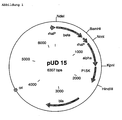
- the resulting expression vector is called pUD 15.
- restriction map can be found in illustration 1 , the sequence under SEQ ID NO: 24.
- the gene for the cobalt transporter was cloned into another expression vector for E. coli in which the inserted genes are also under the control of the rhamnose promoter. For this purpose, it was amplified with primers 9F and 9R, which inserted restriction sites for NdeI and HindIII and changed the start codon of TTG to ATG.
- the resulting expression vector is called pUD 16.
- the restriction map can be found in Figure 2 , the sequence under SEQ ID NO: 25.
- the expression plasmids were transformed into strain E. coli DSM 14459, deposited with the German Collection of Microorganisms and Cell Cultures GmbH (DSMZ).
- pUD15 Gene of ⁇ subunit: nt 25 - 732 Gene of the ⁇ subunit: nt 949 - 1566 Gene of P15K: nt 1592 - 2005
- pUD16 Cobalt transporter gene: nt 25 - 1095
- DSM 14559 was associated with the DE 101 55 928 deposited.
- the cells transformed with pUD15 were grown in LB medium (LB broth according to Miller, VWR) containing 1 mM CoCl 2 and 100 ⁇ g / ml ampicillin with shaking at 37 ° C.
- the culture for the cells transformed with pUD15 and pUD16 was carried out analogously, but the medium additionally contained 50 ⁇ g / ml chloramphenicol.
- the cells were then inoculated into the same medium 3 more times after reaching at least an OD 600 of 2. After 12-16 hours, such an amount of the last preculture was inoculated into a major culture that had an OD 600 of 0.1.
- the culture medium of the main culture corresponded to that of the preculture, but additionally contained 2 g / L L-rhamnose. Cells were harvested after 22 hours.
- the cells were grown as described in Example 3, separated from the culture medium by centrifugation and resuspended in standard buffer (50 mM potassium phosphate buffer pH 7.5). 50 ⁇ l of this cell suspension was added to 700 ⁇ l of the standard buffer and 250 ⁇ l of a 200 mM solution of the nitrile in standard buffer were added to start the reaction. The concentration of the cells in the cell suspension was in this case such that the nitrile was reacted after 10 min at 20 ° C to 5 - 30%. After 10 min at 20 ° C, the reaction by adding 20 ul stopped half-concentrated phosphoric acid and the cells were separated by centrifugation.
- standard buffer 50 mM potassium phosphate buffer pH 7.5
- 50 ⁇ l of this cell suspension was added to 700 ⁇ l of the standard buffer and 250 ⁇ l of a 200 mM solution of the nitrile in standard buffer were added to start the reaction.
- the concentration of the cells in the cell suspension was in this case such that the nitrile was
- the activity of one unit (U) was defined as the amount of enzyme that converts 1 ⁇ mol of N-formylvalinonitrile to the amide in one minute.
- the specific activity is given in U per mg of dry biomass (U / mg BTM).
- the expression was carried out as described in Example 3 with the transformed strain E. coli DSM 14459, which contains the plasmid pUD15.
- the specific activity of the cells was 23 U / mg BTM.
- the expression was carried out as described in Example 3 with the transformed strain E. coli DSM 14459, which contains the plasmids pUD15 and pUD16.
- the specific activity of the cells was 81 U / mg BTM.
- E. coli DSM 14459 cells containing either only plasmid pUD15 or pUD15 and pUD16 were grown as described in Example 3.
- the cobalt concentration in the medium was varied from 0.5 to 2 mM. After 24 hours, the optical density of the culture was measured at 600 nm.
- E. coli with pUD15 E. coli with pUD15 and pUD16 0.5 mM CoCl2 2,808 2,524 1.0 mM CoCl2 2.6955 2,173 2.0 mM CoCl2 2,330 2,113
- E. coli DSM 14459 cells containing the plasmid pUD15 were grown and spun down as described in Example 3. 2.8 g of the cells by wet weight were resuspended in 47.2 ml of 50 mM potassium phosphate buffer pH 7.5 and methionine nitrile was added continuously at 20 ° C. with vigorous stirring at such a rate that the concentration during the reaction was 15 g / ml. L never crossed. The pH was kept constant at 7.5. The reaction was monitored by HPLC as described in Example 4. After 320 minutes, 9.1 g of the nitrile had been completely converted to 10.4 g of amide. That corresponds to a concentration of 176 g / L.
Landscapes
- Chemical & Material Sciences (AREA)
- Organic Chemistry (AREA)
- Life Sciences & Earth Sciences (AREA)
- Health & Medical Sciences (AREA)
- Zoology (AREA)
- Wood Science & Technology (AREA)
- Genetics & Genomics (AREA)
- Engineering & Computer Science (AREA)
- Bioinformatics & Cheminformatics (AREA)
- Biochemistry (AREA)
- General Health & Medical Sciences (AREA)
- Microbiology (AREA)
- General Engineering & Computer Science (AREA)
- Molecular Biology (AREA)
- Medicinal Chemistry (AREA)
- Biotechnology (AREA)
- Chemical Kinetics & Catalysis (AREA)
- General Chemical & Material Sciences (AREA)
- Biophysics (AREA)
- Gastroenterology & Hepatology (AREA)
- Toxicology (AREA)
- Proteomics, Peptides & Aminoacids (AREA)
- Biomedical Technology (AREA)
- Micro-Organisms Or Cultivation Processes Thereof (AREA)
- Enzymes And Modification Thereof (AREA)
- Preparation Of Compounds By Using Micro-Organisms (AREA)
- Measuring Or Testing Involving Enzymes Or Micro-Organisms (AREA)
Description
- Die Erfindung betrifft einen Polynucleotidcluster aus Rhodococcus, der für Polypeptide mit der Aktivität einer Nitrilhydratase, eines dieses Enzym aktivierenden Hilfsproteins P15K und eines Kobalttransporters kodierende Nukleotidsequenzen enthält, damit transformierte Mikroorganismen, in denen die für diese Proteine kodierende Nukleotidsequenzen verstärkt vorliegen und die Verwendung der transformierten Mikroorganismen zur Herstellung von Amiden aus Nitrilen.
- Nitrilhydratasen wurden bereits in großer Zahl in der Literatur beschrieben (Synthetic applications of nitrileconverting enzymes; Martinkova, Ludmila; Mylerova, Veronika; Current Organic Chemistry (2003), 7(13), 1279-1295). Für die Herstellung von Acrylamid im Maßstab von mehreren tausend Tonnen pro Jahr werden Nitrilhydratasen schon seit 1983 eingesetzt. Dieses biokatalytische Verfahren hat sich gegenüber den chemischen Verfahren als konkurrenzfähig erwiesen (Enzymic synthesis of acrylamide: a success story not yet over; Kobayashi, Michihiko; Nagasawa, Toru; Yamada, Trends in Biotechnology (1992), 10(11), 402-8).
- Neben den Nitrilhydratasen, die für die Umsetzung von Acrylnitril eingesetzt werden können, wurden z.B. auch solche beschrieben, die besonders geeignet sind für die Umsetzung von Methacrylnitril (A nitrile hydratase of Pseudonocardia thermophila and the genes encoding and manufacture of the enzyme for conversion of nitriles to amides (
EP 790310 WO 2002055670 ) oder 2-Hydroxynitrilen wie 2-Hydroxy-4-methylthiobutyronitril (A nitrile hydratase of Rhodococcus and its use in the manufacture of amides (WO 2002070717 ) and Enzymic conversion of α-hydroxynitriles to the corresponding α-hydroxyamides, acids or acid salts, (WO 9832872 WO 2002070717 ). - Die enzymatische Umsetzung von Aminonitrilen zu den entsprechenden Amiden eröffnet eine attraktive Syntheseroute zu Aminosäuren, da 2-Aminoamide auf einfache Weise verseift werden können (
WO 2001060789 ). Dieser Prozess läuft unter milden Bedingungen, mit sehr hoher Selektivität und ohne die Bildung von Nebenprodukten wie Salzen ab, wie sie bei der chemischen Hydrolyse anfallen. - Alternativ können Amide auch mit Alkali- oder Erdalkalimetallhydroxiden zu den entsprechenden Salzen der Säuren umgesetzt werden. Besonders bevorzugt ist diese Vorgehensweise beim Einsatz von Calciumhydroxid für die Umsetzung von 4-Methylthio-α-hydroxybutyramid (MHA-Amid), da das Calciumsalz von MHA direkt als alternative Produktform zu Methionin oder MHA als Futtermittelzusatz eingesetzt werden kann.
- Für die Herstellung eines Commodity-Produkts wie z.B. DL-Methionin reicht es jedoch nicht aus, einen Biokatalysator mit hoher Aktivität zur Verfügung zu stellen. Zur Erhöhung der Aktivität muß ein Expressionssystem für die zu verstärkenden Gene etabliert werden. Es bietet sich die heterologe Expression z.B. vor allem in Escherichia coli, Bacillus, Pseudomonas, Pichia, Sacharomyces oder Aspergillus an, da diese Mikroorganismen ein schnelles Wachstum besitzen, sehr hohe Zelldichten erreichen und molekularbiologische Tools verfügbar sind, die sehr hohe Expressionsniveaus erlauben (Lee SY (1996) High cell-density culture of Escherichia coli. TIBTECH 14:98-105; Riesenberg D, Guthke R (1999) High-cell-density cultivation of microorganisms. Appl Microbiol Biotechnol 51:422-430).
- Es ist bekannt, dass für die heterologe Expression von Nitrilhydratasen mindestens 3 Gene co-exprimiert werden müssen. Neben den beiden Strukturgenen muß außerdem sowohl für eisenabhängige, als auch für Cobaltabhängige Enzyme ein entsprechendes Helferprotein verstärkt werden (Nojiri
- M. et al., (1999) Functional expression of Nitrile hydratases in Escherichia coli: Requirement of a nitrile hydratase activator and a post-translational modification of a ligand cysteine. J Biochem 125: 696-704 und Overproduction of stereoselective nitrile hydratase from Pseudomonas putida 5B in Escherichia coli: activity requires a novel downstream protein, Wu, S.; Fallon, R. D.; Payne, M. S. Applied Microbiology and Biotechnology (1997), 48(6), 704-708).
- Zusätzlich zu diesen 3 Genen wurde in Rhodococcus rhodochrous J1 in einem Gencluster neben den Strukturgenen und dem Gen des Helferproteins ein weiteres Gen gefunden, das für einen Cobalttransporter codiert (A novel transporter involved in cobalt uptake, Komeda, Hidenobu et al., Proceedings of the National Academy of Sciences of the United States of America (1997), 94(1), 36-41). Sowohl die Überexpression in Rhodococcus als auch die in E. coli führt zu einer erhöhten Aufnahme von Co2+-Ionen aus dem Kulturmedium. Ausserdem konnte gezeigt werden, daß bei Co-Expression des Cobalttransporters zusammen mit den 3 anderen Proteinen die gleiche Nitrilhydratase-Aktivität bei einer niedrigeren Co-Konzentration im Medium erreicht werden kann, verglichen mit der alleinigen Expression der Strukturgene und des Helferproteins. Allerdings tritt dieser Effekt in Rhodococcus gemäß Komeda et al. nur bei Konzentrationen unterhalb von 42 µM auf.
- Aus der
EP 0 362 829 ist die Fermentation von Rhodococcus rhodochrous in Gegenwart von Kobaltsalzen bekannt. - Aufgabe der Erfindung ist es, Nitrilhydratasen mit hoher Aktivität zugänglich zu machen, die insbesondere α-Aminonitrile zu Amiden umsetzen.
- Die Erfindung beinhaltet folgende Gegenstände:
- 1. Isolierter Polynukleotidcluster aus Rhodococcus opacus, enthaltend vier Nukleotidsequenzen, die für vier Polypeptide mit Aminosäuresequenzen kodieren, die zu jeweils mindestens 90 % identisch sind mit dem in den Sequenzen SEQ ID NO:2 bis SEQ ID NO:4 und SEQ ID NO:6 enthaltenen Aminosäuresequenzen, wobei die Polypeptide die Aktivitäten einer Nitrilhydratase, bestehend aus α- und β-Untereinheit, des Hilfsproteins P15K und eines Kobalttransporters besitzen.
- 2. Polynukleotide gemäß 1., ausgewählt aus der Gruppe:
- a) Polynukleotid bestehend aus den Positionen 1 bis 708 der Nukleotidsequenz SEQ ID NO:1 oder der dazu komplementären Nukleotidsequenz,
- b) Polynukleotid mit einer Nukleotidsequenz, die der Sequenz aus a) im Bereich der Degeneriertheit des genetischen Codes entspricht,
- c) Polynukleotid, das mit den komplementären Sequenzen a) oder b) unter stringenten Bedingungen hybridisiert, wobei die stringenten Bedingungen das Waschen auf 0,1x SSC bei einer Temperatur von 50-68°C beinhalten und
- d) Polynukleotid mit einer Nukleotidsequenz aus a), b) oder c), die funktionsneutrale Sinnmutationen enthält,
- 3. Polynukleotide gemäß 1., ausgewählt aus der Gruppe:
- a) Polynukleotid bestehend aus den Positionen 710 bis 1327 der Nukleotidsequenz SEQ ID NO:1 oder der dazu komplementären Nukleotidsequenz,
- b) Polynukleotid mit einer Nukleotidsequenz, die der Sequenz aus a) im Bereich der Degeneriertheit des genetischen Codes entspricht,
- c) Polynukleotid, das mit den komplementären Sequenzen a) oder b) unter stringenten Bedingungen hybridisiert, wobei die stringenten Bedingungen das Waschen auf 0,1x SSC bei einer Temperatur von 50-68°C beinhalten und
- d) Polynukleotid mit einer Nukleotidsequenz aus a), b) oder c), die funktionsneutrale Sinnmutationen enthält,
- 4. Polypeptid gemäss 1. enthaltend die Aminosäuresequenzen, die zu mindestens 90 % identisch sind mit SEQ ID NO:2 und SEQ ID NO:3, wobei das Polypeptid die Aktivität einer Nitrilhydratase aufweist.
- 5. Sonde oder Primer, enthaltend mindestens 20 aufeinanderfolgende Nukleotide innerhalb der Positionen 1 bis 1327 aus der Nukleotidsequenz SEQ ID NO:1 oder seiner komplementären Form.
- 6. Isoliertes Polynukleotid gemäss 2), das unter stringenten Bedingungen mit dem Komplement mit den Positionen 1 bis 708 aus SEQ ID NO:1 hybridisiert, wobei die stringenten Bedingungen das Waschen in 0,1 x SSC bei einer Temperatur von 50 bis 68°C beinhalten.
- 7. Isoliertes Polynukleotid gemäss 4), das unter stringenten Bedingungen mit dem Komplement mit den Positionen 710 bis 1327 aus SEQ ID NO:1 hybridisiert, wobei die stringenten Bedingungen das Waschen in 0,1 x SSC bei einer Temperatur von 50 bis 68°C beinhalten.
- 8. Vektoren enthaltend (ein) Polynukleotid(e) ausgewählt aus 1) bis 3) und 6) bis 7).
- 9. Vektor pUD15, bestehend aus der Nukleotidsequenz SEQ ID No: 24.
- 10. Vektor pUD16, bestehend aus der Nukleotidsequenz SEQ ID NO:25.
- 11. Wirtszelle, transformiert oder transfektiert durch die Einführung eines Polynukleotids gemäß 1).
- 12. Wirtszelle, transformiert durch die Einführung eines Vektors gemäß 8) bis 10).
- 13. Transformierte Wirtszelle gemäß 11) oder 12) wobei die Wirtszelle ein Bakterium der Familie Enterobacteriaceae, insbesondere Escherichia ist.
- 14. Verfahren zur Herstellung von Amiden aus Nitrilen mit Nitrilhydratasen des Ursprungs Rhodococcus oder dieses Enzym enthaltenden Mikroorganismen, bei dem man
- a) einen transformierten Mikroorganismus, der überexprimierte Gene mit den Nukleotidsequenzen ausgewählt aus den Ansprüchen 1 bis 3 und 6, 7 enthält, in Gegenwart von 0,15 bis 4 mM Co2+, unter Bedingungen fermentiert, die zur Bildung der Nitrilhydratase führen,
- b) dieses Enzym im Mikroorganismus anreichern lässt, und
- c) dieses Enzym aus den Zellen isoliert, oder
- d) die Mikroorganismen erntet und als das Enzym enthaltende ruhende Zellen gewinnt, und
- e) das Enzym oder die enthaltenen Mikroorganismen mit Verbindungen der allgemeinen Formel

R"-CN (II)
in der bedeuten:- X: OH, H, Alkyl mit 1 bis 4 C-Atomen, insbesondere NH2;
- R: H, gesättigter Alkylrest mit 1 bis 12 C-Atomen, verzweigt oder unverzweigt, gegebenenfalls NH2-substituiert, Alkenylreste mit 1 bis 12 C-Atomen, verzweigt
oder
unverzweigt, Cycloalkylgruppen mit 3 bis 6 C-Atomen,
mit Alkylthiogruppen substituierte Alkylenreste,
wobei Alkyl hier einem C1 bis C3-Rest
und Alkylen einem zweiwertigen C3 bis C8-Rest
entspricht, - R': H, Alkyl mit 1 bis 3 C-Atomen,
- R": ein- oder zweikerniger ungesättigter Ring mit 6 bis 12 C-Atomen, gegebenenfalls mit einer oder zwei Alkylgruppen (C1 - C3), Cl, Br, F substituiert, einwertiger Alkylnitrilrest mit 1 bis 6 C-Atomen,
zu den entsprechenden Amiden umsetzt.
- 15. Verfahren gemäss 14), dadurch gekennzeichnet, dass man Wirtszellen gemäss den Ansprüchen 11 bis 13 einsetzt.
- 16. Rekombinant gemäss 14) erzeugte Nitrilhydratase mit dem Ursprung Rhodococcus opacus, die α-Aminonitrile mit einer spezifischen Aktivität von > 50 U/mg Biotrockenmasse umsetzt.
- Vektor DNA kann in eukaryonische oder prokaryonische Zellen durch bekannte Transformations- oder Transfektionstechniken eingeführt werden.
- "Transformation", "Transfektion", "Konjugation" und "Transduktion" beziehen sich auf nach dem Stand der Techniken bekannten Maßnahmen, um fremde DNA einzuführen.
- Gegenstand der Erfindung sind ebenso Polynukleotide, die im wesentlichen aus einer Polynukleotidsequenz bestehen, die erhältlich sind durch Screening mittels Hybridisierung einer entsprechenden Genbank von Rhodococcus opacus, die das vollständige Gen oder Teile davon enthält, mit einer Sonde, die die Sequenzen der erfindungsgemäßen Polynukleotide aus der SEQ ID No:1 oder Fragmente davon enthält und Isolierung der genannten Polynukleotidsequenz.
- Polynukleotide, die die Sequenzen gemäß der Erfindung enthalten, sind als Hybridisierungs-Sonden für RNA, cDNA und DNA geeignet, um Nukleinsäuren beziehungsweise Polynukleotide oder Gene in voller Länge zu isolieren, die für die erfindungsgemäßen Proteine kodieren, oder um solche Nukleinsäuren beziehungsweise Polynukleotide oder Gene zu isolieren, die eine hohe Ähnlichkeit der Sequenzen mit denen der erfindungsgemäßen Gene aufweisen. Sie können ebenso als Sonde auf sogenannte "arrays", "micro arrays" oder "DNA chips" aufgebracht werden, um die entsprechenden Polynukleotide oder hiervon abgeleitete Sequenzen wie z.B. RNA oder cDNA zu detektieren und zu bestimmen.
- Polynukleotide, die die Sequenzen gemäß der Erfindung enthalten, sind weiterhin als Primer geeignet, mit deren Hilfe mit der Polymerase-Kettenreaktion (PCR) DNA von Genen hergestellt werden kann, die für die erfindungsgemäßen Proteine kodieren.
- Solche als Sonden oder Primer dienende Oligonukleotide, enthalten mindestens 25 oder 30, bevorzugt mindestens 20, ganz besonders bevorzugt mindestens 15 aufeinanderfolgende Nukleotide. Geeignet sind ebenfalls Oligonukleotide mit einer Länge von mindestens 40 oder 50 Nukleotiden. Gegebenenfalls sind auch Oligonukleotide mit einer Länge von mindestens 100, 150, 200, 250 oder 300 Nukleotiden geeignet.
- "Isoliert" bedeutet aus seinem natürlichen Umfeld herausgetrennt.
- "Polynukleotid" bezieht sich im allgemeinen auf Polyribonukleotide und Polydeoxyribonukleotide, wobei es sich um nicht modifizierte RNA oder DNA oder modifizierte RNA oder DNA handeln kann.
- Die Polynukleotide gemäß Erfindung schließen Polynukleotide gemäß SEQ ID No. 1 oder darin enthaltene Fragmente und auch solche ein, die zu wenigstens 90 %, 93 %, 95 %, 97 % oder 99% identisch sind mit den Polynukleotiden gemäß SEQ ID NO:1 oder darin enthaltenen Fragmenten.
- Unter "Polypeptiden" versteht man Peptide oder Proteine, die zwei oder mehr über Peptidbindungen verbundene Aminosäuren enthalten.
- Die Polypeptide gemäß Erfindung schließen ein Polypeptid gemäß den Sequenzen SEQ ID NO:2 bis SEQ ID NO:4 und SEQ ID NO:6, und auch solche ein, die zu wenigstens 90%, und besonders bevorzugt zu wenigstens 91%, 95%, 97% oder 99% identisch sind mit den Polypeptiden gemäß den Sequenzen SEQ ID NO:2 bis SEQ ID NO: 4 und SEQ ID NO:6.
- Die Polynukleotide SEQ ID NO:1 enthält mehrere Einzelsequenzen, die für unterschiedliche Proteine kodieren. Die Sequenzen für die α-Untereinheit und das Helferprotein P15K überlappen sich.
- Die Gene, die für die α- und β-Untereinheit der Nitrilhydratase kodieren, müssen gemeinsam exprimiert werden, um ein aktives Protein zu erhalten.
- SEQ ID NO:2 gibt die Aminosäuresequenz der β-Untereinheit und SEQ ID NO:3 die der α-Untereinheit des Proteins wieder, das Nitrilhydrataseaktivität zeigt.
- SEQ ID NO:2 leitet sich aus den Positionen 1 bis 708 und SEQ ID NO:3 aus den Positionen 710 bis 1327 der Nukleotidsequenz SEQ ID NO:1 ab.
- Die Aminosäuresequenz des sogenannten Helferproteins P15K findet sich in SEQ ID NO:6, entsprechend den Positionen 1324 bis 1737 in der Nukleotidsequenz SEQ ID NO:1.
- Das Helferprotein aktiviert die Nitrilhydratase und muss zusammen mit diesem Enzym in dem die Nitrilhydratase bildenden Mikroorganismus vorhanden sein.
- SEQ ID NO:4 steht für die Aminosäuresequenz des Kobalttransporters und leitet sich aus den Positionen 2076 bis 3146 der Nukleotidsequenz SEQ ID NO:1 ab.
- Das Startcodon ttg in SEQ ID NO:4 wird von PatentIN Version 3.1 mit Leucin, das Startcodon gtg in SEQ ID NO:6 mit Valin übersetzt. Es muss richtig heissen Methionin.
- Es wurde gefunden, dass durch Co-Expression des Cobalttransporters die Nitrilhydrataseaktivität in E. coli um ein Vielfaches gesteigert wird. Dies gilt auch dann, wenn hohe Cobalt-Konzentrationen im Medium verwendet werden, die um Größenordnungen oberhalb der natürlich auftretenden Konzentrationen liegen. Überraschenderweise führt die co-Expression des Cobalttransporters nicht zu einer Vergiftung des Organismus sondern nur zu einer geringfügig gesteigerten Sensitivität der Zellen gegenüber hohen Cobaltkonzentrationen im Medium.
- Zur Isolierung des erfindungsgemäßen Genclusters wird im allgemeinen zunächst eine Genbank dieses Mikroorganismus in Escherichia coli (E. coli) angelegt. Das Anlegen von Genbanken ist in allgemein bekannten Lehrbüchern und Handbüchern niedergeschrieben. Als Beispiel seien das Lehrbuch von Winnacker: Gene und Klone, Eine Einführung in die Gentechnologie (Verlag Chemie, Weinheim, Deutschland, 1990), oder das Handbuch von Sambrook et al.: Molecular Cloning, A Laboratory Manual (Cold Spring Harbor Laboratory Press, 1989) genannt. Eine sehr bekannte Genbank ist die des E. coli K-12 Stammes W3110, die von Kohara et al. (Cell 50, 495-508 (1987)) in λ-Vektoren angelegt wurde. Bathe et al. (Molecular and General Genetics, 252:255-265, 1996) beschreiben eine Genbank von C. glutamicum ATCC13032, die mit Hilfe des Cosmidvektors SuperCos I (Wahl et al., 1987, Proceedings of the National Academy of Sciences USA, 84:2160-2164) im E. coli K-12 Stamm NM554 (Raleigh et al., 1988, Nucleic Acids Research 16:1563-1575) angelegt wurde.
- Zur Herstellung einer Genbank in E. coli können auch Plasmide wie pBR322 (Bolivar, Life Sciences, 25, 807-818 (1979)) oder pUC9 (Vieira et al., 1982, Gene, 19:259-268) verwendet werden. Als Wirte eignen sich besonders solche E. coli Stämme, die restriktions- und rekombinationsdefekt sind. Ein Beispiel hierfür ist der Stamm DH5αmcr, der von Grant et al. (Proceedings of the National Academy of Sciences USA, 87 (1990) 4645-4649) beschrieben wurde. Die mit Hilfe von Cosmiden klonierten langen DNA-Fragmente können anschließend wiederum in gängige, für die Sequenzierung geeignete Vektoren subkloniert und anschließend sequenziert werden, so wie es z.B. bei Sanger et al. (Proceedings of the National Academy of Sciences of the United States of America, 74:5463-5467, 1977) beschrieben ist.
- Die erhaltenen DNA-Sequenzen können dann mit bekannten Algorithmen bzw. Sequenzanalyse-Programmen wie z.B. dem von Staden (Nucleic Acids Research 14, 217-232(1986)), dem von Marck (Nucleic Acids Research 16, 1829-1836 (1988)) oder dem GCG-Programm von Butler (Methods of Biochemical Analysis 39, 74-97 (1998)) untersucht werden.
- Kodierende DNA-Sequenzen, die sich aus den in SEQ ID No. 1 enthaltenen Sequenzen durch die Degeneriertheit des genetischen Kodes ergeben, sind ebenfalls Bestandteil der Erfindung. In gleicher Weise sind DNA-Sequenzen, die mit diesen Sequenzen oder Teilen von davon hybridisieren, Bestandteil der Erfindung. In der Fachwelt sind weiterhin konservative Aminosäureaustausche wie z.B. Austausch von Glycin gegen Alanin oder von Asparaginsäure gegen Glutaminsäure in Proteinen als "Sinnmutationen" ("sense mutations") bekannt, die zu keiner grundsätzlichen Veränderung der Aktivität des Proteins führen, d.h. funktionsneutral sind. Weiterhin ist bekannt, daß Änderungen am N- und/oder C-Terminus eines Proteins dessen Funktion nicht wesentlich beeinträchtigen oder sogar stabilisieren können. Angaben hierzu findet der Fachmann unter anderem bei Ben-Bassat et al. (Journal of Bacteriology 169:751-757 (1987)), bei O'Regan et al. (Gene 77:237-251 (1989)), bei Sahin-Toth et al. (Protein Sciences 3:240-247 (1994)), bei Hochuli et al. (Bio/Technology 6:1321-1325 (1988)) und in bekannten Lehrbüchern der Genetik und Molekularbiologie.
- Schließlich sind DNA-Sequenzen Bestandteil der Erfindung, die durch die Polymerase-Kettenreaktion (PCR) unter Verwendung von Primern hergestellt werden, die sich aus SEQ ID NO: 1 ergeben. Derartige Oligonukleotide haben typischerweise eine Länge von mindestens 15 Nukleotiden.
- Anleitungen zur Identifizierung von DNA-Sequenzen mittels Hybridisierung findet der Fachmann unter anderem im Handbuch "The DIG System Users Guide for Filter Hybridization" der Firma Boehringer Mannheim GmbH (Mannheim, Deutschland, 1993) und bei Liebl et al. (International Journal of Systematic Bacteriology (1991) 41: 255-260). Die Hybridisierung findet unter stringenten Bedingungen statt, das heißt, es werden nur Hybride gebildet, bei denen Sonde und Zielsequenz, d. h. die mit der Sonde behandelten Polynukleotide, mindestens 90% identisch sind. Es ist bekannt, dass die Stringenz der Hybridisierung einschließlich der Waschschritte durch Variieren der Pufferzusammensetzung, der Temperatur und der Salzkonzentration beeinflusst bzw. bestimmt wird. Die Hybridisierungsreaktion wird vorzugsweise bei relativ niedriger Stringenz im Vergleich zu den Waschschritten durchgeführt (Hybaid Hybridisation Guide, Hybaid Limited, Teddington, UK, 1996).
- Für die Hybridisierungsreaktion kann beispielsweise ein 5x SSC-Puffer bei einer Temperatur von ca. 50°C - 68°C eingesetzt werden. Dabei können Sonden auch mit Polynukleotiden hybridisieren, die weniger als 70% Identität zur Sequenz der Sonde aufweisen. Solche Hybride sind weniger stabil und werden durch Waschen unter stringenten Bedingungen entfernt. Dies kann beispielsweise durch Senken der Salzkonzentration auf 2x SSC und gegebenenfalls nachfolgend 0,5x SSC (The DIG System User's Guide for Filter Hybridisation, Boehringer Mannheim, Mannheim, Deutschland, 1995) erreicht werden, wobei eine Temperatur von ca. 50°C - 68°C eingestellt wird. Es ist gegebenenfalls möglich die Salzkonzentration bis auf 0,1x SSC zu senken. Durch schrittweise Erhöhung der Hybridisierungstemperatur in Schritten von ca. 1 - 2°C von 50°C auf 68°C können Polynukleotidfragmente isoliert werden, die beispielsweise mindestens 90% bis 95% Identität zur Sequenz der eingesetzten Sonde besitzen. Weitere Anleitungen zur Hybridisierung sind in Form sogenannter Kits am Markt erhältlich (z.B. DIG Easy Hyb von der Firma Roche Diagnostics GmbH, Mannheim, Deutschland, Catalog No. 1603558).
- Anleitungen zur Amplifikation von DNA-Sequenzen mit Hilfe der Polymerase-Kettenreaktion (PCR) findet der Fachmann unter anderem im Handbuch von Gait: Oligonukleotide synthesis: A Practical Approach (IRL Press, Oxford, UK, 1984) und bei Newton und Graham: PCR (Spektrum Akademischer Verlag, Heidelberg, Deutschland, 1994).
- Im allgemeinen geht man so vor, dass man ein gut exprimierbares Gen in einen Vektor mit niedriger Kopienzahl, Gene mit schwächerer Expressionsleistung auf einem Vektor mit höherer Kopienzahl und/oder starkem Promotor kloniert. Die Wirtszellen sind mit diesen Vektoren in der Weise transformiert, dass sie im Vergleich zum Startorganismus mindestens jeweils eine zusätzliche Kopie der für die Bildung von Nitrilhydratase bzw. der weiteren Proteine kodierenden Nukleotidsequenzen enthalten.
- Es hat sich als vorteilhaft erwiesen, das für den Kobalttransporter kodierende Gen in geringerem Umfang, beispielweise mit einem Vektor niedriger Kopienzahl - mindestens eine Kopie weniger - als die für die α- und β-Untereinheiten und das Helferprotein P15K kodierenden Polynukleotidsequenzen zu exprimieren. Die unterschiedliche Expression der genannten Gene kann auch durch die Verwendung unterschiedlich starker Promotoren erreicht werden.
- Die für die α- und β-Untereinheit und das Helferprotein kodierenden Nukleotide liegen bevorzugt gemeinsam auf einem Vektor, mit einem gemeinsamen oder zwei getrennten Promotoren.
- Die so hergestellten transformierten oder rekombinanten Mikroorganismen sind ebenfalls Teil der Erfindung.
- Es wurde gefunden, dass die Verstärkung der für die Nitrilhydratase, das Helferprotein P15K und den Kobalttransporter kodierenden Gene in Mikroorganismen zu einer erhöhten Produktion der Nitrilhydratase oder auch zu einer erhöhten Aktivität der Nitrilhydratase führen.
- Der Begriff "Verstärkung" beschreibt in diesem Zusammenhang die Erhöhung der intrazellulären Aktivität eines oder mehrerer Enzyme in einem Mikroorganismus, die durch die entsprechende DNA kodiert werden, indem man beispielsweise die Kopienzahl des Gens bzw. der Gene erhöht, einen starken Promotor verwendet oder ein Gen verwendet, das für ein entsprechendes Enzym mit einer hohen Aktivität kodiert und gegebenenfalls diese Maßnahmen kombiniert.
- Zur Erzielung einer Überexpression kann die Promotor- und Regluationsregion oder die Ribosomenbindungsstelle, die sich stromaufwärts des Strukturgens befindet, mutiert werden. In gleicher Weise wirken Expressionskassetten, die stromaufwärts des Strukturgens eingebaut werden. Durch induzierbare Promotoren ist es zusätzlich möglich, die Expression im Verlaufe der fermentativen Aminosäure-Produktion zu steigern. Durch Maßnahmen zur Verlängerung der Lebensdauer der m-RNA wird ebenfalls die Expression verbessert.
- Weiterhin wird durch Verhinderung des Abbaus des Enzymproteins ebenfalls die Enzymaktivität verstärkt. Die Gene oder Genkonstrukte können entweder in Plasmiden mit unterschiedlicher Kopienzahl vorliegen oder im Chromosom integriert und amplifiziert sein. Alternativ kann weiterhin eine Überexpression der betreffenden Gene durch Veränderung der Medienzusammensetzung und Kulturführung erreicht werden.
- Durch die Maßnahmen der Verstärkung, insbesondere Überexpression, wird die Aktivität oder Konzentration des entsprechenden Proteins im allgemeinen um mindestens 10 %, 25 %, 50 %, 75 %, 100 %, 150 %, 200 %, 300 %, 400 % oder 500 %, maximal bis 1000 % oder 2000 %, bezogen auf die des Wildtyp-Proteins bzw. der Aktivität oder Konzentration des Proteins in nicht mit den erfindungsgemäßen Nukleotidsequenzen transformierten Mikroorganismen erhöht.
- Ein anderer Gegenstand der Erfindung ist die Bereitstellung von in den ausgewählten Host-Stämmen im allgemeinen autonom replizierbaren Vektoren, die miteinander kompatibel sind und mindestens Nukleotidsequenzen gemäß den Ansprüche 2, 3 und 4 oder eine Nukleotidsequenz gemäß Anspruch 4 enthalten.
- Vektor DNA kann in eukaryotische oder prokariotische Zellen durch bekannte Transformationstechniken eingeführt werden.
- Als Host-Organismus dienen bevorzugt Mikroorganismen, für die es Expressionssysteme gibt, wie z. B. Pseudomonas, Pichia, verschiedene Hefen, Saccaromyces, Aspergillus oder der Familie Streptomyces, isbesondere E. coli. Mikroorganismen der Gattung Rhodococcus sind ebenso geeignet.
- Gegenstand der Erfindung ist ebenso ein Verfahren zur Herstellung von Nitrilhydratase mit dem Ursprung Rhodococcus, insbesondere Rhodococcus opacus oder dieses Enzym enthaltende Mikroorganismen, bei dem man
- a) einen transformierten Mikroorganismus, der überexprimierte Gene mit den Nukleotidsequenzen gemäß den Ansprüchen 1 bis 4 enthält, in Gegenwart von 0,15 bis 4 mM (mmol/1) Co2+, insbesondere 0,3 bis 4 mM, unter Bedingungen fermentiert, die zur Bildung der Nitrilhydratase führen,
- b) dieses Enzym im Mikroorganismus anreichern lässt, und
- c) dieses Enzym aus den Zellen isoliert, oder
- d) die Mikroorganismen erntet und als das Enzym enthaltende ruhende Zellen gewinnt.
- Die rekombinante erzeugte Nitrilhydratase setzt α-Aminonitrile mit einer Aktivität von > 50 U/mg Biotrockenmasse um.
- Bevorzugt fermentiert man in der Gegenwart von 0,5 bis 3,5 mM Co2+, insbesondere 0,7 bis 3 mM das bevorzugt als lösliches Salz der Fermentationsbrühe zugesetzt wird.
- Die erfindungsgemäß verwendeten Mikroorganismen können kontinuierlich oder diskontinuierlich im batch - Verfahren (Satzkultivierung) oder im fed batch (Zulaufverfahren) oder repeated fed batch Verfahren (repetitives Zulaufverfahren) kultiviert werden. Eine Zusammenfassung über bekannte Kultivierungsmethoden ist im Lehrbuch von Chmiel (Bioprozeßtechnik 1. Einführung in die Bioverfahrenstechnik (Gustav Fischer Verlag, Stuttgart, 1991)) oder im Lehrbuch von Storhas (Bioreaktoren und periphere Einrichtungen (Vieweg Verlag, Braunschweig/Wiesbaden, 1994)) beschrieben.
- Das zu verwendende Kulturmedium muss in geeigneter Weise den Ansprüchen der jeweiligen Stämme genügen. Beschreibungen von Kulturmedien verschiedener Mikroorganismen sind im Handbuch "Manual of Methods for General Bacteriology" der American Society for Bacteriology (Washington D.C., USA, 1981) enthalten.
- Als Kohlenstoffquelle können Zucker und Kohlehydrate wie z.B. Glucose, Saccharose, Lactose, Fructose, Maltose, Melasse, Stärke und Cellulose, Öle und Fette wie z.B. Sojaöl, Sonnenblumenöl, Erdnussöl und Kokosfett, Fettsäuren wie z.B. Palmitinsäure, Stearinsäure und Linolsäure, Alkohole wie z.B. Glycerin und Ethanol und organische Säuren wie z.B. Essigsäure verwendet werden. Diese Stoffe können einzeln oder als Mischung verwendet werden.
- Als Stickstoffquelle können Stickstoff-haltige Verbindungen wie Peptone, Hefeextrakt, Fleischextrakt, Malzextrakt, Maisquellwasser, Sojabohnenmehl und Harnstoff oder anorganische Verbindungen wie Ammoniumsulfat, Ammoniumchlorid, Ammoniumphosphat, Ammoniumcarbonat und Ammoniumnitrat verwendet werden. Die Stickstoffquellen können einzeln oder als Mischung verwendet werden.
- Als Phosphorquelle können Phosphorsäure, Kaliumdihydrogenphosphat oder Dikaliumhydrogenphosphat oder die entsprechenden Natrium-haltigen Salze verwendet werden. Das Kulturmedium muss weiterhin Salze von Metallen enthalten wie z.B. Magnesiumsulfat oder Eisensulfat, die für das Wachstum notwendig sind. Schließlich können essentielle Wuchsstoffe wie Aminosäuren und Vitamine zusätzlich zu den oben genannten Stoffen eingesetzt werden. Die genannten Einsatzstoffe können zur Kultur in Form eines einmaligen Ansatzes hinzugegeben oder in geeigneter weise während der Kultivierung zugefüttert werden.
- Zur pH-Kontrolle der Kultur werden basische Verbindungen wie Natriumhydroxid, Kaliumhydroxid, Ammoniak bzw. Ammoniakwasser oder saure Verbindungen wie Phosphorsäure oder Schwefelsäure in geeigneter Weise eingesetzt. Zur Kontrolle der Schaumentwicklung können Antischaummittel wie z.B. Fettsäurepolyglykolester eingesetzt werden. Zur Aufrechterhaltung der Stabilität von Plasmiden können dem Medium geeignete selektiv wirkende Stoffe wie z.B. Antibiotika hinzugefügt werden. Um aerobe Bedingungen aufrechtzuerhalten, werden Sauerstoff oder Sauerstoffhaltige Gasmischungen wie z.B. Luft in die Kultur eingetragen. Die Temperatur der Kultur liegt normalerweise bei 10°C bis 40°c und vorzugsweise bei 10°C bis 30°C. Die Kultur wird bevorzugt mindestens solange fortgesetzt, bis sie die logarithmische Wachstumsphase durchschritten hat. Dieses Ziel wird normalerweise innerhalb von 10 Stunden bis 70 Stunden erreicht.
- Gegenstand der Erfindung ist ebenfalls ein Verfahren zur enzymatischen Herstellung von Amiden aus Nitrilen, das folgende Schritte enthält:
- a) Umsetzung einer Nitrilgruppen enthaltenden Verbindung mit einem Enzym aus Rhodococcus, insbesondere Rhodococcus opacus, das Nitrilhydratase-Aktivität aufweist, und
- b) gegebenenfalls Abtrennung das Amids.
- In einer Verfahrensvariante werden die Zellen geerntet, gewaschen und in einem Puffer als Suspension bei einem pH-Wert von 5 - 9, insbesondere von 6,8 bis 7,9 aufgenommen. Die Zellkonzentration der ruhenden Zellen beläuft sich auf im allgemeinen 1 - 25 %, insbesondere 1,5 bis 15 % (Feuchtgewicht/v). Sie können mit physikalischen oder chemischen Methoden so permeabilisiert werden, z. B. Toluol wie bei Wilms et al., J. Biotechnol., Vol 86 (2001), 19 - 30 beschrieben, dass die umzuwandelnden Nitrilverbindungen die Zellwand durchdringen und das entstandene Amid austreten kann.
- Der Biokatalysator (Ganzzellkatalysator) zeigt eine ausgezeichnete Stabilität, so dass Produktkonzentrationen von über 100 g/l erreicht werden können.
- Es ist auch möglich, die erfindungsgemäße Nitrilhydratase aus den Zellen nach bekannten Methoden abzutrennen, sie gegebenenfalls aufzureinigen und zur Umsetzung der Nitrile einzusetzen.
- Gegenstand der Erfindung ist auch ein Verfahren, das dadurch gekennzeichnet ist, dass man Verbindungen der allgemeinen Formeln

R"-CN (II)
in der bedeuten: - X:
- OH, H,Alkyl mit 1 bis 4 C-Atomen, Aryl, insbesondere NH2;
- R:
- H, gesättigter Alkylrest mit 1 bis 12 C-Atomen, verzweigt oder unverzweigt, gegebenenfalls mit NH2 substituiert, Alkenylreste mit 1 bis 12 C-Atomen, verzweigt oder unverzweigt, Cycloalkylgruppen mit 3 bis 6 C-Atomen, mit Alkylthiogruppen substituierte Alkylenreste, wobei Alkyl hier einem C1 bis C3-Rest und Alkylen einem zweiwertigen C3 bis C8-Rest entspricht,
- R':
- H, Alkyl mit 1 bis 3 C-Atomen,
- R":
- ein oder zweikerniger aromatischer Ring, mit 6 bis 12 C-Atomen, gegebenenfalls substituiert mit einer oder zwie Alkylgruppen (C1 - C3) oder Cl oder F, Alkylnitril mit 1 bis 6 C-Atomen.
- Folgende Nitrile werden bevorzugt umsetzt:
- gesättigte Mononitrile:
- Acetonitril, Propionitril, Butyronitril, Isobutyronitril, Valeronitril, Isovaleronitril, Capronitril
- gesättigte Dinitrile:
- Malonitril, Succinonitril, Glutaronitril, Adiponitril
- aromatische unsubstituierte und substituierte Mono- und Dinitrile:
- Benzonitril, 2,6-Difluorbenzonitril, Phthalonitril, Isophtalonitril, Terephthalonitril,
- α-Aminonitrile:
- α-Aminopropionitril, α-Aminomethylthiobutyronitril, α-Aminobutyronitril, Aminoacetonitril, alle von natürlichen Aminosäuren abgeleiteten Nitrile, α-Amino-3,3-dimethylpropionitril α-Amino-2,3-dimethylpropionitril
- Nitrile mit Carboxyl-Gruppen:
- Cyanessigsäure
- β-Aminonitrile:
- 3-Aminopropionitril
- ungesättigte Nitrile:
- Acrylnitril, Methacrylonitril, Allylcyanid, Crotononitril
- α-Hydroxynitrile:
- α-Hydroxy-n-propionitril, α-Hydroxy-n-butyronitril, α-Hydroxy-isobutyronitril, α-Hydroxy-n-hexanonitril, α-Hydroxy-n-heptanonitril, α-hydroxy-n-octyronitril, α, γ-Dihydroxy-β,β-dimethylbutyronitril, Acroleincyanohydrin, Methacrylaldehyd cyanohydrin, 3-Chlorolactonitril, 4-Methylthio-α-hydroxybutyronitril und α-Hydroxy-α-phenylpropionyl.
- Die Konzentration der umzusetzenden Nitrile in der Reaktionslösung ist nicht auf bestimmte Bereiche begrenzt.
- Um eine Inhibierung der Enzymaktivität durch das Substrat zu vermeiden, hält man die Konzentration des Nitrils im allgemeinen auf 0,001 bis 10 w/w%, insbesondere 0,1 bis 2 w/w%, bezogen auf die Menge des Biokatalysators als getrocknete Zellmasse. Das Substrat kann zu Beginn der Umsetzung insgesamt oder im Verlauf der Umsetzung kontinuierlich oder diskontinuierlich zugesetzt werden.
- Wenn die Löslichkeit der Nitrilverbindung in dem wässrigen Reaktionssystem zu gering ist, kann ein Lösungsvermittler zugesetzt werden.
- Die Reaktion kann aber alternativ auch in einem Zweiphasensystem Wasser/organische Lösungsmittel durchgeführt werden.
- Bei der Verwendung von Zellen des Mikroorganismus als enzymatisch aktivem Material, verhält sich die Menge der eingesetzten Zellen zur Substratmenge bevorzugt auf 0,001 bis 8 w/w% als getrocknete Zellmasse.
- Das Trockengewicht der Zellmasse wird mit einem Moisture Analyser MA45 (Sartorius) bestimmt.
- Es ist auch möglich, das isolierte Enzym nach allgemein bekannten Techniken zu immobilisieren und in dieser Form dann einzusetzen.
- Die Reaktion wird im allgemeinen bei Temperaturen von -5°C bis 50°C, insbesondere 0°C bis 30°C, und einer Zeitdauer von 0,1 bis 100 Stunden durchgeführt.
- Der einzuhaltende pH-Wert des Reaktionsgemisches ist so lange nicht auf bestimmte Werte begrenzt, wie die enzymatische Aktivität nicht beeinträchtigt wird. Nach der Umsetzung kann das gebildete Amid aus der Reaktionslösung wie bekannt abgetrennt und gereinigt werden.
- Gegenstand der Erfindung ist ebenfalls ein Verfahren, bei dem man das Amid bzw. die das Amid enthaltende Lösung z. B. von den Zellen der Biomasse abtrennt und das Amid entweder zu der entsprechenden Säure verseift oder unter Zusatz von Alkali- oder Erdalkalimetallhydroxiden zu den entsprechenden Salzen der Säuren umsetzt. Bevorzugt wird MHA-Amid it Calciumhydroxid verseift und das entsprechende Calciumsalz isoliert.
- Chromosomale DNA von Rhodococcus opacus wurde mit den Restriktionsenzymen PinAI, PstI und XmaI (Roche) verdaut und die Fragmente auf einem 0,8%igem Agarose-Gel aufgetrennt. Ein Southern Blot wurde nach Standard-Methoden (z. B. in Sambrook et al.: Molecular Cloning, A Laboratory Manual, Cold Spring Habor Laboratory Pess, 1989) auf eine positiv geladene Nylon-Membran (Hybond-N+, Amersham) durchgeführt. Die Hybridisierung erfolgte mit einer DIGmarkierten Sonde nach Anweisung des Herstellers (Roche). Die Sonde wurde mittels PCR mit den degenerierten Primern 1F und 1R mit genomischer DNA als Template hergestellt. Die Primer waren von homologen Regionen der β-Untereinheit abgeleitet, die durch Sequenz-Alignment verschiedener NHasen bestimmt wurden. Deren Sequenzen wurden aus Datenbanken erhalten. Zur Isolierung eines detektierten ca. 2,2 kb großen PinAI-Fragmentes wurden mit PinAI geschnittene DNA-Fragmente zwischen 2 und 2,5 kb über präparative Gelelektrophorese aufgereinigt, in den mit XmaI geschnittenen Vektor pUC18 (Promega) ligiert und der Ligationsansatz in E. coli JM109 (Promega) transformiert. Positive Transformanten wurden über Kolonie-Hybridisierung mit der gleichen Sonde identifiziert. Die so erhaltenen Klone enthielten ein Insert von 2206 nt mit dem Gen der β-Untereinheit und dem Großteil des Gens der α-Untereinheit der Nitrilhydratase.
- Für die fehlende Sequenz wurde mit oben beschriebener Methode mit den Primern 2F und 2R eine neue Sonde hergestellt, die am 3'-Ende des klonierten PinAI-Fragmentes hybridisiert. Als Template diente das in pUC18 klonierte PinAI-Fragment. Vor der Hybridisierung mit dieser Sonde wurden von der oben beschriebenen Membran zunächst die Farbsignale sowie die erste Sonde nach Anweisung des Herstellers (Roche) entfernt. Auf dieser Membran wurde mit der zweiten Sonde eine ca. 2 kb große PstI-Bande detektiert. Wie oben beschrieben, wurde das entsprechende DNA-Fragment in den mit PstI geöffneten Vektor pUC18 kloniert, das Produkt in E. coli JM109 transformiert und positive Klone über Kolonie-Hybridisierung identifiziert. Das PstI-Fragment ist 1883 nt groß und enthält einen (3'-) Teil des Gens der α-Untereinheit der Nitrilhydratase, das Gen des Hilfsproteins P15K und einen (5'-) Teil des Gens des Kobalttransporters.
- Um ein DNA-Fragment mit der fehlenden Sequenz des Kobalttransporter-Genes zu klonieren, wurde mit den Primern 3F und 3R und dem in pUC18 klonierten PstI-Fragment als Template eine neue Sonde hergestellt, die am 3'-Ende des klonierten PstI-Fragmentes hybridisiert. Mit dieser Sonde wurde auf der gleichen Membran, von der wiederum zuvor Farbsignale und die zweite Sonde entfernt worden waren, eine ca. 1,7 kb große XmaI-Bande detektiert. Das entsprechende DNA-Fragment wurde in den mit XmaI geöffneten Vektor pUC18 kloniert, das Produkt in E. coli JM109 transformiert und positive Klone über Kolonie-Hybridisierung identifiziert. Dazu wurde eine Sonde eingesetzt, die mit den Primern 4F und 3R amplifiziert worden war. Das XmaI-Fragment ist 1747 nt groß und enthält einen (3'-) Teil des Gens des Kobalttransporters.
- Die fortlaufende Sequenz des Genclusters, der die Polynukleotide kodierend für die α-β-Untereinheiten der Nitrilhydratase, des Hilfsproteins P15K und des Kobalttransporters enthält, ist in SEQ ID NO:1 wiedergegeben.
- Die Strukturgene wurden in einen bekannten Expressionsvektor für E. coli kloniert, bei dem die eingefügten Gene unter der Kontrolle eines Rhamnose-Promoters stehen. Zusätzlich wurde ein zweiter Rhamnose-Promoter eingefügt. Das Gen für die β-UE wurde dazu mit den Primern 5F und 5R amplifiziert, die Schnittstellen für die Restriktionsenzyme NdeI, BamHI und HindIII einfügten. Der zweite Rhamnose-Promoter wurde mit den Primern 6F und 6R amplifiziert, die Schnittstellen für die Restriktionsenzyme BamHI, NcoI und HindIII einfügten. Das Gen für die α-UE wurde mit den Primern 7F und 7R amplifiziert, die Schnittstellen für die Restriktionsenzyme NcoI, KpnI und HindIII einfügten. Das Gen für das Protein P15K wurde mit den Primern 8F und 8R amplifiziert, die Schnittstellen für die Restriktionsenzyme KpnI und HindIIIeinfügten und das Startcodon von GTG zu ATG änderten. Der so entstandene Expressionsvektor heißt pUD 15.
- Die Restriktionskarte findet sich in
Abbildung 1 , die Sequenz unter SEQ ID NO:24. - Das Gen für den Kobalttransporter wurde in einen anderen Expressionsvektor für E. coli kloniert, bei dem die eingefügten Gene auch unter der Kontrolle des Rhamnose-Promoters stehen. Dazu wurde es mit den Primern 9F und 9R amplifiziert, die Schnittstellen für die Restriktionsenzyme NdeI und HindIII einfügten und das Startcodon von TTG zu ATG änderten. Der so entstandene Expressionsvektor heißt pUD 16.
- Die Restriktionskarte findet sich in
Abbildung 2 , die Sequenz unter SEQ ID NO:25. - Die Expressionsplasmide wurden in den Stamm E. coli DSM 14459 transformiert, der bei der Deutschen Sammlung von Mikroorganismen und Zellkulturen GmbH (DSMZ) hinterlegt ist.
-
1F 5'-ATG AAY GGH ATY TTC GA-3' 1R 5'-ATC CAG TGY YHG TAG TA-3' 2F 5'-CGA AGA CAT GAT CGT CGT G-3' 2R 5'-ACC GGT CCC ACA CCG A-3' 3F 5'-TCG AGG AGA TCG GAG G-3' 3R 5'-GTA TCG AAG GTG CTC ATC-3' 4F 5'-CGC GGG CTG GGT GAA-3' 5F 5'-CGG CGG AAT TCA AGA AGG AGA CCC GCA TAT GAA CGG-3' 5R 5'-GGT GCA AGC TTGGAT CCT GTC AGA TTC CTC GAG TAG-3' 6F 5'-GCG AAG GAT CCT GCA TGC ATC GAA ATT AAT ACG-3' 6R 5'-CAT CAA GCT TTT CGC CAT GGC TAT ATC TCC TTC-3' 7F 5'-CTG ACA GGA TCC AAG AAG GAG ATA TAG CCA TGG CCG A-3' 7R 5'-GTT GCA AGC TTG GTA CCG CTC AAG ACA TCG CCT CCC T-3' 8F 5'-GTG GGT ACC AAG AAG GAG GCG ATC ATA TGA GCA CGC-3' 8R 5'-GCG GAC GAG TAG CGA AGC TTG TTA GTT CAC CG-3' 9F 5'-TCA AAG CTT GAA GGA GAT ATA CAT ATG ACG ATT ACT-3' 9R 5'-GTC AAG CTT GGT ACC GAC ATC TCA CAC CTT CGA-3' - Die Gene befinden sich auf den Abschnitten:
pUD15: Gen der β-Untereinheit: nt 25 - 732 Gen der α-Untereinheit: nt 949 - 1566 Gen von P15K: nt 1592 - 2005 pUD16: Gen des Kobalttransporters: nt 25 - 1095 - DSM 14559 wurde im Zusammenhang mit der
DE 101 55 928 hinterlegt. - Die mit pUD15 transformierten Zellen wurden in LB-Medium (LB Bouillon nach Miller, VWR), das 1 mM CoCl2 und 100 µg/ml Ampicillin enthielt unter Schütteln bei 37°C angezogen. Die Anzucht für die mit pUD15 und pUD16 transformierten Zellen wurde analog durchgeführt, das Medium enthielt aber zusätzlich 50 µg/ml Chloramphenicol. Die Zellen wurden danach noch 3 mal in das selbe Medium überimpft, nachdem sie mindestens eine OD600 von 2 erreicht hatten. Nach 12 - 16 Stunden wurde eine solche Menge der letzten Vorkultur in eine Hauptkultur überimpft, dass diese eine OD600 von 0,1 aufwies. Das Kulturmedium der Hauptkultur entsprach dem der Vorkultur, enthielt aber zusätzlich 2 g/L L-Rhamnose. Die Ernte der Zellen erfolgte nach 22 Stunden.
- Die Zellen wurden wie in Beispiel 3 beschrieben angezogen, durch Zentrifugation vom Kulturmedium abgetrennt und im Standardpuffer (50 mM Kaliumphosphatpuffer pH 7,5) resuspendiert. 50 µl dieser Zellsuspension wurden zu 700 µl des Standardpuffers gegeben und zum Starten der Reaktion mit 250 µl einer 200 mM Lösung des Nitrils in Standardpuffer versetzt. Die Konzentration der Zellen in der Zellsuspension war hierbei so bemessen, dass das Nitril nach 10 min bei 20°C zu 5 - 30 % umgesetzt war. Nach 10 min bei 20°C wurde die Reaktion durch Zugabe von 20 µl halbkonzentrierter Phosphorsäure abgestoppt und die Zellen wurden durch Zentrifugation abgetrennt.
HPLC-Analytik Säule Intersil ODS-3V Mobile Phase Gemisch aus 10 mM Kaliumphosphatpuffer pH 2,3 und Acetonitril im Verhältnis 85:15 für Methioninnitril, MHA-Nitril und Aceto-cyanhydrin bzw. 99:1 für alle anderen Substrate Flussrate 1 ml/min Detektion UV bei 200 nm - Die Aktivität von einem Unit (U) wurde definiert als die Menge an Enzym, die 1 µmol N-Formylvalinnitril in einer Minute zum Amid umsetzt. Die spezifische Aktivität wird in U pro mg Biotrockenmasse (U/mg BTM) angegeben.
- Diese wird mit dem Moisture Analyser Modell MA45 (Sartorius) gemessen.
- Die Expression wurde wie in Beispiel 3 beschrieben mit dem transformierten Stamm E. coli DSM 14459, der das Plasmid pUD15 enthält, durchgeführt. Die spezifische Aktivität der Zellen betrug 23 U/mg BTM.
- Die Expression wurde wie in Beispiel 3 beschrieben mit dem transformierten Stamm E. coli DSM 14459, der die Plasmide pUD15 und pUD16 enthält, durchgeführt. Die spezifische Aktivität der Zellen betrug 81 U/mg BTM.
- Verschiedene Nitrile wurden analog zu Beispiel 3 mit ruhenden transformierten E. coli DSM 14459 Zellen, die das Plasmid pUD15 enthalten, umgesetzt. Die spezifische Aktivität, die mit N-Formylvalinnitril erhalten wurde, wurde gleich 100 % gesetzt. Die anderen Aktivitäten wurden relativ dazu angegeben. Die Ergebnisse sind in
Abbildung 3 wiedergegeben. - Transformierte E. coli DSM 14459 Zellen, die entweder nur das Plasmid pUD15 oder pUD15 und pUD16 enthalten, wurden wie in Beispiel 3 beschrieben, angezogen. Die Cobaltkonzentration im Medium wurde dabei von 0,5 bis 2 mM variiert. Nach 24 Stunden wurde die optische Dichte der Kultur bei 600nm gemessen.
E. coli mit pUD15 E. coli mit pUD15 und pUD16 0,5 mM CoCl2 2,808 2,524 1,0 mM CoCl2 2,6955 2,173 2,0 mM CoCl2 2,330 2,113 - Es zeigt sich, dass auch bei hohen Cobaltkonzentrationen nur ein geringer Einfluss auf das Wachstum der Zellen festzustellen ist.
- E. coli DSM 14459 Zellen, die das Plasmid pUD15 enthalten, wurden wie in Beispiel 3 beschrieben, angezogen und abzentrifugiert. 2,8 g der Zellen, bezogen auf das Feuchtgewicht, wurden in 47,2 ml 50 mM Kaliumphosphatpuffer pH7,5 resuspendiert und Methioninnitril bei 20°C unter heftigem Rühren kontinuierlich mit einer solchen Rate zugegeben, dass die Konzentration während der Reaktion 15 g/L zu keinem Zeitpunkt überschritt. Der pH wurde konstant bei 7,5 gehalten. Die Reaktionsverfolgung wurde mittels HPLC wie in Beispiel 4 beschrieben, durchgeführt. Nach 320 min waren 9,1 g des Nitrils vollständig zu 10,4 g Amid umgesetzt worden. Das entspricht einer Konzentration von 176 g/L.
-
- rhaP
- Rhamnose-Promotor
- beta
- Gen der β-Untereinheit der Nitrilhydratase
- alpha
- Gen der α-Untereinheit der Nitrilhydratase
- P15K
- Gen des Hilfsproteins P15K
- ori
- Replikationsorigin
- bla
- Gen für Ampicillin-Resistenz (β-Lactamase)
-
- rhaP
- Rhamnose-Promotor
- CoTrans
- Gen des Kobalttransporters
- ori
- Replikationsorigin
- Cmr
- Gen für Chloramphenicol-Resistenz
- Relative spezifische Aktivität bei der Umsetzung verschiedener Nitrile im Vergleich zur Aktivität bei der Umsetzung von N-Formylvalinnitril.
-
- <110> Degussa AG
- <120> Nitrilhydratase aus Rhodococcus opacus
- <130> 040069 BT
- <160> 25
- <170> PatentIn version 3.1
- <210> 1
<211> 3146
<212> DNA
<213> Rhodococcus opacus - <220>
<221> CDS
<222> (1)..(708)
<223> - <220>
<221> CDS
<222> (710)..(1327)
<223> - <220>
<221> CDS
<222> (2076)..(3146)
<223> - <400> 1


- <210> 2
<211> 235
<212> PRT
<213> Rhodococcus opacus - <400> 2

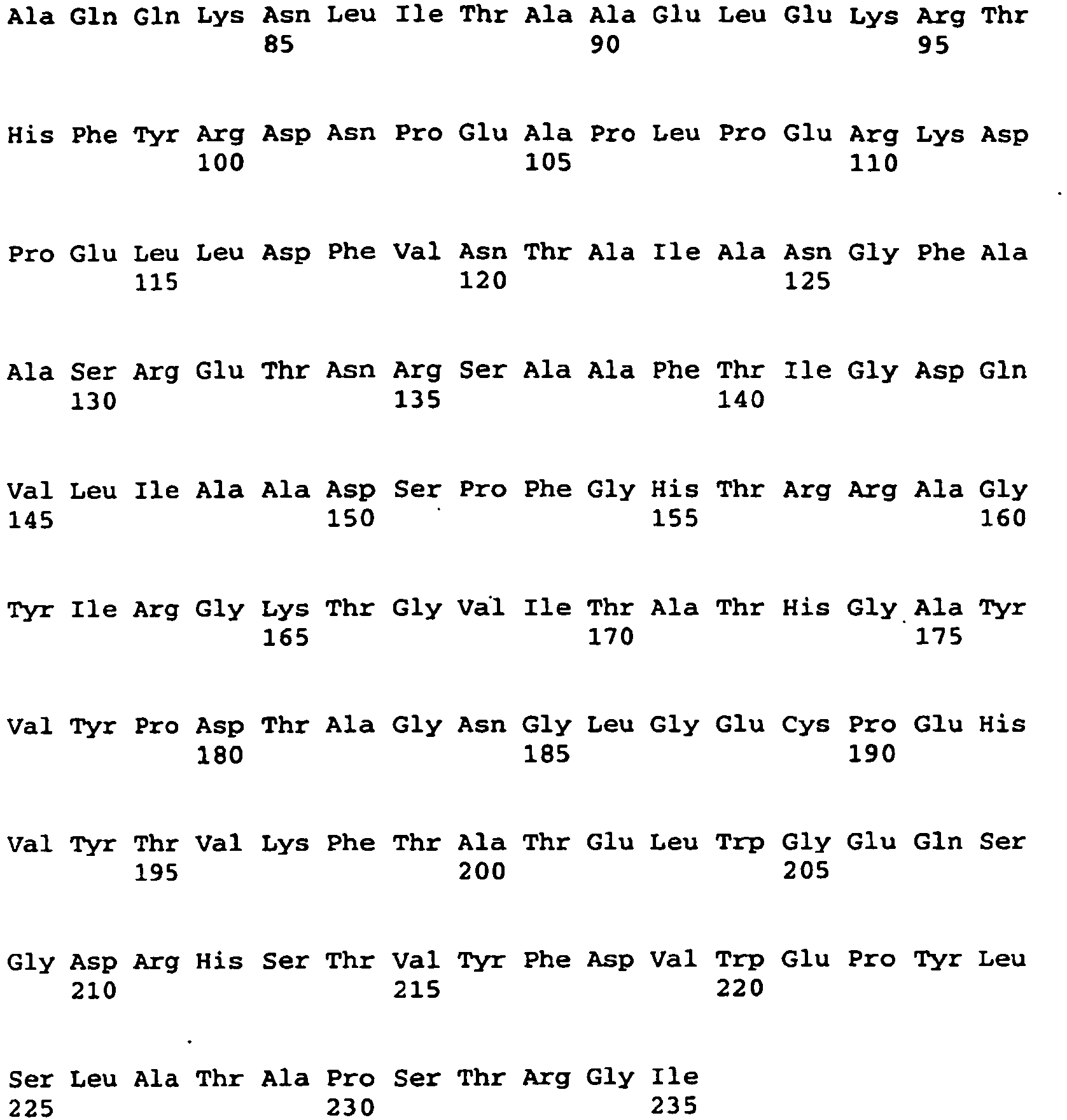
- <210> 3
<211> 205
<212> PRT
<213> Rhodococcus opacus - <400> 3


- <210> 4
<211> 356
<212> PRT
<213> Rhodococcus opacus - <400> 4


- <210> 5
<211> 3146
<212> DNA
<213> Rhodococcus opacus - <220>
<221> CDS
<222> (1324)..(1737)
<223> - <400> 5
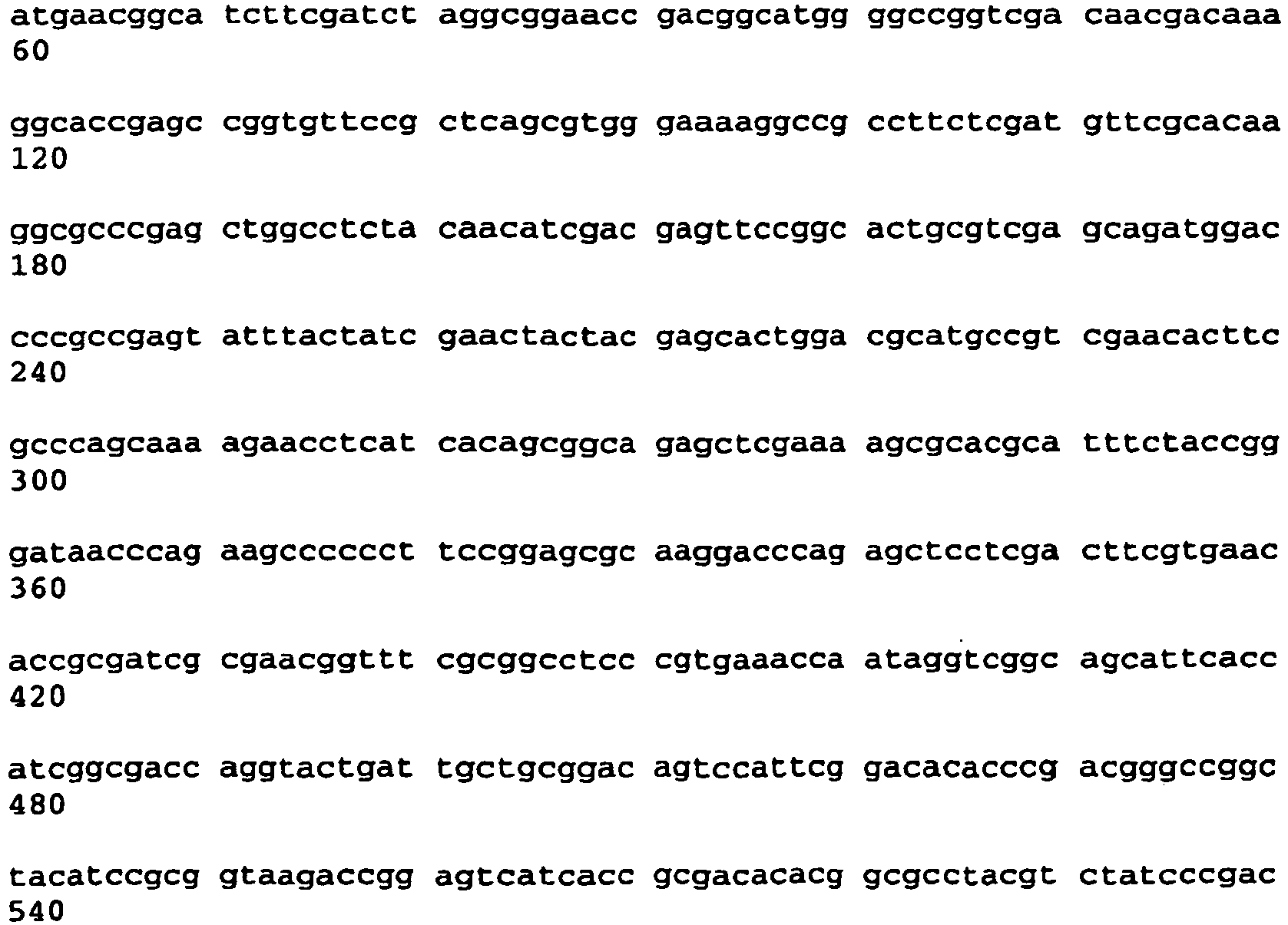


- <210> 6
<211> 137
<212> PRT
<213> Rhodococcus opacus - <400> 6


- <210> 7
<211> 17
<212> DNA
<213> Artificial - <220>
<223> Primer - <400> 7

- <210> 8
<211> 17
<212> DNA
<213> Artificial - <220>
<223> Primer - <400> 8

- <210> 9
<211> 19
<212> DNA
<213> Artificial - <220>
<223> Primer - <400> 9

- <210> 10
<211> 16
<212> DNA
<213> Artificial - <220>
<223> Primer - <400> 10

- <210> 11
<211> 16
<212> DNA
<213> Artificial - <220>
<223> Primer - <400> 11

- <210> 12
<211> 18
<212> DNA
<213> Artificial - <220>
<223> Primer - <400> 12

- <210> 13
<211> 15
<212> DNA
<213> Artificial - <220>
<223> Primer - <400> 13

- <210> 14
<211> 36
<212> DNA
<213> Artificial - <220>
<223> Primer - <400> 14

- <210> 15
<211> 36
<212> DNA
<213> Artificial - <220>
<223> Primer - <400> 15

- <210> 16
<211> 33
<212> DNA
<213> Artificial - <220>
<223> Primer - <400> 16

- <210> 17
<211> 33
<212> DNA
<213> Artificial - <220>
<223> Primer - <400> 17

- <210> 18
<211> 37
<212> DNA
<213> Artificial - <220>
<223> primer - <400> 18

- <210> 19
<211> 37
<212> DNA
<213> Artificial - <220>
<223> Primer - <400> 19

- <210> 20
<211> 36
<212> DNA
<213> Artificial - <220>
<223> Primer - <400> 20

- <210> 21
<211> 32
<212> DNA
<213> Artificial - <220>
<223> Primer - <400> 21

- <210> 22
<211> 36
<212> DNA
<213> Artificial - <220>
<223> Primer - <400> 22

- <210> 23
<211> 33
<212> DNA
<213> Artificial - <220>
<223> Primer - <400> 23

- <210> 24
<211> 6307
<212> DNA
<213> E. coli, Rhodococcus opacus - <400> 24


- <210> 25
<211> 6191
<212> DNA
<213> E. coli, Rhodococcus opacus - <400> 25


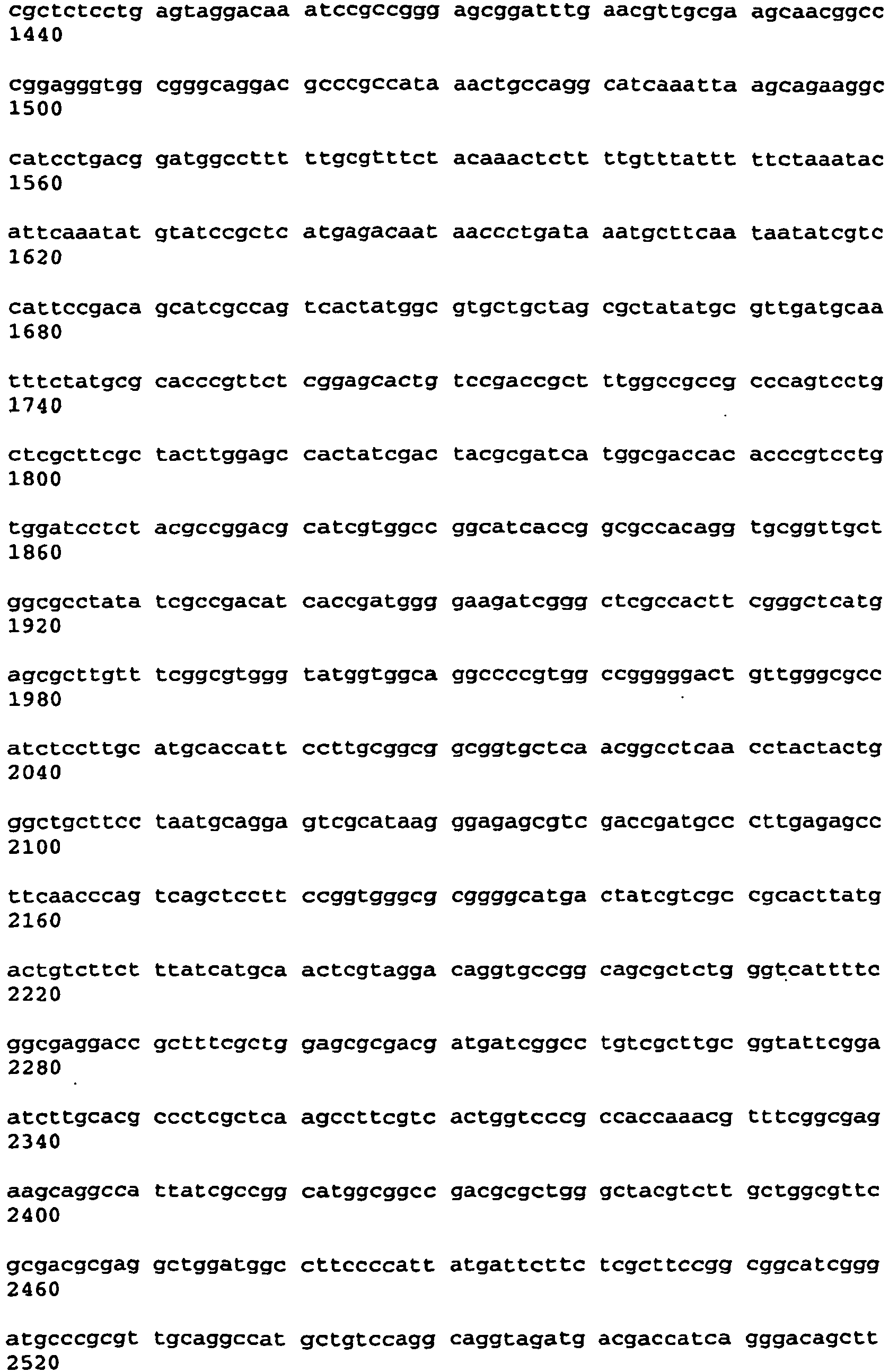
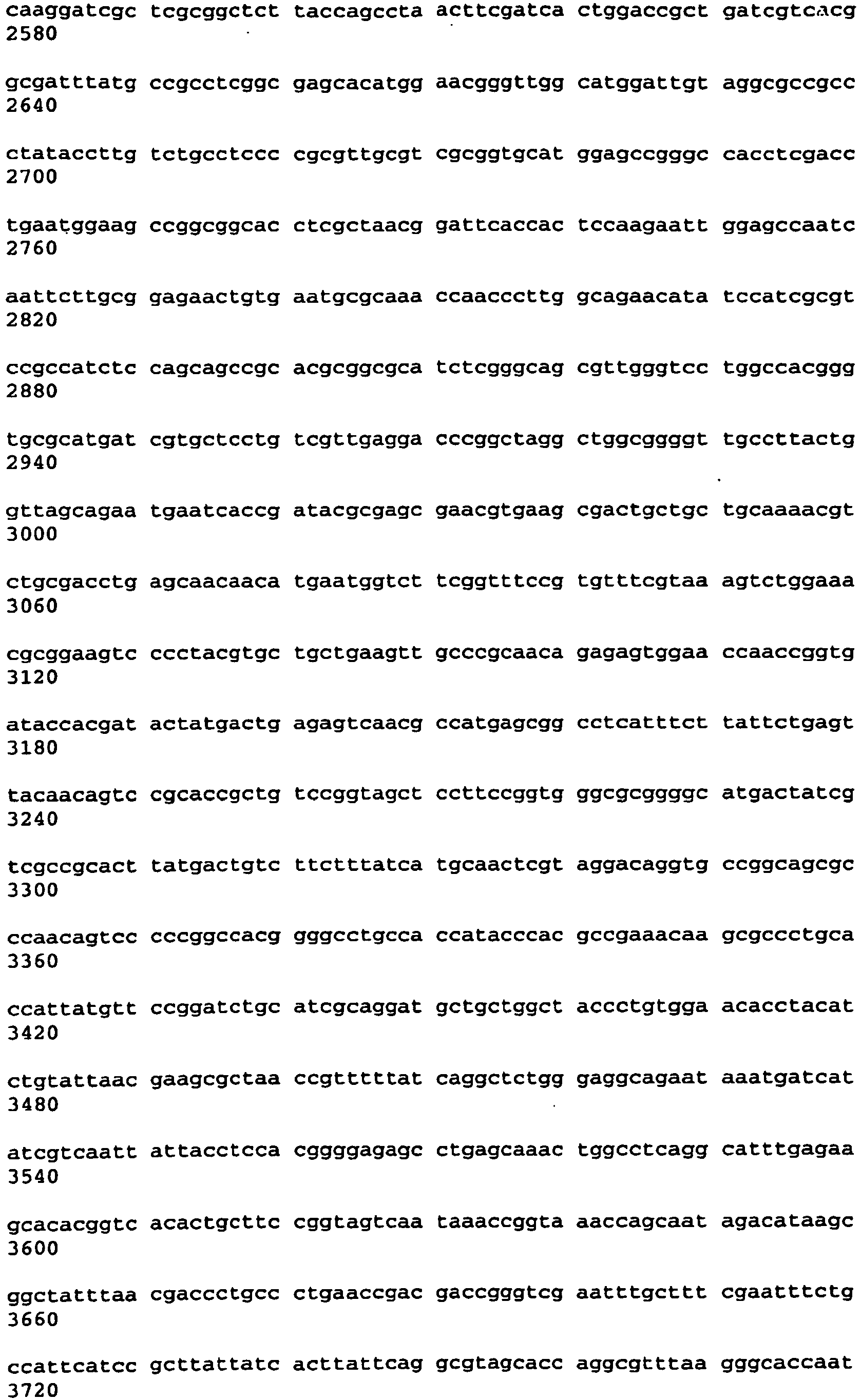


Claims (16)
- Isolierter Polynukleotidcluster aus Rhodococcus opacus, enthaltend vier Nukleotidsequenzen, die für vier Polypeptide mit Aminosäuresequenzen kodieren, die zu jeweils mindestens 90 % identisch sind mit dem in den Sequenzen SEQ ID NO:2 bis SEQ ID NO:4 und SEQ ID NO:6 enthaltenen Aminosäuresequenzen, wobei die Polypeptide die Aktivitäten einer Nitrilhydratase, bestehend aus α- und β-Untereinheit, des Hilfsproteins P15K und eines Kobalttransporters besitzen.
- Polynukleotide gemäss Anspruch 1, ausgewählt aus der Gruppe:a) Polynukleotid bestehend aus den Positionen 1 bis 708 der Nukleotidsequenz SEQ ID NO:1 oder der dazu komplementären Nukleotidsequenz,b) Polynukleotid mit einer Nukleotidsequenz, die der Sequenz aus a) im Bereich der Degeneriertheit des genetischen Codes entspricht,c) Polynukleotid, das mit den komplementären Sequenzen a) oder b) unter stringenten Bedingungen hybridisiert, wobei die stringenten Bedingungen das Waschen auf 0,1x SSC bei einer Temperatur von 50-68°C beinhalten undd) Polynukleotid mit einer Nukleotidsequenz aus a), b) oder c), die funktionsneutrale Sinnmutationen enthält,wobei die Polynukleotide für die β-Untereinheit der Nitrilhydratase kodieren.
- Polynukleotide gemäss Anspruch 1, ausgewählt aus der Gruppe:a) Polynukleotid bestehend aus den Positionen 710 bis 1327 der Nukleotidsequenz SEQ ID NO:1 oder der dazu komplementären Nukleotidsequenz,b) Polynukleotid mit einer Nukleotidsequenz, die der Sequenz aus a) im Bereich der Degeneriertheit des genetischen Codes entspricht,c) Polynukleotid, das mit den komplementären Sequenzen a) oder b) unter stringenten Bedingungen hybridisiert, wobei die stringenten Bedingungen das Waschen auf 0,1x SSC bei einer Temperatur von 50-68°C beinhalten undd) Polynukleotid mit einer Nukleotidsequenz aus a), b) oder c), die funktionsneutrale Sinnmutationen enthält,wobei die Polynukleotide für die α-Untereinheit der Nitrilhydratase kodieren.
wobei die Polynukleotide für das Helferprotein P15K kodieren. - Polypeptid gemäss Anspruch 1, enthaltend die Aminosäuresequenzen die zu mindestens 90 % identisch sind mit SEQ ID NO:2 und SEQ ID NO:3, wobei das Polypeptid die Aktivität einer Nitrilhydratase aufweist.
- Sonde oder Primer, enthaltend mindestens 20 aufeinanderfolgende Nukleotide innerhalb der Positionen 1 bis 1327 aus der Nukleotidsequenz SEQ ID NO:1 oder seiner komplementären Form.
- Isoliertes Polynukleotid gemäss Anspruch 2, das unter stringenten Bedingungen mit dem Komplement mit den Positionen 1 bis 708 aus SEQ ID NO:1 hybridisiert, wobei die stringenten Bedingungen das Waschen auf 0,1 x SSC bei einer Temperatur von 50 bis 68°C beinhalten.
- Isoliertes Polynukleotid gemäss Anspruch 3, das unter stringenten Bedingungen mit dem Komplement mit den Positionen 710 bis 1327 aus SEQ ID NO:1 hybridisiert, wobei die stringenten Bedingungen das Waschen auf 0,1 x SSC bei einer Temperatur von 50 bis 68°C beinhalten.
- Vektoren, enthaltend (ein) Polynukleotid(e) ausgewählt aus denen gemäss den Ansprüchen 1 bis 3 und 6 bis 7.
- Vektor pUD15, bestehend aus der Nukleotidsequenz SEQ ID No:24.
- Vektor pUD16, bestehend aus der Nukleotidsequenz SEQ ID NO:25.
- Wirtszelle, transformiert oder transfektiert durch die Einführung eines Polynukleotids gemäss Anspruch 1.
- Wirtszelle, transformiert durch die Einführung eines Vektors gemäss den Ansprüchen 8 bis 10.
- Transformierte Wirtszelle gemäß den Ansprüchen 11 oder 12 wobei die Wirtszelle ein Bakterium der Familie Enterobacteriaceae, insbesondere Escherichia ist.
- Verfahren zur Herstellung von Amiden aus Nitrilen mit Nitrilhydratasen des Ursprungs Rhodococcus oder dieses Enzym enthaltenden Mikroorganismen, bei dem mana) einen transformierten Mikroorganismus, der überexprimierte Gene mit den Nukleotidsequenzen ausgewählt aus den Ansprüchen 1 bis 3 und 6,7 enthält, in Gegenwart von 0,15 bis 4 mM Co2+, unter Bedingungen fermentiert, die zur Bildung der Nitrilhydratase führen,b) dieses Enzym im Mikroorganismus anreichern lässt, undc) dieses Enzym aus den Zellen isoliert, oderd) die Mikroorganismen erntet und als das Enzym enthaltende ruhende Zellen gewinnt, unde) das Enzym oder die enthaltenen Mikroorganismen mit Verbindungen der allgemeinen Formel

R"-CN (II)
in der bedeuten:X: OH, H, Alkyl mit 1 bis 4 C-Atomen, insbesondere NH2 ;R: H, gesättigter Alkylrest mit 1 bis 12 C-Atomen, verzweigt oder unverzweigt, gegebenenfalls NH2-substituiert,
Alkenylreste mit 1 bis 12 C-Atomen, verzweigt oder
unverzweigt, Cycloalkylgruppen mit 3 bis 6 C-Atomen,
mit Alkylthiogruppen substituierte Alkylenreste, wobei Alkyl hier einem C1 bis C3-Rest
und Alkylen einem zweiwertigen C3 bis C8-Rest entspricht,R': H, Alkyl mit 1 bis 3 C-Atomen,R": ein- oder zweikerniger ungesättigter Ring mit 6 bis 12 C-Atomen, gegebenenfalls mit einer oder zwei Alkylgruppen (C1 - C3), Cl, Br, F substituiert, einwertiger Alkylnitrilrest mit 1 bis 6 C-Atomen, zu den entsprechenden Amiden umsetzt. - Verfahren gemäss Anspruch 14, dadurch gekennzeichnet, dass man Wirtszellen gemäss den Ansprüchen 11 bis 13 einsetzt.
- Rekombinant erzeugte Nitrilhydratase gemaß Anspruch 14 mit dem Ursprung Rhodococcus opacus, die α-Aminonitrile mit einer spezifischen Aktivität von > 50 U/mg Biotrockenmasse umsetzt.
Applications Claiming Priority (2)
| Application Number | Priority Date | Filing Date | Title |
|---|---|---|---|
| DE200410013824 DE102004013824A1 (de) | 2004-03-20 | 2004-03-20 | Nitrilhydratasen aus Rhodococcus opacus |
| PCT/EP2005/002134 WO2005093080A2 (de) | 2004-03-20 | 2005-03-01 | Nitrilhydratase aus rhodococcus |
Publications (2)
| Publication Number | Publication Date |
|---|---|
| EP1730291A2 EP1730291A2 (de) | 2006-12-13 |
| EP1730291B1 true EP1730291B1 (de) | 2012-12-05 |
Family
ID=34961837
Family Applications (1)
| Application Number | Title | Priority Date | Filing Date |
|---|---|---|---|
| EP05715626A Expired - Lifetime EP1730291B1 (de) | 2004-03-20 | 2005-03-01 | Nitrilhydratase aus rhodococcus |
Country Status (9)
| Country | Link |
|---|---|
| US (2) | US7288402B2 (de) |
| EP (1) | EP1730291B1 (de) |
| JP (1) | JP5080240B2 (de) |
| CN (1) | CN1930299B (de) |
| BR (1) | BRPI0509023A (de) |
| DE (1) | DE102004013824A1 (de) |
| ES (1) | ES2400360T3 (de) |
| RU (1) | RU2385932C2 (de) |
| WO (1) | WO2005093080A2 (de) |
Families Citing this family (25)
| Publication number | Priority date | Publication date | Assignee | Title |
|---|---|---|---|---|
| DE10301007A1 (de) | 2003-01-13 | 2004-07-22 | Röhm GmbH & Co. KG | Verbessertes Verfahren zur kontinuierlichen Herstellung von Alkyl(meth)acrylaten mit mehrfacher Katalysatorrezyklierung. |
| DE102005023976A1 (de) * | 2005-05-20 | 2006-11-23 | Röhm Gmbh | Verfahren zur Umesterung |
| DE102005023975A1 (de) * | 2005-05-20 | 2006-11-23 | Röhm Gmbh | Verfahren zur Herstellung von Alkyl(meth)acrylaten |
| DE102005043719A1 (de) * | 2005-09-13 | 2007-03-15 | Röhm Gmbh | Vorrichtung und Verfahren für kontinuierlich durchgeführte Gleichgewichtsreaktionen |
| DE102006010254B4 (de) * | 2006-03-02 | 2008-09-04 | Evonik Degussa Gmbh | Enzymkatalysierte Hydrolyse von optisch aktivem 2-Hydroxy-4-(methylthio)buttersäurenitril |
| EP1842907A1 (de) | 2006-04-07 | 2007-10-10 | B.R.A.I.N. Ag | Eine Gruppe neuer enantioselectiver mikrobieller Nitrilhydratasen mit breiter Substratspezifität |
| JP5517610B2 (ja) * | 2006-05-15 | 2014-06-11 | エボニック レーム ゲゼルシャフト ミット ベシュレンクテル ハフツング | α−ヒドロキシカルボン酸エステルの製造法 |
| DE102006025821A1 (de) * | 2006-06-02 | 2007-12-06 | Degussa Gmbh | Ein Enzym zur Herstellung von Mehylmalonatsemialdehyd oder Malonatsemialdehyd |
| DE102006029320B3 (de) * | 2006-06-23 | 2007-10-11 | Röhm Gmbh | Verfahren zur kontinuierlichen Herstellung von ungesättigten Carbonsäureanhydriden |
| DE102006029319A1 (de) * | 2006-06-23 | 2007-12-27 | Röhm Gmbh | Verfahren zur Aufreinigung von polymerisierbaren Verbindungen |
| DE102006034273A1 (de) * | 2006-07-21 | 2008-01-24 | Röhm Gmbh | Verfahren zur Herstellung von Alpha-Hydroxycarbonsäuren |
| DE102006055430A1 (de) | 2006-11-22 | 2008-05-29 | Evonik Röhm Gmbh | Verfahren zur Herstellung von Carbonsäureamiden durch Hydrolyse von Carbonsäurenitrilen in Gegenwart eines Mangandioxid umfassenden Katalysators |
| DE102006055428A1 (de) | 2006-11-22 | 2008-05-29 | Evonik Röhm Gmbh | Verfahren zur Herstellung von (Meth)acrylsäure |
| DE102006055427A1 (de) | 2006-11-22 | 2008-05-29 | Evonik Röhm Gmbh | Verfahren zur Herstellung von Tetramethylglycolid |
| DE102006055426A1 (de) * | 2006-11-22 | 2008-05-29 | Evonik Röhm Gmbh | Verfahren zur Herstellung von Alkyl(meth)acrylaten unter Verwendung einer enzymatischen Cyanhydrinhydrolyse |
| EP2130925A4 (de) * | 2007-02-28 | 2011-06-01 | Mitsubishi Gas Chemical Co | Verfahren zur herstellung optisch aktiver aminosäure |
| US7943549B2 (en) * | 2007-04-02 | 2011-05-17 | Georgia State University Research Foundation, Inc. | Biological-based catalyst to delay plant development processes |
| WO2010147642A1 (en) | 2009-06-15 | 2010-12-23 | Massachusetts Institute Of Technology | Production of triacylglycerides, fatty acids, and their derivatives |
| CN103649312B (zh) | 2011-05-31 | 2017-03-22 | 三菱丽阳株式会社 | 改良型腈水合酶 |
| CN102517271B (zh) * | 2011-12-13 | 2013-04-03 | 清华大学 | 一种突变腈水合酶 |
| RU2520870C1 (ru) | 2012-12-27 | 2014-06-27 | Кемира Оюй | Штамм бактерий rhodococcus aetherivorans bkm ac-2610d - продуцент нитрилгидратазы, способ его культивирования и способ получения акриламида |
| RU2562822C2 (ru) * | 2014-01-09 | 2015-09-10 | Общество с ограниченной ответственностью "Спектралазер" | Газотурбинный авиационный двигатель и способ его форсирования |
| CN107177581B (zh) * | 2017-06-16 | 2020-04-28 | 清华大学 | 一种改造腈水合酶及其应用 |
| EP4105335A1 (de) | 2021-06-16 | 2022-12-21 | Evonik Operations GmbH | Enzymatisches verfahren zur herstellung von l-glufosinat-p-alkylestern |
| EP4493709A1 (de) | 2022-03-14 | 2025-01-22 | Evonik Operations GmbH | Enzymatisches verfahren zur herstellung von l-glufosinat p-estern |
Family Cites Families (11)
| Publication number | Priority date | Publication date | Assignee | Title |
|---|---|---|---|---|
| CZ280901B6 (cs) | 1988-10-06 | 1996-05-15 | Hideaki Yamada | Způsob kultivace bakterií |
| JP2907479B2 (ja) * | 1990-02-28 | 1999-06-21 | 輝彦 別府 | ニトリルヒドラターゼ活性を有するポリペプチドをコードする遺伝子dna、これを含有する形質転換体及びアミド類の製造法 |
| US5789211A (en) * | 1991-05-02 | 1998-08-04 | Nitto Chemical Industry Co., Ltd. | Gene encoding a polypeptide having nitrile hydratase activity, a transformant containing the gene and a process for the production of amides using the transformant |
| JPH05284982A (ja) | 1992-04-08 | 1993-11-02 | Japan Energy Corp | 微生物によるラセミ化2−アミノニトリルの製造法 |
| DE69739026D1 (de) * | 1996-02-14 | 2008-11-20 | Mitsui Chemicals Inc | Nitril-Hydratase, ihre Derivate und Verfahren zur Herstellung von Verbindungen |
| US5866379A (en) | 1997-01-28 | 1999-02-02 | Novus International | Enzymatic conversion of α-hydroxynitriles to the corresponding .alpha. |
| JP4185607B2 (ja) * | 1998-12-15 | 2008-11-26 | ダイセル化学工業株式会社 | 新規な微生物及びアミド化合物の製造方法 |
| WO2001060789A1 (en) | 2000-02-15 | 2001-08-23 | Rhone-Poulenc Animal Nutrition | Process for the production of methionine |
| MX268424B (es) | 2001-01-09 | 2009-07-17 | Lonza Ag | Procedimiento microbiologico para la produccion de amidas. |
| JP2002325587A (ja) * | 2001-03-02 | 2002-11-12 | Daicel Chem Ind Ltd | ニトリルヒドラターゼ、およびアミドの製造方法 |
| DE10155928A1 (de) | 2001-11-15 | 2003-06-12 | Degussa | recA-negativer und rhaB-negativer Mikroorganismus |
-
2004
- 2004-03-20 DE DE200410013824 patent/DE102004013824A1/de not_active Withdrawn
-
2005
- 2005-03-01 JP JP2007504280A patent/JP5080240B2/ja not_active Expired - Fee Related
- 2005-03-01 EP EP05715626A patent/EP1730291B1/de not_active Expired - Lifetime
- 2005-03-01 BR BRPI0509023-7A patent/BRPI0509023A/pt not_active Application Discontinuation
- 2005-03-01 ES ES05715626T patent/ES2400360T3/es not_active Expired - Lifetime
- 2005-03-01 CN CN2005800082068A patent/CN1930299B/zh not_active Expired - Fee Related
- 2005-03-01 RU RU2006137033A patent/RU2385932C2/ru not_active IP Right Cessation
- 2005-03-01 WO PCT/EP2005/002134 patent/WO2005093080A2/de not_active Ceased
- 2005-03-18 US US11/083,327 patent/US7288402B2/en not_active Expired - Fee Related
-
2007
- 2007-08-20 US US11/892,085 patent/US7491521B2/en not_active Expired - Fee Related
Also Published As
| Publication number | Publication date |
|---|---|
| EP1730291A2 (de) | 2006-12-13 |
| WO2005093080A3 (de) | 2006-04-27 |
| CN1930299B (zh) | 2011-04-06 |
| US7288402B2 (en) | 2007-10-30 |
| BRPI0509023A (pt) | 2007-08-07 |
| CN1930299A (zh) | 2007-03-14 |
| RU2385932C2 (ru) | 2010-04-10 |
| US7491521B2 (en) | 2009-02-17 |
| RU2006137033A (ru) | 2008-04-27 |
| US20080057549A1 (en) | 2008-03-06 |
| US20060068467A1 (en) | 2006-03-30 |
| DE102004013824A1 (de) | 2005-10-13 |
| JP5080240B2 (ja) | 2012-11-21 |
| ES2400360T3 (es) | 2013-04-09 |
| JP2007529231A (ja) | 2007-10-25 |
| WO2005093080A2 (de) | 2005-10-06 |
Similar Documents
| Publication | Publication Date | Title |
|---|---|---|
| DE102004013824A1 (de) | Nitrilhydratasen aus Rhodococcus opacus | |
| EP1730177B1 (de) | Cyanidtolerante nitrilhydratasen | |
| DE10162387A1 (de) | Für das rpoB-Gen kodierende Nukleotidsequenzen | |
| DE10044681A1 (de) | Neue für das lldD2-Gen kodierende Nukleotidsequenzen | |
| DE102005019967A1 (de) | Verfahren zur fermentativen Herstellung von L-Aminosäuren | |
| DE60127425T3 (de) | Für das ppsa-gen kodierende nukleotidsequenzen | |
| DE10045496A1 (de) | Neue für das ptsi-Gen kodierende Nukleotidsequenzen | |
| DE10063314A1 (de) | Neue für das ilvE-Gen kodierende Nukleotidsequenzen | |
| DE10047865A1 (de) | Neue für das deaD-Gen kodierende Nukleotidsequenzen | |
| DE10046623A1 (de) | Neue für das dps-Gen kodierende Nukleotidsequenzen | |
| DE10045487A1 (de) | Neue für das ccsB-Gen kodierende Nukleotidsequenzen | |
| DE60131538T2 (de) | Alanine-racemase (alr) aus corynebacterium glutamicum | |
| DE10047403A1 (de) | Neue für das ppgK-Gen kodierende Nukleotidsequenzen | |
| DE10043331A1 (de) | Neue für das sigD-Gen kodierende Nukleotidsequenzen | |
| DE10045579A1 (de) | Neue für das atr61-Gen kodierende Nukleotidsequenzen | |
| DE10047864A1 (de) | Neue für das truB-Gen kodierende Nukleotidsequenzen | |
| DE10047404A1 (de) | Neue für das msik-Gen kodierende Nukleotidsequenzen | |
| DE10057801A1 (de) | Neue für das cysQ-Gen kodierende Nukleotidsequenzen | |
| DE10046625A1 (de) | Neue für das ndkA-Gen kodierende Nukleotidsequenzen | |
| DE19947792A1 (de) | Neue für das Irp Gen codierende Nukleotidsequenzen | |
| DE10037612A1 (de) | Neue für das rpi-Gen kodierende Nukleotidsequenzen | |
| DE10037611A1 (de) | Neue für das rpe-Gen kodierende Nuleotidsequenzen | |
| DE10011922A1 (de) | Neue für das pfkA-Gen codierende Nukleotidsequenzen | |
| DE10140095A1 (de) | Für das tmk-Gen kodierende Nukleotidsequenzen | |
| DE10133668A1 (de) | Für das gpmB-Gen kodierende Nukleotidsequenzen |
Legal Events
| Date | Code | Title | Description |
|---|---|---|---|
| PUAI | Public reference made under article 153(3) epc to a published international application that has entered the european phase |
Free format text: ORIGINAL CODE: 0009012 |
|
| 17P | Request for examination filed |
Effective date: 20060719 |
|
| AK | Designated contracting states |
Kind code of ref document: A2 Designated state(s): AT BE BG CH CY CZ DE DK EE ES FI FR GB GR HU IE IS IT LI LT LU MC NL PL PT RO SE SI SK TR |
|
| RIN1 | Information on inventor provided before grant (corrected) |
Inventor name: KULA, MARIA-REGINA Inventor name: BINDER, MICHAEL Inventor name: OSSWALD, STEFFEN Inventor name: VERSECK, STEFAN Inventor name: HUTHMACHER, KLAUS Inventor name: DEITING, UTA Inventor name: ODENDAHL, KONRAD Inventor name: WECKBECKER, CHRISTOPH |
|
| DAX | Request for extension of the european patent (deleted) | ||
| RAP1 | Party data changed (applicant data changed or rights of an application transferred) |
Owner name: EVONIK DEGUSSA GMBH |
|
| 17Q | First examination report despatched |
Effective date: 20080508 |
|
| RAP1 | Party data changed (applicant data changed or rights of an application transferred) |
Owner name: EVONIK DEGUSSA GMBH |
|
| GRAP | Despatch of communication of intention to grant a patent |
Free format text: ORIGINAL CODE: EPIDOSNIGR1 |
|
| GRAS | Grant fee paid |
Free format text: ORIGINAL CODE: EPIDOSNIGR3 |
|
| GRAA | (expected) grant |
Free format text: ORIGINAL CODE: 0009210 |
|
| AK | Designated contracting states |
Kind code of ref document: B1 Designated state(s): AT BE BG CH CY CZ DE DK EE ES FI FR GB GR HU IE IS IT LI LT LU MC NL PL PT RO SE SI SK TR |
|
| REG | Reference to a national code |
Ref country code: GB Ref legal event code: FG4D Free format text: NOT ENGLISH |
|
| REG | Reference to a national code |
Ref country code: CH Ref legal event code: EP |
|
| REG | Reference to a national code |
Ref country code: AT Ref legal event code: REF Ref document number: 587324 Country of ref document: AT Kind code of ref document: T Effective date: 20121215 |
|
| REG | Reference to a national code |
Ref country code: IE Ref legal event code: FG4D Free format text: LANGUAGE OF EP DOCUMENT: GERMAN |
|
| REG | Reference to a national code |
Ref country code: DE Ref legal event code: R096 Ref document number: 502005013312 Country of ref document: DE Effective date: 20130131 |
|
| REG | Reference to a national code |
Ref country code: ES Ref legal event code: FG2A Ref document number: 2400360 Country of ref document: ES Kind code of ref document: T3 Effective date: 20130409 |
|
| PG25 | Lapsed in a contracting state [announced via postgrant information from national office to epo] |
Ref country code: FI Free format text: LAPSE BECAUSE OF FAILURE TO SUBMIT A TRANSLATION OF THE DESCRIPTION OR TO PAY THE FEE WITHIN THE PRESCRIBED TIME-LIMIT Effective date: 20121205 Ref country code: SE Free format text: LAPSE BECAUSE OF FAILURE TO SUBMIT A TRANSLATION OF THE DESCRIPTION OR TO PAY THE FEE WITHIN THE PRESCRIBED TIME-LIMIT Effective date: 20121205 Ref country code: LT Free format text: LAPSE BECAUSE OF FAILURE TO SUBMIT A TRANSLATION OF THE DESCRIPTION OR TO PAY THE FEE WITHIN THE PRESCRIBED TIME-LIMIT Effective date: 20121205 |
|
| REG | Reference to a national code |
Ref country code: NL Ref legal event code: VDEP Effective date: 20121205 |
|
| REG | Reference to a national code |
Ref country code: LT Ref legal event code: MG4D |
|
| PG25 | Lapsed in a contracting state [announced via postgrant information from national office to epo] |
Ref country code: SI Free format text: LAPSE BECAUSE OF FAILURE TO SUBMIT A TRANSLATION OF THE DESCRIPTION OR TO PAY THE FEE WITHIN THE PRESCRIBED TIME-LIMIT Effective date: 20121205 Ref country code: PL Free format text: LAPSE BECAUSE OF FAILURE TO SUBMIT A TRANSLATION OF THE DESCRIPTION OR TO PAY THE FEE WITHIN THE PRESCRIBED TIME-LIMIT Effective date: 20121205 Ref country code: CY Free format text: LAPSE BECAUSE OF FAILURE TO SUBMIT A TRANSLATION OF THE DESCRIPTION OR TO PAY THE FEE WITHIN THE PRESCRIBED TIME-LIMIT Effective date: 20121205 Ref country code: GR Free format text: LAPSE BECAUSE OF FAILURE TO SUBMIT A TRANSLATION OF THE DESCRIPTION OR TO PAY THE FEE WITHIN THE PRESCRIBED TIME-LIMIT Effective date: 20130306 |
|
| PG25 | Lapsed in a contracting state [announced via postgrant information from national office to epo] |
Ref country code: CZ Free format text: LAPSE BECAUSE OF FAILURE TO SUBMIT A TRANSLATION OF THE DESCRIPTION OR TO PAY THE FEE WITHIN THE PRESCRIBED TIME-LIMIT Effective date: 20121205 Ref country code: EE Free format text: LAPSE BECAUSE OF FAILURE TO SUBMIT A TRANSLATION OF THE DESCRIPTION OR TO PAY THE FEE WITHIN THE PRESCRIBED TIME-LIMIT Effective date: 20121205 Ref country code: BG Free format text: LAPSE BECAUSE OF FAILURE TO SUBMIT A TRANSLATION OF THE DESCRIPTION OR TO PAY THE FEE WITHIN THE PRESCRIBED TIME-LIMIT Effective date: 20130305 Ref country code: IS Free format text: LAPSE BECAUSE OF FAILURE TO SUBMIT A TRANSLATION OF THE DESCRIPTION OR TO PAY THE FEE WITHIN THE PRESCRIBED TIME-LIMIT Effective date: 20130405 Ref country code: SK Free format text: LAPSE BECAUSE OF FAILURE TO SUBMIT A TRANSLATION OF THE DESCRIPTION OR TO PAY THE FEE WITHIN THE PRESCRIBED TIME-LIMIT Effective date: 20121205 |
|
| PG25 | Lapsed in a contracting state [announced via postgrant information from national office to epo] |
Ref country code: NL Free format text: LAPSE BECAUSE OF FAILURE TO SUBMIT A TRANSLATION OF THE DESCRIPTION OR TO PAY THE FEE WITHIN THE PRESCRIBED TIME-LIMIT Effective date: 20121205 Ref country code: PT Free format text: LAPSE BECAUSE OF FAILURE TO SUBMIT A TRANSLATION OF THE DESCRIPTION OR TO PAY THE FEE WITHIN THE PRESCRIBED TIME-LIMIT Effective date: 20130405 Ref country code: RO Free format text: LAPSE BECAUSE OF FAILURE TO SUBMIT A TRANSLATION OF THE DESCRIPTION OR TO PAY THE FEE WITHIN THE PRESCRIBED TIME-LIMIT Effective date: 20121205 |
|
| PLBE | No opposition filed within time limit |
Free format text: ORIGINAL CODE: 0009261 |
|
| STAA | Information on the status of an ep patent application or granted ep patent |
Free format text: STATUS: NO OPPOSITION FILED WITHIN TIME LIMIT |
|
| PG25 | Lapsed in a contracting state [announced via postgrant information from national office to epo] |
Ref country code: MC Free format text: LAPSE BECAUSE OF NON-PAYMENT OF DUE FEES Effective date: 20130331 Ref country code: DK Free format text: LAPSE BECAUSE OF FAILURE TO SUBMIT A TRANSLATION OF THE DESCRIPTION OR TO PAY THE FEE WITHIN THE PRESCRIBED TIME-LIMIT Effective date: 20121205 |
|
| REG | Reference to a national code |
Ref country code: CH Ref legal event code: PL |
|
| 26N | No opposition filed |
Effective date: 20130906 |
|
| GBPC | Gb: european patent ceased through non-payment of renewal fee |
Effective date: 20130305 |
|
| PG25 | Lapsed in a contracting state [announced via postgrant information from national office to epo] |
Ref country code: IT Free format text: LAPSE BECAUSE OF FAILURE TO SUBMIT A TRANSLATION OF THE DESCRIPTION OR TO PAY THE FEE WITHIN THE PRESCRIBED TIME-LIMIT Effective date: 20121205 |
|
| REG | Reference to a national code |
Ref country code: IE Ref legal event code: MM4A |
|
| REG | Reference to a national code |
Ref country code: DE Ref legal event code: R097 Ref document number: 502005013312 Country of ref document: DE Effective date: 20130906 |
|
| PG25 | Lapsed in a contracting state [announced via postgrant information from national office to epo] |
Ref country code: IE Free format text: LAPSE BECAUSE OF NON-PAYMENT OF DUE FEES Effective date: 20130301 Ref country code: LI Free format text: LAPSE BECAUSE OF NON-PAYMENT OF DUE FEES Effective date: 20130331 Ref country code: CH Free format text: LAPSE BECAUSE OF NON-PAYMENT OF DUE FEES Effective date: 20130331 Ref country code: GB Free format text: LAPSE BECAUSE OF NON-PAYMENT OF DUE FEES Effective date: 20130305 |
|
| REG | Reference to a national code |
Ref country code: AT Ref legal event code: MM01 Ref document number: 587324 Country of ref document: AT Kind code of ref document: T Effective date: 20130301 |
|
| PG25 | Lapsed in a contracting state [announced via postgrant information from national office to epo] |
Ref country code: AT Free format text: LAPSE BECAUSE OF NON-PAYMENT OF DUE FEES Effective date: 20130301 |
|
| PG25 | Lapsed in a contracting state [announced via postgrant information from national office to epo] |
Ref country code: TR Free format text: LAPSE BECAUSE OF FAILURE TO SUBMIT A TRANSLATION OF THE DESCRIPTION OR TO PAY THE FEE WITHIN THE PRESCRIBED TIME-LIMIT Effective date: 20121205 |
|
| PG25 | Lapsed in a contracting state [announced via postgrant information from national office to epo] |
Ref country code: HU Free format text: LAPSE BECAUSE OF FAILURE TO SUBMIT A TRANSLATION OF THE DESCRIPTION OR TO PAY THE FEE WITHIN THE PRESCRIBED TIME-LIMIT; INVALID AB INITIO Effective date: 20050301 Ref country code: LU Free format text: LAPSE BECAUSE OF NON-PAYMENT OF DUE FEES Effective date: 20130301 |
|
| REG | Reference to a national code |
Ref country code: FR Ref legal event code: PLFP Year of fee payment: 12 |
|
| PGFP | Annual fee paid to national office [announced via postgrant information from national office to epo] |
Ref country code: ES Payment date: 20160309 Year of fee payment: 12 Ref country code: DE Payment date: 20160321 Year of fee payment: 12 |
|
| PGFP | Annual fee paid to national office [announced via postgrant information from national office to epo] |
Ref country code: FR Payment date: 20160321 Year of fee payment: 12 Ref country code: BE Payment date: 20160321 Year of fee payment: 12 |
|
| REG | Reference to a national code |
Ref country code: DE Ref legal event code: R119 Ref document number: 502005013312 Country of ref document: DE |
|
| REG | Reference to a national code |
Ref country code: FR Ref legal event code: ST Effective date: 20171130 |
|
| PG25 | Lapsed in a contracting state [announced via postgrant information from national office to epo] |
Ref country code: DE Free format text: LAPSE BECAUSE OF NON-PAYMENT OF DUE FEES Effective date: 20171003 Ref country code: FR Free format text: LAPSE BECAUSE OF NON-PAYMENT OF DUE FEES Effective date: 20170331 |
|
| REG | Reference to a national code |
Ref country code: BE Ref legal event code: MM Effective date: 20170331 |
|
| PG25 | Lapsed in a contracting state [announced via postgrant information from national office to epo] |
Ref country code: BE Free format text: LAPSE BECAUSE OF NON-PAYMENT OF DUE FEES Effective date: 20170331 |
|
| REG | Reference to a national code |
Ref country code: ES Ref legal event code: FD2A Effective date: 20180705 |
|
| PG25 | Lapsed in a contracting state [announced via postgrant information from national office to epo] |
Ref country code: ES Free format text: LAPSE BECAUSE OF NON-PAYMENT OF DUE FEES Effective date: 20170302 |