EP1664257B1 - Maschinelle geschirrspülmittel mit spezieller polymermischung - Google Patents
Maschinelle geschirrspülmittel mit spezieller polymermischung Download PDFInfo
- Publication number
- EP1664257B1 EP1664257B1 EP04764845A EP04764845A EP1664257B1 EP 1664257 B1 EP1664257 B1 EP 1664257B1 EP 04764845 A EP04764845 A EP 04764845A EP 04764845 A EP04764845 A EP 04764845A EP 1664257 B1 EP1664257 B1 EP 1664257B1
- Authority
- EP
- European Patent Office
- Prior art keywords
- acid
- oil
- preferred
- polymer
- weight
- Prior art date
- Legal status (The legal status is an assumption and is not a legal conclusion. Google has not performed a legal analysis and makes no representation as to the accuracy of the status listed.)
- Revoked
Links
- 239000003599 detergent Substances 0.000 title claims abstract description 57
- 229920002959 polymer blend Polymers 0.000 title description 2
- 229920000642 polymer Polymers 0.000 claims abstract description 50
- 239000000178 monomer Substances 0.000 claims abstract description 48
- 239000003795 chemical substances by application Substances 0.000 claims abstract description 28
- XLYOFNOQVPJJNP-UHFFFAOYSA-N water Chemical compound O XLYOFNOQVPJJNP-UHFFFAOYSA-N 0.000 claims abstract description 27
- 125000002091 cationic group Chemical group 0.000 claims abstract description 13
- NINIDFKCEFEMDL-UHFFFAOYSA-N Sulfur Chemical compound [S] NINIDFKCEFEMDL-UHFFFAOYSA-N 0.000 claims abstract description 12
- 229920006318 anionic polymer Polymers 0.000 claims abstract description 7
- 239000012153 distilled water Substances 0.000 claims abstract description 3
- 239000002736 nonionic surfactant Substances 0.000 claims description 57
- 150000001735 carboxylic acids Chemical class 0.000 claims description 15
- 125000000542 sulfonic acid group Chemical group 0.000 claims description 13
- 238000000034 method Methods 0.000 claims description 6
- 229920006317 cationic polymer Polymers 0.000 claims description 4
- 239000005864 Sulphur Substances 0.000 claims 6
- 238000004851 dishwashing Methods 0.000 abstract description 34
- 229910052717 sulfur Inorganic materials 0.000 abstract description 6
- 239000011593 sulfur Substances 0.000 abstract description 6
- -1 polysiloxanes Polymers 0.000 description 91
- 239000000203 mixture Substances 0.000 description 69
- 125000004432 carbon atom Chemical group C* 0.000 description 51
- IAYPIBMASNFSPL-UHFFFAOYSA-N Ethylene oxide Chemical compound C1CO1 IAYPIBMASNFSPL-UHFFFAOYSA-N 0.000 description 50
- 239000002253 acid Substances 0.000 description 47
- 239000003921 oil Substances 0.000 description 37
- 235000019198 oils Nutrition 0.000 description 37
- 229920001577 copolymer Polymers 0.000 description 35
- 150000003839 salts Chemical class 0.000 description 33
- 239000003205 fragrance Substances 0.000 description 27
- 239000011734 sodium Substances 0.000 description 26
- 150000007513 acids Chemical class 0.000 description 24
- 239000004094 surface-active agent Substances 0.000 description 20
- 150000001298 alcohols Chemical class 0.000 description 19
- 150000001875 compounds Chemical class 0.000 description 19
- 229920006395 saturated elastomer Polymers 0.000 description 19
- 239000000126 substance Substances 0.000 description 19
- 235000014113 dietary fatty acids Nutrition 0.000 description 18
- 229930195729 fatty acid Natural products 0.000 description 18
- 239000000194 fatty acid Substances 0.000 description 18
- 150000002191 fatty alcohols Chemical class 0.000 description 18
- 125000006850 spacer group Chemical group 0.000 description 18
- LFQSCWFLJHTTHZ-UHFFFAOYSA-N Ethanol Chemical compound CCO LFQSCWFLJHTTHZ-UHFFFAOYSA-N 0.000 description 17
- 239000007844 bleaching agent Substances 0.000 description 17
- 235000019832 sodium triphosphate Nutrition 0.000 description 17
- 150000003751 zinc Chemical class 0.000 description 17
- NIXOWILDQLNWCW-UHFFFAOYSA-N 2-Propenoic acid Natural products OC(=O)C=C NIXOWILDQLNWCW-UHFFFAOYSA-N 0.000 description 16
- 102000004190 Enzymes Human genes 0.000 description 16
- 108090000790 Enzymes Proteins 0.000 description 16
- DGAQECJNVWCQMB-PUAWFVPOSA-M Ilexoside XXIX Chemical compound C[C@@H]1CC[C@@]2(CC[C@@]3(C(=CC[C@H]4[C@]3(CC[C@@H]5[C@@]4(CC[C@@H](C5(C)C)OS(=O)(=O)[O-])C)C)[C@@H]2[C@]1(C)O)C)C(=O)O[C@H]6[C@@H]([C@H]([C@@H]([C@H](O6)CO)O)O)O.[Na+] DGAQECJNVWCQMB-PUAWFVPOSA-M 0.000 description 16
- CDBYLPFSWZWCQE-UHFFFAOYSA-L Sodium Carbonate Chemical compound [Na+].[Na+].[O-]C([O-])=O CDBYLPFSWZWCQE-UHFFFAOYSA-L 0.000 description 16
- 229940088598 enzyme Drugs 0.000 description 16
- 238000002844 melting Methods 0.000 description 16
- 230000008018 melting Effects 0.000 description 15
- SMZOUWXMTYCWNB-UHFFFAOYSA-N 2-(2-methoxy-5-methylphenyl)ethanamine Chemical compound COC1=CC=C(C)C=C1CCN SMZOUWXMTYCWNB-UHFFFAOYSA-N 0.000 description 14
- NLXLAEXVIDQMFP-UHFFFAOYSA-N Ammonia chloride Chemical compound [NH4+].[Cl-] NLXLAEXVIDQMFP-UHFFFAOYSA-N 0.000 description 14
- 229930195733 hydrocarbon Natural products 0.000 description 14
- 229910052708 sodium Inorganic materials 0.000 description 14
- 239000004215 Carbon black (E152) Substances 0.000 description 13
- 125000000217 alkyl group Chemical group 0.000 description 13
- 239000003086 colorant Substances 0.000 description 13
- 239000011572 manganese Substances 0.000 description 13
- 150000003254 radicals Chemical class 0.000 description 13
- 239000000243 solution Substances 0.000 description 13
- CERQOIWHTDAKMF-UHFFFAOYSA-N Methacrylic acid Chemical compound CC(=C)C(O)=O CERQOIWHTDAKMF-UHFFFAOYSA-N 0.000 description 12
- KWYUFKZDYYNOTN-UHFFFAOYSA-M Potassium hydroxide Chemical compound [OH-].[K+] KWYUFKZDYYNOTN-UHFFFAOYSA-M 0.000 description 12
- KRKNYBCHXYNGOX-UHFFFAOYSA-N citric acid Chemical compound OC(=O)CC(O)(C(O)=O)CC(O)=O KRKNYBCHXYNGOX-UHFFFAOYSA-N 0.000 description 12
- 150000004665 fatty acids Chemical class 0.000 description 12
- 239000000047 product Substances 0.000 description 12
- 229920002126 Acrylic acid copolymer Polymers 0.000 description 11
- 125000001931 aliphatic group Chemical group 0.000 description 11
- 239000003945 anionic surfactant Substances 0.000 description 11
- 125000003118 aryl group Chemical group 0.000 description 11
- 125000002496 methyl group Chemical group [H]C([H])([H])* 0.000 description 11
- VZCYOOQTPOCHFL-UHFFFAOYSA-N trans-butenedioic acid Natural products OC(=O)C=CC(O)=O VZCYOOQTPOCHFL-UHFFFAOYSA-N 0.000 description 11
- LWIHDJKSTIGBAC-UHFFFAOYSA-K tripotassium phosphate Chemical compound [K+].[K+].[K+].[O-]P([O-])([O-])=O LWIHDJKSTIGBAC-UHFFFAOYSA-K 0.000 description 11
- HEMHJVSKTPXQMS-UHFFFAOYSA-M Sodium hydroxide Chemical compound [OH-].[Na+] HEMHJVSKTPXQMS-UHFFFAOYSA-M 0.000 description 10
- 108091005804 Peptidases Proteins 0.000 description 9
- OFOBLEOULBTSOW-UHFFFAOYSA-N Propanedioic acid Natural products OC(=O)CC(O)=O OFOBLEOULBTSOW-UHFFFAOYSA-N 0.000 description 9
- GOOHAUXETOMSMM-UHFFFAOYSA-N Propylene oxide Chemical compound CC1CO1 GOOHAUXETOMSMM-UHFFFAOYSA-N 0.000 description 9
- 239000004365 Protease Substances 0.000 description 9
- 239000000460 chlorine Substances 0.000 description 9
- VZCYOOQTPOCHFL-UPHRSURJSA-N maleic acid Chemical compound OC(=O)\C=C/C(O)=O VZCYOOQTPOCHFL-UPHRSURJSA-N 0.000 description 9
- 239000011976 maleic acid Substances 0.000 description 9
- MHAJPDPJQMAIIY-UHFFFAOYSA-N Hydrogen peroxide Chemical class OO MHAJPDPJQMAIIY-UHFFFAOYSA-N 0.000 description 8
- 229910019142 PO4 Inorganic materials 0.000 description 8
- NBIIXXVUZAFLBC-UHFFFAOYSA-N Phosphoric acid Chemical compound OP(O)(O)=O NBIIXXVUZAFLBC-UHFFFAOYSA-N 0.000 description 8
- 239000012190 activator Substances 0.000 description 8
- 125000003178 carboxy group Chemical group [H]OC(*)=O 0.000 description 8
- 239000000975 dye Substances 0.000 description 8
- 125000000896 monocarboxylic acid group Chemical group 0.000 description 8
- 235000021317 phosphate Nutrition 0.000 description 8
- 229920000058 polyacrylate Polymers 0.000 description 8
- 235000000346 sugar Nutrition 0.000 description 8
- UNXRWKVEANCORM-UHFFFAOYSA-I triphosphate(5-) Chemical compound [O-]P([O-])(=O)OP([O-])(=O)OP([O-])([O-])=O UNXRWKVEANCORM-UHFFFAOYSA-I 0.000 description 8
- VEXZGXHMUGYJMC-UHFFFAOYSA-M Chloride anion Chemical compound [Cl-] VEXZGXHMUGYJMC-UHFFFAOYSA-M 0.000 description 7
- ZLMJMSJWJFRBEC-UHFFFAOYSA-N Potassium Chemical compound [K] ZLMJMSJWJFRBEC-UHFFFAOYSA-N 0.000 description 7
- 229910052783 alkali metal Inorganic materials 0.000 description 7
- 125000002947 alkylene group Chemical group 0.000 description 7
- 235000019270 ammonium chloride Nutrition 0.000 description 7
- 125000000129 anionic group Chemical group 0.000 description 7
- 125000000118 dimethyl group Chemical group [H]C([H])([H])* 0.000 description 7
- 238000005187 foaming Methods 0.000 description 7
- PYGSKMBEVAICCR-UHFFFAOYSA-N hexa-1,5-diene Chemical group C=CCCC=C PYGSKMBEVAICCR-UHFFFAOYSA-N 0.000 description 7
- 230000002366 lipolytic effect Effects 0.000 description 7
- 239000002304 perfume Substances 0.000 description 7
- 150000003013 phosphoric acid derivatives Chemical class 0.000 description 7
- 229920005646 polycarboxylate Polymers 0.000 description 7
- 229910052700 potassium Inorganic materials 0.000 description 7
- 239000011591 potassium Substances 0.000 description 7
- 150000004760 silicates Chemical class 0.000 description 7
- 229910000029 sodium carbonate Inorganic materials 0.000 description 7
- 238000005406 washing Methods 0.000 description 7
- 229920002245 Dextrose equivalent Polymers 0.000 description 6
- 108090001060 Lipase Proteins 0.000 description 6
- 102000004882 Lipase Human genes 0.000 description 6
- 239000004367 Lipase Substances 0.000 description 6
- 102100037486 Reverse transcriptase/ribonuclease H Human genes 0.000 description 6
- ULUAUXLGCMPNKK-UHFFFAOYSA-N Sulfobutanedioic acid Chemical class OC(=O)CC(C(O)=O)S(O)(=O)=O ULUAUXLGCMPNKK-UHFFFAOYSA-N 0.000 description 6
- WNLRTRBMVRJNCN-UHFFFAOYSA-N adipic acid Chemical compound OC(=O)CCCCC(O)=O WNLRTRBMVRJNCN-UHFFFAOYSA-N 0.000 description 6
- QUKGYYKBILRGFE-UHFFFAOYSA-N benzyl acetate Chemical compound CC(=O)OCC1=CC=CC=C1 QUKGYYKBILRGFE-UHFFFAOYSA-N 0.000 description 6
- 238000006243 chemical reaction Methods 0.000 description 6
- 239000012459 cleaning agent Substances 0.000 description 6
- VTIIJXUACCWYHX-UHFFFAOYSA-L disodium;carboxylatooxy carbonate Chemical compound [Na+].[Na+].[O-]C(=O)OOC([O-])=O VTIIJXUACCWYHX-UHFFFAOYSA-L 0.000 description 6
- 230000000694 effects Effects 0.000 description 6
- LNTHITQWFMADLM-UHFFFAOYSA-N gallic acid Chemical compound OC(=O)C1=CC(O)=C(O)C(O)=C1 LNTHITQWFMADLM-UHFFFAOYSA-N 0.000 description 6
- 235000019421 lipase Nutrition 0.000 description 6
- 150000002763 monocarboxylic acids Chemical class 0.000 description 6
- 229920001451 polypropylene glycol Polymers 0.000 description 6
- 235000019419 proteases Nutrition 0.000 description 6
- 239000001488 sodium phosphate Substances 0.000 description 6
- 239000003760 tallow Substances 0.000 description 6
- LSNNMFCWUKXFEE-UHFFFAOYSA-M Bisulfite Chemical compound OS([O-])=O LSNNMFCWUKXFEE-UHFFFAOYSA-M 0.000 description 5
- 108010059892 Cellulase Proteins 0.000 description 5
- 108010084185 Cellulases Proteins 0.000 description 5
- 102000005575 Cellulases Human genes 0.000 description 5
- 235000013162 Cocos nucifera Nutrition 0.000 description 5
- 244000060011 Cocos nucifera Species 0.000 description 5
- 239000004375 Dextrin Substances 0.000 description 5
- 229920001353 Dextrin Polymers 0.000 description 5
- ABLZXFCXXLZCGV-UHFFFAOYSA-N Phosphorous acid Chemical class OP(O)=O ABLZXFCXXLZCGV-UHFFFAOYSA-N 0.000 description 5
- 229920002125 Sokalan® Polymers 0.000 description 5
- 150000001340 alkali metals Chemical class 0.000 description 5
- 150000003863 ammonium salts Chemical class 0.000 description 5
- 230000008901 benefit Effects 0.000 description 5
- 238000004140 cleaning Methods 0.000 description 5
- 238000005260 corrosion Methods 0.000 description 5
- 230000007797 corrosion Effects 0.000 description 5
- 235000019425 dextrin Nutrition 0.000 description 5
- BNIILDVGGAEEIG-UHFFFAOYSA-L disodium hydrogen phosphate Chemical compound [Na+].[Na+].OP([O-])([O-])=O BNIILDVGGAEEIG-UHFFFAOYSA-L 0.000 description 5
- POULHZVOKOAJMA-UHFFFAOYSA-N dodecanoic acid Chemical compound CCCCCCCCCCCC(O)=O POULHZVOKOAJMA-UHFFFAOYSA-N 0.000 description 5
- 125000001495 ethyl group Chemical group [H]C([H])([H])C([H])([H])* 0.000 description 5
- 230000007062 hydrolysis Effects 0.000 description 5
- 238000006460 hydrolysis reaction Methods 0.000 description 5
- XEEYBQQBJWHFJM-UHFFFAOYSA-N iron Substances [Fe] XEEYBQQBJWHFJM-UHFFFAOYSA-N 0.000 description 5
- 125000001449 isopropyl group Chemical group [H]C([H])([H])C([H])(*)C([H])([H])[H] 0.000 description 5
- 239000011777 magnesium Substances 0.000 description 5
- 229910052748 manganese Inorganic materials 0.000 description 5
- 239000000463 material Substances 0.000 description 5
- 150000007524 organic acids Chemical class 0.000 description 5
- 235000011007 phosphoric acid Nutrition 0.000 description 5
- 239000000344 soap Substances 0.000 description 5
- 229940045872 sodium percarbonate Drugs 0.000 description 5
- 159000000000 sodium salts Chemical class 0.000 description 5
- 239000001226 triphosphate Substances 0.000 description 5
- ZGZHWIAQICBGKN-UHFFFAOYSA-N 1-nonanoylpyrrolidine-2,5-dione Chemical compound CCCCCCCCC(=O)N1C(=O)CCC1=O ZGZHWIAQICBGKN-UHFFFAOYSA-N 0.000 description 4
- WRMNZCZEMHIOCP-UHFFFAOYSA-N 2-phenylethanol Chemical compound OCCC1=CC=CC=C1 WRMNZCZEMHIOCP-UHFFFAOYSA-N 0.000 description 4
- HGINCPLSRVDWNT-UHFFFAOYSA-N Acrolein Chemical compound C=CC=O HGINCPLSRVDWNT-UHFFFAOYSA-N 0.000 description 4
- 108010065511 Amylases Proteins 0.000 description 4
- 102000013142 Amylases Human genes 0.000 description 4
- ZAMOUSCENKQFHK-UHFFFAOYSA-N Chlorine atom Chemical compound [Cl] ZAMOUSCENKQFHK-UHFFFAOYSA-N 0.000 description 4
- RGHNJXZEOKUKBD-SQOUGZDYSA-N D-gluconic acid Chemical compound OC[C@@H](O)[C@@H](O)[C@H](O)[C@@H](O)C(O)=O RGHNJXZEOKUKBD-SQOUGZDYSA-N 0.000 description 4
- VZCYOOQTPOCHFL-OWOJBTEDSA-N Fumaric acid Chemical compound OC(=O)\C=C\C(O)=O VZCYOOQTPOCHFL-OWOJBTEDSA-N 0.000 description 4
- GLZPCOQZEFWAFX-UHFFFAOYSA-N Geraniol Chemical compound CC(C)=CCCC(C)=CCO GLZPCOQZEFWAFX-UHFFFAOYSA-N 0.000 description 4
- WQZGKKKJIJFFOK-GASJEMHNSA-N Glucose Natural products OC[C@H]1OC(O)[C@H](O)[C@@H](O)[C@@H]1O WQZGKKKJIJFFOK-GASJEMHNSA-N 0.000 description 4
- 102000004157 Hydrolases Human genes 0.000 description 4
- 108090000604 Hydrolases Proteins 0.000 description 4
- FYYHWMGAXLPEAU-UHFFFAOYSA-N Magnesium Chemical compound [Mg] FYYHWMGAXLPEAU-UHFFFAOYSA-N 0.000 description 4
- 229920003171 Poly (ethylene oxide) Polymers 0.000 description 4
- BQCADISMDOOEFD-UHFFFAOYSA-N Silver Chemical compound [Ag] BQCADISMDOOEFD-UHFFFAOYSA-N 0.000 description 4
- KDYFGRWQOYBRFD-UHFFFAOYSA-N Succinic acid Natural products OC(=O)CCC(O)=O KDYFGRWQOYBRFD-UHFFFAOYSA-N 0.000 description 4
- 229910000147 aluminium phosphate Inorganic materials 0.000 description 4
- 235000019418 amylase Nutrition 0.000 description 4
- WQZGKKKJIJFFOK-VFUOTHLCSA-N beta-D-glucose Chemical compound OC[C@H]1O[C@@H](O)[C@H](O)[C@@H](O)[C@@H]1O WQZGKKKJIJFFOK-VFUOTHLCSA-N 0.000 description 4
- 229940106157 cellulase Drugs 0.000 description 4
- 229910052801 chlorine Inorganic materials 0.000 description 4
- NEHNMFOYXAPHSD-UHFFFAOYSA-N citronellal Chemical compound O=CCC(C)CCC=C(C)C NEHNMFOYXAPHSD-UHFFFAOYSA-N 0.000 description 4
- 239000001177 diphosphate Substances 0.000 description 4
- UKMSUNONTOPOIO-UHFFFAOYSA-N docosanoic acid Chemical compound CCCCCCCCCCCCCCCCCCCCCC(O)=O UKMSUNONTOPOIO-UHFFFAOYSA-N 0.000 description 4
- 150000002148 esters Chemical class 0.000 description 4
- RRAFCDWBNXTKKO-UHFFFAOYSA-N eugenol Chemical compound COC1=CC(CC=C)=CC=C1O RRAFCDWBNXTKKO-UHFFFAOYSA-N 0.000 description 4
- 238000009472 formulation Methods 0.000 description 4
- 238000010438 heat treatment Methods 0.000 description 4
- IPCSVZSSVZVIGE-UHFFFAOYSA-N hexadecanoic acid Chemical compound CCCCCCCCCCCCCCCC(O)=O IPCSVZSSVZVIGE-UHFFFAOYSA-N 0.000 description 4
- 125000002887 hydroxy group Chemical group [H]O* 0.000 description 4
- VKOBVWXKNCXXDE-UHFFFAOYSA-N icosanoic acid Chemical compound CCCCCCCCCCCCCCCCCCCC(O)=O VKOBVWXKNCXXDE-UHFFFAOYSA-N 0.000 description 4
- 239000004615 ingredient Substances 0.000 description 4
- 229910052742 iron Inorganic materials 0.000 description 4
- XMGQYMWWDOXHJM-UHFFFAOYSA-N limonene Chemical compound CC(=C)C1CCC(C)=CC1 XMGQYMWWDOXHJM-UHFFFAOYSA-N 0.000 description 4
- CDOSHBSSFJOMGT-UHFFFAOYSA-N linalool Chemical compound CC(C)=CCCC(C)(O)C=C CDOSHBSSFJOMGT-UHFFFAOYSA-N 0.000 description 4
- 239000007788 liquid Substances 0.000 description 4
- 229910052749 magnesium Inorganic materials 0.000 description 4
- 229910052751 metal Inorganic materials 0.000 description 4
- 239000002184 metal Substances 0.000 description 4
- 229920003145 methacrylic acid copolymer Polymers 0.000 description 4
- VAMXMNNIEUEQDV-UHFFFAOYSA-N methyl anthranilate Chemical compound COC(=O)C1=CC=CC=C1N VAMXMNNIEUEQDV-UHFFFAOYSA-N 0.000 description 4
- 229910052757 nitrogen Inorganic materials 0.000 description 4
- HWGNBUXHKFFFIH-UHFFFAOYSA-I pentasodium;[oxido(phosphonatooxy)phosphoryl] phosphate Chemical compound [Na+].[Na+].[Na+].[Na+].[Na+].[O-]P([O-])(=O)OP([O-])(=O)OP([O-])([O-])=O HWGNBUXHKFFFIH-UHFFFAOYSA-I 0.000 description 4
- BITYAPCSNKJESK-UHFFFAOYSA-N potassiosodium Chemical compound [Na].[K] BITYAPCSNKJESK-UHFFFAOYSA-N 0.000 description 4
- 235000011009 potassium phosphates Nutrition 0.000 description 4
- 239000000843 powder Substances 0.000 description 4
- 229910052709 silver Inorganic materials 0.000 description 4
- 239000004332 silver Substances 0.000 description 4
- 239000007787 solid Substances 0.000 description 4
- FRPJTGXMTIIFIT-UHFFFAOYSA-N tetraacetylethylenediamine Chemical compound CC(=O)C(N)(C(C)=O)C(N)(C(C)=O)C(C)=O FRPJTGXMTIIFIT-UHFFFAOYSA-N 0.000 description 4
- RUVINXPYWBROJD-ONEGZZNKSA-N trans-anethole Chemical compound COC1=CC=C(\C=C\C)C=C1 RUVINXPYWBROJD-ONEGZZNKSA-N 0.000 description 4
- 229910052723 transition metal Inorganic materials 0.000 description 4
- 150000003628 tricarboxylic acids Chemical class 0.000 description 4
- BJEPYKJPYRNKOW-REOHCLBHSA-N (S)-malic acid Chemical compound OC(=O)[C@@H](O)CC(O)=O BJEPYKJPYRNKOW-REOHCLBHSA-N 0.000 description 3
- RTBFRGCFXZNCOE-UHFFFAOYSA-N 1-methylsulfonylpiperidin-4-one Chemical compound CS(=O)(=O)N1CCC(=O)CC1 RTBFRGCFXZNCOE-UHFFFAOYSA-N 0.000 description 3
- XEEYSDHEOQHCDA-UHFFFAOYSA-N 2-methylprop-2-ene-1-sulfonic acid Chemical compound CC(=C)CS(O)(=O)=O XEEYSDHEOQHCDA-UHFFFAOYSA-N 0.000 description 3
- 235000008733 Citrus aurantifolia Nutrition 0.000 description 3
- DBVJJBKOTRCVKF-UHFFFAOYSA-N Etidronic acid Chemical compound OP(=O)(O)C(O)(C)P(O)(O)=O DBVJJBKOTRCVKF-UHFFFAOYSA-N 0.000 description 3
- PEDCQBHIVMGVHV-UHFFFAOYSA-N Glycerine Chemical compound OCC(O)CO PEDCQBHIVMGVHV-UHFFFAOYSA-N 0.000 description 3
- 235000010654 Melissa officinalis Nutrition 0.000 description 3
- 244000062730 Melissa officinalis Species 0.000 description 3
- BPQQTUXANYXVAA-UHFFFAOYSA-N Orthosilicate Chemical compound [O-][Si]([O-])([O-])[O-] BPQQTUXANYXVAA-UHFFFAOYSA-N 0.000 description 3
- 102000035195 Peptidases Human genes 0.000 description 3
- 229920000289 Polyquaternium Polymers 0.000 description 3
- 229910006069 SO3H Inorganic materials 0.000 description 3
- 239000004115 Sodium Silicate Substances 0.000 description 3
- FAPWRFPIFSIZLT-UHFFFAOYSA-M Sodium chloride Chemical compound [Na+].[Cl-] FAPWRFPIFSIZLT-UHFFFAOYSA-M 0.000 description 3
- 235000011941 Tilia x europaea Nutrition 0.000 description 3
- HCHKCACWOHOZIP-UHFFFAOYSA-N Zinc Chemical group [Zn] HCHKCACWOHOZIP-UHFFFAOYSA-N 0.000 description 3
- WHMDKBIGKVEYHS-IYEMJOQQSA-L Zinc gluconate Chemical compound [Zn+2].OC[C@@H](O)[C@@H](O)[C@H](O)[C@@H](O)C([O-])=O.OC[C@@H](O)[C@@H](O)[C@H](O)[C@@H](O)C([O-])=O WHMDKBIGKVEYHS-IYEMJOQQSA-L 0.000 description 3
- ZOIORXHNWRGPMV-UHFFFAOYSA-N acetic acid;zinc Chemical compound [Zn].CC(O)=O.CC(O)=O ZOIORXHNWRGPMV-UHFFFAOYSA-N 0.000 description 3
- 230000001464 adherent effect Effects 0.000 description 3
- 229960000250 adipic acid Drugs 0.000 description 3
- 239000001361 adipic acid Substances 0.000 description 3
- 235000011037 adipic acid Nutrition 0.000 description 3
- 150000001338 aliphatic hydrocarbons Chemical class 0.000 description 3
- BJEPYKJPYRNKOW-UHFFFAOYSA-N alpha-hydroxysuccinic acid Natural products OC(=O)C(O)CC(O)=O BJEPYKJPYRNKOW-UHFFFAOYSA-N 0.000 description 3
- 235000001014 amino acid Nutrition 0.000 description 3
- 229940024606 amino acid Drugs 0.000 description 3
- 150000001413 amino acids Chemical class 0.000 description 3
- 239000002280 amphoteric surfactant Substances 0.000 description 3
- JFCQEDHGNNZCLN-UHFFFAOYSA-N anhydrous glutaric acid Natural products OC(=O)CCCC(O)=O JFCQEDHGNNZCLN-UHFFFAOYSA-N 0.000 description 3
- 239000007864 aqueous solution Substances 0.000 description 3
- QVGXLLKOCUKJST-UHFFFAOYSA-N atomic oxygen Chemical compound [O] QVGXLLKOCUKJST-UHFFFAOYSA-N 0.000 description 3
- 229940007550 benzyl acetate Drugs 0.000 description 3
- 238000004061 bleaching Methods 0.000 description 3
- 229920001400 block copolymer Polymers 0.000 description 3
- KDYFGRWQOYBRFD-NUQCWPJISA-N butanedioic acid Chemical compound O[14C](=O)CC[14C](O)=O KDYFGRWQOYBRFD-NUQCWPJISA-N 0.000 description 3
- 150000001720 carbohydrates Chemical class 0.000 description 3
- 150000004649 carbonic acid derivatives Chemical class 0.000 description 3
- 239000003054 catalyst Substances 0.000 description 3
- 239000003093 cationic surfactant Substances 0.000 description 3
- 238000000576 coating method Methods 0.000 description 3
- 229910017052 cobalt Inorganic materials 0.000 description 3
- 239000010941 cobalt Substances 0.000 description 3
- GUTLYIVDDKVIGB-UHFFFAOYSA-N cobalt atom Chemical compound [Co] GUTLYIVDDKVIGB-UHFFFAOYSA-N 0.000 description 3
- 239000000470 constituent Substances 0.000 description 3
- 150000004691 decahydrates Chemical class 0.000 description 3
- XPPKVPWEQAFLFU-UHFFFAOYSA-J diphosphate(4-) Chemical compound [O-]P([O-])(=O)OP([O-])([O-])=O XPPKVPWEQAFLFU-UHFFFAOYSA-J 0.000 description 3
- 235000011180 diphosphates Nutrition 0.000 description 3
- ZPWVASYFFYYZEW-UHFFFAOYSA-L dipotassium hydrogen phosphate Chemical compound [K+].[K+].OP([O-])([O-])=O ZPWVASYFFYYZEW-UHFFFAOYSA-L 0.000 description 3
- 238000009826 distribution Methods 0.000 description 3
- 150000002170 ethers Chemical class 0.000 description 3
- 238000001704 evaporation Methods 0.000 description 3
- 239000008103 glucose Substances 0.000 description 3
- 229940093915 gynecological organic acid Drugs 0.000 description 3
- 125000004435 hydrogen atom Chemical group [H]* 0.000 description 3
- 150000001261 hydroxy acids Chemical class 0.000 description 3
- 230000001965 increasing effect Effects 0.000 description 3
- 239000003112 inhibitor Substances 0.000 description 3
- 150000004715 keto acids Chemical class 0.000 description 3
- 150000002576 ketones Chemical class 0.000 description 3
- 239000004571 lime Substances 0.000 description 3
- 159000000003 magnesium salts Chemical class 0.000 description 3
- 239000001630 malic acid Substances 0.000 description 3
- 235000011090 malic acid Nutrition 0.000 description 3
- OSWPMRLSEDHDFF-UHFFFAOYSA-N methyl salicylate Chemical compound COC(=O)C1=CC=CC=C1O OSWPMRLSEDHDFF-UHFFFAOYSA-N 0.000 description 3
- 235000019796 monopotassium phosphate Nutrition 0.000 description 3
- WQEPLUUGTLDZJY-UHFFFAOYSA-N n-Pentadecanoic acid Natural products CCCCCCCCCCCCCCC(O)=O WQEPLUUGTLDZJY-UHFFFAOYSA-N 0.000 description 3
- 125000004123 n-propyl group Chemical group [H]C([H])([H])C([H])([H])C([H])([H])* 0.000 description 3
- WWZKQHOCKIZLMA-UHFFFAOYSA-N octanoic acid Chemical compound CCCCCCCC(O)=O WWZKQHOCKIZLMA-UHFFFAOYSA-N 0.000 description 3
- 235000005985 organic acids Nutrition 0.000 description 3
- 230000003647 oxidation Effects 0.000 description 3
- 238000007254 oxidation reaction Methods 0.000 description 3
- 229910052760 oxygen Inorganic materials 0.000 description 3
- 239000001301 oxygen Substances 0.000 description 3
- 239000004584 polyacrylic acid Substances 0.000 description 3
- 229920006324 polyoxymethylene Polymers 0.000 description 3
- 235000019828 potassium polyphosphate Nutrition 0.000 description 3
- 230000008569 process Effects 0.000 description 3
- FQENQNTWSFEDLI-UHFFFAOYSA-J sodium diphosphate Chemical compound [Na+].[Na+].[Na+].[Na+].[O-]P([O-])(=O)OP([O-])([O-])=O FQENQNTWSFEDLI-UHFFFAOYSA-J 0.000 description 3
- 235000019351 sodium silicates Nutrition 0.000 description 3
- 238000006277 sulfonation reaction Methods 0.000 description 3
- AKEJUJNQAAGONA-UHFFFAOYSA-N sulfur trioxide Inorganic materials O=S(=O)=O AKEJUJNQAAGONA-UHFFFAOYSA-N 0.000 description 3
- ARCGXLSVLAOJQL-UHFFFAOYSA-N trimellitic acid Chemical compound OC(=O)C1=CC=C(C(O)=O)C(C(O)=O)=C1 ARCGXLSVLAOJQL-UHFFFAOYSA-N 0.000 description 3
- UZNHKBFIBYXPDV-UHFFFAOYSA-N trimethyl-[3-(2-methylprop-2-enoylamino)propyl]azanium;chloride Chemical compound [Cl-].CC(=C)C(=O)NCCC[N+](C)(C)C UZNHKBFIBYXPDV-UHFFFAOYSA-N 0.000 description 3
- RYFMWSXOAZQYPI-UHFFFAOYSA-K trisodium phosphate Chemical compound [Na+].[Na+].[Na+].[O-]P([O-])([O-])=O RYFMWSXOAZQYPI-UHFFFAOYSA-K 0.000 description 3
- 239000011701 zinc Substances 0.000 description 3
- 229910052725 zinc Inorganic materials 0.000 description 3
- 239000004246 zinc acetate Substances 0.000 description 3
- 235000013904 zinc acetate Nutrition 0.000 description 3
- 239000011670 zinc gluconate Substances 0.000 description 3
- 235000011478 zinc gluconate Nutrition 0.000 description 3
- 229960000306 zinc gluconate Drugs 0.000 description 3
- 239000001490 (3R)-3,7-dimethylocta-1,6-dien-3-ol Substances 0.000 description 2
- ALSTYHKOOCGGFT-KTKRTIGZSA-N (9Z)-octadecen-1-ol Chemical compound CCCCCCCC\C=C/CCCCCCCCO ALSTYHKOOCGGFT-KTKRTIGZSA-N 0.000 description 2
- OOCCDEMITAIZTP-QPJJXVBHSA-N (E)-cinnamyl alcohol Chemical compound OC\C=C\C1=CC=CC=C1 OOCCDEMITAIZTP-QPJJXVBHSA-N 0.000 description 2
- CDOSHBSSFJOMGT-JTQLQIEISA-N (R)-linalool Natural products CC(C)=CCC[C@@](C)(O)C=C CDOSHBSSFJOMGT-JTQLQIEISA-N 0.000 description 2
- WBYWAXJHAXSJNI-VOTSOKGWSA-M .beta-Phenylacrylic acid Natural products [O-]C(=O)\C=C\C1=CC=CC=C1 WBYWAXJHAXSJNI-VOTSOKGWSA-M 0.000 description 2
- OHBQPCCCRFSCAX-UHFFFAOYSA-N 1,4-Dimethoxybenzene Chemical compound COC1=CC=C(OC)C=C1 OHBQPCCCRFSCAX-UHFFFAOYSA-N 0.000 description 2
- CHLICZRVGGXEOD-UHFFFAOYSA-N 1-Methoxy-4-methylbenzene Chemical compound COC1=CC=C(C)C=C1 CHLICZRVGGXEOD-UHFFFAOYSA-N 0.000 description 2
- TWDUKWCXYKWSKZ-UHFFFAOYSA-N 2-(7-methyloctanoyloxy)benzenesulfonic acid Chemical compound CC(C)CCCCCC(=O)OC1=CC=CC=C1S(O)(=O)=O TWDUKWCXYKWSKZ-UHFFFAOYSA-N 0.000 description 2
- FLUWAIIVLCVEKF-UHFFFAOYSA-N 2-Methyl-1-phenyl-2-propanyl acetate Chemical compound CC(=O)OC(C)(C)CC1=CC=CC=C1 FLUWAIIVLCVEKF-UHFFFAOYSA-N 0.000 description 2
- 125000004398 2-methyl-2-butyl group Chemical group CC(C)(CC)* 0.000 description 2
- OVBFMEVBMNZIBR-UHFFFAOYSA-N 2-methylvaleric acid Chemical compound CCCC(C)C(O)=O OVBFMEVBMNZIBR-UHFFFAOYSA-N 0.000 description 2
- GNKZMNRKLCTJAY-UHFFFAOYSA-N 4'-Methylacetophenone Chemical compound CC(=O)C1=CC=C(C)C=C1 GNKZMNRKLCTJAY-UHFFFAOYSA-N 0.000 description 2
- NTPLXRHDUXRPNE-UHFFFAOYSA-N 4-methoxyacetophenone Chemical compound COC1=CC=C(C(C)=O)C=C1 NTPLXRHDUXRPNE-UHFFFAOYSA-N 0.000 description 2
- XSVSPKKXQGNHMD-UHFFFAOYSA-N 5-bromo-3-methyl-1,2-thiazole Chemical compound CC=1C=C(Br)SN=1 XSVSPKKXQGNHMD-UHFFFAOYSA-N 0.000 description 2
- KWOLFJPFCHCOCG-UHFFFAOYSA-N Acetophenone Chemical compound CC(=O)C1=CC=CC=C1 KWOLFJPFCHCOCG-UHFFFAOYSA-N 0.000 description 2
- QGZKDVFQNNGYKY-UHFFFAOYSA-N Ammonia Chemical compound N QGZKDVFQNNGYKY-UHFFFAOYSA-N 0.000 description 2
- 239000004382 Amylase Substances 0.000 description 2
- UIERETOOQGIECD-UHFFFAOYSA-N Angelic acid Natural products CC=C(C)C(O)=O UIERETOOQGIECD-UHFFFAOYSA-N 0.000 description 2
- CIWBSHSKHKDKBQ-JLAZNSOCSA-N Ascorbic acid Chemical compound OC[C@H](O)[C@H]1OC(=O)C(O)=C1O CIWBSHSKHKDKBQ-JLAZNSOCSA-N 0.000 description 2
- 235000021357 Behenic acid Nutrition 0.000 description 2
- ZCTQGTTXIYCGGC-UHFFFAOYSA-N Benzyl salicylate Chemical compound OC1=CC=CC=C1C(=O)OCC1=CC=CC=C1 ZCTQGTTXIYCGGC-UHFFFAOYSA-N 0.000 description 2
- UYWQUFXKFGHYNT-UHFFFAOYSA-N Benzylformate Chemical compound O=COCC1=CC=CC=C1 UYWQUFXKFGHYNT-UHFFFAOYSA-N 0.000 description 2
- 241000717739 Boswellia sacra Species 0.000 description 2
- WKBOTKDWSSQWDR-UHFFFAOYSA-N Bromine atom Chemical compound [Br] WKBOTKDWSSQWDR-UHFFFAOYSA-N 0.000 description 2
- 240000007436 Cananga odorata Species 0.000 description 2
- BVKZGUZCCUSVTD-UHFFFAOYSA-L Carbonate Chemical compound [O-]C([O-])=O BVKZGUZCCUSVTD-UHFFFAOYSA-L 0.000 description 2
- NPBVQXIMTZKSBA-UHFFFAOYSA-N Chavibetol Natural products COC1=CC=C(CC=C)C=C1O NPBVQXIMTZKSBA-UHFFFAOYSA-N 0.000 description 2
- WBYWAXJHAXSJNI-SREVYHEPSA-N Cinnamic acid Chemical compound OC(=O)\C=C/C1=CC=CC=C1 WBYWAXJHAXSJNI-SREVYHEPSA-N 0.000 description 2
- WTEVQBCEXWBHNA-UHFFFAOYSA-N Citral Natural products CC(C)=CCCC(C)=CC=O WTEVQBCEXWBHNA-UHFFFAOYSA-N 0.000 description 2
- FKUPPRZPSYCDRS-UHFFFAOYSA-N Cyclopentadecanolide Chemical compound O=C1CCCCCCCCCCCCCCO1 FKUPPRZPSYCDRS-UHFFFAOYSA-N 0.000 description 2
- RGHNJXZEOKUKBD-UHFFFAOYSA-N D-gluconic acid Natural products OCC(O)C(O)C(O)C(O)C(O)=O RGHNJXZEOKUKBD-UHFFFAOYSA-N 0.000 description 2
- SRBFZHDQGSBBOR-IOVATXLUSA-N D-xylopyranose Chemical compound O[C@@H]1COC(O)[C@H](O)[C@H]1O SRBFZHDQGSBBOR-IOVATXLUSA-N 0.000 description 2
- FEWJPZIEWOKRBE-JCYAYHJZSA-N Dextrotartaric acid Chemical compound OC(=O)[C@H](O)[C@@H](O)C(O)=O FEWJPZIEWOKRBE-JCYAYHJZSA-N 0.000 description 2
- QSJXEFYPDANLFS-UHFFFAOYSA-N Diacetyl Chemical compound CC(=O)C(C)=O QSJXEFYPDANLFS-UHFFFAOYSA-N 0.000 description 2
- RTZKZFJDLAIYFH-UHFFFAOYSA-N Diethyl ether Chemical compound CCOCC RTZKZFJDLAIYFH-UHFFFAOYSA-N 0.000 description 2
- IMROMDMJAWUWLK-UHFFFAOYSA-N Ethenol Chemical class OC=C IMROMDMJAWUWLK-UHFFFAOYSA-N 0.000 description 2
- 239000005770 Eugenol Substances 0.000 description 2
- LHXDLQBQYFFVNW-UHFFFAOYSA-N Fenchone Chemical compound C1CC2(C)C(=O)C(C)(C)C1C2 LHXDLQBQYFFVNW-UHFFFAOYSA-N 0.000 description 2
- JUWUWIGZUVEFQB-UHFFFAOYSA-N Fenchyl acetate Chemical compound C1CC2C(C)(C)C(OC(=O)C)C1(C)C2 JUWUWIGZUVEFQB-UHFFFAOYSA-N 0.000 description 2
- 239000004863 Frankincense Substances 0.000 description 2
- DHMQDGOQFOQNFH-UHFFFAOYSA-N Glycine Chemical compound NCC(O)=O DHMQDGOQFOQNFH-UHFFFAOYSA-N 0.000 description 2
- QIGBRXMKCJKVMJ-UHFFFAOYSA-N Hydroquinone Chemical compound OC1=CC=C(O)C=C1 QIGBRXMKCJKVMJ-UHFFFAOYSA-N 0.000 description 2
- SIKJAQJRHWYJAI-UHFFFAOYSA-N Indole Chemical compound C1=CC=C2NC=CC2=C1 SIKJAQJRHWYJAI-UHFFFAOYSA-N 0.000 description 2
- CKLJMWTZIZZHCS-REOHCLBHSA-N L-aspartic acid Chemical compound OC(=O)[C@@H](N)CC(O)=O CKLJMWTZIZZHCS-REOHCLBHSA-N 0.000 description 2
- 239000005639 Lauric acid Substances 0.000 description 2
- PWHULOQIROXLJO-UHFFFAOYSA-N Manganese Chemical compound [Mn] PWHULOQIROXLJO-UHFFFAOYSA-N 0.000 description 2
- ZYEMGPIYFIJGTP-UHFFFAOYSA-N O-methyleugenol Chemical compound COC1=CC=C(CC=C)C=C1OC ZYEMGPIYFIJGTP-UHFFFAOYSA-N 0.000 description 2
- ZQPPMHVWECSIRJ-UHFFFAOYSA-N Oleic acid Natural products CCCCCCCCC=CCCCCCCCC(O)=O ZQPPMHVWECSIRJ-UHFFFAOYSA-N 0.000 description 2
- 102000004316 Oxidoreductases Human genes 0.000 description 2
- 108090000854 Oxidoreductases Proteins 0.000 description 2
- 239000004435 Oxo alcohol Substances 0.000 description 2
- 235000021314 Palmitic acid Nutrition 0.000 description 2
- CNVZJPUDSLNTQU-UHFFFAOYSA-N Petroselaidic acid Natural products CCCCCCCCCCCC=CCCCCC(O)=O CNVZJPUDSLNTQU-UHFFFAOYSA-N 0.000 description 2
- 235000012550 Pimpinella anisum Nutrition 0.000 description 2
- 240000004760 Pimpinella anisum Species 0.000 description 2
- 229920002845 Poly(methacrylic acid) Polymers 0.000 description 2
- UVMRYBDEERADNV-UHFFFAOYSA-N Pseudoeugenol Natural products COC1=CC(C(C)=C)=CC=C1O UVMRYBDEERADNV-UHFFFAOYSA-N 0.000 description 2
- YGSDEFSMJLZEOE-UHFFFAOYSA-N Salicylic acid Natural products OC(=O)C1=CC=CC=C1O YGSDEFSMJLZEOE-UHFFFAOYSA-N 0.000 description 2
- 235000021355 Stearic acid Nutrition 0.000 description 2
- FEWJPZIEWOKRBE-UHFFFAOYSA-N Tartaric acid Natural products [H+].[H+].[O-]C(=O)C(O)C(O)C([O-])=O FEWJPZIEWOKRBE-UHFFFAOYSA-N 0.000 description 2
- ZJCCRDAZUWHFQH-UHFFFAOYSA-N Trimethylolpropane Chemical compound CCC(CO)(CO)CO ZJCCRDAZUWHFQH-UHFFFAOYSA-N 0.000 description 2
- XTXRWKRVRITETP-UHFFFAOYSA-N Vinyl acetate Chemical compound CC(=O)OC=C XTXRWKRVRITETP-UHFFFAOYSA-N 0.000 description 2
- CANRESZKMUPMAE-UHFFFAOYSA-L Zinc lactate Chemical compound [Zn+2].CC(O)C([O-])=O.CC(O)C([O-])=O CANRESZKMUPMAE-UHFFFAOYSA-L 0.000 description 2
- KGEKLUUHTZCSIP-HOSYDEDBSA-N [(1s,4s,6r)-1,7,7-trimethyl-6-bicyclo[2.2.1]heptanyl] acetate Chemical compound C1C[C@]2(C)[C@H](OC(=O)C)C[C@H]1C2(C)C KGEKLUUHTZCSIP-HOSYDEDBSA-N 0.000 description 2
- 230000002378 acidificating effect Effects 0.000 description 2
- 150000001252 acrylic acid derivatives Chemical class 0.000 description 2
- 239000004480 active ingredient Substances 0.000 description 2
- 150000001299 aldehydes Chemical class 0.000 description 2
- 239000003513 alkali Substances 0.000 description 2
- 229910001413 alkali metal ion Inorganic materials 0.000 description 2
- 229910000318 alkali metal phosphate Inorganic materials 0.000 description 2
- 125000005263 alkylenediamine group Polymers 0.000 description 2
- 108090000637 alpha-Amylases Proteins 0.000 description 2
- IGODOXYLBBXFDW-UHFFFAOYSA-N alpha-Terpinyl acetate Chemical compound CC(=O)OC(C)(C)C1CCC(C)=CC1 IGODOXYLBBXFDW-UHFFFAOYSA-N 0.000 description 2
- WUOACPNHFRMFPN-UHFFFAOYSA-N alpha-terpineol Chemical compound CC1=CCC(C(C)(C)O)CC1 WUOACPNHFRMFPN-UHFFFAOYSA-N 0.000 description 2
- 229940025131 amylases Drugs 0.000 description 2
- 229940011037 anethole Drugs 0.000 description 2
- 150000001450 anions Chemical group 0.000 description 2
- RDOXTESZEPMUJZ-UHFFFAOYSA-N anisole Chemical compound COC1=CC=CC=C1 RDOXTESZEPMUJZ-UHFFFAOYSA-N 0.000 description 2
- 150000005840 aryl radicals Chemical class 0.000 description 2
- 235000003704 aspartic acid Nutrition 0.000 description 2
- 239000002585 base Substances 0.000 description 2
- 229940116226 behenic acid Drugs 0.000 description 2
- HUMNYLRZRPPJDN-UHFFFAOYSA-N benzaldehyde Chemical compound O=CC1=CC=CC=C1 HUMNYLRZRPPJDN-UHFFFAOYSA-N 0.000 description 2
- GGNQRNBDZQJCCN-UHFFFAOYSA-N benzene-1,2,4-triol Chemical compound OC1=CC=C(O)C(O)=C1 GGNQRNBDZQJCCN-UHFFFAOYSA-N 0.000 description 2
- WPYMKLBDIGXBTP-UHFFFAOYSA-N benzoic acid Chemical compound OC(=O)C1=CC=CC=C1 WPYMKLBDIGXBTP-UHFFFAOYSA-N 0.000 description 2
- SESFRYSPDFLNCH-UHFFFAOYSA-N benzyl benzoate Chemical compound C=1C=CC=CC=1C(=O)OCC1=CC=CC=C1 SESFRYSPDFLNCH-UHFFFAOYSA-N 0.000 description 2
- AKGGYBADQZYZPD-UHFFFAOYSA-N benzylacetone Chemical compound CC(=O)CCC1=CC=CC=C1 AKGGYBADQZYZPD-UHFFFAOYSA-N 0.000 description 2
- OQFSQFPPLPISGP-UHFFFAOYSA-N beta-carboxyaspartic acid Natural products OC(=O)C(N)C(C(O)=O)C(O)=O OQFSQFPPLPISGP-UHFFFAOYSA-N 0.000 description 2
- 239000001045 blue dye Substances 0.000 description 2
- 238000009835 boiling Methods 0.000 description 2
- GDTBXPJZTBHREO-UHFFFAOYSA-N bromine Substances BrBr GDTBXPJZTBHREO-UHFFFAOYSA-N 0.000 description 2
- 229910052794 bromium Inorganic materials 0.000 description 2
- BVKZGUZCCUSVTD-UHFFFAOYSA-N carbonic acid Chemical class OC(O)=O BVKZGUZCCUSVTD-UHFFFAOYSA-N 0.000 description 2
- 150000001732 carboxylic acid derivatives Chemical group 0.000 description 2
- 239000000969 carrier Substances 0.000 description 2
- ULDHMXUKGWMISQ-UHFFFAOYSA-N carvone Chemical compound CC(=C)C1CC=C(C)C(=O)C1 ULDHMXUKGWMISQ-UHFFFAOYSA-N 0.000 description 2
- 230000015556 catabolic process Effects 0.000 description 2
- YCIMNLLNPGFGHC-UHFFFAOYSA-N catechol Chemical compound OC1=CC=CC=C1O YCIMNLLNPGFGHC-UHFFFAOYSA-N 0.000 description 2
- 239000010628 chamomile oil Substances 0.000 description 2
- 235000019480 chamomile oil Nutrition 0.000 description 2
- 239000007795 chemical reaction product Substances 0.000 description 2
- 229930016911 cinnamic acid Natural products 0.000 description 2
- 235000013985 cinnamic acid Nutrition 0.000 description 2
- 239000010630 cinnamon oil Substances 0.000 description 2
- 229940043350 citral Drugs 0.000 description 2
- 229960004106 citric acid Drugs 0.000 description 2
- 229930003633 citronellal Natural products 0.000 description 2
- 235000000983 citronellal Nutrition 0.000 description 2
- QMVPMAAFGQKVCJ-UHFFFAOYSA-N citronellol Chemical compound OCCC(C)CCC=C(C)C QMVPMAAFGQKVCJ-UHFFFAOYSA-N 0.000 description 2
- 239000010634 clove oil Substances 0.000 description 2
- 239000011248 coating agent Substances 0.000 description 2
- 239000013065 commercial product Substances 0.000 description 2
- 229910052802 copper Inorganic materials 0.000 description 2
- XCJYREBRNVKWGJ-UHFFFAOYSA-N copper(II) phthalocyanine Chemical compound [Cu+2].C12=CC=CC=C2C(N=C2[N-]C(C3=CC=CC=C32)=N2)=NC1=NC([C]1C=CC=CC1=1)=NC=1N=C1[C]3C=CC=CC3=C2[N-]1 XCJYREBRNVKWGJ-UHFFFAOYSA-N 0.000 description 2
- 239000013078 crystal Substances 0.000 description 2
- NUQDJSMHGCTKNL-UHFFFAOYSA-N cyclohexyl 2-hydroxybenzoate Chemical compound OC1=CC=CC=C1C(=O)OC1CCCCC1 NUQDJSMHGCTKNL-UHFFFAOYSA-N 0.000 description 2
- GHVNFZFCNZKVNT-UHFFFAOYSA-N decanoic acid Chemical compound CCCCCCCCCC(O)=O GHVNFZFCNZKVNT-UHFFFAOYSA-N 0.000 description 2
- 238000000354 decomposition reaction Methods 0.000 description 2
- 238000006731 degradation reaction Methods 0.000 description 2
- SQIFACVGCPWBQZ-UHFFFAOYSA-N delta-terpineol Natural products CC(C)(O)C1CCC(=C)CC1 SQIFACVGCPWBQZ-UHFFFAOYSA-N 0.000 description 2
- 150000001991 dicarboxylic acids Chemical class 0.000 description 2
- CEJLBZWIKQJOAT-UHFFFAOYSA-N dichloroisocyanuric acid Chemical compound ClN1C(=O)NC(=O)N(Cl)C1=O CEJLBZWIKQJOAT-UHFFFAOYSA-N 0.000 description 2
- 150000005690 diesters Chemical class 0.000 description 2
- 229940095104 dimethyl benzyl carbinyl acetate Drugs 0.000 description 2
- 229910000397 disodium phosphate Inorganic materials 0.000 description 2
- 235000019800 disodium phosphate Nutrition 0.000 description 2
- ZOESAMNEZGSOPU-UHFFFAOYSA-L disodium;4-[4-[acetyl(methyl)amino]-2-sulfonatoanilino]-1-amino-9,10-dioxoanthracene-2-sulfonate Chemical compound [Na+].[Na+].[O-]S(=O)(=O)C1=CC(N(C(C)=O)C)=CC=C1NC1=CC(S([O-])(=O)=O)=C(N)C2=C1C(=O)C1=CC=CC=C1C2=O ZOESAMNEZGSOPU-UHFFFAOYSA-L 0.000 description 2
- ZQPPMHVWECSIRJ-MDZDMXLPSA-N elaidic acid Chemical compound CCCCCCCC\C=C\CCCCCCCC(O)=O ZQPPMHVWECSIRJ-MDZDMXLPSA-N 0.000 description 2
- 238000007046 ethoxylation reaction Methods 0.000 description 2
- MTZQAGJQAFMTAQ-UHFFFAOYSA-N ethyl benzoate Chemical compound CCOC(=O)C1=CC=CC=C1 MTZQAGJQAFMTAQ-UHFFFAOYSA-N 0.000 description 2
- 229960002217 eugenol Drugs 0.000 description 2
- 238000002474 experimental method Methods 0.000 description 2
- 235000019387 fatty acid methyl ester Nutrition 0.000 description 2
- 239000001148 ferula galbaniflua oil terpeneless Substances 0.000 description 2
- 238000011049 filling Methods 0.000 description 2
- 239000001530 fumaric acid Substances 0.000 description 2
- 229940074391 gallic acid Drugs 0.000 description 2
- 235000004515 gallic acid Nutrition 0.000 description 2
- 238000005227 gel permeation chromatography Methods 0.000 description 2
- WTEVQBCEXWBHNA-JXMROGBWSA-N geranial Chemical compound CC(C)=CCC\C(C)=C\C=O WTEVQBCEXWBHNA-JXMROGBWSA-N 0.000 description 2
- 239000011521 glass Substances 0.000 description 2
- 239000000174 gluconic acid Substances 0.000 description 2
- 235000012208 gluconic acid Nutrition 0.000 description 2
- 125000003147 glycosyl group Chemical group 0.000 description 2
- LEQAOMBKQFMDFZ-UHFFFAOYSA-N glyoxal Chemical compound O=CC=O LEQAOMBKQFMDFZ-UHFFFAOYSA-N 0.000 description 2
- 229910001385 heavy metal Inorganic materials 0.000 description 2
- CATSNJVOTSVZJV-UHFFFAOYSA-N heptan-2-one Chemical compound CCCCCC(C)=O CATSNJVOTSVZJV-UHFFFAOYSA-N 0.000 description 2
- FUZZWVXGSFPDMH-UHFFFAOYSA-N hexanoic acid Chemical compound CCCCCC(O)=O FUZZWVXGSFPDMH-UHFFFAOYSA-N 0.000 description 2
- 150000002430 hydrocarbons Chemical class 0.000 description 2
- 229910052739 hydrogen Inorganic materials 0.000 description 2
- 239000001257 hydrogen Substances 0.000 description 2
- 230000002401 inhibitory effect Effects 0.000 description 2
- 150000002500 ions Chemical class 0.000 description 2
- QXJSBBXBKPUZAA-UHFFFAOYSA-N isooleic acid Natural products CCCCCCCC=CCCCCCCCCC(O)=O QXJSBBXBKPUZAA-UHFFFAOYSA-N 0.000 description 2
- 239000001851 juniperus communis l. berry oil Substances 0.000 description 2
- 235000001510 limonene Nutrition 0.000 description 2
- 229940087305 limonene Drugs 0.000 description 2
- 229930007744 linalool Natural products 0.000 description 2
- UWKAYLJWKGQEPM-LBPRGKRZSA-N linalyl acetate Chemical compound CC(C)=CCC[C@](C)(C=C)OC(C)=O UWKAYLJWKGQEPM-LBPRGKRZSA-N 0.000 description 2
- 239000011159 matrix material Substances 0.000 description 2
- 229940102398 methyl anthranilate Drugs 0.000 description 2
- 150000004702 methyl esters Chemical class 0.000 description 2
- WBYWAXJHAXSJNI-UHFFFAOYSA-N methyl p-hydroxycinnamate Natural products OC(=O)C=CC1=CC=CC=C1 WBYWAXJHAXSJNI-UHFFFAOYSA-N 0.000 description 2
- 229910000402 monopotassium phosphate Inorganic materials 0.000 description 2
- 125000004108 n-butyl group Chemical group [H]C([H])([H])C([H])([H])C([H])([H])C([H])([H])* 0.000 description 2
- JMXROTHPANUTOJ-UHFFFAOYSA-H naphthol green b Chemical compound [Na+].[Na+].[Na+].[Fe+3].C1=C(S([O-])(=O)=O)C=CC2=C(N=O)C([O-])=CC=C21.C1=C(S([O-])(=O)=O)C=CC2=C(N=O)C([O-])=CC=C21.C1=C(S([O-])(=O)=O)C=CC2=C(N=O)C([O-])=CC=C21 JMXROTHPANUTOJ-UHFFFAOYSA-H 0.000 description 2
- 230000007935 neutral effect Effects 0.000 description 2
- 238000006386 neutralization reaction Methods 0.000 description 2
- LQNUZADURLCDLV-UHFFFAOYSA-N nitrobenzene Chemical compound [O-][N+](=O)C1=CC=CC=C1 LQNUZADURLCDLV-UHFFFAOYSA-N 0.000 description 2
- ZWRUINPWMLAQRD-UHFFFAOYSA-N nonan-1-ol Chemical compound CCCCCCCCCO ZWRUINPWMLAQRD-UHFFFAOYSA-N 0.000 description 2
- GLDOVTGHNKAZLK-UHFFFAOYSA-N octadecan-1-ol Chemical compound CCCCCCCCCCCCCCCCCCO GLDOVTGHNKAZLK-UHFFFAOYSA-N 0.000 description 2
- QIQXTHQIDYTFRH-UHFFFAOYSA-N octadecanoic acid Chemical compound CCCCCCCCCCCCCCCCCC(O)=O QIQXTHQIDYTFRH-UHFFFAOYSA-N 0.000 description 2
- OQCDKBAXFALNLD-UHFFFAOYSA-N octadecanoic acid Natural products CCCCCCCC(C)CCCCCCCCC(O)=O OQCDKBAXFALNLD-UHFFFAOYSA-N 0.000 description 2
- 229940055577 oleyl alcohol Drugs 0.000 description 2
- XMLQWXUVTXCDDL-UHFFFAOYSA-N oleyl alcohol Natural products CCCCCCC=CCCCCCCCCCCO XMLQWXUVTXCDDL-UHFFFAOYSA-N 0.000 description 2
- 230000001590 oxidative effect Effects 0.000 description 2
- MMCOUVMKNAHQOY-UHFFFAOYSA-L oxido carbonate Chemical compound [O-]OC([O-])=O MMCOUVMKNAHQOY-UHFFFAOYSA-L 0.000 description 2
- ZRSNZINYAWTAHE-UHFFFAOYSA-N p-methoxybenzaldehyde Chemical compound COC1=CC=C(C=O)C=C1 ZRSNZINYAWTAHE-UHFFFAOYSA-N 0.000 description 2
- SECPZKHBENQXJG-FPLPWBNLSA-N palmitoleic acid Chemical compound CCCCCC\C=C/CCCCCCCC(O)=O SECPZKHBENQXJG-FPLPWBNLSA-N 0.000 description 2
- RUVINXPYWBROJD-UHFFFAOYSA-N para-methoxyphenyl Natural products COC1=CC=C(C=CC)C=C1 RUVINXPYWBROJD-UHFFFAOYSA-N 0.000 description 2
- 150000004965 peroxy acids Chemical class 0.000 description 2
- CNVZJPUDSLNTQU-SEYXRHQNSA-N petroselinic acid Chemical compound CCCCCCCCCCC\C=C/CCCCC(O)=O CNVZJPUDSLNTQU-SEYXRHQNSA-N 0.000 description 2
- MDHYEMXUFSJLGV-UHFFFAOYSA-N phenethyl acetate Chemical compound CC(=O)OCCC1=CC=CC=C1 MDHYEMXUFSJLGV-UHFFFAOYSA-N 0.000 description 2
- KJFMBFZCATUALV-UHFFFAOYSA-N phenolphthalein Chemical compound C1=CC(O)=CC=C1C1(C=2C=CC(O)=CC=2)C2=CC=CC=C2C(=O)O1 KJFMBFZCATUALV-UHFFFAOYSA-N 0.000 description 2
- DTUQWGWMVIHBKE-UHFFFAOYSA-N phenylacetaldehyde Chemical compound O=CCC1=CC=CC=C1 DTUQWGWMVIHBKE-UHFFFAOYSA-N 0.000 description 2
- NBIIXXVUZAFLBC-UHFFFAOYSA-K phosphate Chemical compound [O-]P([O-])([O-])=O NBIIXXVUZAFLBC-UHFFFAOYSA-K 0.000 description 2
- 239000010665 pine oil Substances 0.000 description 2
- 229920003023 plastic Polymers 0.000 description 2
- 239000004033 plastic Substances 0.000 description 2
- 229920000172 poly(styrenesulfonic acid) Polymers 0.000 description 2
- 229920001282 polysaccharide Polymers 0.000 description 2
- 239000005017 polysaccharide Substances 0.000 description 2
- 150000004804 polysaccharides Chemical class 0.000 description 2
- 238000001556 precipitation Methods 0.000 description 2
- 238000002360 preparation method Methods 0.000 description 2
- 125000001436 propyl group Chemical group [H]C([*])([H])C([H])([H])C([H])([H])[H] 0.000 description 2
- WQGWDDDVZFFDIG-UHFFFAOYSA-N pyrogallol Chemical compound OC1=CC=CC(O)=C1O WQGWDDDVZFFDIG-UHFFFAOYSA-N 0.000 description 2
- 230000001603 reducing effect Effects 0.000 description 2
- 238000006268 reductive amination reaction Methods 0.000 description 2
- 230000002829 reductive effect Effects 0.000 description 2
- PYWVYCXTNDRMGF-UHFFFAOYSA-N rhodamine B Chemical compound [Cl-].C=12C=CC(=[N+](CC)CC)C=C2OC2=CC(N(CC)CC)=CC=C2C=1C1=CC=CC=C1C(O)=O PYWVYCXTNDRMGF-UHFFFAOYSA-N 0.000 description 2
- 229910052707 ruthenium Inorganic materials 0.000 description 2
- ZMQAAUBTXCXRIC-UHFFFAOYSA-N safrole Chemical compound C=CCC1=CC=C2OCOC2=C1 ZMQAAUBTXCXRIC-UHFFFAOYSA-N 0.000 description 2
- 229960004889 salicylic acid Drugs 0.000 description 2
- 239000010671 sandalwood oil Substances 0.000 description 2
- 150000004671 saturated fatty acids Chemical class 0.000 description 2
- 239000002455 scale inhibitor Substances 0.000 description 2
- 125000002914 sec-butyl group Chemical group [H]C([H])([H])C([H])([H])C([H])(*)C([H])([H])[H] 0.000 description 2
- ZFRKQXVRDFCRJG-UHFFFAOYSA-N skatole Chemical compound C1=CC=C2C(C)=CNC2=C1 ZFRKQXVRDFCRJG-UHFFFAOYSA-N 0.000 description 2
- GCLGEJMYGQKIIW-UHFFFAOYSA-H sodium hexametaphosphate Chemical compound [Na]OP1(=O)OP(=O)(O[Na])OP(=O)(O[Na])OP(=O)(O[Na])OP(=O)(O[Na])OP(=O)(O[Na])O1 GCLGEJMYGQKIIW-UHFFFAOYSA-H 0.000 description 2
- 235000019982 sodium hexametaphosphate Nutrition 0.000 description 2
- 229910001415 sodium ion Inorganic materials 0.000 description 2
- 235000019983 sodium metaphosphate Nutrition 0.000 description 2
- AQMNWCRSESPIJM-UHFFFAOYSA-M sodium metaphosphate Chemical compound [Na+].[O-]P(=O)=O AQMNWCRSESPIJM-UHFFFAOYSA-M 0.000 description 2
- 235000011008 sodium phosphates Nutrition 0.000 description 2
- UGTZMIPZNRIWHX-UHFFFAOYSA-K sodium trimetaphosphate Chemical compound [Na+].[Na+].[Na+].[O-]P1(=O)OP([O-])(=O)OP([O-])(=O)O1 UGTZMIPZNRIWHX-UHFFFAOYSA-K 0.000 description 2
- MWNQXXOSWHCCOZ-UHFFFAOYSA-L sodium;oxido carbonate Chemical compound [Na+].[O-]OC([O-])=O MWNQXXOSWHCCOZ-UHFFFAOYSA-L 0.000 description 2
- 238000005507 spraying Methods 0.000 description 2
- 239000008117 stearic acid Substances 0.000 description 2
- 238000003860 storage Methods 0.000 description 2
- 125000001424 substituent group Chemical group 0.000 description 2
- BDHFUVZGWQCTTF-UHFFFAOYSA-M sulfonate Chemical compound [O-]S(=O)=O BDHFUVZGWQCTTF-UHFFFAOYSA-M 0.000 description 2
- 239000011975 tartaric acid Substances 0.000 description 2
- 235000002906 tartaric acid Nutrition 0.000 description 2
- 229940116411 terpineol Drugs 0.000 description 2
- 229920001897 terpolymer Polymers 0.000 description 2
- TUNFSRHWOTWDNC-HKGQFRNVSA-N tetradecanoic acid Chemical compound CCCCCCCCCCCCC[14C](O)=O TUNFSRHWOTWDNC-HKGQFRNVSA-N 0.000 description 2
- RYCLIXPGLDDLTM-UHFFFAOYSA-J tetrapotassium;phosphonato phosphate Chemical compound [K+].[K+].[K+].[K+].[O-]P([O-])(=O)OP([O-])([O-])=O RYCLIXPGLDDLTM-UHFFFAOYSA-J 0.000 description 2
- 235000019818 tetrasodium diphosphate Nutrition 0.000 description 2
- 239000004753 textile Substances 0.000 description 2
- MGSRCZKZVOBKFT-UHFFFAOYSA-N thymol Chemical compound CC(C)C1=CC=C(C)C=C1O MGSRCZKZVOBKFT-UHFFFAOYSA-N 0.000 description 2
- 229910052719 titanium Inorganic materials 0.000 description 2
- URAYPUMNDPQOKB-UHFFFAOYSA-N triacetin Chemical compound CC(=O)OCC(OC(C)=O)COC(C)=O URAYPUMNDPQOKB-UHFFFAOYSA-N 0.000 description 2
- VHOCUJPBKOZGJD-UHFFFAOYSA-N triacontanoic acid Chemical compound CCCCCCCCCCCCCCCCCCCCCCCCCCCCCC(O)=O VHOCUJPBKOZGJD-UHFFFAOYSA-N 0.000 description 2
- SZHOJFHSIKHZHA-UHFFFAOYSA-N tridecanoic acid Chemical compound CCCCCCCCCCCCC(O)=O SZHOJFHSIKHZHA-UHFFFAOYSA-N 0.000 description 2
- 229910000406 trisodium phosphate Inorganic materials 0.000 description 2
- 235000019801 trisodium phosphate Nutrition 0.000 description 2
- WGIWBXUNRXCYRA-UHFFFAOYSA-H trizinc;2-hydroxypropane-1,2,3-tricarboxylate Chemical compound [Zn+2].[Zn+2].[Zn+2].[O-]C(=O)CC(O)(CC([O-])=O)C([O-])=O.[O-]C(=O)CC(O)(CC([O-])=O)C([O-])=O WGIWBXUNRXCYRA-UHFFFAOYSA-H 0.000 description 2
- KYWIYKKSMDLRDC-UHFFFAOYSA-N undecan-2-one Chemical compound CCCCCCCCCC(C)=O KYWIYKKSMDLRDC-UHFFFAOYSA-N 0.000 description 2
- ZDPHROOEEOARMN-UHFFFAOYSA-N undecanoic acid Chemical compound CCCCCCCCCCC(O)=O ZDPHROOEEOARMN-UHFFFAOYSA-N 0.000 description 2
- 229910052720 vanadium Inorganic materials 0.000 description 2
- 239000010679 vetiver oil Substances 0.000 description 2
- 229940117958 vinyl acetate Drugs 0.000 description 2
- 229960000314 zinc acetate Drugs 0.000 description 2
- 239000011746 zinc citrate Substances 0.000 description 2
- 235000006076 zinc citrate Nutrition 0.000 description 2
- 229940068475 zinc citrate Drugs 0.000 description 2
- 150000003752 zinc compounds Chemical class 0.000 description 2
- SRWMQSFFRFWREA-UHFFFAOYSA-M zinc formate Chemical compound [Zn+2].[O-]C=O SRWMQSFFRFWREA-UHFFFAOYSA-M 0.000 description 2
- 239000011576 zinc lactate Substances 0.000 description 2
- 235000000193 zinc lactate Nutrition 0.000 description 2
- 229940050168 zinc lactate Drugs 0.000 description 2
- XOOUIPVCVHRTMJ-UHFFFAOYSA-L zinc stearate Chemical compound [Zn+2].CCCCCCCCCCCCCCCCCC([O-])=O.CCCCCCCCCCCCCCCCCC([O-])=O XOOUIPVCVHRTMJ-UHFFFAOYSA-L 0.000 description 2
- LPEBYPDZMWMCLZ-CVBJKYQLSA-L zinc;(z)-octadec-9-enoate Chemical compound [Zn+2].CCCCCCCC\C=C/CCCCCCCC([O-])=O.CCCCCCCC\C=C/CCCCCCCC([O-])=O LPEBYPDZMWMCLZ-CVBJKYQLSA-L 0.000 description 2
- LHXDLQBQYFFVNW-XCBNKYQSSA-N (+)-Fenchone Natural products C1C[C@]2(C)C(=O)C(C)(C)[C@H]1C2 LHXDLQBQYFFVNW-XCBNKYQSSA-N 0.000 description 1
- NOOLISFMXDJSKH-UTLUCORTSA-N (+)-Neomenthol Chemical compound CC(C)[C@@H]1CC[C@@H](C)C[C@@H]1O NOOLISFMXDJSKH-UTLUCORTSA-N 0.000 description 1
- DTGKSKDOIYIVQL-WEDXCCLWSA-N (+)-borneol Chemical compound C1C[C@@]2(C)[C@@H](O)C[C@@H]1C2(C)C DTGKSKDOIYIVQL-WEDXCCLWSA-N 0.000 description 1
- SXFBQAMLJMDXOD-UHFFFAOYSA-N (+)-hydrogentartrate bitartrate salt Chemical compound OC(=O)C(O)C(O)C(O)=O.OC(=O)C(O)C(O)C(O)=O SXFBQAMLJMDXOD-UHFFFAOYSA-N 0.000 description 1
- NFLGAXVYCFJBMK-RKDXNWHRSA-N (+)-isomenthone Natural products CC(C)[C@H]1CC[C@@H](C)CC1=O NFLGAXVYCFJBMK-RKDXNWHRSA-N 0.000 description 1
- NZGWDASTMWDZIW-MRVPVSSYSA-N (+)-pulegone Chemical compound C[C@@H]1CCC(=C(C)C)C(=O)C1 NZGWDASTMWDZIW-MRVPVSSYSA-N 0.000 description 1
- REPVLJRCJUVQFA-UHFFFAOYSA-N (-)-isopinocampheol Natural products C1C(O)C(C)C2C(C)(C)C1C2 REPVLJRCJUVQFA-UHFFFAOYSA-N 0.000 description 1
- 239000001563 (1,5,5-trimethyl-6-bicyclo[2.2.1]heptanyl) acetate Substances 0.000 description 1
- CRDAMVZIKSXKFV-FBXUGWQNSA-N (2-cis,6-cis)-farnesol Chemical compound CC(C)=CCC\C(C)=C/CC\C(C)=C/CO CRDAMVZIKSXKFV-FBXUGWQNSA-N 0.000 description 1
- 239000000260 (2E,6E)-3,7,11-trimethyldodeca-2,6,10-trien-1-ol Substances 0.000 description 1
- MTCFGRXMJLQNBG-REOHCLBHSA-N (2S)-2-Amino-3-hydroxypropansäure Chemical compound OC[C@H](N)C(O)=O MTCFGRXMJLQNBG-REOHCLBHSA-N 0.000 description 1
- OBETXYAYXDNJHR-SSDOTTSWSA-M (2r)-2-ethylhexanoate Chemical compound CCCC[C@@H](CC)C([O-])=O OBETXYAYXDNJHR-SSDOTTSWSA-M 0.000 description 1
- YPZUZOLGGMJZJO-XRGAULLZSA-N (3as,5as,9as,9br)-3a,6,6,9a-tetramethyl-2,4,5,5a,7,8,9,9b-octahydro-1h-benzo[e][1]benzofuran Chemical compound CC([C@@H]1CC2)(C)CCC[C@]1(C)[C@@H]1[C@@]2(C)OCC1 YPZUZOLGGMJZJO-XRGAULLZSA-N 0.000 description 1
- FFLHFURRPPIZTQ-UHFFFAOYSA-N (5-acetyloxy-2,5-dihydrofuran-2-yl) acetate Chemical compound CC(=O)OC1OC(OC(C)=O)C=C1 FFLHFURRPPIZTQ-UHFFFAOYSA-N 0.000 description 1
- 239000001306 (7E,9E,11E,13E)-pentadeca-7,9,11,13-tetraen-1-ol Substances 0.000 description 1
- NVIPUOMWGQAOIT-UHFFFAOYSA-N (E)-7-Hexadecen-16-olide Natural products O=C1CCCCCC=CCCCCCCCCO1 NVIPUOMWGQAOIT-UHFFFAOYSA-N 0.000 description 1
- WRIDQFICGBMAFQ-UHFFFAOYSA-N (E)-8-Octadecenoic acid Natural products CCCCCCCCCC=CCCCCCCC(O)=O WRIDQFICGBMAFQ-UHFFFAOYSA-N 0.000 description 1
- KJPRLNWUNMBNBZ-QPJJXVBHSA-N (E)-cinnamaldehyde Chemical compound O=C\C=C\C1=CC=CC=C1 KJPRLNWUNMBNBZ-QPJJXVBHSA-N 0.000 description 1
- QMVPMAAFGQKVCJ-SNVBAGLBSA-N (R)-(+)-citronellol Natural products OCC[C@H](C)CCC=C(C)C QMVPMAAFGQKVCJ-SNVBAGLBSA-N 0.000 description 1
- UCTWMZQNUQWSLP-VIFPVBQESA-N (R)-adrenaline Chemical compound CNC[C@H](O)C1=CC=C(O)C(O)=C1 UCTWMZQNUQWSLP-VIFPVBQESA-N 0.000 description 1
- DSSYKIVIOFKYAU-XCBNKYQSSA-N (R)-camphor Chemical compound C1C[C@@]2(C)C(=O)C[C@@H]1C2(C)C DSSYKIVIOFKYAU-XCBNKYQSSA-N 0.000 description 1
- GUYIZQZWDFCUTA-UHFFFAOYSA-N (pentadecachlorophthalocyaninato(2-))-copper Chemical compound [Cu+2].N1=C([N-]2)C3=C(Cl)C(Cl)=C(Cl)C(Cl)=C3C2=NC(C2=C(Cl)C(Cl)=C(Cl)C(Cl)=C22)=NC2=NC(C2=C(Cl)C(Cl)=C(Cl)C(Cl)=C22)=NC2=NC2=C(C(Cl)=C(C(Cl)=C3)Cl)C3=C1[N-]2 GUYIZQZWDFCUTA-UHFFFAOYSA-N 0.000 description 1
- YYMCVDNIIFNDJK-XFQWXJFMSA-N (z)-1-(3-fluorophenyl)-n-[(z)-(3-fluorophenyl)methylideneamino]methanimine Chemical compound FC1=CC=CC(\C=N/N=C\C=2C=C(F)C=CC=2)=C1 YYMCVDNIIFNDJK-XFQWXJFMSA-N 0.000 description 1
- UYXFOIMFLBVYDL-UHFFFAOYSA-N 1,2,4,7-tetramethyl-1,4,7-triazonane Chemical compound CC1CN(C)CCN(C)CCN1C UYXFOIMFLBVYDL-UHFFFAOYSA-N 0.000 description 1
- BPSYZMLXRKCSJY-UHFFFAOYSA-N 1,3,2-dioxaphosphepan-2-ium 2-oxide Chemical compound O=[P+]1OCCCCO1 BPSYZMLXRKCSJY-UHFFFAOYSA-N 0.000 description 1
- QLAJNZSPVITUCQ-UHFFFAOYSA-N 1,3,2-dioxathietane 2,2-dioxide Chemical compound O=S1(=O)OCO1 QLAJNZSPVITUCQ-UHFFFAOYSA-N 0.000 description 1
- YRIZYWQGELRKNT-UHFFFAOYSA-N 1,3,5-trichloro-1,3,5-triazinane-2,4,6-trione Chemical compound ClN1C(=O)N(Cl)C(=O)N(Cl)C1=O YRIZYWQGELRKNT-UHFFFAOYSA-N 0.000 description 1
- HHBCEKAWSILOOP-UHFFFAOYSA-N 1,3-dibromo-1,3,5-triazinane-2,4,6-trione Chemical compound BrN1C(=O)NC(=O)N(Br)C1=O HHBCEKAWSILOOP-UHFFFAOYSA-N 0.000 description 1
- KEQGZUUPPQEDPF-UHFFFAOYSA-N 1,3-dichloro-5,5-dimethylimidazolidine-2,4-dione Chemical compound CC1(C)N(Cl)C(=O)N(Cl)C1=O KEQGZUUPPQEDPF-UHFFFAOYSA-N 0.000 description 1
- WLDGDTPNAKWAIR-UHFFFAOYSA-N 1,4,7-trimethyl-1,4,7-triazonane Chemical compound CN1CCN(C)CCN(C)CC1 WLDGDTPNAKWAIR-UHFFFAOYSA-N 0.000 description 1
- LYPVKWMHGFMDPD-UHFFFAOYSA-N 1,5-diacetyl-1,3,5-triazinane-2,4-dione Chemical compound CC(=O)N1CN(C(C)=O)C(=O)NC1=O LYPVKWMHGFMDPD-UHFFFAOYSA-N 0.000 description 1
- WEEGYLXZBRQIMU-UHFFFAOYSA-N 1,8-cineole Natural products C1CC2CCC1(C)OC2(C)C WEEGYLXZBRQIMU-UHFFFAOYSA-N 0.000 description 1
- IAUGBVWVWDTCJV-UHFFFAOYSA-N 1-(prop-2-enoylamino)propane-1-sulfonic acid Chemical compound CCC(S(O)(=O)=O)NC(=O)C=C IAUGBVWVWDTCJV-UHFFFAOYSA-N 0.000 description 1
- WCIQNYOXLZQQMU-UHFFFAOYSA-N 1-Phenylethyl propanoate Chemical compound CCC(=O)OC(C)C1=CC=CC=C1 WCIQNYOXLZQQMU-UHFFFAOYSA-N 0.000 description 1
- HLZKNKRTKFSKGZ-UHFFFAOYSA-N 1-Tetradecanol Natural products CCCCCCCCCCCCCCO HLZKNKRTKFSKGZ-UHFFFAOYSA-N 0.000 description 1
- SRXJYTZCORKVNA-UHFFFAOYSA-N 1-bromoethenylbenzene Chemical compound BrC(=C)C1=CC=CC=C1 SRXJYTZCORKVNA-UHFFFAOYSA-N 0.000 description 1
- 239000001169 1-methyl-4-propan-2-ylcyclohexa-1,4-diene Substances 0.000 description 1
- OWEGMIWEEQEYGQ-UHFFFAOYSA-N 100676-05-9 Natural products OC1C(O)C(O)C(CO)OC1OCC1C(O)C(O)C(O)C(OC2C(OC(O)C(O)C2O)CO)O1 OWEGMIWEEQEYGQ-UHFFFAOYSA-N 0.000 description 1
- OXEDXHIBHVMDST-UHFFFAOYSA-N 12Z-octadecenoic acid Natural products CCCCCC=CCCCCCCCCCCC(O)=O OXEDXHIBHVMDST-UHFFFAOYSA-N 0.000 description 1
- WNJSKZBEWNVKGU-UHFFFAOYSA-N 2,2-dimethoxyethylbenzene Chemical compound COC(OC)CC1=CC=CC=C1 WNJSKZBEWNVKGU-UHFFFAOYSA-N 0.000 description 1
- MPJQXAIKMSKXBI-UHFFFAOYSA-N 2,7,9,14-tetraoxa-1,8-diazabicyclo[6.6.2]hexadecane-3,6,10,13-tetrone Chemical compound C1CN2OC(=O)CCC(=O)ON1OC(=O)CCC(=O)O2 MPJQXAIKMSKXBI-UHFFFAOYSA-N 0.000 description 1
- CFPOJWPDQWJEMO-UHFFFAOYSA-N 2-(1,2-dicarboxyethoxy)butanedioic acid Chemical class OC(=O)CC(C(O)=O)OC(C(O)=O)CC(O)=O CFPOJWPDQWJEMO-UHFFFAOYSA-N 0.000 description 1
- VVUMWAHNKOLVSN-UHFFFAOYSA-N 2-(4-ethoxyanilino)-n-propylpropanamide Chemical compound CCCNC(=O)C(C)NC1=CC=C(OCC)C=C1 VVUMWAHNKOLVSN-UHFFFAOYSA-N 0.000 description 1
- AIIITCMZOKMJIM-UHFFFAOYSA-N 2-(prop-2-enoylamino)propane-2-sulfonic acid Chemical compound OS(=O)(=O)C(C)(C)NC(=O)C=C AIIITCMZOKMJIM-UHFFFAOYSA-N 0.000 description 1
- GUMOJENFFHZAFP-UHFFFAOYSA-N 2-Ethoxynaphthalene Chemical compound C1=CC=CC2=CC(OCC)=CC=C21 GUMOJENFFHZAFP-UHFFFAOYSA-N 0.000 description 1
- LUZDYPLAQQGJEA-UHFFFAOYSA-N 2-Methoxynaphthalene Chemical compound C1=CC=CC2=CC(OC)=CC=C21 LUZDYPLAQQGJEA-UHFFFAOYSA-N 0.000 description 1
- XHZPRMZZQOIPDS-UHFFFAOYSA-N 2-Methyl-2-[(1-oxo-2-propenyl)amino]-1-propanesulfonic acid Chemical compound OS(=O)(=O)CC(C)(C)NC(=O)C=C XHZPRMZZQOIPDS-UHFFFAOYSA-N 0.000 description 1
- HMKKIXGYKWDQSV-SDNWHVSQSA-N 2-Pentyl-3-phenyl-2-propenal Chemical compound CCCCC\C(C=O)=C/C1=CC=CC=C1 HMKKIXGYKWDQSV-SDNWHVSQSA-N 0.000 description 1
- MJTPMXWJHPOWGH-UHFFFAOYSA-N 2-Phenoxyethyl isobutyrate Chemical compound CC(C)C(=O)OCCOC1=CC=CC=C1 MJTPMXWJHPOWGH-UHFFFAOYSA-N 0.000 description 1
- LSZBMXCYIZBZPD-UHFFFAOYSA-N 2-[(1-hydroperoxy-1-oxohexan-2-yl)carbamoyl]benzoic acid Chemical compound CCCCC(C(=O)OO)NC(=O)C1=CC=CC=C1C(O)=O LSZBMXCYIZBZPD-UHFFFAOYSA-N 0.000 description 1
- CIEZZGWIJBXOTE-UHFFFAOYSA-N 2-[bis(carboxymethyl)amino]propanoic acid Chemical compound OC(=O)C(C)N(CC(O)=O)CC(O)=O CIEZZGWIJBXOTE-UHFFFAOYSA-N 0.000 description 1
- ZJVJPPNOQCMEPI-UHFFFAOYSA-N 2-[ethyl(methyl)amino]-2-phenylacetic acid Chemical compound CCN(C)C(C(O)=O)C1=CC=CC=C1 ZJVJPPNOQCMEPI-UHFFFAOYSA-N 0.000 description 1
- XSAYZAUNJMRRIR-UHFFFAOYSA-N 2-acetylnaphthalene Chemical compound C1=CC=CC2=CC(C(=O)C)=CC=C21 XSAYZAUNJMRRIR-UHFFFAOYSA-N 0.000 description 1
- JTXMVXSTHSMVQF-UHFFFAOYSA-N 2-acetyloxyethyl acetate Chemical compound CC(=O)OCCOC(C)=O JTXMVXSTHSMVQF-UHFFFAOYSA-N 0.000 description 1
- OARDBPIZDHVTCK-UHFFFAOYSA-N 2-butyloctanoic acid Chemical compound CCCCCCC(C(O)=O)CCCC OARDBPIZDHVTCK-UHFFFAOYSA-N 0.000 description 1
- OYXVDHZABMXCMX-UHFFFAOYSA-N 2-decyltetradecanoic acid Chemical compound CCCCCCCCCCCCC(C(O)=O)CCCCCCCCCC OYXVDHZABMXCMX-UHFFFAOYSA-N 0.000 description 1
- VBUWJOHKCBQXNU-IUYQGCFVSA-N 2-deoxy-D-ribonic acid Chemical compound OC[C@@H](O)[C@@H](O)CC(O)=O VBUWJOHKCBQXNU-IUYQGCFVSA-N 0.000 description 1
- WTACYDSQHWXANE-UHFFFAOYSA-N 2-dodecylhexadecanoic acid Chemical compound CCCCCCCCCCCCCCC(C(O)=O)CCCCCCCCCCCC WTACYDSQHWXANE-UHFFFAOYSA-N 0.000 description 1
- UMVHGPUDAUNSQK-UHFFFAOYSA-N 2-heptadecylhenicosanoic acid Chemical compound CCCCCCCCCCCCCCCCCCCC(C(O)=O)CCCCCCCCCCCCCCCCC UMVHGPUDAUNSQK-UHFFFAOYSA-N 0.000 description 1
- YLZIMEJTDZWVJG-UHFFFAOYSA-N 2-heptylundecanoic acid Chemical compound CCCCCCCCCC(C(O)=O)CCCCCCC YLZIMEJTDZWVJG-UHFFFAOYSA-N 0.000 description 1
- IJBWKGHEXLOTPU-UHFFFAOYSA-N 2-hexadecylicosanoic acid Chemical compound CCCCCCCCCCCCCCCCCCC(C(O)=O)CCCCCCCCCCCCCCCC IJBWKGHEXLOTPU-UHFFFAOYSA-N 0.000 description 1
- GDNYDTQPGWENAQ-UHFFFAOYSA-N 2-hydroxy-1-(2-methylprop-2-enoylamino)propane-1-sulfonic acid Chemical compound CC(O)C(S(O)(=O)=O)NC(=O)C(C)=C GDNYDTQPGWENAQ-UHFFFAOYSA-N 0.000 description 1
- QBYIENPQHBMVBV-UHFFFAOYSA-N 2-hydroxy-2-phenylacetic acid Chemical compound OC(=O)C(O)C1=CC=CC=C1.OC(=O)C(O)C1=CC=CC=C1 QBYIENPQHBMVBV-UHFFFAOYSA-N 0.000 description 1
- QSZQTGNYQLNKAQ-UHFFFAOYSA-N 2-hydroxy-3-phenylprop-2-enal Chemical compound O=CC(O)=CC1=CC=CC=C1 QSZQTGNYQLNKAQ-UHFFFAOYSA-N 0.000 description 1
- KOQQKLZTINXBAS-UHFFFAOYSA-N 2-hydroxy-3-prop-2-enoxypropane-1-sulfonic acid Chemical compound OS(=O)(=O)CC(O)COCC=C KOQQKLZTINXBAS-UHFFFAOYSA-N 0.000 description 1
- LODHFNUFVRVKTH-ZHACJKMWSA-N 2-hydroxy-n'-[(e)-3-phenylprop-2-enoyl]benzohydrazide Chemical compound OC1=CC=CC=C1C(=O)NNC(=O)\C=C\C1=CC=CC=C1 LODHFNUFVRVKTH-ZHACJKMWSA-N 0.000 description 1
- VSSGDAWBDKMCMI-UHFFFAOYSA-N 2-methyl-2-(2-methylprop-2-enoylamino)propane-1-sulfonic acid Chemical compound CC(=C)C(=O)NC(C)(C)CS(O)(=O)=O VSSGDAWBDKMCMI-UHFFFAOYSA-N 0.000 description 1
- NFAVNWJJYQAGNB-UHFFFAOYSA-N 2-methylundecanal Chemical compound CCCCCCCCCC(C)C=O NFAVNWJJYQAGNB-UHFFFAOYSA-N 0.000 description 1
- IFCZPBUVKMXJOR-UHFFFAOYSA-N 2-nonyltridecanoic acid Chemical compound CCCCCCCCCCCC(C(O)=O)CCCCCCCCC IFCZPBUVKMXJOR-UHFFFAOYSA-N 0.000 description 1
- KUIYXYIWGVFQPD-UHFFFAOYSA-N 2-octyldodecanoic acid Chemical compound CCCCCCCCCCC(C(O)=O)CCCCCCCC KUIYXYIWGVFQPD-UHFFFAOYSA-N 0.000 description 1
- HWKRAUXFMLQKLS-UHFFFAOYSA-N 2-oxidanylidenepropanoic acid Chemical compound CC(=O)C(O)=O.CC(=O)C(O)=O HWKRAUXFMLQKLS-UHFFFAOYSA-N 0.000 description 1
- FZIPCQLKPTZZIM-UHFFFAOYSA-N 2-oxidanylpropane-1,2,3-tricarboxylic acid Chemical compound OC(=O)CC(O)(C(O)=O)CC(O)=O.OC(=O)CC(O)(C(O)=O)CC(O)=O FZIPCQLKPTZZIM-UHFFFAOYSA-N 0.000 description 1
- KVZLHPXEUGJPAH-UHFFFAOYSA-N 2-oxidanylpropanoic acid Chemical compound CC(O)C(O)=O.CC(O)C(O)=O KVZLHPXEUGJPAH-UHFFFAOYSA-N 0.000 description 1
- GKTSOYRBNYJGTK-UHFFFAOYSA-N 2-pentadecylnonadecanoic acid Chemical compound CCCCCCCCCCCCCCCCCC(C(O)=O)CCCCCCCCCCCCCCC GKTSOYRBNYJGTK-UHFFFAOYSA-N 0.000 description 1
- YNXFWNKTAOTVGR-UHFFFAOYSA-N 2-pentylnonanoic acid Chemical compound CCCCCCCC(C(O)=O)CCCCC YNXFWNKTAOTVGR-UHFFFAOYSA-N 0.000 description 1
- WLJVXDMOQOGPHL-PPJXEINESA-N 2-phenylacetic acid Chemical compound O[14C](=O)CC1=CC=CC=C1 WLJVXDMOQOGPHL-PPJXEINESA-N 0.000 description 1
- AGBXYHCHUYARJY-UHFFFAOYSA-N 2-phenylethenesulfonic acid Chemical compound OS(=O)(=O)C=CC1=CC=CC=C1 AGBXYHCHUYARJY-UHFFFAOYSA-N 0.000 description 1
- RXGPYPPCEXISOV-UHFFFAOYSA-N 2-propylheptanoic acid Chemical compound CCCCCC(C(O)=O)CCC RXGPYPPCEXISOV-UHFFFAOYSA-N 0.000 description 1
- FYYGCTQPBDNICZ-UHFFFAOYSA-N 2-tetradecyloctadecanoic acid Chemical compound CCCCCCCCCCCCCCCCC(C(O)=O)CCCCCCCCCCCCCC FYYGCTQPBDNICZ-UHFFFAOYSA-N 0.000 description 1
- QMYIKIAQMTZSNQ-UHFFFAOYSA-N 2-tridecylheptadecanoic acid Chemical compound CCCCCCCCCCCCCCCC(C(O)=O)CCCCCCCCCCCCC QMYIKIAQMTZSNQ-UHFFFAOYSA-N 0.000 description 1
- XUAUFDAIXABDEF-UHFFFAOYSA-N 2-undecylpentadecanoic acid Chemical compound CCCCCCCCCCCCCC(C(O)=O)CCCCCCCCCCC XUAUFDAIXABDEF-UHFFFAOYSA-N 0.000 description 1
- LQJBNNIYVWPHFW-UHFFFAOYSA-N 20:1omega9c fatty acid Natural products CCCCCCCCCCC=CCCCCCCCC(O)=O LQJBNNIYVWPHFW-UHFFFAOYSA-N 0.000 description 1
- JSIAIROWMJGMQZ-UHFFFAOYSA-N 2h-triazol-4-amine Chemical class NC1=CNN=N1 JSIAIROWMJGMQZ-UHFFFAOYSA-N 0.000 description 1
- GOLORTLGFDVFDW-UHFFFAOYSA-N 3-(1h-benzimidazol-2-yl)-7-(diethylamino)chromen-2-one Chemical compound C1=CC=C2NC(C3=CC4=CC=C(C=C4OC3=O)N(CC)CC)=NC2=C1 GOLORTLGFDVFDW-UHFFFAOYSA-N 0.000 description 1
- KFNGWPXYNSJXOP-UHFFFAOYSA-N 3-(2-methylprop-2-enoyloxy)propane-1-sulfonic acid Chemical compound CC(=C)C(=O)OCCCS(O)(=O)=O KFNGWPXYNSJXOP-UHFFFAOYSA-N 0.000 description 1
- YNJSNEKCXVFDKW-UHFFFAOYSA-N 3-(5-amino-1h-indol-3-yl)-2-azaniumylpropanoate Chemical class C1=C(N)C=C2C(CC(N)C(O)=O)=CNC2=C1 YNJSNEKCXVFDKW-UHFFFAOYSA-N 0.000 description 1
- JRJBVWJSTHECJK-PKNBQFBNSA-N 3-Methyl-4-(2,6,6-trimethyl-2-cyclohexen-1-yl)-3-buten-2-one Chemical compound CC(=O)C(\C)=C\C1C(C)=CCCC1(C)C JRJBVWJSTHECJK-PKNBQFBNSA-N 0.000 description 1
- ZRKSKKQONQUFMR-UHFFFAOYSA-N 3-amino-2-methyl-3-oxoprop-1-ene-1-sulfonic acid Chemical compound NC(=O)C(C)=CS(O)(=O)=O ZRKSKKQONQUFMR-UHFFFAOYSA-N 0.000 description 1
- WIMHGKDTXQGFLJ-UHFFFAOYSA-N 3-phenylprop-2-ene-1,1-diol Chemical compound OC(O)C=CC1=CC=CC=C1 WIMHGKDTXQGFLJ-UHFFFAOYSA-N 0.000 description 1
- NYUTUWAFOUJLKI-UHFFFAOYSA-N 3-prop-2-enoyloxypropane-1-sulfonic acid Chemical compound OS(=O)(=O)CCCOC(=O)C=C NYUTUWAFOUJLKI-UHFFFAOYSA-N 0.000 description 1
- TXFPEBPIARQUIG-UHFFFAOYSA-N 4'-hydroxyacetophenone Chemical compound CC(=O)C1=CC=C(O)C=C1 TXFPEBPIARQUIG-UHFFFAOYSA-N 0.000 description 1
- MSHFRERJPWKJFX-UHFFFAOYSA-N 4-Methoxybenzyl alcohol Chemical compound COC1=CC=C(CO)C=C1 MSHFRERJPWKJFX-UHFFFAOYSA-N 0.000 description 1
- UNDXPKDBFOOQFC-UHFFFAOYSA-N 4-[2-nitro-4-(trifluoromethyl)phenyl]morpholine Chemical compound [O-][N+](=O)C1=CC(C(F)(F)F)=CC=C1N1CCOCC1 UNDXPKDBFOOQFC-UHFFFAOYSA-N 0.000 description 1
- BNNMDMGPZUOOOE-UHFFFAOYSA-N 4-methylbenzenesulfonic acid Chemical compound CC1=CC=C(S(O)(=O)=O)C=C1.CC1=CC=C(S(O)(=O)=O)C=C1 BNNMDMGPZUOOOE-UHFFFAOYSA-N 0.000 description 1
- MUDSDYNRBDKLGK-UHFFFAOYSA-N 4-methylquinoline Chemical compound C1=CC=C2C(C)=CC=NC2=C1 MUDSDYNRBDKLGK-UHFFFAOYSA-N 0.000 description 1
- CZJAMWADLBRIAX-UHFFFAOYSA-N 4-oxopentanoic acid Chemical compound CC(=O)CCC(O)=O.CC(=O)CCC(O)=O CZJAMWADLBRIAX-UHFFFAOYSA-N 0.000 description 1
- MBZRJSQZCBXRGK-UHFFFAOYSA-N 4-tert-Butylcyclohexyl acetate Chemical compound CC(=O)OC1CCC(C(C)(C)C)CC1 MBZRJSQZCBXRGK-UHFFFAOYSA-N 0.000 description 1
- UZJGVXSQDRSSHU-UHFFFAOYSA-N 6-(1,3-dioxoisoindol-2-yl)hexaneperoxoic acid Chemical compound C1=CC=C2C(=O)N(CCCCCC(=O)OO)C(=O)C2=C1 UZJGVXSQDRSSHU-UHFFFAOYSA-N 0.000 description 1
- NVIPUOMWGQAOIT-DUXPYHPUSA-N 7-hexadecen-1,16-olide Chemical compound O=C1CCCCC\C=C\CCCCCCCCO1 NVIPUOMWGQAOIT-DUXPYHPUSA-N 0.000 description 1
- QSBYPNXLFMSGKH-UHFFFAOYSA-N 9-Heptadecensaeure Natural products CCCCCCCC=CCCCCCCCC(O)=O QSBYPNXLFMSGKH-UHFFFAOYSA-N 0.000 description 1
- 235000007173 Abies balsamea Nutrition 0.000 description 1
- QTBSBXVTEAMEQO-UHFFFAOYSA-M Acetate Chemical compound CC([O-])=O QTBSBXVTEAMEQO-UHFFFAOYSA-M 0.000 description 1
- GUBGYTABKSRVRQ-XLOQQCSPSA-N Alpha-Lactose Chemical compound O[C@@H]1[C@@H](O)[C@@H](O)[C@@H](CO)O[C@H]1O[C@@H]1[C@@H](CO)O[C@H](O)[C@H](O)[C@H]1O GUBGYTABKSRVRQ-XLOQQCSPSA-N 0.000 description 1
- 235000009051 Ambrosia paniculata var. peruviana Nutrition 0.000 description 1
- 240000007087 Apium graveolens Species 0.000 description 1
- 235000015849 Apium graveolens Dulce Group Nutrition 0.000 description 1
- 235000010591 Appio Nutrition 0.000 description 1
- 239000004475 Arginine Substances 0.000 description 1
- 241000086254 Arnica montana Species 0.000 description 1
- 235000003097 Artemisia absinthium Nutrition 0.000 description 1
- 240000001851 Artemisia dracunculus Species 0.000 description 1
- 235000017731 Artemisia dracunculus ssp. dracunculus Nutrition 0.000 description 1
- 235000003261 Artemisia vulgaris Nutrition 0.000 description 1
- DCXYFEDJOCDNAF-UHFFFAOYSA-N Asparagine Natural products OC(=O)C(N)CC(N)=O DCXYFEDJOCDNAF-UHFFFAOYSA-N 0.000 description 1
- 241000193422 Bacillus lentus Species 0.000 description 1
- 241000194108 Bacillus licheniformis Species 0.000 description 1
- 244000063299 Bacillus subtilis Species 0.000 description 1
- 235000014469 Bacillus subtilis Nutrition 0.000 description 1
- 239000004857 Balsam Substances 0.000 description 1
- 239000005711 Benzoic acid Substances 0.000 description 1
- 241000219495 Betulaceae Species 0.000 description 1
- BVKZGUZCCUSVTD-UHFFFAOYSA-M Bicarbonate Chemical compound OC([O-])=O BVKZGUZCCUSVTD-UHFFFAOYSA-M 0.000 description 1
- CPELXLSAUQHCOX-UHFFFAOYSA-M Bromide Chemical compound [Br-] CPELXLSAUQHCOX-UHFFFAOYSA-M 0.000 description 1
- WJSLZXMQHNTOBA-UHFFFAOYSA-N C(CCC(=O)O)(=O)O.C(CCC(=O)O)(=O)O.C(CCC(=O)O)(=O)O.OCC(O)CO Chemical class C(CCC(=O)O)(=O)O.C(CCC(=O)O)(=O)O.C(CCC(=O)O)(=O)O.OCC(O)CO WJSLZXMQHNTOBA-UHFFFAOYSA-N 0.000 description 1
- RTMBGDBBDQKNNZ-UHFFFAOYSA-L C.I. Acid Blue 3 Chemical compound [Ca+2].C1=CC(N(CC)CC)=CC=C1C(C=1C(=CC(=C(O)C=1)S([O-])(=O)=O)S([O-])(=O)=O)=C1C=CC(=[N+](CC)CC)C=C1.C1=CC(N(CC)CC)=CC=C1C(C=1C(=CC(=C(O)C=1)S([O-])(=O)=O)S([O-])(=O)=O)=C1C=CC(=[N+](CC)CC)C=C1 RTMBGDBBDQKNNZ-UHFFFAOYSA-L 0.000 description 1
- GAWIXWVDTYZWAW-UHFFFAOYSA-N C[CH]O Chemical group C[CH]O GAWIXWVDTYZWAW-UHFFFAOYSA-N 0.000 description 1
- 239000005632 Capric acid (CAS 334-48-5) Substances 0.000 description 1
- 239000005635 Caprylic acid (CAS 124-07-2) Substances 0.000 description 1
- 235000002566 Capsicum Nutrition 0.000 description 1
- 240000004160 Capsicum annuum Species 0.000 description 1
- 235000008534 Capsicum annuum var annuum Nutrition 0.000 description 1
- KXDHJXZQYSOELW-UHFFFAOYSA-N Carbamic acid Chemical class NC(O)=O KXDHJXZQYSOELW-UHFFFAOYSA-N 0.000 description 1
- OKTJSMMVPCPJKN-UHFFFAOYSA-N Carbon Chemical compound [C] OKTJSMMVPCPJKN-UHFFFAOYSA-N 0.000 description 1
- 235000005747 Carum carvi Nutrition 0.000 description 1
- 240000000467 Carum carvi Species 0.000 description 1
- 108010008885 Cellulose 1,4-beta-Cellobiosidase Proteins 0.000 description 1
- 229910052684 Cerium Inorganic materials 0.000 description 1
- QDHHCQZDFGDHMP-UHFFFAOYSA-N Chloramine Chemical class ClN QDHHCQZDFGDHMP-UHFFFAOYSA-N 0.000 description 1
- 244000037364 Cinnamomum aromaticum Species 0.000 description 1
- 235000014489 Cinnamomum aromaticum Nutrition 0.000 description 1
- 241000723346 Cinnamomum camphora Species 0.000 description 1
- 244000223760 Cinnamomum zeylanicum Species 0.000 description 1
- KRKNYBCHXYNGOX-UHFFFAOYSA-K Citrate Chemical compound [O-]C(=O)CC(O)(CC([O-])=O)C([O-])=O KRKNYBCHXYNGOX-UHFFFAOYSA-K 0.000 description 1
- 241000207199 Citrus Species 0.000 description 1
- 241000675108 Citrus tangerina Species 0.000 description 1
- 244000251987 Coprinus macrorhizus Species 0.000 description 1
- 235000001673 Coprinus macrorhizus Nutrition 0.000 description 1
- 235000007129 Cuminum cyminum Nutrition 0.000 description 1
- 244000304337 Cuminum cyminum Species 0.000 description 1
- 244000007835 Cyamopsis tetragonoloba Species 0.000 description 1
- 241001327300 Cymbopogon schoenanthus Species 0.000 description 1
- VBUYCZFBVCCYFD-UHFFFAOYSA-N D-arabino-2-Hexulosonic acid Natural products OCC(O)C(O)C(O)C(=O)C(O)=O VBUYCZFBVCCYFD-UHFFFAOYSA-N 0.000 description 1
- QXKAIJAYHKCRRA-JJYYJPOSSA-N D-arabinonic acid Chemical compound OC[C@@H](O)[C@@H](O)[C@H](O)C(O)=O QXKAIJAYHKCRRA-JJYYJPOSSA-N 0.000 description 1
- RGHNJXZEOKUKBD-MGCNEYSASA-N D-galactonic acid Chemical compound OC[C@@H](O)[C@H](O)[C@H](O)[C@@H](O)C(O)=O RGHNJXZEOKUKBD-MGCNEYSASA-N 0.000 description 1
- QXKAIJAYHKCRRA-UHFFFAOYSA-N D-lyxonic acid Natural products OCC(O)C(O)C(O)C(O)=O QXKAIJAYHKCRRA-UHFFFAOYSA-N 0.000 description 1
- RGHNJXZEOKUKBD-MBMOQRBOSA-N D-mannonic acid Chemical compound OC[C@@H](O)[C@@H](O)[C@H](O)[C@H](O)C(O)=O RGHNJXZEOKUKBD-MBMOQRBOSA-N 0.000 description 1
- WQZGKKKJIJFFOK-QTVWNMPRSA-N D-mannopyranose Chemical compound OC[C@H]1OC(O)[C@@H](O)[C@@H](O)[C@@H]1O WQZGKKKJIJFFOK-QTVWNMPRSA-N 0.000 description 1
- QXKAIJAYHKCRRA-BXXZVTAOSA-N D-ribonic acid Chemical compound OC[C@@H](O)[C@@H](O)[C@@H](O)C(O)=O QXKAIJAYHKCRRA-BXXZVTAOSA-N 0.000 description 1
- QXKAIJAYHKCRRA-FLRLBIABSA-N D-xylonic acid Chemical compound OC[C@@H](O)[C@H](O)[C@@H](O)C(O)=O QXKAIJAYHKCRRA-FLRLBIABSA-N 0.000 description 1
- NOOLISFMXDJSKH-UHFFFAOYSA-N DL-menthol Natural products CC(C)C1CCC(C)CC1O NOOLISFMXDJSKH-UHFFFAOYSA-N 0.000 description 1
- QXNVGIXVLWOKEQ-UHFFFAOYSA-N Disodium Chemical class [Na][Na] QXNVGIXVLWOKEQ-UHFFFAOYSA-N 0.000 description 1
- 240000002943 Elettaria cardamomum Species 0.000 description 1
- 241000402754 Erythranthe moschata Species 0.000 description 1
- 108090000371 Esterases Proteins 0.000 description 1
- VGGSQFUCUMXWEO-UHFFFAOYSA-N Ethene Chemical compound C=C VGGSQFUCUMXWEO-UHFFFAOYSA-N 0.000 description 1
- KBEBGUQPQBELIU-CMDGGOBGSA-N Ethyl cinnamate Chemical compound CCOC(=O)\C=C\C1=CC=CC=C1 KBEBGUQPQBELIU-CMDGGOBGSA-N 0.000 description 1
- 239000005977 Ethylene Substances 0.000 description 1
- PIICEJLVQHRZGT-UHFFFAOYSA-N Ethylenediamine Chemical compound NCCN PIICEJLVQHRZGT-UHFFFAOYSA-N 0.000 description 1
- WEEGYLXZBRQIMU-WAAGHKOSSA-N Eucalyptol Chemical compound C1C[C@H]2CC[C@]1(C)OC2(C)C WEEGYLXZBRQIMU-WAAGHKOSSA-N 0.000 description 1
- 239000001293 FEMA 3089 Substances 0.000 description 1
- 229930091371 Fructose Natural products 0.000 description 1
- 239000005715 Fructose Substances 0.000 description 1
- RFSUNEUAIZKAJO-ARQDHWQXSA-N Fructose Chemical compound OC[C@H]1O[C@](O)(CO)[C@@H](O)[C@@H]1O RFSUNEUAIZKAJO-ARQDHWQXSA-N 0.000 description 1
- 241000233866 Fungi Species 0.000 description 1
- 239000005792 Geraniol Substances 0.000 description 1
- GLZPCOQZEFWAFX-YFHOEESVSA-N Geraniol Natural products CC(C)=CCC\C(C)=C/CO GLZPCOQZEFWAFX-YFHOEESVSA-N 0.000 description 1
- 108010056771 Glucosidases Proteins 0.000 description 1
- 102000004366 Glucosidases Human genes 0.000 description 1
- WHUUTDBJXJRKMK-UHFFFAOYSA-N Glutamic acid Natural products OC(=O)C(N)CCC(O)=O WHUUTDBJXJRKMK-UHFFFAOYSA-N 0.000 description 1
- SXRSQZLOMIGNAQ-UHFFFAOYSA-N Glutaraldehyde Chemical compound O=CCCCC=O SXRSQZLOMIGNAQ-UHFFFAOYSA-N 0.000 description 1
- 239000004471 Glycine Substances 0.000 description 1
- DUKPKQFHJQGTGU-UHFFFAOYSA-N Hexyl salicylic acid Chemical compound CCCCCCOC(=O)C1=CC=CC=C1O DUKPKQFHJQGTGU-UHFFFAOYSA-N 0.000 description 1
- 241001480714 Humicola insolens Species 0.000 description 1
- SHBUUTHKGIVMJT-UHFFFAOYSA-N Hydroxystearate Chemical compound CCCCCCCCCCCCCCCCCC(=O)OO SHBUUTHKGIVMJT-UHFFFAOYSA-N 0.000 description 1
- 244000018716 Impatiens biflora Species 0.000 description 1
- PMGCQNGBLMMXEW-UHFFFAOYSA-N Isoamyl salicylate Chemical compound CC(C)CCOC(=O)C1=CC=CC=C1O PMGCQNGBLMMXEW-UHFFFAOYSA-N 0.000 description 1
- 108010028688 Isoamylase Proteins 0.000 description 1
- BJIOGJUNALELMI-ONEGZZNKSA-N Isoeugenol Natural products COC1=CC(\C=C\C)=CC=C1O BJIOGJUNALELMI-ONEGZZNKSA-N 0.000 description 1
- VHVOLFRBFDOUSH-NSCUHMNNSA-N Isosafrole Chemical compound C\C=C\C1=CC=C2OCOC2=C1 VHVOLFRBFDOUSH-NSCUHMNNSA-N 0.000 description 1
- VHVOLFRBFDOUSH-UHFFFAOYSA-N Isosafrole Natural products CC=CC1=CC=C2OCOC2=C1 VHVOLFRBFDOUSH-UHFFFAOYSA-N 0.000 description 1
- 235000010254 Jasminum officinale Nutrition 0.000 description 1
- 240000005385 Jasminum sambac Species 0.000 description 1
- XUJNEKJLAYXESH-REOHCLBHSA-N L-Cysteine Chemical compound SC[C@H](N)C(O)=O XUJNEKJLAYXESH-REOHCLBHSA-N 0.000 description 1
- ONIBWKKTOPOVIA-BYPYZUCNSA-N L-Proline Chemical compound OC(=O)[C@@H]1CCCN1 ONIBWKKTOPOVIA-BYPYZUCNSA-N 0.000 description 1
- QNAYBMKLOCPYGJ-REOHCLBHSA-N L-alanine Chemical compound C[C@H](N)C(O)=O QNAYBMKLOCPYGJ-REOHCLBHSA-N 0.000 description 1
- ODKSFYDXXFIFQN-BYPYZUCNSA-P L-argininium(2+) Chemical compound NC(=[NH2+])NCCC[C@H]([NH3+])C(O)=O ODKSFYDXXFIFQN-BYPYZUCNSA-P 0.000 description 1
- DCXYFEDJOCDNAF-REOHCLBHSA-N L-asparagine Chemical compound OC(=O)[C@@H](N)CC(N)=O DCXYFEDJOCDNAF-REOHCLBHSA-N 0.000 description 1
- WHUUTDBJXJRKMK-VKHMYHEASA-N L-glutamic acid Chemical compound OC(=O)[C@@H](N)CCC(O)=O WHUUTDBJXJRKMK-VKHMYHEASA-N 0.000 description 1
- ZDXPYRJPNDTMRX-VKHMYHEASA-N L-glutamine Chemical compound OC(=O)[C@@H](N)CCC(N)=O ZDXPYRJPNDTMRX-VKHMYHEASA-N 0.000 description 1
- HNDVDQJCIGZPNO-YFKPBYRVSA-N L-histidine Chemical compound OC(=O)[C@@H](N)CC1=CN=CN1 HNDVDQJCIGZPNO-YFKPBYRVSA-N 0.000 description 1
- AGPKZVBTJJNPAG-WHFBIAKZSA-N L-isoleucine Chemical compound CC[C@H](C)[C@H](N)C(O)=O AGPKZVBTJJNPAG-WHFBIAKZSA-N 0.000 description 1
- ROHFNLRQFUQHCH-YFKPBYRVSA-N L-leucine Chemical compound CC(C)C[C@H](N)C(O)=O ROHFNLRQFUQHCH-YFKPBYRVSA-N 0.000 description 1
- KDXKERNSBIXSRK-YFKPBYRVSA-N L-lysine Chemical compound NCCCC[C@H](N)C(O)=O KDXKERNSBIXSRK-YFKPBYRVSA-N 0.000 description 1
- FFEARJCKVFRZRR-BYPYZUCNSA-N L-methionine Chemical compound CSCC[C@H](N)C(O)=O FFEARJCKVFRZRR-BYPYZUCNSA-N 0.000 description 1
- COLNVLDHVKWLRT-QMMMGPOBSA-N L-phenylalanine Chemical compound OC(=O)[C@@H](N)CC1=CC=CC=C1 COLNVLDHVKWLRT-QMMMGPOBSA-N 0.000 description 1
- AYFVYJQAPQTCCC-GBXIJSLDSA-N L-threonine Chemical compound C[C@@H](O)[C@H](N)C(O)=O AYFVYJQAPQTCCC-GBXIJSLDSA-N 0.000 description 1
- QIVBCDIJIAJPQS-VIFPVBQESA-N L-tryptophane Chemical compound C1=CC=C2C(C[C@H](N)C(O)=O)=CNC2=C1 QIVBCDIJIAJPQS-VIFPVBQESA-N 0.000 description 1
- OUYCCCASQSFEME-QMMMGPOBSA-N L-tyrosine Chemical compound OC(=O)[C@@H](N)CC1=CC=C(O)C=C1 OUYCCCASQSFEME-QMMMGPOBSA-N 0.000 description 1
- KZSNJWFQEVHDMF-BYPYZUCNSA-N L-valine Chemical compound CC(C)[C@H](N)C(O)=O KZSNJWFQEVHDMF-BYPYZUCNSA-N 0.000 description 1
- GUBGYTABKSRVRQ-QKKXKWKRSA-N Lactose Natural products OC[C@H]1O[C@@H](O[C@H]2[C@H](O)[C@@H](O)C(O)O[C@@H]2CO)[C@H](O)[C@@H](O)[C@H]1O GUBGYTABKSRVRQ-QKKXKWKRSA-N 0.000 description 1
- 235000019501 Lemon oil Nutrition 0.000 description 1
- ROHFNLRQFUQHCH-UHFFFAOYSA-N Leucine Natural products CC(C)CC(N)C(O)=O ROHFNLRQFUQHCH-UHFFFAOYSA-N 0.000 description 1
- 241000234269 Liliales Species 0.000 description 1
- OYHQOLUKZRVURQ-HZJYTTRNSA-N Linoleic acid Chemical compound CCCCC\C=C/C\C=C/CCCCCCCC(O)=O OYHQOLUKZRVURQ-HZJYTTRNSA-N 0.000 description 1
- KDXKERNSBIXSRK-UHFFFAOYSA-N Lysine Natural products NCCCCC(N)C(O)=O KDXKERNSBIXSRK-UHFFFAOYSA-N 0.000 description 1
- 239000004472 Lysine Substances 0.000 description 1
- 229920002774 Maltodextrin Polymers 0.000 description 1
- GUBGYTABKSRVRQ-PICCSMPSSA-N Maltose Natural products O[C@@H]1[C@@H](O)[C@H](O)[C@@H](CO)O[C@@H]1O[C@@H]1[C@@H](CO)OC(O)[C@H](O)[C@H]1O GUBGYTABKSRVRQ-PICCSMPSSA-N 0.000 description 1
- 235000006679 Mentha X verticillata Nutrition 0.000 description 1
- 235000002899 Mentha suaveolens Nutrition 0.000 description 1
- 235000001636 Mentha x rotundifolia Nutrition 0.000 description 1
- NFLGAXVYCFJBMK-UHFFFAOYSA-N Menthone Chemical compound CC(C)C1CCC(C)CC1=O NFLGAXVYCFJBMK-UHFFFAOYSA-N 0.000 description 1
- WHNWPMSKXPGLAX-UHFFFAOYSA-N N-Vinyl-2-pyrrolidone Chemical compound C=CN1CCCC1=O WHNWPMSKXPGLAX-UHFFFAOYSA-N 0.000 description 1
- UDPYEFRYPGXIAL-UHFFFAOYSA-N NC(=O)C(C)=CCS(O)(=O)=O Chemical compound NC(=O)C(C)=CCS(O)(=O)=O UDPYEFRYPGXIAL-UHFFFAOYSA-N 0.000 description 1
- 241001460678 Napo <wasp> Species 0.000 description 1
- GLZPCOQZEFWAFX-JXMROGBWSA-N Nerol Natural products CC(C)=CCC\C(C)=C\CO GLZPCOQZEFWAFX-JXMROGBWSA-N 0.000 description 1
- 239000005642 Oleic acid Substances 0.000 description 1
- 235000019502 Orange oil Nutrition 0.000 description 1
- 235000011203 Origanum Nutrition 0.000 description 1
- 241001529744 Origanum Species 0.000 description 1
- 235000021319 Palmitoleic acid Nutrition 0.000 description 1
- 239000006002 Pepper Substances 0.000 description 1
- 108700020962 Peroxidase Proteins 0.000 description 1
- 102000003992 Peroxidases Human genes 0.000 description 1
- JPYHHZQJCSQRJY-UHFFFAOYSA-N Phloroglucinol Natural products CCC=CCC=CCC=CCC=CCCCCC(=O)C1=C(O)C=C(O)C=C1O JPYHHZQJCSQRJY-UHFFFAOYSA-N 0.000 description 1
- LGRFSURHDFAFJT-UHFFFAOYSA-N Phthalic anhydride Natural products C1=CC=C2C(=O)OC(=O)C2=C1 LGRFSURHDFAFJT-UHFFFAOYSA-N 0.000 description 1
- 241000218657 Picea Species 0.000 description 1
- 240000008299 Pinus lambertiana Species 0.000 description 1
- 235000016761 Piper aduncum Nutrition 0.000 description 1
- 235000017804 Piper guineense Nutrition 0.000 description 1
- 240000003889 Piper guineense Species 0.000 description 1
- 235000008184 Piper nigrum Nutrition 0.000 description 1
- 235000011751 Pogostemon cablin Nutrition 0.000 description 1
- 240000002505 Pogostemon cablin Species 0.000 description 1
- 229920000691 Poly[bis(2-chloroethyl) ether-alt-1,3-bis[3-(dimethylamino)propyl]urea] Polymers 0.000 description 1
- 229920000805 Polyaspartic acid Polymers 0.000 description 1
- 108010059820 Polygalacturonase Proteins 0.000 description 1
- 229920000388 Polyphosphate Polymers 0.000 description 1
- ONIBWKKTOPOVIA-UHFFFAOYSA-N Proline Natural products OC(=O)C1CCCN1 ONIBWKKTOPOVIA-UHFFFAOYSA-N 0.000 description 1
- XBDQKXXYIPTUBI-UHFFFAOYSA-M Propionate Chemical compound CCC([O-])=O XBDQKXXYIPTUBI-UHFFFAOYSA-M 0.000 description 1
- NZGWDASTMWDZIW-UHFFFAOYSA-N Pulegone Natural products CC1CCC(=C(C)C)C(=O)C1 NZGWDASTMWDZIW-UHFFFAOYSA-N 0.000 description 1
- 241000220317 Rosa Species 0.000 description 1
- 235000017304 Ruaghas Nutrition 0.000 description 1
- MTCFGRXMJLQNBG-UHFFFAOYSA-N Serine Natural products OCC(N)C(O)=O MTCFGRXMJLQNBG-UHFFFAOYSA-N 0.000 description 1
- 229910004298 SiO 2 Inorganic materials 0.000 description 1
- 101000983338 Solanum commersonii Osmotin-like protein OSML15 Proteins 0.000 description 1
- 229920002472 Starch Polymers 0.000 description 1
- WYURNTSHIVDZCO-UHFFFAOYSA-N Tetrahydrofuran Chemical compound C1CCOC1 WYURNTSHIVDZCO-UHFFFAOYSA-N 0.000 description 1
- AYFVYJQAPQTCCC-UHFFFAOYSA-N Threonine Natural products CC(O)C(N)C(O)=O AYFVYJQAPQTCCC-UHFFFAOYSA-N 0.000 description 1
- 239000004473 Threonine Substances 0.000 description 1
- 241000218636 Thuja Species 0.000 description 1
- 239000005844 Thymol Substances 0.000 description 1
- 235000007303 Thymus vulgaris Nutrition 0.000 description 1
- 240000002657 Thymus vulgaris Species 0.000 description 1
- GSEJCLTVZPLZKY-UHFFFAOYSA-N Triethanolamine Chemical compound OCCN(CCO)CCO GSEJCLTVZPLZKY-UHFFFAOYSA-N 0.000 description 1
- QIVBCDIJIAJPQS-UHFFFAOYSA-N Tryptophan Natural products C1=CC=C2C(CC(N)C(O)=O)=CNC2=C1 QIVBCDIJIAJPQS-UHFFFAOYSA-N 0.000 description 1
- KZSNJWFQEVHDMF-UHFFFAOYSA-N Valine Natural products CC(C)C(N)C(O)=O KZSNJWFQEVHDMF-UHFFFAOYSA-N 0.000 description 1
- 238000002441 X-ray diffraction Methods 0.000 description 1
- ZZXDRXVIRVJQBT-UHFFFAOYSA-M Xylenesulfonate Chemical compound CC1=CC=CC(S([O-])(=O)=O)=C1C ZZXDRXVIRVJQBT-UHFFFAOYSA-M 0.000 description 1
- LMETVDMCIJNNKH-UHFFFAOYSA-N [(3,7-Dimethyl-6-octenyl)oxy]acetaldehyde Chemical compound CC(C)=CCCC(C)CCOCC=O LMETVDMCIJNNKH-UHFFFAOYSA-N 0.000 description 1
- 229940022663 acetate Drugs 0.000 description 1
- SWLWZVHQLWXZTQ-UHFFFAOYSA-N acetonitrile;4-methylmorpholin-4-ium;methyl sulfate Chemical compound CC#N.COS([O-])(=O)=O.C[NH+]1CCOCC1 SWLWZVHQLWXZTQ-UHFFFAOYSA-N 0.000 description 1
- 238000005903 acid hydrolysis reaction Methods 0.000 description 1
- 239000002535 acidifier Substances 0.000 description 1
- YBCVMFKXIKNREZ-UHFFFAOYSA-N acoh acetic acid Chemical compound CC(O)=O.CC(O)=O YBCVMFKXIKNREZ-UHFFFAOYSA-N 0.000 description 1
- 230000009471 action Effects 0.000 description 1
- 239000013543 active substance Substances 0.000 description 1
- 125000002252 acyl group Chemical group 0.000 description 1
- 230000010933 acylation Effects 0.000 description 1
- 238000005917 acylation reaction Methods 0.000 description 1
- 239000000853 adhesive Substances 0.000 description 1
- 230000001070 adhesive effect Effects 0.000 description 1
- 235000004279 alanine Nutrition 0.000 description 1
- 125000003158 alcohol group Chemical group 0.000 description 1
- 239000000783 alginic acid Substances 0.000 description 1
- 235000010443 alginic acid Nutrition 0.000 description 1
- 229920000615 alginic acid Polymers 0.000 description 1
- 229960001126 alginic acid Drugs 0.000 description 1
- 150000004781 alginic acids Chemical class 0.000 description 1
- 150000001335 aliphatic alkanes Chemical class 0.000 description 1
- 238000005904 alkaline hydrolysis reaction Methods 0.000 description 1
- 150000001336 alkenes Chemical class 0.000 description 1
- 150000004703 alkoxides Chemical class 0.000 description 1
- 150000003973 alkyl amines Chemical class 0.000 description 1
- 150000008051 alkyl sulfates Chemical class 0.000 description 1
- OOCCDEMITAIZTP-UHFFFAOYSA-N allylic benzylic alcohol Natural products OCC=CC1=CC=CC=C1 OOCCDEMITAIZTP-UHFFFAOYSA-N 0.000 description 1
- 102000004139 alpha-Amylases Human genes 0.000 description 1
- WQZGKKKJIJFFOK-PHYPRBDBSA-N alpha-D-galactose Chemical compound OC[C@H]1O[C@H](O)[C@H](O)[C@@H](O)[C@H]1O WQZGKKKJIJFFOK-PHYPRBDBSA-N 0.000 description 1
- OBETXYAYXDNJHR-UHFFFAOYSA-N alpha-ethylcaproic acid Natural products CCCCC(CC)C(O)=O OBETXYAYXDNJHR-UHFFFAOYSA-N 0.000 description 1
- DTOSIQBPPRVQHS-PDBXOOCHSA-N alpha-linolenic acid Chemical compound CC\C=C/C\C=C/C\C=C/CCCCCCCC(O)=O DTOSIQBPPRVQHS-PDBXOOCHSA-N 0.000 description 1
- 235000020661 alpha-linolenic acid Nutrition 0.000 description 1
- QUMXDOLUJCHOAY-UHFFFAOYSA-N alpha-methylbenzyl acetate Natural products CC(=O)OC(C)C1=CC=CC=C1 QUMXDOLUJCHOAY-UHFFFAOYSA-N 0.000 description 1
- USMNOWBWPHYOEA-UHFFFAOYSA-N alpha-thujone Natural products CC1C(=O)CC2(C(C)C)C1C2 USMNOWBWPHYOEA-UHFFFAOYSA-N 0.000 description 1
- 150000001408 amides Chemical class 0.000 description 1
- 150000001412 amines Chemical class 0.000 description 1
- 229910021529 ammonia Inorganic materials 0.000 description 1
- QGZKDVFQNNGYKY-UHFFFAOYSA-O ammonium group Chemical group [NH4+] QGZKDVFQNNGYKY-UHFFFAOYSA-O 0.000 description 1
- 239000001408 angelica archangelica l. root oil Substances 0.000 description 1
- PYMYPHUHKUWMLA-UHFFFAOYSA-N arabinose Natural products OCC(O)C(O)C(O)C=O PYMYPHUHKUWMLA-UHFFFAOYSA-N 0.000 description 1
- ODKSFYDXXFIFQN-UHFFFAOYSA-N arginine Natural products OC(=O)C(N)CCCNC(N)=N ODKSFYDXXFIFQN-UHFFFAOYSA-N 0.000 description 1
- 239000001138 artemisia absinthium Substances 0.000 description 1
- 235000010323 ascorbic acid Nutrition 0.000 description 1
- 229960005070 ascorbic acid Drugs 0.000 description 1
- 239000011668 ascorbic acid Substances 0.000 description 1
- 235000009582 asparagine Nutrition 0.000 description 1
- 229960001230 asparagine Drugs 0.000 description 1
- 230000001580 bacterial effect Effects 0.000 description 1
- 239000010619 basil oil Substances 0.000 description 1
- 229940018006 basil oil Drugs 0.000 description 1
- 239000010620 bay oil Substances 0.000 description 1
- QMKYBPDZANOJGF-UHFFFAOYSA-N benzene-1,3,5-tricarboxylic acid Chemical compound OC(=O)C1=CC(C(O)=O)=CC(C(O)=O)=C1 QMKYBPDZANOJGF-UHFFFAOYSA-N 0.000 description 1
- JRFMZTLWVBLNLM-UHFFFAOYSA-N benzene-1,3-dicarboxylic acid Chemical compound OC(=O)C1=CC=CC(C(O)=O)=C1.OC(=O)C1=CC=CC(C(O)=O)=C1 JRFMZTLWVBLNLM-UHFFFAOYSA-N 0.000 description 1
- WURBFLDFSFBTLW-UHFFFAOYSA-N benzil Chemical group C=1C=CC=CC=1C(=O)C(=O)C1=CC=CC=C1 WURBFLDFSFBTLW-UHFFFAOYSA-N 0.000 description 1
- 235000010233 benzoic acid Nutrition 0.000 description 1
- RWCCWEUUXYIKHB-UHFFFAOYSA-N benzophenone Chemical compound C=1C=CC=CC=1C(=O)C1=CC=CC=C1 RWCCWEUUXYIKHB-UHFFFAOYSA-N 0.000 description 1
- 239000012965 benzophenone Substances 0.000 description 1
- 229940024874 benzophenone Drugs 0.000 description 1
- QRUDEWIWKLJBPS-UHFFFAOYSA-N benzotriazole Chemical compound C1=CC=C2N[N][N]C2=C1 QRUDEWIWKLJBPS-UHFFFAOYSA-N 0.000 description 1
- 239000012964 benzotriazole Substances 0.000 description 1
- 150000001565 benzotriazoles Chemical class 0.000 description 1
- 125000003236 benzoyl group Chemical group [H]C1=C([H])C([H])=C(C([H])=C1[H])C(*)=O 0.000 description 1
- 229960002903 benzyl benzoate Drugs 0.000 description 1
- YZJCDVRXBOPXSQ-UHFFFAOYSA-N benzyl pentanoate Chemical compound CCCCC(=O)OCC1=CC=CC=C1 YZJCDVRXBOPXSQ-UHFFFAOYSA-N 0.000 description 1
- SRBFZHDQGSBBOR-UHFFFAOYSA-N beta-D-Pyranose-Lyxose Natural products OC1COC(O)C(O)C1O SRBFZHDQGSBBOR-UHFFFAOYSA-N 0.000 description 1
- 108010047754 beta-Glucosidase Proteins 0.000 description 1
- 102000006995 beta-Glucosidase Human genes 0.000 description 1
- JGQFVRIQXUFPAH-UHFFFAOYSA-N beta-citronellol Natural products OCCC(C)CCCC(C)=C JGQFVRIQXUFPAH-UHFFFAOYSA-N 0.000 description 1
- WHGYBXFWUBPSRW-FOUAGVGXSA-N beta-cyclodextrin Chemical compound OC[C@H]([C@H]([C@@H]([C@H]1O)O)O[C@H]2O[C@@H]([C@@H](O[C@H]3O[C@H](CO)[C@H]([C@@H]([C@H]3O)O)O[C@H]3O[C@H](CO)[C@H]([C@@H]([C@H]3O)O)O[C@H]3O[C@H](CO)[C@H]([C@@H]([C@H]3O)O)O[C@H]3O[C@H](CO)[C@H]([C@@H]([C@H]3O)O)O3)[C@H](O)[C@H]2O)CO)O[C@@H]1O[C@H]1[C@H](O)[C@@H](O)[C@@H]3O[C@@H]1CO WHGYBXFWUBPSRW-FOUAGVGXSA-N 0.000 description 1
- GUBGYTABKSRVRQ-QUYVBRFLSA-N beta-maltose Chemical compound OC[C@H]1O[C@H](O[C@H]2[C@H](O)[C@@H](O)[C@H](O)O[C@@H]2CO)[C@H](O)[C@@H](O)[C@@H]1O GUBGYTABKSRVRQ-QUYVBRFLSA-N 0.000 description 1
- 229920002988 biodegradable polymer Polymers 0.000 description 1
- 239000004621 biodegradable polymer Substances 0.000 description 1
- 230000015572 biosynthetic process Effects 0.000 description 1
- CKDOCTFBFTVPSN-UHFFFAOYSA-N borneol Natural products C1CC2(C)C(C)CC1C2(C)C CKDOCTFBFTVPSN-UHFFFAOYSA-N 0.000 description 1
- 229940116229 borneol Drugs 0.000 description 1
- 229940115397 bornyl acetate Drugs 0.000 description 1
- FZJUFJKVIYFBSY-UHFFFAOYSA-N bourgeonal Chemical compound CC(C)(C)C1=CC=C(CCC=O)C=C1 FZJUFJKVIYFBSY-UHFFFAOYSA-N 0.000 description 1
- MXROSDBLDWUPIN-UHFFFAOYSA-N but-2-ynedioic acid;2-prop-1-ynylpropanedioic acid Chemical compound OC(=O)C#CC(O)=O.CC#CC(C(O)=O)C(O)=O MXROSDBLDWUPIN-UHFFFAOYSA-N 0.000 description 1
- OVYQSRKFHNKIBM-UHFFFAOYSA-N butanedioic acid Chemical compound OC(=O)CCC(O)=O.OC(=O)CCC(O)=O OVYQSRKFHNKIBM-UHFFFAOYSA-N 0.000 description 1
- WQZQEUCNSUNRRW-UHFFFAOYSA-N butanedioic acid propane-1,2,3-triol Chemical class OCC(O)CO.OC(=O)CCC(O)=O.OC(=O)CCC(O)=O WQZQEUCNSUNRRW-UHFFFAOYSA-N 0.000 description 1
- JHIWVOJDXOSYLW-UHFFFAOYSA-N butyl 2,2-difluorocyclopropane-1-carboxylate Chemical compound CCCCOC(=O)C1CC1(F)F JHIWVOJDXOSYLW-UHFFFAOYSA-N 0.000 description 1
- 125000000484 butyl group Chemical group [H]C([*])([H])C([H])([H])C([H])([H])C([H])([H])[H] 0.000 description 1
- 239000010684 cajeput oil Substances 0.000 description 1
- 239000010629 calamus oil Substances 0.000 description 1
- 229960000846 camphor Drugs 0.000 description 1
- 229930008380 camphor Natural products 0.000 description 1
- 239000010624 camphor oil Substances 0.000 description 1
- 229960000411 camphor oil Drugs 0.000 description 1
- 235000014633 carbohydrates Nutrition 0.000 description 1
- 229910052799 carbon Inorganic materials 0.000 description 1
- MMCOUVMKNAHQOY-UHFFFAOYSA-N carbonoperoxoic acid Chemical class OOC(O)=O MMCOUVMKNAHQOY-UHFFFAOYSA-N 0.000 description 1
- 125000002915 carbonyl group Chemical group [*:2]C([*:1])=O 0.000 description 1
- 150000001244 carboxylic acid anhydrides Chemical class 0.000 description 1
- 108010085318 carboxymethylcellulase Proteins 0.000 description 1
- 235000005300 cardamomo Nutrition 0.000 description 1
- RECUKUPTGUEGMW-UHFFFAOYSA-N carvacrol Chemical compound CC(C)C1=CC=C(C)C(O)=C1 RECUKUPTGUEGMW-UHFFFAOYSA-N 0.000 description 1
- 150000001768 cations Chemical class 0.000 description 1
- 239000001913 cellulose Substances 0.000 description 1
- 229920002678 cellulose Polymers 0.000 description 1
- 238000005119 centrifugation Methods 0.000 description 1
- 229960000541 cetyl alcohol Drugs 0.000 description 1
- 150000001805 chlorine compounds Chemical class 0.000 description 1
- 229960005233 cineole Drugs 0.000 description 1
- KBEBGUQPQBELIU-UHFFFAOYSA-N cinnamic acid ethyl ester Natural products CCOC(=O)C=CC1=CC=CC=C1 KBEBGUQPQBELIU-UHFFFAOYSA-N 0.000 description 1
- KJPRLNWUNMBNBZ-UHFFFAOYSA-N cinnamic aldehyde Natural products O=CC=CC1=CC=CC=C1 KJPRLNWUNMBNBZ-UHFFFAOYSA-N 0.000 description 1
- 229940117916 cinnamic aldehyde Drugs 0.000 description 1
- 235000017803 cinnamon Nutrition 0.000 description 1
- NNWHUJCUHAELCL-UHFFFAOYSA-N cis-Methyl isoeugenol Natural products COC1=CC=C(C=CC)C=C1OC NNWHUJCUHAELCL-UHFFFAOYSA-N 0.000 description 1
- BJIOGJUNALELMI-ARJAWSKDSA-N cis-isoeugenol Chemical compound COC1=CC(\C=C/C)=CC=C1O BJIOGJUNALELMI-ARJAWSKDSA-N 0.000 description 1
- NNWHUJCUHAELCL-PLNGDYQASA-N cis-isomethyleugenol Chemical compound COC1=CC=C(\C=C/C)C=C1OC NNWHUJCUHAELCL-PLNGDYQASA-N 0.000 description 1
- SECPZKHBENQXJG-UHFFFAOYSA-N cis-palmitoleic acid Natural products CCCCCCC=CCCCCCCCC(O)=O SECPZKHBENQXJG-UHFFFAOYSA-N 0.000 description 1
- 239000001507 cistus ladaniferus l. oil Substances 0.000 description 1
- 239000010632 citronella oil Substances 0.000 description 1
- 235000000484 citronellol Nutrition 0.000 description 1
- 239000001279 citrus aurantifolia swingle expressed oil Substances 0.000 description 1
- 239000001111 citrus aurantium l. leaf oil Substances 0.000 description 1
- 239000001926 citrus aurantium l. subsp. bergamia wright et arn. oil Substances 0.000 description 1
- 239000001524 citrus aurantium oil Substances 0.000 description 1
- 235000020971 citrus fruits Nutrition 0.000 description 1
- 239000003245 coal Substances 0.000 description 1
- 150000001868 cobalt Chemical class 0.000 description 1
- QAHREYKOYSIQPH-UHFFFAOYSA-L cobalt(II) acetate Chemical class [Co+2].CC([O-])=O.CC([O-])=O QAHREYKOYSIQPH-UHFFFAOYSA-L 0.000 description 1
- 239000001555 commiphora myrrha gum extract Substances 0.000 description 1
- 238000005056 compaction Methods 0.000 description 1
- 238000013329 compounding Methods 0.000 description 1
- 238000009833 condensation Methods 0.000 description 1
- 230000005494 condensation Effects 0.000 description 1
- 238000007334 copolymerization reaction Methods 0.000 description 1
- 239000010636 coriander oil Substances 0.000 description 1
- 238000002425 crystallisation Methods 0.000 description 1
- 230000008025 crystallization Effects 0.000 description 1
- 108010005400 cutinase Proteins 0.000 description 1
- 229940019836 cyclamen aldehyde Drugs 0.000 description 1
- 125000004122 cyclic group Chemical group 0.000 description 1
- RHKZVMUBMXGOLL-UHFFFAOYSA-N cyclopentolate hydrochloride Chemical compound Cl.C1CCCC1(O)C(C(=O)OCCN(C)C)C1=CC=CC=C1 RHKZVMUBMXGOLL-UHFFFAOYSA-N 0.000 description 1
- 229940075144 cylate Drugs 0.000 description 1
- 239000001941 cymbopogon citratus dc and cymbopogon flexuosus oil Substances 0.000 description 1
- 239000001939 cymbopogon martini roxb. stapf. oil Substances 0.000 description 1
- 239000010639 cypress oil Substances 0.000 description 1
- XUJNEKJLAYXESH-UHFFFAOYSA-N cysteine Natural products SCC(N)C(O)=O XUJNEKJLAYXESH-UHFFFAOYSA-N 0.000 description 1
- 235000018417 cysteine Nutrition 0.000 description 1
- KSMVZQYAVGTKIV-UHFFFAOYSA-N decanal Chemical compound CCCCCCCCCC=O KSMVZQYAVGTKIV-UHFFFAOYSA-N 0.000 description 1
- GJBRTCPWCKRSTQ-UHFFFAOYSA-N decanedioic acid Chemical compound OC(=O)CCCCCCCCC(O)=O.OC(=O)CCCCCCCCC(O)=O GJBRTCPWCKRSTQ-UHFFFAOYSA-N 0.000 description 1
- UNWDCFHEVIWFCW-UHFFFAOYSA-N decanediperoxoic acid Chemical compound OOC(=O)CCCCCCCCC(=O)OO UNWDCFHEVIWFCW-UHFFFAOYSA-N 0.000 description 1
- HABLENUWIZGESP-UHFFFAOYSA-N decanoic acid Chemical compound CCCCCCCCCC(O)=O.CCCCCCCCCC(O)=O HABLENUWIZGESP-UHFFFAOYSA-N 0.000 description 1
- 230000003111 delayed effect Effects 0.000 description 1
- 238000000280 densification Methods 0.000 description 1
- 239000008121 dextrose Substances 0.000 description 1
- 239000012933 diacyl peroxide Substances 0.000 description 1
- 229940111685 dibasic potassium phosphate Drugs 0.000 description 1
- 229940079919 digestives enzyme preparation Drugs 0.000 description 1
- 150000004683 dihydrates Chemical class 0.000 description 1
- YIOJGTBNHQAVBO-UHFFFAOYSA-N dimethyl-bis(prop-2-enyl)azanium Chemical class C=CC[N+](C)(C)CC=C YIOJGTBNHQAVBO-UHFFFAOYSA-N 0.000 description 1
- GYQBBRRVRKFJRG-UHFFFAOYSA-L disodium pyrophosphate Chemical compound [Na+].[Na+].OP([O-])(=O)OP(O)([O-])=O GYQBBRRVRKFJRG-UHFFFAOYSA-L 0.000 description 1
- FPVGTPBMTFTMRT-UHFFFAOYSA-L disodium;2-amino-5-[(4-sulfonatophenyl)diazenyl]benzenesulfonate Chemical compound [Na+].[Na+].C1=C(S([O-])(=O)=O)C(N)=CC=C1N=NC1=CC=C(S([O-])(=O)=O)C=C1 FPVGTPBMTFTMRT-UHFFFAOYSA-L 0.000 description 1
- 238000004090 dissolution Methods 0.000 description 1
- DTGKSKDOIYIVQL-UHFFFAOYSA-N dl-isoborneol Natural products C1CC2(C)C(O)CC1C2(C)C DTGKSKDOIYIVQL-UHFFFAOYSA-N 0.000 description 1
- AGDANEVFLMAYGL-UHFFFAOYSA-N docosanoic acid Chemical compound CCCCCCCCCCCCCCCCCCCCCC(O)=O.CCCCCCCCCCCCCCCCCCCCCC(O)=O AGDANEVFLMAYGL-UHFFFAOYSA-N 0.000 description 1
- HFJRKMMYBMWEAD-UHFFFAOYSA-N dodecanal Chemical compound CCCCCCCCCCCC=O HFJRKMMYBMWEAD-UHFFFAOYSA-N 0.000 description 1
- BRDYCNFHFWUBCZ-UHFFFAOYSA-N dodecaneperoxoic acid Chemical compound CCCCCCCCCCCC(=O)OO BRDYCNFHFWUBCZ-UHFFFAOYSA-N 0.000 description 1
- 125000003438 dodecyl group Chemical group [H]C([H])([H])C([H])([H])C([H])([H])C([H])([H])C([H])([H])C([H])([H])C([H])([H])C([H])([H])C([H])([H])C([H])([H])C([H])([H])C([H])([H])* 0.000 description 1
- 239000002552 dosage form Substances 0.000 description 1
- 238000001035 drying Methods 0.000 description 1
- 238000002003 electron diffraction Methods 0.000 description 1
- 239000008393 encapsulating agent Substances 0.000 description 1
- 238000005516 engineering process Methods 0.000 description 1
- 230000002708 enhancing effect Effects 0.000 description 1
- DPUOLQHDNGRHBS-KTKRTIGZSA-N erucic acid Chemical class CCCCCCCC\C=C/CCCCCCCCCCCC(O)=O DPUOLQHDNGRHBS-KTKRTIGZSA-N 0.000 description 1
- 230000032050 esterification Effects 0.000 description 1
- 238000005886 esterification reaction Methods 0.000 description 1
- 238000006266 etherification reaction Methods 0.000 description 1
- 229940071087 ethylenediamine disuccinate Drugs 0.000 description 1
- 239000010642 eucalyptus oil Substances 0.000 description 1
- 229940044949 eucalyptus oil Drugs 0.000 description 1
- 230000008020 evaporation Effects 0.000 description 1
- 108010093305 exopolygalacturonase Proteins 0.000 description 1
- 239000004744 fabric Substances 0.000 description 1
- 229940043259 farnesol Drugs 0.000 description 1
- 229930002886 farnesol Natural products 0.000 description 1
- 235000019233 fast yellow AB Nutrition 0.000 description 1
- 229930006735 fenchone Natural products 0.000 description 1
- 239000010643 fennel seed oil Substances 0.000 description 1
- 239000000835 fiber Substances 0.000 description 1
- 239000000834 fixative Substances 0.000 description 1
- 239000006260 foam Substances 0.000 description 1
- XVVLAOSRANDVDB-UHFFFAOYSA-N formic acid Chemical compound OC=O.OC=O XVVLAOSRANDVDB-UHFFFAOYSA-N 0.000 description 1
- 230000006870 function Effects 0.000 description 1
- 125000000524 functional group Chemical group 0.000 description 1
- 229930182830 galactose Natural products 0.000 description 1
- HIGQPQRQIQDZMP-UHFFFAOYSA-N geranil acetate Natural products CC(C)=CCCC(C)=CCOC(C)=O HIGQPQRQIQDZMP-UHFFFAOYSA-N 0.000 description 1
- 229940113087 geraniol Drugs 0.000 description 1
- FQMZVFJYMPNUCT-UHFFFAOYSA-N geraniol formate Natural products CC(C)=CCCC(C)=CCOC=O FQMZVFJYMPNUCT-UHFFFAOYSA-N 0.000 description 1
- 239000010648 geranium oil Substances 0.000 description 1
- 235000019717 geranium oil Nutrition 0.000 description 1
- HIGQPQRQIQDZMP-DHZHZOJOSA-N geranyl acetate Chemical compound CC(C)=CCC\C(C)=C\COC(C)=O HIGQPQRQIQDZMP-DHZHZOJOSA-N 0.000 description 1
- 239000010649 ginger oil Substances 0.000 description 1
- 125000002791 glucosyl group Chemical group C1([C@H](O)[C@@H](O)[C@H](O)[C@H](O1)CO)* 0.000 description 1
- 235000013922 glutamic acid Nutrition 0.000 description 1
- 239000004220 glutamic acid Substances 0.000 description 1
- ZDXPYRJPNDTMRX-UHFFFAOYSA-N glutamine Natural products OC(=O)C(N)CCC(N)=O ZDXPYRJPNDTMRX-UHFFFAOYSA-N 0.000 description 1
- 239000001087 glyceryl triacetate Substances 0.000 description 1
- 235000013773 glyceryl triacetate Nutrition 0.000 description 1
- 125000001046 glycoluril group Chemical group [H]C12N(*)C(=O)N(*)C1([H])N(*)C(=O)N2* 0.000 description 1
- 238000005858 glycosidation reaction Methods 0.000 description 1
- 229940015043 glyoxal Drugs 0.000 description 1
- 239000001927 guaiacum sanctum l. gum oil Substances 0.000 description 1
- 229910052735 hafnium Inorganic materials 0.000 description 1
- 229910052736 halogen Inorganic materials 0.000 description 1
- 150000002367 halogens Chemical class 0.000 description 1
- 239000010653 helichrysum oil Substances 0.000 description 1
- NSEXTLCTTCFJCT-UHFFFAOYSA-N heptadecanoic acid Chemical compound CCCCCCCCCCCCCCCCC(O)=O.CCCCCCCCCCCCCCCCC(O)=O NSEXTLCTTCFJCT-UHFFFAOYSA-N 0.000 description 1
- FXHGMKSSBGDXIY-UHFFFAOYSA-N heptanal Chemical compound CCCCCCC=O FXHGMKSSBGDXIY-UHFFFAOYSA-N 0.000 description 1
- XEUHNWODXVYLFD-UHFFFAOYSA-N heptanedioic acid Chemical compound OC(=O)CCCCCC(O)=O.OC(=O)CCCCCC(O)=O XEUHNWODXVYLFD-UHFFFAOYSA-N 0.000 description 1
- JLRBNGCMXSGALP-UHFFFAOYSA-N heptanoic acid Chemical compound CCCCCCC(O)=O.CCCCCCC(O)=O JLRBNGCMXSGALP-UHFFFAOYSA-N 0.000 description 1
- 125000000623 heterocyclic group Chemical group 0.000 description 1
- TUFOVEWZORBKNG-UHFFFAOYSA-N hexacosanoic acid Chemical compound CCCCCCCCCCCCCCCCCCCCCCCCCC(O)=O.CCCCCCCCCCCCCCCCCCCCCCCCCC(O)=O TUFOVEWZORBKNG-UHFFFAOYSA-N 0.000 description 1
- KYYWBEYKBLQSFW-UHFFFAOYSA-N hexadecanoic acid Chemical compound CCCCCCCCCCCCCCCC(O)=O.CCCCCCCCCCCCCCCC(O)=O KYYWBEYKBLQSFW-UHFFFAOYSA-N 0.000 description 1
- YVSCCMNRWFOKDU-UHFFFAOYSA-N hexanedioic acid Chemical compound OC(=O)CCCCC(O)=O.OC(=O)CCCCC(O)=O YVSCCMNRWFOKDU-UHFFFAOYSA-N 0.000 description 1
- ZILMEHNWSRQIEH-UHFFFAOYSA-N hexanoic acid Chemical compound CCCCCC(O)=O.CCCCCC(O)=O ZILMEHNWSRQIEH-UHFFFAOYSA-N 0.000 description 1
- JMOLZNNXZPAGBH-UHFFFAOYSA-N hexyldecanoic acid Chemical compound CCCCCCCCC(C(O)=O)CCCCCC JMOLZNNXZPAGBH-UHFFFAOYSA-N 0.000 description 1
- 229950004531 hexyldecanoic acid Drugs 0.000 description 1
- HNDVDQJCIGZPNO-UHFFFAOYSA-N histidine Natural products OC(=O)C(N)CC1=CN=CN1 HNDVDQJCIGZPNO-UHFFFAOYSA-N 0.000 description 1
- 150000001469 hydantoins Chemical class 0.000 description 1
- XMBWDFGMSWQBCA-UHFFFAOYSA-N hydrogen iodide Chemical compound I XMBWDFGMSWQBCA-UHFFFAOYSA-N 0.000 description 1
- QAOWNCQODCNURD-UHFFFAOYSA-M hydrogensulfate Chemical compound OS([O-])(=O)=O QAOWNCQODCNURD-UHFFFAOYSA-M 0.000 description 1
- 125000002768 hydroxyalkyl group Chemical group 0.000 description 1
- 239000001735 hyssopus officinalis l. herb oil Substances 0.000 description 1
- PZOUSPYUWWUPPK-UHFFFAOYSA-N indole Natural products CC1=CC=CC2=C1C=CN2 PZOUSPYUWWUPPK-UHFFFAOYSA-N 0.000 description 1
- RKJUIXBNRJVNHR-UHFFFAOYSA-N indolenine Natural products C1=CC=C2CC=NC2=C1 RKJUIXBNRJVNHR-UHFFFAOYSA-N 0.000 description 1
- 238000009776 industrial production Methods 0.000 description 1
- 150000002484 inorganic compounds Chemical class 0.000 description 1
- 229910010272 inorganic material Inorganic materials 0.000 description 1
- 229910052500 inorganic mineral Inorganic materials 0.000 description 1
- 229930002839 ionone Natural products 0.000 description 1
- 150000002499 ionone derivatives Chemical class 0.000 description 1
- YAQXGBBDJYBXKL-UHFFFAOYSA-N iron(2+);1,10-phenanthroline;dicyanide Chemical compound [Fe+2].N#[C-].N#[C-].C1=CN=C2C3=NC=CC=C3C=CC2=C1.C1=CN=C2C3=NC=CC=C3C=CC2=C1 YAQXGBBDJYBXKL-UHFFFAOYSA-N 0.000 description 1
- AGPKZVBTJJNPAG-UHFFFAOYSA-N isoleucine Natural products CCC(C)C(N)C(O)=O AGPKZVBTJJNPAG-UHFFFAOYSA-N 0.000 description 1
- 229960000310 isoleucine Drugs 0.000 description 1
- 150000002596 lactones Chemical group 0.000 description 1
- 239000008101 lactose Substances 0.000 description 1
- 239000000171 lavandula angustifolia l. flower oil Substances 0.000 description 1
- 235000021190 leftovers Nutrition 0.000 description 1
- 239000010501 lemon oil Substances 0.000 description 1
- 239000003446 ligand Substances 0.000 description 1
- SDQFDHOLCGWZPU-UHFFFAOYSA-N lilial Chemical compound O=CC(C)CC1=CC=C(C(C)(C)C)C=C1 SDQFDHOLCGWZPU-UHFFFAOYSA-N 0.000 description 1
- UWKAYLJWKGQEPM-UHFFFAOYSA-N linalool acetate Natural products CC(C)=CCCC(C)(C=C)OC(C)=O UWKAYLJWKGQEPM-UHFFFAOYSA-N 0.000 description 1
- 239000000865 liniment Substances 0.000 description 1
- 235000020778 linoleic acid Nutrition 0.000 description 1
- OYHQOLUKZRVURQ-IXWMQOLASA-N linoleic acid Natural products CCCCC\C=C/C\C=C\CCCCCCCC(O)=O OYHQOLUKZRVURQ-IXWMQOLASA-N 0.000 description 1
- 229960004488 linolenic acid Drugs 0.000 description 1
- KQQKGWQCNNTQJW-UHFFFAOYSA-N linolenic acid Natural products CC=CCCC=CCC=CCCCCCCCC(O)=O KQQKGWQCNNTQJW-UHFFFAOYSA-N 0.000 description 1
- SXQCTESRRZBPHJ-UHFFFAOYSA-M lissamine rhodamine Chemical compound [Na+].C=12C=CC(=[N+](CC)CC)C=C2OC2=CC(N(CC)CC)=CC=C2C=1C1=CC=C(S([O-])(=O)=O)C=C1S([O-])(=O)=O SXQCTESRRZBPHJ-UHFFFAOYSA-M 0.000 description 1
- 150000002681 magnesium compounds Chemical class 0.000 description 1
- 230000014759 maintenance of location Effects 0.000 description 1
- 150000002696 manganese Chemical class 0.000 description 1
- 229940099596 manganese sulfate Drugs 0.000 description 1
- 239000011702 manganese sulphate Substances 0.000 description 1
- 235000007079 manganese sulphate Nutrition 0.000 description 1
- SQQMAOCOWKFBNP-UHFFFAOYSA-L manganese(II) sulfate Chemical compound [Mn+2].[O-]S([O-])(=O)=O SQQMAOCOWKFBNP-UHFFFAOYSA-L 0.000 description 1
- 238000004519 manufacturing process Methods 0.000 description 1
- 238000005259 measurement Methods 0.000 description 1
- 239000001525 mentha piperita l. herb oil Substances 0.000 description 1
- 239000001683 mentha spicata herb oil Substances 0.000 description 1
- 229940041616 menthol Drugs 0.000 description 1
- 229930007503 menthone Natural products 0.000 description 1
- 150000002734 metacrylic acid derivatives Chemical class 0.000 description 1
- 150000002736 metal compounds Chemical class 0.000 description 1
- 229910021645 metal ion Inorganic materials 0.000 description 1
- 150000002739 metals Chemical class 0.000 description 1
- 229930182817 methionine Natural products 0.000 description 1
- UZKWTJUDCOPSNM-UHFFFAOYSA-N methoxybenzene Substances CCCCOC=C UZKWTJUDCOPSNM-UHFFFAOYSA-N 0.000 description 1
- SBENKNZHVXGNTP-UHFFFAOYSA-N methylconiferyl ether Natural products COCC=CC1=CC=C(O)C(OC)=C1 SBENKNZHVXGNTP-UHFFFAOYSA-N 0.000 description 1
- JPTOCTSNXXKSSN-UHFFFAOYSA-N methylheptenone Chemical compound CCCC=CC(=O)CC JPTOCTSNXXKSSN-UHFFFAOYSA-N 0.000 description 1
- 210000001724 microfibril Anatomy 0.000 description 1
- 235000010755 mineral Nutrition 0.000 description 1
- 239000011707 mineral Substances 0.000 description 1
- 229910052750 molybdenum Inorganic materials 0.000 description 1
- 150000004682 monohydrates Chemical class 0.000 description 1
- 229910000403 monosodium phosphate Inorganic materials 0.000 description 1
- 235000019799 monosodium phosphate Nutrition 0.000 description 1
- 239000012452 mother liquor Substances 0.000 description 1
- 238000000465 moulding Methods 0.000 description 1
- 239000008164 mustard oil Substances 0.000 description 1
- 229940043348 myristyl alcohol Drugs 0.000 description 1
- 125000001421 myristyl group Chemical group [H]C([*])([H])C([H])([H])C([H])([H])C([H])([H])C([H])([H])C([H])([H])C([H])([H])C([H])([H])C([H])([H])C([H])([H])C([H])([H])C([H])([H])C([H])([H])C([H])([H])[H] 0.000 description 1
- 239000001186 myroxylon pereirae klotzsch oil Substances 0.000 description 1
- GOQYKNQRPGWPLP-UHFFFAOYSA-N n-heptadecyl alcohol Natural products CCCCCCCCCCCCCCCCCO GOQYKNQRPGWPLP-UHFFFAOYSA-N 0.000 description 1
- BXWNKGSJHAJOGX-UHFFFAOYSA-N n-hexadecyl alcohol Natural products CCCCCCCCCCCCCCCCO BXWNKGSJHAJOGX-UHFFFAOYSA-N 0.000 description 1
- 125000001280 n-hexyl group Chemical group C(CCCCC)* 0.000 description 1
- 230000003533 narcotic effect Effects 0.000 description 1
- 235000019720 niaouli oil Nutrition 0.000 description 1
- 150000002825 nitriles Chemical class 0.000 description 1
- MGFYIUFZLHCRTH-UHFFFAOYSA-N nitrilotriacetic acid Chemical compound OC(=O)CN(CC(O)=O)CC(O)=O MGFYIUFZLHCRTH-UHFFFAOYSA-N 0.000 description 1
- QJGQUHMNIGDVPM-UHFFFAOYSA-N nitrogen group Chemical group [N] QJGQUHMNIGDVPM-UHFFFAOYSA-N 0.000 description 1
- GYHFUZHODSMOHU-UHFFFAOYSA-N nonanal Chemical compound CCCCCCCCC=O GYHFUZHODSMOHU-UHFFFAOYSA-N 0.000 description 1
- WPBWJEYRHXACLR-UHFFFAOYSA-N nonanedioic acid Chemical compound OC(=O)CCCCCCCC(O)=O.OC(=O)CCCCCCCC(O)=O WPBWJEYRHXACLR-UHFFFAOYSA-N 0.000 description 1
- SXLLDUPXUVRMEE-UHFFFAOYSA-N nonanediperoxoic acid Chemical compound OOC(=O)CCCCCCCC(=O)OO SXLLDUPXUVRMEE-UHFFFAOYSA-N 0.000 description 1
- BMQNWLUEXNQIGL-UHFFFAOYSA-N nonanoic acid Chemical compound CCCCCCCCC(O)=O.CCCCCCCCC(O)=O BMQNWLUEXNQIGL-UHFFFAOYSA-N 0.000 description 1
- 125000001402 nonanoyl group Chemical group O=C([*])C([H])([H])C([H])([H])C([H])([H])C([H])([H])C([H])([H])C([H])([H])C([H])([H])C([H])([H])[H] 0.000 description 1
- RQFLGKYCYMMRMC-UHFFFAOYSA-N octadecanoic acid Chemical compound CCCCCCCCCCCCCCCCCC(O)=O.CCCCCCCCCCCCCCCCCC(O)=O RQFLGKYCYMMRMC-UHFFFAOYSA-N 0.000 description 1
- NUJGJRNETVAIRJ-UHFFFAOYSA-N octanal Chemical compound CCCCCCCC=O NUJGJRNETVAIRJ-UHFFFAOYSA-N 0.000 description 1
- TWHMVKPVFOOAMY-UHFFFAOYSA-N octanedioic acid Chemical compound OC(=O)CCCCCCC(O)=O.OC(=O)CCCCCCC(O)=O TWHMVKPVFOOAMY-UHFFFAOYSA-N 0.000 description 1
- 229960002446 octanoic acid Drugs 0.000 description 1
- 239000010502 orange oil Substances 0.000 description 1
- 150000007530 organic bases Chemical class 0.000 description 1
- 239000007800 oxidant agent Substances 0.000 description 1
- 229930007459 p-menth-8-en-3-one Natural products 0.000 description 1
- 125000000913 palmityl group Chemical group [H]C([*])([H])C([H])([H])C([H])([H])C([H])([H])C([H])([H])C([H])([H])C([H])([H])C([H])([H])C([H])([H])C([H])([H])C([H])([H])C([H])([H])C([H])([H])C([H])([H])C([H])([H])C([H])([H])[H] 0.000 description 1
- FJKROLUGYXJWQN-UHFFFAOYSA-N papa-hydroxy-benzoic acid Natural products OC(=O)C1=CC=C(O)C=C1 FJKROLUGYXJWQN-UHFFFAOYSA-N 0.000 description 1
- QNGNSVIICDLXHT-UHFFFAOYSA-N para-ethylbenzaldehyde Natural products CCC1=CC=C(C=O)C=C1 QNGNSVIICDLXHT-UHFFFAOYSA-N 0.000 description 1
- 230000036961 partial effect Effects 0.000 description 1
- 239000002245 particle Substances 0.000 description 1
- LVECZGHBXXYWBO-UHFFFAOYSA-N pentadecanolide Natural products CC1CCCCCCCCCCCCC(=O)O1 LVECZGHBXXYWBO-UHFFFAOYSA-N 0.000 description 1
- YKEKYBOBVREARV-UHFFFAOYSA-N pentanedioic acid Chemical compound OC(=O)CCCC(O)=O.OC(=O)CCCC(O)=O YKEKYBOBVREARV-UHFFFAOYSA-N 0.000 description 1
- 235000019831 pentapotassium triphosphate Nutrition 0.000 description 1
- ATGAWOHQWWULNK-UHFFFAOYSA-I pentapotassium;[oxido(phosphonatooxy)phosphoryl] phosphate Chemical compound [K+].[K+].[K+].[K+].[K+].[O-]P([O-])(=O)OP([O-])(=O)OP([O-])([O-])=O ATGAWOHQWWULNK-UHFFFAOYSA-I 0.000 description 1
- 235000019477 peppermint oil Nutrition 0.000 description 1
- 230000008447 perception Effects 0.000 description 1
- 125000000864 peroxy group Chemical group O(O*)* 0.000 description 1
- XCRBXWCUXJNEFX-UHFFFAOYSA-N peroxybenzoic acid Chemical compound OOC(=O)C1=CC=CC=C1 XCRBXWCUXJNEFX-UHFFFAOYSA-N 0.000 description 1
- CNVZJPUDSLNTQU-OUKQBFOZSA-N petroselaidic acid Chemical compound CCCCCCCCCCC\C=C\CCCCC(O)=O CNVZJPUDSLNTQU-OUKQBFOZSA-N 0.000 description 1
- 150000007875 phellandrene derivatives Chemical class 0.000 description 1
- 150000002989 phenols Chemical class 0.000 description 1
- WVDDGKGOMKODPV-ZQBYOMGUSA-N phenyl(114C)methanol Chemical compound O[14CH2]C1=CC=CC=C1 WVDDGKGOMKODPV-ZQBYOMGUSA-N 0.000 description 1
- 229940100595 phenylacetaldehyde Drugs 0.000 description 1
- COLNVLDHVKWLRT-UHFFFAOYSA-N phenylalanine Natural products OC(=O)C(N)CC1=CC=CC=C1 COLNVLDHVKWLRT-UHFFFAOYSA-N 0.000 description 1
- 229940067107 phenylethyl alcohol Drugs 0.000 description 1
- QCDYQQDYXPDABM-UHFFFAOYSA-N phloroglucinol Chemical compound OC1=CC(O)=CC(O)=C1 QCDYQQDYXPDABM-UHFFFAOYSA-N 0.000 description 1
- 229960001553 phloroglucinol Drugs 0.000 description 1
- 239000010452 phosphate Substances 0.000 description 1
- PJNZPQUBCPKICU-UHFFFAOYSA-N phosphoric acid;potassium Chemical compound [K].OP(O)(O)=O PJNZPQUBCPKICU-UHFFFAOYSA-N 0.000 description 1
- 150000003016 phosphoric acids Chemical class 0.000 description 1
- ZFACJPAPCXRZMQ-UHFFFAOYSA-N phthalic acid Chemical compound OC(=O)C1=CC=CC=C1C(O)=O.OC(=O)C1=CC=CC=C1C(O)=O ZFACJPAPCXRZMQ-UHFFFAOYSA-N 0.000 description 1
- 239000000049 pigment Substances 0.000 description 1
- SATCULPHIDQDRE-UHFFFAOYSA-N piperonal Chemical compound O=CC1=CC=C2OCOC2=C1 SATCULPHIDQDRE-UHFFFAOYSA-N 0.000 description 1
- 239000001738 pogostemon cablin oil Substances 0.000 description 1
- 229920005862 polyol Polymers 0.000 description 1
- 229920002503 polyoxyethylene-polyoxypropylene Polymers 0.000 description 1
- 239000001205 polyphosphate Substances 0.000 description 1
- 235000011176 polyphosphates Nutrition 0.000 description 1
- 229920001296 polysiloxane Polymers 0.000 description 1
- 229920002451 polyvinyl alcohol Polymers 0.000 description 1
- 235000019422 polyvinyl alcohol Nutrition 0.000 description 1
- 229910052573 porcelain Inorganic materials 0.000 description 1
- 150000003109 potassium Chemical class 0.000 description 1
- GNSKLFRGEWLPPA-UHFFFAOYSA-M potassium dihydrogen phosphate Chemical compound [K+].OP(O)([O-])=O GNSKLFRGEWLPPA-UHFFFAOYSA-M 0.000 description 1
- 229910001414 potassium ion Inorganic materials 0.000 description 1
- OQZCJRJRGMMSGK-UHFFFAOYSA-M potassium metaphosphate Chemical compound [K+].[O-]P(=O)=O OQZCJRJRGMMSGK-UHFFFAOYSA-M 0.000 description 1
- 229910000160 potassium phosphate Inorganic materials 0.000 description 1
- 159000000001 potassium salts Chemical class 0.000 description 1
- OTYBMLCTZGSZBG-UHFFFAOYSA-L potassium sulfate Chemical compound [K+].[K+].[O-]S([O-])(=O)=O OTYBMLCTZGSZBG-UHFFFAOYSA-L 0.000 description 1
- 229910052939 potassium sulfate Inorganic materials 0.000 description 1
- 235000011151 potassium sulphates Nutrition 0.000 description 1
- WSHYKIAQCMIPTB-UHFFFAOYSA-M potassium;2-oxo-3-(3-oxo-1-phenylbutyl)chromen-4-olate Chemical compound [K+].[O-]C=1C2=CC=CC=C2OC(=O)C=1C(CC(=O)C)C1=CC=CC=C1 WSHYKIAQCMIPTB-UHFFFAOYSA-M 0.000 description 1
- 239000002243 precursor Substances 0.000 description 1
- 230000002028 premature Effects 0.000 description 1
- 150000003138 primary alcohols Chemical class 0.000 description 1
- UIIIBRHUICCMAI-UHFFFAOYSA-N prop-2-ene-1-sulfonic acid Chemical compound OS(=O)(=O)CC=C UIIIBRHUICCMAI-UHFFFAOYSA-N 0.000 description 1
- HJSRRUNWOFLQRG-UHFFFAOYSA-N propanedioic acid Chemical compound OC(=O)CC(O)=O.OC(=O)CC(O)=O HJSRRUNWOFLQRG-UHFFFAOYSA-N 0.000 description 1
- SXBRULKJHUOQCD-UHFFFAOYSA-N propanoic acid Chemical compound CCC(O)=O.CCC(O)=O SXBRULKJHUOQCD-UHFFFAOYSA-N 0.000 description 1
- 229940079877 pyrogallol Drugs 0.000 description 1
- FZUOVNMHEAPVBW-UHFFFAOYSA-L quinoline yellow ws Chemical compound [Na+].[Na+].O=C1C2=CC=CC=C2C(=O)C1C1=NC2=C(S([O-])(=O)=O)C=C(S(=O)(=O)[O-])C=C2C=C1 FZUOVNMHEAPVBW-UHFFFAOYSA-L 0.000 description 1
- 239000010499 rapseed oil Substances 0.000 description 1
- 239000002994 raw material Substances 0.000 description 1
- 239000011347 resin Substances 0.000 description 1
- 229920005989 resin Polymers 0.000 description 1
- 230000002441 reversible effect Effects 0.000 description 1
- 239000010666 rose oil Substances 0.000 description 1
- 235000019719 rose oil Nutrition 0.000 description 1
- 239000010668 rosemary oil Substances 0.000 description 1
- 229940058206 rosemary oil Drugs 0.000 description 1
- 239000010670 sage oil Substances 0.000 description 1
- 238000005185 salting out Methods 0.000 description 1
- 235000003441 saturated fatty acids Nutrition 0.000 description 1
- 150000003333 secondary alcohols Chemical class 0.000 description 1
- 230000035945 sensitivity Effects 0.000 description 1
- 229940074386 skatole Drugs 0.000 description 1
- 239000011780 sodium chloride Substances 0.000 description 1
- 150000003388 sodium compounds Chemical class 0.000 description 1
- AJPJDKMHJJGVTQ-UHFFFAOYSA-M sodium dihydrogen phosphate Chemical compound [Na+].OP(O)([O-])=O AJPJDKMHJJGVTQ-UHFFFAOYSA-M 0.000 description 1
- 239000012418 sodium perborate tetrahydrate Substances 0.000 description 1
- 235000019830 sodium polyphosphate Nutrition 0.000 description 1
- 229940048086 sodium pyrophosphate Drugs 0.000 description 1
- IBDSNZLUHYKHQP-UHFFFAOYSA-N sodium;3-oxidodioxaborirane;tetrahydrate Chemical compound O.O.O.O.[Na+].[O-]B1OO1 IBDSNZLUHYKHQP-UHFFFAOYSA-N 0.000 description 1
- 235000019721 spearmint oil Nutrition 0.000 description 1
- 238000001228 spectrum Methods 0.000 description 1
- 239000003381 stabilizer Substances 0.000 description 1
- 235000019698 starch Nutrition 0.000 description 1
- 229940012831 stearyl alcohol Drugs 0.000 description 1
- 125000000547 substituted alkyl group Chemical group 0.000 description 1
- 150000005846 sugar alcohols Polymers 0.000 description 1
- 150000003467 sulfuric acid derivatives Chemical class 0.000 description 1
- 150000003470 sulfuric acid monoesters Chemical class 0.000 description 1
- 238000004381 surface treatment Methods 0.000 description 1
- 229950009390 symclosene Drugs 0.000 description 1
- 238000003786 synthesis reaction Methods 0.000 description 1
- 229920002994 synthetic fiber Polymers 0.000 description 1
- 239000012209 synthetic fiber Substances 0.000 description 1
- 235000020357 syrup Nutrition 0.000 description 1
- 239000006188 syrup Substances 0.000 description 1
- KUCOHFSKRZZVRO-UHFFFAOYSA-N terephthalaldehyde Chemical compound O=CC1=CC=C(C=O)C=C1 KUCOHFSKRZZVRO-UHFFFAOYSA-N 0.000 description 1
- ZWPWUVNMFVVHHE-UHFFFAOYSA-N terephthalic acid Chemical compound OC(=O)C1=CC=C(C(O)=O)C=C1.OC(=O)C1=CC=C(C(O)=O)C=C1 ZWPWUVNMFVVHHE-UHFFFAOYSA-N 0.000 description 1
- 150000003505 terpenes Chemical class 0.000 description 1
- 235000007586 terpenes Nutrition 0.000 description 1
- CBYCSRICVDBHMZ-UHFFFAOYSA-N tetracosanoic acid Chemical compound CCCCCCCCCCCCCCCCCCCCCCCC(O)=O.CCCCCCCCCCCCCCCCCCCCCCCC(O)=O CBYCSRICVDBHMZ-UHFFFAOYSA-N 0.000 description 1
- ZTUXEFFFLOVXQE-UHFFFAOYSA-N tetradecanoic acid Chemical compound CCCCCCCCCCCCCC(O)=O.CCCCCCCCCCCCCC(O)=O ZTUXEFFFLOVXQE-UHFFFAOYSA-N 0.000 description 1
- 239000001577 tetrasodium phosphonato phosphate Substances 0.000 description 1
- 239000010678 thyme oil Substances 0.000 description 1
- 229960000790 thymol Drugs 0.000 description 1
- CRDAMVZIKSXKFV-UHFFFAOYSA-N trans-Farnesol Natural products CC(C)=CCCC(C)=CCCC(C)=CCO CRDAMVZIKSXKFV-UHFFFAOYSA-N 0.000 description 1
- AQWHMKSIVLSRNY-UHFFFAOYSA-N trans-Octadec-5-ensaeure Natural products CCCCCCCCCCCCC=CCCCC(O)=O AQWHMKSIVLSRNY-UHFFFAOYSA-N 0.000 description 1
- LDHQCZJRKDOVOX-UHFFFAOYSA-N trans-crotonic acid Natural products CC=CC(O)=O LDHQCZJRKDOVOX-UHFFFAOYSA-N 0.000 description 1
- BJIOGJUNALELMI-UHFFFAOYSA-N trans-isoeugenol Natural products COC1=CC(C=CC)=CC=C1O BJIOGJUNALELMI-UHFFFAOYSA-N 0.000 description 1
- XMLSXPIVAXONDL-UHFFFAOYSA-N trans-jasmone Natural products CCC=CCC1=C(C)CCC1=O XMLSXPIVAXONDL-UHFFFAOYSA-N 0.000 description 1
- 238000005809 transesterification reaction Methods 0.000 description 1
- 150000003624 transition metals Chemical class 0.000 description 1
- 229960002622 triacetin Drugs 0.000 description 1
- 150000003626 triacylglycerols Chemical class 0.000 description 1
- 150000003918 triazines Chemical class 0.000 description 1
- 150000003852 triazoles Chemical class 0.000 description 1
- 229940062627 tribasic potassium phosphate Drugs 0.000 description 1
- ZKWDCFPLNQTHSH-UHFFFAOYSA-N tribromoisocyanuric acid Chemical compound BrN1C(=O)N(Br)C(=O)N(Br)C1=O ZKWDCFPLNQTHSH-UHFFFAOYSA-N 0.000 description 1
- 150000005691 triesters Chemical class 0.000 description 1
- 150000004684 trihydrates Chemical class 0.000 description 1
- 229910000404 tripotassium phosphate Inorganic materials 0.000 description 1
- 235000019798 tripotassium phosphate Nutrition 0.000 description 1
- OUYCCCASQSFEME-UHFFFAOYSA-N tyrosine Natural products OC(=O)C(N)CC1=CC=C(O)C=C1 OUYCCCASQSFEME-UHFFFAOYSA-N 0.000 description 1
- NQPDZGIKBAWPEJ-UHFFFAOYSA-N valeric acid Chemical compound CCCCC(O)=O NQPDZGIKBAWPEJ-UHFFFAOYSA-N 0.000 description 1
- 239000004474 valine Substances 0.000 description 1
- MWOOGOJBHIARFG-UHFFFAOYSA-N vanillin Chemical compound COC1=CC(C=O)=CC=C1O MWOOGOJBHIARFG-UHFFFAOYSA-N 0.000 description 1
- 235000013311 vegetables Nutrition 0.000 description 1
- WJUFSDZVCOTFON-UHFFFAOYSA-N veratraldehyde Chemical compound COC1=CC=C(C=O)C=C1OC WJUFSDZVCOTFON-UHFFFAOYSA-N 0.000 description 1
- NLVXSWCKKBEXTG-UHFFFAOYSA-N vinylsulfonic acid Chemical compound OS(=O)(=O)C=C NLVXSWCKKBEXTG-UHFFFAOYSA-N 0.000 description 1
- 239000000341 volatile oil Substances 0.000 description 1
- 239000004552 water soluble powder Substances 0.000 description 1
- 239000000080 wetting agent Substances 0.000 description 1
- 239000009637 wintergreen oil Substances 0.000 description 1
- ZFNVDHOSLNRHNN-UHFFFAOYSA-N xi-3-(4-Isopropylphenyl)-2-methylpropanal Chemical compound O=CC(C)CC1=CC=C(C(C)C)C=C1 ZFNVDHOSLNRHNN-UHFFFAOYSA-N 0.000 description 1
- 229940071104 xylenesulfonate Drugs 0.000 description 1
- GAWWVVGZMLGEIW-GNNYBVKZSA-L zinc ricinoleate Chemical compound [Zn+2].CCCCCC[C@@H](O)C\C=C/CCCCCCCC([O-])=O.CCCCCC[C@@H](O)C\C=C/CCCCCCCC([O-])=O GAWWVVGZMLGEIW-GNNYBVKZSA-L 0.000 description 1
- 229940100530 zinc ricinoleate Drugs 0.000 description 1
- MXODCLTZTIFYDV-JHZYRPMRSA-L zinc;(1r,4ar,4br,10ar)-1,4a-dimethyl-7-propan-2-yl-2,3,4,4b,5,6,10,10a-octahydrophenanthrene-1-carboxylate Chemical compound [Zn+2].C([C@@H]12)CC(C(C)C)=CC1=CC[C@@H]1[C@]2(C)CCC[C@@]1(C)C([O-])=O.C([C@@H]12)CC(C(C)C)=CC1=CC[C@@H]1[C@]2(C)CCC[C@@]1(C)C([O-])=O MXODCLTZTIFYDV-JHZYRPMRSA-L 0.000 description 1
- ZPEJZWGMHAKWNL-UHFFFAOYSA-L zinc;oxalate Chemical compound [Zn+2].[O-]C(=O)C([O-])=O ZPEJZWGMHAKWNL-UHFFFAOYSA-L 0.000 description 1
- 229910052726 zirconium Inorganic materials 0.000 description 1
Classifications
-
- C—CHEMISTRY; METALLURGY
- C11—ANIMAL OR VEGETABLE OILS, FATS, FATTY SUBSTANCES OR WAXES; FATTY ACIDS THEREFROM; DETERGENTS; CANDLES
- C11D—DETERGENT COMPOSITIONS; USE OF SINGLE SUBSTANCES AS DETERGENTS; SOAP OR SOAP-MAKING; RESIN SOAPS; RECOVERY OF GLYCEROL
- C11D3/00—Other compounding ingredients of detergent compositions covered in group C11D1/00
- C11D3/16—Organic compounds
- C11D3/37—Polymers
- C11D3/3703—Macromolecular compounds obtained otherwise than by reactions only involving carbon-to-carbon unsaturated bonds
- C11D3/373—Macromolecular compounds obtained otherwise than by reactions only involving carbon-to-carbon unsaturated bonds containing silicones
- C11D3/3742—Nitrogen containing silicones
-
- C—CHEMISTRY; METALLURGY
- C11—ANIMAL OR VEGETABLE OILS, FATS, FATTY SUBSTANCES OR WAXES; FATTY ACIDS THEREFROM; DETERGENTS; CANDLES
- C11D—DETERGENT COMPOSITIONS; USE OF SINGLE SUBSTANCES AS DETERGENTS; SOAP OR SOAP-MAKING; RESIN SOAPS; RECOVERY OF GLYCEROL
- C11D3/00—Other compounding ingredients of detergent compositions covered in group C11D1/00
- C11D3/16—Organic compounds
- C11D3/20—Organic compounds containing oxygen
- C11D3/22—Carbohydrates or derivatives thereof
- C11D3/222—Natural or synthetic polysaccharides, e.g. cellulose, starch, gum, alginic acid or cyclodextrin
- C11D3/227—Natural or synthetic polysaccharides, e.g. cellulose, starch, gum, alginic acid or cyclodextrin with nitrogen-containing groups
-
- C—CHEMISTRY; METALLURGY
- C11—ANIMAL OR VEGETABLE OILS, FATS, FATTY SUBSTANCES OR WAXES; FATTY ACIDS THEREFROM; DETERGENTS; CANDLES
- C11D—DETERGENT COMPOSITIONS; USE OF SINGLE SUBSTANCES AS DETERGENTS; SOAP OR SOAP-MAKING; RESIN SOAPS; RECOVERY OF GLYCEROL
- C11D3/00—Other compounding ingredients of detergent compositions covered in group C11D1/00
- C11D3/16—Organic compounds
- C11D3/37—Polymers
-
- C—CHEMISTRY; METALLURGY
- C11—ANIMAL OR VEGETABLE OILS, FATS, FATTY SUBSTANCES OR WAXES; FATTY ACIDS THEREFROM; DETERGENTS; CANDLES
- C11D—DETERGENT COMPOSITIONS; USE OF SINGLE SUBSTANCES AS DETERGENTS; SOAP OR SOAP-MAKING; RESIN SOAPS; RECOVERY OF GLYCEROL
- C11D3/00—Other compounding ingredients of detergent compositions covered in group C11D1/00
- C11D3/16—Organic compounds
- C11D3/37—Polymers
- C11D3/3746—Macromolecular compounds obtained by reactions only involving carbon-to-carbon unsaturated bonds
- C11D3/378—(Co)polymerised monomers containing sulfur, e.g. sulfonate
-
- C—CHEMISTRY; METALLURGY
- C11—ANIMAL OR VEGETABLE OILS, FATS, FATTY SUBSTANCES OR WAXES; FATTY ACIDS THEREFROM; DETERGENTS; CANDLES
- C11D—DETERGENT COMPOSITIONS; USE OF SINGLE SUBSTANCES AS DETERGENTS; SOAP OR SOAP-MAKING; RESIN SOAPS; RECOVERY OF GLYCEROL
- C11D3/00—Other compounding ingredients of detergent compositions covered in group C11D1/00
- C11D3/16—Organic compounds
- C11D3/37—Polymers
- C11D3/3746—Macromolecular compounds obtained by reactions only involving carbon-to-carbon unsaturated bonds
- C11D3/3784—(Co)polymerised monomers containing phosphorus
Definitions
- the present invention relates to automatic dishwashing detergents and rinse aids. More particularly, the invention relates to automatic dishwashing detergents and rinse aids, as well as to dosage forms which provide detergents and rinse aids in a product containing certain polymers. These agents are hereinafter summarized under the generic term "detergent for machine dishwashing” or "automatic dishwashing detergent”.
- Machine-washed dishes are often subject to more stringent requirements today than manually-washed dishes. So even a completely cleaned of leftovers dishes is then rated as not flawless if it has after dishwasher washing whitish, based on water hardness or other mineral salts stains that come from lack of wetting agent from dried water droplets.
- rinse aid In order to obtain glossy and spotless dishes, it is therefore successfully used today rinse aid.
- the addition of rinse aid at the end of the washing program ensures that the water runs as completely as possible from the items to be washed, so that the different surfaces at the end of the washing program are residue-free and flawless gloss.
- the automatic cleaning of dishes in household dishwashers usually includes a pre-wash, a main wash, and a rinse cycle interrupted by intermediate rinses.
- the pre-rinse for heavily soiled dishes is switchable, but is selected only in exceptional cases by the consumer, so that in most machines a main rinse, an intermediate rinse with pure water and a rinse cycle are performed.
- the temperature of the main wash cycle varies between 40 and 65 ° C, depending on the machine type and program level selection.
- rinse aids are added from a dosing tank in the machine, which usually contain nonionic surfactants as the main constituent. Such rinse aids are in liquid form and are widely described in the art. Your task is primarily to prevent limescale and deposits on the cleaned dishes. In addition to water and low-foaming nonionic surfactants these rinse aids often include hydrotopes, pH adjusters such as citric acid or scale-inhibiting polymers.
- the storage tank in the dishwasher must be filled with rinse aid at regular intervals, with a filling sufficient for 10 to 50 rinses, depending on the machine type. If the filling of the tank is forgotten, then glasses in particular by lime stains and coverings become unsightly. In the prior art, therefore, there are some solutions proposed to integrate a rinse aid in the detergent for machine dishwashing. These proposed solutions are tied to the offer form of the compact molded article.
- EP-A-0 851 024 Unilever
- the first layer of which contains peroxy bleach, builder and enzyme while the second layer contains acidifying agents and a continuous medium with a melting point of between 55 and 70 ° C and scale inhibitors. Due to the high-melting continuous medium, the acid (s) and scale inhibitor (s) are to be released with a delay and bring about a clear rinse effect. Powdered automatic dishwashing or surfactant-containing rinse systems are not mentioned in this document.
- the object of the present invention was to provide new rinse aid, which provide at least the same results in terms of performance properties as marketable rinse aid and also provide further performance benefits.
- the new rinse aid should be used both as conventional rinse aid and in the form of combination products and develop their advantageous properties regardless of the formulation.
- Last but not least, the use of the new rinse aids should also be possible in conventional automatic dishwashing detergents, i. the funds should also provide performance benefits as an additional component.
- anionic polymers modified with S-containing groups brings about advantageous effects in automatic dishwashing detergents. It is particularly advantageous if the polymers are used in the rinse cycle.
- the present invention therefore relates to a machine dishwashing detergent according to claim 1.
- Preferred machine dishwashing detergents according to the invention are characterized in that the polymer comprising cationic monomer units is a cationic polymer.
- “Cationic polymers” in the context of the present invention are polymers which carry a positive charge in the polymer molecule. This can be realized, for example, by (alkyl) ammonium groups present in the polymer chain or other positively charged groups.
- Particularly preferred cationic polymers originate from the groups of the quaternized cellulose derivatives, the polysiloxanes with quaternary groups, the cationic guar derivatives, the polymeric dimethyldiallylammonium salts and their copolymers with esters and amides of acrylic acid and methacrylic acid, the copolymers of vinylpyrrolidone with quaternized derivatives of dialkylaminoacrylate and methacrylates, the vinylpyrrolidone-methoimidazolinium chloride copolymers, the quaternized polyvinyl alcohols or the polymers specified under the INCl designations Polyquaternium 2, Polyquaternium 17, Polyquaternium 18 and Polyquaternium 27.
- polymer has not only cationic groups but also anionic ones.
- Corresponding polymers are derived from the groups of zwitterionic or amphoteric polymers.
- Preferred automatic dishwashing agents according to the invention are therefore characterized in that the polymer which has cationic monomer units is an amphoteric polymer.
- Preferred usable amphoteric polymers are from the group of the alkylacrylamide / acrylic acid copolymers, the alkylacrylamide / methacrylic acid copolymers, the alkylacrylamide / methylmethacrylic acid copolymers, the alkylacrylamide / acrylic acid / alkylaminoalkyl (meth) acrylic acid copolymers, the alkylacrylamide / methacrylic acid / alkylfaminoalkyl (meth) acrylic acid copolymers, the alkylacrylamide / methylmethacrytic acid / alkylaminoalkyl (meth) acrylic acid copolymers, the alkylacrylamide / alkymethacrylate / alkylaminoethylmethacrylate / alkylmethacrylate Copolymers and copolymers of unsaturated carboxylic acids, cationically derivatized unsaturated carboxylic acids and optionally other ionic or nonionic
- Preferably usable zwitterionic polymers are selected from the group of acrylamidoalkyltrialkylammonium chloride / acrylic acid copolymers and their alkali metal and ammonium salts, the acrylamidoalkyltrialkylammonium chloride / methacrylic acid copolymers and their alkali metal and ammonium salts and the methacroylethylbetaine / methacrylate copolymers.
- amphoteric polymers which comprise, in addition to one or more anionic monomers as cationic monomers, methacrylamidoalkyltrialkylammonium chloride and dimethyl (diallyl) ammonium chloride.
- Particularly preferred amphoteric polymers are selected from the group consisting of the methacrylamidoalkyltrialkylammonium chloride / dimethyl (diallyl) ammonium chloride / acrylic acid copolymers, the methacrylamidoalkyltrialkylammonium chloride / dimethyl (diallyl) ammonium chloride / methacrylic acid copolymers and the methacrylamidoalkyltrialkylammonium chloride / dimethyl (diallyl) ammonium chloride / alkyl (meth) acrylic acid Copolymers and their alkali metal and ammonium salts.
- amphoteric polymers from the group of the methacrylamidopropyltrimethylammonium chloride / dimethyl (diallyl) ammonium chloride / acrylic acid copolymers, the methacrylamidopropyltrimethylammonium chloride / dimethyl (diallyl) ammonium chloride / acrylic acid copolymers and the methacrylamidopropyltrimethylammonium chloride / dimethyl (diallyl) ammonium chloride / alkyl (meth) acrylic acid copolymers and their alkali metal and ammonium salts.
- compositions of the invention contain at least one anionic polymer according to claim 1 which is modified with sulfur-containing groups, wherein the pH of a 1 wt .-% - solution of the anionic polymer in distilled water at 20 ° C less than pH 6.
- R 1 to R 3 independently of one another are -H-CH 3 , a straight-chain or branched saturated alkyl radical having 2 to 12 carbon atoms, a straight-chain or branched, mono- or polyunsaturated alkenyl radical having 2 to 12 carbon atoms, with -NH 2 , -OH or -COOH substituted alkyl or alkenyl radicals as defined above or is -COOH or -COOR 4 , wherein R 4 is a saturated or unsaturated, straight-chain or branched hydrocarbon radical having 1 to 12 carbon atoms.
- R 5 (R 6 ) C C (R 7 ) -X-SO 3 H (VI)
- H 2 C CH-X-SO 3 H (VIa)
- H 2 C C (CH 3 ) -X-SO 3 H (VIb)
- HO 3 SX- (R 6 ) C C (R 7 ) -X-SO 3 H (VIc)
- Particularly preferred monomers containing sulfonic acid groups are 1-acrylamido-1-propanesulfonic acid, 2-acrylamido-2-propanesulfonic acid, 2-acrylamido-2-methyl-1-propanesulfonic acid, 2-methacrylamido-2-methyl-1-propanesulfonic acid, 3 Methacrylamido-2-hydroxypropanesulfonic acid, allylsulfonic acid, methallylsulfonic acid, allyloxybenzenesulfonic acid, methallyloxybenzenesulfonic acid, 2-hydroxy-3- (2-propenyloxy) propanesulfonic acid, 2-methyl-2-propene-1-sulfonic acid, styrenesulfonic acid, vinylsulfonic acid, 3-sulfopropyl acrylate, 3-sulfopropyl methacrylate , Sulfomethacrylamide, sulfomethylmethacrylamide and water-soluble salts of said acids.
- Suitable further ionic or nonionic monomers are, in particular, ethylenically unsaturated compounds.
- the content of the monomers used according to the invention to monomers of group iii) is preferably less than 20% by weight, based on the polymer.
- Particularly preferred polymers to be used consist only of monomers of groups i) and ii).
- the copolymers may contain the monomers from groups i) and ii) and, if appropriate, iii) in varying amounts, it being possible for all representatives from group i) to be combined with all representatives from group ii) and all representatives from group iii).
- Particularly preferred polymers have certain structural units, which are described below.
- maleic acid can also be used as a particularly preferred monomer from group i).
- preferred compositions which are characterized in that they contain one or more copolymers, the structural units of the formula X.
- compositions according to the invention which contain one or more copolymers which contain structural units of the formulas VI and / or VII and / or VIII and / or IX and / or X and / or XI are preferred - [CH 2 -CHCOOH] m - [CH 2 -CHC (O) -Y-SO 3 H] p - (VI), - [CH 2 -C (CH 3 ) COOH] m - [CH 2 -CHC (O) -Y-SO 3 H] p - (VII) - [CH 2 -CHCOOH] m - [CH 2 -C (CH 3 ) C (O) -Y-SO 3 H] p - (VIII), - [CH 2 -C (CH 3 ) COOH] m - [CH 2 -C (CH 3 ) C (O) -Y-SO 3 H] p - (IX), - [HOOCCH-CHCOOH] m m
- the sulfonic acid groups may be wholly or partially in neutralized form, i. in that the acidic hydrogen atom of the sulfonic acid group in some or all sulfonic acid groups can be exchanged for metal ions, preferably alkali metal ions and in particular for sodium ions.
- metal ions preferably alkali metal ions and in particular for sodium ions.
- the monomer distribution of the copolymers used in the compositions according to the invention in the case of copolymers containing only monomers from groups i) and ii) is preferably in each case from 5 to 95% by weight i) or ii), particularly preferably from 50 to 90% by weight. % Of monomer from group i) and from 10 to 50% by weight of monomer from group ii), in each case based on the polymer.
- terpolymers particular preference is given to those containing from 20 to 85% by weight of monomer from group i), from 10 to 60% by weight of monomer from group ii) and from 5 to 30% by weight of monomer from group iii) ,
- the molecular weight of the above-described sulfo-copolymers used in the compositions according to the invention can be varied in order to adapt the properties of the polymers to the desired use.
- Preferred compositions are characterized in that the copolymers have molecular weights of from 2000 to 200,000 gmol -1 , preferably from 4000 to 25,000 gmol -1 and in particular from 5000 to 15,000 gmol -1 .
- Machine dishwashing detergents according to the invention are preferred in which the polymer modified with sulfur-containing groups has at least partially terminal sulfur-containing groups.
- automatic dishwashing agents which contain the sulfur-containing group-modified polymer (s), preferably in amounts of from 0.1 to 20% by weight, more preferably from 0.2 to 10% by weight, and in particular from 0.5 to 7.5 wt .-%, each based on the total agent included.
- Preferred automatic dishwasher detergents according to the invention are characterized in that the sulfur-containing group (s) modified polymer (s) average molecular weights of 1000 to 10,000,000 gmol -1 , preferably from 1500 to 1,000,000 gmol -1 , more preferably from 2000 to 100,000 gmol -1 and especially from 2500 to 50,000 gmol -1 .
- Particularly preferred automatic dishwasher detergents according to the invention are furthermore characterized in that the molar ratio of the monomers i) to ii) is 1: 1 to 200: 1, preferably 1: 1 to 100: 1 and in particular 1: 1 to 10: 1.
- terpolymers can be prepared and used from the abovementioned monomers i) to iii). However, it is preferred to limit the content of monomers iii).
- Machine dishwashing agents according to the invention are preferred in which the content of the polymers in monomers iii) is at most 20 mol%, preferably at most 10 mol% and in particular not more than 5 mol%.
- Automatic dishwashing detergents according to the invention additionally comprise from 0.01 to 5% by weight of one or more nonionic surfactant (s).
- nonionic surfactants are therefore limited.
- Other surfactants are used in automatic dishwashing detergents only in awakegordneten amounts - well below 1 wt .-%, based on the agent - used.
- the amount of surfactant can be reduced without loss of performance, whereby further advantageous properties, such as, for example, better tabletability in detergent tablets, can be achieved.
- Machine dishwashing detergents according to the invention which have a content of nonionic surfactants below 4% by weight and in particular between 0.01 and 2% by weight, based in each case on the total weight of the automatic dishwashing detergent, are preferred.
- the surfactants are described below. They come from the groups of anionic, nonionic, cationic and / or amphoteric surfactants, nonionic surfactants being imperative in the context of automatic dishwashing and the surfactants from the other groups being used only in minor amounts or preferably not at all.
- anionic surfactants for example, those of the sulfonate type and sulfates are used.
- the surfactants of the sulfonate type are preferably C 9-13 -alkylbenzenesulfonates, olefinsulfonates, ie mixtures of alkene and hydroxyalkanesulfonates and disulfonates, as are obtained, for example, from C 12-18 -monoolefins having terminal or internal double bonds by sulfonation with gaseous sulfur trioxide and subsequent alkaline or acid hydrolysis of the sulfonation products into consideration.
- alkanesulfonates which are obtained from C 12-18 alkanes, for example by sulfochlorination or sulfoxidation with subsequent hydrolysis or neutralization.
- esters of ⁇ -sulfo fatty acids for example the ⁇ -sulfonated methyl esters of hydrogenated coconut, palm kernel or tallow fatty acids are suitable.
- sulfated fatty acid glycerol esters are to be understood as meaning the mono-, di- and triesters and mixtures thereof, as obtained in the preparation by esterification of a monoglycerol with 1 to 3 moles of fatty acid or in the transesterification of triglycerides with 0.3 to 2 moles of glycerol.
- Preferred sulfated fatty acid glycerol esters are the sulfonation products of saturated fatty acids having 6 to 22 carbon atoms, for example caproic acid, caprylic acid, capric acid, myristic acid, lauric acid, palmitic acid, stearic acid or behenic acid.
- Alk (en) ylsulfates are the alkali metal salts and, in particular, the sodium salts of the sulfuric monoesters of C 12 -C 18 fatty alcohols, for example coconut fatty alcohol, tallow fatty alcohol, lauryl, myristyl, cetyl or stearyl alcohol or the C 10 -C 20 -oxo alcohols and those half-esters of secondary alcohols of these chain lengths are preferred. Also preferred are alk (en) ylsulfates of said chain length, which contain a synthetic, produced on a petrochemical basis straight-chain alkyl radical, which have an analogous degradation behavior as the adequate compounds based on oleochemical raw materials.
- C 12 -C 16 alkyl sulfates and C 12 -C 15 alkyl sulfates and C 14 -C 15 alkyl sulfates are preferred.
- 2,3-alkyl sulfates which can be obtained as commercial products of Shell Oil Company under the name DAN ® , are suitable anionic surfactants.
- EO ethylene oxide
- Fatty alcohols with 1 to 4 EO are suitable. Due to their high foaming behavior, they are only used in detergents in relatively small amounts, for example in amounts of from 1 to 5% by weight.
- Suitable anionic surfactants are also the salts of alkylsulfosuccinic acid, which are also referred to as sulfosuccinates or as sulfosuccinic acid esters and the monoesters and / or diesters of sulfosuccinic acid with alcohols, preferably fatty alcohols and in particular ethoxylated fatty alcohols.
- alcohols preferably fatty alcohols and in particular ethoxylated fatty alcohols.
- Preferred sulfosuccinates contain C 8-18 fatty alcohol residues or mixtures of these.
- Particularly preferred sulfosuccinates contain a fatty alcohol residue derived from ethoxylated fatty alcohols, which in themselves constitute nonionic surfactants (see description below).
- Sulfosuccinates whose fatty alcohol residues are derived from ethoxylated fatty alcohols with a narrow homolog distribution, are again particularly preferred.
- alk (en) ylsuccinic acid having preferably 8 to 18 carbon atoms in the alk (en) yl chain or salts thereof.
- anionic surfactants are particularly soaps into consideration.
- Suitable are saturated fatty acid soaps, such as the salts of lauric acid, myristic acid, palmitic acid, stearic acid, hydrogenated erucic acid and behenic acid, and in particular of natural fatty acids, e.g. Coconut, palm kernel or tallow fatty acids, derived soap mixtures.
- the anionic surfactants may be in the form of their sodium, potassium or ammonium salts and as soluble salts of organic bases, such as mono-, di- or triethanolamine.
- the anionic surfactants are preferably present in the form of their sodium or potassium salts, in particular in the form of the sodium salts.
- the nonionic surfactants used are preferably alkoxylated, advantageously ethoxylated, in particular primary, alcohols having preferably 8 to 18 carbon atoms and on average 1 to 12 moles of ethylene oxide (EO) per mole of alcohol, in which the alcohol radical can be linear or preferably methyl-branched in the 2-position or linear and methyl-branched radicals in the mixture can contain, as they are usually present in Oxoalkoholresten.
- EO ethylene oxide
- alcohol ethoxylates with linear radicals of alcohols of natural origin having 12 to 18 carbon atoms, for example of coconut, palm, tallow or oleyl alcohol, and on average 2 to 8 EO per mole of alcohol are preferred.
- the preferred ethoxylated alcohols include, for example, C 12-14 alcohols with 3 EO or 4 EO, C 9-11 alcohols with 7 EO, C 13-15 alcohols with 3 EO, 5 EO, 7 EO or 8 EO, C 12-18 alcohols with 3 EO, 5 EO or 7 EO and mixtures of these, such as mixtures of C 12-14 -alcohol with 3 EO and C 12-18 -alcohol with 5 EO.
- the degrees of ethoxylation given represent statistical means which, for a particular product, may be an integer or a fractional number.
- Preferred alcohol ethoxylates have a narrow homolog distribution (narrow range ethoxylates, NRE).
- fatty alcohols with more than 12 EO can also be used. Examples include tallow fatty alcohol with 14 EO, 25 EO, 30 EO or 40 EO.
- nonionic surfactants used either as the sole nonionic surfactant or in combination with other nonionic surfactants are alkoxylated, preferably ethoxylated or ethoxylated and propoxylated fatty acid alkyl esters, preferably having from 1 to 4 carbon atoms in the alkyl chain, especially fatty acid methyl esters.
- alkyl polyglycosides Another class of nonionic surfactants that can be used to advantage are the alkyl polyglycosides (APG).
- APG alkyl polyglycosides
- Usable Alkypolyglycoside meet the general formula RO (G) z , in which R is a linear or branched, especially in the 2-position methyl branched, saturated or unsaturated, aliphatic radical having 8 to 22, preferably 12 to 18 carbon atoms and G is the Is a symbol which represents a glycose unit having 5 or 6 C atoms, preferably glucose.
- the degree of glycosidation z is between 1.0 and 4.0, preferably between 1.0 and 2.0 and in particular between 1.1 and 1.4.
- Preference is given to using linear alkyl polyglucosides, that is to say alkyl polyglycosides which consist of a glucose residue and an n-alkyl chain.
- nonionic surfactants of the amine oxide type for example, N-cocoalkyl-N, N-dimethylamine oxide and N-tallowalkyl-N, N-dihydroxyethylamine oxide, and the fatty acid alkanolamide can be suitable.
- the amount of these nonionic surfactants is preferably not more than that of the ethoxylated fatty alcohols, especially not more than half thereof.
- polyhydroxy fatty acid amides of the formula (XII) wherein RCO is an aliphatic acyl group having 6 to 22 carbon atoms, R 1 is hydrogen, an alkyl or hydroxyalkyl group having 1 to 4 carbon atoms and [Z] is a linear or branched polyhydroxyalkyl group having 3 to 10 carbon atoms and 3 to 10 hydroxyl groups.
- the polyhydroxy fatty acid amides are known substances which can usually be obtained by reductive amination of a reducing sugar with ammonia, an alkylamine or an alkanolamine and subsequent acylation with a fatty acid, a fatty acid alkyl ester or a fatty acid chloride.
- the group of polyhydroxy fatty acid amides also includes compounds of the formula (XIII) in the R is a linear or branched alkyl or alkenyl radical having 7 to 12 carbon atoms, R 1 is a linear, branched or cyclic alkyl radical or an aryl radical having 2 to 8 carbon atoms and R 2 is a linear, branched or cyclic alkyl radical or an aryl radical or an oxy-alkyl radical having 1 to 8 carbon atoms, wherein C 1-4 alkyl or phenyl radicals are preferred and [Z] is a linear polyhydroxyalkyl radical whose alkyl chain is substituted with at least two hydroxyl groups, or alkoxylated, preferably ethoxylated or propoxylated Derivatives of this residue.
- R is a linear or branched alkyl or alkenyl radical having 7 to 12 carbon atoms
- R 1 is a linear, branched or cyclic alkyl radical or an ary
- [Z] is preferably obtained by reductive amination of a reduced sugar, for example glucose, fructose, maltose, lactose, galactose, mannose or xylose.
- a reduced sugar for example glucose, fructose, maltose, lactose, galactose, mannose or xylose.
- the N-alkoxy- or N-aryloxy-substituted compounds can then be converted into the desired polyhydroxy fatty acid amides by reaction with fatty acid methyl esters in the presence of an alkoxide as catalyst.
- nonionic surfactants in detergents and cleaners for automatic dishwashing come as surfactants in general all surfactants in question.
- the nonionic surfactants described above and, above all, the low-foaming nonionic surfactants are preferred for this purpose.
- Particularly preferred are the alkoxylated alcohols, especially the ethoxylated and / or propoxylated alcohols.
- the reaction products of alkylene oxide, preferably ethylene oxide, with alcohols preferably in the context of the present invention, the longer-chain alcohols (C 10 to C 18 , preferably between C 12 and C 16 , such as, for example, C 11 -, C 12 -, C 13 -, C 14 -, C 15 -, C 16 - C 17 - and C 18 -alcohols).
- the longer-chain alcohols C 10 to C 18 , preferably between C 12 and C 16 , such as, for example, C 11 -, C 12 -, C 13 -, C 14 -, C 15 -, C 16 - C 17 - and C 18 -alcohols.
- a further embodiment consists in the use of mixtures of the alkylene oxides, preferably the mixture of ethylene oxide and propylene oxide. Also, if desired, by a final etherification with short-chain alkyl groups, such as preferably the butyl group, the substance class of "closed" alcohol ethoxylates reach, which can also be used in the context of the invention. Very particularly preferred for the purposes of the present invention are highly ethoxylated fatty alcohols or mixtures thereof with end-capped fatty alcohol ethoxylates.
- nonionic surfactants have been low foaming nonionic surfactants which have alternating ethylene oxide and alkylene oxide units.
- surfactants with EO-AO-EO-AO blocks are preferred, wherein in each case one to ten EO or AO groups are bonded to each other before a block of the other groups follows.
- Machine dishwashing detergents which contain surfactants of the general formula XIV as nonionic surfactant (s) are preferred here in which R 1 is a straight-chain or branched, saturated or mono- or polyunsaturated C 6-24 alkyl or alkenyl radical; each group R 2 or R 3 is independently selected from -CH 3 ; -CH 2 CH 3 , -CH 2 CH 2 -CH 3 , -CH (CH 3 ) 2 and the indices w, x, y, z independently of one another are integers from 1 to 6.
- the preferred nonionic surfactants of formula III can be prepared by known methods from the corresponding alcohols R 1 -OH and ethylene or alkylene oxide.
- the radical R 1 in the formula I above may vary depending on the origin of the alcohol. When native sources are used, the radical R 1 has an even number of carbon atoms and is usually undisplayed, wherein the linear radicals of alcohols of native origin having 12 to 18 carbon atoms, for example from coconut, palm, tallow or oleyl alcohol, are preferred.
- Alcohols accessible from synthetic sources are, for example, the Guerbet alcohols or methyl-branched or linear and methyl-branched radicals in the 2-position in the mixture, as they are usually present in oxo alcohol radicals.
- R 1 in formula I is an alkyl radical having 6 to 24, preferably 8 to 20, particularly preferably 9 to 15 and in particular 9 to 11 carbon atoms.
- alkylene oxide unit which is contained in the preferred nonionic surfactants in alternation with the ethylene oxide unit, in particular butylene oxide is considered in addition to propylene oxide.
- R 2 or R 3 are independently selected from -CH 2 CH 2 -CH 3 or -CH (CH 3 ) 2 are suitable.
- Preferred automatic dishwashing agents are characterized in that R 2 and R 3 are each a residue -CH 3 , w and x independently of one another for values of 3 or 4 and y and z independently of one another represent values of 1 or 2.
- nonionic surfactants which have a C 9-15 -alkyl radical having 1 to 4 ethylene oxide units, followed by 1 to 4 propylene oxide units, followed by 1 to 4 ethylene oxide units, followed by 1 to 4 propylene oxide units.
- the automatic dishwasher detergents according to the invention contain a nonionic surfactant which has a melting point above room temperature.
- preferred agents are characterized by containing nonionic surfactant (s) having a melting point above 20 ° C, preferably above 25 ° C, more preferably between 25 and 60 ° C, and most preferably between 26.6 and 43, 3 ° C, included.
- Suitable nonionic surfactants in addition to the nonionic surfactants according to the invention which have melting or softening points in the temperature range mentioned are, for example, low-foaming nonionic surfactants which may be solid or highly viscous at room temperature. If high-viscosity nonionic surfactants are used at room temperature, it is preferred that they have a viscosity above 20 Pas, preferably above 35 Pas and in particular above 40 Pas. Nonionic surfactants which have waxy consistency at room temperature are also preferred.
- Preferred nonionic surfactants to be used at room temperature are from the groups of the alkoxylated nonionic surfactants, in particular the ethoxylated primary alcohols and mixtures of these surfactants with structurally complicated surfactants such as polyoxypropylene / polyoxyethylene / polyoxypropylene (PO / EO / PO) surfactants.
- Such (PO / EO / PO) nonionic surfactants are also characterized by good foam control.
- the nonionic surfactant having a melting point above room temperature is an ethoxylated nonionic surfactant consisting of the reaction of a monohydroxyalkanol or alkylphenol having 6 to 20 carbon atoms, preferably at least 12 mol, more preferably at least 15 mol, especially at least 20 moles of ethylene oxide per mole of alcohol or alkylphenol emerged.
- a particularly preferred room temperature solid nonionic surfactant is obtained from a straight chain fatty alcohol having 16 to 20 carbon atoms (C 16-20 alcohol), preferably a C 18 alcohol and at least 12 moles, preferably at least 15 moles and especially at least 20 moles of ethylene oxide , Of these, the so-called “narrow range ethoxylates" (see above) are particularly preferred.
- compositions according to the invention contain ethoxylated nonionic surfactants which are prepared from C 6-2o monohydroxyalkanols or C 6-20 alkylphenols or C 16-20 fatty alcohols and more than 12 mol, preferably more than 15 mol and in particular more than 20 moles of ethylene oxide per mole of alcohol was recovered (n).
- the nonionic surfactant preferably additionally has propylene oxide units in the molecule.
- such PO units make up to 25 wt .-%, more preferably up to 20 wt .-% and in particular up to 15 wt .-% of the total molecular weight of the nonionic surfactant from.
- Particularly preferred nonionic surfactants are ethoxylated monohydroxyalkanols or alkylphenols which additionally have polyoxyethylene-polyoxypropylene block copolymer units.
- the alcohol or alkylphenol part of such nonionic surfactant molecules preferably constitutes more than 30% by weight, more preferably more than 50% by weight and in particular more than 70% by weight of the total molecular weight of such nonionic surfactants.
- Preferred automatic dishwashing detergents are characterized in that they contain ethoxylated and propoxylated nonionic surfactants in which the propylene oxide units in the molecule contain up to 25% by weight, preferably up to 20% by weight and in particular up to 15% by weight of the total molecular weight of the nonionic surfactant.
- More particularly preferred nonionic surfactants having melting points above room temperature contain from 40 to 70% of a polyoxypropylene / polyoxyethylene / polyoxypropylene block polymer blend containing 75% by weight of a reverse block copolymer of polyoxyethylene and polyoxypropylene with 17 moles of ethylene oxide and 44 moles of propylene oxide and 25% by weight. % of a block copolymer of polyoxyethylene and polyoxypropylene initiated with trimethylolpropane and containing 24 moles of ethylene oxide and 99 moles of propylene oxide per mole of trimethylolpropane.
- Nonionic surfactants that may be used with particular preference are available, for example under the name Poly Tergent ® SLF-18 from Olin Chemicals.
- a further preferred machine dishwashing detergent according to the invention contains nonionic surfactants of the formula R 1 O [CH 2 CH (CH 3 ) O] x [CH 2 CH 2 O] y [CH 2 CH (OH) R 2 ],
- R 1 is a linear or branched aliphatic hydrocarbon radical having 4 to 18 carbon atoms or mixtures thereof
- R 2 denotes a linear or branched hydrocarbon radical having 2 to 26 carbon atoms or mixtures thereof and x for values between 0.5 and 1.5 and y is a value of at least 15.
- nonionic surfactants are the end-capped poly (oxyalkylated) nonionic surfactants of the formula R 1 O [CH 2 CH (R 3 ) O] x [CH 2 ] k CH (OH) [CH 2 ] j OR 2 in which R 1 and R 2 are linear or branched, saturated or unsaturated, aliphatic or aromatic hydrocarbon radicals having 1 to 30 carbon atoms, R 3 is H or a methyl, ethyl, n-propyl, iso-propyl, n- Butyl, 2-butyl or 2-methyl-2-butyl radical, x are values between 1 and 30, k and j are values between 1 and 12, preferably between 1 and 5.
- each R 3 in the above formula may be different.
- R 1 and R 2 are preferably linear or branched, saturated or unsaturated, aliphatic or aromatic hydrocarbon radicals having 6 to 22 carbon atoms, with radicals having 8 to 18 carbon atoms being particularly preferred.
- R 3 H, -CH 3 or -CH 2 CH 3 are particularly preferred.
- Particularly preferred values for x are in the range from 1 to 20, in particular from 6 to 15.
- each R 3 in the above formula may be different if x ⁇ 2.
- the alkylene oxide unit in the square bracket can be varied.
- the value 3 for x has been selected here by way of example and may well be greater, with the variation width increasing with increasing x values and including, for example, a large number (EO) groups combined with a small number (PO) groups, or vice versa ,
- R 1 , R 2 and R 3 are as defined above and x is from 1 to 30, preferably from 1 to 20 and in particular from 6 to 18.
- Particularly preferred are surfactants in which the radicals R 1 and R 2 has 9 to 14 C atoms, R 3 is H and x assumes values of 6 to 15.
- dishwashing agents according to the invention are preferred, the end-capped poly (oxyalkylated) nonionic surfactants of the formula R 1 O [CH 2 CH (R 3 ) O] x [CH 2 ] k CH (OH) [CH 2 ] j R 2 in which R 1 and R 2 are linear or branched, saturated or unsaturated, aliphatic or aromatic hydrocarbon radicals having 1 to 30 carbon atoms, R 3 is H or a methyl, ethyl, n-propyl, iso-propyl, x is n-butyl, 2-butyl or 2-methyl-2-butyl, x are values between 1 and 30, k and j are values between 1 and 12, preferably between 1 and 5, surfactants of the type R 1 O [CH 2 CH (R 3 ) O] x CH 2 CH (OH) CH 2 OR 2 in which x is from 1 to 30, preferably from 1 to 20 and in particular from 6 to 18, are particularly preferred.
- Anionic, cationic and / or amphoteric surfactants may also be used in conjunction with the surfactants mentioned, these having only minor importance because of their foaming behavior in dishwasher detergents and usually only in amounts below 10% by weight, in most cases even below 5% by weight .-%, for example, from 0.01 to 2.5 wt .-%, each based on the agent used.
- the agents according to the invention can thus also contain anionic, cationic and / or amphoteric surfactants as surfactant component.
- Preferred automatic dishwashing agents according to the invention contain, in addition to the ingredients mentioned above, one or more substances from the group of builders, co-builders, bleaches, bleach activators, enzymes, dyes, fragrances, corrosion inhibitors, polymers, or another common constituent of detergents and cleaners , These ingredients are described below.
- all builders commonly used in detergents and cleaners in particular silicates, carbonates, organic cobuilders and also the phosphates, may be incorporated in the detergents and cleaners.
- Suitable crystalline layered sodium silicates have the general formula NaMSi x O 2x + 1 H 2 O, where M is sodium or hydrogen, x is a number from 1.9 to 4 and y is a number from 0 to 20 and preferred values for x 2 , 3 or 4 are.
- Preferred crystalline layered silicates of the formula given are those in which M is sodium and x assumes the values 2 or 3. In particular, both ⁇ - and ⁇ -sodium disilicates Na 2 Si 2 O 5 .yH 2 O are preferred.
- amorphous sodium silicates with a Na 2 O: SiO 2 modulus of from 1: 2 to 1: 3.3, preferably from 1: 2 to 1: 2.8 and in particular from 1: 2 to 1: 2.6, which Delayed and have secondary washing properties.
- the dissolution delay compared with conventional amorphous sodium silicates may have been caused in various ways, for example by surface treatment, compounding, compaction / densification or by overdrying.
- the term "amorphous” is also understood to mean "X-ray amorphous”.
- the silicates do not yield sharp X-ray reflections typical of crystalline substances in X-ray diffraction experiments, but at most one or more maxima of the scattered X-rays having a width of several degrees of diffraction angle. However, it may well even lead to particularly good builder properties if the silicate particles provide blurred or even sharp diffraction maxima in electron diffraction experiments. This is to be interpreted as meaning that the products have microcrystalline regions of size 10 to a few hundred nm, values of up to max. 50 nm and in particular up to max. 20 nm are preferred. Particularly preferred are compacted / compacted amorphous silicates, com pounded amorphous silicates and overdried X-ray amorphous silicates.
- both the monoalkali metal salts and the dialkali metal salts of carbonic acid as well as sesquicarbonates can be contained in the compositions.
- Preferred alkali metal ions are sodium and / or potassium ions.
- Compounds of, for example, carbonate, silicate and optionally other auxiliaries such as, for example, anionic surfactants or other, in particular organic builders, may be present as a separate component in the finished compositions.
- the alkali metal phosphates with a particular preference for pentasodium or pentapotassium triphosphate (sodium or potassium tripolyphosphate), have the greatest importance in the washing and cleaning agent industry.
- Alkali metal phosphates is the summary term for the alkali metal (especially sodium and potassium) salts of various phosphoric acids, in which one can distinguish metaphosphoric acids (HPO 3 ) n and orthophosphoric H 3 PO 4 in addition to higher molecular weight representatives.
- the phosphates combine several advantages: they act as alkali carriers, prevent limescale deposits on machine parts or limescale deposits on the items to be washed and also contribute to the cleaning performance.
- NaH 2 PO 4 Sodium dihydrogen phosphate, NaH 2 PO 4 , exists as a dihydrate (density 1.91 gcm -3 , melting point 60 °) and as a monohydrate (density 2.04 gcm -3 ). Both salts are white powders which are very soluble in water and which lose their water of crystallization when heated and at 200 ° C into the weak acid diphosphate (disodium hydrogen diphosphate, Na 2 H 2 P 2 O 7 ), at higher temperature in sodium trimetaphosphate (Na 3 P 3 O 9 ) and Maddrell's salt (see below).
- NaH 2 PO 4 is acidic; It is formed when phosphoric acid is adjusted to pH 4.5 with narcotic eye and the mash is sprayed.
- Potassium dihydrogen phosphate (potassium phosphate primary or monobasic phosphate, potassium biphosphate, KDP), KH 2 PO 4 , is a white salt of density 2.33 gcm -3 , has a melting point of 253 ° [decomposition to form potassium polyphosphate (KPO 3 ) x ] and is light soluble in water.
- Disodium hydrogen phosphate (secondary sodium phosphate), Na 2 HPO 4 , is a colorless, very slightly water-soluble crystalline salt. It exists anhydrous and with 2 moles (density 2.066 gcm -3 , loss of water at 95 °), 7 moles (density 1.68 gcm -3 , melting point 48 ° with loss of 5 H 2 O) and 12 moles water ( Density 1.52 gcm -3 , melting point 35 ° with loss of 5 H 2 O) becomes anhydrous at 100 ° C and, upon increased heating, passes into the diphosphate Na 4 P 2 O 7 .
- Disodium hydrogen phosphate is prepared by neutralization of phosphoric acid with soda solution using phenolphthalein as an indicator.
- Dipotassium hydrogen phosphate (secondary or dibasic potassium phosphate), K 2 HPO 4 , is an amorphous, white salt that is readily soluble in water.
- Trisodium phosphate, tertiary sodium phosphate, Na 3 PO 4 are colorless crystals which have a density of 1.62 gcm -3 as dodecahydrate and a melting point of 73-76 ° C (decomposition), as decahydrate (corresponding to 19-20% P 2 O 5 ) a melting point of 100 ° C and in anhydrous form (corresponding to 39-40% P 2 O 5 ) aufeisen a density of 2.536 gcm -3 .
- Trisodium phosphate is readily soluble in water under alkaline reaction and is prepared by evaporating a solution of exactly 1 mole of disodium phosphate and 1 mole of NaOH.
- Tripotassium phosphate (tertiary or tribasic Potassium phosphate), K 3 PO 4 , is a white, deliquescent, granular powder of density 2.56 gcm -3 , has a melting point of 1340 ° and is readily soluble in water with an alkaline reaction. It arises, for example, when heating Thomasschlacke with coal and potassium sulfate. Despite the higher price, the more soluble, therefore highly effective, potassium phosphates are often preferred over the corresponding sodium compounds in the detergent industry.
- Tetrasodium diphosphate (sodium pyrophosphate), Na 4 P 2 O 7 , exists in anhydrous form (density 2.534 gcm -3 , melting point 988 °, also indicated 880 °) and as decahydrate (density 1.815-1.836 gcm -3 , melting point 94 ° with loss of water) , For substances are colorless, in water with alkaline reaction soluble crystals.
- Na 4 P 2 O 7 is formed on heating of disodium phosphate to> 200 ° or by reacting phosphoric acid with soda in a stoichiometric ratio and dewatering the solution by spraying.
- the decahydrate complexes heavy metal salts and hardness agents and therefore reduces the hardness of the water.
- Potassium diphosphate (potassium pyrophosphate), K 4 P 2 O 7 , exists in the form of the trihydrate and is a colorless, hygroscopic powder with a density of 2.33 gcm -3 , which is soluble in water, the pH being 1% Solution at 25 ° 10.4.
- Sodium and potassium phosphates where one can distinguish cyclic representatives, the sodium or Kaliummetaphoshate and chain types, the sodium or potassium polyphosphates. In particular, for the latter are a variety of names in use: hot or cold phosphates, Graham's salt, Kurrolsches and Maddrell's salt. All higher sodium and potassium phosphates are collectively referred to as condensed phosphates.
- pentasodium triphosphate Na 5 P 3 O 10 (sodium tripolyphosphate)
- sodium tripolyphosphate sodium tripolyphosphate
- n 3
- 100 g of water dissolve at room temperature about 17 g, at 60 ° about 20 g, at 100 ° around 32 g of the salt water-free salt; after two hours of heating the solution to 100 ° caused by hydrolysis about 8% orthophosphate and 15% diphosphate.
- pentasodium triphosphate In the preparation of pentasodium triphosphate, phosphoric acid is reacted with sodium carbonate solution or sodium hydroxide solution in a stoichiometric ratio and the solution is dehydrated by spraying. Similar to Graham's salt and sodium diphosphate, pentasodium triphosphate dissolves many insoluble metal compounds (including lime soaps, etc.). Pentakaliumtriphosphat, K 5 P 3 O 10 (potassium tripolyphosphate), for example, in the form of a 50 wt .-% solution (> 23% P 2 O 5 , 25% K 2 O) in the trade. The potassium polyphosphates are widely used in the washing and cleaning industry. There are also sodium potassium tripolyphosphates which can also be used in the context of the present invention. These arise, for example, when hydrolyzed sodium trimetaphosphate with KOH: (NaPO 3 ) 3 + 2 KOH ⁇ Na 3 K 2 P 3 O 10 + H 2 O
- Automatic dishwashing detergents preferred in the context of the present invention contain no sodium and / or potassium hydroxide.
- a waiver of sodium and / or potassium hydroxide as an alkali source has proved to be particularly advantageous if zinc gluconate, zinc formate and zinc acetate are used as zinc salts.
- the organic cobuilders used may in particular be polycarboxylates / polycarboxylic acids, polymeric polycarboxylates, aspartic acid, polyacetals, dextrins, further organic cobuilders (see below) and also phosphonates.
- the polymers may also be part of the active ingredient-containing matrix, but they may also be contained completely independently of these in the inventive compositions. The mentioned classes of substances are described below.
- Useful organic builder substances are, for example, the polycarboxylic acids which can be used in the form of their sodium salts, polycarboxylic acids meaning those carboxylic acids which carry more than one acid function. These are, for example, citric acid, adipic acid, succinic acid, glutaric acid, malic acid, tartaric acid, maleic acid, fumaric acid, sugar acids, aminocarboxylic acids, nitrilotriacetic acid (NTA), if such use is not objectionable for ecological reasons, and mixtures of these.
- Preferred salts are the salts of polycarboxylic acids such as citric acid, adipic acid, succinic acid, glutaric acid, tartaric acid, methylglycinediacetic acid, sugar acids and mixtures thereof.
- the acids themselves can also be used.
- the acids typically also have the property of an acidifying component and thus also serve to set a lower and milder pH of detergents or cleaners.
- citric acid, succinic acid, glutaric acid, adipic acid, gluconic acid and any desired mixtures of these can be mentioned here.
- polymeric polycarboxylates for example the alkali metal salts of polyacrylic acid or polymethacrylic acid, for example those having a relative molecular mass of from 500 to 70,000 g / mol.
- the molecular weights stated for polymeric polycarboxylates are weight-average molar masses M w of the particular acid form, which were determined in principle by means of gel permeation chromatography (GPC), a UV detector being used. The measurement was carried out against an external polyacrylic acid standard, which provides realistic molecular weight values due to its structural relationship with the polymers investigated. These data differ significantly from the molecular weight data, in which polystyrene sulfonic acids are used as standard. The molar masses measured against polystyrenesulfonic acids are generally significantly higher than the molecular weights specified in this document.
- Suitable polymers are in particular polyacrylates, which preferably have a molecular weight of from 1000 to 20 000 g / mol. Because of their superior solubility, the short-chain polyacrylates, which have molecular weights of from 1,000 to 10,000 g / mol, and more preferably from 1,200 to 4,000 g / mol, may again be preferred from this group.
- Both polyacrylates and copolymers of unsaturated carboxylic acids, monomers containing sulfonic acid groups and optionally further ionic or nonionogenic monomers are particularly preferably used in the compositions according to the invention.
- the sulfonic acid-containing copolymers will be described in detail below.
- compositions of the invention may be included in the compositions of the invention, without necessarily having to be part of the active ingredient-containing matrix zuu.
- polyacrylates As already mentioned above, in the agents according to the invention it is particularly preferable to use both polyacrylates and the above-described copolymers of unsaturated carboxylic acids, monomers containing sulfonic acid groups and optionally further ionic or nonionogenic monomers.
- the polyacrylates were described in detail above. Particularly preferred are combinations of the above-described sulfonic acid-containing copolymers with low molecular weight polyacrylates, for example in the range between 1000 and 4000 daltons.
- Such polyacrylates are commercially available under the trade name Sokalan ® PA15 and Sokalan ® PA25 (BASF).
- copolymeric polycarboxylates in particular those of acrylic acid with methacrylic acid and of acrylic acid or methacrylic acid with maleic acid.
- Particularly suitable copolymers of acrylic acid with maleic acid have proven that 50 to 90 wt .-% acrylic acid and 50 to 10 wt .-% maleic acid.
- Their molecular weight relative to free acids is generally from 2000 to 100,000 g / mol, preferably from 20,000 to 90,000 g / mol and in particular from 30,000 to 80,000 g / mol.
- the (co) polymeric polycarboxylates can be used either as a powder or as an aqueous solution.
- the content of (co) polymeric polycarboxylates in the compositions is preferably 0.5 to 20% by weight, in particular 3 to 10% by weight.
- the polymers may also contain allylsulfonic acids such as allyloxybenzenesulfonic acid and methallylsulfonic acid as a monomer.
- biodegradable polymers of more than two different monomer units for example those containing as monomers salts of acrylic acid and maleic acid and vinyl alcohol or vinyl alcohol derivatives or the monomers as the salts of acrylic acid and 2-alkylallylsulfonic acid and sugar derivatives contain.
- copolymers preferably contain acrolein and acrylic acid / acrylic acid salts or acrolein and vinyl acetate as monomers.
- polymeric aminodicarboxylic acids their salts or their precursors.
- polyaspartic acids or their salts and derivatives are particularly preferred.
- polyacetals which can be obtained by reacting dialdehydes with polyolcarboxylic acids which have 5 to 7 C atoms and at least 3 hydroxyl groups.
- Preferred polyacetals are obtained from dialdehydes such as glyoxal, glutaraldehyde, terephthalaldehyde and mixtures thereof and from polyol carboxylic acids such as gluconic acid and / or glucoheptonic acid.
- dextrins for example oligomers or polymers of carbohydrates, which can be obtained by partial hydrolysis of starches.
- the hydrolysis can be carried out by customary, for example acid or enzyme catalyzed processes.
- it is hydrolysis products having average molecular weights in the range of 400 to 500,000 g / mol.
- a polysaccharide with a dextrose equivalent (DE) in the range from 0.5 to 40, in particular from 2 to 30 is preferred, DE being a common measure of the reducing action of a polysaccharide compared to dextrose, which has a DE of 100 , is.
- DE dextrose equivalent
- the oxidized derivatives of such dextrins are their reaction products with oxidizing agents which are capable of oxidizing at least one alcohol function of the saccharide ring to the carboxylic acid function.
- a product oxidized to C 6 of the saccharide ring may be particularly advantageous.
- Oxydisuccinates and other derivatives of disuccinates are other suitable co-builders.
- ethylenediamine-N, N'-disuccinate (EDDS) is preferably used in the form of its sodium or magnesium salts.
- glycerol disuccinates and glycerol trisuccinates are also preferred in this context. Suitable amounts are in zeolithissen and / or silicate-containing formulations at 3 to 15 wt .-%.
- organic cobuilders are, for example, acetylated hydroxycarboxylic acids or their salts, which may optionally also be present in lactone form and which contain at least 4 carbon atoms and at least one hydroxyl group and a maximum of two acid groups.
- phosphonates are, in particular, hydroxyalkane or aminoalkanephosphonates.
- hydroxyalkane phosphonates 1-hydroxyethane-1,1-diphosphonate (HEDP) is of particular importance as a co-builder.
- HEDP 1-hydroxyethane-1,1-diphosphonate
- Preferred aminoalkanephosphonates are ethylenediamine tetramethylenephosphonate (EDTMP), diethylenetriaminepentamethylenephosphonate (DTPMP) and their higher homologs. They are preferably in the form of neutral sodium salts, eg. B.
- the builder used here is preferably HEDP from the class of phosphonates.
- the aminoalkanephosphonates also have a pronounced heavy metal binding capacity. Accordingly, in particular if the agents also contain bleach, it may be preferable to use aminoalkanephosphonates, in particular DTPMP, or to use mixtures of the phosphonates mentioned.
- agents according to the invention are characterized in that they comprise builders, preferably from the group of silicates, carbonates, organic cobuilders and / or phosphates, in amounts of from 0.1 to 99.5% by weight, preferably from 1 to 95% % By weight, more preferably from 5 to 90% by weight and in particular from 10 to 80% by weight, based in each case on the composition.
- Bleaching agents and bleach activators are important constituents of detergents and cleaners, and a washing and cleaning agent may in the context of the present invention contain one or more substances from the groups mentioned.
- sodium percarbonate has particular significance.
- Further useful bleaching agents are, for example, sodium perborate tetrahydrate and the sodium perborate monohydrate, peroxypyrophosphates, citrate perhydrates and H 2 O 2 -forming peracidic salts or peracids, such as perbenzoates, peroxophthalates, diperazelaic acid, phthaloiminoperacid or diperdodecanedioic acid.
- Sodium percarbonate is a term used in unspecified form for sodium carbonate peroxohydrates, which strictly speaking are not “percarbonates” (ie salts of percarbonic acid) but hydrogen peroxide adducts of sodium carbonate.
- the commercial product has the average composition 2 Na 2 CO 3 ⁇ 3 H 2 O 2 and is therefore no peroxycarbonate.
- Sodium percarbonate forms a white, water-soluble powder with a density of 2.14 gcm -3 , which readily decomposes into sodium carbonate and bleaching or oxidizing oxygen.
- the industrial production of sodium percarbonate is predominantly produced by precipitation from aqueous solution (so-called wet process).
- aqueous solutions of sodium carbonate and hydrogen peroxide are combined and the sodium by salting-out agent (mainly sodium chloride), Kristallisierangesstoff (for example, polyphosphates, polyacrylates) and stabilizers (for example, Mg 2+ ions) like.
- the precipitated salt which still contains 5 to 12 wt .-% mother liquor is then removed by centrifugation and dried in fluidized bed driers at 90 ° C.
- the bulk density of the finished product may vary between 800 and 1200 g / l, depending on the manufacturing process.
- the percarbonate is stabilized by an additional coating. Coating methods and materials used for coating are widely described in the patent literature. In principle, all commercially available percarbonate types can be used according to the invention, as offered for example by the companies Solvay Interox, Degussa, Kemira or Akzo.
- Dishwashing detergents may also contain bleaches from the group of organic bleaches.
- Typical organic bleaches that can be used as ingredients in the present invention are the diacyl peroxides, such as
- Dibenzoyl Other typical organic bleaches are the peroxyacids, examples of which include the alkyl peroxyacids and the aryl peroxyacids.
- Preferred representatives are (a) the peroxybenzoic acid and its ring-substituted derivatives, such as alkylperoxybenzoic acids, but also peroxy- ⁇ -naphthoic acid and magnesium monoperphthalate, (b) the aliphatic or substituted aliphatic peroxyacids, such as peroxylauric acid, peroxystearic acid, ⁇ -phthalimidoperoxycaproic acid [phthaloiminoperoxyhexanoic acid ( PAP)], o-carboxybenzamidoperoxycaproic acid, N-nonenylamidoperadipic acid and N-nonenylamidopersuccinate, and (c) aliphatic and araliphatic peroxydicarboxylic acids such as 1,12-diperoxycarboxylic acid,
- chlorine or bromine releasing substances can also be used according to the present invention.
- suitable chlorine or bromine releasing materials are, for example, heterocyclic N-bromo- and N-chloroamides, for example trichloroisocyanuric acid, tribromoisocyanuric acid, dibromoisocyanuric acid and / or dichloroisocyanuric acid (DICA) and / or their salts with cations such as potassium and sodium.
- DICA dichloroisocyanuric acid
- Hydantoin compounds such as 1,3-dichloro-5,5-dimethylhydantoin are also suitable.
- Advantageous agents in the context of the present invention comprise one or more bleaching agents, preferably from the group of the oxygen or halogen bleaches, in particular the chlorine bleaches, with particular preference of sodium percarbonate and / or sodium perborate monohydrate, in amounts of from 0.5 to 40% by weight. %, preferably from 1 to 30 wt .-%, particularly preferably from 2.5 to 25 wt .-% and in particular from 5 to 20 wt .-%, each based on the total agent.
- bleaching agents preferably from the group of the oxygen or halogen bleaches, in particular the chlorine bleaches, with particular preference of sodium percarbonate and / or sodium perborate monohydrate, in amounts of from 0.5 to 40% by weight. %, preferably from 1 to 30 wt .-%, particularly preferably from 2.5 to 25 wt .-% and in particular from 5 to 20 wt .-%, each based on the total agent.
- cleaning agents in the context of the present invention may contain bleach activators.
- bleach activators it is possible to use compounds which, under perhydrolysis conditions, give aliphatic peroxycarboxylic acids having preferably 1 to 10 C atoms, in particular 2 to 4 C atoms, and / or optionally substituted perbenzoic acid.
- Suitable substances are those which carry O- and / or N-acyl groups of the stated C atom number and / or optionally substituted benzoyl groups.
- polyacylated alkylenediamines in particular tetraacetylethylenediamine (TAED), acylated triazine derivatives, in particular 1,5-diacetyl-2,4-dioxohexahydro-1,3,5-triazine (DADHT), acylated glycolurils, in particular tetraacetylglycoluril (TAGU), N- Acylimides, in particular N-nonanoylsuccinimide (NOSI), acylated phenolsulfonates, especially n-nonanoyl or Isononanoyloxybenzolsulfonat (n- or iso-NOBS), carboxylic anhydrides, in particular phthalic anhydride, acylated polyhydric alcohols, in particular triacetin, ethylene glycol diacetate and 2,5-diacetoxy-2,5-dihydrofuran.
- TAED tetraacety
- bleach catalysts can also be incorporated into the detergents according to the present invention.
- These substances are bleach-enhancing transition metal salts or transition metal complexes such as Mn, Fe, Co, Ru or Mo saline complexes or - carbonyl complexes.
- Mn, Fe, Co, Ru, Mo, Ti, V and Cu complexes with N-containing tripod ligands and Co, Fe, Cu and Ru ammine complexes can also be used as bleach catalysts.
- agents which comprise one or more substances from the group of bleach activators, in particular from the groups of the polyacylated alkylenediamines, in particular tetraacetylethylenediamine (TAED), N-acylimides, in particular N-nonanoylsuccinimide (NOSI), the acylated phenolsulfonates, in particular Nonanoyl or Isononanoyloxybenzolsulfonat (n- or iso-NOBS) and n-methyl-morpholinium acetonitrile-methyl sulfate (MMA), in amounts of 0.1 to 20 wt .-%, preferably from 0.5 to 15 wt. % and in particular from 1 to 10 wt .-%, each based on the total agent included.
- TAED tetraacetylethylenediamine
- N-acylimides in particular N-nonanoylsuccinimide (NOSI)
- the bleach activators preferred in the context of the present invention furthermore include the "nitrile quats", cationic nitriles of the formula (XV),
- R 1 is -H, -CH 3 , a C 2-24 -alkyl or -alkenyl radical, a substituted C 2-24 -alkyl or -alkenyl radical having at least one substituent from the group -Cl, -Br, - OH, -NH 2 , -CN, an alkyl or alkenylaryl radical having a C 1-24 -alkyl group, or represents a substituted alkyl or alkenylaryl radical having a C 1-24 -alkyl group and at least one further substituent on the aromatic ring
- R 2 and R 3 are independently selected from -CH 2 -CN, -CH 3 , -CH 2 -CH 3 , -CH 2 -CH 2 -CH 3 , -CH (CH 3 ) -CH 3 , -CH 2 - OH, -CH 2 -CH 2 -OH, -CH (OH) -CH 3 , -CH 2 -CH 2
- the general formula (XXI) includes a variety of cationic nitriles useful in the present invention.
- the detergent tablets according to the invention comprise cationic nitriles in which R 1 represents methyl, ethyl, Propyl, isopropyl or n-butyl, n-hexyl, n-octyl, n-decyl, n-dodecyl, n-tetradecyl, n-hexadecyl or n-octadecyl.
- R 2 and R 3 are preferably selected from methyl, ethyl, propyl, isopropyl and hydroxyethyl, wherein one or both radicals may advantageously also be a Cyanomethylenrest.
- radicals R 1 to R 3 are identical, for example (CH 3 ) 3 N (+) CH 2 -CN X - , (CH 3 CH 2 ) 3 N (+) CH 2 -CN X -, (CH 3 CH 2 CH 2) 3 N (+) CH 2 -CN X -, (CH 3 CH (CH 3)) N (+) CH 2 -CN X -, or (HO- CH 2 -CH 2 ) 3 N (+) CH 2 -CN X - , wherein X - preferably represents an anion selected from the group consisting of chloride, bromide, iodide, hydrogensulfate, methosulfate, p-toluenesulfonate (tosylate) or xylenesulfonate is.
- Detergents and cleaning agents which are preferred in the context of the present invention are characterized in that they contain the cationic nitrile of the formula (XXI) in amounts of from 0.1 to 20% by weight, preferably from 0.25 to 15% by weight, and in particular from 0.5 to 10 wt .-%, each based on the molding weight.
- Particularly suitable enzymes are those from the classes of hydrolases such as the proteases, esterases, lipases or lipolytic enzymes, amylases, cellulases or other glycosyl hydrolases and mixtures of the enzymes mentioned. All of these hydrolases in the wash contribute to the removal of stains such as proteinaceous, greasy or starchy stains and graying. In addition, cellulases and other glycosyl hydrolases may contribute to color retention and to enhancing the softness of the fabric by removing pilling and microfibrils. It is also possible to use oxidoreductases for bleaching or inhibiting color transfer.
- Bacillus subtilis Bacillus subtilis
- Bacillus licheniformis Bacillus licheniformis
- Streptomyceus griseus Streptomyceus griseus
- Coprinus cinereus and Humicola insolens
- enzymatically-derived variants derived from their genetically modified variants e.g., Bacillus subtilis, Bacillus licheniformis, Streptomyceus griseus, Coprinus cinereus and Humicola insolens
- subtilisin-type proteases and in particular proteases derived from Bacillus lentus are used.
- enzyme mixtures for example from protease and amylase or protease and lipase or lipolytic enzymes or protease and cellulase or from cellulase and lipase or lipolytic enzymes or from protease, amylase and lipase or lipolytic enzymes or protease, lipase or lipolytic enzymes and cellulase, but in particular protease and / or lipase-containing mixtures or mixtures with lipolytic enzymes of particular interest.
- lipolytic enzymes are the known cutinases.
- Peroxidases or oxidases have also proved suitable in some cases.
- Suitable amylases include, in particular, alpha-amylases, iso-amylases, pullulanases and pectinases.
- As cellulases are preferably cellobiohydrolases, endoglucanases and - glucosidases, which are also called cellobiases, or mixtures thereof used. Since different cellulase types differ by their CMCase and avicelase activities, the desired activities can be set by targeted mixtures of the cellulases.
- the enzymes may be adsorbed to carriers or embedded in encapsulants to protect against premature degradation.
- Preferred agents according to the invention contain enzymes, preferably in the form of liquid and / or solid enzyme preparations, in amounts of from 0.1 to 10% by weight, preferably from 0.5 to 8% by weight and in particular from 1 to 5% by weight. , in each case based on the total mean.
- Dyes which are preferred in the context of the present invention and whose selection does not present any difficulty to a person skilled in the art have a high storage stability and insensitivity to the other ingredients of the compositions and to light and no pronounced substantivity to textile fibers so as not to stain them.
- Preferred for use in the detergents and cleaning agents according to the invention are all colorants which can be oxidatively destroyed in the cleaning process and mixtures thereof with suitable blue dyes, so-called blue toners. It has proved to be advantageous to use colorants which are soluble in water or at room temperature in liquid organic substances. Suitable examples are anionic colorants, for example anionic nitrosofarbstoffe.
- One possible dye is, for example, naphthol green (Color Index (CI) Part 1: Acid Green 1; Part 2: 10020), which as a commercial product ® for example as Basacid Green 970 from BASF, Ludwigshafen, is, as well as mixtures thereof with suitable. blue dyes.
- Pigmosol come ® Blue 6900 (CI 74160), Pigmosol ® Green 8730 (CI 74260), Basonyl ® Red 545 FL (CI 45170), Sandolan® ® rhodamine EB400 (CI 45100), Basacid® ® Yellow 094 (CI 47005) Sicovit ® Patentblau 85 e 131 (CI 42051), Acid Blue 183 (CAS 12217-22-0, Cl Acidblue 183), pigment Blue 15 (Cl 74160), Supranol Blue ® GLW (CAS 12219-32-8, Cl Acidblue 221 )), Nylosan Yellow ® N-7GL SGR (CAS 61814-57-1, Cl Acidyellow 218) and / or Sandolan Blue ® (Cl Acid Blue 182, CAS 12219-26-0) is used.
- the colorants do not have too high an affinity for the textile surfaces and, in particular, for synthetic fibers.
- the appropriate concentration of the colorant is in washing or cleaning agents, however, typically a few 10 -3 to 10 -4 wt .-% ,
- fragrance compounds e.g. the synthetic products of the ester, ether, aldehyde, ketone, alcohol and hydrocarbon type are used. Fragrance compounds of the ester type are known e.g.
- the ethers include, for example, benzyl ethyl ether and ambroxane, to the aldehydes e.g.
- the linear alkanals having 8-18 C atoms citral, citronellal, citronellyloxyacetaldehyde, cyclamen aldehyde, lilial and bourgeonal
- the ketones e.g. the ionones, ⁇ -isomethylionone and methyl cedryl ketone
- the alcohols anethole, citronellol, eugenol, geraniol, linalool, phenylethyl alcohol and terpineol
- the hydrocarbons mainly include the terpenes such as limonene and pinene.
- mixtures of different fragrances are used, which together produce an attractive fragrance.
- perfume oils may also contain natural fragrance mixtures such as are available from vegetable sources, e.g. Pine, citrus, jasmine, patchouly, rose or ylang-ylang oil. Also suitable are Muskateller sage oil, chamomile oil, clove oil, lemon balm oil, mint oil, cinnamon leaf oil, lime blossom oil, juniper berry oil, vetiver oil, olibanum oil, galbanum oil and labdanum oil and orange blossom oil, neroliol, orange peel oil and sandalwood oil.
- fragrance To be perceptible, a fragrance must be volatile, whereby besides the nature of the functional groups and the structure of the chemical compound, the molecular weight also plays an important role , That's how most people own it Perfumes up to about 200 daltons, while molar masses of 300 daltons and more are an exception. Due to the different volatility of fragrances, the smell of a perfume or fragrance composed of several fragrances changes during evaporation, whereby the odor impressions in "top note”, “middle note or body” and “base note” (end note or dry out).
- the top note of a perfume or fragrance does not consist solely of volatile compounds, while the base note consists for the most part of less volatile, ie adherent Riehcstoffen.
- more volatile fragrances can be bound to certain fixatives, preventing them from evaporating too quickly.
- the above-described embodiment of the present invention wherein the more-volatile fragrances are applied to the water-insoluble low-density support materials is one such fragrance-fixing method.
- the subsequent classification of the fragrances in "more volatile” or "adherent" fragrances so nothing about the olfactory impression and whether the corresponding fragrance is perceived as a head or middle note, nothing said.
- Adhesive-resistant fragrances which can be used in the context of the present invention are, for example, the essential oils such as angelica root oil, aniseed oil, arnica blossom oil, basil oil, bay oil, bergamot oil, Champacablütenöl, Edeltannöl, Edeltannenzapfenapfen, Elemiöl, eucalyptus oil, fennel oil, spruce alder oil, galbanum oil, geranium oil, gingergrass oil, Guaiac wood oil, gurdy balm oil, helichrysum oil, ho oil, ginger oil, iris oil, cajeput oil, calamus oil, chamomile oil, camphor oil, kanga oil, cardamom oil, cassia oil, pine oil, copaia balsam oil, coriander oil, spearmint oil, caraway oil, cumin oil, lavender oil, lemongrass oil, lime oil, tangerine oil, lemon balm oil, Musk Grain Oil, Myrrh
- fragrances can be used in the context of the present invention as adherent fragrances or fragrance mixtures, ie fragrances.
- These compounds include the following compounds and mixtures thereof: ambrettolide, ⁇ -amylcinnamaldehyde, anethole, anisaldehyde, anisalcohol, anisole, methyl anthranilate, acetophenone, benzylacetone, benzaldehyde, ethyl benzoate, benzophenone, benzyl alcohol, benzyl acetate, benzyl benzoate, benzyl formate, benzyl valerate, borneol , Bornyl acetate, ⁇ -bromostyrene, n-decyl aldehyde, n-dodecyl aldehyde, eugenol, eugenol methyl ether, eucalyptol,
- the more volatile fragrances include in particular the lower-boiling fragrances natural or synthetic origin, which can be used alone or in mixtures.
- Examples of more readily volatile fragrances are alkyl isothiocyanates (alkyl mustard oils), butanedione, limonene, linalool, linayl acetate and propionate, menthol, menthone, methyl-n-heptenone, phellandrene, phenylacetaldehyde, terpinyl acetate, citral, citronellal.
- Detergents for machine dishwashing may contain corrosion inhibitors to protect the items to be washed or the machine, with silver protectants in particular being of particular importance in the field of automatic dishwashing. It is possible to use the known substances of the prior art. In general, silver protectants selected from the group of triazoles, benzotriazoles, bisbenzotriazoles, aminotriazoles, alkylaminotriazoles and transition metal salts or complexes can be used in particular. Particularly preferred to use are benzotriazole and / or alkylaminotriazole. In addition, cleaner formulations often contain active chlorine-containing agents which can markedly reduce the corrosion of the silver surface.
- chlorine-free cleaners are particularly oxygen and nitrogen-containing organic redox-active compounds, such as di- and trihydric phenols, eg. As hydroquinone, pyrocatechol, hydroxyhydroquinone, gallic acid, phloroglucinol, pyrogallol or derivatives of these classes of compounds. Also, salt and complex inorganic compounds, such as salts of the metals Mn, Ti, Zr, Hf, V, Co and Ce are often used.
- transition metal salts which are selected from the group of manganese and / or cobalt salts and / or complexes, more preferably the cobalt (amrin) complexes, the cobalt (acetate) complexes, the cobalt (carbonyl) complexes , the chlorides of cobalt or manganese and manganese sulfate, as well as the manganese complexes [Me-TACN) Mn IV (m-0) 3 Mn IV (Me-TACN)] 2+ (PF 6 - ) 2 [Me-MeTACN) Mn IV (m-0) 3 Mn IV (Me-MeTACN)] 2+ (PF 6 - ) 2 , [Me-TACN) Mn III (mO) (m-OAc) 2 Mn III (Me-TACN)] 2+ (PF 6 - ) 2 and [Me-MeTACN) Mn III (m-0) (m-0A
- a preferred agent for providing anticorrosive protection to glassware during dishwashing and / or rinsing operations of a dishwashing machine is zinc in oxidized form, i. Zinc compounds in which zinc is cationic. Similarly, magnesium salts are also preferred. Both soluble and non-soluble zinc or magnesium compounds can be used here.
- Preferred compositions according to the invention comprise one or more magnesium and / or zinc salt (s) of at least one monomeric and / or polymeric organic acid.
- the acids in question are preferably derived. from the group of unbranched saturated or unsaturated monocarboxylic acids, branched saturated or unsaturated monocarboxylic acids, saturated and unsaturated dicarboxylic acids, aromatic mono-, di- and tricarboxylic acids, sugar acids, hydroxy acids, oxo acids, amino acids and / or polymeric carboxylic acids , the unbranched or branched, unsaturated or saturated, mono- or polyhydroxylated fatty acids having at least 8 carbon atoms and / or resin acids.
- magnesium and / or zinc salt (s) of monomeric and / or polymeric organic acids may be contained according to the invention, as described above, the magnesium and / or zinc salts of monomeric and / or polymeric organic acids are selected from the groups of unbranched saturated or unsaturated monocarboxylic acids, branched saturated or unsaturated monocarboxylic acids, saturated and unsaturated dicarboxylic acids, aromatic mono-, di- and tricarboxylic acids, sugar acids, hydroxy acids, oxo acids, amino acids and / or polymeric carboxylic acids. Within these groups, the acids mentioned below are again preferred in the context of the present invention:
- benzoic acid 2-carboxybenzoic acid (phthalic acid), 3-carboxybenzoic acid (isophthalic acid), 4-carboxybenzoic acid (terephthalic acid), 3,4-dicarboxybenzoic acid (trimellitic acid), 3,5-dicarboxybenzoic acid (Trimesionklare).
- sugar acids galactonic acid, mannonic acid, fructonic acid, arabinonic acid, xylonic acid, ribonic acid, 2-deoxy-ribonic acid, alginic acid.
- hydroxy acids From the group of hydroxy acids: hydroxyphenylacetic acid (mandelic acid), 2-hydroxypropionic acid (lactic acid), malic acid (malic acid), 2,3-dihydroxybutanedioic acid (tartaric acid), 2-hydroxy-1,2,3-propanetricarboxylic acid (citric acid), ascorbic acid, 2 Hydroxybenzoic acid (salicylic acid), 3,4,5-trihydroxybenzoic acid (gallic acid).
- oxo acids 2-oxopropionic acid (pyruvic acid), 4-oxopentanoic acid (levulinic acid).
- amino acids From the group of amino acids: alanine, valine, leucine, isoleucine, proline, tryptophan, phenylalanine, methionine, glycine, serine, tyrosine, threonine, cysteine, asparagine, glutamine, aspartic acid, glutamic acid, lysine, arginine, histidine.
- polymeric carboxylic acids polyacrylic acid, polymethacrylic acid, alkylacrylamide / acrylic acid copolymers, alkylacrylamide / methacrylic acid copolymers, alkylacrylamide / methylmethacrylic acid copolymers, copolymers of unsaturated carboxylic acids, vinylacetate / crotonic acid copolymers, vinylpyrrolidone-nylacrylate copolymers.
- the spectrum of the inventively preferred zinc salts of organic acids ranging from salts which are difficult or insoluble in water, ie a solubility below 100 mg / L, preferably below 10 mg / L, in particular have no solubility, to such salts having a solubility in water above 100 mg / L, preferably above 500 mg / L, more preferably above 1 g / L and in particular above 5 g / L (all solubilities at 20 ° C water temperature).
- the first group of zinc salts includes, for example, zinc citrate, zinc oleate and zinc stearate
- the group of soluble zinc salts includes, for example, zinc formate, zinc acetate, zinc lactate and zinc gluconate:
- compositions according to the invention comprise at least one zinc salt but no magnesium salt of an organic acid, which is preferably at least one zinc salt of an organic carboxylic acid, more preferably a zinc salt selected from zinc stearate, zinc oleate, zinc gluconate, zinc acetate , Zinc lactate and / or zinc citrate.
- zinc ricinoleate, zinc abietate and zinc oxalate are also preferably used
Landscapes
- Chemical & Material Sciences (AREA)
- Life Sciences & Earth Sciences (AREA)
- Engineering & Computer Science (AREA)
- Chemical Kinetics & Catalysis (AREA)
- Oil, Petroleum & Natural Gas (AREA)
- Wood Science & Technology (AREA)
- Organic Chemistry (AREA)
- Health & Medical Sciences (AREA)
- Molecular Biology (AREA)
- Emergency Medicine (AREA)
- Detergent Compositions (AREA)
- Addition Polymer Or Copolymer, Post-Treatments, Or Chemical Modifications (AREA)
Description
- Die vorliegende Erfindung betrifft Reinigungs- und Klarspülmittel für das maschinelle Geschirrspülen. Die Erfindung betrifft insbesondere Reinigungs- und Klarspülmittel für das maschinelle Geschirrspülen sowie Angebotsformen, die Reinigungsmittel und Klarspüler in einem Produkt bereitstellen, welche bestimmte Polymere enthalten. Diese Mittel werden nachfolgend unter dem Oberbegriff "Reinigungsmittel für das maschinelle Geschirrspülen" oder "maschinelle Geschirrspülmittel" zusammengefaßt.
- An maschinell gespültes Geschirr werden heute häufig höhere Anforderungen gestellt als an manuell gespültes Geschirr. So wird auch ein von Speiseresten völlig gereinigtes Geschirr dann als nicht einwandfrei bewertet, wenn es nach dem maschinellen Geschirrspülen noch weißliche, auf Wasserhärte oder anderen mineralischen Salzen beruhende Flecken aufweist, die mangels Netzmittel aus eingetrockneten Wassertropfen stammen.
- Um glanzklares und fleckenloses Geschirr zu erhalten, setzt man daher heute mit Erfolg Klarspüler ein. Der Zusatz von Klarspüler am Ende des Spülprogramms sorgt dafür, daß das Wasser möglichst vollständig vom Spülgut abläuft, so daß die unterschiedlichen Oberflächen am Ende des Spülprogramms rückstandsfrei und makellos glänzend sind.
- Das maschinelle Reinigen von Geschirr in Haushaltsgeschirrspülmaschinen umfaßt üblicherweise einen Vorspülgang, einen Hauptspülgang und einen Klarspülgang, die von Zwischenspülgängen unterbrochen werden. Bei den meisten Maschinen ist der Vorspülgang für stark verschmutztes Geschirr zuschaltbar, wird aber nur in Ausnahmefällen vom Verbraucher gewählt, so daß in den meisten Maschinen ein Hauptspülgang, ein Zwischenspülgang mit reinem Wasser und ein Klarspülgang durchgeführt werden. Die Temperatur des Hauptspülgangs variiert dabei je nach Maschinentyp und Programmstufenwahl zwischen 40 und 65°C. Im Klarspülgang werden aus einem Dosiertank in der Maschine Klarspülmittel zugegeben, die üblicherweise als Hauptsbestandteil nichtionische Tenside enthalten. Solche Klarspüler liegen in flüssiger Form vor und sind im Stand der Technik breit beschrieben. Ihre Aufgabe besteht vornehmlich darin, Kalkflecken und Beläge auf dem gereinigten Geschirr zu verhindern. Neben Wasser und schwachschäumenden Niotensiden enthalten diese Klarspüler oft auch Hydrotope, pH-Stellmittel wie Citronensäure oder belagsinhibierende Polymere.
- Aus der
EP-B1 0 197 434 (Henkel) sind flüssige Klarspüler bekannt, die als nichtionische Tenside Mischether enthalten. In der Geschirrspülmaschine wird eine Vielzahl unterschiedlicher Materialien (Glas, Metall, Silber, Kunststoff, Porzellan) gereinigt. Diese Materialvielfalt muß im Klarspülgang möglichst gut benetzt werden. Klarspülerformulierungen, die als Tensidkomponente ausschließlich Mischether enthalten, erfüllen diese Anforderungen nicht oder nur in geringem Umfang, so daß der Klarspül- bzw. Trocknungseffekt insbesondere bei Kunststoffoberflächen nicht zufriedenstellend ist. - Der Vorratstank in der Geschirrspülmaschine muß in regelmäßigen Abständen mit Klarspüler aufgefüllt werden, wobei eine Füllung je nach Maschinentyp für 10 bis 50 Spülgänge ausreicht. Wird das Auffüllen des Tanks vergessen, so werden insbesondere Gläser durch Kalkflecken und Beläge unansehnlich. Im Stand der Technik existieren daher einige Lösungsvorschläge, einen Klarspüler in das Reinigungsmittel für das maschinelle Geschirrspülen zu integrieren. Diese Lösungsvorschläge sind an die Angebotsform des kompakten Formkörpers gebunden.
- So beschreibt die europäische Patentanmeldung
EP-A-0 851 024 (Unilever) zweischichtige Reinigungsmitteltabletten, deren erste Schicht Peroxy-Bleichmittel, Builder und Enzym enthält, während die zweite Schicht Acidifizierungsmittel und ein kontinuierliches Medium mit einem Schmelzpunkt zwischen 55 und 70°C sowie Belagsinhibitoren enthält. Durch das hochschmelzende kontinuierliche Medium sollen die Säure(n) und Belagsinhibitor(en) verzögert freigesetzt werden und einen Klarspüleffekt bewirken. Pulverförmige maschinelle Geschirrspülmittel oder tensidhaltige Klarspülsysteme werden in dieser Schrift nicht erwähnt. - Die Aufgabe der vorliegenden Erfindung hat darin bestanden, neue Klarspüler bereitzustellen, die bezüglich der anwendungstechnischen Eigenschaften mindestens gleiche Resultate liefern wie marktgängige Klarspüler und die darüber hinaus weitere Leistungsvorteile erbringen. Dabei sollten die neuen Klarspüler sowohl als herkömmliche Klarspülmittel als auch in Form von Kombinationsprodukten einsetzbar sein und unabhängig von der Zubereitungsform ihre vorteilhaften Eigenschaften entfalten. Nicht zuletzt sollte der Einsatz der neuen Klarspülmittel auch in herkömmlichen Reinigungsmitteln für das maschinelle Geschirrspülen möglich sein, d.h. die Mittel sollten auch als Zusatzkomponente Leistungsvorteile ermöglichen.
- Es wurde nun gefunden, daß der Einsatz von anionischen Polymeren, die mit S-haltigen Gruppen modifiziert sind, in Reinigungsmitteln für das maschinelle Geschirrspülen vorteilhafte Effekte bewirkt. Besonders vorteilhaft ist es dabei, wenn die Polymere im Klarspülgang zur Anwendung gelangen.
- Gegenstand der vorliegenden Erfindung ist daher ein maschinelles Geschirrspülmittel gemäß Anspruch 1.
- Bevorzugte erfindungsgemäße Maschinelles Geschirrspülmittel sind dadurch gekennzeichnet, daß es sich bei dem Polymer, welches kationische Monomereinheiten aufweist um ein kationisches Polymer handelt.
- "Kationische Polymere" im Sinne der vorliegenden Erfindung sind Polymere, welche eine positive Ladung im Polymermolekül tragen. Diese kann beispielsweise durch in der Polymerkette vorliegende (Alkyl-)Ammoniumgruppieru ngen oder andere positiv geladene Gruppen realisiert werden.
- Besonders bevorzugte kationische Polymere stammen aus den Gruppen der quaternierten CelluloseDerivate, der Polysiloxane mit quaternären Gruppen, der kationischen Guar-Derivate, der polymeren Dimethyldiallylammoniumsalze und deren Copolymere mit Estern und Amiden von Acrylsäure und Methacrylsäure, der Copolymere des Vinylpyrrolidons mit quaternierten Derivaten des Dialkylaminoacrylats und -methacrylats, der Vinylpyrrolidon-Methoimidazoliniumchlorid-Copolymere, der quaternierter Polyvinylalkohole oder der unter den INCl-Bezeichnungen Polyquaternium 2, Polyquaternium 17, Polyquaternium 18 und Polyquaternium 27 angegeben Polymere.
- Eine andere Möglichkeit besteht darin, daß das Polymer nicht nur kationische Gruppen aufweist, sondern auch anionische. Entsprechende Polymere stammen aus den Gruppen der zwitterionischen oder amphoteren Polymere.
- Bevorzugte erfindungsgemäße maschinelle Geschirrspülmittel sind daher dadurch gekennzeichnet, daß es sich bei dem Polymer, welches kationische Monomereinheiten aufweist um ein amphoteres Polymer handelt.
- Bevorzugte einsetzbare amphotere Polymeren stammen aus der Gruppe der Alkylacrylamid/Acrylsäure-Copolymere, der Alkylacrylamid/Methacrylsäure-Copolymere, der Alkylacrylamid/Methylmethacrylsäure-Copolymere, der Alkylacrylamid/Acrylsäure/Alkyl-aminoalkyl(meth)acrylsäure -Copolymere, der Alkylacrylamid/Methacrylsäure/Alkyfaminoalkyl(meth)-acrylsäure-Copolymere, der Alkylacrylamid/Methylmethacrytsäure/Alkylaminoalkyl(meth)acrylsäure-Copolymere, der Alkylacrylamid/Alkymethacrylat/Alkylaminoethylmethacrylat/Alkylmethacrylat-Copolymere sowie der Copolymere aus ungesättigten Carbonsäuren, kationisch derivatisierten ungesättigten Carbonsäuren und gegebenenfalls weiteren ionischen oder nichtionogenen Monomeren.
- Bevorzugt einsetzbare zwitterionische Polymeren stammen aus der Gruppe der Acrylamidoalkyltrialkylammoniumchlorid/Acrylsäure-Copolymere sowie deren Alkali- und Ammoniumsalze, der Acrylamidoalkyltrialkylammoniumchlorid/Methacrylsäure-Copolymere sowie deren Alkali- und Ammoniumsalze und der Methacroylethylbetain/Methacrylat-Copolymere.
- Bevorzugt werden weiterhin amphotere Polymere, welche neben einem oder mehreren anionischen Monomeren als kationische Monomere Methacrylamidoalkyl-trialkylammoniumchlorid und Dimethyl(diallyl)ammoniumchlorid umfassen.
Besonders bevorzugte amphotere Polymere stammen aus der Gruppe der Methacrylamidoalkyltrialkylammoniumchlorid/Dimethyl(diallyl)ammoniumchlorid/Acrylsäure-Copolymere, der Methacrylamidoalkyltrialkylammoniumchlorid/Dimethyl(diallyl)ammoniumchlorid/Methacrylsäure-Copolymere und der Methacrylamidoalkyltrialkylammoniumchlorid/Dimethyl(diallyl)ammoniumchlorid/Alkyl-(meth)acrylsäure-Copolymere sowie deren Alkali- und Ammoniumsalze.
Insbesondere bevorzugt werden amphotere Polymere aus der Gruppe der Methacrylamidopropyltrimethylammoniumchlorid/Dimethyl(diallyl)ammon iumchlorid/Acrylsäure-Copolymere, der Methacrylamidopropyltrimethylammoniumchlorid/Dimethyl(diallyl)ammoniumchlorid/Acrylsäure-Copolymere und der Methacrylamidopropyltrimethylammonium-chlorid/Dimethyl(diallyl)ammoniumchlorid/Alkyl(meth)acrylsäure-Copolymere sowie deren Alkali- und Ammoniumsalze. - Die erfindungsgemäßen Mittel enthalten mindestens ein anionisches Polymer gemäß Anspruch 1 welches mit schwefelhaltigen Gruppen modifiziert ist, wobei der pH-Wert einer 1 Gew.-%-igen Lösung des anionischen Polymers in destilliertem Wasser bei 20°C weniger als pH 6 beträgt.
- Im Rahmen der vorliegenden Erfindung umfassen die Sulfonsäuregruppen-haltigen Polymere ungesättigte Carbonsäuren der Formel I als Monomer bevorzugt,
R1 (R2)C=C(R3)COOH (I),
- in der R1 bis R3 unabhängig voneinander für -H -CH3, einen geradkettigen oder verzweigten gesättigten Alkylrest mit 2 bis 12 Kohlenstoffatomen, einen geradkettigen oder verzweigten, ein- oder mehrfach ungesättigten Alkenylrest mit 2 bis 12 Kohlenstoffatomen, mit -NH2, -OH oder -COOH substituierte Alkyl- oder Alkenylreste wie vorstehend definiert oder für -COOH oder -COOR4 steht, wobei R4 ein gesättigter oder ungesättigter, geradkettigter oder verzweigter Kohlenwasserstoffrest m it 1 bis 12 Kohlenstoffatomen ist.
- Unter den ungesättigten Carbonsäuren, die sich durch die Formel I beschreiben lassen, sind insbesondere Acrylsäure (R1 = R2 = R3 = H), Methacrylsäure (R1 = R2 = H; R3 = CH3) und/oder Maleinsäure (R1 = COOH; R2 = R3 = H) bevorzugt.
- Bei den Sulfonsäuregruppen-haltigen Monomeren sind solche der Formel VI bevorzugt,
R5(R6)C=C(R7)-X-SO3H (VI),
in der R5 bis R7 unabhängig voneinander für -H -CH3, einen geradkettigen oder verzweigten gesättigten Alkylrest mit 2 bis 12 Kohlenstoffatomen, einen geradkettigen oder verzweigten, ein- oder mehrfach ungesättigten Alkenylrest mit 2 bis 12 Kohlenstoffatomen, mit -NH2, -OH oder -COOH substituierte Alkyl- oder Alkenylreste wie vorstehend definiert oder für -COOH oder -COOR4 steht, wobei R4 ein gesättigter oder ungesättigter, geradkettigter oder verzweigter Kohlenwasserstoffrest m it 1 bis 12 Kohlenstoffatomen ist, und X für eine optional vorhandene Spacergruppe steht, die ausgewählt ist aus -(CH2)n- mit n = 0 bis 4, -COO-(CH2)k- mit k = 1 bis 6, -C(O)-NH-C(CH3)2- und - C(O)-NH-CH(CH2CH3)-. - Unter diesen Monomeren bevorzugt sind solche der Formeln VIa, VIb und/oder VIc,
H2C=CH-X-SO3H (VIa),
H2C=C(CH3)-X-SO3H (Vlb),
HO3S-X-(R6)C=C(R7)-X-SO3H (VIc),
- in denen R6 und R7 unabhängig voneinander ausgewählt sind aus -H, -CH3, -CH2CH3, -CH2CH2CH3, - CH(CH3)2 und X für eine optional vorhandene Spacergruppe steht, die ausgewählt ist aus -(CH2)n- mit n = 0 bis 4, -COO-(CH2)k- mit k = 1 bis 6, -C(O)-NH-C(CH3)2- und -C(O)-NH-CH(CH2CH3)-.
- Besonders bevorzugte Sulfonsäuregruppen-haltige Monomere sind dabei 1-Acrylamido-1-propansulfonsäure, 2-Acrylamido-2-propansulfonsäure, 2-Acrylamido-2-methyl-1-propansulfonsäure, 2-Methacrylamido-2-methyl-1-propansulfonsäure, 3-Methacrylamido-2-hydroxy-propansulfonsäure, Allylsulfonsäure, Methallylsulfonsäure, Allyloxybenzolsulfonsäure, Methallyloxybenzolsulfonsäure, 2-Hydroxy-3-(2-propenyloxy)propansulfonsäure, 2-Methyl-2-propen1-sulfonsäure, Styrolsulfonsäure, Vinylsulfonsäure, 3-Sulfopropylacrylat, 3-Sulfopropylmethacrylat, Sulfomethacrylamid, Sulfomethylmethacrylamid sowie wasserlösliche Salze der genannten Säuren.
- Als weitere ionische oder nichtionogene Monomere kommen insbesondere ethylenisch ungesättigte Verbindungen in Betracht. Vorzugsweise beträgt der Gehalt der erfindungsgemäß eingesetzten Polymere an Monomeren der Gruppe iii) weniger als 20 Gew.-%, bezogen auf das Polymer. Besonders bevorzugt zu verwendende Polymere bestehen lediglich aus Monomeren der Gruppen i) und ii).
- Zusammenfassend sind Copolymere aus
- i) ungesättigten Carbonsäuren der Formel I.
R1(R2)C=C(R3)COOH (I),
in der R1 bis R3 unabhängig voneinander für -H -CH3, einen geradkettigen oder verzweigten gesättigten Alkylrest mit 2 bis 12 Kohlenstoffatomen, einen geradkettigen oder verzweigten, ein- oder mehrfach ungesättigten Alkenylrest mit 2 bis 12 Kohlenstoffatomen, mit -NH2, -OH oder -COOH substituierte Alkyl- oder Alkenylreste wie vorstehend definiert oder für -COOH oder -COOR4 steht, wobei R4 ein gesättigter oder ungesättigter, geradkettigter oder verzweigter Kohlenwasserstoffrest mit 1 bis 12 Kohlenstoffatomen ist, - ii) Sulfonsäuregruppen-haltigen Monomeren der Formel VI
R5(R6)C=C(R7)-X-SO3H (VI),
in der R5 bis R7 unabhängig voneinander für -H -CH3, einen geradkettigen oder verzweigten gesättigten Alkylrest mit 2 bis 12 Kohlenstoffatomen, einen geradkettigen oder verzweigten, ein- oder mehrfach ungesättigten Alkenylrest mit 2 bis 12 Kohlenstoffatomen, mit -NH2, -OH oder -COOH substituierte Alkyl- oder Alkenylreste wie vorstehend definiert oder für -COOH oder -COOR4 steht, wobei R4 ein gesättigter oder ungesättigter, geradkettigter oder verzweigter Kohlenwasserstoffrest mit 1 bis 12 Kohlenstoffatomen ist, und X für eine optional vorhandene Spacergruppe steht, die ausgewählt ist aus -(CH2)n- mit n = 0 bis 4, -COO-(CH2)k- mit k = 1 bis 6, -C(O)-NH-C(CH3)2- und - C(O)-NH-CH(CH2CH3)- - iii) gegebenenfalls weiteren ionischen oder nichtionogenen Monomeren
- Besonders bevorzugte Copolymere bestehen aus
- i) einer oder mehrerer ungesättigter Carbonsäuren aus der Gruppe Acrylsäure, Methacrylsäure und/oder Maleinsäure
- ii) einem oder mehreren Sulfonsäuregruppen-haltigen Monomeren der Formeln VIa, VIb und/oder VIc:
H2C=CH-X-S03H (VIa),
H2C=C(CH3)-X-SO3H (VIb),
HO3S-X-(R6)C=C(R7)-X-SO3H (VIc),
in der R6 und R7 unabhängig voneinander ausgewählt sind aus -H, -CH3, -CH2CH3, -CH2CH2CH3,- CH(CH3)2 und X für eine optional vorhandene Spacergruppe steht, die ausgewählt ist aus -(CH2)n- mit n = 0 bis 4, -COO-(CH2)k- mit k = 1 bis 6, -C(O)-NH-C(CH3)2- und -C(O)-NH-CH(CH2CH3)-
- iii) gegebenenfalls weiteren ionischen oder nichtionogenen Monomeren.
- Die Copolymere können die Monomere aus den Gruppen i) und ii) sowie gegebenenfalls iii) in variierenden Mengen enthalten, wobei sämtliche Vertreter aus der Gruppe i) mit sämtlichen Vertretern aus der Gruppe ii) und sämtlichen Vertretern aus der Gruppe iii) kombiniert werden können. Besonders bevorzugte Polymere weisen bestimmte Struktureinheiten auf, die nachfolgend beschrieben werden.
- So sind beispielsweise erfindungsgemäße Zusammensetzungen bevorzugt, die dadurch gekennzeichnet sind, daß sie ein oder mehrere Copolymere enthalten, die Struktureinheiten der Formel VII
-[CH2-CHCOOH]m-[CH2-CHC(O)-Y-SO3H]p- (VII),
enthalten, in der m und p jeweils für eine ganze natürliche Zahl zwischen 1 und 2000 sowie Y für eine Spacergruppe steht, die ausgewählt ist aus substituierten oder unsubstituierten aliphatischen, aromatischen oder araliphatischen Kohlenwasserstoffresten mit 1 bis 24 Kohlenstoffatomen, wobei Spacergruppen, in denen Y für -O-(CH2)n- mit n = 0 bis 4, für -O-(C6H4)-, für -NH-C(CH3)2- oder -NH-CH(CH2CH3)- steht, bevorzugt sind. - Diese Polymere werden durch Copolymerisation von Acrylsäure mit einem Sulfonsäuregruppen-haltigen Acrylsäurederivat hergestellt. Copolymerisiert man das Sulfonsäuregruppen-haltige Acrylsäurederivat mit Methacrylsäure, gelangt man zu einem anderen Polymer, dessen Einsatz in den erfindungsgemäßen Zusammensetzungen ebenfalls bevorzugt und dadurch gekennzeichnet ist, daß die Zusammensetzungen ein oder mehrere Copolymere enthalten, die Struktureinheiten der Formel VIII
-[CH2-C(CH3)COOH]m [CH2-CHC(O)-Y-SO3H]p- (VIII),
enthalten, in der m und p jeweils für eine ganze natürliche Zahl zwischen 1 und 2000 sowie Y für eine Spacergruppe steht, die ausgewählt ist aus substituierten oder unsubstituierten aliphatischen, aromatischen oder araliphatischen Kohlenwasserstoffresten mit 1 bis 24 Kohlenstoffatomen, wobei Spacergruppen, in denen Y für -O-(CH2)n- mit n = 0 bis 4, für -O-(C6H4)-, für -NH-C(CH3)2- oder -NH-CH(CH2CH3)- steht, bevorzugt sind. - Völlig analog lassen sich Acrylsäure und/oder Methacrylsäure auch mit Sulfonsäuregruppen-haltigen Methacrylsäurederivaten copolymerisieren, wodurch die Struktureinheiten im Molekül verändert werden. So sind erfindungsgemäße Zusammensetzungen, die ein oder mehrere Copolymere enthalten, welche Struktu reinheiten der Formel IX
-[CH2-CHCOOH]m [CH2-C(CH3)C(O)-Y-SO3H]p- (IX),
enthalten, in der m und p jeweils für eine ganze natürliche Zahl zwischen 1 und 2000 sowie Y für eine Spacergruppe steht, die ausgewählt ist aus substituierten oder unsubstituierten aliphatischen, aromatischen oder araliphatischen Kohlenwasserstoffresten mit 1 bis 24 Kohlenstoffatomen, wobei Spacergruppen, in denen Y für -O-(CH2)n- mit n = 0 bis 4, für -O-(C6H4)-, für -NH-C(CH3)2- oder -NH-CH(CH2CH3)- steht, bevorzugt sind, ebenfalls eine bevorzugte Ausführungsform der vorliegenden Erfindung, genau wie auch Zusammensetzungen bevorzugt sind, die dadurch gekennzeichnet sind, daß sie ein oder mehrere Copolymere enthalten, die Struktureinheiten der Formel X
[CH2-C(CH3)COOH]m-[CH2-C(CH3)C(O)-Y-SO3H]p- (IX),
enthalten, in der m und p jeweils für eine ganze natürliche Zahl zwischen 1 und 2000 sowie Y für eine Spacergruppe steht, die ausgewählt ist aus substituierten oder unsubstituierten aliphatischen, aromatischen oder araliphatischen Kohlenwasserstoffresten mit 1 bis 24 Kohlenstoffatomen, wobei Spacergruppen, in denen Y für -O-(CH2)" mit n = 0 bis 4, für -O-(C6H4)-, für -NH-C(CH3)2- oder -NH-CH(CH2CH3)- steht, bevorzugt sind. - Anstelle von Acrylsäure und/oder Methacrylsäure bzw. in Ergänzung hierzu kann auch Maleinsäure als besonders bevorzugtes Monomer aus der Gruppe i) eingesetzt werden. Man gelangt auf diese Weise zu erfindungsgemäß bevorzugten Zusammensetzungen, die dadurch gekennzeichnet sind, daß sie ein oder mehrere Copolymere enthalten, die Struktureinheiten der Formel X
-[HOOCCH-CHCOOH]m-[CH2-CHC(O)-Y-SO3H]p- (X),
enthalten, in der m und p jeweils für eine ganze natürliche Zahl zwischen 1 und 2000 sowie Y für eine Spacergruppe steht, die ausgewählt ist aus substituierten oder unsubstituierten aliphatischen, aromatischen oder araliphatischen Kohlenwasserstoffresten mit 1 bis 24 Kohlenstoffatomen, wobei Spacergruppen, in denen Y für -O-(CH2)n- mit n = 0 bis 4, für -O-(C6H4)-, für -NH-C(CH3)2- oder -NH-CH(CH2CH3)- steht, bevorzugt sind und zu Zusammensetzungen, welche dadurch gekennzeichnet sind, daß sie ein oder mehrere Copolymere enthalten, die Struktureinheiten der Formel XI
-[HOOCCH-CHCOOH]m-[CH2-C(CH3)C(O)O-Y-SO3H]p- (XI),
enthalten, in der m und p jeweils für eine ganze natürliche Zahl zwischen 1 und 2000 sowie Y für eine Spacergruppe steht, die ausgewählt ist aus substituierten oder unsubstituierten aliphatischen, aromatischen oder araliphatischen Kohlenwasserstoffresten mit 1 bis 24 Kohlenstoffatomen, wobei Spacergruppen, in denen Y für -O-(CH2)n- mit n = 0 bis 4, für -O-(C6H4)-, für -NH-C(CH3)2- oder -NH-CH(CH2CH3)- steht, bevorzugt sind. - Zusammenfassend sind erfindungsgemäße Zusammensetzungen bevorzugt, die ein oder mehrere Copolymere enthalten, die Struktureinheiten der Formeln VI und/oder VII und/oder VIII und/oder IX und/oder X und/oder XI
-[CH2-CHCOOH]m-[CH2-CHC(O)-Y-SO3H]p- (VI),
-[CH2-C(CH3)COOH]m-[CH2-CHC(O)-Y-SO3H]p- (VII),
-[CH2-CHCOOH]m-[CH2-C(CH3)C(O)-Y-SO3H]p- (VIII),
-[CH2-C(CH3)COOH]m-[CH2-C(CH3)C(O)-Y-SO3H]p- (IX),
-[HOOCCH-CHCOOH]m-[CH2-CHC(O)-Y-SO3H]p- (X),
-[HOOCCH-CHCOOH]m-[CH2-C(CH3)C(O)O-Y-SO3H]p- (XI),
enthalten, in denen m und p jeweils für eine ganze natürliche Zahl zwischen 1 und 2000 sowie Y für eine Spacergruppe steht, die ausgewählt ist aus substituierten oder unsubstituierten aliphatischen, aromatischen oder araliphatischen Kohlenwasserstoffresten mit 1 bis 24 Kohlenstoffatomen, wobei Spacergruppen, in denen Y für -O-(CH2)n- mit n = 0 bis 4, für -O-(C6H4)-, für -NH-C(CH3)2- oder -NH-CH(CH2CH3)- steht, bevorzugt sind. - In den Polymeren können die Sulfonsäuregruppen ganz oder teilweise in neutralisierter Form vorliegen, d.h. daß das acide Wasserstoffatom der Sulfonsäuregruppe in einigen oder allen Sulfonsäuregruppen gegen Metallionen, vorzugsweise Alkalimetallionen und insbesondere gegen Natriumionen, ausgetauscht sein kann. Entsprechende Zusammensetzungen, die dadurch gekennzeichnet sind, daß die Sulfonsäuregruppen im Copolymer teil- oder vollneutralisiert vorliegen; sind erfindungsgemäß bevorzugt.
- Die Monomerenverteilung der in den erfindungsgemäßen Zusammensetzungen eingesetzten Copolymeren beträgt bei Copolymeren, die nur Monomere aus den Gruppen i) und ii) enthalten, vorzugsweise jeweils 5 bis 95 Gew.-% i) bzw. ii), besonders bevorzugt 50 bis 90 Gew.-% Monomer aus der Gruppe i) und 10 bis 50 Gew.-% Monomer aus der Gruppe ii), jeweils bezogen auf das Polymer.
- Bei Terpolymeren sind solche besonders bevorzugt, die 20 bis 85 Gew.-% Monomer aus der Gruppe i), 10 bis 60 Gew.-% Monomer aus der Gruppe ii) sowie 5 bis 30 Gew.-% Monomer aus der Gruppe iii) enthalten.
- Die Molmasse der in den erfindungsgemäßen Zusammensetzungen eingesetzten vorstehend beschriebenen Sulfo-Copolymere kann variiert werden, um die Eigenschaften der Polymere dem gewünschten Verwendungszweck anzupassen. Bevorzugte Zusammensetzungen sind dadurch gekennzeichnet, daß die Copolymere Molmassen von 2000 bis 200.000 gmol-1, vorzugsweise von 4000 bis 25.000 gmol-1 und insbesondere von 5000 bis 15.000 gmol-1 aufweisen.
- Bevorzugt sind erfindungsgemäße maschinelle Geschirrspülmittel bei denen das mit Schwefel-haltigen Gruppen modifizierte Polymer wenigstens anteilsweise terminale Schwefel-haltige Gruppen aufweist.
- Bevorzugt sind erfindungsgemäße maschinelle Geschirrspülmittel, die das/die Schwefel-haltigen Gruppen modifizierte(n) Polymer(e) vorzugsweise in Mengen von 0,1 bis 20 Gew.-%, besonders bevorzugt von 0,2 bis 10 Gew.-% und insbesondere von 0,5 bis 7,5 Gew.-%, jeweils bezogen auf das gesamte Mittel, enthalten.
- Bevorzugte erfindungsgemäße maschinelle Geschirrspülmittel sind dadurch gekennzeichnet, daß das/die Schwefel-haltigen Gruppen modifizierte(n) Polymer(e) mittlere Molmassen von 1000 bis 10.000.000 gmol-1, vorzugsweise von 1500 bis 1.000.000 gmol-1, besonders bevorzugt von 2000 bis 100.000 gmol-1 und insbesondere von 2500 bis 50.000 gmol-1, aufweisen.
- Besonders bevorzugte erfindungsgemäße maschinelle Geschirrspülmittel sind darüber hinaus dadurch gekennzeichnet, daß das molare Verhältnis der Monomere i) zu ii) 1:1 bis 200:1, vorzugsweise 1:1 bis 100:1 und insbesondere 1:1 bis 10:1 beträgt.
- Wie bereits ausgeführt, sind Terpolymere aus den vorstehend genannten Monomeren i) bis iii) herstell- und einsetzbar. Bevorzugt ist jedoch, den Gehalt an Monomeren iii) zu begrenzen. Hier sind erfindungsgemäße maschinelle Geschirrspülmittel bevorzugt, bei denen der Gehalt der Polymere an Monomeren iii) maximal 20 Mol.-%, vorzugsweise maximal 10 Mol.-% und insbesondere maximal 5 Mol.% beträgt.
- Erfindungsgemäße maschinelle Geschirrspülmittel enthalten zusätzlich 0,01 bis 5 Gew-% ein oder mehrere nichtionische(s) Tensid(e).
- In den erfindungsgemäßen Mitteln ist der Gehalt an Niotensiden also begrenzt. Andere Tenside kommen in maschinellen Geschirrspülmitteln nur in untergordneten Mengen - deutlich unter 1 Gew.-%, bezogen auf das Mittel - zum Einsatz. Durch den Einsatz der modifizierten Polymere kann die Tensidmenge ohne Leistungsverlust reduziert werden, wobei weitere vorteilhafte Eigenschaften wie beispielsweise eine bessere Tablettierbarkeit bei Reinigungsmitteltabletten erzielt werden können.
- Bevorzugt sind erfindunggemäße maschinelle Geschirrspülmittel, die einen Gehalt an nichtionischen Tensiden unterhalb unterhalb 4 Gew.-% und insbesondere zwischen 0,01 und 2 Gew.-%, jeweils bezogen auf das Gesamtgewicht des maschinellen Geschirrspülmittels, aufweisen.
- Die Tenside werden nachfolgend beschrieben. Sie stammen aus den Gruppen der anionischen, nichtionischen, kationischen und/oder amphoteren Tenside, wobei im Rahmen des maschinellen Geschirrspülens nichtionische Tenside zwingend sind und die Tenside aus den anderen Gruppen nur in untergeordneten Mengen bzw. vorzugsweise gar nicht zum Einsatz kommen.
- Als anionische Tenside werden beispielsweise solche vom Typ der Sulfonate und Sulfate eingesetzt. Als Tenside vom Sulfonat-Typ kommen dabei vorzugsweise C9-13-Alkylbenzolsulfonate, Olefinsulfonate, d.h. Gemische aus Alken- und Hydroxyalkansulfonaten sowie Disulfonaten, wie man sie beispielsweise aus C12-18-Monoolefinen mit end- oder innenständiger Doppelbindung durch Sulfonieren mit gasförmigem Schwefeltrioxid und anschließende alkalische oder saure Hydrolyse der Sulfonierungsprodukte erhält, in Betracht. Geeignet sind auch Alkansulfonate, die aus C12-18-Alkanen beispielsweise durch Sulfochlorierung oder Sulfoxidation mit anschließender Hydrolyse bzw. Neutralisation gewonnen werden. Ebenso sind auch die Ester von α-Sulfofettsäuren (Estersulfonate), z.B. die α-sulfonierten Methylester der hydrierten Kokos-, Palmkern- oder Talgfettsäuren geeignet.
- Weitere geeignete Aniontenside sind sulfierte Fettsäureglycerinester. Unter Fettsäureglycerinestern sind die Mono-, Di- und Triester sowie deren Gemische zu verstehen, wie sie bei der Herstellung durch Veresterung von einem Monoglycerin mit 1 bis 3 Mol Fettsäure oder bei der Umesterung von Triglyceriden mit 0,3 bis 2 Mol Glycerin erhalten werden. Bevorzugte sulfierte Fettsäureglycerinester sind dabei die Sulfierprodukte von gesättigten Fettsäuren mit 6 bis 22 Kohlenstoffatomen, beispielsweise der Capronsäure, Caprylsäure, Caprinsäure, Myristinsäure, Laurinsäure, Palmitinsäure, Stearinsäure oder Behensäure.
- Als Alk(en)ylsulfate werden die Alkali- und insbesondere die Natriumsalze der Schwefelsäurehalbester der C12-C18-Fettalkohole, beispielsweise aus Kokosfettalkohol, Talgfettalkohol, Lauryl-, Myristyl-, Cetyl- oder Stearylalkohol oder der C10C20-Oxoalkohole und diejenigen Halbester sekundärer Alkohole dieser Kettenlängen bevorzugt. Weiterhin bevorzugt sind Alk(en)ylsulfate der genannten Kettenlänge, welche einen synthetischen, auf petrochemischer Basis hergestellten geradkettigen Alkylrest enthalten, die ein analoges Abbauverhalten besitzen wie die adäquaten Verbindungen auf der Basis von fettchemischen Rohstoffen. Aus waschtechnischem Interesse sind die C12-C16-Alkylsulfate und C12-C15-Alkylsulfate sowie C14-C15-Alkylsulfate bevorzugt. Auch 2,3-Alkylsulfate, welche als Handelsprodukte der Shell Oil Company unter dem Namen DAN® erhalten werden können, sind geeignete Aniontenside.
- Auch die Schwefelsäuremonoester der mit 1 bis 6 Mol Ethylenoxid ethoxylierten geradkettigen oder verzweigten C7-21-Alkohole, wie 2-Methyl-verzweigte C9-11-Alkohole mit im Durchschnitt 3,5 Mol Ethylenoxid (EO) oder C12-18-Fettalkohole mit 1 bis 4 EO, sind geeignet. Sie werden in Reinigungsmitteln aufgrund ihres hohen Schaumverhaltens nur in relativ geringen Mengen, beispielsweise in Mengen von 1 bis 5 Gew.-%, eingesetzt.
- Weitere geeignete Aniontenside sind auch die Salze der Alkylsulfobernsteinsäure, die auch als Sulfosuccinate oder als Sulfobernsteinsäureester bezeichnet werden und die Monoester und/oder Diester der Sulfobernsteinsäure mit Alkoholen, vorzugsweise Fettalkoholen und insbesondere ethoxylierten Fettalkoholen darstellen. Bevorzugte Sulfosuccinate enthalten C8-18-Fettalkoholreste oder Mischungen aus diesen. Insbesondere bevorzugte Sulfosuccinate enthalten einen Fettalkoholrest, der sich von ethoxylierten Fettalkoholen ableitet, die für sich betrachtet nichtionische Tenside darstellen (Beschreibung siehe unten). Dabei sind wiederum Sulfosuccinate, deren Fettalkohol-Reste sich von ethoxylierten Fettalkoholen mit eingeengter Homologenverteilung ableiten, besonders bevorzugt. Ebenso ist es auch möglich, Alk(en)ylbernsteinsäure mit vorzugsweise 8 bis 18 Kohlenstoffatomen in der Alk(en)ylkette oder deren Salze einzusetzen.
- Als weitere anionische Tenside kommen insbesondere Seifen in Betracht. Geeignet sind gesättigte Fettsäureseifen, wie die Salze der Laurinsäure, Myristinsäure, Palmitinsäure, Stearinsäure, hydrierte Erucasäure und Behensäure sowie insbesondere aus natürlichen Fettsäuren, z.B. Kokos-, Palm kern- oder Talgfettsäuren, abgeleitete Seifengemische.
- Die anionischen Tenside einschließlich der Seifen können in Form ihrer Natrium-, Kalium- oder Ammoniumsalze sowie als lösliche Salze organischer Basen, wie Mono-, Di- oder Triethanolamin, vorliegen. Vorzugsweise liegen die anionischen Tenside in Form ihrer Natrium- oder Kaliumsalze, insbesondere in Form der Natriumsalze vor.
- Eine wesentliche Gruppe der reinigungsaktiven Substanzen sind die nichtionischen Tenside. Als nichtionische Tenside werden vorzugsweise alkoxylierte, vorteilhafterweise ethoxylierte, insbesondere primäre Alkohole mit vorzugsweise 8 bis 18 C-Atomen und durchschnittlich 1 bis 12 Mol Ethylenoxid (EO) pro Mol Alkohol eingesetzt, in denen der Alkoholrest linear oder bevorzugt in 2-Stellung methylverzweigt sein kann bzw. lineare und methylverzweigte Reste im Gemisch enthalten kann, so wie sie üblicherweise in Oxoalkoholresten vorliegen. Insbesondere sind jedoch Alkoholethoxylate mit linearen Resten aus Alkoholen nativen Ursprungs mit 12 bis 18 C-Atomen, z.B. aus Kokos-, Palm-, Talgfett- oder Oleylalkohol, und durchschnittlich 2 bis 8 EO pro Mol Alkohol bevorzugt. Zu den bevorzugten ethoxylierten Alkoholen gehören beispielsweise C12-14-Alkohole mit 3 EO oder 4 EO, C9-11-Alkohol mit 7 EO, C13-15-Alkohole mit 3 EO, 5 EO, 7 EO oder 8 EO, C12-18-Alkohole mit 3 EO, 5 EO oder 7 EO und Mischungen aus diesen, wie Mischungen aus C12-14-Alkohol mit 3 EO und C12-18-Alkohol mit 5 EO. Die angegebenen Ethoxylierungsgrade stellen statistische Mittelwerte dar, die für ein spezielles Produkt eine ganze oder eine gebrochene Zahl sein können. Bevorzugte Alkoholethoxylate weisen eine eingeengte Homologenverteilung auf (narrow range ethoxylates, NRE). Zusätzlich zu diesen nichtionischen Tensiden können auch Fettalkohole mit mehr als 12 EO eingesetzt werden. Beispiele hierfür sind Talgfettalkohol mit 14 EO, 25 EO, 30 EO oder 40 EO.
- Eine weitere Klasse bevorzugt eingesetzter nichtionischer Tenside, die entweder als alleiniges nichtionisches Tensid oder in Kombination mit anderen nichtionischen Tensiden eingesetzt werden, sind alkoxylierte, vorzugsweise ethoxylierte oder ethoxylierte und propoxylierte Fettsäurealkylester, vorzugsweise mit 1 bis 4 Kohlenstoffatomen in der Alkylkette, insbesondere Fettsäuremethylester.
- Eine weitere Klasse von nichtionischen Tensiden, die vorteilhaft eingesetzt werden kann, sind die Alkylpolyglycoside (APG). Einsetzbare Alkypolyglycoside genügen der allgemeinen Formel RO(G)z, in der R für einen linearen oder verzweigten, insbesondere in 2-Stellung methylverzweigten, gesättigten oder ungesättigten, aliphatischen Rest mit 8 bis 22, vorzugsweise 12 bis 18 C-Atomen bedeutet und G das Symbol ist, das für eine Glykoseeinheit mit 5 oder 6 C-Atomen, vorzugsweise für Glucose, steht. Der Glycosidierungsgrad z liegt dabei zwischen 1,0 und 4,0, vorzugsweise zwischen 1,0 und 2,0 und insbesondere zwischen 1,1 und 1,4. Bevorzugt eingesetzt werden lineare Alkylpolyglucoside, also Alkylpolyglycoside, die aus einem Glucoserest und einer n-Alkylkette bestehen.
- Auch nichtionische Tenside vom Typ der Aminoxide, beispielsweise N-Kokosalkyl-N,N-dimethylaminoxid und N-Talgalkyl-N,N-dihydroxyethylaminoxid, und der Fettsäurealkanolamide können geeignet sein. Die Menge dieser nichtionischen Tenside beträgt vorzugsweise nicht mehr als die der ethoxylierten Fettalkohole, insbesondere nicht mehr als die Hälfte davon.
- Weitere geeignete Tenside sind Polyhydroxyfettsäureamide der Formel (XII),

- Zur Gruppe der Polyhydroxyfettsäureamide gehören auch Verbindungen der Formel (XIII),
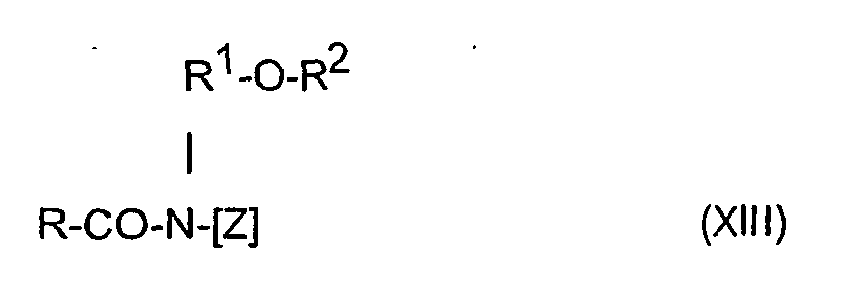
- [Z] wird vorzugsweise durch reduktive Aminierung eines reduzierten Zuckers erhalten, beispielsweise Glucose, Fructose, Maltose, Lactose, Galactose, Mannose oder Xylose. Die N-Alkoxy- oder N-Aryloxy-substituierten Verbindungen können dann durch Umsetzung mit Fettsäuremethylestern in Gegenwart eines Alkoxids als Katalysator in die gewünschten Polyhydroxyfettsäureamide überführt werden.
- Bei Wasch- und Reinigungsmitteln für das maschinelle Geschirrspülen kommen als Tenside im allgemeinen alle Tenside in Frage. Bevorzugt sind für diesen Anwendungszweck aber die vorstehend beschriebenen nichtionischen Tenside und hier vor allem die schwachschäumenden nichtionischen Tenside. Besonders bevorzugt sind die alkoxylierten Alkohole, besonders die ethoxylierten und/oder propoxylierten Alkohole. Dabei versteht der Fachmann allgemein unter alkoxylierten Alkoholen die Reaktionsprodukte von Alkylenoxid, bevorzugt Ethylenoxid, mit Alkoholen, bevorzugt im Sinne der vorliegenden Erfindung die längerkettigen Alkohole (C10 bis C18, bevorzugt zwischen C12 und C16, wie z. B. C11-, C12-, C13-, C14-, C15-, C16- C17- und C18-Alkohole). In der Regel entstehen aus n Molen Ethylenoxid und einem Mol Alkohol, abhängig von den Reaktionsbedingungen ein komplexes Gemisch von Additionsprodukten unterschiedlichen Ethoxylierungsgrades. Eine weitere Ausführungsform besteht im Einsatz von Gemischen der Alkylenoxide bevorzugt des Gemisches von Ethylenoxid und Propylenoxid. Auch kann man gewünschtenfalls durch eine abschließende Veretherung mit kurzkettigen Alkylgruppen, wie bevorzugt der Butylgruppe, zur Substanzklasse der "verschlossenen" Alkoholethoxylaten gelangen, die ebenfalls im Sinne der Erfindung eingesetzt werden kann. Ganz besonders bevorzugt im Sinne der vorliegenden Erfindung sind dabei hochethoxylierte Fettalkohole oder deren Gemische mit endgruppenverschlossenen Fettalkoholethoxylaten.
- Als besonders bevorzugte Niotenside haben sich im Rahmen der vorliegenden Erfindung schwachschäumende Niotenside erwiesen, welche alternierende Ethylenoxid- und Alkylenoxideinheiten aufweisen. Unter diesen sind wiederum Tenside mit EO-AO-EO-AO-Blöcken bevorzugt, wobei jeweils eine bis zehn EO- bzw. AO-Gruppen aneinander gebunden sind, bevor ein Block aus den jeweils anderen Gruppen folgt. Hier sind erfindungsgemäße maschinelle Geschirrspülmittel bevorzugt, die als nichionische(s) Tensid(e) Tenside der allgemeinen Formel XIV enthalten

- Die bevorzugten Niotenside der Formel III lassen sich durch bekannte Methoden aus den entsprechenden Alkoholen R1-OH und Ethylen- bzw. Alkylenoxid herstellen. Der Rest R1 in der vorstehenden Formel I kann je nach Herkunft des Alkohols variieren. Werden native Quellen genutzt, weist der Rest R1 eine gerade Anzahl von Kohlenstoffatomen auf und ist in der Regel unverzeigt, wobei die linearen Resten aus Alkoholen nativen Ursprungs mit 12 bis 18 C-Atomen, z.B. aus Kokos-, Palm-, Talgfett- oder Oleylalkohol, bevorzugt sind. Aus sysnthetischen Quellen zugängliche Alkohole sind beispielsweise die Guerbetalkohole oder in 2-Stellung methylverzweigte bzw. lineare und methylverzweigte Reste im Gemisch, so wie sie üblicherweise in Oxoalkoholresten vorliegen. Unabhängig von der Art des zur Herstellung der erfindungsgemäß in den Mitteln enthaltenen Niotenside eingesetzten Alkohols sind erfindungsgemäße maschinelle Geschirrspülmittel bevorzugt, bei denen R1 in Formel I für einen Alkylrest mit 6 bis 24, vorzugsweise 8 bis 20, besonders bevorzugt 9 bis 15 und insbesondere 9 bis 11 Kohlenstoffatomen steht.
- Als Alkylenoxideinheit, die alternierend zur Ethylenoxideinheit in den bevorzugten Niotensiden enthalten ist, kommt neben Propylenoxid insbesondere Butylenoxid in Betracht. Aber auch weitere Alkylenoxide, bei denen R2 bzw. R3 unabhängig voneinander ausgewählt sind aus -CH2CH2-CH3 bzw. -CH(CH3)2 sind geeignet. Bevorzugte maschinelle Geschirrspülmittel sind dadurch gekennzeichnet, daß R2 bzw. R3 für einen Rest -CH3, w und x unabhängig voneinander für Werte von 3 oder 4 und y und z unabhängig voneinander für Werte von 1 oder 2 stehen.
- Zusammenfassend sind zum Einsatz in den erfindungsgemäßen Mitteln insbesondere nichtionische Tenside bevorzugt, die einen C9-15-Alkylrest mit 1 bis 4 Ethylenoxideinheiten, gefolgt von 1 bis 4 Propylenoxideinheiten, gefolgt von1 bis 4 Ethylenoxideinheiten, gefolgt von1 bis 4 Propylenoxideinheiten aufweisen.
- Als bevorzugte zusätzliche Tenside werden schwachschäumende nichtionische Tenside eingesetzt. Mit besonderem Vorzug enthalten die erfindungsgemäßen maschinellen Geschirrspülmittel ein nichtionisches Tensid, das einen Schmelzpunkt oberhalb Raumtemperatur aufweist. Demzufolge sind bevorzugte Mittel dadurch gekennzeichnet, daß sie nichtionische(s) Tensid(e) mit einem Schmelzpunkt oberhalb von 20°C, vorzugsweise oberhalb von 25°C, besonders bevorzugt zwischen 25 und 60°C und insbesondere zwischen 26,6 und 43,3°C, enthalten.
- Geeignete zusätzlich zu den erfindungsgemäß in den Mitteln enthaltenen Niotenside nichtionische Tenside, die Schmelz- bzw. Erweichungspunkte im genannten Temperaturbereich aufweisen, sind beispielsweise schwachschäumende nichtionische Tenside, die bei Raumtemperatur fest oder hochviskos sein können. Werden bei Raumtemperatur hochviskose Niotenside eingesetzt, so ist bevorzugt, daß diese eine Viskosität oberhalb von 20 Pas, vorzugsweise oberhalb von 35 Pas und insbesondere oberhalb 40 Pas aufweisen. Auch Niotenside, die bei Raumtemperatur wachsartige Konsistenz besitzen, sind bevorzugt.
- Bevorzugt als bei Raumtemperatur feste einzusetzende Niotenside stammen aus den Gruppen der alkoxylierten Niotenside, insbesondere der ethoxylierten primären Alkohole und Mischungen dieser Tenside mit strukturell komplizierter aufgebauten Tensiden wie Polyoxypropylen/Polyoxyethylen/Polyoxypropylen (PO/EO/PO)-Tenside. Solche (PO/EO/PO)-Niotenside zeichnen sich darüber hinaus durch gute Schaumkontrolle aus.
- In einer bevorzugten Ausführungsform der vorliegenden Erfindung ist das nichtionische Tensid mit einem Schmelzpunkt oberhalb Raumtemperatur ein ethoxyliertes Niotensid, das aus der Reaktion von einem Monohydroxyalkanol oder Alkylphenol mit 6 bis 20 C-Atomen mit vorzugsweise mindestens 12 Mol, besonders bevorzugt mindestens 15 Mol, insbesondere mindestens 20 Mol Ethylenoxid pro Mol Alkohol bzw. Alkylphenol hervorgegangen ist.
- Ein besonders bevorzugtes bei Raumtemperatur festes, einzusetzendes Niotensid wird aus einem geradkettigen Fettalkohol mit 16 bis 20 Kohlenstoffatomen (C16-20-Alkohol), vorzugsweise einem C18-Alkohol und mindestens 12 Mol, vorzugsweise mindestens 15 Mol und insbesondere mindestens 20 Mol Ethylenoxid gewonnen. Hierunter sind die sogenannten "narrow range ethoxylates" (siehe oben) besonders bevorzugt.
- Demnach enthalten besonders bevorzugte erfindungsgemäße Mittel ethoxylierte(s) Niotensid(e), das/die aus C6-2o-Monohydroxyalkanolen oder C6-20-Alkylphenolen oder C16-20-Fettalkoholen und mehr als 12 Mol, vorzugsweise mehr als 15 Mol und insbesondere mehr als 20 Mol Ethylenoxid pro Mol Alkohol gewonnen wurde(n).
- Das Niotensid besitzt vorzugsweise zusätzlich Propylenoxideinheiten im Molekül. Vorzugsweise machen solche PO-Einheiten bis zu 25 Gew.-%, besonders bevorzugt bis zu 20 Gew.-% und insbesondere bis zu 15 Gew.-% der gesamten Molmasse des nichtionischen Tensids aus. Besonders bevorzugte nichtionische Tenside sind ethoxylierte Monohydroxyalkanole oder Alkylphenole, die zusätzlich Polyoxyethylen-Polyoxypropylen Blockcopolymereinheiten aufweisen. Der Alkohol- bzw. Alkylphenolteil solcher Niotensidmoleküle macht dabei vorzugsweise mehr als 30 Gew.-%, besonders bevorzugt mehr als 50 Gew.-% und insbesondere mehr als 70 Gew.-% der gesamten Molmasse solcher Niotenside aus. Bevorzugte maschinelle Geschirrspülmittel sind dadurch gekennzeichnet, daß sie ethoxylierte und propoxylierte Niotenside enthalten, bei denen die Propylenoxideinheiten im Molekül bis zu 25 Gew.-%, bevorzugt bis zu 20 Gew.-% und insbesondere bis zu 15 Gew.-% der gesamten Molmasse des nichtionischen Tensids ausmachen, enthalten.
- Weitere besonders bevorzugt einzusetzende Niotenside mit Schmelzpunkten oberhalb Raumtemperatur enthalten 40 bis 70% eines Polyoxypropylen/Polyoxyethylen/Polyoxypropylen-Blockpolymerblends, der 75 Gew.-% eines umgekehrten Block-Copolymers von Polyoxyethylen und Polyoxypropylen mit 17 Mol Ethylenoxid und 44 Mol Propylenoxid und 25 Gew.-% eines Block-Copolymers von Polyoxyethylen und Polyoxypropylen, initiiert mit Trimethylolpropan und enthaltend 24 Mol Ethylenoxid und 99 Mol Propylenoxid pro Mol Trimethylolpropan.
- Nichtionische Tenside, die mit besonderem Vorzug eingesetzt werden können, sind beispielsweise unter dem Namen Poly Tergent® SLF-18 von der Firma Olin Chemicals erhältlich.
- Ein weiter bevorzugtes erfindungsgemäßes maschinelles Geschirrspülmittel enthält nichtionische Tenside der Formel
R1O[CH2CH(CH3)O]x[CH2CH2O]y[CH2CH(OH)R2],
- in der R1 für einen linearen oder verzweigten aliphatischen Kohlenwasserstoffrest mit 4 bis 18 Kohlenstoffatomen oder Mischungen hieraus steht, R2 einen linearen oder verzweigten Kohlenwasserstoffrest mit 2 bis 26 Kohlenstoffatomen oder Mischungen hieraus bezeichnet und x für Werte zwischen 0,5 und 1,5 und y für einen Wert von mindestens 15 steht.
- Weitere bevorzugt einsetzbare Niotenside sind die endgruppenverschlossenen Poly(oxyalkylierten) Niotenside der Formel
R1O[CH2CH(R3)O]x[CH2]kCH(OH)[CH2]jOR2
in der R1 und R2 für lineare oder verzweigte, gesättigte oder ungesättigte, aliphatische oder aromatische Kohlenwasserstoffreste mit 1 bis 30 Kohlenstoffatomen stehen, R3 für H oder einen Methyl-, Ethyl-, n-Propyl-, iso-Propyl, n-Butyl-, 2-Butyl- oder 2-Methyl-2-Butylrest steht, x für Werte zwischen 1 und 30, k und j für Werte zwischen 1 und 12, vorzugsweise zwischen 1 und 5 stehen. Wenn der Wert x ≥ 2 ist, kann jedes R3 in der obenstehenden Formel unterschiedlich sein. R1 und R2 sind vorzugsweise lineare oder verzweigte, gesättigte oder ungesättigte, aliphatische oder aromatische Kohlenwasserstoffreste mit 6 bis 22 Kohlenstoffatomen, wobei Reste mit 8 bis 18 C-Atomen besonders bevorzugt sind. Für den Rest R3 sind H, -CH3 oder -CH2CH3 besonders bevorzugt. Besonders bevorzugte Werte für x liegen im Bereich von 1 bis 20, insbesondere von 6 bis 15. - Wie vorstehend beschrieben, kann jedes R3 in der obenstehenden Formel unterschiedlich sein, falls x ≥ 2 ist. Hierdurch kann die Alkylenoxideinheit in der eckigen Klammer variiert werden. Steht x beispielsweise für 3, kann der Rest R3 ausgewählt werden, um Ethylenoxid- (R3 = H) oder Propylenoxid- (R3 = CH3) Einheiten zu bilden, die in jedweder Reihenfolge aneinandergefügt sein können, beispielsweise (EO)(PO)(EO), (EO)(EO)(PO), (EO)(EO)(EO), (PO)(EO)(PO), (PO)(PO)(EO) und (PO)(PO)(PO). Der Wert 3 für x ist hierbei beispielhaft gewählt worden und kann durchaus größer sein, wobei die Variationsbreite mit steigenden x-Werten zunimmt und beispielsweise eine große Anzahl (EO)-Gruppen, kombiniert mit einer geringen Anzahl (PO)-Gruppen einschließt, oder umgekehrt.
- Insbesondere bevorzugte endgruppenverschlossenen Poly(oxyalkylierte) Alkohole der obenstehenden Formel weisen Werte von k = 1 und j = 1 auf, so daß sich die vorstehende Formel zu
R1O[CH2CH (R3)O]xCH2CH(OH)CH2OR2
vereinfacht. In der letztgenannten Formel sind R1, R2 und R3 wie oben definiert und x steht für Zahlen von 1 bis 30, vorzugsweise von 1 bis 20 und insbesonders von 6 bis 18. Besonders bevorzugt sind Tenside, bei denen die Reste R1 und R2 9 bis 14 C-Atome aufweisen, R3 für H steht und x Werte von 6 bis 15 annimmt. - Faßt man die letztgenannten Aussagen zusammen, sind erfindungsgemäße Geschirrspülmittel bevorzugt, die endgruppenverschlossenen Poly(oxyalkylierten) Niotenside der Formel
R1O[CH2CH(R3)O]x[CH2]kCH(OH)[CH2]jR2
enthalten, in der R1 und R2 für lineare oder verzweigte, gesättigte oder ungesättigte, aliphatische oder aromatische Kohlenwasserstoffreste mit 1 bis 30 Kohlenstoffatomen stehen, R3 für H oder einen Methyl-, Ethyl-, n-Propyl-, iso-Propyl, n-Butyl-, 2-Butyl- oder 2-Methyl-2-Butylrest steht, x für Werte zwischen 1 und 30, k und j für Werte zwischen 1 und 12, vorzugsweise zwischen 1 und 5 stehen, wobei Tenside des Typs
R1O[CH2CH (R3)O]xCH2CH(OH)CH2OR2
in denen x für Zahlen von 1 bis 30, vorzugsweise von 1 bis 20 und insbesondere von 6 bis 18 steht, besonders bevorzugt sind. - In Verbindung mit den genannten Tensiden können auch anionische, kationische und/oder amphotere Tenside eingesetzt werden, wobei diese wegen ihres Schaumverhaltens in maschinellen Geschirrspülmitteln nur untergeordnete Bedeutung besitzen und zumeist nur in Mengen unterhalb von 10 Gew.-%, meistens sogar unterhalb von 5 Gew.-%, beispielsweise von 0,01 bis 2,5 Gew.-%, jeweils bezogen auf das Mittel, eingesetzt werden. Die erfindungsgemäßen Mittel können somit als Tensidkomponente auch anionische, kationische und/oder amphotere Tenside enthalten.
- Bevorzugte erfindungsgemäße maschinelle Geschirrspülmittel enthalten neben den vorstehend genannten Inhaltsstoffen weiter einen oder mehrere Stoffe aus der Gruppe der Gerüststoffe (Builder), Cobuilder, Bleichmittel, Bleichaktivatoren, Enzyme, Farbstoffe, Duftstoffe, Korrosionschutzmittel, Polymere, oder eines weiteren üblichen Bestandteils von Wasch- und Reinigungsmitteln. Diese Inhaltsstoffe werden in der Folge beschrieben.
- Gemäß der vorliegenden Erfindung können in die Wasch- und Reinigungsmittel alle üblicherweise in Wasch- und Reinigungsmitteln eingesetzten Gerüststoffe eingearbeitet sein, insbesondere Silikate, Carbonate, organische Cobuilder und auch die Phosphate.
- Geeignete kristalline, schichtförmige Natriumsilikate besitzen die allgemeine Formel NaMSixO2x+1 H2O, wobei M Natrium oder Wasserstoff bedeutet, x eine Zahl von 1,9 bis 4 und y eine Zahl von 0 bis 20 ist und bevorzugte Werte für x 2, 3 oder 4 sind. Bevorzugte kristalline Schichtsilikate der angegebenen Formel sind solche, in denen M für Natrium steht und x die Werte 2 oder 3 annimmt. Insbesondere sind sowohl β- als auch δ-Natriumdisilikate Na2Si2O5 · yH2O bevorzugt.
- Einsetzbar sind auch amorphe Natriumsilikate mit einem Modul Na2O : SiO2 von 1:2 bis 1:3,3, vorzugsweise von 1:2 bis 1:2,8 und insbesondere von 1:2 bis 1:2,6, welche löseverzögert sind und Sekundärwascheigenschaften aufweisen. Die Löseverzögerung gegenüber herkömmlichen amorphen Natriumsilikaten kann dabei auf verschiedene Weise, beispielsweise durch Oberflächenbehandlung, Compoundierung, Kompaktierung/ Verdichtung oder durch Übertrocknung hervorgerufen worden sein. Im Rahmen dieser Erfindung wird unter dem Begriff "amorph" auch "röntgenamorph" verstanden. Dies heißt, daß die Silikate bei Röntgenbeugungsexperimenten keine scharfen Röntgenreflexe liefern, wie sie für kristalline Substanzen typisch sind, sondern allenfalls ein oder mehrere Maxima der gestreuten Röntgenstrahlung, die eine Breite von mehreren Gradeinheiten des Beugungswinkels aufweisen. Es kann jedoch sehr wohl sogar zu besonders guten Buildereigenschaften führen, wenn die Silikatpartikel bei Elektronenbeugungsexperimenten verwaschene oder sogar scharfe Beugungsmaxima liefern. Dies ist so zu interpretieren, daß die Produkte mikrokristalline Bereiche der Größe 10 bis einige Hundert nm aufweisen, wobei Werte bis max. 50 nm und insbesondere bis max. 20 nm bevorzugt sind. Insbesondere bevorzugt sind verdichtete/kompaktierte amorphe Silikate, com poundierte amorphe Silikate und übertrocknete röntgenamorphe Silikate.
- Als Carbonate können sowohl die Monoalkalimetallsalze als auch die Dialkalimetallsalze der Kohlensäure als auch Sesquicarbonate in den Mitteln enthalten sein. Bevorzugte Alkalimetallionen stellen Natrium- und/oder Kaliumionen dar. In einer Ausführungsform kann es bevorzugt sein, das Carbonat und/oder Bicarbonat zumindest teilweise als weitere Komponente separat bzw. nachträglich zuzumischen. Auch Compounds aus beispielsweise Carbonat, Silikat und gegebenenfalls weiteren Hilfsstoffen wie beispielsweise Aniontensiden oder anderen, insbesondere organischen Buildersubstanzen, können als separate Komponente in den fertigen Mitteln vorliegen.
- Selbstverständlich ist auch ein Einsatz der allgemein bekannten Phosphate als Buildersubstanzen möglich, sofern ein derartiger Einsatz nicht aus öko logischen Gründen vermieden werden sollte. Unter der Vielzahl der kommerziell erhältlichen Phosphate haben die Alkalimetallphosphate unter besonderer Bevorzugung von Pentanatrium- bzw. Pentakaliumtriphosphat (Natrium- bzw. Kaliumtripolyphosphat) in der Wasch- und Reinigungsmittel-Industrie die größte Bedeutung.
- Alkalimetallphosphate ist dabei die summarische Bezeichnung für die Alkalimetall- (insbesondere Natrium- und Kalium-) -Salze der verschiedenen Phosphorsäuren, bei denen man Metaphosphorsäuren (HPO3)n und Orthophosphorsäure H3PO4 neben höhermolekularen Vertretern unterscheiden kann. Die Phosphate vereinen dabei mehrere Vorteile in sich: Sie wirken als Alkaliträger, verhindern Kalkbeläge auf Maschinenteilen bzw. Kalkablagerungen auf dem Spülgut und tragen überdies zur Reinigungsleistung bei.
- Natriumdihydrogenphosphat, NaH2PO4, existiert als Dihydrat (Dichte 1,91 gcm-3, Schmelzpunkt 60°) und als Monohydrat (Dichte 2,04 gcm-3). Beide Salze sind weiße, in Wasser sehr leicht lösliche Pulver, die beim Erhitzen das Kristallwasser verlieren und bei 200°C in das schwach saure Diphosphat (Dinatriumhydrogendiphosphat, Na2H2P2O7), bei höherer Temperatur in Natiumtrimetaphosphat (Na3P3O9) und Maddrellsches Salz (siehe unten), übergehen. NaH2PO4 reagiert sauer; es entsteht, wenn Phosphorsäure mit Naronauge auf einen pH-Wert von 4,5 eingestellt und die Maische versprüht wird. Kaliumihydrogenphosphat (primäres oder einbasiges Kaliumphosphat, Kaliumbiphoshat, KDP), KH2PO4, ist ein weißes Salz der Dichte 2,33 gcm-3, hat einen Schmelzpunkt 253° [Zeretzng unter Bildung von Kaliumpolyphosphat (KPO3)x] und ist leicht löslich in Wasser.
- Dinatriumhydrogenphosphat (sekundäres Natriumphosphat), Na2HPO4, ist ein farbloses, sehr leicht wasserlösliches kristallines Salz. Es existiert wasserfrei und mit 2 Mol. (Dichte 2,066 gcm-3, Wasserverlust bei 95°), 7 Mol. (Dichte 1,68 gcm-3, Schmelzpunkt 48° unter Verlust von 5 H2O) und 12 Mol. Wasser (Dichte 1,52 gcm-3, Schmelzpunkt 35° unter Verlust von 5 H2O), wird bei 100° wasserfrei und geht bei stärkerem Erhitzen in das Diphosphat Na4P2O7 über. Dinatriumhydrogenphosphat wird durch Neutralisation von Phosphorsäure mit Sodalösung unter Verwendung von Phenolphthalein als Indikator hergestellt. Dikaliumhydrogenphosphat (sekundäres od. zweibasiges Kaliumphosphat), K2HPO4, ist ein amorphes, weißes Salz, das in Wasser leicht löslich ist.
- Trinatriumphosphat, tertiäres Natriumphosphat, Na3PO4, sind farblose Kristalle, die als Dodecahydrat eine Dichte von 1,62 gcm-3 und einen Schmelzpunkt von 73-76°C (Zeretzung), als Decahydrat (entsprechend 19-20% P2O5) einen Schmelzpunkt von 100°C und in wasserfreier Form (entsprechend 39-40% P2O5) eine Dichte von 2,536 gcm-3 aufeisen. Trinatriumphosphat ist in Wasser unter alkalischer Reaktion leicht löslich und wird durch Eindampfen einer Lösung aus genau 1 Mol Dinatriumphosphat und 1 Mol NaOH hergestellt. Trikaliumphosphat (tertiäres oder dreibasiges Kaliumphosphat), K3PO4, ist ein weißes, zerfließliches, körniges Pulver der Dichte 2,56 gcm-3, hat einen Schmelzunkt von 1340° und ist in Wasser mit alkalischer Reaktion leicht löslich. Es entsteht z.B. beim Erhitzen von Thomasschlacke mit Kohle und Kaliumsulfat. Trotz des höheren Preises werden in der Reinigungsmittel-Industrie die leichter löslichen, daher hochwirkamen, Kaliumphosphate gegenüber entsprechenden Natrium-Verbindungen vielfach bevorzugt.
- Tetranatriumdiphosphat (Natriumpyrophosphat), Na4P2O7, existiert in wasserfreier Form (Dichte 2,534 gcm-3, Schmelzpunkt 988°, auch 880° angegeben) und als Decahydrat (Dichte 1,815-1,836 gcm-3, Schmelzpunkt 94° unter Wasserverlust). Bei Substanzen sind farblose, in Wasser mit alkalischer Reaktion lösliche Kristalle. Na4P2O7 entsteht beim Erhitzen von Dinatriumphosphat auf >200° oder indem man Phosphorsäure mit Soda im stöchiometrischem Verhältnis umsetzt und die Lösung durch Versprühen entwässert. Das Decahydrat komplexiert Schwermetall-Salze und Härtebildner und verringert daher die Härte des Wassers. Kaliumdiphosphat (Kaliumpyrophosphat), K4P2O7, existiert in Form des Trihydrats und stellt ein farbloses, hygroskopisches Pulver mit der Dichte 2,33 gcm-3 dar, das in Wasser löslich ist, wobei der pH-Wert der 1%igen Lösung bei 25° 10,4 beträgt.
- Durch Kondensation des NaH2PO4 bzw. des KH2PO4 entstehen höhermol. Natrium- und Kaliumphosphate, bei denen man cyclische Vertreter, die Natrium- bzw. Kaliummetaphoshate und kettenförmige Typen, die Natrium- bzw. Kaliumpolyphosphate, unterscheiden kann. Insbesondere für letztere sind eine Vielzahl von Bezeichnungen in Gebrauch: Schmelz- oder Glühphosphate, Grahamsches Salz, Kurrolsches und Maddrellsches Salz. Alle höheren Natrium- und Kaliumphosphate werden gemeinsam als kondensierte Phosphate bezeichnet.
- Das technisch wichtige Pentanatriumtriphosphat, Na5P3O10 (Natriumtripolyphosphat), ist ein wasserfrei oder mit 6 H2O kristallisierendes, nicht hygroskopisches, weißes, wasserlösliches Salz der allgemeinen Formel NaO-[P(O)(ONa)-O]n-Na mit n=3. In 100 g Wasser lösen sich bei Zimmertemperatur etwa 17 g, bei 60° ca. 20 g, bei 100° rund 32 g des kristallwasserfreien Salzes; nach zweistündigem Erhitzen der Lösung auf 100° entstehen durch Hydrolyse etwa 8% Orthophosphat und 15% Diphosphat. Bei der Herstellung von Pentanatriumtriphosphat wird Phosphorsäure mit Sodalösung oder Natronlauge im stöchiometrischen Verhältnis zur Reaktion gebracht und die Lsg. durch Versprühen entwässert. Ähnlich wie Grahamsches Salz und Natriumdiphosphat löst Pentanatriumtriphosphat viele unlösliche Metall-Verbindungen (auch Kalkseifen usw.). Pentakaliumtriphosphat, K5P3O10 (Kaliumtripolyphosphat), kommt beispielsweise in Form einer 50 Gew.-%-igen Lösung (> 23% P2O5, 25% K2O) in den Handel. Die Kaliumpolyphosphate finden in der Wasch- und Reinigungsmittel-Industrie breite Verwendung. Weiter existieren auch Natriumkaliumtripolyphosphate, welche ebenfalls im Rahmen der vorliegenden Erfindung einsetzbar sind. Diese entstehen beispielsweise, wenn man Natriumtrimetaphosphat mit KOH hydrolysiert:
(NaPO3)3 + 2 KOH → Na3K2P3O10 + H2O
- Diese sind erfindungsgemäß genau wie Natriumtripolyphosphat, Kaliumtripolyphosphat oder Mischungen aus diesen beiden einsetzbar; auch Mischungen aus Natriumtripolyphosphat und Natriumkaliumtripolyphosphat oder Mischungen aus Kaliumtripolyphosphat und Natriumkaliumtripolyphosphat oder Gemische aus Natriumtripolyphosphat und Kaliumtripolyphosphat und Natriumkaliumtripolyphosphat sind erfindungsgemäß einsetzbar.
- Im Rahmen der vorliegenden Erfindungen bevorzugte maschinelle Geschirrspülmittel enthalten kein Natrium- und/oder Kaliumhydroxid. Ein Verzicht auf Natrium- und/oder Kaliumhydroxid als Alkaliquelle hat sich insbesondere dann als vorteilhaft erwiesen, wenn als Zinksalze Zinkgluconat, Zinkformiat und Zinkacetat eingesetzt werden.
- Als organische Cobuilder können in den Reinigungsmitteln im Rahmen der vorliegenden Erfindung insbesondere Polycarboxylate / Polycarbonsäuren, polymere Polycarboxylate, Asparaginsäure, Polyacetale, Dextrine, weitere organische Cobuilder (siehe unten) sowie Phosphonate eingesetzt werden. Die Polymere können dabei auch Bestandteil der wirkstoffhaltigen Matrix sein, sie können aber auch völlig unabhängig von dieser in den erfindungsgemäßen Mitteln enthalten sein. Die genannten Stoffklassen werden nachfolgend beschrieben.
- Brauchbare organische Gerüstsubstanzen sind beispielsweise die in Form ihrer Natriumsalze einsetzbaren Polycarbonsäuren, wobei unter Polycarbonsäuren solche Carbonsäuren verstanden werden, die mehr als eine Säurefunktion tragen. Beispielsweise sind dies Citronensäure, Adipinsäure, Bernsteinsäure, Glutarsäure, Äpfelsäure, Weinsäure, Maleinsäure, Fumarsäure, Zuckersäuren, Aminocarbonsäuren, Nitrilotriessigsäure (NTA), sofern ein derartiger Einsatz aus ökologischen Gründen nicht zu beanstanden ist, sowie Mischungen aus diesen. Bevorzugte Salze sind die Salze der Polycarbonsäuren wie Citronensäure, Adipinsäure, Bernsteinsäure, Glutarsäure, Weinsäure, Methylglycindiessigsäure, Zuckersäuren und Mischungen aus diesen.
- Auch die Säuren an sich können eingesetzt werden. Die Säuren besitzen neben ihrer Builderwirkung typischerweise auch die Eigenschaft einer Säuerungskomponente und dienen somit auch zur Einstellung eines niedrigeren und milderen pH-Wertes von Wasch- oder Reinigungsmitteln. Insbesondere sind hierbei Citronensäure, Bernsteinsäure, Glutarsäure, Adipinsäure, Gluconsäure und beliebige Mischungen aus diesen zu nennen.
- Als Builder sind weiter polymere Polycarboxylate geeignet, dies sind beispielsweise die Alkalimetallsalze der Polyacrylsäure oder der Polymethacrylsäure, beispielsweise solche mit einer relativen Molekülmasse von 500 bis 70000 g/mol.
- Bei den für polymere Polycarboxylate angegebenen Molmassen handelt es sich im Sinne dieser Schrift um gewichtsmittlere Molmassen Mw der jeweiligen Säureform, die grundsätzlich mittels Gelpermeationschromatographie (GPC) bestimmt wurden, wobei ein UV-Detektor eingesetzt wurde. Die Messung erfolgte dabei gegen einen externen Polyacrylsäure-Standard, der aufgrund seiner strukturellen Verwandtschaft mit den untersuchten Polymeren realistische Molgewichtswerte liefert. Diese Angaben weichen deutlich von den Molgewichtsangaben ab, bei denen Polystyrolsulfonsäuren als Standard eingesetzt werden. Die gegen Polystyrolsulfonsäuren gemessenen Molmassen sind in der Regel deutlich höher als die in dieser Schrift angegebenen Molmassen.
- Geeignete Polymere sind insbesondere Polyacrylate, die bevorzugt eine Molekülmasse von 1000 bis 20000 g/mol aufweisen. Aufgrund ihrer überlegenen Löslichkeit können aus dieser Gruppe wiederum die kurzkettigen Polyacrylate, die Molmassen von 1000 bis 10000 g/mol, und besonders bevorzugt von 1200 bis 4000 g/mol, aufweisen, bevorzugt sein.
- Besonders bevorzugt werden in den erfindungsgemäßen Mitteln sowohl Polyacrylate als auch Copolymere aus ungesättigten Carbonsäuren, Sulfonsäuregruppen-haltigen Monomeren sowie gegebenenfalls weiteren ionischen oder nichtionogenen Monomeren eingesetzt. Die Sulfonsäuregruppen-haltigen Copolymere werden in der Folge ausführlich beschrieben.
- Daneben können selbstverständlich auch die weiter oben beschriebenen Sulfonsäuregruppen-haltigen Polymere in den erfindungsgemäßen Mitteln enthalten sein, ohne zwingend Bestandteil der wirkstoffhaltigen Matrix sein zuu müssen.
- Wie bereits weiter oben erwähnt, werden in den erfindungsgemäßen Mitteln besonders bevorzugt sowohl Polyacrylate als auch die vorstehend beschriebenen Copolymere aus ungesättigten Carbonsäuren, Sulfonsäuregruppen-haltigen Monomeren sowie gegebenenfalls weiteren ionischen oder nichtionogenen Monomeren eingesetzt. Die Polyacrylate wurden dabei weiter oben ausführlich beschrieben. Besonders bevorzugt sind Kombinationen aus den vorstehend beschriebenen Sulfonsäuregruppen-haltigen Copolymeren mit Polyacrylaten niedriger Molmasse, beispielsweise im Bereich zwischen 1000 und 4000 Dalton. Solche Polyacrylate sind kommerziell unter dem Handelsnamen Sokalan® PA15 bzw. Sokalan® PA25 (BASF) erhältlich.
- Geeignet sind weiterhin copolymere Polycarboxylate, insbesondere solche der Acrylsäure mit Methacrylsäure und der Acrylsäure oder Methacrylsäure mit Maleinsäure. Als besonders geeignet haben sich Copolymere der Acrylsäure mit Maleinsäure erwiesen, die 50 bis 90 Gew.-% Acrylsäure und 50 bis 10 Gew.-% Maleinsäure enthalten. Ihre relative Molekülmasse, bezogen auf freie Säuren, beträgt im allgemeinen 2000 bis 100000 g/mol, vorzugsweise 20000 bis 90000 g/mol und insbesondere 30000 bis 80000 g/mol.
- Die (co-)polymeren Polycarboxylate können entweder als Pulver oder als wäßrige Lösung eingesetzt werden. Der Gehalt der Mittel an (co-)polymeren Polycarboxylaten beträgt vorzugsweise 0,5 bis 20 Gew.-%, insbesondere 3 bis 10 Gew.-%.
- Zur Verbesserung der Wasserlöslichkeit können die Polymere auch Allylsulfonsäuren, wie beispielsweise Allyloxybenzolsulfonsäure und Methallylsulfonsäure, als Monomer enthalten.
- Insbesondere bevorzugt sind auch biologisch abbaubare Polymere aus mehr als zwei verschiedenen Monomereinheiten, beispielsweise solche, die als Monomere Salze der Acrylsäure und der Maleinsäure sowie Vinylalkohol bzw. Vinylalkohol-Derivate oder die als Monomere Salze- der Acrylsäure und der 2-Alkylallylsulfonsäure sowie Zucker-Derivate enthalten.
- Weitere bevorzugte Copolymere weisen als Monomere vorzugsweise Acrolein und Acrylsäure/Acrylsäuresalze bzw. Acrolein und Vinylacetat auf.
- Ebenso sind als weitere bevorzugte Buildersubstanzen polymere Aminodicarbonsäuren, deren Salze oder deren Vorläufersubstanzen zu nennen. Besonders bevorzugt sind Polyasparaginsäuren bzw. deren Salze und Derivate.
- Weitere geeignete Buildersubstanzen sind Polyacetale, welche durch Umsetzung von Dialdehyden mit Polyolcarbonsäuren, welche 5 bis 7 C-Atome und mindestens 3 Hydroxylgruppen aufweisen, erhalten werden können. Bevorzugte Polyacetale werden aus Dialdehyden wie Glyoxal, Glutaraldehyd, Terephthalaldehyd sowie deren Gemischen und aus Polyolcarbonsäuren wie Gluconsäure und/oder Glucoheptonsäure erhalten.
- Weitere geeignete organische Buildersubstanzen sind Dextrine, beispielsweise Oligomere bzw. Polymere von Kohlenhydraten, die durch partielle Hydrolyse von Stärken erhalten werden können. Die Hydrolyse kann nach üblichen, beispielsweise säure- oder enzymkatalysierten Verfahren durchgeführt werden. Vorzugsweise handelt es sich um Hydrolyseprodukte mit mittleren Molmassen im Bereich von 400 bis 500000 g/mol. Dabei ist ein Polysaccharid mit einem Dextrose-Äquivalent (DE) im Bereich von 0,5 bis 40, insbesondere von 2 bis 30 bevorzugt, wobei DE ein gebräuchliches Maß für die reduzierende Wirkung eines Polysaccharids im Vergleich zu Dextrose, welche ein DE von 100 besitzt, ist. Brauchbar sind sowohl Maltodextrine mit einem DE zwischen 3 und 20 und Trockenglucosesirupe mit einem DE zwischen 20 und 37 als auch sogenannte Gelbdextrine und Weißdextrine mit höheren Molmassen im Bereich von 2000 bis 30000 g/mol.
- Bei den oxidierten Derivaten derartiger Dextrine handelt es sich um deren Umsetzungsprodukte mit Oxidationsmitteln, welche in der Lage sind, mindestens eine Alkoholfunktion des Saccharidrings zur Carbonsäurefunktion zu oxidieren. Ein an C6 des Saccharidrings oxidiertes Produkt kann besonders vorteilhaft sein.
- Auch Oxydisuccinate und andere Derivate von Disuccinaten, vorzugsweise Ethylendiamindisuccinat, sind weitere geeignete Cobuilder. Dabei wird Ethylendiamin-N,N'-disuccinat (EDDS) bevorzugt in Form seiner Natrium- oder Magnesiumsalze verwendet. Weiterhin bevorzugt sind in diesem Zusammenhang auch Glycerindisuccinate und Glycerintrisuccinate. Geeignete Einsatzmengen liegen in zeolithhaltigen und/oder silicathaltigen Formulierungen bei 3 bis 15 Gew.-%.
- Weitere brauchbare organische Cobuilder sind beispielsweise acetylierte Hydroxycarbonsäuren bzw. deren Salze, welche gegebenenfalls auch in Lactonform vorliegen können und welche mindestens 4 Kohlenstoffatome und mindestens eine Hydroxygruppe sowie maximal zwei Säuregruppen enthalten.
- Eine weitere Substanzklasse mit Cobuildereigenschaften stellen die Phosphonate dar. Dabei handelt es sich insbesondere um Hydroxyalkan- bzw. Aminoalkanphosphonate. Unter den Hydroxyalkanphosphonaten ist das 1-Hydroxyethan-1,1-diphosphonat (HEDP) von besonderer Bedeutung als Cobuilder. Es wird vorzugsweise als Natriumsalz eingesetzt, wobei das Dinatriumsalz neutral und das Tetranatriumsalz alkalisch (pH 9) reagiert. Als Aminoalkanphosphonate kommen vorzugsweise Ethylendiamintetramethylenphosphonat (EDTMP), Diethylentriaminpentamethylenphosphonat (DTPMP) sowie deren höhere Homologe in Frage. Sie werden vorzugsweise in Form der neutral reagierenden Natriumsalze, z. B. als Hexanatriumsalz der EDTMP bzw. als Hepta- und Octa-Natriumsalz der DTPMP, eingesetzt. Als Builder wird dabei aus der Klasse der Phosphonate bevorzugt HEDP verwendet. Die Aminoalkanphosphonate besitzen zudem ein ausgeprägtes Schwermetallbindevermögen. Dementsprechend kann es, insbesondere wenn die Mittel auch Bleiche enthalten, bevorzugt sein, Aminoalkanphosphonate, insbesondere DTPMP, einzusetzen, oder Mischungen aus den genannten Phosphonaten zu verwenden.
- Darüber hinaus können alle Verbindungen, die in der Lage sind, Komplexe mit Erdalkaliionen auszubilden, als Cobuilder eingesetzt werden.
- Erfindungsgemäße Mittel sind im Rahmen der vorliegenden Anmeldung dadurch gekennzeichnet, daß sie Gerüststoffe, vorzugsweise aus der Gruppe der Silikate, Carbonate, organische Cobuilder und/oder Phosphate in Mengen von 0,1 bis 99,5 Gew.-%, vorzugsweise von 1 bis 95 Gew.-%, besonders bevorzugt von 5 bis 90 Gew.-% und.insbesondere von 10 bis 80 Gew.-%, jeweils bezogen auf das Mittel, enthalten.
- Bleichmittel und Bleichkaktivatoren sind wichtige Bestandteile von Wasch- und Reinigungsmitteln und ein Wasch- und Reinigungsmittel kann im Rahmen der vorliegenden Erfindung ein oder mehrere Substanzen aus den genannten Gruppen enthalten. Unter den als Bleichmittel dienenden, in Wasser H2O2 liefernden Verbindungen hat das Natriumpercarbonat besondere Bedeutung. Weitere brauchbare Bleichmittel sind beispielsweise Natriumperborattetrahydrat und das Natriumperboratmonohydrat ,Peroxypyrophosphate, Citratperhydrate sowie H2O2 liefernde persaure Salze oder Persäuren, wie Perbenzoate, Peroxophthalate, Diperazelainsäure, Phthaloiminopersäure oder Diperdodecandisäure.
- "Natriumpercarbonat" ist eine in unspezifischer Weise verwendete Bezeichnung für Natriumcarbonat-Peroxohydrate, welche streng genommen keine "Percarbonate" (also Salze der Perkohlensäure) sondern Wasserstoffperoxid-Addukte an Natriumcarbonat sind. Die Handelsware hat die durchschnittliche Zusammensetzung 2 Na2CO3·3 H2O2 und ist damit kein Peroxycarbonat. Natriumpercarbonat bildet ein weißes, wasserlösliches Pulver der Dichte 2,14 gcm-3, das leicht in Natriumcarbonat und bleichend bzw. oxidierend wirkenden Sauerstoff zerfällt.
- Natriumcarbonatperoxohydrat wurde erstmals 1899 durch Fällung mit Ethanol aus einer Lösung von Natriumcarbonat in Wasserstoffperoxid erhalten, aber irrtümlich als Peroxycarbonat angesehen. Erst 1909 wurde die Verbindung als Wasserstoffperoxid-Anlagerungsverbindung erkannt, dennoch hat die historische Bezeichnung "Natriumpercarbonat" sich in der Praxis durchgesetzt.
- Die industrielle Herstellung von Natriumpercarbonat wird überwiegend durch Fällung aus wäßriger Lösung (sogenanntes Naßverfahren) hergestellt. Hierbei werden wäßrige Lösungen von Natriumcarbonat und Wasserstoffperoxid vereinigt und das Natriumpercarbonat durch Aussalzmittel (überwiegend Natriumchlorid), Kristallisierhilfsmittel (beispielsweise Polyphosphate, Polyacrylate) und Stabilisatoren (beispielsweise Mg2+-Ionen) gefällt. Das ausgefällte Salz, das noch 5 bis 12 Gew.-% Mutterlauge enthält, wird anschließend abzentrifugiert und in Fließbett-Trocknern bei 90°C getrocknet. Das Schüttgewicht des Fertigprodukts kann je nach Herstellungsprozeß zwischen 800 und 1200 g/l schwanken. In der Regel wird das Percarbonat durch ein zusätzliches Coating stabilisiert. Coatingverfahren und Stoffe, die zur Beschichtung eingesetzt werden, sind in der Patentliteratur breit beschrieben. Grundsätzlich können erfindungsgemäß alle handelsüblichen Percarbonattypen eingesetzt werden, wie sie beispielsweise von den Firmen Solvay Interox, Degussa, Kemira oder Akzo angeboten werden.
- Reinigungsmittel für das maschinelle Geschirrspülen können auch Bleichmittel aus der Gruppe der organischen.Bleichmittel enthalten. Typische organische Bleichmittel, die als Inhaltsstoffe im Rahmen der vorliegenden Erfindung eingesetzt werden können, sind die Diacylperoxide, wie z.B.
- Dibenzoylperoxid. Weitere typische organische Bleichmittel sind die Peroxysäuren, wobei als Beispiele besonders die Alkylperoxysäuren und die Arylperoxysäuren genannt werden. Bevorzugte Vertreter sind (a) die Peroxybenzoesäure und ihre ringsubstituierten Derivate, wie Alkylperoxybenzoesäuren, aber auch Peroxy-α-Naphtoesäure und Magnesium-monoperphthalat, (b) die aliphatischen oder substituiert aliphatischen Peroxysäuren, wie Peroxylaurinsäure, Peroxystearinsäure, ε-Phthalimidoperoxycapronsäure [Phthalo iminoperoxyhexansäure (PAP)], o-Carboxybenzamidoperoxycapronsäure, N-nonenylamidoperad ipinsäure und N-nonenylamidopersuccinate, und (c) aliphatische und araliphatische Peroxydicarbonsäuren, wie 1,12-Diperoxycarbonsäure, 1,9-Diperoxyazelainsäure, Diperocysebacinsäure, Diperoxybrassylsäure, die Diperoxyphthalsäuren, 2-Decyldiperoxybutan-1,4-disäure, N,N-Terephthaloyl-di(6-aminopercapronsäue) können eingesetzt werden.
- Als Bleichmittel für das maschinelle Geschirrspülen können gemäß der vorliegenden Erfindung auch Chlor oder Brom freisetzende Substanzen eingesetzt werden. Unter den geeigneten Chlor oder Brom freisetzenden Materialien kommen beispielsweise heterocyclische N-Brom- und N-Chloramide, beispielsweise Trichlorisocyanursäure, Tribromisocyanursäure, Dibromisocyanursäure und/oder Dichlorisocyanursäure (DICA) und/oder deren Salze mit Kationen wie Kalium und Natrium in Betracht. Hydantoinverbindungen, wie 1,3-Dichlor-5,5-dimethylhydanthoin sind ebenfalls geeignet.
- Vorteilhafte Mittel im Rahmen der vorliegenden Erfindung enthalten ein oder mehrere Bleichmittel, vorzugsweise aus der Gruppe der Sauerstoff- oder Halogen-Bleichmittel, insbesondere der Chlorbleichmittel, unter besonderer Bevorzugung von Natriumpercarbonat und/oder NatriumperboratMonohydrat, in Mengen von 0,5 bis 40 Gew.-%, vorzugsweise von 1 bis 30 Gew.-%, besonders bevorzugt von 2,5 bis 25 Gew.-% und insbesondere von 5 bis 20 Gew.-%, jeweils bezogen auf das gesamte Mittel.
- Um beim Reinigen bei Temperaturen von 60 °C und darunter eine verbesserte Bleichwirkung zu erreichen, können Reinigungsmittel im Rahmen der vorliegenden Erfindung Bleichaktivatoren enthalten. Als Bleichaktivatoren können Verbindungen, die unter Perhydrolysebedingungen aliphatische Peroxocarbonsäuren mit vorzugsweise 1 bis 10 C-Atomen, insbesondere 2 bis 4 C-Atomen, und/oder gegebenenfalls substituierte Perbenzoesäure ergeben, eingesetzt werden. Geeignet sind Substanzen, die O- und/oder N-Acylgruppen der genannten C-Atomzahl und/oder gegebenenfalls substituierte Benzoylgruppen tragen. Bevorzugt sind mehrfach acylierte Alkylendiamine, insbesondere Tetraacetylethylendiamin (TAED), acylierte Triazinderivate, insbesondere 1,5-Diacetyl-2,4-dioxohexahydro-1,3,5-triazin (DADHT), acylierte Glykolurile, insbesondere Tetraacetylglykoluril (TAGU), N-Acylimide, insbesondere N-Nonanoylsuccinimid (NOSI), acylierte Phenolsulfonate, insbesondere n-Nonanoyl- oder Isononanoyloxybenzolsulfonat (n- bzw. iso-NOBS), Carbonsäureanhydride, insbesondere Phthalsäureanhydrid, acylierte mehrwertige Alkohole, insbesondere Triacetin, Ethylenglykoldiacetat und 2,5-Diacetoxy-2,5-dihydrofuran.
- Zusätzlich zu den konventionellen Bleichaktivatoren oder an deren Stelle können gemäß der vorliegenden Erfindung auch sogenannte Bleichkatalysatoren in die Reinigungsmittel eingearbeitet werden. Bei diesen Stoffen handelt es sich um bleichverstärkende Übergangsmetallsalze bzw. Übergangsmetallkomplexe wie beispielsweise Mn-, Fe-, Co-, Ru - oder Mo-Salenkomplexe oder - carbonylkomplexe. Auch Mn-, Fe-, Co-, Ru-, Mo-, Ti-, V- und Cu-Komplexe mit N-haltigen Tripod-Liganden sowie Co-, Fe-, Cu- und Ru-Amminkomplexe sind als Bleichkatalysatoren verwendbar.
- Erfindungsgemäß werden Mittel bevorzugt, einen oder mehrerer Stoffe aus der Gruppe der Bleichaktivatoren, insbesondere aus den Gruppen der mehrfach acylierten Alkylendiamine, insbesondere Tetraacetylethylendiamin (TAED), der N-Acylimide, insbesondere N-Nonanoylsuccinimid (NOSI), der acylierten Phenolsulfonate, insbesondere n-Nonanoyl- oder Isononanoyloxybenzolsulfonat (n- bzw. iso-NOBS) und n-Methyl-Morpholinium-Acetonitril-Methylsulfat (MMA), in Mengen von 0,1 bis 20 Gew.-%, vorzugsweise von 0,5 bis 15 Gew.-% und insbesondere von 1 bis 10 Gew.-%, jeweils bezogen auf das gesamte Mittel, enthalten.
- Zu den im Rahmen der vorliegenden Erfindung bevorzugten Bleichaktivatoren gehören weiterhin die "Nitrilquats", kationische Nitrile der Formel (XV),

- in denen R1 für -H, -CH3, einen C2-24-Alkyl- oder -Alkenylrest, einen substituierten C2-24-Alkyl- oder -Alkenylrest mit mindestens einem Substituenten aus der Gruppe -Cl, -Br, -OH, -NH2, -CN, einen Alkyl- oder Alkenylarylrest mit einer C1-24-Alkylgruppe, oder für einen substituierten Alkyl- oder Alkenylarylrest mit einer C1-24-Alkylgruppe und mindestens einem weiteren Substituenten am aromatischen Ring steht, R2und R3 unabhängig voneinander ausgewählt sind aus -CH2-CN, -CH3, -CH2-CH3, -CH2-CH2-CH3, -CH(CH3)-CH3, -CH2-OH, -CH2-CH2-OH, -CH(OH)-CH3, -CH2-CH2-CH2-OH, -CH2-CH(OH)-CH3, -CH(OH)-CH2-CH3, -(CH2CH2-O)nH mit n = 1, 2, 3, 4, 5 oder 6 und X ein Anion ist.
- Unter die allgemeine Formel (XXI) fällt eine Vielzahl von kationischen Nitrilen, die im Rahmen der vorliegenden Erfindung einsetzbar sind. Mit besonderem Vorteil enthalten die erfindungsgemäßen Wasch- und Reinigungsmittelformkörper dabei kationische Nitrile, in denen R1 für Methyl, Ethyl, Propyl, Isopropyl oder einen n-Butyl, n-Hexyl, n-Octyl, n-Decyl, n-Dodecyl, n-Tetradecyl, n-Hexadecyl oder n-Octadecylrest steht. R2 und R3 sind vorzugsweise ausgewählt aus Methyl, Ethyl, Propyl, Isopropyl und Hydroxyethyl, wobei einer oder beide Reste vorteilhaft auch noch ein Cyanomethylenrest sein kann.
- Aus Gründen der leichteren Synthese sind Verbindungen bevorzugt, in denen die Reste R1 bis R3 identisch sind, beispielsweise (CH3)3N(+)CH2-CN X-, (CH3CH2)3N(+)CH2-CN X-, (CH3CH2CH2)3N(+)CH2-CN X-, (CH3CH(CH3))N(+)CH2-CN X-, oder (HO-CH2-CH2)3N(+)CH2-CN X-, wobei X- vorzugsweise für ein Anion steht, das aus der Gruppe Chlorid, Bromid, Iodid, Hydrogensulfat, Methosulfat, p-Toluolsulfonat (Tosylat) oder Xylolsulfonat ausgewählt ist.
- Im Rahmen der vorliegenden Erfindung bevorzugte Wasch- und Reinigungsmittel sind dadurch gekennzeichnet, daß sie das kationische Nitril der Formel (XXI) in Mengen von 0,1 bis 20 Gew.-%, vorzugsweise von 0,25 bis 15 Gew.-% und insbesondere von 0,5 bis 10 Gew.-%, jeweils bezogen auf das Formkörpergewicht, enthalten.
- Als Enzyme kommen insbesondere solche aus der Klassen der Hydrolasen wie der Proteasen, Esterasen, Lipasen bzw. lipolytisch wirkende Enzyme, Amylasen, Cellulasen bzw. andere Glykosylhydrolasen und Gemische der genannten Enzyme in Frage. Alle diese Hydrolasen tragen in der Wäsche zur Entfernung von Verfleckungen wie protein-, fett- oder stärkehaltigen Verfleckungen und Vergrauungen bei. Cellulasen und andere Glykosylhydrolasen können darüber hinaus durch das Entfernen von Pilling und Mikrofibrillen zur Farberhaltung und zur Erhöhung der Weichheit des Textils beitragen. Zur Bleiche bzw. zur Hemmung der Farbübertragung können auch Oxidoreduktasen eingesetzt werden. Besonders gut geeignet sind aus Bakterienstämmen oder Pilzen wie Bacillus subtilis, Bacillus licheniformis, Streptomyceus griseus, Coprinus Cinereus und Humicola insolens sowie aus deren gentechnisch modifizierten Varianten gewonnene enzymatische Wirkstoffe. Vorzugsweise werden Proteasen vom Subtilisin-Typ und insbesondere Proteasen, die aus Bacillus lentus gewonnen werden, eingesetzt. Dabei sind Enzymmischungen, beispielsweise aus Protease und Amylase oder Protease und Lipase bzw. lipolytisch wirkenden Enzymen oder Protease und Cellulase oder aus Cellulase und Lipase bzw. lipolytisch wirkenden Enzymen oder aus Protease, Amylase und Lipase bzw. lipolytisch wirkenden Enzymen oder Protease, Lipase bzw. lipolytisch wirkenden Enzymen und Cellulase, insbesondere jedoch Protease und/oder Lipase-haltige Mischungen bzw. Mischungen mit lipolytisch wirkenden Enzymen von besonderem Interesse. Beispiele für derartige lipolytisch wirkende Enzyme sind die bekannten Cutinasen.
- Auch Peroxidasen oder Oxidasen haben sich in einigen Fällen als geeignet erwiesen. Zu den geeigneten Amylasen zählen insbesondere alpha-Amylasen, Iso-Amylasen, Pullulanasen und Pektinasen. Als Cellulasen werden vorzugsweise Cellobiohydrolasen, Endoglucanasen und - Glucosidasen, die auch Cellobiasen genannt werden, bzw. Mischungen aus diesen eingesetzt. Da sich verschiedene Cellulase-Typen durch ihre CMCase- und Avicelase-Aktivitäten unterscheiden, können durch gezielte Mischungen der Cellulasen die gewünschten Aktivitäten eingestellt werden.
- Die Enzyme können an Trägerstoffe adsorbiert oder in Hüllsubstanzen eingebettet sein, um sie gegen vorzeitige Zersetzung zu schützen. Bevorzugte erfindungsgemäße Mittel enthalten Enzyme, vorzugsweise in Form flüssiger und/oder fester Enzymzubereitungen, in Mengen von 0,1 bis 10 Gew.-%, vorzugsweise von 0,5 bis 8 Gew.-% und insbesondere von 1 bis 5 Gew.-%, jeweils bezogen auf das gesamte Mittel.
- Um den ästhetischen Eindruck der Wasch- und Reinigungsmittel zu verbessern, können sie mit geeigneten Farbstoffen eingefärbt werden. Im Rahmen der vorliegenden Erfindung bevorzugte Farbstoffe, deren Auswahl dem Fachmann keinerlei Schwierigkeit bereitet, besitzen eine hohe Lagerstabilität und Unempfindlichkeit gegenüber den übrigen Inhaltsstoffen der Mittel und gegen Licht sowie keine ausgeprägte Substantivität gegenüber Textilfasern, um diese nicht anzufärben.
- Bevorzugt für den Einsatz in den erfindungsgemäßen Wasch- und Reinigungsmitteln sind alle Färbemittel, die im Reinigungsprozeß oxidativ zerstört werden können sowie Mischungen derselben mit geeigneten blauen Farbstoffen, sog. Blautönern. Es hat sich als vorteilhaft erwiesen Färbemittel einzusetzen, die in Wasser oder bei Raumtemperatur in flüssigen organischen Substanzen löslich sind. Geeignet sind beispielsweise anionische Färbemittel, z.B. anionische Nitrosofarbstoffe. Ein mögliches Färbemittel ist beispielsweise Naphtholgrün (Colour Index (Cl) Teil 1: Acid Green 1; Teil 2: 10020), das als Handelsprodukt beispielsweise als Basacid® Grün 970 von der Fa. BASF, Ludwigshafen, erhältlich ist, sowie Mischungen dieser mit geeigneten blauen Farbstoffen. Als weitere Färbemittel kommen Pigmosol® Blau 6900 (Cl 74160), Pigmosol® Grün 8730 (Cl 74260), Basonyl® Rot 545 FL (Cl 45170), Sandolan® Rhodamin EB400 (Cl 45100), Basacid® Gelb 094 (Cl 47005), Sicovit® Patentblau 85 E 131 (Cl 42051), Acid Blue 183 (CAS 12217-22-0, Cl Acidblue 183), Pigment Blue 15 (Cl 74160), Supranol® Blau GLW (CAS 12219-32-8, Cl Acidblue 221)), Nylosan® Gelb N-7GL SGR (CAS 61814-57-1, Cl Acidyellow 218) und/oder Sandolan® Blau (Cl Acid Blue 182, CAS 12219-26-0) zum Einsatz.
- Bei der Wahl des Färbemittels muß beachtet werden, daß die Färbemittel keine zu starke Affinität gegenüber den textilen Oberflächen und hier insbesondere gegenüber Kunstfasern aufweisen.
- Gleichzeitig ist auch bei der Wahl geeigneter Färbemittel zu berücksichtigen, daß Färbemittel unterschiedliche Stabilitäten gegenüber der Oxidation aufweisen. Im allgemeinen gilt, daß wasserunlösliche Färbemittel gegen Oxidation stabiler sind als wasserlösliche Färbemittel. Abhängig von der Löslichkeit und damit auch von der Oxidationsempfindlichkeit variiert die Konzentration des Färbemittels in den Wasch- oder Reinigungsmitteln. Bei gut wasserlöslichen Färbemitteln, z.B. dem oben genannten Basacid® Grün oder dem gleichfalls oben genannten Sandolan® Blau, werden typischerweise Färbemittel-Konzentrationen im Bereich von einigen 10-2 bis 10-3 Gew.-% gewählt. Bei den auf Grund ihrer Brillanz insbesondere bevorzugten, allerdings weniger gut wasserlöslichen Pigmentfarbstoffen, z.B. den oben genannten Pigmosol®-Farbstoffen, liegt die geeignete Konzentration des Färbemittels in Wasch- oder Reinigungsmitteln dagegen typischerweise bei einigen 10-3 bis 10-4 Gew.-%.
- Als Parfümöle bzw. Duftstoffe können erfindungsgemäß einzelne Riechstoffverbindungen, z.B. die synthetischen Produkte vom Typ der Ester, Ether, Aldehyde, Ketone, Alkohole und Kohlenwasserstoffe verwendet werden. Riechstoffverbindungen vom Typ der Ester sind z.B. Benzylacetat, Phenoxyethylisobutyrat, p-tert.-Butylcyclohexylacetat, Linalylacetat, Dimethylbenzylcarbinylacetat (DMBCA), Phenylethylacetat, Benzylacetat, Ethylmethylphenylglycinat, Allylcyclohexylpropionat, Styrallylpropionat, Benzylsalicylat, Cyclohexylsalicylat, Floramat, Melusat und Jasmecyclat. Zu den Ethern zählen beispielsweise Benzylethylether und Ambroxan , zu den Aldehyden z.B. die linearen Alkanale mit 8 - 18 C-Atomen, Citral, Citronellal, Citronellyloxyacetaldehyd, Cyclamenaldehyd, Lilial und Bourgeonal, zu den Ketonen z.B. die Jonone, ∝-Isomethylionon und Methyl-cedrylketon, zu den Alkoholen Anethol, Citronellol, Eugenol, Geraniol, Linalool, Phenylethylalkohol und Terpineol, zu den Kohlenwasserstoffen gehören hauptsächlich die Terpene wie Limonen und Pinen. Bevorzugt werden jedoch Mischungen verschiedener Riechstoffe verwendet, die gemeinsam eine ansprechende Duftnote erzeugen.
- Solche Parfümöle können auch natürliche Riechstoffgemische enthalten, wie sie aus pflanzlichen Quellen zugänglich sind, z.B. Pine-, Citrus-, Jasmin-, Patchouly-, Rosen- oder Ylang-Ylang-Öl. Ebenfalls geeignet sind Muskateller-Salbeiöl, Kamillenöl, Nelkenöl, Melissenöl, Minzöl, Zimtblätteröl, Lindenblütenöl, Wacholderbeeröl, Vetiveröl, Olibanumöl, Galbanumöl und Labdanumöl sowie Orangenbl ütenöl, Neroliol, Orangenschalenöl und Sandelholzöl.
- Die allgemeine Beschreibung der einsetzbaren Parfüme (siehe oben) stellte allgemein die unterschiedlichen Substanzklassen von Riechstoffen dar. Um wahrnehmbar zu sein, muß ein Riechstoff flüchtig sein, wobei neben der Natur der funktionellen Gruppen und der Struktur der chemischen Verbindung auch die Molmasse eine wichtige Rolle spielt. So besitzen die meisten Riechstoffe Molmassen bis etwa 200 Dalton, während Molmassen von 300 Dalton und darüber eher eine Ausnahme darstellen. Aufgrund der unterschiedlichen Flüchtigkeit von Riechstoffen verändert sich der Geruch eines aus mehreren Riechstoffen zusammengesetzten Parfüms bzw. Duftstoffs während des Verdampfens, wobei man die Geruchseindrücke in "Kopfnote" (top note), "Herz- bzw. Mittelnote" (middle note bzw. body) sowie "Basisnote" (end note bzw. dry out) unterteilt. Da die Geruchswahrnehmung zu einem großen Teil auch auf der Geruchsintensität beruht, besteht die Kopfnote eines Parfüms bzw. Duftstoffs nicht allein aus leichtflüchtigen Verbindungen, während die Basisnote zum größten Teil aus weniger flüchtigen, d.h. haftfesten Riehcstoffen besteht. Bei der Komposition von Parfüms können leichter flüchtige Riechstoffe beispielsweise an bestimmte Fixative gebunden werden, wodurch ihr zu schnelles Verdampfen verhindert wird. Die oben beschriebene Ausführungsform der vorliegenden Erfindung, in der die leichter flüchtigen Riechstoffe bzw. Duftstoffe auf die wasserunslöslichen Trägermaterialien niedriger Dichte aufgebracht werden, ist eine solche Methode zur Riechstoffixierung. Bei der nachfolgenden Einteilung der Riechstoffe in "leichter flüchtige" bzw. "haftfeste" Riechstoffe ist also über den Geruchseindruck und darüber, ob der entsprechende Riechstoff als Kopf- oder Herznote wahrgenommen wird, nichts ausgesagt.
- Haftfeste Riechstoffe, die im Rahmen der vorliegenden Erfindung einsetzbar sind, sind beispielsweise die ätherischen Öle wie Angelikawurzelöl, Anisöl, Arnikablütenöl, Basilikumöl, Bayöl, Bergamottöl, Champacablütenöl, Edeltannenöl, Edeltannenzapfenöl, Elemiöl, Eukalyptusöl, Fenchelöl, Fichtennandelöl, Galbanumöl, Geraniumöl, Gingergrasöl, Guajakholzöl, Gurjunbalsamöl, Helichrysumöl, Ho-Öl, Ingweröl, Irisöl, Kajeputöl, Kalmusöl, Kamillenöl, Kampferöl, Kanagaöl, Kardamomenöl, Kassiaöl, Kiefernnadelöl, Kopaïvabalsamöl, Korianderöl, Krauseminzeöl, Kümmelöl, Kuminöl, Lavendelöl, Lemongrasöl, Limetteöl, Mandarinenöl, Melissenöl, Moschuskörneröl, Myrrhenöl, Nelkenöl, Neroliöl, Niaouliöl,- Olibanumöl, Orangenöl, Origanumöl, Palmarosaöl, Patschuliöl, Perubalsamöl, Petitgrainöl, Pfefferöl, Pfefferminzöl, Pimentöl, Pine-Öl, Rosenöl, Rosmarinöl, Sandelholzöl, Sellerieöl, Spiköl, Sternanisöl, Terpentinöl, Thujaöl, Thymianöl, Verbenaöl, Vetiveröl, Wacholderbeeröl, Wermutöl, Wintergrünöl, Ylang-Ylang-Öl, Ysop-Öl, Zimtöl, Zimtblätteröl, Zitronellöl, Zitronenöl sowie Zypressenöl.
- Aber auch die höhersiedenden bzw. festen Riechstoffe natürlichen oder synthetischen Ursprungs können im Rahmen der vorliegenden Erfindung als haftfeste Riechstoffe bzw. Riechstoffgemische, also Duftstoffe, eingesetzt werden. Zu diesen Verbindungen zählen die nachfolgend genannten Verbindungen sowie Mischungen aus diesen: Ambrettolid, α-Amylzimtaldehyd, Anethol, Anisaldehyd, Anisalkohol, Anisol, Anthranilsäuremethylester, Acetophenon, Benzylaceton, Benzaldehyd, Benzoesäureethylester, Benzophenon, Benzylakohol, Benzylacetat, Benzylbenzoat, Benzylformiat, Benzylvalerianat, Borneol, Bornylacetat, α-Bromstyrol, n-Decylaldehyd, n-Dodecylaldehyd, Eugenol, Eugenolmethylether, Eukalyptol, Farnesol, Fenchon, Fenchylacetat, Geranylacetat, Geranylformiat, Heliotropin, Heptincarbonsäuremethylester, Heptaldehyd, Hydrochinon-Dimethylether, Hydroxyzimtaldehyd, Hydroxyzimtalkohol, Indol, Iron, Isoeugenol, Isoeugenolmethylether, Isosafrol, Jasmon, Kampfer, Karvakrol, Karvon, p-Kresolmethylether, Cumarin, p-Methoxyacetophenon, Methyl-n-amylketon, Methylanthranilsäuremethylester, p-Methylacetophenon, Methylchavikol, p-Methylchinolin, Methyl-β-naphthylketon, Methyl-n-nonylacetaldeh yd, Methyl-n-nonylketon, Muskon, β-Naphtholethylether, β-Naphtholmethylether, Nerol, Nitrobenzol, n-Nonylaldehyd, Nonylakohol, n-Octylaldehyd, p-Oxy-Acetophenon, Pentadekanolid, β-Phenylethylakohol, Phenylacetaldehyd-Dimethyacetal, Phenylessigsäure, Pulegon, Safrol, Salicylsäureisoamylester, Salicylsäuremethylester, Salicylsäurehexylester, Salicylsäurecyclohexylester, Santalol, Skatol, Terpineol, Thymen, Thymol, γ-Undelacton, Vanilin, Veratrumaldehyd, Zimtaldehyd, Zimatalkohol, Zimtsäure, Zimtsäureethylester, Zimtsäurebenzylester.
- Zu den leichter flüchtigen Riechstoffen zählen insbesondere die niedriger siedenden Riechstoffe natürlichen oder synthetischen Usprung, die allein oder in Mischungen eingesetzt werrden können. Beispiele für leichter flüchtige Riechstoffe sind Alkyisothiocyanate (Alkylsenföle), Butandion, Limonen, Linalool, Linaylacetat und -propionat, Menthol, Menthon, Methyl-n-heptenon, Phellandren, Phenylacetaldehyd, Terpinylacetat, Zitral, Zitronellal.
- Reinigungsmittel, für das maschinelle Geschirrspülen, können zum Schutze des Spülgutes oder der Maschine Korrosionsinhibitoren enthalten, wobei besonders Silberschutzmittel im Bereich des maschinellen Geschirrspülens eine besondere Bedeutung haben. Einsetzbar sind die bekannten Substanzen des Standes der Technik. Allgemein können vor allem Silberschutzmittel ausgewählt aus der Gruppe der Triazole, der Benzotriazole, der Bisbenzotriazole, der Aminotriazole, der Alkylaminotriazole und der Übergangsmetallsalze oder -komplexe eingesetzt werden. Besonders bevorzugt zu verwenden sind Benzotriazol und/oder Alkylaminotriazol. Man findet in Reinigerformulierungen darüber hinaus häufig aktivchlorhaltige Mittel, die das Korrodieren der Silberoberfläche deutlich vermindern können. In chlorfreien Reinigern werden besonders Sauerstoff- und stickstoffhaltige organische redoxaktive Verbindungen, wie zwei- und dreiwertige Phenole, z. B. Hydrochinon, Brenzkatechin, Hydroxyhydrochinon, Gallussäure, Phloroglucin, Pyrogallol bzw. Derivate dieser Verbindungsklassen. Auch salz- und komplexartige anorganische Verbindungen, wie Salze der Metalle Mn, Ti, Zr, Hf, V, Co und Ce finden häufig Verwendung. Bevorzugt sind hierbei die Übergangsmetallsalze, die ausgewählt sind aus der Gruppe der Mangan und/oder Cobaltsalze und/oder -komplexe, besonders bevorzugt der Cobalt(amrnin)-Komplexe, der Cobalt(acetat)-Komplexe, der Cobalt-(Carbonyl)-Komplexe, der Chloride des Cobalts oder Mangans und des Mangansulfats sowie den Mangankomplexen
[Me-TACN)MnIV (m-0)3MnIV(Me-TACN)]2+(PF6 -)2
[Me-MeTACN)MnIV(m-0)3MnIV(Me-MeTACN)]2+(PF6 -)2,
[Me-TACN)MnIII(m-O)(m-OAc)2MnIII(Me-TACN)]2+(PF6 -)2
und
[Me-MeTACN)MnIII (m-0)(m-0Ac)2MnIII(Me-MeTACN)]2+(PF6 -)2, wobei Me-TACN für 1,4,7-trimethyl-1,4,7-triazacyclononan und Me-MeTACN für 1,2,4,7-tetramethyl-1,4,7-triazacyclononan steht. Ebenfalls können Zinkverbindungen zur Verhinderung der Korrosion am Spülgut eingesetzt werden. - Ein bevorzugtes Agens zur Bereitstellung eines Korrosionsschutzes für Glaswaren bei Reinigungs- und/oder Spülvorgängen einer Geschirrspülmaschine ist Zink in oxidierter Form, d.h. Zinkverbindungen, in denen Zink kationisch vorliegt. Analog sind auch Magnesiumsalze bevorzugt. Hierbei können sowohl lösliche als aluch schlecht oder nicht lösliche Zink- oder Magnesiumverbindungen eingesetzt werden. Bevorzugte erfindungsgemäße Zusammensetzungen enthalten ein oder mehrere Magnesium- und/oder Zinksalz(e) mindestens einer monomeren und/oder polymeren organischen Säure.
- Die betreffenden Säuren stammen dabei vorzugsweise. aus der Gruppe der unverzweigten gesättigten oder ungesättigten Monocarbonsäuren, der verzweigten gesättigten oder ungesättigten Monocarbonsäuren, der gesättigten und ungesättigten Dicarbonsäuren, der aromatischen Mono-, Di- und Tricarbonsäuren, der Zuckersäuren, der Hydroxysäuren, der Oxosäuren, der Aminosäuren und/oder der polymeren Carbonsäuren, der unverzweigten oder verzweigten, ungesättigten oder gesättigten, ein- oder mehrfach hydroxylierten Fettsäuren mit mindestens 8 Kohlenstoffatomen und/oder Harzsäuren.
- Obwohl erfindungsgemäß alle Magnesium- und/oder Zinksalz(e) monomerer und/oder polymerer organischer Säuren enthalten sein können, werden doch, wie vorstehend beschrieben, die Magnesium- und/oder Zinksalze monomerer und/oder polymerer organischer Säuren aus den Gruppen der unverzweigten gesättigten oder ungesättigten Monocarbonsäuren, der verzweigten gesättigten oder ungesättigten Monocarbonsäuren, der gesättigten und ungesättigten Dicarbonsäuren, der aromatischen Mono-, Di- und Tricarbonsäuren, der Zuckersäuren, der Hydroxysäuren, der Oxosäuren, der Aminosäuren und/oder der polymeren Carbonsäuren bevorzugt. Innerhalb dieser Gruppen werden im Rahmen der vorliegenden Erfindung wiederum die in der Folge genannten Säuren bevorzugt:
- Aus der Gruppe der unverzweigten gesättigten oder ungesättigten Monocarbonsäuren: Methansäure (Ameisensäure), Ethansäure (Essigsäure), Propansäure (Propionsäure), Pentansäure (Valeriansäure), Hexansäure (Capronsäure), Heptansäure (Önanthsäure), Octansäure (Caprylsäure), Nonansäure (Pelargonsäure), Decansäure (Caprinsäure), Undecansäure, Dodecansäure (Laurinsäure), Tridecansäure, Tetradecansäure (Myristinsäure), Pentadecansäure, Hexadecansäure (Palmitinsäure), Heptadecansäure (Margarinsäure), Octadecansäure (Stearinsäure), Eicosansäure (Arachinsäure), Docosansäure (Behensäure), Tetracosansäure (Lignocerinsäure), Hexacosansäure (Cerotinsäure), Triacotansäure (Melissinsäure), 9c-Hexadecensäure (Palmitoleinsäure), 6c-Octadecensäure (Petroselinsäure), 6t-Octadecensäure (Petroselaidinsäure), 9c-Octadecensäure (Ölsäure), 9t-Octadecensäure (Elaidinsäure), 9c,12c-Octadecadiensäure (Linolsäure), 9t,12t-Octadecadiensäure (Linolaidinsäure) und 9c,12c,15c-Octadecatreinsäure (Linolensäure).
- Aus der Gruppe der verzweigten gesättigten oder ungesättigten Monocarbonsäuren: 2-Methylpentansäure, 2-Ethylhexansäure, 2-Propylheptansäure, 2-Butyloctansäure, 2-Pentylnonansäure, 2-Hexyldecansäure, 2-Heptylundecansäure, 2-Octyldodecansäure, 2-Nonyltridecansäure, 2-Decyltetradecansäure, 2- Undecylpentadecansäure, 2-Dodecylhexadecansäure, 2-Tridecylheptadecansäure, 2-Tetradecyloctadecansäure, 2-Pentadecylnonadecansäure, 2-Hexadecyleicosansäure, 2-Heptadecylheneicosansäure enthält.
- Aus der Gruppe der unverzweigten gesättigten oder ungesättigten Di- oder Tricarbonsäuren: Propandisäure (Malonsäure), Butandisäure (Bernsteinsäure), Pentandisäure (Glutarsäure), Hexandisäure (Adipinsäure), Heptandisäure (Pimelinsäure), Octandisäure (Korksäure), Nonandisäure (Azelainsäure), Decandisäure (Sebacinsäure), 2c-Butendisäure (Maleinsäure), 2t-Butendisäure (Fumarsäure), 2-Butindicarbonsäure (Acetylendicarbonsäure).
- Aus der Gruppe der aromatischen Mono-, Di- und Tricarbonsäuren: Benzoesäure, 2-Carboxybenzoesäure (Phthalsäure), 3-Carboxybenzoesäure (Isophthalsäure), 4-Carboxybenzoesäure (Terephthalsäure), 3,4-Dicarboxybenzoesäure (Trimellithsäure), 3,5-Dicarboxybenzoesäure (Trimesionsäure).
- Aus der Gruppe der Zuckersäuren: Galactonsäure, Mannonsäure, Fructonsäure, Arabinonsäure, Xylonsäure, Ribonsäure, 2-Desoxy-ribonsäure, Alginsäure.
- Aus der Gruppe der Hydroxysäuren: Hydroxyphenylessigsäure (Mandelsäure), 2-Hydroxypropionsäure (Milchsäure), Hydroxybernsteinsäure (Äpfelsäure), 2,3-Dihydorxybutandisäure (Weinsäure), 2-Hydroxy-1,2,3-propantricarbonsäure (Citronensäure), Ascorbinsäure, 2-Hydroxybenzoesäure (Salicylsäure), 3,4,5-Trihydroxybenzoesäure (Gallussäure).
- Aus der Gruppe der Oxosäuren: 2-Oxopropionsäure (Brenztraubensäure), 4-Oxopentansäure (Lävulinsäure).
- Aus der Gruppe der Aminosäuren: Alanin, Valin, Leucin, Isoleucin, Prolin, Tryptophan, Phenylalanin, Methionin, Glycin, Serin, Tyrosin, Threonin, Cystein, Asparagin, Glutamin, Asparaginsäure, Glutaminsäure, Lysin, Arginin, Histidin.
- Aus der Gruppe der polymeren Carbonsäuren: Polyacrylsäure, Polymethacrylsäure, Alkylacrylamid/Acrylsäure-Copolymere, Alkylacrylamid/Methacrylsäure-Copolymere, Alkylacrylamid/Methylmethacrylsäure-Copolymere, Copolymere aus ungesättigten Carbonsäuren, Vinylacetat/Crotonsäure-Copolymere, VinyfpyrrolidonNinylacrylat-Copolymere.
- Das Spektrum der erfindungsgemäß bevorzugten Zinksalze organischer Säuren, vorzugsweise organischer Carbonsäuren, reicht von Salzen die in Wasser schwer oder nicht löslich sind, also eine Löslichkeit unterhalb 100 mg/L, vorzugsweise unterhalb 10 mg/L, insbesondere keine Löslichkeit aufweisen, bis zu solchen Salzen, die in Wasser eine Löslichkeit oberhalb 100 mg/L, vorzugsweise oberhalb 500 mg/L, besonders bevorzugt oberhalb 1 g/L und insbesondere oberhalb 5 g/L aufweisen (alle Löslichkeiten bei 20°C Wassertemperatur). Zu der ersten Gruppe von Zinksalzen gehören beispielsweise das Zinkcitrat, das Zinkoleat und das Zinkstearat, zu der Gruppe der löslichen Zinksalze gehören beispielsweise das Zinkformiat, das Zinkacetat, das Zinklactat und das Zinkgluconat:
- In einer weiteren bevorzugten Ausführungsform der vorliegenden Erfindung enthalten die erfindungsgemäßen Zusammensetzungen wenigstens ein Zinksalz, jedoch kein Magnesiumsalz einer organischen Säure, wobei es sich vorzugsweise um mindestens ein Zinksalz einer organischen Carbonsäure, besonders bevorzugt um ein Zinksalz aus der Gruppe Zinkstearat, Zinkoleat, Zinkgluconat, Zinkacetat, Zinklactat und/oder Zinkcitrat handelt. Weiter sind auch Zinkricinoleat, Zinkabietat und Zinkoxalat bevorzugt einsetzbar
Claims (10)
- Maschinelles Geschirrspülmittel, umfassenda) mindestens ein Polymer, welches kationische Monomereinheiten aufweist, sowieb) mindestens ein anionisches Polymer, welches mit schwefelhaltigen Gruppen modifiziert ist, dadurch gekennzeichnet, dass das mit schwefelhaltigen Gruppen modifizierte Polymer als Monomereinheiteni) ungesättigten Carbonsäurenii) Sulfonsäuregruppen-haltigen Monomereiii) gegebenenfalls weitere ionische oder nichtionogene Monomere umfasst,
wobei der pH-Wert einer 1 Gew.-%-igen Lösung des anionischen Polymers in destilliertem Wasser bei 20°C weniger als pH 6 beträgt; sowiec) 0,01 bis 5 Gew.-% nichtionisches Tensid - Maschinelles Geschirrspülmittel nach Anspruch 1, dadurch gekennzeichnet, dass es sich bei dem Polymer, welches kationische Monomereinheiten aufweist um ein kationisches Polymer handelt.
- Maschinelles Geschirrspülmittel nach Anspruch 1, dadurch gekennzeichnet, dass es sich bei dem Polymer, welches kationische Monomereinheiten aufweist um ein amphoteres Polymer handelt.
- Maschinelles Geschirrspülmittel nach einem der Ansprüche 1 bis 3, dadurch gekennzeichnet, dass das mit Schwefel-haltigen Gruppen modifizierte Polymer wenigstens antellsweise terminale Schwefel-haltige Gruppen aufweist.
- Maschinelles Geschirrspülmittel nach einem der Ansprüche 1 bis 4, dadurch gekennzeichnet, dass es das/die mit Schwefel-haltigen Gruppen modifizierte(n) Polymer(e) in Mengen von 0,1 bis 20 Gew.%, besonders bevorzugt von 0,2 bis 10 Gew.-% und insbesondere von 0,5 bis 7,5 Gew.-%, jeweils bezogen auf das gesamte Mittel, enthält.
- Maschinelle Geschirrspülmittel nach einem der Ansprüche 1 bis 5, dadurch gekennzeichnet, dass das Geschirrspülmittel einen Gehalt an nichtionischen Tensiden unterhalb 4 Gew.-% und insbesondere zwischen 0,01 und 2 Gew.-%, jeweils bezogen auf das Gesamtgewicht des maschinellen Geschirrspülmittels, aufweist.
- Maschinelles Geschirrspülmittel nach einem der Ansprüche 1 bis 6, dadurch gekennzeichnet, dass das/die mit Schwefel-haltigen Gruppen modifizierte(n) Polymer(e) mittlere Molmassen von 1000 bis 10.000.000 gmol-1, vorzugsweise von 1500 bis 1.000.000 gmol-1, besonders bevorzugt von 2000 bis 100.000 gmol-1 und insbesondere von 2500 bis 50.000 gmol-1, aufweisen.
- Maschinelles Geschirrspülmittel nach einem der Ansprüche 1 bis 7, dadurch gekennzeichnet, dass das molare Verhältnis der Monomere i) zu ii) 1:1 bis 200:1, vorzugsweise 1:1 bis 100:1 und insbesondere 1:1 bis 10:1 beträgt.
- Maschinelles Geschirrspülmittel nach einem der Ansprüche 1 bis 8 dadurch gekennzeichnet, dass der Gehalt der Polymere an Monomeren iii) maximal 20 Mol.-%, vorzugsweise maximal 10 Mol.-% und insbesondere maximal 5 Mol.-% beträgt.
- Maschinelles Geschirrspolverfahren unter Einsatz eines maschinellen Geschirrspülmittels nach einem der vorherigen Ansprüche.
Priority Applications (1)
| Application Number | Priority Date | Filing Date | Title |
|---|---|---|---|
| PL04764845T PL1664257T3 (pl) | 2003-09-15 | 2004-09-04 | Maszynowy środek do zmywarki do naczyń, zawierający specjalną mieszankę polimeryczną |
Applications Claiming Priority (2)
| Application Number | Priority Date | Filing Date | Title |
|---|---|---|---|
| DE10342631A DE10342631B4 (de) | 2003-09-15 | 2003-09-15 | Maschinelle Geschirrspülmittel mit spezieller Polymermischung |
| PCT/EP2004/009894 WO2005026305A1 (de) | 2003-09-15 | 2004-09-04 | Maschinelle geschirrspülmittel mit spezieller polymermischung |
Publications (2)
| Publication Number | Publication Date |
|---|---|
| EP1664257A1 EP1664257A1 (de) | 2006-06-07 |
| EP1664257B1 true EP1664257B1 (de) | 2008-07-09 |
Family
ID=34305801
Family Applications (1)
| Application Number | Title | Priority Date | Filing Date |
|---|---|---|---|
| EP04764845A Revoked EP1664257B1 (de) | 2003-09-15 | 2004-09-04 | Maschinelle geschirrspülmittel mit spezieller polymermischung |
Country Status (7)
| Country | Link |
|---|---|
| US (1) | US7462588B2 (de) |
| EP (1) | EP1664257B1 (de) |
| AT (1) | ATE400636T1 (de) |
| DE (2) | DE10342631B4 (de) |
| ES (1) | ES2308224T3 (de) |
| PL (1) | PL1664257T3 (de) |
| WO (1) | WO2005026305A1 (de) |
Families Citing this family (13)
| Publication number | Priority date | Publication date | Assignee | Title |
|---|---|---|---|---|
| GB0522658D0 (en) | 2005-11-07 | 2005-12-14 | Reckitt Benckiser Nv | Composition |
| DE102005060431A1 (de) * | 2005-12-15 | 2007-06-21 | Henkel Kgaa | Maschinelles Geschirrspülmittel |
| GB0607562D0 (en) * | 2006-04-18 | 2006-05-24 | Reckitt Benckiser Nv | Method, composition and use |
| US7960329B2 (en) | 2007-05-04 | 2011-06-14 | Ecolab Usa Inc. | Compositions including magnesium ion, calcium ion, and silicate and methods employing them to reduce corrosion and etch |
| MX2010003825A (es) * | 2007-10-18 | 2010-04-27 | Ecolab Inc | Composiciones de limpieza solidas, auto-solidificables, comprimidas, y metodos para hacerlas. |
| CA2704568C (en) * | 2007-11-09 | 2016-01-26 | The Procter & Gamble Company | Cleaning compositions with monocarboxylic acid monomers, dicarboxylic monomers, and monomers comprising sulfonic acid groups |
| EP2260070B1 (de) * | 2008-03-31 | 2015-07-22 | Nippon Shokubai Co., Ltd. | Sulfongruppenhaltige, maleinsäurebasierte, wässrige lösung mit wasserlöslichem copolymer und durch trocknen der wässrigen lösung erhaltenes pulver |
| DE102008028229A1 (de) * | 2008-06-16 | 2009-12-17 | Fit Gmbh | Zusammensetzung zur Herstellung von Reinigungsmitteln, Tablettiermischung, Polymerkombination, Reinigunsmittel-Formkörper und Verfahren zur deren Herstellung |
| DE102008060471A1 (de) * | 2008-12-05 | 2010-06-10 | Henkel Ag & Co. Kgaa | Maschinelles Geschirrspülmittel |
| US8852353B2 (en) * | 2008-12-10 | 2014-10-07 | Michael Oberlander | Solid dishmachine detergent not requiring a separate rinse additive |
| DE102009027158A1 (de) * | 2009-06-24 | 2010-12-30 | Henkel Ag & Co. Kgaa | Maschinelles Geschirrspülmittel |
| PL2380963T3 (pl) * | 2010-04-23 | 2016-07-29 | Procter & Gamble | Sposób perfumowania |
| RU2012155311A (ru) * | 2010-05-20 | 2014-06-27 | Аркема Инк. | Чистящие составы с активированным пероксидом |
Citations (1)
| Publication number | Priority date | Publication date | Assignee | Title |
|---|---|---|---|---|
| DE2811010A1 (de) * | 1977-03-15 | 1978-09-28 | Oreal | Mittel und verfahren zur behandlung von keratinmaterialien mit kationischen und anionischen polymeren |
Family Cites Families (22)
| Publication number | Priority date | Publication date | Assignee | Title |
|---|---|---|---|---|
| FI823446A7 (fi) * | 1981-10-16 | 1983-04-17 | Unilever Nv | Parannettu seos koneellista astianpesua ja huuhtelua varten. |
| DE3418496A1 (de) | 1984-05-18 | 1985-11-21 | Hoechst Ag, 6230 Frankfurt | Verfahren zur herstellung von mischpolymerisaten aus vinylphosphonsaeure und (meth-)acrylsaeure in waessriger loesung und ihre verwendung |
| DE3664480D1 (en) | 1985-04-03 | 1989-08-24 | Henkel Kgaa | Rinsing agents for use in mechanical dish washing |
| US5077361A (en) | 1989-06-26 | 1991-12-31 | Rohm And Haas Company | Low molecular weight water soluble phosphinate and phosphonate containing polymers |
| US5451644A (en) * | 1994-01-14 | 1995-09-19 | Rohm And Haas Company | Aqueous process for preparing water soluble polymers of monoethylenically unsaturated dicarboxylic acids |
| EP0664334A1 (de) | 1994-01-19 | 1995-07-26 | The Procter & Gamble Company | Waschmittelzusammensetzungen zur Verhinderung der Farbstoffübertragung |
| DE19532542B4 (de) * | 1995-09-04 | 2008-12-18 | Henkel Ag & Co. Kgaa | Klarspülmittel mit kationischen Polymeren |
| EP0824145A1 (de) | 1996-08-12 | 1998-02-18 | The Procter & Gamble Company | Bleichmittelzusammensetzungen |
| EP0835925A3 (de) * | 1996-09-09 | 1999-01-27 | Unilever N.V. | Maschinengeschirrspülmittelzusammensetzung enthaltend amphotere Polymere |
| US5783540A (en) | 1996-12-23 | 1998-07-21 | Lever Brothers Company, Division Of Conopco, Inc. | Machine dishwashing tablets delivering a rinse aid benefit |
| US5866664A (en) * | 1997-02-03 | 1999-02-02 | Rohm And Haas Company | Process for preparing phosphonate-terminated polymers |
| DE69819593T2 (de) * | 1997-05-09 | 2004-09-16 | Rohm And Haas Co. | Detergensformulierungen |
| ATE277998T1 (de) * | 1997-07-23 | 2004-10-15 | Unilever Nv | Maschinengeschirrspülmittel enthaltend wasserlösliche kationische oder amphotere polymere |
| US6200937B1 (en) * | 1998-06-09 | 2001-03-13 | Neutrogena Corporation | Anti-residue shampoo and liquid toiletry production method |
| US6367487B1 (en) | 1999-08-11 | 2002-04-09 | Diversey Lever, Inc. | Anti-etch and cleaning composition for glass bottles |
| ATE339493T1 (de) | 2000-05-11 | 2006-10-15 | Unilever Nv | Bleichmittel und polymere enthaltende maschinengeschirrspülmittellzusammensetzungen |
| DE10032612A1 (de) | 2000-07-07 | 2002-02-14 | Henkel Kgaa | Klarspülmittel II |
| DE10050622A1 (de) | 2000-07-07 | 2002-05-02 | Henkel Kgaa | Klarspülmittel II a |
| US6326343B1 (en) * | 2000-09-08 | 2001-12-04 | Unilever Home & Personal Care Usa, Division Of Conopco, Inc. | Three-in-one composition for dishwashing machines |
| US20030162679A1 (en) * | 2002-01-15 | 2003-08-28 | Rodrigues Klein A. | Hydrophobically modified polymer formulations |
| FR2839977B1 (fr) * | 2002-05-27 | 2005-08-12 | Rhodia Chimie Sa | Utilisation, dans une composition lavante et rincante de la vaisselle en machine, d'un copolymere amphotere comme agent anti-redeposition des salissures |
| US7012048B2 (en) * | 2003-02-11 | 2006-03-14 | National Starch And Chemical Investment Holding Corporation | Composition and method for treating hair containing a cationic ampholytic polymer and an anionic benefit agent |
-
2003
- 2003-09-15 DE DE10342631A patent/DE10342631B4/de not_active Withdrawn - After Issue
-
2004
- 2004-09-04 DE DE502004007574T patent/DE502004007574D1/de not_active Expired - Lifetime
- 2004-09-04 WO PCT/EP2004/009894 patent/WO2005026305A1/de not_active Ceased
- 2004-09-04 PL PL04764845T patent/PL1664257T3/pl unknown
- 2004-09-04 ES ES04764845T patent/ES2308224T3/es not_active Expired - Lifetime
- 2004-09-04 AT AT04764845T patent/ATE400636T1/de active
- 2004-09-04 EP EP04764845A patent/EP1664257B1/de not_active Revoked
-
2006
- 2006-03-10 US US11/373,808 patent/US7462588B2/en not_active Expired - Lifetime
Patent Citations (1)
| Publication number | Priority date | Publication date | Assignee | Title |
|---|---|---|---|---|
| DE2811010A1 (de) * | 1977-03-15 | 1978-09-28 | Oreal | Mittel und verfahren zur behandlung von keratinmaterialien mit kationischen und anionischen polymeren |
Also Published As
| Publication number | Publication date |
|---|---|
| ATE400636T1 (de) | 2008-07-15 |
| DE502004007574D1 (de) | 2008-08-21 |
| WO2005026305A1 (de) | 2005-03-24 |
| ES2308224T3 (es) | 2008-12-01 |
| PL1664257T3 (pl) | 2008-12-31 |
| US20060223734A1 (en) | 2006-10-05 |
| EP1664257A1 (de) | 2006-06-07 |
| DE10342631A1 (de) | 2005-04-28 |
| DE10342631B4 (de) | 2006-04-13 |
| US7462588B2 (en) | 2008-12-09 |
Similar Documents
| Publication | Publication Date | Title |
|---|---|---|
| EP1363986B1 (de) | "3 in 1" GESCHIRRSPÜLMITTEL UND VERFAHREN ZUR HERSTELLUNG DERSELBEN | |
| DE102007019457A1 (de) | Maschinengeschirrspülmittel mit ausgezeichneter Klarspülleistung | |
| EP1409623B1 (de) | Maschinelle geschirrspülmittel mit niederviskosen tensiden | |
| DE10342631B4 (de) | Maschinelle Geschirrspülmittel mit spezieller Polymermischung | |
| EP1409625B1 (de) | Maschinelle geschirrspülmittel mit tensiden bestimmten diffusionskoeffizientens | |
| EP1794269A1 (de) | Reinigungsmittelkomponente | |
| EP1409624B1 (de) | Maschinelle geschirrspülmittel mit tensiden niederer dynamischer oberflächenspannung | |
| WO2000060046A1 (de) | Maschinelle geschirrspülmittel mit teilchenförmigem klarspüler | |
| DE10140535B4 (de) | Maschinelles Geschirrspülmittel mit verbessertem Glaskorrosionsschutz | |
| EP1340807B1 (de) | Formkörper mit nachträglicher Tensiddosierung | |
| EP1340808B1 (de) | Parfümierte Reinigungsmittelformkörper | |
| WO2006128543A1 (de) | Tensidcompound | |
| DE102004011256B4 (de) | Mehrphasentabletten mit verbesserter Duftwahrnehmung | |
| EP1664256A1 (de) | Maschinelle geschirrsp lmittel mit speziellen polymeren | |
| DE102004039921A1 (de) | Klarspülhaltige Wasch- und Reinigungsmittel mit schwefelhaltigen Aminosäuren | |
| DE102006015837A1 (de) | Partikel mit Schmutz abweisender Wirkung auf Basis von Polyethylenglykol und amphiphilem Polymer | |
| DE102004020082A1 (de) | Verfahren zur Herstellung von Wasch- und/oder Reinigungsmitteln | |
| WO2000060047A1 (de) | Teilchenförmiger klarspüler und maschinelle geschirrspülmittel | |
| DE102004051620A1 (de) | Wasch- oder Reinigungsmittel | |
| DE10335455A1 (de) | Geschirrspülmittel mit verbesserter Duftwahrnehmung | |
| DE10260833B4 (de) | Verfahren zur Verarbeitung von Wasch- oder Reinigungsmitteln | |
| DE10211184B4 (de) | Applikation von Hilfsmitteln und Zusatzstoffen für das maschinelle Geschirrspülen | |
| DE102004051557A1 (de) | Wasch- oder Reinigungsmitteldosiereinheit | |
| DE102005005499A1 (de) | Verfahren zur Herstellung von Wasch- oder Reinigungsmitteln |
Legal Events
| Date | Code | Title | Description |
|---|---|---|---|
| PUAI | Public reference made under article 153(3) epc to a published international application that has entered the european phase |
Free format text: ORIGINAL CODE: 0009012 |
|
| 17P | Request for examination filed |
Effective date: 20051223 |
|
| AK | Designated contracting states |
Kind code of ref document: A1 Designated state(s): AT BE BG CH CY CZ DE DK EE ES FI FR GB GR HU IE IT LI LU MC NL PL PT RO SE SI SK TR |
|
| RIN1 | Information on inventor provided before grant (corrected) |
Inventor name: KESSLER, ARND Inventor name: MENKE, SILKE Inventor name: BAYERDOERFER, ROLF |
|
| DAX | Request for extension of the european patent (deleted) | ||
| 17Q | First examination report despatched |
Effective date: 20061215 |
|
| GRAP | Despatch of communication of intention to grant a patent |
Free format text: ORIGINAL CODE: EPIDOSNIGR1 |
|
| GRAS | Grant fee paid |
Free format text: ORIGINAL CODE: EPIDOSNIGR3 |
|
| GRAA | (expected) grant |
Free format text: ORIGINAL CODE: 0009210 |
|
| RAP1 | Party data changed (applicant data changed or rights of an application transferred) |
Owner name: HENKEL AG & CO. KGAA |
|
| AK | Designated contracting states |
Kind code of ref document: B1 Designated state(s): AT BE BG CH CY CZ DE DK EE ES FI FR GB GR HU IE IT LI LU MC NL PL PT RO SE SI SK TR |
|
| REG | Reference to a national code |
Ref country code: GB Ref legal event code: FG4D Free format text: NOT ENGLISH |
|
| REG | Reference to a national code |
Ref country code: CH Ref legal event code: EP |
|
| REF | Corresponds to: |
Ref document number: 502004007574 Country of ref document: DE Date of ref document: 20080821 Kind code of ref document: P |
|
| REG | Reference to a national code |
Ref country code: IE Ref legal event code: FG4D Free format text: LANGUAGE OF EP DOCUMENT: GERMAN |
|
| REG | Reference to a national code |
Ref country code: ES Ref legal event code: FG2A Ref document number: 2308224 Country of ref document: ES Kind code of ref document: T3 |
|
| REG | Reference to a national code |
Ref country code: PL Ref legal event code: T3 |
|
| NLV1 | Nl: lapsed or annulled due to failure to fulfill the requirements of art. 29p and 29m of the patents act | ||
| PG25 | Lapsed in a contracting state [announced via postgrant information from national office to epo] |
Ref country code: NL Free format text: LAPSE BECAUSE OF FAILURE TO SUBMIT A TRANSLATION OF THE DESCRIPTION OR TO PAY THE FEE WITHIN THE PRESCRIBED TIME-LIMIT Effective date: 20080709 Ref country code: PT Free format text: LAPSE BECAUSE OF FAILURE TO SUBMIT A TRANSLATION OF THE DESCRIPTION OR TO PAY THE FEE WITHIN THE PRESCRIBED TIME-LIMIT Effective date: 20081209 |
|
| PG25 | Lapsed in a contracting state [announced via postgrant information from national office to epo] |
Ref country code: SI Free format text: LAPSE BECAUSE OF FAILURE TO SUBMIT A TRANSLATION OF THE DESCRIPTION OR TO PAY THE FEE WITHIN THE PRESCRIBED TIME-LIMIT Effective date: 20080709 Ref country code: FI Free format text: LAPSE BECAUSE OF FAILURE TO SUBMIT A TRANSLATION OF THE DESCRIPTION OR TO PAY THE FEE WITHIN THE PRESCRIBED TIME-LIMIT Effective date: 20080709 Ref country code: BG Free format text: LAPSE BECAUSE OF FAILURE TO SUBMIT A TRANSLATION OF THE DESCRIPTION OR TO PAY THE FEE WITHIN THE PRESCRIBED TIME-LIMIT Effective date: 20081009 |
|
| REG | Reference to a national code |
Ref country code: IE Ref legal event code: FD4D |
|
| BERE | Be: lapsed |
Owner name: HENKEL A.G. & CO. KGAA Effective date: 20080930 |
|
| PLBI | Opposition filed |
Free format text: ORIGINAL CODE: 0009260 |
|
| PLBI | Opposition filed |
Free format text: ORIGINAL CODE: 0009260 |
|
| PG25 | Lapsed in a contracting state [announced via postgrant information from national office to epo] |
Ref country code: IE Free format text: LAPSE BECAUSE OF FAILURE TO SUBMIT A TRANSLATION OF THE DESCRIPTION OR TO PAY THE FEE WITHIN THE PRESCRIBED TIME-LIMIT Effective date: 20080709 Ref country code: MC Free format text: LAPSE BECAUSE OF NON-PAYMENT OF DUE FEES Effective date: 20080930 Ref country code: EE Free format text: LAPSE BECAUSE OF FAILURE TO SUBMIT A TRANSLATION OF THE DESCRIPTION OR TO PAY THE FEE WITHIN THE PRESCRIBED TIME-LIMIT Effective date: 20080709 Ref country code: DK Free format text: LAPSE BECAUSE OF FAILURE TO SUBMIT A TRANSLATION OF THE DESCRIPTION OR TO PAY THE FEE WITHIN THE PRESCRIBED TIME-LIMIT Effective date: 20080709 |
|
| REG | Reference to a national code |
Ref country code: CH Ref legal event code: PL |
|
| PLAX | Notice of opposition and request to file observation + time limit sent |
Free format text: ORIGINAL CODE: EPIDOSNOBS2 |
|
| 26 | Opposition filed |
Opponent name: DALLI-WERKE GMBH & CO. KG Effective date: 20090407 |
|
| 26 | Opposition filed |
Opponent name: RHODIA OPERATIONS Effective date: 20090409 Opponent name: DALLI-WERKE GMBH & CO. KG Effective date: 20090407 |
|
| PG25 | Lapsed in a contracting state [announced via postgrant information from national office to epo] |
Ref country code: RO Free format text: LAPSE BECAUSE OF FAILURE TO SUBMIT A TRANSLATION OF THE DESCRIPTION OR TO PAY THE FEE WITHIN THE PRESCRIBED TIME-LIMIT Effective date: 20080709 Ref country code: CZ Free format text: LAPSE BECAUSE OF FAILURE TO SUBMIT A TRANSLATION OF THE DESCRIPTION OR TO PAY THE FEE WITHIN THE PRESCRIBED TIME-LIMIT Effective date: 20080709 Ref country code: SK Free format text: LAPSE BECAUSE OF FAILURE TO SUBMIT A TRANSLATION OF THE DESCRIPTION OR TO PAY THE FEE WITHIN THE PRESCRIBED TIME-LIMIT Effective date: 20080709 |
|
| PG25 | Lapsed in a contracting state [announced via postgrant information from national office to epo] |
Ref country code: BE Free format text: LAPSE BECAUSE OF NON-PAYMENT OF DUE FEES Effective date: 20080930 |
|
| PLAF | Information modified related to communication of a notice of opposition and request to file observations + time limit |
Free format text: ORIGINAL CODE: EPIDOSCOBS2 |
|
| PG25 | Lapsed in a contracting state [announced via postgrant information from national office to epo] |
Ref country code: LI Free format text: LAPSE BECAUSE OF NON-PAYMENT OF DUE FEES Effective date: 20080930 Ref country code: CH Free format text: LAPSE BECAUSE OF NON-PAYMENT OF DUE FEES Effective date: 20080930 |
|
| PLBB | Reply of patent proprietor to notice(s) of opposition received |
Free format text: ORIGINAL CODE: EPIDOSNOBS3 |
|
| PG25 | Lapsed in a contracting state [announced via postgrant information from national office to epo] |
Ref country code: SE Free format text: LAPSE BECAUSE OF FAILURE TO SUBMIT A TRANSLATION OF THE DESCRIPTION OR TO PAY THE FEE WITHIN THE PRESCRIBED TIME-LIMIT Effective date: 20081009 |
|
| PG25 | Lapsed in a contracting state [announced via postgrant information from national office to epo] |
Ref country code: HU Free format text: LAPSE BECAUSE OF FAILURE TO SUBMIT A TRANSLATION OF THE DESCRIPTION OR TO PAY THE FEE WITHIN THE PRESCRIBED TIME-LIMIT Effective date: 20090110 Ref country code: CY Free format text: LAPSE BECAUSE OF FAILURE TO SUBMIT A TRANSLATION OF THE DESCRIPTION OR TO PAY THE FEE WITHIN THE PRESCRIBED TIME-LIMIT Effective date: 20080709 |
|
| PG25 | Lapsed in a contracting state [announced via postgrant information from national office to epo] |
Ref country code: GR Free format text: LAPSE BECAUSE OF FAILURE TO SUBMIT A TRANSLATION OF THE DESCRIPTION OR TO PAY THE FEE WITHIN THE PRESCRIBED TIME-LIMIT Effective date: 20081010 |
|
| PLAB | Opposition data, opponent's data or that of the opponent's representative modified |
Free format text: ORIGINAL CODE: 0009299OPPO |
|
| R26 | Opposition filed (corrected) |
Opponent name: DALLI-WERKE GMBH & CO. KG Effective date: 20090407 Opponent name: RHODIA OPERATIONS Effective date: 20090409 |
|
| APBM | Appeal reference recorded |
Free format text: ORIGINAL CODE: EPIDOSNREFNO |
|
| APBP | Date of receipt of notice of appeal recorded |
Free format text: ORIGINAL CODE: EPIDOSNNOA2O |
|
| APAH | Appeal reference modified |
Free format text: ORIGINAL CODE: EPIDOSCREFNO |
|
| APAJ | Date of receipt of notice of appeal modified |
Free format text: ORIGINAL CODE: EPIDOSCNOA2O |
|
| APBM | Appeal reference recorded |
Free format text: ORIGINAL CODE: EPIDOSNREFNO |
|
| APBP | Date of receipt of notice of appeal recorded |
Free format text: ORIGINAL CODE: EPIDOSNNOA2O |
|
| APBQ | Date of receipt of statement of grounds of appeal recorded |
Free format text: ORIGINAL CODE: EPIDOSNNOA3O |
|
| PLAB | Opposition data, opponent's data or that of the opponent's representative modified |
Free format text: ORIGINAL CODE: 0009299OPPO |
|
| R26 | Opposition filed (corrected) |
Opponent name: DALLI-WERKE GMBH & CO. KG Effective date: 20090407 |
|
| APBU | Appeal procedure closed |
Free format text: ORIGINAL CODE: EPIDOSNNOA9O |
|
| REG | Reference to a national code |
Ref country code: DE Ref legal event code: R103 Ref document number: 502004007574 Country of ref document: DE Ref country code: DE Ref legal event code: R064 Ref document number: 502004007574 Country of ref document: DE |
|
| PGFP | Annual fee paid to national office [announced via postgrant information from national office to epo] |
Ref country code: LU Payment date: 20130913 Year of fee payment: 10 Ref country code: AT Payment date: 20130828 Year of fee payment: 10 Ref country code: DE Payment date: 20130829 Year of fee payment: 10 Ref country code: ES Payment date: 20130813 Year of fee payment: 10 |
|
| PGFP | Annual fee paid to national office [announced via postgrant information from national office to epo] |
Ref country code: FR Payment date: 20130910 Year of fee payment: 10 Ref country code: PL Payment date: 20130717 Year of fee payment: 10 Ref country code: TR Payment date: 20130813 Year of fee payment: 10 Ref country code: GB Payment date: 20130904 Year of fee payment: 10 |
|
| PGFP | Annual fee paid to national office [announced via postgrant information from national office to epo] |
Ref country code: IT Payment date: 20130913 Year of fee payment: 10 |
|
| RDAF | Communication despatched that patent is revoked |
Free format text: ORIGINAL CODE: EPIDOSNREV1 |
|
| RDAG | Patent revoked |
Free format text: ORIGINAL CODE: 0009271 |
|
| STAA | Information on the status of an ep patent application or granted ep patent |
Free format text: STATUS: PATENT REVOKED |
|
| 27W | Patent revoked |
Effective date: 20130813 |
|
| GBPR | Gb: patent revoked under art. 102 of the ep convention designating the uk as contracting state |
Effective date: 20130813 |
|
| REG | Reference to a national code |
Ref country code: DE Ref legal event code: R107 Ref document number: 502004007574 Country of ref document: DE Effective date: 20140410 |
|
| REG | Reference to a national code |
Ref country code: AT Ref legal event code: MA03 Ref document number: 400636 Country of ref document: AT Kind code of ref document: T Effective date: 20130813 |