EP1664089B1 - Basisch-substituierte benzylaminanaloga als inhibitoren des gerinnungsfaktors xa, ihre herstellung und verwendung - Google Patents
Basisch-substituierte benzylaminanaloga als inhibitoren des gerinnungsfaktors xa, ihre herstellung und verwendung Download PDFInfo
- Publication number
- EP1664089B1 EP1664089B1 EP04765144A EP04765144A EP1664089B1 EP 1664089 B1 EP1664089 B1 EP 1664089B1 EP 04765144 A EP04765144 A EP 04765144A EP 04765144 A EP04765144 A EP 04765144A EP 1664089 B1 EP1664089 B1 EP 1664089B1
- Authority
- EP
- European Patent Office
- Prior art keywords
- radical
- atoms
- amidino
- coor
- benzylsulfonyl
- Prior art date
- Legal status (The legal status is an assumption and is not a legal conclusion. Google has not performed a legal analysis and makes no representation as to the accuracy of the status listed.)
- Expired - Lifetime
Links
- 108010074860 Factor Xa Proteins 0.000 title abstract description 14
- 229940123583 Factor Xa inhibitor Drugs 0.000 title abstract description 5
- 238000004519 manufacturing process Methods 0.000 title abstract description 4
- 150000003939 benzylamines Chemical class 0.000 title abstract description 3
- 208000024172 Cardiovascular disease Diseases 0.000 claims abstract description 6
- 208000005189 Embolism Diseases 0.000 claims abstract description 6
- 238000011321 prophylaxis Methods 0.000 claims abstract description 6
- 238000002560 therapeutic procedure Methods 0.000 claims abstract description 6
- -1 alkyl radical Chemical class 0.000 claims description 138
- 150000001875 compounds Chemical class 0.000 claims description 89
- QTBSBXVTEAMEQO-UHFFFAOYSA-N Acetic acid Chemical compound CC(O)=O QTBSBXVTEAMEQO-UHFFFAOYSA-N 0.000 claims description 53
- 125000004432 carbon atom Chemical group C* 0.000 claims description 36
- DTQVDTLACAAQTR-UHFFFAOYSA-N Trifluoroacetic acid Chemical compound OC(=O)C(F)(F)F DTQVDTLACAAQTR-UHFFFAOYSA-N 0.000 claims description 28
- 125000001495 ethyl group Chemical group [H]C([H])([H])C([H])([H])* 0.000 claims description 26
- 125000003118 aryl group Chemical group 0.000 claims description 23
- 150000003254 radicals Chemical class 0.000 claims description 20
- VEXZGXHMUGYJMC-UHFFFAOYSA-N Hydrochloric acid Chemical compound Cl VEXZGXHMUGYJMC-UHFFFAOYSA-N 0.000 claims description 18
- 150000001413 amino acids Chemical class 0.000 claims description 18
- 239000003814 drug Substances 0.000 claims description 18
- 239000003112 inhibitor Substances 0.000 claims description 17
- 125000003178 carboxy group Chemical group [H]OC(*)=O 0.000 claims description 16
- 239000000460 chlorine Substances 0.000 claims description 14
- 229910052731 fluorine Inorganic materials 0.000 claims description 14
- 125000005842 heteroatom Chemical group 0.000 claims description 14
- 125000001424 substituent group Chemical group 0.000 claims description 14
- 229910052801 chlorine Inorganic materials 0.000 claims description 13
- 239000000243 solution Substances 0.000 claims description 13
- 125000000339 4-pyridyl group Chemical group N1=C([H])C([H])=C([*])C([H])=C1[H] 0.000 claims description 12
- 125000000217 alkyl group Chemical group 0.000 claims description 11
- 125000001309 chloro group Chemical group Cl* 0.000 claims description 11
- 125000001246 bromo group Chemical group Br* 0.000 claims description 10
- 150000003839 salts Chemical class 0.000 claims description 10
- ZAMOUSCENKQFHK-UHFFFAOYSA-N Chlorine atom Chemical compound [Cl] ZAMOUSCENKQFHK-UHFFFAOYSA-N 0.000 claims description 9
- PXGOKWXKJXAPGV-UHFFFAOYSA-N Fluorine Chemical compound FF PXGOKWXKJXAPGV-UHFFFAOYSA-N 0.000 claims description 9
- QAOWNCQODCNURD-UHFFFAOYSA-N Sulfuric acid Chemical compound OS(O)(=O)=O QAOWNCQODCNURD-UHFFFAOYSA-N 0.000 claims description 8
- 239000011737 fluorine Substances 0.000 claims description 8
- BDAGIHXWWSANSR-UHFFFAOYSA-N methanoic acid Natural products OC=O BDAGIHXWWSANSR-UHFFFAOYSA-N 0.000 claims description 8
- ABSNGNUGFQIDDO-UHFFFAOYSA-N 2-benzylguanidine Chemical compound NC(N)=NCC1=CC=CC=C1 ABSNGNUGFQIDDO-UHFFFAOYSA-N 0.000 claims description 7
- 125000003710 aryl alkyl group Chemical group 0.000 claims description 7
- 125000003739 carbamimidoyl group Chemical group C(N)(=N)* 0.000 claims description 7
- 125000001072 heteroaryl group Chemical group 0.000 claims description 7
- 238000001990 intravenous administration Methods 0.000 claims description 7
- 125000001997 phenyl group Chemical group [H]C1=C([H])C([H])=C(*)C([H])=C1[H] 0.000 claims description 7
- 238000007920 subcutaneous administration Methods 0.000 claims description 7
- 125000001797 benzyl group Chemical group [H]C1=C([H])C([H])=C(C([H])=C1[H])C([H])([H])* 0.000 claims description 6
- 125000001153 fluoro group Chemical group F* 0.000 claims description 6
- 229910052736 halogen Inorganic materials 0.000 claims description 6
- 150000002367 halogens Chemical class 0.000 claims description 6
- 238000000034 method Methods 0.000 claims description 6
- 229940002612 prodrug Drugs 0.000 claims description 6
- 239000000651 prodrug Substances 0.000 claims description 6
- 125000004076 pyridyl group Chemical group 0.000 claims description 6
- 125000001429 N-terminal alpha-amino-acid group Chemical group 0.000 claims description 5
- 239000000654 additive Substances 0.000 claims description 5
- 150000005840 aryl radicals Chemical class 0.000 claims description 5
- 239000002775 capsule Substances 0.000 claims description 5
- 125000006125 ethylsulfonyl group Chemical group 0.000 claims description 5
- 125000002887 hydroxy group Chemical group [H]O* 0.000 claims description 5
- 125000004170 methylsulfonyl group Chemical group [H]C([H])([H])S(*)(=O)=O 0.000 claims description 5
- 125000006126 n-butyl sulfonyl group Chemical group 0.000 claims description 5
- 125000006124 n-propyl sulfonyl group Chemical group 0.000 claims description 5
- 229910052757 nitrogen Inorganic materials 0.000 claims description 5
- 238000002360 preparation method Methods 0.000 claims description 5
- 229910052717 sulfur Inorganic materials 0.000 claims description 5
- BJEPYKJPYRNKOW-REOHCLBHSA-N (S)-malic acid Chemical compound OC(=O)[C@@H](O)CC(O)=O BJEPYKJPYRNKOW-REOHCLBHSA-N 0.000 claims description 4
- OSWFIVFLDKOXQC-UHFFFAOYSA-N 4-(3-methoxyphenyl)aniline Chemical compound COC1=CC=CC(C=2C=CC(N)=CC=2)=C1 OSWFIVFLDKOXQC-UHFFFAOYSA-N 0.000 claims description 4
- AFVFQIVMOAPDHO-UHFFFAOYSA-N Methanesulfonic acid Chemical compound CS(O)(=O)=O AFVFQIVMOAPDHO-UHFFFAOYSA-N 0.000 claims description 4
- KDYFGRWQOYBRFD-UHFFFAOYSA-N Succinic acid Natural products OC(=O)CCC(O)=O KDYFGRWQOYBRFD-UHFFFAOYSA-N 0.000 claims description 4
- 150000001242 acetic acid derivatives Chemical class 0.000 claims description 4
- 239000002253 acid Substances 0.000 claims description 4
- 150000007513 acids Chemical class 0.000 claims description 4
- 239000000443 aerosol Substances 0.000 claims description 4
- BJEPYKJPYRNKOW-UHFFFAOYSA-N alpha-hydroxysuccinic acid Natural products OC(=O)C(O)CC(O)=O BJEPYKJPYRNKOW-UHFFFAOYSA-N 0.000 claims description 4
- KDYFGRWQOYBRFD-NUQCWPJISA-N butanedioic acid Chemical compound O[14C](=O)CC[14C](O)=O KDYFGRWQOYBRFD-NUQCWPJISA-N 0.000 claims description 4
- 239000006071 cream Substances 0.000 claims description 4
- 239000003221 ear drop Substances 0.000 claims description 4
- 229940047652 ear drops Drugs 0.000 claims description 4
- 239000000839 emulsion Substances 0.000 claims description 4
- 150000002148 esters Chemical class 0.000 claims description 4
- 235000019253 formic acid Nutrition 0.000 claims description 4
- 150000003840 hydrochlorides Chemical class 0.000 claims description 4
- 239000003978 infusion fluid Substances 0.000 claims description 4
- 238000002347 injection Methods 0.000 claims description 4
- 239000007924 injection Substances 0.000 claims description 4
- 229910052500 inorganic mineral Inorganic materials 0.000 claims description 4
- 239000001630 malic acid Substances 0.000 claims description 4
- 235000011090 malic acid Nutrition 0.000 claims description 4
- 239000011707 mineral Substances 0.000 claims description 4
- 229940100662 nasal drops Drugs 0.000 claims description 4
- 239000002674 ointment Substances 0.000 claims description 4
- 150000007524 organic acids Chemical class 0.000 claims description 4
- 235000005985 organic acids Nutrition 0.000 claims description 4
- 229910052760 oxygen Inorganic materials 0.000 claims description 4
- 239000006072 paste Substances 0.000 claims description 4
- 239000008188 pellet Substances 0.000 claims description 4
- 239000000843 powder Substances 0.000 claims description 4
- 150000003467 sulfuric acid derivatives Chemical class 0.000 claims description 4
- 239000000829 suppository Substances 0.000 claims description 4
- 239000000725 suspension Substances 0.000 claims description 4
- WKBOTKDWSSQWDR-UHFFFAOYSA-N Bromine atom Chemical compound [Br] WKBOTKDWSSQWDR-UHFFFAOYSA-N 0.000 claims description 3
- WFBHRSAKANVBKH-UHFFFAOYSA-N N-hydroxyguanidine Chemical compound NC(=N)NO WFBHRSAKANVBKH-UHFFFAOYSA-N 0.000 claims description 3
- 125000005907 alkyl ester group Chemical group 0.000 claims description 3
- 125000004429 atom Chemical group 0.000 claims description 3
- GDTBXPJZTBHREO-UHFFFAOYSA-N bromine Substances BrBr GDTBXPJZTBHREO-UHFFFAOYSA-N 0.000 claims description 3
- 229910052794 bromium Inorganic materials 0.000 claims description 3
- 150000004649 carbonic acid derivatives Chemical class 0.000 claims description 3
- 125000004494 ethyl ester group Chemical group 0.000 claims description 3
- 125000004464 hydroxyphenyl group Chemical group 0.000 claims description 3
- 125000002496 methyl group Chemical group [H]C([H])([H])* 0.000 claims description 3
- 125000006413 ring segment Chemical group 0.000 claims description 3
- JAVBBFXUGDCHLZ-UHFFFAOYSA-N 1-$l^{1}-oxidanylpropane Chemical compound CCC[O] JAVBBFXUGDCHLZ-UHFFFAOYSA-N 0.000 claims description 2
- LOOZZTFGSTZNRX-VIFPVBQESA-N L-Homotyrosine Chemical compound OC(=O)[C@@H](N)CCC1=CC=C(O)C=C1 LOOZZTFGSTZNRX-VIFPVBQESA-N 0.000 claims description 2
- JTTHKOPSMAVJFE-VIFPVBQESA-N L-homophenylalanine Chemical compound OC(=O)[C@@H](N)CCC1=CC=CC=C1 JTTHKOPSMAVJFE-VIFPVBQESA-N 0.000 claims description 2
- 125000004453 alkoxycarbonyl group Chemical group 0.000 claims description 2
- 210000004899 c-terminal region Anatomy 0.000 claims description 2
- 125000001436 propyl group Chemical group [H]C([*])([H])C([H])([H])C([H])([H])[H] 0.000 claims description 2
- 239000003889 eye drop Substances 0.000 claims 2
- 229940012356 eye drops Drugs 0.000 claims 2
- 239000000546 pharmaceutical excipient Substances 0.000 claims 2
- 239000006188 syrup Substances 0.000 claims 2
- 235000020357 syrup Nutrition 0.000 claims 2
- ZCTLLTIUDPFWLZ-QMMMGPOBSA-N (2s)-2-(pyridin-4-ylamino)butanoic acid Chemical compound CC[C@@H](C(O)=O)NC1=CC=NC=C1 ZCTLLTIUDPFWLZ-QMMMGPOBSA-N 0.000 claims 1
- MKFDYOISVJDNKS-UHFFFAOYSA-N 2-(2,3-dihydro-1h-inden-1-ylamino)acetic acid Chemical compound C1=CC=C2C(NCC(=O)O)CCC2=C1 MKFDYOISVJDNKS-UHFFFAOYSA-N 0.000 claims 1
- 239000002904 solvent Substances 0.000 description 38
- XEKOWRVHYACXOJ-UHFFFAOYSA-N Ethyl acetate Chemical compound CCOC(C)=O XEKOWRVHYACXOJ-UHFFFAOYSA-N 0.000 description 36
- RTZKZFJDLAIYFH-UHFFFAOYSA-N Diethyl ether Chemical compound CCOCC RTZKZFJDLAIYFH-UHFFFAOYSA-N 0.000 description 31
- 238000004128 high performance liquid chromatography Methods 0.000 description 29
- 239000000047 product Substances 0.000 description 28
- 239000012043 crude product Substances 0.000 description 24
- JGFZNNIVVJXRND-UHFFFAOYSA-N N,N-Diisopropylethylamine (DIPEA) Chemical compound CCN(C(C)C)C(C)C JGFZNNIVVJXRND-UHFFFAOYSA-N 0.000 description 22
- XLYOFNOQVPJJNP-UHFFFAOYSA-N water Substances O XLYOFNOQVPJJNP-UHFFFAOYSA-N 0.000 description 21
- 229920006395 saturated elastomer Polymers 0.000 description 20
- 229960000583 acetic acid Drugs 0.000 description 17
- IJOOHPMOJXWVHK-UHFFFAOYSA-N chlorotrimethylsilane Chemical compound C[Si](C)(C)Cl IJOOHPMOJXWVHK-UHFFFAOYSA-N 0.000 description 17
- 235000001014 amino acid Nutrition 0.000 description 16
- 239000003054 catalyst Substances 0.000 description 16
- YMWUJEATGCHHMB-UHFFFAOYSA-N Dichloromethane Chemical compound ClCCl YMWUJEATGCHHMB-UHFFFAOYSA-N 0.000 description 13
- ZMXDDKWLCZADIW-UHFFFAOYSA-N N,N-dimethylformamide Substances CN(C)C=O ZMXDDKWLCZADIW-UHFFFAOYSA-N 0.000 description 10
- 239000007787 solid Substances 0.000 description 10
- 238000000746 purification Methods 0.000 description 9
- UFHFLCQGNIYNRP-UHFFFAOYSA-N Hydrogen Chemical compound [H][H] UFHFLCQGNIYNRP-UHFFFAOYSA-N 0.000 description 8
- 108090000190 Thrombin Proteins 0.000 description 8
- 229910052739 hydrogen Inorganic materials 0.000 description 8
- 239000001257 hydrogen Substances 0.000 description 8
- 239000008176 lyophilized powder Substances 0.000 description 8
- 239000000203 mixture Substances 0.000 description 8
- 238000004007 reversed phase HPLC Methods 0.000 description 8
- 229960004072 thrombin Drugs 0.000 description 8
- 0 CN=C(c1ccc(CN**)cc1)N Chemical compound CN=C(c1ccc(CN**)cc1)N 0.000 description 7
- OKKJLVBELUTLKV-UHFFFAOYSA-N Methanol Chemical compound OC OKKJLVBELUTLKV-UHFFFAOYSA-N 0.000 description 6
- SJRJJKPEHAURKC-UHFFFAOYSA-N N-Methylmorpholine Chemical compound CN1CCOCC1 SJRJJKPEHAURKC-UHFFFAOYSA-N 0.000 description 6
- HEMHJVSKTPXQMS-UHFFFAOYSA-M Sodium hydroxide Chemical compound [OH-].[Na+] HEMHJVSKTPXQMS-UHFFFAOYSA-M 0.000 description 6
- ZMANZCXQSJIPKH-UHFFFAOYSA-N Triethylamine Chemical compound CCN(CC)CC ZMANZCXQSJIPKH-UHFFFAOYSA-N 0.000 description 5
- 238000006243 chemical reaction Methods 0.000 description 5
- 230000002401 inhibitory effect Effects 0.000 description 5
- 230000003389 potentiating effect Effects 0.000 description 5
- ITMCEJHCFYSIIV-UHFFFAOYSA-M triflate Chemical compound [O-]S(=O)(=O)C(F)(F)F ITMCEJHCFYSIIV-UHFFFAOYSA-M 0.000 description 5
- CIUQDSCDWFSTQR-UHFFFAOYSA-N [C]1=CC=CC=C1 Chemical compound [C]1=CC=CC=C1 CIUQDSCDWFSTQR-UHFFFAOYSA-N 0.000 description 4
- 125000000539 amino acid group Chemical group 0.000 description 4
- 239000003146 anticoagulant agent Substances 0.000 description 4
- 238000013459 approach Methods 0.000 description 4
- 230000015572 biosynthetic process Effects 0.000 description 4
- 125000000753 cycloalkyl group Chemical group 0.000 description 4
- 125000000113 cyclohexyl group Chemical group [H]C1([H])C([H])([H])C([H])([H])C([H])(*)C([H])([H])C1([H])[H] 0.000 description 4
- 239000012362 glacial acetic acid Substances 0.000 description 4
- 108090000765 processed proteins & peptides Proteins 0.000 description 4
- 238000003786 synthesis reaction Methods 0.000 description 4
- CHOGNBXWAZDZBM-UHFFFAOYSA-N 4-(aminomethyl)benzenecarboximidamide Chemical compound NCC1=CC=C(C(N)=N)C=C1 CHOGNBXWAZDZBM-UHFFFAOYSA-N 0.000 description 3
- QTBSBXVTEAMEQO-UHFFFAOYSA-M Acetate Chemical compound CC([O-])=O QTBSBXVTEAMEQO-UHFFFAOYSA-M 0.000 description 3
- WFDIJRYMOXRFFG-UHFFFAOYSA-N Acetic anhydride Chemical compound CC(=O)OC(C)=O WFDIJRYMOXRFFG-UHFFFAOYSA-N 0.000 description 3
- LFQSCWFLJHTTHZ-UHFFFAOYSA-N Ethanol Chemical compound CCO LFQSCWFLJHTTHZ-UHFFFAOYSA-N 0.000 description 3
- 230000002785 anti-thrombosis Effects 0.000 description 3
- 230000005764 inhibitory process Effects 0.000 description 3
- OAHKWDDSKCRNFE-UHFFFAOYSA-N phenylmethanesulfonyl chloride Chemical compound ClS(=O)(=O)CC1=CC=CC=C1 OAHKWDDSKCRNFE-UHFFFAOYSA-N 0.000 description 3
- 125000006239 protecting group Chemical group 0.000 description 3
- GSXAZLRAMNDMDB-UHFFFAOYSA-N pyridin-4-ylmethanesulfonyl chloride Chemical compound ClS(=O)(=O)CC1=CC=NC=C1 GSXAZLRAMNDMDB-UHFFFAOYSA-N 0.000 description 3
- 125000003607 serino group Chemical group [H]N([H])[C@]([H])(C(=O)[*])C(O[H])([H])[H] 0.000 description 3
- 239000000758 substrate Substances 0.000 description 3
- JTTHKOPSMAVJFE-SECBINFHSA-N (2r)-2-azaniumyl-4-phenylbutanoate Chemical compound [O-]C(=O)[C@H]([NH3+])CCC1=CC=CC=C1 JTTHKOPSMAVJFE-SECBINFHSA-N 0.000 description 2
- LJCBAPRMNYSDOP-LVCYMWGESA-N (2s)-3-(7-carbamimidoylnaphthalen-2-yl)-2-[4-[(3s)-1-ethanimidoylpyrrolidin-3-yl]oxyphenyl]propanoic acid;hydron;chloride;pentahydrate Chemical compound O.O.O.O.O.Cl.C1N(C(=N)C)CC[C@@H]1OC1=CC=C([C@H](CC=2C=C3C=C(C=CC3=CC=2)C(N)=N)C(O)=O)C=C1 LJCBAPRMNYSDOP-LVCYMWGESA-N 0.000 description 2
- UFJCEIJCOUJELZ-UHFFFAOYSA-N 2-(benzylamino)guanidine Chemical class NC(N)=NNCC1=CC=CC=C1 UFJCEIJCOUJELZ-UHFFFAOYSA-N 0.000 description 2
- YOETUEMZNOLGDB-UHFFFAOYSA-N 2-methylpropyl carbonochloridate Chemical compound CC(C)COC(Cl)=O YOETUEMZNOLGDB-UHFFFAOYSA-N 0.000 description 2
- LFIWXXXFJFOECP-UHFFFAOYSA-N 4-(aminomethyl)benzonitrile Chemical compound NCC1=CC=C(C#N)C=C1 LFIWXXXFJFOECP-UHFFFAOYSA-N 0.000 description 2
- USFZMSVCRYTOJT-UHFFFAOYSA-N Ammonium acetate Chemical compound N.CC(O)=O USFZMSVCRYTOJT-UHFFFAOYSA-N 0.000 description 2
- 239000005695 Ammonium acetate Substances 0.000 description 2
- 108010016626 Dipeptides Proteins 0.000 description 2
- 241001465754 Metazoa Species 0.000 description 2
- 102000003827 Plasma Kallikrein Human genes 0.000 description 2
- 108090000113 Plasma Kallikrein Proteins 0.000 description 2
- FAPWRFPIFSIZLT-UHFFFAOYSA-M Sodium chloride Chemical compound [Na+].[Cl-] FAPWRFPIFSIZLT-UHFFFAOYSA-M 0.000 description 2
- 229940122388 Thrombin inhibitor Drugs 0.000 description 2
- 239000007983 Tris buffer Substances 0.000 description 2
- 239000013543 active substance Substances 0.000 description 2
- 229940043376 ammonium acetate Drugs 0.000 description 2
- 235000019257 ammonium acetate Nutrition 0.000 description 2
- 229940127219 anticoagulant drug Drugs 0.000 description 2
- JPYQFYIEOUVJDU-UHFFFAOYSA-N beclamide Chemical compound ClCCC(=O)NCC1=CC=CC=C1 JPYQFYIEOUVJDU-UHFFFAOYSA-N 0.000 description 2
- WGQKYBSKWIADBV-UHFFFAOYSA-N benzylamine Chemical compound NCC1=CC=CC=C1 WGQKYBSKWIADBV-UHFFFAOYSA-N 0.000 description 2
- 230000015271 coagulation Effects 0.000 description 2
- 238000005345 coagulation Methods 0.000 description 2
- 238000010168 coupling process Methods 0.000 description 2
- 238000001514 detection method Methods 0.000 description 2
- 239000008298 dragée Substances 0.000 description 2
- 229940079593 drug Drugs 0.000 description 2
- 230000000694 effects Effects 0.000 description 2
- 235000011389 fruit/vegetable juice Nutrition 0.000 description 2
- 229940093915 gynecological organic acid Drugs 0.000 description 2
- 238000001727 in vivo Methods 0.000 description 2
- 238000005342 ion exchange Methods 0.000 description 2
- 238000004949 mass spectrometry Methods 0.000 description 2
- 239000007923 nasal drop Substances 0.000 description 2
- 102000004196 processed proteins & peptides Human genes 0.000 description 2
- 238000010992 reflux Methods 0.000 description 2
- 239000003868 thrombin inhibitor Substances 0.000 description 2
- FANCTJAFZSYTIS-IQUVVAJASA-N (1r,3s,5z)-5-[(2e)-2-[(1r,3as,7ar)-7a-methyl-1-[(2r)-4-(phenylsulfonimidoyl)butan-2-yl]-2,3,3a,5,6,7-hexahydro-1h-inden-4-ylidene]ethylidene]-4-methylidenecyclohexane-1,3-diol Chemical compound C([C@@H](C)[C@@H]1[C@]2(CCCC(/[C@@H]2CC1)=C\C=C\1C([C@@H](O)C[C@H](O)C/1)=C)C)CS(=N)(=O)C1=CC=CC=C1 FANCTJAFZSYTIS-IQUVVAJASA-N 0.000 description 1
- MCODLPJUFHPVQP-GFCCVEGCSA-N (2r)-2-[(2-methylpropan-2-yl)oxycarbonylamino]-4-phenylbutanoic acid Chemical compound CC(C)(C)OC(=O)N[C@@H](C(O)=O)CCC1=CC=CC=C1 MCODLPJUFHPVQP-GFCCVEGCSA-N 0.000 description 1
- ORQXBVXKBGUSBA-MRVPVSSYSA-N (2r)-2-azaniumyl-3-cyclohexylpropanoate Chemical compound OC(=O)[C@H](N)CC1CCCCC1 ORQXBVXKBGUSBA-MRVPVSSYSA-N 0.000 description 1
- LOOZZTFGSTZNRX-SECBINFHSA-N (2r)-2-azaniumyl-4-(4-hydroxyphenyl)butanoate Chemical compound OC(=O)[C@H](N)CCC1=CC=C(O)C=C1 LOOZZTFGSTZNRX-SECBINFHSA-N 0.000 description 1
- NJTHXJKYQYACIG-LURJTMIESA-N (2s)-2-[(4-carbamimidoylpiperidin-1-yl)amino]propanoic acid Chemical compound OC(=O)[C@H](C)NN1CCC(C(N)=N)CC1 NJTHXJKYQYACIG-LURJTMIESA-N 0.000 description 1
- NIOKQPJRXDRREF-QMMMGPOBSA-N (2s)-2-amino-3-(3-carbamimidoylphenyl)propanoic acid Chemical compound OC(=O)[C@@H](N)CC1=CC=CC(C(N)=N)=C1 NIOKQPJRXDRREF-QMMMGPOBSA-N 0.000 description 1
- XPRCPVGCTGELMN-QMMMGPOBSA-N (2s)-2-amino-3-(4-carbamimidoylphenyl)propanoic acid Chemical compound OC(=O)[C@@H](N)CC1=CC=C(C(N)=N)C=C1 XPRCPVGCTGELMN-QMMMGPOBSA-N 0.000 description 1
- FYMNTAQFDTZISY-QMMMGPOBSA-N (2s)-2-amino-3-[4-(diaminomethylideneamino)phenyl]propanoic acid Chemical compound OC(=O)[C@@H](N)CC1=CC=C(N=C(N)N)C=C1 FYMNTAQFDTZISY-QMMMGPOBSA-N 0.000 description 1
- FHOAKXBXYSJBGX-YFKPBYRVSA-N (2s)-3-hydroxy-2-[(2-methylpropan-2-yl)oxycarbonylamino]propanoic acid Chemical compound CC(C)(C)OC(=O)N[C@@H](CO)C(O)=O FHOAKXBXYSJBGX-YFKPBYRVSA-N 0.000 description 1
- RYHBNJHYFVUHQT-UHFFFAOYSA-N 1,4-Dioxane Chemical compound C1COCCO1 RYHBNJHYFVUHQT-UHFFFAOYSA-N 0.000 description 1
- QJYRUYURLPTHLR-YFKPBYRVSA-N 2-[(4s)-4-amino-5-oxopentyl]guanidine Chemical class O=C[C@@H](N)CCCNC(N)=N QJYRUYURLPTHLR-YFKPBYRVSA-N 0.000 description 1
- MOKSHZWZRKXXAO-UHFFFAOYSA-N 2-[4-(aminomethyl)phenyl]guanidine Chemical compound NCC1=CC=C(NC(N)=N)C=C1 MOKSHZWZRKXXAO-UHFFFAOYSA-N 0.000 description 1
- GOJUJUVQIVIZAV-UHFFFAOYSA-N 2-amino-4,6-dichloropyrimidine-5-carbaldehyde Chemical group NC1=NC(Cl)=C(C=O)C(Cl)=N1 GOJUJUVQIVIZAV-UHFFFAOYSA-N 0.000 description 1
- MXHKOHWUQAULOV-UHFFFAOYSA-N 2-azaniumyl-4-cyclohexylbutanoate Chemical compound OC(=O)C(N)CCC1CCCCC1 MXHKOHWUQAULOV-UHFFFAOYSA-N 0.000 description 1
- 125000003504 2-oxazolinyl group Chemical group O1C(=NCC1)* 0.000 description 1
- 239000004475 Arginine Substances 0.000 description 1
- 241000283690 Bos taurus Species 0.000 description 1
- IAJIADLOOPIJOP-XZWHSSHBSA-N CC(C)(C)OC(CCC[C@@H](C(NCc(cc1)ccc1C(N)=N)=O)NC([C@@H](CCc1ccccc1)NS(Cc1ccccc1)(=O)=O)=O)=O Chemical compound CC(C)(C)OC(CCC[C@@H](C(NCc(cc1)ccc1C(N)=N)=O)NC([C@@H](CCc1ccccc1)NS(Cc1ccccc1)(=O)=O)=O)=O IAJIADLOOPIJOP-XZWHSSHBSA-N 0.000 description 1
- LKHKEOXLEYUXBK-URLMMPGGSA-N CC(C)(C)OC(CC[C@@H](C(NCc(cc1)ccc1C(N)=N)=O)NC([C@@H](CCc(cc1)ccc1O)NS(Cc(cc1)ccc1N)(=O)=O)=O)=O Chemical compound CC(C)(C)OC(CC[C@@H](C(NCc(cc1)ccc1C(N)=N)=O)NC([C@@H](CCc(cc1)ccc1O)NS(Cc(cc1)ccc1N)(=O)=O)=O)=O LKHKEOXLEYUXBK-URLMMPGGSA-N 0.000 description 1
- WVARWQOECGOMTP-OAQYLSRUSA-N CC(C)(C)OC(CN[C@H](CCc1ccccc1)C(NCC(NCc(cc1)ccc1C(N)=N)=O)=O)=O Chemical compound CC(C)(C)OC(CN[C@H](CCc1ccccc1)C(NCC(NCc(cc1)ccc1C(N)=N)=O)=O)=O WVARWQOECGOMTP-OAQYLSRUSA-N 0.000 description 1
- DDYQYRDCHFOKOX-UHFFFAOYSA-N COC(c1ccc(CS(NC(CCc2ccncc2)C(NCC(NCc(cc2)ccc2C(N)=N)=O)=O)(=O)=O)cc1)=O Chemical compound COC(c1ccc(CS(NC(CCc2ccncc2)C(NCC(NCc(cc2)ccc2C(N)=N)=O)=O)(=O)=O)cc1)=O DDYQYRDCHFOKOX-UHFFFAOYSA-N 0.000 description 1
- CENXZUMFQRCGRW-NKYZOEBKSA-N C[C@@H](Cc(cc1)ccc1O)[C@H](C(NC(CC(O)=O)C(NCC(C=C1)=CC(C)C1C(N)=N)=O)=O)NS(Cc(cc1)ccc1[N+]([O-])=O)(=O)=O Chemical compound C[C@@H](Cc(cc1)ccc1O)[C@H](C(NC(CC(O)=O)C(NCC(C=C1)=CC(C)C1C(N)=N)=O)=O)NS(Cc(cc1)ccc1[N+]([O-])=O)(=O)=O CENXZUMFQRCGRW-NKYZOEBKSA-N 0.000 description 1
- 206010053567 Coagulopathies Diseases 0.000 description 1
- MTCFGRXMJLQNBG-UWTATZPHSA-N D-Serine Chemical compound OC[C@@H](N)C(O)=O MTCFGRXMJLQNBG-UWTATZPHSA-N 0.000 description 1
- ODKSFYDXXFIFQN-SCSAIBSYSA-N D-arginine Chemical compound OC(=O)[C@H](N)CCCNC(N)=N ODKSFYDXXFIFQN-SCSAIBSYSA-N 0.000 description 1
- 229930028154 D-arginine Natural products 0.000 description 1
- 108090000790 Enzymes Proteins 0.000 description 1
- 102000004190 Enzymes Human genes 0.000 description 1
- 108010080805 Factor XIa Proteins 0.000 description 1
- WQZGKKKJIJFFOK-GASJEMHNSA-N Glucose Natural products OC[C@H]1OC(O)[C@H](O)[C@@H](O)[C@@H]1O WQZGKKKJIJFFOK-GASJEMHNSA-N 0.000 description 1
- AVXURJPOCDRRFD-UHFFFAOYSA-N Hydroxylamine Chemical compound ON AVXURJPOCDRRFD-UHFFFAOYSA-N 0.000 description 1
- PECYZEOJVXMISF-UHFFFAOYSA-N L-DAPA Natural products [NH3+]CC(N)C([O-])=O PECYZEOJVXMISF-UHFFFAOYSA-N 0.000 description 1
- WIMGRWAXPGVLAE-XIEYBQDHSA-N NC(c1ccc(CNC(CNC(/C(/CCc2ccccc2)=N/CC(O)=O)=O)=O)cc1)=N Chemical compound NC(c1ccc(CNC(CNC(/C(/CCc2ccccc2)=N/CC(O)=O)=O)=O)cc1)=N WIMGRWAXPGVLAE-XIEYBQDHSA-N 0.000 description 1
- JQPBADGQDLFSLZ-UHFFFAOYSA-N NC(c1ccc(CNC(CNC(C(C2)(C2Nc2ccncc2)NS(Cc2ccccc2)(=O)=O)=O)=O)cc1)=N Chemical compound NC(c1ccc(CNC(CNC(C(C2)(C2Nc2ccncc2)NS(Cc2ccccc2)(=O)=O)=O)=O)cc1)=N JQPBADGQDLFSLZ-UHFFFAOYSA-N 0.000 description 1
- QRCPUXWGCBDQQR-UHFFFAOYSA-N NC(c1ccc(CNC(CNC(C(CCc2ccccc2)NS(Cc(cc2)ccc2O)(=O)=O)=O)=O)cc1)=N Chemical compound NC(c1ccc(CNC(CNC(C(CCc2ccccc2)NS(Cc(cc2)ccc2O)(=O)=O)=O)=O)cc1)=N QRCPUXWGCBDQQR-UHFFFAOYSA-N 0.000 description 1
- SKIWRKNWCQEFKK-UHFFFAOYSA-N NC(c1ccc(CNC(CNC(C(CCc2ccccn2)NS(Cc2ccccc2)(=O)=O)=O)=O)cc1)=N Chemical compound NC(c1ccc(CNC(CNC(C(CCc2ccccn2)NS(Cc2ccccc2)(=O)=O)=O)=O)cc1)=N SKIWRKNWCQEFKK-UHFFFAOYSA-N 0.000 description 1
- YIOOYKVJACESCN-UHFFFAOYSA-N NC(c1ccc(CNC(CNC(C2(C(Cc3ccccc3)C2)NS(Cc(cc2)ccc2[N+]([O-])=O)(=O)=O)=O)=O)cc1)=N Chemical compound NC(c1ccc(CNC(CNC(C2(C(Cc3ccccc3)C2)NS(Cc(cc2)ccc2[N+]([O-])=O)(=O)=O)=O)=O)cc1)=N YIOOYKVJACESCN-UHFFFAOYSA-N 0.000 description 1
- KBHDOTFTOBEFTM-RUZDIDTESA-N NC(c1ccc(CNC(CNC([C@@H](CCCc2ccccc2)NS(Cc2ccccc2)(=O)=O)=O)=O)cc1)=N Chemical compound NC(c1ccc(CNC(CNC([C@@H](CCCc2ccccc2)NS(Cc2ccccc2)(=O)=O)=O)=O)cc1)=N KBHDOTFTOBEFTM-RUZDIDTESA-N 0.000 description 1
- MEGFKECUAMCFPY-XMMPIXPASA-N NC(c1ccc(CNC(CNC([C@@H](CCc(cc2)ccc2O)NS(Cc(cc2)ccc2N)(=O)=O)=O)=O)cc1)=N Chemical compound NC(c1ccc(CNC(CNC([C@@H](CCc(cc2)ccc2O)NS(Cc(cc2)ccc2N)(=O)=O)=O)=O)cc1)=N MEGFKECUAMCFPY-XMMPIXPASA-N 0.000 description 1
- GYIXTQRFQVVWSQ-PMCHYTPCSA-N NC(c1ccc(CNC([C@H](CCC(O)=O)NC(C(CCc(cc2)ccc2O)NS(Cc2ccccc2)(=O)=O)=O)=O)cc1)=N Chemical compound NC(c1ccc(CNC([C@H](CCC(O)=O)NC(C(CCc(cc2)ccc2O)NS(Cc2ccccc2)(=O)=O)=O)=O)cc1)=N GYIXTQRFQVVWSQ-PMCHYTPCSA-N 0.000 description 1
- ZTAWXPSQNLHNPZ-IZZNHLLZSA-N NC(c1ccc(CNC([C@H](CCC(O)=O)NC([C@@H](CCc2ccccc2)NS(Cc2cccc([N+]([O-])=O)c2)(=O)=O)=O)=O)cc1)=N Chemical compound NC(c1ccc(CNC([C@H](CCC(O)=O)NC([C@@H](CCc2ccccc2)NS(Cc2cccc([N+]([O-])=O)c2)(=O)=O)=O)=O)cc1)=N ZTAWXPSQNLHNPZ-IZZNHLLZSA-N 0.000 description 1
- YOCIFLKMMJZFOS-LOSJGSFVSA-N NC(c1ccc(CNC([C@H](CCC(O)=O)NC([C@@H](CCc2ccncc2)NS(Cc(cc2)ccc2O)(=O)=O)=O)=O)cc1)=N Chemical compound NC(c1ccc(CNC([C@H](CCC(O)=O)NC([C@@H](CCc2ccncc2)NS(Cc(cc2)ccc2O)(=O)=O)=O)=O)cc1)=N YOCIFLKMMJZFOS-LOSJGSFVSA-N 0.000 description 1
- NBTMDMNQNFJWAG-RPBOFIJWSA-N NC(c1ccc(CNC([C@H](CO)NC([C@@H](CCc(cc2)ccc2O)NS(Cc2ccccc2)(=O)=O)=O)=O)cc1)=N Chemical compound NC(c1ccc(CNC([C@H](CO)NC([C@@H](CCc(cc2)ccc2O)NS(Cc2ccccc2)(=O)=O)=O)=O)cc1)=N NBTMDMNQNFJWAG-RPBOFIJWSA-N 0.000 description 1
- SBFKFWBRWWLHMZ-RPWUZVMVSA-N NC(c1ccc(CNC([C@H](CO)NC([C@@H](CCc2ccncc2)NS(Cc2ccccc2)(=O)=O)=O)=O)cc1)=N Chemical compound NC(c1ccc(CNC([C@H](CO)NC([C@@H](CCc2ccncc2)NS(Cc2ccccc2)(=O)=O)=O)=O)cc1)=N SBFKFWBRWWLHMZ-RPWUZVMVSA-N 0.000 description 1
- ONIBWKKTOPOVIA-UHFFFAOYSA-N Proline Natural products OC(=O)C1CCCN1 ONIBWKKTOPOVIA-UHFFFAOYSA-N 0.000 description 1
- LCTONWCANYUPML-UHFFFAOYSA-N Pyruvic acid Chemical group CC(=O)C(O)=O LCTONWCANYUPML-UHFFFAOYSA-N 0.000 description 1
- 239000008156 Ringer's lactate solution Substances 0.000 description 1
- 108010088275 SEL 2711 Proteins 0.000 description 1
- 229940124639 Selective inhibitor Drugs 0.000 description 1
- 108010022999 Serine Proteases Proteins 0.000 description 1
- 102000012479 Serine Proteases Human genes 0.000 description 1
- 102000003990 Urokinase-type plasminogen activator Human genes 0.000 description 1
- 108090000435 Urokinase-type plasminogen activator Proteins 0.000 description 1
- YUDRVAHLXDBKSR-UHFFFAOYSA-N [CH]1CCCCC1 Chemical compound [CH]1CCCCC1 YUDRVAHLXDBKSR-UHFFFAOYSA-N 0.000 description 1
- 238000002835 absorbance Methods 0.000 description 1
- 125000002777 acetyl group Chemical group [H]C([H])([H])C(*)=O 0.000 description 1
- 230000004913 activation Effects 0.000 description 1
- 150000001371 alpha-amino acids Chemical class 0.000 description 1
- 235000008206 alpha-amino acids Nutrition 0.000 description 1
- 150000001408 amides Chemical class 0.000 description 1
- GRKUXCWELVWVMZ-UHFFFAOYSA-N amino acetate Chemical compound CC(=O)ON GRKUXCWELVWVMZ-UHFFFAOYSA-N 0.000 description 1
- 230000000845 anti-microbial effect Effects 0.000 description 1
- 229940019748 antifibrinolytic proteinase inhibitors Drugs 0.000 description 1
- 239000003963 antioxidant agent Substances 0.000 description 1
- 229960004676 antithrombotic agent Drugs 0.000 description 1
- PXXJHWLDUBFPOL-UHFFFAOYSA-N benzamidine Chemical group NC(=N)C1=CC=CC=C1 PXXJHWLDUBFPOL-UHFFFAOYSA-N 0.000 description 1
- RELQNVJWEQKPEA-UHFFFAOYSA-N benzyl n-[amino-[4-(aminomethyl)phenyl]methylidene]carbamate Chemical compound C1=CC(CN)=CC=C1C(=N)NC(=O)OCC1=CC=CC=C1 RELQNVJWEQKPEA-UHFFFAOYSA-N 0.000 description 1
- WQZGKKKJIJFFOK-VFUOTHLCSA-N beta-D-glucose Chemical compound OC[C@H]1O[C@@H](O)[C@H](O)[C@@H](O)[C@@H]1O WQZGKKKJIJFFOK-VFUOTHLCSA-N 0.000 description 1
- 230000000740 bleeding effect Effects 0.000 description 1
- OSVHLUXLWQLPIY-KBAYOESNSA-N butyl 2-[(6aR,9R,10aR)-1-hydroxy-9-(hydroxymethyl)-6,6-dimethyl-6a,7,8,9,10,10a-hexahydrobenzo[c]chromen-3-yl]-2-methylpropanoate Chemical compound C(CCC)OC(C(C)(C)C1=CC(=C2[C@H]3[C@H](C(OC2=C1)(C)C)CC[C@H](C3)CO)O)=O OSVHLUXLWQLPIY-KBAYOESNSA-N 0.000 description 1
- ZEWYCNBZMPELPF-UHFFFAOYSA-J calcium;potassium;sodium;2-hydroxypropanoic acid;sodium;tetrachloride Chemical compound [Na].[Na+].[Cl-].[Cl-].[Cl-].[Cl-].[K+].[Ca+2].CC(O)C(O)=O ZEWYCNBZMPELPF-UHFFFAOYSA-J 0.000 description 1
- 229910052799 carbon Inorganic materials 0.000 description 1
- NPNSVNGQJGRSNR-UHFFFAOYSA-N chembl73193 Chemical compound N=1C(OC=2C(=CC=C(C=2)C(N)=N)O)=C(F)C(N(CC(O)=O)C)=C(F)C=1OC(C=1)=CC=CC=1C1=NCCN1C NPNSVNGQJGRSNR-UHFFFAOYSA-N 0.000 description 1
- 239000003153 chemical reaction reagent Substances 0.000 description 1
- 238000003776 cleavage reaction Methods 0.000 description 1
- 230000035602 clotting Effects 0.000 description 1
- 239000008139 complexing agent Substances 0.000 description 1
- 238000004590 computer program Methods 0.000 description 1
- 239000000470 constituent Substances 0.000 description 1
- 230000008878 coupling Effects 0.000 description 1
- 238000005859 coupling reaction Methods 0.000 description 1
- DEZRYPDIMOWBDS-UHFFFAOYSA-N dcm dichloromethane Chemical compound ClCCl.ClCCl DEZRYPDIMOWBDS-UHFFFAOYSA-N 0.000 description 1
- 239000008121 dextrose Substances 0.000 description 1
- UXGNZZKBCMGWAZ-UHFFFAOYSA-N dimethylformamide dmf Chemical compound CN(C)C=O.CN(C)C=O UXGNZZKBCMGWAZ-UHFFFAOYSA-N 0.000 description 1
- 230000003670 easy-to-clean Effects 0.000 description 1
- 230000002526 effect on cardiovascular system Effects 0.000 description 1
- 238000002330 electrospray ionisation mass spectrometry Methods 0.000 description 1
- 238000005516 engineering process Methods 0.000 description 1
- 229940088598 enzyme Drugs 0.000 description 1
- 238000002474 experimental method Methods 0.000 description 1
- 239000012467 final product Substances 0.000 description 1
- 125000000291 glutamic acid group Chemical group N[C@@H](CCC(O)=O)C(=O)* 0.000 description 1
- ZDXPYRJPNDTMRX-UHFFFAOYSA-N glutamine Natural products OC(=O)C(N)CCC(N)=O ZDXPYRJPNDTMRX-UHFFFAOYSA-N 0.000 description 1
- 150000002332 glycine derivatives Chemical class 0.000 description 1
- 125000003630 glycyl group Chemical group [H]N([H])C([H])([H])C(*)=O 0.000 description 1
- 230000002779 inactivation Effects 0.000 description 1
- 239000011261 inert gas Substances 0.000 description 1
- 239000000543 intermediate Substances 0.000 description 1
- 238000007918 intramuscular administration Methods 0.000 description 1
- 230000000670 limiting effect Effects 0.000 description 1
- 238000012417 linear regression Methods 0.000 description 1
- 125000003588 lysine group Chemical group [H]N([H])C([H])([H])C([H])([H])C([H])([H])C([H])([H])C([H])(N([H])[H])C(*)=O 0.000 description 1
- 238000001819 mass spectrum Methods 0.000 description 1
- MELCHBVBYGSSOC-UHFFFAOYSA-N naphthalene-1-carboximidamide Chemical class C1=CC=C2C(C(=N)N)=CC=CC2=C1 MELCHBVBYGSSOC-UHFFFAOYSA-N 0.000 description 1
- 239000002547 new drug Substances 0.000 description 1
- PSACHCMMPFMFAJ-UHFFFAOYSA-N nmm n-methylmorpholine Chemical compound CN1CCOCC1.CN1CCOCC1 PSACHCMMPFMFAJ-UHFFFAOYSA-N 0.000 description 1
- 238000007911 parenteral administration Methods 0.000 description 1
- 239000000137 peptide hydrolase inhibitor Substances 0.000 description 1
- LEVJVKGPFAQPOI-UHFFFAOYSA-N phenylmethanone Chemical compound O=[C]C1=CC=CC=C1 LEVJVKGPFAQPOI-UHFFFAOYSA-N 0.000 description 1
- RGCLLPNLLBQHPF-HJWRWDBZSA-N phosphamidon Chemical compound CCN(CC)C(=O)C(\Cl)=C(/C)OP(=O)(OC)OC RGCLLPNLLBQHPF-HJWRWDBZSA-N 0.000 description 1
- 239000002504 physiological saline solution Substances 0.000 description 1
- 210000002381 plasma Anatomy 0.000 description 1
- 238000002953 preparative HPLC Methods 0.000 description 1
- 238000004321 preservation Methods 0.000 description 1
- 230000002265 prevention Effects 0.000 description 1
- 125000002924 primary amino group Chemical group [H]N([H])* 0.000 description 1
- 125000001500 prolyl group Chemical group [H]N1C([H])(C(=O)[*])C([H])([H])C([H])([H])C1([H])[H] 0.000 description 1
- 230000002685 pulmonary effect Effects 0.000 description 1
- AJMQRUCRBKMIKB-UHFFFAOYSA-N pyridin-2-ylmethanesulfonyl chloride Chemical compound ClS(=O)(=O)CC1=CC=CC=N1 AJMQRUCRBKMIKB-UHFFFAOYSA-N 0.000 description 1
- IMERRCYWGAOVGQ-UHFFFAOYSA-N pyridin-3-ylmethanesulfonyl chloride Chemical compound ClS(=O)(=O)CC1=CC=CN=C1 IMERRCYWGAOVGQ-UHFFFAOYSA-N 0.000 description 1
- 230000002829 reductive effect Effects 0.000 description 1
- 238000012552 review Methods 0.000 description 1
- 230000007017 scission Effects 0.000 description 1
- 150000003384 small molecules Chemical class 0.000 description 1
- 239000011780 sodium chloride Substances 0.000 description 1
- 230000006641 stabilisation Effects 0.000 description 1
- 238000011105 stabilization Methods 0.000 description 1
- 239000003381 stabilizer Substances 0.000 description 1
- 238000007910 systemic administration Methods 0.000 description 1
- DYHSDKLCOJIUFX-UHFFFAOYSA-N tert-butoxycarbonyl anhydride Chemical class CC(C)(C)OC(=O)OC(=O)OC(C)(C)C DYHSDKLCOJIUFX-UHFFFAOYSA-N 0.000 description 1
- 125000000999 tert-butyl group Chemical group [H]C([H])([H])C(*)(C([H])([H])[H])C([H])([H])[H] 0.000 description 1
- NCGBJBDHEYDWEC-UHFFFAOYSA-N tert-butyl n-[(4-cyanophenyl)methyl]carbamate Chemical compound CC(C)(C)OC(=O)NCC1=CC=C(C#N)C=C1 NCGBJBDHEYDWEC-UHFFFAOYSA-N 0.000 description 1
- 125000005931 tert-butyloxycarbonyl group Chemical group [H]C([H])([H])C(OC(*)=O)(C([H])([H])[H])C([H])([H])[H] 0.000 description 1
- 238000012360 testing method Methods 0.000 description 1
- WHRNULOCNSKMGB-UHFFFAOYSA-N tetrahydrofuran thf Chemical compound C1CCOC1.C1CCOC1 WHRNULOCNSKMGB-UHFFFAOYSA-N 0.000 description 1
- 230000001225 therapeutic effect Effects 0.000 description 1
- 230000000699 topical effect Effects 0.000 description 1
- LENZDBCJOHFCAS-UHFFFAOYSA-N tris Chemical compound OCC(N)(CO)CO LENZDBCJOHFCAS-UHFFFAOYSA-N 0.000 description 1
- 229960005356 urokinase Drugs 0.000 description 1
- 229940019333 vitamin k antagonists Drugs 0.000 description 1
- 239000002023 wood Substances 0.000 description 1
Classifications
-
- C—CHEMISTRY; METALLURGY
- C07—ORGANIC CHEMISTRY
- C07K—PEPTIDES
- C07K5/00—Peptides containing up to four amino acids in a fully defined sequence; Derivatives thereof
- C07K5/04—Peptides containing up to four amino acids in a fully defined sequence; Derivatives thereof containing only normal peptide links
- C07K5/06—Dipeptides
- C07K5/06139—Dipeptides with the first amino acid being heterocyclic
-
- A—HUMAN NECESSITIES
- A61—MEDICAL OR VETERINARY SCIENCE; HYGIENE
- A61P—SPECIFIC THERAPEUTIC ACTIVITY OF CHEMICAL COMPOUNDS OR MEDICINAL PREPARATIONS
- A61P7/00—Drugs for disorders of the blood or the extracellular fluid
- A61P7/02—Antithrombotic agents; Anticoagulants; Platelet aggregation inhibitors
-
- A—HUMAN NECESSITIES
- A61—MEDICAL OR VETERINARY SCIENCE; HYGIENE
- A61P—SPECIFIC THERAPEUTIC ACTIVITY OF CHEMICAL COMPOUNDS OR MEDICINAL PREPARATIONS
- A61P9/00—Drugs for disorders of the cardiovascular system
-
- C—CHEMISTRY; METALLURGY
- C07—ORGANIC CHEMISTRY
- C07K—PEPTIDES
- C07K5/00—Peptides containing up to four amino acids in a fully defined sequence; Derivatives thereof
- C07K5/04—Peptides containing up to four amino acids in a fully defined sequence; Derivatives thereof containing only normal peptide links
- C07K5/06—Dipeptides
- C07K5/06008—Dipeptides with the first amino acid being neutral
- C07K5/06078—Dipeptides with the first amino acid being neutral and aromatic or cycloaliphatic
-
- C—CHEMISTRY; METALLURGY
- C07—ORGANIC CHEMISTRY
- C07K—PEPTIDES
- C07K5/00—Peptides containing up to four amino acids in a fully defined sequence; Derivatives thereof
- C07K5/04—Peptides containing up to four amino acids in a fully defined sequence; Derivatives thereof containing only normal peptide links
- C07K5/08—Tripeptides
- C07K5/0802—Tripeptides with the first amino acid being neutral
- C07K5/0812—Tripeptides with the first amino acid being neutral and aromatic or cycloaliphatic
-
- C—CHEMISTRY; METALLURGY
- C07—ORGANIC CHEMISTRY
- C07K—PEPTIDES
- C07K5/00—Peptides containing up to four amino acids in a fully defined sequence; Derivatives thereof
- C07K5/04—Peptides containing up to four amino acids in a fully defined sequence; Derivatives thereof containing only normal peptide links
- C07K5/08—Tripeptides
- C07K5/0821—Tripeptides with the first amino acid being heterocyclic, e.g. His, Pro, Trp
Definitions
- the invention relates to novel basic-substituted benzylamine analogues as inhibitors of coagulation factor Xa, their preparation and use for the therapy and prophylaxis of cardiovascular diseases and thromboembolic events.
- the structurally related DX-9065a inhibitor YM-60828 K. Sato et al. Eur. J. Pharmacol.
- Inhibitors of F Xa containing only one basic group have also been described.
- peptidyl-arginine aldehydes and peptidyl-arginyl ketones have been described which in addition to argininal or an arginyl ketone derivative, such as arginyl-ketothiazole in P3 position, a D-arginine or an unnatural basic amino acid, such as 4-amidinophenylalanine , 3- or 4-amidinopiperidinylalanine and 4-guanidinophenylalanine in P3 ( ZH Jonathan, Bioorg. Med. Lett.
- Inhibitors which are derived from acylated amidinobenzylamine and in addition to a natural amino acid in P2 contain a D-Ser ether or a similar derivative of an unnatural amino acid.
- compounds of this type have insufficient pharmacokinetic properties for in vivo use; they are hardly absorbed after oral administration and eliminated very quickly from the circulation in the test animal after intravenous administration.
- thrombin inhibitors which have a d-homophenylalanine or d-homocyclohexylalanine in the P3 position and also show a weak factor Xa inhibition with inhibiting micro-micromolar activity (for factor Xa: K ass ⁇ 5.5 ⁇ 10 6 l / mol, corresponds to approx. K i > 0.18 ⁇ M).
- these inhibitors necessarily have an amino acid in the P2 position, ie analogs of the proline or N (alkyl) glycine derivatives.
- the thrombin affinity is significantly increased and the selectivity ratio (K i for thrombin / K i for F Xa) is ⁇ 0.08 for the compounds indicated.
- Dipeptides which are inhibitors of thrombin and factor Xa are used by Künzel et al. ("4-Amidinobenzylamine-Based Inhibitors of Urokinase" in Bioorganic & Medicinal Chemistry Letters, 2002, 12 (4), 644-648 ). However, these dipeptides are different from those of the present invention in that they contain a serine residue in place of the ring-containing amino acid residue.
- acylated 4-amidino- or 4-guanidinobenzylamine for the inhibition of plasma kallikrein (PK), factor XIa and Fator XIIa, in particular for the prevention of coagulation activation on artificial surfaces and for systemic administration as anticoagulants / antithrombotics.
- PK plasma kallikrein
- factor XIa factor XIa
- Fator XIIa Fator XIIa
- the invention is therefore based on the object to provide a suitable drug for therapeutic applications, which inhibits the coagulation factor Xa with high activity and specificity and preferably as long as i.v.-, s.c. or oral administration circulates in the body as long as possible.
- the letter P is associated with a subscript 1 or 2, ie P 1 or P 2 , for amino acid residues and their derivatives as constituents of structure A in formula I of the present invention.
- substituted or unsubstituted natural or unnatural amino acid P 1 in the structure A P2 according to Schechter and Berger and the present in the D configuration substituted or unsubstituted natural or unnatural amino acid P 2 in the structure A corresponds to P3 after Schechter and Berger.
- substituted means, for example, -OH, -NH 2 , -NO 2 , -COOH, -COOCH 2 CH 3 or a halogen, the term “halogen "generally fluorine, chlorine or bromine, advantageously fluorine or chlorine.
- the alkyl radical is generally, unless otherwise defined, a radical having advantageously 1-5 C atoms, for example ethyl, and as the cycloalkyl, aryl, aralkyl radical is in general, unless otherwise defined, a radical having advantageously 4 to 14 , For example, 6 to 10, such as 6 carbon atoms called ring atoms.
- a further embodiment of the present invention relates to a compound according to general formula I, characterized in that the compounds are present as salts, preferably with mineral acids or with suitable organic acids, preferably with hydrochloric acid, sulfuric acid, acetic acid, formic acid, methylsulfonic acid, succinic acid, malic acid or trifluoroacetic acid especially in the form of their hydrochlorides, sulfates or acetates.
- Yet another object of the present invention is a process for preparing a compound according to general formula 1, characterized in that the corresponding amino acids are sequentially coupled to an amidinobenzylamine protected at the amidino group, wherein the N-terminal amino acid is either the R 5 radical already wears or is subsequently bound to it.
- an object of the present invention is a medicament containing a compound according to general formula 1 and pharmaceutically suitable auxiliaries and / or additives.
- a corresponding medicament where the medicament is in the form of a tablet, a dragee, a capsule, a pellet, suppository, a solution, in particular an injection or infusion solution of ocular, nasal and ear drops, a juice, an emulsion or suspension , Globuli, Styli, Aerosol, Powder, Paste, Cream or Ointment.
- the present invention also relates to the use of a compound according to general formula 1 for the preparation of a medicament as a factor Xa inhibitor for the therapy or prophylaxis of a cardiovascular disease or a thromboembolic event, in particular in oral, subcutaneous, intravenous or transdermal form.
- representative compounds according to the present invention are compounds according to compounds 11 to 20 and 22 to 65 of Table 1.
- the glycine residue with the structural element each is replaced by a serine residue with the structural element or by a glutamic acid residue with the structural element or by a glutamine ⁇ -ethyl ester with the structural element
- R 7 ** an aryl radical for example a phenyl radical or an aralkyl, preferably a benzoyl radical, or a heteroaryl radical having one to two N, S or O heteroatoms, advantageously N-heteroatoms.
- R 4 is a -CH 2 -SR 8 or -CH 2 CH 2 -SR 8 group.
- R 5 is a -SO 2 R 9 * or a -SO 2 CH 2 R 9 * group or in which R 5 is a -SO 2 R 9 * or a -SO 2 CH 2 R 9 * Group is or in which R 5 is -SO 2 R 9 * or -SO 2 CH 2 R 9 * group.
- R 5 is a -SO 2 R 9 * or a -SO 2 CH 2 R 9 * group or in which R 5 is a -SO 2 R 9 * or a -SO 2 CH 2 R 9 * group or in which R 5 is a -SO 2 R 9 * or an -SO 2 CH 2 R 9 * group and in which R 9 * is a phenyl radical, a cyclohexyl radical, a pyridyl radical or a pyridyl-N-oxide radical
- R 5 is a -SO 2 R 9 * or a -SO 2 CH 2 R 9 * group or in which R 5 is a -SO 2 R 9 * or -SO 2 CH 2 R 9 * group or in which R 5 is a -SO 2 R 9 * or -SO 2 CH 2 R 9 * group and in which R 9 * is a substituted phenyl or cyclohexyl or pyridyl or pyridyl-N-oxide radical, where the substituent is a -OH, -O-COOR 7 , - CH 2 OCOOR 7 , with R 7 as defined above, NH 2 -, NO 2 -, -COOR 10 , -CH 2 COOR 10 - group or a Cl- or F- or Br Atom can be.
- R 5 is a -SO 2 R 9 * or an -SO 2 CH 2 R 9 * group or in which R 5 is a -SO 2 R 9 * or -SO 2 CH 2 R 9 * group or in which R 5 is a -SO 2 R 9 * or a -SO 2 CH 2 R 9 * group and in which R 9 * is a substituted phenyl or Cyclohexyl or pyridyl or pyridyl-N-oxide radical, wherein the substituent is an -OH, -O-COOR 7 , -CH 2 OCOOR 7 , where R 7 is as defined above, an NH 2 -, NO 2 -, -COOR 10 , -CH 2 COOR 10 - may be a group or a Cl or F or Br atom and in which R 2 is -CH 2 -CH 2 -CONHR 7 * or -CH 2 CH 2 CONHR 7 ** or -CH 2 CH 2 COOR 7 ** wherein R 7
- R 5 is a -SO 2 R 9 * or a -SO 2 CH 2 R 9 * group or in which R 5 is a -SO 2 R 9 * or a -SO 2 CH 2 R 9 * group and or in which R5 is a -SO 2 R 9 * or -SO 2 CH 2 R 9 * group and in which R 9 * is a substituted phenyl or cyclohexyl or pyridyl radical, where the substituent is an -OH, -O- COOR 7 , -CH 2 OCOOR 7 , where R 7 is as defined above, can be an NH 2 , NO 2 , -COOR 10 , -CH 2 COOR 10 group or a Cl or F or Br atom, and in which R 4 is a -CH 2 -SR 8 or -CH 2 CH 2 -SR 8 - group.
- R 8 is a pyridyl-N-oxide radical.
- Extra-ders are compounds in which P 1 is a prolyl residue or an acetylcarboxylic acid residue.
- P 2 is a 4-N-oxide-Pyridylhomoalaninrest. Also advantageous are compounds in which P 2 is a lysyl or an ⁇ , ⁇ -diaminopropionic acid radical.
- R 4 is a -CH 2 -SR 8 or -CH 2 CH 2 -SR 8 group.
- Particularly preferred compounds are compounds according to the general formula I, wherein at least one carboxyl group is present protected as an ester, preferably as an ethyl ester.
- a prodrug is a pharmaceutically inactive derivative of the corresponding pharmaceutically active substance, which is biotransformed spontaneously or enzymatically after oral administration to release the pharmaceutically active substance.
- a carboxyl group protected as an ester for example as an ethyl ester, in a compound of the general formula I is converted into a carboxyl group only after it has been fluidized in the body.
- prodrug refers, for example, to compounds of the general formula I which additionally or exclusively contain one or more carboxyl groups in the form of their alkyl esters with a branched or unbranched alkyl having 1-5 C atoms, preferably ethyl, and / or in which one or more Hydroxyl groups as carbonates, in which the terminal radical may be identical to R 7 , as defined above.
- a prodrug in the context of the present invention is, for example, also an amidino- or guanidinobenzylamine derivative according to the general formula I in which the amidino- or guanidinobenzylamine residue is hydroxyamidine or hydroxyguanidine or alkyloxycarbonyl derivative with preferably a branched or unbranched alkyl residue with 1-5 C- Atoms, preferably ethyl, is present.
- preferred compounds are compounds of general formula I in the form of a prodrug in which one or more carboxyl groups in the form of their alkyl esters with a branched or unbranched alkyl having 1-5 C atoms, preferably ethyl, and / or in which one or more Hydroxyl groups as carbonates, in which the terminal radical is equal to R 7 , as defined above, and / or in which the amidino or Guanidinobenzylaminrest present as hydroxyamidine or hydroxyguanidine or as Alkyloxycarbonylderivat.
- R 4 is a -CH 2 -CH 2 -R 8 radical wherein R 8 is an aryl or heteroaryl radical having 4-6 ring atoms containing 1 or 2 heteroatoms, preferably N , owns and which is substituted with one or more -NH 2 and / or OH-groups, preferably P 2 is derived in the structure a of the general formula I from a homophenylalanine, homotyrosine, 4-indanylglycine or Pyridylhomoalanin, and the P 2 - Amino acid is present in particular in the D configuration.
- the compounds of one or more or all of the compounds 22 to 64 of Table 1 are the subject of the invention.
- the compounds are generally present as salts, preferably with mineral acids or suitable organic acids, preferably with hydrochloric acid, sulfuric acid, acetic acid, formic acid, methylsulfonic acid, succinic acid, malic acid or trifluoroacetic acid, especially in the form of their hydrochlorides, sulfates or acetates.
- the compounds of the general formula I can be prepared in a manner known in principle as described below, for example as follows, wherein in general the corresponding amino acids are sequentially coupled to an amidinobenzylamine protected on the amidino group, the N-terminal amino acid being either the R 5 Rest or already attached to it:
- the Boc-protected 4-acetyloxamidinobenzylamine is recovered by methods known to those skilled in the art. After cleavage of the Boc protective group, the coupling of the further amino acids and the protective group R 5 is carried out by means of standard coupling methods with Boc as N-terminal protective group.
- the second amino acid can also be coupled directly as N-aryl- or N-aralkyl-sulfonyl-protected amino acid.
- the peptide analogues are synthesized sequentially starting from acetyloxamidinobenzylamine. Most intermediates crystallize well and are therefore easy to clean. The final purification of the inhibitors takes place in the last stage preferably via preparative, reversed-phase HPLC.
- Another object of the invention is therefore a process for the preparation of a compound of general formula 1, wherein sequentially the corresponding amino acids to an amidinobenzylamine protected at the amidino group. can be coupled, wherein the N-terminal amino acid either already carries the R 5 residue or this is subsequently bound.
- the appropriate amino acid may be coupled to a 4-acyloxomidine benzylamine or a 4- (benzyloxycarbonylamidino) benzylamine.
- Another object of the invention is also a medicament containing a compound of the invention and other pharmaceutically suitable auxiliaries and / or additives.
- auxiliaries and / or additives which serve for example for the stabilization and / or preservation of the medicament are generally known to the person skilled in the art (eg Sucker H. et al., (1991) Pharmaceutical Technology, 2nd Edition, Georg Thieme Verlag, Stuttgart ). These include, for example, physiological saline solutions, Ringer's dextrose, Ringer's lactate, demineralized water, stabilizers, antioxidants, complexing agents, antimicrobial compounds, proteinase inhibitors and / or inert gases.
- the medicament could be used, for example, in parenteral administration, in particular in intraarticular, intravenous, intramuscular or subcutaneous form, in enteral application form, in particular for oral or rectal use, or in topical application form, especially as dermatological. Preferred are intravenous or subcutaneous applications.
- the drug is in the form of a tablet, a dragee, a capsule, a pellet, suppository, a solution, in particular an injection or infusion solution of ocular, nasal and ear drops, a juice, a capsule, an emulsion or suspension, a globule, styli, aerosol, powder, a paste, cream or ointment.
- Another object of the present invention is the use of the compound according to the invention for the manufacture of a medicament for the therapy or prophylaxis of a cardiovascular disease or a thromboembolic event, especially used in oral, subcutaneous, intravenous or transdermal form.
- Analytical HPLC Shimadzu LC-10A System, Column: Phenomenex-Luna C 18 , 5 ⁇ m (250 x 4 mm) Solvent A: 0.1% TFA in water, B: 0.1% TFA in ACN, gradient: 10% B to 70% B in 60 min, 1 ml / min flow, detection at 220 or 215 nm.
- Preparative HPLC Shimadzu LC-8A system, Column: Phenomenex-Luna C18, 5 ⁇ m (250x 30mm) Solvent A: 0.1% TFA in water, B: 0.1% TFA in ACN, gradient: 5% B to 50 % B in 120 mm, 10 ml / min flow, detection at 220 mm.
- Mass spectroscopy The mass spectra were measured on an ESI-MS LCQ from Finnigan (Bremen, Germany).
- the crude product 2a was dissolved in 50 ml of 90% acetic acid and treated with 20 mg of catalyst (10% Pd / C). The mixture was hydrogenated at room temperature and atmospheric pressure overnight with hydrogen. Subsequently, the catalyst was filtered off and the solvent was concentrated in vacuo. The remaining residue was dissolved in 5 ml of water and applied to an ion exchange column (Fractogel EMD COO column, dimension 16 ⁇ 125 mm, equilibrated with water). The column was filled with 85 ml of water and then eluting the product with an ammonium acetate gradient. The product-containing fractions (HPLC control) were combined and lyophilized. Yield: 20 mg (0.034 mmol) lyophilized powder, HPLC: 13.14% B MS: calculated 523.20 (monoisotopic), found 524.3 [M + H] +
- the K i values are the mean of at least three determinations.
- the determination of thrombin inhibition was carried out analogously to a previously described method ( S.zebecher et al., J.Med.Chem. 40, 3091-3099, 1997 ).
Landscapes
- Chemical & Material Sciences (AREA)
- Organic Chemistry (AREA)
- Health & Medical Sciences (AREA)
- Life Sciences & Earth Sciences (AREA)
- General Health & Medical Sciences (AREA)
- Medicinal Chemistry (AREA)
- Biochemistry (AREA)
- Biophysics (AREA)
- Genetics & Genomics (AREA)
- Molecular Biology (AREA)
- Proteomics, Peptides & Aminoacids (AREA)
- Veterinary Medicine (AREA)
- Public Health (AREA)
- Engineering & Computer Science (AREA)
- Bioinformatics & Cheminformatics (AREA)
- Chemical Kinetics & Catalysis (AREA)
- General Chemical & Material Sciences (AREA)
- Nuclear Medicine, Radiotherapy & Molecular Imaging (AREA)
- Pharmacology & Pharmacy (AREA)
- Animal Behavior & Ethology (AREA)
- Hematology (AREA)
- Diabetes (AREA)
- Cardiology (AREA)
- Heart & Thoracic Surgery (AREA)
- Medicines That Contain Protein Lipid Enzymes And Other Medicines (AREA)
- Pharmaceuticals Containing Other Organic And Inorganic Compounds (AREA)
- Acyclic And Carbocyclic Compounds In Medicinal Compositions (AREA)
- Medicinal Preparation (AREA)
- Peptides Or Proteins (AREA)
Abstract
Description
- Die Erfindung betrifft neue basisch-substituierte Benzylaminanaloga als Inhibitoren des Gerinnungsfaktors Xa, ihre Herstellung und Verwendung zur Therapie und Prophylaxe von kardiovaskulären Erkrankungen und thromboembolischen Ereignissen.
- Die gegenwärtig klinisch eingesetzten Antikoagulantien vom Heparin-Typ bzw. die Vitamin-K-Antagonisten werden nicht allen Anforderungen an ein "ideales" Antithrombotikum gerecht. Deshalb wird mit kleinmolekularen Hemmstoffen der Gerinnungsenzyme, speziell von Thrombin und Faktor Xa (F Xa), nach Alternativen gesucht. Ein besonderer Vorteil von F Xa-Hemmstoffen im Vergleich zu Thrombin-Hemmstoffen könnte die geringere Blutungsneigung sein, die sich bei verschiedenen Tierversuchen gezeigt hat. So wurde bei antithrombotisch effektiven Dosen die Blutungszeit nur minimal beeinflußt (J.M. Herbert et al., J. Pharmacol. Exp. Ther. 276, 1030-1038, 1996; K. Sato et al., Br. J. Pharmacol. 123, 92-96, 1998).
- Die ersten nichtpeptidischen Verbindungen mit hoher Affinität für F Xa waren symmetrische Bis-benzamidine (Ki = 13 nM für die wirksamste Verbindung BABCH) (J. Stürzebecher et al., Thromb. Res. 54, 245-252 1989). Auch das Naphthamidin-Derivat DX-9065a besitzt zwei basische Gruppen und hemmt F Xa selektiv mit einem Ki = 24 nM (T. Hara et al., Thromb. Haemost. 71, 314-319, 1994). Der mit DX-9065a strukturell verwandte Inhibitor YM-60828 (K. Sato et al. Eur. J. Pharmacol. 339, 141-146, 1997) ist noch wirksamer (Ki = 1.3 nM). Inzwischen wurde eine ganze Reihe weiterer bis-basischer Verbindungen beschrieben, bei denen z. B. zwei Benzamidin-Reste über einen Oxazolin-Ring (Ki = 18 nM) (M.L. Quan et al., Bioorg. Med. Chem. Lett. 7, 2813-2818, 1997) bzw. eine Carboxymethylalkyl-Kette (Ki = 34 nM) verknüpft sind (T.P. Maduskuie et al., J. Med. Chem. 41, 53-62, 1998). Nachteil der bis-basischen Verbindungen ist insbesondere die geringe Bioverfügbarkeit nach oraler Gabe.
- Auch Hemmstoffe für F Xa, die nur eine basische Gruppe enthalten, wurden beschrieben. N-substituierte Amidino-phenoxypyridine (Ki = 0,11 nM für BX-807834) wurden auf der Basis von BABCH entwickelt (R. Mohan et al., Bioorg. Med. Chem. Lett. 8, 1877-1882, 1998; G.B. Phillips et al. J. Med. Chem. 41, 3557-3562, 1998). Amide des Nα-Adamantyloxycarbonyl-3-amidinophenylalanins (Ki = 74 nM für die wirksamste Verbindung) sind selektive Hemmstoffe des F Xa (S. Sperl et al., Biol. Chem. 381, 321-329, 2000), während Nα-arylsulfonyl-aminoacylierte Ester des 3-Amidinophenylalanins eine geringe Hemmwirkung (Ki = 840 nM für TAPAM) besitzen (J. Stürzebecher et al., Thromb. Res. 54, 245-252, 1998). Die
WO 96/10022 - Bisher wurden nur wenige Peptide als Hemmstoffe für F Xa beschrieben, die sich von der Substrat-Sequenz Ile-Glu-Gly-Arg ableiten. Die von Kettner und Shaw (Thromb. Res. 22, 645-652, 1981) beschriebenen Chlormethylketone hemmen F Xa irreversibel und sind nicht für in vivo-Anwendungen geeignet. Dagegen sind die Peptide SEL 2489 (Ki = 25 nM) und SEL 2711 (Ki = 3 nM) außerordentlich wirksam (J. A. Ostrem et al., Biochemistry 37, 1053-1059,1998). Auch einige Peptidyl-Arginin-Aldehyde und Peptidyl-Arginyl-Ketone wurden beschrieben, die neben Argininal oder einem Arginyl-Ketonderivat, wie z.B. Arginyl-Ketothiazol in P3-Position ein D-Arginin bzw. eine unnatürliche basische Aminosäure, wie z.B. 4-Amidinophenylalanin, 3- oder 4-Amidinopiperidinylalanin und 4-Guanidinophenylalanin in P3 besitzen (Z. H. Jonathan, Bioorg. Med. Lett. 9, 3459-3464, 1999 und Übersichtsarbeit: Zhu und Scarborough Current Opinion in Cardiovascular, Pulmonary & Renal Investigational Drugs 1999, 1, 63-88).) In der Anmeldung
WO 01/96366 - In dem U.S. Patent Nr.
US 5,914,319 wurden Thrombinhemmstoffe beschrieben, die in P3-Position ein d-Homophenylalanin oder d-Homocyclohexylalanin besitzen und auch eine schwache Faktor Xa-Inhibierung mit Hemmkonsten im mikromaolaren Bereich zeigen (für Faktor Xa: Kass < 5,5 x 10⁶ l/mol, entspricht ca. Ki > 0,18 µM). Diese Inhibitoren besitzen jedoch zwingend eine Aminosäure in P2-Position, also Analoga des Prolins oder N(Alkyl)Glycin-Derivate. Auch ist die Thrombinaffinität deutlich erhöht und das Selektivitätsverhältnis (Ki für Thrombin/Ki für F Xa) ist für die angegebenen Verbindungen < 0,08. - Dipeptide, welche Inhibitoren von Thrombin und Faktor Xa sind, werden von Künzel et al. offenbart ("4-Amidinobenzylamine-Based Inhibitors of Urokinase" in Bioorganic & Medicinal Chemistry Letters, 2002, 12(4), 644-648). Diese Dipeptide unterscheiden sich jedoch von denen der vorliegenden Erfindung darin, dass sie anstelle des Ring-enthaltenden Aminosäurerests einen Serin-Rest enthalten.
- Ferner beschreibt
WO 2004/062657 A1 die Verwendung von acyliertem 4-Amidino- oder 4-Guanidinobenzylamin zur Inhibierung von Plasmakallikrein (PK), Faktor XIa und Fator XIIa, insbesondere zur Verhinderung der Gerinnungsaktivierung an künstlichen Oberflächen und zur systemischen Gabe als Antikoagulanzien/Antithrombotika. Die in dieser Schrift vorgestellten Verbindungen unterscheiden sich jedoch strukturell von denen der vorliegenden Erfindung. - Der Erfindung liegt daher die Aufgabe zu Grunde, einen für therapeutische Anwendungen geeigneten Wirkstoff anzugeben, der den Gerinnungsfaktor Xa mit hoher Aktivität und Spezifität hemmt und der vorzugsweise nach i.v.-, s.c.- oder oraler Gabe möglichst lange im Körper zirkuliert.
- Überraschend wurde gefunden, dass acyliertes Amidinobenzylamin gemäß der im Patentanspruch 1 angeführte allgemeinen Formel I,

A P2-P1 ist, mit
- Zur klarstellung wird darauf hingewiesen, dass die Benennung der Reste P2 und P1 in dem Struktursegment A der allgemeinen Formel I sich nicht auf die sonst üblicherweise verwendete Nomenklatur der Aminosäurereste in Peptidsubstraten von Serinproteasen und davon abgeleiteten Inhibitoren bezieht, wie sie von Schechter und Berger eingeführt wurde (Schechter und Berger, Biochem. Biophys. Res. Comm. 27, 157-162 (1967)). In allen Teilen der Erfindung, d.h. sowohl in der Beschreibung als auch in den Ansprüchen gelten die folgenden Definitionen:
- Der Buchstabe P in Zusammenhang mit einer Zahl von 1 bis 3 in normaler Schrift, d.h. P1, P2 oder P3, wird für Aminosäurereste und deren Derivate entsprechend der Nomenklatur von Schechter und Berger verwendet. Dagegen steht der Buchstabe P in Zusammenhang mit einer tiefgestellten 1 oder 2, d.h. P1 oder P2, für Aminosäurereste und deren Derivate als Bestandteile der Struktur A in Formel I der vorliegenden Erfindung. Dabei entspricht substituierte oder unsubstituierte natürliche oder unatürliche Aminosäure P1 in der Struktur A P2 nach Schechter und Berger und die in der D-Konfiguration vorliegende substituierte oder unsubstituierte natürliche oder unatürliche Aminosäure P2 in der Struktur A entspricht P3 nach Schechter und Berger.
- Ein Gegenstand der vorliegenden Erfindung ist daher eine Verbindung der allgemeinen Formel I
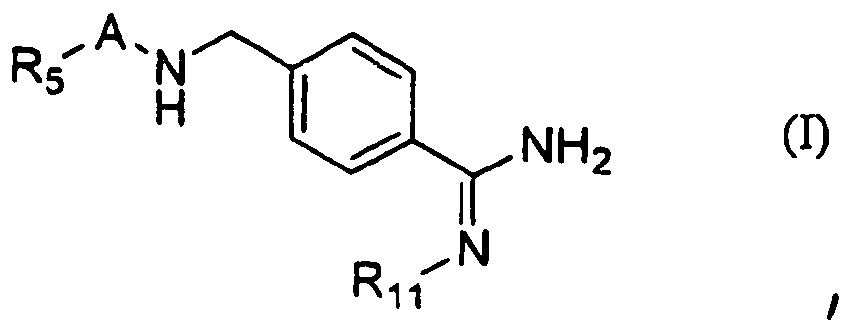

- X
- ein N oder CH, vorzugsweise an CH; R2 ein H, -CH2-OR7 oder -CH2-OCOOR7 ist, wobei R7 ein H oder ein verzweigter oder unverzweigter Alkylrest mit 1-5, insbesondere 1-3 C-Atomen, ist, oder R2 ist ein -CH2-CH2-COOR7*, wobei R7* ein H oder ein verzweigter oder unverzweigter Alkylrest mit 1-5 C-Atomen, vorzugsweise Ethyl, ist;
- R3
- ein H ist;
- R4
- -(CH2)f-R8 mit f = 0 oder 2, vorzugsweise mit f = 2, -CH2NHR8, -(CH2)2NHR8 oder -CH=CH-R8 ist, wobei R8 ein einfach oder mehrfach substituierter oder unsubstituierter Aryl- oder Heteroarylrest ist, wobei der Aryl- oder Heteroarylrest vorzugsweise 5 bis 14, insbesondere 5 bis 6 C-Atome im Ring und im Falle des Heteroarylrestes vorzugsweise 1 bis 3 N als Heteroatome besitzt, und wobei P2 in der Struktur A der allgemeinen Formel I in der D- oder L-Konfiguration, vorzugsweise in der D-Konfiguration vorliegt;
- R5
- -(CH2)i-COOR9 mit i = 1, 2 oder 3, vorzugsweise mit i = 1, und R9 gleich ein verzweigter oder unverzweigter Alkylrest mit 1-5 C-Atomen, vorzugsweise Ethyl, ist, oder R5 ist -SO2R9*, -SO2-NH-R9*, wobei R9* ein H, ein verzweigtes oder unverzweigtes Alkyl mit 1-10, vorzugsweise 1 bis 6, insbesondere 1 bis 4, vor allem 1 bis 2 C-Atomen, ein einfach oder mehrfach substituierter oder unsubstituierter Aryl-, Heteroaryl-, Aralkyl-, vorzugsweise Benzyl-, Heteroaralkylrest oder ein Cyclohexylalkylrest, vorzugsweise ein Cyclohexylmethylrest ist, wobei der Substituent eine -OH, -O-COOR7, -CH2- OCOOR7, mit R7 wie oben definiert, -NH2, -NO2, -COOR10, -CH2-COOR10-Gruppe oder ein Cl-, F- oder Br-Atom ist und wobei R10 ein H oder ein Alkylrest mit 1 bis 6, insbesondere mit 1 bis 4 C-Atomen, vor allem Ethyl, ist;
- R11
- H, OH, oder -COOR12 ist, wobei R12 ein verzweigter oder unverzweigter Alkylrest mit 1 bis 8, vorzugsweise 1 bis 6 C-Atomen ist;
- Benzylsulfonyl-D-hPhe-Ser-4-Amidinobenzylamid,
- Benzylsulfonyl-D-hAla(4-Pyridyl)-Ser-4-Amidinobenzylamid,
- Benzylsulfonyl-D-hTyr-Ser-4-Amidinobenzylamid,
- 4-NH2-Benzylsulfonyl-D-hPhe-Gly-4-Amidinobenzylamid,
- Benzylsulfonyl-D-Indanylglycyl-Gly-4-Amidinobenzylamid,
- Benzylsulfonyl-D/L-hAla(4-Pyridyl)-Gly-4-Amidinobenzylamid und
- 4-Pyridylmethylsulfonyl-D-hPhe-Gly-4-Amidinobenzylamid:,
- Sofern nichts anderes definiert ist, bedeutet der Begriff "Substituent" bzw. "substituiert" gemäß der vorliegenden Erfindung beispierweise -OH, -NH2, -NO2, -COOH, - COOCH2CH3 oder ein Halogen, wobei der Begriff "Halogen" im allgemeinen Fluor, Chlor oder Brom, vorteilhafterweise Fluor oder Chlor, bedeutet.
- Weiterhin bevorzugt ist daher eine Verbindung gemäß allgemeiner Formel I, dadurch gekennzeichnet, dass der Substituent -OH, -NH2, -NO2, -COOH, -COOCH2CH3, Fluor, Chlor oder Brom, insbesondere Fluor oder Chlor, ist.
- Als Alkylrest wird im allgemeinen, sofern nicht anders definiert, ein Rest mit vorteilhafterweise 1-5 C-Atomen, beispielweise Ethyl, und als Cycloalkyl-, Aryl-, Aralkylrest wird im allgemeinen, sofern nicht anders definiert, ein Rest mit vorteilhafterweise 4 bis 14, beispielweise 6 bis 10, wie 6 C-Atomen als Ringatome bezeichnet. Der Begriff "Hetero" bedeutet im allgemeinen, sofern nicht anders definiert, beispeilsweise N, S oder O, vorteilhafterweise insbesondere N, wobei bei einem Heteroarylrest mindestens ein C-Atom des Ringes durch ein Heteroatom ersetzt ist, zum Beispiel sind 1, 2 oder 3 C-Atome des Ringes insbesondere durch N ersetzt.
- Eine weitere Ausführungsform der vorliegenden Erfindung betrifft eine Verbindung gemäß allgemeiner Formel I, dadurch gekennzeichnet, dass die Verbindungen als Salze vorliegen, vorzugsweise mit Mineralsäuren oder mit geeigneten organischen Säuren, vorzugsweise mit Salzsäure, Schwefelsäure, Essigsäure, Ameisensäure, Methylsulfonsäure, Bernsteinsäure, Äpfelsäure oder Trifluoressigsäure, vor allem in Form ihrer Hydrochloride, Sulfate oder Acetate.
- Noch ein weiterer Gegenstand der vorliegenden Erfindung ist ein Verfahren zur Herstellung einer Verbindung gemäß allgemeiner Formel 1, dadurch gekennzeichnet, dass sequentiell die entsprechenden Aminosäuren an ein an der Amidinogruppe geschütztes Amidinobenzylamin angekoppelt werden, wobei die N-terminale Aminosäure entweder den R5-Rest bereits trägt oder dieser anschließend daran gebunden wird.
- Ferner ist ein Gegenstand der vorliegenden Erfindung ein Arzneimittel enthaltend eine Verbindung gemäß allgemeiner Formel 1 sowie pharmazeutisch geeignete Hilfs- und/oder Zusatzstoffe.
- Bevorzugt ist ein entsprechendes Arzneimittel, wobei das Arzneimittel in Form einer Tablette, eines Dragees, einer Kapsel, eines Pellets, Suppositoriums, einer Lösung, insbesondere einer Injektions- oder Infusionslösung, von Augen-, Nasen und Ohrentropfen, eines Safts, einer Emulsion oder Suspension, eines Globuli, Styli, Aerosols, Puders, einer Paste, Creme oder Salbe eingesetzt wird.
- Auch Gegenstand der vorliegenden Erfindung ist die Verwendung einer Verbindung gemäß allgemeiner Formel 1 zur Herstellung eines Arzneimittels als Faktor Xa-Inhibitor zur Therapie oder Prophylaxe einer kardiovaskulären Erkrankung oder eines thromboembolischen Ereignisses, insbesondere in oraler, subkutaner, intravenöser oder transdermaler Form.
- Im Detail sind repräsentative Verbindungen gemäß der vorliegenden Erfindung Verbindungen gemäß den Verbindungen 11 bis 20 und 22 bis 65 der Tabelle 1.
- Unter den einzelnen besonders vorteilhaften Verbindungen gehören jedoch auch Verbindungen, bei denen in den genannten Strukturen der Glycinrest mit dem Strukturelement


- Beispielsweise sind dies folgende Strukturen mit einem Serinrest:


- Weitere geeignete Verbindungen sind in folgenden beschtrieben:
- Eberfalls geeignet sind Verbindungen wie vorstehend genannt mit der Ausnahme, dass R2 -(CH2)aCONHR7* oder -(CH2)aCONHR7** mit a = 1, 2, oder 3 ist, wobei R7** ein Arylrest, beispielweise ein Phenylrest oder ein Aralkyl, vorzugsweise ein Benzoylrest ist oder ein Heteroarylrest mit ein bis zwei N-, S- oder O-Heteroatomen, vorteilhafterweise N-Heteroatomen ist.
- Ein weiterere Gruppe der geeigneten Verbindungen sind Verbindungen wie vorstehend genannt, wobei R2-(CH2)aCONHR7* oder -(CH2)aCONHR7** mit a = 1, 2, oder 3 ist und wobei R7** substituiert ist mit mindestens einem Halogen, einer Methyl-, einer Ethyl-, einer Amino-, einer Hydroxy-, einer Vitro-, einer -COOH, einer -CH2COOH, oder einer - CH2NH2- Gruppe.
- Darüber hinaus geeignete Verbingen sind Verbindungen wie vorstehend genannt, wobei R2 ein -(CH2)n-NH2 ist, mit n= 1, 2, 3, 4 oder 5, vorteilhafterweise 1 oder 4, ist.
- Auch geeignet sind Verbindungen wie vorstehend genannt, wobei R5 R9 = H ist.
- Weitere reprösentative geeignete Verbindungen sind soldie Verbindungen wie vorstehend genannt, wobei R4 eine -CH2-SR8 oder -CH2CH2-SR8 Gruppe ist. Beispiele derartiger Verbindungen sind solche, in denen R5 eine -SO2R9* oder eine -SO2CH2R9* Gruppe ist oder in denen R5 eine -SO2R9* oder eine -SO2CH2R9* Gruppe ist ist oder in denen R5 eine -SO2R9* oder eine -SO2CH2R9* Gruppe ist.
- Ebenso sind Verbindungen geeignet, in denen R5 eine -SO2R9* oder eine -SO2CH2R9* Gruppe oder in denen R5 eine -SO2R9* oder eine -SO2CH2R9* Gruppe ist oder in denen R5 eine -SO2R9* oder eine -SO2CH2R9* Gruppe ist und in denen R9* ein Phenylrest, ein Cyclohexylrest, ein Pyridylrest oder ein Pyridyl-N-oxidrest ist
- Ebenso geeignete solche in denen R5 eine -SO2R9* oder eine -SO2CH2R9* Gruppe ist oder in denen R5 eine -SO2R9* oder -SO2CH2R9* Gruppe ist oder in denen R5 eine -SO2R9* oder -SO2CH2R9* Gruppe ist und in denen R9* ein substituierter Phenyl- oder Cyclohexyl- oder Pyridyl- oder Pyridyl-N-oxidrest ist, wobei der Substituent eine -OH, -O-COOR7, - CH2OCOOR7, mit R7 wie oben definiert, NH2-, NO2-, -COOR10, -CH2COOR10- Gruppe oder ein Cl- oder F- oder Br-Atom sein kann.
- Ebenso sind darüber hinaus Verbindungen geeignet in denen R5 eine -SO2R9* oder -SO2CH2R9* Gruppe ist oder in denen R5 eine -SO2R9* oder -SO2CH2R9* Gruppe ist oder in denen R5 eine -SO2R9* oder -SO2CH2R9* Gruppe ist und in denen R9* ein substituierter Phenyl- oder Cyclohexyl- oder Pyridyl- oder Pyridyl-N-oxidrest ist, wobei der Substituent eine -OH, - O-COOR7, -CH2OCOOR7, mit R7 wie oben definiert, NH2-, NO2-, -COOR10, - CH2COOR10- Gruppe oder ein Cl- oder F- oder Br-Atom sein kann und in denen R1 - (CH2)aCONHR6 oder -(CH2)aCONHR6* mit a = 0, 1, 2, 3, 4 oder 5, vorzugsweise 0, 1 oder 2 ist, wobei R6* ein Arylrest, vorteilhafterweise ein Phenylrest ist.
- Ebenso sind auch Verbindungen geeignet in denen R5 eine -SO2R9* oder eine -SO2CH2R9* Gruppe ist oder in denen R5 eine -SO2R9* oder -SO2CH2R9* Gruppe ist oder in denen R5 eine -SO2R9* oder eine -SO2CH2R9* Gruppe ist und in denen R9* ein substituierter Phenyl- oder Cyclohexyl- oder Pyridyl- oder Pyridyl-N-oxidrest ist, wobei der Substituent eine -OH,-O-COOR7, -CH2OCOOR7, mit R7 wie oben definiert, eine NH2-, NO2-, -COOR10,-CH2COOR10- Gruppe oder ein Cl- oder F- oder Br-Atom sein kann und in denen R2 -CH2-CH2-CONHR7∗ oder -CH2CH2CONHR7∗∗ oder -CH2CH2COOR7∗∗ ist wobei R7∗∗ ein Arylrest, -beispielweise ein Benzyl- oder Phenylrest ist.
- Auch sind Verbindungen geeignet in denen R5 eine -SO2R9∗ oder eine -SO2CH2R9∗ Gruppe ist oder in denen R5 eine -SO2R9∗ oder eine -SO2CH2R9∗ Gruppe und oder in denen R5 eine -SO2R9∗ oder -SO2CH2R9∗ Gruppe ist und in denen R9∗ ein substituierter Phenyl- oder Cyclohexyl- oder Pyridylrest ist, wobei der Substituent eine -OH, -O-COOR7, -CH2OCOOR7, mit R7 wie oben definiert, eine NH2-, NO2-, -COOR10, -CH2COOR10- Gruppe oder ein Cl- oder F- oder Br-Atom sein kann und in denen R4 eine -CH2-SR8 oder -CH2CH2-SR8 -Gruppe ist.
- Ebenso sind Verbindungen vorteilhaft wie vorstehend genannt, wobei R8 ein Pyridyl-N-oxid- Rest ist.
- Außerdern sind Verbindungen, vorteilhaftin denen P1 ein Prolylrest oder ein Azetidincarbonsäurerest ist.
- Ebenso sind Verbindungen vorteilhaft in denen P2 ein 4-N-oxid-Pyridylhomoalaninrest ist. Auch sind Verbindungen vorteilhaft in denen P2 ein Lysyl- oder ein a,β-Diaminopropionsäurerest ist.
- Daher ist ferner auch Gegenstand der vorliegenden Erfindung eine Verbindung der allgemeinen Formel I

A P2- P1 ist, mit - P1 =
-

- P2 =
-
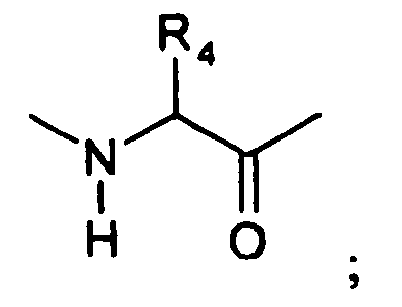
- X =
- N oder CH, vorzugsweise CH;
- R2
- eine -(CH2)aCONHR7∗ oder -(CH2)aCONHR7∗∗ Gruppe ist, wobei a = 1, 2 oder 3 und
- R7∗
- ein H oder ein verzweigter oder unverzweigter Alkylrest mit 1-5 C-Atomen, vorzugsweise Ethyl;
- R7∗∗
- ein Arylrest oder ein Heteroarylrest mit 1 -2 Heteroatomen ausgewählt aus N, S oder O ist;
- R3
- ein H ist;
- R4
- -(CH2)f-R8 mit f = 0 oder 2, vorzugsweise mit f = 2, -CH2NHR8, -(CH2)2NHR8 oder -CH=CH-R8 ist, wobei R8 ein einfach oder mehrfach substituierter oder unsubstituierter Aryl- oder Heteroarylrest ist, wobei der Aryl- oder Heteroarylrest 5 bis 14, insbesondere 5 bis 6 C-Atome im Ring und im Falle des Heteroarylrestes vorzugsweise 1 bis 3 N als Heteroatome besitzt, und wobei P2 in der Struktur A der allgemeinen Formel I in der D-oder L-Konfiguration, vorzugsweise in der D-Konfiguration vorliegt;
- R5
- -(CH2)i-COOR9 mit i = 1, 2 oder 3, vorzugsweise mit i = 1, und R9 gleich ein verzweigter oder unverzweigter Alkylrest mit 1-5 C-Atomen, vorzugsweise Ethyl, ist, oder R5 ist -SO2R9∗, -SO2-NH-R9∗, wobei R9∗ ein H, ein verzweigtes oder unverzweigtes Alkyl mit 1-10, vorzugsweise 1 bis 6, insbesondere 1 bis 4, vor allem 1 bis 2 C-Atomen, ein einfach oder mehrfach substituierter oder unsubstituierter Aryl-, Heteroaryl-, Aralkyl-, vorzugsweise Benzyl-, Heteroaralkylrest oder ein Cyclohexylalkylrest, vorzugsweise ein Cyclohexylmethylrest ist, wobei der Substituent eine -OH, -O-COOR7, -CH2-OCOOR7, mit R7 wie oben definiert, -NH2, -NO2, -COOR10, -CH2-COOR10-Gruppe oder ein Cl-, F- oder Br-Atom ist und wobei R10 ein H oder ein Alkylrest mit 1 bis 6, insbesondere mit 1 bis 4 C-Atomen, vor allem Ethyl, ist;
- R11,
- H, OH, oder -COOR12 ist, wobei R12 ein verzweigter oder unverzweigter Alkylrest mit 1 bis 8, vorzugsweise 1 bis 6 C-Atomen ist;
- Bevorzugt ist eine Verbindung gemäß der allgemeinen Formel I, wobei in R5 R9 = H ist.
- Weiterhin bevorzugt ist eine Verbindung nach der allgemeinen Formel I, wobei R4 eine -CH2-SR8 oder -CH2CH2-SR8 Gruppe ist.
- Besonders bevorzugte Verbindungen sind Verbindungen nach der allgemeinen Formel I, wobei mindestens eine Carboxylgruppe als Ester, bevorzugt als Ethylester, geschützt vorliegt.
- Ganz allgemein ist ein Prodrug ein pharmazeutisch inaktives Derivat der entsprechenden pharmazeutisch wirksamen Substanz, das nach oraler Gabe spontan oder enzymatisch unter Freisetzung der pharmazeutisch wirksamen Substanz biotransformiert wird. Im Sinne eines Prodrugs wird eine als Ester, zum Beispiel als Ethylester, geschützte Carboxylgruppe in einer Verbindung nach der allgemeinen Formel I erst nach Flufnahme im Körper in eine Carboxylgruppe umgewandelt.
- Folglich versteht man als Prodrug beispielsweise Verbindungen der allgemeinen Formel I, bei denen zusätzlich oder ausschließlich ein oder mehrere Carboxylgruppen in Form ihrer Alkylester mit einem verzweigten oder unverzweigten Alkyl mit 1-5 C-Atomen, vorzugsweise Ethyl, und/oder bei denen ein oder mehrere Hydroxylgruppen als Carbonate, bei denen der endständige Rest gleich R7, wie oben definiert, vorliegen können. Ein Prodrug im Sinne der vorliegenden Erfindung ist beispielsweise auch ein Amidino- oder Guanidinobenzylaminderivat gemäß der allgemeinen Formel I, bei dem der Amidino- bzw. Guanidinobenzylaminrest als Hydroxyamidin bzw. Hydroxyguanidin oder als Alkyloxycarbonylderivat mit vorzugsweise einem verzweigten oder unverzweigten Alkylrest mit 1-5 C-Atomen, vorzugsweise Ethyl, vorliegt.
- Ebenso bevorzugte Verbindungen sind Verbindungen nach der allgemeinen Formel I in Form eines Prodrugs, bei dem ein oder mehrere Carboxylgruppen in Form ihrer Alkylester mit einem verzweigten oder unverzweigten Alkyl mit 1-5 C-Atomen, vorzugsweise Ethyl, und/oder bei dem ein oder mehrere Hydroxylgruppen als Carbonate, bei denen der endständige Rest gleich R7, wie oben definiert vorliegen, und/oder bei dem der Amidino- bzw. Guanidinobenzylaminrest als Hydroxyamidin bzw. Hydroxyguanidin oder als Alkyloxycarbonylderivat vorliegt.
- Beispielhaft sind dies Verbindungen, bei denen
- R2
- ein H, -CH2-CH2-COOH, -CH2-CH2-COOCH2CH3 oder -CH2OH ist;
- R3
- ein H ist;
- R4
- ein -(CH2)2-R8, -CH2NH8, -(CH2)2NHR8 oder ein -CH2-4-Hydroxycyclohexyl-Rest ist, wobei R8 ein einfach oder mehrfach substituierter oder unsubstituierter Cycloalkyl-, Aryl- oder Heteroarylrest ist, wobei der Cycloalkyl-, Aryl- oder Heteroarylrest 5 oder 6 C-Atome und im Falle eines Heteroarylrestes 1 oder 2 N als Heteroatome besitzt, vorzugsweise ist R8 ein Phenyl-, Hydroxyphenyl-, Pyridyl- oder Aminopyridylrest;
- R5
- ein Methylsulfonyl, Ethylsulfonyl, n-Propylsulfonyl, iso-Propylsulfonyl, Butylsulfonyl, Benzylsulfonyl, n-Butylsulfonyl, Aminobenzylsulfonyl, Hydroxybenzylsulfonyl, Chlorobenzylsulfonyl, Fluorobenzylsulfonyl, Carboxybenzylsulfonyl, Ethyloxycarbonylbenzylsulfonyl, Carboxymethylbenzylsulfonyl, Ethyloxycarbonylmethylbenzylsulfonyl, Pyridylmethylsulfonyl, N-(oxid)-pyridylmethylsulfonyl, -CH2-COOH oder ein -CH2COOCH2CH3 Rest ist;
- Ein weiterer Gegenstand der vorliegenden Erfindung ist daher eine Verbindung der allgemeinen Formel I

A P2-P1 ist, mit - P1=
-

- P2 =
-

- R2
- ein H, -CH2-CH2-COOH, -CH2-CH2-COOCH2CH3 oder -CH2OH ist;
- R3
- ein H ist;
- R4
- ein -(CH2)2-R8, -CH2NHR8, -(CH2)2NHR8 oder ein -CH2-4-Hydroxycyclohexylrest ist, wobei R8 ein einfach oder mehrfach substituierter oder unsubstituierter Aryl- oder Heteroarylrest ist, wobei der Aryl- oder Heteroarylrest 5 oder 6 C-Atome und im Falle eines Heteroarylrestes 1 oder 2 N als Heteroatome besitzt, vorzugsweise ist R8 ein Phenyl-, Hydroxyphenyl-, Pyridyl- oder Aminopyridylrest;
- R5
- ein Methylsulfonyl, Ethylsulfonyl, n-Propylsulfonyl, iso-Propylsulfonyl, Butylsulfonyl, n-Butylsulfonyl, Benzylsulfonyl, Aminobenzylsulfonyl, Hydroxybenzylsulfonyl, Chlorobenzylsulfonyl, Fluorobenzylsulfonyl, Carboxybenzylsulfonyl, Ethyloxycarbonylbenzylsulfonyl, Carboxymethylbenzylsulfonyl, Ethyloxycarbonylmethylbenzylsulfonyl, Pyridylmethylensulfonyl, N-(oxid)-pyridylmethylensulfonyl, -CH2-COOH oder ein -CH2COOCH2CH3 Rest ist;
- X
- CH ist;
- R11
- H, OH oder -COOR12 mit R12 ein verzweigter oder unverzweigter Alkylrest mit 2, 4 oder 6 C-Atomen ist,
- Benzylsulfonyl-D-hPhe-Ser-4-Amidinobenzylamid,
- Benzylsulfonyl-D-hAla(4-Pyridyl)-Ser-4-Amidinobenzylamid,
- Benzylsulfonyl-D-hTyr-Ser-4-Amidinobenzylamid,
- 4-NH2-Benzylsulfonyl-D-hPhe-Gly-4-Amidinobenzylamid,
- Benzylsulfonyl-D-Indanylglycyl-Gly-4-Amidinobenzylamid,
- Benzylsulfonyl-D/L-hAla(4-Pyridyl)-Gly-4-Amidinobenzylamid und
- 4-Pyridylmethylsulfonyl-D-hPhe-Gly-4-Amidinobenzylamid.
- Andere bevorzugte Verbindungen sind Verbindungen des allgemeinen Formel I, bei denen R4 ein -CH2-CH2-R8 Rest ist, wobei R8 ein Aryl- oder Heteroarylrest mit 4-6 Ringatomen ist, der 1 oder 2 Heteroatome, vorzugsweise N, besitzt und der mit einer oder mehreren -NH2 und/oder-OH Gruppen substituiert ist, vorzugsweise ist P2 in der Struktur A der allgemeinen Formel I von einem Homophenylalanin, Homotyrosin, Indanylglycin oder 4-Pyridylhomoalanin abgeleitet, und die P2- Aminosäure liegt insbesondere in der D-Konfiguration vor.
- Ebenso sind die Verbindungen eine oder mehr oder alle der Verbindungen 22 bis 64 der Tabelle 1 Gegenstand der Erfindung.
- Neben der Inaktivierung von Faktor Xa werden die zusätzlich geladenen 4-Amidinobenzylamin-Derivate gemäß der vorliegenden Erfindung wie bereits erwähnt auf vorteilhafte und überraschende Weise sehr langsam eliminiert, so dass die erfindungsgemäßen Verbindungen eine neue Gruppe von hochaktiven F Xa-Hemmstoffen darstellen.
- Die Verbindungen liegen in der Regel als Salze, vorzugsweise mit Mineralsäuren oder geeigneten organischen Säuren, vorzugsweise mit Salzsäure, Schwefelsäure, Essigsäure, Ameisensäure, Methylsulfonsäure, Bernsteinsäure, Äpfelsäure oder Trifluoressigsäure, vor allem in Form ihrer Hydrochloride, Sulfate oder Acetate.
- Die Verbindungen der allgemeinen Formel I können in prinzipiell bekannter Weise, wie nachfolgend beschrieben, beispielsweise wie folgt hergestellt werden, wobei im allegemeinen sequentiell die entsprechenden Aminosäuren an ein an der Amidinogruppe geschütztes Amidinobenzylamin angekoppelt werden, wobei die N-terminale Aminosäure entweder den R5-Rest bereits trägt oder dieser anschließend daran gebunden wird:
- Aus dem kommerziell erhältlichen 4-Cyanobenzylamin (Showa Denko, Japan) wird das Boc-geschützte 4-Acetyloxamidinobenzylamin nach dem Fachmann bekannten Verfahren gewonnen. Nach Abspaltung der Boc-Schutzgruppe erfolgt die Ankopplung der weiteren Aminosäuren und der Schutzgruppe R5 mittels Standardkopplungsmethoden mit Boc als N-terminaler Schutzgruppe. Die zweite Aminosäure kann auch direkt als N-aryl- bzw. N-aralkyl-sulfonyl-geschützte Aminosäure gekoppelt werden. Die Peptidanaloga werden sequentiell, beginnend vom Acetyloxamidinobenzylamin, aufgebaut. Die meisten Zwischenprodukte kristallisieren gut und lassen sich damit einfach reinigen. Die Endreinigung der Hemmstoffe erfolgt auf der letzten Stufe vorzugsweise über präparative, reversed-phase HPLC.
- Ein weiterer Gegenstand der Erfindung ist daher ein Verfahren zur Herstellung einer Verbindung nach der allgemeinen Formel 1, wobei sequentiell die entsprechenden Aminosäuren an ein an der Amidinogruppe geschütztes Amidinobenzylamin. angekoppelt werden, wobei die N-terminale Aminosäure entweder den R5-Rest bereits trägt oder dieser anschließend daran gebunden wird.
- Beispielsweise kann sequentiell die entsprechende Aminosäure an ein 4-Acetyloxomidinebenzylamin odes an ein 4-(Benzyloxycarbonylamidino) benzylamin angekoppelt werden.
- Ein anderer Gegenstand der Erfindung ist auch ein Arzneimittel enthaltend eine erfindungsgemäße Verbindung sowie weitere pharmazeutisch geeignete Hilfs- und/oder Zusatzstoffe. Geeignete Hilfs- und/oder Zusatzstoffe, die z.B. der Stabilisierung und/oder konservierung des Arzneimittels dienen, sind dem Fachmann allgemein geläufig (z.B. Sucker H. et al., (1991) Pharmazeutische Technologie, 2. Auflage, Georg Thieme Verlag, Stuttgart). Hierzu zählen beilspielsweise physiologische Kochsalzlösungen, Ringer-Dextrose, Ringer-Laktat, entmineralisiertes Wasser, Stabilisatoren, Antioxidantien, komplexbildner, antimikrobielle Verbindungen, Proteinaseinhibitoren und/oder inerte Gase.
- Das Arzneimittel könnte beispielsweise in parenteraler Anwendungsform insbesondere in intraartieller, intravenöser, intramuskulärer oder subcutaner Form, in enteraler Anwendungsform, insbesondere zur oralen oder rektalen Anwendung, oder in topischer Anwendungsform, insbesondere als Dermatikum, angewendet werden. Bevorzugt sind intravenöse oder subkutane Anwendungen.
- In einer Ausführungsform der Erfindung wird das Arzneimittel in Form einer Tablette, eines Dragées, einer Kapsel, eines Pellets, Suppositoriums, einer Lösung, insbesondere einer Injektions- oder Infusionslösung, von Augen-, Nasen und Ohrentropfen, eines Safts, einer Kapsel, einer Emulsion oder Suspension, eines Globuli, Styli, Aerosols, Puders, einer Paste, Creme oder Salbe eingesetzt.
- Ein weiterer Gegenstand der vorliegenden Erfindung ist die Verwendung des erfindungsgemäßen Verbindung zur Herstellung eines Arzneimittels zur Therapie oder Prophylaxe einer kardiovaskulären Erkrankung oder eines thromboembolischen Ereignisses, insbesondere in oraler, subkutaner, intravenöser oder transdermaler Form verwendet.
- Die Erfindung soll nachstehend anhand von mehreren Ausführungsbeispielen näher erläutert werden, ohne sie darauf zu beschränken.
- Analytische HPLC: Shimadzu LC-10A System, Säule: Phenomenex-Luna C18, 5 µm (250 x 4 mm) Lösungsmittel A: 0,1 % TFA in Wasser, B: 0,1 % TFA in ACN, Gradient: 10 % B bis 70 % B in 60 min, 1 ml/min Fluß, Detektion bei 220 oder 215 nm.
Präparative HPLC: Shimadzu LC-8A System, Säule: Phenomenex-Luna C18, 5µm (250x 30 mm) Lösungsmittel A: 0,1 % TFA in Wasser, B: 0,1 % TFA in ACN, Gradient: 5 % B bis 50 % B in 120 mm, 10ml/min Fluß, Detektion bei 220 mm. - Massenspektroskopie: Die Massenspektren wurden auf einem ESI-MS LCQ der Firma Finnigan (Bremen, Deutschland), gemessen.
-
- Ac
- Acetyl
- AcOxam
- N-(Acetyloxy)amidin
- Amb
- Amidomethylbenzen
- 4-Amba
- 4-Amidinobenzylamid
- Boc
- tert.-Butyloxycarbonyl
- Bzl
- Benzyl
- Bzls
- Benzylsulfonyl
- dCha
- d-βCyclohexylalanin
- CKIBE
- Chlorkohlensäureisobutylester
- DIEA
- Diisopropylethylamin
- DCM
- Dichlormethan
- DMF
- N,N-Dimethylformamid
- i.V.
- im Vakuum
- MS
- Massenspektroskopie
- NMM
- N-Methylmorpholin
- PyBOP
- Benzotriazol-1-yl-N-oxy-tris(pyrrolidino)phosphoniumhexafluorophosphat
- TEA
- Triethylamin
- TFA
- Trifluoressigsäure
- THF
- Tetrahydrofuran
- TMS-Cl
- Trimethylsilylchlorid
- tBu
- tert.-Butyl
-

- 2 g (5,49 mmol) Boc-Gly-4-(Acetyloxamidino)Benzylamid (hergestellt wie in
WO 01/96286 A2
Ausbeute: 1,55 g (5,15 mmol), weißer Feststoff - 250 mg (0,89 mmol) Boc-D,L-homoAla(4-Pyr)-OH [RSP Amino Acids DBA, Shirley MA, USA] und 308 mg (1,02 mmol) Produkt 1a wurden in 20 ml DMF gelöst und bei 0 °C mit 531 mg (1,02 mmol) PyBop und 533 µl (3,06 mmol) DIEA versetzt. Der Ansatz wurde 20 min bei 0°C und weitere 2h bei Raumtemperatur gerührt. Anschließend wurde das Lösungsmittel im Vakuum entfernt, der Rückstand in Essigester aufgenommen, 1x mit NaCl- gesättigtem Wasser, 2x mit gesättigter NaHCO3-Lösung und 2x mit NaClgesättigtem Wasser gewaschen und über Na2SO4 getrocknet. Das Lösungsmittel wurde im Vakuum entfernt (gelbliches Öl).
Ausbeute: ca. 600 mg (Rohprodukt), HPLC: 27,89% B - 600 mg Rohprodukt 1b wurden mit 10 ml 1N HCl in Eisessig versetzt. Der Ansatz wurde gelegentlich umgeschüttelt. Nach 1 h wurde das Lösungsmittel etwas eingeengt und das Produkt durch Zugabe von Diethylether gefällt, auf einer Fritte abgesaugt, mit Ether gewaschen und im Vakuum getrocknet.
Ausbeute: 320 mg (0,69 mmol) hellgelber Feststoff, HPLC: 16,83% B - 75 mg (0,16 mmol) Rohprodukt 1c und 37 mg (0,19 mmol) Phenylmethansulfonylchlorid (Bzls-Cl) [Fluka] wurden in 10 ml DMF gelöst und bei 0 °C mit 68 µl (0,39 mmol) DIEA versetzt. Der Ansatz wurde 20 min bei 0°C und weitere 2 h bei Raumtemperatur gerührt. Anschließend wurde das Lösungsmittel im Vakuum entfernt, der Rückstand in Essigester aufgenommen, 1x mit NaCl- gesättigtem Wasser, 2x mit gesättigter NaHCO3-Lösung und 2x mit NaCl- gesättigtem Wasser gewaschen und über Na2SO4 getrocknet. Das Lösungsmittel wurde im Vakuum entfernt (helles Öl).
Ausbeute: ca. 280 mg (Rohprodukt), HPLC: 29,27% B - Das Rohprodukt 1d wurde in 50ml 90% Essigsäure gelöst und mit 20 mg Katalysator (10% Pd/C) versetzt. Der Ansatz wurde bei Raumtemperatur und Normaldruck für 5 h mit Wasserstoff hydriert. Anschließend wurde der Katalysator abfiltriert und das Lösungsmittel im Vakuum eingeengt. Der verbleibende Rückstand wurde im Vakuum getrocknet und mit präparativer reversed- phase HPLC gereinigt und lyophilisiert.
Ausbeute: 34,6 mg (0,054 mmol) lyophilisiertes Pulver, HPLC: 22,97% B
MS: berechnet 522,20 (monoisotopic), gefunden 523,4 [M+H]+ -

- 50 mg (0,11 mmol) Produkt 1c wurden in 10 ml DCM suspendiert und mit 34 µl (0,28 mmol) Chlortrimethylsilan (= TMS-Cl) [Merck] und 69 µl (0,4 mmol) DIEA versetzt und der Ansatz 15 min bei Raumtemperatur gerührt. Anschließend wurden 41 mg (0,12 mmol) 4-Pyridylmethylsulfonylchlorid x Triflat (= 4-PMs-Cl) [Array Biopharma, Boulder, CO, USA] und weitere 20 µl (0,11 mmol) DIEA zugegeben und weiter über Nacht bei Raumtemperatur gerührt. Dann wurde das Lösungsmittel im Vakuum entfernt. Der Rückstand wurde ohne weitere Reinigung direkt für den nächsten Syntheseschritt eingesetzt.
- Das Rohprodukt 2a wurde in 50ml 90% Essigsäure gelöst und mit 20mg Katalysator (10% Pd/C) versetzt. Der Ansatz wurde bei Raumtemperatur und Normaldruck über Nacht mit Wasserstoff hydriert. Anschließend wurde der Katalysator abfiltriert und das Lösungsmittel im Vakuum eingeengt. Der verbleibende Rückstand wurde in 5 ml Wasser gelöst und auf eine Ionenaustauschsäule (Fractogel- EMD COO- Säule, Dimension 16 x 125 mm, equilibriert mit Wasser) aufgegeben. Die Säule wurde mit 85 ml Wasser gewaschen und anschließend das Produkt mit einem Ammoniumacetat- Gradienten eluiert. Die Produkt-enthaltenden Fraktionen (HPLC-Kontrolle) wurden vereinigt und lyophilisiert.
Ausbeute: 20 mg (0,034 mmol) lyophilisiertes Pulver, HPLC: 13,14% B
MS: berechnet 523,20 (monoisotopic), gefunden 524,3 [M+H]+ -

- 100 g (0,593 mol) 4-Cyanobenzylamin x HCl wurden in 1,21 Dioxan und 600 ml 2N NaOH gelöst. 142,3 g (0,652 mol) di(tert.-Butyl)Pyrocarbonate wurden bei 0 °C über 10 min in zwei Portionen zugegeben. Der pH-Wert wurde durch Zugabe von 2 N NaOH auf 9-10 eingestellt und der Ansatz für weitere 4 h gerührt. Das Lösungsmittel wurde im Vakuum entfernt, der Rückstand mit Essigester aufgenommen, jeweils 3x mit 5% KHSO4 und NaCl- gesättigtem Wasser gewaschen und anschließend über Na2SO4 getrocknet. Das Lösungsmittel wurde im Vakuum entfernt (weißer Feststoff).
Ausbeute: 132,6 g (0,57 mol) weißer Feststoff, HPLC: 51,6% B - 130 g (0,56 mol) Produkt 3a, 58,4 g (0,84 mol) Hydroxylamin x HCl und 146 ml DIEA wurden in 1,51 Methanol gelöst. Der Ansatz wurde 6 h unter Rückfluß gekocht und anschließend über Nacht bei Raumtemperatur gerührt. Das Lösungsmittel wurde im Vakuum entfernt, der ölige Rückstand in 1,51 Essigsäure gelöst, mit 160 ml (1,68 mol) Acetanhydrid versetzt und 30 min gerührt. Das Lösungsmittel wurde im Vakuum entfernt, der Rückstand mit Essigester aufgenommen und 3x mit NaCl- gesättigtem Wasser gewaschen und anschließend über Na2SO4 getrocknet. Das Lösungsmittel wurde im Vakuum weitestgehend entfernt und das Produkt aus Essigester kristallisiert.
Ausbeute: 110,6 g (0,36 mol) kristalliner Feststoff, HPLC: 39,76% B - 50 g (163 mmol) Produkt 3b wurden in 11 Essigsäure gelöst und es wurden 800 ml 1N HCl in Eisessig zugegeben. Der Ansatz wurde geschüttelt und nach einigen Minuten begann das Produkt auszufallen. Nach 75 min wurde das Produkt abgesaugt, mit Diethylether gewaschen und im Vakuum getrocknet.
Ausbeute: 36 g (147,7 mmol) weißer Feststoff, HPLC: 18,97% B - 25 g (122 mmol) Boc-Ser-OH wurden in 750 ml DMF gelöst und auf -15°C gekühlt. Es wurden 13,42 ml (122 mmol) N-Methylmorpholin und 15,86 ml (122 ml) Chlorkohlensäureisobutylester zugegeben und 10 min gerührt. Dann wurden 29,74 g (122 mmol) Produkt 3c und 13,42 ml (122 mmol) N-Methylmorpholin hinzugefügt und der Ansatz für 1 h bei -15 °C und über Nacht bei Raumtemperatur gerührt. Anschließend wurde das DMF im Vakuum entfernt, der Rückstand in 21 Essigester gelöst und jeweils 2x mit 300 ml gesättigter NaHCO3- Lösung und 300 ml NaCl- gesättigtem Wasser gewaschen, über Na2SO4 getrocknet und das Lösungsmittel im Vakuum entfernt (Öl).
Ausbeute: 43 g Rohprukt Öl, HPLC: 29,87% B - 40 g des öligen Rohproduktes 3d wurden mit 200 ml Trifluoressigsäure versetzt und 1 h gerührt. Das Produkt wurde durch Zugabe von Diethylether gefällt, abgesaugt, mit Diethylether gewaschen und im Vakuum getrocknet.
Ausbeute: 27 g (66 mmol) weißer Feststoff, HPLC: 20,22% B - 100 mg (0,36 mmol) Boc-D,L-homoAla(4-Pyr)-OH [RSP Amino Acids DBA, Shirley MA, USA] und 161 mg (0,4 mmol) Rohprodukt 3e wurden in 15 ml DMF gelöst und bei 0 °C mit 206 mg (0,4 mmol) PyBop und 207 µl (1,2 mmol) DIEA versetzt. Der Ansatz wurde 20 min bei 0°C und weitere 2h bei Raumtemperatur gerührt. Anschließend wurde das Lösungsmittel im Vakuum entfernt, der Rückstand in Essigester aufgenommen, 1x mit NaCl- gesättigtem Wasser, 2x mit gesättigter NaHCO3-Lösung und 2x mit NaClgesättigtem Wasser gewaschen und über Na2SO4 getrocknet. Das Lösungsmittel wurde im Vakuum entfernt (helles Öl).
Ausbeute: ca. 300 mg (Rohprodukt), HPLC: 26,8% B und 27,4% B (Doppelpeak, Racemat) - 300 mg Rohprodukt aus 3f wurden in 5 ml 50% TFA in Dichlormethan versetzt. Der Ansatz wurde gelegentlich umgeschüttelt. Nach 45 min wurde das Lösungsmittel eingeengt, der Rückstand in Methanol angelöst und das Produkt durch Zugabe von Diethylether gefällt, auf einer Fritte abgesaugt, mit Ether gewaschen und im Vakuum getrocknet.
Ausbeute: 186 mg (0,33 mmol) weißer Feststoff, HPLC: 21,6% B und 22,7% B (Doppelpeak, Racemat) - 75 mg (0,13 mmol) Produkt 3g und 38 mg (0,2 mmol) Phenylmethansulfonylchlorid (= Bzls-Cl) [Fluka] wurden in 10 ml DMF gelöst und bei 0 °C mit 68 µl (0,39 mmol) DIEA versetzt. Der Ansatz wurde 20 min bei 0°C und über Nacht bei Raumtemperatur gerührt. Das Lösungsmittel wurde im Vakuum entfernt (Öl).
Ausbeute: ca. 120 mg (Rohprodukt), HPLC: 28,1% B und 28,6% B (Doppelpeak) - Das Rohprodukt aus 3h wurde in 50ml 90% Essigsäure gelöst und mit 20 mg Katalysator (10% Pd/C) versetzt. Der Ansatz wurde bei Raumtemperatur und Normaldruck über Nacht mit Wasserstoff hydriert. Anschließend wurde der Katalysator abfiltriert und das Lösungsmittel im Vakuum eingeengt. Der verbleibende Rückstand wurde im Vakuum getrocknet und mit präparativer reversed- phase HPLC gereinigt und lyophilisiert. Dadurch konnten die Diastereomere getrennt werden.
HPLC: 22,01% B (Verbindung 3a) und 22,6% B (Verbindung 3b).
MS: berechnet 552,22 (monoisotopic), gefunden 553,5 [M+H]+ -

- 55 mg (0,1 mmol) Produkt 3g wurden in 10 ml DCM suspendiert und mit 31 µl (0,25 mmol) Chlortrimethylsilan (= TMS-Cl) [Merck] und 61 µl (0,36 mmol) DIEA versetzt und der Ansatz 15 min bei Raumtemperatur gerührt. Anschließend wurden 36 mg (0,105 mmol) 4-Pyridylmethylsulfonylchlorid x Triflat (= 4-PMs-Cl) [Array Biopharma, Boulder, CO, USA] und weitere 17,5 µl (0,1 mmol) DIEA zugegeben und weiter über Nacht bei Raumtemperatur gerührt. Dann wurde das Lösungsmittel im Vakuum entfernt. Der Rückstand wurde ohne weitere Reinigung direkt für den nächsten Syntheseschritt eingesetzt.
- Das Rohprodukt aus 4a wurde in 50ml 90% Essigsäure gelöst und mit 20mg Katalysator (10% Pd/C) versetzt. Der Ansatz wurde bei Raumtemperatur und Normaldruck über Nacht mit Wasserstoff hydriert. Anschließend wurde der Katalysator abfiltriert und das Lösungsmittel im Vakuum eingeengt. Der verbleibende Rückstand wurde in 5 ml Wasser gelöst und auf eine Ionenaustauschsäule (Fractogel- EMD COO- Säule, Dimension 16 x 125 mm, equilibriert mit Wasser) aufgegeben. Die Säule wurde mit 85 ml Wasser gewaschen und anschließend das Produkt mit einem Ammoniumacetat- Gradienten eluiert. Die Produkt-enthaltenden Fraktionen wurden vereinigt und lyophilisiert.
Ausbeute: 17,2 mg (0,028 mmol) lyophilisiertes Pulver, HPLC: 12,1 undd 12,3% B (Doppelpeak, Racemat)
MS: berechnet 553,21 (monoisotopic), gefunden 554,5 [M+H]+ -

- 300 mg (1,09 mmol) H-d-homoTyr-OH x HBr [Chem-Impex International, Wood Dale, IL, USA] wurden in 20 ml DCM suspendiert und mit 425 µl (3,37 mmol) Chlortrimethylsilan (= TMS-Cl) [Merck] und 586 µl (3,37 mmol) DIEA versetzt und der Ansatz 1 h bei 60 °C unter Rückfluß gerührt, dann wieder auf Raumtemperatur abgekühlt. Anschließend wurden 229 mg (1,2 mmol) Phenylmethansulfonylchlorid (= Bzls-Cl)
[Fluka] und weitere 190 µl (1,09 mmol) DIEA zugegeben und für 2 h bei Raumtemperatur gerührt. Das Lösungsmittel wurde im Vakuum entfernt, der Rückstand in Essigester aufgenommen, 1x mit 5% KHSO4- Lösung und 2x mit NaCl- gesättigtem Wasser gewaschen und über Na2SO4 getrocknet. Nach Entfernen des Lösungsmittels wurde das Produkt aus Essigester kristallisiert.
Ausbeute: 353 mg (1,01 mmol) hellgelber Feststoff, HPLC: 40,9% B - 50 mg (0,14 mmol) Produkt 5a und 43 mg (0,14 mmol) H-Gly-Amb(4AcOxam) (= Produkt 1a) wurden in 15 ml DMF gelöst und bei 0 °C mit 74,4 mg (0,14 mmol) PyBop und 74,6 µl (0,43 mmol) DIEA versetzt. Der Ansatz wurde 20 min bei 0°C und weitere 2h bei Raumtemperatur gerührt. Anschließend wurde das Lösungsmittel im Vakuum entfernt, der Rückstand in Essigester aufgenommen, l x mit 5% KHSO4- Lösung und 2x mit NaClgesättigtem Wasser gewaschen und über Na2SO4 getrocknet. Als Rückstand blieb ein helles Öl.
Ausbeute: ca. 200 mg (Rohprodukt), HPLC: 39,84% B - Das Rohprodukt aus 5b wurde in 50ml 90% Essigsäure gelöst und mit 20 mg Katalysator (10% Pd/C) versetzt. Der Ansatz wurde bei Raumtemperatur und Normaldruck für 6 h mit Wasserstoff hydriert. Anschließend wurde der Katalysator abfiltriert und das Lösungsmittel im Vakuum eingeengt. Der verbleibende Rückstand wurde im Vakuum getrocknet und ohne weitere Vorreinigung mit präparativer reversed- phase HPLC gereinigt und lyophilisiert.
Ausbeute: 37,5 mg (0,058 mmol) lyophilisiertes Pulver, HPLC: 32, 37% B
MS: berechnet 537,20 (monoisotopic), gefunden 538,4 [M+H]+ -

- 50 mg (0,14 mmol) Produkt 5a und 58,4 mg (0,14 mmol) H-Ser-Amb(4AcOxam) (= Produkt 3e) wurden in 15 ml DMF gelöst und bei 0 °C mit 74,4 mg (0,14 mmol) PyBop und 74,6 µl (0,43 mmol) DIEA versetzt. Der Ansatz wurde 20 min bei 0°C und über Nacht bei Raumtemperatur gerührt. Anschließend wurde das Lösungsmittel im Vakuum entfernt, der Rückstand in Essigester aufgenommen, 1x mit 5% KHSO4- Lösung und 2x mit NaClgesättigtem Wasser gewaschen und über Na2SO4 getrocknet (helles Öl).
Ausbeute: ca. 165 mg (Rohprodukt), HPLC: 38,49% B - Das Rohprodukt aus 6a wurde in 50ml 90% Essigsäure gelöst und mit 20 mg Katalysator (10% Pd/C) versetzt. Der Ansatz wurde bei Raumtemperatur und Normaldruck für 6 h mit Wasserstoff hydriert. Anschließend wurde der Katalysator abfiltriert und das Lösungsmittel im Vakuum eingeengt. Der verbleibende Rückstand wurde im Vakuum getrocknet und ohne weitere Vorreinigung mit präparativer reversed- phase HPLC gereinigt und lyophilisiert.
Ausbeute: 38 mg (0,056 mmol) lyophilisiertes Pulver, HPLC: 31,74% B
MS: berechnet 567,22 (monoisotopic), gefunden 568,5 [M+H]+ -
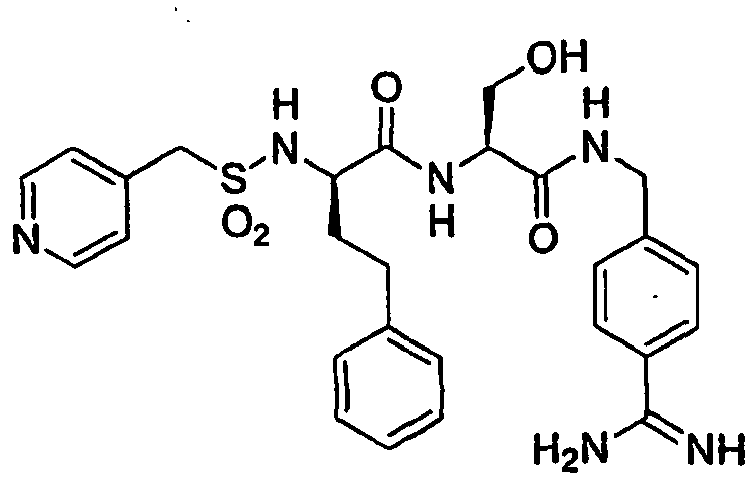
- 732 mg (2,62 mmol) Boc-d-homoPhe-OH [Bachem] und 788 mg (2,62 mmol) H-Gly-Amb(4AcOxam) (=Produkt 1a) wurden in 50 ml DMF gelöst und bei 0 °C mit 1,36 g (2,62 mmol) PyBop und 1,37 ml (7,86 mmol) DIEA versetzt. Der Ansatz wurde 20 min bei 0°C und weitere 2h bei Raumtemperatur gerührt. Anschließend wurde das Lösungsmittel im Vakuum entfernt, der Rückstand in Essigester aufgenommen, jeweils 2x mit 5% KHSO4, gesättigter NaHCO3-Lösung und NaCl- gesättigtem Wasser gewaschen und anschließend über Na2SO4 getrocknet. Das Lösungsmittel wurde im Vakuum entfernt (hellbraunes Öl).
Ausbeute: ca. 1,8 g (Rohprodukt), HPLC: 47,87% B - 600 mg Rohprodukt aus 7a wurden mit 15 ml 1N HCl in Eisessig versetzt. Der Ansatz wurde gelegentlich umgeschüttelt. Nach 1 h wurde das Lösungsmittel etwas eingeengt und das Produkt durch Zugabe von Diethylether gefällt, auf einer Fritte abgesaugt, mit Ether gewaschen und im Vakuum getrocknet.
Ausbeute: 1,02g (2,2 mmol) hellgelber Feststoff, HPLC: 28,11% B - 50 mg (0,11 mmol) Produkt 7b wurden in 10 ml DCM suspendiert und mit 20,5 µl (0,16 mmol) Chlortrimethylsilan (= TMS-Cl) [Merck] und 49 µl (0,28 mmol) DIEA versetzt und der Ansatz 15 min bei Raumtemperatur gerührt. Anschließend wurden 41 mg (0,12 mmol) 4-Pyridylmethylsulfonylchlorid x Triflat (= 4-PMs-Cl) [Array Biopharma, Boulder, CO, USA] und weitere 20 µl (0,11 mmol) DIEA zugegeben und weiter für 2 h bei Raumtemperatur gerührt. Dann wurde das Lösungsmittel im Vakuum entfernt. Der Rückstand wurde ohne weitere Reinigung direkt für den nächsten Syntheseschritt eingesetzt
- Das Rohprodukt aus 7c wurde in 50ml 90% Essigsäure gelöst und mit 20mg Katalysator (10% Pd/C) versetzt. Der Ansatz wurde bei Raumtemperatur und Normaldruck über Nacht mit Wasserstoff hydriert. Anschließend wurde der Katalysator abfiltriert und das Lösungsmittel im Vakuum eingeengt. Der verbleibende Rückstand wurde im Vakuum getrocknet und ohne weitere Vorreinigung mit präparativer reversed- phase HPLC gereinigt und lyophilisiert.
Ausbeute: 30 mg (0,047 mmol) lyophilisiertes Pulver, HPLC: 26,01% B
MS: berechnet 522,20 (monoisotopic), gefunden 523,3 [M+H]+ -

- 75 mg (0,42 mmol) H-d-homoPhe-OH [Bachem] wurden in 10 ml DCM suspendiert und mit 116 µl (0,92 mmol) Chlortrimethylsilan (= TMS-Cl) [Merck] und 160 µl (0,92 mmol) DIEA versetzt und der Ansatz 1h bei 60 °C unter Rückfluß gerührt, dann wieder auf Raumtemperatur abgekühlt. Anschließend wurden 150 mg (0,44 mmol) 2-Pyridylmethylsulfonylchlorid x Triflat (= 2-PMs-Cl) [Array Biopharma, Boulder, CO, USA] und weitere 77 µl (0,44 mmol) DIEA zugegeben und weiter über Nacht bei Raumtemperatur gerührt. Dann wurde das Lösungsmittel entfernt. Der Rückstand wurde ohne weitere Reinigung direkt für den nächsten Syntheseschritt eingesetzt.
Ausbeute: ca. 300 mg Rohprodukt, HPLC: 32,86% B - 150 mg (ca. 0,2 mmol) Rohprodukt 8a und 60,2 mg (0,2mmol) H-Gly-Amb(4AcOxam (=Produkt 1a) wurden in 10 ml DMF gelöst und bei 0 °C mit 104 mg (0,2 mmol) PyBop und 104,5 µl (0,6 mmol) DIEA versetzt. Der Ansatz wurde 20 min bei 0°C und weitere 2h bei Raumtemperatur gerührt. Anschließend wurde das Lösungsmittel im Vakuum entfernt, der Rückstand in Essigester aufgenommen, 2x mit gesättigter NaHCO3-Lösung und 2x mit NaCl- gesättigtem Wasser gewaschen und über Na2SO4 getrocknet. Das Lösungsmittel wurde im Vakuum entfernt (hellbraunes Öl).
HPLC: 35,28% B - Das Rohprodukt aus 8b wurde in 50ml 90% Essigsäure gelöst und mit 20 mg Katalysator (10% Pd/C) versetzt. Der Ansatz wurde bei Raumtemperatur und Normaldruck für 5 h mit Wasserstoff hydriert. Anschließend wurde der Katalysator abfiltriert und das Lösungsmittel im Vakuum eingeengt. Der verbleibende Rückstand wurde im Vakuum getrocknet und ohne weitere Vorreinigung mit präparativer reversed- phase HPLC gereinigt und das Produkt lyophilisiert.
Ausbeute: 69 mg (0,11 mmol) lyophilisiertes Pulver, HPLC: 31,18% B
MS: berechnet 522,20 (monoisotopic), gefunden 523,4 [M+H]+ -

- Beispiel 9 wurde in Analogie zu Beispiel 8 synthetisiert, nur dass 3-Pyridylmethylsulfonylchlorid x Triflat (= 3-PMs-Cl) [Array Biopharma, Boulder, CO, USA] verwendet wurde. Das Endprodukt wurde mit präparativer reversed- phase HPLC gereinigt und lyophilisiert.
Ausbeute: 62 mg (0,097 mmol) lyophilisiertes Pulver, HPLC: 29,08% B
MS: berechnet 522,20 (monoisotopic), gefunden 523,4 [M+H]+Tabelle 1: Bestimmung der Hemmkonstanten für Faktor Xa und Thrombin. Zusätzlich ist das Selektivitätsverhältnis SV angegeben (SV = Ki Thrombin/Ki Faktor Xa). Nr. Struktur Ki (µM) SV Faktor Xa Thrombin 10 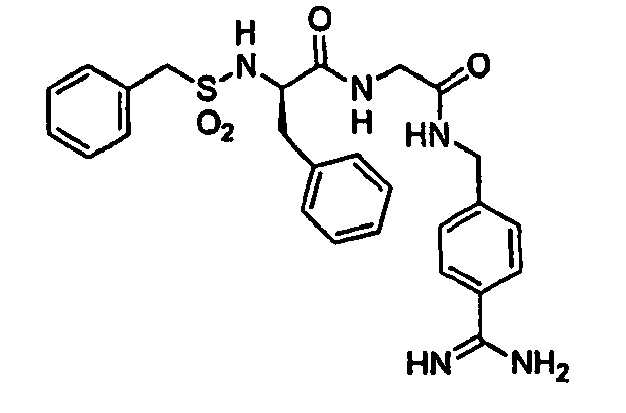
0,026 0,068 2,6 11 
0,0065 0,047 7,2 12 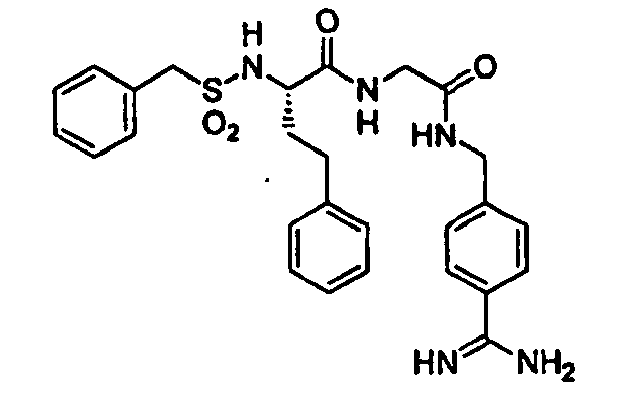
0,36 11 31 13 
1,1 1,3 1,2 8 
0, 051 4,9 96 9 
0,062 5,9 95 14 
0,08 3,6 45 15 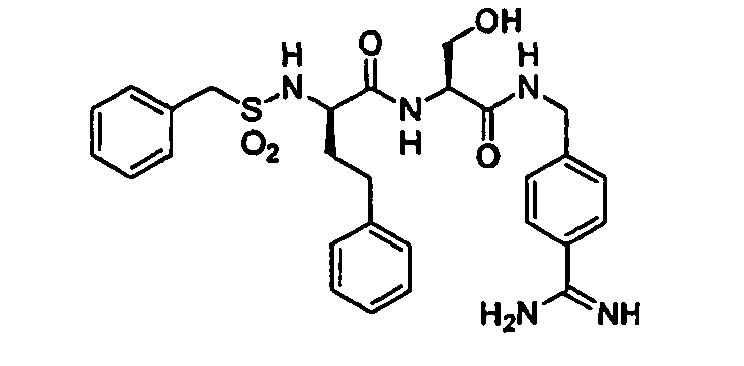
0,04 0,6 15 7 
0,46 3,3 7,2 16 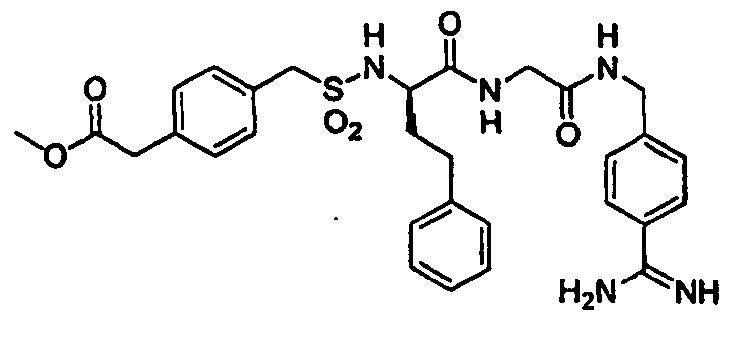
0,038 1,8 47 17 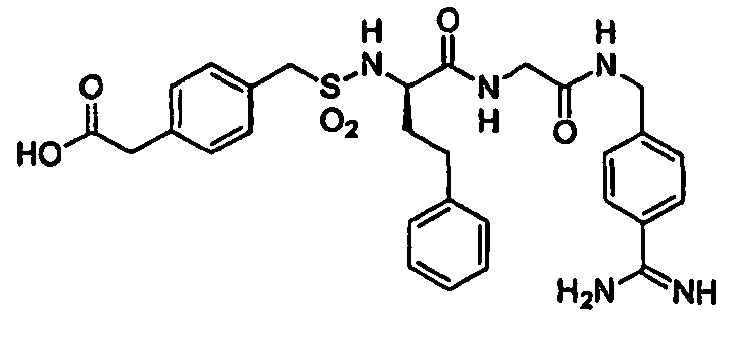
0,054 14 259 18 
0,11 5,4 49 19 
0,0067 0,92 137 20 
0,026 1,2 46 5 
0,0027 1,5 556 6 
0,019 1, 4 74 1 
0,0029 2 690 2 
0,013 3,2 246 3a 
0,0094 0,91 97 3b 
0,095 4, 6 48,4 4 
0,097 6,3 65 21 
0,029 0,15 5,2 22 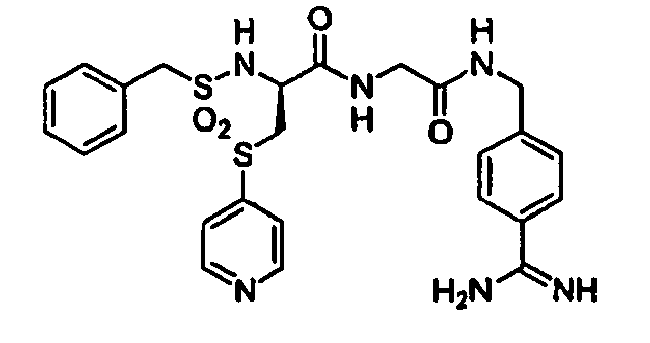
0,0027 0,7 259 23 
0,022 2,8 127 24 
0,005 2,0 400 25 
0,0021 2,0 952 26 
0,0017 25 14705 27 
0,0019 0,56 295 28 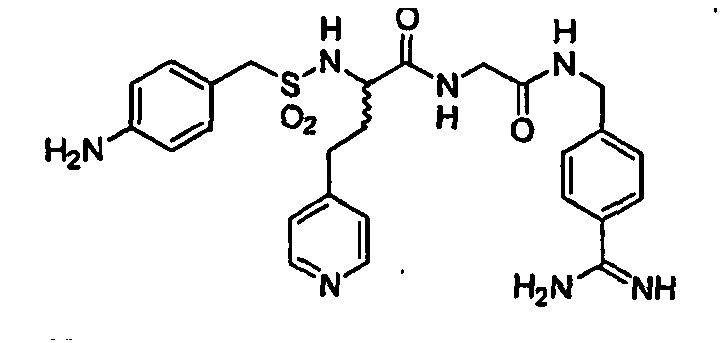
0,0022 1 454 29 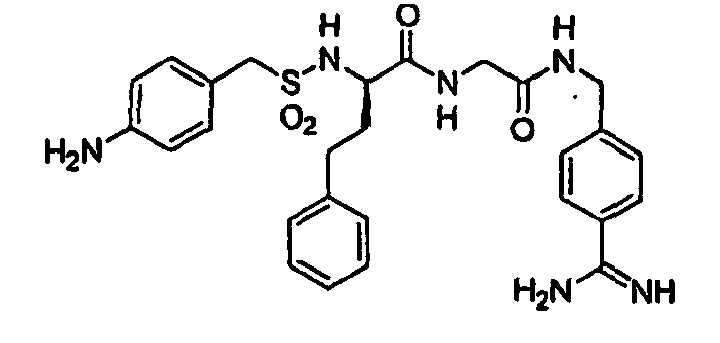
0,0026 0,26 100 30 
0,0034 78 22940 31 
0,0035 1,9 543 32 
0,0036 0,38 105 33 
0,0036 100 27778 34 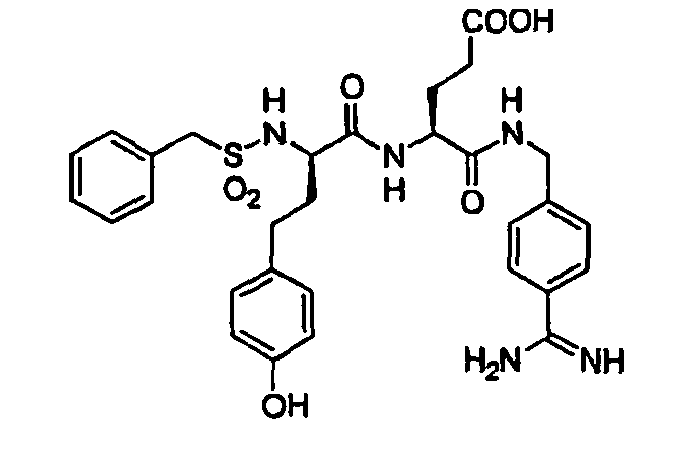
0,0037 19 5135 35 
0, 005 1 200 36 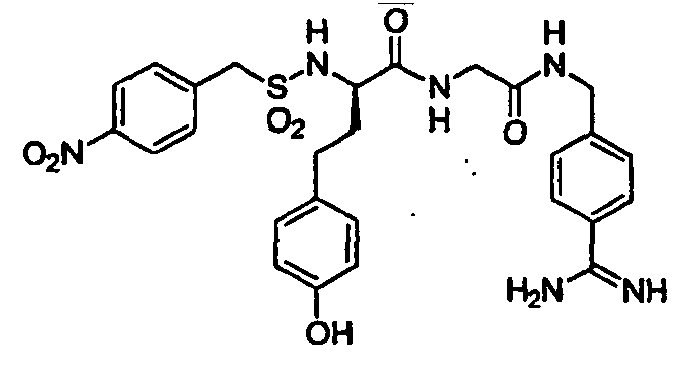
0,0052 0,86 165 37 
0,0056 35 6250 38 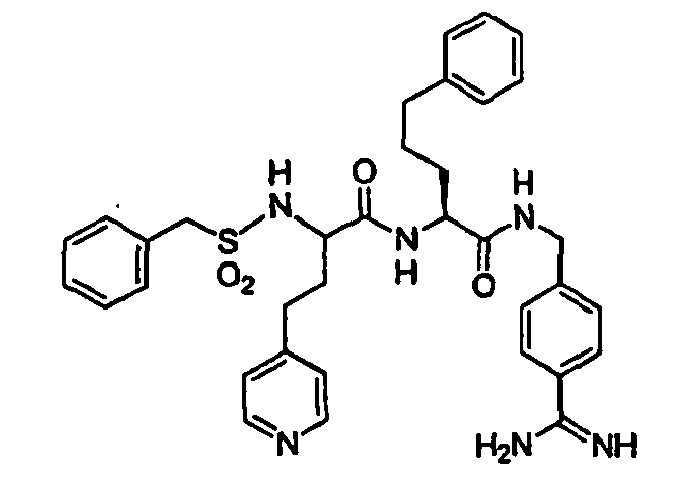
0,006 0,18 30 39 
0,0064 0,17 26 40 
0,0065 1,1 170 41 
0,0068 1,7 250 42 
0,0072 1,5 288 43 
0,0075 15 2000 44 
0,0082 3,8 463 45 
0,0093 1,4 150 46 
0,0098 7,6 775 47 
0,01 0,71 71 48 
0,01 n.b.* - 49 
0,013 38 2923 50 
0,013 15 1153 51 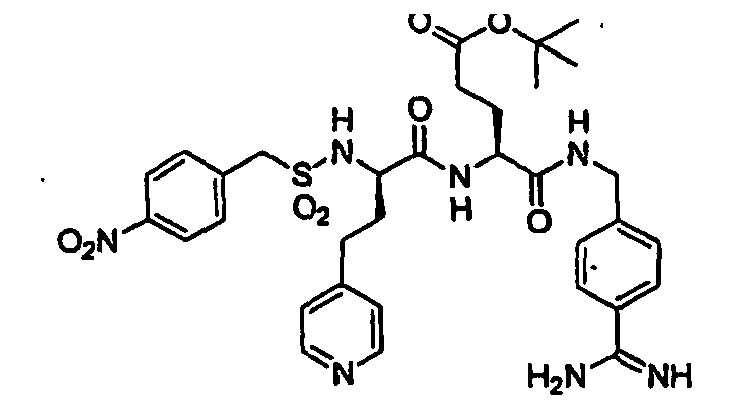
0,016 1,4 87 52 
0,016 84 5250 53 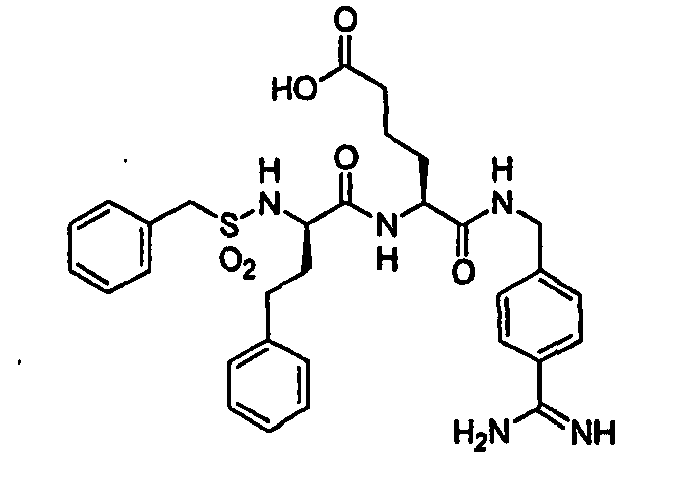
0,03 0,8 27 54 
0,039 0,69 18 55 
0,067 0,21 3 56 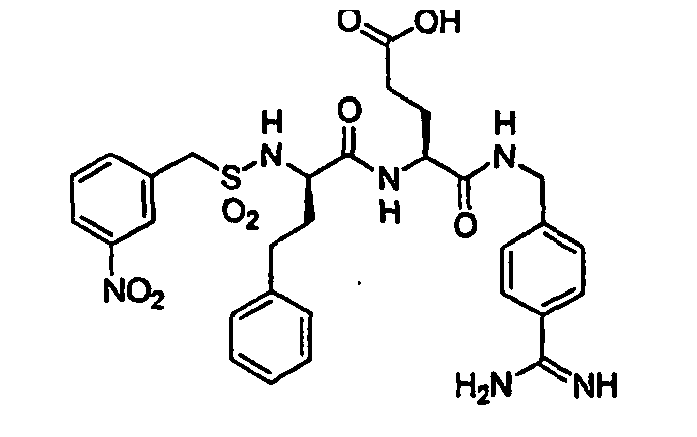
0,083 13 156 57 
0,13 0,46 3,5 58 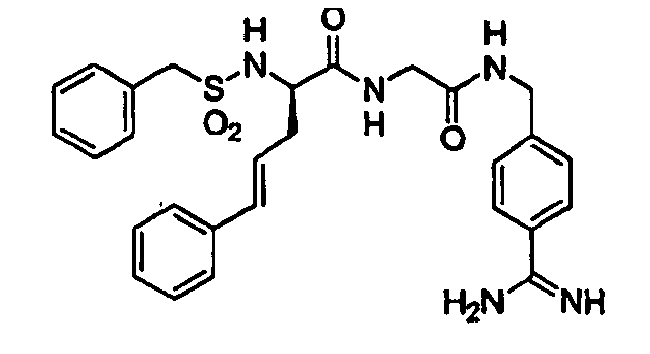
0,58 1,8 3,1 59 
0,97 16 16 60 
0,0048 3,5 730 61 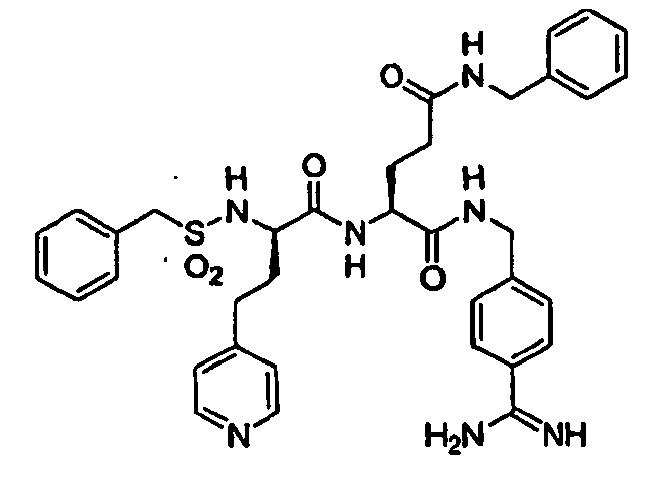
0,0068 1,7 250 62 
1,06 1,3 1,2 63 
0,62 1,5 2,4 64 
0,87 28 32 65 
0,12 100 833 n.b. = nicht bestimmt - Zur Bestimmung der Hemmwirkung wurden 200 µl Tris-Puffer (0,05 M, 0,154 M NaCl, 5% Ethanol, pH 8,0; enthält den Inhibitor), 25 µl Substrat (Moc-D-Nle-Gly-Arg-pNA in H2O; Pentapharm Ltd., Basel, Schweiz) und 50 µl Faktor Xa (vom Rind, Diagnostic Reagents Ltd, Thame, GB) bei 25 °C inkubiert. Nach 3 min wurde die Reaktion durch Zugabe von 25 µl Essigsäure (50%) unterbrochen und die Absorption bei 405 nm mittels Microplate Reader (MR 5000, Dynatech, Denkendorf, Deutschland) bestimmt. Die Ki-Werte wurden nach Dixon (Biochem. J. 55, 170-171, 1953) durch lineare Regression mittels eines Computerprogramms ermittelt. Die Ki-Werte sind das Mittel aus mindestens drei Bestimmungen. Die Bestimmung der Thrombinhemmung erfolgte analog einer früher beschriebenen Methode (Stürzebecher et al., J. Med. Chem. 40,3091-3099,1997).
mit Ausnahme folgender Verbindungen:
mit Ausnahme folgender Verbindungen:
Claims (20)
- Verbindung der allgemeinen Formel I

A P2—P1 ist, mitP1= P2 =
P2 = X ein N oder CH, vorzugsweise ein CH;R2 ein H, -CH2-OR7 oder -CH2-OCOOR7 ist, wobei R7 ein H oder ein verzweigter oder unverzweigter Alkylrest mit 1-5, insbesondere 1-3 C-Atomen, ist, oder R2 ist ein -CH2-CH2-COOR7*, wobei R7* ein H oder ein verzweigter oder unverzweigter Alkylrest mit 1-5 C-Atomen, vorzugsweise Ethyl, ist;R3 ein H ist;R4 -(CH2)f-R8 mit f = 0 oder 2, vorzugsweise mit f = 2, -CH2NHR8, -(CH2)2NHR8 oder -CH=CH-R8 ist, wobei R8 ein einfach oder mehrfach substituierter oder unsubstituierter Aryl- oder Heteroarylrest ist, wobei der Aryl- oder Heteroarylrest vorzugsweise 5 bis 14, insbesondere 5 bis 6 C-Atome im Ring und im Falle des Heteroarylrestes vorzugsweise 1 bis 3 N als Heteroatome besitzt, und wobei P2 in der Struktur A der allgemeinen Formel I in der D- oder L-Konfiguration, vorzugsweise in der D-Konfiguration vorliegt;R5 -(CH2)i-COOR9 mit i = 1, 2 oder 3, vorzugsweise mit i = 1, und R9 gleich ein verzweigter oder unverzweigter Alkylrest mit 1-5 C-Atomen, vorzugsweise Ethyl, ist, oder R5 ist -SO2R9*, -SO2-NH-R9*, wobei R9* ein H, ein verzweigtes oder unverzweigtes Alkyl mit 1-10, vorzugsweise 1 bis 6, insbesondere 1 bis 4, vor allem 1 bis 2 C-Atomen, ein einfach oder mehrfach substituierter oder unsubstituierter Aryl-, Heteroaryl-, Aralkyl-, vorzugsweise Benzyl-, Heteroaralkylrest oder ein Cyclohexylalkylrest, vorzugsweise ein Cyclohexylmethylrest ist, wobei der Substituent eine -OH, -O-COOR7, -CH2-OCOOR1, mit R7 wie oben definiert, -NH2, -NO2, -COOR10, -CH2-COOR10-Gruppe oder ein Cl-, F- oder Br-Atom ist und wobei R10 ein H oder ein Alkylrest mit 1 bis 6, insbesondere mit 1 bis 4 C-Atomen, vor allem Ethyl, ist;R11 H, OH, oder -COOR12 ist, wobei R12 ein verzweigter oder unverzweigter Alkylrest mit 1 bis 8, vorzugsweise 1 bis 6 C-Atomen ist;oder eine Verbindung der allgemeinen Formel I in Form ihres Salzes;
mit Ausnahme folgender Verbindungen:
Benzylsulfonyl-D-hPhe-Ser-4-Amidinobenzylamid,
Benzylsulfonyl-D-hAla(4-Pyridyl)-Ser-4-Amidinobenzylamid,
Benzylsulfonyl-D-hTyr-Ser-4-Amidinobenzylamid,
4-NHi-Benzylsulfonyl-D-hPhe-Gly-4-Amidinobenzylamid,
Benzylsulfonyl-D-Indanylglycyl=Gly-4-Amidinobenzylamid,
Benzylsulfonyl-D/L-hAla(4-Pyridyl)-Gly-4-Amidinobenzylamid und
4-Pyridylmethylsulfonyl-D-hPhe-Gly-4-Amidinobenzylamid,
wobei der C-terminale aromatische Benzamidinrest an 1, 2 oder 3 Positionen zusätzlich mit einem Halogen, insbesondere Fluor oder Chlor, oder einem Methyl-, Ethyl-, Propyl-, Methoxy-, Ethoxy-, oder Propoxyrest subsituiert sein kann. - Verbindung nach Anspruch 1, wobei mindestens eine Carboxylgruppe als Ester, bevorzugt als Ethylester, geschützt vorliegt.
- Verbindung nach Anspruch 1 oder 2 in Form eines Prodrugs, bei dem ein oder mehrere Carboxylgruppen in Form ihrer Alkylester mit einem verzweigten oder unverzweigten Alkyl mit 1-5 C-Atomen, vorzugsweise Ethyl, und/oder bei dem ein oder mehrere Hydroxylgruppen als Carbonate, bei denen der endständige Rest gleich R7, wie oben definiert vorliegen, und/oder bei dem der Amidino- bzw. Guanidinobenzylaminrest als Hydroxyamidin bzw. Hydroxyguanidin oder als Alkyloxycarbonylderivat vorliegt.
- Verbindung der allgemeinen Formel I

A P2—P1 ist, mitP1=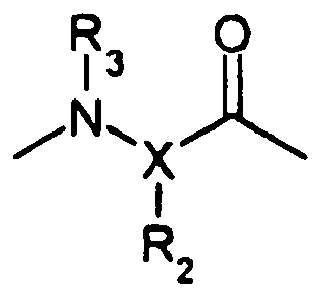 P2 =
P2 = R2 ein H, -CH2-CH2-COOH, -CH2-CH2-COOCH2CH3 oder -CH2OH ist;R3 ein H ist;R4 ein -(CH2)2-R8, -CH2NHR8, -(CH2)2NHR8 oder ein -CH2-4-Hydroxycyclohexylrest ist, wobei R8 ein einfach oder mehrfach substituierter oder unsubstituierter Aryl- oder Heteroarylrest ist, wobei der Aryl- oder Heteroarylrest 5 oder 6 C-Atome und im Falle eines Heteroarylrestes 1 oder 2 N als Heteroatome besitzt, vorzugsweise ist R8 ein Phenyl-, Hydroxyphenyl-, Pyridyl- oder Aminopyridylrest;R5 ein Methylsulfonyl, Ethylsulfonyl, n-Propylsulfonyl, iso-Propylsulfonyl, Butylsulfonyl, n-Butylsulfonyl, Benzylsulfonyl, Aminobenzylsulfonyl, Hydroxybenzylsulfonyl, Chlorobenzylsulfonyl, Fluorobenzylsulfonyl, Carboxybenzylsulfonyl, Ethyloxycarbonylbenzylsulfonyl, Carboxymethylbenzylsulfonyl, Ethyloxycarbonylmethylbenzylsulfonyl, Pyridylmethylensulfonyl, N-(oxid)-pyridylmethylensulfonyl, -CH2-COOH oder ein -CH2COOCH2CH3 Rest ist;X CH ist;R11 H, OH oder -COOR12 mit R12 ein verzweigter oder unverzweigter Alkylrest mit 2, 4 oder 6 C-Atomen ist,oder eine Verbindung der allgemeinen Formel I in Form ihres Salzes;
mit Ausnahme folgender Verbindungen:Benzylsulfonyl-D-hPhe-Ser-4-Amidinobenzylamid,Benzylsulfonyl-D-hAla(4-Pyridyl)-Ser-4-Amidinobenzylamid, Benzylsulfonyl-D-hTyr-Ser-4-Amidinobenzylamid,4-NH2-Benzylsulfonyl-D-hPhe-Gly-4-Amidinobenzylamid,Benzylsulfonyl-D-Indanylglycyl-Gly-4-Amidinobenzylamid,Benzylsulfonyl-D/L-hAla(4-Pyridyl)-Gly-4-Amidinobenzylamid und4-Pyridylmethylsulfonyl-D-hPhe-Gly-4-Amidinobenzylamid. - Verbindung nach mindestens einem der Ansprüche 1 bis 4, dadurch gekenn-zeichnet, dass R4 ein -CH2-CH2-R8 Rest ist, wobei R8 ein Aryl- oder Heteroarylrest mit 4-6 Ringatomen ist, der 1 oder 2 Heteroatome, vorzugsweise N, besitzt und der mit einer oder mehreren -NH2 und/oder -OH Gruppen substituiert ist, vorzugsweise ist P2 in der Struktur A der allgemeinen Formel I von einem Homophenylalanin, Homotyrosin, Indanylglycin oder 4-Pyridylhomoalanin abgeleitet, und die P2-Aminosäure liegt insbesondere in der D-Konfiguration vor.
- Verbindung nach mindestens einem der Ansprüche 1 bis 5, dadurch gekennzeichnet, dass der Substituent -OH, -NH2, -NO2, -COOH, -COOCH2CH3, Fluor, Chlor oder Brom, insbesondere Fluor oder Chlor, ist.
- Verbindung nach mindestens einem der Ansprüche 1 bis 6, dadurch gekennzeichnet, dass die Verbindungen als Salze vorliegen, vorzugsweise mit Mineralsäuren oder mit geeigneten organischen Säuren, vorzugsweise mit Salzsäure, Schwefelsäure, Essigsäure, Ameisensäure, Methylsulfonsäure, Bernsteinsäure, Äpfelsäure oder Trifluoressigsäure, vor allem in Form ihrer Hydrochloride, Sulfate oder Acetate.
- Verfahren zur Herstellung einer Verbindung gemäß mindestens einem der Ansprüche 1 bis 7, dadurch gekennzeichnet, dass sequentiell die entsprechenden Aminosäuren an ein an der Amidinogruppe geschütztes Amidinobenzylamin angekoppelt werden, wobei die N-terminale Aminosäure entweder den R5-Rest bereits trägt oder dieser anschließend daran gebunden wird.
- Arzneimittel enthaltend eine Verbindung gemäß mindestens einem der Ansprüche 1 bis 7 sowie pharmazeutisch geeignete Hilfs- und/oder Zusatzstoffe.
- Arzneimittel nach Anspruch 9, wobei das Arzneimittel in Form einer Tablette, eines Dragees, einer Kapsel, eines Pellets, Suppositoriums, einer Lösung, insbesondere einer Injektions- oder Infusionslösung, von Augen-, Nasen und Ohrentropfen, eines Safts, einer Emulsion oder Suspension, eines Globuli, Styli, Aerosols, Puders, einer Paste, Creme oder Salbe eingesetzt wird.
- Verwendung einer Verbindung gemäß mindestens einem der Ansprüche 1 bis 7 zur Herstellung eines Arzneimittels als Faktor Xa-Inhibitor zur Therapie oder Prophylaxe einer kardiovaskulären Erkrankung oder eines thromboembolischen Ereignisses, insbesondere in oraler, subkutaner, intravenöser oder transdermaler Form.
- Verbindung der allgemeinen Formel I

A P2—P1 ist, mitP1=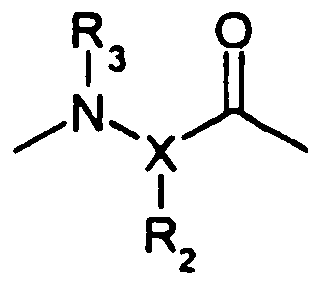 P2 =
P2 =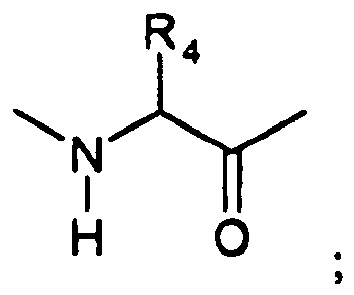 X = N oder CH, vorzugsweise CH;R2 eine -(CH2)aCONHR7* oder -(CH2)aCONHR7** Gruppe ist, wobei a = 1, 2 oder 3 undR7* ein H oder ein verzweigter oder unverzweigter Alkylrest mit 1-5 C-Atomen, vorzugsweise Ethyl;R7** ein Arylrest oder ein Heteroarylrest mit 1 -2 Heteroatomen ausgewählt aus N, S oder 0 ist;R3 ein H ist;R4 -(CH2)f-R8 mit f = 0 oder 2, vorzugsweise mit f = 2, -CH2NHR8, -(CH2)2NHR8 oder -CH=CH-R8 ist, wobei R8 ein einfach oder mehrfach substituierter oder unsubstituierter Aryl- oder Heteroarylrest ist, wobei der Aryl- oder Heteroarylrest 5 bis 14, insbesondere 5 bis 6 C-Atome im Ring und im Falle des Heteroarylrestes vorzugsweise 1 bis 3 N als Heteroatome besitzt, und wobei P2 in der Struktur A der allgemeinen Formel I in der D-oder L-Konfiguration, vorzugsweise in der D-Konfiguration vorliegt;R5 -(CH2)i-COOR9 mit i = 1, 2 oder 3, vorzugsweise mit i = 1, und R9 gleich ein verzweigter oder unverzweigter Alkylrest mit 1-5 C-Atomen, vorzugsweise Ethyl, ist, oder R5 ist -SO2R9*, -SO2-NH-R9*, wobei R9* ein H, ein verzweigtes oder unverzweigtes Alkyl mit 1-10, vorzugsweise 1 bis 6, insbesondere 1 bis 4, vor allem 1 bis 2 C-Atomen, ein einfach oder mehrfach substituierter oder unsubstituierter Aryl-, Heteroaryl-, Aralkyl-, vorzugsweise Benzyl-, Heteroaralkylrest oder ein Cyclohexylalkylrest, vorzugsweise ein Cyclohexylmethylrest ist, wobei der Substituent eine -OH, -O-COOR7, -CH2-OCOOR7, mit R7 wie oben definiert, -NH2, -NO2, -COOR10, -CH2-COOR10-Gruppe oder ein Cl-, F- oder Br-Atom ist und wobei R10 ein H oder ein Alkylrest mit 1 bis 6, insbesondere mit 1 bis 4 C-Atomen, vor allem Ethyl, ist;R11 H, OH, oder -COOR12 ist, wobei R12 ein verzweigter oder unverzweigter Alkylrest mit 1 bis 8, vorzugsweise 1 bis 6 C-Atomen ist;oder eine Verbindung der allgemeinen Formel I in Form ihres Salzes.
 - Verbindung nach Anspruch 12, wobei in R5 R9 = H ist.
- Verbindung nach Anspruch 12 oder 13, wobei R4 eine -CH2-SR8 oder -CH2CH2-SR8 Gruppe ist.
- Verbindung ausgewählt aus folgenden Strukturen:


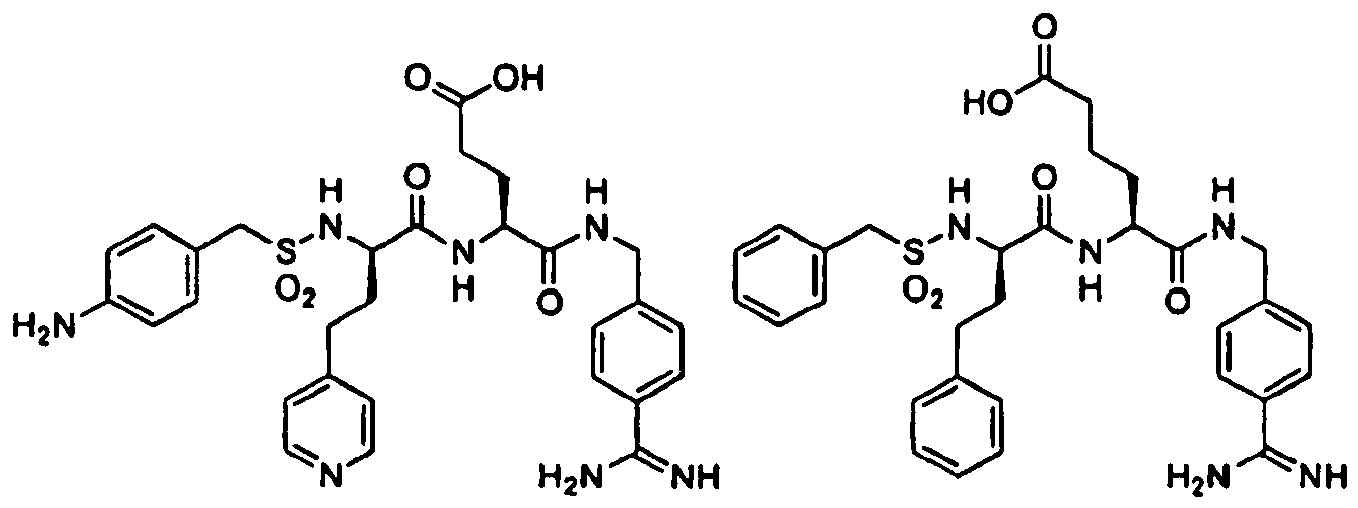

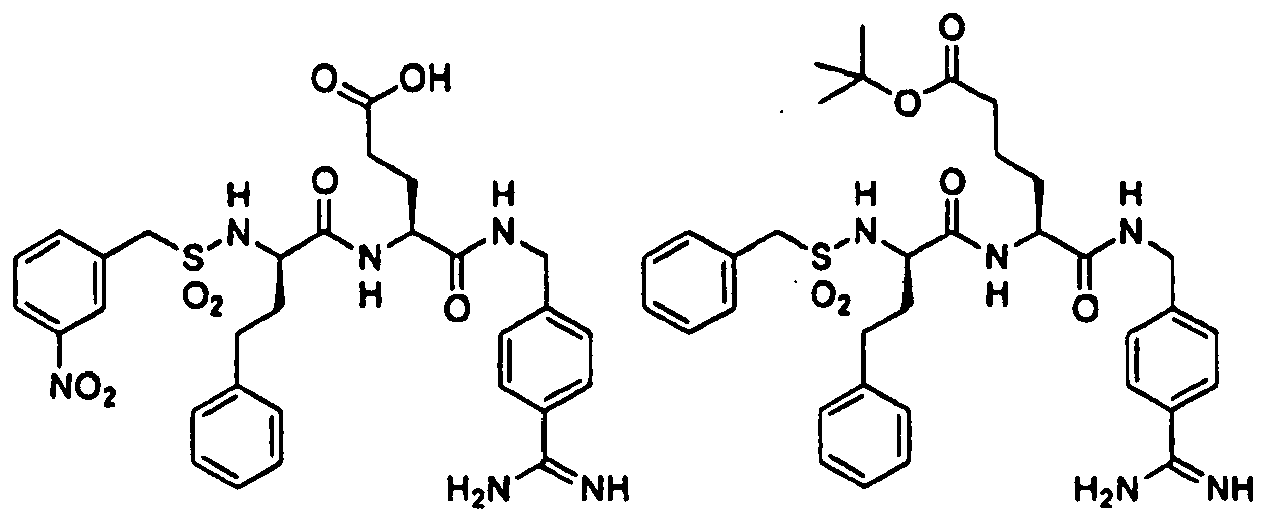

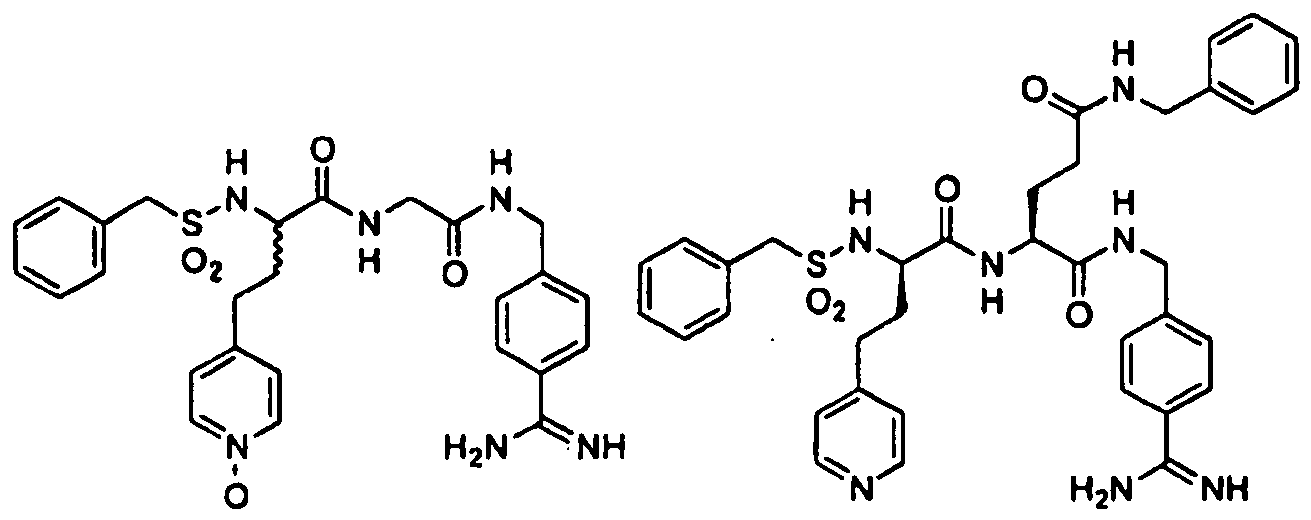

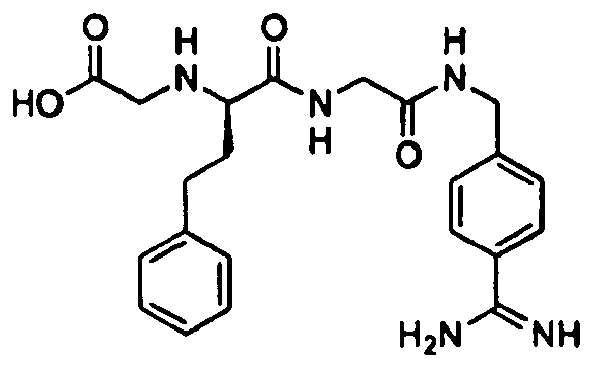
- Verbindung nach mindestens einem der Ansprüche 12 bis 15, dadurch gekennzeichnet, dass die Verbindungen als Salze vorliegen, vorzugsweise mit Mineralsäuren oder mit geeigneten organischen Säuren, vorzugsweise mit Salzsäure, Schwefelsäure, Essigsäure, Ameisensäure, Methylsulfonsäure, Bernsteinsäure, Äpfelsäure oder Trifluoressigsäure, vor allem in Form ihrer Hydrochloride, Sulfate oder Acetate.
- Verfahren zur Herstellung einer Verbindung gemäß mindestens einem der Ansprüche 12 bis 16, dadurch gekennzeichnet, dass sequentiell die entsprechenden Aminosäuren an ein an der Amidinogruppe geschütztes Amidinobenzylamin angekoppelt werden, wobei die N-terminale Aminosäure entweder den R5-Rest bereits trägt oder dieser anschließend daran gebunden wird.
- Arzneimittel enthaltend eine Verbindung gemäß mindestens einem der Ansprüche 12 bis 16 sowie pharmazeutisch geeignete Hilfs- und/oder Zusatzstoffe.
- Arzneimittel nach Anspruch 18, wobei das Arzneimittel in Form einer Tablette, eines Dragees, einer Kapsel, eines Pellets, Suppositoriums, einer Lösung, insbesondere einer Injektions- oder Infusionslösung, von Augen-, Nasen und Ohrentropfen, eines Safts, einer Emulsion oder Suspension, eines Globuli, Styli, Aerosols, Puders, einer Paste, Creme oder Salbe eingesetzt wird.
- Verwendung einer Verbindung gemäß mindestens einem der Ansprüche 12 bis 16 zur Herstellung eines Arzneimittels als Faktor Xa-Inhibitor zur Therapie oder Prophylaxe einer kardiovaskulären Erkrankung oder eines thromboembolischen Ereignisses, insbesondere in oraler, subkutaner, intravenöser oder transdermaler Form.
Priority Applications (1)
| Application Number | Priority Date | Filing Date | Title |
|---|---|---|---|
| EP10013066A EP2292640A2 (de) | 2003-09-11 | 2004-09-13 | Basisch-substituierte Benzylaminanaloga als Inhibitoren des Gerinnungsfaktors Xa, ihre Herstellung und Verwendung |
Applications Claiming Priority (2)
| Application Number | Priority Date | Filing Date | Title |
|---|---|---|---|
| DE10342108A DE10342108A1 (de) | 2003-09-11 | 2003-09-11 | Basisch-substituierte Benzylaminanaloga als Inhibitoren des Gerinnungsfaktors Xa, ihre Herstellung und Verwendung |
| PCT/EP2004/010225 WO2005026198A1 (de) | 2003-09-11 | 2004-09-13 | Basisch-substituierte benzylaminanaloga als inhibitoren des gerinnungsfaktors xa, ihre herstellung und verwendung |
Related Child Applications (1)
| Application Number | Title | Priority Date | Filing Date |
|---|---|---|---|
| EP10013066.5 Division-Into | 2010-10-01 |
Publications (2)
| Publication Number | Publication Date |
|---|---|
| EP1664089A1 EP1664089A1 (de) | 2006-06-07 |
| EP1664089B1 true EP1664089B1 (de) | 2011-11-16 |
Family
ID=34305691
Family Applications (2)
| Application Number | Title | Priority Date | Filing Date |
|---|---|---|---|
| EP04765144A Expired - Lifetime EP1664089B1 (de) | 2003-09-11 | 2004-09-13 | Basisch-substituierte benzylaminanaloga als inhibitoren des gerinnungsfaktors xa, ihre herstellung und verwendung |
| EP10013066A Withdrawn EP2292640A2 (de) | 2003-09-11 | 2004-09-13 | Basisch-substituierte Benzylaminanaloga als Inhibitoren des Gerinnungsfaktors Xa, ihre Herstellung und Verwendung |
Family Applications After (1)
| Application Number | Title | Priority Date | Filing Date |
|---|---|---|---|
| EP10013066A Withdrawn EP2292640A2 (de) | 2003-09-11 | 2004-09-13 | Basisch-substituierte Benzylaminanaloga als Inhibitoren des Gerinnungsfaktors Xa, ihre Herstellung und Verwendung |
Country Status (7)
| Country | Link |
|---|---|
| US (1) | US9090658B2 (de) |
| EP (2) | EP1664089B1 (de) |
| JP (1) | JP4942481B2 (de) |
| AU (1) | AU2004272272B2 (de) |
| CA (1) | CA2538075C (de) |
| DE (1) | DE10342108A1 (de) |
| WO (1) | WO2005026198A1 (de) |
Families Citing this family (10)
| Publication number | Priority date | Publication date | Assignee | Title |
|---|---|---|---|---|
| AU2003219039A1 (en) * | 2002-03-11 | 2003-09-22 | Curacyte Ag | Urokinase inhibitors, production and use thereof |
| DE10301300B4 (de) * | 2003-01-15 | 2009-07-16 | Curacyte Chemistry Gmbh | Verwendung von acylierten 4-Amidino- und 4-Guanidinobenzylaminen zur Inhibierung von Plasmakallikrein |
| US8394084B2 (en) | 2005-01-10 | 2013-03-12 | Optimedica Corporation | Apparatus for patterned plasma-mediated laser trephination of the lens capsule and three dimensional phaco-segmentation |
| MX2008002702A (es) * | 2005-08-29 | 2008-03-18 | Wilex Ag | Compuestos de oxadiazol como inhibidores de uroquinasa. |
| DE102005044319A1 (de) * | 2005-09-16 | 2007-03-22 | Curacyte Chemistry Gmbh | 2-(Aminomethyl)-5-Chlor-Benzylamid-Derivate und ihre Verwendung als Hemmstoffe des Gerinnungsfaktors Xa |
| DE102006048300A1 (de) * | 2006-01-26 | 2007-08-02 | Hellstern, Peter, Prof. Dr.med. | Inhibitoren des Blutgerinnungsfaktors Xa zur Verwendung als Antikoagulans |
| DE102006050672A1 (de) | 2006-10-24 | 2008-04-30 | Curacyte Discovery Gmbh | Hemmstoffe des Plasmins und des Plasmakallikreins |
| WO2011094496A2 (en) * | 2010-01-28 | 2011-08-04 | The Medicines Company | Trypsin-like serine protease inhibitors, and their preparation and use |
| ES2483802T3 (es) | 2010-07-07 | 2014-08-07 | The Medicines Company (Leipzig) Gmbh | Inhibidores de serina proteasa |
| EP2655399B1 (de) | 2010-12-21 | 2017-09-27 | The Medicines Company (Leipzig) GmbH | Trypsin-ähnliche serinproteasehemmer, ihre herstellung und verwendung als selektive inhibitoren der gerinnungsfaktoren iia und xa |
Family Cites Families (53)
| Publication number | Priority date | Publication date | Assignee | Title |
|---|---|---|---|---|
| EP0183271B1 (de) | 1984-11-30 | 1990-05-16 | Shosuke Okamoto | Lysinderivat und Proteinase-Inhibitor |
| KR920703558A (ko) | 1990-11-15 | 1992-12-18 | 원본미기재 | 메타-치환 페닐알라닌 유도체 |
| DE4243858A1 (de) | 1992-12-23 | 1994-06-30 | Thomae Gmbh Dr K | Aminosäurederivate, diese Verbindungen enthaltende Arzneimittel und Verfahren zu ihrer Herstellung |
| WO1994018185A1 (de) | 1993-02-10 | 1994-08-18 | Pentapharm Ag | Piperazide von substituierten phenylalanin-derivativen als thrombin inhibitoren |
| SE9301916D0 (sv) * | 1993-06-03 | 1993-06-03 | Ab Astra | New peptides derivatives |
| US5550213A (en) | 1993-12-27 | 1996-08-27 | Rutgers, The State University Of New Jersey | Inhibitors of urokinase plasminogen activator |
| AU1025795A (en) * | 1994-01-27 | 1995-08-03 | Mitsubishi Chemical Corporation | Prolineamide derivatives |
| ZA951617B (en) | 1994-03-04 | 1997-02-27 | Lilly Co Eli | Antithrombotic agents. |
| US5726159A (en) * | 1994-03-04 | 1998-03-10 | Eli Lilly And Company | Antithrombotic agents |
| US5707966A (en) * | 1994-03-04 | 1998-01-13 | Eli Lilly And Company | Antithrombotic agents |
| US5705487A (en) * | 1994-03-04 | 1998-01-06 | Eli Lilly And Company | Antithrombotic agents |
| ZA953361B (en) | 1994-04-26 | 1996-01-12 | Selectide Corp | Factor Xa inhibitors |
| IL115420A0 (en) | 1994-09-26 | 1995-12-31 | Zeneca Ltd | Aminoheterocyclic derivatives |
| FI973360L (fi) * | 1995-02-17 | 1997-08-15 | Basf Ag | Uusia dipeptidisiä amidiineja trombiininestäjiksi |
| US5914319A (en) | 1995-02-27 | 1999-06-22 | Eli Lilly And Company | Antithrombotic agents |
| US5710130A (en) * | 1995-02-27 | 1998-01-20 | Eli Lilly And Company | Antithrombotic agents |
| CH689611A5 (de) | 1995-03-01 | 1999-07-15 | Pentapharm Ag | Urokinase-Inhibitoren. |
| AR005245A1 (es) * | 1995-12-21 | 1999-04-28 | Astrazeneca Ab | Prodrogas de inhibidores de trombina, una formulación farmaceutica que las comprende, el uso de dichas prodrogas para la manufactura de un medicamento y un procedimiento para su preparacion |
| JP2000514788A (ja) * | 1996-06-25 | 2000-11-07 | イーライ・リリー・アンド・カンパニー | 抗凝固剤 |
| ZA986594B (en) | 1997-07-25 | 1999-01-27 | Abbott Lab | Urokinase inhibitors |
| US7342018B2 (en) * | 1998-07-20 | 2008-03-11 | Wilex Ag | Urokinase inhibitors and uses thereof |
| BR9912327B1 (pt) * | 1998-07-20 | 2013-11-12 | Inibidores da uroquinase | |
| US6576613B1 (en) | 1998-07-24 | 2003-06-10 | Corvas International, Inc. | Title inhibitors of urokinase |
| SE9802974D0 (sv) | 1998-09-03 | 1998-09-03 | Astra Ab | New crystalline forms |
| US7745441B1 (en) | 1998-09-18 | 2010-06-29 | Wilex Ag | Urokinase inhibitors |
| IL144032A0 (en) * | 1999-01-13 | 2002-04-21 | Genentech Inc | Serine protease inhibitors |
| FR2791683A1 (fr) * | 1999-03-30 | 2000-10-06 | Synthelabo | Derives de n-sulfonyl-dipeptides, leur preparation et leur application en therapeutique |
| AR023510A1 (es) | 1999-04-21 | 2002-09-04 | Astrazeneca Ab | Un equipo de partes, formulacion farmaceutica y uso de un inhibidor de trombina. |
| DE19940389A1 (de) * | 1999-08-25 | 2001-03-01 | Wilex Biotechnology Gmbh | Selektive Inhibitoren des Urokinase-Plasminogen Aktivators |
| US6797504B1 (en) | 2000-09-08 | 2004-09-28 | Dendreon San Diego Llc | Inhibitors of serine protease activity of matriptase or MTSP1 |
| DE10005631A1 (de) * | 2000-02-09 | 2001-08-23 | Max Planck Gesellschaft | Arginin-Mimetika als Faktor X¶a¶-Inhibitoren |
| DE10013715A1 (de) * | 2000-03-20 | 2001-09-27 | Wilex Biotechnology Gmbh | Hochselektive Inhibitoren des Urokinase-Plasminogenaktivators |
| ES2260222T3 (es) | 2000-04-25 | 2006-11-01 | Abbott Laboratories | Naftamidina que inhibe la uroquinasa. |
| DE10029015A1 (de) | 2000-06-15 | 2001-12-20 | Curacyte Ag | Hemmstoffe für den Gerinnungsfaktor Xa |
| DE10029014A1 (de) | 2000-06-15 | 2001-12-20 | Univ Schiller Jena | Urokinase-Hemmstoffe |
| WO2001097794A2 (en) | 2000-06-21 | 2001-12-27 | Georgetown University | Inhibitors of matriptase for the treatment of cancer |
| AU2002222933A1 (en) | 2000-07-13 | 2002-01-30 | Millennium Pharamaceuticals, Inc. | Inhibitors of factor xa |
| ES2285989T3 (es) | 2000-08-11 | 2007-12-01 | Wilex Ag | Inhibidores no covalentes de la uroquinasa y de la formacion de vasos sanguineos. |
| NZ547626A (en) | 2000-08-11 | 2007-10-26 | Wilex Ag | Non-covalent inhibitors of urokinase and blood vessel formation |
| JP2004516286A (ja) | 2000-12-18 | 2004-06-03 | メルク エンド カムパニー インコーポレーテッド | ベンジルアミン誘導体およびそれのトロンビン阻害薬としての使用 |
| DE10102878A1 (de) * | 2001-01-23 | 2002-08-01 | Haemosys Gmbh | Oligo- oder Polyalkylengekoppelte Thrombininhibitoren |
| JP4179878B2 (ja) * | 2001-02-02 | 2008-11-12 | 中外製薬株式会社 | ペプチド誘導体 |
| PT1453852E (pt) * | 2001-12-12 | 2007-02-28 | Wilex Ag | Péptidos de arilguanidina selectivos como inibidores da urocinase |
| AU2003206945A1 (en) | 2002-02-22 | 2003-09-09 | Max-Planck-Gesellschaft Zur Forderung Der Wissenschaften E.V. | Use of proteinase inhibitors in the treatment of autoimmune diseases |
| AU2003219039A1 (en) | 2002-03-11 | 2003-09-22 | Curacyte Ag | Urokinase inhibitors, production and use thereof |
| DE10210590A1 (de) | 2002-03-11 | 2003-10-02 | Curacyte Ag | Hemmstoffe des Gerinnungsfaktors Xa, ihre Herstellung und Verwendung |
| DE10212555A1 (de) | 2002-03-15 | 2003-09-25 | Univ Schiller Jena | Verwendung von Hemmstoffen des Gerinnungsfaktors Xa als Wirkstoffe zur Erkennung und Unterdrückung des Wachstums maligner Tumore sowie der von diesen ausgehenden Metastasierung |
| DE10225876A1 (de) * | 2002-06-11 | 2003-12-24 | Wilex Ag | Guanidinophenylalaninverbindungen als Urokinase-Inhibitoren |
| EP1551864B1 (de) * | 2002-10-04 | 2011-11-09 | DSM IP Assets B.V. | Substrate zur Bestimmung von TAFI(a) |
| DE10301300B4 (de) * | 2003-01-15 | 2009-07-16 | Curacyte Chemistry Gmbh | Verwendung von acylierten 4-Amidino- und 4-Guanidinobenzylaminen zur Inhibierung von Plasmakallikrein |
| DE10322191B4 (de) * | 2003-05-16 | 2014-02-27 | The Medicines Company (Leipzig) Gmbh | N-sulfonylierte Aminosäurederivate, Verfahren zu ihrer Herstellung und ihre Verwendung |
| DE10323898A1 (de) * | 2003-05-26 | 2004-12-23 | Wilex Ag | Hydroxyamidin- und Hydroxyguanidin-Verbindungen als Urokinase-Hemmstoffe |
| DE102005044319A1 (de) * | 2005-09-16 | 2007-03-22 | Curacyte Chemistry Gmbh | 2-(Aminomethyl)-5-Chlor-Benzylamid-Derivate und ihre Verwendung als Hemmstoffe des Gerinnungsfaktors Xa |
-
2003
- 2003-09-11 DE DE10342108A patent/DE10342108A1/de not_active Ceased
-
2004
- 2004-09-13 CA CA2538075A patent/CA2538075C/en not_active Expired - Fee Related
- 2004-09-13 EP EP04765144A patent/EP1664089B1/de not_active Expired - Lifetime
- 2004-09-13 WO PCT/EP2004/010225 patent/WO2005026198A1/de not_active Ceased
- 2004-09-13 AU AU2004272272A patent/AU2004272272B2/en not_active Ceased
- 2004-09-13 EP EP10013066A patent/EP2292640A2/de not_active Withdrawn
- 2004-09-13 JP JP2006525787A patent/JP4942481B2/ja not_active Expired - Fee Related
- 2004-09-13 US US10/571,026 patent/US9090658B2/en not_active Expired - Fee Related
Also Published As
| Publication number | Publication date |
|---|---|
| JP4942481B2 (ja) | 2012-05-30 |
| EP2292640A2 (de) | 2011-03-09 |
| WO2005026198A1 (de) | 2005-03-24 |
| AU2004272272A1 (en) | 2005-03-24 |
| JP2007528363A (ja) | 2007-10-11 |
| US9090658B2 (en) | 2015-07-28 |
| DE10342108A1 (de) | 2005-04-14 |
| AU2004272272B2 (en) | 2009-12-10 |
| EP1664089A1 (de) | 2006-06-07 |
| US20070066539A1 (en) | 2007-03-22 |
| CA2538075C (en) | 2013-04-02 |
| CA2538075A1 (en) | 2005-03-24 |
Similar Documents
| Publication | Publication Date | Title |
|---|---|---|
| DE69919397T2 (de) | Thrombin-inhibitoren | |
| EP0236872B1 (de) | Hydroxylaminderivate, deren Herstellung und Verwendung für Heilmittel | |
| DE69528528T2 (de) | Thrombin-inhibitoren | |
| EP1583526B1 (de) | Acylierte 4-amidino- und 4-guanidinobenzylaminen zur inhibierung von plasmakallikrein | |
| DE10322191B4 (de) | N-sulfonylierte Aminosäurederivate, Verfahren zu ihrer Herstellung und ihre Verwendung | |
| EP0513543A1 (de) | Amidinophenylalaninderivate, Verfahren zu deren Herstellung, deren Verwendung und diese enthaltende Mittel als Antikoagulantien | |
| EP1294742B1 (de) | Urokinase-hemmstoffe | |
| WO1992016549A1 (de) | Para-substituierte phenylalanin-derivate | |
| EP0508220B1 (de) | Amidinophenylalaninderivate, Verfahren zu deren Herstellung, deren Verwendung und diese enthaltende Mittel | |
| EP0374097A2 (de) | Verwendung von Peptidisosteren als retrovirale Proteasehemmer | |
| EP0344682B1 (de) | Oligopeptide mit zyklischen Prolin-analogen Aminosäuren | |
| EP1485345B1 (de) | Hemmstoffe der urokinase, ihre herstellung und verwendung | |
| DE4443390A1 (de) | Neue dipeptidische p-Amidinobenzylamide mit N-terminalen Sulfonyl- bzw. Aminosulfonylresten | |
| EP1272458A1 (de) | Arginin-mimetika als faktor xa-inhibitoren | |
| EP1483285B1 (de) | HEMMSTOFFE DES GERINNUNGSFAKTORS Xa, IHRE HERSTELLUNG UND VERWENDUNG | |
| EP2292640A2 (de) | Basisch-substituierte Benzylaminanaloga als Inhibitoren des Gerinnungsfaktors Xa, ihre Herstellung und Verwendung | |
| WO2001096366A2 (de) | Dipeptidische hemmstoffe für den gerinnungsfaktor xa | |
| EP1373234B1 (de) | Urokinase-inhibitoren | |
| EP2132174B1 (de) | Meta-substituierte phenylsulfonylamide sekundärer aminosäureamide als hemmstoffe der matriptase zur hemmung des tumorwachstums und/oder der metastasierung von tumoren | |
| EP0403828A1 (de) | Renininhibitorische Peptide, Verfahren zur ihrer Herstellung und ihre Verwendung in Arzneimitteln | |
| EP0203450B1 (de) | Neue Derivate bicyclischer Aminosäuren, Verfahren zu ihrer Herstellung, diese enthaltende Mittel und deren Verwendung | |
| DE4038921A1 (de) | Renininhibitorische peptide vom cyclohexylstatin-typ, verfahren zu ihrer herstellung und ihre verwendung in arzneimitteln | |
| EP1169318A1 (de) | Prodrugs von thrombininhibitoren | |
| WO1992010510A1 (de) | Dithiolano- und dithianoglycinhaltige renininhibitorische peptide, verfahren zu ihrer herstellung und ihre verwendung in arzneimitteln | |
| DE10210592A1 (de) | Hemmstoffe der Urokinase, ihre Herstellung und Verwendung |
Legal Events
| Date | Code | Title | Description |
|---|---|---|---|
| PUAI | Public reference made under article 153(3) epc to a published international application that has entered the european phase |
Free format text: ORIGINAL CODE: 0009012 |
|
| 17P | Request for examination filed |
Effective date: 20060411 |
|
| AK | Designated contracting states |
Kind code of ref document: A1 Designated state(s): DE FR GB |
|
| DAX | Request for extension of the european patent (deleted) | ||
| 17Q | First examination report despatched |
Effective date: 20060803 |
|
| RBV | Designated contracting states (corrected) |
Designated state(s): DE FR GB |
|
| RAP1 | Party data changed (applicant data changed or rights of an application transferred) |
Owner name: THE MEDICINES COMPANY (LEIPZIG) GMBH |
|
| GRAP | Despatch of communication of intention to grant a patent |
Free format text: ORIGINAL CODE: EPIDOSNIGR1 |
|
| GRAJ | Information related to disapproval of communication of intention to grant by the applicant or resumption of examination proceedings by the epo deleted |
Free format text: ORIGINAL CODE: EPIDOSDIGR1 |
|
| GRAP | Despatch of communication of intention to grant a patent |
Free format text: ORIGINAL CODE: EPIDOSNIGR1 |
|
| GRAS | Grant fee paid |
Free format text: ORIGINAL CODE: EPIDOSNIGR3 |
|
| RIN1 | Information on inventor provided before grant (corrected) |
Inventor name: DOENNECKE, DANIEL Inventor name: STUERZEBECHER, ANNE Inventor name: SCHWEINITZ, ANDREA Inventor name: STEINMETZER, TORSTEN Inventor name: STUERZEBECHER, JOERG |
|
| GRAA | (expected) grant |
Free format text: ORIGINAL CODE: 0009210 |
|
| AK | Designated contracting states |
Kind code of ref document: B1 Designated state(s): DE FR GB |
|
| REG | Reference to a national code |
Ref country code: GB Ref legal event code: FG4D Free format text: NOT ENGLISH |
|
| REG | Reference to a national code |
Ref country code: DE Ref legal event code: R096 Ref document number: 502004013072 Country of ref document: DE Effective date: 20120119 |
|
| PLBE | No opposition filed within time limit |
Free format text: ORIGINAL CODE: 0009261 |
|
| STAA | Information on the status of an ep patent application or granted ep patent |
Free format text: STATUS: NO OPPOSITION FILED WITHIN TIME LIMIT |
|
| 26N | No opposition filed |
Effective date: 20120817 |
|
| PGFP | Annual fee paid to national office [announced via postgrant information from national office to epo] |
Ref country code: GB Payment date: 20120920 Year of fee payment: 9 |
|
| REG | Reference to a national code |
Ref country code: DE Ref legal event code: R097 Ref document number: 502004013072 Country of ref document: DE Effective date: 20120817 |
|
| PGFP | Annual fee paid to national office [announced via postgrant information from national office to epo] |
Ref country code: FR Payment date: 20121008 Year of fee payment: 9 Ref country code: DE Payment date: 20121129 Year of fee payment: 9 |
|
| GBPC | Gb: european patent ceased through non-payment of renewal fee |
Effective date: 20130913 |
|
| REG | Reference to a national code |
Ref country code: FR Ref legal event code: ST Effective date: 20140530 |
|
| REG | Reference to a national code |
Ref country code: DE Ref legal event code: R119 Ref document number: 502004013072 Country of ref document: DE Effective date: 20140401 |
|
| PG25 | Lapsed in a contracting state [announced via postgrant information from national office to epo] |
Ref country code: GB Free format text: LAPSE BECAUSE OF NON-PAYMENT OF DUE FEES Effective date: 20130913 |
|
| PG25 | Lapsed in a contracting state [announced via postgrant information from national office to epo] |
Ref country code: DE Free format text: LAPSE BECAUSE OF NON-PAYMENT OF DUE FEES Effective date: 20140401 Ref country code: FR Free format text: LAPSE BECAUSE OF NON-PAYMENT OF DUE FEES Effective date: 20130930 |