EP1483285B1 - HEMMSTOFFE DES GERINNUNGSFAKTORS Xa, IHRE HERSTELLUNG UND VERWENDUNG - Google Patents
HEMMSTOFFE DES GERINNUNGSFAKTORS Xa, IHRE HERSTELLUNG UND VERWENDUNG Download PDFInfo
- Publication number
- EP1483285B1 EP1483285B1 EP03743869A EP03743869A EP1483285B1 EP 1483285 B1 EP1483285 B1 EP 1483285B1 EP 03743869 A EP03743869 A EP 03743869A EP 03743869 A EP03743869 A EP 03743869A EP 1483285 B1 EP1483285 B1 EP 1483285B1
- Authority
- EP
- European Patent Office
- Prior art keywords
- amino
- acid
- radical
- compound
- atoms
- Prior art date
- Legal status (The legal status is an assumption and is not a legal conclusion. Google has not performed a legal analysis and makes no representation as to the accuracy of the status listed.)
- Expired - Lifetime
Links
- LOSGQZIDXJICMM-HSZRJFAPSA-N N/C(/c1ccc(CNC(CNC([C@@H](Cc2cc(/C(/N)=N\O)ccc2)NS(Cc2ccccc2)(=O)=O)=O)=O)cc1)=N\O Chemical compound N/C(/c1ccc(CNC(CNC([C@@H](Cc2cc(/C(/N)=N\O)ccc2)NS(Cc2ccccc2)(=O)=O)=O)=O)cc1)=N\O LOSGQZIDXJICMM-HSZRJFAPSA-N 0.000 description 2
- LAZFHIDCUUAVLK-UHFFFAOYSA-N O=S(Cc1ccccc1)=O Chemical compound O=S(Cc1ccccc1)=O LAZFHIDCUUAVLK-UHFFFAOYSA-N 0.000 description 2
- NSXJVQLLBLCBDO-HXUWFJFHSA-N CC(C)(C)OC[C@H](C(NCC(NCc(cc1)ccc1C(N)=N)=O)=O)NSCc1cccc(C(O)=O)c1 Chemical compound CC(C)(C)OC[C@H](C(NCC(NCc(cc1)ccc1C(N)=N)=O)=O)NSCc1cccc(C(O)=O)c1 NSXJVQLLBLCBDO-HXUWFJFHSA-N 0.000 description 1
- ACAFCQKMTQRYBR-FCHUYYIVSA-N CC(C)(C)OC[C@H](C(N[C@@H](CCC(O)=O)C(NCc(cc1)ccc1C(N)=N)=O)=O)NS(Cc1ccccc1)(=O)=O Chemical compound CC(C)(C)OC[C@H](C(N[C@@H](CCC(O)=O)C(NCc(cc1)ccc1C(N)=N)=O)=O)NS(Cc1ccccc1)(=O)=O ACAFCQKMTQRYBR-FCHUYYIVSA-N 0.000 description 1
- JECLPKPNLXLUNK-UHFFFAOYSA-N O=S(C=Cc1c2ccccc2ccc1)=O Chemical compound O=S(C=Cc1c2ccccc2ccc1)=O JECLPKPNLXLUNK-UHFFFAOYSA-N 0.000 description 1
Classifications
-
- A—HUMAN NECESSITIES
- A61—MEDICAL OR VETERINARY SCIENCE; HYGIENE
- A61K—PREPARATIONS FOR MEDICAL, DENTAL OR TOILETRY PURPOSES
- A61K31/00—Medicinal preparations containing organic active ingredients
- A61K31/33—Heterocyclic compounds
- A61K31/395—Heterocyclic compounds having nitrogen as a ring hetero atom, e.g. guanethidine or rifamycins
- A61K31/435—Heterocyclic compounds having nitrogen as a ring hetero atom, e.g. guanethidine or rifamycins having six-membered rings with one nitrogen as the only ring hetero atom
-
- A—HUMAN NECESSITIES
- A61—MEDICAL OR VETERINARY SCIENCE; HYGIENE
- A61P—SPECIFIC THERAPEUTIC ACTIVITY OF CHEMICAL COMPOUNDS OR MEDICINAL PREPARATIONS
- A61P43/00—Drugs for specific purposes, not provided for in groups A61P1/00-A61P41/00
-
- A—HUMAN NECESSITIES
- A61—MEDICAL OR VETERINARY SCIENCE; HYGIENE
- A61P—SPECIFIC THERAPEUTIC ACTIVITY OF CHEMICAL COMPOUNDS OR MEDICINAL PREPARATIONS
- A61P7/00—Drugs for disorders of the blood or the extracellular fluid
- A61P7/02—Antithrombotic agents; Anticoagulants; Platelet aggregation inhibitors
-
- A—HUMAN NECESSITIES
- A61—MEDICAL OR VETERINARY SCIENCE; HYGIENE
- A61P—SPECIFIC THERAPEUTIC ACTIVITY OF CHEMICAL COMPOUNDS OR MEDICINAL PREPARATIONS
- A61P9/00—Drugs for disorders of the cardiovascular system
- A61P9/10—Drugs for disorders of the cardiovascular system for treating ischaemic or atherosclerotic diseases, e.g. antianginal drugs, coronary vasodilators, drugs for myocardial infarction, retinopathy, cerebrovascula insufficiency, renal arteriosclerosis
-
- C—CHEMISTRY; METALLURGY
- C07—ORGANIC CHEMISTRY
- C07K—PEPTIDES
- C07K5/00—Peptides containing up to four amino acids in a fully defined sequence; Derivatives thereof
- C07K5/04—Peptides containing up to four amino acids in a fully defined sequence; Derivatives thereof containing only normal peptide links
- C07K5/06—Dipeptides
- C07K5/06008—Dipeptides with the first amino acid being neutral
- C07K5/06017—Dipeptides with the first amino acid being neutral and aliphatic
- C07K5/0606—Dipeptides with the first amino acid being neutral and aliphatic the side chain containing heteroatoms not provided for by C07K5/06086 - C07K5/06139, e.g. Ser, Met, Cys, Thr
-
- C—CHEMISTRY; METALLURGY
- C07—ORGANIC CHEMISTRY
- C07K—PEPTIDES
- C07K5/00—Peptides containing up to four amino acids in a fully defined sequence; Derivatives thereof
- C07K5/04—Peptides containing up to four amino acids in a fully defined sequence; Derivatives thereof containing only normal peptide links
- C07K5/06—Dipeptides
- C07K5/06008—Dipeptides with the first amino acid being neutral
- C07K5/06078—Dipeptides with the first amino acid being neutral and aromatic or cycloaliphatic
-
- C—CHEMISTRY; METALLURGY
- C07—ORGANIC CHEMISTRY
- C07K—PEPTIDES
- C07K5/00—Peptides containing up to four amino acids in a fully defined sequence; Derivatives thereof
- C07K5/04—Peptides containing up to four amino acids in a fully defined sequence; Derivatives thereof containing only normal peptide links
- C07K5/06—Dipeptides
- C07K5/06086—Dipeptides with the first amino acid being basic
-
- C—CHEMISTRY; METALLURGY
- C07—ORGANIC CHEMISTRY
- C07K—PEPTIDES
- C07K5/00—Peptides containing up to four amino acids in a fully defined sequence; Derivatives thereof
- C07K5/04—Peptides containing up to four amino acids in a fully defined sequence; Derivatives thereof containing only normal peptide links
- C07K5/06—Dipeptides
- C07K5/06139—Dipeptides with the first amino acid being heterocyclic
-
- A—HUMAN NECESSITIES
- A61—MEDICAL OR VETERINARY SCIENCE; HYGIENE
- A61K—PREPARATIONS FOR MEDICAL, DENTAL OR TOILETRY PURPOSES
- A61K38/00—Medicinal preparations containing peptides
Definitions
- the invention relates to novel inhibitors of coagulation factor Xa, their preparation and use for the therapy, prophylaxis and diagnosis of cardiovascular diseases and thromboembolic events.
- the structurally related DX-9065a inhibitor YM-60828 K. Sato et al. Eur. J. Pharmacol.
- Inhibitors of F Xa containing only one basic group have also been described.
- peptidyl-arginine aldehydes and peptidyl-arginyl ketones have been described which, in addition to argininal or an arginyl ketone derivative, such as arginyl-ketothiazole in the P3 position, a D-arginine or an unnatural basic amino acid, such as 4-amidinophenylalanine , 3- or 4-amidinopiperidinylalanine and 4-guanidinophenylalanine in P3 ( ZH Jonathan, Bioorg. Med. Lett.
- Inhibitors which are derived from acylated amidinobenzylamine and in addition to a natural amino acid in P2 contain a D-Ser ether or a similar derivative of an unnatural amino acid.
- compounds of this type have insufficient pharmacokinetic properties for in vivo use; they are hardly absorbed after oral administration and eliminated very quickly from the circulation in the test animal after intravenous administration.
- the invention is therefore based on the object to provide a suitable drug for therapeutic applications, which inhibits the coagulation factor Xa with high activity and specificity and circulates after i.v.-, s.c.- or oral administration as long as possible in the body.
- acylated amidinobenzylamine according to the general formula I given in claim 1, in which AP 2 -P 1 with and P 2 derived from one of the following amino acids in the D configuration: D-2,3-diaminopropionic acid, D-2,4-diaminobutyric acid, D-citrulline, D-homocitrulline, D-norcitrulline, D-arginine, D-homoarginine, D-norarginine, D-3-guanidinophenylalanine, D-3-guanidinophenylhomoalanine, D-3-guanidinophenylglycine, D-3-amidinophenylalanine, D-3-amidinophenylhomoalanine, D-3-amidinophenylglycine, D-4-guanidinomethylphenylalanine, D-4- Guanidinomethylphenylhomoalanine, D-4-guanidinomethylphenylalanine, D
- residues P 2 and P 1 in the structural segment A of the general formula I does not refer to the otherwise commonly used nomenclature of the amino acid residues in peptide substrates of serine proteases and inhibitors derived therefrom, as introduced by Schechter and Berger ( Schechter and Berger, Biochem. Biophys. Res. Comm. 27, 157-162 (1967) ). In all parts of the invention, ie both in the description and in the claims, the following definitions apply:
- the letter P is associated with a subscript 1 or 2, ie P 1 or P 2 , for amino acid residues and their derivatives as constituents of structure A in formula I of the present invention.
- substituted or unsubstituted natural or unnatural amino acid P 1 in the structure A P2 according to Schechter and Berger and the present in the D configuration substituted or unsubstituted natural or unnatural amino acid P 2 in the structure A corresponds to P3 after Schechter and Berger.
- one or more charged radicals are preferably derived from -COOH, -CH (COOH) 2 , -SO 2 H, NH 2 , an amidino, hydroxyamidino, amidrazono or guanidino group in the radicals R 1 , R 2 , R 3 or R 5 are present; or a compound of the general formula I in the form of a prodrug or in the form of its salt.
- Suitable compounds are compounds according to the general formula I, wherein U at 1, 2 or 3 positions preferably with a halogen, in particular fluorine or chlorine, or a methyl, ethyl, propyl, methoxy, ethoxy, or propoxy is substituted.
- a halogen in particular fluorine or chlorine
- a methyl, ethyl, propyl, methoxy, ethoxy, or propoxy is substituted.
- R 9 in this case is an alkylcarbonyl, aralkylcarbonyl, alkyloxycarbonyl or aralkyloxycarbonyl radical, the alkyl radical preferably having 1 to 6, in particular 1 to 4, C atoms and the Aryl radical preferably 5 to 8, in particular 6 carbon atoms.
- D-canavanine D-homocanavanine, D-norcanavanine
- D-Canavanine is synthesized analogously to the protocol for L-canavanine with D-homoserine as the starting material (Kim et al., Med. Chem. Res.
- 2-amino-4- (pyridin-4-ylamino) butyric acid 2-amino-4- (pyridin-4-ylamino) -propionic acid
- 2-amino-4- (pyridin-4-ylamino) -pentanoic acid wherein the synthesis of the aminopyridine derivatives as in: of Hall, Bioorg. Med. Chem. Lett. 7, 1283-1288 (1997) described.
- Another example is 4-imidazolyl-propargylglycine, which consists of propargylglycine (Advanced Chemtech) and Pd-catalyzed coupling with N-trityl-4-iodoimidazole analogously to the following references: Lee et al., Bioorg.
- D-histidine D-homohistidine, D-histidine (1-methyl), D-homohistidine (1-methyl), D-histidine (3-methyl), D-homohistidine (3-methyl ), D-alanine (4- [5-2 (-amino) imidazoyl], D-homoalanine (4- [5-2 (-amino) imidazoyl], D-glycine (4- [5-2 (-amino) imidazoyl], D-alanine (3- (2-pyrimidinyl), D-homoalanine (3- (2-pyrimidinyl), D-alanine (3- (5-pyrimidinyl), D-homoalanine (3- (5-pyrimidinyl) , D-2-amino-3- (2-aminopyrimidin-5-y
- compositions according to the general formula I wherein the compound has the following structure wherein the hydroxamidino groups contained in the structure in the sense of a prodrug are converted into the analogous amidino groups only after uptake in the body, whereby the inhibitory inhibitor structure is formed.
- Suitable compounds are compounds according to the general formula I, where the substituent on the substituted aryl, heteroaryl, aralkyl or heteroaralkyl radical is a halogen, preferably fluorine, chlorine or bromine, in particular fluorine or chlorine.
- the additionally charged 4-amidinobenzylamine derivatives are advantageously and surprisingly eliminated very slowly, so that the compounds according to the invention represent a new group of highly active F Xa inhibitors.
- the compounds are generally present as salts, preferably with mineral acids, preferably as hydrochlorides, before or preferably as salts with suitable organic acids.
- Preferred salts of mineral acids are also sulfates.
- Suitable organic acids are, for example, acetic acid, formic acid, methylsulfonic acid, succinic acid, malic acid or trifluoroacetic acid, preferred organic acid salts being acetates.
- the compounds of the general formula I can be prepared in a manner known in principle, as described below, for example as follows:
- the Boc-protected 4-acetyloxamidinobenzylamine is recovered by methods known to those skilled in the art. After cleavage of the Boc protective group, the coupling of the further amino acids and the protective group R 5 is carried out by means of standard coupling methods with Boc as N-terminal protective group.
- the second amino acid can also be coupled directly as N-aryl- or N-aralkyl-sulfonyl-protected amino acid.
- the peptide analogues are synthesized sequentially starting from acetyloxamidinobenzylamine. Most intermediates crystallize well and are therefore easy to clean. The final purification of the inhibitors takes place in the last stage preferably via preparative, reversed-phase HPLC.
- Another object of the invention is a process for the preparation of a compound of general formula I, wherein the corresponding amino acids are sequentially coupled to a 4-Acetyloxamidinobenzylamin, wherein the N-terminal amino acid already carries the R 5 residue already or this subsequently attached becomes.
- Another object of the invention is a medicament containing an inhibitor of the invention and other pharmaceutically suitable auxiliaries and / or additives.
- auxiliaries and / or additives which serve for example for the stabilization and / or preservation of the medicament are generally known to the person skilled in the art (eg Sucker H. et al., (1991) Pharmaceutical Technology, 2nd Edition, Georg Thieme Verlag, Stuttgart ). These include, for example, physiological saline solutions, Ringer's dextrose, Ringer's lactate, demineralized water, stabilizers, antioxidants, complexing agents, antimicrobial compounds, proteinase inhibitors and / or inert gases.
- the medicament could be used, for example, in parenteral administration form, in particular in intraarticular, intravenous, intramuscular or subcutaneous form, in enteral application form, in particular for oral or rectal use, or in topical application form, in particular as dermatological. Preferred are intravenous or subcutaneous applications.
- the medicament is used, for example, in the form of a tablet, a dragee, a capsule, a pellet, suppository, a solution, in particular an injection or infusion solution, eye, nose and ear drops, a juice, a capsule, an emulsion or suspension, a globule, styli, aerosol, powder, a paste, cream or ointment.
- the inhibitors of factor Xa or the medicaments according to the invention are preferably used for the diagnosis, therapy or prophylaxis of a cardiovascular disease or a thromboembolic event, in particular in oral, subcutaneous, intravenous or transdermal form.
- Analytical HPLC Shimadzu LC-10A System, Column: Vydac C 18 , 5 ⁇ m (250 x 4 mm) Solvent A: 0.1% TFA in water, B: 0.1% TFA in ACN, gradient: 10% B to 60% B in 50 min, 1 ml / min flow, detection at 220 or 215 nm.
- Preparative HPLC Shimadzu LC-8A system, column: Knauer C 18 , 5 ⁇ m (250 x 32 mm) Solvent A: 0.1% TFA in water, B: 0.1% TFA in ACN, gradient: 10% B to 55% B in 120 min, 10 ml / min flow, detection at 220 nm.
- Mass Spectroscopy Mass spectra were run on a Kompact sample from Kratos (Manchester, England) with a time-of-flight measurement detector and ⁇ -cyano-hydroxycinnamic acid as matrix, or on an ESI-MS LCQ from Finnigan (Bremen, Germany).
- Boc-4-Acetyloxamidinobenzylamid 5 mmol Boc-4-Acetyloxamidinobenzylamid are dissolved in 20 ml of 1 N HCl in glacial acetic acid and allowed to stand for 45 min at room temperature. Then i.V. concentrated largely, the product was precipitated with dry diethyl ether, fritted, washed again with fresh ether and I.V. dried. Due to the quantitative conversion, the product was used without further purification for the next step in the synthesis.
- Example 3 Elimination after i.v. administration of 1 mg / kg body weight to the rat of derivatives of the benzylsulfonyl-D-Ser (tBu) -gly-4-amidinobenzylamide with Ala, Asp or Glu in the P2 position
- mice Female Wistar rats (240-300 g body weight) were anesthetized (ethyl urethane 2.5 g / ml in NaCl, 0.5 ml / 100 g rat), followed by dissection of the carotid artery at the neck . A catheter fixed in this vessel allowed the blood to be drawn at fixed times. The application volume was 0.5 ml, 0.9% NaCl was used as the application solution. Blood samples of 500 ⁇ l (added in the ratio 19 + 1 with 1.04 M sodium citrate) were taken at the following times: 2, 5, 15, 30, 45, 60, 90, 120, 150, 180, 210, 240 and 270 min , The resulting blood loss was compensated immediately after removal of the sample with 500 ul 0.9% NaCl solution. Citrated plasma was obtained by centrifuging the blood at 1200 * g for 10 min. The concentration of the active ingredients in the plasma was determined by HPLC.
- Example 5 Synthesis of Example 1: 3- (HOOC) Benzylsulfonyl-dSer (tBu) -Gly-4-amidinobenzylamide x TFA (No. 19. of the Table from Example 4)
Landscapes
- Chemical & Material Sciences (AREA)
- Health & Medical Sciences (AREA)
- Organic Chemistry (AREA)
- Life Sciences & Earth Sciences (AREA)
- General Health & Medical Sciences (AREA)
- Medicinal Chemistry (AREA)
- Biochemistry (AREA)
- Biophysics (AREA)
- Genetics & Genomics (AREA)
- Molecular Biology (AREA)
- Proteomics, Peptides & Aminoacids (AREA)
- Animal Behavior & Ethology (AREA)
- Pharmacology & Pharmacy (AREA)
- Veterinary Medicine (AREA)
- Public Health (AREA)
- Bioinformatics & Cheminformatics (AREA)
- Engineering & Computer Science (AREA)
- Chemical Kinetics & Catalysis (AREA)
- General Chemical & Material Sciences (AREA)
- Nuclear Medicine, Radiotherapy & Molecular Imaging (AREA)
- Epidemiology (AREA)
- Heart & Thoracic Surgery (AREA)
- Cardiology (AREA)
- Vascular Medicine (AREA)
- Urology & Nephrology (AREA)
- Diabetes (AREA)
- Hematology (AREA)
- Medicines That Contain Protein Lipid Enzymes And Other Medicines (AREA)
- Medicinal Preparation (AREA)
- Peptides Or Proteins (AREA)
- Pharmaceuticals Containing Other Organic And Inorganic Compounds (AREA)
Description
- Die Erfindung betrifft neue Hemmstoffe des Gerinnungsfaktors Xa, ihre Herstellung und Verwendung zur Therapie, Prophylaxe und Diagnose von kardiovaskulären Erkrankungen und thromboembolischen Ereignissen.
- Die gegenwärtig klinisch eingesetzten Antikoagulantien vom Heparin-Typ bzw. die Vitamin-K-Antagonisten werden nicht allen Anforderungen an ein "ideales" Antithrombotikum gerecht. Deshalb wird mit kleinmolekularen Hemmstoffen der Gerinnungsenzyme, speziell von Thrombin und Faktor Xa (F Xa), nach Alternativen gesucht. Ein besonderer Vorteil von F Xa-Hemmstoffen im Vergleich zu Thrombin-Hemmstoffen könnte die geringere Blutungsneigung sein, die sich bei verschiedenen Tierversuchen gezeigt hat. So wurde bei antithrombotisch effektiven Dosen die Blutungszeit nur minimal beeinflußt (J.M. Herbert et al., J. Pharmacol. Exp. Ther. 276, 1030-1038, 1996; K. Sato et al., Br. J. Pharmacol. 123, 92-96, 1998).
- Die ersten nichtpeptidischen Verbindungen mit hoher Affinität für F Xa waren symmetrische Bis-benzamidine (Ki = 13 nM für die wirksamste Verbindung BABCH) (J. Stürzebecher et al., Thromb. Res. 54, 245-252, 1998). Auch das Naphthamidin-Derivat DX-9065a besitzt zwei basische Gruppen und hemmt F Xa selektiv mit einem Ki = 24 nM (T. Hara et al., Thromb. Haemost. 71, 314-319, 1994). Der mit DX-9065a strukturell verwandte Inhibitor YM-60828 (K. Sato et al. Eur. J. Pharmacol. 339, 141-146, 1997) ist noch wirksamer (Ki = 1.3 nM). Inzwischen wurde eine ganze Reihe weiterer bis-basischer Verbindungen beschrieben, bei denen z. B. zwei Benzamidin-Reste über einen Oxazolin-Ring (Ki = 18 nM) (M.L. Quan et al., Bioorg. Med. Chem. Lett. 7, 2813-2818, 1997) bzw. eine Carboxymethylalkyl-Kette (Ki = 34 nM) verknüpft sind (T.P. Maduskuie et al., J. Med. Chem. 41, 53-62, 1998). Nachteil der bis-basischen Verbindungen ist insbesondere die geringe Bioverfügbarkeit nach oraler Gabe.
- Auch Hemmstoffe für F Xa, die nur eine basische Gruppe enthalten, wurden beschrieben. N-substituierte Amidino-phenoxypyridine (Ki = 0,11 nM für BX-807834) wurden auf der Basis von BABCH entwickelt (R. Mohan et al., Bioorg. Med. Chem. Lett. 8, 1877-1882, 1998; G.B. Phillips et al. J. Med. Chem. 41, 3557-3562, 1998). Amide des Nα-Adamantyloxycarbonyl-3-amidinophenylalanins (Ki = 74 nM für die wirksamste Verbindung) sind selektive Hemmstoffe des F Xa (S. Sperl et al., Biol. Chem. 381, 321-329, 2000), während Nα-arylsulfonyl-aminoacylierte Ester des 3-Amidinophenylalanins eine geringe Hemmwirkung (Ki = 840 nM für TAPAM) besitzen (J. Stürzebecher et al., Thromb. Res. 54, 245-252, 1998). Die
WO 96/10022 - Bisher wurden nur wenige Peptide als Hemmstoffe für F Xa beschrieben, die sich von der Substrat-Sequenz Ile-Glu-Gly-Arg ableiten. Die von Kettner und Shaw (Thromb. Res. 22, 645-652, 1981) beschriebenen Chlormethylketone hemmen F Xa irreversibel und sind nicht für in vivo-Anwendungen geeignet. Dagegen sind die Peptide SEL 2489 (Ki = 25 nM) und SEL 2711 (Ki = 3 nM) außerordentlich wirksam (J. A. Ostrem et al., Biochemistry 37, 1053-1059, 1998). Auch einige Peptidyl-Arginin-Aldehyde und Peptidyl-Arginyl-Ketone wurden beschrieben, die neben Argininal oder einem Arginyl-Ketonderivat, wie z.B. Arginyl-Ketothiazol in P3-Position ein D-Arginin bzw. eine unnatürliche basische Aminosäure, wie z.B. 4-Amidinophenylalanin, 3- oder 4- Amidinopiperidinylalanin und 4-Guanidinophenylalanin in P3 besitzen (Z. H. Jonathan, Bioorg. Med. Lett. 9, 3459-3464, 1999 und Übersichtsarbeit: Zhu und Scarborough Current Opinion in Cardiovascular, Pulmonary & Renal Investigational Drugs 1999, 1, 63-88).) In der Anmeldung
WO 01/96366 - Der Erfindung liegt daher die Aufgabe zu Grunde, einen auch für therapeutische Anwendungen geeigneten Wirkstoff anzugeben, der den Gerinnungsfaktor Xa mit hoher Aktivität und Spezifität hemmt und der nach i.v.-, s.c.- oder oraler Gabe möglichst lange im Körper zirkuliert.
- Überraschend wurde gefunden, dass acyliertes Amidinobenzylamin gemäß der im Patentanspruch 1 angeführten allgemeinen Formel I,

A P2-P1 mit
P2 von einer der folgenden Aminosäuren in der D-Konfiguration abstammt: D-2,3-Diaminopropionsäure, D-2,4-Diaminobuttersäure, D-Citrullin, D-Homocitrullin, D-Norcitrullin, D-Arginin, D-Homoarginin, D-Norarginin, D-3-Guanidinophenylalanin, D-3-Guanidinophenylhomoalanin, D-3-Guanidinophenylglycin, D-3-Amidinophenylalanin, D-3-Amidinophenylhomoalanin, D-3-Amidinophenylglycin, D-4-Guanidinomethylphenylalanin, D-4-Guanidinomethylphenylhomoalanin, D-4-Guanidinomethylphenylglycin, D-3-Guanidinomethylphenylalanin, D-3-Guanidinomethylphenylhomoalanin, D-3-Guanidinomethylphenylglycin, D-3-Amidinopiperidinylalanin, D-3-Amidinopiperidinylhomoalanin, D-3-Amidinopiperidinylglycin, n-Butylamidinoglycin, n-Pentylamidinoglycin, n-Propylamidinoglycin, D-Canavanin, D-Homocanavanin, D-Norcanavanin, 2-Amino-4-Amidinohydrazono-Buttersäure, 2-Amino-3-Amidinohydrazono-Propionsäure, 2-Amino-5-Amidinohydrazono-Pentansäure, 2-Amino-4-(Pyridin-4-ylamino)-Buttersäure, 2-Amino-4-(Pyridin-4-ylatnino)-Propionsäure, 2-Amino-4-(Pyridin-4-ylamino)-Pentansäure, 4-Imidazoly-Propargylglycin, D-Histidin, D-Homohistidin, D-Histidin-(1-Methyl), D-Homohistidin-(1-Methyl), D-Histidin-(3-Methyl), D-Homohistidin-(3-Methyl), D-Alanin(4-[5-2(-amino)imidazoyl], D-Homoalanin(4-[5-2(-amino)imidazoyl], D-Glycin(4-[5-2(-amino)imidazoyl], D-Alanin(3-(2-Pyrimidinyl), D-Homoalanin(3-(2-Pyrimidinyl), D-Alanin(3-(5-Pyrimidinyl), D-Homoalanin(3-(5-Pyrimidinyl), D-2-Amino-3-(2-amino-pyrimidin-5-yl)-propionsäure, D-2-Amino-4-(2-amino-pyrimidin-5-yl)-buttersäure, D-Alanin(3-(2-benzimidazolyl)), D-Homoalanin(3-(2-benzimidazolyl)), D-Tryptophan das mit Aminoalkylgruppen am Indolring substituiert ist, D-Homotryptophan das mit Aminoalkylgruppen am Indolring substituiert ist, D-2-Amino-3-(6-amino-pyridin-3-yl)-propionsäure, D-2-Amino-4-(6-amino-pyridin-3-yl)-buttersäure, D-2-Amino-3-(6-amino-2-methyl-pyridin-3-yl)-propionsäure, D-2-Amino-4-(6-amino-2-methyl-pyridin-3-yl)-buttersäure, D-2-Amino-3-(6-amino-2,4-dimethyl-pyridin-3-yl)-propionsäure, D-2-Amino-4-(6-amino-2,4-dimethyl-pyridin-3-yl)-buttersäure, D-3-Hydroxyamidinophenylalanin, D-3-Hydroxy-amidinophenylhomoalanin, D-3-Hydroxyamidinophenylglycin
bei denen X, R2 und R3 natürliche und/oder unnatürliche Aminosäuren ergeben, dann sowohl Faktor Xa sehr wirksam inaktivieren als auch langsam aus der Zirkulation eliminiert
werden, wenn neben der Amidinofunktion weitere geladene Gruppen, vorzugsweise Carboxyl, Amino, Amidino, Hydroxyamidino, Amidrazono oder Guanidino eingeführt werden. Die Carboxylgruppen können auch geschützt in Form ihrer Ester vorliegen, wobei bevorzugt Ethylester Verwendung finden. Diese Ester werden in vivo teilweise in die freien Säuren umgewandelt. - Die Benennung der Reste P2 und P1 in dem Struktursegment A der allgemeinen Formel I bezieht sich nicht auf die sonst üblicherweise verwendete Nomenklatur der Aminosäurereste in Peptidsubstraten von Serinproteasen und davon abgeleiteten Inhibitoren, wie sie von Schechter und Berger eingeführt wurde (Schechter und Berger, Biochem. Biophys. Res. Comm. 27, 157-162 (1967)). In allen Teilen der Erfindung, d.h. sowohl in der Beschreibung als auch in den Ansprüchen gelten die folgenden Definitionen:
- Der Buchstabe P in Zusammenhang mit einer Zahl von 1 bis 3 in normaler Schrift, d.h. P1, P2 oder P3, wird für Aminosäurereste und deren Derivate entsprechend der Nomenklatur von Schechter und Berger verwendet. Dagegen steht der Buchstabe P in Zusammenhang mit einer tiefgestellten 1 oder 2, d.h. P1 oder P2, für Aminosäurereste und deren Derivate als Bestandteile der Struktur A in Formel I der vorliegenden Erfindung. Dabei entspricht substituierte oder unsubstituierte natürliche oder unatürliche Aminosäure P1 in der Struktur A P2 nach Schechter und Berger und die in der D-Konfiguration vorliegende substituierte oder unsubstituierte natürliche oder unatürliche Aminosäure P2 in der Struktur A entspricht P3 nach Schechter und Berger.
- In Formel I ist
R1 ein H oder -(CH2)aCOOR6 mit a = 0, 1, 2, 3, 4 oder 5, vorzugsweise mit a= 0, 1 oder 2, wobei R6 ein verzweigter oder unverzweigter Alkylrest mit vorzugsweise 1 bis 6 C-Atomen, insbesondere 1 bis 3 C-Atomen, vor allem Ethyl, ist;
R2 ist ein H, ein verzweigter oder unverzweigter Alkylrest mit 1 bis 8 C-Atomen, vorzugsweise mit 1 bis 3 C-Atomen, oder
-(CH2)cCOOR8 mit c = 1, 2, 3 oder 4, wobei R8 H oder ein verzweigter oder unverzweigter Alkylrest mit vorzugsweise 1 bis 6 C-Atomen, insbesondere 1 bis 3 C-Atomen, vor allem Ethyl, ist, oder
-(CH2)d-OR9 mit d =1, 2, 3 oder 4, wobei R9 H ist, oder
-(CH2)eOR10, -(CH2)eSR10, -(CH2)e-Guanidino, -(CH2)e-Imidazol oder -(CH2)eNHR10 mit e = 1, 2, 3, 4 oder 5 ist, wobei R10 H, ein verzweigter oder unverzweigter Alkylrest mit 1-16, insbesondere 1-8, vor allem 1-3 C-Atomen oder ein substituierter oder unsubstituierter Aryl-, Heteroaryl-, Aralkyl- oder Heteroaralkylrest ist, wobei der Alkylrest vorzugsweise 1 bis 16, insbesondere 1 bis 8, vor allem 1 bis 3 C-Atome, und der Aryl- oder Heteroarylrest vorzugsweise 4 bis 14, insbesondere 6 bis 10, vor allem 6 C-Atome und vorzugsweise 1 bis 3 N als Heteroatom besitzt;
R3 ist ein H oder -(CH2)bR7 mit b = 1, 2, 3, 4, 5, 6, 7 oder 8, vorzugsweise mit b = 2 oder 3, wobei R7 H, ein verzweigter oder unverzweigter Alkylrest mit 1 bis 10 C-Atomen, vorzugsweise mit 1 bis 3 C-Atomen, oder ein geladener Rest ist;
R5 ist -(CH2)g(CH3)h, -(CH2)i-Aryl mit g + h = i = 0, 1, 2 oder 3, -SO2R12, -COR12, oder -COOR12, wobei R12 ein verzweigtes oder unverzweigtes Alkyl mit 1-16, vorzugsweise 1 bis 8, insbesondere 1-4, vor allem 1-2 C-Atomen, ein substituierter oder unsubstituierter Aryl-, Heteroaryl-, Aralkyl- oder Heteroaralkylrest, ein Adamantyl-, ein Campher-, ein Cyclohexylmethylrest, vorzugsweise Benzyl, ist, wobei R5 mit einer geladenen oder ungeladenen Gruppe ist;
U ist ein Phenyl- oder Cyclohexylrest; ein Heterophenyl- oder Heterocyclohexylrest mit vorzugsweise mindestens einem N, S oder O als Heteroatom, insbesondere Pyridin, Piperidin oder Pyrimidin oder ein Thiophenrest;
V ist (CH2)n mit n = 0, 1, 2 oder 3, vorzugsweise 0;
X ist N oder CH, vorzugsweise CH;
Y ist N oder (CH)m mit m = 0 oder 1, vorzugsweise CH;
Z kommt in 3- oder 4-Position vor und ist eine Aminomethyl-, eine Guanidinofunktion oder eine Amidinogruppe
oder eine Verbindung mit
R5 gleich

dadurch gekennzeichnet, dass ein oder mehrere geladene Reste in den Resten R1, R2, R3 oder R5 vorhanden sind.
wobei ein oder mehrere geladene Reste vorzugsweise abgeleitet von -COOH, -CH(COOH)2, -SO2H, NH2, einer Amidino-, Hydroxyamidino-, Amidrazono-oder Guanidinogruppe in den Resten R1, R2, R3 oder R5 vorhanden sind;
oder eine Verbindung der allgemeinen Formel I in Form eines Prodrugs oder in Form ihres Salzes. - Weitere besonders geeignete Verbindungen sind Verbindungen nach der allgemeinen Formel I, wobei U an 1, 2 oder 3 Positionen vorzugsweise mit einem Halogen, insbesondere Fluor oder Chlor, oder einem Methyl-, Ethyl-, Propyl-, Methoxy-, Ethoxy-, oder Propoxyrest substituiert ist.
- Weitere besonders geeignete Verbindungen sind Verbindungen nach der allgemeinen Formel I, wobei eine Carboxylgruppe als Ester, bevorzugt als Ethylester, geschützt vorliegt.
- Weitere besonders geeignete Verbindungen sind Verbindungen nach der allgemeinen Formel I, wobei R9 in diesem Fall ein Alkylcarbonyl-, Aralkylcarbonyl-, Alkyloxycarbonyl- oder Aralkyloxycarbonyl-Rest ist, wobei der Alkylrest vorzugsweise 1 bis 6, insbesondere 1 bis 4 C-Atome und der Arylrest vorzugsweise 5 bis 8, insbesondere 6 C-Atome besitzt.
- Weitere besonders geeignete Verbindungen sind Verbindungen nach der allgemeinen Formel I, wobei P2 in der Struktur A der allgemeinen Formel I ein Arginin-Derivat ist, die eine geringe Basizität aufweist. Besonders geeignete Beispiele hierfür sind: D-Canavanin, D-Homocanavanin, D-Norcanavanin; D-Canavanin wird analog der Vorschrift für L-Canavanin mit D-Homoserin als Ausgangsstoff synthetisiert (Kim et al., Med. Chem. Res. 377-383 (1996). Weitere Beispiele sind: 2-Amino-4-Amidinohydrazono-Buttersäure, 2-Amino-5-Amidinohydrazono-Piopionsäure, 2-Amino-5-Amidinohydrazono-Pentansäure. Die Synthese erfolgt nach der Strategie, die für die Einführung der Amidrazonogruppe in eine Serie von Thrombin-hemmstoffen beschrieben wurde (Soll et al., Bioorg. Med. Chem. Lett. 10 (2000) 1-4). Des Weiteren 2-Amino-4-(Pyridin-4-ylamino)-Buttersäure, 2-Amino-4-(Pyridin-4-ylamino)-Propionsäure, 2-Amino-4-(Pyridin-4-ylamino)-Pentansäure, wobei die Synthese der Aminopyridinderivate wie in: von der Saal, Bioorg. Med. Chem. Lett. 7,1283-1288 (1997) beschrieben erfolgt. Ein weiteres Beispiel ist das 4-Imidazolyl-Propargylglycin, das aus Propargylglycin (Advanced Chemtech) und Pd-Katalysierter Kopplung mit N-Trityl-4-lodimidazol analog folgender Referenzen: Lee et al., Bioorg. Med. Chem. Lett. 10, 2775-2778 (2000); Kirk, K.I. J. Heterocycl. Chem. 22, 57 ff. (1985) hergestellt wird. Weitere Beispiele sind: D-Histidin, D-Homohistidin, D-Histidin-(1-Methyl), D-Homohistidin-(1-Methyl), D-Histidin-(3-Methyl), D-Homohistidin-(3-Methyl), D-Alanin(4-[5-2(-amino)imidazoyl], D-Homoalanin(4-[5-2(-amino)imidazoyl], D-Glycin(4-[5-2(-amino)imidazoyl], D-Alanin(3-(2-Pyrimidinyl), D-Homoalanin(3-(2-Pyrimidinyl), D-Alanin(3-(5-Pyrimidinyl), D-Homoalanin(3-(5-Pyrimidinyl), D-2-Amino-3-(2-aminopyrimidin-5-yl)-propionsäure, D-2-Amino-4-(2-amino-pyrimidin-5-yl)-buttersäure, D-Alanin(3-(2-benzimidazolyl)), D-Homoalanin(3-(2-benzimidazolyl)), D-Tryptophan das mit Aminoalkylgruppen am Indolring substituiert ist, D-Homotryptophan das mit Aminoalkylgruppen am Indolring substituiert ist, D-2-Amino-3-(6-amino-pyridin-3-yl)-propionsäure, D-2-Amino-4-(6-amino-pyridin-3-yl)-buttersäure, D-2-Amino-3-(6-amino-2-methyl-pyridin-3-yl)-propionsäure, D-2-Amino-4-(6-amino-2-methyl-pyridin-3-yl)-buttersäure, D-2-Amino-3-(6-amino-2,4-dimethyl-pyridin-3-yl)-propionsäure, D-2-Amino-4-(6-amino-2,4-dimethyl-pyridin-3-yl)-buttersäure, D-Citrullin, D-Homocitrullin, D-Norcitrullin, D-3-Hydroxyamidinophenylalanin, D-3-Hydroxyamidinophenylhomoalanin oder D-3-Hydroxyamidinophenylglycin. Ein Vorteil von Faktor Xa-Inhibitoren mit diesen weniger basischen D-Arginin-Mimetika besteht darin, dass sie bei physiologischem pH Wert nur teilweise geladen sind und daher oral besser aufgenommen werden.
- Weitere besonders geeignete Verbindungen sind Verbindungen nach der allgemeinen Formel I, wobei die Verbindung die folgende Struktur aufweist

- Weitere besonders geeignete Verbindungen sind Verbindungen nach der allgemeinen Formel I, wobei der Substituent am substituierten Aryl-, Heteroaryl-, Aralkyl- oder Heteroaralkylrest ein Halogen, vorzugsweise Fluor, Chlor oder Brom, insbesondere Fluor oder Chlor, ist.
- Neben der Inaktivierung von Faktor Xa werden die zusätzlich geladenen 4-Amidinobenzylamin-Derivate auf vorteilhafte und überraschende Weise sehr langsam eliminiert, so dass die erfindungsgemäßen Verbindungen eine neue Gruppe von hochaktiven F Xa-Hemmstoffen darstellen.
- Die Verbindungen liegen in der Regel als Salze, vorzugsweise mit Mineralsäuren, bevorzugt als Hydrochloride, vor oder vorzugsweise als Salze mit geeigneten organischen Säuren. Bevorzugte Salze von Mineralsäuren sind auch Sulfate. Geeignete organische Säuren sind beispielsweise Essigsäure, Ameisensäure, Methylsulfonsäure, Bernsteinsäure, Apfelsäure oder Trifluoressigsäure, wobei bevorzugte Salze von organischen Säuren Acetate sind.
- Die Verbindungen der allgemeinen Formel I können in prinzipiell bekannter Weise, wie nachfolgend beschrieben, beispielsweise wie folgt hergestellt werden:
- Aus dem kommerziell erhältlichen 4-Cyanobenzylamin (Showa Denko, Japan) wird das Boc-geschützte 4-Acetyloxamidinobenzylamin nach dem Fachmann bekannten Verfahren gewonnen. Nach Abspaltung der Boc-Schutzgruppe erfolgt die Ankopplung der weiteren Aminosäuren und der Schutzgruppe R5 mittels Standardkopplungsmethoden mit Boc als N-terminaler Schutzgruppe. Die zweite Aminosäure kann auch direkt als N-aryl- bzw. N-aralkyl-sulfonyl-geschützte Aminosäure gekoppelt werden. Die Peptidanaloga werden sequentiell, beginnend vom Acetyloxamidinobenzylamin, aufgebaut. Die meisten Zwischenprodukte kristallisieren gut und lassen sich damit einfach reinigen. Die Endreinigung der Hemmstoffe erfolgt auf der letzten Stufe vorzugsweise über präparative, reversed-phase HPLC.
- Ein weiterer Gegenstand der Erfindung ist ein Verfahren zur Herstellung einer Verbindung nach der allgemeinen Formel I, wobei sequentiell die entsprechenden Aminosäuren an ein 4-Acetyloxamidinobenzylamin angekoppelt werden, wobei die N-terminale Aminosäure entweder den R5-Rest bereits trägt oder dieser anschließend daran gebunden wird.
- Ein weiterer Gegenstand der Erfindung ist ein Arzneimittel enthaltend einen erfindungsgemäßen Hemmstoff sowie weitere pharmazeutisch geeignete Hilfs-und/oder Zusatzstoffe. Geeignete Hilfs- und/oder Zusatzstoffe, die z.B. der Stabilisierung und/oder Konservierung des Arzneimittels dienen, sind dem Fachmann allgemein geläufig (z.B. Sucker H. et al., (1991) Pharmazeutische Technologie, 2. Auflage, Georg Thieme Verlag, Stuttgart). Hierzu zählen beispielsweise physiologische Kochsalzlösungen, Ringer-Dextrose, Ringer-Laktat, entmineralisiertes Wasser, Stabilisatoren, Antioxidantien, Komplexbildner, antimikrobielle Verbindungen, Proteinaseinhibitoren und/oder inerte Gase.
- Das Arzneimittel könnte beispielsweise in parenteraler Anwendungsform, insbesondere in intraartieller, intravenöser, intramuskulärer oder subcutaner Form, in enteraler Anwendungsform, insbesondere zur oralen oder rektalen Anwendung, oder in topischer Anwendungsform, insbesondere als Dermatikum, angewendet werden. Bevorzugt sind intravenöse oder subkutane Anwendungen.
- In einer Ausführungsform der Erfindung wird das Arzneimittel beispielsweise in Form einer Tablette, eines Dragees, einer Kapsel, eines Pellets, Suppositoriums, einer Lösung, insbesondere einer Injektions- oder Infusionslösung, von Augen-, Nasen- und Ohrentropfen, eines Safts, einer Kapsel, einer Emulsion oder Suspension, eines Globuli, Styli, Aerosols, Puders, einer Paste, Creme oder Salbe eingesetzt.
- Die erfindungsgemäßen Hemmstoffe von Faktor Xa oder die genannten Arzneimittel werden bvorzugt zur Diagnose, Therapie oder Prophylaxe einer kardiovaskulären Erkrankung oder eines thromboembolischen Ereignisses, insbesondere in oraler, subkutaner, intravenöser oder transdermaler Form verwendet.
- Die Erfindung soll nachstehend anhand von drei Ausführungsbeispielen näher erläutert werden, ohne sie zu beschränken
- Analytische HPLC: Shimadzu LC-10A System, Säule: Vydac C18, 5 µm (250 x 4 mm) Lösungsmittel A: 0,1 % TFA in Wasser, B: 0,1 % TFA in ACN, Gradient: 10 % B bis 60 % B in 50 min, 1 ml/min Fluß, Detektion bei 220 oder 215 nm. Präparative HPLC: Shimadzu LC-8A System, Säule: Knauer C18, 5 µm (250 x 32 mm) Lösungsmittel A: 0,1 % TFA in Wasser, B: 0,1 % TFA in ACN, Gradient: 10 % B bis 55 % B in 120 min, 10 ml/min Fluß, Detektion bei 220 nm. Massenspektroskopie: Die Massenspektren wurden auf einem Kompact Probe der Firma Kratos (Manchester, England) mit einem Flugzeitmessungsdetektor und α-Cyano-Hydroxyzimtsäure als Matrix, bzw. auf einem ESI-MS LCQ der Firma Finnigan (Bremen, Deutschland), gemessen.
-

- 20 g (0,151 mol) 4-Cyano-benzylamin wurden in 300 ml H2O, 150 ml Dioxan und 150 ml 1 N NaOH gelöst. Unter Eiskühlung wurden 37,5 ml Di-tert.-butyl-dicarbonat zugetropft und eine Stunde bei 0 °C sowie weitere 24 Std. bei Raumtemperatur gerührt. Das Dioxan wurde im i.V. entfernt und das Produnkt wurde in Essigester und 5 % KHSO4-Lösung aufgenommen. Die Essigesterphase wurde 3Mal mit 5 %-iger KHSO4- und 3-mal mit gesättigter NaCl-Lösung gewaschen, über Na2SO4 getrocknet und i.V. eingeengt (weiße Kristalle). HPLC: Acetonitril/H2O, Elution bei 44,1 % Acetonitril; Ausbeute: 30,48 g (0,131 mol), 87 %.
- Nach Judkins et al. (Synthetic Comm. 26, 4351-4367, 1996) wurden 30,48 g (0,131 mol) Boc-4-Cyanobenzylamid mit 13,65 g (0,197 mol) Hydroxylamin x HCl und 34 ml (0,197 mol) DIEA in 300 ml abs. Ethanol gelöst. Es wurde 2 Std. unter Rückfluss gekocht und über Nacht bei Raumtemperatur gerührt. Danach wurde der Ansatz i.V. eingeengt, der Rückstand in ca. 200 ml Essigsäure gelöst und mit 18,67 ml (0,197 mol) Essigsäureanhydrid versetzt. Nach 1 Std. wurde erneut eingeengt, in Essigester gelöst und bei 0 °C je 3-mal mit 5 %iger KHSO4-und gesättigter NaCl-Lösung gewaschen. Nach dem Trocknen über Na2SO4 und Einengen i.V. fiel ein weißes Pulver an. HPLC: Acetonitril/H2O, Elution bei 32,0 % Acetonitril; Ausbeute: 31,3 g (0,102 mol) 78 %.
- 5 mmol Boc-4-Acetyloxamidinobenzylamid werden in 20 ml 1 N HCl in Eisessig gelöst und 45 min bei Raumtemperatur stehen gelassen. Dann wird i.V. weitgehend eingeengt, das Produkt mit trockenem Diethylether gefällt, abgefrittet, nochmals mit frischem Ether gewaschen und i.V. getrocknet. Auf Grund der quantitativen Umsetzung wurde das Produkt ohne weitere Reinigung für den nächsten Syntheseschritt eingesetzt.
- Die Kopplung von Boc-Glu(OBzl)-OH (Orpegen, Heidelberg) an 4-AcetyloxAmidinobenzylamin x HCl erfolgte nach Frérot et al. (Tetrahedron 47, 259 ff., 1991). Dazu wurden 2,27 g (9,3 mmol) 4-AcetyloxAmidinobenzylamin x HCl und 3,138 g g (9,3 mmol) Boe-Glu(OBzl)-OH in ca. 25 ml DMF gelöst. Bei 0 °C wurden 4,84 g (9,3 mmol) PyBOP und 3,878 ml (27,9 mmol) TEA zugegeben und der pH-Wert mit TEA auf 9 eingestellt. Nach 1 Std. Rühren bei Raumtemperatur wurde i.V. eingeengt, in Essigester aufgenommen und je 3-mal sauer, basisch und neutral gewaschen, mit Na2SO4 getrocknet und i.V. eingeengt. Ausbeute: 4,1 g (7,8 mmol) 84 %.
- 4,1 g (7,8 mmol) Boc-Glu(OBzl)-4-Acetyloxamidinobenzylamid wurden in 100 ml 1 N HCl in Eisessig gelöst und 45 min bei Raumtemperatur stehen gelassen. Dann wurde i.V. weitgehend eingeengt und mit trockenem Diethylether gefällt, danach abgefrittet und das Produkt nochmals mit frischem Ether gewaschen. Nach Trocknen des Produkts i.V. wurde es ohne weitere Aufreinigung für die Synthese nach Punkt 1.7 eingesetzt.
- 525 mg (3,257 mmol) H-D-Ser(tBu)-OH und 1,187 ml (6,824 mmol) DIEA wurden in 75 ml 50 % Acetonitril gelöst. Dann wurden 591 mg (3,102 mmol) Benzylsulfonylchlorid zugegeben und 12 Std. bei Raumtemperatur gerührt. Es wurde i.V. eingeengt, mit Essigester aufgenommen und je 3-mal sauer und neutral gewaschen. Nach Trocknen über Natriumsulfat wurde i.V. eingeengt. Ausbeute: 743 mg (2,357mmol) 76 %.
- 136 mg (0,433 mmol) Benzylsulfonyl-D-Ser(tBu)-OH und 194 mg (0,433 mmol) H-Glu(OBzl)-4-Acetyloxamidinobenzylamid x HCl wurden in 5 ml abs. DMF gelöst. Unter Eiskühlung wurden 225 mg (0,433 mmol) PyBOP und 230 µl (1,32 mmol) DIEA zugegeben. Nach 2 Std. wurde i.V. eingeengt, mit Essigester aufgenommen und je 3-mal sauer, basisch und neutral gewaschen. Nach Trocknen über Natriumsulfat wurde i.V. eingeengt und ohne weitere Aufarbeitung nach Punkt 1.8 hydriert. Ausbeute: 242 mg (0,342 mmol) 79 %.
- 242 mg (0,342 mmol) Bzls-D-Ser(tBu)-Glu(OBzl)-4-Acetyloxamidinobenzylamid wurden in 30 ml 90 %iger Essigsäure gelöst. Anschließend wurden unter Argon 20 mg 10 % Palladium auf Aktivkohle zugesetzt. Argon wurde durch eine Wasserstoffatmosphäre ersetzt und der Ansatz unter Rühren 24 Std. hydriert. Der Katalysator wurde abfiltriert, das Filtrat i.V. eingeengt und das Produkt mit präparativer reversed-phase HPLC gereinigt (Acetonitril/H2O, 0,1 % Trifluoressigsäure, Elution bei 34,9 % Acetonitril).
-
R5 Konfiguration R4 R4 R3 X-R2 Y-R1 Ki(µM) Bzl-SO2 D CH2-O-tBu H CH2 CH2 0,050 Bzl-SO2 D CH2-O-tBu H CH-CH2-COOH CH2 1,2 Bzl-SO2 D CH2-O-tBu H CH-(CH2)2-COOH CH2 0,25 - Zur Bestimmung der Hemmwirkung wurden 200 µI Tris-Puffer (0,05 M, 0,154 M NaCI, 5% Ethanol, pH 8,0; enthält den Inhibitor), 25 µI Substrat (Moc-D-Nle-Gly-Arg-pNA in H2O; Pentapharm Ltd., Basel, Schweiz) und 50 µl F Xa (vom Rind, Diagnostic Reagents Ltd, Thame, GB) bei 25 °C inkubiert. Nach 3 min wurde die Reaktion durch Zugabe von 25 µI Essigsäure (50%) unterbrochen und die Absorption bei 405 nm mittels Microplate Reader (MR 5000, Dynatech, Denkendorf, Deutschland) bestimmt. Die Ki-Werte wurden nach Dixon (Biochem. J. 55, 170-171, 1953) durch lineare Regression mittels eines Computerprogramms ermittelt. Die Ki-Werte sind das Mittel aus mindestens drei Bestimmungen.
-

- Weibliche Wistar Ratten (240-300 g Körpergewicht) wurden narkotisiert (Ethylurethan 2,5 g/ml in NaCl, 0,5 ml/100 g Ratte), anschließend erfolgte die Präparation der am Hals gelegenen A. carotis. Ein in diesem Gefäß fixierter Katheter ermöglichte die Blutentnahme zu festgelegten Zeiten. Das Applikationsvolumen betrug 0,5 ml, als Applikationslösung wurde 0,9% NaCl eingesetzt. Blutproben à 500 µl (versetzt im Verhältnis 19 + 1 mit 1,04 M Natriumcitrat) wurden zu folgenden Zeitpunkten entnommen: 2, 5, 15, 30, 45, 60, 90, 120, 150, 180, 210, 240 und 270 min. Der entstandene Blutverlust wurde unmittelbar nach Entnahme der Probe mit 500 µl 0,9 % NaCl-Lösung kompensiert. Citratplasma wurde durch Zentrifugation des Blutes bei 1200*g, für 10 min erhalten. Die Konzentration der Wirkstoffe im Plasma wurde mittels HPLC ermittelt.
-
Nr R5 P2 P1 NH-YR1-V-U-Z Ki (µM) 1. 
D-Phe(3-Amidino) Gly 4-Amba 0,0065 2. 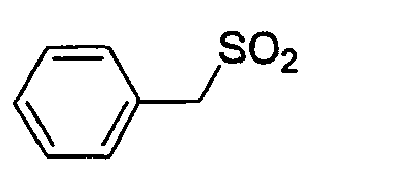
D-Arg Gly 4-Amba 0,0067 3. 
D-Ser(tBu) Gly 4-Amba 0,014 4. 
D-Phe Gly 4-Amba 0,026 5. 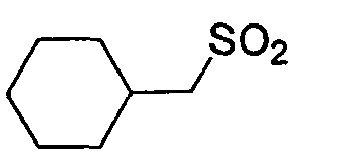
D-Ser(tBu) Ser 4-Amba 0,027 6. 
D-Cha Glu 4-Amba 0,028 7. 
D-Ser(tBu) Gly 4-Amba 0,029 8. 
D-Ser(tBu) Gly 4-Amba 0,034 9. 
D-Ser(tBu) Gly 4-Amba 0,036 10. 
D-Ser(tBu) Gly 4-Amba 0,053 11. 
D-Ser(tBu) Ser 4-Amba 0,054 12. 
D-Ser(tBu) Gly 4-Amba 0,065 13. 
D-Cha Lys 4-Amba 0,067 14. 
D-Ser(tBu) Gly 4-Amba 0,07 15. 
D-Ser(tBu) Gly 4-Amba 0,078 16. 
D-Ser(tBu) Gly 4-Amba 0,083 17. 
D-Ser(tBu) Gly 4-Amba 0,088 18. 
D-Ser(tBu) Ala 4-Amba 0,12 19. 
D-Ser(tBu) Gly 4-Amba 0,13 20. 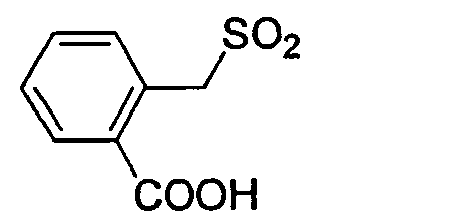
D-Ser(tBu) Gly 4-Amba 0,14 21. 
D-Ser(tBu) Gly 4-Amba 0,16 22. 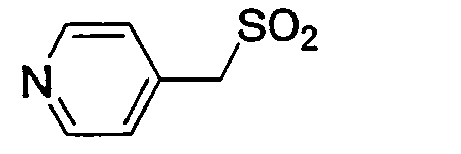
D-Ser(tBu) Gly 4-Amba 0,17 23. 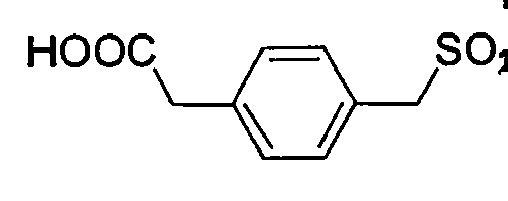
D-Ser(tBu) Gly 4-Amba 0,17 24. 
D-Ser(tBu) Gly 4-Amba 0,18 25. 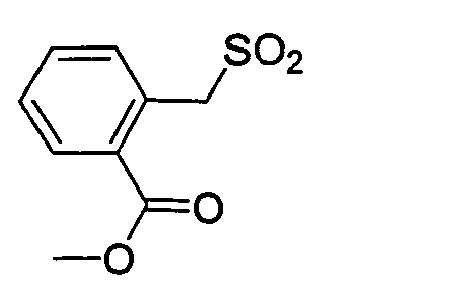
D-Ser(tBu) Gly 4-Amba 0,18 26. 
D-Phe(4-Amidino) Gly 4-Amba 0,26 27. 
D-Ser(tBu) Ser 4-Amba 0,27 28. 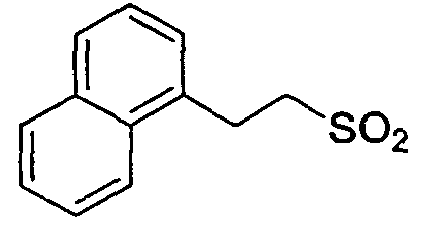
D-Ser(tBu) Gly 4-Amba 0,28 29. 
D-Phe(4-CN) Gly 4-Amba 0,30 30. 
D-Ser(tBu) Gly 4-Amba 0,35 31. 
D-Phe(4-Aminomethyl) Gly 4-Amba 0,39 32. 
D-His Gly 4-Amba 0,67 33. 
D-Ser(tBu) Gly 4-Oxamidinobenzylamid 26 -

- 5 g (21,1 mmol) 3-(Bromomethyl)Benzoesäuremethylester (Lancaster) wurden in 35 ml Wasser suspendiert und nach Zugabe von 2,94 g (23,3 mmol) Na2SO3 8 h unter Rückfluss gekocht. Der Ansatz wurde heiß filtriert und das Wasser im Vakuum bis zur beginnenden Kristallisation eingeengt. Der Ansatz wurde über Nacht im Kühlschrank aufbewahrt, danach wurden die Kristalle abgesaugt und nochmals aus Wasser umkristallisiert. Die Kristalle wurden abgesaugt und im Vakuum getrocknet.
Ausbeute: 3,9 g (15,46 mmol) HPLC: 22,3 % B - 2,5 g (9,91 mmol) 3-(COOMe)-Benzylsulfonsäure Natrium-Salz wurden mit ca. 10 ml Phosphorylchlorid angefeuchtet, mit 2,27 g (10,9 mmol) PCl5 versetzt und 15 Minuten im Eisbad gerührt. Danach wurde der Ansatz 4 h auf 80 °C erwärmt. Anschließend wurde der Ansatz auf Eis gegossen und 30 min kräftig gerührt, das Produkt schied sich in Form weißer Kristalle auf dem Eis ab. Nachdem das Eis teilweise aufgetaut war, wurde der Ansatz durch eine Fritte filtriert und das verbleibende Produkt-Eis-Gemisch mehrmals mit Wasser gewaschen. Die verbleibenden Kristalle wurden im Vakuum getrocknet.
Ausbeute: 1,6 g (6,43 mmol) 65 % (weiße Kristalle) - 0,75 g (4,65 mmol) H-dSer(tBu)-OH (Bachem) wurden in 60 ml trockenem DCM suspendiert, mit 1,23 ml (9,765 mmol) Trimethylsilylchlorid und 1,7 ml (9,765 mmol) DIEA versetzt. Der Ansatz wurde 1,0 h unter Rückfluss gekocht und danach im Eisbad abgekühlt. Anschließend wurden 1,27 g (5,12 mmol) 3-(COOMe)-Benzylsulfonylchlorid und 1,04 ml (6 mmol) DIEA in mehreren Portion innerhalb von 30 min zugegeben. Der Ansatz wurde weitere 15 min unter Eiskühlung und danach für 3 h bei Raumtemperatur gerührt. Das Lösungsmittel wurde im Vakuum entfernt, der Rückstand in Wasser (mit 1 N NaOH auf pH 8,5-9 gebracht) gelöst und 2 x mit Ether extrahiert. Die wässrige Phase wurde mit 5 % KHSO4-Lösung angesäuert und 3 x mit Essigester extrahiert. Die vereinte Essigesterphase wurde jeweils 3 x mit 5 % KHSO4-Lösung und NaCl-gesättigter Lösung gewaschen und mit Na2SO4 getrocknet. Anschließend wurde das Lösungsmittel im Vakuum entfernt.
Ausbeute: 1,3 g (3,48 mmol Feststoff), HPLC: 51 % B - 2 g (5,49 mmol) Boc-Gly-4-(Acetyloxamidino)Benzylamid (hergestellt wie in
WO 01/96286 A2
Ausbeute: 1,55 g (5,15 mmol), weißer Feststoff - 1 g (2,68 mmol) 3-(COOMe)-Benzylsulfonyl-dSer(tBu)-OH und 0,84 g (2,8 mmol) H-Gly-4-(Acetyloxamidino)Benzylamid x HCl wurden unter Rühren und Eiskühlung in 15 ml DMF gelöst und mit 1,39 g (2,68 mmol) PyBop sowie 1,26 ml (7,236 mmol) DIEA versetzt. Nach 30 min wurde das Eisbad entfernt und weitere 4 h bei Raumtemperatur gerührt. Das DMF wurde im Vakuum eingeengt, der verbleibende Rückstand in Essigester gelöst und jeweils 3 x mit 5 % KHSO4, NaCl-gesättigtem Wasser, gesättigter NaHCO3-Lösung und nochmals mit NaCl-gesättigtem Wasser gewaschen. Die Essigesterphase wurde mit Na2SO4 getrocknet und anschließend das Lösungsmittel im Vakuum entfernt. Das Rohprodukt wurde ohne weitere Reinigung für den nächsten Syntheseschritt verwendet.
Ausbeute: 1,35 g (2,18 mmol) Öl, HPLC: 47,89 % B - 1 g (1,61 mmol) 3-(COOMe)-Benzylsulfonyl-dSer(tBu)-Gly-4-(Acetyloxamidino)-Benzylamid wurden in 65 ml 90 % Essigsäure gelöst, mit 150 mg Katalysator (10 % Pd auf Aktivkohle) versetzt und über Nacht mit Wasserstoff hydriert. Der Katalysator wurde abfiltriert und das Lösungsmittel im Vakuum eingeengt. Der verbleibende Rückstand wurde mit Toluen versetzt, danach wurde das Lösungsmittel im Vakuum wieder entfernt. Dieser Vorgang wurde nochmals wiederholt. Der verbleibende Rückstand wurde direkt für den nächsten Reaktionsschritt verwendet.
Ausbeute: 0,9 g (1,44 mmol) Feststoff, HPLC: 39,75 % B
Ca. 50 mg des Rohproduktes wurden mit präparativer reversed-phase HPLC gereinigt und lyophilisiert.
MS: berechnet 561,2 (monoisotopic), gefunden 562,9 [M+H]+ - 750 mg (1,2 mmol) 3-(COOMe)-Benzylsulfonyl-dSer(tBu)-Gly-4-(Amidino)-Benzylamid x Acetat wurden in 20 ml Methanol und 10 ml Wasser gelöst und mit 4 ml 1 N LiOH versetzt. Der Ansatz wurde über Nacht gerührt, nach ca. 15 h mit 5 % KHSO4 neutralisiert (pH 6-7) und das Lösungsmittel im Vakuum entfernt. Das Rohprodukt wurde mittels präparativer reversed-phase HPLC gereinigt und lyophilisiert.
HPLC: 34,16 % B (weißer Feststoff)
MS: berechnet 547,21 (monoisotopic), gefunden 548,3 [M+H]+ -

- 1 g (4,873 mmol) Boc-Ser-OH wurden in 50 ml DMF gelöst und bei -15 °C mit 0,536 ml (4,873 mmol) NMM und 0,6335 ml (4,873 mmol) CKBIE versetzt. Der Ansatz wurde 10 min bei -15 °C gerührt, dann wurden 1,187 g (4,873 mmol) 4-(Acetyloxamidino)Benzylamin x HCl (hergestellt wie in
WO 01/96286 A2
Ausbeute: 1,2 g weißer Schaum, HPLC: 29,9 % B - 1,1 g Boc-Ser-4-(Acetyloxamidino)Benzylamid wurden mit 2 ml Wasser und 18 ml TFA versetzt. Nach 1 h Rühren bei Raumtemperatur wurde das Produkt durch Zugabe von trockenem Diethylether gefällt, abgesaugt und nochmals mit Diethylether gewaschen. Das Produkt wurde im Vakuum getrocknet.
Ausbeute: 0,85 g weißer Feststoff, HPLC: 15,42 % B - 0,2 g (0,634 mmol) Bzls-dSer(tBu)-OH und 0,2097 g (0,634 mmol) H-Ser-4-(Acetyloxamidino)Benzylamid x TFA wurden in 10 ml DMF gelöst und bei 0 °C mit 0,329 g (0,634 mmol) PyBop und 329 µl DIEA versetzt. Der Ansatz wurde 30 min bei 0 °C und weitere 4 h bei Raumtemperatur gerührt. Das Lösungsmittel wurde im Vakuum entfernt, der Rückstand in reichlich Essigester aufgenommen und jeweils 2 x mit wenig Volumen an 5 % KHSO4, NaCl-gesättigtem Wasser, gesättigter NaHCO3-Lösung und nochmals mit NaCl-gesättigtem Wasser gewaschen und anschließend mit Na2SO4 getrocknet. Das Lösungsmittel wurde im Vakuum entfernt. Es verblieb ein öliges Rohprodukt, das direkt für den nächsten Syntheseschritt eingesetzt wurde.
Ausbeute: 0,31 g Öl, HPLC: 42,97 % B - 200 mg (0,29 mmol) Bzls-dSer(tBu)-Ser(Bzl)-4-(Acetyloxamidino)Benzylamid wurden in 100 ml 90 % Essigsäure gelöst, dazu wurden 50 mg Katalysator (10 % Pd/C) gegeben. Der Ansatz wurde 6 h bei Raumtemperatur und Normaldruck mit Wasserstoff hydriert. Anschließend wurde der Katalysator abfiltriert, das Lösungsmittel im Vakuum eingeengt und das Produkt mit präparativer HPLC gereinigt und lyophilisiert.
Ausbeute: 75 mg (weisser Feststoff); HPLC: 34,7 % B.
MS: berechnet 533,23 (monoisotopic), gefunden 534,5 [M+H]+ -
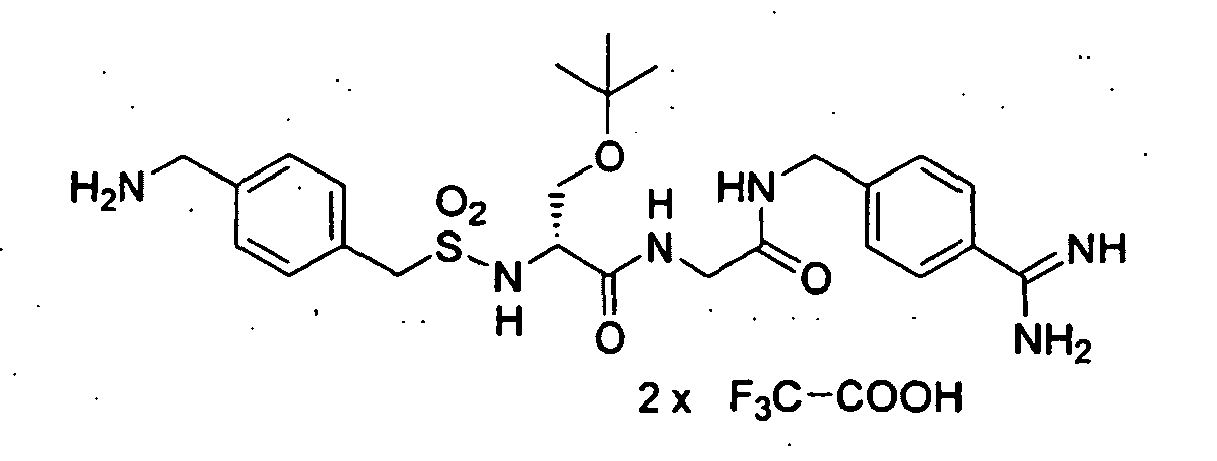
- 30 g (153 mmol) 4-Cyanobenzylbromid (Aldrich) wurden in 150 ml Wasser suspendiert und nach Zugabe von 21,2 g (168,3 mmol) Na2SO3 8 h unter Rückfluß gekocht. Der Ansatz wurde heiß filtriert und das Wasser im Vakuum etwas eingeengt. Der Ansatz wurde zur Kristallisation über Nacht im Kühlschrank aufbewahrt, danach wurden die Kristalle abgesaugt und nochmals aus Wasser umkristallisiert. Die Kristalle wurden abgesaugt und im Vakuum getrocknet.
Ausbeute: 17,1 g (78 mmol),HPLC: 18,24 % B - 5 g (22,83 mmol) 4-Cyano-Benzylsulfonsäure Natrium-Salz wurden mit ca. 20 ml Phosphorylchlorid angefeuchtet und mit 5,2 g (25,11 mmol) PCl5 versetzt und 15 min unter Eiskühlung gerührt. Anschließend wurde der Ansatz 4 h auf 80°C erwärmt. Danach wurde der Ansatz auf Eis gegossen und 30 min kräftig gerührt, das Produkt schied sich als weißer Feststoff auf dem Eis ab. Nachdem das Eis teilweise aufgetaut war, wurde der Ansatz durch eine Fritte filtriert und das verbleibende Produkt-Eis-Gemisch mehrmals mit Wasser gewaschen. Die verbleibenden Kristalle wurden im Vakuum getrocknet und direkt für den nächsten Syntheseschritt verwendet.
Ausbeute: 3,4 g (15,76 mmol) - 1 g (6,2 mmol) H-dSer(tBu)-OH (Bachem) wurden in 50 ml trockenem DCM suspendiert, mit 1,65 ml (13 mmol) Trimethylsilylchlorid und 2,26 ml (13 mmol) DIEA versetzt. Der Ansatz wurde 1 h unter Rückfluß gekocht und im Eisbad abgekühlt. Anschließend wurden 1,47 g (6,82 mmol) 4-Cyano-Benzylsulfonylchlorid und 1,19 ml (6,82 mmol) DIEA innerhalb von 30 min zugesetzt. Der Ansatz wurde weitere 15 min unter Eiskühlung und danach für weitere 3 h bei Raumtemperatur gerührt. Das Lösungsmittel wurde im Vakuum entfernt, der Rückstand in Wasser (mit 1 N NaOH auf pH 8,5-9 gebracht) gelöst und 2 x mit Ether extrahiert. Anschließend wurde die wässrige Phase mit 5 % KHSO4-Lösung angesäuert und 3 x mit Essigester extrahiert. Die vereinte Essigesterphase wurde jeweils 3 x mit 5 % KHSO4-Lösung und NaCl-gesättigter Lösung gewaschen und mit Na2SO4 getrocknet. Das Lösungsmittel wurde im Vakuum entfernt. Ausbeute: 1,4 g (4,11 mmol Feststoff), HPLC: 48,89 % B
- 1 g (2,94 mmol) 4-Cyano-Benzylsulfonyl-dSer(tBu)-OH und 0,884 g (2,94 mmol) H-Gly-4-(Acetyloxamidino)Benzylamid x HCl (siehe Beispiel 1d) wurden unter Rühren und Eiskühlung in 15 ml DMF gelöst und mit 1,53 g (2,94 mmol) PyBop sowie 1,38 ml (7,94 mmol) DIEA versetzt. Nach 30 min wurde das Eisbad entfernt und der Ansatz weitere 4 h bei Raumtemperatur gerührt. Das DMF wurde im Vakuum eingeengt, der verbleibende Rückstand in Essigester gelöst und jeweils 3 x mit 5 % KHSO4, NaCl-gesättigtem Wasser, gesättigter NaHCO3-Lösung und nochmals mit NaCl-gesättigtem Wasser gewaschen und mit Na2SO4 getrocknet. Das Lösungsmittel wurde im Vakuum entfernt. Das Rohprodukt wurde ohne weitere Reinigung für den nächsten Syntheseschritt verwendet.
Ausbeute: 1,4 g (2,386 mmol) Öl, HPLC: 46,05 % B - 1 g (1,7 mmol) 4-Cyano-Benzylsulfonyl-dSer(tBu)-Gly-4-(Acetyloxamidino)-Benzylamid wurden in 70 ml 90 % Essigsäure gelöst, mit 150 mg Katalysator (10 % Pd auf Aktivkohle) versetzt und 5 h mit Wasserstoff hydriert. Der Katalysator wurde abfiltriert und das Lösungsmittel eingeengt. Der verbleibende Rückstand wurde mit Toluen versetzt, anschließend wurde das Lösungsmittel im Vakuum entfernt. Dieser Vorgang wurde nochmals wiederholt. Der verbleibende Rückstand wurde direkt für den nächsten Reaktionsschritt verwendet.
Ausbeute: 0,85 g (1,44 mmol als Acetat-Salz) Feststoff HPLC: 37,55 % B
Ca. 60 mg dieses Rohproduktes wurden mit präparativer HPLC gereinigt.
MS: berechnet 528,2 (monoisotopic), gefunden 530,1 [M+H]+ - 200 mg Rohprodukt an 4-Cyano-Benzylsulfonyl-dSer(tBu)-Gly-4-(Amidino)-Benzylamid x Acetat wurden in 50 ml 90 % Essigsäure und 5 ml 1 N HCl gelöst, mit 40 mg Katalysator (10 % Pd auf Aktivkohle) versetzt und über Nacht bei 40 °C mit Wasserstoff hydriert. Der Katalysator wurde abfiltriert und das Lösungsmittel im Vakuum eingeengt. Der verbleibende Rückstand wurde mit präparativer reversed phase HPLC gereinigt.
Ausbeute: 75 mg (als 2 x TFA-Salz) Feststoff HPLC: 26,05 % B
MS: berechnet 532,25 (monoisotopic), gefunden 533,7 [M+H]+ -

- 1 g (4,42 mmol) H-dPhe(3-CN)-OH x HCl wurden in einer Mischung von 40 ml Dioxan und 10 ml Wasser gelöst, der pH wurde durch Zugabe von DIEA auf pH 8-9 eingestellt. Der Ansatz wurde im Eisbad gekühlt, über einen Zeitraum von 3 h wurden insgesamt 1,265 g (6,63 mmol) in mehreren Portionen zugegeben, wobei der pH-Wert durch Zugabe von DIEA auf 8-9 eingestellt wurde. Nach 1 h wurde das Eisbad entfernt und der Ansatz über Nacht bei RT gerührt. Das Lösungsmittel wurde im Vakuum entfernt, der Rückstand in Essigester und 5 % KHSO4-Lösung aufgenommen. Die Essigesterphase wurde 3 x mit 5 % KHSO4-Lösung und 3 x mit NaCl-gesättigter wässriger Lösung gewaschen. Die Essigesterphase wurde mit Na2SO4 getrocknet und das Lösungsmittel im Vakuum entfernt. Das Produkt wurde aus Essigester kristallisiert.
Ausbeute: 1,6 g (weißer Feststoff), HPLC bei 45,8 % B - 800 mg (2,32 mmol) Benzylsultonyl-dPhe(3-CN)-OH wurden in 30 ml Methanol gelöst und mit 280 mg (4 mmol) Hydroxylamin x HCl und 0,63 ml (3,6 mmol) DIEA versetzt. Der Ansatz wurde 5 h unter Rückfluß gekocht und über Nacht bei RT gerührt. Das Lösungsmittel wurde im Vakuum entfernt und der Rückstand in 30 ml Essigsäure gelöst. Es wurden 665 µl (7 mmol) Essigsäureanhydrid zugegeben, der Ansatz wurde 30 min bei RT gerührt. Danach wurde das Lösungsmittel im Vakuum entfernt und der Rückstand in Essigester gelöst und 2 x mit 5 % KHSO4-Lösung und 3 x mit NaCl-gesättigter wässriger Lösung gewaschen. Die Essigesterphase wurde mit Na2SO4 getrocknet und das Lösungsmittel im Vakuum entfernt. Ausbeute: 805 mg (Öl), HPLC bei 38,5 % B
- 100 mg (0,24 mmol) Benzylsulfonyl-dPhe(3-Acetyloxamidino)-OH und 75 mg (0,25 mmol) H-Gly-4-(Acetyloxamidino)Benzylamid x HCl (siehe Beispiel 1d) wurden unter Rühren und Eiskühlung in 5 ml DMF gelöst und mit 125 mg (0,24 mmol) PyBop sowie 125 µl DIEA versetzt. Nach 30 min wurde das Eisbad entfernt und der Ansatz weitere 3 h bei Raumtemperatur gerührt. Das DMF wurde im Vakuum eingeengt, der verbleibende Rückstand in Essigester gelöst und jeweils 3 x mit 5 % KHS04, NaCl-gesättigtem Wasser, gesättigter NaHCO3-Lösung und nochmals mit NaCl-gesättigtem Wasser gewaschen und mit Na2SO4 getrocknet. Das Lösungsmittel wurde im Vakuum entfernt. Das Rohprodukt wurde ohne weitere Reinigung für den nächsten Syntheseschritt verwendet.
Ausbeute: 1,43 mg gelbliches Öl, HPLC: 38,3 % B - 100 mg Benzylsulfonyl-dPhe(3-Acetyloxamidino)-Gly-4-(Acetyloxamidino) Benzylamid wurden in 20 ml Eisessig gelöst und mit 20 mg Katalysator (10 % Pd/C) versetzt. Der Ansatz wurde über Nacht unter Wasserstoffatmosphäre hydriert. Der Katalysator wurde abfiltriert und das Lösungsmittel im Vakuum entfernt. Das Produkt wurde mit präparativer HPLC gereinigt.
Ausbeute: 25 mg, HPLC bei 24,6 % B
MS: berechnet 549,22 (monoisotopic), gefunden 550,3 [M+H]+ -
- Ac
- Acetyl
- 4-Amba
- 4-Amidinobenzylamid
- Boc
- tert.-Butyloxycarbonyl
- Bzl
- Benzyl
- dCha
- d-βCyclohexylalanin
- CKIBE
- Chlorkohlensäureisobutylester
- Dab
- α,γ-Diaminobuttersäure
- Dap
- α,β-Diaminopropionsäure
- DIEA
- Diisopropylethylamin
- DMF
- N,N-Dimethylformamid
- i.V.
- im Vakuum
- NMM
- N-Methylmorpholin
- PyBOP
- Benzotriazol-1-yl-oxy-tris(pyrrolidino)phosphoniumhexafluorophosphat
- TEA
- Triethylamin
- TFA
- Trifluoressigsäure
- THF
- Tetrahydrofuran
- tBu
- tert.-Butyl
Claims (16)
- Verbindung der allgemeinen Formel I
 A P2-P1 mit
P2 von einer der folgenden Aminosäuren in der D-Konfiguration abstammt: D-2,3-Diaminopropionsäure, D-2,4-Diaminobuttersäure, D-Citrullin, D-Homocitrullin, D-Norcitrullin, D-Arginin, D-Homoarginin, D-Norarginin, D-3-Guanidinophenylalanin, D-3-Guanidinophenylhomoalanin, D-3-Guanidinophenylglycin, D-3-Amidinophenylalanin, D-3-Amidinophenylhomoalanin, D-3-Amidinophenylglycin, D-4-Guanidinomethylphenylalanin, D-4-Guanidinomethylphenylhomoalanin, D-4-Guanidinomethylphenylglycin, D-3-Guanidinomethylphenylalanin, D-3-Guanidinomethylphenylhomoalanin, D-3-Guanidinomethylphenylglycin, D-3-Amidinopiperidinylalanin, D-3-Amidinopiperidinylhomoalanin, D-3-Amidinopiperidinylglycin, n-Butylamidinoglycin, n-Pentylamidinoglycin, n-Propylamidinoglycin, D-Canavanin, D-Homocanavanin, D-Norcanavanin, 2-Amino-4-Amidinohydrazono-Buttersäure, 2-Amino-3-Amidinohydrazono-Propionsäure, 2-Amino-5-Amidinohydrazono-Pentansäure, 2-Amino-4-(Pyridin-4-ylamino)-Buttersäure, 2-Amino-4-(Pyridin-4-ylamino)-Propionsäure, 2-Amino-4-(Pyridin-4-ylamino)-Pentansäure, 4-Imidazolyl-Propargylglycin, D-Histidin, D-Homohistidin, D-Histidin-(1-Methyl), D-Homohistidin-(1-Methyl), D-Histidin-(3-Methyl), D-Homohistidin-(3-Methyl), D-Alanin(4-[5-2(-amino)imidazoyl], D-Homoalanin(4-[5-2(-amino)imidazoyl], D-Glycin(4-[5-2(-amino)imidazoyl], D-Alanin(3-(2-Pyrimidinyl), D-Homoalanin(3-(2-Pyrimidinyl), D-Alanin(3-(5-Pyrimidinyl), D-Homoalanin(3-(5-Pyrimidinyl), D-2-Amino-3-(2-amino-pyrimidin-5-yl)-propionsäure, D-2-Amino-4-(2-amino-pyrimidin-5-yl)-buttersäure, D-Alanin(3-(2-benzimidazolyl)), D-Homoalanin(3-(2-benzimidazolyl)), D-Tryptophan das mit Aminoalkylgruppen am Indolring substituiert ist, D-Homotryptophan das mit Aminoalkylgruppen am Indolring substituiert ist, D-2-Amino-3-(6-amino-pyridin-3-yl)-propionsäure, D-2-Amino-4-(6-amino-pyridin-3-yl)-buttersäure, D-2-Amino-3-(6-amino-2-methylpyridin-3-yl)-propionsäure, D-2-Amino-4-(6-amino-2-methyl-pyridin-3-yl)-buttersäure, D-2-Amino-3-(6-amino-2,4-dimethyl-pyridin-3-yl)-propionsäure, D-2-Amino-4-(6-amino-2,4-dimethyl-pyridin-3-yl)-buttersäure, D-3-Hydroxyamidinophenylalanin, D-3-Hydroxy-amidinophenylhomoalanin, D-3-Hydroxyamidinophenylglycin,;R1 H oder -(CH2)aCOOR6 mit a = 0, 1, 2, 3, 4 oder 5 ist, wobei R6 ein verzweigter oder unverzweigter Alkylrest mit 1 bis 6 C-Atomen ist;R2 ein H, ein verzweigter oder unverzweigter Alkylrest mit 1 bis 8 C-Atomen, oder
-(CH2)cCOOR8 mit c = 1, 2, 3 oder 4, wobei R8 H oder ein verzweigter oder unverzweigter Alkylrest mit 1 bis 6 C-Atomen ist, oder
-(CH2)d-OR9 mit d = 1, 2, 3 oder 4, wobei R9 H ist, oder
-(CH2)eOR10, -(CH2)eSR10, -(CH2)e-Guanidino, -(CH2)e-Imidazol oder
-(CH2)eNHR10 mit e = 1, 2, 3, 4 oder 5 ist, wobei R10 H, ein verzweigter oder unverzweigter Alkylrest mit 1-16 C-Atomen oder ein substituierter oder unsubstituierter Aryl-, Heteroaryl-, Aralkyl- oder Heteroaralkylrest
ist, wobei der Alkylrest 1 bis 16 C-Atome, und der Aryl- oder Heteroarylrest 4 bis 14 C-Atome besitzt;R3 H oder -(CH2)bR7 mit b = 1, 2, 3, 4, 5, 6, 7 oder 8 ist, wobei R7 H, ein verzweigter oder unverzweigter Alkylrest mit 1 bis 10 C-Atomen oder ein geladener Rest ist;R5 -(CH2)g(CH3)h, -(CH2)i-Aryl mit g + h = i = 0, 1, 2 oder 3, -SO2R12, -COR12, oder -COOR12 ist, wobei R12 ein verzweigtes oder unverzweigtes Alkyl mit 1-16 C-Atomen, ein substituierter oder unsubstituierter Aryl-, Heteroaryl-, Aralkyl- oder Heteroaralkylrest, ein Adamantyl-, ein Campher-, ein Cyclohexylmethylrest ist,
wobei R5 mit einer geladenen oder ungeladenen Gruppe ist;U ein Phenyl- oder Cyclohexylrest ist;
ein Heterophenyl- oder Heterocyclohexylrest ist oder
ein Thiophenrest ist;V (CH2)n mit n = 0, 1, 2 oder 3 ist;X N oder CH ist;Y N oder (CH)m mit m = 0 oder 1 ist;Z in 3- oder 4-Position vorkommt und eine Aminomethyl-, eine Guanidinofunktion oder eine Amidinogruppeoder eine Verbindung mit
R5 gleich

dadurch gekennzeichnet, dass ein oder mehrere geladene Reste in den Resten R1, R2, R3 oder R5 vorhanden sind. - Verbindung nach Anspruch 1, wobei U an 1, 2 oder 3 Positionen vorzugsweise mit einem Halogen, insbesondere Fluor oder Chlor, oder einem Methyl, Ethyl-, Propyl-, Methoxy-, Ethoxy-, oder Propoxyrest substituiert ist.
- Verbindung nach Anspruch 1 oder 2, wobei eine Carboxylgruppe als Ester, bevorzugt als Ethylester, geschützt vorliegt.
- Verbindung nach mindestens einem der Ansprüche 1 bis 3, wobei R9 in diesem Fall ein Alkylcarbonyl-, Aralkylcarbonyl-, Alkyloxycarbonyl- oder Aralkyloxycarbonyl-Rest ist, wobei der Alkylrest vorzugsweise 1 bis 6, insbesondere 1 bis 4 C-Atome und der Arylrest vorzugsweise 5 bis 8, insbesondere 6 C-Atome besitzt.
- Verbindung der allgemeinen Formel I, dadurch gekennzeichnet, dass die Verbindung die folgende Struktur aufweist:

- Verbindung nach mindestens einem der Ansprüche 1 bis 5, dadurch gekennzeichnet, dass der Substituent am substituierten Aryl-, Heteroaryl-, Aralkyl- oder Heteroaralkylrest ein Halogen, vorzugsweise Fluor, Chlor oder Brom, insbesondere Fluor oder Chlor, ist.
- Verbindung nach mindestens einem der Ansprüche 1 bis 6, dadurch gekennzeichnet, dass die Verbindungen als Salze mit Mineralsäuren, bevorzugt als Hydrochloride, oder als Salze mit geeigneten organischen Säuren vorliegen.
- Verbindung nach Anspruch 7, dadurch gekennzeichnet, dass Salze von Mineralsäuren auch Sulfate sind und geeignete organische Säuren Essigsäure, Ameisensäure, Methylsulfonsäure, Bernsteinsäure, Apfelsäure oder Trifluoressigsäure sind, wobei bevorzugte Salze von organischen Säuren Acetate sind.
- Verbindung gemäß mindestens einem der Ansprüche 1 bis 8, dadurch gekennzeichnet, dass R3 ein geladener Rest mit einer (CH2)jCOOR13, -(CH2)jSO2R13, -(CH2)jNH2, -(CH2)j-Amidino-, -(CH2)j-Hydroxyamidino- oder -(CH2)j-Guanidino-Gruppe mit j = 0, 1 oder 2 ist, wobei R13 H oder ein Alkylrest mit vorzugsweise 1 bis 6 C-Atomen, insbesondere 1 bis 4, vor allem Ethyl, ist.
- Verbindung gemäß mindestens einem der Ansprüche 1 bis 9, dadurch gekennzeichnet, dass R5 mit einem geladenen Rest ausgewählt aus einer -(CH2)jCOOR13, -(CH2)jSO2R13, -(CH2)jNH2, -(CH2)j-Amidino-, -(CH2)j-Hydroxyamidino- oder -(CH2)j-Guanidino-Gruppe mit j = 0, 1 oder 2 modifiziert ist, wobei R13 H oder ein Alkylrest mit vorzugsweise 1 bis 6 C-Atomen, insbesondere 1 bis 4, vor allem Ethyl, ist.
- Verbindung ausgewählt aus
Benzylsulfonyl-dPhe(3-Amidino)-Gly-4-(Amidino)Benzylamid oder
Benzylsulfonyl-dArg-Gly-4-(Amidino)Benzylamid. - Verfahren zur Herstellung einer Verbindung gemäß mindestens einem der Ansprüche 1 bis 11, dadurch gekennzeichnet, dass sequentiell die entsprechenden Aminosäuren an ein 4-Acetyloxamidinobenzylamin angekoppelt werden, wobei die N-terminale Aminosäure entweder den R5-Rest bereits trägt oder dieser anschließend daran gebunden wird.
- Arzneimittel enthaltend eine Verbindung gemäß mindestens einem der Ansprüche 1 bis 11 sowie pharmazeutisch geeignete Hilfs- und/oder Zusatzstoffe.
- Arzneimittel nach Anspruch 13, wobei das Arzneimittel in Form einer Tablette, eines Dragees, einer Kapsel, eines Pellets, Suppositoriums, einer Lösung, insbesondere einer Injektions- oder Infusionslösung, von Augen-, Nasen und Ohrentropfen, eines Safts, einer Kapsel, einer Emulsion oder Suspension, eines Globuli, Styli, Aerosols, Puders, einer Paste, Creme oder Salbe eingesetzt wird.
- Verwendung einer Verbindung gemäß mindestens einem der Ansprüche 1 bis 11 zur Herstellung eines Arzneimittels zur Therapie oder Prophylaxe einer kardiovaskulären Erkrankung oder eines thromboembolischen Ereignisses, insbesondere in oraler, subkutaner, intravenöser oder transdermaler Form.
- Verwendung einer Verbindung gemäß mindestens einem der Ansprüche 1 bis 11 zur Herstellung eines Diagnostikums zur Diagnose eines thromboembolischen Ereignisses.
Applications Claiming Priority (3)
| Application Number | Priority Date | Filing Date | Title |
|---|---|---|---|
| DE10210590A DE10210590A1 (de) | 2002-03-11 | 2002-03-11 | Hemmstoffe des Gerinnungsfaktors Xa, ihre Herstellung und Verwendung |
| DE10210590 | 2002-03-11 | ||
| PCT/EP2003/002487 WO2003076457A1 (de) | 2002-03-11 | 2003-03-11 | HEMMSTOFFE DES GERINNUNGSFAKTORS Xa, IHRE HERSTELLUNG UND VERWENDUNG |
Publications (2)
| Publication Number | Publication Date |
|---|---|
| EP1483285A1 EP1483285A1 (de) | 2004-12-08 |
| EP1483285B1 true EP1483285B1 (de) | 2008-05-07 |
Family
ID=27797651
Family Applications (1)
| Application Number | Title | Priority Date | Filing Date |
|---|---|---|---|
| EP03743869A Expired - Lifetime EP1483285B1 (de) | 2002-03-11 | 2003-03-11 | HEMMSTOFFE DES GERINNUNGSFAKTORS Xa, IHRE HERSTELLUNG UND VERWENDUNG |
Country Status (9)
| Country | Link |
|---|---|
| US (1) | US20050119190A1 (de) |
| EP (1) | EP1483285B1 (de) |
| JP (1) | JP2005533749A (de) |
| AT (1) | ATE394414T1 (de) |
| AU (1) | AU2003215655A1 (de) |
| CA (1) | CA2478412A1 (de) |
| DE (2) | DE10210590A1 (de) |
| ES (1) | ES2309328T3 (de) |
| WO (1) | WO2003076457A1 (de) |
Families Citing this family (10)
| Publication number | Priority date | Publication date | Assignee | Title |
|---|---|---|---|---|
| EP1485345B1 (de) | 2002-03-11 | 2008-06-25 | Curacyte AG | Hemmstoffe der urokinase, ihre herstellung und verwendung |
| DE10301300B4 (de) * | 2003-01-15 | 2009-07-16 | Curacyte Chemistry Gmbh | Verwendung von acylierten 4-Amidino- und 4-Guanidinobenzylaminen zur Inhibierung von Plasmakallikrein |
| DE10342108A1 (de) | 2003-09-11 | 2005-04-14 | Curacyte Chemistry Gmbh | Basisch-substituierte Benzylaminanaloga als Inhibitoren des Gerinnungsfaktors Xa, ihre Herstellung und Verwendung |
| DE102005044319A1 (de) * | 2005-09-16 | 2007-03-22 | Curacyte Chemistry Gmbh | 2-(Aminomethyl)-5-Chlor-Benzylamid-Derivate und ihre Verwendung als Hemmstoffe des Gerinnungsfaktors Xa |
| DE102006048300A1 (de) * | 2006-01-26 | 2007-08-02 | Hellstern, Peter, Prof. Dr.med. | Inhibitoren des Blutgerinnungsfaktors Xa zur Verwendung als Antikoagulans |
| DE102006050672A1 (de) * | 2006-10-24 | 2008-04-30 | Curacyte Discovery Gmbh | Hemmstoffe des Plasmins und des Plasmakallikreins |
| JP5268264B2 (ja) * | 2007-02-07 | 2013-08-21 | 住友精化株式会社 | アルカンジスルホニルハライドの製造方法 |
| JP5709902B2 (ja) * | 2010-01-28 | 2015-04-30 | ザ メディシンズ カンパニー (ライプツィヒ) ゲーエムベーハー | トリプシン様セリンプロテアーゼ阻害剤、ならびにその調製および使用 |
| ES2483802T3 (es) | 2010-07-07 | 2014-08-07 | The Medicines Company (Leipzig) Gmbh | Inhibidores de serina proteasa |
| EP2960232A1 (de) * | 2014-06-25 | 2015-12-30 | DSM IP Assets B.V. | Verfahren zur Herstellung eines Dipeptidderivats |
Family Cites Families (5)
| Publication number | Priority date | Publication date | Assignee | Title |
|---|---|---|---|---|
| SE9301916D0 (sv) * | 1993-06-03 | 1993-06-03 | Ab Astra | New peptides derivatives |
| US5726159A (en) * | 1994-03-04 | 1998-03-10 | Eli Lilly And Company | Antithrombotic agents |
| CZ245797A3 (cs) * | 1995-02-17 | 1998-06-17 | Basf Aktiengesellschaft | Derivát amidinu dipeptidu jako inhibitor thrombinu |
| FR2791683A1 (fr) * | 1999-03-30 | 2000-10-06 | Synthelabo | Derives de n-sulfonyl-dipeptides, leur preparation et leur application en therapeutique |
| DE10029015A1 (de) * | 2000-06-15 | 2001-12-20 | Curacyte Ag | Hemmstoffe für den Gerinnungsfaktor Xa |
-
2002
- 2002-03-11 DE DE10210590A patent/DE10210590A1/de not_active Ceased
-
2003
- 2003-03-11 EP EP03743869A patent/EP1483285B1/de not_active Expired - Lifetime
- 2003-03-11 WO PCT/EP2003/002487 patent/WO2003076457A1/de not_active Ceased
- 2003-03-11 JP JP2003574672A patent/JP2005533749A/ja not_active Withdrawn
- 2003-03-11 AU AU2003215655A patent/AU2003215655A1/en not_active Abandoned
- 2003-03-11 AT AT03743869T patent/ATE394414T1/de active
- 2003-03-11 US US10/506,383 patent/US20050119190A1/en not_active Abandoned
- 2003-03-11 CA CA002478412A patent/CA2478412A1/en not_active Abandoned
- 2003-03-11 ES ES03743869T patent/ES2309328T3/es not_active Expired - Lifetime
- 2003-03-11 DE DE50309777T patent/DE50309777D1/de not_active Expired - Lifetime
Also Published As
| Publication number | Publication date |
|---|---|
| US20050119190A1 (en) | 2005-06-02 |
| ATE394414T1 (de) | 2008-05-15 |
| CA2478412A1 (en) | 2003-09-18 |
| JP2005533749A (ja) | 2005-11-10 |
| AU2003215655A1 (en) | 2003-09-22 |
| WO2003076457A1 (de) | 2003-09-18 |
| DE10210590A1 (de) | 2003-10-02 |
| ES2309328T3 (es) | 2008-12-16 |
| EP1483285A1 (de) | 2004-12-08 |
| DE50309777D1 (de) | 2008-06-19 |
Similar Documents
| Publication | Publication Date | Title |
|---|---|---|
| DE69919397T2 (de) | Thrombin-inhibitoren | |
| DE69528528T2 (de) | Thrombin-inhibitoren | |
| EP0513543B1 (de) | Amidinophenylalaninderivate, Verfahren zu deren Herstellung, deren Verwendung und diese enthaltende Mittel als Antikoagulantien | |
| EP1583526B1 (de) | Acylierte 4-amidino- und 4-guanidinobenzylaminen zur inhibierung von plasmakallikrein | |
| DE69226152T2 (de) | Antithrombotische Verbindungen | |
| EP0236872B1 (de) | Hydroxylaminderivate, deren Herstellung und Verwendung für Heilmittel | |
| EP1538160B1 (de) | Substituierte Isochinolin-3-Carbonsäureamide, ihre Herstellung und ihre Verwendung als Arzneimittel | |
| DE69314478T2 (de) | Neuartige antikoagulierende peptidderivate und arzneimittel die solche enthalten so wie entsprechendes herstellungsverfahren | |
| EP1294742B1 (de) | Urokinase-hemmstoffe | |
| WO1992016549A1 (de) | Para-substituierte phenylalanin-derivate | |
| EP0235692A2 (de) | Oligopeptidylnitrilderivate, diese enthaltende Mittel, Verfahren zu ihrer Herstellung und ihre Verwendung | |
| EP0796271B1 (de) | Dipeptidische p-amidinobenzylamide mit n-terminalen sulfonyl- bzw. aminosulfonylresten | |
| EP0508220B1 (de) | Amidinophenylalaninderivate, Verfahren zu deren Herstellung, deren Verwendung und diese enthaltende Mittel | |
| EP1483285B1 (de) | HEMMSTOFFE DES GERINNUNGSFAKTORS Xa, IHRE HERSTELLUNG UND VERWENDUNG | |
| EP1485345B1 (de) | Hemmstoffe der urokinase, ihre herstellung und verwendung | |
| EP1272458A1 (de) | Arginin-mimetika als faktor xa-inhibitoren | |
| EP1664089B1 (de) | Basisch-substituierte benzylaminanaloga als inhibitoren des gerinnungsfaktors xa, ihre herstellung und verwendung | |
| EP1294741B1 (de) | Dipeptidische hemmstoffe für den gerinnungsfaktor xa | |
| DE69426897T2 (de) | Antithrombotisch wirkende azacycloalkyl-alkanoyl-peptide und-pseudopeptide | |
| DE69625230T2 (de) | Thrombininhibitoren | |
| EP0403828A1 (de) | Renininhibitorische Peptide, Verfahren zur ihrer Herstellung und ihre Verwendung in Arzneimitteln | |
| EP0373497A2 (de) | Dipeptid-Derivate mit Enzym-inhibitorischer Wirkung | |
| EP0203450B1 (de) | Neue Derivate bicyclischer Aminosäuren, Verfahren zu ihrer Herstellung, diese enthaltende Mittel und deren Verwendung | |
| WO1992010510A1 (de) | Dithiolano- und dithianoglycinhaltige renininhibitorische peptide, verfahren zu ihrer herstellung und ihre verwendung in arzneimitteln | |
| DE10210592A1 (de) | Hemmstoffe der Urokinase, ihre Herstellung und Verwendung |
Legal Events
| Date | Code | Title | Description |
|---|---|---|---|
| PUAI | Public reference made under article 153(3) epc to a published international application that has entered the european phase |
Free format text: ORIGINAL CODE: 0009012 |
|
| 17P | Request for examination filed |
Effective date: 20040922 |
|
| AK | Designated contracting states |
Kind code of ref document: A1 Designated state(s): AT BE BG CH CY CZ DE DK EE ES FI FR GB GR HU IE IT LI LU MC NL PT RO SE SI SK TR |
|
| AX | Request for extension of the european patent |
Extension state: AL LT LV MK |
|
| 17Q | First examination report despatched |
Effective date: 20051017 |
|
| GRAP | Despatch of communication of intention to grant a patent |
Free format text: ORIGINAL CODE: EPIDOSNIGR1 |
|
| GRAS | Grant fee paid |
Free format text: ORIGINAL CODE: EPIDOSNIGR3 |
|
| RAP1 | Party data changed (applicant data changed or rights of an application transferred) |
Owner name: CURACYTE AG |
|
| GRAA | (expected) grant |
Free format text: ORIGINAL CODE: 0009210 |
|
| AK | Designated contracting states |
Kind code of ref document: B1 Designated state(s): AT BE BG CH CY CZ DE DK EE ES FI FR GB GR HU IE IT LI LU MC NL PT RO SE SI SK TR |
|
| REG | Reference to a national code |
Ref country code: GB Ref legal event code: FG4D Free format text: NOT ENGLISH |
|
| REG | Reference to a national code |
Ref country code: CH Ref legal event code: EP |
|
| REG | Reference to a national code |
Ref country code: IE Ref legal event code: FG4D Free format text: LANGUAGE OF EP DOCUMENT: GERMAN |
|
| REF | Corresponds to: |
Ref document number: 50309777 Country of ref document: DE Date of ref document: 20080619 Kind code of ref document: P |
|
| PG25 | Lapsed in a contracting state [announced via postgrant information from national office to epo] |
Ref country code: SI Free format text: LAPSE BECAUSE OF FAILURE TO SUBMIT A TRANSLATION OF THE DESCRIPTION OR TO PAY THE FEE WITHIN THE PRESCRIBED TIME-LIMIT Effective date: 20080507 |
|
| PG25 | Lapsed in a contracting state [announced via postgrant information from national office to epo] |
Ref country code: FI Free format text: LAPSE BECAUSE OF FAILURE TO SUBMIT A TRANSLATION OF THE DESCRIPTION OR TO PAY THE FEE WITHIN THE PRESCRIBED TIME-LIMIT Effective date: 20080507 Ref country code: NL Free format text: LAPSE BECAUSE OF FAILURE TO SUBMIT A TRANSLATION OF THE DESCRIPTION OR TO PAY THE FEE WITHIN THE PRESCRIBED TIME-LIMIT Effective date: 20080507 |
|
| NLV1 | Nl: lapsed or annulled due to failure to fulfill the requirements of art. 29p and 29m of the patents act | ||
| REG | Reference to a national code |
Ref country code: IE Ref legal event code: FD4D |
|
| REG | Reference to a national code |
Ref country code: ES Ref legal event code: FG2A Ref document number: 2309328 Country of ref document: ES Kind code of ref document: T3 |
|
| PG25 | Lapsed in a contracting state [announced via postgrant information from national office to epo] |
Ref country code: IE Free format text: LAPSE BECAUSE OF FAILURE TO SUBMIT A TRANSLATION OF THE DESCRIPTION OR TO PAY THE FEE WITHIN THE PRESCRIBED TIME-LIMIT Effective date: 20080507 Ref country code: PT Free format text: LAPSE BECAUSE OF FAILURE TO SUBMIT A TRANSLATION OF THE DESCRIPTION OR TO PAY THE FEE WITHIN THE PRESCRIBED TIME-LIMIT Effective date: 20081007 Ref country code: SE Free format text: LAPSE BECAUSE OF FAILURE TO SUBMIT A TRANSLATION OF THE DESCRIPTION OR TO PAY THE FEE WITHIN THE PRESCRIBED TIME-LIMIT Effective date: 20080807 Ref country code: CZ Free format text: LAPSE BECAUSE OF FAILURE TO SUBMIT A TRANSLATION OF THE DESCRIPTION OR TO PAY THE FEE WITHIN THE PRESCRIBED TIME-LIMIT Effective date: 20080507 Ref country code: DK Free format text: LAPSE BECAUSE OF FAILURE TO SUBMIT A TRANSLATION OF THE DESCRIPTION OR TO PAY THE FEE WITHIN THE PRESCRIBED TIME-LIMIT Effective date: 20080507 |
|
| REG | Reference to a national code |
Ref country code: GB Ref legal event code: 732E Free format text: REGISTERED BETWEEN 20090129 AND 20090204 |
|
| PG25 | Lapsed in a contracting state [announced via postgrant information from national office to epo] |
Ref country code: SK Free format text: LAPSE BECAUSE OF FAILURE TO SUBMIT A TRANSLATION OF THE DESCRIPTION OR TO PAY THE FEE WITHIN THE PRESCRIBED TIME-LIMIT Effective date: 20080507 Ref country code: RO Free format text: LAPSE BECAUSE OF FAILURE TO SUBMIT A TRANSLATION OF THE DESCRIPTION OR TO PAY THE FEE WITHIN THE PRESCRIBED TIME-LIMIT Effective date: 20080507 |
|
| PLBE | No opposition filed within time limit |
Free format text: ORIGINAL CODE: 0009261 |
|
| STAA | Information on the status of an ep patent application or granted ep patent |
Free format text: STATUS: NO OPPOSITION FILED WITHIN TIME LIMIT |
|
| REG | Reference to a national code |
Ref country code: CH Ref legal event code: PUE Owner name: CURACYTE DISCOVERY GMBH Free format text: CURACYTE AG#GRILLPARZERSTRASSE 14#81675 MUENCHEN (DE) -TRANSFER TO- CURACYTE DISCOVERY GMBH#DEUTSCHER PLATZ 5D#04103 LEIPZIG (DE) Ref country code: CH Ref legal event code: NV Representative=s name: PATENTANWAELTE SCHAAD, BALASS, MENZL & PARTNER AG Ref country code: CH Ref legal event code: PFA Owner name: THE MEDICINES COMPANY (LEIPZIG) GMBH Free format text: CURACYTE DISCOVERY GMBH#DEUTSCHER PLATZ 5D#04103 LEIPZIG (DE) -TRANSFER TO- THE MEDICINES COMPANY (LEIPZIG) GMBH#DEUTSCHER PLATZ 5D#04103 LEIPZIG (DE) |
|
| 26N | No opposition filed |
Effective date: 20090210 |
|
| PG25 | Lapsed in a contracting state [announced via postgrant information from national office to epo] |
Ref country code: EE Free format text: LAPSE BECAUSE OF FAILURE TO SUBMIT A TRANSLATION OF THE DESCRIPTION OR TO PAY THE FEE WITHIN THE PRESCRIBED TIME-LIMIT Effective date: 20080507 Ref country code: BG Free format text: LAPSE BECAUSE OF FAILURE TO SUBMIT A TRANSLATION OF THE DESCRIPTION OR TO PAY THE FEE WITHIN THE PRESCRIBED TIME-LIMIT Effective date: 20080807 |
|
| PG25 | Lapsed in a contracting state [announced via postgrant information from national office to epo] |
Ref country code: IT Free format text: LAPSE BECAUSE OF FAILURE TO SUBMIT A TRANSLATION OF THE DESCRIPTION OR TO PAY THE FEE WITHIN THE PRESCRIBED TIME-LIMIT Effective date: 20080507 |
|
| BERE | Be: lapsed |
Owner name: CURACYTE A.G. Effective date: 20090331 |
|
| REG | Reference to a national code |
Ref country code: FR Ref legal event code: CD Ref country code: FR Ref legal event code: CA Ref country code: FR Ref legal event code: TP |
|
| PG25 | Lapsed in a contracting state [announced via postgrant information from national office to epo] |
Ref country code: MC Free format text: LAPSE BECAUSE OF NON-PAYMENT OF DUE FEES Effective date: 20090331 |
|
| REG | Reference to a national code |
Ref country code: ES Ref legal event code: PC2A |
|
| PG25 | Lapsed in a contracting state [announced via postgrant information from national office to epo] |
Ref country code: BE Free format text: LAPSE BECAUSE OF NON-PAYMENT OF DUE FEES Effective date: 20090331 |
|
| PG25 | Lapsed in a contracting state [announced via postgrant information from national office to epo] |
Ref country code: GR Free format text: LAPSE BECAUSE OF FAILURE TO SUBMIT A TRANSLATION OF THE DESCRIPTION OR TO PAY THE FEE WITHIN THE PRESCRIBED TIME-LIMIT Effective date: 20080808 |
|
| PG25 | Lapsed in a contracting state [announced via postgrant information from national office to epo] |
Ref country code: LU Free format text: LAPSE BECAUSE OF NON-PAYMENT OF DUE FEES Effective date: 20090311 |
|
| PGFP | Annual fee paid to national office [announced via postgrant information from national office to epo] |
Ref country code: FR Payment date: 20110401 Year of fee payment: 9 Ref country code: CH Payment date: 20110328 Year of fee payment: 9 Ref country code: AT Payment date: 20110323 Year of fee payment: 9 |
|
| PG25 | Lapsed in a contracting state [announced via postgrant information from national office to epo] |
Ref country code: HU Free format text: LAPSE BECAUSE OF FAILURE TO SUBMIT A TRANSLATION OF THE DESCRIPTION OR TO PAY THE FEE WITHIN THE PRESCRIBED TIME-LIMIT Effective date: 20081108 |
|
| PGFP | Annual fee paid to national office [announced via postgrant information from national office to epo] |
Ref country code: ES Payment date: 20110324 Year of fee payment: 9 Ref country code: GB Payment date: 20110324 Year of fee payment: 9 |
|
| PG25 | Lapsed in a contracting state [announced via postgrant information from national office to epo] |
Ref country code: TR Free format text: LAPSE BECAUSE OF FAILURE TO SUBMIT A TRANSLATION OF THE DESCRIPTION OR TO PAY THE FEE WITHIN THE PRESCRIBED TIME-LIMIT Effective date: 20080507 |
|
| PG25 | Lapsed in a contracting state [announced via postgrant information from national office to epo] |
Ref country code: CY Free format text: LAPSE BECAUSE OF FAILURE TO SUBMIT A TRANSLATION OF THE DESCRIPTION OR TO PAY THE FEE WITHIN THE PRESCRIBED TIME-LIMIT Effective date: 20080507 |
|
| PGFP | Annual fee paid to national office [announced via postgrant information from national office to epo] |
Ref country code: DE Payment date: 20110527 Year of fee payment: 9 |
|
| REG | Reference to a national code |
Ref country code: CH Ref legal event code: PL |
|
| GBPC | Gb: european patent ceased through non-payment of renewal fee |
Effective date: 20120311 |
|
| REG | Reference to a national code |
Ref country code: AT Ref legal event code: MM01 Ref document number: 394414 Country of ref document: AT Kind code of ref document: T Effective date: 20120311 |
|
| REG | Reference to a national code |
Ref country code: FR Ref legal event code: ST Effective date: 20121130 |
|
| PG25 | Lapsed in a contracting state [announced via postgrant information from national office to epo] |
Ref country code: AT Free format text: LAPSE BECAUSE OF NON-PAYMENT OF DUE FEES Effective date: 20120311 Ref country code: CH Free format text: LAPSE BECAUSE OF NON-PAYMENT OF DUE FEES Effective date: 20120331 Ref country code: GB Free format text: LAPSE BECAUSE OF NON-PAYMENT OF DUE FEES Effective date: 20120311 Ref country code: FR Free format text: LAPSE BECAUSE OF NON-PAYMENT OF DUE FEES Effective date: 20120402 Ref country code: LI Free format text: LAPSE BECAUSE OF NON-PAYMENT OF DUE FEES Effective date: 20120331 |
|
| REG | Reference to a national code |
Ref country code: DE Ref legal event code: R119 Ref document number: 50309777 Country of ref document: DE Effective date: 20121002 |
|
| REG | Reference to a national code |
Ref country code: ES Ref legal event code: FD2A Effective date: 20130710 |
|
| PG25 | Lapsed in a contracting state [announced via postgrant information from national office to epo] |
Ref country code: ES Free format text: LAPSE BECAUSE OF NON-PAYMENT OF DUE FEES Effective date: 20120312 |
|
| PG25 | Lapsed in a contracting state [announced via postgrant information from national office to epo] |
Ref country code: DE Free format text: LAPSE BECAUSE OF NON-PAYMENT OF DUE FEES Effective date: 20121002 |