EP1663036B1 - Vorrichtung zur behandlung von frakturen des femur - Google Patents
Vorrichtung zur behandlung von frakturen des femur Download PDFInfo
- Publication number
- EP1663036B1 EP1663036B1 EP03818609A EP03818609A EP1663036B1 EP 1663036 B1 EP1663036 B1 EP 1663036B1 EP 03818609 A EP03818609 A EP 03818609A EP 03818609 A EP03818609 A EP 03818609A EP 1663036 B1 EP1663036 B1 EP 1663036B1
- Authority
- EP
- European Patent Office
- Prior art keywords
- sliding sleeve
- shaft
- bone fixation
- fixation element
- longitudinal
- Prior art date
- Legal status (The legal status is an assumption and is not a legal conclusion. Google has not performed a legal analysis and makes no representation as to the accuracy of the status listed.)
- Expired - Lifetime
Links
Images



Classifications
-
- A—HUMAN NECESSITIES
- A61—MEDICAL OR VETERINARY SCIENCE; HYGIENE
- A61B—DIAGNOSIS; SURGERY; IDENTIFICATION
- A61B17/00—Surgical instruments, devices or methods
- A61B17/56—Surgical instruments or methods for treatment of bones or joints; Devices specially adapted therefor
- A61B17/58—Surgical instruments or methods for treatment of bones or joints; Devices specially adapted therefor for osteosynthesis, e.g. bone plates, screws or setting implements
- A61B17/68—Internal fixation devices, including fasteners and spinal fixators, even if a part thereof projects from the skin
- A61B17/74—Devices for the head or neck or trochanter of the femur
- A61B17/742—Devices for the head or neck or trochanter of the femur having one or more longitudinal elements oriented along or parallel to the axis of the neck
- A61B17/744—Devices for the head or neck or trochanter of the femur having one or more longitudinal elements oriented along or parallel to the axis of the neck the longitudinal elements coupled to an intramedullary nail
-
- A—HUMAN NECESSITIES
- A61—MEDICAL OR VETERINARY SCIENCE; HYGIENE
- A61B—DIAGNOSIS; SURGERY; IDENTIFICATION
- A61B17/00—Surgical instruments, devices or methods
- A61B17/56—Surgical instruments or methods for treatment of bones or joints; Devices specially adapted therefor
- A61B17/58—Surgical instruments or methods for treatment of bones or joints; Devices specially adapted therefor for osteosynthesis, e.g. bone plates, screws or setting implements
- A61B17/68—Internal fixation devices, including fasteners and spinal fixators, even if a part thereof projects from the skin
- A61B17/74—Devices for the head or neck or trochanter of the femur
Definitions
- the invention relates to a device for treating fractures of the femur according to the preamble of patent claim 1.
- the hip screw must first be used during implantation and only then the sliding sleeve. Furthermore, there is a risk that the hip screw moves medially, if not additionally a compression screw is used. Another disadvantage is that the blocking screw must be inserted from the top (cranial) in the intramedullary nail, which means an additional operation step. Finally, if the hip screw needs to be removed later, a relatively large intervention is necessary in order to disengage the blocking screw screwed in proximally into the intramedullary nail in one step, before the hip screw can be removed.
- This known device has the disadvantage that the previously introduced hip screw during assembly of the sliding sleeve again forward or must be rotated backwards until it is aligned so that the non-circular cross sections on the shaft, the inner and outer profile of the sliding sleeve and the passage the Allow insertion of the sliding sleeve. This means one Time-consuming adjustment for the surgeon.
- Another disadvantage of this known device is that a media migration can be prevented only with an additional component (voltage adjuster).
- the invention aims to remedy this situation.
- the invention is based on the problem to provide a device for the treatment of bone fractures, in particular of proximal femur fractures, which requires no complicated adjustment operations for the surgeon during implantation and simply blockable and deblockable, positive rotational blocking between the longitudinal bone fixation element (eg the hip screw) and the intramedullary nail allowed.
- the longitudinal bone fixation element eg the hip screw
- the invention solves the stated object with a device for treating fractures of the femur, which has the features of claim 1.
- the blocking means comprise an axially fixed and rotatably movable connected to the shaft clamping screw, by means of which in the longitudinal bore of the sliding sleeve axially displaceable and relative to the sliding sleeve rotatably fixed sleeve.
- the blocking means Preferably, at the front end of the sleeve and at the free end of the shaft with each other rotatably positively engageable engageable means are arranged.
- the tensioning screw has an annular bead at its forward end while the shaft has a coaxial bore with a bead receiving undercut so that the tensioning screw is rotatably but axially fixedly connected to the shaft.
- the bore and the undercut comprise a radial opening, so that the tensioning screw can be mounted transversely to the longitudinal axis of the bone fixation element.
- the non-circular passage is formed complementary to the non-circular cross section of the outer lateral surface of the sliding sleeve, wherein, for example, the cross section of the passage is designed so that the non-circular cross section of the passage has peripheral sections in the form of partial arcs.
- the fixation means of the longitudinal bone fixation element preferably consist of a helix blade, preferably a double helix blade.
- Other embodiments of the fixation means are a screw thread with a relatively small pitch, a chisel, a nail, a T-profile or a double-T-profile.
- the head part of the longitudinal bone fixation element is designed as a multi-start thread, preferably as a four-start thread.
- the thread of the head part can have a pitch of at least 50 mm, preferably at least 80 mm.
- the advantage of this relatively high slope is the higher resistance to rotation of the bone fixation element.
- the trained as a helix bone bone fixation destroys less bone than a conventional hip screw with relatively low pitch. The bone is more compacted than cut by the helical surfaces of the helix blade.
- the blocking means are preferably dimensioned to act as an axial stop with respect to the passage of the intramedullary nail. This stop avoids too much migration of the bone fixation element medially.
- the longitudinal bone fixation element is a hip screw.
- the longitudinal bone fixation element is a helix screw.
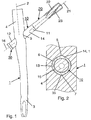
- a femoral fracture treatment device comprising an intramedullary nail 1, a sliding sleeve 10, a longitudinal bone fixation member 20 in the form of a hip screw or helix screw, and a blocking means 30.
- the intramedullary nail 1 has a central longitudinal axis 2, an insertable into the medullary canal of the femur front part 3, a rear part 4, and a rear part 4, obliquely to the longitudinal axis 2 piercing passage 5 with a non-circular cross section 6 (Fig. Fig. 2 to 4 ).
- the sliding sleeve 10 which can be passed through the non-circular passage 5 has a front end 11, a rear end 12, a central longitudinal bore 13, an outer lateral surface 14, an inner lateral surface 15 and a longitudinal axis 16.
- the longitudinal bone fixation element 20 in the form of a hip screw or helix screw has a longitudinal axis 21, a head portion 22 with fixation means 23, in the form of a multi-thread relatively high pitch thread, which are engageable with the femoral head in use, as well as a, coaxial with the sliding sleeve 10th insertable shaft 24.
- the outer lateral surface 14 of the sliding sleeve 10 has a non-circular cross-section 17, while the inner circumferential surface 15 of the sliding sleeve 10 only on a rear end 12 adjacent to its rear segment 36 has a non-circular cross section 38 and on a front segment 37 a round cross-section 18 having ( 10, 11 ).
- the round cross section 18 of the front segment 37 (FIG.
- the sliding sleeve 10 is secured by its non-circular cross-section 17 having outer lateral surface 14 in also a non-circular cross-section 6 having passage 5 of the intramedullary nail 1 against rotation.
- the non-circular cross-section 6 of the passage 5 is - as in Fig. 2 shown - formed substantially as a circle with two diametrically arranged, parallel to the longitudinal axis 16 of the sliding sleeve 10 grooves 7. Due to the complementary configuration of the outer lateral surface 14 of the sliding sleeve 10 with two elevations 35, the sliding sleeve 10 is secured in the passage 5 against rotation relative to the intramedullary nail 1. Thanks to this design, the intramedullary nail 1 can also be used with a conventional hip screw with a circular cylindrical shank, ie even without a sliding sleeve.
- Fig. 3 a variant of the non-circular cross section 6 of the passage 5 is shown.
- the circular cylindrical shaft 24 of the longitudinal bone fixation element 20 designed as a hip screw is rotatably mounted in the interior of the sliding sleeve 10 having a circular cylindrical inner lateral surface 15 in the front segment 37.
- the substantially a square, ie non-circular cross-section 17 having outer lateral surface 14 of the sliding sleeve 10 is, however, secured in the likewise a non-circular cross-section 6 having passage 5 of the intramedullary nail 1 against rotation.
- the non-circular cross-section 6 of the passage 5 is - as in Fig. 3 shown - also formed approximately square, but also has peripheral sections in the form of partial arcs. Thanks to this design, the intramedullary nail 1 can also with a conventional hip screw with circular cylindrical shaft be used, ie without sliding sleeve.
- a further variant of a non-circular cross section 6 of the passage 5 is shown, in which two small partial arcs and a larger partial arc are present. Accordingly, the non-circular cross section 17 of the outer circumferential surface 14 of the sliding sleeve 10 is formed.
- the blocking means 30 comprise a sleeve 60, which is displaceable parallel to the longitudinal axis 21 of the bone fixation element 20, and a clamping screw 70.
- the sleeve 60 is mounted so as to be axially displaceable in the longitudinal bore 13 at the rear end 12 of the sliding sleeve 10.
- the longitudinal bore 13 in the sliding sleeve 10 comprises two axially adjoining segments 36, 37, of which the front segment 37 has a round cross-section 18.
- the shaft 24 of the bone fixation element 20 is therefore at deblocked blocking means 30 (FIG. Fig. 9b ) rotatably supported about the longitudinal axis 16 of the sliding sleeve 10 in this.
- the fixing means 23 of the longitudinal bone fixation element 20 are formed as a four-barrel helical screw, wherein the thread has a pitch of about 120 mm.
- Fig. 9a and 9b are shown between the front end 62 of the sleeve 60 and the free end 27 of the shaft 24 with each other rotatably positively engageable engageable means 50 which are engageable by axial displacement of the sleeve 60 in engagement.
- the means 50 are engaged, ie blocked ( Fig. 9a )
- relative rotation between sleeve 60 and shank 24 about the longitudinal axis 21 of bone fixation member 20 is prevented
- deblocked means 50 FIG. Fig. 9b
- the means 50 are here designed as serrations 51, 52, wherein at the front end 62 of the sleeve 60 an annular first spur teeth 51 is arranged and the second spur gearing 52 is also arranged like an annular ring at the free end 27 of the shaft 24.
- the sleeve 60 has a central bore 65 with a coaxial, schraubares on the external thread 71 of the clamping screw 70 Internal thread 64 on. When tightening the clamping screw 70, the sleeve 60 is axially displaced against the free end 27 of the shank 24 until the two serrations 51, 52 are engaged at the front end 62 of the sleeve 60 and at the free end 27 of the shank 24 ( Fig. 9a ).
- the longitudinal bore 13 has in the region of its rear segment 36 a non-circular cross section 38 with also two flats 41 ( Fig. 11 ).
- blocked blocking means 30 (FIG. Fig. 9a ) is thus on the one hand, the bone fixation member 20 secured against rotation relative to the sliding sleeve 10 and on the other hand, the sliding sleeve 10 because of the non-circular cross-sections 6; 17 of passage 5 and outer surface 14 secured against rotation relative to the intramedullary nail 1.
- the clamping screw 70 is axially fixed and rotatably movable connected to the free end 27 of the shaft 24. As in the Fig. 9a and 9b shown this axial connection is realized by an engaging in an undercut 66 in the bore 25 in the shaft 24 bead 72 at the front end 73 of the clamping screw 70. Since the undercut 66 extends over the entire circumference of the bore 25, the rotation of the clamping screw 70 is not hindered relative to the shaft 24 about the longitudinal axis 21 of the bone fixation element 20.
- the clamping screw 70 is pierced coaxially and has at its rear end 74 means 75 for receiving a screwdriver (not shown).
- the sleeve 60 By the axial fixation of the clamping screw 70 on the shaft 24, the sleeve 60 is moved when tightening the clamping screw 70 against the free end 27 of the shaft 24 until the two spur teeth 51, 52 engage each other, while releasing the clamping screw 70, the sleeve 60 in the opposite direction is shifted until the two serrations 51, 52 are disengaged.
- the wall of the shaft 24 in the region of the free end 27 of the shaft 24 has a radial opening 42. And that way, that the clamping screw 70 with the bead 72 can be inserted laterally into the undercut 66.
Landscapes
- Health & Medical Sciences (AREA)
- Orthopedic Medicine & Surgery (AREA)
- Surgery (AREA)
- Life Sciences & Earth Sciences (AREA)
- Heart & Thoracic Surgery (AREA)
- Nuclear Medicine, Radiotherapy & Molecular Imaging (AREA)
- Engineering & Computer Science (AREA)
- Biomedical Technology (AREA)
- Neurology (AREA)
- Medical Informatics (AREA)
- Molecular Biology (AREA)
- Animal Behavior & Ethology (AREA)
- General Health & Medical Sciences (AREA)
- Public Health (AREA)
- Veterinary Medicine (AREA)
- Surgical Instruments (AREA)
- Prostheses (AREA)
Description
- Die Erfindung bezieht sich auf eine Vorrichtung zur Behandlung von Frakturen des Femur gemäss dem Oberbegriff des Patentanspruchs 1.
- Es sind bereits Vorrichtungen bekannt, bei welchen eine Rotationssicherung des Femurkopfes mit einer einzigen Hüftschraube, d.h. einem longitudinalen Knochenfixationsmittel zu erreichen versucht wird. Aus der
EP-B 0 441 577 ist beispielsweise eine solche Vorrichtung bekannt, welche eine die Hüftschraube gleitend aufnehmende Hülse aufweist, wobei die Hülse mittels einer von proximal in den Marknagel einführbaren Blockierschraube im Marknagel gegen Rotation gesichert werden kann. Der Schaft der Hüftschraube und die Bohrung der Hülse sind allerdings unrund ausgebildet, damit sich die Hüftschraube in der Hülse nicht drehen kann. Die Hüftschraube muss sich aber während des Einbringen in den Hüftkopf drehen können. Aus diesem Grund muss bei der Implantation zuerst die Hüftschraube eingesetzt werden und erst danach die Gleithülse. Im weiteren besteht die Gefahr, dass die Hüftschraube nach medial wandert, wenn nicht zusätzlich eine Kompressionsschraube verwendet wird. Ein weiterer Nachteil besteht darin, dass die Blockierschraube von oben (kranial) in den Marknagel eingeführt werden muss, was einen zusätzlichen Operationsschritt bedeutet. Schliesslich ist bei einer allfällig später notwendig werdenden Entfernung der Hüftschraube ein relativ grosser Eingriff notwendig, um in einem Schritt die von proximal in den Marknagel eingeschraubte Blockierschraube zu lösen, bevor die Hüftschraube entfernt werden kann. - Im weiteren ist aus der
US-A 5,454,813 LAWES (Basis für den Oberbegriff des Anspruchs 1) ein Marknagel mit einer Hüftschraube und mit einer Gleithülse bekannt, bei welchem der Durchgang im Marknagel, das äussere und innere Profil der Gleithülse und der Schaft der Hüftschraube unrund ausgebildet sind. Die Gleithülse wirkt hier somit als Antirotationsmittel zwischen der Hüftschraube und dem Marknagel. Diese bekannte Vorrichtung weist die Nachteil auf, dass die vorgängig eingebrachte Hüftschraube während der Montage der Gleithülse wieder vorwärts- oder rückwärtsgedreht werden muss, bis sie so ausgerichtet ist, dass die unrunden Querschnitte am Schaft, des inneren und äusseren Profiles der Gleithülse und des Durchganges das Einführen der Gleithülse gestatten. Dies bedeutet eine zeitaufwendige Justierung für den Operateur. Ein weiterer Nachteil dieser bekannten Vorrichtung besteht darin, dass eine mediale Wanderung nur mit einem zusätzlichen Bauelement (Spannungseinsteller) verhindert werden kann. - Die obenstehende Diskussion des Standes der Technik erfolgt lediglich zur Erläuterung des Umfeldes der Erfindung und bedeutet nicht, dass der zitierte Stand der Technik zum Zeitpunkt dieser Anmeldung auch tatsächlich publiziert oder öffentlich bekannt war.
- Hier will die Erfindung Abhilfe schaffen. Der Erfindung liegt das Problem zugrunde, eine Vorrichtung zur Behandlung von Knochenfrakturen, insbesondere von proximalen Femurfrakturen zu schaffen, welche während der Implantation keine aufwendigen Justiervorgänge für den Operateur erfordert und einfach blockier- und deblockierbare, formschlüssige Rotationsblockierung zwischen dem longitudinalen Knochenfixationselement (z.B. der Hüftschraube) und dem Marknagel erlaubt.
- Die Erfindung löst die gestellte Aufgabe mit einer Vorrichtung zur Behandlung von Frakturen des Femur, welche die Merkmale des Anspruchs 1 aufweist.
- Die durch die Erfindung erreichten Vorteile sind im wesentlichen darin zu sehen, dass dank der erfindungsgemässen Vorrichtung
- das Knochenfixationselement relativ zum Marknagel mittels der Blockiermittel bezüglich Rotation um die Längsachse des Knochenfixationselementes wahlweise blockierbar oder deblockierbar ist;
- die Blockiermittel von lateral blockier- respektive deblockierbar sind;
- vor der Montage der Blockiermittel wegen der Rotierbarkeit der Gleithülse auf dem Schaft des Knochenfixationselementes das Einführen der Gleithülse nach der Implantation des Knochenfixationselementes ohne langes Justieren der Gleithülse möglich ist und somit die Operationsmethode vereinfacht und verkürzt wird;
- das laterale Gleiten des longitudinalen Knochenfixationselementes wird durch die Blockiermittel nicht limitiert;
- der vorzugsweise als Schraube oder Helixklinge ausgebildete Vorderteil des longitudinalen Knochenfixationselementes sich optimal in der Spongiosa des Femurkopfes verankern kann, weil der Schaft des longitudinalen Knochenfixationselementes in der ihn umschliessenden Hülse während dem Einbringen rotativ frei beweglich bleibt; und
- das longitudinale Knochenfixationselement beim Einbringen in den Femurkopf nicht speziell ausgerichtet werden muss und sich beim Einschlagen helixförmig in den Femurkopf drehen kann. Das longitudinale Knochenfixationselement ist in diesem Zeitpunkt noch nicht gegen Rotation gesichert. Der Chirurg kann somit noch Rotationskorrekturen des Femurkopfes vornehmen, bevor er die Rotation des longitudinalen Knochenfixationselementes in der Längsbohrung der Gleithülse blockiert.
- Weitere vorteilhafte Ausgestaltungen der Erfindung sind in den abhängigen Ansprüchen gekennzeichnet.
- In einer bevorzugten Ausführungsform umfassen die Blockiermittel eine axialfest und rotativ bewegbar mit dem Schaft verbundene Spannschraube, mittels welcher eine in der Längsbohrung der Gleithülse axial verschiebbare und relativ zur Gleithülse rotativ feste Büchse. Vorzugsweise sind am vorderen Ende der Büchse und am freien Ende des Schaftes miteinander rotativ formschlüssig in Eingriff bringbare Mittel angeordnet.
- In einer anderen Ausführungsform sind die Mittel am vorderen Ende der Büchse und am freien Ende des Schaftes als komplementäre Stirnverzahnungen ausgebildet. Damit sind die Vorteile erreichbar, dass
- die Stirnverzahnungen einen Eingriff bei verschiedenen Drehwinkeln zwischen dem Knochenfixationselement und der Gleithülse gestattet, so dass eine einfache Justierung zwischen Knochenfixationselement und intramedullärem Nagel während der Implantation ermöglicht wird; und
- durch die Stirnverzahnungen eine sichere Verdrehsicherung erreichbar ist.
- In wiederum einer anderen Ausführungsform weist die Spannschraube an ihrem vorderen Ende mit einem ringförmigen Wulst auf während der Schaft eine koaxiale Bohrung mit einem den Wulst aufnehmenden Hinterstich aufweist, so dass die Spannschraube rotierbar aber axial fest mit dem Schaft verbunden ist. Vorzugsweise umfassen die Bohrung und der Hinterstich eine radiale Öffnung, so dass die Spannschraube quer zur Längsachse des Knochenfixationselementes montierbar ist.
- In einer weiteren Ausführungsform ist der unrunde Durchgang komplementär zum unrunden Querschnitt der äusseren Mantelfläche der Gleithülse ausgebildet, wobei beispielsweise der Querschnitt des Durchgangs so ausgestaltet ist, dass der unrunde Querschnitt des Durchgangs periphere Teilabschnitte in Form von Teilkreisbögen aufweist.
- Die Fixationsmittel des longitudinalen Knochenfixationselementes bestehen bevorzugt aus einer Helixklinge, vorzugsweise eine Doppelhelixklinge. Andere Ausgestaltungen der Fixationsmittel sind ein Schraubengewinde mit relativ geringer Steigung, ein Meissel, ein Nagel, ein T-Profil oder ein Doppel-T-Profil.
- In einer anderen Ausführungsform ist der Kopfteil des longitudinalen Knochenfixationselementes als mehrgängiges Gewinde, vorzugsweise als viergängiges Gewinde ausgebildet. Durch diese Ausgestaltung spielt die Positionierung de Knochenfixationselementes keine Rolle. Das Gewinde des Kopfteils kann dabei eine Steigung von mindestens 50 mm, vorzugsweise mindestens 80 mm aufweisen. Der Vorteil dieser relativ hohen Steigung liegt im höheren Widerstand gegen Rotation des Knochenfixationselementes. Zudem zerstört das als Helixklinge ausgebildete Knochenfixationselement weniger Knochensubstanz als eine konventionelle Hüftschraube mit relativ geringer Gewindesteigung. Der Knochen wird durch die Helixflächen der Helixklinge mehr kompaktiert als geschnitten.
- Die Blockiermittel sind vorzugsweise derart dimensioniert, dass sie bezüglich des Durchgangs des intramedullären Nagels als axialer Stop wirken. Dieser Stop vermeidet eine zu weite Migration des Knochenfixationselementes nach medial.
- In einer weiteren Ausführungsform ist das longitudinale Knochenfixationselement eine Hüftschraube.
- In wiederum einer weiteren Ausführungsform ist das longitudinale Knochenfixationselement eine Helix-Schraube.
- Die Erfindung und Weiterbildungen der Erfindung werden im folgenden anhand der teilweise schematischen Darstellungen mehrerer Ausführungsbeispiele noch näher erläutert.
- Es zeigen:
-
Fig. 1 eine Seitenansicht durch die erfindungsgemässe Vorrichtung; -
Fig. 2 einen partiellen Schnitt durch einen Marknagel im Bereich seines schrägen Durchgangs mit eingesetzter Hüftschraube und Gleithülse; -
Fig. 3 einen partiellen Schnitt durch einen modifizierten Marknagel im Bereich seines schrägen Durchgangs mit eingesetzter Hüftschraube und Gleithülse; -
Fig. 4 einen partiellen Schnitt durch eine weitere Modifikation eines Marknagels im Bereich seines schrägen Durchgangs mit eingesetzter Hüftschraube und Gleithülse; -
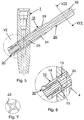
Fig. 5 einen partiellen Schnitt durch die Vorrichtung gemässFig. 1 ; -
Fig. 6 einen vergrösserten Ausschnitt des Kreises VI inFig. 5 ; -
Fig. 7 einen Schnitt längs der Linie VII-VII inFig. 5 ; -
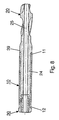
Fig. 8 einen Längsschnitt durch die Gleithülse mit darin vormontiertem Knochenfixationselement; -
Fig. 9a einen vergrösserten Ausschnitt des Kreises VI inFig. 5 mit blockierten Blockiermitteln; -
Fig. 9b einen vergrösserten Ausschnitt des Kreises VI inFig. 5 mit deblockierten Blockiermitteln; -
Fig. 10 einen Längsschnitt durch die inFig. 2 dargestellte Ausführungsform der Gleithülse; -
Fig. 11 eine Ansicht von hinten auf die inFig. 10 dargestellte Ausführungsform der Gleithülse; -
Fig. 12 einen Längsschnitt durch die inFig. 2 dargestellte Ausführungsform der Gleithülse mit eingeführtem Schaft des Knochenfixationselementes; und -
Fig. 13 einen Schnitt längs der Linie III-III inFig. 12 . - In den
Fig. 1 bis 2 sowie 5 bis 8 ist eine Vorrichtung zur Behandlung von Frakturen des Femur dargestellt, welche einen intramedullären Nagel 1, eine Gleithülse 10, ein longitudinales Knochenfixationselement 20 in Form einer Hüftschraube oder Helixschraube und ein Blockiermittel 30 umfasst. Der intramedulläre Nagel 1 besitzt eine zentrale Längsachse 2, einen in den Markkanal des Femur einführbaren Vorderteil 3, einen Hinterteil 4, sowie einen den Hinterteil 4, schräg zur Längsachse 2 durchbohrenden Durchgang 5 mit einem unrunden Querschnitt 6 (Fig. 2 bis 4 ). Die durch den unrunden Durchgang 5 hindurchführbare Gleithülse 10 besitzt ein vorderes Ende 11, ein hinteres Ende 12, eine zentrale Längsbohrung 13, eine äussere Mantelfläche 14, eine innere Mantelfläche 15 sowie eine Längsachse 16. - Das longitudinale Knochenfixationselement 20 in Form einer Hüftschraube oder Helixschraube besitzt eine Längsachse 21, einen Kopfteil 22 mit Fixationsmitteln 23, in Form eines mehrgängigen Gewindes relativ hoher Steigung, die bei Benutzung mit dem Femurkopf in Eingriff bringbar sind, sowie einem, koaxial in die Gleithülse 10 einführbaren Schaft 24. Die äussere Mantelfläche 14 der Gleithülse 10 weist einen unrunden Querschnitt 17 auf, während die innere Mantelfläche 15 der Gleithülse 10 nur auf einem an ihr hinteres Ende 12 angrenzenden, hinteren Segment 36 einen unrunden Querschnitt 38 und auf einem vorderen Segment 37 einen runden Querschnitt 18 aufweist (
Fig. 10;11 ). Der runde Querschnitt 18 des vorderen Segmentes 37 (Fig.10; 11 ) weist denselben Durchmesser wie der Schaft 24 des Knochenfixationselementes 20 auf, so dass das Knochenfixationselement 20 axial verschiebbar und um die Längsachse 16 rotierbar in der Gleithülse 10 gelagert ist. Ein Segment am Übergang zwischen diesem in die Längsbohrung 13 einführbaren Segment des Schaftes 24 und dem Kopfteil 22 des Knochenfixationselementes 20 weist einen grösseren Durchmesser auf, so dass dadurch eine am vorderen Ende 11 der Gleithülse 10 zur Anlage bringbare Schulter 39 gebildet. Durch diese Schulter 39 wird die axiale Verschiebbarkeit des Knochenfixationselementes 20 gegen das hintere Ende 11 der Gleithülse 10 begrenzt. Schliesslich sind Blockiermittel 30 vorgesehen, um die Rotation der Hüftschraube in der Gleithülse 10 wahlweise blockieren zu können. - Wie in
Fig. 2 dargestellt wird die Gleithülse 10 durch ihre einen unrunden Querschnitt 17 aufweisende äussere Mantelfläche 14 im ebenfalls einen unrunden Querschnitt 6 aufweisenden Durchgang 5 des Marknagels 1 gegen Rotation gesichert. Der unrunde Querschnitt 6 des Durchgangs 5 ist - wie inFig. 2 dargestellt - im wesentlichen als Kreis mit zwei diametral angeordneten, zur Längsachse 16 der Gleithülse 10 parallelen Rillen 7 ausgebildet. Durch die dazu komplementäre Ausgestaltung der äusseren Mantelfläche 14 der Gleithülse 10 mit zwei Erhebungen 35 ist die Gleithülse 10 im Durchgang 5 gegen Rotation relativ zum Marknagel 1 gesichert. Dank dieser Gestaltung kann der Marknagel 1 auch mit einer konventionellen Hüftschraube mit kreiszylindrischen Schaft verwendet werden, d.h. auch ohne Gleithülse. - In
Fig. 3 ist ein Variante des unrunden Querschnitts 6 des Durchgangs 5 dargestellt. Der kreiszylindrische Schaft 24 des als Hüftschraube ausgebildeten longitudinalen Knochenfixationselementes 20 ist im Inneren der im vorderen Segment 37 eine kreiszylindrische innere Mantelfläche 15 aufweisenden Gleithülse 10 rotativ frei gelagert. Die im wesentlichen einen quadratischen, d.h. unrunden Querschnitt 17 aufweisende äussere Mantelfläche 14 der Gleithülse 10 ist dagegen im ebenfalls einen unrunden Querschnitt 6 aufweisenden Durchgang 5 des Marknagels 1 gegen Rotation gesichert. Der unrunde Querschnitt 6 des Durchgangs 5 ist - wie inFig. 3 dargestellt - ebenfalls annähernd quadratisch ausgebildet, weist aber zusätzlich periphere Teilabschnitte in Form von Teilkreisbögen auf. Dank dieser Gestaltung kann der Marknagel 1 auch mit einer konventionellen Hüftschraube mit kreiszylindrischen Schaft verwendet werden, d.h. auch ohne Gleithülse. - In
Fig. 4 ist eine weitere Variante eines unrunden Querschnitts 6 des Durchgangs 5 dargestellt, bei welchem zwei kleine Teilkreisbögen und einer grösserer Teilkreisbogen vorhanden sind. Entsprechend ist der unrunde Querschnitt 17 der äusseren Mantelfläche 14 der Gleithülse 10 ausgebildet. - Wie in den
Fig. 9a;9b dargestellt umfassen die Blockiermittel 30 eine parallel zur Längsachse 21 des Knochenfixationselementes 20 verschiebbare Büchse 60 sowie eine Spannschraube 70. Die Büchse 60 ist am hinteren Ende 12 der Gleithülse 10 in deren Längsbohrung 13 axial verschiebbar gelagert. - Wie in den
Fig. 10 und 12 dargestellt umfasst die Längsbohrung 13 in der Gleithülse 10 zwei axial aneinandergrenzende Segmente 36;37, wovon das vordere Segment 37 einen runden Querschnitt 18 aufweist. Der Schaft 24 des Knochenfixationselementes 20 ist daher bei deblockierten Blockiermitteln 30 (Fig. 9b ) um die Längsachse 16 der Gleithülse 10 rotierbar in dieser gelagert. - Wie in
Fig. 7 dargestellt, sind die Fixationsmittel 23 des longitudinalen Knochenfixationselementes 20 als viergängige Helix-Schraube ausgebildet, wobei das Gewinde eine Steigung von ca. 120 mm aufweist. - Wie in den
Fig. 9a und 9b dargestellt sind zwischen dem vorderen Ende 62 der Büchse 60 und dem freien Ende 27 des Schaftes 24 miteinander rotativ formschlüssig in Eingriff bringbare Mittel 50 angeordnet, welche durch axiale Verschiebung der Büchse 60 in Eingriff bringbar sind. Wenn die Mittel 50 in Eingriff, d.h. blockiert sind (Fig. 9a ), wird eine relative Rotation zwischen Büchse 60 und Schaft 24 um die Längsachse 21 des Knochenfixationselementes 20 verhindert, während bei deblockierten Mitteln 50 (Fig. 9b ) eine Rotation des Knochenfixationselementes 20 relativ zur Gleithülse 10 möglich ist. Die Mittel 50 sind hier als Stirnverzahnungen 51 ;52 ausgebildet, wobei am vorderen Ende 62 der Büchse 60 eine kreisringartige, ersten Stirnverzahnung 51 angeordnet ist und die zweite Stirnverzahnung 52 ebenfalls kreisringartig am freien Ende 27 des Schaftes 24 angeordnet ist. Die Büchse 60 weist eine Zentralbohrung 65 mit einem koaxialen, auf das Aussengewinde 71 der Spannschraube 70 schraubares Innengewinde 64 auf. Beim Anziehen der Spannschraube 70 wird die Büchse 60 axial gegen das freie Ende 27 des Schaftes 24 verschoben bis die zwei Stirnverzahnungen 51;52 am vorderen Ende 62 der Büchse 60 und am freien Ende 27 des Schaftes 24 in Eingriff gebracht sind (Fig. 9a ). Dadurch wird zwischen der Büchse 60 und dem Schaft 24 eine relative Rotation um die Längsachse 21 des Knochenfixationselementes 20 verhindert. Die Längsbohrung 13 weist im Bereich ihres hinteren Segmentes 36 einen unrunden Querschnitt 38 mit ebenfalls zwei Abflachungen 41 auf (Fig. 11 ). Durch die komplementär unrunden Querschnitte der Büchse 60 und der Längsbohrung 13 in der Gleithülse 10 wird eine Rotation zwischen der Büchse 60 und der Gleithülse 10 verhindert. - Bei blockierten Blockiermitteln 30 (
Fig. 9a ) ist somit einerseits das Knochenfixationselement 20 gegen Rotation relativ zur Gleithülse 10 gesichert und andererseits die Gleithülse 10 wegen der unrunden Querschnitte 6; 17 von Durchgang 5 und äusserer Mantelfläche 14 gegen eine Rotation relativ zum intramedullären Nagel 1 gesichert. - Die Spannschraube 70 ist axial fest und rotativ bewegbar mit dem freien Ende 27 des Schaftes 24 verbunden. Wie in den
Fig. 9a und 9b gezeigt ist diese axiale Verbindung durch einen in einen Hinterstich 66 in der Bohrung 25 im Schaft 24 eingreifenden Wulst 72 am vorderen Ende 73 der Spannschraube 70 realisiert. Da sich der Hinterstich 66 über den gesamten Umfang der Bohrung 25 erstreckt, wird die Rotation der Spannschraube 70 relativ zum Schaft 24 um die Längsachse 21 des Knochenfixationselementes 20 nicht behindert. Die Spannschraube 70 ist koaxial durchbohrt und weist an ihrem hinteren Ende 74 Mittel 75 zur Aufnahme eines Schraubendrehers (nicht gezeichnet) auf. Durch die axiale Fixierung der Spannschraube 70 am Schaft 24 wird die Büchse 60 beim Anziehen der Spannschraube 70 gegen das freie Ende 27 des Schaftes 24 bewegt bis die zwei Stirnverzahnungen 51;52 miteinander im Eingriff stehen, während beim Lösen der Spannschraube 70 die Büchse 60 in die Gegenrichtung verschoben wird, bis die zwei Stirnverzahnungen 51;52 ausgerastet sind. Wie aus denFig. 12 und 13 ersichtlich, weist die Wand des Schaftes 24 im Bereich der des freien Endes 27 des Schaftes 24 eine radiale Öffnung 42 auf. Und zwar so, dass die Spannschraube 70 mit dem Wulst 72 seitlich in den Hinterstich 66 einführbar ist. Dieses seitliche Einführen der Spannschraube 70 in die radiale Öffnung 42 erfolgt vor dem Überschieben der Gleithülse 10 über den Schaft 24. Anschliessend wird die Spannschraube 70 in das Innengewinde 64 der Zentralbohrung 65 in der Büchse 60 eingeschraubt.
Claims (15)
- Vorrichtung zur Behandlung von Frakturen des Femur mitA) einem intramedullären Nagel (1) mit einer zentralen Längsachse (2), einem in den Markkanal des Femur einführbaren Vorderteil (3), einem Hinterteil (4), einem den Hinterteil (4), schräg zur Längsachse (2) durchbohrenden Durchgang (5) mit unrundem Querschnitt (6);B) einer durch den unrunden Durchgang (5) hindurchführbaren Gleithülse (10), mit einem vorderen Ende (11), einem hinteren Ende (12), einer zentralen Längsbohrung (13), einer äusseren Mantelfläche (14), einer inneren Mantelfläche (15) und einer Längsachse (16);C) einem longitudinalen Knochenfixationselement (20) mit einer Längsachse (21), einem Kopfteil (22) mit Fixationsmitteln (23), die bei Benutzung mit dem Femurkopf in Eingriff bringbar sind, sowie einem, koaxial in die Gleithülse (10) einführbaren Schaft (24); wobeiD) die äussere Mantelfläche (14) der Gleithülse (10) mindestens in einem Teilbereich einen unrunden Querschnitt (17) aufweist; undE) die innere Mantelfläche (15) der Gleithülse (10) mindestens in einem Teilbereich einen unrunden Querschnitt (38) aufweist,
dadurch gekennzeichnet, dassF) der Schaft (24) in der Längsbohrung (13) der Gleithülse (10) rotierbar gelagert ist; undG) am freien Ende (27) des Schaftes (24) Blockiermittel (30) angeordnet sind, mittels welcher der Schaft (24) wahlweise rotativ formschlüssig mit der Gleithülse (10) verbindbar ist, so dass die Rotation des longitudinalen Knochenfixationselementes (20) relativ zur Gleithülse (10) wahlweise blockierbar oder deblockierbar ist. - Vorrichtung nach Anspruch 1, dadurch gekennzeichnet, dass die Blockiermittel (30) eine axialfest und rotativ bewegbar mit dem Schaft (24) verbundene Spannschraube (70) und eine mittels der Spannschraube (70) axial verschiebbare und in der Längsbohrung (13) der Gleithülse (10) rotativ feste Büchse (60) umfassen.
- Vorrichtung nach Anspruch 2, dadurch gekennzeichnet, dass die Büchse (60) ein vorderes Ende (62) und der Schaft (24) ein freies Ende (27) haben und dass am vorderen Ende (62) der Büchse (60) und am freien Ende (27) des Schaftes (24) miteinander rotativ formschlüssig in Eingriff bringbare Mittel (50) angeordnet sind.
- Vorrichtung nach Anspruch 3, dadurch gekennzeichnet, dass die Mittel (50) eine erste Stirnverzahnung (51) am vorderen Ende (62) der Büchse (60) und eine zweite Stirnverzahnung (52) am freien Ende (27) des Schaftes (24) umfassen.
- Vorrichtung nach einem der Ansprüche 2 bis 4, dadurch gekennzeichnet, dass die Spannschraube (70) ein vorderes Ende (73) mit einem ringförmigen Wulst (72) aufweist, und dass der Schaft (24) eine koaxiale Bohrung (25) mit einem den Wulst (72) rotierbar aufnehmenden Hinterstich (66) aufweist.
- Vorrichtung nach Anspruch 5, dadurch gekennzeichnet, dass die Bohrung (25) und der Hinterstich (66) eine radiale Öffnung (42) aufweisen, so dass die Spannschraube (70) quer zur Längsachse (21) des Knochenfixationselementes (20) montierbar ist.
- Vorrichtung nach einem der Ansprüche 1 bis 6, dadurch gekennzeichnet, dass der unrunde Durchgang (5) komplementär zum unrunden Querschnitt (17) der äusseren Mantelfläche (14) der Gleithülse ausgebildet ist.
- Vorrichtung nach Anspruch 7, dadurch gekennzeichnet, dass der unrunde Querschnitt (6) des Durchgangs (5) periphere Teilabschnitte in Form von Teilkreisbögen aufweist.
- Vorrichtung nach Anspruch 7 oder 8, dadurch gekennzeichnet, dass die Fixationsmittel (23) des longitudinalen Knochenfixationselementes (20) eine Helixklinge, vorzugsweise eine Doppelhelixklinge sind.
- Vorrichtung nach Anspruch 7 oder 8, dadurch gekennzeichnet, dass die Fixationsmittel (23) ein Schraubengewinde, ein Meissel, ein Nagel, ein T-Profil oder ein Doppel-T-Profil sind.
- Vorrichtung nach einem der Ansprüche 1 bis 10, dadurch gekennzeichnet, dass der Kopfteil (22) des longitudinalen Knochenfixationselementes (20) als mehrgängiges Gewinde, vorzugsweise als viergängiges Gewinde ausgebildet ist.
- Vorrichtung nach Anspruch 11, dadurch gekennzeichnet, dass das Gewinde des Kopfteils (22) eine Steigung von mindestens 50 mm, vorzugsweise mindestens 80 mm aufweist.
- Vorrichtung nach einem der Ansprüche 7 bis 11, dadurch gekennzeichnet, dass die Blockiermittel (30) bezüglich des Durchgangs (5) als axialer Stop wirken.
- Vorrichtung nach einem der Ansprüche 1 bis 13, dadurch gekennzeichnet, dass das longitudinale Knochenfixationselement (20) eine Hüftschraube ist.
- Vorrichtung nach einem der Ansprüche 1 bis 13, dadurch gekennzeichnet, dass das longitudinale Knochenfixationselement (20) eine Helix-Schraube ist.
Applications Claiming Priority (1)
| Application Number | Priority Date | Filing Date | Title |
|---|---|---|---|
| PCT/CH2003/000630 WO2005025435A1 (de) | 2003-09-18 | 2003-09-18 | Vorrichtung zur behandlung von frakturen des femur |
Publications (2)
| Publication Number | Publication Date |
|---|---|
| EP1663036A1 EP1663036A1 (de) | 2006-06-07 |
| EP1663036B1 true EP1663036B1 (de) | 2009-11-18 |
Family
ID=34280700
Family Applications (1)
| Application Number | Title | Priority Date | Filing Date |
|---|---|---|---|
| EP03818609A Expired - Lifetime EP1663036B1 (de) | 2003-09-18 | 2003-09-18 | Vorrichtung zur behandlung von frakturen des femur |
Country Status (15)
| Country | Link |
|---|---|
| US (1) | US7850690B2 (de) |
| EP (1) | EP1663036B1 (de) |
| JP (1) | JP4657104B2 (de) |
| KR (1) | KR101036055B1 (de) |
| CN (1) | CN100393287C (de) |
| AR (1) | AR045650A1 (de) |
| AT (1) | ATE448744T1 (de) |
| AU (1) | AU2003260232B2 (de) |
| BR (1) | BR0318488B1 (de) |
| CA (1) | CA2539488C (de) |
| DE (1) | DE50312145D1 (de) |
| ES (1) | ES2333320T3 (de) |
| NZ (1) | NZ545901A (de) |
| TW (1) | TWI335213B (de) |
| WO (1) | WO2005025435A1 (de) |
Cited By (1)
| Publication number | Priority date | Publication date | Assignee | Title |
|---|---|---|---|---|
| US9895177B2 (en) | 2016-01-15 | 2018-02-20 | ARTHREX, GmbH | Bone fixation device for treatment of femoral fractures |
Families Citing this family (55)
| Publication number | Priority date | Publication date | Assignee | Title |
|---|---|---|---|---|
| ATE390893T1 (de) * | 2004-02-23 | 2008-04-15 | Synthes Gmbh | Knochenschraube |
| EP1945120A1 (de) * | 2005-09-28 | 2008-07-23 | Smith and Nephew, Inc. | Instrument zur reposition von frakturen, insbesondere des oberschenkelhalses |
| WO2007112589A1 (en) * | 2006-04-06 | 2007-10-11 | Halifax Biomedical Inc. | Intramedullary rod with vent |
| US20090198237A1 (en) * | 2006-05-10 | 2009-08-06 | David Downey | Method for augmenting, reducing, and repairing bone with thermoplastic materials |
| US20080003255A1 (en) | 2006-05-10 | 2008-01-03 | Synthes (Usa) | Method for augmenting, reducing, and repairing bone with thermoplastic materials |
| DE102006032811A1 (de) * | 2006-06-21 | 2008-01-03 | Königsee Implantate und Instrumente zur Osteosynthese GmbH | Femurkopf-Implantat |
| WO2008069800A1 (en) * | 2006-12-07 | 2008-06-12 | Anatol Podolsky | Method and apparatus for total hip replacement |
| US8579985B2 (en) * | 2006-12-07 | 2013-11-12 | Ihip Surgical, Llc | Method and apparatus for hip replacement |
| US8974540B2 (en) | 2006-12-07 | 2015-03-10 | Ihip Surgical, Llc | Method and apparatus for attachment in a modular hip replacement or fracture fixation device |
| US9308031B2 (en) | 2007-01-26 | 2016-04-12 | Biomet Manufacturing, Llc | Lockable intramedullary fixation device |
| US9320551B2 (en) * | 2007-01-26 | 2016-04-26 | Biomet Manufacturing, Llc | Lockable intramedullary fixation device |
| US8177786B2 (en) * | 2007-03-30 | 2012-05-15 | Depuy Products, Inc. | Orthopaedic trauma hip screw assembly and associated method |
| ES2393679T3 (es) * | 2007-04-19 | 2012-12-27 | Stryker Trauma Gmbh | Dispositivo para fracturas de cadera con cilindro y tapa de extremo para control de carga |
| US9597129B2 (en) | 2007-05-25 | 2017-03-21 | Zimmer Gmbh | Reinforced intramedullary nail |
| EP2207503B1 (de) * | 2007-09-27 | 2014-04-23 | Synthes GmbH | Nagelplatten-kombination |
| JP5702290B2 (ja) | 2008-10-15 | 2015-04-15 | ジンマー ゲーエムベーハー | 髄内釘 |
| WO2010082183A2 (en) | 2009-01-16 | 2010-07-22 | N.M.B. Medical Applications Ltd. | Composite material bone implant |
| KR101672413B1 (ko) * | 2009-07-01 | 2016-11-03 | 신세스 게엠바하 | 수내 정 및 돌출 스크류 록킹 메커니즘 |
| CN202843761U (zh) * | 2009-10-13 | 2013-04-03 | 捷迈有限责任公司 | 矫形钉和矫形钉系统 |
| KR101074446B1 (ko) | 2009-11-19 | 2011-10-17 | 김정재 | 대퇴골 골절치료용 고정장치 |
| ES2614919T3 (es) | 2010-01-13 | 2017-06-02 | Jcbd, Llc | Sistema de fijación y fusión de la articulación sacroilíaca |
| US9381045B2 (en) | 2010-01-13 | 2016-07-05 | Jcbd, Llc | Sacroiliac joint implant and sacroiliac joint instrument for fusing a sacroiliac joint |
| US9333090B2 (en) | 2010-01-13 | 2016-05-10 | Jcbd, Llc | Systems for and methods of fusing a sacroiliac joint |
| US9757154B2 (en) | 2010-01-13 | 2017-09-12 | Jcbd, Llc | Systems and methods for fusing a sacroiliac joint and anchoring an orthopedic appliance |
| US9421109B2 (en) | 2010-01-13 | 2016-08-23 | Jcbd, Llc | Systems and methods of fusing a sacroiliac joint |
| US9554909B2 (en) | 2012-07-20 | 2017-01-31 | Jcbd, Llc | Orthopedic anchoring system and methods |
| US9788961B2 (en) | 2010-01-13 | 2017-10-17 | Jcbd, Llc | Sacroiliac joint implant system |
| US10154867B2 (en) | 2010-06-07 | 2018-12-18 | Carbofix In Orthopedics Llc | Multi-layer composite material bone screw |
| EP2575656B1 (de) * | 2010-06-07 | 2019-04-10 | Carbofix Orthopedics Ltd. | Knochenimplantat aus verbundstoff |
| CN103327918B (zh) * | 2011-01-21 | 2016-12-14 | 新特斯有限责任公司 | 可扩张的转子股骨钉 |
| US8709092B2 (en) | 2011-02-16 | 2014-04-29 | Genesis Medical Devices, LLC | Periprosthetic fracture management enhancements |
| EP2712562B1 (de) * | 2012-10-01 | 2015-07-29 | Stryker Trauma GmbH | Marknagel und Implantationssystem mit dem Nagel |
| US9717539B2 (en) | 2013-07-30 | 2017-08-01 | Jcbd, Llc | Implants, systems, and methods for fusing a sacroiliac joint |
| US10245087B2 (en) | 2013-03-15 | 2019-04-02 | Jcbd, Llc | Systems and methods for fusing a sacroiliac joint and anchoring an orthopedic appliance |
| US9826986B2 (en) | 2013-07-30 | 2017-11-28 | Jcbd, Llc | Systems for and methods of preparing a sacroiliac joint for fusion |
| US9700356B2 (en) | 2013-07-30 | 2017-07-11 | Jcbd, Llc | Systems for and methods of fusing a sacroiliac joint |
| US9463055B2 (en) | 2013-12-09 | 2016-10-11 | Acumed Llc | Plate-based compliant hip fixation system |
| US9526542B2 (en) * | 2014-05-07 | 2016-12-27 | Acumed Llc | Hip fixation with load-controlled dynamization |
| PT3079612T (pt) | 2013-12-09 | 2020-07-16 | Acumed Llc | Sistema de fixação de anca compatível à base de hastes |
| US9433451B2 (en) | 2013-12-09 | 2016-09-06 | Acumed Llc | Hip fixation system with a compliant fixation element |
| US10080596B2 (en) | 2013-12-09 | 2018-09-25 | Acumed Llc | Hip fixation with load-controlled dynamization |
| US9801546B2 (en) | 2014-05-27 | 2017-10-31 | Jcbd, Llc | Systems for and methods of diagnosing and treating a sacroiliac joint disorder |
| CN104146757A (zh) * | 2014-07-14 | 2014-11-19 | 苏州瑞华医院有限公司 | 一种治疗股骨粗隆间骨折的接骨装置 |
| US20220151664A1 (en) * | 2015-04-16 | 2022-05-19 | Texas Tech University System | Ankle (Tibio-Talar) Fusion Nail |
| CN105266875B (zh) * | 2015-11-27 | 2017-06-09 | 广东工业大学 | 滑移及摆动式骨科定位导针导向装置 |
| US10617458B2 (en) | 2015-12-23 | 2020-04-14 | Carbofix In Orthopedics Llc | Multi-layer composite material bone screw |
| WO2018042595A1 (ja) * | 2016-09-01 | 2018-03-08 | 株式会社オーミック | 大腿骨固定器具 |
| ES2903393T3 (es) * | 2016-12-02 | 2022-04-01 | Stryker European Holdings I Llc | Tornillo de bloqueo ortopédico |
| US10603055B2 (en) | 2017-09-15 | 2020-03-31 | Jcbd, Llc | Systems for and methods of preparing and fusing a sacroiliac joint |
| EP3735193A1 (de) | 2018-01-03 | 2020-11-11 | GLW, Inc. | Hybride kanülierte orthopädische schrauben |
| WO2019140438A1 (en) | 2018-01-15 | 2019-07-18 | Sands Steven Saam | Hybrid intramedullary rods |
| US11628000B2 (en) | 2019-03-18 | 2023-04-18 | Glw, Inc. | Hybrid bone plate |
| CN111281510A (zh) * | 2020-02-27 | 2020-06-16 | 天津市威曼生物材料有限公司 | 一种组配式解剖型股骨近端骨折髓内固定装置 |
| EP4319666B1 (de) | 2021-04-09 | 2025-06-11 | GLW, Inc. | Hybride knochenplatten und zugehörige herstellungsverfahren |
| KR102804829B1 (ko) | 2022-10-31 | 2025-05-08 | 인제대학교 산학협력단 | 대퇴부 수술대용 상지 고정 장치 및 이를 포함하는 대퇴부 수술대 |
Family Cites Families (31)
| Publication number | Priority date | Publication date | Assignee | Title |
|---|---|---|---|---|
| US4432358A (en) * | 1982-01-22 | 1984-02-21 | Fixel Irving E | Compression hip screw apparatus |
| US4733654A (en) * | 1986-05-29 | 1988-03-29 | Marino James F | Intramedullar nailing assembly |
| DE8701164U1 (de) * | 1987-01-24 | 1987-06-04 | Howmedica GmbH, 2314 Schönkirchen | Osteosynthesehilfsmittel |
| US5032125A (en) * | 1990-02-06 | 1991-07-16 | Smith & Nephew Richards Inc. | Intramedullary hip screw |
| GB9113578D0 (en) * | 1991-06-24 | 1991-08-14 | Howmedica | Intramedullary intertrochanteric fracture fixation appliance |
| JPH09220235A (ja) * | 1996-02-19 | 1997-08-26 | Bristol Mayers Sukuibu Kk | 骨接合装置 |
| IT1287271B1 (it) * | 1996-04-05 | 1998-08-04 | Antonio Chemello | Chiodo endomidollare per l'osteosintesi delle fratture delle ossa lunghe |
| US5741256A (en) * | 1997-01-13 | 1998-04-21 | Synthes (U.S.A.) | Helical osteosynthetic implant |
| DE29701099U1 (de) * | 1997-01-23 | 1997-03-06 | Aesculap Ag, 78532 Tuttlingen | Stiftförmiges Halteelement für ein orthopädisches Haltesystem |
| DE19750493A1 (de) * | 1997-11-14 | 1999-06-02 | Medos Medizintechnik Gmbh | Implantat zur Stabilisierung einer Fraktur und Schraube zur Verwendung in der Chirurgie |
| US6248095B1 (en) * | 1998-02-23 | 2001-06-19 | Becton, Dickinson And Company | Low-cost medication delivery pen |
| US6139552A (en) * | 1998-05-13 | 2000-10-31 | K. K. Hollyx | Bone jointer and a bone jointer fixing tool |
| US6974290B2 (en) * | 1998-06-26 | 2005-12-13 | Dynamic Marketing Group Limited | Connecting assembly for joining two panels and mounting the joined panels on a support |
| DE19829228C1 (de) * | 1998-06-30 | 1999-10-28 | Aesculap Ag & Co Kg | Vorrichtung zur Versorgung von Knochenbrüchen |
| DE29823113U1 (de) * | 1998-12-28 | 2000-05-11 | Howmedica GmbH, 24232 Schönkirchen | Schenkelhalsschraube |
| US6783529B2 (en) * | 1999-04-09 | 2004-08-31 | Depuy Orthopaedics, Inc. | Non-metal inserts for bone support assembly |
| JP4336023B2 (ja) * | 1999-05-12 | 2009-09-30 | 浩平 窪田 | インプラントスクリュー |
| US6221074B1 (en) * | 1999-06-10 | 2001-04-24 | Orthodyne, Inc. | Femoral intramedullary rod system |
| US6235031B1 (en) * | 2000-02-04 | 2001-05-22 | Encore Medical Corporation | Intramedullary fracture fixation device |
| US6645209B2 (en) * | 2000-04-04 | 2003-11-11 | Synthes (Usa) | Device for rotational stabilization of bone segments |
| US6533789B1 (en) * | 2000-04-04 | 2003-03-18 | Synthes (Usa) | Device for rotational stabilization of bone segments |
| JP4018327B2 (ja) * | 2000-09-04 | 2007-12-05 | 株式会社ホムズ技研 | 骨接合装置 |
| US6423033B1 (en) * | 2001-03-02 | 2002-07-23 | Jin-Chou Tsai | Safety hypodermic syringe |
| US6511481B2 (en) * | 2001-03-30 | 2003-01-28 | Triage Medical, Inc. | Method and apparatus for fixation of proximal femoral fractures |
| US6443954B1 (en) * | 2001-04-24 | 2002-09-03 | Dale G. Bramlet | Femoral nail intramedullary system |
| US6648889B2 (en) * | 2001-04-24 | 2003-11-18 | Dale G. Bramlet | Intramedullary hip nail with bifurcated lock |
| US6835197B2 (en) * | 2001-10-17 | 2004-12-28 | Christoph Andreas Roth | Bone fixation system |
| CA2500864A1 (en) * | 2002-10-01 | 2004-04-15 | Synthes (U.S.A.) | Device for fixing bones |
| AU2002333153B2 (en) * | 2002-10-29 | 2006-09-28 | Synthes Gmbh | Device for the treatment of fractures of the femur |
| US20060241606A1 (en) * | 2003-06-12 | 2006-10-26 | Disc-O-Tech, Ltd. | Plate device |
| US7455673B2 (en) * | 2003-07-08 | 2008-11-25 | Yechiel Gotfried | Intramedullary nail system and method for fixation of a fractured bone |
-
2003
- 2003-09-18 JP JP2005508841A patent/JP4657104B2/ja not_active Expired - Fee Related
- 2003-09-18 NZ NZ545901A patent/NZ545901A/en unknown
- 2003-09-18 BR BRPI0318488-9A patent/BR0318488B1/pt active IP Right Grant
- 2003-09-18 EP EP03818609A patent/EP1663036B1/de not_active Expired - Lifetime
- 2003-09-18 AT AT03818609T patent/ATE448744T1/de active
- 2003-09-18 DE DE50312145T patent/DE50312145D1/de not_active Expired - Lifetime
- 2003-09-18 KR KR1020067005464A patent/KR101036055B1/ko not_active Expired - Fee Related
- 2003-09-18 ES ES03818609T patent/ES2333320T3/es not_active Expired - Lifetime
- 2003-09-18 WO PCT/CH2003/000630 patent/WO2005025435A1/de not_active Ceased
- 2003-09-18 CN CNB038270889A patent/CN100393287C/zh not_active Expired - Fee Related
- 2003-09-18 AU AU2003260232A patent/AU2003260232B2/en not_active Ceased
- 2003-09-18 CA CA2539488A patent/CA2539488C/en not_active Expired - Lifetime
-
2004
- 2004-09-01 TW TW093126340A patent/TWI335213B/zh not_active IP Right Cessation
- 2004-09-15 AR ARP040103289A patent/AR045650A1/es unknown
-
2006
- 2006-03-17 US US11/378,916 patent/US7850690B2/en active Active
Cited By (1)
| Publication number | Priority date | Publication date | Assignee | Title |
|---|---|---|---|---|
| US9895177B2 (en) | 2016-01-15 | 2018-02-20 | ARTHREX, GmbH | Bone fixation device for treatment of femoral fractures |
Also Published As
| Publication number | Publication date |
|---|---|
| JP4657104B2 (ja) | 2011-03-23 |
| ES2333320T3 (es) | 2010-02-19 |
| BR0318488A (pt) | 2006-09-12 |
| KR101036055B1 (ko) | 2011-05-19 |
| EP1663036A1 (de) | 2006-06-07 |
| JP2007506454A (ja) | 2007-03-22 |
| AR045650A1 (es) | 2005-11-02 |
| CA2539488C (en) | 2011-11-08 |
| KR20060097749A (ko) | 2006-09-15 |
| DE50312145D1 (de) | 2009-12-31 |
| NZ545901A (en) | 2007-11-30 |
| ATE448744T1 (de) | 2009-12-15 |
| TW200513229A (en) | 2005-04-16 |
| AU2003260232B2 (en) | 2009-04-09 |
| CN100393287C (zh) | 2008-06-11 |
| WO2005025435A1 (de) | 2005-03-24 |
| CN1838922A (zh) | 2006-09-27 |
| TWI335213B (en) | 2011-01-01 |
| US7850690B2 (en) | 2010-12-14 |
| US20060241604A1 (en) | 2006-10-26 |
| AU2003260232A1 (en) | 2005-04-06 |
| BR0318488B1 (pt) | 2012-05-02 |
| CA2539488A1 (en) | 2005-03-24 |
Similar Documents
| Publication | Publication Date | Title |
|---|---|---|
| EP1558159B1 (de) | Vorrichtung zur behandlung von frakturen des femur | |
| WO2005025435A1 (de) | Vorrichtung zur behandlung von frakturen des femur | |
| EP2263584B1 (de) | Marknagel mit Verriegelungsschraube | |
| DE10246386B4 (de) | Knochenschraube, Knochenfixationseinrichtung und Halteelement | |
| DE10157814B4 (de) | Verschlußeinrichtung zum Sichern eines stabförmigen Elements in einem mit einem Schaft verbundenen Halteelement | |
| EP1681024B1 (de) | Knochenverankerungselement | |
| DE10157969C1 (de) | Element mit einem Schaft und einem damit verbundenen Halteelement zum Verbinden mit einem Stab | |
| DE3541597C2 (de) | ||
| EP1761182B1 (de) | Chirurgischer nagel | |
| EP1978885B1 (de) | Zahnimplantat | |
| EP2421455B1 (de) | Befestigungsvorrichtung für chirurgische haltesysteme | |
| EP0682917B1 (de) | Schraubwerkzeug für eine Schraube, bestehend aus einem Bolzenteil und einer darauf aufschraubbaren Mutter | |
| DE2724307A1 (de) | Vorrichtung zur halterung von knochengeweben | |
| DE2705154A1 (de) | Knochenmarknagel und zielgeraet zu seiner verankerung im markkanal | |
| DE2906068C2 (de) | Einrichtung zur Befestigung von Knochenstücken | |
| EP1720473B1 (de) | Knochenfixierungsmittel | |
| EP2768401B1 (de) | Mtv-implantations-set | |
| EP3742993B1 (de) | Intravertebrale schraube | |
| DE19646307A1 (de) | Kieferschraubenimplantat | |
| WO2004000144A1 (de) | Knochenschraube mit tangentialer schneidkante | |
| EP4412545B1 (de) | Gekrümmter marknagel | |
| WO2007023101A1 (de) | Proximaler femurnagel | |
| DE102022119169A1 (de) | Vorrichtung zum Betätigen eines Marknagels, umfassend ein Gewindeelement zum Anschluss eines Marknagels | |
| DE202022104343U1 (de) | Vorrichtung zum Betätigen eines Marknagels, umfassend ein Gewindeelement zum Anschluss eines Marknagels | |
| WO2016083355A1 (de) | Befestigungselement |
Legal Events
| Date | Code | Title | Description |
|---|---|---|---|
| PUAI | Public reference made under article 153(3) epc to a published international application that has entered the european phase |
Free format text: ORIGINAL CODE: 0009012 |
|
| 17P | Request for examination filed |
Effective date: 20060222 |
|
| AK | Designated contracting states |
Kind code of ref document: A1 Designated state(s): AT BE BG CH CY CZ DE DK EE ES FI FR GB GR HU IE IT LI LU MC NL PT RO SE SI SK TR |
|
| DAX | Request for extension of the european patent (deleted) | ||
| GRAP | Despatch of communication of intention to grant a patent |
Free format text: ORIGINAL CODE: EPIDOSNIGR1 |
|
| GRAS | Grant fee paid |
Free format text: ORIGINAL CODE: EPIDOSNIGR3 |
|
| GRAA | (expected) grant |
Free format text: ORIGINAL CODE: 0009210 |
|
| AK | Designated contracting states |
Kind code of ref document: B1 Designated state(s): AT BE BG CH CY CZ DE DK EE ES FI FR GB GR HU IE IT LI LU MC NL PT RO SE SI SK TR |
|
| REG | Reference to a national code |
Ref country code: GB Ref legal event code: FG4D Free format text: NOT ENGLISH |
|
| REG | Reference to a national code |
Ref country code: CH Ref legal event code: NV Representative=s name: DR. LUSUARDI AG Ref country code: CH Ref legal event code: EP |
|
| REG | Reference to a national code |
Ref country code: IE Ref legal event code: FG4D |
|
| REG | Reference to a national code |
Ref country code: SE Ref legal event code: TRGR |
|
| REF | Corresponds to: |
Ref document number: 50312145 Country of ref document: DE Date of ref document: 20091231 Kind code of ref document: P |
|
| REG | Reference to a national code |
Ref country code: ES Ref legal event code: FG2A Ref document number: 2333320 Country of ref document: ES Kind code of ref document: T3 |
|
| REG | Reference to a national code |
Ref country code: NL Ref legal event code: VDEP Effective date: 20091118 |
|
| PG25 | Lapsed in a contracting state [announced via postgrant information from national office to epo] |
Ref country code: FI Free format text: LAPSE BECAUSE OF FAILURE TO SUBMIT A TRANSLATION OF THE DESCRIPTION OR TO PAY THE FEE WITHIN THE PRESCRIBED TIME-LIMIT Effective date: 20091118 Ref country code: PT Free format text: LAPSE BECAUSE OF FAILURE TO SUBMIT A TRANSLATION OF THE DESCRIPTION OR TO PAY THE FEE WITHIN THE PRESCRIBED TIME-LIMIT Effective date: 20100318 |
|
| PG25 | Lapsed in a contracting state [announced via postgrant information from national office to epo] |
Ref country code: CY Free format text: LAPSE BECAUSE OF FAILURE TO SUBMIT A TRANSLATION OF THE DESCRIPTION OR TO PAY THE FEE WITHIN THE PRESCRIBED TIME-LIMIT Effective date: 20091118 Ref country code: SI Free format text: LAPSE BECAUSE OF FAILURE TO SUBMIT A TRANSLATION OF THE DESCRIPTION OR TO PAY THE FEE WITHIN THE PRESCRIBED TIME-LIMIT Effective date: 20091118 |
|
| REG | Reference to a national code |
Ref country code: IE Ref legal event code: FD4D |
|
| PG25 | Lapsed in a contracting state [announced via postgrant information from national office to epo] |
Ref country code: RO Free format text: LAPSE BECAUSE OF FAILURE TO SUBMIT A TRANSLATION OF THE DESCRIPTION OR TO PAY THE FEE WITHIN THE PRESCRIBED TIME-LIMIT Effective date: 20091118 Ref country code: DK Free format text: LAPSE BECAUSE OF FAILURE TO SUBMIT A TRANSLATION OF THE DESCRIPTION OR TO PAY THE FEE WITHIN THE PRESCRIBED TIME-LIMIT Effective date: 20091118 Ref country code: IE Free format text: LAPSE BECAUSE OF FAILURE TO SUBMIT A TRANSLATION OF THE DESCRIPTION OR TO PAY THE FEE WITHIN THE PRESCRIBED TIME-LIMIT Effective date: 20091118 Ref country code: BG Free format text: LAPSE BECAUSE OF FAILURE TO SUBMIT A TRANSLATION OF THE DESCRIPTION OR TO PAY THE FEE WITHIN THE PRESCRIBED TIME-LIMIT Effective date: 20100218 Ref country code: EE Free format text: LAPSE BECAUSE OF FAILURE TO SUBMIT A TRANSLATION OF THE DESCRIPTION OR TO PAY THE FEE WITHIN THE PRESCRIBED TIME-LIMIT Effective date: 20091118 Ref country code: NL Free format text: LAPSE BECAUSE OF FAILURE TO SUBMIT A TRANSLATION OF THE DESCRIPTION OR TO PAY THE FEE WITHIN THE PRESCRIBED TIME-LIMIT Effective date: 20091118 |
|
| REG | Reference to a national code |
Ref country code: HU Ref legal event code: AG4A Ref document number: E007835 Country of ref document: HU |
|
| PG25 | Lapsed in a contracting state [announced via postgrant information from national office to epo] |
Ref country code: CZ Free format text: LAPSE BECAUSE OF FAILURE TO SUBMIT A TRANSLATION OF THE DESCRIPTION OR TO PAY THE FEE WITHIN THE PRESCRIBED TIME-LIMIT Effective date: 20091118 Ref country code: SK Free format text: LAPSE BECAUSE OF FAILURE TO SUBMIT A TRANSLATION OF THE DESCRIPTION OR TO PAY THE FEE WITHIN THE PRESCRIBED TIME-LIMIT Effective date: 20091118 |
|
| PLBE | No opposition filed within time limit |
Free format text: ORIGINAL CODE: 0009261 |
|
| STAA | Information on the status of an ep patent application or granted ep patent |
Free format text: STATUS: NO OPPOSITION FILED WITHIN TIME LIMIT |
|
| 26N | No opposition filed |
Effective date: 20100819 |
|
| PG25 | Lapsed in a contracting state [announced via postgrant information from national office to epo] |
Ref country code: GR Free format text: LAPSE BECAUSE OF FAILURE TO SUBMIT A TRANSLATION OF THE DESCRIPTION OR TO PAY THE FEE WITHIN THE PRESCRIBED TIME-LIMIT Effective date: 20100219 |
|
| BERE | Be: lapsed |
Owner name: SYNTHES GMBH Effective date: 20100930 |
|
| PG25 | Lapsed in a contracting state [announced via postgrant information from national office to epo] |
Ref country code: MC Free format text: LAPSE BECAUSE OF NON-PAYMENT OF DUE FEES Effective date: 20100930 |
|
| REG | Reference to a national code |
Ref country code: SE Ref legal event code: EUG |
|
| PG25 | Lapsed in a contracting state [announced via postgrant information from national office to epo] |
Ref country code: BE Free format text: LAPSE BECAUSE OF NON-PAYMENT OF DUE FEES Effective date: 20100930 |
|
| PG25 | Lapsed in a contracting state [announced via postgrant information from national office to epo] |
Ref country code: SE Free format text: LAPSE BECAUSE OF NON-PAYMENT OF DUE FEES Effective date: 20100919 Ref country code: LU Free format text: LAPSE BECAUSE OF NON-PAYMENT OF DUE FEES Effective date: 20100918 |
|
| PG25 | Lapsed in a contracting state [announced via postgrant information from national office to epo] |
Ref country code: TR Free format text: LAPSE BECAUSE OF FAILURE TO SUBMIT A TRANSLATION OF THE DESCRIPTION OR TO PAY THE FEE WITHIN THE PRESCRIBED TIME-LIMIT Effective date: 20091118 |
|
| REG | Reference to a national code |
Ref country code: FR Ref legal event code: PLFP Year of fee payment: 14 |
|
| REG | Reference to a national code |
Ref country code: FR Ref legal event code: PLFP Year of fee payment: 15 |
|
| REG | Reference to a national code |
Ref country code: FR Ref legal event code: PLFP Year of fee payment: 16 |
|
| PGFP | Annual fee paid to national office [announced via postgrant information from national office to epo] |
Ref country code: IT Payment date: 20210811 Year of fee payment: 19 Ref country code: CH Payment date: 20210916 Year of fee payment: 19 Ref country code: AT Payment date: 20210825 Year of fee payment: 19 Ref country code: FR Payment date: 20210812 Year of fee payment: 19 |
|
| PGFP | Annual fee paid to national office [announced via postgrant information from national office to epo] |
Ref country code: GB Payment date: 20210811 Year of fee payment: 19 Ref country code: HU Payment date: 20210815 Year of fee payment: 19 Ref country code: DE Payment date: 20210810 Year of fee payment: 19 |
|
| PGFP | Annual fee paid to national office [announced via postgrant information from national office to epo] |
Ref country code: ES Payment date: 20211006 Year of fee payment: 19 |
|
| REG | Reference to a national code |
Ref country code: DE Ref legal event code: R119 Ref document number: 50312145 Country of ref document: DE |
|
| REG | Reference to a national code |
Ref country code: CH Ref legal event code: PL |
|
| REG | Reference to a national code |
Ref country code: AT Ref legal event code: MM01 Ref document number: 448744 Country of ref document: AT Kind code of ref document: T Effective date: 20220918 |
|
| GBPC | Gb: european patent ceased through non-payment of renewal fee |
Effective date: 20220918 |
|
| PG25 | Lapsed in a contracting state [announced via postgrant information from national office to epo] |
Ref country code: LI Free format text: LAPSE BECAUSE OF NON-PAYMENT OF DUE FEES Effective date: 20220930 Ref country code: FR Free format text: LAPSE BECAUSE OF NON-PAYMENT OF DUE FEES Effective date: 20220930 Ref country code: DE Free format text: LAPSE BECAUSE OF NON-PAYMENT OF DUE FEES Effective date: 20230401 Ref country code: CH Free format text: LAPSE BECAUSE OF NON-PAYMENT OF DUE FEES Effective date: 20220930 Ref country code: AT Free format text: LAPSE BECAUSE OF NON-PAYMENT OF DUE FEES Effective date: 20220918 |
|
| REG | Reference to a national code |
Ref country code: ES Ref legal event code: FD2A Effective date: 20231027 |
|
| PG25 | Lapsed in a contracting state [announced via postgrant information from national office to epo] |
Ref country code: IT Free format text: LAPSE BECAUSE OF NON-PAYMENT OF DUE FEES Effective date: 20220918 Ref country code: GB Free format text: LAPSE BECAUSE OF NON-PAYMENT OF DUE FEES Effective date: 20220918 |
|
| PG25 | Lapsed in a contracting state [announced via postgrant information from national office to epo] |
Ref country code: ES Free format text: LAPSE BECAUSE OF NON-PAYMENT OF DUE FEES Effective date: 20220919 |
|
| PG25 | Lapsed in a contracting state [announced via postgrant information from national office to epo] |
Ref country code: ES Free format text: LAPSE BECAUSE OF NON-PAYMENT OF DUE FEES Effective date: 20220919 |
|
| PG25 | Lapsed in a contracting state [announced via postgrant information from national office to epo] |
Ref country code: HU Free format text: LAPSE BECAUSE OF NON-PAYMENT OF DUE FEES Effective date: 20220919 |
|
| PG25 | Lapsed in a contracting state [announced via postgrant information from national office to epo] |
Ref country code: HU Free format text: LAPSE BECAUSE OF NON-PAYMENT OF DUE FEES Effective date: 20240919 |
|
| PG25 | Lapsed in a contracting state [announced via postgrant information from national office to epo] |
Ref country code: HU Free format text: LAPSE BECAUSE OF NON-PAYMENT OF DUE FEES Effective date: 20240919 |
|
| PG25 | Lapsed in a contracting state [announced via postgrant information from national office to epo] |
Ref country code: HU Free format text: LAPSE BECAUSE OF NON-PAYMENT OF DUE FEES Effective date: 20220919 |