EP1646209B1 - IP terminal apparatus - Google Patents
IP terminal apparatus Download PDFInfo
- Publication number
- EP1646209B1 EP1646209B1 EP20050020245 EP05020245A EP1646209B1 EP 1646209 B1 EP1646209 B1 EP 1646209B1 EP 20050020245 EP20050020245 EP 20050020245 EP 05020245 A EP05020245 A EP 05020245A EP 1646209 B1 EP1646209 B1 EP 1646209B1
- Authority
- EP
- European Patent Office
- Prior art keywords
- communication
- terminal
- terminal apparatus
- destination
- cpu
- Prior art date
- Legal status (The legal status is an assumption and is not a legal conclusion. Google has not performed a legal analysis and makes no representation as to the accuracy of the status listed.)
- Expired - Lifetime
Links
Images

Classifications
-
- H—ELECTRICITY
- H04—ELECTRIC COMMUNICATION TECHNIQUE
- H04L—TRANSMISSION OF DIGITAL INFORMATION, e.g. TELEGRAPHIC COMMUNICATION
- H04L12/00—Data switching networks
- H04L12/66—Arrangements for connecting between networks having differing types of switching systems, e.g. gateways
-
- H—ELECTRICITY
- H04—ELECTRIC COMMUNICATION TECHNIQUE
- H04M—TELEPHONIC COMMUNICATION
- H04M1/00—Substation equipment, e.g. for use by subscribers
- H04M1/247—Telephone sets including user guidance or feature selection means facilitating their use
- H04M1/2477—Telephone sets including user guidance or feature selection means facilitating their use for selecting a function from a menu display
-
- H—ELECTRICITY
- H04—ELECTRIC COMMUNICATION TECHNIQUE
- H04L—TRANSMISSION OF DIGITAL INFORMATION, e.g. TELEGRAPHIC COMMUNICATION
- H04L61/00—Network arrangements, protocols or services for addressing or naming
- H04L61/45—Network directories; Name-to-address mapping
- H04L61/4505—Network directories; Name-to-address mapping using standardised directories; using standardised directory access protocols
- H04L61/4511—Network directories; Name-to-address mapping using standardised directories; using standardised directory access protocols using domain name system [DNS]
-
- H—ELECTRICITY
- H04—ELECTRIC COMMUNICATION TECHNIQUE
- H04L—TRANSMISSION OF DIGITAL INFORMATION, e.g. TELEGRAPHIC COMMUNICATION
- H04L61/00—Network arrangements, protocols or services for addressing or naming
- H04L61/45—Network directories; Name-to-address mapping
- H04L61/4557—Directories for hybrid networks, e.g. including telephone numbers
-
- H—ELECTRICITY
- H04—ELECTRIC COMMUNICATION TECHNIQUE
- H04L—TRANSMISSION OF DIGITAL INFORMATION, e.g. TELEGRAPHIC COMMUNICATION
- H04L65/00—Network arrangements, protocols or services for supporting real-time applications in data packet communication
- H04L65/1066—Session management
- H04L65/1101—Session protocols
-
- H—ELECTRICITY
- H04—ELECTRIC COMMUNICATION TECHNIQUE
- H04M—TELEPHONIC COMMUNICATION
- H04M1/00—Substation equipment, e.g. for use by subscribers
- H04M1/253—Telephone sets using digital voice transmission
- H04M1/2535—Telephone sets using digital voice transmission adapted for voice communication over an Internet Protocol [IP] network
-
- H—ELECTRICITY
- H04—ELECTRIC COMMUNICATION TECHNIQUE
- H04M—TELEPHONIC COMMUNICATION
- H04M11/00—Telephonic communication systems specially adapted for combination with other electrical systems
- H04M11/06—Simultaneous speech and data transmission, e.g. telegraphic transmission over the same conductors
-
- H—ELECTRICITY
- H04—ELECTRIC COMMUNICATION TECHNIQUE
- H04M—TELEPHONIC COMMUNICATION
- H04M7/00—Arrangements for interconnection between switching centres
- H04M7/006—Networks other than PSTN/ISDN providing telephone service, e.g. Voice over Internet Protocol (VoIP), including next generation networks with a packet-switched transport layer
-
- H—ELECTRICITY
- H04—ELECTRIC COMMUNICATION TECHNIQUE
- H04M—TELEPHONIC COMMUNICATION
- H04M2203/00—Aspects of automatic or semi-automatic exchanges
- H04M2203/20—Aspects of automatic or semi-automatic exchanges related to features of supplementary services
- H04M2203/2066—Call type detection of indication, e.g. voice or fax, mobile of fixed, PSTN or IP
-
- H—ELECTRICITY
- H04—ELECTRIC COMMUNICATION TECHNIQUE
- H04M—TELEPHONIC COMMUNICATION
- H04M3/00—Automatic or semi-automatic exchanges
- H04M3/42—Systems providing special services or facilities to subscribers
- H04M3/42025—Calling or Called party identification service
- H04M3/42085—Called party identification service
- H04M3/42102—Making use of the called party identifier
- H04M3/4211—Making use of the called party identifier where the identifier is used to access a profile
-
- Y—GENERAL TAGGING OF NEW TECHNOLOGICAL DEVELOPMENTS; GENERAL TAGGING OF CROSS-SECTIONAL TECHNOLOGIES SPANNING OVER SEVERAL SECTIONS OF THE IPC; TECHNICAL SUBJECTS COVERED BY FORMER USPC CROSS-REFERENCE ART COLLECTIONS [XRACs] AND DIGESTS
- Y10—TECHNICAL SUBJECTS COVERED BY FORMER USPC
- Y10S—TECHNICAL SUBJECTS COVERED BY FORMER USPC CROSS-REFERENCE ART COLLECTIONS [XRACs] AND DIGESTS
- Y10S379/00—Telephonic communications
- Y10S379/90—Internet, e.g. Internet phone, webphone, internet-based telephony
-
- Y—GENERAL TAGGING OF NEW TECHNOLOGICAL DEVELOPMENTS; GENERAL TAGGING OF CROSS-SECTIONAL TECHNOLOGIES SPANNING OVER SEVERAL SECTIONS OF THE IPC; TECHNICAL SUBJECTS COVERED BY FORMER USPC CROSS-REFERENCE ART COLLECTIONS [XRACs] AND DIGESTS
- Y10—TECHNICAL SUBJECTS COVERED BY FORMER USPC
- Y10S—TECHNICAL SUBJECTS COVERED BY FORMER USPC CROSS-REFERENCE ART COLLECTIONS [XRACs] AND DIGESTS
- Y10S707/00—Data processing: database and file management or data structures
- Y10S707/99931—Database or file accessing
- Y10S707/99933—Query processing, i.e. searching
Definitions
- the present invention relates to an IP terminal apparatus, particularly to an IP terminal apparatus that utilizes an ENUM server.
- ENUM protocol is designed to allow retrieval of an IP address or a URI (Uniform Resource Identifier) based upon a telephone number that is converted into the E.164 system defined by ITU - T, utilizing DNS (Domain Name System).
- An IP terminal apparatus that performs under ENUM protocol is equipped with not only an IP telephone function but also with a plurality of functions such as facsimile and e-mail functions.
- a multifunction apparatus having functions such as printer and scanner functions has been provided.
- Publication 1 was issued by ENUM Trial Japan "ENUM Trial Japan First Report” on May, 2004 Document: " ENUM Implementation Issues and Experiences” by CONROY ROKE MANOR RESEARCH K FUJIWARA JPRS L; IETF STANDARD-WORKING-DRAFT, INTERNET ENGINEERING TASK FORCE, IETF, CH, vol.
- document D1 discusses the relation of character sets and in particular, the use of non-ASCII code.
- the general processing of NAPTRs in regard to order/priority values is discussed in document D1.
- the NAPTRs should be sorted using the ORDER field value and the PRIORITY field value, whereas the PRIORITY field value is the minor sort term, according to the document.
- the list of NAPTRs is then assessed in the sorted order.
- the document states that the end user also may have pre-specified their own preference for services that are to be used.
- the sorted list may again be reordered, namely, an NAPTR, which initially may have a low ORDER field value, may nevertheless be chosen before an NAPTR with a higher ORDER value, because the end user has specified the low ORDER service as preferred.
- Document D2 further describes ENUM client applications, which includes the display of all the NAPTR records after an ENUM query.
- the result of the ENUM query is displayed in a human readable format, containing the URI and additional information of the type of service.
- an IP terminal apparatus called a multifunction apparatus has the following problems when communication is performed between multifunction apparatuses.
- both IP terminal apparatuses do not necessarily have all of the communication functions installed. Therefore, when a multifunction apparatus user on the transmitting end selects a communication function that is not stored in a multifunction apparatus on the receiving end, communication failure occurs. This requires the user extra work before identifying communication functions that are selectable for the multifunction apparatus on the receiving end.
- the present invention is provided to address the above-described problems.
- the purpose of the present invention is to provide an IP terminal apparatus that displays, on a source IP terminal apparatus, selectable communication functions by checking communication functions stored in source and destination IP terminal apparatuses respectively, based upon the NAPTR records of those IP terminal apparatuses stored on an ENUM server.
- the present invention relates to an IP terminal apparatus, according to claim 1, connected to the ENUM server via an IP network.
- the IP terminal apparatus includes a memory, an obtainer, an identifier, a display and a communication controller.
- the memory stores a plurality of communication control programs corresponding to various communication functions.
- the obtainer obtains, from the ENUM server, terminal information regarding the destination IP terminal apparatus, when placing a call.
- the identifier determines whether the destination IP terminal apparatus stores a communication function corresponding to the IP terminal, based upon the terminal information obtained by the obtainer.
- the display displays one or a plurality of communication function that are determined to be stored in the destination IP terminal.
- the communication controller controls voice communication with the destination IP terminal apparatus, when an operation is performed in accordance with the communication function displayed on the display, based upon the communication control program corresponding to the communication function.
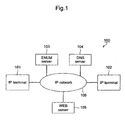
- Fig. 1 illustrates an entire configuration of an IP telephone system according to an embodiment of the present invention.
- IP terminal apparatuses hereafter referred to as IP terminal
- IP terminal IP terminal apparatuses
- ENUM server 103 ENUM server
- DNS server 104 DNS server
- Web server 105 Web server
- IP terminal 101 (102) is a multifunction apparatus equipped with a plurality of communication functions, such as IP telephone, facsimile, and e-mail functions, as well as printer and scanner functions. IP terminal 101 (102) performs voice communication with another IP telephone via IP network 106, using the IP telephone function. IP terminal 101 (102) performs facsimile and e-mail communications with another multifunction apparatus via IP network 106, using the facsimile and e-mail functions.
- ENUM (tElephone NUmber Mapping) server 103 is equipped with a database that stores a NAPTR (The Naming Authority Pointer) resource record (hereafter referred to as NAPTR record).
- NAPTR record The Naming Authority Pointer resource record (hereafter referred to as NAPTR record).
- ENUM server 103 sends, to IP terminal 101 (102), a NAPTR record stored in the database in response to a query from IP terminal 101 (102).
- DNS (Domain Name System) server 104 is equipped with a database that stores URIs (Uniform Resource Identifier) specified in a NAPTR record and IP addresses corresponding to the URIs. DNS server 104 sends, to IP terminal 101 (102), an IP address stored in the database in response to a query from IP phone 101 (102).
- URIs Uniform Resource Identifier
- Web server 105 reserves information such as HTML (Hyper Text Markup Language) texts and image and transmits, to IP terminal 101 (102), such information via IP network 106 in response to a request from a client software such as a WEB browser.
- HTML Hyper Text Markup Language
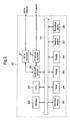
- Fig. 2 is a block diagram illustrating a configuration of IP terminal 101 according to the present embodiment.
- IP terminal 101 includes CPU 201, handset 202, key input section 203, RAM 204, FROM 205, display 206, reading section 207, recording section 208 and external I/F selector 209 that is connected to IP network controller 210 and PSTN controller 211. All devices are mutually connected via bus 212.
- IP terminal 102 has the same configuration as IP terminal 101.
- CPU (Central Processing Unit) 201 controls all operations needed to perform IP telephone, facsimile and e-mail communications with another IP terminal via IP network 106, based upon the IP telephone control program, facsimile communication control program and e-mail control program that are stored in FROM 205. Therefore, CPU 201 performs a call control with the destination IP terminal in accordance with call control protocols such as SIP (Session Initiation Protocol) and H.323.
- CPU 201 further provides necessary instructions to display 206, external I/F selector 209, IP network controller 210 and PSTN controller 211.
- CPU 201 executes a process for obtaining, from ENUM server 103, a NAPTR record of the destination IP terminal 102 by controlling IP network controller 210 when placing a call to the destination IP terminal 102, a process for determining, based upon the communication functions of the destination IP terminal specified in that NAPTR record, whether the destination IP terminal 102 stores a communication function corresponding to the source IP terminal 101 and a process for displaying, on display 206, one or a plurality of communication functions that are determined to be stored in the destination IP terminal 102.
- CPU 201 stores, in RAM 204, flag information associated with the obtained NAPTR record (availability information), the flag information indicating the individual availability of one or a plurality of communication functions that are determined to be stored in the destination terminal.
- CPU 201 functions as an obtainer, an identifier and a communication controller.
- Handset 202 is used to output, to CPU 201, on/off signals in accordance with the user's on/off hook operations.
- Handset 202 is equipped with a microphone and a speaker, and is used to convert the user's transmitting voice, via the microphone, into a transmitting voice signal and output the same to CPU 201 when starting voice communication with the destination IP terminal.
- handset 202 outputs, from the speaker, a receiving voice signal input from CPU 201 as receiving voice.
- Key input section 203 is equipped with a numeric keypad, various function keys and the like. Key input section 203 is used by the user for dialing to the destination IP terminal and for selecting a communication function, etc.
- RAM (Random Access Memory) 204 is used as a work memory when CPU 201 performs a program.
- RAM 204 stores flag information (availability information) that indicates the individual availability of one or a plurality of communication functions for the destination IP terminal, the communication functions being obtained by CPU 201 performing the above-noted obtaining process.
- Display 206 configured with an LCD (Liquid Crystal Display) and the like displays the current status of IP terminal 101, telephone numbers input from CPU 201, selectable communication functions for the destination IP terminal and other information. Display 206 functions as a display.
- LCD Liquid Crystal Display
- Reading section 207 reads the image of a document placed on a document reader (not shown in the figure) and converts the readout image into digital image data to be sent to CPU 201.
- Recording section 208 converts the digital image data input from CPU 201 into a recordable form and records the same on a recording sheet.
- External I/F selector 209 selects IP network controller 210 or PSTN controller 211 in accordance with an instruction for selecting a communication function, the instruction being input from CPU 201 based upon a communication function that is selected by a user (IP telephone, facsimile, e-mail). Further, external I/F selector 209 outputs, to IP network controller 210 or to PSTN controller 211, transmitting data input from CPU 201 and outputs, to CPU 201, a receiving signal input from IP network controller 210 or PSTN controller 211.
- IP network controller 210 has an interface function with IP network 106 to which IP terminal 101 is connected, an IP telephone control function that controls, by CPU 201, an IP phone call with another IP terminal via IP network 106, a facsimile control function that controls, by CPU 201, facsimile communication with another IP terminal via IP network 106 and a function that accesses, under the control of CPU 201, Web server 105 via IP network 106.
- IP network controller 210 When performing facsimile communication, IP network controller 210 transmits, to another IP terminal via IP network 106, digital image data input from CPU 201, receives from another IP terminal digital image data via IP network 106, and transmits the same to CPU 201.
- IP network controller 210 performs, under the control of CPU 201, the above-noted process for obtaining, from ENUM server 103, the NAPTR record of the destination IP terminal, when placing a call based upon dialing input from key input section 203.
- PSTN controller 211 has an interface function with the PSTN (not shown in the figure) to which IP terminal 101 is connected and a communication control function that controls communication with another PSTN communication terminal under the control of CPU 201.
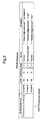
- the service field of the first URI specifies "E2U+sip”, which indicates that the terminal specified by "05012345678" is able to perform under the SIP protocol.
- the service field of the second URI specifies "E2U+message:mailto”, which indicates that the terminal specified by "05012345678” is capable of e-mail communications.
- the service field of the third URI specifies "E2U+ifax”, which indicates that the terminal specified by "05012345678" is capable of facsimile communications.
- IP terminal 102 has IP telephone, e-mail and facsimile communication functions via IP network 106 to select from.
- CPU 201 selects IP network controller 210 by outputting a signal, to external I/F selector 209, for instructing to select an IP communication function.
- CPU 201 transmits, from IP network controller 210 via external I/F selector 209 to ENUM server 103, a "NAPTR query" message that specifies the telephone number of IP terminal 102.
- ENUM server 103 Upon receiving the "NAPTR query” message from IP terminal 101, ENUM server 103 retrieves, from the database, a corresponding NAPTR record by referring to the telephone number that is specified in the "NAPTR query” message. In this case, the corresponding NAPTR record is shown in Fig. 3 .
- ENUM server 103 transmits, to IP terminal 101, a "NAPTR response" message that specifies the retrieved NAPTR record.
- IP terminal 101 receives, from IP network controller 210, the "NAPTR response" message transmitted from ENUM server 103.
- IP network controller 210 forwards the "NAPTR response” to CPU 201 via external I/F selector 209.
- CPU 201 Upon receiving the "NAPTR response" message from IP network controller 210, CPU 201 obtains the NAPTR record specified in the "NAPTR response” message and stores the same in RAM 204.
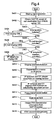
- CPU 201 then performs steps S403 - S408 shown in Fig. 4 where CPU 201 extracts the communication functions available to IP terminal 102 by comparing the communication functions of IP terminal 102 to those of the source IP terminal 101, based upon the URI schemes specified in the NAPTR record shown in Fig. 3 .
- CPU 201 determines whether IP terminal 102 has a facsimile function corresponding to IP terminal 101 based upon the URI schemes of the obtained NAPTR record (step S403).
- the URI schemes of the NAPTR record shown in Fig. 3 include ""! ⁇ .*$!mailto:ifax@jp.dddd.com” "FAX"", indicating that it has the facsimile communication function. Therefore, CPU 201 determines that IP terminal 102 has the facsimile communication function (step S403: YES) and stores in RAM 204 "FAX display ON" information as flag information associated with the above-noted NAPTR record, indicating that the facsimile function can be used (step S404).
- step S403 NO
- step S405 When CPU 201 determines that IP terminal 102 has no facsimile communication function (step S403: NO) or after the above-noted flag information for the facsimile communication function is stored, the process proceeds to step S405.
- CPU 201 determines whether IP terminal 102 has an e-mail function corresponding to IP terminal 101 based upon the URI schemes of the obtained NAPTR record (step S405).
- the URI schemes of the NAPTR record shown in Fig. 3 include ""! ⁇ . * $!mailto:mail@jp.dddd.com” "e-mail”", indicating that it has the e-mail function. Therefore, CPU 201 determines that IP terminal 102 has the e-mail function (step S405: YES) and stores in RAM 204 "e-mail display ON" information as flag information associated with the above-noted NAPTR record, indicating that the e-mail function can be used (step S406).
- step S405 NO
- step S407 determines that IP terminal 102 has no e-mail function (step S405: NO) or after the above-noted flag information for the e-mail function is stored, the process proceeds to step S407.
- CPU 201 determines whether IP terminal 102 has an IP telephone function based upon the URI schemes of the obtained NAPTR record (step S407).
- the URI schemes of the NAPTR record shown in Fig. 3 include ""! ⁇ .*$!sip:info@sip.dddd.com” "Taro telephone”", indicating that it has the IP telephone function. Therefore, CPU 201 determines that IP terminal 102 has the IP telephone function (step S407: YES) and stores in RAM 204 "IP telephone display ON" information as flag information associated with the above-noted NAPTR record, indicating that the IP telephone function can be used (step S408).
- step S407 NO
- step S409 When CPU 201 determines that IP terminal 102 has no IP telephone function (step S407: NO) or after the above-noted flag information for the IP phone function is stored, the process proceeds to step S409.
- CPU 201 displays, on display 206, the available communication functions based upon the flag information stored in RAM 204: "FAX display ON", "e-mail display ON” and "IP telephone display ON".
- a screen display example of the available functions is shown in Fig. 5 .
- the screen display example of Fig. 5 indicates a case wherein "05012345678", the telephone number of IP terminal 102, is displayed, meaning that an IP phone call can be made.
- the IP terminal 101 user becomes able to make an IP phone call to IP terminal 102 by pressing the start button (not shown in the figure) of key input section 203.
- a call instruction signal is output to CPU 201 from key input section 203.
- CPU 201 performs a transmission process as IP phone to IP terminal 102 based upon the IP phone control program stored in FROM 205 (step S410).
- CPU 201 controls IP network controller 210 based upon the IP phone control program and performs, by referring to the NAPTR record obtained in step S402, a call connection process and a voice communication initiation process with IP terminal 102 based upon the SIP protocol, thereby enabling voice communication with IP terminal 102.
- reading section 207 outputs, to CPU 201, a document placement signal.
- CPU 201 sets the facsimile communication function as selected and displays "FAX" of display 206 as selected (step S412).
- Fig. 6 shows a display example of "FAX” as selected (in gray). In this case, "Press start button for transmission” is displayed as a message to the IP terminal 101 user.
- step S413 After the IP terminal 101 user presses the start button of key input section 203 (step S413), key input section 203 outputs, to CPU 201, a readout start signal. After the readout start signal is input from key input section 203, CPU 201 starts scanning the document by outputting, to reading section 207, the readout start signal (step S414).
- reading section 207 scans the document placed on the document reader, and converts the image of the document into digital image data to be output to CPU 201.
- CPU 201 reserves, in RAM 204, the digital image data input from reading section 207 and then obtains, from the NAPTR record obtained in step S402, fax transmission information for IP terminal 102 (step S415).
- CPU 201 controls IP network controller 210 based upon the facsimile communication control program stored in FROM 205 and performs a process for transmitting, to IP terminal 102, the digital image data reserved in RAM 204 (step S416), thereby terminating the process.
- the IP terminal in the IP telephone system obtains, from the ENUM server, the NAPTR record of the destination IP terminal when transmitting a call to another IP terminal, and determines whether the destination IP terminal has the communication functions corresponding to the source IP terminal based upon the URI schemes specified in the NAPTR record.
- the source IP terminal displays, on its display, one or a plurality of communication functions that are determined to be stored in the destination IP terminal and performs an operation in accordance with the displayed communication function, after which the source IP terminal starts a communication control with the destination IP terminal apparatus based upon the communication control program stored in FROM that corresponds to the communication function.
- the source IP terminal user is able to reliably select the communication functions of the destination IP terminal that correspond to the source IP terminal, by referring to the communication functions displayed on the display.
- the source IP terminal user is able to save the trouble of checking the communication functions of the destination IP terminal, thereby preventing a situation where a wrong communication function is selected.
- the IP terminal of the IP telephone system stores in RAM flag information indicating that the communication functions available to the source IP terminal are stored in the destination IP terminal and displays, on its display, one or a plurality of communication functions that are stored in the destination IP terminal based upon the flag information.
- the source IP terminal is able to easily display the communication functions stored in both source and destination IP terminals, thereby reducing the amount of work for a display control.
- the IP terminal of the IP telephone system is configured to be able to set the facsimile communication function as selected and start the facsimile transmission by pressing a transmission button after executing a transmission process as IP phone and placing a document on the reading section.
- the source IP terminal user is able to easily switch from the IP phone call transmission (the first communication function) to the facsimile communication (the second communication function), thereby reducing the amount of work for switching from the IP phone call to the facsimile communication.
- the IP terminal stores in RAM the NAPTR record obtained from the ENUM server and flag information indicating the communication functions that are determined, based upon the NAPTR record, to be stored in the destination IP terminal.
- the NAPTR record obtained from the ENUM server and flag information indicating the communication functions that are determined, based upon the NAPTR record, to be stored in the destination IP terminal.
- IP phone, facsimile and e-mail communications are stored in IP terminals as IP terminal communication functions.
- IP terminal communication functions it is not limited to these communications and it is further possible to store other communication functions for the present invention.
- a case is provided wherein the function is switched from the IP phone communication to the facsimile communication.
- the function is switched from the IP phone communication to the e-mail communication and the function to be switched to is not particularly limited.
- IP terminal 101 places a call to IP terminal 102.
- IP terminal 102 place a call to IP terminal 101.
Landscapes
- Engineering & Computer Science (AREA)
- Signal Processing (AREA)
- Computer Networks & Wireless Communication (AREA)
- Computer Vision & Pattern Recognition (AREA)
- Human Computer Interaction (AREA)
- Business, Economics & Management (AREA)
- General Business, Economics & Management (AREA)
- Multimedia (AREA)
- Telephonic Communication Services (AREA)
- Facsimiles In General (AREA)
- Data Exchanges In Wide-Area Networks (AREA)
Applications Claiming Priority (1)
| Application Number | Priority Date | Filing Date | Title |
|---|---|---|---|
| JP2004292865A JP4511901B2 (ja) | 2004-10-05 | 2004-10-05 | Ip端末装置および通信機能表示方法 |
Publications (2)
| Publication Number | Publication Date |
|---|---|
| EP1646209A1 EP1646209A1 (en) | 2006-04-12 |
| EP1646209B1 true EP1646209B1 (en) | 2011-11-09 |
Family
ID=35504885
Family Applications (1)
| Application Number | Title | Priority Date | Filing Date |
|---|---|---|---|
| EP20050020245 Expired - Lifetime EP1646209B1 (en) | 2004-10-05 | 2005-09-16 | IP terminal apparatus |
Country Status (4)
| Country | Link |
|---|---|
| US (1) | US7756113B2 (enExample) |
| EP (1) | EP1646209B1 (enExample) |
| JP (1) | JP4511901B2 (enExample) |
| KR (1) | KR100675308B1 (enExample) |
Families Citing this family (11)
| Publication number | Priority date | Publication date | Assignee | Title |
|---|---|---|---|---|
| US7796578B2 (en) * | 2005-10-05 | 2010-09-14 | Cingular Wireless Ii, Llc | Resolution of IP addresses associated with a telephone number utilizing query flags |
| KR100714114B1 (ko) * | 2005-12-09 | 2007-05-02 | 한국전자통신연구원 | Uri를 획득하기 위한 클라이언트, 기록매체 및 그 방법 |
| US7823069B1 (en) * | 2006-03-23 | 2010-10-26 | Cisco Technology, Inc. | Method and application tool for dynamically navigating a user customizable representation of a network device configuration |
| US7630485B2 (en) * | 2006-07-06 | 2009-12-08 | At&T Intellectual Property I, L.P. | Method and system to bypass ENUM to reach a callee via a PSTN or a PLMN |
| KR20080046060A (ko) * | 2006-11-21 | 2008-05-26 | 삼성전자주식회사 | VoIP 단말장치, VoIP 통신시스템 및 그 프리젠스확인방법 |
| US8675643B2 (en) * | 2007-06-29 | 2014-03-18 | Brother Kogyc Kabushiki Kaisha | IP telephone system and iP telephone terminal used therein |
| US8767589B2 (en) * | 2008-10-22 | 2014-07-01 | At&T Intellectual Property I, L.P. | Method and apparatus for providing privacy for a telephone number in a network |
| US8514838B2 (en) * | 2008-11-17 | 2013-08-20 | At&T Intellectual Property I, L.P. | Method and apparatus for providing call routing in a network |
| JP5792993B2 (ja) * | 2011-05-09 | 2015-10-14 | キヤノン株式会社 | 画像形成装置と、その制御方法及びプログラム |
| US9203936B2 (en) | 2013-10-07 | 2015-12-01 | At&T Intellectual Property I, Lp | Method and apparatus for initiating communication sessions |
| US10142466B1 (en) * | 2016-05-13 | 2018-11-27 | Sonus Networks, Inc. | Systems and methods for special called number call handling |
Family Cites Families (22)
| Publication number | Priority date | Publication date | Assignee | Title |
|---|---|---|---|---|
| JP2605564B2 (ja) * | 1992-11-28 | 1997-04-30 | 村田機械株式会社 | ファクシミリ装置 |
| JPH08130594A (ja) | 1994-11-02 | 1996-05-21 | Fujitsu Ltd | 通話料金割引サービスルート選択方法とlcr装置 |
| JPH08195870A (ja) * | 1995-01-17 | 1996-07-30 | Nippon Telegr & Teleph Corp <Ntt> | データ通信方法及びその端末装置並びにデータ通信システム |
| KR19990003258A (ko) | 1997-06-25 | 1999-01-15 | 윤종용 | 착신측 정보 확인 가능한 키폰 시스템의 내선 통화방법 |
| US6498797B1 (en) | 1997-11-14 | 2002-12-24 | At&T Corp. | Method and apparatus for communication services on a network |
| EP1061728A1 (de) | 1999-05-20 | 2000-12-20 | teledis Telecom Dienstleistungen AG | Least-cost-routing-Verfahren mit Internet-Nutzung |
| US8295270B2 (en) | 2002-05-16 | 2012-10-23 | International Business Machines Corporation | Internet telephony system for enabling internet telephone access from traditional telephone interface |
| FR2841072A1 (fr) * | 2002-06-14 | 2003-12-19 | France Telecom | Systeme de consultation et/ou mise a jour de serveurs dns et/ou d'annuaires ldap |
| US7320026B2 (en) * | 2002-06-27 | 2008-01-15 | At&T Bls Intellectual Property, Inc. | Intersystem messaging using ENUM standard |
| US7161933B2 (en) * | 2002-09-24 | 2007-01-09 | Intel Corporation | Optimistic caching for address translations |
| KR100911095B1 (ko) | 2002-09-30 | 2009-08-06 | 주식회사 케이티 | 번호 이동성 데이터베이스를 이용한 enum 서비스 호처리 방법 |
| JP2004248086A (ja) | 2003-02-14 | 2004-09-02 | Fumio Kobayashi | 電話システム |
| US7564836B2 (en) * | 2003-03-27 | 2009-07-21 | Panasonic Corporation | Internet telephone apparatus, adapter and server for internet telephone communication, internet telephone system, and control method |
| JP4279135B2 (ja) * | 2003-12-26 | 2009-06-17 | パナソニック株式会社 | ホームゲートウェイ装置 |
| JP2005294993A (ja) * | 2004-03-31 | 2005-10-20 | Matsushita Electric Ind Co Ltd | Ip電話機及びipアダプタ |
| JP4436208B2 (ja) * | 2004-08-04 | 2010-03-24 | パナソニック株式会社 | Ip電話番号照会システム及びip電話システム |
| JP4603913B2 (ja) * | 2004-08-06 | 2010-12-22 | パナソニック株式会社 | Ip電話装置及びip電話システム |
| JP4603914B2 (ja) * | 2004-08-06 | 2010-12-22 | パナソニック株式会社 | Ip電話装置及びip電話システム |
| JP4445421B2 (ja) * | 2004-08-26 | 2010-04-07 | パナソニック株式会社 | Ip電話装置、enumサーバ及びip電話システム |
| JP4535829B2 (ja) * | 2004-10-08 | 2010-09-01 | パナソニック株式会社 | Ip通信方法、ip端末装置、enumサーバ及びip通信システム |
| JP4542872B2 (ja) * | 2004-11-02 | 2010-09-15 | パナソニック株式会社 | Ip電話装置及びip電話システム |
| JP4522843B2 (ja) * | 2004-12-24 | 2010-08-11 | パナソニック株式会社 | Ip電話システム、ip電話装置及びファイル転送方法 |
-
2004
- 2004-10-05 JP JP2004292865A patent/JP4511901B2/ja not_active Expired - Fee Related
-
2005
- 2005-09-16 EP EP20050020245 patent/EP1646209B1/en not_active Expired - Lifetime
- 2005-09-27 US US11/235,217 patent/US7756113B2/en not_active Expired - Fee Related
- 2005-10-04 KR KR20050093169A patent/KR100675308B1/ko not_active Expired - Fee Related
Also Published As
| Publication number | Publication date |
|---|---|
| JP4511901B2 (ja) | 2010-07-28 |
| KR100675308B1 (ko) | 2007-01-29 |
| US20060072575A1 (en) | 2006-04-06 |
| KR20060052014A (ko) | 2006-05-19 |
| EP1646209A1 (en) | 2006-04-12 |
| JP2006109086A (ja) | 2006-04-20 |
| US7756113B2 (en) | 2010-07-13 |
Similar Documents
| Publication | Publication Date | Title |
|---|---|---|
| KR100675304B1 (ko) | Ip 전화 시스템 및 발호 방법 | |
| US7885252B2 (en) | IP telephone apparatus | |
| EP1646209B1 (en) | IP terminal apparatus | |
| KR100671534B1 (ko) | Ip 전화 시스템, ip 전화 장치 및 착신 유저 식별 방법 | |
| KR100720601B1 (ko) | Ip 전화 장치, enum 서버, ip 전화 시스템 및 단말정보를 삭제하기 위한 방법 | |
| EP1619866A2 (en) | IP telephone system, IP telephone apparatus and communication method | |
| US7778238B2 (en) | IP telephone apparatus | |
| KR100598729B1 (ko) | 호 에이전트 장치, ip 전화 장치 및 ip 전화 시스템 | |
| KR100648591B1 (ko) | Ip 전화 시스템, ip 전화 장치 및 메시지 녹음 방법 | |
| KR100796279B1 (ko) | Ip 전화 장치 | |
| US7602767B2 (en) | IP communication method, IP terminal apparatus, ENUM server and IP communication system | |
| KR20060050287A (ko) | 호 에이전트 장치, ip 전화 장치 및 ip 전화 시스템 | |
| JP2006041915A (ja) | 情報通信装置およびその制御方法 | |
| JP4429934B2 (ja) | 画像通信装置 | |
| JP2008124920A (ja) | 情報通信装置及びそれを用いた情報通信システム |
Legal Events
| Date | Code | Title | Description |
|---|---|---|---|
| PUAI | Public reference made under article 153(3) epc to a published international application that has entered the european phase |
Free format text: ORIGINAL CODE: 0009012 |
|
| 17P | Request for examination filed |
Effective date: 20050916 |
|
| AK | Designated contracting states |
Kind code of ref document: A1 Designated state(s): AT BE BG CH CY CZ DE DK EE ES FI FR GB GR HU IE IS IT LI LT LU LV MC NL PL PT RO SE SI SK TR |
|
| AX | Request for extension of the european patent |
Extension state: AL BA HR MK YU |
|
| AKX | Designation fees paid |
Designated state(s): DE FR GB |
|
| RAP1 | Party data changed (applicant data changed or rights of an application transferred) |
Owner name: PANASONIC CORPORATION |
|
| GRAP | Despatch of communication of intention to grant a patent |
Free format text: ORIGINAL CODE: EPIDOSNIGR1 |
|
| GRAS | Grant fee paid |
Free format text: ORIGINAL CODE: EPIDOSNIGR3 |
|
| GRAA | (expected) grant |
Free format text: ORIGINAL CODE: 0009210 |
|
| AK | Designated contracting states |
Kind code of ref document: B1 Designated state(s): DE FR GB |
|
| REG | Reference to a national code |
Ref country code: GB Ref legal event code: FG4D |
|
| REG | Reference to a national code |
Ref country code: DE Ref legal event code: R096 Ref document number: 602005031066 Country of ref document: DE Effective date: 20120202 |
|
| PLBE | No opposition filed within time limit |
Free format text: ORIGINAL CODE: 0009261 |
|
| STAA | Information on the status of an ep patent application or granted ep patent |
Free format text: STATUS: NO OPPOSITION FILED WITHIN TIME LIMIT |
|
| 26N | No opposition filed |
Effective date: 20120810 |
|
| REG | Reference to a national code |
Ref country code: DE Ref legal event code: R097 Ref document number: 602005031066 Country of ref document: DE Effective date: 20120810 |
|
| REG | Reference to a national code |
Ref country code: DE Ref legal event code: R084 Ref document number: 602005031066 Country of ref document: DE |
|
| REG | Reference to a national code |
Ref country code: GB Ref legal event code: 746 Effective date: 20130617 |
|
| REG | Reference to a national code |
Ref country code: DE Ref legal event code: R084 Ref document number: 602005031066 Country of ref document: DE Effective date: 20130701 |
|
| REG | Reference to a national code |
Ref country code: FR Ref legal event code: PLFP Year of fee payment: 11 |
|
| PGFP | Annual fee paid to national office [announced via postgrant information from national office to epo] |
Ref country code: DE Payment date: 20150922 Year of fee payment: 11 Ref country code: GB Payment date: 20150917 Year of fee payment: 11 |
|
| PGFP | Annual fee paid to national office [announced via postgrant information from national office to epo] |
Ref country code: FR Payment date: 20150922 Year of fee payment: 11 |
|
| REG | Reference to a national code |
Ref country code: DE Ref legal event code: R119 Ref document number: 602005031066 Country of ref document: DE |
|
| GBPC | Gb: european patent ceased through non-payment of renewal fee |
Effective date: 20160916 |
|
| REG | Reference to a national code |
Ref country code: FR Ref legal event code: ST Effective date: 20170531 |
|
| PG25 | Lapsed in a contracting state [announced via postgrant information from national office to epo] |
Ref country code: DE Free format text: LAPSE BECAUSE OF NON-PAYMENT OF DUE FEES Effective date: 20170401 Ref country code: FR Free format text: LAPSE BECAUSE OF NON-PAYMENT OF DUE FEES Effective date: 20160930 Ref country code: GB Free format text: LAPSE BECAUSE OF NON-PAYMENT OF DUE FEES Effective date: 20160916 |